Tenants

Security guard strike is “imminent”

10

At least a hundred SEIU members in purple jackets marched down Bush St. this afternoon (June 5), in preparation for a possible strike. Security guards who are a member of an affiliated union have been working without a contract since 2012; some make so little money that they can’t afford apartments in SF and wind up living in SROs.

The signs said “on strike,” but actually that hasn’t happened yet. I spoke to some of the marchers who said they weren’t a liberty to say when the security officers would walk out, but “it’s imminent.”

And they clearly got the message out, making noise loud enough that I could hear it on the 17th floor and backing up rush-hour traffic just North of Market.

I really don’t think any of the owners of these big commercial office buildings are so hard up right now in this boom market that they can’t afford to pay the people who protect their property and tenants a living wage.

Foggy holiday

2

culture@sfbg.com

COCKTAILS Having worked in retail for the past five years, I’ve had Memorial Day off precisely zero times in the past half-decade. That means never enjoying the pleasure of spending the unofficial start of Summer barbecuing in the park, leisurely sipping ice cold beers with friends as the sun gets higher and the shorts get shorter. So when I got the email from the CEO of my new gig telling us all to go out and enjoy the holiday, I was delighted. That is until, in pure San Francisco fashion, the fog rolled in and all my visions of patios, grills, and parks misted over. What to do? My friend. Danielle and I didn’t take too long to figure it out: um, bar crawl.

We started at the Blarney Stone (5625 Geary, SF. (415) 386-9914) in the Outer Richmond. Along with some guys aching to watch a baseball game, I found myself waiting promptly at 2pm for the doors to open. Yes, that’s dedication. After taking my seat, Nathan behind the bar mixed me me a Paloma with freshly squeezed grapefruit juice, and I pulled out my book, waiting for my habitually late partner to arrive.

I’m a Blarney regular (I live a couple blocks away) and over the past four years of frequent Stoning, I’ve gotten to know the bartenders, who have gladly introduced me to some new spirits. And friendly fellow patrons have creatively helped me dodge uncomfortable encounters with any creepy visitors, all while enjoying said spirits. Can’t complain with that.

After several Palomas (at $7 each) and an Irish coffee (which was paid for by a gentleman who was probably a might too caffeinated by Irish coffees himself) — and after Danielle finally showed up — we hit the road and headed for Trick Dog (3010 20th St., SF. www.trickdogbar.com) in the Mission. I’ve been longing to hit up the Dog for some time now. If you’re a cocktail enthusiast, you already know why. Owned by Josh Harris and Scott Baird, otherwise known as swashbuckling bar-consulting duo the Bon Vivants, it’s been the hot spot ever since it opened this January.

Although all the seats were taken, we were lucky enough to be able to grab a standing spot by the window immediately after walking in. Danielle shifted through the cocktail menu made to look like a paint color swatch, while I ordered the mezcal-based Polar Bear ($11). Along with the mezcal, the Polar Bear is made with dry vermouth and Creme de Menthe. It’s a bit like a Glacier mint served up in a stemmed cocktail glass: minty and clear, instantly refreshing and smoky at the same time. I loved it. Danielle ordered the Straw Hat ($11), a Calvados (French apple brandy) drink with chestnut honey, hard cider, vermouth, rosemary, and lime served on the rocks, and I could tell in an instant she was into it. I moved on to a Baby Turtle: reposado tequila, Compari, cinnamon, grapefruit, and egg white (a weakness of mine in cocktails). It was frothy, pink, and lovely.

Blackbird (2124 Market, SF. www.blackbirdbar.com) at Church and Market, has been one of my favorite bars for a while now. Here’s hoping it remains popular but doesn’t get too crowded once the new tenants of all the condos being constructed on Market move in.

I love that the artwork inside changes as much as the drink menu (although I’m longing for the day the amazing Grape Drink returns). But nothing can beat the happy hour special. $5 sours? Yes, please.

Already floating a heavy buzz, we strolled in and easily sat at the bar. Whiskey sours would top off our night just right. Even better, more egg whites topped the yummy sours. I believe I had about three of these frothy treats before our Sidecar arrived to take us home.

After squeezing 10 drinks into six hours, I don’t remember much about the ride home (and I don’t dare look at my bank statement). But a Memorial Day filled with new drinks and new friends — cheers to that.

Editor’s notes

51

Tredmond@sfbg.com

EDITORS NOTES It’s as if someone has some kind of auto-respond system: Every time I write about housing or rent control, one of the trolls who comments on the Guardian Politics blog complains that landlords are “subsidizing” longterm tenants.

That’s a complaint I’ve heard plenty of times before — rent control is a “subsidy” because property owners have to allow the use of their property for a lower rate than the current market might allow.

And it’s completely wrong.

In fact, it only takes a basic understanding of economics to realize that in many cases, tenants are subsidizing their landlords. That’s how the business works.

You don’t have to read Karl Marx to learn that in a capitalist system, the owner of a business typically pays his or her employees less than the value they bring to the operation; the difference is what’s called “profit.” It’s how American capitalism works.

Same way, when a landlord signs a rental agreement with a tenant, the rent he or she charges is typically enough to: (a) cover that tenant’s portion of the building mortgage; (b) cover expected maintenance costs, and (c) provide the owner with a profit. Not that many landlords go into the business to lose money, or to break even.

I have a friend who bought a multi-unit building in the East Bay a few years ago, and it’s a great deal for him: He lives in one unit, and the tenants in the other units pay enough rent to cover most of the mortgage. So my friend’s housing is practically free. The tenants are subsidizing him.

Now: Add in rent control, and what do you get? The same exact situation. At the time a landlord and a tenant agree on a lease, the payments are adequate to cover the landlord’s costs plus a margin of profit. (Otherwise the landlord would be a fool to sign the lease.) Over time, the rent goes up a little bit every year. The landlord’s mortgage either stays the same, or, these days, goes down after a refinance at the lowest rates in history. The landlord’s next biggest expense — property tax — goes up by less than the allowable rent increase most years. So every year, the tenant pays the landlord more than it costs the landlord to provide the housing. Every year, the vast majority of landlords in San Francisco make a profit.

Yes: a rent-controlled unit prevents someone who bought a building years ago and has longterm tenants from making even more of a profit. It is, and should be seen as, a way of limiting profit on rental property to a reasonable amount, not to what a speculative market could bring. That’s fair; housing is a public right, and should be regulated a little like a public utility. (PG&E gets to make a profit every year, but not an unlimited profit.)

But like workers in a capitalist system whose product of labor subsidizes the profit of the owners, tenants in San Francisco are subsidizing landlords. That’s how the private housing market works.

Some wins, some losses in Sacto

9

The state Assembly and Senate passed the usual flurry of bills on May 31, the last day for initial-house approval, with some unusual drama that temporarily sidelined a medical-marijuana bill by Assemblymember Tom Ammiano.

By the time it was all over, several other Ammiano bills passed, a measure by Assemblymember Phil Ting to ease the way for a Warriors arena on the waterfront won approval, and state Sen. Mark Leno got most of his major legislation through.

The pot bill, AB 473, would have established a state regulatory framework for medical cannabis, something that most advocates and providers support. Still, because the subject is marijuana, it was no easy sell and at first, a lot of members, both Republicans and Democrats, expressed concern that the measure might restrict the ability of local government to ban or limit dispensaries.

Ammiano, in presenting the bill, made it clear that it had no impact on local control, and that was enough to get 38 votes. Typically, when a bill is that close to passage, the chair asks the sponsor if he or she wants to “hold the call” that is, freeze the vote for a few minutes so supporters can make sure all of their allies are actually on the floor and voting and to try, if necessary, to round up a couple of wobblers.

In this case, though, Speaker Pro Tem Nora Campos, of San Jose, simply gaveled the vote to a close while Ammiano was scrambling to get her to hold it. “That’s very unusual, not good behavior,” one Sacramento insider told me.

Ammiano was more respectful toward Campos, simply calling it a “procedural mistake.” He told us he would be looking for other ways to move the bill. “The door is never fully closed up here,” he said.

However that turns out, the veteran Assemblymember, now in his final term, won a resounding victory with the passage of his Domestic Workers Bill of Rights, AB 241. The bill would give domestic workers some of the same labor rights as other employees, including the right to overtime pay and breaks. “These workers, who are mostly women, keep our households running smoothly, care for our children, and enable people with disabilities to live at home and remain engaged in our communities,” Ammiano said. “Why shouldn’t they have overtime protections like the average barista or gas station attendant?”

An Ammiano bill restricting the ability of prosecutors to use condom possession as evidence in prostitution cases also cleared, as did a bill tightening safety rules on firearms.

Ting’s bill, AB 1273, would allow the state Legislature, not the Bay Conservation and Development Commission, to make a key finding on whether the new area is appropriate for the shoreline. Mayor Ed Lee and the Warriors strongly backed the measure, clearly believing it would make the path to development easier. Ammiano voted against it showing that the San Francisco delegation is by no means unanimous on this issue.

Leno had a string of significant victories. A bill called the Disclose Act, which would mandate that all campaign ads reveal, in large, readable type, who is actually paying for them, cleared with the precise two-thirds majority needed and it was a straight party-line vote. Every single Republican was in opposition. “They know that if their ads say “paid for by Chevron and PG&E, the won’t work as well,” Leno told us.

He also won approval for a bill that would ease the way for people wrongfully imprisoned for crimes they didn’t commit to receive the modest $100 a day payment the state theoretically owes them. There are 132 people cleared of crimes and released from prison, but the process of applying for the payment is currently so onerous that only 11 have actually gotten a penny. “We victimized these people, and we shouldn’t make them prove their innocence twice,” Leno said.

Bills to better monitor price manipulation by oil companies and to expand the trauma recovery program pioneered by San Francisco General Hospital also cleared the Senate floor.

But Leno had a disappointing loss, too: A bill that would have helped tenants collect on security deposits that landlords wrongfully withheld died with only 12 vote a sign of how powerful the real-estate industry remains in Sacramento.


Editor’s notes

57

tredmond@sfbg.com

EDITORS NOTES I know you’re getting a lot of shit these days, and it’s not entirely fair. You’re not the ones making a killing in overpriced real estate. You came here looking for a job, and the jobs you get pay well enough that landlords and speculators can extract wealth that you ought to be able to save or spend in town, creating more jobs for everyone. I can’t blame you for wanting to live in one of the world’s greatest cities; I came here too, from the East Coast, in 1981, looking for work as a writer but mostly looking to live in San Francisco. So did waves of immigrants before me.

But we all have to remember something: There were people living here when we arrived. It was their city before it was ours. And they had, and have, the right to live here, too.

In fact, the people who have been here for 20 or 30 years, who have worked to build this community, have — in a karmic sense — even more right to be here than you. Trite as it sounds, they were here first.

Americans have a bad record when it comes to moving into established populations. Ask any American Indian. Ask the Mexicans about the treaty of Guadalupe Hidalgo.

The hippies who arrived in San Francisco in the 1960s — attracted, among other things, by really cheap rent in the Haight Asbury — weren’t always terribly polite to, or concerned about, the natives who lived there, and had fun teasing the straights and fouling their parks. But they didn’t force anyone else to leave; there was lots of empty space in San Francisco. The city wasn’t kind to them, either — official San Francisco may celebrate the Summer of Love now, but back then, the cops went after the hippies with gusto.

Gay people who arrived in the 1970s — attracted, among other things, by cheap rent in Eureka Valley — faced harassment, discrimination, and brutality.

You, on the other hand, are officially welcomed — the mayor thinks you’re the city’s future. You face no barriers to renting or buying a home, no police crackdowns. The only people unhappy about your presence are the ones who are getting forced out of town to make room for you.

It’s not your fault that the city lacks eviction protections or effective rent control — but it is your fault if you act as if it doesn’t matter. Building community means more than spending money. It means getting involved.

Many of you are tenants. You may be richer than the people who you displaced, but your landlord will cheat you just the same. The Tenants Union needs support. You can be a part of making it stronger. Some of you will have kids at some point; there are great public schools in San Francisco, and I hope you support them.

Meanwhile, you can help keep longtime residents from being forced out. Jeremy Mykaels, a former web designer disabled by AIDS, has set up a site listing all the properties that have been cleared through the eviction of a senior or disabled person (ellishurtsseniors.com). Check it out. Don’t buy those units. If that means you have to live with lesser housing for a while, you can deal. For generations, the rest of us did.

Yeah, we were here first. Show a little humility and a little respect, and perhaps we’ll all get along fine.


Urbicide

53

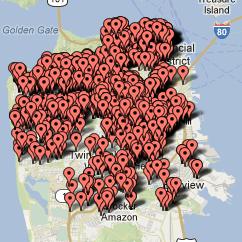
Every point on the map (click here for the detailed, interactive version) is a building where the landlord has used the state’s Ellis Act to evict all the tenants. (The points typically involve multi-unit buildings, so the number of tenants displaced is even worst than it looks). Some tenants have been here for decades, living in rent-controlled apartments, contributing to the community. And when the eviction notice arrives, they have nowhere else to go.

>>TO SEE A PROPERTY-BY-PROPERTY SPREADSHEET TRANSLATING OUR COVER’S EVICTION MAP — THAT INCLUDES LANDLORD NAMES –CLICK HERE

It feels as if all of crazy, radical, artistic, and unconventional San Francisco is under attack, as if a city that once welcomed waves of weirdos and malcontents — who, in turn, gave the city its attractive reputation and flavor — is changing forever. It’s as if there’s no longer any room for the working class — the people who, for example, keep the city’s number one industry (that’s hospitality and tourism, not tech) functioning.

It’s terrifying. Neighborhood after neighborhood is losing affordable rental housing as landlords cash in on soaring prices. And there’s a huge human cost.

In the end, if trends continue, this will soon be a very different city. We all know that change is part of life (and certainly part of hyper-capitalism) but the notion that there’s a value to a city culture that needs low rent housing and cheap commercial space has been all-but abandoned by the administration of Ed Lee, which wants high-paying jobs at all costs.

And it’s hard to imagine how the best of San Francisco — the city whose culture and sense of madness attracted all these creative folks in the first place — will ever survive. Call it Urbicide — because as Rebecca Bowe reports here, it goes way beyond residential evictions.

DPH: Unaffordable housing is bad for your health

To cover rent on a two-bedroom apartment at “fair market value” in SoMa, a San Francisco minimum-wage earner would have to work 7.4 full-time jobs.

That jaw-dropper of a statistic is just one tidbit in a fascinating dataset featured in a recently published interactive map plotting housing affordability in San Francisco neighborhoods. Combining data from Craigslist and PadMapper, the U.S. Census Bureau’s American Community Survey, and the local minimum wage ($10.24 per hour, widely regarded as generous), the map isn’t the handiwork of affordable housing activists. [Note: this reflects the 2012 minimum wage, the rate now stands at $10.55.]

Instead, it was created by the San Francisco Department of Public Health’s Program on Health, Equity and Sustainability. To view the full map and dig around for data on your neighborhood of interest, go here.

The embedded dataset reveals that the median income in SoMa is $91,000 lower than the $158,000 one would need to afford renting a market-rate two-bedroom. This figure, expressed as $-91,000, is known as the “affordability gap,” and the map plots these gaps neighborhood by neighborhood.

It was rolled out as part of a weeklong effort to raise public awareness about the link between affordable housing and public health, explains Cyndy Comerford, manager of planning and fiscal policy at the Environmental Health division of DPH. The reason? “Unmet housing needs in San Francisco can result in significant public health concerns,” Comerford says.

A lack of affordable rental housing can push more tenants into substandard or overcrowded living situations, she adds. Housing units within reach for lower income residents might be squeezed up against a highway, for instance, putting tenants in close proximity to noise, traffic, or air pollution, thus increasing their risks for experiencing heart or respiratory problems. Substandard housing also makes lead or mold exposure more likely, possibly triggering serious health issues over time.

For residents who fork over a significant percentage of their income for rent, other problems can arise. “It leaves little money for other provisions,” such as healthy food or preventative health care, Comerford adds, so low-income tenants have a higher likelihood of malnourishment or preventable disease related to nutrition.

The map is part of a broader DPH initiative known as the Sustainable Communities Index, which provides datasets for more than 100 health indicators. There’s a whole section on housing, which even covers the negative health effects of eviction: “Involuntary displacement contributes to stress, loss of supportive social networks and increased risk for substandard housing conditions and overcrowding,” DPH points out.

More information is yet to come: “Every day this week, we’ll put out a new bit of information around health and housing,” Comerford says.

Taking a broader view, it appears that sweeping cuts to public programs will present a whole new set of challenges for lower-income populations who have a higher risk of housing-related health problems. As a New York Times opinion piece highlighting the public health ramifications of austerity measures notes, “there are warning signs … that health trends are worsening. Prescriptions for antidepressants have soared. Three-quarters of a million people (particularly out-of-work young men) have turned to binge drinking. Over five million Americans lost access to health care in the recession because they lost their jobs.”

Amid all this, as a consequence of the $85 billion “sequester” that began on March 1, “Public housing budgets will be cut by nearly $2 billion this year,” the New York Times piece continues, “even while 1.4 million homes are in foreclosure.”

Why rent control works

108

I shouldn’t even bother to talk about this, because all it will do is stir up the trolls, but I’m getting sick of all the talk about rent control being a source of San Francisco’s housing problem. The latest is an editorial in the Business Times, which I buy to read J.K. Dineen’s stories about commercial real-estate, among other things. I should treat it like the Wall Street Journal; nobody takes the Journal’s editorial page seriously.

But the BT is just putting in print the argument that I’m hearing from the neo-libertarians who seem to be more and more populous in this town. And it goes like this:

Rent control distorts the market, which should be controlled by supply and demand. When you have rent control, evil tenants can stay in one place a really long time, thus “reducing urban vitality by discouraging mobility.” They can save their money for something other than rent. And it’s deeply unfair to landlords, because, as the BT notes:

By artificially limiting the return a building’s owner can generate on his investment, it discourages him from spending to maintain or upgrade the city’s housing stock. Rent increases are ordained not by supply and demand but by the city’s rent board. Legally, controlled rents can only go up each year by a fraction of the inflation rate. The ability to recoup costs of improvement or maintenance are also tightly curtailed. Costs are subject to no such limitations, so generally as a rent-controlled landlord, the longer you do it, the further behind you get.

Actually, rents go up by the percentage of the inflation rate that’s due to housing. The ability to recoup maintenance costs are not “tightly curtailed.” But more important, this notion that landlords “get further behind” because they can’t raise the rent assumes that most landlords — and their bankers — are idiots.

When you buy a piece of rental property, you typically have to prove to the bank that the rental income from the place is adequate to cover the mortgage, the taxes, the insurance, and upkeep, the same way a person buying a home has to prove that he or she has adequate income to pay the costs. When banks make loans the borrowers can’t repay, you get the mortgage crisis we’ve seen — but most of those units were single-family homes.

If I buy a rental property, the rent that’s coming in TODAY is matched with the price I’m paying TODAY. If the rents are too low to cover the cost, I have no business buying the place. And the bank has no business loaning me the money.

In San Francisco, unless you’re a complete moron, you buy rental property knowing, as the banker does, exactly what the current tenants are paying, and understanding, as the banker does, that the law won’t let me raise those rents by more than a modest amount each year. You’re making a profit at those rent levels; if not, you shouldn’t buy the place.

Now: Under Prop. 13, your property taxes can’t go up by much more than the rent goes up each year. And if you aren’t a speculative gambler (if you are, you have no rights anyway), you almost certainly have a fixed-rate mortgage. So your biggest “costs” are just as constrained as the rents you get. Meanwhile, your property continues to appreciate in value as the tenants pay your mortgage and taxes.

I know a lot of landlords in San Francisco, and the honest ones all say that owning rental property is a great deal — for the owner. There are probably some poor landlords who either (a) made bad business decisions or (b) were subject to some awful disaster and now find themselves unable to make ends meet. But they are not common.

Here’s the bottom line: Rent control prevents landlords from making speculative profits when the housing market booms. It also allows non-wealthy people to live here, for long periods of time, and become part of the San Francisco community. Housing stability INCREASES “urban vitality.” That’s the point.

Real, effective rent control would include limits on rent increases when a property becomes vacant. Berkeley had that in the 1980s. It didn’t cause urban blight or landlords abandoning buildings; instead, it helped create the Gourmet Ghetto and a thriving local business scene because tenants had more money to spend. It was a great success, until the state outlawed it.

Oh, and don’t tell me it discourages new construction: All new construction, since 1979, is exempt from rent control in San Francisco.

Rent control is, I will admit, bad for people who see housing as a speculative commodity, to be traded with little regard for its function as a basic human right. But I see housing more as a regulated utility — private owners have the right to a regular, acceptable return on investment, but not to excessive profits. Tenants have the right to live in the same place their entire lives, as long as they pay the (stable) rent and don’t become a nuisance.

These are good things for a city. The only problem with San Francisco rent control is that it isn’t strong enough.

Attack me, trolls. Or better, make a civil counter-argument that doesn’t start with “The problem with Tim is ….” Cuz we all know about my problems.


Nice builds

5

marke@sfbg.com

STREETS ISSUE “Oh, we’re doing pretty well right now,” a hunky contractor with Cahill Construction said with a wink at a chic party a couple weeks ago. He was referring to the building boom that’s hitting SF, its slender cranes teetering across our skyline like a stilettoed bacherorette party drinking its way down Polk Street. In terms of new build, 2010s SF is the new 1990s Berlin (somebody wrap our Reichstag, already). And while some of the design is surprisingly gorgeous, and we thankfully haven’t fallen yet for too much trendy starchitect stuff, a lot of it is a bit perfunctory to say the least. For a region that produced visionary architects from A.G Rizzoli to Ant Farm (and the often gorgeous infrastructure of your personal computer), you’d think we could push beyond stacked glass boxes lined in travertine and looming USB-like forms a tad more.

Practicality intrudes, of course, and while we wait for this, one of the richest and most creative places on earth, to develop a contemporary street vernacular to replace those awful ’90s SoMa live/work lofts, there’s a lot of loveliness hitting our streets, This year’s American Institute of Architecture SF Awards, which took place April 25, were abuzz with great, recently completed projects that focused on ground-up design that was practical, sustainable, inventive, and just plain neato. Here are a few winners that caught my eye, mostly because I had seen them in action on my weekly walks through the city and beyond. Their worth a closer look on your own jaunts. (See more winners at www.aiasf.org.)

RICHARDSON APARTMENTS

Designed by David Baker + Partners (snappy sage of green design Baker is SF’s closest thing to a starchitect) and run by Community Housing Partnership, this Hayes Valley supportive housing complex is named for Drs. Julian and Raye Richardson, who started Marcus Books in the Fillmore, the country’s oldest black book store. It houses 120 formerly homeless tenants as well as several businesses, and its swoop of natural materials and neighborhood-brightening color “seek to repair the site of a collapsed freeway with homes.”


OAKLAND MUSEUM ENTRY PLAZA

You usually go to a museum to see (worship?) others’ creativity: Oakland Museum’s interactive entry plaza and event space, designed by Jensen Architects, allows you to express your own. Usable white garden furniture hangs from a giant blackboard — make a space to chill, and write out your thoughts. Simple and stunning.


OURCADIA

The parklet movement began in San Francisco in 2010 and has now spread throughout the world, decommissioning parking spaces for more humanely amenable uses. (Maybe parklets are our new native architectural vernacular? Hope so.) Now some of the sharper ones are being institutionally recognized, like this nifty zag outside farm:table restaurant in the Tenderloin, designed by Ogrydziak/Prillinger Architects and Reynolds-Sebastiani landscape architects. Funding by, duh, Kickstarter.


HAYES VALLEY PLAYGROUND

Hayes Valley has gotten so congested at this point, its need for some space to breathe is critical — and with patricia’s Green being pretty much overrun and Hayes Valley Farm about to disappear under a cloud of construction, it’s only getting worse. This groovy clubhouse and playground design by WRNS Studio (in association with the Trust for Public Land) updates the 1958 Parks and Rec space with some bright color, fun contraptions, and spacious feel, creating a safe space for kids to “foster an appreciation of nature and social gathering.”


LAND’S END LOOKOUT

Perched above Sutro Baths, on a cliff exploding right now with colorful blooms, this exceedingly graceful 4,050 sq. ft. National Park Service visitor center is one of my new favorite places in the world. It contains a smart little cafe, oodles of info on the natural surroundings and nearby historical hot spots, and a superfriendly staff. But the design itself, by EHDD, fits so perfectly into its Point Lobos surroundings (and puts further to shame the industrial barn-like Cliff House next door) that you may find yourself lingering beyond a cappuccino to enjoy the light and light-filled space, waves frothing on the rocks far below.


ONE KEARNY LOBBY

A walk through the Financial District at night is a journey into Mad Men nostalgia — further back, even, as elaborately sculpted Neo-Gothic lintels from the early 1900s beckon over entranceways, lit dramatically by the spacious lobbies within. Contemporary takes are worth searching out as well. Redeveloped century-old beauty One Kearny’s tiny new lobby, designed by IwamotoScott Architecture and entitled Lightfold (because we brand our lobbies now), is a wee swooner of luminescent stalactites, a.k.a. “an array of digitally-fabricated wood veneer lanterns” and bright, odd angles. Like all good entryways, it draws you fully in.


SFO T2

The glistening, organic-futuristic San Francisco International Airport Terminal Two “elevates the passenger experience with design strategies that reduce traveler stress, promote progressive sustainability measures and highlight the airport’s art installations.” It also kind of makes me not want to leave.

Condo bypass legislation now before the full board

196

Controversial condominium lottery bypass legislation — sponsored by Sups. Mark Farrell and Scott Wiener but substantially modified by tenant group that strongly opposed the original legislation, with the help of Sup. David Chiu, Jane Kim, and Norman Yee — is finally coming to the full Board of Supervisors today (Tues/7, starting at 2pm).

Those involved in the negotiations say the legislation will likely to be returned to the Land Use Committee because of amendments being introduced today that the City Attorney’s Office has deemed substantial enough to require another public hearing. [UPDATE: The board voted unanimously to send this back to committee, which will consider it on Monday the 13th].They include a provision pushed by tenant groups that would scuttle the lottery bypass if the 10-year lottery moratorium is challenged in court. 

That moratorium was pushed by tenants and their supporters as a tradeoff for letting a backlog of around 2,000 tenancy-in-common owners buy their way out of the city’s lottery for the annual allowed conversion of 200 TICs into condominiums, which are more valuable and easier to sell and finance than TICs.

Farrell told the Guardian late last week that he was still negotiating with both sides and hopeful that he might be able to support the legislation, despite the hostile amendments that Chiu made which were opposed by Farrell and Wiener in committee.

San Francisco Tenants Union head Ted Gullicksen told us that the tenants’ side was willing to accept a couple of the technical amendments that Farrell proposed during negotiations with them, including exempting from the bypass fee the 19 building that have awaited conversion the longest and allowing some owner-occupier changes as the bypass is phased in over six years.

He said Farrell also proposed that if less than 2,000 condos opt for the bypass, then the difference in numbers would be added to the allowable number of condos in the first year that the lottery is restored, which the tenants’ groups haven’t yet agreed to.

Farrell and Wiener are also expected to offer other amendments, but the tenant groups have said they’ve gone as far as they’re willing to in allowing any increase in condo conversions, and they seem to have six solid votes lined up on the board.

Yet it’s still an open question how new amendments might affect those political dynamics, how the real estate industry (which simply wants as many condo conversions as possible) will respond, whether Mayor Ed Lee (who has avoided taking a position on the legislation) will sign or veto whatever emerges, and whether whoever is left unsatisfied by this deal will try to go to the ballot.

In other words, there may be some tricky political maneuvering ahead, so stay tuned. 

A call to arms

38

OPINION No one can deny that the San Francisco of the new dot-com boom is a scary place to live. Rents are astronomical: $2,353 is the median rent for a one-bedroom in the Bayview, an area that has never had high rents. Ellis Act evictions are up 68 percent from last year, and buyouts and threats of Ellis (de facto evictions) are skyrocketing. Longterm rent-controlled tenants live in absolute dread that their buildings will be sold to a real-estate speculator who will decide, a month later, to “go out of the business of being a landlord.”

Neighborhoods are being transformed, and not for the better. The once immigrant Latino and working-class lesbian area of Valencia Street is now mostly white, straight and solidly upscale. The Castro has more baby strollers per square foot than a suburban mall, not to mention a high rate of evictions of people with AIDS. Along Third Street and in SOMA and other areas, people of color are being pushed out, and the working-class is being replaced by middle-income condo owners. The African American population of the city is down to 6 percent.

Small businesses, too, are being decimated, as landlords demand higher and higher rents and chain stores try and creep into every block. If the demographics of the city continue to change and become more moderate, many longstanding political gains could be lost.

Resistance is not futile.

During the Great Depression, the Communist Party in the Bronx and elsewhere successfully mobilized the working class to block doorways when the marshals arrived to evict tenants. In the 1970s here in San Francisco, the “redevelopment” of the Fillmore and the I-Hotel was met with widespread protests. Then-sheriff Richard Hongisto went to jail rather than evict the working-class Filipino tenants at the I-Hotel. In the late 1990s, organizing to fight the evictions and displacement happening in the wake of the first dot-com boom culminated in a progressive takeover of the Board of Supervisors.

These days, there’s no mass movement to fight the evictions and displacement. Occupy Bernal, ACCE and others have successfully stopped the auctions of foreclosed homes, and even twisted the arms of banks to renegotiate some mortgages. Tenant organizations have been holding back efforts to weaken rent control for years.

Where is the building-by-building organizing of renters? Where is the street outreach in every neighborhood? Where are the blocked doorways of those being forced out of their apartments by pure greed? Where are the direct actions against the speculators and investors who are turning our neighborhoods into a monopoly game? Where is the pressure on the Board of Supervisors to pass legislation to curb speculation and gentrification rather than approve tax breaks for dot-com companies? Where is the pressure on state legislators to repeal the Ellis Act and other state laws that prohibit our city from strengthening rent control and eviction protections?

Every moment we wait, more people are displaced from their homes, more neighborhoods become upscale, more small businesses are lost. Progressives wake up.

It’s time to take back what’s left of our city.

Tommi Avicolli Mecca is a longtime queer housing activist who works at the Housing Rights Committee. He is editor of Smash the Church, Smash the State: the early years of gay liberation (City Lights).


A win for the tenants

44

EDITORIAL In a stunning victory, tenant advocates have managed to derail a terrible piece of condo-conversion legislation — and replace it with a compromise that actually improves the current situation and could help slow the wave of speculative evictions.

The supervisors need to support the revised version of the bill — and if Mayor Lee wants to have any credibility at all with tenants, he needs to sign it.

For some 30 years, San Francisco has had a strict policy limiting the conversion of rental apartments to condominiums. Only 200 units a year get permission, through a lottery.

But thanks to the popularity of tenancies in common (a backdoor way around the limit) and the state’s Ellis Act, which allows landlords to evict all their tenants and sell the units as TICs, there’s now a long waiting list.

TIC owners say it’s unfair that they have to accept (somewhat) higher mortgage payments and reduced value on their homes because the wait for a conversion permit has grown to ten years or more. Real-estate speculators see huge profits in clearing buildings of long-term tenants with rent-controlled apartments and selling the places as TICs.

When Supervisors Scott Wiener and Mark Farrell first proposed allowing more than 2,000 tenancy-in-common units to bypass the lottery, tenant advocates began organizing to defeat the bill. Nobody thought a compromise was possible — particularly when the landlord-backed Plan C refused to negotiate in good faith and look for a solution everyone could accept.

But with the help of Supervisors Norman Yee, Jane Kim, and David Chiu, the tenants were able to craft a deal that clears up the backlog — and then prevents any further conversions for at least a decade. That’s fair: If the limit is 200 a year, and TIC owners want to clear up a backlog of 2,000 all at once, a ten-year moratorium makes sense. The tenant package also bars conversion of any buildings with more the five units and includes more protections for existing tenants.

If this proposal is really about helping TIC owners who face a long and uncertain time on the conversion list, then the compromise ought to be fine — and indeed, many TIC owners support it. The real-estate speculators who want to see evictions continue at a rapid pace hate it — this would make TICs less appealing and less valuable. But that’s fine: Buying a TIC has never been, and should never be, based on a future promise of condo conversion. And if this slows down the horrifying epidemic of evictions and displacement, it will be a very positive change.

Wiener and Farrell didn’t accept the compromise, but it was amended into their legislation anyway. The new version will come before the supervisors May 7. The supervisors should see this for what it is — greedy speculators against everyone else — and vote yes.

Special occasion eviction

11

STREET SEEN “My customers are Latin,” says the owner of Latin Bridal Silvia Ferrusquia, entertaining a crowd of mamas, grandmas, and our photographer while we wait for the models for our photoshoot to get their hair and makeup done, and don the massive, fairytale quinceañera dresses and tiaras they bought from her shop for their big days.

“They may not have a lot of money, but they have good taste. There’s nobody that serves this community the way we do.”

Sadly, the community may have to look for other options. After a decade in the Mission Street storefront, Ferrusquia — whose crowded, colorful shop is one of the last of its kind in the neighborhood — has been served an eviction notice.

In the spring of 2012, in the middle of the shop’s busy season, a damaged sewage pipe caused 11 ceiling tiles to fall, ruining close to a hundred of Ferrusquia’s ornate bridal, communion, and quince dresses with foul liquid. She says a representative from Prado Group, her landlord, told her to hold her rent payments until damage could be assessed and reparations made.

“What are we going to do without you?” customer Veronica Ortiz wonders, when she hears of the shop’s predicament. Ortiz was picking up her daughter’s communion dress, with its skirt of carefully-curled tulle roses. Like her sisters and sisters-in-law, Ortiz also bought her wedding dress from Latin Bridal. An extravagant gown inspired by Princess Diana’s famous nuptials, it had 6,000 crystals sewn to it, and a 20-meter train that Ortiz says was mistaken by guests at her hometown wedding in Durango, Mexico for the church aisle’s carpet as she said her vows.

Things went further south for the shop when the Prado representative with which they were communicating was fired. Ferrusquia was told by the company that she had to pay up the three months’ back rent in short order. After the losses sustained while her shop was smattered with sewage, mildew, and subsequent discovery of asbestos during its busy months, she was forced to file for bankruptcy.

After multiple warnings to pay the back rent (which has ballooned to a figure over $25,000 — a number representing six months’ rent that Ferrusquia does not understand and went unexplained by the Prado Group, who declined to comment when contacted for this feature), she was served with a final eviction notice this month. She tells me the building’s other tenants are being pushed out, that the Prado Group would only renew the shoe store next door’s commercial lease for a year and a half, and that she worries for the residential tenants upstairs.

The shop may be gone by the time you read this, if small business advocates are unable to help. At the very least we will have these photos of young customers in the Latin Bridal dresses they wore on the heretofore most important day of their lives — proof positive of Latin Bridal’s importance in a neighborhood that seems to have decided to change. “At least we’ll have gone out big,” says Ferrusquia’s son Eddie, thanking the shoot crew after the lights and curling irons are packed out.

“Don’t worry about anything on your day,” Ferrusquia says in Spanish to one of our customer-models, for whom the shoot is a test drive for her quinceañera next week. “Don’t let anyone rush you! This day will never happen again.” 

Latin Bridal 2631 Mission, SF. (415) 647-4200, www.latinbridal.com


Models: Amaris Tenorio, Brenda Diaz, Michelle Trejo

Art direction: Caitlin Donohue

Photography: Shot in the City

Makeup: Sarina Martinez/porcelainglow@gmail.com

Hair: Vivien Brown/Salon Miel

Assistant: Dick Van Dick


You want scary? We’ve got an eviction map

205

You want to see something frightening on a lovely afternoon? Check out this amazing interactive map of Ellis Act evictions in San Francisco put together by Brian Whitty.

It’s stunning: Between 1997 and 2013, it seems as if most of the Mission, Noe Valley, North Beach, the Marina, and Potrero Hill was evicted. Hundreds and hundreds of apartments turned into TICs, which now want to convert to condos. Hundreds and hundreds of tenants, who once had rent-controlled apartments, losing their homes — and given the price of housing, losing their ability to live in San Francisco.

Each little red flag is a human tragedy. Each one represents a transforming city that no longer has room for the middle class, much less poor people. It makes we want to cry. Or throw up. Or something.

The vultures of greed

129

A small but enthusiastic crowd marched through the Castro April 20 to bring some attention to the rash of Ellis Act evictions that are forcing seniors and disabled people out of the city. The activists stopped at the home of Jeremy Mykaels, whose plight is symbolic of the state of housing in San Francisco today. Mykaels insists he’s not a public speaker, but his remarks were poignant; we’ve excerpted them here:

I have AIDS and I am being evicted through the use of the Ellis Act. I want to welcome you to my home for the past 18 years, and to my Castro neighborhood where I’ve spent the last four decades, or two-thirds of my life.

I was there at some of the earliest Gay Pride Parades and Castro Street Fairs, listening to speakers like Harvey Milk and seeing entertainers like Sylvester with Two Tons ‘O Fun and Patrick Cowley. I proudly voted for Harvey to become the city’s first openly gay supervisor. I participated in the fight against the Briggs amendment, which would have outlawed gay teachers in California schools. I walked in the candlelight march honoring the lives of Harvey Milk and Mayor Moscone after their assassinations by Supervisor Dan White. And I’ve been here for many other protests and for many other celebrations.

And like most of you, I’ve seen how HIV and AIDS have devastated this community over the years and I have lost most of my closest friends and lovers to this disease. Until 12 years ago I thought I had somehow miraculously escaped it’s clutches, but that was not to be and I have been dealing with that reality as best as I can ever since, with mixed results. And now on top of the great losses this disease has cost our gay community, even more losses are occurring in the form of more and more long-term tenants with HIV/AIDS living in rent-controlled apartments being forced to move out of their homes and/or out of the city after being evicted through the use of the Ellis Act, or who have been scared and bullied by just the threat of an Ellis eviction into accepting low buyout offers to vacate.

I had always thought that I would spend the rest of my life living in this neighborhood and city that I love. Now I know that, like so many others before me who found themselves in similar situations, I will have no choice but to move out.

Tech boom 2.0 has brought out what I call the Vultures of Greed, a de facto alliance of banks, the real estate lobby, and, whether unwittingly or not, city officials like the mayor and several supervisors and the Planning Commission. But the worst Vultures of Greed have been the real estate speculators, many of whom I have listed on my website.

And here I would like to call out my own personal vultures as a prime example of how uncaring real estate speculators can be. The new owners of this property are Cuong Mai, William H. Young and John H. Du, and their business entity is 460Noe Group LLC, based in Union City. These are truly callous individuals who knew from the very beginning that they had a person with AIDS living in the building, and soon after they bought the place they began threatening me with an Ellis eviction if I didn’t accept their low-ball buyout offer and vacate. On September 10th, 2012 they subsequently Ellised the building and served me with eviction papers which means that I will only have until September 10th of this year to legally occupy my apartment. All these men want is the highest profit they can get after they remodel and re-sell this building. They could care less what happens to me when I am forced to move out of the city and no longer have access to all my HIV specialists who have kept me alive for this long. A prospect I’ll admit that, yes, scares me. But these guys, they won’t lose even a seconds sleep over my fate.


Yes, the Vultures of Greed are soaring high with sharpened talons ready to feed upon our city’s seniors and disabled, and on what’s left of our already decimated San Francisco gay community. But we don’t have to allow it. Together with our growing number of allies, we can change minds and we can eventually reclaim this city from the Vultures of Greed.

BTW, we couldn’t reach Mai, Young, or Du, and their lawyer, Saul Ferster, did not return a call seeking comment.

The Chron gets the condo deal wrong

23

It’s kind of a surprise that the Chron actually likes the (possible) condo conversion deal. That paper typically opposes anything that is good for tenants and supports anything that the landlords like. But it’s annoying that the editorial writers made it sound as if Sups. Scott Wiener and Mark Farrell engineered this whole thing. You need to get beyond the silly paywall to read the full editorial, so I’ll reproduce the key part here:

This week a deal may be struck to end the stalemate. A plan by Supervisors Mark Farrell and Scott Wiener will give owners of tenancies in common the chance to convert under a one-time deal. The yearly lottery will be suspended, the apartment owners will pay from $4,000 to $20,000 each into a subsidized housing fund, and those in the conversion pipeline can go forward. It’s essentially a one-time offer with the lottery system swinging back in place in 10 years.

Actually, Farrell and Wiener weren’t the ones who came up with the proposal that might make this legislation possible. That work was done by tenant and housing advocates — Sarah Shortt of the Housing Rights Committee, Ted Gullkicksen of the Tenants Union, Peter Cohen from the Council of Community Housing Organizations, Gen Fujioka of CCDC — and Sups. Norman Yee, Jane Kim, and David Chiu. The landlord group Plan C didn’t make any effort to negotiate anything in good faith, so the tenant and housing people went and put this together on their own.

It was never included in the Wiener/Farrell bill; if anything, it was prepared as a hostile amendment. Realizing that, with Yee on the side of the tenants, there wouldn’t be six votes for their original plan, Wiener and Farrell had no choice but to accept the tenant alternative.

A lot of hard work, and a lot of give-and-take was involved — but the credit for that goes first and foremost to the activists who fought the original Wiener-Farrell proposal. Let’s be fair here.

Proposal would halt condo conversions for ten years

San Francisco Supervisors Norman Yee, Jane Kim and Board President David Chiu gathered with a cluster of tenant advocates at City Hall April 15 to unveil a proposal billed as a more equitable alternative to a highly controversial condominium conversion legislation that’s fueled a months-long battle over affordable housing.

Crafted with the input of tenant advocates, the new plan seeks to amend controversial legislation proposed earlier this year by Sups. Scott Wiener and Mark Farrell to allow a backlog of approximately 2,000 housing units to convert immediately from jointly held tenancies-in-common (TICs) to condos.

The proposal would effectively shut down the city’s condo conversion lottery for a minimum of 10 years, a measure aimed toward ending the cycle of real estate speculation that tenant advocates say has given rise to a spike in evictions in San Francisco’s supercharged housing market.

The proposal would still allow a current backlog of TICs to convert to condos without having to wait in a lottery system created to limit the number of units lost from the city’s rental housing stock. The board’s Land Use and Economic Development Committee, which is currently in session, will take up the legislation and proposed amendments later this afternoon.

The 10-year suspension on condo conversions would allow time for permanently affordable units to be built in place of the rental units that would be lost in the one-time conversion, proponents of the alternative legislation said. “If more affordable housing isn’t produced, then units don’t get to convert,” Housing Rights Committee executive director Sara Shortt told the Guardian. 

Chiu stressed that the proposal was crafted to “ensure that as we expedite condo conversions … we protect tenants by suspending the lottery for at least 10 years.”

The 10-year minimum suspension is based on current regulations capping condo conversions at 200 per year. It would last a decade because an estimated 2,000 units would be converted, but could last longer than that.

“For example, if 2,200 units are converted,” Chiu explained, “the suspension would last for 11 years.”

Meanwhile, the proposal would require the conversions that would be intially allowed to be staggered over the course of three years.

The plan “puts the Board of Supervisors on record that we strongly believe in preserving our affordable housing stock,” said Sup. Yee, adding that the package of amendments seeks to “address the risk of speculation that will ensue with a large number of TICs being converted to condominiums.”

The Wiener-Farrell proposal spurred a months-long opposition campaign led by tenant advocates, who said it would permanently remove affordable rental units from the city’s housing stock and incentivize evictions of long-term tenants at a time when Ellis Act evictions are already on the rise. 

“Condo conversions are the number one reason why people are being evicted from the city,” San Francisco Tenants Union executive director Ted Gullicksen said at the April 15 rally and press conference.

Wiener and Farrell’s proposal was presented as a way to remedy TIC owners’ complaints that onerous shared mortgages had left them financially strapped.

But Sup. David Campos, who also appeared at the rally, commented that the real challenge “is for the renters who are finding it very hard to live in San Francisco.”

Campos seemed dubious that a one-time condo conversion should be allowed to move forward at all. “If anything, I think we should be doing more to protect tenants,” he said. “My hope is … if it’s something we cannot live with as a community, we will make sure it dies,” he added, referring to the original condo conversion proposal. 

In an earlier attempt to strike a compromise between TIC owners and tenant advocates, “negotiations broke down quickly,” Shortt said in an interview. At the rally, she said this alternative was “drafted in a way that’s not trying to meet any political agendas.”

For many elderly and low-income tenants who have few options if they are faced with eviction, “there is no price tag that you can put on their units,” said Matt McFarland, a staff attorney at the Tenderloin Housing Clinic, who spoke at the rally. “Their most valuable possession is the long-term rent control on their property. For these tenants, it’s basically a death sentence when you get these eviction notices.”

Ron Lanza, queer impressario, dies at 78

24

Ron Lanza, a pioneer in San Francisco’s gay rights movement and an impressario who promoted queer arts through the worst of the AIDS crisis, has died after a long battle with colon cancer. He was 78.

Lanza, a Brooklyn native, was one of the leaders of Bay Area Gay Liberation in the 1970s, and, along with Assemblymember Tom Ammiano and the late activists Hank Wilson and Howard Wallace, was instrumental in building the LGBT movement in San Francisco.

He was the owner and operator of the Valencia Rose Café and later Josie’s Cabaret and Juice Joint, two groundbreaking queer performance venues that helpled launch the careers of  Whoopie Goldberg, Marga Gomez, and Margaret Cho.

“His vision came from looking at people and saying, ‘you have talent, you ought to try this,’ ” Ammiano, who performed as a comedian at Valencia Rose, told me.

“He was a giant in this city,” Tommi Avicolli Mecca, a performer and housing activist and the author of a book on the history of gay liberation, noted. “He created the foundation for what we now know as queer arts in San Francisco. He was really one of a kind.”

Lanza with Dennis Peron and Tom Ammiano

Marke B., our managing editor and a longtime follower of queer culture, put it this way:

“He dedicated his life to promoting theater and arts in San Francisco — even if it sometimes meant playing hardball, but always with that super-charming, goofball smile. Every single drag queen, performance artist, comedian, and actor in the city owes Ron a memorial smoothie — the Valencia Rose and Josie’s Cabaret kept performing arts alive in this town through the worst years of AIDS and political artphobia.”

Lanza, a Navy veteran, arrived in San Francisco in the 1970s, and worked for a while as a teacher in Walnut Creek. “When he came out, he risked being fired, so he quite before they could fire him,” Ammiano said.

With Wilson, Lanza took over the Ambassador Hotel, a Tenderloin SRO with a large number of gay and transgender tenants. In the 1980s, the two helped create what would become the Tenderloin AIDS Resource Center.

Lanza never liked the headlines; while his compatriots entered politics, ran for office, and organized on the streets, he stayed in the background, providing the cultural, moral, and financial support.

When Ammiano challenged then-Mayor Willie Brown in a legendary 1999 write-in campaign, Josie’s Cabaret and Juice Joint became the campaign headquarters. “He was so supportive,” Ammiano said. “He was a real San Francisco lefty. He only cared about money if he had to pay the bills.”

Gabriel Haaland, who helped run the Ammiano write-in, told me that “San Francisco is dimished. It’s such a heavy loss. There are people who are just magical, bright lights in the world, and he was one of them.”

Lanza was diagnosed with colon cancer in his 40s, but survived — in part, probably, thanks to adopting a healthy lifestyle. “He didn’t smoke, he was a vegetarian, and back then we teased him about it,” Ammiano said.

But the cancer came back in his later years, and he quietly underwent a series of operations. “He called me a few weeks ago and said he was dying,” Ammiano said. “He wanted to have a good-bye dinner.”

A huge dog-lover, Lanza could often be seen running down Dolores Street with two or three rescue animals. One of his last wishes was for a trip East to leave the dogs with a relative. He’d been driving a limo for income, and one of his wealthy clients paid for the ticket.

“He was always handsome, always loyal,” Ammiano recalled. “There were times you wanted to kill him, but the love was always there.”

A memorial is pending.

No progress in condo conversion standoff, despite the Chron’s spin

93

Perhaps it was just an unfunny April Fool’s Day joke or some wishful political spin, but the San Francisco Chronicle’s April 1 article about how tenancy-in-common owners and their political supporters are pushing legislation that would allow them to bypass the condo conversion lottery seriously misrepresented the city’s biggest current political standoff.

Nevermind the article’s over-the-top bias in favor of those poor, hard-luck TIC owners, like the featured Pacific Heights couple forced to raise their baby in a closet when all they really want to do is flip the apartment they bought for a profit. Or how the Chron all-but-ignored the fact that these TICs were rent-controlled apartments in a city where two-thirds of citizens rent. That kind of top-down view of the world is pretty typical for the Chron, even in its news stories, despite the paper’s strained claim to “objectivity.”

No, the article’s real sin was to get the basic facts wrong on where this political stalemate now stands, presenting the wishful spin of one side as if it were the latest news. Between the headline, “Owners seeking condo conversions may have shot” and the first deckhead, “Making progress” (which plays off this paragraph. “’I think we’re making progress in our discussions and negotiations,’ said [sponsoring Sup. Mark] Farrell, while noting the talks with tenant advocates, TIC owners, and real estate interests are ‘far from the finish line.’”) the article leaves the impression current negotiations may produce a compromise.

But the problem is that there aren’t any current negotiations between the two sides, and there haven’t been for weeks, according to tenant and other involved sources. In fact, they say there’s been no movement in this standoff since almost a month ago when I last reported that tenant groups and progressive supervisors were preparing a set of hostile amendments to the legislation.

They would allow a one-time condo lottery bypass for the nearly 2,500 TIC owners in the pipeline in exchange to shutting down the lottery for many years and preventing any conversions of rent-controlled apartments into condos until city builds a comparable amount of new affordable housing, and then probably restricting condo conversions to smaller buildings after that to protect large rent-controlled apartment buildings from real estate speculators.

That proposed compromise, which the article barely mentions before letting Farrell say “his legislation poses no threat to rent control,” would help the poor Pacific Heights couple at the center of the article. But the real estate industry and its conservative allies don’t really care about that couple as much as they do maintaining the flow of rental units into the real estate market, which is why the negotiations have broken down.

Instead, the Chron has Sup. London Breed – who is indeed a swing vote of the issue, but not one that tenant groups are counting on given how close she is to Plan C and the landlord lobby – citing a compromise proposal that would prevent the new condo owners from selling their properties for five years to discourage real estate speculation.

Perhaps that’s something the TIC owners and real estate interests that the article relies on think is a realistic compromise, but it’s not something that has been seriously discussed with tenant groups, mediating Sup. David Chiu, or the other interests that would be needed to pass this legislation.

Sara Shortt, the token tenant activist that the Chron talked to for the article, confirmed to us that there is no real compromise deal in the works and preventing the creation of new condos from existing apartments is a bottom-line issue that unites everyone who is now opposed to this legislation.

“The Plan C/Realtor etc. won’t concede on our key issue: restriction on future conversions in exchange for the bypass. We have given as much as we can give and they have given virtually nothing in return,” Shortt, executive director of the Housing Right Committee, told us by email.

Even Sup. Scott Wiener, who co-sponsors the legislation with Farrell, told us there has been “no change from before,” when negotiations broke down. But the legislation is on the April 15 agenda for the Land Use and Economic Development Committee – for the fifth time, with most hearings canceled because of the lack of negotiating progress.

If the Realtors and Plan C (which is dominated by real estate and banking interests) stick to their intransigent position – hurting this poor Pac Heights couple in the process, which the Chron fails to note – then tenants and progressive supervisors are likely to amend the legislation and call the bluff of those who claim this issue is simply about poor TIC owners stuck with shared mortgages.

Tech Bubble 2.0

58

OPINION We all remember the first dot-com bubble, right? Web technology start-ups flocked to San Francisco in the late 1990s. Thousands of would-be entrepreneurs and techies filled up the city. Gentrification of Central City neighborhoods accelerated sharply. Apartment rents jumped, followed by the condo boom. Demand for commercial office space, especially South of Market, quickly grew red-hot. Rents zoomed, and office developers rushed dozens of proposed new projects forward.

The leaders of Mayor Willie Brown’s gutless Planning Department rubber-stamped all they could, and decried the annual limit imposed on their approvals by the 1986 community-activist-sponsored Proposition M ballot measure.

The activists and the mayor put two competing measures on the November 2000 ballot in response. Both lost, but the progressive slate for the Board of Supervisors swept that election, defeating most of the mayor’s candidates.

And then Tech Bubble 1.0 popped. The peak year was 2000. The big dot-com bust, 9/11, and finally the Great Recession all followed.

The city’s office market crashed. Some new office buildings were foreclosed by their lenders. Many approved office developments went unbuilt. Overall office market vacancies approached 20 percent by 2010.

Ah, but here we go again — Tech Bubble 2.0! A new wave of recent technology industry start-ups — like Twitter and Yelp — are joining the growing survivors of Bubble Number 1 — like Salesforce. And San Francisco has become a premiere national media venue for the tech industry.

Thousands of would-be entrepreneurs and techies are again filling up the city. Apartment rents are going through the roof. Gentrification of Central City neighborhoods is accelerating even faster. Demand for commercial office space, still in SoMa, is red-hot again.

But by 2011 so much vacant space was on the market, and so many approved buildings were waiting for anchor tenants to start construction, that there has been room for them all so far. Several new buildings got underway. Mayor Ed Lee strategically took advantage of this market boom to target economic expansion to the Central Market District, the last disinvested zone of San Francisco’s Downtown.

Even today though, city office vacancies still exceed 5 percent. And according to the most recent Planning Department report, more than a dozen already-approved new buildings, totaling more than 4.5 million square feet, are waiting to start construction in the Transbay Transit District, South of Market, and Mission Bay. Another 5 million feet of office space is proposed for more than a dozen more pipeline projects for those areas. Plus another 2.5 million feet is planned for projects on Port property — including the San Francisco Giant’s huge project — that are not even on the Planning Department’s list yet!

How does this total of 12 million square feet of pending new San Francisco office buildings compare to historic demand? Going back to 1986, the amount of new office space actually built — true long-term market demand through the boom/bust business cycles — averages out to about only 750,000 square feet a year. The city’s old-school corporate headquarters dramatically downsized or even moved out of San Francisco — like Chevron and Bank of America — and that’s still ongoing. The new tech industry is mostly replacing them. So these 30+ identifiable current projects would provide a 16-year supply of office space at historic rates.

But even in the face of this evident market glut of future office buildings, the usual civic development hypsters are once again muttering about gutting Proposition M, and radically upzoning Soma for even greater office expansion. Is that who City Hall will listen to this time too?

Bubble? What Bubble? [Pop!]

John Elberling is executive director of the Tenants and Owners Development Corporation.