Tenants

Airbnb’s tax and tenant law violations headed for hearings

80

As Airbnb continues to avoid making any public comment on the $1.8 million annual Transient Occupancy Tax obligation to the city that it appears to be dodging, with the complicity of the Mayor’s Office, Board of Supervisors President David Chiu is getting closer to introducing legislation to regulate so-called “shared housing” and holding public hearings on the issues it raises.

In addition to the tax issue, there are concerns that Airbnb, VRBO.com, and other Internet-based sites that facilitate short-term rentals of San Francisco apartments are increasingly being used to circumvent local tenant protections, often after evicting tenants from the apartments using the Ellis Act. That state law allows owners to leave the rental business and convert to other uses, and landlords can argue that Airbnb is a commercial use and not a residential use.

“I’ve been deep into a lot of these issues in my conversations with a lot of community stakeholders around Airbnb and the area of shareable housing and I’m hoping very soon to have a package of proposals in this area. And at that point, we’ll have public hearings on the topics that you describe,” Chiu told us when we asked about the tax and tenants issues.

Among those involved in Chiu’s negotiations with Airbnb is Ted Gullicksen, executive director of the San Francisco Tenants Union, who says the negotiations have been slow-going but he’s generally happy with how they’re proceeding and hopeful that the resulting legislation will rein in rampant current abuses of zoning, tax, and other regulations that city officials have been ignoring.

“All you have to do is sit in front of the computer for a few hours and you can identify a lot of the lawbreakers. But there’s no enforcement by the city,” he said, noting that the Tax Collector’s Office is the notable exception among city departments, such as the Planning and Building departments. “The taxes shouldn’t even be an issue because they’re illegal uses.”

For example, while landlords may be able to get around rental restrictions triggered by an Ellis Act eviction by calling the use for shared housing websites “commercial,” that’s usually a violation of local planning codes prohibiting commercial use of residential property. Chiu’s legislation approved late last year banning “hotelization,” in which entire apartment buildings are cleared of tenants and rented out on a short-term basis, allows nonprofit groups like the Tenants Union to help enforce the ban.

“We’ve been researching the buildings we want to go after with complaints and lawsuits,” Gullicksen said. “It’s a pretty widespread problem.”

He said the VRBO.com appears to be a bigger culprit in terms of being used by landlords to avoid tenant protections than Airbnb, whose hosts are evenly split between tenants and landlords. But as the biggest shared housing service in San Francisco, the tax issues are bigger for Airbnb and the city.

“We don’t mind the limited use of someone’s principal residence for short-term rental, where we’re concerned is about the whole buildings,” Gullicksen said.

Whether the issue is avoiding taxes or circumventing tenant protections, the complicated issues surrounding shared housing are long overdue for some public discussions and scrutiny, and it sounds like that’s what we’re see later this spring or summer.

No golden years for LGBT seniors

139

According to studies, queer seniors are poorer than their straight counterparts. They’re half as likely to have health insurance, and two-thirds as likely to live alone. Not to mention facing discrimination in medical and social services, retirement homes, and nursing care facilities. So much for the “golden years.”
Here in San Francisco, LGBT seniors face another grave threat: evictions. Many of our elderly live in rent-controlled apartments that are targeted by real-estate speculators and investors out to make big bucks turning them into tenancies-in-common.

With median rents close to $3,000 a month and vacancy rates low, the odds are pretty good that an evicted senior won’t find an affordable place in the city. For a senior with AIDS, an eviction is especially threatening since our city offers the best treatment and services. Studies show that people with AIDS who lose their apartments tend to die sooner, especially if they become homeless. 

The only LGBT organization that actually addresses the housing needs of queer seniors is Open House. Its 110 units at 55 Laguna will be the first affordable queer senior housing development in the city. I hope it’s not the last. As for seniors with AIDS, there’s only one AIDS organization in the vast list of groups and services — the AIDS Housing Alliance — that actually finds housing for its clients. It was started by Brian Basinger, a gay man with AIDS, after he was evicted and his apartment was sold as a TIC.

No one knows how many LGBT seniors have been, and are being, evicted. Ditto for how many seniors with AIDS end up on the streets. We also don’t have stats on how many transgender seniors are victims of real estate greed or live in absolute terror of losing their homes. 

The Rent Board doesn’t break down its eviction stats by sexual orientation or even age. The city’s homeless count doesn’t mention if someone’s queer or transgender. There is no way to determine how many LGBT seniors live in SROs or with life-threatening conditions such as mold or lack of heat. Or how many live in homes that have been — or are being — foreclosed.

That’s why the housing subcommittee of the city’s LGBT Aging Policy Task Force is holding a hearing into the housing needs and concerns of queer seniors. Information is power.

All LGBT seniors — housed and homeless — are invited to come testify about their housing issues. Whether they live in an SRO or a home that they own, whether they sleep in a shelter or a rent-controlled apartment, whether they’re in a subsidized unit or an illegal in-law, the subcommittee wants to hear from them about their concerns and needs.

The subcommittee will ultimately be making recommendations that will be included in a task force report on what the city can do to address LGBT issues.
LGBT seniors deserve their golden years.

The hearing is Monday, April 1, 9am to 12 noon, room 416, City Hall. Written testimony accepted. For more info, call Tommi at 415-703-8634.
Tommi Avicolli Mecca is a longtime queer and tenants rights/affordable housing activist who works for Housing Rights Committee. He is a member of the LGBT Aging Policy Task Force.

The human price of Catholic conservatism

2

A new book by local historian William Issel explains the key role the Catholic Church played in funding and supporting progressive causes in 20th Century San Francisco, and Randy Shaw’s take on it is accurate: For a while, in the 1970s and 1980s, the Church funded a lot of the tenant advocacy and poverty work in this city. The other side of that is a piece of the debate over the new Pope that we’re not hearing much.

As John Paul II moved the Church to the right, he also shifted its focus — away from concerns with economic justice and towards issues like same-sex marraige and abortion (oh, and covering up sex crimes by priests). In the process, not only did vast numbers of Western Catholics start to lose faith in their church — the money and focus that used to help local activists fight for the poor went away.

The new Pope Francis I is known for his work on poverty — but not for his advocacy of progressive organizations that take that fight out of the pulpit and into the streets, where material good is done.

There’s a human cost to the conservatism of the Catholic Church, and it goes way beyond the altar.


Mall the right moves

0

caitlin@sfbg.com

STREET SEEN The fact that that our conversation is taking place to beat of Carly Rae Jepsen’s 2012 seminal classic “Call Me Maybe” leads me to believe that T-We Tea owner Christopher Coccagna is being real when he says he’ll be holding 12:30pm dance parties for the FiDi lunch set in the darling tea shop he just opened in the neighborhood.

It also leads me to believe that Crocker Galleria may be downtown’s most fun mall — or at least, that it’s on the way.

“I was totally down on having a retail store,” Coccagna tells me as we ship cups of his “Chai Me” blend in his small shop’s kiki parlor. For years he sold at events like the Renegade Craft Fair, consterning regulars who often ran out of his cheekily-titled single origin teas (“Bicurious George,” “Sexpot,” and “Hipsters in Wonderland”) before the next sales opportunity. But the five-year lease contracts often associated with renting commercial space scared the young business owner away.

In contrast, Crocker Galleria is offering him a much more flexible agreement and he’s been presiding over his space, lovingly decorated in fuchsias and Moroccan poufs since February. “I’m going for Euro pop, eclectic, and adorable,” Coccagna says.

Does Topshelf Boutique have FiDi’s new look? Guardian photo by Caitlin Donohue

That craft-fair-over-corporate-chic aesthetic may speak to Cushman and Wakeman retail manager Sabrina Goris’ plans for Crocker. In the past few years, Versaces and Dolce and Gabbanas have been vacating the center. At the moment, Ralph Lauren’s shuttered doors make a great visual metaphor for this sea change, although not as good as the expensive tiling floor work that Versace left behind for new tenant VIP Luggage. The turnover has made way for a mix of tenants who count 85 percent local owners among them.

Goris partners with local business nonprofits like La Cocina and Renaissance Entrepreneurship Center to attract new entrepreneurs to their first brick-and-mortar location. La Luna Cupcakes, a La Cocina grad, is set to open in Crocker this spring and Tomboy Tailors, the city’s best genderqueer place for a butch dandy to get a perfectly tailored three-piece, went through the Renaissance program and also opened at Crocker this year.

The challenge with the space is figuring how to make the robust lunch crowd that comes for the mall’s top floor food court stay to shop. Every Thursday from 11am to 3pm a year-round farmer’s market sets up on the first floor, opening on Tuesdays during the summer as well. The mall even hosts a concert series to get shoppers in the glass doors.

Like the rest of the universe, Crocker is experimenting with pop-ups, too. On the first floor, a quartet of small local clothing and accessory companies opened a single storefront in February. Surf brand After Eleven and its irreverent pizza cross t-shirts, Topshelf Boutique, kids shirts and zoo-themed tees from Animal Instinct, and Embergrass Jewelry bring a fresher fashion tone to the mall. Their pop-up run’s was recently extended — it’ll now be open until the end of March.

Christina Ruiz, who opened Topshelf Boutique originally in a van that traveled about, bringing gauzy, bright dresses, studded button-downs, cat-eye sunglasses, and the occasional vintage piece to shoppers, has had a lot of luck in the pop-up space. She admits that originally, she wasn’t sure if the Topshelf’s club casual style would sell to the big-money downtown types.

“I was surprised that I sold so well,” she says. “I worked as a bartender for a long time when I didn’t have to dress up for anything.” She’s grown to appreciate the day job schedule, though. “I really like it here because [customers come through] Monday to Friday, 10am to 6pm. That’s so not traditional for retail.”

Office workers who wear studs, tea shop kikis, a mall that could be kind of cool — sounds like a different kind of commercial community is being built. Says Coccagna of this mall magic: “you can feel the shift here.”

Crocker Galleria 50 Post, SF. www.thecrockergalleria.com


Workers underpaid by firms renovating fancy mid-Market offices

Union members from San Francisco Carpenters Local 22 were distributing flyers outside a developer’s Bush Street headquarters this week, upset that the company hired contractors who don’t pay union scale wages. “Hurting workers!” The bright orange flyers screamed. “Shame on them!”

The developer is Group I, headed by Joy Ou. In addition to being the CEO of the development firm, Ou is also listed on state licensing records as the principal officer of Construction Studios, Inc., one of the general contracting firms singled out on the flyer. Ou did not return Guardian calls seeking comment.

Group I is conducting office renovations at 988 Market Street, a 1920s-era building located at Sixth and Market streets adjacent to the Warfield Theater. Group I purchased the Warfield office building from David Addington. It is a prominent location: when Mayor Ed Lee ran for election in 2011, his campaign office was headquartered there. The building is also included among mid-Market properties eligible for payroll tax exclusion under a program hashed out in 2011 to revitalize the central Market corridor.

Of the multiple floors under renovation, two will house Benchmark Capital, a venture capital firm that invests in tech startups. Tech startup companies are poised to move in just below. It’s unclear whether these businesses will apply for the payroll tax break.

According to Bill Gerber of Tico Construction Co., a contractor tapped to conduct some of the renovations, the workers he’s hired actually are earning union-scale wages. “Tico is running it as a union job,” he said. “We are paying area wages.”

But Scott Littlehale, a spokesperson for the carpenters’ union, told the Guardian that Gerber never responded when the union asked him if Tico pays area standard wages on all jobs. “What we believe is that the developer in this case, Group I, has not required its contractors to pay area wages all the time on all its jobs,” Littlehale said. “This is a labor market that extends beyond a single job site.”

Under California law, workers employed on city-funded projects must pay the prevailing wage, which is $38.50 an hour for carpenters before benefits are factored in, according to the Department of Industrial Relations. Since 988 Market is not a publicly funded project, it’s not bound to this requirement.

Nevertheless, the idea that construction crews are working for less than the area standard in San Francisco’s burgeoning economic climate – to renovate space for a venture-capital firm that will qualify for a payroll-tax exclusion – raises questions about whether this kind of development is actually helping struggling workers recover from the economic hit of the last several years. Group I stands to make top dollar by renting its office spaces out to tenants heavily invested in the booming tech industry. Meanwhile, San Francisco is becoming increasingly unaffordable for skilled laborers.

Construction gigs are temporary by nature, and Littlehale said many union members earn less than the area median income. “Construction work had been a pathway to fairly stable middle class standards, and that’s under threat,” Littlehale said. “The big picture is: We’re going to hold the folks up the food chain accountable.”

Condo conversion compromise in the works despite Realtors’ resistance

180

[UPDATED BELOW] Negotiations between tenant advocates and real estate interests (including the political advocacy group Plan C) over the controversial condo lottery bypass legislation haven’t gone well or found common ground. But sources tell the Guardian that Sup. Jane Kim and Board President David Chiu, who has been mediating the dispute, are preparing to introduce compromise amendments that have the support of the San Francisco Tenants Union and other tenant advocates if a deal can’t be worked out with real estate interests.

Details are still being hammered out with advocates and the City Attorney’s Office, so the hearing scheduled for this Monday at the Land Use and Economic Development Committee will likely be postponed until March 25. But the basic deal is to allow the roughly 2,000 tenancies-in-common now seeking to convert into condos to do so in exchange for a long moratorium on new condo conversions, possibly indexed to construction of new affordable housing for the renters who comprise nearly two-thirds of San Franciscans.

The original legislation by Sups. Mark Farrell and Scott Wiener is being strongly backed by both current TIC owners who want the ability to refinance and Plan C and other real estate interests that want to continue converting ever more rent-controlled apartments into condos, rather than abiding the city’s current limit of 200 per year, awarded through a lottery system. The SFTU has strenuously resisted opening up those flood gates, but it’s open to clearing out the backlog in exchange to shutting the gates for awhile (see my story in this week’s Guardian for more on the political dynamics surrounding this issue).

“We’re hopeful that a majority of the board will support amendments which will significantly protect tenants and which will allow a version of the Wiener-Farrell legislation to be approved,” SFTU head Ted Gullicksen told us.

Progressives on the board oppose the legislation as currently written, and the swing votes are thought to be Sups. London Breed (which Plan C supported in the last election in exchange for what it says was her promise to support more condo conversions, an assurance she denies making), Norman Yee (who was brought into the Chiu-mediated negotiations), and Malia Cohen, with just one of them needed to force changes to the legislation.

But the real estate interests – including Plan C, the Association of Realtors (whose government affairs director we left a message for and are waiting to hear back from, and we’ll update below if/when we do), San Francisco Apartment Association, and other downtown-based groups – who are pushing for more condo conversions are likely to strongly resist the amendments. They simply want more rent-controlled apartments turned into condos they can sell, period.

Their perspective is reflected in SF Apartment Magazine, put out by the San Francisco Apartment Association, which every month offers advice to real estate investors and apartment building owners on various ways to buy apartment buildings, evict tenants or increase their rents, and convert the buildings to TICs or condos.

It runs a regular column called “TIC Corner” with the latest tricks for financing acquisitions and getting rid of those pesky tenants. In the November 2012 issue, for example, attorney D. Andrew Sirkin wrote excitedly about a new Securities and Exchange Commission rule that will now allow owners to advertise the sale of apartment buildings as TIC/condo investments, which he said “will dramatically ease the regulatory burden for real estate entrepreneurs wishing to raise money for apartment acquisitions and make it much easier to find investors.”

Another feature story in the magazine, “The ABCs of OMIs,” teaches these investors all the tricks for evicting tenants from their buildings, while “Roommate Roulette” offers advice to owners of rent-controlled buildings for keeping new roommates of existing tenants off the lease so they can charge market rate rents as soon as possible.

And, of course, the magazine is filled with ads for San Francisco apartment buildings that are for sale and just waiting to be cleared of tenants and turned into amazing real estate investment opportunities. Gullicksen says it is this mentality, applied to what even Mayor Ed Lee has called the city’s “precious few rent-controlled apartments,” that has animated the opposition to the Wiener-Farrell legislation. SFTU had planned a rally for Monday called “Stop Rent Control Attack,” which has now been postponed until March 25.

UPDATE 3/11: Sup. Wiener got back to us and said, “I hope we can move to a compromise and I don’t want to prejudge that compromise.” Asked about the concept of approving TICs in the pipeline in exchange for halting on all condo conversions for some number of years, he said, “It’s definitely something to explore, a pause in the lottery, and I’m open to that. But the devil is in the details.”

Compromised position

16

steve@sfbg.com

When Mayor Ed Lee came to the Board of Supervisors for his monthly “question time” appearance Feb. 12, Sup. David Chiu tried to get some sense of where the mayor stood on a controversial piece of legislation that would allow more condominium conversions.

Chiu explained the complexities and implications of an issue where the two sides have dug in and appear to have little common ground, and he asked the mayor for some guidance.

“What is your position on this pending legislation?” he asked. “What protections would you support to prevent the loss of rent-controlled housing in our increasingly unaffordable city? How would you address the concern that if we allow the current generation of tenancy in common owners to convert, we will replace then with a new generation of TIC owners and additional real estate investments that will lead us right back to an identical debate within a short time?”

But if Chiu and other board members were looking for leadership, direction or a clue of where the mayor might stand, they didn’t get it. Lee said he understood both sides of the issue and hoped they could reach a consensus solution — without offering any hints what they might look like or how to achieve it. “I can’t say that I have a magic solution to this issue that will make everyone happy,” the city’s chief executive explained.

Asked by the Guardian afterward why he didn’t take a position and whether he might be more specific about how he’d like to see this conflict resolved, he replied, “I actually did take a position, even though it didn’t sound like it, because I actually believe they have good points on both sides.”

That’s a typical answer for a mayor who rose to power preaching the virtues of civility and compromise and striving to replace political conflict with consensus. But now several major, seemingly intractable issues are facing the city — and insiders say Lee’s refusal to take a strong stand is undermining any chance for successful.

The lack of mayoral leadership has been maddening to both sides involved in the negotiations over the condo-conversion legislation. Tenant advocates say the mayor’s waffling hardened the positions on both sides and emboldened the group Plan C and its allies in the real estate industry to reject the compromises offered by supervisors and tenant advocates.

“It’s very unhelpful,” San Francisco Tenants Union head Ted Gullicksen said of Lee’s refusal to take a stand. “Someone needs to kick the realtors in the butt, and that’s not happening. They have no impetus at all to compromise.”

Then there’s the case of California Pacific Medical Center’s proposed new hospital, a billion-dollar project that would transform the Cathedral Hill neighborhood and have lasting impacts on health care in San Francisco.

The mayor’s eagerness to get the deal done — even if it wasn’t the best deal for the city — led to a proposal that fell apart last year under scrutiny by the Board of Supervisors. That project has now been in mediation for months — and sources tell us they’re getting close to a deal that has little resemblance to the anything offered by the Mayor’s Office.

California Nurses Association Director of Public Policy Michael Lighty, who has been involved with the CPMC negotiations, said Lee’s unwillingness to take a strong and clear stand, or to help mediate the dispute once the deal blew up, is why this negotiation has been so difficult and protracted.

“If he had engaged stakeholders and the supervisors, we wouldn’t have had to go to the brink last summer,” he said. “You’ve got to have clear objectives and be willing to fight for those, and that means saying no…If you’re willing to accept any deal and just put political spin on it, this is what you get.”


ADMINISTRATOR-IN-CHIEF

Neither Lighty nor others involved in the CPMC negotiations would discuss details of the pending deal, as per the instructions of mediator Lou Giraudo. But they did talk to the Guardian about the political shortcomings that led to such a protracted mediation process on a project that has been in the works for many years and involving a looming state deadline to replace the seismically unsafe St. Luke’s Hospital.

Lighty called Lee’s conciliatory approach to CPMC “an administrative orientation and not a political one,” noting that what worked during Lee’s long career as a city administrator may not be working well now that he’s in the Mayor’s Office dealing with issues where consensus isn’t always possible.

“I don’t think it’s a very sophisticated view and I don’t think it’s one that produces the best results,” Lighty said.

Lighty did say the negotiations were getting close to resolution. “What comes before the board is going to be vastly superior to what the mayor and CPMC proposed,” he said. “I think what you’ll find whenever this comes out is it will repudiate the mayor’s approach.”

He contrasted Lee’s style to that of his predecessor, Gavin Newsom, who took positions on most controversial issues and would often get involved with forcing his allies to cut deals. For example, shortly after taking office on 2004, Newsom demanded that his allies in the hospitality industry end their lockout of hotel workers, and when they refused he turned on them and even famously joined workers on the picket line, pressuring the hotels to soon end the lockout.

“Why did you need to bring in an outside mediator for CPMC? Why didn’t the mayor do that?” Lighty asked, noting that Lee has stayed away from the current negotiations.

Ken Rich from the Mayor’s Office of Economic and Workforce Development has been in those meetings but didn’t return our call. Mayoral Press Secretary Christine Falvey has also ignored repeated messages seeking comment on the issues raised in this story.

Rudy Nothenberg, who negotiated big deals on behalf of five successive mayors before Lee and who has been critical of the Warriors Arena deal that the Mayor’s Office has negotiated, said Lee’s unwillingness to take strong stands with developers is hurting the city.

“I was able to say I’m going to get the best deal I can for the city,” Nothenberg told us, saying he approached all negotiations, including the construction of AT&T Park, with the understanding from the mayors he worked for that he could simply say no to bad deals. “You need to bargain for the city as if these guys walked away, well, then that’s okay too.”

Sup. David Campos, who has been trying to get CPMC to strengthen its commitment to keeping St. Luke’s open as a full-service hospital, agreed that, “There have to be times when you’re willing to say no.” And on the CPMC project, Campos said that fell to the supervisors when the Mayor’s Office wasn’t willing to. “It was clear that the board was not going to approve it,” Campos said, “and sometimes you have to do that to get to a result you can live with,”

UCSF Political Science Professor Corey Cook said the problem is less with Lee’s overall philosophy than with what is strategically smart on individual issues.

“The mayor’s strength is in trying to come up with consensus measures,” Cook told us, calling the approach “generally a good one” and saying “the decider isn’t always who you want, then you get George W. [Bush].” Yet Cook also said intractable problems like the condo conversion debate may require a different approach. “Sometimes you do need to stake out clear ground to limit the terms of the debate.”


CHIU’S CENTRAL ROLE

Chiu has at least been willing to put his energies behind his belief in compromise, taking an active role in the CPMC and condo negotiations, as well as complicated current negotiations involving how to legalize but limit Airbnb’s shared housing business in San Francisco, which involves landlord-tenant-neighbor dynamics, regulation of private leases, and complex land use and taxation issues.

“It’s been a very long month. I’ve been going around the clock on several challenging negotiations,” Chiu told the Guardian. “The most important things to work on are often the ones that are the most difficult to get done.”

Chiu was reluctant to discuss the negotiations, calling it a sensitive moment for each of them. But he did admit that he was disappointed in Lee’s non-answer to his publicly posed question. “I had hoped for a little more direction,” Chiu said. And while these negotiations haven’t shaken his faith in compromise, he did say, “It depends on the substance of the issue whether there are common ground solutions that are superior to two warring sides.”

But all involved in the condo debate say it appears we’ll be stuck with the latter. “The two sides are so far apart that I don’t know what a compromise that both sides would live with would even look like,” Campos said. “There are certain issues where I don’t think compromise or consensus is possible.”

On this one, tenant advocates are trying to protect a finite supply of rent-controlled housing and real estate interests want to convert that same housing into condos. “If the issue was just existing TIC owners, we would come to an agreement,” Gullicksen said. “But clearly the agenda of Plan C and the realtors is they just want more condos.”

Plan C board member Kat Anderson told us, “I have a simple approach to this: Home ownership is important to me.”

She was undeterred by arguments that thousands of new condos are now being built in San Francisco, but there’s a steadily dwindling number of rent-controlled apartments in a city where two-thirds of San Franciscans are renters.

Anderson made it clear that she wants to not only allow the backlog of condo applicants to be approved, but she doesn’t want to slow the flow of condo conversions for a few years thereafter or place TICs themselves under the cap, compromises offered by Gullicksen. “The worry is that if you change the system, it will never come back and we’ll lose our tiny toehold of 200 units [that the lottery allows to be converted to condos annually],” Anderson said. And so we end up with the very thing Lee sought to avoid: a big, nasty, divisive public fight that will probably end up being decided by big money and deceptive campaign mailers rather than a civil, deliberative political process. And the mayor has nobody to blame but himself.

Family of teen shot in Alice Griffith still waiting for Housing Authority help

14

Aireez Taylor, a 15-year-old Mission High School student and a resident of the Alice Griffith public housing project in Bayview, was shot seven times on Dec. 29.

It happened around 6:30 p.m. She was with several friends at a house just a few blocks from her home in Alice Griffith, also known as Double Rock. They were standing on the porch talking, her mother, Marissa, told the Guardian. Then two men armed with guns hopped out of a parked car. One of Aireez’s friends, a 17-year-old boy who lived at the house with his family, saw them coming. He ran for the door and was shot once in the foot. Aireez, fleeing after him, was shot seven times.


Residents of Alice Griffith interviewed by the Guardian described an intensification in the violent crime at and around their community in recent months. Several attributed the violence to a conflict between African American and Samoan gang members. Whatever the cause, the shooting of a 15-year-old girl stands as evidence of the ongoing danger in San Francisco’s public housing developments. Aireez’s father, Roger Blalark, said that his daughter wasn’t the intended target of the shooting. She was in the wrong place at the wrong time, he said.

But for Aireez, who survived the attack, the wrong place at the wrong time is her home in Alice Griffith. Her parents have applied for emergency relocation with the San Francisco Housing Authority, but after two months—and amid the recent scandal surrounding Director Henry Alvarez and federal reports that have rated the agency as one of the worst in California—they are still waiting for the agency to locate and repair a unit in a new housing development. In the meantime, Roger and Marissa continue to fear for their daughter’s life. “What if they find the guy and ask her to testify?” asked Roger.

Aireez made a steady recovery from the gunshot wounds inflicted upon her in the December attack. But the trauma of the event has not been as easily healed. She spent three weeks at San Francisco General Hospital. During that time, an unknown intruder tried to snap a photo of her as she lay in her hospital bed, Roger said. Later, a man claiming to be her father came to inquire about her, while Roger himself was at her bedside.

A police officer met with Roger and Marissa on the Monday following the attack. Aireez reportedly had not seen the shooters. An investigation is underway, though no arrests have been made and the police have no suspects, according to SFPD spokesperson Gordon Shyy.

The journey home from the hospital was a return to the place where she had nearly been killed, a community where the shooters presumably were still at large. “She gets shakes, every time she comes home,” said Roger. “She has to come by the corner where she got shot.”

SFPD Bayview District Captain Robert O’Sullivan said that relocation is an important part of protecting the victims of violent crimes. Ultimately, the choice to relocate a tenant rests with the Housing Authority. “There needs to be an assessment done when something like a shooting occurs in public housing,” said O’Sullivan. Alice Griffith, he pointed out, has a significant number of people in a relatively small space.

“It’s always something that is in the front of people’s mind, anyone that has a stake in this, in investigating or assisting—is this going to be a risk for this person or their family in continuing to stay here?” O’Sullivan said.

Marissa and Roger applied for an emergency transfer on Jan. 2. There was paperwork to fill out, then the Housing Authority had to search for a vacant unit that could accommodate a family of their size. Housing Authority spokesperson Rose Marie Dennis said that she could not give out confidential information regarding specific tenants, but confirmed that the majority of the Housing Authority’s holdings are studios, one-, or two-bedroom apartments.

Roger and Marissa needed something bigger. A unit that could accommodate their family was finally located in another housing development by the third week of January. Marissa was initially told that the unit would be ready in two weeks. But two weeks turned into five, and now six, and Marissa still doesn’t know the status of the unit or when it will be ready for move in.

Dennis told us the Housing Authority tries to accommodate all requests for relocation, and prioritizes tenants with emergencies. Victims of a violent crime that request a transfer are moved as soon as possible, she said. But the process of relocating a victim is often hindered by a variety of factors, including Housing Authority’s ability to allocate resources toward fixing up vacant units. The length of the wait is a matter of resources and cooperation between all the parties involved in preparing the new unit. Once a suitable place has been found, teams of custodians and craftsmen and women must work to clear, clean, and repair the unit. Preparing a unit for move in costs on average $12,000, she said.

The problem is not that there aren’t empty units. According to Dennis, vacant housing stock is in a constant state of flux, with the current occupancy rate estimated to be 96.3 percent. Since the Housing Authority manages a total of 6,476 units over 45 development projects, that would indicate that as many as 240 units now lie empty. Dennis said that some units are kept vacant by the Housing Authority for a variety of reasons, while many others are only made available as the agency finishes the repairs and renovations necessary to make the units livable by the U.S. Department of Housing and Urban Development’s (HUD) strict standards.

Roger and Marissa’s experiences would appear to dovetail with recent media scrutiny that suggests the Housing Authority has reached a critical state of dysfunction. The agency made the U.S. Department of Housing and Urban Development’s list of troubled agencies after it received a 54 out of 100 on their latest evaluation. Scandal has dogged the agency’s leadership—three lawsuits alleging discrimination and retaliation were recently filed against Alvarez, who was also accused in a lawsuit of steering contracts to political allies. And it’s long-term capital outlook is looking increasingly bleak, as buildings accumulate decades of wear and tear and infrastructure becomes obsolescent. Stuck with a federal budget that remains constant, the Housing Authority is put in the position of maintaining outdated infrastructure that would, in the long run, be more cost effective to replace, said Dennis.

But Dennis nevertheless assured the Guardian that the agency addresses emergencies as quickly as possible—irrespective of larger, structural financial deficits. “We get bogged down in anecdotes that aren’t reflective of what’s ahead of us,” said Dennis. “We don’t have time for politics, that really doesn’t add up to positive change.”

So what is positive change for the residents of San Francisco’s public housing? With Alvarez on leave, Mayor Ed Lee has stated his intention to revamp the agency’s leadership and has appointed five new commissioners to oversee the city’s public housing.  “Being on a constant treadmill of troubled lists and repair backlogs that are structurally underfunded is not working for our residents or our City,” Lee said in a press release.

Lee spoke of a “better model” through HOPE SF, a massive redevelopment plan that began under former Mayor Gavin Newsom and which hinges on public-private partnerships. Alice Griffith is one among several sites that is being rebuilt as part of HOPE SF, with construction scheduled to begin in 2014. The plan is to create mixed-income neighborhoods where 256 new affordable rental units are interspersed in a larger community of market-rate homes.

But in the meantime, the day-to-day reality of the violence and dysfunction faced by tenants continues. “It’s not about tearing down the projects, you got to revitalize what’s already here,” said Roger.  

Roger knows that a relocation won’t necessarily solve their problems. He worries about the persisting presence of gang members at the new housing development, about the fact that he will be trying to protect his family in a community that he is much less familiar with. At Alice Griffith, Roger has connections within the community. He helps direct the Run, Ball & Learn Program, which provides basketball and tutoring programs for community youth. So they wait.

“They’re gonna have their own process,” says Marissa. “In the meantime we’re still sitting here.”

Staff of shut-down Mission dispensary opens SoMa’s newest cannabis club

1

Today was the grand opening for a new dispensary just steps from the front door of Mezzanine and right down the block from a rapidly-changing Sixth Street. Long-time medical marijuana patients may recognize some familiar faces — Bloom Room employs many of the staff and management from Medithrive, the Mission Street dispensary was was forced to close “for the children” back in November of 2011.

“I was the manager of a store, and then I was the manager of a delivery service,” Bloom Room manager Stephen Rechit tells me, sitting in the dispensary vaporizing lounge area. When federal government agencies informed the cannabis club that it was too close to Marshall Elementary School, Medithrive switched to a $50-minimum, delivery-only service that owners continue to operate. 

The Bloom Room’s open for business, with space for on-site vaporizing steps from the cash register

Did Rechit — who says he became Medithrive’s first employee as a new University of San Francisco graduate — consider a career change in the face of unyielding federal agents? Not for a second. 

“I know this is definitely what I want to do,” he reflects. “I just really — I don’t want to get cheesy, but I believe in the plant.”

>>THROUGH MARCH 1, NEW BLOOM ROOM PATIENTS GET A SAMPLER OF THREE MARIJUANA STRAINS WITH ANY PURCHASE OF $50

Bloom Room’s downtown design, with its exposed brick walls and translucent glass marijuana leaf panels reappropriated from the defunct Medithrive storefront, may be the perfect fit for a Sixth Street neighborhood that’s on a definite upward economic swing. Rechit points out the window to the corporate offices of Burning Man, perched atop a skyscraper alongside the rest of the Mid-Market buildings that tech tenants are filling up. Burning Man’s been an earlier contributor to Bloom Room’s “Community Corner,” a space for neighborhood fliers, business cards. 

Bloom Room plans to stock six to 10 strains each of indicas and sativa, and sells blackberry chocolate bars from Kiva, Auntie Dolores caramel corn, and oen of Rechit’s favorites, TerpX concentrates. 

Sticky: TerpX concentrate

“TerpX is like the Girl Scout Cookies of last year,” Rechit comments, unrolling a piece of waxed paper so I can check out the golden goo. 

As we chatted, Tenderloin resident Jim Murray (who, happily, bore a striking resemblance to Bill Murray in The Life Aquatic in his navy beanie) pulled up in the narrow, tall table to inquire about the availability of the clould of OG Kush pumping into the vaporizer bag between Rechit and I. 

I’d seen Murray complaining about the quality of Bloom Room bud he’d picked up previously, and now he was interested in the “toast,” the spent flower already used in the vaporizer that was sitting on a piece of paper in the ashtray. 

“The reason why I’m sensitive to this is because I am a senior living on a VA pension,” he informed me. “What compassionate care programs do you have here?” he asked Rechit. 

FYI, Rechit says the dispensary gives away free product to patient on holidays and keeps prices low in general. Back when Medithrive’s doors were open at its Mission Street location it made monthly donations to the school around the corner that was eventually used as the excuse by the federal government to shut it down. Let’s hope Bloom Room has more luck in its new SoMa spot. 

Bloom Room, 471 Jessie, SF. (415) 543-7666, www.bloomroomsf.com

Supes scramble to find TIC deal

158

Some San Francisco supervisors are scrambling to find an acceptable compromise that would prevent condo-conversion legislation by Sups. Scott Wiener and Mark Farrell from becoming a bitter battle that could be a no-win situation for centrists.

Board President David Chiu is meeting with tenant groups and trying to craft an alternative to the proposal, which would allow some 2,000 tenancy in common units to convert to condominiums. Wiener says the legislation is needed to provide housing stability to people in the almost-but-not-quite-a-condo world of TICs. Tenant activists who have met with Chiu say he’s discussing ways to limit speculation, which might include a five-year ban on the resale of converted condos. But that won’t be anywhere near enough for the tenant groups.

In fact, tenant and landlord groups are both talking to Sup. Norman Yee, who will be one of the swing votes, and who could introduce a series of amendments to the Wiener/Farrell bill that would be more palatable to tenants.

“They’ve had a couple of meetings,” Yee told me. “We’re just examining the issues to see if there’s a compromise. It would be great if we could work something out so the supervisors could feel better about voting on this.”

But any deal, Ted Gullicksen of the San Francisco Tenants Union told me, would require “structural reform of the future condo-conversion process.”

Yee could probably get away with that — he’s never relied on landlords or real-estate interests for his campaign money, and there aren’t that many TIC owners in his district, which is largely single-family homes. This won’t be a vote that will make or break his future in District 7.

On the other hand, it could be a huge issue for Sup. London Breed, who represents a district with a huge majority of tenants and the most progressive voting record in the city. Breed insists that she hasn’t made up her mind on the issue, and she told me she agrees she’s on the hot seat here: Much of her political and financial support came from Plan C and real-estate interests that want more condo conversions, but she would face furious policial fallout if she voted against tenants. “I am open to a compromise, but only if it’s good policy for the city,” she said.

Supervisors David Campos and John Avalos are strongly against the TIC bill, and it’s likely that Sups. Eric Mar (who got immense support from tenants in his recent re-election) and Jane Kim (who didn’t support the measure in committee) will oppose it unless it’s altered in a way that tenants can accept.

Naturally, Farrell and Wiener are on the yes side, as is, almost certainly, Sup. Carmen Chu.

That leaves Breed, Chiu, Yee, and Sup. Malia Cohen — and three of them have to vote Aye for the bill to pass. Chiu wants to run for state Assembly from the tenant-heavy side of the city, but, as always, he’s looking for a way to avoid an ugly fight.

The problem is that the tenants aren’t going to sign off on anything modest; if they’re going to accept the conversion of 2,000 units that used to be rental housing, they’re going to want to be absolutely certain it doesn’t happen again — and that there are new rules in place that halt the rampant assault on existing rent-controlled housing.

So either the folks in the center — Yee, Breed, Chiu, and Cohen — are going to have to force the landlords to accept some long-term reforms that they won’t like, or politicans like Breed are going to be forced to take a yes or not vote that could come back to haunt them.


Earthquake safety legislation could hit renters hard

42

Pending legislation that would require seismic retrofitting of thousands of properties at the building owners’ expense could hit renters harder than anyone, causing evictions and increasing rents by up to 10 percent, impacts that tenant advocates are trying to get the Mayor’s Office and sponsoring Supervisors David Chiu and Scott Wiener to address.  

As stated in the Earthquake Safety Implementation Program (ESIP) Workplan, retrofit costs are expected to range from $10,000 to $20,000 per dwelling unit. In a five-unit building, this could add up to as much as $100,000. According to a public statement by Mayor Ed Lee, before the first retrofit is required, they will “develop financial incentives and assistance programs to help defray costs for property owners.”

But with apartment owners allowed to pass the cost of the work on to their tenants — a class of San Franciscans already being hit with rising rents, a wave of evictions, and legislation that would encourage more conversation of apartments into condos — this earthquake safety measure could make their situation even worse.

“We have concerns about this, mainly that landlords will be able to pass on the costs to tenants and that landlords will use it as a pretext to evict long-term tenants with affordable rents, so we’ll be working to increase tenant protections in this plan,” says Ted Gullicksen from the San Francisco Tenants Union.

According to the San Francisco Rent Board (SFRB) website, for seismic work that is required by law, 100 percent of the capital improvement cost may be passed through to the tenants, regardless of property size, over a period of 20 years. The increases are subject to an annual limitation of 10 percent of the tenant’s base rent. Gullicksen says that rent increases will be up to $100 a month for many tenants, which is on top of the annual 1.9 percent increase landlords are allowed to impose in rent-controlled apartments.

Another worry for long-term tenants is the possibility of eviction. The SFRB also states some of the just cause evictions these landlords could use would be “…non-payment or habitual late payment of rent… to perform capital improvements which will make the unit temporarily uninhabitable while the work is being done, and… to perform substantial rehabilitation of a building that is at least 50 years old, provided that the cost of the proposed work is at least 75 percent of the cost of new construction.” This would mean rent increases and nearly any construction could be the reason a long-term tenant would be evicted.

This seismic retrofitting could drive up rent prices around the city and be one more obstacle tenants have to face. As Gullicksen said, “I think the mayor and sponsors don’t understand the impact this will have on tenants, so we will look to educate them and press for amendments to lower the rent increases.”

No sympathy for TICs

153

Got a fascinating letter from a local lawyer named Richard Hurlburt, who has some thoughts on the TIC-condo conversion legislation sponsored by Sups. Scott Wiener and Mark Farrell. He writes:

I’m a tenant’s rights lawyer and real estate broker. Whenever possible I help tenants facing eviction buy their TIC units. I also own and reside in a TIC unit. My building has twelve units and would not be affected by the proposed law.

I just read the actual text of the legislation sponsored by Sups. Farrell & Wiener and I’m against it.

TIC financing isn’t that difficult anymore. Fractional loans are the norm and not that much more expensive than condominium loans. It does cost a little more to finance a TIC, but the units cost less to begin with. So I don’t really see a hardship on the part of TIC owners who generally have smaller mortgages because they paid less for their units to start with.

The supposed $20,000 per unit condo conversion impact fee to benefit low-income housing is largely illusory. The proposed law contains a reduction for each year the building has participated in the lottery, so a building that participated in the lottery for five years, which is the majority, would get an 80% reduction and pay only $4,000.

Although the law would provide lifetime leases for the few tenants occupying converted units, this benefit is seriously disproportionate. For the tenants getting lifetime leases, good for them but that is a huge windfall for a very few lucky individuals. For tenants generally the legislation is actually quite bad. Once any of the affected units becomes vacant, all future tenants would be exempt from the rent increase protections of the Rent Ordinance. And allowing certain owners to bypass the condo lottery will only encourage more Ellis-TIC conversions.


An Ellis Act boycott list

34

Jeremy Mykaels, who is featured in our story this week on Ellis Act evictions, is fighting back with his reseach and web-developer skills: He’s put together a site, ellishurtsseniors.org, that details not only his story and the overall plight of tenants but lists every Ellis Act eviction involving seniors or disabled people, the address, the name and contact info. for the landlord — and a call for potential TIC buyers to avoid those properties.

I hope this gets circulately widely — and that people buying property consider the human costs of eviction.

Out of place

414

news@sfbg.com 

In his State of the City address last week, Mayor Ed Lee cheerfully characterized San Francisco as “the new gravitational center of Silicon Valley.” He touted tech-sector job creation. “We have truly become the innovation capital of the world,” Lee said, “home to 1,800 tech companies with more than 42,000 employees — and growing every day.”

From a purely economic standpoint, San Francisco is on a steady climb. But not all residents share the mayor’s rosy outlook. Shortly after Lee’s speech, renowned local author Rebecca Solnit published her own view of San Francisco’s condition in the London Review of Books. Zeroing in on the Google Bus as a symbol of the city’s housing affordability crisis, she linked the influx of high-salaried tech workers to soaring housing costs. With rents trending skyward, she pointed out, the dearth of affordable housing is escalating a shift in the city’s cultural fabric.

“All this is changing the character of what was once a great city of refuge for dissidents, queers, pacifists and experimentalists,” Solnit wrote. “It has become increasingly unaffordable over the past quarter-century, but still has a host of writers, artists, activists, environmentalists, eccentrics and others who don’t work sixty-hour weeks for corporations — though we may be a relic population.”

LIMITED OPTIONS

The issue of housing in San Francisco is highly emotional, and there is perhaps no greater flashpoint in the charged debate than Ellis Act evictions.

When the housing market bounces upward, Ellis Act evictions tend to hit long-term tenants whose monthly payments, protected by rent control, are a comparative bargain. Even if they’ve submitted every payment on time and upheld every lease obligation for 20 years, these renters can find themselves in the bind of being forced out.

And they don’t just lose their homes; often they lose their community. San Francisco has become so expensive that many Ellis Act victims are tossed out of this city for good.

Enacted in 1986, the state law allows a landlord to stop renting units, evict all tenants, and sell the building for another purpose. Originally construed as a way for landlords to “go out of business” and move into their properties, the Ellis Act instead gained notoriety as a driving force behind a wave of evictions that slammed San Francisco during the tech boom of the late 90s. Between 1986 and 1995, just 29 Ellis evictions were filed with the San Francisco Rent Board; in the 1999-2000 fiscal year alone, that number ballooned to a staggering 440.

Under the current tech heyday, there are indications that Ellis Act evictions are gaining fresh momentum. The San Francisco Rent Board recorded 81 this past fiscal year, more than double that of the previous year, and there appears to be an upward trend.

TIC CONTROVERSY

Buildings cleared via the Ellis Act are typically repackaged as tenancies-in-common (TIC), where several buyers jointly purchase a multi-unit residence and each occupy one unit. Realtors often market TICs as a path to homeownership for moderate-income individuals, creating an incentive for buyers to enter into risky, high-interest shared mortgages in hopes of later converting to condos with more attractive financing.

The divide between TIC owners and renters came into sharp focus at a contentious Jan. 28 hearing, when a Board of Supervisors committee met to consider legislation that would allow some 2,000 TIC units to immediately convert to condos without having to wait their turn in a requisite lottery system.

One TIC owner said he was financially burdened, but had only entered into the arrangement because “I wanted to stay here and raise my family, but we couldn’t afford a single family home.” Yet tenants brought their own set of concerns to the table, saying the temptation to create TICs was putting a major dent in the city’s finite stock of rent-controlled units — the single greatest source of affordable housing in San Francisco.

“My feeling is, let’s stop doing TICs,” Tommi Avicolli Mecca, a tenants right activist with the Housing Rights Committee, told the Guardian following the hearing. “The city has to just start making sure that the condos that are built are the kind of thing [TIC buyers] can afford. Instead, we cannibalize our rental stock? That’s a reasonable way? You evict one group of people to house another: How does that make sense?”

The grueling five-hour hearing illustrated the sad fact that San Franciscans in a slightly better economic position were being pitted against economically disadvantaged renters. The two groups were bitterly divided, and all seemed weary, furious, and frustrated by their housing situations.

The condo-conversion legislation, co-sponsored by Sups. Scott Wiener and Mark Farrell, did not move forward that day. Instead, Board President David Chiu made a motion to table the discussion until Feb. 25, to provide time for “an intensive negotiation process.” Chiu, who rents his home, added: “While I myself would like to become a homeowner someday … I do not support the legislation in its current form.”

Sup. Jane Kim sought to appeal to the tenants as well as the TIC owners. “It’s very tragic that we have set up a situation where [TICs and renters] are pitted against one another,” she said. She hinted at what a possible alternative to might look like. “We should be looking at a ban of scale,” she said. “If we allow 1,800 potential units to go thru this year, are we willing to do a freeze for the next 8 to 10 years?”

It’s unclear what will happen in the next few weeks, but if this legislation makes it back to the full board in some form, the swing votes are expected to be Sups. London Breed, Malia Cohen and Norman Yee.

CASH OR EVICTION?

New protections were enacted following the late-90s frenzy to discourage real-estate speculators from using the Ellis Act to turn a profit on the backs of vulnerable seniors or disabled tenants. Yet a new wave of investors has discovered they can persuade tenants to leave voluntarily, simply by offering buyouts while simultaneously wielding the threat of an Ellis Act eviction. “The process got more sophisticated,” explains San Francisco Rent Board Deputy Director Robert Collins.

Once a tenant has accepted a check in lieu of eviction, rent-controlled units can be converted to market rate, or refurbished and sold as pricey condos, without the legal hindrances of an eviction blemish. Buyouts aren’t recorded with the Rent Board, and the agency has no real guidance for residents faced with this particular dilemma. “We don’t have the true number on buyouts,” says Mecca. “We don’t know how many people have left due to intimidation.”

Identity-wise, renters impacted by the Ellis Act defy categorization. A contingent of monolingual Chinese residents rallied outside City Hall recently to oppose legislation they believed would give rise to evictions; in the Mission, many targeted tenants are Latinos who primarily speak Spanish. From working immigrants, to aging queer activists, to disabled seniors, to idealists banding together in collective houses, the affected tenants do have one thing in common. When landlords or real-estate speculators perceive that their homes are more valuable unoccupied, their lives are susceptible to being upended by forces beyond their control.

The upshot of San Francisco’s affordability crisis is a cultural blow for a city traditionally regarded as tolerant, forward thinking, and progressive. In the words of Rose Eger, a musician who faces an Ellis Act eviction from her apartment of 19 years, “it changes the face of who San Francisco is.

Out of the Castro

By Tim Redmond

You can’t get much more Castro than Jeremy Mykaels. The 62-year old moved to the neighborhood in the early 1970s, fleeing raids at gay bars in Denver. He played in a rock band, worked at the old Jaguar Books, watched the rise of Harvey Milk, saw the neighborhood transform and made it his home.

He’s lived in a modest apartment on Noe Street for 17 years, and for the past 11 has been living with AIDS. Rent control has made it possible for Mykaels, who survives on disability payments, to remain in this city, in his community, close to the doctors at Davis Hospital who, he believes, have saved his life.

And now he’s going to have to leave.

In the spring of 2011, his longtime landlords sold the building to a real-estate investment group based in Union City — and the new owners immediately sought to get rid of all the tenants. Two renters fled, knowing what was coming; Mykaels stuck around. In September of 2012, he was served with an eviction notice, filed under the state’s Ellis Act.

He’s a senior, he’s disabled, his friends are mostly dead and his life is in his community — but none of that matters. The Ellis Act has no exceptions.

Mykaels spent a fair amount of his life savings fixing up his place. The walls are beige, decorated with nice art. Dickens the cat, who is chocolate brown but looks black, wanders in and out of the small bedroom. Mykaels has been happy there and never wanted to leave; “this,” he told me, “is where I thought I would live the rest of my life.”

There’s no place in the Castro, or even the rest of the city, where he can afford to move. Small studios start at $2,500 a month, which would eat up all of his income. There is, quite literally, nowhere left for him to go.

“A lot of my friends have died, or moved to Palm Springs,” he said. “But this is where my doctors are and where I’m comfortable. I’m not going to find a support system like this anywhere else in the world.”

Mykaels is the face of San Francisco, 2013, a resident who is not part of the mayor’s grand vision for bringing development and high-paying jobs into the city. As far as City Hall is concerned, he’s collateral damage, someone whose life will have to be upended in the name of progress.

But Mykaels isn’t going easily. The former web designer has created a site — ellishurtsseniors.org — that lists not only his address (460 Noe) and the names of the new owners (Cuong Mai, William H. Young and John H. Du) but the addresses of dozens of other properties that are facing Ellis Act evictions. His message to potential buyers: Boycott.

“Do not buy properties where seniors or the disabled have been evicted for profit by real estate speculators using the Ellis Act,” the website states.

Mykaels is a demon researcher — his site is a guide to 31 properties with 94 units where seniors or disabled people are being evicted under the Ellis Act. In some cases, individuals or couples are filing the eviction papers, but at least 14 properties are owned by corporations or trusts.

Mai told me that he knew a disabled senior was living in the building when he and his two partners bought it, but he said his plan all along was to evict all the tenants and turn the three-unit place into a single-family house. He said he hasn’t decided yet whether to sell building; “I might decide to live there myself.” (Of course, if he wanted to live there himself, he wouldn’t need the Ellis Act.)

Mai said he “felt bad about the whole situation,” and he had offered to buy Mykaels out. The offer, however, wouldn’t have covered more than a few months of market rent anyplace else in the Castro.

By law, Mykaels can stay in his apartment until September. If he can’t stave off the eviction by then, San Francisco will lose another longtime member of the city community.


Dark days in the Inner Sunset

By Rebecca Bowe

The living room in Rose and Willie Eger’s Inner Sunset apartment is where Rose composes her songs and Willie unwinds after playing baseball in Golden Gate Park. Faded Beatles memorabilia and 45 records adorn the walls, and a prominently displayed poster of Jimi Hendrix looms above a row of guitar cases and an expansive record collection.

It’s a little worn and drafty, but the couple has called this 10th Ave. apartment home for 19 years. Now their lives are about to change. On Jan. 5, all the tenants in their eight-unit building received notice that an Ellis Act eviction proceeding had been filed against them.

“The music that I do is about social and political things,” explains Rose, dressed from head-to-toe in hot pink with a gray braid swinging down her back. Determined to derive inspiration from this whole eviction nightmare, she’s composing a song that plays with the phrase “tenants-in-common.”

Cindy Huff, the Egers’ upstairs neighbor, says she began worrying about the prospect of eviction when the property changed hands last summer. Realtor Elba Borgen, described as a “serial evictor” in online news stories because she’s used the Ellis Act to clear several other properties, purchased the apartment building last August, through a limited liability corporation. The notice of eviction landed in the mailbox less than six months later. (Borgen did not return Guardian calls seeking comment.)

“With the [average] rent being three times what most of us pay, there’s no way we can stay in the city,” Huff says. “The only option we would have is to move out of San Francisco.” She retired last year following a 33-year stint with UCSF’s human resources department. Now, facing the prospect of moving when she and her partner are on fixed incomes, she’s scouring job listings for part-time work.

The initial notice stated that every tenant had to vacate within 120 days, but several residents are working with advocates from the Housing Rights Committee in hopes of qualifying for extensions. Huff and the Egers are all in their fifties, but some tenants are seniors—including a 90-year-old Cuban woman who lives with her daughter, and has Alzheimer’s disease.

Willie works two days a week, and Rose is doing her best to get by with earnings from musical gigs. Both originally from New York City, they’ve lived in the city 35 years. When they first moved to the Sunset, it resembled something more like a working-class neighborhood, where families could raise kids. The recent tech boom has ushered in a transformation, one that Rose believes “changes the face of who San Francisco is.” Willie doesn’t mince words about the mess this eviction has landed them in. “I call it ‘Scam-Francisco,'” he says.

The trio recently joined tenant advocates in visiting Sup. Norman Yee, their district supervisor, to tell their stories. Yee, who is expected to be one of the swing votes on an upcoming debate about condo-conversion legislation vehemently opposed by tenant activists, reportedly listened politely but didn’t say much.

As for what the next few months have in store for the Egers? “I can’t really visualize the outcome,” Rose says. “I can only visualize the day-to-day fight. And that’s scary.”


Fighting for a home in the Mission

By Tim Redmond

Eleven years ago, Olga Pizarro fell in love with Ocean Beach. A native of Peru who was living in Canada, she visited the Bay Area, saw the water and decided she would never leave.

Fast forward to today and she’s built a home in the Mission, renting a small room in a basement flat on Folsom Street. The 55-year-old has lived in the building for eight years; polio has left her wearing a leg brace and she can’t climb stairs very well, but she still rides her bike to work at the Golden Gate Regional Center. She’s a sociologist by training; the walls in her room are lined with bookshelves, with hundreds of books in Spanish and English.

The place isn’t fancy, and it needs work, but it’s hard to find a ground-floor apartment in the Mission that’s affordable on a nonprofit worker’s salary. Since 2011, when she moved in, she and her three housemates have been protected by rent control. And Pizarro’s been happy; “I love the neighborhood,” she told me.

The letter warning of a pending eviction arrived Jan. 16. A new owner of the building wants to turn the place into tenancies in common and is prepared to throw everyone out under the Ellis Act. There’s no place else in town for Pizarro to go.

“I’ve looked and looked,” she said. “The cheapest places are $2,500 a month or more. Maybe I’ll have to move out of the city.”

Pizarro’s building is owned by Wai Ahead, LLC, a San Francisco partnership registered to Carol Wai and Sean Lundy. I couldn’t reach Wai or Lundy, but their attorney, Robert Sheppard, had plenty to say. “San Francisco is going the way of New York,” he told me. “Manhattan is full of co-ops that used to be rentals, and lower-income people are moving to Brooklyn and Queens. That’s happening here with Oakland and further out.” He argued that TICs, like co-ops, provide home-ownership opportunities for former renters.

Sheppard, who for years represented tenants in eviction cases, said the Ellis Act is law, and America is a capitalist country, and “as long as there is a private housing market, there will be shifts of people as the housing market shifts.” He agreed that it’s not good for lower-income people to lose their homes, but “the poor will always be hurt by a changing economy. It’s called evolution.”

Pizarro told me she’s shocked at how expensive housing has become in the Mission. “It’s gotten so gentrified,” she said. “People show up in their BMWs. It’s starting to feel very isolated.”

She’s fighting the eviction. “I didn’t intend it to be this way,” she explained. “I just want to live here.” Lacking any family in the area, the Mission has become her community — “and I’m frustrated by the violence of how expensive it is.”


Affordability goes out of style

By Rebecca Bowe

Hester Michael is a fashion designer, and her home doubles as a project space for creating patterns, sewing custom clothing, weaving cloth, and painting. She’s lived in her Outer Sunset two-bedroom unit for almost two decades, but now she faces an Ellis Act eviction. Michael says she initially received notice last June. The timing was awful -– that same month, her husband passed away after a long battle with terminal illness.

“I’ve been here 25 years. My friends are here, and my business. I don’t know where else to go, or what else to do,” she says. “I just couldn’t picture myself anywhere else.”

Michael rents the upstairs unit of a split single-family home, a kind of residence that normally isn’t protected by rent control. Yet she leased the property in 1994, getting in under the wire before that exemption took effect. Since she pays below-market-rate rent in a home that could be sold vacant for top dollar, a target was essentially inscribed on her back when the property changed hands in 2004. That’s about when her long battle with the landlords began, she says.

From the get-go, her landlords indicated that she should look for a new place, Michael says, yet she chose to remain. The years that followed brought things falling into disrepair, she says, and a string of events that caused her feel intimidated and to fear eviction. Finally, she consulted with tenant advocates and hired an attorney. A complaint filed in superior court alleges that the property owners “harassed and retaliated [Michael] when she complained about the defective and dangerous conditions …telling [her] to move out of the property if she did not like the dangerous conditions thereat … repeatedly making improper entries into [the] property, and wrongfully accusing [her] of causing problems.”

Records show that Angela Ng serves as attorney in fact for the property owner, Ringo Chung Wai Lee. Steven Adair MacDonald, an attorney who represents both landlords and tenants in San Francisco housing disputes, represents the owners. “An owner of a single family home where the rent is controlled and a fraction of market has virtually no other choice but to terminate the tenancy,” MacDonald said when the Guardian reached him by phone. “They’ve got to empty it, and the only way to empty it is the Ellis Act.”

While Michael received an extension that allows her to remain until June 5, she fears her custom sewing business, Hester’s Designs, will suffer if she has to move. There’s the issue of space. “I have so much stuff in this house,” she says. And most of her clients are currently located close by, so she doesn’t know where her business would come from if she had to relocate. “A lot of my clients don’t have cars,” she says, “so if I live in some suburb in the East Bay, forget it. I’ll lose my business.”

The prospect of eviction has created a major dilemma for Michael, who first moved to San Francisco in 1987. While moving to the East Bay seems untenable, she says renting in San Francisco feels out of reach. “People are renting out small, tiny bedrooms for the same price as I pay here,” she says. With a wry laugh, she adds: “I don’t think there’s any vacant apartments in San Francisco -– unless you’re a tech dude and make seven grand a month.”

Editor’s notes

97

tredmond@sfbg.com

EDITORS NOTES People who rent apartments aren’t second-class citizens. In fact, under San Francisco laws, they have (and ought to have) many of the same rights as the landed gentry.

If you rent a place in this city, and you pay the rent on time, and abide by the terms of the lease, you should be able to stay in your home (and yes, it IS your home) as long as you want. The rent can only go up by a modest amount every year.

Landlords know that when they enter into rental agreements. Accepting a tenant means acknowledging that the person may want to say in his or her apartment for years, maybe for life; the rent the landlord sets for that unit has to be adequate to cover a share of the mortgage, expected maintenance costs, and a reasonable return on the owner’s investment.

When you buy a piece of rental property in the city, you are told that tenants live there; you’re told what rent they pay, you’re informed that you can’t raise it much, and unless your utterly ignorant of local law, you realize that the tenants have, in effect, lifetime leases since you can only evict them for “just cause” — which does not include your desire to make more money.

If the numbers don’t pencil out under those conditions, they you shouldn’t buy the place.

That’s how a sane rental housing system ought to operate. Unfortunately, the state Legislature has undermined local rent-control laws with the Ellis Act, which allows landlords to evict all their tenants, cease renting altogether, and turn the place into condominiums. Or, since there are limits on condo conversions in this city, into tenancies in common, which are not limited at all.

Sup. Scott Wiener wants to make it easier to turn TICs into condos; he says the poor TIC owners are having a tough time and can get better mortgage rates if they rules are changed. I don’t feel bad for them; they knew the rules when they bought their TICs. They have no right to convert to condos; that’s a privilege granted to a limited number each year, by waiting list and lottery. Buy a TIC? You should assume it will remain your ownership model for a long, long time.

The city can’t stop the TIC conversions, but it can set ground rules — for example, local law mandates a payment to tenants who are evicted, which can reach $5,000. Sounds big — but it won’t even pay two months’ rent on a new place in this market.

SO let’s be fair here: If you want to evict a tenant, who has and ought to have the right to a stable place to live, you should pay enough to make that person whole. Calculate market rent on a similar place; subtract the current rent the tenant is paying, and cover the difference — for, let’s say, five years.

If that makes TICs too expensive, and thus lowers property values by making evictions difficult and keeping rents low, fine: Property values are too high in this town anyway. And if it means more stability for lower-income people at the expense of property owners … well, I can live with that.

City considers making building owners do seismic upgrades

84

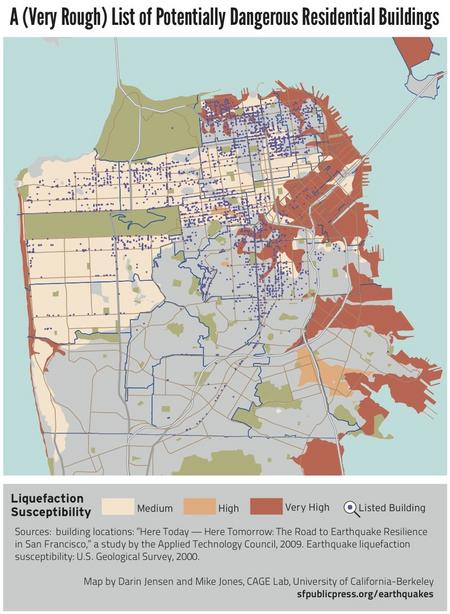
City Hall sources have confirmed the basic details of a San Francisco Public Press report from Friday afternoon that the Board of Supervisors will consider requiring the owners of soft-story buildings of three stories or more to seismically retrofit them by 2020 – at the expense of building owners, something sure to rouse controversy.

The legislation was developed and introduced by the Mayor’s Office and it’s being sponsored by the board’s two most prolific and effective supervisors, Board President David Chiu and Sup. Scott Wiener, which is probably a signal that city officials know this one is going to be “challenging,” as one source told us.

Details are still being hammered out before the measure is introduced at tomorrow’s board meeting, including some of the financing options that would be open to property owners. But after voters in 2010 narrowly rejected Measure A, a bond that would have provided low-cost loans for the seismic retrofits, property owners could be forced to dig deep to ensure their buildings don’t collapse in an earthquake.

Wiener confirmed that the legislation would be mandate on building owners without public money attached: “It would be a mandate that they within a certain time frame do an earthquake retrofit,” Wiener told the Guardian.

As the Public Press reported, the legislation would apply to all wood-framed buildings of three stories or more built before 1978, with smaller buildings and single-family homes exempted. In the most recent print edition of the Public Press, extensive coverage of the city’s earthquake vulnerabilities estimated that about 58,000 San Franciscans live in the nearly 3,000 soft-story buildings deemed dangerous places to be when the next big earthquake hits.

Wiener said city officials have been deeply involved with negotiations with various effected groups, including building owners and their tenants, who could face displacement as the work is done or higher rents if landlords pass through those costs. Wiener said the legislation is bound to evolve as talks and hearings continue: “There are a lot of variables and the introduction is really just a preliminary step.”

Supes call for stronger SRO safety measures

It’s no secret that tenants living in single room occupancy hotels (SROs) often grapple with health and safety issues, from bedbug infestations to plumbing problems.

At a committee hearing this afternoon, members of the Board of Supervisors will consider legislation [PDF] introduced by Sup. Eric Mar that would amend the housing code to require owners of SROs to install grab bars in common-area bathrooms, and to provide working phone jacks in each SRO unit.

These measures may seem relatively small, but Tony Robles of the Senior & Disability Action Housing Collaborative says installing grab bars can go a long way toward preventing falls, a leading cause of injury deaths for people older than 65.

In SROs, “there’s a lot of folks who have mobility problems,” Robles explains. “Many are disabled, or elders.” He said knows an elderly woman living in an SRO who recently fell and now faces hip surgery.

“This legislation is about safety, and it’s about quality of life,” Robles said. “It’s not just affluent folks who deserve to live in reasonably habitable conditions.”

Last June, advocates with Senior Action Network and several SRO collaboratives published detailed findings [PDF] from an in-depth survey of 151 SRO residents living in Chinatown, the Mission, SoMa and the Tenderloin. Most respondents were older than 55, and 62 percent identified as having a disability.

The in-depth study found that safety issues topped the list of residents’ concerns. Many respondents said they feared falling on the stairs or in the shower, and less than half reported having grab bars in their bathrooms.

The legislation, which was co-sponsored by Supervisors Jane Kim, David Campos and David Chiu, would also require SRO operators to install working phone jacks in residents’ rooms, which can be critical for tenants who need a way to communicate in case of an emergency.

According to the study findings, these low-income tenants face a host of other issues too:

“About one-third or more of survey respondents said their hotel had a problem with bedbugs, other infestations, visitor policy violations, electrical problems, unsanitary bathrooms, and harassment/ disrespect. One-fifth of respondents also cited problems with heat, plumbing, personal safety, fire safety, and maintenance and repairs. 
More than half (53%) had no access to a kitchen in their building, and 18% of respondents said they skip meals due to lack of resources or facilities.”

San Francisco has more than 500 residential hotels, according to city records, with more than 19,000 units. An estimated 8,000 seniors and adults with disabilities live in SROs.

Robles remarked that it took courage for the SRO residents to speak up in hopes of improving their living conditions. “Tenants in theses SROs oftentimes are intimidated to say anything,” he said. “Some folks might have feared reprisal.”

Don’t just stand there — squat!

59

You know I love this story. I love it so much I am going to be following it for weeks, and I hope for years. A homeless guy takes over a $2 million mansion in Florida, which was sitting empty while Bank of America dicked around and never sold or rented it, and now the bank is going to have a tough time getting rid of him.

Did I say I love this story?

Check it out:

It only gets more complicated. By invoking an obscure but never rescinded nor revised Florida law, Barbosa is using “adverse possession” to justify his claim in the house, as it allows a person to move in and claim title of a property “if they can stay there seven years.” Florida has suffered more than one similar case. The Sun Sentinel makes reference to a “handful” of adverse possession claims making their way through the Palm Beach County Property Appraiser’s Office, but Barbosa’s stands out because the house he’s possessing (adversely) is so valuable. And though Barbosa is certainly eccentric, posting a sign that he is the “living beneficiary to the Divine Estate being superior of commerce and usury” on the front of the home, he isn’t stupid. He even contacted the Appraiser’s Office to alert them that his tenancy had begun, presumably as he intends to stay for the required seven years.

We haven’t had any good high-profile public squats like this in San Francisco in years. Back in the day, my old friend Paul Kangas and his brother John were the kings of squats; Paul found an empty house in the Sunset in the late 1970s, with the paint peeling and the shutters hanging off the windows, moved into it, fixed it up, had the water and power turned on in his name and lived there for years. He didn’t operate in secret or the middle of the night; he got the lock re-keyed, moved all his stuff in, and acted like he owned the place. He fixed it up nicely, took care of the yard — and the neighbors loved him. An empty eyesore was now a clean, inhabited house.

Paul was no fool; he had researched the place and found out that the owner had died without leaving direct descendants or a clear will, and for a long time, nobody in the city or the legal system could figure out who actually did own it. Paul needed a place to live; this one was going to be empty for a long time. Why not use it?

John did the same thing with an abandoned house in the Mission, except that to open the door, he had to climb in a window. Somebody saw him, called the cops …. and he was arrested for burglary (for taking the front door knob, which he was going to replace.) He took the case to trial, and it was spectacular: His lawyer, Jonathan McCurdy, called a bunch of city officials and asked them who John had stolen the door knob from; “who,” he kept asking, “actually owns this property?” The title was unclear; nobody could answer the question.

Then John took the stand and said he wasn’t a burglar at all; he was a squatter, who was planning to take over, fix up, and live in an abandoned house.

The jury took about an hour to come back with a verdict of not guilty.

There are plenty of pieces of property around the Bay Area that are owned by banks and sitting vacant. Some of them are becoming eyesores. Somebody ought to be living there.

As we used to say, Don’t just stand there — squat!


Housing stability for all

9

OPINION San Francisco is in the midst of a housing affordability crisis. It’s way too expensive to live here, and for those fortunate enough to have housing they can afford, we need to provide stability. This need for housing stability applies to renters as well as homeowners. If we’ve learned anything from the foreclosure crisis, homeowners are not all rich, and they are not all stable in their housing.

Last week’s Guardian argued against legislation I’m co-sponsoring, which provides one-time relief to owners of tenancies-in-common (TICs) — mostly middle- and working-class first-time homeowners who reside in their units — while providing strong protection to renters. While the editorial correctly stressed the need to support rent control, it failed to acknowledge the need to support housing stability for homeowners as well.

Rent control is one of the pillars of our city. It stabilizes housing prices, recognizes that housing isn’t just another commodity, keeps communities intact, and helps maintain San Francisco’s diverse fabric. I’ve long supported rent control, as reflected by my voting record. I supported a series of rent control measures designed to reduce evictions, including requiring sales disclosure of a unit’s eviction history, requiring increased relocation benefits to evicted tenants, outlawing harassment of tenants, and restricting use of the Ellis Act by real-estate speculators. As a member of the Board of Supervisors, I authored successful legislation to ban conversion of rent-controlled units to student dorms and to provide temporary affordable units to renters displaced by disasters.

The current legislation I’m co-sponsoring will provide needed relief to struggling TIC owners, many of whom are experiencing serious financial distress, while protecting the small number of tenants who live in these units. TIC owners have group mortgages, meaning that if one owner defaults, all owners default. They pay double the interest rate other homeowners pay and usually cannot refinance. The legislation will allow them to convert their units to condos and obtain their own mortgages, at lower rates and less foreclosure risk.

While some caricature TIC owners as speculators and wealthy people, that’s untrue. Many TIC owners are quite middle class, former renters who scraped together a down payment to purchase a home. Many are teachers, social workers, public employees, and other workers who are anything but speculators. These are people who, if they didn’t own TICs, would be renting. They aren’t Martians who dropped out of the sky. They’re our neighbors, co-workers, and fellow San Franciscans. They are part of the city’s fabric.

Under the legislation, owner-occupied TICs that are in the condo lottery will be able to convert to condos by paying a fee of $20,000 per unit, with the proceeds dedicated to affordable housing. Buildings with Ellis Act and other problem evictions are typically prohibited from condo converting in San Francisco, under a 2006 law, and that restriction applies to this legislation. In other words, this legislation won’t encourage Ellis Act evictions. Moreover, buildings that aren’t owner-occupied can’t condo convert. Nor can buildings with more than six units. The legislation is one-time in nature and not an ongoing invitation to condo convert.

The legislation covers very few units with tenants — 85% are owner-occupied — and protects this small number of tenants by mandating they receive lifetime leases, with full rent and eviction controls identical to our rent control laws. This protection is stronger than what most tenants receive in buildings that win the condo lottery currently.

Renters and homeowners both deserve housing stability. This legislation moves us in that direction.

Supervisor Scott Wiener represents District 8.


Condo conversion legislation on hold for now

Following a contentious five-hour hearing, a committee of the Board of Supervisors postponed voting on a controversial housing proposal, and agreed to revisit the issue on Feb. 25. Over the next few weeks, opposing sides are expected to negotiate a possible alternative.

Authored by Sups. Scott Wiener and Mark Farrell, the proposed condo conversion impact fee would have allowed as many as 2,000 tenancy-in-common (TIC) units to be immediately converted to condos for a fee, allowing owners to bypass a housing lottery system that places an annual cap on conversions.

While TIC owners voiced frustration about the backlogged lottery system, tenants expressed fears that the legislation could give rise to a wave of Ellis Act evictions if landlords or speculators interpreted it as a signal that lucrative condo conversion would be easier to achieve.

Prior to the hearing, a group of tenants gathered in front of City Hall in a show of opposition to the condo-conversion legislation, waving signs that read, “Stop the Attack on Rent Control.”

“The reality is, if this legislation passes, there will be more evictions in San Francisco,” said Tommi Avicolli Mecca of the Housing Rights Committee, who spoke at the rally.

Tenant advocates worry that the legislation would result in a permanent loss of affordable, rent-controlled units from the city’s housing stock, at a time when rents are soaring. When landlords rent out their condos or TICs in San Francisco, there’s a key difference: TICs are covered by rent control, but condos are exempt.

“I’ve been evicted three times,” one woman said while addressing members of the Land Use & Economic Development Committee. “I know so many people who have gotten evicted. I don’t know anyone who’s won their case against eviction.”

During the hearing, Farrell adopted a defensive tone against critics who’d described the proposal as an attack on rent control. “The tactics that these opponents have deployed is out of line,” he said. To assuage concerns, he noted that he and Wiener had included a provision guaranteeing lifetime leases for existing tenants in units that qualified for condo conversion under the program.

But Sup. Jane Kim drilled down on this detail, questioning whether such an agreement would be legally enforceable in the long run. In response, a representative from the City Attorney’s office said he thought the provision was on solid legal ground, but noted that the specific matter “has not been litigated before,” meaning there is still a question as to whether it could withstand a court challenge. When Kim asked if any funding was set aside to enforce these lifetime leases, the response was “no.”

Board President David Chiu proposed holding off on a vote for several weeks. “I do not support the legislation in its current form,” he said. If the current generation of TIC owners were allowed to convert this time, he explained, the next generation’s frustrations with the housing lottery would only “lead us back to an identical debate in a short period of time.”

Kim echoed this point. “My concern was that … folks were looking at this legislation as an ice-break for more condo conversion,” she said just after a public comment session that lasted several hours. And she acknowledged that there is a larger problem to consider. “It’s very tragic that we have set up a situation where [TICs and renters] are pitted against one another,” she said.

Ed Lee’s State of the City: What evictions? What displacement?

196

Mayor Ed Lee punctuated his State of the City speech with a nice little quip: “Every San Franciscan deserves a clean, safe place to call home.” I agree.

So why, in a speech lasting more than an hour, did the mayor not once mention that thousands of San Franciscans are facing the loss of their homes — and will be forced out of the city — because of the same policies that he’s proudly promoting?

These things are always self-congratualtory and full of the requisite bullshit. But Lee’s description of the State of the City was nothing more than a fantasy to the two-thirds of San Franciscans who live in rental housing, many of whom are living with an unacceptable level of insecurity. Much of the city’s rental stock — and the effectiveness of rent control — is at risk at speculators are buying up properties, tossing the tenants out with the Ellis Act, and converting them to tenancies in common. This is a massive civic crisis, brought on in part by the boom in tech jobs and the consequent boom in high-paid young people who want to live in a city that has virtually no vacant housing.

We saw this before, under Mayor Willie Brown; we called it the Economic Cleansing of San Francisco. It was awful, and it’s happening again.

But you wouldn’t know that to hear the mayor completely ignore the issue.

Oh, Lee gave it a toss-off line; gee, the rent is too high, but we can’t ignore the laws of supply and demand. Gee, we’re going to build 45,000 new housing units, and that will fix everything.

But Lee, of all people, ought to know that housing in San Francisco has never followed the laws of supply and demand. This is a highly irregular market, because demand is essentially unlimited. Housing fills us as fast as you build it. And none of the new housing that’s currently under construction or in the pipeline will be affordable to current SF residents who live in rent-controlled units and are at risk for eviction.

When you’re evicted under the Ellis Act in San Francisco today, to make room for someone with more money, you wind up having to leave the city. That’s the bottom line. And everywhere you turn, tenants are facing that ugly prospect.

The mayor spent much of his time talking about jobs. That’s fine; he’s proud that the unemployment rate in the city has fallen to 6.5 percent, but he insists he won’t rest until everyone has a job. Actually, most economists would say that’s impossible; capitalism, by its nature, exists with a structural unemployment rate that rarely falls below 4 percent. In fact, 4 percent is generally considered “full employment.”

More important, the overall rate is 6.5 percent, but it’s way higher for people without college degrees, for youth, and for African Americans. (It’s above 50 percent for transgender people.) The tech boom isn’t providing jobs for all of the unemployed current San Francisco residents; a lot of the jobs are going to people who don’t live here and are moving here for employment. They are putting pressure on the existing housing stock. That always leads to displacement.

None of this is to say that tech jobs are bad or that we shouldn’t have companies that pay high wages locate in San Francisco. What it means is that the city first has to protect its existing vulnerable populations — and that’s not happening.

I would encourage Mayor Lee to talk to the Housing Rights Committee, or the Tenderloin Housing Clinic, or any of the other tenant lawyers who are fighting desperately every day to state off evictions. He’d get a very different picture of the state of the city.