taxes

Willie Brown and Ammiano’s pot bill

35

Assemblymember Tom Ammiano’s new medical marijuana bill seems pretty straightforward. Almost everyone in the medpot biz thinks there ought to be some sort of statewide regulations for a growing industry that operates in a mish-mash of local jurisdictions with no overall rules. If nothing else, consumer-protection policies ought to be in place. And, of course, the more the dispensaries accept, and follow, reasonable regs, the easier it is to win the mainstream political support necessary to get the feds off all of our backs and ultimately follow Colorado and Washington.

All good, right?

So Ammiano, who has been on this issue for years, is proposing that the state’s Department of Alcoholic Beverage Control — which for all its problems has experience regulating mind-altering substances — draft and oversee medpot rules.

But the industry that makes a lot of money off the legalization of medicinal weed is famously fractured — and the politics of Sacramento are often nasty. Add in former San Francisco Mayor Willie Brown — who has his fingers in all sorts of business opportunities these days — and the story turns downright weird.
Ammiano’s been talking about Califonria and pot for years. He proposed legalization before the other states did, but frankly, this current state Legislature’s never going to have that kind of courage.

But he continues on with the effort. Last year, he tried to put pot under the Department of Consumer Affairs, which clearly didn’t want it; his bill died in the state Senate.

Normally, when new regulations are proposed for an industry, the Legislature holds what’s called a Sunrise Hearing, to bring all the stakeholders into a room and talk about what issues ought to be addressed. So Ammiano a few months back asked for a hearing in the Senate Business, Professions, and Economic Development Committee. No problem, said the chair, Curren Price, a Los Angeles Democrat.

But in February, five days before the hearing was set, Curran called the whole thing off. Turns out that the Governor’s Office and the Attorney General’s Office wanted no part of it, so it was hard to round up the essential players. Also, Curran was running for an open LA City Council seat and probably didn’t want the publicity. As Ammiano said at the time, “What’s up with marijuana? You can’t even have a hearing?”

Even without a hearing, he’s moving a new bill, AB 473, which would create under ABC a Division of Medical Cannabis Regulation and Enforcement. The bill is modeled on a successful effort in Colorado that has kept the feds at bay. Washington is also putting marijuana regulation under its liquor control authority.
“We’ve had not one federal intervention,” in Colorado, Matt Cook, a consultant who help write the rules in that state, said.

But just as Ammiano was preparing to line up support for his measure, another bill mysteriously appeared, in the state Senate. A “spot bill” with no actual content, the measure was set as a medical marijuana regulation placeholder. The authors: Senate President Darrell Steinberg and San Francisco’s Mark Leno.

Now: Leno’s been a big supporter of medical pot for years — but the bill wasn’t his idea. “Darrell told me he was going to do something about marijuana regulations, and he asked me if I would join him,” Leno told us.

What Leno didn’t know: Steinberg had been approached and asked to carry a bill by Willie Brown. Brown contacted the Senate president, sources tell us, and said that Ammiano was the wrong person to carry pot legislation.

Why? Who knows. Brown wouldn’t return my calls. But I can tell you with absolute certainty that Brown has been looking for ways to discredit Ammiano since 1999, when the then-supervisor challenged the mayor’s re-election in a legendary write-in campaign that galvanized the city’s left and created the momentum for the complete rejection of Brown’s politics and endorsed candidates a year later, in the first district elections.

And yes: Willie Brown carries a grudge. So it’s possible that he would go out of his way to make sure that Ammiano didn’t get credit for leading the way on what will evenutally be a huge sea chance in how California handles pot.

Now: This sort of thing isn’t viewed very highly in the hallowed halls of the state Leg, where people take their bills — and their history on issues — very seriously. Ammiano was furious, and talked to Steinberg, who (properly) apologized for stepping on his toes. Leno told us he had no intention of undermining his San Francisco colleague, that he had immense respect for Ammiano and all of his efforts, and that he wouldn’t move forward with any bill that didn’t have Ammiano’s input and support.

But it raises the question: Why is Brown even involved in medical marijuana? The only answer I can come up with is that he’s making money off it. Not as a dispensary owner or a grower, but as, in effect, a lobbyist.

When I heard Brown was messing around with the industry, I called Steve DeAngelo, who runs Harborside Health Center, the $22 million a year dispensary in Oakland. DeAngelo’s a promient leader on medical marijuana issues, and has built a respected business that pays taxes to Oakland, provides quality product, and is in many ways a model for what a dispensary should look like.

We talked for a while about Ammiano’s bill, and DeAngelo said he wants to be sure there’s community consensus. “The most important thing is that whatever passes addresses the issues and has broad supoprt in the industry,” he said. He agreed that regulation is needed, but stopped short of endorsing Ammiano’s bill, saying “there still needs to be further discussion.”

Then I asked him if he knew why Brown was talking to the state Senate president, and he told me:

“Willie Brown has been a political advisor to Harborside.”

I asked him if Harborside was paying Brown for his advice. He refused to say.

Okay then. But Brown doesn’t have much of a history of working on this issue pro bono, and is not known for serving as a “political advisor” (or doing much of anything else in the way of work) for free.

What does Brown think about the Ammiano bill? “He thinks,” DeAngelo said, “that it’s important it have a broad base of support.”

Willie Brown is not popular with the voters of California. His history of questionable (at best) ethics was among the reasons the voters approved terms limits for the Legislature. Hardly anyone on the left trusts him. A medical marijuana regulatory bill that has his fingerprints isn’t going to do much for “consensus” or “broad-based support.”

So maybe the best thing Brown could do for his client is stay the hell out of Sacramento.

Does Mayor Lee support Airbnb dodging its $1.8 million tax debt to SF?

185

My story in this week’s Guardian about how Airbnb appears to be refusing to pay the hotel taxes it owes to the city has gotten a lot of attention. But I’m still getting stonewalled by representatives from the company and Mayor Ed Lee, who apparently refuses to take a public stand against corporate tax evasion, even when it means thousands of San Franciscans could get stuck with an unexpected tax bill.

How much money are we talking about? According to a study that Airbnb commissioned and publicized late last year, its hosts in San Francisco collect $12.7 million from their guests every year. That means that if the company was charging the 14 percent Transient Occupancy Tax – as the Tax Collector’s Office last year ruled that it must – it would be paying the city nearly $1.8 million annually.

But that doesn’t seem to be happening, although only Airbnb can say for sure, which is why its spokespeople have been dodging my questions for more than a week. As I reported, taxpayer privacy laws prevent city officials from disclosing how much individual businesses pay in local taxes, but we do know Airbnb doesn’t add the TOT to the online transactions it facilitates or specifically encourage its San Francisco hosts to collect the taxes (even though the tax codes make the hosts and Airbnb jointly responsible for this growing debt to city coffers). And with the company charging 6-12 percent per transaction, it’s a safe bet that it isn’t simply paying the taxes itself.

What makes this particular case of corporate tax dodging even more interesting is the fact that Mayor Lee has a close connection to this particular San Francisco-based corporation. Venture capitalist Ron Conway is a top investor in both Airbnb and Mayor Lee’s political campaigns, creating a potential conflict-of-interest in Room 200. Last year, Mayor Lee personally lobbied against the interpretation by the Tax Collector’s Office, and now he appears to be silently backing Airbnb’s resistance to paying its taxes.

Last week, when I was trying to get a comment for Lee spokesperson Francis Tsang on Airbnb’s apparent tax dodge, he replied, “It’s an incorrect assumption that Airbnb and hosts haven’t been paying any transient occupancy tax..” Of course, because of the taxpayer privacy laws, Tsang can’t actually support that statement and I responded by laying out the evidence that the city is getting stiffed by Airbnb.

Then, he and Airbnb simply stopped responding to my questions, even though I’ve made repeated inquiries and asked only whether Mayor Lee was willing to make a public statement calling for a major San Francisco corporation to meet its local tax obligations. And in the interests of fully transparency, I’ll close with the email that I sent to spokespersons for Airbnb and the Mayor’s Office on Wednesday as my story came out, along with their emails in case you want to push for answers yourself.

kim@airbnb.com, francis.tsang@sfgov.org, christine.falvey@sfgov.org.

Dear Airbnb and mayoral spokespeople,

Since I couldn’t get responsive answers from any of you about why Airbnb isn’t collecting the Transient Occupancy Tax from its guests, I wanted to forward the link to my story on the topic in our latest issue (http://www.sfbg.com/2013/03/19/airbnb-isnt-sharing) and to let you know that I will continue covering this issue in the Guardian and our sister newspapers until you address it publicly.

Because of privacy laws that limit the Tax Collector’s Office from addressing this directly, only Airbnb can say whether they’re paying any of the hotel taxes that the city last year conclusively ruled that they owe. As I reported in my story, that tax obligation is shared jointly by Airbnb and its hosts, who don’t appear to have been warned of this by the company, making this an issue of consumer protection as well as corporate greed.

Will the Mayor’s Office make a public statement opposing tax evasion? Will it stand up for San Franciscans who may be unwittingly stuck with the tax bill by Airbnb? Or will Mayor Lee stick up for a tax-dodging corporation funded by the same billionaire that funds his political campaigns? And how will people feel about San Franciscans and the city treasury paying for his political ambitions?

These are all questions that I plan to air and explore in the Guardian, and I think that our readers and the general public deserve answers to those questions. If there are reasons why Airbnb guests aren’t being charged the TOT, some other arrangement that has been made, or some other complex reasons why Airbnb feels it can’t comply with last year’s ruling by the Tax Collector’s Office, I’ll be happy to hear it and let you make your case to our readers. But I don’t think that continuing to stonewall me is going to be a viable strategy for any of you. I hope to hear from you soon.

Spare change, Larry?

Tensions flared over the America’s Cup last week as critics called for billionaire yacht owner Larry Ellison to cover the looming city deficit out of his own deep pockets.

It’s evidently a popular idea: A petition asking Ellison to pony up had collected 1,663 signatures as of Wednesday morning.

The language in the petition, started by former Sup. Aaron Peskin, cuts straight to the point: “Your net worth is $43 billion,” it states. “Covering the America’s Cup debt would be equivalent to a person who has $40,000 donating $13.95. Is that too much to ask?”

At a hearing March 13, Sup. John Avalos asked why the city’s General Fund was on the hook to help cover costs for the yachting event, despite earlier assurances that the city would be reimbursed for tournament-related expenses.

The prestigious international yacht race will be held on the San Francisco Bay starting in July. A host and venue agreement hashed out between the city and race organizers provided that the America’s Cup Organizing Committee, the tournament’s fundraising arm, would “endeavor” to solicit donations from private donors to reimburse the city for expenses incurred, originally pegged at $32 million. Total city costs are now estimated to hover around $22 million, but so far ACOC has sent less than $7 million in reimbursement, city agency representatives reported at the hearing.

The fundraising committee has mostly come up dry on the rest — and now Avalos is irked because the city agency that negotiated the deal appears to be “moving the buoys,” as he characterized it, by counting a projected tax revenue boost instead of actual reimbursement dollars as adequate compensation for city spending.

Mike Martin, tasked with leading the city’s involvement in the America’s Cup under the Office of Economic and Workforce Development, showed a slide at the hearing suggesting that ACOC’s “remaining fundraising need” was just $2.6 million, since a projected $13 million in increased tax revenues would bring the city to a break-even point. That projection was based on expected increases in sales, payroll and hotel taxes during the yachting event.

The presentation seemed to reframe the premise that the city would be made whole for tournament-related expenditures, as well as reap the benefits of a tax boost, in exchange for agreeing to host the sailing events. Yet Martin called this notion a “mischaracterization” in a phone interview.

“I don’t disagree that there are people who think that this is not what they understood to be the deal,” Martin said, clearly reacting to Avalos. But “this was part of the policy dialogue at all steps of the conversation.”

Reached by phone after the hearing, Avalos did not sound satisfied with the responses he’d heard. “It seems that the commitments that were made to the Board in 2010 … are not being taken seriously,” he said. “Now that they’re coming up short on fundraising efforts, they’re trying to say the General Fund should be subsidizing the cost of the race.”

Martin pointed to a report prepared by Budget and Legislative Analyst Harvey Rose in December of 2010, before the contract between the city and race organizers was finalized. The report included a break-even analysis that factored in tax revenues, and Martin stressed that this consideration had been part of the dialogue since the outset.

But that same report also contained a key recommendation: Rose advised the supervisors to amend the proposed agreement to “require that the America’s Cup Organizing Committee pay the City and County of San Francisco $32 million, or final estimated city costs.”

No such ironclad requirement was ever included; instead, the fine print in the final agreement wound up containing watered-down language: “The Authority and the City acknowledge and agree that they are not relying in any manner on any current or future commitment … or any statements, representation, or actions of, any … agent of [ACOC].”

Nick Magel, who works for Causes.com, told us that Peskin’s online petition calling on Ellison to cover the fundraising shortfall was gaining more momentum than most online campaigns taken up via the website. “The campaign is performing well, considering it’s less than a day old,” he said March 15. “The most impressive indicator is that over 95 percent of the signatories are from the Bay Area. Seems the campaign is striking a chord with local residents.”

The America’s Cup is killing us!

56

First Larry Ellison and his rich cronies try to perpetrate an audacious real estate scam on San Francisco, after pitting us against other cities to host his America’s Cup race. Even though we were able to scale back that swindle, they still evicted Teatro ZinZanni from Pier 27 so they could profit from overpriced waterfront concerts at the spot they supposedly need for their boat race — lying, cheating and corrupting the system along the way.

Then we learned that Ellison, the world’s fifth richest man, and the other 1-percenters on the America’s Cup Organizing Committee, may stick San Francisco taxpayers with a $20 million bill for their race because they’re all too greedy and selfish to honor their private fundraising commitment – which they could cover by simply writing checks for amounts they would barely notice, and which they’d probably find a way to write off of their taxes anyway.

And now, on top of all those outrageous indignities … they’re killing people!

Well, maybe Ellison and his crew aren’t actually committing murder. But during last weekend’s venerable Escape from Alcatraz triathlon – which was moved up from the warm-ish summer months to the frigid winter because the yachts are apparently unable to share the bay for a few hours one morning – one man died of a heart attack and 150 participants had to be rescued (three times the normal number) because the water was so dangerously cold.

Just one more example of how overentitled rich people, with the active complicity of the Mayor’s Office, are having their way with San Francisco, heedless of the consequences.

It’s about housing, not taxes

48

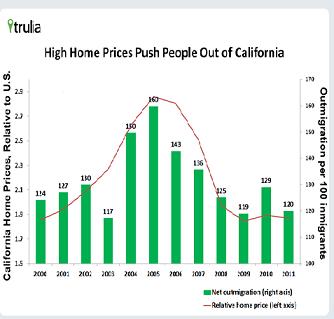
Texas Guv Rick Perry made a spectacle of himself trying to take businesses away from California, but as everyone with any sense predicted, his trip was a bust. Fact is, very few businessess anywhere make major relocation decisions because of taxes and regulations. But as Calitics points out (with a nice chart), the real reason people have left California of late is the cost of housing.

The so-called “job creators” have enough money to afford to live here, so they aren’t going anywhere. What’s happening is that the rest of the workforce, particularly the middle-class workforce, is finding the gap between the amount they can earn and the amount they have to pay for a home is getting so radical that they’re leaving altogether.

That’s happening in San Francisco, as evictions are driving people out of the city. Some may move to other parts of the Bay Area, creating what most environmentalists and economists agree is an unsustainable situation: Workers living so far from their jobs that vast amounts of energy have to be expended getting them back and forth. But the data shows that people are leaving California altogether. Calitics:

If we are to really continue our growth, we must address the housing crunch that is going on, especially along the coast. That isn’t accomplished through slashing services and budgets, but rather working to create new affordable housing solutions and ways for young families to stay here in California, where most would rather stay.

And let’s remember: One of the biggest factors that does drive business location decisions is the availability of skilled labor. If people are leaving the state because they can’t afford to live here, who’s going to work in the industries that are the biggest employers in San Francisco (hint: It’s not tech)? Tourism is this city’s greatest economic engine, and jobs in the hospitality industry don’t pay enough for housing in the city that depends on it.

That’s a dilemma we all ought to be talking about — and Rick Perry trying to get businesses to go to Texas is not.


America’s new Progressive Era?

13

By Jeffrey D. Sachs
Jeffrey D. Sachs is Professor of Sustainable Development, Professor of Health Policy and Management, and Director of the Earth Institute at Columbia University. He is also Special Adviser to the United Nations Secretary-General on the Millennium Development Goals.

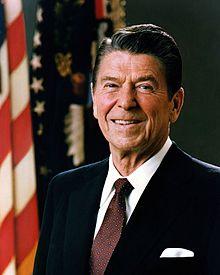
NEW YORK – In 1981, US President Ronald Reagan came to office famously declaring that, “Government is not the solution to our problem. Government is the problem.” Thirty-two years and four presidents later, Barack Obama’s recent inaugural address, with its ringing endorsement of a larger role for government in addressing America’s – and the world’s – most urgent challenges, looks like it may bring down the curtain on that era.

Reagan’s statement in 1981 was extraordinary. It signaled that America’s new president was less interested in using government to solve society’s problems than he was in cutting taxes, mainly for the benefit of the wealthy. More important, his presidency began a “revolution” from the political right – against the poor, the environment, and science and technology – that lasted for three decades, its tenets upheld, more or less, by all who followed him: George H. W. Bush, Bill Clinton, George W. Bush, and, in some respects, by Obama in his first term.

The “Reagan Revolution” had four main components: tax cuts for the rich; spending cuts on education, infrastructure, energy, climate change, and job training; massive growth in the defense budget; and economic deregulation, including privatization of core government functions, like operating military bases and prisons. Billed as a “free-market” revolution, because it promised to reduce the role of government, in practice it was the beginning of an assault on the middle class and the poor by wealthy special interests.

These special interests included Wall Street, Big Oil, the big health insurers, and arms manufacturers. They demanded tax cuts, and got them; they demanded a rollback of environmental protection, and got it; they demanded, and received, the right to attack unions; and they demanded lucrative government contracts, even for paramilitary operations, and got those, too.

For more than three decades, no one really challenged the consequences of turning political power over to the highest bidders. In the meantime, America went from being a middle-class society to one increasingly divided between rich and poor. CEOs who were once paid around 30 times what their average workers earned now make around 230 times that amount. Once a world leader in the fight against environmental degradation, America was the last major economy to acknowledge the reality of climate change. Financial deregulation enriched Wall Street, but ended up creating a global economic crisis through fraud, excessive risk-taking, incompetence, and insider dealing.

Maybe, just maybe, Obama’s recent address marks not only the end of this destructive agenda, but also the start of a new era. Indeed, he devoted almost the entire speech to the positive role of government in providing education, fighting climate change, rebuilding infrastructure, taking care of the poor and disabled, and generally investing in the future. It was the first inaugural address of its kind since Reagan turned America away from government in 1981.

If Obama’s speech turns out to mark the start of a new era of progressive politics in America, it would fit a pattern explored by one of America’s great historians, Arthur Schlesinger, Jr., who documented roughly 30-year intervals between periods of what he called “private interest” and “public purpose.”

In the late 1800’s, America had its Gilded Age, with the creation of large new industries by the era’s “robber barons” accompanied by massive inequality and corruption. The subsequent Progressive Era was followed by a temporary return to plutocracy in the 1920’s.

Then came the Great Depression, Franklin Roosevelt’s New Deal, and another 30 years of progressive politics, from the 1930’s to the 1960’s. The 1970’s were a transition period to the Age of Reagan – 30 years of conservative politics led by powerful corporate interests.

It is certainly time for a rebirth of public purpose and government leadership in the US to fight climate change, help the poor, promote sustainable technologies, and modernize America’s infrastructure. If America realizes these bold steps through purposeful public policies, as Obama outlined, the innovative science, new technology, and powerful demonstration effects that result will benefit countries around the world.

It is certainly too early to declare a new Progressive Era in America. Vested interests remain powerful, certainly in Congress – and even within the White House. These wealthy groups and individuals gave billions of dollars to the candidates in the recent election campaign, and they expect their contributions to yield benefits. Moreover, 30 years of tax cutting has left the US government without the financial resources needed to carry out effective programs in key areas such as the transition to low-carbon energy.

Still, Obama has wisely thrown down the gauntlet, calling for a new era of government activism. He is right to do so, because many of today’s crucial challenges – saving the planet from our own excesses; ensuring that technological advances benefit all members of society; and building the new infrastructure that we need nationally and globally for a sustainable future – demand collective solutions.

Implementation of public policy is just as important to good governance as the vision that underlies it. So the next task is to design wise, innovative, and cost-effective programs to address these challenges. Unfortunately, when it comes to bold and innovative programs to meet critical human needs, America is out of practice. It is time to begin anew, and Obama’s full-throated defense of a progressive vision points the US in the right direction.


Jeffrey D. Sachs is Professor of Sustainable Development, Professor of Health Policy and Management, and Director of the Earth Institute at Columbia University. He is also Special Adviser to the United Nations Secretary-General on the Millennium Development Goals.

Copyright: Project Syndicate, 2013.
www.project-syndicate.org

Can Obama really unravel Reagan?

36

I like Robert Reich; he’s one of the smartest economic thinkers in the country and can explain everything that’s wrong with the economy in two minutes. And I really want to believe that he’s correct in his latest essay, and that President Obama really is poised to under the Reagan Revolution (or at least, the Reagan Republican Coalition).

I get it: The GOP is a fractured collection of groups that often have little in common (although the Democratic Party has some of the same problems). And the Reich message is hopeful:

Obama’s focus in his second inaugural — and, by inference, in his second term — on equal opportunity is hardly a radical agenda. But it aggravates all the tensions inside the GOP. And it leaves the GOP without an overriding target to maintain its fragile coalition. In hammering home the need for the rich to contribute a fair share in order to ensure equal opportunity, and for anyone in America — be they poor, black, gay, immigrant, women, or average working person — to be able to make the most of themselves, Obama advances the founding ideals of America in such way that the Republican Party is incapable of opposing yet also incapable of uniting behind.

All of that may be true — but it’s hard to understate the damage that Reagan did to America — and the amount of work and leadership it’s going to take to get us back to where we were as a nation before he and his ilk declared war on social programs, cities, and non-military government spending.

Before the Reagan Era, even Republicans accepted the concept that the very rich should be taxed at high rates; the marginal rates under Richard Nixon were at 70 percent. In the 1960s and 1970s, the federal government spent huge sums of money on cities. Before Reagan, economic equality was a value in this country. Now it’s not even on the agenda.

Obama’s second inaugural touched all the right notes. But he needs to do more than tinker around the edges of policy if he wants to have a Reagan-style impact on the country. And I don’t know if he’s up for it.

King’s ideals echoed in SF and DC events

2

Labor leaders and a plethora of elected officials from San Francisco – including almost the entire Board of Supervisors – began today at the San Francisco Labor Council’s annual Martin Luther King Jr. Breakfast. They heard inspiring words from speakers on hand, but not from President Barack Obama, whose inaugural address wasn’t broadcast at the event as planned due to technical difficulties.

Yet the ideals voiced here at the West Bay Conference Center on Fillmore Street echoed those sounded on Capitol Mall in Washington DC, channeling the spirit of Dr. King in calling for us to take bold collective action to better care for all people and the planet.

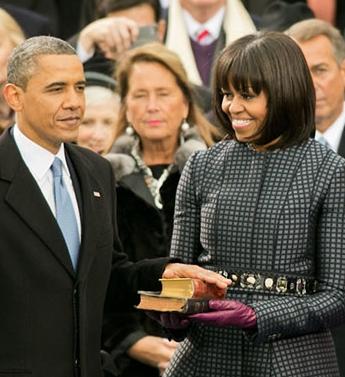
“My fellow Americans, we were made for this moment, and we will seize it as long as we seize it together,” Obama said in his speech. “For we, the people, understand that our country cannot succeed when a shrinking few do very well and a growing many barely make it.”

At his invocation here in San Francisco, Rev. Floyd Trammel, called for a “clarity of thought and unity of purpose” and cast Obama as the inheritor of King’s legacy. “In many ways, you sent one, Dr. Martin Luther King Jr., to pave the way for another, President Barack Hussein Obama,” Trammel said in his prayer.

Sen. Mark Leno – speaking in the place of Mayor Ed Lee, who is in DC for the inauguration – quoted the late Supreme Court Justice Louis Brandeis, who said, “We can have democracy in this country, or we can have great wealth concentrated in the hands of a few, but we can’t have both.” And while Leno praised those present for helping pass Prop. 30 to begin turning around California’s fiscal state with higher taxes on the rich, Leno also said, “The work is just beginning.”

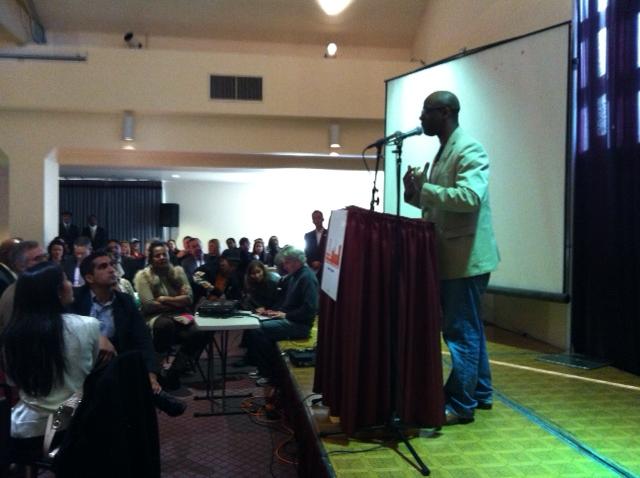
It was a theme echoed by the most dynamic speaker on the program, Thurgood Marshall High School teacher Van Cedric Williams, who said the theme of both MLK Day and Obama’s inaugural address was that there is still much work to do to realize King’s dreams of social and economic justice.

“I believe community and labor are working on the unfinished business that Martin Luther King started,” Williams said, calling it a moral imperative to help create a better world for all. He called on those present to really “embrace your fellow community member,” those of all races and backgrounds, to pursue the solutions the world needs.

“They have to see the passion,” Williams said of young people today, “they have to know we got their backs.”

Obama also appealed to the obligation that we have to future generations. “We will respond to the threat of climate change, knowing the failure to do so would betray our children and future generations.”

It was a call for Americans to move beyond our narrow self-interest. As King once said, in a quote included at the MLK memorial in SF’s Yerba Buena Center, “An individual has not started living until he can rise above the narrow confines of his individualistic concerns to the broader concerns of all humanity.”

The inauguration and the economic divide

112

Second inaugration speeches are hard; you have to be political without sounding partisan, inspiring without being divisive — and promise change and progress even if you haven’t accomplished what you wanted in the first term. The Obama address surprised me: He went left, making clear that he wants economic and social equality to be his final legacy. It’s getting rave reviews in the lib-blogosphere, where it’s been described as the speech liberals have been begging him to give for years. You can’t argue with the content — he mentions gay rights, global climate change, equal pay, protecting social security, economic inequality, the need for collective effort … he even talks about reforming the tax code.

So now comes the hard part: The struggle for economic justice has to go beyond a compromise plan that limits higher tax rates to people earning more than $400,000 a year.

In fact, the best thing I read this weekend was a NY Times piece by Nobel-Prize-winning economist Joseph Stiglitz, who argues forcefully that continued economic inequality is prolonging the recession. It’s also destroying the nation’s future:

Our skyrocketing inequality — so contrary to our meritocratic ideal of America as a place where anyone with hard work and talent can “make it” — means that those who are born to parents of limited means are likely never to live up to their potential. Children in other rich countries like Canada, France, Germany and Sweden have a better chance of doing better than their parents did than American kids have. More than a fifth of our children live in poverty — the second worst of all the advanced economies, putting us behind countries like Bulgaria, Latvia and Greece. Our society is squandering its most valuable resource: our young.

Stiglitz says what few in Washington want to admit: We can’t get the economy going again without rebuilding the middle class, and we can’t do that without higher taxes on the rich and a lot more public investment in education. Oh, and all this talk of how it’s out of our control is bullshit:

There are all kinds of excuses for inequality. Some say it’s beyond our control, pointing to market forces like globalization, trade liberalization, the technological revolution, the “rise of the rest.” Others assert that doing anything about it would make us all worse off, by stifling our already sputtering economic engine. These are self-serving, ignorant falsehoods. Market forces don’t exist in a vacuum — we shape them. Other countries, like fast-growing Brazil, have shaped them in ways that have lowered inequality while creating more opportunity and higher growth. Countries far poorer than ours have decided that all young people should have access to food, education and health care so they can fulfill their aspirations.

Makes me think about some of what I hear out of San Francisco City Hall. Oh, we can’t do anything about economic inequality; that’s a national issue. Or maybe it’s a state issue. I bet there’s not an elected official in town today who woudn’t proclaim complete agreement with everything Obama just said — and there are very few of them who are trying to bring that message back home.

In San Francisco, we give tax breaks for businesses that create high-end jobs that drive poor people out of town. We happily seek development without considering the impact it will have on existing vulnerable populations. We even struggle over free Muni for low-income youth. We do nothing — nothing — to reclaim wealth from the 1 percent and put it into local housing, public education, and job-training that could make a dent in our local economic inequality.

Mr. Mayor: Are you even paying attention?


The (bad) Warriors deal, by the numbers

36

Rudy Nothenberg, who ran Muni and the city’s water system, was chief administrative officer, negotiated the deal for the Giants ballpark, and served under six San Francisco mayors, stopped by the office last week to talk to us about the Warriors Arena. We’ve had our fights with Nothenberg (as we would with anyone who was that close to Willie Brown and Dianne Feinstein) but the guy knows more about City Hall, public works, private development, and infrastructure finance than almost anyone alive. So we were happy to hear what he had to say.

Let’s be clear, here: Nothenberg lives near where the arena is slated to be built, and, as he was quick to tell us, he doesn’t want it in his backyard. But he also presented a compelling case that San Francisco is getting ripped off. And he had a few pointed things to say about the lack of negotiating skills among the members of Mayor Ed Lee’s administration.

Back when Nothenberg was talking to the Giants about a stadium at Third and King — at that point a district of dilapidated and underused warehouses — always kept a card in his back pocket. “I always knew that if things didn’t work out and we didn’t build the stadium, that would be okay too,” he said. In other words: You can’t get a good deal if you’re not prepared to walk away. And when it comes to the Warriors proposal, the mayor has made it so clear that this is his legacy that the team knows the city will never walk away. So one side of the talks can demand pretty much anything, and the other side has no leverage.

Oh, and it doesn’t hurt that just about every development lawyer, political consultant, and lobbyist in town is already working on the project. “They have co-opted everyone,” Nothenberg — no stranger to the dark side of politics — told us.

The exact terms of the deal are still not public, which is a bit odd since the city has already started its environmental review. (Can you really do an environmental impact report on a project when you don’t know what the project actually is? Two difference state courts have come to opposite conclusions, so for now the answer is: maybe.)

But there’s enough information out there for Nothenberg to give us a basic rundown on the financing — and it doesn’t look good. “The Port is really not getting anything out of the deal,” he said. The city will get some increased sales and business taxes, and the Warriors will have to pay housing and transit fees. But there won’t be a lot of new property tax revenue, since that will all go to pay for the arena.

Here’s how Nothenberg laid out his analysis:

The Warriors have to spend $120 million to replace Piers 30-32. (Costs a lot to build such a huge structure over the water.) To make the team whole, the city will sell the Warriors a seawall lot on the other side of the Embarcadero for $30 million, then give the $30 million right back to the team. Then the city will set up an Infrastructure Finance District — the 2013 equivalent of a redevelopment agency — use the future tax increments to fund a $50 million bond. The Warriors get the bond money; the city pays it back. Oh, and then the city gives the team $30 million worth of rent credits, meaning the Warriors will probably never pay any rent at all for the use of that public property. And to make it sweeter, San Francisco will pay the Warriors 13 percent interest on the rent-credit money.

Meanwhile, the local taxpayers will have to come up with a huge amount of money to increase Muni capacity, since the existing transit can’t possibly handle the load of the new arena. Yes, the Warriors, like any developer, will have to pay a modest transit impact fee — “but it’s laughable to thing that this will ever cover the capital and operating costs,” Nothenberg said.

To summarize: The wealthy owners of a professional sports team will get free waterfront land to build an immensely valuable new arena. The city will pay to bring the fans there and get them home, deal with the traffic impacts — and get almost nothing in return.

Good one, Mr. Mayor.

Texas and tax cuts suck; CA leads job growth

41

How many times have we heard that jobs are leaving California for Texas? How many times have big-business groups and the polticians who play to their needs said that lower taxes and corporate welfare make states more “competitive” and are good for the economy?

So look, for a moment, at California and Texas. Who has the lower taxes and the governor who will do whatever employers want? And who has the more robust job growth?

Just goes to show: Tax breaks do not a health economy make. What companies look for when the make location decisions is much more complicated. An educated labor force (which, by the way, means spending tax money on schools and colleges), access to transportation (again, a public-sector concern) and yes, a decent place where the executives want to live are bigger factors than things like the payroll tax.

That’s what studies have shown repeatedly over the years — and it’s playing out now in CA.

The downside of Jerry Brown’s budget

9

The guv is quite proud of his new budget: He’s eliminated the chronic deficits, he’s giving some more money to the schools, and he’s vowing that the state will live “within its means.” Which sounds like no more taxes. And gee, just about everyone in Sacramento is singing Kumbaya; the praise is coming not just from Democrats but from Republicans.

But there’s a downside to the Brown budget: He has, to his credit, stopped the red ink, and he’s presenting things in a brilliant way that makes him look like the grownup the state has needed for many years — but he’s doing very little to replace the the money that services for the poor have lost in the past five years.

“At first blush, it has some good things,” Assemblymember Tom Ammiano told me. “But I don’t see restoration of the cuts for the disenfranchised.”

Ammiano is calling for closing Prop. 13 loopholes and passing an oil severance tax as part of the budget process. And with Democrats holding a two-thirds majority in both houses, those kinds of changes are possible. At the very least, it seems, the progressives ought to demand from Brown a plan to backfill what social service providers have lost. If it can’t all happen this year, it ought to be part of the future budget process.

State Sen. Mark Leno, who chairs the Senate Budget Commitee, was a bit more politic than Ammiano, but he also is concerned that the budget move the state forward:

“With the improvement of our fiscal outlook comes the opportunity to continue our work to restore California. While our recent efforts have focused largely on making cuts in the least harmful manner possible, we will now have more capacity to refine our work to improve essential programs and analyze the role of government and its effectiveness. I look forward to working with Governor Brown and my colleagues in the Legislature to evaluate this year’s budget to help ensure it is the best possible plan for a state on the mend.”

On the mend is right — because the state of California is in way worse shape than it was when Arnold Schwarzenegger took over and screwed things up, and the goal shoudn’t be to keep at a steady state that’s unacceptable. It ought to be returning California to its role as a leader in progressive policy. Sorry, Jerry: A balanced budget alone isn’t good enough.

Oh, and Californians United for a Reponsible Budget, which seeks to cut prison spending, points out that this budget is hardly tough on the bloated corrections budget:

The administration has deserted plans to shrink California’s over-sized prison population, ignoring clear messages from voters. The proposed budget increases prison spending $250 million including a $52 million General Fund increase, bringing the total Corrections budget over $11 billion. Despite the passage of Prop. 36 and continuing realignment,  It also projects an increase in the prison population by 2,262 people over the 2012 Budget Act projections. ”If the Governor believes that ‘we can’t pour more and more dollars down the rat hole of incarceration’ then why is he increasing spending on Corrections, planning for more prisoners rather than fewer and defying the demands of the Federal Court and the voters to further shrink the prison system?” asked Diana Zuñiga, Field Organizer for Californians United for a Responsible Budget.

It’s no surprise that the prison guards’ union is happy.

UPDATE: An analysis by Ammiano’s office shows a few other lowlights of the budget: It reduced AIDS Drug Assistance Program money by $16.9 million. It doesn’t restore any of the deep cuts to the state’s Welfare to Work Program. It cuts community college funding by tying state money to student completion, not student enrollment. It offers no additional funding for child care programs. It caps the number of courses students are allowed to take if they want to receive Cal Grants.

The Leg needs to take a hard look at this before it signs off on all these cuts.

Will narrow business interests continue to dominate SF’s political agenda?

44

Will the narrow, deceptive, and disempowering “jobs” rhetoric of the last two years continue to dominate San Francisco politics in 2013? Or can San Franciscans find the will and organizing ability to create a broader political agenda that includes livability, sustainability, and affordability?

If it’s up to the San Francisco Chamber of Commerce – whose perspective has been aired in both the Examiner and Chronicle over the last two days – private sector profits will continue to be our only metric of civic success.

Just take a look at the “Pinkslips and Paychecks Scorecard” that the Chamber released yesterday, rating members of the Board of Supervisors based on a series of 16 votes for tax cuts and public subsidies for businesses, approvals of projects serving the rich, rollbacks of government regulations, business surcharges on consumers, maintaining PG&E’s dirty energy monopoly, and blocking an expansion of developer fees to improve Muni.

That aggressive neoliberal agenda, which is shared by Mayor Ed Lee and his big corporate backers, was reinforced by Chamber VP Jim Lazarus in an op-ed in today’s Examiner. Ignoring the rising housing and other living costs that plague the average San Francisco, Lazarus uses hopeful language about how we’re all “poised for success in 2013,” burying the Chamber’s aggressive and exclusive agenda in the subtext.

At the top of his agenda are: “Approval of the California Pacific Medical Center rebuild, reforming San Francisco’s California Environmental Quality Act appeals process, and rule-making for the upcoming gross-receipts tax.” In other words, let CPMC have what it wants, make it more difficult to challenge developers on environmental grounds, and ensure business taxes remain as low as possible.

And to ensure supervisors get the message, he closes by noting that business leaders are “energized and ready” to push their agenda with tools such as the Alliance for Jobs and Sustainable Growth, which waged some of the nastiest and most deceptive political attack ads on progressive candidates in the last election cycle.

The progressive movement of San Francisco has its problems and issues, including a recently widening schism between environmental and transportation activists on one side and the nonprofit housing and social justice faction on the other. And in the current economic and political climate, both sides too often find themselves partnering with corporate and neoliberal interests to get things done.

But now, more than ever, San Francisco needs to broaden into political dialogue, and that means a reconstitution and expansion of its progressive movement. That’s something that the Guardian has long focused on facilitating and publicizing – something that will be my personal focus as well – and we have some idea percolating that we’ll discuss in the coming weeks and months.

Then maybe all San Franciscans can be poised for success in 2013 and beyond.

Why the GOP gets away with obstructing Congress

91

There’s an interesting piece on Calitics talking about what California can teach the nation in terms of ending Republican obstructionism. Robert Cruickshank, as usual, is right on target — and he points to the real problem in Washington. Republicans in the House no longer worry about losing their seats to Democrats; the GOP has been so good about gerrymandering that only maybe 30 or 40 seats in the entire nation are still competitive. What these increasingly right-wing loonies worry about is a primary challenge from an even loonier, even right-wingier candidate — so they refuse to vote for any taxes and they’re willing to bring down the entire economy if that’s what it takes.

The problem is it’s not as easy to fix nationally as it was in California. We’re talking long-term efforts to change governors and state Legislatures so they can rewrite Congressional districts (or create California-style independent redistricting, which I initially opposed but hasn’t turned out so bad). The Constitution mandages redistricting every ten years, but I don’t think there’s any rule saying you can’t draw new districts more often, or that you can’t create a new way of drawing them and put that in place right away. But again, that’s not immediate.

Meanwhile, Obama’s going to have to force as much as he can through a reluctant Congress and do as much as he can with executive orders.

Willie Brown is so full of shit on Prop. 13

43

The Chron’s conflict-laden columnist made an interesting admission Dec. 9: The multibillion-dollar tax loophole that allows corporations to avoid reassessments under Prop. 13 was all his fault:

 After voters approved Prop. 13 in 1978, capping property taxes for landowners, we had to sit down in the Legislature and figure out how to implement it. One of the biggest questions was how and when properties could be reassessed. We decided that should happen whenever a property was “transferred.” When you sold your home, it was transferred to someone else. The home was reassessed, and the taxes for the buyer were increased accordingly. What we did not realize was that corporations don’t actually transfer property – they transfer the stock in the company that owns the property. And Prop. 13 didn’t apply to stock.

Wait: In 1978, Brown (a lawyer) and the office of the Legislative Counsel and the rest of the lawyer-heavy Legislature didn’t know how corporations transfer property? It was all a big mistake? There were no corporate lobbyists in Sacramento trying to make sure that the loophole was created? Just the poor undereducated elected officials who got snookered by their own lack of information?

And remember: That was 1978. Brown was elected Speaker of the Assembly in 1980, and served for 14 years. Somewhere during that era, someone must have noticed what was going on (every county assessor in California did). There was ample opportunity to close that loophole, if the immensely powerful Speaker Brown had any desire to do so.

But somehow, it never happened. Funny thing, that.

So now Brown agrees that this problem should be fixed — but he says the person carrying the bill, Assemblymember Tom Ammiano, shouldn’t be doing the work because he’s too liberal and pro-tax. Which is either stupidity (and Brown’s many things, but normally stupid isn’t one of them) or he’s still bitter that Ammiano forced him into a mayoral runoff in 1999 and lead the rebellion that ousted all of the mayor’s loyal supervisors a year later. Vindictive? Yeah, we’ve heard that about Willie Brown.

“He doesn’t even understand the history of the bill,” Ammiano told me. “I introduced it last year and got it out of committee and to the floor, which was a miracle.” And now, with a two-thirds majority in both houses, the Democrats can approve it without the Republican minority veto.

“I have cosponsors and I’m going to get more,” Ammiano said. “We may be able to make it part of the budget process.”

And since local governments all over the state, and anyone who believes in tax fairness, is going to support this, I think it’s got a pretty good chance of getting to the desk of the governor.

Willie Brown, as is his practice, didn’t return my call seeking comment.


Could we really fix Prop. 13?

17

Is it really possible? Could California be on the path to repair the damage of Prop. 13? Would Jerry go along?

You wouldn’t think so — it’s been talked about for so long and so little has happened. But it’s an all new year in Sacramento, and the era of Republican dominancy-by-minority is over (in fact, the era when Republicans will have any role at all in state government is pretty much over), and already, some changes are in the works.

Assemblymember Tom Ammiano notes:

 “Prop. 13 is not the untouchable third-rail anymore. It’s more like the bad guy with the mustache who has tied California to the rails with the fiscal train wreck coming.”

Ammiano is introducing legislation to change the way Prop. 13 is interpreted — to stop corporations for using loopholes to get around paying higher taxes after commercial property changes hands. But the polls now suggest the voters might be willing to do more — the Public Policy Institute suggests that a sizable majority of Californians would like to see a split-role measure approved. That alone would provide billions of dollars in revenue for public schools.

By a 57-36% margin, voters responded positively when asked this question: Under Proposition 13, residential and commercial property taxes are both strictly limited. What do you think about having commercial properties taxed according to their current market value? Do you favor or oppose this proposal? Democrats favor the idea 66-26% and independents like the prospect 58-36%. Even Republicans are evenly divided 47-48%. Voters aged 18-34, who represent the future, favor the idea 65-28% but the idea is also popular among the most reliable voters, those 55 and older, by 56-39%. Splitting the tax roll is a popular idea in every region of the state, among men and women equally and especially among Asians (65-26%) and Latinos (58-36%) but also among whites (56-38%).

Now: That’s before the commercial property industry and every major landowning corporation in the state pours about $50 million into a campaign to defeat any whisper of a split-roll. But we all know that big-money campaigns don’t always win in California — and right now, the guv is a pretty popular guy. So if he got behind a split-roll measure, and every progressive and labor group in the state (and most local elected officials) did, too, it would be at the very least a level playing field.

That, alone, would change California more than anything else the Legislature or the governor could do. It’s out there; it’s possible. I wouldn’t try in 2013, but 2014 is looking pretty good.


SF’s newest political pole gets a new name: Moderate progressives

101

A Daily Kos blogger known as Kurykh has posted an interesting and insightful “crash course in San Francisco politics,” in which he correctly identifies the tri-polar dynamic of local politics. Everyone knows the progressives (Ammiano, Avalos, the Guardian) and the so-called moderates (Wiener, Ma, the Chronicle), and so Kurykh dubs the rising third pole (Chiu, Kim, Mayor Lee) “moderate progressives.”

He calls them “the new kids on the block,” noting that they sided with progressives in 2008 but ushered in a new political reality by siding with the moderates in 2010, now serving essentially as the swing votes on major issues and projects.

“Like other progressives, they are pro-tenant and advocate for more social services to the poor. However, they have pro-business and pro-development tendencies and tend to focus on streamlining bureaucracy and effective government,” he wrote of the moderate progressives.

Personally, I think a more accurate label for this rising new power center is “neoliberal” (I just called them “liberals” in my own San Francisco political primer that I wrote a year ago), a political term describing the belief that any reforms or progress needs to be negotiated with capitalists and corporations instead of coming directly through taxes or regulations.

And I think it underestimates the influence that so-called “moderates” who are actually quite conservative when it come to finances and land use – people like Lee fundraiser Ron Conway and Planning Commissioner Michael Antonini – have in influencing Lee and shaping politics in the city.

But I welcome this contribution to helping San Franciscans understand the political dynamics that are governing this city.