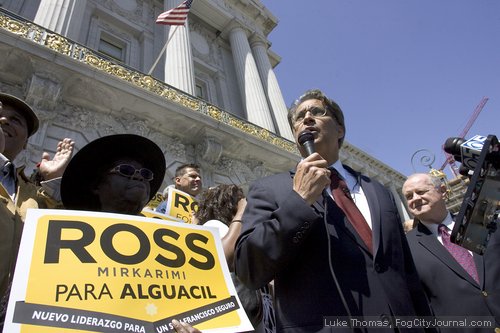
Sheriff

Taking out the trash

1

sarah@sfbg.com

A controversial city waste disposal contract appeared primed for final approval by the Board of Supervisors on July 26 (after Guardian press time) — despite being challenged by a lawsuit and initiative campaign — after two progressive supervisors rescinded their initial vote in a July 20 committee hearing and supported awarding the contract to Recology.

City staff had recommended awarding the 10-year, $112-million landfill disposal and facilitation agreement to Recology (formerly NorCal Waste Systems, Inc.), which has grown from a locally based company to the 10th largest waste management firm in the US, with $652 million in annual revenue, according to Waste Age magazine.

If the full board follows the unanimous recommendation of its Budget & Finance Committee, the vote will authorize Recology to transport and dispose up to 5 million tons of the city’s solid waste at the company’s Ostrom Road landfill in Wheatland, Yuba County. The contract will take effect when San Francisco’s disposal agreement at Waste Management Inc.’s Altamont landfill in Livermore expires — estimated to occur in 2015.

The deal will cement Recology’s control, at least for a 10-year period, over all aspects of the city’s solid waste stream, at a cost of about $225 million per year, even as the company faces significant challenges, many related to the city’s 1932 refuse collection and disposal ordinance.

That law, approved during the Great Depression to prevent conflict between competing garbage haulers, has resulted in Recology’s exercising complete control over trash collection and transportation in San Francisco, without having to bid on those contracts or pay the city franchise fees.

During the negotiations over the city’s next landfill contract — the only aspect of San Francisco’s waste stream put out to bid — this 79-year-old law was invoked to explain why Recology has the sole authority to transport trash and compostables to Wheatland, which is 130 miles from San Francisco.

The move also comes as Yuba County is contemplating significantly increasing dumping fees at the landfill — from $4.40 per ton to $20 or $30 per ton — a hike that could erase the $100 million that the Department of the Environment (DoE) claims the Recology deal would save over a competing bid by Waste Management Inc. WM is the largest waste firm in the U.S., according to Waste Age, with about $12.5 billion in annual revenues.

On July 18, WM filed a lawsuit in San Francisco Superior Court to prevent the city from approving the agreements with Recology on the grounds that they violate the city’s competitive bid laws.

“The Department of the Environment inappropriately and unlawfully expanded the scope of its 2009 ‘request for proposal for landfill disposal capacity’ and, therefore, violated the city’s competitive procurement laws,” WM alleges in the suit.

WM has long held that DoE inappropriately issued a tentative contract award for both the transportation and disposal of solid waste to Recology without soliciting any other transportation bids. But DoE, which gleans $7 million annually (to operate recycling, green building, and environmental justice programs and long-term planning for waste disposal) from rates that Recology’s customers pay, ruled last year that WM’s objections are “without merit.”

Now WM is asking the court to require DoE to scrap its award to Recology and issue a new request for proposals to comply with competitive bidding requirements.

“There is ample time for the department to issue a new RFP,” WM stated July 18, noting that there is plenty of room at its Altamont landfill to accommodate the city’s waste after the contract expires.

That same week, a coalition led by retired Judge Quentin Kopp, community activist Tony Kelly, and Waste Solutions CEO David Gavrich announced that it had submitted enough signatures to qualify an initiative on the June 2012 ballot requiring competitive bidding and franchise fees from any company that seeks to win any aspect of the city’s solid waste business.

Kelly says his group was unable to collect enough signatures in time for the November election because Recology hired the city’s two biggest signature-gathering firms to circulate what he calls a “phony petition” in support of Recology’s performance in San Francisco. And signature gatherers say they were harassed by Recology boosters while trying to petition citywide.

“But I believe the question of whether candidates support competitive bidding will continue to be a defining issue this fall,” Kelly said.

The board’s decision on the landfill agreements has already been delayed several months, following a February 2011 Budget and Legislative Analyst report recommending that the board consider submitting a proposition to the voters to repeal the 1932 refuse ordinance so that future collection and transportation services be put to bid. The report also recommended that future residential and commercial refuse collection rates be subject to board approval.

But with two progressive supervisors running in citywide elections this fall, and with Recology exerting massive pressure on elected officials, the Kelly coalition could not find four supervisors to place such a charter amendment on the November ballot, forcing them to launch their own initiative.

And at the July 20 meeting of the board’s Budget and Finance Committee, Sup. Ross Mirkarimi, who is running for sheriff, and Sup. Jane Kim rescinded their initial decision to send the agreements to the full Board without recommendation. Instead, after the committee had moved on to other business, they joined Chair Carmen Chu, one of the most conservative supervisors, in forwarding the Recology agreements to the full board with unanimous support.

Mirkarimi interrupted the committee’s next discussion to rescind the landfill vote. “I think there was some misunderstanding a little bit in wrapping up the landfill agreements with Recology, ” Mirkarimi said. He said that he asked for the vote to be rescinded, “so we can accurately reflect some of the sentiments being articulated here. I think we just learned some things on the fly.”

In many respects, the switch by Kim and Mirkarimi made sense: prior to their initial vote, they made positive statements about the proposed agreements, but also stated an interest in exploring the appropriateness of the city’s 1932 law.

“Overall, I think this was a good contract,” Kim said. But she noted that, thanks to the 1932 ordinance, the city doesn’t get franchise fees. And she claimed that it only gets half of what other Bay Area cities get from their waste contractors. “So, I’m really interested in continuing that conversation, but I think it’s a separate conversation,” she said.

Mirkarimi said it was his concerns that led the committee to “put a pause” on the Recology agreements until it could “undertake more homework.” He also noted that his office “held a number of meetings” and he tried to “leverage this opportunity to reanimate activity at the Port.”

“I was hoping that we might be able to arrive at something much more deliverable,” Mirkarimi said, presumably referring to the fact that these efforts resulted in DoE unveiling an amendment to include two “possible changes” to operations and facilities at the Port of San Francisco in the agreements.

These changes involve utilizing other modes of transportation, including barges, as alternatives to the rail-haul plan proposed in the agreement. They also call for developing new facilities at the Port for handling waste, recyclables, organics, and other refuse. The cost of such alternatives would be passed onto the rate payers.

“I think that, cost-effectively, we may be able to insert the Port into this equation, but it’s not ready for prime-time yet,” Mirkarimi said. He concluded by saying that Recology has been innovative in reducing the city’s waste stream.

“This should be a front-burner conversation,” Mirkarimi said, noting that former Mayor Gavin Newsom focused on making San Francisco “the greenest city” in the United States. He added that San Francisco claims to have a 77 percent diversion rate, the highest in the U.S., and said, “That comes at a cost, it doesn’t come for free.”

After the meeting, DoE deputy director David Assmann said that the City Attorney’s Office is reviewing WM’s filing. “But it’s too soon to comment,” Assmann said.

He also claimed that, thanks to the 1932 ordinance, “there was no practical way” for another company to transport San Francisco’s waste to its designated landfill, “other than building a second transfer station outside the city.”

But Kelly continued to express concerns that the agreements are not competitive, and that the city lacks a contract and ensuing franchise fees. “They are running this as if it’s still the 1950s,” he said.

Kelly claimed that Recology Vice President John Legnitto, who is the 2011 chair of the SF Chamber of Commerce’s Board of Directors, recently told him that Recology has been in negotiations with City Hall around a $4 million franchise fee, but that the money would now be spent opposing Kelly’s competitive bidding initiative.

Will Esbernd support Lee?

24

As the tom toms grew louder at the Chronicle and in the Willie Brown/Rose Pak community for Interim Mayor Ed Lee to run for the full term as mayor, I emailed two impertinent questions to my district supervisor Sean Elsbernd:


1. Would you have nominated Ed Lee for interim mayor had you known he would consider running for the job?


2. Will you endorse him if he does decide to run for mayor?


As a longtime West Portal resident, I’ve always gotten annoyed at how Elsbernd (and other supervisors) love to play the neighborhood game back in their district — but when the chips are down on a power structure issue, they go down to City Hall and vote with Willie Brown and the downtown gang. Which is what happened in January on the critical vote for mayor when the Willie Brown/Rose Pak forces worked a quiet play to knock out the progressive candidates (Sheriff Mike Hennessey and former Mayor Art Agnos) and put in City Administrator  Ed Lee, a Willie Brown ally.


Elsbernd was happy to nominate Lee and told us at the time that he had done so because he wanted an interim mayor who would not run in November.


In his email answer to me, Elsbernd wrote, “I believe the benefits of that strategy have proven correct (e.g. the overall budget process and its unanimous approval, and the unanimous approval of the consensus and comprehensive pension/health care charter amendment.“


So what about today when Lee seems more and more poised to run?


Elsburn noted that he has not endorsed anyone, but that “I have been most attracted to the candidacies of City Attorney Dennis Herrera and former Supervisors Alioto-Pier and Bevan Dufty.” He said that these three have the “right combination of qualifications, experience, intelligence, skills and integrity to serve as mayor.”


So what’s his out? “Should Mayor Lee run for election, I would only consider endorsing his effort under one circumstance—if, and only if, I was convinced that without his candidacy, Sen. Leland Yee would be elected. That is, if I see that no one else can beat Sen, Yee other than Mayor Lee, then I would support a Mayor Lee campaign. At this point, I’m not convinced of that—I still think any one of the three I mentioned above could beat Sen. Yee.”


Well, that’s Elsbernd back in his district doing his neighborhood routine at the Village Grill, a favorite Elsbernd breakfast place. Elsbernd has still left himself a way to do what he said he was dead set against doing: going along with Willie Brown and  Rose Pak and  helping Lee become the fulltime mayor. Bring back Quentin Kopp and John Barbagelata. B3


North Garberville Beach

0

Rating: C

Just five miles from Garberville, there’s a beach on the south fork of the Eel River that’s so secluded some visitors even camp nude there.  Its existence was kept secret by users for years, but it’s not unknown anymore — we unveiled directions to it last year.  The naked enclave, which is just off Highway 101, continues to get rave views.

“The beach is excellent for tents,” says reader Dave.  “It’s really private and fun.”

Legal status:

Believed to be public property.  Says Dave:  “I have called the Humboldt County Sheriff’s substation in Garberville.  They even called me back to clarify that you can camp … as long as you don’t plan on staying a week or more.”

How to find it:

Go north on Highway 101 about five miles north of Garberville to the Phillipsville exit.  Take the exit (also called Exit 645), turn left, and go a half mile to a service road.  Turn left onto the service road.  Or from the north, take Highway 101 south to Exit 645.  Take the exit to Hooker Creek Road and continue straight for about 100 feet, where you will see the service road.  You can only go one way onto the service road.  Follow it less than a half mile south along the river.  Then park where you see cars pulled over along the street.  Look for a path there marked by a rainbow streamer and follow it as it curves to the right and takes you about 100 yards to the beach.  Local nudies and campers tend to stay on the far right end of the beach.

The beach:

Adorned with some nice shade trees, the beach can’t be seen from the road, so it’s not only nice and sandy but fairly private.  “It’s shielded from view,” says reader Dave.  “It’s really great.”  Some visitors bring tubes or other floaties with them.  “It has about 30 yards of both shallow and deep swimming areas,” adds Dave.  

The crowd:  

Used by local visitors for years, the beach usually attracts only a few people.  But, says Dave, “the word is getting out,” so there’s been a gradual increase in visitation.  He’s seen clothing-optional use by others at the site on both weekdays and weekends.

Problems:

Cold water; rocks in river (wear flip flops or old tennis shoes to protect your feet in the water.)

Mayoral candidates scurry for signatures

33

San Francisco mayoral candidates and their volunteers have been scrambling to gather the signatures of registered voters needed to reduce their filing fees and demonstrate popular support, over the weekend hitting popular gathering spots such as Dolores Park with a combination of earnest appeals and election-year gimmicks.

Volunteers for candidate John Avalos were the first to hit a crowded Dolores Park on Saturday, canvassing throughout the day, but they may have been upstaged by the campaign of David Chiu, which featured both the candidate himself and his Star Wars-inspired alter ego Chiu-bacca – a campaign volunteer dressed up as Chewbacca. The campaign even carried the motif through at the table it set up, which was staffed by someone in a space helmet that was reminiscent of a stormtrooper. No other mayoral or district attorney candidates seemed to have a visible presence there.

A Clonetrooper for David Chiu

Candidates have until this Thursday, July 28, to turn in the signatures of registered voters, each of which reduces that candidate’s filing fees by 50 cents. So mayoral candidates can eliminate their $5,048 filing fee (which represents 2 percent of the mayor’s $252,397 annual salary) by turning in 10,096 signatures. For district attorney candidates, the goal is 8,704 sigs, while sheriff candidates need 7,990 to get the freebie.

An Avalos volunteer gathers signatures (and possibly PBRs)

The other important upcoming election-related dates are Aug. 1, when the semi-annual campaign finance statements are due and we find out who’s been raising the most money, and Aug. 12, the deadline for candidates to file their intent to run for office. That’s when we find out whether Mayor Ed Lee breaks his pledge not to run, and whether there are any other surprise late entrants into the race, which is always a possibility.

Recology president Mike Sangiacomo disses the Guardian as landfill agreements head to full Board

4

Dressed in neon- yellow vests, a crowd of Recology employees filed into the Board’s Chambers to witness the Board’s Budget and Finance subcommittee, which Sup. Carmen Chu chairs, vote to forward the Department of Environment’s proposal to award the city’s landfill disposal and facilitation agreements to Recology (formerly NorCal Waste, Inc), to the full Board.

The B&F vote wasn’t exactly a surprise. In the past six months, Recology’s top brass have been exerting pressure on the committee members to approve the agreements, which got delayed after folks started raising questions about the lack of a franchise fee and competitive bidding on all other aspects of San Francisco’s multimillion dollar municipal solid waste stream. And lobbyist Alex Clemens reported $17, 134.25 in promised payments from Recology between January and June 2011 for services that included contact with B&F subcommittee vice-chair Ross Mirkarimi in mid-June.

If the full Board goes ahead and gives the green light July 26, that approval would authorize Recology, which Waste Age’s June 2011 issue named as the 10th largest waste management company in the U.S.,  to start transporting and disposing up to 5 million tons of municipal solid waste in its Ostrom Road Landfill in Wheatland, Yuba County, once the city’s agreement at Waste Management’s Altamont landfill in Livermore expires, which is expected to happen some time in 2014 or 2015.

The initial refusal of Mirkarimi and fellow B&F subcommittee member Sup. Jane Kim to agree to Chu’s suggestion that they forward the proposed agreements “with recommendation” appeared to be indications that both supervisors harbored some concerns about the deal. UPDATE: But According to DoE communications director Mark Westlund, before yesterday’s meeting was over, Mirkarimi called to rescind the vote on the landfill item asking for it to go to the full Board with recommendation. Jane Kim concurred, and so now it goes to the Board with unanimous committee support. 

“Overall, I think this was a good contract,” Kim said during the July 20 hearing.

Kim added that she thinks “We need to continue the dialogue,” about the city’s 1932 refuse collection and disposal ordinance, which resulted in Recology gaining a monopoly over every aspect of the city’s $225 million-a-year waste stream, except the $11-million-a-year landfill disposal agreement.

Kim noted that under the arrangement that grew out of the 1932 ordiance the city doesn’t get a  franchise fee. And she claimed that San Francisco is getting half of what other Bay Area cities, which all have franchise fees, get from their waste contractors. “So, I’m really interested in continuing that conversation, but I think it’s a separate conversation,” Kim said.

Mirkarimi, who is running for sheriff this fall, noted that he has been “the most outspoken member” of the committee on the Recology item, and that his concerns were what led the committee to “put a pause” on the deal, until the committee could “undertake more homework.”

Thanks to that pause, the city’s LAFCO committee was able to commission a report on what other jurisdictions do around transporting and disposing of their solid waste in landfills, and Mirkarimi noted that his office “held a number of meetings” and he tried to leverage this opportunity to “reanimate activity at the Port.”

“I was hoping we might be able to arrive at something much more deliverable,” Mirkarimi said, presumably referring to the fact that these efforts only resulted in DoE unveiling a last-minute amendment to include two “possible changes” to operations and facilities at the Port of San Francisco in the agreements.

These possible changes, which DoE director Melanie Nutter presented during the July 20 hearing, involve a) utilizing modes of transportation, including barges, other than, or in addition to, the rail haul plan proposed in the agreement, b) developing new facilities at the Port for the handling of waste, recyclables, organics and other refuse, meeting no later than the fifth anniversary of the agreement to discuss the feasibility of such changes, and c) incorporating into the rates, or otherwise financing, the cost of implementing such transportation alternatives and the cost of such facilities.

“I think that cost-effectively we may be able to insert the Port into this equation, but it’s not ready for prime-time yet,” Mirkarimi observed.

Mirkarimi concluded by noting the many innovative things Recology has done in terms of making the city’s waste disposal system more environmentally friendly. “This should be a front-burner conversation,” Mirkarimi said noting that Mayor Gavin Newsom made it a focus of his administration to make San Francisco the greenest city. Referring to the fact that San Francisco claims to have a 77 percent diversion rate—the highest in the U.S—Mirkarimi said, “That comes at a cost, it doesn’t come for free.”

Mirkarimi’s comments came in the wake of Nutter’s claims that Recology’s bid for the landfill disposal agreement will save ratepayers $130 million, over the 10-year course of the agreement, compared to the bid that Waste Management submitted. “This is the best deal for San Francisco,” Nutter said.

Nutter’s estimates were repeated by Jim Lazarus, who spoke on behalf of the SF Chamber of Commerce and the Alliance for Jobs and Sustainable Growth. “This is the right contract for the people of San Francisco,” Lazarus said.

But Nutter’s $130 million estimate was thrown into question by Yuba County Sup. Roger Abe, who had driven the 130 miles from Wheatland to alert San Francisco  that Recology’s bid is based on the assumption that Yuba County will only charge San Francisco a $4.40 per ton host fee.

As Abe pointed out, Yuba’s rates have not changed in 14 years, and his county is considering increasing them later this year by up to $20 or $30 a ton.
Such an increase, multiplied by the 5-million tons of garbage in the agreement, could dramatically increase the cost to San Francisco ratepayers over the course of 10 years, Abe observed..

[If Yuba County approves an increase, and diesel fuel prices also increase, it could eliminate much of the cost differential between Recology’s and WM’s bid: a recent Budget and Legislative Analyst report shows that Recology would charge $58.94 a ton, ($28.53 for tipping and other fees + $30.14 transportation cost per ton), while WM would charge $66.79 for tipping and other fees + $18.33 transportation costs per ton.). But if diesel rises above $2:30 a gallon, SF ratepayers could also get hit with a fuel surcharge.]

Also speaking at the hearing was former D10 supervisorial candidate Tony Kelly, who along with retired Judge Quentin Kopp, David Gavrich’s SF Bay Railroad, and other concerned citizens, recently gathered 12,000 signatures to qualify a petition to require all aspects of San Francisco’s $225-million-a-year waste services to be put out to bid, and to require the winning bidder to pay San Francisco an annual franchise fee.

Kelly et al were originally aiming to qualify their petition for the 2011 ballot, but they blame what Kelly described during public comment as, “a very expensive advertising campaign,” by Recology, plus harassment of petition gatherers and signers, as why they ultimately had to delay qualifying their initiative until the June 2012 election cycle.

Kelly urged the committee to probe the details of a $10 million Special Reserve fund, which Recology could access, under the terms of its facilitation agreement, to cover all its expenses that have not yet been reimbursed through rate hikes. “You’d think the Budget and Finance sub-committee would want to explore those things,” Kelly said.

David Gavrich, who is also President & CEO of Waste Solutions Group, which has hauled 6 million tons of waste in the last 20 years, said approving the landfill disposal agreement, without knowing what rates Yuba County are about to set, was tantamount to “opening up San Francisco’s check book to Yuba County.”

“Recology has never moved a single ton by rail,” Gavrich also asserted.

But while none of the supervisors asked for any clarification of details in the proposed agreements, including the last-minute amendment, during the hearing, Chu was quick to comment about Gavrich’s “blank check” comment, noting that any county can increase its rates. “Alameda County already charges a lot more, so there are no guarantees either way,” Chu said.

She also claimed that the agreements had been subjected to a “very extensive, competitive and open process, especially around tipping fees.” What Chu didn’t mention is that earlier this week, WM filed a writ of mandate with San Francisco Superior Court to prevent the final award of a new long-term solid waste transportation agreement and landfill disposal contract to Recology ordinances, on the grounds that the deal violates the City’s competitive procurement laws.

Instead, Chu urged moving on the deal as soon as possible, by invoking the specter of a disaster hitting San Francisco before a landfill agreement is reached.
“Imagine if we had to go to the open market,” Chu said, apparently ignoring the fact that WM has stated that it would take SF’s waste in an emergency.

After the vote, Kelly expressed concern that the agreements are not competitive, but cost-plus, which means all costs get passed along to ratepayers. And that the city continues to lack a contract and ensuing franchise fees. “They are running this as if it’s still the 1950s,” Kelly said.

Kelly claimed that Recology Vice President John Legnitto, who is the 2011 Chair of the SF Chamber of Commerce’s Board, told him that Recology had been in negotiations with City Hall around a $4 million franchise fee, but that the money would now be spent opposing Kelly et al’s competitive bidding initiative.
But when the Guardian approached Legnitto after the hearing, he refused to comment, telling me my questions should go to Recology’s Robert Reed.
And Recology President Mike Sangiacomo, who was speaking to Chronicle reporter Rachel Gordon rudely told me, “Not today thank you,” when I approached him seeking comment on the Board committee’s vote.

“What did you do to him?” Gordon asked, as she followed Sangiacomo into a corner of City Hall. Er, nothing. Except what any self-respecting reporter would do. Like ask questions, read documents, and challenge the spin.

But that something clearly has ruffled the feathers of Recology’s top brass.
 “It’s like Godzilla, it’s like Monster Island, they can’t help themselves,” Beyond Chron’s Eric Smith commented to me during the hearing. “I’m disgusted by how money, labor and all these different entities can influence what happens. They don’t care about the little people. They care about the bottom line.”

Smith, who ran for D10 supervisor in 2010, spoke to the huge pressure that has been exerted on those supervisors who have publicly raised questions about Recology’s monopoly over all other aspects of the city’s $225 million-per-year waste stream. “Big corporations like Recology throw big money around and intimidate the electeds,” Smith said.

Meanwhile, DoE deputy director David Assmann confirmed that the City Attorney’s Office is looking at WM’s writ of mandate. But Assmann added that it is too early to respond to questions about the implications of that legal action on the Recology agreements.

Assmann also responded to a number of questions I’d already raised on the Guardian’s blog about the juicy details buried in the Recology agreements, beginning with a special reserve fund that was established in 1988, as part of Recology’s facilitation agreement that governed the transportation of waste to WM’s Altamont landfill, which is where San Francisco has been depositing its trash since 1987, and that will be rolled over to form the basis of a new special reserve fund.

Assmann said the fund currently contains almost $29 million, but only needs a baseline of $15 million. The extra funds will be the subject of a hearing this fall, he said, to determine how to use the balance, including exploring the possibility of using the funds, which were collected through a 1.3 percent surcharge on ratepayers, to lower the garbage rates.

Assmann also noted that while there is no limit on how much Yuba County can theoretically increase its host fees, “there has to be a nexus with associated costs,” and that Yuba County supervisors would have to bring any such proposed increase, which would also apply to all their other landfill users, to their voters.

Assmann further noted that the idea behind developing new facilities relates to the city’s 2020 goal of zero waste is “to get to zero waste we need new methods of handling waste,” Assmann told me explaining that San Francisco wants to be able to take residual material and process it so it could be recycled and wouldn’t end up in the landfill.

Assmann said a consultant is comparing the feasibility of building those facilities on land next to Recology’s Tunnel Road facility in Brisbane, or on land the Port owns in San Francisco, and the report should be completed later this year. He also noted that the transportation amendment would allow the City to switch or improve its transportation mode, during the life of the agreement, should cleaner technologies be developed, “including trains that run on less polluting fuel.”

Assmann clarified that San Francisco ratepayers won’t be footing the cost of building a new rail spur in Yuba County. “We’re not paying capital costs. The rail spur is not a cost that Recology can charge because it’s out of county. And if San Francisco only produces 2 million tons during the life of the agreement, we are under no obligation beyond that.”

And he noted that a potential $10 million contingency payment would only go into play if the City gave Recology the green light, and the company incurred costs related to rail haul, and the City then reneged on its deal, at which point Recology could then use its incurred costs to justify why it needs up to $10 million to included in the garbage rates.

All interesting details as we approach the Board’s July 26 vote—with a lawsuit hanging over the City’s head. So stay tuned…

Alerts

0

alert@sfbg.com

WEDNESDAY 20

Hotel Frank picket line

Since being foreclosed on by Wells Fargo and taken over by a union-busting management team, Hotel Frank has unilaterally subjected its workers to new working condition and benefits and fired two labor representatives who resisted the changes (see “Lembi’s legacy,” 9/21/10, and “Hotel Frank fires key union organizer,” SFBG Politics blog, 10/4/10). Join UNITE HERE Local 2 members and other supporters of Hotel Frank workers in picketing the hotel and calling for management to respect workers’ rights. Repeats each Wednesday, and on Fridays from 1–5:30 p.m.

3–5:30 p.m., free

Hotel Frank, Geary and Mason, SF

www.hotelfranksf.info


THURSDAY 21

Summer of Choice kickoff

Concerned about how budget cuts and new campaigns against abortion rights, the Bay Area Coalition for Our Reproductive Rights is launching the Summer of Choice with an event featuring Shawna Pattison of New Generations Health Center, Loren Dobkin of UCSF Nursing Students for Choice, and Belle Taylor-McGhee, president of California Coalition for Reproductive Freedom.

7–9 p.m., $3 donation

Quaker Meeting House

65 Ninth St, SF

bacorrinfo@yahoo.com


FRIDAY 22

Living Wage Awards dinner

The San Francisco Living Wage Coalition, which has sponsored several successful local campaigns protecting and expanding the rights of workers, is holding the first of what is intended to be an annual awards ceremony honoring labor’s local heroes. Conny Ford, the secretary-treasurer of Office and Professional Employees Local 3, will be named Labor Woman of the Year, while San Francisco Labor Council Executive Director Tim Paulson will receive Labor Man of the Year honors. The event is part of this year’s Laborfest, a month-long commemorate of San Francisco’s 1934 General Strike. And for details on a pair of labor mural tours on Saturday, July 23, visit www.laborfest.net/2011/2011schedule.htm

6:30 p.m., $35 or $300 for a table of nine

Third Baptist Church

1399 McAllister, SF

415-863-1225

sflivingwage@riseup.net

www.livingwage-sf.org


SUNDAY 24

Mirkarimi for Sheriff fundraiser

Join supporters of Ross Mirkarimi in a fundraiser for his campaign to succeed longtime Sheriff Michael Hennessey, who has endorsed Mirkarimi. In addition to serving on the Board of Supervisors, Mirkarimi is graduate of the San Francisco Police Academy and former investigator with the San Francisco District Attorney’s office. He’s running against a field of police officers and sheriff’s deputies.

2–4 p.m., $25+ suggested donation

Park 77

77 Cambon, SF

www.rossmirkarimi.com

Chris Cunnie running for sheriff?

65

It appears that the race for San Francisco sheriff is about to get more competitive: Chris Cunnie, the former Police Officers Association president, the former undersheriff and chief district attorney investigator is getting close to deciding to run, numerous sources tell me.


I haven’t been able to reach Cunnie directly, but he’s been calling around to local political types and talking about the race, and several people close to him say he’s about ready to make the jump.


Cunnie was widely expected to run when incument Mike Hennessey appointed him as undersheriff more than a year ago, but Cunnie left that job for personal reasons and appeared to have no interest in trying for the top position.


But he’s apparently changed his mind, and he would be the third candidate in the race and likely to get more traction than Paul Miyamoto, a captain in the Sheriff”s Department who has no prior political experience.


At this point, however, Hennessey has already endorsed Ross Mirkarimi, who is by any account the front-runner. He’s the only candidate with any electoral experience and he’ll have the progressives united behind his campaign. Cunnie’s time as the POA boss will hurt him on the left.


It’s not clear why Cunnie has decided to enter the race, but I think it’s safe to say that a lot of powerful people in this town are worried that Mirkarimi — a stalwart progressive who happens to have been very involved in law-enforcement issues — could wind up in a citywide office from which he might at some point seek to run for mayor. Cunnie would make it much safer for the more conservative types.


Repulsed by Recology’s tactics, Kopp strikes name from Adachi initiative

36

Who knew that a bunch of garbage could get a taxpayer watchdog like former supe/state senator/judge Quentin Kopp threatening not to endorse Public Defender Jeff Adachi’s pension reform initiative? But that’s what happened according to Kopp, who adds that he was “personally insulted’ by a signature gatherer outside the West Portal post office last week, after he struck his name from a petition he had signed in support of Public Defender Jeff Adachi’s pension reform measure.

Adachi, who has reportedly been paying up to $5 per signature, also came under fire this week from opponents of his measure, who are threatening legal action after an undercover video showed four signature gatherers for Adachi’s measure soliciting signatures while making misleading statements about the proposal.

But this misbehavior had not been made public when Kopp encountered a signature gatherer last Friday, who asked if he would sign the Adachi petition. “I wrote my name and has just started to print it, when he said, how do you feel about Recology?” recalled Kopp, who is backing a ballot initiative that would require competitive bidding and hundreds of millions of dollars in franchise fees from firms who seek to win San Francisco’s garbage collection and recycling contract.

As such, Kopp’s initiative threatens to up-end the terms of an 80-year old charter amendment that resulted in Recology (formerly Norcal Waste Systems) gaining a contractless monopoly on San Francisco’s $226 million-a-year garbage and recycling stream. 

When Kopp asked the signature gatherer, who identified himself as Tim McArdle, why he was asking about Recology, McArdle said he had another petition on hand, which referred to the allegedly satisfactory service that Recology is providing.

At which point, Kopp began to strike his name from Adachi’s $5-a pop petition. McArdle allegedly interrupted, saying, “No, that’s not the same petition as Recology’s.” And when Kopp kept scratching out his name, McArdle allegedly began swearing at him, even allegedly employing the time-honored F-word. “A woman walked by and was shocked,” Kopp said.(So far the Guardian has been unable to locate McArdle, but when we do, we’ll be sure to update this post.)


When McArdle grabbed back his clipboard, Kopp said he was able to see that on its backside was what Kopp describes as ‘Recology’s phony petition.”

So, why is Kopp so repulsed by Recology? According to Kopp. Recology recently signed up the city’s top signature-gathering firms to work on their petition thereby preventing Kopp and his associates from hiring these firms to collect signatures for his competitive bidding initiative. “And they are doing so from our rates, the money we pay, its legalized misappropriation of our money,” Kopp claimed

So far, it seems as if Recology’s strategy is paying off, at least in the short term. This week, sponsors of the competitive bidding initiative announced that they will turn in their signatures by December 11 to qualify their measure for the June 2012 ballot—and not their original target of November 2011.

Their decision followed less than three weeks of signature-gathering, a tight squeeze that occured, in part, because the City Attorney’s Office  took the full 15 days allowed by law to review the language of the Kopp initiative, which was first submitted June 3.

Even so, and despite an extensive Recology-financed media campaign that included push polls and network and cable TV ads against competitive bidding,  proponents and volunteers with Kopp’s campaign managed to gather the 7,168 signatures they needed to qualify his initiative by the city’s July 11 deadline for submitting petitions for the November election. But some signatures could prove invalid, hence the decision to delay the competitive bidding initiative until June.

And the Guardian learned today that the Board’s Budget and Finance Committee has scheduled a July 20 hearing on whether to award Recology the city’s $11 million-a-year landfill disposal contract, with the full Board set to vote on the issue on July 26 and August 2. In other words, the Board is rushing to make a decision on the landfill, which would further consolidate Recology’s monopoly on the city’s waste stream, before the Board’s summer recess.

The Guardian has also learned that the Budget and Finance Committee will hear a resolution July 20 concerning Recology’s existing agreement with the city over garbage. Rumors are swirling that this hearing will allow Sup. Ross Mirkarimi, who sits on the committee, is running for sheriff and has allegedly been meeting with Mayor Ed Lee and Recology president and CEO Mike Sangiacomo behind closed doors, to insert a clause to allow for the payment of a $4 million franchise fee. But insiders assure the Guardian that Mirkarimi has no such plans, although Mirkarimi himself could not be reached.


Either way, as Kopp points out, the alleged proposed $4 million fee would only amount to 2 percent of Recology’s annual revenue from San Francisco ratepayers. ‘That’s almost an insult,” Kopp said, noting that Oakland, whose population is 340,000, (42 percent of San Francisco’s daytime population) gets a franchise fee of $30 million.

Now, in a recent report to the Board’s LAFCO committee, Recology claimed it provides $18 million annually in “free services” to the city. But the report did not include an independent analysis of Recology’s estimates, and therefore these claims raised the hackles of Kopp, Kelly and other competitive bidding proponents.

Kopp predicts a $4 million franchise fee would allow city leaders who oppose his measure to claim that one of the two objectives of his proposed initiative have been addressed.

In an interview with the Guardian earlier this year, Mayor Ed Lee said he felt that Recology “has justified its privilege to be the permit holder in San Francisco because of the things that it has been willing to do with us.”

Kopp said Lee repeated this position in June, and that Board President David Chiu recently said that he is opposed to monopolies in concept, but felt that any effort to allow competitive bidding on garbage services would tear the city apart.

“Chiu spoke in such draconian terms I thought I was in Iraq or Afghanistan,” Kopp said.

But these latest developments have strengthened Kopp and Kelly’s resolve to push ahead with their effort to give local residents a chance to decide whether competitive bidding would be better for San Francisco rate payers. As they point out, such a vote doesn’t mean Recology would be ousted from the city because they stand an excellent chance of winning any competitive bid. But it could mean that Recology is ousted from its current cost-plus arrangement with the city that allows them to make an estimated 10-20 percent profit.

And whatever happens, the upcoming battle threatens to shed light on Recology’s business model, which is based on vertical expansion into other counties and states, and the knowledge that, unlike the competitive bids it submits everywhere else in California, it has a guaranteed annual revenue of $225 million in San Francisco. In its 1996 filings with the Securities Exchange Commission, NorCal Waste and its 45 subsidiaries (now known as Recology) reported that San Francisco accounts for 50 percent of its annual revenue. And while those public filings are 15 years old, it’s clear Recology continues to rely on San Francisco for a large and guaranteed chunk of its income.

Or as one insider put it, “When you have a cost-plus contract, you can start buying things—like the Pier 96 development, and the recycling facility. And you can move profits to a different part of the company. You’re not competitively bidding the composting. And you can shift your profits out of San Francisco. And with a cost-plus contract, you put everything in the rates. For instance, the city says it wants composting. Ok, here’s the cost, here’s the bill. But you take the profit from the composting and invest it in San Jose, or San Bernardino, and use it to advance your other objectives, like buying two large landfills in Nevada and financing political campaigns.”

Meanwhile, Kopp says he plans to take Adachi to task for hiring the same signature gathering firm that is trying to undermine his petition.


“And I’m not planning to sign his petition now, and I might not endorse it,” Kopp said.


Where does Gavin Newsom vote?

23

Now that it’s pretty clear Gavin Newsom no longer has a residence in San Francisco, when is he going to change his voter registration? According to the San Francisco Department of Elections, there’s no statutory deadline; he can stay registered in San Francisco as long as he wants.

But he can’t vote here if he doesn’t live here — which means that if he wants to vote in the November election, he’s going to have to either (a) rent an apartment or buy another house in San Francisco that he can claim is his primary residence or (b) re-register as a resident of Marin County. As it is now, with no fixed place of abode in this city, he can’t come back and vote for the next mayor or sheriff or vote against the measure to change Care Not Cash. Because that would be voter fraud. And the lieutenant governor of California would never want to break the law.

Human rights for felons

57

Matier and Ross have a way with making any story into something the national news media will use to say “only in San Francisco.” And here it is again; check out hte first paragraph of the July 13 item:


Ex-convicts may soon become a “protected class” in San Francisco – joining African Americans, Latinos, gays, transgender people, pregnant women and the disabled.


Right there in one sentence, everything Fox news loves to report: That crazy city that loves gays and trannies now wants to protect criminals.

And this is going to play out as an issue in the sheriff’s race, since Supervisor (and sheriff candidate) Ross Mirkarimi is the one carrying the legislation. You know, that crazy liberal — the guy who whant to give civil rights to ex-cons. I can see the ads now — if any of the other candidates decide to go negative on something that actually makes a lot of law-enforcement sense.

See, if people returning from prison can’t get a place to live or a job, they’re going to be homeless and back to a life of crime. Pretty basic math. And thanks to the governor’s realignment plan, a lot more prisoners are coming to San Francisco, and the next sheriff is going to have to make anti-recidivism programs a top priority. That’s really what this is.

And the fact that the district attorney and former police chief supports it was buried in the story.


Don’t privatize public safety

3

Four weeks ago, surgeon Dimitry Nikitin walked out of Florida’s Orlando Regional Medical Center to his car and was shot dead by a disgruntled patient who then turned his gun on himself and committed suicide. Last September, a doctor at Baltimore’s Johns Hopkins was shot and killed by a patient distraught over his mother’s terminal diagnosis.

There is an epidemic of violence in America’s health care facilities. Many of the scenarios are familiar — the news is full of stories of combatants in gang fights following wounded rivals into hospital emergency rooms to finish them off. But the full depth of the problem is largely unreported and extends to hospital wards, clinics, and long-term care facilities

A recent report from the U.S. Department of Labor based on 2009 statistics says health care providers rank third in the likelihood of being assaulted on the job — just behind police and correctional officers. In 2009, there were 38 assaults per 10,000 nurses aides.

Despite this troubling trend, the San Francisco Department of Public Health is asking the Board of Supervisors to approve its proposal to replace institutional police officers in some public health facilities with low-paid private security guards.

Here are two reasons this is a profoundly bad idea.

1. Health care is a stressful environment and growing more stressful every day.

As the providers of last resort, public hospitals and clinics often face a perfect storm of patients who are involved in violence, alcohol and drug abuse, or are suffering from untreated mental illness. But even outside emergency wards, health care workers must work up-close with patients and family members pushed to the breaking point by an overburdened delivery system.

As health care costs spiral, public health budgets shrink and access to high quality care dwindles, many hospitals and clinics are reporting assaults by patients and family members upset by long lines, half-day waits, and unaffordable care.

According to a September report by CNN on rising violence in health care facilities, violence caused by patients’ frustration with health care services is on the rise.

“People are just tired of waiting, or they are just angry that they’re not getting the care they feel is acceptable,” nurse Rita Anderson told CNN. “Instead of saying something, their response is yelling, hitting, screaming, and spitting.”

2. Well-screened and trained security officers reduce health care violence.

According to a study on reducing violence in hospitals by the National Crime Prevention Council, three top strategies for keeping health care facilities safe include reducing patient wait-times through well-organized and managed patient processing; controlling facilities through locked wards, staff ID badges, and security cameras; and hiring carefully selected and well-trained security personnel.

Currently, San Francisco’s hospitals and health care facilities are protected by highly trained San Francisco Sheriff’s deputies and institutional police officers. The Department of Public Health wants to replace some of these officers with private security guards.

But the private security industry is notoriously bad at screening recruits and plagued with turnover, in part because of low salaries. As a result, the use of private security creates unsafe working conditions for employees who deal with difficult or violent patients, such as those in San Francisco’s psychiatric emergency wards.

Unlike institutional police officers, private security guards cannot make arrests. Instead, they must involve the San Francisco Police Department, accumulating costs that quickly defeat the budget savings of using low-paid private guards to do work that should be done by highly trained officers.

Everyone who uses San Francisco’s public health system should contact the San Francisco Board of Supervisors and ask them to make the right choice to keep our hospitals, clinics, and long-term care facilities safe.

Ed Kinchley is an emergency room social worker at San Francisco General Hospital.


Private cops at SF General?

26


Truly astonishing moment at the June 23 Budget Committee hearing. The director of Public Health, Barbara Garcia, actually testified that San Francisco General Hospital would be better off with private security guards instead of sheriff’s deputies — because the deputies were only able to follow the law.


You can watch the video here. The discussion starts at 4:49. It begins with Sup. Scott Wiener, is his quiet Scott Wiener way, asking Garcia to talk about the plan to contract out hospital security.


Garcia first insisted that this was a way to save $2 million that would prevent further cuts to health programs. That’s always the primary argument for contracting out.


But then she went a step further.  An outside company, she said, could provide better security — because the (low paid, poorly trained) guards will be able to operate without the restrictions of being peace officers. “There are some restrictions on [the deputy sheriffs’] ability to restrain patients,” she said.


That wasn’t a slip of the tongue — Gregg Sass, the chief financial officer, repeated it again. “If a patient isn’t breaking the law,” he said, “a deputy sheriff won’t intervene.” More: “Private security can intervene. They’re not bound by the same limits that a deputy sheriff is bound by.”


Both Garcia and Sass noted that they wanted security officers who reported directly to them, not to an elected sheriff.


Am I the only one who thinks this is a little weird?


The money thing I understand. I don’t agree — often these supposed savings don’t show up in the end, and besides, do we really want people who get paid $13 an hour without benefits handling security at SF General? But I understand the argument.


On the other hand, the notion that peace officers have to follow rules, and so we should have people who don’t have to follow rules instead strikes me as pretty disturbing. And I’m not sure how true it is: Can a security guard hold and restrain a patient who hasn’t broken the law and isn’t covered by a legal order like a 5150?


I don’t think so. The folks at SEIU Local 1021 don’t think so, either: A flier the group put out notes that:


The issue of Sheriff’s Dept. having legal restraints applies equally to all employees. If there is no 5150 or 5250, no-one has a right to restrain the patient against their will; but a well trained Institutional Policeman can gently persuade a patient with Alzheimer’s to return to their unit.


And I have to say, the notion of having the Department of Public Health oversee a security force (instead of the Sheriff or the Police Department) is disturbing, too. The worst problems in police abuse tend to come from little fiefdoms that aren’t propertly managed — the BART Police, for example, and housing and transit cops in other jurisdictions. Nobody at DPH is trained to manage a security force.


What, exactly, are these (low paid, poorly trained) security guards going to do — grab patients who complain about waiting six hours to see a doctor and “restrain” them? What happens when somebody actually does commit a crime (or brings a gun or a knife into the hospital)? The guards can’t make an arrest. So they call the cops — who come, in due time, but maybe not quickly enough to prevent a disaster. And, of course, we then pay the cops to come and make the arrest.


I haven’t been able to reach Eileen Shields, the public information officer at the Health Department, but I can tell you: The language that her boss used at the Budget and Finance Committee was pretty frightening.


UPDATE: Shields sent me over Garcia’s memo on this, which lays out the case. It pretty much says it all: 


There are times when  patients are unable to control their behavior due to acute medical       
 illness, such as delirium or brain injury. These patients may present a   
 serious risk to their own safety as well as to the safety of other       
 patients and hospital staff.                                             
                                                                           
 These situations are not the result of – nor do they result in – illegal 
 activity. This puts the Sheriff’s deputies, whose responsibility is to   
 uphold the law, in a difficult situation when they are confronted with   
 potentially harmful (but not illegal) situations caused by acute,         
 non-psychiatric medical conditions. Outside security firms do not operate 
 under the same constraints. Instead, they function as members of the     
 health care team whose responsibility is to enforce hospital policy. They 
 are charged with ensuring a safe environment and can act with greater     
 freedom to ensure safety within the limits of the law but without the     
 additional requirements and expectations placed upon a law enforcement   
 officer.
 

Candidates land punches in first D.A. debate

5

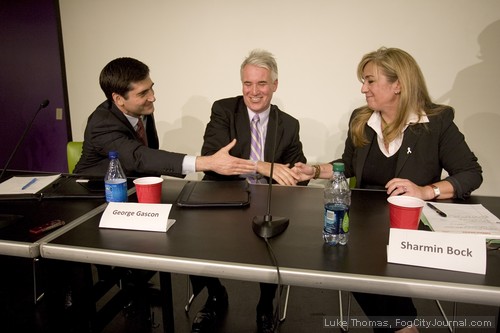
District Attorney and former SFPD Chief George Gascón, Alameda County Deputy District Attorney Sharmin Bock, and former San Francisco Police Commissioner David Onek all landed solid punches during a three-way District Attorney debate that was co-hosted by the San Francisco Young Democrats and the Alice B. Toklas LGBT Democratic Club, and moderated by Recorder editor Scott Graham. The primary sponsor of the debate was the City Democratic Club, according to CDC President Jim Reilly. So, thanks CDC for helping to pull off a great event.

The debate was framed as a choice between Bock, a veteran prosecutor with leadership experience, Gascón, a career cop with managerial experience, and Onek, a former San Francisco Police Commissioner and criminal justice reform expert. And above all it proved that if you lock three attorneys in the same room and pit them in a three-way fight, you’ll be rewarded with a blood sport spectacle.

Bock kicked off by noting that there are many similarities between the three candidates—except when it comes to independence and experience “Experience matters,” Bock said, throwing a one-two punch at Gascón and Onek. “The job of the District Attorney is not a management job, a police job or a job for someone with just a law degree. It needs a veteran prosecutor,” she said—remarks that resonated well with the crowd, judging from the applause.

But after a few niceties, Gascón shot right back at Bock and Onek. “I am the only one who has led large organizations and pushed public policy forward in an effective manner,” he said.

And Gascón struck a home run when he revealed that when he took the job of Chief of Police in Mesa, Arizona, he was “facing one of the most toxic environments” in terms of hatred towards people of color and the LGBT community–and that he did something about it, by standing up to anti-immigrant Sheriff Joe Arpaio of Maricopa County, and protecting the local LGBT community’s right to protest.

When it was his turn to speak, Onek fired off his own rounds at Bock and Gascón, noting that the state’s criminal justice system is broken—and claiming that it will take an outsider to fix it.
“This is a once-in-a-lifetime opportunity to reform the criminal justice system,” Onek said, laying out his reform-minded track record.

And then he stuck it to both Bock and Gascón by stating that the death penalty does not work. “I will never seek it in San Francisco under any circumstances,” Onek said, earning excited applause, as he noted that he’ll look at all policy question through the prism of three questions: ‘Does it make us safer, is it cost effective and is it fair and equitable?”

Onek also noted that neither the Supreme Court’s ruling that California must reduce its prison population by 30,000, nor Gov. Jerry Brown’s call for prisoner realignment, come with any money.
‘That’s a disaster,” observed Onek, as he stressed the need to demand resources to help deal with the upcoming load of prisoners that about to return to San Francisco.

Gascón fielded questions about whether they are enough people of color and LGBT background in management in the D.A.’s Office. “Well, I think there’s definitely always room for improvement in any organization,” he said, noting that he has a history in the Los Angeles Police Department, the Mesa, Arizona Police Department and the SFPD, “of pushing very aggressively to have diversity within the office.”
But he started a bit of a buzz when he said it was “really a surprise to me that I promoted the first male, black, police captain to the San Francisco Police Department.”
“You would think that there have been, you know, male African-Americans in that department for many years. It was hard for me to believe that actually in 2009 we had not had one,”  Gascón continued, a remark that got some debate observers asking afterwards, if this meant that Gascón really did not know that former SFPD Chief Earl Sanders was a black male.

Meanwhile, Bock was happily trampling all over the sit-lie legislation that then SFPD Chief Gascón and Mayor Newsom backed last fall, as she noted that more foot patrols and community policy are what’s actually needed. “Political hot-button measures don’t work,” Bock said. “Both sides agree it hasn’t worked. It’s the wrong response to the real problem.

Asked if he had a conflict of interest, when it comes to investigating allegations of police misconduct, Gascón claimed the problem is limited to a small number of officers, adding, “if the allegations are true.”

“In reality the majority of the SFPD are hard-working people doing the right thing,” he said. “And there has been only one challenge—and our office has prevailed,” Gascón said. “However, there have been a finite number of cases where I personally adjudicated the bad conduct—and those will be handled by the Attorney General’s office.”

Bock stressed that she was not in favor of sending drug offenders to prison and would focus on restorative justice, instead. Asked if she would have a panel on her staff review potential death penalty cases, Bock confirmed that she is committed to having a Special Circumstances Committee, as D.A. Kamala Harris did, to get input around the facts and from lawyers involved in such cases.“The ultimate decision is mine, and I oppose the death penalty,” Bock said, noting that she does not believe that 12 jurors will return a unanimous death penalty verdict. “But I do think as prosecutor you need to go case by case.”

Asked if he would have sought the death penalty in a case like the L.A. Night Stalker, who murdered 13 people, many of them elderly, Gascón said, “Probably not. All of us agree that the death penalty is not a good tool. But it is part of our system, and I continue to have the system Kamala Harris had in place. At the end of the day, it’s my decision, and I’m the only one in the room, who can say I’ve already turned down the death penalty.”

Agreeing with Bock that a jury is unlikely to go for the death penalty, Gascón maintained that the death penalty is “an illusory issue,” and that the real question is, “How do we rewrite the State Constitution [so the death penalty is not on the books]?”

Asked how he felt about marijuana, Gascón said he doesn’t believe folks should be incarcerated for use—and that folks are already being diverted to community courts in those instances.

But when Onek tried to wrap up by positioning himself as a the reformist-minded outsider, Gascón pounced, reminding folks that Onek was a Police Commissioner, when the Police Commission recommended Gascón to Mayor Newsom as the next SFPD Chief. “While David is someone I respect—and one of those who hired me, David has painted himself as an outsider, when the Police Commission is the policy-making body for the SFPD. There are no outsiders here. The question is, what have you done? There’s a difference between calling yourself a reformer and having other people call you a reformer.”

Bock for her part used her closing remarks to remind folks that there has been a crime lab scandal, alleged police misconduct, a DNA backlog, and about 100 cases dismissed as a result of these scandals, and a bunch of prisoners are about to be sent back to the community because of realignment. “We’re in challenging times, at a critical crossroads, with stormy weather ahead,” she said. “I’m not going to be trying things out at your expense. As a veteran progressive prosecutor, I’m fully prepared.”

A fountain of Penn

0

When Arthur Penn died at 88 last September, obituaries listing career highlights reinforced the notion that he was one of those directors — others include Mike Nichols and George Roy Hill — who were BFDs in the 1960s and ’70s yet rapidly faded from prominence thereafter. In Penn’s case the decline was especially steep, particularly given that during arguably the single most roiling period of change in mainstream American filmmaking, he was at the top of the heap in terms of prestige and thematic adventure.

Did he simply lose interest? Did some significant flops dishearten him? Whatever the cause, post-1976 his occasional films — he was never very prolific — became those of any competent journeyman whose projects seemingly picked him rather than vice versa. (Particularly dismaying was 1981 “turbulent ’60s” drama Four Friends, in which he reduced that era of his own greatest impact to stereotype-ridden soap opera.) After the respectable 1996 TV movie Inside, about apartheid, he never directed another feature.

The Pacific Film Archive’s June retrospective is titled “Arthur Penn: A Liberal Helping.” That moniker pays tribute to his lefty conscience, yet in another sense this assortment isn’t so liberal: there’s nothing here dating from after the 1976 Bicentennial Year, when both he made his last identifiably personal film and saw it widely trashed. (That would be The Missouri Breaks, a Jack Nicholson-Marlon Brando revisionist western that deserved better than it got but was doomed to ridicule by one of Brando’s deliberately bizarre later performances. Now, of course, that’s its major attraction.)

What we’ve got here is an extraordinary run: encompassing 1967’s Bonnie and Clyde, one of those movies that changed the movies in general; 1969’s counterculture pulse-taking Alice’s Restaurant; Little Big Man, the big-noise historical black-comedy literary adaptation (along with Nichols’ Catch-22) of 1970; and 1962’s The Miracle Worker, a joltingly good translation of the play he directed on Broadway. Even his commercial failures were exceptionally interesting, from 1958 film debut The Left Handed Gun (Paul Newman as Gore Vidal’s neurotic Billy the Kid) to 1965’s Mickey One (a dazzling, pretentious expressionist nightmare with Warren Beatty at its bewildered center) and 1975’s Night Moves (private eye Gene Hackman wading into a morass of Florida Keys corruption).

But there was a blot even during those glory days. In the mid-1960s the country was in thrall to civil rights struggles, and them “Hollywood liberals” duly responded. Penn’s 1966 The Chase was arguably the worst, most artificial “prestige” effort to deal with the issue this side of Otto Preminger’s 1967 Hurry Sundown, which humiliated Jane Fonda even more. (It has a scene in which she tries to arouse probably-gay Southern tycoon husband Michael Caine by fellating his saxophone.)

Hopes were high for a while, though. Adapting The Chase, Horton Foote’s 1952 Broadway failure about an escaped con settling a score with a Texas sheriff was no less than literary lioness Lillian Hellman, penning her first (and as it turned out, last) screenplay since being blacklisted as an alleged commie threat.

Everybody was excited about their involvement in the prestigious project, packed as it was with high-profile talent on and off-screen. (Besides Brando’s sheriff, Robert Redford’s fugitive, and Fonda as his pining ex-wife, the cast included E.G. Marshall, Angie Dickinson, Janice Rule, Miriam Hopkins, Robert Duvall, and James Fox.) Penn wanted to prove he could direct a large-scale commercial picture; Fonda to break away from sex-kitten roles; Redford to establish himself as a movie star; etc. All were thrilled about working with the exalted Brando, who badly needed a hit. He also strongly identified with the (initial) script’s potent commentary on civil rights struggles.

Like Foote before her, Hellman envisioned a taut, intimate drama about small-town tensions boiling over during one long night of drunkenness, bigotry, and violence. But this was, above all, a “Sam Spiegel Production.” And the notoriously egomaniacal, controlling, duplicitous producer (one colleague called him “a corkscrew … very effective … but twisted and bent”), hungry for more Oscar gold after a major roll encompassing The African Queen (1951), On the Waterfront (1954), The Bridge on the River Kwai (1957), Suddenly, Last Summer (1959), and Lawrence of Arabia (1962), kept pressing her to make it “larger.” He eventually brought other writers in to further tart things up.

As detailed in James Robert Parish’s book Fiasco: A History of Hollywood’s Iconic Flops, the steadily cheapening rewrites continued daily even after shooting commenced. Morale sank, with Brando the most conspicuous malcontent. (One scene he remained enthused about was his sheriff being badly beaten by local bigots — onscreen it’s as if the sleepwalking actor suddenly wakes up for a couple vivid minutes.) Penn clashed with the old-school cinematographer he hadn’t chosen. Adding insult to injury, Spiegel managed to exclude the director from the editorial process, insisting that the film be cut in London or Los Angeles while fully aware that Penn was stuck in New York City on a Broadway assignment.

The result was crude, inauthentic (it was shot in SoCal), stagey-looking, with variably laughable Texas accents and barn-door-broad sexual innuendos. Aiming for importance in the worst way imaginable, it instead recalls the lurid finger-waggling Southsploitation of such later non-triumphs as Shanty Tramp (1967), The Klansman (1974), Scum of the Earth (1963), Mandingo (1975), and (more recently) Hounddog (2007), albeit on a more grandiose scale. Embarrassingly, this movie about Southern prejudice and injustice kept any people of color waaaay in the background: its lone “noble Negro” was played by Joel Fluellen, billed 21st.

Reviews were scathing (“witless and preposterous drivel,” “a phony, tasteless movie”) and the expensive project tanked commercially as well. It also turned Spiegel’s luck for keeps: all his subsequent films were ambitious disappointments. Penn recovered, and then some — next stop, Bonnie and Clyde — but one suspects that he (or Foote, or Hellman, or Brando) never quite got over being so callously undermined and pushed around. For the next decade, at least, he made sure he’d never be in that kind of compromised position again.

ARTHUR PENN: A LIBERAL HELPING

June 10–29, $5.50–$9.50

Pacific Film Archive

2575 Bancroft, Berk.

(510) 642-5249

www.bampfa.berkeley.edu


OPINION: The “people’s seat” on the Police Commission

68

Editor’s note: School Board member Kim-Shree Maufas submitted this opinion piece on the upcoming Police Commission appointment.


On Friday, October 11, 2002, what began as an early morning school fight turned into a uniformed police officer-driven melee against students and teachers at Thurgoom Marshall High School. A total of 126 cops (some in SWAT/Riot gear) and sheriff’s deputites (tactical training was nearby) with firefighter and helicopter air support occupied the campus into the late afternoon.


That was so awful — but the real crime and shame for San Francisco was the subsequent behavior of the then Police Commission, which ignored hundreds of requests (delivered in writing and in person at commission meetings) for accountability, transparency, and reform to address ongoing police misconduct and bad practices so that San Francisco and its youth could actually feel safe and secure – not just from the criminals but from the city’s police force. 


I recall that one woman, who lived in Pacific Heights, asking the commission to “deal with what happened at that high school across town because we all want to know what happened.” 


After attending Police Commission meeting after Police Commission meeting with staff from the Ella Baker Center, Coleman Advocates for Youth and their Families and the ACLU of Northern California, the only response that I ever heard from that commission about the incident was: “We handle things in our own time.” 


These painful memories had me in tears as I walked home after attending the recent Board of Supervisor’s Rules Committee meeting on June 2, 2011, where I watched the recommendation for the board’s appointment to the commission go forward.


Back in October 2002, I was the Parent Teacher Student Association president at Marshall, my daughter was a student, and I suddenly thrust forward to a public podium over and over again to demand justice for our families … goodbye fundraising and bake sales.


My social justice journey to the Board of Education is closely tied to the 2003 Proposition H, the police reform measure that gave people a voice for reform and accountability by expanding the  Police Commission from five to seven, three to be selected by the Board of Supervisors and four by the mayor.  San Franciscans slapped the old Police Commission squarely in the face, screaming that the people MUST have a VOICE.


Because of what my family and countless others have been through and died for, I will forever consider the seats appoinnted by the board as “the People’s Seats for the People’s Voice,” meaning that those seats are for people who openly fight on behalf of disenfranchised community members, for people who stand as unashamed/outspoken advocates for common sense police policies and practices — and as seats for those who don’t get mayoral appointments because they’re a part of the in crowd.


On June 14, 2011, the entire Board of Supervisors will vote for the Police Commission appointment — and it doesn’t have to be the recommendation from the Rules Committee. The supervisors can take a different position – they can stand with the people on this one.


With all due serious respect to the other applicants, this opening on the Police Commission belongs to David Waggoner, who represents that “People’s Voice for the People’s Seat” — and I believe all those voters who reformed the commission in 2003 would say so too.


A rather odd endorsement

94

I got a press release today from the Dennis Herrera for Mayor campaign proudly announcing the endorsement of … Frank Jordan.


Jordan was mayor of San Francisco once. Back in the 1990s. His term ran from 1992 to 1996, and was, to be polite, mediocre. Nice guy; awful mayor. He was one of the more conservative mayors in memory, left office pretty unpopular, and a lot of people don’t even remember him. Those who do, particularly progressives, don’t remember him fondly at all.


Ah, but Herrera does.


“I’m deeply honored by Mayor Jordan’s praise for my leadership, and grateful for his endorsement for my mayoral candidacy,” said Herrera.  “Few can claim to have done as much to serve our City with such integrity, skill and courage as Frank Jordan.”


While Leland Yee is out trying to get support on the left, which might actually help him win, Herrera seems to be moving, if anything, to the right (which is what Jordan’s endorsement represents). Very odd. Very odd indeed.


I couldn’t reach Herrera today to ask him about it, but I’m sure he’ll call me and I’ll update this post. Meanwhile: WTF?  


UPDATE: I heard from Herrera late in the day. He told me that “there are only six people alive who have ever held the office of mayor of San Francisco and know what it’s really like to manage this city, and I would be proud to have the endorsement of any of them.” I asked: Including Willie Brown? Herrera: “He’s a columnist now so he doesn’t do endorsements.”


Herrera also pointed out, correctly, that he has the endorsement of Mike Hennessey, the progressive sheriff. And he’ll wind up with some more leftish endorsements, too. Still: Frank Jordan?

Ammiano’s TRUST Act passes the Assembly

10

Tom Ammiano’s TRUST Act (AB 1081) passed the California Assembly in a 47-26 vote. It now heads to the Senate for approval. Ammiano says his bill “seeks to repair the damaging impacts of the Immigration Customs Enforcement (ICE) Agency’s “Secure” Communities program.”  The feds’ Secure-Communities program, in which fingerprints taken in local jails are automatically shared with immigration enforcement officials, has increasingly been accused of undermining public safety without transparency or local oversight. Today’s vote came a year after San Francisco Sheriff Mike Hennessey blew the whistle on ICE’s plan to silently activate S-Comm in San Francisco. And it followed on the heels of a series of damaging revelations about how S-Comm has mostly resulted in the deportation of non-violent immigrants, and has led to complaints that local municipalities received confusing information about their participation options.


Following a request from Congressmember Zoe Lofgren and Sen. Robert Menendez, the Department of Homeland Security (DHS) Office of the Inspector General recently announced it will investigate questions about S-Comm’s success in meeting its stated criminal targets, and look into charges that misinformation was provided to states and localities about their ability to opt out. Earlier this month, llinois Gov. Pat Quinn tried to cancel his state’s participation in the program and the Congressional Hispanic Committee asked Obama to put a moratorium on the program.  


 “S-Comm is a farce,” Assemblymember Ammiano charged. “ICE misled local jurisdictions from the beginning and blurred the lines between law enforcement and immigration, striking unnecessary fear into innocent people’s lives. The TRUST Act is a practical solution that will re-build trust with our immigrant communities and by doing so will restore some balance to this dysfunctional and unjust program.”


Fatal stance

7

sarah@sfbg.com

Ever since Mayor Gavin Newsom appointed Police Chief George Gascón district attorney in January — when Gascón said he was “not categorically opposed to the death penalty and would consider it in appropriate cases” — capital punishment has become a big issue in a town where the last death penalty case was in 1989.

Gascón is running against former San Francisco Police Commissioner David Onek, who is the founding director of the Berkeley Center for Criminal Justice and has consistently promised since entering the race last summer that he will not seek the death penalty.

Both men also face a serious challenge from Alameda County Deputy D.A. Sharmin Bock, who opposes capital punishment but won’t categorically state that she would never seek it, as former DAs Kamala Harris and Terence Hallinan both did while running for office.

Bock said that Harris eventually formed a committee to review each capital case but never filed for the death penalty, including in the 2004 murder of San Francisco police officer Isaac Espinoza, the same approach Bock would take. But she doesn’t think it’s legally wise to make a categorical statement opposing the death penalty, saying it could be challenged in court, as some attorneys tried to do with Harris.

“But capital punishment is unjust, and can say that categorically,” she said.

In the week since Bock’s May 17 campaign launch, Gascón challenged her credibility on the issue by noting that Bock used the threat of the death penalty to secure a guilty plea from a sexual predator who tortured and killed women in Alameda County last year.

But Bock used that case to draw a distinction in their positions on the issue, telling us, “George Gascón says he’d use it for the most heinous cases, and I’ve seen the most heinous cases and I haven’t use it,” Bock said, emphasizing that she’s the only prosecutor in the race.

In a May 1 Chronicle op-ed, Gascón tried to neutralize Onek and those opposed to the death penalty by noting that he also has “serious misgivings” about capital punishment, including the potential for wrongful convictions, the disproportionate application on racial minorities, the roller-coaster the victims’ families endure as they wait decades for closure, and the financial impact on an already overburdened justice system.

But Gascón also tried to hide behind the “death penalty is state law” defense, even though prosecutors have extensive discretion in such matters. “Rather than refuse to enforce our laws, I believe the more appropriate approach is to accept the law and work to change it,” Gascón wrote. “I don’t believe district attorneys should be allowed to supplant the views of the state with those of their own.”

Bock criticized Gascón’s deferential stance, which was in sharp contrast to Sheriff Mike Hennessey, who recently announced that he will stop cooperating with federal immigration officials and start releasing undocumented immigrants jailed for minor offenses before they can be picked up for deportation, to comply with San Francisco’s sanctuary ordinance.

Gascón appeared to be trying to cast his position as a courageous stand. “Some have given me the political advice to simply say I will not seek the death penalty in San Francisco,” he wrote. “While I am not prepared to say that at this time, I can say that I do intend to be a district attorney committed to San Francisco values.”

And he promised that if he believes a case merits the death penalty, he would seek the advice and counsel of a panel of local prosecutors. “Ultimately, the decision will always rest on my shoulders, and it is a decision that I will not take lightly,” Gascón wrote.

But Onek accused Gascón of giving a politician’s answer. “Gascón is trying to have it both ways,” Onek told the Guardian. “The voters have the right to hear a clear answer to a fundamental question. And my answer is clear — I will not seek the death penalty in San Francisco and I will continue to work to change the law statewide. To me, it’s a yes or no question, and I won’t seek it. Period.”

Onek says his stance is informed by his belief that the death penalty solves nothing. “It doesn’t make us safer; it’s not fair and equitable; and it wastes enormous resources,” he said. “We are much better off spending our precious resources on things that actually make us safer, like more cops on the streets, more programs in our communities, and better services for victims.”

Gov. Jerry Brown made a similar comparison last month when he canceled a $356 million project for a new death row at San Quentin. “At a time when children, the disabled, and seniors face painful cuts to essential programs, the state of California cannot justify a massive expenditure of public dollars for the worst criminals in our state,” Brown said.

A recent David Binder research poll found 63 percent support statewide for commuting all of the 700 sentences of California’s death row inmates to life in prison without parole and requiring them to pay restitution to the victims’ families, while 70 percent of Bay Area voters support the plan, which would save the state $1 billion over five years.

At a May 18 panel discussion on the death penalty, Public Defender Jeff Adachi’s criminal justice summit offered panel moderator Matt Gonzalez, a chief attorney in Adachi’s office, a timely opportunity to grill Gascón about his death penalty stance.

“Folks felt it might be a step backward,” Gonzalez said, noting that former D.A. Terence Hallinan pledged not to seek the death penalty when he ran for reelection in 2000, and Harris followed suit when she first ran for district attorney in 2003. “So — are you pro death?” Gonzalez asked.

“No, but I am a public official,” Gascón replied, even as he repeated his misgivings about the death penalty, including the fact that 62 percent of those on death row are minority populations, especially from African American and Latino communities.

The panel also provided a chance to see Gascón debate exonerated death row inmate JT Thompson, watch American Civil Liberties Union of Northern California attorney Natasha Minsker explain why the death penalty system is dysfunctional, and witness former San Quentin prison warden Jeanne Woodford describe how the impacts of the four executions that she reluctantly oversaw motivated her to sign on as director of Death Penalty Focus, a nonprofit dedicated to abolishing capital punishment.

“Who is responsible for the prosecutors that go bad?” asked Thompson, an African American man who spent 14 years on death row in Louisiana, and another four facing life without parole, because a prosecutor suppressed exculpatory evidence.

“When I was sentenced to death in 1985, for a crime I didn’t commit, I thought this would be rectified right away. But it took 18 years, and I watched 12 inmates being executed while I was there,” Thompson said, noting that he was holed up 23 hours a day.

Gascón said he would terminate prosecutors who withheld exculpatory evidence, but said he didn’t know if he could charge them with murder.

Thompson, founder of the New Orleans-based nonprofit Resurrection after Exoneration, argued that the debate needs to be recast from its current public safety frame.

“People need to be asked, ‘Under what conditions do you support giving the state the right to kill you?’ ” Thompson said.

Woodford recalled how she got sick after the last execution she presided over. “I focused on what my responsibility was. But in hindsight, I realize it had had much more of an impact,” she said. “These executions happen in California at least 20 years after the crime. And they don’t bring victims back.”

Minsker noted that 16 states do not have the death penalty, and that every day brings people closer to ending the practice in California. “People once thought opposing the death penalty would end political careers, but Kamala Harris showed that it is no longer a liability,” she said.

Reached by phone after the debate, Onek said ending capital punishment makes sense morally and financially. “We would have $1 billion to invest in things that actually make us safer,” Onek said. “The D.A. is given discretion around requesting the death penalty, and I will use my discretion to reflect San Francisco values. That’s why people in the trenches working on these issues, including Jeanne Woodford, support me in this race.” 


Film Listings

0

Film listings are edited by Cheryl Eddy. Reviewers are Kimberly Chun, Michelle Devereaux, Peter Galvin, Max Goldberg, Dennis Harvey, Johnny Ray Huston, Louis Peitzman, Lynn Rapoport, Ben Richardson, and Matt Sussman. For rep house showtimes, see Rep Clock. For first-run showtimes, see Movie Guide.

OPENING

*Bridesmaids For anyone burned out on bad romantic comedies, Bridesmaids can teach you how to love again. This film is an answer to those who have lamented the lack of strong female roles in comedy, of good vehicles for Saturday Night Live cast members, of an appropriate showcase for Melissa McCarthy. The hilarious but grounded Kristen Wiig stars as Annie, whose best friend Lillian (Maya Rudolph) is getting hitched. Financially and romantically unstable, Annie tries to throw herself into her maid of honor duties — all while competing with the far more refined Helen (Rose Byrne). Bridesmaids is one of the best comedies in recent memory, treating its relatable female characters with sympathy. It’s also damn funny from start to finish, which is more than can be said for most of the comedies Hollywood continues to churn out. Here’s your choice: let Bridesmaids work its charm on you, or never allow yourself to complain about an Adam Sandler flick again. (2:04) Balboa. (Peitzman)

*The Double Hour Slovenian hotel maid Sonia (Ksenia Rappoport) and security guard Guido (Filippo Timi) are two lonely people in the Italian city of Turin. They find one another (via a speed-dating service) and things are seriously looking up for the fledgling couple when calamity strikes. This first feature by music video director Giuseppe Capotondi takes a spare, somber approach to a screenplay (by Alessandro Fabbri, Ludovica Rampoldi, and Stefano Sardo) that strikingly keeps raising, then resisting genre categorization. Suffice it to say their story goes from lonely-hearts romance to violent thriller, ghost story, criminal intrigue, and yet more. It doesn’t all work seamlessly, but such narrative unpredictability is so rare at the movies these days that The Double Hour is worth seeing simply for the satisfying feeling of never being sure where it’s headed. (1:35) Clay, Smith Rafael. (Harvey)

*Everything Must Go Just skirting the edge of sentimentality and banality, Everything Must Go aims to do justice by its source material: Raymond Carver’s rueful, characteristically spare short story, “Why Don’t You Dance?,” from the 1988 collection Where I’m Calling From. And it mostly succeeds with some restraint from its director-writer Dan Rush, who mainly helmed commercials in the past. Everything Must Go gropes toward a cinematic search for meaning for the Willy Lomans on both sides of the camera — it’s been a while since Will Ferrell attempted to stretch beyond selling a joke, albeit often extended ones about masculinity, and go further as an actor than 2006’s Stranger Than Fiction. The focus here turns to the despairing, voyeuristic whiskey drinker of Carver’s highly-charged short story, fills in the blanks that the writer always carefully threaded into his work, and essentially pushes him down a crevasse into the worst day of his life: Ferrell’s Nick has been fired and his wife has left him, changing the locks, putting a hold on all his bank accounts, and depositing his worldly possessions on the lawn of their house. Nick’s car has been reclaimed, his neighbors are miffed that he’s sleeping on his lawn, the cops are doing drive-bys, and he’s fallen off the wagon. His only reprieve, says his sponsor Frank (Michael Pena), is to pretend to hold a yard sale; his only help, a neighborhood boy Kenny who’s searching for a father figure (Christopher Jordan Wallace, who played his dad Notorious B.I.G. as a child in 2009’s Notorious) and the new neighbor across the street (Rebecca Hall). Though Rush expands the characters way beyond the narrow, brilliant scope of Carver’s original narrative, the urge to stay with those fallible people — as well as the details of their life and the way suburban detritus defines them, even as those possessions are forcibly stripped away — remains. It makes for an interesting animal of a dramedy, though in Everything Must Go‘s search for bright spots and moments of hope, it’s nowhere near as raw, uncompromising, and tautly loaded as Carver’s work can be. (1:36) (Chun)

Forks Over Knives Lee Fulkerson steps up as the latest filmmaker-turned-guinea-pig to appear in his own documentary about nutrition. As he makes progress on his 12-week plan to adopt a “whole foods, plant-based diet” (and curb his Red Bull addiction), he meets with other former junk food junkies, as well as health professionals who’ve made it their mission to prevent or even reverse diseases strictly through dietary changes. Along the way, Forks Over Knives dishes out scientific factoids both enlightening and alarming about the way people (mostly us fatty Americans, though the film investigates a groundbreaking cancer study in China) have steadily gotten unhealthier as a direct result of what they are (or in some cases, are not) eating. Fulkerson isn’t as entertaining as Morgan Spurlock (and it’s unlikely his movie will have the mainstream appeal of 2004’s Super Size Me), but the staunchly pro-vegan Forks Over Knives certainly offers some interesting, ahem, food for thought. (1:36) Bridge. (Eddy)

*Hesher See “Ride the Lightning.” (1:45) Embarcadero.

*Nostalgia for the Light Chile’s Atacama Desert, the setting for Patricio Guzmán’s lyrically haunting and meditative documentary, is supposedly the driest place on earth. As a result, it’s also the most ideal place to study the stars. Here, in this most Mars-like of earthly landscapes, astronomers look to the heavens in an attempt to decode the origins of the universe. Guzmán superimposes images from the world’s most powerful telescopes — effluent, gaseous nebulas, clusters of constellations rendered in 3-D brilliance — over the night sky of Atacama for an even more otherworldly effect, but it’s the film’s terrestrial preoccupations that resonate most. For decades, a small, ever dwindling group of women have scoured the cracked clay of Atacama searching for loved ones who disappeared early in Augusto Pinochet’s regime. They take their tiny, toy-like spades and sift through the dirt, finding a partial jawbone here, an entire mummified corpse there. Guzmán’s attempt through voice-over to make these “architects of memory,” both astronomers and excavators alike, a metaphor for Chile’s reluctance to deal with its past atrocities is only marginally successful. Here, it’s the images that do all the talking — if “memory has a gravitational force,” their emotional weight is as inescapable as a black hole. (1:30) Lumiere. (Devereaux)

Priest Paul Bettany stars as the titular vampire-fighter in this graphic novel adaptation. (1:27)

True Legend “Directed by Yuen Woo Ping” = high-flying martial arts galore. (1:56) Lumiere.

ONGOING

The Beaver It’s been more than 15 years since Jodie Foster sat in the director’s chair; she’s back with The Beaver, which tells the unique story of Walter Black (Mel Gibson), a clinically depressed man who struggles through his suicidal desires with the help of a beaver puppet. Walter uses the puppet — which he also voices — as a way of connecting with his family and the outside world. The film examines both the comedic aspects and the devastating reality of mental illness, and the script walks the line between dark and light — it’s the first feature from Kyle Killen, who created the critically adored but short-lived TV series Lone Star. The Beaver gets points for ambition, but it’s ultimately too all over the place to come together in the end. The moments of humanity are undercut by scenes of Walter and his wife Meredith (Foster) having sex with the puppet in the bed — intentionally funny, but jarring nonetheless. Still, Foster’s direction is solid and, for all its faults, The Beaver is a great reminder of Gibson’s legitimate talent. (1:31) SF Center, Sundance Kabuki. (Peitzman)

*Bill Cunningham New York To say that Bill Cunningham, the 82-year old New York Times photographer, has made documenting how New Yorkers dress his life’s work would be an understatement. To be sure, Cunningham’s two decades-old Sunday Times columns — “On the Street,” which tracks street-fashion, and “Evening Hours,” which covers the charity gala circuit — are about the clothes. And, my, what clothes they are. But Cunningham is a sartorial anthropologist, and his pictures always tell the bigger story behind the changing hemlines, which socialite wore what designer, or the latest trend in footwear. Whether tracking the near-infinite variations of a particular hue, a sudden bumper-crop of cropped blazers, or the fanciful leaps of well-heeled pedestrians dodging February slush puddles, Cunningham’s talent lies in his ability to recognize fleeting moments of beauty, creativity, humor, and joy. That last quality courses through Bill Cunningham New York, Richard Press’ captivating and moving portrait of a man whose reticence and personal asceticism are proportional to his total devotion to documenting what Harold Koda, chief curator at the Costume Institute at the Metropolitan Museum of Art, describes in the film as “ordinary people going about their lives, dressed in fascinating ways.” (1:24) Embarcadero. (Sussman)

*Cave of Forgotten Dreams The latest documentary from Werner Herzog once again goes where no filmmaker — or many human beings, for that matter — has gone before: the Chauvet-Pont-d’Arc Cave, a heavily-guarded cavern in Southern France containing the oldest prehistoric artwork on record. Access is highly restricted, but Herzog’s 3D study is surely the next best thing to an in-person visit. The eerie beauty of the works leads to a typically Herzog-ian quest to learn more about the primitive culture that produced the paintings; as usual, Herzog’s experts have their own quirks (like a circus performer-turned-scientist), and the director’s own wry narration is peppered with random pop culture references and existential ponderings. It’s all interwoven with footage of crude yet beautiful renderings of horses and rhinos, calcified cave-bear skulls, and other time-capsule peeks at life tens of thousands of years ago. The end result is awe-inspiring. (1:35) SF Center, Sundance Kabuki. (Eddy)

The Conspirator It may not be your standard legal drama, but The Conspirator is a lot more enjoyable when you think of it as an extended episode of Law & Order. The film chronicles the trial of Mary Surratt (Robin Wright), the lone woman charged in the conspiracy to assassinate Abraham Lincoln. It’s a fascinating story, especially for those who don’t know much of the history past John Wilkes Booth. But while the subject matter is compelling, the execution is hit-or-miss. Wright is sympathetic as Surratt, but the usually great James McAvoy is somewhat forgettable in the pivotal role of Frederick Aiken, Surratt’s conflicted lawyer. It’s hard to say what it is that’s missing from The Conspirator: the cast — which also includes Evan Rachel Wood and Tom Wilkinson — is great, and this is a story that’s long overdue to be told. Still, something is lacking. Could it be the presence of everyone’s favorite detective, the late Lennie Briscoe? (2:02) Embarcadero. (Peitzman)

Fast Five There are plenty of laugh-out-loud moments in Fast Five, in addition to a much demolition derby-style crunch — instances that stretch credulity and simultaneously trigger a chuckle at the OTT fantasy of the entire enterprise. Two unarmed men chained to the ceiling kick their way out of a torture cell, jump favela rooftops to freedom with nary a bullet wound in sight, and, in the movie’s smash-’em-up tour de force, use a bank vault as a hulking pair of not-so-fuzzy dice to pulverize an unsuspecting Rio de Janeiro. Not for nothing is rapper Ludacris attached to this franchise — his name says it all (why not go further than his simple closing track, director Justin Lin, now designated the keeper of Fast flame, and have him providing the rap-eratic score/running commentary throughout?) In this installment, shady hero Dominic (Vin Diesel) needs busting out of jail — check, thanks to undercover-cop-turned-pal Brian (Paul Walker) and Dominic’s sis Mia (Jordana Brewster). Time to go on the lam in Brazil and to bring bossa nova culture down to level of thieving L.A. gearheads, as the gearhead threesome assemble their dream team of thieves to undertake a last big heist that will set ’em up for life. Still, despite the predictable pseudo-twists — can’t we all see the bromance-bonding between testosteroni boys Diesel and Dwayne Johnson coming from miles of blacktop away? — there’s enough genre fun, stunt driving marvels, and action choreography here (Lin, who made his name in ambitious indies like 2002’s Better Luck Tomorrow, has developed a knack for harnessing/shooting the seeming chaos) — to please fans looking for a bigger, louder kick. (1:41) Empire, 1000 Van Ness. (Chun)

*Hanna The title character of Hanna falls perfectly into the lately very popular Hit-Girl mold. Add a dash of The Boys from Brazil-style genetic engineering — Hanna has the unfair advantage, you see, when it comes to squashing other kids on the soccer field or maiming thugs with her bare hands — and you have an ethereal killing/survival machine, played with impassive confidence by Atonement (2007) shit-starter Saoirse Ronan. She’s been fine-tuned by her father, Erik (Eric Bana), a spy who went out into the cold and off the grid, disappearing into the wilds of Scandinavia where he home-schooled his charge with an encyclopedia and brutal self-defense and hunting tests. Atonement director Joe Wright plays with a snowy palette associated with innocence, purity, and death — this could be any time or place, though far from the touch of modern childhood stresses: that other Hannah (Montana), consumerism, suburban blight, and academic competition. The 16-year-old Hanna, however, isn’t immune from that desire to succeed. Her game mission: go from a feral, lonely existence into the modern world, run for her life, and avenge the death of her mother by killing Erik’s CIA handler, Marissa (Cate Blanchett). The nagging doubt: was she born free, or Bourne to be a killer? Much like the illustrated Brothers Grimm storybook that she studies, Hanna is caught in an evil death trap of fairytale allegories. One wonders if the super-soldier apple didn’t fall far from the tree, since evil stepmonster Marissa oversaw the program that produced Hanna — the older woman and the young girl have the same cold-blooded talent for destruction and the same steely determination. Yet there’s hope for the young ‘un. After learning that even her beloved father hid some basic truths from her, this natural-born killer seems less likely to go along with the predetermined ending, happy or no, further along in her storybook life. (1:51) 1000 Van Ness, SF Center. (Chun)

Hoodwinked Too! Hood vs. Evil (1:25) 1000 Van Ness.

*Incendies When tightly wound émigré Nawal (Luba Azabal) dies, she leaves behind adult twins Jeanne (Mélissa Désormeaux-Poulin) and Simon (Maxim Gaudette) — and leaves them documents that only compound their feelings of grief and anger, suggesting that what little they thought they knew about their background might have been a lie. While resentful Simon at first stays home in Montreal, Jeanne travels to fictive “Fuad” (a stand-in for source-material playwright Wajdi Mouawad’s native Lebanon), playing detective to piece together decades later the truth of why their mother fled her homeland at the height of its long, brutal civil war. Alternating between present-day and flashback sequences, this latest by Canadian director Denis Villeneuve (2000’s Maelstrom) achieves an urgent sweep punctuated by moments of shocking violence. Resembling The Kite Runner in some respects as a portrait of the civilian victimization excused by war, it also resembles that work in arguably piling on more traumatic incidences and revelations than one story can bear — though so much here has great impact that a sense of over-contrivance toward the very end only slightly mars the whole. (2:10) Embarcadero. (Harvey)

*Jane Eyre Do we really need another adaptation of Jane Eyre? As long as they’re all as good as Cary Fukunaga’s stirring take on the gothic romance, keep ’em coming. Mia Wasikowska stars in the titular role, with the dreamy Michael Fassbender stepping into the high pants of Edward Rochester. The cast is rounded out by familiar faces like Judi Dench, Jamie Bell, and Sally Hawkins — all of whom breathe new life into the material. It helps that Fukunaga’s sensibilities are perfectly suited to the story: he stays true to the novel while maintaining an aesthetic certain to appeal to a modern audience. Even if you know Jane Eyre’s story — Mr. Rochester’s dark secret, the fate of their romance, etc. — there are still surprises to be had. Everyone tells the classics differently, and this adaptation is a thoroughly unique experience. And here’s hoping it pushes the engaging Wasikowska further in her ascent to stardom. (2:00) Opera Plaza. (Peitzman)

Jumping the Broom (1:48) 1000 Van Ness, Shattuck.

Last Night Married for three years and together “since college,” New York City yuppies Michael (Sam Worthington) and Joanna (Keira Knightley) have a comfortable, loving relationship, though it’s unclear how much passion remains. Still, it doesn’t take much for Joanna to bristle jealously when she meets Michael’s co-worker and frequent business-trip companion, Laura (Eva Mendes). As Michael and Laura flirt their way to an overnight meeting in Philly, Joanna runs into an old flame (Guillaume Canet); before long, it becomes a cross-cutting race to see who’ll cheat first. Writer-director Massy Tadjedin isn’t spinning a new story here — and though the film offers a sleek look at contemporary marriage, Last Night takes itself a tad too seriously, purporting to showcase realistic problems and emotions amid a cast beamed directly from Planet Gorgeous Movie Star. Beautiful people: they’re just like us? (1:30) Sundance Kabuki. (Eddy)

*Limitless An open letter to the makers of Limitless: please fire your marketing team because they are making your movie look terrible. The story of a deadbeat writer (Bradley Cooper) who acquires an unregulated drug that allows him to take advantage of 100 percent of his previously under-utilized brain, Limitless is silly, improbable and features a number of distracting comic-book-esque stylistic tics. But consumed with the comic book in mind, Limitless is also unpredictable, thrilling, and darkly funny. The aforementioned style, which includes many instances of the infinite regression effect that you get when you point two mirrors at each other, and a heavy blur to distort depth-of-field, only solidifies the film’s cartoonish intentions. Cooper learns foreign languages in hours, impresses women with his keen attention to detail, and sets his sights on Wall Street, a move that gets him noticed by businessman Carl Van Loon (Robert DeNiro in a glorified cameo) as well as some rather nasty drug dealers and hired guns looking to cash in on the drug. Limitless is regrettably titled and masquerades in TV spots as a Wall Street series spin-off, but in truth it sports the speedy pacing and tongue-in-cheek humor required of a good popcorn flick. (1:37) 1000 Van Ness. (Galvin)

*Meek’s Cutoff After three broke down road movies (1994’s River of Grass, 2006’s Old Joy, 2008’s Wendy and Lucy), Kelly Reichardt’s new frontier story tilts decisively towards socially-minded existentialism. It’s 1845 on the choked plains of Oregon, miles from the fertile valley where a wagon train of three families is headed. They’ve hired the rogue guide Meek to show them the way, but he’s got them lost and low on water. When the group captures a Cayeuse Indian, Solomon proposes they keep him on as a compass; Meek thinks it better to hang him and be done with it. The periodic shots of the men deliberating are filmed from a distance — the earshot range of the three women (Michelle Williams, Zoe Kazan, and Shirley Henderson) who set up camp each night. It’s through subtle moves like these that Meek’s Cutoff gives a vivid taste of being subject to fate and, worse still, the likes of Meek. Reichardt winnows away the close-ups, small talk, and music that provided the simple gifts of her earlier work, and the overall effect is suitably austere. (1:44) Opera Plaza. (Goldberg)

*My Perestroika Robin Hessman’s very engaging documentary takes one very relatable look at how changes since glasnost have affected some average Russians. The subjects here are five thirtysomethings who, growing up in Moscow in the 70s and 80s, were the last generation to experience full-on Communist Party indoctrination. But just as they reached adulthood, the whole system dissolved, confusing long-held beliefs and variably impacting their futures. Andrei has ridden the capitalist choo-choo to considerable enrichment as the proprietor of luxury Western menswear shops. But single mother Olga, unlucky in love, just scrapes by, while married schoolteachers Lyuba and Boris are lucky to have inherited an apartment (cramped as it is) they could otherwise ill afford. Meanwhile Ruslan, once member of a famous punk band (which he abandoned on principal because it was getting “too commercial”), both disdains and resents the new order just as he did the old one. Home movies and old footage of pageantry celebrating Soviet socialist glory make a whole ‘nother era come to life in this intimate, unexpectedly charming portrait of its long-term aftermath. (1:27) Balboa. (Harvey)

*The Princess of Montpensier Marie (Mélanie Thierry), the titular figure in French director Bertrand Tavernier’s latest, is a young 16th century noblewoman married off to a Prince (Grégoire Leprince-Ringuet) of great wealth and property. But they’ve barely met when he’s called off to war — leaving her alone on his enormous estate, vulnerable to myriad suitors who seem to be forever throwing themselves at her nubile, neglected body. Lambert Wilson (2010’s Of Gods and Men) is touching as the older soldier appointed her protector; he comes to love her, yet is the one man upstanding enough to resist compromising her. If you’ve been jonesing for the kind of lush arthouse period epic that feels like a big fat classic novel, this engrossing saga from a 70-year-old Gallic cinema veteran in top form will scratch that itch for nearly two and a half satisfyingly tragic-romantic hours. (2:19) Opera Plaza, Smith Rafael. (Harvey)

Potiche When we first meet Catherine Deneuve’s Suzanne — the titular trophy wife (or potiche) of Francois Ozon’s new airspun comedy — she is on her morning jog, barely breaking a sweat as she huffs and puffs in her maroon Adidas tracksuit, her hair still in curlers. It’s 1977 and Suzanne’s life as a bourgeois homemaker in a small provincial French town has played out as smoothly as one of her many poly-blend skirt suits: a devoted mother to two grown children and loving wife who turns a blind eye to the philandering of husband Robert (Fabrice Luchini), Suzanne is on the fast track to comfortable irrelevance. All that changes when the workers at Robert’s umbrella factory strike and take him hostage. Suzanne, with the help of union leader and old flame Babin (Gerard Depardieu, as big as a house), negotiates a peace, and soon turns around the company’s fortunes with her new-found confidence and business savvy. But when Robert wrests back control with the help of a duped Babin, Suzanne does an Elle Woods and takes them both on in a surprise run for political office. True to the film’s light théâtre de boulevard source material, Ozon keeps things brisk and cheeky (Suzanne sings with as much ease as she spouts off Women’s Lib boilerplate) to the point where his cast’s hammy performances start blending into the cheery production design. Satire needs an edge that Potiche, for all its charm, never provides. (1:43) Embarcadero, Smith Rafael. (Sussman)

Prom (1:44) 1000 Van Ness.

Queen to Play From first-time feature director Caroline Bottaro comes this drama about … chess. Wait! Before your eyes glaze over, here are a few more fast facts: it’s set in idyllic Corsica and features, as an American expat, Kevin Kline in his first French-speaking role. (Side note: is there a Kline comeback afoot? First No Strings Attached, then The Conspirator, and now Queen to Play. All within a few short months.) Lovely French superstar Sandrine Bonnaire plays Héléne, a hotel maid who has more or less accepted her unremarkable life — until she happens to catch a couple (one half of which is played by Jennifer Beals, cast because Bottaro is a longtime fan of 1983’s Flashdance!) playing chess. An unlikely obsession soon follows, and she asks Kline’s character, a reclusive doctor who’s on her freelance house-cleaning route, to help her up her game. None too pleased with this new friendship are Héléne’s husband and nosy neighbors, who are both suspicious of the doctor and unsure of how to treat the formerly complacent Héléne’s newfound, chess-inspired confidence. Queen to Play can get a little corny (we’re reminded over and over that the queen is “the most powerful piece”), and chess is by nature not very cinematic (slightly more fascinating than watching someone type, say). But Bonnaire’s quietly powerful performance is worth sticking around for, even when the novelty of whiskery, cardigan-wearing, French-spouting Kline wears off. (1:36) Opera Plaza, Smith Rafael. (Eddy)

Rio (1:32) 1000 Van Ness, SF Center.

Scre4m Back in 1996, Wes Craven’s Scream revitalized the slasher genre with a script (by Kevin Williamson) that poked fun at horror clichés while still delivering genuine scares. The sequels offered diminishing returns on this once-clever formula; Scream 4 arrives 11 years past Scream 3, presumably hoping to work that old self-referential yet gory magic on a new crop of filmgoers. But Craven and Williamson’s hall-of-mirrors creation (more self-satisfied than self-referential, scrambling to anticipate a cynical audience member’s every second-guess) is barely more than than a continuation of something that was already tired in 2000, albeit with iPhone and web cam gags pasted in for currency’s sake. Eternal Ghostface target Sidney Prescott (Neve Campbell) returns to her hometown to promote what’s apparently a woo-woo self-help book (Mad Men‘s Alison Brie, as Sidney’s bitchy-perky publicist, steals every scene she’s in); still haunting Woodsboro are Dewey (David Arquette), now the sheriff, and Gale (Courteney Cox), a crime author with writer’s block. When the Munch-faced one starts offing high school kids, local movie nerds (Rory Culkin, Hayden Panettiere) and nubile types (Emma Roberts, Hayden Panettiere) react by screening all seven Stab films, inspired by the “real-life” Woodsboro murders, and spouting off about the rules, or lack thereof in the 21st century, of horror sequels. If that sounds mega-meta exhausting, it is. And, truth be told, not very scary. (1:51) 1000 Van Ness. (Eddy)

Something Borrowed (1:53) 1000 Van Ness.

*Source Code A post-9/11 Groundhog Day (1993) with explosions, Inception (2010) with a heart, or Avatar (2009) taken down a notch or dozen in Chicago —whatever you choose to call it, Source Code manages to stand up on its own wobbly Philip K. Dick-inspired legs, damn the science, and take off on the wings of wish fulfillment. ‘Cause who hasn’t yearned for a do-over — and then a do-over of that do-over, etc. We could all be as lucky — or as cursed — as soldier Colter Stevens (Jake Gyllenhaal), who gets to tumble down that time-space rabbit hole again and again, his consciousness hitching a ride in another man’s body, while in search of the bomber of a Chicago commuter train. On the upside, he gets to meet the girl of his dreams (Michelle Monaghan) — and see her getting blown to smithereens again and again, all in the service of his country, his commander-cum-link to the outside world (Vera Farmiga), and the scientist masterminding this secret military project (Jeffrey Wright). On the downside, well, he gets to do it over and over again, like a good little test bunny in pinball purgatory. Fortunately, director Duncan Jones (2009’s Moon) makes compelling work out of the potentially ludicrous material, while his cast lends the tale a glossed yet likable humanity, the kind that was all too absent in 2010’s Inception. (1:33) 1000 Van Ness, Sundance Kabuki. (Chun)

Stake Land Not gonna lie — the reason I wanted to review this one was because of the film still in the San Francisco International Film Festival catalogue. Rotten-faced vampire with a stake through its neck? Yes, please! But while Jim Mickle’s apocalyptic road movie does offer plenty of gore, it’s more introspective than one might expect, following an orphaned teenage boy, Martin (Connor Paolo, Serena’s little bro on Gossip Girl), and his gruff mentor, Mister (Snake Plissken-ish Nick Damici), on their travels through a ravaged America. As books, films, and comics have taught us, whenever a big chunk of the human race is wiped out (thanks to zombies, vampires, an unknown cataclysm, etc.), the remaining population will either be good (heroic, like Mister and Martin, or helpless, like the stragglers they rescue, including a nun played by Kelly McGillis), or evil — cannibals, rapists, religious nuts, militant survivalists, etc. Stake Land doesn’t throw many curveballs into its end-times narrative, but it’s beautifully shot and doesn’t hold back on the brutality. Larry Fessenden (director of 2006’s The Last Winter) produced and has a brief cameo as a helpful bartender. (1:38) Roxie. (Eddy)

There Be Dragons (2:00) SF Center, Sundance Kabuki.

These Amazing Shadows If you love movies, it’ll be hard to resist These Amazing Shadows (subtitled “A story about the National Film Registry and the power of the movies”) — it’s chock full o’ clips from films that’ve been deemed worthy of inclusion in the National Film Registry’s elite ranks. This includes, of course, the likes of 1942’s Casablanca and 1939’s Gone With the Wind, but also more recent cultural touchstones like 1985’s Back to the Future and a number of experimental, short, and silent works, and even a few cult films too. Along the way film scholars and makers (including locals Barry Jenkins, Rick Prelinger, and Mick LaSalle) chime in on their favorite films and stress why preserving film is important. There’s a healthy dose of film history, as well, with mentions of groundbreaking director Lois Weber (one of early cinema’s most prolific artists, despite her gender) and a discussion of why racially questionable films like 1915’s The Birth of a Nation — a film that Boyz n the Hood (1991) director John Singleton recommended for Registry inclusion — are historically important despite their content. Dedicated film buffs won’t discover any surprises, and there’s not much discussion of queer film (unless John Waters talking about 1939’s The Wizard of Oz counts?), nor any mention of the current shift from film to digital formats (of course preserving old films is important, but will the Registry also start considering digital-only films for inclusion?) But perhaps these are topics for another film, not this nostalgia-heavy warm fuzzy that’ll affect anyone who remembers the magic of seeing a personally significant film — join the mob if it’s 1977’s Star Wars — for the first time. (1:28) Sundance Kabuki. (Eddy)

*Thor When it comes to superhero movies, I’m not easily impressed. Couple that with my complete disinterest in the character of Thor, and I didn’t go into his big-screen debut with any level of excitement. Turns out Kenneth Branagh’s Thor is a genre standout — the best I’ve seen since 2008’s Iron Man. For those who don’t know the mythology, the film follows Thor (Chris Hemsworth) as he’s exiled from the realm of Asgard to Earth. Once there, he must reclaim his mighty hammer — along with his powers — in order to save the world and win the heart of astrophysicist Jane Foster (Natalie Portman). Hemsworth is perfectly cast as the titular hero: he’s adept at bringing charm to a larger-than-life god. The script is a huge help, striking the ideal balance between action, drama, and humor. That’s right, Thor is seriously funny. On top of that, the effects are sensational. Sure, the 3D is once again unnecessary, but it’s admittedly kind of fun when you’re zooming through space. (2:03) Empire, 1000 Van Ness, Sundance Kabuki. (Peitzman)

Tyler Perry’s Madea’s Big Happy Family (2:00) 1000 Van Ness.

Water for Elephants A young man named Jacob Jankowski (Robert Pattinson) turns his back on catastrophe and runs off to join the circus. It sounds like a fantasy, but this was never Jacob’s dream, and the circus world of Water for Elephants isn’t all death-defying feats and pretty women on horses. Or rather, the pretty woman also rides an elephant named Rosie and the casualties tend to occur outside the big top, after the rubes have gone home. Stumbling onto a train and into this world by chance, Jacob manages to charm the sadistic sociopath who runs the show, August (Christophe Waltz), and is charmed in turn by August’s wife, Marlena (Reese Witherspoon), a star performer and the object of August’s abusive, obsessive affections. Director Francis Lawrence’s film, an adaptation of Sarah Gruen’s 2006 novel, depicts a harsh Depression-era landscape in which troupes founder in small towns across America, waiting to be scavenged for parts — performers and animals — by other circuses passing through. Waltz’s August is a frightening man who defines a layoff as throwing workers off a moving train, and the anxiety of anticipating his moods and moves supplies most of the movie’s dramatic tension; Jacob and Marlena’s pallid love story feeds off it rather than adding its own. The film also suffers from a frame tale that feels awkward and forced, though Hal Holbrook makes heroic efforts as the elderly Jacob, surfacing on the grounds of — what else? — a modern-day circus to recount his tale of tragedy and romance. (2:00) Empire, 1000 Van Ness, SF Center. (Rapoport)

*Win Win Is Tom McCarthy the most versatile guy in Hollywood? He’s a successful character actor (in big-budget movies like 2009’s 2012; smaller-scale pictures like 2005’s Good Night, and Good Luck; and the final season of The Wire). He’s an Oscar-nominated screenwriter (2009’s Up). And he’s the writer-director of two highly acclaimed indie dramas, The Station Agent (2003) and The Visitor (2007). Clearly, McCarthy must not sleep much. His latest, Win Win, is a comedy set in his hometown of New Providence, N.J. Paul Giamatti stars as Mike Flaherty, a lawyer who’s feeling the economic pinch. Betraying his own basic good-guy-ness, he takes advantage of a senile client, Leo (Burt Young), when he spots the opportunity to pull in some badly-needed extra cash. Matters complicate with the appearance of Leo’s grandson, Kyle (newcomer Alex Shaffer), a runaway from Ohio. Though Mike’s wife, Jackie (Amy Ryan), is suspicious of the taciturn teen, she allows Kyle to crash with the Flaherty family. As luck would have it, Kyle is a superstar wrestler — and Mike happens to coach the local high school team. Things are going well until Kyle’s greedy mother (Melanie Lynskey) turns up and starts sniffing around her father’s finances. Lessons are learned, sure, and there are no big plot twists beyond typical indie-comedy turf. But the script delivers more genuine laughs than you’d expect from a movie that’s essentially about the recession. (1:46) Lumiere. (Eddy)


 

Legal scholars weigh in on Secure Communities

5

In face of statements by Secretary of Homeland Security Janet Napolitano, three legal scholars in California have offered their opinions on recent developments surrounding immigration enforcement in California and “Secure Communities” (S-Comm) a program run by U.S. Immigration and Customs Enforcement (ICE) that automatically shares fingerprints at the point of arrest by local law enforcement.

Napolitano recently asserted that states and localities have no power to decide whether to participate in S-Comm, raising serious concerns about overreaching by the federal government and intrusion into local police power. In response, Aarti Kohli Director of Immigration Policy at the Warren Institute on Law & Social Policy at UC Berkeley’s law school, and law professors Hiroshi Motomura and Bill Ong Hing have weighed in on the growing controversy to provide, “accurate and important analysis on the legal terrain surrounding S-Comm.”

Kohli said that the reason academics are weighing in now is to point out that just because the federal government is asserting that it has certain authority doesn’t mean that’s the case, and that there are people who are interpreting the law differently.
“It’s not a cut and dry situation,” Kohli said of the federal government’s current position. “Strong arguments can be made that the federal government is overreaching.”

Kohli notes that at least 60 percent of the people who are currently in the country unlawfully entered the United States before 2000. “So, they have been here for over 11 years,” she said, noting that the last legalization opportunity for folks who entered unlawfully occurred in 1986. “So, you are talking 26 years ago,” she said, noting that there used to be many more options for people to adjust their status. “So, now you have people who have lived in the country for two decades who have not been able to legalize their status.”

Kohli observed that given the economic crisis, cooperating with the feds’ controversial “Secure Communities” program also becomes a question of priorities. “It becomes a question of where do you want to put your enforcement dollars,” she said, noting that state and local governments facing restraints in terms of jail space and resources. “So, does it make us safer to lock up low-level offenders, people who we would otherwise never dream of locking up, particularly in face of the constraints at the state and local levels?”

Initial research conducted by UC Berkeley’s Warren Institute’s indicates that S-Comm does implicate the use of local resources. 
“Data indicates that the majority of non-citizens who are booked into ICE custody through Secure Communities have been accused of low-level offenses, including traffic-related misdemeanors,” Kohli said in a press statement. “ Under typical circumstances, localities would allow low-level arrestees to post bond soon after an arrest.  However, if ICE issues a request for the local jurisdiction to hold the person, then bond is often denied and the person must remain in the local jail until the case comes before a judge.  Because of ICE holds, local jurisdictions use their own limited resources to feed, detain, and manage low-level offenders who would ordinarily not remain in custody.  All of this occurs before the person is even taken into custody by ICE.  Secure communities has resulted in a dramatic rise in ICE holds issued to local jails, thereby overburdening local law enforcement with the detention of those arrested on minor offenses who would not normally be held for extended periods.

Hiroshi Motomura, a law professor at UCLA, asserted that S_Comm undermines trust between local law enforcement and immigrant communities, may overstep the constitutional authority of the federal government to tell local governments how to run their police departments—and has a more basic flaw that has  policy and constitutional dimensions. “It is that the program delegates to local police the discretion to decide who—through stops and arrests—will be put into the immigration enforcement system, and who will not,” Motomura said in a press statement. “Even if the federal government retains the theoretical power to decide not to deport some non-citizens, local police will become the gatekeepers. As a practical matter, their decisions to arrest some residents but not others, to get tough with some neighborhoods but not others, will drive and direct federal immigration policy.  The constitutional command that U.S. citizenship is national citizenship means that immigration enforcement decisions can’t be left to local preferences—and local prejudices.  The local government proponents of opt-out aren’t arguing that they should be allowed to make immigration decisions.  Instead, they are arguing that no local officials should be allowed to make what must ultimately be national policy.”

And Bill Ong Hing, a law professor at the University of San Francisco reacted to ICE’s stated position that states and local governments must participate in S-Comm: “In the immigration field, the concept of preemption is an appropriate check on over-zealous local enforcement efforts that directly affect immigration regulation, while the Tenth Amendment is a check on federal intrusion on a local jurisdiction’s attempt to be more protective of individual rights and when the locality has a legitimate non-immigration-related purpose such as public safety,” he said. “The central teaching of the Tenth Amendment cases is that ‘even where Congress has the authority under the Constitution to pass laws requiring or prohibiting certain acts, it lacks the power directly to compel the States to require or prohibit those acts.’ Congress may not, therefore, directly compel states or localities to enact or to administer policies or programs adopted by the federal government. It may not directly shift to the states enforcement and administrative responsibilities allocated to the federal government by the Constitution. Such a reallocation would not only diminish the political accountability of both state and federal officers, but it would also ‘compromise the structural framework of dual sovereignty,’ and separation of powers. Thus, Congress may not directly force states to assume enforcement or administrative responsibilities constitutionally vested in the federal government.”

Ong Hing also noted that S-Comm’s current Memorandum of Agreement (MOA) between ICE and the State of California provides that it may be ‘modified at any time by mutual written consent of both parties. “The implication of this provision is clear: the terms of the MOA are negotiable,” he said

The trio’s move comes as local authorities in California and across the nation are increasingly turning against S-Comm, arguing that it overburdens local law enforcement with civil immigration enforcement, and results in high budgetary and social costs. 
Community advocates and several elected officials have already asserted that S-Comm harms community policing strategies by eroding trust between victims and witnesses of crime and police who fear immigration consequences. They cite examples of domestic violence victims in San Francisco and Maryland who have been placed in deportation proceedings after they called local law enforcement agencies for help.

In San Francisco, Sheriff Michael Hennessey has already asked to opt out of S-Comm because it casts “too wide a net”. Under the current program, S-Comm calls for fingerprinting and federal immigration database checks of arrestees, including those jailed for minor offenses like a broken taillight. And community advocates warn that the program can result in deportation without conviction or a trial. But the federal government has stated that only states can opt out. Last week, shortly after Illinois announced that it was pulling out of S-Comm, and a bill that Assemblymember Tom Ammiano authored, requiring the Attorney General to allow California counties to opt out of the program passed out of a committee, Hennessey announced that he will start releasing from jail undocumented immigrants who have been arrested for low-level crimes, even if federal officials notified through S-Comm’s fingerprint identification program request that they be held for deportation hearings.

Hennessey’s new policy is set to begin June 1. It means that undocumented immigrants arrested for petty crimes such as disorderly conduct, drunk in public or shoplifting will not be held in jail until ICE come to collect them. And it will make San Francisco the first California county to implement such a policy.

Hennessey explained that local jails are not required to hold inmates if ICE has identified them as undocumented, so sheriff’s deputies won’t be violating the law. Currently, sheriff’s deputies hold undocumented immigrants who have been booked for low-level offenses until ICE picks them up. But under the new policy sheriff’s deputies will release them with a citation as they do in cases involving U.S. citizens.

Hennessey, who is retiring and has endorsed Sup.Ross Mirkarimi in the race to replace him this fall, says the shift is intended to uphold the city’s sanctuary ordinance, which prohibits local officials from assisting ICE unless a felony crime is involved.

ICE’s own statistics seem to support Hennessey’s concerns: From June 2010 until February, 111 people that S-Comm identified were deported without being convicted in criminal court. 85 people who committed the lowest two levels of crimes were deported, plus 45 who committed felonies, including rape and assault.

But ICE spokeswoman Virginia Kice decribed Hennessey’s decision as “unfortunate”.
“ICE detainers are an effective tool to ensure that individuals arrested on criminal charges, who are also in violation of U.S. immigration law, are not released back into the community to potentially commit more crimes,” Kice said in a statement.

SF’s top cops differ on local control

7

The announcement by Sheriff Michael Hennessey that he won’t honor federal deportation holds for undocumented prisoners accused of low-level crimes is a great illustration of local control – which is the reason why we elect our sheriff and district attorney – but it is a concept that District Attorney George Gascon doesn’t seem to understand.

As the Guardian recently reported in a cover story by Sarah Phelan, Gascon ignored local control, civilian police oversight, and even standing police general orders as police chief by taking a highly deferential stance with the FBI and its domestic spying operations. Then, in a Chronicle op-ed on the death penalty last weekend, Gascon went even further in declaring himself to be merely a minion of higher government authorities.

While stating his opposition to capital punishment, Gascon said he wouldn’t rule out seeking the death penalty because he doesn’t think his own view or that of the vast majority of San Franciscans should determine his office’s actions. “I don’t believe district attorneys should be allowed to supplant the views of the state with those of their own,” he wrote.

That is a rather astounding statement that only an inexperienced prosecutor and an individual who has spent almost his entire career in the rigid hierarchies of police departments – rather than actually working as an attorney – would make.

“That’s where rookies make mistakes because they don’t have the experience to use their prosecutorial discretion,” said Sharmin Bock, a career prosecutor who works in the the Alameda County District Attorney’s Office, and who is running against Gascon (who did not return our calls for comment). “The DA has discretion over charging decisions and when you pick a DA it is for their discretion.”

For example, Bock cited the Three Strikes You’re Out law, which allows prosecutors to seek a sentence of 25 years to life even for the most minor crimes when they are committed by two-time felons. If all prosecutors used that full authority in every case, California’s severely overcrowded prison system would be even worse, which is one reason why prosecutors in places like San Francisco, Alameda County, and Los Angeles use their discretion and only seek Three Strikes sentencing standards for violent felons.

Similarly, in San Francisco, former DA Kamala Harris upheld her campaign pledge to never seek the death penalty, just as her predecessor Terence Hallinan used his prosecutorial discretion in dealing with local medical marijuana dispensaries or refusing to throw the book at those who committed low-level drug crimes.

Otherwise, the DA is nothing more than an administrative position, and San Francisco is forced to endure the same prosecutorial standards and values that are promulgated by intolerant conservatives from rural counties who have loaded up the Penal Code with costly and unjust new crimes and sentencing enhancements.

Hennessey understands that San Franciscans don’t want the same harsh treatment of our immigrant neighbors that the intolerant residents of Fresno, Orange, or Placer counties might demand. That why San Francisco’s elected officials made this a sanctuary city, and it’s why Hennessey told the Examiner, “I’m just doing our best to enforce local law. That’s my job.” But if Gascon thinks it’s his job to simply be an agent of the state and federal governments, perhaps San Francisco voters should cast their ballots accordingly.

Illinois pulls out of Secure Communities

16

As California considers reforming Secure Communities, Illinois announced today that it is terminating its involvement in the controversial federal immigration program. California and Illinois moves come in face of Washington D.C’s decision to opt out of S-Comm and Washington State’s refusal to participate. And they test ICE’s claims that the program is mandatory, as other states watch these developments.

(UPDATE: Yesterday, I erroneously reported that New York State had refused to participate in S-Comm.That is not the case. New York State does allow jurisdictions to participate, they have a MOA with ICE, and 8 more counties just joined. I confused NY with Washington State, which has refused to join.)

In a May 4 letter to Immigration and Customs Enforcement (ICE), Illinois Gov. Pat Quinn enclosed a notice from Illinois State Police (ISP) director Hiram Grau, notifying ICE that because of its indiscriminate use of the “Secure Communities” deportation program, Illinois is terminating the November 2009 S-Comm Memorandum of Agreement (MOA) between ISP and U.S. Department of Homeland Security’s ICE.”

“The stated purpose of the program, as set forth in the MOA, is to “identify, detain and remove from the United States aliens who have been convicted of ¬serious criminal offenses and are subject to removal (emphasis added), ICE’s statistics on the Secure Communities program, compiled through February 28, 2011, reveal that the implementation of the Secure Communities program in Illinois is contrary to the stated purpose of the MOA: more than 30 percent of those deported from the United States, under the program, have never been convicted of ¬any crime, much less a serious one. In fact, by ICE’s own measure, less than 20 percent of those who have been deported from Illinois under the program have ever been convicted of a serious crime.”

Quinn notes that on November 9, 2010, his office directed ISP to suspend S-Comm until a review of the program and its adherence to the MOA could be conducted. “Upon evaluation of data provided by ICE to the State of Illinois, conversations between ICE and members of my administration, and a new, proposed MOA from ICE, it’s clear that the conflict between the MOA as signed by ISP and ICE’s implementation of the program cannot be resolved to the State of Illinois’ satisfaction.”

“With this termination, no new counties in Illinois can be activated and those counties that were previously activated… must be deactivated and removed from the Secure Communities program,” Quinn concludes.

Illinois’ move comes as California Assemblymember Tom Ammiano’s Transparency and Responsibility Using State Tools (TRUST) Act passes out of the California Assembly’s Public Safety Committee, next stop appropriations. The TRUST Act would allow local governments to opt out of S-Comm or set standards for jurisdictions that chose to participate. Joining Ammiano as co-sponsors of the TRUST Act are Assemblymembers Gil Cedillo (D-LA) and Bill Monning (D- Carmel) and Sen. Leland Yee (D-SF). Endorsers include 80 organizations, local governments and elected officials, including the Santa Clara and Santa Cruz County Boards, San Francisco Sheriff Michael Hennessey, who blew the whistle on S-Comm in San Francisco a year ago, and has endorsed San Francisco Sup. Ross Mirkarimi in the sheriff’s race this fall, retired Sacramento Police Chief Arturo Venegas, and civil rights and faith groups, including the California Partnership to End Domestic Violence, the California Labor Federation, the San Bernardino Catholic Diocese and Equality California.

Advocates hope Ammiano’s TRUST Act will restore balance and accountability to the nation’s immigration system. They charge that S-Comm’s misleading focus, over-broad reach and lack of transparency have eroded trust between police and immigrant communities, making victims and witnesses to crimes reluctant to come forward.

The TRUST Act would make S-Comm an “opt-in” program so local governments can tailor their participation based on local needs.The bill would set safeguards for municipalities that do elect to participate in S-Comm to guard against racial profiling and would ensure that children and domestic violence survivors are not swept up by S-Comm. The TRUST act also upholds the right to a day in court by only reporting for deportation individuals convicted – not merely accused – of crimes.

These moves come fresh in the heels of Congressman Luis Gutierrez’s April 27 appearance in San Francisco, where he was joined by San Francisco Sups David Campos and John Avalos, and Board President David Chiu in asking President Obama for administrative relief from rapidly increasing deportations.
“We need to stop deporting parents and ripping apart all families, including same-sex partners, “ wrote Chiu, Campos and mayoral candidate Avalos. “We need to stop deporting students who would have been eligible for the DREAM ACT. Last year, the U.S. deported an estimated 400,000 immigrants, the highest number of deportations per year in the history of our nation. We must allow our counties to opt out of  “S-Comm” (Secure Communities), which is making our communities less secure, and we support Congressman Gutierrez in these courageous requests. Immigrants are part of the fabric of our communities, and we need to fix our immigration system so everyone who lives here can continue to live as a full member of society without constant fear of safety, security, and livelihood being jeopardized at any moment.”


Ross for boss (of the sheriff’s department)

3

City Hall’s steps were awash in multi-lingual black and yellow “Ross Mirkarimi for Sherrif” signs at noon today, as Mirkarimi supporters watched Sheriff Mike Hennessey, who is stepping down after 31 years of service and eight elections, endorse Sup. Mirkarimi as the next sheriff.  “New Leadership for a Safe San Francisco” was printed on the English version of the signs that Mirkarimi’s supporters carried. They included former Mayor Art Agnos, Sups. David Campos and Eric Mar, Tim Paulson of the Labor Council, Debra Walker, Linda Richardson, Sharen Hewitt, Terry Anders, and Mirkarimi’s partner Eliana Lopez and their almost two-year old son Theo. And everyone had plenty of great things to say about outgoing sheriff Hennessey and sheriff candidate Mirkarimi. And Hennessey even pinned a shiny toy sheriff’s badge onto the T-shirt of Mirkarimi’s son Theo, making him the happiest kid in town. At least for the day.

Campos kicked off the event by honoring Hennessey as the “most progressive and most effective sheriff in the country.”
“Mike Hennessey is also my neighbor in District 9. I see him taking out the trash so I know he’s a good neighbor,” Campos joked, as he listed the many achievements in Hennessey’s long career as an elected official in San Francisco. These achievements included Hennessey’s pioneering innovations in criminal justice and culminated in his decision to blow the whistle in 2010 on the federal government’s plan to activate its controversial Secure Communities program in San Francisco—without telling the public.
“He’s not afraid to stand up for what’s right,” Campos said.

‘This is the time for me to move on,” Hennessey announced, as he laid out his reasons for endorsing Mirkarimi as Sheriff, over other candidates in the field.
Hennessey described the Sheriff’s Department as a “large enterprise” that has over 1,000 employees, a $150 million budget and whose jail houses an average population of 2,000 folks in custody, on a daily basis.
“It’s not something that can be handled lightly,” Hennessey said. “That’s why I’m here to endorse Ross Mirkarimi as the next sheriff.”

Hennessey listed the many endeavors that he and Mirkarimi have worked closely on, including a number of criminal justice issues, and he cited Mirkarimi’s extensive law enforcement background, his significant legislative accomplishments in the areas of criminal justice and public safety, and his ability to find innovative solutions and overcome obstacles to progress, as reasons to support Mirkarimi.

Hennessey observed that criminal justice is “one of the thornier issues” that members of the Board of Supervisors are often asked to get involved in, but often duck.”But Ross has not shied away from working on them,” Hennessey said, citing Mirkarimi’s involvement in shaping the “No Violence Alliance Project” and his leadership in creating the Safe Communities Re-entry Council.

Hennessey also noted that in face of AB 109, the Governor’s plan to transfer state inmates to county jails, “it’s vitally important to have person in charge of sheriff’s office that understands these alliances and can make them work more effectively.”

Hennessey concluded by observing that the Sherrif’s Department has to deal with a lot of bureaucracy, so it’s important to understand how the Board, the budget process and other city departments, including the District Attorney’s office and the police, work.
‘And that’s why I’m endorsing Ross as Sheriff,” Hennessey said

Then it was the turn of Mirkarimi, who graduated from the San Francisco Police Academy, did Naval Reserve training and worked for more than 8 years as an investigator for the District Attorney’s office, to speak.

“I have never been at a loss for words,” Mirkarimi acknowledged, as he launched into a speech that began by thanking everyone for showing up at short notice “for one of the most important occasions of my political career.”

Mirkarimi did a great job of giving Hennessey the praise he deserves.
“He is a living legend,” Mirkarimi said. “It’s completely impossible to fill his shoes.”
Citing Hennessey’s integrity and his ability to innovate, Mirkarimi warned that, “Maybe it’s come to the point where we have taken him for granted. He’s the longest serving elected official in the history of San Francisco, and he’s probably the most understated.”

“And the most important endorsement in this race is that of Mike Hennessey,” Mirkarimi added, as he gave Hennessey his commitment “to build upon your legacy as effectively as possible.”

Mirkarimi cited some of the most immediate and serious challenges that face the next sheriff. These include AB 109, which Gov. Jerry Brown just signed, which. Mirkarimi said, threatens to increase the reentry prisoner level by 30 percent in California. “It will take creative ingenuity and resources to make sure we are effective in taking care of this population,” he said.

Mirkarimi also touched on the rising number of veterans that are ending up in the prison system, talked more about the No Violence Alliance Project, and suggested that certified deputy sheriffs could help serve warrants, transfer prisoners, and patrol Muni, “when the police department finds itself understaffed” so as to ensure that San Francisco is safe.

“For every four people arrested and jailed in San Francisco, three out of four are repeat offenders in a three-year period,” Mirkarimi warned, by way of explaining why he wants to advance a more collaborative spirit between SPPD and the Sheriff’s department.

Mirkarimi also noted that one out of every 15 African American males are in jail, at any time in the year, compared to I out of 300 males who are not black or brown. “So, we must step up our game in dealing with poverty,” he said, as he recommended increased access to job training and good jobs, “so work doesn’t become a seasonal hope but a permanent job.” He also made the connections between a lack of good housing, childcare, and schools and a rise in poverty, crime and recidivism.

Mirkarimi concluded by crediting Hennessey for “walking that fine pirouette” between upholding the principles of public safety and understanding the power of redemption at the same time.

I asked Sheriff Mike Hennessey what he considers to be the biggest challenges of running for sheriff/
“Letting people know what you are going to do, and what your issues are,” Hennessey said, noting that San Francisco has an intelligent, issues-driven electorate.

And Mirkarimi’s supporters weren’t shy about letting folks know the issues that the current D5 Supervisor has helped them with, over the years.

“Ross, as a supervisor and me, as someone who comes from a community of color, we know the habits that ex-offenders can bring with them, if there are no safety nets,” said Terry Anders who sits with Mirkarimi on the Safe Communities Reentry Council. “And I believe in what Ross stands for and the integrity of his person. He’s one of the first people to show up when there are crimes and victims, and he attends basketball games and boxing matches.”

Paulette Brown, whose son Aubrey Abraska Jr, was murdered in August 2006, but whose killers have still not been brought to justice.
“We shouldn’t have to run and leave our families, we should be protected,” Brown said. “Ross is my district supervisor and if he can get in, and do something about crime and solve unsolved homicides, then I’m for him. Maybe if he gets in, he’ll have more pull to do something about these unresolved cases.”

And then it was back to work, which for Mirkarimi now includes the somewhat daunting task of trying to raise money in an election year that also includes a mayor’s race, but does not include the help of public financing, at least not for the sherrif’s race….

Mirkarimi running for sheriff

27

OPINION Serving as San Francisco Sheriff is a huge civic responsibility. The sheriff has 1,000 employees, more than 2,000 pretrial and sentenced prisoners daily, and management responsibility for a budget of more than $150 million. And, like all department heads, the sheriff’s involved in a lot of politics.

I believe Sup. Ross Mirkarimi is the person best prepared to serve as San Francisco’s next sheriff.

Mirkarimi has the law enforcement experience of graduating from the San Francisco Police Academy (as class president) and more than eight years of on-the-job experience as an investigator for the San Francisco District Attorney. He was the lead investigator in one of the city’s all-time biggest white collar crime cases, against Old Republic National Title Insurance Company.

As a union labor representative in the D.A.’s office, he picked up some significant experience negotiating contracts for public safety personnel under the CALPERS retirement system.

He’s no stranger to the training and discipline of a paramilitary institution, having been certified in advanced environmental crime forensics from the Federal Law Enforcement Training Center in Glynco, Ga., as well as earning an honorable discharge from the U.S. Navy for serving in the reserves.

Equally important, Mirkarimi has demonstrated the progressive values required to maintain and expand San Francisco’s outstanding track record of diversity in hiring, innovation in criminal justice, and commitment to rehabilitation San Francisco deserves in our next sheriff.

Elected supervisor in 2004, and reelected in 2008 with 77 percent of the vote, Mirkarimi has been a very effective advocate for his district and for San Francisco — especially on public safety issues.

As a member of the Budget Committee for five years and twice chair of the Public Safety Committee, he is intimately familiar with the complicated issues confronting all partners in San Francisco’s criminal justice system, whose combined budgets account for well over $1 billion.

Mirkairmi and I have worked together on many criminal justice issues, including the creation of San Francisco’s Reentry Council and an innovative community-based program that provides case management services to ex-offenders who have a history of violence. That program — the No Violence Alliance — has significantly reduced recidivism among the program’s participants. It was a risky venture to take on violent offenders as a case management study, but both Mirkarimi and I felt that it was time San Francisco expanded its approach toward effective reentry.

It is this type of thoughtful, yet courageous approach to our criminal justice challenges that leads me to endorse Ross Mirkarimi to be my successor.

The San Francisco Sheriff’s Department has many difficult challenges ahead: a diminishing budget; the governor’s “prison realignment,” which will put many state prisoners in the county jail; preserving the jail’s rehabilitation programs; and finding cost-effective ways of managing the 40,000 individuals who come through San Francisco’s jails each year.

I believe Ross Mirkarimi brings the right combination of law enforcement training, legislative experience, and political acumen to meet these challenges. I am proud to support him in his bid to become our next sheriff.

Mike Hennessey is sheriff of San Francisco.