San Francisco

DA’s office makeover may have skirted the rules

In a San Francisco Chronicle article published March 31, District Attorney George Gascon was quoted as saying he would not “even bother to defend” his decision to accept payments and in-kind donations for office furniture, valued at $26,445, from a roster of influential donors.

Although San Francisco’s top law enforcement official minimized the issue when questioned by reporters, it appears the DA may not have followed a number of state disclosure regulations when he accepted and reported the donation, which consists of a new glass-top desk and other trimmings to spruce up his executive office and the DA’s victim services lounge.

And the Guardian has learned that a formal complaint will be filed with the California Fair Political Practices Commission, a government accountability agency, alleging violations.

Charles Marsteller, a public ethics advocate and former co-coordinator of San Francisco Common Cause, sent the Guardian a copy of a complaint he intends to file with the FPPC, charging that Gascon either failed to properly disclose political contributions, or violated a gift limit imposed by state law.

“The District Attorney appears to be actively disregarding the applicable state law regarding the furniture payments,” a statement attached to Marsteller’s complaint notes.

Thirteen well-connected donors contributed payments toward the office set, with billionaire angel investor Ron Conway outspending the rest with a monetary contribution just shy of $10,000.

Other contributors, who gave between $1,000 and $2,000, included the Nibbi Brothers Contractors, who have worked on public housing renovations and other residential housing projects within San Francisco; Victor Makras, a member of the San Francisco Employees Retirement System board; Pius Lee, who previously served on the Police Commission; Charlotte Schultz, who holds the position of San Francisco’s Chief of Protocol, and Ryan Brooks, who formerly served on the city’s Public Utilities Commission.

The kind of disclosure form Gascon filed to report the new furniture, known as a behested payment report, is filed in cases where an elected official solicits a donation to a nonprofit entity or a government agency, and successfully secures a payment exceeding $5,000. In the case of governmental agencies, behested payments benefit a department as a whole, rather than any particular individual.

The fact that the donation was reported on a behested payment report, rather than a gift disclosure form, suggests that the new office furniture arrived only after Gascon requested it specifically, to benefit the DA office as a whole. But Marsteller’s complaint charges: “Since the furniture payments at issue were made for the benefit of Gascon’s own use, they would not constitute a behested payment that must be reported on Form 803.”

The complaint goes on to state that payments for Gascon’s furniture should either be counted as “contributions” or “gifts,” but not “behested payments.”

According to a memo prepared by the San Francisco City Attorney in 2008, department heads must obtain Board approval before accepting donations made to public agencies.

“Generally, the Board of Supervisors must approve, by resolution, any gift with a value greater than $10,000 before a City agency or department accepts such a gift,” according to a 2008 memo drafted by San Francisco Deputy City Attorney Jon Givner. The total value of the new office furniture is $26,445, but the funding was divided up among numerous donors, with payments submitted over the course of several months. Conway contributed $9,999 – exactly one dollar under the $10,000 disclosure threshold.

However, Gascon did not solicit Board approval before accepting the furniture payments. Instead, he submitted a resolution and memo to the Clerk of the Board on March 19, to be introduced at the April 2 Board meeting, seeking retroactive approval.

“Apparently, Gascon decided that he should seek to sanitize any violation of San Francisco’s Charter provision regarding acceptance of gifts by requesting retroactive approval,” Marsteller’s complaint suggests.

Reached on his cell phone and asked to comment for this story, Gascon told the Guardian that he was unable to answer questions at that time because a family member was undergoing surgery.

The 2008 memo from the City Attorney also states that city agencies “must report gifts worth more than $100 on the department’s website.” Visitors to the DA’s website will find a section on the “About” page, titled “Supporters of the San Francisco District Attorney’s Office,” which links to a PDF disclosing the donors’ names and individual gift amounts. However, a search on the Wayback Machine, a historical webpage snapshot service provided by the Internet Archive, shows that as of March 12, that disclosure section had not yet been created.

It’s possible that it was created as a result of questions raised. Larry Bush, who maintains a government watchdog news site called CitiReport, told the Guardian he began raising questions about the gift in March. Marsteller’s complaint is endorsed by Friends of Ethics, an ad hoc government accountability group that has also been scrutinizing the furniture payments.

Reached by phone, City Attorney spokesperson Matt Dorsey said he was unable to offer an official comment on the matter. “I wouldn’t be able to comment on, or even acknowledge whether, we gave advice or were asked for advice,” Dorsey told the Guardian.
Wiener to star in porn flick

22

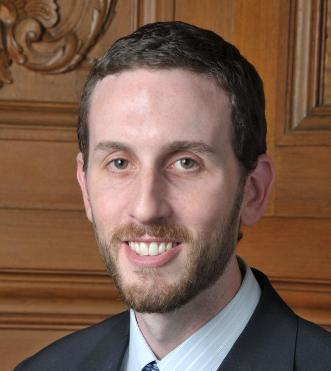
Supervisor Scott Wiener has signed a contract to star in a new porn film satirizing the city’s ban on nudity.

Variety reports that Wiener accepted a deal “in the mid three figures” to play the fictitious Supervisor Scott Cox in “Cover Up,” a film by the legendary Naked Sword productions.

Wiener replaces porn star Dale Cooper, who has left the film “to pursue other interests.”

The film, shot on location in the Castro, would violate the ban on public nudity that Wiener sponsored – but since the producers obatined permits, Wiener said, wieners are permitted.

“Besides,” he told us, “penises and anuses and perineums are good for business. And what’s good for business is good for San Francisco.”

Wiener, who is exceptionally tall and shuns the dating scene, said he expects his appearing in the film to jump-start his sex life. “A six-foot-six naked guy is, well, a six-foot-six naked guy, if you know what I mean,” Wiener told us. “And I think you do,” he added with a giggle.

Outtakes will soon be available at sfgov.org/nakedsupervisorwiener.

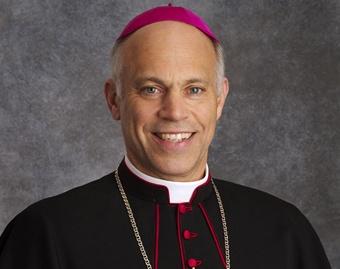
Archbishop announces nuptials

1

San Francisco Archbishop Salvatore Cordileone announced today that he would wed his longtime lover, Lupe, a tennis pro at the Bay Club.

“It will be a simple ceremony, as befits two humble servants in the eyes of our Lord,” George Wesolek, spokesman for the Archdiocese of  San Francisco, told us.

The marriage will take place in Connecticut, because same-sex nuptials are not at this point legal in California, Wesolek said. “Jesus casts a wide net, and we are happy to be able to include the Nutmeg State as part of our sister congregation — not that we are really sisters, which might suggest some sort of incest, which would be a sin,” he noted.

Cordileone has been an outspoken foe of same-sex marriage and has repeatedly argued that sex should only occur as part of  a procreative plan.  But Wesolek said the Catholic Church, which once sold tickets to free souls from purgatory and collaborated with the Nazis in World War II, has a history of moral flexibility.

“Plus, Lupe has a really cute ass,” he said.

 The couple plans to honeymoon in Argentina.

SFBG.com to start charging for “premium content”

9

This will be the last day you can read this blog for free.

To reflect the changing environment of the new business, the SF Bay Guardian will begin instituting a $27-a-day paywall April 2, in what Managing Editor Marke B said was an attempt “prevent any sane person from actually reading this stuff.”

The site known as sfbg.com will remain in place, and remain free, but all content will be removed except for the comments of Lucretia Snapples and a selected number of “guests,” whose extensive contributions the Bay Guardian hopes to spin off as another packaged product in the coming months.

All staff-written content will now be available at sfbayguardiancostsalotofmoney.com. Except for Marke B.’s own Super Ego nightlife column, since no one really knows what the hell she’s jabbering on about anyway except teenagers, and teenagers don’t pay.

The idea of newspaper paywalls is spreading, with the San Francisco Chronicle creating one just this month. “We’re, frankly, just copying the Chron,” Bieschke, who also oversees Web operations, said. “If there’s nothing in one place and something somewhere else, and nobody knows which is where or why, then it only makes sense to charge a lot of money so the traffic will all go away and I can take a goddamn nap after yesterday’s all-nighter.

“Anyway, I say let the interns handle it.”

Lyft to take on Muni routes

37

In an announcement that could transform transportation policy in San Francisco, the startup company Lyft is prepared to take over some of the most crowded and dysfunctional Muni routes in San Francisco.

Mayor Ed Lee and the Municipal Transportation Agency have approved a plan that would turn the 38 Geary, 30 Stockton, and 14 Mission over to the tech startup, City Hall sources told us. The plan is still tentative and the Mayor’s Office is trying to keep it tightly under wraps until the financial details are complete.

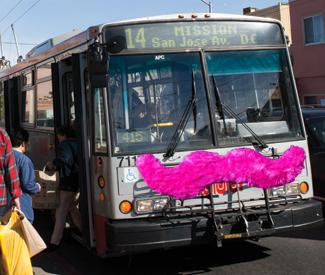
However, documents provided to the Guardian show that Lyft would buy at least 68 buses, including 12 articulated vehicles, at a price still to be negotiated. In exchange, the city would give the company – known for its pink mustaches on illegal taxi cabs – exclusive rights to operate on the heavily-used lines.

Lyft is developing an  app that would allow customers not only to view approaching buses but to book specific seats for an additional  price. Sensors in the bus seats will emit an electronic buzz to alert passengers that their seats had been purchased by someone else, warning them to vacate by the next stop. If the passengers remain, they will feel a sharp electric shock.

Lee’s office said the plan is similar to the market-based parking-meter program that raises the price of a space in times of heavy demand.

“The free market solves so many problems,” Christine Falvey, spokesperson for Lee, told us. “And it’s pretty clear that too many people who don’t really need to sit down or who are perfectly capable of waiting for a later conveyance are taking up space on the most crowded buses.”

Ron Conway, the venture capitalist who is Lee’s closest ally in the business community, will invest as much as $40 million in the new venture, Silicon Valley sources say.  If the trial public-private partnership works, he’s prepared to raise money to buy out Muni and turn the city’s bus system into a private operation.

“You’ve got a captive market, and demand-based pricing is what’s happening these days,” Falvey said.  “It’s just the next step.”

Foxygen works its uncanny magic at Brick and Mortar Music Hall

0

I experienced a strange phenomenon in the few days leading up to Tuesday’s sold out concert at Brick and Mortar Music Hall. The first in a series of strange events occurred in a coffee shop. I overheard one barista say to another, “Put on that Foxygen song.”

“Who?” she asked.

“It’s like ‘oxygen’ but with an ‘F.’”

The next day, one of my favorite websites listed Foxygen’s “Shuggie” as the “Song of the Day,” and later that evening, a friend mentioned the band in a conversation that had very little to do with music.

These coincidences probably mean nothing other than the fact that the band, whose second album, We Are the 21st Century Ambassadors of Peace & Magic, came out in January, are taking off. But I found something strange in the repetitions, maybe a reflection of the fact that there seems to be a certain uncanniness to Foxygen in the first place.

http://www.youtube.com/watch?v=KtdWGGpvY1s

At first listen, the band struck me as an almost unsettling echo of classic psychedelic rock. Even the album title bears striking resemblance to the names of 45-year-old concept albums such as The Kinks are the Village Green Preservation Society and Sgt. Pepper’s Lonely Hearts Club Band. And the parallels to the Kinks and the Beatles do not stop there. “San Francisco,” with its sparkling circus instrumentals and soft tinny vocals sounds like any song off of Village Green, and a line about introductions in the album opener “In The Darkness” feels like a direct nod to the album opener of Sgt. Pepper’s.

And while this makes for a pleasant listening experience – who doesn’t want more of the Kinks and the Beatles? – I found the derivativeness slightly problematic.

As soon as the band came onto the small stage at Brick and Mortar, though, that didn’t matter. Wearing embroidered frocks, suede coats, and ruffled blouses, costumes to complement the sound, the band played through a long set that, for all of its performative aspects, never felt forced. Each tune, from the feverishly noisy title track to the wistful “No Destruction,” poured out of the five-member band with ease.

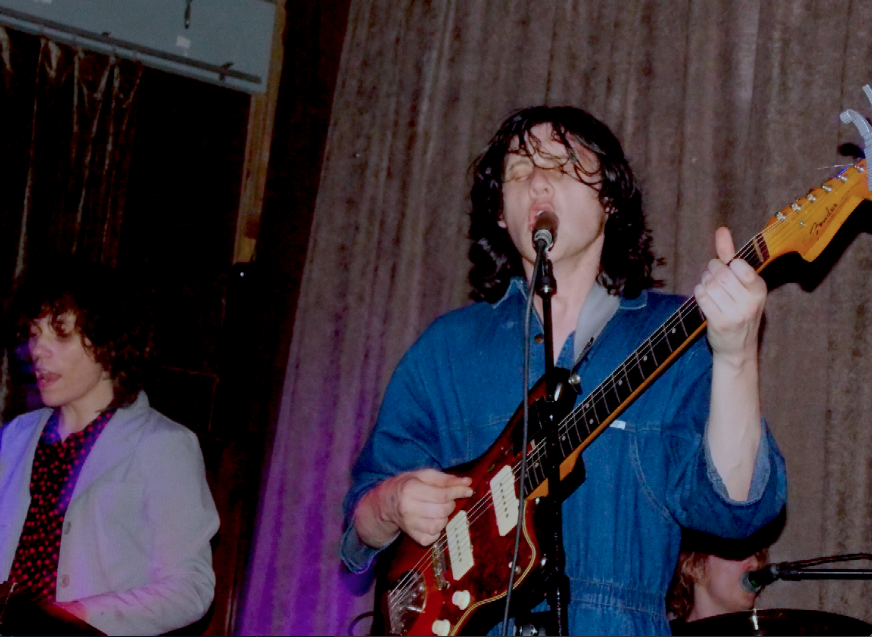
Sam France, the diminutive frontperson, is a rockstar from a bygone era. Within the first few songs he had descended into the audience, shed his fur-lined coat to reveal a jean jumpsuit, and invited us all bowling. With beady eyes that shifted their focus in a manner reminiscent of the quietly plotting villain in any psychological thriller and fingers that moved as if he was casting a spell, he exhibited an oddly magnetic breed of charisma. And he had done all this while showing expert vocal range and control. He had the unique ability to sound both like Lou Reed to Nico.

And although the band’s music and style would seemingly make them untouchable, the venue and the familiarity on stage gave the performance an air of intimacy. While France’s swagger commanded the show, Jonathan Rado, with whom France formed the first incarnation of the band at age 15 (seven years ago – these guys are young), played a quietly endearing counterpart. Their interactions, including Rado muttering “asshole” into his mic, reminded us that though they perform like rock stars, they’re also kids that want to have a good time. And that kind of fun is contagious.

At the end of the night, Rado thanked the audience. “We have so many friends here,” he said and then corrected himself. “I mean, you’re all our friends.” And, with the help of that uncanny magic that seems to characterize the group, that felt true; for reasons that go beyond its restitching of classic rock, Foxygen feels like a band you’ve known and loved for a long time.

Privacy and electronic tolls on the Golden Gate Bridge

Now that human toll collectors have vanished from the Golden Gate Bridge, motorists can expect their license plate numbers to be recorded for fare collection. Yet one aspect of this shift to receive little ink in recent media reports is the privacy implications of the new electronic system.

Slowing without stopping may improve traffic flows, but it also means motorists’ movements are tracked by default. Databases logging bridge-crossings can be mined for information: Subpoenas for FasTrak and similar electronic toll collection systems are on the rise, even for purposes such as divorce cases.

As the Electronic Frontier Foundation’s Senior Staff Technologist Seth Schoen noted in a recent blog post: “All of the bridge’s electronic payment options track the identities of those paying the toll, and all represent a loss of privacy for visitors or commuters entering San Francisco by car.” (Full disclosure: Schoen is a friend and former coworker.)

As the Wall Street Journal noted last year, it’s part of a wider trend of privacy erosion: “Storing and studying people’s everyday activities, even the seemingly mundane, has become the default rather than the exception.”

To weigh your bridge-crossing options from a privacy perspective, read Schoen’s full blog post here.

Bow down to the robo-proletariat!

0

 
Radically refashioning a host of reactionary fashions, La Pocha Nostra Live Art Laboratory puts all borders up for grabs. The international performance art troupe returns to San Francisco Sat/30 for the US premiere of La Pocha Nostra’s latest creation, Corpo Insurrecto 3.0: The Robo-Proletariat.
 
A performance project by Guillermo Gómez-Peña, Roberto Sifuentes, and Erica Mott (with LPN associates Brittany Chavez, Rico Martin, Marcos Nájera, Esther Baker Tarpaga, and Allison Wyper), Corpo Insurrecto 3.0: The Robo-Proletariat asks the time-old question: What might you discover at the intersection of “an aging deviant shaman, a Neo-Aztec priest making romantic religious tableaux with a goat, a flamenco drag king, and an Oil Spill Madonna”?


 Audience members are invited to help figure this one out, in corporeal dialogue with the performers, in what LPN calls a “wonderfully clumsy but efficient form of radical democratic practice.” The piece will also be an exactingly strange multidisciplinary exploration of the forms ideology and power take on and through the body. LPN’s exuberant Chicano cyborg/cyberpunk sensibilities brilliantly limn the boundary lines defining the (secretly amorphous) “truths” and “identities” of masscult’s virtual reality show — those hipster beards concealing the voracious colonial maw of capitalist society.
 
In related news: In coming back from Mexico City to home-base San Francisco, LPN’s artistic director — artist/intellectual and border-crosser extraordinaire, Gómez-Peña — returns too from the border town of illness, from whence he is steadily extricating himself and about which he has written powerfully and eloquently here.

Corpo Insurrecto 3.0: The Robo-Proletariat

Sat/30th, 8pm, $15-20

435 23rd St, SF

http://theperformanceartinstitute.org, www.brownpapertickets.com/event/350355


Airbnb’s tax and tenant law violations headed for hearings

80

As Airbnb continues to avoid making any public comment on the $1.8 million annual Transient Occupancy Tax obligation to the city that it appears to be dodging, with the complicity of the Mayor’s Office, Board of Supervisors President David Chiu is getting closer to introducing legislation to regulate so-called “shared housing” and holding public hearings on the issues it raises.

In addition to the tax issue, there are concerns that Airbnb, VRBO.com, and other Internet-based sites that facilitate short-term rentals of San Francisco apartments are increasingly being used to circumvent local tenant protections, often after evicting tenants from the apartments using the Ellis Act. That state law allows owners to leave the rental business and convert to other uses, and landlords can argue that Airbnb is a commercial use and not a residential use.

“I’ve been deep into a lot of these issues in my conversations with a lot of community stakeholders around Airbnb and the area of shareable housing and I’m hoping very soon to have a package of proposals in this area. And at that point, we’ll have public hearings on the topics that you describe,” Chiu told us when we asked about the tax and tenants issues.

Among those involved in Chiu’s negotiations with Airbnb is Ted Gullicksen, executive director of the San Francisco Tenants Union, who says the negotiations have been slow-going but he’s generally happy with how they’re proceeding and hopeful that the resulting legislation will rein in rampant current abuses of zoning, tax, and other regulations that city officials have been ignoring.

“All you have to do is sit in front of the computer for a few hours and you can identify a lot of the lawbreakers. But there’s no enforcement by the city,” he said, noting that the Tax Collector’s Office is the notable exception among city departments, such as the Planning and Building departments. “The taxes shouldn’t even be an issue because they’re illegal uses.”

For example, while landlords may be able to get around rental restrictions triggered by an Ellis Act eviction by calling the use for shared housing websites “commercial,” that’s usually a violation of local planning codes prohibiting commercial use of residential property. Chiu’s legislation approved late last year banning “hotelization,” in which entire apartment buildings are cleared of tenants and rented out on a short-term basis, allows nonprofit groups like the Tenants Union to help enforce the ban.

“We’ve been researching the buildings we want to go after with complaints and lawsuits,” Gullicksen said. “It’s a pretty widespread problem.”

He said the VRBO.com appears to be a bigger culprit in terms of being used by landlords to avoid tenant protections than Airbnb, whose hosts are evenly split between tenants and landlords. But as the biggest shared housing service in San Francisco, the tax issues are bigger for Airbnb and the city.

“We don’t mind the limited use of someone’s principal residence for short-term rental, where we’re concerned is about the whole buildings,” Gullicksen said.

Whether the issue is avoiding taxes or circumventing tenant protections, the complicated issues surrounding shared housing are long overdue for some public discussions and scrutiny, and it sounds like that’s what we’re see later this spring or summer.

Reagan’s legacy: Homeless death

130

The headline on sfgate is about as brutal as you can get: “The coming homeless die-off.” But the brief story points to an alarming set of statistics: The median age of homeless people on the streets of US cities is now 53. The life expectancy for homeless people is 64. You get the point.

But here’s the key political element:

Social scientists say the median age has been steadily increasing for many years, supporting the “big bang” theory that many of today’s street people hit the gutter back in the 1980s era of recession and slashings of social programs.

Having lived through the Reagan Era, and worked with homeless people in the early 1980s at the Haight Ashbury Switchboard, I can tell you that makes perfect sense. Vast libraries of books have been written about the Reagan Era, but one of the things it represented was the end of major federal support for low-cost housing in cities — and the end of any concept of linking welfare payments to the cost of housing.

There were a lot of people living on General Assistance and SSI in San Francisco in the late 1970s, and most of them had homes. That’s because public assistance programs provided enough income to cover the rent on a cheap place. Between GA and food stamps, people who were, for whatever reason, unable to work wound up in crappy apartments and sometimes crappier SROs, but they weren’t on the streets.

Yes: Some of those people had serious substance-abuse issues. Yes: SSI and GA checks were going, in part, for drugs and booze. But even ignroing the notion that it’s much better for a drunk to have an SRO room than to be homeless, it’s also cheaper. San Francisco spends a fortune on homeless services, and if the feds (and the City and County) had indexed public assistance to the cost of housing (which happened pre-Reagan) the toll on the local taxpayers would almost certainly be lower.

So Reagan’s policies are now killing people on the streets of San Francisco. All these years later.


Heartless Bastards’ Erika Wennerstrom on breaking writer’s block with travel

0

It seems like the Austin-based Heartless Bastards have made some drastic changes since the release of their debut album, Stairs and Elevators, shedding their punkish irreverence in favor of more candid Americana as illustrated in Arrow, their 2012 Jim Eno-produced release.

I caught up with frontperson Erika Wennerstrom before the band’s Great American Music Hall show this weekend, amid a van ride from Tucson to California to chat about her quartet’s ever-changing sound, her favorite SF food, Neil Young, and Arrow’s traveling backstory:
 
SFBG How do you think your sound has changed since you started playing under the Heartless Bastards moniker back in 2003, and what type of sound were you going for with ‘Arrow’?
 
Erika Wennerstrom I really like to try different things – that’s what I enjoy about creating. I don’t try to recreate the same album. I’d like to think I’ve evolved as a songwriter, but I’m very much proud of songs I did on my first album. I’d also like to think that we don’t have one sound and that it’s not necessarily “going” in a specific direction. I have a lot of diverse influences, and I feel like our music is a little all over the place.

http://www.youtube.com/watch?v=SBX22g53ZOQ
 
SFBG People call Heartless Bastards “garage rock” quite often, which seems kind of limiting and maybe even inaccurate. How do you feel about this characterization?
 
EW Yeah, I agree that it’s limiting. We recorded our first album really quickly and without a producer, so it kind of has a garage, rough around the edges feel. I’d say it’s still part of our sound, but it’s just one element and there are a lot of other elements. I’ve also gotten “country” a lot in the past several years between The Mountain and Arrow, and I get that but my country influences are more like Neil Young – artists that have a little bit of that country Americana sound but are very much rock’n’ roll artists as well.
 
SFBG Can you talk about the inspiration behind ‘Arrow’?
 
EW I had a bit of writer’s block at the time and decided to take some road trips, which ended up shaping the album. I went to the East Coast and the Catskills and stopped through Ohio and Pennsylvania. I also spent time in West Texas and went out hiking in Big Bend. There’s a lot of imagery on the album from my stay in West Texas.
 
SFBG What’s it like living in West Texas?
 
EW A lot of it is desert. There’s yellow grass; it’s dry. I find it inspiring out there – all that open space. The songs on the album have a lot of space in them, which is reflective of the imagery out there. I think I tried to channel the desert in Arrow.
 
SFBG What was your songwriting process like?
 
EW I approached each song on Arrow individually and hoped they’d all ended up fitting together and flowing. Usually I try to focus on one song at a time or I never get anything done and just have 100 unfinished songs. The album starts out with “Marathon,” which was written for The Mountain, but we ran out of recording space. I thought it was appropriate to start Arrow where I left off.

http://www.youtube.com/watch?v=71mt0FcgGI8
 
SFBG Is there anything you’re particularly excited about doing while you’re here in San Francisco?
 
EW Eating some fresh seafood!
 
 
Heartless Bastards
With Johnny Fritz
Sat/30, 9pm, $23
Great American Music Hall
859 O’Farrell, SF
(415) 885-0750
www.slimspresents.com

Hot sexy events: Nerd boobs, Bill Gates’ condom quest, and the Sheagle = landed

0

Hey, dudes who don’t like condoms, has Bill Gates got your back or what? During the same month that the Pope Emeritus reincarnates as a wall of condoms, the tech bajillionaire has donated the change he found in his couch ($100,000) to the Global Health research foundation Bill and wife Melinda founded through their foundation to developing a rubber that feels better on penises.

Yes, we know, yet more money that focuses on male reproductive health. But for those who regularly find themselves in contact with penis-bearers, the promise of never hearing another “but I can’t feeeel it with the condom on,” will be a definite boon to that largest of sexual organs: our brain, which non-scientifically speaking, shrivels up and dies a little from so much whining in bed. (Also, penis bearers? Golf claps for science, but in the meantime you might benefit from not jerking it so damn hard. Try a Fleshlight.)

Chat about the politics of sex research, or forget about politics altogether, at this week’s sexy events:

Sheagle

A night presented by the female-identified kinksters of San Francisco, but open to attendees in the newly (more or less) re-opened space of this beloved leather bar. The monthly party will benefit a different female-identified organization — this month it’s the SF girls of Leather, who rad work you can read about in this Guardian cover story on their cute kink from a few years ago. 

Wed/27, 8pm-2am, free. Eagle, 298 12th St., SF. www.sf-eagle.com

“Bling My Vibe” awards ceremony 

When Good Vibrations contacted me about crafting an project from a vibrator for their March art contest I said: sure. And though every time I’ve been back to see it proudly installed in the Polk Street store’s gallery/education space there’s been a class going on, I have nothing but the utmost faith that the room full of Conehead vibes, vibrators fashioned into magical steeds, and Ninja Turtles vibes (HuffPo has a nice slideshow if you’re curious) is an uplifting experience. Today, the top crafters take home gift certificates so that they can continue to make sweet projects with Good Vibes gear.

Fri/29, 6-8pm, free. Good Vibrations, 1620 Polk, SF. www.goodvibes.com

Nerd Nite at the Lusty Lady

SF’s only co-op strip club welcomes sci-fi freaks tonight. Lusty dancer Pandora wrote us in an email that the Lusty theme nights are all about costumes: “Well, as much as you can costume and still be naked, which as it turns out is quite a bit. 😉 Sometimes music or activities like naked Twister, naked light saber battle. naked karaoke. Pretty much anything fun, and put naked in front of it.” Check out this video for more on why the peep shows and VIP booths here rock:

Fri/29, 8am-3pm. The Lusty Lady, 1033 Kearny, SF. www.lustylady.com

Spring Breakers 

“Why you acting ‘spicious?” The ATL twins, James Franco Gucci Mane, Vanessa Hudgens, blatant perversion of typical crime movie gender roles — Harmony Korine’s latest cult classic is the sexiest film of 2013 and you should see it before you get secondhand sick of the catchphrases. Which reminds me, “spring break 4eva.”

http://www.youtube.com/watch?v=rVvn9T6bqls

Various Bay Area theaters

Goodbye Gauley Mountain screening and dinner

Feminist porn pioneer Annie Sprinkle and partner Beth Stephens premiere the couple’s documentary on their ecosexual relationship with the Appalachian mountains and the crusade to stop destructive mining practices. Come early for the pre-screening vegan Appalachian dinner.

Trailer Goodbye Gauley Mtn: An Ecosexual Love Story from Elizabeth Stephens on Vimeo.

Sat/30, dinner 6:30pm, screening 7pm, $10-100. Center for Sex and Culture, 1349 Mission, SF. www.sexandculture.org

Sutter/CPMC agrees to a contract with its nurses in SF, clearing the path for its hospital deal

10

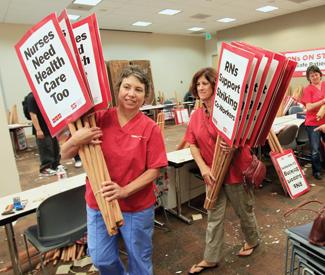
Ending a long and contentious labor impasse and setting the stage for the city to approve the pair of new hospitals that Sutter Health and its California Pacific Medical Center affiliate want to build in San Francisco, the California Nurses Association today announced that it has reached a tentative contract agreement with the hospital corporations.

As we’ve reported, reaching a deal with its nurses seemed to be the last major hurdle for Sutter/CPMC to overcome before the community-labor coalition would fully support the compromise hospital deal that a city-CPMC negotiating team announced on March 5. The nurses helped force that hard-won deal in part by aggressively advocating for St. Luke’s Hospital to remain financially viable and open to the low-income community it serves.

“We are delighted to finally reach a contract deal. It’s been six years of a very contentious relationship,” Eileen Prendiville, a registered nurse who works at CPMC’s California Campus, told the Guardian. She said that the nurses are thrilled to have attained good job security and patient advocacy standards while ensuring St. Luke’s stays open. “Working with a coalition of labor and community, we were successful at changing the face of healthcare in San Francisco.”

Under a previous agreement reached last year between CPMC and the Mayor’s Office, St. Luke’s would have had just 80 beds and could have been closed if the corporations revenues sagged. But activists and the Board of Supervisors were able to kill it and force the corporations back to the bargaining table.

In today’s print edition of the Guardian, I cover the movement to value caregiving in our uncaring economic system and the key role that CNA has played has in that growing movement. In San Francisco, CNA has faced down lawsuits, lock-outs, and harsh union-busting tactics as it pushed for contracts with strong patient advocacy protections.

Sup. David Campos, who help negotiate the latest hospital deal, said he was “thrilled” to hear Sutter/CPMC reached a deal with CNA. “We’ve always said it’s really important as we finalize the agreement that there is protection for the workers,” Campos told us.

Board President David Chiu, another key negotiator in the recent deal, told us, “I’m tremendously excited that there’s finally an agreement between oru nurses and CPMC, and thank the parties for their hard work in reaching this point. Along with the agreement we recently arrived at for the new Cathedral Hill and St. Luke’s campuses, this is an important moment for our city’s health care futue.”

CPMC spokespersons didn’t immediately respond to our calls for comment, but we’ll update this post if and when we hear back. The CNA press release announcing the deal and its details follows:


Nurses Reach Agreement with Sutter California Pacific

RNs Hail Community Support, Decision to Keep St. Luke’s Open 


Registered nurses at two San Francisco Sutter hospitals, California Pacific Medical Center and St. Luke’s Hospital, have, at long last, reached agreement with hospital officials on a new collective bargaining contract for the 800 RNs who work at the two facilities, the California Nurses Association said today.

The agreement expands patient protections, strengthens the nurses’ bargaining and job security rights, and provides for economic gains. It must still be ratified by CPMC and St. Luke’s nurses who will vote on the pact in membership meetings soon.

The RNs emphasized that they are especially pleased with the overall political and community framework, announced earlier this month, that preserves St. Luke’s after years of uncertainly and threats of closure for the historic hospital that serves a medically underserved community in San Francisco.

CNA Executive Director RoseAnn DeMoro praised the unity of the nurses over the long contract fight and the broad public support for nurses as critical to protecting St. Luke’s and winning a new agreement for the nurses.

“San Francisco nurses have worked extremely hard, with the widespread support of a very broad community coalition and the support of a number of community leaders, including members of the Board of Supervisors, to protect this vital community resource. We are proud of the efforts of everyone who has held the line for maintaining St. Luke’s,” DeMoro said.

For the first time, the RNs at both hospitals will be under one contract with equal job security and seniority rights. The pact includes safe patient handling provisions to stem patient falls and injuries to patients and nurses. Additionally it obligates the employer to provide for meal and rest breaks and stipulates that new technology not supplant RN professional judgment.

On economics, all the RNs will receive across the board pay increases of 6 percent over the next 34 months, as well as additional pay based on years of service in the San Francisco hospitals, at other Sutter facilities, and foreign nursing experience.

“We are delighted to finally reach a contract settlement with Sutter/CPMC,” said California Pacific campus RN Susan Blaschak RN.  “Our contract provides for continued patient advocacy and will keep our professional nursing standards high for years to come.”

“The process has been tumultuous but in the end we had a vision and we were successful in performing the ultimate in patient advocacy – saving St Luke’s,” said Jane Sandoval, a St. Luke’s RN and CNA board member. “In addition, with our collective bargaining agreement we have preserved patient care standards, having a voice in that and in our professional integrity.”

“Working with a coalition of labor and community groups, we have been successful in changing the face of healthcare for San Francisco’s future. St Luke’s will not only remain open it will offer more healthcare services to residents in the community south of Market,” said Eileen Prendiville RN at the California Pacific campus of CPMC.

“Our contract settlement was also made possible by the strong support for the nurses by San Franciscans for Healthcare, Housing, Jobs and Justice as well as elected leaders who knew San Franciscans overall would be best served by a fair collective bargaining agreement,” said Sandoval.

CNA also calls on Sutter officials in its headquarters in Sacramento, and other Sutter regions to view the San Francisco agreement as a new opportunity to resolve outstanding contract fights with RNs in the East Bay and North Bay.

Nurses have now reached agreement with CNA-represented Sutter hospitals in the past nine months at Mills-Peninsula in Burlingame and San Mateo, Sutter Santa Rosa, Sutter Lakeside in Lakeport, and Sutter VNA in Santa Cruz.

Contracts remain unresolved at Alta Bates Summit in Berkeley and Oakland, Eden in Castro Valley and San Leandro, Sutter Delta in Antioch, Sutter Solano in Vallejo, and Sutter Novato.

“Every one of those disputes could also be resolved if those hospital’s officials would approach negotiations with a desire to stop the war on their nurses, remove unwarranted and punitive concessions demands, and show the community served by their hospitals that they desire a cooperative relationship with nurses based on therapeutic healing for their patients,” said Sandoval.

Mayor Lee’s mysterious breakfast companions [UPDATED]

See an update to this story below. San Francisco Mayor Ed Lee has been having breakfast with CEOs to seek millions in funding for the America’s Cup, but the identities of those CEOs remain a mystery.

At a City Hall hearing two weeks ago, America’s Cup Organizing Committee chief Kyri McClellan told supervisors that Lee has been “putting an incredible amount of energy” into fundraising to cover city costs for the America’s Cup. As the yacht race draws closer, pressure is building around an anticipated funding shortfall that could deal a blow to city coffers.

McClellan told supervisors that Lee was “holding breakfasts with CEOs” to raise money. Encouragingly, she added, “people are responding.”

So, who are the CEOs? And how much have they agreed to contribute? So far, nobody has disclosed that information.

Shortly after the hearing, the Guardian submitted a public records request to Lee’s office seeking documentation on the fundraising breakfasts and records showing the names and affiliations of the CEOs.

In response, we received several pages from the mayor’s calendar. Entries show that Lee held half a dozen meetings concerning “economic development,” with no mention of the America’s Cup. The mayor had a meeting at Waterbar, a restaurant on the Embarcadero overlooking the Bay Bridge, on the morning of Jan. 25; he had another meeting there Feb. 1; he met at the Hotel Vitale on Feb. 22; met at City Hall on Feb. 28; had breakfast at the St. Regis Hotel on March 1, and had lunch with someone at Original Joe’s on March 4. But there was no information disclosing whom he met with.

After receiving the documents, the Guardian left multiple voicemails with the mayor’s press office asking for the identities of the CEOs. So far, nobody has responded.

The request also yielded a fundraising form that asks prospective donors to “join the 2013 America’s Cup San Francisco Host Committee.”

Donors could opt to become a “Legacy Benefactor” for committing to give or raise $5 million; a “Legacy Partner” for $2.5 million; a “Strategic Partner” for $1 million, a “Civic Champion” for $500,000, or a mere “Member” for $250,000. Donors with questions or who wished “to connect with Mayor Lee” could call Stephanie Roumeliotes, the form noted. 

Roumeliotes is a prominent fundraiser and political strategist who provided financial consulting for the re-election campaigns of Senators Dianne Feinstein and Barbara Boxer. She was appointed to serve on the Golden Gate Concourse Authority, a part of the Recreation and Parks Department, by former Mayor Gavin Newsom.

A call to the number listed went to SGR Consulting, Roumeliotes’ firm. The receptionist declined to comment or to connect the Guardian with Roumeliotes, saying, “All press inquiries should be directed to the Mayor’s Office.”

UPDATE: We just received a voicemail from Christine Falvey, Mayor Lee’s press secretary, who told us “I don’t have a list of the attendees for those breakfasts. They were hosted by the America’s Cup Organizing Committee.” Which raises more questions, but in any case we placed a call to race organizers and will update again when we know more.

I survived the “Real World: San Francisco” marathon

0

 The 28th season of The Real World premieres tonight, and the trailer features some crying bros and a lot of slapping in Portland, Ore. To remind us of the show’s less … well, shitty origins, MTV ran a “retro marathon” of its first three seasons last weekend.

Before the Teen Mom franchise, before Jersey Shore (and its ever-multiplying spin-offs), and before something called Buckwild that I don’t feel like researching, there were true stories of seven strangers picked to live in houses in New York and Los Angeles. And then in 1994, some strangers came to the wonderful city of San Francisco. The third season, last weekend’s grand finale, often gets credited with sparking the show’s popularity and indirectly launching the reality TV craze. It almost lives up to its reputation.

Usually, watching a reality television show after it’s finished airing presents a predicament; the knowledge that the cast has returned to the world outside the screen takes away the precept — flimsy as it is to begin with — that we are seeing reality unfold. Watching the San Francisco season is a different experience. The 19 years of distance, a huge cultural gap (OMG, no smartphones!), makes the show a historical document.

The Real World: San Francisco is a fascinating record of 20-something life in the mid-90s (OMG, no texting!). And because at that time, the channel dealt with issues besides teen pregnancy, it’s also a depiction of an earlier era of gay rights, of a different political climate, and of a time when an AIDS educator had to reassure his peers that they did not need to fear sharing a bathroom with someone HIV-positive.

Pedro Zamora, one of the first openly gay and HIV-positive men on TV, has been tasked with the responsibility of giving a face to history (the use of B-roll that supplements parts of his story, such as his emigration from Cuba, adds to the sense of his role in the show as documentary). Bill Clinton, who took up the cause of honoring Zamora, believed his stint on The Real World made giant strides in the effort to humanize the struggle with HIV/AIDS and that lends great historical weight to the show.

So, counter to the typical experience of re-watching reality TV, our awareness of events after San Francisco heightens the drama. Knowledge of Pedro’s death right after the season’s premier gives his plotline — for lack of a better term — an eery poignancy. On a happier note, Pam Ling and Judd Winick’s marriage in 2001 their season makes us look for clues in their innocent beginnings as friends during taping. The show becomes primary source material for their romance. Less pleasant is the tale of Puck (David Rainey), the roommate kicked out of the house, whose life after the show comes as no surprise at all. (Don’t worry, he got out of jail in time to film this interview before the marathon.)

How can any reality show claim to show an authentic view of history, though? It probably can’t, but It’s worth noting that The Real World‘s claim to be a social experiment had some legitimacy back then; people didn’t sign up for reality TV to achieve the same fame that they do today because the cult of the reality TV star had not yet exploded (in 1994, Kim Kardashian was still in the early stages of puberty). As a result, most of the cast was intelligent and had real goals that made them compelling and seemingly genuine. (We do, however, find a proto-reality TV star in Rachel Campos, the pretty girl who gave up dreams of academia when she met her husband on Road Rules: All Stars. For a while, she occasionally guest-hosted The View, and her Wikipedia page lists her occupation as “television personality.”)

Much of what makes The Real World: San Francisco entertaining nearly two decades later, though, are the things that make all ‘90s artifacts entertaining. It is a history of those fun outdated cultural signs that make “Buzzfeed Rewind” slide shows so heartwarming for millennials. Look at the low resolution! Note the light wash high-waisted jeans worn by men and women alike! Everyone’s rollerblading! Remember pagers?

And don’t worry, there are the requisite black-and-white confessionals, a comically suggestive musical score, and some drama, too — yelling, making out (and subsequent regret), and name-calling. But a word of warning for fans of Bad Girls Club and Tila Tequila: the name-calling doesn’t get much worse than “brat.”

Which brings me to a final point that, yes, the show mostly lives up to its reputation; The Real World: San Francisco is compelling as a historical record and nostalgia machine, but I have to admit that overall, I found it a little bland. The cast has a good time together, argues about house cleanliness over the dinner table, and learns from each other, but the fact that one of the few drunken escapades happens as a ladies’ night in floral pajamas made the whole day-to-day feel a little too charming.

It’s official: today’s television has ruined me. I don’t want to see interesting people with ambitious goals or downtrodden youth with the passion to make society more tolerant. I don’t want a document of reality at all, but an absurd heightening of it.

Even so, I think I’ll probably skip The Real World: Portland.

Oh, and if you want your own fix of retro reality, you can stream the complete San Francisco season here.

Faith in flow

0

culture@sfbg.com

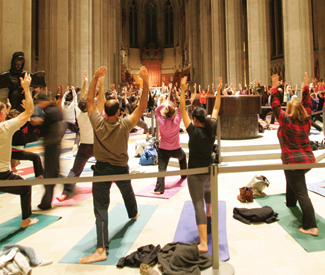
ON THE OM FRONT Every Tuesday evening, hundreds of people flock to the Grace Cathedral Labyrinth to practice yoga with local teacher Darren Main. With Easter around the corner, I talked to Main and the Reverend Jude Harmon, who manages the program, about how this unlikely class came to be, and why it works so well in San Francisco.

San Francisco Bay Guardian Darren, how did you wind up teaching the class at Grace Cathedral?

Darren Main Jamie Lindsay, a yoga teacher who had been attending Grace Cathedral for years, started the class there. When he moved to New York in 2009, he asked me if I would take the class. I had long admired Grace Cathedral for both its architectural wonder as well as how it has been on the cutting edge of social justice and spiritual equality. Right from the start I could feel something magical happening. What started off as a small group of students has now grown to over 300 people each week.

SFBG How does yoga fit in at the church?

Jude Harmon Grace Cathedral was established with the founding vision “to be a house of prayer for all people.” We were at the forefront of civil rights, welcoming Martin Luther King Jr. to preach here, and we paved the way forward for the embrace of LGBT people in the sacramental life of the Church long before it became the norm at a national level. This yoga class is just a natural extension of our commitment to welcome all people, from every walk of life, and to support them in their spiritual growth.

SFBG What’s it like to teach yoga at Grace?

DM It’s an amazing experience. You can’t help but feel something sacred by simply walking through the door. It’s like teaching in the Taj Mahal or the Great Pyramid. People come from all over the world just to see this building, walk its labyrinth, and admire the architecture and artwork. I am moved to tears sometimes when I think of how much this cathedral — and specifically doing yoga in this cathedral — represents the magic of San Francisco.

SFBG Do you have to be a churchgoer to attend?

DM Not at all. Yoga is a science, not a religion and so it requires no belief to be effective as a practice for quieting the mind, opening the heart, and balancing the body. In fact, many atheists find yoga extremely rewarding. Non-Christians attend the class for the community, the practice, and the beauty of the cathedral.

SFBG Can yoga enhance one’s spiritual practice?

DM Yes, because it helps us to more easily access the divine when we have a quiet mind, a balanced body and an open heart. Yoga can also be a way of exploring the same universal questions that religion explores, like “why are we here?” and “who are we?”

SFBG Does the practice of yoga connect in any way to the practice of Christianity?

JH I remember the first time I saw the yoga students ascending Grace Cathedral’s great steps in droves on the dusk of a July evening. They seemed like angelic visitors from some Hyperion realm. But they weren’t carrying Books of Common Prayer in their hands, or hymnals, or even Bibles — they were carrying yoga mats! While most of them wouldn’t dream of setting foot in a church for a traditional Eucharist, I felt my heart bond with them. At the heart of a yogic practice, just as at the heart of our Eucharistic practice, is the possibility of a self-integration that opens out our consciousness toward the world in compassion.

SFBG What is the yoga class like?

DM Given that the class is so diverse in terms of age, physical ability, and level of yoga practice, I focus on the more gentle and meditative side of yoga. The cathedral itself invites a more inward and contemplative experience as well, so it is really a perfect fit. Every week, I invite Bay Area musicians who have a transcendent quality to play at class.

SFBG Why do you think a class like this became so popular in San Francisco?

DM San Francisco has always been known for being open-mined, and that quality makes people open to the unique experience of doing yoga in a church. That said, I would not be at all surprised if we see this idea spreading beyond the Bay Area over the next 10 years or so.

Karen Macklin is a writer and yoga teacher in San Francisco. Read her On the Om Front column every other week on the SFBG Pixel Vision blog.


SCOTUS talks same sex marriage: San Francisco responds

LGBT rights activists held a vigil outside the California Supreme Court building in San Francisco March 26 as part of several events launched in response to yesterday’s U.S. Supreme Court hearing on Proposition 8. Today, the court is considering the Defense of Marriage Act, a law that restricts federal marriage benefits for same-sex couples.

The slideshow features interviews with  (in order of appearance) Justin Taylor, who said he was there to stand up for the rights of his mothers, who have been together for 16 years; Jackie Jolly, who said that for her the issue is about the underlying principle of equality; Thomas Coy, who teared up as he addressed the crowd and shared a memory of his husband, who passed away three years ago; and Trey Allen, who helped organize a rally and march on Monday and expressed hope that the Supreme Court would reach a favorable outcome at the end of June.

Photos, audio and slideshow by Rebecca Bowe

This evening, LGBT activists will return to 350 McAllister Street in San Francisco to hold a second vigil from 4 to 8 p.m.

No golden years for LGBT seniors

139

According to studies, queer seniors are poorer than their straight counterparts. They’re half as likely to have health insurance, and two-thirds as likely to live alone. Not to mention facing discrimination in medical and social services, retirement homes, and nursing care facilities. So much for the “golden years.”
Here in San Francisco, LGBT seniors face another grave threat: evictions. Many of our elderly live in rent-controlled apartments that are targeted by real-estate speculators and investors out to make big bucks turning them into tenancies-in-common.

With median rents close to $3,000 a month and vacancy rates low, the odds are pretty good that an evicted senior won’t find an affordable place in the city. For a senior with AIDS, an eviction is especially threatening since our city offers the best treatment and services. Studies show that people with AIDS who lose their apartments tend to die sooner, especially if they become homeless. 

The only LGBT organization that actually addresses the housing needs of queer seniors is Open House. Its 110 units at 55 Laguna will be the first affordable queer senior housing development in the city. I hope it’s not the last. As for seniors with AIDS, there’s only one AIDS organization in the vast list of groups and services — the AIDS Housing Alliance — that actually finds housing for its clients. It was started by Brian Basinger, a gay man with AIDS, after he was evicted and his apartment was sold as a TIC.

No one knows how many LGBT seniors have been, and are being, evicted. Ditto for how many seniors with AIDS end up on the streets. We also don’t have stats on how many transgender seniors are victims of real estate greed or live in absolute terror of losing their homes. 

The Rent Board doesn’t break down its eviction stats by sexual orientation or even age. The city’s homeless count doesn’t mention if someone’s queer or transgender. There is no way to determine how many LGBT seniors live in SROs or with life-threatening conditions such as mold or lack of heat. Or how many live in homes that have been — or are being — foreclosed.

That’s why the housing subcommittee of the city’s LGBT Aging Policy Task Force is holding a hearing into the housing needs and concerns of queer seniors. Information is power.

All LGBT seniors — housed and homeless — are invited to come testify about their housing issues. Whether they live in an SRO or a home that they own, whether they sleep in a shelter or a rent-controlled apartment, whether they’re in a subsidized unit or an illegal in-law, the subcommittee wants to hear from them about their concerns and needs.

The subcommittee will ultimately be making recommendations that will be included in a task force report on what the city can do to address LGBT issues.
LGBT seniors deserve their golden years.

The hearing is Monday, April 1, 9am to 12 noon, room 416, City Hall. Written testimony accepted. For more info, call Tommi at 415-703-8634.
Tommi Avicolli Mecca is a longtime queer and tenants rights/affordable housing activist who works for Housing Rights Committee. He is a member of the LGBT Aging Policy Task Force.

Reality rap: Q&A with Saafir, the Saucee Nomad

6

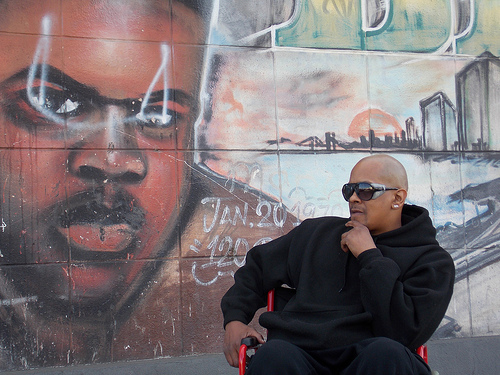
Ed. note – this week’s music feature is all about emcee-producer Saafir, the Saucee Nomad. The wheelchair-bound associate of Hobo Junction and Digital Underground (and actor in ‘Menace II Society’) opened up to Guardian music writer Garrett Caples about his recent health struggles, making music, and what’s keeping him in check. Here’s the extended interview we couldn’t fit in the print edition:

San Francisco Bay Guardian Did you have any idea [Digital Underground leader] Shock-G was going to post about you on Davey-D’s blog?

Saafir Actually I had no idea that he was going to put that out. Shock had came and saw me one time and I didn’t really tell nobody that I was in a wheelchair as far as the DU crew. I wasn’t really in contact with anybody. Nobody really stayed in contact with me. If you ain’t really hollerin’ at me, I’m not just gonna call you and be like, “Hey bruh, what’s up? I’m in a wheelchair.”

But I had ran into Money B and he told Shock, and Shock came by and saw me in that wheelchair and it kinda hurt him. He was like, “We really need to do something for you, man. We gotta try to bust a move and do something to make this shit right.” I told him I was down for whatever.

As far as [Shock’s] article is concerned, I’m not really gonna go into it. [Laughs] I’m just gonna say that. The focus is to try to get some awareness up with my condition and my situation. My situation is that I’ll have to have surgery to get my shit corrected. So I’m trying to raise awareness and get as much assistance with it as possible just to make it happen. But shout out to Shock-G for his effort in getting the word out and letting people know about my condition. His way of doing it is unconventional but it’s appreciated.

https://www.youtube.com/watch?v=3Dc8I23sCeI

SFBG But is your condition the result of back injuries or the tumor you had to have removed?

Saafir My back wasn’t really the problem, it was moreso internal. I had a cancerous tumor in my spinal cord and they had to get it out as soon as possible. That was around ’05. The timeline was based off of Shock’s own memories and some of the details got mixed up. I had to have the surgery to get the tumor out. The doctor told me that if I didn’t take it out, by the time I was in my later 40s I would probably be paralyzed. And it’s ironic because I did the surgery and I’m still kinda in that situation. I’m not a paraplegic; my legs are still active and whatnot, it’s just getting the right kind of treatment to spark what needs to be sparked in order to get my legs to work.

I have insurance but insurance only covers so much so I’m trying to make sure I’m able to fully meet the criteria so I can step back into the position I need to be in.

But moreso than that, you have to have a stable environment to even complete the things you need to do with the doctor as far as transportation and living situation. I’ve been out here doing this on my own, but I’m trying to get reestablished into a stable enough situation where I can do the things that need to be done in succession. You have to have a foundation in order to do that so that’s what I’m really focusing on right now, trying to establish that foundation, so that I can complete that.

SFBG Why did you wait so long to reach out to anyone about your condition?

Saafir I didn’t really go into telling people I was in a wheelchair or disabled because a lot of people don’t want to be bothered with it. They pretend like they do but in reality they don’t really want to deal with that shit. And I understand that. I don’t take it personally. So to avoid any harsh feelings or bitterness towards either party, I just keep it to myself and just deal with it. I don’t have a problem with asking anybody for help or allowing people to help me or whatnot but people have their own agenda, people have their own lives. And I need a bit of assistance just to do the basic things, getting into the bathtub, that’s like a marathon for me. And alone it’s damn near impossible. There’s not a lot of people there so I just try to stay concrete and just try to tread through it.

SFBG Why couldn’t they help you at the laser surgery clinic in Arizona that Shock had taken you to?

Saafir At the time I felt that what may have been stopping me from being able to walk was scar tissue surrounding the spinal cord and creating pressure to where my legs wasn’t responding. I had saw that on TV one night on a commercial so I called them. The guy I initially talked to led me to believe that I had action, that it could be done.

My first surgery was like, seven or eight or hours. They split me open. I had to heal for like, 10 months. I was like, “I can’t go through that again.” If I have to I will, but if I don’t have to, I really don’t want to. So I thought the laser surgery would be a good alternative.

Shock helped me get the money together to do the surgery because it’s a private practice. So we get out there and they do a checkup on me and they basically say they didn’t have the facility to do the kind of surgery I needed. I thought that was bullshit. I guess it was more of a situation where they didn’t want to take a chance on messing up something more than what it was, so they just decided, “We don’t really know what was there prior so we don’t want to go in and mess anything up.” And I’m like, man, if you’re afraid to do the surgery, say that. Don’t tell me you don’t have the facility; you just afraid to do the surgery. You know how it is, a lot of them practices are just there to take your money. So we had to come home.

SFBG What’s your prognosis now?

Saafir I got back in touch with the doctor who did the initial surgery. He asked me, “Why you didn’t tell me your legs were going out?” And I was like, “I left messages for you, man, to let you know what was going on with my condition.” I never got a call back so I figured that he couldn’t really do anything for me. And I left multiple messages. But we got past it.

He said, “I think I can get you back walking, we just have to figure out what is the ’cause of the decline.” So that’s what we’re trying to do now. I gotta take a few more MRIs. And from the MRIs they should be able to spot exactly what the decline is and they should be able to work back from there. But again, that shit costs money so I’m trying to raise funds to be able to get that all done.

I keep missing my appointments because I don’t have a car. I try to take the bus to BART but I need assistance getting on the bus. I need to raise funds so I can get back and forth to these appointments and just to help with the basic shit I need every day.

I can’t really move at the capacity I was moving at before. I’m a hustler. I go out and get it on my own, you feel me? But you really don’t understand the blessing you have to be healthy and have access to all your limbs and all your faculties. Don’t take it for granted.

https://www.youtube.com/watch?v=o9v7cgA3xIM

SFBG Have you still been making music at this time?

Saafir I’m trying to get a place where I can complete an album but right now I’m just writing songs and doing little stuff. But I’m definitely writing about my experience, how I’m dealing with it and going through it. A lot of people look at my shit from the ’90s and think I’m going to do the exact same shit now and that’s just not reality. I’ve evolved as a person.

At that time I was a young man and mentally I was in a young frame of mind. Now I’m a grown ass man and I done been through a lot. Life has shown me a lot more shit than it had at the time when I was doing what I was doing. I tried to be innovative and poetic about what I was doing and at the time that was the flavor.

Now, I don’t even feel like that level of dedication or creativity would even be appreciated. That’s not saying that I’m not going to try to do it. It wouldn’t be a situation where it’s a street record or a hip-hop record. I just call it reality rap. I don’t particularly rap like I did in the ’90s anymore. I’m more focused on substance and content as opposed to how I swing a rhyme. But I’m always going to swing a rhyme with flavor. My rhythm has never been a problem. I understand the rhythm and the beat so it’s nothing for me to do it.

For the full story, see: Injured Player in the Game.

LGBT youth law, ignored

Thirteen years ago, the San Francisco Board of Supervisors enacted an ordinance designed to make city services more accessible to lesbian, gay, bisexual and transgender youth. Under Chapter 12N of the San Francisco Administrative Code, city departments must provide LGBT sensitivity training “to any employee or volunteer who has direct contact with youth.” It also applies to any collaborative youth service providers who receive $50,000 or more in city funding.

Fueled with great intentions, 12N is the letter of the law in a city known for its tolerance and forward-thinking, progressive values. “San Francisco is committed to ensuring that LGBTQ youth receive the same level of dignity and respect as granted to all residents when encountering city services and programs,” a statement on the Human Rights Commission website reads.

There’s only one problem. With the exception of one department, 12N has never actually been implemented.

Last week, Paul Monge-Rodriguez, a 23-year-old appointee to the San Francisco Youth Commission, approached the Harvey Milk LGBT Democratic Club to point out that 12N has never been put into practice.

“To this day, there’s only one city department in compliance, and that’s the Department of Public Health,” Monge-Rodriguez explained in an interview with the Guardian. Other major service providers include the Human Services Agency, the Department of Children Youth & their Families, and the Office of Economic and Workforce Development.

An effort to push implementation, led by the Youth Commission, the Human Rights Commission and LYRIC — a nonprofit organization addressing issues facing LGBT youth — is gaining traction. Sup. John Avalos called for a hearing; following Monge-Rodriguez’s presentation, the Milk Club voted to formally support the effort.

“We pass these laws, but then when it comes to putting it in action, we don’t always live up to the legislation,” Avalos told the Guardian. “Basically, the city hasn’t implemented the program in terms of providing training for city staff.”

Jodi Schwartz, executive director of LYRIC, argues that 12N implementation should involve collection of sexual orientation and transgender identity data so as to better inform agencies about the populations they serve. The San Francisco Unified School District is the only district nationwide that collects sexual orientation and gender identity data when studying risk behavior for middle and high school students — and the results of a 2011 SFUSD anonymous survey revealed an alarming number of suicide attempts reported among queer youth.

According to SFUSD’s suicide indicators analysis, more than a third of high school students and nearly half of middle school students who self-identified as transgender reported having attempted suicide at some point; meanwhile, about a third of middle school students and about 17 percent of high school students who identified as lesbian, gay or bisexual also reported having attempted suicide.

The data is based on extrapolations and assumes no overlap between transgender and LGB populations, and concrete data in this realm is generally difficult to obtain. But based on the SFUSD data, LYRIC estimated that more than 1,000 LGBT students in middle and high school had reported attempting suicide. It’s a disturbing figure to say the least. If other agencies begin collecting such data, Schwartz argues, “they’ll use it to inform their priorities as an institution.”

Youth Commissioner Mia Tu Mutch, 22, helped create a training video that was shown to city staff at the Department of Public Health as part of a pilot program to initiate the sensitivity training mandated under 12N.

“Some of the stories talked about trans people feeling unsafe or unwelcome by service providers,” she explained when asked about the video, which was not made publicly available. “One featured a gender-queer young person who felt more comfortable using gender-neutral terms, but the intake person went out of their way to use the wrong pronoun.”

Tu Mutch worked with LYRIC to create a Tumblr site, entitled 12N Now or Never, featuring photographs of queer youth holding up signs asking for immediate 12N implementation. Her own sign reads, “I need 12N because youth shouldn’t have to educate adults.” Another message, posted by a young person named Vincent, reads, “I need 12N because I don’t want my kids to be judged like I was.”

“I think it just speaks to the bureaucratic process,” David Miree, spokesperson for the Human Rights Commission, responded when asked about the long delay. “The great intentions were there to put it into an ordinance. But what had to happen was, there had to be someone, or some community, or some agency” to step in and make it happen.

Schwartz takes a different view on why so little has been done. “There’s a lack of political will,” she says, “to invest the resources to do the transformation that’s necessary.”

Alternative medicine

0

arts@sfbg.com

FILM No country exports mainstream films to the extensive success that the US does. To the frequent chagrin of local filmmakers and cultural watchdogs, Hollywood dominates many nations’ box offices, non-English-speaking ones included. Nor do we reciprocate much — there remains a wide separation between what are perceived as commercial entertainments and “art house” films, with foreign-language (or even just British) ones almost invariably limited to the latter category.

We’ve all rolled our eyes at otherwise sophisticated people moaning that they can’t be bothered with even the most accessible movie in another language because subtitles are too much trouble. As a result, ‘murricans seldom hazard big-screen exposure to anything but the most rarefied, prize-winning, serious, or conceptually novel features from other nations. While we feed them plenty of our mall flicks, their less-than-exceptional homegrown genre movies are considered to have little marketable value here. (Save as fodder for remakes, of course.)

So it’s a tiny bit unusual when one week brings openings of two movies unalike in every aspect save their being solid if unremarkable examples of mainstream hits abroad. French-Canadian comedy Starbuck and German crime thriller The Silence are both an uptick or two above “decent,” but they hardly sport the thematic-stylistic edginess or other qualities that usually win US distribution. They’re just kinda fun.

Maybe “fun” is a tasteless way to describe The Silence, which hinges on pederasty and child murder — though in the end this is more an intelligent pulp thriller than serious address of those issues, uneasily as it straddles both at times. In 1986 two men abduct an 11-year-old girl — one the initially excited, then horrified observer to the second’s murderous sexual assault. Twenty-three years later, another young girl disappears in the same place under disturbingly identical circumstances.

This event gradually pulls together a large cast of characters, many initial strangers — including the original victim’s mother (Katrin Sass) and the just-retired detective (Burghart Klaubner) who failed to solve that crime; parents (Karoline Eichhorn, Roeland Wiesnekker) of the newly disappeared teen, who experience full-on mental meltdown; a solidly bourgeoisie husband and father of two girls (Wotan Wilke Möhring), inordinately distressed by this repeat of history; and the erstwhile friend he hasn’t contacted in decades, an apartment-complex handyman with a secret life (Ulrich Thomsen).

Part procedural, part psychological thriller, part small-town-community portrait, director-scenarist (from Jan Costin Wagner’s novel) Baran bo Odar’s The Silence is just juicy and artful enough to get away with occasional stylistic hyperbole. Let alone having enough subplot intrigue and weirdo characterizations — Sebastian Blomberg’s spazzy grieving-widower police detective is a bit much, in the Anthony Perkins tradition — to float a miniseries. It’s a conflicted movie, albeit handled with such engrossing confidence that you might not notice the credibility gaps. At least until thinking it over later. Which, don’t.

There’s no complicated narrative brain-teasing in Starbuck, which has a great (if not entirely original) comedic concept it chooses to play seriocomedically — i.e., less for the laughs it seldom earns than for the heart-tugging it eventually pretty much does. An ingratiatingly rumpled Patrick Huard (a major Quebec star best known for the mega-hit Les Boys series and 2006’s Good Cop, Bad Cop) plays David, erstwhile stellar contributor to a Montreal sperm bank in his salad days. Now older but no wiser, he finds himself confronted by the reality of 533 biologically fathered, now-grown offspring who’ve filed a class action lawsuit to discover his identity even as he deals with mob debt and an exasperated, pregnant semi-ex-girlfriend (Julie LeBreton).

This is one of those “loser man-boy must semi-grow up fast amid crisis, finding family values en route” scenarios tailor-fit for Adam Sandler. That said, the overlong, stubbornly endearing Starbuck is so much less insufferable than anything Sandler has made since … um, ever? Halfway through, this agreeable movie gets clever — as David stumbles into a meeting of his prodigious anonymous progeny — and remains reasonably so to the satisfyingly hard-won happy ending.

It’s still got moments of contrivance, editorial fat (too many montages, for one thing), and more climactic hugs than any self-respecting dramedy needs to get the redemptive point across. Yet it’s also got something few comedies of any national origin have today: a lovely, distinctive, bright yet non-cartoonish wide screen look.

THE SILENCE opens Fri/29 in Bay Area theaters; STARBUCK opens Fri/29 in San Francisco.

Campaign to ban bottled water sales in national parks targets GGNRA

43

UPDATED A national campaign to ban the sale of disposal plastic water and soda bottles in our national parks – which is being actively opposed by Coca-Cola and others who bottle and sell water, that most basic of life-sustaining resources – has arrived in San Francisco as it targets Yosemite and the Golden Gate National Recreation Area.

“We have thousands of people in the area who are very supportive and working hard on this,” Alyse Opatowski, an organizer with Corporate Accountability International’s Think Outside the Bottle campaign, told the Guardian.

Opatowski and a host of local supporters – including Board of Supervisors President David Chiu, Sierra Club Chapter Executive Director Michelle Meyer, and Hans Florine, who holds a world record for speed climbing in Yosemite – will rally tomorrow (Wed/27) at 10:30am in Crissy Field to publicize the campaign and hold a blind taste tasting comparing San Francisco tap water to bottled waters.

And we know who wins that one, right? San Franciscans are justifiably proud of our water, the best urban water in the country, arriving to us through what’s essentially a gravity-fed straw from the Hetch Hetchy Reservoir adjacent to Yosemite. Even though that project broke famed naturalist John Muir’s heart a century ago, it was a engineering marvel and enduring source of clean power and water that we voted overwhelmingly to protect in November when voters rejected a study of the sentimentalists’ dream of removing it.

But back to the issue at hand: activists say that selling single-use water bottles in the national parks in antithetical to environmental stewardship. Health advocates have made some progress in curtailing our addiction to soda, but those crafty soda companies responded by commodifying that which is available basically for free in every locality in the country. And they aren’t about to give up that market without a fight.

Coca-Cola – whose spokespeople haven’t yet returned out calls for comment – gives lots of money to the National Parks Foundation and has used that influence to stall efforts to have the National Parks Service ban bottled water. So the campaign is targetting individual regions, including the GGNRA, which seems well positioned to advance the cause.

Cheers to that.

UPDATE 3/27: American Beverage Association spokesperson Chuck Finnie issued a prepared statement to us that began, “Eliminating plastic bottles altogether isn’t the answer because it limits personal choice and doesn’t address the bigger picture. People should have the choice to decide how they drink water in a National Park — from a bottle of water, from a water fountain, or from a refillable container. While making that choice, they should be educated on the benefits of recycling and ways to do so.”

Hospitable pectorals

14

caitlin@sfbg.com

SEX The clan I had assembled that day in my living room had little idea what was in store for them.

“So they’re strippers?” one of my friends hoped, fingering their tumbler of champagne.

“Not strippers, they’re sexy butlers. Same tipping rules,” I said. “They’ll serve drinks and do icebreakers.” “Oh.”

The parties in our living room are rarely in need of icebreakers, but the offer from the Bare Bachelors (www.barebachelor.com) to do a test run at a hastily-organized cocktail hour in honor of my roommate’s birthday — for journalism, mind you — was not one, I felt, a thinking person would pass up.

************

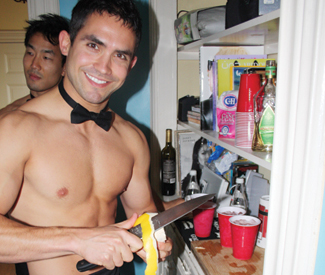
“I was looking for this kind of business and it didn’t exist in San Francisco.” I’ve installed Bare Bachelors founder Maureen Downey at my kitchen table so we can talk as two of her “actors, models, bartenders, or whatever,” attired in jockey briefs, aprons, and bow ties prepare Cazadores-and-grapefruit-sodas for the suddenly-awkward guests in the living room.

Downey, who tells me her previous career was in medical device clinical research, envisioned a party service less “dated” than strippers, but still sexy. It’s a combination that makes sense for the straight 30-something lady clientele Bare Bachelors has been attracting, mainly through word of mouth, since 2010. Downey’s Bachelors are self-aware, scantily clad caterers. She hopes to expand the clientele base.

For individuals well used to groin-thrusting go-go’s under strobe lights — or Dolores Park on a sunny day, as one of my guests pointed out — the Bare Bachelors’ impressive pectorals will not have quite the same novelty. But they charmed the goddamn pants off of the birthday boy, were handsome, and managed to get surprisingly candid during the game of Never Have I Ever they happily catalyzed.

************

So candid, I thought I’d open up the party to a little Q&A for my guests. Which was a mistake.

“So if someone, like, gave you a little more money will you, you know, go further?,” inquired another roommate emboldened by her tequila-and-grapefruit.

“No, absolutely not.” The Bare Bachelors tittered nervously, pecs unsure about the appropriate course of action under this kind of scrutiny.

“Do you consider yourself sex workers?,” her line of questioning pressed on, unrelenting in its desire to contextualize the Bachelors.

“No, definitely not.” The room pondered its next probe, but was unable to go further down the rabbit hole before one of my more socially-sensitive friends effectively closed interrogations.

Post-Bachelors, we reconvened for a processing session. Results were mainly favorable: “not creepy,” “tried to mesh with the group,” “the biggest problem was that there were no tits,” “visibly shy,” “pretty tasty drinks,” and perhaps most succinctly: “really sexy, and they had ass hair!”

THIS WEEK’S SEXY EVENTS

Spring Breakers Various Bay Area theaters. ATL twins, Gucci Mane, Vanessa Hudgens, blatant perversion of typical crime movie gender roles — Harmony Korine’s latest cult classic is the sexiest film of 2013 and you should see it before you get secondhand sick of the catchphrases.

Goodbye Gauley Mountain Sat/30, dinner 6:30pm, screening 7pm, $10-100. Center for Sex and Culture, 1349 Mission, SF. www.sexandculture.org. Feminist porn pioneer Annie Sprinkle and partner Beth Stephens premiere the couple’s documentary on their ecosexual relationship with the Appalachian mountains and the crusade to stop destructive mining practices. Come early for the pre-screening vegan Appalachian dinner.

Our Weekly Picks: March 27-April 2, 2013

0

THURSDAY 28

“The Secret History of Love”

It’s only four guys, but the quartet manages to call up a whole period in the cultural history of the LGBT community which, until Sean Dorsey put his considerable intellectual and artistic resources into this project, was little known even to its members, not to speak of the community at large. Dorsey, who found his way in a round about manner to dance through theater, has developed a personal language in which words and movement are irrevocably fused, each drawing its energy and expressive power from the other. These performances are a send-off for “The Secret History of Love” which is about to embark on its second national tour. Good to see what these very different dancers bring to this project. They are Dorsey, Juan De La Rosa, Brian Fisher, and Nol Simonse. (Rita Felciano)

Through March 31

8pm, Sat/Sun, 4pm; $15–$25

Dance Mission Theater

3316 24th St., S.F.

SecretHistory.brownpapertickets.com


Anthrax

Fresh off celebrating its 30th anniversary, iconic metal titan Anthrax is back with a new covers EP, Anthems (released last week), paying tribute to some of the songs that influenced it when the band was first starting out. Searing versions of tunes by artists such as AC/DC, Thin Lizzy, and Rush help shed light on the formative recipe that would eventually lead Anthrax to being considered one of “The Big 4” of thrash metal. Scott Ian and company will perform their classic 1987 album Among The Living in its entirety during their headlining slot tonight on the brutal “Metal Alliance Tour,” which also features Exodus, High On Fire, Municipal Waste, and Holy Grail. (Sean McCourt)

8pm, $29.99–$32

Regency Ballroom

1300 Van Ness, SF

www.theregencyballroom.com


FRIDAY 29

“Overturning the Artifice” closing reception

What do shoe shining and art have in common? Very much, according to Jack Leamy, curator of SOMArts’ show, “Overturning the Artifice,” which closes in style Friday evening with free shoe-shining by artist Rachel Leamy. When one shines another person’s shoes, the act is reflective and forms an intimate human connection that uplifts the soul. Art, the curator says, has the same uplifting effect; it raises consciousness “out of the doldrums.” That is an upbeat way to speak about a show that deals with the struggles of being human, but then again, art can act as a powerfully positive force. Come to the show while you still can, to be uplifted — or just to get shinier shoes. (Laura Kerry)

6pm, free

SOMArts Main Gallery

934 Brannan, SF

(415) 863-1414

www.somarts.org


“KUSF-In-Exile’s Blown-Out, Blowout Benefit II”

Benefit is an often overused term, but this one applies for the sake of preserving San Francisco Community Radio (SFCR). As the group Save KUSF transitions into SFCR (its nonprofit identity) the costly legal quest continues with an FCC-level appeal of 90.3 FM’s sale still waiting to be ruled on. So what’s a group of rogue DJs to do when their sojourn on the web waves appears as if it’s becoming permanent? They throw another springtime blowout of mind-melting music to raise cash for their cause. Carlton Melton delivers the psychedelic, stoner-drone, Disappearing People emerges out of Oakland with experimental punk, and from the same neck of the woods, the one and only Yogurt Brain rides in with some catchy jangle and an occasional monster riff thrown in. (Andre Torrez)

With Carlton Melton, Disappearing People, Yogurt Brain, and KUSF-in-Exile DJs

8pm, $5–$10

Lab

2948 16th St., SF

415-864-8855

www.thelab.org


Texas is the Reason

In 1994 Texas is the Reason released a three-song EP that would initially be heard by very few and go on to influence a great many. The band’s only full-length Do You Know Who You Are? remains a touchstone album in the post-hardcore canon and is considered to be one of the primary kick-starters of the ’90s emo movement. Just as the band was about to burst from underground notoriety to a mainstream record label, however, it collapsed due to internal tensions. After just three years of existence and one beloved album, Texas is the Reason was done. Other than a two-show reunion in 2006, this year marks the band’s first and only tour since its disintegration a decade and a half back. This spring, the band unveiled two new songs and a brief tour — its last ever. While it may be cruel to give us hope and a taste of what could have been before disappearing again, I’m not complaining. After nearly 15 years of waiting, I’ll take what I can get. (Haley Zaremba)

With the Jealous Sound

9pm, $20

Bimbo’s 365

1025 Columbus, SF

(415) 474-0365

www.bimbos365club.com


Mano Le Tough

Having proved himself a more than capable in long form (popping up on this year’s Resident Advisor Top 100 poll and a recent Boiler Room set) and short (contributing remixes for Midnight Magic, Roisin Murphy, and Aloe Blacc) Ireland’s Mano Le Tough needed only to release a solid album to complete the producer trifecta. With Changing Days, he’s done just that, and it’s an assured, spaced out collection of deep house and future disco, organic, airy sounds alternating at times with ray-gun zaps. Throughout, Mano expands on the calmly emotive vocal style earlier heard on “In My Arms” and the glistening Stories EP. (Ryan Prendiville)

With Bells and Whistles, Joey Alaniz

9pm, $8–$15

Monarch

101 Sixth St., SF

(415) 284-9774

www.monarchsf.com


SATURDAY 30

Lynne Hershman Leeson’s “The Agent Ruby Files”

The story of the humanoid and the human goes way back — Pinocchio, that relationship between Skywalker and his robot companions. Now, we can add Lyne Hershman Leeson’s Agent Ruby, an online platform in the shape of Ruby, a character based on the artist’s 2002 film, Teknolust, that invites its visitors to converse with it. Over the past 12 years, Ruby has learned, improving her responses as the database has expanded. In a show on view from March 30 to June 2, SFMOMA will present a look at the growth of Ruby. Exhibiting collections of user conversations on topics such as dreams and sexuality, we can expect to see something very human reflected in the non-human. (Kerry)

Through June 2

$18

SFMOMA

151 Third St., SF

(415) 357-4170

www.sfmoma.org


Jonny Fritz

Nashville’s Jonny Fritz has been writing, recording, and touring for the better part of a decade, and looks to be breaking into his own this year after recent stints opening for the likes of Alabama Shakes, Shooter Jennings, and Wanda Jackson. Recently dropping his long-time moniker of “Jonny Corndawg” in favor of his real name, Fritz (who opens for Heartless Bastards tonight) is releasing his new album, Dad Country on ATO Records in April, a collection of slice-of-life tales, sweet vocals, and great lyrics that blend the sounds of his native city with California country and a wide swath of points in between. (McCourt)

9pm, $23

Great American Music Hall

859 O’Farrell, SF

(415) 885-0750

www.slimspresents.com


Colette and DJ Heather

Around 16 years ago, four young female DJs united to form the formidable quartet known as the SuperJane Collective. Feeding off Chicago’s potent house music scene, DJ Heather, Colette, Lady D, and Dayhota laid claim to being the first all-female electronic DJ group. The groundbreaking foursome have since separated, both musically and geographically, but they are scheduled for a Sweet Sixteen reunion in Chicago in June. In the meantime, Colette and DJ Heather are coming in hot off their appearance at Austin’s SXSW. Expect deep grooves, funkiness, and improvisational live vocals from Colette. (Kevin Lee)

With Pink Mammoth

10pm, $15–$20

Mighty

119 Utah, SF

(415) 762-0151

www.mighty119.com


SUNDAY 31

Dolores Park Easter Celebration with Hunky Jesus Contest

Once you’re done sleeping through the church hours, the best thing to wake up to would be the annual Easter celebration in Dolores Park. The Sisters of Perpetual Indulgence are hosting their 34th birthday party once again at the park, and the “Under the Big Top” theme this year will be sure to charm the inner bunny out of you. The day will start out with family-friendly children’s Easter happenings at 11am, but just after noon the party really gets started. There will be circus tricks, an Easter Bonnet Contest, performances by the likes of our own Honey Mahogany (recently seen on RuPaul’s Drag Race), Sparkle Ponies, and Jane Wiedlin, along with the beloved Hunky Jesus Contest. The Sisters suggest you “bring a picnic blanket, some nosh and, of course, a little libation.” (Taylor Hynes)

11am-4pm, free

Dolores Park

18th and Dolores, SF

www.thesisters.org


Widowspeak

Eudora Welty once said, “Every story would be another story, and unrecognizable if it took up its characters and plot and happened somewhere else.” It is no surprise then that Widowspeak recorded its second album, Almanac, in a 100-year-old barn in the Hudson River Valley. Setting creeps in, the soft singing of frontperson Molly Hamilton ringing like a ghostly whisper from a rural past, which sits in beautiful tension with the sometimes jangly rock instrumentals that seem reflective of the band’s Brooklyn base. At the Chapel show, though, it might be more apt to say that the atmospheric folk-pop of the band creates a setting of its own. (Kerry)

With SISU

9pm, $12

Chapel

777 Valencia, SF

(415) 551-5157

www.thechapelsf.com


Daedelus

“The Willy Wonka of music.” That’s how one clever Internet commentator labeled LA beats producer Alfred Darlington, a.k.a Daedelus. It’s a fitting moniker — the dapper Darlington (often sporting colorful, wide-lapel suit jackets) ushers unsuspecting listeners into his music factory, laden with delicious and dangerous drums. Lick a sample here, taste a vocal there, and suddenly you’re swimming in a bass-filled reimagining of a video game villain’s theme music or hip-hop hacked to pieces and sped up to 130 BPM. All the while, Darlington goes all mad scientist, mashing away at a 256-button device known as a monome from which he can summon all sorts of sweet and sinister sounds. Overindulge at your own peril. (Lee)

With Two Fresh, Ryan Hemsworth, Samo Sound

8pm, $18

Independent

628 Divisadero

(415) 771-1421

www.theindependentsf.com

The Guardian listings deadline is two weeks prior to our Wednesday publication date. To submit an item for consideration, please include the title of the event, a brief description of the event, date and time, venue name, street address (listing cross streets only isn’t sufficient), city, telephone number readers can call for more information, telephone number for media, and admission costs. Send information to Listings, the Guardian, 225 Bush, 17th Flr., SF, CA 94105; or e-mail (paste press release into e-mail body — no attachments, please) to listings@sfbg.com. Digital photos may be submitted in jpeg format; the image must be at least 240 dpi and four inches by six inches in size. We regret we cannot accept listings over the phone.