San Francisco

Extra! Extra! Sunshine advocates beat the Anti-Sunshine Gang in City Hall

27

 By Bruce B. Brugmann

And so the  Anti-Sunshine Gang in City Hall, which for two years has been conducting a nasty vendetta against the Sunshine Ordinance Task Force,  capitulated quietly at Tuesday’s Board of Supervisors meeting without a fight or even a whimper.

The capitulation came in a two line phrase  buried in item 28 in the middle of the board’s agenda.  It was a report from the rules committee recommending  the Board of Supervisors approve a motion for  unnamed nominees to the Sunshine Ordinance Task Force. “Question:  Shall this Motion be approved.”

Board Chair David Chiu asked for approval in his usual board meeting monotone. And the approval came unanimously, with no dissent and no roll call vote and not a word spoken by anybody.  He banged the gavel and that was that. And only a few veteran board watchers knew that this was the astonishing  end to a crucial battle that pitted the powerfuf Anti-Sunshine Gangs against the sunshine forces and the citizens of San Francisco. It was a battle that would decide whether the task force would remain an independent people’s court that would hear and rule on public access complaints.  Sunshine won.

It was ironic and fitting that Chiu presided over the capitulation. For it was Chiu as board president who orchestrated  the deal to demolish Park Merced and then orchestrated the  infamous 6-5 board vote  in September 2010 approving  a monstrous redevelopment  project that would evict lots of tenants, and destroy most of the affordable housing. This was a big deal because the housing crisis was heating up and Park Merced was the largest affordable community in the city and one of the largest In the nation. This is where tens of thousands of young people, young married couples, students and faculty at nearby San Francisco State, older people, and middle class people had come for generations with their families to live in affordable housing in an  “urban park,” as Park Merced promo once put it.

And it was Chiu as board president who was charged by the Sunshine Task Force, along with Supervisors Scott Wiener, Malia Cohen, and Eric Mar with violating the Sunshine Ordinance and the state’s open meeting law (Brown Act) when they approved the project with blazing speed.. 

Wiener, Cohen, and Mar were on the board’s Land Use and Economic Development Committee when they voted on the contract. Literally minutes before the committee vote, Chiu introduced 14 pages of amendments to the contract. The deputy city attorney at the meeting blessed the amendments by saying, gosh, golly, gee, no problem, the amendments do  not substantially alter the contract and therefore the description of the item on the agenda was still apt and the committee could act on it. Bombs away! The full board approved the contract the same day by one vote.

This sleight of hand and pellmell approval process meant that Park Merced was going,going, gone and in its place would be a project that “has no hindsight, no insight, or foresight,” as Planning Commissioner Kathryn Moore was quoted as saying in a scathing Westside Observer column by landscape architect Glenn Rogers. “It is not a project of the 21st century.  It is the agenda of a self-serving developer.”

 The Observer, to its immense credit, was the only media in town to blast away at the project. (Read its coverage and weep, starting with a June piece by Pastor Lynn Gavin who wrote that the Park Merced owners did not disclose to her or her family that they “were going to demolish the garden apartment that was our home.”)  Gavin and her neighbors took the formal complaint to the Sunshine Ordinance Task Force and got a unanimous 8-0  ruling condemning Chiu, Wiener, Cohen, and Mar for open government violations.

It was a historic ruling by the task force and demonstrated once again in 96 point tempo bold the irreplaceable value of the people’s court.  The ruling also had impact because it amounted to a stinging  expose of how government often works in San Francisco with big money and big development and how one vote can add gallons of high octane petrol to the housing crisis. It angered the hell out of the six supervisors who voted for the project.

 And in effect, it gave rise to what I call the Anti-Sunshine Gang in City Hall whose response to the ruling was, not to apologize and change their illegal ways, but to start a vicious vendetta against the task force for doing the right thing at the right time.  The six votes were David Chiu, Scott Wiener, Malia Cohen, Mark Farrell, Sean Elsbernd, and Carmen Chu. Elsbernd has gone on to Sen. Diane Feinstein’s office in San Francisco and Chu to becoming assessor. But the gang picked up other allies along the way, notably the city attorney’s office.

Two years ago, when the task force members came to the board for reappointment, the Anti-Sunshine Gang retaliated and swung into action by “launching a smear campaign aimed at purging the eight task force members who had unanimously voted to find the violations,” according to Richard Knee, a 12 year veteran of the task force, in a June column in the Observer.  Knee, who represents the local chapter of the Society of Professonal Journalists, also wrote that “the mayor and the Board of Supervisors…made sure that the panel gets minimal funding, staffing and resources, and the board has refused to fill two long standing vacancies, making It difficult at times to muster a quorum since task force members are volunteers with outside responsibilities such as family and work.

“Two year ago, the board’s failure to appoint a physically disabled member forced the task force to take a five month hiatus, exacerbating a backlog of complaints filed by members of the public.This year, Knee wrote,  the start of the appointment process was “farcical and ominous.”  He explained that, at the May 15 meeting of the board’s rules committee, which vets applicants for city bodies, the two supervisors present chair Norman Yee and Katy Tang (David Campos had an excused absence) “complained that there weren’t enough racial/ethnic diversity among the 13 candidates. “That didn’t deter them from recommending the reappointments of Todd David, Louise Fischer, and David Pilpel, all Anglos.”

Before the full board five days later, Yee complained again, “this time that lack of a regular schedule and frequent switching of meeting dates were making attendance difficult for task force members. Either Yee had no clue of the facts or he was lying.” Knee explained that the task force normally meets the first Wednesday of each month and its subcommittees usually meet during the third week of the month.

“Meeting postponements and cancellations are the result, not the cause, of difficulties in mustering a quorum, due to the vacancies—which now number three.

“In gushing over David, Fischer, and Pilpel, at the board’s May 20 meeting, Wiener offered no evidence or detail of their alleged accomplishments and ignored the fact that David has missed six task force meetings since March 2013, including those of last February and April. Until the board fills the other seats, the five remaining incumbents—Chris Hyland, Bruce Oka, David Sims, Allyson Washburn, and yours truly—stay on as ‘holdover’ members.”

Meanwhile, by the next session of the Rules Committee on June 5, the sunshine advocates had rallied and put together an impressive mass of sunshine power. Testifying at the hearing were representatives from SPJ and the journalism community, the League of Women Voters, the ACLU, the sunshine posse, the Library Users Association, the Bay Area News Group, the Inter-American Press Asociation, the Center for Investigative Reporting, the UC-Berkeley Graduate School of Journalism, the First Amendment Coalition, the  Electronic Frontier Foundation, the Observer and neighborhood activists, and other sunshine allies and FOI groupies. It was quite a show of force. 

SPJ placed a pointed, timely op ed in the Chronicle (“SF Supervisors block Sunshine Ordinance Task Force,” good of the Chron/Hearst to run it but better if the paper didn’t black out local sunshine issues.) Members of the posse peppered the gang with public record requests aimed at tracking skullduggery and they found it. Reps from the groups lobbied the supervisors by email, phone, and personal office visits. And the word that the Anti-Sunshine Gang was back and on the gallop shot through the neighborhoods and around town and into election campaigns and among constituents of the gang.

SPJ and its vigorous Freedom of Information Committee under co-chairs Journalist Thomas Peele, of Chauncey Bailey fame, and Attorney Geoff King  were particularly effective. Peele is an investigative reporter with the Bay Area Newspaper Group, a lecturer on public records at the UC-Berkeley Graduate School of Journalism, and author of a respected book on Chauncey Bailey, a black journalist murdered on his way to work.

The word got around that the supervisors were blocking strong pro-sunshine candidates for the task force and that their first three nominees were the weakest of the lot. Campos, a stellar sunshine advocate, was back at the committee meeting, making the right calls and shepherding the strong nominees along through the committee and the Board of Supervisors.  Great job.

The cumulative weight and force  of the presentations of the nominees and the sunshine advocates made the proper political point:  any supervisor who voted with the Anti-Sunshine Gang was going to face their constituents and voters with the brand of being anti-sunshine and anti- government accountability.  More: they would have to answer some embarrassing questions: Who lost Park Merced? Who voted to turbo charge evictions and middle class flight from the city for years to come? Who tried to cover up the outrage and who did it? And who led the retaliatory vendetta against the Sunshine Ordinance Task Force for doing the right thing on behalf of sunshine in San Francisco?

And so the Board of Supervisors was dragged kicking and screaming into the sunshine of June 2014 and beyond. The supervisors ended up nominating what looks to be one of the strongest pro-sunshine task forces: Attorney  Mark Rumold and journalist Ali Winston from SPJ, Allyson Washburn from the League of Women Voters, Attorney Lee Hepner, Journalist Josh Wolf, and holdover Chris Hyland. Plus Bruce Oka who looks to be a late holdover in the disabled seat. Congratulations for hanging in and winning, hurray for the power of sunshine, on guard,  B3

P.S. l: PG&E institutionalizes City Hall secrecy and corruption:  The pernicious influence of the Anti-Sunshine gang hung heavy over the rules committee.  Tang tried to force every candidate to take a pledge of allegiance to the city attorney. Tang is the kind of neighborhood supervisor (Sunset) who has a 100 per cent Chamber of Commerce voting record. Her city attorney pledge demand was laughable on its face, given the fact that the city attorney refuses to move on the PG&E/Raker Act scandal and thus has helped institutionalize secrecy and corruption in City Hall on a multi-million dollar scale for decades. Which is reason enough for the city to always maintain a strong, enduring Sunshine Ordinance Task Force, to help keep tabs on how PG&E keeps City Hall safe for PG&E and its allies. (See Guardian stories and editorials since 1969.)  

Tang and Yee continued the gang’s hammering on Bruce Wolfe, a worthy candidate for the disabled seat whose main sin was that he was one of the Honorable Eight who voted condemnation.  The gang knocked out Wolfe as a holdover candidate the first time around and they were at it again at the committee meeting. Oka says he wants to resign from the task force but only when the board finds a good replacement. Wolfe, who was an effective and knowledgeable sunshine task force member, is the obvious replacement but he is still on the purge list.  Stay tuned on this one. . 

There are three things that no one can do to the entire satisfaction of anyone else: make love, poke the fire, and run a newspaper. William Allen White, 1917, line atop the editorial page of the Durango Herald, Durango, Colorado. 

State regulators issue stern warning to rideshare companies

About a month ago, we wrote about how San Francisco International Airport Director John Martin was cracking down on rideshare drivers ferrying passengers to the airport.

In a formal letter, Martin enlisted the help of the California Public Utilities Commission to assist with enforcement actions against Uber, Lyft, and other so-called “transportation network providers,” whose drivers were found to be taking passengers to the airport despite a state decision requiring them to obtain permits from airport administrators to do so.

The permits haven’t yet been obtained because the TNCs took issue with SFO’s proposed pilot program, and subsequently refused to fill out the permit applications and send them in.

It appears CPUC President Michael Peevey took Martin’s plea for help seriously. In a letter dated June 10, Peevey called on TNCs to cease airport operations until they had secured permits from airport authorities. The letter warns that if the companies do not comply and are found to be in violation of the state’s decision governing TNCs, “the CPUC may revoke your permit to operate.”

Here’s the letter, which references operations in other California cities as well.

CPUC Letter to Logan Green of Lyft by Rebecca Bowe

Elderly assisted living facility residents face eviction

A San Francisco-based assisted living facility for the elderly is slated for eviction July 10, a jarring and unexpected turn of events for families who are concerned about their loved ones’ health and wellbeing. However, concerned families and the facility’s board of trustees are working in tandem with city officials to craft a solution, so a different outcome may still be in the works.

Just before Mother’s Day, residents received 60-day eviction notices announcing the pending closure of University Mound Ladies Home. Residents were told that the facility would be closing its doors due to insurmountable debt, and that they would have to vacate by July 10.

“The current residents had expected to spend the rest of their lives there, in peace,” said Sandra Parker, whose mother Alice Parker, 89, has been a resident there for nearly three years. “They do not want to move.”

Located in San Francisco’s Portola District, University Mound – which houses men as well as women – has been at its current location since 1884. As a charitable organization, its mission has always been to provide an affordable community-based assisted living option.

University Mound provides housing and care for 52 residents, with licensing to care for up to 72, including 60 who are unable to walk without assistance. Many are in their late 80s or early 90s, making an abrupt move a difficult and potentially dangerous prospect.

Bill Brinkman of Jigsaw Advisors, a crisis management consultant, was hired to assist the troubled elder care center. The Bay Guardian was unable to reach Brinkman to ask what had led to the dire financial straits, or what possible resolutions were being contemplated.

“They’re saying the debt is based on a broken business model. In 2006 or 2008 the community stepped in, and somehow kept it going,” explained Parker, noting that Brinkman and the board of trustees had told family members that the nonprofit’s debt amounted to $600,000. “I don’t think they did due diligence to keep them financially sound.”

Sup. David Campos, whose District 9 includes the facility, has initiated a process to try and work with the elder care facility to stave off the pending displacement and identify some solution to prevent immediate closure. However, as of June 11, Campos’ legislative aide Laura Lane informed us that despite attending meetings and approaching University Mound to find out what viable options might be available, the elder care center had yet to identify a workable solution.

Campos and affected family members also enlisted the help of Mayor Ed Lee to try and secure emergency funding for University Mound, with Parker noting that a figure of $300,000 had been floated in meetings as a requested amount. Christine Falvey, a spokesperson for Mayor Lee, did not return calls seeking details about that possibility.

Meanwhile, a property records search revealed that the University Mound entered into a deed of trust with three corporate shareholders on May 27, more than two weeks after the eviction notices were issued.

Under a deed of trust arrangement, a borrower transfers their interest in real property – in this case, the stately 1932 brick building that houses the elder care home at 350 University Street – to a neutral trustee, who holds the interest until a debt is repaid. It appears this was done in exchange for a loan of $1.7 million, provided by three lenders: Rubicon Mortgage Fund, a limited liability company based in Lafayette; Pacific BVL Corporation, a San Francisco-based corporation; and Daniel Weiss, named as trustee, whose company is described as The Weiss Company, Inc., a 401(K) Profit Sharing Plan.

If University Mound defaults on the loan, the the property could revert to the trustee. According to an automated report from the San Francisco Assessor / Recorder’s office, the building is valued at $2.1 million, not including the land, which is valued at $840,000.

It is unclear why University Mound, under Brinkman’s interim leadership, opted to take on more debt and enter into a deed of trust after sending out eviction notices to its residents and announcing the facility’s pending closure. This could be a strategy for paying off existing debt, or it could be a sign that the facility is trying to find a solution for staying in operation beyond July 10. If Brinkman responds with more information, we will update this post.

When we dialed a number listed online that corresponded to Weiss’ company, and to the address listed on the deed of trust, the person who answered the phone said he wasn’t Weiss, but that he did not believe Weiss had any involvement with such a deal. Pressed for more information, the person said, “I’m just here fixing a computer. I just picked up the phone.”

The University Mound Board of Trustees was scheduled to meet last night, June 12, and again on June 17. At this juncture, it seems there have been no updates as to whether the current residents will be granted an extension or if they will be forced to move by July 10.

“Because we have been kept in the dark as to the financial situation is at UMLH, and how the situation has developed, we do not have confidence that every avenue and creative solution has been explored and considered to keep UMHL open and not displace the current residents,”  said Parker.

Water bottle industry lauds law helping public water systems

3

The International Water Bottle Association (IBWA) sent out a press release this week [Tues/10] “applauding” a new federal law aimed at improving public drinking water. Although some might consider this unusual, the bottled water industry sources almost half of its water from municipal supplies.

“We don’t oppose tap water,” IBWA spokesperson Chris Hogan told us. “From an industry standpoint, we, in general, want people to drink water, whether it’s bottled or tap.” 

In recent years, however, both consumers and anti-disposable water bottle activists have chided the industry as wateful and unnecessary bottling and shipping what is basically tap water. “It is really just ‘public water sources’ that they take and sell back to the public,” Tomás Bosque, a member of anti-water bottle advocacy group Ban the Bottle, told us. 

According to the IBWA, 49 percent of bottled water is drawn from public sources. But Hogan said that public water goes through a numerous treatments — reverse osmosis, distillation, micro-filtration, carbon filtration, ozonation, and/or ultraviolet (UV) light — before it’s bottled and sold. “FDA standards for the bottled water are so strict it’s irrelevant where it’s sourced,” Hogan said.

But Bosque is skeptical of the IBWA’s praise of the newly signed federal legislation, which is called the Water Resources Reform and Development Act.  “We would imagine that this act will help streamline the bottled water manufacturer’s ‘purifying’ process thereby providing them with more revenue opportunities,” Bosque wrote in an email. 

The legislation, which was signed by President Barrack Obama on Tuesday [6/10], will increase federal funding to improve public water systems infrastructure.  “Overall, we are eager to see how this act will benefit the tap water infrastructure,” Bosque wrote. “We hope that providing some level of update to the more than 70,000 water systems will increase public awareness of this awesome, free resource and thereby help change behaviors.”

In San Francisco, however, a change in behaviors is inevitable. In March, the Board of Supervisors voted unanimously to ban the sale of non-reusable water bottles on city property. The ban will take effect in October of this year. Hogan said the IBWA is “not pleased” with the ban. “It’s a false argument to make municipal water stronger by banning bottled water,” he said. “They’re really two different things.”

Hogan explained that Sup. David Chiu, the author of the water bottle ban, should have banned other, more sugary packaged beverages — an industry Hogan cited as the bottled water industry’s main competitors — instead of water. Chiu didn’t immediately return our calls, but we’ll update this post if and when we hear back.   

Win Tickets to Frameline!

0

Frameline 38, the San Francisco International LGBT Film Festival starts June 19! We’re giving away two pairs of tickets to two shows. Enter to win tickets to Opening Night’s The Case Against 8 or Closing Night’s I Feel Like Disco by emailing rsvp@sfmediaco.com with your FIRST and LAST name along with the movie title in the subject line. Find more information about the festival here!

Shaw’s “housing civil war” is really about influence peddling

158

I’m always wary of the BeyondChron stories by Tenderloin power broker Randy Shaw, who uses the website as a propaganda tool for his interests and those of the politicians who he helped get into office, including Mayor Ed Lee and Sup. Jane Kim, as I wrote in last week’s paper.

Sure, they can be a great way to understand what the Mayor Lee and his business community allies are up to, as Shaw floats his little trial balloons that try to frame the city’s political dynamics in the interests of his allies. And now, he’s got San Francisco (aka Modern Luxury) Magazine amplifying those efforts.

For example, did you know that we’re in the midst of a “housing civil war” in San Francisco? No, me neither. But that’s what Shaw declared this week, a declaration that the folks at downtown-friendly Modern Luxury amplified today by reprinting that story.

The tone of the story is a little more even-handed than usual, given that Shaw is being careful not to hurt his close relationship with Kim. But it’s also clearly a shot across her bow on behalf of Lee and the pro-development crowd that Shaw has cozied up to in recent years.

Kim already engages in a delicate balancing act between the progressive community that helped her get elected (which is increasingly restive about the gentrification and displacement that have been fed by economic policies she supported after winning the race in 2010) and the political establishment surrounding Mayor Lee, whom she regularly lavishes praises upon.

Apparently, it’s a dance that she’s performed pretty well, given her lack of serious challengers as she runs for reelection this year. But Shaw’s piece seems to be a subtle public warning to remember where her political bread is buttered, and to not go too far with her proposal to limit luxury condo development when it exceeds 70 percent of the total housing construction.

As with any legislation, the devil is in the details on this one, and Shaw seems to be trying to have a big say in influencing those details by declaring a “war” without identifying any of its combatants or battlefields. Then again, this piece doesn’t seem intended for a general audience, but for those in the back rooms where Shaw truly exercises his power.   

Kevin Epps’ new film targets outsize black and latino student suspensions

9

A second grader recounts his school calling in the police to stop his tantrum. A young girl repeatedly suspended by her school lowers her head in sorrow. A community confronts a seemingly-violent teen who lost his way.

Kevin Epps’ 2002 film Straight Outta Hunters Point pulled viewers through the painful churn of poverty in a historically black San Francisco neighborhood. In his newest film, Solutions not Suspensions, Epps shows viewers one systemic cause of poverty: kids who are suspended and sent out onto the streets, instead of embraced by their communities when they falter.

These students aren’t only held back by each other, they’re held back by their schools. Studies show African American and Latino students are disproportionately suspended compared to other ethnic groups, a topic we wrote about in our cover story “Suspending Judgement, [12/13].”

That’s now changing, and Epps’ film chronicles the efforts of Coleman Advocates and other youth groups to push the San Francisco Unified School District to implement Restorative Practices, a new form of discipline focusing on community-building as opposed to punishment.

The stakes are high. Though some argue students need punishment, the film (and Coleman Advocates) argue this is counter-intuitive. Suspensions don’t heal wounds, don’t address behavior, and exacerbate the school to prisons pipeline.

“I’m a troublemaker, I have a police record,” one girl in the film says, talking about how her teachers and counselors no longer trust her. “They don’t care about me now.”

Restorative Practices are a new set of rules for handling conflict in SFUSD schools, calling for students and teachers in disagreements to enter into restorative circles to discuss their differences. One of the most powerful moments in Solutions not Suspensions puts you right in the middle of one teen’s restorative circle.

A teenager sits in a room surrounded by teachers and his community. To his left is his crying mother, to his right is a man leading the restorative circle.

“I need for you to fall back a little bit from that man role in taking the lead,” the man tells the teen. “Just be a young man. Enjoy this journey to being a man. One thing I know is you love that woman right there so much.”

He points to the teens’ crying mom. 

“I know you carry a heavy load sometimes,” he says. “You worry about her, you worry about your family, and worrying about your family may be behind the decisions in life you made. But you’ve got a network of people. You’ve got to let us know about that load.”

“You’ve got to tell us. You’ve got to tell us.”

Epps told the Guardian that the teen had gotten into fights at school. He came from a broken home and his mother had troubles with substance abuse. The fight, Epps said, “was his cry for help.” 

And that’s the power of restorative practices, he said, it gives students help instead of sending them to the streets.

“Instead of suspending him they took him to the side,” Epps said. “They said ‘let’s talk about this.'”

Epps said Solutions not Suspensions has direct ties to his seminal film, Straight Outta Hunters Point, and its sequel. The kids suspended from schools, he said, were the same kids living in poverty and getting caught up in “mischievious things” in his other films.

“It’s a direct connection,” he said.

Solutions not Suspensions premieres tonight at th San Francisco Public Library Main Branch, in the Latino room, at 6pm. Coleman Advocates will then host the film on their website for viewing, and announce a number of subsequent showings.

coleman

13TH SAN FRANCISCO DOCUMENTARY FESTIVAL

0

With over 40 feature films in the official selection, the 13th Annual San Francisco Documentary Film Festival (SF DocFest) once again showcases the best documentaries from around the globe and around the Bay. 

Presented by SF IndieFest, the 13th Edition of the SF DocFest will include films, panels, and events. In addition to the Roxie and Brava Theatres in San Francisco, the festival will also include the Oakland School of the Arts’ Marion E. Greene Black Box Theater as their newest venue. For more information on films, parties and panels at the festival visit www.sfindie.com

Enter to win a pair of tickets by emailing your FIRST and LAST name to rsvp@sfmediaco.com with the “DocFest” in the subject line.

City College’s accreditors bow to pressure, amend rules to save CCSF

18

Keep City College of San Francisco open, or else.

That’s the message local and federal officials have drilled into City College’s accreditors in recent weeks. Representatives Nancy Pelosi and Jackie Speier; Assemblymembers Tom Ammiano and Phil Ting; and the state’s community college government have all publicly pressured the Accrediting Commission for Community and Junior Colleges to give City College an extension to prove its worth.

Finally bowing to pressure, the ACCJC may soon chang their own rules to save City College.

Today the ACCJC announced changes in its policy exclusively for colleges with terminated accreditation, granting a chance for such colleges to request a new “accreditation restoration status.”

“This is new for the ACCJC, but I don’t know if its new for other institutions,” Dave Hyams, a spokesperson for the ACCJC told us. But this new policy may offer new hope for City College.

In 2012 the ACCJC told City College its accreditation would be terminated, putting the school in the fight of its life. A loss of accreditation would mean its degrees are worthless, and the school would lose government funding. Notably, the school has not lost its accreditation yet.

The ACCJC’s policy change is not yet final, as the agency is allowing two weeks for the public to weigh in. The changes will be finalized on June 25, the commission said.

If the policy is adopted though, it means City College would be able to apply for a lifeline.

“If this policy is adopted as expected,” the ACCJC wrote in their statement to the press, “CCSF would have the opportunity to take steps to be designated as being in restoration status.”

Hyams denied the decision has anything to do with the very recent, and very public, emails from Nancy Pelosi and other politicians to demanding the ACCJC give City College more time.

“The ACCJC was looking for a way to balance the impact of termination on students,” he said, “with the needs for the college to meet basic standards.”

The college would need to file its application for restoration status by July 2014, City College’s originally announced accreditation termination date. This may all be moot, however, as City Attorney Dennis Herrera filed for an injunction to stall the college’s closure until the conclusion of the city’s lawsuit against the ACCJC. Legal proceedings are expected to begin in October.

Sara Eisenberg, the deputy city attorney leading the case against the ACCJC, told us this doesn’t affect the case at all.

Our lawsuit is about the ACCJC’s bad acts, which go to the heart of the fairness and accuracy of the accreditation evaluation process,” she told the Guardian. “These violations of law, policy and fundamental fairness require that the ACCJC’s past decisions concerning City College be vacated and that City College be reevaluated on a clean slate using a fair process.”

Interestingly, the announcement of restoration status by the ACCJC contains a caveat: they will not extend CCSF’s appeal unless the US Department of Education gives them the go-ahead. Hyams said the ACCJC developed this plan while consulting the USDOE, so it may be a slam dunk.

Need some context on the City College fight? Check out the video above for a basic overview.

“The commission and the department had very recent meetings that have been constructive and productive, they’re fully aware of this proposal,” he told us.

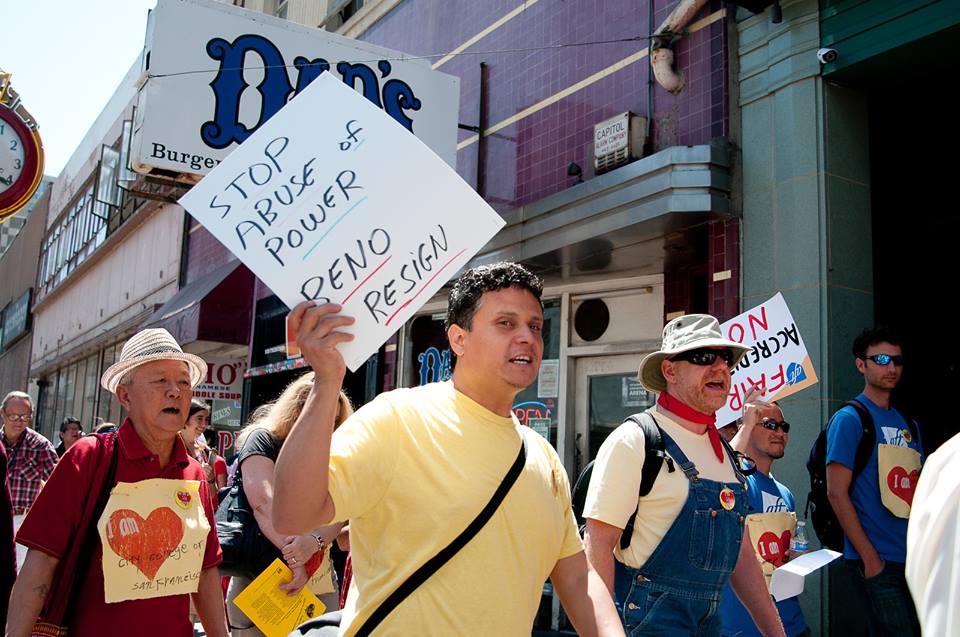
One of those meetings was not so peaceful, however, as over 200 City College supporters rallied outside the ACCJC’s semi-annual meeting in Sacramento, demanding the organization rescind its decision to revoke the college’s accreditation. The protest was led by the California Federation of Teachers, the local AFT 2121 and attended by teachers and students alike.

Tim Killikelly, the president of the AFT 2121 had questions about the new policy.

“I’m not sure how this restoration status is different than what appeals already existed,” he said. “The students need to be sure about their academic future, and this doesn’t do that. The students need to breathe a sigh of relief.”

He’s referring to the college’s recent drop in enrollment. At its height City College had over 100,000 students enrolled. But, due in part to its accreditation struggles and (some have said) the economy’s mild upswing, the enrollment has recently dropped to under 80,000 students. 

Killikelly laid much of the blame for that enrollment drop at the feet of the ACCJC. “They should’ve sent a team to verify we’re in compliance,” he said. Instead of this middling compromise, if the ACCJC had instead granted full accreditation Killikelly thinks confidence in the college could be restored.

City College Trustee Rafael Mandelman was also cautious about the decision.

“Its good news,”  he said, but, “the powers that be have rallied and persuaded the ACCJC that they cannot shut City College down now. The ACCJC are not pulling their claws out of the college. We will continue this terrible dance unless the City Attorney wins his lawsuit.”

The college may already have bounced back. California Community College Chancellor Brice Harris and City College Chancellor Arthur Tyler have publicly stated the school is 95 percent done addressing all of the concerns the ACCJC wanted to see fixed.

Mandelman contends the ACCJC’s move to terminate City College’s accreditation did more harm than good. “This whole process has been incredibly and unnecessarily disruptive on City College,” he said. “It’s a horrendous way to reform an institution.”

It should be noted that City College is still open, and remains accredited. For a look at the new policy from the ACCJC, click here.

Fogged in

1

THE WEEKNIGHTER Weekends are for amateurs. Weeknights are for pros. That’s why each week Broke-Ass Stuart (www.brokeassstuart.com) will be exploring a different San Francisco bar, bringing you stories about the places and people who make San Francisco one of the most phenomenal cities in the world. Who wants a drink?

We decided to walk around the Tenderloin. I had my computer, Gene had his bike, and Sabrina had a bag of things I’m sure she didn’t want taken from her as well. We were coming from my weekly Wednesday gig at Monarch where I do a coloring book happy hour.

“It’s very San Francisco out,” I said as we came up Taylor and saw the fog sliding its fingers down the sides of Nob Hill’s buildings. “I love summer in San Francisco,” I mused. “Me too,” Sabrina said, “I hate when people bitch about it. It’s part of San Francisco and loving it is part of being a San Franciscan.”

As we got to the entrance of Jones (620 Jones, SF. www.620-jones.com), the three of us landed on something we felt was important at the moment, that before this current gold rush, it was San Francisco’s summers that weeded out who would stay and who would go. You couldn’t take the mist and the fog? Then you got the fuck out of town. That fog is our inheritance and our merit badge and such a part of The City that you have to love it to live here.

Walking out onto the patio at Jones we were surprised there were no heat lamps. The entirely of the joint’s drinkers were crammed into the little sidebar adjacent to the patio, and as we sat down at the short end of the bar, the three of us gave each other a knowing glance. It said: How many of these people are experiencing their first San Francisco summer? How many would be considering packing up and heading back to wherever they’re from if they weren’t here for the gold rush? How many are living in apartments recently vacated by people whose love for the fog, and all it represents, just wasn’t enough to be able to keep them here?

Gene tipped the barman with a two-dollar bill. “Oh wow,” the bartender said, “you’re still doing that after all this time?” Gene told us he’d met him years before, during the first dot com boom, when the guy tended bar at 111 Minna. “Back then Minna was just a small one room space, not like it is now, Gene explained. “And I remember being there and learning for the first time how badly cocaine got on top of some people when these two girls, up from LA, were offering to blow people for blow.” As I looked around the room at all the pretty and well-dressed people, I wondered what they’d all be willing to do to get something they really wanted. I wondered the same thing about myself. What was I willing to do to stay in San Francisco if push came to shove and shove came to eviction.

Across the bar I noticed a friend who was obviously on a date and even more obviously drunk. “Hey look who it is,” I said to Sabrina who was also friends with the girl, and our conversation changed to the fact that, another integral part of living here is being ok with your past. “You can’t burn bridges,” Gene said, “since you’re bound to run into that person on a barstool sometime soon.” To which I replied, “If you burnt San Francisco’s bridges, all we’d be left with was the Peninsula…” The joke hit all three of us harder than expected. We looked around, looked at each other, and then left the bar. We felt more at home amid the fog anyways. 

Stuart Schuffman aka Broke-Ass Stuart is a travel writer, poet, and TV host. You can find his online shenanigans at www.brokeassstuart.com  

Shrimp Boy denied bail

Raymond “Shrimp Boy” Chow, who has a criminal history in Chinese gangs and was indicted along with Sen. Leland Yee and a slew of others in a high-profile FBI operation, was denied bail June 11.

U.S. Magistrate Nathanael Cousins struck down his defense attorneys’ motion for pretrial release on the grounds that Chow might pose a danger to the community due to his position as leader of the Chee Kung Tong (CKT), characterized as a Chinese crime syndicate by the FBI. Chow’s charges include seven counts of money laundering, one count of conspiracy to sell stolen cigarettes, and two counts of conspiracy to sell stolen liquor.

“The government’s advancing this conspiracy theory that my client is in charge of this organized crime syndicate. On that basis the judge is deciding to hold him,” said defense attorney Curtis Briggs. “It’s the Chinese Freemasons, it’s not a crime syndicate,” Briggs added. “It’s a fraternal organization. They’re going to be muddied up and dirtied up because the govermnent is pursing a racketeering case against them.”

Another wrinkle: “Now the government’s issued a deportation warrant againt him,” Briggs noted. “Even if we got him out, he’d be in immigration custody.”

A 23-page motion for release on bail for Chow, filed by Briggs and attorneys Gregory Bentley and Tony Serra, paints a very different picture of the targeted Chinatown figure than the all-powerful gangster portrayed by federal authorities.

The FBI complaint, unveiled in March, paints Chow as an international crime boss holding “supreme authority” as Dragonhead of the CKT.

In this role, the FBI charged, Chow was “the supervisor” of criminal relationships between Yee, political consultant Keith Jackson, and Chow’s associates, who had knowledge of and approved all criminal operations of the CKT and received payment for the various criminal dealings he facilitated. The complaint even noted that Chow had once told an undercover FBI agent that he served as a judge within the CKT; “if one member kills another member, Chow decides if the killing was justified.”

The mob boss who had returned yet again to a life of crime, all while swearing he’d given it all up, couldn’t be more different from the humble ex-convict described in his defense attorneys’ motion for release. Yee and Jackson, who faced charges on firearms trafficking, among other counts, were released on bail totaling $500,000 and $250,000, respectively. Prior to being taken into custody, Chow had already been wearing an ankle monitoring bracelet due to his pending case with immigration authorities.

In letters of support written on his behalf referenced in the motion, Chow was described as a community leader whose actions in recent years stemmed from nothing less than “a spiritual commitment … to make the San Francisco community a better place for all people even if it came at a great personal sacrifice to him.” A letter of support was even written by Wendy MacNaughton, an illustrator, journalist and author of Meanwhile in San Francisco.

Chow had apparently been working on his autobiography prior to being taken down by the FBI.

The motion recounts how Chow, born into “devastating financial conditions” in China, was taken in by the Chinese Triad at the age of seven “and for the next ten years scraped by and supported himself and his family through Triad related activities.” At 16, he was arrested and beaten by Chinese police in custody. Soon after, his family fled to the United States for a better life.

“Chow was recruited by local Chinatown so-called ‘gangs,’” the motion states. “As with many immigrant children with no resources, Chow was exploited by these groups for his desperate need for protection, acceptance, and recognition.” He served multiple prison sentences for various gang-related criminal activities.

But in 2003, when he was serving out a ten-year prison term, Chow became thoroughly disenchanted with the criminal lifestyle,” his defense attorneys wrote. “His revelation occurred when the façade of the gangster life disintegrated as each and every one of his criminal associates, people who he thought of as ‘brothers,’ turned their back on him and participated in activities which blatantly harmed the community.”

Chow’s girlfriend, Alicia Lo, had volunteered to act as a third-party custodian and post property bonds on her two San Francisco properties in order to facilitate his pretrial release.

In written testimony, she described him as caring and generous, saying she would buy him “second-hand clothes so he looked sharp in public,” only to later discover that he “would at times give these clothes away to addicts on the street so they could look presentable at job interviews.”

Yet in making his determination, the federal magistrate noted that there is “more than clear and convincing evidence that Mr. Chow would pose a danger to the community” if released.

Housing crisis requires creative thinking

10

EDITORIAL Does the construction of brand new high-end towers represent the only possible opportunity for new affordable housing in San Francisco? To hear the arguments of those bemoaning the passage of Proposition B, the ballot measure overwhelmingly approved June 3 requiring voter approval for increased building heights along the waterfront, one would think so.

Shortly after Prop. B had been decided, the Washington Post ran a headline proclaiming: “Voters in one of America’s most expensive cities just came up with another way to block new housing.” The idea seems to be that by making it harder for developers to build waterfront towers incorporating a small percentage of affordable units, San Francisco has sealed itself off from any new affordable housing, forever.

To buy this argument, you must resign yourself to a world where the only conceivable pathway for housing average-income people is to hope high-end developers decide to incorporate them into massive complexes for the wealthy on a narrow strip of waterfront property. Which just isn’t a terribly creative solution.

Surely, alternatives exist. The city is brimming with clever people who are skilled at creative thinking and aren’t afraid to dream big. Why not apply some brainpower to the housing crisis? Here are a few ideas.

• Change city law to allow people to build their own backyard cottages to rent out at affordable prices. Here we must holler at the Public Press, which is hosting a conference Fri/13 called “Hack the Housing Crisis,” and recently calculated that San Francisco could theoretically add another residence to each of its 124,000 single-family lots if the city were to legalize backyard cottages. That would increase the total number of households by 33 percent; no luxury towers required.

• Make the most of public land holdings. A Budget and Legislative Analyst’s report dating back to March of 2012 determined that city agencies have in their possession at least 27 underutilized “surplus” properties. Under the Administrative Code, the top priority for such lands is affordable housing, yet they go unused. Why not prioritize the transfer of these parcels for 100 percent affordable projects?

• Figure out some alternative financing schemes. Recent changes to federal law sanction crowdfunding for real-estate projects, an option that didn’t previously exist. Say some affordable housing people got together, started an online fundraising campaign, bought vacant properties for conversion into affordable units, and secured public funding to make the whole thing pencil out. Real estate investors won’t give a project a green light unless they’re guaranteed a stupidly high return; maybe under this scenario, thousands of nontraditional investors who care about the city they live in could reap small bonuses for pitching in.

And by the way, developers are still free to propose highly affordable projects under Prop B. In fact, voters might be much happier to sign off on that idea than high-end luxury condo towers.


Puff piece

2

arts@sfbg.com

FILM Sometimes a movie can only be called a gift — a gift intended for somebody other than the viewer. Clearly a film is a vanity project if its primary intent seems to flatter its maker. But what about when it’s a love letter from one rich, entitled celebrity to another? Then the vanity grows complicated, not least by the fact that we’re expected to pay for the privilege of watching one ass kiss another.

Anyone who blinked probably missed Super Duper Alice Cooper, which mostly did just one-night showings across the nation in April. That rockumentary was duly “authorized” but awfully entertaining, with the wit to tell its original shock-rocker’s tale entirely through archival footage plus a running oral history of latter-day interviews. Mike Myers’ directorial bow Supermensch: The Legend of Shep Gordon tells the same story for its first half hour — Gordon being the “Jewish kid from Long Island” who stumbled into being Cooper’s manager, shepherding (har) him to fame with an uncanny knack for promotional stunts and image-shaping.

He eventually provided those services and more to a highly eccentric roster of talents including Wonder Bread pop thrush Anne Murray, R&B vibrator Teddy Pendergrass, and (an end-scroll informs) King Sunny Ade, Ben Vereen, Raquel Welch, Michelle Shocked, Rick James, and Frankie Valli. He co-founded Alive Films, which produced and distributed an innovative slate of indie and foreign features. Discovering that the world’s greatest chefs were “treated like shit” (?!), he had the foresight to create the whole “celebrity chef racket” in which they have reality TV shows and hawk their own supermarket products, for which we presumably must be grateful.

In a respite from bedding and occasionally marrying other “tens,” he kept Sharon Stone off the dating market for two years, for which we should probably also be grateful. She introduced him to the Dalai Lama, of whom he says, “Every time His Holiness walks into a room I feel like I’ve taken the greatest shower of my life.” (Apparently, he feels spiritually cleansed.) Dropping more names than a telephone book in a shredder, Gordon shares amusing anecdotes about Cary Grant and Steve Jobs alike. He is a wellspring of generosity who supported an ex-girlfriend’s orphaned grandchildren and secured financial stability for an elderly Groucho Marx. Meeting Myers via Cooper on the set of 1992’s Wayne’s World, he subsequently housed the famously difficult comedian turned (here) documentarian for two months at his Maui compound when the erstwhile Austin Powers was going through a rough stretch.

“He’s the nicest man I’ve ever met, hands down,” Myers gushes onscreen, while some other famous person (Michael Douglas? I forget) calls Gordon “the nexus for everybody who means anything in the entire world.”

Supermensch is a professional funny guy’s documentary, which means it can’t help manipulating things (wacky klezmer soundtrack; campy re-enactments; celebrity testimonials from Tom Arnold, Sammy Hagar, and Sylvester Stallone) in ways that beg for approval. Gordon is no doubt a great host, a good cook, a consummate cocksman, and a social and business genius. But watching this movie is like paying to see a $5,000-per-plate benefit dinner via closed circuit TV — as if it were a humbling honor to witness famous people pat each other on the back.

It’s a given here that the tragedy of Gordon’s life is his not being able to foster a biological family of his own — no matter that he’d out-bachelored many a former lover who might have realized it. “I felt really lonely for him,” says one loyal personal assistant re: the moment he woke up from near fatal surgery (cue Radiohead track “Everything In Its Right Place”) and was disappointed her less-than-gorgeous self was at his bedside. The by-association narcissism Supermensch exudes is exceeded only by the depressingly low self-esteem of she who pities a man who hasn’t yet found his impossible feminine ideal. *


SUPERMENSCH: THE LEGEND OF SHEP GORDON opens Fri/13 in San Francisco.

Event Listings: June 18-24, 2014

0

Listings are compiled by Guardian staff. Submit items for the listings at listings@sfbg.com. For further information on how to submit items for the listings, see Selector.

WEDNESDAY 18

“Exploding Stars, Dark Energy, and the End of the Universe” Randall Museum Theater, 199 Museum Way, SF; www.randallmuseum.org. 7:30pm, free (donations encouraged). UC Berkeley astrophysicist and cosmologist Brad Tucker leads this lecture presented by the San Francisco Amateur Astronomers.

Susan Jane Gilman Book Passage, 1 Ferry Bldg, SF; www.bookpassage.com. 6pm, free. The author reads from her debut novel, The Ice Cream Queen of Orchard Street.

“Peter Orlovsky, A Life in Words” City Lights Bookstore, 261 Columbus, SF; www.citylights.com. 7pm, free. The late poet is remembered with Peter Orlovsky, a Life in Words: Intimate Chronicles of a Beat Writer, read by Bill Morgan, Joanne Kluger, and Michael McClure.

Tom Spanbauer Books Inc., 2275 Market, SF; www.booksinc.net. 7:30pm, free. The author reads from his first novel in seven years, I Loved You More.

THURSDAY 19

“Ink: The Enduring Art of Tattoos” Creativity Explored Gallery, 3245 16th St, SF; www.creativityexplored.org. Opening reception tonight, 7-9pm. Free. Exhibit through Aug 6 (Mon-Fri, 10am-3pm; Thu, 10am-7pm; Sat-Sun, noon-5pm). Creativity Explored artists present works inspired by tattoo art in this group exhibition.

FRIDAY 20

Community of Writers at Squaw Valley benefit reading Starr King Room, First Unitarian Universalist Church, 1187 Franklin, SF; www.squawvalleywriters.org. 7pm, $12-24. Readings by poets Don Mee Choi, Robert Hass, Harryette Mullen, C.D. Wright, and Matthew Zapruder.

SATURDAY 21

“Action and Adventure: The Beginning of Modern Comics” Escapist Comic Bookstore, 3090 Claremont, Berk; www.escapistcomics.com. 3-5pm, free. Gerard Jones (Men of Tomorrow: Geeks, Gangsters, and the Birth of the Comic Book) and Nicky Wheeler-Nicholson (granddaughter of the founder of DC Comics) discuss the early days of comics.

“Step Back” Meet in front of City Lights Bookstore, 261 Columbus, SF; www.radarproductions.org. 4pm, free. Radar presents this walking tour (with performances!) through the queer origins of North Beach with author and historian Nan Alamilla Boyd (Wide Open Town: A History of Queer San Francisco to 1965).

San Mateo SummerFest B Street between Tilton and Sixth Aves, San Mateo; www.sresproductions.com. 10am-6pm, free. Also Sun/22. Historic downtown San Mateo hosts this summer fair, with arts and crafts, cooking demos, live entertainment, and more.

“Sexy Summer Dance Party” One Grove Street, SF; www.ftloose.org. 7-11pm, $20-50 donation. Raise money for nonprofit art group Footloose at this event, featuring live music by Stephanie Teel Band and Rasa Vitalia, plus raffles, a silent auction, and more.

“What the Truck?” Jack London Square, Broadway at Embarcadero, Oakl; www.jacklondonsquare.com. 11am-5pm, free. Not just food trucks, though there’ll be plenty of those; this event also boasts art trucks, toy trucks, a mobile photo bus, and fashion boutiques on wheels.

SUNDAY 22

“Sunday Storytime Hour” Cartoon Art Museum, 655 Mission, SF; www.cartoonart.org. 11am-noon, included with museum admission ($4-8). Reading for kids spotlighting the John Klassen books This is Not My Hat and I Want My Hat Back, plus treats from Arizmendi Bakery. Wear your favorite hat!

“We Shape Our City” Old Mint, 88 Fifth St, SF; www.sfhistory.org. 1-4pm, $5-10. Ongoing every Sunday. The San Francisco Museum and Historical Society hosts docent-led tours of the historic landmark, as well as showcasing a number of exhibits, including photographic explorations of various SF neighborhoods and the new “We Shape Our City,” dedicated to local innovators.

MONDAY 23

Kenneth Turan Book Passage, 1 Ferry Bldg, SF; www.bookpassage.com. 6pm, free. The veteran film critic reads from Not to Be Missed.

TUESDAY 24

Jeffrey Renard Allen Booksmith, 1644 Haight, SF; www.booksmith.com. 7:30pm, free. The author reads from Song of the Shank.

Joanna Smith Rakoff Book Passage, 1 Ferry Bldg, SF; www.bookpassage.com. 6pm, free. The author shares her memoir, My Salinger Year.

Adam Wilson and Lucy Corin City Lights Bookstore, 261 Columbus, SF; www.citylights.com. 7pm, free. The authors share What’s Important Is Feeling and One Hundred Apocalypses. *


Stage Listings: June 11-17, 2014

0

Stage listings are compiled by Guardian staff. Performance times may change; call venues to confirm. Reviewers are Robert Avila, Rita Felciano, and Nicole Gluckstern. Submit items for the listings at listings@sfbg.com.

THEATER

OPENING

“The Bakla Show 3” Bindlestiff Studio, 185 Sixth St, SF; http://baklashow3.bpt.me. $10-20. Opens Thu/12, 8pm. Runs Thu-Sat, 8pm. Through June 28. Three short works focusing on the struggles of Pinoy LGBT youth.

Body of Water Southside Theater, Fort Mason Center, Bldg D, Third Flr, Marina at Laguna, SF; www.brownpapertickets.com. $15-35. Opens Fri/13, 7:30pm. Runs Fri-Sat, 7:30pm; Sun, 2:30pm. Through June 28. A Theatre Near U presents an original indie-rock teen musical, with songs by Jim Walker.

The Weir Shelton Theater, 533 Sutter, SF; www.sheltontheater.org. $38. Opens Thu/12, 8pm. Runs Thu-Sat, 8pm. Through July 12. Shelton Theater performs Conor McPherson’s acclaimed tale about a spooky night in an Irish pub.

BAY AREA

American Buffalo Aurora Theatre, 2081 Addison, Berk; www.auroratheatre.org. $32-60. Previews Fri/13-Sat14 and June 18, 8pm; Sun/15, 2pm; Tue/17, 7pm. Opens June 19, 8pm. Runs Tue and Sun, 7pm (also Sun, 2pm); Wed-Sat, 8pm. through July 13. Aurora Theatre closes its 22nd season with David Mamet’s powerful drama.

ONGOING

Brahmin/I: A One-Hijra Stand-Up Comedy Show Thick House, 1695 18th St, SF; www.crowdedfire.org. $15-35. Wed-Sat, 8pm. Through June 28. Crowded Fire Theater presents Aditi Brennan Kapil’s “outrageous play masquerading as a stand-up comedy routine.”

The Crucible Gough Street Playhouse, 1620 Gough, SF; www.custommade.org. $10-35. Thu/12-Sat/14, 8pm; Sun/15, 7pm. Custom Made Theatre Co. performs Arthur Miller’s drama.

Devil Boys From Beyond New Conservatory Theatre Center, 25 Van Ness, SF; www.nctcsf.org. $25-45. Wed-Sat, 8pm; Sun, 2pm. Through June 28. New Conservatory Theatre Center performs Buddy Thomas and Kenneth Elliot’s campy sci-fi saga.

Each and Every Thing Marsh San Francisco Main Stage, 1062 Valencia, SF; www.themarsh.org. $20-50. Previews Thu/12-Fri/13, 8pm. Opens Sat/14, 8:30pm. Runs Thu-Fri, 8pm; Sat, 8:30pm. Through July 12. Dan Hoyle presents his latest solo show, about the search for real-world connections in a tech-crazed world.

Feisty Old Jew Marsh San Francisco Main Stage, 1062 Valencia, SF; www.themarsh.org. $25-100. Sat-Sun, 5pm. Extended through July 13. Charlie Varon performs his latest solo show, a fictional comedy about “a 20th century man living in a 21st century city.”

Foodies! The Musical Shelton Theater, 533 Sutter, SF; www.foodiesthemusical.com. $32-34. Fri-Sat, 8pm. Open-ended. AWAT Productions presents Morris Bobrow’s musical comedy revue all about food.

God Fights the Plague Marsh San Francisco Studio Theater, 1062 Valencia, SF; www.themarsh.org. $15-100. Previews Sat/14, 8:30pm; Sun/15, 7pm. Opens June 21, 8:30pm. Runs Sat, 8:30pm; Sun, 7pm. Through Aug 10. The Marsh presents a solo show written by and starring 18-year-old theater phenom Dezi Gallegos.

Homo File CounterPULSE, 1310 Mission, SF; www.counterpulse.org. $20-35. Fri/13-Sat/14, 8pm; Sun/15, 7pm. Writer-designer-director Seth Eisen’s homage to queer rebel Samuel Stewart (1909–1993), whose polymorphous career spanned the better part of the 20th century, was last seen at CounterPULSE in a trim and appealing 40-minute version that capped his artistic residence there in 2012. Since then the work has ballooned across two acts and, unfortunately, lost its focus. What was a compact but meaningful exploration of a polymath and sexual rebel, boldly negotiating the social hierarchies of a deeply repressive and homophobic culture, has become a vague, sometimes difficult to follow story with little more to recommend it than a hedonistic joie de vivre (though even the raunch feels listless and somewhat perfunctory). The expanded production still sports the playful puppetry (shadow and otherwise), overhead and video projections, and aerial choreography of the original — and these do produce some interesting or enjoyable moments — but the show’s polyphonic elements get drastically watered down in a sprawling, lumbering, and unevenly performed dramatic narrative. This is marked by a lot of leaden dialogue and underwhelming songs in scenes that feel either unnecessary or under-explored. The subject (played dutifully but without much illumination by Brian Livingston), along with a seven-actor ensemble of supporting characters, traverses the mutually exclusive worlds of academia and the literary avant-garde (where Michael Soldier as both sexologist Alfred Kinsey and Gertrude Stein is a notable treat); the working-class homosexual underworld of sailors and tattoo parlors; and even the conventionality of a part-time heterosexual romance (where a nicely understated Katharine Otis as Emmy Curtis begins to cast an intriguing angle on Stewart’s complex makeup). But the import of Stewart’s unique vantage and influence on it all as well as his peculiar aloofness in the midst of everything are fuzzily evoked at best. For all the media employed to depict him and his world, we come away with little sense of either. (Avila)

The Homosexuals New Conservatory Theatre Center, Decker Theatre, 25 Van Ness, SF; www.nctcsf.org. $25-45. Wed-Sat, 8pm; Sun, 2pm. Through June 28. This mildly intriguing and fitfully engaging drama from rising Chicago playwright Philip Dawkins (whose Failure: A Love Story is currently having its Bay Area debut at Marin Theater Company) explores the tensions — sexual, generational, and otherwise — among a small circle of mostly gay friends via a central figure, Evan (a sharp Robert Rushin), who ends up in relationships with almost everyone. Beginning in 2010, as 29-year-old Evan breaks up with older histrionic theater director Peter (a drolly world-weary Matt Weimer), each successive scene jumps back two years and one relationship, until the final scene unites the entire circle as they welcome naïve Iowa teen Evan out of the closest and to the big city. It’s also a new millennium, of course, some distance now from Stonewall and the first wave of the AIDS crisis, and one of the more interesting aspects of the drama (which benefits from an overall strong cast under the direction of Arturo Catricala) is the generational divide between Evan and his circle. This divide feels downright political in the aggressive showdown between Evan and the apathetic art teacher and predatory libertine Mark (a persuasive Keith Marshall), but there’s a political edge at the outset, in Evan’s pointed refusal to join Peter in referring to himself as a “homosexual,” insisting instead on the word “gay” tout court. Despite this underlying issue and some witty dialogue, however, there’s little of interest in most of the dynamics between Evan and his circle. The play’s structure accordingly becomes a slightly tedious countdown, at least until the final scene, which cashes in on the power of hindsight to produce a limited, wistful tremor of reflection. (Avila)

In the Tree of Smoke Great Star Theater, 636 Jackson, SF; www.brownpapertickets.com. $25. Thu-Sat, 8pm. Through June 28. Circus Automatic performs an new evening of immersive, experimental circus.

Macbeth Fort Point (beneath the Golden Gate Bridge), SF; www.weplayers.org. $30-75. Thu-Sun, 7pm. Through June 29. We Players’ latest site-specific undertaking is nothing less than the Scottish play at San Francisco’s historic Civil War-era Fort Point, under the southern base of the Golden Gate Bridge. And a better location for Shakespeare’s brooding, bloody, and spooky civil war drama is hard to imagine. The grandeur of the multi-story red-brick edifice with its mammoth steel doors, magnificent inner courtyard, graceful arches, spiral stairwells, mysterious passageways, canon casemates looking onto the Pacific — as well as old canons and cannonballs — add up to a deeply atmospheric setting. Moreover, directors Ava Roy and John Hadden and their production team make good use of it, moving the audience around the grounds for the better part of three hours amid picturesque staging of scenes, a wonderfully powerful quartet of musicians (made up of percussionist Brent Elberg, trumpeter Aaron Priskorn, saxophonist Charlie Gurke, and trombonist Mara Fox alternating with Rick Brown), and reverberant cries from the weyard sisters (Julie Douglas, Maria Leigh, Caroline Parsons), the enraged MacDuff (Dixon Phillips), or usurper Macbeth’s hapless victims. As the titular hero-villain, John Hadden is generally imposing if not always convincing, while Ava Roy’s forceful Lady M cuts an elegant, at times ethereal figure in her magnificent black gown (the admirable costumes throughout are by Julia Rose Meeks and Master Seamstress Dana Taylor). In general, the acting proves the weakest link, but the overall spectacle makes this a unique and rather compelling outing. (Avila)

The Orphan of Zhao ACT’s Geary Theater, 415 Geary, SF; www.act-sf.org. $20-120. Opens Wed/11, 8pm. Runs Wed-Sat and June 24, 8pm (also Wed and Sat, 2pm); Tue/17, 7pm. Through June 29. Tony winner BD Wong stars in James Fenton’s acclaimed Chinese-legend adaptation at American Conservatory Theater.

Pearls Over Shanghai Hypnodrome Theatre, 575 10th St, SF; www.thrillpeddlers.com. $30-35. Thu-Sat, 8pm. Extended through June 28. Five years ago, Thrillpeddlers breathed new life into a glitter-dusted piece of Sixties flotsam, beautifully reimagining the Cockettes’ raunchy mock-operetta Pearls Over Shanghai (in collaboration with several surviving members of San Francisco’s storied acid-drag troupe) and running it for a whopping 22 months. Written by Cockette Link Martin as a carefree interpretation of a 1926 Broadway play, the baldly stereotyped Shanghai Gesture, it was the perfectly lurid vehicle for irreverence in all directions. It’s back in this revival, once again helmed by artistic director Russell Blackwood with musical direction by Cockette and local favorite Scrumbly Koldewyn. But despite the frisson of featuring some original-original cast members — including “Sweet Pam” Tent (who with Koldewyn also contributes some new dialogue) and Rumi Missabu (regally reprising the role of Madam Gin Sling) — there’s less fire the second time around as the production straddles the line between carefully slick and appropriately sloppy. Nevertheless, there are some fine musical numbers and moments throughout. Among these, Zelda Koznofsky, Birdie-Bob Watt, and Jesse Cortez consistently hit high notes as the singing Andrews Sisters-like trio of Americans thrown into white slavery; Bonni Suval’s Lottie Wu is a fierce vixen; and Noah Haydon (as the sultry Petrushka) is a class act. Koldewyn’s musical direction and piano accompaniment, meanwhile, provide strong and sure momentum as well as exquisite atmosphere. (Avila)

Seminar San Francisco Playhouse, 450 Post, Second Flr, SF; www.sfplayhouse.org. $20-100. Wed/11-Thu/12, 7pm; Fri/13-Sat/14, 8pm (also Sat/14, 3pm). San Francisco Playhouse performs Theresa Rebeck’s biting comedy.

“Sheherezade 14” Exit Theater, 156 Eddy, SF; www.playwrightscentersf.org. $25. Thu-Sat, 8pm. Through June 21. The Playwrights’ Center of SF and Wily West Productions host this annual festival of fully-produced short plays.

Shit & Champagne Rebel, 1772 Market, SF; shitandchampagne.eventbrite.com. $25. Fri-Sat, 8pm. Open-ended. D’Arcy Drollinger is Champagne White, bodacious blond innocent with a wicked left hook in this cross-dressing ’70s-style white-sploitation flick, played out live on Rebel’s intimate but action-packed barroom stage. Written by Drollinger and co-directed with Laurie Bushman (with high-flying choreography by John Paolillo, Drollinger, and Matthew Martin), this high-octane camp send-up of a favored formula comes dependably stocked with stock characters and delightfully protracted by a convoluted plot (involving, among other things, a certain street drug that’s triggered an epidemic of poopy pants) — all of it played to the hilt by an excellent cast that includes Martin as Dixie Stampede, an evil corporate dominatrix at the head of some sinister front for world domination called Mal*Wart; Alex Brown as Detective Jack Hammer, rough-hewn cop on the case and ambivalent love interest; Rotimi Agbabiaka as Sergio, gay Puerto Rican impresario and confidante; Steven Lemay as Brandy, high-end calf model and Champagne’s (much) beloved roommate; and Nancy French as Rod, Champagne’s doomed fiancé. Sprawling often literally across two buxom acts, the show maintains admirable consistency: The energy never flags and the brow stays decidedly low. (Avila)

The Speakeasy Undisclosed location (ticket buyers receive a text with directions), SF; www.thespeakeasysf.com. $65-100 (gambling chips, $7-10 extra; after-hours admission, $10). Wed-Sat, 7:30, 7:40, 7:50, 8pm, and 9pm admittance times. Extended through June 21. Boxcar Theater’s most ambitious project to date is also one of the more involved and impressively orchestrated theatrical experiences on any Bay Area stage just now. An immersive time-tripping environmental work, The Speakeasy takes place in an “undisclosed location” (in fact, a wonderfully redesigned version of the company’s Hyde Street theater complex) amid a period-specific cocktail lounge, cabaret, and gambling den inhabited by dozens of Prohibition-era characters and scenarios that unfold around an audience ultimately invited to wander around at will. At one level, this is an invitation to pure dress-up social entertainment. But there are artistic aims here too. Intentionally designed (by co-director and creator Nick A. Olivero with co-director Peter Ruocco) as a fractured super-narrative — in which audiences perceive snatches of overheard stories rather than complete arcs, and can follow those of their own choosing — there’s a way the piece becomes specifically and ever more subtly about time itself. This is most pointedly demonstrated in the opening vignettes in the cocktail lounge, where even the ticking of Joe’s Clock Shop (the “cover” storefront for the illicit 1920s den inside) can be heard underscoring conversations (deeply ironic in historical hindsight) about war, loss, and regained hope for the future. For a San Francisco currently gripped by a kind of historical double-recurrence of the roaring Twenties and dire Thirties at once, The Speakeasy is not a bad place to sit and ponder the simulacra of our elusive moment. (Avila)

36 Stories by Sam Shepard Z Below, 470 Florida, SF; www.36stories.org. $35-55. Wed-Thu, 7pm; Fri-Sat, 8pm; Sun, 3pm. Through June 22. Word for Word has been at the business of putting literature on the stage, verbatim, for some time, and far from slowing down, this new production shows the company operating at the height of its powers. Among the best manifestations of the company’s particular concerns and talents, 36 Stories by Sam Shepard not only shows off the considerable virtues of Shepard’s short-story writing (usually overshadowed by his justly acclaimed plays) but unfolds as a stellar piece of theater in its own right. Shrewdly adapted and directed by company charter member Amy Kossow, the production repeatedly finds opportunities in the writing for dramatic transmission and exchange among the performers — a kick-ass ensemble composed of Patrick Alparone, Carl Lumbly, Delia MacDougall, JoAnne Winter, and Rod Gnapp as “The Writer” — the latter a sleepless wanderer crisscrossing the country by car, from whose head and manual typewriter the low characters, tall tales, and electrical encounters issue forth with sharp, sometimes zany humor; smoldering sexual heat; and a shapeless foreboding. Word for Word’s loyal fans need little encouragement, but all interested in a gratifying night in the theater will want to catch this one before it goes. (Avila)

Too Much Light Makes the Baby Go Blind Boxcar Theatre, 505 Natoma, SF; www.sfneofuturists.com. $11-16. Fri-Sat, 9pm. Ongoing. The Neo-Futurists perform Greg Allen’s spontaneous, ever-changing show that crams 30 plays into 60 minutes.

Triassic Parq Eureka Theater, 215 Jackson, SF; www.rayoflighttheatre.com. $25-36. Wed-Sat, 8pm (also June 21 and 28, 2pm). Through June 28. Ray of Light Theatre presents the Bay Area premiere of Marshall Pailet’s musical involving “dinosaurs, show tunes, and sex changes.”

Walk Like A Man Costume Shop, 1117 Market, SF; www.therhino.org. $15-35. Wed/11-Sat/14, 8pm; Sun/15, 3pm. Falling in love with your boss, surviving child abuse, losing a loved one in war, dealing with your straight daughter’s shame around her mom’s butch wardrobe — these are only a few of the circumstances encountered in a raucous and affecting evening of celebrating desire and being true to yourself, as Theatre Rhinoceros presents 10 stories of love and sex among a diverse set of African American women. Culled from the titular collection of erotic fiction by Atlanta-based author Laurinda D. Brown, the evening unfolds with a pert and playful finesse thanks to director John Fisher and a strong, charismatic five-women ensemble (made up of Alexaendrai Bond, Kelli Crump, Nkechi Emeruwa, Daile Mitchum, and Desiree Rogers). Sexy and brazen, raunchy and wrenching, this series of vignettes, spread out over two acts, comes with nary a dull moment and plenty of climaxes. (Avila)

BAY AREA

Candida Town Hall Theatre, 3535 School, Lafayette; www.townhalltheatre.com. $20-32. Thu/12-Sat/14, 8pm. Town Hall Theatre performs the Shaw classic.

The Crazed Berkeley City Club, 2315 Durant, Berk; www.centralworks.org. $15-28. Thu-Sat, 8pm; Sun, 5pm. Through June 23. Central Works performs Sally Dawidoff’s play, based on Ha Jin’s novel about coming of age in Communist China.

Daylighting: The Berkeley Stories Project Ashby Stage, 1901 Ashby, Berk; www.shotgunplayers.org. $20-35. Wed-Thu, 7pm; Fri-Sat, 8pm; Sun, 5pm (June 22, show at 2pm). Through June 22. Shotgun Players present Dan Wolf’s new play inspired by real-life tales from Berkeley residents past and present.

Dead Man’s Cell Phone Masquers Playhouse, 105 Park Place, Point Richmond; www.masquers.org. $22. Fri-Sat, 8pm; Sun, 2pm. Through June 28. Masquers Playhouse performs Sarah Ruhl’s imaginative comedy.

Failure: A Love Story Marin Theatre Company, 397 Miller, Mill Valley; www.marintheatre.org. $37-58. Tue and Thu-Sat, 8pm (also Sat/14 and June 28, 2pm; June 19, 1pm); Wed, 7:30pm; Sun, 2 and 7pm. Through June 29. Marin Theatre Company performs Philip Dawkins’ play about love and loss, with puppets and live music.

Hershey Felder as Leonard Bernstein in Maestro Berkeley Repertory Theatre, Thrust Stage, 2025 Addison, Berk; www.berkeleyrep.org. $29-87. Tue and Thu-Sat, 8pm (also Sat, 2pm); Wed and Sun, 7pm (also Sun, 2pm). Through June 22. Juno-winning actor and musician Hershey Felder (George Gershwin Alone) performs his latest solo show.

The Intelligent Homosexual’s Guide to Capitalism and Socialism with a Key to the Scriptures Berkeley Repertory Theatre, Roda Theatre, 2015 Addison, Berk; www.berkeleyrep.org. $14.50-89. Tue, Thu-Sat, 7:30pm (also Sat and June 26, 2pm); Wed and Sun, 7pm (also Sun, 2pm). Through June 29. Berkeley Rep’s Tony Taccone, a comrade of Tony Kushner’s from way back in the Angels in America days, directs this revised version of the playwright’s 2009 play, whose long title is a riff on an earlier one by George Bernard Shaw. It concerns the fractured Italian American family of a diehard Communist longshoreman named Gus (Mark Margolis in an impressive, anchoring performance), now retired, who has announced his intention to kill himself and leave his Brooklyn brownstone to the grown children to sell and divide among themselves. In today’s inflated real estate market, that’s not chump change either. His announcement plunges the family into chaos, though truth be told they were all kind of a mess already. Son Pill (Lou Liberatore) is a married gay high school history teacher having a torrid affair with a young hustler (Jordan Geiger), which has already cost him $30,000 of his sister’s hard-earned money. His sister, Empty (Deidre Lovejoy), meanwhile couldn’t care less about the baby to whom her partner (Liz Wisan) is about to give birth, courtesy of the donated sperm from her kid brother Vito (Joseph J. Parks) — who comes across as the contrarian of the family: he’s neither gay nor a Communist. Other significant others are on hand, as well as Gus’s sister Clio (an effective, comically deadpan Randy Danson), a onetime nun who later became a Maoist in Peru and now seems some sloshy mix of the two. And for that reason she, along with Gus, symbolizes more than most the real dilemma here: a lack of something to believe in, of a structure for explaining and shaping experience and modeling action toward a better (post-capitalist) world. At nearly four hours, the play is Kushner’s version of the great American three-act family drama — those personal yet prophetic portraits by your O’Neills, your Millers, your Shepards. Tracy Letts made a similar bid with 2007’s August: Osage County. I don’t think either play really makes it into the pantheon, but while Letts’ play was ultimately slicker, more entertaining, Kushner’s has more in it, more to talk about of real relevance. Not that the production isn’t also entertaining — stage business with pregnant lesbians and mysterious briefcases buried in the wall are deployed to elating effect. But the play’s various subplots and characters are not equally interesting and the machinations of the plot and the sometimes-overlapping dialogue can be overwrought. But despite the tedium this produces, the political questions opened up here are liable to continue rattling around the brain after the curtain comes down, leaving one with a small but worthwhile buzz. (Avila)

Marry Me A Little Mountain View Center for the Performing Arts, 500 Castro, Mtn View; www.theatreworks.org. $19-73. Tue-Wed, 7:30pm; Thu-Sat, 8pm (also Sat, 8pm); Sun, 2 and 7pm. Through June 29. TheatreWorks performs Stephen Sondheim’s intimate musical.

Nantucket Marsh Berkeley MainStage, 2120 Allston, Berk; www.themarsh.org. $25-100 (all tickets include a picnic dinner). Thu and Sat, 7pm. Extended through July 19. Nantucket Island, a wisp of shifting sand 30 miles off the coast of Cape Cod, Mass., is the evocative setting for this autobiographical story from writer-performer Mark Kenward — less the tourists’ Nantucket of summer holidays, mind you, than the inhabitants’ gray and isolated winter. And just as its bleak weather stood for the tempestuous mood of Herman Melville’s Ishmael before he sets sail again in Moby Dick, so the environment for Kenward’s coming-of-age darkly foreshadows a terrible downward spiral. The only son and oldest child of two in a nuclear family from Normal, Ill., that really seemed to fit the bill — complete with a dad who, “in his entire life, only missed four days of shaving” — Mark becomes the odd-boy out upon the Kenwards’ relocation to the remote island. An affable, poised, physically demonstrative performer with a residual Midwestern charm, Kenward describes an upbringing in a household overshadowed by a high-strung, controlling, deeply unhappy mother who, as luck would have it, also becomes his high school English teacher. This relationship is the ground for much of the play’s humor, but also a trauma that blows in like a winter squall. Directed keenly, if perhaps a little too stiffly, by Rebecca Fisher, and accompanied at points by a watery island backdrop (courtesy of video designer Alfonso Alvarez), Nantucket discharges some of its messy human themes a bit too neatly but maintains an inescapable pull. (Avila)

Other Desert Cities Barn Theatre, 30 Sir Francis Drake, Ross; www.rossvalleyplayers.com. $10-26. Thu/12, 7:30pm; Fri/13-Sat/14, 8pm; Sun/15, 2pm. Ross Valley Players perform Jon Robin Baitz’s Pultizer-nominated drama about a tense family holiday.

South Pacific Cushing Memorial Amphitheater, 801 Panoramic Hwy, Mill Valley; www.mountainplay.org. $20-60. Sun/15, 2pm (arrive one hour prior to show time). Mountain Play Association performs the classic Rodgers and Hammerstein musical.

The 25th Annual Putnam County Spelling Bee Lesher Center for the Arts, 1601 Civic, Walnut Creek; www.centerrep.org. $37-65. Wed, 7:30pm; Thu-Sat, 8pm (also Saturdays in June, 2:30pm); Sun, 2:30pm. Through June 21. Center REP performs the Tony-winning musical by William Finn and Rachel Sheinkin.

PERFORMANCE/DANCE

“Bitch and Tell: A Real Funny Variety Show” Kunst-Stoff Arts, One Grove, SF; www.brownpapertickets.com. Fri/13-Sat/14, 8pm. $8-10. Footloose presents this variety show with Bob McIntyre, Nick Stargu, Carolina “CoiCoi” Duncan, and others.

Caroline Lugo and Carolé Acuña’s Ballet Flamenco Peña Pachamama, 1630 Powell, SF; www.carolinalugo.com. June 22, 29, July 12, 19, and 27, 6:30pm. $15-19. Flamenco performance by the mother-daughter dance company, featuring live musicians.

“Dash: Improv in a Flash” Un-Scripted Theater Company, 533 Sutter, Second Flr, SF; www.un-scripted.com. Sat, 10pm. $15. Ongoing through Aug 30. A late-night, free-form improv show with Un-Scripted Theater Company.

“Dream Queens Revue” Aunt Charlie’s Lounge, 133 Turk, SF; www.dreamqueensrevue.com. Wed/11, 9:30pm. Free. Drag with Collette LeGrande, Ruby Slippers, Sophilya Leggz, Bobby Ashton, and more.

Feinstein’s at the Nikko 222 Mason, SF; www.feinsteinssf.com. This week: “Judy Kaye Sings Bernstein and Sondheim,” Thu/12-Fri/13, 8pm, $35-50; Christine Ebersole in “Strings Attached,” Sat/14-Sun/15, 7pm, $60-85.

“Global Dance Passport Showcase” ODC Dance Commons Studio B, 351 Shotwell, SF; www.odctheater.org. Sat/14, 8pm; Sun/15, 4 and 7pm. $10. ODC presents a sampler of world dance.

“Hubba Hubba Revue’s Burlesque Nation” DNA Lounge, 375 11th St, SF; www.dnalounge.com. Fri/13, 9:30pm. $15-30. Burlesque performers from NY, Miami, LA, Germany, Australia, and more.

“Imaginary Activism: The Role of the Artist Beyond the Art World” Modern Times Bookstore Collective, 2919 24th St, SF; (415) 282-9246. Sat/14, 8pm. Free. A new monologue by acclaimed performance artist Guillermo Gomez Peña.

“Magic at the Rex” Hotel Rex, 562 Sutter, SF; www.magicattherex.com. Sat, 8pm. Ongoing. $25. Magic and mystery with Adam Sachs and mentalist Sebastian Boswell III.

Natasha Carlitz Dance Ensemble Dance Mission Theater, 3316 24th St, SF; www.carlitzdance.org. Fri/13-Sat/14, 8pm. $15-18. Performing Momentum, dance works exploring the magic of mathematics.

“Out of Line Improv” Stage Werx, 446 Valencia, SF; outoflineimprov.brownpapertickets.com. Sat, 10:30pm. $12. Ongoing. A new, completely improvised show every week.

“Rites and Passages” Nourse Theatre, 275 Hayes, SF; www.cityboxoffice.com. Sat/14, 8pm. $18-36. The San Francisco Girls Chorus closes its season with a concert of music by Eastern European composers (Bartók, Stravinsky), plus performances by the Joe Goode Performance Group and pianists Kanoko Nishi and Sarah Cahill.

“San Francisco Comedy College” Purple Onion at Kells, 530 Jackson, SF; www.purpleonionatkells.com. $5-10. “New Talent Show,” Wed-Thu, 7. Ongoing. “The Cellar Dwellers,” stand-up comedy, Wed-Thu, 8:15pm and Fri-Sat, 7:30pm. Ongoing.

“Sojourners” Commonwealth Club of California, 595 Market, SF; www.magictheatre.org. Mon/16, 6pm. Free. Staged reading of Nigerian storyteller Mfoniso Udofia’s new work. Presented as part of the Magic Theatre’s Martha Heasly Cox Virgin Play Series.

“This Lingering Life” Z Space, 450 Florida, SF; www.theatreofyugen.org. Previews Thu/5, 7pm. Opens Fri/6, 8pm. Wed/11-Thu/12, 7pm; Fri/13-Sat/14, 8pm. $15-50. Theatre of Yugen performs the world premiere of Chiori Miyagawa’s drama, inspired by nine Japanese Noh plays from the 14th century.

“Yerba Buena Gardens Festival” Yerba Buena Gardens, 760 Howard, SF; www.ybgfestival.org. Free. Through Oct 26. This week: Destani Wolf, Thu/12, 12:30-1pm; Venezuelan Music Project, Fri/13, 11-11:30am; “The Art of the Descarga” with the John Santos Sextet, Sat/14, 1-2:30pm; Native Contemporary Arts Festival, Sun/15, noon-3pm; “Poetic Tuesday,” Tue/17, 12:30-1:30pm.

BAY AREA

“Immigrant Stories: Personal Stories Honoring the Immigrant Experience” La Peña Cultural Center, 3105 Shattuck, Berk; www.livingartsplayback.com. Sat/14, 8pm. $18-20. Playback Theater presents an evening dedicated to honoring the experiences of immigrants, with audience input guiding the performance.

“MarshJam Improv Comedy Show” Marsh Berkeley, 2120 Allston, Berk; www.themarsh.org. Fri, 8pm. Ongoing. $10. Improv comedy with local legends and drop-in guests.

“The Next Big Thing” Laney College Theater, 900 Fallon, Oakl; www.bigmoves.org. Sat/14, 8pm; Sun/15, 2pm. $18. Big Moves presents its all-new dance and music spectacular, featuring residence dance company emFATic DANCE.

“Precious Drop: Our Relationship to Water” Malonga Casquelourd Theater, 1428 Alice, Oakl; www.afriquesogue.com. Sat/14, 7pm; Sun/15, 2pm. $10-15. Live music, dance, and multimedia elements contribute to this contemplation of water and culture, inspired by African folklore.

“Virago Theatre Company New Play Reading Series” Flight Deck, 1540 Broadway, Oakl; www.theflightdeck.org. Wed/11, 5:30pm; June 18, 25, and July 2, 7pm. Wed/11, $10-25; other dates free. This week: Danii Kharms: A Life in One Act and Several Dozen Eggs by Nancy Cooper Frank. *


 

The Selector June 11-17, 2014

0

WEDNESDAY 11

Luke Sweeney

“Miss Me?” Luke Sweeney asks in the lead track from his forthcoming album Adventure:Us, and in response I’d probably deny, avoid eye contact, but then demurely say, “Um…maybe a li’l bit.” Truth be told I’ve been quite won over by the album, maybe because of the apparent shared affectation for Mark Bolan’s swinging shuffle, George Harrison’s weepsy guitar, Jeff Tweedy’s pop twang, and a little bit of Question Mark and the Mysterians mysterious…something or other. Now Sweeney is returning to SF from a California tour with a homecoming show at Monarch (of all places.) Luke, please don’t leave us like that again. (Ryan Prendiville)

With Farallons, Tidelands

9pm, $5 – $8

Monarch

101 6th St, SF

(415) 284-9774

www.monarchsf.com


Guided By Voices

Guided By Voices’ Robert Pollard is one of the most insanely prolific songwriters in rock history. Since its inception in 1983 in Dayton, Ohio, Guided By Voices has released 22 studio albums, 17 EPs, and 39 singles. Each of these records contains around 20 songs, most hovering around the one-minute mark. Within these little vignettes of genius (read: insanity) Pollard explores surrealist narratives, charmingly compact and catchy melodies, and genuine emotional impact. 30 years into their career, GBV play hard, drink hard, and make much younger rockers look washed-up and tame. The band also rarely tours, so don’t miss tonight’s show. There’s no knowing what they’ll play, but it’s going to be a night to remember. (Haley Zaremba)

With Bobby Bare, Jr.

8pm, $38

Regency Ballroom

1300 Van Ness, SF

www.theregencyballroom.com


THURSDAY 12


San Francisco Black Film Festival

At a time when cultural landmarks like Marcus Books are being evicted from the historic Fillmore district, this festival, which celebrates African-American contributions to cinema, might strike a more poignant tone than ever before. Now in its 16th year, the three-day fest aims to present films that “reinforce positive images and dispel negative stereotypes” and connect Black filmmakers from around the Bay Area and beyond. This opening evening features the Life of King, starring Cuba Gooding Jr. as Eugene Brown, who turned his life around after 18 years in prison, funneling his passion for chess into a way to help inner-city youth in Washington, D.C. (Emma Silvers)

Through Sun/15

Prices and showtimes vary, see website for details

Jazz Heritage Center

1320 Fillmore, SF

www.sfbff.org


FRIDAY 13


Alice Glass

Alice Glass is one of the most dynamic frontpeople in the music industry. Half of Toronto’s infamous electro-duo Crystal Castles, Glass’ clear, piercing voice and fiercely frenetic stage presence make her a stunning vocalist and onstage force of nature. Hard-partying and un-compromising, Glass is a born performer, commanding arenas and collecting a following of cult-like fans with ease. Since she ran away at 14 to join a punk squat, fronting an all-girl crust-punk band called Fetus Fatale, Glass has been making a name for herself as a skilled musician and magnetic personality. Combining punk and hardcore aesthetics with harshly catchy electronics, Glass’ music is a unique concoction that will make you dance your ass off. (Zaremba)

With Sad Andy, 28 Mansions, We Are Isis (side room)

10pm, $17.50

1015 Folsom, SF

(415) 431-1200

www.1015.com


Hayes Carll & Bob Schneider

“The World’s Greatest Living Songwriters of All Time” is a pretty cocky name for a tour, but this team delivers. Both singer-songwriters from the state of Texas, Carll and Schneider are performing together for the first time in their careers. Carll, from just outside of Houston, has been lauded as a modern songwriting heavyweight among the likes of Townes Van Zandt, Guy Clark, and Ray Wylie Hubbard. Carl’s songs sound timeless, although his content speaks to a modern world. Bob Schneider has been making music in Austin for decades with various bands: Joe Rockhead, the Scabs, Ugly Americans. Schneider’s output reaches across pop, rock, folk, and country, while his uncensored songwriting has some labeling his music “adult alternative.” This is a show songwriters can’t miss.

8pm, $21

859 O’Farrell, SF

(415) 885-0750

www.slimspresents.com


#MyGreatCat Pop-Up Photo Gallery

You’d be lying if you said you’ve never been victim of the Internet black hole dedicated to cats. There’s no denying that the world wide web is the best thing to have happened to our pets. Take a look at the @Cats_of_Instagram account and you’ll find 1.4 million people who are just like you! From the silly to the cuddly to the serious, these fuzzy fellows have a wide range of adorable emotions, which is why @Cats_of_Instagram are hosting a pop-up photo gallery in the middle of Union Square for your viewing pleasure. “What’s so great about a cat” is the theme of the exhibition. Last month, Instagram users were encouraged to post photos and the hashtag #MyGreatCat for a chance to be part of the exhibit. Photos by teenage pet photographer Jessica Trinh will also be on display and the founders of @Cats_of_Instagram will be at the event too. Cat lovers unite for a heart-warming night that (you’ve been warned) may leave you melted into a pile of goo. (Laura B. Childs)

11am-7pm, free

Union Square, SF

www.catsofinstagram.com


SATURDAY 14


Queer Women of Color Film Festival

Now in its tenth year, the Queer Women of Color Film Festival kicks off Pride Month with 32 short films, all of which are captioned for the benefit of deaf and hearing-impaired audience members — a presentation choice that reflects the festival’s quest to empower (and entertain) its diverse community. Standout programs include the doc-heavy “Seeds of Resistance,” spotlighting themes of cultivation and community organizing; “Girl Power!,” with films celebrating the younger generation; and a panel discussion with queer cinema pioneers Cheryl Dunye and Madeleine Lim on “the art and transformative power of film.” (Cheryl Eddy)

Starts Fri/13, through Sun/15, free ($5-$10 suggested donation)

Brava Theater Center

2789 24th St, SF

www.qwocmap.org


Phuture

Commercially, the Roland TB-303 was discontinued in ’84. Should have been obsolete, but when a trio from Chicago got their hands on the bass synthesizer the next year, they discovered something else: the sound of the future. On Phuture’s seminal “Acid Tracks” the overdriven sound that gave birth to acid house is unmistakable. Perhaps feeling the impact of their legacy on music more than ever, original members DJ Pierre and Spanky (along with Lothario “Rio” Lee) are prepping a new album and performing together again, on a tour that brings them from a recent gig at the Sydney Opera House to Sunset’s annual picturesque bayside “electronic music picnic.” (Ryan Prendiville)

With Kyle Hall, Beautiful Swimmers, Awesome Tapes from Africa, J-Boogie, Galen, Solar, J-Bird

Noon-9:30pm, $20 – $30

Great Lawn, Treasure Island

www.sunsetmusicelectric.com


SUNDAY 15


Buzz Osborne

Having earned a well-deserved reputation as one of the heaviest purveyors of down-tuned, sludgy rock as the leader of The Melvins, Buzz Osborne likely turned some heads when he announced he was putting out an acoustic album. That release, This Machine Kills Artists (Ipecac Recordings), which hit stores earlier this month, isn’t as much of a departure as one might think, however — songs like “Dark Brown Teeth” aren’t fluffy folk, they’re still vintage Osborne. When Nirvana thanked him at their Rock N Roll Hall of Fame induction, it was for good reason; he helped shape the sound that defined hard rock in the early ’90s, and he continues to do so today. (Sean McCourt)

8pm, $15

Great American Music Hall

859 O’Farrell, SF

(415) 885-0750

www.slimspresents.com


MONDAY 16

Tupac Birthday Celebration

Tupac Shakur lives on — in holograms, in our hearts, and tonight, at the Elbo Room. In honor of what would have been the late rapper’s 43rd birthday, the club is hosting a birthday party featuring the music of Tupac and other special guests, hosted by Bay Area rapper/activist/event producer Sellassie. Enjoy the moving and eloquent music Shakur left behind and celebrate the impact he still has on hip-hop and culture today. (Childs)

9pm, $5

Elbo Room

647 Valencia, SF

(415) 552-7788

www.elbo.com


TUESDAY 17


Yann Tiersen

Yann Tiersen wants you to know that he is more than just composer of film soundtracks. Perhaps best known for his musical score for the french film Amélie, the Breton musician’s passion lies in touring and recording studio albums. His music just happens to fit seamlessly into films. Though renowned in France for his studio albums, Tiersen remains mostly known as the guy who created the magical accordion and piano driven tunes that fuel Amélie’s imaginative adventures. However, tonight at the Regency Ballroom, Tiersen will play from his own albums, his most recent, “Ï” (aka Infinity) in particular. Those expecting a classical performance will be sorely disappointed. Heavily influenced by punk music, Tiersen’s minimalist tracks range from noisy to melancholic with his five-piece band. The musical influence of each of his nine album varies greatly, but his musical style simple and recognizable. With each album, he shows a new facet to his talent, proving that he is so much more than an orchestral composer. (Childs)

8pm, $25

Regency Ballroom

1290 Sutter, SF

(415) 673-5716

www.theregencyballroom.com

The Guardian listings deadline is two weeks prior to our Wednesday publication date. To submit an item for consideration, please include the title of the event, a brief description of the event, date and time, venue name, street address (listing cross streets only isn’t sufficient), city, telephone number readers can call for more information, telephone number for media, and admission costs. Send information to Listings, the Guardian, 225 Bush, 17th Flr., SF, CA 94105; or e-mail (paste press release into e-mail body — no attachments, please) to listings@sfbg.com. Digital photos may be submitted in jpeg format; the image must be at least 240 dpi and four inches by six inches in size. We regret we cannot accept listings over the phone.

Rep Clock June 11-17, 2014

0

Schedules are for Wed/11-Tue/17 except where noted. Director and year are given when available. Double and triple features marked with a •. All times pm unless otherwise specified.

ARTISTS’ TELEVISION ACCESS 992 Valencia, SF; www.atasite.org. $10-12. “Cine Mas:” Delusions of Grandeur (Almaraz and Ramos), Thu, 7:30.

BERKELEY FELLOWSHIP OF UNITARIAN UNIVERSALISTS 1924 Cedar, Berk; www.bfuu.org. $5-10. State of Siege (Costa-Gavras, 1972), Thu, 7.

BRAVA THEATER 2789 24th St, SF; www.qwocmap.org. Free ($5-10 suggested donation). Queer Women of Color Film Festival, four programs of short films (all screening with captions) under the theme “Re-Generation,” Fri-Sun.

CASTRO 429 Castro, SF; (415) 621-6120, www.castrotheatre.com. $8.50-11. The Wind Rises (Miyazaki, 2013), Wed, 7 (subtitled), 9:30 (dubbed). •Joe (Green, 2013), Thu, 7, and Red Rock West (Dahl, 1993), Thu, 9:15. “Midnites for Maniacs: Bloody Fangs Double Bill:” •Interview with the Vampire (Jordan, 1994), Fri, 7:20, and Vampire’s Kiss (Bierman, 1988), Fri, 9:45. This double bill, $12. Frozen (Buck and Lee, 2013), Sat-Sun, 1. Presented sing-along style; advance tickets ($10-16) at www.ticketweb.com. •Lost in America (Brooks, 1985), Sat, 7:15, and Something Wild (Demme, 1986), Sat, 5, 9. Othello (Welles, 1952), Sun, 5, 7, 9. •Under the Skin (Glazer, 2013), Tue, 7, and Trouble Every Day (Denis, 2001), Tue, 9:05.

CHRISTOPHER B. SMITH RAFAEL FILM CENTER 1118 Fourth St, San Rafael; (415) 454-1222, www.cafilm.org. $6.50-$10.75. We Are the Best! (Moodysson, 2013), Wed-Thu, call for times.

CLAY 2261 Fillmore, SF; www.landmarktheatres.com. $10. “Midnight Movies:” The Room (Wiseau, 2003), Sat, midnight.

COURTHOUSE SQUARE 2200 Broadway, Redwood City; www.redwoodcity.org. Free. Lee Daniels’ The Butler (Daniels, 2013), Thu, 8:45.

JACK LONDON FERRY LAWN Clay and Water, Oakl; www.jacklondonsquare.com. Free. “Waterfront Flicks:” Gravity (Cuaron, 2013), Thu, sundown.

PACIFIC FILM ARCHIVE 2575 Bancroft, Berk; (510) 642-5249, bampfa.berkeley.edu. $5.50-9.50. “A Theater Near You:” L’avventura (Antonioni, 1960), Fri, 7:30. “Martin Scorsese Presents Masterpieces of Polish Cinema:” Saragossa Manuscript (Has, 1964), Sat, 7; Ashes and Diamonds (Wajda, 1958), Sun, 6:30.

ROXIE 3117 and 3125 16th St, SF; (415) 863-1087, www.roxie.com. $6.50-11. San Francisco Documentary Film Festival, through June 19. Complete program details, including additional venues, and tickets (most shows $12) at www.sfindie.com.

“SAN FRANCISCO BLACK FILM FESTIVAL” Yoshi’s, 1330 Fillmore, SF; and Buriel Clay Theater, 762 Fulton, SF; www.sfbff.org. Check website for individual ticket prices; festival pass, $50. A celebration of African American cinema and the African cultural Diaspora, with a focus on both local and global filmmakers, Thu-Sat.

YERBA BUENA CENTER FOR THE ARTS 701 Mission, SF; www.ybca.org. $8-10. “New Filipino Cinema 2014:” How to Disappear Completely (Martin, 2013), Wed, 7:30 (reception, 6:30); Jungle Love (Sanchez, 2012), Thu, 4; Debosyon (Yapan, 2013), Thu, 6; Sana Dati (Tarog, 2013), Thu, 8; Iskalawags (Deligero, 2013), Fri, 2: Woman of the Ruins (Sicat, 2013), Fri, 2; The Bit Player (Jaturian, 2013), Fri, 7; Metro Manila (Ellis, 2013), Fri, 9:15; Oro, Plata, Mata: The Restored Version (Gallaga, 1982/2012), Sat, noon; “Basket Case: Short Films Over the Edge,” Sat, 4; Transit (Espia, 2013), Sat, 7; Anita’s Last Cha-Cha (Bernardo, 2013), Sat, 9:15; No End in Sight (Tabay, 2012), Sun, noon; Pascalina (Miras, 2012), Sun, 2; Rigodon (Matti, 2012), Sun, 4:30; Thy Womb (Mendoza, 2012), Sun, 7 (reception, 6). *


Invisible no more

9

We all want to be responsible for our environment. We sort our trash. We put the right things into the right containers, and feel good when we see them at the curb on trash pickup day.

Then the trash disappears. End of story.

But really, it’s not the end. Not only does the trash go somewhere, but people still have to sort through what we’ve thrown away. In a society full of people doing work that’s unacknowledged, and often out of sight, those who deal with our recycled trash are some of the most invisible of all.

Sorting trash is dangerous and dirty work. In 2012 two East Bay workers were killed in recycling facilities. With some notable exceptions, putting your hands into fast moving conveyor belts filled with cardboard and cans does not pay well — much less, for instance, than the jobs of the drivers who pick up the containers at the curb. And the sorting is done almost entirely by women of color; in the Bay Area, they are mostly immigrants from Mexico and Central America, as well as some African Americans.

This spring, one group of recycling workers, probably those with the worst conditions of all, finally had enough. Their effort to attain higher wages, particularly after many were fired for their immigration status, began to pull back recycling’s cloak of invisibility. Not only did they become visible activists in a growing movement of East Bay recycling workers, but their protests galvanized public action to stop the firings of undocumented workers.


ILLEGAL WAGES FOR “TEMPORARY” WORKERS

Alameda County Industries occupies two big, nondescript buildings at the end of a cul-de-sac in a San Leandro industrial park. Garbage trucks with recycled trash pull in every minute, dumping their fragrant loads gathered on routes in Livermore, Alameda, and San Leandro. These cities contract with ACI to process the trash. In the Bay Area, only one city, Berkeley, picks up its own garbage. All the rest sign contracts with private companies. Even Berkeley contracts recycling to an independent sorter.

At ACI, the company contracts out its own sorting work. A temp agency, Select Staffing, hires and employs the workers on the lines. As at most temp agencies, this means sorters have no health insurance, no vacations, and no holidays. It also means wages are very low, even for recycling. After a small raise two years ago, sorters began earning $8.30 per hour during the day shift, and $8.50 at night.

Last winter, workers discovered this was an illegal wage.

Because ACI has a contract with the city of San Leandro to process its recycling, it is covered by the city’s Living Wage Ordinance, passed in 2007. Under that law, as of July 2013: “Covered businesses are required to pay no less than $14.17 per hour or $12.67 with health benefits valued at least $1.50 per hour, subject to annual CPI [consumer price index] adjustment.”

There is no union for recycling workers at ACI, but last fall some of the women on the lines got a leaflet advertising a health and safety training workshop for recycling workers, put on by Local 6 of the International Longshore and Warehouse Union. There, they met the union’s organizing director, Agustin Ramirez. “Sorting trash is not a clean or easy job anywhere,” he recalls, “but what they described was shocking. And when they told me what they were paid, I knew something was very wrong.”

Ramirez put them in touch with a lawyer. In January, the lawyer sent ACI and Select a letter stating workers’ intention to file suit to reclaim the unpaid wages. ACI has about 70 sorters. At 2,000 work hours per year each, and a potential discrepancy of almost $6 per hour, that adds up to a lot of money in back wages.

The response by ACI and Select was quick. In early February, 18 workers — including all but one who’d signed onto the initial suit — were called into the Select office. They were told the company had been audited by the Immigration and Customs Enforcement agency of the Department of Homeland Security a year before, and that ICE had questioned their immigration status. Unless they could provide a good Social Security number and valid work authorization within a few days, they’d be terminated.

Instead of quietly disappearing, though, about half the sorters walked off the lines on Feb. 27, protesting the impending firings and asking for more time from the company and ICE. Faith leaders and members of Alameda County United for Immigrant Rights joined them in front of the ACI office. Workers came from other recycling facilities. Jack in the Box workers, some of whom were fired after last fall’s fast-food strikes, marched down the cul-de-sac carrying their banner of the East Bay Organizing Committee. Even San Leandro City Councilman Jim Prola showed up.

“The company told us they’d fire anyone who walked out,” said sorter Ignacia Garcia. But after a confrontation at the gate, with trucks full of recycled trash backed up for a block, Select and ACI managers agreed the strikers could return to work the following day. The next week, however, all 18 accused of being undocumented were fired. “Some of us have been there 14 years, so why now?” wondered Garcia.

In the weeks that followed, East Bay churches, which earlier called ICE to try to stop the firings, collected more than $6,500 to pay rent for nine families. According to Rev. Deborah Lee, director of the Interfaith Coalition for Immigrant Rights, “after they had a chance to meet the fired workers and hear their stories, their hearts went out to these hardworking workers and parents, who had no warning, and no safety net.” Money is still coming in, she says.


ONE OF MANY BATTLES

Because cities give contracts for recycling services, they indirectly control how much money is available for workers’ wages. But a lot depends on the contractor. San Francisco workers have the gold standard. Recology, whose garbage contract is written into the city charter, has a labor contract with the Teamsters Union. Under it, workers on its recycle lines are guaranteed to earn $21 an hour.

Across the bay, wages are much lower.

ACI is one battle among many taking place among recycling workers concerning low wages. In 1998, Ramirez and the ILWU began organizing sorters. That year 70 workers struck California Waste Solutions, which received a contract for half of Oakland’s recycling in 1992. As at ACI, workers were motivated by a living wage ordinance. At the time, Oakland mandated $8 an hour plus $2.40 for health insurance. Workers were only paid $6, and the city had failed to monitor the company for seven years, until the strike.

Finally, the walkout was settled for increases that eventually brought CWS into compliance. During the conflict, however, it became public (through the Bay Guardian in particular) that Councilman Larry Reid had a financial interest in the business, and that CWS owner David Duong was contributing thousands of dollars in city election races.

Waste Management, Inc., holds the Oakland city garbage contract. While garbage haulers have been Teamster members for decades, when Waste Management took over Oakland’s recycling contract in 1991 it signed an agreement with ILWU Local 6. Here too workers faced immigration raids. In 1998, sorters at Waste Management’s San Leandro facility staged a wildcat work stoppage over safety issues, occupying the company’s lunchroom. Three weeks later immigration agents showed up, audited company records, and eventually deported eight of them. And last year another three workers were fired from Waste Management, accused of not having legal immigration status.

Today Waste Management sorters are paid $12.50 under the ILWU contract — more than ACI, but a long way from the hourly wage Recology pays in San Francisco. Furthermore, the union contracts with both CWS and Waste Management expired almost two years ago. The union hasn’t signed new ones, because workers are tired of the second-class wage standard.

To increase wages, union recycling workers in the East Bay organized a coalition to establish a new standard — not just for wages, but safety and working conditions — called the Campaign for Sustainable Recycling. Two dozen organizations belong to it in addition to the union, including the Sierra Club, the Global Alliance for Incinerator Alternatives, Movement Generation, the Justice and Ecology Project, the East Bay Alliance for a Sustainable Economy, and the Faith Alliance for a Moral Economy.

ILWU researcher Amy Willis points out, “San Francisco, with a $21 wage, charges garbage rates to customers of $34 a month. East Bay recyclers pay half that wage, but East Bay ratepayers still pay $28-30 for garbage, recycling included. So where’s the money going? Not to the workers, clearly.”

Fremont became the test for the campaign’s strategy of forcing cities to mandate wage increases. Last December the Fremont City Council passed a 32-cent rate increase with the condition that its recycler, BLT, agree to provide raises. The union contract there now mandates $14.59 per hour for sorters in 2014, finally reaching $20.94 in 2019. Oakland has followed, requiring wage increases for sorters as part of the new recycling contract that’s currently up for bid.

Good news for those still working. But even for people currently on the job, and certainly for the 18 workers fired at ACI, raising wages only addresses part of the problem. Even more important is the ability to keep working and earn that paycheck.


CRIMINALIZING IMMIGRANT WORKERS

When ACI and Select told workers they’d be fired if they couldn’t produce good Social Security numbers and proof of legal immigration status, they were only “obeying the law.” Since 1986, U.S. immigration law has prohibited employers from hiring undocumented workers. Yet according to the Pew Hispanic Trust, 11-12 million people without papers live in the U.S. — and not only do the vast majority of them work, they have to work as a matter of survival. Without papers people can’t collect unemployment benefits, family assistance or almost any other public benefit.

To enforce the law, all job applicants must fill out an I-9 form, provide a Social Security number and show the employer two pieces of ID. Since 1986 immigration authorities have audited the I-9 forms in company personnel records to find workers with bad Social Security numbers or other ID problems. Immigration and Customs Enforcement (ICE) then sends the employer a letter, demanding that it fire those workers.

According to ICE, last year the agency audited over 2,000 employers, and similar numbers in previous years. One of the biggest mass firings took place in San Francisco in 2010, when 475 janitors cleaning office buildings for ABM Industries lost their jobs. Olga Miranda, president of Service Employees Local 87, the city’s janitors union, charges: “You cannot kill a family quicker than by taking away their right to find employment. The I-9 audits, the workplace raids, E-Verify, make workers fear to speak out against injustices, that because of their immigration status they have no standing in this country. They have criminalized immigrants. They have dehumanized them.”

One fired janitor, Teresa Mina, said at the time, “This law is very unjust. We’re doing jobs that are heavy and dirty, to help our children have a better life, or just to eat. Now my children won’t have what they need.”

Similar I-9 audits have taken place in the past two years at the Pacific Steel foundry in Berkeley, at Silicon Valley cafeterias run by Bon Appetit, at South Bay building contractor Albanese Construction, and at the Dobake bakery, where workers prepare food for many Bay Area schools. All are union employers.

Sometimes the audits take place where workers have no union, but are protesting wages and conditions. Like the ACI workers, in 2006 employees at the Woodfin Suites hotel in Emeryville asked their employer to raise their wages to comply with the city’s living wage ordinance. Twenty-one housekeepers were then fired for not having papers. Emeryville finally collected over $100,000 in back pay on their behalf, but the workers were never able to return to their jobs.

Last fall, as fast-food workers around the country were demanding $15 an hour, several were fired at an Oakland Jack in the Box for being undocumented. “They knew that when they hired us,” said Diana Rivera. “I don’t believe working is a crime. What we’re doing is something normal — we’re not hurting anyone.” The Mi Pueblo Mexican market chain also fired many workers in an immigration audit, during a union organizing drive.

Because the audits are not public, no exact total of the number of workers fired is available. ICE spokesperson Virginia Kice would not comment on the audit at ACI. In response to an information request, she stated: “To avoid negatively impacting the reputation of law-abiding businesses, we do not release information or confirm an audit unless the investigation results in a fine or the filing of criminal charges.” Neither ACI nor Select Staffing responded to requests for comment.

San Francisco became a leader in opposing the firings in January, when the Board of Supervisors passed unanimously a resolution calling on the Obama administration to implement a moratorium on the audits and on deportations. Other cities, like Los Angeles, have also opposed deportations, but San Francisco added: “End the firings of undocumented workers by ending the I-9 audits and the use of the E-Verify system.”

Gordon Mar, of Jobs with Justice, urged the board to act at a rally in front of City Hall. “When hundreds of workers are fired from their jobs,” he declared, “the damage is felt far beyond the workers themselves. Many communities have voiced their opposition to these ‘silent raids’ because they hurt everyone. Making it a crime to work drives people into poverty, and drives down workplace standards for all people.” Like many Bay Area progressive immigrant rights activists, Mar calls for repealing the section of immigration law that prohibits the undocumented from working.

The Board of Supervisors urged President Obama to change the way immigration law is enforced, in part because Congress has failed to pass immigration reform that would protect immigrants’ rights. The Senate did pass a bill a year ago, but although it might eventually bring legal status to some of the undocumented, other provisions would increase firings and deportations.

Like the Board of Supervisors, therefore, the California Legislature has also passed measures that took effect Jan. 1, to ameliorate the consequences of workplace immigration enforcement: AB 263, AB 524, and SB 666. Retaliation is now illegal against workers who complain they are owed unpaid wages, or who testify about an employer’s violation of a statute or regulation. Employers can have their business licenses suspended if they threaten to report the immigration status of workers who exercise their rights. Lawyers who do so can be disbarred. And threats to report immigration status can be considered extortion.

It’s too early to know how effective these new measures will be in protecting workers like the 18 who were fired at ACI. While a memorandum of understanding between ICE and the Department of Labor bars audits or other enforcement actions in retaliation for enforcing wage and hour laws, ICE routinely denies it engages in such retaliation.

Yet, as difficult as their situation is, the fired recyclers don’t seem to regret having filed the suit and standing up for their rights. Meanwhile, the actions by the cities of Oakland and Fremont hold out the promise of a better standard of living for those still laboring on the lines.


New minimum wage proposal less ambitious, has broader support

San Francisco bears the unfortunate distinction of having the fastest-growing income inequality nationwide. At the same time, the city may retain its more progressive status as having the highest nationwide minimum wage — if voters approve a November ballot measure unveiled today by Mayor Ed Lee and 10 members of the Board of Supervisors.

The consensus measure would increase the minimum wage for all San Francisco employees to $15 an hour by 2018. Currently, the city’s lowest-paid workers earn $10.74 per hour under the existing minimum wage ordinance.

The proposed increase, announced at a June 10 press conference held in Mayor Lee’s office, calls for minimum wage workers to earn $12.25 per hour by May Day of next year, followed by paycheck increases amounting to $13 an hour in 2016, $14 an hour in 2017, and $15 an hour in 2018.

Crafted by representatives from labor, business, and the nonprofit sector in conjunction with Mayor Lee and Sup. Jane Kim, this November ballot measure proposal is less ambitious than an earlier minimum wage increase floated by the Campaign for a Fair Economy, although both guarantee workers an eventual $15 an hour.

The earlier proposal, backed by a coalition that included city employee union SEIU Local 1021, the Progressive Worker’s Alliance, San Francisco Rising, and other progressive organizations, sought to increase the minimum wage to $13 an hour by 2015, $14 by 2016, and $15 by 2017.

So at the end of the day, the newly unveiled consensus proposal would leave minimum wage earners with $0.75 less per hour in 2015 and $1 less in 2017 than what the Campaign for a Fair Economy originally called for, but the broader support for this measure might mean brighter prospects for lowest-paid workers in the long run. The consensus proposal also eliminates the idea of an enforcement committee tasked with holding employers to the mandatory wage increases, yet continues to allocate resources for this purpose.

Shaw San Liu of the Campaign for a Fair Economy, who was part of the negotiations for the consensus measure, noted that this piece was especially important: “It is meaningless to raise the minimum wage if they’re not going to enforce it,” she said. The Office of Labor Standards and Enforcement, tasked with upholding the minimum wage, is currently experiencing a backlog due to case volume.

Shaw San Liu speaks about the importance of the proposed wage increase.

Moderates’ strong opposition to the more ambitious wage increase posed the threat of having two competing measures going to voters in November. Now that a single unified measure is headed to the ballot, there may be less of a risk that workers will end up with an inadequate increase or none at all.

The across-the-board increase to $15 an hour makes this a stronger proposal than a similar wage increase moving forward in Seattle, although that city has a lower cost of living than San Francisco, so the wage will stretch a lot farther. San Francisco has a notoriously high cost of living; former Mayor Willie Brown once famously quipped that anyone earning less than $50,000 simply shouldn’t try to live in the city, and rents were much lower then. Under this proposal, minimum wage workers can hope to earn $31,200 before taxes by 2018, with wages continuing up from there in correlation with Consumer Price Index adjustments.

The San Francisco Chamber of Commerce was adamantly opposed to the earlier ballot measure proposal, but is now on board. “We think that with consensus built up around this measure, which residents will be voting on, we’ve reached that compromise,” Wade Rose, co-chair of the Public Policy Committee of the SFCOC, said at the press event.

However, the SFCOC played a minimum role in the negotiations, with the key players being labor leader Mike Casey, Liu of the Progressive Workers Alliance, Sup. Kim and her staff, and Mayor Lee and his staff, with input from a variety of minimum wage earners, employers, and other stakeholders.

Kim called the measure “the most progressive and strongest minimum wage proposal in the country,” and later clarified that unlike a similar proposal in Seattle, this measure guarantees a $15 wage across the board regardless of business size or additional benefits. “There will be no tip credit or health care credit – this will be pure wages that San Francisco workers will be bringing home to their families,” Kim said. “Despite setting a successful precedent in 2003, which set the highest minimum wage in the country then, in the last years in particular we’ve been seeing a widening income gap between our lowest paid workers and our highest paid workers. In times of economic prosperity, no one should be left behind.”

“We’ve heard input from all of the different affected sectors of our community – earners, and people who pay the minimum wage, we’ve heard from nonprofits as well as small businesses and large businesses,” Mayor Lee said at a June 10 press conference. “And today, with the current minimum wage at $10.74, there’s been an across the board agreement that that just doesn’t cut it; that’s not enough.”

Lee emphasized that with the unveiling of the consensus proposal, “there are no two measures. There is one measure,” destined for the November ballot. He added that in the course of negotiations between opposing sides, “there was reality that needed to be checked in on all sides.”