San Francisco

Do not disturb

0

arts@sfbg.com

FILM Todd Solondz elicits a variety of responses, nearly all of them extreme, and nearly all reasonable enough. You can look at his work and find it brilliant, savage, challenging; or show-offy, contrived, fraudulent. The circles of interpersonal (especially familial) hell he describes are simultaneously brutal, banal, and baroque.

But what probably distresses people most is that they’re also funny — raising the issue of whether he trivializes trauma (rape, murder, child abuse, etc.) for the sake of cheap shock-value yuks, or if black comedy is just another valid way of facing the unbearable.

His dialogue is enjoyably snappy, in the sense that the cat doubtlessly enjoys the crunchy snapping of bones in the bird or mouse it’s caught (and which the fox then enjoys in the cat). He’s very good with actors — it’s not easy to draw fully dimensionalized performances from such grotesque material. But these strengths only further muddy the line he walks between a theater of cruel hyper-realism and facile, modishly mean-spirited satire.

After 17 years and six features (excluding 1989’s Fear, Anxiety & Depression, a tampered-with debut he’s disowned), it seems safe to say the truth is somewhere between. While variable, his films have stayed interesting despite their narrow thematic and stylistic range. Life During Wartime (2009), the “sequel” to Happiness (1998), had startlingly good sequences even as it dutifully handed more ammo to the naysayers. No matter how suspect his intentions, it’s difficult to shrug off the alarming punch in reptilian Charlotte Rampling’s pickup of Ciarán Hinds, his tense reunion with the son he’d molested, or Allison Janney’s whole portrait of a hapless “good” mother self-justifying one bad decision after another. It proved, at the very least, that Solondz hadn’t lost his edge.

That’s why Dark Horse is disturbing — because it isn’t, in his usual way, and because it’s such a slight, inconsequential, even soft movie by his standards. This time the sharp edges seem glibly cynical, and the sum ordinary enough to no longer seem unmistakably his.

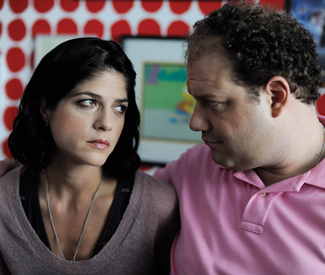
It opens at a wedding reception, always a ghastly ordeal for single people who figure themselves losers. In that regard, Abe (Jordan Gelber) would be right — he is a big fat loser, an obnoxious jerk of about 35 who still lives with his parents (Mia Farrow, Christopher Walken) and works at dad’s office, likely because no one else would employ him.

But Abe doesn’t exactly see himself as a loser. He resents and blames others for being winners, which is different — he sees the inequality as their fault. Spying Miranda (Selma Blair) at the reception, clearly miserable, he perceives someone whose self-esteem is so low she might lack the will or good sense to resist his awful personality when it’s forced upon her.

He’s right. Miranda’s self-loathing is such that after some bewildered and mortified initial resistance, she figures she … deserves him. In the interest of full disclosure, however, she airs some skeletons from the past, and these rattle Abe’s barricade of angry obliviousness. So does getting fired by his fed-up dad, being asked to move out, discovering something weird about the office secretary (Donna Murphy), and so forth. Plus there’s the eternal aggravation of being much less smart, handsome, and successful than his brother Richard (Justin Bartha), whom he thus blames for “ruining my life” — and who doesn’t even lose points with mom and dad for being gay! So unfair.

Dark Horse flirts with something interesting by letting these factors tear at Abe’s deniability until he starts suffering delusional episodes — ones in which people tell him exactly the truth about himself. (Farrow’s simpering voice has seldom been put to better use than a sequence in which her infallibly supportive mother uses just the same sugary tone to inform Abe he’s always been a waste of space.)

But Dark Horse is less of an ensemble piece than most of Solondz’s films, and in hinging on Abe, it diminishes his usual ambivalence toward flawed humanity. Abe is a buffoon, like a particularly unfunny Zach Galifianakis supporting character in a broad commercial comedy inexplicably given center stage in a low-key seriocomedy. The awful people in prior Solondz movies were also repellant, yet partly because we could perceive enough of their pathos to make them even more squirm-inducing. Abe has no pathos, or other redemptive qualities. He’s just an annoyance, one whose mental health issues aren’t clarified enough to induce sympathy. The director’s deliberately crap pop soundtrack choices and tritely ironic ending only further reduce these 86 minutes to a thin, overextended joke.

That’s disappointing for Solondz, though admittedly if Dark Horse were by somebody else its modest virtues might be more easily appreciated. In particular, the erratic Blair is excellent here — she digs into Miranda’s depression so deeply we marvel that the woman can still summon energy to walk and talk.


DARK HORSE screens Thu/19 at San Francisco Film Society Cinema; it opens Fri/20 in Bay Area theaters.

Personal detectives

0

cheryl@sfbg.com

SFJFF This year’s San Francisco Jewish Film Festival includes a trio of documentaries inspired by ephemera: hand-scrawled memoirs and journals, decades-old letters, fading photographs, and yellowing newspapers, long-forgotten and crumpled into attics and storage closets.

Dust be damned, for all three filmmakers — Arnon Goldfinger (The Flat), David Fisher (Six Million and One), and Daniel Edelstyn (How to Re-Establish a Vodka Empire) — become obsessed with these scraps from the past, and with piecing together their family histories, all of which were studded with tragedy and rarely discussed with younger generations. The task requires the kind of determination that can only be mined from a deeply personal place — and it results in some deeply personal films.

The docs are similar, especially when viewed in the short span of a festival, but Goldfinger’s The Flat is the standout. It begins as the filmmaker’s family descends upon the Tel Aviv apartment of his recently-deceased grandmother, “a bit of a hoarder” who lived to 95 and seemingly never got rid of anything. This includes, as Goldfinger discovers, copies of the Joseph Goebbels-founded newspaper Der Angriff, containing articles about “the Nazi who visited Palestine.” The Nazi was Leopold von Mildenstein, an SS officer with an interest in Zionism. Turns out he made the journey in 1933 with his wife and a Jewish couple named Kurt and Gerda Tuchler — Goldfinger’s grandparents.

Understandably intrigued and more than a little baffled, Goldfinger investigates, finding letters and diary entries that reveal the unlikely traveling companions were close friends, even after World War II. His mother, the Tuchler’s daughter, prefers to “keep the past out,” but curiosity (and the pursuit of a good documentary) presses Goldfinger forward; he visits von Mildenstein’s elderly daughter in Germany, digs through German archives, and unearths even more surprises about his family tree. Broader themes about guilt and denial emerge — post-traumatic coping mechanisms that echo through generations.

Family is a favorite subject for fellow Israeli David Fisher (2000’s Love Inventory). For Six Million and One, he rounds up his brothers and sister for a visit to the Austrian concentration camp where their late father was held as a teen. The elder Fisher recorded his thoughts in a memoir that only David can bear to read. As the siblings engage in the odd pursuit of being tourists in a place of brutality — the film illustrates the town’s changing landscape through eerie, before-and-after photos — their playful arguments escalate into legit psychodrama as the camera rolls and four raw nerves react to their intense emotions.

Interspersed with this journey is David Fisher’s visit with some American veterans who saw unimaginable horrors when they arrived to liberate the camps. It becomes clear that post-traumatic stress doesn’t just affect Jewish families grappling with the after effects of the Holocaust. When Fisher wistfully remarks that his father never spoke about his experiences, an elderly solder tells him, “Maybe you’re better off not having heard the stories.”

Lighter in tone, but with an equally serious back story, is Daniel Edelstyn’s How to Re-Establish a Vodka Empire, which follows the British filmmaker’s quest to import the vodka made at the Ukrainian factory once owned by his great-grandfather. The disheveled Edelstyn, who admits he has no business experience, pinballs between charming and exasperating as he fumbles through meetings with distributors and dodges hostile locals in his grandmother’s hometown. Despite the film’s title, Edelstyn’s adventures in booze are less compelling than the tale of that grandmother, whose remarkable life is re-enacted with sepia-toned silent film-style clips (starring Edelstyn’s wife, Hilary Powell, who’s also the film’s cinematographer), and miniature animations.


THE MORE YOU KNOW

There’s more for fans of non-narrative cinema, as SFJFF unspools several biopics that also delve into troubled pasts — with significant triumphs along the way. No one embodies this more than Roman Polanski, subject of Roman Polanski: A Film Memoir, directed by Laurent Bouzereau and structured as a sit-down conversation with longtime Polanski pal and producer Andrew Braunsberg. If you’re hoping for hardball questions or new information on Polanski’s colorful life, prepare for disappointment; the familiar pillars of the Polanski legend (traumatic childhood growing up as a Polish Jew during World War II; filmmaking success with films like 1968’s Rosemary’s Baby and 1974’s Chinatown; wife Sharon Tate’s gruesome death at the hands of Charles Manson’s followers; and that oh-so-inconvenient sexual assault charge, which came back to haunt him 30 years after the fact) are all covered.

If you’ve read Roman By Polanski, the director’s autobiography, or seen the 2008 doc about his struggle with scandal, Roman Polanski: Wanted and Desired, this is familiar turf. But to hear the celebrated director share his memories in his own voice, encouraged by an interviewer he trusts, is a unique experience.

You won’t hear the spoken voice of passionate, patriotic Yoni Netanyahu, the Israeli commando who died leading the 1976 hostage-rescue mission at Uganda’s Entebbe Airport, in Ari Daniel Pinchot and Jonathan Gruber’s Follow Me: The Yoni Netanyahu Story. But Netanyahu — adored older brother of Benjamin Netanyahu, Israel’s current Prime Minister — was prolific letter-writer, and his words (read by actor Marton Csokas) are an invaluable component of this affectionate portrait. But it’s not all heroic platitudes: Netanyahu, who also fought in the Six Day War and the Yom Kippur War, put the military above everything else, including his marriage.

“I don’t ever remember walking as a young person,” jokes sportscasting great Marty Glickman at the start of James Freedman’s upbeat Glickman. “I always ran. It was just my nature to run.” Though he’s referring to his extraordinary sprinting ability, which got him all the way to the 1936 Olympics (where he was denied the chance for certain glory for Hitler-related reasons), it’s also kind of how he lived his life, attacking bigotry and adversity with sunny side-up resilience. Glickman died in 2001, but his life was well-documented — when he wasn’t making sports history, he was doing the play-by-play for it. As an influential broadcaster (basketball fans: he was the first one to say “Swish!”), there’s no shortage of famous fans willing to weigh in: Bob Costas, Bill Bradley, Jerry Stiller, Jim Brown, and Larry King, who has supremely high praise for Glickman’s skills: “It was like his voice was attached to the ball.”

SAN FRANCISCO JEWISH FILM FESTIVAL

July 19-August 6, most shows $12

Various Bay Area venues

www.sfjff.org


Melody machers

0

>>Read Cheryl Eddy’s take on this year’s SFJFF documentaries here.

SFJFF “All greatness comes from pain.” The simple statement comes from Raoul Felder, brother of legendary R&B songwriter Doc Pomus, in the beautiful, crushing mediation on his brother’s life, A.K.A. Doc Pomus, the closing-night film of the San Francisco Jewish Film Festival.

Doc wrote some of the greatest music of a generation: R&B and early rock’n’roll standards such as “This Magic Moment,” “A Teenager in Love,” “Save the Last Dance For Me,” and “Viva Las Vegas” — songs made famous by the likes of Dion, the Drifters, and Elvis Presley. Jewish, debilitated by polio, and vastly overweight, Doc defied expectations while struggling with a lifetime of outsider status and physical pain.

It’s a subject that runs — albeit in far paler shades — throughout many of the fest’s music-filled documentaries. Defying limitations, strength through struggle, alienation, outsiders looking in; these all come up again and again. Tsuris to nachas, struggle to get to joy. All that plays out in the films, along with wildly varying (R&B, hip-hop, classical old world violin, 1990s-era Australian grunge pop) and vibrant music created by the subjects.

In Y-Love, about the gay, formerly Hasidic (still Orthodox) black Jewish rapper, these themes of isolation persist, almost painfully so. Having just come out during the year of filming, Y-Love seems to be smack dab in the midst of his struggle, and not yet capable of showing it all to the cameras following him through performances in Israel, his childhood neighborhood in Baltimore, and a New York recording studio. Most of these scenes are a bit long, focusing intently on Y-Love’s furrowed brow as he talks in great detail about the past without revealing much about how it’s affecting him now.

That’s not to say he hasn’t achieved something notable — we see that part. Y-Love does have followers, his records are starting to gain some traction, his YouTube videos have plenty of hits. He’s an anomaly in the communities he’s chosen (Judaism, the hip-hop scene), and owes his burgeoning artist status to this. He defied an agonizing childhood with an alcoholic, drug-addicted mother by turning to Judaism — a religion he first heard of in a TV commercial, a story he mentions in most interviews — and using word flow to study Torah.

On the other side of the world, and from an entirely different generation, there’s Jascha Heifetz, the gifted subject of God’s Fiddler. Growing up in rural Russia in the early part of the last century (he passed away in 1987), he was attached to the violin nearly since birth — a voice-over tells the story of Heifetz as a baby being soothed by the instrument’s sound — and a prodigy by age 5. Heifetz struggled with a demanding father and rising anti-Semitism, and had to fight to live in Saint Petersburg: the city had a quota for the amount of Jews allowed within its limits, not to mention the amount of Jews allowed to study at its prestigious music conservatory. But his eventual international attention and success led to a period of rebellion; negative reviews led the wunderkind to contemplate suicide. Emerging from the darkness, he re-focused on his instrument — but never again smiled while playing.

Though Ben Lee was born in Sydney, Australia some 77 years later, his musical journey — traced in fun, frenzied, colorful doc Ben Lee: Catch My Disease — mirrors Heifetz’s in certain ways. His first bout with fame also came at an early age, as a precocious tween in ’93 with his band Noise Addict. He went on to achieve higher levels of attention as a solo artist, steadily releasing poppier albums throughout the late ’90s and early ’00s, but never again reached as wide an audience outside of Oz (where he is a bona fide superstar).

Catch My Disease features interviews with ’90s mainstays and enduring entertainers like Thurston Moore (who discovered Lee as a child), Beastie Boy Mike D (who signed him to Grand Royal), actor Winona Ryder, and former girlfriend Claire Danes; Lee emerges as a well-rounded, exuberantly talented musician, always chasing a seemingly unattainable level of success.

SAN FRANCISCO JEWISH FILM FESTIVAL

July 19-August 6, most shows $12

Various Bay Area venues

www.sfjff.org

Lunch hour

0

arts@sfbg.com

MUSIC What’s your idea of a productive lunch break? Mine involves returning a failed online shopping purchase to FedEx with just enough time to grab a sandwich to shove into my face back at my desk.

DJ Matt Haze, of the Slayers Club collective, hates this. “A lot of my friends work in the tech industry or in finance,” he explains. “Even though they’re eating a nice gourmet lunch, they’re eating it at their desks. They’re not taking a moment to breathe or take their eyes off the monitor… I want to provide an outlet for people during the day.”

That outlet is RECESS, a new monthly (for now) midday party Haze is organizing with Sunset Promotions. The goal: to get as many young, San Francisco office workers to take full advantage of that magical allotted free hour during their day by getting sweaty with like-minded PYTs on the dance floor.

The daytime lunch party idea isn’t entirely new. The Swedes have been doing it with wild success since 2010, under the name Lunch Beat, but Matt is quick to point out that his idea for RECESS came independently. He first shared the idea of a lunchtime party with friend and Scoutmob Community Manager Lauryn McCarthy.

She was the one who told him about the Lunch Beat phenomenon, which he credits for motivating him to make RECESS a reality. “I was spurred into action,” he says, “knowing that someone else had a similar idea and was making it work in Europe. I thought if any city in the US should have a lunchtime dance party, surely it’s San Francisco.”

Surely indeed. Last week, my coworker and I headed to the RECESS launch party (NOTE: future installments will be dubbed bEATs for Lunch out of respect to an already-existing Oakland Recess party that was just brought to the organizers’ attention).

That kickoff event was held at Monarch, a club at the lively intersection of Sixth and Mission Streets.

We passed a small crowd standing on the side of the Monarch building, eating sandwiches in the sunshine (RECESS provided free, vegetarian sandwiches from Ike’s to the crowd, but we were too late to snag a bite — alas, they looked pretty good).

With our IDs checked, we headed into the small bar and lounge area. Less than 10 people were scattered around the bar and a few couches, chatting and eating. House music bumped from the basement. I wondered if the dance floor was experiencing the same sparse attendance.

We ventured toward the music, passing two sweaty girls who were laughing and fanning their faces on their way up. I was shocked when we hit the basement.

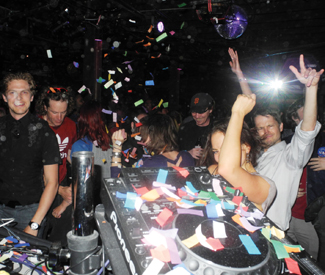
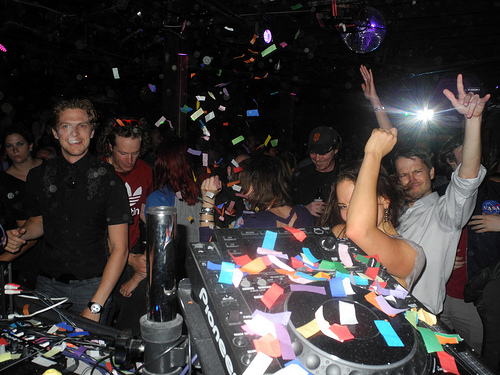
Here was the party. Not the daytime awkward-fest I’d been imaging. It was a party-party with club lighting and projectors splashing trippy footage of abstract art and bare boobs and squiggly lines across the walls. Haze was dancing behind his turntables, spinning an electrifying set of house music mixed with the likes of Depeche Mode and eclectic world music.

And because everyone was coming from work, they were dressed casually. No guys in shiny button-down shirts or girls with torture-devices strapped to their feet.

The vibe was fun, inclusive, and warm. Maybe because we were all doing something a bit out of the norm, everyone was smiling and jumping, laughing and making real eye contact with each other. It was a genuinely positive atmosphere without dreaded pretension.

My coworker and I stayed for 45 minutes. We pounded a drink at the bar — this is another way the SF event differs from the strictly non-alcohol-offering Lunch Beat — and danced with abandon. People began trickling out around 1:45pm.

Back at the office, I was noticeably less tense and in a fantastic mood. It’s hard to pinpoint why RECESS feels so exciting and illicit. Yes, you’re sneaking off to a club in the middle of the workday, but it’s your lunch break. No broken rules there. Still, there’s a rush that comes with using that time to do something just for you.

The next bEATs for Lunch (formerly RECESS) will take place Aug. 8 at Monarch.

NUDE BEACHES 2012

7

Editors Note: Below you’ll find our annual update on the state of nude beaches in the Bay Area, along with detailed guides and directions to several of our favorites. For details on dozens more, please see our complete Nude Beaches Guide, which we are in the process of updating. 

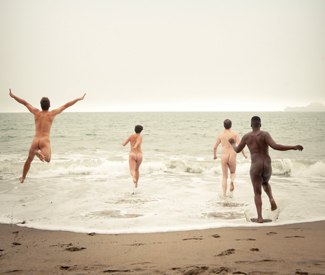
NUDE BEACHES Arrests for being naked on the sand, anti-nudity warning signs going up at previously unthreatened spots, outright threats of beach closures, social activists making their mark on San Francisco’s most well-known clothing-optional beach: this is shaping up to be one of Northern California’s busiest nude beach seasons in recent memory.

Faced with a July 1 deadline, on June 28 Governor Jerry Brown’s administration announced it saved or would stall shutting down all but one of 70 state parks and beaches targeted for closure due to budgetary shortfalls. These include three sites in our annual guide: Montara’s Gray Whale Cove, Carmel’s Garrapata State Park, and Zmudowski State Beach in northern Monterey County.

Officials said they would use $13 million in bond money in the budget to keep the properties running at least through summer. Some 40 parks will remain open for an estimated one to five years, due to temporary funding and support agreements being negotiated with nonprofit foundations and other organizations. More than 25 other properties, including Gray Whale Cove, also known as Devil’s Slide, will keep going while deals are completed.

When asked exactly how long Gray Whale Cove, Garrapata, and Zmudowski would stay open, California State Parks spokesman Dennis Weber told me they could keep going for a month, the entire summer, a year, or even longer. “We don’t know how much time we have,” he said.

Paul Keel, the state parks sector superintendent for the area that includes Gray Whale Cove, was more optimistic. He told me he’s keeping the popular beach open through at least the end of July because while “nothing’s been signed or inked, it’s fair to say we are optimistic” an agreement with a private operator or nonprofit will be finalized before then. Until the state took control, the site was run by a private licensee, San Francisco developer Carl Ernst and his company, Gray Whale Cove Enterprises, Inc.

Ruth Coleman, head of the State Parks and Recreation Department, said the bonds would fund solar power systems, as well as automatic pay machines that take credit and debit cards. And visitors arriving at Devil’s Slide or Garrapata are likely to notice signs that urge them to pay for parking instead of parking outside.

The card machines are likely to be particularly handy at Devil’s Slide after a long-awaited tunnel bypassing rockslide-prone Highway 1, which remains the access point to the beach, is expected to open this fall. Keel suspects the Devil’s Slide Tunnel will bring larger crowds to the beach.

But the news wasn’t all good. Maintenance and garbage pick up operations are likely to remain reduced or eliminated. In late June, Brown partly vetoed a larger, $41 million funding bill that had been OKed by the state legislature. State Senator Joe Simitian (D-Palo Alto), who coauthored the bigger funding plan, criticized the veto, calling it “a lost opportunity to take action.” Another lost opportunity: in November 2010, California voters rejected a ballot initiative that would have raised about $500 million for state parks.

Meanwhile, while Sacramento was cutting back beach services, activists were making additions to the section of San Francisco’s Baker Beach used by nudists. Naturists have erected driftwood art sculptures and tent-like structures without walls, called “dunies,” at the north end of the beach. And they’ve vowed to keep the site free of gawkers by staring them down in what organizers call a non-confrontational approach to self-policing. “They usually decide to leave pretty soon,” says Santosh, 46, an artist and street fair producer.

Speaking of policing, in the past year cops have raided Garrapata and put up signs about nudity at Bonny Doon Beach and at least two other beaches north of Santa Cruz.

At Garrapata, rangers and lifeguards cited over a dozen persons for public nudity last summer and began patrolling the beach at least two times a day after receiving what lifeguard Eric Sturm told the Carmel Pine Cone were reports of “sex acts on the beach.”

And at Bonny Doon, Laguna Creek, and Panther Beach, “Nudity In The State Park System Is Prohibited” signs have been posted, although naturists there remain defiant and are still visiting the sites. “A 50-year tradition (of clothing-optional use at Bonny Doon) cannot be extinguished by a simple sign,” said Rich Pasco, coordinator of the Bay Area Naturists, after the signs went up. He urged nudists to “be polite and respectful” of rangers and suit up “if requested,” but to engage them in “intelligent conversations.” After two months, the signs at Bonny Doon, though, were taken down because, according to Joe Connors, public safety superintendent for state beaches in the Santa Cruz area, “we don’t get a big volume of complaints there.”

Want to join others in having fun at a clothing-optional spot this summer? The USA’s only naked “Full Moon Hikes” will take place in Castro Valley in late July, August, and September (see our listings online at SFBG.com for Last Trampas in Contra Costa County for details). Another idea to meet and socialize with fellow naturists: drop by Bonny Doon on September 15, when fans of the site will be gathering to keep it pristine by finding and removing trash.

Finally, you can aid the naturist community by sending me your new beach discoveries, trip reports, and improved directions (especially road milepost numbers), along with your phone number to garhan@aol.com or Gary Hanauer, c/o San Francisco Bay Guardian, 71 Stevenson, 2nd Floor, San Francisco, CA 94105.

Our ratings: [full moon] signifies a beach that is large or well-established and where the crowd is mostly nude; [half moon] indicates places where fewer than half the visitors are nude; and [quarter moon] means small or emerging nude areas.

SAN FRANCISCO

NORTH BAKER BEACH, SAN FRANCISCO

RATING: A

Social activists have begun streaming onto the sand of America’s biggest urban nude beach, creating what visitor Santosh calls “a tone that’s like Burning Man,” with regulars bringing guitars, drums, and Frisbees to the sand, putting up art work best described as eclectic, and occasionally staring down gawkers.” There’s no requirement that you go nude,” says Santosh, an artist, graphic artist, and producer of San Francisco’s How Weird Street Faire, an outdoor street fair held each year in the SoMa neighborhood as a fundraiser for the World Peace Through Technology Organization. “But if a creeper dude plops down next to a (nude) person or if they are staring at someone’s private parts and it’s happening close to where we are, on the far north end (of North Baker), then they will start being the object of ridicule.

Directions: Take the 29 Sunset bus or go north on 25th Avenue to Lincoln Boulevard. Turn right and take the second left onto Bowley Street. Follow Bowley to Gibson Road, turn right, and follow Gibson to the east parking lot. At the beach, head right to the nude area, which starts at the brown and yellow “Hazardous surf, undertow, swim at your own risk” sign. Some motorcycles in the lot have been vandalized, possibly by car owners angered by bikers parking in car spaces; to avoid trouble, motorcyclists should park in the motorcycle area near the cyclone fence.

LAND’S END BEACH

RATING: A

Considered one of the most beautiful places in the Bay Area to doff your togs, Land’s End should really be called Swimsuit’s End. The reason: although it draws more clothed users than nudists, more than a few swim tops and bottoms magically “disappear” on warm spring, summer, and fall days at the little cove off Geary Boulevard. Come early to grab your share of the sand on this semi-rocky shoreline, which is sometimes dotted with rock-lined windbreaks left by previous sunbathers. Bring a light jacket or sweatshirt in case the weather changes.

Directions: Follow Geary Boulevard to the end, then park in the dirt lot up the road from the Cliff House. Take the trail at the far end of the lot. About 100 yards past a bench and some trash cans, the path narrows and bends, then rises and falls, eventually becoming the width of a road. Don’t take the road to the right, which leads to a golf course. Just past another bench, as the trail turns right, go left toward a group of dead trees where you will see a stairway and a “Dogs must be leashed” sign. Descend and head left to another stairway, which leads to a 100-foot walk to the cove. Or, instead, take the service road below the El Camino del Mar parking lot 1/4 mile until you reach a bench, then follow the trail there. It’s eroded in a few places. At the end, you’ll have to scramble over some rocks. Turn left (west) and walk until you find a good place to put down your towel.

GOLDEN GATE BRIDGE BEACH

RATING: A

On the hottest days, Golden Gate Bridge Beach becomes so packed with people that one visitor describes it as a “gay mob scene.” But the rocky shore, which connects three picturesque coves, also gets its share of straight men and women. Prime, non-cruising activities include sunbathing, enjoying breathtaking views of the Bridge, and even taking some dips in the water. “You can sometimes go out over 100 feet during low tide,” a woman tells me.

Directions: from the toll booth area of Highway 101/1, take Lincoln Boulevard west about a half mile to Langdon Court. Turn right (west) on Langdon and look for space in the parking lots, across Lincoln from Fort Winfield Scott. Park and then take the beach trail, starting just west of the end of Langdon, down its more than 200 steps to Golden Gate Bridge Beach, also known as Marshall’s Beach. Despite recent improvements, the trail to the beach can still be slippery, especially in the spring and winter.

FORT FUNSTON BEACH

RATING: C

What’s the only Golden Gate National Recreation Area park where you can walk your dog without a leash, as well as the spot where the world record for the farthest tossed object (a flying ring sent soaring 1,333 feet by Erin Hemmings) was set in 2003? Answer: Fort Funston, which is affectionately called Fort Fun by its fans. Known for its magnetic sand, steady winds (especially in March and October) that make its cliffs popular for hang gliding, and, in particular, its dogs, who appear here with their human escorts by the hundreds, the area even attracts a few naturists from time to time. Mostly hidden away in the sand dunes on the beach, naked sunbathers usually stay away on the weekends, when families swarm the area. To keep the “fun” in Fort Funston, even on weekdays, be sure to use caution before disrobing.

Directions: From San Francisco, go west to Ocean Beach, then south on the Great Highway. After Sloat Boulevard, the road heads uphill. From there, curve right onto Skyline Boulevard, go past one stoplight, and look for signs for Funston on the right. Turn into the public lot and find a space near the west side. At the southwest end, take the sandy steps to the beach, turn right, and walk to the dunes. Find a spot as far as possible from the parking lot.

CONTRA COSTA COUNTY

LAS TRAMPAS REGIONAL WILDERNESS, CASTRO VALLEY

RATING: C

Want to go walking around nude at night outside without being hauled off to jail? Imagine hiking naked guided only by your flashlight in the East Bay Hills, with the trail silhouetted by a full moon and small herds of horses coming up to greet you.

“It’s absolutely surreal,” says Jurek Zarzycki. “The horses come within inches of you, so close you can feel their breath. It’s like being on a moonscape with aliens. You may be a little afraid at first, but the horses are very friendly.”

America’s only nude “Full Moon Hikes” have been taking place on summer full moon nights in Castro Valley for more than seven years. The next ones will be held July 29, August 31 (arrive by 6pm), and September 28 (starting at 5:15pm) “We start early so that we have the full moon already risen by the time the sun sets,” says San Leandro’s Dave Smith, who leads most of the hikes. “Then we hike up the trail around sunset.”

Coordinated by a partnership between the Sequoians Naturist Club and the Bay Area Naturists, based in San Jose, walkers leave the property of the Sequoians fully clothed at dusk and walk through meadows and up hills until the moon rises, before heading back down the slopes completely nude, with their clothes folded neatly into their backpacks.

After the walk, most hikers shower at The Sequoians, and, for a fee of $5, take a dip in the 86-degree pool there and enjoy a plunge in the facility’s hot tub. “It was fabulous,” says Zarzycki about an earlier trek. “I pitched my tent right there at The Sequoians and then slept under the sky.”

Directions: Contact The Sequoians (www.sequoians.com) or the Bay Area Naturists (www.bayareanaturists.org) for details on how to join a walk. Meet at The Sequoians. To get there, take Highway 580 east to the Crow Canyon Road exit. Or follow 580 west to the first Castro Valley off-ramp. Take Crow Canyon road toward San Ramon .75 mile to Cull Canyon road. Then follow Cull canyon road around 6.5 miles to the end of the paved road. take the dirt road on the right until the “Y” in the road and keep left. Shortly after, you’ll see The Sequoians sign. Proceed ahead for about another .75 mile to The Sequoians front gate.

SAN MATEO COUNTY

DEVIL’S SLIDE, MONTARA

RATING: A

Although Devil’s Slide, also known as Gray Whale Cove, was scheduled to be closed this month by the state due to budget shortfalls, officials plan to keep it open while they negotiate with what Paul Keel, San Mateo coast state parks sector superintendent, calls a prospective “donor to keep it in operation for the coming year.” At press time, Keel told us that although “nothing’s been signed or inked, it’s fair to say we are optimistic, so hopefully we will know more in the next month.” Access to the site, though, is changing: after a long-awaited, voter-approved Devil’s Slide tunnel is completed this fall, Keel and others expect a possible increase in traffic to the beach, as more pedestrians and bicyclists use a nearby section of Highway 1 that is being closed. Meanwhile, rangers say they will allow a long-standing tradition of nudity to continue on the sand unless visitors complain.

Directions: Driving from San Francisco, take Highway 1 south through Pacifica. Three miles south of the Denny’s restaurant in Linda Mar, turn left (inland or east) on an unmarked road, which takes you to the beach’s parking lot and to a 146-step staircase that leads to the sand. Coming from the south on Highway 1, look for a road on the right (east), 1.2 miles north of the Chart House restaurant in Montara. Starting this fall, from the north, take Highway 1 through the Devil’s Slide tunnel and then turn left onto the road described above. From the south, continue using the above directions. Most naturists use the north end of the beach, which is separated by rocks from the rest of the shore.

SAN GREGORIO NUDE BEACH, SAN GREGORIO

RATING: A

Still the USA’s longest continually used nude beach, San Gregorio even has its own web site and live web cam at www.freewebs.com/sangregoriobeach. The privately run operation, which is located next to San Gregorio State Beach, recently began its 46th year of serving the clothing-optional community.

The beach often draws a large gay crowd, along with some nude and suited straight couples, singles, and families. “It’s a really romantic spot,” says a single woman. However, first-timers are sometimes annoyed (as I was, years ago) by the driftwood structures on the sandy slope leading down to the beach, which are used by some visitors as “sex condos.” However, fans of the beach savor San Gregorio’s stunning scenery. It has “awesome natural beauty,” says regular visitor Bob Wood. Attractions of the 120-acre site include two miles of soft sand and tide pools to explore, as well as a lagoon, lava tube, and, if you look closely enough on the cliffs, the remains of an old railroad line.

Directions: From San Francisco, drive south on Highway 1, past Half Moon Bay, and, between mileposts 18 and 19, look on the right side of the road for telephone call box number SM 001 0195, at the intersection of Highway 1 and Stage Road, and near an iron gate with trees on either side. From there, expect a drive of 1.1 miles to the entrance. At the Junction 84 highway sign, the beach’s driveway is just .1 mile away. Turn into a gravel driveway, passing through the iron gate mentioned above, which says 119429 on the gatepost. Drive past a grassy field to the parking lot, where you’ll be asked to pay an entrance fee. Take the long path from the lot to the sand; everything north of the trail’s end is clothing-optional (families and swimsuit using visitors tend to stay on the south end of the beach). The beach is also accessible from the San Gregorio State Beach parking area to the south; from there, hike about a half-mile north. Take the dirt road past the big white gate with the Toll Road sign to the parking lot.

SANTA CRUZ COUNTY

GARDEN OF EDEN, FELTON

RATING: C

Tucked away in Henry Cowell Redwoods State Park, between Santa Cruz and Felton, the Garden Of Eden is a much-used skinny-dipping hole on the San Lorenzo River, which is also visited by clothed families. Some hikers are surprised when they see people nude there and either use the spot anyway or keep walking. Watch out for poison oak and slippery sections on the trail. Eden is one of three clothing-optional swimming holes on the river. To find them, look for cars pulled over on Highway 9, next to the state park, which bans nudity but seldom sends ranger patrols to the creek.

Directions: From Santa Cruz, drive north on Highway 9 and look for turnouts on the right side of the road, where cars are pulled over. The first, a wide turnout with a tree in the middle, is just north of Santa Cruz. Rincon Fire Trail starts about where the tree is, according to reader Robert Carlsen, of Sacramento. The many forks in the trail all lead to the river, down toward Big Rock Hole and Frisbee Beach; Carlsen says the best area off this turnout can be reached by bearing left until the end of the trail. Farther up the highway, 1.3 miles south of the park entrance, is the second and bigger pullout, called the Ox Trail Turnout, leading to Garden of Eden. Park in the turnout and follow the dirt fire road downhill and across some railroad tracks. Head south, following the tracks, for around .5 miles. Look for a “Pack Your Trash” sign with park rules and hours and then proceed down the Eden Trail.

Ox Trail, which can be slippery, and Eden Trail both wind down steeply to the creek. “The path continues to the left, where there are several spots for wading and sunbathing,” Carlsen says. The main beach is only 75 feet long and 30 feet wide, but fairly sandy. Carlsen’s favorite hole is accessible from a trail that starts at the third turnout, a small one on the right side of the road, about 4.5 miles from Highway 1 and just before Felton. A gate marks the start of the path. The trail bends left. When you come to the road again, go right. At the railroad tracks, go right. From here, look for the river down the hill on your left; many paths lead to it. Says Mike: “Within 10 yards, you can be in the water.”

BONNY DOON NUDE BEACH, BONNY DOON

RATING: A

Despite the temporary erection of anti-nudity warning signs at longtime nudie fan favorite Bonny Doon Beach, north of Santa Cruz, officials have told us they have no immediate plans to issue citations at the north end of the site, which has traditionally been occupied by naturists. In fact, the signs were taken down after just two months.

In fact, in June, Pam, of San Mateo, even found a nudist at the main public, south side of the beach, which is used by suited visitors. A 15-foot long rock on the sand, along with a sloping cliff with rocks that jut out, separate the two sides of the cove that form Bonny Doon.

“In the short term, things at Bonny Doon are destined to continue the way they are,” says Kirk Lingenfelter, sector superintendent for Bonny Doon and nearby state beaches. Lingenfelter says he likes Bonny Doon just the way it is. “It’s one of our pocket beaches,” he explains. “They can really give you the feeling of rugged, untouched majesty. I like standing on those beaches. You can sometimes forget that there’s a highway in the distance. It’s a very important feeling to maintain. “The clothing-optional section usually attracts more women and couples than most nude beaches. “Minuses” include occasional vehicle burglaries and gawkers on the bluffs or in the bushes.

Directions: From San Francisco, go south on Highway 1 to the Bonny Doon parking lot at milepost 27.6 on the west side of the road, 2.4 miles north of Red, White, and Blue Beach, and some 11 miles north of Santa Cruz. From Santa Cruz, head north on Highway 1 until you see Bonny Doon Road, which veers off sharply to the right just south of Davenport. The beach is just off the intersection. Park in the paved lot to the west of Highway 1; don’t park on Bonny Doon Road or the shoulder of Highway 1. If the lot is full, drive north on Highway 1, park at the next beach lot, and walk back to the first lot. Or take Santa Cruz Metro Transit District bus route 40 to the lot; it leaves the Metro Center three times a day on Saturdays and takes about 20 minutes. To get to the beach, climb the berm next to the railroad tracks adjacent to the Bonny Doon lot, cross the tracks, descend, and take a recently improved, sign-marked trail to the sand. Walk north past most of the beach to the nude cove on the north end. Alternately, Dusty suggests parking as far north as possible, taking the northern entrance, and, with good shoes, following a “rocky and steep” walk down to the sand.

2222 BEACH, SANTA CRUZ

RATING: A

In late May, when my girlfriend and I visited a little cliffside park above it and peered down on the aptly named 2222 — it’s the number of the house across the street — we discovered that the pocket-size cove looked as beautiful as ever. In fact, America’s smallest nude beach is so small it could probably fit in your yard. And that’s what makes it a magical place. You won’t find crowds at 2222, which takes scrambling to reach and isn’t recommended for children or anyone who isn’t a good hiker. However, those who are agile enough to make it down a steep cliff and over some concrete blocks on the way down will probably be rewarded with an oasis of calm and a good spot to catch some sunrays.

Directions: The beach is a few blocks west of Natural Bridges State Beach and about 2.5 miles north of the Santa Cruz Boardwalk. From either north or south of Santa Cruz, take Highway 1 to Swift Street. Drive .8 miles to the sea, then turn right on West Cliff Drive. 2222 is five blocks away. Past Auburn Avenue, look for 2222 West Cliff on the inland side of the street. Park in the nine-car lot next to the cliff. If it’s full, continue straight and park along Chico Avenue. Bay Area Naturists leader Rich Pasco suggests visitors use care and then follow the path on the side of the beach closest to downtown Santa Cruz and the Municipal Wharf.

PRIVATES BEACH, SANTA CRUZ

RATING: A

“Privates is one of my favorite beaches,” says Brittney Barrios, manager-buyer of Freeline Design Surf Shop, which is located nearby and sells keys to unlock the gate leading to the clean, beautiful cove. “It’s always very peaceful.” Visitors include nudists, surfers, families, and local residents. “Everyone gets along,” adds Barrios. “And it’s never crowded.”

Barrios says many of the naturists, who often visit in groups, like to play Paddle Ball on the sand. As for Barrios, she prefers to “lay out,” as she calls it, in the sun.

There’s almost no litter, wind, noise, or troublemakers — security guards plus a locked gate keep the latter out — and world class surfers, such as those who starred in Endless Summer II, regularly put on a free show for the naked people who share the warm, clean sand with surfers.

“It’s really nice,” says Hunter Young, a former worker at Freeline, which sells up to 600 beach passes a year. “Surfers love it because it has good waves. It’s 100 percent standup surfing, with paddling. Anytime I go to Privates, I can expect a long ride on my longboard.”

“The beach is also very family oriented,” explains Barrios. “And it’s OK for dogs too.”

“There are two different coves on the beach,” says Young. “Clothed families who use the beach know which cove is nude and stay away from it. If you want to play naked Frisbee, at the bottom of the beach stairs you just walk to the left.”

Directions: 1) Some visitors walk north from Capitola Pier in low tide (not a good idea since at least four people have needed to be rescued). 2) Others reach it in low tide via the stairs at the end of 41st Avenue, which lead to a surf spot called the Hook at the south end of a rocky shore known as Pleasure Point. 3) Surfers paddle on boards for a few minutes to Privates from Capitola or the Hook. 4) Most visitors buy a key to the beach gate for $100 a year at Freeline (821 41st Ave., Santa Cruz, 831-476-2950) 1.5 blocks west of the beach. Others go with someone with a key or wait outside the gate until a person with a key goes in, provided a security guard is not present (they often are there). “Most people will gladly hold the gate open for someone behind them whose hands are full,” says Bay Area Naturists leader Rich Pasco. The nude area starts to the left of the bottom of the stairs.

MARIN COUNTY

MUIR NUDE BEACH, MUIR BEACH

RATING: A

Mellow times are continuing at one of the Bay Area’s easiest to reach and most enjoyable nude beaches, the clothing-optional north side of Muir Beach. Also known as Little Beach, it’s separated by the main public beach by a line of large rocks that visitors usually walk over. Says Lucas Valley’s Michael Velkoff, who switched from Red Rock to become a regular at Muir: “This season, there’s plenty of sand. It’s also a great place for women because people leave you alone here. Nobody’s hitting on you. And high tide only comes a third of the way up the beach.” Recent additions include a new bridge over a marshy, lagoon-like area near the parking lot, plus about a half dozen Porta-Potties.

Directions: From San Francisco, take Highway 1 north to Muir Beach, to milepost 5.7. Turn left on Pacific Way and park in the Muir lot (to avoid tickets, don’t park on Pacific). Or park on the long street off Highway 1 across from Pacific and about 100 yards north. From the Muir lot, follow a path and boardwalk to the sand. Then walk north to a pile of rocks between the cliffs and the sea. You’ll need good hiking or walking shoes to cross; in very low tide, try to cross closer to the water. The nude area starts north of it.

RED ROCK BEACH, STINSON BEACH

RATING: B

One of the most popular Bay Area nude beaches, Red Rock has struggled with sand erosion that’s left a smaller site the last few seasons, along with a more crowded feel to it and, perhaps in reaction, fewer overall visitations. Except for being a little overgrown with vegetation in early July and some poison oak on the half nearest the highway, the beach trail, however, is reported in good shape this year. “Just wear shoes with socks, go single file in spots, and you should be okay,” advises Stinson Beach attorney-teacher Fred Jaggi. Rock climbing and various kinds of Frisbee continue to be frequent pastimes at Red Rock — Ultimate Frisbee games there can last as long as three hours. Naked Scrabble and Nude Hearts are among the other games played by sunbathers. “It’s very peaceful at the beach,” says Jaggi. “Nobody ever brings down a large boombox.”

Directions: Go north on Highway 1 from Mill Valley, following the signs to Stinson Beach. At the long line of mailboxes next to the Muir Beach cutoff point, start checking your odometer. Look for a dirt lot full of cars to the left (west) of the highway 5.6 miles north of Muir and a smaller one on east side of the road. The lots are at milepost 11.3, one mile south of Stinson Beach. Limited parking is also available 150 yards to the south on the west side of Highway 1. Or from Mill Valley, take the West Marin/Bolinas Stage toward Stinson Beach and Bolinas. Get off at the intersection of Panoramic Highway and Highway 1. Then walk south .6 mile to the Red Rock lots. Follow the long, steep path to the beach that starts near the Dumpster next to the main parking lot.

BOLINAS, BASS LAKE

After Tracey, of San Anselmo, hiked to what she called “beautiful, clean, sunny” Bass Lake, she went onto a message board in June to urge those who are considering trying the Bolinas attraction to “Go. Go. Go now.” “The trail was a little overgrown. But I had fun swimming nude in the lake,” says regular Dave Smith, of San Leandro, about his adventure last year. “If you want to visit an enchanted lake, Bass is it,” agrees Ryan, also of the East Bay. “Tree branches reach over the water, forming a magical canopy, and huge branches of calla lilies bloom on the shore.” Ryan isn’t kidding: even walking (45-60 minutes from the parking area over 2.8 mostly easy miles) to Bass can be an adventure unlike any other. One time, rangers stopped and cited a clad man with an unleashed dog, but let some passing nudists continue. And Smith, who usually walks naked, has come across bobcats and mountain lions early in the morning. “I came around a corner and there was a mountain lion sitting like Egypt’s Great Sphinx of Giza 50 yards down the path,” he says.

Directions: From Stinson Beach, go north on Highway 1. Just north of Bolinas Lagoon, turn left on the often-unmarked exit to Bolinas. Follow the road as it curves along the lagoon and eventually ends at Olema-Bolinas Road. Continue along Olema-Bolinas Road to the stop sign at Mesa Road. Turn right on Mesa and drive four miles until it becomes a dirt road and ends at a parking lot. On hot days the lot fills quickly. A sign at the trailhead next to the lot will guide you down scenic Palomarin Trail to the lake. For directions to Alamere Falls, 1.5 miles past Bass Lake, please see “Elsewhere In Marin” in our online listings.

RCA BEACH, BOLINAS

RATING: A

Want to recharge your life? A trip to RCA can do just that. And a single stopover at the beautiful beach will probably inspire you to keep coming back. “It hasn’t changed much in 20 years,” says regular visitor Michael Velkoff. “A downside is that it’s very exposed to the wind. The good news is that there are lots of nooks that are sheltered from the wind. And there’s so much driftwood on the sand that many people build windbreaks or even whole forts. You could build a village with all that driftwood. The last time I went, somebody built a 30 foot tall dragon out of it.” Suited and unsuited males and females and families visit the shoreline, which seems even bigger than its one mile length because, adds Velkoff, “we’ll see six people on a beautiful day on a Sunday. Picture [please see next listing] Limantour as far as how people are spread out on the sand. Everybody’s like 100 feet apart. It’s great.”

Directions: From Stinson Beach, take Highway 1 (Shoreline Highway) north toward Calle Del Mar for 4.5 miles. Turn left onto Olema Bolinas Road and follow it 1.8 miles to Mesa Road in Bolinas. Turn right and stay on Mesa until you see cars parked past some old transmission towers. Park and walk .25 miles to the end of the pavement. Go left through the gap in the fence. The trail leads to a gravel road. Follow it until you see a path on your right, leading through a gate. Take it along the cliff top until it veers down to the beach. Or continue along Mesa until you come to a grove of eucalyptus trees. Enter through the gate here, then hike .5 miles through a cow pasture on a path that will also bring you through thick brush. The second route is slippery and eroding, but less steep. “It’s shorter, but toward the end there’s a rope for you to hold onto going down the cliff,” tells Velkoff.

LIMANTOUR BEACH, OLEMA

RATING B

At Limantour, in Point Reyes National Seashore, you can walk a mile wearing nothing but your smile. “I just head away from any people and put my towel down in the dunes or against a wall,” says visitor Michael Velkoff. “Nobody bothers you. Of course, I carry a pair of shorts, just in case I need to put them on. I love it at Limantour. Plus it has tons of nice sand.” You may also want to don a pair of binoculars for watching birds, seals, and other wildlife. This May, Velkoff saw a whale from his vantage point on the sand; he’s also seen porpoises frolicking just offshore. The long shoreline is one of America’s most beautiful beaches, yet few visitors realize the narrow spit of sand is clothing-optional. The site is so big — about 2.5 miles in length — you can wander for hours, checking out ducks and other waterfowl, shorebirds such as snowy plovers, gray whales, and playful harbor seals. Dogs are allowed on six-foot leashes on the south end of the beach. To grab the best parking, arrive by 10:30am.

Directions: Follow Highway 101 north to the Sir Francis Drake Boulevard exit, then follow Sir Francis through San Anselmo and Lagunitas to Olema. At the intersection with Highway 1, turn right onto 1. Just north of Olema, go left on Bear Valley Road. A mile after the turnoff for the Bear Valley Visitor Center, turn left (at the Limantour Beach sign) on Limantour Road and follow it 11 miles to the parking lot at the end. Walk north .5 miles until you see some dunes about 50 yards east of the shore. Nudists usually prefer the valleys between the dunes for sunbathing, which may be nearly devoid of or dotted with users, depending on the day.


 

Black Young Democrats rally against stop and frisk

14

A group organized by the San Francisco Black Young Democrats rallied at City Hall today. Their message: no to stop and frisk.

Members of the group, as well as the ACLU and the Asian Law Caucus, said the policy would violate the civil rights of San Franciscans.

Supervisors Malia Cohen, along with Avalos, Campos, and Mar also attended the rally and expressed their support. They co-sponsored a non-binding resolution, introduced by Cohen,  that condemned the idea of implementing stop and frisk in San Francisco.

Mayor Ed Lee said he was considering implementing the controversial policy a few weeks ago.

Under a stop and frisk policy, police have the leeway to stop and search people that they consider suspicious. On average, 85 percent of those stopped in New York City are young African American and Latino men.

Opponents say racial profiling is inevitably involved and that, for people who may be carrying minor contraband but no dangerous weapons, this racial profiling leads to selective enforcement of laws. About 87 percent of those stopped in New York were completely innocent, according to numbers compiled by the New York Civil Liberties Union.

Lee said he suggested the idea after a spike of gun violence in June. But it has generated a backlash, and at today’s rally about 75 showed up to present a petition signed by more than 2,000 asking the mayor not to implement the policy.

Joaquin Torres, director of that office, accepted it on Lee’s behalf.

Lee himself didn’t engage with the protesters, but he did issue a statement not an hour after they left City Hall “clarifying his position” on stop and frisk.

“I want to be clear that I have not considered implementing a policy in San Francisco that would violate anyone’s constitutional rights or that would result in racial profiling,” the statement reads.

Ellington said the statement was not enough. “We want Mayor Ed Lee to say that he will not implement stop and frisk in San Francisco, nor any policies that are like stop and frisk. No policies that infringe upon our civil liberties,” Ellington told the Guardian.

“These are predatory policing practices that we don’t want in our city,” he said.

Localized Appreesh: Diego’s Umbrella

1

Localized Appreesh is our weekly thank-you column to the musicians that make the Bay. To be considered, contact emilysavage@sfbg.com.

Gypsy punk, that wild pluck-pluck-pluck of flamenco guitar, that bombastic percussion and brass, it all makes for a rather frenetic if sultry affair when bands such as Gogol Bordello do it well. And in our midst, there lives a gifted bunch of musicians – pulled together to form Diego’s Umbrella – that does it well too.

If you live in the Bay Area, you likely already know San Francisco’s Diego’s Umbrella. Perhaps you caught it at Outside Lands last year? Or you’ve heard any of its three peppy previous LPs? If not, here’s a chance to bone up. If so, there’s something new for you too.

The band’s latest, Proper Cowboy – said to be a “futuristic spaghetti western album” – drops today. The dance-worthy record, created in collaboration with San Francisco producers the Rondo Brothers, employs the frenzied Eastern European-influenced flamenco guitar and fiddle, along with analog synth and “an army of tubas” to create a mesmerizing landscape of sound, with images of twirling dancers in flowing red skirts and pirates with long swords held between their teeth spinning through the cliched mind.

The band plays a totally free record release show at New Parish this week. Get to know it here first:

http://www.youtube.com/watch?v=OdXRnqyHkgA&feature=youtu.be

Year and location of origin: Tyson and Vaughn have played music together in San Francisco since 2001, but the band as people now know it has been around since 2007.

Band name origin:  From our friend Phil Burnett’s tattoo on his arm of Diego Rivera holding an umbrella.

Band motto: Let’s do this, people!

Description of sound in 10 words or less: Gypsy Rock.

Instrumentation: Vox/flamenco guitar, vox/electric guitar/percussion, electric guitar, violin/omnichord, bass, drums.

Most recent release: Proper Cowboy, released July 2012.

Best part about life as a Bay Area band: The best part about being an SF band is the passion and support from our incredible hometown fans. And we can’t imagine living anywhere else.  

Worst part about life as a Bay Area band: Trying to find parking for our van/trailer.  

First album ever purchased: In Effect Mode, by Al B Sure.

Most recent album purchased/downloaded: Fiona Apple’s latest.

Favorite local eatery and dish: I’ve recently grown quite fond of the ahi tacos at The Bell Tower, and the tea leaf salad at Mandalay is an all time favorite.

Diego’s Umbrella
With Buster Blue, Kate Cotruvo and Friends
Tues/17, 9pm, free
New Parish
579 18th St., Oakl.
(510) 444-7474
www.thenewparish.com

Noir to nerds: 8 artsy-cultural happenings you could check out this week

0

Remember the time you lived in one of the most exciting, cultured places in the world? Hold up, that’s right now. Check our picks for 8 amazing — and oftentimes free — ways to spend your nights and days this week.

Jim Nisbet: Old and Cold

Jim Nisbet’s protagonist is old, cold, and totally cool. A confusing infusion of mystery, Dexter-style serial murder, and flat-out noir creepiness, Nisbet’s Old and Cold follows the wrongdoings of a man who lives under a bridge and will do anything for a martini. All the action is enveloped within our dear city’s seven miles of dive bars, beaches, and grey sidewalk.

Wed/16, 7pm, free

City Lights Bookstore 

261 Columbus, SF

www.citylights.com 

Nerd Nite! 

What’s better than a gregarious gaggle of boozed-up nerds? Robin Marks, Nick Bouskill, and Justin Benttinen will each give three snarky-smart 30-minute lectures at the Rickshaw as a part of the monthly lecture series Nerd Nite. Covering a broad span of topics — peer-reviewed journal satire, to the nasty nuances of nitrogen, to a history of bizarre invention and innovation in San Francisco — the lecture series even offers a brief break for DJs. Drink, dance, and dig the dork.

Wed/18, 7:30-11pm, $9

Rickshaw Stop

155 Fell, SF

www.rickshawstop.com 

Pint Sized Plays 

Usually stationed in the Tenderloin’s Cafe Royale, San Francisco Theater Pub’s Pint Sized Plays is making a special performance at the Plough and the Stars. With more than 10 directors crammed into 90 minute show, variety is guaranteed: there’ll be images of love and loss from Megan Cohen’s Beeeeeeaar, Stuart Bousel and Megan Cohen’s Llama let us follow the travails and triumphs of a llama at a crossroads, and William Bivin’s Celia Sh**s makes an appearance reminding us that, well, everybody sh**s. 

Wed/18, 8pm, free

The Plough and the Stars

116 Clement, SF

sftheaterpub.wordpress.com

Renegade Craft Fair 

Your dreams of glass-blown bug figurines, artisan jewelry, and paper-mache wall hangings have been answered. The fifth annual Renegade Craft Fair makes its appearance at the Fort Mason Festival Pavilion for a day of showcasing unique, artisan products from over 250 emerging crafters. Enjoy a day of (hopefully) sunshine, food, drink, and, most importantly, art that you can actually use. 

Sat/21-Sun/22, 11am-7pm, free

Fort Mason, SF

www.renegadecraft.com

Brave New Voices International Youth Poetry Grand Slam 

America’s youth has something to say and you’re going to listen, dammit. The creativity and eloquence of these performers aged 13 to 19 are not to be taken lightly at the 15th annual BNV grand slam finals. BNV was created by Youth Speaks in 1998 to represent a forum of dialogue for a new, socially-aware, mutually respecting, and artistically-active generation of young individuals who are anything but shy. The competition and festival runs from July 17-21, with the the culminating grand slam competition offering an inspiring and hopeful alternative to your regular Saturday night. 

Sat/21 7pm, $20

Fox Theater

1807 Telegraph, Oakl.

www.youthspeaks.org

LaborFest book fair and poetry reading 

The annual LaborFest kicks off the arts portion with an all-day reading series at the Mission Cultural Center for Latino Arts. Speakers, poets, and authors like award-winning Sean Burns with his biography, Archie Green, The Making of a Working Class Hero will be present as testament to the longstanding collaboration between labor, community, and art. 

Sun/22, 10am-9pm, free

Mission Cultural Center for Latino Arts

2868 Mission, SF

www.laborfest.net

Dana Johnson and Paula Priamos

Dana Johnson and Paula Priamos paint an ironically dark picture of sunny Southern California as they read from their two books Elsewhere, CA and The Shyster’s Daughter. Johnson’s novel follows the search for self-discovery of Avery, a black girl growing up in Los Angeles who doesn’t seem to fit in to her community’s vision of ideal femininity and ideal blackness. Priamos’ book takes a memoir-turned-noir tone, remembering her own family’s actions and anxieties after the conviction of murderer Kevin Cooper for murdering an innocent family in a neighborhood not far from their very own. 

Mon/23, 7pm, free

Books, Inc.

601 Van Ness, SF

www.booksinc.net

Sketch Tuesdays

The ultimate place to see and be seen. Sketch Tuesdays brings a night of live art making and artist-to-buyer exchange to 111 Minna. This Tuesday’s artsy attendees can look forward to an all-female lineup of live artists and International Museum of Women, a full bar, music from DJ Pre-K, and current exhibition, “Shinkasen Conspiracy” by Last Gasp Publishing. 

Tue/24, 6-10pm, free

111 Minna, SF

www.sketchtuesdays.com

Guest opinion: RCV is good for progressives

52

Since San Francisco began using ranked choice voting in 2004 and public financing of campaigns in 2002, the city has been a leader in the types of political reform badly needed at state and national levels. People of color today have an unprecedented degree of representation and progressives are a dominant presence in city government. Elections are being decided in November, when turnout usually is highest, and the combination of public financing and deciding races in one election minimizes the impact of independent expenditures and Super PACs .

Yet progressive stalwart Calvin Welch, whose work we have long admired, recently authored a Bay Guardian oped against RCV. His charges against RCV are as wrong today as they were when he first made them 10 years ago when he opposed RCV on the ballot. And given the horrible Supreme Court ruling known as Citizens United, which has opened the floodgates on corporate campaign spending and did not exist when San Francisco last used separate runoff elections, returning to two elections is a direct threat to the future of San Francisco progressivism. 

The most serious of his claims is that RCV favors “moderate to conservative candidates” because “left-liberals do very well in run-off elections” since “in low-turnout elections, left-liberals vote more heavily than do conservatives.” He cites the 2000 supervisorial races and 2001 city attorney race, in which “the more liberal candidate for City Attorney, Dennis Herrera” bested “Chamber of Commerce functionary Jim Lazarus.” He asserts “that’s a verifiable San Francisco political fact.”

But San Francisco State University professor Richard DeLeon, author of the acclaimed book of Left Coast City about San Francisco politics, debunked that claim with real election data in his 2002 paper, “Do December runoffs help or hurt progressives?”

He found that in the November 2001 city attorney election, for every 100 voters who turned out in progressive precincts, 107 turned out in conservative precincts. But in the December 2001 runoff, for every 100 voters who turned out in the progressive precincts, 126 turned out in the conservative precincts, an 18 percent increase. Wrote DeLeon, “This dramatic increase in the ratio of conservative to progressive voters occurred despite (or perhaps because of) the 44 percent drop in voter turnout citywide between November and December.”

He continued: “If San Francisco had used [ranked choice voting] in November, Herrera most likely would have won by an even greater margin. In November, the liberal/progressive candidates for city attorney won a combined 60 percent of the vote…In the December runoff, however, Herrera won with only 52 percent of the vote. Thus, due to the proportionally greater decline in progressive voter turnout, Herrera probably lost approximately 8 percent of his potential vote, making the election close.”

DeLeon also rebutted Welch’s citation of the supervisorial races in 2000 as ones that demonstrated a progressive advantage in low-turnout runoffs, writing:

 “Progressive success that year was NOT due solely to a one-time surge in turnout among progressive voters…Many powerful forces converged in that election, not least the anti-Willie Brown backlash, the cresting of the dot-com invasion, and the return to district elections, which forced despised incumbents to stand trial before angry neighborhood electorates.”

DeLeon concluded:  “Based on the evidence presented, I conclude that December runoffs have hurt progressive voters, candidates and causes in the past and (absent same-day runoffs) will continue to do so in the future, even under district elections.”The Bay Guardian cited Professor DeLeon’s study in March 2002 (see  and scroll down to “A is OK”), and Mr. Welch is ignoring these results today just as he did then.

Certainly progressives haven’t won 100% of RCV elections — should any political perspective? — but they have done well nonetheless, electing  Bay Guardian-endorsed candidates like John Avalos, David Campos, Eric Mar, David Chiu and Ross Mirkarimi, despite those candidates not being incumbents. Other progressive incumbents first elected before RCV elections, like Aaron Peskin, Chris Daly, and others, were re-elected under RCV. And Mirkarimi was elected citywide in the sheriff’s race. On  the flip side, progressive Eileen Hansen most certainly would have beaten moderate Bevan Dufty in a November RCV contest for D8 supervisor; instead she lost in December after finishing first in November.

What’s actually at stake here is how we define progressivism. Since we began using RCV in 2004, 8 of the eleven members of the Board of Supervisors come from communities of color, a DOUBLING from pre-RCV days. At the citywide level, all seven officials elected by RCV come from communities of color. So out of the 18 elected officials in San Francisco, a whopping 15 out of 18 come from communities of color, the highest percentage for a major city in the United States.

The proposed repeal amendment would launch low-turnout September elections in San Francisco. In fact, the December 2001 city attorney race in which Welch cites as exemplary had a turnout of 15 percent of registered voters, the lowest in San Francisco’s history. New York City’s last September mayoral primary had a turnout of 11.4 percent. In Charlotte NC (population 750,000, similar to San Francisco) its last mayoral primary had a turnout of only 4.3 percent. Cincinnati had a September turnout of 15 percent, and Boston and Baltimore had September mayoral primaries with turnout in the low 20s. Many cities in Minnesota have September primaries with extremely low turnout; the two largest cities, Minneapolis and St. Paul, have switched to RCV largely to eliminate September primaries.

Research has demonstrated that voters in low turnout elections are disproportionately more conservative, whiter, older, and more affluent; those who don’t participate are people of color, young people, poor people — and progressives. So having a mayoral race in a low turnout September election has real consequences not only on voter turnout but on the demographics of the electorate.

While we share the priorities of Welch’s progressive economics, we believe progressivism must be more inclusive, especially if it wants to enjoy the support of these burgeoning demographics. While disappointed by the lack of progressive achievements of President Barack Obama, we still view the election of the first African American as president as a major progressive achievement.

Finally, we would assert that the ranked ballots used in RCV have been important for San Francisco democracy. Just look at the recent “top two” primary on June 5, and you can see the defects of the methods proposed to replace RCV. In many races across the state – including in the Marin County congressional race where progressive Democrat Norman Solomon lost by 0.2 percent — too many spoiler candidates split the field and candidates got into the top two with extremely low vote percentages, some as low as 15 percent of the vote. In one race where there was a Latino majority and a solid Democratic district, the Democrats ran so many candidates that the Democratic vote split and two white Republicans made the runoff with low vote percentages.

San Francisco risks such elections if we get rid of RCV. Think of the last mayoral election, and the choice for Asian voters if we used single-shot plurality voting instead of RCV. Which Asian candidate would they vote for with their single-shot vote — Lee, Chiu, Yee, Ting, Adachi? What kind of vote split might have occurred? And to avoid that, what kind of backroom dealing would have occurred BEFORE the election to keep that many candidates out of the race to prevent that vote-splitting?  We saw such vote splitting in the 2003 mayoral election as well, with various progressive candidates running and splitting the progressive vote. Going back to plurality elections would be damaging for constituencies that often run multiple candidates, such as the Asian and progressive communities.

RCV has been good for San Francisco, and we should keep it. For those who would like to see a runoff in mayoral races, Board president David Chiu has proposed a compromise that, while increasing the costs of running for mayor, is far better than the repeal measure for September elections. Chiu’s proposal would keep RCV to elect the mayor, but with a December runoff if no mayoral candidate won a majority of first rankings in November. The 2011 mayoral election would have gone to a runoff, with John Avalos as Ed Lee’s opponent.

San Francisco progressives should embrace a view of progressivism that is inclusive, promotes higher turnout and is based on a politics that is looking forward instead of backward to some golden age that never existed. Ranked choice voting and public financing are two parts of the puzzle for ensuring a vibrant progressivism.

Steven Hill led the campaign for ranked choice voting in San Francisco, and Matt Gonzalez was President of the Board of Supervisors and legislative author of the RCV charter amendment. See www.SFBetterElections.org for more information


Heads Up: 7 must-see concerts this week

0

Use a selection of mixtapes as a base crust, add a pinch of sweet Young Magic, some crunchy Grass Widow(s), extract of Phono Del Sol and warm Summer Soul, along with a creamy dollop of pastoral My Best Fiend. What have you got? The week in San Francisco sound pie. Stick a fork in it.

Unfortunately, that recipe was supposed to include two spicy shakes of the flamenco passion of Charo, but she had to cancel her Yoshi’s shows this week due to illness. Here’s wishing her a speedy recovery. Check out this sexy video to see what we’ll be missing. Heartbreaking, really.

But don’t let it bring you down. Here are your must-see Bay Area concerts this week/end:

Young Magic
Last time Australian electronic-psych trio Young Magic swung through town, then opening for Youth Lagoon, we declared them a band to watch. Here’s your chance, don’t blow it.
With Quilt, Shock
Tue/17, 8pm, $10-$12
Rickshaw Stop
155 Fell, SF
(415) 861-2011
www.rickshawstop.com
http://www.youtube.com/watch?v=2ydYhTG4LbI

Churches
Local power-pop trio Churches (with members of Rogue Wave, Port O’Brien, and Grand Lake) channels reflections of the past, those rough, alienating, fresh hell years of high school in the loud grunge angst of the ’90s.
With Waters, Tijuana Panthers, Chasms
Wed/18, 9pm, $10-$12
Brick and Mortar Music Hall
1710 Mission, SF
(415) 800-8782
www.brickandmortarmusic.com
http://www.youtube.com/watch?v=Dztzf2Z8Nw8

Mixology, Mixtapes and Remixes
More of an event than a straight-forward show, Mixology, Mixtapes, and Remixes does still have a rough sonic edge: music swapping, DJs, live music. The San Francisco Mixtape Society (recently profiled in SFBG) is hosting a swap, so bring a mixtape, CD, or USB stick inspired by the creepy/sensual theme of “night creatures.” There’ll be DJ remixing by Friendzone, Yalls, and Giraffage; along with performances by ethereal Heathered Pearls and Gorillaz co-founder Dan the Automator.
With Push the Feeling (epicsauce DJs and YR SKULL) 
Thu/19, 6pm, $10-$12
California Academy of Sciences
55 Music Concourse, SF
(415) 379-8000
calacademy.org
http://www.youtube.com/watch?v=rKw58G4APDc

Grass Widow
Its been called out here before as an absolute must-see, apologies. However this is the official album release party, so…go, celebrate Internal Logic with this harmonizing local post-punk trio. And read our interview with the band in this week’s issue.
With American Splits, Wax Idols, the Worlds Longest Guitar Solo with Breaks
Fri/20, 9pm, $10–$12
Rickshaw Stop
155 Fell, SF
www.rickshawstop.com
http://www.youtube.com/watch?v=meCV2sfThYA

Summer Soul Friday Night
San Francisco has a way of letting us float through a teenage Shangri-La, well into adulthood. Summer Soul Friday Night, hosted by the Bold Italic and Dusty Stax, sounds as though it will vibe like the Enchantment Under the Sea meets Motormouth Maybelle’s record store. There’ll be sharp-dressed young men in ties and ladies in skirts or dresses (as required) swaying to the soulful punch of the Gold Star Band, lead by Quinn DeVeaux and featuring guest star crooners Carletta Sue Kay, Paula Frazer, Tahlia Harbour of Sonny and the Sunsets, and Freddie Hughes, among others. Also included: Dick and Sama of Rooky Ricardo’s spinning vinyl, and a summer cocktail by Templeton Rye.
Fri/20, 8pm, $30
Verdi Club
2424 Mariposa, SF
summersoulfridaynight.eventbrite.com
http://www.youtube.com/watch?v=sRHgav4AoCc

Phono Del Sol Music and Food Festival
Phono Del Sol returns this weekend, and the price is still right:  just $7 to $10 max (unless you go VIP) for the pleasure of chilling in the grass with pals while rollicking locals Fresh & Onlys, sincere globe-trotters Unknown Mortal Orchestra, and Santa Barbara synth-and-flute freaks Gardens & Villa fill the park with sweet music. Produced by the Bay Bridged blog, this year’s curated lineup also includes Vivian Girl Katy Goodman’s shimmery solo effort La Sera, along with Northern California bred acts such as Dominant Legs, Sea of Bees, and Mwahaha.
Noon-6pm. $7–$10.
Potrero Del Sol Park
25th Street at Utah, SF
www.phonodelsol.com
http://www.youtube.com/watch?v=GaUDCpTxmj4

My Best Fiend
“My Best Fiend cranks out pastoral ballads of human frailty that mutate slyly into psychedelic, space-bound epics. The Brooklyn outfit’s debut full-length, In Ghostlike Fading, emanates a distinctly ’70s vibe, recalling the heady propulsion of Pink Floyd’s looser, slower jams; the stoned disillusionment of David Crosby’s If I Could Only Remember My Name; the sun-drenched melancholy of Neil Young’s Harvest.”  — Taylor Kaplan
With White Cloud
Sat/21, 9pm, $10
Brick & Mortar
1710 Mission, SF
(415) 800-8782
www.brickandmortarmusic.com
http://www.youtube.com/watch?v=7P61iJ_I4i8

SF bragging rights (and ass) galore in Double Duchess’ brand-new “Bucket Betch”

0

Blatant disregard for traffic safety be damned (really, the bike-riding sparklers past the Castro Theatre shot is magick), the new Double Duchess video for “Bucket Betch” looks like something I’d show to my friends who don’t live in San Francisco to make them jealous. See, New Orleans and Brooklyn aren’t the only place with queer hip-hop anthems right now. See, it is possible to dance in those shoes. See 2:55 for an expert glitter vogue move. Try to count how many flagging club kids you can spot in this tour of ass-cheek-exposed SF summer. You can catch the duo performing with drag-wreck Christeene at Peaches Christ‘s new quarterly party Church on Aug. 10 at Public Works.

Guardian Voices: The case against RCV

88

“The Cure for the Ills of Democracy is More Democracy”
                                 — old Progressive Party slogan

My friends here at the Guardian have elevated support for ranked choice voting to a defining requirement for being considered a progressive. This is not only historically incorrect,  it is actually politically silly. There are many progressive reasons to oppose RCV — not the least of which is the undeniable fact that it overwhelmingly favors incumbents, has failed to deliver on the 2002 ballot promises, and now poses real threats to progressive political advancement in key supervisor districts. 

First, a little history. 

The two greatest national political victorys  of the Progressive Era were the 1913 adoption of the 17th Amendment of the US Constitution, which required direct elections of US Senators, and, at the tail end of the era,  the 1920 passage of the 19th Amendment, which gave women the right to vote. Both expanded people power in elections, curing the ills of democracy by more democracy.

Historically, to be a Progressive is to favor MORE elections, MORE political opportunities for more people at the local level.  How can it be that it is now progressive to favor FEWER elections at the local level?

In the March, 2002 Voters Handbook, ballot arguments against RCV were authored by several progressive activists (Sue Bierman, Jane Morrison, David Looman, Larry Griffin, David Spiro and me, to name a few). We argued then that replacing local elections with a mathematical formula that few understand and even fewer could explain was political foolishness. While were outvoted, I think we were right a decade ago.

Left-liberals do very well in run-off elections in San Francisco — from 1975, when Moscone beat Bargbagalata in a December run-off, to the run-off victory of the more liberal candidate for City Attorney, Dennis Herrera, over Chamber of Commerce functionary Jim Lazarus in 2001. The reason is that in low-turnout elections, left-liberals vote more heavily that do conservatives, and that’s a verifiable San Francisco political fact.

But it was the 2000  supervisors races that showed just how well left-liberal forces did in run-off elections at the district level: Jake McGoldrick, Aaron Peskin, Matt Gonzales, Chris Daly, Sophie Maxwell, and Gerardo Sandoval, the very heart of the progressive majority, were elected in December run-off elections.

In 2002, three arguments were made for RCV: first, that it would reduce negative campaigning; second, that it would increase turnout in local elections and third, it would reduce costs by eliminating the run off election. Of the three  arguments only the last has been met, a dubious achievement in that even more such savings could be made by eliminating ALL elections.

Can anyone actually claim that last year’s mayoral election, the first contested one conducted under RCV, was anything but a negative free-for-all? Or, how about the 2010 D6 race between Debra Walker and Jane Kim, or the D8 race between Mandelman and Weiner? Or the 2002 D4 Ron Dudum – Ed Jew race? RCV did not end negative campaigns.

How about turnout?  Last year’s mayoral race had the lowest turnout in a contested race for mayor in the modern history of San Francisco. Every supervisorial race in 2008 had a lower turnout than  the citywide average. Turnout in 2010 was below citywide levels in the RCV supervisor races in D4, D6 and D10.

No, the record is clear RCV has not resulted in higher turnout, either.

RCV creates a political system in which candidates make deals with other candidates, behind closed doors, before the voters vote.  Runoff elections result in a system in which voters make deals with candidates AFTER they vote in the polling booth. What’s wrong with giving voters two choices in two elections instead of three choices in one election? Oh, that’s right, we save money by giving voters fewer elections.

Left-liberals tend to field fewer candidates for races than do moderates and conservatives because, especially in San Francisco, left-liberals simply don’t know how to raise political money, while moderates and conservatives do. RCV elections reward multiple candidates of the same political persuasion as these candidate can agree to appeal to their similar voters to vote for them as a block.  Thus, RCV will always favor, in an open contest in which there is no incumbent, moderate to conservative candidates because there are  usually more of them running.

That’s what happened to Avalos in last years mayoral election: he picked up nothing as the moderate candidates’ second and third votes went to the moderate Lee. The same happened in D10 two years ago: moderates voted for multiple moderate candidates and the only real left-liberal in the race did not pick up any of these votes and lost — although he outpolled the eventual, moderate winner.

RCV favors incumbents, and that’s why at least two of the Class of 2000 progressive supervisors told me they voted for it. Lets see how well it works to defeat Sup. Scott Wiener, who is far to the right of the average voter in D8, or Supervisor Malia Cohen in D10 who was supported by less than 30 percent of the election day vote.

What seems to be going on here is an incredibly silly political association game.  Because repealing RCV is supported by conservative supervisors and the Chamber of Commerce we should be opposed since they are for it. Haven’t we seen this year conservative Republicans make one self defeating political move after another?  When your enemy is threatening to shoot himself in the heard why are we trying to pull the gun away? It time to pull the trigger on RCV.

Step away from the desk and dance

2

What’s your idea of a productive lunch break? Mine involves returning a failed online shopping purchase to FedEx with just enough time to grab a sandwich to shove into my face back at my desk. 

DJ Matt Haze, of the Slayers Club collective, hates this. “A lot of my friends work in the tech industry or in finance,” he explains. “Even though they’re eating a nice gourmet lunch, they’re eating it at their desks. They’re not taking a moment to breathe or take their eyes off the monitor… I want to provide an outlet for people during the day.”

That outlet is RECESS, a new monthly (for now) midday party Haze is organizing with Sunset Promotions. The goal: to get as many young, San Francisco office workers to take full advantage of that magical allotted free hour during their day by getting sweaty with like-minded PYTs on the dance floor.

The daytime lunch party idea isn’t entirely new. The Swedes have been doing it with wild success since 2010, under the name Lunch Beat, but Matt is quick to point out that his idea for RECESS came independently. He first shared the idea of a lunchtime party with friend and Scoutmob Community Manager Lauryn McCarthy.

She was the one who told him about the Lunch Beat phenomenon, which he credits for motivating him to make RECESS a reality. “I was spurred into action,” he says, “knowing that someone else had a similar idea and was making it work in Europe. I thought if any city in the US should have a lunchtime dance party, surely it’s San Francisco.”

Surely indeed. On Wednesday, my coworker and I headed to the RECESS launch party (NOTE: future installments will be dubbed bEATs for Lunch out of respect to an already-existing Oakland Recess party that was just brought to the organizers’ attention).

That kickoff event was held at Monarch, a club at the lively intersection of Sixth and Mission Streets.

We passed a small crowd standing on the side of the Monarch building, eating sandwiches in the sunshine (RECESS provided free, vegetarian sandwiches from Ike’s to the crowd, but we were too late to snag a bite — alas, they looked pretty good).

With our IDs checked, we headed into the small bar and lounge area. Less than 10 people were scattered around the bar and a few couches, chatting and eating. House music bumped from the basement. I wondered if the dance floor was experiencing the same sparse attendance.

We ventured toward the music, passing two sweaty girls who were laughing and fanning their faces on their way up. I was shocked when we hit the basement.

Here was the party. Not the daytime awkward-fest I’d been imaging. It was a party-party with club lighting and projectors splashing trippy footage of abstract art and bare boobs and squiggly lines across the walls. Haze was dancing behind his turntables, spinning an electrifying set of house music mixed with the likes of Depeche Mode and eclectic world music.

And because everyone was coming from work, they were dressed casually. No guys in shiny button-down shirts or girls with torture-devices strapped to their feet.

The vibe was fun, inclusive, and warm. Maybe because we were all doing something a bit out of the norm, everyone was smiling and jumping, laughing and making real eye contact with each other. It was a genuinely positive atmosphere without dreaded pretension.

My coworker and I stayed for 45 minutes. We pounded a drink at the bar — this is another way the SF event differs from the strictly non-alcohol-offering Lunch Beat — and danced with abandon. People began trickling out around 1:45pm.

Back at the office, I was noticeably less tense and in a fantastic mood. It’s hard to pinpoint why RECESS feels so exciting and illicit. Yes, you’re sneaking off to a club in the middle of the workday, but it’s your lunch break. No broken rules there. Still, there’s a rush that comes with using that time to do something just for you.

The next bEATs for Lunch (formerly RECESS) will take place Aug. 8 at Monarch.

Olague’s antics on RCV alarm her progressive supporters

61

As Sup. Christina Olague was being appointed to the District 5 seat on the Board of Supervisors by Mayor Ed Lee in January, we noted how difficult it might be to balance loyalty to the moderate mayor with her history as a progressive and someone running for office in one of the city’s most progressive districts.

By most indications, Olague doesn’t seem to be handling that balancing act — or the pressure that goes along with it — very well at all, to the increasing frustration of her longtime political allies. And that’s never been more clear than on the issue of repealing the city’s ranked choice voting (RCV) system.

As you may recall, earlier this year the board narrowly rejected an effort by its five most conservative, pro-downtown supervisors to place a measure repealing RCV on the June ballot. So chief sponsor Sup. Mark Farrell tried again in March with a ballot measure for November, this time just for citywide offices, and Olague surprised progressives by immediately co-sponsoring the measure, giving it the sixth vote it needed.

Since then, she’s offered shifting and evasive explanations for her actions, telling RCV supporters that she would withdraw her support then going back on her word. Sources close to Olague say that she’s been taking her marching orders on the issue directly from the Mayor’s Office, even as she tries to appease her progressive supporters.

Even trying to get a straight answer out of her is difficult. Two weeks ago, as the Farrell measure was coming to the board for a vote, I called her on her cell phone to ask whether she still supported the measure, and she angrily complained about why people care about this issue and said “you’re going to write what you want anyway” before abruptly hanging up on me.

I left her a message noting that it was her support for repealing RCV that had raised the issue again, that I was merely trying to find where she now stood, and that we expect accountability from elected officials. She called back an hour later to say she was still deciding and she denied hanging up on me, claiming that she had just run into someone that she needed to talk to.

At that week’s board meeting, she offered an amended version of Farrell’s proposal – which would replace RCV with a primary election in September and runoff in November for citywide offices – repealing RCV only for the mayor’s race. She has not directly addressed the question of why she supports a September election, which is expected to have even lower voter turnout than the old December runoff elections that RCV replaced.

So RCV supporters worked with Board President David Chiu to fashion an third option, this one maintaining the ranked-choice election for all offices in November, but having a December runoff between the top two mayoral finishers.

Going into this week’s board meeting on the issue, nobody was quite sure where Olague stood on that proposal or the overall issue, again because she’s been making different statements to different constituencies. And as the issue came up and various supervisors stated their positions, Olague stayed silent, as she has remained since then, refusing to return our calls or messages on the issue.

But because of technical changes to the three measures requested by the City Attorney’s Office – which Farrell made to Olague’s option, which he said he would support if his is defeated – consideration was delayed by a week to this coming Tuesday.

RCV supporters and Olague’s progressive allies didn’t want to speak on the record given that she is still the swing vote on the issue, but privately they’re fuming about Olague’s squirrely temperament, lack of integrity, and how she’s handling this issue (as well as her bad votes on the 8 Washington high-end housing project and her role in the Lee perjury scandal).

But rival supervisorial candidates like Julian Davis – who came to the hearing at City Hall Tuesday and proclaimed his unqualified support for RCV – are less reticent.

“Silence or avoidance are not acceptable, so we’re calling for her to explain why a low-turnout, plurality election in September is good for San Francisco. Help us understand,” he said, noting that such a election especially hurts minority groups and other progressive constituencies that don’t vote as reliably as conservatives. “Why should Christina Olague have anything to do with it? You and the rest of San Francisco deserve an answer.”

Meanwhile, Davis recently won the endorsement of local Democratic Party Chair Aaron Peskin, while fellow progressive candidate John Rizzo announced his endorsement by Assembly member Tom Ammiano. And there are rumors that some prominent progressives who have already endorsed Olague are considering withdrawing their endorsements because of her recent behavior.

All of which make for some interesting dramas going into Tuesday’s RCV vote.

Batman approacheth…but what to see THIS weekend?

0

You already have your tickets for The Dark Knight Rises (opens July 20) — if not, you might want to get on that — but there’s an entire week between then and now. Parental types are already locked into Ice Age: Continental Drift, which, in addition to Ray Romano and company, features teenage mammoths voiced by Nicki Minaj and Drake and a baboon pirate captain voiced by Peter Dinklage. So there’s that. Cineastes won’t want to miss the San Francisco Silent Film Festival (check out Dennis Harvey’s tribute to featured filmmaker William Beaudine here).

The best of the rest includes an eye-opening doc about teen athletes being groomed for MLB in the Dominican Republic; a doc about a rebellious Tibetan Buddhist; a lush Marie Antoinette drama; a family drama set against the backdrop of a kite festival in India; and an Australian import about a dog whose scruffy brio united a hardscrabble community. Which one made me sob like a tween Belieber? Hint: its star has four legs and very pointy ears.

Ballplayer: Pelotero With upbeat music, slick editing, and narration by John Leguizamo, Ballplayer: Pelotero is an entertaining, enlightening investigation into exactly why the Dominican Republic produces so many baseball stars. Comparisons to acclaimed sports doc Hoop Dreams (1994) are apt, as filmmakers Ross Finkel, Trevor Martin, and Jonathan Paley travel to the DR to follow a pair of teenage baseball players dreaming of big-league stardom (and big-league paychecks). But the Hoop Dreams kids weren’t being confronted by the shady, sinister, bottom-line-obsessed recruiters working for Major League Baseball, which maintains a pee-wee farm system of sorts in the country to train young prospects — the best of whom are snapped up at the magic age of 16 for bargain-basement (relatively speaking) prices. And in this environment, questions about numbers reign supreme: how much with each kid be signed for? And, more intriguingly, is either kid lying about his true age? (1:12) SF Film Society Cinema. (Cheryl Eddy)

Crazy Wisdom Not exactly your average Buddhist leader, Chogyam Trungpa was one part monk to two parts rock star. Recognized as a reincarnated master while still an infant, he left Tibet behind to flee Chinese government forces in 1960, eventually landing in the UK, where he founded its first Buddhist center. A decade later he’d move to the US, founding its first Buddhist university. Amidst all that achievement and enlightenment-spreading, however, he also found time to marry a 16-year-old upper-class Brit, have myriad affairs with students, partially paralyze himself driving a car into a shop front, frequently get drunk in public, and so forth — even though, incongruously, he frowned upon marijuana (and rock music). All this made sense in a tradition of Tibetan Buddhist “crazy wisdom” — or so his supporters would (and still) claim in his defense. Having left this life at age 48, his body exhausted by decades of hedonistic excess, he still has a powerful hold over diverse, multi-faith followers and acquaintances who recall his extraordinary spiritual-personal magnetism. Johanna Demetrakas’ entertaining documentary gathers up testimony from a gamut of them, including Ram Dass, Allen Ginsberg, Robert Thurman, and Anne Waldman. (1:26) Roxie. (Dennis Harvey)

http://www.youtube.com/watch?v=Hu95AAbj7bE

Farewell, My Queen (Benoît Jacquot, France, 2012) Opening early on the morning of July 14, 1789, Farewell, My Queen depicts four days at the Palace of Versailles on the eve of the French Revolution, as witnessed by a young woman named Sidonie Laborde (Léa Seydoux) who serves as reader to Marie Antoinette (Diane Kruger). Sidonie displays a singular and romantic devotion to the queen, while the latter’s loyalties are split between a heedless amour propre and her grand passion for the Duchess de Polignac (Virginie Ledoyen). These domestic matters and other regal whims loom large in the tiny galaxy of the queen’s retinue, so that while elsewhere in the palace, in shadowy, candle-lit corridors, courtiers and their servants mingle to exchange news, rumor, panicky theories, and evacuation plans, in the queen’s quarters the task of embroidering a dahlia for a projected gown at times overshadows the storming of the Bastille and the much larger catastrophe on the horizon. (1:39) (Lynn Rapoport)

http://www.youtube.com/watch?v=E8dH2BEj5Os

Patang (The Kite) Loving memories tethered to a place (Ahmedabad, India), moment (the city’s kite festival, the largest of its kind in the country), and season (according to the Hindu calendar, the event coincides with the day that wind direction shifts) beautifully suffuse this first feature film by director and co-writer Prashant Bhargava. Certainly Patang (The Kite) is the story of a family: Delhi businessman Jayesh (Mukund Shukla) has returned with his freewheeling, movie-camera-toting daughter Priya (Sugandha Garg) to his majestically ramshackle family home, where he supports his mother, sister-in-law (Seema Biswas of 1994’s Bandit Queen), and nephew Chakku (Nawazuddin Siddiqui). He’s come to indulge his childhood love of kite flying and to introduce Priya to Ahmedabad’s old-world sights and ways. Entangled among the strands of story are past resentments —harbored by Chakku against his paternalistic uncle — and new hopes, particularly in the form of a budding romance between Priya and Bobby (Aakash Maherya), the son of the kite shop owner. Above all — and as much a presence as any other — is the city, with its fleeting pleasures and memorable faces, captured with vérité verve and sensuous lyricism on small HD cameras by Bhargava and director of photography Shanker Raman. Their imagery imprints on a viewer like an early memory, darting to mind like those many bright kites dancing buoyantly in the city sky. (1:32) (Kimberly Chun)

Red Dog Already a monster hit in Australia, provenance of the Babe movies, this animal-centric charmer comes to the Bay Area as part of the Windrider Bay Area Film Forum in Atherton. It’s based on Louis de Bernières’ collection of tales (and tall tales) about a legendary canine that roamed the country’s Northwestern wilderness in the 1970s. Director Kriv Stenders centers his film in the mining burg that erected a statue to the animal after its death — an event that serves as the movie’s starting point, as the townspeople gather to toast Red Dog’s many contributions to the community (in addition to providing a much-needed source of amusement in a bleak, barren place, he also became a mascot for the local union, match-made multiple couples, prevented a suicide-by-shark attempt, and engaged in epic brawls with his arch-nemesis, Red Cat). It’s a shaggy, sentimental story elevated by some appealing human performances — Josh Lucas is the token American star, though Aussie film fans will recognize Noah Taylor and Keisha Castle-Hughes — and, of course, one very charismatic pooch. If you can’t make the trek down the peninsula for the screening, Red Dog will be available On Demand starting August 14; the DVD will be out September 4. (1:32) Menlo-Atherton Performing Arts Center. (Eddy)

Exchange is good

0

MUSIC The heyday of the mixtape was the 1990s, when a mix required a gentle touch with the pause button, careful calculations to make sure the songs fit on the cassette, and a delicate winding of the tape spool with the pinky finger, advancing the clear tape to the magnetic. They took hours to complete. They were fragile, often made in a torrent of teenage lust and given with sweaty palms.

With the San Francisco Mixtape Society, you get a semblance of that experience.

Every few months, the group holds free mixtape exchanges at the Mission District’s Make-Out Room. What happens is this: people come to the event with a mix (cassette, CD, or USB stick), and everyone gets a number. When your number is picked, you give your mix to the person who called your number. Then, you pick a number, and you get a mix in return. Each event has its own theme, to give attendees a spark of inspiration.

Most mixtape exchanges occur by word of mouth, or by invitation-only. Co-founders Annie Lin and John Verrochi, Brooklyn transplants, met by attending similar events in Brooklyn, which were low-key, “just hang outs in bars. We wanted to create an event that could accommodate more people, and make it easier to participate,” Lin said in an interview last week. The two of them started the exchange partly because there weren’t any events like it in San Francisco at the time.

“When I moved here I felt like there wasn’t really a channel for people that like music to meet other people that like music. When you go to a show, you really can’t talk to people. Part of it grew out of wanting to meet cool people as a newcomer to the city with no established clique. The nice thing is that a lot of people have actually come together,” said Lin.

“There’s two connections that you’re forced to have,” explained Ashley Saks, a member and organizer of the society. “One is with the person you’re giving your [mixtape] to, and one is the person you’re getting the mixtape from.”

“There is a dating aspect,” said co-founder Verrochi, “though we don’t promote that. You usually make them for someone you care about, so it kind of has this courting thing to it. People have definitely hooked up.”

The society gives a free beer to those who make a mix on cassette, and awards prizes in categories such as Best Art.

“We were thinking we would get to see cool graphic art, like really cool album covers,” Verrochi said. (He works by day as an art director.) “But it’s turned into these art objects. Tiny sculptures.”

Cases have been hand knit, papier-mâché’d, and encased in world globes. One person made a 3-D dollhouse. Another made a lemonade stand out of Popsicle sticks. The winner of the last event — the theme was “Under the Covers” — made a coffin. Inside was a collection of mixes that together formed a skeleton. The track listing came in a funeral booklet.

“You never know what you’re going to get,” said Lin. “You know you’re going to get something. You might get something huge and crazy, like a Noah’s Ark.”

Besides winsome cover art, coveted mixes are well-sequenced and tell a story. “Editing is the secret,” said Lin. “In this era it’s so easy to say, ‘Let’s get on Spotify and do a search for titles that have the theme in the name.’ With a really good mixtape, someone really thought about the tone or the flavor of the theme, and how the songs come together over all. It’s more than just an algorithmic search for songs, which is easy to do.”

One memorable mixtape was made for a Treasure Island Music Festival event. The theme was “Hidden Treasure,” and the tape was called “Pirate’s Booty.” “Every single song on that mixtape was about ass,” Verrochi said.

Interest in the SF Mixtape Society has grown beyond its own events. Music festivals like SXSW have asked the group to run exchanges, and mixtape enthusiasts in Toronto and San Diego have asked how to start similar groups. It’s a reflection of people’s desire to do more than share music on the internet.

“We live in a curation culture,” said Lin. “People make playlists and share them on Spotify. Like, ‘Here’s all the songs that I’m listening to right now on this playlist in random order.’ A mixtape is sharing, yes, but it’s also selecting exactly what it is you’re going to share.”

“I think why people like our event is you actually have to show up in person, you have to create an object and hand it to them. And there’s this really tangible quality to it,” Verrochi said.

The SF Mixtape Society’s next event, themed “American Summer,” occurs Sun/15 at the Make-Out Room; a smaller exchange will take place as part of the California Academy of Sciences’ “Mixology, Mixtapes and Remixes at NightLife” event July 19. *

Guardian Voices: My San Francisco

29

I’ve spent the last 12 years learning to love and sometimes hate San Francisco, and I’ve made it my home. A few months after my 31st birthday, I drove out here from the midwest to contribute to social change in a place where I could be Black, LGBT, and a community organizer – and not be forced to have my dyke identity matter quite so much. (More on that history somewhere else…) While doing grassroots community work in this city, I found love, made life-long friends, started a family and developed an incredible multi-ethnic community that has deeply enriched my life. Over the years, we’ve shared moments of tragedy and the sweetness of victory, and all of it together has defined a “San Francisco experience” quite different from what I expected. And quite different from what the tour guides sell.

Over these years, I developed an analysis of the political, economic and cultural life of this incredibly contradictory city. I’ve come to understand the structural roots of gentrification, the nature of corporate elite rule in a supposedly progressive town, and the challenges white activists face dealing with the complexities of politics in a “majority minority” city. But most of all, it’s the people in my particular San Francisco who I’ve come to love, and I’m now carrying all of their stories with me as I move in new directions. 

My San Francisco is the people rarely quoted in the local media and most often mentioned only in the context of one social problem or another. They are the mostly poor and working-class families of color I’ve been learning from all these years, people whose daily suffering goes mostly unnoticed, whose political leadership is rarely respected, and whose view of San Francisco is rarely taken into account. This is the San Francisco largely off the political and geographic map, where neither tour buses nor politicians tend to go.

My San Francisco has been in the southeast quarter, the Frisco where people work hard and do whatever is necessary to feed their families, have loud family BBQs in the park, and rock their Giants gear as much and as often as possible. The folks getting evicted, foreclosed on, and displaced by being priced out. They are Black and Latino folks who’ve joined grassroots organizations — mostly women — who make incredible daily sacrifices to change the world. They are volunteer community organizers, who might go to school or take care of other people’s children during the day, and organize for change one meeting at a time, at night. They face the threat of deportations, police harassment, and stressful low-wage work. When they join a membership-based organization, they get a community with shared values and support, but they don’t get money, status or personal power. The Frisco families I know and love don’t identify as “moderate” or “progressive,” but they know that rich people don’t have the right to rule the world, that public education and decent housing should be basic human rights, and that it makes no sense, in the middle of such deep unemployment, to raise bus fares and make it more expensive to take the bus to work. They have compassion, common-sense, critical thinking, and courage. They should be running the city.

The grassroots leaders, activists and organizers who’ve become such an intimate part of my life and whose stories now make up “my San Francisco” don’t align nicely with most dominant ideas about this place. They are not cool, cosmopolitan and carefree. But neither are they simply victims of downtown’s political power. Their leadership is the only hope for this city that I have.

It’s the young Black women with heartbreaking stories of brothers and cousins lost through gun violence, and with less public but equally horrifying private horrors of sexual violence and abuse that have traumatized them to their core.  But they are proud to be born and raised in this city and are leading community meetings, developing campaign strategies, educating their peers about Prop. 13 and their right to quality education. I have their tears, their youthful giggles, and their dreams for the future, all here in my head. 

I have the stories of undocumented Latina immigrant women, who too suffered sexual abuse when crossing the border, but now here in the US take incredible risks and do practically everything in their power to ensure their children have a better life than their own. I have the sound of their laughter together, often in Spanish —  of  these mamas, as they make plans to call 100 people for the next meeting, and the shaking in their voice when they rise to speak out in public against the racism they witness in our public schools. These women in my San Francisco have knocked on thousands of doors, talked to tens of thousands of people about the pressing issues of our times. But they are ignored on the streets of our city and in the halls of power, invisible to so many middle class, often white, professionals and activists who just don’t know, understand, or appreciate this ‘other’ San Francisco.

I love this San Francisco, and my hope is that this column can lift up these stories in coming weeks and months. San Francisco will never, ever, become the city of our dreams until the people doing the hard, often invisible work of grassroots organizing in the communities most impacted by city’s contradictions, play a more central role in defining the city’s politics. There is new leadership emerging in communities of color, and the future of San Francisco lies in their power.

We can stop 8 Washington

19

There’s a week left to stop the sale of San Francisco’s waterfront to the 1 percent.

The Board of Supervisors approved the 8 Washington project, and a coalition that (for various reasons) opposes this giant pile of housing for the very, very rich is trying to put the issue on the ballot. That takes a lot of signatures, and there’s only one week left to collect them.

I could tell you the story of why this project sucks, or you could just read it here. In my mind, it’s simple: If we are using public land to build housing for the richest people in the country, allowing a developer to clear a couple hundred million dollars while offering the city only $11 million for affordable housing — nowhere near enought to equalize the housing imbalance inherent in this deal — then we’re losing the city’s future.

But there’s still time. If you want to help, go here. Stop by 15 Columbus Ave or call 415-894-7008.

Hell, I’m willing to have a discussion this fall about the really, really dumb idea of tearing down the Hetch Hetchy dam. Let’s at least give the voters a chance to look at the future of the city’s housing policy.


Guardian Voices: A harsh city for queer youth

21

By Mia Tumutch

I moved to San Francisco at 19, having recently escaped small-town Texas because of ignorance and hatred associated with the fact that I am transsexual. I arrived on a Greyhound with a huge purse, a duffle bag, and big dreams for the queer wonderland.

Then life happened. Unable to find a job because I was too visibly trans, I ran out of money and ended up homeless.

Thousands of other young queers have runa way to San Francisco, but they still face daunting statistics once they arrive. Our city by the Bay has long been assumed a safe haven for the gays — however there’s more work to be done. It’s our responsibility, as San Franciscans and decent human beings, to ensure LGBTQ youth don’t face more violence and discrimination once they make it here.

LGBTQ youth face a disproportionate amount of obstacles to success, including bullying in school, family rejection, violence on the street, and job discrimination. After coming out of the closet, 26 percent of LGBTQ youth are kicked out of their homes by their parents. While LGBTQ youth account for only 5-10 percent of the population, we represent 40 percent of the homeless youth in San Francisco. The number of LGBTQ youth coming out and becoming homeless continues to increase, while funding for services to this very vulnerable population is cut back almost every budget season.

There are more than 94,000 LGB people living in San Francisco and approximately 6,000 LGBTQ youth, but there is still not a single queer homeless shelter. There are currently 36,000 vacant housing units in San Francisco, and only 6,000 homeless people; why can’t homeless people live there?

In recent years there have been a number of policy changes that have made life harder for the homeless. In 2010, proposition L, passed making it illegal to sit or lie on a sidewalk between 7am and 11pm. This law further demonizes homeless people who can be hit with $500 fines and even a month in jail for accessing public space.

In 2011, Scott Weiner, an out gay politician representing Harvey Milk’s former district, implemented a harsh new policy even further criminalizing homeless people in the Castro. This law makes sleeping, camping, cooking, creating a shelter, and using a four-wheel shopping cart all illegal at all times in Jane Warner and Harvey Milk plazas. The law goes further to ban the selling or bartering of merchandise without a permit.

In the 1970s, a similar sit-lie law in San Francisco was used to unjustly harass gay men. Harvey Milk crusaded against these laws until he was killed — and now the plaza named after him has the harshest sit-lie law in the city, and it’s driving LGBTQ youth out of the Castro.

“My queer friends are leaving the city because they feel run out of the Castro,” explains a homeless youth and active ally in the LGBTQ community. “We get harassed by cops at least three times a day, when we aren’t harming anyone at all. I was told by a police officer that me sitting on the benches in the Castro community was disrespectful of the hardworking people of the neighborhood. Then she told me to get a job.”

It’s our duty as citizens of a supposed sanctuary city to not turn a blind eye on the plight of homeless people, and especially not LGBTQ homeless youth. Let’s repeal sit-lie laws and stop cutting desperately needed funds for LGBTQ youth. Let’s create a shelter for LGBTQ people, and establish a permanent source of funds to make housing affordable for everyone. The solution to ending homelessness is not to increase criminalization and harassment; we need to expand our consciousness and compassion.

7 ways to revive your sunburned brain this week

0

Dead set on frying your brain in this sunshine? Fine. Just hit up one of your city’s affordable cultural happenings afterwards and your gray matter will have no choice but to call it a draw. 

Epicenter reading series 

Sip on some of Cafe Tosca’s famous non-coffee cappuccino (brandy and hot chocolate, what could be better?) and listen to three members of the contemporary literati. Along with San Francisco-native Josh Mohr, the program will include Joe Meno reading from Office Girl, his new fiction work of artistic detachment and big city love, plus Nathan Larson’s The Nervous System, a novel depicting a terrorist-induced dystopia in the walls of the New York Public Library, starring a protagonist dubbed Dewey Decimal.

Thu/12 7pm, free

Cafe Tosca

242 Columbus Ave., SF

www.citylights.com

True Stories Lounge

Have your mind blown (pardon the pun) with Salon’s sex writer Tracy Clark-Flory at the True Stories Lounge. The reading series offers the unique opportunity to turn out your Friday night pre-game with a winning combination of cocktails and creative non-fiction, featuring writers from various genres recounting poignant childhood memoir, true crime, and sex follies.

Fri/13, 7pm, $10

Make Out Room

3225 22nd, SF

(415) 647-2888

www.makeoutroom.com

“Myth” 

An art reception wrought magical and mystical is this “Myth,” a group art exhibit exploring menaing in various types of folklore — everything from Greek myth to religious icons. Exhibiting artists will be in attendance at the opening reception, so you can ask them for the (assuredly fascinating) tales behind the images over drinks and and DJ. 

Sat/14, 6pm, free

Modern Eden Gallery

403 Francisco, SF

(415) 956-3303

www.moderneden.com

“Sin and Redemption” 

Have a perfectly sinful Saturday afternoon with what may be the SFMOMA Fort Mason annex’s most tantalizing exhibition yet. Artists will create pieces that play with themes of sin and redemption via pointed sculpture installations, interactive confessionals, and more. It’s sure to be an afternoon of contemplation and question amid the stunning Bay views.

Sat/14, opening reception 1pm-3pm, free

SFMOMA Artists Gallery 

Fort Mason, SF. 

(415) 441-4777

www.sfmoma.org

Chuck Palahniuk 

Brave hordes of dark literature lovers to hear none other than this legendary author of trangressional (OK, downright disturbing) fiction. Palahniuk, author of Fight Club and other contemporary literature treasures like “Guts” and Choke will discuss the “remix” of his 1999 novel Invisible Monsters. Already a story of plastic surgery, drugs, tragic hope, and other delights, the book is now equipped with an edgy new design and even edgier new material.  

Mon/16, 6pm, $20-$40

Castro Theatre 

429 Castro, SF

(415) 621-6120

www.castrotheatre.com

LitSlam 

Competitive literary lunacy takes the stage at Lit Slam on selected Monday nights in the Mission. A variety show by nature that involves spoken word poetry, workshops, and friendly (maybe) competition, the event is also a brilliant move towards guerrilla publication. Audience members (like you) choose the winners of the slam, who will go on to be published in the organization’s annual literary journal. Get there early if you’re gunning to perform. Stage fright? Lit Slam picks four audience members at random to act as judges for the competition, that’s a little more behind the scenes. 

Mon/16, 8pm, free

Viracocha

998 Valencia, SF

www.viracochasf.com

The man who made 500 movies

0

arts@sfbg.com

FILM In 1969, a lot of silent films unloaded on the Library of Congress by Paramount Pictures was found to include The Canadian, a little-remembered 1926 drama that proved a major rediscovery when shown to new audiences under the American Film Institute’s banner. Its director, William Beaudine, had never seen it — hustling between assignments at different studios, he’d had no time — and would die at age 78 in March of 1970. But the prior month he managed (just out of the hospital, in a wheelchair) to catch a revival screening. Surprised by both the film and his standing ovation afterward, he admitted “Maybe I wasn’t such a bad director after all.”

That wasn’t just false modesty speaking — over the course of six decades in the business, Beaudine no doubt had been called a bottom-rung director, or worse. This wasn’t due so much to the actual quality of his movies (had anyone bothered to evaluate them as a whole) as the assumption that no one so ludicrously, indiscriminately prolific could possibly be good. Upon retiring a couple years earlier, he’d completed some 500 theatrical films (including shorts) and approximately 350 TV programs. No one even knows the precise numbers, as he occasionally worked under pseudonyms. What could you say about a man credited with such titles as Blonde Dynamite (1950), Tuna Clipper (1949), Billy the Kid vs. Dracula (1966), Voodoo Man (1944), Trick Golf (1934), The Girl from Woolworth’s (1929), and Bela Lugosi Meets A Brooklyn Gorilla (1952)? How could a one-man factory be expected to be an artist, too?

The truth was that Beaudine seldom got the chance to be one, and by being so pliant and efficient at directing low-end commercial product he probably helped ensure those chances would be rare. Still relatively unknown, The Canadian was certainly one such exception. It plays Saturday afternoon as part of the 17th San Francisco Silent Film Festival, on a program that will also see an honorary award go to Telluride Film Festival directors Tom Luddy, Gary Meyer, and Julie Huntsinger for their event’s long-standing efforts at preserving and exhibiting silent cinema.

A working-class Manhattan native infatuated with the movies from childhood — Beaudine and his brother actually acted in a 1900 short for Thomas Edison’s company — he began working in the then-NYC-centered early industry while still a teen, performing nearly every job behind (and a few before) the camera. He apprenticed under pioneers D.W. Griffith and Mack Sennett, graduating to the director’s seat shortly after a second, permanent move to Los Angeles in 1914.

Beaudine quickly acquired a reputation for being fast and funny — comedy was considered his forte, alongside working with child actors. It was the latter talent that won the attention of “America’s Sweetheart,” film industry tycoon Mary Pickford. Grudgingly accepting that the public still only wanted to see her in juvenile roles despite the fact that she was pushing 40, she chose him to direct two “comeback” vehicles after a year’s hiatus. Sentimental 1925 entry Little Annie Rooney was a great hit; the next year’s more Gothic Sparrows is still considered by some her best vehicle.

These prestige assignments and several other box-office successes should have lifted Beaudine to the top tier of Hollywood directors — he was already paid accordingly — yet curiously his self-effacing flexibility and ability to deliver the goods under-budget seemed to work against his acquiring the kind of artistic cred that might have let him choose his projects, or be assigned bigger, A-level ones. Frequently loaned out by whatever studio he was currently contracted to, he invariably did a sound job, even if the material was sub-par.

The Canadian itself was an example of his ability to roll with the punches. Sent east by Paramount to make a football picture, he arrived in New York only to find he was now directing a rural drama instead. Improbably based on a W. Somerset Maugham play, it starred Thomas Meighan as an Alberta farmer who marries his neighbor’s sister — a sort of grudge match, as she (Mona Palma) is a European society snob just recently forced here by dwindling family fortunes, and who proposes marriage herself largely to spite the brother and sister-in-law she’s managed to offend.

Sometimes compared today to Victor Sjöström’s 1928 The Wind with Lillian Gish, The Canadian is much less extreme in its style, melodrama, and emotions. (Its heroine doesn’t nearly go mad, for one thing.) The taming-of the-snoot gist is routine, but played out with charming naturalism and restraint. A somewhat difficult, weather-challenged location shoot near Calgary paid off in admiring reviews and good business, although by then Beaudine was already well into other projects, the most immediate being SF-set Frisco Sally Levy (1927).

Beaudine nimbly transitioned into “talkies,” freelancing rather than tying himself down. Yet perversely his adaptability, and knack for getting the most out of a budget, got him typed as a B-pic director rather than promoted to the front ranks. Wiped out in the 1929 stock market crash, he accepted what turned out to be a very successful stint abroad directing some of the top English comedians (notably Will Hays in 1936’s deliciously titled Windbag the Sailor). But those films weren’t seen in the U.S. When he returned home, Beaudine was — for reasons still murky — shut out at every Hollywood major, despite a long track record and being widely liked by coworkers.

His remaining three decades were a testimony to dogged workaholicism, versatility, and solid craftsmanship under sometimes trying circumstances. He worked for all the low-budget “Poverty Row” studios, as well as companies targeting “Negro-only” cinemas, and Protestant church circuits. He chalked up umpteen bottom-half-of-the-bill features in popular series, including dozens starring those aging adolescent cutups the Bowery Boys. He also directed infamous “sex hygiene” film Mom and Dad (1945), which for years played grindhouses and tent shows while fending off as many legal challenges as Deep Throat (1972) years later. Moving into television, he cranked out episodes of everything from The Mickey Mouse Club and Lassie to The Green Hornet — becoming surely the sole person ever to direct both Mary Pickford and Bruce Lee.

This year’s Silent Film Fest contains many more treasures, from two with the “It Girl” Clara Bow (1926’s Mantrap, 1927’s Wings) to films by Ernst Lubitsch, Josef von Sternberg, Georg Wilhelm Pabst, and Buster Keaton; from China, Russia, and Sweden; and with irrepressible cartoon id Felix the Cat. If you loved The Artist, check out The Mark of Zorro (1920) — its leaping, grinning star Douglas Fairbanks was the unmistakable model for Jean Dujardin’s Oscar-winning turn. *

SAN FRANCISCO SILENT FILM FESTIVAL

Thu/12-Sun/15, free-$42

Castro Theatre

429 Castro, SF

www.silentfilm.org