San Francisco

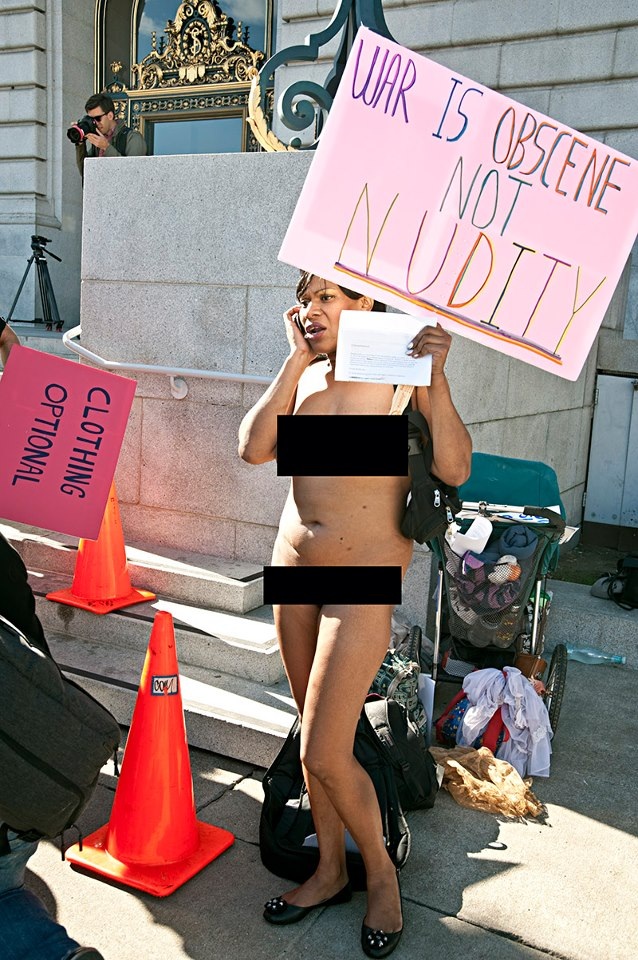
The nudists file suit

32

You all know the joke: What did the unsuccessful lawyer who joined a nudist colony never have? (A suit. LOL. Sort of.)

But a successful lawyer just filed a detailed suit trying to stop San Francisco from enforcing a ban on public nudity, and it makes a lot of interesting points. You can read the filing here (pdf). I’ll get beyond the fact that a legal argument over nudism uses the terms “prong” and “thrust” and “penal” all in a few short paragraphs, and get to the substance:

Attorney Christina DeEduoardo claims that her clients use nudity as a form of free speech and protest — and given who they are, it’s a pretty good argument. You’ve got a guy who ran as the nudist candidate for mayor and a woman who took her clothes off at a Board of Supervisors meeting for political reasons, and they contend that they have the right to appear naked in public.

The claim seeks a restraining order prohibiting the Board of Supervisors from enacting the law, but a federal judge already nixed that, according to City Attorney spokesperson Matt Dorsey. Instead, all parties have to wait unitl the supes approve the law, at which point this will become a motion for an injunction against the law taking effect.

So banning a handful of people, mostly older guys, from hanging out naked on Castro Street is going to become a legal battle that will cost the city a bunch of money. Unless sanity prevails and Sup. Scott Wiener, the city attorney and the nudists can reach a deal, which might be pretty simple:

It’s cool to get all nekkid (although it won’t be happening much in the next few months, way too cold). But maybe the Castro Guys can agree not to wear cockrings that attract attention to their dicks (and seem to be the proximate cause of all the fuss). Just be natural when you go au naturel, and we can all stop fighting over this.

You think?


The Faint will play ‘Danse Macabre’ in its entirety this weekend

0

It’s been a decade since the release of the Faint’s stand-out album, Danse Macabre. Nuts, right? With Saddle Creek Record‘s release this month of the deluxe edition of its landmark album, the somewhat dormant dark wave band is now touring and playing Danse Macabre in its entirety; that tour takes the Faint to the Regency Ballroom this weekend (Sat/17).

Originally released on Saddle Creek at the height of its buzz, the Faint’s crisp and flashy third studio full-length was a standout during the early electro-pop buzz of the Aughts, sounding like it was crafted by a dance-punk band with a heavy metal guitarist, which it pretty much was. Do you remember “Agenda Suicide” pumping out of boomboxes at every party in 2001, and swallowing up goth club and new wave dancefloors? I do.

On the eve of the Regency show, I shot synth-master Jacob Thiele a few rapid-fire questions about the band’s influences, Danse Macabre, and what the members have been up to the past few years (hint: some have been DJing under the name Depressed Buttons):

San Francisco Bay Guardian What’s it been like revisiting ‘Danse Macabre’? 

Jacob Thiele Actually all the songs on the album that we’ve neglected in our live show over the years have so far been the most fun to play as a band. So I think we’re all looking forward to finally playing those for everyone, as well as showing off our new songs!

SFBG There’s been an increasingly trend of ‘whole album’ shows, what are the advantages to this? Why did you decide to do it for this deluxe version release?

JT With the re-issue coming out it seemed right. We are doing it a little differently than other bands, in terms of how we play the whole album.

SFBG What other songs will you be playing during this tour? 

JT We’re also going to be selling a limited edition 12-inch of the current versions of our new songs, which we’re really excited about! We are playing some of our new songs from the 12-inch and songs from all of our albums.

SFBG Did you feel on the verge of something new when ‘Danse Macabre’ first dropped, or before it with ‘Blank-Wave Arcade’? 

JT At that time all of our friends were also in bands and everyone was doing something, recording, touring, etc, so it did not feel like anything different was happening to us.

SFBG Were you influenced by any of the first wave of dance-punk, ESG and the like? 

JT Yeah totally, all of that stuff was great and really important to us. Todd made a mix for an online magazine [that] sums up a lot of what we have been into over the years and it is a great listen.  

SFBG What have you all been up to since 2008’s ‘Fasciination’? 

JT We have been DJing a lot, some of us did some music under the name Depressed Buttons that our friends at Mad Decent released. 

SFBG Are there any plans for a new record? 

JT We have this 12-ich for now and we are working on more new music. 

The Faint
With Trust, Casket Girls
Sat/17, 8pm, $25-$27
Regency Ballroom
1300 Van Ness, SF
www.theregencyballroom.com

Howard Wallace, LGBT icon, dies at 76

6

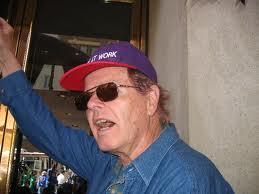
Howard Wallace, a longtime organizer who played a key role in bringing the LGBT movement and labor together in San Francisco, died Nov. 14. He was 76 and had been struggling with Alzhiemer’s disease.

Wallace grew up in Denver, and according to a biography by Andrej Koymasky, was forced to drop out of college when his father saw some United World Federalist literatature he’d brought home and told him to drop of of “commie” politics:

“He put a couple of checks on the dining-room table – the checks for next year’s tuition – and said, ‘Get out [of activism] and you can have those checks.’ I tore them up in his face, and that was the end of my college education.” 

Instead, he began a series of blue-collar jobs that brought him into labor organizing.

By the early 1970s he was in San Francisco, part of a generation of activists that included the late Hank Wilson and Assemblymember Tom Ammiano, who together helped form a group called Bay Area Gay Liberation.

“He made bridges,” Ammiano told me. “He came to BAGL and told us we had to support Cesar Chavez, and some of us were reluctant — you know, it was the Catholic Church, homophobia, all of that. But he convinced us to go on that march, and we were all glad we did.”

Wallace was a founder of the Lesbian-Gay Labor Alliance and later Pride at Work, and he was instrumental in bringing LGBT workers into the labor movement — and also bringing labor support to LGBT causes.

In 1974, Wallace worked with members of the Teamsters Union — not a group always known in those days known for enlightened attitudes towards gay people — on a boycott of Coors beer.  The teamsters were fighting bad labor practices at Coors, including a mandate that all employees take a lie-detector test that incuded the question “are you a homosexual?”

Working with both sides, Wallace got the LGBT community to sign on to the boycott, got Coors out of many of the bars in the Castro — and made lasting connections between local labor leaders and the LGBT community.

“He’s the one who brought Harvey Milk into the Coors boycott,” Ammiano recalled. “And he was never afraid to call out labor leaders when they were being homophobic.”

Like all great organizers, he could be persistent to the point where he was sometimes infuriating — but always, always pure of heart. “He was a character,” Ammiano said. “I never knew what color his hair would be, but I always knew what color his politics would be.”

Tommi Avicolli Mecca, a longtime activist and writer on LGBT history, said Wallace was “a giant among us. He was always there, for the rights of union members, the poor and working class, antiwar activists … you could always count on Howard to be there.”

Mecca noted that Wallace “saw the connections between the LBGT movement and disenfranchised people everywhere. He saw the queer struggle as part of a larger struggle for social and economic justice.”

He will be sorely missed, but as Mecca said, “we will always have his legacy; future generations can look back and understand what our movement was about.”

Said Ammiano: “I hope he and Hank Wilson are up there tipping a few back and talking about Lenin vs. Trotsky.”
 
A memorial is pending, and I’ll keep you posted as updates are available.

UPDATE NUMBER 1: State Sen. Mark Leno told me that Wallace “was not only a dear friend but a teacher. His values were strongly intact.” Leno recalled chairing the fundraising drive for the LGBT Center, a huge undertaking, and accepting a check from Coors for $5,000. “I though I had done due diligence, I knew the boycott was over, but Howard came to our board meeting and convinced us that the LGBT Center had to be above reproach.” 

(I’m sure Howard Wallace didn’t use those exact words).

“It was after that that we became good friends,” Leno said.

UPDATE NUMBER 2: From Gabriel Haaland, Pride at Work co-vice-president (SEIU< SF): I don’t know if most progressives know how much Howard gave to us all. I know there are so many who considered him a mentor and an inspiration. For those of you who don’t know him, Howard had a way of connecting the dots across so many issues. A legend and a hero for sure. A fearless warrior for justice, Howard was both passionate and gentle in his own way… He gave so much of himself and taught me so much in the rashness of my younger years. Even in death, he continues to inspire me to be better than I was before, more in integrity. I honor those who took such good care of him in the last year, like Kathy Lipscomb, Carl Finamore, Tab Buckner, Eileen Hansen, and Susan
Englander. I will miss him.

Fell/Oak bike lane project appealed

56

Long-awaited bicycle and pedestrian improvements along Fell and Oak streets – a key east-west connection where fast-moving cars create sometimes-scary conditions for cyclists – approved last month by the Municipal Transportation Agency’s board suffered a couple frustrating setbacks last week.

First, on Nov. 5, the project was appealed to the Board of Supervisors by area residents Mark Brennan, Howard Chabner, and Ted Loewenberg, who charged that it violates state environmental laws and the Americans with Disabilities Act and should be subjected to a full-blown Environmental Impact Report rather than relying on the overall Bicycle Plan’s EIR.

The MTA is confident the appeal will be denied, so its crews went ahead with the project, removing the existing bike lane markings and then just leaving it that way for the last week, creating a confusing and potentially dangerous situation for both motorists and cyclists. It also raised fears among project supporters that the two developments were connected.

But MTA spokesperson Paul Rose told us there is no connection and “we expect to begin striping tomorrow, weather permitting.” He also said the agency heard the concerns from cyclists and this week put up signs urging motorists to share the road with cyclists and placing flyers on cars parked along the stretch.

As for the appeal, Rose said, “We have confidence that the environmental work that went into this project was appropriate and the appeal will be denied.”

Leah Shahum, executive director of the San Francisco Bicycle Coalition – for whom this project has been a top priority for years – echoed the optimism and emphasized the extensive outreach effort that has gone into this project.

“I think it’s unfortunate that there is the threat of delay to a project that has gone through so many years of community input and has such strong support,” Shahum said. “There are a few individuals who are trying to delay the project, but I’m happy to hear the MTA is moving it forward anyway.”

The appeals hearing has been tentatively set for Dec. 11. Once completed, this will be one of just a few cycletracks – or bikeways that are physically separated from automobile traffic – in San Francisco, something bike activists hope to see more of in the coming years.

Oh well, Pelosi’s going to stick around

32

For a while there some of us thought that Rep. Nancy Pelosi, who failed to win back a house majority for the Democrats, might decide her time was up and step down as minority leader (which would probably have meant retiring from Congress). That would have set off one of the hottest political battles in town; just about everyone knows that Pelosi’s daughter is interested in the seat, but there’s no way she was going to get it without a fight. There are lots of ambitious people in this town who would jump at a once-in-a-lifetime chance at a Congressional seat, starting with possibly all of our current state Legislators and a few supervisors.

Would progressives and independents sick of the notion of a Pelosi family dynasty get behind one candidate (say, Mark Leno)? Would Scott Wiener, who Leno has supported and mentored all these years, run anyway, arguing for a younger candidate who could be around for long enough to get seniority? Would Leland Yee, who will be termed out and didn’t get elected mayor, jump in the race? Would Tom Ammiano, who doesn’t seem at all ready to retire?

Lots of crazy speculation — and now it appears we’ll have to wait two more years to go through it again. Because, barring a huge upset in the Democratic Caucus, Pelosi’s sticking around.

I’m not so thrilled about that — and I swear it has nothing (well, almost nothing) to do with the amazing story that a contested race would create for political reporters. It’s just that Pelosi’s been a big disappointment to San Francisco; she cares more about her national constituency that about her district, and her legacy achievement is the privatization of a national park.

It would be nice to get someone representing San Francisco who represented San Francisco values.

Oh well.

Localized Appreesh: Brand New Trash

0

Localized Appreesh is our thank-you column to the musicians that make the Bay. To be considered, contact emilysavage@sfbg.com.

Brand New Trash is a new “trash pop” (more on that in a second) band from Buxter Hoot’n’s SF-via-Indiana brothers Vince and Jimmy Dewald. The group, rounded out by two drummers – Kevin Alan Walters and Ebony Towner, who also doubles on keyboard – is about to release its debut self-titled LP.

It’s a record rooted in raw rock’n’roll Americana, with dreamy roadtrip sing-along melodies, hence the “trash” and the “pop” that make up the band’s sound. The album is mostly original tunes, but one of the more surprising turns would be the group’s solid, harmonica-peppered cover of Tupac’s classic “Brenda’s Got A Baby” – definitely worth a listen; and it’s certainly not done in a kitschy-krappy Karmin way. Instead, it’s a Tom Petty-reminiscent mouthful of a tribute, showcasing the boldness of the original lyrics, wrapped in a noisy roots rock package.

Brand New Trash’s last local live appearance of 2012 – at Bottom of the Hill this week – also happens to be its release party for that brand new album.

http://www.youtube.com/watch?v=QJ12emzwy-I&feature=youtu.be

Year and location of origin: 2011, San Francisco, but the band’s roots go back to the late ’90s in northern Indiana where three of us grew up and played in a band together.
 
Band name origin: Our sound just kind of spawned the name. We are also big Crazy Horse fans and Neil Young saying “Here’s some more trash for ya,” on a live album has always stuck in my mind.
 
Band motto: “Tell the story and keep it trashy.” A lot of the songs on our debut are first takes. This is a big part of “trash pop,” being ready for the moment and delivering something raw and uncensored. There are no put ons with this band, allow for the unexpected and let the music tell a story.
 
Description of sound in 10 words or less: Trash Pop – raw rock with stick-in-your-brain melodies.

Instrumentation: We do a lot of switching instruments and we all sing because we all write songs. Mainly, brothers Vince and Jimmy Dewald share the bass and guitar duties. Kevin Walters and Ebony Towner share the drums and Ebony also plays keys.

Most recent release: Debut album, Brand New Trash out November 20, 2012.

Best part about life as a Bay Area band: The general freedom in the Bay. We did a lot of touring with our first band, Buxter Hoot’n, and you just don’t find that everywhere.

Worst part about life as a Bay Area band: Getting to the rest of the country for tours is a big undertaking

First album ever purchased: Run-D.M.C, Run-D.M.C. “It’s Tricky” still pops up in my head, probably the first song I ever memorized.

Most recent album purchased/downloaded: Kurt Vile, Smoke Ring For My Halo.

Favorite local eatery and dish: Underdog-“The Organic Sausage Joint”, half of the band gets “Let’s Be Frank” half goes for the Vegan Dog.

http://www.youtube.com/watch?v=YFgNZqdm5Gs

Brand New Trash
With Jonny Cat and the Coo Coo Birds, Sufis
Thu/15, 9pm, $10
Bottom of the Hill
1233 17th St., SF
www.bottomofthehill.com

Dick Meister: Labor’s big day

2

By Dick Meister

Dick Meister, former labor editor of the SF Chronicle and KQED/TV Newsroom, has covered labor and politics for more than a half century. Contact him through his website, www.dickmeister.com, which includes more than 350 of his columns.

Now that the election dust has settled, it’s clear that organized labor was a big winner locally, statewide and nationally.

In San Francisco, more than half the winning candidates for local office had labor backing, as did all local candidates for state office and all but two of the winning city propositions.

Labor did as well statewide, with voters soundly rejecting State Prop 32 that would have greatly diminished unions’ political strength.  Defeating the proposition was by far labor’s most important election goal.

Almost as important was Prop 30, which will provide badly needed increases in funding for education and other local services and reduce the state budget deficit.  Funding will come primarily from higher taxes on the wealthy.

Prop 38, which labor successfully opposed, would have provided only increased education funding and that wouldn’t even have included funding for the community colleges that provide vital job training. Funds for Prop 38 would have come from taxes on everyone, including the poor. 

Labor’s campaigning nationally was done largely – and extensively – for President Obama and Democrats who had hoped to substantially increase the party’s narrow margin in the Senate and even regain control of the House.

But though they failed to elect more friendly congressional Democrats who would back labor’s political agenda, unions can correctly assume that Obama will be as friendly to labor in his second term as he was in is first four years in office.  Pro-labor measures that unions might fail to push through Congress could very well be enacted through presidential executive orders, if not through presidential pressures on Congress.

Labor’s election victories included increases in the minimum wage rates in Albuquerque, San Jose and Long Beach, and the defeat of anti-union measures in several states.

Labor Notes’ Samantha Winslow reported, for instance, that unions helped defeat a measure in Illinois that would have changed the state constitution to require a three-fifths majority vote by the legislature to increase public employee pensions, while requiring only a simple majority to make pension cuts. It would have superseded collective bargaining over pension improvements at the state and local levels

Unions also played a major role in helping groups fighting voter suppression in Ohio and elsewhere, and in the successful re-election campaign of Ohio Sen. Sherrod Brown, one of the Senate’s most labor- friendly members.

Labor’s political efforts obviously aren’t going to end with the election over. Unions already are planning drives to protect Social Security, Medicare and Medicaid from benefit cuts.

“Some legislators and their backers on Wall Street are already set on reaching a ‘grand bargain’ in the next eight weeks,” says AFL-CIO President Richard Trumka. He says they’re aiming to raise the retirement age for Social Security and the eligibility requirements for Medicare and Medicaid.

Trumka has a better idea.  He says “Congress must let the Bush tax cuts expire for the wealthiest 2 percent and make no cuts to Social Security, Medicare or Medicaid.”

Those are among the most important of the many tough political issues now facing unions and their supporters in San Francisco, and throughout California and the rest of the country. As the election proved beyond doubt, unions have what’s needed to seriously challenge their opponents and in the process provide important help to us all.

Dick Meister, former labor editor of the SF Chronicle and KQED/TV Newsroom, has covered labor and politics for more than a half century. Contact him through his website, www.dickmeister.com, which includes more than 350 of his columns.

Gascon skips valuable reform panel

58

District Attorney George Gascon didn’t show up for the town hall meeting that Sen. Mark Leno held on criminal justice reform last night. Gascon was scheduled to appear on a panel with Sheriff Ross Mirkarimi, Chief Probation Officer Wendy Still, Public Defender Jeff Adachi, and Police Chief Greg Suhr (who also didn’t show, sending Commander John Murphy instead).

Gascon spokesperson Stephanie Ong Stillman minimized the decision to forego appearing on a panel with Mirkarimi, whom Gascon prosecuted for a domestic violence incident and continues to persecute with calls to resign or abdicate some of his official duties, telling us, “There was just a change in his schedule.”

But Gascon, who has only lived and worked in San Francisco for three years, might have benefitted from the discussion, which focused on how San Francisco has for decades pioneered a successful approach to criminal justice emphasizing rehabilitation and redemption rather than the punitive “zero tolerance” approach to crime pushed in Sacramento and other jurisdictions, which has been costly in human and fiscal terms.

“This team of individuals you see in front of you have had the most extraordinary results in leading San Francisco,” Leno said, focusing much of the discussion on how well-prepared San Francisco was for Realignment, the year-old state policy of transferring low-level offenders from the overcrowded state prison system to the local level.

David Onek, the UC Berkeley criminal justice professor who ran against Gascon for DA last year, was added to the panel after Gascon bailed out. He said, “San Francisco by all accounts is way ahead of the curve and can really provide leadership to the rest of the state for how to do Realignment right.”

The main reason for that, as most panelists acknowledged, was because of a variety of programs created by longtime Sheriff Michael Hennessey, who endorsed Mirkarimi to continue his legacy over two traditional law enforcement challengers. Mirkarimi noted that Hennessey didn’t have a law enforcement background when he became sheriff, and that the SFPD and other local agencies long resisted the progressive reforms that he instituted.

“The constellation of what we’re all addressing is unique to San Francisco,” Mirkarimi said, describing the city’s current multi-agency approach as “one that recognizes where redemption comes into the criminal justice system.”

Still, whose department oversees Mirkarimi’s three-year probation for his misdemeanor false imprisonment conviction, emphasized how much her department’s approach has changed in recent years, adopting “evidence-based” approach that respects  probationers, which she now calls “clients,” and addressing their needs.

“We created a plan for success instead of supervising for failure,” Still said. “We changed the culture.”

That cultural change came from the Sheriff’s Department, she said. “Sheriff Hennessey developed a litany of programs over the years, so we were well-positioned for [SB] 678,” the legislation that created Realignment. Despite all the recent talk about having “zero tolerance” for crimes like domestic violence, Hennessey’s controversial approach brought ex-offenders into key leadership positions and refused to dehumanize criminals or see them in black-and-white terms.

“In San Francisco, we kind of live in a bubble. You don’t know how crazy it is outside San Francisco,” Adachi said, noting how politicians in other jurisdictions have aggressively sought to block sentencing reforms and demonize criminals for political reasons.
“In San Francisco, we’ve been so fortunate that we’ve had progressive criminal justice policies,” Adachi said, recognizing that the last three DAs refused to bring the death penalty and Mirkarimi for six years ago creating the Reentry Council to address recidivism.

“It might seem like common sense, but it’s radical to other counties,” Mirkarimi said. “It makes me proud to be part of a criminal justice system that is looking forward.”
  

GOLDIES 2012 LIFETIME ACHIEVEMENT: Frank Shawl and Victor Anderson, Shawl-Anderson Dance Center

1

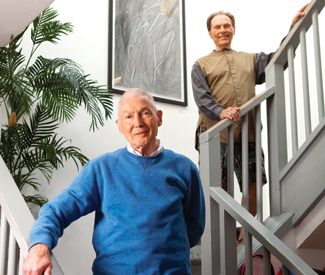
GOLDIES John Cage and Merce Cunningham, Ginger Rogers and Fred Astaire, and Fayard and Harold Nicholas are among the dance world’s most famous couples. In the Bay Area, nobody comes close to the relationship between Frank Shawl and Victor Anderson, of Berkeley’s Shawl-Anderson Dance Center.

Over the years the two men have a created a heaven for dance unlike anything that exists here, and probably could not be replicated anywhere else. Shawl and Anderson are the local dance community’s patriarchs.

They started modestly in 1958, above a liquor store on the corner of Alcatraz and College. After dance careers that spanned both coasts, they moved West from New York because they wanted to teach. Anderson had family roots in Berkeley, and the duo figured they might have a better chance at making a living in the Bay Area than in NYC’s competitive jungle.

Having performed and studied with May O’Donnell, a Martha Graham Dance Company member, they wanted to teach modern dance — at the time, a discipline that was not easily available to local dancers. They called their studio “Shawl-Anderson Modern Dance Center,” still its official name. In the beginning, Shawl remembers, “We did not even make enough money to pay its one-hundred dollar rent.”

From those early beginnings has grown the Bay Area’s oldest and — if you listen to dancers — most-beloved teaching institution, with over 100 classes per week. In addition to a full pre-professional curriculum for children, they teach modern dance; that style’s focus on individuality and personal expression has created an atmosphere that also welcomes ballet, hip-hop, jazz, and Horton, plus physical practices like Feldenkrais, pilates, and yoga.

Most remarkable is the breadth and longevity of its teaching staff, all of whom are on salary. Marina Eglevsky, whose artistic roots go back to the legendary André Eglevsky, considered the greatest ballet dancer of his generation, still teaches ballet twice a week. “Her classes are packed — people come from all over,” Shawl says. Wendy Diamond has taught modern since 1988; Joanna Harris’ decade-long Sunday morning class, “Lifelong Movement,” addresses the needs of older adults.

Younger teachers who are still actively choreographing — like Randee Paufve, Nina Haft, Antoine Hunter, and Nol Simonse — bring their own creative perspectives to the classes. The combination of life-long experiences and fresh approaches is invaluable to student dancers.

To get teachers — some start as substitutes — Shawl relies on his instincts and his experience. “I talk with them, and I can usually tell whether they would be a good fit,” he explains. “Very rarely have we had to let somebody go.”

He remembers Reginald Ray-Savage just walking in a few years ago. “I listened to what he had to say, and I just could tell that he was the real thing.” Today, Shawl-Anderson has the Savage Jazz Dance Company in residence.

But back to the earlier days: when the center was facing eviction from the liquor store (apparently, all that dancing made too much noise), student Sylvia McGraw suggested the two men look at a building across the street. “It was a home,” Shawl remembers. “I walked in and all I saw was a bunch of tiny little rooms.” McGraw pointed out that the house was zoned residential-commercial and, furthermore, that her husband was an architect.

With the budget spent on the essentials, in 1968 the school moved into the reconfigured space, with two small studios on the entry level and two huge ones — beautiful dance floors, lots of light, and high ceilings — one floor up. Shawl’s office is still the size of a closet, and the women’s dressing room still looks like it might originally have been a kitchen.

Most remarkably, the building still feels like a home. Walking up the small pathway from the street and the few steps that invite stoop-sitting, it uncannily feels like the rest of the Arts and Crafts residences that stretch toward the Berkeley hills. The wooden floors in the entry are well-worn, and the bench on the side looks like it has been there forever.

No doubt its funky charm and good usable studios have helped make what Shawl-Anderson has become. But it’s these two remarkable men who have given the place its soul. The minute you walk in, you pick up its sense of generosity of spirit, a commitment to craft and creativity, and a welcoming embrace of diversity in all its manifestations.

It’s what Paufve, whose company now is in residence, experienced when she first stepped through the door in 1986. “I don’t remember not ever having felt at home here,” she says. After moving from New York, she heard about the place the first week she was here. She also found teachers with whom she wanted to work. Over the years, she says, “People here have been incredibly generous. I honestly don’t know if I would still have Paufve Dance if it was not for Shawl-Anderson.”

Fog Beast, one of San Francisco’s newest dance companies (formed by Joe Goode dancers Melecio Estrella and Andrew Ward), recently paid tribute to “the decades of dance art cultivation at Shawl-Anderson.” Move Here, created when the duo was in residence, was a site-specific work using the building’s architectural space. It allowed the choreographers “to step into the role of host, exploring the aesthetics of hospitality, the art of friendliness and warmth.” Shawl enjoyed the performance. “They had pictures of the two of us on the walls — it was so nice,” he smiles.

Both men are now in their 80s. Anderson is semi-retired, but Shawl still takes class every day and substitute teaches when needed. Looking back over more than 50 years, is there something that they would have changed? “It is the way it was [meant] to be,” Shawl says. “I believe in the right path. We didn’t do it for the ego, we did it for love.”

GOLDIES 2012: PianoFight

4

GOLDIES A PianoFight show can be almost as striking for its audience as for what the company puts onstage, even if few audiences will upstage a machine that blows ducks out of people’s butts, per Duck Lake. PianoFight crowds are conspicuously not your typical theatergoers — they’re closer to the boisterous women in office attire I noticed at the now-defunct Off-Market Theater, PianoFight’s old haunt, who had smuggled in a bottle of Chardonnay and were picnicking in a back row like it was Baker Beach. Such eager insouciance is one sign of this young company’s burgeoning success.

“We’re aiming for those people,” says Rob Ready. “We’re aiming our stuff at Giants fans. That’s who we want in the door. Our generation didn’t grow up with theatergoing as a habit.”

“On the contrary,” says Ready’s colleague, Dan Williams. “You grew up with theater as a joke, as a byline for something boring and stuffy. There’s no reason it has to be that.”

Let it be known that PianoFight is doing its part to insure it isn’t. A PianoFight show takes many forms — sketch comedy, original drama, new play festivals, oyster-fuelled theater al fresco, a rotten vegetable barrage, or the fowl comedy-horror-ballet-musical mash-up of 2012’s aforementioned Duck Lake — but it always includes a rambunctious spirit of collusion with an audience who, very often, take some part in the proceedings.

Ready and Williams, two guys whose laid-back nature belies their seriousness and savvy as theatrical entrepreneurs, first met doing theater in their Santa Barbara high school. After Ready got his arts degree at NYU, he moved out to San Francisco specifically to start a theater company with Williams, who was then working a day job downtown. In Ready’s hands was his own script for a play based on NYU’s string of student suicides called Roommate Wanted. With the help of friends and family, they produced a successful two-weekend run in 2007.

From this humble beginning, PianoFight has mushroomed into a multi-faceted, multi-armed organization that includes sketch comedy troupe Mission Control and its female-driven counterpart, Monday Night ForePlays. It regularly sells out shows, boasts a semi-official “flexible” roster of 46 company members (with many more in unofficial orbit around the company), and is building its own bar-theater complex on the site of the old Original Joe’s on Taylor Street.

Along the way, it’s toured the West Coast (twice), scattered a set of new playlets across an oyster bed in Tomales Bay (two years in a row), opened productions simultaneously in SF and LA, taken four company retreats, and generally developed ambitious programs that balk at the usual small-cast, three-weekend production model, while adding fuel to the fire of local playwrights like Tim Bauer, William Bivins (Pulp Scripture, The Position), Jon Brooks, Megan Cohen, Bennett Fisher, Daniel Heath (FORKING!, A Merry FORKING! Christmas), and Lauren Yee, among others.

Ready and Williams credit Matthew Quinn with taking a chance on their inexperienced but fervent selves when the producing artistic director of Combined Art Form Entertainment, who had co-founded Off-Market Theater in 2004, handed them the keys in 2007. PianoFight eventually left Off-Market when the rent rose, but by then it was on a roll, having proved resourceful and inspired in its own venue. When tenants Point Break Live! moved onto a bigger venue, for instance, Ready and Williams filled the gap by inventing “the nation’s largest audience-judged playwriting competition,” the (now long-lived) ShortLived series.

“So glad Point Break Live! dropped out,” muses Williams, “because ShortLived turned out to be an amazing community builder. It really was one of the biggest drivers of our company initially, since we had to get a bunch of actors, a bunch of directors, and a bunch of writers.”

“The R&D wing of the theater business is [made up of] small, scrappy companies,” says Ready. “If it was just us I’d be, ‘All right, we’re just that more awesome,’ but it’s not. There are a lot of people saying theater can be a lot of different things to a lot of different people.”

As for the name PianoFight, apparently there’s no short answer to that question. I was invited to come back some time with a bottle of whiskey and ask again. “Have at least 24 hours,” cautions Williams. “You’ve got to set aside some time, some whiskey … and bring a credit card, too.”

GOLDIES 2012: Jamie Meltzer

1

GOLDIES He may be a filmmaker, but the inspiration for Jamie Meltzer’s first feature-length documentary came while he was flipping through the bins at a record store.

“I found this song-poem compilation,” Meltzer remembers. At the time, he was a San Francisco State University MFA student. “It was such an amazing, undiscovered-to-me subculture that I started making the film that day. It took me two years to go around and meet all of these song poets and musicians, but it really started in the record store.”

The end result morphed from thesis film into 2003’s Off the Charts: The Song-Poem Story, which aired on PBS and earned a cult following. It also opened professional doors for Meltzer; after thanking one of his undergrad professors in the film’s credits, he learned that his alma matter, Vassar College, was hiring in its film department. In 2007, he transitioned to his current teaching gig, at Stanford’s prestigious MFA program in Documentary Film and Video.

“I was happy to come back to San Francisco, of course, but I was also really happy to step into the documentary-centric environment at Stanford,” Meltzer says. “It’s almost like a documentary lab — between the students and other professors, we’re all thinking about documentary films, talking about them, studying them, making them.”

His follow-up to Off the Charts, 2007’s Welcome to Nollywood, takes on another “Who knew?” subject: Nigeria’s vibrant film industry.

“Nollywood is the third-largest film industry in the world, and they have this independent film model that makes a lot more sense than even what we have in the US. That just kind of blew my mind,” Meltzer says.

“But beyond just being a portrait of an industry, the film ended up being a complex story. There’s all sorts of questions of, are these quote-unquote good films, or is the value that they’re being made and consumed as kind of a self-representation? To me, Nollywood and Off the Charts were similar in that way: different people passionately making art, but not sure how well it will be received. The character of the dreamer against all odds, that outsized ambition — I think that’s a big parallel with independent filmmaking in general. You always believe in what you’re doing, but you’re not really expecting other people to believe in what you’re doing.”

Meltzer’s current film, Informant, premiered at the 2012 San Francisco International Film Festival, and has since been on a nonstop festival tour. The doc explores the strange life of Brandon Darby, a lefty activist turned FBI informant who helped send two 2008 Republican National Convention protestors to jail. He’s a polarizing guy, but the film, which is anchored by an extensive interview with Darby, invites the audience to draw their own conclusions. Complexity is once again an important theme.

“The main thing was to try to respect the complexity of Brandon, as a subject, as a person, because he has all these different facets,” Meltzer says. “His story’s very intense, and he was very sincere and conflicted in ways that I found really compelling. It brought up a lot of interesting moral territory and all these moral issues. Then you’d go and talk to Brandon’s activist nemesis, and he had a totally different take, and you’d find yourself agreeing with his story. So, to have that kind of character who can be seen from such different perspectives — that’s totally astounding. I really wanted to get that across in the film.”

Informant, which avoids making any tidy conclusions, reflects Meltzer’s own philosophy on documentary making.

“Some audiences have this idea that documentaries have to make very clear and usually politically-based arguments. And that’s the thing that I set out not to do. I think it’s great that the film creates a dialogue over, ‘What is documentary?’ People question my point of view, they question the point of view of Brandon and the other characters,” he says. “Hopefully they will start questioning other documentaries, too, and the notion of objectivity. Documentary filmmakers know that documentaries aren’t objective in the least. But I think audiences still aren’t entirely clear on that.”

Meltzer credits both the Bay Area filmmaking community (particularly Frazer Bradshaw, Informant‘s director of photography) and his Stanford colleagues (including numerous former students) for helping him make the film. “San Francisco has a lot of people who are committed to working on things that they believe in for little or no money, out of passion. That can’t be overstated,” he says.

So what’s next? Making Informant was so difficult, Meltzer confesses, that he thought it would be his last film. But then he heard about a group of exonerated men in Texas who’ve formed a detective agency to help other innocent people behind bars. “You can’t pass up those kind of ideas,” the filmmaker says. “You have to grab them when they come.”

No doubt it won’t end up being a simple story — but Meltzer will weave all of its threads into a captivating tale.

GOLDIES 2012: Joe Landini and the Garage

1

GOLDIES Choreographer, impresario, and arts advocate Joe Landini likes to say yes. “It’s my philosophy to start that way,” the founder and artistic director of the Garage — San Francisco’s most hoppin’ performance venue — explains. “If you say no to something, the conversation is closed. There is nowhere to go.”

Landini is a curious mixture between visionary idealist and pragmatist who has a solid grasp of what it takes to get a job done. As a young jazz dancer, he was told to take ballet to improve his alignment. So he did, until his knees gave out and he switched to modern dance at UC Irvine, where he majored in choreography.

While Landini was in college, master choreographer Donald McKayle suggested that he had talents as an administrator. Landini accepted the observation though he saw himself primarily as a choreographer. He moved back to San Francisco — he grew up in Concord — and waited tables while interning for Mary Alice Fry’s Footloose Dance Company and Shotwell Studios. “I learned to write grants,” he remembers over coffee, near the Garage’s digs at 715 Bryant. “And I got free rehearsal space for my own choreography.” He also learned that per capita, San Francisco funds its dancers reasonably well. “In New York, you might have 200 applicants for one grant. Here, there may be 50 to 60.”

Opening the Garage in 2007 (its original location was on Howard Street) allowed him to offer what he thought artists, particularly young ones, need: an environment where experimentation, learning, and risk-taking are welcome. Artistic failure doesn’t bother Landini; it’s part of the learning process, he says. During the first five years, he estimated that annually around 10,000 people walked through that iconic red door on Howard.

Landini’s major initiative, RAW (Resident Artists’ Workshop), is modeled after AIRspace (AIR standing for “artists in residence”) — which had been set up for queer performers at the Jon Sims Center for the Arts. Landini ran it for a year. When the Sims Center closed, he bought the seats and tech equipment, putting them in storage until needed.

The Garage is run like a time-share in which 30 groups evenly divide up the time slots. While primarily a haven for dancers, theater folks and performance artists are equally welcome. Anybody can apply. True to form, Landini doesn’t tell them no, though “they just may have to wait until a space opens up.”

Wayne Hazzard, executive director of Dancers’ Group, the Bay Area’s dance service organization, considers the Garage a “powerful space where community-building can start. Joe, with his practically 24-hour open-door policy and constant presence, is almost like a neighborhood mom-and-pop store. For first-time young artists, this is particularly valuable.”

All Garage artists get three months of four-hours-a-week rehearsal time that ends with a public performance. Artists can come back — and many do. As for his own choreography, Landini is just getting back into it. During a two-year stint in London for an MA in choreography from the Laban Centre, he immersed himself in the European dance theater tradition. “I learned so much, and I have never been able to use it,” he says — until now: on November 27, he will present his new physical theater piece, Bitter Queen.

As if running the Garage seven days a week was not enough, Landini also started a Summer Performance Festival this year, curated in conjunction with ODC Theater. Again, he couldn’t say no — this time to offering a select group of Garage choreographers a venue more professional than his own modest theater can provide. The event will return in August 2013.

And, of course, Landini couldn’t say no when he heard that the city was interested in keeping another summer event, the 22-year-old West Wave Dance Festival, alive. “Every city needs a yearly independent dance festival, right?” he asks. One guess who will be running it in 2013.

GOLDIES 2012: Mica Sigourney

9

GOLDIES Regular appearances are not Mica Sigourney’s thing. True, most Friday nights you’ll find alt-persona VivvyAnne ForeverMORE! at the Stud hosting Some Thing, the boisterously resourceful drag cavalcade (formerly Tiara Sensation) started two years ago with drag mother Glamamore and dj down-E. Even there, though, you couldn’t call VivvyAnne’s appearance regular: one night it’s ersatz Dior, another it’s lipstick, hobo beard, and a jock strap.

Beyond that, you never know where or how you’ll see either VivvyAnne or Sigourney. This is an artist drawn not only to the spotlight (what drag queen isn’t?) but to the genuinely experimental and demanding, whose work runs the gamut from go-go to performance art to contemporary dance (the latter most notably as an all-out ensemble member of Laura Arrington’s Wag in 2011) and in the process bridges the nightlife and performance scenes with untiring ingenuity.

This crossover élan was on display at the 2009 National Queer Arts Festival with the unveiling of Martha Martha Martha, a drag piece co-created with Eli Magid (a.k.a. Elijah Minnelli) in which some maniacally looped dialogue from Who’s Afraid of Virginia Woolf? gets refracted through a stage-full of renegade Liz Taylors. A year later, at the debut of Keith Hennessy and Julie Phelps’ “Too Much!” marathon of queer performance, VivvyAnne ForeverMORE! led an impressive roster of SF drag superstars into the proceedings (including Glamamore and Fauxnique, a.k.a. past Goldie winner Monique Jenkinson, another major influence).

That showcase brought the nightlife scene squarely into the realm of contemporary queer performance, and evolved into the sporadic Work MORE! series, based on crossover collaboration between highly distinct artists. Sigourney, who just produced its fourth installment in August, plans to tour it next year. Meanwhile, a 2012 CounterPULSE residency produced the winking hubris of MASTERWORK, marshaling a cast of po-mo drag queens under Sigourney’s control to question the egotism of the artist and the role of the audience. And in a highlight of 2012’s This Is What I Want festival, Sigourney re-purposed his performance fee to negotiate his sexual currency in real-time with his audience, while a chorus beside him voiced the testimonials of ex-lovers.

The brio and subtle play in these and other works keep Sigourney a vital presence on multiple stages, as well as an important catalyst for new work. But the more makeshift outings, without any stage at all, can be just as memorable: Sigourney in a crowded men’s room at SOMArts, for instance, seated at a table in a wife-beater beside a stack of his own poems, some pages from David Wojnarowicz, a fifth of bourbon, and a lot of shot glasses.

“It was the first time I’d brought my writing into a performance,” says Sigourney of the inebriated presentation in the john (mounted as part of SOMArts’ monthly new queer performance showcase, “The News”). “It was my writing and Wojnarowicz’s from two of his books, and the audience picked what I read.” Sigourney offered bourbon to anyone who wanted a shot with their request, and he committed himself to always drinking one with them. “I was trying to layer people on top of people. It was good for that,” recalls the artist, a little hazily. “Someone actually used the bathroom.”

Another sighting: a makeshift biergarten in Portland last September, during one of the nightly after-parties for that city’s Time-Based Art festival. Out of a small huddle by the fence rises VivvyAnne like a gibbous moon, flashlight held firmly to her face and balancing her leggy fishnets on a combination of high heels and patio furniture. After instructing the crowd in a few dance steps, she leads an impromptu off-program all her own, lip-syncing to a boom box that blasted Miley Cyrus’ “Party in the USA.”

Surprisingly, the Long Island native, a longtime theater (and later, club) kid who moved to San Francisco in 2004 and birthed VivvyAnne ForeverMORE! in 2008, says drag was something he grew up admiring but never thought he could do. Maybe that’s why he can do so much with it.

“I’ll never be a ‘lady lady’ drag queen,” he says. “It just won’t happen for me. So I started out saying fuck the illusion, what illusion? I’d wear things where my chest was exposed or a see-through dress or just underwear. There’s no illusion here to ruin in the first place. Once we agree that it is an illusion [we’re after], then we can make it together.”

GOLDIES 2012: WATERS

0

GOLDIES “It’s been a great year for me,” says Van Pierszalowski, slightly out of breath after pushing his bicycle up a seriously steep hill. “It’s been the first year that I’ve lived anywhere in a long time.”

Pierszalowski has been part of the San Francisco indie rock scene for years, first with Port O’Brien and now with WATERS, but he hasn’t actually lived in the Bay Area since his days at UC Berkeley. He’s been mostly out on the road, couch-hopping at friends’ houses upon return, spending summers fishing in Alaska with his father — or in Oslo with his European girlfriend, Marte Solbakken, who also plays in WATERS.

But in 2012, following positive reviews for 2011’s Out In The Light (TBD Records), his debut album as WATERS, he’s finally on dry ground. He’s got a somewhat permanent structure — an apartment he shares with Solbakken — on the top of Potrero Hill, and a part-time job at the bottom of those hills, at Four Barrel.

“I haven’t had a job, other than music and fishing, since college,” he says with a laugh. “Finally I’m not touring for a little while, and I’m just concentrating on writing songs, and I wanted my days to have a little more structure. So I sought out a job — I love coffee and I love Four Barrel.”

Java-brewing skills aside, Pierszlawski’s been garnering notice from music fans for other reasons: his earnest, salty sea-referencing lyrics; matured and more aggressive vocals; grungy, fuzzed out guitar-work; and seriously tripped-out music videos. As far as imagery goes, there’s a lot to take in with the video for “For the One” — flaming dream catchers, creepy convenience store clerks, acid-laced dreams, purplish starry nightscapes that look like screensavers for Windows 95, extras fleeing through smoke machine fog, and Pierszalowski riding his bicycle through a tunnel full of trash and glitter. https://www.youtube.com/watch?v=JIOJkUFTiwY

It’s kind of what WATERS is all about, the light and the dark, the weird and the weirdly confident, the grungier moments of the ’90s, soulful voyages through choppy seas, the hooks (pop and otherwise), a fisherman in a flannel.

Then there’s the more straightforward tour video for sparkly, garage-punk standout track “Back to You,” and two for moodier, yearning acoustic single “Mickey Mantle” — one clip that’s of Pierszalowski with a guitar on a rooftop, and the other a zoomed-in snapshot of his day — created for the 48-hour Music Video Race this spring. Live, the song’s a crowd-pleaser in which he pleads, “forever, forever” and gets the audience chanting the word back to him. https://www.youtube.com/watch?v=izgmACVXVBA

Pierszalowski also toured a whole lot with WATERS this year, opening for Delta Spirit across the US and Nada Surf throughout Europe. But WATERS’ biggest moment came this summer, when the band topped a bill at Brick and Mortar Music Hall.

“It was the first WATERS headlining show and I was super nervous and anxious about it. I thought no one was going to come. I could feel that my mood for the next while was dependent on how it would go,” he says. “To my great surprise, it was an amazing turnout. It was packed, and people knew the songs and were singing along and dancing. It just really felt like almost a solid year of promoting the album had paid off. And I know that’s not a huge deal, but it kind of is to me. It felt like the start of something new.”

With a boyish gleam of hope in his eyes, he adds, “Getting to play for people in San Francisco, on our own, felt infinitely more powerful than any of those [previous] experiences.”

Plus, now that he’s got his own apartment in SF, it probably didn’t take him too long to find his way home after the show.

GOLDIES 2012: Anna Ishida

0

GOLDIES One of the very first things you’ll notice about Anna Ishida, onstage and off, is an aura of self-possession that simultaneously grounds her and yet sets her ever-so-subtly apart in a crowd. But she also has a chameleon-like quality, a way of blending seamlessly into her surroundings, whether it’s a 49-seat black box theater on Natoma Street, or the hip buzz of Farley’s East in Oakland, where we meet over coffee and sandwiches.

It’s this very quality that helps make her such a compelling actor to watch onstage. No matter what the role, Ishida appears born to it, whether appearing as an allegorical peasant in an imaginary land (in The Forest War at Shotgun Players), a horny Russian aristocrat with a mic (in Beardo, also at Shotgun), or a frustrated former drag queen forced to languish in the glitter-dusted shadow of her employer-lover (in Boxcar Theatre’s Hedwig and the Angry Inch).

Professionally, Ishida appeared first in The Color of Justice at Oakland’s TheatreFIRST in 2002, following up with roles with a miscellany of companies such as Woman’s Will and the San Francisco Shakespeare Festival, plus a long association with Shotgun Players. But this year, after a powerful performance as Tamora, Queen of the Goths, in Impact Theatre’s Titus Andronicus, Ishida’s been working to make herself even better-known as a triple threat: vocalist, actor, and independent film star. Her turn as Yitzhak in Boxcar’s summer production of Hedwig framed her trademark spiky hairdo in black leather and heartbreak, and matched her versatile vocals and formidable stage presence to the dozen glam-rock divas cast in the title role.

Her current show, Christopher Chen’s The Hundred Flowers Project with Crowded Fire Theater, casts her as an actor exploring the sprawling epic of China’s Cultural Revolution via the creative process. Earlier this year, she spent a week basically locked up in a room for 16 hours a day for her cinematic debut in HP Mendoza’s unsettling art house ode to the horror film genre, I Am a Ghost. The film — about a literal lost soul trapped in an unending routine — premiered at the 2012 San Francisco International Asian American Film Festival, and has been getting raves elsewhere on the festival circuit.

Ishida was born in Tokyo; her family moved to the East Bay when she was four, where she first attended a mostly all-black kindergarten followed by an almost all-white Catholic school, which naturally meant she fit into neither. Gravitating towards music at a young age, she narrowly escaped becoming a business major in college and instead attended the Pacific Conservatory of the Performing Arts in Southern California, where she connected on a deeper level to acting, and has mostly stuck with it ever since.

“The grass is always greener,” she confesses with a smile. “If I’m acting, I want to be singing; if I sing, I want to do Shakespeare; if I do Shakespeare, I want to dance. I’m fortunate I can do all three.”

Onstage, no matter what the role, Ishida never lets her focus flag, and her signature watchfulness gives her characters a feral, almost predatory depth. Perhaps most interestingly, in a climate of casting controversies particularly affecting Asian actors (such as a recent production of The Nightingale at La Jolla Playhouse, where a Caucasian actor played the Emperor of China), Ishida has successfully avoided being categorized by her racial makeup. With the exceptions of The Forest War and The Hundred Flowers Project, she’s been seen in roles she has successfully rendered colorblind.

“I’ve demanded that people see me as an actor, rather than as ‘Asian’ — and if I didn’t work, then so be it, but I was not going to be pigeonholed,” she emphasizes.

Then she laughs, considering some of her recent roles: a Russian tsaritsa, Poseidon (in Shotgun’s The Salt Plays, Part Two: Of the Earth), and Tamora. “I may have escaped being typecast as Asian,” she allows, “but now I’m typecast as the angry queen. The angry god-queen!”

GOLDIES 2012: The Mallard

3

GOLDIES You always hear of those artists that simply must keep creating, regardless of location, monetary resources, health, or free time. It’s the urge, the craving, something deep in the pit of their being. Idle hands and all that. I get the feeling this is just how it is for Greer McGettrick, the Mallard’s lead vocalist-guitarist. There’s a fire in her belly, and it burns from a sonic tinder.

Let’s take just this year as a case example. The Mallard released its psych-garage influenced debut full-length, Yes on Blood, in March on John Dwyer’s Castle Face Records to increasingly rave reviews. The band opened for Ty Segall, Thee Oh Sees, Shonen Knife, Hot Snakes, and countless others, at shows at places like the Verdi Club, Slim’s, and Bottom of the Hill. It toured with the Fresh and Onlys’ Wymond Miles. It put out a split seven-inch with Thee Oh Sees. It’ll have a plexi seven-inch out later this month. It contributed a stirring cover of the classicaly morose track “There She Goes Again” to Castle Face Records’ Velvet Underground and Nico tribute album. Oh, and McGettrick has had a few art shows around the city, showcasing her intricate woodcuts.

In addition to all that, the fuzzy San Francisco four-piece is now working on its follow-up to Blood. “I’m still writing a lot, but I feel like it’s more of a record for me,” says McGettrick, sitting outside the coffee shop-video store where she works. “I feel like Yes on Blood was more of a record for San Francisco, an homage, where it was like, ‘These are the bands that I love and I’m drawing from them’ — there’s the Thee Oh Sees song, the Ty Segall song, the Intelligence song.”

Or, as she’s been know to describe it, the band makes “inside-out-echo-laser-garage-psych-rock.”

“This is more of an album for me in that it’s a lot weirder, a lot darker, more personal,” she says. “I’m learning how to use my voice versus yelping.”

Live, that yelping comes across as more of a gritty punk plea, an emotional core tumbling out, backed by McGettrick’s noisy guitar work; “boy” Dylan Tidyman-Jones on guitar, keys, and backing vocals; “girl” Dylan Edrich on bass; and Miles Luttrell on drums.

This current formation of the Mallard is here after a few false starts. When McGettrick first moved to SF three years back, she gathered friends to start a new band, but it quickly fizzled. So she started again. “I just needed to keep playing songs, keep playing shows,” McGettrick says.

She’d already been in bands for years before her move to the Bay Area. The Studio City, Calif. native was part of the Fresno music scene for five years after college. “I kind of got stuck there, but it was good for me. There are some great people there, some really talented musicians, there’s just not a lot to do. A lot of people move away once they realize there’s something else out there.”

Once in SF, she clicked with the booming garage rock scene, and fortuitously met Dwyer. She played him some of her raw home recordings and he told her to go record more, and he’d put them out on Castle Face.

“It’s a really great scene,” McGettrick says. “Living in Fresno for five years — where it was just such a struggle to get other bands to play from out of town, and it was hard to get any momentum there. People moved away, bands broke up — it got me to work a lot harder. I moved to San Francisco and it kind of seemed easy. There’s all these bands, all these shows, people go to shows. It feels nourishing. We’re really lucky to live in this city.”

Our Weekly Picks: November 14-20

0

WEDNESDAY 14

outLOUD Radio 10th anniversary gala

It’s Saturday afternoon at the LGBT Community Center, and outLOUD Radio’s youth producers are interviewing queer elders about their fashion sense. The recording session was but one of many that the nonprofit has conducted, an amazing opportunity for baby gays and their elders to connect and preserve their stories for the future. Tonight, outLOUD is celebrating a decade of work with radio greats — NPR’s Ari Shapiro will take the stage for a Q&A with outLOUD youth leaders and KQED’s Scott Schafer. Come out to support the group’s efforts — because even with the nationwide advances made in last week’s elections, more LGBT stories must be told. (Caitlin Donohue)

7pm, $10–$100

Brava Theater Center

2781 24th St., SF

(415) 658-6010

gala.outloudradio.org


THURSDAY 15

“Everyday as History: Selections from Lost Landscapes of San Francisco by Rick Prelinger”

Prelinger Archives founder Rick Prelinger has a collection of over 60,000 so-called “ephemeral films” — including home movies and industrial clips (see: 1935’s “About Bananas,” an 11-minute, black-and-white bit of United Fruit Company propaganda hailing “one of America’s most important foods.”) Prelinger visits the Contemporary Jewish Museum in conjunction with the current exhibit “The Radical Camera: New York’s Photo League 1936-51,” where he’ll be presenting highlights from his popular “Lost Landscapes” series of San Francisco history caught on film. No bananas, probably — but Playland, a youthful Golden Gate Bridge, and post-1906 earthquake scenes will likely make appearances. (Cheryl Eddy)

6:30-8pm, $10 (includes museum admission)

Contemporary Jewish Museum

736 Mission, SF

www.thecjm.org


Crushed Out

Brooklyn-based band Crushed Out (formerly Boom Chick) mixes swirling, bluesy slide guitar riffs with reverb-laden surf fills, stomping honky tonk rhythms and a host of other early rock’n’roll influences into a truly tasty batch of infectious tunes. When listening to Crushed Out’s new album, Want To Give, it may be hard to believe that it’s just a duo making all that noise — but singer-guitarist Frank Hoier and drummer Moselle Spiller have no problem recreating the full sound when playing live. They’ve opened for fans such as Jon Spencer, and are playing with Social Distortion in the new year—catch them up close tonight while you still can. (Sean McCourt)

With the Lower 48, Halsted

9pm, $8

Hotel Utah

500 Fourth St., SF

(415) 546-6300

www.hotelutah.com


Tame Impala

Recording an LP alone, in Perth, Australia, the world’s most remote city, practically guarantees a finished product permeated by angsty solitude. Psych-rock, though? Not exactly the most common vehicle for the expression of existential dread. Still, Kevin Parker pulls it off brilliantly on Lonerism, the sophomore full-length from Tame Impala, and his first as a lone, multi-tracking solo artist under the moniker. The result is a golden pop album, stuck in limbo between Britney-esque bubblegum vapidity, and Lennon/McCartney’s wholesome pop transcendence. It should be fascinating to watch a full band reinterpret the bittersweet hooks floating around in Parker’s head. (Taylor Kaplan)

8pm, $22.50

Fillmore

1805 Geary, SF

(415) 346-6000

www.thefillmore.com


FRIDAY 16

SF International Hip Hop DanceFest

The SF International Hip Hop DanceFest is an extraordinary event. Always the same, it’s always new. The formula works. Over the years, curator Micaya has honed her sense of what is hot and what is even hotter without neglecting the vibrant local scene that give this love fest of urban dance its backbone. New this year is Blue Boy from London with two different shows; the Academy of Villains will be back with its competition style fierceness; so is Ill-Abilities whose members travel the world conquering physical challenges. Female crews Decadancetheatre (NY) and Mix’d Ingrdnts (Oakland) will be there. That’s just five of the 16 companies that will make a cheerful noise and shake up the Palace of Fine Arts. (Rita Felciano)

Also Sat/17, 8pm; Sun/18, 2 and 7pm, $39.99

Palace of the Fine Arts Theatre

3301 Lyon , SF

www.sfhiphopdancefest.com


Vladimir in Butterfly Country

Vladimir Nabokov’s love of butterflies is another example of the often deeply entwined relationship between art and science. His most famous work, Lolita, was composed on several butterfly-collecting trips and he even theorized a migration pattern for the Polyommatus blue butterfly that was later confirmed by scientists. Vladimir in Butterfly Country, hosted by the Old First Church, will begin with readings from the author’s writings about butterflies. These will be followed by an original, one act opera, written by Ann Callaway and Jaime Robles, which brings to life Nobokov’s love affair with the beautiful insect. And if that’s not enough, the group boasts some of the finest chamber musicians in the Bay; Soprano Erino Newkirk will lead, accompanied by flute, bass, piano, bassoon, and percussion. (Molly Champlin)

8pm, $14–$17

Old First Church

1751 Sacramento, SF

(415) 474-1608

www.oldfirstconcerts.org


Twin Peaks: The Beginning”

When it hit the airwaves in 1990, Twin Peaks caused a sensation — and despite the copycats that sprang up in its wake, remains a singular example of what can happen when a pair of crazily creative minds (David Lynch and Mark Frost) come together and test the boundaries of television. Watching it today, it’s no surprise it became a cult hit after its mainstream popularity waned. The characters! The settings! The bizarro plot twists and quotable lines! Brooklyn’s Silent Drape Runners (+100 for the name) visit the Vortex Room for a special “live re-sound-tracking” of episode one, adding a new score of both original and familiar songs to the adventures of Agent Cooper and company. Let’s rock! (Eddy)

10pm, $10

Vortex Room

1082 Howard, SF

Facebook: The Vortex Room


Anna and the Annadroids present “Clone Zone”

Acrobatics, dance, aerial silks, video game metaphors, and animation compromise Anna and the Annadroid’s latest wacky, philosophical performance,Clone Zone.” Anna Sullivan started the San Francisco based performance group in 2004, inspired by dark horror films, pop culture, technology, and a love of dolls (though a slightly atypical one that had her building Barbie colonies on her front porch as a child.) This performance will see the Annadroids battling their way through Carl Jung’s model of the human psyche in a video game format. Come for a night that promises a give-and-take exploration of the human condition through rule-breaking and genre-fusing dance. (Champlin)

Through Sat/17, 8pm; also Sun/18, 7pm, $20

Dance Mission Theater 3316 24th St., SF

(415) 826-4441

www.amerifluff.com


SATURDAY 17

BluePrint: “Danzas Breves”

“Tonight I can write the saddest lines,” begins Pablo Neruda’s famous, post-love “Poema XX.” That mainstay of brokenhearted lotharios has been set to music by local composer Chris Pratorius — and debuts alongside a number of other short, contemporary and traditional classical works in the Latin American tradition as part of the wonderful, forward-looking BluePrint series at the San Francisco Conservatory of Music. In the Conservatory’s gorgeous concert hall, you’ll also hear Gabriela Lena Fran’s “Manchay Tiempo,” Armando Luna’s “Graffiti,” Darius Milhaud’s “Saudades do Brasil, Op. 67,” and more. Conservatory artistic director Nicole Paiement conducts the New Music Ensemble, soprano Julia Metzler provides the vocals, and David Tanenbaum will shine on the essential guitar parts. (Marke B.)

San Francisco Conservatory of Music

8pm, $15-$20

50 Oak, SF

(415) 864-7326

www.sfcm.edu


The Faint

Has it really been a decade since the release of seminal dark wave album Danse Macabre? Released on Saddle Creek Records, the Faint’s crisp and flashy third studio full-length was a standout during the early electro-pop buzz of the Aughts, sounding like it was crafted by a dance-punk band with a heavy metal guitarist, which it pretty much was. Or, Duran Duran tweaked out and covered in blood. Do you remember “Agenda Suicide” pumping out of boomboxes at every party in 2001, and swallowing up goth club and new wave dancefloors? I do. The record got the so-so remix treatment in 2003 by Paul Oakenfold, Junior Sanchez, and more. This October, Saddle Creek released a deluxe edition of Danse Macabre, replete with unreleased tracks and a DVD of live footage from early shows. In conjunction with that news, the recently quiet Faint announced its return with a tour in which the five-piece will play the album in its entirety. (Emily Savage)

With Trust, Casket Girls

8pm, $25–$27

Regency Ballroom

1300 Van Ness, SF (415) 673-5716

www.theregencyballroom.com


Philistines

Energetic local growler-howler Colin Daly, formerly of Ex-Boyfriends (which won best local band in our 2008 Best of the Bay) and the super-diverse Lucky Jesus, is fronting a new band, the Philistines — and he’s got our indie-loving panties in a twist once again. Self-released debut album Therewolves! rips a page from the Replacements playbook, folds it into a power-pop origami swan, and sails it down a stream of catchy hooks and bouncy riffs. Let’s face it though, I’ve admired hottie Daly’s rad songwriting skills and charismatic onstage energy for years. The real news here that he has a twin brother from Chicago who is in the band with him. Twin brother! Swoon.They’ll be performing with expansive rock soundscapists MINOT, which includes Matthew Solberg from storied Bay Area band From Monument to Masses, who killed me with their live shows in the 2000s. (Marke B.)

9pm, $7

Hemlock Tavern

1131 Polk, SF

www.hemlocktavern.com


SUNDAY 18

Patchwork Indie Art and Craft Fair

With the holidays approaching, it’s about time to start thinking about gifts for loved ones. If you want something crafty, cute, or just made in California, check out the Patchwork Indie Art and Craft Fair. The fair was started by Los Angeles based painter, Nicole Stevenson, and Delilah Snell, owner of the environmentally friendly store, The Road Less Traveled. The basic concept was to help local artists, designers, and crafters sell their work in an inclusive environment. The biannual event brings vendors, musicians, food, and hands-on craft activities to four different cities in the state. In addition to beautiful ceramics, jewelry and on-the-spot, screen-printed clothing, you’ll likely find some quirkier items like knitted headphone covers (which can double as earmuffs) or whiskey flavored candles. (Champlin)

11am, free

Jack London Square Pavilion

98 Broadway, Oakl.

(510) 645-9292

www.patchworkshow.com