San Francisco

Capo’s

9

virginia@bayguardian.com

APPETITE Tony’s Pizza Napoletana reigns for my favorite all-around pizza experience, because of its range of impeccable pies, from New York to Neapolitan. I’m no stranger to these categories, especially after years of living in what’s become a damn great pizza town. As an 11-time world pizza champion, Tony Gemignani has done the impossible: win 2007’s World Champion Pizza Maker prize at Italy’s World Pizza Cup, the only American and non-Neapolitan to do so. What makes Tony’s special is painstaking detail to which each style is prepared, right down to flour and ovens used, whether authentic versions of Detroit pizza cooked in a 550 degree gas oven, or a Jersey tomato pie that could make one weep with its garlic and tomato purity.

Enter Capo’s (“boss” in Italian), Gemignani’s new Chicago pizza endeavor. Consulting four scions of Chicago’s legendary pizza families (Marc Malnati of Lou Malnati’s, Leo Spitziri of Giordano’s, Jeff Stolfe from Connie’s, Tony Troiano of JB Alberto’s), he chose three ovens — one wood-fired and two brick, heated to different degrees depending on recipe — and is the only West Coast restaurant using Ceresota flour from one of Illinois’ oldest mills, a staple of Chicago’s most revered pizzerias.

Capo’s Prohibition-era setting (pressed tin ceiling included) is entirely my scene. From the doorman to a stylish host, it evokes a decades-old North Beach haunt, not a newcomer. Red leather booths named after Chicago mobsters, a functioning 1930’s telephone booth, a restored, 1960’s panoramic painting (found in the floor boards) of Adolf Restaurant once housed in the space… Capo’s is an ode to Chicago and San Francisco’s rich Italian-American immigrant history.

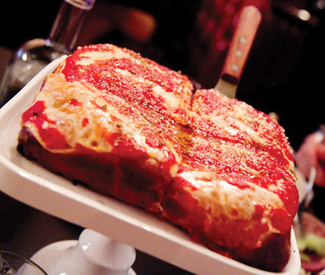
Sweet-spicy house Calabrese sausage ($18) in roasted peppers, caramelized onions, and light tomato cream sauce is dreamy. An antipasti platter ($12) feels sparse compared to antipasti “salads” of my New Jersey youth, dense with meat and cheese, but meats here are hand-sliced daily on an antique slicer in Capo’s front window. I rarely seeing Chicago specialties mostaccioli or conchiglie ($12 in pesto or tomato sauce, $13.50 in meat sauce) on West Coast menus; Tony’s mostaccioli is a beaut. Appropriately cheesy, baked in a wood-fired oven, red meat sauce seals the deal. Capo’s signature dish, quattro forni ($13), is limited to 20 a day due to the preparation required and well worth ordering. Like a glorified garlic bread, or as a waitress described it, doughnut, puffed bread is cooked four times in different ovens, doused in tomato sauce, mozzarella, garlic. If you have room and a warm whiskey crisp is available for dessert, get it.

Then there’s the pizza. While I’ve savored excellent thin crust in Chicago, even after multiple tries at original locations of legendary chains or solo favorites, I’ve yet to find deep dish remotely comparable to Capo’s or Bay Area deep dish havens, Zachary’s and Little Star. I won’t give up the hunt, but thus far for me eating deep dish here is better than going to Chicago (though I’d happily eat my way through Chicago any day).

Appropriate for a Chicago-influenced spot, there are four types of pies: deep dish, cast iron pan, stuffed, and cracker-thin ($17-35). You can’t go wrong. Meat blissfully dominates most pies (unless you build your own), whether folds of Italian beef, thinly shaved in authentic Chi-town fashion, or house Calabrese, fennel, or Italian sausages, shown off in the likes of the Sam Giancana or Old Chicago pies. Italian Stallion pizza, which I prefer in cracker-thin form, showcases Italian beef, heightened by a drizzle of horseradish cream and insanely good sweet-hot peppers you’ll find on a number of Capo’s pies. Flour-based crust gets texture and complexity from a dusting of cornmeal, while Tony reveals a key to its perfection: European butter and a bit of lard. Fresh cheese oozes, unlike chewy wads of low-quality mozzarella I’m faced with in some of Chicago’s venerable deep dish houses.

Elmer Mejicanos heads up a whiskey-centric bar program, housing over 100 American-dominant whiskies, while Tony mentions finding a few antique whiskey bottles dating back to the 1920s in the basement (when are we pouring?) Building your own Old Fashioned is a key menu focus, alongside a short-but-sweet cocktail list ($12). After trying every one on the menu, I’ve re-ordered only The Silencer. Carpano Antica takes the form of ice cubes melting in Campari, Seltzer Sister Soda and crystals of brandy — an ideally bitter, bright aperitif. A glass of Chianti or Montepulciano is well-suited to all that red sauce: Tony’s longtime business partner Marni McKirahan runs the wine program, also highlighting rare Midwest wineries.

If I seem to be gushing, perhaps I am. Visiting three times in the first month alone, I’ve sampled almost every listed pizza and cocktail. Some new openings are exciting, fresh, visionary. A spare few respect the past, even perfect it.

641 Vallejo, SF. (415) 986-8998, www.sfcapos.com

Subscribe to Virgina’s twice-monthly newsletter, The Perfect Spot, www.theperfectspotsf.com


Wait!

1

le.chicken.farmer@gmail.com

CHEAP EATS Anna Yamo has been trying to catch me for it seems like a year now. When she calls it says Restricted Number and that’s how I know it is her, but I am always in New Orleans or Seattle or the bathroom.

“Restricted Number,” it said.

I was sitting on my couch. San Francisco!

“Hello?” I said. This time.

“Danielle!” she said, with her characteristically loaded laugh, which tells me I’m a hard person to catch hold of. And in her characteristic accent, which is, of course, Thai: “When we have lunch?”

“Sunday?”

“Where you want to eat?” she said, then (also characteristically) she told me where: at this crepe place on Valencia, across from City College. News to me.

“It’s a date,” I said, thinking that — who knows — maybe there’d be a check for $3,300 in my mailbox, and I’d be going back to work. Stranger things have happened, although admittedly they usually involve badgers.

Anna and I hadn’t seen each other in over a year and there were so many things I wanted to talk to her about: her son’s restaurant and did she think we could shoot a short movie there … would she teach me how to make duck noodle soup … and why doesn’t she move to Youngstown, Ohio, the town of my birth and the last US city of any size to not have a Thai restaurant in it.

Let the record also show: I love crepes, and these ones were very very very


CHEAP SPORTS

by Hedgehog

The rain. That’s all I have to say about sports this week. Jesus H. Christ is in a mother fucking raft, as my mother always proclaimed He would be. And even He is standing in line for Tartine. Or floating. I know what you’re thinking: He doesn’t need the raft, for He can walk on water, but even our Lord and savior likes a good sit-down now and again (see the Book of Mark, 16:19. Also, the Book of Eames, 12:34).

Neverminding the weather, I’m sick of the line at Tartine. I never go in because I refuse to stand in it. I stood in it once. (Once!)

And not for the stupid goddamn morning rolls (which have too much orange zest in them), but for a sandwich. This was back when I ate things like sandwiches, so you know; it was awhile ago.

Anyway, Chicken Farmer had introduced me to the Tartine pastrami sandwich without making me stand in that god-awful line and I wanted to repay the favor by going and getting them the next time. So I “queued up” (as they would say on Downton Abbey) and 30 minutes later, it was finally my turn to exchange money for goods. But the peopleperson behind the counter cut me off, mid-order, to inform me that they don’t take sandwich orders until 11:30.

It was 11:17.

It was a Five Easy Pieces moment if ever I’ve had one, and I’m all for making a scene, but the 30 minutes of anticipation and herd-member-like treatment backfired and the rage shut down my brain. We got takeout from Pakwan instead.

So when I say “I’m sick of the line at Tartine” (like I just did, up there somewhere), what I mean is, “I’m sick of looking at the line at Tartine.”

We have big windows. And a lovely window seat. Overlooking the line at Tartine.

On Christmas day, after we blew the candles out on the pot roast and dished up the traditional Brussels sprouts, our rag-tag group of holiday orphans were entertained for hours by the comings and nose-pressings and then forlorn goings of a steady stream of Tartinian acolytes. Behold: even Thine Holier Than Thou Bakery is closed on this day.

But the day after, it was busy-ness, as usual. Can you see us in the windows, looking down judgmentically at you from our ellipticating albatross?

Well, enough about what’s-their-faces. We got a Christmas tree! And it nearly caused us to divorce before we could even marry. But that’s neither eats nor sports, so…

R.A. Dickey is now a Toronto Blue Jay.


CHEAP EATS CONTINUED

Wait a minute! I like Tartine, and — being a people peopleperson, love looking at the line. Though I agree their morning buns are overrated. 

DOWNTON ABBEY

www.pbs.org

Stage Listings

0

Stage listings are compiled by Guardian staff. Performance times may change; call venues to confirm. Reviewers are Robert Avila, Rita Felciano, and Nicole Gluckstern. Submit items for the listings at listings@sfbg.com. For further information on how to submit items for the listings, see Picks.

THEATER

OPENING

The Listener: Short Stories on Stage, A Cycle of Original Comic Stories Marsh San Francisco, 1062 Valencia, SF; www.themarsh.org. $15-50. Opens Sat/5, 8pm. Runs Sat, 8pm; Sun, 5pm (Jan 27, shows at 3 and 7pm). Through Jan 27. Charlie Varon reads five comic short stories, presented in two parts. Part one: Jan 5, 6, 12, and 13; Part two: Jan 19-20 and 26; parts one and two in succession: Jan 27.

Something Cloudy, Something Clear Eureka Theatre, 215 Jackson, SF; www.therhino.org. $15-30. Previews Wed/2-Fri/4, 8pm. Opens Sat/5, 8pm. Runs Wed-Sat, 8pm; Sun, 3pm. Through Jan 13. Theatre Rhinoceros performs one of Tennessee Williams’ lesser-known works, based on the playwright’s own early years.

BAY AREA

Troublemaker, or the Freakin Kick-A Adventures of Bradley Boatwright Berkeley Repertory Theatre, Thrust Stage, 2025 Addison, Berk; www.berkeleyrep.org. $29-77. Previews Fri/4-Tue/8, 8pm; Sun/6, 7pm. Opens Jan 9, 8pm. Runs Tue and Thu-Sat, 8pm (also Sat, 2pm); Wed and Sun, 7pm (also Sun, 2pm). Through Feb 3. Berkeley Rep presents the world premiere of a play — about a 12-year-old wannabe superhero — it commissioned from writer Dan LeFranc.

ONGOING

Bell, Book and Candle SF Playhouse, 450 Post, SF; www.sfplayhouse.org. $30-60. Tue-Thu, 7pm; Fri-Sat, 8pm (also Sat, 3pm). Through Jan 19. John van Druten’s 1950 Broadway comedy (later a film with Jimmy Stewart and Kim Novak) is the fluff that woozy holiday evenings are made on, striking an appealing balance between wacky storyline, witty banter, and lightly lathered romance. Gillian Holroyd (Lauren English), the powerful young witch and landlady of a swank Manhattan apartment building, has the hots for a disgruntled neighbor, the recently engaged publisher Shepherd Henderson (William Connell), who’s lately come home to find Gillian’s mischievous sister (Zehra Berkman) in his locked apartment. Gillian may be a witch, but she’s far too ethical to actually work a little magic on the object of her desire, seeing as he’s already spoken for — at least until she learns the woman in question is an old nemesis from college. All’s fair in love and war, counsels loving warlock and brother Nicky (Scott Cox), who soon brings into the mix a hapless author (Louis Parnell) researching witches in New York City. Gillian, meanwhile, flirts with kryptonite, since witches who fall in love lose their powers. Director Bill English’s sure treatment for SF Playhouse features enjoyable performances across the cast, but Connell’s classically tailored comic leading man and Lauren English’s alternately proud, kittenish, and vulnerable heroine are the indispensable spellbinders. (Avila)

Foodies! The Musical Shelton Theater, 533 Sutter, SF; www.foodiesthemusical.com. $30-34. Fri-Sat, 8pm. Open-ended. AWAT Productions presents Morris Bobrow’s musical comedy revue all about food.

Hedwig and the Angry Inch Boxcar Playhouse, 505 Natoma, SF; www.boxcartheatre.org. $25-35. Wed-Sat, 8pm (also Sat, 5pm). Through Jan 26. Boxcar’s popular production of John Cameron Mitchell’s glam-rock musical returns, starring a rotating cast of Hedwigs.

The Marvelous Wonderettes New Conservatory Theatre Center, 25 Van Ness, SF; www.nctcsf.org. $27-46. Wed-Sat, 8pm; Sun, 2pm. Through Jan 13. New Conservatory Theatre Center performs Roger Bean’s 1950s pop-hit musical.

BAY AREA

Acid Test: The Many Incarnations of Ram Dass Marsh Berkeley, 2120 Allston, Berk; www.themarsh.org. $15-50. Thu/3-Fri/4, 8pm; Sat/5, 5pm; starting Jan 12, runs Sat, 8pm; Sun, 3pm. Extended through Feb 17. Lynne Kaufman’s new play stars Warren David Keith as the noted spiritual figure.

Big Bubbly Holiday Spectacle with Louis Pearl, the Amazing Bubble Man Marsh Berkeley, 2120 Allston, Berk; www.themarsh.org. $8-50. Sun/6, 11am. Through Jan 6. Holiday-themed, kid-friendly show with bubble whisperer Louis Pearl.

Woyzeck Ashby Stage, 1901 Ashby, Berk; www.shotgunplayers.org. $23-35. Wed-Thu, 7pm; Fri-Sat, 8pm; Sun, 5pm. Through Jan 27. Shotgun Players presents Tom Waits, Kathleen Brennan, and Robert Wilson’s tragic musical, based on an unfinished 1837 play by Georg Büchner.

PERFORMANCE/DANCE

"Comedy Bottle" Purple Onion at Kells, 530 Jackson, SF; comedybottle.bpt.me. Fri/4-Sat/5, 8:30pm. $15. Stand-up with headliner Kevin Camia.

"San Francisco Magic Parlor" Chancellor Hotel Union Square, 433 Powell, SF; www.sfmagicparlor.com. Thu-Sat, 8pm. Ongoing. $40. Magic vignettes with conjurer and storyteller Walt Anthony.

BAY AREA

"Risk for Deep Love" Temescal Art Center, 511 48th St, Oakl; www.eroplay.com. Sat/5, 8pm. Free. "Ritual audience participation experience experiment" with performance artist Frank Moore.

Film Listings

0

Film listings are edited by Cheryl Eddy. Reviewers are Kimberly Chun, Dennis Harvey, Lynn Rapoport, and Sara Maria Vizcarrondo. For rep house showtimes, see Rep Clock. Due to the New Year holiday, theater information was incomplete at presstime.

OPENING

Texas Chainsaw Massacre 3D The seventh film in the series, bolstered (maybe) by cameos by Marilyn Burns (from the 1974 original) and Bill Mosely (from its immortal 1986 sequel). (1:32)

Tchopitoulas Three adolescent brothers enjoy a dusk-to-dawn night in the Big Easy — New Orleans, baby — in this impressionistic documentary that blurs the line between staged and sampled lyricism. Bill and Turner Ross’ film sets the trio loose in the French Quarter and beyond, where they sample the company of various drunks, buskers, oyster shuckers, painted ladies, and so forth. No laws are conspicuously broken, though a few get bent — it’s safe to say these kids probably won’t be visiting several environs again until they’re of legal drinking age. The long night is an inebriate dream of color and sound, strange but seldom menacing. Like the "city symphony" movies of the 1920s and 30s, this is less nonfiction cinema in a strict vérité vein than a poetically contrived ode to life — a life that’s sturdier than it looks, since Tchoupitoulas finds NO back to the business of partying like Katrina never happened. If you’re looking for a harder-edged portrait of the burg’s status quo, there are plenty of other documentaries to choose from; the Ross’ provide a woozy mash note rather than a sober pulse-taking. You’ll definitely want to go bar-hopping afterward. (1:20) (Harvey)

Tristana Luis Buñuel’s 1970 drama starring Catherine Deneuve and Franco Nero (the original Django!) gets a restored re-release. (1:38)

Zero Dark Thirty See "Bigger Than Bigelow." (2:39)

ONGOING

Anna Karenina Joe Wright broke out of British TV with the 9,000th filmed Pride and Prejudice (2005), unnecessary but quite good. Too bad it immediately went to his head. His increasing showiness as director enlivened the silly teenage-superspy avenger fantasy Hanna (2011), but it started to get in the way of Atonement (2007), a fine book didn’t need camera gymnastics to make a great movie. Now it’s completely sunk a certified literary masterpiece still waiting for a worthy film adaptation. Keira Knightley plays the titular 19th century St. Petersburg aristocrat whose staid, happy-enough existence as a doting mother and dutiful wife (to deglammed Jude Law’s honorable but neglectful Karenin) is upended when she enters a mutually passionate affair with dashing military officer Count Vronsky (Aaron Taylor-Johnson, miscast). Scandal and tragedy ensue. There’s nothing wrong with the screenplay, by Tom Stoppard no less. What’s wrong is Wright’s bright idea of staging the whole shebang as if it were indeed staged — a theatrical production in which nearly everything (even a crucial horse race) takes place on a proscenium stage, in the auditorium, or "backstage" among riggings. Whenever we move into a "real" location, the director makes sure that transition draws attention to its own cleverness as possible. What, you might ask, is the point? That the public social mores and society Anna lives in are a sort of "acting"? Like wow. Add to that another brittle, mannered performance by Wright’s muse Knightley, and there’s no hope of involvement here, let alone empathy — in love with its empty (but very prettily designed) layers of artifice, this movie ends up suffocating all emotion in gilded horseshit. The reversed-fortune romance between Levin (Domhall Gleeson) and Kitty (Alicia Vikander) does work quite well — though since Tolstoy called his novel Anna Karenina, it’s a pretty bad sign when the subsidiary storyline ends up vastly more engaging than hers. (2:10) (Harvey)

Any Day Now In 1970s West Hollywood, flamboyant drag queen Rudy (Alan Cumming) and closeted, newly divorced lawyer Paul (Garret Dillahunt) meet and become an unlikely but loving couple. Their opposites-attract bond strengthens when they become de facto parents to Marco (Isaac Leyva), a teen with Down syndrome left adrift when his party-girl mother (Jamie Anne Allman) is arrested. Domestic bliss — school for Marco with a caring special-education teacher (Kelli Williams); a fledgling singing career for Rudy (so: lots of crooning, for Cumming superfans) — is threatened by rampant homophobia, so Rudy and Paul must conceal their true relationship from Paul’s overbearing boss and the other parents at Marco’s school. When the secret gets out, the fact that Marco is being well cared-for matters not to the law; he’s immediately shunted into a foster home while Paul and Rudy battle the court for custody. Actor-turned-director and co-writer Travis Fine (2010’s The Space Between) guides a veteran cast through this based-on-true-events tale, with sensitive performances and realistic characterizations balancing out the story’s broader strokes. (1:43) (Eddy)

Argo If you didn’t know the particulars of the 1979 Iranian Revolution, you won’t be an expert after Argo, but the film does a good job of capturing America’s fearful reaction to the events that followed it — particularly the hostage crisis at the US embassy in Tehran. Argo zeroes in on the fate of six embassy staffers who managed to escape the building and flee to the home of the sympathetic Canadian ambassador (Victor Garber). Back in Washington, short-tempered CIA agents (including a top-notch Bryan Cranston) cast about for ways to rescue them. Enter Tony Mendez (Ben Affleck, who also directs), exfil specialist and father to a youngster wrapped up in the era’s sci-fi craze. While watching 1973’s Battle for the Planet of the Apes, Tony comes up with what Cranston’s character calls "the best bad idea we have:" the CIA will fund a phony Canadian movie production (corny, intergalactic, and titled Argo) and pretend the six are part of the crew, visiting Iran for a few days on a location shoot. Tony will sneak in, deliver the necessary fake-ID documents, and escort them out. Neither his superiors, nor the six in hiding, have much faith in the idea. ("Is this the part where we say, ‘It’s so crazy it just might work?’" someone asks, beating the cliché to the punch.) Argo never lets you forget that lives are at stake; every painstakingly forged form, every bluff past a checkpoint official increases the anxiety (to the point of being laid on a bit thick by the end). But though Affleck builds the needed suspense with gusto, Argo comes alive in its Hollywood scenes. As the show-biz veterans who mull over Tony’s plan with a mix of Tinseltown cynicism and patiotic duty, John Goodman and Alan Arkin practically burst with in-joke brio. I could have watched an entire movie just about those two. (2:00) (Eddy)

The Central Park Five Acclaimed documentarian Ken Burns takes on the 1989 rape case that shocked and divided a New York City already overwhelmed by racially-charged violence. The initial crime was horrible enough — a female jogger was brutally assaulted in Central Park — but what happened after was also awful: cops and prosecutors, none of whom agreed to appear in the film, swooped in on a group of African American and Latino teenagers who had been making mischief in the vicinity (NYC’s hysterical media dubbed the acts "wilding," a term that became forever associated with the event). Just 14 to 16 years old, the boys were questioned for hours and intimidated into giving false, damning confessions. Already guilty in the court of public opinion, the accused were convicted in trials — only to see their convictions vacated years after they’d served their time, when the real assailant was finally identified. Using archival news footage (in one clip, Gov. Mario Cuomo calls the crime "the ultimate shriek of alarm that says none of us are safe") and contemporary, emotional interviews with the Five, Burns crafts a fascinating study of a crime that ran away with itself, in an environment that encouraged it, leaving lives beyond just the jogger’s devastated in the process. (1:59) (Eddy)

Chasing Ice Even wild-eyed neocons might reconsider their declarations that global warming is a hoax after seeing the work of photographer James Balog, whose images of shrinking glaciers offer startling proof that our planet is indeed being ravaged by climate change (and it’s getting exponentially worse). Jeff Orlowski’s doc follows Balog and his Extreme Ice Survey team as they brave cruel elements in Iceland, Greenland, and Alaska, using time-lapse cameras to record glacier activity, some of it quite dramatic, over months and years. Balog is an affable subject, doggedly pursuing his work even after multiple knee surgeries make him a less-than-agile hiker, but it’s the photographs — as hauntingly beautiful as they are alarming — that make Chasing Ice so powerful. Could’ve done without Scarlett Johansson crooning over the end credits, though. (1:15) (Eddy)

Cirque du Soleil: Worlds Away (1:31)

Citadel Irish import Citadel begins with terror: a young pregnant woman, on the verge of moving out of her soon-to-be-condemned high-rise, is attacked — while her husband, Tommy (Aneurin Barnard), looks on helplessly — by a pack of hoodie-wearing youths who inject her with a mysterious substance. Though the baby lives, the woman dies, and Tommy becomes a haunted, paranoid husk of a man. Not that you can really blame him; the housing project he lives in is nearly deserted, and those hoodie-wearing gangs seem to be increasing (and are increasingly interested in his infant daughter). After an ominous build-up, the darkly disturbing Citadel can’t quite keep the momentum going, though James Cosmo (Game of Thrones fans will recognize him even out of his Night’s Watch blacks) offers an amusingly over-the-top performance as a foul-mouthed priest. (1:24) (Eddy)

Cloud Atlas Cramming the six busy storylines of David Mitchell’s wildly ambitious novel into just three hours — the average reader might have thought at least 12 would be required — this impressive adaptation directed (in separate parts) by Tom Twyker (1998’s Run Lola Run) and Matrix siblings Lana and Andy Wachowski has a whole lot of narrative to get through, stretching around the globe and over centuries. In the mid 19th century, Jim Sturgess’ sickly American notory endures a long sea voyage as reluctant protector of a runaway-slave stowaway from the Chatham Islands (David Gyasi). In 1931 Belgium, a talented but criminally minded British musician (Ben Whishaw) wheedles his way into the household of a famous but long-inactive composer (Jim Broadbent). A chance encounter sets 1970s San Francisco journalist Luisa (Halle Berry) on the path of a massive cover-up conspiracy, swiftly putting her life in danger. Circa now, a reprobate London publisher’s (Broadbent) huge windfall turns into bad luck that gets even worse when he seeks help from his brother (Hugh Grant). In the not-so-distant future, a disposable "fabricant" server to the "consumer" classes (Doona Bae) finds herself plucked from her cog-like life for a rebellious higher purpose. Finally, in an indeterminately distant future after "the Fall," an island tribesman (Tom Hanks) forms a highly ambivalent relationship toward a visitor (Berry) from a more advanced but dying civilization. Mitchell’s book was divided into huge novella-sized blocks, with each thread split in two; the film wastes very little time establishing its individual stories before beginning to rapidly intercut between them. That may result in a sense of information (and eventually action) overload, particularly for non-readers, even as it clarifies the connective tissues running throughout. Compression robs some episodes of the cumulative impact they had on the page; the starry multicasting (which in addition to the above mentioned finds many uses for Hugo Weaving, Keith David, James D’Arcy, and Susan Sarandon) can be a distraction; and there’s too much uplift forced on the six tales’ summation. Simply put, not everything here works; like the very different Watchmen, this is a rather brilliant "impossible adaptation" screenplay (by the directors) than nonetheless can’t help but be a bit too much. But so much does work — in alternating currents of satire, melodrama, pulp thriller, dystopian sci-fi, adventure, and so on — that Cloud Atlas must be forgiven for being imperfect. If it were perfect, it couldn’t possibly sprawl as imaginatively and challengingly as it does, and as mainstream movies very seldom do. (2:52) (Harvey)

The Collection As soon as you behold the neon sign "Hotel Argento" shining over the grim warehouse-cum-evil dead trap, you know exactly what you’re in for — a wink, and even a little bit of a horror superfan’s giggle. In other words, to tweak that killer Roach Motel tagline: kids check in, but they don’t check out. No need to see 2009’s The Collector — the previous movie by director-cowriter Marcus Dunstan and writer Patrick Melton (winners of the third season of Project Greenlight, now with the screenplays for multiple Saw films beneath their collective belt) — the giallo fanboy and gorehound hallmarks are there for all to enjoy: tarantulas (straight from 1981’s The Beyond), a factory kitted out as an elaborate murder machine, and end credits that capture characters’ last moments. Plus, plenty of fast-paced shocks and seemingly endless splatter, with a heavy sprinkle of wince-inducing compound fractures. The Collection ups the first film’s ante, as gamine Elena (Emma Fitzpatrick) is lured to go dancing with her pals. Their underground party turns out to be way beyond the fringe, as the killer mows down the dance floor, literally, and gives the phrase "teen crush" a bloody new spin. Stumbling on The Collector‘s antihero thief Arkin (Josh Stewart) locked in a box, Elena releases him but can’t prevent her own capture, so killer-bodyguard Lucello (Oz‘s Lee Tergesen) snatches Arkin from the hospital and forces him to lead his team of toughs through a not-so-funhouse teeming with booby traps as well as victims-turned-insidious-weapons. All of which almost convinces you of nutty-nutball genius of the masked, dilated-pupiled Collector (here stuntman Randall Archer), who takes trendy taxidermy to icky extremes — even when his mechanism is threatened by a way smart last girl and a lock picker who’s adept at cracking building codes. Despite Dunstan’s obvious devotion to horror-movie landmarks, The Collection doesn’t turn out to be particularly original: rather, it attempts to stand on the shoulders — and arms and dismembered body parts — of others, in hopes of finding its place on a nonexistent drive-in bill. (1:23) (Chun)

Deadfall Thriller Deadfall, set amid a howling blizzard, has an all-star cast: Eric Bana and Olivia Wilde play a creepy-close brother-sister team who crash their getaway car after a successful casino heist; Sons of Anarchy‘s Charlie Hunnam plays a vengeful boxer just out of the slammer (with nervous parents played by Kris Kristofferson and Sissy Spacek); and Treat Williams and Kate Mara are an antagonistic father-daughter team of cops chasing after most of the above. Bana’s glowering performance is the high point of this noir-Western, though if the snowy landscape were a character, it’d be the most important part of the ensemble. (1:35) (Eddy)

Django Unchained Quentin Tarantino’s spaghetti western homage features a cameo by the original Django (Franco Nero, star of the 1966 film), and solid performances by a meticulously assembled cast, including Jamie Foxx as the titular former slave who becomes a badass bounty hunter under the tutelage of Dr. Schultz (Christoph Waltz). Waltz, who won an Oscar for playing the evil yet befuddlingly delightful Nazi Hans Landa in Tarantino’s 2009 Inglourious Basterds, is just as memorable (and here, you can feel good about liking him) as a quick-witted, quick-drawing wayward German dentist. There are no Nazis in Django, of course, but Tarantino’s taboo du jour (slavery) more than supplies motivation for the filmmaker’s favorite theme (revenge). Once Django joins forces with Schultz, the natural-born partners hatch a scheme to rescue Django’s still-enslaved wife, Broomhilda (Kerry Washington), whose German-language skills are as unlikely as they are convenient. Along the way (and it’s a long way; the movie runs 165 minutes), they encounter a cruel plantation owner (Leonardo DiCaprio), whose main passion is the offensive, shocking "sport" of "Mandingo fighting," and his right-hand man, played by Tarantino muse Samuel L. Jackson in a transcendently scandalous performance. And amid all the violence and racist language and Foxx vengeance-making, there are many moments of screaming hilarity, as when a character with the Old South 101 name of Big Daddy (Don Johnson) argues with the posse he’s rounded up over the proper construction of vigilante hoods. It’s a classic Tarantino moment: pausing the action so characters can blather on about something trivial before an epic scene of violence. Mr. Pink would approve. (2:45) (Eddy)

Flight To twist the words of one troubled balladeer, he believes he can fly, he believes he can touch the sky. Unfortunately for Denzel Washington’s Whip Whitaker, another less savory connotation applies: his semi-sketchy airline captain is sailing on the overconfidence that comes with billowing clouds of blow. Beware the quickie TV spot — and Washington’s heroic stance in the poster — that plays this as a quasi-action flick: Flight is really about a man’s efforts to escape responsibility and his flight from facing his own addiction. It also sees Washington once again doing what he does so well: wrestling with the demons of a charismatic yet deeply flawed protagonist. We come upon Whip as he’s rousing himself from yet another bender, balancing himself out with a couple lines with a gorgeous, enabling flight attendant by his side. It’s a checks-and-balances routine we’re led to believe is business as usual, as he slides confidently into the cockpit, gives the passengers a good scare by charging through turbulence, and proceeds to doze off. The plane, however, goes into fail mode and forces the pilot to improvise brilliantly and kick into hero mode, though he can’t fly from his cover, which is slowly blown despite the ministrations of kindred addict Nicole (Kelly Reilly) and dealer Harling (John Goodman at his most ebullient) and the defensive moves of his pilots union cohort (Bruce Greenwood) and the airline’s lawyer (Don Cheadle). How can Whip fly out of the particular jam called his life? Working with what he’s given, Washington summons reserves of humanity, though he’s ultimately failed by John Gatins’ sanctimonious, recovery-by-the-numbers script and the tendency of seasoned director Robert Zemeckis to blithely skip over the personal history and background details that would have more completely filled out our picture of Whip. We’re left grasping for the highs, waiting for the instances that Harling sails into view and Whip tumbles off the wagon. (2:18) (Chun)

The Guilt Trip (1:35)

Hitchcock On the heels of last year’s My Week With Marilyn comes another biopic about an instantly recognizable celebrity viewed through the lens of a specific film shoot. Here, we have Anthony Hopkins (padded and prosthetic’d) playing the Master of Suspense, mulling over which project to pursue after the success of 1959’s North by Northwest. Even if you’re not a Hitch buff, it’s clear from the first scene that Psycho, based on Robert Bloch’s true crime-inspired pulpy thriller, is looming. We open on "Ed Gein’s Farmhouse, 1944;" Gein (Michael Wincott) is seen in his yard, his various heinous crimes — murder, grave-robbing, body-part hoarding, human-skin-mask crafting, etc. — as yet undiscovered. Hitchcock, portrayed by the guy who also played the Gein-inspired Hannibal Lecter, steps into the frame with that familiar droll greeting: "Guhhd eevvveeeening." And we’re off, following the veteran director as he muses "What if somebody really good made a horror picture?" Though his wife and collaborator, Alma (Helen Mirren), cautions him against doing something simply because everyone tells him not to, he plows ahead; the filmmaking scenes are peppered with behind-the-scenes moments detailed in Stephen Rebello’s Alfred Hitchcock and the Making of Psycho, the source material for John J. McLaughlin’s script. But as the film’s tagline — "Behind every Psycho is a great woman" — suggests, the relationship between Alma and Hitch is, stubbornly, Hitchcock‘s main focus. While Mirren is effective (and I’m all for seeing a lady who works hard behind the scenes get recognition), the Hitch-at-home subplot exists only to shoehorn more conflict into a tale that’s got plenty already. Elsewhere, however, Hitchcock director Sacha Gervasi — making his narrative debut after hit 2008 doc Anvil: The Story of Anvil — shows stylistic flair, working Hitchcock references into the mise-en-scène. (1:32) (Eddy)

The Hobbit: An Unexpected Journey Make no mistake: the Lord of the Rings trilogy represented an incredible filmmaking achievement, with well-deserved Oscars handed down after the third installment in 2003. If director Peter Jackson wanted to go one more round with J.R.R. Tolkien’s beloved characters for a Hobbit movie, who was gonna stop him? Not so fast. This return to Middle-earth (in 3D this time) represents not one but three films — which would be self-indulgent enough even if part one didn’t unspool at just under three hours, and even if Jackson hadn’t decided to shoot at 48 frames per second. (I can’t even begin to explain what that means from a technical standpoint, but suffice to say there’s a certain amount of cinematic lushness lost when everything is rendered in insanely crystal-clear hi-def.) Journey begins as Bilbo Baggins (a game, funny Martin Freeman) reluctantly joins Gandalf (a weary-seeming Ian McKellan) and a gang of dwarves on their quest to reclaim their stolen homeland and treasure, batting Orcs, goblins, Gollum (Andy Serkis), and other beasties along the way. Fan-pandering happens (with characters like Cate Blanchett’s icy Galadriel popping in to remind you how much you loved LOTR), and the story moves at a brisk enough pace, but Journey never transcends what came before — or in the chronology of the story, what comes after. I’m not quite ready to declare this Jackson’s Phantom Menace (1999), but it’s not an unfair comparison to make, either. (2:50) (Eddy)

Hyde Park on Hudson Weeks after the release of Lincoln, Hyde Park on Hudson arrives with a lighthearted (-ish) take on Franklin D. Roosevelt’s 1939 meeting with King George VI (of stuttering fame) and Queen Elizabeth at FDR’s rural New York estate. Casting Bill Murray as FDR is Hyde Park‘s main attraction, though Olivia Williams makes for a surprisingly effective Eleanor. But the thrust of the film concerns FDR’s relationship with his cousin, Daisy — played by Laura Linney, who’s relegated to a series of dowdy outfits, pouting reaction shots, and far too many voice-overs. The affair has zero heat, and the film is disappointingly shallow — how many times can one be urged to giggle at someone saying "Hot dogs!" in an English accent? — not to mention a waste of a perfectly fine Bill Murray performance. As that sideburned Democrat bellows in Lincoln, "Howwww dare you!" (1:35) (Eddy)

The Impossible Spanish director Juan Antonio Bayona (2007’s The Orphanage) directs The Impossible, a relatively modestly-budgeted take on the 2004 Indian Ocean tsunami, based on the real story of a Spanish family who experienced the disaster. Here, the family (Naomi Watts, Ewan McGregor, three young sons) is British, on a Christmas vacation from dad’s high-stress job in Japan. Beachy bliss is soon ruined by that terrible series of waves; they hit early in the film, and Bayona offers a devastatingly realistic depiction of what being caught in a tsunami must feel like: roaring, debris-filled water threatening death by drowning, impalement, or skull-crushing. And then, the anguish of surfacing, alive but injured, stranded, and miles from the nearest doctor, not knowing if your family members have perished. Without giving anything away (no more than the film’s suggestive title, anyway), once the survivors are established (and the film’s strongest performer, Watts, is relegated to hospital-bed scenes) The Impossible finds its way inevitably to melodrama, and triumph-of-the-human-spirit theatrics. As the family’s oldest son, 16-year-old Tom Holland is effective as a kid who reacts exactly right to crisis, morphing from sulky teen to thoughtful hero — but the film is too narrowly focused on its tourist characters, with native Thais mostly relegated to background action. It’s a disconnect that’s not quite offensive, but is still off-putting. (1:54) (Eddy)

Jack Reacher See "No Headbutting?" (2:10)

Killing Them Softly Lowest-level criminal fuckwits Frankie (Scoot McNairy) and Russell (Ben Mendelsohn) are hired to rob a mob gambling den, a task which miraculously they fail to blow. Nevertheless, the repercussions are swift and harsh, as a middleman suit (Richard Jenkins) to the unseen bosses brings in one hitman (Brad Pitt), who brings in another (James Gandolfini) to figure out who the thieves are and administer extreme justice. Based on a 1970s novel by George V. Higgins, this latest collaboration by Pitt and director-scenarist Andrew Dominik would appear superficially to be a surer commercial bet after the box-office failure of their last, 2007’s The Assassination of Jesse James By the Coward Robert Ford — one of the great films of the last decade. But if you’re looking for action thrills or even Guy Ritchie-style swaggering mantalk (though there is some of that), you’ll be disappointed to find Killing more in the abstracted crime drama arena of Drive (2011) or The American (2010), landing somewhere between the riveting former and the arid latter. This meticulously crafted tale is never less than compelling in imaginative direction and expert performance, but it still carries a certain unshakable air of so-what. Some may be turned off by just how vividly unpleasant Mendelsohn’s junkie and Gandolfini’s alchie are. Others will shrug at the wisdom of re-setting this story in the fall of 2008, with financial-infrastructure collapse and the hollow promise of President-elect Obama’s "Change" providing ironical background noise. It’s all a little too little, too soon. (1:37) (Harvey)

A Late Quartet Philip Seymour Hoffman is fed up playing second fiddle — literally. He stars in this grown-up soap opera about the internal dramas of a world-class string quartet. While the group is preparing for its 25th season, the eldest member (Christopher Walken) is diagnosed with early stage Parkinson’s. As he’s the base note in the quartet, his retirement challenges the group’s future, not just his own. Hoffman’s second violinist sees the transition as an opportunity to challenge the first violin (Mark Ivanir) for an occasional Alpha role. When his wife, the quartet’s viola player (Catherine Keener), disagrees, it’s a slight ("You think I’m not good enough?") and a betrayal because prior to their marriage, viola and first violin would "duet" if you get my meaning. This becomes a grody aside when Hoffman and Keener’s violin prodigy daughter (Imogen Poots) falls for her mother’s old beau and Hoffman challenges their marriage with a flamenco dancer. These quiet people finds ways to use some loud instruments (a flamenco dancer, really?) and the music as well as the views of Manhattan create a deeply settled feeling of comfort in the cold —insulation can be a dangerous thing. When we see (real world) cellist Nina Lee play, and her full body interacts with a drama as big as vaudeville, we see what tension was left out of the playing and forced into the incestuous "family" conflicts. In A Late Quartet, pleasures are great and atmosphere, heavy. You couldn’t find a better advertisement for this symphonic season; I wanted to buy tickets immediately. And also vowed to stay away from musicians. (1:45) (Vizcarrondo)

Life of Pi Several filmmakers including Alfonso Cuarón, Jean-Pierre Jeunet, and M. Night Shyamalan had a crack at Yann Martel’s "unfilmable" novel over the last decade, without success. That turns out to have been a very good thing, since Ang Lee and scenarist David Magee have made probably the best movie possible from the material — arguably even an improvement on it. Framed as the adult protagonist’s (Irrfan Khan) lengthy reminiscence to an interested writer (Rafe Spall) it chronicles his youthful experience accompanying his family and animals from their just shuttered zoo on a cargo ship voyage from India to Canada. But a storm capsizes the vessel, stranding teenaged Pi (Suraj Sharma) on a lifeboat with a mini menagerie — albeit one swiftly reduced by the food chain in action to one Richard Parker, a whimsically named Bengal tiger. This uneasy forced cohabitation between Hindu vegetarian and instinctual carnivore is an object lesson in survival as well as a fable about the existence of God, among other things. Shot in 3D, the movie has plenty of enchanted, original imagery, though its outstanding technical accomplishment may lie more in the application of CGI (rather than stereoscopic photography) to something reasonably intelligent for a change. First-time actor Sharma is a natural, while his costar gives the most remarkable performance by a wild animal this side of Joaquin Phoenix in The Master. It’s not a perfect film, but it’s a charmed, lovely experience. (2:00) (Harvey)

Lincoln Distinguished subject matter and an A+ production team (Steven Spielberg directing, Daniel Day-Lewis starring, Tony Kushner adapting Doris Kearns Goodwin, John Williams scoring every emotion juuust so) mean Lincoln delivers about what you’d expect: a compelling (if verbose), emotionally resonant (and somehow suspenseful) dramatization of President Lincoln’s push to get the 13th amendment passed before the start of his second term. America’s neck-deep in the Civil War, and Congress, though now without Southern representation, is profoundly divided on the issue of abolition. Spielberg recreates 1865 Washington as a vibrant, exciting place, albeit one filled with so many recognizable stars it’s almost distracting wondering who’ll pop up in the next scene: Jared Harris as Ulysses S. Grant! Joseph Gordon-Levitt as Robert Lincoln! Lena Dunham’s shirtless boyfriend on Girls (Adam Driver) as a soldier! Most notable among the huge cast are John Hawkes, Tim Blake Nelson, and a daffy James Spader as a trio of lobbyists; Sally Field as the troubled First Lady; and likely Oscar contenders Tommy Lee Jones (as winningly cranky Rep. Thaddeus Stevens) and Day-Lewis, who does a reliably great job of disappearing into his iconic role. (2:30) (Eddy)

The Master Paul Thomas Anderson’s much-hyped likely Best Picture contender lives up: it’s easily the best film of 2012 so far. Philip Seymour Hoffman stars as Lancaster Dodd, the L. Ron Hubbard-ish head of a Scientology-esque movement. "The Cause" attracts Freddie Quell (Joaquin Phoenix, in a welcome return from the faux-deep end), less for its pseudo-religious psychobabble and bizarre personal-growth exercises, and more because it supplies the aimless, alcoholic veteran — a drifter in every sense of the word — with a sense of community he yearns for, yet resists submitting to. As with There Will Be Blood (2007), Anderson focuses on the tension between the two main characters: an older, established figure and his upstart challenger. But there’s less cut-and-dried antagonism here; while their relationship is complex, and it does lead to dark, troubled places, there are also moments of levity and weird hilarity — which might have something to do with Freddie’s paint-thinner moonshine. (2:17) (Eddy)

The Matchmaker In 2006, amid ongoing conflict with Lebanon, an Israeli novelist learns he’s received an unexpected inheritance from a man he knew in 1968, the summer before he turned 16. Most of Avi Nesher’s The Matchmaker takes place during those golden months in Haifa, when young Arik (Tuval Shafir) — lover of Dashiell Hammett, son of Holocaust survivors — takes a job working for a charismatic but vaguely shady matchmaker (comedian Adir Miller, who won the Israeli equivalent of a Best Actor Oscar), following potential clients to assure their quest for love is on the level. His exciting new gig whisks the budding writer out of middle-class monotony and introduces him to a wealth of colorful "Low Rent district" types; he also nurses a raging crush on his best friend’s free-spirited American cousin. Mostly a gently nostalgic tale, The Matchmaker also offers an unusual take on the Holocaust, viewing it from two decades later and using its looming memory to shape the characters who experienced it firsthand — as well as members of the younger generation, like Arik, who pages through The House of Dolls to learn more, even as he refers to the concentration camp where his father was held as simply "there." (1:52) (Eddy)

Les Misérables There is a not-insignificant portion of the population who already knows all the words to all the songs of this musical-theater warhorse, around since the 1980s and honored here with a lavish production by Tom Hooper (2010’s The King’s Speech). As other reviews have pointed out, this version only tangentially concerns Victor Hugo’s French Revolution tale; its true raison d’être is swooning over the sight of its big-name cast crooning those famous tunes. Vocals were recorded live on-set, with microphones digitally removed in post-production — but despite this technical achievement, there’s a certain inorganic quality to the proceedings. Like The King’s Speech, the whole affair feels spliced together in the Oscar-creation lab. The hardworking Hugh Jackman deserves the nomination he’ll inevitably get; jury’s still out on Anne Hathaway’s blubbery, "I cut my hair for real, I am so brave!" performance. (2:37) (Eddy)

Monsters, Inc. 3D (1:35)

My Worst Nightmare First seen locally in the San Francisco Film Society’s 2012 "French Cinema Now" series, My Worst Nightmare follows icy art curator Agathe (Isabelle Huppert) as her airless, tightly-controlled world begins to crumble — thanks in no small part to an exuberantly uncouth, down-on-his-luck Belgian contractor named Patrick (Benoît Poelvoorde). (His obnoxious, freewheeling presence in Agathe’s precision-mapped orbit gives rise to the film’s title.) Director and co-writer Anne Fontaine (2009’s Coco Before Chanel) injects plenty of offbeat, occasionally raunchy humor into what could’ve been a predictable personal-liberation tale — the sight of classy dame Huppert driving through a bikini car wash, for instance. (1:43) Smith Rafael. (Eddy)

Not Fade Away How to explain why the Beatles have been tossed so many cinematic bon mots and not the Stones? The group’s relatively short lifespan — and even the tragic, unexpectedly dramatic passing of John Lennon — seem to have all played into the band’s nostalgia-marinated legend, while the Stones’ profitable tour rotation and shocking physical resilience have lessened their romantic charge. So it reads as a counterintuitive, and a bit random, that Sopranos creator David Chase would open his first feature film with a black and white re-creation of the Mick Jagger and Keith Richards meet-up, before switching to the ’60s coming-of-age of New Jersey teen geek Douglas (John Magaro), trapped in an oppressively whiny nuclear family headed up by his Pep Boy grouch of a dad (James Gandolfini) — at least until rock ‘n’ roll saves his soul and he starts beating the skins. Graduating to better-than-average singer after his band’s frontman Eugene (Boardwalk Empire‘s Jack Huston) inhales a joint, Douglas not only finds his voice, but also wins over dream girl Grace (Bella Heathcote). Sure, Not Fade Away is about sex, drugs, and rock ‘n’ roll — and much attention is dutifully squandered on basement shows, band practice, and politics, and posturing with wacky new haircuts and funny cigarettes, thanks to Chase’s own background in garage bands and executive producer, music supervisor, and true believer Steve Van Zandt’s considerable passion. Yet despite the amount screen time devoted to rock’s rites, those familiar gestures never rise above the clichéd, and Not Fade Away only finds its authentic emotional footing when Gandolfini’s imposing yet trapped patriarch and the rest of Douglas’s beaten-down yet still kicking family enters the picture — they’re the force that refuses to fade away, even after they disappear in the rear view. (1:52) (Chun)

Parental Guidance (1:36)

The Perks of Being a Wallflower Move over, Diary of a Wimpy Kid series — there’s a new shrinking-violet social outcast in town. These days, life might not suck quite so hard for 90-pound weaklings in every age category, what with so many films and TV shows exposing, and sometimes even celebrating, the many miseries of childhood and adolescence for all to see. In this case, Perks author Stephen Chbosky takes on the directorial duties — both a good and bad thing, much like the teen years. Smart, shy Charlie is starting high school with a host of issues: he’s painfully awkward and very alone in the brutal throng, his only friend just committed suicide, and his only simpatico family member was killed in a car accident. Charlie’s English teacher Mr. Andersen (Paul Rudd) appears to be his only connection, until the freshman strikes up a conversation with feline, charismatic, shop-class jester Patrick (Ezra Miller) and his magnetic, music- and fun-loving stepsister Sam (Emma Watson). Who needs the popular kids? The witty duo head up their gang of coolly uncool outcasts their own, the Wallflowers (not to be confused with the deeply uncool Jakob Dylan combo), and with them, Charlie appears to have found his tribe. Only a few small secrets put a damper on matters: Patrick happens to be gay and involved with football player Brad (Johnny Simmons), who’s saddled with a violently conservative father, and Charlie is in love with the already-hooked-up Sam and is frightened that his fragile equilibrium will be destroyed when his new besties graduate and slip out of his life. Displaying empathy and a devotion to emotional truth, Chbosky takes good care of his characters, preserving the complexity and ungainly quirks of their not-so-cartoonish suburbia, though his limitations as a director come to the fore in the murkiness and choppily handled climax that reveals how damaged Charlie truly is. (1:43) (Chun)

Playing For Keeps Not a keeper: the marketing imagery that makes Gerard Butler look like an insufferable creep with bad hair. Dennis Quaid, seen in a small pic toward the base of the Playing For Keeps poster, gets that thankless role instead in this family-oriented rom-com, which is better than some while still being capable of eliciting very audible yawns from an audience supposedly primed for cutesy hijinks. Butler is George Dryer, a onetime pro soccer star now on the decline yet desperately seeking his next opening — a career as a sportscaster. To get there he has to run a networking gauntlet called coaching children’s soccer, which he gets roped into by ex Stacie (Jessica Biel) and spawn Lewis (Noah Lomax). The ankle biters are the least of his problems: more challenging are hot ‘n’ horny soccer moms like TV sports vet Denise (Catherine Zeta-Jones), cry-face Barn (Judy Greer), and desperate trophy housewife Patti (Uma Thurman), who’s saddled with all-American a-hole Carl (Dennis Quaid). The charisma-oozing George has to practically fight them off, while somehow shooting for that family-first goal. With its sex farce tendencies, rom-com DNA, and vaguely sour attitude toward hard-up moms, hot or not, I’m not sure who Playing For Keeps is really making a play for — perhaps married ladies looking for date-night possibilities and some shirtless Butler action? Projecting believability even under the most plausibility-taxing circumstances, Butler manages, as always, to be the best thing in the movie, though it seems like less of an achievement when his projects tend toward mediocrity. (1:46) (Chun)

Promised Land Gus Van Sant’s fracking fable — co-written by stars Matt Damon and John Krasinski, from a story by Dave Eggers — offers a didactic lesson in environmental politics, capped off by the earth-shattering revelation that billion-dollar corporations are sleazy and evil. You don’t say! Formulated like a Capra movie, Promised Land follows company man Steve Butler (Matt Damon) as he and sales partner Sue (Frances McDormand) travel to a small Pennsylvania town to convince its (they hope) gullible residents to allow drilling on their land. But things don’t go as smoothly as hoped, when the pair faces opposition from a science teacher with a brainiac past (Hal Holbrook), and an irritatingly upbeat green activist (Krasinski) breezes into town to further monkey-wrench their scheme. That Damon is such a likeable actor actually works against him here; his character arc from soulless salesman to emotional-creature-with-a-conscience couldn’t be more predictable or obvious. McDormand’s wonderfully biting supporting performance is the best (and only) reason to see this ponderous, faux-folksy tale, which targets an audience that likely already shares its point of view. (1:46) (Eddy)

Rise of the Guardians There’s nothing so camp as "Heat Miser" from The Year Without a Santa Claus (1974) in Rise of the Guardians,, but there’s plenty here to charm all ages. The mystery at its center: we open on Jack Frost (voiced by Chris Pine) being born, pulled from the depths of a frozen pond by the Man on the Moon and destined to spread ice and cold everywhere he goes, invisible to all living creatures. It’s an individualistic yet lonely lot for Jack, who’s styled as an impish snowboarder in a hoodie and armed with an icy scepter, until the Guardians — spirits like North/Santa Claus (Alec Baldwin), the Tooth Fairy (Isla Fisher), and the Easter Bunny (Hugh Jackman) — call on him to join them. Pitch the Boogeyman (Jude Law) is threatening to snuff out all children’s hopes and dreams with fears and nightmares, and it’s up to the Guardians must keep belief in magic alive. But what’s in it for Jack, except the most important thing: namely who is he and what is his origin story? Director Peter Ramsey keeps those fragile dreams aloft with scenes awash with motion and animation that evokes the chubby figures and cozy warm tones of ’70s European storybooks. And though Pine verges on blandness with his vocal performance, Baldwin, Jackman, and Fisher winningly deliver the jokes. (1:38) (Chun)

A Royal Affair At age 15 in 1766, British princess Caroline (Alicia Vikander) travels abroad to a new life — as queen to the new ruler of Denmark, her cousin. Attractive and accomplished, she is judged a great success by everyone but her husband. King Christian (Mikkel Boe Følsgaard) is just a teenager himself, albeit one whose mental illness makes him behave alternately like a debauched libertine, a rude two year-old, a sulky-rebellious adolescent, and a plain old abusive spouse. Once her principal official duty is fulfilled — bearing a male heir — the two do their best to avoid each other. But on a tour of Europe Christian meets German doctor Johann Friedrich Struenesse (Mads Mikkelsen), a true man of the Enlightenment who not only has advanced notions about calming the monarch’s "eccentricities," but proves a tolerant and agreeable royal companion. Lured back to Denmark as the King’s personal physician, he soon infects the cultured Queen with the fervor of his progressive ideas, while the two find themselves mutually attracted on less intellectual levels as well. When they start manipulating their unstable but malleable ruler to push much-needed public reforms through in the still basically feudal nation, they begin acquiring powerful enemies. This very handsome-looking history lesson highlights a chapter relatively little-known here, and finds in it an interesting juncture in the eternal battle between masters and servants, the piously self-interested and the secular humanists. At the same time, Nikolaj Arcel’s impressively mounted and acted film is also somewhat pedestrian and overlong. It’s a quality costume drama, but not a great one. (2:17) (Harvey)

Rust and Bone Unlike her Dark Knight Rises co-star Anne Hathaway, Rust and Bone star Marion Cotillard never seems like she’s trying too hard to be sexy, or edgy, or whatever (plus, she already has an Oscar, so the pressure’s off). Here, she’s a whale trainer at a SeaWorld-type park who loses her legs in an accident, which complicates (but ultimately strengthens) her relationship with Ali (Belgian actor Matthias Schoenaerts, so tremendous in 2011’s Bullhead), a single dad trying to make a name for himself as a boxer. Jacques Audiard’s follow-up to 2009’s A Prophet gets a bit overwrought by its last act, but there’s an emotional authenticity in the performances that makes even a ridiculous twist (like, the kind that’ll make you exclaim "Are you fucking kidding me?") feel almost well-earned. (2:00) (Eddy)

The Sessions Polio has long since paralyzed the body of Berkeley poet Mark O’Brien (John Hawkes) from the neck down. Of course his mind is free to roam — but it often roams south of the personal equator, where he hasn’t had the same opportunities as able-bodied people. Thus he enlists the services of Cheryl (Helen Hunt), a professional sex surrogate, to lose his virginity at last. Based on the real-life figures’ experiences, this drama by Australian polio survivor Ben Lewin was a big hit at Sundance this year (then titled The Surrogate), and it’s not hard to see why: this is one of those rare inspirational feel-good stories that doesn’t pander and earns its tears with honest emotional toil. Hawkes is always arresting, but Hunt hasn’t been this good in a long time, and William H. Macy is pure pleasure as a sympathetic priest put in numerous awkward positions with the Lord by Mark’s very down-to-earth questions and confessions. (1:35) (Harvey)

Silver Linings Playbook After guiding two actors to Best Supporting Oscars in 2010’s The Fighter, director David O. Russell returns (adapting his script from Matthew Quick’s novel) with another darkly comedic film about a complicated family that will probably earn some gold of its own. Though he’s obviously not ready to face the outside world, Pat (Bradley Cooper) checks out of the state institution he’s been court-ordered to spend eight months in after displaying some serious anger-management issues. He moves home with his football-obsessed father (Robert De Niro) and worrywart mother (Jacki Weaver of 2010’s Animal Kingdom), where he plunges into a plan to win back his estranged wife. Cooper plays Pat as a man vibrating with troubled energy — always in danger of flying into a rage, even as he pursues his forced-upbeat "silver linings" philosophy. But the movie belongs to Jennifer Lawrence, who proves the chops she showcased (pre-Hunger Games megafame) in 2010’s Winter’s Bone were no fluke. As the damaged-but-determined Tiffany, she’s the left-field element that jolts Pat out of his crazytown funk; she’s also the only reason Playbook‘s dance-competition subplot doesn’t feel eye-rollingly clichéd. The film’s not perfect, but Lawrence’s layered performance — emotional, demanding, bitchy, tough-yet-secretly-tender — damn near is. (2:01) (Eddy)

Skyfall Top marks to Adele, who delivers a magnificent title song to cap off Skyfall‘s thrilling pre-credits chase scene. Unfortunate, then, that the film that follows squanders its initial promise. After a bomb attack on MI6, the clock is running out for Bond (Daniel Craig) and M (Judi Dench), accused of Cold War irrelevancy in a 21st century full of malevolent, stateless computer hackers. The audience, too, will yearn for a return to simpler times; dialogue about "firewalls" and "obfuscated code" never fails to sound faintly ridiculous, despite the efforts Ben Whishaw as the youthful new head of Q branch. Javier Bardem is creative and creepy as keyboard-tapping villain Raoul Silva, but would have done better with a megalomaniac scheme to take over the world. Instead, a small-potatoes revenge plot limps to a dull conclusion in the middle of nowhere. Skyfall never decides whether it prefers action, bon mots, and in-jokes to ponderous mythologizing and ripped-from-the-headlines speechifying — the result is a unsatisfying, uneven mixture. (2:23) (Ben Richardson)

This is 40 A spin-off of sorts from 2007’s Knocked Up, Judd Apatow’s This is 40 continues the story of two characters nobody cared about from that earlier film: Debbie (Leslie Mann, Apatow’s wife) and Pete (Paul Rudd), plus their two kids (played by Mann and Apatow’s kids). Pete and Debbie have accumulated all the trappings of comfortable Los Angeles livin’: luxury cars, a huge house, a private personal trainer, the means to throw catered parties and take weekend trips to fancy hotels (and to whimsically decide to go gluten-free), and more Apple products than have ever before been shoehorned into a single film. But! This was crap they got used to having before Pete’s record label went into the shitter, and Debbie’s dress-shop employee (Charlene Yi, another Knocked Up returnee who is one of two people of color in the film; the other is an Indian doctor who exists so Pete can mock his accent) started stealing thousands from the register. How will this couple and their whiny offspring deal with their financial reality? By arguing! About bullshit! In every scene! For nearly two and a half hours! By the time Melissa McCarthy, as a fellow parent, shows up to command the film’s only satisfying scene — ripping Pete and Debbie a new one, which they sorely deserve — you’re torn between cheering for her and wishing she’d never appeared. Seeing McCarthy go at it is a reminder that most comedies don’t make you feel like stabbing yourself in the face. I’m honestly perplexed as to who this movie’s audience is supposed to be. Self-loathing yuppies? Masochists? Apatow’s immediate family, most of whom are already in the film? (2:14) (Eddy)

The Twilight Saga: Breaking Dawn – Part 2 The final installment of the Twilight franchise picks up shortly after the medical-emergency vampirization of last year’s Breaking Dawn – Part 1, giving newly undead Bella Swan (Kristen Stewart) just enough time to freshen up after nearly being torn asunder during labor by her hybrid spawn, Renesmee. In a just world, Bella and soul mate Edward Cullen (Robert Pattinson) would get more of a honeymoon period, given how badly Part 1‘s actual honeymoon turned out. Alas, there’s just enough time for some soft-focus vampire-on-vampire action (a letdown after all the talk of rowdy undead sex), some catamount hunting, some werewolf posturing, a reunion with Jacob (Taylor Lautner), and a few seconds of Cullen family bonding, and then those creepy Volturi are back, convinced that the Cullens have committed a vampire capital crime and ready to exact penance. Director Bill Condon (1998’s Gods and Monsters, 2004’s Kinsey) knows what the Twi-hards want and methodically doles it out, but the overall effect is less sweeping action and shivery romance and more "I have bugs crawling on me — and yet I’m bored." Some of that isn’t his fault — he bears no responsibility for naming Renesmee, for instance, to say nothing of a January-May subplot that we’re asked to wrap our brains around. But the film maintains such a loose emotional grip, shifting clumsily and robotically from comic interludes to unintentionally comic interludes to soaring-music love scenes to attempted pathos to a snowy battlefield where the only moment of any dramatic value occurs. Weighed down by the responsibility of bringing The Twilight Saga to a close, it limps weakly to its anticlimax, leaving one almost — but not quite — wishing for one more installment, a chance for a more stirring farewell. (1:55) (Rapoport)

We Are Legion: The Story of the Hacktivists (1:33) Roxie.

Wreck-It Ralph Wreck-It Ralph cribs directly from the Toy Story series: when the lights go off in the arcade, video game characters gather to eat, drink, and endure existential crises. John C. Reilly is likable and idiosyncratic as Ralph, the hulking, ham-fisted villain of a game called Fix-It-Felix. Fed up with being the bad guy, Ralph sneaks into gritty combat sim Hero’s Duty under the nose of Sergeant Calhoun (Jane Lynch), a blond space marine who mixes Mass Effect‘s Commander Shepard with a PG-rated R. Lee Ermey. Things go quickly awry, and soon Ralph is marooned in cart-racing candyland Sugar Rush, helping Vanellope Von Schweetz (a manic Sarah Silverman), with Calhoun and opposite number Felix (Jack McBrayer) hot on his heels. Though often aggressively childish, the humor will amuse kids, parents, and occasionally gamers, and the Disney-approved message about acceptance is moving without being maudlin. The animation, limber enough to portray 30 years of changing video game graphics, deserves special praise. (1:34) (Ben Richardson)


More school security? Maybe not.

9

OPINION I pretty much live in schools. Almost every morning, I get my three-year-old ready for pre-school, my seven-year-old ready for first grade, and myself ready for high school, where I teach English. Almost everyday, I’m in at least three schools. But never before had I thought so thoroughly about school security until Monday, Dec. 17, when I drove my daughters, and then myself, to school for the first time after the shootings in Newtown.

My first stop is my daughter’s public elementary school in San Francisco. Because I often have an 8am class and am pressed for time, I almost never walk her into school. I pull up along a curb, where fifth graders clad in fluorescent vests open the back door of my car to escort my daughter out. From there, she walks alone into a side door and then out onto an outdoor basketball court, where the whole school gathers every morning. Her teacher then takes my daughter to her classroom, which is, incidentally, closest to the front door to the school, which is always open during the day. A potential shooter would have no problem entering, and with enough ammunition and a deadly enough gun, he could kill at will.

I asked for the first time that day: would it be better to close off the campus?

The next stop is my three-year-old daughter’s pre-school. There, I park my car, get her out, and walk to the front entrance, where an administrative assistant buzzes me in upon recognition. Because it’s busy in the mornings, I often hold the door for other parents trying to get in. Of course, it would be very easy for a killer to force his way in behind one of us, or he could simply shoot the glass if he was determined enough.

Again, the questions arise: should the director have a gun in her office? Should we put up metal doors? Should the school hire a security guard monitoring cameras before letting parents and children into the school?

Finally, I arrive at my high school, which is a rather affluent independent school. I park on the street and walk right in. Often the receptionist doesn’t even notice me. We have a completely open campus, with many doors into which someone could enter with no resistance whatsoever. We have security guards, but they are unarmed and more concerned with directing traffic around the school than with a potential intruder. All of our students have off-campus privileges. Should we keep students on campus? Should we bar all the doors? Place an armed security guard at every entry point into the school?

The answer I’ve come to is no.

The question of school security gets at the very nature of what schools are. Schools both are and are not of the world. On the one hand, schools are a place that prepares our youth for the world. They’re also a place where young people can learn to take risks, where they can make mistakes before they go out into the “real” world. On the other hand, however, schools reflect our neighborhoods, our counties, our cities, our states, our country, and our world.

If we bar our schools off from the outside world, the message that we’re sending to our children is that the world is a place to be feared, a place where calculus won’t do you any good — but where a gun will. To “secure” our schools is to admit our collective failure at making the outside world safe. It is to admit that one of the fundamental values of any society, and in particular our American society—trust—has been broken.

I would hope instead that we work now to change the world enough to communicate to our children that the world is, in fact, a place that is not just safe but that they are invited into, a place where they can thrive and find happiness rather than a place to fear and hide from. Our responsibility is not to gate schools off from the world but to take the need for gates down altogether.

Scott Laughlin teaches English at University High School.

No headbutting?

0

tredmond@sfbg.com

LIT/FILM The folding travel toothbrush is a central element in every Jack Reacher novel. It’s his only possession, the only thing the wandering ex-military cop takes with him when he throws away his old clothes and buys new ones, the only thing that ties him directly to his old life in the U.S. Army. It’s part of the Reacher formula, one that consistently works through 17 books by Lee Child.

It’s not in the Jack Reacher movie.

That was the first sign that one of the best trash-lit characters to come on the scene since John D. MacDonald invented Travis McGee hasn’t translated so well to the big screen. (McGee never did, either; the only McGee movies ever made were disasters, and MacDonald hated all of them.)

But the esoteric musings of McGee, on everything from Florida real-estate development to the demise of San Francisco, were the charm that held those modest plots together. Child, who has a background in television production, offers more action-packed stories with all the elements that ought to make a great movie.

Like MacDonald, though, Child goes a bit deeper than the traditional trashy thriller writer. His books have themes of violence and redemption, of freedom and responsibility, of wanderlust and homesickness that can’t just be shoehorned into a fast-paced screenplay with Tom Cruise. This may not be Shakespearean literature, but it isn’t Mission Impossible, either.

To make it more challenging, there are long periods of silence in the Reacher book, and those don’t work will in today’s mainstream cinema — but without them, the pacing is all wrong.

I showed up at the movie ready to be let down. The diminutive and emotional Cruise seemed all wrong as the tall, taciturn Reacher; I was hoping for a more Daniel Craig approach. Child, on the other hand, was totally down with the casting, so I was ready to give it a shot. (Or, as the book title from whence this flick emerged put it, One Shot.)

The book is a classic of the Reacher oevre, with a tiny bit of 2007’s Shooter mixed in. There’s a former Army sniper named James Barr (Joseph Sikora) who gets charged with an apparently random killing spree; the evidence is overwhelming, the cops have him nailed, and the execution-mad district attorney tells him if he doesn’t confess, he’s going to get the death penalty.

Barr refuses to talk; he just takes a legal pad and writes “Get Jack Reacher.” Which turns out to be tricky; Reacher has no address, no credit cards, no car, no driver’s license … nothing to pin him down. He’s almost impossible to find.

But he shows up on his own — not to help save Barr but to tell the cops that the guy once murdered a bunch of civilian contractors in Iraq. Reacher had him nailed, but the Army, for political reasons, let the case go. He’s ready to send the guy to the chair, if he doesn’t kill him with his own hands first.

But then the DA’s daughter, Helen Rodin (Rosamund Pike), who is representing Barr, convinces Reacher to take another look, and together they discover a fiendish plot involving an 80-year-old mob capo from the old Soviet Gulag.

Nice movie plot. And the film version doesn’t take too many liberties with the general idea of the book.

But there’s no headbutting, which is Reacher’s trademark fighting technique. And he never has sex with the female protagonist, which is disappointing.

That and the fact that the movie’s about 20 minutes too long — and the car chase scene alone is about five minutes too long (and car chases are not part of the Reacher mix) and there’s an embarassing scene where Cruise takes his shirt off just so we can see him with his shirt off left me wondering: did Lee Child really sign off on this screenplay?

So that’s the bad news. The good news is that the film is entertaining, Cruise does the best he can under the circumstances, and he delivers the key lines nicely. Pike does a fine job of being sexy without being movie-star beautiful. The fight scenes are lively and fun and not too overdone.

And Werner Herzog is just spectacular as the evil Zec, a man so tough that he chewed his fingers off in prison to avoid getting gangrene. Watching Herzog sneer and be scary, horrible, and fascinating at the same time is worth the price of admission.

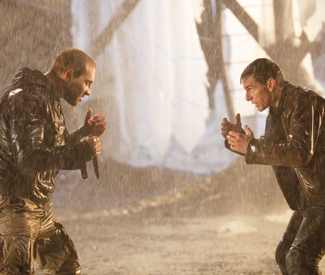
No nudity. Five people beaten near death. Three cops cars destroyed. Sniper porn. Fight to the death in the pouring rain. Not a great tribute to a great character, but I’ll take it. *

JACK REACHER is now playing in Bay Area theaters.

White men behaving (very) badly

69

Could it be — the worst year ever?

I keep asking. And every time the Offies come around, I find myself boggled yet again. Our awards for the very worst — the dumbest, the most tasteless, the most truly offensive acts of the year past — keep sinking lower and lower.

But what can we do? There are still Republicans, and this year a lot of them ran for high office, and every single one made a fool of himself. There are still politicians who think you can run for San Francisco supervisor even if you live in Walnut Creek, and elected leaders who find the courage deep in themselves to prevent a bunch of old men from walking around with their sagging asses and limp dicks out.

There are still entertainers who punch psychics, and gun nuts who blame mass murder on TV sex, and … well, a whole lot of people who have made this a banner year for the Offies.


SUPPORT OUR BRAVE, HEROIC TROOPS! (EXCEPT THE MEN WHO FUCK MEN)

The audience at a Republican presidential primary debate booed a gay solider who called in from Iraq with a question about don’t ask, don’t tell.


FROM A GUY WHO HAD TO BUY OXYCONTINS AND VIAGRA ON THE STREET, THIS SORT OF THING IS AN OBVIOUS CONCERN

Rush Limbaugh attacked law student Sandra Fluke, calling her a “slut” and a “prostitute” because she testified that health-care plans should cover contraceptives.


THERE ARE MEN SO BRILLIANT THAT WE STAND IN AWE OF THEIR INTELLECT

Mitt Romney said he really liked Michigan because the trees were all the right height.


GIVING NEW MEANING TO THE 1 PERCENT

Herman Cain proclaimed that for every woman who claimed he sexually harassed her, there were a thousand others who didn’t.


IF WE WANTED A DRESS CODE ON AIRLINES, WE’D START WITH THOSE DREARY PILOT UNIFORMS

An American Airlines pilot kicked a woman off a flight for wearing a shirt that said “if I wanted the government in my womb I’d fuck a senator.”


PROBLEM IS, BUSH MADE THAT ONE A CABINET-LEVEL POSITION

Rick Perry proclaimed in a debate that he was going to do away with three agencies of the federal government, but after listing Commerce and Education, he couldn’t remember what the third one was, identifying it only as “oops.”


FOR SOMEONE WHOSE NAME MEANS ASS-CUM JUICE, THAT’S A REALLY PRETTY PICTURE

Rick Santorum said that he’d listened to John F. Kennedy’s speech on the separation of church and state and it made him want to throw up.


LOOK! UP AT THE RAMPARTS! THE MAN WITH THE HAIR!

Donald Trump, mistakenly believing Romney won the popular vote but lost the election, called the election “a sham and travesty” and called for “revolution.”


BUT HE COULD HELP THEM OUT WITH A FEW BINDERS FULL OF WOMEN

Romney insulted the British by saying the nation didn’t appear ready to host the Olympics.


FINE, JUST TAKE RICK PERRY WITH YOU

More than 50 thousand people signed a White House petition asking for permission for Texas to secede.


GUNS DON’T KILL PEOPLE, ATHEISM AND OVERSTIMULATED GLANDS DO. HAPPY FRIDAY, SHOOTERS!

On the same day that a gunman opened fire at a showing of the Dark Knight movie in Colorado, the National Rifle Association’s magazine sent out a tweet that read: “Good morning, shooters! Happy Friday.”

A Congressman from Texas, Louie Gohmert, argued that the Dark Knight shootings happened because of “ongoing attacks on Judeo-Christian beliefs.”

Mike Huckabee blamed the massacre in Newtown, CT on atheism. “We ask why there is violence in our schools, but we have systematically removed God from our schools,” Huckabee said on Fox News. “Should we be so surprised that schools would become a place of carnage?”

Timothy Bordnow at Tea Party nation said the shooting was caused by too much sexual stimulation in the media . “There is a reason why young people commit these sorts of crimes, and sex plays no small part. Their passions are eternally inflamed, and they wander the Earth with no outlet for their overstimulated glands.”

Megan McArdle, the Daily Beast writer, urged the victims of mass shootings to gang-rush the shooter so he wouldn’t kill as many people.

The head of the National Rifle Association said the only way to stop mass murders of school children is to post armed guards in every school.


WOW — THE DISTRICT 8 SUPERVISOR HAS BEEN OVERWHELMED BY A COUPLE OF OLD MEN’S FLACCID DICKS

Sup. Scott Wiener promoted a ban on public nudity in San Francisco.


WHEN YOU’RE A MAJOR LOSER, EVEN MONEY CAN’T BUY YOU LOVE

Michael Breyer, who has never been elected to anything, spent roughly $1 million trying to win a state Assembly seat as the candidate of “traditional San Francisco values,” and lost badly.


AND THESE PEOPLE ARE COOPERATING WITH HOMELAND SECURITY?

Confetti thrown in the Giants parade turned out to be lightly shredded internal police documents that included home addresses and social security numbers of officers.


GUESS IT’S OKAY TO PERJURE YOURSELF IF YOU’RE THE MAYOR

Mayor Ed Lee testified under oath that he’d never discussed the Ross Mirkarimi case with members of the board of Supervisors, although friends of Sup. Christina Olague said she’d been open about her talks with the mayor on the topic.


NOW, WHICH ONES ARE THE IRON MONSTERS OF DEATH?

A San Francisco bicyclist who was allegedly trying to beat a speed record crashed into and killed a 71-year-old man in the Castro.


UNFORTUNATELY, THERE’S NO MALPRACTICE STATUTE GOVERNING THAT AUGUST PROFESSION

Political consultant Enrique Pearce oversaw perhaps the worst district election campaign in history, helping Olague become the first incumbent ever to lose in ranked-choice voting in SF.


SOMEHOW, REPRESENTING WALNUT CREEK AT CITY HALL DIDN’T SEEM LIKE SUCH A GOOD IDEA

Union official Leon Chow dropped his challenge to Sup. John Avalos when the SF Appeal revealed that he didn’t live in District 11, or even in San Francisco.


WHEN MEN ARE JUST TOTAL DICKS: THE GOP REDEFINES RAPE

1. Divine providence rape (Rick Santorum): “The right approach is to accept this horribly created .. gift of life, accept what God is giving to you.”

2. Honest Rape (Ron Paul): “If it was an honest rape, that individual should go immediately to the emergency room.”

3. Forcible Rape (Paul Ryan): Federal law should prevent abortion except in the case of “forcible rape.”

4. Emergency Rape (Linda McMahon): “It was really an issue about a Catholic Church being forced to issue those pills if a person came in with an emergency rape.”

5. Legitimate Rape: (Todd Akin): “If it was a legitimate rape, the female body has ways to try to shut that whole thing down.”


CALL IT BIEBER RAGE; IT’S DANGEROUS SHIT

After a Justin Bieber concert, Lindsay Lohan punched a psychic in the face at a New York nightclub, then threw her personal assistant out of the car.


YEP, AND IT DOESN’T LOOK ANY BETTER THE SECOND TIME

Romney’s campaign manager said that his candidate would change his right-wing positions for the fall campaign: “It’s almost like an Etch-A-Sketch. You can kind of shake it up and we start all over again.”


AND IF HE GOES WITH THEM, IT WILL ALL BE WORTH WHILE

Newt Gingrich proposed sending 13,000 Americans to the Moon and creating a new state there.


AND WE ALL WONDER WHY THE MEDIA IS DOING SO SMASHINGLY WELL THESE DAYS

After Gabby Douglas became the first black woman to win the Olympic gold medal in all-around gymnastics, the news media reported on problems with her hair.


AND YOUR VIEW OF THE WORLD IS OVER, OVER, OVER, OVER

Justice Antonin Scalia, in defending his argument that sodomy is legally equivalent to murder, told law students at Princeton that the Constitution is not a living document, it’s “dead, dead, dead, dead.”


MAKES YOU WONDER ABOUT THE POOR SOUL WHO CAME IN AT 99

Kim Kardashian fell 90 places, to 98, on AskMen Magazine’s list of the worlds 100 most desirable women.


SADLY, “GOTTA CATCH ‘EM ALL” DOESN’T MAKE SUCH A GREAT CAMPAIGN SLOGAN

Herman Cain said his life’s philosophy came from a Pokemon song.


WE’RE GLAD THAT HIS FAITH HAS GIVEN HIM SUCH AN UPLIFTING ATTITUDE

Romney said he’s “not concerned about the very poor.”


HE WAS PROBABLY SHITFACED, TOO, BUT SINCE HE DOESN’T DRINK HE CAN’T REMEMBER THAT EITHER

Romney said he didn’t remember beating up a gay student at his prep school and cutting off his long hair.


IT’S A GOOD THING MONDAY NIGHT FOOTBALL ISN’T LOOKING FOR ANOTHER JOHN MADDEN

A full 78 percent of Americans thought Ryan Seacrest was doing a good job broadcasting from the Olympics, although most of them couldn’t figure out what he was actually doing.


HE ALSO TOLD US THAT TAX CUTS AND DEREGULATION WOULD IMPROVE THE ECONOMY, SO HE’S GOT A WINNING RECORD HERE

Karl Rove on election night kept insisting the Romney still had a chance to win.


TALK ABOUT A BLOWN COVER

David Petraus resigned as CIA director after an affair with a woman who was threatening another woman who might have had a thing for him.


TOO BAD — HE MIGHT HAVE HAD TO SEEK ASYLUM IN THE NEW REPUBLIC OF TEXAS

A petition to allow every American to punch Grover Norquist in the dick was removed from the White House website.


WE’RE WITH THE GOVERNMENT OF BELIZE; THIS MAN IS “BONKERS”

One-time software mogul John McAfee fled Belize claiming the cops would persecute him after he was sought for questioning in the shooting death of his neighbor — using a body double, faking a heart attack, pretending he was crazy, and winding up in Miami.


IT SUCKS TO BE STINKING RICH AND OWN FOUR HOUSES AND HAVE TO LIVE WITH REJECTION

Ann Romney was deeply depressed that her husband didn’t win the election, telling friends she though it was their fate to move into the White House.


AND WHEN ASKED IF SOMEONE THAT MORONIC COULD ACTUALLY RUN FOR PRESIDENT, HE SAID “I’M A REPUBLICAN, MAN”

Marco Rubio, when asked about the age of the Earth, said “I’m not a scientist, man.”


EASY — THE ONES WHO ARE GETTING PAID ARE THE ONES PRETENDING TO BE INTERESTED IN NASTY OLD FRENCHMEN

After Dominique Strauss-Kahn was held overnight in Lille to be questioned about possible connections between a prostitution ring and orgies he attended in Paris and Washington, his lawyer said: “I challenge you to distinguish a naked prostitute from any other woman.”


DUDE — THAT’S THE TERRITORY OF SERIOUS LOSERS

Vice-presidential candidate Paul Ryan lied about his time in the marathon.


GO AHEAD, CLINT — MAKE OUR DAY

Surprise guest speaker Clint Eastwood addressed GOP convention delegates for 12 minutes, during which he carried on an imagined dialogue with an empty chair he identified as President Obama.


AND YES, HE DID GET A FAIR AMOUNT OF THE STUPIDITY VOTE

Santorum told a gathering of conservatives in Washington, “We will never have the elite, smart people on our side.”

We go together

0

APPETITE A celebratory or comforting drink is just what we crave at this time of year. When it comes with an excellent bite, even better. Here are a few of the most noteworthy drinks, winter cocktail menus, and dishes in SF as 2012 passes into 2013.


AME

It’s not a cocktail, and its blowfish base has long been known as dangerous… but in skilled hands, is entirely safe. Ame Restaurant in The St. Regis serves this fugu (blowfish) fin sake, the most adventurous drink on order this winter. Yes, it’s infused with an actual toasted fugu fin resting in the bottom of a ceramic mug ($15 for 6 oz.), filled with warm Honjozo-style “Karatamba” sake from Japan’s Hyogo prefecture. In Japan, this torafugu is considered to be of the highest quality, the fins traditionally roasted and steeped in warm sake. I couldn’t miss a chance to taste the rarity when it came on the menu a few weeks ago — and it will be available through February 2013. On a brisk, clear winter’s night, it warmed me from within with rich, layered, funky, even umami notes.

Eat with: Sit at Ame’s small bar with a mug of blowfish fin sake accompanied by Ame’s now classic Lissa’s Staff Meal ($16.50), an artful bowl of cuttlefish noodles, appropriate soft and muscled, tossed with brightly fresh sea urchin and quail egg in soy and wasabi.

In the St. Regis Hotel, 689 Mission, SF. (415) 284-4040, www.amerestaurant.com


BLACKBIRD

Launched on December 17, Blackbird’s winter menu offers the most sophisticated, satisfying cocktails in the Castro. Owner Shawn Vergara has been filling this needed niche on Market Street since opening Blackbird in 2009. This brand-new menu features some of Blackbird’s best drinks yet. I adore Italy’s sexy, sparkling red wine, Lambrusco. Here it’s a vibrant aperitif with pear-infused gin in the Poached Pear ($8), balanced by honey and lemon. Crimson King ($9) is another rosy, cool sipper of hibiscus-infused brandy, house pistachio orgeat, cranberry, and lemon. My tops on the new menu just might be Harvest Moon ($10). It’s a Bols Genever and Nocino (green walnut liqueur) base, sweetened with maple and pumpkin butter, balanced by lemon and Angostura bitters, softened with egg whites.

Eat with: Blackbird’s six different bar jars smeared on crispy crackers make for playful snacks, whether you opt for the smoked trout or deviled ham jars. I lean towards the pimento cheese jar laden with piquillo peppers and cheddar.

2124 Market, SF. (415) 503-0630, www.blackbirdbar.com


15 ROMOLO

Running through the first week of January, 15 Romolo’s Sherry Christmas! explores the wonders of sherry in cocktails that don’t taste merely of sherry. The impressive range is no surprise from what has consistently remained one of the best cocktail menus in San Francisco — with damn great food, too. The menu features all sherry styles from fino to oloroso, which act as shining stars or subtle unifiers. Manzanilla sherry subtly backs gin in Gardner’s Delight ($10) next to celery bitters, Dolin blanc vermouth, lemon, and a house thyme shrub — a lively “delight”. White Elephant ($9) illumines white port, sherry vinegar. and spiced liqueur with manzanilla sherry, a dash of absinthe tying this refresher together. Typically when I see rye whiskey, Cynar, and amontillado sherry together, I expect a musky, fall-spiced drink. In the case of a Solstice Sour ($10), these elements are mixed with a light hand, touched with lemon and cinnamon syrup, a cocktail that manages to capture winter in an almost spring-like way. Here’s hoping these sherry beauties stay on past January.

Eat with: Chef Justin Deering added on a few Spanish inspired dishes to accompany sherry cocktails or half bottles of sherry, like gambas a la plancha (shrimp in garlic and lemon), juicy albondigas (beef-pork meatballs), and sherried mushrooms ($5-8).

5 Romolo Place, SF. (415) 398-1359, www.15romolo.com


JASPER’S CORNER TAP

Bar manager Kevin Diedrich and crew produced another all-star cocktail menu this season at Jasper’s Corner Tap. One of the most unusual, savory drinks you’ll run into anywhere is Diedrich’s Genki ($13), inspired by a dish he recently had at Makoto in DC. With a base of Del Maguey Vida mezcal balanced by Partida Blanco tequila and Combier orange liqueur, Diedrich adds Togarashi syrup, lime, egg white and Matcha salt. Genki is simultaneously spicy, perky, refreshing.

Though there’s many a joy (don’t miss the creamy-but-light, floral Rum Shaker, seamlessly mixing Bacardi 8 Rum, Shipyard Pumpkin Ale, lime, pumpkin syrup, cream, egg white, orange flower water), one of the most playful drinks is a bottled Here Comes the Fuzz! ($11). Charred peach is infused in Jasper’s house bourbon, bottled with Manzanilla sherry (sherry dominates this season!), honey, lemon, pomegranate molasses, peach bitters and Angostura Bitters. Fizzy and vivacious, charred peaches and sherry imbue a gorgeous, nutty hue.

Eat with: With the invigorating drinks above, a trio of deviled eggs ($8 or $4 each) is appropriately light but satisfying. Though deviled eggs seem to be everywhere the last couple years, this trio stays fun with heirloom tomato caprese, “Caesar salad”, chipotle-romesco.

401 Taylor, SF. (415) 775-7979, www.jasperscornertap.com

Subscribe to Virgina’s twice-monthly newsletter, The Perfect Spot, www.theperfectspotsf.com


New Year’s Day special: How to watch the Nebraska bowl game!

1

I emailed my relatively reliable Nebraska source to get an inside line on the big Nebraska vs. Georgia Capital One bowl game on New Year’s Day Tuesday morning in Orlando, Florida.

“It will be tough,”  reported my grandson Nicholas Perez, a freshman in mechanical engineering at the University of Nebraska in Lincoln.

He’s right. Nebraska ought to be in the Rose Bowl, replaying Stanford and the game they lost to Stanford  in the Rose Bowl in 1941–and a game Nebraska fans never forgot.

But Nebraska got slaughtered by Wisconsin, 70-31, in its last game, the Big Ten championship game, and so had to take a consolation bowl game prize.

And the Huskers are playing a tough Georgia team, with an 11-2 record, and a 81/2 point odds advantage.

Game time is 10 a.m Tuesday  on ABC (Channel 7) in San Francisco.

Meanwhile, for those hardcore Husker fans who like to congregate and cheer in a bar,  Final Final will be showing the game on its premiere screen at l0 a.m. Tuesday.

Final Final is a Nebrask stronghold owned amd operated by a loyal Nebraskan,  Arnie Prien of Lyons, Nebraska.  The game comes with inexpensive beer and free popcorn and the Husker faithful.  Final Final is situated at 2900 Baker St., San Francisco, 415-931-7800. Street parking is always a problem in this neighborhood, so try the nearby Presidio.

There is no place like Nebraska. Especially in San Francisco and Orlando.  Go Big Red!


Off to Pompei’s Grotto for our 26th anniversary New Year’s Eve dinner

2

In a couple of hours, the former Jean Dibble  and I will be going to the delightful Fisherman’s Wharf restaurant we have  frequented for the past quarter century on New Year’s Eve.

Twenty-six  or so years ago, we happened to be strolling along on Fisherman’s Wharf looking for a place to eat New Year’s Eve dinner, We happened upon Pompei’s Grotto. in the heart of the Wharf at 340 Jefferson St.

It looked warm and inviting and beckoned to us with colorful holiday decorations and a friendly demeanor and so we went in.  We found it the perfect place for us on New Year’s Eve and we’ve never missed a New Year’s Eve dinner at Pompei’s.

Red-checked table cloths. Lamps on each table.  Lots of greenery. Lots of Dungeness crab. Reasonably priced and nicely prepared fish dishes. Superb martinis.  And always members of the founding Pompei family on hand to insure good service and quality meals and drinks and the friendly atmosphere of a family-owned and operated restaurant at the same location where Frank and and wife Marian started Pompei’s in 1946 from a tiny place with a couple of counters. Last year,  daughter Nancy was running things, son Tom was cooking most days, and son-in-law Gayne, who has been cooking for 40 years or so, was making cameo appearances in the kitchen.

Jean and I have the same meals. We are both cognizant of the quintessential San Francisco meal that Carl Nolte touted so deliciously in his vintage San Francisco column in the Chronicle introducing the crab season. Except for one crucial point. We have gin martinis, no vermouth, instead of a crisp white wine as Nolte recommended.  We both have the largest Dungeness crab in stock, with lots of drawn butter and fresh sour dough bread.  We each have very dry martinis, one for Jean and at least two for me. Jean has a shrimp cocktail and I have half a dozen oysters with a hearty mix of cocktail sauce and horseradish. We  finish things off  by asking for two spoons and sharing a good old-fashioned Midwestern-style chocolate sundae with a perched cherry on top.  Somehow, we never vary the routine and we don’t intend to do so this year.    And we have, I assure you, the best New Year’s Eve dinner in town.

We’re off.  I’ll keep you posted on Pompei’s 2013.  Meanwhile, take a virtual tour of Pompei’s: http://www.pompeisgrottosf.com/tour.html

P.S. After reading Carl’s column, I invited him to celebrate with me the best traditional San Francisco crab meal at the restaurant that we could agree upon to do the job for us.

I’m holding out for Pompei’s. B3


Help Bliss Dance stay on Treasure Island

1

Bliss Dance, the 40-foot-tall sculpture of nude woman built to dance at Burning Man in 2010, became a beloved, iconic local art installation when it was placed on Treasure Island later that year. What was meant to be a temporary placement has been repeatedly extended by the Treasure Island Development Authority and artist Marco Cochrane’s crew.

But she was never meant to dance in these foggy elements for such a long song. So if she’s going to remain there for the extra year that TIDA has authorized, she’s going to need some help in the form for a rust-proof protective coating and an overhaul of her lighting system.

And that’s where we all come in — at least those of us who want to see her continue dancing there, framed against the San Francisco waterfront and skyline. Cochrane and his crew have started a Kickstarter campaign to raise the $16,000 they need by Jan. 10.

At this point, they’re more than halfway to the goal, so take some of that extra cash that grandma sent you for the holidays and apply it to a worthy cause: supporting local art and artists, and ensuring this place remains a hub of creativity. Or if that’s not good enough, do it for nude dancing women everywhere. 

Manhattanization forgotten, Transbay Tower moves without the trains

101

Times in San Francisco have changed since the battles in the ‘80s against increased high-rise development and the “Manhattanization of San Francisco,” which peaked in 1986 with the passage of Prop. M placing limits on the rapid development pushed by then-Mayor Dianne Feinstein and her downtown allies.

Now, in 2012, the tallest building on the West Coast — Transbay Tower, the first in a series of new high-rises envisioned for downtown — gathered its final approvals with only scattered opposition (such as Quentin Kopp, the former judge and legislator, who derides the project as nothing but a “real estate scheme” involving lucrative publicly owned land being turned over private developers).

Whether we were all too distracted by a year of political scandals real and contrived, or whether it was the project proponents’ savvy marriage of the real estate deal to the high-speed rail project and Caltrain extension that environmentalists want to see become a reality, this behemoth building is now all but a done-deal.

Yet despite the slick and compelling interactive videos and project descriptions on the Transit Joint Powers Authority website, San Franciscans aren’t really on the verge of realizing this utopian urban vision of 21st century high-speed rail burrowing its way into SoMa over the next few years.

“The projection of that is less clear now. The delays with the high-speed rail have created some challenges for us,” said Adam Alberti of the high-powered communications firm Singer Associates, which represents the TJPA. Contributing to the delay and uncertainty is the indefinitely delayed plan for the electricification of Caltrain tracks that would be a precursor to bringing the trains downtown.

Now, even though the current Transbay Terminal rebuild (scheduled for completion in 2017) includes a “train box,” funding hasn’t yet been identified for the tunneling to get the trains there. That depends on federal allocations and the New Starts program administered by the Metropolitan Transportation Commission.

“Those things take awhile. It’s a long process,” Alberti said.

But the 930-foot Transbay Tower has its approvals, with the property scheduled to be formally transferred to the Hines/Boston Properties building team in the next couple months, followed in the coming years by other parcels in the area for more high-rises.

“The other parcels will be metered out and put out when we get maximum return for taxpayers,” Alberti said. “The transit center itself is on schedule and on budget, so it’s moving forward.”

That’s great, even if it’s just going to be a glorified bus station for the foreseeable future as the high-rises that are being built as part of this trade-off for trains help inch San Francisco a bit closer to Manhattanization

The new board president

204

The last time the San Francisco supervisors elected a new board president, the progressives got a swift kick in the ass. David Chiu, who had been elected to the top slot two years earlier with the unanimous support of progressives, disappointed some of his allies and wasn’t going to get their votes. But he wanted to keep his job, so he turned to the conservatives — and with the support of the folks on the right, he won another term. The he turned around and put the center-right folks in charge of some key committees. Price of the deal.

Now he’s looking for a third two-year term — but this time there aren’t any easy alliances. Several of his colleagues are also in the running, from across the political spectrum. And nobody right now has the magical six votes.

Scott Wiener on one side, David Campos on the other, Jane Kim closer to Chiu … somebody’s going to have to back down or cut a deal. And that’s where these things tend to get squirrly.

Me, I think Campos would be perfect for the job, not only because I agree with him most of the time but because he’s reliable, fair, and cares about public empowerment and input. That wouldn’t be to Chiu’s advantage — the two are likely to be facing off in a tough state Assembly contest when Tom Ammiano is termed out in two years, and the last thing Chiu would want is to have his rival in such a high-profile spot. So it’s not likely either of those two will be voting for the other.

I haven’t always agreed with Kim, but she’s more on the progressive side than not, and she’s really smart. You could see that as she took apart the city attorney’s arguments during the Ross Mirkarimi debate. Wiener has one of the most ambitious legislative agendas of any current board member and has proven to be an effective (sometimes dangerously effective) politician.

Wiener can probably get votes from the most conservative side, Mark Farrell and Carmen Chu, and might be able to line up, say, Malia Cohen and possibly even newcomer London Breed. But that’s not six — and that assumes that Chiu doesn’t make a play for those votes the way he did last time. Campos will get the progressives (John Avalos and likely Eric Mar), but that’s not six either. And with Kim and Chiu going after some of the same people, nobody’s going to come close in the first round.

That is, unless somebody cuts a series of backroom deals.

So my suggestion is this: Let’s demand that all of them tell us up front who they would put on which committees. Sure, it looks like pandering if Wiener promises Budget and Finance Chair to Cohen, who then votes for him — but that stuff is going to happen anyway, and I’d rather have it out in the open.


City College’s new divide

156

Despite recent voter approval of Proposition A, the parcel tax expected to bring $14 million annually to City College of San Francisco, faculty there are enduring pay cuts and layoffs, a reality that has rankled union leaders and others who have rallied to save the school. 

In the face of the school’s accreditation crisis, which if not addressed by March could lead to its closure, the college was a united front to keep the school open and pass Prop. A, which was approved by over 70 percent of San Francisco voters on the same night as President Obama’s reelection.

But a combination of timing (the money won’t roll in until later in 2013), the depth of the district’s fiscal hole, and declining student enrollment have left CCSF with essentially status quo funding. District officials appear to be leaning toward using most of the surplus it does get to beef up its scant reserve funds, which was one of the things that triggered the accreditation crisis.  

After the good news of Prop. A’s passage, CCSF discovered it wasn’t on track to meet its required enrollment numbers — and the number of students enrolled dictates state funding.

“[The administration] was focused on these accreditation reports. It’s a big job. It was very disruptive to change chancellors kind of midstream,” said John Rizzo, the college’s board president. “We had to switch administrations, and that’s been very difficult.”

City College has been through three different chancellors in the past year: longtime Chancellor Don Q. Griffin left in April due to illness, Pamila Fisher was interim chancellor until October, and now Thelma Scott-Skillman is the current chancellor.

Whatever the reason, City College has 3,000 fewer students enrolled than it expected to have for the Spring, potentially putting it $6.5 million in the hole this coming year. It has until the end of summer to boost those numbers. Now, despite all the cards coming up aces for them in the polls, the college still needs to save millions of dollars somewhere else in the budget.

It has started by slashing faculty and administration wages 8.8 percent, and not renewing contracts for more than 30 part time teachers, 18 part time counselors, and 30 clerical staff. Notably, Scott-Skillman — whose office negotiated the plan, which the board discussed on Dec. 13 — will also take a paycut.

Alisa Messer, president of the faculty union at City College, thinks cutting teachers, and therefore classes, flies in the face of what the voters bargained for with Prop. A. “There’s no discussion here about accountability to San Francisco voters,” Messer told us. And with the loss of competitive wages, the faculty has already started to come apart at the seams.

“We have unfortunately heard from quite a few faculty that they will be looking for jobs out of state,” Messer said. “Many said they’ll have to change their living situation or move out of San Francisco.”

She said that would hurt CCSF: “These things have to do with the long term viability of the college.”

Steve Ngo, a trustee on the college’s board, thinks that the Prop. A money should be used to shore up the school’s reserve fund, as dictated by the accreditation team that threatens the school with closure. Unfortunately, this means losing teachers now rather than later.

“If you want to frame it in terms of labor, there’s nothing worse to do than spending money now [to retain teachers] and laying off teachers in the future,” Ngo said. “Those are younger teachers. The people there now will be retired.”

Due to increased focus on diversity in hiring, CCSF’s more diverse and younger teachers tend to be the newer ones, and part time faculty, Ngo said. Those are the teachers most at risk — and the ones that students will end up losing.

Amidst the arguments about proper use of funding, teachers at the school are seeing their wages cut. Some, like Danny Halford, are losing their jobs.

Halford taught English as a Second Language at City College for seven years. A friendly and outgoing middle-aged guy, Halford is a veritable man about town, and can be seen at City College fundraisers, and was among the college’s most ardent Prop. A supporters, waving picket signs and attending rallies.

He was also one of the part time faculty members to lose his job in the Spring.

“Greg Keech, our super-wonderful ESL Dept. chair, wrote me a very nice letter to inform me that due to budget cuts there will be no job for me next semester,” Halford said. He had also recently lost his job as an organist at the College Avenue Presbyterian Church, which he’d had for 10 years, when a new pastor had “a new music concept that I don’t fit,” he said.

One of his favorite memories from City College was of a student named Elmer, from Guatemala. “He came into my Literacy class in May 2006, near the end of my first semester, with almost no English.  He made progress quickly.”

“When he got his G.E.D. diploma, I was so proud of him, I could have bust,” Halford said. “I’ve watched him grow, off and on, for six years now. He has no family here, and I think of him as my nephew.”

He may even be re-hired next fall, but until then he waits in limbo. He’ll try to substitute teach at the college for now, he said, but ruled out looking at other schools for work. As he said, “There are no jobs at other colleges because all colleges are in the same boat.”

Ngo said that the choice is basically between drastic change, or the closure of the school.

“It’s mathematically impossible to keep that payrate now,” Ngo said. “My hope is to provide the best wages and benefits in the long run, but we can’t offer it if it’s a facade. We can’t maintain payrates as they are now because we have too many faculty…There’s no agreement if there’s no college.”

City College’s faculty’s union, American Federation of Teachers 2121, filed an unfair labor practice charge Dec. 21 with the Public Employee Relations Board, a state entity that has the power to enforce labor law in California. The charge alleges that the college’s paycuts are unlawful.

A recent email to their union members outlines the AFT 2121’s grievances with the college: “At Monday’s bargaining session, the District finally outlined its claim that it will cut wages to recover last year’s ongoing state cuts of $13 million—even though the parties bargained in good faith, reaching agreement on June 20, 2012 to address these losses, including the 2.85% wage reduction this year and millions of dollars in savings through attrition and program cuts. The District is essentially overriding the previous agreement by now moving to cut wages to recover $13 million on top of the already agreed to concessions.”

College spokesperson Larry Kamer said he hadn’t seen the charges yet, as the college is on vacation, but that “we respectfully disagree with AFT 2121’s characterization of the situation.”

“City College is facing an immediate budget shortfall due to a second straight year of missed enrollment targets,” he said. “In the past, City College might have papered over such a budget gap with money it didn’t have, but those days are over. The college remains in a perilous situation with regard to accreditation and has no choice but to respond to the crisis with swift action and a request for shared sacrifice.”

And there’s the rub. In the midst of reforming the school to meet the requirements of the accreditation team by March or face closure, the college failed to keep its eye on their enrollment.

“The unions were trying to help, calling prospective students and trying a pitch,” Rizzo said. “‘Hey enroll!’ That kind of thing. They’re helping. A lot of people are trying to chip in to help this.”

“Ultimately it’s the people in the administration who are responsible for the enrollment,” he said.

With City College’s newest Chancellor Scott-Skillman on track to stay for at least a year, some stability may return to college’s administration. But City College’s dilemma, to potentially strain its budget to the breaking point or to lose valued and experienced teachers, has no easy answers  — and either way the losers may end up being the students.

To register for classes at City College, visit ccsf.edu. Enrollment for Spring is open.


CCSF by the numbers:

Prop A - $14 million a year for 8 years starting in 2013
 
3,000 - the number of students city college needs to enroll in order to meet its budget expectations, or lose money
 
$6.5 million - the amount CCSF loses if it doesn't enroll 3,000 students
 
8.8 percent, the amount faculty wages are being cut
 
160 - faculty lost in the past year due to attrition - retirement, quitting
 
30 - part time faculty not rehired next semester, including ESL teacher Danny Halford
 
30 - clerical staff not rehired for next semester
 
18 - part time counselors not rehired next semester
 
3 - number of chancellors running City College over the past year


The Performant: How Grinches save Christmas

0

Jeff Garrett and Will Franken overcome holiday saccharine.

Is that a collective sigh of relief in the air as another frenzied holiday season winds down to its usual end and whatever apocalypse was scheduled to go down seems to have spared at least our physical reality?

As we drift back into the routines of our regularly scheduled lives, the brief illumination of whatever lessons we were meant to be learning on the eve of our potential destruction and the supposed birthday of our salvation, flickers out without so much as a whimper. It’s a bit of a stretch anyhow, to weight a single stretch of calendar with so much cosmic significance, yet we do it year after year, grasping superstitiously at the shimmering notion of redemption, the hidden catalyst underlying our frantic excess.

It’s no wonder that the literature of the season is so full of characters in need of said redemption. The curmudgeons of Christmas have populated the landscape since long before jolly old St. Nick appeared on the scene, all the way back to the mean-spirited innkeeper of biblical infamy, who forced history’s holiest matriarch to give birth to her saintly son in a stable. Next to his casual crime, our own feckless peccadilloes seem so tame in comparison. And almost no act of pernicious revenge we could practically carry out quite stacks up to the hilarious inventiveness of the Grinch’s Christmas-in-reverse plot, and the wisdom we can glean from such a tale is twofold. Firstly, that if redemption is possible for such miserable wretches, then it’s certainly within our own grasp, and secondly, we have a collective need for these bad boys of winter to balance out the more saccharine elements of the holidays and keep them palatable, even plausible.

Thus spending an evening with a misanthrope so iconic his moniker is also a descriptor, is as seasonally-appropriate as trimming a tree or eating Chinese food. That misanthrope, of course, is one Ebenezer Scrooge, and in Jeff Garrett’s solo rendition at Boxcar Studio (“Scrooge, the Haunting of Ebenezer”), he undergoes the preordained transformation with a fearsome intensity that spills over the modestly appointed black box stage that struggles to contain him and the multitudes (more than twenty characters worth) he portrays. Judiciously edited down into a lean hour, stripped of the sumptuous Victorian accoutrements of big budget/big cast renditions, Garrett’s version, directed by Peter Ruocco, clearly revels in its dark origin—that of a ghost story, predating the trend of scary movies at Christmastime by almost a hundred and fifty years. True, the compressed timeline makes the eventual reformation of the reprobate seem a little hasty, but not to the extent that one would begrudge him his exultant transformation.

A more modern Christmastide tradition for San Francisco’s orphans and miscreants, is Will Franken’s annual holiday foray, an evening which rarely has much to do overtly with the actual holidays, but much to do with the need to distract ourselves from their inevitability. At Saturday’s edition, Franken’s signature stream-of-(sub)consciousness vignettes featured a bevy of characters in patently absurdist situations: a 39 year-old man without health insurance attempting to rediscover penicillin in time to cure his own strep throat, an Irish construction crew foreman left shorthanded by a few actors (Liam Neeson, Colin Ferrell), authors (Oscar Wilde, James Joyce), and Bono, a murder trial defendant confessing to murder in order to be allowed to smoke a cigarette, an obnoxious professional eavedropper with a broad Scottish accent plying his trade on the train, a talkative Southerner cursed with the rare condition of “jelly feet”. Scant attention was paid by Franken, or his many manic onstage personalities, to the pending festivities (despite being flanked onstage by a plywood Christmas Tree and hearth), offering a welcome respite from the otherwise continuous onslaught of holi-mania, and a tradition well worth hanging on to.


Gentle mosh

0

TOFU AND WHISKEY Vetiver and Howlin Rain have both been haunting around the Bay for the better part of a decade. Sonically split, playing tender Americana folk and 1970s-tinged psychedelic rock, respectively, the bands share a common thread of superior musicanship and drive — each releasing a landmark album in the past year or so (Howlin Rain’s The Russian Wilds and Vetiver’s The Errant Charm). The other link? Mutual admiration.

The two bands will play a series of three concerts together this weekend (Fri/28, Sat/ 29, Mon/31, 9pm, $20–$35, Cafe Du Nord, 2170 Market, SF. www.cafedunord.com). In anticipation of those, we did a sort of round-robin of interviews. I asked the musicians — Vetiver band leader and chief songwriter Andy Cabic and Howlin Rain’s Ethan Miller — a few general questions, then they took their conversation adrift, discussing literary influences, favorite Bay Area bands, and “the softest mosh pit in history.” Here are some hearty pieces of the conversation. There’ll be more up on SFBG.com/Noise.

SFBG What compelled you to create music in San Francisco, initially? What keeps you here?

AC I was playing music before I moved here and just gradually found folks to play with here in SF. Bands like Thinking Fellers Union and Caroliner were an initial inspiration. I’ve been here a while and have an apartment with reasonable rent, so that along with the weather, food, community and landscape of the city keeps me here.

EM Initially I moved up from that haunted little paradise that is Santa Cruz to be with my band at the time, Comets On Fire. The rest of the guys had all started migrating to the city and I was finishing up school there, I knew I needed to be with the band and San Francisco had a real buzz of excitement and electricity in the air for us at that time, we were moving toward a dark magic both in the atmosphere of San Francisco and the creative work that was ahead of us.

I actually live in Oakland. I love it here. I stay for my bands, the culture, access to the art museums, the food, the music, the airports, the architecture, the weather, the outlying and incorporated nature, the people, my friends, the work opportunities — I could go on and on, I really don’t have any incentive to leave. After 10 years of living in the metropolitan Bay Area I think my romance with these cities and all they have to offer is stronger than ever and my engagement with their mythologies is increasing daily.

AC [Ethan,]I know you are a voracious reader, and someone who is a fan of epic and oftentimes challenging works of fiction, like Valis, Gravity’s Rainbow, and War and Peace. What is the attraction to committing to a lengthy or monumental work, and how does this impact your songwriting?

EM I started to get into some pretty dark head places when we were making the last record The Russian Wilds. As it dragged into year three, I realized I really needed some highly focused activities outside of music in my life to dismantle stress/anger/exasperation/despair etc. I began jogging religiously to beat these emotions out of my body on the pavement and I took on some heavy books to beat them out of my mind. Moby Dick and War and Peace were the two big ones that began to clear the mental air for me.

Even though we’d finished the album and life moved on to a different kind of pace and substance, I loved the challenge and grandiosity of those works and continued on with the epics. I read Gravity’s Rainbow this year while on the road near the end of our tour cycle and loved it. It is a work that has taunted, haunted, and eluded me for years and now I can say it’s one of my all time favorites; it just took some relatively hard work and time to begin to engage properly with it. It is a true and singular masterpiece but it plays by a different set of rules than most of us are used to dealing with in literature.

AC Can you talk a little bit about your relationship with Tim Green and his role in the recording process of ‘The Russian Wilds’?

EM Tim worked for months and months, perhaps dedicated half his year to The Russian Wilds. I can’t say enough about his focus and enthusiasm for the making of that album. Tim and I have been working together on records for 13 years now and we have a pretty telepathic level of communication at this point. I always learn from him, a true professional and an incredible mix of artist and scientist and a great friend. The songs that you hear on that album were chosen and shaped by Rick in their basic forms but the sounds and the “album” that you hear is Tim Green. That’s his blood, sweat, and tears along with ours.

EM Stylistically, perhaps the thing Vetiver is most famous for is your “hushed”/”understated” delivery. Your singing, phrasing, and various levels of serene projection really are the mechanism that delivers Vetiver’s artistic manifesto. When you first began to sing, was what we now know as your style already there by intention or default? Was there a conscious decision to build that style?

AC I think I’ve always sung in a soft way. I had a band in college where I tried yelling and shouting and in that context it worked alright, but never quite clicked for me. I was usually hoarse by the end of those songs. I have a predilection for jangly, poppy sounds and melodic singing, and having never been trained or really taught how to sing correctly, I don’t sing with a very strong voice.

Getting an acoustic guitar and learning to fingerpick allowed me to bring the volume of the performance in line with my voice, and helped me develop a songwriting style that felt easier and more natural.

EM I’m keen to know what kind of literary influences move your musical mind…favorite books or authors that you go back to for musical inspiration year after year? Do you often cross-pollinate influences for songwriting inspiration? Cinema, poetry, visual art?

AC I worked for some years as a buyer for a used bookstore (Aardvark Books on Church at Market…the best!), and though it was one of my favorite jobs, it kind of ruined my ability to stick to one book at a time, hence my reading taste is a bit divided. I read a lot of non-fiction, history, and biographies.

As far as fiction goes, I’m a fan of authors who imbue their writing with their own personal voice. Charles Portis, Robert Walser, Eric Ambler, Paul (and Jane) Bowles, Donald Barthelme and Gertrude Stein are a few of my favorite authors. I’m inspired by economy of language and simplicity, when a lot is communicated with just a few well-chosen words. Conviction of conception is important to me. Bold ideas executed with modesty. The artwork and lived life of Wallace Berman and Marcel Duchamp is a big inspiration for me as well.

EM When we were backstage at a show a while back you told me about a mosh pit that broke out at a Vetiver gig last year. You or someone in the conversation described it as one of the softest mosh pits in history…

AC This was earlier this year, at Pitzer College, during their Kohoutek Festival. It was a blow-out for the students at the end of their term, and we were asked to play last, which is unusual as Vetiver’s sound isn’t exactly of a climactic nature, let’s say. Kids were definitely tripping balls and the prior electronic pop acts had raised the bar to where everyone was ready to go.

A significant portion of the people up front were mesmerized by the dancer twirling her LED hula hoop. That kind of thing. And basically when we began, some folks started pushing around and trying to make it more than it probably was. Some loose student with large pupils got on stage and strained inanities into the microphone between songs, and we were told after a few tunes that the police had arrived and asked to turn ourselves down. We’re probably the only band that has no problem turning down.

EM There are great rolling layers of ambience beneath the more attention grabbing pop and rock elements of ‘The Errant Charm.’ It’s almost as if another dimension has slipped into the world we know and casts a dream state on the listener. A subtle overthrow of pop consciousness. What is that ambient world? Is it of a Machiavellian nature? And why or how is it there flowing effortlessly and breeze-like in and out of a more familiar pop world?

AC This ambient world is a reflective space for me. The Errant Charm may have more of this as the album began with myself and Thom Monahan building layers of keyboards and effects as a substrate for the tunes. I love catchy melodies as well as slow moving ambiences and tried to create opportunities for both to coexist.

AC What’s your favorite underrated Bay Area band of all time and why?

EM Man, this is a tough one between Icky Boyfriends and Monoshock. Probably Icky Boyfriends. Their reunion gig at the Hemlock this year was really something else. I’ve been super into the Public Nuisance record that just got reissued, but they are a lost group from Sacramento and that may be a little too far out from the Bay. Still worth checking out!


This ain’t a wrap

0

YEAR IN FILM Perhaps the backlash was inevitable. Any film that so flawlessly wows its initial audience in turn begins to receive a lot more scrutiny down the line, and there are definitely things about This Ain’t California to scrutinize. Billed as a documentary, yet centered around a character who may not actually exist, This Ain’t California details the unlikely rise of a rebellious East German skateboarding scene hidden from view behind the Iron Curtain.

An exuberant mischung of archival and new video footage, a brash and punkish soundtrack, animated sequences, and compelling, little-explored subject matter, the film made irreverence its watchword, from storyline to storyboard. And although the sheer scale of this irreverent approach, including the filmmakers’ unorthodox methods of framing their story, raised serious questions about This Ain’t California‘s self-definition as documentary, what was undeniable was the movie’s greatest success — its flawless capture of a zeitgeist, not just of a specific place and time, but of the irrepressible vitality of youth cultures everywhere.

>>Read more from our Year in Film 2012 issue here.

Screened first at the 2012 Berlinale in February (and in San Francisco at the Berlin and Beyond Film Festival in October), This Ain’t California won the coveted “Dialogue en Perspective” prize for young filmmakers, an award given with this statement that foreshadowed the controversy to come: “We’ve rarely been so splendidly manipulated.” While the jury in Berlin was referring to the dynamic editing job spearheaded by 23-year-old Maxine Gödecke, as the film won more awards around the festival circuit — including “Best Documentary” at the Cannes Independent Film Festival — details about its unconventional creation began to emerge in the press. That much of the so-called “archival” video footage was recreated by a slew of modern-day skaters disguised in touchingly hilarious GDR-era hairdos and aggressively mismatched stripes. That all of the footage of the central character Denis “Panik” Paraceck was actually that of Berlin-based skater-model, Kai Hillebrandt. That Denis Paraceck (who, according to the film, died in Afghanistan in 2011) might actually never have existed, let alone been the impetus behind the film’s modern-day reunion of the now-adult skaters (and at least a couple of hired actors, including David Nathan and Tina Bartel).

German news weekly Der Spiegel condemned it as a glorified advertisement for skate culture, bloggers such as Berlin-based Joseph Pearson of The Needle decried the dangerous folly of Germans rewriting their own history, and the filmmakers themselves have been cagey about admitting to the extent of their subterfuge.

“[It’s] so much more fun to keep that secret,” director Martin Persiel explains to me via email when asked to comment.

But lest the naysayers condemn the film as pure hoax, it should be noted that there most definitely was an underground skate scene in East Germany, in addition to other outlaw scenes, including break dancers, punk rockers, and heavy metal bands. Plenty of the film’s old-school skate rats are verifiable as such, and some of the most frankly unbelievable details of the film, such as a compatriot with a Finnish passport being tapped to smuggle boards in from the West, appear to be corroborated independently by academic Kai Reinhart, who has been researching sports history and GDR funsportart since 2005.

“As a filmmaker there is a huge responsibility to truthful depiction of your subject,” Persiel insists. “[And] as far as feedback from the skaters from the East goes, we did do justice to their story.”

On the controversy over allowing a partially fictitious film win awards in the documentary category (against presumably less colorful and more rigorously fact-based films), Persiel remains silent, though he does theorize that the definition of “documentary” is expanding and evolving all the time.

“I call This Ain’t California a ‘documentary tale’,” he explicates, adding his own micro-category. It’s an explanation that probably won’t placate his detractors, but whatever side of the definition of “documentary” the film winds up being relegated to, the definition of “best” will still apply. No matter what, it’s a movie well worth seeing, and controversies aside, a movie well worth having been made — for truly we have been splendidly manipulated. *


2012’S TOP SELF-CURATED DOUBLE FEATURES (A.K.A. TWO-DOLLAR WEDNESDAY AT LOST WEEKEND IS MY JAM)


More in common than you’d expect Delicatessen (Marc Caro and Jean-Pierre Jeunet, France, 1991) and Deliverance (John Boorman, US, 1972)

William H. Macy is underrated Edmond (Stuart Gordon, US, 2005) and The Cooler (Wayne Kramer, US, 2003)

All about men A Single Man (Tom Ford, US, 2009) and A Serious Man (Ethan Coen and Joel Coen, US/UK/France, 2009)

Post-Prometheus Ridley Scott-a-thon Blade Runner (Ridley Scott, US/Hong Kong/UK, 1982) and Alien (Ridley Scott, US/UK, 1979)

Noomi vs. Rooney The Girl with the Dragon Tattoo (David Fincher, US/Sweden/Norway, 2011) and The Girl with the

Dragon Tattoo (Niels Arden Oplev, Sweden/Denmark/Germany/Norway, 2009)

Please kill me Dancer in the Dark (Lars von Trier, various, 2000) and Black Swan (Darren Aronofsky, US, 2010)

Gay follies Paris is Burning (Jennie Livingston, US, 1990) and The Birdcage (Mike Nichols, US, 1996)

Dark days Capturing the Friedmans (Andrew Jarecki, US, 2003) and Deliver Us from Evil (Amy Berg, US, 2006)

The masochism tango The Piano Teacher (Michael Haneke, Austria/France/Germany, 2001) and Secretary (Steven Shainberg, US, 2002) Let’s get physical Boogie Nights (Paul Thomas Anderson, US, 1997) and Magic Mike (Steven Soderbergh, US, 2012)

Ficks’ picks

0

1. Cosmopolis (David Cronenberg, Canada/France/Portugal/Italy) During the five times I watched this brilliantly slow-burning, transcendental flick, I saw dozens of audience members fall asleep, walk out early, and complain all the way down the corridor of the Embarcadero Center Cinema hallways. I had to watch it that many times (plus read the book and have countless late-night discussions) just to try and wrap my brain around this era-defining exploration of what it means to be a (hu)man in the Y2Ks. Robert Pattinson proved he’s a truly spectacular actor, Paul Giamatti has never been better, and David Cronenberg is only getting better as he gets older.

2. In the Family  (Patrick Wang, US, 2011) Self-distributed due to its length (169 minutes), this is a stunningly haunting and devastating work. Viewers with the patience to stick with it are rewarded with a genuinely achieved emotional volcano that I can only relate to John Cassavetes’ greatest films. A truly landmark film, in both style and content.

3. The Master  (Paul Thomas Anderson, US) Of all the films that Anderson has boldly attempted, audaciously experimented with, and (perhaps most importantly) been critically embraced for, The Master is a balanced period piece that combines both poetic and historical elements with a couple of truly profound performances by Joaquin Phoenix and Philip Seymour Hoffman. This is not a film only about Scientology, or about just one master. This is a film that asks many questions, but supplies few answers.

4. The Comedy (Rick Alverson, US) Perhaps containing the most mean-spirited characters of the decade, this harrowingly insightful satire of the hipster generation’s compulsion to heap irony upon irony inspired many an audience member to exit mid-film. But the many who dared to remain (including fans of the film’s lead actor, Tim Heidecker, from Tim and Eric Awesome Show, Great Job!) may have found themselves forced to question their own heartless (and even sociopath) tendencies.

Director Rick Alverson’s perceptive use of a contemporary antihero is quite comparable to the counterculture characters of the 1970s: Robert De Niro in Taxi Driver (1976), Peter Falk in Husbands (1970), and Jack Nicholson in Five Easy Pieces (1970). And since The Comedy was not necessarily made to be enjoyed, it will probably, sadly, take 20 years for people to recognize that there is no finer film to define this generation.

5. Florentina Hubaldo CTE (Lav Diaz, Philippines) With this six-hour film, Lav Diaz has created yet another minimalist masterpiece that few will even attempt to watch — 20 people started out in the Yerba Buena Center for the Arts’ screening, and only 10 finished it. Diaz has a monumental goal in mind for his character, and his film’s length is a major part of achieving it. I am not sure if there will ever be a time when six-hour character studies will be all the rage, but until then, Diaz is paving an uncharted road for others to follow.

6. Shanghai (Dibakar Banerjee, India) This Hindi remake of Costa-Gavras’ monumental political thriller Z (1969) may not have French New Wave cinematographer Raoul Coutard behind the camera, but Shanghai‘s director of photography Nikos Andritsakis adds his own brand of raw intensity. For his part, writer-director Banerjee creates an even more complicated look at the state of politics in the age of the modern terrorist. Seemingly inspired by fellow director Ram Gopal Varma’s career of gritty political dramas, Banerjee is an international director to watch.

7. Holy Motors (Leos Carax, France) The perfect companion to David Cronenberg’s Cosmopolis, this film contains a tour de force performance by the almighty Denis Lavant (of Claire Denis’ 1999 Beau Travail), with Michel Piccoli, Eva Mendes, Édith Scob, and Kylie Minogue in supporting roles. Unique, surreal, and completely inspired, this day-in-the-life journey will make you want to watch it again as soon as it ends.

8. The Grey  (Joe Carnahan, US) The best existential “animal attacking human” flick since David Mamet’s 1997 cult classic The Edge. It’s a film that showcases Liam Neeson as he tapes glass to his fists to battle a pack of giant wolves — and manages to be emotionally stirring at the same time. Make sure to keep watching all the way through the credits.

9a. Your Sister’s Sister (Lynn Shelton, US, 2011) Lynn Shelton’s follow-up to her genre-defining bromance Humpday (2009) is a pitch-perfect indie that attempts to dig deep within its dark and confused characters. Depressed and confused thirtysomething Jack (played by Mark Duplass, master of casual awkwardness) heads off to a remote island to figure out his life. The only trouble: his best friend (a mesmerizing Emily Blunt) also has a lesbian sister (Rosemarie DeWitt) who is already there doing her own soul searching. With this contemplative, honest, and hilarious film, Shelton is turning out to be quite a splendid voice for our current generation of progressive pitfallers.

9b. Jeff, Who Lives At Home (Jay Duplass and Mark Dupass, US) They’ve done it again! With Jeff, the mumblecore masters (2005’s The Puffy Chair; 2010’s Cyrus) construct a stoner comedy-existential trip for the man-child generation. While inspiring outstanding performances from Jason Segal and Ed Helms (both the best they’ve ever been), playing brothers, a poignantly performance by Susan Sarandon as their mother raises this wonderfully earned sentimental indie flick to the ranks of family dramas like Jodie Foster’s Home for the Holidays (1995) and her most recent overlooked gem, The Beaver (2011).

10. Lotus Community Workshop (Harmony Korine, US) His next film, Spring Breakers (due out next year), is poised to become Harmony Korine’s most accessible film to date; it’s a T&A-filled exploitation film, led by James Franco as a grimy, gold-grilled-grinning, dreadlocked drug dealer who lives to prey on bikini-clad young girls. But 30-minute meta-masterpiece Lotus Community Workshop, which played the San Francisco International Film Festival earlier this year (as part of omnibus film The Fourth Dimension), is maybe Korine’s greatest film to date. The almighty Val Kilmer plays a dirt bike-riding, fanny-pack wearing, roller-rink guru named Val Kilmer — and yep, it’s as mind-blowing as it sounds.

11. ParaNorman  (Chris Butler and Sam Fell, US) This stop-motion animated film surprised parents who felt its PG rating should have been PG-13 — and it inspired gasps and even yells (from adults!) in every screening I attended. Daringly shot on a Canon 5D Mark II DSLR Camera and released in a fully utilized 3D, this ode to midnight movies is a kids’ film that will stand the test of time and should rank right alongside Shaun of the Dead (2004) and Army of Darkness (1992): horror parodies that transcended their own self-awareness and become classics themselves.

12-14 [tie]. A Simple Life (Ann Hui, Hong Kong, 2011), Amour (Michael Haneke, Austria/France/Germany), The Turin Horse (Béla Tarr and Ágnes Hranitzky, Hungary/France/Germany/Switzerland/US, 2011) Ann Hui’s simple, straightforward tale of a woman’s choice to check herself into a retirement home after suffering a stroke will probably get overshadowed by Michael Haneke’s wonderfully minimalist approach to an elderly couple’s decline after one of them experiences the same ailment. Meanwhile, Béla Tarr’s final film is for acquired tastes only; it’s a cyclical journey with a rural couple, who eat potatoes, are isolated in a stormy darkness, and care for their horse. All three films lay out a terrifyingly realistic blueprint of old age.

15. Compliance  (Craig Zobel, US) No film at the 2012 Sundance Film Festival encountered as much controversy as Compliance. At the first public screening, an all-out shouting match erupted, with one audience member yelling “Sundance can do better!” You can’t buy that kind of publicity. Every screening that followed was jam-packed with people hoping to experience the most shocking film at the fest. And it doesn’t disappoint: Zobel unleashes an uncomfortable psychological mindfuck on the viewer all the way through to the stunning final 15 minutes, which are even more shocking than all the twists and turns that came before.

16. The Kid With a Bike (Jean-Pierre Dardenne and Luc Dardenne, Belgium/France/Italy, 2011) Can these Belgian brothers make a bad film? Seriously? Like their Palme D’Or winners Rosetta (1999), The Son (2002), and L’enfant (2005), Kid is yet another hypnotic, neo-realist portrait of modern-day youth. Every character makes unexpected yet inevitable decisions. No moment is false. The Dardennes create movies that make life feel more real.

17. Beasts of the Southern Wild ( Benh Zeitlin, US) Fantastical special effects created by 31 students at San Francisco’s own Academy of Art University (yes, I am biased), plus star Quvenzhané Wallis as Hushpuppy, a precocious six-year-old searching to understand a world post-Katrina, post-race, and more importantly post-childhood. Combining David Gordon Green’s George Washington (2001), Spike Jonze’s Where the Wild Things Are (2008) and perhaps even Julie Dash’s Daughters of the Dust (1991), Zeitlin has created a haunting enigma for modern audiences that deserves multiple viewings. But even though it won multiple prizes at the 2012 Sundance Film Festival, will it get the Oscar attention it deserves?

18. Universal Soldier: Day of Reckoning (John Hyams, US) When Jean-Claude Van Damme started this franchise back in 1992, it was a nice little combo of First Blood (1982), The Terminator (1984) and Robocop (1987). Twenty years later, the series’ fourth entry is co-written, co-edited, and directed by John Hyams, the son of Peter Hyams, who directed JCVD classics Timecop (1994) and Sudden Death (1995) — and man oh man does he deliver a tough and gritty little action sci-fi film. Van Damme takes on an even darker role than his scene-stealing turn in Expendables 2; with a cleverly subversive script, eloquently choreographed fight scenes (one of which gives Dolph Lundgren some pretty priceless moments), and a denouement that has to be seen to be believed, you may be rooting for this VOD released genre film as much as I am — not to mention Indiewire, which called it “One of the Best Action Movies of the Year!”

19. John Carter (Andrew Stanton, US) With a budget of $250 million, this epic based on Edgar Rice Burroughs stories brought the Walt Disney company to its knees by only making $73 million back. If you saw the film in 3D, you might be confused as to why no one bothered to see it. In my opinion (having watched it twice), John Carter achieves everything James Cameron’s Avatar (2009) did, as far as sci-fi extravaganzas go, but it also has an inspired story and a charming cast: Taylor Kitsch, Lynn Collins, Samantha Morton, and Willem Dafoe. This is possibly this generation’s Ishtar (1987), and like Elaine May’s infamous still-unavailable bomb, John Carter is actually enjoyable; it’ll need a decade or two for audiences to find it as one of the most enjoyable CGI spectacles in recent years.

20. The Dark Knight Rises (Christopher Nolan, US) [SPOILER ALERT!] I found The Dark Knight Rises hard to dismiss as just another money-making super-hero adaptation. After multiple viewings, I’ve come to think of the conclusion to the trilogy as the finest of the three. I’ve also had time to puzzle over the film’s intricate plot.

While many fellow critics seemed to find the film’s political handlings of Bane’s Occupy/French Revolution movement to be flimsy and even irresponsible, I would argue that the film works in a more complicated way toward politics. If Bane’s misguided revolution fell flat, then it would be important to look at Catwoman’s anarchist ways. And about that — did she put her selfishness aside to start over with a broke Bruce Wayne, or is the closing sequence just Alfred’s fantasy? (And if the latter is true, did Batman actually blow himself up in the end?)

And then there’s Blake, who bests the pathetic Deputy Commissioner, then turns his back on the well-meaning yet lying-to-the-people Commissioner Gordon. Though Blake knows he has to quit the police force amid such corruption, he can’t dismiss his urge to help the helpless and downtrodden — after all, he’s an orphan from the streets — and Robin is born. He’s alone (no butlers down in that cave anymore …), and will need to figure out what to do in Gotham City — a town that’s always wild at heart and weird on top.

(Note: list compiled prior to viewing Zero Dark Thirty or Les Misérables.)

Best Actor of 2012
Matthew McConaughey for Bernie (Richard Linklater, US, 2011), Killer Joe (William Friedkin, US, 2011), Magic Mike (Steven Soderbergh, US, 2011), and The Paperboy (Lee Daniels, US)

Best Unreleased Films of 2012

The Act of Killing (Joshua Oppenheimer, Christine Cynn, and Anonymous, Denmark/Norway/UK)

Black Rock (Katie Aselton, USA)

Berberian Sound Studio (Peter Strickland, UK)

Pilgrim Song (Martha Stephens, US)

The Lords of Salem (Rob Zombie, US)

Jesse Hawthorne Ficks programs the Midnites for Maniacs series, which emphasizes dismissed, underrated, and overlooked films. He is the Film History Coordinator at Academy of Art University.

Putting transit first

268

By Stuart Cohen, Leah Shahum, Rob Boden, and Elizabeth Stampe

OPINION Every day, San Franciscans pay the price of an underfunded transportation system. We have all experienced painfully overcrowded bus rides … or, worse yet, the bus that never shows up. Now, Muni is reducing service during Christmas week, as it is faced with a $7 million deficit this fiscal year.

Today, we are finally facing up to the reality that our declining transportation system hurts us all. It hurts our economy and it hurts people all along the economic spectrum. San Francisco is a world-class city in many ways, but we have a long way to go to have a world-class transportation system.

San Franciscans want better transit options: reliable, fast, comfortable buses, and safe and pleasant streets for walking and biking. San Franciscans support the city’s official transit-first policy, but lacking political will, the city hasn’t delivered on it.

By failing to make the tough decisions to fund our transit system, our leaders have put the burden on those who depend on affordable transportation options most. Transportation is one of the top expenses for people living in the Bay Area, after housing, and an exponentially greater burden for those with lower incomes.

Who will be hurt most by Muni’s skeletal service this holiday week? Working families.

That is why our organizations are proud to have joined together recently to support a proposal to update the Transit-Impact Development Fee (TIDF), which would have ensured that major developments pay their fair share into the city’s transit system. This would have included large nonprofits like Kaiser and the Exploratorium, when they build major new developments that generate thousands of new trips. The fee, probably about 1 percent of costs, would have paralleled the existing development fees for water, sewer, parks, and even art, that nonprofits already pay. It would not have included small nonprofits, and of course most nonprofits never build developments at all.

It would have helped visitors to large institutions have more dependable transit to get there, and helped the whole transportation system work better for everyone.

But it didn’t pass, and last week’s opinion piece (“The Muni vs. housing clash,” 12/18/12) mischaracterized the issue, suggesting a trade-off between basic services and transportation. But good, reliable, safe transportation is a basic service. Just like housing and health care, it’s something everyone should have access to, and something our city has declared a priority with its transit-first policy.

Unsafe streets are inequitable streets; low-income people and people of color are more likely to be hit by cars while walking. Underfunded transit is inequitable; low-income people have fewer options aside from walking or taking the bus, and the stakes are higher when the bus is late or doesn’t arrive.

Funding transit is a core progressive value. Great public transit — and being able to get around the city under your own power, by walking and bicycling — are great equalizers in a city like ours.

We should be investing more and expecting more from our transit system. Our organizations are proud to be doing just that. It’s time to help San Francisco finally live up to its transit-first policy — because that means putting people first.

Stuart Cohen works with TransForm, Leah Shahum with the San Francisco Bicycle Coalition, Rob Boden with the San Francisco Transit Riders Union, and Elizabeth Stampe with Walk San Francisco.

More recycling fallout

84

The unintended consequences of closing the Haight Ashbury’s only recycling center are about to ripple through small businesses in the neighborhood. As the recycling center’s final days loom, merchants are gearing up to face new fees — as much as $100 a day.

But they may get a reprieve sooner than they think.

State law requires stores that sell beverages in cans and bottles to take them back for recycling — unless there’s a functioning recycling center within a half-mile radius.

With the Haight-Ashbury Neighborhood Council recycling center gone, Whole Foods supermarket, the largest purveyor of beverages on Haight Street, will be faced with a decision — provide bottle and can buy-back services, or pay a $100 a day fee instead. If Whole Foods decides to pay the fee and not provide recycling in the area, small businesses in the Haight will be forced to make the same choice — only they won’t be able to afford the $36,500 a year fee.

San Francisco’s Department of the Environment doesn’t enforce those fees, but does provide oversight on recycling in San Francisco. Guillermo Rodriguez, spokesperson for the department, said that his office is in the planning stages of creating a mobile recycling center, which could roll out in early 2013.

“Certainly it’s not in our interest to have those businesses pack up and move out,” Rodriguez said. The mobile recycling center gives the neighborhood a new option.

If a recycling center serves the Haight neighborhood, the small businesses in the area could avoid paying the steep fees, and from having to go through the trouble of seeking exemption.

“Its similar to food trucks,” Rodriguez said. “After they finish for the day, they leave. But they’d set up at a usual time in a usual spot.”

San Francisco Supervisor Christina Olague, whose district includes the Haight Ashbury, said she was working on a way for HANC to turn into a mobile recycling center. Though she said that those talks had since stalled, Rodriguez said that if HANC wanted to be a partner in the new mobile center, the Department of the Environment would be open to it.

Why does the state of California expect small businesses to provide a can and bottle buy-back program on site, or face fees in the first place?

Rodriguez explained that the laws weren’t necessarily made with San Francisco in mind.

“When the rules were drafted, San Francisco was the exception, as we are for a lot of things,” Rodriguez told us. “The law was written for the suburbs, where small businesses generally have parking lots where recycling can easily be handled.”

The San Francisco Recreation and Parks department has long pushed for the Haight recycling center’s ouster. Sarah Ballard, spokesperson for the department, said the recycling fees and regulations that will hit local businesses aren’t Rec-Park’s problem.

“HANC has been on a month to month lease for over a decade,” she said. “The Parks Department have never sought to stop them from seeking non-park property to continue to run their business.”

Basically, HANC can operate wherever it wants to — just not in Golden Gate Park. And there aren’t a whole lot of other low-cost open spaces where the center can set up shop.

Small businesses we’ve talked to say they don’t have the space, staff, or ability to handle buying back recyclables. Fred Kazzouh, owner of “Fred’s New Lite Supermarket” on Haight and Masonic streets, doubted he’d get a reprieve from the fee.

“I mean if we all apply for an exemption, there’ll be half a mile radius without a recycling center,” Kazzouh said. “I saw recycling centers on Safeway on Webster (street) and I don’t see why Whole Foods can’t do it.”

Kazzouh’s store has been in the Haight neighborhood since 1995. The Haight has long been known as a place that draws alternative people, he said. And that’s the way he likes it.

“I don’t like to be in the clean neighborhood with the white picket fence and suits and ties,” Kazzouh said. “That’s not a real life. Its a very fake life.”

Even some of the ritzier stores along Haight St. aren’t bothered by the homeless population there. Firras Zawaideh, owner of Liquid Experience on Haight, sells high end (expensive) alcohol that few homeless people can afford.

He said he thinks only the transplants and new folks to San Francisco are bothered by them.

“I’m a native San Franciscan, from the Sunset [district],” Zawaideh said. “We’re the ones who don’t hate the homeless. Its all the transplants from New York and the midwest who complain about it.”

Zawaideh already handles bottle and can buy-back through his store, though he said that no one has ever taken advantage of it. But with HANC closing, he dreads the idea of people bringing cans and bottles en masse to his store.

“Say on a busy Friday night someone comes in with a cart full of recyclables,” he said. “Then what? I have to help them out too?”

The mobile recycling center would exempt Zawaideh of that responsibility. But if neighbors of HANC complained about the homeless population, would the same customers cause a problem for the mobile center as well?

Rodriguez said he wouldn’t speculate on if the homeless population that now uses the Haight recycling center would follow the food trucks around as well.

“I think we’ll have to take it as it comes,” Rodriguez said. Though he wanted this to be clear: “Not everyone that participates, frankly, is a homeless person.”

Fred Kazzouh was dubious that the homeless population would go away with HANC’s closure. “If HANC goes away, the homeless won’t go with them,” Kazzouh said. “The homeless will just have less people fighting for them.”

On the cheap

0

Event listings compiled by George McIntire. Submit items for the listings at listings@sfbg.com. For further information on how to submit items for the listings, see Picks.

WEDNESDAY 26

Kwanzaa Celebration Bay Area Discovery Museum, 557 McReynolds, Sausalito. www.baykidsmuseum.org. 9am-5pm, free. A traditional Kwanzaa altar will greet you upon arriving at the kids museum’s celebration of African American community, featuring two performance (at 11am and 1pm) by African Roots of Jazz.

7th Annual San Francisco Celebration City Hall Rotunda, 1 Dr. Carlton Goodlett, SF. www.kwanzaasanfrancisco.com. Noon, free. Head on over to City Hall to celebrate the umoja (unity) day of Kwanzaa, the 150th anniversary of the Emancipation Proclamation. Keynote speeches from the likes of Dr. Amos C. Brown, pastor of Third Baptist Church and district vice president of YMCA San Francisco Gina Fromm.

Soul Sessions Era Art Bar and Lounge, 19 Grand, Oakl. www.oaklandera.com. 9pm-1am, $5-10. Live performance from the Antique Naked Soul collective, painting by Bushmama & Smokie, and DJs spinning deep house, trap, hip-hop, and R&B.

Stay Gold Public Works, 161 Erie, SF. www.publicsf.com, (415) 932-0955. 10pm-1am, $3-5. It’s going to be a raucous holi-gay par-tay at Public Works tonight where DJ Pink Lightning will be throwing down the sick, bass-throbbing beats. Bring pastel lipstick and chandelier earrings.

THURSDAY 27

DIY Zine Making Workshop Rock Paper Scissors Collective, 2278 Telegraph, Oakl. www.rpscollective.org. 6-8pm, $1. This is your chance to become the next big media mogul. The good folks at the Rock Paper Scissors Collective are being gracious enough of to provide you with a workshop and your own materials to create your own zine, take them up on it.

FRIDAY 28

Dam-Funk 1015 Folsom, SF. www.1015.com. 10pm-3am, free with RSVP on website. No one in the world is as committed to the funk than super-funkateer Dam Funk. Get your boogie on as he shreds his keytar with his electro-synth jams. Be on the look out for the new album dropping in the spring of 2013.

Free Muni Day SF Muni stops. www.sfmta.com. All day, free. Take the L-line to the zoo or ride a cable car for the first time ever — today all Muni services are on the house to celebrate the agency’s 100th anniversary.

SATURDAY 29

Treasure Island Flea Market Great Lawn, Ave of the Palms, Treasure Island, SF. www.treasureislandflea.com. 10am-4pm, $3. Looking to pick up some Christmas or Chanukah presents? Then head over to the Island of Treasure for its monthly open-air flea market. Enjoy awesome views of the Bay Area while perusing goodies from local designers, collectors, and other makers.

SUNDAY 30

Instant Camera Photo Walk Photobooth SF, 1193 Valencia, SF. www.photoboothsf.com. 1-3pm, free. This event is for analog photographers only, so Instagrammers need not apply. Join the staff of the Mission’s Photobooth gallery for a photowalk down Valencia corridor. Be sure to bring a Polaroid/Land or Frankenstein instant camera along. No worries if you don’t have one, Photobooth will be happy to lend you one for the occasion.

SF Zoo Lights 1 Zoo, SF. www.sfzoo.com, (415) 753-8141. 4-8pm, $5. Stuck with the family all week? May we recommend taking them to the last night of the San Francisco Zoo Lights extravaganza? The zoo will be a bastion of animal-themed, family-friendly holiday fun complete with a splendid light show, 30-foot Christmas tree with animal decorations, and free rides on the carousel.

MONDAY 31

Holiday 3D Light Show Westfield SF Centre, 865 Market, SF. www.westfield.com/sanfrancisco. 5pm, free. Tonight’s your last chance to catch the holiday magic of the Illuminique Under the Dome show, which transforms the Westfield mall’s glass dome, built in 1908, into a surround-sound wonderland of scenes sure to get your little (and not-so-little) ones in an eggnog froth.


Our Weekly Picks

0

WEDNESDAY 26

San Francisco Kwanzaa Celebration

The celebration of Nguzo Saba (“The Seven Principles”) was created by Dr. Maulana Karenga in 1966 as a way for the African American community to reaffirm its values. Accordingly, concepts that we all should live by are the focus of each day’s worth of Kwanzaa events at City Hall this year. Today’s candle-lighting, feast, and live entertainment pay homage to unity — in the days following, self determination, collective responsibility, cooperative economics, purpose, creativity, and faith will be the program’s focus. (Caitlin Donohue)

Events through Jan. 1

Unity celebration: noon, free

City Hall

1 Dr. Carlton B. Goodlett Place, SF

www.kwanzaasanfrancisco.com


THURSDAY 27

Sepalcure

In 2011, producers Machinedrum (a.k.a. Travis Stewart) and Braille (a.k.a. Praveen Sharma) teamed up for the self-titled Sepalcure, a genre cross-stepping album that brought together past and present sounds of house, garage, and dubstep. Take standout track “Pencil Pimp,” where solemn keys progress with gospel moans that share space against hyped “heys” and light, energizing percussive beats. It’s an evocative emotional balance that puts them in league with contemporaries Tomas Barfod and Shlohmo — the latter providing support for this show, which will feature live visuals created by designer Sougwen Chung (a.k.a. Sharma’s girlfriend) for the 2011 MUTEK festival in Mexico City. (Ryan Prendiville)

9pm, $25 Independent 628 Divisadero, SF (415) 771-1421 www.theindependentsf.com


FRIDAY 28

We are Legion: The Story of the Hacktivists

When Israel threatened to shut down all Internet communication into and out of Gaza, Anonymous responded by taking down Israeli sites and providing instructional “care packages” for the case of outages. When Westboro Baptist Church announced plans to protest Connecticut’s legalization of gay marriage at vigils for the Sandy Hook Elementary School victims, Anonymous responded by shutting down the church’s site, godhatesfags.com, and the releasing names and information of church leaders. The group is relatively new but has had a huge impact with over a hundred raids in the last few years. This is the Story of the Hacktivists. The film’s director, Brian Knappenberger, interviews members of the online community in order to spark conversations about tactics, motives, and whether these illegal activities are the work of vigilantes, power-trippers, or just what we needed. (Molly Champlin)

7pm, $10

Roxie

3117 16th St., SF

(415) 863-1087

www.roxie.com


Cherub

Do we need another electro-pop, falsetto-laden act to follow the likes of Passion Pit and MGMT? Listening to Cherub, the answer is a resounding, “absolutely.” For one thing, this band is a bit sexier than the others (aspiring towards that pan-sexual prowess of Prince.) The duo — made up of Jason Huber and Jordan Kelley — is from Nashville, Tenn., but a respect for mac’n’cheese as a vegetable is about as far as their Southern roots extend. There’s no twang found here. Huber and Kelley’s layered, upbeat guitar, vocals, and synth meld in an energetic show that will demand you dance. (Champlin)

With Battlehooch and Rappers

9:30pm, $12

Bottom of the Hill

1233 17th St., SF (415) 626-4455

www.bottomofthehill.com


X

Legendary Los Angeles punk act X has always distinguished itself from other bands of its time and genre, with the rock solid drumming of DJ Bonebrake, the guitar virtuosity of Billy Zoom, and the poetic lyrics and intimate vocal interplay of John Doe and Exene Cervenka. Currently celebrating its 35th anniversary — which is hard to believe, considering X’s material sounds as fresh as ever, and it sounds better than ever live — the iconic group is traveling up the West Coast on a mini “X-mas 2012” tour where fans are sure to hear all of their favorite tunes, as well as a couple of revved-up holiday favorites thrown in for good measure. (Sean McCourt)

Also Sat/29, 9pm, $32

Slim’s

333 11th St., SF

(415) 255-0333

www.slimspresents.com


Wintersalt 2012

It took us a few head-scratching minutes to get the pun on sommersault (I think we get it?), but the two-night Wintersalt festival is sure to bring a little tumble of sunshine into our nightlives. Headliners include that tropical beat-appropriating genius, Diplo; our own atmospheric vinyl cut-up legend DJ Shadow, fresh from infamously getting booted off the decks at Miami douche palace the Mansion for being “too future”; a wee hip-hop rainbow of local adored MCs — Lyrics Born and Lateef, K.Flay, and Goldenchyld. Oh yes, there will also be EDM of the pop monster kind from Zedd and Dillon Francis — ensuring that at least the first night of this 18+ event will be flooded with fun-loving, neon-Raybanned, un-shirted younger brothers and sisters. Travis Barker and Mixmaster Mike will also be there, pumping the retro-’90s live drum-turntable alchemy they’re experts at. (Marke B.)

Also Sat/29

7pm-2am, $50-$160

Fort Mason Festival Pavillion

Marina Blvd, SF

www.wintersaltsf.com


SATURDAY 29

Lee Burridge

On “Lost in a Moment,” the 2012 track by Matthew Dekay and Lee Burridge, a snake-charming synth befitting of Vangelis winds around a hazy, beguiling vocalist who seems thoroughly entranced by the beat. The result is hypnotically effective and typical of Burridge, a much loved globe-trotting DJ who has created a dedicated following by transforming sets into moments to remember. Just Youtube his rapturous sunrise performances atop Robot Heart, or ask anyone who caught the last time he came through Public Works, and reportedly kept things going until 5am. (Prendiville)

With Rooz, Bo, Ben Seagren, Atish, and Brian Bejarano

9:30pm, $18–$25

Public Works

161 Erie, SF

(415) 932-0955

www.publicsf.com


SUNDAY 30

PRIMUS

Got plans for New Year’s Eve? Want to go Sailing The Seas Of Cheese? Do you plan on serving up some Frizzle Fry? Imbibing some Pork Soda? Any way you look at it, the two club shows this week by musical boundary-busting Bay Area rock favorites Primus are a rare treat for local fans to see the band up close and personal. You can party with Les Claypool and company on Sunday night, or ring in the New Year with them on Monday, either way, you’re guaranteed quite a night as these special “Frankenstein’s Masquerade” shows are part of Primus’ new 3D Tour, complete with stereoscopic visuals and quad surround sound. (McCourt)

Also Mon/31, 9pm, $47.50–$75

Warfield

982 Market St., SF

www.thewarfieldtheater.com


MONDAY 31

Sea of Dreams NYE 2013: LunaSea

The biggest pain about NYE is coordinating all your friends, not to mention their inseparable dates. The annual SOD event is a big tent experience, with wide-ranging musical choices and live, body-warping spectacles to please just about everyone. (Okay, maybe not your roommate’s boyfriend — he should just stay home.) Best of all, it’s broken up into distinct areas to prevent the oppressing, cramped feel of a “massive.” Check out the headliners, with the added bonus of having both Opulent Temple and Dirtybird DJs under one roof. (Prendiville)

With Gogol Bordello, Shpongle’s Quixotic Masquerade, The Glitch Mob (DJ set), Trentemoller (DJ Set), Diego’s Umbrella, Pumpkin, Robert Delong, and more 8pm-4am, $79–$145 SF Concourse Exhibition Center 635 8th St., SF www.seaofdreamsnye.com


Remones

Dec. 31 generally cost a lot of money. It’s just this weird, ingrained fact of the day that with the slow, chilly shifting of years comes the jacking up of prices. Hey, here’s an additional $20–$40 tacked on for a glass of bubbly! Sure, some of those crazy pricey shows are probably worth it — the big-name bands, the packed lineups with sparklers, dancers, and holiday accoutrement. But if you’re just in it for the basic, primal fun of fun, here’s a show that’s totally free: the Remones, a Ramones cover band (duh) playing the Riptide. Because really, all you want to do on NYE is gather with friends in a warm, Bay Area environment, drink copious amounts of liquor, and watch live, sing-along punk songs. Hey ho, let’s go. (Emily Savage)

9:30pm, free

Riptide

3639 Taraval, SF (415) 681-8433

www.riptidesf.com


The New Parish: The People NYE Ball

The People Party was started in 2007 by a group of artists who thought that the East Bay was being overlooked by Bay Area taste-makers (wow, how time flies). Though Oakland has been saturated in attention in the last few years, the event still stands out in the area’s nightlife scene. The multidimensional dance party attracts a creative group of people. It’s a chance for local artists to show their work in a fun environment, and from samples of organic tea to dripping, bright acrylic paint, there is plenty to see. Headlining to celebrate the end of the year will be poet, DJ, and producer, Rich Medina, livening up the evening with his unique connections between spoken word, hip-hop, afrobeat, and jazz. (Champlin)

New Parish

9pm, $20

579 18th St., Oakl.

(510) 444-7474

www.thenewparish.com


TUESDAY 1


No Way Back New Years Day Disco

There’s a few places to head if you went all night long and want to keep going all day strong. But to start the year off with a certain fresh feeling (and avoid an entire crowd of socket-eyed, gurning zombies), head over to Monarch. With No Ways Back’s reputation of infallible parties and quality music — in this case including Brooklyn’s Justin Vandervolgen (responsible for a double set on Beats in Space earlier this year) and local disco veteran James Glass — there are likely to be a fair number of people skipping the night altogether, and setting their clocks and krups for this one. (Prendiville) With Justin Vandervolgen, Sunny Side Up, Solar, Conor, 40 Thieves, and James Glass 6am, $15–$20 Monarch 101 Sixth St., SF (415) 284-9774 www.monarchsf.com


The Guardian listings deadline is two weeks prior to our Wednesday publication date. To submit an item for consideration, please include the title of the event, a brief description of the event, date and time, venue name, street address (listing cross streets only isn’t sufficient), city, telephone number readers can call for more information, telephone number for media, and admission costs. Send information to Listings, the Guardian, 225 Bush, 17th Flr., SF, CA 94105; or e-mail (paste press release into e-mail body — no attachments, please) to listings@sfbg.com. Digital photos may be submitted in jpeg format; the image must be at least 240 dpi and four inches by six inches in size. We regret we cannot accept listings over the phone.