Some people go out to bars and drink on a Friday. But, you want to know what I do for a good time? I chant. I chill in a room full of yogis and I sing mantras in Sanskrit and I get really happy.
If you’re in the yoga tribe, you might be nodding your head here. If you’re not, you may be thinking I sound like a New Age freak who’s sniffed a little too much patchouli. I understand. I’m the city girl who first resisted yoga 15 years ago, when I moved to San Francisco, saying, “Yeah, right, I’m going to just sit there and breathe.” Like yoga, chanting can be something of an acquired taste. But, also like yoga, it can be acquired very quickly. The biggest obstacle is just getting into the room for the first time to do it.
Chanting events are often called kirtan, which is call-and-response singing led by a kirtan artist (also known as a kirtan wallah). The chants are in Sanskrit, a language that has an innate meditative quality, and the repetition of the words put you into an ecstatic mindset. Though the songs are mostly honoring Hindu gods — like Rama, Lakshmi, and Shiva — you don’t have to be Hindu (or a theist at all) to sing them. I mean, anyone can find joy in offering a Christmas gift, or have a spiritual experience while eating a latke, right? The gods are thought by most to be symbolic, representing different aspects of life and humanity. Ultimately, kirtan is a practice of devotion or bhakti. It doesn’t matter what it is you are devoted to — God, trees, your pup or your honey — so long as love is at the center.
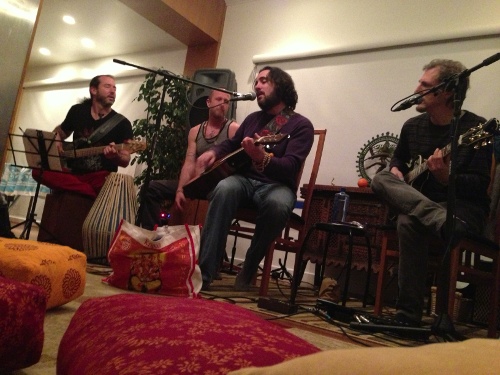
There are kirtan events frequently happening in the Bay (see the listings below), and there are touring kirtan bands constantly coming through here to share their music. One of my favorite kirtan musicians is David Newman (aka Durga Das), a Philly-born yogi who has the soul of an angel and the vibe of an indie rock singer-songwriter. He and his band (pictured above: Dave Watts, Clay Campbell, David Newman, and Philippo Franchini) played a small, intimate house concert this past weekend. It was my favorite kind of Friday night: music, tea, a dimly lit room, and a feeling like each person in the room was somehow destined to be there. But that’s often what it feels like at kirtan. It’s as if time somehow stops, and we’re all just there to linger in the pause.
Video of David Newman and band by Dazza Greenwood: http://www.youtube.com/watch?v=UNzopGaXyQA
Karen Macklin is a writer and yoga teacher in San Francisco — her On the Om Front column appears biweekly here on SFBG.com.
PLACES TO FIND KIRTAN IN THE BAY AREA
by Joanne Greenstein
Weekly: Wednesday Night Kirtan around the fire pit 8pm–9pm, by donation Yoga Society, 2872 Folsom, SF. More info here
Sunday Night Kirtan 7pm, $10-$15 First Sunday: Stephanie Winn Second Sunday: Kozmik Kirtan with Evelie Posch Third Sunday: Art of Living Foundation Last Sunday: Sean Feit Yoga Tree Telegraph, 2807 Telegraph, Berk. More info here
Monthly:
Open Secret Kirtan with Mirabai & Friends 3rd Thursday of the month This month: Thursday, 2/21, 7:30–9pm, $10-$20 Open Secret, 923C Street, San Rafael More info here
Kirtan: An Evening of Devotional Chanting & Music with Bhakti Heart Last Saturday of the month with some exceptions This month: Saturday, 2/23, 7:45–9:15pm, by donation Mindful Body, 2876 California, SF. More info here
Upcoming:
Community Kirtan with Andrew Thomas Fisher and Erin Lila Wilson All are invited to lead a chant, join in the response or listen to the sweet sounds. Feel free to bring instruments. Sat, 2/23, 7–8:30pm, by donation Integral Yoga Institute, 770 Dolores, SF. More info here
Complete Immersion:
Bhakti Fest A full-on kirtan festival in the Joshua Tree desert, the September Bhakti Fest (and its May sister festival, Shakti Fest) features around-the-clock chanting, premiere yoga classes and inspiring lectures. All the top international kirtan artists play at these festivals. Shakti Fest, May 17-19 Bhakti Fest, September 5-9 More info here
A San Francisco entrepreneur is trying to get the Obama administration to overturn a stupid anticonsumer law that protects cell phone makers and phone companies.
Sina Khanifar, co-founder of opensignal, has collected more than 80,000 signatures on a White House petition calling for a restoration of the right to “unlock” a cell phone — that is, to alter its programming so it can be used on a different carrier’s network.
It is, Khanifar told me, a fairly simple issue: If I buy a cell phone, it ought to be mine to use as I wish — and if that includes taking it apart, rewiring it, or changing the programming, that’s my business.
As he notes:
Intuitively we understand that once we’ve purchased a product it’s up to us how we use or modify it. Replacing the hard drive on a Macbook may invalidate our warranty, but it isn’t, and shouldn’t be, illegal.
But under a recent ruling by the Library of Congress, which oversees parts of the Digital Millenium Copyright Act, cell phone companies have the right to demand exclusive use of the devices.
That means when you buy a phone from, say, Sprint, it comes with a code that ensures it will work only on Sprint’s network. You can’t take that same phone and move your account to, say, Verizon or AT&T; you’d have to buy a new phone.
Khanifar has made something of a business out of resetting phones to work on other networks, which is particularly useful for people who are moving or travelling out of the country, where it often costs a fortune to use a US cell phone. Several years ago, Motorola tried to sue him — but with the help of a pro bono lawyer, he was able to beat the giant company back.
But the new rules mean someone who tries to change the code on a device he or she legally owns can be subject to as much as five years in prison and a $500,000 fine.
Cell phone companies say the law is needed to protect their interests; after all, that smart phone you bought for $99 when you signed a contract with your carrier actually retails for about $700. You get the discount by signing a contract to use the company’s network for a period of time, typically two years.
But Khanifar says — correctly — that those contracts already include hefty cancellation fees that more than cover the investment the company made in giving you a discounted phone.
In other words, he says, this is a corporate giveaway that undermines consumer rights. Ultimately, it will take an act of Congress to change the rules, and so far, only one member, Rep. Peter DeFazio (D-Oregon) has shown any interest. “But right now, we’re just trying to get this on the administration’s radar,” Khanifar said.
He needs 100,000 signatures to get an official White House response, and the deadline is Feb. 23. Sign up.
Dick Meister, former labor editor of the San Francisco Chronicle, is co-author of A Long Time Coming: The Struggle to Unionize America’s Farm Workers (Macmillan)
There’s still time, if you hurry, to join a nationwide campaign to posthumously award the Presidential Medal of Freedom to legendary organizer Fred Ross. For more than a half-century he was among the most influential, skilled, dedicated and successful of the community organizers who have done so much for the underdogs of American society.
Most people have never heard of Fred Ross, which is exactly how he wanted it. He saw his job as training others to assume leadership and the public recognition that accompanies it. And train them he did, hundreds of them, including farm worker leaders Cesar Chavez and Dolores Huerta, who were previously awarded the Presidential Medal of Freedom.
Chavez and Huerta were typical Ross trainees poor, inexperienced members of an oppressed minority who were inspired to mobilize others like them to stand up to their oppressors.
“Fred did such a good job of explaining how poor people could build power I could taste it,” Chavez recalled.
Chavez was among the Mexican Americans living in California’s barrios in the 1950s that Ross, then with Saul Alinsky’s Industrial Areas Foundation, was helping form political blocs to demand improvements in the woefully inadequate community services provided them.
Ross’ approach was, as always, to get people to organize themselves, and he sensed correctly that young Chavez was “potentially the best-grass-roots leader I’d ever run into.”
Within just a few years, the small organizations formed by the residents of the particular barrios joined into a potent statewide group, the Community Services Organization, headed by Chavez.
A few years later, Chavez and Huerta founded what became the United Farm Workers Union. It was the country’s first effective organization of farm workers precisely because it was built in accord with Ross’ principles from the ground up by farm workers relying heavily on such non-violent tactics as the boycott.
Ross had started out to be a classroom teacher after working is way through the University of Southern California in 1936. But he could find no teaching jobs in that dark year of the Great Depression. He took other public work, eventually managing the federal migratory labor camp near Bakersfield, California, that novelist John Steinbeck used as a model for the camp that had a central role in “The Grapes of Wrath.”
Fiction though it was, Steinbeck’s account was accurate. Conditions in the camp were deplorable. So were the conditions imposed on the migrants by the local growers for whom they worked.
But the migrants organized themselves to win better living and working conditions, thanks to young Fred Ross. He went from cabin to cabin and tent to tent every morning after daybreak, encouraging camp residents to form the organizations that helped improve their conditions,
Ross had found his life’s work. He would become a full-time organizer, a task he described as being “a social arsonist who goes around setting people on fire.” Never was Ross paid more than a marginal salary, sometimes no more than room, board and expenses, but never would he falter.
His goal was “to help people do away with fear fear to speak up and demand their rights to push people to get out in front so they could prove to themselves they could do it.”
Ross left the migrant group to work with the Japanese Americans on the West Coast who were herded into internment camps during World War II. Ross, then with the American Friends Service Committee, helped internees win release by finding them jobs in the manpower-short steel plants and other factories in the Midwest that produced vital war materials.
After the war, he returned to southern California, to help African Americans and Mexican Americans fight against housing and school segregation. They fought effectively, too, against police brutality and helped elect Los Angeles’ first Hispanic city councilman.
Ross also worked in Arizona, helping Yaqui Indians get sewers, paved streets, medical facilities and other basic needs that had been denied their communities.
Ross’ most ambitious and probably most satisfying work came during his 15 years of training hundreds of organizers and negotiators for the United Farm Workers from the UFW’s inexperienced and long-oppressed rank-and-file members.
Ross kept at it for virtually the rest of his life, joining his son, Fred Jr., a highly regarded organizer himself, in grass-roots campaigns for liberal politicians and progressive causes. He actively supported a wide variety of international as well as domestic issues, much of the time working with anti-nuclear and peace groups.
It was not until four years before his death in 1992, when Alzheimer’s Disease struck, that he finally stopped.
Fred Ross was an organizer’s organizer, a trailblazer, a pioneer. He was and he remains a vitally important model for those seeking to empower the powerless and to truly reform, if not perfect, this imperfect society.
“Fred fought more fights and trained more organizers and planted more seeds of righteous indignation against social injustice than anyone we’re ever likely to see again,” noted Jerry Cohen, formerly the UFW’s general counsel.
House Minority Leader Nancy Pelosi noted that Ross “left a legacy of good works that have given many the courage of their convictions, the powers of their ideals, and the strength to do heroic deeds on behalf of the common person.”
Honoring Ross, said his son, would be recognizing “the foot soldiers in all struggles that do the day to day work but rarely get acknowledged for their labors. It’s about honoring the farm workers, low- wage urban workers, and all those fighting for social justice against what many see as insurmountable odds.”
To add your voice to those urging President Obama to award the Presidential Medal of Freedom to Fred Ross, send an email before Feb. 28 to presidential aide Julie Chavez Rodriquez at Julie_C_Rodriguez@who.eop.gov. Please send a blind copy to Fred Ross Jr. at fredross47@gmail.com. You might also ask your House and Senate representatives to join others in Congress who have signed a letter urging the President to act.
Dick Meister, former labor editor of the San Francisco Chronicle, is co-author of A Long Time Coming: The Struggle to Unionize America’s Farm Workers (Macmillan)
THEATER In a deceptively low-key but major theatrical event, Yerba Buena Center for the Arts last weekend presented the local debuts of both the Wooster Group and the New York City Players, in their collaborative take on three of Eugene O’Neill’s seafaring “Glencairn plays.”
It’s striking and not a little frustrating that San Francisco has never before been a port of call for either of these two world-famous and globetrotting experimental theater companies. Moreover, because this was a first-time collaboration between the two influential groups, Early Plays (as the O’Neill program is titled) was not really representative of either one of them. Rather, it was an intriguing, at times euphoric, at times baffling exploration fusing actors from both companies with relatively bare-bones Wooster design elements — all under the signature directorial style of NYC Players’ playwright-director, Richard Maxwell. Even so, it was a stimulating evening in which the attentive, open curiosity of the audience was palpable.
The triplet of early O’Neill one-acts — all written between 1913 and 1916 and featuring polyglot crew members of the British tramp steamer Glencairn —included, in order of presentation, The Moon of the Caribbees, Bound East for Cardiff, and The Long Voyage Home. In these short and atmospheric plays, O’Neill explores the hard, often brutal lives of sailors and other working-class people swept along by the winds of trade. But in paying attention to their distinct cadences, relationships, and dreams, the playwright also points to the lyrical nature of their lonely yet social lives, as well as flickering moments of transcendent experience amid coarse routines and unruly bursts of energy.
In this sense, they are not all that different from (and nearly as contemporary as) Maxwell’s own plays (like House, Burger King, Boxing 2000, or People Without History), which often delve into the mundane musicality of ordinary, inconsequential lives sideswiped by half-understood forces, churned by bumptious pretentions and bumpy social interactions, bewildered by quiet epiphanies. Indeed, Maxwell’s work comes shaded by his own original songs in which the banal takes unexpected flight.
But whatever their resonances, their plays remain a fat century apart in theatrical worldviews. O’Neill, learning from Europe and especially Stindberg, was inventing an American theatrical vocabulary still not entirely free of a certain melodramatic tradition. Maxwell and the New York City Players, on the other hand, represent a distinct and sustained attack on the stifling affects of the theatrical artifice that has accrued since then. And the Wooster Group has maintained a visionary re-imagining of the stage, its strengths and capacities, for nearly four decades (a project whose power and scope was clearly visible even on video in the three-weekend series of Wooster Group work screened at YBCA in the lead-up to the Early Plays premiere).
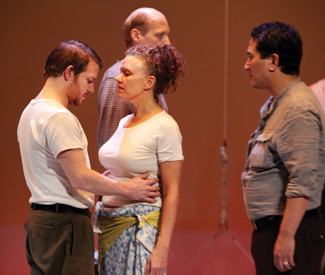
And so, what audiences encountered last weekend was a purposively monotone rendering of O’Neill’s rather overwrought dialogue, laden with a variety of archaic-sounding dialects that the actors dutifully articulated as written but, for the most part, without further embellishment or affectation. The action, meanwhile, unfolded with a deliberately subdued, knowing amateurishness on a Wooster-like set (designed by Jim Clayburgh and Wooster leader Elizabeth LeCompte) whose exposed gray-planed design featured a floating stage floor, supported by thin vertical cables, on which a skeletal framework of piping, bulging light bulbs, ropes, and pulleys combined in vaguely nautical abstraction.
Not that theatricality per se was absent: three of Maxwell’s workmanlike yet stirring ditties, for example, stitch together the O’Neill plays with simple, poignant, uninflected harmonies and rhythms as the actors smoothly reconfigure the stage. During Bound East for Cardiff, moreover, the stage was plunged into semi-darkness, sculpted by the warm glow of a few lantern lamps and the looming, slowly dissipating clouds blasted at intervals from a smoke machine, as main characters Yank and Driscoll (played respectively by NYC Players’ Brian Mendes and Wooster veteran Ari Fliakos) conferred at the former’s deathbed in a recessed, beautifully haunted corner of the stage. And in The Long Voyage Home, NYC Players stalwart Jim Fletcher (a riveting presence who is perhaps the quintessence of Maxwell’s forthright aesthetic, deflating and commanding at once) donned a too-tight barman’s vest and a toupee that looked like an animal roosting rump-forward on his head; while beside him Wooster’s luminous Kate Valk burst into and out of tears with a kind of blank perfection.
But it was precisely the melding of the clumsy and the graceful — and the volatile tension that arose between the purposely anti-theatrical and the inescapable pull of the plays themselves — that marked the production’s dissonant, quasi-Brechtian approach. In eschewing the usual cohesion, the production gave itself over to an admittedly not entirely successful but fascinating pursuit of what is much more rare: a sense of raw immediacy and authenticity, and a poetic capacity for unexpected instants of reflection. It’s an approach that wrestled with itself as much as the material or the audience, but it led to a refreshing sense of possibility and inquiry, and in it too there were moments when the lyrical and transcendent were given new life.
FILM San Francisco is a town of many film festivals: SF IndieFest wraps up Thu/21, and the Center for Asian American Media Festival (formerly the San Francisco International Asian American Film Festival) kicks off March 14. Lest you suffer fest withdrawal, the gap between is filled nearly end-to-end by Cinequest — San Jose’s 23rd annual salute to cinema that has a Silicon Valley-appropriate focus on technological innovations.
One example of that focus: Sony-sponsored 4K digital screenings of Taxi Driver (1976), Dr. Strangelove (1964), and Lawrence of Arabia (1962). While there’s no replacing the experience of seeing these classics projected on film, these restorations promise to render even Travis Bickle’s grimy apartment in eye-poppingly sharp relief. (“You talkin’ to me, or you checkin’ out my dirty dishes?”)
If the idea of burning highway miles to see movies you’ve already snagged on Blu-ray doesn’t appeal, Cinequest has corralled a genuine Hollywood icon for its Maverick Spirit Award: Harrison Ford. He’ll attend in person to discuss his career and, no doubt, field many a question about his rumored involvement in the upcoming Star Wars sequel-reboot-spinoff-thing — to be directed by J.J. Abrams, a past Maverick recipient himself. Other 2013 Maverick winners include Salman Rushdie, who’ll receive his award after the closing-night screening of Deepa Mehta’s Midnight’s Children, based on Rushdie’s 1981 Booker Prize-winning novel; and Chuck Palahniuk, who’ll be honored after a screening of a short film he scripted, Romance (one theme: Britney Spears), among others.
Cinequest’s largest component is, of course, its actual film programming, with a wide array of shorts, narratives, and docs. The fest kicks off with Sally Potter’s downbeat coming-of-age tale Ginger & Rosa. It’s the 1960s, nuclear war is a real possibility, and nuclear-family war is an absolute certainty, at least in the London house occupied by Ginger (Elle Fanning), her emotionally wounded mother (Mad Men‘s Christina Hendricks), and her narcissistic-intellectual father (Alessandro Nivola). Ginger’s teenage rebellion quickly morphs into angst when her BFF Rosa (Beautiful Creatures‘ Alice Englert) wedges her sexed-up neediness between Ginger’s parents. Hendricks (playing the accordion — just like Joan!) and Annette Bening (as an American activist who encourages Ginger’s political-protest leanings) are strong, but Fanning’s powerhouse performance is the main focus — though even she’s occasionally overshadowed by her artificially scarlet hair.
Horror fans: the number one reason to haul your carcass to Cinequest is Year of the Living Dead, a ghoulishly delightful look back at the making of 1968’s Night of the Living Dead. Rob Kuhns’ doc skews more cultural-legacy than fanboy, deploying a variety of talking heads (critics Mark Harris and Elvis Mitchell, Walking Dead producer Gale Anne Hurd, filmmaker Larry Fessenden) to explain why Night — offering just as much social commentary as any film from the Vietnam and Civil Rights era, except with way more squishy entrails — endures on so many levels. The best part, though, is the extended interview with George A. Romero, grinning and chuckling his way through anecdotes and on-set memories. On directing his amateur actors: “Just do your best zombie, man!”
Also highly enjoyable is Tom Bean and Luke Poling’s Plimpton! Starring George Plimpton as Himself, an affectionate portrait of the longtime Paris Review editor and “professional collector of experiences” who wrote books, articles, and made TV specials about his delight in being “the universal amateur.” His endeavors included playing football with the Detroit Lions, hockey with the Boston Bruins, and the triangle with the New York Philharmonic, among even more unusual pursuits. Some called him a dilettante (to his face while he was alive, and in this doc, too), but most of the friends, colleagues, and family members here recall Plimpton — born to an upper-crust New York family, he was friends with the Kennedys and worshipped Hemingway — as an irrepressible adventurer who more or less tailored a journalism career around his talents and personality.
Less upbeat but just as fascinating is Clayton Brown and Monica Long Ross’ The Believers, which starts in 1989 as University of Utah scientists Martin Fleischmann and Stanley Pons hold a press conference to announce they’ve discovered cold fusion — a way to make clean, cheap, plentiful power by fusing atoms instead of splitting them. But the initial excitement over their announcement soon gave way to skepticism and widespread dissent; eventually, their careers were in ruins, and by 1996, cold fusion was reduced to being a plot device for Keanu Reeves in Chain Reaction.
With new input from nearly everyone who was involved in the controversy (save the intensely private Pons, who’s seen in archival footage), The Believers captures cold fusion’s slow and spectacular fall from favor, while giving equal screen time to visionaries who believe it may still be possible. More importantly, its broader message explores what happens — or more pointedly, what doesn’t happen — when a radical idea appears, seemingly out of nowhere, to challenge an established way of thinking.
STREET SEEN I was going to write this column about what it was like to be art star Kehinde Wiley’s model. It was supposed to be an eloquent reflection on musedom, and I’d locked down a post-performance chat with Ethiopian Israeli rapper Kalkidan, who stars in several of Wiley’s portraits in the current show at the Contemporary Jewish Museum.
But you know what, Tel Aviv to San Francisco is a long flight and I’ll wager that if you followed up the same journey with two hip-hop sets in front of the opening night Contemporary Jewish Museum hoi polloi — whose hosted-bar pink cocktails gave birth to some very art-world dance moves — you would wind up much the same way Kalkidan did for our chat. Call it jet lag. Our interview veered towards monosyllabic, though I did manage to gather he’d seen the Wiley paintings in which he stars two times before, when the exhibition toured LA and New York. And that he’s an Aquarius.
“Leviathan Zodiac”
… Leaving me to my own devices with you, dear reader. Well, not entirely. I did have a chance to ask Wiley about the direction he gives to his “painfully young and present models,” as he calls them, mere minutes after his flight touched down from New York. (Right before another journalist saw fit to ask him about Frank Ocean? Has a moratorium been decreed on talking to black queers, or anyone even tangentially related to hip-hop, about anything else?)
Insight into Wiley’s models seems central to his gorgeous “World Stage” series, for which he poses young men of color in classic historical poses, with ornate backgrounds and rarified postures mimicking 18th and 19th European portraiture, among other influences. The conceit started when the San Francisco Art Institute grad moved to New York, and he’s painted other chapters of “World Stage” starring men in India, Nigeria, Brazil, China, and elsewhere.
Kalkidan on “World Stage: Israel” opening night at the Contemporary Jewish Museum. Photo by David Schnur
Coupled with his subjects’ vivid streetwear, which Wiley and his assistants (the artist is well-known for employing staff that contribute the pieces’ background, if not more) render faithfully, and region-specific background motif, the series is a gorgeous homage to modern brown and black manhood, with a swagger that is decidedly hip-hop.
“There is an aspect of black American creative culture that has become globalized. Every country finds their own response to this evolving reality,” reads a Wiley quote that greets visitors to the CJM exhibit. How has a culture that’s made its way everywhere still so vilified?
Wiley allowed to our group of arthounds at the preview that he does tend to capture men who are gorgeous — you won’t miss the fact once surrounded by his canvas gods — but that his choice has less to do with his own personal preferences. “You can’t know who’s zooming who,” he said. “Nor is it a particular interest of mine.” I overheard curator Karen Tsujimoto tell another reporter that she didn’t believe sexuality played a role in his work.
I guess I buy that. Wiley said that painting beautiful men is about highlighting factors rarely pulled out to the front in the art world. “Male beauty seems to be the elephant in the room when it comes to the history of painting,” he reflected.
“The World Stage: Israel” Through May 27. Contemporary Jewish Museum, 736 Mission, SF. www.thecjm.org
BOYCHILD DOES BIG APPLE
I’d be wrong if I didn’t laserpoint out that drag (is that term adequate still?) babe boychild for bringing genderphucked Bay Area fierce to the runway for the Hood By Air-New York Fashion Week collection named, yeah, “boychild.” You know you’re the buzz when you’re overshadowing rapper A$AP Rocky, who also walked in the show. The look? Wetsuits and sportswear with glittering detail: canary yellow do-rags with blonde extensions, pearl-headphone earrings, French manicure. Strong, kinda freaky, hella pretty. Just like our child.
Not so much the disease itself — although the rate of HIV infections has been rising again in young gay men, according to a report last year by the Centers for Disease Control and Prevention, and African Americans continue to be the hardest hit population in the US. And California, especially the Internet of California, has been gripped by another paroxysm of debate about barebacking porn, one that reached all the way to the ballot box in November with the passage of Measure B in Los Angeles, requiring all porn actors to wear condoms when filming in the city.
However, it’s the vibrant culture that grew up in resistance to the disease in the 1980s and ’90s that’s capturing the attention of a new generation, sparking a revival of interest that goes beyond typical retro-cycle nostalgia. For many young queers and allies frustrated by HIV discrimination, evictions, predatory pharmaceutical companies, sex-work criminalization, and immigration policy failures, it’s a newfound inspiration.
Rowdy AIDS resistance, defined by the loud-mouthed, street-closing, bridge-blocking, cathedral-occupying international AIDS Coalition to Unleash Power activist network, has been thrust back in the cultural spotlight after being overshadowed by more recent, conservative fights for marriage equality and military service rights. Initiated by NYC rabblerouser Larry Kramer in 1987, ACT UP defined queer politics for almost a decade and successfully changed the way government policy and the medical industry approached AIDS. (There would be no life-sustaining HIV drug combination therapy without ACT UP’s in-your-face civil disobedience.)
In San Francisco, the homegrown AIDS Action Pledge organization, started in 1985, laid the foundation for nonviolent yet radically confrontational AIDS activism, before partnering with ACT UP/New York and changing its name to ACT UP/San Francisco, helping to create a coast-to-coast juggernaut of information- and strategy-sharing. In its early ’90s heyday, thousands of virile ACT UPpers (and participants in related groups like Queer Nation, Gran Fury, and Boy With Arms Akimbo) from Kansas City to Copenhagen took to the streets, scaled walls, pilloried politicians, got arrested, and yes, got laid, too — it was a heady, cruisey time.
https://www.youtube.com/watch?v=wwhFS1mUaVY
During the past two years four documentaries about the period have been released to critical acclaim — How to Survive a Plague, nominated for a 2013 Academy Award, which documents the enormous influence ACT UP and its offshoot Treatment Action Group had on the development of life-saving combination drug therapies by major pharmaceutical companies; United in Anger, director Jim Hubbard’s eye-opening ode to the diverse membership, complex infrastructure, and social issue agenda of ACT UP in New York, which draws on the immense ACT UP Oral History Project archives Hubbard started 10 years ago with writer Sarah Schulman; Vito, an HBO documentary about outspoken AIDS activist and Celluloid Closet author Vito Russo; and We Were Hereby director David Weissman (currently being Ellis Act evicted from his Castro apartment), which focuses on San Francisco at the very beginning of the epidemic leading up to ACT UP’s founding, and the development here of innovative treatments.
Kramer’s own polemical, overwhelming 1985 play about the dawn of the disease in New York, The Normal Heart, was revived on Broadway in 2011 (it played here at A.C.T. last year), snagged three top Tony Awards, and is being made into a movie with Mark Ruffalo, Alec Baldwin, and possibly Julia Roberts. The artwork of hyperkinetic grafitti artist Keith Haring, who designed some of the most recognizable anti-AIDS iconography before succumbing to the disease in 1990, was everywhere in 2012, from Google Doodles and iPhone cases to collectible sex toys and a retrospective at the Brooklyn Academy of Music. Dangly pink triangle earrings and “Silence = Death” t-shirts and buttons, emblems of ACT UP, are popping up on hipsters all over.
And, um, Justin Bieber wore an ACT UP T-shirt to the 2012 CMT Country Music Awards?
FANNING THE FLAMES
Last year, a 28-year-old sex worker and activist named Cyd Nova, along with others who had been involved with the Occupy movement, started contacting ACT UP veterans about the upcoming 25th anniversary of ACT UP that March.
“My friend Kentaro and I had developed a common obsession with ACT UP because we saw it as reflection of what is missing in our community,” he told me. Nova had discovered ACT UP when he was 17, as he made an attempt to “understand who I was in the world I was living in.” When he began researching the ACT UP Oral History Project online and watching New Queer Cinema classics like the 1993 HIV-themed musical Zero Patience he “found it all incredible.”
“The emergence of ACT UP represented to us this time when queers stood together when faced with a genocide of indifference, devoting their lives to fighting for the those of their friends, lovers, family and themselves. This stands in contrast to gay and lesbian culture of the 2000s — the focus on marriage and class climbing. For people of color, sex workers, drug users, and transgender people HIV still exists. I wanted to get involved in some deeper way.”
Kentaro updated ACT UP graphics with a new “Act the Fuck Up” design, and there was enough traction about the anniversary idea among curious young people and elders to plan a “NOT OVER: 25 Years of ACT UP” panel at the Women’s Building in March, followed by a march in April through the Castro and Mission protesting the evictions of people living with HIV/AIDS, condoms being used as evidence to prosecute sex workers, and the Catholic Church’s homophobic and sex-phobic policies.
Both the panel and the march were well-attended, and another panel — this time featuring ACT UP veteran Sarah Schulman reading from The Gentrification of the Mind, her impassioned memoir of how queer rebellion to the AIDS crisis vanished into conservatism and consumerism, — overflowed its Luggage Gallery setting. Several of the attendees decided to start holding regular meetings and full-on reactivate the movement, reviving the name ACT UP/San Francisco.
The new ACT UP/SF joining with OccuPride at the 2012 Pride Parade. Photo by Liz Highleyman
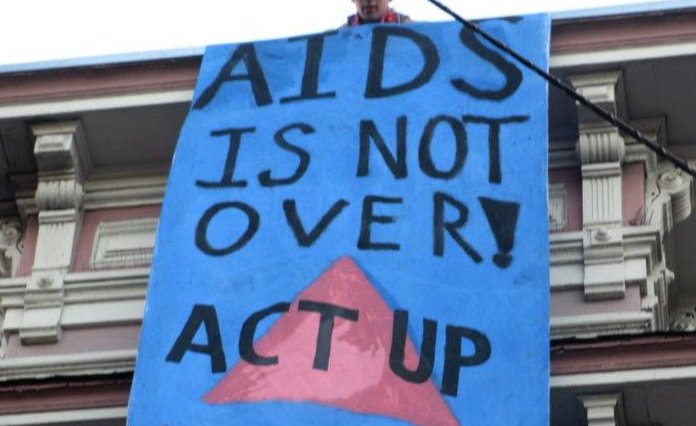
These events were followed by more old school-style ACT UP actions: slogan-bearing banner drops at Pink Saturday in the Castro, guerilla street art bombs, a “Cumdumpsters of the GOP” condom toss at Folsom Street Fair. A nexus of affiliation emerged among fellow radical queer groups like OccuPride, Homonomixxx, and active ACT UP chapters in other cities. In December, a small group managed to enter Bay Area-based pharmaceutical giant Gilead’s headquarters to protest the exorbitant pricing — $28,500 per year — of its new, more convenient HIV drug Stribild. An action is planned for February 25 to deliver letters protesting Stribild’s price to Gilead, and another for ACT UP’s 26th anniversary in March.
One of the less-emphasized aspects of ACT UP was its reverence for procedure and attention to order, its organization into multiple affinity groups and action committees: a trick learned from classical anarchism and the Civil Rights Movement. The young ACT UP/SF members I’ve met — there are about 25-30 core members — seem to have absorbed these techniques: they speak calmly and deliberately but candidly, seeking out consensus but unafraid to disagree. Their actions, too, seem deliberately organized and calmly executed.
The delicately butch-featured Nova joined me at Church Street Cafe, along with fellow ACT UP/San Francisco revivalists Mayra Lopez, 24, a poised yet vivacious nonprofit worker with striking red lips, and Alan Guttirez, 23, the kind of soft-voiced, sharply intelligent sex worker who somehow survives Dennis Cooper novels.
“I was 18 and taking a summer sociology class at SF State with this flaming faggot professor,” Guttirez told me. “Usually queer teachers like to talk about themselves a lot, and at some point he mentioned ACT UP. No one knew what he was talking about, that there was this whole radical movement here that had been almost completely buried. I was immediately curious about the possibilities.”
Lopez told me, “I grew up in Sonoma — for half my life, HIV wasn’t even on my radar. You never talked about sex in the Latino community I’m from, nevermind queer issues or HIV. Then, in high school, I watched a documentary about HIV and wanted to do a history of the disease for a project. I picked up a book of posters, included ones from ACT UP, that’s how I found out about it. From there I went to work for a nonprofit — but nonprofits have a problem with being able to address issues about migrant workers and HIV, which is my focus. They have to be so P.C. I feel like ACT UP is a tool to address those issues openly.”
A 2012 ACT UP/SF die-in outside Mission Dolores Basilica, protesting the Catholic Church’s homophobic and sexphobic policies. Photo by Liz Highleyman
Is any of the motivation for the ACT UP renewal a matter of trendy nostalgia? “We’re too busy for nostalgia,” Guttirez says. “We wish the people wearing ACT UP things or looking back at the ’90s would dig deeper into the meanings to know what those things stood for, that we’re still fighting against the same shit. Categorizing people on hookup sites as ‘clean’ or ‘dirty’ according to their HIV status or making fun of poor people is just perpetuating behaviors that were once used against us, and killed us.”
A BROADER AGENDA
One of the original ACT UP’s main goals was access to life-sustaining drugs. What’s the agenda of a new ACT UP? Besides addressing the prohibitively high costs of AIDS meds — something most HIV-positive people with insurance may take for granted, a lack of awareness that drug companies can take advantage of by price gouging or delaying more cost-effective treatments, and leaving uninsured people scrambling and dangerously stressed as public programs are increasingly cut — and the lack of an HIV safety net for many immigrants, the new ACT UP/SF also gives priority to sex worker and housing issues.
ACT UP/SF joined a coalition of local organizations, including Nova’s employer St. James Infirmary, to successfully demand that the San Francisco Police Department ban the use of condoms found on someone suspected of prostitution from being used evidence against them. (On January 14, however, Police Chief Greg Suhr announced that the ban would remain “temporary” for 90 days.)
And ACT UP/SF is also agitating around a provision in the $15 billion, George W. Bush-initiated PEPFAR international AIDS relief program, which forces organizations to pledge to oppose prostitution in order to receive funds. The US Supreme Court has agreed to hear a case against the provision this year.
A more local, immediate concern, however, one that ACT UP/SF places at the top of its list, is the skyrocketing cost of rent in San Francisco and the increasing numbers of evictions and stressful threat of evictions that many people living with HIV/AIDS face today.
“Evictions are killing us, they’re murder,” Lopez said, as Guttirez and Nova voiced their agreement. “People think medication is the number one priority for people with HIV — but it’s not, it’s housing. SROs are being pushed out, affordable housing stock is shrinking, people are being forced to leave. Without stability, it’s very hard to comply with your drug regimen, which is already complicated enough.
“I hear people all the time say, well if you can’t afford it here, then just move. They don’t understand that San Francisco is still one of the few places where queer people feel safe, that there’s a network of services here with proven results that you can’t find anywhere else, especially places many people living with HIV can afford to live. And there are support networks here, too, that aren’t available anywhere else.”
In fact, one of the most valuable things ACT UP/SF may be doing right now is offering a community for people, especially young people, with HIV to connect beyond the isolation of computer screens, to share information, enter into a positive dialogue, and receive support in a sympathetic environment geared toward changing the status quo.
Guttirez sums it up: “We’re for people who realize an angry Facebook post isn’t enough.”
BACK IN THE DAY
Have any old-guard feathers been ruffled by the ACT UP revival?
“The only real resistance we’ve had is to the name ACT UP/San Francisco — our intention is to reclaim the name from the mess that happened in the past,” Cyd told me. He’s referring to perhaps the most acrimonious legacy of local queer history. In 1990, after a phenomenally successful year of protest and media attention, several people left ACT UP/San Francisco to form ACT UP Golden Gate, intending to focus specifically on advocating for drug development and treatment, rather than address broader social issues like economic justice and gay equality.
The split was amenable at first, until things got really weird. Two men, David Pasquarelli and Michael Bellefountaine, moved here from Florida in 1993 and took over Act Up San Francisco. They quickly went from questioning the wisdom of poisoning one’s body with chemicals from the medical industry to flat out denying that HIV was the cause of AIDS, telling HIV-positive followers to forego medications altogether, saying that’s what was really killing them. Many panicked young people were swept into the new ACT UP/SF’s cultlike atmosphere, and to their doom.
“They were whackadoos!” old school ACT UP member Waiyde Palmer exclaimed when I brought up Pasquarelli and Bellefountiane. “They killed hundreds of people — and now they’re dead. Of AIDS. But the bitterness still lingers.”
I met the svelte and sassy Palmer, contributing editor of the Castro Biscuit news website and longtime survivor of AIDS, at Church Street Cafe, along with other ACT UP veterans Dean Ouellette, bushy-bearded gardener and musician, and respected journalist and activist Liz Highleyman. The three formed an uncanny, silver-haired mirror image of their younger counterparts I’d met with earlier.
A lively conversation careened among several milestones of queer radical AIDS activist history. The major early, roof-climbing takeover of pharmaceutical giant Burroughs Wellcome’s Burlingame office in 1987. The packed week of successful demonstrations around the sixth International AIDS Conference in 1990. Protesting a 1989 episode of NBC program “Midnight Caller,” which featured a murderous bisexual HIV-positive character. The 1989 day that Stop AIDS Now or Else blockaded the Golden Gate Bridge, two weeks after members of ACT UP/SF chained themselves to the Pacific Stock Exchange.
Juicy tidbits dropped: owner Marty Blecman of Megatone Records, Sylvester’s label, bankrolled ACT UP until he died in 1991; a fresh-faced Rachel Maddow, member of the AIDS Legal Referral Panel in 1994, stole some other cute dyke’s look. We tried to pin down a timeline of everything, but memories were fuzzy, exact dates had faded.
“I’m pleased to be a part of what’s happening, and I’m glad that it’s so intergenerational,” said Palmer (all three are active in the new ACT UP/SF) “but we need to maintain a momentum, and the motivation is different than when people were dying around you every day. Back then, the movement had members from every walk of life — yuppies, deadheads, people I never would have dreamed of associating with as a punk — united by this life-threatening illness.”
Highleyman agreed. “HIV has been taken over by the medical industry, we’re narcotized. A lot of ACT UP was based on exchanging information on these bewildering scientific things. Now people just ask their doctor what medicine to take. But who’s monitoring the doctors or watching the drug companies?”
“And the economics of the city have changed so much,” she continued. “I wonder if there are the resources anymore to support a protest movement. It’s just so expensive to live here, who has time to organize and follow through? The fact that these kids are taking it on is incredible and rare.”
“Back then we all worked three jobs, too” Palmer said. “But our rent was only $300 dollars — and if you had to leave one job to go to a protest, something else would pop up. I’m not sure if that can happen now.”
TIME PASSAGES
What happened to ACT UP? Leafing through the mesmerizing ACT UP Golden Gate files in the GLBT Historical Society archives in SoMa (especially those of its young star activist, Edward Zold, who succumbed to AIDS in 2009 at 38), a blizzard of drug names zips past: liposomal, foscarnet, fluconzole, sp-pg, TNP470, D4t, clarithromycin, AZT, Deovythymidine, xylocaine.
Every week it seemed, a new hope rose with a new drug name, only to be quashed when that drug failed. As several of the recent AIDS movies posit, the overwhelming amount of death just became too much, people couldn’t handle it anymore. Activists began turning on each other, the movement faded, and activist queer culture sank into despair. Until 1997, that is, when everyone began to realize the new anti-retroviral drug therapies would actually work. They were going to live, and then it was the best Folsom Street Fair ever.
Maybe more importantly, whatever happened to radical queer activism in general? I met with writer K.M. Soehnlein, who’s working on a novel based on his experiences of the ACT UP period — he was there from the very beginning in New York. He’s featured in United in Anger, and Queer Nation, an ACT UP offshoot formed to combat gay-bashing and promote queer visibility through renegade tactics, began in his living room in 1990.
“Occupy was a blip on the everyday gay person’s radar screen — and the police response to it was enormously more brutal and scary than when we protested in the ’90s and police usually worked with us,” he said. “But honestly, most gay people now are happy to see their president onscreen saying the word ‘gay’ before the word ‘marriage’ and that’s good enough for them.”
Soehnlein also has thoughts about why ACT UP may be resonating again. “There’s been talk about AIDS PTSD, and it really was a war. ACT UP felt like the only thing you could do to stay sane. Many people had to shut themselves off from that time in order to move on, and activism may be included in that.
“But 20, 25 years is a long time. It could just be a matter of waking people back up.”
ACT UP/SF meets at 7pm every first, third, and fifth Thursday — including Thu/21 at Alley Cat Books, 3036 24th St., SF. www.facebook.com/ACTUPSF
Head on down to the waterfront tonight for a hilarious night of bad B-movie fun! Where could be better to watch the schlocky sci-fi flick Mega Shark vs. Giant Octopus (featuring over-the-top cheesy performances from Deborah Gibson and Lorenzo Lamas) than an actual aquarium on the San Francisco Bay? Part of Aquarium of the Bay’s “Octopalooza,” a week-long fete celebrating cephalopods, the price of admission to this “Bad Movie Night” will include two drinks, popcorn, admission to the aquarium, and live satiric commentary about the film from Dark Room Theater. (Sean McCourt)
Travel writer Patricia Schultz explained how she selected entries for her New York Times-bestseller 1,000 Places to See Before You Die in the book’s introduction: “In the final analysis, the common denominator I chose was a simple one: that each place impress upon the visitor — and, I hope, upon the reader — some sense of the earth’s magic, integrity, wonder, and legacy.” Lately, Schultz seems like she is looking for the next 1,000 places to pass on to readers. She has made stops in Connecticut, Boston, and California this month, and has a 10-day jaunt through Ethiopia in April ($5,400 to join her) followed by a 19-day cruise ship voyage near the Antarctic coast in November ($9,500). Interested (and perhaps more frugal) travelers can listen in tonight on her latest adventures. (Kevin Lee)
The creators of the fabulous People’s History poster series, Justseeds, and Culturestr/ke have assembled a poster show to heal the psychic wounds you’ve done to yourself listening to the Right rage on against immigrants ruining our country. Seriously, this is the antidote: undocumented queer activist Julio Salgado’s peaceful odes to cross-border gay marriage, the flock of monarch butterflies that Portland, Ore.’s Roger Peet has conjured, alighting on a human skull in protest of the War on Drugs. King of the subversive poster Emory Douglas will also show work, along with many others. The opening reception features hip-hop performance, panel discussion, an appearance by the Filipino Caregiver Theater Ensemble, and more. (Caitlin Donohue)
“Fabulous Artistic Guys Get Overtly Traumatized Sometimes: the Musical!”
After a sold-out weekend premiere in October, DavEnd’s sharp-witted, madcap, acronym-inviting musical comes back for another raucous binge of self-obsession and doubt before the bedroom mirror. Fabulous Artistic Guys Get Overtly Traumatized Sometimes features writer, composer, performer, chanteuse, accordionist, and costume designer extraordinaire DavEnd as, who else, queer artist DavEnd and her active — very active — imagination. Upon reflection (her own that is, courtesy of a full-length looking-glass (Maryam Farnaz Rostami)), solipsism turns to schism as DavEnd confronts a fractured fashion show of ideal or not-so-ideal types, MC’d by her Fairy Drag Mother (luminous burlesque star World Famous *BOB*). Discerning direction by D’Arcy Drollinger and musical director Chris Winslow support a pitch-perfect combo of the effervescent and deadpan, in a comedy that actually asks stark present-day questions about difference, acceptance, and validation of the self. (Robert Avila)
In the third century BCE, a Chinese emperor wanted to defeat death by commissioning a life-size terracotta army of over 7,000 warriors. In 2013, New York-based art collective CHERYL wants to defeat convention by throwing a party in honor of 10 of these warriors. At the opening of the Asian Art Museum’s “China’s Terracotta Warriors: The First Emperor’s Legacy,” the collective, joined by DJ Hakobo and the Extra Action Marching Band, will set up a video installation, an excellent set of tunes, and a bar, and they invite you to join them (preferably in a costume of your choosing). Probably not what the emperor had in mind, but it just might work. (Laura Kerry)
The full title of the Roxie’s first post-SF Indiefest event is “Sexual Politics: The Occasionally Autobiographical and Always Personal Films of Joe Swanberg,” a mouthful befitting a prolific filmmaker who is only 31 and yet has already made nearly 20 films. His debut, 2005’s Kissing on the Mouth, isn’t included here, but his second and third films are — LOL (2006) and Hannah Takes the Stairs (2007), both of which rushed him to the forefront of the lo-fi, low-budget, mostly-improv’d genre known (for better and worse) as “mumblecore.” (Both also star Hollywood’s next big thing, Greta Gerwig.) Among the 12 Swanberg selections is IndieFest closer All the Light in the Sky, a 2012 release that isn’t even his most recent (that’s be Drinking Buddies, which just screened at Sundance). Never sleep, Joe. (Cheryl Eddy)
Fans of Americana, rockabilly, and roots music — or just plain old fashioned rock’n’roll — are in for a special treat tonight as two of the greatest singer-songwriters-guitarists of the past 30 years come to town on tour together — Dave Alvin and Marshall Crenshaw. First displaying his formidable chops as a member of the Blasters, Alvin has gone on to a distinguished solo career, as has Crenshaw, who gained mainstream exposure with his 1981 hit “Someday, Someway,” and portrayed Buddy Holly in the 1987 film La Bamba. Get ready for a night of shredding Stratocasters as these two tunesmith titans, who just keep getting better with age, play live backed by the Guilty Ones. (McCourt)
At this rate, I’ll never make it to the future. But when I do, I know exactly what would make the perfect soundtrack. Giorgio Moroder’s Metropolis, Wendy Carlos’s Tron, John Carpenter’s Escape From New York, Michael Jarre’s Dreamscape, and Hirokazu Tanaka’s Metroid. Of course, that’s too much for one Walkman, but since I’ll be going that direction anyway, I’ll make a point to procure a copy of Elemental Themes, the recent analog synth saturated non-soundtrack from Brooklyn’s Chrome Canyon. It captures the mood. First order of business: find a place that sells cassettes. Second: restore causality. (Ryan Prendiville)
Voltaire Records and Stones Throw Present, with Peanut Butter Wolf (DJ set), Jonas Reinhardt, Shock, Chautauqua (DJ set)
Producer Drew Lustman may hail from New York, but his newest release Hardcourage impressively fuses the pace and smoothness of Chicago house with the synths and bleeps found in Detroit techno. The result is a multilayered work that leans more toward spacey introspection than frenetic movement, a somewhat surprising departure from vintage FaltyDL productions of two-step and UK-influenced garage. Consistent throughout Lustman’s discography is an emphasis on melody and texture that is quite fitting, given Lustman played upright bass and piano in jazz groups and counts Miles Davis as a big influence. How Lustman mixes groovier works like the luscious “She Sleeps” with harder-stepping garage in the tighter confines of Public Works’ loft space will bear watching. (Lee)
It’s difficult to describe the voice — a tinge of a yowl but always fluid and warm. Then there’s the songwriting — mysteriously transcendent. And the incredible style that is both quirky and catchy. OK, this might be gushing, but come on, it’s Morrissey, and he’s coming to Davies Symphony Hall (and we’re keeping our fingers crossed that he actually makes it to the Bay this time). The influential artist, who established his reputation with the Smiths in the ’80s, will release a “very best of” album in April. Even though he’s looking back on career classics, he wants to show us he can still rock out. Morrissey, we wouldn’t doubt you for a second. (Kerry)
Relax. Try to concentrate. I’m going to play some sounds. Tell me what you see. A triangle? No. Try again. A velvet blivet? No. Focus, please. What? I assure you, no one has had sex on this table. One more. A damn deacon? Please, there’s no call for that sort of language. Fail, a complete fail. Correct answer was A Marriage of True Minds, an auditory experiment into ESP by former SF — now Baltimore — residing duo Matmos. Yes, extra-sensory perception. Telepathy for the layperson like you. Here, give it a listen the next time you’re in the flotation tank. (Prendiville)
With Horse Lords, C.L.A.W.S. (DJ set), Kit Clayton, and visuals by Golden Suicide
Surfer Blood has discovered a magical formula. When the band came together in ’09, it united with the simple goal to produce an album and go on tour, but with the album and EP it has released since that time, the quartet has earned impressive recognition for its unceasingly gratifying pop-rock. Surfer Blood’s four-year-old goal continues with the launch of another tour leading up to the June release of Pythons. In the single, “Weird Shapes,” the magic continues in a catchy tune that somehow recalls both the Strokes and the Beach Boys. Come see what other tricks it has up its sleeve. (Kerry)
Stage listings are compiled by Guardian staff. Performance times may change; call venues to confirm. Reviewers are Robert Avila, Rita Felciano, and Nicole Gluckstern. Submit items for the listings at listings@sfbg.com. For further information on how to submit items for the listings, see Picks.
THEATER
OPENING
The Lisbon Traviata New Conservatory Theatre Center, 25 Van Ness, SF; www.nctcsf.org. $25. Opens Fri/22, 8pm. Runs Wed-Sat, 8pm; Sun, 2pm. Through March 24. New Conservatory Theatre Center performs Terrence McNally’s play, a mix of comedy and tragedy, about the relationship between two opera fanatics.
Steve Seabrook: Better Than You Marsh San Francisco, 1062 Valencia, SF; www.themarsh.org. $15-50. Opens Fri/22, 8pm. Runs Fri, 8pm; Sat, 8:30pm. Through March 22. Kurt Bodden’s San Francisco Best of Fringe-winning show takes a satirical look at motivational speakers.
BAY AREA
Dostoevsky’s The Grand Inquisitor Berkeley City Club, 2315 Durant, Berk; www.centralworks.org. $15-28. Previews Thu/21-Fri/22, 8pm. Opens Sat/23, 8pm. Runs Thu-Sat, 8pm; Sun, 5pm. Through March 31. Central Works performs Gary Graves’ adaptation of the story-within-a-story from The Brothers Karamazov.
My Recollect Time South Berkeley Community Church, 1802 Fairview, Berk; (510) 788-6415. $12-25. Opens Fri/22, 9pm. Runs Sat/23-Sun/24, Feb 28, March 2, 7, and 9, 8pm; March 1, 8, 9pm; March 3, 5pm. Through March 9. Inferno Theater performs Jamie Greenblatt’s play about the life of former slave Mary Fields.
ONGOING
Dear Harvey New Conservatory Theatre Center, 25 Van Ness, SF; www.nctcsf.org. $25-45. Wed/20-Sat/23, 8pm; Sun/24, 2pm. There’s always room in San Francisco for milk — Harvey Milk, that is, our very own out-and-proud crusader for equal rights for all, whose election as city supervisor in 1977 and assassination in 1978 galvanized the LGBT movement on a national level. Part history lesson, part memorial tribute, the Patricia Loughrey-penned Dear Harvey offers details of the extent of his influence, mostly in the realm of the political, collected from interviews with over 30 of Milk’s associates and friends. Interspersing testimonials with Bay Area Reporter headlines, fan mail, and projections of Daniel Nicoletta’s candid photos of the era, each member of the ensemble cast assumes multiple roles throughout the piece including Harvey’s activist nephew Stuart Milk, the "Queen Mother of the Americas" Nicole Murray-Ramirez, openly-gay politician Tom Ammiano, former youthful aide and prominent AIDS activist Cleve Jones, Milk’s spitfire campaign manager Anne Kronenberg, and even Milk himself. At its core, Dear Harvey plays out mainly like a talking head-style documentary, the disparate strands of monologue woven together providing a composite image of a single character. But as endearing in many ways that character is, it’s not enough to sustain the overall piece, which never develops its other, often fascinating, characters enough for the audience to feel much of a connection to the stage, no matter how much, personally, they might feel a connection to Milk himself. (Gluckstern)
Foodies! The Musical Shelton Theater, 533 Sutter, SF; www.foodiesthemusical.com. $30-34. Fri-Sat, 8pm. Open-ended. AWAT Productions presents Morris Bobrow’s musical comedy revue all about food.
God of Carnage Shelton Theater, 533 Sutter, SF; www.sheltontheater.org. $38. Thu-Sat, 8pm. Through March 30. Shelton Theater presents Yasmina Reza’s Tony-winning comedy about upper-middle-class parents clashing over an act of playground violence between their children.
Hedwig and the Angry Inch Boxcar Playhouse, 505 Natoma, SF; www.boxcartheatre.org. $25-40. Wed-Sat, 8pm (also Sat, 5pm). Through March 2. Hold onto your hairpiece, Boxcar Theatre is reprising their all-too short summer run of Hedwig and the Angry Inch, and just in case you think you saw it already, be forewarned — you ain’t seen nothing yet. Recast, redesigned, and re-vamped, this outcast-rock musical familiarly follows the misadventures of one Hedwig Robinson (né Hansel Schmidt) with glam, guts, and glitter. But unlike the movie version penned by and starring John Cameron Mitchell as the titular chanteuse, or other staged versions, director Nick A. Olivero splits the larger-than-life, would-be rock sensation into eight different characters, who are each given a solo turn as well as plenty of ensemble harmonizing during the course of the two hour-plus performance. The effect is often electric, and just as frequently hilarious, as when the four female actors playing the role stomp across the stage swinging imaginary dicks in the air to the lyric "six inches forward and five inches back, I got a, I got an angry inch!" Supported by a tight quartet of rock musicians led by Rachel Robinson, and the phenomenal Amy Lizardo as Hedwig’s beleaguered "man Friday" Yitzhak, Hedwig keeps on extending for what appears to be an indefinite run, employing the time-honored Thrillpeddlers’ tradition of rotating cast members and comeback performances, which means you could theoretically go multiple times and never see quite the same show twice. I certainly plan to. (Gluckstern)
Jurassic Ark Exit Theatre, 156 Eddy, SF; www.theexit.org. $15-25. Fri-Sat, 8pm. Through March 16. Writer-performer David Caggiano’s zany, well-executed solo play centers on a Christian televangelist who is unwaveringly bent on making a big-budget movie about a cowboy-like Biblical Noah, his Ark, and the largely lovable dinosaurs callously left out of the story — a project he sees delivering a decisive blow to the Darwinians, while turning cineplexes across the land into celluloid cathedrals. Brother Dallas and his proselytizing pitch eventually find receptive ears in a trinity of movie-industry heavies, whose collective business acumen demands a few changes to the script. Meanwhile, the intoxicating power of it all leads to a lapse in Brother Dallas’s righteousness and a scandal reminiscent of Hugh Grant’s career. Dallas rebounds from this bout with the Devil and sees his movie made — but surely only he is unaware that the Devil keeps a Hollywood address. Smartly directed by Mark Kenward, this low-frills production relies almost exclusively on Caggiano’s sturdy ability with quick-change characterizations (couched in Dylan West’s modest lighting design and a suggestive soundscape by sound editor–musician John Mazzei). The fitful satire trades in pretty orthodox caricature and, in Brother Dallas, lacks a very compelling or sympathetic central figure; but it unfolds with a very cinematic imagination that, while formulaic, is itself one hell of a movie pitch. (Avila)
The Little Foxes Tides Theatre, 533 Sutter, SF; www.tidestheatre.org. $20-38. Wed/20-Sat/23, 8pm. Tides Theatre Company performs a modern take on the Lillian Hellman classic.
The Motherfucker with the Hat San Francisco Playhouse, 450 Post, SF; www.sfplayhouse.org. $30-70. Tue-Thu, 7pm; Fri-Sat, 8pm (also Sat, 3pm). Through March 16. A fine cast makes the most of Stephen Adly Guirgis’s deceptively coarse, often amusing little play, The Motherfucker with the Hat, which receives its local premiere in a sure and rowdy production from SF Playhouse. Director and designer Bill English’s striking two-tier set almost belies the intimate nature of the quirky story, which concerns a hapless parolee and recovering alcoholic named Jackie (a winningly frazzled, bumptious Gabriel Marin) who retreats to his AA sponsor’s apartment to pine and plot revenge after he discovers a stranger’s hat in the bedroom of his longtime Puerto Rican girlfriend, Veronica (played vividly by an at once edgy and vulnerable Isabelle Ortega). But Ralph, his suave and persuasive sponsor (played with unctuous charm gilded by just a hint of ineptitude by an excellent Carl Lumbly), may not be the guy he wants in his corner. Not that Jackie can see that — he’s got a man-crush on Ralph that dwarfs his already ambivalent affection for much put-upon but stalwart cousin Julio (a sharply funny Rudy Guerrero) and blinds him to the warning signals from Ralph’s own disgruntled wife (a coolly disgusted Margo Hall). Throughout, these working-class New York borough dwellers display their wit and shield their soft underbellies with a rapid-fire barrage of creative swearing. English and cast display a real comfort with this kind of material (this is SF Playhouse’s fourth Girguis play), which drapes its soft heart in the intimations of violence more than the real thing. If the heat and imaginative cursing also seem to cover up for a play with little dramatic purpose beyond a gentle and somewhat pat exploration of loyalty, maturity, and trust, there’s pleasure to be had in the unfolding. (Avila)
Not a Genuine Black Man Marsh San Francisco, 1062 Valencia, SF; www.themarsh.org. $25-50. Fri/22, 8pm; Sat/23, 5pm. What, the unapologetically middle-class Brian Copeland asks, is the real meaning behind the phrase "a genuine black man"? By way of an answer, the stand-up comic and KGO radio host offers up a simultaneously funny and disarmingly frank story about growing up African American in the racist suburb that was San Leandro in the early 1970s. Letting his narrative bounce back and forth between his boyhood memories and a period of depression that overtook him as a parent in 1999 — and interlacing the autobiography with verbatim utterances from both sides of the fight his family joined to desegregate the city — Copeland brings admirable chops as a comedian to bear on some difficult and disturbing, if ultimately hopeful, material. Note: review from an earlier run of the same show. (Avila)
Sex and the City: LIVE! Rebel, 1760 Market, SF; trannyshack.com/sexandthecity. $25. Wed, 7 and 9pm. Open-ended. Lady Bear, Trixie Carr, Heklina, and D’Arcy Drollinger star in this drag tribute to the long-running HBO show.
The World’s Funniest Bubble Show Marsh San Francisco, 1062 Valencia, SF; www.themarsh.org. $8-50. Sun, 11am. Extended through March 17. The Amazing Bubble Man (a.k.a. Louis Pearl) continues his family-friendly bubble extravaganza.
You Know When the Men Are Gone Z Space, 450 Florida, SF; www.zspace.org. $30-55. Wed/20-Thu/21, 7pm; Fri/22-Sat/23, 8pm; Sun/24, 3pm. Word for Word mounts two related short stories from the titular collection by Siobhan Fallon about the home-front impact of warfare on the families of an American army base. In The Last Stand, an injured soldier (Chad Deverman) returns home to his young wife (Roselyn Hallett) to find she has decided to leave him. In Gold Star, a wife (Arwen Anderson) learns of her soldier husband’s (Ryan Tasker) death — the officer who died saving the life of the young soldier in the first story. Reeling from grief, she innocently hangs on the words of the young soldier (Deverman) as he comes to visit her. Beautifully designed — with shrewd use of Z Space’s large, potentially engulfing stage by Jacqueline Scott (set), Drew Yerys (lighting, sound), Delia McDougall (costume, props), and Andrea Weber (choreography) — directors Joel Mullennix (Last Stand) and Amy Kossow (Gold Star) show an imaginative command of the material that has made the company’s trademark verbatim staging of literature a viable theatrical undertaking in its own right, with much to admire and ponder in the juxtaposition of words, blocking, characterization, and imagery. Moreover, the ensemble (rounded out by Marilet Martinez and Armando McClain) is very strong, with standout turns from the mutually sympathetic but achingly at-odds characters played by Deverman and Hallett in the first half, and by Anderson’s shattered, erratic, yet highly attuned new widow in the second. As for the stories themselves, certain details of base life (such as the prime parking spaces eerily and crassly allotted widows of soldiers killed in combat) reveal the author’s firsthand knowledge as the wife of an active-duty soldier, adding a sense of authenticity to these intimate, heartfelt, and movingly told stories. Their essentially everyday tragedies, however, remain tightly focused on the subtleties of grief rather than any larger contextualizing of the immediate political and moral dimensions of the American imperial machine in which all characters ultimately serve. That leaves largely intact and unexamined the usual allusions to sacrifice, service, nationhood, duty, and traditional modes of male and female heroism in war, which is perhaps the most distressing thing about these otherwise quietly troubled stories. (Avila)
BAY AREA
The Fourth Messenger Ashby Stage, 1901 Ashby, Berk; www.thefourthmessenger.com. $23-40. Wed-Thu, 7pm (no show Wed/20); Fri-Sat, 8pm; Sun, 2pm. Through March 10. It’s been some time since a work by local playwright Tanya Shaffer last graced our stages, not since 2005 to be precise, and in keeping with her penchant for multicultural themes, her latest piece, The Fourth Messenger, is a reimagining of the Siddhartha story, written as a musical in collaboration with composer Vienna Teng. Raina (Anna Ishida), a "hungry" journalism intern with a secret agenda, pitches her first scoop — the debunking of a beatific guru named Mama Sid (Annemaria Rajala) — and embeds herself in a meditation retreat where she can get close to the famously private teacher and uncover her past. Neither as humorous or as merciless as Jesus Christ Superstar or as exuberant as Godspell (though the excellent song "Monkey Mind" crackles with wit and trenchant observation, and the tender "Human Experience" genuinely uplifts), Messenger does offer a fairly solid primer to the path of spiritual enlightenment including its all-too-human fallout and sacrifices. The white-on-wood set design by Joe Ragey frames the action in a deceptively delicate layer of gauze and mystery, and the capable ensemble inhabit their multiple roles with ease — from jaded newsies to loyal disciples. Which makes it doubly unfortunate that the jazzy, piano-driven score seems pitched just outside of most of the actor’s ranges, even those of the notably skilled Ishida and Rajala, an admitted distraction for the monkey-minded, which is to say most of us. (Gluckstern)
Our Practical Heaven Aurora Theatre, 2081 Addison, Berk; www.auroratheatre.org. $32-60. Tue and Sun, 7pm (also Sun, 2pm); Wed-Sat, 8pm. Through March 3. Anthony Clarvoe’s new play receives its world premiere as a 2011 prizewinner in Aurora’s Global Age Project (GAP), which cultivates new work addressing life in the 21st century. In the case of this labored and dull effort, the young century and its anxious outlook come refracted through three generations of women who gather for holidays at a seaside home whose own future is threatened by, first, financial and, ultimately, climatic conditions. Neurotic, self-absorbed Sasha (Anne Darragh) and capable businesswoman Willa (Julia Brothers) are middle-aged best friends forever who grew up in the home of Sasha’s mother (Joy Carlin) and late father. Joining Sasha’s two daughters by separate husbands, Suze (Blythe Foster) and Leez (Adrienne Walters), is Willa’s daughter, Magz (Lauren Spencer), who suffers from a debilitating disease. Despite many personal and generational differences — and a rising conflict over the house — all six women share in a traditional bout of bird watching in this fragile nature "refuge" for bird and human alike. While bird watching supplies the play’s operative metaphors, however, it does little to actually bring these characters together in any compelling or convincing way. In fact, respective backstories are pretty sketchy in general, dialogue strained and broadcasting, and performances correspondingly patchy. The three stage veterans in director Allen McKelvey’s cast — Brothers, Carlin, and Darragh — go furthest toward making Clarvoe’s leaden exposition somewhat buoyant, but the momentary pleasure they provide can’t stem the overall tide. (Avila)
PERFORMANCE/DANCE
"Analog: New Work by Katharine Hawthorne" Joe Goode Annex, 401 Alabama, SF; analogdance.eventbrite.com. Fri/22-Sat/23, 8pm. $15-25. A full evening of choreography inspired by the intersection of art and science.
BATS Improv Bayfront Theater, Fort Mason Center, Marina at Laguna, SF; www.improv.org. Sat/23, 8pm. $20. The company performs "Warp Speed: An Improvised Trek!"
"Comedy Night at the Presidio" Presidio Café and Golf Course, 300 Finley, SF; www.presidiocafe.com. Thu/21, 8pm. $10. With Will Durst, Andrew Holmgren, and host Justin Gomes.
"Dance and Diaspora" ODC Theater, 3153 17th St, SF; www.odctheater.org. Fri/22-Sat/23, 8pm. $25-30. Featuring the work of belly dance artist Jill Parker and Afro-Brazilian choreographer Tania Santiago.
"Fabulous Artistic Guys Get Overtly Traumatized Sometimes: The Musical!" CounterPULSE, 1310 Mission, SF; www.counterpulse.org. Thu/21-Sun/24, 8pm. $20-25. DavEnd’s performance extravaganza promises "singing pink cakes, dancing mirrors, and couture genitalia."
"Killing Me Softly With Jazz Hands" Stage Werx Theatre, 446 Valencia, SF; (415) 517-3581. Wed/20, 8pm. $10. Comedian Becky Pedigo performs.
"Megillah 3.0" Intersection for the Arts, 925 Mission, SF; www.killingmylobster.com. Sat/23, 7pm, $20. Killing My Lobster launches its online collection of original videos, music, and performance with a Purim carnival, featuring live sketch shows, KML comedy videos, and more.
"Our Voices, Our Stories Play Reading Festival" San Francisco Playhouse, 450 Post, SF; www.sfplayhouse.org. Mon/25, 7:30pm. Free. Readings of in-development works Without and Opportunity for Defense and Obeah.
"San Francisco Magic Parlor" Chancellor Hotel Union Square, 433 Powell, SF; www.sfmagicparlor.com. Thu-Sat, 8pm. Ongoing. $40. Magic vignettes with conjurer and storyteller Walt Anthony.
"Smack Dab" Magnet, 4122 18th St, SF; www.magnetsf.org. Wed/20, 8pm. Free. Open mic featuring Randy Alford.
"Solo Sundays: Family Blend, the Sweet and the Bitter" Stage Werx Theatre, 433 Valencia, SF; www.brownpapertickets.com. Sun/24, 7pm. $12. With Susan Ito, Lisa Marie Rollins, and Zahra Noorbakhsh.
Tanya Bello’s Project. B. and Karen Reedy Dance ODC Dance Commons, 351 Shotwell, SF; www.odcdance.org. Sat/23, 8pm; Sun/24, 7pm. $22. Featuring the world premiere of Bello’s Games We Play(ed).
BAY AREA
"One-Off Wednesdays (or sometimes Two-Off)" Marsh Berkeley, 2120 Allston, Berk; www.themarsh.org. Wed/20, 8pm. $15-50. This week: Wayne Harris in The Letter: Martin Luther King at the Crossroads.
Red Hots Burlesque Show El Rio, 3158 Mission, SF. www.redhotsburlesque.com. 7:30, $5. Get ready for some hot bods, pasties, and outrageous costumes. Head over to El Rio beforehand to take advantage of its happy hour from 5-8pm with pints and wells for just three bucks.
THURSDAY 21
sfnoir Remixology Otis Lounge, 25 Maiden, SF. www.sfnoir.org. 6-9pm, free. Marking the start of sfnoir, a four-day culinary festival honoring black cuisine, some of the city’s top African-American mixologists have created an original cocktail menu starring fresh remixes of traditional favorites, as well as libations representing manifestations of the African diaspora all over the world.
There’s Nothing Beautiful Around Here book release SF Camerawork, 1011 Market, SF. www.owlandtiger.com. 6-9pm, free. Bay Area photographer Paccarik Orue likes to leave viewers with more questions than answers and his new photobook, There’s Nothing Beautiful Around Here does just that. The 48-page book spotlights the city of Richmond, California — not necessarily an area known for it’s beautiful scenery. Orue gives us a closer look at the city and proves that beauty can appear where you might least expect it.
“No Bones About It: The Diversity of Gelatinous Invertebrates in the Deep Sea” The Bone Room, 1573 Solano, Berkl. 7pm, free. www.boneroompresents.com. If you think the giant squids popping up in Monterey are awesome, wait until you find out what other crazy creatures call the Northern Coast home. Many of these species are so fragile they have only recently been observed, filmed, and collected. Tonight Dr. Steve Haddock of the Monterey Bay Aquarium Research Institute will discuss and introduce you to some of the strangest animals our sea has to offer.
FRIDAY 22
“Sugar Does San Francisco” Project One, 251 Rhode Island, SF. www.sugarartandfashionshow.com. 8pm-2am, $15. Purchase tickets online. A cultural smorgasbord showcasing some of San Francisco’s most creative ladies in music, fashion, photography, fine art, and graffiti art. An artist and photography showcase will begin at 8pm, followed by a fashion show featuring emerging and underground local fashion and accessory designers.
SATURDAY 23
Year of the Snake celebration Chinese Historical Society of America, 965 Clay, SF. www.chsa.org. 1pm, free. To celebrate its 50th anniversary the museum is offering free admission in February and holding special events this month and next. Getting the show started is James Beard-awarded Grace Young, author of Stir-Frying to the Sky’s Edges. Young will give a demonstration of her cookbook, impart some wok wisdom and share Chinese New Year culinary customs and superstitions.
San Francisco Crystal Fair Fort Mason Center, Bldg. A, SF. www.crystalfair.com. 10am-6pm, $6 for adults, free for children 12 and under. Crystals, jewels, and minerals, oh my! The 26th annual San Francisco Crystal Fair returns to add some sparkle to your weekend. In addition to the crystals, jewels, and minerals there will also be psychic readings, jewelry, and metaphysical healing tools from over 40 vendors.
Rubberband bookmaking Bayview Branch Library, 5075 Third St., SF. www.sfmcd.org. 12:30-2pm, free. Bookmaking doesn’t have to complicated. The Museum of Craft and Design wants to help you create a handmade book using only two materials — paper and colorful rubber bands. Use your new treasure as a journal, photo album, planner, or whatever you damn well please!
SUNDAY 24
“The World’s Funniest Bubble Show” The Marsh, 1062 Valencia, SF. www.themarsh.org. 11am, $8 for children under 12, $11 for adults. Blowing bubbles in the backyard is entertaining, but this is hour-long show nothing like that. Bubble artist Louis Pearl’s mix of comedy, artistry, and audience participation is captivating enough to keep both children and adults mesmerized. Expect to see square bubbles, bubbles inside bubbles, fog-filled bubbles, bubble volcanoes, and plenty of other bubbly shenanigans.
MONDAY 25
“Nerd Nite East Bay” The New Parkway Theatre, 474 24th St., Oakl. eastbay.nerdnite.com. 8pm, $8. Nerd out and pick up some trivia that is sure to pay off at your next pub quiz. Jessica Richman shares a bit about the microbial cells found in you that outnumber your own cells 10-to-one. Will Fischer will speak about modern manufacturing, and you’ll take a trip to Mars with Guy Pyrzak as he explains how we can take a 249 million miles road trip.
TUESDAY 26
“Snow Falling on Cedars” screening SF State University, Coppola Theatre, 1600 Holloway, SF. creativestate.sfsu.edu. 4:10-8pm, free. This 1999 Academy Award-nominated murder mystery flick “Snow Falling on Cedars” is set in the quiet community of San Piedro where a murder trial has severely disrupted the tranquil norm. Local reporter (Ethan Hawke) gets sucked into solving the case when he discovers his ex-lover was involved. After the screening will be a Q&A with one of the film’s executive editors and Hollywood veteran Lloyd A. Silverman.
Do livability and gentrification go hand-in-hand? In other words, as you improve a neighborhood like the Valencia Street corridor with bike lanes, wide sidewalks, parklets, and other improvements that are part of the so-called “livability agenda,” does that necessarily drive up rents and force out the working class?
That was a contention made to me recently by owner of nightclubs and small business advocate Michael O’Connor, who has been critical of the Valencia Street improvement project and other initiatives supported by the group Livable City and its Executive Director Tom Radulovich. And it’s part of a larger discussion about whether neighborhoods pay a price for their own success.
O’Connor says the toll taken by livability projects is just too high in the form of rising rents and lost diversity, which is why he’s focused on Oakland for his latest business ventures. Radulovich understands the concern, but he says that safety measures like pedestrian-friendly design and lighting improvements shouldn’t be avoided simply because they make a neighborhood more attractive, and that the answer is making sure social justice and equity remain part of these political conversations.
Frankly, as a resident of the Mission, I had to admit O’Connor’s point that the Valencia Street Improvement Project – in combination with condo conversions, the latest dot-com boom (those dreaded Google-busers), and other upward pressures on cost of living – had the the effect of sterilizing and gentrifying that once-vibrant corridor.
Now, those who want to open cool new businesses in the area have turned to Mission Street, where the commercial rents are still reasonable but also rising, and there are some people wringing their hands about that now too. It’s sort of an economic development domino theory in reverse.
The Mission Local blog last month ran a post that mentioned my friend Illy McMahan’s groovy new store on Mission near 20th Street: Carousel SF, a consignment store featuring the stylishly re-purposed furniture, golden flea market finds, and the works of local artists (many from the Burning Man world, where McMahan met her business partner Kelley Wehman among the indie circus freaks of the Red Nose District).
The article presented that and other more upscale new Mission Street businesses – including Hi-Lo BBQ and Mission Oyster Bar – as spilling over from their “saturation” of Valencia Street, and some comments denigrated the “yuppie real estate developers” behind the trend and said, “Will the last Latino left in the Mission please turn off the lights on the way out.”
I understand the sentiment, but I’m still troubled by it in the same way that I am with O’Connor’s belief that livability improvements should be abandoned because they can gentrify an area. As I’ve argued before, it’s up to San Francisco’s political class to find a way to maintain the city’s affordability and diversity and balance that against its relentless economic development promotion.
After all, McMahan is a single mother of modest means, and the fact that she has an opportunity to start a business based on her sense of style and network of contacts with artists should be a good thing for San Francisco. She and Weham went through The Women’s Initiative training program to learn about operating a small business, getting a loan to open through its Working Solutions affiliate.
“Since 1988, Women’s Initiative has been assisting high-potential low-income women who dream of business ownership,” reads a description on its website, noting that 99 percent of participants are low-income women and 78 percent are women of color. Combine that with McMahan and Wehman’s artistic roots in the Burning Man world — and the need for artists to have outlets to sell their works here — and it’s hard to imagine a business that is more quintessentially San Francisco than this one.
“This store represents our take on aesthetics and our mutual love for all things previous and peculiar. It also gives us the opportunity to showcase the incredibly talented artist communities we’re fortunate to be a part of, while keep the pricing at an affordable level throughout the store,” McMahan says in a press release announcing the recent opening of Carousel SF.
Will this cool new business attract other ones near it? I’m sure they hope so. Will that begin to cause Mission Street to go the way of that parallel universe a block away on Valencia, with rising rents and the calls for livability improvements that inevitably follow? I sure hope not. But our challenge now is to facilitate the dreams of low-income women who strive to be small business owners while ensuring that they can remain welcome and stable in the neighborhoods that they’re helping to improve.
Women’s Building, 3542 18th St., SF. www.ggphp.org. 7-9 p.m., free. Join Breathe California, the San Francisco Bicycle Coalition and the Golden Gate Health Partnership for a panel discussion on youth-led movements that seek solutions to global climate change. Speakers will include representatives from Alliance for Climate Education, People Organizing to Demand Environmental and Economic Rights (PODER), and others. The evening will begin with a networking reception with light refreshments, followed by a panel discussion beginning at 7:30.
FRIDAY 22
Lecture: 50 years of creating radical change at Glide
Berkeley Arts & Letters at First Congregational Church of Berkeley, 2345 Channing, Berk. (800) 838-3006, tinyurl.com/glide50. 7:30pm, $10 in advance ($5 students), $12 at the door. The Reverend Cecil Williams and his wife, Janice Mirikitani, tell the story of half a century of advocating for a disenfranchised community through San Francisco’s famed Glide church in their book, Beyond the Possible: 50 Years of Creating Radical Change in a Community Called Glide. Listen to Williams share stories of his experiences during the Civil Rights Movement, the assassination of Harvey Milk, and his clashes with conservative church factions as Glide pushed the boundaries.
Celebrating Domestic Worker Organizing
ILWU, Ship Clerk’s Local 34, 4 Berry, SF. 6:30-8:30pm, free. The Labor Archives & Research Center hosts a program entitled “More than a Labor of Love: the Work of Home Care,” highlighting the history of domestic workers in the United States. Refreshments at 6:30 followed by a 7 p.m. talk by Eileen Boris, who is co-author, with Jennifer Klein, of Caring for America: Home Health Workers in the Shadow of the Welfare State. Mujeres Unidas y Activas, a grassroots organization of Latina women, will provide an organizing update on domestic worker issues.
Ten years ago, Kim Jiang-Dubaniewicz sat outside the Chinatown gates nursing an existential crisis; she had serious doubts about pursuing her longtime dream of a career in acting. Just then, she looked up and saw a familiar face drinking coffee next to her. It was Sean Penn, and she asked him for a cigarette even though she didn’t smoke. He told her to stick with acting.
Apparently one doesn’t ignore the advice of Sean Penn.
After several years of acting, the discovery of a store that sold 25-cent paperbacks (including the works of playwrights William Saroyan and Eugene O’Neill), and a move to San Francisco, Jiang-Dubaniewicz wanted to try something new. Last October, she embarked on her first production as a director. The resulting work, The Saroyan O’Neill Project, just finished a two–weekend run at the Postage Stamp Theater in the Potrero Hill Neighborhood House.
In a room that hosts senior lunches by day in a building that has served as a community gathering place for a almost a century, her New City Company staged an energetic piece that worked best in the narrowly focused and understated moments when the play made no attempts to disguise the modesty of the production (the simplicity of the set in the second of two one-acts, a panel of bars in the center of the stage, was probably a reflection both of artistic choice and of the fact that practicing for free in the community room of a police station tends to impose some limits). Hello Out There, the starker of the plays with two characters continuing a mostly linear dialogue that builds into romance, came across beautifully. Gift Harris gave a tight and compelling performance as Photo-Finish, taking us with him through the varying shades of desperation, loneliness, and hope in the repeated cry, “Hello out there!” from which the play earns its name.
The director cast the play well. In the script of Hello Out There, Saroyan describes Photo-Finish simply as “A Young Man,” a phrase that certainly contained an internal set of assumptions about race and ethnicity in 1941 when the play was written. Jiang-Dubaniewicz chose Harris, an African American man who has performed a number of roles on television and stage, because he just seemed to fit. Similarly, she decided to cast The Long Voyage Home, an Irish play from 1917, without regards to race or other qualities that typically account for typecasting in theater.
Discussing what she refers to as “inclusive casting,” the director cites her own experiences struggling with the scarcity of roles for Asian American actors. The same is true with other racial minorities, she says. Many of the African American actors in her cast have opted not to join Actor’s Equity because the number of available roles doesn’t justify the union fee. Not only does Jiang-Dubaniewicz view this as an injustice, but she also sees it as a failure to mirror the reality of the world around us, an aim of theater. “This is our city,” she says. “This is what we look like.”
The “we” implicates the audience, merging the play and the community. The direction of the show emphasized this. Little separated the two rows of guests and the stage, and while this was sometimes unsettling — the larger cast and chaotic drunken merriment of A Long Voyage Home at times felt too big for the space and distanced the audience — it mostly added to the feeling of intimacy. In the quieter, more finely tuned Hello Out There, the characters spoke facing outward toward the audience, inviting us into the burgeoning love between outcasts.
And the audience participation did not end with the bows. At the end of the performance, Lewis Campbell, the indispensable executive producer, addressed the audience with a half-joking plea for help transforming the space back to its daytime function. In 30 minutes, it would become a senior lunch room once again.
Will the senior lunch room ever transform back into The Postage Stamp Theater? Jiang-Dubaniewicz is considering a number of future projects for the New City Company, including more of the rich anti-hero tales of Saroyan and O’Neill. After the success of this first project, hopefully she won’t need a fortuitous Sean Penn run-in to make it happen.
Forward on Climate, an event billed as the largest climate rally in history, will have a presence in San Francisco on Feb. 17. With most activity centered in Washington, D.C., organizers of the nationwide mobilization hope to convince President Barack Obama to reject the development of the Keystone XL pipeline, an extension of a tar-sand oil pipeline that connects Alberta, Canada and multiple Midwest cities.
In San Francisco, protesters plan to surround the U.S. State Department building at One Market Plaza to demonstrate opposition the pipeline project. “Since the pipeline crosses the international boundary with Canada, the State Department has to approve the permit, so symbolically that’s why we chose it,” explained Taylor Hawke of 350 Bay Area.
More than 70 organizations are partnering to promote the event, including 350.org, the Sierra Club, the National Resources Defense Council, CREDO Action and others. Sup. John Avalos will join student groups, indigenous organization Idle No More, and others in speaking at the rally. Organizers expect a turnout of more than 2,000 with participants traveling to San Francisco from Chico, Sacramento, Santa Cruz and University of California campuses at Davis and Merced.
Jessica Dervin-Ackerman of 350 Bay Area says activists “intend to send a strong message to President Obama that immediate action is needed to stop climate disruption and to protect current and future generations,” and that “the U.S. needs to be an international leader in the diplomacy of cutting greenhouse-gas emissions.” A recent HSBC report underscored the role of national governments in fighting climate change, noting that 90 percent of the world’s oil and gas is held by governments or state-owned oil companies.
Some climate activists aren’t waiting until Feb. 17 to get their message across. Protestors from 350.org and the Sierra Club, along with many other organizations, sat outside the gates of the White House Feb. 13 in an act of civil disobedience meant to raise awareness about the Keystone XL pipeline extension. Many were arrested, including actress Daryl Hannah, and released the following day.
Bill McKibben, co-founder of 350.org, touched on Obama’s apparent contradiction on climate change in a recent Rolling Stones article. While the President has made promises to work on wind and solar energy, McKibben said, he’s also emphasized a goal of “producing more oil and gas here at home.” The pipeline would financially benefit the Canadian government, which is anxious to export its most lucrative commodity. The tar sands in Alberta contain as much as 240 gigatons of carbon, representing half the amount carbon scientists say can be “safely” burned by 2050.
Big oil companies stand to lose the most if the Forward on Climate movement succeeds. Oil reserves represent corporate assets that lay buried underground, and that’s where organizations like 350.org want them to stay. “The key to everything is this,” Hawke said: “From the latest science, we now know that the climate crisis is the greatest moral issue of our time.”
TransCanada, the pipeline developer, claims the project would provide tens of thousands of jobs, but the U.S. State Department estimates that it would be closer to five or six thousand temporary construction jobs. A more sustainable approach, says Frances Aubrey of 350.org, would be to create new jobs by investing in renewable energy. The only ones who will benefit from fossil fuels, she added, are the oil companies and the politicians whose campaigns they fund. “Oil companies are willing to change the planet beyond what people can survive,” says Aubrey, “to make a profit.”
During what one official called the “show-and-tell” portion of a public hearing held yesterday by a committee of the Alameda County Board of Supervisors, a representative from the Sheriff’s Office held up a drone so the crowd of 100 or so attendees could have a look. The small, lightweight device consisted of a plastic box to house technical equipment, a camera, and four spidery legs affixed with tiny black propellers.
“It’s cuute!” someone exclaimed. But that was likely a sarcastic wisecrack – concerned citizens had packed the board chambers in hopes of convincing the two-person Public Protection Committee that the civil liberties implications of surveillance drones were too great to justify flying them over Oakland and other cities.
Last summer, Alameda County Sheriff Gregory Ahern submitted a Department of Homeland Security (DHS) grant request for an “unmanned aircraft system” (UAS), police-speak for drone. The agency intends to purchase one or two, depending on the manufacturer, for uses ranging from thermal imagery to crime detection.
The Sheriff now seeks supervisors’ approval, and is working to secure a Certificate of Authorization (COA) from the Federal Aviation Administration, required for aircraft flown at 400 feet. But the Sheriff’s plan has been met with strong resistance from civil liberties advocates worried that drones would open the gates to aerial surveillance and runaway data collection.
Concerns revolve around surveillance
Representatives from the Northern California chapter of the American Civil Liberties Union (ACLU), the Electronic Frontier Foundation (EFF) and the grassroots Alameda County Against Drones voiced myriad concerns about what they viewed as flimsy privacy protections put forward by the department. “The potential concerns with drones are too great to justify any use of drones at all in Alameda County,” said Nadia Kayyali of Alameda County Against Drones.
In turn, Sheriff representatives sought to defend its plan to use the devices, at one point practically asking critics to think of the children.
“We get several hundred calls a year for search and rescue, and deployment of our teams, to find lost children, lost hikers, or elderly persons,” Capt. Tom Madigan explained, and his co-presenter even referenced the case of famed kidnap victim Jaycee Dugard as a possible scenario where a drone could have been deployed. Commander Tom Wright assured supervisors that the drones would not be equipped with weapons, and stated that UAS devices would “not be used for indiscriminate mass surveillance.”
Yet the use of drones for surveillance and intelligence gathering lies at the heart of the controversy. “Data collected in the name of search and rescue could be retained for intelligence gathering and analysis,” ACLU staff attorney Linda Lye warned in comments delivered to the Public Protection Committee. “In conjunction with other existing policies, this would lead to the submission of UAS-collected data to the Northern California Regional Intelligence Center, also known as a ‘fusion center,’ where data – in some instances, about constitutionally protected activity –are stockpiled and analyzed in the name of so-called terrorism prevention.”
According to documents obtained by EFF and MuckRock News, the Sheriff’s Office indicated in its grant request that the unmanned aircraft could be used for “surveillance (investigative and tactical),” “intelligence gathering,” “suspicious persons” or “large crowd control disturbances,” the latter bringing to mind street clashes that flared up in downtown Oakland in 2011 when riot police sought to crush protests organized under the banner of Occupy Oakland.
If the Alameda County Sheriff’s Department obtains drones, the unmanned aircraft could be deployed anywhere from Monterey to the Oregon border, Madigan noted, if regional law enforcement agencies determined that emergency circumstances warranted jurisdictional waivers.
Technology advancing
Unlike helicopters, drones can gather high-resolution footage and other kinds of data without detection, transmitting live video feed to a command post for real-time viewing. While the Sheriff’s Department is eyeing drones that travel a quarter of a mile from base with a 25-minute flight time capacity, the technology is advancing quickly. It’s technically possible for drones to be equipped with facial recognition technology, radar, or license-plate readers.
Those growing capabilities are part of the reason civil liberties advocates are so focused on hammering out strong privacy safeguards. “We’re wading into uncharted waters here,” Lye cautioned, noting that any privacy safeguards established for these drones would apply to more advanced models down the line. “We have to bake in the privacy safeguards into this template.”
The Alameda County Board of Supervisors held off on approving a drone purchase by the Sheriff Department late last year when faced with controversy. It was originally included as an agenda item before any public meeting had been scheduled, but was later removed after civil liberties advocates intervened. At a December meeting, Undersheriff Richard Lucia told supervisors that including drone approval on the agenda had been “an oversight.”
If Alameda County obtains a drone, it will be the first California law enforcement agency to do so. Several other cities are proceeding cautiously: Last week, for example, Mayor Mike McGinn of Seattle canceled a drone program amid heated controversy.
San Francisco also sought a drone
Meanwhile, the Alameda County Sheriff’s Department is not the only Bay Area law enforcement agency eyeing unmanned aircraft devices. According to a document unearthed by an EFF and MuckRock News, the San Francisco Police Department (SFPD) submitted a $100,000 funding request to the Bay Area Urban Areas Security Initiative for a “remote pilot video camera,” basically a drone, that could be outfitted to “transmit real-time, geo-coded data to command centers.” The SFPD initially hoped to clear the FAA approval process by June of 2013, according to the document. However, its funding request was rejected. (It is unclear why San Francisco’s funding request for a drone was more than three times the funding request submitted by Alameda County.)
The grant request form notes that Lieutenant Thomas Feledy of the SFPD’s Homeland Security Unit sought funding for “the deployment of mobile compact video cameras in the visual and infrared spectrum … to provide live overhead views of critical infrastructure” in the event of a terrorist attack or natural disaster.
“It was rejected,” Officer Albie Esparza told the Guardian when we called SFPD media relations to ask about it. “And we have no plans of getting a drone.”
Some San Francisco supervisors are scrambling to find an acceptable compromise that would prevent condo-conversion legislation by Sups. Scott Wiener and Mark Farrell from becoming a bitter battle that could be a no-win situation for centrists.
Board President David Chiu is meeting with tenant groups and trying to craft an alternative to the proposal, which would allow some 2,000 tenancy in common units to convert to condominiums. Wiener says the legislation is needed to provide housing stability to people in the almost-but-not-quite-a-condo world of TICs. Tenant activists who have met with Chiu say he’s discussing ways to limit speculation, which might include a five-year ban on the resale of converted condos. But that won’t be anywhere near enough for the tenant groups.
In fact, tenant and landlord groups are both talking to Sup. Norman Yee, who will be one of the swing votes, and who could introduce a series of amendments to the Wiener/Farrell bill that would be more palatable to tenants.
“They’ve had a couple of meetings,” Yee told me. “We’re just examining the issues to see if there’s a compromise. It would be great if we could work something out so the supervisors could feel better about voting on this.”
But any deal, Ted Gullicksen of the San Francisco Tenants Union told me, would require “structural reform of the future condo-conversion process.”
Yee could probably get away with that — he’s never relied on landlords or real-estate interests for his campaign money, and there aren’t that many TIC owners in his district, which is largely single-family homes. This won’t be a vote that will make or break his future in District 7.
On the other hand, it could be a huge issue for Sup. London Breed, who represents a district with a huge majority of tenants and the most progressive voting record in the city. Breed insists that she hasn’t made up her mind on the issue, and she told me she agrees she’s on the hot seat here: Much of her political and financial support came from Plan C and real-estate interests that want more condo conversions, but she would face furious policial fallout if she voted against tenants. “I am open to a compromise, but only if it’s good policy for the city,” she said.
Supervisors David Campos and John Avalos are strongly against the TIC bill, and it’s likely that Sups. Eric Mar (who got immense support from tenants in his recent re-election) and Jane Kim (who didn’t support the measure in committee) will oppose it unless it’s altered in a way that tenants can accept.
Naturally, Farrell and Wiener are on the yes side, as is, almost certainly, Sup. Carmen Chu.
That leaves Breed, Chiu, Yee, and Sup. Malia Cohen — and three of them have to vote Aye for the bill to pass. Chiu wants to run for state Assembly from the tenant-heavy side of the city, but, as always, he’s looking for a way to avoid an ugly fight.
The problem is that the tenants aren’t going to sign off on anything modest; if they’re going to accept the conversion of 2,000 units that used to be rental housing, they’re going to want to be absolutely certain it doesn’t happen again — and that there are new rules in place that halt the rampant assault on existing rent-controlled housing.
So either the folks in the center — Yee, Breed, Chiu, and Cohen — are going to have to force the landlords to accept some long-term reforms that they won’t like, or politicans like Breed are going to be forced to take a yes or not vote that could come back to haunt them.
Although few have ever heard of it, there’s probably no number more important to the global financial system than the London Interbank Offered Rate, or LIBOR. Defined precisely, LIBOR is a set of different interest rates that the world’s largest banks charge one another for cash loans denominated in US dollars.
Because of its centrality to the economic system, and the trust placed in it, LIBOR is used to calculate everything from consumer loans and home mortgages to exotic financial derivatives and investments. LIBOR makes the financial world go round, influencing the price of everything. Fortune 500 companies decide whether or not to invest billions in new factories and product lines based on LIBOR’s direction. Governments rethink their debt levels and spending when LIBOR ticks up and down.
It turns out, however, that LIBOR has been a lie, and that the world’s biggest banks rigged the rate to skim off billions of dollars in value from other corporations and the general public. In a devastating set of revelations that began to surface two years ago, the panel of the largest global banks that set the LIBOR rate conspired to manipulate it, to increase or decrease LIBOR, solely because a higher or lower quote on particular days would allow them to reap millions in instant profits.
US authorities working with regulators in the UK, Japan, Switzerland, and Singapore are currently investigating upwards of two dozen banks in what is probably the single biggest financial crime ever perpetrated. So far, employees of Barclay’s, UBS, and Credit Suisse have been fired, arrested, and charged. Many more criminal prosecutions are surely coming, but the real battle will be in the civil courts and the court of public opinion.
To date only a handful of civil lawsuits have been filed, the first shot fired by the city of Baltimore early last year. Last month, the County of San Mateo, city of Richmond, and the East Bay Municipal Utility District filed their own cases which were quickly consolidated into a growing class action to be heard in New York’s Southern District Federal Court.
Now San Francisco is set to enter the ring. On January 29, Supervisor John Avalos called for public hearings to review the impact of LIBOR manipulation on San Francisco’s finances, starting next week. While other cities and public agencies might be ahead in the federal courts, Avalos’s recommendation takes the investigation further, and in a different direction.
“We’re trying to assess how the LIBOR scandal affects San Francisco, and that’s what the hearing is about,” Avalos told the Guardian. “These banks rigged the financial markets for their own benefit and the global economy suffered as a result.”
While early indications are that San Francisco is better protected than many jurisdictions, Avalos said, “I think it’s important to stand with other cities and counties that are suffering.” Or as his legislative aide Jeremy Pollock told us, “When a major city like San Francisco calls for hearings, it’ll get a lot more attention. The hearing will be an educational process for everyone to understand how this complicated financial world really works.”
Former Supervisor Chris Daly, now the political director for Service Employees International Union Local 1021, which represents most city employees, said there’s a need to hold the banks publicly accountable. “These other jurisdictions that have filed suit haven’t had a big public process. We don’t want to see settlements for less in courtrooms. We want to see the full public exposure of the issue, and in terms of the cause of bank accountability, it is the better approach.”
Avalos has already met with the heads of different city departments and agencies in an effort to determine what kinds of losses the public might have sustained as a result of LIBOR rigging. Pollock said the city’s finance staff and attorneys are currently working closely with the city’s airport, retirement system, and Office of the Treasurer to gauge the size of the problem.
“LIBOR rigging may have impacted the payments under the airport’s swaps,” said Kevin Kone, who oversees capital finance for the San Francisco International Airport. The swaps Kone is referring to include seven interest rate swaps that the airport used to convert variable rate debts into fixed rates for half a billion of SFO’s bonds (see “The losing bets,” 2/28/12).
The swaps require SFO to pay a fixed rate of between 3.4 and 3.9 percent on its half-billion dollars in debt, while the banks pay about 60 percent of LIBOR. When SFO signed these swap contracts years ago, 60 percent of LIBOR was roughly equal to 3.4 percent, meaning the net payments between SFO and the banks basically canceled one another out. However, if LIBOR was later rigged downward by the banks, then the net interest rate payments would shift in favor of the banks, draining hundreds of thousands or even millions from SFO’s capital budget.
“As an example of the order of magnitude, if LIBOR were set artificially low by 0.25 percent for a full two years, the Airport would receive $900,000 less each year (for a total of $1.8 million) than it should from its swap counterparties,” explained Kone in an email.
The airport’s counterparties on its swaps included JP Morgan Chase, Merrill Lynch, and Goldman Sachs. JPMorgan Chase sits on the committee of banks that sets various LIBOR rates, as does Bank of America, which bought Merrill Lynch in 2008. Both JPMorgan Chase and Bank of America are named as conspirators in the LIBOR lawsuits pending in federal court. JPMorgan Chase and Bank of America are also the subject of federal criminal investigations concerning LIBOR rigging.
Other losses may have been suffered by the San Francisco Employees’ Retirement System which makes investments in derivative instruments that are linked to LIBOR. “The retirement board has been looking at this,” said Nadia Sesay, director of the Controller’s Office of Public Finance. “We know Retirement has exposure and they’re assessing their portfolios.”
According to the most recent audit of the Retirement System’s portfolio, SFERs holds two interest rate swaps on its books with a notional value of $15 million. In prior years, SFERs held other swaps. In 2010, the Retirement System’s audit showed three interest rate swaps with a total value of $41 million. Over the last two years these swaps drained $5.3 million from the pension system, and some of these losses might have been due to the downward manipulation of LIBOR. Also on the Retirement System’s books are other investments in bank loans, options, and other securities that might have been impacted by the LIBOR fraud.
Still more losses due to LIBOR-linked instruments on the city’s books will be investments held by the city treasury in pooled funds. Banks offer various investment products to local governments that need a temporary place to park millions or billions in cash; the returns on these investment are often pegged to LIBOR. Just as with the airport’s swaps with JPMorgan and Merrill Lynch subsidiary, often times these so-called “municipal derivatives” investments are sold to cities by the same global banks that sit on the British Banker’s Association panels that determine the various LIBOR rates.
That’s one of the most alarming things about the LIBOR scandal: how absurdly easy it was for just 16 banks to rig the entire world financial system in their favor for several years on end. LIBOR isn’t actually a market rate that is determined by the loans banks make to one another. Rather, it’s a rate the banks claim they would able to secure loans from their peers, and the final LIBOR numbers for any given day are determined not by some independent authority, but instead by the British Bankers Association’s panel members — the banks themselves.
“The problem is that there’s a clear conflict of interest,” explained Rosa Abrantes-Metz, an economist at the NYU Stern School of Business who has closely studied LIBOR and is an expert in financial markets and cartels. “Banks make proprietary trades on instruments related to LIBOR, so they do have an interest in moving LIBOR in their own favor.”
Abrantes-Metz is currently working as an expert in several LIBOR lawsuits. Among her recent research findings in studies that tracked LIBOR alongside other economic indicators is that all the conditions of a potential conspiracy are present, and empirical evidence points toward coordinated fraud. “The banks had, as we say, the means, motive, and opportunity,” concluded Abrantes-Metz.
Regardless of what San Francisco’s public hearings on LIBOR uncover, the road ahead will be long and complicated. When asked about the the expected flood of LIBOR litigation, Abrantes-Metz said it’s just getting started. “We’ve only had the settlements of three banks with the authorities [Barclays, UBS, and Credit Suisse]. I’ve read there are investigations of 14 of the 16 banks that were on the LIBOR panel. That’s just US Dollar LIBOR.”
“Then there’s Euroibor, and there’s 40 banks on that panel. Then there’s Tibor which some overlapping banks with Yen Libor banks,” said Abrantes-Metz, referring to other key global interest rates denominated in Euros and Yen. Like LIBOR, these lesser rates are used to calculate the values and obligations of trillions in securities and payments.
“Those are just the governmental investigations,” said Abrantes-Metz. “I’m sure as more evidence comes out of these settlements it will probably generate more private litigation. I think this is to go on for very many years.”
Meanwhile, a proposal that Avalos made in the fall of 2011 to have the city start a municipal bank is nearing completion of its legal analysis by the City Attorney’s Office. While it’s legally complicated and wouldn’t eliminate the local need for big banks, he said the LIBOR scandal reinforces the need for alternative lending institutions with great public accountability. “My goal is this year to have something on paper that will lead to a municipal bank,” Avalos told us. “These institutions are willing to rig the system, and we could protect ourselves more locally if we had a banking institution.”
Can you feel the love, San Francisco? Cuz it’s flowing through the streets right now, taking many forms on this unusually busy and politically active Valentine’s Day, with a strong theme of protecting the interests of women.
As I write these words, hundreds of SEIU Local 1021 members – many clad in Cupid-inspired costumes – are rallying outside the San Francisco Department of Human Resources office at 1 South Van Ness. They’re calling for the city not to slash the salaries of 43 different city job classifications that are disproportionately staffed by women and minorities (check my story in this week’s paper for details on that issue).
Meanwhile, over in Dolores Park, members of the Mission Rising collective are massing up amid live bands and other festivities and preparing to dance their way through way through the Mission this afternoon en route to join us with the One Billion Rising movement protesting violence against women and girls in all its many forms. Check the One Billion Rising website for live feeds from about 200 events around the world.
The biggest local manifestation of that global event will start at 4pm outside of City Hall, with speakers and a massive flash mob dance party at 5:30pm (as the Guardian’s Rebecca Bowe reported yesterday, the One Billion Rising event will even include a flash mob dance party within San Francisco County Jail, as well as an event at 3pm in Union Square focused on migrant women).
Or if you prefer your flash mob madness to be politics-free, there’s always the annual Valentine’s Day Pillow fight in Justin Herman Plaza at 5:30pm, which is always a feather-filled good time. However you choose to spend your day, do it with love.
Texas Guv Rick Perry made a spectacle of himself trying to take businesses away from California, but as everyone with any sense predicted, his trip was a bust. Fact is, very few businessess anywhere make major relocation decisions because of taxes and regulations. But as Calitics points out (with a nice chart), the real reason people have left California of late is the cost of housing.
The so-called “job creators” have enough money to afford to live here, so they aren’t going anywhere. What’s happening is that the rest of the workforce, particularly the middle-class workforce, is finding the gap between the amount they can earn and the amount they have to pay for a home is getting so radical that they’re leaving altogether.
That’s happening in San Francisco, as evictions are driving people out of the city. Some may move to other parts of the Bay Area, creating what most environmentalists and economists agree is an unsustainable situation: Workers living so far from their jobs that vast amounts of energy have to be expended getting them back and forth. But the data shows that people are leaving California altogether. Calitics:
If we are to really continue our growth, we must address the housing crunch that is going on, especially along the coast. That isn’t accomplished through slashing services and budgets, but rather working to create new affordable housing solutions and ways for young families to stay here in California, where most would rather stay.
And let’s remember: One of the biggest factors that does drive business location decisions is the availability of skilled labor. If people are leaving the state because they can’t afford to live here, who’s going to work in the industries that are the biggest employers in San Francisco (hint: It’s not tech)? Tourism is this city’s greatest economic engine, and jobs in the hospitality industry don’t pay enough for housing in the city that depends on it.
That’s a dilemma we all ought to be talking about — and Rick Perry trying to get businesses to go to Texas is not.
A la Lord of the Rings, San Francisco (Facebook, at least) has become an epic battleground, the clash of two radical cultures, a reinvigoration of an age-old rancor. The 18th annual Bay Area Anarchist Book Fair is set to be held at the Kink.com Armory (a.k.a., the Armory Community Center) March 16-17. The questions being addressed: is BDSM porn radical? Is a corporate dungeon’s event space the right place for the anarchists?
It would seem that some anarchists don’t want to hawk their anti-capitalist zines and lovingly-silkscreened patches, or talk activist history in a place owned by a company who pays women to be submersed in water and gang-banged for the sexual pleasure of others. Feminist pioneer Roxanne Dunbar-Ortiz has canceled her scheduled anti-colonist talk, calling the choice of venue unecessarily controversial.
Poster design by Hugh D’Andrade
“I feel good about the venue,” said Book Fair planning committee member Jen Angel, who called me to explain how the decision to hold the Fair at the Armory was reached. To retain the previous venue at Golden Gate Park’s Hall of Flowers, Angel told me that her group would have had to hire park rangers and pay a rental fee beyond its means. Venues the size and price of the Armory Community Center, she said, are rare in San Francisco.
She cited the Armory Community Center’s affordability and accessibility (the venue is two blocks from the 16th Street BART station) in the committee’s eventual decision to move, which was announced in a blog post on the Book Fair website in August of last year and included in all subsequent literature released by the Fair.
The Book Fair would not be the first to utilize the massive “Drill Court” hanger — last August SF Beautiful, hardly a radical organization, held its awards ceremony there and the space had been rented out once before, Kink.com staff told me, years ago.
Dunbar-Ortiz – well-known for her organizing work beginning in the 1960s, when she split from groups like Weather Underground and Students for a Democratic Society to form separatist feminist group Cell 16, eventually going on to teach in the Cal Hayward Native Studies program, help found the school’s Ethnic Studies and Women’s Studies degrees, and become a Native activist – said she only became aware of the venue change last week, when she sent a public letter to the organizers explaining that she would no longer be appearing at the Fair.
“I would not in my wildest imagination have thought that anything remotely related to my political circles would take place in that corporate dungeon, just as I wouldn’t imagine that it would take place, say at Bank of America headquarters at the right price,” Dunbar-Ortiz wrote in her February 6 public letter, addressed to the Book Fair organizers [full text below].
She said her planned talk, which was to have commemorated the anniversary of Wounded Knee, was a particularly inappropriate choice for the venue. “I am equally embarrassed as a feminist at a time when violence against women and rape culture are epidemic,” she continued, ending with a call to change the Book Fair venue.
Angel says when Dunbar-Ortiz pulled out, her letter was sent to every Fair vendor and speaker so that all were appraised of the situation. None of them have canceled their appearance, she says, though the Fair’s event wall is marked with attendees who’ve announced they will not be entering the Armory to attend.
There is nothing overtly sexual about Kink’s event space, which has a separate entrance from the porn company’s front doors. Angel confirms that porn and erotica has been sold at previous Book Fairs, although the organization doesn’t monitor what vendors have at their tables.
After Dunbar-Ortiz published her letter, the Book Fair’s event page blew up with debate, both civilized and not. There was nearly 800 comments on it at the time this post was published. Angel said debate over the venue — outside the bounds of Facebook — has been minimal.
For many in the San Francisco kink community, the anti-BDSM stance of Dunbar-Ortiz and other anarchists who’ve announced they won’t be attending shows a lack of education about BDSM and sex work.
Others take issue with Kink.com as a company, but say the debate over “torture porn” on the page is missing the point.
“We’ve spent days arguing with each other about whether or not porn and prostitution should be decriminalized,” wrote local alt-porn performer Kitty Stryker. “The heat has been effectively removed from Kink.com entirely. All too often that suits capitalism and the patriarchy just fine.” Stryker has long been vocal against the company’s hiring and other labor practices. (See local porn performer Maggie Mayhem’s reflection on the company for a good first-person account of these failings.)
Angel says that the Book Fair – which has responded to concerns about the venue in a statement on its website – will be sponsoring a discussion on March 16 (the Saturday night of the weekend the fair is held) at an as-yet undetermined location, not at the Armory. For those interested in learning more about sex-related activism, there will be a panel on the history of sex worker organizing, and workshops on preventing assault within the anarchist community and on queering the anarchist model, all at the Book Fair itself.
We here at the Guardian are fans – legitimate and significant critiques of the company’s practices notwithstanding – of the work Kink has done to bring alternative sexuality into the spotlight.
More importantly, we’ve heard the “BDSM creates violence” arguments and we’re just not buying it. Consensually, safely, sexily-created BDSM subverts societally-accepted power differentials. And we’re stoked that a porn company has a community space, that’s the kind of thing we like.
So we’re bummed to see this business – yes, it’s a for-profit business, at odds with some aspects of anarchist thought. But as some have pointed out, do you know the shady dealings our public institutions are getting into these days, should the Book Fair be moved to a university? – pilloried by activists in what may be their first introduction to BDSM, and the role that Kink.com plays in the SF sex-positive community.
If anything, the mess-of-an-Internet has highlighted the need for more education surrounding BDSM feminism. Surely there are some rad dominatrixes, slaves, daddies, ponies, sluts, pervs who’d be happy to provide just that — in fact, Kink representatives told us they are in talks with the anarchists to provide seminars on power dynamics. Bookfair organizers could have anticipated this necessity.
This could have been a big, sexy learning opportunity. It still can be.
UPDATE: The original letter, a reader has informed us, contained a link to this article by Gail Dines in Counterpunch calling out James Franco’s “feel-good torture porn.” What follows is the version that Dunbar sent us yesterday at our request.
Dear sister and fellow workers,
I received a message this morning informing me that the 2013 Bay Area Anarchist Book Fair will be held at the Armory, corporate headquarters of Kink.com.
I did not know about the arrangement between the Bay Area Anarchist Book Fair and Kink.com until now. I’m sure that is my fault as I see it is posted on the Book Fair website as well as the Facebook page, now that I look there to find it. However, I would not in my wildest imagination have thought that anything remotely related to my political circles would take place in that corporate dungeon, just as I wouldn’t imagine that it would take place, say at Bank of America headquarters at the right price.
Clearly, Kink.com had a problem from the beginning with its “image” in the family friendly San Francisco Mission District neighborhood and has been working hard during the six years since it paid $14.5 million to buy the Armory, without success–it is shunned like the plague. But what a boon to get the stamp of approval from the anarchist community, in the wake of their courageous leadership role in the Occupy movement! What a dishonor to our Wobbly ancestors (in my case my own grandfather).
The sleazy owner of Kink.com must be exposed for trying to pretend to be a respectable public venue while continuing promoting torture.
I am particularly embarrassed and ashamed to have the 40th anniversary of Wounded Knee and Leonard Peltier–the subject matter of my talk–to be associated with Kink.com. I often consider my actions by thinking of what Leonard Peltier would do, and in this case I have no choice. I have apologies to make to people to whom I am responsible for this error on my part in not having been aware of the venue.
I am equally embarrassed as a feminist at a time when violence against women and rape culture are epidemic.
Please immediately remove my name and the topic from the program and the website. If my name or the topic is already printed on posters they must be destroyed. I urge other speakers, panelists, vendors, and anarchists in general to object to the Book Fair being held at the Armory and consider not walking in the door, ever, while Kink.com owns it.
I call on the organizers of the event who are responsible for contracting with the pornographic industrial complex to take responsibility for this horrific choice, making very clear, with apologies, on the website and the Facebook page and to every vendor and speaker what they are getting in to, as well as to the public you are expecting to attend.
Pending legislation that would require seismic retrofitting of thousands of properties at the building owners’ expense could hit renters harder than anyone, causing evictions and increasing rents by up to 10 percent, impacts that tenant advocates are trying to get the Mayor’s Office and sponsoring Supervisors David Chiu and Scott Wiener to address.
As stated in the Earthquake Safety Implementation Program (ESIP) Workplan, retrofit costs are expected to range from $10,000 to $20,000 per dwelling unit. In a five-unit building, this could add up to as much as $100,000. According to a public statement by Mayor Ed Lee, before the first retrofit is required, they will “develop financial incentives and assistance programs to help defray costs for property owners.”
But with apartment owners allowed to pass the cost of the work on to their tenants — a class of San Franciscans already being hit with rising rents, a wave of evictions, and legislation that would encourage more conversation of apartments into condos — this earthquake safety measure could make their situation even worse.
“We have concerns about this, mainly that landlords will be able to pass on the costs to tenants and that landlords will use it as a pretext to evict long-term tenants with affordable rents, so we’ll be working to increase tenant protections in this plan,” says Ted Gullicksen from the San Francisco Tenants Union.
According to the San Francisco Rent Board (SFRB) website, for seismic work that is required by law, 100 percent of the capital improvement cost may be passed through to the tenants, regardless of property size, over a period of 20 years. The increases are subject to an annual limitation of 10 percent of the tenant’s base rent. Gullicksen says that rent increases will be up to $100 a month for many tenants, which is on top of the annual 1.9 percent increase landlords are allowed to impose in rent-controlled apartments.
Another worry for long-term tenants is the possibility of eviction. The SFRB also states some of the just cause evictions these landlords could use would be “…non-payment or habitual late payment of rent… to perform capital improvements which will make the unit temporarily uninhabitable while the work is being done, and… to perform substantial rehabilitation of a building that is at least 50 years old, provided that the cost of the proposed work is at least 75 percent of the cost of new construction.” This would mean rent increases and nearly any construction could be the reason a long-term tenant would be evicted.
This seismic retrofitting could drive up rent prices around the city and be one more obstacle tenants have to face. As Gullicksen said, “I think the mayor and sponsors don’t understand the impact this will have on tenants, so we will look to educate them and press for amendments to lower the rent increases.”
THEATER A filthy, forlorn world emerges in surreal half-light at the outset of Magic Theater’s premiere of Se Llama Cristina, the new play by celebrated San Francisco–based playwright Octavio Solis. But almost as quickly, its initially intriguing outlines begin to look artificial, becoming the bloated lines of caricature more than a poetical evocation of real life, as the sentiment at the heart of this sometimes forceful but finally thin and frustrating play steadily takes over.
It’s odd and somehow appropriate that the two wayward characters at the center of the story — an at first nameless Woman (a vital Sarah Nina Hayon) and Man (a sympathetic but inconsistent Sean San José) — so aimless and rootless in their own lives, find themselves confined to the same dingy drug- and trash-strewn apartment (nicely realized by set designer Andrew Boyce and lighting designer Burke Brown), with initially no conception of where they are, who they are, or how they are related — let alone the meaning of the baby crib in the corner with a piece of fried chicken in it.
In this shabby environment, time and memory and biography all collapse and rise again as if within the ether of sleep or a heavy nod. Checkered histories and nervous dispositions slowly present themselves in a compact but oversaturated 80 minutes of dialogue that, at its best, pivots bracingly between horror and hilarity, with a rough lyricism that is a trademark of Solis’s border-town noir aesthetic. Soon a jilted villain named Abel (a very able Rod Gnapp) appears, incarnating the menace in the air. Also in the room is the possibility that the Man and Woman are about to be parents — or are already — which throws further fuel on the fire of their desperate coupling.
When, near the end, a young woman (Karina Gutiérrez) blows into this increasingly claustrophobic and wearying ménage, it’s like a breath of fresh air — and that is almost literally so, since she enters through the window. We could take her monologue as the voice of their daughter, the Cristina of the title, from some not too distant future. But whether or not we do, her impact is transformative in a way more or less synonymous with parenthood: presenting the couple with the possibility of a salvation at once of their own making and a gift from beyond — a kind of daughter ex machina.
If the details of the couple’s situation are better left subject to dream-logic than to a realistic accounting of probabilities and physical possibilities, it’s nevertheless true that the play suffers from an erratic need to fill in gaps. Among other things, that can lead to dialogue overburdened by exposition and back story (as in the Man’s graceless retelling of his self-exile from romantic attachments). Less would have been more. In director Loretta Greco’s staging, the awkward tension between the violence and despair of circumstance and an almost impatient rush toward love and hope is sometimes apparent in performances that can betray an uncertain balance between comedy, violence, and dread. In a scene where the Woman appears about to birth her daughter into the wicked, greedy mitts of Abel, the visceral, sexual, messy heat of the dialogue feels at odds with the somewhat guarded blocking of the actors. That said, there are moments in which a potent balance of elements reigns, as when Abel appears as the Telephone Man, threatening a total domination of the couple’s fate. It’s spooky, funny, surreal, and convincing at once.
In the end, however, the stakes never feel high or real, despite an almost too-insistent ladling on of gory detail, foul language, and teeth bearing. Like the impetuous verse scrawled on the back of Cristina’s sonogram image by her wannabe-writer father, Se Llama Cristina is ultimately a passionate poem to the deliverance that a child can offer her parents. But it’s scribbled too hastily and self-consciously in the hand of a playwright whose best instincts balk at the maudlin habit it encourages. *
FILM The 2013 San Francisco Silent Film Festival isn’t until July, but the fest’s Silent Winter offshoot offers a day packed full of classic delights to tide over its legions of fans until summer. The Castro Theatre plays host to four features and one shorts program, all of which boast live musical accompaniment.
Silent Winter’s earliest (1916) and latest films (1927) are both buoyed by charismatic leading ladies: Marguerite Clark, in J. Searle Dawley’s Snow White, and Mary Pickford in Sam Taylor’s My Best Girl. Clark, who found early fame as a Broadway star, was already in her 30s by the time film acting became a viable career option. No matter — she’s believably girlish as the princess with “skin white as snow,” hated by her jealous stepmother, whose own beauty comes courtesy of witchcraft. (Dig the proto-Witchiepoo who helps the conniving queen in her various evil schemes, and her giant kitty helper, too.) A teenage Walt Disney saw the film in 1917 and made animation history with the same story 20 years later — though his heroine lacks Clark’s easy effervescence.
Pickford’s own joie de vivre has been exhaustively documented, but she’s particularly charming in My Best Girl, a late-career film that marked her final silent film, as well as her only onscreen pairing with the man who’d become her third husband, Buddy Rogers (in a marriage that would last from 1937 until her death in 1979). Watching My Best Girl is an excellent reminder that the romantic comedy structure still used with great frequency today — boy meets girl, boy loses girl, boy wins girl back just in time for a happy ending — is very much an old-school invention. Here, Pickford plays sassy shopgirl Maggie, who has no idea her cute new co-worker, Joe (Rogers), is actually the store owner’s son pulling an Undercover Boss.
Though My Best Girl is ostensibly a comedy, Pickford’s standout scenes are the film’s most melodramatic: first, when she conveys equal parts mortification and heartbreak when she realizes who her new crush really is, and later, when she pretends to be a gold-digging jazz baby to chase him away, believing he’s too good for her. Sob. Suck it, Reese, Julia, and whoever else — Mary (who was actually Canadian) is America’s sweetheart forever.
Buster Keaton, another actor (and director) much-beloved by silent film fans, is spotlighted in “Think Slow, Act Fast,” a program of three early shorts. The Scarecrow (1920), about a pair of farm hands battling over the farmer’s comely daughter, features a winning turn by one of Hollywood’s first canine stars — Luke, a pit bull owned by Keaton mentor Fatty Arbuckle. One Week (1920) follows a hapless newlywed couple as they attempt to assemble their pre-fab house; it’s a set-up that offers ample opportunity to showcase Keaton’s physical-comedy gifts. Third entry The Play House (1921) opens with what was a dazzling special-effects achievement at the time, as multiple Keatons play all of the parts in a minstrel show (yes, there’s blackface). After this Keaton-opoly is revealed to be a backstage dream, the rest of the short follows the comedian as he woos a twin he can’t quite tell apart from her sister — pausing here and there to crash different shows, including one where he impersonates a monkey.
Rounding out Silent Winter are a freshly restored Douglas Fairbanks classic, Raoul Walsh’s high-flying fantasy The Thief of Bagdad (1924); and Nosferatu (1922) director F.W. Murnau’s take on Faust (1926), his final German film.
FILM The late 1950s saw Japanese film production and attendance at all-time highs. Soon the expanding television market would steadily draw audiences away, but in the meantime the industry was robust enough to encourage the promotion of assistant directors and other next-generation talents influenced by the era’s various artistic avant-gardes to make their own features. This resulted in a flowering of bold new voices parallel to France’s New Wave and other radical filmmaking shifts around the globe. As elsewhere, ideas and influences from the underground began bubbling up to the mainstream surface.
Unlike other places, however, Japan had its own conglomerate means of importing, producing, and exhibiting (in a micro-chain of specially designated theaters) more experimental work in direct if modest competition with commercial product. That means would be the Art Theater Guild of Japan, which a group of cineastes, filmmakers, and critics launched in 1961; by spring of the next year they’d secured 10 venues across the nation to showcase the work ATG distributed and, eventually, created in-house.
Two concurrent local retrospectives highlight the Art Theater Guild’s important but (at least in the West) underseen contributions. The organization is tangentially related to the roster of experimental shorts (plus Michio Okabe’s mondo-like 1968 feature counterculture overview Crazy Love) in Yerba Buena Center for the Arts and San Francisco Cinematheque’s two-week “Fragments of Japanese Underground Cinema 1960-1974” series, which begins this week. But it’s central to the Pacific Film Archive’s already in-progress “Chronicles of Inferno: Japan’s Art Theater Guild,” continuing through month’s end.
Raised in a society whose rigid codes for behavior and loyalty enabled a remarkable post-World War II economic recovery, but which could also stifle individual expression, Japanese filmmakers emerging in the 1960s were if anything even more eager than young Americans and Europeans to tear apart inherited thematic, stylistic, and commercial conventions. Whether advocating for full-on revolution, critiquing the status quo, or playing with form, ATG’s productions pushed both medium and audiences out of the comfort zone.
That aim couldn’t have been more apparent in the company’s first original feature (co-produced with Nikkatsu Corp.), 1967’s A Man Vanishes by the celebrated Shohei Imamura (1963’s The Insect Woman, 1966’s The Pornographers, 1983’s The Ballad of Narayama). Ostensibly an investigative documentary about a salaryman who’s gone missing for two years, it’s a poker-faced prank that slowly grows more convoluted and bizarre until the film becomes a chronicle of its own unmaking, and an accusation directed at any notion of truth in cinema.
More traditional subjects are turned inside out in Masahiro Shinoda’s Double Suicide (1969) and Toshio Matsumoto’s Shura (1971). The former is drawn from a 300-year-old tragic romance written for bunraku (puppet) theater; mixing abstraction and naturalism, actors human and otherwise, it’s a jewel that questions artifice itself. In contrast to the prolific Shinoda, Matsumoto made very few features, most famously 1969’s pop art-camp extravaganza Funeral Parade of Roses, which transplants Oedipus Rex to the Tokyo gay underground with cross-dressing singer-actor “Peter” as its ruthless glamazon protagonist.
Shura (a.k.a. Demons) is as cramped as that film is extravagant. Turning its extreme physical and budgetary limitations into the stuff of claustrophobic nightmare à la Edgar G. Ulmer’s Detour (1945) or Roger Corman’s Teenage Doll (1957), it’s the tale of a samurai who gives everything up for love of a geisha — you know that’s a bad idea when early on she asks the question that needs no answer, “How dare you call me a vixen?” Once he realizes he’s been betrayed, all hell breaks loose in bursts of over-the-top violence that might be real or imaginary, given the film’s penchant for showing us successive alternate versions of the same scenes.
Arguably the series’ wildest stylistic leap is Shuji Terayama’s 1974 Pastoral: Hide and Seek, a bracing phantasmagorical chronicle of a very troubled mother-child relationship that reels from circus surrealism and mime makeup to porno sex and quiet lyricism. Perhaps its bitterest statement comes in the form of 1971’s The Ceremony from a pre-In the Realm of the Senses (1976) Nagisa Oshima. Rigorously formal in presentation (and taking place almost exclusively during public rituals), it traces the gradual soul crushing of a protagonist whose forced lifelong hewing to the model of a “pure and perfect Japanese” sacrifices any possibility of happiness. One of the ultimate “You think you hate your family?” horror films, it features multiple suicides and gruesomely joyless sexual interludes testifying to the suffocation of bourgeoisie conformity.
While its stature and role changed over time, ATG hung on through the mid 1980s, its final releases including such memorable ones as Yoshimitsu Morita’s anarchic social satire The Family Game (1983), an international hit. *
“CHRONICLES OF INFERNO: JAPAN’S ART THEATER GUILD”