San Francisco

Morale, management, and money

3

rebecca@sfbg.com

The lack of a director at the Fine Arts Museums comes at a time when staff members say morale is low and some key employees have been dismissed. The agency is still suffering from the fallout of the firing of Lynn Orr, former Curator in Charge of European Art, who was stationed at the Legion of Honor and is widely respected in international art circles.

Orr planted the seed to bring Dutch paintings to the de Young in 2007, when she traveled to Maastricht and had tea with the former chief of collections at Mauritshuis, The Royal Picture Gallery. He’d told her that museum renovations would soon be in the works, so she encouraged him to schedule a tour and add San Francisco to the list of venues.

Yet when “Girl with a Pearl Earring: Dutch Paintings from the Mauritshuis” opened at the de Young on January 26, Orr was not invited, she told the Guardian.

“I was told on Tuesday before Thanksgiving at 4:30 in the afternoon that I was terminated immediately, with no prior discussion, no prior warning,” Orr explained. When she demanded to know why she was being fired, “they said it was for performance reasons,” she recounted. However, “They gave no specific examples.”

Orr was employed at the museum for 29 years, and considered it her life’s work. Her recent Victorian exhibit had been lauded in Apollo Magazine, an arts publication, and she had brought other celebrated exhibitions to the museum over the years. “The job of curator not just doing exhibitions,” she explained. “It’s being the steward of the city of San Francisco’s public collection.” The de Young’s European collection, she added, is “one of the most distinguished collections in the country. It generates a huge amount of scholarly research and correspondence. It’s an important city asset.”

Since June, Orr said, more than half a dozen staff members have been fired from the de Young. Among them “are seasoned professionals who have been with the museum for decades,” she explained. While some city employees hold some staff positions at the FAMSF, Orr’s employer was COFAM. An email forwarded to the Guardian showed that the most recent notice of termination was handed down to Bill White, who managed the de Young’s Exhibition Design department and worked at the museum for more than three decades. His assistant is also being let go. Reached by phone at the museum on Feb. 21, White told the Guardian he was unable to discuss his pending termination.

Orr said she was deeply affected by the news that two more long-term staff members would no longer be a part of the museum. In the meantime, she has hired an attorney and plans to challenge her own abrupt dismissal. “To fire me after 29 years without any prior notice, having received nothing but very positive feedback regarding my performance during that entire time, and to then refuse to provide me any detail or information about the supposed performance issues,” Orr said, “not only seems deceptive and unprofessional — but also affects my professional reputation.” Yet she is heartened by the fact that many have rallied to her defense. “I’ve heard from almost 100 people directly: Former directors, former colleagues, arts historical and curatorial colleagues all across the country.”

In another incident raising serious questions about leadership at FAMSF, records provided to the Guardian show that museum staff were involved in reducing the value of a painting on government forms, apparently to avoid customs payments.

An oil painting was being sent to Paris in September 2012 for authentication, where experts at the Wildenstein Institute would determine whether it was the work of Italian painter Amedeo Modigliani. Its value, originally reported on an accompanying pro forma export invoice at $500,000, could have risen considerably depending on the results of the evaluation.

At the last minute, however, when the painting was already on a pallet at the airport, museum staff learned that they would be subjected to a nonrefundable customs fee amounting to $35,000. To resolve the matter, “the decision is to have Maria issue a new Pro Form [sic] Invoice with a value of $15,000 so that the French customs fee would be lower,” Director of Registration Therese Chen wrote in an email to several staff members including Maria Reilly, then a senior registrar. Reilly, another staff member who has since been let go from the museum, balked. “With all due respect, I am quite uncomfortable working with two sets of values for one painting,” she responded via email, documentation shows.

Orr, the European exhibits curator, was also included on that thread. “I think $15,000 is absolutely unacceptable,” she wrote in an email in response. When asked during a telephone interview about this email thread, Orr confirmed to the Guardian that the exchange was authentic, and added that she had been overruled.

Ken Garcia, spokesperson for the museums, told us: “For security reasons, we do not disclose information about the value of works in the Fine Art Museums of San Francisco’s collection. Although we can’t discuss the value of specific works in our collections, we can say that prior to expert authentication, the estimated values of art works naturally fluctuate and may be difficult to determine.”

An undated statement sent to the Guardian expressing “points of great concern amongst a broad range of professional staff” at FAMSF suggests that, while no one is prepared to come forward and say so publicly, some employees are unhappy with the way things are going at the museums. “While recognizing and appreciating the dedication and support of all the Board of Trustees, members of FAMSF staff are alarmed with recent decisions made and the current lack of clear direction of the museums,” the statement begins. It concludes with, “The general morale among staff is at a low point. Many believe that the recent personnel decisions … will make it difficult to attract the caliber of staff that is needed to move the Museums forward in the coming years.”

Garcia declined to discuss personnel issues, citing employee privacy. There’s no evidence that Dede Wilsey had anything whatsoever to do with the dismissals, the morale problems, or the financial issues. But she is the president of the board, and it’s happening on her watch.

Mrs. Wilsey’s fine art

66

rebecca@sfbg.com

A little more than a year ago, Therese Chen, director of registration at San Francisco’s de Young Museum in Golden Gate Park, sent an email to another staffer concerning “Mrs. Wilsey’s new Matisse.”

That would be Diane “Dede” Wilsey, the wealthy art collector who is also president of the Board of Trustees of the Fine Arts Museums of San Francisco.

Chen asked Steve Brindmore, then a museum staff member who also runs a personal art crating business, whether he had a crate for the oil painting, which is titled “The Pink Blouse.” According to records from Sotheby’s New York auction house, the estimated value of this painting is between $3 and $4 million.

“The painting is on an A-frame in the Examination Room,” Chen wrote. “I’m taking the painting over to Dede on Wednesday … for [an event], and then it will come back here to the de Young to be crated for Portland around the week of Jan. 23.”

The exchange suggests that public museum facilities were being used to store and crate a piece of art from Wilsey’s personal collection.

Timestamps show that the exchange happened around 1:30 on a Monday, during museum hours. The correspondence was sent using museum staff email. It’s unclear what, if anything, this task had to do with the operations of a public museum. But FAMSF clearly handled a painting from the growing private art collection maintained by Wilsey, a major donor and key FAMSF fundraiser who loves Impressionist paintings and seems to gravitate toward works incorporating the color pink.

Beth Heinrich, a spokesperson for the Portland Art Museum, confirmed to the Guardian that a Matisse titled “The Pink Blouse” was indeed loaned to the museum from a private collection, and placed on display in its Impressionist galleries in February of 2012.

The email exchange between Chen and Brindmore is just one thread in a trove of correspondence, invoices, and other documentation anonymously submitted to the Guardian. Put together, the information shows museum staff being asked, during normal business hours, to handle, photograph, crate or arrange shipments for more than a dozen different pieces from Wilsey’s personal art collection in just the past two years. The documentation also shows several examples in which museum employees were directed by Chen to digitally reproduce works from Wilsey’s private collection.

It’s not uncommon for art collectors to put private pieces in the collection of a museum, nor it is unusual for collectors to lend out art to other museums. And if the de Young received some benefit from its association with Wilsey’s art, it wouldn’t be surprising (or inappropriate) for the museum to help reproduce or ship it.

On the other hand, if Wilsey is loaning out the pieces on her own, from her private collection, and using museum resources, it could raise conflicts of interest.

The de Young, for example, wasn’t cosponsoring the Portland exhibit where the Matisse was shown. Since Wilsey just bought the Matisse, it couldn’t have been part of the de Young’s collection.

There’s no indication that it was anything but her personal loan of a valuable painting — facilitated by the staff of a nonprofit that runs a city museum.

Invoices show that some staff members were paid separately for assisting with Wilsey’s art collection, in some cases through independent businesses.

WHO’S IN CHARGE?

The Fine Arts Museums include the de Young and the Legion of Honor. Included as charitable trust departments under the City Charter, they are governed by a 43-member Board of Trustees, which is responsible for appointing a director. Wilsey has presided over the body as board president since the 1990s. The bylaws of the board were changed to eliminate term limits for the president, meaning she could stay in the post for as long as her board colleagues want.

The FAMSF has been leaderless since director John Buchanan died in December, 2011.

Though the museums are public institutions, their governance structure is similar to that of a public-private partnership, since a private nonprofit organization called the Corporation of Fine Arts Museums of San Francisco handles museum administration and employs a number of museum staff, including curators and other professionals.

The city contributes some public funding to FAMSF, but the majority of revenue is derived from private sources. Wilsey, a multi-millionaire, contributed $10 million to the de Young, and spearheaded a 10-year fundraising campaign that culminated in 2005 with more than $180 million raised to rebuild the museum.

The socially connected philanthropist, known for throwing Christmastime bashes that attract a roster of powerful luminaries from government and big business to her Pacific Heights mansion, is often the subject of press reports or gossip surrounding San Francisco high society. Her stepson, Sean Wilsey, famously characterized Wilsey as his “evil stepmother” in his memoir, “Oh, the Glory of It All,” which includes an unflattering scene in which she is said to have pinned $200,000 brooches onto her bathrobe one Christmas morning.

She owns a fair amount of art — and apparently moves it around. In August of 2011, for instance, email threads show that Chen, using her FAMSF email address, contacted Jamil Abou-Samra of Masterpiece International, the shipping company, regarding “Mrs. Wilsey’s Degas.” Chen wrote: “I brought the Degas to the de Young last week for glazing. It should be ready for Steve to measure for crating any days [sic] now. Are we still looking at August 30, Tuesday, for pick up?” The thread indicates that the painting was destined for the Royal Academy of Arts, in London.

An Internet search shows that the Royal Academy indeed hosted an exhibit titled “Degas and the Ballet,” which opened in September of 2011. Press reports highlighting the artwork on display include an image of a Degas credited to “Collection of Diane B. Wilsey.”

There is no mention of the de Young or the Fine Arts Museums of San Francisco anywhere in the web or press materials discussing the exhibition. Numerous other cooperating museums are identified by name.

When the Guardian reached Abou-Samra by phone, she indicated that she was not at liberty to discuss any of Masterpiece International’s handling of art shipments.

OFF TO PARIS

In February of 2011, email records show, Chen contacted Brindmore on his FAMSF email regarding a crate for a painting by Jean-Louis Forain that was bound for an exhibition at the Petit Palais, in Paris. The Parisian exhibit was launched in partnership with a Forain exhibit at Dixon Gallery and Gardens in Memphis.

“Dede has a Forain painting that needs to be packed and crated … The painting is currently in our storage and [FAMSF staff member Steven Correll] knows the exact location,” Chen wrote to Brindmore. A few weeks later, Chen provided some special handling instructions for the Forain in an email to Samra, of Masterpiece International, just before it was transported to the airport.

There are established professional standards governing the operations of art museums, and the Guardian phoned several experts to determine whether it’s common practice for a member of the Board of Trustees to call upon museum staff members to handle their personal artwork. In response, communications director Dewey Blanton of the American Alliance of Museums highlighted an ethical standard stating, “No individual can use his or her position with the museum for personal gain.”

The code of ethics at the Boston Science Museum put it quite clearly: “When Museum of Science Trustees seek staff assistance for personal needs they should not expect that such help will be rendered to an extent greater than that available to a member of the general public in similar circumstances or with similar needs.”

It’s unlikely that a member of the general public who wanted to ship artworks would have the staff of the de Young at his or her disposal.

The Guardian telephoned a number believed to be Wilsey’s seeking comment, and was greeted with a receptionist who answered with the bright greeting, “Wilsey residence!” After being informed that Wilsey was traveling, we requested comment from her via email, explaining that documentation appeared to show use of museum time to manage her personal art collection. She had not responded by press time.

Ken Garcia, press spokesman for the Museums, told us “there are situations in which the museum facilitates loans to the Corporation of the Fine Arts Museums (COFAM), loans to other museums, and in other ways assists with the care and handling of artworks for private collectors, including trustees when there is significant value to our museum.” He added: “The reasons for museum staff to have handled the board president’s private art collection reflect standard practice for exhibitions and loans.”

He noted: “Reproductions of artworks (2D) are routinely requested by collectors when the loan of a picture conflicts with the lenders need for privacy, represents a potential security issue, or interrupts the continuity of the enjoyment of a collection. FAMSF provides for the photographic reproduction of artworks as an appreciative acknowledgment of the negotiated loan. Mrs. Wilsey has on occasion requested a reproduction be made of a loaned picture but on each occasion has generously assumed responsibility for the associated costs.”

Maybe it’s all perfectly fine and normal, “standard practice.” But there’s a lot of it going on, and some is at the very least curious.

Cutting from the bottom

86

news@sfbg.com

While the looming federal budget cuts known as sequestration were designed to equally hit Democratic and Republican party priorities, from social services to the military budget, in the Bay Area they would disproportionately target society’s most vulnerable citizens and strain already-stretched local agency budgets.

If Congress and the White House fail to forge a budget deal by March 1, the cuts could begin to withdraw $9-10 billion of federal support from the California. In the Bay Area, these cuts would have the biggest impact on low-income families, the homeless, victims of domestic violence, adults living with AIDS, and children ages 3-5.

Back in September, San Francisco Mayor Ed Lee signed a U.S. Conference of Mayors’ letter that called on federal lawmakers to resolve the budget conflict before the sequestration cuts could take effect, labeling the budget cuts “a threat” to local economies nationwide. Now, with the deadline looming, city officials and social service providers across the Bay Area are bracing for the impact.

Depending to how the cuts are eventually allocated, San Francisco alone could lose more than $10 million in critical social services. “All across the city, the sequestration hurts those most in need of services and support,” Gentle Blythe, spokesperson with the San Francisco Unified School District, told the Guardian.

San Francisco Unified stands to lose $3.8 million in funding, over 5 percent of the district’s federal education dollars. The cuts would strain an already-tight education budget, which has suffered from the slow economy and the corresponding dip in tax revenue. “We’ve been in a climate of cuts for years,” Blythe said. “There is a definite sense of fatigue.”

The pending round of cuts would force San Francisco district officials to make a series of uncomfortable decisions. The bulk of San Francisco’s federal education funding comes from Title I and Title III grants, money specifically earmarked for low-income students and English-language learners. If the state does not step in to fill the hole, the $3.8 million shortfall will translate into a significant rollback of services for the city’s most at-risk students and potential layoffs of teachers and resource officers.

Early childhood programs are especially vulnerable to the impact of the sequester. San Francisco Head Start Director Marjorie Weiss told us the demand for these federal education programs is spiking as more San Francisco children are living in poverty.

US Census figures show 13.8 percent of San Francisco residents were living below the federal poverty line in 2011, up from 12.2 percent in 2005. Over the last decade, 850 additional children became eligible for SF Head Start, which operates federally funded preschool programs in 19 classrooms at 9 different centers across the city.

These programs significantly improve the long-term employment and educational prospects of children living in or near poverty. But as the need for these early-childhood services grows, the money is drying up. Over the last two years, state and local funding for early-childhood education has be cut by nearly 20 percent.

Now, with the sequestration looming, San Francisco Head Start providers are worried about their ability to continue providing services. “At Head Start, we have already been dealing with years of budget cuts,” Weiss told us. If the sequester comes through, the program will lose an additional $1.1 million and will be forced to eliminate programming for more than 100 low income children ages 3-5.

“This will be devastating. These cuts will have a crippling effect on low-income children in the community and their ability to be ready for school” says Weiss. The funding cuts will take effect June 1st and directly impact the incoming class of 3-year-old preschool students.

Although education will absorb a significant impact from the sequestration, social services across the city will be cut back. San Francisco homeless advocates are forecasting a $1 million cut in federal assistance and AIDS groups have warned that nearly $800,000 dollars in housing vouchers for AIDS patients are on the chopping block. Federal funding for the AIDS Drug Assistance Program (ADAP), which subsidized medical care for AIDS patients, is set to be slashed by nearly 8 percent across the board.

Advocates for the victims of domestic abuse are also worried about the sequester’s impact on local survivors of domestic violence. In San Francisco, federal money provides crucial services for victims of domestic violence through nationally-mandated Family Violence and Prevention Services (FVPS). The city’s three primary domestic violence shelters rely on this revenue stream for outreach programming, translation services, and extended operating hours. The pending sequester would cut nearly 10 percent of FVPS grants, forcing shelters to tighten their belts.

“The sequester is going to dramatically impact the funding for lifesaving services for domestic violence shelters and rape crisis centers, as well as legal service, and children’s programs,” Beckie Masaki, the founder and former executive director of San Francisco’s Asian Women’s Shelter, told the Guardian. Masaki now works with the Asian and Pacific Island Institute (APIDV) on Domestic Violence, where she advocates for more federal funding for domestic violence service providers.

Masaki is worried that the cuts will disproportionately impact the city’s most vulnerable women: low-income and non-English speaking victims of domestic violence, as cash-strapped shelters lay off translators and cut back on outreach and group therapy.

“In the past, when we were facing cuts, we did our best to minimize the impact on survivors,” she explains. “But in this era of constant cuts, it’s going to mean layoffs, and ultimately fewer services for the most vulnerable survivors”. As lawmakers in Washington scramble to pass a budget deal before the March 1 deadline, the climate of uncertainty leaves local service agencies in a state of limbo. With future funding in doubt, long-term planning and strategizing become increasingly difficult. Yet for many local service providers, the most recent threat of sequestration is a familiar consequence of an increasingly fragile social safety net. According to Masaki, the sequestration should motivate Congress to rethink its budgeting priorities: “If they invest in these baseline life-saving services for those that are most vulnerable in our community, in the end that is the path to better economic and social sustainability for our whole nation.”

Wiener’s dance mix: more DJs mixed with fines for “bad actors”

7

DJs could proliferate in San Francisco’s bars, restaurants, coffee shops, and plazas under legislation that Sup. Scott Wiener introduced today to include DJs under the city’s limited live music permits, but the legislation also includes new enforcement powers to crackdown on underground parties and other unpermitted events.

Limited live music permits – which are far cheaper and easier to obtain than the city’s full-blown Place of Entertainment permits ($385 compared to around $2,000 for the POE permits) – were created in 2011 by legislation sponsored by then-Sup. Ross Mirkarimi, allowing amplified performances until a 10pm curfew. But DJs were left out, despite their prevalence in San Francisco, something Wiener is now trying to correct.

“Entertainment and nightlife are an essential part of San Francisco’s cultural and economic vibrancy,” Wiener said today in a press release announcing the proposal. “This legislation fosters live entertainment while also heightening our ability to monitor and regulate bad actors.”

It’s that last part that doesn’t sit well with everyone, particularly given San Francisco’s pervasive culture of throwing underground parties, which are key fundraising tools for grassroots efforts such as Burning Man camps but which are the targets of periodic crackdowns by the SFPD and other agencies. It seems that when it comes to nightlife, we always have to take some medicine whenever City Hall offers a spoonful of sugar.

The legislation would give the Entertainment Commission the authority to levy $100 fines to those involved with unpermitted parties, either in established clubs or underground warehouses, whereas now the commission only has the authority to punish those who have permits for violating them.

“Punishing a DJ playing at a party in which the promoter didn’t get the proper permits (perhaps unbeknownst to the DJ), would be unfair and inappropriate, in my opinion,” was how DJ/Promoter Syd Gris from Opel Productions and Opulent Temple reacted to the legislation.

But Entertainment Commission Executive Director Jocelyn Kane told us she doesn’t expect to fine an DJs. While she asked Wiener for those enforcement powers, they are simply a way of encouraging promoters and business owners to get permits. “We’re not into punishment, we’re into compliance,” she said, adding that this is simply seeking authority to do administratively what the SFPD and California Alcoholic Beverage Control Administration can now to criminally and civilly.

Tom Temprano, president of the Harvey Milk LGBT Democratic Club and a DJ/promoter at the popular Hard French parties, told us “where I really want clarification is on the new enforcement powers for the commission,” although he agreed with Kane that the commission generally works cooperatively with the nightlife community, far more than either the SFPD or ABC.

“All in all, it’s a really good step in the right direction,” Temprano said of the Wiener legislation. “It seems really positive. As a DJ, allowing DJs to be used for limited live performances is just common sense.”

Kane said the legislation will allow music to flourish in the city, from outdoor plazas to small venues, many of which have used DJs illegally. “We’ll be able to legalize that and bring them into the fold,” she said. “There always have been places that use a DJ like a jukebox.”

In addition to the relatively cheap application cost compared to POE permits, limited live music perhaps are quick and easy to obtain and don’t necessarily require city inspections paid for by the applicant.

In his press release, Wiener praised the importance of nightlife to the city economy and cited a city study he commissioned last year which found that nightlife has a $4.2 billion impact on San Francisco, employing 48,000 people and furnishing the City with $55 million in tax revenue annually.

“We need to encourage a flourishing nightlife that not only marks San Francisco as a cultural capital, but also creates jobs and brings in revenue for essential City services,” Wiener said. “These amendments are part of that broader strategy.”

Sequestration cuts would hit the Bay Area’s most vulnerable

31

While the looming federal budget cuts known as sequestration were designed to equally hit Democratic and Republican party priorities, from social services to the military budget, in the Bay Area they would disproportionately target society’s most vulnerable citizens and strain already-stretched local agency budgets.

If Congress and the White House fail to forge a budget deal by March 1, the cuts could begin to withdraw $9-10 billion of federal support from the California. In the Bay Area, these cuts would have the biggest impact on low-income families, the homeless, victims of domestic violence, adults living with AIDS, and children ages 3-5.

Back in September, San Francisco Mayor Ed Lee signed a U.S. Conference of Mayors’ letter that called on federal lawmakers to resolve the budget conflict before the sequestration cuts could take effect, labeling the budget cuts “a threat” to local economies nationwide. Now, with the deadline looming, city officials and social service providers across the Bay Area are bracing for the impact. Depending to how the cuts are eventually allocated, San Francisco alone could lose more than $10 million in critical social services.

“All across the city, the sequestration hurts those most in need of services and support,” Gentle Blythe, spokesperson with the San Francisco Unified School District, told the Guardian.

San Francisco Unified stands to lose $3.8 million in funding, over 5 percent of the district’s federal education dollars. The cuts would strain an already-tight education budget, which has suffered from the slow economy and the corresponding dip in tax revenue. “We’ve been in a climate of cuts for years,” Blythe said. “There is a definite sense of fatigue.”

The pending round of cuts would force San Francisco district officials to make a series of uncomfortable decisions. The bulk of San Francisco’s federal education funding comes from Title I and Title III grants, money specifically earmarked for low-income students and English-language learners. If the state does not step in to fill the hole, the $3.8 million shortfall will translate into a significant rollback of services for the city’s most at-risk students and potential layoffs of teachers and resource officers.

Early childhood programs are especially vulnerable to the impact of the sequester. San Francisco Head Start Director Marjorie Weiss told us the demand for these federal education programs is spiking as more San Francisco children are living in poverty.

US Census figures show 13.8 percent of San Francisco residents were living below the federal poverty line in 2011, up from 12.2 percent in 2005. Over the last decade, 850 additional children became eligible for SF Head Start, which operates federally funded preschool programs in 19 classrooms at 9 different centers across the city.

These programs significantly improve the long-term employment and educational prospects of children living in or near poverty. But as the need for these early-childhood services grows, the money is drying up. Over the last two years, state and local funding for early-childhood education has be cut by nearly 20 percent.

Now, with the sequestration looming, San Francisco Head Start providers are worried about their ability to continue providing services. “At Head Start, we have already been dealing with years of budget cuts,” Weiss told us. If the sequester comes through, the program will lose an additional $1.1 million and will be forced to eliminate programming for more than 100 low income children ages 3-5.

“This will be devastating. These cuts will have a crippling effect on low-income children in the community and their ability to be ready for school” says Weiss. The funding cuts will take effect June 1st and directly impact the incoming class of 3-year-old preschool students.

Although education will absorb a significant impact from the sequestration, social services across the city will be cut back. San Francisco homeless advocates are forecasting a $1 million cut in federal assistance and AIDS groups have warned that nearly $800,000 dollars in housing vouchers for AIDS patients are on the chopping block. Federal funding for the AIDS Drug Assistance Program (ADAP), which subsidized medical care for AIDS patients, is set to be slashed by nearly 8 percent across the board.

Advocates for the victims of domestic abuse are also worried about the sequester’s impact on local survivors of domestic violence. In San Francisco, federal money provides crucial services for victims of domestic violence through nationally-mandated Family Violence and Prevention Services (FVPS). The city’s three primary domestic violence shelters rely on this revenue stream for outreach programming, translation services, and extended operating hours. The pending sequester would cut nearly 10 percent of FVPS grants, forcing shelters to tighten their belts.

“The sequester is going to dramatically impact the funding for lifesaving services for domestic violence shelters and rape crisis centers, as well as legal service, and children’s programs,” Beckie Masaki, the founder and former executive director of San Francisco’s Asian Women’s Shelter, told the Guardian. Masaki now works with the Asian and Pacific Island Institute (APIDV) on Domestic Violence, where she advocates for more federal funding for domestic violence service providers.

Masaki is worried that the cuts will disproportionately impact the city’s most vulnerable women: low-income and non-English speaking victims of domestic violence, as cash-strapped shelters lay off translators and cut back on outreach and group therapy.

“In the past, when we were facing cuts, we did our best to minimize the impact on survivors,” she explains. “But in this era of constant cuts, it’s going to mean layoffs, and ultimately fewer services for the most vulnerable survivors”.

As lawmakers in Washington scramble to pass a budget deal before the March 1 deadline, the climate of uncertainty leaves local service agencies in a state of limbo. With future funding in doubt, long-term planning and strategizing become increasingly difficult. Yet for many local service providers, the most recent threat of sequestration is a familiar consequence of an increasingly fragile social safety net.

According to Masaki, the sequestration should motivate Congress to rethink its budgeting priorities: “If they invest in these baseline life-saving services for those that are most vulnerable in our community, in the end that is the path to better economic and social sustainability for our whole nation.”

Activists to government: SF should be more like LA

9

What sets San Francisco apart from Los Angeles? When it comes to city agencies that are supposed to keep politicians, lobbyists and campaign financiers honest, there are evidently some key differences.

Last year, San Francisco’s Budget & Legislative Analyst, Harvey Rose, drafted a report at the behest of Sup. David Campos comparing the San Francisco Ethics Commission to that of LA. It was meant as a precursor for moving forward with a package of tougher Ethics regulations governing areas like campaign finance, but so far little has happened on that front.

Some of Rose’s findings are intriguing. For example, the report notes that in LA, investigations into possible ethics violations result in more findings of merit and, ultimately, significantly higher fines on average. Whereas the LA Ethics Commission dismisses just 19 percent of its cases, the vast majority of ethical investigations here in San Francisco – 76 percent – die off with findings of no merit, or “case dismissed.”

Do San Franciscans have a tendency to file more complaints lacking in substance, or does this reflect the modus operandi of the Ethics Commission – an agency that has long been painted as a sleeping watchdog by good-government wonks?

“I think that could be a fascinating figure to get more detail about,” says Eileen Hansen, a former member of the San Francisco Ethics Commission who served for six years. “LA heard more [cases], but we dismissed more,” she added.

Hansen is part of an ad hoc group, Friends of Ethics, that’s gearing up for an informational hearing scheduled for tomorrow, Feb. 27, to take a deeper look at the Rose report and consider what lessons San Francisco’s Ethics Commission might learn from its counterpart in LA, where government accountability rules are regarded by lawyers and government transparency activists as a gold standard. Those who attend the “interested persons” meeting will enjoy a rare perk: The ability to address a commission without having to adhere to the two-minute time limit normally imposed at public hearings.

“Those who are on the commission’s list – consultants, political treasurers, political lawyers, all the usual suspects – are the ones who have weighed in so far,” an email circulated by Friends of Ethics points out. “For ten years the rules have been written by those special interests, and we are insisting that they be written for the public interest.”

What’s LA got that San Francisco doesn’t? For one thing, the city bans political contributions from registered lobbyists. This means, for instance, that if a registered lobbyist is trying to sway an elected official who’s up for reelection on, say, a major development project, that lobbyist is legally barred from writing a big fat juicy check to support said politician’s campaign. In San Francisco, there is no such rule.

Hansen says there are other measures that could improve government accountability in San Francisco. “We ban contributions from city contractors, but we have a huge loophole,” she explains, “of not including people seeking development projects. That’s 90 percent. Development drives politics in this town,” she added, noting that closing the loophole could be a possible reform.

“LA is doing some great things. Our hope is that we get the public to take the Rose report seriously,” Hansen said. “It could inform the beginning of a reform package that we would love to see the Ethics Commission take seriously.”

The Ethics Commission hearing will be held on Feb. 27 at 3 p.m. in San Francisco City Hall, Room 400.

Light-up wonders, deep sea explorers, jelly apps: Marine biology at the Bone Room

1

You don’t have to travel far to enter foreign waters. Just a few miles off San Francisco shores lies a world more alien to us than anything dreamed up by the likes of Ridley Scott or James Cameron. And as Doctor Steve Haddock of the Monterey Bay Aquarium Research Institute told us in his lecture, entitled “No Bones About It: The Diversity of Gelatinous Invertebrates in the Deep Sea” at Berkeley’s Bone Room last Thursday night, this world — otherwise known as Monterey Bay — holds 4,000 meters of uncharted underwater territory , miles of yet-to-be-discovered ecosystems, organisms, and almost unimaginable possibilities of new life.

Monterey Bay is one of the most biologically diverse bodies of waters in the world due to the massive sub-oceanic Monterey Canyon, one of the deepest of its kind off the coast of the United States. It stretches about 4,000 meters in depth, surpassing the depth of the Grand Canyon. 

Bioluminescence and zooplankton expert Haddock came up for air from his research to tell tales about the diversity of the underwater world, not to mention his discoveries regarding siphonophores, ctenophores, and various other classes of jellyfish — which turned out highly mysterious creatures, as far as science is concerned. 

Through his dedicated and highly specified research, Haddock is shedding light on what lies beneath. Reconsidering previous discoveries and challenging everything previously known about these deep-sea and open-ocean ctenophores, siphonophores, radiolarians, medusae and deep-sea gelatinous zooplankton, the scientist has discovered many new species, and has put out a call to realign and redefine some of the branches on marine biology’s tree of life.

He offered us a simplified glimpse into the world he is slowly but assuredly helping to piece together, proving that sometimes, all it takes to reach a sound conclusion is to turn off the lights.

More specifically, the lights on his submersible, which allowed Haddock to see the light, meaning bioluminescence.

This became the highlight of Haddock’s lecture on Thursday. He closed his talk with video slides of various jellies lighting up the layers of sea where the sun don’t shine, using a chemically-produced mechanism to hunt prey, defend themselves, find mates, and survive in the unfamiliar world of the deep.

Want to help Haddock and his team put together a more comprehensive look at the behaviors of jellies? There’s an app for that. (And it rocks). Next time you see a jelly, a bloom of jellies, or an an unidentifiable invertebrate washed up on a beach, snap a pic and upload it to Jellywatch — it’s available on iTunes for free. Happy jelly-watching! 

The Bone Room 1573 Solano, Berk. (510) 526-5252, www.boneroompresents.com

Kacey Johansing goes walking with her ‘Ghosts’

0

Singer-songwriter (and former Geographer member) Kacey Johansing released her stunning sophomore album, Grand Ghosts, today. And how grand it is. Lush, moody, and dreamy, too. You can stream it now on her Soundcloud.

Along with Geographer, Johansing was also once a member of Honeycomb, and is currently one-half of experimental folk duo Yesway. Or, you might remember San Francisco’s Johansing from the Localized Appreesh column last fall, in which the Kalamazoo, Michigan-born, Colorado-raised musician told me: “I love it here so much and am incredibly grateful to be a part of such insanely talented, creative, and supportive musical community.”

There’s a welcome maturity to Johansing’s voice (oft favorably likened to that of Joni Mitchell and her kind), a confidence that glides over twinkling piano and subtle, far-away strings, in tracks such as album opener “River” and title track “Grand Ghosts,” the latter opening with a more somber, Amelie score-esque tinkling of the organ keys. In that track, Johansing sings of her wise grandparents and tales of Lake Michigan that build beautifully to a repeated promise “And in the end/if we can’t go on/we will carry each other home.”

https://www.youtube.com/watch?v=Mo6kfV-2TUk

Johansing’s expert blend of classical, jazz, and folk influences comes together well on “Out to Sea,” with the subtle sound of fingers moving over downbeat acoustic guitar meeting Johansing’s melancholy, “I don’t want you to go/but I want you to be true/what’s best for me is not what’s best for you.” Even her harmonized “oh, oh, ohs,” sound emotive here, giving the sweetness a little gut-punch.

The haunting album as a whole pays tribute to loved ones that died during the making of the record (actual ghosts), along with her current Bay Area home, and her upbringing in Colorado (emotional ghosts), and features accompaniment by other local notables including Robert Shelton (of DRMS) on keyboards, Andrew Maguire (Honeycomb) on vibraphone and percussion, James Riotto (the Moanin Dove) on bass, Jeremy Harris on guitar, pianos, and string arrangements, and Ezra Lipp on drums.

The LP is available for purchase/download on her Bandcamp page, here.

Her next show is part of Noise Pop, of course:
Kacey Johansing
With Thao and the Get Down Stay Down, Sallie Ford and the Sound Outside, Before the Brave
Sat/2, 8pm, sold out
Great American Music Hall
859 O’Farrell, SF
www.slimspresents.com

Does Ed Lee think moms can’t be supes?

40

As I expected, Mayor Lee appointed a new supervisor before the Democratic County Central Committee had a chance to weigh in on a resolution suggesting he appoint a mother. The resolution is moot now; Lee named Katy Tang, an aide to outgoing Sup. Carmen Chu, and my most accounts Tang is a smart young woman with plenty of experience in the district who will likely carry on the more conservative politics of her former boss. She will have to face the voters in November, but in a district where more than half the voters are Asian — and where Chu was popular, and Tang has been out and about on the streets for years — she’s going to be in a strong position to win.

So that should be over, and Rosenthal’s suggestion consigned to the Oh Well, That Was A Nice Idea file, and it would be … except that the mayor made a kinda stupid comment on KTVU. When asked about Rosenthal’s suggestion, he said there were lots of qualifications for office, one of them being “somone who’s going to be spending a lot of their personal time on the weekends.”

Now: I’m sure the mayor didn’t really mean to say that a woman with kids can’t hold a demanding public office, or that women with kids can’t spend time working on the weekends. “I know a dozen female law partners who would scoff at the idea that mothers don’t work at night and on weekends,” Rosenthal told me.

Sup. John Avalos has kids, and does a fine job on the board. Former Sup. Sean Elsbernd had a young family, and nobody ever said he didn’t devote enough time to the district. Sup. Eric Mar has a daughter, and just won a tough re-election race.

It’s absolutely true that none of the four women on the board right now has kids. I think that was sort of Rosenthal’s point. I don’t know; it’s 2013, and maybe I’m reading too much into this, but did the mayor of San Francisco just imply that women with kids don’t have the time to handle the responsibilities of elective office? I hope not.

Watching models eat: On and off-runway shots at NY Fashion Week

1

New York inspires me to be more ambitious and to push my work to higher levels,” reflected Academy of Art University shutterbug Aldo Carrera on his recent trip to document his school’s Fashion Week runway collections.

“I also love watching models eat.”

Truly, that most elusive of NYFW moments.

As it turns out, AAU sends one of its own each year to document the proceedings on its NYFW. (Coincidentally, ur intern Jessica Wolfrom who was in NYC reporting for the Guardian on a few shows is a AAU student as well.) We checked in with Carrera upon his return to San Francisco to hear about what it was like to student-snap the shows. He told us he’s big into fashion photogs who push the limits of documenting lewks — Helmut Newton and Nick Knight among them. 

SFBG: Tell us about your degree program. How does school prepare you for fashion photojournalism?

Aldo Carrera: At the Academy of Art my focus is fine art and fashion photography. Mixing the two actually is what I enjoy most. As far as photojournalism, I would say it is something that comes as more of an instinct, I don’t think any school can teach a photographer how to be at the right place and right time with your camera. Especially now with our cell phones, anyone can be a great photojournalist. Although, being in school I have learned how to tell a story with my camera.

SFBG: What do you think fashion photojournalism is lacking these days?

AC: Sometimes it seems as though photographers these days care more about constantly clicking their shutter rather than reading into their subject.

SFBG: What was your favorite part of New York Fashion Week? Least favorite? How long were you out there?

AC: This was actually my first time being able to attend a show for NYFW, being around the amazing work of emerging artists and designers have their work recognized with such honor. It was truly inspiring to be around (and be able to photograph) that type of creative energy. The only negative moment I can think of the experience is how cold New York can get! Following the show, I stayed in the city for another week to do some of my own editorial shoots.

SFBG: How did it come about that you came to be shooting your school’s NYFW show?

AC: The PR department at the Academy invited me to shoot backstage. It was also an incredible experience to see some of my friends in the knitwear department throughout their processes and then able to see it go down the runway in a Mercedes-Benz NYFW show. 


FYI ‘Drag Race’, SF is still doing it better

0

Now that our local darling Honey Mahogany is out of the RuPaul’s Drag Race due to being nice and enjoying actual fashion, we must say that Seattle drag queen Jinkx Monsoon‘s Little Edie from Grey Gardens blew away the Marilyn Monroes and Katy Perrys of last night’s celebrity impersonation challenge last night on the LOGO TV show.

But we take serious issue with Gawker’s headline proclaiming it the best Edie ever. Clearly politiqueen Anna Conda’s take, assumed for her housewarming party upon moving to a fixer-upper in the Excelsior last summer, was superior in both motivation and situation. Overturned hottubs > sparkly curtained TV sets, in this case (and many others.)

That being said, tip of the champagne flute to Monsoon for going with a celebrity impersonation slightly more challenging than Ke$ha. We cringed when the other queens gave Monsoon shade for expanding her cultural references beyond feather extensions (and then the queen doing Marilyn Monroe missed the politicians affairs reference??), but they were in turn schooled by RuPaul, who named Monsoon the winner of the night’s challenge. 

Last night’s ‘Drag Race’ challenge winner, our second-favorite Edie

Monsoon choose to watch the goings-on smack-dab in the Castro at Toad Hall last night. After Mahogany’s dismissal, San Francisco may be done with Drag Race, but Drag Race just won’t do without San Francisco. 

Western SoMa Plan changed to lessen development impacts to nightlife and Muni

14

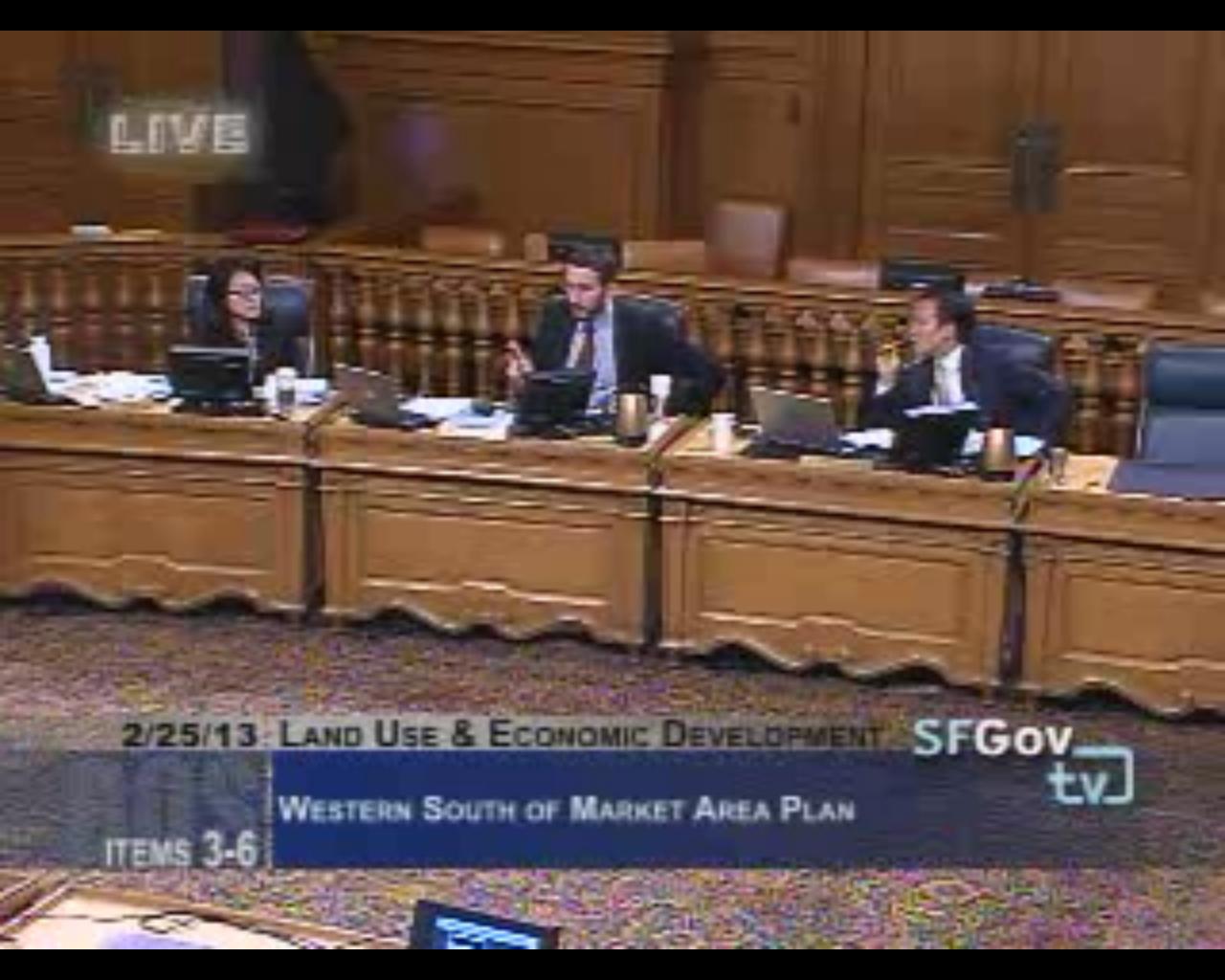
The Western SoMa Community Plan had its first hearing before the Board of Supervisors Land Use and Economic Development Committee today, with dozens of speakers praising the eight-year citizen-based planning effort that developed it but with much of the testimony criticizing the plan’s emphasis on facilitating housing development to the exclusion of other goals.

As we’ve reported, the nightlife community has in recent months been pushing for changes to the plan that would better protect nightclubs from complaints and pressure from nearby residents, particularly along 11th Street. Area Sup. Jane Kim has supported that effort and those concerns were echoed by Sup. Scott Wiener, the committee chair and a strong nightlife advocate.

“I have had significant concerns about this plan…and I’m hoping we can address them over the course of this hearing,” Wiener said.

Wiener also opened another front of attack on the plan by noting that it doesn’t adequately pay for the impact that thousands of new housing units would have on Muni and other aspects of the transportation system. In particular, he criticized a policy in the plan that would let 13 large properties get increased density in exchange for higher affordable housing fees that would be offset by lower transit and other impact fees paid to the city.

“What are we doing to make sure our transportation system keeps pace?” Wiener asked of Planning Department staff, later asking again, “Where would we get the money to improve transit for these increased residents?” Wiener didn’t get back any answers that seemed to satisfy him, so he asked for a more detailed report when the plan returns next week for a second hearing. That concern was echoed by the third committee member, Board President David Chiu, who said, “Building housing without money for transit will lead to long-term problems.”

The concern seemed to revive a losing fight that Wiener led in December over expanding who pays the city’s Transit Impact Development Fee, which pitted transportation advocates against affordable housing activists. Fernando Marti of the Council of Community Housing Organizing rued the revival of that conflict. “We’ve been here before, pitting [transportation against affordable housing needs] as if it were a zero sum game,” Marti told the committee, noting the importance of policies to balance out market rate housing and calling it a “plan for stability in a neighborhood facing large-scale gentrification.”

Marti’s COCHO colleague Peter Cohen, who was closely involved with the plan’s creation, also urged the committee not to tweak the housing policies or the revenues it creates for affordable housing. “This is a major upzoning,” Cohen said. “In 20 years, perhaps all the market rate stock [of housing in the plan area] will be gentrified.”

But the issue raised most often during more than two hours of public testimony involved nightlife and the need to strike a better balance between housing development and entertainment, much of the input stirred up by the California Music and Culture Association, a industry-backed trade group that formed largely in response to crackdowns on clubs in SoMa.

“It’s often said San Francisco can plan more for fun, and this is a great opportunity to do that,” said Guy Carson, a CMAC founder who owns Cafe du Nord. Longtime nightlife advocate Terrence Alan took part in the Western SoMa Task Force for four years before resigning in frustration, and he told the committee, “We are bringing up issues we felt marginalized in bringing up earlier.”

But several people involved with the task force, as well as speakers representing development interests, urged supervisors to pass the place without significant modifications. “There are dozens or hundreds of compromises in this plan,” Cohen said, urging supervisors not to upset that careful balance.

Task Force Chair Jim Meko – whose leadership was widely praised in the testimony – detailed the extensive outreach and detailed work that went into the plan, and offered a simple plea to the committee: “Please pass this plan so we can get on with our lives.”

The committee unanimously voted to support the change made to the plan by the Planning Commission to ban new residential development on the raucous 300-block of 11th Street, but to reverse the commission’s decision to grandfather in one final 24-home residential project on that block, in the so-called “purple building” at 340 11th Street. A number of other small changes to the plan were also unanimously approved.

But Kim objected to Wiener’s motion to eliminate the plan provision that would reduce the transit and open space fees and raise the affordable housing fees that developers of those 13 large parcels would pay. “I don’t think it’s good policy to reduce transit impact fees when we’re increasing population,” Wiener said.

“This has gone through an extensive community process,” Kim countered, adding that, “I hate that we’re always having this discussion about transit versus affordable housing.”

But Chiu sided with Wiener and the amendment was approved on a 2-1 vote with Kim in dissent. Yet Chiu held open the possibility of changing his mind next week when the plan returns to committee for a final vote – the delay prompted by the other revisions in the plan – when Planning staff will provide more information on the fee structure and its impacts.

If the committee gives final approval to the plan next Monday, it could be before the full board for approval the next day.

Staff of shut-down Mission dispensary opens SoMa’s newest cannabis club

1

Today was the grand opening for a new dispensary just steps from the front door of Mezzanine and right down the block from a rapidly-changing Sixth Street. Long-time medical marijuana patients may recognize some familiar faces — Bloom Room employs many of the staff and management from Medithrive, the Mission Street dispensary was was forced to close “for the children” back in November of 2011.

“I was the manager of a store, and then I was the manager of a delivery service,” Bloom Room manager Stephen Rechit tells me, sitting in the dispensary vaporizing lounge area. When federal government agencies informed the cannabis club that it was too close to Marshall Elementary School, Medithrive switched to a $50-minimum, delivery-only service that owners continue to operate. 

The Bloom Room’s open for business, with space for on-site vaporizing steps from the cash register

Did Rechit — who says he became Medithrive’s first employee as a new University of San Francisco graduate — consider a career change in the face of unyielding federal agents? Not for a second. 

“I know this is definitely what I want to do,” he reflects. “I just really — I don’t want to get cheesy, but I believe in the plant.”

>>THROUGH MARCH 1, NEW BLOOM ROOM PATIENTS GET A SAMPLER OF THREE MARIJUANA STRAINS WITH ANY PURCHASE OF $50

Bloom Room’s downtown design, with its exposed brick walls and translucent glass marijuana leaf panels reappropriated from the defunct Medithrive storefront, may be the perfect fit for a Sixth Street neighborhood that’s on a definite upward economic swing. Rechit points out the window to the corporate offices of Burning Man, perched atop a skyscraper alongside the rest of the Mid-Market buildings that tech tenants are filling up. Burning Man’s been an earlier contributor to Bloom Room’s “Community Corner,” a space for neighborhood fliers, business cards. 

Bloom Room plans to stock six to 10 strains each of indicas and sativa, and sells blackberry chocolate bars from Kiva, Auntie Dolores caramel corn, and oen of Rechit’s favorites, TerpX concentrates. 

Sticky: TerpX concentrate

“TerpX is like the Girl Scout Cookies of last year,” Rechit comments, unrolling a piece of waxed paper so I can check out the golden goo. 

As we chatted, Tenderloin resident Jim Murray (who, happily, bore a striking resemblance to Bill Murray in The Life Aquatic in his navy beanie) pulled up in the narrow, tall table to inquire about the availability of the clould of OG Kush pumping into the vaporizer bag between Rechit and I. 

I’d seen Murray complaining about the quality of Bloom Room bud he’d picked up previously, and now he was interested in the “toast,” the spent flower already used in the vaporizer that was sitting on a piece of paper in the ashtray. 

“The reason why I’m sensitive to this is because I am a senior living on a VA pension,” he informed me. “What compassionate care programs do you have here?” he asked Rechit. 

FYI, Rechit says the dispensary gives away free product to patient on holidays and keeps prices low in general. Back when Medithrive’s doors were open at its Mission Street location it made monthly donations to the school around the corner that was eventually used as the excuse by the federal government to shut it down. Let’s hope Bloom Room has more luck in its new SoMa spot. 

Bloom Room, 471 Jessie, SF. (415) 543-7666, www.bloomroomsf.com

Plan C, and the C stands for Condo conversions

229

No politically savvy San Franciscan has ever really bought the rhetoric espoused by the so-called “moderate” political action group Plan C that it’s all about finding middle ground between what its website calls “a ‘downtown’ machine, and a far-left, dogmatic, so-called ‘progressive’ machine.” As if that unbalanced labeling wasn’t enough of a indicator, the fact that its funding comes from all the biggest cogs in the downtown machine should be.

But now, as the group’s members aggressively work to open the flood gates on converting San Francisco’s rent-controlled apartments into privately controlled condominiums, it’s become more clear than ever that the C stands for Condo and that the financially motivated group is moving the agenda of the real-estate and investment interests that dominate its Board of Directors.

City Hall sources connected to the ongoing meetings that Sups. David Chiu and Mark Farrell have been holding with stakeholders on the controversial condo lottery bypass legislation sponsored by Farrell and Sup. Scott Wiener say there were indications of possible compromise that came out of the first mediation meeting.

That one primarily involved the tenant advocates who have led the charge against the legislation and the representatives for tenancy-in-common owners seeking to buy a bypass to the city’s condo conversion lottery that only allows 200 new condos per year. There were whispers that came from that meeting of a compromise that would allow a one-time bypass in exchange for shutting down the lottery for several years, or indexing it to the construction of new housing for low-income San Franciscans.

Since then, the sources say, Plan C and their partners in the real-estate industry have dominated the meetings with their dogmatic advocacy for indefinitely allowing the maximum number of condo conversions. Despite public statements by Farrell and Wiener that they just want to clear out some backlog without encouraging more landlords to convert apartments to TICs in the future, Plan C just wants to feed more affordable apartments into the expensive real estate market.

Some basic research on the group and its Board of Directors seems to show that this position is about financial self-interest rather than values or ideology.

Plan C Co-Chair Steve Adams is a regional manager for Sterling Bank & Trust, which has consistently been one of the city’s top TIC lenders and which recently sponsored a forum encouraging more conversion of apartments, promising to increase its loan volume, and painting a rosy picture of the TIC financing market that belies Wiener’s claims that TIC owners can’t get financial relief and need the city’s intervention.

One of the key presenters at that symposium was TIC attorney Lyssa Paul, who is also a Plan C board member and someone who makes her living creating more TICs. Other members of the 12-member board who make their living in the real estate industry and benefit directly for TICs conversions are Amanda Jones and Brian Hecktman. Other bankers or investment managers on the board that benefit from the TIC business are Ashley Lyon and Bob Gain.

Co-Chair Mike Sullivan is a venture capital attorney who created Plan C in 2001 and used it to help then-Sup. Gavin Newsom sell his Care Not Cash homelessness plan and run for mayor. Randy Brasche is in software marketing and got involved in the issue being frustrated with the condo lottery and [[CORRECTION/DELETION: last year]] forming the San Francisco TIC Coalition.

Board member David Fix is [[CORRECTION/ADDITION: the former]] president of the Small Property Owners of San Francisco, so it’s possible that his interest is as much ideological as financial, particularly given his past public statements against rent control. That may also be the case with Baha Hariri, a principal at A&F Properties and the former political director of the downtown-funded-and-created Committee on Jobs.

Among the downtown players that fund Plan C, which was sitting on $73,872 in the bank as of the start of this year, are the Committee on Jobs, the San Francisco Association of Realtors, PG&E, San Francisco Apartment Association, Small Property Owners of San Francisco, Shorenstein Realty, the San Francisco Chamber of Commerce, and venture capitalist Ron Conway.

So Plan C appears to be little more than Plan A’s deceptive effort to push Plan Condo. BTW, I’ve been waiting more than 24 hours now to get a call back from the Plan C board, after leaving a message with its only paid administrator, Richard Magary, who told me Sullivan and his colleagues are all quite busy now. But I’ll be happy to update this post if and when I hear back.

2/22 UPDATE: Still no call back from Plan C, but Fix made a comment requesting the two minor corrections above. C’mon, Plan C, gimme a call, what are you so afraid of?

Cell phone petition gets 100K signatures

2

A San Francisco entrepreneur’s petition to allow consumers to unlock their cell phones has gathered more than 100,000 signatures, and now the White House will have to offer an official response.

Sina Khanifar, who runs opensignal, has been pushing to overturn a recent ruling allowing cell phone companies to prevent people who want to switch carriers from changing the firmware that controls the device.

The campaign to convince the Obama administration and Congress to overturn the ridiculous ruling continues here.

Look for a quick decision on D4 appointment

44

A Democratic Party resolution calling on Ed Lee to appoint a mother to the Board of Supervisors may have driven the slow-moving mayor to fill the seat of departing Sup. Carmen Chu quickly, perhaps as soon as today (Feb. 21), City Hall sources are saying.

Lee appointed Chu to fill the post of Assessor-Recorder vacated when Phil Ting moved to the state Assembly. But he’s been dragging his feet on naming Chu’s replacement.

Alix Rosenthal, a member of the Democratic County Central Committee, has put a resolution on the agenda for the group’s Feb. 27 meeting urging the mayor to name a woman with a family. Her argument:

Political office is often beyond the reach of mothers, because balancing a political life with family and work is often an insurmountable challenge.  Appointing a mother to fill the District 4 seat will demonstrate the Mayor’s commitment to stemming the tide of families leaving San Francisco, and it may serve to inspire women with children to be politically engaged, and to run for office themselves in the future.

That, of course, could put the mayor’s allies on the DCCC in a tough situation. Will they vote to urge the mayor to do something he doesn’t want to — or will they vote against, you know, motherhood?

Of course, if the mayor makes an appointment before Feb. 27, the resolution becomes moot.

Rosenthal and some other politically active women are supporting Suzy Loftus, a member of the Police Commission and a mom. But D4 is more than half Asian, and has always had an Asian supervisor, so it’s unlikely the mayor would appoint a non-Asian to the job.

One obvious candidate: Katy Tang, who is now Chu’s legislative aide.

The mayor will want someone he can count on as loyal — and who he’s pretty sure can win an election. His last two appointees to elective office, Christina Olague and Rodrigo Santos, were both defeated the first time they faced the voters.

But at this point, Lee isn’t saying anything. Look for an announcement soon.


SF aims for the history books, filing its same-sex marriage brief with the Supremes

10

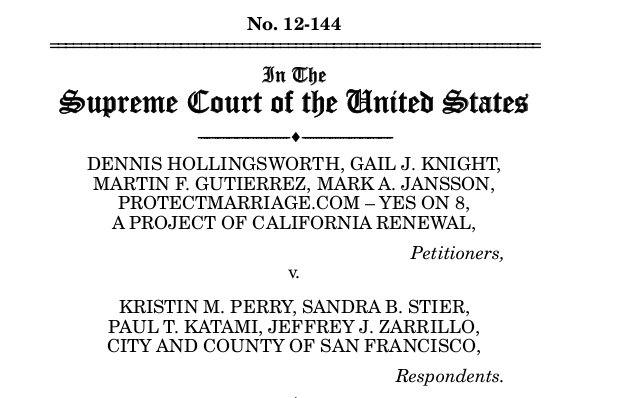
San Francisco City Attorney Dennis Herrera and his legal team today submitted written arguments to the US Supreme Court in the landmark same-sex marriage equality case it will consider this spring, with the hopes that their phrases and framing of the issue will be echoed in a civil rights ruling that could go down in history.

He argues that Proposition 8 – the California ballot measure that undid the California Supreme Court ruling legalizing same-sex marriage in a case that grew out of San Francisco’s unilateral decision to start marrying lesbians and gay men in 2004 – was unconstitutionally about “asserting the inferiority of same-sex couples….But relegating gay couples to a lesser status simply to brand them as different and less worthy than opposite-sex couples is not a legitimate purpose.”

Herrera, Deputy City Attorney Therese Stewart, and the rest of the city’s legal team also take up the notion of the “tyranny the majority” (which I explored in an earlier Guardian story on the issue) in their brief, arguing: “Petitioners’ argument derogates the most important role this Court serves in our democracy: to protect the constitutional rights of minorities from encroachment by an unsympathetic majority. The responsibility to protect individual rights does not transfer to the political process when the dispute happens to be ‘controversial.’  Quite the contrary.  In this circumstance more than any other, constitutional rights ‘may not be submitted to vote; they depend on the outcome of no elections.’ West Virginia State Bd. of Educ. v. Barnette, 319 U.S. 624, 638 (1943).”

Will the Supreme Court justices borrow any of these words or ideas in their ruling, as they sometimes do in such cases, placing them in history books alongside phrases such as “separate but equal is inherently not equal,” from the 1954 Brown v. Board of Education ruling ending racial segregation, which echoed the 1896 Plessy v. Ferguson ruling that it overturned?

Herrera told us that he couldn’t help but feel that sense of momentousness as he finalized the brief: “You have a sense as to the importance of what you’re working on, and that certainly has an impression on you.”

But he also said that he’s continually had that sense through this “long struggle,” during which he said that he’s remained focused on the LGBT community that he’s fighting to protect. “It’s been frustrating when you see how some folks perpetuate the discrimination that’s gone on too long,” he told us, adding that “to finally see it come to the Supreme Court is momentous.”

And Herrera said that he does hope the Supreme Court issues a broad ruling that finally settles this issue and removes the question of same-sex rights from the political realm and deems them to be an issue of equal protection under the law. “They’ve asked the court to abdicate its responsibility because same-sex marriage is controversial,” Herrera told us, arguing that’s why the Constitution offers equal protections to all citizens, regardless of the passions or societal biases of the moment. “Those constitutional rights are not subject to majority rule.”

You can read city’s full 62-page legal brief here.


Which Noise Pop show is right for you?

0

It’s all about choice, people. Noise Pop is a well-oiled festival machine at this point — now in its 21st year — cranking out dozens of concerts, nightlife happenings, film screenings, culture club events, photography showings, and all that good stuff we’ve come to expect from the homegrown indie fest. But given all those choices for the week of Feb. 26 through March 3, restless souls such as myself always tend to feel a bit well, overwhelmed.

Do I see headliner Toro Y Moi at one of his Independent showcases, or DIIV at Brick and Mortar Music Hall? (Shouldn’t matter much to most; those are all super sold out by now.) Do I squeeze in a Noise Pop Happy Hour after work, before the cozy Sonny and the Sunsets Bottom of the Hill concert or Kim Gordon’s new project, Body/Head at the Rickshaw Stop? How much is too much booze for one week? I can’t answer them all for you (if you want to see a sold-out show, buy a fest badge), but I can help with those pesky last-minute questions that boil down to which show to choose over another, equally appealing event.

The infographic flowchart for this appeared in this week’s issue (pg. 20 of the Feb. 20 Guardian), but for these purposes, I’ll hook you up with a video for each:

Interested in live music? Are you a “members of” type of fan? Do you prefer distorted guitar?
Answer: Kim Gordon’s newest venture, Body/Head. Body/Head is the newest post-Sonic Youth project for Gordon, who teams up with free-noise guitarist Bill Nace to create noisy experimental mindfucks such as single “The Eyes, The Mouth.”
https://www.youtube.com/watch?v=cQ4axZa5ZFo
With Horsebladder, Burmese, Noel Von Harmonson
Feb. 26, 8pm, $17
Rickshaw Stop
155 Fell, SF
www.rickshawstop.com

Are you a “members of” type of fan? Do you prefer analog synth?
Answer: Jason Lytle of Grandaddy. The Modesto-born Grandaddy frontperson and singer-songwriter most recently released heart-tugging solo work, Dept. of Disappearance (ANTI-, 2012).
https://www.youtube.com/watch?v=M0yMQCcU6NY
With Jenny-O, Will Sprott, Michael Stasis
Feb. 26, 7pm, $14
Brick and Mortar Music Hall
1710 Mission, SF
www.brickandmortarmusic.com

Do you like to keep it local? Do you only go to shows if they are free?
Answer: Noise Pop Happy Hour with Golden Void, Wild Moth. San Francisco psych band Golden Void and local post-punk act Wild Moth (check out 2012 EP Mourning Glow, on Asian Man Records) are both acts to know now.
https://www.youtube.com/watch?v=yJC3u_COifo
With DSTVV
March 1, 5pm, free
Bender’s
806 Van Ness, SF
www.bendersbar.com

Do you like to keep it local? Are you willing to spend a nominal sum on live music?
Answer: Sonny and the Sunsets. By now, the band, led by prolific artist-musician Sonny Smith, is a go-to classic for quality SF garage-pop. And yet, last year’s Longtime Companion (Polyvinyl) pumped up the twang.
https://www.youtube.com/watch?v=rbctzd9kW1A
With Magic Trick, Cool Ghouls, Dune Rats
March 2, 8pm, $12
Bottom of the Hill
1233 17th St., SF
www.bottomofthehill.com

Can you get into some ’90s slow jams?
Answer: XXYYXX. Woozy XXYYXX is the creation of 18-year-old Orlando, Florida producer, Marcel Everett, whose beat-driven Relief in Abstract albums, have gotten props from the likes of Kardashian baby momma/Kanye West and the like. Our very own DJ Dials brings the wunderkind West.
http://www.youtube.com/watch?v=lG5aSZBAuPs
With DJ Dials, Teebs, Nanosaur
Feb. 28, 9pm, $25
DNA Lounge
375 11th St., SF
www.dnalounge.com

Extra credit:
There will be a feature story on Noise Pop 21 headliner Toro Y Moi in next week’s issue (Feb. 27). He’s playing two sold out shows at the Independent (March 1 and 2). 
http://www.youtube.com/watch?v=O0_ardwzTrA

And if you’re able to attend any of the other ticket-less shows, there’s also this great one:
Post-punk Beach Fossils side project DIIV, recent On the Rise act Wax Idols, Sisu (fronted by Sandy of Dum Dum Girls), and Lenz.
http://www.youtube.com/watch?v=L702zw6Ilqs
March 2, 8pm, $15 (sold out)
Brick and Mortar Music Hall
1710 Mission, SF
www.brickandmortarmusic.com

The World’s Best Artist©: Getting weird with Mitch O’Connell

0

Can you guess which of the 290 pages of Mitch Connell‘s jampacked new, puffy-covered-like-cheap-tablecloth art anthology he is most proud of? It is not the vaguely seedy Hanna Barbera art, commissions all for Warner Brothers that were never utilized commercially. It’s not the illustrations for porno mags, the public works benches in Chicago, several Newsweek covers, untold numbers of event flyers, or his late-1980s pop art aerial views of reclining women hoisting hot dogs.

It’s the crazy shit he drew after he discovered his wife had been chronically cheating on him. You thought the rest of it was wacky!

But hoist a copy of Mitch O’Connell: The World’s Best Artist — you should, it’s awesome — and there’s no telling where you’ll get lost amid the artist’s decades of work. The book is a (puffy-covered) homage to an insane career of drawing and illustration, accomplished by a man (PS, not this guy) who has managed to raise a family on his skills while steadfastly pushing the bounds of good taste. The Chicago-based artist is coming to the Bay Area tonight (Thu/21, Berkeley) and tomorrow (Fri/22, San Francisco) for book tour dates. If you like insane, and talent, and professionally insane talent, you’ll most likely be there. 

We email-interviewed him, to talk.

SFBG: You did a few series of drawings for Warner Bros., how on earth did that come about? What was your highest hope for that collaboration?

 Mitch O’Connell: After doing this drawing thing forever, it would be hard NOT to accumulate a long list of clients. If I hadn’t, I’d be writing this from my cardboard box estate situated on the sidewalk of Michigan Avenue.

I’ve done little bits and pieces for Warner Brothers over the years, working with art directors who must have just seen my art here and there, but the “Hanna Barbera” series was the most fun and involving. I think I pushed a few of the paintings into PG-13 territory, but they encouraged me to be irreverent. Which might not have been a good thing. Once they got the finished art and started pondering how it might look on a kid’s lunchbox it seems they rethought their initial enthusiasm and put the job on the shelf. Where it’s still collecting dust. But I still like ’em!

Your next lunchbox

SFBG: You’re favorite and/or most disturbing tattoo you’ve done?

MO: ALL the tattoos I actually tattooed into peoples flesh were disturbing. Mostly because the clients kept on squirming, screaming, and bleeding. How the hell am I supposed to get any work done with those type of folks?! Actually, now I’m just sticking with simply designing the tattoos, and leaving the actual permanent engraving to the professional tattooists. It was much too nerve-wracking trying to get the art right the first time. As for my best ones, I’m working on my fourth set off flash [ink newbs: “flash” refers to the 11″x14″ sheets of sample ink that hang in tattoo parlors] now, and I like how it’s turning out the best of all. But I’m biased. Tattoo shops, start clearing some room on the walls!

SFBG: How long did your “covering up the naughty bits” gig for Fox Magazine last?

MO: The Fox mascot will hopefully be on the cover blocking out nipples and vaginas as long as there’s a Fox magazine. I did the painting a dozen years ago, it’s all up to them where/when/how often it appears. The more the merrier!

SFBG: Besides its puffy cover (please explain that feature) what are you most proud about with this book?

MO: The graphic design work of my pal Joseph Allen Black (yes, that would be www.josephallenblack.com). He took my rough placement of where I wanted everything and made it look stunning. Think of me as the guy who delivers the 4000-pound block of marble to Michelangelo. As for the puffy glittery cover, a) I loved the look, and b) wanted my book to stand out from the millions of others. At least I’ll have a better chance of folks actually picking it up out of curiosity. Then, considering what’s inside, the better chance of them putting it back.

I kid! They’ll LOVE it!

SFBG: Advice for aspiring freelance illustrators?

MO: Try to be more creative, distinctive, easy to work with, and talented than anyone else. Sadly, you’ll never be able to be the best, because I’ve already copyrighted it.

SFBG: We must know: What does makes you the World’s Best Artist?

MO: One reason was that no matter who reviews it, they have to use the title [of the book]. That way if the opinion is “Mitch O’Connell the World’s Best Artist sucks!” I can turn that into “‘The world’s best artist!,’ raves the New York Times!”

Also, if you keep on repeating something, at some point folks might start falling for it. Think “weapons of mass destruction,” “trickle down economics,” and “guaranteed to add inches to your penis!”. And I’m STILL waiting for my money back!

Mitch O’Connell: The World’s Best Artist book tour

Thu/21, 7-9pm, free

Pegasus Books

2349 Shattuck, Berk. 

www.pegasusbookstore.com


Fri/22, 7-9pm, free

Mission Comics and Art

3520 20th St., SF

www.missioncomicsandart.com

Pressure, two ways: Academy of Art and Project Runway at NY Fashion Week

2

While hyperbolic coverage of what many news pundits called the ‘storm of the year’ raged across the Tri-State area, Manhattan’s would-be-mammoth blizzard arrived in the Big Apple as a pint-sized flurry that the Weather Channel dubbed Nemo. Nemo did little to deter the stilettoed, snow-shoeing pack of fashion-forward who started the morning of Feb. 8 filing into the tents at Lincoln Center for New York Fashion Week hullabaloo around 6 am.

This is the world of fashion, where a steel backbone is required. Plus, “this is New York, we have noreasters,” said a publicist with whom I scored post-show beers. “This is not a some kind of apocalypse blizzard. This is a snow storm. Put on your big girl boots and get over it.”

The action outside the white-tent runway shows of NYFW has become something of a spectacle recently thanks to the hyper-documentation of show attendees by bloggers, fashion journos, and Instagrammers. The evolution of the street scene has become almost as hyped as the collections themselves — outside-the-tent has converted into a place where writers, buyers, and industry professionals rub shoulders with blogosphere self-starters and editorial wanna-bes. Once you’ve crossed the threshold, however — moved past security and secured your seat — the herd thins out. Inside the shows, attention shifts from the amateur peacocking out front onto the belabored fashion lines themselves.

I attended two shows on February 8 — Project Runway‘s, and that of my Bay Area peers from the Academy of Art University. 

Project Runway: Lacking any true designer start that has emerged from this TV series, the jury is still out on whether reality show competition breeds success or mediocrity. Regardless of who will sink or swim in Project Runway’s 11th season, fierce competition certainly yielded entertainment at NYFW.

Usually by Fashion Week, the Project Runway panel — composed of designers Michael Kors and Zac Posen, fashion editor Nina Garcia, and supermodel host Heidi Klum — has winnowed competitors down to the final three. This season, NYFW crowds were treated to the work of seven. The normal Project protocol was thrown to the wind, each designer remaining anonymous, a move that forced them to compete solely on the strength of their garments, without the crowd bias based on on-air personality.

Fashion is an exhibitionist’s sport, but flashiness is not always effective when it comes to style. Some collections at the show came out swinging, trying too hard to define a point of view. Others showed up more quietly, using complicated shapes and silhouettes without appearing self-indulgent. Most resisted the urge to disguise imperfect results with fluff. Michelle Lesniak Franklin’s collection hit the highest note, with several structured pieces rendered in soft quilted fabric, giving way to an ethereal easiness. It appeared elfin or even Zelda-esque, but retained it’s modernity in the silhouette and layering. She took the road less traveled, mixing 1980s-inspired jacket shapes with earth tones, rendering their severe structures soft in wools and knits.

In short, the show was a mixed bag, and no one went home a true winner.

Academy of Art University:  Pressure is an odd catalyst. Some respond to it favorably, combining time and tension to yield extraordinary results. For others, pressure works against success, internal combustion evident in the resulting design.

Where Project Runway’s contestants are forced into a pressure cooker for 12 weeks to design, shop for, sew, and style their collections, San Francisco Academy of Art University students are incubated in a better-paced program. Here, years of planning and months of preparation produce the impressive work that the school has come to be known for. These student-designers are not working for cheap airtime or a bump in ratings for their network television handlers, but instead are putting in the hours of work for genuine academic recognition, fashion futures the old-fashioned way.

As an Academy fashion journalism student myself, I have witnessed the rigorous, extremely exhausting, but equally rewarding process firsthand. In last weeks leading up to the end of the semester, there is a pronounced hush in campus design studios, the only audible noises come in deep hums of the sewing machines, the incessant clicking of mechanical needles, and the hissing of industrial-grade irons. Each student, earbuds in, rips, measures, presses, tapes, pins, and repeats. One feels guilty even walking past such determination on the way to the bathrooms, so intense is the creative process.

This year, the collections from AAU’s multi-national student body were marked by a range of culture fusions. The show’s focal point was the visual negotiation between student, fabric, form, and heritage.

The runway sequence ebbed and flowed between moments of sparse minimalism, as in Yuming Weng ‘s simple monochromatics and plays on texture and structure, in Chenxi Li’s over-sized crushed velvet coats, rendered unique by combining elements of ‘50s Americana with traditional Chinese armor. Knitwear student Heather Scholl’s sexually charged, gender-explorative neon psychedelics stalked the lane.

Stand-out collections included show openers Janine M. Villa and Amanda Nervig’s marriage of tailored suiting and free-falling knitwear, which gave the rigid geometric patterns that adorned both fabrics fluidity, and embued the suiting with an astonishing sense of movement. Inspired by traditional Welsh blankets, Villa and Nervig’s work felt eclectic and free-spirited on the runway, the print-on-print combinations of chunky knits and embellished tailoring gave the collection an exciting and unexpected visual depth.

Heather McDonald took taut silhouettes to new heights with soaring shapes that defied gravity. These exaggerated forms were rendered in deeply-saturated angoras and wools, which brought the avant-garde down to earth. The final act was perhaps the most impressive. Qian Xie’s crystal-encrusted coat dresses and lattice-woven leather overcoats followed her apt theme “50 Shades of Grey”, and the results were lust-worthy.


The Performant: Love bites

0

Celebrating romance with power ballads, Spandex leggings, fancy panties

Although there are about 364 days of the year when I can do without it—one day of the year seems custom-made to celebrate the ignoble rise of hair metal and its greatest contribution to the musical landscape — the power ballad. From “Love Bites” to “Is This Love,” “(I Can’t Live Without) Your Love and Affection,” to “The Power of Love” — all the saccharine sentiment of brooding, pouty millionaires in ripped jeans, tight leather, and all those glorious manes — power ballads can and probably should form the soundtrack to Saint Valentine’s Day now and forever. They so perfectly tap into both the cynicism of the single person facing “the dread VD” alone, as well as offering a soaring guitar-solo boost to the cuddly nostalgia of the happily coupled.

While innamorati for hundreds of years have used February 14 as a date to shower their beloved in flowers and cards, Jeff Ross and the SF IndieFest team have used it as another excuse to party, with an annual Power Ballad Sing-along at the Roxie Theatre. Just three years after its San Francisco debut (a similar party tears it up each year in Brooklyn), PBS pours its sugar and motors through the packed house, screening subtitled MTV videos turned up to 11 of all the best bands you’d love to forget to a theatre full of eager inebriates, cutting loose in a veritable bacchanalia of communal song.

If you’re lucky enough to squeeze into the perpetually sold-out event, you’ll be handed a lighter at the door, the essential prop of the power ballad lover and although no extra credit points are handed out for costumes, this being San Francisco, plenty of people do show up in them. Spandex leggings, ripped stonewash denim, studded wristbands, and plenty of Aquanet. One enterprising soul even comes dressed as Slash — right down to the guitar — a handy prop during the obligatory screening of Guns ‘N Roses’ nine-minute orchestral dirge “November Rain”.

Unlike a karaoke night full of awkward people who have to be cajoled into singing at all, let alone bellowing REO Speedwagon songs at full volume, a sing-along allows everyone to a) hide in the dark and b) therefore sing with the full confidence that almost everyone around them sounds even worse than they do, especially after the effects of cheap whiskey and rampant silliness settles in. It’s about as egalitarian as it gets, and even though this year’s blowout was marred by technical difficulties, my sorrow at missing out on the ultimate elation of singing “You Give Love a Bad Name” en masse couldn’t spoil the gleeful satisfaction of mangling an otherwise extensive playbook of all the worst bands with the best hair: Def Leppard, Cinderella, Whitesnake, Journey.

Meantime, just up the block at the Little Roxie, Liz Worthy’s window display aka “Heist Boutique” offers a poignant love letter to the ever-changing landscape of the Mission district via a few carefully-curated *objets d’art* used to represent a psychogeographical survey of “old-school” Mission businesses taken over by others in recent years. There’s the Self Edge VHS tape (asking price $714, in honor of the address), commemorating previous tenant and nostalgic favorite Leather Tongue video store (represented cheekily by a pair of red jeans), a pair of Modern Times sunglasses ($888) named for the bookstore that until recently inhabited the space where Fine Arts Optical now resides, a Wang Fat Fish Market bikini in turquoise and red ($2199) honoring the fish store of yore, (now Zoe Bikini). The display will be up until at least the middle of March, so swing by soon to relive your own fond memories of a Mission gone by. It may be too late to hang out at the Café Macondo or Jivano’s Cutlery, but, like the power ballads of the past, it’s still not too late to reminisce about them awhile.

Why do cops use hollow-point bullets?

100

A Board of Supervisors committee will tomorrow (Thu/21) consider a pair of proposals to regulate the sale of ammunition in San Francisco. And while the legislation is all but certain to pass – gun control is always popular in San Francisco, even when it has minimal impact – one of the measures raises some interesting questions about our understanding of the purpose of deadly weapons.

Sponsoring Sup. Malia Cohen and Mayor Ed Lee held a press conference in December, shortly after the horrific shootings in Newtown, Connecticut, announcing proposals to require notification of the San Francisco Police Department when someone buys 500 round or more of ammunition and banning “the possession or sale of law enforcement or military ammunition.”

The latter measure concerns the sale of hollow-point bullets that are designed to expand after entering the bodies of their targets, which General Hospital Dr. Andre Campbell told those assembled at the press conference “create absolute devastation in the victims. When they strike a victim it’s like a bomb going off.”

So why do we let police officers use them? After all, while officers are instructed to shoot-to-kill when firing their guns, do we really need to make extra sure that those hit by police bullets die? I’m sure the families of the long list of people shot by police who are at most guilty of less than a capital offense — let alone innocent victims of overexuberant policing — might disagree with that approach.

Well, one reason that law enforcement sources cite for their use of hollow-point bullets is that they tend to stay in their targets, thereby reducing collateral damage from bullets exiting a victim and hitting someone else. Fine, but doesn’t that same logic also apply to criminals shooting at rivals in the street? Isn’t it better for their intended target to suffer more damage if it might save other innocent bystanders?

Incidentally, the use of hollow-point bullets was once recognized as a war crime, banned under the Hague Convention of 1899, precisely because of the extra damage they inflicted on human bodies. But now, San Francisco seeks to protect them for cops but ban them for citizens, which certainly seems to violate the spirit of the Second Amendment and intent of allowed an armed citizenry to stand against police state tyranny.

The board’s City Operations and Neighborhood Services Committee takes up the measure starting 10am in City Hall Room 263.