San Francisco

9 innings, 20 years

3

le.chicken.farmer@gmail.com

A giant hawk swooped down from the tall trees along the right field line. Against the blazing white San Francisco sky, it seemed all wing span and tiny-headed. And jaggedly, viciously beautiful.

The pickoff play was on.

Greg Snyder, caught completely off guard, dove back to third. Lucky for him, third-baseman Johnny Bartlett was also caught off guard, and the throw glanced off his glove and rolled to the chain link fence in front of the third base dugout, West Sunset Playground.

So I guess that means the pickoff play wasn’t on. Except in the pitcher’s mind. And maybe the hawk’s.

Eskimoed inside my furry-fringed corduroy coat in the stands, I watched with the hawk as Bartlett retrieved the ball. Snyder, with no thought of advancing, knelt on third base and looked at his fingers. The first joint of his right pinky was bent away from his hand at an unnatural angle. He’d jammed it on the bag. First Bartlett, then Sean Paul Presley, the pitcher, came over and had a look, and both turned away, wincing, while Snyder calmly torqued it back into place.

Then, yeah, the game went on.

When we talked later, in the stands, top of the seventh, Snyder had the pinky taped to the ring finger of his throwing hand with a thin strip of dirty white tape.

“Can I get you some ice?” I said.

He said, “Nah.”

“I have ibuprofen,” I said, reaching into my purse.

“No thanks,” he said. “I have some in my car.”

But I never saw him get it. Although he had pitched the first few innings for the visiting team, by the time of the finger thing, he was catching. And continued to catch — six more innings, to the end of a wacky, back-and-forth, 11-inning game.

In the bottom of the tenth, he threw out a runner trying to steal second.

Greg Snyder is 47 years old.

Carter Rockwell, 24, picked up the win in relief, and also hit a home run off his older brother, Will.

Doc Magrane, 69, did not play. But not because of age. He and chemo have recently whipped a little bone cancer into complete remission. He still suits up for pick-up games, puts on some of the extra catchers’ gear, and umps.

Tony Rojas brought a sweater for his dog, Dee Dee. He showed me before the game: black with white skull and crossbones.

“Nice. Does she like it?” I said.

“No,” he said. “She hates it.”

The sweater went on and came back off of Dee Dee, and then she started to shake and shiver and Rojas became worried, which affected his play. He threw high to first, swung at bad pitches . . . had she gotten into something? he wondered.

“We could use a field ump, too, you know,” Doc Magrane called out to me, between innings.

I didn’t know yet that I was a sports writer.

“No thanks!” I hollered back anyway.

It’s been twenty years now since the Mission Baseball Club, as it has come to be called, started. Maybe 21.

In 1992 (or 3), four or five Mission District musicians and poets, myself included, gathered at Jackson Field at the foot of Potrero Hill one day a week to play catch, field grounders, and take batting practice.

Six or seven, eight . . . Once there were nine, we could split into threes and play tiny three-way games, with right field foul and “imaginary runners.”

At twelve we opened right field, and any more than that meant we could have a catcher, so we bought some catchers’ gear.

For a few years there in the mid-90s, the Mission fielded a team in the city’s Roberto Clemente League. We were a ragtag crew, and the only team in the league with women on it. No one asked. We just did it.

Twenty years later: this. Eye black and uniforms. Field reservations. An umpire. As it turns out, a reporter . . . Two teams of 11, arbitrarily decided, share one dugout each week. And the range of play varies. Widely. Some have played college ball. One played in the minors.

Jen Ralston (a.k.a. Hedgehog, a.k.a. my Hedgehog), who at 42 is playing the first baseball of her life, lined a two-strike curve into shallow center: her first hit ever. I asked for the ball.

Eventually she came around to score, and commented later, over fish, that the bases had been softer than she’d expected.

“Are they always like that?” she said.

I said that they were.

The right to transgender health care

23

OPINION When I first came out as a transgender man in the mid 1990s, I quickly realized that I would have to pay out-of-pocket for the health care I needed.

Nearly every insurance plan has outdated exclusions that bar transgender people from receiving medically necessary health care. Everything from cancer screenings to the care related to gender transition is commonly excluded, despite being provided without exclusion to non-transgender health insurance customers.

For working people everywhere, including members of the LGBT community, accessible, affordable, quality healthcare is critical. And for union members like myself, healthcare equity is part of a basic and broader vision for equality for all people.

In recognition of this vision, Pride at Work, the SEIU National Lavender Caucus, National Center for Transgender Equality, the Transgender Law Center, and Basic Rights Oregon have partnered for the very first Transgender Month of Action, aimed at lifting the healthcare inequities that face our community.

I began to gender transition in 1996, starting with hormone therapy, a process that required walking through countless hoops. I will forever be thankful to the Tom Wadell Clinic and Lyon Martin Clinic for making hormone therapy accessible to low-income and uninsured trans people like myself, but I know I was one of the lucky ones. A few years later, when I was insured, I began to feel as if insurance companies were the gatekeepers of my body.

I knew that I needed to get chest surgery and that it wouldn’t be covered by my insurance, so I held a rent party and told my friends and loved ones that I needed help. It took a lot of vulnerability to do that. Like everyone else, transgender people need acute care when they are sick and preventative care to keep us from becoming ill, including services that are traditionally considered to be gender specific — such as Pap smears, prostate exams, and mammograms.

But insurers frequently expand discriminatory exclusions in a way that denies transgender people coverage for basic services. Take the outrageous example of a transgender woman in New Jersey who was denied coverage for a mammogram on the basis that it fell under her plan’s sweeping exclusion for all treatments “related to changing sex.”

Sometimes, trans people are denied care completely. In the late 1990s, I went to a gynecologist, but the doctor refused to treat me. Over the next 10 years, likes so many other trans people, I did not get an exam, too embarrassed and outraged to seek treatment.

In 2001, I worked with the a group of transgender healthcare activists to remove discriminatory exclusions for trans employees. When the Board of Supervisors voted to remove these exclusions, it was a huge and historic victory. Since that decision over a decade ago, San Francisco has proudly provided inclusive health care to city employees — and there’s been no cost increase to the overall plan.

Pride at Work, the organization that brings together LGBT union members and their allies, has a sign in the office that states: An injury to one is an injury to all. That’s the premise that underscores the labor movement’s commitment to LGBT equality, including trans-inclusive healthcare.

And it’s why Pride at Work is organizing local and national efforts to educate LGBT people and labor unions about the importance of ensuring access to basic healthcare for transgender people and providing coverage of medically-necessary transition-related care in health insurance. This first-of-its-kind effort is inspired by the belief that all workers deserve to have all medically-necessary care covered by health insurance, including transgender people whose healthcare needs are not being met.

Gabriel Haaland is co-vice president of Pride at Work.

Editor’s Notes

7

tredmond@sfbg.com

EDITOR’S NOTES I wasn’t invited to the meeting where Mayor Ed Lee (and Willie Brown and Rose Pak) sat down with representatives of Lennar Corp. and a Chinese investment consortium to try to finalize a deal for Treasure Island. But I can tell you with near-absolute certainty that what comes out will not be good for San Francisco.

I can tell you that because every major project the mayor has negotiated has been bad for the city.

The way the California Pacific Medical Center project came down is a perfect example. The mayor worked directly with Sutter Corp., which owns CPMC, last spring, and in March, came out with a proposal that he and his allies presented as the best the city and the hospital giant could do.

It was awful.

CPMC would pay nowhere near enough in housing money to offset the new jobs it was creating. St. Luke’s, the critical public health link in the Mission, would be cut to 80 beds, below what it needed to be sustainable. Only about five percent of the 1,500 new jobs would go to existing San Francisco residents.

It was also pretty much dead on arrival at the Board of Supervisors, where a broad-based group of community activists pushed for big changes — and won. Sups. David Campos, David Chiu, and Mark Farrell stepped into the void created by a lack of mayoral leadership and forced Sutter to accept a much better deal, with St. Luke’s at 120 beds, vastly increased charity care, a guarantee that 40 percent of the new jobs will go to San Franciscans, and a much-better housing and transit component.

The mayor got rolled; he was ready to accept what everyone with any sense knew was better for Sutter than for his constituents. He clearly didn’t know how to say what the supervisors said: This won’t work, and we’d rather walk away from the whole deal than accept a crappy outcome.

That’s exactly what’s going on with the Warriors’ arena — the mayor is giving away the store. And he, with Brown and Pak at his side, will do the same at Treasure Island.

The balance of power in the city is moving to the board. And for good reason — the supervisors seem to be able to get things done.

The 8 Washington shit show

9

The latest problem with the 8 Washington condo project emerged March 12 when the Chron reported on a new study that shows construction of the most pricey condos in San Francisco history could threaten a major sewer line that serves a quarter of the city. That report, which is pretty scathing, came the same day the SF Public Utilities Commission voted to sign off on environmental approvals and sewage easements that would allow the developer to move forward with preliminary design work — even though the project will be the subject of a voter referendum in November.

The engineering report says, among other things, that construction on the project (involving significant excavation and the driving of 100-foot pilings) could cause the ground around a main sewer pipe to shift by as much as 5 1/2 inches, when “the normally accepted limit for tolerable ground movement is less than an inch.” That’s kind of a problem, since the North Force sewer pipe handles an awful lot of shit, and would be very expensive to repair.

There’s also an underground sewage vault that could be damaged by the construction work.

And the developer isn’t helping much. As Brian Henderson, chief engineer for the PUC, told the commissioners, “we’ve agreed to disagree about these issues.”

In other words, the 8 Washington folks are giving the city a big FU — and still asking for approval to begin work on a project that more than 30,000 voters insisted go on the ballot first.

That ought to be enough reason for the commission to put this whole thing on hold, wait until some more studies are completed (and the PUC engineering staff is satisfied that the developer won’t shatter a sewage main). After all, no construction work can begin until after November anyway; what’s the rush?

Well, Commissioner Francesca Vietor asked that very question: What happens if we say no? General Manager Harlan Kelly hemmed and hawed. Assistant General Manager Mike Carlin said the developer “would have no incentive” to work on a better design. And all of the PUC senior staff said there’s no reason to worry, since this would all come back again once negotiations with the developer are completed.

Oh, and by the way, they said, the Port of San Francisco has asked for this. (Actually, no: According to Sup. David Chiu, Port officials have said they do not intend to push for any preliminary approvals for 8 Washington until after November.)

Carlin insisted that there was no reason to be concenred about the data in the report that the city had commissioned and spent more than $100,000 on. “We are very diligent about protecting our infrastructure,” he said, adding that existing building codes protected the city’s interests anyway. See, if your neighbor digs a new foundation and screws up your foundation, your neighbor has to pay to fix it.

So no worries; about 200,000 San Franciscans might be unable to flush the toilet for a while, but in the end, the developer (a limited liability company controlled by Simon Snellgrove) will be on the hook for the repairs, after the lawyers are all done fighting it out.

In fact, the very concept that the commission might not go along with this deal seemed foreign to Carlin, who from the beginning talked about “what you will be approving today” — as if the votes were already lined up and his job was just to instruct the puppets so they understand what they’re supposed to be doing.

Among the items the commission “would be approving:” a change in the environmental findings related to design changes that, by the way, might make the sewage problem worse. The PUC staff found that the changes would have no impact on the environment; that finding came two days before the sewage report arrived.

And, of course, as land-use lawyer Sue Hestor noted, the environmental documents alone are 125 pages. “When did you get them, and when did you get a chance to read them,” she asked. None of the commissioners answered.

In the end, there were no surprises — Commissioner Ann Moller Caen made the motion to approve, Commissioner Anson Moran seconded, and on a voice vote, the deal was approved.

Now let me predict what’s going to happen. Kelly and the PUC staff will negotiate with Snellgrove and come back and tell the commissioners that they still don’t have the assurances they need, not really, but there’s no choice any more because the PUC already voted to approve the environmental findings and the easements, and the developer has spent millions on design changes, and now it’s too late to go back.

That’s how things work in this city.

And when, as I predict, the voters kill this whole thing in November, the PUC is going to look foolish.


VOWS’ Luke Sweeney on marinating songs, foot prayers, and the gospel of Al Green

3

San Francisco’s VOWS has come a long way from its beginning in 2007. As with many creative enterprises, the band — which plays the Rickshaw Stop Wed/13 — formed out of the ashes of some good old-fashioned turmoil.

Guitarist Luke Sweeney and drummer Scott Tomio Noda, pals since high school, had just broken up with their band, and bassist Jitsun Sandoval, a friend with whom they sometimes played music, had just split with his wife. The three formed a band whose name signaled the start of restored commitment.

Arriving at a cafe on a bike whose tires had deflated with disuse, Sweeney reminisces about the old days of the band. The early period included near-weekly bike collisions and other kinds of upheavals. He recalled sleeping just feet away from Noda in the one bedroom apartment that they shared, as well as the “hippy circus speakeasy space” where Sandoval lived. “That was the first couple years of VOWS,” he tells me. “We were either homeless or living in squalor.”

Since ’07, the trio moved on from the squalor. Sweeney has a seven-month-old baby at home and several musical endeavors underway throughout the Bay Area; Noda and Sandoval have settled down in Los Angeles. But VOWS continues to develop.

https://www.youtube.com/watch?v=Il4AND6Y5v0

When we meet a week before both a VOWS show at the Rickshaw Stop and the band beginning to record its third full-length album (due to drop some time next fall), Sweeney projects an easy confidence as he describes his band.

VOWS has no need to grasp at a formula or a manifesto; its members’ chemistry and experience produce a breed of rock that feels effortless. Part California psych-rock, part pop, and with a bit of something reminiscent of country, its tunes invite head-nodding and that strange sensation of beginning to sing along until you realize you don’t know the words.

Get a better sense of VOWS before its Rickshaw show as Sweeney discusses the band’s development, VOWS’  principles of genre, and the gospel of Al Green:

San Francisco Bay Guardian How have you changed as a band over the past six years?

Luke Sweeney We’ve honed our sound and we’re very comfortable playing with each other. We’ve always been a band that will take a song and play with the arrangement of it. We like to do that a lot for live shows – change things around, keep things exciting. But more than as a band musically, I think it’s about growing as people….I think we’re a little more mature, and I think it’s reflected in our songs.

SFBG What are you working on for the third album?

LS We have a constant problem of having way more music than we could possibly record or keep track of or realistically promote and share with everybody, so we’re actually trying to play catch-up right now. The songs that we’re going to be recording next week are mostly two years old….I mean, it’s a delightful dilemma. With the first two albums, as soon as they were ready, we popped them in the oven  – or maybe we took them out of the oven too fast; they weren’t as developed. These ones have been sitting around for a little while marinating. They’ll be more developed.

SFBG The band is often described as having a “California sound.” Does this fit?
LS I feel like our sound is not just Californian; it’s almost aesthetic-less in a way. In terms of what’s going on now with a lot of music, you have two ends of the spectrum – either this whole  retro-folk scene…or you have this ’80s-referencing chillwave, synth, future-wave. We don’t really have any of that. Our music is based more on packing in as much  melody and lyrics and instrumentation, the three basic colors of music. We try to apply those with a simple palette and don’t try to wash over them with any aesthetic. Although we do dress up ridiculously at our shows.

SFBG Do you have costumes planned for the Rickshaw Stop show?

LS Scott is often our wardrobe coordinator. I don’t know what he’s got in mind yet but he’ll definitely have something special and surprising. It’s all ages, though, so it’ll be tasteful.

SFBG How do you break up responsibility with writing? How does that process look?

LS It’s very collaborative. It’s mostly Jitsun or myself writing a song or a few pieces of a song and then all of us coming together on it….We don’t force anything. I never sit down and say, I have to finish a song. They all come from real moments of feeling, whether that feeling is agony or ecstasy, or just hungover. Everything’s pretty natural as it comes together. I can’t recall any time where we’ve had problems bringing a song into fruition. There might be a couple times where a song is super simple starting out, and it just takes some time to sit with the song and develop melodies. I don’t think I would be able to spend so much time on music if it wasn’t a natural thing.

SFBG Where does the new music video for ‘Temptation?’ come from?

LS At the end of the video are a couple of pictures that Scott took from that same tour. Earlier in that tour, we happened to be playing in Memphis on a Sunday night. It was serendipitous because a couple of days before, we were in Lawrence, Kansas, and a really cool musician we met figured out we were going [to Memphis] on a Sunday and said, ‘get there early so you can go attend Al Green’s Sunday gospel church. ‘ And so we did.

We drove all night from St. Louis. Our first stop in Memphis was at the hospital because I had to get a shot and get my foot cleaned up from a shoe that cut me up [and from not being able to shower for a couple days]. And then right after the hospital we prayed for my foot’s healing and sang along with all the incredible music that was at Al Green’s gospel. It‘s probably the greatest show I’ve ever seen. 

SFBG Did your foot heal?

LS It was healed up enough within the next 48 hours for me to jump off a roof into a swimming pool when we got to Denton, Texas. [Al Green] performs miracles.

VOWS
With Standard Poodle, Goldenhearts
Wed/13, 8pm, $10
Rickshaw Stop
155 Fell, SF
(415) 861-2011
www.rickshawstop.com

From the Rocketship to Bay Lights, “temporary” is the key that unlocked public art in SF

11

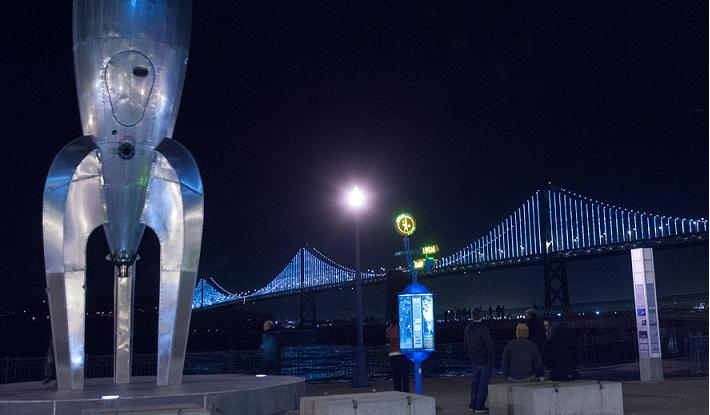
In the wake of The Bay Lights coming on to rave reviews and mesmerized gazes last week, next weekend the Raygun Gothic Rocketship will be taken down from the Pier 14 launch pad it’s occupied since 2010, the latest transitions in San Francisco’s trend of using temporary public art placements to bypass the protracted, emotional, and expensive battles that once defined the siting of sculptures on public lands in San Francisco.

By partnering with private arts organizations and calling the pieces “temporary” – even though almost all of them have been extended past their initial removal deadlines, sometimes by years – the San Francisco Arts Commission, the Port of San Francisco, and other local entities have allowed public art to flourish in the City.

The commission’s longtime public art director Jill Manton told us that temporary public art placements go back to the early ’90s, usually involving smaller pieces while big, years-long controversies continued to rage on over bigger pieces such as “the foot” that never went in on the Embarcadero, the Cupid’s Span piece that Don Fisher did finally place on the waterfront (and which many critics wish had been only a temporary placement), and a big, ill-fated peace sign in Golden Gate Park.

“It’s not as threatening to the public, not as imposing, so it doesn’t seem like a life-or-death decision,” Manton said of the trend toward temporary placements.

But the real turning point came in 2005 when then-Mayor Gavin Newsom, Manton, and other city officials began to embrace the Burning Man art world by bringing a David Best temple into Patricia Green in Hayes Valley, Michael Christian’s Flock into Civic Center Plaza, and Passage by Karen Cusolito and Dan Das Mann onto Pier 14 (a transition point that I chronicle in my book, The Tribes of Burning Man).

Each piece was well-received and had its initial removal deadlines extended. Since then, temporary placements of both original art and pieces that returned from the playa – including Cusolito’s dandelion in UN Plaza, the rocketship, Kate Raudenbush’s Future’s Past in Hayes Valley, and Marco Cochrane’s Bliss Dance on Treasure Island, which is now undergoing a renovation to better protect it against the elements during its longer-than-expected and now open-ended run – have enlivened The City.

“They get to rotate art and people get excited about what’s next,” said Tomas McCabe, director of the Black Rock Arts Foundation, a Burning Man offshoot organization that has helped with fundraising and logistics for most of the burner-built placements.

We spoke by phone on the afternoon of March 8 as he was working with Christian to install The Bike Bridge – a sculpture using recycled bicycle parts that local at-risk teens helped Christian build thanks to a grant from the National Endowment for the Arts – at the intersection of Telegraph and 19th in Oakland as a temporary placement.

The Bike Bridge will officially be unveiled on April 5 during the increasingly popular monthly Art Murmur, and the party will get extra pep from a conference of Burning Man regional representatives that is being held just down the block that day.

McCabe said the connection between Burning Man and the temporary art trend doesn’t just derive from the fact that Bay Area warehouses are filled with cool artwork built for the playa that is now just sitting in storage. It’s also about an artistic style and sensibility that burners have helped to foster.

“We try to help the art pieces have a life after Burning Man, but it’s more the style of community-based art that we promote,” McCabe said, noting that BRAF also helps with fundraising and other tasks needed to support these local art collectives. “We like to see the artists get paid for their work, we’re funny like that.”

Manton said there are currently discussions underway with San Francisco Grants for the Arts (which is funded by the city’s hotel tax) and other parties to put several large pieces built for Burning Man on display in either UN Plaza or Civic Center Plaza, a proposal Manton called UN Playa. “We bring the best of Burning Man to the city,” she said.

Most of the art placements in San Francisco have been labors of love more than anything, and a chance to win over new audiences. When the Five-Ton Crane crew and other artists placed the Raygun Gothic Rocketship on the waterfront in 2010, they had permission from the Port to be there for a year. Then it got extended for another year, and then another six months, and it will finally come down this weekend.

There will be final reception for the Rocketship this Friday evening (with music from the fellow burners in the Space Cowboys’ Unimog) and then the crane will come up on Sunday morning to remove it, in case any Earthlings want to come say hello-goodbye.

“The Rocketship and its crew have had a fantastic 2.5 years on display at Pier 14. Maintenance days were always a pleasure, giving us a chance to talk to people – and see the smiles and joy people got from the installation,” one of its artists, David Shulman, told us. “We’ve had tremendous support from, and would like to thank, the people of San Francisco, the Port of San Francisco, and the Black Rock Arts Foundation. But Pier 14 is intended for rotating displays, and we’re excited to see what comes next.”

Dan Hodapp, a senior waterfront planner for the Port district, said they don’t currently have plans for the site, although he said it will include more temporary art in the future. “The Port Commission and the public are supportive of public art at that location,” Hodapp told us. “But right now, we’re just reveling in the new Bay Lights and we’re not in a hurry to replace the Rocketship.”

Manton said The Bay Lights – the Bay Bridge light sculpture by art Leo Villareal that began what is supposed to be a two-year run (but which Mayor Ed Lee is already publicly talking about extending) on March 5 – has already received overwhelming international media attention and is expected to draw 55 million visitors and $97 million of additional revenue to the city annually.

“It is public art as spectacle. It’s amazing,” Manton said of the piece, which the commission and BRAF played only a small roles in bringing about. “It’s so good for the field of public art.”

She that the success of recent temporary art placements and the role that private foundations have played in funding them have not only caused San Franciscans to finally, truly embrace public art, but it has ended the divisive old debates about whether particular artworks were worth the tradeoff with other city needs and expenditures. And it has allowed the Hayes Valley Neighborhood Association and other neighborhood organizations to curate the art in their public parks.

Meanwhile, even as the Port gives Pier 14 a rest, Hodapp said another temporary artwork will be going up this fall at Pier 92, where old grain silos will be transformed into visual artworks, and that Pier 27 will be turned into a spot for a rotating series of temporary artworks once the Port regains possession of the spot from the America’s Cup in November.

As he told us, “The public really enjoys art on the waterfront, and they’re most supportive when we do temporary art, so there’s a freshness to it.”

Heads Up: 7 must-see concerts this week

0

If you’re avoiding the hype and heat of Austin for that annual indie, not indie music-and-film massacre that is South By Southwest (er, SXSW, nerds), fear not – there are still plenty of acts to catch live in our town this week. That list includes Martha Wainwright, PANTyRAID, Autre Ne Veut, the Dodos, an annual St. Patty’s Day punk blowout, and plenty more.

Here are your must-see Bay Area concerts this week/end:

Music for Adobe Books
This last-minute event is the best kind of fundraiser: it’s for a worthy cause (the Mission’s beloved Adobe Books, which was forced out of business by a large rent increase) and features big name, locals acts including the Dodos, Adam Stephens of Two Gallants, the Tambo Rays, and DJ Andy Cabic of Vetiver. The show is part of the book shop’s Indiegogo campaign to create a new Adobe, with a sustainable plan for small arts and culture businesses such as itself.
Mon/11, 7pm, $25
Public Works
161 Erie, SF
www.publicworkssf.com
https://www.youtube.com/watch?v=1d6IeNpC9p0

Autre Ne Veut
“’Anxiety in children is originally nothing other than an expression of the fact they are feeling the loss of the person they love.’ Sigmund Freud must have been on Arthur Ashin/Autre Ne Veut’s mind as he created his follow up album, appropriately entitled Anxiety. This New York electronic artist chips away at layers of R&B harmonies and futuristic free jazz.” — Ryan Prendiville
With Majical Cloudz, Bago
Mon/11, 9pm, $12
Independent
628 Divisadero, SF
www.theindependentsf.com
https://www.youtube.com/watch?v=_qhHUmL0U6k

VOWS
“The legend of San Francisco band VOWS includes heartbreak, cross-country travel, and a little gambling in Reno. All that occurred nearly six years and a couple of albums ago. Since then, it has more finely tuned its breed of psych-pop comprised of punchy guitar riffs, seamless transitions between raspy yelps and bright three-part harmonies, and depth couched in catchy lyrics that all fits perfectly into a distinctly West Coast tradition. In the midst of recording its third album, VOWS comes to Rickshaw Stop to show it all off.” — Laura Kerry
With Standard Poodle, the Goldenhearts
Wed/13, 8pm, $10
Rickshaw Stop
155 Fell, SF
(415) 861-2011
www.rickshawstop.com

Martha Wainwright
Treasured, delicate folk singer-songwriter Martha Wainwright has had many lives – and they mostly play out in the themes of her personal albums such as 2008’s I Know You’re Married But I’ve Got Feelings Too, her Edith Piaf incarnation (Sans Fusils, Ni Souliers, a Paris, 2009) and most recently, the lovely Come Home to Mama, her 2012 record spurred by both the birth of her first child, and the death of her well-known Canadian folk singer mother, Kate McGarrigle.
With BeRn
Fri/15, 6:30pm, $20
Swedish American Hall
2174 Market, SF
www.cafedunord.com
https://www.youtube.com/watch?v=V4di1pbzveQ

PANTyRAID
Electronic twosome PANTyRAID is broken down into Martin Folb (Marty Party) and Josh Mayer (Ooah of the Glitch Mob), which means An-ten-nae’s “Get Freaky” party is about to get a whole lot freakier. The experimental duo is known for mixing synth-based trip-hop, dubstep, electro, tribal drumming, and “whatever works and causes booty shaking and making out.”
Fri/15, 10pm, $20
1015 Folsom, SF
www.1015folsom.com
http://www.youtube.com/watch?v=oK3L-ZbWHv8

Afrolicious
Is Afrolicious the hardest working world band in the Bay Area? It seems to pop up everywhere. The 12-piece Latin soul-tropical Afrobeat act met at Elbo Room’s energetic weekly Afrolicious party, and is this week playing the Great American Music Hall in celebration of its debut full-length album California Dreaming, released on its own label, Afrolicious Music.
With Midtown Social Band, Afrolicious DJs Pleasure Maker and Senor Oz.
Fri/15, 9pm, $15
Great American Music Hall
850 O’Farrell, SF
www.slimspresents.com
https://www.youtube.com/watch?v=sUZ1qBJI-pI

St. Patty’s Punk Bash XIII
Ay, it’s time yet again to celebrate St. Patrick’s Day with the punks at Thee Parkside, all damn day. This time, there’s Latin American-San Franciscan punk-with-horns act La Plebe, the legendary ’70s-born VKTMS, folk-punk group the Fucking Buckaroos, awesomely named Gorilla Biscuits cover group, Girl-illa Biscuits, Blackbird Raum, Unko Atama, and plenty more. Remember to wear green, drink large mugs of Guinness/shots of Jameson, and all those requisite traditions.
With Ruleta Rusa, Bad Coyotes, Bankrupt District
Sat/16, 3pm, $8-$10
Thee Parkside
1600 17th St., SF
www.theeparkside.com
https://www.youtube.com/watch?v=SoSYwe77_to

Next, the Treasure Island sellout

82

Now that he’s done such a bang-up job negotiating a deal for the CMPC hospital, leaving the supervisors to clean up the mess, does anyone think that the hurry-up-and-finish-in-time-for-a-China-trip talks with Rose Pak and Willie Brown (who has his own interests here, too) will have a good outcome for San Francisco?

Because I don’t.

Nothing the mayor has directly negotiated with private interests has been anything but a disaster for the city. America’s Cup, the Warriors arena, CPMC … the guy just can’t seem to say No. And you really don’t want someone who gives away the story to be representing the city when there are billions of dollars and the future of a huge new neighborhood (on a sinking island in the middle of a rising bay) at stake.

I still don’t see how intense residential and commercial development works on TI, when there’s only one overcrowded artery on and off the island. In New York, people who live on Staten Island are used to using the (free, heavily subsidized)  ferry — 60,000 a day take the boats into Manhattan. That’s going to be a huge stretch for people who live on TI, where there will be limited shopping (even for things like groceries) — and at this point, I don’t see the developer, or the city, purchasing and paying for enough cheap ferry service to make it an effective form of transportation.

That said, if we can make it work as a transit-first community, I have no problem with developing Treasure Island — but I don’t see Lee getting the level of civic benefits out of Lennar and the China Development Corporation that San Francisco needs to make this pencil out. Hasn’t happened yet. 


Live Shots: Passion Pit, Icona Pop, Matt and Kim at the Bill Graham

0

Swedish duo Icona Pop made the typical announcement about being really happy to finish up its tour in San Francisco, last Thursday at the Passion Pit/Icona Pop/Matt and Kim show at the Bill Graham Civic Auditorium.

Things likely have changed for Icona Pop, which specializes in bouncy, dubstep-inflected pop about “heartbreak,” particularly since the song “I Love It”* was appropriately included in the episode of HBO’s Girls where TV’s most self-centered character** goes on a coke binge.

Icona Pop received its biggest, swelling crowd response closing its set with the track, essentially the millionth song to say YOLO in recent memory. I’d say it has the potential to be the “song of its generation,” but only if we can all agree that that whole concept needs revising.***

Matt and Kim played Girl Talk (or at least a mega-mashup-mix of Black Sabbath, Timbaland beats, Jay Z 1.0, etc.) while warming up. Matt wore a Big Freedia t-shirt. Just a couple clues that the pair is similarly oriented towards audience response.

Snippets of familiar hits – Alice DeeJay’s “Do You Think You’re Better Off Alone” comes to mind, as well as Dr.Dre and Snoop**** – were occasionally mixed in with their own music, which most often has the same twinkling piano and rudimentary drum beat. Fun often came at the cost of sticking slavishly to trends, which would explain the “Harlem Shake” section of the show.

I want to dislike the duo, but somehow the two members remain really shiny, seemingly unpretentious musicians who have done their best to scale up from fine china-shattering house parties to festival sized performances and still be engaging. (The equipment mounted cameras they use make them seem slightly less like rockstars and more like contestants on a reality TV show, still slightly shocked by the exposure.) Even slightly criticizing them makes me feel like the time I tossed a kitten down a staircase. (I was 6.)

The last time I went to see Passion Pit – at the Warfield during the Manners tour – well, it was on what would retroactively be a first date, and in part because of the lame soul revue opener and my general nervousness, I drank way too much alcohol and ended high up in my balcony seat, where the show on stage seemed to consist of firing strobes lights directly at the audience. So, yeah, it was a lot of fun.

And, of course, I was very interested to see what a Passion Pit concert is actually like. Well, things started off maximally with “I’ll be Alright,” Manners single “The Reeling”, “Carried Away,” and the pretty “Moth Wings.” Then singer Michael Angelakos moved into a slight lull of twee balladry with “Love Is Greed,” a potentially devastating song for anyone that grew up on watching too many Disney movies*****, and “It’s Not My Fault, I’m Happy”, eventually rising back up to peak with the two best songs from sophomore album Gossamer, the R.Kelly-esque “Constant Conversations” and the politipop masterpiece “Take a Walk”******. It was a good performance, with Angelakos stalking the stage throughout and the band actually jamming a little bit on “Mirrored Sea.”

Passion Pit ended with “Sleepyhead” and “Little Secrets” as the encore. There were bubbles and confetti, but ultimately it all may not have been as memorable as forgetting.

*I like to imagine this song is borrowing the chorus structure of 10cc’s “Dreadlock Holiday,” but somehow I doubt it.
**Besides maybe Walter White.
***How can someone three years younger than me not know of Mr. T?
****Or David Axelrod/David McCallum.
*****At one point in the night, Angelakos began singing slowly and for a split second I was expecting this.
******Also on Girls, last night.

Labor activist urges “innovation” in workers’ rights organizing

Even as renowned labor activist Bill Fletcher Jr. geared up for a talk last Thursday to describe the dire situation he believes the labor movement is facing, local organizers had victories to celebrate.

Fletcher joined organizers from the Filipino Community Center, OUR Walmart, PODER and POWER for a March 7 forum hosted by San Francisco Jobs With Justice, called “Labor at the Crossroads.”

Prior to the discussion, Fletcher told the Guardian he believes the national labor movement is witnessing a “final offensive” from big business and right-wing interests, and “an attempt to destroy unions altogether.” He also criticized a reluctance among national labor leaders to openly recognize the gravity of the situation. Fletcher’s latest book, published last August, is titled They’re Bankrupting Us, and 20 Other Myths About Unions.

Fletcher said he believes labor should place less emphasis on “being invited to this or that social occasion,” and more on reaching out to community-based organizations to foster movement building. He said he thought there was a need for “innovation” by organized labor, such as forging alliances with the unemployed, or reaching out to under-employed workers earning low wages in retail positions. “The labor movement grew by being audacious … by making the comfortable uncomfortable,” he said.

Despite Fletcher’s bleak portrait and the generally discouraging trends of the day, such as the impacts of the sequester, an international move toward austerity and stubbornly high unemployment in the United States, representatives from San Francisco Jobs with Justice nevertheless were able to point to some recent worker victories.

Many San Franciscans who gathered for “Labor at the Crossroads” were encouraged by successful negotiations that resulted in what they viewed as a much-improved deal for the San Francisco CPMC hospital project, which included stronger local hiring requirements and other items labor and community organizers had fought for.

Organizers also applauded last month’s Chinese Progressive Association victory against Dick Lee Pastry on behalf of workers subjected to wage-theft violations. The San Francisco Chinatown restaurant was forced to pay a whopping $525,000 in back wages and penalties.

At the state level, the California Domestic Workers’ Coalition kicked off its mobilization last week in Los Angeles urging passage of the Domestic Workers’ Bill of Rights, authored by Assembly Member Tom Ammiano. The legislation would extend basic labor protections to housekeepers, childcare workers and caregivers, who collectively represent a primarily immigrant workforce. At the national level, momentum is starting to build around the Fair Minimum Wage Act, with supporters calling on lawmakers to raise the minimum wage to $10.10 an hour.

“The union movement should be helping unemployed workers get organized, fight back and fight for jobs,” Fletcher said. “There is no significant organization of the unemployed – no significant force that has taken up this issue and said, we need to build a mass movement around jobs.”

He urged local organizers to identify priorities. “We have to go forward with, what is the vision?” he said. “What do the people of Oakland and San Francisco need?”

Nurses still waiting for CPMC to fully embrace San Francisco

25

Labor and community activists cheered this week’s news of a much-improved deal between the city and California Pacific Medical Center to build two new hospitals in San Francisco, and there are hopeful signs that frosty local relations with this sometimes-stubborn corporate behemoth may improve. But they also say they are withholding full support for the deal until CPMC reaches a contract agreement with the California Nurses Association.

CPMC and its parent, Sutter Health, have had a nasty running battle with CNA over the six years since their last contract expired that has included strikes, lockouts, lawsuits, harsh union-busting tactics, and the pooling of bad blood on both sides. But CPMC announced a labor agreement with its other major union, National Union of Healthcare Workers, on the day after the hospital deal was announced and there are signs that a deal with CNA could also be imminent.

“We’ve made some progress and we have the makings of a settlement on the table, but we’re not there yet. Yet now is the time,” Fernando Losada, CNA’s collective bargaining director for California.

It was CNA and other labor groups that effectively partnered with community organizations and progressive members of the Board of Supervisors last year to kill the hospital deal that CPMC cut with the Mayor’s Office and to force the much-improved agreement that was announced on Tuesday. “It’s all about necessity and their being able to implement their plans,” Losada said of CPMC’s designs on San Francisco. “Obviously, the full of implementation of their plans were thwarted with the help of some good community organizing.”

And Losada said he expects that labor-community coalition to stand firm on expecting CPMC to reach a fair agreement with the nurses, who are seeking more job security and benefit concessions than CPMC has been willing to make so far.

“The successful community organizing that we played an active role in putting together has had a lot to do with them being more forthcoming at the bargaining table,” Losada said. “We like where this has ended up, particularly on the St. Luke’s [Hospital] issue [guaranteeing a larger and more viable new hospital than originally proposed]. But we can’t support this wholeheartedly and we won’t if our nurses are left out in the cold.”

Gordon Mar of San Franciscans for Healthcare, Housing, Jobs, and Justice, which formed up around the CPMC negotiations with the city, said that most community groups will also insist on CPMC reaching an agreement with CNA before the project moves forward.

“A contract for CNA is the last remaining big issue the coalition would like to see resolved,” Mar, who also works with the labor group Jobs With Justice, told us. “We at Jobs With Justice would not support the deal unless the CNA dispute is resolved.”

Paul Kumar, a consultant with NUHW who represented the coalition during the negotiations between CPMC and the city, as represented mostly by Sups. David Campos, David Chiu, and Mark Farrell, said he was happy to see CPMC reach agreements with the city and NUHW, but that it’s too soon to conclude the corporate has turned over a new leaf.

“I think it’s premature because relationships take a long time to transform themselves, but there are transformative moments, and it’s our duty to make the best of them. This may be one of them,” Kumar told us. “They’re obviously now trying to pursue their business interests in alignment with their community instead of without regard to their community, which has characterized their behavior in the past.”

Kumar said the coalition that overcame last year’s aggressive and uncompromising effort by CPMC to push through a deal that was bad for the city has learned a lot from that fight and evened out the playing field. “It’s up to us to try to build on their breakthrough,” Kumar said.

CPMC spokesperson Dean Fryer was unable to put the Guardian on contact with Sutter officials that our sources say may be responsible for the softening of CPMC’s tough negotiating stance in San Francisco, or to offer a comment on the changing dynamics in the company.

He stressed that CPMC has “a lot of interface with various communities in San Francisco” and said the company “does more charity care than anyone in San Francisco.” But he’s only been with CPMC for a few months and was unaware of studies last year showing CPMC actually does the least per-capita charity care of any hospital in San Francisco, a major point of controversy that resulted in improved charity care commitments in the latest agreement.

As for the prospects of an agreement with its nurses, “I can’t address CNA, that has been ongoing and it’s something I can’t comment on.”

NUHW – which represents medical technicians, administrative staff, and hospital workers other than nurses and doctors – announced that it reached a deal with CPMC at 12:30am on Tuesday that includes no labor concessions, retroactive wage increases, job security provisions, fully employer-paid health coverage, an improved pension, and maintenance of retiree health coverage.

Losada said he was happy to see the CPMC agreement with the city include strong local hiring requirements for construction workers, a predominantly male workforce, and now it’s time for CPMC to do right by its nurses, “an overwhelmingly female workforce.”

“As it stands, they have no protections and no guarantees they’ll be hired in the new facilities,” he said, noting how frustrating it’s been to get any assurances from CPMC as it has pursued this hospital deal over many years. “It’s always been about issues of job security, and affordable health care, ironically.”

Workers underpaid by firms renovating fancy mid-Market offices

Union members from San Francisco Carpenters Local 22 were distributing flyers outside a developer’s Bush Street headquarters this week, upset that the company hired contractors who don’t pay union scale wages. “Hurting workers!” The bright orange flyers screamed. “Shame on them!”

The developer is Group I, headed by Joy Ou. In addition to being the CEO of the development firm, Ou is also listed on state licensing records as the principal officer of Construction Studios, Inc., one of the general contracting firms singled out on the flyer. Ou did not return Guardian calls seeking comment.

Group I is conducting office renovations at 988 Market Street, a 1920s-era building located at Sixth and Market streets adjacent to the Warfield Theater. Group I purchased the Warfield office building from David Addington. It is a prominent location: when Mayor Ed Lee ran for election in 2011, his campaign office was headquartered there. The building is also included among mid-Market properties eligible for payroll tax exclusion under a program hashed out in 2011 to revitalize the central Market corridor.

Of the multiple floors under renovation, two will house Benchmark Capital, a venture capital firm that invests in tech startups. Tech startup companies are poised to move in just below. It’s unclear whether these businesses will apply for the payroll tax break.

According to Bill Gerber of Tico Construction Co., a contractor tapped to conduct some of the renovations, the workers he’s hired actually are earning union-scale wages. “Tico is running it as a union job,” he said. “We are paying area wages.”

But Scott Littlehale, a spokesperson for the carpenters’ union, told the Guardian that Gerber never responded when the union asked him if Tico pays area standard wages on all jobs. “What we believe is that the developer in this case, Group I, has not required its contractors to pay area wages all the time on all its jobs,” Littlehale said. “This is a labor market that extends beyond a single job site.”

Under California law, workers employed on city-funded projects must pay the prevailing wage, which is $38.50 an hour for carpenters before benefits are factored in, according to the Department of Industrial Relations. Since 988 Market is not a publicly funded project, it’s not bound to this requirement.

Nevertheless, the idea that construction crews are working for less than the area standard in San Francisco’s burgeoning economic climate – to renovate space for a venture-capital firm that will qualify for a payroll-tax exclusion – raises questions about whether this kind of development is actually helping struggling workers recover from the economic hit of the last several years. Group I stands to make top dollar by renting its office spaces out to tenants heavily invested in the booming tech industry. Meanwhile, San Francisco is becoming increasingly unaffordable for skilled laborers.

Construction gigs are temporary by nature, and Littlehale said many union members earn less than the area median income. “Construction work had been a pathway to fairly stable middle class standards, and that’s under threat,” Littlehale said. “The big picture is: We’re going to hold the folks up the food chain accountable.”

Condo conversion compromise in the works despite Realtors’ resistance

180

[UPDATED BELOW] Negotiations between tenant advocates and real estate interests (including the political advocacy group Plan C) over the controversial condo lottery bypass legislation haven’t gone well or found common ground. But sources tell the Guardian that Sup. Jane Kim and Board President David Chiu, who has been mediating the dispute, are preparing to introduce compromise amendments that have the support of the San Francisco Tenants Union and other tenant advocates if a deal can’t be worked out with real estate interests.

Details are still being hammered out with advocates and the City Attorney’s Office, so the hearing scheduled for this Monday at the Land Use and Economic Development Committee will likely be postponed until March 25. But the basic deal is to allow the roughly 2,000 tenancies-in-common now seeking to convert into condos to do so in exchange for a long moratorium on new condo conversions, possibly indexed to construction of new affordable housing for the renters who comprise nearly two-thirds of San Franciscans.

The original legislation by Sups. Mark Farrell and Scott Wiener is being strongly backed by both current TIC owners who want the ability to refinance and Plan C and other real estate interests that want to continue converting ever more rent-controlled apartments into condos, rather than abiding the city’s current limit of 200 per year, awarded through a lottery system. The SFTU has strenuously resisted opening up those flood gates, but it’s open to clearing out the backlog in exchange to shutting the gates for awhile (see my story in this week’s Guardian for more on the political dynamics surrounding this issue).

“We’re hopeful that a majority of the board will support amendments which will significantly protect tenants and which will allow a version of the Wiener-Farrell legislation to be approved,” SFTU head Ted Gullicksen told us.

Progressives on the board oppose the legislation as currently written, and the swing votes are thought to be Sups. London Breed (which Plan C supported in the last election in exchange for what it says was her promise to support more condo conversions, an assurance she denies making), Norman Yee (who was brought into the Chiu-mediated negotiations), and Malia Cohen, with just one of them needed to force changes to the legislation.

But the real estate interests – including Plan C, the Association of Realtors (whose government affairs director we left a message for and are waiting to hear back from, and we’ll update below if/when we do), San Francisco Apartment Association, and other downtown-based groups – who are pushing for more condo conversions are likely to strongly resist the amendments. They simply want more rent-controlled apartments turned into condos they can sell, period.

Their perspective is reflected in SF Apartment Magazine, put out by the San Francisco Apartment Association, which every month offers advice to real estate investors and apartment building owners on various ways to buy apartment buildings, evict tenants or increase their rents, and convert the buildings to TICs or condos.

It runs a regular column called “TIC Corner” with the latest tricks for financing acquisitions and getting rid of those pesky tenants. In the November 2012 issue, for example, attorney D. Andrew Sirkin wrote excitedly about a new Securities and Exchange Commission rule that will now allow owners to advertise the sale of apartment buildings as TIC/condo investments, which he said “will dramatically ease the regulatory burden for real estate entrepreneurs wishing to raise money for apartment acquisitions and make it much easier to find investors.”

Another feature story in the magazine, “The ABCs of OMIs,” teaches these investors all the tricks for evicting tenants from their buildings, while “Roommate Roulette” offers advice to owners of rent-controlled buildings for keeping new roommates of existing tenants off the lease so they can charge market rate rents as soon as possible.

And, of course, the magazine is filled with ads for San Francisco apartment buildings that are for sale and just waiting to be cleared of tenants and turned into amazing real estate investment opportunities. Gullicksen says it is this mentality, applied to what even Mayor Ed Lee has called the city’s “precious few rent-controlled apartments,” that has animated the opposition to the Wiener-Farrell legislation. SFTU had planned a rally for Monday called “Stop Rent Control Attack,” which has now been postponed until March 25.

UPDATE 3/11: Sup. Wiener got back to us and said, “I hope we can move to a compromise and I don’t want to prejudge that compromise.” Asked about the concept of approving TICs in the pipeline in exchange for halting on all condo conversions for some number of years, he said, “It’s definitely something to explore, a pause in the lottery, and I’m open to that. But the devil is in the details.”

Chinese Historical Society celebrates golden anniversary as neighborhood’s memory bank

0

In 1963 a publicist, an art collector, an actor, a newspaper publisher, and a dentist joined forces to form San Francisco’s Chinese Historical Society of America. The group’s mission was simple: to preserve and document Chinese culture in the US. Now celebrating its 50th anniversary this year, it has the same goal it always has had with one major difference: a museum to house the fruits of its labor.

The CHSA moved into its Chinatown digs 12 years ago. The building was built in 1932 by funds raised by a group of Chinese women who traveled up and down the Pacific Coast visiting various Chinese communities to raise funds to construct a small gym and women’s dormitory in Chinatown. In the midst of the Great Depression they somewho drummed up $25,000 for the cause, and the gym provided athletic space to its urban community until it was struck by the 1989 earthquake. 

As the CHSA’s executive director Sue Lee takes me on a tour she speaks with almost an encyclopedia-like knowledge of Chinese history on the West Coast. Her animated descriptions of each and every exhibit make it clear that the enthusiasm for preserving Chinese culture that drove the Historical Society’s original founders hasn’t been lost over the generations. 

In the CHSA’s early days, the founders’ sense of urgency stemmed from the immigration restrictions put in place during the Cold War due to the Chinese’s association with the Soviet Union, which were resulting in a withering Asian population.

Lee explains, “[the founders] thought, ‘this is all we’ve got’. Lee explains. “They were visiting dying Chinese communities up and down the west coast, collecting stuff, interviewing old timers, and picking up stories, and artifacts.” 

That drive to preserve has been augmented by new goals for the Historical Society in the modern era. “We also want to engage local artists to use our history and to be inspired by Chinese-American history for their artistic endeavors,” says Lee.

One direct way the CHSA is putting that plan in action is through its “Creative Spaces” program. Currently in its second year, “Creative Spaces” invites artists, designers, curators, and educators to propose concepts for interpreting and presenting history in the museum. This year Leland Wong, an artist and Chinatown native, has been chosen as one of the featured artists.

A stage inside the museum has been transformed into a working studio for Wong. Visitors can peek in whether Woing is working or not.

A playful collection of intricate Qing Dynasty children’s hats temporarily donated by collector Leslie Selcow in memory of Jade Snow Wong, a Chinese-American ceramic artist and author, fills another exhibition space. In another area, a small suitcase contains the sparse belongings Chinese immigrants commonly brought with them when traveling to America: a notebook, a few pieces of clothing, an umbrella. Visitors are invited to write which items they’d bring on paper luggage tags and attach them to the trunk. History’s tidal changes are visible in the tags that I glimpse on my visit — everything from video games to iPods to the maybe-not-so-portable family cat is scribbled on the tags.

Lee tells me that the lessons learned at the CHSA are certainly not confined to Chinatown residents, or even to Chinese Americans. “Our challenge is always to reach out to our own community as well as to educate the greater community.”  Last year, the Historical Society partnered with the Israeli consulate to honor Dr. Feng Shan Ho, a Chinese diplomat who saved thousands of Jews in Vienna from being deported to Nazi concentration camps during World War II. 

In the over-informed, distracting era we live in, making people care about history is a constant challenge, but it seems clear that Lee and her crew are up for the challenge. “We’re trying to be more active,” she says. “We can’t be a mausoleum, we have to be engaged. We have to try to inspire people.” 

On the Om Front: Guys Wanted in the Yoga Room

4

I teach a weekly employee yoga class at a hospital where my students are all women. Every week, a young man peers curiously into the classroom. I asked him once if he’d like to join us, and he said, “Yes, but what would my friends say? Yoga is for girls.”

This odd societal notion that yoga is an emasculating, status-reducing activity is bad enough. But to make matters worse, people like William J. Broad, the so-called New York Times science writer, have publically espoused that yoga is actually harmful to men. Why? Because, he says, men have a tendency to push themselves too hard, and their bigger muscles are more injury prone.

Wait … what?

Here’s the truth: The majority of the yoga poses that we do in the studio today were developed by men, not women. In fact, women had to fight for the right to take part in this practice in the first place. And I could spend days discussing the fallacies of Broad’s arguments (which are based on poor science and don’t at all credit men with the ability to take care of themselves), but we all have better things to do. The point is: When did yoga get deemed wussifying or, worse, a threat to one’s health?

I don’t live in a man’s body, but I do teach yoga to a lot of strong, masculine, and intelligent men, and I can tell you from what I see that yoga is every bit as beneficial to men as it is to women. It does not seem to have negatively affected anyone’s testosterone levels, nor do my male students get injured any more than my female students — if they practice intelligently. (If one practices unintelligently, regardless of gender, one will get injured.) In fact, despite the obvious anatomical disparities, I see very little difference between the male and female practitioners I know in terms of commitment to practice, injury rate, and advancement. The largest challenge for men is the message in Western society that yoga was not made for them.

As a response to the dearth of dudes in yoga class, an interesting movement to promote male-only yoga classes has come about. The national Broga program is one example of this trend, though it hasn’t yet caught on locally. While I love that this movement is encouraging more men into the classroom, the segregation aspect feels weird to me. This is yoga, not football. I’d prefer to see all of us — men, women, and trans folk — practicing in the same room, side by side. Together.

As a society, both men and women have suffered from countless years of gender segregation. The yoga room can be a place for us to be in community together. Sure, we have different bodies, but we’re all there for the same reason: to improve ourselves and develop a deeper sense of inner intelligence. I understand that there’s a comfort in being around people who look like you, and avoiding environments where the other gender dominates. But if women had let that fear deter us, we wouldn’t have gained the right to attend college, vote, or have our own bank accounts. Besides, yoga is actually about moving out of your comfort zone, and confronting the fears and insecurities that imprison you. What better place to push your boundaries?

I’m a fan of anything that gets more guys, straight or gay, into the yoga room — even boys-only yoga. But the beautiful thing about bringing the genders together in general, and particularly in the yoga room, is that we balance one another energetically. We can learn from, support, and better understand one another. I think the time is ripe now for us to come together in mindful community — in fact, I think our evolution as a species depends on it.

And a little secret for those men who’ve yet to take a yoga class because they think the women don’t want them there: We do.

Karen Macklin is a writer and yoga teacher in San Francisco — her On the Om Front column appears biweekly here on sfbg.com.

___________________________________________________

Yoga and Spirituality Listings

By Joanne Greenstein

Restorative Yoga with Live Singing Bowls with Kevin Hibbit and Sam Jackson
Combining crystal bowl music, healing touch, poetry, and restorative yoga, this workshop will help attendees to slow down, relax and look within.
Sat/9, 6:30-9:30pm, $35, Mindful Body, 2876 California, SF

Naked Men’s Yoga
Check out these weekly classes for men that are aimed at offering community and more freedom for expression and movement. Clothing is not optional. Days and times and locations vary.

Therapeutics Workshop with John Friend
After a long hiatus from the yoga world, the founder of Anusara yoga is back in town. In this workshop, he will focus on common issues and injuries in the body, and how to overcome them using therapeutic postures based on principles of alignment.
Sat/9, 6:30-8:30pm, $50, Urban Flow Yoga, 1543 Mission, SF

Yoga Grad School
Laughing Lotus is offering several weekend workshops between now and the end of June on topics ranging from teaching yoga to at-risk youth to hands-on assisting. The workshops are appropriate for dedicated practitioners looking to deepen their practice as well as for those interested in earning credit toward advanced teacher certification. Price varies based on number of workshops taken.
Next up:
Lotus Fly: Advanced Asana and Sequencing with Sheri Celentano
March 16-17, 1-6pm, $199
Laughing Lotus, 3271 16th Street, SF

Healing the Heart – A Daylong Immersion in Bhakti Yoga with Jai Uttal, Nubia Teixeira, and Swami Ramananda
Immerse yourself in a day of devotional exploration. This daylong workshop integrates meditation, ceremony, breathing exercises, devotional dance, and chanting.
March 16, 10am-5pm, $100 ($90 by Mon/11); includes a vegetarian lunch
Integral Yoga Institute, 770 Dolores, SF

Yoga and Dance with Wendy Faith
Link two forms of movement in one in this workshop combining yoga and dance. Dance forms visited include Afro-Brazilian, salsa, tribal bellydance, Bhangra, West African and hip-hop.
March 17, 1-3:30pm, $35
Aha Yoga, 1892 Union, SF

Chocolate, symbolism, polka dots at this weekend’s quilt show

0

The San Francisco Quilters Guild’s biennial show is back and ready to prove needle arts are alive and kicking – and not just in grandma’s eyes. The exhibit will cozy up the Concourse Exhibition Center this Sat/9 and Sun/10 with a display of over 400 quilts.

Twenty quilts made by members of the Israel Quilters Association comprise a special exhibition dealing in the symbolism of daily life in Israeli society through textile. Former film costumer and seasoned quilter Eleanor Dugan will be showing off the elaborate dot motifs characteristic of her work. Pieces by this year’s two featured artists Laura Lee Fritz, and Roberta Walker will also be on display exhibiting a fresh spin on classic techniques. 

The show will also include a special exhibit on wearable art as well as two quilting challenges, a SFQG tradition that goes out to members prior to the biennial so that completed challenge quilts can be on display through the weekend. For this year’s challenges, the guild gang designed 20-inch square quilt based on the theme “chocolate.” Others crafted from two required fabrics designated by the challenge committee, creating pieces that celebrate the guild’s 30th anniversary.

Roberta Walker is a longtime member of the SFQG, but this is the first year she has been selected as a QUILT San Francisco featured artist – and she has a pretty good idea what has helped earn her spotlight.

“What I do as a quilter that’s different from other quilters is, I am very involved in the Japanese stitchery called sashiko,” she tells the Guardian. Sashiko is a big running stitch that can be seen in Walker’s pieces made from Japanese fabric as well as in her quilts crafted from more conventional materials – the combination of which is Walker’s own adaptation of the technique. 

“I think that’s why people really like my quilts,” Walker explains. “I’ve put a different spin on them by doing that stitching. That has sort of been my specialty. In fact, people go to quilt shows and they say they don’t even have to look at the name to see whose quilt it is, they know [it’s mine].”

Twenty of Walker’s pieces will be on display this weekend. Featured artists will conduct twice-daily walkthroughs of their quilts.

The Quilters Guild biennial requires almost a year of planning. In other words: prepare your eyes.

“People walk into our show and they sort of gasp,” Walker says. “When you see that many quilts hanging, it’s overwhelming.” 

“Quilt San Francisco”

Sat/9-Sun/10

Concourse Exhibition Center

635 Eighth St., SF

www.sfquiltersguild.org 

SF Music Matters Asia showcase

0

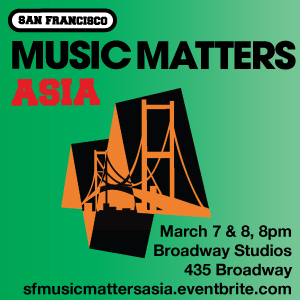
Asia’s most heralded bands take over Chinatown for a special two-day showcase before they lift off at SXSW. From China’s Carsick Cars to Korea’s Galaxy Express to Taiwan’s The Chairman, San Francisco Music Matters Asia features eleven of Asia’s finest musical artists, spanning garage to indie to electronic and much more.
 
Presented by Music Matters, Viki.com, an alliance of Asia’s top indie music promoters (Maybe Mars/DFSB Kollective/The Wall), and CAAM. Get more event details here and purchase tickets here.
 
Thursday, March 7: Galaxy Express (Korea), White+ (China), Kim Jonho (Korea), Lowdown (Korea), and No Brain (Korea).
 
Friday, March 8: Carsick Cars (China), The Chairman (Taiwan), The Gar (China), Goonam (Korea), 3rd Line Butterfly (Korea), and The Gold Medalists (SF).
 
Thursday, March 7 & Friday, March 8 at 8pm @ Broadway Studios, 435 Broadway, SF | $12 one-day/$20 two-day pass

#OpenData just got a teeny bit more open

We were disheartened when, after submitting some fairly innocuous questions to the Mayor’s Chief Innovation Officer, Jay Nath, we received zero answers. By the time the Guardian’s annual Freedom of Information issue hit stands yesterday, we were still out in the cold. (Shameless plug: Pick up a print edition of this week’s paper for our flow chart on how to file Sunshine requests, designed by our illustrious Art Director Brooke Robertson.)

Nath, who helped start the city’s Open Data program, responded to our emails and tweets (apologetically) by saying he was awaiting the green light from the Mayor’s Office of Communications. Which begs the question: In a city so outwardly committed to transparency, why can’t the Mayor’s Office of Communications entrust a program expert to share information about information-sharing software?

Anyway, the day after we ran our story, Nath did respond in an email. The first objective of Open Data is to “increase transparency,” he told us.

Other goals are to “drive economic development” and “foster the creation of new services and analysis by our community.” The inspiration behind it came from President Barack Obama, who on his first day in office “issued a memo on open government that heralded their open data program Data.gov,” Nath explained. “With this precedent, the city recognized an opportunity to share local data with the public.” 

Head over to the city’s Open Data Portal and you can poke around for info on everything from real-estate development, to restaurant health inspection scores, to city salary ranges by job classification.

As Nath pointed out, there are also over 30 datasets around campaign finance. That’s a good thing – but there’s still room for improvement. Last year, after attending a city hackathon where transparency advocates hoped to spur creation of an app to track lobbying, campaign contributions and real-estate development, Adriel Hampton of the San Francisco Technology Democrats noted that this was impossible due to a lack of information. “Despite millions in spending on … online transparency measures, access to data in these areas is woefully lacking,” Hampton wrote.

Nath said the annual cost is $40,000 per year for software. He also shared his vision for future expansion. “In terms of new services, I see applications that mash up data from multiple public and private sources to create a seamless experience,” he said. “For example, imagine a tourism app that helps you navigate the city via public transit, taxis, car / bike sharing, biking, walking, etc.”

So how does Open Data affect public records requests under the San Francisco Sunshine Ordinance? “Government can use open data to reduce costs by pro-actively providing information that is often requested through FOIA,” Nath told us, referring to the Freedom of Information Act. “For example, by releasing real-time transit data, transit riders have dozens of ways to know when their next bus is coming. This new and immediate access to information has resulted in 21.7% fewer SF 311 calls – and at $2 per call – that yielded a savings of over $1 million a year.”

An interesting thing about data is that it can be totally neutral until it’s harnessed for a particular purpose, with clever visualization and presentation. Just ask the producer of this video on wealth distribution, which has been making the rounds.

The Performant: Whose story?

4

Sifting through the past at The SF History Expo

If history is a tale written by the victors, one wonders who San Francisco’s victors are. A chimeral concept as much as a destination, represented by a Phoenix rising from its own destruction, San Francisco has been lauded as a land of opportunity and “the city that knows how,” and detracted as “ingrown (and) self-obsessed,” a “golden handcuff,” and a “Babylon-by-the-Bay” ever since it surfaced in the national consciousness. A city where eccentrics are celebrated, “family values” extend beyond heteronormativity, and the very real threat of natural disaster colors the mundane with an idealized wash of importance.

This past weekend, the San Francisco Museum and Historical Society’s SF History Expo offered a gateway to the various and colliding stories of San Francisco for people interested in delving into what lies below the surface of the present day, assembling around forty exhibitors and presenters in once spot, to confab, to network, to recruit, and to educate.

Held in San Francisco’s Old Mint, built in 1874 and a rare survivor of the 1906 earthquake, just wandering around the building is a rare treat. The lower level is a veritable warren of small rooms, former vaults with ominously heavy doors, slippery stone floors, old graffiti, and no ventilation, situated off a long brick corridor lined with gas lamps.

Upstairs the rooms are larger, airier, with high ceilings and plenty of light streaming in through large windows, encircling a rather bleak courtyard like a prison exercise yard with high sandstone walls. Crowded with exhibitors, the smallish rooms overflowed with maps, pamphlets, sepia-toned photographs, and glass cases of ephemera,

In a central room, folks from Actions Past in period dress gave demonstrations of Victorian parlor arts, while down the hall the volunteers from the San Francisco Maritime National Historical Park encouraged people to hoist the mainsail on a scale model of historic scow schooner the Alma. At one end of the hall, four neighborhood historical societies from Portrero, Bernal, Visitacion Valley, and the “Western Neighborhoods” (including the faraway lands of the Sunset and the Outer Richmond) shared one room, while on the opposite end the “Guardians of the City,” a historical society dedicated to the Police and Fire departments, rubbed elbows with proponents of “alternative” histories, Shaping San Francisco/FoundSF and Thinkwalks.

Despite this welcome nod to the stories of the typically underrepresented, it did highlight the fact that of all the neighborhood and community historians in attendance, there was hardly a radical element to be found. To be fair, organizations such as the Chinese Historical Society and the GLBT Historical Society did have tables, so the event wasn’t completely devoid of more-than-geographic diversity, but it still could have used a few more nods to the Tenderloin, the Bayview, the Fillmore—or even just a single Sister of Perpetual Indulgence in Victorian drag.

Still, the value of assembling so many various stories under one roof shouldn’t be underestimated. If we consider history not as a static and one-sided document, but a constantly evolving perspective, then the opportunity to compare and contrast a variety of viewpoints has to start somewhere, and who better to spearhead the conversation than a roomful of enthusiasts each advocating the awareness and preservation of a different one?

Most important and interesting to the conversation was probably the attendance of so many amateur historians who gathered around each exhibit to share their personal perspectives on the overviews being offered. One hopes that their contributions to the collective chronicle will not go uncollected, so that future voices will not go unheard.

Oakland’s JVP counters AIPAC’s push to exempt aid to Israel from sequestration cuts

26

Ahead of the American Israel Public Affairs Committee’s three-day policy conference in Washington DC, Oakland-based Jewish Voice for Peace and Avaaz.org blanketed the DC Metro with provocative anti-AIPAC posters. The $100,000 marketing campaign features images of young Jews with the words: “AIPAC does not speak for me. Most Jewish Americans are pro-peace. AIPAC is not.” The posters, which are part of a larger campaign to counteract AIPAC’s strong and hawkish influence on American foreign policy, will run for two-weeks in the DC Metro.

The March 5-7 AIPAC conference attracts pro-Israel activists from around the country and this year features an address by Vice President Joe Biden. AIPAC spends nearly $3 million a year lobbying Congress and enjoys widespread support from both major political parties. But according to JVP Executive Director Rebecca Vilkomerson, Jewish-American frustration with AIPAC is mounting.

JVP’s high-profile ad campaign is designed to appeal to more liberal American Jews who are uncomfortable with AIPAC’s continued support for conservative US foreign policy priorities. “AIPAC is the NRA of foreign policy lobbies, it pushes a right-wing agenda that in no way represents the majority of Jewish Americans,” JVP Spokesperson Sydney Levy told the Guardian.

JVP endorses the controversial Boycott, Divestment, and Sanction (BDS) movement which seeks to isolate Israel internationally through a sustained divestment from Israeli institutions. This position has drawn criticism from other local Bay Area Jewish organizations and Levy said JVP has been barred from using space at the San Francisco Jewish Community Relations Council.

During the ongoing conference, AIPAC is expected to launch a campaign to convince Congress to exempt Israel aid from the sequestration budget cuts. But JVP is calling on its grassroots network of more than 35 local chapters to oppose the campaign. “In the era of sequestration, where every item is on the table – from Medicare to Head Start – why isn’t aid to Israel on the table?” asks Levy.

AIPAC did not responded to requests for comment, but we’ll update this post if it does.

SF approaches 1 million residents

167

So the Association of Bay Area Governments, which plays an outsized role in local planning by making all sorts of projections, based on whatever economists and demographers use to make projections, that are supposed to guide how cities in the region make land-use decisions, says San Francisco should be prepared to see its population grow to 964,000 people by 2035.If you figure that’s only an estimate, and probably off by at least five percent, we could be talking about a million people in this city just 20 years down the road.

Now: Some of those people will be coming here for jobs that are being created. Many will be coming here as immigrants from other countries. Many more will be coming because, well, California is growing, and, as the official motto of the old Redevelopment Agency put it, “Omnes Volunt Habitare in Urbe San Francisco.” Everybody wants to live in the city of San Francisco.

ABAG says we’re going to need to build homes and create jobs for all of those people, and the Chron talks about the new private-sector development that’s going on, and the zoning plans the city has adopted to increase density, particularly on the Eastern and Southeastern side of town. (Yes, it’s crazy, but John Rahaim, the planning director, freely admits that 80 percent of all new development is going into 20 percent of the city.)

Before we decide that this is our fate and our future, though, it’s worth considering a few points.

1. San Francisco is already one of the densest urban areas in the US. Last time I check the data, this city was number three on the list, behind Manhattan and Union City, New Jersey. Clearly, urban areas are going to have to get more dense as population increases in this state; the only other option is suburban sprawl, which works for nobody. But I wonder: Should San Francisco take this much more density when Berkeley (for example) doesn’t want it and won’t take it? Should it all go on the East Side when the more suburban-style areas on the West Side don’t want it?

Is there a way to do density that looks more like North Beach — one of the densest neighborhoods in town, and a really great place to live, work, and visit — and less like the highrise forests of Soma, which are unappealing at ground level, discourage neighborhood interaction, and are lacking in human scale?

I don’t want to live in Manhattan. I don’t want Soma to turn into Manhattan. Downtown is bad enough.

2. Nowhere in the Chron article, or in the comments attributed to Rahaim, is there any mention of affordable housing. That’s crazy. The urban planning train wreck that we’re heading for is all about the balance between jobs and the cost of housing. The vast majority of the jobs in San Francisco today do not pay enough to cover the cost of renting or buying a market-rate home. That’s not going to change radically; tourism and government are, and will be, the city’s major industries, even as tech, which pays better, increases.
If the housing that gets built is not in synch with the needs of the workforce, then the workers will be forced to live futher and further away, which leads to exactly the kind of sprawl and transportation problems that this “infill” and increased density is supposed to prevent.In other words: Affordable housing for the workforce prevents sprawl. Market-rate housing for people who live here and commute to work on the Peninsula is not environmentally sound.

3. Density — both in housing and in commercial development — has huge impacts on existing populations, particularly low-income communities. That’s not part of the planning discussion at all, and it really ought to be the starting point.

I know my trolls — I know you well — and I know you’re all going to say that growth and change is inevitable. Sure. But I think of a city first and foremost as a community, as a place where a diverse group of people live. Protecting that is just as important as giving developers and businesses a chance to make money.

Oh, and Rahaim’s comment —  “This (growth) is going to happen whether we plan for it or not” — is wrong. If we don’t build office space and room for new jobs, if we don’t build housing, the growth isn’t going to happen. San Francisco gets to decide what happens on land in San Francisco. Not saying we want to stop (all) growth, but Rahaim is a planner, and he should know: Growth happens when you encourage it and allow it. Growth doesn’t happen in places where you don’t allow it.

There is no growth in Bolinas, because the people who live there don’t want it. There’s less growth in Berkeley, because the people who live there want less. Again: Not the model I want to use. I don’t want to live in Bolinas any more than I want to live in Manhattan. But San Francisco does control our own fate, and we should never forget that.