San Francisco Chronicle

Da Mayor, local hire advocate

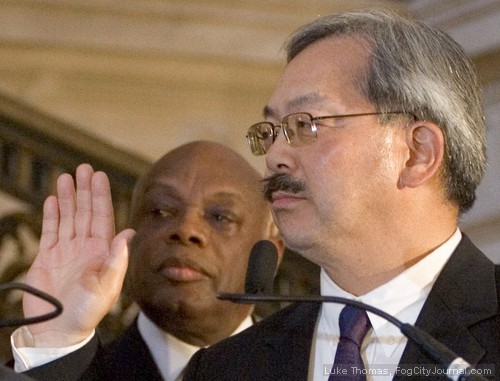
Even as Sup. John Avalos continues to be raked over the coals by San Francisco Examiner columnist Melissa Griffin for his so-called “peacocking, disrespectful demeanor” and “flexible hate speech standards,” the progressive District 11 supervisor nevertheless earned something akin to praise May 22 from an unlikely figure: former San Francisco Mayor Willie Brown.

The San Francisco Chronicle columnist, attorney (Brown mentioned in his speech that he paid $50 a semester for law school), sometimes PG&E consultant, self-proclaimed “buddy” of former California Gov. Arnold Schwarzenegger, and all-around power broker delivered his Annual Lecture on Political Trends at the Commonwealth Club yesterday. He plugged his own column, saying, “On Sunday, you can read a column that can’t be disputed. Because it’s my version of the facts.”

Brown is known for his cozy relationship with Mayor Ed Lee and is politically at odds with Avalos, who ran against Lee in 2011. Emphasizing his support for Lee, Brown lauded him for clinching the city’s right to host Super Bowl 2016 events in San Francisco. He pointed out, “That Super Bowl is going to be exactly when he’s possibly seeking reelection.”

Brown also mentioned accompanying the mayor on a recent trip to China, where Lee was reportedly “treated as if he was the president of America instead of just the mayor of San Francisco.”

However, Da Mayor had a bone to pick. He launched into a tale of how he often wanders down to the city’s bustling construction sites, marked by “these 24 or 25 cranes that you see around town” (presumably he finds time for this aimless wandering this between international excursions, dining with the Gettys in North Beach, and palling around with his “buddy” Schwarzenegger?). “Invariably I take a look at the cars, the crews,” he said, and has concluded that “they’re not San Franciscans.” Not only are private development projects being built by out-of-towners, he said, no local hire requirement was imposed upon the city’s Central Subway contractors. 

Giving voice to a cause long championed by Avalos, a progressive who fought doggedly to enact a local hire ordinance, Brown expressed frustration that locals aren’t the ones scoring gigs in the city’s construction bonanza.  

Then he gave Avalos a sort of backhanded compliment, calling him “the strongest advocate for local hire,” but saying “he hasn’t followed up the way he should follow up, to ensure that people who live here get the jobs.”

It seems unfair to lay the blame for this at Avalos’ feet, but Da Mayor seems to be on the money as far as this point is concerned: As long as SF has embarked on a building frenzy, shouldn’t it be residents who reap the benefits of decent paying construction gigs?

“One powerful newsroom” pulls back from its San Francisco roots

22

Locally focused journalism in San Francisco took another big hit today with the announcement that The Bay Citizen — which was founded by the late Warren Hellman in 2009 specifically to augment declining reporting on San Francisco and the Bay Area — is being folded into Center for Investigative Reporting [Updated below].

When the two entities merged last year, Bay Guardian and others raised concerns that local accountability journalism in San Francisco would suffer and that the strong donor base that Hellman developed to support Bay Citizen was being used to support CIR, whose board is chaired by former San Francisco Chronicle Editor Phil Bronstein, who engineered the deal.

“It’s exciting for us to be able to address what has been a vacuum in San Francisco for a long time,” CIR Executive Director Robert Rosenthal, addressing the need to strengthen local coverage, told us last year.

But today, in an upbeat press release and blog post announcing The Bay Citizen’s demise entitled “One Powerful Newsroom,” Rosenthal seems to dismiss the importance of San Francisco City Hall coverage and other locally based reporting in justifying CIR’s flip to a more national focus.  

“We know that as long as we are telling the right stories – the stories that no one else is covering, the stories that reveal deeply hidden information, the stories that actually make a difference in people’s lives – it doesn’t matter if they are about San Francisco or Sacramento or Washington, D.C.,” wrote Rosenthal, who has not yet returned our call to discuss the issue [see below].

For anyone who cares about journalism and accountability in San Francisco, where wealthy interests have essentially partnered with the Mayor’s Office on an ambitious agenda that is changing the face and future of the city, it does matter where reporters focus their time and energies.

CIR Editorial Director Mark Katches also wrote today that in addition to less coverage of San Francisco, the merged organization will do fewer overall stories: “First and foremost, we have rededicated ourselves to high-impact investigative reporting – stories that matter. We’ve largely stopped covering routine stories and breaking news, which got in the way of this core mission. Last year, we generated about 1,000 stories. By choice, we expect to produce about 200 stories this year. But the stories we go after will be the ones we think can make a difference.

“The newsroom will also rethink the scope of its coverage: Last year, about 95 percent of the stories generated out of this newsroom were either focused on the Bay Area or the state of California. That left a small fraction of our work focused on national or international issues or produced in a way that would appeal to an audience outside California’s borders,” wrote Katches, who also hasn’t yet returned our call (we’ll update this post if and when we hear back from Rosenethal and Katches).

While it’s always good to have more quality journalism focused on national and international issues, San Francisco needs more accountability journalism, not less, particularly when the Chronicle newsroom has been decimated and the stories that its reporters are doing are now stuck behind an online paywall, further reducing readership.

That dearth of San Francisco-based reporting is why Hellman created The Bay Citizen, as he told me while he was conceiving the concept and shortly after it was created. “It will focus on local news events, including politics and the arts, the kind of thing that is just dying at the Chronicle,” Hellman told me.

And now, just as we feared, two of the Chronicle editors who oversaw that demise — Bronstein and Rosenthal — are killing off the once-successful local newsroom that was created to shine a critical light on what’s happening in San Francisco and around the Bay Area.

We certainly wish CIR well and we hope that this “one powerful newsroom” will continue to devote some reporting resources to San Francisco, as they did most recently in exposing radioactive contamination at Treasure Island. But this is still a sad day for the Fourth Estate in the rapidly evolving city of St. Francis.

Update: Rosenthal just got back to me and expressed the hope that San Francisco won’t suffer from this latest move: “We’re going to continue doing what we hope will be stories that make a difference in San Francisco and the Bay Area.”

But as a longtime newspaper editor who also values local reporters working beats to hold powerful people and entities accountable and to inform local citizens about issues that affect them, Rosenthal said that he understands the Guardian’s concerns.

“I love beat reporting, and yes, beat reporting will suffer,” Rosenthal said, decrying the newsroom cutbacks in communities across the country. “At the same time, we’re the only news organization, if you can call us that, in the country that has been adding staff in the last five years.”

Rosenthal emphasized that there were no layoffs during last year’s merger or as part of this current move, and in the always challenging modern media environment, he said the question he wrestles with is: “How do we keep the whole organization alive?”

Rosenthal also said CIR plans to expand its investigative reporting on the technology industry and its impact on San Francisco and other cities, which should benefit the need for accountability journalism here.

“We don’t want to abandon the Bay Area or the Bay Area media,” he said, citing recent coverage of Bay Area pedestrian deaths as an example the kind of stories that can make a difference locally.

As for Hellman’s vision of The Bay Citizen as a local news outlet, Rosenthal said, “It evolved.”

The Pulitzer Prize Board surrender – and how the New York Times blew the Ed Kennedy story (Part l)

10

In the May 19, 1945 edition of the New Yorker magazine, the legendary press critic A. J. Liebling wrote a prescient article on what happened when Edward Kennedy, an Associated Press combat correspondent, defied military censorship to break one of the century’s biggest and most important stories.

His lead said that “the great row over Edward Kennedy’s Associated Press story of the signing of the German surrender at Reims served to point up the truth that if you are smart enough you can kick yourself in the seat of the pants, grab yourself by the back of the collar and throw yourself out on the sidewalk. This is an axiom that I hope will be taught to future students of journalism as Liebling’s Law.” Liebling titled his piece, “The AP surrender,” because AP, caving in to government pressure, led the attack on its own reporter by publicly censuring and then firing him. He cited the New York Times as leading the charge with a nasty editorial blasting Kennedy only two days after it had splashed Kennedy’s story on the front page with huge heads. Kennedy, the editorial intoned solemnly, had done a “grave disservice to the newspaper profession.”

Liebling, a mid-1920s  student at the Graduate School of Journalism at Columbia University in New York City, was presumably aiming his axiom at his alma mater, which was in a building endowed by Joseph Pulitzer, a crusading liberal publisher in New York at the turn of the century.  Pulitzer also endowed the prestigious Pulitzer Prizes, which are housed in the school and administered by a senior member of the faculty.

I especially enjoyed Liebling’s Law as a Columbia journalism graduate (’58) and as a charter member of the committee working to get Kennedy a posthumous Pulitzer prize this year for his story. The axiom was timely because my wife Jean and I were at the journalism school in April to attend my 55th class reunion and the school’s centennial celebration. The event was full of Pulitzer references and remembrances, highlighted by an address by James McGrath Morris, a respected Pulitzer biographer, speaking in the World room, named after Pulitzer’s newspaper.

The day after the centennial weekend, the Pulitzer Prize Board announced its Pulitzers and rejected the two Kennedy nominations without comment. One nomination was for his story, the other for a previously unpublished book by Kennedy on his career as a WWII foreign correspondent. The rejections demonstrated a serious flaw in the Pulitzer Prize process.

The point of quoting Liebling today, in May of 2013, is that almost seven decades after his article, the Pulitzer Prize Board and the New York Times have once again left Kennedy out on the sidewalk for doing his job as a reporter who, in a favorite Pulitzer phrase, knew “the  right and had the courage to do it.” Since this is a historic story of military censorship for political reasons, it is as timely and relevant now as it was then, since the Pulitzer Board and the Times still do not get the point.

So let me put the issue in context. Let me start by quoting Liebling’s main arguments and link his full six page piece, written in the heat of the censorship battle.

Liebling, who was himself a distinguished World War II correspondent, wrote,  ”The important aspect of the story of the row, I am sure, is not that Kennedy got his dispatch out of Europe before the SHAEF Public Relations bosses wanted him to but that only three representatives of the American press were admitted to one of the memorable scenes in the history of man, and only on condition that they promise not to tell about it until the brigadier general in charge of public relations gave them permission.

“No correspondent of a newspaper published in the United States was invited to the signing; besides Kennedy, Boyd Lewis of United Press, and James Kilgallen, of Hearst’s International News Service, the official list included four radio men, an enlisted correspondent for the Stars and Stripes, and a collection of French, Russian, Australian, and Canadian correspondents.

“Whether a promise extorted as this one was, in an airplane several thousand feet up, has any moral force is a question for theologians…I suppose Kennedy should have refused to promise anything and thus made sure of missing an event that no newspaperman in the world would want to miss, but I can’t imagine any correspondent doing it.

“I do not think Kennedy imperiled the lives of any Allied soldiers by sending the story, as some of his critics   have charged. He probably saved a few, because by withholding the announcement of an armistice you prolong the shooting, and, conversely, by announcing it promptly you make the shooting stop. Moreover, the Germans had broadcast the news of the armistice several hours before Kennedy’s story appeared on the streets of New York, and Alsie, the OWI’s American Broadcasting Station in Europe, broadcast it in 24 languages, including English, within an hour after.”

Liebling noted that the Russians “had their own surrender show in Berlin, and probably had a better publicity break on it than they would have had if the two surrenders has been announced simultaneously… One unconditional surrender of the Reich a day is as much as the public can absorb.” 

Liebling brought out the crucial political censorship point. “Moreover, the row can do a lot of good if it brings into the clear the whole disturbing question of military censorship imposed for political, personal, or merely capricious reasons and reveals the history of the prodigious amount of pure poodle-faking that has gone under the name of Army Public Relations.” Liebling was right on because it later turned out that a secret agreement between Stalin, Roosevelt, and Churchill had imposed a 24 hour embargo on the surrender story so the Russians could announce it the next day in Berlin. Kennedy’s story was in effect the start of the Cold War.

Last year, almost 70 years later,  Tom Curley, as president and CEO of AP,  backed up Liebling’s Law and apologized publicly on behalf of  AP. for the way it treated Kennedy. “tt was a terrible day for AP,” he was quoted as saying on the AP wire.  “It was handled in the worst possible way,.” He wrote a strong  defense of Kennedy in an introduction to a book published last year by the Lousiana State University Press,  titled “Ed Kennedy’s War: V-E Day, Censorship & the Associated Press.” The book was a personal account by Kennedy of his career as a foreign correspondent and a detailed account of his side of the controversy. His daughter, Julia Kennedy Cochran, found Kennedy’s manuscript in his papers after he died in a pedestrian accident in Monterey in 1963 at age 58 where he was editing the Monterey Peninsula  Herald. 

Curley wrote that “Kennedy and his editors performed superbly. They delivered one of the most significant scoops in journalism history. They did four things right. A great correspondent was assigned to the story. He kept reporting even after the censors tried to shut him down. The London desk moved the news without hesitation. The correspondent and editors adhered to the wartime rules as they knew them.  Finally, Kennedy wins the argument on a technicality. With the signing of a surrender treaty, there was no longer a war in Europe and not any excuse to submit to censors.”

Curley said “the book matches the best memoirs by World War II combat reporters for the quality of writing and telling detail, some of it gripping.  And in one way it surpasses the others. Not only does Kennedy give his final, thoughtful explanation for what happened on May 7, 1945. In describing his struggles with censorship and bureaucratic red tape and stupidity over many months, not just on May 7, he provides the fullest first-person account we have of the difficulties World War II correspondents encountered every day trying to do their jobs.

“Perhaps in some small way we bring posthumous recognition to an American hero and embrace – too belatedly – what McClean and Cooper (B3: AP executives) and the AP board could not admit. Edward Kennedy was the embodiment of the highest aspirations of the Associated Press and American journalism.” Curley said his account drew upon newly available records held in the Associated Press Corporate Archives.

Curley’s co-author was John Maxwell Hamilton, founding dean of the Manship School of Mass Communications at LSU.  He is the editor of “From Our Correspondent,” a series of books that features forgotten works and unpublished memoirs by pioneering foreign correspondents and illuminates “the development of foreign news gathering at a time when it has never been more important.” Hamilton, once a foreign correspondent himself, is currently the executive vice chancellor and provost of LSU. The book was submitted by LSU Press for a Pulitzer in the book category but the board rejected the nomination and, in keeping with tradition, rejected it without comment.

Following V-E Day, Kennedy was out at AP and the big  mainstream dailies. He became a managing editor for two years at the Santa Barbara News-Press and then edited the Monterey County Herald, later the Monterey Peninsula Herald.   The Herald won lots of journalism awards under Kennedy and he wrote many international commentaries under the initials E.K. He loved his community and he loved his job. .A memorial to Kennedy stands in the form of a sundial in Laguna Grande Park in nearby Seaside. It reads: “He saved the world an extra day of happiness.”

Meanwhile, Ray March, editor of the Modoc (Calif.) Independent News  and a former reporter under Kennedy on the Herald, decided it was time to nominate Kennedy for a posthumous Pulitzer prize and help right a historic journalistic and public policy wrong. With the help of Eric Brazil, a former Examiner editor and reporter, he put together a committee and petition.  I signed up immediately when Brazil called me.  And I helped put together the first ever panel anywhere on the Kennedy story for last year’s annual meeting of the California Press Association. It featured as moderator Ward Bushee, the Chronicle editor whose father had been recruited by Kennedy to work on the Herald. (He turned down the offer.)  Ward’s father had earlier won a Pulitzer as editor of the Watsonville Register-Pajaronian for exposing corruption involving the local district attorney.

The historic panel included March, Kennedy’s daughter, and Dave Perlman, a Chronicle reporter at 93, who was in Paris as a reporter at the time of the surrender. Jim Ewert, general counsel of the California Newspaper Publishers Association, drafted  a stirring resolution supporting the nomination and the members approved it unanimously.  It was submitted as part of the nomination package, put together by the Chronicle’s promotion department. March, Brazil, and  Frank McCulloch, former bureau chief for Time magazine in Vietnam who later held top editorial positions at the LA Times, the Sacramento Bee, and the old San Francisco Chronicle, wrote the nomination letter. It stressed that Kennedy had been the victim of military censorship for political reasons.  Meanwhile, the nomination got much media coverage, including the Chronicle, Washington Post, Sacramento Bee, Atlantic Magazine, Portland Oregonian, Editor and Publisher, and many other print and online venues.

When the New York Times announced this year’s Pulitzers, the paper gushed that  it got four Pulitzers, giving it a total of 112 Pulitzers, ”far more than any other newspaper,” as trumpeted in full page promotion ads. Margaret Sullivan, the public editor, was even more glowing in her Sunday column (4/21/2013). Her lead:  “The Times, it is safe to say, had a very good week. On Monday, it won four Pulitzer prizes – “the third most in its history and twice a many as any other news organization this year.”  (She also quite properly gave credit to the Times for its coverage of the Boston bombings and in particular for staying on the safe side of the “Rubicon of inaccuracy” by not reporting that an arrest had been made and a suspect was in custody.) She concluded her appraisal by saying that “The Times is far from perfect.  But last week, in its intelligent and restrained handling both of images and facts, it looked like a newspaper worthy of this year’s Pulitzer glory.”

However,  I and many others weren’t as smitten by Pulitzer glory. We were disappointed to see that the Pulitzer Board  not only rejected a Pulitzer for Kennedy, but that it did so without reference or mention of the Kennedy nominations, made no special citation (such as the special citation to the late Chronicle columnist Herb Caen) and gave no reasons nor acknowledgment of any kind for the rejections or to the historic importance of righting a major  journalistic and public policy wrong on one of the most crucial issues of our time:  military censorship for political reasons of news the public needs to know. I couldn’t find any evidence that the Times ever changed its editorial opposition to Kennedy and that it ever properly covered Kennedy’s side of the story. And the Times, unlike AP and so many other papers, didn’t cover the current story of the nominations to award Kennedy a posthumous Pulitzer prize or the censorship issues, before or after the Pulitzer awards were announced. Will it do so now? I am sending this report to the public editor and other Times editors and public  for comment.

I emailed Sig Gissler, the former Milwaukee Journal editor who now administers the Pulitzers.as a journalism professor. I put the above points to him and asked why the committee “instead of coming down on the side of the free press that Pulitzer and his school and prizes represented, the committee in effect came down on the side of government censorship for political reasons and supported a politically charged embargo agreement that would allow Stalin to catch up on the surrender announcement and hold his own press conference in Berlin.” 

Specifically, I asked Gissler  “was there any discussion on the Kennedy nominations, was there a vote and what was it, who voted for and against, what were the reasons for the rejection, was there any real internal debate on the importance and timeliness of this issue, and anything else that you or the Columbia officials (Outgoing Dean Nicholas Lemann or incoming Dean Steve  Coll, President Lee Bollinger) or the committee chairs or member would like to add. Is there a spokeperson I can talk to?”  I also asked for the names and contact information of the full Pulitzer committee and subcommittees and the appropriate Columbia spokespeople.

Gissler is a good man in a tough job burdened with honoring a dated policy. He emailed me back promptly and thanked me for my “interesting note.”  He said that, “regarding Kennedy, your desire for an explanation is testimony to your earnestness. However, each year the Pulitzer process produces many similar situations. Entrants desire to know why they did not become finalists. Finalists desire to know why they didn’t become winners. Petitioners for special citations desire to know why no special citations were bestowed. The Board declines to provide explanatory details, consistent with its tradition of basically not discussing, debating or defending its decisions.

“I understand your disappointment. However, at the risk of eternal irritation, I can only reiterate that the request for a special citation for Ed Kennedy was duly considered and that we do not issue statements when a request does not result in a citation.” He didn’t send me the names or contact information of the board or Columbia spokespeople. 

To give Gissler every opportunity to explain, I emailed him again and asked more questions: “So, after all these years, are you saying that the Pulitzer Board has no way for anyone (entrants or journalists or the public) to comment on the awards or the contest or the process? If not, why not?” I also asked again how the Kennedy nominating committee and others could make comments this year, right now. I ended by saying there was now much interest in “making the Pulitzer process more transparent, representative, and accountable.” I hope you agree, I told Gissler, and that you “at least present the issue to the board and the proper Columbia officials.”  I got no further comment from Gissler.

The Pulitzer School of Journalism and the Pulitzer prizes are endowed by Joseph Pulitzer. The school has the venerable Columbia Journalism Review magazine with a mission to “encourage excellence in journalism in the service of a free society.” And it has the excellent  CJR.org website that “weighs in daily, hosting a conversation that is open to all who share a commitment to high journalistic standards in the U.S. and around the world” and that could, let me suggest,  display the Pulitzer winners properly and host a lively forum for congratulations and comment  on the Pulitzers and the Pulitzer process,  It has a large and distinguished faculty and hosts a wide array of newsworthy panels and programs. It attracts each year an excellent class of students. It has a huge statue of Thomas Jefferson, paid for by Pulitzer, standing as a beacon of press freedom in front of the entrance to the journalism building. It is situated in the media capital of the world and promotes itself as the best journalism school in the country and a source of many of the country’s best journalists. It can do better, much better, with the prizes that the New York Times proclaimed, in its full page ad promoting its four Pulitzers, as “widely considered journalism’s highest honor.” .

And so I recommend that Columbia, the Graduate School of Journalism, and its Pulitzer Prize Board use the rejected nominations of Edward Kennedy, the reporter who was tarred and feathered for the crime of committing journalism, as the catalyst for major Pulitzer reforms. I recommend making the Pulitzer process more transparent, more responsive, and more prepared in our militarized age to fight government censorship and more prepared to promote and defend the First Amendment values of free speech and free press.

I will keep you posted. B3

POSTSCRIPT:  THE RUSSIAN PLAN TO PREEMPT THE SURRENDER STORY:   Ed Kennedy writes in his book that in the turmoil over his dispatch the correspondents overlooked another story almost as big as the surrender story. It came from  “no less august an official spokesman”  than Brig. Gen. Frank A. Allen Jr., the SHAEF commanding officer,  who told the corresponents in a May 8 meeting that “the official announcement might be delayed even further beyond the time set for it–3 p.m., Paris time.  He revealed that the Russians, having induced Washington and London to hold up the announcement, until the hour set for their own ceremony in Berlin, now were asking that news of the real surrender at Reims be suppressed until some hours after the phony surrender of Berlin. HIs disclosure was ‘off the record’ at the moment but could have been legitimately been reported the following day. It never was. 

“The sole purpose of the Soviet request, it was later established–and even then was obvious–was to convince a large part of the world that the Russians had obtained the surrender of Germany, with but contributory help from the Western Allies, whom they had generously invited to share in the final honor.  The Berlin ceremony was staged purely for Soviet propaganda purposes. Although a Russian correspondent was one of those whom General Allen had invited to Reims to the exclusion of any reporter of an American newspaper, no word of the Reims surrender appeared in the Russian press. So far as I know, none has to this day.

“The Russian action was the inauguration of the propaganda build-up for the course of expansion on which the Soviet Union was shortly to embark in Europe. Its importance as news was that it was the first clue to Moscow’s postwar policy.  But it went unreported at that time.”

Bruce B, Brugmann, writing as editor at large of the San Francisco Bay Guardian, as editor and co-founder and co-publisher of the Guardian with his wife Jean Dibble (1966-2012, now  retired), as a graduate of the Columbia Graduate School of Journalism (’58), as a recipient of  the Columbia Journalism School’s  Distinguished Alumnus award (2011), as a former bureau chief of the Korea Bureau of the Pacific edition of Stars and Stripes who encountered milItary censorship  (1959-60), and as a charter member of the Kennedy nominating committee. 



Solomon: The Orwellian warfare state of carnage and doublethink

3

By Norman Solomon

Norman Solomon is co-founder of RootsAction.org and founding director of the Institute for Public Accuracy. His books include “War Made Easy: How Presidents and Pundits Keep Spinning Us to Death.” He writes the Political Culture 2013 column.

After the bombings that killed and maimed so horribly at the Boston Marathon, our country’s politics and mass media are awash in heartfelt compassion — and reflexive “doublethink,” which George Orwell described as willingness “to forget any fact that has become inconvenient.”

In sync with media outlets across the country, the New York Times put a chilling headline on Wednesday’s front page: “Boston Bombs Were Loaded to Maim, Officials Say.” The story reported that nails and ball bearings were stuffed into pressure cookers, “rigged to shoot sharp bits of shrapnel into anyone within reach of their blast.”

Much less crude and weighing in at 1,000 pounds, CBU-87/B warheads were in the category of “combined effects munitions” when put to use 14 years ago by a bomber named Uncle Sam. The U.S. media coverage was brief and fleeting.

One Friday, at noontime, U.S.-led NATO forces dropped cluster bombs on the city of Nis, in the vicinity of a vegetable market. “The bombs struck next to the hospital complex and near the market, bringing death and destruction, peppering the streets of Serbia’s third-largest city with shrapnel,” a dispatch in the San Francisco Chronicle reported on May 8, 1999.

And: “In a street leading from the market, dismembered bodies were strewn among carrots and other vegetables in pools of blood. A dead woman, her body covered with a sheet, was still clutching a shopping bag filled with carrots.”

Pointing out that cluster bombs “explode in the air and hurl shards of shrapnel over a wide radius,” BBC correspondent John Simpson wrote in the Sunday Telegraph: “Used against human beings, cluster bombs are some of the most savage weapons of modern warfare.”

Savage did not preclude usage. As a matter of fact, to Commander in Chief Bill Clinton and the prevailing military minds in Washington, savage was bound up in the positive attributes of cluster bombs. Each one could send up to 60,000 pieces of jagged steel shrapnel into what the weapon’s maker described as “soft targets.”

An unusually diligent reporter, Paul Watson of the Los Angeles Timesreported from Pristina, Yugoslavia: “During five weeks of airstrikes, witnesses here say, NATO warplanes have dropped cluster bombs that scatter smaller munitions over wide areas. In military jargon, the smaller munitions are bomblets. Dr. Rade Grbic, a surgeon and director of Pristina’s main hospital, sees proof every day that the almost benign term bomblet masks a tragic impact. Grbic, who saved the lives of two ethnic Albanian boys wounded while other boys played with a cluster bomb found Saturday, said he had never done so many amputations.”

The LA Times article quoted Dr. Grbic: “I have been an orthopedist for 15 years now, working in a crisis region where we often have injuries, but neither I nor my colleagues have ever seen such horrific wounds as those caused by cluster bombs.” He added: “They are wounds that lead to disabilities to a great extent. The limbs are so crushed that the only remaining option is amputation. It’s awful, awful.”

The newspaper account went on: “Pristina’s hospital alone has treated 300 to 400 people wounded by cluster bombs since NATO’s air war began March 24, Grbic said. Roughly half of those victims were civilians, he said. Because that number doesn’t include those killed by cluster bombs and doesn’t account for those wounded in other regions of Yugoslavia, the casualty toll probably is much higher, he said. ‘Most people are victims of the time-activated cluster bombs that explode some time after they fall,’ he said.”

Later, during invasions and initial periods of occupation, the U.S. military dropped cluster bombs in Afghanistan and fired cluster munitions in Iraq.

Today, the U.S. State Department remains opposed to outlawing those weapons, declaring on its official website: “Cluster munitions have demonstrated military utility. Their elimination from U.S. stockpiles would put the lives of its soldiers and those of its coalition partners at risk.”

The State Department position statement adds: “Moreover, cluster munitions can often result in much less collateral damage than unitary weapons, such as a larger bomb or larger artillery shell would cause, if used for the same mission.” Perhaps the bomber(s) who stuffed nails and ball bearings into pressure cookers for use in Boston had a similarly twisted rationale.

But don’t expect explorations of such matters from the USA’s daily papers or commercial networks — or from the likes of NPR’s “Morning Edition” and “All Things Considered,” or the PBS “NewsHour.” When the subject is killing and maiming, such news outlets take as a given the presumptive moral high ground of the U.S. government.

In his novel 1984, Orwell wrote about the conditioned reflex of “stopping short, as though by instinct, at the threshold of any dangerous thought . . . and of being bored or repelled by any train of thought which is capable of leading in a heretical direction.”

The doublethink — continually reinforced by mass media — remains within an irony-free zone that would amount to mere self-satire if not so damaging to intellectual and moral coherence

Every news report about the children killed and injured at the finish line in Boston, every account of the horrific loss of limbs, makes me think of a little girl named Guljumma. She was seven years old when I met her at an Afghan refugee camp one day in the summer of 2009

At the time, I wrote: “Guljumma talked about what happened one morning last year when she was sleeping at home in southern Afghanistan’s Helmand Valley. At about 5 a.m., bombs exploded. Some people in her family died. She lost an arm.

In the refugee camp on the outskirts of Kabul, where several hundred families were living in squalid conditions, the U.S. government was providing no help. The last time Guljumma and her father had meaningful contact with the U.S. government was when it bombed them.

War thrives on abstractions, but Guljumma was no abstraction. She was no more or less of an abstraction than the children whose lives have been forever wrecked by the bombing at the Boston finish line.

But the same U.S. news media that are conveying the preciousness of children so terribly harmed in Boston are scarcely interested in children like Guljumma.

I thought of her again when seeing news reports and a chilling photo on April 7, soon after 11 children in eastern Afghanistan were even more unlucky than she was. Those children died from a U.S./NATO air strike. For mainline American journalists, it wasn’t much of a story; for American officials, it was no big deal.

“Circus dogs jump when the trainer cracks his whip,” Orwell observed, “but the really well-trained dog is the one that turns his somersault when there is no whip.”

Norman Solomon is co-founder of RootsAction.org and founding director of the Institute for Public Accuracy. His books include “War Made Easy: How Presidents and Pundits Keep Spinning Us to Death.” He writes the Political Culture 2013 column.

By the numbers

16

rebecca@sfbg.com

77: Years before climate scientists say the Sierra Snowpack, the state’s largest reservoir, could dwindle to half its historic size. [Source: Fact Sheet, California Air Resources Board]

2,500,000,000,000: Barrels of “produced” wastewater generated by onshore oil and gas wells in California in 2011.

[Source: California Department of Conservation]

2,294: New oil and gas wells drilled in California in 2011.

[Source: California Department of Conservation]

565: Gigatons of carbon that can be burned before global average temperatures rise by 2 degrees Celsius, the ceiling target established by the Copenhagen Accord to avert the worst consequences of global climate change.

[Source: 350.org]

2,795: Gigatons of carbon held in reserves by the world’s oil and gas companies, which would emit five times the “safe” amount of carbon into the atmosphere if burned.

[Source: 350.org]

$26,200,000,000: Annual profit reaped by San Ramon-based Chevron last year — the oil company’s second-highest profit ever earned.

[Source: San Francisco Chronicle]

$1,000,000: Approximate amount Chevron was fined by state regulators for the Aug. 6, 2012 Richmond Refinery fire, which resulted in about 200 hospital visits due to exposure to toxic fumes.

[Source: LA Times]

656,576: Miles of waterways, representing 55 percent of all rivers and streams in the U.S., ranked in “poor” condition in the EPA’s latest assessment, meaning they can’t support healthy aquatic life.

[Source: US EPA]

13,144: Miles of U.S. waterways where fish are not safe for human consumption, due to high levels of mercury.

[Source: US EPA]

16: Inches sea level is expected to rise in the San Francisco Bay by 2050, according to climate change scenarios.

[Source: Bay Conservation and Development Commission]

55: Inches sea level is expected to rise in the San Francisco Bay by 2099, according to climate change scenarios.

[Source: Bay Conservation and Development Commission]

234,167: Metric tons of greenhouse gases Pacific Gas & Electric Co. reported emitting in San Francisco in 2011, from natural gas distribution.

[Source: U.S. EPA]

195,061: Acres of pine or fir forest it would take to absorb PG&E’s 2011 San Francisco greenhouse gas emissions, assuming CO2 absorption for one year. (Roughly 6.5 times the land area of SF.)

[Calculation based on California Air Resources Board million metric ton equivalents]

$500,000,000: Estimated San Francisco Employee Retirement System holdings in 81 fossil fuel companies including Chevron, BP, Exxon Mobil, Occidental Petroleum and Arch Coal.

[Source: SFERS]

Mayor Lee’s trip to China raises questions of ethics and influence

86

[UPDATED(x3)] Mayor Ed Lee barely had time to unpack from his recent political junket to Paris before he was off on his current trip to China – both of which were paid for and accompanied by some of his top political supporters and among the city’s most influential power brokers. No wonder Lee doesn’t have time to weigh in on Airbnb’s tax dodge, the condo conversion stalemate, or other important city issues.

Local good government advocate Charles Marsteller learned of the current China trip from Willie Brown’s column in Sunday’s San Francisco Chronicle, whose editors (including Editor Ward Bushee, who we’re still waiting to hear back from about this trip) consider it a “man about town” column immune from conflict-of-interest policies that normally require journalists to disclose who is paying them on the side.

“I’m here with Mayor Ed Lee for my seventh official visit,” Brown cheerfully wrote, although readers were left to wonder just what official business Brown might be conducting with our mayor and his entourage. So, being an expert on political disclosure laws, Marsteller went down to the Ethics Commission to pull the Form SFEC-3.216(d) that state law requires elected officials to file before leaving on trips paid for by outside interests.

But it wasn’t there, so Marsteller filed an official complaint with the commission, telling us, “I did so to impress upon our Elected and other City Officials the need to properly report gifts in a timely way and in the manner as called for by State law and on the forms provided by the SF Ethics Commission.” 

When we contacted mayoral Press Secretary Christine Falvey, she forwarded us a copy of the form that should have been filed before the trip and told us, “I’m not going to answer the question about why we failed to file the appropriate forms with the Ethics Commission, as we worked closely with the City Attorney’s office to exceed reporting requirements by all appropriate deadlines.” [UPDATE: The time stamp on the form indicated it was filed on May 25, before the trip, even though it wasn’t publicly available at the Ethics Commission office when Marsteller went down to look for it].

The form indicates that Lee’s portion of the trip was paid for by the San Francisco Chinese Chamber of Commerce, whose influential leader Rose Pak conspired with Brown to get Lee appointed mayor more than two years ago. This is also the same Rose Pak who was admonished by the state’s Fair Political Practices Commission for illegally funding another political junket to China in 2009 with Sups. David Chiu and Eric Mar and then-Sup. Carmen Chu, who Lee appointed as Assessor earlier this year.

Those officials were forced to repay the expenses after the FPPC found that Pak, that time acting under the auspices of the Chinese New Year Festival Committee, was not allowed to make gifts exceeding $420 per official that year. “Please be advised that since the Chinese New Year Festival Committee is not an organization that falls under Section 501(c)(3) of the Internal Revenue Code, no public official may accept gifts of any type from this organization valued in excess of the applicable limit,” FPPC counsel Zachary Norton wrote in an Aug. 22, 2011 enforcement letter to Pak.

In other words, because this committee and “other 501(c)(6) chamber of commerce organization[s]” are in the business of actively lobbying top elected officials for favorable policies, rulings, and projects, they are barred by ethics law from giving them the gifts of big overseas political junkets. As Marsteller noted in his complaint letter, violations are punishable by fines of $5,000 per violation, or if they are “willful violations of the law” – which doing the same thing you were sanctioned for just two years ago certainly might be considered – the criminal penalties are $10,000 per violation or up to a year in jail.

Mayor Lee’s portion of the trip cost the Chamber $11,970, according to the form. But this time, to get around the FPPC restrictions, Pak seems to have passed the hat among various business elites to fund the trip. The mayor’s form shows that 41 people paid up to the current gift limit of $440 “to defray the cost of the mayor’s trip.”

They include Pak, Brown, four people from Kwan Wo Construction, three from American Pacific International Capital, two each from Boyett Construction, Young Electric, and Bel Builders, Harbor View Holdings Director Gorretti Lo Lui, and SF Immigration Rights Commissioner Sonya Molodetskaya – most of whom were also part of the trip’s 43-member delegation.

Among others who tagged along for the trip are Public Works Director Mohammed Nuru (who has a history of political corruption under Mayors Brown and Newsom and no clear business being on a Chinese trade delegation, but who doesn’t love a free trip?!), Kofi Bonner from Lennar Home Builders, Harlan Kelly with the SFPUC, Jay Xu with the Asian Art Museum, the wives of Lee and Bonner, Kandace Bender with San Francisco International Airport, and Mark Chandler with the Mayor’s Office of International Trade and Commerce.

It’s not clear who paid for those other public officials or even what they were doing there. [UPDATE: Department of Public Works spokesperson Rachel Gordon told us that Nuru paid for the trip himself, but that he’ll be studying China’s instrastructure, from its separated bikesways to greening of public rights-of-way, as well as meeting with Chinese businesses involved in the redevelopment of Hunter’s Point. “He’s been looking at a lot of the infrastructure in China,” Gordon said. “I expect a dozen if not more ideas when he returns.”] Then again, it also wasn’t clear why venture capitalist Ron Conway – Lee’s top campaign fundraiser and possible reason for publicly subsidizing big tech companies, including many that Conway funds – joined and helped sponsor Lee’s recent trip to Paris. This is just how business gets done in San Francisco.

“Willie Brown is the former Mayor of San Francisco,” Falvey told us when we asked why Brown was on the trip and what its purpose was. “The purpose of the trip is to promote San Francisco, its local manufacturing, cultural exchanges, he is signing an MOU and meeting with high level, new Chinese government officials.”

[UPDATE 4/5: Marsteller has withdrawn his complaint from the Ethics Commission alleging the mayor’s form wasn’t filed on time, but he and another citizen have filed separate complaints with the FPPC alleging the trip and its funding mechanism may violate the agency’s 2011 ruling against Pak.]

No progress in condo conversion standoff, despite the Chron’s spin

93

Perhaps it was just an unfunny April Fool’s Day joke or some wishful political spin, but the San Francisco Chronicle’s April 1 article about how tenancy-in-common owners and their political supporters are pushing legislation that would allow them to bypass the condo conversion lottery seriously misrepresented the city’s biggest current political standoff.

Nevermind the article’s over-the-top bias in favor of those poor, hard-luck TIC owners, like the featured Pacific Heights couple forced to raise their baby in a closet when all they really want to do is flip the apartment they bought for a profit. Or how the Chron all-but-ignored the fact that these TICs were rent-controlled apartments in a city where two-thirds of citizens rent. That kind of top-down view of the world is pretty typical for the Chron, even in its news stories, despite the paper’s strained claim to “objectivity.”

No, the article’s real sin was to get the basic facts wrong on where this political stalemate now stands, presenting the wishful spin of one side as if it were the latest news. Between the headline, “Owners seeking condo conversions may have shot” and the first deckhead, “Making progress” (which plays off this paragraph. “’I think we’re making progress in our discussions and negotiations,’ said [sponsoring Sup. Mark] Farrell, while noting the talks with tenant advocates, TIC owners, and real estate interests are ‘far from the finish line.’”) the article leaves the impression current negotiations may produce a compromise.

But the problem is that there aren’t any current negotiations between the two sides, and there haven’t been for weeks, according to tenant and other involved sources. In fact, they say there’s been no movement in this standoff since almost a month ago when I last reported that tenant groups and progressive supervisors were preparing a set of hostile amendments to the legislation.

They would allow a one-time condo lottery bypass for the nearly 2,500 TIC owners in the pipeline in exchange to shutting down the lottery for many years and preventing any conversions of rent-controlled apartments into condos until city builds a comparable amount of new affordable housing, and then probably restricting condo conversions to smaller buildings after that to protect large rent-controlled apartment buildings from real estate speculators.

That proposed compromise, which the article barely mentions before letting Farrell say “his legislation poses no threat to rent control,” would help the poor Pacific Heights couple at the center of the article. But the real estate industry and its conservative allies don’t really care about that couple as much as they do maintaining the flow of rental units into the real estate market, which is why the negotiations have broken down.

Instead, the Chron has Sup. London Breed – who is indeed a swing vote of the issue, but not one that tenant groups are counting on given how close she is to Plan C and the landlord lobby – citing a compromise proposal that would prevent the new condo owners from selling their properties for five years to discourage real estate speculation.

Perhaps that’s something the TIC owners and real estate interests that the article relies on think is a realistic compromise, but it’s not something that has been seriously discussed with tenant groups, mediating Sup. David Chiu, or the other interests that would be needed to pass this legislation.

Sara Shortt, the token tenant activist that the Chron talked to for the article, confirmed to us that there is no real compromise deal in the works and preventing the creation of new condos from existing apartments is a bottom-line issue that unites everyone who is now opposed to this legislation.

“The Plan C/Realtor etc. won’t concede on our key issue: restriction on future conversions in exchange for the bypass. We have given as much as we can give and they have given virtually nothing in return,” Shortt, executive director of the Housing Right Committee, told us by email.

Even Sup. Scott Wiener, who co-sponsors the legislation with Farrell, told us there has been “no change from before,” when negotiations broke down. But the legislation is on the April 15 agenda for the Land Use and Economic Development Committee – for the fifth time, with most hearings canceled because of the lack of negotiating progress.

If the Realtors and Plan C (which is dominated by real estate and banking interests) stick to their intransigent position – hurting this poor Pac Heights couple in the process, which the Chron fails to note – then tenants and progressive supervisors are likely to amend the legislation and call the bluff of those who claim this issue is simply about poor TIC owners stuck with shared mortgages.

DA’s office makeover may have skirted the rules

In a San Francisco Chronicle article published March 31, District Attorney George Gascon was quoted as saying he would not “even bother to defend” his decision to accept payments and in-kind donations for office furniture, valued at $26,445, from a roster of influential donors.

Although San Francisco’s top law enforcement official minimized the issue when questioned by reporters, it appears the DA may not have followed a number of state disclosure regulations when he accepted and reported the donation, which consists of a new glass-top desk and other trimmings to spruce up his executive office and the DA’s victim services lounge.

And the Guardian has learned that a formal complaint will be filed with the California Fair Political Practices Commission, a government accountability agency, alleging violations.

Charles Marsteller, a public ethics advocate and former co-coordinator of San Francisco Common Cause, sent the Guardian a copy of a complaint he intends to file with the FPPC, charging that Gascon either failed to properly disclose political contributions, or violated a gift limit imposed by state law.

“The District Attorney appears to be actively disregarding the applicable state law regarding the furniture payments,” a statement attached to Marsteller’s complaint notes.

Thirteen well-connected donors contributed payments toward the office set, with billionaire angel investor Ron Conway outspending the rest with a monetary contribution just shy of $10,000.

Other contributors, who gave between $1,000 and $2,000, included the Nibbi Brothers Contractors, who have worked on public housing renovations and other residential housing projects within San Francisco; Victor Makras, a member of the San Francisco Employees Retirement System board; Pius Lee, who previously served on the Police Commission; Charlotte Schultz, who holds the position of San Francisco’s Chief of Protocol, and Ryan Brooks, who formerly served on the city’s Public Utilities Commission.

The kind of disclosure form Gascon filed to report the new furniture, known as a behested payment report, is filed in cases where an elected official solicits a donation to a nonprofit entity or a government agency, and successfully secures a payment exceeding $5,000. In the case of governmental agencies, behested payments benefit a department as a whole, rather than any particular individual.

The fact that the donation was reported on a behested payment report, rather than a gift disclosure form, suggests that the new office furniture arrived only after Gascon requested it specifically, to benefit the DA office as a whole. But Marsteller’s complaint charges: “Since the furniture payments at issue were made for the benefit of Gascon’s own use, they would not constitute a behested payment that must be reported on Form 803.”

The complaint goes on to state that payments for Gascon’s furniture should either be counted as “contributions” or “gifts,” but not “behested payments.”

According to a memo prepared by the San Francisco City Attorney in 2008, department heads must obtain Board approval before accepting donations made to public agencies.

“Generally, the Board of Supervisors must approve, by resolution, any gift with a value greater than $10,000 before a City agency or department accepts such a gift,” according to a 2008 memo drafted by San Francisco Deputy City Attorney Jon Givner. The total value of the new office furniture is $26,445, but the funding was divided up among numerous donors, with payments submitted over the course of several months. Conway contributed $9,999 – exactly one dollar under the $10,000 disclosure threshold.

However, Gascon did not solicit Board approval before accepting the furniture payments. Instead, he submitted a resolution and memo to the Clerk of the Board on March 19, to be introduced at the April 2 Board meeting, seeking retroactive approval.

“Apparently, Gascon decided that he should seek to sanitize any violation of San Francisco’s Charter provision regarding acceptance of gifts by requesting retroactive approval,” Marsteller’s complaint suggests.

Reached on his cell phone and asked to comment for this story, Gascon told the Guardian that he was unable to answer questions at that time because a family member was undergoing surgery.

The 2008 memo from the City Attorney also states that city agencies “must report gifts worth more than $100 on the department’s website.” Visitors to the DA’s website will find a section on the “About” page, titled “Supporters of the San Francisco District Attorney’s Office,” which links to a PDF disclosing the donors’ names and individual gift amounts. However, a search on the Wayback Machine, a historical webpage snapshot service provided by the Internet Archive, shows that as of March 12, that disclosure section had not yet been created.

It’s possible that it was created as a result of questions raised. Larry Bush, who maintains a government watchdog news site called CitiReport, told the Guardian he began raising questions about the gift in March. Marsteller’s complaint is endorsed by Friends of Ethics, an ad hoc government accountability group that has also been scrutinizing the furniture payments.

Reached by phone, City Attorney spokesperson Matt Dorsey said he was unable to offer an official comment on the matter. “I wouldn’t be able to comment on, or even acknowledge whether, we gave advice or were asked for advice,” Dorsey told the Guardian.

SFBG.com to start charging for “premium content”

9

This will be the last day you can read this blog for free.

To reflect the changing environment of the new business, the SF Bay Guardian will begin instituting a $27-a-day paywall April 2, in what Managing Editor Marke B said was an attempt “prevent any sane person from actually reading this stuff.”

The site known as sfbg.com will remain in place, and remain free, but all content will be removed except for the comments of Lucretia Snapples and a selected number of “guests,” whose extensive contributions the Bay Guardian hopes to spin off as another packaged product in the coming months.

All staff-written content will now be available at sfbayguardiancostsalotofmoney.com. Except for Marke B.’s own Super Ego nightlife column, since no one really knows what the hell she’s jabbering on about anyway except teenagers, and teenagers don’t pay.

The idea of newspaper paywalls is spreading, with the San Francisco Chronicle creating one just this month. “We’re, frankly, just copying the Chron,” Bieschke, who also oversees Web operations, said. “If there’s nothing in one place and something somewhere else, and nobody knows which is where or why, then it only makes sense to charge a lot of money so the traffic will all go away and I can take a goddamn nap after yesterday’s all-nighter.

“Anyway, I say let the interns handle it.”

Behind the Chron’s paywall

24

I wish the Chronicle luck at its experiment with a “paywall.” Once upon a time, we used to call that a “subscription” — that is, you pay money and someone delivers to you something worthwhile to read. Since nobody much likes to pay to read anything any more, it’s considered risky and a bit radical for a newspaper to charge money for access to the work that it pays a staff a fair amount of money to produce.

Let’s do the nice thing here, shall we, and set aside the question of whether the journalism the Chron produces is of such high quality that people ought to pay a premium for it. I have my gripes with the Chron, and always have, but seriously: Having a local newspaper that tells you what’s going on in town — even if it doesn’t always do it well — is worth a dollar a day. Which is what the print version costs.

Writers need to get paid. Reporters are necessary to the function of democracy, and if they can’t make a living doing the job, it’s not going to get done. Since most young people aren’t used to paying to read anything these days, the only option has been selling (more and more) ads.

That’s actually a model the alternative press has followed for decades, and it’s worked fine. In the days before cable, that’s how TV worked, too — it comes in free, and you pay for it by watching (annoying) ads.

But it’s a problem on the web, where ads don’t bring in the revenue they once did in print, so everyone’s scrambling to find a way to pay the bills. If you’re Markos over at Daily Kos, you build a huge, huge community that loves what you’re doing, and keep the staff fairly modest, and sell enough ads and bring in enough donations to pay for it all. If you’re Nick Denton’s Gawker Media Empire, you keep costs very low by hiring very limited staff (certainly not a lot of reporters) and sell ads ads ads everywhere, including “sponored posts.”

But if you’re the San Francisco Chronicle, with 280-plus reporters who need health care, and lots of editors and executives, and the Hearst Corp. demanding impossible profits, you’re kind of SOL.

Thus: Paywall.

These things don’t tend to work very well. Sfgate had a paywall for “premium content” years ago, and it just sort of faded away. The Wall Street Journal and the Business Times pubs get away with it, because people who read biz pubs are used to paying for information. I’m not sure how many truly loyal Chron readers there are who are willing to pay to read Matier and Ross and Chuck Nevius on the web. Most of those people already pay for a print subscription.
The other problem is that it’s really unclear what the identities of the two sites, sfgate and sfchronicle, will be. They look different (sfgate looks like a newsy website, sfchronicle looks like a print newspaper), but where do you go every day for news? If you read sfgate, you’re missing stuff that only appears on sfchronicle, but if you read sfchronicle, you’re missing stuff that appears on sfgate. It’s not like you get a “premium” edition of the paper in one place; you have to check two sites to get your local news, not one.

For example, today you can get The Chron’s own Carolyn Lochhead on the same-sex marriage case at sfgate. If you pay extra, you can go to sfchronicle and get an AP story that’s not exclusive and will run in lots of papers.

Why does this make me want to pay?

So I don’t know; it’s going to take a lot of evolving to make this work. Again, I wish them luck; anyone who’s trying to find a way to keep paying a news staff deserves credit. But at this point, it seems like a pretty dubious plan.

Fine Arts Museums management blasted in colorful anonymous letter

Ever since the Guardian reported on recent firings and allegations of improper behavior by senior staff at the Fine Arts Museums of San Francisco (FAMSF), we’ve received a great deal of correspondence relating to the museums. The barbs continue to fly as current and former museum staff members describe an intimidating internal atmosphere within the city’s charitable trust departments, which Curator Emeritus Robert Flynn Johnson has termed “Orwellian dysfunction.” Just this afternoon, another letter arrived — with no return address.

Dated March 20, it was addressed to Richard Benefield, Deputy Director of the de Young. Here’s the text in full, with our own links inserted to clarify the issues the writer is referencing:

“What a ridiculous and absurd Dept. Head Meeting yesterday!

“Aside from the competent I.T. report … how could you expect even a singular response regarding the recent media attention when everyone in the room has been completely intimidated and muted into silence?

“You, sir, are operating with the same delusion as our board president.

“‘Orwellian Dysfunction’ doesn’t even begin to describe the underlying rage, resentment, and disloyalty among most of us still employed by this institution.”

The letter goes on to name three top-ranking museum staff members, calling them “the greatest threat to this museum’s future function and credibility. If Colin Bailey cannot swiftly address these problem individuals, provide the city and public with a transparent accounting of its operating budget, reinstate board president term limits, and modify the draconian time clock surveillance system for our once dedicated hourly workers, then its [sic] certain that the probing press will only continue.”

Additional recipients were listed as San Francisco Mayor Ed Lee; Colin Bailey (rumored to have been selected as the new director of the de Young); FAMSF Board of Trustees President Diane “Dede” Wilsey; San Francisco Chronicle reporter Jesse Hamlin (who managed to get Wilsey on the phone; she ignored Guardian requests for an interview); New York Times reporter Patricia Cohen and arts journalist Lee Rosenbaum.

The Guardian left a message for Ken Garcia, spokesperson for the museums, to share the contents of the letter and request comment. So far, he has not responded.

Keystone pipeline protesters bound for Pac Heights

Environmentalists opposing the Keystone XL oil pipeline are gearing up to protest in San Francisco’s wealthy Pacific Heights neighborhood on April 3, when President Barack Obama will dine with the city’s upper crust for a Democratic Party fundraiser.

Credo Action – the advocacy arm of telecom Credo Mobile – is mobilizing the protest in tandem with the Sierra Club, 350.org and Friends of the Earth. Credo Action political director Becky Bond says she expects around 1,000 protesters to turn out. Since the pipeline will traverse international boundaries, Obama has the power to reject permits for its construction, and environmentalists across the country are calling upon him to do so.

There have been protests outside the White House, but Bond says environmentalists’ goal is to follow the president wherever he goes to demonstrate Keystone XL opposition. “Everywhere he has a public appearance he’ll find protesters – even if he’s attending a [Democratic Congressional Campaign Committee] fundraiser in Pac Heights,” Bond told the Guardian. “Before we can get behind any part of his agenda, he needs to reject the Keystone XL pipeline. He doesn’t realize how much this will hurt him, both in his base and with his donors.”

According to a report in the Los Angeles Times, Obama will make two different stops in Pac Heights when he visits San Francisco early next month. The main attraction will be a $32,500-per-person dinner hosted by philanthropists Ann and Gordon Getty at their mansion, listed as 2870 Broadway on Credo Action’s event announcement. The Getty family fortune, as it happens, was originally derived from the oil industry. 

Obama’s other fundraising stop, meanwhile, raises some interesting questions. 

The LA Times reports that prior to dining with the Gettys, Obama will attend “a $5,000-per-person cocktail reception at the home of Kat Taylor and Tom Steyer, a former hedge fund manager.”

Steyer isn’t just any former hedge fund manager – he’s a billionaire and founder of Farallon Capital, one of the largest hedge funds in the world. Steyer is also a self-proclaimed environmentalist – he recently told the San Francisco Chronicle, “I believe global warming is the big moral issue of our time.” 

He made headlines earlier this week when he pledged to fund an opposition campaign challenging Congressional representative Stephen Lynch, a Massachusetts Democrat running for Senate, because Lynch supports the Keystone XL pipeline. Perhaps Obama will get an earful on Keystone inside Steyer’s mansion as well as from protesters out on the street.

As a side note, Steyer’s grave concern about climate change apparently hasn’t always prevented him from investing in the fossil fuel industry. According to this report, Farallon Capital bought up 1.8 million shares of BP stock in August of 2011 – after the Deepwater Horizon oil spill utterly devastated the Gulf of Mexico.

Last gasp ends the sordid Mirkarimi saga

167

A San Francisco judge has dismissed a defamation lawsuit against Sheriff Ross Mirkarimi and his wife, Eliana Lopez, which is likely to be the last step in an ugly and protracted political, legal, and administrative battle stemming from Mirkarimi grabbing Lopez’s arm during an argument on Dec. 31, 2011.

The couple’s neighbors, attorney Abraham Mertens and his wife, Ivory Madison, reported the grabbing incident to police over the objections of Lopez, who had sought advice from Madison and allowed her to film a short but emotional video displaying a bruise on her arm, which became the main evidence against Mirkarimi.

That exploded into a high-profile drama in which Mirkarimi was vilified by the media, charged with domestic violence and witness dissuasion, pleaded guilty to misdemeanor false imprisonment, suspended without pay for six months by Mayor Ed Lee, and finally reinstated to office by the Board of Supervisors in October.

Along the way, the two couples – who are still neighbors, despite Mirkarimi’s efforts to sell his house and move – became increasingly bitter public rivals. Lopez consistently denied being abused and implied to reporters that Mertens and Madison had political motives for breaking her confidence and reporting the incident to police. Mertens and Madison maintained that Mirkarimi tried to dissuade their cooperation with police – an allegation that the long investigation failed to substantiate – and blasted Mirkarimi and Lopez in a San Francisco Chronicle op-ed.

Other than that, Madison and Mertens refused to talk to the press as the saga unfolded – a stance they maintained today, with a man who answered the phone at the Red Room website business they run immediately telling us, “They’re not interested in talking.”

But Madison, who went to law school before becoming a fantasy writer, did let loose in June when she submitted a wild, incredible 22-page declaration to the Ethics Commission as part of the city’s effort to permanently remove Mirkarimi on official misconduct charges, purporting to describe the tyrannical way the Mirkarimi ran the household, as Madison claimed she was told by Lopez (which she disputes).

The commission criticized and gutted the declaration, finding that it was prejudicial and contained little usable evidence. Commissioner Paul Renne even dressed down the deputy city attorneys for submitting it, calling it “clearly hearsay, clearly having the intention of poisoning the well of this hearing,” causing Deputy City Attorney Peter Keith to apologize and explain they had little to do with the declaration because Madison had hired a private attorney who helped her prepare it.

The couple and their attorney have threatened to sue Mirkarimi and Lopez for more than a year, and they finally filed the defamation case in January, and it has now been quickly dismissed. Domestic violence advocates and allies of Mayor Lee also threatened a recall election against Mirkarimi, but that also seemed to wither late last year – meaning this is probably the last we’ll hear about this case, at least until Mirkarimi runs for reelection in two years, if he decides to do so.

Asked to comment on the lawsuit’s dismissal, Mirkarimi told the Guardian, “My family and I are very happy and have moved forward, and I hope they are too.” His attorney, David Waggoner, told us, “Hopefully, the dismissal represents the end of what has been a long and painful experience for everyone involved.”

Sunshine superheroes

0

From the nation’s Capitol to local city halls, requests filed under the Freedom of Information Act (FOIA) and local public records laws tend to be stymied by bureaucracy. Protecting the public’s right to know requires fierce dedication, and for 28 years, the Northern California Chapter of the Society of Professional Journalists (SPJ) has honored journalists, lawyers, citizens and others who have successfully used public records to hold government accountable. In an era of steep budget cuts and assaults on transparency laws, these first amendment champions deserve serious cred.

On March 12, during national Sunshine Week, the winners of the annual James Madison Freedom of Information Awards will be honored at a banquet hosted by SPJ’s local Freedom of Information Committee. Here are a few of the first amendment champions who will be honored for their work.

UP AGAINST THE FBI

Before embarking down the path of a FOIA request, it’s worth considering what sort of rabbit hole you might find yourself down. When then-undergraduate Seth Rosenfeld began investigating FBI activities on UC Berkeley’s campus for his senior journalism project, he started with a mere nine thousand pages of FBI files obtained through the Freedom of Information Act by his university’s newspaper, The Daily Californian. Thirty-one years and five lawsuits later, he ended up with a total of more than 300,000.

Rosenfeld, who has worked as an investigative reporter for the San Francisco Examiner and the San Francisco Chronicle, enlisted a team of pro-bono lawyers to pursue his case. The FBI resisted, claiming that the records were of little public interest and demanding that Rosenfeld pay thousands of dollars in processing fees, then by heavily excising any documents they were forced to release. The agency, which spent more than $1 million trying to withhold the information from Rosenfeld, argued that redactions were necessary to protect law enforcement operations, national security and the privacy of people named in the records. On one document, Rosenfeld found scrawled by former FBI director J. Edgar Hoover himself: “I sense utter fright as to the Freedom of Information Act. It doesn’t open up the flood gates to every ‘kook,’ ‘jackal’ and ‘coyote’ to all our publications, files & records.”

Rosenfeld’s research led him to publish Subversives: The FBI’s War on Student Radicals and Reagan’s Rise to Power, which details how the FBI, under Hoover, used Cold War-era tactics to target political dissent on the UC campus. The book reveals Hoover’s close relationship with Ronald Reagan and a plot—ultimately successful—to fire then-UC president Clark Kerr. Rosenfeld is this year’s winner of the Norwin S. Yoffie Career Achievement Award. (Dylan Tokar)

OUTING CONFLICTED JUDGES

Using information obtained through the Freedom of Information Act, Jennifer Gollan and Shane Shifflett of the Center for Investigative Reporting examined conflicts of interest in California’s federal judiciary. Using financial disclosures, court records and judicial budgets, Gollan and Shifflett cross-referenced the financial investments of federal judges with cases in which they filed rulings.

They discovered that, since 2006, judges had entered more than two dozen rulings in cases involving companies in which they owned stock — a violation of federal law and the Judicial Code of Conduct. Their investigation revealed flaws in the system that should prevent conflicts of interest. In California, Gollan and Shifflett found, judges are allowed autonomy in deciding who and how their financial interests are monitored.

Their story also demonstrated that FOIA doesn’t always function the way it should. According to the reporters, the federal government inhibits public access to what is supposed to be public information, by collecting fees from the Public Access to Court Electronic Records (PACER) valued at nearly five times the cost of running the system. The federal judiciary also refused to cooperate with the investigation. Fee waivers for PACER records were refused, judges were notified of requests for financial disclosures, and financial figures regarding PACER fees were withheld. (Tokar)

REALLY, BERKELEY? AN ARMORED VEHICLE?

Copwatch is a Berkeley-based advocacy organization dedicated to monitoring police action and opposing police brutality. Last May, Copwatch filed a FOIA request and received documents revealing that the Berkeley Police Department had requested a $170,000 armored vehicle from the Department of Homeland Security. The vehicle — a Lenco BearCat G3 — resembles a military-style armored truck and was intended to assist the Berkeley, University of California and Albany police in suppressing civilian protests and potential civil unrest. Thanks to the vigilance of Copwatch, the local community mobilized to oppose the introduction of the BearCat and convinced Berkley lawmakers to withdraw the request for funding. (Avi Asher-Schapiro)

For a full list of winners, visit tinyurl.com/sunshine13. The James Madison Freedom of Information Awards Banquet will be held at 5:30pm, Tues/12. To purchase tickets, visit tinyurl.com/2013spjFOI.

Dick Meister: Honor a legendary organizer

0

Dick Meister, former labor editor of the San Francisco Chronicle, is co-author of A Long Time Coming: The Struggle to Unionize America’s Farm Workers (Macmillan)

There’s still time, if you hurry, to join a nationwide campaign  to posthumously award the Presidential Medal of Freedom to legendary organizer Fred Ross. For more than a half-century he was among the most influential, skilled, dedicated and successful of the community organizers who have done so much for the underdogs of American society.

Most people have never heard of Fred Ross, which is exactly how he wanted it. He saw his job as training others to assume leadership and the public recognition that accompanies it.  And train them he did, hundreds of them, including farm worker leaders Cesar Chavez and Dolores Huerta, who were previously awarded the Presidential Medal of Freedom.

Chavez and Huerta were typical Ross trainees ­­ poor, inexperienced members of an oppressed minority who were inspired to mobilize others like them to stand up to their oppressors.

“Fred did such a good job of explaining how poor people could build power I could taste it,” Chavez recalled.


Chavez was among the Mexican Americans living in California’s barrios in the 1950s that Ross, then with Saul Alinsky’s Industrial Areas Foundation, was helping form political blocs to demand improvements in the woefully inadequate community services provided them.

Ross’ approach was, as always, to get people to organize themselves, and he sensed correctly that young Chavez was “potentially the best-grass-roots leader I’d ever run into.”

Within just a few years, the small organizations formed by the residents of the particular barrios joined into a potent statewide group, the Community Services Organization, headed by Chavez.

A few years later, Chavez and Huerta founded what became the United Farm Workers Union. It was the country’s first effective organization of farm workers precisely because it was built in accord with Ross’ principles ­­ from the ground up by farm workers relying heavily on such non-violent tactics as the boycott.

Ross had started out to be a classroom teacher after working is way through the University of Southern California in 1936. But he could find no teaching jobs in that dark year of the Great Depression. He took other public work, eventually managing the federal migratory labor camp near Bakersfield, California, that novelist John Steinbeck used as a model for the camp that had a central role in “The Grapes of Wrath.”

Fiction though it was, Steinbeck’s account was accurate. Conditions in the camp were deplorable. So were the conditions imposed on the migrants by the local growers for whom they worked.

But the migrants organized themselves to win better living and working conditions, thanks to young Fred Ross. He went from cabin to cabin and tent to tent every morning after daybreak, encouraging camp residents to form the organizations that helped improve their conditions,

Ross had found his life’s work. He would become a full-time organizer, a task he described as being “a social arsonist who goes around setting people on fire.” Never was Ross paid more than a marginal salary, sometimes no more than room, board and expenses, but never would he falter.

His goal was “to help people do away with fear­­ fear to speak up and demand their rights ­ ­ to push people to get out in front so they could prove to themselves they could do it.”

Ross left the migrant group to work with the Japanese Americans on the West Coast who were herded into internment camps during World War II. Ross, then with the American Friends Service Committee, helped internees win release by finding them jobs in the manpower-short steel plants and other factories in the Midwest that produced vital war materials.

After the war, he returned to southern California, to help African Americans and Mexican Americans fight against housing and school segregation.  They fought effectively, too, against police brutality and helped elect Los Angeles’ first Hispanic city councilman.

Ross also worked in Arizona, helping Yaqui Indians get sewers, paved streets, medical facilities and other basic needs that had been denied their communities.

Ross’ most ambitious and probably most satisfying work came during his 15 years of training hundreds of organizers and negotiators for the United Farm Workers from the UFW’s inexperienced and long-oppressed rank-and-file members.

Ross kept at it for virtually the rest of his life, joining his son, Fred Jr., a highly regarded organizer himself, in grass-roots campaigns for liberal politicians and progressive causes. He actively supported a wide variety of international as well as domestic issues, much of the time working with anti-nuclear and peace groups.

It was not until four years before his death in 1992, when Alzheimer’s Disease struck, that he finally stopped.

Fred Ross was an organizer’s organizer, a trailblazer, a pioneer. He was ­­and he remains ­­ a vitally important model for those seeking to empower the powerless and to truly reform, if not perfect, this imperfect society.

“Fred fought more fights  and trained more organizers and planted more seeds of righteous indignation against social injustice than anyone we’re ever likely to see again,” noted Jerry Cohen, formerly the UFW’s general counsel.

House Minority Leader Nancy Pelosi noted  that Ross “left a legacy of good works that have given many the courage of their convictions, the powers of their ideals, and the strength to do heroic deeds on behalf of the common person.”

Honoring Ross, said his son, would be recognizing “the foot soldiers in all struggles that do the day to day work but rarely get acknowledged for their labors. It’s about honoring the farm workers, low- wage urban workers, and all those fighting for social justice against what many see as insurmountable odds.”

To add your voice to those urging President Obama to award the Presidential Medal of Freedom to Fred Ross, send an email before Feb. 28 to presidential aide Julie Chavez Rodriquez at Julie_C_Rodriguez@who.eop.gov. Please send a blind copy to Fred Ross Jr. at fredross47@gmail.com. You might also ask your House and Senate representatives to join others in Congress who have signed a letter urging the President to act.

Dick Meister, former labor editor of the San Francisco Chronicle, is co-author of A Long Time Coming: The Struggle to Unionize America’s Farm Workers (Macmillan)


You Know When the Men Are Gone

0

Word for Word gives their signature theatrical treatment to Siobhan Fallon’s gripping portrayal of the home front during the Iraq War, You Know When the Men Are Gone. These interconnected stories show another experience of war – how those who are left behind to carry on survive their daily lives, as well as what it’s like for the wounded vet “returning to normal.”

The February 16th show will feature a post-show reception with author Siobhan Fallon, including a question and answer period, book signing, refreshments, and cocktail hour. This “author’s night” requires a special ticket ($55).

For more information and to purchase tickets, follow this link.

“Captivating and Necessary” —Rob Hurwitt, San Francisco Chronicle

“…[it] is a powerful and important piece of theater. Not to mention a beautiful and moving one.”—Chad Jones on Theater Dogs

Now through February 24 @ Z Space, 450 Florida, SF | $20-$40


The Chron’s bizarre attack on Milk Airport

78

It must have been hard for John Diaz, the Chron’s editorial page editor, to just come out and oppose the idea of renaming San Francisco International Airport for Harvey Milk. So instead he put out a tortured argument that goes like this:

It’s too easy to put things on the ballot in San Francisco. To wit:

San Francisco has a system that is ripe for abuse by politicians who want to call attention to themselves or want to try to acquire at the ballot box what they could not otherwise attain by working with their colleagues.

He actually quotes Lite Guv Gavin Newsom who says, apparently without blushing, that he went to “excrutiating lenghts” to avoid putting things on the ballot that he couldn’t get passed through the Board of Supervisors. Excuse me? Care Not Cash? WiFi?

More Diaz:

The renaming of SFO is an example of an issue that demands a thorough public airing: about its cost, about the implication for the airport’s global brand and about whether other San Franciscans should be considered. The regrettable upshot of the Harvey Milk San Francisco International Airport proposal is that it could devolve into a referendum on the late supervisor’s worthiness for such an honor.

Wait: You don’t think the supervisors will discuss this, that there won’t be public comment, that this proposed city charter amendment won’t go to committee for discussion? You don’t think that’s already happenning, or that a ballot campaign won’t involve all of those issues? That’s just silly.

Yeah, there have been things put on the ballot in the past without adequate hearings, but that’s certainly not the case here. This thing will be discussed and dissected and cost-analyzed and debated at great length. And in the end, it ought to go on the ballot. The Diaz argument is just an excuse to oppose something that’s hard to fight on the merits; if the supes had just gone ahead and done it on their own, we’d be hearing the opposite, that the voters need to weigh in.

And this?

There may be a time when an airport naming makes perfect sense, perhaps because of a San Franciscan’s contribution to the airport itself or aviation generally. Harvey Milk simply does not offer such a natural connection.

Please. John F. Kennedy may have sent a man to the moon, but had nothing substantive to do with New York City aviation. Ronald Reagan didn’t even fly into National Airport; Air Force One lands at Andrews Air Force Base. And his major contribution to civilian aviation was firing all the air traffic controllers and breaking their union.

Naming SFO after Milk would be a political statement on a grand scale. The City and County of San Francisco would be saying that a gay person deserves a monument of international scale, that Milk’s contributions to changing the world are something this city should treat as so special that we should tell the whole world, loudly and forever.

I’m all for it. But if you’re not, let’s at least debate it on the merits

Discord at City College as accreditation cliff nears

48

More than 300 City College of San Francisco (CCSF) faculty and supporters protested their chancellor’s “state of the school” address at CCSF’s Diego Rivera Theater on Friday (Jan.11) morning as the clock continues to tick down to March 15 — when the community college accrediting commission will decide the future of City College.

Teachers and administrators are now battling over the right way to meet the challenge of staying accredited. The administrators are trying desperately to “cut the fat,” and the teachers contend the baby is being thrown out with the bathwater.

As we’ve reported previously, CCSF’s new divide is over the use of the $14 million a year generated by the parcel tax voters created through Proposition A in November. The school’s administration still wants faculty to take an 8.8 percent pay cut, and already has over 70 faculty and staff “not being rehired” next semester. The school plans to use the money to shore up their fiscal reserves, one of the many sticking points the accrediting commission wanted them to adhere to in order to stay accredited and open.

The teachers see it differently. They volunteered and worked long hours, rallying and passing out flyers about Prop. A for months leading up to the election, with little to no financial support from administrators and the college’s Board of Trustees. They contend that Prop A’s language, which you can read online, specifically outlines that the money should be used to prevent layoffs — which the school has decided to do anyway.

The teachers, understandably, are upset.

“A lot of our teachers work really hard, and this is a slap in the face, frankly,” Greg Keech, the English as Second Language Department chair, said to faculty the day of the rally, outside the college’s Diego Rivera Theater.

The theater houses a giant, elaborate fresco, Diego Rivera’s World War II era mural “Pan-American Unity,” which depicts the 1940s working class laboring toward a common goal, a stark contrast to the college’s divisions. As the cries of the marchers echoed from just outside the door, CCSF’s chancellor Thelma Scott-Skillman stood at the theater’s main stage defending City College’s faculty pay cuts and recent layoffs.

“Over the years, CCSF has managed to serve far more students than they had resources available, a very laudable goal,” Scott-Skillman said to her audience of mostly faculty and staff. “However, harsher austerity measures unfortunately are being implemented to address this imbalance.”

The San Francisco Chronicle seems to think Scott-Skillman has a point, writing an editorial siding with the administration. If the Chronicle and the college’s leadership had their way, the teachers would just shut-up and take their medicine.

“I think the protest today was an unproductive response to a house that’s burning down,” Steve Ngo, the newly re-elected college trustee, told us. “We’re trying to put out the fire, and [faculty] are arguing about the drapes.”

But teachers have good reason to be worried. When a commission with the power to close your school holds a gun to your head and essentially says, “You have one year to implement drastic reforms at your college that will last years, or we’ll close you down,” yeah, of course teachers are going to be worried about the lasting affects on their careers and their students.

Some of those changes are happening already, teachers told us.

“People without academic expertise, who don’t know the field, will lead the departments,” said Kristina Whalen, the director of the speech department at CCSF. “Academic reorganization will have automotive and child development under the same dean — those fields aren’t related.”

The previous model had teachers elected from within their own departments who represented those departments, leading to at least 60 department chairs at CCSF. The college has since consolidated those positions, and is moving to hire a smaller number of deans to handle the same jobs. Faculty who have worked under deans at other colleges didn’t have many kind things to say about the experience.

“I’ve worked at other schools where you reported to a dean,” art teacher Andrew Leone told us as rally-goers marched and yelled behind around him. He’s worked at San Francisco State University, and USF, among other schools, he said.  “The dean has so many responsibilities, there’s no way they can deal with them all.”

The chairpersons at City College were more efficient at taking care of teachers’ needs, he said. Now, “they’re giving us a top down corporate model. They’re turning us into Wal-mart.”

Meanwhile, the tally of concessions made to keep the college open keeps piling up. More than 160 teachers have left the school due to retirement and attrition without being replaced, and more than 50 faculty members and 30 staff have been reported as being let go so far, according to data from the teacher’s union, AFT 2121. The union won’t know the full number of faculty not rehired until early March, and the total amount of “not rehired teachers,” can be hard to track. Additionally, three school sites, Castro, Presidio and Fort Mason, will close soon.

Despite the drastic measures being taken, Interim-Chancellor Scott-Skillman made the case that arguing about them is a moot point.

“This college represents a promise to the surrounding communities that this is a place of quality and opportunity to acquire higher education, “Scott-Skillman said. “Reality check:  unfortunately, we can no longer keep that promise for everyone.”

Trustee Ngo took it a step further, saying that the protest could hurt the school’s chances at keeping its accreditation, especially in light of CCSF asking the state for an extension to the March 15 deadline for accreditation.

“These protests are hurting our chance for an extension,” Ngo said. “If [the accrediting commission] sees protests of our interim chancellor, they’ll think that, chances are, these people aren’t ready for change.”

Ngo could be right. Notably, the accreditation commission’s evaluation report of the college, which is the guiding document of what the college has to fix, called out the school’s divisions: “Despite the unified commitment to the college mission, there exists a veil of distrust among the governance groups that manifests itself as an indirect resistance to board and administrative decision-making authority.”

Beyond just the teachers, at least one person was happy to see the protest. CCSF student Kitty Lui , 26, is a a few units shy of transferring to San Francisco State, and sees the cuts at City College as a threat to her education, she said.

“We need good jobs, especially here in SF, so we’re not living paycheck to paycheck,” Lui said. “It’s inspiring to see so many teachers here — it gives me hope.”

Honoring Edward Kennedy for defying and defeating political censorship in WWII

2

The campaign to award a posthumous Pulitzer Prize to Edward Kennedy, the Associated Press reporter who defied political censorship to break the story of the German surrender on May 7, 1945, was given a historic boost at the 135th annual meeting of the California Press Association on Dec. 7, 2012 at the Marines Memorial Building in San Francisco.

See the video of the Cal Press panel on Kennedy after the jump.

Honoring Edward Kennedy from The Intermountain News on Vimeo.

Video Credit: Craig Harrington, publisher of the Intermountain News in Burney

The association unanimously approved the first ever resolution by a news organization in support of Kennedy and it hosted the first ever panel discussion on Kennedy. Cal Press, as it is affectionately known in the newspaper business, is the oldest press organization west of the Mississippi and one of the oldest in the country. It was founded in 1876 at the Palace Hotel in San Francisco.

The resolution noted what happened to Kennedy after he broke the 36-hour embargo on the story. “Whereas the story made page one in nearly every newspaper, it angered General Dwight Eisenhower, the supreme allied commander, and all the other newsmen Kennedy had scooped. The military lifted his war correspondent’s credential, he was threatened with court martial and was fired by the Associated Press.”

The resolution explained that “unbeknownst to the reporters at the time, that suppression was the result of an agreement between U.S. President Harry Truman and British Prime Minister Winston Churchill to allow Russian Premier Joseph Stalin to hold a second surrender ceremony in Berlin.”

Kennedy broke the embargo, Cal Press explained, after “he learned that news of the German surrender was being broadcast to Germany from a radio station in Flensburg, Germany. He contacted military censors and said that since the story was being reported in Germany, the security of Allied troops was no longer an issue and he intended to defy censorship and report the news, which he proceeded to do by using a military phone line thereby registering the biggest scoop of the entire war.”

The resolution noted that Kennedy’s story is now the subject of two major efforts to “rectify the journalistic injustice by awarding him a Pulitzer Prize posthumously.” The resolution was written by Jim Ewert, general counsel of the California Newspaper Publishers Association.

One effort is a campaign launched from Modoc County by Ray A. March, editor of the Modoc Independent News monthly newspaper, to win a posthumous Pulitzer Prize for Kennedy’s hard news international reporting. March worked for Kennedy as a reporter on the Monterey Peninsula Herald a half century ago. Kennedy was the editor and associate publisher of the Herald until his death at age 58 in November 1963 when he was struck by a car while a pedestrian in Monterey.

The Kennedy campaign, the resolution stated, “is supported by 54 noteworthy professional reporters, editors, and photographers, that include San Francisco Chronicle editor Ward Bushee, Pulitzer-prize winning photographers Kim Komenich and Sal Veder, San Francisco Chronicle Science editor David Perlman, former San Francisco Bay Guardian owner Bruce Brugmann, former AP legal reporter Bob Egelko and Frank McCulloch, former senior editor at the Los Angeles Times and the Sacramento Bee, and Eric Brazil,  a retired Examiner and Chronicle reporter, who co-chairs the effort with March.”

The panel gave life and substance to the resolution. Brugmann introduced Bushee as the moderator, who read the eloquent Pulitzer nominating letter from McCulloch. Bushee introduced March, and Perlman, 93, who was a reporter for the old New York Herald-Tribune shortly after World War II,  and Julia Kennedy Cochran, Kennedy’s daughter who discovered her father’s unpublished memoir among his belongings after his death. She got the manuscript published as a major book by Louisiana State University Press. It is titled “Ed Kennedy’s War: V-E Day, Censorship, and the Associated Press.”

The LSU Press and Tom Curley, former AP president and CEO, entered the book in the Pulitzer competition on the basis of its literary qualities. Curley had issued a formal apology in 2011, saying that AP’s repudiation of Kennedy “was a terrible day for the AP. It was handled in the worst possible way…Kennedy did everything right.” In a later interview, he elaborated, “Once the war is over, you can’t hold back information like that. The world needed to know.”

Sixty seven years after Kennedy defied and defeated political censorship, the Cal Press sent its resolution to the Pulitzer board as a formal part of the Kennedy nomination. It said that Cal Press “honors Edward Kennedy for his distinguished example of reporting on international affairs and his courage in the face of potential personal and professional hardship to share with the world one of the most important events of the 20th century.”

 Cal Press concluded that it “applauds and endorses the efforts of Ray A. March, Eric Brazil, and the 54 noteworthy journalists and calls upon the Pulitzer Prize Board and Columbia University to recognize Edward Kennedy for journalistic excellence and posthumously award him with a Pulitzer prize for his groundbreaking coverage of the end of WWII in Europe.”

The 135th meeting of the California Press Association was an historic occasion with an historic pronouncement to right an historic wrong in American history. We’ll keep you posted.  B3


Sorting out a strange election

120

steve@sfbg.com, tredmond@sfbg.com

The way the San Francisco Chronicle pundits put it, Mayor Ed Lee was the clear winner in a grand San Francisco election. “All his measures on the ballot won hands down,” noted Willie Brown, the high-paid lawyer and political operative who also functions as a Chron columnist. “It was a great day for Ed Lee,” proclaimed columnist C.W. Nevius.

Well, not really.

There are a lot of ways to explain and analyze the inconsistent results of one of the most heavily propagandized elections in recent San Francisco history. But no matter how you look at it, the election was at best a wash for the mayor. Indeed, we’d argue that voters rejected the basic premise of the mayor’s political agenda – that tax cuts and favors for big business are the best economic policy – despite record-breaking outside spending selling that agenda and targeting those who stood in its way.

Let’s take a look at the real facts:

• Every single initiative backed by the mayor, the ones he’s getting credit for – from the City College parcel tax to the housing fund to the business tax – was either a compromise with progressives or a measure that originated on the left. There was nothing the mayor pushed that had any significant progressive opposition; his wins were equally, if not more dramatically, wins for the left.

• Both people the mayor appointed to office were soundly rejected by the voters. Rodrigo Santos, his high-profile appointee to the troubled City College Board of Trustees, spent almost $200,000 and finished a distant sixth. Sup. Christina Olague lost to the candidate Lee had rejected for appointment, London Breed, in a complicated race where the mayor’s actual role was unclear (he never withdrew his endorsement of Olague even as his allies trashed her in nasty ways).

• A million-dollar effort funded by some of the mayor’s allies to oust Sup. Eric Mar was a spectacular failure, suggested some serious problems in the mayor’s political operation, and undermined his emphasis on “civility.”

• The voters made clear on every level that they believe higher taxes on the wealthy and closing tax loopholes on big business are the right approach to the economy and to funding government. From Prop. 30 to Prop. 39 to Prop. A to Prop. E, the message was pretty clear: The tax revolt that started in California in 1978 may be winding down, and the notion of making property owners and the wealthy pay for education and public services is no longer a radical idea.

Robert Cruikshank, who writes for the Calitics blog, argues that the November election signals a major sea change in California. “[The] vote to pass Prop 30 — by a larger margin than most observers expected — does more than just provide $6 billion of badly needed funding to the state’s public school,” he wrote. “It brings to a close a 34-year long tax revolt that came very close to destroying California’s middle class, locking its low income families into permanent poverty, and left the state on the edge of financial ruin.”

That sounds like a progressive message. The agenda put forward by the mayor’s closest allies, including right-wing billionaire Ron Conway, who played a heavy-handed role in this election, not only failed to carry the day; the big-money types may have overplayed their hand in a way that will shape the political narratives going forward.

A LOT OF CONSENSUS

Let’s start with the ballot measures (before we get to the huge and confusing mess that was D5).

Proposition A, the parcel tax for City College, didn’t come out of the Mayor’s Office at all; it came from a City College board whose direction the mayor tried to undermine with the appointment of Santos, a pro-development engineer so conservative that he actually endorsed the Republican opponent of Assembly member Tom Ammiano.

Lee didn’t even endorse Prop. A until a few weeks before the election, and played almost no role in raising money or campaigning for its passage (see “Words and deeds,” 9/11/12). Yet it got a higher percentage of the vote than any of the three measures that Lee actively campaigned for: Props. B, C, and E.

Then there’s Prop. C, the Housing Trust Fund. Lee’s office played a central role in drafting and promoting the measure -– but it wasn’t exactly a Lee initiative. Prop. C came out of the affordable housing community, and Lee, who has strong ties to that community, went along. There were tough negotiations -– the mayor wanted more guarantees and protections for private developers -– and the final product was much more what the progressives who have spent decades on the housing front wanted than what the mayor would have done on his own.

The way the mayor envisioned business-tax reform, the city would have eliminated the payroll tax, which tech firms hate, and replaced it with a gross-receipts tax -– and the result would have been revenue-neutral. It was only after Sup. John Avalos and the progressives demanded that the tax actually bring in more money that the outlines of Prop. E were drafted and it received strong support from groups across the ideological spectrum.

“You had a lot of consensus in the city about these ballot measures,” political consultant David Latterman, who usually works with downtown-backed campaigns, said at SPUR’s post-election round-up.

The supervisorial races were a different story, with unprecedented spending and nasty messaging aimed at tipping the balance in favor of real estate and development interests. Mayor Lee didn’t get directly involved in the District 1 race, but he was clearly not a supporter of incumbent Sup. Eric Mar.

The real-estate and tech folks who are allied with Lee spent more than $800,000 trying to oust Mar — and they failed miserably, with Mar winning by 15 points. While Mar did have the backing of Chinatown powerbroker Rose Pak, who raised money and helped organize ground troops to help, Mar’s victory was primarily the result of a massive outpouring of support from labor and progressive activists, many reacting to the over-the-top effort to oust him.

Mar, who voted to put Lee in office, won’t feel a bit indebted to the mayor for his survival against a huge money onslaught. But in District 5, the story was a whole lot more complicated, and impact more difficult to discern.

THE D5 MESS

Before we get into what happened in D5, let’s dispel some of the simplistic and self-serving stories that circulated in the wake of this election, the most prominent being that Olague’s loss -– the first time an incumbent was defeated in a ranked-choice election –- was payback for crossing Mayor Lee and voting to reinstatement Sheriff Ross Mirkarimi.

It’s certainly true that Lee’s allies went after Olague and supported London Breed, and that they tried to make an issue of domestic violence, but there was much, much more to this district election. Breed is an SF native with a compelling personal story who ran a strong campaign –- and that three strongest progressive candidates in the race each had major flaws that hurt their electability. By most accounts, the Olague campaign was a disaster until the very end. Equally important, the progressive community was divided over D5, leaving room for Breed to slip in.

“It’s hard to unravel what happened here,” Latterman said.

San Francisco Women for Responsibility and an Accountable Supervisor was an independent expenditure group fronted by domestic violence advocates and funded by more than $100,000 from the families of Conway and fellow right-wing billionaire Thomas Coates. It attacked Olague’s Mirkarimi vote as being soft on domestic violence — but it also did a last minute mailer criticizing Olague’s vote for CleanPowerSF, muddling its message of moral outrage.

On election night, Olague told us she believed her split with the Mayor’s Office really had more to do with CleanPowerSF –- which the board approved with a veto-proof majority over the objections of Lee and the business community –- and with her insisting on new revenue from Prop. E than it did with Mirkarimi, whose ouster she dismissed as “a power play” aimed at weakening progressives.

“They don’t want to say it, but it was the whole thing around CleanPowerSF. Do you think PG&E wanted to lose its monopoly?” she said.

Yet Olague said the blame from her loss was also shared by progressives, who were hard on her for supporting Lee, courting his appointment to the D5 seat, and for voting with him on 8 Washington luxury condo project and other high-profile issues. “The left and the right both came at me,” she told us. “From the beginning, people were hypercritical of me in ways that might not be completely fair.”

Fair or not, Olague’s divided loyalties hurt her campaign for the D5 seat, with most prominent progressives only getting behind her at the end of the race after concluding that John Rizzo’s lackluster campaign wasn’t going anywhere, and that Julian Davis, marred as he was by his mishandling of sexual impropriety accusations, couldn’t and shouldn’t win.

Olague told us she “can’t think of anything I would have done differently.” But she later mentioned that she should have raised the threats to renters earlier, worked more closely with other progressive candidates, and relied on grassroots activists more than political consultants connected to the Mayor’s Office.

“The left shouldn’t deal with consultants, we should use steering committees to drive the agenda,” Olague said, noting that her campaign finally found its footing in just the last couple weeks of the race.

Inside sources say Olague’s relations with Lee-connected campaign consultant Enrique Pearce soured months before the campaign finally sidelined him in the final weeks, the result of his wasteful spending on ineffective strategies and divided loyalties once a wedge began to develop between Olague and the Mayor’s Office.

Progressive endorsements were all over the map in the district: The Harvey Milk Club endorsed Davis then declined to withdraw that endorsement. The Tenants Union wasn’t with Olague. The Guardian endorsed Rizzo number one. And none of the leading progressive candidates had a credible ranked-choice voting strategy — Breed got nearly as many second-place votes from Davis and Rizzo supporters as Olague did.

Meanwhile, Breed had a high-profile falling out with Brown, her one-time political ally, after her profanity-laden criticism of Brown appeared in Fog City Journal and then the San Francisco Chronicle, causing US Sen. Dianne Feinstein to withdraw her endorsement of Breed. That incident and Olague’s ties to Lee, Brown, and Pak may have solidified perceptions of Breed’s independence among even progressive voters, which the late attacks on her support from landlords weren’t ever able to overcome.

Ironically, while Breed and some of her prominent supporters, including African American ministers in the district, weren’t happy when Lee bypassed her to appoint Olague, that may have been her key to victory. Latterman noted that while Olague was plagued by having to divide loyalties between Lee and her progressive district and make votes on tough issues like reinstating Mirkarimi –- a vote that could hurt the D5 supervisor in either direction -– Breed was free to run her race and reinforce her independence: “I think Supervisor Breed doesn’t win this race; challenger Breed did.”

But even if Breed lives up to progressive fears, the balance of power on the Board of Supervisors could be up in the air. District 7 soundly rejected Mike Garcia, the hand-picked successor of the conservative outgoing Sup. Sean Elsbernd.

At press time, progressive favorite Norman Yee seemed headed for victory, although FX Crowley was within about 30 votes, making this too close to call. But either way, the once-solid conservative seat will now be a swing vote on many issues, just as Breed will be in the once-solid progressive D5.

“The Board of Supervisors as a whole is becoming a helluva lot more interesting,” was how political consultant Alex Clemens put it at SPUR election wrap-up. “Determining what’s going to happen before it happens just got more difficult.”

GOBS OF MONEY

The other big story of this election was money, gobs of it, and how it can be spent effectively — or used to raise suspicions about hidden agendas.

Third-party spending on D1 loser David Lee’s behalf was $454,921, with another $219,039 to oppose Mar, pushing total spending to defeat Mar up over the $1 million mark, roughly doubling the previous record. Labor groups, meanwhile, spent $72,739 attacking Lee and $91,690 backing Mar. But many political analysts felt that lop-sided spending only served to turn off voters and reinforce the idea that powerful interests were trying to buy the seat.

In District 5, the landlords, Realtors, and tech moguls spent $177,556 in support of Breed, while labor spent $15,067 attacking her as a shill for the landlord lobby. The only other D5 candidate to attract significant spending by outside groups was Olague, who had $104,016 spent against her, mostly by the families of Conway and Coates, and $45,708 spent in support of her by SEIU 1021. Yet ultimately, none of these groups bought very much with their money. Conway, Salesforce CEO Marc Benioff, and San Francisco Association of Realtors each spent hundreds of thousands of dollars of their money, and the most obvious result was to convince San Franciscans that they’re working together to move an agenda in San Francisco. They may have the mayor on their side, but in a politically sophisticated city like San Francisco –- with its cost of living being driven up by the schemes of Lee, Conway, and the Realtors -– they seem to have a long way to go before they achieve they’re stated desire of destroying the progressive movement, particularly with its rising new leaders on the left, including Matt Haney and Sandra Fewer on the school board and Steven Ngo and Rafael Mandelman on the City College board. As Haney said on Election Night, “It was a good night for progressive San Francisco,” which stands for important egalitarian values. “We are the ones about equity and compassion. That’s what this city is about.”

A sizzling tale

0

cheryl@sfbg.com

LIT Every San Franciscan has at least some knowledge of the city’s pre-1906 earthquake days (Gold Rush!), with the more curious able to rattle off a few more random tidbits (Emperor Norton!)

It’s possible, though, that no other San Franciscan hungers for historical facts like Robert Graysmith, a former San Francisco Chronicle journalist and cartoonist best-known for his true-crime classic Zodiac — the basis for the 2007 David Fincher film. He also wrote The Murder of Bob Crane, which was made into the 2002 film Auto Focus.

Graysmith’s latest is Black Fire: The True Story of the Original Tom Sawyer and of the Mysterious Fires that Baptized Gold Rush-Era San Francisco, which uncovers Mark Twain’s friendship with the real-life Sawyer — a colorful figure in the city’s early firefighting culture — and paints a detailed portrait of San Francisco, circa 1849-1866. It’s jam-packed with notable residents whose long-ago importance lingers in the city’s street names (Broderick, Brannan) — plus mustachioed hooligans and “The Lightkeeper,” an arsonist as mysterious as he was destructive. The book also spills over with highly unromantic descriptions of what day-to-day living must’ve been like: raucous, dangerous, and astonishingly muddy. I spoke with the longtime local about his latest tale.

San Francisco Bay Guardian How did you find out about the original Tom Sawyer?

Robert Graysmith Back in 1991, I saw this little article about “torch boys,” and I thought, “What’s this?” No names or anything. Basically, it was boy firefighters. Like with Zodiac, the Bob Crane book, and the Trailside Killer [in The Sleeping Lady: The Trailside Murders Above the Golden Gate], I always like to do the first book on a subject because you start from zero. You have to go to the actual records. You have to go live where the people did. You immerse yourself. You literally get to live what I call “the great adventure.”

So I decided I was going to write about these boy firefighters, because how could anyone not have written about them? A little bit later, I discovered there was an arsonist — the name I’ve given is a name I’d heard before, the Lightkeeper — who’d burned down all of San Francisco six times in 18 months. I thought, this is an even greater story! And then I came across the original Tom Sawyer, and I was going through these journals and diaries and things, and there’s Mark Twain, and they’re friends! Gradually it developed into the first biography of Tom Sawyer, and yet at heart it’s a true crime story about catching this arsonist, and the making of a great city.

But what I really came away with was, even without meeting Mark Twain, Tom Sawyer was a great man. He saved 90 lives at sea after an exploding steamboat tragedy, he fought for the rights of volunteer firemen, and who knows how many lives he saved during fires. As he said in interviews back in 1898, he’d been with the very first volunteer fire company in California. Every aspect of firefighting in San Francisco, Tom Sawyer encompassed that.

SFBG Even beyond Tom Sawyer, Black Fire talks quite a bit about firefighting history in San Francisco.

RG I love that. Isn’t that fascinating? [When I’m writing] I want to know every single thing. If a house is on fire, I want to know who lives there, who got out, how the fire started, the wind direction, the weather, the kind of food they ate. My goal is this: if Tom Sawyer came back today, he would say, “How did he know that?” I like to play that game with myself and I like to do that with the reader. I’d like the reader, at least once on every page, to say “I didn’t know that!”

But I hope I did a good job. I loved the book and I loved doing the drawings for it. [I had so much material that] the companion book, Black Water, is already done — it’s an incredible story, so I’m really counting on Black Fire doing well so we can bring it out. I can’t really tell you what it’s about, but there’s a lot of archaeology involved, and it’s the exact same time period, with a few of the same characters.

SFBG The characters in Black Fire are pretty memorable.

RG I love the characters, like “the ugliest man in San Francisco” — and maybe in the world, we weren’t sure! You’ve got a US senator, a gunfighter, boxing champs, con men. Incredibly bigger-than-life figures, and these are the guys who saved the city! In a city where everybody was terrible, these slightly bad guys were the heroes. They really were what held us together, pulling these water wagons up hills, fighting fires with tiny hoses. It was so overwhelming, the devastation — because we had paper houses, and they kept building the same houses over again. I love the fact that they fought against impossible odds and succeeded.

ROBERT GRAYSMITH

Nov. 15, 7pm, free

City Lights

261 Columbus, SF

www.citylights.com


Halloween 1951: Fast times in Rock Rapids, Iowa

1

The tale of what really happened on Halloween Eve in 1951 in Rock Rapids, Iowa.  (Reprinted by popular demand.)

As I was preparing to update my annual Halloween blog, I checked Tuesday’s San Francisco Chronicle to see what the action looked like for Halloween on Wednesday.

The Giants had just swept the World Series and Kevin Fagan’s front page story caught the spirit of  Wednesday’s parade and celebration, “We’re No. 1, let’s party, Celebration likely to bring a million to downtown SF.”  There was no mention of Halloween in his story and the only reference to mischief on Halloween was a dire warning from Police Chief Gregg Suhr.  “If you’re coming (to San Francisco) to do mischief, don’t come.”
Well, back where I come from in the Halloweens of my youth, we didn’t have parades on Halloween and the cops never issued any public warnings about mischief. But we did have some fast times and created some almost famous smalltown  legends on Halloween. This was in my hometown of Rock Rapids, a small farming community nestled along the Rock River in northwest Iowa. I can speak for a generation or two back in the early 1950s when Halloween was the one night of the year when we could raise a little hell and and hope to stay one step ahead of the cops.

Or, in the case of Rock Rapids, the one and only cop, who happened to be Elmer “Shinny” Sheneberger. Shinny had the unenviable job of trying to keep some semblance of law and order during an evening when the Hermie Casjens gang was on the loose. Somehow through the years, nobody remembered exactly when, the tradition was born that the little kids would go house to house trick and treating but the older boys could roam the town looking to make trouble and pull off some pranks.

It was all quite civilized.

The Casjens gang would gather (no girls allowed) and set out about our evening’s business, being careful to stay away from the houses of watchful parents and Shinny on patrol. Dave Dietz and I specialized in finding cars with keys in the ignition and driving them to the other end of town and just leaving them. We tipped over an outhouse or two, the small town cliche, but one time we thought there was someone inside. We never hung around to find out. There was some mischief with fences and shrubs and lawn sprinklers and potted plants on porches.

After an evening of such lusty adventures, we would go home about 11 p.m. and tell our parents what we had been up to and how we evaded Shinny the whole evening and they would (generally) be relieved. Shinny would just drive around in his patrol car and shine his lights here and there and do some honking. But somehow he never caught anybody or made any serious followup investigation. And the targets of our pranks never seemed to make police complaints. I once asked Paul Smith, the editor of the celebrated Lyon County Reporter, why he never wrote up this bit of zesty small town lore. “Bruce,” he said, “I don’t want things to get out of hand.” During my era, they never did. As a Rock Rapids reporter on special assignment, I feel an obligation to retell this story on Halloween and bring some Rock Rapids values to San Francisco.

Nonetheless, the city elders decided to keep Halloween devastation to a minimum and scheduled a dance in the Community Building, with the misbegotten idea the pranksters would give up their errant ways and come to the dance. The Casjens Gang would have none of this. In fact it was the year of the dance diversion that we made our most culturally significant contribution to Halloween lore in Rock Rapids. We happened upon a boxcar, loaded with coal, parked on a siding a block or so from Main Street, which also served as a busy main arterial highway for cars coming across northwest Iowa.

It is not clear to this day who came up with the idea of rolling the boxcar across Main Street and blocking all traffic coming from both directions. We massed behind the car and pushed and pushed but it wouldn’t budge. Then Bob Babl came up with a brilliant idea:  to use a special lever his dad used to move boxcars full of lumber for his nearby lumberyard. Bob slipped through a fence behind the yard and somehow managed to find the lever in the dark.

We massed again, now some 20 or so strong, behind the car and waited for the signal to push. Willie Ver Meer climbed to the top of the car and wrenched the wheel that loosened the brakes. We heaved in unison and the car moved slowly on the tracks until it reached the middle of Main Street. Willie gave a mighty heave and ground the car to a dead stop, bang, square in the middle of the street. Almost immediately, the cars started lining up on both sides of the car, honking away. Grace under pressure. An historic event. Man, were we proud.

We slipped away and from a safe distance watched the fruits of our labor unfold. Shinny, the ever resourceful police chief, soon came upon the scene. He strode into the dance in the nearby Community Building and commandeered enough of the dancers to come out and help him move the car back onto its siding. We bided our time and then went back and pushed the car once again into the middle of the street. Jerry Prahl added a nice touch by rolling out a batch of Firestone tires onto the street from his Dad’s nearby store. Suddenly, Main Street was a boxcar- blocked, tire-ridden mess. Again, the cars started lining up, honking away. Then we fled, figuring we were now wanted pranksters and needed to be on the lam.

The Casjens gang and groupies have retold the story through the years at our regular get togethers at the Sportsmen Club bar at Heritage Days in Rock Rapids and at our all-Rock Rapids Cocktail Party and Beer Kegger held for years in a Long Beach park and then in the back lawn of the Mary Rose Babl Hindt house in Cupertino. We would jokingly say that the statute of limitations never runs out in Rock Rapids and so we needed to be careful what we said and ought not to disclose fully the involvement of Dave Dietz, Hermie Casjens, Ted Fisch, Ken Roach, Jerry Prahl, Bob Babl, Romain Hahn, Willie Ver Meer, and lots of others, some who were there working in peril, others who declared they were there safely after the fact.

A few years ago, just before Halloween, I was invited back to Rock Rapids to speak to a fund-raising event for the local high school. It was a a crisp clear night just like the night of Halloween in l95l and a perfect setting to tell the story publicly in town for the first time. The event was at the new community building, on Main Street, just a block or so from the old Community Building, and a block or so from the siding where we found the boxcar. I told the audience that Shinny had assured me the statute of limitations had run out in Rock Rapids and that I could now,  five decades later, tell the boxcar- across -Main -Street caper with no fear of prosecution. And so I did, with relish.

Chuck Telford was in the audience and I recalled that he had driven up to us that night, as part of a civilian patrol, and inquired as to what we were doing. When he could see what we were doing, he just quietly drove off. “Very civilized behavior,” I told the audience.  Afterward, I told Chuck I would back him for mayor, on the basis of that incident alone. Craig Vinson, then the highway patrolman for the area, came up to me and said he remembered the incident vividly because he was on duty that night and came upon the boxcar blocking the highway with long lines of honking cars. “I got ahold of Shinny that night and told him it was his job to move the boxcar and get it off the highway,” he said. Others in attendance said they had gotten a whiff of the story but were never able to pin it down and were glad to get the real story.  The high school principal and superintendent didn’t say much and, I suspect, were worried my tale might lead to the Rock Rapids version of the movie “Ferris Buhler Takes A Day Off.”

For years, I said in my talk, I didn’t think that Shinny ever knew exactly what happened or who was involved in the caper or how we pulled it off, twice, almost before his very eyes. Shinny retired in Rock Rapids and I saw him twice a year when I came back to visit my parents. But I never said anything and he never said anything but I finally found the right moment and cautiously filled him in. He chuckled and said, “Let’s drink to it.”  And we did,  for years.

At the 55th reunion of the famous Dream Class of l953, I invited Shinny to sit in with us. He was still going strong at 89. He assured us once again that the statute of limitations had run out and we could speak openly about the Halloween caper in his presence and in front of witnesses. So Dave Dietz and I retold the story with expansiveness and gusto. Shinny supplied some key missing details. For example, he said that he didn’t get his troops out of the dance but out of the nearby movie theater with the threat that he would arrest them if they didn’t help him move the boxcar. However, Dave and I didn’t pin down some key details, such as how Shinny got someone nimble and brave enough to undo the work of Willie Ver Meer, climb to the top of the boxcar, twice, and wrench loose the brake. The boxcar would not budge until that brake was undone. That would have required some  expertise with boxcars, plus some physical skills, and would have been quite a feat to do at night with a gallery of a crowd and honking cars. Thus, there are some tantalizing questions that may never get answered.

So there we were, five decades later, working to make the fast times even faster on Halloween in Rock Rapids. Did Shinny  ever arrest anybody on Halloween? “No,” he said. “I would just shine my car lights and honk my horn and everybody would run.” Any hard feelings? Shinny chuckled. “Naw,” he replied. “Let’s drink to Halloween in the good old days.”

And so we did. Shinny often called me at my office in San Francisco and he always told  the receptionist, “Tell Bruce, it’s Shinny. I’m his parole officer in Rock Rapids.”  I”m glad that we were able to confess properly to the top cop of Rock Rapids in l951 and to hear Shinny’s side of the story.  We plan to go over the story again at our 60th class reunion, coming up next June at the country club in Rock Rapids. Alas, Shinny has died, but his fame as an enlightened, humane, non-arresting peace officer continues on and we will remember him and toast him properly.

Those were the days, my friends. The days of fast times and safe Halloweens in Rock Rapids, Iowa. Let’s hope they never end.  B3

P.S.: Ted Fisch, a key conspirator, and I talk regularly about Rock Rapids. He was the center and I was the left-handed quarterback on our 195l football  team. He became a colonel in the Air Force and loved to say that he was the only field grade officer he knew of who was a solid Democrat. He lives in Redondo Beach and we talk often on the phone and I visit him and and the rest of the Casjens gang now living in Southern California. We discuss Obama’s prospects and the campaign in detail and the eternal question why there are so few Democrats in Rock Rapids. In  one conversation, he said, Bruce, a friend of mine googled my name the other day and found that I was mentioned in your Halloween story. How could that be? Does that mean I am up there forever? Does that mean the boxcar story will be up there forever? Somehow, the news made me feel good.

P.S.1 I love smalltown lore and from time to time lay out the life and fast times and wild adventures of my hometown, the best little town in the territory. I invite others to do the same. B3