Richmond

Gourmet fresh (and cheap)

1

virginia@sfbg.com

APPETITE Trekking around the Bay for what is not at all elusive — excellent food — is ever a pleasure. Finding it on the cheap? Options are endless. Sandwiches stand as one of the easiest ways to fill up for less, making the continued glut of sandwich openings unsurprising. (Check out the Richmond’s new Chomp n’ Swig — hard to top the Bacon Butter Crunch sandwich: white cheddar, tomato, bits of bacon, guacamole. Or in the Mission, the Galley inside Clooney’s Pub at 1401 Valencia serves a meaty French Onion sandwich, yes, like the soup and oh so good.) Beyond mere sandwiches, here are some other affordable delights.


MARKET AND RYE


West Portal is lucky to claim new Market and Rye, from Top Chef alum Ryan Scott. What could be just another sandwich shop is instead an airy, high-ceilinged cafe in yellows and whites under skylights. Salted rye bread is made specifically for the spot by North Beach’s classic Italian French Baking Company (IFBC’s sourdough and wheat bread choices are also available).

Sandwiches ($8.50–9) offer enough playful touches to keep them unique, like Funyuns on roast beef or Cool Ranch Doritos adding crunch to chicken salad layered with avocado spread and pepper jack. I took to the Reuben chicken meatball sandwich on salted rye, its generous contents falling out all over the place, overflowing with 1000 Island dressing, sauerkraut, Swiss cheese, red cabbage caraway slaw, and house chicken meatballs. I almost didn’t miss the corned beef.

Build-your-own-salads offer healthy alternatives, while above average sides ($4 per scoop, $7.50 2 scoops, $10.50 3 scoops) are generous helpings of the likes of roasted zucchini tossed with cherry tomatoes and boccaccini (mini mozzarella balls), enlivened by mint vinaigrette. The side that didn’t work for me was grilled broccoli. It appeared green and verdant, dotted with ricotta and walnuts in red wine dressing, but was so cold, its flavor was stunted.

Housemade root beer float “Twinkies” ($3.50) are a fun finish, though Twinkie-lovers be aware: these are dense, dark cakes filled with a dreamy root beer float cream, neither fluffy nor spongy.

68 West Portal Ave., SF. (415) 564-5950


ALL GOOD PIZZA

A jaunt to Jerrold and Third Street leads to a food truck parked in a Bayview oasis: a parking lot filled with picnic tables, potted cacti, and herbs used for cooking. All Good Pizza — open weekdays only: 10am-2pm — just launched this month from neighborhood locals desiring healthy food and “good, sincere pizza,” with a real commitment to the area (check out the site’s community page).

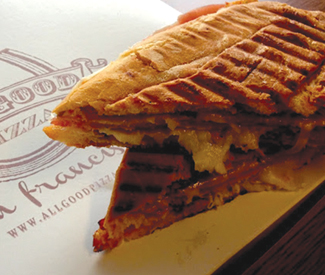
The lot invites lingering over cracker-thin pizzas (a steal at $7), from a basic Margherita to a spicy pie dotted with peppers, fennel, mozzarella, and Louisiana hot links smoked on site. The trailer houses a 650 degree gas-fired oven. These aren’t game-changing pies but there’s nothing like it in the ‘hood — nor are there many healthy salads, like a kale, radicchio, sweet potato crisps, Parmesan, balsamic reserva combo. There are also panini sandwiches ($7) such as a pig-heavy, super salty Nola Muffaletta: Genoa salami, smoked ham, olive salad, fior di latte mozzarella, and provolone cheese.

Italian sodas ($2.50) are all made on premises, like a candy sweet coconut soda evoking coconut oil, beaches and vacation. All this in a Bayview parking lot.

1605 Jerrold Ave., SF. (415) 846-6960, www.allgoodpizza.com


ANDA PIROSHKI

A close childhood pal is Russian and her mother and grandmother often home-baked us unforgettable treats as kids, from blintzes to piroshkis, those little baked buns stuffed with goodness. I still dream of them — a rarity in this town. Not even in Chicago or NY have I tasted any piroshkis as fresh as those at Anda Piroshki, a stall in the tiny but idyllic 331 Cortland marketplace housing a few take-out food purveyors. I’ve eaten Anda at SF Street Food Fest, but the ideal is to arrive at 331 soon after it opens when piroshkis are pulled from the oven piping hot.

The dough is airy yet dense, ever-so-subtly sweet, like a glorified Hawaiian roll. No skimping on fillings — one piroshki ($3.75–4.50) fills me up. Sustainable meats and local ingredients make them relatively guilt-free. Try a button mushroom piroshki overflowing with fresh spinach, or one of ground beef, rice and Swiss, oozing comfort. My favorite is Atlantic smoked salmon and cream cheese accented by black pepper and dill. It makes a savory, creamy breakfast.

The one downside has been a straight-faced, disinterested server who could not be bothered as I asked a question about Russian sodas (like Kvass, a fermented rye soda — pleasing rye notes if too saccharine) and acted the same when I returned a second time… a stark contrast to the friendliness I encounter at every other 331 business. But momentary coldness is still worth those warm piroshkis.

331 Cortland Ave., SF. (415) 271-9055, www.andapiroshki.com

Subscribe to Virgina’s twice-monthly newsletter, The Perfect Spot, www.theperfectspotsf.com


7 pretty tea parties

0

caitlin@sfbg.com

Unbeknownst to those whose primary haunt is dingy dive bars and the bottom of a margarita glass, there are as many kinds of tea houses in San Francisco as one-night stands.

There are the futsy Anglo types: all frill, pastel snack-treats, and delicate china. The hippie tea shacks, where you can order “half of an avocado” without going off the menu. There are borscht-and-herring Russian places, like Katia’s in the Richmond (600 Fifth Ave., SF. (415) 668-9292, www.katias.com). Of course, the real-deal knowledgeable Chinatown shops with blends to spare and free tastings like Red Blossom Tea Company (831 Grant, SF. (415) 395-0868, www.redblossomtea.com).

But none will leave you with a hangover, or linger awkwardly as you get ready for work — and most provide a slow-paced, table service setting perfect for making sober-eyes at the hottie you may be lugging home afterwards. 

OM SHAN TEA

This cozy Mission room may just have the healthiest meal options in the neighborhood — salads to rice bowls and the aforementioned avo half. If you come on Mondays from 7 to 10pm you’ll find yourself in the womb of Open Heart Poetry night, a soul-searching open mic with featured poets that draws a packed house (there’s also weekly temple dancer and live music evenings.) Like the other shops on in this roundup, the menu of teas here can be a little intimidating to a newbie, but in this hand-holding environment an ask for guidance to your server will go a long way.

233 14th St., SF. (415) 747-8327, www.omshantea.com

LOVEJOY’S

Nuzzled into the bosom of Noe Valley, Lovejoy’s can at first be overwhelming — my god, the doilies! Just embrace the chintz, you’ll be glad you did. This is the most perfect pinky-up spot in town, and it stocks the traditional menu of sweets and scones in addition to heartier fare like shepard’s pies and the Ploughman’s Lunch — a platter of artichoke hummus, fruit, greens, and vinegar crisps. Suggestion: go for afternoon tea and order the tallest multi-tier tray of petit fours you can manage. And don’t mind the flocks of MILFs.

1351 Church, SF. (415) 648-5895, www.lovejoystearoom.com

TASTE

Had a rough weekend? Taste awaits to aide in your detoxification and mental clarification. A serene spot in Hayes Valley where one orders at the counter, Taste prides itself on serving tea the traditional Chinese way. That means a tableside lesson on how to drink your brew, pouring out the first cup onto the slotted platform provided before decanting and then tipping the hot liquid into your teeny-tiny cup. Side dishes to all the Zen-like ceremony include dim sum-style buns filled with red bean paste and vegetable curry. Like many tea rooms, you’re also welcome to buy your favorite blend to take home.

535 Octavia, SF. (415) 552-5668, www.tasteteasf.com

TAL Y TARA

It is testament to the misty wonder of the Richmond District that such a place as Tal Y Tara is not overrun with fashionistas seeking authentic British ridingwear and a picturesque place to Instagram themselves drinking a cup of PG Tips. Actually a clothing store hawking everything from longer-in-the-back pastel polo shirts to horse bridles, the back of Tal Y Tara houses a handful of tables with polo-patterned coverings. Snack on a Picadilly (a toasted crumpet with a slice of tomato and Dubliner cheese) while you sip your cuppa and stare at the vintage show pony photos on the walls.

6430 California, SF. (415) 751-9275, www.talytara.com

SECRET GARDEN TEA HOUSE

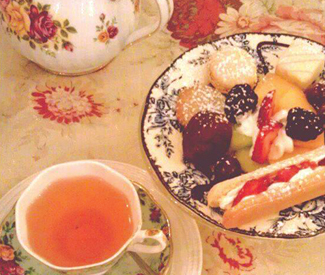
There are so many bric-a-brac shelves in Secret Garden that some of them are brac-less: they exist only to be shelves. Such is the décor reasoning at this parkside parlor, where pastel-colored church hats hang from the walls for insta in-house cred. Upon my visit to Secret Garden I sipped lemon chiffon tea and consumed the Sweet Surrender plate: an ungodly amount of lady fingers, French macaroons, petit fours, and powdered sugar-dusted fruit slices. I also heard the next table over in raptures over glimpsing the royal family on a recent London vacation. Bring your grandma, or a small royal-watcher: there is an ample kid’s menu here.

721 Lincoln, SF. (415) 702-0398, www.secretgardenteahouse.com

DARTEALING

You will undoubtedly be distracted by the fetching jars of pink malt balls and rooster-decorated Sriracha truffles that greet you upon entry into this hideout from the bustling tech world of SoMa. But push on past the retail space: rewards await in the form of comfy sofas be-pillowed with intricately embroidered soft things. Once settled in the space, choose a tea service (blends include cheekily named flavors like “Cabana Boy,” with a sweet tropical fruit taste) that includes options from the sandwich menu: Dartealing has a vast array of crustless wonders, the tofu-and-citrus ginger-soy glazed option being a favorite. Just make sure you leave room for dessert — the lavender-dusted scones that arrive with a ramekin of clotted cream are the dreamiest.

470 Third St., SF. (415) 644-0142, www.dartealing.com

I get by with the help of my local DIY classes

0

What would the ultimate DIY day look like? There’s heaps of classes you can take in the Bay Area to make yourself more handy and sustainability-minded. Here’s a hypothetical 24 hours using the skills you can cull from those courses — scroll to the end of the article for details on where you can take each class concerned.

It’s Saturday! Wake up to the smell of coffee you roasted yourself (“Home Coffee Roasting”). Pour in your homemade almond milk for a nutty kick. (“Everyday Nut Milks and Cheeses”) For breakfast, you’re having toast with the jam you preserved (“Basics of Food Preservation and Jam-Making”) and fresh honey from your backyard beehive. (“Backyard Beekeeping”) Say hello to the chicken peeping outside, and thank your favorite hen as you enjoy that plate of scrambled eggs. (“Intro to Backyard Chickens”)

Mosey out to your freshly-landscaped garden, picking your way past the brand-new bank of sprightly succulents. (“Strategies in Urban Permaculture”) Admire your new water-saving irrigation system — she’s a real looker. (“Greywater, Rainwater Catchment, Earthworks”)

Time to primp for your day. Wash your body with the soap you made from scratch (“Cold Process Soap Making”) and afterwards, spritz yourself with handcrafted perfume. (“Making Natural Perfumes”) Head to your closet and pick out the fresh new frock you sewed (“Patternmaking and Design”), adorning yourself with those homemade earrings and pendant. (“Stitch DIY Class: Jewelry Making”)

After running a few errands around town, return to your garden to enjoy a cup of seasonal tea. It’s perfectly steeped — no need for artificial sweeteners. (“Tea and Food Pairing”) For lunch, you’re thinking crab ravioli with tomato cream sauce. (“Using Your Noodle”) Sprinkle fresh herbs gathered from your garden onto your plate for that extra kick. (“Starting an Herb Garden”)

Your out-of-town friends have been eating out every day of their trip, so you invite them over for a home-cooked meal. You remember hearing one of them saying that he craved sushi — sounds like the perfect night for nigiri and maki. (“We Be Sushi Workshop”) The handsome wooden table you built last weekend (“Wood and Metal”) makes the perfect centerpiece over which to catch up on each other’s lives.

The evening is going smoothly. Until, that is, one of your guests bumps into a burning candle on her way to the bathroom. The fire spreads quickly, but what do you know, those skills you copped from San Francisco’s firefighters save the day. (“Disaster Preparedness Training”)

Singe avoided, you and your friends get in the car to head to a mutual friend’s art show. Snap — the car sputters out! But you dodge an evening of tow trucks and mechanics’ waiting rooms. That auto repair class (“Essentials of Auto Maintenance”) taught you everything you need to save the day. Again.

You drift off to a deep sleep wrapped in a warm nest of your favorite knitted blankets. (“Knitting 101”) Sweet dreams, most capable person ever. 

“Home Coffee Roasting” May 3, 6pm-9pm, $30–$60. Modern Coffee, 411 13th St., Oakl. (510) 927-3252, www.iuhoakland.com

“Everyday Nut Milks and Cheeses” May 2, 6pm-8:30pm, $40-65. Instructor’s private home in Oakland, www.rawbayarea.com

“Basics of food preservation and jam-making” Fri/20, 6:30pm-8pm, $10. Pot and Pantry, 593 Guerrero, SF. (415) 206-1134, www.potandpantry.com

“Backyard beekeeping” Tue/24, 6pm-9pm, $35. Sticky Art Lab, 1682 University, Berk. (510) 655-5509, www.biofueloasis.com

“Intro to Backyard Chickens” Sun/15, 2pm, $35. Mill Valley Chickens, 106 Lomita, Mill Valley. (415) 389-8216, www.millvalleychickens.com

“Strategies in Urban Permaculture” Sun/15, noon-5pm, $25. Hayes Valley Farm, 450 Laguna, SF. (415) 753-7645, www.hayesvalleyfarm.com

“Greywater, Rainwater Catchment, Earthworks” basics of home irrigation Sun/29, 10am-1pm, $15. EcoHouse, 1305 Hopkins, Berk. (510) 548-2220, www.ecologycenter.org

“Cold Process Soap Making” Fri/20, 6pm-9pm, $65. Nova Studio, 24 West Richmond, Point Richmond. (510) 234-5700, www.thenovastudio.com

“Making Natural Perfumes” May 6, 10 am-5 p.m., $125. Nova Studio, 24 West Richmond, Point Richmond. (510) 234-5700, www.thenovastudio.com

“Patternmaking and Design” Four weekly classes, $175. Apparel Arts, 2325 Third St. Suite No. 406, SF. (415) 436-9738, www.apparel-arts.com

“Stitch DIY Class: Jewelry Making” Sat/14, 2:30pm-3:30pm, free. Indie Industries Castro Store, 2352 Market, SF. (415) 861-1150, 5titch.eventbrite.com

“Tea and Food Pairing” Tue/17, 7pm-8:30pm, $85. Tea Time Room, 542 Ramona, Palo Alto. (650) 328-2877, www.tea-time.com

“Using Your Noodle” 5/1, 6:30pm-9:30pm, $45-60. Marina Middle School,104A, 3500 Fillmore, SF. (415) 749-3495, www.ccsf.edu/continEd

“Starting an Herb Garden” May 5, 10:30am, $39. Common Ground Organic Garden Supply and Education Center, 559 College, Palo Alto. (650) 493-6072, www.commongroundinpaloalto.org

“We Be Sushi Workshop” Sat/14 and Sat/21, 10am-1pm, $65-80. We Be Sushi, 538 Valencia, SF. (415) 565-0749, www.ccsf.edu/continEd

“Wood and Metal” April 23 through July 2, Mon. 6pm-9pm, 10 sessions for $520. The Crucible, 1260 Seventh St., Oakl. (510) 444-0919, www.thecrucible.org

“Disaster preparedness training” Tues/17, 6:30pm-9:30pm, free. Valencia Gardens Community Room, 390 Valencia, SF. (415) 970-2024, www.sf-fire.org

“Essentials of Auto Maintenance” Sat/14, 11am, $60. Metric Motors, 1480 Howard, SF. (415) 295-4486, www.thedistilledman.com

“Knitting 101” Weekly instruction hours Mon. and Wed., 7 p.m.-9pm; Sat., 8:30am-10:30am, $66. Imagiknit, 3897 18th St., SF. (415) 621-6642, www.imagiknit.com


Green shopping guide: 6 earth-conscious fashion outposts

21

We’ve been shopping green for a week now — check out our previous guides to housewares, kid’s stuff, gardening resources, and local beauty

Let’s face it. Finding an oversized sweater in your mom’s closet that looks good on you tends to make you feel better than purchasing one at a corporate retail store because (a) you hate homogeneity, (b) you like saving money, (c) you’re rocking something straight out of the 80s, and (d) you’re relieved of the guilt associated with buying an item produced overseas. Here are a few suggestions on where to shop locally for you tree-hugging, fashion-conscious souls.

Static

Static showcases an extensive collection of vintage clothing, shoes, and accessories from the 1920s to today. We’ve never seen so many fur-lined jeans jackets, wearable pieces of grandma jewelry, and rad, antiquated boots in one spot.

Sunday-Thursday 12pm-7pm; Friday-Saturday noon-8pm. 1764 Haight, SF. (415) 422-0046, www.staticvintage.com

No

If you’re looking for a vintage sweater that says, “I just threw this on haphazardly because I don’t really care how I look” (but you actually look awesome in a mysteriously sexy, I’m post-showing cleavage way) look no further than No. This is one of those places where you take 15 things into the dressing room and, annoyingly, like most of them. 

Monday-Sunday 11am-7pm. 389 Valencia, SF. (415) 252-9982

Foggy Notion

Alissa Anderson of mittenmaker opened the doors of her Inner Richmond shop last month. She sells her own eco-conscious creations as well as green products from other, mostly Western United States-based designers and craftspeople — like Captain Blankenship fragrances made with local biodynamic grape alcohol and Daughter of the Sun recycled leather crystal pendants. 

Wednesday, Thursday, Sunday 11am-6pm; Friday-Saturday 11am-7pm. 275 Sixth Ave No. 101, SF. (415) 683-5654, www.foggy-notion.com

Mystery Mister

The apparel and accessories at this Haight Street gem span the eras between Victorian and ’80s. You may feel the urge to buy a lace-trimmed bonnet. Indulge it. 

Monday-Sunday 11am-7pm. 1506 Haight, SF. (415) 552-4226, www.mysterymister.com

Retro Fit Vintage

An ideal place to piece together a costume for Halloween, Bay to Breakers, or your average Friday night in San Francisco. 

Sunday, Monday, Wednesday, Thursday 12pm-7pm; Friday-Saturday noon-9 pm. 910 Valencia, SF. (415) 550-1530, www.retrofityourworld.com

General Store

A carefully curated clothing and handmade craft shop located in the Outer Sunset. Locally made items include Tellason denim, Joshu+Vela backpacks, and Tanya Maydoff natural fiber wool caps and hand warmers. 

Monday-Friday 11am-7pm; Saturday-Sunday 10am-7pm. 4035 Judah, SF. (415) 682-0600, www.visitgeneralstore.com

Weird me out

0

emilysavage@sfbg.com

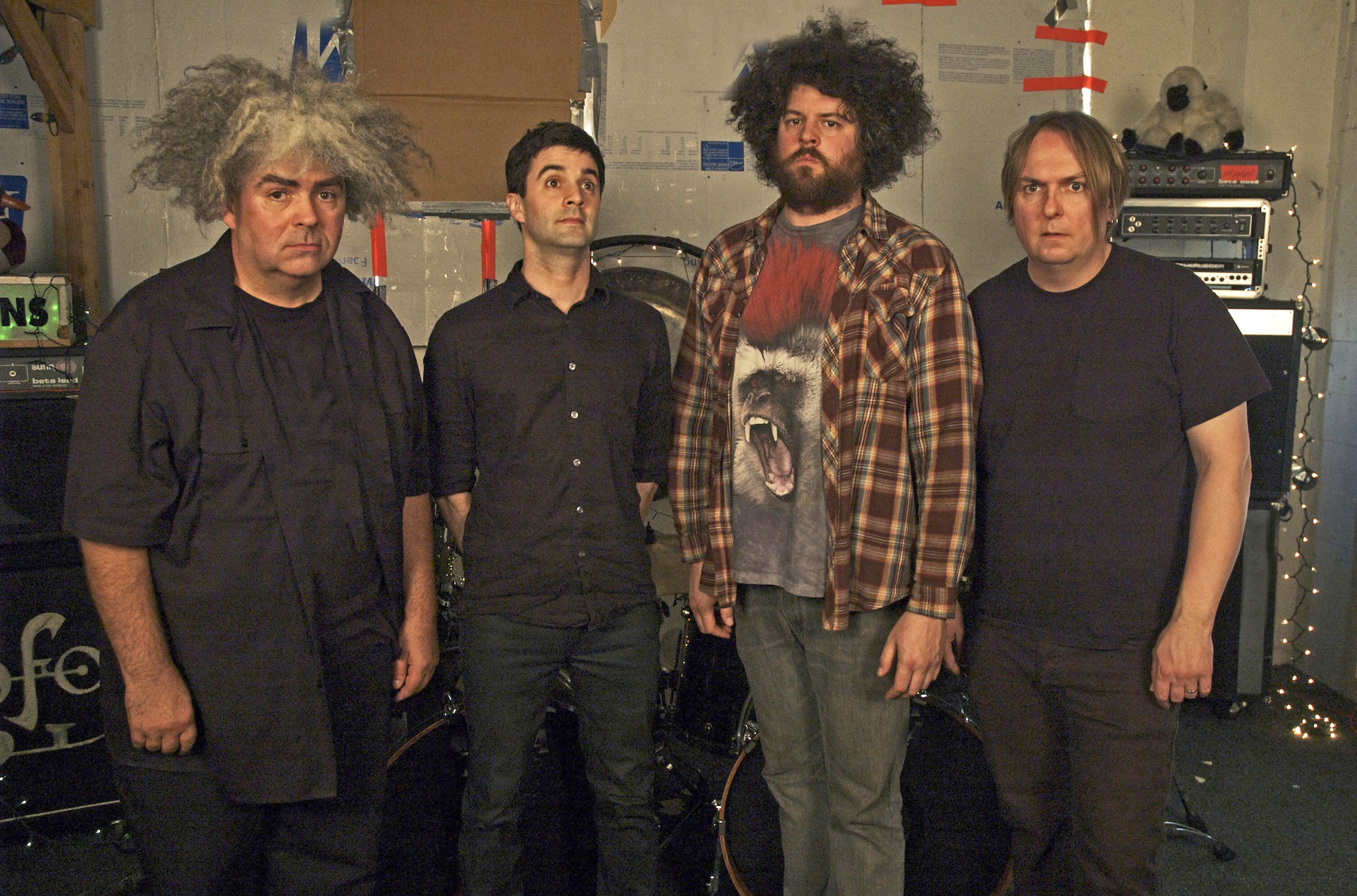
MUSIC Here is a partial list of not quite idioms, butchered sayings, and quasi heartfelt beliefs the Melvins’ Buzz “King Buzzo” Osborne peppered throughout a conversation during a phone call last week from his home in Hollywood.

“We can’t be lion tamers all the time.” “You can accuse me of a lot of things, being lazy isn’t one of them.” “When in fear, or in doubt, run in circles, scream and shout.” “Treat me right, I’ll be your best friend. Treat me wrong, you don’t exist.”

At least one of those deserves to be crocheted on a throw pillow. Or screenprinted on a Melvins backpatch.

“WE CAN’T BE LION TAMERS ALL THE TIME.”

Singer-guitarist Osborne met his longtime collaborator, drummer Dale Crover, in 1984, Aberdeen, Wash., one year after the Melvins had formed and were performing mostly Cream covers. Crover was also in a bad cover band, but Osborne knew he could play well, so he invited him to join his band.

“There’s a fine line between genius and stupidity for both of us. I like playing with him, one way or another,” Osborne says of their continued relationship. “And it seems to work, no reason to quit — until he gives me a reason, then that will be it.” Osborne’s speech patterns raise often with sarcasm; in person that signature fuzzy grey ‘fro of his is likely shaking, punctuating each joke.

After that first shaky year, the Melvins got an early foothold in the blending of punk and metal, influenced by first round Black Flag (The band would go on to influence scores of musicians itself, recently, Mastodon).

“Somehow I realized even then that I needed to work on writing my own music, not relying on playing cover songs — even though we love to play cover songs, and we still do. But I started writing music pretty quickly. Sometimes we still play those first songs I ever wrote.”

“YOU CAN ACCUSE ME OF A LOT OF THINGS, BEING LAZY ISN’T ONE OF THEM.”

In the past some 29 years, the Melvins — which is made up of a rotating lineup, save for Osborne and Crover — have recorded 19 full-length albums, and that’s not counting countless other releases (singles, EPs, comps).

Since the end of December, the band recorded more than 50 songs, Osborne notes proudly as his Jack Russell Terriers scream in the background. Included in that batch is The Bulls & the Bees EP, released for free download through Scion last month and the Freak Puke LP, which will be out in June on Ipecac.

“WHEN IN FEAR, OR IN DOUBT, RUN IN CIRCLES, SCREAM AND SHOUT.”

The head bang-worthy The Bulls & the Bees is five classic Melvins cuts, thundering drums, doomy guitar, and Osborne’s low octave howl, it’s drum-happy sludge rounded out by frequent Melvins players Jared Warren and Coady Willis from stoney LA band Big Business.

Up next, there’s the upcoming Freak Puke, which is being touted as Melvins Lite. In this record, the band is a trio: Osborne, Crover, and Trevor Dunn of Mr. Bungle and Fantomas fame on stand-up bass.

Freak Puke is similarly dense and dark, so that’s not the reason for the ‘Lite’ attached to the name. Is it? Osborne explains: “You be the judge. We’ve always done lighter stuff. I’ll just say it’s Melvins lighter in weight, as in, our weight is less with three guys in it, as opposed to four. That record just has a different vibe.”

He’s, of course, right, it’s more the vibe of the record that sets it apart. The frenzied plucking of strings that kick off “Baby, Won’t You Weird Me Out” take the Melvins even further down the strange hybrid wormhole they’ve long been building out of mud — yet not so far that we can’t recognize their inimitable sound.

“TREAT ME RIGHT, I’LL BE YOUR BEST FRIEND. TREAT ME WRONG, YOU DON’T EXIST.”

After Osborne moved from Aberdeen, but before his trek to LA to be with his wife (and now, their many dogs), he lived for seven years in the Richmond District of San Francisco, near the Presidio. And while he claims to not be sentimental about the past (“I’m more of a ‘what have you done lately’ type of person”) he mentions that he remains loyal to the promoters at Slim’s and Great American Music Hall, where the Melvins four-piece/non-lite will be performing all the tracks off the new EP later this week. “As long as those people want to continue doing shows with us, we’re there.” 

MELVINS

With Unsane

Thu/12, 9pm, sold out

Great American Music Hall

859 O’Farrell, SF

(415) 885-0750

www.slimspresents.com

Mayor McLaughlin on synthetic biology issue

1

For my story about synthetic biology in this week’s Guardian, I tried to reach Mayor Gayle McLaughlin of Richmond, where Lawrence Berkeley National Laboratory is building its second campus. The group Synbiowatch is questioning the safety and environmental responsibility of these new technologies. McLaughlin was traveling and just got back to us, so we thought we’d share the perspective of a Green Party mayor of the city where this work will take place.

SFBG: Do you have any concerns about safety at the lab or with the regulation of the synthetic biology field?

GM: I understand that this issue is extremely important. I was at the symposium “Unmasking the Synthetic Biology Lab” held in Berkeley last week and have been learning about the risks and concerns related to this field.

SFBG: Are you worried that we’re entering another “economic bubble,” this time with so-called “green jobs,” and that it could pop like previous bubbles and end up hurting Richmond?

GM: I think that green and sustainable job development will continue, as there is an absolute necessity for our human survival that we create a sustainable planet on which to live and thrive as well as pass along to future generations.

SFBG: The activists say the Precautionary Principle should dictate a slower and more careful and regulated approach to developing newly engineered microorganisms, do you share that view?

GM: I absolutely agree. There needs to a slow and deliberate process that fully researches and regulates this new engineering. I believe that science has a responsibility to examine step by step what is in the interest of us all as human beings – what truly advances us and what may cause us more problems.

SFBG: While the lab diversifies Richmond’s economy, much this research is funded by and could ultimately by developed by Chevron and other big energy companies. Is that appropriate for research into new energy forms that is sponsored with public money?

GM: I agree that the lab diversifies Richmond’s economy and I support opportunities it offers our community that come from positive, safe and healthy scientific exploration, education, and job opportunities. 

The fact that big energy corporations are funding much of the research definitely brings up concerns for me. We need to make sure that science is not conducted with an eye toward profit-making, but rather for the advancement of humanity. We know that our society currently is corporate-run, so we need to continuously raise the issue that true science has an obligation not to the corporations but to the people. This issue is something that should be raised everywhere.

Playing God?

6

steve@sfbg.com

THE GREEN ISSUE When Richmond was selected as the site for Lawrence Berkeley National Laboratory’s huge second campus in January, city officials and community leaders celebrated the “green” jobs it would create, hundreds of them, diversifying an economy dependent on Chevron and its massive oil refinery. But a new coalition called Synbiowatch (www.synbiowatch.org) is questioning how green those jobs really are and raising fears about the new scientific realm on which they rely.

It’s called synthetic biology, which combines engineering and computer science with the biological sciences to design new microbes that don’t exist in nature — living, self-replicating organisms — taking the field of genetic engineering to another level by allowing scientists to actually write new DNA codes and incubate new life forms.

Proponents tout myriad potential benefits from the approach, from medical treatments (such as developing new anti-malarial drugs or creating new viruses that would attack cancer cells in humans) to the creation of renewable energy sources that might eventually replace fossil fuels, a major focus of the new lab and its main partner, the U.S. Department of Energy’s Joint BioEnergy Institute (JBEI).

“JBEI researchers are engineering new types of microbes using the latest tools in biotechnology,” notes a cartoonish video on its website (www.jbei.org) explaining how these engineered organisms will turn grasses and other abundant biomass matter into powerful fuels — a task that is not yet possible — which can run cleaner burning internal combustion engines.

But the environmentalists, labor organizers, scientists, and community activists who make up Synbiowatch say this technology not only doesn’t live up to its speculative hype, but that it is being developed too rapidly and without adequate oversight given its potential to alter natural ecosystems in unpredictable ways.

“We need a precautionary approach to health and safety,” Jim Thomas — program manager for ETC Group (which stands for Erosion, Technology, and Concentration) and lead author of the 2007 report “Extreme Genetic Engineering: An Introduction to Synthetic Biology” — told journalists during a March 28 briefing at Center for Genetics and Society in Berkeley.

He was joined by UC Berkeley microbial ecologist Ignacio Chapela, a researcher who has publicized environmental impacts of the biotechnology industry; Nnimmo Bassey, executive director of Environmental Rights Action in Nigeria and chair of Friends of the Earth International; molecular biologist Becky McClain, who won a $1.4 million civil lawsuit against her old employer, Pfizer, after blowing the whistle on safety violations in its biotech research; Henry Clark of the West County Toxics Coalition; and Richmond activist Gopal Dayaneni of Movement Generation Justice and Ecology Project. All took part in a conference the next day entitled “Unmasking the Bay Area Bio Lab and Synthetic Biology: Health, Justice, and Communities at Risk.”

Thomas said this coalition formed in recent years to counter the rapid development of what he says is now a $1.6 billion industry that has successfully resisted meaningful government regulation and oversight, despite the fact that the microbes it produces “have no analog in nature, and they will grow and reproduce.”

With no natural predators, the new microbes could reproduce unchecked. “We cannot allow these corporations to play God. They are not God,” said Bassey, who has spent a career combating the false claims and environmental degradation of some of the same big energy corporations (such as Chevron, Shell, and BP) sponsoring this new research. “It’s reckless, it’s out of control, it’s all about money.”

The biggest target of these activists’ ire is Jay Keasling, who directs the JBEI program, helped found the Richmond lab, and has pioneered synthetic biology research for LBNL and UC Berkeley, in addition to starting several companies to take advantage of that research. His latest is Lygos, which he formed in February to develop commercial applications for JBEI’s work on developing new fuels.

Keasling tells us that his critics are wrong and that these new microbes are basically just modifications of substances that scientists have worked with for decades and know how to safely handle. “What we’re trying to do is make the engineering of biology more reliable, so it’s safer and more predictable,” Keasling told us.

He dismissed the idea that these new microbes could threaten ecosystems if they escape from the lab, noting that microbes whose genetic sequencing has been altered in experiments over the last 40 years haven’t proven to be resilient in nature. “When they’re exposed to the environment, they generally don’t survive,” he said. “They get eaten by the other microbes completely.”

But the fear raised by Synbiowatch is that these rapid technological advances could produce a more durable new microbe, and that these scientists are essentially playing God with the basic building blocks of life before they really understand the implications of what they’re creating. Does Keasling think it’s possible that one of his new microbes might be more of a survivor than its predecessors?

“There’s always a possibility, but in 40 years of doing research in this area, that has not been found,” Keasling told us.

That’s not good enough for Synbiowatch and other critics, who say that it’s important to practice the Precautionary Principle — which places the burden of proof on innovators to prove that new technologies won’t be harmful to the environment or human health — before this new lab ramps up its research and development.

The new facility is expected to produce more than 800 jobs. Dayaneni said it’s understandable that Richmond officials embraced the new lab and the prospect of green jobs, but he called the promises of synthetic biology “a wolf in sheep’s clothing, or a wolf genetically engineered to look like a sheep.” He called the new lab “a shell institution for a host of corporate interests” seeking to “synthesize fuel in a petri dish” as much to create an economic bubble as a long-term energy solution.

But he and Bassey said the nascent industry isn’t focused on the many potential downsides of its pursuit, including the degradation of vast tracts of land and consumption of natural resources in order to acquire the sugars needed to fuel the process. “They will need a massive amount of land,” Bassey said. “This is what the progenitors of synthetic biology have failed to acknowledge.”

Keasling does acknowledge that to develop large-scale energy production of the new technology — something he said is still decades away from being viable — will indeed require vast tracts of land growing crops such as jatropha that have been developed for their fuel production potential, something Bassey said will displace poor people around the world.

“Farmers are being tricked to grow crops that are only for industrial uses,” he said. “Farmers that would normally grow crops for food will now be growing it for machines.”

Bassey ridiculed claims that such crops would only utilized marginal lands, but Keasling said the idea is to make use of currently nonproductive vegetation such as switchgrass, using the new microbes to extract sugars from their cellulose. “My hope is the plants will be grown on marginal land and the people who own it will make money from growing it,” Keasling said. “In some ways, it’s giving something back to the farmers.”

Dayaneni compared the new facility and industry to the short-sighted hubris of the nuclear industry before Japan’s Fukushima disaster: “You don’t build a nuclear power plant on the edge of the ring of fire and you don’t build a synthetic biology laboratory on the edge of the ring of fire either.”

Yet Keasling said he and his colleagues are far more aware of these issues and the need for safety and security than activists are giving them credit for. “The synthetic biology community is made up of people who are really concerned about the environment,” Keasling told us.

But McClain said her case shows corporations will often disregard worker safety and environmental consequences in pursuit of profits, often with the complicity of scientists enamored by new discoveries. “There is a lack of integrity and leadership in our scientific leadership,” she said, later adding, “The bottom line is we’re giving the scientific community the right to self-regulate, but that comes with responsibility.”

Keasling said he thinks there is a middle ground possible because “we’re not against regulation, we believe in regulation, it’s important, but it has to be sensible.” He also defended the role that large energy and biotechnology corporations have played in funding this research and licensing the patented new technologies it produces.

“We live in a capitalist system, somebody has to fund this research and science,” Keasling said. “The government doesn’t have the money.”

Our Weekly Picks: April 4-10

0

WEDNESDAY 4


Nile

Death metal fans are eagerly awaiting At the Gate of Sethu, the newest album from South Carolina speed-demons Nile. Influenced, as always, by singer-guitarist Carl Sanders’ exhaustive study of Egyptian history and myth, the band’s new offering is sure to feature Nile’s distinctive traits: impossibly fast blast-beats (courtesy of drummer George Kollias), keening, Middle Eastern chords, and creepy, atmospheric interludes played on traditional instruments. Still, the chief delight for any Nile fan should be witnessing the band’s superhuman stamina and chops in person — despite a truncated opening set, few bands can play more individual notes in a single night.(Ben Richardson)

With the Black Dahlia Murder, Skeletonwitch, Hour of Penance

7:30pm, $21

Slim’s

333 11th St., SF

(415) 255-0333

www.slimspresents.com


Blank Tape Beloved featuring Brother Ali

“Sometimes I don’t write a lot/ I know folks out there call that writer’s block/ I just call it my process/ It comes out when it’s ready to, I guess…” So explains Brother Ali in new single “Writer’s Block,” perhaps as a reply to fans asking about the lengthy stretches between releases. The Minneapolis-based emcee brings a big-picture perspective, striking a lyrical balance between brevity and bookishness. New (and free!) seven-song EP The Bite Marked Heart provides the appetizer for upcoming LP Mourning in America and Dreaming in Color. Ali brings in the band Blank Tape Beloved for what he describes as an impromptu and intimate performance. (Kevin Lee)

9pm, $10

Cafe Du Nord

2170 Market, SF

(415) 861-5016

www.cafedunord.com


Cults

Cults sound like a ’60s girl group (think the Shangri-Las/Ronettes) drenched in dreamy, lo-fi noise. New York-based couple and artistic collaborators Madeline Follin and Brian Oblivion began making music in their home as a hobby not too long ago. Shortly after their hit single “Go Outside” went viral in the blogosphere, however, they landed a record deal and released their first album (Cults). Their vocals, which Follin belts out in a sweet, crooning manner, suggest foreboding themes like senseless depression, unalterable inadequacies, and uneven, entrapping love. You’ll most likely want to slowly sway to these songs — and reverently mimic Oblivion’s steady, controlled head banging. (Mia Sullivan)

With Spectrals, Mrs. Magician

8pm, $21

Great American Music Hall

859 O’Farrell, SF

(415) 885-0750

Thu/5, 8 p.m., $21

Slim’s

333 11th St., SF

(415) 255-0333

www.slimspresents.com


THURSDAY 5

“Behind The Scenes: The Art and Craft of Cinema”

As a costume designer in Hollywood, Deborah Nadoolman Landis has worked on a host of legendary films and created iconic looks such as the fedora and jacket of Harrison Ford (Indiana Jones) in Raiders of The Lost Ark (1981), the candy apple red leather jacket for Michael Jackson in Thriller, the “College” shirt worn by John Belushi in Animal House (1978), and many more. Landis will be appearing at PFA this week to discuss her work as part of “Behind The Scenes: The Art and Craft of Cinema,” a special two-night program — on Thursday she will be joined by her husband, director John Landis, for a screening of Three Amigos! (1986) — one of several projects they’ve worked on together over the years. On Friday she will join fellow costume designer Aggie Guerard Rodgers for a talk and screening of the classic American Graffiti (1973). (Sean McCourt)

Thu/4-Fri/5, 7pm, $5.50–<\d>$9.50

Pacific Film Archive

2575 Bancroft Way, Berk.

(510) 642-1412

bampfa.berkeley.edu


Argentine Tango USA Festival

There are few cities more similar to San Francisco than Buenos Aires — leaving aside the vagaries of bistec versus burrito and geographic shaping (121 compared to 203 square kilometers). The two are major cities with world-class art scenes, passionate histories of social protest, and dammit, we dance. Be you a hippie-shaker or a vogue hand-waver, the motion in your ocean will most surely respond to the sultry allure of tango, brought to us this week in spades in a big-time competition authorized by the Buenos Aires city government. Spring to attend a milonga, which is like a tango jam session, or take a seat to watch the pros pivot it out. (Caitlin Donohue)

Thu/5-Sun/8, $20 competition spectator admission Check website for competition times

San Francisco Airport Marriott

1800 Old Bayshore Highway, Burlingame

www.argentinetangousa.com


Dark Star Orchestra

Depending on how much second-hand pot you’ve smoked, if you close your eyes and listen up to Dark Star Orchestra, it’s possible to convince yourself you’ve transported back to 1969 for a Grateful Dead show. Yes, DSO is a nationally recognized and acclaimed Dead tribute act (seriously, the band really sound like the Dead) that is coming to show us young whippersnappers what we missed in the 1960s, ’70s, ’80s, and ’90s. So melt into the sunny jams that have shaped our fair city’s culture, expose your inner ecstasy, and rub against the person next to you; lovingly. Also, consider this is a prime opportunity to people-watch and swap Jerry Garcia-related personal transformation stories. (Sullivan)

9pm, $35

Great American Music Hall

859 O’Farrell, SF

(415) 885-0750

www.slimspresents.com


FRIDAY 6


Yours and Mine

If contemporary performance originated partly in response to the cultural primacy of visual art, Macklin Kowal’s Yours and Mine suggests a full-circle act of reclamation in which performance shares not only space but a full dynamic partnership with other objets d’art. In it Kowal, a San Francisco performer-choreographer and current artist-in-residence at Meridian Gallery, responds with capable, thoughtful intelligence to an exhibition by leading Irish contemporary painter Patrick Graham, in an hour-long performance installation involving ten dancers and all three floors of the gallery. The piece promises a further livening of the rooms beyond the already electric effect of Graham’s roiling canvases, as well as an exploration of the way we literally embody the aesthetic experience. (Robert Avila)

Fri/6-Sat/7, 7:30pm, $10–<\d>$20

Meridian Gallery

535 Powell, SF

(415) 624-6765.

www.meridiangallery.org


“Beautiful Rebels: A Celebration of the Fashion World of Jean Paul Gaultier”

You got epaulet envy trawling the paparazzi shots from the opening of the JPG-de Young exhibit a few weeks ago. Chin up girl, your chance to fete fashion’s enfant terrible hasn’t passed you by. Sashay to Golden Gate Park to hang with the Guardian (we’re the media sponsors) at this Friday night happy hour event. Drag-cinema supernova Peaches Christ will be doing us the honor of emceeing, and would you believe there will be a fashion show featuring the work of Mister David and others — not to mention a performance by SF’s queer-hop representatives Double Duchess and a craft table by Some Thing artisan Haute Gloo? (Donohue)

Fri/6 5:30pm, free de Young Museum 50 Hagiwara Tea Garden, SF (415) 750-7694

Facebook: Beautiful Rebels www.peacheschrist.com


dead prez

The dead prez anthem “It’s Bigger Than Hip-Hop” may as well apply to both dead prez lyricists-producers M-1 and stic.man. Since teaming together in New York in the mid-1990s in New York, M-1 and stic.man have developed from hip-hop artists into social change activists, revolutionary lecturers, and health advocates. (Legend has it the duo used to fling apples into the crowd at concerts.) Both have kept busy with their own projects — stic.man came out with a “fit-hop” album The Workout (Boss Up Inc) espousing the benefits of good breathing tactics and calisthenics, while M-1 has paired with Italian electro producer Bonnot of Assalti Frontali to become AP2P (aka All Power to the People). But dead prez is still very much alive, continuing to tour and working on the long-delayed LP Information Age. (Lee)

With Los Rakas, DJ Mr. E

9pm, $20

Mezzanine

444 Jessie, SF

(415) 625-8880

www.mezzaninesf.com


Thrones

Game on: the band Thrones has been around far longer than that newbie medieval fantasy television show (though not quite as long as the book series it’s based on). Another key difference, this Thrones is actually just one dude: Seattle’s Joe Preston, the metal-grinding doom bassist/Moog-enthusiast who’s spent time on tastemaker labels Kill Rock Stars and Southern Lord, and played alongside Earth, the Melvins, and High on Fire. If Preston were to play his own Thrones game, it would likely involve some sort of underground “chew up this sheet metal and spit it out stylishly” auditory sensation contest. Coda: I was advised against relating Thrones in any way to Games of Thrones, but it has now just happened, so do with that what you will. (Emily Savage)

With Helms Alee, Grayceon

9:30pm, $10

Hemlock Tavern

1131 Polk, SF

(415) 923-0923

www.hemlocktavern.com


GWAR

You know a band is worth seeing when the singer has a seven-syllable name for his prosthetic penis. The “Cuttlefish of Cthulu” has flopped mightily at the forefront of GWAR shows for over 20 years, and the Richmond, Va. outfit shows no signs of slowing down. The tunes are still mostly straightforward, forgettable headbanger fuel, but the elaborate costumes and stage show change every tour — half the fun is discovering which foam-rubber politician effigy GWAR is going to disembowel next. My money’s on Rick Santorum this time around. (Ben Richardson)

With Municipal Waste, Ghoul, Legacy of Disorder

8pm, $25

Regency Ballroom

1300 Van Ness, SF

(415) 673-5716

www.theregencyballroom.com


MONDAY 9

Jeff Mangum

How much do we owe the Elephant Six Recording Company collective for our current slate of folk and indie rock? Two decades after a group of four friends launched their own record label in Denver, Elephant Six bands and spin-off projects (The Apples in Stereo and of Montreal among them) are still pushing critically acclaimed music. Core member Jeff Mangum remains among the collective’s most followed musicians, even though his Neutral Milk Hotel released the last of its two LPs fifteen years ago. The everlasting appeal of On Avery Island and In the Aeroplane Over the Sea may stem from a refreshing rawness devoid of glossy production. In these two shows before Coachella, Mangum’s acoustic performances highlight his signature sweet serenade. (Lee)

With Laura Carter and Andrew Rieger of Elf Power and Scott Spillane of the Gerbils

Mon/9-Tue/10, 8pm, $36

Fox Theater

1807 Telegraph, Oakl.

(510) 548-3010

www.thefoxoakland.com 


The Guardian listings deadline is two weeks prior to our Wednesday publication date. To submit an item for consideration, please include the title of the event, a brief description of the event, date and time, venue name, street address (listing cross streets only isn’t sufficient), city, telephone number readers can call for more information, telephone number for media, and admission costs. Send information to Listings, the Guardian Building, 135 Mississippi St., SF, CA 94107; fax to (415) 487-2506; or e-mail (paste press release into e-mail body — no text attachments, please) to listings@sfbg.com. Digital photos may be submitted in jpeg format; the image must be at least 240 dpi and four inches by six inches in size. We regret we cannot accept listings over the phone.

Appetite: New bar manager, superb cocktails at Heaven’s Dog

0

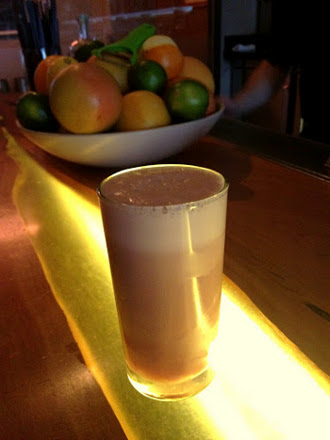
Heaven’s Dog has been a haven for superb cocktails since it opened, with excellent bartenders like Erik Ellestad (Savoy Stomp) and pre-Prohibition era cocktails ($10 each) from Charles H. Baker’s The Gentleman’s Companion, aka “Jigger, Beaker, and Glass.” The bar still serves Baker classics, and with new bar manager Trevor Easter on board, receives a fresh infusion while keeping to its roots. Easter came from some of our city’s best bars (like 15 Romolo and Wilson & Wilson inside Bourbon & Branch), and used to trek up from San Diego where he lived prior to SF for cocktails at Heaven’s Dog by bar director Erik Adkins.


Technique is Easter’s drive, generally keeping to ingredients used 100 years ago. One housemade item that I’d recommend highly, though it is only occasionally on the menu (should be back by May), is Erik Adkins’ gin-based Pimm’s recipe. It makes a beautiful Pimm’s Cup, one of my favorites here, bright with cucumber and lemon. I was delighted with Easter’s off-menu twist on a low alcohol Americano, a Salted Americano with a couple drops of saline solution added to open it up and offer a brilliant layer of saltiness amidst sweet bitterness.

Oaxacan Firing Squad is based on the Mexican Firing Squad cocktail in Charles Baker’s book, using Del Maguey Mezcal Vida alongside tequila instead of merely tequila as the original does. Lime, Small Hands excellent grenadine, and Angostura bitters round out this refresher.

Elks Own is a classic from 1901, prepared beautifully here with a late bottled 2006 vintage Quinta De La Rosa Porta. Don’t let the soft pink color fool you. It’s robust with Rittenhouse Rye, bright with lemon, silky with sugar and egg whites. The tart, tannic berry of the port gives the cocktail a lush, sexy texture while remaining refreshing.

An off-menu twist on the Brooklyn cocktail, Wall Street (originally served at Rickhouse) is another luxuriant pleaser using Old Bardstown bourbon instead of rye whiskey, Punt e Mes vermouth, Luxardo maraschino, winter bitters (house made allspice and mole bitters) and Della Christina Nocino walnut liqueur instead of Amer Picon, adding a nutty layer.

There are a couple Easter creations on the menu (Chantilly Lace: Plymouth gin, lime, Small Hands Pineapple Gum, apricot brandy, bitters, mint; and Yankee Clipper: Beefeater gin, Carpano Antica, Luxardo Maraschino, Bitter Truth orange bitters, Duplais Absinthe Verte), but the menu sticks mostly to classics. The bartenders know their classics so feel comfortable opting for Freedom from Choice and let them create something for you.

For those who find the warm shumai dumplings and spicy wontons expensive compared to cheap Sunset or Richmond district dim sum, both are $6 during happy hour (Monday-Friday, 5-6:30pm).

Subscribe to Virgina’s twice-monthly newsletter, The Perfect Spot, www.theperfectspotsf.com

The legacy of racism

5

steve@sfbg.com

The legacy of brutal racism in this country, particularly against African Americans, shapes the events of today. That’s a notion that much of white America resists accepting, particularly conservatives. But actions create reactions, hatred begets hatred, and those cycles can roll forward endlessly and manifest in unpredictable ways.

That’s one of the most compelling lessons in local journalist Thomas Peele’s gripping and insightful new book, Killing the Messenger: A Story of Radical Faith, Racism’s Backlash, and the Assassination of a Journalist (2012, Crown), which grew out of covering the aftermath of the 2007 murder of Oakland journalist Chauncey Bailey by members of Your Black Muslim Bakery.

Bailey was killed to prevent him from writing a story in the Oakland Post about the violence and financial crimes perpetrated by followers of the late Yusuf Bey and his sons, including Yusuf Bey IV (aka Fourth). Peele and other local journalists and media outlets (including the Bay Guardian) formed the Chauncey Bailey Project to build on the work Bailey began and investigate his murder, which Fourth was convicted last year of ordering.

“The free press on which the public depends to keep it informed had been attacked,” Peele wrote. While such murders are rare in the U.S. — the last was a Mafia hit on a reporter from Arizona in 1976 — Peele and his brethren considered it important to send the message that, “A story could not be killed by killing a journalist.”

But the story that emerges from Peele’s years-long investigation goes well beyond Bailey’s murder, its flawed investigation by the Oakland Police Department, the violence and hypocrisy of the Your Black Muslim Bakery “cult,” or its long and complex relationship with Oakland’s political and community leaders.

Peele delves deeply into the 80-plus-year history of the Nation of Islam and Black Muslim ideology, dissecting its turbulent evolution and belief system that white people are “devils,” created by a mad scientist named Big-Headed Yakub, who use “tricknology” to hide the truth that African Americans are superior beings who will be spared during a coming Armageddon inflicted by a spaceship that has long circled the earth — a belief system that Malcolm X rejected after taking a hajj to Mecca and shortly before his assassination.

Peele dismisses the entire religion — which has very little in common with true Islam — as a deceptive scam from its inception, devised by the “con man” W.D. Fard and promoted by Elijah Muhammad simply to enrich its leaders by manipulating poor African Americans. Similarly, Yusuf Bey spoke the language of black empowerment in founding his own breakaway Black Muslim sect in North Oakland then used it as cover for criminal enterprises and raping the women under his control over a period of decades.

But to understand the appeal of Black Muslims preaching hatred of white devils, you have to look at the African American experience and horrible racism and violence that black people have endured in this country, as Peele does. He starts in Depression-era Detroit, where Fard and Muhammad met amid the virulent racism against Southern blacks who migrated north to work in Henry Ford’s automobile factories.

“This is the question of the psychology of race,” legendary attorney Clarence Darrow said during the Detroit murder trial of blacks defending their home against an attacking white mob, which Peele uses to great effect. “Of how everything known to a race affects its actions. What we learn as children we remember — it gets fastened to the mind. I would not claim that the people outside the Sweet house were bad. But they would do to Negroes something they would not do to whites. It’s their race psychology.”

We see Joseph Stephens (who would later become Yusuf Bey) growing up with tales of brutal lynchings in his hometown of Greenville, Texas, and later as a Santa Barbara hairdresser who discovered the Nation of Islam in 1962 after the Los Angeles Police Department had shot up its mosque and Stephens found his calling in the resolute words of Malcolm X and the Honorable Elijah Muhammad.

African American history made Bailey want to become a journalist focused on covering and empowering his community. And this same legacy — mixed with hopelessness, poverty, and broken homes during an upbringing in San Francisco and Richmond — animated Devaughndre Broussard, who fired three shotgun blasts into Bailey on a sunny morning in downtown Oakland.

“His life was no accident. Neither was his faith,” Peele wrote of Fourth in the last chapter. “The society that now worked through its flawed laws and imperfect courts to put him in prison for life had only itself to blame for the terror that Fourth and his fellow believers had inflicted upon it. The backlash against centuries of enslavement of Africans and the subhuman treatment of their descendants had seen to that. The stick figure hanging from a loose that Elijah Muhammad had ordered displayed in all the Nation of Islam mosques, the symbol of the boyhood lynching of his friend Albert Hamilton, showed that some could never forget, or forgive. Neither could Yusef Bey forget the stories of cotton fields his parents brought west from East Texas along with the story of a Negro burned to death as white people gathered in the square of a horrible place called Greenville and cheered. Some wounds are too deep to heal.”

But Americans have short memories for even our recent history, coupled with a growing sense that society’s have-nots somehow deserve to be that way and a lack of understanding of the many ways that racism and its legacy still affects this country.

“I don’t think white America understands it at all. White America has this attitude of: get over it,” Peele told me when I asked about that “racism’s backlash” theme. “How long can you oppress people and treat them like utter garbage before there is a rebellion?”

Gauged by poverty or incarceration rates, or by the poor quality of many of its schools, much of black America still faces tough struggles. It wrestles with a lack of opportunities and an understandable sense of hopelessness that can easily breed resentment or even violence. One example that Peele includes were the Death Angels (aka the “Zebra murders”), in which a small group of militant black ex-convicts randomly shot dozens of white people in San Francisco and Oakland in the early 1970s.

Peele closes the book with a chilling suggestion that Broussard, who is serving a fixed 25-year prison sentence because of his cooperation in the prosecution of Fourth and co-defendant Antoine Mackey, is studying to become a spiritual leader and may follow familiar patterns. “Look at where he came from? Have things changed that much?” Peele said of the lack of opportunities that Broussard faced growing up, and will face again when he gets out of prison in his mid-40s.

Peele has long been an award-winning investigative reporter rooted in deep research, which he combines with a colorful and dramatic narrative style. Yet he sometimes oversimplifies and harshly judges events and people, even Bailey, who Peele deems a lazy journalist and bad writer.

“The truth speaks for itself,” Peele told me. But the truth is often a matter of perspective, and Peele can’t escape the fact that he’s a white guy who has worked out of Contra Costa and Alameda counties since 2000. Perhaps that’s why he’s so quick to label poor urban areas with substantial African American populations as “ghettos.” Or, sometimes even more dramatically, as a “sagging, blood-splattered ghetto,” a phrase that a Los Angeles Times reviewer singled out as an example of how “Peele’s prose occasionally overreaches.”

I was repeatedly struck by the same thought, almost physically cringing when Peele labeled San Francisco’s Western Addition, my old neighborhood, as a violent ghetto. Or when he wrote, “Richmond is one of the most hopeless and violent cities in America, an oil-refinery town of 103,000 people, littered with shanties where shipyard workers lived during World War II ,” as if it were a cross between an Appalachian coal town and Third World hovel rather than a clean, modern Bay Area city well-served by public transit and a Green Party mayor.

Peele got defensive when I asked him about the labels, telling me, ” I stand by characterizations,” although he admitted that maybe Western Addition isn’t really a ghetto. “I think you’re nitpicking,” he told me.

Perhaps, and I do think that Peele’s flair for the dramatic is one of the things that makes Killing the Messenger such a page-turner, in the tradition of great true-crime novels such as Truman Capote’s In Cold Blood. But in a book that bravely takes on the complexities of racism and its backlash, I think this is more than a trivial “nit.”

It’s tempting for white America to dismiss such details, treat racism is a thing of the past, and malign racial sensitivity as political correctness. But as Peele and his book remind us, the wounds of not-so-distant indignities can run deep. And the collapsing opportunities for social and economic advancement in this country will create a backlash if we try to ignore it.

Just longing for sameness

0

[An earlier version of this article incorrectly identified Paul Robeson as Renee Gibbons’ lover, when in fact it was William Marshall. We regret the error]

caitlin@sfbg.com

IRISH Yesterday she and her husband received notice that it would soon be converted into a condo. But for the moment, it is still hers. We are sitting in Irish author Renee Gibbons’ rent-controlled North Beach apartment of 31 years and she is telling me about the time she saw Van Morrison walking down Columbus Street in the 1970s.

“I was looking pretty foxy,” she remembers. Gibbons still recalls what she was wearing: a woven Irish sweater, hippie skirt, and knee-length camel-colored boots.

Morrison had always been one of those celebrities who she knows — she just knows — would fall in love with her if only they knew each other. So imagine the scene: a pretty girl and a boy pass each other, walk on, and then turn with their entire bodies to look at the other. Only then he resumed his journey and the moment was over.

Not that Gibbons hasn’t had enough torrid love affairs to fill a book. In fact, she’s done just that with Longing For Elsewhere: My Irish Voyage Through Hunger, History, and High Times (self-published, 250pp, $16.95). And though she took William Marshall for a lover at the age of 19, and was a fashion model in Paris, Longing‘s short folk stories revolve around places, not people. It’s her first book, though she did write a column in the Irish Herald for 13 years.

An inveterate traveler, Gibbons and husband, 84-year old retired radical longshoreman Lew, have made their home in the North Beach neighborhood, which to Gibbons has the feel of a small village. But the evictions are rampant on their block, and the day before our interview the daughter of Gibbons’ landlord sent her a letter stating their intention to convert the building into condos. The couple pays $1200 a month for their space. The letter said they could buy their unit for $2 million.

Steering from that painful subject, I ask Gibbons where — since this is the St. Patrick’s Day issue of the Guardian after all — people should go to see the real (read: not green beer) Irish community of San Francisco.

She recommends bars, primarily. Irelands 32 and the Plough and the Stars in the Richmond, Berkeley’s Starry Plough, where she and her daughter used to sing (a natural talent, her daughter now tours with Prince), O’Reilly’s down the street from her home. The Irish Castle Gift Shop is also a hub, a place where the San Francisco Irish can shop for Barry’s Irish tea, fishermen’s sweaters, Irish baked beans, and “the real” kind of Cadbury’s chocolate, and travelers can dip in for some Éire hospitality. “They take the time to chat and all that,” Gibbons says.

Longing is a self-narrated look at the life of a radical bohemian, a woman who came from poverty unheard of in this country (she calls this part of the book “Angela’s Ashes without the dead babies.”) to become an adventurer. Gibbons and Lew once traveled from Santiago, Chile to Dublin — without flying on an airplane. The journey took them to Argentina, Africa, Istanbul, and they did it in two months.

So she doesn’t limit her community to the Irish and Irish Americans in town, relating more to the activist set. She and Lew been occupying with the best of them (“I have a photograph of Lew on his cane giving the cops in riot gear the whatfor,” she tells me. “They were trying to stop him from protesting in front of the docks where he used to work!”) When the two alit on San Francisco, the city fit them like a glove.

She’s prepared to fight for her right to stay in North Beach, where every morning she does tai chi in Washington Square, where she celebrated Nelson Mandela’s release from prison with her daughter, and where she can always depend on the local green grocer for the block’s gossip.

“But we’re not going quietly,” she says. “I told the landlord the only way we’re leaving here is in urns or pine coffins.” Gibbons doesn’t drive, and honestly has no desire to live anywhere in the United States besides San Francisco. Maybe she’ll go back to Ireland, she says. They take care of their elderly there better than we do.

“North Beach is known as a bohemian community. There’s hardly any poets or artists left in the neighborhood.” It may just be that the San Francisco she loves is in its last days. Maybe it’s always in its last days, making it doubly important that all its remaining freaks and artist-types get record of their lives on paper. 

LONGING FOR ELSEWHERE: RENEE GIBBONS AUTHOR READING

Fri/16 7 p.m., free

Books Inc.

601 Van Ness, SF

www.renee-gibbons.com


St. Patrick’s Day events

0

culture@sfbg.com

WEDNESDAY 14

“THE HISTORY OF THE IRISH COFFEE” PRESENTATION

If you’re already weary of the beer-overkill this weekend entails, celebrate St. Patrick’s with a different type of festive drink — the Irish coffee. The Buena Vista Cafe holds a collection of clippings and photographs that track the beginnings of Irish coffee in San Francisco from as far back as the 1960s. Luckily, the drink is still around to salvage everyone’s hangover this weekend. Presented as part of the Crossroads Irish American Festival.

5:30 p.m.-7:30 p.m., free. California Historical Society, 678 Mission, SF. (415) 357-1848, www.irishamericancrossroads.org


“AMID A SPACE BETWEEN: IRISH ARTISTS IN AMERICA” ART EXHIBIT

This exhibit features six Irish artists living in America who fuse their multifaceted Irish identities and cross-cultural exchanges in to their creative work.

Through April 19. Gallery hours Tues.-Sat. 11:30 a.m.-5:30 p.m., free to members; $18 regular museum admission; $11 for students; half-price admission Thursday evenings. SFMOMA Artist Gallery at Fort Mason, Buchanan at Marina, SF. (415) 441-4777, www.sfmoma.org


IRISH WHISKEY COMPETITION

Bartenders from Txoko, 15 Romolo, Campanula, and Bottle Cap (all fine North Beach establishments) will be whipping up their most innovative cocktail made with Michael Collins Irish whiskey. Celebrate Ireland’s fine contribution to the mixology scene, and sample all four concoctions.

6 p.m., $5–$10. Bottle Cap, 1707 Powell, SF. www.bottlecapsf.com


THE HOOKS

Club Six’s new indie rock room gets a rowdy opening concert with this punk group, originally from County Sligo. The Hooks weave traditional Irish rawkus with good old agit-punk — just the way to kick off your week of celebrations.

With The California Celts. 9 p.m.-2 a.m., $5. RKRL, 52 Sixth St., SF. www.clubsix1.com


THURSDAY 15

ST. PATRICK’S NIGHTLIFE

Cal Academy’s yearly tribute to the Irish gets grounded by the presence of SF’s Érie arbiters, the United Irish Cultural Center (it’ll have a booth), and maintains its scientifical presence with step dancing in the Africa room, planetarium shows, and a lecture on the biological significance of the four-leaf clover.

6 p.m.-10 p.m., $12. California Academy of Sciences, 55 Music Concourse, SF. 1-888-670-4433, www.calacademy.org


CROSSROADS FESTIVAL IRISH AMERICAN WRITING AWARD CEREMONY AND OPEN MIC

Brooklyn writer Kathleen Donohoe already won this year’s top honors for her short story, “You Were Forever.” But anyone from the Irish diaspora is encouraged to have his or her five minutes of fame during the open mic. RSVP to secure a time slot.

7 p.m.-9p.m., free. University of San Francisco, Fromm Hall, 2130 Fulton, SF. (415) 810-3774, www.irishamericancrossroads.org


FRIDAY 16

PRE-ST. PATRICK’S DAY ALLEYS AND BLOCK PARTY

With thousands predicted to show up at FiDi’s annual block party, every nook and cranny will be shamrock-filled at this tavern’s fourth annual shindig. Arrive hungry as there will be food trucks, and thirsty as your first beer is free before 6:30 p.m.

5 p.m.-10 p.m., free with RSVP. Taverna Aventine, 582 Washington, SF. (415) 981-1500, www.aventinesf.com


SHAMROCK BALL

For a staid, grown-people St. Patrick’s Day, cruise over to this casino event, sponsored by the California Irish-American Alliance. Why would a group committed to preserving Irish heritage in the Golden State produce a casino night with a partially hosted bar, gambling, and dancing for St. Patty’s Day? Because the Californian Irish have a history of having a real good time, that’s why.

7 p.m.-midnight, $85. Marines’ Memorial Club and Hotel, 609 Sutter, SF. (415) 713-6341, www.shamrockball.com


SATURDAY 17

FARLEY’S COFFEE BIRTHDAY BAGPIPES

The Guardian’s staff respirates to the beat of our cups of joe from our neighbor up Potrero Hill, so we are pleased as punch to announce that our fave cafe is turning 23 — and as always, it’s having a green-themed birthday party. To whit, live bagpipers will accompany your morning scone and paper. The pipers will play in the morning, other Irish tunes in the afternoon.

7:30 a.m.-9:30 p.m., free. Farley’s, 1315 18th St., SF. (415) 648-1545, www.farleyscoffee.com


ST. PATRICK’S DAY PARADE AND FESTIVAL

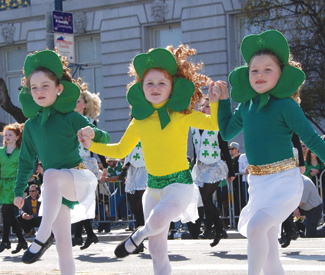
Watch our city turn a shade greener as Irish dance troupes, marching bands, and hundred of floats make their way around West Coast’s largest Patty’s Day event. Celebrate Irish culture and history in an alcohol-free, yet still fun way — we’re talking ponies, mechanical rides, and finger-lickin’ Irish food.

Parade: 11:30 a.m., free. Starts at Market and Second Street; Festival: 11 a.m.-5 p.m., free.

Civic Center Plaza, SF. (415) 203-1027, www.sresproductions.com


FINANCIAL DISTRICT’S BLOCK PARTY AND LIVE MUSIC

Between this and yesterday’s street party, the Financial District has two chances to take off its usual gray suit for a “Kiss Me I’m Irish” tee and a pair of shamrock glasses.

9 a.m.- midnight, free. Irish Bank, 10 Mark, SF. (415) 788-7152, www.theirishbank.com


HABITOT MUSEUM’S SHAMROCK DAY

Getting drunk seems to be the St. Patrick’s Day highlight for many in San Francisco, but for kids the high point is usually pinching buddies for not wearing green and finding little emerald men in the clover field. At least at this event. Embrace your inner leprechaun and find gold at the end of the rainbow.

9:30 a.m.-12:30 p.m., $9 museum admission. Habitot Children’s Museum, 2065 Kittredge, Berk. (510) 647-1111, www.habitot.org


IRISH BRUNCH, BLOCK PARTY, AND LIVE MUSIC

Bands like Blue on Green and the Whelan Academy of Irish Dance will accompany your boxty pancakes and Irish car bombs. Fifth round’s the charm, right?

Brunch 8 a.m.-12:30 p.m.; block party 1 p.m.-11 p.m., $10 for block party. O’Riley’s, 622 Green, SF. (415) 989-6222, www.sforileys.com


UNITED IRISH CULTURAL CENTER CORNED BEEF AND CABBAGE DINNER

For perhaps the most traditional celebration in San Francisco, head to this Outer Sunset hub of Irish culture. Load up on calories in the dining room with the center’s ladies auxiliary-sponsored traditional Irish eats, then work them off to the live Irish bands that’ll be keeping it lively.

Dinner seating starts at 3:30 p.m., no reservations necessary. United Irish Cultural Center, 2700 45th Ave., SF. (415) 661-2700, www.irishcentersf.org


CULANN’S HOUNDS

In Irish folklore, a great hero was named Cuchulainn — a moniker which translates to “hound of Culann” — after defeating a savage beast in self-defense. This SF-based Irish folk band channels the authentic, legendary spirit in a high-energy, 21st century kind of way.

9 p.m., $20. Slim’s, 333 11th St., SF. (415) 255-0333, www.slims-sf.com


QUIN AND THE PAT O’DONNELL BAND LIVE PERFORMANCE

Catch SF-based Celtic folk-indie band (sham)rocking out in this laidback bar of great Guinness and Kilkenny — the Richmond’s got most of SF’s best Irish bars, so a cruise in this direction is a great bet this weekend.

9 p.m., $6. The Plough and Stars, 116 Clement, SF. (415) 751-1122, www.theploughandstars.com


ST. PATRICK’S DAY CELEBRATION WITH LUCIA COMNES

Comnes takes traditional Irish folk music and layers it with Indian tabla, Turkish rhythms, and Motown grooves. Pair this melodic stew with a $4 pint of Murphy’s Irish stout, and get ready for a night of banjos, jigs, and polkas.

9 p.m., $20. Cafe Du Nord, 2170 Market, SF. (415) 861-5016, www.cafedunord.com


BOOTIE ST. PATRICK’S DAY

With emcee O’Kingfish setting the mood and wacky blenderized beats served by DJ Tripp and DJ Ajazx, don’t think that this is just another regular party looking to cash in on St. Patty’s blarney with a few shamrocks stuck on the walls. Burly Q’s of Hubba Hubba Revue will be performing a very special Irish-themed burlesque program.

9 p.m.-late night, $10-$20. DNA Lounge, 375 11th St., SF. www.dnalounge.com


PADDY’S DAY WITH THE DOCSTEADY SOUNDSYSTEM

Enjoy $4 Jameson shots and Guinness pints with SF’s favorite half Irish-half Filipino sound guy, DJ Doc Fu. He’ll be spinning rebel music, fight songs, and hip-hop for your sláinte, along with PK and Cutz on Demand.

10 p.m., free. Showdown, 10 Sixth St., SF. (415) 503-0684, www.showdownsf.com


SUNDAY 18

GREEN FEST BLOCK PARTY

Java Beach’s zoo-side location hosts this family-friendly outdoor event, just outside the United Irish Cultural Center. Irish music and dancing is promised, as is face painting for the wee ones, and that most Irish of all traditions: the bouncy castle.

11 a.m.-4 p.m., free. 45th Ave. and Sloat, SF. www.javabeachsf.com

St. Patrick’s Day events

0

culture@sfbg.com

“THE HISTORY OF THE IRISH COFFEE” PRESENTATION

If you’re already weary of the beer-overkill this weekend entails, celebrate St. Patrick’s with a different type of festive drink — the Irish coffee. The Buena Vista Cafe holds a collection of clippings and photographs that track the beginnings of Irish coffee in San Francisco from as far back as the 1960s. Luckily, the drink is still around to salvage everyone’s hangover this weekend. Presented as part of the Crossroads Irish American Festival.

Wed/14, 5:30 p.m.-7:30 p.m., free. California Historical Society, 678 Mission, SF. (415) 357-1848, www.irishamericancrossroads.org


IRISH WHISKEY COMPETITION

Bartenders from Txoko, 15 Romolo, Campanula, and Bottle Cap (all fine North Beach establishments) will be whipping up their most innovative cocktail made with Michael Collins Irish whiskey. Celebrate Ireland’s fine contribution to the mixology scene, and sample all four concoctions.

Wed/14 6 p.m., $5–$10. Bottle Cap, 1707 Powell, SF. www.bottlecapsf.com


THE HOOKS

Club Six’s new indie rock room gets a rowdy opening concert with this punk group, originally from County Sligo. The Hooks weave traditional Irish rawkus with good old agit-punk — just the way to kick off your week of celebrations.

With The California Celts. Wed/14, 9 p.m.-2 a.m., $5. RKRL, 52 Sixth St., SF. www.clubsix1.com


ST. PATRICK’S NIGHTLIFE

Cal Academy’s yearly tribute to the Irish gets grounded by the presence of SF’s Érie arbiters, the United Irish Cultural Center (it’ll have a booth), and maintains its scientifical presence with step dancing in the Africa room, planetarium shows, and a lecture on the biological significance of the four-leaf clover.

Thu/15, 6 p.m.-10 p.m., $12. California Academy of Sciences, 55 Music Concourse, SF. 1-888-670-4433, www.calacademy.org


“AMID A SPACE BETWEEN: IRISH ARTISTS IN AMERICA” ART EXHIBIT

This exhibit features six Irish artists living in America who fuse their multifaceted Irish identities and cross-cultural exchanges in to their creative work.

Through April 19. Gallery hours Tues.-Sat. 11:30 a.m.-5:30 p.m., free to members; $18 regular museum admission; $11 for students; half-price admission Thursday evenings. SFMOMA Artist Gallery at Fort Mason, Buchanan at Marina, SF. (415) 441-4777, www.sfmoma.org


CROSSROADS FESTIVAL IRISH AMERICAN WRITING AWARD CEREMONY AND OPEN MIC

Brooklyn writer Kathleen Donohoe already won this year’s top honors for her short story, “You Were Forever.” But anyone from the Irish diaspora is encouraged to have his or her five minutes of fame during the open mic. RSVP to secure a time slot.

Thu/15, 7 p.m.-9p.m., free. University of San Francisco, Fromm Hall, 2130 Fulton, SF. (415) 810-3774, www.irishamericancrossroads.org


PRE-ST. PATRICK’S DAY ALLEYS AND BLOCK PARTY

With thousands predicted to show up at FiDi’s annual block party, every nook and cranny will be shamrock-filled at this tavern’s fourth annual shindig. Arrive hungry as there will be food trucks, and thirsty as your first beer is free before 6:30 p.m.

Fri/16, 5 p.m.-10 p.m., free with RSVP. Taverna Aventine, 582 Washington, SF. (415) 981-1500, www.aventinesf.com


SHAMROCK BALL

For a staid, grown-people St. Patrick’s Day, cruise over to this casino event, sponsored by the California Irish-American Alliance. Why would a group committed to preserving Irish heritage in the Golden State produce a casino night with a partially hosted bar, gambling, and dancing for St. Patty’s Day? Because the Californian Irish have a history of having a real good time, that’s why.

Fri/16 7 p.m.-midnight, $85. Marines’ Memorial Club and Hotel, 609 Sutter, SF. (415) 713-6341, www.shamrockball.com


FARLEY’S COFFEE BIRTHDAY BAGPIPES

The Guardian’s staff respirates to the beat of our cups of joe from our neighbor up Potrero Hill, so we are pleased as punch to announce that our fave cafe is turning 23 — and as always, it’s having a green-themed birthday party. To whit, live bagpipers will accompany your morning scone and paper. The pipers will play in the morning, other Irish tunes in the afternoon.

Sat/17 7:30 a.m.-9:30 p.m., free. Farley’s, 1315 18th St., SF. (415) 648-1545, www.farleyscoffee.com


ST. PATRICK’S DAY PARADE AND FESTIVAL

Watch our city turn a shade greener as Irish dance troupes, marching bands, and hundred of floats make their way around West Coast’s largest Patty’s Day event. Celebrate Irish culture and history in an alcohol-free, yet still fun way — we’re talking ponies, mechanical rides, and finger-lickin’ Irish food.

Sat/ 17 Parade: 11:30 a.m., free. Starts at Market and Second Street; Festival: 11 a.m.-5 p.m., free.

Civic Center Plaza, SF. (415) 203-1027, www.sresproductions.com


FINANCIAL DISTRICT’S BLOCK PARTY AND LIVE MUSIC

Between this and yesterday’s street party, the Financial District has two chances to take off its usual gray suit for a “Kiss Me I’m Irish” tee and a pair of shamrock glasses.

Sat/17 9 a.m.- midnight, free. Irish Bank, 10 Mark, SF. (415) 788-7152, www.theirishbank.com


HABITOT MUSEUM’S SHAMROCK DAY

Getting drunk seems to be the St. Patrick’s Day highlight for many in San Francisco, but for kids the high point is usually pinching buddies for not wearing green and finding little emerald men in the clover field. At least at this event. Embrace your inner leprechaun and find gold at the end of the rainbow.

Sat/17 9:30 a.m.-12:30 p.m., $9 museum admission. Habitot Children’s Museum, 2065 Kittredge, Berk. (510) 647-1111, www.habitot.org


IRISH BRUNCH, BLOCK PARTY, AND LIVE MUSIC

Bands like Blue on Green and the Whelan Academy of Irish Dance will accompany your boxty pancakes and Irish car bombs. Fifth round’s the charm, right?

Sat/ 17, Brunch 8 a.m.-12:30 p.m.; block party 1 p.m.-11 p.m., $10 for block party. O’Riley’s, 622 Green, SF. (415) 989-6222, www.sforileys.com


UNITED IRISH CULTURAL CENTER CORNED BEEF AND CABBAGE DINNER

For perhaps the most traditional celebration in San Francisco, head to this Outer Sunset hub of Irish culture. Load up on calories in the dining room with the center’s ladies auxiliary-sponsored traditional Irish eats, then work them off to the live Irish bands that’ll be keeping it lively.

Sat/17, dinner seating starts at 3:30 p.m., no reservations necessary. United Irish Cultural Center, 2700 45th Ave., SF. (415) 661-2700, www.irishcentersf.org


CULANN’S HOUNDS

In Irish folklore, a great hero was named Cuchulainn — a moniker which translates to “hound of Culann” — after defeating a savage beast in self-defense. This SF-based Irish folk band channels the authentic, legendary spirit in a high-energy, 21st century kind of way.

Sat/17 9 p.m., $20. Slim’s, 333 11th St., SF. (415) 255-0333, www.slims-sf.com


QUIN AND THE PAT O’DONNELL BAND LIVE PERFORMANCE

Catch SF-based Celtic folk-indie band (sham)rocking out in this laidback bar of great Guinness and Kilkenny — the Richmond’s got most of SF’s best Irish bars, so a cruise in this direction is a great bet this weekend.

Sat/17, 9 p.m., $6. The Plough and Stars, 116 Clement, SF. (415) 751-1122, www.theploughandstars.com


ST. PATRICK’S DAY CELEBRATION WITH LUCIA COMNES

Comnes takes traditional Irish folk music and layers it with Indian tabla, Turkish rhythms, and Motown grooves. Pair this melodic stew with a $4 pint of Murphy’s Irish stout, and get ready for a night of banjos, jigs, and polkas.

Sat/ 17, 9 p.m., $20. Cafe Du Nord, 2170 Market, SF. (415) 861-5016, www.cafedunord.com


BOOTIE ST. PATRICK’S DAY

With emcee O’Kingfish setting the mood and wacky blenderized beats served by DJ Tripp and DJ Ajazx, don’t think that this is just another regular party looking to cash in on St. Patty’s blarney with a few shamrocks stuck on the walls. Burly Q’s of Hubba Hubba Revue will be performing a very special Irish-themed burlesque program.

Sat/17 9 p.m.-late night, $10-$20. DNA Lounge, 375 11th St., SF. www.dnalounge.com


PADDY’S DAY WITH THE DOCSTEADY SOUNDSYSTEM

Enjoy $4 Jameson shots and Guinness pints with SF’s favorite half Irish-half Filipino sound guy, DJ Doc Fu. He’ll be spinning rebel music, fight songs, and hip-hop for your sláinte, along with PK and Cutz on Demand.

Sat/17 10 p.m., free. Showdown, 10 Sixth St., SF. (415) 503-0684, www.showdownsf.com


GREEN FEST BLOCK PARTY

Java Beach’s zoo-side location hosts this family-friendly outdoor event, just outside the United Irish Cultural Center. Irish music and dancing is promised, as is face painting for the wee ones, and that most Irish of all traditions: the bouncy castle.

Sun/18 11 a.m.-4 p.m., free. 45th Ave. and Sloat, SF. www.javabeachsf.com

Occupying the Capitol

5

It’s an unseasonably hot day at UC Davis, and student activists are milling around a tent city, set up especially for 100 people arriving from a four-day March on Education. The school, one of the hubs of the Occupy movement, gained notoriety when public safety Officer John Pike casually pepper sprayed a line students during a sit-in back in November. Now, officers bike through the idyllic scene, smiling and chatting up occupiers.

Everyone is preparing for the next day, March 5, the statewide day to defend education that will bring thousands of students and teachers to Sacramento to demand an end to budget cuts and fee hikes at California’s schools, community colleges, and universities.

Those on the march hope to highlight the importance of this issue, marching 79 miles from the Bay Area. The first night, the march stayed in Richmond, and the next day Richmond’s Mayor Gayle McLaughlin came out to welcome them.

Students march annually on Sacramento, and say they won’t stop until education is affordable (or, as some would demand, free). A climate of worldwide protest over disparities in wealth and opportunity, including Occupy protests in the United States, helped fuel a larger than usual turnout this year.

More than 5,000 people converged in Sacramento March 5 and marched to the Capitol building, occupying the Rotunda all day. Many chanted “no cuts, no fees, education must be free.”

Community college student throughout the state are reeling from the cuts, and resulting fee hikes—course units, once free, were raised from $26 to $36 per unit last year, and will be increased another $10 this summer. These costs go towards closing the state budget deficit, and not toward a bigger course catalogue; classes continue to be slashed.

Frances Gotoh of San Bernardino Valley College is back at school after being laid off from her longtime job at Bank of America. She said she desperately needs the retraining; without it her job prospects look dim. She needs to support her family—her 20-year-old son is also a college student—but says she can’t afford the increasing fees. “Why is education being taken away?” asked Gotoh. “It belongs to the people.”

Josselyn Torres, a psychology major at Sonoma State University, felt similarly. “Every year, the fees are getting higher but the class size is getting bigger,” said Torres, who noted that many of her friends won’t be graduating with her because so many of the classes they needed were cut. “The politicians have all gone to college. If they keep cutting our education, how can we make it as far as them?”

When the march reached the Capitol, student and state government leaders spoke on the importance of education. Students demanded an end to fee hikes and budget cuts. Assembly Speaker John Perez (D-Los Angeles) and Senate President Pro Tem Darrell Steinberg (D-Sacramento) praised student activists and expounded on the necessity of accessibility to education. Almost all speakers decried the two-thirds majority needed to raise taxes, allowing just a few Republicans to block them.

Lt. Gov. Gavin Newsom also spoke, describing the need to support education in staunchly free-market terms: “You can’t have an economic development strategy without a workforce development strategy.”

Periodically, the crowd interrupted Newsom and other politicians in the midst of making promises with chants of “show us.” They also chanted this election year threat: “You’ll hear us out or we’ll vote you out!”

Around 12:30 p.m., the permitted rally ended and thousands dispersed. About 400 stayed to “Occupy the Capitol.” The group streamed into the building and into the rotunda. California Highway Patrol officers, responsible for policing the Capitol, blocked more than 150 from entering the central area. So, communicating via the Peoples Mic with several rounds of crowd repetition for every sentence spoken, the group participated in a statewide general assembly.

Some building employees showed support, but the only politician to sit down with the protesters was Newsom, who sits on the UC Board of Regents and CSU Board of Trustees. He chatted with students, some of whom requested that he ask police to stop blocking students from meeting in the same area; he didn’t do so, but was able to convince them to give protesters in the rotunda access to bathrooms.

The group managed to collectively decide on demands of the state: support the Millionaire’s Tax ballot initiative, repeal Prop. 13, cancel all student debt, fund all education through college, and democratize the Board of Regents. When building closed at 6 p.m., officers declared the assembly unlawful and arrested 70 who refused to disperse.

Meanwhile, another 400 or so attended a permitted rally on the Capitol lawn called by several Sacramento labor unions to support Occupy the Capitol.

Over the past five years, education funding in California has been cut drastically. Spending per K-12 student per year has gone down by almost $2,000 and higher education has seen program cuts and tuition hikes. Gov. Jerry Brown’s latest budget proposal includes still more cuts to California colleges and universities.

Several proposed ballot initiatives are designed to address this. An initiative sponsored by Brown would bring spending per student per year up by $1,000, stabilizing at $7,658 (it was $7,096 in 2011-12) and reversing a five-year slide. But it would still be less than 2007-08, according to a report from the California Budget Project (CBP).

That report shows K-12 education spending is the biggest piece of the state budget, although California ranks dismally low compared to other states for spending on K-12 education: 47th in the country.

The governor’s proposal would raise funds with a combination of a tax increase for those earning $250,000 and over per year and a sales tax increase. But critics say the increase in the sales tax, which is notoriously regressive, would hurt lower and middle income families.

The measure is up against other potential ballot initiatives that would raise revenue strictly from the wealthiest Californians. The so-called Millionaire’s Tax, for example, would raise funds for education by increasing taxes on those making $1 million or more per year. The Millionaire’s Tax also has the advantage of resulting in a permanent change in the law, while Brown’s measure would apply only for the next five years.

“California’s problems have also been exacerbated by tax cuts, one-time ‘solutions,’ overly optimistic assumptions, and the fact that the two-thirds vote requirement for the legislature to approve any tax measure has blocked adoption of a balanced approach towards bridging the budget gap,” according to the CBP report.

Teachers’ unions are divided over the best ballot measure. The California Teachers’ Association has endorsed Brown’s measure, emphasizing that it includes a plan to close the budget deficit.

“The governor’s initiative is the only initiative that provides additional revenues for our classrooms and closes the state budget deficit, and guarantees local communities will receive funds to pay for the realignment of local health and public safety services that the Legislature approved last year,” said Dean Vogel, CTA president, in a press release.

But the Millionaire’s Tax was sponsored by the California Federation of Teachers, and it has now been endorsed by this student general assembly. John Rizzo, president of the City College of San Francisco Board of Trustees, also endorsed the measure.

“We’ve got to tell the state of California that we cannot continue this. We cannot continue the cuts to our community colleges, to UCs, to the California State Universities,” said Rizzo, speaking at a March 1 rally in San Francisco.

According to a recent report, of five polls conducted throughout California, each initiative has majority support, but voter prefer the Millionaire’s Tax, with a recent Field Poll showing 63 percent support.

Legislators are also at work trying to increase education funding. Assembly Speaker Perez has introduced a bill that would slash tuition fees by two-thirds at CSU and UC schools for students of families making less than $150,000 per year. The bill would also allocate funding to city colleges throughout the state, for them to determine how to best use the money.

The cost of the plan, about $1 billion, would be paid by eliminating a corporate tax loophole that the Legislature approved in 2009, which would allow companies to choose the cheaper of two formulas for calculating their taxes. Critics have called the legislation bad for business, saying that removing tax incentives would hurt California companies.

“The California Middle Class Scholarship Act is very simple,” Perez told students at UC Davis when he unveiled the bill on Feb. 3. “Too many families are getting squeezed out of higher education. For students whose families make $150,000 a year or less, too much to qualify for our current financial aid system, but not enough to be able to write a check for the cost of education, without feeling that pinch, the Middle Class Scholarship Act reduces fees at the UC system and at the CSU system by two-thirds, giving tremendous assistance to those families to make college affordable again.”

Education advocates say California needs to do something to reverse the spiraling cost of higher education in California, which could do long-term damage to the state, affecting young people and businesses that need skilled workers and spiraling out from there. And these advocates say this short-sighted strategy is easily preventable if there is the political will to address it.

“There are a lot of sources of revenue that are not being taken advantage of,” Lisa Schiff, a member of Parents for Public Schools of San Francisco, told us.

Even if tuitions were lowered or—as the most ambitious of protesters demand—higher education was made free, most former students would still be saddled with massive debt. As costs have risen, debts of hundreds of thousands of dollars are commonplace. With the job market recovery slow and painful, graduates often feel helpless to pay back their debt.

Robert Meister, a professor of Political and Social Thought at UC Santa Cruz and president of the Council of UC Faculty Associations, has long argued that the state’s higher education systems ought to focus on keeping tuitions low and student debt in check (see “In the red,” 1/11/11).

Yet he told us that growing income inequality makes people even more desperate for a college education and willing to accept levels of student debt that limit their ability to become anything more than corporate cogs after graduation. “Their ability to raise tuition is a function of the growth of income inequality,” he told us.

In his speech at UC Davis, Perez cast the issue as one of a disinvestment in the state’s future: “California’s public colleges and universities has been one of our most prestigious institutions, and, unfortunately, because of the collapse of the economy, we’ve moved away from fully investing in those universities and colleges.”

A month later, the school again served as a backdrop for illustrating the problem and calling for reform. Dani Galietti, a MFA student at UC Davis who was setting up a performance art piece when I arrived, greets everyone cheerfully and is thrilled about the Occupy movement.

“I wanted to share myself and my work with the movement,” Galietti tells me while taping a “paper trail” to the sidewalk; she plans to walk on it with home-made stamps attached to the bottoms of her shoes.

But her mood darkens when I ask about her student debt. “I came out of five years of education $100,000 in debt,” says Galietti, “and I’m not the only one.”

She is a first generation college student, she explains, who helped pay for school with McNair scholarships.

“I grew up one of five, with a single mother,” Galietti explains. “We struggled my whole life, as a lot of people have, financially.”

“So many people are graduating with so much debt. There’s this looming fear, fear and hopelessness. The economy’s bad, the job market sucks. I’m so thankful that they’re out here. People are active, they’re making a difference.”

“We need education,” Galietti says. “I mean, knowledge is power.”


The losing bets

26

By Darwin BondGraham

news@sfbg.com

Wall Street’s massive taxpayer funded bailout, initiated by the Bush administration and carried forward under President Obama, never really ended — it just shifted from federal to local sources of funding. Even while local and state governments have been forced to cut back on crucial services, wealthy banks and investment firms are being padded with enormous cash flows sucked directly from the already strained budgets of cities, counties, and public agencies.

That’s the message a growing chorus of activists in the Bay Area are bringing before the boards, councils, and commissions that entered into complex financial deals with Wall Street banks, deals that turned toxic in the crash of 2008. Activists want elected officials and the banks to cancel the contracts and refund the public.

The Bay Area is the epicenter of this renewed movement for financial justice. Last week, teachers from Peralta College, organizers with the Alliance of Californians for Community Empowerment (ACCE), Oakland religious leaders, and Occupy Oakland activists organized four protests contesting what they say is bank predation on local communities.

At issue are arcane financial instruments called interest rate swaps. Sold by banks to virtually every sizable government and local agency in the US through the 2000s, rate swaps promised governments the ability to “swap” their potentially costly variable rate payments on bonds into a synthetic fixed rate. Seeking to protect local taxpayers during the volatile 2000s, when floating interest rates were rising, local leaders eagerly signed on.

But the economic meltdown turned those tools into golden handcuffs for local government agencies. Taxpayers are now forced to regularly pay millions to the banks simply because variable interest rates, at the urging of the Federal Reserve, have fallen far below the synthetic rates. These deals might seem numbingly complex, but the effects on local communities are clear and painful.

“The Metropolitan Transportation Commission is paying upwards of $53 million a year on rate swaps,” said Alia Phelps of ACCE at a protest on Feb. 21 outside of the former Bank of America building at 555 California Street. “This is money that isn’t going to keep routes in service, that isn’t paying drivers, nor going to repair buses, or to keep fares lower. We need these swaps renegotiated.”

That protest included visits to half a dozen banks. Activists demanded branch managers fax a letter to their corporate headquarters calling on the banks to voluntarily renegotiate swaps signed with the Metropolitan Transportation Commission (MTC), the Bay Area’s regional transportation authority, which has lost over $100 million on toxic swap deals.

In 2002 the Bay Area Toll Authority (BATA), a state-level agency operated by the MTC, issued more than $1 billion in bonds to pay for repairs and seismic upgrades of regional toll bridges. Three financial giants stepped forward promising to lower MTC’s long-term borrowing costs on these bonds by using interest rate swaps. Ambac, Solomon Smith Barney and Morgan Stanley signed deals with the MTC to cover $300 million in debt.

“With this transaction, we are getting the peace of mind of a fixed debt payment at a significant discount from traditional price levels,” MTC’s Chief Financial Officer Brian Mayhew said at the time of the deal.

Basically the swap agreement had the MTC paying a fixed interest rate of 4.1 percent to the banks, while the banks paid 65 percent of the London Interbank Offered Rate (LIBOR), a key benchmark used in global financial markets. Whichever party’s sum happened to be higher when payments came due would pay the difference. The advantage of the deal, in the eyes of the MTC’s managers, was that it would lock-in a low interest rate on MTC’s debt, potentially saving as much as $45 million.

“We think it’s a good time to lock in these low rates,” Mayhew said in 2002.

Fast forward to 2009. A year into the financial crisis, interest rates collapsed. LIBOR, which had been fluctuating around 5 percent and reached a peak of 5.8 percent in September of 2007, plummeted to virtually zero. The flow of payments became entirely one-sided, from MTC to banks that offered this deal. The advantage of the swap evaporated, and it became a toxic asset. While the Federal Treasury would offload similar toxic assets from the “too big to fail banks” using the TARP program, local governments were stuck with them.

As Ambac careened toward bankruptcy in 2010 due to its absurdly over-leveraged portfolio of credit default swaps, the MTC was forced to terminate its swap agreement with the company, paying the exorbitant sum of $104 million, after already having paid out $23 million in interest. All of this was essentially bridge toll money, surrendered by drivers crossing the seven state-owned bridges administered by BATA: the Bay, Antioch, Benicia-Martinez, Carquinez, Dumbarton, Richmond-San Rafael, and San Mateo bridges.

The drain on MTC funds indirectly affects all of its programs, including operational support for AC Transit, Muni, and other regional bus and train services. According to its most recent Comprehensive Annual Financial Report, MTC and its transit agency partners are on the hook for another $235 million in interest rate payments due on swaps with a rogue’s gallery of banks including Wells Fargo, Morgan Stanley, Citigroup, Bank of America, JP Morgan, Bank of New York, and Goldman Sachs. All of this money will be diverted from the MTC’s various transit infrastructure, planning, and operations accounts.

“The big picture is service cuts, pay cuts, work speed ups, fare hikes, route eliminations, and other things that harm working people who ride transit,” said retired Muni worker Ellen Murray.

The MTC’s quarter-billion dollar rate swap nightmare is only the most obvious part of a more systemic problem. Until at least 2030, given current conditions, San Francisco’s Airport Commission must make costly rate swap payments to numerous banks, including JP Morgan Chase, Goldman Sachs, Depfa, Bank of America, and Merrill Lynch, on agreements associated with more than a half-billion in debt. Much of this is linked to commercial paper issued to pay for infrastructure at the Airport (SFO).

Unlike the MTC, SFO’s financial managers were more prudent in entering swap agreements, and therefore secured better terms that have produced a net savings. “The Airport has saved about $92 million to date,” Assistant Deputy Airport Director Kevin Kone told us, referring mostly to gains made between 2005 and late 2007.

But since 2008, SFO’s swaps have been losing money. When Lehman Brothers collapsed, and Bear Stearns imploded and was absorbed into JP Morgan, SFO was forced to terminate swaps with both companies, costing $6.7 million. Last year SFO paid $6.65 million to terminate a rate swap agreement with Ireland’s Depfa Bank. In September, the Airport paid another $4.6 million to end yet another rate swap with JP Morgan. These specific swap agreements, Kone says, “were functioning as they should have early on, providing savings,” but now they’re draining public funds.

SFO’s seven remaining swaps have a negative value of $67 million, according to San Francisco’s 2011 Comprehensive Annual Financial Report. As with the MTC, SFO’s debts will ultimately be paid by passengers and taxpayers. Kone says nobody really knows how much these swaps could ultimately impact the airport, either in terms of cost or savings.

“If interest rates rise, they could have a positive cost savings impact on the airport,” he said.

Joe Keffer of the Service Employees International Union (SEIU) Local 1021 said at the Feb. 21 rally that Oakland has already paid Goldman Sachs $26 million on a swap that dates back to 1997, and that under current market conditions, the city will have to pay roughly another $25 million until the contract expires in 2021.

Oakland’s toxic deal with Goldman Sachs is now the subject of much scrutiny. The newly formed Coalition for Economic and Social Justice —made up of churches, labor unions, neighborhood groups, and Occupy Oakland activists— took up the issue with the City Council on Feb. 21, packing the chamber with one of the more diverse activist coalitions in recent memory.

“We’re here to implore you to get the City of Oakland out of this toxic relationship,” Rev. Daniel Buford of the Allen Temple Baptist Church told the council.

Members of the Oakland City Council are sympathetic to this message. In a letter sent last June, Council member Rebecca Kaplan implored Goldman Sachs CEO Lloyd Blankfein to spare Oakland’s taxpayers: “By bringing the contract to conclusion with no penalty fees, and negotiating a reasonable exit strategy, you would be demonstrating good faith to public taxpayers in the most substantial way.” At the conclusion of public comment Tuesday night, Oakland Council member Libby Schaaf promised the public action on the swap.

In a Valentine’s Day protest the previous week, 50 activists visited the Oakland offices of Morgan Stanley. Faculty and students from the Peralta Community College system went there demanding the bank renegotiate a rate swap that is estimated to have cost the college $1.6 million last year. The same day the college’s board of trustees discussed the need to cut $12 million more from the budget in 2012. Morgan Stanley CEO James Goreman’s pay for 2011 was $14 million, opponents of the swap point out.

Peralta student and Bay Area transit activist Adam Ross attempted to reach the 9th floor offices of Morgan Stanley in a small delegation to deliver a letter demanding the bank renegotiate the swap: “There were signs on the door saying the office was closed. They probably got tipped off and locked the doors.”

Afterward, Caesar Swaby of Riders for Transit Justice addressed the rally, connecting dots for the different constituencies present: “Morgan Stanley is taking money from Peralta College, causing classes to be cut. Morgan Stanley is also taking money from transit riders. Morgan Stanley has a $3 million rate swap with the MTC, causing cuts to bus and train services.”

A Morgan Stanley representative declined to comment for this report. Goldman Sachs did not return calls and emails. A spokesperson for the MTC was unable to be reached by deadline.

Save our homes

9

yael@sfbg.com


This story has been edited


Bay Area activists, fueled in part by the Occupy movement, have recently taken stands against police brutality, for the rights of the homeless, against the corporate power of banks, and much more. But, arguably, nowhere has the movement been more successful than in the fight against foreclosures and evictions.


With the support of Alliance of Californians for Community Empowerment (ACCE) and the Bayview Foreclosure Fighters, several Bayview residents whose homes had already been sold continue to occupy them, and in some cases sales have been rescinded. Occupy Bernal has used civil disobedience to postpone six housing auctions, keeping their neighbors in their homes that much longer. They secured a meeting with Diana Stauffer, Wells Fargo Home Mortgage senior vice president, and David Campos, District 9 supervisor, to delay foreclosure proceedings.


But the activists are pushing for a full moratorium on foreclosures and evictions in San Francisco. Such a moratorium is not without precedent. In recent years, sheriffs have stopped evictions and foreclosures in Wayne Country, Michigan; Cook County, Illinois; Butler County, Ohio; and Philadelphia County, Pennsylvania.


When Cook County Sheriff John Dart imposed his moratorium in 2010, he said, “I can’t possibly be expected to evict people from their homes when the banks themselves can’t say for sure everything was done properly. I need some kind of assurance that we aren’t evicting families based on fraudulent behavior by the banks.”


San Francisco seems ripe for a similar stance, as Assessor-Recorder Phil Ting recently released a report revealing widespread lawbreaking in foreclosure proceedings. The report found that 84 percent of foreclosures in San Francisco over the last three years involved faulty paperwork, some of it amounting to fraud.


Representatives from the District Attorney’s and the City Attorney’s offices told the Guardian that they are concerned about the report. These bodies may be starting the process of further investigating findings. Last week, Sheriff Ross Mirkarimi, whose office carries out the county’s evictions, said he has begun an initiative to collect and analyze the city’s foreclosure data.


But Mirkarimi’s hands may be tied. As he told Ann Garrison of KPFA radio Feb. 25, “I don’t have the latitude or discretion, much as I would like, because there would need to be a change in state law that empowers municipal sheriffs to be able to use that discretion.”


Occupy Bernal formed just a couple months ago, but it has emerged as a powerful advocate for homeowners facing foreclosure. The neighborhood-based branch of the Occupy movement chose to focus specifically on preventing the evictions of Bernal Heights residents, where over 100 homes face foreclosure.


They kept the pressure up Feb. 25, when a group of supporters convened at 1090 Chestnut Street, the residence of John Stumpf, the CEO of Wells Fargo. That bank owns the majority of mortgages on Bernal homes facing foreclosure.


The protest wasn’t meant to block the street and no one tried to enter the building where Stumpf owns three of the 14 floors. But police decided that the group of about 150 warranted blocking off the entire block to traffic, to the annoyance of many neighbors.


“You collected $43.7 billion in taxpayer money and have since made record profits at the expense of low-income communities, while repeatedly breaking your legal and moral obligations as a creditor. You have failed to comply with loan modification requirements under your own lending agreements,” said a blown-up “foreclosure notice” outside Stumpf’s home.


In the spirited street theater scene, activists dressed as an auctioneer and a larger-than-life John Stumpf played out a fake auction of Stumpf’s property.


Dexter Cato, a father of four whose wife was recently killed in a car crash in the midst of months-long loan modification proceedings, faces foreclosure from his Bayview home of 40 years.


“Stumpf, we want a new address for you,” said Archbishop Franzo King of the Western Additions’ John Coltrane church, “850 Bryant Street!”


The crowd then proceeded to chant this address: the San Francisco Hall of Jusice and County Jail.


“We understand that some of our customers are going through difficult times during this economic recovery,” said Jim Foley, president of Wells Fargo’s Greater Bay Area region, in a press release responding to the Feb. 25 protest. The company plans to hold “Home Preservation Workshops” in Richmond March 7 and 8 to help homeowners facing foreclosure.


Public officials may be a long way from locking up CEOs for foreclosure fraud, but some have taken notice of complaints against the banks. On Feb. 2, the Berkeley City Council voted not to extend its contract with Wells Fargo to manage $300 million in city assets, citing its foreclosures on city residents.


On a national level, activists have been successful in persuading people to transfer their money to local banks and credit unions in recent months. Javelin Strategy and Research came out with statistics that 5.6 million Americans have switched bank service providers in the past 90 days, three times the normal transfer rate. Bank Transfer Day in early October was specifically cited as the trigger by 610,000 of those people.


The recent $25 billion settlement between the five largest banks and attorneys general in California and other states over mortgage fraud made big headlines, but activists note that it allocates a measly $2,000 to some people who have lost their homes to foreclosure. Occupy Bernal’s Buck Bagot said people need more protection from powerful banks. “Banks suckered people into this stuff, and they have made billions,” Bagot said. “We’re not saying people shouldn’t have to pay off the money they borrowed, but it took two to tango.”

Spanning time with the Flaming Lips

0

I ran into a temporal anomaly while driving. My first warning sign was the police cruiser with one headlight flashing its sirens behind me. Wrong place at the wrong time? Well, I was getting pulled over in Sebastopol on the way to Richmond from SF, but when the cop told me I was doing 78 in a 55, it suggested one thing —speeding.

And speeding isn’t spatial — location is irrelevant — you are precisely where you should be, just too fucking soon. The cop seemed hopeful that he could help me, but as he took my papers and ran back to his car I knew he had abandoned me to the crush of an impending temporal singularity, as time began to move in slow motion.

Slow motion. Some refer to it as time dilation. The sensation that a certain duration lasts longer than it should. The Flaming Lips have a song about it, called, obviously, “Slow Motion.” It goes like this:

Hey, come on over.

You know the day is going slower.

It takes a year, to make a day.

And I’m feeling like a float in the Macy’s Day parade.

Or like a boat, out on the ocean. 
I’m drifting round in slow motion.

LSD and other narcotics aside, time generally doesn’t work that way. Compared to your life so far, each additional day is a smaller proportion. Time telescopes, you speed up, it goes faster. Slowing down is the opposite, unnatural. Sitting in a car waiting for the cop to come back (Is he going to search me?) or laying on a couch with friends trying not to cry — whenever time slows down — it’s unnerving.

You only know this much about “Slow Motion” — an alternate track from The Soft Bulletin not released in the US — because you saw the Flaming Lips play it once. But which time? Not at that fair in Santa Rosa. That one had a rave after. Not at the Fox Theater. That was the one where you slow danced with your girlfriend (at the time) until the staff asked you to leave. At Sasquatch, there in the Gorge? They did play The Soft Bulletin then, but it was rushed. That guy stood behind you — when Wayne Coyne was recounting Steven Drozd almost losing his hand and Michael Ivins being in a car crash — screaming “Play-a-song!” No, there just hadn’t been time.

And time, for the Flaming Lips, is important. Because as a band — one that has been through all sorts of well documented shit — the Flaming Lips know the value of time (particularly borrowed) and have made it their work to not just create music but get into the complete manufacture of moments. Which is a tricky business, because moments are bastards. Take all the pictures you want of the blinding lights, the beautiful costumed kids, the confetti cannons or all the other individual weapons that the Flaming Lips use to wage musical psychedelic war on time, and the moment still might not fit in a shutter, no matter how you slice a second.

It was at Bimbo’s. Not the time they played Noise Pop a few years back, but more recently. They were playing The Soft Bulletin, and taking their time. Hitting every single track from every single version of the album. Not quite slow motion, but close. When was that?

It was the night after the couch. When you were watching Blade Runner on TV, just the end part. Where the maniac with white hair is running around, trying to knock some sense into the other idiot character, who hardly even realizes he’s alive most of the time. And it starts getting heavy. Meaningless inevitability; the crushing force of time. Fucking tears in the rain. Before you know it, you’re happy it’s basic cable, because sometimes a commercial interruption is all that’s keeping you from crying.

It was the night after that. The Lips were going slower for sure, but still way too fast. The moments going by before you’re ready. Before you know it, they are on to other songs, and “Slow Motion” is somewhere in the past, back there with your best friends on the couch, never to return.

The band is getting ready to play something else, Steven readying both miraculous hands on another instrument while Michael stands ready, as ever, on the bass. You want to reach into your bag to take the camera out again, but you resist the urge. It won’t capture the cold press of the air canisters at your back anyway. Or, for that matter, the hookah scented air from the smoke machines. And anyway, if you’re taking pictures during “Feeling Yourself Disintegrate,” you’re probably irretrievably lost.

And suddenly, everything has changed. The cop comes back to the car. Tells me my record is clear, that he just marked 65 on the ticket, because I was didn’t know where I was. He gives me some directions, regarding the roads. I don’t really listen (but do thank him and let him know about his broken headlight.) I drive forward, knowing exactly where I am. I was at a Flaming Lips show, and now I’m driving home.  

Conversation on Golden Gate Park concerts continues

11

“I call for this hearing each year,” said District 1 Supervisor Eric Mar. The focus of the hearing was large events in Golden Gate Park, and each year, hundreds of San Franciscans have something to say about it.

At the Land Use Committee meeting Feb. 13, the room was packed with concert industry representatives, local artists, police officers, a couple dozen members of the Carpenters In Action from the United Brotherhood of Carpenters Local 22, and neighbors. Lots and lots of neighbors.

Many of the Richmond and Sunset residents who spoke are furious with the many large concerts that take place in Golden Gate Park throughout the year, including Hardly Strictly Bluegrass, Alice’s Summerthing, Outside Lands, and Power to the Peaceful.

They spoke of unbearable noise, impossible parking, and crime spilling over from the event crowds. One man said that during Outside Lands, his house shakes so much that he feels “trapped inside an acoustic guitar for three days straight.”

The Recreation and Parks Department has implemented several measures addressing these ongoing concerns since the first annual hearing on this topic in 2009. Dana Ketchum and Nick Kinsey represented the department at the hearing, speaking in detail of tightened permitting measures, increased outreach to the community about upcoming events, and a hotline set up so neighbors can call in noise complaints more efficiently during large concerts and performances.

Ketchum said that noise complaints have resulted more than once in Rec and Parks representatives threatening to pull the plug on amplified sound in the park if partiers don’t turn it down. One neighbor called the hotline, “more useless than yesterday’s spit.”

Proponents of the events, too, were passionate.

Local hip hop artist Tom Shimura, aka Lyrics Born spoke on the importance of the events to the San Francisco music scene. Shimura praised how the Outside Lands lineup is 20 percent local artists.

“These festivals launch careers and create Bay Area success stories,” said Shimura.

“I just wanted to say that I’m a big fan,” said Supervisor Mar.

Many supporters cited a recently released San Francisco State University Study, which finds that Outside Lands generates “more than $60 million for the San Francisco economy,” and even claims the festival creates “683 full-time equivalent jobs” in the city.

Some Richmond residents demanded that all the festivals be cancelled, and, barring that, that they be issued the personal cell phone numbers of the Rec and Parks staff.

“It’s clear everyone supports these events,” said Supervisor Mar at the hearing’s conclusion.

“It’s a matter of collaboration.”

An upside

0

le.chicken.farmer@gmail.com

CHEAP EATS I’ve been saving something for you. Something special. For a time just like this.

The 49ers have fizzled in the drizzle, and the spring season of dyke football is a long way off. Not to mention spring training. Not to mention Spring.

Sportswise we are left with the Warriors. And speaking of lose-lose situations, there’s the murky mess that our sheriff is in. Oh, and the Republican candidates for prez, whose collective aim is so untrue (also speaking of the Warriors) that even those of us who try and stay out of it are covered in mud and shit.

Is everyone sick and suicidal, or just sick?

Well, my dears, I have something for you, and it isn’t duck soup. It’s better. It’s butter corn ramen at Halu, which is my new favorite restaurant by 10 miles. Or at least thirty blocks.

Unfortunately, we aren’t the only ones who know about it. Halu isn’t open for lunch and doesn’t accept reservations for dinner. It’s a hole in the wall. So, unless you get there at five, expect a line.

And expect that line to be worth waiting in. (I rarely say that.)

About a year ago or so I started hearing about this place from all sides. Alice Shaw the Person gave me its business card. Which I lost. But I still recall her rhapsodic description of skewered scallops wrapped in bacon. We were getting ready to play soccer. “One of the best things I ever ate,” she said. “The scallops …” Her eyes fluttered and started to roll back under their lids, until I thought she might lose consciousness. Which would have sucked because we’d have had to forfeit.

Then Papa, my butcher, started in on it. “Pork jowls,” she kept saying. At football practice. In the huddle. Every time I saw her: “Pork jowls.”

When people say pork jowls, I listen. They only need to say it once. After three or four times, I start to dream cheeky things. So, long before I ever ate there, Halu was on my mind and under my skin.

I tried to go once with a big group, but at least one of us was too hungry to stomach the wait, so we wound up at the Burmese place around the corner on Clement.

Then, finally, last summer while Hedgehog and me were house sitting in the Richmond one week, we walked over right at five and sat right down and ordered all the wrong things. Lava ramen, which was the best and second-spiciest bowl of ramen I had ever had, but it wasn’t spicy butter corn ramen. Or, as they inexplicably call it, spicy corn butter ramen. Which, I would have to wait three more months to learn, is even better.

Amazingly tender roast pork, crisp kernels of fresh corn, and pats of butter melting into it as they bring the bowl to your table. The noodles taste homemade, and the broth has an insane amount of flavor to it.

I must not have looked at the menu the first time I was there, or I would have become a Halu addict sooner. But the lava ramen was on the wall, with a lot of other yummy sounding dishes, and all the Beatles posters and ’60s stuff — including a cool old bass and an even cooler acoustic guitar.

The yakitori menu is on the wall too, and every time I get my butter corn butter ramen butter fix, I sample one or two of these, on the side. So far I’ve had mochi bacon, which was divine, and of course the pork jowls, which were even diviner. Chicken livers. Good. The boneless short ribs were a little dry.

Oddly, since it was what sold me on the place in the first place, I have yet to try the bacon-wrapped scallops. (Sorry, Alice Shaw the Person.) Other didn’t-get-yets include asparagus bacon, enoki bacon, and eringi bacon, because in my opinion two of those things are mushrooms. But I do love asparagus.

One time we had karaage (fried chicken), by way of an appetizer. It was nothing special.

Otherwise, though: worth the wait. Way. Go say hi to Baseball Mary across the corner at Clement Street Bar and Grill. The game’ll be on, if there is one.

HALU

Tue.-Thu. 5-10 p.m.; Fri.-Sat. 5-11 p.m.; closed Sun.-Mon.

312 8th Ave., SF.

(415) 221-9165

MC/V

Beer and wine

Live Shots: Phonte and 9th Wonder at New Parish

0

I’ve heard complaints that the Occupy movement doesn’t have a clear message, but Saturday night you could read it from a passing car. At an intersection off of Broadway, where a large crowd had gathered, a few people held up a giant banner on the corner that read “FUCK THE POLICE.” And as we passed groups of officers in riot gear and searched for parking among  the cop cars on nearly every block, it was also obvious that a confrontation was brewing.

It may have been N.W.A. out on the streets, but inside the New Parish where a show was taking place, it was strictly no beefing. Rapper Phonte and DJ/producer 9th Wonder, formerly members of North Carolina’s alternative hip-hop group Little Brother, were finally performing together after settling some outstanding public grievances.

Addressing the crowd midway through the show, Phonte — in a playfully straight-forward manner — explained that he’d done a lot of growing in the last year, and that he’d learned that mistakes have a way of  living on the Internet. Recalling some Southern gospel preaching, he asked the audience to repeat the word “perpetuity” after him, on top of turning to their neighbors and saying “You got to own up to your own shit.”

Support included local openers including Richmond’s Locksmith and D.U.S.T. from Zion I’s crew as well as tour mates Median and Rapsody, but the focus of the show was definitely Phonte and 9th, who ripped through a set of material including both LB and more recent solo work. Part of their speed was necessity. “Grown man rap time,” Phonte called it, explaining that being an aging artist meant that you have an aging audience, with children, bills, and responsibilities, well past the point where “you can spend the whole god damn night at the rap show.”

On the plus side, having an older audience means that they are also likely to be more familiar with your work. When the beat dropped on “Lovin’ It,” a major track from LB’s 2005 concept album, The Minstrel Show, the whole crowd went off.  

But what really surprised me was to see a couple upstairs singing to each other the call and response section of “Make Me Hot,” a short proto-soul/Percy Miracles from LB’s 2003 debut The Listening. There was a sense of coming together (if you put the civil unrest an police action going down half a mile away out of mind.).

And considering that Phonte said it was his first sold out “solo” show in the Bay Area, definitely a long time coming. Which may have been why, despite expressing a plan to “Come to the show, spit these raps, take my ass home,” he didn’t seem to be rushing it.

Redrawing the map

43

tredmond@sfbg.com, steve@sfbg.com

The most important political change of 2012 may not be the appointment of a new District 5 supervisor or the inauguration of a new mayor and sheriff. A process moving slowly through a little-known city task force could wind up profoundly shifting the makeup, and balance of power, on the Board of Supervisors — and hardly anyone is paying attention, yet.

The Redistricting Task Force is in the process of drawing new lines for the supervisorial districts, as mandated every 10 years when new census data is available. The nine-member body is made up of three appointees each by the board, the mayor and the Elections Commission. While mandated to draw equal-sized districts that maintain “communities of interest,” the board has almost unchecked authority to decide which voters are in which districts.

While it’s difficult to draw 11 bad districts in San Francisco, it’s entirely possible to shift the lines to make it more difficult to elect progressives — something many groups out there are anxious to do.

VIEW THE CURRENT WORKING DRAFT MAP HERE


CONSOLIDATING THE LEFT

Downtown and pro-landlord groups are circulating their own draft maps, attempting to influence the outcome. Their goal is hardly a secret: If progressive voters can be concentrated in a small number of districts — say, districts 5, 6, and 9 — it’s more likely that a majority of the board will be moderates and conservatives.

The task force has looked at 10 “visualizations” prepared by a consultant, and each of them had some alarming aspects. For example, the visualizations mostly pushed such conservative areas as Seacliff and Presidio Heights into District 1, which is represented by progressive Sup. Eric Mar.

On Jan. 4, those drafts were replaced by a single working draft map, which is now on the task force’s hard-to-find website (www.sfgov2.org/index.aspx?page=2622) — and it’s not as bad as the earlier versions. The working draft keeps Seacliff and Presidio Terrace in District 2 — which share similar demographics.

“The working families in the Richmond don’t belong in the same community of interest as the millionaires with homes overlooking the ocean,” Mar told us.

But there are other changes that some may find alarming. The more conservative Portola neighborhood, which is now in District 9, would be included in District 11, while D9 would pick up the more liberal north Mission. That would make D9 an even safer progressive district — but make D11 harder for a progressive like the incumbent, John Avalos, to win.

The task force has been holding hearings on each of the districts — but there’s been little discussion about how the new lines will affect the makeup of the board, and the politics and policy of the city, as a whole.


POPULATION CHANGES

The driving force behind the changes in the districts is the rather dramatic population shift on the east side of the city. Most of the districts, census data show, have been relatively stable. But since 2000, 24,591 more people have moved into D6 — a nearly 30 percent increase — while 5,465 have moved into D10 (a 7.5 percent increase) and 5,414 into D11 (8.7 percent). D9 saw the biggest population decrease, losing 7,530 voters or 10.3 percent.

The huge growth in D6 has been the result of a boom in new high-end condos in the Rincon Hill and SoMa neighborhoods, and it’s changed the demographics of that district and forced the city to rethink how all of the surrounding districts are drawn.

No matter what scenario you look at, D6 has to become geographically smaller. Most of the maps circulating around suggest that the north Mission be shifted into D9 and parts of the Tenderloin move into districts 3 and 5. But those moves will make D6 less progressive, and create a challenge: The residents of the Tenderloin don’t have a lot in common with the millionaires in their high-rise condos.

As progressive political consultant David Looman noted, “The question is, how do you accommodate both the interests and concerns of San Francisco’s oldest and poorest population and San Francisco’s youngest, hippest, and very prosperous population?”

The working map is far from final. By law, the population of every district has to be within 1 percent of the median district population, or up to 5 percent if needed to prevent dividing or diluting the voting power of minority groups and/or keeping established neighborhoods together.

Under the current draft, eight of the 11 districts are out of compliance with the 1 percent standard, and District 7 has 5.35 percent more residents than the mean, so it will need to change. But task force Chair Eric McDonnell told the Guardian that he expects the current map to be adopted with only slight modifications following a series of public meetings over the next couple months.

“The tweaks will be about how we satisfy the population equalization, while trying to satisfy communities of interest,” McDonnell said, noting that this balancing act won’t be easy. “I anticipate everyone will be disappointed at some level.”


OUTSIDE INFLUENCES?

Some progressives have been concerned that downtown groups have been trying to influence the final map, noting that the San Francisco Board of Realtors, downtown-oriented political consultants David Latterman and Chris Bowman, and others have all created and submitted their own maps to the task force.

McDonnell said the task force considered solutions proposed by the various maps, but he said, “We won’t adopt wholesale anyone’s maps, but we think about what problem they were trying to solve.”

For example, some progressive analysts told us that many of the proposals from downtown make D9 more progressive, even though it is already a solidly progressive seat, while making D8 more conservative, whereas now it is still a contestable district even though moderates have held it for the last decade.

“It would be nice to see the Mission in one district, but it makes D8 considerably more conservative, so it’s a balancing act,” said Tom Radulovich, a progressive activist who ran for D8 supervisor in 2002.

Latterman told us he has a hard time believing the final map will be substantially similar to the current draft. “Once that gets circulated to the neighborhoods, I find that hard to believe it won’t change,” he said. “A lot of the deviations are big and they will have to change.”

He said that he approached the process of making a map as a statistician trying to solve a puzzle, and that begins with figuring out what to do with D6. “I fall back on my technician skills more than the political,” Latterman, who teaches political science at the University of San Francisco, said. “It’s a big puzzle.”

Latterman also disputed concerns that he or others have tried to diminish progressive voting power, saying that’s difficult to do without a drastic remaking of the map, something that few people are advocating.

“It’s hard to make major political changes with the other constraints we have to meet,” he said. “Unless you’re willing to scrap everything we have, it’ll be hard to make major political changes.”

Once the task force approves a final map in April, there’s little that can be done to change it. The map will go to both the Elections Commission and the Board of Supervisors, but neither can alter the boundaries.

“We are the final say,” McDonnell said. That is, unless it is challenged with a lawsuit, which is entirely possible given the stakes.

Our Weekly Picks: January 11-17

0

WEDNESDAY 11

The Finches

The Finches are keen on the sounds of the 1960s and ’70s. While checking the band’s website recently, I found a couple of mixes that founding members Carolyn Pennypacker Riggs and Aaron Olson put together, comprised of songs by Harry Nilsson, Donovan, the Byrds, Joni Mitchell, and others. You might have been able to guess that they listened to some of those when writing their own songs. On the Finches’ most recent album, 2011’s On Golden Hill (their first in four years), there are smidgens of proto-punk, psychedelic rock, and singer-songwriter folk soaked in ’60s sheen. But while the band may quote from the past, the music is for now, distinctly their own. (James H. Miller)

With Brainstorm, and the Key Losers

9 p.m., $7

Hemlock Tavern

1131 Polk, SF

(415) 596-7777

www.hemlocktavern.com


Victims Family

With wailing guitar, gruff vocals, and jazzy bass lines, Victims Family has long crouched above the standard crusted punk pack, creating an aggressive punk-jazz-metal hybrid assault with political-circus style lyrics that satisfy the thinking-man’s pit. The long-standing hardcore act — born of Santa Rosa circa 1984 — is on Jello Biafra’s Alternative Tentacles label; AT describes Victims Family’s music in a fittingly verbose fashion: “groove/thrash/bad-acid/punk/noise/metal/samba.” All of the above. The band’s Elbo Room show this week is its first of the year, and the lineup is an Alternative Tentacles Showcase, fleshed out by the excellent Fleshies and Pins Of Light. Here’s to a pit-filled 2012. (Emily Savage)

With Fleshies, and Pins of Light

9 p.m., $10

Elbo Room

647 Valencia, SF

(415) 552-7788

www.elbo.com


THURSDAY 12

Burnt Ones

Though I’m not sure what it is about San Francisco that sparks the formation of retro garage-pop bands, I’m positive that Burnt Ones are doing it better than most. This trio laces sweet pop melodies with heavy reverb for some sweaty, good old fashioned fun. It’s been a while since Burnt Ones released its catchy debut LP Black Teeth & Golden Tongues (Roaring Colonel), yet it remains a staple in my rotation. Check out the addictive single, “Gonna Listen To T.Rex (All Night Long).” If this heavy hitter doesn’t get stuck in your head for the rest of the week, you might wanna get yourself checked out. (Frances Capell)

With the Mallard, and Koko and the Sweetmeats

9 p.m., $6

Hemlock Tavern

1131 Polk, SF

(415) 923-0925

www.hemlocktavern.com


French Cassettes

While there may not be anything explicitly French about this quartet of garage rockers from the Bay, the Baroque pop ménage they embrace along with their refined musical sensibilities suggests the French Cassettes are more quintessentially so than one might imagine. It’s a preference towards subtlety over excess, and an emphasis on the minutiae. A touch of strings here, a tinge of electric energy there, and a deep reserve of catchy hooks borrowed and reinvented from some of their forerunners in pop art. Think Kinks and Beatles, but more demure; The Shins but less morose. Their first EP Summer Darling came out last year and now the band starts the year off rocking ever-so-effortlessly at a divey venue in the Mission. (Courtney Garcia)

9 p.m., $8

Brick and Mortar Music Hall

1710 Mission, SF

(415) 800-8782

www.brickandmortarmusic.com


“Le Martyre de Saint Sébastien”

Here’s the stereotypical scandal in a nutshell: According to Roman Catholic legend, Saint Sébastien was martyred in the third century BCE during Emperor Diocletian’s persecution of Christians. First he was shot through with arrows (the homoerotic possibilities of a half-naked youth being pierced many times while in religious ecstasy has not escaped centuries of artists), then he was clubbed to death. In 1911, French composer Claude Debussy, with Italian poet Gabriele d’Annunzio, wrote a five act mystery about the saint’s life, incorporating narrative and musical accompaniment. But the star ballerina, Ida Rubinstein, was a Jewish woman, so Pope Pius X (himself later canonized) instructed Catholics to shun the performances, martyring the work. Le sigh. Now here’s the music: grounded yet unearthly, full of Debussy’s restless, swirling chords augmented with sacred-sounding chants and hypnotic figures. This multimedia interpretation by the SF Symphony, featuring narrator Frederica von Stade, should shoot to the stars.

Through Sat/14

8 p.m., $35–$140

Davies Symphony Hall

201 Van Ness, SF

(415) 864-6400

www.sfsymphony.org


FRIDAY 13

“For Your Consideration”

Unless you have the time, coin, and stamina to globe-trot around to every festival, you’re likely missing out on quite a bit of tasty international cinema. Sure, the latest Pedro Almodóvar will always hit the local art-house joint, but more obscure (and no less worthy) films that lack big-money distribution probably will not. Fortunately, San Rafael is a lot closer than Berlin or Cannes, where “For Your Consideration: A Selection of Oscar Submissions from Around the World” unspools starting today, with Sweden’s Beyond (starring Noomi “I Had the Dragon Tattoo First” Rapace); Hungarian standout Béla Tarr’s latest, The Turin Horse; Bulgarian youth-gone-wild treatise Tilt; and several others, including a movie from the Philippines (The Woman in the Septic Tank) that spoofs awards-grubbing “message” films. (Cheryl Eddy)

Through Jan. 19, $6.35–$10.25

Christopher B. Smith Rafael Film Center

1118 Fourth St., San Rafael

(415) 454-1222

www.cafilm.org


Ellis Avery

“La Belle Rafaela” (1927) is a decadent, highly erotic painting by the Polish Art Deco painter Tamara de Lempicka. The model de Lempicka used for the piece was Rafaela Fano — a woman she hired off the streets of Paris, painted several times, and with whom she became romantically involved. “La Belle” depicts Rafaela as a curvaceous nude, bathed in shadows, and flinching with euphoria. It conveys such feverish sensuality that probably would have been unachievable had the artist’s desires not been utterly real. The painting inspired author Ellis Avery to write The Last Nude, a historical novel that re-imagines the love affair from the perspective of Fano. At Books Inc., Avery reads from this story that plunges into the depths of a forbidden romance set in glamorous 1920s Paris. (Miller)

7:30 p.m., Free

Books Inc.

2275 Market, SF

(415) 864-6777

www.booksinc.net


“Midnites for Maniacs: The Mind is a Terrible Thing to Taste”

Oh, you didn’t think Midnites for Maniacs programmer Jesse Hawthorne Ficks would program a Friday the 13th flick to coincide with today’s sinister day-and-date combo? (Well, he might, but he’d pick one of the more ridiculous entries, like the one where Jason takes outer space.) Nay, fiends, tonight’s triple-feature is face-warping enough to be themed “The Mind is a Terrible Thing to Taste.” It kicks off with Sam Raimi’s 1992 Army of Darkness (Bruce. Fucking. Campbell.); followed by American Psycho, which came out in 2000 but remains eerily current in all ways (fashions excepted); and Alice Cooper’s Welcome to My Nightmare, a 1975 concert film capturing the shock rocker in his prime. All this for $12! Hockey mask optional. (Eddy)

7:30 p.m., $12

Castro Theatre

429 Castro, SF

(415) 621-6120

www.castrotheatre.com


Devo

If there is any band that is a testament to the variance in public recognition, it’s Devo. To many, it is simply the band with the flowerpot hats that sang “Whip It.” Another group, however, will assert that Devo is the greatest musical act to ever come out of the Akron, Ohio area (Ha! Take that the Black Keys!) and that those “hats” are in fact Energy Domes. But while its 2010 album Something For Everybody — the first in 20 years since 1990’s Smooth Noodle Maps — was ostensibly market tested to please all camps, it largely represents a return to the formula of cynical yet mind-numbingly catchy pop that made it a quintessential cult band in the first place. (Ryan Prendiville)

Through Sat/14, 9 p.m., $50

Fillmore

1850 Geary, SF

(415) 346-6000

www.thefillmore.com


SATURDAY 14

Coast Jumper

I recently put together a list of my top 10 self-released albums of 2011, and I’m now kicking myself for not listening to Coast Jumper’s ambitious Grand Opening before I did. As far as debuts go, this Bandcamp gem is surprisingly lush and cohesive. There are a few glimpses of Vampire Weekend and Grizzly Bear, but above all Grand Opening presents a young indie rock five-piece making an exciting contribution to our local music scene. So, I’m making a late New Year’s resolution to pay close attention to Coast Jumper in 2012. (Capell)

With Dogcatcher, Briertone, and Colin Carthen

9 p.m., $10

Hotel Utah

500 Fourth St, SF

(415) 546-6300

www.hotelutah.com


SUNDAY 15

Max Cooper

With a PhD in computational biology and a tendency to name, if not organize, tracks after abstract scientific concepts (see the Serie trilogy of Harmonisch, Stochastisch, and Chaotisch) the UK’s Max Cooper could come across as a purely heady figure — a brain floating in a jar in some IDM lab. But Cooper has made a name for himself — appearing on Resident Advisor’s Top 100 DJs of 2011 — with ambient techno that manages to be moving. A delicate, light touch at work, whether a twinkle of keys or burst of static, Cooper’s evocative effects create familiar cinematic imagery: a walk in the rain, a passing car, a gasp emitted from bright red lips. (Prendiville)

With William Wardlaw, Max Jack vs. Pedro Arbulu, Max Gardner vs. Brian Knarfield

9 p.m., $15–$20

Monarch

101 Sixth St., SF

(415) 284-9774

www.monarchsf.com


Vetiver

Vetiver’s lead singer Andy Cabic proved the value of wandering when his strolls through the Richmond District led to another critically-acclaimed album for one of San Francisco’s most compelling folk bands. The band gained serious traction last spring with the release of The Errant Charm, a title hinting there may be inherent misdeed in such vagrancy; though the music, channeling ’60s-style acoustics and California daze, is meant for musing. Through the close of last year the disheveled crooners were playing what seemed like every city in the country, promoting their newest record, and spreading the love. Now they return to their roots. The oracle predicts a jam session on a sparkly night in the Bay. (Garcia)

With Magic Trick, Prairiedog, DJ Britt Govea

8 p.m., $20

Independent

628 Divisadero, SF

(415) 771-1421

www.theindependentsf.com


MONDAY 16

“Martin Luther King Jr. Day Double Feature”

“All of us have something to say, but some are never heard” — Richard Pryor, Wattstax (1973). MLK Jr. Day calls into question how we remember the past. The Wattstax concert is sometimes recalled derivatively as “the black Woodstock.” But while soul music may have been the response, the event was put on by Stax Records to commemorate and come to terms with the seventh anniversary of the Watts Riots in LA, which challenged the limits of MLK Jr.’s nonviolent philosophy. As a double feature the Wattstax documentary will be shown with The Black Power Mixtape 1967-1975 (2011), a revelatory look at a movement’s era that sadly took the distance of continent and a few decades to make. (Prendiville)

Wattstax 3, 7p.m.; The Black Power Mixtape 4:55, 8:55 p.m., $7.50–$10

Castro Theatre

429 Castro, SF

(415) 621-6120

www.castrotheatre.com


The Guardian listings deadline is two weeks prior to our Wednesday publication date. To submit an item for consideration, please include the title of the event, a brief description of the event, date and time, venue name, street address (listing cross streets only isn’t sufficient), city, telephone number readers can call for more information, telephone number for media, and admission costs. Send information to Listings, the Guardian Building, 135 Mississippi St., SF, CA 94107; fax to (415) 487-2506; or e-mail (paste press release into e-mail body — no text attachments, please) to listings@sfbg.com. Digital photos may be submitted in jpeg format; the image must be at least 240 dpi and four inches by six inches in size. We regret we cannot accept listings over the phone.