Richmond

Events Listings

0

On the Cheap listings are compiled by Lucy Schiller and Caitlin Donohue. Submit items for the listings at listings@sfbg.com. For further information on how to submit items for the listings, see Picks.

WEDNESDAY 4

2012 showing Chinatown Meeting Room, Chinatown Library, 1135 Powell, SF; www.sfpl.org. 2:30-5:30pm, free. Ring in the purported year of our doom with a little cinematic apocalypse: John Cusack and Danny Glover battling mega-tsunamis, an irate Yellowstone super-volcano, and the inevitable detachment of California from the continental U.S.

BAY AREA

“Being and Ideal Grace: Love and Spirituality in Robert and Elizabeth Browning’s Letters” lecture Northbrae Community Church, 941 the Alameda, Berk; (510) 526-3805. 7:30pm, $5 donation suggested. Bay Area actor Julian Lopez-Morillas explores the written missives shot between Robert and Elizabeth Browning, two 19th century romantic poets who penned some of the steamiest pre-Victorian prose known to Fabio.

THURSDAY 5

Lands End restoration Lands End, Presidio, SF; www.parksconservancy.org. 1-4pm, free. The coastal bluffs of the Presidio are calling out for a little TLC. Help plant, water, and weed in a spot more naturally beautiful than any human-made garden.

FRIDAY 6

“Get Lucky” opening reception SOMArts Cultural Center, 934 Brannan, SF; www.somarts.org. 6-9pm, free. Celebrating experimental music pioneer and artist John Cage’s hundredth birthday, SOMArts stages an indeterminacy-themed evening, featuring the creation of a living tarot deck and an involved, improvised poem.

“Taking Stock’ opening reception Z Space, 450 Florida, SF; www.zspace.org. 6:30-8:30pm, free. Venturing daily into the packaged wilderness of grocery stores in San Francisco and Denver, artists Emily Heller and Leah Rosenberg took pains documenting and replicating how food is presented to the American public.

Sharon Lockhart’s pop-up “Lunch Break” SFMOMA, 151 Third St., SF; (415) 357-4035, www.sfmoma.org. 11:30 a.m.-1:30pm, free. An ongoing exhibition looking at the activities Americans pursue on our lunch breaks gets free and interactive today, hosting Vietnamese pop-up cafe Rice Paper Scissors, Blue Bottle Coffee, and a Skype chat with curator Sharon Lockhart. Share your lunch break traditions at a community table that will be set up to encourage conversation among fellow laborers.

“Working Conditions” closing reception Southern Exposure, 3030 20th St., SF; www.soex.org. 7-9pm, free. For almost two months, nine artists have worked in view of the public under the theme of labor and process, and with varying degrees of audience interaction. Jennie Ottinger’s method serves as one example; she promised a certificate of recognition to visitors willing to mix her paints and clean her brushes. Nathaniel Parsons is another; he bestowed a thoughtful woodcarving on every visitor who accompanied him on a walk-and-talk.

SATURDAY 7

Vintage Paper Fair Hall of Flowers, Golden Gate Park, SF; www.vintagepaperfair.com. Through Sun/8. 10am-6 pm, free. “Ephemera” can bring to mind molding moth wings and mildew spots as much as forgotten treasures of yesteryear. But Hal Lutsky’s annual vintage paper fair promises nothing but pristinely-preserved postcards, brochures — even stereoviews.

SUNDAY 8

Battle reenactment Frankenart Mart, 515 Balboa, SF; www.frankenartmart.com. Noon-6 pm, free. A hotdog-fixated art gallery in the Inner Richmond, Frankenart Mart staged a multi-month series of battles and battle-related artwork. Today’s reenactments (participant-led, nonviolent, and accompanied by hotdogs) are less Appomattox as they are Thanksgiving Day.

BAY AREA

“Hiram Johnson and Woman’s Suffrage Vote 1911” lecture Berkeley History Center, 1931 Center, Berk; www.lwvbae.org. 2pm, free. Sure, we’ve got the vote. But failing to learn about our dark(er) past will only doom us to repeat it – reason enough to head to this free lecture at the Berkeley History Center on the progressive revolution sparked by California governor Hiram Johnson. After you get your fill of the talk, all visitors are invited to tour the exhibit on our state’s voting women, which is stacked with memorabilia and facts from the last century.

TUESDAY 10

Word Is Out: A Queer Film Classic book launch SF Public Library, 100 Larkin, SF; www.sfpl.org. 6pm, free. In 1977, a documentary on the lives of gays and lesbians helped shift the political dialogue of the United States – or at least, so says author Greg Youmans, who recently penned a book exploring the significance of the film. At this roundtable discussion with Youmans, an original promoter of the film, and the Word Is Out‘s makers, rarely-seen footage of the video pre-interviews conducted for the documentary will be screened.

Battling big box

1

news@sfbg.com   

In neighborhood commercial districts, national chains and other formula retail stores such as PETCO, Target, Subway, Walmart, and Starbucks are hot button issues for residents who don’t want to see San Francisco turn into a strip mall or have local money pulled from the community.

Sup. Eric Mar and other city officials want to make sure local small businesses aren’t being unnecessarily hurt by competition from national chains, which is why he called a hearing on Dec. 5 to discuss big box retailers and their impacts on San Francisco’s small businesses, neighborhoods, workers, and economy.

“There is no vehicle to see the impacts of big business on the city,” Mar told us, saying he is contemplating legislation to do just that.

Mar was part of city efforts to keep formula pet stores from locating in the Richmond area, working with a coalition of pet food small businesses concerned about PETCO and Pet Food Express trying to move into the area. But it isn’t just pet stores.

“There is a perception that Walmart might make a move into the city since we already have stores like Fresh n’ Easy,” Mar’s Legislative Aide Nick Pagoulatos told us.

The city doesn’t have a comprehensive analysis on how these companies impact San Francisco. Mar says he wants to “have a clear scale of their influence and see what we need to do to protect small business in San Francisco.”

History of wariness

In 2004, the Board of Supervisors adopted the first Formula Retail Use Control legislation, an ordinance that “prohibited Formula Retail in one district; required Conditional Use Authorization in another; and established notification requirements in all neighborhood commercial districts.”

The Planning Code changed again after a voter ballot initiative in 2007, Proposition G, required any formula retail use in neighborhood commercial districts to obtain a conditional use permit, which gave neighboring businesses a chance to weigh in during a public hearing.

Mar said the intent wasn’t to bar big box retail from entering the city, but to simply give neighborhoods a voice. But now, he said the city needs to take a more comprehensive look at what’s coming and how they will impact the city.

Small Business Commissioner Kathleen Dooley echoed the concern, which extends even beyond city limits. “I’ve heard through the rumor mill that Lowe’s in South San Francisco is going to close and

Walmart is looking to take that space since they know they’d never get into the city,” she told us. “It’s bad enough that Target is opening stores [in San Francisco]. They are the quintessential big box because they sell everything.”

Target is in the process of opening a massive store inside the Metreon in SoMa, and another store at Geary and Masonic. Mar isn’t diametrically opposed to the big box industry, but he thinks those companies should be appropriately situated.

“I’ve seen that people in Richmond are positive toward big box like Target coming into the district, but some are nervous that it will take down business,” he told us. “There are some property spaces that are supposed to be for big box, like the property at Geary and Masonic where the old Sears and Toys”R”Us used to be.”

But it’s not easy to figure out what other big box stores have their sights set on the city. The Planning Department’s list of projects in the pipeline aren’t always filed under the name of the business, making it difficult to stay vigilant.

For example, while application #3710017 at 350 Mission Street describes the project as a “95,000 sq. ft. building of office, retail and accessory uses,” it isn’t clear what businesses are actually setting up shop. And these days, some big box stores are coming in smaller boxes.

Prototype stores such as Unleashed by PETCO are specifically designed to squeeze into smaller property spaces so they can get into neighbor corridors that are typically reserved for small businesses.

More help needed

During the Dec. 5 hearing before the Land Use and Economic Development Committee, Sup. Scott Wiener echoed Mar concerns, commenting that he wants to see how the Planning Commission could “improve the Conditional Use process since we see a pushback of strong neighborhood activity.”

Dooley recalled an issue from 2009 when the Small Business Commission formally asked the Planning Commission not to authorize a PETCO in the Richmond because “the surrounding area was already well served by pet stores.” The board ultimately stopped PETCO, but Pet Food Express did locate a store nearby, which Dooley said has already taken a toll on the locally owned pet food suppliers.

“Big box stores carry a huge number of products that impact other stores,” she said. “Big box is a category killer in the neighborhood…the Planning Commission needs new criteria for formula retail because there are several different types.”

Some superstores require parking lots, taking up additional land, and increasing traffic in certain neighborhoods. Yet one trait that most chain stores have in common is that they extract more money from San Francisco than locally owned businesses, whose revenues tend to circulate locally.

“With every dollar spent at local stores, 65 cents will go back into the community, while only a quarter will be returned from a big box.” Rick Karp, owner of the 50-year-old Cole Hardware, said at the hearing, citing various studies on the issue.

Small business owners are asking for economic impact reports to be included in project applications from chain stores to see just how they measure up to their locally owned counterparts.

When Lowe’s entered his district, Karp says he lost 18 percent of his business and was forced to eliminate six full-time jobs. He appealed to city officials to “keep big box out of San Francisco because it impacts the efficacy of neighborhood shopping.”

Once chain stores puts the locals out of business, the consumer is stuck with set prices and reduced variety. But critics say it isn’t just consumers and small business owners who suffer, but workers as well. They singled out Walmart as notorious for union-busting and poor labor standards.

“We can use our land use ordinances and powers to set a basic minimum labor standard. Big box must abide by that and also include health care if implemented in local government [legislation],” Mar said.

But Steven Pitts, a labor policy specialist at UC Berkeley, told us there is a connection between low prices and low wages.

“People who work at Walmart are poorer than those who shop there,” he told us. “Therefore, if prices were raised to increase wages for employees, the burden wouldn’t be on people of lower income.”
Opposing Walmart

To illustrate how Walmart would adversely affect San Francisco’s workforce, the hearing included two employees of Walmart, Barbara Collins and Ronald Phillips from Placerville, who helped create Organization United for Respect at Walmart (OURWalmart) to push for better benefits and labor standards.

“We want to hold Walmart accountable,” said Collins, whose last annual income from Walmart was $15,000 annually, a salary she realized couldn’t support her four children. “Walmart says they pay living wages. No, they don’t.”

Phillips said that Walmart has “a tendency to fire people for any reason and then does not have to pay for the benefits… I was one of these people, but I was rehired.”

For the past three months, Phillips says she has worked at least six days and 40 hours per week, but that she still qualified for welfare assistance.

Also at the hearing, SF Locally Owned Merchants Alliance unveiled a study showing that formula retail costs nearly as many jobs as it creates. A domino effect occurs when stores close because fewer customers circulate to other nearby stores.

But the group noted that consumer habits are probably even more important than city regulations. The SFLOMA study found that if 10 percent of San Franciscans shifted their spending to locally owned small businesses, consumers would create 1,300 jobs and $190 million in the city.

And that would be good for everyone: owners, consumers, and workers. Steven Cornell, owner of Brownie’s Hardware, said that small business pays good wages, typically above the minimum wage, as well as sick leave, health coverage, and other benefits. As he told the hearing, “Local businesses have been doing this for 20 to 30 years since we are already invested in the community.”

SF supervisors urge city to defy federal immigration holds

57

The San Francisco Board of Supervisors yesterday (Tues/13) approved a resolution calling for the city to adopt stronger policies for resisting federal efforts to deport undocumented immigrants who live here. It is the latest move to support the city’s Sanctuary City status and counter the federal Secure Communities (S-Com) program, a new database that allows the feds to circumvent local policies protecting local immigrants who have been arrested but not convicted of any crimes.

The resolution urges the Sheriff’s and Juvenile Probation departments not to honor civil immigration detainer requests from U.S. Immigration and Customs Enforcement until there is a written agreement to have ICE pay for all local costs associated with the incarcerations. The Santa Clara County Board of Supervisors adopted a similar policy in October, a move also being pursued in Chicago, New York City, Washington DC, and other jurisdictions.

“It doesn’t make communities safer. In fact, it makes immigrant communities less safe,” Sup. Eric Mar, who authored the resolution, said of S-Com, noting that it makes immigrants less likely to report crimes or cooperate with police. “I urge you to support this message and to follow the lead of jurisdictions like Santa Clara and Chicago, Cook County.”

Sups. David Campos and Jane Kim asked to join Mar and Board President David Chiu as co-sponsors of the measure, which was then approved on an 8-3 vote, with Sups. Sean Elsbernd, Mark Farrell, and Carmen Chu in dissent. Members of the San Francisco Immigrant Right Defense Committee, who had lobbied hard for the resolution and who packed board chambers, erupted in a sustained standing ovation after the vote.

Angela Chan, an attorney with Asian Law Caucus who helped lead the effort, afterward told supporters, “It’s because of this group’s hard work that we got a lot more votes than we thought we’d get,” noting they only had six solid votes going in. “Thank you, happy holiday, and we have lots more work to do.”

Chan hopes the resolution will give political cover to Ross Mirkarimi – who supported the measure as a supervisor and who takes over as sheriff at the end of the month – to expand policies created this year by Sheriff Michael Hennessey to resist some immigration detainer requests. Mirkarimi hasn’t yet returned calls for comment on the issue.

San Francisco has a fraught recent history on how to handle undocumented immigrants accused of crimes. Two years ago, the board adopted a policy of refusing to report them to the feds until they had been convicted of serious crimes, approving the Campos-authored legislation on a veto-proof 8-3 vote, only to have then-Mayor Gavin Newsom refuse to enforce the policy. After that highly charged fight, the creation of the S-Com program allowed the feds to circumvent those restrictions by directly finding out whether local inmates are undocumented, making moot Mayor Ed Lee’s agreement to partially implement the Campos legislation.

As we report in this week’s paper, this is one of a number of issues related to local control and an overreaching police state where Bay Area communities such as Berkeley, San Francisco, Richmond, and San Jose are trying to push back on the federal government. Sup. Jane Kim is currently working on an ordinance to restrict the participation of San Francisco http://www.sfbg.com/2011/04/26/spies-blue. Advocates say she plans to introduce the measure next month, but Kim told us she’s have some difficulty getting sign-off from the City Attorney’s Office.

Policing the police

2

Bay Area cities have been at the forefront of local challenges to the police state, making stands on issues including racial profiling, deportations of undocumented immigrants, the use of force against peaceful protests, and police intelligence-gathering and surveillance of law-abiding citizens. But the city of Berkeley is creating comprehensive policies to address all of these issues in a proposed Peace and Justice Ordinance that is now being developed.

The effort comes against the backdrop of clashes between police and Occupy movement protesters, including the violent Oct. 25 police raid on OccupyOakland, with Berkeley Police and other jurisdictions on the scene.

Among other things, Berkeley is redefining when it will join other communities in what’s called “mutual aid” agreements — deals that require nearby agencies to help each other out when one public-safety department is overwhelmed.

It’s not terribly controversial when it applies to firefighting — but some people in San Francisco and Berkeley weren’t happy to see their officers joining the Oakland cops in the crackdown in peaceful protesters.

Berkeley officials also want to limit the ability of local cops to work with the FBI and federal immigration agents.

The effort began quietly last summer with behind-the-scene organizing spearheaded by the Washington D.C.-based Bill of Rights Defense Committee, which reached out to a wide variety of groups, include the NAACP, the ACLU, Asian Law Caucus, National Lawyers Guild, the Coalition for a Safe Berkeley, and the city’s Peace and Justice Commission.

“It was a series of one-on-one conversations with the leaders of these groups and then getting them into a room together,” said Bill of Rights Defense Committee Executive Director Shahid Buttar.

That effort got a major push forward last month when Councilmembers Jesse Arreguin and Kriss Worthington led an effort to suspend mutual aid agreements the Berkeley Police Department has with the University of California police and two other police agencies — as well as two city policy documents — over concerns about the use of force against peaceful protesters and domestic surveillance activities.

The council approved the proposal unanimously. Ironically, on the day after the vote, the university launched a violent and controversial crackdown on the OccupyCal encampment — without the help of Berkeley Police.

“It sends the message that we’re not going to try to suppress people’s rights to demonstrate and express themselves,” Arreguin told the Guardian.

The timing of the violent police raid on OccupyOakland — which made international headlines — helped elevate the issue. “What happened in Oakland made people very concerned,” Arreguin said.

Peace and Justice Commission member George Lippman agreed: “People were so shocked by what happened in Oakland that they didn’t resist. …To me, it comes down to what are our values.”

Arreguin used public records laws to obtain the mutual aid agreements between the various cities and then, with help from activists, identified provisions that conflict with Berkeley laws and values. Worthington said that work was crucial to winning over other members of the council: “If it was a generic objection to the whole thing, we would not have won the vote.”

The agreements that the council suspended were with the UC police, the Northern California Regional Intelligence Center (an arm of the Joint Terrorism Task Force, a domestic surveillance pact that has ramped up activities since 9/11), the Urban Area Security Initiative (a creation of the Department of Homeland Security), the city’s Criminal Intelligence Policy, and its Jail Policy (which directs local officers to honor federal immigration holds).

“There is a real potential for problems when we give police the blank check to respond to mutual aid agreements,” he said. “We’re trying to ensure they respect this community’s values.”


“WE DON’T DO ICE’S JOB.”

Arreguin and other members of his coalition have been working on modifying provisions of these documents, and they are expected to return to the council for a vote next month. But that’s just the first step in Berkeley’s efforts to create comprehensive peace and justice policies, covering civil liberties, crowd control policies, use of force, and cooperation with other policing agencies.

“The ordinance we’re discussing would cover a lot of these areas,” Arreguin said. “What we’re trying to achieve here is more accountability.”

For example, the police are the ones who decide what is an “emergency situation” that would trigger a mutual aid response. But should a peaceful protest that blocks traffic or goes on an unpermitted march be considered an emergency? “It may not be appropriate for us to respond to every request, particularly when it comes to political activities,” Arreguin said. “Just because people are breaking laws, that shouldn’t be a pretext to respond to mutual aid.”

In a similar vein, the coalition is developing policies to support Berkeley’s status as a sanctuary city for immigrants of all kinds and looking for ways to resist the federal Secure Communities program, a national database of fingerprints and arrest information that allows Immigration and Customs Enforcement agents to place detention holds on those suspected of being undocumented immigrants.

The boards of supervisors in San Francisco, Santa Clara, and other jurisdictions have tried unsuccessfully to opt out of the program, something that requires state approval. But the activists say Santa Clara has become a model by following up with an ordinance that says the county won’t honor the federal requests until they have a signed written agreement to cover all the county’s costs associated with honoring the holds.

“We don’t do ICE’s job,” Sup. George Shirakawa told supporters after the Oct. 17 vote, according to published reports. Arreguin called the effort “a smart approach and we want to see if we can do it in Berkeley.”

Other Bay Area cities have also begun to examine issues related to a police state that has expanded since the 9/11 attacks, including Richmond and Piedmont. In San Francisco, the latest process of challenging the role of local police officers in domestic surveillance — issues the city has periodically wrestled with for decades — began earlier this year (“Spies in blue,” April 26). It led to an ordinance that would limit that activity, which activists say Sup. Jane Kim will introduce next month.

“If our local police are going to work with the FBI at all, they have to observe our local laws,” says John Crew, the police practices expert with the ACLU-Northern California who has been helping develop San Francisco’s ordinance. “Far to often, the FBI has shown interest in protest activities that have nothing to do with illegal activities.”

For example, documents unearthed by a lawsuit filed by the ACLU and the Bay Guardian and through other avenues show FBI coordination with local police agencies related to the Occupy protests, those aimed at BART, and in the aftermath of the trail of Johannes Merserle, the former BART officer who shot Oscar Grant. The UC Board of Regents also canceled a meeting last month where a large protest was organized, citing unspecified intelligence about threats to public safety.

Crew noted that a right to privacy is written into California’s constitution, yet San Francisco has two experienced police inspectors assigned full-time to work with FBI and its Joint Terrorism Task Force. “They aren’t focused on laws being broken, but on collecting massive amounts of information,” Crew said.


SURVEILLANCE IN THE SPOTLIGHT

Veena Dubal of the Asian Law Caucus, which has also been involved with Berkeley coalition, is happy to finally be connecting various issues related to an overreaching police state. “What’s really exciting about the ordinance is it’s pushing back on all these very problematic federal polices that have really gone after communities of color,” she said. “The people being spied on in Berkeley are not the people who live in the hills, it’s the students and people of color.”

She said the Occupy movement, its broad appeal to the 99 percent, and police overreaction to peaceful protests have helped to highlight some of these longstanding policing issues and caused more people to feel affected by this struggle.

“The Occupy movement certainly brings these issues to an audience that wasn’t concerned about it before. Surveillance and police brutality, all the sudden that’s in the spotlight.” she said, noting that people have begun to question their willingness to give police more power after 9/11. “More and more people are understanding that the powers the government took aren’t just being directed at terrorists, but members of their families.”

Willie Phillips of Berkeley’s NAACP chapter, a lifelong Berkeley resident who has experienced discrimination and racial profiling by police his whole life, said it’s good to finally build a coalition that broadens support for addressing policing issues.

“It gets people discussing issues that overlap and creating that kind of dialogue is important,” he told us. “Separation only creates a division in addressing the issue that we’re facing…..We have to start looking at our commonalities and our hopes, instead of fear, because fear is what divides us.”

Phillips said the Occupy movement, with its engaged young people who have stood strong against aggressive police tactics, has helped place the spotlight back on policing issues after progress on combating racial profiling in the ’90s was derailed by 9/11.

“It’s shows that everyone can be marginalized,” Phillips said of the Occupy movement. “Ninety-nine percent of people have been marginalized and that context helps us understand each other.”

Arreguin hopes that Berkeley’s work in this realm sparks discussions with other Bay Area jurisdictions. “We want to work on a regional level to deal with these issues,” he said, later adding, “I’ve been alarmed as the police state has developed over the years.”

Asked whether he’s gotten any pushback from police to his efforts, Arreguin said Police Chief Michael Meehan and his department have been very cooperative and that “our police are just waiting for a dialogue about what kind of changes we want to see.”

A Berkeley Police spokesperson says the department won’t comment on political matters. Berkeley Police Association President Tim Kaplan said mutual aid agreements are important to public safety, but that “we do feel like we’re part of the Berkeley community and we want to work with the city and its citizens….We’re going to do what the law says.”

And the coalition is intent on writing some of the country’s most progressive laws for policing the police.

“The victory we had on mutual aid agreements is very exciting and we have an opportunity to make some real changes,” Arreguin said.

Buttar said his organization has helped to facilitate similar coalitions in about 30 cities, from Los Angeles to Hartford, Conn. But he said Berkeley’s is the biggest and has the most ambitious agenda. “I tend to think that just getting the coalition together is a win,” Buttar said. “So, to that extent, Berkeley is already a model.”

Alerts

0

alert@sfbg.com

WEDNESDAY 14

Is Global Revolution Possible?

The Arab Spring and Occupy movements were catalysts to a worldwide introspection and discontent toward countries’ economic and political systems. Change is necessary in order to place human interest over economic gain. The big questions are on the table with Shimaa Helmy, revolutionary activist in Cairo, Egypt, and Sid Patel, OccupySFer and contributor to SocialistWorker.org.

7 p.m., free

Redstone Building, Third Floor Conference Room

2940 16th St., SF

www.norcalsocialism.org

iso@norcalsocialism.org


THURSDAY 15

Occupy Chevron

The multi-billion-dollar oil corporation Chevron is appealing its property tax assessment for its Richmond refinery and other Contra Costa County facilities, trying to get $150 million back from revenues going to the cash-strapped county and its school district. So the Richmond Progressive Alliance and other groups are organizing a protest outside the hearing of the Contra Costa County Assessment Appeals Board in Martinez. Stop Chevron’s slick lawyers from bullying the community and taking more away from the 99 percent.

11:30 a.m. gathering, rally at noon, free

651 Pine, Martinez Contact: Eduardo Martinez

(510) 412-2260

www.richmondprogressivealliance.net

info@richmondprogressivealliance.net


Rally Against Budget Cuts

The state deadline for mid-year budget cuts approaches and Gov. Jerry Brown’s $2.5 billion additional take backs from public education and other social services launches another stint of heavy austerity measures. Why steal from the poor and the state when you can take taxes from the rich? Sisters United Front for Survival and CalWORKS invite all to congregate and try to save what is left of California services.

5 p.m., free

California State Building

455 Golden Gate, SF

(415) 864-1278

baradicalwomen@earthlink.net


SUNDAY 18

Resist ICE raid

Over 200 workers at the Pacific Steel Castings foundry in Berkeley were fired as a result of a “silent raid’ by the Immigration and Customs Enforcement branch. ICE claims the employees had no legal immigrant status, but this massive firing is damaging the East Bay economy and job market since many of these steel workers had been employees for decades. A community coalition stands in solidarity for those displaced and out of work.

2-4 p.m., free but suggested donations include food, toys, clothing to help families

St Mark’s Hall

159 Harbour Way, Richmond

(510) 233-5215

For more info call Rev. Debbie Lee at 510-903-7106 ext. 319

Or Francisco Herrera at 510-903-7106 ext. 302


Mail items for Alerts to the Guardian Building, 135 Mississippi St., SF, CA 94107; fax to (415) 437-3658; or e-mail alert@sfbg.com. Please include a contact telephone number. Items must be received at least one week prior to the publication date.

The Balboa is here to stay — fundraiser tonight!

0

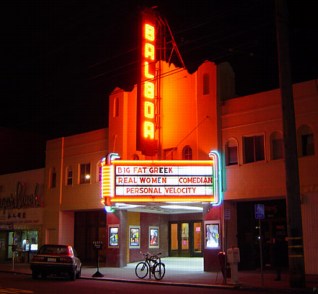
With all the bad news in the world, the recent announcement that the Richmond District’s historic Balboa Theatre would be keeping its doors open — thanks to a partnership between the non-profit San Francisco Neighborhood Theater Foundation and the theater’s veteran operator, Gary Meyer — is cause for cinematic celebration. (Full release here.)

Under president Alfonso Felder, the SFNTF (which also owns the Vogue on Sacramento Street and oversees the “Film Night in the Park” series) will lease the Balboa through 2024 — taking the built-in-1926 landmark nearly to its 100th birthday. A fundraiser tonight offers the public a chance to step up and show support for this new partnership and help raise some dough for Balboa repairs and upgrades.

The event features a “Then and Now Presentation of San Francisco Theatres” (presumably, focusing more on the pre-multiplex days), plus an Oscar season preview (get a head start on your office pool!), and live and silent auctions, with items contributed by such local luminaries as the Film Noir Foundation‘s Eddie Muller. Some ticket levels include chances to “name” one of the brand-new seats in the auditorium and copies of Jack Tillmany’s Theatres of San Francisco, filled with historic photos of venues — some gone long ago, others shuttered only recently (remember the Coronet? Sigh). Fortunately, the Balboa looks set to thrive for years to come.

“Celebrating the Balboa Theatre: SFNTF Fundraiser”

Tues/13, 7-9 p.m., $35-$1000

Balboa Theatre

3630 Balboa, SF

www.sfntf.org

www.balboamovies.com


Poverty among plenty

108

The Bay Citizen has a fascinating map by census tract of poverty in the Bay Area. Among the things that jump out: There’s plenty of serious poverty in the area — and it’s worst than the map shows. The definition of “poverty” is a family of four living on $22,113 — in the Bay Area. Hard to imagine how a family of four can even pay rent, much less eat, in this part of the world on $22,000.

Aaron Glantz makes an interesting point: “In many parts of the Bay Area, the wealthy and poor live in close proximity to each other.” Check out the census tract in the Richmond, right next to Seacliff, where some of the richest San Franciscans live. A full 20 percent of the residents of that area are under the federal poverty line — and they can walk a couple of blocks to the mansions where millionaires live. There are 60 people living in extreme poverty in the 35-square-block area around Presidio Heights, where the likes of Sen. Dianne Feinstein and Rep. Nancy Pelosi live.

Poverty among plenty. Just a tiny fraction of the wealth of Feinstein, Pelosi and their neighbors would pull all of those 60 people way above the poverty line. And the Presidio Heights denizens would never miss it.


The data also show that in many parts of the Bay Area, the wealthy and the poor live in close proximity to each othe

Source: The Bay Citizen (http://s.tt/14J0t)

The data also show that in many parts of the Bay Area, the wealthy and the poor live in close proximity to each other. 

Source: The Bay Citizen (http://s.tt/14J0t)

Just pho you

0

le.chicken.farmer@gmail.com

CHEAP EATS I can’t tell you how many times in my life I have been sitting in Java Supreme dunking a biscotti and discussing literature and pork with Earl Butter, and then I have to use the bathroom so I go home.

Yeah, well turnabout is fair play, according to Skeeter Willis and others. Some L.A. friends of Hedgehog were here, and wanted to bum around the Mission with us. One thing we did was I took them to meet Stoplight. But I don’t exactly live in my apartment anymore. We were hoping Stoplight would be out back outside (where he mostly is), and accepting visitors (which he mostly isn’t). As a result, we wound up waiting around in my building’s birdseed covered courtyard, discussing literature and pork, until I had to use the bathroom so we went to Java Supreme.

In truth, this happened twice, and both times I got coffee, because even though the Java people know me, and know that I’ve been dipping my biscotti into their coffee for 20 years, without hardly ever using the facilities … still, I like to set a good example: the restroom is for paying customers only.

So I kept drinking, to earn my pee, and then kept needing to pee on account of all the coffee I was drinking. This was a slippery slope, destined to leave me penniless and friendless, pretty much living on the toilet and pissing off basically everyone.

Except that, luckily, Hedgehog’s L.A. friends needed to be getting on back to L.A., and we had offered to drive them as far as Colma, where their car was parked. After dinner.

They wanted Chinese, but Mission Chinese doesn’t open for dinner until 5, and it’s a what, a six hour drive to L.A.? Or longer — at the end of a holiday weekend.

None of us had had lunch. We couldn’t wait. We went to San Tung, which I like anyway better than Mission Chinese. It was only 4:30. There was a parking space right in front. It was surreal: For the first time ever, we not only sat right down but had a choice of tables.

Then came one of the what-the-fuckest things that ever happened to me in a restaurant: nothing. It took them 20 minutes to find the time to take our order. By which time the place did get crowded. Another party of four sat at the other end of our table, ordered after us, and were served before. Which would be one thing. But. A half hour before??? I’m not exaggerating. And we’d ordered many of the same dishes!

Not only did we have to watch them smugly munching their chicken wings while our end of the table was dying of malnutrition, they were boxing up their leftovers, divvying up the bill, and putting on their coats before half of our dishes were even served. To get any of them at all, we had had to go knock on the kitchen door. Figuratively speaking.

That’s crap, and so is San Tung. Henceforth. In my opinion.

My new favorite restaurant is Pho Saigon II, in Richmond at the Pacific East Mall. I went there on the day after Thanksgiving, on Black Friday, to a mall! But I went there for a massage, and to eat pho, so, no, I have not lost my mind completely.

It’s that Asian mall, you know, with 99 Ranch, which I love. Well, there’s a place in there, upstairs, where you can get an hour-long massage for $20. Crawdad told me about it. The Jungle told her.

Now I’m telling you. And:

Pho Saigon II, for all its fluorescence and atmospherelessness, has good, cheap pho. I would think this would go without saying, but, get the beef. Hedgehog, who prefers pho ga, or chicken noodle soup, was sorely disappointed in hers. And I second her disappointment. The broth was lame and the chicken very dry.

The rare steak in my soup was perfect and pink, and the noodles were good, and the broth … just so.

After lunch, come to think of it, we did do a little shopping. We bought three kinds of rice noodles at 99 Ranch. Oh, and I also stepped into one of those little doodad stores and bought a cute little eraser for Hedgehog. I was their only customer. Pepper spray did not play a role.

PHO SAIGON II

Sun.-Thu.: 10 a.m.-9 p.m.; Fri.-Sat. 10 a.m.-10 p.m.

3288 Pierce St., Suite A116, Richmond

(510) 528-6388

Cash only

No alcohol


Period Piece: A fight we won

0

As steadfast Occupiers confront growing police and official opposition comparisons to historical protest movements are cropping up. 

San Francisco, of course, has been home to more than a few spirited speeches, many of which have resulted in real protest-driven change. Local protests here have long been loci of larger nationwide movements. One cool example: the freeway revolt movement, a national pushback against the autofication of cities in the 1960s and ’70s which reached its peak in San Francisco in the fight against the Western Freeway.

Many of the 1955 organizers who battled the freeway that would have connected 101’s march up Octavia Boulevard all the way to the Golden Gate Bridge hadn’t protested anything before. They included pastors and churchgoers, housewives, concerned parents, World War II veterans, middle-class San Franciscans working and living in the path of a projected freeway.

The proposed Western Freeway would have included a major interchange around 7th and Irving Streets before heading into Golden Gate Park. Image courtesy San Francisco Public Library

The last addition to a city-wide highway plan, the double-decker Western Freeway would have snaked through West Portal, the Sunset District, and the Richmond (with, of course, a little jog through Golden Gate Park, devouring the Rose Garden and the Hall of Flowers). Three huge arteries would have tangled and clogged where Irving and Seventh Streets now intersect in a tree-lined corner. 

Obviously, the protesters who assembled to challenge the Board of Supervisors at Lincoln High School in December of 1955 weren’t just speaking out against the views and noise that were to accompany the proposed concrete ribbon. They were challenging the disruption of a settled post-war life, the bisection of their parishes by eight lanes of concrete, the impossibility of getting their kids to previously accessible neighborhood schools. Thousands of homes were to be demolished, and businesses to be relocated. 

“The turnout was enormous, and the angry crowd unanimous in opposing the freeway plan. The politicians were stunned,” writes Frank Dunnigan in a recollection of the 1955 meeting.

The struggle against the freeway lasted four years and was replicated, again and again, and with growing momentum by neighborhood groups across the entire city. Resolution 45-59, which passed in 1959, squashed plans for the Western Highway as well similar nasty proposals. It was the direct result of efforts by ordinary people with full-time jobs, families, and livelihoods that threatened by the powers that were. And they won.


Lessons from 2011 for 2012

4

With the release of precinct results for the 2011 election, we are able to actually see, for the first time, what San Francisco voters did, as opposed to hearing what various nabobs said they did.  There are a couple of key conclusions about the vote that should guide any left-liberal thinking of the key 2012 Supervisor races.

The first thing San Francisco voters did- about 40,000 of them-  was stay home.  Turnout – about 40% – was the lowest for a mayor’s race in 40 years. Moreover, counter to several “expert” narratives, turnout in neighborhoods with large numbers of Chinese voters — Chinatown, the Richmond, the Sunset, and Vis Valley — was lower (average 33%) than in neighborhoods with few Chinese voters — Diamond Heights, Noe Valley, the Castro and West of Twin Peaks — where turnout averaged 40%.

There seems to be four reasons for this curious outcome. A couple of them have lessons for us for the 2012 election that we ignore at our peril.
First, in a City that is clearly center-left, voters were presented with nine center-right candidates, seven of whom were declared by the Chronicle at one time or another to be “serious.” Only John Avalos was a clear center-left choice. This was shown in the huge number undecideds that appeared in poll after poll. Undecided voters are often unhappy at the lack of choice being offered by the field and simply don’t vote.

Second, professional campaign management of the supposedly serious candidates was terrible and actually counter-productive to their candidates’ best interests. The pros actually seemed to have suppressed turnout in key neighborhoods. Ace Smith and Bill Barnes, working for for Ed Lee, spent most of their time trying to distance their candidate from his base and key supporters, made rookie fund-raising mistakes time and again and gave their counterparts in the Yee and Herrera campaigns ample ammunition for a  series of negative ads and mailers.  John Whitehurst and Mark Mosher, working for Herrera, and Jim Sterns, working for Yee, took the opportunity and went negative on the least threatening figure in San Francisco politics in recent memory. 

As we all know negative campaigns generally suppress turnout — and that seems to be the case in this election. Avalos, who after September had no professional management, stayed positive and gained votes by doing so.

Third, organized labor, for the first time in living memory, did not endorse the winning candidate for mayor. Indeed, its official candidate, Yee, came in FIFTH. It’s as if labor decided to concentrate only on its issue — pension reform — and devote no energy, people or money to the myors race. Without labor’ support,effective GOTV in left-liberal neighborhoods is all the more difficult and was clearly beyond the ability of the Avalos campaign to carry by itself.

Labor knew who it wanted to vote on pension reform and narrowly focused only on those voters. That it still has the ability to do electoral politics can be seen in the fact that more total votes were cast on  Proposition C (186,336) — labor’s pension- reform measure –than were cast for all candidates in the mayors race (179,888).

Finally, there were 160 fewer polling places this election than last year, and to make matters worse the Department of  Elections mailed 115,000 voter handbooks with the wrong polling place address causing them to send postcards with the corrections. While this in no way was responsible for the 40,000 fewer votes cast, it was probably worth several hundreds of missed votes.

The lessons for next year? We need good candidates who actually align with political sensibility of the voters. This will be especially true in District Five after Mayor Lee appoints some center-right clone in the most left-liberal district in the city, and equally true in District Three with David Chiu, who has certainly turned to the right since his election. 

Supervisor David Campos in District 9 will be fine in this regard as will Supervisor Eric Mar in District 1 — where he will face a real fight.
Avalos’ showing in the mayors race should do him well in District 11 and offers a real chance for him to be board president in 2013.
Community-based left-liberals and labor must come together closer than in this election and perhaps closer than at any time since the Great depression. Labor’s support for the Occupy movement is a good indication that fruitful common ground can be found. We need each other more than ever in 2012.

We need to work to get good lines for the new districts and have a grand meeting of the minds on how we address the absentee voter issue.  Both labor and the Mirkarimi campaign did absentees well enough to win.  We need to apply their lessons to the Supervisors races.

Dare to struggle, dare to win.

Calvin Welch is a housing activist who has been watching San Francisco elections for more than 40 years.


The Performant: Hell of a ‘ween

0

Getting scared with The Residents — and other Hallowed traditions

Used to be that on Halloween you could be assured of catching either The Residents or The Cramps storming the stages of San Francisco; bands practically designed to blend in with the emissaries of the afterlife creeping through the thin membrane demarcating the spiritual plane. But with the sad passing of The Cramps iconic frontman Lux Interior in 2009, and the always-sporadic scheduling of The Residents, it seems like those days may be gone forever. But perhaps not coincidentally, in a unique twist on the Halloween season tradition, The Residents lead singer Randy Rose has been workshopping a disturbing cabaret all his own at the Marsh in Berkeley.

Entitled “Sam’s Enchanted Evening,” the production in its current permutation is a stripped-down acoustic medley of altered cover tunes and rambling monologues, blustery dispatches from the tortured depths of a character named Sam—an old high school chum, according to Randy. A broken-down shell of a former Casanova and Vietnam War veteran, a stooped and decrepit figure tottered onstage, walker and bourbon in tow, dragging the oddience down the claustrophobic rabbit hole of his pessimistic world view. Accompanied by occasional Resident’s collaborator and Marsh stalwart Joshua Raoul Brody on the keys, Sam warbled through an All-American pop-culture soundtrack from “Sixteen Tons,” to “Living the Vida Loca,” with desperate intensity. A haunting portrait of a twisted, tragic life, and possibly the scariest thing you could have seen during the long Halloween weekend.

As party-packed as the weekend was, for Halloween traditionalists, Monday night was still the real deal. And what better way to celebrate the scariest night of the year than at a bona-fide, old-fashioned, haunted house? For years, tiny corner grocery store Appel and Dietrich Market at 6001 California has been hosting haunted house mayhem in its basement, conceptualized and staffed by a stalwart crew of Richmond district denizens. An eye-catching guillotine and witch-burning stake out on the sidewalk entertained the passerby, while in the “dungeons” below the street, mouthy chopped off heads in baskets, strobe-lit tortures chambers, a mad scientist’s laboratory, and a sacrificial ritual lay in wait for the thrill-seeking horrorphiliacs who ventured down.

Later that evening, the third annual Halloween edition of FlashDance, one of the city’s most low-key yet exuberant howl-day traditions, occupied an anonymous pier on the Embarcadero, affording a great view of the Bay bridge, lit up in the background like a strand of party lights. While the mild evening pulsed with the soundtrack of the evening (heavy on the Michael Jackson, a favorite of FlashDance founder Amandeep Jawa), a costumed frenzy of flashdancers put their hands in the air like they just didn’t care. If there were any spirits walking that evening, they blended right in with the spunky aerobics instructors, zombies, and deep sea creatures otherwise disguised as party revelers, which is exactly the point of such revels, both for the living and the dead. It makes one suspect that whatever the afterlife has going for it, dance parties are not among them, so we’d best enjoy them now while we can.

Sam’s Enchanted Evening
Through November 26
The Marsh Berkeley
2120 Allston Way, Berkeley
$15-$50
(415) 826-5750
www.themarsh.org

Classic style

1

arts@sfbg.com

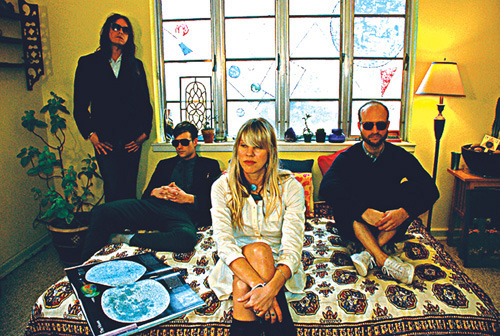
MUSIC “We were listening to these old [Jamaican]records that were just incredibly psychedelic and very alive — breathing and pumping with groovy consciousness,” says Alex deLanda, bassist of San Franciscan outfit, Extra Classic. “But they were recorded on four-tracks.”

As deLanda gushes about this style of music, vocalist-keyboardist  Adrianne “Dri” Verhoeven (formerly of emo-pop’s the Anniversary) nods in agreement, stroking the couple’s tangerine-colored cat, Carol. Their other cat, King Jonezers, circles as they sit in the living room of their Richmond District apartment.

To simulate the sonic texture on old recordings of Jamaican music, Verhoeven and deLanda made a conscious decision to record Extra Classic’s full-length, Your Light Like White Lightning, Your Light Like a Laser Beam (Manimal Vinyl), all-analog on eight-track tape with equipment from the ’60s and ’70s. To celebrate the album’s vinyl release, Extra Classic will play the Make-Out Room with King Tuff and Audacity on Oct. 26; but first, a gig opening for Moonface at the Independent this Tuesday, Oct. 18.

Working on old cars and working on vintage recording equipment is basically the same thing, deLanda says recalling memories of working on his father’s Chevys from the ’40s and ’50s. “I’m underneath [the recording equipment], cussing, and trying to solder some wires together — trying to make it work,” deLanda laughs. “It just made sense [to record all-analog].” Vanhoeven joins in the laughter, her pants now blanketed in cat fur.

The technological limitations of analog exaggerated the interconnectedness of Extra Classic’s songwriting process and recording method, rendering it challenging at times. “[We had] to think inside of eight tracks,” Verhoeven says. DeLanda (formerly of Casiotone For The Painfully Alone and the Papercuts) adds, “If we weren’t able to express ourselves with eight tracks, then we needed to go back to the drawing board.”

The absence of ProTools notwithstanding, Extra Classic masterfully braids elements of Jamaican music, which include dub, reggae, Caribbean music, and American R&B/soul/pop — among others — into its own brand of multidimensional grooves. Despite technical constraints, they were able to create a kaleidoscopic album that impeccably honors the style of music that they love dearly.

Borrowing its moniker from the eponymous album by reggae legend, Gregory Issacs, Extra Classic was also inspired by Jamaican music thematically. “I drew inspiration, as a singer, from the amount of feeling and soul in [this] whole genre of music,” Verhoeven says. “Times are tough. You got a lot of shit stacked up against you, but [you find] some sort of way out and hope.”

This is strikingly evident in “You Can’t Bring Me Down,” an anthem of strength, resilience, and empowerment. Upon a cursory listen, it’d be understandable if someone was to categorize Extra Classic as a reggae band. But in songs such as “Angel Eyes,” Verhoeven’s vocals gently hover above an airy arrangement, recalling ’50s American pop, à la Patti Page. In the closer, “Give Me Your Love,” her richly nuanced and soulful voice emanates more of an R&B vibe.

Verhoeven attests to the band’s inherently eclectic sound, “I’d say we’re influenced by reggae music. But, I wouldn’t say that’s the kind of band we are. I would say we’re psychedelic dub rock.”

Petting King Jonezers, deLanda interjects, “It’s like the rock and roll’ers think we’re reggae. And the reggae guys think we’re rock and roll.” 

EXTRA CLASSIC

With Moonface Tues/18, 8 p.m., $15

The Independent

628 Divisadero, SF

(415) 771-1421

www.theindependentsf.com


With King Tuff and Audacity

Oct. 26, 10 p.m., $10

Make-Out Room

3225 22nd St., SF

(415) 647-2886

www.makeoutroom.com

Under my umbrella

0

culture@sfbg.com

GO THERE Nothing fouls an SF afternoon like a sudden shower. We are not given much to bike fenders, Gore-Tex, or waterproof shoes (current Doc Marten resurgence notwithstanding), so when the skies open you are as like as not to find that your dayplanner has closed. But worry not. Should your loved or soon-to-be-loved-whether-they-know-it-or-not one get cold feet on the rainy day of your date, offer them this fuzzy bunny slipper of a list: our collection of bars and restaurants around the Bay that are perfect for when skies are moist. 


PHO GARDEN

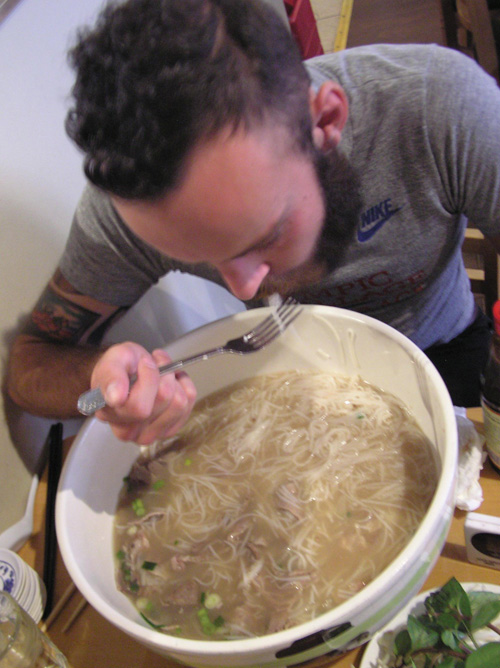
This Clement Street Vietnamese spot does not play. A billboard out front advertises its particular draw: a pho eating challenge employing the use of a bowl large enough to hold a baby, as said billboard helpfully illustrates. A $22 bowl of serviceable beef pho containing two pounds of noodles and two pounds of — at times frighteningly stringy and translucent — meat awaits competitors, who have one hour to scarf it down. You may never want to eat pho again after plunging into its depths but hey, it’s rainy out and you just found a bowl of soup on which you can rest your elbows (and chin when the hour inevitably takes its toll). Winners get the pho for free and take home the mega-bowl. Losers get a “Got Pho Challenge?” T-shirt, so everyone waddles home happy. (Caitlin Donohue)

2109 Clement, SF. (415) 379-8677, www.phogardensf.com


THE LITTLE SHAMROCK

A 118-year-old bar surely has a few ghosts (or at least three sheets to the wind). But nothing could send a chill up your spine while you’re seated in front of the fireplace at this Irish Inner Sunset favorite, enjoying a sprightly game of backgammon and nursing a fortifying draft. The uber-Victorian décor and Great Quake-oriented memorabilia lining the walls might just whisk(ey) you back to 1929, when then-owner Tony Herzo Jr. “always had a big kettle of Spanish beans at the window by the front door,” according to the bar’s lore. We’ll gladly settle for the Shamrock’s belly-warming Bloody Mary meal plan. (Marke B.)

807 Lincoln, SF. (415) 661-0060


TOSCA

When it’s chilly outside, nothing warms your insides like hot chocolate with sweet brandy in a fancy glass. Tosca, with red vinyl booths and exquisite-imposing carved wood bar, will be your beacon in a dreary North Beach storm. The bar keeps the sizzling hot chocolate lined up, awaiting request. And if you need to steady the alcohol running through your delicate system, they bring out these lovely homemade cheesy nibbles and other assorted snacks. The atmosphere is doubly cozy thanks to nostalgic cuts off actual records in the vintage jukebox; the Rat Pack dominates the mix. (Emily Savage)

242 Columbus, SF. (415) 986-9651, www.toscasf.com


THE RIPTIDE

Everybody in the Sunset knows that this bar specializes in providing cozy climes for those who have been carving gnarly waves (or just stuck on a packed L-Taraval car). The local paraphernalia-bedecked brick fireplace makes for a great place to curl up and wait out the rainstorms — and you’re unlikely to be alone when you do so. The Riptide houses a mini-scene in the outer neighborhoods: open mics, live bands, karaoke, all set to a food menu that rotates daily. Shepard’s pie Mondays? DIY grilled cheese Thursdays? It’s just enough to reconcile a person to the caprices of Mother Nature for the day. (Donohue)

3639 Taraval, SF. (415) 681-8433, www.riptidesf.com


JUPITER

From handcrafted beers to delicious specialty pizzas named after planets, moons, and astronomers (try the Odysseus, which tops out with wild mushrooms and Danish fontina cheese), Berkeley’s Jupiter is a great place for a casual date when it’s pouring out. An outdoor seating area with a fireplace and heaters can keep the two of you pleasantly warm. Gothic accents decorate the two-story venue, which is housed in an old livery stable from the 1980s — a European atmosphere in the heart of downtown Berkeley. Every pizza is cooked in a traditional wood-fired brick oven and can be complimented with a cold beer — now that’ll make you feel all warm and fuzzy inside. (Paige A. Ricks)

2181 Shattuck, Berk. (510) THE-TAPS, www.jupiterbeer.com


RITE SPOT CAFE

Melt-prone San Franciscans deal with the rain in a variety of ways: drinking and eating heavy foods are prime among these. Indulge in both at a bar-restaurant inside which you’ll never even notice if the sun comes out. The Rite Spot’s windows are few and far between, but never you mind; live music from the jangling piano, white tablecloths, walls painted a vivacious red, and a menu that harkens back to your (non-Italian) grandparents’ fave Italian joint will keep you begging drinks off the affable, struggling artist staff until long after the rainbow’s gone. (Donohue)

2099 Folsom, SF. (415) 552-6066, www.ritespotcafe.net


PIZZETTA

There’s nothing like a rainy night to inspire the sudden need for cozy interpersonal contact — preferably over a steaming dish of cheese and sauce. Pizzetta 211, a four-table restaurant in the Outer Richmond, offers just that. It’s likely you will share your window ledge-turned-seat with a stranger. It is equally likely that whichever one of you gets your pizza first will forget about the utter lack of elbow space, and possibly about the swampy fog outside. Pizzetta’s standbys alone make it worth a trip — a rosemary and pine nut pie, particularly — and if you manage to hit the tiny, fragrant spot when there’s a farm egg pizza on the menu, endure the wait. (Lucy Schiller)

211 23rd Ave., SF. (415)379-9880, www.pizzetta211.com


Korean wave

0

virginia@sfbg.com

APPETITE Growing up partly on the East Coast (New Jersey) with close Korean friends exposed me to the pleasures of kimchi and burning hot ssamjang (a Korean hot sauce) early in life. In Flushing, Queens, I savored endless incredible Korean restaurants, often filled only with Korean customers. I was first hooked on those crispy, comforting Korean pancakes, pajeon, and my fondness for the cuisine grew from there.

Although more than 30 percent of our city’s population is of Asian descent, our Korean community is not as large as that of LA or NYC, which could be why we’re less the Korean food Mecca those two cities are (despite our abundance of Korean BBQ joints, that is). But there’s been a recent wave of Korean openings I can only hope will signal a robust Korean dining catalog in our future. The more bulgogi and bibimbap in this town, the better. While I usually find less to love at places mixing cuisines, like the Tenderloin’s new Ahn Sushi & Soju serving both Japanese and Korean food, here are three recent openings that show promise… and none are Korean BBQ.


AATO

Aato, a new “Korean fusion” restaurant in the Marina, is an unexpected oasis on busy Lombard Street. Owner Jennie Kim grows herbs in potted plants by a little front patio strewn with white lights. Despite a pricier menu than one typically sees in Korean eateries ($12–$15 for starters, $13.50–$25 for entrees), Aato does things differently, apparent from chandeliers in the surprisingly elegant dining room to the use of locally grown, organic ingredients (though common-as-day in SF, unusual for local Korean spots). Initial highlights include ssam, which literally means “wrapped” in Korean. There are three versions served with rice, kimchi, veggies and rice paper wraps. My gut pushed me straight to eel ssam, but Kim talked me into hangbang (Herbal) bo ssam. I wasn’t sorry. The tender, steamed pork is aromatic and nuanced with herbs. Man-du Korean dumplings are delicately pan-fried, plump with kimchi and shrimp, an exemplary appetizer. Jab-chae is traditional sweet potato noodles stir-fried with beef and seasonal veggies. Weekend brunch intrigues with the likes of eggs with “Korean-style” hash browns,, man-du dumpling soup, and a fritatta with tobiko, salmon, avocado, and cheese.

1449 Lombard, SF. (415) 292-2368


NAN

Japantown’s Nan works for two reasons: it’s a minimalist, airy space, with an extensive menu that tends slightly toward creativity. Skewers of pork belly and BBQ beef abound, alongside rice bowls, bibimbap and rice cakes. Seafood pajeon is not the perfection it is at Manna (see below), but bulgogi beef mixed with wheat noodles utterly satisfies, particularly with Asian beers on tap.

1560 Fillmore, SF. (415) 441-9294


MANNA

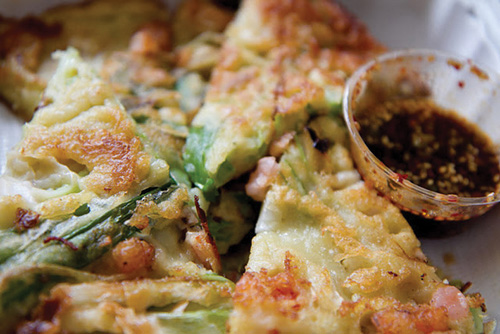
Manna offers a clean, friendly dining room in the heart of the Inner Sunset. It serves a number of Korean classics with varying iterations among their 44 dinner menu items. There are diverse versions of bibimbap, short ribs, and stews. Manna also fries up a buttery seafood pajeon (Korean pancake), loaded with leeks, scallions, mini-shrimp, and squid — one of the best I’ve ever had.

845 Irving Street at 10th Ave., SF. (415) 665-5969


OTHER RECOMMENDED (BUT NOT NEW) KOREAN STOPS:

I adore Toyose (3814 Noriega, SF. (415) 731-0232), a humble hangout in a garage with Korean bar style food like spicy chicken wings, washed down with sojus and Korean beers. First Korean Market (4625 Geary, SF. (415) 221-2565) is a tiny Korean market with kimbap, sushi/maki-style rolls. Head to To Hyang (3815 Geary, SF. (415) 668-8186) for raw beef salad — a hefty beef tartare-style beef dish topped with an egg — and other homestyle treats from Mom, whose daughters run the front of the house. Korean tacos are playful and cheap at John’s Snack and Deli (40 Battery, SF. (415) 434-4634) in the Financial District, and the Seoul on Wheels truck (www.seoulonwheels.com) which can be found at Off the Grid (www.offthegridsf.com).

Wonderfully worn HRD Coffee Shop (521 3rd Street, SF. (415) 543-2355) a humble Korean-run sandwich shop in SoMa, serves a hefty spicy pork kimchi burrito. Arang (1506 Fillmore, SF. (415) 775-9095) on Lower Fillmore serves a heartwarming seafood bibimbap with octopus and shrimp. A “fusion” place that really does work, and that is one of the Richmond’s best restaurants overall, is Namu (439 Balboa, SF. (415) 386-8332), offers Korean fried chicken and ever-popular Korean beef short rib “tacos” on nori (seaweed), which is also sold at the Ferry Plaza Farmers Market on Thursdays and Saturdays.

Subscribe to Virgina’s twice monthly newsletter, The Perfect Spot (www.theperfectspotsf.com)


On the Cheap Listings

0

WEDNESDAY 5

Poetry World Series Play-Off San Francisco Public Library, lower level, 100 Larkin, SF. www.sfpl.org. 6 p.m., free. Has the Giants’ lackluster season struck you as less than poetic masterpiece? Time to regain some baseball-themed inspiration. The SF Public Library is hosting this showdown between local poets – celebrity judges (including Lemony Snicket himself, Daniel Handler) will “pitch” poem topics at the bards so that they can improvise sonnets onstage.

“Architectural Books and the Art of the Bookstore” Scanners Bookstore, 312 Valencia, SF. (415) 374-9379, www.scannersproject.com. 6:30 p.m., free. Watch City Lights Bookstore head buyer Paul Yamazaki and architecture bookstore owner William Stout in conversation about, well, what they know best. San Francisco entrepreneurs take center-stage at this Litquake literary festival event.

THURSDAY 6

“Windows and Mirrors” Afghani culture art opening University of San Francisco, Kalmanovitz Hall, 2130 Fulton, SF. www.windowsandmirrors.org. 5-7 p.m., free. After a speech by Veterans Against the War activist Matt Southworth you’ll be free to stare at the walls. Or better yet, at the 45 murals dedicated to the lives of Afghanistan’s citizens. An inter-faith peace vigil will also be held.

FRIDAY 7

Armenian Bazaar and Food Festival St. Vartan Armenian Church, 650 Spruce, Oakl. (510) 893-1671, www.stvartanoakland.org. 5:30 p.m.-midnight, $3. Bounce to the Khatg Jinigirian Ensemble, who’ll be taking the stage at this open-air fair. You’ll need to burn calories if you’re a beoreg, boorma, or kufta fan, anyways.

SATURDAY 8

“Cakeland: Your Deadly Desserts” art exhibit Modern Eden Gallery, 403 Francisco, SF. 6-9 p.m., free. Scott Hove room of cake has a secret. You’ll find it out quickly if you step into the overpoweringly sweet lair – despite the sugar, this cake is armed with multiple, vicious-looking maws.

San Carlos Art and Wine Faire San Carlos between El Camino and Walnut, plus Laurel between San Carlos and Arroyo, San Carlos. www.sancarloschamber.org. Also Sun/9. 10 a.m.-5 p.m., free. The so-called “City of Good Living” is strutting its stuff this weekend. Lisa Loeb will turn in a performance, the cinnamon-roasted almonds, garlic fries, and sparkling wines will be flying, and families will find ample things for their kiddos to do.

Open Studios: Sunset, Richmond, Haight, Hayes Various locations, SF. www.artspan.org. Also Sun/9 11 a.m.-6 p.m., free. The second week of the 36th annual SF Open Studios hits the western neighborhoods and the Haight and Hayes Valley areas. Would be the perfect reason to bike out (and around the Hardly Strictly Bluegrass crowds)

Estria Invitational Graffiti Battle DeFremery Park, 1651 Adeline, Oakl. www.estriabattle.com. 11 a.m.-6 p.m., free. For five years, this event has bringing some of the best graffiti artists from around the country (Hawaii included) to duke it out with aerosol in Oakland. In the days leading up to this park side main event there will be a San Francisco premiere of the spray art movie Bomb It 2, a Pecha Kucha presentation night at Oaksterdam University on women and public art.

h.Naoto-New People boutique opening New People, 1746 Post, SF. www.newpeopleworld.com. Noon-4 p.m., free. Another J-pop fashion designer has joined the sleek and silly folds of the New People Japantown mall. Naoto Hirooka is that man, whose edgy designs will be sure to wow the gothic Lolita set.

SUNDAY 9

The Great Night in Buena Vista Park Buena Vista Park, Buena Vista Ave. and Upper Terrace, SF. www.litquake.org. 4 p.m., free. Chris Adrian’s new novel The Great Night takes place in the selfsame Buena Vista Park, following the intersection of the fairy world with that of our own (or at least, that of who we were back in 2008). Tonight, some of the magic hopes to be made manifest – Adrian will be performing a book reading, a string quartet will take to the plain air, and you and your picnic blanket can be present to witness it all go down.

Rockridge Out and About College between Alcatraz and Lincoln, Rockridge. www.rockridgeoutandabout.com. Noon-6 p.m., free. This North Oakland neighborhood welcomes visitors for chef demonstrations, dancin’ in the street, and an event being produced by clothing brand Oaklandish.

Excelsior Arts and Music Festival Mission and Ocean, SF. wwweagsf.org. 11 a.m.-5 p.m., free. Dip into the southern neighborhoods for Excelsior’s family day. Bayonics, The Blind Willies, Estrada Real, and Cassandra Farrar will provide the live music.

On the Cheap listings are compiled by Caitlin Donohue. Submit items for the listings at listings@sfbg.com. For further information on how to submit items for the listings, see Picks.

Consider it moved: Shots from Saturday’s Moving Planet Day celebrations

2

Cloudy skies may have kept the crowds down at Saturday’s Moving Planet Day celebration in Civic Center Plaza, but the people that did show up could see light shining through. For being a climate change demonstration, the tone was pretty sunny. After marching from Justin Herman Plaza through downtown, a passel of environmental speakers, from 350.org founder Bill McKibbon to Richmond mayor Gayle McLaughlin, took the stage to talk about ongoing clean energy projects — and to exhort attendees to keep doing their part to reduce fossil fuel reliance. Click here to check out our interview from last week with one of the day’s organizers. Check back tomorrow, when we’ll run photos and talk to organizers from Moving Planet Days around the world. 

The real Leland Yee

53

tredmond@sfbg.com

It’s early January 2011, and the Four Seas restaurant at Grant and Clay is packed. Everyone who is anyone in Chinatown is there — and for good reason. In a few days, the Board of Supervisors is expected to appoint the city’s first Asian mayor.

The rally is billed as a statement of support for Ed Lee, the mild-mannered bureaucrat and reluctant mayoral hopeful. But that’s not the entire — or even, perhaps, the central — agenda.

Rose Pak, who describes herself as a consultant to the Chinese Chamber of Commerce but who is more widely known as a Chinatown powerbroker, is the host of the event. She stands in front of the room, takes the microphone, and, in Cantonese, delivers a remarkable political speech.

According to people in the audience, she says, in essence, that the community has come out to celebrate and support Ed Lee — but that’s just the start. She also urges them not just to promote their candidate — but to do everything possible to prevent Leland Yee from becoming mayor.

She continues on for several minutes, lambasting Yee, the state Senator who lived in Chinatown as a child, accusing him of about every possible political sin — and turning the Lee rally into an anti-Yee crusade. And nobody in the crowd seems terribly surprised.

Across Chinatown, from the liberal nonprofits to the conservative Chamber of Commerce, there’s a palpable fear and distrust of the man who for years has been among San Francisco’s most prominent Asian politicians — and who, had Lee not changed his mind and decided to run for a full term this fall, was the odds-on favorite to become the city’s first elected Chinese mayor.

The reasons for that fear are complex and say a lot about the changing politics of Asian San Francisco, the power structure of a city where an old political machine is making a bold bid to recover its lucrative clout — and about the career of Yee himself.

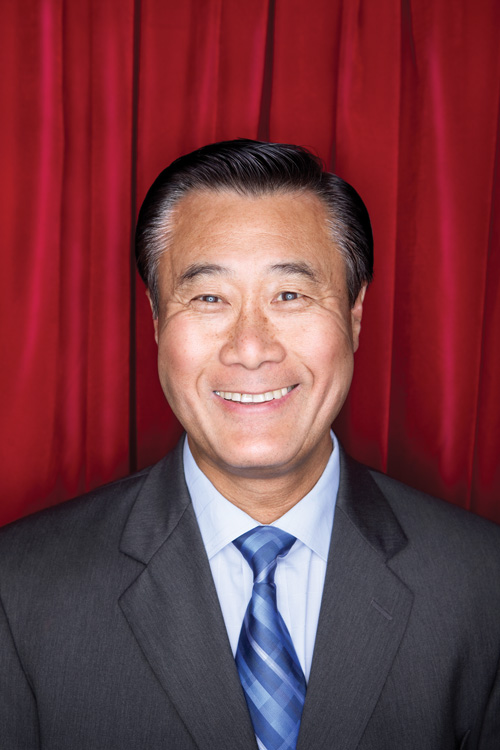
Senator Leland Yee is a political puzzle. He’s a Chinese immigrant who has built a political base almost entirely outside of the traditional Chinatown community. He’s a politician who once represented a deeply conservative district, opposed tenant protections, voted against transgender health benefits and sided with Pacific Gas and Electric Co. on key environmental issues — and now has the support of some of the most progressive organizations in the city. He’s taken large sums of campaign money from some of the worst polluters in California, but gets high marks from the Sierra Club.

His roots are as a fiscal conservative — yet he’s been the only Democrat in Sacramento to reject budget compromises on the grounds that they required too many spending cuts.

He’s grown, changed, and developed his positions over time. Or he’s become an expert at political pandering, telling every group exactly what it wants to hear. He’s the best chance progressives have of keeping the corrupt old political machine out of City Hall — or he’s a chameleon who will be a nightmare for progressive San Francisco.

Or maybe he’s a little bit of all of that.


Leland Yin Yee was born in Taishan, a city in China’s Guangdong province on the South China Sea. The year was 1948; Mao Zedong’s Communist Party of China had taken control of much of the countryside and was moving rapidly to take the major cities. The nationalist army of General Chiang Kai-Shek was falling apart, and Yee’s father, who owned a store, decided it was time for the family to leave.

The Yees made it to Hong Kong, and since Mee G. Yee had previously lived in the United States and served in the U.S. Army during World War II, he was ultimately able to move the family to San Francisco. In 1951, the three-year-old Leland Yee arrived in Chinatown.

For four years, Yee lived with his sister and mother in a one-room apartment with a shared bathroom while his father worked as a sailor in the merchant marine. It was, Yee recalled in a recent interview, a tight, closed, and largely self-sufficient community.

“The movie theater, the shoe store, the barber shop, food — everything you needed you could get in Chinatown,” Yee said. “You never had to leave.”

Of course, after a while, Yee and his mom started to venture out, down Stockton Street to Market, where they’d shop at the Emporium, the venerable department store. “It was like walking into a different country,” he said. “If you didn’t know English, they didn’t have time for you.”

Yee, like a lot of young Chinese immigrants of his era, put much of his time into his studies — in the San Francisco public schools and in a local Chinese school. “My mom spoke a village dialect, and we had to learn Cantonese,” he said. “Every little kid had to go to Chinese school. We hated it.”

When Yee was eight, his parents managed to buy a four-unit building on Dolores Street, and the family moved to the Mission, where he would spend not only the rest of his childhood but much of his early adult life. He graduated from Mission High School, enrolled in City College, studied psychology and after two years won admission to UC Berkeley.

Berkeley in 1968 was a very different world from Chinatown and even the relatively controlled environment he’d experienced at home in the Mission. “You didn’t protest in school. You’d have been sent home, and your mother would kill you,” he said.

At Berekely, all hell was breaking loose, with the antiwar protests, the People’s Park demonstrations, the campaign to create a Third World College (which led to the first Ethnic Studies Department), and a general attitude of mistrust for authority. “I developed a sense of activism,” Yee said. “I realized I could speak out.”

That spirit quickly vanished when Yee lost faith in some of his fellow activists. “People would work with us, then get into positions of power and use that against you,” he recalled. “A lot of my friends said ‘forget it.’ I left the scene.”

Yee once again devoted his energy to school, earning a masters at San Francisco State University and a Ph.D in child psychology from the University of Hawaii. Along the way, he met his wife, Maxine.

With his new degree, the Yees moved back to San Francisco — and back in with his parents at the Dolores property, where he, Maxine and a family that would grow to four kids would live for more than a decade.


Yee worked as a child psychologist for the San Francisco Department of Public Health, starting the city’s first high school mental-health clinic. He went on to become a child psychologist at the Oakland Unified School District, then joined a nonprofit mental health program in San Jose.

In 1986, Yee decided to get active in politics for the first time since college, and ran for the San Francisco School Board. He lost — and that would be the only election he would ever lose. In 1988, he won a seat, and established himself as an advocate for students of color, fighting school closures in minority neighborhoods. He also tried to get the district to modify its harsh disciplinary rules, arguing against mandatory expulsions.

On fiscal issues, though, Yee was a conservative. For his first term, despite the brutal cutbacks of the recession of the late 1980s and early 1990s, he insisted that the district make do with the money it had. His solution to the red ink: Cut waste. Only in 1992, when he was up for re-election, did he acknowledge that the district needed more cash; at that point, he supported a statewide initiative to tax the rich to bring money to the schools.

The sense of fiscal conservatism — of holding the line on taxes, but mandating open and fair contracting procedures and tight financial controls — was a hallmark of much of his political career. When the Guardian endorsed him for re-election to the board in 1992, we wrote that “there’s real value in his continuing vigilance against administrative fat and favoritism in contracts.”

Over the next four years, Yee worked with then-Superintendent Waldemar “Bill” Rojas, a deeply polarizing figure who pushed his own personal theory of “reconstitution” — firing all the staff at low-performing schools — and later was enmeshed in a scandal that led to prison time for a contractor he’d hired. Yee told me he was the only board member to vote against hiring Rojas, but people who were watching the board closely back then say he didn’t always stand up to the superintendent.

He also became what some say was a bit too close with Tim Tronson, a consultant hired by the district as a $1,000-a-day facilities consultant. Tronson wound up getting indicted on 22 counts of grand theft, embezzlement, and conspiracy in a scheme to steal $850,000 from the schools, and was sentenced to four years in state prison.

In 1998, when some school board members wanted to build housing for teachers on property that the district owned in the Sunset, Yee led the opposition — with Tronson’s help. At one meeting at Sunset Elementary School, Yee went so far as to say, according to people present, that “Tim Tronson is my man, and I rely on him for advice.”

Yee acknowledged that he worked closely with Tronson to defeat that housing project. “He was the facilities manager,” Yee explained, “and I said that I trusted his judgment.”


Yee has either a great sense of political timing or exceptional luck. He ran for the Board of Supervisors in 1996, facing one of the weakest fields in modern San Francisco history. He was the only Chinese candidate and one of just two Asians (the other, appointed incumbent Michael Yaki, barely squeaked to re-election). In an at at-large election with the top five winning seats, Yee came in third, with 103,000 votes.

He was never a progressive supervisor. In 2000, the Guardian ranked the good votes of what we referred to as Willie Brown’s Board, and Yee scored only 43 percent. He was against campaign finance reform. He supported the brutal gentrification and community displacement represented by the Bryant Square development. He voted to kill a public-power feasibility study and opposed the Municipal Utility District initiative. He opposed a moratorium on uncontrolled live-work development.

In 2002, Yee was one of only three supervisors to oppose Proposition D, a crucial public-power measure that would have broken up PG&E’s monopoly in the city. He stood with PG&E (and then-Sups. Tony Hall and Gavin Newsom) in opposition to the measure, then signed a pro-PG&E ballot argument packed with PG&E lies.

When I asked him about that stand, Yee at first didn’t recall opposing Prop. D, but then said he “stood with labor” on the issue. In fact, the progressive unions didn’t oppose Prop. D at all; the opposition was led by PG&E’s house union, IBEW Local 1245.

Yee was particularly bad on tenant issues. He not only voted to deny city funding for the Eviction Defense Collaborative, which helped low-income tenants fight evictions; he actually tried to get the city to put up money for a free legal fund to help landlords evict their tenants. He opposed a ballot measure limiting condo conversions. He opposed a measure to limit the ability of landlords to pass improvement costs on to their tenants.

In 2001, Yee voted to uphold a Willie Brown veto of legislation to limit tenancies in common, a backdoor way to get around the city’s condo conversion ordinance. Only Hall and Newsom, then the most conservative supervisors on the board, joined Yee. At one point, he started asking whether the city should consider repealing rent control.

He opposed an affordable housing bond in 2002, joining the big landlord groups in arguing that it would raise property taxes. Every tenant group in town supported the measure, Proposition B; every landlord group opposed it.

I asked Yee about his tenant record, and he told me that he now supports rent control. But he said that he was always on the side of homeowners and small landlords, and that property ownership was central to Chinese culture. “I was responding to the Chinese community and the West Side,” he said.

He wasn’t much of an environmentalist, either — at least not in today’s terms. He was one of the only city officials to support a “Critical Car” rally in 1999, aimed at promoting the rights of vehicle drivers (and by implication, criticizing Critical Mass and the bicycle movement).

His record on LGBT issues was mixed. While he supported a counseling program for queer youth when he was on the school board, he also supported JROTC, angering queer leaders who didn’t want a program in the public schools run by, and used as a recruiting tool for, the military, which at that point open discriminated against gay and lesbian people.


Yee was also one of only two supervisors who voted in 2001 against extending city health benefits to transgender employees.

That was a dramatic moment in local politics. Nine votes were needed to pass the measure, and while eight of the supervisors were in favor, Yee and Hall balked. At one point, Board President Tom Ammiano had to direct the Sheriff’s Office to go roust Sup. Gerardo Sandoval, who was ducking the issue in his office, to provide the crucial ninth vote.

Yee didn’t just vote against the bill. According to one reliable source who was there at the time, Yee spoke to a community meeting out on Ulloa Street in the Sunset and berated his colleagues, quipping that the city should have better things to do than “spend taxpayer money on sex-change operations.”

It was a bit shocking to trans people — Yee had, over the years, befriended some of the most marginalized members of what was already a marginalized community. “There was one person at the rail crying, saying ‘Leland, how could you do this to us,'” Ammiano recalled.

The LGBT community was furious with Yee. “I didn’t speak to him for at least a year,” Gabriel Haaland, one of the city’s most prominent transgender activists, told me.

Yee now says the vote was a mistake — but at the time, he told me, he was under immense pressure. When he voted for the queer youth program, he said, “the elders of the Chinese community ripped me apart. They called my mother’s friends back in the village [where he was born] and said her son was embarrassing the Chinese community.”

That must have been difficult — and he said that “if I had known the pain I had caused, I wouldn’t have voted that way.” But it was hard to miss that pain his vote caused.

On the other hand, people learn from their experiences, attitudes evolve, we all grow up and get smarter, and the way Yee describes it, that’s what happened to him.

In 2006, when he was running for state Senate, Yee met with a group of trans leaders and formally — many now say sincerely — apologized. It was an important gesture that made a lot of his critics feel better about him.

“He didn’t have to do that,” Haaland said. “People change, and he paid for his crime, and that’s genuine enough for me.”

As a former school board member, Yee kept an interest in the schools — but not always a healthy one. At one point, he actually proposed splitting SFUSD into two districts, one on the (poorer) east side of town and one on the (richer) west. “We strongly opposed that,” recalled Margaret Brodkin, who at the time ran Coleman Advocates for Children and Youth. “Eventually he dropped the idea.”

For all the problems, in his time on the Board of Supervisors, Yee developed a reputation for independence from the Brown Machine, which utterly dominated much of city politics in the late 1990s. His weak 43 percent rating on the Guardian scorecard was actually third-best among the supervisors, after Ammiano and the late Sue Bierman.

In 1998, he was one of the leaders in a battle to prevent the owners of Sutro Tower from defying the city’s zoning administrator and placing hundreds of new antennas on Sutro Tower. He, Bierman, and Ammiano were the only supervisors opposing Brown’s crackdown on homeless people in Union Square.

When he ran in the first district elections, in 2000, against two opponents who had Brown’s support and big downtown money, the Guardian endorsed him, noting that while he “can’t be counted on to support worthy legislation … He’s one of only two board members who regularly buck the mayor on the big issues.”

(He never liked district elections, and used to take any opportunity to denounce the system, at times forcing Ammiano to use his position as president to tell Yee to quit dissing the electoral process and get to the point of his speech.)


In 2002, the westside state Assembly district seat opened up, and both Yee and his former school board colleague Dan Kelly ran in the Democratic primary. Yee won, and went on to win the general election with only token opposition.

His legislative record in the Assembly wasn’t terribly distinguished. Yee never chaired a policy committee — although he did win a leadership post as speaker pro tem. And he cast some surprisingly bad votes.

In 2003, for example, then-Assemblymember Mark Leno introduced a bill that would have exempted single-room occupancy hotels from the Ellis Act, which allows landlords to evict tenants for no reason. Yee refused to vote for the bill. Leno was furious — he was one vote short of a majority and Yee’s position would have doomed the bill. At the last minute, a conservative Republican who had grown up in an SRO hotel voted in favor.

When he ran for re-election in 2004, we noted: “What’s Leland Yee doing up in Sacramento? We can’t figure it out — and neither, as far as we can tell, can his colleagues or constituents. He’s introduced almost no significant bills — compared, for example, to Assemblymember Mark Leno’s record, Yee’s is an embarrassment. The only high-profile thing he’s done in the past several years is introduce a bill to urge state and local governments to allow feng shui principles in building codes.”

In 2006, Yee decided to move up to the state Senate, and he won handily, beating a weak opponent (San Mateo County Supervisor and former San Francisco cop Mike Nevin) by almost 2-1. His productivity increased significantly in the upper chamber — and in some ways, he moved to the left. He’s begun to support taxes — particularly, an oil severance tax — and when I’ve questioned him, he somewhat grudgingly admits that Prop. 13 deserves review.

He’s done some awful stuff, like trying to sell off the Cow Palace land to private developers. But he has consistently been one of the best voices in the Legislature on open government, and that’s brought him some national attention.

Yee has been a harsh critic of spending practices and secrecy at the University of California, and when UC Stanislaus refused in 2010 to release the documents that would show how much the school was paying Sarah Palin to speak at a fundraiser, Leland flew into action. He not only blasted the university and introduced legislation to force university foundations to abide by sunshine laws; he worked with two Stanislaus students who had found the contract in a dumpster and made headlines all over the country.

He’s fought for student free speech rights and this year pushed a bill mandating that corporations that get tax breaks for job creation prove that they’ve actually created jobs — or pay the tax money back. He’s also won immense plaudits from youth advocates and criminal justice reformers for his bill that would end life-without-parole sentences for offenders under 18.

Along the way, he compiled a 100 percent voting record from the major labor unions, including the California Nurses Association and SEIU, and with the Sierra Club. All three organizations have endorsed him for mayor.

Yee told me that he thinks he’s become more progressive over the years. “My philosophy has shifted,” he said.

Yet when you talk to his colleagues in Sacramento, including Democrats, they aren’t always happy with him. Yee has a tendency to be a bit of a loner — he’s never chaired a policy committee and in some of the most bitter budget fights, he’s refused to go along with the Democratic majority. Yee insists that he’s taken principled stands, declining to vote for budget bills that include deep service cuts. But the reality in Sacramento is that budget bills have until this year required a two-thirds vote, meaning two or three Republicans have had to accept the deal — and losing a Democratic vote has its cost.

“You have to give up all sorts of things, make terrible compromises, to get even two Republicans,” one legislative insider told me. “When a Democrat goes south, you have to find another Republican, and give up even more.”

In other words: It’s easy to take a principled stand, and make a lot of liberal constituencies happy, when you aren’t really trying to make the state budget work.


I met Rose Pak on a July afternoon at the Chinatown Hilton. She brought along her own loose tea, in a paper package; the waitress, who clearly knew the drill, took it back to the kitchen to brew. Pak and I have not been on the greatest of terms; she’s called the Guardian all kinds of names, and I’ve had my share of critical things to say about her. But on this day, she was polite and even at times charming.

After we got the niceties out of the way (she told me I was unfair to her, and I told her I didn’t like the way she and Willie Brown played politics), we started talking about Yee. And Pak (unlike some people I interviewed for this story) was happy to speak on the record.

She told me Yee had “no moral character.” She told me she couldn’t trust him. She told me a lot of stories and made a lot of allegations that we both knew neither she nor I could ever prove.

Then we got to talking about the politics of Chinatown and Asians in San Francisco, and a lot of the animosity toward Yee became more clear.

For decades, Chinatown and the institutions and people who live and work there have been the political center of the Chinese community. Nonprofits like the Chinatown Community Development Center have trained several generations of community organizers and leaders. The Chinese Chamber of Commerce, the Six Companies, and other business groups have represented the interests of Chinese merchants. And while the various players don’t always get along, there’s a sense of shared political culture.

“In Chinatown,” Gordon Chin, CCDC’s director, likes to say, “it’s all about personal connections.”

There’s a lively infrastructure of community-service programs, some of which get city money. There’s also a sense that any mayor or supervisor who wants to work with the Chinese community needs to at least touch base with the Chinatown establishment.

Yee doesn’t do that. “He doesn’t give a shit about them,” David Looman, a political consultant who has worked with many Chinese candidates over the years, told me.

Yee’s Asian political base is outside of Chinatown; he told me he sees himself representing more of the Chinese population of the Sunset and Richmond and the growing Asian community in Visitacion Valley and Bayview.

Pak is connected closely to Brown, who Yee often clashed with. For Pak, Brown, and their allies, strong connections to City Hall mean lucrative lobbying deals and public attention to the needs of Chinatown businesses. Then there’s the nonprofit sector.

CCDC and other nonprofits do important, sometimes crucial work, building and maintaining affordable housing, taking care of seniors, fighting for workers rights, and protecting the community safety net. Yee, Pak said, “has never shown any interest in our local nonprofits. We all work together here, and he doesn’t seem to care what we do.” Yee told me he has no desire to see funding cut for any critical social services in any part of town. But he has also made no secret of the fact that he questions the current model of delivering city services through a large network of nonprofits, some of which get millions of taxpayer dollars. And the way Pak sees it, all of that — the nonprofits, the business benefits, the contracts — are all at risk. “If Leland Yee is elected mayor,” she told me, “we are all dead.”

I ran into an old San Francisco political figure the other day, a man who has been around since the 1970s, inside and outside of City Hall, who remains an astute observer of the players and the power relationships in the local scene. At the time we talked, he wasn’t supporting any of the mayoral candidates, but he had a thought for me. “This town,” he said, “is being taken over by a syndicate. Willie Brown is the CEO, and Rose Pak is the COO, and it’s all about money and influence.”

That’s not a pleasant thought — I’ve lived through the era of political machine dominance in this town, and it was awful. In the days when Brown ran San Francisco, politics was a tightly controlled operation; only a small number of people managed to get elected to office without the support of the machine. Developers made land-use policy; gentrification and displacement were rampant; corruption at City Hall turned a lot of San Franciscans off, not only to the political process but to the whole notion that government could be a positive force in society.

A few years ago, I thought those days were over — and to a certain extent, district elections will always make machine politics more difficult. But when I see signs of the syndicate popping up — and I see a candidate like Ed Lee, who’s close friends with Brown, leading the Mayor’s Race — it makes me nervous. And for all his obvious flaws, at least Leland Yee isn’t part of that particular operation. If there’s a better reason to vote for him, I don’t know what it is.

YEE HOME PURCHASE RAISES SUSPICIONS

Rose Pak has a question about Leland Yee. “How,” she asked me, “did the guy manage to buy a million-dollar house on a $30,000 City Hall salary?”

Pak isn’t the only one asking — numerous media reports over the years have examined how Yee raised a family of four and bought a house in the Sunset on very little visible income. And while I’m not usually that interested in the personal finances of political candidates, I decided that it was worth a look.

Here’s what I found: Public records show that in July 1999, Yee and his wife, Maxine, purchased a house on 24th Avenue for $875,000 (it’s now assessed at slightly more than $1 million). At the time, Yee was a San Francisco supervisor, earning a little more than $30,000 a year. (The salary of the supervisors was raised dramatically shortly after Yee left the board and went to the state Assembly.) His wife wasn’t working. And his economic interest statements for that period show no other outside earnings. So the disposable, after-tax income of the entire Yee family couldn’t have been much more than $25,000.

That, by any normal standard, shouldn’t have been enough to float a mortgage that, records show, totaled $516,000. In fact, the interest payments alone on that mortgage alone would total $3,600 a month — more than Yee’s gross income.

Documents in the Assessor’s Office show another paper trail, too. In 1989, Jung H. Lee, Yee’s mother, transferred the deed on a four-unit Dolores St. building where the family had been living to Maxine and Leland Yee — for no money. And a few months before the Yees bought the Sunset house, they took out a $320,000 home-equity loan on that property. That was the down payment on the Sunset property.

Still: At that point, the Yees would have been paying off two mortgages, with a total nut of about $5,000 a month — and supporting four kids, in San Francisco. In 2002, Yee’s economic interest statement’s show some modest income from teaching at Lincoln University — but nowhere near enough to pay that level of expenses.

What happened? Yee explains it this way: “For more than 10 years, we were living rent-free in my parents’ property,” he told me I an interview. “We were a close Chinese family, and my parents provided the food and helped pay for the children’s clothing. So we had almost no expenses and we lived very frugally.”

During that period, Yee was working for the San Francisco Department of Public Health, the Oakland Unified School District, and a San Jose nonprofit, earning, he said, between $50,000 and $90,000 a year. If he saved almost all of that money, he would have had more than a half-million dollars in the bank when he bought the Sunset house.

There’s nothing on any of his economic disclosure forms showing any ownership of stocks or other reportable financial interests during that period, so he wasn’t investing the money. In fact, he says, it was, and is, all in simple savings accounts. A bit unusual for that large a sum of money.

How did he get a mortgage? “Back then,” he said, “banks were willing to lend a lot more freely than they do today.”

Starting in 2003, Yee was in the state Assembly, making a higher salary — but still not much in excess of $100,000 a year. After taxes, he was probably taking home about $75,000 — and $60,000 was going to the two mortgages.

How did he do it? “We have been supplementing our income with our savings,” he said. “We don’t take vacations, we are very careful with our money.” And they clearly aren’t desperate for cash — Yee’s daughter occupies two of the four units in the Dolores St. building they own, but the other two units are vacant.

It’s possible. It’s plausible. But I don’t blame people for wondering how he managed to pull it off. (Tim Redmond, with research assistance by Oona Robertson) 


BIG CORPORATIONS HAVE BACKED YEE

Yee became a prodigious fundraiser in Sacramento — and a lot of the money came from big corporations that had business in the Legislature. And while he has perfect scores from the Sierra Club and the big labor unions, he’s taken tens of thousands of dollars from some of the biggest corporations, agribusiness interests, and polluters in the state. And at times, he’s voted their way.

Since 1993, for example, campaign finance records show Yee has taken more than $20,000 from Chevron, ExxonMobil, Valero, Conoco Phillips, and BP. He’s received another $22,450 from the chemical industry (and industry employees). Most of it came from Clorox, Dow Chemical, and Dupont.

And while the Sierra Club may not have considered it a priority, Sen. Mark Leno has worked hard to pass a bill limiting chemical fire retardants in furniture. In 2008, Yee voted against Leno’s AB 706.

That year he also refused to support a bill that would prohibit the use of the chemical diacetyl in workplaces. The industries that opposed AB 514 (including Bayer, Abbott Laboratories, Pfizer, and Johnson & Johnson) have given Yee a total of more than $60,000.

In 2003, Yee voted against a crucial tenant bill, one that would have prevented the owners of single room occupancy hotels from using the Ellis Act to evict tenants. He received a campaign check for $2,500 from the San Francisco Apartment Association the next day. Landlords in general have given Yee close to $40,000.

Then there’s agribusiness. Yee gets a lot of money from the farming industry, despite the fact that there obviously aren’t many farms in his district. Why, for example, would the California Poultry Association, the California Cattlemen’s Association, and the California Farm Bureau give him money? The Poultry Association’s Bill Mattos told us that Yee “has taken a keen interest in California’s poultry industry.”

Yee also took immense flak from the San Francisco Chronicle and other papers over a 2003 vote against a bill to limit emissions from farm vehicles. In an editorial, the paper wrote that he was “doing dirty work for the lobbyists.” In the end, under immense public pressure, he switched positions and voted for the bill. I asked Yee about all that money from all those bad operators, and he told me — as most politicians will — that campaign cash has never influenced any of his votes.

So why do all these groups give him money? “It’s about whether you will sit down and listen,” Yee said. “I will talk to all sides and at least consider the arguments as a thoughtful human being. Then I vote my conscience.” (Tim Redmond, with research by Oona Robertson) 

Tim Lincecum Bobble Head Day comes to AT&T Park. Giants fans get their Freak on.

1

“They’re taking torture to a new level.”

Such were the words of Giants manager Bruce Bochy after his team’s exhilarating 10th inning 2-1 walkoff win versus the visiting Houston Astros on Saturday night. Although it might not have been the best fielded game or the offensive show of force the Giants have been longing for, the team escaped with a win thanks to the bat of trade deadline acquisition Jeff Keppinger. 

But before the night’s climactic finish on the field, a different kind of celebration took place, just off it. It was Tim Lincecum Bobblehead Day at AT&T Park.

Giants fans impatiently lined up for their chance to get a miniature model of their beloved freak. Thousands of fans dressed in orange and black crammed their way into lines that surrounded every inch of the ballpark. 

The 25,000 bobbleheads available vanished within minutes of the gates being opened. If you didn’t line up at least two and a half hours before the game, you probably missed out on the action.

One of the die-hard fans anxiously waiting his opportunity to receive his figurine was Robert Novoa. A 52-year old San Francisco native, Novoa has been a Giants fan since 1963 and has memories of the Giants teams of the ‘60s and legends like Willie Mccovey and Willie Mays. He arrived in front of the Willie Mays gates six hours before the start of the Saturday night’s ballgame, but he was still all smiles at the prospect of scoring his one-of-a-kind Tim Lincecum bobblehead. “[Lincecum’s] the best there is right now. He’s got a unique way of pitching the ball. You have to watch him,” he said. 

But though the pregame chaos was pure Lincecum, the night’s on-field spotlight shined on another Giant. To a roaring, sold-out crowd, left handed pitcher Eric Surkamp took the mound, making his major league baseball debut. Prior to Saturday night’s game, Surkamp played for the Giants’ minor league team Richmond Flying Squirrels. 

“It was awesome. You dream about it your whole life. And for it to finally come true, is amazing,” he said.

The rookie pitched six solid innings, striking out four and allowing just one earned run. Surkamp, who admitted that he couldn’t feel his legs at the beginning of the game, was able to rid himself of the pre-game jitters and put on quite a performance in front of his friends, family, and 42,000 Giants fanatics. “The kid was impressive tonight,” said Bruce Bochy. “He comes in a packed house, pitching his first game. Believe me you’re nervous, you’re amped up, but he never showed it and looked very comfortable out there. I thought he did a great job.”

With the ups, come the downs. Outfielder Nate Schierholtz was placed on the 15 day disabled list with a bone fracture on his right foot; adding to the never ending list of injury ridden Giants. This marks the twenty-fifth time the Giants have used the disabled list, the most in the majors.

The win versus the Astros was the Giants second straight consecutive victory, something they hadn’t done since August 13th. However, they still remain three games back of the Arizona Diamondbacks who beat the San Diego Padres 3-1.

“Hopefully we’ll get on a roll here, keep this thing close, and get this offense clicking”

The Giants will look for production from right fielder Carlos Beltran to provide some offensive prowess for the ball club. Since returning from the disabled list and missing thirteen games, Beltran has been impressive; going 7-for-16 with a .438 average. Beltran went 2-for-4 on Saturday with a run batted in during the first inning.

Up next the Giants look to capitalize on a three game series against the struggling Chicago Cubs, and then will await the arrival of the Arizona Diamondbacks for a crucial weekend series.  

Game Note: On Sunday The Giants lost to the Astros 4-to-3 in eleven innings, and are now four games back of the Arizona Diamondbacks in the NL West Division.


Stage Listings

0

OPENING

Exit, Pursued By a Bear Boxcar Playhouse, 505 Natoma, SF; www.crowdedfire.org. $10-35. Previews Thurs/18-Fri/19, 8pm. Opens Sat/20, 8pm. Runs Wed-Sat (Aug 24-27 and Sept 7-17), 8pm. Through Sept 17. Crowded Fire performs Lauren Gunderson’s new play, a feminist revenge comedy.

Waiting for Giovanni Decker Theater, New Conservatory Theatre Center, 25 Van Ness, SF; www.nctcsf.org. $25-36. Previews Fri/19-Sat/20 and Aug 24-26, 8pm; Sun/21, 2pm. Opens Aug 27, 8pm. Runs Wed-Sat, 8pm; Sun, 2pm. Through Sept 18. This world-premiere play by Jewelle Gomez in collaboration with Harry Waters Jr. imagines a split-second of indecision in the mind of author James Baldwin.

BAY AREA

Toke Ashby Stage, 1901 Ashby, Berk; www.brownpapertickets.com. $25. Opens Thurs/18, 8pm. Runs Thurs-Sat, 8pm; Sun, 5pm. Through Sept 11. Swirl Media presents Deedee Kirkwood’s pot-fueled comedy.

ONGOING

Act One, Scene Two SF Playhouse, Stage Two, 533 Sutter, SF; (415) 869-5384, www.un-scripted.com. $10-20. Thurs/18-Sat/20, 8pm. Un-Scripted Theater Company hosts a different playwright each night, performing the first scene of an unfinished play and then improvising its finish.

“AfroSolo Arts Festival” Various venues, SF; www.afrosolo.org. Free-$100. Through Oct 20. The AfroSolo Theatre Company presents its 18th annual festival celebrating African American artists, musicians, and performers.

American Buffalo Actors Theatre of San Francisco, 855 Bush, SF; (415) 345-1287, www.actorstheatresf.org. $26-38. Wed-Sat, 8pm. Through Sept 3. Actors Theatre of San Francisco performs the David Mamet crime classic.

Bedtime in Detroit Boxcar Theatre Studios, 125A Hyde, SF; www.boxcartheatre.org. $15. Thurs/18-Sat/20, 8pm; Sun/21, 4pm. Boxcar Theatre’s first-ever Directing Lab Performance is of Ellen K. Anderson’s drama, set in Detroit on Devil’s Night.

Billy Elliot Orpheum Theater, 1192 Market, SF; www.shnsf.com/shows/billyelliot. $35-200. Wed/17-Sat/20, 8pm (also Sat/20, 2pm); Sun/21, 2 and 7:30pm. As a Broadway musical, Billy Elliot proves more enjoyable than the film. The movie’s T. Rex score may have been a major selling point, but it was a bit maudlin for a story that needed no help in that department. The musical naturally has a sentimental moment or three, but it’s much more often funny, muscular in its staging (with repeatedly inspired choreography from Peter Darling), and expansive in its eclectic score (Elton John) and well-wrought book and lyrics (Lee Hall). Moreover, Stephen Daldry (who also directed the 2000 film) plays up bracingly the too-timely class politics of the modest 1980s English mining town besieged by Margaret Thatcher’s neoliberal regime in the latter’s ultimately successful bid to crush the once-powerful miners union. The cast is likewise very strong. The second act is not as strong as the first, but as crowd-pleasing entertainment the musical burrows deep and more often than not comes up with gold. (Avila)

The Book of Liz Custom Made Theatre, 1620 Gough, SF; www.custommade.org. $25-32. Thurs-Sat, 8pm; Sun, 7pm. Extended through Aug 28. Custom Made Theatre performs David and Amy Sedaris’ comedy about an unconventional nun.

Gilligan’s Island: Live On Stage! 2011 Garage, 975 Howard, SF; www.brownpapertickets.com. $10-20. Sat-Sun, 8pm. Through Aug 28. Moore Theatre and SAFEhouse for the Performing Arts presents this updated, ribald take on TV’s classic castaways.

A Midsummer Night’s Dream Steve Silver Theater, 1101 Eucalyptus (on the Lowell High School campus), SF; www.bathwater.org. $20. Thurs/18-Sat/20, 7:30pm. Bathwater Productions performs an acrobatic version of the Shakespeare classic.

A Midsummer’s Night Dream This week: McLaren Park, Mansell St, SF; www.womanswill.org. Free (donations requested). Sat/20-Sun/21, 2pm. Performances continue at Bay Area parks through Aug 28. Woman’s Will performs the Shakespeare favorite.

The Nature Line Phoenix Theater, 414 Mason, SF; www.sleepwalkerstheatre.com. $17-20. Thurs-Sat, 8pm. Through Aug 27. With The Nature Line, Sleepwalkers Theatre concludes playwright J.C. Lee’s ambitious apocalypse trilogy, “This World and After.” Now well into the post-apocalyptic age, Aya (Charisse Loriaux) buries her miscarriages in the hardscrabble earth, tended by a blind one-breasted s/he named T (Amy Prosser) who plants a would-be garden and collects tattered love letters from a past when people could still physically — and emotionally — touch one another. All that’s been banished now, Aya’s friend Arty (Ariane Owens) tells us, along with the onetime plague of “sadness.” The few humans remaining huddle in the antiseptic arms of a corporate entity represented by a bossy nurse (Janna Kefalas) and her spacey assistant (Lissa Keigwin), who manage an artificial insemination clinic fueled by a stable of four comic-book–reared studs, or “dudes” in the argot of the future (a sensitive crooner smitten with Aya, played by Joshua Schell, and a boisterously adolescent fantastic three played by the roundly hilarious Roy Landaverde, Jeff Moran, and Jomar Tagatac). This all takes place at the edge of a vast, reportedly menacing frontier. Lured by an enchanting dream, and urged by T, Aya crosses over into this forbidding land, followed willy-nilly by everyone else, only to find another Eden of sorts, inhabited by the, at first, unrecognized figures of Aya’s lost and future familia (Soraya Gillis and Carla Pantoja) — a poignant moment comes in a bilingual reunion that magically erases barriers of language and time. Indeed, if Lee’s title suggests “line” as both lineage and division, the play recovers a timeless order by challenging the artificial lines between persons; people and “nature”; past, present, and future; or dream and reality. Director Mina Morita’s staging is fleet and at times poetic, while she gets generally solid performances from her cast (the more comical parts working best). Imaginative, just a little risqué, and reminiscent in its heightened vernacular, low humor, and romantic optimism of word-struck apocalypto-dramas like Liz Duffy Adams’ Dog Act, Nature is a well-constructed narrative with a theme and dialogue that can feel alternately eloquent and heavy-handed. That said, its final image remains an apt conclusion for the trilogy as a whole, amid another Eden where the first kiss, and first heartbreak, starts the beating all over again. (Avila)

Peaches en Regalia Stage Werx, 533 Sutter, SF; www.wilywestproductions.com. $12-24. Thurs-Sat, 8pm. Through Aug 27. The new comedy by Bay Area playwright Steve Lyons borrows its title from a Frank Zappa instrumental and stamps it on the menu of a local diner (tangibly evoked in Wes Cayabyab and Quinn J. Whitaker’s spiffy set design), where new employee and recent college graduate Peaches (an endearingly offbeat Sarah Moser) revels in her impulse decision to leave a job at an investment bank to work at a place with such an auspicious side dish. We meet Peaches, as well as best friend Joanne (Nicole Hammersla), nebbish customer Norman (Philip Goleman), and confident guy’s guy Syd (Cooper Carlson), through a set of discrete monologues, each illustrated with mute help from the other characters. Philosophies of life and hidden desires are all on display but the plot is a prix fixe menu of romance, marriage, and parenthood as deliberate encounters lead to unexpected matches. Sharp performances crisply directed by Sara Staley add zest to otherwise average comic fare, but the writing has several inspired flights of zaniness too. Questionable whether the second act’s course is warranted, however, since it’s plot to pull into parenthood a reluctant Norman — for whom the pace of events collapses nine months and more into a dizzying time warp — is a bit too I Love Lucy to concentrate on without itching to change the channel. (Avila)

Tigers Be Still SF Playhouse, 522 Sutter, SF; www.sfplayhouse.org. $30-50. Tues-Wed, 7pm; Thurs-Sat, 8pm (also Sat, 3pm). Through Sept 10. SF Playhouse performs Kim Rosenstock’s quirky comedy.

True West NOHspace, 2840 Mariposa, SF; 1-800-838-3006, www.truewestsf.com. $10-28. Wed-Sat, 8pm. Through Sept 17. Expression Productions presents Sam Shepard’s tale of two brothers.

2012: The Musical! This week: Washington Square Park, Columbus at Union, SF; www.sfmt.org. Free. Sat/20, 2pm. Also Sun/21, 2pm, Yerba Buena Gardens, Mission at Third St, SF. Continues through Sept 25 at various Bay Area venues. San Francisco Mime Troupe mounts their annual summer musical; this year’s show is about a political theater company torn between selling out and staying true to its anti-corporate roots.

What Mamma Said About Down There SF Downtown Comedy Theater, 287 Ellis, SF; www.sfdowntowncomedytheater.com. $15. Thurs/18-Sat/20, 8pm. Sia Amma returns with her solo comedy.

BAY AREA

Candida Bruns Memorial Amphitheater, 100 California Shakespeare Theatre Way, Orinda; www.calshakes.org. $35-66. Tues-Thurs, 7:30pm; Fri-Sat, 8pm (also Sept 3, 2pm); Sun, 4pm. Through Sept 4. Cal Shakes artistic director helms this taken on George Bernard Shaw’s classic about a housewife torn between her husband and a new suitor.

Communicating Doors Live Oak Theatre, 1301 Shattuck, Berk; www.aeofberkeley.org. $12-15. Fri/19-Sat/20, 8pm. Actors Ensemble of Berkeley performs Alan Ayckbourn’s “time-travel-battle-of-the-sexes comedy.”

The Complete History of America (abridged) Dominican University of California, Forest Meadows Amphitheater, 1475 Grand, San Rafael; (415) 499-4488, www.marinshakespeare.org. $20-35. Performance times vary; check website for schedule. Through Sept. 25. Marin Shakespeare Company performs Adam Lon, Reed Martin, and Austin Tichenor’s three-person romp through American history.

Madhouse Rhythm Cabaret at Marsh Berkeley, 2120 Allston, Berk; (415) 282-3055, www.themarsh.org. $15-35. Thurs, 7:30pm. Through Aug 25. Joshua Walters performs his hip-hop-infused autobiographical show about his experiences with bipolar disorder.

Not a Genuine Black Man Marsh Berkeley, TheaterStage, 2120 Allston, Berk; 1-800-838-3006, www.themarsh.org. $20-50. Sat, 5pm (also Sept 8 and 22, 7:30pm). Through Sept 24. This is it: the final extension of Brian Copeland’s solo show about growing up in (nearly) all-white San Leandro.

Reduction in Force Berkeley City Club, 2315 Durant, Berk; (510) 558-1381, www.centralworks.org. $14-25. Thurs-Sat, 8pm (also Sat/20 and Aug 27, 5pm); Sun, 5pm. Through Aug 28. Central Works performs “an economic comedy about back-stabbing, ass-kissing, and survival of the sneakiest.”

The Road to Hades John Hinkel Park, Southampton Ave, Berk; (510) 841-6500, www.shotgunplayers.org. $10 (suggested donation; no one turned away for lack of funds). Sat-Sun, 3pm. Through Sept 11. Shotgun Players presents a new comedy written by and starring veteran comedian and clown Jeff Raz.

Seven Guitars Marin Theatre Company, 397 Miller, Mill Valley; (415) 388-5208, www.marintheatre.org. $34-55. Tues and Thurs-Sat, 8pm (also Aug 25, 1pm; Sat/20 and Sept 3, 2pm); Wed, 7:30pm; Sun, 2 and 7pm. Through Sept 4. Marin Theatre Company performs August Wilson’s 1940s-set entry into his series of plays about the African-American experience.

Strange Travel Suggestions Cabaret at Marsh Berkeley, 2120 Allston, Berk; (415) 282-3055, www.themarsh.org. $20-50. Fri, 8pm; Sat, 5pm. Through Aug 27. Jeff Greenwald returns with a new version of his hit show of improvised monologues about travel.

“2011 New Works Festival” TheatreWorks at Lucie Stern Theatre, 1355 Middlefield, Palo Alto; (650) 463-1960, www.theatreworks.org. $19-29. Schedule varies. Through Sun/21. TheatreWorks presents its annual festival of new musicals and plays, performed in workshop or staged-reading form, plus a panel discussion.

PERFORMANCE/DANCE

“Four Saints in Three Acts: An Opera Installation” Novellus Theater, 700 Howard, SF; (415) 978-2787, www.ybca.org. Previews Thurs, 7:30pm. Runs Fri-Sat, 8pm; Sun, 2pm. $10-85. SFMOMA and YBCA present this new production of Virgil Thomson and Gertrude Stein’s opera.

“Free Preview of SF Fringe Festival” Exit Theatre, 156 Eddy, SF; RSVP to carrpool@pacbell.net. Sat, 8pm. Free. Check out excerpts from Fringe-bound works by local companies.

“Help is on the Way XVII: Gotta Sing! Gotta Dance!” Herbst Theatre, 401 Van Ness, SF; www.helpisontheway.org. Sun, 7:30pm. $50-125. Performers including Lea Salonga, Shirley Jones, Kim Nalley, Paula West, and more join forces to raise money for local AIDS service organizations, presented by the Richmond/Ermet AIDS Foundation.

“House Special” ODC Theater, 3153 17th St, SF; (415) 863-9834, www.odctheater.org. Sat, 8pm. $15-18. Julie Caffey, Christine Bonasea, and Raisa Punkii present works-in-progress as part of ODC’s summer shared-residency program.

“A Mix Tape for Ophelia” CounterPULSE, 1310 Mission, SF; www.counterpulse.org. Fri-Sat, 8pm. $20. CounterPULSE and Collage Theater present this multimedia exploration of adolescence through a Shakespearian, queer lens.

“SF Live!” 50 Mason Social House, 50 Mason, SF; www.50masonsocialhouse.com. Mon, 9:30pm. Free. Ongoing. Comedy and music showcase.

“2011 Bay Area Rhythm Exchange” Herbst Theatre, 401 Van Ness, SF; (415) 392-4400, www.cityboxoffice.com. Fri-Sat, 8pm. $17-25. Stepology presents this tap dance festival, featuring Melinda Sullivan, Channing Cook Holmes, the Barbary Coast Cloggers, and more.

“The Wounded Stag” Marsh, 1062 Valencia, SF; www.themarsh.org. Tues, 7:30pm, $10. Musical performance and monologues with multi-instrumentalist Andrew Goldfarb (a.k.a. the Slow Poisoner) and absurdist performance artist Dan Carbone.


Performance times may change; call venues to confirm. Reviewers are Robert Avila, Rita Felciano, and Nicole Gluckstern. Submit items for the listings at listings@sfbg.com. For further information on how to submit items for the listings, see Picks. For complete listings, see www.sfbg.com.

Replacing the Concourse

4

news@sfbg.com

In one of the few remaining San Francisco neighborhoods untouched by gentrification, there is a proposal to demolish the Concourse Exhibition Center and replace the quintessential Showplace Square building with a market-rate residential project, which the developer says will be rental apartments.

This is the first major project in the new Eastern Neighborhoods Plan that will change the light industrial neighborhood where brick and mortar meet interior design, raising questions about whether the development would be sustainable, transit-oriented, and family-friendly.

Home to annual events like the Green Festival and the KPFA Craft Fair, the Concourse is where mom and pop vendors share their wares in an affordable venue — one of the few remaining in the city.

“Since ’96,” recounted Alan Van De Kamp, director of sales for the Green Festival, “they’ve been trying to sell it, to tear it down. You never know from year to year … You imagine at some point, somebody’s gonna say it’s time.”

Though nothing has been approved, the current proposal by developer and Concourse owner Bay West Development, first introduced in 2000, has come the farthest yet. The project will be considered for approval by the Planning Commission once the environmental review process is complete, which could take up to six months. Public comments on the project will be accepted until August 8.

The proposed project contains two sites, one at 801 Brannan Street and one at 1 Henry Adams Street, which would result in a total development of up to 674 residential units, 43,037 square feet of retail space, and 673 parking spaces. Under the city’s inclusionary housing laws, 221 of those units would be affordable (71 to be built on site and 150 dedicated to the city for development). Of the total parking spaces, 166 spaces would replace existing parking spots at the site.

Bay West, developer of the San Francisco Design Center, has owned the Concourse building for 30 years and wants to demolish and rebuild as part of the Eastern Neighborhoods Rezoning and Area Plans, the blueprint for development in a part of the city dominated by working class residents.

That controversial plan was in development for years, during which there was a moratorium on approval of large projects, and it was finally adopted in 2008. It was created to redevelop The Mission, Showplace Square/Potrero Hill, East SoMa, and the Central Waterfront — 7 percent of the city’s 47 square miles — over 20 years.

“It’s our feeling that the building itself is beyond its use as an exhibit hall and we’re replacing it with housing units,” said Sean Murphy, a partner at Bay West.

The Planning Commission heard the draft Environmental Impact Report for the proposal on July 28. At the hearing, the commissioners expressed interest in seeing the progression of the development, but not all were convinced.

“There is a certain amount of vagueness,” said Commissioner Kathrin Moore. “This EIR is ultimately tempered by the strong policy issues that underlie building in the Eastern Neighborhoods and at this moment I don’t quite see that.”

The proposal has left some questions unanswered, such as, where will the small vendors go to sell their wares? Bay West has suggested exhibition halls like the Cow Palace or Moscone Center, but Green Festival organizers say that isn’t realistic for everyone. “We would lose some of our vendors if we went to Moscone,” said Van De Kamp. “There’s some people that can’t come. A lot of the green economy is about mom and pops. They can’t afford it.”

Sue Hestor, a land-use attorney who opposes the development, asked vendors who use the Concourse how important leaving the center would be. “For a lot of people,” she said, “it meant the difference for them being viable or not.”

It would be a major challenge to move, said Robbie Kowal, the co-director of Sea of Dreams, a huge party and concert that will hold its seventh annual celebration this New Years Eve at the Concourse. “There’s the Cow Palace, and the Design Center, but it’s not that big, not a place where you can put a proper concert on one side and a multitude of different kinds of spaces [on the other]. The Sea of Dreams’ success is attributable to the proper use of the Concourse.”

With 125,000 square feet of space that can be split into its west and east halls and a mezzanine, the Concourse building has catered to annual festivals and events for more than 20 years, holding as many as 6,800 people at once.

“There’s room for so many different communities in there. We love our home,” said Kowal. “It’s a really unique and wonderful space.”

The redwood frame of the Concourse, accented by glass fronts that allow for natural lighting, used to be a furniture mart and then a fashion and jewelry mart before it was an event center. The project proposal’s architect, David Baker and Partners, has already designed many of the new buildings in Showplace Square.

Bay West isn’t worried about where the Concourse shows will go. “Most of our shows use less than 20,000 square feet,” said Murphy. “The larger shows would go to the 100,000 square foot San Mateo County Event Center.”

Tony Kelly of the Potrero Boosters Neighborhood Association says the intention of the plan is to reduce the light industrial area by zoning more of it for residential uses, protecting only about half of it and converting the remainder.

“This is an area where we don’t have enough parks, or transit. The project would double the population, and we don’t have enough new infrastructure to handle it,” he said. “It’s essentially a ticking time bomb that the city’s going to have to get a handle on at some point, or these residents are going to be miserable.”

Though the project would create at least an acre of publicly accessible open space, some residents wonder if it’s enough, and the concern about insufficient transit remains.

“It seems to me that once again there is too much parking near a freeway entrance, inadequate transit that is not likely to improve significantly once the Transit Effectiveness Project [a city plan for improving Muni service] is implemented,” said activist Sue Vaughan, who rides her bike at least part way during her commute from the Richmond District to REI at 840 Brannan Street for work.

“This is exactly the kind of place that attracts (commuters),” said Hestor. “There’s too much parking. There’s crappy transit. It totally undermines any idea of sustainable development.”

But at the commission hearing, Commissioner Hisashi Sugaya didn’t think Hestor’s argument had merit. “Parking is not an environmental impact as far as the city is concerned,” he said.

Vaughan says that Muni managers have been absent from several development meetings in the Eastern Neighborhoods area. “No one from Muni was represented on this panel discussion about the Sustainable Communities Strategy,” she said, referring to a July 6 meeting convened by the Planning Department to discuss the importance of building housing next to accessible transit.

The Concourse is scarcely accessible by bus lines 10 and 19, but with a growing population in Showplace Square, it wouldn’t be enough, says Vaughan. “We’re moving forward with all these projects with lots of parking near freeway entrances, which makes it seems like SF is becoming a bedroom community for Silicon Valley. You have an impact on Muni when that happens. With more cars, there’s more congestion for buses.”

Bay West argues that the apartments it plans to build at the Concourse site would be “workforce housing” with less than 1:1 parking (actual parking would work out to .79:1 at the 801 Brannan site and .64:1 at the One Henry Adams site). More than 40 percent of the units would be larger two-bedroom units intended for families.

Yet Kelly says that that by offering the apartments at market rates, none are appropriate for new families. “For all the talk about keeping families here, then how come we’re not building family housing?”

It’s a max-out project, says San Francisco architect Dick Millet, of the Potrero Boosters Neighborhood Association. “In the end, under their breath, they’re all going to say, I wouldn’t live there myself.”

What’s next for San Francisco’s small theaters? The Roxie has an idea…

1

The Red Vic closed this week, and a recent SFgate.com article reported that Balboa Theater owner Gary Meyer will be leaving the Richmond District landmark at the end of the summer. What’s a small, independent movie theater to do in these troubled times?

The Roxie, San Francisco’s oldest continually operating theater (it’s had a few different monikers, but the Mission District space opened in 1909; it became a non-profit in 2008), has a plan, according to a press release that landed in my inbox this morning. It boils down to a four-letter word: BEER.

According to the release, “At a spry 102-years-young, the Roxie Theater has applied for a permanent beer license. Over the past year, the Roxie has used its non-profit status to obtain day use permits for on-site alcohol, and the response was so overwhelmingly positive that we’re trying to make it permanent. Our application is in! The Roxie hopes to add beer sales as part of its mission statement to make the theater a place of gathering and celebration, as well as a business model for the survival of neighborhood theaters.”

The release goes on to explain that the programming won’t change (have you seen World on a Wire yet?), and there will still be kid-friendly events planned to balance out the 21-and-over-only screenings. Also: “It has not yet been decided if beer will be offered every day, just weekends or just special events.”

Cross your popcorn butter-stained fingers that the Roxie finds success with this new endeavor, and in the name of all that is (cinematically) holy — get out there and see a movie! Check out the Roxie’s upcoming programming here.