Richmond

Community questions Chevron in wake of refinery fire

46

This post has been updated to correct information concerning the Ecuadorian lawsuit against Chevron.

In the wake of last night’s fire at Chevron’s oil refinery in Richmond, community members are asking questions about exactly what happened, what health risks the public was exposed to, and whether the facility is safe.

Tonight [Tue/7], they’ll get a chance to ask those and other questions of Chevron representatives as the company hosts a townhall meeting at 6pm, preceded by a rally called by Asian Pacific Environmental Network at 5:30, both at Richmond Memorial Auditorium, 403 Civic Center Plaza, Richmond.

The fire ignited just before 6:30pm and burned for more than three hours before it was contained. As the fire burned, thousands of residents were warned to stay indoors, seal off all doors and windows, and, preferably hiding in rooms with no windows or doors within their homes.

This morning, Chevron spokesperson Heather Kulp reported that a preliminary investigation showed that the fire was a result of a hydrocarbon vapor leak that ignited. She denied that any explosion occurred, despite witness reports that they heard loud booms.

“There was an ignition. That may be what people are talking about hearing,” she told ABC.

On KQED’s Forum program this morning, she implied that an expansion of the plant that was stalled by the courts after being challenged by environmentalists — which she termed an “upgrade” — might have prevented the fire. But that notion by dismissed by Communities for a Better Environment, which said in a prepared statement, “This crude unit was not part of what it was going to replace.”

They and others were also skeptical of company assurances that the fire never presented a danger to the community. “We do have in place comprehensive plans and procedures to respond to situations like the ones we are facing this evening, and we are taking appropriate measures necessary to provide for the safety and security of our facilities, our employees and our surrounding community,” said the refinery’s general manger Nigel Hearne last night.

But APEN reports that a multi-lingual warning system that includes boxes installed in residents homes may have failed. “To compound Chevron’s lack of safety accountability in last night’s refinery fire/explosion, the multi-lingual warning systems that APEN and our allies fought for and won, failed. Many residents reported not being properly notified and are now experiences dizziness, headaches and other symptoms of exposure to toxins,” the statement reads.

More than 300 people flooded emergency rooms in the hours after the fire ignited complaining of respiratory problems. This is not the first time that Richmond residents have been affected by toxic fumes from the Chevron oil refinery. A similar fire happened in 2007 and burned for 10 hours.

Sierra Club put out a cautionary statement on the incident: “No one should have to live downwind of a dangerous oil refinery. Our thoughts are with the families living near the Chevron facility who must now contend with the aftermath and long-term health consequences of breathing in smoke filled with dangerous particulate matter, soot and cancer-causing toxins like sulfur compounds.”

Yeterday was already a bad day for Chevron — midnight was their deadline to pay a $19 billion settlement, to be paid into a fund managed by the Ecuadorian government, following a decades-long lawsuit. The company was found guilty of widespread land contanimation there, including releasing toxic water into rivers and streams, dumping waste in unlined pits, and frequent oil spills and gas flares.

The company did not pay by the midnight deadline.

“The plaintiffs will continue to seek enforcement of that ruling in other countries where Chevron has assets,” said Paul Paz y Mino, spokesperson for Amazon Watch.

Chevron claims that the ruling in Ecuador was invalid and based on fraud, and has refused to pay the settlement money. “The Ecuador judgment is a product of bribery, fraud, and it is illegitimate. Chevron does not believe that the Ecuador judgment is enforceable in any court that observes the rule of law,” reads a statement from the company.

“I don’t know if the two are connected in any way,” said Karen Hinton, spokesperson for the Amazon Defense Council. “But certainly the fire is in keeping with what we see in other countries, which is a disregard for the rule of law and an attitude of, if we can skirt safety regulations, we will.”

Stage Listings

0

Stage listings are compiled by Guardian staff. Performance times may change; call venues to confirm. Reviewers are Robert Avila, Rita Felciano, and Nicole Gluckstern. Submit items for the listings at listings@sfbg.com. For further information on how to submit items for the listings, see Picks.

THEATER

OPENING

Humor Abuse American Conservatory Theater, 415 Geary, SF; www.act-sf.org. $25-95. Opens Fri/3, 8pm. Runs Tue-Sat, 8pm (also Sat, 2pm); Sun, 2pm. Through Aug 19. Lorenzo Pisoni performs his autobiographical show about growing up as the youngest member of San Francisco’s Pickle Family Circus.

The Princess Bride: Live! Dark Room Theater, 2263 Mission, SF; foulplaysf.com/princessbride. $20. Opens Thu/2, 8pm. Runs Thu-Sat, 8pm. Through Aug 25. Dark Room Productions presents a live tribute to the cult fairy-tale movie.

BAY AREA

Circle Mirror Transformation Marin Theatre Company, 397 Miller, Mill Valley; www.marintheatre.org. $20-57. Previews Thu/2-Sat/4, 8pm; Sun/5, 7pm. Opens Tue/7, 8pm. Runs Tue and Thu-Sat, 8pm (also Aug 11, 16, and 25, 2pm); Wed, 7:30pm; Sun, 2 and 7pm. Though Aug 26. Marin Theatre Company and Encore Theatre Company co-present the regional premiere of Annie Baker’s comedy about a drama class.

"TheatreWorks 2012 New Works Festival" TheatreWorks at Lucie Stern Theatre, 1305 Middlefield, Palo Alto; www.theatreworks.org. $19-25 (fest pass, $65). Aug 5-19, various times. The 11th annual festival features a developmental production of The Trouble With Doug by Will Aronson and Daniel Maté and staged readings of Sleeping Rough by Kara Manning, The Loudest Man on Earth by Catherine Rush, Being Earnest by Paul Gordon and Jay Gruska, and Triangle by Curtis Moore and Thomas Mizer.

ONGOING

Absolutely San Francisco Alcove Theater, 414 Mason, Ste 502, SF; www.thealcovetheater.com. $32-50. Thu-Sat, 8pm. Through Aug 18. A multi-character solo show about the characters of San Francisco.

Arctic Hysteria Bindlestiff Studio, 185 Sixth St, SF; www.brownpapertickets.com. $10-25. Thu/2-Sat/4, 8pm (also Sat/4, 2pm). SNAP (Some New Arts Project) presents this movement-based dark comedy by Abi Basch, performed by Berlin’s Kinderdeutsch Projekts.

Enron Exit Theatre, 156 Eddy, SF; www.enron2012.com. $25. Thu-Sat, 8pm. Through Aug 17. In OpenTab’s production of British playwright Lucy Prebble’s 2009 Enron, tragedy plus time equals comedy plus puppets (in imaginative designs by Miyaka Cochrane), as fast-paced satire delivers a timely reconsideration of yet another infamous financial scandal. Some fictional elements shape the plotline but simplifying strategies serve well to clarify the real-life actions and consequences of Ken Lay (GreyWolf) and Jeffry Skilling’s (Alex Plant) deceptive energy-trading juggernaut, the onetime darling of Wall Street and the financial pages. There’s also much verbatim information (echoing the book and documentary, Enron: The Smartest Guys in the Room) enlivening the quick dialogue and underscoring the reckless, hubristic malfeasance that famously preyed on California’s electricity grid and threw Enron’s own employees under the bus. Director Ben Euphrat gets spirited and engaging performances from his principals, with especially nice work from Plant as a cruelly superior Skilling, Laurie Burke as ambitious straight-shooter Claudia Roe (a fictionalized composite creation of the playwright), and Nathan Tucker as manic sycophant Andy Fastow, feeding poisonous Enron debt into three beloved "raptors" (the pet names for some animated shadow companies arising from Fastow’s fast work in "structured finance"). At the same time, the staging can prove rough between concept and execution, with scenic elements sometimes confusing as well as aesthetically ragged (a red fabric serving as a large profit graph, for instance, just looks like some droopy inexplicable drapery at first; and the first puppets to appear are too small to be very effective either). Despite this messiness in terms of mise-en-scène, however, the play is generally clear-eyed and good for more than easy laughs — since no single villain but rather a system and culture are the proper targets here. As Prebble notes, the strategies developed by Enron, far from remaining beyond the pale, are now standard practices throughout the financial and corporate world. That, in some circles, is known as progress. (Avila)

The Merchant of Venice Gough Street Playhouse, 1622 Gough, SF; www.custommade.org. $25-32. Thu-Sat, 8pm; Sun, 7pm. Extended through Aug 19. Custom Made Theater presents director Stuart Bousel’s generally sharp staging of Shakespeare’s perennially controversial but often-misunderstood play. The lively if uneven production ensures the involved storyline cannot be reduced to the problematical nature of its notorious Jewish villain, Shylock (played with a compellingly burdened intensity by a quick Catz Forsman), but rather has to be seen in a wider landscape of desire in which money, status, sex, gender, political and ethnic affiliations, and human bodies all mix, collide, and negotiate. To this end, this Merchant is set amid a contemporary financial district coterie (given plenty of scope in Sarah Phykitt’s thoughtfully pared-down scenic design), where titular melancholic businessman Antonio (Ryan Hayes) sticks his neck out (or anyway a pound of flesh) for his beloved friend Bassanio (Dashiell Hillman) — no doubt the unspoken source of Antonio’s brooding heart as staged here — as the latter seeks a loan with which to court the lovely and brilliant Portia (a winning Megan Briggs). While the subplot concerning the wooing and flight of Shylock’s daughter, Jessica (Kim Saunders), is less adeptly rendered, fluid pacing and a confident sense of the priorities of the drama overall offer a satisfying encounter with this fascinatingly subtle play. (Avila)

Les Misérables Orpheum Theatre, 1192 Market, SF; www.bestofbroadway-sf.com. $83-155. Tue-Sat, 8pm (also Wed and Sat, 2pm); Sun, 2pm. Through Aug 26. SHN’s Best of Broadway series brings to town the new 25th anniversary production of Cameron Mackintosh’s musical giant, based on the novel by Victor Hugo. The revival at the Orpheum does without the famous rotating stage but nevertheless spares no expense or artistry in rendering the show’s barrage of colorful Romantic scenes (with Matt Kinley’s scenic design drawing painterly inspiration from Hugo’s own oils) or its larger-than-life characters — first and foremost Jean Valjean (a slim but passionate Peter Lockyer), nemesis Javert (Andrew Varela), and rescued orphan beauty Cosette (Lauren Wiley). Chris Jahnke contributes new orchestrations to the rollicking original score by Claude-Michel Schönberg (music) and Herbert Kretzmer (lyrics) in this flagrantly sentimental, somewhat problematic but still-stirring meld of music and melodrama in dutiful overlapping service of box office treasure and powerful humanist aspirations. (Avila)

Project: Lohan Costume Shop, 1117 Market, SF; www.projectlohan.com. $25. Thu-Sat, 8pm; Sun, 7pm. Through Aug 19. D’Arcy Drollinger pays tribute to the paparazzi target with this performance constructed solely from tabloids, magazines, court documents, and other pre-existing sources.

Sweeney Todd: The Demon Barber of Fleet Street Eureka Theatre, 215 Jackson, SF; www.rayoflighttheatre.com. $25-36. Thu-Sat, 8pm (also Sat, 2pm); Sun, 2pm. Through Aug 11. Halloween comes early this year thanks to Ray of Light Theatre’s production of Sweeney Todd and all its attendant horrors. Set in bleakest, Industrial Revolution-era London, this Sondheim musical pushes the titular Todd to enact a brutal vengeance on a world he perceives as having stolen the best of life from him, namely his family and his freedom. No fey, gothic vampire, ROLT’s Sweeney Todd (played by Adam Scott Campbell) is both physically and psychically imposing, built like a blacksmith and twice as dark. Pushed over the line between misanthropic and murderous, Sweeney Todd methodically plots his revenge on the hated Judge Turpin (portrayed with surprising sympathy by Ken Brill) while the comfortably comical purveyor of pies, Mrs. Lovett (Miss Sheldra), dreams of a sunnier future. Mrs. Lovett’s no-nonsense, wisecracking ways aside, there are few laughs to be had in this slow-burning dirge to the worst in mankind, and as the body count rises, it is made abundantly clear that all hope of redemption is also but a fantasy. Contributing to the dark mood are Maya Linke’s imposing, industrial set, Cathie Anderson’s ghostly green and hellfire amber lighting, and a spare chamber ensemble of six able musicians conducted by Sean Forte. (Gluckstern)

"Un-Abridged: The Best of Ten Years of Un-Scripted" SF Playhouse, 533 Sutter, SF; www.un-scripted.com. $10-20. Thu-Sat, 8pm (also Fri/3, 10pm; no show Sat/4). Through Aug 18. The veteran Bay Area company celebrates its tenth anniversary season with a four-week retrospective of its favorite long- and short-form improv shows. Check website for schedule.

Vital Signs Marsh San Francisco, 1062 Valencia, SF; (415) 282-3055, www.themarsh.org. $15-50. Sat, 8:30pm. Extended through Aug 25. The Marsh San Francisco presents Alison Whittaker’s behind-the-scenes look at nursing in America.

Waiting… Larkspur Hotel Union Square, 525 Sutter, SF; www.brownpapertickets.com. $49-75. Thu/2-Sat/4, 8pm; Sun/5, 2pm. Comedy set behind the scenes at a San Francisco restaurant.

The Waiting Period MainStage, Marsh San Francisco, 1062 Valencia, SF; (415) 282-3055, www.themarsh.org. $15-50. Fri/3, 8pm; Sat/4, 5pm. Brian Copeland (comedian, TV and radio personality, and creator-performer of the long-running solo play Not a Genuine Black Man) returns to the Marsh with a new solo, this one based on more recent and messier events` in Copeland’s life. The play concerns an episode of severe depression in which he considered suicide, going so far as to purchase a handgun — the title coming from the legally mandatory 10-day period between purchasing and picking up the weapon, which leaves time for reflections and circumstances that ultimately prevent Copeland from pulling the trigger. A grim subject, but Copeland (with co-developer and director David Ford) ensures there’s plenty of humor as well as frank sentiment along the way. The actor peoples the opening scene in the gun store with a comically if somewhat stereotypically rugged representative of the Second Amendment, for instance, as well as an equally familiar "doood" dude at the service counter. Afterward, we follow Copeland, a just barely coping dad, home to the house recently abandoned by his wife, and through the ordinary routines that become unbearable to the clinically depressed. Copeland also recreates interviews he’s made with other survivors of suicidal depression. Telling someone about such things is vital to preventing their worst outcomes, says Copeland, and telling his own story is meant to encourage others. It’s a worthy aim but only a fitfully engaging piece, since as drama it remains thin, standing at perhaps too respectful a distance from the convoluted torment and alienation at its center. (Avila)

BAY AREA

For the Greater Good, Or The Last Election This week: Lakeside Park, 666 Bellevue, Oakl; www.sfmt.org. Free (donations accepted). Wed/1-Thu/2, 7pm. Live Oak Park, 1301 Shattuck, Berk; www.sfmt.org. Free (donations accepted). Sat/4-Sun/5, 2pm. Various venues through Sept. 8. "Don’t they understand that without us they don’t have anything?" asks Gideon Bloodgood (Ed Holmes), investment banker at the top of the San Francisco Mime Troupe’s vivisection of the "real" American Dream, For the Greater Good, Or the Last Election. But surely the hero of a Mime Troupe show cannot possibly be a billionaire? Well, sort of. Though Bloodgood enriches himself dishonestly with precarious investments and outright theft in this Occupy-era melodrama, he actually does occasionally spare a sentiment for Mom and apple pie, or anyway his daughter Alida (Lisa Hori-Garcia) and cookies baked by the unsuspecting victim of his ill-gotten gains, the Widow Fairweather (Keiko Shimosato Carreiro) — now living at the last Occupy encampment standing in the city. Alida, however, displays no compunction in throwing aside his affection and her prospective seat in Congress, running off to join the occupiers for reasons that truthfully appear about as politically motivated as her father’s parasitic avarice, leaving him to join forces instead with the most unlikely of allies — the impeccable, ingenuous Lucy Fairweather (Velina Brown), heiress to a stolen legacy, and staunch patriot. Based loosely on 19th century play The Poor of New York, The Last Election attempts to turn a presumptive ode to the free market into its swan song with good-humored, if predictable, results. (Gluckstern)

King John Forest Meadows Amphitheater, 890 Belle, Dominican University of California, San Rafael; www.marinshakespeare.org. $20-35. Sat/4, 10-12, 8pm; Sun/5, 4pm. Marin Shakespeare Company kicks off its 2012 outdoor summer festival season with this history play.

The Kipling Hotel: True Misadventures of the Electric Pink ’80s Marsh Berkeley, 2120 Allston, Berk; (415) 282-3055, www.themarsh.org. $20-50. Sat, 8:30pm; Sun, 7pm. Extended through Aug 26. This new autobiographical solo show by Don Reed, writer-performer of the fine and long-running East 14th, is another slice of the artist’s journey from 1970s Oakland ghetto to comedy-circuit respectability — here via a partial debate-scholarship to UCLA. The titular Los Angeles residency hotel was where Reed lived and worked for a time in the 1980s while attending university. It’s also a rich mine of memory and material for this physically protean and charismatic comic actor, who sails through two acts of often hilarious, sometimes touching vignettes loosely structured around his time on the hotel’s young wait staff, which catered to the needs of elderly patrons who might need conversation as much as breakfast. On opening night, the episodic narrative seemed to pass through several endings before settling on one whose tidy moral was delivered with too heavy a hand, but if the piece runs a little long, it’s only the last 20 minutes that noticeably meanders. And even with some awkward bumps along the way, it’s never a dull thing watching Reed work. (Avila)

A Midsummer Night’s Dream Forest Meadows Amphitheater, 890 Belle, Dominican University of California, San Rafael; www.marinshakespeare.org. $20-35. Fri/3, Sun/5, Aug 12, 18, 24, 26, Sept 7, 9, 15, 28-29, 8pm. Aug 12, Sept 2, 16, 23, and 30, 4pm. Through Sept 30. Marin Shakespeare Company performs the Bard’s classic, transported to the shores of Hawaii.

Noises Off Live Oak Theatre, 1301 Shattuck, Berk; www.aeofberkeley.org. $15. Fri-Sat, 8pm; Aug 12, 2pm. Through Aug 18. Actors Ensemble of Berkeley performs Michael Frayn’s backstage comedy.

Roald Dahl’s Willy Wonka and the Chocolate Factory Julia Morgan Theatre, 2640 College, Berk; www.berkeleyplayhouse.org. $17-35. Thu and Sat, 7pm (also Sat, 2pm); Sun, noon and 5pm. Through Aug 19. Berkeley Playhouse performs a musical based on the candy-filled book, with songs from the 1971 movie adaptation.

Upright Grand TheatreWorks at Lucie Stern Theatre, 1305 Middlefield, Palo Alto; www.theatreworks.org. $24-73. Tue-Wed, 7:30pm; Thu-Sat, 8pm (also Sat, 2pm); Sun, 7pm. Through Aug 10. TheatreWorks launches its 43rd season with the world premiere of Laura Schellhardt’s play about a musical father and daughter.

PERFORMANCE/DANCE

"Café con Comedy: Tales of Restaurant Work" Dolores Park Café, 501 Dolores, SF; www.koshercomedy.com. Fri/3, 8pm. $7-20. Behind-the-scenes restaurant humor with Bob McIntyre, Nick Leonard, Carla Clayy, and Lisa Geduldig.

"Elect to Laugh" Studio Theater, Marsh San Francisco, 1062 Valencia, SF; (415) 282-3055, www.themarsh.org. Tue, 8pm. Through Nov 6. $15-50. Veteran political comedian Will Durst emphasizes he’s watching the news and keeping track of the presidential race "so you don’t have to." No kidding, it sounds like brutal work for anyone other than a professional comedian — for whom alone it must be Willy Wonka’s edible Eden of delicious material. Durst deserves thanks for ingesting this material and converting it into funny, but between the ingesting and out-jesting there’s the risk of turning too palatable what amounts to a deeply offensive excuse for a democratic process, as we once again hurtle and are herded toward another election-year November, with its attendant massive anticlimax and hangover already so close you can touch them. Durst knows his politics and comedy backwards and forwards, and the evolving show, which pops up at the Marsh every Tuesday in the run-up to election night, offers consistent laughs born on his breezy, infectious delivery. One just wishes there were some alternative political universe that also made itself known alongside the deft two-party sportscasting. (Avila)

"Help is on the Way XVIII: That’s Entertainment" Herbst Theatre, 401 Van Ness, SF; www.richmondermet.org. Sun/5, 7pm. $50-150. The Richmond-Ermet AIDS Foundation benefits from this all-star concert, with performances from Helen Reddy, Sam Harris, Rex Smith, Tuck and Patti, Kimberly Locke, and more.

"Majestic Musical Review Featuring Her Rebel Highness" Harlot, 46 Minna, SF; www.herrebelhighness.com. Sun, 5pm. Through Aug 12. $25-65. A trio of 18th century princesses (the graceful, full-throated, international team of Velia Amarasingham, Linsay Rousseau Burnett, and Maria Mikheyenko), chafing under the patriarchal constraints of their otherwise exalted status, metamorphose into a defiant band of disco queens in this stylish, high-kitsch musical revue by writer-producer Amarasingham and composer–musical director Simon Amarasingham. The action begins in desultory fashion, bar-side in the Harlot lounge, amid scuttlebutt from a pair of chatty housemaids (Meira Perelstein and a tuneful Diana DiCostanzo) overseen by a giddy royal valet (a gregariously foppish Michael Sommers, also the show’s emcee and narrator). When the dallying princesses finally arrive (sumptuously attired in appealing period costumes by Noric Design), they ascend a small stage attended by Lady Lucinda Pilon (a Goth-inflected Amber Slemmer, alternating nights with director Danica Sena), and launch into a slick set of tightly choreographed ‘autobiographical’ numbers as the prerecorded music progresses stylistically from smooth, harpsichord-tinted dance-floor beats to all-out four-on-the-floor Donna Summer–style revelry. Despite a certain static, slightly stark ambiance in the site-specific surroundings, with the right crowd and a couple of drinks this 90-minute revue is easily a doubly retro girl-power party for all. (Avila)

Picklewater Clown Cabaret Stage Werx Theatre, 446 Valencia, SF; www.brownpapertickets.com. Mon/6, 7 and 9pm. $15. Circus cabaret benefitting Oakland’s Children’s Fairyland.

"Soundwave ((5)): The Unconscious World" Intersection for the Arts, 925 Mission, SF; www.projectsoundwave.com. Fri/3, 8pm. $12-25. A "lying-down event with audience participatory experiences" with performances by Stephen Hurrel, Andrea Williams, and Lee Pembleton and Jon Porras.

Caught in the FBI’s net: the extended interview

15

From June 20 through June 23, the FBI and local police departments and district attorney’s offices throughout the United States were engaged in Operation Cross Country, three days of stings targeting pimps for arrest.

According to the FBI, the mission was successful. “Nationwide, 79 children were rescued and 104 pimps were arrested for various state and local charges,” a press statement released the following week reads.

In the Bay Area, the operation resulted in “the recovery of six children, who were being victimized through prostitution, and the arrest of seven individuals, commonly referred to as pimps.”

Also caught up in the Bay Area sweep: 61 adult prostitutes — ten consensual sex workers for every underage victim.

The Guardian caught up with one such consensual sex worker swept up in Operation Cross Country. “Maya,” 22, an escort in Richmond, was targeted because officers believed she looked under 18 in her ads.

This is an extended version of the interivew with “Maya” published in this week’s paper.

Bay Guardian: Tell me about the arrest.

Maya: I got a phone call. All he said to me was that he was nervous and had never done this before, and that he was looking for somebody to party with. So I never said anything sexual, and he didn’t either. There was absolutely no premise.

So I went to the hotel room. I walked in the door and I said, I’m glad that I found the right room. I put my bag down. I turned to the side and there was another man standing there, and my immediate thought was that I was going to get taken advantage of by another person. But then- I can’t even, I don’t know how many officers it was. Some came out of the bathroom, and they said Richmond PD, you’re under arrest, put your hands behind your back. They arrested me.
They had me in handcuffs, they questioned me for a while. Then they took me back to a different place where they read me my rights and questioned me, then they took me to a different police station to get booked. So all in all, I was in custody for about six hours. So I guess the way that it works with that is, the phone call is initiation and showing up to the hotel room is an act in furtherance. Entrapment is legal for that in California.

BG: What was the questioning like?

M: You know, I’ve been through a lot of things in my life. Family tragedies. Just like a lot of people. But that was definitely hands down, probably top five most traumatic events in my life.  I’ve never felt so degraded. Because of the questioning, because they really badgered me and broke me down. And I’ve always been such a strong person that I think that was the hardest part of it, they really took advantage of me and put me in a very vulnerable space. Because they were very, very adamant about, basically getting me to say that I have sex for money.

They didn’t read me my rights until about an hour and a half after I was in custody. And they were sitting there asking me, why do you have condoms in your bag? I had a vibrator, I had lube, and I had condoms with me. So they just sat there and asked me about it.

There were four men and one woman in the room, and they were all sitting there making jokes. One of the officers was very adamant about telling me that he would never pay me that much for my services.

BG: You’ve said they lied to you, what did they lie to you about?

M: They told me that that day they had caught an underage girl, but then I read the newspaper article about the sting about it, and they said the youngest girl that they got that day was 20. So they were trying to make it seem like they were helping all these women, helping all these girls get away from this lifestyle, when in reality they’re just busting girls like me. Who totally- this has made my life infinitely worse.

They looked through my phone and looked through my pictures, and questioned me about every picture in my phone. They were like, is this your pimp? They read my text messages, they listened to voice mails from my family. They don’t care.

BG: Did you tell them that you didn’t have a pimp?

M: Yes.

BG: And they didn’t believe you?

M: Well, not at first. Because when I got arrested- my boyfriend is my safety call. I call him after I get into the room to let him know that I’m OK, and then I call him when I’m leaving . And if I don’t call him and let him know that I’m OK, that means that there’s a problem. So I knew that he was going to call and I didn’t want him to have a heart attack worrying that I was hurt or something like that. So I had to tell them that he was going to call, and they assumed he was my pimp because of that. But after they talked to him and all that, they realized that he wasn’t. Like, I’m saying they- you know, they’re trying to deal with these girls who are completely not in the realm of who I work with and what I do. Whatsoever.

BG: Have you experienced an arrest before?

M: No, never been arrested before.

BG: The sting was for underage people being trafficked.  Do you think that’s a big problem? What do you think about that issue?

I do think that it’s a problem, absolutely. But this is the very unfortunate thing about what I do for work. Whether you want to call it prostitution or you want to call it escorting. So I do think absolutely it’s a problem, but it’s very important for people to know that it’s not the same thing, it’s really, really not.

I love my job, it’s unfortunate that this happened. I went to school for psychology, my main interest in human sexuality, and I was sort of doing this as a way to get into the field, essentially. I would absolutely consider it a form of therapy. Absolutely. Because I genuinely care. That’s why it’s the girlfriend experience. So yes, human trafficking is absolutely a problem. It’s not in my realm. I don’t support it, of course not. But there’s nothing that I can do about that unfortunately.

BG: Do you have any thoughts on how police could better track down trafficking in a way that doesn’t put you and other people who are in a totally different line of work in danger?

M: Yeah, I think that they need to not go after the girls, they need to go after the pimps. That’s it, period. It’s not fair to prosecute us…When it comes down to it, they say that they’re really trying to go after the pimps, but it sure doesn’t seem like it.

For me, for instance, I’m probably going to get two years’ probation, up to 60 days in jail and hundreds of dollars in fines. Now I’m out of work, can’t get a job, and I have prostitution on my record. You know, it’s just- it doesn’t help anybody.

BG: You’re out of work?

M: I can’t put ads up. I don’t have another job right now. So of course I can find work in the future, but it’s- it was abrupt. Basically everything that I’ve worked for. Because I’ve been doing sex work since I was 18. So people might not look at it this way, but its sales. It’s marketing. I’ve built my little empire with that. I’ve built the reviews, and I’ve built the experience, and essentially they just swiped it all away from me.

People I’m sure will read this article and either be completely unsympathetic or, if they take the time to really think about it, it’s a service, like any other service. This is the oldest profession in the world. If you, I’m a good and caring person. People give it such a bad name. Like the police, they think that us girls are just hustlers and pieces of shits and we’re just trying to make money and we don’t care. Which is absolutely not the case. Three quarters of the reason I do this job is because I care.

BG: It strikes me what you were saying about the police officer saying I wouldn’t pay that much. Were there other degrading things said?

M: In total I probably talked to about 10 different officers. Every single one of them, their first question was, how old are you? And when I said 22, they got this look of disgust, and they were like, oh, you’re so young. I had multiple officers tell me, you’re a victim and you don’t even know it. Just trying to break me down.

I don’t care if they’re officers, I don’t care what they do for a living. They’re still men.  And when you come in and you’re a prostitute, they look you up and down. And they’re thinking about that. And I had the officer asking me questions like oh, how do you clean your vibrator. Just unnecessary questions, where obviously they’re getting some sort of gratification out of it. My interest is human sexuality and psychology, and I know, also because of this job, I know how to read a man and how to read what they’re thinking. And like I said, when you get booked as a prostitute you just get treated like a piece of meat and they all look at you like one. They’re just completely unsympathetic, I had to sit in a jail cell in Richmond, there was blood on the walls and there’s MS-13 tags everywhere…. And they keep telling me, you did this to yourself, you put yourself in this position, and it’s your fault you’re here. And they kept telling me, you need to get out of this life.

They all just joked, they were all laughing and joking. I had an officer, I was telling them why I have condoms and he said “I call bullshit!” and they all fucking laughed at me. I was a joke to them. They were all just sitting around laughing the whole time. And they’re sitting there watching the A’s game, I’m just sitting in handcuffs in the corner crying.

It was bad enough that it took me about a week before I could even see people again. It was, yeah.  I couldn’t see anybody, I couldn’t tell anybody about it. Pretty much cried all the time.

BG: I was wondering if you could talk more about pimping, because people have told me that the definition of pimping has led to peoples boyfriends getting busted for pimping. Could you talk about pimping in general, what it means, what falls under it?

M: I can only tell you so much because I don’t have a pimp. But for the standard they use to evaluate if someone’s a pimp or not, I know they were asking my boyfriend if he set up dates for me. So I think it’s the setting you- I imagine if he had driven me to my appointment, he probably would have gotten in trouble also. So it’s the driving them, being the driver, setting up appointments. And I know they asked me a lot, and I heard them asking another girl who got arrested around the same time as me, they kept asking her if she gave him money for anything. So I think that’s it, if you give them money, if they drive you, if they set up your dates. They asked me, because my boyfriend got surgery recently and I’ve been helping him out with that. And they kept prying, asking if I gave him money for groceries, if I gave him money for anything. They try to trick you. But other than that I don’t have any thoughts on pimping, other than its terrible.

BG: Have you ever met people who were forced into what they’re doing?

M: No…I mean, we’ve all done things for money. You know, desperate times. Whether it’s working some shit job- I mean, I look at it as a job. So in the past when I was younger yeah, you know, trying to make rent. You know, maybe I’ll do something that I wouldn’t want to do as much, or not get paid as much for it. But it’s like shit, beats working at Taco Bell. You know, that’s the way you look at it. I’d rather have one appointment with a guy instead of making the same amount of money working 20 hours that week. Its’ just the way you look at. It takes a certain kind of person to do this kind of work, its now- people sometimes think it’s easy money. It’s not easy money. It takes a certain person, it takes an emotionally stable and sexually stable person to do this work sustainably. It’s definitely tolling. It’s tolling because its therapy. It’s tolling because I listen to people’s problems, it’s not tolling because of the sexual aspect at all. You know, that’s anatomy. It’s not the way that people think. People always concentrate on the physical attributes, when realistically there’s so many more psychological attributes that go into this kind of work.

BG: Have you gotten any help from sex workers rights organizations?

M: I did have a therapist that’s sex-worker friendly offer me free sessions. I might take him up on that, but- you know, the event was traumatizing. I’m not traumatized by my work. I can tell the story and that’s pretty much enough for me. I don’t really need therapy for being a sex worker. I love my job. It makes me happy, its great.

BG: What do you love about it?

M: I love meeting different people, I love the psychological aspects. I just have so many fantastic stories, and amazing people that I’ve met. I saw a guy recently who, after our session he was telling me that his wife had died about six months previous that he had married to for 42 years, and he started crying. And my mother passed away when I was younger, and so we were able to relate on that. And I gave him my lessons on how I dealt with it, and he had never really had somebody tell him that, and he was very touched. And I know that he will take those lessons that I taught him and use them for his grieving process.

So it’s things like that. People don’t realize how much therapy it really is, how many of these people just want some intimacy…we’re human beings, we need sexual outlets. That’s just the way that we are.

“Maya” invites anyone who has been in a similar situation or wants to talk to contact her at mayaarticle8719@yahoo.com.

Healing the Hood

3

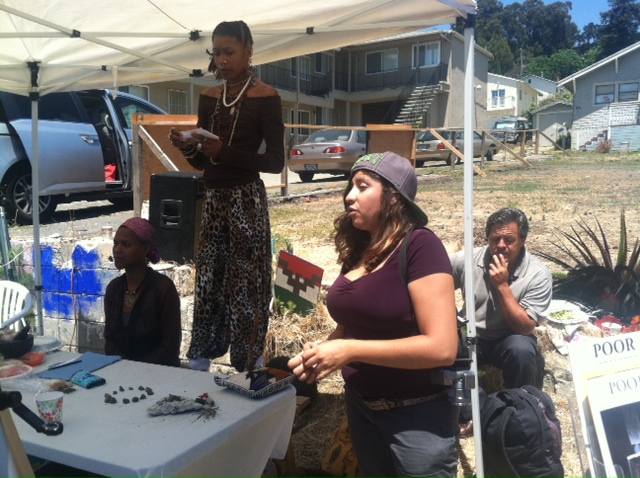
Fifty people were sitting in a circle July 8, talking about what was weighing on them that week. And the weight was heavy. Poverty, violence, addiction, racism. Crushed by debt, foreclosed and evicted. Seeing family members deported, imprisoned, and killed. Continued repression of the Ohlone and other Native peoples. After telling her story, Vivian Thorp said she got together the money to seek medical treatment.

“So I go to the doctor,” she said. “And they tell me, you’ve got anxiety. I go, no shit.”

The others in the circle understood. This was the second day of Healing the Hood, a weekend of workshops, art, cooking, biking, spirituality, and communtiy building. The Poor Magazine project is aimed at resisting corporate control of food, medicine, the environment, and other survival necessities.

For many of the people present, “anxiety” doesn’t quite describe the oppression caused by abuse and violence, by fear of police and prison, by having not enough money to feed their families, by injuries and stress incurred by working for that money. No pill can cure that anxiety, even if you can afford it.

Healing the Hood is supposed to be some part of the real cure. Day one was spent in the Mission district, where Poor Magazine has it’s office. Day two was in East Oakland on a plot of land that Poor has purchased as part of its Homefulness project.

I arrived around lunchtime. In the hot East Bay sun, Needa Bee was preparing a salad while teaching a workshop on food. As she chopped the lettuce and carrots, she talked about how Monsanto and other agricultural industry giants control most of the food that’s available in supermarkets. She discussed resistance movements to Monsanto, telling of farmers in India and China who burned their GMO fields lest they infect other plants. Her lesson ended at the same moment that she topped off the salad with sesame seeds and coconut vinegar.

“This is all fields, backyard, street, Halal markets, Southeast Asian markets,” she said of the feast, recommending those sources as places where GMOs and factory farmed products can be avoided.

Tiny Gray-Garcia, Poor Magazine’s co-founder, smiled as 50 people lined up to eat. Gray-Garcia helped bring together the many sages present at Healing the Hood. The event is steeped in a deep yearning to preserve and teach cultural and medicinal knowledge, made all the more difficult because, as Gray-Garcia put it, people must “try to do it within this capitalist society, whose oppression is in everything, even our food.”

The weekends teachers were more than cooks; herbalists and nutritionists, gardeners and mothers, poets and dancers. After the food demonstration, nutritionist Tanya Henderson and Poor Magazine scholar Estrella gave a presentation on native herbs and foods and their medicinal properties. Next, youth from 67 Suenos, an organization that rejects not just attempts at harsher immigration laws but the colonial notion of borders in the Americas itself, led a discussion.

“Borders aren’t real. They’re a construct. They’re part of the plantation system,” one of the members said. The group supports the concept of a path to legalization for young people embodied in the DREAM Act, but takes issue with policies that would help successful students– “good immigrants”– while still allowing for families to be torn apart and ignoring the reality of students who are delayed in their success, often by that very fear of deportation of themselves or family members.

“Sadly, no one’s talking about a path towards legalization for every undocumented person in this country,” one of the members noted, recalling protests in 2006 and 2007, when many groups demanded “legalize all.”

Luis Rodriguez, one of the weekend’s special guests, is an author and poet based in the Los Angeles area. He was in town partly to promote his new book, It Calls You Back, and will soon be heading to El Salvador for an event celebrating a gang truce that has more than halved the country’s homicides since it was brokered.

“Earth Mother” Iyalode Kinney, founder of the Richmond urban gardening project Communities United Restoring Mother Earth, passed around leaves of comfrey and sprigs of fragrant German chamomile, plucked from her garden that morning, explaining their medicinal properties. Attendants rode bikes and recited poetry as the sun set.

The Healing the Hood initiative didn’t end Sunday. Poor Magazine will be meeting again August 5 to plant the Pachamama Garden as part of Homefulness.

“We as poor peoples and indigenous peoples are in constant struggle to survive and resist the violence of poverty, racism and colonization and if we are to not only survive but thrive, we most focus some time on healing our bodies, minds and spirits with out lives and ancestral knowledge not tied to the Western Medical Industrial complex, big pharma and corporations,” the Healing the Hood event descriptions reads.

In their many publications and its everyday work, the folks at Poor Magazine speak a sort of revolutionary language. The US is Amerikkka, deals that gentrify and displace are devil-opment, and Mama Scholars and Poverty Scholars spread their knowledge while the merits of establishment “akkkademia” are questioned. It’s a the language of a culture of empowerment and resistance, whose people have found violence and destruction in the things most valued in capitalism.

Rodriguez closed out the healing circle. He said a prayer to the Earth, and each attendant named a suffering or dead loved one as he and ceremonially spilled water on a newly sprouting plant.

The preservance, the survival, the regeneration. The suffering and the healing. As Rodriguez said as he closed it out, “Capitalism can’t reconcile with this circle.”

Caught in the FBI’s net

3

yael@sfbg.com

The mission: Rescuing sexually exploited children. Who can argue with that?

From June 20 through June 23, the FBI and local police departments and district attorney’s offices throughout the United States were engaged in Operation Cross Country, three days of stings targeting pimps for arrest.

According to the FBI, the mission was successful. “Nationwide, 79 children were rescued and 104 pimps were arrested for various state and local charges,” a press statement released the following week reads.

In the Bay Area, the operation resulted in “the recovery of six children, who were being victimized through prostitution, and the arrest of seven individuals, commonly referred to as pimps.”

Also caught up in the Bay Area sweep: 61 adult prostitutes — ten consensual sex workers for every underage victim.

Operation Cross Country was part of an ongoing effort called the Innocence Lost National Initiative, which the FBI describes as beginning in the Bay Area in 2005 with the Bay Area Innocence Lost Working Group. According to FBI spokesperson Julianne Sohn, this June’s crackdown was the sixth Operation Cross Country in the past several years.

“The FBI and our partners are looking for those who are exploiting minors for purposes of prostitution,” Sohn told the Guardian. “But in the process of doing this we also pick up pimps exploiting adults, and adult prostitutes along the way.”

“What we’re looking at are people who traffic children for prostitution and solicitation,” she said. But the pimping arrests under Operation Cross Country don’t necessarily have anything to do with children. “Those are just pimps, generally speaking,” said Sohn.

As Caitlin Manning, a sex workers rights advocate, put it, “This emotionally laden appeal to save children who are forced into sexual slavery is being used to further the criminalization of all sex work, these lines are being blurred. There are always a large number of consensual sex workers involved in these stings.”

The Guardian caught up with one such consensual sex worker swept up in Operation Cross Country. “Maya,” 22, an escort in Richmond, was targeted because officers believed she looked under 18 in her ads. After her entrapment, arrest and interrogation, she convinced them she was older. She says that sex trafficking is a terrible problem, but criminalizing working people like her is no solution.

Bay Guardian: Tell me about the arrest.

Maya: I got a phone call. All he said to me was that he was nervous and had never done this before, and that he was looking for somebody to party with. So I never said anything sexual, and he didn’t either. There was absolutely no premise.

So I went to the hotel room. I walked in the door and I said, I’m glad that I found the right room. I put my bag down. I turned to the side and there was another man standing there, and my immediate thought was that I was going to get taken advantage of by another person. But then- I can’t even, I don’t know how many officers it was. Some came out of the bathroom, and they said Richmond PD, you’re under arrest, put your hands behind your back.

They had me in handcuffs, they questioned me for a while. I was in custody for about six hours. So I guess the way that it works with that is, the phone call is initiation and showing up to the hotel room is an act in furtherance. Entrapment is legal for that in California.

BG: What was the questioning like?

M: You know, I’ve been through a lot of things in my life. Family tragedies. Just like a lot of people. But that was definitely hands down, probably top five most traumatic events in my life. I’ve never felt so degraded. They were sitting there asking me, why do you have condoms in your bag? I had a vibrator, I had lube, and I had condoms with me.

There were four men and one woman in the room, and they were all sitting there making jokes. One of the officers was very adamant about telling me that he would never pay me that much for my services.

BG: You’ve said they lied to you, what did they lie to you about?

M: They told me that that day they had caught an underage girl, but then I read the newspaper article about the sting about it, and they said the youngest girl that they got that day was 20. So they were trying to make it seem like they were helping all these women, helping all these girls get away from this lifestyle, when in reality they’re just busting girls like me.

They looked through my phone and looked through my pictures, and questioned me about every picture in my phone. They were like, is this your pimp? They read my text messages, they listened to voice mails from my family. They don’t care.

BG: The sting was for underage people being trafficked. Do you think that’s a big problem? What do you think about that issue?

M: I do think that it’s a problem, absolutely. But this is the very unfortunate thing about what I do for work. Whether you want to call it prostitution or you want to call it escorting. So I do think absolutely it’s a problem, but it’s very important for people to know that it’s not the same thing, it’s really, really not.

I’m probably going to get two years’ probation, up to 60 days in jail and hundreds of dollars in fines. Now I’m out of work, can’t get a job, and I have prostitution on my record. You know, it’s just … it doesn’t help anybody.

BG: It strikes me what you were saying about the police officer saying I wouldn’t pay that much. Were there other degrading things said?

M: I don’t care if they’re officers, I don’t care what they do for a living. They’re still men. And when you come in and you’re a prostitute, they look you up and down. And they’re thinking about that. And I had the officer asking me questions like oh, how do you clean your vibrator. Just unnecessary questions, where obviously they’re getting some sort of gratification out of it.

BG: Have you ever met people who were forced into what they’re doing?

M: No…I mean, we’ve all done things for money. You know, desperate times. Whether it’s working some shit job. I mean, I look at it as a job. So in the past when I was younger yeah, you know, trying to make rent, maybe I’ll do something that I wouldn’t want to do as much, or not get paid as much for it. But it beats working at Taco Bell.

People sometimes think it’s easy money. It’s not easy money. It takes a certain person, it takes an emotionally stable and sexually stable person to do this work sustainably. It’s definitely tolling. It’s tolling because its therapy. It’s tolling because I listen to people’s problems, it’s not tolling because of the sexual aspect at all.

BG: Have you gotten any help from sex workers rights organizations?

M: I did have a therapist that’s sex-worker friendly offer me free sessions. I might take him up on that, but — you know, the event was traumatizing. I’m not traumatized by my work. I can tell the story and that’s pretty much enough for me. I don’t really need therapy for being a sex worker. I love my job. It makes me happy, its great.

BG: What do you love about it?

M: I love meeting different people, I love the psychological aspects. I just have so many fantastic stories, and amazing people that I’ve met. I saw a guy recently who, after our session he was telling me that his wife had died about six months previous that he had been married to for 42 years, and he started crying. And my mother passed away when I was younger, and so we were able to relate on that. And I gave him my lessons on how I dealt with it, and he had never really had somebody tell him that, and he was very touched. And I know that he will take those lessons that I taught him and use them for his grieving process.

So it’s things like that. People don’t realize how much therapy it really is, how many of these people just want some intimacy…we’re human beings, we need sexual outlets. That’s just the way that we are. “Maya” invites anyone who has been in a similar situation or wants to talk to contact her at mayaarticle8719@yahoo.com. An extended version of this interview can be found at sfbg.com

Guardian Voices: Stop and Frisk didn’t work last time

5

Mayor Lee’s musings before the Chronicle editorial board, in which he revealed his thoughts about instituting a “stop and frisk” policy in San Francisco, set off a very quick negative responses from two of his high-profile supporters in the African American community, Willie Brown and Supervisor Malia Cohen. But that’s only part of the surprise the mayor will face if he pursues this policy.

It wasn’t a real good week for Mayor Lee, who seemed to repeatedly trip himself up:

— In  the chat about stop and frisk;
— In the admission at a Board of  Supervisors hearing by Sutter/CPMC that the economic modeling of the hospital chain’s proposed  project so undermined key elements of the deal that Mayor Lee demanded that it be redone;
— And in his testimony before the Ethics Commission on the Mirkarimi case that brought specific charges of  perjury he has yet to answer.

But the stop and frisk was the most sobering of the three, for it shows a fundamental misunderstanding of the very nature of the city that he seeks to govern and an astounding insensitivity to its not-too-distant past.

The last time stop and frisk was implemented by the San Francisco Police Department was in 1974, at the height of the “Zebra” murders during which, over a six-month period from the end of 1973 to the beginning of 1974, 16 whites were murdered and another six wounded (one of whopm was a young Art Agnos) in shootings using a similar caliber hand gun. What made sensational headlines was the fact that the six survivors all agreed that the shooters were  black. 

Mayor Joe Alioto, facing a steep decline in tourist visits to the city and a drumbeat of headlines, surprised eferyone by announcing a stop and frisk policy aimed at young Black males. Within the first week some 500 stops were made. Not a single Zebra suspect was found.

The San Francisco NAACP and ACLU quickly filed suit in Federal Court where the policy was banned as being un-Constitutional racial profiling. The Zebra case was broken using the time tested technique of offering a reward for information. An informant stepped up, and in the summer of 1974, four men were arrested based upon his information. In 1976 the four men were convicted –and the stop and frisk policy had nothing to do with either their arrest or conviction.  Nothing remained of the failed policy for 38 years.

What did remain was a deep and bitter memory of stop and frisk in the San Francisco African-American community — a memory neither Willie Brown nor Malia Cohen forgot.

If the mayor really believes that stop and frisk will work in the face of deep seated community resentment, based on actual local historic experience – for his remarks were all about “getting the guns” off the street in African American neighborhoods — then he has a profound misunderstanding of the nature of San Francisco.

San Francisco is perhaps one of the two or three most humanly diverse cities in North America. There is a bewildering mix of humans in our city, which confronts any policy based upon appearances — such as stop and frisk — with complexities that often render its actual use on the street ineffective. Simply stated, people are not as they seem in San Francisco, and many San Franciscans prefer to live no other way. Good cops understand this and work hard to learn who is who on the street. That’s called community policing and it often works in San Francisco.  

But many times it doesn’t. Let me tell you a personal story.

During the school year, I try to pick up my two grandsons, Jalius and Jacob, every Tuesday. We spend some time together walking from their school, George Peabody, in the Inner Richmond, to the 33 Stanyan bus stop at Clement and Arguello for a bus ride back to the Haight-Ashbury. We walk and talk and then wait for the bus and talk some more.

A few months ago, we were waiting for the bus, the boys sitting on the bench, me standing and talking. I noticed a cop across the street doing a foot patrol, talking to merchants and customers. He kept looking at us. He was Chinese and my grandsons are half Chinese.  Finally, he walked over to us and with a polite smile asked me why was I talking to these children.

I had an idea that was why he came over so I was expecting the question. I smiled back to him and said, proudly, “these are my grandsons, Jalius and Jacob”.  He looked at me and then turned to the boys and said “is he?” They said “yes” and he looked back at me and said “just doing my job,”  and turned and walked away.

And what a tough job it is as people are often other than they look in San Francisco. Old white men are not always what they seem, and young black men are not always what they seem, no matter how low they ware their pants. Policies based upon things being exactly as they appear will be overwhelmed by the human reality of the City of St. Francis.

There is a connection between people in this physically compact city of ours that forms a foundation for a common political outlook when it comes to personal and group rights and freedoms. San Francisco is a center-left city on matters of civil and human rights. Local elections have shown time after time that on civil and human rights the usual political divisions between the various parts of San Francisco don’t obtain. Trying to push a center-right stop and frisk policy on San Francisco will politically isolate Ed Lee, making all other parts of his agenda that much more difficult to accomplish. And as a city we need to get some big things done, quickly. Let’s move on, together, and get them done.

Guardian voices: The labor agreement that changed SF

18

This year marks the 53rd anniversary of the beginnings of  negotiations between the International Longshoreman’s and Warehouseman’s Union and the Pacific Maritime Association over what came to be known as the “Mechanization and Modernization Agreement.”  Signed in October, 1960, after months of talks,  the “M and M agreement” transformed San Francisco’s economy forever, moving its founding industry — shipping and trans shipping — to the East Bay, opening up the land once devoted to maritime uses to real estate development, and setting off the modern political era of San Francisco.

The agreement allowed containerization to come into the San Francisco Bay, making obsolete  the finger piers along San Francisco’s waterfront and the ILWU’s “gangs” that worked on them, hand-loading “break bulk” cargo into the holds of cargo ships. The new technology of shipping cargo in a single  container that could be transported by truck, train, and ship without unloading  transformed maritime trade.

During World War II, shipbuilding and shipping were  fundamental in the effort to move billions of tons of supplies and millions of troops across the global battlefield. In both cases the  San Francisco Bay was ground zero in that in that effort.

Kaiser and Bechtel, two Bay Area-based construction companies, wildly successful in undertaking huge construction projects during the New Deal, were urged to build ships during the war. Kaiser in Richmond and Bechtel in Sausalito constructed  huge shipyards that  built cargo ships by the hundreds, bringing tens of thousands of workers to the Bay Area and changing the demographics of the region for ever. These huge industrial centers didn’t last after the war, and while they transformed who lived in the region, they didn’t really have a lasting economic impact.

But wartime changes in cargo handling did.

For as long as San Francisco had been a city, it depended on its port as the base of its economy. The Gold Rush happened here in part because we had a port and the world rushed in on ships. The enduring fortunes were made during that period by merchants and shipping companies were totally dependent on shipping and cargo handling.

At the heart of the maritime economy was the longshoreman who, by hand, loaded and unloaded ships’ holds. The demand for speed during WWII saw the then-revolutionary introduction of the fork lift truck on the piers of San Francisco, replacing hands with a machine for the first time in the history of the San Francisco waterfront.

But that was only the beginning. New ship designs and new shipping techniques were invented to meet the needs of global war. Since most of the Pacific islands that were the military objectives of the war had no ports or piers, ships were designed that could land directly on a beach and unload preloaded trucks.  Preloaded containers were simply stacked on the decks of Liberty ships, avoiding the need to load the cargo below decks.  By the Korean War these containers were in such regular use by the Army that ships were modified to carry only them, replacing below-deck cargo entirely.

Since ports and piers had been major targets during the war and required extensive rebuilding in both Europe and Asia,  new cargo handling techniques were built into these new facilities, making US ports, undamaged by the war, outmoded and old fashioned.  If US ports were to keep up they had to be modernized.  But who would pay for these new facilities: the shipping business or the government?

San Francisco was still governed by an unbroken line of Republican Mayors during this key period: the anti-New Deal, pro-Mussolini Angelo Rossi; the shipping line owner and anti- ILWU leader Roger Lapham; the pro-real-estate development Elmer Robinson; and finally, the last Republican Mayor of San Francisco, the pro-urban-renewal stalwart George Christopher. These four had no desire to rebuild the waterfront and make the ILWU even stronger. Indeed, Robinson and his successor Christopher had a vision of the waterfront as prime real estate, not working waterfront.

And so, with no commitment to the maritime industry from the city’s leadership and with technological change making the status quo impossible to maintain, Harry Bridges and the leadership of the ILWU cut the best deal they could for their existing members: the 1960 M and M agreement, which gave all existing longshore workers lifetime jobs and very good pay — but sealed the fate of San Francisco waterfront.

By 1962 the Port of Oakland had built its first container facility, and that same year, the first containership, the S.S. Elizabethport, docked and begin loading. By the mid 1970’s, the ILWU was no longer a force in the San Francesco labor movement, its leadership taken by the Building Trades unions  whose  numbers increased as the development boom, fueled by land made vacant by the loss of the maritime industry, grew.

For the rest of the Bay Area, it was San Francisco’s model of waterfront as real estate development that was followed, not Oakland’s investment in cargo shipping. By 1965, development of the Bay was so intense that the McAteer-Petris Act was passed, creating the Bay Conservation and Development Commission, a regional body aimed at limiting the powers of local governments (like San Francisco) in filling and over-developing the Bay.

The 8 Washington battle, the struggle over the Hunters Point shipyard, and the looming battle over the use of a port pier for the Warriors arena all have their history deeply rooted in the 1960 M and M agreement.

In this second decade of the 21st century, our greatest challenge is creating and sustaining meaningful employment. Would our prospects be better if we had somehow been able to keep some maritime uses at the port? Would families in Bay View-Hunters Point be more able to buy homes in their own neighborhood if the same kinds of jobs that allowed their grandparents to buy theirs still existed? Would the boom-or-bust cycle of our real-estate dependent local economy been so disruptive if we had a more steady state base of a maritime sector — which kept the Great Depression from being so devastating in San Francisco in the1930s?

These questions are real — and should show that the shape of our economy is made by us and the decisions we make, locally, not solely by techological change, global trends or the far-too-palsied invisible hand of the free market.

Stage Listings

0

Stage listings are compiled by Guardian staff. Performance times may change; call venues to confirm. Reviewers are Robert Avila, Rita Felciano, and Nicole Gluckstern. Submit items for the listings at listings@sfbg.com. For further information on how to submit items for the listings, see Picks.

THEATER

OPENING

Absolutely San Francisco Alcove Theater, 414 Mason, Ste 502, SF; www.thealcovetheater.com. $32-50. Opens Thu/28, 8pm. Runs Thu-Sat, 8pm (no show Fri/29 or July 6). Through Aug 18. A multi-character solo show about the characters of San Francisco.

Hedwig and the Angry Inch Boxcar Playhouse, 505 Natoma, SF; www.boxcartheatre.org. $25. Opens Wed/27, 8pm. Runs Wed-Thu, 8pm; Fri-Sat, 7 and 9:30pm; July 8, 5pm. Through July 8. Boxcar Theatre performs John Cameron Mitchell’s musical about a transgendered glam rocker.

Jip: His Story Marsh San Francisco, MainStage, 1062 Valencia, SF; www.themarsh.org. $8-50. Previews Fri/29, 7:30pm. Opens Sat/30, 5pm. Runs Sun/1, 4:30; Thu-Fri, 7:30pm; Sat, 2pm; Sun, 3pm. Through July 15. Marsh Youth Theater remounts its 2005 musical production of Katherine Paterson’s historical novel.

Waiting… Larkspur Hotel Union Square, 525 Sutter, SF; www.brownpapertickets.com. $69-75. Opens Fri/29, 8pm. Runs Thu-Sat, 8pm; Sun, 2pm. Through Aug 5. Comedy set behind the scenes at a San Francisco restaurant.

ONGOING

Aftermath Stagewerx, 446 Valencia, SF; www.brownpapertickets.com. $25. Thu/28-Sat/30, 8pm. Theatre, Period presents Jessica Blank and Erik Jenson’s docu-drama, based on interviews with Iraqi civilians forced to flee after the US military’s arrival in 2003.

A Behanding in Spokane SF Playhouse, 533 Sutter, SF; www.sfplayhouse.org. $20-70. Wed/27-Thu/28, 7pm; Fri/29-Sat/30, 8pm (also Sat/30, 3pm). If Garth Ennis had been asked to write a comic book about a one-handed sociopath with a dark obsession, he might well have written something similar to Martin McDonagh’s A Behanding in Spokane. And admittedly, approached from that angle, a lot of the script’s dramatic flaws are more easily forgiven. There’s not a whole lot of subtle context or languid metaphor to be found in McDonagh’s criminal caper about the little-known “hand-dealing” trade, but as in Ennis’ best known work, Preacher, the pretty girl (Melissa Quine) is the smartest one in the room; the sociopath (Rod Gnapp) is interested in enacting as vicious a revenge on all humanity while spewing as many blatantly offensive invectives as possible; the boyfriend (Daveed Diggs) has some arrested development issues to work out; and the receptionist (Alex Hurt) takes the caricature of man-child to a whole new level. In fact, while all four actors deliver rock-solid performances of their mostly unsympathetic characters, it’s Hurt’s that impresses most. His spooky intensity and goofily tone-deaf determination plays like a combination of Adam Sandler and Arno Frisch, and if there’s a real sociopath in the room, the evidence suggests it’s probably him. Ultimately though the piece relies too heavily on hollow one-liners to remain interesting — a 20-minute farce stretched to 90 minutes — and quite unlike an Ennis comic, it does not leave one wanting more. (Gluckstern)

Bruja Magic Theatre, Fort Mason Center, Marina at Laguna, SF; www.magictheatre.org. $20-60. Extended run: Wed/27-Fri/29, 8pm; Sun/1, 2:30pm and 7pm. Although San Francisco’s Mission District is inexorably morphing into an empire of twee boutiques and haute cuisine, it’s still the first port of call for many Latin American migrants, and there are plenty of panaderias and botanicas tucked in between the sushi joints. In the Magic Theatre’s production of Bruja, playwright Luis Alfaro transplants the story of Medea to 24th Street by way of Michoacán, exploring the tension between retaining old-country values and staking out a future in a new world. Directed by artistic director Loretta Greco, the title role played by a stunning Sabina Zuniga Varela, this chamber version of the Greek tragedy hits hard, exposing each character’s darkest secrets to an unforgiving light. And every character, save the doomed brothers Acan and Acat (played the night I saw it by Daniel Castaneda and Gavilan Gordon-Chavez), has a secret to hide, even Medea, a curandera or healer by trade, whose powers run deeper and darker than her new world acquaintances, or even her old servant (Wilma Bonet) suspect. And when Jason (Sean San José) and his callous boss Creon (Carlos Aguirre), ruthlessly push Medea to her breaking point, her bloody vengeance proves, if little else, that she can play at ruthlessness better than anyone, whatever the consequences. (Gluckstern)

5 Lesbians Eating a Quiche Phoenix Theatre, 414 Mason, SF; www.tidestheatre.org. $20-38. Thu-Sat, 8pm (also Sat, 10pm). Through July 21. Tides Theatre performs Evan Linder and Andrew Hobgood’s comedy about five women forced into a bomb shelter during a mid-breakfast nuke attack.

The Full Monty Eureka Theatre, 215 Jackson, SF; www.roltheatre.com. $25-36. Thu/28-Sat/30, 8pm (also Sat/30, 2pm). In desperate times, how far would you go to turn a buck? The central premise of the 1997 movie and its namesake musical comedy The Full Monty, the answer to this question is right in the title, which limits the suspense, but amps up the expectations. Set not in Sheffield, England as in the movie, but the similarly economically challenged climate of Buffalo, New York circa the late nineties, the comical romp follows a group of unemployed steel workers who decide, rather optimistically, that spending one night as exotic dancers will solve their immediate financial woes. Banish all notions of a Hot Chocolate sing-along; the soundtrack of the stage musical has little in common with its cinematic predecessor, but there are a couple of toe-tappers, particularly the songs writ for the ladies: a belter’s anthem for their spry but elderly accompanist Jeanette (Cami Thompson), a snarky commentary on male beauty, “The Goods,” for the ensemble. On opening night, Ray of Light’s production ran about 15 minutes long after a late start, and the tempo seemed sluggish in parts, but once it hits its stride, The Full Monty should provide a welcome antidote to the ongoing, we’re-still-in-a-recession blues, red leather g-strings and all. (Gluckstern) Fwd: Life Gone Viral Marsh San Francisco, 1062 Valencia, SF; (415) 282-3055, www.themarsh.org. $20-50. Sat, 8:30pm; Sun, 7pm (July 15, show at 7:30pm). Extended through July 22. The internet becomes comic fodder for creator-performers Charlie Varon and Jeri Lynn Cohen, and creator-director David Ford.

Lips Together, Teeth Apart New Conservatory Theatre Center, 25 Van Ness, SF; www.nctcsf.org. $25-45. Wed/27-Sat/30, 8pm; Sun/1, 2pm. New Conservatory Theatre Center performs Terrence McNally’s play about two straight couples spending July 4 amid Fire Island’s gay community.

100 Saints You Should Know Thick House, 1695 18th St, SF; www.therhino.org. $10-30. Fri/29-Sat/30, 8pm; Sun/1, 3pm. Homespun scenic design notwithstanding, Theatre Rhinoceros and artistic director John Fisher offer a fine, engrossing production of this 2007 play by Kate Fodor (Hannah and Martin, RX), a sturdy comedy-drama about two fractured families colliding awkwardly in a sort of spiritual vacuum. Matthew (an intriguingly restrained Wiley Herman) is a desolate but forbearing Catholic priest sent on a leave of absence after a venial transgression involving some artful nude male photographs. Returning home, he endures a pained relationship with his devout, passively domineering Irish mother (Tamar Cohn, channeling a nicely measured mixture of stony discipline and childlike vulnerability). Soon Matthew gets an unexpected visit from single mom Theresa (a bright but shrewdly self-possessed Ann Lawler), a former Deadhead who now cleans the rectory and finds herself overcome with an urge to ask the gentle priest about prayer — just at the moment his faith seems to have left him. Meanwhile, Theresa’s too-cool-for-school teenager, Abby (a deft and hilarious Kim Stephenson), waits outside and does some preying of her own on a slower-witted but game young man from the neighborhood (a charmingly quirky Michael Rosen), both of them roiling with confused yearnings. The appealing characters and unexpected storyline come supported by some excellent dialogue, developing a searching theme that ultimately has less to do with formal religion than the ordinary but ineffable need it promises (problematically) to meet. “I think I could be religious or whatever if it made any sense,” notes Abby, “but it doesn’t make any sense.” It’s easy to agree with the teenager on this one. 100 Saints is a genuinely funny and compassionate play discerning enough to avoid naming the depths it sounds. (Avila)

Proof NOHspace, 2840 Mariposa, SF; www.proofsf.com. Wed-Sat, 8pm. Through July 14. $28. Expression Productions performs David Auburn’s Pulitzer-winning play about a mathematician and his daughter.

Reunion SF Playhouse, Stage Two, 533 Sutter, SF; (415) 677-9596, www.sfplayhouse.org. $20. Wed/27-Thu/28, 7pm; Fri/29-Sat/30, 8pm. SF Playhouse presents a world premiere drama by local playwright Kenn Rabin.

“Risk Is This…The Cutting Ball New Experimental Plays Festival” Exit on Taylor, 277 Taylor, SF; (415) 525-1205, www.cuttingball.com. Free ($20 donation for reserved seating; $50 donation for five-play reserved seating pass). Fri-Sat, 8pm. Through July 14. Cutting Ball’s annual fest of experimental plays features two new works and five new translations in staged readings.

The Scottsboro Boys American Conservatory Theater, 415 Geary, SF; www.act-sf.org. $20-95. Opens Wed/27, 8pm. Runs Tue-Sat, 8pm (Tue/3 performance at 7pm; also Wed and Sat, 2pm; no matinee July 4); Sun/1 and July 8, 7pm. Through July 15. American Conservatory Theater presents the Kander and Ebb musical about nine African American men falsely accused of a crime they didn’t commit in the pre-civil rights movement South.

Slipping New Conservatory Theatre Center, 25 Van Ness, SF; www.nctcsf.org. $25-45. Wed/27-Sat/30, 8pm; Sun/1, 2pm. Midwestern high-school senior Eli (Evan Johnson), a recent transfer from San Francisco, is a rebellious gay teen with issues — what American teen doesn’t have issues? But then Eli’s, which include the loss of a beloved father and a Hamlet-like resentment for his recently widowed, sexually liberated academic of a mom (a subtle Stacy Thunes), have already driven him over the ledge. Eli’s “slip” into a state of deep grief is further accelerated by the complicated, violently closeted love he left back in San Francisco. In flashbacks, Eli relives this punishing, irresistible relationship with Chris (a coiled, forceful Fernando Navales) as meanwhile new best friend Jake (Benjamin T. Ismail) gradually expresses more than platonic interest and life with mother builds toward a showdown, in New Conservatory’s Bay Area premiere of Bay Area–born playwright Daniel Talbott’s thoughtfully drawn if dramatically underdeveloped play. In contrast to Ron Gasparinetti’s purposefully vague “anywhere” of a monochrome set (consisting of several low or sloped stone slabs), director Andrew Nance’s cast are engagingly precise in their clear-eyed take on adolescent anguish. Johnson proves gracefully multifaceted as Eli, at turns unbearable in his loose, simmering rage and disarming in his helplessness and heartbreak. And a charmingly awkward and earnest Ismail makes wholly convincing Jake’s innocent moth-to-flame attraction. Indeed, the play’s weaknesses — including a dizzying amount of hopping around the time-space continuum and, more critically, a dramatic arc that’s too neat and shallow to be really satisfying — do not completely detract from a worthwhile subject that often feels drawn from life. (Avila)

Vital Signs Marsh San Francisco, 1062 Valencia, SF; (415) 282-3055, www.themarsh.org. $15-50. Sat, 8:30pm. Through July 21. The Marsh San Francisco presents Alison Whittaker’s behind-the-scenes look at nursing in America.

The Waiting Period MainStage, Marsh San Francisco, 1062 Valencia, SF; (415) 282-3055, www.themarsh.org. $15-50. Fri, 8pm; Sat, 5pm. Extended through July 7. Brian Copeland (comedian, TV and radio personality, and creator-performer of the long-running solo play Not a Genuine Black Man) returns to the Marsh with a new solo, this one based on more recent and messier events in Copeland’s life. The play concerns an episode of severe depression in which he considered suicide, going so far as to purchase a handgun — the title coming from the legally mandatory 10-day period between purchasing and picking up the weapon, which leaves time for reflections and circumstances that ultimately prevent Copeland from pulling the trigger. A grim subject, but Copeland (with co-developer and director David Ford) ensures there’s plenty of humor as well as frank sentiment along the way. The actor peoples the opening scene in the gun store with a comically if somewhat stereotypically rugged representative of the Second Amendment, for instance, as well as an equally familiar “doood” dude at the service counter. Afterward, we follow Copeland, a just barely coping dad, home to the house recently abandoned by his wife, and through the ordinary routines that become unbearable to the clinically depressed. Copeland also recreates interviews he’s made with other survivors of suicidal depression. Telling someone about such things is vital to preventing their worst outcomes, says Copeland, and telling his own story is meant to encourage others. It’s a worthy aim but only a fitfully engaging piece, since as drama it remains thin, standing at perhaps too respectful a distance from the convoluted torment and alienation at its center. (Avila)

BAY AREA

Emilie: La Marquise Du Chatelet Defends Her Life Tonight Berkeley City Club, 2315 Durant, Berk; www.brownpapertickets.com. $18-25. Thu/28-Sat/30, 8pm; Sun/1, 2pm. Symmetry Theatre Company presents Bay Area playwright Lauren Gunderson’s romantic drama centering on the life of 18th-century French physicist and mathematician, Émilie du Châtelet (Danielle Levin) and her (here tempestuous) long-term romance with Voltaire (Robert Parsons). In a familiar conceit left accordingly vague, fate rematerializes Emilie from some hazy afterlife so that she may relive key moments in her life and account for herself. A Cartesian mind/body split rules the replay, with Emilie finding herself painfully attenuated from the world of the senses — her flashback self (played by an impressive Blythe Foster) alone able to enjoy sensual contact with her surroundings. Meanwhile, love and loyalty face the test as Emilie goes head-to-head with a male-dominated scientific establishment over a certain theorem she calls “force vivre” — a formula into which Gunderson cleverly folds theoretical physics and the irrational heart. There’s even a visual aid: a running tally is kept throughout on a screen at the back of the stage, where hash marks appear and disappear under the headings “philosophy” and “love” as the scenes wind their desultory way back toward the moment of her demise. Chloe Bronzan directs a cast of strong actors but their work is uneven. Foster alone is consistently commanding in a part that, while minor, suggests what a more muscular approach overall might have accomplished. The normally formidable Parsons seems uncommitted in the part of Voltaire, admittedly a character too simpering and watery as written to merit much credence. Instead of palpable relationships — whether with lovers or ideas — Emilie deploys self-conscious verbiage, strained repartee and heavy thematic underscoring to churn what amounts to thin drama. (Avila)

Emotional Creature Berkeley Repertory Theatre, Roda Theatre, 2025 Addison, Berk; www.berkeleyrep.org. $14.50-73. Tue and Thu-Sat, 8pm (also Sat, 2pm; no show July 13); Wed, 7pm (no show July 4); Sun, 2 and 7pm. Through July 15. Berkeley Rep presents Eve Ensler’s world premiere, based on her best-seller I Am an Emotional Creature: The Secret Life of Girls Around the World.

The Kipling Hotel: True Misadventures of the Electric Pink ’80s New venue: Marsh Berkeley, 2120 Allston, Berk; (415) 282-3055, www.themarsh.org. $20-50. Sat, 8:30pm; Sun, 7pm. Extended through July 15. This new autobiographical solo show by Don Reed, writer-performer of the fine and long-running East 14th, is another slice of the artist’s journey from 1970s Oakland ghetto to comedy-circuit respectability — here via a partial debate-scholarship to UCLA. The titular Los Angeles residency hotel was where Reed lived and worked for a time in the 1980s while attending university. It’s also a rich mine of memory and material for this physically protean and charismatic comic actor, who sails through two acts of often hilarious, sometimes touching vignettes loosely structured around his time on the hotel’s young wait staff, which catered to the needs of elderly patrons who might need conversation as much as breakfast. On opening night, the episodic narrative seemed to pass through several endings before settling on one whose tidy moral was delivered with too heavy a hand, but if the piece runs a little long, it’s only the last 20 minutes that noticeably meanders. And even with some awkward bumps along the way, it’s never a dull thing watching Reed work. (Avila)

Not Getting Any Younger Marsh Berkeley, 2120 Allston, Berk; (415) 282-3055, www.themarsh.org. $15-50. Fri/29, 8pm; Sat/30, 5pm. Marga Gomez is back at the Marsh, a couple of too-brief decades after inaugurating the theater’s new stage with her first solo show — an apt setting, in other words, for the writer-performer’s latest monologue, a reflection on the inevitable process of aging for a Latina lesbian comedian and artist who still hangs at Starbucks and can’t be trusted with the details of her own Wikipedia entry. If the thought of someone as perennially irreverent, insouciant, and appealingly immature as Gomez makes you depressed, the show is, strangely enough, the best antidote. Note: review from the show’s 2011 run at the Marsh San Francisco. (Avila)

The Odyssey Angel Island; (415) 547-0189, www.weplayers.org. $40-76 (some tickets include ferry passage). Sat/30-Sun/1, 10:30am-4pm (does not include travel time to island). We Players present Ava Roy’s adaptation of Homer’s epic poem: an all-day adventure set throughout the nature and buildings of Angel Island State Park.

Salomania Aurora Theatre, 2081 Addison, Berk; www.auroratheatre.org. $30-55. Previews Wed/20, 8pm. Tue, 7pm; Wed-Sat, 8pm; Sun, 2 and 7pm. Throgh July 22. The libel trial of a politically opportunistic newspaper publisher (Mark Andrew Phillips) and the private life of a famous dancer of the London stage — San Franciscan Maud Allan (a striking Madeline H.D. Brown) — become the scandalous headline-grabber of the day, as World War I rages on in some forgotten external world. In Aurora’s impressive world premiere by playwright-director Mark Jackson, the real-life story of Allan, celebrated for her risqué interpretation of Oscar Wilde’s Salomé, soon gets conflated with the infamous trial (20 years earlier) of Wilde himself (a shrewdly understated Kevin Clarke). But is this case just a media-stoked distraction, or is there a deeper connection between the disciplining of “sexual deviance” and the ordered disorder of the nation state? Jackson’s sharp if sprawling ensemble-driven exploration brings up plenty of tantalizing suggestions, while reveling in the complexly intermingling themes of sex, nationalism, militarism, women’s rights, and the webs spun by media and politics. A group of trench-bound soldiers (the admirable ensemble of Clarke, Alex Moggridge, Anthony Nemirovsky, Phillips, Marilee Talkington, and Liam Vincent) provide one comedy-lined avenue into a system whose own excesses are manifest in the insane carnage of war — yet an insanity only possible in a world policed by illusions, distractions and the fear of unsettled and unsettling “deviants” of all kinds. In its cracked-mirror portraiture of an era, the play echoes a social and political turmoil that has never really subsided. (Avila)

Wheelhouse TheatreWorks at the Mountain View Center for the Performing Arts, 500 Castro, Mtn View; (650) 463-1960, www.theatreworks.org. $19-69. Wed/27, 7:30pm; Thu/28-Sat/30, 8pm (also Sat/30, 2); Sun/1, 2 and 7pm. TheatreWorks’ 60th world premiere is a musical created by and starring pop-rock trio GrooveLily.

The World’s Funniest Bubble Show Marsh Berkeley, TheaterStage, 2120 Allston, Berk; (415) 826-5750, www.themarsh.org. $8-50. Fri/29, 6pm; Sat/30, 11am. Louis “The Amazing Bubble Man” Pearl returns with this kid-friendly, bubble-tastic comedy.

PERFORMANCE/DANCE

Alicia Dattner Exit Theatre, 156 Eddy, SF; www.theexit.org. Thu/28-Sat/30, 8pm. $26. The comedian performs.

“DEEPER, Architectural Meditations at CounterPULSE” CounterPULSE, 1310 Mission, SF; www.counterpulse.org. Fri/29-Sun/1, 8pm. $25. Lizz Roman and Dancers perform a site-specific work.

“Elect to Laugh” Studio Theater, Marsh San Francisco, 1062 Valencia, SF; (415) 282-3055, www.themarsh.org. Tue, 8pm. Through Nov 6. $15-50. Will Durst and friends perform in this weekly political humor show that focuses on the upcoming presidential election.

“I Heart Hamas: And Other Things I’m Afraid to Tell You” Exit Theatre, 156 Eddy, SF; www.brownpapertickets.com. Fri/29-Sat/30, 8pm. $20. Jennifer Jajeh performs her solo show, soon to be presented at the Edinburgh Festival Fringe.

“Jillarious Tuesdays” Tommy T’s Showroom, 1000 Van Ness, SF; www.jillarious.com. Tue, 7:30. Ongoing. $20. Weekly comedy show with Jill Bourque, Kevin Camia, Justin Lucas, and special guests.

“Majestic Musical Review Featuring Her Rebel Highness” Harlot, 46 Minna, SF; www.herrebelhighness.com. Sun, 5pm. Through Aug 12. $25-65. Cocktails and hors d’oeuvres, performers in Baroque-chic gowns, music, and more.

“Mission in the Mix” Dance Mission Theatre, 3316 24th St, SF; www.brownpapertickets.com. Fri/29-Sat/30, 8pm; Sun/1, 7pm. $17. SF Hip-Hop DanceFest producer Micaya presents new work by her SoulForce Dance Company, plus guest performances.

“Nerdgasm” Garage, 715 Bryant, SF; wonderdave.wordpress.com. Thu/28, 8pm. $12. Poetry, storytelling, and more, for nerds and by nerds. Part of the National Queer Arts Festival.

“One Night Only Benefit Cabaret” Marines Memorial Theater, 609 Sutter, SF; www.richmondermet.org. Mon/2, 7:30pm. $25-65. Cast members from the American Idiot tour perform original music and comedy to raise money for the Richmond/Ermet AIDS Foundation and Broadway Cares/Equity Fights AIDS.

“Picklewater Clown Cabaret: Robot’s Revenge!” Stage Werx Theatre, 446 Valencia, SF; www.brownpapertickets.com. Mon/2, 8pm. $15. Picklewater and guests perform physical comedy and other circus acts.

“Same Amor” Shotwell Studios, 3252-A 19th St, SF; www.ftloose.org. Fri/29-Sat/30, 8pm; Sun/1, 3pm. $10-20. Flamenco and contemporary dance, comedy, and live music, featuring Acuña Danza Teatro.

San Francisco Ethnic Dance Festival Novellus Theater, Yerba Buena Center for the Arts, 700 Howard, SF; www.worldartswest.org. Sat/30-Sun/1, 3pm (also Sat/30, 8pm). $18-58. This final weekend of programming includes dance from Hawaii, India, Indonesia, Japan, Liberia, Mexico, the Philippines, Spain, Tajikistan, and Uzbekistan.

Sex and the City: Live!” Rebel, 1760 Market, SF; www.brownpapertickets.com. Tue, 7 and 9pm. Through June 26. $25. Heklina, D’Arcy Drollinger, Lady Bear, Trixxie Carr play the fab four in this drag-tastic homage to the HBO series.

“This Is What I Want Performance Festival” SOMArts Cultural Center, 934 Brannan, SF; thisiswhatiwant.eventbrite.com. Wed/27-Fri/29, 8pm. $20. Part of the National Queer Arts Festival, this event features different bills each night of new, multidisciplinary performances from San Francisco and Los Angeles-based artists.

“Walking Distance Dance Festival” ODC Theater, 3153 17th St, SF; www.odctheater.org. Fri/29-Sat/30, 6:30pm; Sun/1, 2pm. $20-75. LEVYdance, inkBoat, Kunst-Stoff, and more participate in this new festival, featuring dance artists performing throughout ODC’s two-building campus.

“When We Fall Apart” Z Space, 450 Florida, SF; www.zspace.org. Wed/27-Sat/30, 7pm (also Fri/29-Sat/30, 9pm). $25-35. Joe Goode Performance Group presents a world premiere, an exploration of “home” with a set designed by architect Cass Calder Smith.

On the Cheap Listings

0

Submit items for the listings at listings@sfbg.com. For further information on how to submit items for the listings, see Picks.

WEDNESDAY 27

Swing in the Square Union Square Park, SF. www.unionsquarelive.org. Fourth Wednesdays, 6pm-8pm, free. All you jazzy cats can get your groove on in 1930s and ’40s style at this outdoor party. Move to the Western swing sounds of the B-Stars, who will play live all evening. If you show up early, professional dance instructors await to give you lessons.

San Francisco’s 236th birthday Presidio, SF. www.presidio.gov/calendar. 11am-midnight, free. Join Los Californianos in celebrating SF’s anniversary at the location of the city’s founding, the Presidio. Commemorate the people of early California with music and a horse riding ceremony performed by the Amigos de Anza drill team.

Music on the Main 12th Street and Macdonald, Richmond. www.richmondmainstreet.org. 5pm, free. Enjoy some classic rhythm and blues as it floats over the children’s activities and outdoor bazaar at the first installment of this annual concert series. Blues artist Jesse James will lay down his soul, R&B crooner Reed Fromer will make your hair stand tall, and pop performers from the Richmond Police Activities League will keep your feet tappin’

THURSDAY 28

“So You Think You Can Paint” art party Club Six, 60 6th St., SF. www.clubsix1.com. Thursdays, 6pm-11pm, free. All you have to bring is a friend to this self-titled “world’s most creative happy hour.” The venue will provide all the paint, brushes, tunes, and cheap drinks you need to paint a masterpiece on one of Club Six’s walls. The idea is to complete as many eight-foot-long walls as possible prior to the end of the night, as a party.

Jazz Summerfest Citizen Rhythm Project Stanford Shopping Center, 180 El Camino Real, Palo Alto. www.sfjazz.org. 6pm-7:30pm, free. Citizen Rhythm is an award winning Bay Area fusion group. Come jam with Bay Area fusion group Citizen Rhythm – they’ll be infusing the works of Mingus, Monk, Miles, and more with funk, hard rock, and hip-hop.

Costume roller disco party Mighty, 119 Utah, SF. www.mighty119.com. 9pm, $5. Ladies and gents rolling around in revealing disco outfits? Check. Saturday night classics all night long? Check. Bring a pair of quads or rent skates from David “Skate Godfather” Myles who will be at the front desk. Costumes are optional, boogie is mandatory.

Underground Market Public Works, 161 Erie, SF. www.publicsf.com. 5pm, $10. It’s been away for a year (dang health inspectors, let us live!) but ForageSF’s DIY market of mealtime is back, and better than ever. All food items – prepared by such rad local vendors as Rice Paper Scissors and Homeroom – will be under $5, and sustainable sweeties abound. A date auction will go off, another facet of the evening that’ll contribute to a drive for a new community kitchen space run by ForageSF.

FRIDAY 29

Circus Bella in the park Yerba Buena Gardens, Third St. and Mission, SF. www.circusbella.com. Noon, free. It was the shared dream of David Hunt and Abigail Munn to create this open air, one-ring circus, so in 2008 they made it come true. Ever since, lucky park-goers have been known to happen across Munn’s loping aerial acrobatics and ground-level clowning by the rest of Bella’s talented pack. Bring a blanket and enjoy a picnic lunch as you watch their antics set to live music.

Sonny and the Sunsets concert Amoeba Music, 1855 Haight, SF. www.amoeba.com. 6pm, free. Sonny Smith recorded his album Longtime Companion (out June 26 on Polyvinyl Records) directly onto tape in a musty basement that smelt of beer and tobacco. By way of acoustic guitars, intimate lyrics, and pedal steel, Smith explores love and heartache with songs that sound a little like the results of a Johnny Cash-Kinks-Gene Clark jam session. Hear him perform live today.

SATURDAY 30

Flickr photo walk Treasure Island, 1 Avenue of the Palms, SF. www.meetup.com/flickr. 2pm-4pm, $5. Snag your real camera and give Instagram a break for this photo walk through the man-made island in the middle of the Bay. Flickr peeps will guide you to spectacular views of the city, bay, and the construction that’s underway on the eastern span of the Bay Bridge.

Toothpick Golden Gate Bridge Exhibit final day Hyatt Regency, 5 Embarcadero, SF. www.sanfranciscoregency.hyatt.com. 9am-midnight, free. Ripley’s Believe It Or Not presents this 13-foot model of the Golden Gate Bridge, constructed out of 30,000 toothpicks. You can also gawk at a scale model of a cable car made from matchsticks, and enormous 3-D portraits of Jerry Garcia and legendary Spanish guitarist Carlos Santana made from chicken wire.

French cinema night with wine Alliance Francaise, 1345 Bush, SF. www.afsf.com. 6:45pm, $5 donation. This evening was designed to help non-French speakers discover French cinema. Enjoy wine, refreshments, and free popcorn — and learn to speak French through conversing with cinema buffs.

Russian River water carnival and fireworks show Monte Rio Public Beach, Monte Rio. www.mrrpd.org. Enjoy Independence Day in high California-style — at a beach crowded with people and BBQ. This annual event features a water boat parade, and a “water curtain” — patriotic images projected onto a curtain of water that flows from the Monte Rio bridge. Plus, yes, fireworks.

SUNDAY 1

Sonoma Winery charity classic car show B.R. Cohn Winery, 15000 Sonoma Highway, Glen Ellen. www.brcohn.com. Noon-5pm, free. Visitors can enjoy live music as they gaze at a hand-picked collection of vintage cars from various eras. Food from local vendors will be available, and B.R. Cohn wines will abound. Bring your wallet if you’d like to support Redwood Empire Food Bank of Santa Rosa, donations will be accepted on site.

Park electronic dance music party Pioneer Log Cabin picnic area, Stow Lake Dr. East, Golden Gate Park, SF. www.goldengateparkparty.com. 2pm, free. Bring dancing shoes, something to BBQ, face paint, beer to share, perhaps some earplugs, and boogie down with fellow house music fans at this all-day dance extravaganza.

Preservation Hall Jazz Band Stern Grove, 19th Ave. and Sloat, SF. www.sterngrove.org. 2pm, free. Have you gotten your Stern Grove Festival fix yet this summer? The Sunday free concert series is once more in glorious swing – pack up your hummus and homies and head to the leafy glade for Big Easy brass from Preservation Hall, headlining a bill that also includes bluesers the Stone Foxes.

Monday 2

Beatles karaoke night Café Royale, 800 Post, SF. www.caferoyale-sf.com. 8pm, free. Pianist Joshua Raoul Brody plays your blackbird singing in the dead of night – sit back and let the evening go with beer and cocktails at this Tenderloin neighborhood bar. Brody’s turning it into a Beatle-driven piano bar tonight.

Women of Jazz fan appreciation night Yoshi’s Jazz Club, 510 Embarcadero, Oakl. www.yoshis.com. 8pm, $5. Celebrate the female jazz world as you tap your feet (and enjoy delicious sushi, if you like) to the tunes of “Sweet” Sue Terry, an internationally-known soloist on the sax and clarinet. Then hear composer Peggy Stern riff on everything from her original work to re-harmonized standards.

TUESDAY 3

Colleen Green Brick and Mortar Music Hall, 1710 Mission, SF. www.brickandmortar.com. 8pm, free. Colleen Green sings catchy, heart-wrenching songs that range from psychedelic drone to ’80s pop goulash and ’90s power punk. She plays her Daniel Johnston-inspired live shows alone on stage with only an electric guitar and a drum machine to accompany her. Come down to this free show and see.

A’s post-game fireworks show Oakland Coliseum, 7000 Coliseum Way, Oakl. www.oakland.athletics.mlb.com. 10pm, free. As soon as the Athletics (hopefully) defeat the Boston Red Sox, just make sure you’re anywhere near the Coliseum. If you are, you can enjoy this spectacle of fireworks that will boom over the stadium following the game in celebration of our nation’s independence from Great Britain. And baseball, obviously baseball.


Announcing the weed winners of this weekend’s High Times Cannabis Cup

1

While thousands took to the streets this weekend to celebrate SF Pride, over in the East Bay an event was taking place that celebrated a freedom of a different sort. 

The third annual Bay Area High Times Cannabis Cup brought together marijuana connoisseurs from across the state to Richmond’s Craneway Pavilion. Although the main event was the judging of some of the kindest buds in the country, the exposition also featured a variety of glass water pipes, portable vaporizers, ice-cold cannabis beverages and miscellaneous cannabis accessories. Outside in the parking lot, a chain-link fence surrounded the Prop 215 area where vendors offered card-carrying cannabis patients tastes of an assortment of potent edibles, dabs of concentrate, and tokes of some of the best medical cannabis strains of sativa and indica the state has to offer.

As the sun lowered over the harbor on Sunday night, a soft amber light shining through the many windows of the pavilion, people gathered around the stage for the start of the awards ceremony. High Times staffers announced awards for best product, booth, glass, concentrate, edibles, hybrid, sativa and indica. After a long afternoon of ingesting cannabis products galore, the winners wound their way up to the stage to accept their honors from Miss High Times Emily Aryn (more on her majesty here). San Jose Patients Group took home first place among indicas for its Cordero Kush Platinum. Playbud Delivery Service received first place for best sativa, an honor claimed by its Premium Jack Herer. 

During the ceremony, a special lifetime achievement award was given to Oaksterdam University founder, Richard Lee. Considered the father of Prop 19, his cannabis university and his dispensary were raided by federal agents last April. For an update on where Lee and Oaksterdam are at now, read our interview with Lee and new Oaksterdam head Dale Sky Jones here

[from the High Times website]

BEST INDICA

1st Place – Cordero Kush Platinum, San Jose Patients Group

2nd Place – Master Yoda Kush, Kush connection

3rd Place – Cherry Cola, Sonoma County Collective

BEST SATIVA

1st Place – Premium Jack Herer, Playbud Delivery Service

2nd Place – Yogi Diesel, Elemental Wellness

3rd Place – XJ-13 Cracker Jack, Santa Cruz Mountain Natural

BEST HYBRID

1st Place – Larry OG Kush, The Cali Connection Seed Company

2nd Place – Ken’s Phantom, Granddaddy Purple Collective

3rd Place – OG Sky, Buddy’s Cannabis

CBD AWARDS

1st Place – MCU ATF Bubble, Hill Farms presents Master Control Unit

2nd Place – Lemon Remedy, Harborside Health Center of SJ

3rd Place – Harlequin, Buds and Roses Collective

BEST CONCENTRATE

1st Place – Hardcore OG Budder, Superior Extracts for West Coast Cures

2nd Place – OG Super Sexy Budder, LA Confidential Caregivers

3rd Place – Unfuckwitable OG Wax, Venice Medical Wax Centers

BEST NON-SOLVENT HASH

1st Place – Solvent-less BAMF Mix Hash, BAMF Extractions for Buds and Roses Collective

BEST EDIBLE

1st Place – Eleve Gourmet Veganic Medicated Truffles, Hills Farmacy

2nd Place – CannaChocolate 44/8mg THC/CBD, Tea House Collective

3rd Place – Spice Orange Drops, Greenway Compassionate Relief Inc.

BEST BOOTH

1st Place – Mamma P’s

2nd Place – Elemental Wellness

3rd Place – Cali Connection

BEST PRODUCT

1st Place – Mama P’s Grinder

2nd Place – KO Nail from KO Domeless Nail

3rd Place – The Grinder Card from V-Syndicate

BEST GLASS

1st Place – Hitman Glass

2nd Place – Pulse Glass

3rd Place – Dopeass Glass

Ladies and gentleman, the Bay’s youth spoken word team (and where you can see them spit)

0

Hey you, over-20 person. Do you ever wonder what what on the minds of today’s teens? The answers are heavy, and they soar from the mouths of spoken word poets — especially those of the recently-announced team that will be representing the Bay Area at this year’s Brave New Voices international slam on July 21. Care to meet them?


Bay Area grand slam champion: Nyabingha McDowell, Richmond, Salesian High School, age 15

Obasi Davis Oakland, Berkeley High School, 16

Colleen Hamilton-Lecky Berkeley, Berkeley High School, 15

Allison Kephart Pacifica, Oceana High School, 17

Marje Kilpatrick Richmond, Holy Names High School, 15

Queen Nefertiti Shabazz Berkeley, Lick-Wilmerding High School, 17


Take note of the names above. These young people deserve our support. Consider them your Baybies. 

This year, the BNV International Youth Poetry Slam Festival will bring more than 500 poets and their mentors from around the globe for five days of open mics, preliminary poetry slams, and writing workshops beginning July 19. 

For the kids, the competition is an opportunity to spit the most difficult, strange, or meaningful aspects of their lives into a mic. For the listeners, the slam is just that — a shock to the senses in a society that rarely lets its kids go unedited. 

In preparation for the festival, teams of four to six poets aged 13 to 18, have been selected by way of city and region-wide poetry slams throughout the year. Locally, the SF nonprofit Youth Speaks organizes and coordinates BNV representatives. Youth Speaks is also the progenitor of the festival, which has now spread to include participants from Guam, South Africa, Taiwan, and New Zealand among other countries. 

After rehearsing, rewriting, and reinventing their poetry for months, the poets step into the final spotlight for three rounds of onstage recitation, both in tandem and solo.  Meanwhile, the kids offstage get to meet and spit words with poetic peers that hail from places like New York, Chicago, South Africa and Taiwan. 

James Kass, founder and executive director of Youth Speaks, says it is important that participants come from varied backgrounds. 

“The kids get to know each other and hear from each other, and see their similarities and differences,” he says. “They really represent the changing demographics in the country. They really represent the future of the country.”

15-year old  Nyabingha McDowell at the Bay Area grand slam finals. Photo by Ashleigh Reddy

He adds that it is just as important to bring in a diverse audience. 

 “A lot of adults, their main interaction with teenagers — if they don’t have kids — is through the mass media. We want to dispel those myths and stereotypes that are created. Adults need to hear directly from teenagers what they’re talking about and who they are.”

Now a decade and a half old, BNV began in San Francisco in 1998 following an inaugural Youth Speaks Teen Poetry Slam the previous year. 

“I look back to the very first [BNV] we did when there were only four teams and we had hardly any crowd,” Kass says. “But the kids that came from these four different cities immediately started connecting and started feeling that they were part of a larger movement.”

The BNV Festival takes place in a different US city each year, but this year’s competition brings the beatniks back home to the Bay. Says Kass: “If you think you don’t like poetry, if you think you don’t know what’s going on in the youth world, come check it out because it’s a whole different experience. It’s an incredible place to be.”

Brave New Voices International Youth Poetry Slam finals

July 21, 7pm, $20

Fox Theatre 

1807 Telegraph, Oakl.

www.bravenewvoices.org

High Times magazine presents: Medical Cannabis Cup

0

The San Francisco Bay Area’s Third Annual Medical Cannabis Cup is the world’s ultimate marijuana awards and returns to California for High Times’ homegrown Medical Cannabis Cup competition. Richard Lee from Oaksterdam will be honoured with a special lifetime achievement award.

Ticket includes a Saturday night party with Del The Funky Homosapien, Smoke DZA and Harry Fraud Expansion Team Soundsystem, Task Rok, and Linus. Celebrate all weekend long with music, parties, cannabis competition, expo, seminars, activism and more! Get more info here.

To win a pair of tickets, email sfbgpromos@sfbg.com with your name and mailing address and several lucky winners will get two printable in their inbox!

Saturday, June 23-Sunday, June 24 @ Craneway Pavilion, 1414 Harbour Way South, Richmond | Free shuttle buses from Richmond BART


WTF, Chuck: Those poor exploited landlords

92

In my continuing attempt to make sense of the politics of the Chron’s C.W. Nevius, I present: What The Fuck, Chuck — the saga of the poor landlord.

I’ll try to be fair: There’s nothing inherently wrong with this story. I don’t like rich people taking advantage of anything, particularly rent control. It’s true that there are a few people who are cheating, good for Chuck to expose them (tho he didn’t exactly name names). You can’t make better copy than a family that moves to Hawaii (!) and keeps a rent-controlled house in the Richmond. (Of course, maybe the parents needed to be there for a couple of years for work, and were hoping to return to their family home and the landlord wouldn’t allow sublets, but whatever. Sounds horrible.)

And I’m not excusing it for a minute.

But I’ve never seen Nevius write a story about a family that can remain in this city only because of rent control, or a longterm tenant being forced out by the Ellis Act to create “homeownership” opportunities for a wealthier person who can buy a tenance in common, or a landlord who lies, cheats and abuses tenants to get rid of them so he or she can raise the rent — and those are far, far more common occurences. Those are problems that happen every day in this city.

It’s always about the poor landlords.

Yeah, there are bad tenants. But anyone on the front lines of the renatl-housing struggles in San Francisco can tell you that the abuses by the property-owning class radically exceed the harm caused by the tenant class.

I feel about this the same way I feel about the ongoing stories on bloated city employee pay and pensions. Yes, it’s true: Some city employees game the overtime and pension systems and in effect pluck money from the pockets of the taxpayers. I see no reason why a police chief who retires at 55 should get $250,000 a year for life.

But it’s also true that a lot of city employees earn a basic middle-class salary and get a pension of maybe $30,000 a year, which is hardly excessive — and the fact that the private sector quit giving pensions decades ago doesn’t mean that the public sector is wrong to do it. But all of these stories create a powerful Big Lie mythology of bloated public payrolls, which undermines any effort to raise taxes for desperately needed public services.

You tell people enough tales about the poor landlord and the rich tenants and you start to make rent control look like a bad idea. Which is about the worst thing you can do in San Francisco today, where the existence of any middle class at all is primarily the result of rent control — and if anything, rent control ought to be stronger.

In other words: A little perspective here, please.


Namu Gaji

0

virginia@sfbg.com

APPETITE Although Asian outpost Namu Gaji is brand new, the presence of Namu restaurant itself and owners the Lee brothers — Dennis, David and Daniel — has been felt in San Francisco for years. Since 2006, the Lees have been weaving Korean, Japanese, and other Asian cuisines with California spirit in the original, now shuttered Richmond restaurant and eventually Namu’s Ferry Building farmers market stand on Tuesdays and Saturdays. In early April, the brothers opened their Mission incarnation, Namu Gaji.

Its kitchen is in direct view of the small dining room, as Dennis Lee and Chef de Cuisine Michael Kim (Craft Los Angeles, SPQR) cook at a grill fired with bincho-tan, a low smoke, Japanese charcoal. The Lee brothers’ aunt, direct from Korea, will oversee a house fermenting program, bringing with her bacteria strains from the family’s Korean village. The chefs do the usual sourcing from local farms but, in an unusual slant, have commissioned farmer Kristyn Leach to grow exclusively for them on a one-acre plot at Baia Nicchia Farm in Sunol, where she’s raising rare Korean chiles and herbs — quite a treat.

I already miss the chic, spare Richmond dining room compared to the cramped Mission space, despite its striking communal table and tree branch sculpture weaving dramatically from the ceiling. Granted, the Dolores Park location is prime real estate, particularly when it comes to daytime takeout, perfect for picnicking in the park, possibly my favorite way to enjoy Namu Gaji. But the Mission is saturated with hip dining destinations in a way the Richmond, one of our great underrated neighborhoods, is not. This was an understandably strategic move, but the new space gets progressively warmer and noisier as an evening evolves. For those who don’t enjoy yelling through dinner, I’d suggest dining early, although do note the actual dinner menu doesn’t start until 6pm.

In multiple early visits, truly unique dishes flow from the kitchen. The menu is grouped in categories like raw, broth, salad, crispy, grill, and comfort, with a handful of key choices under each heading. The “raw” section is pricey ($18), but raw King salmon, topped with pickled red onion, a dollop of whipped yuzu cream, and shiso (Japanese herb from the mint family) is generously portioned, bright sashimi. Uni sure is fantastic fried — what isn’t? — as tempura ($14) alongside fried shiso leaf, lemon zest, and market veggies, which on a recent visit were fava beans and a yellow onion. Grilled octopus ($14) is a tad bland compared to other grilled octopus dishes around town, though pleasingly plated with English peas, spring onion, fried garlic, and that fabulously pungent Korean chili paste, gochujang.

It gets exciting with an off-menu special of buckwheat gnocchi, pan seared in black garlic gastrique, with English peas and pea shoots (can you tell peas are in season?) This non-traditional gnocchi is earthy, lively, playful. “Fish parts” ($18) arrive on a wood slab, generously portioned and artfully arranged, more hearty than fussy. The fish parts change, but one night I dined on impeccable wild salmon belly and spine, with caramelized, crispy-sweet skin. Its partner requires a more adventurous palate: ahi tuna roe, cured and grilled. A dining companion bluntly called this large hunk of meat what it was: a giant egg sac. If you didn’t know, however, you’d think the pink, meaty fish a more savory, funky cut of salmon. Either way, I was delighted to be served something I’d never had before.

One evening after a 90-minute dinner, I waited nearly 30 minutes after all dishes had been served (and eaten) for a dessert which my sweet, adept server kept informing us was about to arrive. Though next time I’ll skip dessert under those conditions, I was pleased with shaved ice ($8), or shave ice as it’s known in Hawaii, which you can order doused in Four Barrel coffee and cocoa crumbles. My top choice is in coconut cream with coconut crumble and strawberries. The ice is creamy soft, feathery… and quickly devoured.

The brothers’ Korean heritage shines best in their street food-style dishes, available at the Ferry Building Farmers Market as well as during the day at Namu Gaji, ideal taken across the street to Dolores Park. Their beloved nori “tacos” ($3) and okonomiyaki ($10 lunch, $16 dinner) still delight, while BBQ belly and Korean BBQ-style marinated chicken thigh ($10) are packed into pan de mie bun layered with Swiss cheese, soy glazed onions, pickled daikon, aioli, Dijon mustard — a buttery, fatty pleasure of a sandwich. Gamja fries ($10), essentially organic fried potatoes piled with short ribs, kimchee relish, gochujang, kewpie mayo, and green onions, are the fast food of your dreams. KFC ($12) is a quarter of a Marin Sun Farms chicken tossed in sweet and tangy sauce with dashi gravy. Each of these heartwarmers not only satiate but illuminate best why the Lee brothers have become an SF staple.

NAMU GAJI

499 Dolores, SF

(415) 431-6268

www.namusf.com

Subscribe to Virgina’s twice-monthly newsletter, The Perfect Spot: www.theperfectspotsf.com


Localized Appreesh: Major Powers & the Lo-Fi Symphony

2

Localized Appreesh is our weekly thank-you column to the musicians that make the Bay. To be considered, contact emilysavage@sfbg.com.

Behind every San Francisco band is the shadow of the past – decades of sweeping musical scenes that came before it, haunting the Victorian venues, ghosts with ink stamped on their hands. With Major Powers & the Lo-Fi Symphony, that tap-tap-tapping is a bit more literal.

Two of the three members of the trio (French brothers Kevin and Dylan Gautschi) are the sons of Pamela Wood, bassist of 1970s Bay Area act Leila & the Snakes. That’s not to say Major Powers & the Lo-Fi Symphony emulates Leila & the Snakes’ minimalist rock’n’roll weirdo sound, just that perhaps the musical spirit of experimentation courses through the veins of certain families.

No, MP&LFS gets just as much vigor from both the height of the ragtime era and the rise of ’90s Buzz Bin alternative rock as it does the less tangible local past. Led by dynamic pianist-songwriter Nicholas Jarvis Powers, the bouncy band calls itself “adventure rock” and makes good on the promise with complex arrangements spruced up with those tickling feel-good keys and power pop vocals.

The trio is currently in the process of releasing its first LP –  We Became Monters – on SF’s Amazing Pony Records, but for now you can catch it popping up live in venues across the city (most recently, a piano showdown at Monarch). This week? Upper Haight experimenters-haven Milk.

Year and location of origin: 2011, Richmond, Calif.

Band name origin: Nick dreamt the phrase “Lo-Fi Symphony.” Dylan’s girlfriend said, “call it Major Powers & The Lo-Fi Symphony.” We all got jazzed.

Band motto: “There is no spoon.”

Description of sound in 10 words or less: Everything Bert Does In Mary Poppins Meets Superdrag Meets Queen.

Instrumentation: Piano, Guitar, Drums.

Most recent release: We Became Monsters.

Best part about life as a Bay Area band: Hotties.

Worst part about life as a Bay Area band: Money.

First album ever purchased: Dylan: Sex Packets, Digital Underground.
Kevin: Please Hammer, Don’t Hurt ‘Em.
Nick: Ice Ice Baby (single).

Most recent album purchased/downloaded: Dylan: Powerman 5000 in 1998.
Kevin: All Eyez On Me, Tupac.
Nick: “Ice Ice Baby” (single) (I’m not kidding – I bought one cassette and that was it).

Favorite local eatery and dish: Dylan: my kitchen
Kevin: La Taqueria, Carnitas Burrito
Nick: Fonda, Skirt Steak, THAT SHIT CRAY

Major Powers & The Lo-Fi Symphony
With the Greening, Hungry Skinny
Thu/24, 9pm, $5
Milk
1840 Haight, SF
(415) 387-6455
www.milksf.com

Recology’s slate cards

8

Wow. Every single slate card I’ve seen so far for this election has been paid for at least in part by Recology, which is fighting a measure that would require competitive bidding on its garbage contract.

The Richmond Democratic Club. The Teacher’s Union. The SF Women’s Political Committee. The SF Democratic Party. The Milk Club. The Alice B. Toklas Club. I’m sure there are a few more out there. And every one has a big “No on A” ad on the back.

The good news is that a lot of these mailers list good candidates for the County Central Commitee, and getting their message out to more people helps. And this is nothing new — everyone looks to the people with money to fund slate cards, and Recology’s spending a lot of money this spring. And I’m confident that every one of these groups took a No on A position before they asked for slate-card money.

Still: You look at the pile and it looks like Recology owns San Francisco politics.

Deutch maneuver

0

le.chicken.farmer@gmail.com

CHEAP EATS “Berlin is awesome,” Kayday writes me, from Berlin. “We should all live here.”

Amazingly, I answer her in German. “Genau,” I write.

Berlin is awesome, true. But it’s one thing May through September, and something very much else the rest of the time. Is my opinion.

Kayday lives in Seattle, and complains about the weather there from September through July.

She doesn’t want to live in Germany, I feel certain.

When she was here, just a few weeks ago, she wanted to eat at Schmidt’s, maybe for practice. So we did. No complaints from me. Schmidt’s has the best wild boar sausage in all of San Francisco.

We also ate at my new favorite Chinese restaurant, in the Richmond, but I’m not going to tell you yet about that. Maybe next week. If you’re good.

Wild boar sausage, I’m pretty sure I already told you about. There’s Rice Broker though, in the Mission, which is another place where Kayday and me ciao’d down.

“Hi,” I said.

“Hello.”

“Hola.”

And she tried to answer — probably in German — but couldn’t, because something had gone down the wrong pipe. Maybe, I’m thinking, a sesame seed. Or a teeny tiny speck of almond?

Both things were in her rice bowl, which was the two skewers of lemongrass beef one, with whole orange slices, string beans, and, yeah, almonds and sesame seeds.

Now, I’ve seen people choking in restaurants before. I’ve even been the person choking in restaurants. It’s no big thing. You cough, you turn red, you hold up your finger to let your dining companions know that, no, in fact you don’t need the Heimlich. Yet. And then you drink some water, cough some more, tear up a little, feel like an idiot, and continue eating.

So happens, the wrong-pipe problem is a recurring theme for me, in life. I have lots and lots of sympathy and patience, and too am ready — if necessary — to spring into action. Ever the nanny, I am trained in CPR and so forth.

“Hello?” I said again. “Are you quite sure you don’t need the Heimlich?”

“I’m OK,” Kayday said. “I just need to go for a walk.” And she excused herself. “Be right back.” And left.

This was a first.

I digged into my own bowl, which was rice porridge with pork-and-ginger meatballs, bok choy, and cilantro. It was excellent, and went down very smoothly.

While I ate, though, I couldn’t take my eyes off of Kayday’s bowl, which was beautiful. The meat, as yet untouched, glistened on its skewers. The orange slices shone forth, like little sunsets. The beans — it was just a beautiful bowl of food. Calling to me.

Kayday is a dear and good friend. She’s an important part of my band. It occurred to me she could choke and die outside on the sidewalk. Still, I decided not to eat her food. When she came back, I would ask. And she would share.

Then, the hell with it, I reached across the table and tried a piece of meat from her skewer. Tough city, go figure!

But, like I says, mine was very good. The meatballs were almost as smooth as the porridge, and good and gingery. And I loved my edamame snack bowl, with dandelion and cane vinegar.

Come to think of it, she’d had a snack bowl appetizer too. Pickled daikon and carrots. And I can’t remember now if I even tasted it, but it sounds pretty good, no?

Of course, this isn’t Kentucky Fried Chicken. But to its credit it isn’t Spork either. And even though it choked my friend, I like that Rice Broker is there. Here in the hood.

And anyway, she survived. She came back.

“Hello,” I said.

She said, “Hi.”

RICE BOWL

Wed-Sun 6-10pm

1058 Valencia, SF.

(415) 643-5000

Cash only

Beer and wine


Wiener goes after historic preservation

40


Sup. Scott Wiener is pushing a bill that would make it more difficult to create historic districts in San Francisco, and it’s already cleared the Land Use and Economic Development Committee.

UPDATE: Milk Club calls on Sup. Olague to drop her support for the bill.

The measure hasn’t received a lot of news media attention, but it could have a far-reaching effect on development in San Francisco.

In essence, the Wiener bill amends two parts of the city planning code to tighten the requirements for designating a part of the city as a protected historic area — a designation that makes it harder to demolish or substantially alter buildings.
Developers and some property owners dislike the historic designation. Perservationists see it as a way to prevent the destruction of buildings and neigbhorhoods that are a part of the city’s heritage.

Classic example: In the 1980s, members of the Residential Builders Association were tearing down vintage Victorians in the Richmond district and replacing them with boxy, multi-unit apartments that were worth more money than a single-family home. The builders made a lot of quick cash; the city lost some elegant old houses that can never be replaced.

They couldn’t do that as easily in Alamo Square, which is a historic district.

On the other hand, the owners of those stately well-protected houses in these special districts have to go through increased Planning Department scrutiny any time they want to make any substantial alteration in the structure.

Context: Less than 1 percent of the developed part of San Francisco is currently in a historic district. It’s not a huge deal, and most people don’t pay any attention to this stuff.

But it’s important, and here’s why: One, this city doesn’t care enough about its past — but more important, preservation is a tool that can be used to prevent very bad things from happening.

If we’d had good historic preservation laws in the 1970s, the International Hotel could have been designated an historic structure and wouldn’t have been demolished. Same, possibly, for the Goodman Building. Preservation laws could have been used to fight some of the horrors of redevelopment, which mowed down African American and Filipino neighborhoods in the 1960s and 1970s.

Some of Wiener’s suggestions are relatively benign. He wants to exempt affordable housing units from the laws that apply to historic districts, and Sup. Christina Olague, his co-sponsor, wants an economic hardship exemption so that the owners of buildings, particularly in communities of color, can avoid expensive battles over minor repairs and alterations.

I’m fine with all of that. I’m all for it. Good idea. Although it’s not fair to say that this process was driven by a concern for affordable housing; I spoke to Peter Cohen, at the Council of Community Housing Organizations, and he told me that the idea didn’t come from his crew. Not one affordable housing activist showed up at the Land Use hearing to support the Wiener bill.

But the measure also adds more burdens to the process of designating an historic district. It mandates a written survey of all property owners and occupants in an area proposed for historic designation — an expensive and cumbersome thing that isn’t required for commercial development, demolitions, zoning changes, massive market-rate housing projects, full-on gentrification, or anything else that screws up neighborhoods.
It requires the Planning Commission to consider whether historic preservation conflicts with “the provision of housing to meet the city’s regional housing needs allocation,” which is odd because the commission didn’t consider that when it approved 8 Washington, which directly conflicts with the city’s housing needs allocation, or when it’s allowed 20,000 units of mostly high-end housing over the past decade without any provision for the proper corresponding amount of affordable housing.

In short, it gives opponents of historic preservation more ways to stop new protections. That’s going to make developers very happy.

I asked Wiener why he decided to do this, what the problem was that this law is meant to solve. His answer: There are lots of potential new historic districts (including where he lives, in the Duboce Park and Dolores Street areas) and he wants to be sure that there’s a “robust community process.” Excuse me, Supervisor: There’s a robust community process every time anyone does anything in this town, and designating a historic district is no different.

Also: “A lot of people believe that in some situations, historic preservation can be taken to the extremes. This is a real hot topic for the city.”

Now here’s where it gets interesting (and even more complicated). There’s a neighborhood group called the Mission Dolores Neighborhood Association that’s been trying for almost seven years to get the area between Market and 20, Valencia and Sanchez designated a historic district. Peter Lewis, a musician who has been leading the battle, told me that he got involved because developers were tearing down some important old buildings (a Willis Polk building on Dolores and 15th came down a few years ago) and he wanted to halt it.
The group’s got sophistication and resources — MDNA has raised $80,000 for the necessary studies and has been working the the Planning Department and the Historic Preservation Commission.

Wiener is opposed to the idea — particularly the concept of including the Dolores Street median (designed by John Mclaren, he of Golden Gate Park fame) and Dolores Park in the district. The median’s already a state landmark.

“He’s been very polite to us, but he’s made it clear he doesn’t want to see streets or parks included in any historic designation,” Lewis told me.
Why? Well, for one thing, the Planning Department is talking about building bulb-outs on Dolores as a traffic-calming measure. Historic designation for the median might make that more difficult. And Lewis opposes the bulb-outs for all the wrong reasons: “They just want to get people out of their cars,” he said, dismissively.

But really: Is this all worth pushing a measure that could undermine preservation and encourage demolitions and bad development all over the city? Is the current system really all that bad? Didn’t a measure to strengthen historic preservation (placed on the ballot with an 11-0 vote on the Board of Supervisors) just pass overwhelmingly two years ago?

Because it seems to me that this is a solution in search of a problem.


The (latest) battle of KPFA

2

yael@sfbg.com

If you’re a member of KPFA, the progressive Berkeley radio station, you’ll be receiving a ballot in the mail shortly with one issue at hand: the recall of Tracy Rosenberg. She’s an elected member of the Local Station Board, and her critics want her removed from office.

Rosenberg is also the former chair of the Finance Committee at Pacifica Network, the nonprofit that owns KPFA. And she has become the face of a conflict at KPFA that is about issues much bigger than Rosenberg herself. The petition to recall Rosenberg accuses her of stealing an email list of KPFA supporters, of election fraud in a 2011 Local Station Board election, and of orchestrating the cancellation of the station’s beloved Morning Show. But there’s a deeper issue here: How should the famously fractious KPFA handle a downturn in financial support — and should the station rely more on volunteer programming and less on paid professional staff? How will the station, which is an essential part of the Bay Area left, face a changing media landscape?

As the staff at KPFA—administrative and broadcaster, paid and unpaid, union and non-union—try to answer these questions, most of them with a real commitment to progressive radio, they are also mired in a political dispute that’s been draining for everyone involved.

KPFA has a long history of providing news and critique that supports progressive efforts and questions the status quo. But, like most businesses, it took a hit in the 2008 financial crisis.

That came a decade after some dramatic governance changes. In July 1999, Pacifica put all the local staff on administrative leave and brought in staff from Houston affiliate KPFT to run the station. In response, hundreds protested in the streets, and the establishment of a detailed democratic governing structure came out of the dispute. Soon after, listener donations took off—parties on both sides attribute this to an increased demand for progressive content in the wake of 9/11 and the war on Iraq. But around 2007, KPFA started to use up the last of its reserves.

According to data provided by the station, listener contributions peaked at more than $4 million during fiscal year 2005, and then began to level off. By 2010, donation income was back below $3 million —still more than 2001 levels. As donations dropped significantly during those five years, salaries and related personnel expenses continued a slow and steady increase, and KPFA managed to avoid outright staff and programming cuts.

That is, until September 2008, when the hosts and producers of the Morning Show were laid off and the show cancelled.

According to the recall campaign, the lay offs were retaliatory (the Morning Show staff had criticized Pacifica management on the air). According to defenders, canceling the Morning Show was a necessary budget decision. The recall campaign argues that the dire financial situation has stabilized after the Morning Show was cancelled; the recall people say that the local board had already balanced it through buyouts. The recall crowd says donations have gone down; the other crowd, they’ve shifted, but remain about the same. According to Brian Edwards-Tiekert, one of the forces behind the recall effort, “At the start of the dispute were these retaliatory firings a year and a half ago. It became a recall because of how they dealt with it.”

The Pacifica Foundation has partnered with KPFA since they were both founded out of anti-war movements in the late 1940s, but their relationship has evolved over the years. As it stands, KPFA and Pacifica’s four other member stations pay yearly dues to the foundation; Pacifica, in turn, provides program that is syndicated over many stations such Free Speech Radio News and Democracy Now!

The Save KPFA campaign website makes the case that Pacifica “uses KPFA as a cash cow,” and notes money KPFA loaned to Pacifica around 2000, from which Pacifica apparently still owes KPFA $1.4 million.

As a staff-elected representative on KPFA’s Local Station Board, Edwards-Tiekert pushed back on attempts by Pacifica to seize station funds. The Morning Show invited Pacifica’s executives onto to the airwaves and “challenged them about how much they were taking from KPFA, and about Pacifica’s spending priorities,” the site reads.

“All of those charges are somewhat overstated. There’s a certain percentage of KPFA’s budget that goes to overall expenses,” Rosenberg told us. In fact, according to Rosenberg’s allies, the situation was reversed; KPFA had run out of funds and was threatening to bankrupt Pacifica. In response to budget shortfalls, Pacifica’s executive director Arlene Engleheart “asked all five Pacifica stations to cut down on paid staff 2-3 years ago, as the only way to meet escalating deficits, KPFA’s 4 “sister” Pacifica stations have already done this. Only KPFA continued to employ more paid staff than it can afford.”

According to the website of a campaign against the recall, Support KPFA, in the fall of 2010, KPFA owed Pacifica more than $100,000 in unpaid dues. “At that time I was the representative from KPFA at the national Finance Committee, which does the budget from KPFA after it comes back from the local level,” said Rosenberg. She claims that the budget that the board came up with came short of meeting expenses.

“So as a board member I went to the station and said, where’s the budget? So I pushed for a couple of meetings saying look, a budget has to come up here that makes sense and is balanced. I told the executive director it was her responsively to make sure a plan for a balanced budget went forward. I would say that I put some pressure on the executive director to make some hard decisions.”

Communication Workers of America Local 9415, a union that represents KPFA’s paid workers, brought the issue to the National Labor Relations Board in late 2011, and the federal agency dismissed five charges of retaliation and layoffs out of the seniority order. Edwards-Tiekert, however, was reinstated as the result of a successful union grievance.

The other charges on the recall petition include putting forward two motions to overturn Jan 2011 local station board elections under fraudulent auspices and for specious reasons and misappropriating a list of KPFA members’ personal email addresses.

The election fraud charge refers to a motion Rosenberg brought disqualify Dan Siegel, an attorney who was elected to the Local Station Board, from holding his seat, based on Pacifica policy barring individuals who hold a public office from serving on the board.

“I pointed out that this seemed to be a violation of the bylaws. That’s all I did,” she said.

But the incident turned into a court battle, and a judge eventually issued an injunction reinstating Siegel.

The email theft charge refers to an email blast that Rosenberg sent out concerning the Morning Mix, the Morning Show’s replacement.

The Morning Show provided an in-depth look at stories from around the Bay Area. It had, and still has, a large following. “The corporate media doesn’t cover real issues as they really affect people,” said Sasha Futran, a listener member of the Local Station Board. With its cancellation, she said, “I want to know what’s going on. I want intelligent analysis.”

Democracy Now!—the foremost example of professional progressive journalism in the country—is now KPFA’s highest donation-generating show. And in style and content, the Morning Mix is distinctly not a Bay Area version of Democracy Now!

Instead, it is a show with rotating hosts Dennis Bernstein, Davey D Cook, JR Valrey, Andres Soto, Anita Johnson, Peter Phillips and Mickey Huff. The content and approach varies depending on the host.

Henry Norr, a listener and elected member of the Local Station Board, is pleased with the format, and thinks it might represent a good path for KPFA. “The station should be more community-oriented. We should have a diversity of voices, and lots of people on who aren’t skilled or paid but represent progressive voices and active movements,” said Norr. The new show has increased coverage of Richmond politics and has provided a forum for Valrey and Cook to talk about left-wing politics from an African-American perspective.

But cutting the Morning Show had its financial implications: The old format brought in significantly more donations than the Morning Mix. According to KPFA documents, donations have increased in other time slots that air more traditional-sounding journalism, including during Letters and Politics, Flashpoints, and the Evening News.

So the recall is about the Morning Show, but it’s also about the future: Should KPFA seek to retain a traditional structure, with paid staff who can earn a decent living and focus on making news programs whose quality compares to that of more mainstream outlets? Or should the station solve its budget woes by relying on more community volunteers with more wide-ranging content?

And should the people who work at KPFA have the right to discuss the station’s finances, policies and future openly, on the air, without fear of retaliation?

Rosenberg or not, those issues aren’t going away.


Stage Listings

0

Stage listings are compiled by Guardian staff. Performance times may change; call venues to confirm. Reviewers are Robert Avila, Rita Felciano, and Nicole Gluckstern. Submit items for the listings at listings@sfbg.com. For further information on how to submit items for the listings, see Picks.

THEATER

OPENING

Killing My Lobster Chops Down the Family Tree TJT, 470 Florida, SF; www.killingmylobster.com. $10-22. Opens Thu/26, 8pm. Runs Thu-Sat, 8pm (May 12, shows at 7 and 10pm); Sun, 7pm. Through May 13. The sketch comedy troupe performs a new show inspired by contemporary families.

Tenderloin Exit on Taylor, 277 Taylor, SF; (415) 525-1205, www.cuttingball.com. $10-50. Previews Fri/27-Sat/28, 8pm; Sun/29, 5pm. Opens May 3, 7:30pm. Runs Thu, 7:30pm; Fri-Sat, 8pm (also Sat, 2pm); Sun, 5pm. Through May 27. Annie Elias and Cutting Ball Theater artists present a world premiere “documentary theater” piece looking at the people and places in the Cutting Ball Theater’s own ‘hood.

BAY AREA

In Paris Berkeley Repertory Theatre, Roda Theatre, 2015 Addison, Berk; (510) 647-2949, www.berkeleyrep.org. $22.50-125. Opens Wed/25, 8pm. Runs Tue and Thu-Sat, 8pm (also Sat, 2pm); Wed, 7pm; Sun, 2pm. Through May 13. Mikhail Baryshnikov stars in Dmitry Krymov’s romantic new play.

Not Getting Any Younger Marsh Berkeley, 2120 Allston, Berk; (415) 282-3055, www.themarsh.org. $15-50. Opens Fri/27, 8pm. Runs Fri, 8pm; Sat, 5pm. Through May 19. Marga Gomez is back at the Marsh, a couple of too-brief decades after inaugurating the theater’s new stage with her first solo show — an apt setting, in other words, for the writer-performer’s latest monologue, a reflection on the inevitable process of aging for a Latina lesbian comedian and artist who still hangs at Starbucks and can’t be trusted with the details of her own Wikipedia entry. If the thought of someone as perennially irreverent, insouciant, and appealingly immature as Gomez makes you depressed, the show is, strangely enough, the best antidote. Note: review from the show’s 2011 run at the Marsh San Francisco. (Avila)

ONGOING

Act One, Scene Two Phoenix Arts Association Theatre, 414 Mason, Ste 601, SF; www.un-scripted.com. $10-20. Thu-Sat, 8pm. Through May 12. Un-Scripted Theater Company performs the beginning of a new, unfinished play by a local author — and creates an ending on the spot once the script runs out.

*The Aliens SF Playhouse, 533 Sutter, SF; (415) 677-9596, www.sfplayhouse.org. $20-70. Tue-Thu, 7pm; Fri-Sat, 8pm; Sun, 3pm. Through May 5. On the heels of Aurora Theatre’s production of Body Awareness, SF Playhouse introduces local audiences to another of contemporary American playwright Annie Baker’s acclaimed plays, in a finely tailored West Coast premiere directed by Lila Neugebauer. The Aliens unfolds in the days just around July 4, at slacker pace, in the backyard of a Vermont café (lovingly realized to palpable perfection by scenic designer Bill English), daily haunt of scruffy, post-Beat dropouts and sometime band mates Jasper (a secretly brooding but determined Peter O’Connor) and KJ (a charmingly ingenuous yet mischievous Haynes Thigpen). New employee and high school student Evan (a winningly eager and reticent Brian Miskell) is at first desperate to get the interlopers out of the “staff only” backyard but is just lonely enough to be seduced into friendship and wary idolatry by the older males. What unfolds is a small, sweet and unexpected tale of connection and influence, amid today’s alienated dream-sucking American landscape — same as it ever was, if you ask Charles Bukowski or Henry Miller, both points of reference to Jasper and KJ, who borrow Bukowski’s poem The Aliens for one of their many band names. An appropriate name for the alienated, sure, but part of the charm of these characters is just how easy they are to recognize, or how much we can recognize ourselves in them. Delusions of grandeur reside in every coffee house across this wistful, restless land. It’s not just Jasper and KJ who may be going nowhere. A final gesture to the young and awkward but clearly capable Evan suggests, a little ambiguously to be sure, that there’s promise out there yet for some. But more than that: the transaction makes clear by then that there are no fuck-ups, really; not among people with generous and open hearts — never mind how fucked up the country at large. (Avila)

Any Given Day Magic Theatre, Fort Mason Center, Marina at Laguna, SF; www.magictheatre.org. $20-60. Extended run: Wed/25-Sat/28, 8pm (also Sat/28, 2:30pm); Sun/29, 2:30 and 7:30pm. Magic Theatre performs Linda McLean’s Glasgow-set play about modern, urban life.

“Bay One Acts Festival” Boxcar Theatre, 505 Natoma, SF; www.bayoneacts.org. $25-45. Wed-Sat, 8pm (also May 5 and 12, 3pm); Sun, 3 and 7pm. Through May 12. Ten bold and adventurous short plays by local playwrights, performed two full programs running in repertory.

Fwd: Life Gone Viral Marsh San Francisco, 1062 Valencia, SF; (415) 282-3055, www.themarsh.org. $20-50. Thu, 8pm (no show Thu/26); Sat, 8:30pm; Sun, 7pm (no show May 6). Through June 10. The internet becomes comic fodder for creator-performers Charlie Varon and Jeri Lynn Cohen, and creator-director David Ford.

*Glengarry Glen Ross Actors Theatre of San Francisco, 855 Bush, SF; (415) 345-1287, www.brownpapertickets.com. $26-40. Wed/25-Sat/28, 8pm. Actors Theatre of San Francisco and director Keith Phillips offer a sharp, spirited production of the 1984 play by David Mamet in which four real estate agents (Mark Bird, Sean Hallinan, John Krause, and Christian Phillips) jockey and scheme for advantage in their Chicago office in a landscape of insecurity and fierce competition symbolized by the selective doling out of the best leads by manager and company man John (Frank Willey). Clients (like the gullible young husband played by Randy Blair), meanwhile, are just witless marks for the machinations of the predatory salesman, no more meaningfully human than the “muppets” targeted by Greg Smith’s Goldman Sachs. If the scenic design is a little shabby, the strong cast makes that hardly an impediment to a story that feels especially timely in its sharply etched, not to say angry portrait of the ruthless and corrosive business mentality to which egos, livelihoods, and lives — not to mention the culture at large — are enthralled. (Avila)

Goodfellas Live Dark Room Theater, 2263 Mission, SF; www.darkroomsf.com. $20. Fri/27-Sat/28, 8pm. The Dark Room offers a comedic take on Scorsese’s gangsters.

*Hot Greeks Hypnodrome Theatre, 575 10th St, SF; www.brownpapertickets.com. $30-35. Thu-Sat, 8pm. Extended through May 19. Cheap thrills don’t come much cheaper or more thrilling than at a Thrillpeddlers musical extravaganza, and their newly remounted run of Hot Greeks affords all the glitter-dusted eye-candy and labyrinthian plot points we’ve come to expect from their gleefully exhibitionist ranks. Structured as loosely as possible on Aristophanes’ Lysistrata, Greeks appropriately enough follows the trials and tribulations of a college sorority tired of “losing” their boyfriends to the big football match every year (Athens U vs. Sparta Tech). Pledging to withhold sex from the men unless they call off the game results in frustration for all, only partially alleviated by the discovery that sexual needs can be satisfied by “playing the other team,” as it were. But like other Cockettes’ revivals presented by the Thrillpeddlers, the momentum of the show is carried forward not by the rather thinly-sketched narrative, but by the group song-and-dance numbers, extravagant costuming (and lack thereof), ribald wordplay, and overt gender-fuckery. In addition to many TP regulars, including a hot trio of Greek columns topped with “capital” headdresses who serve as the obligatory chorus (Steven Satyricon, Ste Fishell, Bobby Singer), exciting new additions to the Hypnodrome stage include a bewigged Rik Lopes as stalwart sister Lysistrata, angelically-voiced Maggie Tenenbaum as the not-so-angelic Sodoma, and multi-faceted cabaret talent Tom Orr as heartthrob hunk Pendulum Pulaski. (Gluckstern)

It Is What It Is and The Watchtower Exit Theater, 156 Eddy, SF; www.myadultland.com. $20. Fri/27-Sat/28, 8pm; Sun/29, 3pm. Short plays by Diane Karagienakos and Christopher Barranti, presented on the same stage with a brief intermission.

It’s All the Rage Studio Theater, Marsh San Francisco, 1062 Valencia, SF; (415) 282-3055, www.themarsh.org. $15-50. Thu, 8pm; Sat, 8:30pm, Sun, 7pm. Extended through May 27. Longtime comedian and radio host Marilyn Pittman’s solo play wrestles with the legacy of her parents’ violent deaths in a 1997 murder-suicide initiated by her father. It’s disturbing material that Pittman, a stout middle-aged woman with a gregarious and bounding personality, approaches indirectly via a good deal of humor — including recounting the first time she did her growing-up-lesbian bit before her mother in a DC comedy club. But the pain and confusion trailing her for 13 years is never far behind, whether in accounts of her own battle with anger (and the broken relationships it has left in its wake) or in ominous memories of her too complacent mother or her charming but domineering father, whose controlling behavior extended to casually announcing murderous dreams while policing the boundaries of his marriage against family interference. A fine mimic, Pittman deploys a Southern lilt in playing each parent, on a stage decorated with a hint of their Southwestern furnishings and a framed set of parental photographs. In not exactly knowing where to lay blame for, or find meaning in, such a horrifying act, the play itself mimics in subtler form the emotional tumult left behind. There’s a too brief but eerie scene in which her veteran father makes reference to a murder among fellow soldiers en route to war, but while PTSD is mentioned (including as an unwanted patrimony), the 60-minute narrative crafted by Pittman and director David Ford wisely eschews any pat explanation. If transitions are occasionally awkward and the pace a bit loose, the play leaves one with an uncomfortable sense of the darker aspects of love, mingled with vague concentric histories of trauma and dislocation in a weird, sad tale of destruction and staying power. Note: review from the show’s 2009 run at the Marsh San Francisco. (Avila)

Thunder Above, Deeps Below Bindlestiff Studio, 185 Sixth St, SF; www.brownpapertickets.com. $20-25. Thu-Sat, 8pm. Through May 5. Bindlestiff presents A. Rey Pamatmat’s dramatic comedy about three homeless young adults.

The Waiting Period MainStage, Marsh San Francisco, 1062 Valencia, SF; (415) 282-3055, www.themarsh.org. $15-50. Fri, 8pm; Sat, 5pm. Extended through May 26. Brian Copeland (comedian, TV and radio personality, and creator-performer of the long-running solo play Not a Genuine Black Man) returns to the Marsh with a new solo, this one based on more recent and messier events in Copeland’s life. The play concerns an episode of severe depression in which he considered suicide, going so far as to purchase a handgun — the title coming from the legally mandatory 10-day period between purchasing and picking up the weapon, which leaves time for reflections and circumstances that ultimately prevent Copeland from pulling the trigger. A grim subject, but Copeland (with co-developer and director David Ford) ensures there’s plenty of humor as well as frank sentiment along the way. The actor peoples the opening scene in the gun store with a comically if somewhat stereotypically rugged representative of the Second Amendment, for instance, as well as an equally familiar “doood” dude at the service counter. Afterward, we follow Copeland, a just barely coping dad, home to the house recently abandoned by his wife, and through the ordinary routines that become unbearable to the clinically depressed. Copeland also recreates interviews he’s made with other survivors of suicidal depression. Telling someone about such things is vital to preventing their worst outcomes, says Copeland, and telling his own story is meant to encourage others. It’s a worthy aim but only a fitfully engaging piece, since as drama it remains thin, standing at perhaps too respectful a distance from the convoluted torment and alienation at its center. (Avila)

BAY AREA

Anatol Aurora Theatre, 2081 Addison, Berk; www.auroratheatre.org. $30-55. Tue and Sun, 7pm (also Sun, 2pm); Wed-Sat, 8pm. Through May 13. Aurora Theatre Company performs a world premiere translation of Arthur Schnitzler’s drama about the love life of an Viennese philanderer.

The Coast of Utopia: Voyage Ashby Stage, 1901 Ashby, Berk; www.shotgunplayers.org. $20-30. Wed/25-Thu/26, 7pm; Fri/27-Sat/28, 8pm; Sun/29, 5pm. Shotgun Players present Tom Stoppard’s riff on pre-revolutionary Russia.

A Hot Day in Ephesus Live Oak Theatre, 1301 Shattuck, Berk; info@aeofberkeley.org. $12-15. Fri-Sat, 8pm; May 13, 2pm. Through May 19. Actors Ensemble performs the world premiere of a musical based on Shakespeare’s Comedy of Errors.

John Brown’s Truth La Peña Cultural Center, 3105 Shattuck, Berk; www.brownpapertickets.com. $10-15. Sun/29, 7:30pm. The story of abolitionist John Brown comes to life via William Crossman’s script-libretto, plus dance, spoken word, and a variety of improvised music styles.

*The Kipling Hotel: True Misadventures of the Electric Pink ’80s New venue: Marsh Berkeley, 2120 Allston, Berk; (415) 282-3055, www.themarsh.org. $20-50. Sat, 8:30pm; Sun, 7pm. Extended through May 6. This new autobiographical solo show by Don Reed, writer-performer of the fine and long-running East 14th, is another slice of the artist’s journey from 1970s Oakland ghetto to comedy-circuit respectability — here via a partial debate-scholarship to UCLA. The titular Los Angeles residency hotel was where Reed lived and worked for a time in the 1980s while attending university. It’s also a rich mine of memory and material for this physically protean and charismatic comic actor, who sails through two acts of often hilarious, sometimes touching vignettes loosely structured around his time on the hotel’s young wait staff, which catered to the needs of elderly patrons who might need conversation as much as breakfast. On opening night, the episodic narrative seemed to pass through several endings before settling on one whose tidy moral was delivered with too heavy a hand, but if the piece runs a little long, it’s only the last 20 minutes that noticeably meanders. And even with some awkward bumps along the way, it’s never a dull thing watching Reed work. (Avila)

Lucky Duck Julia Morgan Theatre, 2640 College, Berk; www.berkeleyplayhouse.org. $17-35. Thu and Sat, 7pm (also Sat, 2pm); Sun, noon and 5pm (additional performance May 11, 7pm). Through May 13. Berkeley Playhouse performs a musical inspired by the “Ugly Duckling” tale.

Of Mice and Men TheatreWorks at Mountain View Center for the Performing Arts, 500 Castro, Mtn View; (650) 463-1960, www.theatreworks.org. $19-69. Wed/25, 7:30pm; Thu/26-Sat/28, 8pm (also Sat/28, 2pm); Sun/29, 2pm. TheatreWorks performs the Steinbeck classic.

Oleanna Berkeley City Club, 2315 Durant, Berk; www.theatrefirst.com. $15-30. Thu-Sat, 8pm; Sun, 5pm. Through May 13. TheatreFIRST performs David Mamet’s tense two-charater drama.

Red Berkeley Repertory Theatre, Thrust Stage, 2025 Addison, Berk; (510) 647-2949, www.berkeleyrep.org. $14.50-83. Tue and Thu-Fri, 8pm (also Thu/26, 2pm; no show Fri/27); Wed, 7pm; Sat-Sun, 2pm (also Sat, 8pm; no 8pm show May 12; Sun, 7pm). Extended through May 12. Mark Rothko (David Chandler) isn’t the only one painting with a broad brush in this labored and ultimately superficial two-hander by John Logan, enjoying a competent but underwhelming production by outgoing Berkeley Rep associate artistic director Les Waters. Set inside the late-1950s New York studio of the legendary abstract expressionist at the height of his fame, the play introduces a blunt and brash young painter named Ken (John Brummer) as Rothko’s new hired hand, less a character than a crude dramatic device, there first as a sounding board for the pompous philosophizing that apparently comprises a good chunk of the artist’s process and finally as a kind of mirror held up to the old iconoclast in challenging proximity to a new generation that must ultimately transcend Rothko’s canvases in turn. The dialogue holds up signs announcing intellectual and aesthetic depths but these remain surface effects, reflecting only platitudes, while the posturing tends to reduce Rothko to caricature. Much of the self-consciously reluctant filial interaction here smacks of biographical sound bites or heavy-handed underscoring of theme, and tends toward the outright hokey when touching on the credulity-bending subject of Ken’s murdered parents — with the attendant shades this adds to Rothko’s and the play’s chosen color palette. (Avila)

The World’s Funniest Bubble Show Marsh Berkeley, TheaterStage, 2120 Allston, Berk; (415) 826-5750, www.themarsh.org. $8-50. Extended run: May 5-27 (Sat-Sun, 11am); June 3-July 15 (Sun, 11am). Louis “The Amazing Bubble Man” Pearl returns with this kid-friendly, bubble-tastic comedy.

PERFORMANCE/DANCE

Bad Unkl Sista Z Space, 450 Florida, SF; www.brownpapertickets.com. Fri/27-Sat/28, 8pm (also Sat/28, 2pm). $35. The company melds Butoh, aerial installations, couture costuming, and more in the world premiere First Breath — Last Breath.

BATS Improv Bayfront Theater, Fort Mason Center, Marina and Laguna, SF; www.improv.org. Fri/27, 8pm: “Theatresports Madness,” $20.

“Comedy SuperPAC: Promoting Good Comedy and Great Causes Since 2012!” Hemlock Tavern, 1131 Polk, SF; www.hemlocktavern.com. Mon, 7pm. Through May 7. $5. Nate Green and W. Kamau Bell present this ongoing comedy showcase; this week’s performers are Chris Garcia, Brendan McGowan, Jeff Kreisler, and Brandie Posey.

Company C Contemporary Ballet Cowell Theater, Fort Mason Center, Marina at Laguna, SF; (415) 392-4400, www.cityboxoffice.com. Fri/27-Sat/28, 8pm; Sun/29, 2pm. $23-45. The company’s spring program includes works by Charles Anderson, Gregory Dawson, and Peter Anastos.

“Dancers’ Group presents 2012 Bay Area Dance Week” Various locations; www.bayareadance.org. Through Sun/29. Free. Over 600 free dance events at locations throughout San Francisco, the East Bay, and beyond.

“Dances From the Heart” Cowell Theater, Fort Mason Center, Marina at Laguna, SF; www.helpisontheway.org. Mon/30, 7:30pm. $30-50. Dancers from Ballet San Jose, Diablo Ballet, ODC, and more perform to raise money for the Richmond/Ermet AIDS Foundation.

“Elect to Laugh” Studio Theater, Marsh San Francisco, 1062 Valencia, SF; (415) 282-3055, www.themarsh.org. Tue, 8pm. Ongoing through Nov 6. $15-50. Will Durst and friends perform in this weekly political humor show that focuses on the upcoming presidential election.

“Mark Foehringer Dance Project SF: Young Choreographer’s Forum” Kunst Stoff Arts, One Market, SF; www.mfdpsf.org. Sat/28, 11:30am-12:30pm. Free. As part of Bay Area Dance Week, dance makers ages 16-24 perform.

“Move to the Now” 111 Minna Gallery, 111 Minna, SF; www.asimagery.org, www.postballet.org. Sat/28, 6-9pm. Free. As part of National Dance Week, Amy Seiwert’s Imagery and Post: Ballet present “one night of extravagant dance” featuring performances by numerous Bay Area companies.

“Poems Under the Dome” City Hall, North Light Court, One Dr. Carlton B. Goodlett Pl, SF; www.poemdome.net. Fri/27, 5:30-8:30pm. Free. Celebrate National Poetry Month with this open mic at City Hall.

Smuin Ballet Yerba Buena Center for the Arts, 701 Mission, SF; www.smuinballet.org. Fri/27-Sat/28 and May 1-5, 8pm (also Sat/28 and May 5, 2pm); Sun/29 and May 6, 2pm. $25-62. Program includes the West Coast premiere of Val Caniparoli’s Swipe and the world premiere of Ma Cong’s Through.

“Youth Speaks Teen Poetry Slam” Masonic Auditorium, 1111 California, SF; www.youthspeaks.org. Fri/27, 7pm. $6-18. Sixteen finalists battle it out in Youth Speaks’ 16th annual slam competition.

David Zambrano Yerba Buena Center for the Arts, 701 Mission, SF; (415) 978-2787, www.ybca.org. Fri/27-Sat/28, 8pm. $20. The renowned choreographer performs Soul Project.

BAY AREA

“April Follies Same Sex Dance Sport Competition” Just Dance Ballroom, 2500 Embarcadero, Oakl; www.aprilfollies.com. Sat/28, 10am-5pm (competition); 6:30-7:30pm (beginning lessons); 8-11pm (showcase of champions). $15-35. Styles include tango, swing, merengue, salsa, something called “American Smooth,” and more.

“CubaCaribe Dance Festival” Laney College Theater, 900 Fallon, Oakl; www.cubacaribe.org. Fri/27-Sat/28, 8pm; Sun/29, 7pm. $10-24. The festival’s final week features Oil and Water, a world premiere by Alayo Dance Company.