Review

Film Listings

0

Film listings are edited by Cheryl Eddy. Reviewers are Kimberly Chun, Dennis Harvey, Lynn Rapoport, and Sara Maria Vizcarrondo. For rep house showtimes, see Rep Clock.

OPENING

Amour Arriving in local theaters atop a tidal wave of critical hosannas, Amour now seeks to tempt popular acclaim — though actually liking this perfectly crafted, intensely depressing film (from Austrian director Michael Haneke) may be nigh impossible for most audience members. Eightysomething former music teachers Georges and Anne (the flawless Jean-Louis Trintignant and Emmanuelle Riva) are living out their days in their spacious Paris apartment, going to classical concerts and enjoying the comfort of their relationship. Early in the film, someone tries to break into their flat — and the rest of Amour unfolds with a series of invasions, with Anne’s declining health the most distressing, though there are also unwanted visits from the couple’s only daughter (an appropriately self-involved Isabelle Huppert), an inept nurse who disrespects Anne and curses out Georges, and even a rogue pigeon that wanders in more than once. As Anne fades into a hollow, twisted, babbling version of her former self, Georges also becomes hollow and twisted, taking care of her while grimly awaiting the inevitable. Of course, the movie’s called Amour, so there’s some tenderness involved. But if you seek heartwarming hope and last-act uplift, look anywhere but here. (2:07) Clay. (Eddy)

California Solo Whatever happened to &ldots;? In a sense, Robert Carlyle — lost too long to US movie audiences while marooned on SGU Stargate Universe — might have found the ideal role in this soulful indie turn as a Scottish rock star on the decline. Lachlan (Carlyle) was once the guitarist in a Britpop-band-on-the-verge called the Cranks —now he’s grounding himself by working at a farm outside LA and doing his humble part in the music world with a podcast on spectacular rock ‘n’ roll deaths. But Lachlan’s attempts to hold steady are dashed when he’s slapped with a DUI and his immigration status is threatened. With few bucks saved and a life that has gone strictly solo for far too long, the free spirit is forced to reckon with his past — an old manager (Michael Des Barres), the ex-wife (Kathleen Wilhoite) and daughter (Savannah Lathem) he never sees — in an attempt to avoid getting deported. Echoes of both Dennis Wilson’s and Noel Gallagher’s rock histories reverberate through California Solo, as do 1983’s Tender Mercies, 2009’s Crazy Heart, and other music films about charismatic old reprobates coming to terms with their misdeeds. The intense, sexy Carlyle, however, makes it clear through the specifics of his performance that this story, and these sins, is his extremely flawed, charmingly self-absorbed character’s own. Will he or won’t he fabulously flame out rather than fade away, asks writer-director Marshall Lewy (2007s Blue State)? The more heroic path, according to California Solo, might be waking up to face yet another day. For a longer review of this film, see "The Damage Done." (1:34) Opera Plaza. (Chun)

Gangster Squad Ryan Gosling leads a fedora-wearing cast in this cops ‘n’ mobsters tale set in 1949 Los Angeles. (1:53)

A Haunted House Marlon Wayans stars in this spoof of the Paranormal Activity series and other "found footage" films. Mocking the trend means it’s on its way out, right? (1:25)

Only the Young First seen locally at the 2012 San Francisco International Film Festival, this documentary from Elizabeth Mims and Jason Tippet is styled like a narrative and often shot like a fine art photograph (or at least a particularly bitchin’ Instagram), with an unexpectedly groovy soundtrack. It follows a pair of high schoolers with ever-changing hairstyles in dried-up Santa Clarita, Calif. — a burg of abandoned mini-golf courses and squatter’s houses, and a place where the owner of the local skate shop seems equally obsessed with tacos and Jesus. It’s never clear where Garrison and Kevin fall on the religious spectrum — though "the church" has a looming importance, influencing relationships if not wardrobe choices — but one gets the feeling all they really care about is skateboarding, with their own friendship a close second. Less certain are Garrison’s feelings about punky, tough-yet-sweet gal pal Skye — especially when they begin spending time with new flames. Only the Young‘s seemingly random choice of subjects works to its advantage, capturing the kids’ unaffected, surprisingly honest point of view on subjects as varied as cars, dating, college, the economy, and Gandalf Halloween costumes. (1:10) Roxie. (Eddy)

ONGOING

Anna Karenina Joe Wright broke out of British TV with the 9,000th filmed Pride and Prejudice (2005), unnecessary but quite good. Too bad it immediately went to his head. His increasing showiness as director enlivened the silly teenage-superspy avenger fantasy Hanna (2011), but it started to get in the way of Atonement (2007), a fine book didn’t need camera gymnastics to make a great movie. Now it’s completely sunk a certified literary masterpiece still waiting for a worthy film adaptation. Keira Knightley plays the titular 19th century St. Petersburg aristocrat whose staid, happy-enough existence as a doting mother and dutiful wife (to deglammed Jude Law’s honorable but neglectful Karenin) is upended when she enters a mutually passionate affair with dashing military officer Count Vronsky (Aaron Taylor-Johnson, miscast). Scandal and tragedy ensue. There’s nothing wrong with the screenplay, by Tom Stoppard no less. What’s wrong is Wright’s bright idea of staging the whole shebang as if it were indeed staged — a theatrical production in which nearly everything (even a crucial horse race) takes place on a proscenium stage, in the auditorium, or "backstage" among riggings. Whenever we move into a "real" location, the director makes sure that transition draws attention to its own cleverness as possible. What, you might ask, is the point? That the public social mores and society Anna lives in are a sort of "acting"? Like wow. Add to that another brittle, mannered performance by Wright’s muse Knightley, and there’s no hope of involvement here, let alone empathy — in love with its empty (but very prettily designed) layers of artifice, this movie ends up suffocating all emotion in gilded horseshit. The reversed-fortune romance between Levin (Domhall Gleeson) and Kitty (Alicia Vikander) does work quite well — though since Tolstoy called his novel Anna Karenina, it’s a pretty bad sign when the subsidiary storyline ends up vastly more engaging than hers. (2:10) Albany, Embarcadero. (Harvey)

Argo If you didn’t know the particulars of the 1979 Iranian Revolution, you won’t be an expert after Argo, but the film does a good job of capturing America’s fearful reaction to the events that followed it — particularly the hostage crisis at the US embassy in Tehran. Argo zeroes in on the fate of six embassy staffers who managed to escape the building and flee to the home of the sympathetic Canadian ambassador (Victor Garber). Back in Washington, short-tempered CIA agents (including a top-notch Bryan Cranston) cast about for ways to rescue them. Enter Tony Mendez (Ben Affleck, who also directs), exfil specialist and father to a youngster wrapped up in the era’s sci-fi craze. While watching 1973’s Battle for the Planet of the Apes, Tony comes up with what Cranston’s character calls "the best bad idea we have:" the CIA will fund a phony Canadian movie production (corny, intergalactic, and titled Argo) and pretend the six are part of the crew, visiting Iran for a few days on a location shoot. Tony will sneak in, deliver the necessary fake-ID documents, and escort them out. Neither his superiors, nor the six in hiding, have much faith in the idea. ("Is this the part where we say, ‘It’s so crazy it just might work?’" someone asks, beating the cliché to the punch.) Argo never lets you forget that lives are at stake; every painstakingly forged form, every bluff past a checkpoint official increases the anxiety (to the point of being laid on a bit thick by the end). But though Affleck builds the needed suspense with gusto, Argo comes alive in its Hollywood scenes. As the show-biz veterans who mull over Tony’s plan with a mix of Tinseltown cynicism and patiotic duty, John Goodman and Alan Arkin practically burst with in-joke brio. I could have watched an entire movie just about those two. (2:00) Embarcadero, Castro, Piedmont, Sundance Kabuki. (Eddy)

The Central Park Five Acclaimed documentarian Ken Burns takes on the 1989 rape case that shocked and divided a New York City already overwhelmed by racially-charged violence. The initial crime was horrible enough — a female jogger was brutally assaulted in Central Park — but what happened after was also awful: cops and prosecutors, none of whom agreed to appear in the film, swooped in on a group of African American and Latino teenagers who had been making mischief in the vicinity (NYC’s hysterical media dubbed the acts "wilding," a term that became forever associated with the event). Just 14 to 16 years old, the boys were questioned for hours and intimidated into giving false, damning confessions. Already guilty in the court of public opinion, the accused were convicted in trials — only to see their convictions vacated years after they’d served their time, when the real assailant was finally identified. Using archival news footage (in one clip, Gov. Mario Cuomo calls the crime "the ultimate shriek of alarm that says none of us are safe") and contemporary, emotional interviews with the Five, Burns crafts a fascinating study of a crime that ran away with itself, in an environment that encouraged it, leaving lives beyond just the jogger’s devastated in the process. (1:59) Roxie. (Eddy)

Cirque du Soleil: Worlds Away (1:31) Metreon, 1000 Van Ness, Shattuck.

Cloud Atlas Cramming the six busy storylines of David Mitchell’s wildly ambitious novel into just three hours — the average reader might have thought at least 12 would be required — this impressive adaptation directed (in separate parts) by Tom Twyker (1998’s Run Lola Run) and Matrix siblings Lana and Andy Wachowski has a whole lot of narrative to get through, stretching around the globe and over centuries. In the mid 19th century, Jim Sturgess’ sickly American notory endures a long sea voyage as reluctant protector of a runaway-slave stowaway from the Chatham Islands (David Gyasi). In 1931 Belgium, a talented but criminally minded British musician (Ben Whishaw) wheedles his way into the household of a famous but long-inactive composer (Jim Broadbent). A chance encounter sets 1970s San Francisco journalist Luisa (Halle Berry) on the path of a massive cover-up conspiracy, swiftly putting her life in danger. Circa now, a reprobate London publisher’s (Broadbent) huge windfall turns into bad luck that gets even worse when he seeks help from his brother (Hugh Grant). In the not-so-distant future, a disposable "fabricant" server to the "consumer" classes (Doona Bae) finds herself plucked from her cog-like life for a rebellious higher purpose. Finally, in an indeterminately distant future after "the Fall," an island tribesman (Tom Hanks) forms a highly ambivalent relationship toward a visitor (Berry) from a more advanced but dying civilization. Mitchell’s book was divided into huge novella-sized blocks, with each thread split in two; the film wastes very little time establishing its individual stories before beginning to rapidly intercut between them. That may result in a sense of information (and eventually action) overload, particularly for non-readers, even as it clarifies the connective tissues running throughout. Compression robs some episodes of the cumulative impact they had on the page; the starry multicasting (which in addition to the above mentioned finds many uses for Hugo Weaving, Keith David, James D’Arcy, and Susan Sarandon) can be a distraction; and there’s too much uplift forced on the six tales’ summation. Simply put, not everything here works; like the very different Watchmen, this is a rather brilliant "impossible adaptation" screenplay (by the directors) than nonetheless can’t help but be a bit too much. But so much does work — in alternating currents of satire, melodrama, pulp thriller, dystopian sci-fi, adventure, and so on — that Cloud Atlas must be forgiven for being imperfect. If it were perfect, it couldn’t possibly sprawl as imaginatively and challengingly as it does, and as mainstream movies very seldom do. (2:52) Castro. (Harvey)

Django Unchained Quentin Tarantino’s spaghetti western homage features a cameo by the original Django (Franco Nero, star of the 1966 film), and solid performances by a meticulously assembled cast, including Jamie Foxx as the titular former slave who becomes a badass bounty hunter under the tutelage of Dr. Schultz (Christoph Waltz). Waltz, who won an Oscar for playing the evil yet befuddlingly delightful Nazi Hans Landa in Tarantino’s 2009 Inglourious Basterds, is just as memorable (and here, you can feel good about liking him) as a quick-witted, quick-drawing wayward German dentist. There are no Nazis in Django, of course, but Tarantino’s taboo du jour (slavery) more than supplies motivation for the filmmaker’s favorite theme (revenge). Once Django joins forces with Schultz, the natural-born partners hatch a scheme to rescue Django’s still-enslaved wife, Broomhilda (Kerry Washington), whose German-language skills are as unlikely as they are convenient. Along the way (and it’s a long way; the movie runs 165 minutes), they encounter a cruel plantation owner (Leonardo DiCaprio), whose main passion is the offensive, shocking "sport" of "Mandingo fighting," and his right-hand man, played by Tarantino muse Samuel L. Jackson in a transcendently scandalous performance. And amid all the violence and racist language and Foxx vengeance-making, there are many moments of screaming hilarity, as when a character with the Old South 101 name of Big Daddy (Don Johnson) argues with the posse he’s rounded up over the proper construction of vigilante hoods. It’s a classic Tarantino moment: pausing the action so characters can blather on about something trivial before an epic scene of violence. Mr. Pink would approve. (2:45) Four Star, Metreon, 1000 Van Ness, Presidio, Sundance Kabuki. (Eddy)

The Guilt Trip (1:35) Metreon, 1000 Van Ness, Shattuck.

Hitchcock On the heels of last year’s My Week With Marilyn comes another biopic about an instantly recognizable celebrity viewed through the lens of a specific film shoot. Here, we have Anthony Hopkins (padded and prosthetic’d) playing the Master of Suspense, mulling over which project to pursue after the success of 1959’s North by Northwest. Even if you’re not a Hitch buff, it’s clear from the first scene that Psycho, based on Robert Bloch’s true crime-inspired pulpy thriller, is looming. We open on "Ed Gein’s Farmhouse, 1944;" Gein (Michael Wincott) is seen in his yard, his various heinous crimes — murder, grave-robbing, body-part hoarding, human-skin-mask crafting, etc. — as yet undiscovered. Hitchcock, portrayed by the guy who also played the Gein-inspired Hannibal Lecter, steps into the frame with that familiar droll greeting: "Guhhd eevvveeeening." And we’re off, following the veteran director as he muses "What if somebody really good made a horror picture?" Though his wife and collaborator, Alma (Helen Mirren), cautions him against doing something simply because everyone tells him not to, he plows ahead; the filmmaking scenes are peppered with behind-the-scenes moments detailed in Stephen Rebello’s Alfred Hitchcock and the Making of Psycho, the source material for John J. McLaughlin’s script. But as the film’s tagline — "Behind every Psycho is a great woman" — suggests, the relationship between Alma and Hitch is, stubbornly, Hitchcock‘s main focus. While Mirren is effective (and I’m all for seeing a lady who works hard behind the scenes get recognition), the Hitch-at-home subplot exists only to shoehorn more conflict into a tale that’s got plenty already. Elsewhere, however, Hitchcock director Sacha Gervasi — making his narrative debut after hit 2008 doc Anvil: The Story of Anvil — shows stylistic flair, working Hitchcock references into the mise-en-scène. (1:32) Embarcadero, Four Star. (Eddy)

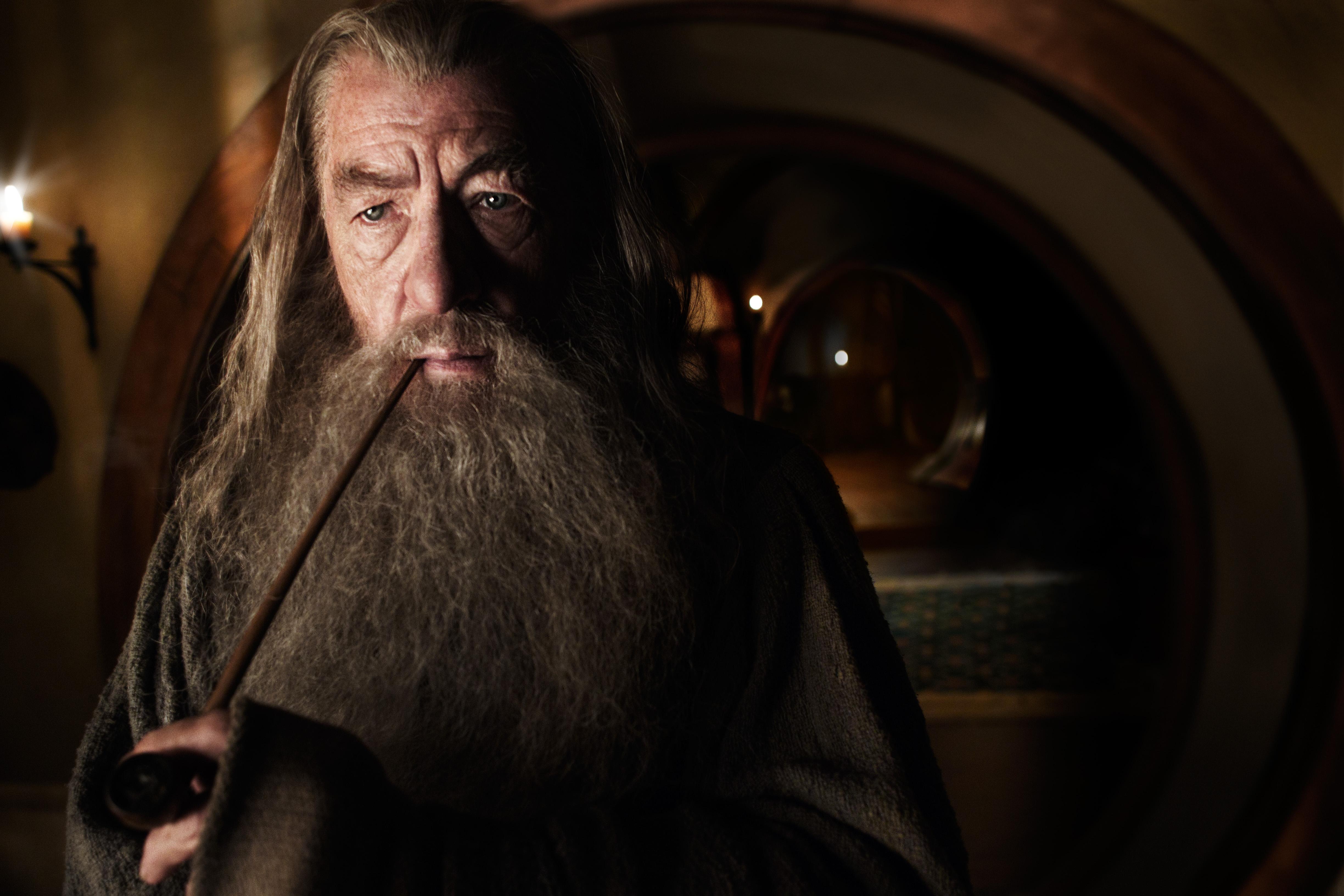
The Hobbit: An Unexpected Journey Make no mistake: the Lord of the Rings trilogy represented an incredible filmmaking achievement, with well-deserved Oscars handed down after the third installment in 2003. If director Peter Jackson wanted to go one more round with J.R.R. Tolkien’s beloved characters for a Hobbit movie, who was gonna stop him? Not so fast. This return to Middle-earth (in 3D this time) represents not one but three films — which would be self-indulgent enough even if part one didn’t unspool at just under three hours, and even if Jackson hadn’t decided to shoot at 48 frames per second. (I can’t even begin to explain what that means from a technical standpoint, but suffice to say there’s a certain amount of cinematic lushness lost when everything is rendered in insanely crystal-clear hi-def.) Journey begins as Bilbo Baggins (a game, funny Martin Freeman) reluctantly joins Gandalf (a weary-seeming Ian McKellan) and a gang of dwarves on their quest to reclaim their stolen homeland and treasure, batting Orcs, goblins, Gollum (Andy Serkis), and other beasties along the way. Fan-pandering happens (with characters like Cate Blanchett’s icy Galadriel popping in to remind you how much you loved LOTR), and the story moves at a brisk enough pace, but Journey never transcends what came before — or in the chronology of the story, what comes after. I’m not quite ready to declare this Jackson’s Phantom Menace (1999), but it’s not an unfair comparison to make, either. (2:50) California, Metreon, 1000 Van Ness, Sundance Kabuki. (Eddy)

Holy Motors Holy moly. Offbeat auteur Leos Carax (1999’s Pola X) and frequent star Denis Lavant (1991’s Lovers on the Bridge) collaborate on one of the most bizarrely wonderful films of the year, or any year. Oscar (Lavant) spends every day riding around Paris in a white limo driven by Céline (Edith Scob, whose eerie role in 1960’s Eyes Without a Face is freely referenced here). After making use of the car’s full complement of wigs, theatrical make-up, and costumes, he emerges for "appointments" with unseen "clients," who apparently observe each vignette as it happens. And don’t even try to predict what’s coming next, or decipher what it all means, beyond an investigation of identity so original you won’t believe your eyes. This wickedly humorous trip through motion-capture suits, graveyard photo shoots, teen angst, back-alley gangsters, old age, and more (yep, that’s the theme from 1954’s Godzilla you hear; oh, and yep, that’s pop star Kylie Minogue) is equal parts disturbing and delightful. Movies don’t get more original or memorable than this. (1:56) Roxie. (Eddy)

Hyde Park on Hudson Weeks after the release of Lincoln, Hyde Park on Hudson arrives with a lighthearted (-ish) take on Franklin D. Roosevelt’s 1939 meeting with King George VI (of stuttering fame) and Queen Elizabeth at FDR’s rural New York estate. Casting Bill Murray as FDR is Hyde Park‘s main attraction, though Olivia Williams makes for a surprisingly effective Eleanor. But the thrust of the film concerns FDR’s relationship with his cousin, Daisy — played by Laura Linney, who’s relegated to a series of dowdy outfits, pouting reaction shots, and far too many voice-overs. The affair has zero heat, and the film is disappointingly shallow — how many times can one be urged to giggle at someone saying "Hot dogs!" in an English accent? — not to mention a waste of a perfectly fine Bill Murray performance. As that sideburned Democrat bellows in Lincoln, "Howwww dare you!" (1:35) Albany, Embarcadero. (Eddy)

The Impossible Spanish director Juan Antonio Bayona (2007’s The Orphanage) directs The Impossible, a relatively modestly-budgeted take on the 2004 Indian Ocean tsunami, based on the real story of a Spanish family who experienced the disaster. Here, the family (Naomi Watts, Ewan McGregor, three young sons) is British, on a Christmas vacation from dad’s high-stress job in Japan. Beachy bliss is soon ruined by that terrible series of waves; they hit early in the film, and Bayona offers a devastatingly realistic depiction of what being caught in a tsunami must feel like: roaring, debris-filled water threatening death by drowning, impalement, or skull-crushing. And then, the anguish of surfacing, alive but injured, stranded, and miles from the nearest doctor, not knowing if your family members have perished. Without giving anything away (no more than the film’s suggestive title, anyway), once the survivors are established (and the film’s strongest performer, Watts, is relegated to hospital-bed scenes) The Impossible finds its way inevitably to melodrama, and triumph-of-the-human-spirit theatrics. As the family’s oldest son, 16-year-old Tom Holland is effective as a kid who reacts exactly right to crisis, morphing from sulky teen to thoughtful hero — but the film is too narrowly focused on its tourist characters, with native Thais mostly relegated to background action. It’s a disconnect that’s not quite offensive, but is still off-putting. (1:54) California, Piedmont, SF Center, Sundance Kabuki. (Eddy)

Jack Reacher (2:10) Metreon, 1000 Van Ness.

Killing Them Softly Lowest-level criminal fuckwits Frankie (Scoot McNairy) and Russell (Ben Mendelsohn) are hired to rob a mob gambling den, a task which miraculously they fail to blow. Nevertheless, the repercussions are swift and harsh, as a middleman suit (Richard Jenkins) to the unseen bosses brings in one hitman (Brad Pitt), who brings in another (James Gandolfini) to figure out who the thieves are and administer extreme justice. Based on a 1970s novel by George V. Higgins, this latest collaboration by Pitt and director-scenarist Andrew Dominik would appear superficially to be a surer commercial bet after the box-office failure of their last, 2007’s The Assassination of Jesse James By the Coward Robert Ford — one of the great films of the last decade. But if you’re looking for action thrills or even Guy Ritchie-style swaggering mantalk (though there is some of that), you’ll be disappointed to find Killing more in the abstracted crime drama arena of Drive (2011) or The American (2010), landing somewhere between the riveting former and the arid latter. This meticulously crafted tale is never less than compelling in imaginative direction and expert performance, but it still carries a certain unshakable air of so-what. Some may be turned off by just how vividly unpleasant Mendelsohn’s junkie and Gandolfini’s alchie are. Others will shrug at the wisdom of re-setting this story in the fall of 2008, with financial-infrastructure collapse and the hollow promise of President-elect Obama’s "Change" providing ironical background noise. It’s all a little too little, too soon. (1:37) New Parkway. (Harvey)

Life of Pi Several filmmakers including Alfonso Cuarón, Jean-Pierre Jeunet, and M. Night Shyamalan had a crack at Yann Martel’s "unfilmable" novel over the last decade, without success. That turns out to have been a very good thing, since Ang Lee and scenarist David Magee have made probably the best movie possible from the material — arguably even an improvement on it. Framed as the adult protagonist’s (Irrfan Khan) lengthy reminiscence to an interested writer (Rafe Spall) it chronicles his youthful experience accompanying his family and animals from their just shuttered zoo on a cargo ship voyage from India to Canada. But a storm capsizes the vessel, stranding teenaged Pi (Suraj Sharma) on a lifeboat with a mini menagerie — albeit one swiftly reduced by the food chain in action to one Richard Parker, a whimsically named Bengal tiger. This uneasy forced cohabitation between Hindu vegetarian and instinctual carnivore is an object lesson in survival as well as a fable about the existence of God, among other things. Shot in 3D, the movie has plenty of enchanted, original imagery, though its outstanding technical accomplishment may lie more in the application of CGI (rather than stereoscopic photography) to something reasonably intelligent for a change. First-time actor Sharma is a natural, while his costar gives the most remarkable performance by a wild animal this side of Joaquin Phoenix in The Master. It’s not a perfect film, but it’s a charmed, lovely experience. (2:00) 1000 Van Ness, SF Center. (Harvey)

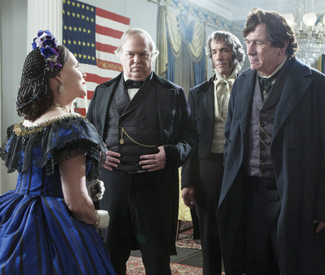
Lincoln Distinguished subject matter and an A+ production team (Steven Spielberg directing, Daniel Day-Lewis starring, Tony Kushner adapting Doris Kearns Goodwin, John Williams scoring every emotion juuust so) mean Lincoln delivers about what you’d expect: a compelling (if verbose), emotionally resonant (and somehow suspenseful) dramatization of President Lincoln’s push to get the 13th amendment passed before the start of his second term. America’s neck-deep in the Civil War, and Congress, though now without Southern representation, is profoundly divided on the issue of abolition. Spielberg recreates 1865 Washington as a vibrant, exciting place, albeit one filled with so many recognizable stars it’s almost distracting wondering who’ll pop up in the next scene: Jared Harris as Ulysses S. Grant! Joseph Gordon-Levitt as Robert Lincoln! Lena Dunham’s shirtless boyfriend on Girls (Adam Driver) as a soldier! Most notable among the huge cast are John Hawkes, Tim Blake Nelson, and a daffy James Spader as a trio of lobbyists; Sally Field as the troubled First Lady; and likely Oscar contenders Tommy Lee Jones (as winningly cranky Rep. Thaddeus Stevens) and Day-Lewis, who does a reliably great job of disappearing into his iconic role. (2:30) 1000 Van Ness, Presidio, SF Center, Shattuck, Sundance Kabuki. (Eddy)

Les Misérables There is a not-insignificant portion of the population who already knows all the words to all the songs of this musical-theater warhorse, around since the 1980s and honored here with a lavish production by Tom Hooper (2010’s The King’s Speech). As other reviews have pointed out, this version only tangentially concerns Victor Hugo’s French Revolution tale; its true raison d’être is swooning over the sight of its big-name cast crooning those famous tunes. Vocals were recorded live on-set, with microphones digitally removed in post-production — but despite this technical achievement, there’s a certain inorganic quality to the proceedings. Like The King’s Speech, the whole affair feels spliced together in the Oscar-creation lab. The hardworking Hugh Jackman deserves the nomination he’ll inevitably get; jury’s still out on Anne Hathaway’s blubbery, "I cut my hair for real, I am so brave!" performance. (2:37) Balboa, Marina, 1000 Van Ness, SF Center, Shattuck, Sundance Kabuki. (Eddy)

Monsters, Inc. 3D (1:35) Metreon.

My Worst Nightmare First seen locally in the San Francisco Film Society’s 2012 "French Cinema Now" series, My Worst Nightmare follows icy art curator Agathe (Isabelle Huppert) as her airless, tightly-controlled world begins to crumble — thanks in no small part to an exuberantly uncouth, down-on-his-luck Belgian contractor named Patrick (Benoît Poelvoorde). (His obnoxious, freewheeling presence in Agathe’s precision-mapped orbit gives rise to the film’s title.) Director and co-writer Anne Fontaine (2009’s Coco Before Chanel) injects plenty of offbeat, occasionally raunchy humor into what could’ve been a predictable personal-liberation tale — the sight of classy dame Huppert driving through a bikini car wash, for instance. (1:43) Smith Rafael. (Eddy)

Not Fade Away How to explain why the Beatles have been tossed so many cinematic bon mots and not the Stones? The group’s relatively short lifespan — and even the tragic, unexpectedly dramatic passing of John Lennon — seem to have all played into the band’s nostalgia-marinated legend, while the Stones’ profitable tour rotation and shocking physical resilience have lessened their romantic charge. So it reads as a counterintuitive, and a bit random, that Sopranos creator David Chase would open his first feature film with a black and white re-creation of the Mick Jagger and Keith Richards meet-up, before switching to the ’60s coming-of-age of New Jersey teen geek Douglas (John Magaro), trapped in an oppressively whiny nuclear family headed up by his Pep Boy grouch of a dad (James Gandolfini) — at least until rock ‘n’ roll saves his soul and he starts beating the skins. Graduating to better-than-average singer after his band’s frontman Eugene (Boardwalk Empire‘s Jack Huston) inhales a joint, Douglas not only finds his voice, but also wins over dream girl Grace (Bella Heathcote). Sure, Not Fade Away is about sex, drugs, and rock ‘n’ roll — and much attention is dutifully squandered on basement shows, band practice, and politics, and posturing with wacky new haircuts and funny cigarettes, thanks to Chase’s own background in garage bands and executive producer, music supervisor, and true believer Steve Van Zandt’s considerable passion. Yet despite the amount screen time devoted to rock’s rites, those familiar gestures never rise above the clichéd, and Not Fade Away only finds its authentic emotional footing when Gandolfini’s imposing yet trapped patriarch and the rest of Douglas’s beaten-down yet still kicking family enters the picture — they’re the force that refuses to fade away, even after they disappear in the rear view. (1:52) Metreon, 1000 Van Ness, Shattuck. (Chun)

Parental Guidance (1:36) Metreon, 1000 Van Ness.

The Perks of Being a Wallflower Move over, Diary of a Wimpy Kid series — there’s a new shrinking-violet social outcast in town. These days, life might not suck quite so hard for 90-pound weaklings in every age category, what with so many films and TV shows exposing, and sometimes even celebrating, the many miseries of childhood and adolescence for all to see. In this case, Perks author Stephen Chbosky takes on the directorial duties — both a good and bad thing, much like the teen years. Smart, shy Charlie is starting high school with a host of issues: he’s painfully awkward and very alone in the brutal throng, his only friend just committed suicide, and his only simpatico family member was killed in a car accident. Charlie’s English teacher Mr. Andersen (Paul Rudd) appears to be his only connection, until the freshman strikes up a conversation with feline, charismatic, shop-class jester Patrick (Ezra Miller) and his magnetic, music- and fun-loving stepsister Sam (Emma Watson). Who needs the popular kids? The witty duo head up their gang of coolly uncool outcasts their own, the Wallflowers (not to be confused with the deeply uncool Jakob Dylan combo), and with them, Charlie appears to have found his tribe. Only a few small secrets put a damper on matters: Patrick happens to be gay and involved with football player Brad (Johnny Simmons), who’s saddled with a violently conservative father, and Charlie is in love with the already-hooked-up Sam and is frightened that his fragile equilibrium will be destroyed when his new besties graduate and slip out of his life. Displaying empathy and a devotion to emotional truth, Chbosky takes good care of his characters, preserving the complexity and ungainly quirks of their not-so-cartoonish suburbia, though his limitations as a director come to the fore in the murkiness and choppily handled climax that reveals how damaged Charlie truly is. (1:43) New Parkway, Opera Plaza.. (Chun)

Promised Land Gus Van Sant’s fracking fable — co-written by stars Matt Damon and John Krasinski, from a story by Dave Eggers — offers a didactic lesson in environmental politics, capped off by the earth-shattering revelation that billion-dollar corporations are sleazy and evil. You don’t say! Formulated like a Capra movie, Promised Land follows company man Steve Butler (Matt Damon) as he and sales partner Sue (Frances McDormand) travel to a small Pennsylvania town to convince its (they hope) gullible residents to allow drilling on their land. But things don’t go as smoothly as hoped, when the pair faces opposition from a science teacher with a brainiac past (Hal Holbrook), and an irritatingly upbeat green activist (Krasinski) breezes into town to further monkey-wrench their scheme. That Damon is such a likeable actor actually works against him here; his character arc from soulless salesman to emotional-creature-with-a-conscience couldn’t be more predictable or obvious. McDormand’s wonderfully biting supporting performance is the best (and only) reason to see this ponderous, faux-folksy tale, which targets an audience that likely already shares its point of view. (1:46) 1000 Van Ness, Presidio, SF Center. (Eddy)

Rise of the Guardians There’s nothing so camp as "Heat Miser" from The Year Without a Santa Claus (1974) in Rise of the Guardians,, but there’s plenty here to charm all ages. The mystery at its center: we open on Jack Frost (voiced by Chris Pine) being born, pulled from the depths of a frozen pond by the Man on the Moon and destined to spread ice and cold everywhere he goes, invisible to all living creatures. It’s an individualistic yet lonely lot for Jack, who’s styled as an impish snowboarder in a hoodie and armed with an icy scepter, until the Guardians — spirits like North/Santa Claus (Alec Baldwin), the Tooth Fairy (Isla Fisher), and the Easter Bunny (Hugh Jackman) — call on him to join them. Pitch the Boogeyman (Jude Law) is threatening to snuff out all children’s hopes and dreams with fears and nightmares, and it’s up to the Guardians must keep belief in magic alive. But what’s in it for Jack, except the most important thing: namely who is he and what is his origin story? Director Peter Ramsey keeps those fragile dreams aloft with scenes awash with motion and animation that evokes the chubby figures and cozy warm tones of ’70s European storybooks. And though Pine verges on blandness with his vocal performance, Baldwin, Jackman, and Fisher winningly deliver the jokes. (1:38) Metreon. (Chun)

Rust and Bone Unlike her Dark Knight Rises co-star Anne Hathaway, Rust and Bone star Marion Cotillard never seems like she’s trying too hard to be sexy, or edgy, or whatever (plus, she already has an Oscar, so the pressure’s off). Here, she’s a whale trainer at a SeaWorld-type park who loses her legs in an accident, which complicates (but ultimately strengthens) her relationship with Ali (Belgian actor Matthias Schoenaerts, so tremendous in 2011’s Bullhead), a single dad trying to make a name for himself as a boxer. Jacques Audiard’s follow-up to 2009’s A Prophet gets a bit overwrought by its last act, but there’s an emotional authenticity in the performances that makes even a ridiculous twist (like, the kind that’ll make you exclaim "Are you fucking kidding me?") feel almost well-earned. (2:00) Embarcadero, Shattuck. (Eddy)

The Sessions Polio has long since paralyzed the body of Berkeley poet Mark O’Brien (John Hawkes) from the neck down. Of course his mind is free to roam — but it often roams south of the personal equator, where he hasn’t had the same opportunities as able-bodied people. Thus he enlists the services of Cheryl (Helen Hunt), a professional sex surrogate, to lose his virginity at last. Based on the real-life figures’ experiences, this drama by Australian polio survivor Ben Lewin was a big hit at Sundance this year (then titled The Surrogate), and it’s not hard to see why: this is one of those rare inspirational feel-good stories that doesn’t pander and earns its tears with honest emotional toil. Hawkes is always arresting, but Hunt hasn’t been this good in a long time, and William H. Macy is pure pleasure as a sympathetic priest put in numerous awkward positions with the Lord by Mark’s very down-to-earth questions and confessions. (1:35) Opera Plaza. (Harvey)

Silver Linings Playbook After guiding two actors to Best Supporting Oscars in 2010’s The Fighter, director David O. Russell returns (adapting his script from Matthew Quick’s novel) with another darkly comedic film about a complicated family that will probably earn some gold of its own. Though he’s obviously not ready to face the outside world, Pat (Bradley Cooper) checks out of the state institution he’s been court-ordered to spend eight months in after displaying some serious anger-management issues. He moves home with his football-obsessed father (Robert De Niro) and worrywart mother (Jacki Weaver of 2010’s Animal Kingdom), where he plunges into a plan to win back his estranged wife. Cooper plays Pat as a man vibrating with troubled energy — always in danger of flying into a rage, even as he pursues his forced-upbeat "silver linings" philosophy. But the movie belongs to Jennifer Lawrence, who proves the chops she showcased (pre-Hunger Games megafame) in 2010’s Winter’s Bone were no fluke. As the damaged-but-determined Tiffany, she’s the left-field element that jolts Pat out of his crazytown funk; she’s also the only reason Playbook‘s dance-competition subplot doesn’t feel eye-rollingly clichéd. The film’s not perfect, but Lawrence’s layered performance — emotional, demanding, bitchy, tough-yet-secretly-tender — damn near is. (2:01) Piedmont, Presidio, SF Center, Shattuck. (Eddy)

Skyfall Top marks to Adele, who delivers a magnificent title song to cap off Skyfall‘s thrilling pre-credits chase scene. Unfortunate, then, that the film that follows squanders its initial promise. After a bomb attack on MI6, the clock is running out for Bond (Daniel Craig) and M (Judi Dench), accused of Cold War irrelevancy in a 21st century full of malevolent, stateless computer hackers. The audience, too, will yearn for a return to simpler times; dialogue about "firewalls" and "obfuscated code" never fails to sound faintly ridiculous, despite the efforts Ben Whishaw as the youthful new head of Q branch. Javier Bardem is creative and creepy as keyboard-tapping villain Raoul Silva, but would have done better with a megalomaniac scheme to take over the world. Instead, a small-potatoes revenge plot limps to a dull conclusion in the middle of nowhere. Skyfall never decides whether it prefers action, bon mots, and in-jokes to ponderous mythologizing and ripped-from-the-headlines speechifying — the result is a unsatisfying, uneven mixture. (2:23) Metreon, 1000 Van Ness, Shattuck, Sundance Kabuki. (Ben Richardson)

Texas Chainsaw 3D (1:32) Metreon, 1000 Van Ness.

Tchopitoulas Three adolescent brothers enjoy a dusk-to-dawn night in the Big Easy — New Orleans, baby — in this impressionistic documentary that blurs the line between staged and sampled lyricism. Bill and Turner Ross’ film sets the trio loose in the French Quarter and beyond, where they sample the company of various drunks, buskers, oyster shuckers, painted ladies, and so forth. No laws are conspicuously broken, though a few get bent — it’s safe to say these kids probably won’t be visiting several environs again until they’re of legal drinking age. The long night is an inebriate dream of color and sound, strange but seldom menacing. Like the "city symphony" movies of the 1920s and 30s, this is less nonfiction cinema in a strict vérité vein than a poetically contrived ode to life — a life that’s sturdier than it looks, since Tchoupitoulas finds NO back to the business of partying like Katrina never happened. If you’re looking for a harder-edged portrait of the burg’s status quo, there are plenty of other documentaries to choose from; the Ross’ provide a woozy mash note rather than a sober pulse-taking. You’ll definitely want to go bar-hopping afterward. (1:20) Roxie. (Harvey)

This is 40 A spin-off of sorts from 2007’s Knocked Up, Judd Apatow’s This is 40 continues the story of two characters nobody cared about from that earlier film: Debbie (Leslie Mann, Apatow’s wife) and Pete (Paul Rudd), plus their two kids (played by Mann and Apatow’s kids). Pete and Debbie have accumulated all the trappings of comfortable Los Angeles livin’: luxury cars, a huge house, a private personal trainer, the means to throw catered parties and take weekend trips to fancy hotels (and to whimsically decide to go gluten-free), and more Apple products than have ever before been shoehorned into a single film. But! This was crap they got used to having before Pete’s record label went into the shitter, and Debbie’s dress-shop employee (Charlene Yi, another Knocked Up returnee who is one of two people of color in the film; the other is an Indian doctor who exists so Pete can mock his accent) started stealing thousands from the register. How will this couple and their whiny offspring deal with their financial reality? By arguing! About bullshit! In every scene! For nearly two and a half hours! By the time Melissa McCarthy, as a fellow parent, shows up to command the film’s only satisfying scene — ripping Pete and Debbie a new one, which they sorely deserve — you’re torn between cheering for her and wishing she’d never appeared. Seeing McCarthy go at it is a reminder that most comedies don’t make you feel like stabbing yourself in the face. I’m honestly perplexed as to who this movie’s audience is supposed to be. Self-loathing yuppies? Masochists? Apatow’s immediate family, most of whom are already in the film? (2:14) Metreon, 1000 Van Ness, Shattuck, Vogue. (Eddy)

Tristana The morality tale rarely gets as twisted as it does in Luis Buñuel’s 1970 late-in-the-day beauty Tristana. Working with Benito Perez Galdos’s novel, the filmmaker gleefully picked up a thread entwining erotic politics and S&M — explored to exquisite effect in 1967’s Belle de Jour and again offset by the immaculate bone structure of anti-heroine Catherine Deneuve — while bringing a corrosive intimacy to his black-humored disembowelment of a self-serving aristocracy, hypocritical church, and Franco-era fascism. Today it feels like one of Buñuel’s most personal and Spanish films, with the director-cowriter basing the impressionable Tristana on his sister Conchita. The starting point is an archetypal innocent "strange flower" clad in black, Tristana (Deneuve). She has been placed in the care of the aristocratic Don Lope (Buñuel regular Fernando Rey), a dissolute "senorito" (akin to Buñuel’s own father) who lives off his inheritance and espouses a kind of anti-clerical, antiauthoritarian, albeit elitist, libertine lifestyle. The patriarch can hardly deny himself anything, let alone his gorgeous ward, who is confined to the house like a prisoner and learns at Don Lope’s feet to despise the man who admits he’s her father or her husband, depending on when it suits him. Enter a dashing young artist Horacio (Franco Nero, the original Django) to spirit the increasingly embittered Tristana away from the battered, mazelike streets of Toledo, Spain. But that feat is far from easy when the "fallen" woman’s daydreams of teaching piano pale in comparison to a recurring nightmare of Don Lope’s head at the end of a rather phallic church bell clapper. What follows — photographed with disciplined, earthy beauty by cinematographer Jose Aguayo and now restored to its dusky, lustrous good looks—is a de-evolution of sorts, as both an innocent and corruptor are defiled, though Tristana‘s psychosexual reverberations, which would have given both Freud and the Marquis de Sade palpitations, echo out beyond the closing montage, its tolling bell, and the repeated heavy thud of a prosthetic slamming into the floor. (1:38) Opera Plaza. (Chun)

Wreck-It Ralph Wreck-It Ralph cribs directly from the Toy Story series: when the lights go off in the arcade, video game characters gather to eat, drink, and endure existential crises. John C. Reilly is likable and idiosyncratic as Ralph, the hulking, ham-fisted villain of a game called Fix-It-Felix. Fed up with being the bad guy, Ralph sneaks into gritty combat sim Hero’s Duty under the nose of Sergeant Calhoun (Jane Lynch), a blond space marine who mixes Mass Effect‘s Commander Shepard with a PG-rated R. Lee Ermey. Things go quickly awry, and soon Ralph is marooned in cart-racing candyland Sugar Rush, helping Vanellope Von Schweetz (a manic Sarah Silverman), with Calhoun and opposite number Felix (Jack McBrayer) hot on his heels. Though often aggressively childish, the humor will amuse kids, parents, and occasionally gamers, and the Disney-approved message about acceptance is moving without being maudlin. The animation, limber enough to portray 30 years of changing video game graphics, deserves special praise. (1:34) Metreon. (Ben Richardson)

Zero Dark Thirty The extent to which torture was actually used in the hunt for Osama Bin Ladin may never be known, though popular opinion will surely be shaped by this film, as it’s produced with the same kind of "realness" that made Kathryn Bigelow’s previous film, the Oscar-winning The Hurt Locker (2008), so potent. Zero Dark Thirty incorporates torture early in its chronology — which begins in 2003, after a brief opening that captures the terror of September 11, 2001 using only 911 phone calls — but the practice is discarded after 2008, a sea-change year marked by the sight of Obama on TV insisting that "America does not torture." (The "any more" goes unspoken.) Most of Zero Dark Thirty is set in Pakistan and/or "CIA black sites" in undisclosed locations; it’s a suspenseful procedural that manages to make well-documented events (the July 2005 London bombings; the September 2008 Islamabad Marriott Hotel bombing) seem shocking and unexpected. Even the raid on Bin Ladin’s HQ is nail-bitingly intense. The film immerses the viewer in the clandestine world, tossing out abbreviations ("KSM" for al-Qaeda bigwig Khalid Sheikh Mohammed) and jargon ("tradecraft") without pausing for a breath. It is thrilling, emotional, engrossing — the smartest, most tightly-constructed action film of the year. At the center of it all: a character allegedly based on a real person whose actual identity is kept top-secret by necessity. She’s interpreted here in the form of a steely CIA operative named Maya, played to likely Oscar-winning perfection by Jessica Chastain. No matter the film’s divisive subject matter, there’s no denying that this is a powerful performance. "Washington says she’s a killer," a character remarks after meeting this seemingly delicate creature, and he’s proven right long before Bin Ladin goes down. Some critics have argued that character is underdeveloped, but anyone who says that isn’t watching closely enough. Maya may not be given a traditional backstory, but there’s plenty of interior life there, and it comes through in quick, vulnerable flashes — leading up to the payoff of the film’s devastating final shot. (2:39) Balboa, Marina, SF Center, Sundance Kabuki. (Eddy)

Oscar contender ‘Zero Dark Thirty’ opens today! Plus (a few) more new movies

7

At last, the movie most likely to challenge Lincoln for Best Picture opens in San Francisco, with an even wider release coming next week. Check out my review of Zero Dark Thirty here. Highly recommended, and even if it doesn’t snag the top trophy, look for Jessica Chastain to win Best Actress. (More Oscar predictions here, in case you’re getting your pool in order extra-early.)

Also this week: Texas Chainsaw 3D (the first two films in this series, I’ll defend to the death … no interest in seeing this one, frankly), a re-release of Luis Buñuel’s 1970 drama Tristana, and freewheeling New Orleans doc Tchoupitoulas (reviews of the latter two after the jump).

http://www.youtube.com/watch?v=bcW2EKnzXxE

Tristana The morality tale rarely gets as twisted as it does in Luis Buñuel’s 1970 late-in-the-day beauty Tristana. Working with Benito Perez Galdos’s novel, the filmmaker gleefully picked up a thread entwining erotic politics and S&M — explored to exquisite effect in 1967’s Belle de Jour and again offset by the immaculate bone structure of anti-heroine Catherine Deneuve — while bringing a corrosive intimacy to his black-humored disembowelment of a self-serving aristocracy, hypocritical church, and Franco-era fascism. Today it feels like one of Buñuel’s most personal and Spanish films, with the director-cowriter basing the impressionable Tristana on his sister Conchita. The starting point is an archetypal innocent “strange flower” clad in black, Tristana (Deneuve). She has been placed in the care of the aristocratic Don Lope (Buñuel regular Fernando Rey), a dissolute “senorito” (akin to Buñuel’s own father) who lives off his inheritance and espouses a kind of anti-clerical, antiauthoritarian, albeit elitist, libertine lifestyle. The patriarch can hardly deny himself anything, let alone his gorgeous ward, who is confined to the house like a prisoner and learns at Don Lope’s feet to despise the man who admits he’s her father or her husband, depending on when it suits him. Enter a dashing young artist Horacio (Franco Nero, the original Django) to spirit the increasingly embittered Tristana away from the battered, mazelike streets of Toledo, Spain. But that feat is far from easy when the “fallen” woman’s daydreams of teaching piano pale in comparison to a recurring nightmare of Don Lope’s head at the end of a rather phallic church bell clapper. What follows — photographed with disciplined, earthy beauty by cinematographer Jose Aguayo and now restored to its dusky, lustrous good looks—is a de-evolution of sorts, as both an innocent and corruptor are defiled, though Tristana’s psychosexual reverberations, which would have given both Freud and the Marquis de Sade palpitations, echo out beyond the closing montage, its tolling bell, and the repeated heavy thud of a prosthetic slamming into the floor. (1:38) (Kimberly Chun)

Tchopitoulas Three adolescent brothers enjoy a dusk-to-dawn night in the Big Easy — New Orleans, baby — in this impressionistic documentary that blurs the line between staged and sampled lyricism. Bill and Turner Ross’ film sets the trio loose in the French Quarter and beyond, where they sample the company of various drunks, buskers, oyster shuckers, painted ladies, and so forth. No laws are conspicuously broken, though a few get bent — it’s safe to say these kids probably won’t be visiting several environs again until they’re of legal drinking age. The long night is an inebriate dream of color and sound, strange but seldom menacing. Like the “city symphony” movies of the 1920s and 30s, this is less nonfiction cinema in a strict vérité vein than a poetically contrived ode to life — a life that’s sturdier than it looks, since Tchoupitoulas finds NO back to the business of partying like Katrina never happened. If you’re looking for a harder-edged portrait of the burg’s status quo, there are plenty of other documentaries to choose from; the Ross’ provide a woozy mash note rather than a sober pulse-taking. You’ll definitely want to go bar-hopping afterward. (1:20) (Dennis Harvey)

Golden doodles

4

cheryl@sfbg.com

Yeah, the presidential election happened months ago. But the most intense campaign season is just beginning, as multiple ceremonies ramp up to Hollywood’s ultimate night of self-congratulation (and occasionally questionable fashion): the Academy Awards. The nominations will be announced Jan. 10; the ceremony, hosted by first-timer Seth MacFarlane — of Family Guy and talking teddy bear fame — is Feb. 24. Predictions are based on Golden Globe nominations, Screen Actors Guild Award nominations, Independent Spirit Award nominations, random news and gossip reports, and my own loudmouthed opinion.

Best Actor This one’s already in the bag, or more accurately, tucked under the stovepipe hat: Daniel Day-Lewis is the closest thing 2013 has to a lock, for Lincoln. The only strike against the two-time winner is that his last trophy came pretty recently, for 2007’s There Will Be Blood. Though it’s unlikely any of the other nominees have a chance, best guesses for also-rans are Hugh Jackman for Les Misérables (he sings!); John Hawkes for The Sessions (he’s paralyzed!); and Denzel Washington for Flight (he drinks!) The fifth slot could go to Silver Linings Playbook‘s Bradley Cooper, The Master‘s Joaquin Phoenix (my pick), or dark horse Jack Black, for Bernie.

Best Actress Two women enter, one woman leaves … with a little gold man in tow. Best Actress looks to be a battle between Zero Dark Thirty‘s Jessica Chastain and Silver Linings Playbook‘s Jennifer Lawrence. Both have been nominated before, though Chastain might have an edge here: Zero is a serious action-drama that’s been hyped more than Playbook, and Chastain — last year’s “Where did she come from and why is she in every movie?” surprise — has settled down from overexposed newcomer to reliable talent. Lawrence, also the lead in the mega-popular Hunger Games series, is just 22 years old, and though her sophisticated work in Playbook belies her relative youth, she may be passed over with the understanding that she’ll soon be nominated again.

Other names that will likely appear on the ballot: Marion Cotillard, a past winner, for playing a woman who loses her legs in Rust and Bone; and Naomi Watts, a past nominee who should probably have gotten a statuette by now, for playing the matriarch of a tsunami-ravaged family in The Impossible. The last slot could go to Academy fave Helen Mirren (for the so-so Hitchcock); another past winner, Rachel Weisz, for her raw turn in The Deep Blue Sea; Emmanuelle Riva, winner of the San Francisco Film Critic Circle’s Best Actress award for her work as a dying woman in Amour; or grade-school discovery Quevenzhané Wallis, for her tough-sprite turn in Beasts of the Southern Wild.

Best Supporting Actor After I saw Argo, I was certain that Alan Arkin (who won in this category for 2006’s Little Miss Sunshine) would repeat. Then I saw Lincoln, and decided Tommy Lee Jones was the clear favorite. Then I saw Django Unchained, and Samuel L. Jackson, Leonardo DiCaprio, and Christoph Waltz lurched forth. I suspect all of Django‘s supporting cast won’t actually be nominated (my favorite of the trio: Jackson), and The Master’s Philip Seymour Hoffman and Silver Linings Playbook‘s Robert De Niro are likely contenders. Matthew McConaughey could also slither in, for the crowd-pleasing Magic Mike. But right now, I’m leaning toward the hilariously world-weary Jones for the win. “It opens!”

Best Supporting Actress It’s going to be Sally Field, the nutty-yet-sympathetic Mary Todd in Lincoln, versus Anne Hathaway, the weepy, shorn Fantine in Les Misérables. I am not a Hathaway fan, but if the Academy — who are not immune to being emotionally manipulated by director Tom Hooper (2010’s Best Picture The King’s Speech) — wants to award someone from Les Mis, she’s more likely to squeak in than Jackman. Plus, she hosted the Oscars a few years ago. That’s got to count for something, right?

Other nominees: I’m hoping both Amy Adams (spooky in The Master) and Nicole Kidman (daffy in the Paperboy) get nods, but any slots left over will probably be filled by The Sessions’ Helen Hunt or Maggie “Dowager Countess 4-Lyfe” Smith, for The Best Exotic Marigold Hotel.

Best Screenplay (Original and Adapted) The Golden Globes, the Oscars’ boozier little bro, doesn’t differentiate between original or adapted, but its lumped-together nominees contain the likely winners in each category: Mark Boal for Zero Dark Thirty (original), and Tony Kushner for Lincoln (adapted). Other original nominees could include Django Unchained, The Master, Amour, and Looper; other adapted nominees will be sure-things Argo and Silver Linings Playbook, with The Sessions and Beasts of the Southern Wild possibly filling out the category.

Best Documentary The 15-film short list was released in early December, so there’s a bit of navigational help with this one. I have seen most (but not all) of the films on the list; with that disclaimer, my predictions for the final five are: The House I Live In, The Imposter, Searching for Sugar Man, This Is Not a Film, and the SFFCC’s top doc, locally-made hospital drama The Waiting Room. I’m still awaiting the chance to check out Mea Maxima Culpa: Silence in the House of God, a highly-praised look at clerical sex abuse from oft-nominated (and once-rewarded, for 2007’s Taxi to the Dark Side) director Alex Gibney.

Best Foreign Language Film Since only one film per country can be submitted, and The Intouchables snagged France’s spot, my favorite movie of the year (Holy Motors) isn’t even eligible. But that doesn’t matter, really — Intouchables will likely get a nod, but this race is for the critically-beloved Amour (from Austrian director Michael Haneke, whose The White Ribbon was nominated in 2010) to lose. Other short listers (there are a total of nine) include Canada’s War Witch, Chile’s No, Denmark’s A Royal Affair, Romania’s Beyond the Hills, and Switzerland’s Sister.

Best Director/Best Picture As Steven Spielberg surely recalls, just because you win Best Director (for 1998’s Saving Private Ryan) doesn’t mean Shakespeare in Love won’t swoop in and steal your Best Picture prize. Oscar can tap between five and ten nominees for Best Picture, so the categories won’t necessarily line up — but this year, they just might. Look for the top contenders to be Kathryn Bigelow-Zero Dark Thirty (see my review elsewhere in this issue; it’s also my pick to win), and Spielberg-Lincoln. Other likely nominees: Paul Thomas Anderson-The Master; Ben Affleck-Argo; Tom Hooper-Les Misérables; David O. Russell-Silver Linings Playbook; and Michael Haneke-Amour.


Heroic shorties return! “The Hobbit” and more new movies

3

One more week until Hollywood unleashes a mighty flood of new films, in honor of noted multiplex fan Baby Jesus. This week’s only big release is Peter Jackson’s return to Middle-earth, The Hobbit: An Unexpected Journey, which at two hours and 46 minutes is definitely a pee-before, bring-snacks-to-eat-during experience. My review below the jump, along with takes on the Alan Cumming showcase Any Day Now and Israeli coming-of-age drama The Matchmaker.

Also worth the popcorn calories: documentarian Ken Burns’ provocative look at one of New York City’s most infamous crimes, The Central Park Five; less so is the FDR dramedy Hyde Park on Hudson, which does star Bill Murray, so at least it has that goin’ for it, which is nice. I review both films here.

Any Day Now In 1970s West Hollywood, flamboyant drag queen Rudy (Alan Cumming) and closeted, newly divorced lawyer Paul (Garret Dillahunt) meet and become an unlikely but loving couple. Their opposites-attract bond strengthens when they become de facto parents to Marco (Isaac Leyva), a teen with Down syndrome left adrift when his party-girl mother (Jamie Anne Allman) is arrested. Domestic bliss — school for Marco with a caring special-education teacher (Kelli Williams); a fledgling singing career for Rudy (so: lots of crooning, for Cumming superfans) — is threatened by rampant homophobia, so Rudy and Paul must conceal their true relationship from Paul’s overbearing boss and the other parents at Marco’s school. When the secret gets out, the fact that Marco is being well cared-for matters not to the law; he’s immediately shunted into a foster home while Paul and Rudy battle the court for custody. Actor-turned-director and co-writer Travis Fine (2010’s The Space Between) guides a veteran cast through this based-on-true-events tale, with sensitive performances and realistic characterizations balancing out the story’s broader strokes. (1:43) (Cheryl Eddy)

http://www.youtube.com/watch?v=SDnYMbYB-nU

The Hobbit: An Unexpected Journey Make no mistake: the Lord of the Rings trilogy represented an incredible filmmaking achievement, with well-deserved Oscars handed down after the third installment in 2003. If director Peter Jackson wanted to go one more round with J.R.R. Tolkien’s beloved characters for a Hobbit movie, who was gonna stop him? Not so fast. This return to Middle-earth (in 3D this time) represents not one but three films — which would be self-indulgent enough even if part one didn’t unspool at just under three hours, and even if Jackson hadn’t decided to shoot at 48 frames per second. (I can’t even begin to explain what that means from a technical standpoint, but suffice to say there’s a certain amount of cinematic lushness lost when everything is rendered in insanely crystal-clear hi-def.) Journey begins as Bilbo Baggins (a game, funny Martin Freeman) reluctantly joins Gandalf (a weary-seeming Ian McKellan) and a gang of dwarves on their quest to reclaim their stolen homeland and treasure, batting Orcs, goblins, Gollum (Andy Serkis), and other beasties along the way. Fan-pandering happens (with characters like Cate Blanchett’s icy Galadriel popping in to remind you how much you loved LOTR), and the story moves at a brisk enough pace, but Journey never transcends what came before — or in the chronology of the story, what comes after. I’m not quite ready to declare this Jackson’s Phantom Menace (1999), but it’s not an completely unfair comparison to make, either. (2:50) (Cheryl Eddy)

http://www.youtube.com/watch?v=VBmrW2LeCnw

The Matchmaker In 2006, amid ongoing conflict with Lebanon, an Israeli novelist learns he’s received an unexpected inheritance from a man he knew in 1968, the summer before he turned 16. Most of Avi Nesher’s The Matchmaker takes place during those golden months in Haifa, when young Arik (Tuval Shafir) — lover of Dashiell Hammett, son of Holocaust survivors — takes a job working for a charismatic but vaguely shady matchmaker (comedian Adir Miller, who won the Israeli equivalent of a Best Actor Oscar), following potential clients to assure their quest for love is on the level. His exciting new gig whisks the budding writer out of middle-class monotony and introduces him to a wealth of colorful “Low Rent district” types; he also nurses a raging crush on his best friend’s free-spirited American cousin. Mostly a gently nostalgic tale, The Matchmaker also offers an unusual take on the Holocaust, viewing it from two decades later and using its looming memory to shape the characters who experienced it firsthand — as well as members of the younger generation, like Arik, who pages through The House of Dolls to learn more, even as he refers to the concentration camp where his father was held as simply “there.” (1:52) (Cheryl Eddy)

Final step?

4

steve@sfbg.com

President Barack Obama is fond of reciting the Martin Luther King Jr. quote, “The arc of history is long, but it bends toward justice.” On the issue of marriage equality, that arc looks more like a zig-zagging path that began when San Francisco unilaterally began issuing marriage license to same-sex couples just before Valentines Day in 2004 and ending — its backers hope — in June 2013 with the US Supreme Court affirming the basic constitutional right of everyone to marry whomever they want and to have those marriages treated equally under the law.

“We’ve seen the ups and the downs, the highs and the lows,” said City Attorney Dennis Herrera, who has watched court injunctions blocking marriages by the city, the California Supreme Court ruling that the ban on same-sex marriage violated the state constitution, the 2008 vote amending the constitution through Proposition. 8, and the Ninth Circuit Court ruling that the measure violated federal equal protection standards.

Yet few officials or legal experts are willing to predict with any certainty that this long and winding road will end with a definitive conclusion in June. In fact, Herrera and other same-sex marriage supporters expressed disappointment Dec. 7 when the Supreme Court announced it had decided to review the Ninth Circuit Court ruling that Proposition 8 was unconstitutional.

Letting the ruling in Perry v. Brown stand would have re-legalized same-sex marriages in California, which would have joined the nine other states and the District of Columbia as places where it’s legal for gays and lesbians to get hitched. Yet in taking the case — along with U.S. v. Windsor, which challenges the Defense of Marriage Act and its prohibition on recognizing the inheritance law and tax code rights of same-sex spouses — the court could issue a landmark civil rights ruling striking down all laws that discriminate against same-sex couples.

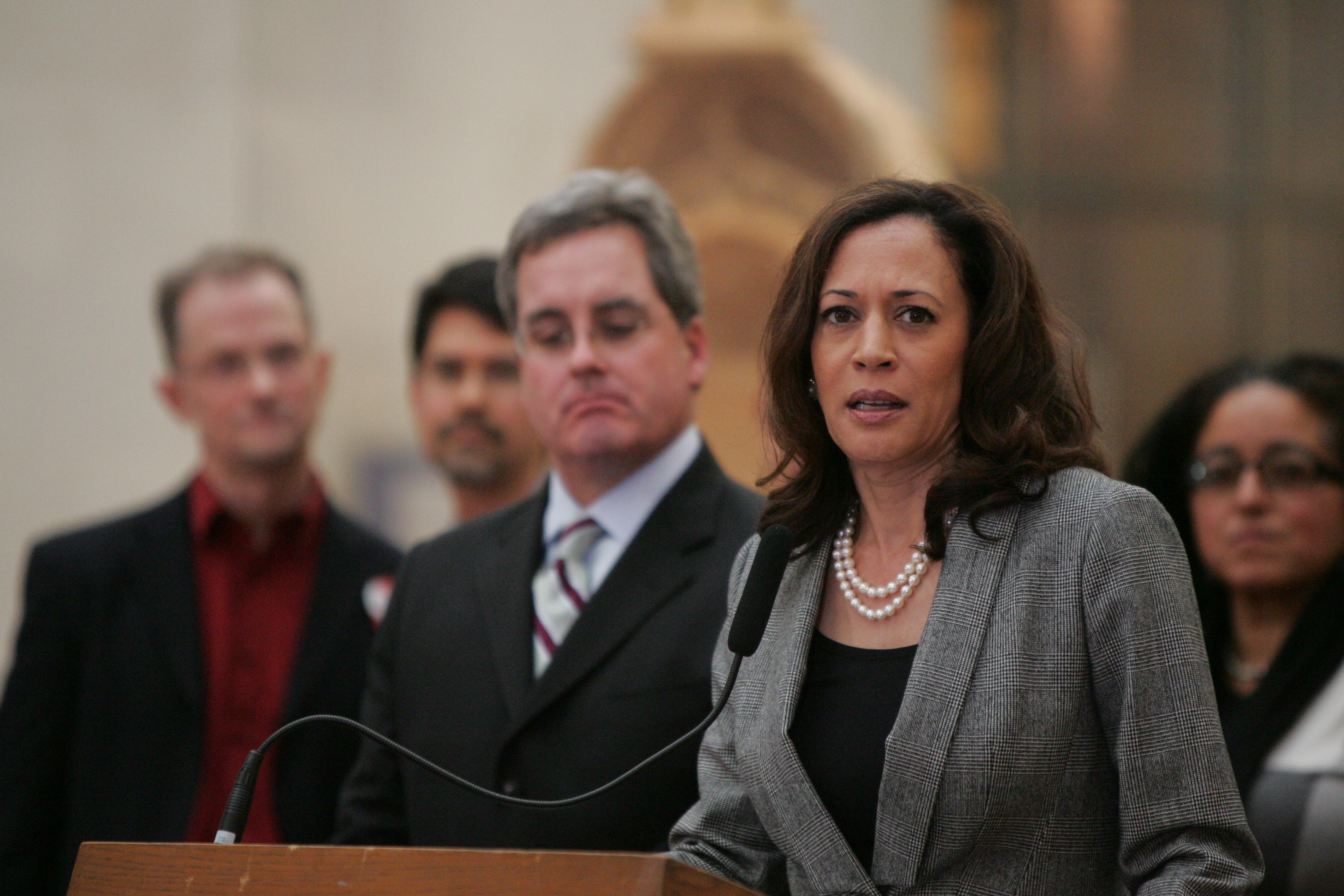
That’s the hope of California Attorney General Kamala Harris. “Are we a country that is true to its word and true to its spirit, or not?” was how Harris framed the question at a Dec. 7 press conference with Herrera. She focused on the basic equal protection argument and the need to “stand for the principle that we are equal and we will be treated that way.”

Herrera, who had just gotten off a conference call with lead attorneys Theodore Olson and David Boies and the rest of the advocates who are defending same-sex marriage, told reporters that the main goal was a broad ruling: “Ted Olson has made it clear he’s going to make a very broad argument.” Yet the Supreme Court could also issue a narrow ruling, extending the twisty path of this issue.

As for reading the tea leaves, Deputy City Attorney Terry Stewart, who has litigated the city’s position since the beginning, said she doesn’t think anyone knows how this case is going to be resolved — not even the Supreme Court justices themselves. “I don’t think they know, to be honest with you,” Stewart said when asked whether taking the Perry and DOMA cases indicate a willingness to finally settle the broad question of whether same-sex couples should be treated equally to heterosexual couples.

She noted that the Supreme Court waited until the last minute — its decision had initially been expected on Nov. 30 — to decide to take the cases: “They took a long time, so clearly they’re wrestling with it.”

Like many observers, Harris speculated that Justice Kennedy is the likely swing vote if the court reaches a 5-4 ruling on the issue, and some have speculated that Chief Justice Roberts could also be a surprisingly liberal vote on the issue, as he was earlier this year in upholding Obamacare. And the advocates say their optimism is reinforced by the long and meticulous case for marriage equality that advocates put together in the courtroom of federal Judge Vaughn Walker, whose 2010 ruling the Ninth Circuit upheld.

“We worked really hard to put in the best possible case,” Stewart said, while Herrera said, “I can think of no better case to take up than this case…The confidence level of all of us is high.”

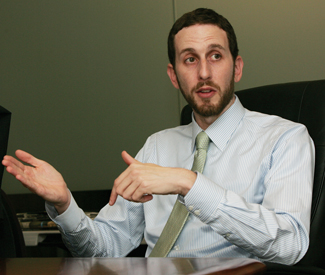
Yet even if it turns out that there are a few more turns to navigate before justice prevails on what Harris called “the civil rights struggle of our time,” the advocates are pledging to win marriage equality in California next year, even if that means going back to the ballot. “We’re going to win this fight one way or another,” Sup. Scott Wiener said at the press conference, with Sup. David Campos later adding, “the question is whether the Supreme Court chooses to be on the right side or history or the wrong side of history.” It was a theme that Lt. Gov. Gavin Newsom — who started us down this path with his unilateral decision as mayor to issue marriage licenses to same-sex couples — echoed in public statement he released: “Today’s announcement starts the clock towards the final decision for California. History will one day be divided into the time before marriage equality and the period that follows. And thankfully, we will be on the side of history worthy of being proud of.”

Herrera and other officials disappointed but hopeful as Supreme Court takes marriage equality case

7

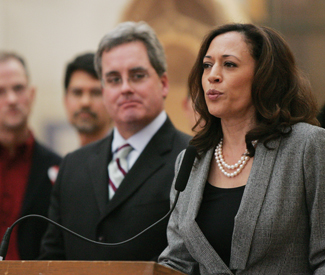
City Attorney Dennis Herrera, Deputy City Attorney Theresa Stewart, California Attorney General Kamala Harris, and other officials who held a press conference at City Hall today admitted they were disappointed that the US Supreme Court has decided to review the Ninth Circuit Court ruling that Proposition 8, the 2008 measure banning same-sex marriage in California, was unconstitutional.

“But we can’t let that obscure the tremendous progress that we’ve made in California on marriage equality,” said Herrera, who has been at the center of a struggle that began in 2004 when then-Mayor Gavin Newsom decided the city should begin unilaterally issuing marriage licenses to same-sex couples, in defiance of state and federal law.

“I’d be lying if I didn’t say I was a little disappointed,” said Stewart, who has been the city’s main litigator on the issue as it moved through court injunctions blocking marriages by the city, the California Supreme Court ruling the ban on same-sex marriage violated the state constitution, the vote amending the constitution through Prop. 8, and the Ninth Circuit ruling Prop. 8 violated federal equal protection standards.

Herrera and Stewart both expressed confidence that the Prop. 8 case that the Supreme Court will review, Perry v. Brown, was put together in a solid, meticulous way that will make it difficult for the US Supreme Court to disagree with the Ninth Circuit conclusion. “We worked really hard to put in the best possible case,” Stewart said, while Herrera said, “I can think of no better case to take up than this case…The confidence level of all of us is high.”

They also expressed hopes that the strategy of lead attorney Theodore Olsen to make broad arguments that any legal distinctions denying rights to homosexuals are unconstitutional – as opposed to the city’s more narrow approach that Prop. 8 doesn’t pass legal muster, which Herrera called “complementary” to Olsen’s approach – would be successful in making this case a definitive civil rights victory.

“Are we a country that is true to its word and true to its spirit, or not?” is how Harris framed the question, focusing on the basic equal protection argument and the need to “stand for the principle that we are equal and we will be treated that way.”

She and others called this “the civil rights struggle of our time,” and they pledged to win this issue now, no matter what. “I am optimistic that we’re going to win at the Supreme Court,” Sup. Scott Wiener said, pledging to win the right to marry at the ballot box even if the court doesn’t affirm that right. “We’re going to win this fight one way or another.”

Sup. David Campos, who is also gay, agreed that same-sex marriage will again be legal in California and “the question is whether the Supreme Court chooses to be on the right side or history or the wrong side of history.”

Same-sex marriage: What they’re saying

4

Lots of statements getting issued on the Supreme Court’s decision, reflecting both the desire of many elected officials to weigh in on this momentus event and some interesting differences in tone.

Assembly Member Tom Ammiano:


“This doesn’t decide anything on its own, but it opens the door for the U.S. Supreme Court to acknowledge that people in every state of this union should be able to form marriage unions with the partner of their choosing and not be limited by outdated customs and laws.”

“It’s a bit disappointing that the Supreme Court isn’t already kicking Prop. 8 to the curb, but I’m hopeful that they will do that after hearing arguments. We can also hope that this court decides that it’s time to say, once and for all, that denying this right to same-sex couples is just as unconstitutional as denying marriage to mixed-race couples – a decision made decades ago.”

State Sen. Mark Leno:

“I am hopeful and encouraged about today’s decision from the U.S. Supreme Court to review the Proposition 8 case, which is one of the most significant equal rights issues to come before the court in many decades,” said Senator Leno. “For the past four years we have argued that Proposition 8 is not only unconstitutional, but that it also violates the basic principles of respect, dignity and validation that every American deserves. I am confident that the Supreme Court will reaffirm these fundamental freedoms and uphold that a person’s right to be treated equally does not vanish simply because of who they are or whom they love.


“The momentum for marriage equality has never been stronger in our country. We have support from President Obama, recent victories at the ballot box, and polls that show a majority of Americans are with us. In addition, federal courts continue to strike down laws that discriminate against lesbian, gay, bisexual and transgender people. I am convinced our triumphs will continue.”


Mayor Ed Lee:


“I am optimistic that the Supreme Court will reaffirm, as the Ninth Circuit Court did, that California’s Proposition 8 is unconstitutional.

“We remain as deeply committed today as we were nearly eight years ago when then Mayor Gavin Newsom jumpstarted one of the most important civil rights movements of our generation. I would like to thank City Attorney Dennis Herrera for his work on this important issue and bringing us to this point. I thank the legal team of Ted Olson and David Boies and the American Foundation for Equal Rights for defending equality in this legal pursuit. 

Same-sex marriage is legal, or will soon be, in nine states — Connecticut, Iowa, Maine, Maryland, Massachusetts, New Hampshire, New York, Vermont, Washington — and the District of Columbia. I look forward to the day when California joins this well-respected list.”


Lt. Gov. Gavin Newsom:


Today marks the beginning of the end for a California journey that started eight years ago when San Francisco issued same-sex marriage licenses. By agreeing to hear the Proposition 8  case the U.S. Supreme Court could end, once and for all, marriage inequity in California.

Forty-five years after the Supreme Court ruled that marriages between interracial couples were constitutional in Loving vs. Virginia, Justices can once again reaffirm the basic American principal of equality for all.

The singling out a class of Californians for discrimination violates the basic principles of who we are as a nation. It is important at this moment in time to recognize that individuals can be mightier together than apart, that there is strength in our diversity, power when we unite around our shared values and success when we advance together.

 Today’s announcement starts the clock towards the final decision for California. History will one day be divided into the time before marriage equality and the period that follows. And thankfully, we will be on the side of history worthy of being proud of.


Assembly Speaker John Perez:

“Today’s announcement that the Supreme Court will take up Hollingsworth v. Perry and the challenges to the Defense of Marriage Act is a reminder that the pathway to justice is long and difficult. The plaintiffs in the initial challenge to Proposition 8, Perry v. Schwarzenegger, presented a powerful and compelling argument that Proposition 8 is unconstitutional, which was eloquently recognized in Judge Vaughn Walker’s ruling in that case. I am very confident that the Supreme Court will rule in favor of our community in Hollingsworth v. Perry, as it is now known, and affirm that Proposition 8 is unconstitutional. But until that outcome is secured, our community must continue to fight for justice on every front, from working to secure the Employment Non-Discrimination Act to addressing the issues of homelessness among LGBT Youth.”

Rep. Nancy Pelosi:


With the Supreme Court’s decision, marriage equality will finally have its day in the highest court in the land. Americans will hear whether inequality and discrimination are consistent with the high standards and deepest values of our Constitution. We remain confident that the justices’ ruling will fall on the side of civil rights and discard DOMA and Prop 8 in the dustbin of history.

“From the start, Republicans have known that DOMA is unconstitutional, and that’s why Republicans have tried to pass legislation to prohibit judicial review of this disgraceful law. Speaker Boehner’s legal team repeatedly failed to convince the courts to keep denying basic rights to American families, all while wasting nearly $1.5 million in taxpayer funds. Now, the Supreme Court will decide whether Edie Windsor deserved to face a penalty of hundreds of thousands of dollars after her partner of four decades passed away. We believe Ms. Windsor and couples like hers will see justice done in this case.

“By taking up the Prop 8 case, the Supreme Court will have the opportunity to make a strong statement that laws, in California and nationwide, must not target the LGBT community unfairly and that families across our state and our country deserve fair and equal treatment under the law.

“We have now reached a landmark moment in the history of civil rights in our nation. Let’s end discrimination and ensure equality for all of America’s families. Let’s get this over with and on to the future!”

UPDATE:

Bay Guardian Controller Sandy Lange:

“Well, at least I don’t have to get married this weekend.”


Boy Howdy

0

le.chicken.farmer@gmail.com

CHEAP EATS This.

CHEAP SPORTS


by Hedgehog


I love my editor/column hostess. And not just because I’m domestically partnered to her (though that helps).

My loyalty running as deep as it does in her general direction, when I see her overworked, I want to unburden her. Tonight, she made pork chops. They were delicious: on a bed of leftover basmati rice from an unfortunate delivery job earlier in the week, with a side of sauteed string beans. Best dinner of the day, hands down. And then she says to me, she says "Confound it, Hedgehog. My column’s due again."

"Has it been a week already? Well don’t fret," says I (we always speak like old-timey prospectors after dinner), "it’s still early. You can write your column aftern you do the dishes."

"No," she says. "By the time I finish doing all of these here dishes — dishes which, mind you, were dirtied in service of a meal you specifically requestered — I’ll be too tired to type let alone think of some other meal I ate somewheres else and review it."

So here I am, writing her review for her while she does the dishes. And to make sure my editor’s editors know I mean business, I’ll give you not one but two reviews for the price of none this week.

First there was this Vietnamese place we went to called Oriental Something or Other. That’s not really the name but I’m not really a food reviewer so I forgot to grab a menu and I can’t rightly bother the actual food reviewer while she’s elbows-deep in lemon-scented bubbles. Anyway, it was in Berkeley. You can find it on Yelp, I’m sure.

And when youse’re done reading everyone else’s uneducated opinion there, here’s one more: it was really good pho. And a really disappointing shrimp spring roll. Mostly rice noodles, one little shrimp splayed open like that dude Hannibal Lector hung from the rafters (not Pembry, mind you; the other one), and a little wilted lettuce.

But the pho — woah. And cheap, too. So that’s a good place. You should eat pho there. But not rolls.

Second, Chicken Farmer was very impressed by a place I took her to in Los Angeles the other week. It was the meal we had before we went to win our award. Place called Sabina’s European Restaurant, on the corner of Vine and Fountain in one of those strip mall things that constitute 90% of Los Angeles.

The other 10% being Joel Silver’s ego.

Anyway, Sabina’s does not actually represent all of Europe, cuisine-wise. It’s exclusively Romanian.

So exclusively, in fact, that they don’t even know what pierogis are. What they do know is how to stuff a cabbage and paprika up some chicken. And dumplings! Boy Howdy do they ever!

And get this: everything on the menu is $5.75 or cheaper. Yes, it is still 2012! Huge portions, too! Just ask Kayday. We couldn’t finish everything and still fit into our red carpet gowns, so we took it to go and left it in her rental car while we went in to the event and achieved everlasting fame and glory.

And man, did that car smell funky when we got back in it.

CHEAP EATS continued

Whoa, Hedgehog. Whoa! Do you really want to drag Hannibal Lector into this? Not to mention Boy Howdy.

Still, it’s your best Cheap Sports yet, in that you didn’t say Word One about anything sporty. If I didn’t know better, I might think you were finally making your play for my job.

Wait … Are you?

If so, next time focus on the jalapenos. I would have said how we only needed one little slice to spice up the whole big bowl of pho to a sweat-inducing, sinus-scouring, head-spinning pitch. How often are jalapenos even hot at all, let alone rip-roaringly hot. So hurray for Oriental for knowing how to pick out a good one.

But, really, Berkeley be damned, my new favorite restaurant is Sabina’s, in Hollywood. So let’s make another movie. Quick.

SABINA’S EUROPEAN RESTAURANT

Tue-Thu, Sat-Sun 11am-8pm; Fri 11am-7pm, closed Mon

1253 Vine, Ste 12, LA

(323) 469 9522

No alcohol

Cash only

No surprise: The Chron hates Ammiano’s homeless bill

67

Why should I be surprised? Assemblymember Tom Ammiano tried to introduce a bill providing some basic human rights for homeless people, and the Chron lashes out with a nasty editorial that misses the entire point.

Ammiano’s AB 5 was crafted with the help of homeless advocacy groups, and it’s really not that radical a proposal. It would simply guarantee some basic human rights to people who don’t have a permanent place to live. It would, for example, forbid employment discrimination against homeless people in employment, public services and voting. It would enshrine in law the right of all people to use public space, including as a place to rest, and would establish that 24-hour access to bathrooms and showers is a basic human right.It would protect the rights of homeless children to attend school. It would guarantee homeless people cited under laws that could lead to criminal sanctions the right to a lawyer.

It would also bar local authorities from forcing people into shelters or other programs without their consent and would guarantee equal treatment from law-enforcement.

Oh, and it would prevent local laws that bar homeless people from occupying vehicles that are legally parked, and precent authorities from taking away the personal property of homeless people.

But to read the Chron’s editorial, you’d think the world was coming to an end:

A bill that asserts an individual’s right to urinate, sleep and panhandle wherever he wants is neither compassionate nor wise. To pass it would be to surrender our streets and parks to misery, chaos and squalor.

Misery, chaos and squalor? Whoa. As if the lives of homeless people are not already, in many cases, marked by those characteristics.

And really, the bill doesn’t talk about the right to “urinate wherever he wants;” it mandates that cities provide accessible bathroom facilities so people don’t have to urinate on the streets. “It’s not a good idea or even healthy to have a law that says you can piss or shit wherever you want,” Pauld Boden, director of the Western Regional Advocacy Project, told me. “So having 24-hour access to hygiene centers is a way better alternative.”

But of course, Boden said, opponents of the law “are going to try to make it all about urination and defecation. It’s a way to dehumanize people.”

I don’t understand what’s wrong with asserting that homeless people have the same human rights as the rest of us. If this undermines bad laws like sit-lie and care not cash, so be it; in a rich state, we can and should do better. (But even the Chron’s own reporter says the bill won’t undermine SF’s sit-lie law).

Ammiano’s moving forward with the bill, expecting amendments and open to discussion. But as far as the Chron’s editorial goes, he told me” “It reminds me of Robin Williams’ comment about a bad review he got ” ‘I was going to have a chicken shit on it, but that would be redundant.;”

UPDATE: If you want to see a comparison of the current anti-homeless laws to the “ugly laws,” the Jim Crow laws and a lot of other stuff we all now agree was wrong, check it out here (pdf)

Our Weekly Picks: December 5-11

0

WEDNESDAY 5

Jill Tracy

Spooky chanteuse Jill Tracy describes her new holiday release, Silver Smoke, Star of Night, as “the Christmas album for those who prefer the October chill.” She celebrates its release with three festive events, starting with tonight’s “Fragrance: The Allure and Magical History of Perfumes,” an after-hours party at the San Francisco Conservatory of Flowers. The evening is both concert and launch of her limited-edition fragrances (appropriately, devoted to “dark elegance”), created with local perfumers Nocturne Alchemy. Sat/8, the Hypnodrome (where Tracy has been known to perform with the Thrillpeddlers) hosts “Creepshow Christmas” — a family-friendly show mixing ghost stories with live accompaniment. Finally, Silver Smoke‘s official CD release shindig is Dec. 19 at the DNA Lounge. Spirits will be bright! (Cheryl Eddy)

Tonight, 6-10pm, $13

San Francisco Conservatory of Flowers

Golden Gate Park, 100 John F. Kennedy Dr., SF

Sat/8, 8pm, $13–$25

Hypnodrome

575 10th St., SF

www.jilltracy.com


Blue Scholars

The young MCs in Seattle rap duo Blue Scholars met, quite appropriately, in a hip-hop club at the University of Washington. You can hear these academic roots clearly in DJs Sabzi and Geologic’s smart, searing rhymes. The heady lyrical content of their work tackles serious, political issues such as socioeconomic mobility, empowerment, and questioning authority. Even more impressively, these boys don’t just talk the talk. Geologic’s history of activism in the Filipino-American community and the duo’s headquarters in 98118, the country’s most ethnically diverse zip code, is the perfect recipe for the smart, relevant hip-hop that the scene most desperately needs (we’re looking at you, Chris Brown). (Haley Zaremba)

With The Physics, Brothers From Another

8pm, $19.50

Fillmore

1805 Geary, SF

(415) 346-6000

www.thefillmore.com


Get Carter and The Trip

Verrrry clever, Castro Theatre — programming back-to-back screenings of Get Carter (1971) and The Trip (2010). Gritty Get Carter follows a snarling Michael Caine as he prowls around Newcastle, punching his way through the local gangster contingent he holds responsible for his brother’s death. The Trip, a travelogue featuring Steve Coogan and Rob Brydon (playing exaggerated versions of themselves), contains some genius and quotable comedy — ABBA sing-offs, mock-epic speeches — but none more memorable than the two actors going head to head with their Caine impressions: “You were only supposed to blow the bloody doors off!” Truly, an inspired double feature. (Cheryl Eddy)

Get Carter 2:40 and 7pm; The Trip 4:50 and 9:10pm, $8.50–$11

Castro Theatre

429 Castro, SF

www.castrotheatre.com


THURSDAY 6

“Drag Queens on Ice”

It’s a bird! It’s a plane! It’s … er, definitely something, flying at you with the unstoppable momentum of a two-story wig and a pair of birdseed-filled balloons. You already know what’s green and ice skates (Peggy Phlegm) now come find out what’s queen and ice wobbles — all those years in man-stilletos can’t help you out on the rink, honey. This cherished annual hoot features a wealth of San Francisco’s beloved gender clown personalities threading their way through bewildered tourist families in Union Square (who actually get really into it, and by the end it’s a heartwarming family affair, full of squeals of delight). You can even skate with these swanning lovelies! No money back if you end up with a weave in your face. The great Donna Sachet — she of the stunning, form-fitting, fake-fur-trimmed ravishing red holiday dress — mistresses the ceremonies. Grab a warming adult beverage from nearby Emporio Rulli Il Caffe and join in the fun. But don’t you dare judge, or you might get Nancy Kerrigan’d. Skates are blades, remember. (Marke B.)

8-9:30pm, $10 entrance, $5 rentals

Union Square Skating Rink

Post and Geary, SF

www.unionsquareicerink.com


The Family Stone

I’ve had some good times listening to San Francisco’s Sly and the Family Stone — both letting my mind wander the groove of their funky sound and feeling the sense of pride in one’s self that Sly Stone sings so well — and I’d venture a guess that you have too. Though that innovate teacher and leader has opted for life out of the spotlight, three of the original members, Jerry Martini (saxophone), Cynthia Robinson(trumpet), and Greg Errico (drums), are keeping the music alive with the help of a few younger talents. Mostly hailing from the Las Vegas area, these new members are all performers with rich experiences listening to Sly’s music. This new Family Stone recreates the old hits in a fresh show, hoping to bring the music to all generations. (Molly Champlin)

7-8pm, $40–$45

Rrazz Room

222 Mason, SF

(800) 380-3095

www.therrazzroom.com


Streetlight Manifesto

Streetlight Manifesto was pretty late to the ska game, releasing its first album in 2003, well over a decade after the genre’s revival heyday. Though in a way, the band’s timing was actually perfect. Born out of the ashes of previous Jersey ska-punk heroes Catch-22 and One Cool Guy, Streetlight’s catchy tunes and punk rock virility have been nearly single-handedly keeping third-wave ska alive in a world dominated by hip-hop, mainstream pop, and EDM. The band is ringing in the new year with the release of its fifth album, The Hands That Thieve. During this tour, Streetlight Manifesto promises to play new songs, old favorites, and everything in between; so put on your skanking shoes and lace ’em up tight. It’s gonna be a good night. (Zaremba)

With Hostage Calm, Lionize

8pm, $21

Slim’s

333 11th St., SF

(415) 255-0333

www.slimspresents.com


FRIDAY 7

Hope Beyond

Kim Gordon, artist and gallery director at Modern Eden, has curated the one-night-only art show, Hope Beyond, a benefit for the victims of Hurricane Sandy. The assembled line-up includes an impressive selection of artists representing a variety of pop-surreal and contemporary styles. The work ranges from the graffiti style sharpie drawings of Kidlew to intricate fusion of nature images and Hindi symbolism by Inge Vandormael. Personally, I’m excited to see what all of these artists will contribute to the show. Especially Serge Gay Jr. — an artist whose paintings collage and reproduce pop culture images to create dichotomies between what’s real and what’s fake and make you to take a second look at his subjects: beauty, violence, drugs, and race. With all art priced below $100 and the proceeds going to Hurricane Sandy victims, what’s not to love? (Champlin)

6pm, free

Modern Eden Gallery

403 Francisco, SF

(415) 956-3303

www.hope-beyond.com


SFBallet’s Nutcracker

The folks in Imperial Russia loved The Nutcracker and kept it alive during Soviet times. But the West never saw it until some White Russians, who had escaped to San Francisco, nagged then San Francisco Ballet Artistic Director Willam Christensen to choreograph it in 1944. By now there are hundreds of versions all over the world; the oddest one I ever saw had Drosselmeyer arrive on a spaceship. SFB’s, choreographed by Helgi Tomasson in 2004, is set during the 1915 Panama International Exhibition. It lacks the cloying sweetness and sentimentality that infects so many others. Tomasson’s is a love letter to the City — cool, transparent, a little reserved and superbly elegant. (Rita Felciano)

Through Dec. 28, 7pm, 2pm matinees; $20–$270

War Memorial Opera House

301 Van Ness, SF

(415) 865-2000

www.boxofficesanfrancisco.com


SATURDAY 8

Misfit Toy Factory II

Did you ever feel cheated as a kid when you would see cartoons and hear stories about elves making toys from scratch, then you got a Barbie doll or video game that obviously wasn’t cobbled at the North Pole? Well, now is your chance to watch the toys actually being made. Not by elves though, but by local artists. There will be over 35 of them at Root Division Art Space bringing creativity from their various fields (painting, sculpture, and illustration mostly) to the art of toy making. All the work will be sold for a flat rate of $40. Bring cash for some shopping, or just come to enjoy the atmosphere of creativity complete with music by DJ Yukon Cornelius. (Champlin)

6pm, free

Root Division Art Space

3175 17th, SF

(415) 863-7668

www.rootdivision.org


John Prine

I think I need to start with a disclaimer: I love John Prine. Yes, I’m completely biased when I say that he is one of the greatest living lyricists and you’d be lucky to go see him. But why take my word for it? His more than 40 years of successful songwriting can speak for themselves. Starting off as a Chicago-area postman doing open mics in his spare time, Prine eventually got noticed — by a young Roger Ebert. Now, almost 70 years after that glowing review, Prine is still an incredible songwriter and performer, and each song is a charming, witty, and poignant labor of love. In his time as a performer, many trends and genres have come and gone, but a great folk song never goes out of style. (Zaremba)

With Justin Townes Earle

8pm, $39–$59

Warfield

982 Market, SF

(415) 345-0900

www.thewarfieldtheatre.com


SUNDAY 9

San Francisco Crab Fest 2012

Continuing a long-running San Francisco tradition that takes advantage of the fact that the crab fishing season along the California coast coincides with the holiday season, the Fisherman’s Wharf Community Benefit District 2012 Crab Fest will offer up a tasty fete featuring the crustacean prepared in a variety of ways by local restaurants, along with exhibits, cooking demonstrations and more. A host of sustainably-produced regional wines will provide the perfect way to raise a toast to the annual event, which donates all proceeds to the San Francisco Firefighters Toy Program and the San Francisco Police Department’s Youth Fishing Program. (Sean McCourt)

Noon-3pm, $25–$30

Waterfront Terraces, Fisherman’s Wharf

145 Jefferson St., Third Floor, SF

www.visitfishermanswharf.com


Queer Rebels Winter Shindig

Though the weather outside is frightful, the smolderingly creative queers performing tonight at El Rio are more than capable of keeping your toasty warm. The lineup alone is worth the sleigh ride to El Rio — burlesque from the bountiful Ms. Vagina Jenkins, jazzy moves courtesy East Bay punker Brontez Purnell, the release performance of drag king blueser K.B. TuffNStuff’s Trans of Venus album, and so much more hotness. But as if that wasn’t enough to draw you like a moth to flame, this: the evening is a benefit for Queer Rebels’ year-round lineup of genderbending, empowering art events like the Exploding Lineage! experimental film fest, two-day summit of Asian American activists, and the group’s annual eponymous production of queer takes on the Harlem Renaissance and beyond. (Caitlin Donohue)

8-11pm, $7-20 sliding scale

El Rio

3158 Mission, SF

www.elriosf.com


SUNDAY 9

John Cale

Whereas Lou Reed was the primary source of the Velvet Underground’s swagger, and hard-bitten lyricism, John Cale took charge of the group’s more avant-garde leanings. Even 45 years after leaving the band, Cale continues to challenge and surprise his listeners, as evidenced by the title of his latest LP: Shifty Adventures in Nookie Wood. Largely devoid of the splintering bursts of noise that defined his formative years, and the rootsy pastoralism of Paris 1919 and Vintage Violence, Cale’s latest is an art-rock record in the tradition of Peter Gabriel and Kate Bush: affecting in its ability to experiment and take risks while working squarely within the pop template. Another gutsy effort from an aging icon whose renegade streak hasn’t gone anywhere. See him while you can. (Taylor Kaplan)

With Cass McCombs

8pm, $32–$48

Regency

1290 Sutter, SF

(888) 929-7849

www.theregencyballroom.com

The Guardian listings deadline is two weeks prior to our Wednesday publication date. To submit an item for consideration, please include the title of the event, a brief description of the event, date and time, venue name, street address (listing cross streets only isn’t sufficient), city, telephone number readers can call for more information, telephone number for media, and admission costs. Send information to Listings, the Guardian, 225 Bush, 17th Flr., SF, CA 94105; or e-mail (paste press release into e-mail body — no attachments, please) to listings@sfbg.com. Digital photos may be submitted in jpeg format; the image must be at least 240 dpi and four inches by six inches in size. We regret we cannot accept listings over the phone.

Ethics Commission wants to hide its own flaws

3

The Ethics Commission has serious problems. A detailed report by Board of Supervisors Budget Analyst Harvey Rose, comparing SF’s ethics rules and enfocement to that of Los Angeles, found a long list of ways that this city is falling short. The supervisors asked the commission to have a robust discussion of the findings and propose reforms.

Now Friends of Ethics, made up of a number of former commissioners, activists, and campaign-finance watchdogs, says that the commission is trying to hold a quick hearing that will gloss over much of the criticism of the Rose report. The group wants the hearing delayed until there’s a lot more time to bring a lot more people into the process.

Here’s the letter FOE sent over:

To the Ethics Commission and Staff:

Friends of Ethics is writing with objections and protests regarding the upcoming “Interested Persons” meetings scheduled for December 4 and 10, 2012.

The Commission notified “Candidates, Treasurers and Interested Persons” of meetings “to discuss recommendations of the Budget Analyst report (also known as the Harvey Rose report) comparing programs of the San Francisco Ethics Commission with those of the Los Angeles Ethics Commission.”

The notice was dated November 28, providing only three business days before the first meeting will take place.

The Friends of Ethics bases its protest and objections on the following facts, and by this memo, formally requests that Ethics postpone these meetings until February.

     The proposed Interested Persons meetings do not mention inclusion of a representative from the Board Budget Analyst office to present their report and to discuss its findings. Without their direct involvement, as well as the invited presence of Supervisor Campos who requested the Rose report, the Interested Persons meeting will have only the staff’s views of the report as a basis for discussion. We believe this fails to provide the direct interaction and communication that should be part of this process.

    Ethics was requested by the Board of Supervisors to conduct robust and inclusive outreach to all participants in San Francisco’s political life. Ethics provided Friends of Ethics with the list used to contact Interested Persons about this meeting. We believe the list provided is not an adequate outreach, includes no community-based organizations active in electoral politics, any of the chartered Democratic clubs or other partisan political organizations, or special focus organizations active in San Francisco elections. We believe the lack of an inclusive outreach as evidenced by this list denies the Commission of a full discussion of the issues and is weighted toward the regulated community. We are puzzled by the fact that many people who do receive the Interested Persons notices are not on the list provided by Ethics, and seek a clarification on whether additional lists were used that were not disclosed to us. We also note that the late Joe Lynn, while the Campaign Finance Officer for Ethics, not only conducted extensive outreaches for IP meetings, including contacting past treasurers and press and posting notices on local political blogs and chat boards, but also later informed Director St. Croix in writing about those practices for the purpose of encouraging the continuation of such outreach.

    Ethics provided insufficient time for a review and analysis of recommendations that are significant and meaningful for the operation and success of the Ethics Commission mission. We believe that Ethics has done the bare minimum of notice of a public meeting and failed to take a serious approach to this important issue. Providing notice three days before the meeting, particularly in the holiday period between Thanksgiving and the first of December, means that no organization has an opportunity to place this issue on their agenda for a discussion or to endorse comments to be provided to the Ethics Commission.

    Ethics prepared an agenda that omitted significant and critically important comparisons between the Los Angeles and San Francisco Ethics Commissions that were included in the Rose report. While Ethics did list specific recommendations from the Rose report, the report itself detailed a number of additional differences that are significant to the San Francisco political community as we know it, and that should be part of a discussion of the Rose report.

Among the omitted points are:

    Los Angeles has a private right of action for citizens to act when Ethics does not; in Los Angeles this can include penalties under a civil action. San Francisco has no such provision. We believe this is essential to meaningfully empower citizens to directly seek compliance with our laws.

    Los Angeles requires disclosure of contributors of $100 or more to groups making “third party” expenditures. San Francisco does not require public disclosure of this money stream. Disclosure of donors to third party committees would add transparency, particularly if this has become a strategy to allow city contractors to influence elections.

    Los Angeles prohibits contributions from those seeking permits, while San Francisco does not. Friends of Ethics has determined that over 90 percent of all City Hall lobbying involves permit decisions.

    Los Angeles prohibits commissioners from fundraising for candidates, while San Francisco does not. This is the heart of pay-to-play politics that infects city appointments as commissioners are often the first stop for fundraising on behalf of city elected officials. We note a recent case where a city commissioner hosted a fundraiser that included contributions from city employees from the same department. The candidate returned the contributions, recognizing that commissioners are prohibited from seeking contributions from city employees. However, this demonstrates the potential abuse and underscores that Los Angeles’ policy is a stronger and more easily enforced prohibition. We recommend it.

    Los Angeles prohibits fundraising from city contractors and those seeking city actions. San Francisco allows contractors to fundraise and serve on candidate finance committees, although they may not contribute their own funds. Currently San Francisco also does not require candidates to disclose the names of their Finance Committee members. However, we strongly prefer closing the loophole, as Los Angeles has done, by prohibiting city contractors and permit seekers from fundraising.

    Los Angeles requires a more robust disclosure of “paid by” notification on telephone messages when 200 or more people are called. San Francisco sets the threshold at 500 people. Therefore, “paid by” calls to members of political clubs during the endorsement process would be missed under San Francisco’s standard but included under LA’s standard.

    Los Angeles provides a “Guide for Contributors” that educates donors and reduces confusion on such issues as aggregate contribution limits, prohibitions on officers of organizations receiving city funds, and so forth. This is done at minimal cost and made available on the Internet with no printing or mailing costs. San Francisco does not provide a Guide. Instead, the Ethics staff has recommended that the Commission rewrite the law to overturn specific prohibitions, stating that contributors are confused about the rules. The best approach is Los Angeles, where an educational outreach to contributors is part of their program. We note that San Francisco provides guides and outreach to most others involved in political activities, including committee treasurers, candidates and others but does not include an educational outreach to donors.

    Los Angeles prohibits political contributions from being made at City Hall or other city offices, including offices rented with city funds. San Francisco allows contributions to take place in the mayor’s own office, supervisor’s offices, at Redevelopment, Planning, Port or other offices – in short, anywhere that a donor chooses to make a contribution. We believe allowing contributions to be made in the workplace of city officials undermines public confidence and is inconsistent with other restrictions on the use of city resources for political purposes.

    Los Angeles has a more robust view of what constitutes lobbying and includes attorneys who offer strategic advice even if they do not directly contact a city official. San Francisco does not require registering or disclosing clients from such attorneys involved in orchestrating a favorable result for a paying client. Attorneys who serve as committee treasurers also do not face the same level of public disclosure as lobbyists.

We believe this list of omitted topics, coupled with the unacceptable short timeframe provided for analysis and review by the political community, and the failure to provide adequate outreach, raises serious concerns that Ethics is not engaged in a serious effort to obtain the public’s views on its operations and policies based on the Harvey Rose report.

We further note that Ethics has not provided a public schedule of when it will complete a summary of the Interested Persons meeting and comments, or a schedule for consideration by the full Commission of any recommendations.

In addition, Friends of Ethics requests that the San Francisco Ethics Commission audio record the IP meetings regarding the Rose report and post the recordings on its website, as is done by the Los Angeles City Ethics Commission.  In the past, the San Francisco Ethics Commission made audio recordings of its IP meetings, though they were not posted online.  The Commission’s Directors later discontinued the audio recording altogether, which may have been motivated by valuing the privacy of attendees over public transparency.  Given that the Rose report IP meetings are about comparing San Francisco’s good government laws with Los Angeles’ to consider adopting improvements offered by Los Angeles, Friends of Ethics believes that the first improvement that San Francisco should adopt is the Los Angele set of standard practices for conducting IP meetings.  When it comes to the development of good government law and policy, the public’s right to know is paramount.  Therefore, Friends of Ethics requests that all future IP meetings held by the San Francisco Ethics Commission be audio recorded and the recordings promptly posted online.”

Our reasons for requesting a specific timetable for next steps is based on our observation of lengthy delays in staff action on issues even when raised by the Commission itself. We believe the political community will be unlikely to participate in a process that has no specific and public timetable for action but that could take more than a year to reappear.

For example:

    In July 2011, the Ethics Commission requested that staff draft proposals to close the loophole that allows committees seeking to draft a candidate to fall outside the normal reporting and disclosure requirements. However, staff did not produce a proposal until November 2012, 16 months later, and did so without an Interested Persons meeting to discuss their proposal.

    Also at the July 2011 meeting, the Ethics Commission requested that staff examine the loophole that prevented the Commission from acting in cases of Official Misconduct by a commissioner. Ethics staff still has not produced a proposal to close that loophole.

    Also in 2011, a Superior Court judge suggested that San Francisco adopt a policy prohibiting commissioners from recommending a specific lobbyist to parties seeking a contract or other decision from that commission. Ethics has not prepared any response to that suggestion.

    In June 2012, Rules Committee Chair Jane Kim requested that the Ethics Commission provide some information on the city’s Ethics laws in languages other than English, noting that the rules are as important to donors and committees as they are to the public. The Ethics Commission has taken no steps, including in the election just concluded.

Given this record, we believe that any public process to examine the Harvey Rose Report and build new recommendations must include proposed timelines for action if there is to be public confidence that this process is meaningful.

We also strongly recommend that the Ethics Commission set aside time to allow a full discussion before the Commission itself. We believe that such a discussion should not place a two-minute limit on public members making comments.

For the above reasons and cited facts, Friends of Ethics requests that the Interested Persons meeting on the Harvey Rose Report be postponed until February when the political community will have an opportunity to evaluate the proposals and endorse changes, that the Commission immediately engage in a more robust outreach effort that extends beyond the list provided by Ethics to us, that the conversation be broadened to include all topics of comparison between Los Angeles and San Francisco, and that a proposed timeline for a record of the Interested Persons meeting and action by the Commission be provided.

We submit this protest respectfully and with support for the work of the Commission and specifically for the thorough review of any steps that can improve the Commission and public confidence in our political process.

Signed:

Eileen Hansen, former Ethics Commissioner
Bob Planthold, former Ethics Commissioner
Paul Melbostad, former Ethics Commissioner
Sharyn Saslafsky, former Ethics Commissioner
Bob Dockendorff, former Ethics Commissioner
Joe Julian, former Ethics Commissioner
Oliver Luby, former Ethics Commission staffer
Aaron Peskin, past President, Board of Supervisors
Charles Marsteller, former SF Coordinator, Common Cause
Karen Babbitt, community advocate
Marc Saloman, community advocate
Larry Bush, Publisher, CitiReport


Music Listings

0

Since club life is unpredictable, it’s a good idea to call ahead or check the venue’s website to confirm bookings and hours. Prices are listed when provided to us. Visit www.sfbg.com/venue-guide for venue information. Submit items for the listings at listings@sfbg.com. For further information on how to submit items for the listings, see Picks.

WEDNESDAY 21

ROCK/BLUES/HIP-HOP

Be Grateful, Eleven Boom Boom Room. 8pm, $8.

Gold Fields, Electric Youth (DJ set), popscene DJs Rickshaw Stop. 9:30pm, $13-$15.

Jackie Greene Fillmore. 8pm, $28.50.

Hopie, DJ Ry Toast, DJ Cutso Brick and Mortar Music Hall. 9pm, $5-$8.

J. Boog, Hot Rain, Bayonics Mezzanine. 9pm, $30.

Jeremy Jones Band, Chris James and the Showdowns, Jeff Campbell Bottom of the Hill. 9pm, $8.

John Lawton Trio Johnny Foley’s. 9pm, free.

"Rockin Reggae Thanksgiving" DNA Lounge. 5:30pm, $12, all ages. With Clear Conscience, Dewey and the Peoples, Thanks For Leaving, and more.

Solwave, Major Powers and the Lo-Fi Symphony, Resurrection Men Cafe Du Nord. 8pm, $12.

Todd vs Charles Johnny Foley’s Dueling Pianos. 9:30pm, free.

UFO, Points North Independent. 8pm, $25.

White Panda, 2AM Club Slim’s. 9pm, $16-$19.

Witchburn, All Hail the Yeti Hemlock Tavern. 8:30pm, $7.

JAZZ/NEW MUSIC

Dink Dink Dink, Gaucho, Eric Garland’s Jazz Session Amnesia. 7pm, free.

Ricardo Scales Top of the Mark, 999 California, SF; www.topofthemark.com. 6:30pm, $5.

DANCE CLUBS

Sweater Funk Elbo Room. 9pm, $5-$10. Steppers night with two step soul on vinyl.

Booty Call Q-Bar, 456 Castro, SF; www.bootycallwednesdays.com. 9pm. Juanita MORE! and Joshua J host this dance party.

Coo-Yah! Slate Bar, 2925 16th St, SF; www.slate-sf.com. 10pm, free. With Vinyl Ambassador, DJ Silverback, DJs Green B and Daneekah.

Eats Everything, Ryan Crosson, Bill Patrick Public Works. 10pm, $10.

Hardcore Humpday Happy Hour RKRL, 52 Sixth St, SF; (415) 658-5506. 6pm, $3.

THURSDAY 22

ROCK/BLUES/HIP-HOP.

Dark Sparkle Cafe Du Nord. 9pm, $5.

Todd Dunnigan Johnny Foley’s. 9pm, free.

JAZZ/NEW MUSIC

Stompy Jones Top of the Mark, 999 California, SF; www.topofthemark.com. 7:30pm, $10.

FOLK/WORLD/COUNTRY

Twang! Honky Tonk Fiddler’s Green, 1330 Columbus, SF; www.twanghonkytonk.com. 5pm. Live country music.

DANCE CLUBS

Afrolicious Elbo Room. 9:30pm, $7. Thanksgiving edition with DJ-hosts Pleasuremaker and Senor Oz, DJ Small Change.

All 80s Thursday Cat Club. 9pm, $6 (free before 9:30pm). The best of ’80s mainstream and underground.

FRIDAY 23

ROCK/BLUES/HIP-HOP

As I Lay Dying, Asking Alexandria, Suicide Silence, Memphis Mayfire, Attila Regency Ballroom. 6:30pm, $30.

Body and Soul Johnny Foley’s. 9pm, free.

Charles, Rome Balestrieri, Todd Johnny Foley’s Dueling Pianos. 9pm, free.

Delicate Steve, Dana Buoy, Raleigh Moncrief Rickshaw Stop. 8pm, $10-$12.

Quinn Deveaux and the Blue Beat Review, Brass Menazeri Independent. 9pm, $15.

English Beat, Impalers Bimbo’s. 9pm, $25.

Golden Void, Joel Robinow Band, Phil Manley Hemlock Tavern. 9:30pm, $7.

Jackie Greene Fillmore. 9pm, $28.50.

Katdelic, DJ Fillmore Wax Boom Boom Room. 8pm, $10.

Macarthur, R.O.D., Rossisings, Halley Washington, Skye Green Brick and Mortar Music Hall. 9pm, $10.

Pi Hotel Utah. 9pm, $10.

RNDM feat. Jeff Ament, Joseph Arthur, Richard Stuverud, Line and Circle Great American Music Hall. 9pm, $22.

Wallpaper, Neon Hitch Slim’s. 9pm, $16.

JAZZ/NEW MUSIC

Audium 1616 Bush, SF; www.audium.org. 8:30pm, $20. Theater of sound-sculptured space.

Black Market Jazz Orchestra Top of the Mark, 999 California, SF; www.topofthemark.com. 9pm, $10.

FOLK/WORLD/COUNTRY

Baxtalo Drom Amnesia. 9pm, $7-$10. Live music, gypsy punk, belly dancing.

Colonel Jimmy and the Blackfish, Misisipi Mike and the Midnight Gamblers, Blank Tapes Cafe Du Nord. 8pm, $13-$15. "Turkey Trot 2012."

Sebastien Giniaux Red Poppy Art House. 8pm, $10-$15.

DANCE CLUBS

Biscuits and Gravy Elbo Room. 10pm, free. With DJs Vinnie Esparza, Asti Spumanti, Johnny Deeper.

Distance, Tunnidge, District, Trap City Mighty. 10pm, $15.

Joe Lookout, 3600 16th St.,SF; www.lookoutsf.com. 9pm. Eight rotating DJs, shirt-off drink specials.

NO-ID Vessel, 85 Campton Place, SF; www.vesselsf.com. 10pm, $20-$30.

Old School JAMZ El Rio. 9pm. Fruit Stand DJs spinning old school funk, hip-hop, and R&B.

Paris to Dakar Little Baobab, 3388 19th St, SF; (415) 643-3558. 10pm, $5. Afro and world music with rotating DJs.

Taboo DNA Lounge. 9pm, $20-$25, 18+. With Larry Tee, Brooke Candy, Manics.

SATURDAY 24

ROCK/BLUES/HIP-HOP

American Professionals, Bobbleheads Thee Parkside. 3pm, free.

B-Side Players, LoCura Brick and Mortar Music Hall. 9pm, $9-$15.

"Complete Last Waltz" Warfield. 8pm, $32.50-$55. With members of Dr. Dog, Ween, Gomez, Nada Surf, and more.

Jackie Greene Fillmore. 9pm, $28.50.

Petty Theft, Stung Cafe Du Nord. 9pm, $15.

Richard Cheese and Lounge Against the Machine, Project: Pimento Bimbo’s. 9pm, $45-$65.

New Riders of the Purple Sage, Moonalice Great American Music Hall. 9pm, $25.

Tamaryn, Tropic of Cancer, She’s Independent. 9pm, $15.

Top Secret Band Johnny Foley’s. 9pm, free.

Todd, Charles, Rome Balestrieri, Johnny Foley’s Dueling Pianos. 9pm, free.

Via Coma, Beta State, PK Bottom of the Hill. 9pm, $10.

Vitamin X, Strung Up, Side Effects, Zero Progress Thee Parkside. 9pm, $8.

White Barons, Tiger Honey Pot, Winter Teeth Hemlock Tavern. 9:30pm, $7.

JAZZ/NEW MUSIC

Audium 1616 Bush, SF; www.audium.org. 8:30pm, $20. Theater of sound-sculptured space.

FOLK/WORLD/COUNTRY

Alexander Abreu and Havana D’Primera Yoshi’s SF. 8 and 10pm, $30.

DANCE CLUBS

Bootie SF: Post-Thanksgiving Madness DNA Lounge. 9pm, $10-$15. With Smash-Up Derby, Lucio K, DJ A Plus D, and more.

Church Rickshaw Stop. 9:30pm, $10. With Rusty Lazer (DJ set), DaveO of Double Duchess (DJ set), Trixxie Carr, Dulce De Leche, Honey Mahogany.

Chris Garcia Vessel, 85 Campton Place, SF; www.vesselsf.com. 10pm, $20-$30.

120 Minutes Elbo Room. 10pm.

Paris to Dakar Little Baobab, 3388 19th St, SF; (415) 643-3558. 10pm, $5. Afro and world music with rotating DJs.

Tiefschwarz, Roos and Bo Public Works. 10pm, $20.

SUNDAY 25

ROCK/BLUES/HIP-HOP

Action Bronson Independent. 9pm, $20.

Enrique Bunbury Fillmore. 8pm, $45.

Killswitch Engage, Shadows Fall, Acaro Slim’s. 8pm, $20-$25

Aaron Leese and the Panhandlers Boom Boom Room. 8pm, $5.

Cass McCombs Amnesia. 9pm, $5.

Nasty Christmas, Black Sparrow Press Hemlock Tavern. 6pm, $6.

JAZZ/NEW MUSIC

Donald Arquilla with Tom Shaw Trio Martuni’s. 7pm, $7.

FOLK/WORLD/COUNTRY

"Twang Sunday" Thee Parkside. 4pm, free. With Rocketship, Rocketship.

DANCE CLUBS

Dub Mission Elbo Room. 9pm, free before 9:30pm; $6 after. With DJs Sep, Vinnie Esparza and DJ Mundi.

Jock Lookout, 3600 16th St, SF; www.lookoutsf.com. 3pm, $2.

MONDAY 26

ROCK/BLUES/HIP-HOP

Creepers, Commissure, Loomers, Permanent Collection Elbo Room. 9pm, $5.

Earl Brothers, Kendl and Joe from Blackbetter Bushes Amnesia. 9pm.

FOLK/WORLD/COUNTRY

Uni and Her Ukelele Rite Spot Cafe. 8:30pm, free.

DANCE CLUBS

Death Guild DNA Lounge. 9:30pm, $3-$5, 18+.

Crazy Mondays Beauty Bar, 2299 Mission, SF; www.thebeautybar.com. 10pm, free. Hip-hop and other stuff.

M.O.M. Madrone Art Bar. 6pm, free. DJs Timoteo Gigante, Gordo Cabeza, and Chris Phlek playing all Motown every Monday.

Soul Cafe John Colins Lounge, 138 Minna, SF; www.johncolins.com. 9pm. R&B, Hip-Hop, Neosoul, reggae, dancehall, and more with DJ Jerry Ross.

Vibes’N’Stuff El Amigo Bar, 3355 Mission, SF; (415) 852-0092. 10pm, free. Conscious jazz and hip-hop with DJs Luce Lucy, Vinnie Esparza, and more.

TUESDAY 27

ROCK/BLUES/HIP-HOP

BAUS, Pleasure Gallows, Life Stinks Hemlock Tavern. 8:30pm, $6.

Alice Cooper, Kill Devil Hill Warfield. 8pm, $37.50-$57.50.

Deep Sea Diver, Wild Belle, Showrunners Bottom of the Hill. 9pm, $12.

Sufis Amnesia. 9:30pm.

JAZZ/NEW MUSIC

Jacob Armen Yoshi’s SF. 8pm, $22.

FOLK/WORLD/COUNTRY

Toshio Hirano Rite Spot Cafe. 8:30pm, free.

DANCE CLUBS

Stylus John Colins Lounge, 138 Minna, SF; www.johncolins.com. 9pm. Hip-hop, dancehall, and Bay slaps with DJ Left Lane.

Takin’ Back Tuesdays Double Dutch, 3192 16th St,SF; www.thedoubledutch.com. 10pm. Hip-hop from the 1990s.

A developer’s wet dream

90

CORRECTION: This article has been updated to correct a statement from Sup. Scott Wiener about affordable housing.


tredmond@sfbg.com


Sup. Scott Wiener is proposing a dramatic overhaul of the city’s environmental review process that would limit the ability of citizen activists to appeal projects and could ease the path for major developments.


The new rules — some of which are fairly simple and routine, others more far-reaching — cover the city’s interpretation and implementation of the California Environmental Quality Act (CEQA), the state’s venerable land-use and environmental oversight law. The legislation is before the Planning Commission and could reach the supervisors in December.


According to city staff and outside analysts, the Wiener proposals would:


• Eliminate the public’s legal right to appeal a ruling by the Planning Commission if the Board of Supervisors has to approve any part of the project.


• Weaken the standard for environmental review by city planners.


• Weaken the public notice requirements for CEQA exemptions.


• Speed up the process for developments by compacting the time frame for CEQA appeals.


“Generally, the amendments decrease the opportunities for individuals and community groups with serious environmental concerns to provide input and assert influence on development projects as part of the CEQA process,” an analysis by Community Economic Development Clinic at Hastings College of the Law notes. “The amendments arguably would streamline the CEQA process for various projects, but at the cost of significantly curtailing public participation.”


Wiener told us that he wants to eliminate lengthy, sometimes unpredictable appeals. “The goal is to make sure we have a good CEQA process but also a more predictable process,” he said. “Right now it’s so chaotic and loose that we have unnecessary delays.”


Aaron Peskin, a former supervisor and neighborhood activist, calls the proposed legislation “a developer’s wet dream. It shuts off or makes impossible citizens’ ability to participate in the environmental review process.”


WHAT ARE THE ABUSES?


At issue is a critical part of city planning, mandated by state law and sharpened by years of court decisions. Before any project is approved, the city’s environmental review officer (ERO) must either determine that the proposal “could not have a significant impact on the environment” or is exempt by law from CEQA review. If not — if in fact the proposal could have an impact — then the project sponsor has to pay for a full environmental impact report.


If any member of the public thinks that the ERO’s decision is wrong — or believes that an EIR is inadequate — he or she can appeal to the Board of Supervisors. An appeal halts all work on the project until the supervisors resolve it.


If the board rejects the environmental review, it doesn’t kill the project — planners just have to go back and write, or rewrite, an EIR.


On a practical basis, appeals are relatively rare — the city, Peskin told us, makes tens of thousands of CEQA determinations every year, and at most a couple dozen get appealed. “I don’t understand what the abuses are,” Peskin said.


But in some cases, opponents of a project file a CEQA appeal after they’ve lost at all the policy bodies — and that, Wiener argues, just slows things down. “If you’re going to appeal, then appeal, but don’t wait around,” he said.


Wiener said his proposals would benefit not only private developers but also nonprofit affordable housing projects. “This will help prevent unnecessary challenges to affordable housing,” he told us.


But Calvin Welch, a member of the Council of Community Housing Organizations who has been working to build affordable housing for more than 30 years, told us he doesn’t see the problem. “CEQA never gets used to stop affordable housing,” he said. “It just doesn’t happen.”


CONSOLIDATED APPEALS


Perhaps the most profound change would eliminate any CEQA appeal for a project that has to go to the supervisors anyway. Wiener’s idea: if the board already has to sign off on, say, a zoning change or a special use district or any finances of a project, the environmental review can be done at the same time. “It’s as if there’s an automatic appeal,” he said.


But that conflicts with the concept of environmental review, critics say. No member of the public has the legal right to a sustainable or environmentally sound project; planning commissions, city councils, and county supervisors can, and often do, approve horrible projects.


But everyone has the right to a complete and fair environmental review. CEQA mandates that the decision-makers accept and acknowledge the consequences of their decisions — and if an EIR is flawed, those consequences can be understated.


Wiener would do away with the mandate that the supervisors hold a hearing, accept appeal briefs, and address CEQA questions as a distinct and separate part of a project approval. “The public would be denied the right to a hearing before the full elected body on the adequacy of an EIR or other CEQA determination,” a Planning Department staff analysis states. “And if a member of the public introduced new information at the committee hearing, there would be no way for the city to respond to or modify the environmental document.”


Among the projects that this provision would affect — where the public would lose the right to appeal an environmental determination: The America’s Cup, the Central Subway, the Parkmerced rebuild, the 8 Washington project, and the California Pacific Medical Center’s billion-dollar hospital proposal.


The proposal would also change the standard city planners apply when they review projects. The current rules require that the city show there is a “fair argument” that a project would have a significant environmental impact. The new language would mandate the staffers find “substantial evidence” that a full review is needed.


“It is likely more projects would require an EIR under the ‘fair argument’ standard and fewer projects would require an EIR under the ‘substantial evidence’ standard,” the Hastings analysis concludes.


And while the Board of Supervisors now has to certify that an environmental determination is accurate and correct, Wiener would change that to a determination that the city has made “an independent judgment” on the merits of the review. That, the Hastings lawyers state, “is a more discretionary standard that would be used to uphold an EIR certification decision even if the board determines that the conclusions and findings in the EIR are incorrect.”


MORE LAWSUITS?


A lot of the language in the complex package of CEQA changes involves public information and notice. Many of the lawyers and activists who have reviewed the legislation say it limits public notification of some CEQA determinations, particularly when the city concludes that a project is categorically exempt.


“If the ERO determines that a project is exempt from CEQA review, he may or may not be required to provide public notice of this determination,” the Hastings analysis states.


There’s no question that it would add to the complexity and burden of filing an appeal; and shorten the time frame for doing so — in a way that some say would actually encourage more lawsuits.


Kevin Bundy, a lawyer with the Center for Biological Diversity, argues that “The proposed amendments create a situation where appellants will be required to file litigation prior to the board’s decision on appeal.”


It’s a complicated situation, but in essence, the new Wiener rules would set the timeline for project approval at the first stage of policy decision — and if the supervisors overturned an environmental appeal, the clock for the project would be set back to that day.


That could upset the statutory timeline for CEQA lawsuits — and thus lead to more cases.


Wiener acknowledged that there were a lot of technical issues like that one that still need to be resolved. “We will be conferring with the people who have commented on the legislation and making the appropriate changes,” he said.


He added, however, that he sticks by the essential parts of his proposal despite the opposition: “There are a lot of CEQA lawyers out there,” he said. “And they aren’t always right.”

Critics urge caution on fast-moving Warriors arena deal

28

UPDATED The proposal to let the Golden State Warriors build a new sports arena complex at Piers 30-32 is moving forward quickly, with the Board of Supervisors Budget and Finance Committee considering approving its fiscal feasibility tomorrow (Wed/14), the Land Use Committee hearing its design and transportation aspects on Monday, and the full board scheduled to move it forward on Tuesday, two days before Thanksgiving. After that, it will undergo an environmental study and work on myriad fiscal and administrative details, coming back to the board for final approval, probably in the fall, with the goal of opening by the 2017 basketball season.

[UPDATE 11/14: The Finance Committee today voted 3-0 to approve findings of fiscal feasibility for the project after Sup. Jane Kim made amendments delaying the EIR scoping session until January and ensuring the Citizens Advisory Committee will be given more time to review the project and its term sheet. City officials and the Warriors also signed a deal this morning requiring that at least 25 percent of its construction jobs and half of its apprenticeship positions go to local residents or military veterans. We’ll have more details and analysis of what happened in the coming days.]

Critics of the project say it is being rammed through too quickly, with too little public notice or attention to blocking off views of the bay, and on terms that are too costly to city taxpayers. To some, Lee’s quest for a “legacy project” is reminiscent of the groupthink boosterism that characterized the initial America’s Cup proposal, before it was revealed to really be a lucrative waterfront real estate scheme that was great for developers but costly to the public, and later abandoned.

And just like last time, when the Guardian, then-Sup. Chris Daly, Budget Analyst Harvey Rose, and others forced a major scaling back of the developers’ ambitions, there are some prominent voices of caution now being raised about the Warriors arena deal and its potential to fleece city taxpayers, including concerns raised by someone with decades of experience shepherding some of San Francisco’s biggest public works projects.

Rudy Nothenberg, who served as city administrator and other level fiscal advisory roles to six SF mayors and currently serves as president of the city’s Bond Oversight Committee, yesterday wrote a letter to the Board of Supervisors urging it to reject the deal.

Among other things, he criticized the 13 percent interest that city taxpayers would pay on the $120 million in pier restoration work that the Warriors will do. “Quite simply, I would have been ashamed of such a recommendation,” Nothenberg wrote. “In today’s markets it is incomprehensible to have such a stunning recommendation brought to your honorable Board in such haste.”

Project spokesperson PJ Johnston and its main advocate City Hall, Office of Economic and Workforce Development head Jennifer Matz, each disputed Nothenberg’s characterization, citing a report by the project consultants, the Berkeley-based Economic and Planning Systems Inc. (EPS), that 13 percent is a “reasonable and appropriate market based return.”

Matz told us the rate was based on the risky nature of rebuilding the piers, for which the Warriors are responsible for any cost overruns. And she compared the project to the massive redevelopment projects now underway on Treasure Island and Hunters Point, from which the city is guaranteeing powerful developer Lennar returns on investment of 18.5 percent and 20 percent respectively.

Johnston, who was press secretary to former Mayor Willie Brown and worked with Nothenberg on building AT&T Park and other projects, told us “ I have great respect for Rudy.” But then he went on to criticize him for taking a self-interested stand to defend the views from the condo he owns nearby: “They don’t want anything built in their neighborhood. They would rather leave it a dilapidated parking lot.”

But Nothenberg told us his stand is consistent with the work he did throughout his public service career in trying to keep the waterfront open and accessible to the public, rather than blocking those views with a 14-story stadium and surrounding commercial and hotel complex.

“I have a self-interest as a San Franciscan, and after 20 years of doing the right thing, I don’t want to see this rushed through in an arrogant way that would have been unthinkable even a year ago,” Nothenberg told us. “I spent 20 years of my life trying to deal with waterfront issues.”

Among those also sounding the alarm about how quickly this project is moving is land use attorney Sue Hestor and former Mayor Art Agnos, who told us the supervisors should heed the input of Nothenberg and make sure this is a good deal for the city.

Agnos said, “Rudy Nothenberg stands apart from every other department head and CAO in the modern history of San Francisco for his financial and managerial expertise in bringing major projects with complex finances to completion that worked for our City. That is why the past six mayors…whether conservative or liberal…trusted him to advise them and administer the biggest projects in this city from Moscone Convention Center to the new main library to the Giants baseball park and Mission Bay. “

Legislative Analyst Harvey Rose released his initial analysis of the project on Friday. The $120 million plus interest that the city is paying to the Warriors would be partially offset by the $30 million the team would pay for Seawall Lot 330, a one-time payment of $53.8 million (mostly in development impact fees), annual rent of nearly $2 million on its 66-year lease of Piers 30-32, and annual tax and mitigation payments to the city of between $9.8 million and $19 million.

But the report also notes that many city departments and agencies – including the Department of Public Works, Municipal Transportation Agency, and the Police Department – have yet to estimate their costs. Both Johnston and Matz emphasized Rose’s conclusion that the project is “fiscally feasible” – the determination that supervisors will have to agree with to move the project forward – but the report also noted “the finding of ‘fiscal feasibility’ means only that the project merits further evaluation of environmental review.”

The full text of Nothenberg’s letter follows:

Dear Supervisors:

My experience as a high level financial advisor and city administrator for Mayors Moscone, Feinstein, Agnos, Jordan, Brown, and Newsom, and current President of the City’s Bond Oversight Committee cause me to write in the hope that you will reject the outrageous 13% interest rate that the developers of the waterfront arena are proposing to charge the City for their cost of replacing Piers 30/32. 

In my years as General Manager of Public Utilities, the Municipal Railway System, Water and Hetch Hetchy, and later as the Chief Administrative Officer for the City and County of San Francisco, I took probably more that a billion dollars worth of various debt instruments to the Board. 

Never…even in the worst days of highest modern era interest rates of the 1970’s hovering at 20% …never did I ever bring a 13% City borrowing to the Mayor and the Board of Supervisors for approval.  Quite simply, I would have been ashamed of such a recommendation.

In today’s markets it is incomprehensible to have such a stunning recommendation brought to your honorable Board in such haste. 

Even more remarkable is the fact that just weeks ago, Allentown, Pennsylvania has just procured a 4.78 % interest rate for $224.4 million of taxable bonds to help build with private contributions a hockey arena for 8500 seats. 

Yet, you are being told the best our city can do is 13% for $120 million.

No Board of Supervisors I ever appeared before would tolerate such dramatic discrepancy.

It is with this in mind, I would most respectfully urge you to send this proposed deal back to the developers, instructing the City’s negotiators not to bring it back without a far more favorable interest rate for City tax payers not to exceed a maximum of 7.5%.

And that would still be almost twice what the City would need to pay for City issued debt and more than amply compensate the developers for any risk premium that they allege that they are taking. 

Any such instruction from you to the City negotiators should also make it clear that they are not to make any new concessions to the developers in exchange for achieving a still high, but eminently more reasonable interest rate.

Thank you for your attention.

Rudy Nothenberg

Chief Administrative Officer (Ret.)

Documentation:

1.     The Warriors Arena negotiates 13% interest on $120 million from San Francisco when the City of Allentown in Pennsylvania just issued $224.4 million of taxable bonds for an arena at an average interest rate of 4.78%. 

13% for SF versus 4.78%  for Allentown

 http://www.allentownpa.gov/Home/AllentownCityNews/tabid/142/xmmid/636/xmid/2000/xmview/2/Default.aspx

City of Allentown – PA – Official Site

www.allentownpa.gov

The official website for the City of Allentown, PA. Learn about all the exciting events going on in the city of Allentown, from music, arts, theater, and sports. Allentown is the largest city in the 

2.     Allentown hockey arena bonds cost $4.2 million to issue 

www.lehighvalleylive.com/allentown/…/allentown_hockey_ar

Oct 10, 2012 – About $224.4 million in municipal bonds were sold last week to help finance arena construction. City officials say the issuance costs are about 


Presidents, secret agents, and true stories galore: new movies!

0

The election is over and, thank Zeus, good defeated evil. So you can stop making snarky Romney gifs and turn your attentions to more important matters — like seeing Lincoln (yeah, he was a Republican, but as Spielberg’s movie makes abundantly clear, Democrats were actually the bigger assholes back in the day). Or, you could see what ol’ James Bond is up to in his 4785th film, Skyfall (just kidding — it’s his 23rd, so Godzilla still has him beat). Reviews for both below the jump.

Elsewhere, DocFest opens tonight and runs through Nov. 21; check out my take on this year’s programming (spoiler alert: lots o’ good stuff) here; and read Dennis Harvey’s review of a very strange movie starring a very strangely coiffed Sean Penn, This Must Be the Place.

And … as if that would be everything going on in San Francisco’s film scene this week? Are you new in town? There’s also the San Francisco Film Society’s local showcase Cinema By the Bay (my overview here) and New Italian Cinema programs; the always-popular (and now 10th annual!) San Francisco Transgender Film Festival; and Marc Huestis’ multi-film tribute to the late, great Natalie Wood at the Castro.

PLUS more short takes, including the good word on Ursula Meier’s acclaimed Sister, below.

Dangerous Liaisons John Malkovich and Sarah Michelle Gellar may have already starred in pop culture’s favorite adaptations of this classic French novel, but since pretty people scheming never gets old, here’s a Chinese take on Les Liaisons dangereuses, complete with big-name cast and all the visual allure of 1930s Shanghai. “You are such a cad!” a woman shrieks at Xie Yifan (Jang Dong-gun) in the first scene, and indeed he is — though his heart belongs to “Miss Mo” (Cecilia Cheung). The malicious wager (if you seduce her and then horribly dump her, I’ll let you sleep with me … plus: incidental affairs along the way) is struck and things proceed on schedule, until Yifan finds himself actually falling for virtuous widow Fenyu (Zhang Ziyi). You know how it ends. Gorgeous costumes and mise-en-scène add visual interest to the familiar story, which also adds a little political flair in the form of Chinese students protesting the early days of Japanese occupation. (1:45) (Cheryl Eddy)

The Details One of the hardest hurdles to clear in watching Jacob Aaron Estes’s The Details might be the sight of Tobey Maguire, erstwhile boy-man and Spider-Man, inelegantly proposing to Elizabeth Banks (playing his character’s wife) that they put their small child to bed and F-U-C-K. On paper, or perhaps under the right mood lighting, that could work, but it’s not a sexy sight here, and it’s almost a relief when she turns him down. Far less appetizing intimacies lie ahead, though, as Maguire’s gynecologist and family man Jeffrey Lang triggers a sticky, unsalutary domino effect involving marauding raccoons, marital infidelity, enabling friends (Kerry Washington), unstable neighbors (Laura Linney), planning codes, pesticides, and kidney disease. Like Estes’s 2004 film Mean Creek, which he also wrote and directed, The Details shows us what can happen when baser human impulses meet unforeseen circumstances. There, it was children making painfully bad decisions. Here, we squeamishly watch Lang get caught, but the drama has a glossy, dark-comedy finish to it that prevents us from suffering too much as we witness his domestic life imploding. Dennis Haysbert plays a pickup basketball buddy/better human being drawn inexorably into the mess our protagonist has made; Ray Liotta, a husband made irate by Lang’s misjudgments. (1:31) (Lynn Rapoport)

Lincoln Distinguished subject matter and an A+ production team (Steven Spielberg directing, Daniel Day-Lewis starring, Tony Kushner adapting Doris Kearns Goodwin, John Williams scoring every emotion juuust so) mean Lincoln delivers about what you’d expect: a compelling (if verbose), emotionally resonant (and somehow suspenseful) dramatization of President Lincoln’s push to get the 13th amendment passed before the start of his second term. America’s neck-deep in the Civil War, and Congress, though now without Southern representation, is profoundly divided on the issue of abolition. Spielberg recreates 1865 Washington as a vibrant, exciting place, albeit one filled with so many recognizable stars it’s almost distracting wondering who’ll pop up in the next scene: Jared Harris as Ulysses S. Grant! Joseph Gordon-Levitt as Robert Lincoln! Lena Dunham’s shirtless boyfriend on Girls (Adam Driver) as a soldier! Most notable among the huge cast are John Hawkes, Tim Blake Nelson, and a daffy James Spader as a trio of lobbyists; Sally Field as the troubled First Lady; and likely Oscar contenders Tommy Lee Jones (as winningly cranky Rep. Thaddeus Stevens) and Day-Lewis, who does a reliably great job of disappearing into his iconic role. (2:30) (Cheryl Eddy)

Sister Twelve-year-old Simon (Kacey Mottet Klein) looks like any other kid vacationing with a family on the slopes of a Swiss ski resort. That’s a big plus, because he’s not one of them — he’s a local living “downhill” in an anonymous high-rise apartment block, sustaining himself and his pretty but irresponsible older sister Louise (Léa Seydoux) by stealing expensive sports equipment and clothes from the oblivious guests. He has no guilt about what he does, but then why should he? Those people are rich, he’s not, and sis’ short attention span toward jobs and boyfriends isn’t going to pay the rent. Ursula Meier’s French-language second feature isn’t heavily plot-driven, though it doesn’t feel like a second is wasted. The casual, somewhat furtive relationships that develop between Simon and stray adults who glean enough to worry about him — a seasonal restaurant worker (Martin Compston), a maternal resort guest (Gillian Anderson), Louise’s better-than-usual new beau (Yann Tregouet) — come and go but are toeholds on stability for him. It’s the contrast between Simon’s aggressively take-charge premature adulthood and his unaddressed needs as a child that ultimately make Sister rather devastating. It’s been aptly compared to the Dardenne Brothers’ similar dramas, but Meier lets her film’s heart beat a little more in open empathy with its protagonist while aping those Belgians’ brisk surface objectivity. (1:37) (Dennis Harvey)

Skyfall Top marks to Adele, who delivers a magnificent title song to cap off Skyfall‘s thrilling pre-credits chase scene. Unfortunate, then, that the film that follows squanders its initial promise. After a bomb attack on MI6, the clock is running out for Bond (Daniel Craig) and M (Judi Dench), accused of Cold War irrelevancy in a 21st century full of malevolent, stateless computer hackers. The audience, too, will yearn for a return to simpler times; dialogue about “firewalls” and “obfuscated code” never fails to sound faintly ridiculous, despite the efforts Ben Whishaw as the youthful new head of Q branch. Javier Bardem is creative and creepy as keyboard-tapping villain Raoul Silva, but would have done better with a megalomaniac scheme to take over the world. Instead, a small-potatoes revenge plot limps to a dull conclusion in the middle of nowhere. Skyfall never decides whether it prefers action, bon mots, and in-jokes to ponderous mythologizing and ripped-from-the-headlines speechifying – the result is a unsatisfying, uneven mixture. (2:23) (Ben Richardson)

Lots going on

0

le.chicken.farmer@gmail.com

CHEAP EATS Oh the horror!

Oh the hilarity!

Oh the black bean and chicken chili, spaghetti and meatballs!

No, it wouldn’t look good, journalismically, for me to review Hedgehog’s second li’l movie myself, being after all her ever-loving domestie. Not to mention my three (3) credits, for catering, co-production, and co-score. So, for once I have decided to do the right thing: ask my dad to review it for me.

CHEAP FILM

by Peaches Leone

Having lived 78 years and weathered numerous careers (gas station attendant, softball pitcher, ditch digger, guard rail painter, mail sorter, school teacher, cartoonist, imaginary basketball star, stay-at-home dad, composer, composter, memoirist, country music performer, poet, etc.) I thought I’d try my hand at film reviewing.

Since I’m new at this, I’ll start with a critique of a nine-minute film, “The Chain,” written and directed by Hedgehog (of “Treme” fame), starring the wonderful character actor Earl Butter, the Maze, and Long Tall Philip, with music by Bikkets and Chicken Farmer, Bullet LaVolta, and Daniel Voigt. It begins with Bob (Butter), sitting before his TV waiting for the big game to begin. Soon his friend Jeff, played perfectly by the Maze, arrives with a stash of beer and his cell phone.

I won’t give away the final eight minutes (no spoiler alert here), but it’s scary and surprising. And the music is probably very good.

Cheap Eats continued

Speaking of big games, I of course couldn’t keep my nose out of the World Serious brouhaha. First I hurried home from Lost Weekend for socks and my winter coat, then I went back out into the mayhem, looking as clueless as possible, and asking as many revelers as would meet my eye, “Excuse me, do you know who won?” And other such dada doozies — none of which achieved their desired effect.

Worse, at the bonfire at Mission and 22nd, I must have brushed up against some fresh graffiti, because my favorite white winter coat woke up ruined.

Oh well. Destruction is how we say “yay.” No?

As usual, when the bottles started to fly, I headed home and tried to sleep, beep beep.


CHEAP SPORTS

by Hedgehog

The Giants won the World Series! I’m sure you already noticed that since you were in San Francisco at the time and buses were on fire outside your house and shit. Me? I was (and still am) in Los Angeles.

My beloved Chicken Farmer needs a new pair of shoes — and now, it turns out, a new winter coat, to boot. Since she’s on strike, that means it’s time for me to look for a real job which, in my line of work, means going to Los Angeles.

Or Skywalker — but I’ve yet to learn their secret handshake so… Traffic wasn’t bad, thanks for asking. I listened to the first four innings in the car on the way in to town. And by the time things really got heated up (the 8th), I had put in enough face time with Kristy Kreme, my Valley bestie, and my hosts (Groovy and Julie of the Julies), that it seemed appropriate to turn on their huge plasma TV and ignore them for a while.

They have 3D! It makes everyone look like colorforms when the programming isn’t 3D though, so I watched Sergio Romo strike out Miguel Cabrera in only two dimensions, like most of the rest of yous.

Here is LA’s reaction to SF’s win: Kristy said “Fuck yeah.” Julie declared she was in awe. Groovy grilled steaks.

If you work at Skywalker/Disney, please rescue me from this warm, sunshiney place with wide lanes and ample parking. I’m homesick and you’re my only hope.

Cheap Eats continued

Here! Here! No matter how you spell it, it’s better than there there.

New favorite restaurant? …

Don’t have one, deal with it.

THE CHAIN

www.vimeo.com/52043639


Stage Listings

0

Stage listings are compiled by Guardian staff. Performance times may change; call venues to confirm. Reviewers are Robert Avila, Rita Felciano, and Nicole Gluckstern. Submit items for the listings at listings@sfbg.com. For further information on how to submit items for the listings, see Picks.

THEATER

OPENING

The Foreigner Mission Dolores Academy Auditorium, 3371 16th St, SF; (650) 952-3021. Free (donations requested). Opens Fri/9, 7:30pm. Runs Fri, 7:30pm; Sat-Sun, 3pm. Through Nov 18. 16th Street Players perform Larry Shue’s comedy about an Englishman in the American South.

The Submission New Conservatory Theatre Center, 25 Van Ness, SF; www.nctcsf.org. $25-45. Previews Wed/7-Fri/9, 8pm. Opens Sat/10, 8pm. Runs Wed-Sat, 8pm (no shows Nov 21-22); Sun, 2pm. Through Dec 16. New Conservatory Theatre Center performs Jeff Talbott’s drama about a playwright who falsifies his identity when he enters his latest work into a prestigious theater festival.

Superior Donuts Gough Street Playhouse, 1622 Gough, SF; www.custommade.org. $25-30. Opens Thu/8, 8pm. Runs Thu-Sat, 8pm; Sun, 7pm. Through Dec 2. Custom Made Theatre performs Tracy Letts’ poignant, Chicago-set comedy.

BAY AREA

The White Snake Berkeley Repertory Theatre, Roda Theatre, 2025 Addison, Berk; www.berkeleyrep.org. $29-99. Previews Fri/9-Sat/10 and Tue/13, 8pm; Sun/11, 2pm. Opens Nov 14, 8pm. Runs Tue and Thu-Sat, 8pm (also Nov 29, Dec 13, and Sat, 2pm; no matinee Dec 1; no show Nov 22); Sun, 2 and 7pm. Through Dec 23. Mary Zimmerman (Metamorphoses) returns to Berkeley Rep with this classic romance adapted from a Chinese legend.

ONGOING

Carmelina Eureka Theatre, 215 Geary, SF; www.42ndstmoon.org. $25-75. Wed, 7pm; Thu-Fri, 8pm; Sat, 6pm (family matinee Sat/10, 1pm); Sun, 3pm. Through Nov 18. 42nd Street Moon performs the “forgotten musical” that inspired the Broadway hit Mamma Mia!

Elektra Geary Theater, 415 Geary, SF; www.act-sf.org. $20-110. Opens Wed/31, 8pm. Runs Wed-Sat and Nov 13, 8pm (also Wed/7, Sat/10, and Nov 17, 2pm); Sun, 2pm. Through Nov 18. Academy Award winner Olympia Dukakis stars in Sophocles’ Greek tragedy.

Fat Pig Boxcar Theatre Studio, 125A Hyde, SF; www.brownpapertickets.com. $20. Thu/8-Sat/10, 8pm. Theater Toda presents Neil LaBute’s dark comedy about a man who faces scrutiny from his friends when he falls for a plus-sized woman.

Foodies! The Musical Shelton Theater, 533 Sutter, SF; www.foodiesthemusical.com. $30-34. Fri-Sat, 8pm (no show Nov 17). Open-ended. AWAT Productions presents Morris Bobrow’s musical comedy revue all about food.

Geezer Marsh San Francisco, 1062 Valencia, SF; www.themarsh.org. $30-100. Sat, 8pm; Sun, 7pm. Through Nov 18. Geoff Hoyle’s popular solo show about aging returns.

The Hundred Flowers Project Thick House, 1695 18th St, SF; www.crowdedfire.org. $10-35. Wed-Sat, 8pm. Through Nov 17. Reinvention is as American as apple pie — allowing every individual to shed the limitations of the past and move constantly forward. Of course it’s not an exclusively American concept, a point Christopher Chen makes early on in his latest play, The Hundred Flowers Project. A group of Asian American actors gather to collaborate on a play about the Maoist Cultural Revolution, focusing first on the idea of China as a “country of only beginnings … built on the idea of no past,” while wrestling with the implications of creating and recreating history as you go along, including, eventually, their own. Ultimately the ideal overtakes their earnest intentions and hijacks the play to serve its own dictatorial end, each actor reduced to an insubstantial shadow of their former “selves,” from the over-eager Sam (Ogie Zulueta) to the penitent philanderer Mike (Wiley Naman Strasser) to his somewhat wary ex, Lily (Anna Ishida). Their identities gobbled up by the restless juggernaut the play has morphed into after a triumphal five-year world-tour they hover constantly just on the edges of a dangerous discovery, their once lively sense of purpose replaced by an almost willful inability to question their roles or their fate. Chen’s sprawling, Orwellian tour de force is further bolstered by an army of adroit designers and the competent hand of director Desdemona Chiang, who one hopes is a slightly more benign force than the director of the play-within-the-play, Mel (Charisse Loriaux) (Gluckstern)

Lost Love Mojo Theatre, 2940 16th St, Ste 217, SF; www.mojotheatre.com. $28. Wed-Sat, 8pm. Through Nov 17. Modern love and modern life: it’s all a wash in this very funny and smart play from playwright-director Peter Papadopoulos about two pairs of lost souls thrown together in the shoals of a soggy apocalypse. Mitzy (a sure Elena Spittler) is a stunned bride whose just lost her wedding party and everyone she knew — except the valet, Tito (a perfectly deadpan Carlos Flores, Jr.), a loose canon if ultimately goodhearted, who finds himself clinging to the same rock after some unmentioned catastrophe. Meanwhile, Jan (a brilliantly, manically articulate Kimberly Lester) has gone from just sexy crazy to all-out nuts for her girlfriend Barb (a sharp, sympathetic Jessica Risco), whose recent infidelity has apparently triggered Jan’s meltdown, key symptoms of which include an obsession with a certain downbeat French existentialist on the Discovery Channel (a spritely Roy Eikleberry in an outrageous French accent so mal it’s bon), and shedding all material possessions in their mutually decorated apartment. What happens when they all end up together? The possibilities, if not endless, spell end times for the old world. The welcome inaugural production by newcomers Mojo Theatre turns out to have preempted Hurricane Sandy with its own storm of the century, proving rather timely as well as dramatically very worthwhile. Director Papadopoulos makes excellent use of modest resources in staging the action with dynamic contrasts and choice detailing, across a set of finely tuned ensemble performances, as the eccentricities and common sense at war within and between his characters begin slowly and surely to unravel a life out of balance, merrily and mercifully making way for who knows what. (Avila)

Phaedra’s Love Bindlestiff Studios, 185 Sixth St, SF; www.doitliveproductions.com. $15. Wed-Sat, 8pm. Through Nov 17. Although she didn’t make it into the 21st century herself, British playwright Sarah Kane (1971-1999) left behind a small group of plays that continue to test the complacency of an age lulled into thinking itself ultimately rational and civilized. In Kane’s cutting, brutally funny reworking of Seneca’s play (itself an adaptation of Euripides’ Hippolytus), the titular lovelorn queen (an amiably tormented Whitney Thomas) throws herself shamelessly at her stepson, royal slob Hippolytus (a sharp yet low-key Michael Zavala, channeling mumblecore nihilism) despite, or because of, his pungent contempt for everyone around him. The play’s main action, however, takes place after Phaedra has killed herself, leaving a note accusing Hippolytus of rape and setting in motion a downfall that is his own perverse salvation. Despite occasionally flagging momentum, director Ben Landmesser and newcomers Do It Live! (in their second outing since last season’s debut, an agile staging of Sam Shepard’s Suicide in B Flat) deliver a worthy production of this clever gem. While a sporadic, low-murmuring sound design (by Hannah Birch Carl) infuses the atmosphere with a muffled libidinal menace, the thrust stage brings us close to the action, rubbing our noses in the fetid whisperings and fumblings of royal parasites and their dialectical kin, the infantilized, desensitized masses. Kane’s Hippolytus, meanwhile, turns from a sort of repellent Hamlet without motive to a Genet-like criminal-saint whose martyrdom is a solitary ecstasy of stark perception. (Avila)

The Rainmaker Shelton Theater, 533 Sutter, SF; www.sheltontheater.org. $38. Fri-Sat, 8pm. Through Dec 22. Shelton Theatre preforms N. Richard Nash’s classic drama.

“ReOrient 2012 Festival and Forum” Z Space, 450 Florida, SF; www.goldenthread.org. $20. Series A runs Thu-Sat, 8pm; Sun, 7pm. Through Nov 18. Series B runs Nov 16-17, 8pm. After a three-year hiatus, Golden Thread Productions’ ReOrient Festival of short plays from and about the Middle East is back (coupled with an impressive two-day forum of talks, panels, workshops, and performance around art and politics in the wake of the Arab Spring and other momentous developments across the region). The first of two series of plays, Series A, includes War & Peace, a short symbolical comedy by 20th-century Egyptian literary giant Tawfiq Al-Hakim (handily translated by May Jayyusi and David Wright) that distills imposing social forces into a three-way ménage between a smart, free-spirited woman (a vibrant Lena Hart), her secret suitor in a showman’s coattails and cane (a comically fervent Jesse Horne), and her jealous husband, a violent-tempered military officer (a suave yet stentorian Garth Petal). Sharply directed by Hafiz Karmali, it’s an effervescent little farce that in its power dynamics, and the elusive happiness of the characters, neatly limns bigger themes never timelier in Egypt (or here). It’s followed by Farzam Farrokhi’s 2012, directed by Sara Razavi, a low-key second-coming cum coffee klatch among three laid-back, cell phone-obsessed messiahs (Cory Censoprano, Horne, Roneet Aliza Rahamim) from the three Abrahamic religions that sets an unexpected tone but never really amounts to much. Far more dramatic is Birds Flew In by Yussef El Guindi (of Golden Thread hit Language Rooms, among others), a monologue by a single Arab American mother mourning her deceased soldier-son and wondering where she might have gone wrong. Delivered with unsentimental grit by Nora El Samahy, it’s a strongly voiced if familiar story that registers ambivalence with facile patriotism and violent nationalism, yet unconvincingly retreats at the last moment into a familiar red-white-and-blue corner. Silva Semericiyan’s Stalemate, directed by Desdemona Chiang, is a triptych of scenes between changing pairs of men (played by Censoprano and Horne) that aims at a transnational snapshot of ingrained patterns of male aggression (from Fleet Street to Red Light Amsterdam to war-torn Baghdad) but comes across too weakly and a little confusingly. Durected by Christine Young, Jen Silverman’s In the Days That Follow — set in Boston amid clichés of American openness, innocence and possibility (albeit charmingly personified by Censoprano) — is the longest piece and the most dramatically interesting, if also somewhat strained, positing a 22-year-old Jewish Israeli translator and IDF veteran (Rahamim) as the instigator of peaceful dialogue and mutual affection with an older and politically hardened Palestinian Lebanese poet (El Samahy). Finally, in Mona Mansour and Tala Manassah’s sweet but drifting meta-theatrical, The Letter, directed by Razavi, a Palestinian American physicist (Petal) and his philosopher daughter (Hart) mount an amateur theater piece to respond to the 2011 controversy over CUNY’s blocking of an honorary degree to Tony Kushner based on an attack by a CUNY board member on Kushner’s opposition to Israel’s occupation of Palestine. (Avila)

Roseanne: Live! Rebel, 1760 Market, SF; www.brownpapertickets.com. $25. Wed, 7 and 9pm. Through Nov 14. Lady Bear, Heklina, D’Arcy Drollinger, and more star in this tribute to the long-running sitcom.

Shocktoberfest 13: The Bride of Death Hypnodrome, 575 10th St, SF; www.thrillpeddlers.com. $25-35. Thu-Sat, 8pm. Through Nov 17. Thrillpeddlers’ seasonal assortment of yeasty Grand Guignol playlets is a mixed bag of treats, but it all goes so nicely with the autumnal slink into early nights and dark cravings. Fredrick Whitney’s Coals of Fire is lightly amusing, if far from smoking, as a two-hander about a blind older matron (Leigh Crow) who discovers her young companion (Zelda Koznofski, alternating nights with Nancy French) has been secretly schtupping her husband. I’m a Mummy is a short, not very effective musical interlude by Douglas Byng, featuring the bright pair of Jim Jeske and Annie Larson as Mr. and Mrs., respectively. The titular feature, The Bride of Death, written by Michael Phillis and directed by Russell Blackwood, proves a worthy centerpiece, unfolding an intriguing, well-acted tale about a reporter (Phillis) and his photographer (Flynn DeMarco) arriving at a stormy castle to interview a strangely youthful Grand Guignol stage star (Bonni Suval) making her film debut. After another, this time more rousing musical number, Those Beautiful Ghouls (with music and lyrics by Scrumbly Koldewyn; directed and choreographed by D’Arcy Drollinger), comes the evening’s real high point, The Twisted Pair by Rob Keefe, acted to the bloody hilt by leads Blackwood and DeMarco as the titular duo of scientists driven mad by an experimental batch of ‘crazy’ glue. All of it comes capped, of course, by the company’s signature lights-out spook show. (Avila)

“Strindberg Cycle: The Chamber Plays in Rep” Exit on Taylor, 277 Taylor, SF; www.cuttingball.com. $10-50 (festival pass, $75). Thu, 7:30pm; Fri-Sat, 8pm (also Sat, 2pm); Sun, 5pm. Through Nov 18. Cutting Ball performs a festival of August Strindberg in three parts: The Ghost Sonata, The Pelican and The Black Glove, and Storm and Burned House.

The Waiting Period Marsh San Francisco, 1062 Valencia, SF; www.themarsh.org. $15-50. Thu-Fri, 8pm; Sat, 5pm. Extended through Dec 8. Brian Copeland (comedian, TV and radio personality, and creator-performer of the long-running solo play Not a Genuine Black Man) returns to the Marsh with a new solo, this one based on more recent and messier events` in Copeland’s life. The play concerns an episode of severe depression in which he considered suicide, going so far as to purchase a handgun — the title coming from the legally mandatory 10-day period between purchasing and picking up the weapon, which leaves time for reflections and circumstances that ultimately prevent Copeland from pulling the trigger. A grim subject, but Copeland (with co-developer and director David Ford) ensures there’s plenty of humor as well as frank sentiment along the way. The actor peoples the opening scene in the gun store with a comically if somewhat stereotypically rugged representative of the Second Amendment, for instance, as well as an equally familiar “doood” dude at the service counter. Afterward, we follow Copeland, a just barely coping dad, home to the house recently abandoned by his wife, and through the ordinary routines that become unbearable to the clinically depressed. Copeland also recreates interviews he’s made with other survivors of suicidal depression. Telling someone about such things is vital to preventing their worst outcomes, says Copeland, and telling his own story is meant to encourage others. It’s a worthy aim but only a fitfully engaging piece, since as drama it remains thin, standing at perhaps too respectful a distance from the convoluted torment and alienation at its center. (Avila)

BAY AREA

Acid Test: The Many Incarnations of Ram Dass Marsh Berkeley, 2120 Allston, Berk; www.themarsh.org. $15-50. Thu-Fri, 8pm; Sat, 5pm. Through Nov 24. Lynne Kaufman’s new play stars Warren David Keith as the noted spiritual figure.

An Iliad Berkeley Repertory Theatre, Roda Theatre, 2015 Addison, Berk; www.berkeleyrep.org. $14.50-77. Wed/7 and Sun/11, 7pm (also Sun/11, 2pm); Thu/8-Sat/10, 8pm (also Sat/10, 2pm). Director Lisa Peterson and actor Denis O’Hare’s adaptation of the Homeric epic poem (in Robert Fagles’ translation) puts the narrative of the Trojan War in the hands of a Homeric storyteller (played by an indefatigable but somewhat histrionic Henry Woronicz) who, finding himself backstage before an audience, reluctantly warms to yet another retelling of the ninth year of the ten-year battle. The narrative comes underscored by bassist Brian Ellingsen (as a shy hipster Muse, arriving late to the theater on his bicycle), and comes peppered with contemporary analogies to drive home, in a rather stock and limited way, the “timeliness” of such a timeless story. This can be heavy-handed (as in a long chronological listing of foreign wars from ancient to modern delivered with a strained intensity) or even jarringly banal (as when entry into battle is described with reference to everyday road rage). Indeed, the whole production is likely to bring to mind one of those special-assembly days in grade school, where a traveling actor delivers an accessible amount of good-for-you classics to a half-bored auditorium of children. Meanwhile, the story’s over-the-top patriarchal and class biases and general authoritarianism mostly get a pass. The complacency of it all simply belies the war-is-hell message. (Avila)

The Kipling Hotel: True Misadventures of the Electric Pink ’80s Marsh Berkeley, 2120 Allston, Berk; www.themarsh.org. $20-50. Sat, 8:30pm; Sun, 7pm. Extended through Dec 16. This new autobiographical solo show by Don Reed, writer-performer of the fine and long-running East 14th, is another slice of the artist’s journey from 1970s Oakland ghetto to comedy-circuit respectability — here via a partial debate-scholarship to UCLA. The titular Los Angeles residency hotel was where Reed lived and worked for a time in the 1980s while attending university. It’s also a rich mine of memory and material for this physically protean and charismatic comic actor, who sails through two acts of often hilarious, sometimes touching vignettes loosely structured around his time on the hotel’s young wait staff, which catered to the needs of elderly patrons who might need conversation as much as breakfast. On opening night, the episodic narrative seemed to pass through several endings before settling on one whose tidy moral was delivered with too heavy a hand, but if the piece runs a little long, it’s only the last 20 minutes that noticeably meanders. And even with some awkward bumps along the way, it’s never a dull thing watching Reed work. (Avila)

Richard the First: Part One, Part Two, Part Three Berkeley City Club, 2315 Durant, Berk; www.centralworks.org. $14-25. Thu-Sat, 8pm; Sun, 5pm (three-part marathon Sun/11 and Nov 18, 2, 5, 8pm). Through Nov 18. This Central Works Method Trilogy presents a rotating schedule of three plays by Gary Graves about the king known as “the Lionheart.”

Richard III Live Oak Theatre, 1301 Shattuck, Berk; www.aeofberkeley.org. $12-15. Fri-Sat, 8pm. Through Nov 17. Actors Ensemble of Berkeley performs the Shakespeare classic.

Sex, Slugs and Accordion Marsh Berkeley, 2120 Allston, Berk; www.themarsh.org. $10. Wed, 8pm. Through Nov 14. Jetty Swart, a.k.a. Jet Black Pearl, stars in this “wild and exotic evening of song.”

The Sound of Music Julia Morgan Theatre, 2640 College, Berk; www.berkeleyplayhouse.org. $15-35. Thu-Sat, 7pm (also Sat, 2pm); Sun, noon and 5pm. Through Dec 2. Berkeley Playhouse opens its fifth season with the Rodgers and Hammerstein musical.

Toil and Trouble La Val’s Subterranean, 1834 Euclid, Berk; www.impacttheatre.com. $10-20. Thu-Sat, 8pm (no show Nov 22). Through Dec 8. Impact Theatre presents Lauren Gunderson’s world premiere comedy inspired by Macbeth.

Wilder Times Aurora Theatre, 2081 Addison, Berk; www.auroratheatre.org. $32-60. Previews Wed/7, 8pm. Opens Thu/8, 8pm. Runs Tue, 7pm; Wed-Sat, 8pm; Sun, 2 and 7pm. Through Dec 9. Aurora Theatre performs a collection of one-acts by Thornton Wilder.

The World’s Funniest Bubble Show Marsh Berkeley, 2120 Allston, Berk; www.themarsh.org. $8-50. Sun, 11am; Nov 23-25, 11am. Through Nov 25. Louis “The Amazing Bubble Man” Pearl brings his lighter-than-air show back to the Marsh.

PERFORMANCE/DANCE

BATS Improv Bayfront Theater, B350 Fort Mason Center, SF; www.improv.org. $20. “Theatresports,” Fri, 8pm, through Dec 21. “Family Drama,” Sat, 8pm, through Nov 24.

“Comedy Bodega” Esta Noche Nightclub, 3079 16th St, SF; www.comedybodega.com. Thu, 8pm. Ongoing. No cover (one drink minumum). This week: Pippi Lovestocking.

“Comedy Returns to El Rio” El Rio, 3158 Mission, SF; www.brownpapertickets.com. Mon/12, 8pm. $7-20. Stand-up with David Hawkins, Samson Koletkar, Stefani Silverman, Kate Willett, and host Lisa Geduldig.

“Dr. Zebrovski’s Hour of Power” Garage, 715 Bryant, SF; zebrovski.brownpapertickets.com. Fri/9-Sat/10, 8pm. $9.99-19.99. Commercial and infomercial parodies.

“Literary Death Match: All Jew Review” Contemporary Jewish Museum, 736 Mission, SF; www.thecjm.org. Thu/8, 7pm. $10. A read-off with celebrity judges Nato Green, Ayelet Waldman, and Josh Kornbluth.

“Numb” Z Space, 450 Florida, SF; www.simonamstell.com. Fri/9-Sat/10, 8pm. $20. British comedian Simon Amstell performs his new show.

“Passion and Soul: Direct from Spain” Brava Theater Center, 2781 24th St, SF; www.brava.org. Sun/11, 7pm. $30-40. Flamenco de Raiz performs.

“Round One Cabaret” Alcove Theater, 414 Mason, Ste 502, SF; roundonecabaret.brownpapertickets.com. Fri-Sat, 8pm. Through Nov 17. $30. Not Quite Opera presents this showcase of new songs by Bay Area composers.

“San Francisco Magic Parlor” Chancellor Hotel Union Square, 433 Powell, SF; www.sfmagicparlor.com. Thu-Sat, 8pm. Ongoing. $40. Magic vignettes with conjurer and storyteller Walt Anthony.

“Show/Off” Box Factory, 865 Florida, SF; www.underthegoldengate.com. Thu/8, 9pm. $5 suggested donation. Live taping of Under the Golden Gate’s new internet program, a drag and variety show starring Pristine Condition and DJ Dank.

“SF International Festival Lounge Cabaret” Joe Goode Annex, 401 Alabama, SF; www.sfiaf.org. Sat/10, 8pm. $25-50. Performance cabaret with Rhodessa Jones, Paul Flores, inkBoat, and more.

“Take 5” and “Unplugged” ODC Dance Commons Studio B, 351 Shotwell, SF; www.odctheater.org. Fri/9, 5pm (“Take 5”); Fri/9, 7pm (“Unplugged.”) $5-20. A showcase of five minutes’ worth of three new works, followed by discussion, precedes ODC/Dance’s popular in-progress series.

KCSM and the future of community TV

0

OPINION On October 24th, the San Mateo Community College District Board of Trustees voted unanimously to reject the final two bidders (of an original six) for the broadcast license for KCSM television, bringing to an end an 18-month process by the district to try to sell the television broadcast license housed at the College of San Mateo since 1964. KCSM television reaches 10 Bay Area counties and is broadcast on 60 municipal cable systems in Northern California.

The 48-year old TV station was originally established as a broadcast training facility. From 1964 to 1980, the College of San Mateo ran one of the most comprehensive broadcast journalism programs in the country. In 2004, the station converted to a digital-only signal and in 2009, dropped PBS affiliation and became one of the largest independent public televisions stations in the country.

The district, which operates the College of San Mateo, Skyline College and Canada College, has experienced the severe financial pressures affecting California higher education generally and community colleges in particular. Throughout the US, colleges and universities have been shedding non-commercial broadcast licenses at a rapid rate, causing a crisis in independent media that has long had a home at educational facilities. KCSM-TV is the largest Bay Area media asset to go on the chopping block so far.

KCSM currently broadcasts a block of distance learning opportunities and on-line courses that provide a lifeline to many Bay Area residents who for reasons of disability or family obligations can’t participate in campus-based education. It also features a variety of cultural-exchange, craft/hobby, theatrical and informational programs including Ideas in Action, the Miller Center forums and Moyers and Company. The station is also one of the few sources for children’s programs free of commercials and provides 16 hours of week of kids TV.

Educational broadcasters are a bulwark against the commercially-driven broadcast media, whose need to deliver eyes and ears to advertisers compels them to avoid potentially controversial content and pander to the audiences that are most likely to buy large amounts of consumer goods. The freedom to present content that appeals to smaller niche audiences or presents ideas that may be challenging to some aspects of the status quo largely belongs to the independent media. So when a big chunk of it goes up for sale, it affects everyone who values the free exchange of ideas without a corporate blockade.

My organization, democratic communication advocates Media Alliance, filed a public records request with the District to obtain the details of the bids for the broadcast license and the documents are available for review at media-alliance.org.

Unsuccessful bidders for the station included Christian broadcaster Daystar Television Networks, low-power San Jose station KAXT, the Minority Television Project, which operates KMPT, Channel 32, and Belmont’s Locus Point Networks, a startup run by two former telecom executives The final two runners-up were Public Media Company, a division of the Colorado LLC Public Radio Capital, the radio brokers who have been active in scooping up college radio stations, and San Mateo Community Television, a newly established nonprofit connected with Independent Public Media of Colorado.

At the October 24th board meeting, district trustees stated repeatedly that despite the collapse of the process, they were unwavering their determination to sell the television license. This follows previous board meetings at which some trustees referred to the $5 million public asset as the equivalent of a junked car.

A new bid cycle is likely to ensue, which will provide an opportunity for an open and transparent process to find a responsible local operator to serve Bay Area residents and their informational and educational needs. It’s more than time for colleges and universities to stop speculating on broadcast infrastructure like Maui condos and strive to fulfill the public interest obligations inherent in the free gift of a non-commercial license to broadcast.

Tracy Rosenberg is the executive director of Media Alliance, an Oakland-based advocate for community media. They can be found at www.media-alliance.org.

An icon’s icons

0

arts@sfbg.com

VISUAL ART The new Jasper Johns retrospective currently on view at the San Francisco Museum of Modern Art opens not with his seminal 1955 painting Flag, but with one much less well known from 1956, a painted object titled Canvas. That work is made from a wood stretcher frame and canvas panel turned around to face the wall, the entire back of the thing covered in gray encaustic. Above it on the wall is a quotation from Johns, “I’ve always considered myself a very literal artist.”

This greeting at the show’s entrance is meant to tell you two things: that you may not be seeing all the most iconic works by one of the world’s most famous living artists, and that you’ll want to take this one slowly, since you’re going to be presented with a methodical review of Johns’ handling of artworks as objects. The central narrative of this excellent show — comprising some 90-plus works, some new and never before exhibited — is Johns’ continuing inquiry into the relationship between what an artwork is as an object and what it depicts.

The first two galleries are dedicated to Johns’ Numbers works, which bookend his nearly 60-year career. The numbers stand in for the other early works, the flag and target paintings that made him an immediate star in the late 1950s and announced the arrival of the post-Abstract Expressionist era. The room is framed by a high key oil painting titled 0 through 9 (pun probably intended), in which a stack of superimposed numerals competes with loud bursts of brushed color. Also in the same room is 1959’s White Numbers, a large relief grid of ordered numerals painted in very thick white encaustic. That impasto grid, texture and all, recurs in a cast bronze wall work from 2005, and a silver sculpture from 2008. Likewise, 0 through 9 is shown also as a charcoal drawing, a lithograph, and a lead relief.

The thing about numbers, of course, is the same about targets or flags. Namely, a painting of a flag is in fact a flag (distinct from how, say, a painting of a tree is not actually a tree). Letting this sink in and acknowledging that Johns is interested in the literal facts (pun intended here, too) of painting and sculpture helps frame how you encounter the rest of the works on display. From start to finish of the show, Johns’ works slowly build in visual and textual intricacy, but tend to circle around this same main refrain.

Johns wants you to understand the complex objects he’s creating, but that doesn’t mean he’ll make it easy. Proceeding by a kind of diffracted metonymy, the various components in Johns’ artworks are both meant to be exactly whatever they are, and also to stand in for a set of other things that also might have been included. This is made explicit in the way Johns mulls over compositions, and transmutes them across media, recasting — sometimes literally — a work in different iterations. Compounding this self-reflexivity, you’ll find statements once proposed as standalone artworks recur later as motifs or referents.

In other hands, this activity might be inexcusably hermetic or academic, but in Johns’ best works the effect is to establish at once both a harmonic resonance between concepts and a continual scrutiny of his own conclusions. For example, in the 1970s-80s Crosshatch paintings, you notice that same numerical grid from 20 years prior, this time reintroduced as the underlying compositional structure of works like Usuyuki (1979-81) or Scent (1973-74). Or, beginning with his 80s Seasons series and continuing to his new Shrinky Dink and Bushbaby images, entire compositions from past works are miniaturized and sampled in new ones, in a highly complex virtualization that juxtaposes metonymy with metaphor. When it works it is astonishing.

It’s axiomatic that an artist will return to established precepts over the course or her career, but few have done so with the explicitness of Johns, who uses his own process as fodder for new deconstructions and assemblages. That the show contains several new works and two new series suggests that Johns, now 82, is not done yet. *

JASPER JOHNS: SEEING WITH THE MIND’S EYE

Through Feb. 3

SFMOMA

151 Third St., SF

www.sfmoma.org


ALSO RECOMMENDED:

MARIE BOURGET, KENNETH LO, AND DANIEL SMALL

Marie Bourget’s arabesque paintings take from tile work and ceramics and combine them with translations of Walt Whitman to lovely effect. Through Nov. 22, Johansson Projects, 2300 Telegraph, Oakl; www.johanssonprojects.com

JAMES STERLING PITT

Pitt’s painted wooden sculptures recall both Jonathan Lasker and Richard Tuttle. And that ain’t a bad thing. Through Dec. 8, Eli Ridgway Gallery, 172 Minna, SF; www.eliridgway.com

ROBERT SAGERMAN

Sagerman’s paintings reimagine Georges Seurat’s pointillism as luminous color field paintings. Through Dec. 22, Brian Gross Fine Art, 49 Geary, Fifth Flr., SF; www.briangrossfineart.com