Rent

Stage Listings

0

Stage listings are compiled by Guardian staff. Performance times may change; call venues to confirm. Reviewers are Robert Avila, Rita Felciano, and Nicole Gluckstern. Submit items for the listings at listings@sfbg.com. For further information on how to submit items for the listings, see Picks.

THEATER

OPENING

Hysterical, Historical San Francisco: Holiday Edition Alcove Theater, 414 Mason, Ste 502, SF; www.thealcovetheater.com. $25-40. Opens Fri/23, 9pm. Runs Fri-Sat and Dec 26-31, 9pm. Through Dec 31. Comedian Kurt Weitzmann takes on San Francisco history, adding some holiday flair along the way.

Slugs and Kicks Thick House, 1695 18th St, SF; www.therhino.org. $15-30. Previews Sat/24 and Nov 28, 8pm; Sun/25, 3pm. Opens Nov 29, 8pm. Runs Wed-Sat, 8pm; Sun, 3pm. Through Dec 9. Theatre Rhinoceros performs John Fisher’s play about the offstage drama at a college theater company.

BAY AREA

It’s a Wonderful Life: A Live Radio Play Marin Theatre Company, 397 Miller, Mill Valley; www.marintheatre.org. $36-57. Previews Thu/23-Sat/24, 8pm; Sun/25, 7pm. Opens Tue/27, 8pm. Runs Tue and Thu-Sat, 8pm (also Sat/24, Dec 1, and Dec 15, 2pm; Dec 6, 1pm); Wed, 7:30pm; Sun, 2 and 7pm. Through Dec 16. Marin Theatre Company performs Joe Landry’s live radio play adaptation of the classic Capra film.

ONGOING

Foodies! The Musical Shelton Theater, 533 Sutter, SF; www.foodiesthemusical.com. $30-34. Fri-Sat, 8pm. Open-ended. AWAT Productions presents Morris Bobrow’s musical comedy revue all about food.

History: The Musical Un-Scripted Theater, 533 Sutter, SF; www.un-scripted.com. $10-20. Thu-Sat, 8pm (no show Thu/22). Through Dec 22. The Un-Scripted Theater Company performs "an unscripted romp through Western history."

The Rainmaker Shelton Theater, 533 Sutter, SF; www.sheltontheater.org. $38. Fri-Sat, 8pm. Through Dec 22. Shelton Theatre preforms N. Richard Nash’s classic drama.

Speed-the-Plow Actors Theatre of San Francisco, 855 Bush, SF; www.actorstheatresf.org. $26-38. Wed-Sat, 8pm. Extended through Dec 21. Actors Theatre of San Francisco performs the David Mamet drama.

The Submission New Conservatory Theatre Center, 25 Van Ness, SF; www.nctcsf.org. $25-45. Wed-Sat, 8pm (no shows Wed/21-Thu/22); Sun, 2pm. Through Dec 16. New Conservatory Theatre Center performs Jeff Talbott’s drama about a playwright who falsifies his identity when he enters his latest work into a prestigious theater festival.

Superior Donuts Gough Street Playhouse, 1622 Gough, SF; www.custommade.org. $25-30. Thu-Sat, 8pm; Sun, 7pm. Through Dec 2. Consider the doughnut: an infinite ring of fried dough and glaze, simple, unassuming, ubiquitous. Once a staple of on-the-go breakfasts and on-the-road snacking, the doughnut has gone into decline, assaulted on all sides by nutritionists, tastier pastries, and luxury branding. Arthur (Don Wood), the aging protagonist of Tracy Letts’ Superior Donuts, has failed to see the writing on the wall, perhaps for decades, as his family doughnut shop, whose regulars include a feisty bag lady (Vicki Siegel) and a pair of beat cops (Ariane Owens, Emmanuel Lee), struggles to compete with the Starbucks across the street and the changing mores and values of the neighborhood demographic. Enter Franco (Chris Marsol), a likable youthful hustler in desperate need of a job, who sees potential in Arthur’s decrepit shop: poetry readings! Bran muffins! A liquor license! Drawn to each other by mutual loneliness the two warily navigate the waters of friendship, despite their obvious gaps in age, ambition, and fashion sense (Franco to Arthur: "the Grateful Dead aren’t hiring anymore"). Custom Made’s production, directed by Marilyn Langbehn, breathes vibrancy into a gentrifying corner of Chicago, thanks especially to Chris Marsol, whose Franco is bold, intelligent and thwarted, and Don Wood, who plays Arthur like a man frozen in ice, whose eventual thaw speaks to the restorative powers of possibility. (Gluckstern)

The Waiting Period Marsh San Francisco, 1062 Valencia, SF; www.themarsh.org. $15-50. Thu-Fri, 8pm; Sat, 5pm. Extended through Dec 8. Brian Copeland (comedian, TV and radio personality, and creator-performer of the long-running solo play Not a Genuine Black Man) returns to the Marsh with a new solo, this one based on more recent and messier events` in Copeland’s life. The play concerns an episode of severe depression in which he considered suicide, going so far as to purchase a handgun — the title coming from the legally mandatory 10-day period between purchasing and picking up the weapon, which leaves time for reflections and circumstances that ultimately prevent Copeland from pulling the trigger. A grim subject, but Copeland (with co-developer and director David Ford) ensures there’s plenty of humor as well as frank sentiment along the way. The actor peoples the opening scene in the gun store with a comically if somewhat stereotypically rugged representative of the Second Amendment, for instance, as well as an equally familiar "doood" dude at the service counter. Afterward, we follow Copeland, a just barely coping dad, home to the house recently abandoned by his wife, and through the ordinary routines that become unbearable to the clinically depressed. Copeland also recreates interviews he’s made with other survivors of suicidal depression. Telling someone about such things is vital to preventing their worst outcomes, says Copeland, and telling his own story is meant to encourage others. It’s a worthy aim but only a fitfully engaging piece, since as drama it remains thin, standing at perhaps too respectful a distance from the convoluted torment and alienation at its center. (Avila)

BAY AREA

Acid Test: The Many Incarnations of Ram Dass Marsh Berkeley, 2120 Allston, Berk; www.themarsh.org. $15-50. Thu-Fri, 8pm; Sat, 5pm. Extended through Jan 5. Lynne Kaufman’s new play stars Warren David Keith as the noted spiritual figure.

The Kipling Hotel: True Misadventures of the Electric Pink ’80s Marsh Berkeley, 2120 Allston, Berk; www.themarsh.org. $20-50. Sat, 8:30pm; Sun, 7pm. Extended through Dec 16. This new autobiographical solo show by Don Reed, writer-performer of the fine and long-running East 14th, is another slice of the artist’s journey from 1970s Oakland ghetto to comedy-circuit respectability — here via a partial debate-scholarship to UCLA. The titular Los Angeles residency hotel was where Reed lived and worked for a time in the 1980s while attending university. It’s also a rich mine of memory and material for this physically protean and charismatic comic actor, who sails through two acts of often hilarious, sometimes touching vignettes loosely structured around his time on the hotel’s young wait staff, which catered to the needs of elderly patrons who might need conversation as much as breakfast. On opening night, the episodic narrative seemed to pass through several endings before settling on one whose tidy moral was delivered with too heavy a hand, but if the piece runs a little long, it’s only the last 20 minutes that noticeably meanders. And even with some awkward bumps along the way, it’s never a dull thing watching Reed work. (Avila)

The Sound of Music Julia Morgan Theatre, 2640 College, Berk; www.berkeleyplayhouse.org. $15-35. Thu-Sat, 7pm (also Sat, 2pm); Sun, noon and 5pm. Through Dec 2. Berkeley Playhouse opens its fifth season with the Rodgers and Hammerstein musical.

Toil and Trouble La Val’s Subterranean, 1834 Euclid, Berk; www.impacttheatre.com. $10-20. Thu-Sat, 8pm (no show Thu/22). Through Dec 8. For a theater company known for its radical interpretations of the Shakespearean canon, a play such as Lauren Gunderson’s Toil and Trouble, a goofy Generation Why retelling of Macbeth, is a particularly good fit for Impact Theatre. Whittled down to a dynamic three-character chamber play featuring delusionary slackers plotting to turn their MBAs and nebulous SF Giants connections into a bloodless takeover of a remote island nation rather than get crappy café jobs to pay the rent, Toil throws baseball, investors, Wikipedia, fortune cookies, hypothetical sex, and real violence into one cauldron, letting them bubble and froth throughout the piece. The so-crazy-it-might-just-work plan hatched by Adam (Michael Delaney), a relentlessly cheerful narcissist, quickly leads to tension between the three, especially once the potential payout is estimated at 30 million dollars, and before their plot is even finalized, a tenuous, murderous alliance forms between the insufferably wimpy Matt (Will Hand) and the rage-aholic Beth (Jeanette Penley). All three actors play their all-too-familiar characters to the hilt, and Josh Costello’s direction is deft and assured. A surprise twist subverts the expected lull of tragedy, and all is resolved, more or less, in a manner more appropriate to this time and place than Shakespeare’s, though not without some grand sound and fury beforehand, signifying both. (Gluckstern)

The White Snake Berkeley Repertory Theatre, Roda Theatre, 2025 Addison, Berk; www.berkeleyrep.org. $29-99. Tue and Thu-Sat, 8pm (also Nov 29, Dec 13, and Sat, 2pm; no matinee Dec 1; no show Thu/22); Sun, 2 and 7pm. Through Dec 23. Mary Zimmerman (Metamorphoses) returns to Berkeley Rep with this classic romance adapted from a Chinese legend.

Wilder Times Aurora Theatre, 2081 Addison, Berk; www.auroratheatre.org. $32-60. Tue, 7pm; Wed-Sat, 8pm; Sun, 2 and 7pm. Through Dec 9. Aurora Theatre performs a collection of one-acts by Thornton Wilder.

The World’s Funniest Bubble Show Marsh Berkeley, 2120 Allston, Berk; www.themarsh.org. $8-50. Fri/23-Sun/25, 11am. Louis "The Amazing Bubble Man" Pearl brings his lighter-than-air show back to the Marsh.

PERFORMANCE/DANCE

BATS Improv Bayfront Theater, B350 Fort Mason Center, SF; www.improv.org. $20. "Theatresports," Fri, 8pm, through Dec 21. "Family Drama," Sat/24, 8pm.

"San Francisco Magic Parlor" Chancellor Hotel Union Square, 433 Powell, SF; www.sfmagicparlor.com. Thu-Sat, 8pm. Ongoing. $40. Magic vignettes with conjurer and storyteller Walt Anthony.

Creating our own traditions

0

culture@sfbg.com

HOLIDAY GUIDE Hold onto your butts, sweethearts, ’tis the season. Your kids are about to be out of school, your extended family is about to fly in, and your alone time is about to dwindle down to a nub.

Don’t fear, we’ve got you covered.

This holiday guide is designed specifically for LGBTQ families, sex-positive families, and other parents who don’t fit into the monogamous, heteronormative mold. Why? Most holiday advice directed at families comes with a heaping dose of heterosexism. Plus, feeling isolated from larger community networks — a common experience for parents — is especially prevalent among parents with sexual identities that reside outside the norm. That feeling of not being connected can result in stress on alt-families during the holiday season.

But not this season! This year we’ve got tips, a recipe, and events to keep you loving your queer, kinky, radical-parenting self.

IT TAKES A VILLAGE

The easiest way to stay sane during the holidays is to maximize the friends and family you’ve already got. If you’re not careful, a house full of holiday guests can seriously cut down on the already limited amount of sexytime parents are allotted.

So don’t think that you have to be the one to take your children to the San Francisco Lesbian/Gay Freedom Band’s Dance-Along Nutcracker. Try to get your in-laws to do it, while you squeeze in a quickie with your partner or have a grown-up play date with your friend with benefits. Sure, you still have to wrap the kids’ presents — but you should really have someone unwrap your clothing first.

In this truly unique SF version of the Nutcracker, the audience dances along while the Freedom Band plays Tchaikovsky’s classical suite. Tutus are available for rent on site.

Dec. 8, 2:30 p.m. and Dec. 9, 1pm, $25 for adults, $16 for children and seniors. sflgfb.townalive.com

HOLIDAY HEALING

The best part about being a non-traditional parent is that we create the rituals. Here’s two family-focused events that each seek to empower parents.

At Rad Dad Zine’s 23rd issue release party — celebrating an end-of-the-year issue appropriately titled “Making Family” — parents will do short readings from the zine, followed by a discussion on radical parenting at this kid-friendly community gathering. Parenting norms? Hmph, let’s go poke at stick at them.

Dec. 15, 5-7pm, free. The Holdout, 2313 San Pablo, Oakl. raddadzine.blogspot.com

You’re encouraged to “bring the foods and holiday traditions that make this season meaningful to your family” to the annual Our Family Winter Solstice Party. This year, the LGBTQ group is partnering with San Francisco Recreation and Parks to hold the celebration at the Eureka Valley Recreation Center, where the party will feature a magician, the group’s legendary multi-table gingerbread-making station, and other arts and crafts.

Dec. 16, noon-2:30pm, free. Eureka Valley Recreation Center, 100 Collingwood, SF. www.ourfamily.org

POTLUCK LIKE A MOFO

I encourage potluck-style casual dinners with other families during the holiday season. It doesn’t have to be a big production, and if it’s other parents who are coming over, your house doesn’t even have to be super-clean. (They get it.) Just offering a space to gather is an important contribution, and if it goes well, next time around a different family can host.

At the best family holiday potluck I ever went to, the kids made all the food. My sons were six and seven at the time, and weren’t allowed to use sharp knives or the stove, as was the case for most of the other children in our little after school collective. We found easy, no-cook recipes that they could make with very little assistance from their grown-ups.

The variety of dishes we wound up with was hilarious and festive — probably not the most balanced meal ever cooked, but nutritional concerns took a back seat to the pride the kids felt in sharing food they had made themselves. The hands-down favorite dish of the evening was this little number:

NO-BAKE HOLIDAY ÉCLAIR CAKE

Ingredients:

1 package instant vanilla pudding mix

1 container frozen whipped topping, thawed

3 cups milk

1 package graham cracker squares

1 package prepared chocolate frosting

1 package holiday M&M’s

Directions:

Whisk together the pudding mix, whipped topping, and milk. Arrange as you would a lasagna, with a single layer of graham cracker squares in the bottom of a 13×9 inch baking pan. Drop spoonfuls of the pudding mixture over the crackers, leaving about half in the bowl. Then add another layer of crackers and the remaining mixture. Top with the last of crackers. Spread the frosting over the whole cake, up to the edges of the pan. Place M&M’s on the frosting. Cover, and chill at least four hours before serving.

GIVE THIS GIFT

No holiday guide would be complete without the perfect gift recommendation. I’m bestowing this honor on Santa Rosa-based Calliope Designs’s personalized holiday ornaments. The company has been making them for over 30 years, and its website specifically states how happy it is to make ornaments for LGBTQ families: “We know that families come in all shapes and sizes and are happy to present ornaments to the gay and lesbian partners and families all over the world.” How can you not adore that?

www.calliopedesigns.com

KEEP IT CLASSY

Regardless of if you’re having sex alone or with a partner, your sexuality matters. That can mean prioritizing some grown-up time at one of the great sex-ed classes offered by Good Vibrations. I’ve heard that sometimes attendees leave with a free gift! The only challenge is that classes are during prime “must be at home with the kids” time. How to resolve? Do a childcare swap that includes dinner. One day a week, you host the brood, then later in the week your parent-ally can host. Maybe you can even attend a Good Vibes “Humpday Happy Hour” workshop. Every Wednesday you can find a free sexuality workshop at one of the store’s Bay Area locations. Here are two upcoming classes that I highly recommend:

“The Art of Clitoral Stimulation” Dec. 6, 6:30-7:30pm, free. Good Vibrations, 1620 Polk, SF;”50 Shades of Play” Dec. 12, 6:30-7:30pm, free. Good Vibrations, 603 Valencia, SF. (415) 522-5460, www.goodvibes.com

Airial Clark is the Sex-Positive Parent, an East Bay sex educator who teaches workshops on raising kids outside heteronormative models of family. Read more about her work at www.thesexpositiveparent.com


Aggressive Warriors

0

steve@sfbg.com

No standard defensive strategy is likely to stop the Golden State Warriors, Mayor Ed Lee, and their huge team of partners and employees from dominating the game of approving construction of a new basketball and concert arena on San Francisco’s central waterfront. That became clear on Nov. 14, as the political operation overcame fire, darkness, and neighborhood-based opposition for the first big score.

The Board of Supervisors Budget and Finance Committee was set to consider declaring the project, which the Warriors want to build on Piers 30-32 by the 2017 basketball season, to be “fiscally feasible,” recommending it move forward with more detailed environmental studies and a term sheet nailing down myriad administrative details.

Before the 11am hearing, the project team held a packed press conference to announce that the Warriors had volunteered to abide by the city’s local-hire standards for public works projects, hiring San Francisco residents or military veterans for at least 25 percent of total construction jobs and 50 percent of apprenticeships. A beaming Lee praised the deal as an “unprecedented” indicator of the Warriors’ willingness to partner with the city.

The event overflowed with union members in hard hats and orange “Build It Now!” T-shirts, as well as a full range of local political pros, from former mayoral and current project spokespersons PJ Johnston and Nathan Ballard to former aides to progressive supervisors, David Owen and David Loyola. Among the agreement’s four signatories were Joshua Arce, the Brightline Defense Project head who last year crusaded for Sup. John Avalos’s local hire ordinance, and building trades chief Michael Theriault.

Strikingly missing at the press conference was Sup. Jane Kim, in whose District 6 the project would be built — over the objections of many residents who are raising concerns about the loss of waterfront views, huge crowds attending what is projected to be more than 200 events per year, high interest rates paid by city taxpayers, the project’s accelerated approval schedule, and other concerns.

Kim is one of the three members of the Budget Committee, which held its meeting despite an electrical fire in the basement of City Hall that knocked out power to the building. Portable photography lighting was brought in to supplement the emergency backup lights, making it bright enough so the televised show could go on but giving a strangely surreal feel to the proceedings and reinforcing the urgency project supporters feel to move this forward without delay.

Kim raised the concerns of her constituents, winning support for amending the resolution to ensure the Citizens Advisory Committee — whose chair was given two minutes to convey how its members feel steamrolled by the accelerated process, asking it be delayed by a month or two — will be given chances to weigh in and pushing the EIR scoping meetings back a few weeks to January.

In the end, Kim and the committee voted to move the project forward. A few days later, on Nov. 19, the process repeated itself with another flashy press conference in the Mayor’s Office — with another important union endorsing the project — followed by the Land Use Committee responding favorably to the project.

The full Board of Supervisors was scheduled to approve the project’s fiscal feasibility the next day, after Guardian press time, but there was little chance that the full board would take any other action than giving the Warriors, Lee, and their huge roster of teammates what they want.

This despite unusual financing and some very real concerns about waterfront development.


JOBS, MONEY, AND SUPPORT

Mayor Lee — who has placed a high priority on this project since announcing his deal with the team in May — emphasized its job creation and contribution to the local economy during the Nov. 19 press conference.

“I remind people, this is a private investment of hundreds of millions of dollars,” Lee said of a project pegged to cost around $1 billion. “It means a lot of jobs, and that is so important to all of us.”

The project is expected to directly create 4,300 jobs: 2,600 construction jobs and 1,700 permanent jobs, including those at the 17,000-seat sports and entertainment arena and the 250-room hotel and 100,000 square feet of retail and restaurants that would be built as part of the project.

“We’ve been spending a lot of these last many months describing what it is we want to build,” Warriors President Rick Welts said at the press conference before casting the project in grander terms. “That’s not really what we’re building. What we’re really building are memories.”

But city residents and workers are looking for more tangible benefits than just the highs of watching big games or concerts. The building trades were already expected to strongly support the project, which only got stronger with last week’s local-hire deal. Labor’s support for the project was broadened on Nov. 19 with the announcement that the Warriors agreed to card-check neutrality for the hotel, making it easier for its employees to join UNITE-HERE Local 2.

“Thank you for being a partner and we’re looking forward to working with you in the future,” Local 2 head Mike Casey, who notably also serves as president of the San Francisco Labor Council, said to Welts at the event before the two signed a formal agreement.

In addition to allowing the hotel workers to easily organize, the Warriors agreed to card-check neutrality for vendors at the arena with at least 15 employees and those outside the arena with more than 45 employees, as well as giving those who now work Warriors’ games at Oracle Arena first dibs on jobs at the new arena.

“I think that speaks a lot about what the project is. It’s not just a San Francisco project, but a Bay Area project,” Casey said. He also said, “I want to thank the mayor for bringing people together and laying all this out.”

While Lee and the Warriors do seem to have this deal pretty well wired, this is still a San Francisco project, a complex one on the politically and environmentally sensitive waterfront that city taxpayers are helping to pay for and one for which the residents there will bear the brunt of its impacts.


PAYING FOR IT

Lee, Office of Economic and Workforce Development head Jennifer Matz, and other key project supporters have repeatedly claimed this project is funded completely with private money, noting how rare that is for urban sports stadiums these days.

But in reality, city taxpayers are spending up to $120 million for the Warriors to rebuild the unstable piers on which the arena will be built, plus an interest rate of 13 percent, an arrangement that has drawn criticism from a key source.

Rudy Nothenberg, who served as city administrator and other level fiscal advisory roles to six SF mayors and currently serves as president of the city’s Bond Oversight Committee, wrote a Nov. 12 letter to the Board of Supervisors urging it to reject the deal.

“Quite simply, I would have been ashamed of such a recommendation,” Nothenberg wrote of the high interest rate. “In today’s markets it is incomprehensible to have such a stunning recommendation brought to your honorable Board in such haste.”

Johnston and Matz each disputed Nothenberg’s characterization, citing a report by the project consultants, the Berkeley-based Economic and Planning Systems Inc. (EPS), that 13 percent is a “reasonable and appropriate market based return.”

Matz told us the rate was based on the risky nature of rebuilding the piers, for which the Warriors are responsible for any cost overruns. And she compared the project to the massive redevelopment projects now underway on Treasure Island and Hunters Point, from which the city is guaranteeing powerful developer Lennar returns on investment of 18.5 percent and 20 percent respectively.

Johnston, who was press secretary to former Mayor Willie Brown and worked with Nothenberg on building AT&T Park and other projects, told us “I have great respect for Rudy.” But then he went on to criticize him for taking a self-interested stand to defend the views from the condo he owns nearby: “They don’t want anything built in their neighborhood. They would rather leave it a dilapidated parking lot.”

But Nothenberg told us his stand is consistent with the work he did throughout his public service career in trying to keep the waterfront open and accessible to the public, rather than blocking those views with a 14-story stadium and hotel complex.

“I have a self-interest as a San Franciscan, and after 20 years of doing the right thing, I don’t want to see this rushed through in an arrogant way that would have been unthinkable even a year ago,” Nothenberg told us. “I spent 20 years of my life trying to deal with waterfront issues.”

He is being joined in his opposition by other neighborhood residents, land use experts such as attorney Sue Hestor, some opponents of the 8 Washington project concerned with the creeping rollback of waterfront development standards, and members of the Citizens Advisory Committee who have felt steamrolled by the rapid process so far and unable to thoroughly discuss the project or the neighborhood’s concerns.

“We would like to slow this process down,” committee Chair Katy Liddell told supervisors on Nov. 14. “Things are going so quickly.”


DETAILS OF THE DEAL

The $120 million plus interest that the city will owe the Warriors would be offset by the $30 million the team would pay for Seawall Lot 330 (the property across from the piers where the hotel would be built), a one-time payment of $53.8 million (mostly in development impact fees), annual rent of nearly $2 million on its 66-year lease of Piers 30-32, and annual tax and mitigation payments to the city of between $9.8 million and $19 million.

Kim raised concerns at the Budget Committee hearing about the more than 200 events a year that the arena will host, but she was told by Matz that’s necessary to make the project pencil out for the Warriors.

Many of the project’s financial and administrative details are still being worked out as part of a term sheet going to the Board of Supervisors for approval, probably in April. Other details will be studied in the project Environmental Impact Report, which is expected to come back to the board in the fall.

The Department of Public Works, Police Department, and — perhaps most critically given its impact on Muni and roadways — Municipal Transportation Agency have yet to estimate their costs.

“We do have a lot of concerns in the neighborhood about this project,” Kim told the Land Use Committee, singling out impacts to the transportation system as perhaps the most important, followed by quality-of-life issues associated with huge crowds of sports fans.

Kim noted that the area already has a problematic transportation infrastructure, with some of the highest rates of motorist-pedestrian collisions in the city and a public transit system that reaches capacity at peak times, and said that many residents worry this project will make things worse. The EIR will deal with the transportation details. But Kim praised how about half the space on the piers, about seven acres, will be maintained as public open space: “I think the open space aspect is incredible and it could actually increase access to the waterfront.” In the end, Kim urged project proponents to heed the input of the CAC and other concerned parties because, “This could be a very valuable project, or it could also be a disaster.”

Cabs v. Lyft et. al. isn’t just about tech

65

Of course the Chron portrays it as “The latest battle pitting disruptive high-tech innovators against old-school industries and regulators,” because that makes for good copy. It also puts the taxicab industry and the people who oversee it in the position of being dinosaurs fighting against an inevitable new world.

But seriously: This has so little to do with smart phones and apps and GPS systems. Those are tools that anyone can use, and the local cab companies ought to and will soon anyway.

What it’s about is the notion that there are such things as public utilities that ought to be regulated in a way that protects the public.

San Francisco decided as a city many, many years ago that you can’t just stick a sign on your car, call yourself a taxi and start charging people for rides. That’s fairly standard practice in American cities, where cabs are considered part of the transportation system — and are a service that, without regulation, is ripe for consumer fraud and safety problems.

Not to make too broad a case, but in California, you can’t just hang out a sign and call yourself a contractor and start applying for building permits. You need a license. You can’t just open a bank and start making loans, at any interest rate you want. You can’t call yourself a dentist and start pulling teeth, either. There are good reasons for these rules. (I suppose some day someone will suggest that surgeons should be chosen not by the AMA or by state licensing boards but by Yelp; some guy cuts off the wrong part of the body or kills someone on the operating table? Hey, he won’t get a good rep on social media and his prices will have to come down. But I don’t think that’s such an excellent idea.)

Even conservatives agree that there needs to be some form of business regulation — and when it comes to cabs in a major urban center, those regulations need to include safety tests and standards on the vehicles, safety checks for drivers (a DUI in the past three years will make you ineligible to drive a cab in SF), a system to regulate fares (so tourists who don’t speak English or understand US currency don’t get cheated) and, perhaps most important, an oversight system that allows people to complain about incompetent or dangerous drivers — and have those complaints investigated and addressed by a government agency.

The battle between the new high(er)-tech faux cabs and the existing industry is also being portrayed as selfish, entitled drivers not wanting to give up their piece of the game:

SideCar’s Paul, a onetime congressional policy analyst, said the issue might eventually work its way up to the governor’s office, which oversees the commission. “The PUC has an existing set of rules that were written for an era when communication technology was literally just a landline telephone, and they’re trying to shoehorn them into this new world,” he said. SideCar is also using social media to drive support of an online petition to the PUC. Within 24 hours, the petition at Change.org had more than 5,000 signatures. “Change always threatens incumbents,” wrote Tim O’Reilly, a Sebastopol business owner. “But some incumbents find ways to get government on their side and try to restrict competition.”

But let’s have a little perspective here. We’re not talking about (unregulated) musicians complaining about MP3 downloads and song-sharing or old-school (unregulated) newspaper publishers complaining that Craigslist took all the classified ads. We’re talking about an industry that is part of a public infrastructure and needs to fall under direct government supervision.

There are good reasons why San Francisco limits the number of cabs on the streets — and it’s not just industry corruption and influence. Too many cabs chasing too little money leads to bad behavior — and to bad drivers. You can’t get someone to drive a cab for so little money that they can’t pay the rent, and the lower the pay, the lower the quality of the drivers. There are excellent cab drivers in this town who have been doing the job for 20 years or more and know every address, every shortcut, every trick to get you there … but there won’t be many more of them if it becomes a business only for the young and the desperate.

Now: The city ought to have a centralized computerized dispatch system, with GPS on all the cars and an app to get the one that’s clsoes to you (and even more important, give you honest, real-time information about when the ride will arrive). These are technological changes that are coming, and that the city can mandate.

But you can’t just let anyone with a smart phone be a cab driver. That’s not innovation against old-school; that’s just good common sense.


GOLDIES 2012 LIFETIME ACHIEVEMENT: Frank Shawl and Victor Anderson, Shawl-Anderson Dance Center

1

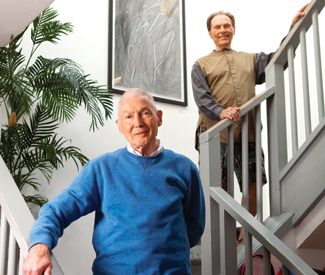
GOLDIES John Cage and Merce Cunningham, Ginger Rogers and Fred Astaire, and Fayard and Harold Nicholas are among the dance world’s most famous couples. In the Bay Area, nobody comes close to the relationship between Frank Shawl and Victor Anderson, of Berkeley’s Shawl-Anderson Dance Center.

Over the years the two men have a created a heaven for dance unlike anything that exists here, and probably could not be replicated anywhere else. Shawl and Anderson are the local dance community’s patriarchs.

They started modestly in 1958, above a liquor store on the corner of Alcatraz and College. After dance careers that spanned both coasts, they moved West from New York because they wanted to teach. Anderson had family roots in Berkeley, and the duo figured they might have a better chance at making a living in the Bay Area than in NYC’s competitive jungle.

Having performed and studied with May O’Donnell, a Martha Graham Dance Company member, they wanted to teach modern dance — at the time, a discipline that was not easily available to local dancers. They called their studio “Shawl-Anderson Modern Dance Center,” still its official name. In the beginning, Shawl remembers, “We did not even make enough money to pay its one-hundred dollar rent.”

From those early beginnings has grown the Bay Area’s oldest and — if you listen to dancers — most-beloved teaching institution, with over 100 classes per week. In addition to a full pre-professional curriculum for children, they teach modern dance; that style’s focus on individuality and personal expression has created an atmosphere that also welcomes ballet, hip-hop, jazz, and Horton, plus physical practices like Feldenkrais, pilates, and yoga.

Most remarkable is the breadth and longevity of its teaching staff, all of whom are on salary. Marina Eglevsky, whose artistic roots go back to the legendary André Eglevsky, considered the greatest ballet dancer of his generation, still teaches ballet twice a week. “Her classes are packed — people come from all over,” Shawl says. Wendy Diamond has taught modern since 1988; Joanna Harris’ decade-long Sunday morning class, “Lifelong Movement,” addresses the needs of older adults.

Younger teachers who are still actively choreographing — like Randee Paufve, Nina Haft, Antoine Hunter, and Nol Simonse — bring their own creative perspectives to the classes. The combination of life-long experiences and fresh approaches is invaluable to student dancers.

To get teachers — some start as substitutes — Shawl relies on his instincts and his experience. “I talk with them, and I can usually tell whether they would be a good fit,” he explains. “Very rarely have we had to let somebody go.”

He remembers Reginald Ray-Savage just walking in a few years ago. “I listened to what he had to say, and I just could tell that he was the real thing.” Today, Shawl-Anderson has the Savage Jazz Dance Company in residence.

But back to the earlier days: when the center was facing eviction from the liquor store (apparently, all that dancing made too much noise), student Sylvia McGraw suggested the two men look at a building across the street. “It was a home,” Shawl remembers. “I walked in and all I saw was a bunch of tiny little rooms.” McGraw pointed out that the house was zoned residential-commercial and, furthermore, that her husband was an architect.

With the budget spent on the essentials, in 1968 the school moved into the reconfigured space, with two small studios on the entry level and two huge ones — beautiful dance floors, lots of light, and high ceilings — one floor up. Shawl’s office is still the size of a closet, and the women’s dressing room still looks like it might originally have been a kitchen.

Most remarkably, the building still feels like a home. Walking up the small pathway from the street and the few steps that invite stoop-sitting, it uncannily feels like the rest of the Arts and Crafts residences that stretch toward the Berkeley hills. The wooden floors in the entry are well-worn, and the bench on the side looks like it has been there forever.

No doubt its funky charm and good usable studios have helped make what Shawl-Anderson has become. But it’s these two remarkable men who have given the place its soul. The minute you walk in, you pick up its sense of generosity of spirit, a commitment to craft and creativity, and a welcoming embrace of diversity in all its manifestations.

It’s what Paufve, whose company now is in residence, experienced when she first stepped through the door in 1986. “I don’t remember not ever having felt at home here,” she says. After moving from New York, she heard about the place the first week she was here. She also found teachers with whom she wanted to work. Over the years, she says, “People here have been incredibly generous. I honestly don’t know if I would still have Paufve Dance if it was not for Shawl-Anderson.”

Fog Beast, one of San Francisco’s newest dance companies (formed by Joe Goode dancers Melecio Estrella and Andrew Ward), recently paid tribute to “the decades of dance art cultivation at Shawl-Anderson.” Move Here, created when the duo was in residence, was a site-specific work using the building’s architectural space. It allowed the choreographers “to step into the role of host, exploring the aesthetics of hospitality, the art of friendliness and warmth.” Shawl enjoyed the performance. “They had pictures of the two of us on the walls — it was so nice,” he smiles.

Both men are now in their 80s. Anderson is semi-retired, but Shawl still takes class every day and substitute teaches when needed. Looking back over more than 50 years, is there something that they would have changed? “It is the way it was [meant] to be,” Shawl says. “I believe in the right path. We didn’t do it for the ego, we did it for love.”

GOLDIES 2012: PianoFight

4

GOLDIES A PianoFight show can be almost as striking for its audience as for what the company puts onstage, even if few audiences will upstage a machine that blows ducks out of people’s butts, per Duck Lake. PianoFight crowds are conspicuously not your typical theatergoers — they’re closer to the boisterous women in office attire I noticed at the now-defunct Off-Market Theater, PianoFight’s old haunt, who had smuggled in a bottle of Chardonnay and were picnicking in a back row like it was Baker Beach. Such eager insouciance is one sign of this young company’s burgeoning success.

“We’re aiming for those people,” says Rob Ready. “We’re aiming our stuff at Giants fans. That’s who we want in the door. Our generation didn’t grow up with theatergoing as a habit.”

“On the contrary,” says Ready’s colleague, Dan Williams. “You grew up with theater as a joke, as a byline for something boring and stuffy. There’s no reason it has to be that.”

Let it be known that PianoFight is doing its part to insure it isn’t. A PianoFight show takes many forms — sketch comedy, original drama, new play festivals, oyster-fuelled theater al fresco, a rotten vegetable barrage, or the fowl comedy-horror-ballet-musical mash-up of 2012’s aforementioned Duck Lake — but it always includes a rambunctious spirit of collusion with an audience who, very often, take some part in the proceedings.

Ready and Williams, two guys whose laid-back nature belies their seriousness and savvy as theatrical entrepreneurs, first met doing theater in their Santa Barbara high school. After Ready got his arts degree at NYU, he moved out to San Francisco specifically to start a theater company with Williams, who was then working a day job downtown. In Ready’s hands was his own script for a play based on NYU’s string of student suicides called Roommate Wanted. With the help of friends and family, they produced a successful two-weekend run in 2007.

From this humble beginning, PianoFight has mushroomed into a multi-faceted, multi-armed organization that includes sketch comedy troupe Mission Control and its female-driven counterpart, Monday Night ForePlays. It regularly sells out shows, boasts a semi-official “flexible” roster of 46 company members (with many more in unofficial orbit around the company), and is building its own bar-theater complex on the site of the old Original Joe’s on Taylor Street.

Along the way, it’s toured the West Coast (twice), scattered a set of new playlets across an oyster bed in Tomales Bay (two years in a row), opened productions simultaneously in SF and LA, taken four company retreats, and generally developed ambitious programs that balk at the usual small-cast, three-weekend production model, while adding fuel to the fire of local playwrights like Tim Bauer, William Bivins (Pulp Scripture, The Position), Jon Brooks, Megan Cohen, Bennett Fisher, Daniel Heath (FORKING!, A Merry FORKING! Christmas), and Lauren Yee, among others.

Ready and Williams credit Matthew Quinn with taking a chance on their inexperienced but fervent selves when the producing artistic director of Combined Art Form Entertainment, who had co-founded Off-Market Theater in 2004, handed them the keys in 2007. PianoFight eventually left Off-Market when the rent rose, but by then it was on a roll, having proved resourceful and inspired in its own venue. When tenants Point Break Live! moved onto a bigger venue, for instance, Ready and Williams filled the gap by inventing “the nation’s largest audience-judged playwriting competition,” the (now long-lived) ShortLived series.

“So glad Point Break Live! dropped out,” muses Williams, “because ShortLived turned out to be an amazing community builder. It really was one of the biggest drivers of our company initially, since we had to get a bunch of actors, a bunch of directors, and a bunch of writers.”

“The R&D wing of the theater business is [made up of] small, scrappy companies,” says Ready. “If it was just us I’d be, ‘All right, we’re just that more awesome,’ but it’s not. There are a lot of people saying theater can be a lot of different things to a lot of different people.”

As for the name PianoFight, apparently there’s no short answer to that question. I was invited to come back some time with a bottle of whiskey and ask again. “Have at least 24 hours,” cautions Williams. “You’ve got to set aside some time, some whiskey … and bring a credit card, too.”

Critics urge caution on fast-moving Warriors arena deal

28

UPDATED The proposal to let the Golden State Warriors build a new sports arena complex at Piers 30-32 is moving forward quickly, with the Board of Supervisors Budget and Finance Committee considering approving its fiscal feasibility tomorrow (Wed/14), the Land Use Committee hearing its design and transportation aspects on Monday, and the full board scheduled to move it forward on Tuesday, two days before Thanksgiving. After that, it will undergo an environmental study and work on myriad fiscal and administrative details, coming back to the board for final approval, probably in the fall, with the goal of opening by the 2017 basketball season.

[UPDATE 11/14: The Finance Committee today voted 3-0 to approve findings of fiscal feasibility for the project after Sup. Jane Kim made amendments delaying the EIR scoping session until January and ensuring the Citizens Advisory Committee will be given more time to review the project and its term sheet. City officials and the Warriors also signed a deal this morning requiring that at least 25 percent of its construction jobs and half of its apprenticeship positions go to local residents or military veterans. We’ll have more details and analysis of what happened in the coming days.]

Critics of the project say it is being rammed through too quickly, with too little public notice or attention to blocking off views of the bay, and on terms that are too costly to city taxpayers. To some, Lee’s quest for a “legacy project” is reminiscent of the groupthink boosterism that characterized the initial America’s Cup proposal, before it was revealed to really be a lucrative waterfront real estate scheme that was great for developers but costly to the public, and later abandoned.

And just like last time, when the Guardian, then-Sup. Chris Daly, Budget Analyst Harvey Rose, and others forced a major scaling back of the developers’ ambitions, there are some prominent voices of caution now being raised about the Warriors arena deal and its potential to fleece city taxpayers, including concerns raised by someone with decades of experience shepherding some of San Francisco’s biggest public works projects.

Rudy Nothenberg, who served as city administrator and other level fiscal advisory roles to six SF mayors and currently serves as president of the city’s Bond Oversight Committee, yesterday wrote a letter to the Board of Supervisors urging it to reject the deal.

Among other things, he criticized the 13 percent interest that city taxpayers would pay on the $120 million in pier restoration work that the Warriors will do. “Quite simply, I would have been ashamed of such a recommendation,” Nothenberg wrote. “In today’s markets it is incomprehensible to have such a stunning recommendation brought to your honorable Board in such haste.”

Project spokesperson PJ Johnston and its main advocate City Hall, Office of Economic and Workforce Development head Jennifer Matz, each disputed Nothenberg’s characterization, citing a report by the project consultants, the Berkeley-based Economic and Planning Systems Inc. (EPS), that 13 percent is a “reasonable and appropriate market based return.”

Matz told us the rate was based on the risky nature of rebuilding the piers, for which the Warriors are responsible for any cost overruns. And she compared the project to the massive redevelopment projects now underway on Treasure Island and Hunters Point, from which the city is guaranteeing powerful developer Lennar returns on investment of 18.5 percent and 20 percent respectively.

Johnston, who was press secretary to former Mayor Willie Brown and worked with Nothenberg on building AT&T Park and other projects, told us “ I have great respect for Rudy.” But then he went on to criticize him for taking a self-interested stand to defend the views from the condo he owns nearby: “They don’t want anything built in their neighborhood. They would rather leave it a dilapidated parking lot.”

But Nothenberg told us his stand is consistent with the work he did throughout his public service career in trying to keep the waterfront open and accessible to the public, rather than blocking those views with a 14-story stadium and surrounding commercial and hotel complex.

“I have a self-interest as a San Franciscan, and after 20 years of doing the right thing, I don’t want to see this rushed through in an arrogant way that would have been unthinkable even a year ago,” Nothenberg told us. “I spent 20 years of my life trying to deal with waterfront issues.”

Among those also sounding the alarm about how quickly this project is moving is land use attorney Sue Hestor and former Mayor Art Agnos, who told us the supervisors should heed the input of Nothenberg and make sure this is a good deal for the city.

Agnos said, “Rudy Nothenberg stands apart from every other department head and CAO in the modern history of San Francisco for his financial and managerial expertise in bringing major projects with complex finances to completion that worked for our City. That is why the past six mayors…whether conservative or liberal…trusted him to advise them and administer the biggest projects in this city from Moscone Convention Center to the new main library to the Giants baseball park and Mission Bay. “

Legislative Analyst Harvey Rose released his initial analysis of the project on Friday. The $120 million plus interest that the city is paying to the Warriors would be partially offset by the $30 million the team would pay for Seawall Lot 330, a one-time payment of $53.8 million (mostly in development impact fees), annual rent of nearly $2 million on its 66-year lease of Piers 30-32, and annual tax and mitigation payments to the city of between $9.8 million and $19 million.

But the report also notes that many city departments and agencies – including the Department of Public Works, Municipal Transportation Agency, and the Police Department – have yet to estimate their costs. Both Johnston and Matz emphasized Rose’s conclusion that the project is “fiscally feasible” – the determination that supervisors will have to agree with to move the project forward – but the report also noted “the finding of ‘fiscal feasibility’ means only that the project merits further evaluation of environmental review.”

The full text of Nothenberg’s letter follows:

Dear Supervisors:

My experience as a high level financial advisor and city administrator for Mayors Moscone, Feinstein, Agnos, Jordan, Brown, and Newsom, and current President of the City’s Bond Oversight Committee cause me to write in the hope that you will reject the outrageous 13% interest rate that the developers of the waterfront arena are proposing to charge the City for their cost of replacing Piers 30/32. 

In my years as General Manager of Public Utilities, the Municipal Railway System, Water and Hetch Hetchy, and later as the Chief Administrative Officer for the City and County of San Francisco, I took probably more that a billion dollars worth of various debt instruments to the Board. 

Never…even in the worst days of highest modern era interest rates of the 1970’s hovering at 20% …never did I ever bring a 13% City borrowing to the Mayor and the Board of Supervisors for approval.  Quite simply, I would have been ashamed of such a recommendation.

In today’s markets it is incomprehensible to have such a stunning recommendation brought to your honorable Board in such haste. 

Even more remarkable is the fact that just weeks ago, Allentown, Pennsylvania has just procured a 4.78 % interest rate for $224.4 million of taxable bonds to help build with private contributions a hockey arena for 8500 seats. 

Yet, you are being told the best our city can do is 13% for $120 million.

No Board of Supervisors I ever appeared before would tolerate such dramatic discrepancy.

It is with this in mind, I would most respectfully urge you to send this proposed deal back to the developers, instructing the City’s negotiators not to bring it back without a far more favorable interest rate for City tax payers not to exceed a maximum of 7.5%.

And that would still be almost twice what the City would need to pay for City issued debt and more than amply compensate the developers for any risk premium that they allege that they are taking. 

Any such instruction from you to the City negotiators should also make it clear that they are not to make any new concessions to the developers in exchange for achieving a still high, but eminently more reasonable interest rate.

Thank you for your attention.

Rudy Nothenberg

Chief Administrative Officer (Ret.)

Documentation:

1.     The Warriors Arena negotiates 13% interest on $120 million from San Francisco when the City of Allentown in Pennsylvania just issued $224.4 million of taxable bonds for an arena at an average interest rate of 4.78%. 

13% for SF versus 4.78%  for Allentown

 http://www.allentownpa.gov/Home/AllentownCityNews/tabid/142/xmmid/636/xmid/2000/xmview/2/Default.aspx

City of Allentown – PA – Official Site

www.allentownpa.gov

The official website for the City of Allentown, PA. Learn about all the exciting events going on in the city of Allentown, from music, arts, theater, and sports. Allentown is the largest city in the 

2.     Allentown hockey arena bonds cost $4.2 million to issue 

www.lehighvalleylive.com/allentown/…/allentown_hockey_ar

Oct 10, 2012 – About $224.4 million in municipal bonds were sold last week to help finance arena construction. City officials say the issuance costs are about 


Presidents, secret agents, and true stories galore: new movies!

0

The election is over and, thank Zeus, good defeated evil. So you can stop making snarky Romney gifs and turn your attentions to more important matters — like seeing Lincoln (yeah, he was a Republican, but as Spielberg’s movie makes abundantly clear, Democrats were actually the bigger assholes back in the day). Or, you could see what ol’ James Bond is up to in his 4785th film, Skyfall (just kidding — it’s his 23rd, so Godzilla still has him beat). Reviews for both below the jump.

Elsewhere, DocFest opens tonight and runs through Nov. 21; check out my take on this year’s programming (spoiler alert: lots o’ good stuff) here; and read Dennis Harvey’s review of a very strange movie starring a very strangely coiffed Sean Penn, This Must Be the Place.

And … as if that would be everything going on in San Francisco’s film scene this week? Are you new in town? There’s also the San Francisco Film Society’s local showcase Cinema By the Bay (my overview here) and New Italian Cinema programs; the always-popular (and now 10th annual!) San Francisco Transgender Film Festival; and Marc Huestis’ multi-film tribute to the late, great Natalie Wood at the Castro.

PLUS more short takes, including the good word on Ursula Meier’s acclaimed Sister, below.

Dangerous Liaisons John Malkovich and Sarah Michelle Gellar may have already starred in pop culture’s favorite adaptations of this classic French novel, but since pretty people scheming never gets old, here’s a Chinese take on Les Liaisons dangereuses, complete with big-name cast and all the visual allure of 1930s Shanghai. “You are such a cad!” a woman shrieks at Xie Yifan (Jang Dong-gun) in the first scene, and indeed he is — though his heart belongs to “Miss Mo” (Cecilia Cheung). The malicious wager (if you seduce her and then horribly dump her, I’ll let you sleep with me … plus: incidental affairs along the way) is struck and things proceed on schedule, until Yifan finds himself actually falling for virtuous widow Fenyu (Zhang Ziyi). You know how it ends. Gorgeous costumes and mise-en-scène add visual interest to the familiar story, which also adds a little political flair in the form of Chinese students protesting the early days of Japanese occupation. (1:45) (Cheryl Eddy)

The Details One of the hardest hurdles to clear in watching Jacob Aaron Estes’s The Details might be the sight of Tobey Maguire, erstwhile boy-man and Spider-Man, inelegantly proposing to Elizabeth Banks (playing his character’s wife) that they put their small child to bed and F-U-C-K. On paper, or perhaps under the right mood lighting, that could work, but it’s not a sexy sight here, and it’s almost a relief when she turns him down. Far less appetizing intimacies lie ahead, though, as Maguire’s gynecologist and family man Jeffrey Lang triggers a sticky, unsalutary domino effect involving marauding raccoons, marital infidelity, enabling friends (Kerry Washington), unstable neighbors (Laura Linney), planning codes, pesticides, and kidney disease. Like Estes’s 2004 film Mean Creek, which he also wrote and directed, The Details shows us what can happen when baser human impulses meet unforeseen circumstances. There, it was children making painfully bad decisions. Here, we squeamishly watch Lang get caught, but the drama has a glossy, dark-comedy finish to it that prevents us from suffering too much as we witness his domestic life imploding. Dennis Haysbert plays a pickup basketball buddy/better human being drawn inexorably into the mess our protagonist has made; Ray Liotta, a husband made irate by Lang’s misjudgments. (1:31) (Lynn Rapoport)

Lincoln Distinguished subject matter and an A+ production team (Steven Spielberg directing, Daniel Day-Lewis starring, Tony Kushner adapting Doris Kearns Goodwin, John Williams scoring every emotion juuust so) mean Lincoln delivers about what you’d expect: a compelling (if verbose), emotionally resonant (and somehow suspenseful) dramatization of President Lincoln’s push to get the 13th amendment passed before the start of his second term. America’s neck-deep in the Civil War, and Congress, though now without Southern representation, is profoundly divided on the issue of abolition. Spielberg recreates 1865 Washington as a vibrant, exciting place, albeit one filled with so many recognizable stars it’s almost distracting wondering who’ll pop up in the next scene: Jared Harris as Ulysses S. Grant! Joseph Gordon-Levitt as Robert Lincoln! Lena Dunham’s shirtless boyfriend on Girls (Adam Driver) as a soldier! Most notable among the huge cast are John Hawkes, Tim Blake Nelson, and a daffy James Spader as a trio of lobbyists; Sally Field as the troubled First Lady; and likely Oscar contenders Tommy Lee Jones (as winningly cranky Rep. Thaddeus Stevens) and Day-Lewis, who does a reliably great job of disappearing into his iconic role. (2:30) (Cheryl Eddy)

Sister Twelve-year-old Simon (Kacey Mottet Klein) looks like any other kid vacationing with a family on the slopes of a Swiss ski resort. That’s a big plus, because he’s not one of them — he’s a local living “downhill” in an anonymous high-rise apartment block, sustaining himself and his pretty but irresponsible older sister Louise (Léa Seydoux) by stealing expensive sports equipment and clothes from the oblivious guests. He has no guilt about what he does, but then why should he? Those people are rich, he’s not, and sis’ short attention span toward jobs and boyfriends isn’t going to pay the rent. Ursula Meier’s French-language second feature isn’t heavily plot-driven, though it doesn’t feel like a second is wasted. The casual, somewhat furtive relationships that develop between Simon and stray adults who glean enough to worry about him — a seasonal restaurant worker (Martin Compston), a maternal resort guest (Gillian Anderson), Louise’s better-than-usual new beau (Yann Tregouet) — come and go but are toeholds on stability for him. It’s the contrast between Simon’s aggressively take-charge premature adulthood and his unaddressed needs as a child that ultimately make Sister rather devastating. It’s been aptly compared to the Dardenne Brothers’ similar dramas, but Meier lets her film’s heart beat a little more in open empathy with its protagonist while aping those Belgians’ brisk surface objectivity. (1:37) (Dennis Harvey)

Skyfall Top marks to Adele, who delivers a magnificent title song to cap off Skyfall‘s thrilling pre-credits chase scene. Unfortunate, then, that the film that follows squanders its initial promise. After a bomb attack on MI6, the clock is running out for Bond (Daniel Craig) and M (Judi Dench), accused of Cold War irrelevancy in a 21st century full of malevolent, stateless computer hackers. The audience, too, will yearn for a return to simpler times; dialogue about “firewalls” and “obfuscated code” never fails to sound faintly ridiculous, despite the efforts Ben Whishaw as the youthful new head of Q branch. Javier Bardem is creative and creepy as keyboard-tapping villain Raoul Silva, but would have done better with a megalomaniac scheme to take over the world. Instead, a small-potatoes revenge plot limps to a dull conclusion in the middle of nowhere. Skyfall never decides whether it prefers action, bon mots, and in-jokes to ponderous mythologizing and ripped-from-the-headlines speechifying – the result is a unsatisfying, uneven mixture. (2:23) (Ben Richardson)

D5 race displays key SF political dynamics

70

There’s so much to say about the District 5 supervisorial race, whose top five finishers’ parties I attended tonight, gathering interesting perspectives from each candidate. But given the late hour, I’m just going to run a few thoughts and quotes and save most of it for a more in-depth report tomorrow, because there’s a fascinating story to be told here.

Christina Olague, John Rizzo, and Julian Davis – respectively the second through fourth place candidates – each presented as more progressive than the likely winner, London Breed, who has an 8-point lead going into the final ballot tally and ranked choice tabulation. They and their allies raised concerns that renters were undermined by Breed’s victory in one of the city’s most progressive districts.

“It was a lie. I’m a renter, I live in a rent-controlled apartment,” she told us just before midnight outside in party at Nickie’s on Haight. “I will do everything to protect rent control. I will work with the Tenants’ Union. I’m here to be everybody’s supervisor.”

She pledged to work productively with all the progressive groups who opposed her, such at SEIU Local 1021, whose members “ take care of my mom at Laguna Honda,” while others are her friends.

“The pettiness of politics is over and it’s time to move forward,” Breed said.

It was a widely sounded theme among jubilant progressives tonight, but D5’s (likely) runner-up Olague sounded a bit of bitterness when we caught up with her a little after 11pm as she was leaving her party at Rassela’s on Fillmore. “The Left and the Right both came at me,” she told us.

She felt unfairly attacked by progressives after being appointed to the D5 seat by Mayor Ed Lee, saying her only bad vote was in favor of the 8 Washington luxury condo project, which Sup. Eric Mar also backed without losing progressive support. “From the beginning, people were hypercritical of me in ways that might not be completely fair.”

Then, this fall, Mayor Lee’s people – chief of staff Steve Kawa, tech point person Tony Winnicker, and billionaire backer Ron Conway – turned on her after a series of votes culminating in the one to reinstate Sheriff Ross Mirkarimi, resisting what she labeled “a power play” aimed at progressives.

Yet she believes her key vote in favor of CleanPowerSF, coming after her support for Sup. John Avalos getting new revenue out of the business tax reform Prop. E, was really what turned Conway and the downtown crowd against her and attracted outrageous attacks that she condoned domestic violence and supported Big Oil.

“They don’t want to say it, but it was the whole thing around CleanPowerSF. Do you think PG&E wanted to lose its monopoly?” she said. “It’s not about disloyalty, it’s about power.”

Julian Davis was similarly deflective about his campaign’s fourth place finish, despite having a strong presence on the streets today and lots of energy at his crowded campaign party at Club Waziema, after he weathered a loss of prominent progressive endorsements over his handling of sexual misconduct allegations.

“It’s been a challenging few weeks, but I’ve kept my head held high in this campaign,” Davis said, decrying the “self-fulfilling prophecy of the local media” that didn’t focus on the progressive endorsers who stayed with him, such as former D5 Sup. Matt Gonzalez and the SF Tenants Union.

Third place finisher John Rizzo, whose party at Murio’s Trophy Room party reflected his less-than-exuberant campaign, was generally positive about the night, although he expressed some concerns about the agenda of the “people putting up hundreds of thousands of dollars” into this race and the D1 contest, where progressive favorite Eric Mar won a strong victory.

I stopped by Breed’s party twice tonight: at the end, and a little before 10pm, when the results were coming over the television proclaiming that voters in Maryland approved same-sex marriage and Colorado voter legalized marijuana – and the room erupted in cheers – and Oregon voters rejected legalizing weed, drawing big boos.

Breed’s was a liberal crowd, a D5 crowd, and a largely African American crowd. Rev. Arnold Townsend, who is on the Elections Commission and local NAACP board, told me as I left Breed’s party the second time, “It’s a good election for my community. The black community was energized by this.”

New school board member Matt Haney, whose party at Brick & Mortar was my final stop of the night, also likes Breed and said her likely victory was another part of “a good night for progressive San Francisco,” which stands for important egalitarian values. “We are the ones about equity and compassion. That’s what this city is about.”

Mar jubilant at early returns

5

The first precinct reports are coming in — just a few — and they share Sup. Eric Mar holding and even expanding his lead in District 1. Too early to call it, but Mar is jubilant and so are his supporters. Joe Fitzgerald send this report:

If there was a loud and clear message from the Eric Mar supporters at his election party, it was that realtors and rent-control opponents can’t keep a good progressive down.

“We’re going to kick their ass,” said Mar. “We’re going to show that the anti-rent control, realtors and big business people downtown can’t do this again.”

Mar was talking about the barrage of hit mailers that have attacked him relentlessly in the past few weeks.

The residents themselves were fed up with it.

“I like to use two bags to recycle all this shit,” Brian Hudgins, a novelist from the neighborhood told us. He was amazed by how Lee, an obvious moderate, targeted his liberal, progressive apartment complex.

“The mailers turned people off,” Mar said.

Norman Ten is an ardent Mar supporter. Wearing his blue “Eric Mar for Supervisor” shirt, he said that as a scientist, he looks at the facts when he votes.

“That David Lee guy had offices and headquarters over on Post street. Now that’s not even in the Richmond, now is it?” he said.

Chris Daly, the fiery progressive ex-supervisor even made an appearance at Mar’s party. He saw this election as a particularly blatant attack on progressives.

“Its just like my 2006 race,” he said. “But when progressive San Francisco is united, we win.”

Film Listings

0

Film listings are edited by Cheryl Eddy. Reviewers are Kimberly Chun, Dennis Harvey, Lynn Rapoport, and Sara Vizcarrondo. For rep house showtimes, see Rep Clock.

DOCFEST

The 11th San Francisco Documentary Film Festival runs Nov 8-21 at the Brava Theater, 2781 24th St, SF; Roxie, 3117 16th St, SF; and Shattuck Cinema, 2230 Shattuck, SF. Tickets (most films $10-12) and complete schedule at www.sfindie.com.

OPENING

Dangerous Liaisons John Malkovich and Sarah Michelle Gellar may have already starred in pop culture’s favorite adaptations of this classic French novel, but since pretty people scheming never gets old, here’s a Chinese take on Les Liaisons dangereuses, complete with big-name cast and all the visual allure of 1930s Shanghai. "You are such a cad!" a woman shrieks at Xie Yifan (Jang Dong-gun) in the first scene, and indeed he is — though his heart belongs to "Miss Mo" (Cecilia Cheung). The malicious wager (if you seduce her and then horribly dump her, I’ll let you sleep with me … plus: incidental affairs along the way) is struck and things proceed on schedule, until Yifan finds himself actually falling for virtuous widow Fenyu (Zhang Ziyi). You know how it ends. Gorgeous costumes and mise-en-scène add visual interest to the familiar story, which also adds a little political flair in the form of Chinese students protesting the early days of Japanese occupation. (1:45) Metreon. (Eddy)

The Details One of the hardest hurdles to clear in watching Jacob Aaron Estes’s The Details might be the sight of Tobey Maguire, erstwhile boy-man and Spider-Man, inelegantly proposing to Elizabeth Banks (playing his character’s wife) that they put their small child to bed and F-U-C-K. On paper, or perhaps under the right mood lighting, that could work, but it’s not a sexy sight here, and it’s almost a relief when she turns him down. Far less appetizing intimacies lie ahead, though, as Maguire’s gynecologist and family man Jeffrey Lang triggers a sticky, unsalutary domino effect involving marauding raccoons, marital infidelity, enabling friends (Kerry Washington), unstable neighbors (Laura Linney), planning codes, pesticides, and kidney disease. Like Estes’s 2004 film Mean Creek, which he also wrote and directed, The Details shows us what can happen when baser human impulses meet unforeseen circumstances. There, it was children making painfully bad decisions. Here, we squeamishly watch Lang get caught, but the drama has a glossy, dark-comedy finish to it that prevents us from suffering too much as we witness his domestic life imploding. Dennis Haysbert plays a pickup basketball buddy/better human being drawn inexorably into the mess our protagonist has made; Ray Liotta, a husband made irate by Lang’s misjudgments. (1:31) (Rapoport)

Lincoln No vampires in this one. (2:30)

Sister Twelve-year-old Simon (Kacey Mottet Klein) looks like any other kid vacationing with a family on the slopes of a Swiss ski resort. That’s a big plus, because he’s not one of them — he’s a local living "downhill" in an anonymous high-rise apartment block, sustaining himself and his pretty but irresponsible older sister Louise (Léa Seydoux) by stealing expensive sports equipment and clothes from the oblivious guests. He has no guilt about what he does, but then why should he? Those people are rich, he’s not, and sis’ short attention span toward jobs and boyfriends isn’t going to pay the rent. Ursula Meier’s French-language second feature isn’t heavily plot-driven, though it doesn’t feel like a second is wasted. The casual, somewhat furtive relationships that develop between Simon and stray adults who glean enough to worry about him — a seasonal restaurant worker (Martin Compston), a maternal resort guest (Gillian Anderson), Louise’s better-than-usual new beau (Yann Tregouet) — come and go but are toeholds on stability for him. It’s the contrast between Simon’s aggressively take-charge premature adulthood and his unaddressed needs as a child that ultimately make Sister rather devastating. It’s been aptly compared to the Dardenne Brothers’ similar dramas, but Meier lets her film’s heart beat a little more in open empathy with its protagonist while aping those Belgians’ brisk surface objectivity. (1:37) Clay, Smith Rafael. (Harvey)

Skyfall Bond is back! (2:23) California, Four Star, Marina, Shattuck.

This Must Be the Place See "Goth-hmm City." (1:58) Bridge, Shattuck.

ONGOING

Argo If you didn’t know the particulars of the 1979 Iranian Revolution, you won’t be an expert after Argo, but the film does a good job of capturing America’s fearful reaction to the events that followed it — particularly the hostage crisis at the US embassy in Tehran. Argo zeroes in on the fate of six embassy staffers who managed to escape the building and flee to the home of the sympathetic Canadian ambassador (Victor Garber). Back in Washington, short-tempered CIA agents (including a top-notch Bryan Cranston) cast about for ways to rescue them. Enter Tony Mendez (Ben Affleck, who also directs), exfil specialist and father to a youngster wrapped up in the era’s sci-fi craze. While watching 1973’s Battle for the Planet of the Apes, Tony comes up with what Cranston’s character calls "the best bad idea we have:" the CIA will fund a phony Canadian movie production (corny, intergalactic, and titled Argo) and pretend the six are part of the crew, visiting Iran for a few days on a location shoot. Tony will sneak in, deliver the necessary fake-ID documents, and escort them out. Neither his superiors, nor the six in hiding, have much faith in the idea. ("Is this the part where we say, ‘It’s so crazy it just might work?’" someone asks, beating the cliché to the punch.) Argo never lets you forget that lives are at stake; every painstakingly forged form, every bluff past a checkpoint official increases the anxiety (to the point of being laid on a bit thick by the end). But though Affleck builds the needed suspense with gusto, Argo comes alive in its Hollywood scenes. As the show-biz veterans who mull over Tony’s plan with a mix of Tinseltown cynicism and patiotic duty, John Goodman and Alan Arkin practically burst with in-joke brio. I could have watched an entire movie just about those two. (2:00) Four Star, Marina, 1000 Van Ness, Presidio, SF Center, Sundance Kabuki. (Eddy)

The Bay Top-quality (i.e., realistically repulsive) special effects highlight this otherwise unremarkable disaster movie that’s yet another "found footage" concoction, albeit maybe the first one from an Oscar-winning director. But it’s been a long time since 1988’s Rain Man, and the Baltimore-adjacent setting is the only Barry Levinson signature you’ll find here. Instead, parasites-gnaw-apart-a-coastal-town drama The Bay — positioned as a collection of suppressed material coming to light on "Govleaks.org" — is a relentlessly familiar affair, further hampered by a narrator (Kether Donohue) with a supremely grating voice. Rising star Christopher Denham (Argo) has a small part as an oceanographer whose warnings about the impending waterborne catastrophe are brushed aside by a mayor who is (spoiler alert!) more concerned with tourist dollars than safety. (1:25) Sundance Kabuki. (Eddy)

Chasing Mavericks Sidestepping the potential surf-porn impact of influential docs like The Endless Summer (1966) and Step Into Liquid (2003), Chasing Mavericks directors Curtis Hanson and Michael Apted instead focus on the coming-of-age back story of Santa Cruz surf legend Jay Moriarity, who landed on the cover of Surfer magazine at the very unripe age of 16 while attempting the way-challenging waves at Half Moon Bay’s Mavericks. How did the teenager manage to tackle the mythically massive, highly dangerous 25- to 80-plus-foot waves that have killed far more seasoned surfers? It all started at an early age, a starting point that’s perhaps a nod to Apted’s lifetime-spanning Up documentaries, as Moriarity (Jonny Weston) learned to gauge the size of the waves on his own and grew up idolizing neighbor and surfing kahuna Frosty Hesson (Gerard Butler). After tailing Hesson on a Mavericks surfing jaunt, Moriarity becomes enthralled with the idea of tackling those killer waves — an obsession that could kill the kid, Hesson realizes with the help of his wife Brenda (Abigail Spencer). So the elder puts him through a makeshift big-wave rider academy, developing him physically by having the teen, say, paddle from SC to Monterey and mentally by putting him through a series of discipline-building challenges. The result is a riptide of inspiration that even Moriarity’s damaged mom (Elisabeth Shue) can appreciate, that is if the directors hadn’t succumbed to an all-too-predictable story arc, complete with random bullying and an on-again-off-again love interest (Leven Rambin), plus the depthless performance of a too-cute, cherubic Weston. Too bad Butler, who tasted the ocean’s wrath when he got injured during the production, aged out of the Moriarity role: he brings the fire — and the fury that fuels a drive to do the physically unthinkable — that would have given Moriarity’s story new life. (1:45) Metreon, 1000 Van Ness. (Chun)

Cloud Atlas Cramming the six busy storylines of David Mitchell’s wildly ambitious novel into just three hours — the average reader might have thought at least 12 would be required — this impressive adaptation directed (in separate parts) by Tom Twyker (1998’s Run Lola Run) and Matrix siblings Lana and Andy Wachowski has a whole lot of narrative to get through, stretching around the globe and over centuries. In the mid 19th century, Jim Sturgess’ sickly American notory endures a long sea voyage as reluctant protector of a runaway-slave stowaway from the Chatham Islands (David Gyasi). In 1931 Belgium, a talented but criminally minded British musician (Ben Whishaw) wheedles his way into the household of a famous but long-inactive composer (Jim Broadbent). A chance encounter sets 1970s San Francisco journalist Luisa (Halle Berry) on the path of a massive cover-up conspiracy, swiftly putting her life in danger. Circa now, a reprobate London publisher’s (Broadbent) huge windfall turns into bad luck that gets even worse when he seeks help from his brother (Hugh Grant). In the not-so-distant future, a disposable "fabricant" server to the "consumer" classes (Doona Bae) finds herself plucked from her cog-like life for a rebellious higher purpose. Finally, in an indeterminately distant future after "the Fall," an island tribesman (Tom Hanks) forms a highly ambivalent relationship toward a visitor (Berry) from a more advanced but dying civilization. Mitchell’s book was divided into huge novella-sized blocks, with each thread split in two; the film wastes very little time establishing its individual stories before beginning to rapidly intercut between them. That may result in a sense of information (and eventually action) overload, particularly for non-readers, even as it clarifies the connective tissues running throughout. Compression robs some episodes of the cumulative impact they had on the page; the starry multicasting (which in addition to the above mentioned finds many uses for Hugo Weaving, Keith David, James D’Arcy, and Susan Sarandon) can be a distraction; and there’s too much uplift forced on the six tales’ summation. Simply put, not everything here works; like the very different Watchmen, this is a rather brilliant "impossible adaptation" screenplay (by the directors) than nonetheless can’t help but be a bit too much. But so much does work — in alternating currents of satire, melodrama, pulp thriller, dystopian sci-fi, adventure, and so on — that Cloud Atlas must be forgiven for being imperfect. If it were perfect, it couldn’t possibly sprawl as imaginatively and challengingly as it does, and as mainstream movies very seldom do. (2:52) California, 1000 Van Ness, Presidio, SF Center, Sundance Kabuki. (Harvey)

The Dark Knight Rises Early reviews that called out The Dark Knight Rises‘ flaws were greeted with the kind of vicious rage that only anonymous internet commentators can dish out. And maybe this is yet another critic-proof movie, albeit not one based on a best-selling YA book series. Of course, it is based on a comic book, though Christopher Nolan’s sophisticated filmmaking and Christian Bale’s tortured lead performance tend to make that easy to forget. In this third and "final" installment in Nolan’s trilogy, Bruce Wayne has gone into seclusion, skulking around his mansion and bemoaning his broken body and shattered reputation. He’s lured back into the Batcave after a series of unfortunate events, during which The Dark Knight Rises takes some jabs at contemporary class warfare (with problematic mixed results), introduces a villain with pecs of steel and an at-times distractingly muffled voice (Tom Hardy), and unveils a potentially dangerous device that produces sustainable energy (paging Tony Stark). Make no mistake: this is an exciting, appropriately moody conclusion to a superior superhero series, with some nice turns by supporting players Gary Oldman and Joseph Gordon-Levitt. But in trying to cram in so many characters and plot threads and themes (so many prisons in this thing, literal and figural), The Dark Knight Rises is ultimately done in by its sprawl. Without a focal point — like Heath Ledger’s menacing, iconic Joker in 2008’s The Dark Knight — the stakes aren’t as high, and the end result feels more like a superior summer blockbuster than one for the ages. (2:44) Metreon. (Eddy)

Diana Vreeland: The Eye Has to Travel The life of legendary fashion editor Diana Vreeland is colorfully recounted in Diana Vreeland: The Eye Has to Travel, a doc directed by her granddaughter-in-law, Lisa Immordino Vreeland. The family connection meant seemingly unlimited access to material featuring the unconventionally glamorous (and highly quotable) Vreeland herself, plus the striking images that remain from her work at Harper’s Bazaar, Vogue, and the Costume Institute of the Metropolitan Museum of Art. "Narrated" from interview transcripts by an actor approximating the late Vreeland’s husky, posh tones, the film allows for some criticism (her employees often trembled at the sight of her; her sons felt neglected; her grasp of historical accuracy while working at the museum was sometimes lacking) among the praise, which is lavish and delivered by A-listers like Anjelica Huston, who remembers "She had a taste for the extraordinary and the extreme," and Manolo Blahnik, who squeals, "She had the vision!" (1:26) Opera Plaza. (Eddy)

The Flat Arnon Goldfinger’s The Flat begins as the filmmaker’s family descends upon the Tel Aviv apartment of his recently-deceased grandmother, "a bit of a hoarder" who lived to 95 and seemingly never got rid of anything. This includes, as Goldfinger discovers, copies of the Joseph Goebbels-founded newspaper Der Angriff, containing articles about "the Nazi who visited Palestine." The Nazi was Leopold von Mildenstein, an SS officer with an interest in Zionism. Turns out he made the journey in 1933 with his wife and a Jewish couple named Kurt and Gerda Tuchler — Goldfinger’s grandparents. Understandably intrigued and more than a little baffled, Goldfinger investigates, finding letters and diary entries that reveal the unlikely traveling companions were close friends, even after World War II. His mother, the Tuchler’s daughter, prefers to "keep the past out," but curiosity (and the pursuit of a good documentary) presses Goldfinger forward; he visits von Mildenstein’s elderly daughter in Germany, digs through German archives, and unearths even more suprises about his family tree. Broader themes about guilt and denial emerge — post-traumatic coping mechanisms that echo through generations.

(1:37) Albany, Embarcadero. (Eddy)

Flight To twist the words of one troubled balladeer, he believes he can fly, he believes he can touch the sky. Unfortunately for Denzel Washington’s Whip Whitaker, another less savory connotation applies: his semi-sketchy airline captain is sailing on the overconfidence that comes with billowing clouds of blow. Beware the quickie TV spot — and Washington’s heroic stance in the poster — that plays this as a quasi-action flick: Flight is really about a man’s efforts to escape responsibility and his flight from facing his own addiction. It also sees Washington once again doing what he does so well: wrestling with the demons of a charismatic yet deeply flawed protagonist. We come upon Whip as he’s rousing himself from yet another bender, balancing himself out with a couple lines with a gorgeous, enabling flight attendant by his side. It’s a checks-and-balances routine we’re led to believe is business as usual, as he slides confidently into the cockpit, gives the passengers a good scare by charging through turbulence, and proceeds to doze off. The plane, however, goes into fail mode and forces the pilot to improvise brilliantly and kick into hero mode, though he can’t fly from his cover, which is slowly blown despite the ministrations of kindred addict Nicole (Kelly Reilly) and dealer Harling (John Goodman at his most ebullient) and the defensive moves of his pilots union cohort (Bruce Greenwood) and the airline’s lawyer (Don Cheadle). How can Whip fly out of the particular jam called his life? Working with what he’s given, Washington summons reserves of humanity, though he’s ultimately failed by John Gatins’ sanctimonious, recovery-by-the-numbers script and the tendency of seasoned director Robert Zemeckis to blithely skip over the personal history and background details that would have more completely filled out our picture of Whip. We’re left grasping for the highs, waiting for the instances that Harling sails into view and Whip tumbles off the wagon. (2:18) 1000 Van Ness, Presidio, SF Center, Sundance Kabuki. (Chun)

Frankenweenie Tim Burton’s feature-length Frankenweenie expands his 1984 short of the same name (canned by Disney back in the day for being too scary), and is the first black and white film to receive the 3D IMAX treatment. A stop-motion homage to every monster movie Burton ever loved, Frankenweenie is also a revival of the Frankenstein story cute-ified for kids; it takes the showy elements of Mary Shelley’s novel and morphs them to fit Burton’s hyperbolic aesthetic. Elementary-school science wiz Victor takes his disinterred dog from bull terrier to gentle abomination (when the thirsty Sparky drinks, he shoots water out of the seams holding his body parts together). Victor’s competitor in the school science fair, Edgar E. Gore, finds out about Sparky and ropes in classmates to scrape up their dead pets from the town’s eerily utilized pet cemetery and harness the town’s lightning surplus. The film’s answer to Boris Karloff (lisp intact) resurrects a mummified hamster, while a surrogate for Japanese Godzilla maker Ishiro Honda, revives his pet turtle Shelley (get it?) into Gamera. As these experiments aren’t borne of love, they don’t go as well at Victor’s. If you love Burton, Frankenweenie feels like the at-last presentation of a story he’s been dying to tell for years. If you don’t love him, you might wonder why it took him so long to get it out. When Victor’s science teacher leaves the school, he tells Victor an experiment conducted without love is different from one conducted with it: love, he implies, is a variable. If that’s the variable that separates 2003’s Big Fish (heartbreaking) from 2010’s Alice In Wonderland (atrocious), it’s a large one indeed. The love was there for 29 minutes in 1984, but I can’t say it endures when stretched to 87 minutes 22 years later. (1:27) Metreon. (Vizcarrondo)

Fun Size (1:45) Metreon, 1000 Van Ness.

Here Comes the Boom The makers of September’s Won’t Back Down might quibble with this statement, but the rest of us can probably agree that nothing (with the possible exception of Trapper Keepers) says "back to school" like competitive steel-cage mixed martial arts — particularly if the proceeds from the matches go toward saving extracurriculars at a down-at-the-heels public high school. Kevin James plays Scott Voss, a 42-year-old biology teacher at the aforementioned school, whose lack of vocational enthusiasm is manifested by poor attendance and classroom observations about how none of what the students are learning matters. He’s jolted from this criminally subpar performance of his academic duties, however, when budget cuts threaten the school’s arts programs, including the job of an earnest and enthusiastic music teacher (Henry Winkler) whose dedication Scott lazily admires. It seems less than inevitable that this state of affairs would lead to Scott’s donning his college wrestling singlet and trundling into the ring to get pummeled and mauled for cash, but it seems to work better than a bake sale. Less effective and equally unconvincing are Scott’s whiplash arc from bad apple to teacher-of-the-year; a percolating romance between him and the school nurse, played by Salma Hayek; and the script’s tortuous parade of rousing statements celebrating the power of the human spirit, seemingly cribbed from a page-a-day calendar of inspirational quotes. (1:45) SF Center. (Rapoport)

Hotel Transylvania (1:32) Metreon.

A Late Quartet Philip Seymour Hoffman is fed up playing second fiddle — literally. He stars in this grown-up soap opera about the internal dramas of a world-class string quartet. While the group is preparing for its 25th season, the eldest member (Christopher Walken) is diagnosed with early stage Parkinson’s. As he’s the base note in the quartet, his retirement challenges the group’s future, not just his own. Hoffman’s second violinist sees the transition as an opportunity to challenge the first violin (Mark Ivanir) for an occasional Alpha role. When his wife, the quartet’s viola player (Catherine Keener), disagrees, it’s a slight ("You think I’m not good enough?") and a betrayal because prior to their marriage, viola and first violin would "duet" if you get my meaning. This becomes a grody aside when Hoffman and Keener’s violin prodigy daughter (Imogen Poots) falls for her mother’s old beau and Hoffman challenges their marriage with a flamenco dancer. These quiet people finds ways to use some loud instruments (a flamenco dancer, really?) and the music as well as the views of Manhattan create a deeply settled feeling of comfort in the cold —insulation can be a dangerous thing. When we see (real world) cellist Nina Lee play, and her full body interacts with a drama as big as vaudeville, we see what tension was left out of the playing and forced into the incestuous "family" conflicts. In A Late Quartet, pleasures are great and atmosphere, heavy. You couldn’t find a better advertisement for this symphonic season; I wanted to buy tickets immediately. And also vowed to stay away from musicians. (1:45) Albany, Embarcadero, Smith Rafael. (Vizcarrondo)

A Liar’s Autobiography: The Untrue Story of Monty Python’s Graham Chapman Blessed with recordings made by Monty Python member Graham Chapman (King Arthur in 1975’s Monty Python and the Holy Grail; Brian in 1979’s Life of Brian) before his death in 1989 from cancer, filmmakers Bill Jones, Jeff Simpson, and Ben Timlett recruited 14 different animation studios to piece together Chapman’s darkly humorous (and often just plain dark) life story. He was gay, he was an alcoholic, he co-wrote (with John Cleese) the legendary "Dead Parrot Sketch." A Liar’s Autobiography starts slowly — even with fellow Monty Python members Cleese, Terry Jones, Terry Gilliam, and Michael Palin lending their voices, much of the bone-dry humor falls disappointingly flat. "This is not a Monty Python film," the filmmakers insist, and viewers hoping for such will be disappointed. Stick with it, though, and the film eventually finds its footing as an offbeat biopic, with the pick-a-mix animation gimmick at its most effective when illustrating Chapman’s booze-fueled hallucinations. (1:22) Smith Rafael. (Eddy)

The Loneliest Planet Travel broadens, they say — and has a way of foregrounding anxiety and desire. So the little tells take on a larger, much more loaded significance in The Loneliest Planet when contextualized by the devastatingly beautiful Caucasus Mountains in Georgia. In this film by Russian American director and video artist Julia Loktev, adventuring, engaged Westerners Nica (an ethereal Hani Furstenberg) and Alex (Gael García Bernal) hire a local guide and war veteran (Bidzina Gujabidze) to lead them on a camping trip through the wilderness. They’re globe-trotting blithe spirits, throwing themselves into new languages and new experiences, though the harsh, hazardous, and glorious Georgian peaks and crevasses have a way of making them seem even smaller while magnifying their weaknesses and naiveté. One small, critical stumble on their journey is all it takes for the pair to question their relationship, their roles, and the solid ground of their love. Working with minimal dialogue (and no handlebar subtitles) from a Tom Bissell short story, Loktev shows a deliberate hand and thoughtful eye in her use of the space, as well as her way of allowing the silences to speak louder than dialogue: she turns the outdoor expanses into a quietly awe-inspiring, albeit frightening mirror for the distances between, and emptiness within, her wanderers, uncertain about how to quite find their way home. (1:53) Opera Plaza. (Chun)

Looper It’s 2044 and, thanks to a lengthy bout of exposition by our protagonist, Joe (Joseph Gordon-Levitt), here’s what we know: Time travel, an invention 30 years away, will be used by criminals to transport their soon-to-be homicide victims backward, where a class of gunmen called loopers, Joe among them, are employed to "do the necessaries." More deftly revealed in Brick writer-director Rian Johnson’s new film is the joylessness of the world in which Joe amorally makes his way, where gangsters from the future control the present (under the supervision of Jeff Daniels), their hit men live large but badly (Joe is addicted to some eyeball-administered narcotic), and the remainder of the urban populace suffers below-subsistence-level poverty. The latest downside for guys like Joe is that a new crime boss has begun sending back a steady stream of aging loopers for termination, or "closing the loop"; soon enough, Joe is staring down a gun barrel at himself plus 30 years. Being played by Bruce Willis, old Joe is not one to peaceably abide by a death warrant, and young Joe must set off in search of himself so that—with the help of a woman named Sara (Emily Blunt) and her creepy-cute son Cid (Pierce Gagnon)—he can blow his own (future) head off. Having seen the evocatively horrific fate of another escaped looper, we can’t totally blame him. Parsing the daft mechanics of time travel as envisioned here is rough going, but the film’s brisk pacing and talented cast distract, and as one Joe tersely explains to another, if they start talking about it, "we’re gonna be here all day making diagrams with straws" —in other words, some loops just weren’t meant to be closed. (1:58) 1000 Van Ness, Piedmont, SF Center, Sundance Kabuki. (Rapoport)

The Man With The Iron Fists (1:36) 1000 Van Ness, SF Center.

Masquerade (2:11) Metreon.

The Master Paul Thomas Anderson’s much-hyped likely Best Picture contender lives up: it’s easily the best film of 2012 so far. Philip Seymour Hoffman stars as Lancaster Dodd, the L. Ron Hubbard-ish head of a Scientology-esque movement. "The Cause" attracts Freddie Quell (Joaquin Phoenix, in a welcome return from the faux-deep end), less for its pseudo-religious psychobabble and bizarre personal-growth exercises, and more because it supplies the aimless, alcoholic veteran — a drifter in every sense of the word — with a sense of community he yearns for, yet resists submitting to. As with There Will Be Blood (2007), Anderson focuses on the tension between the two main characters: an older, established figure and his upstart challenger. But there’s less cut-and-dried antagonism here; while their relationship is complex, and it does lead to dark, troubled places, there are also moments of levity and weird hilarity — which might have something to do with Freddie’s paint-thinner moonshine. (2:17) Shattuck. (Eddy)

The Other Son The plot of ABC Family’s Switched at Birth gets a politically-minded makeover in Lorraine Lévy’s The Other Son, in which the mixed-up teens represent both sides of the Israel-Palestine conflict. When mop-topped wannabe rocker Joseph (Jules Sitruk) dutifully signs up for Israeli military duty, the required blood test reveals he’s not the biological son of his parents. Understandably freaked out, his French-Israeli mother (Emmanuelle Devos) finds out that a hospital error during a Gulf War-era evacuation meant she and husband Alon (Pascal Elbé) went home with the wrong infant — and their child, aspiring doctor Yacine (Medhi Dehbi), was raised instead by a Palestinian couple (Areen Omari, Khalifia Natour). It’s a highly-charged situation on many levels ("Am I still Jewish?", a tearful Joseph asks; "Have fun with the occupying forces?", Yacine’s bitter brother inquires after his family visits Joseph in Tel Aviv), and potential for melodrama is sky-high. Fortunately, director and co-writer Levy handles the subject with admirable sensitivity, and the film is further buoyed by strong performances. (1:53) Opera Plaza, Smith Rafael. (Eddy)

Paranormal Activity 4 (1:21) Metreon.

The Perks of Being a Wallflower Move over, Diary of a Wimpy Kid series — there’s a new shrinking-violet social outcast in town. These days, life might not suck quite so hard for 90-pound weaklings in every age category, what with so many films and TV shows exposing, and sometimes even celebrating, the many miseries of childhood and adolescence for all to see. In this case, Perks author Stephen Chbosky takes on the directorial duties — both a good and bad thing, much like the teen years. Smart, shy Charlie is starting high school with a host of issues: he’s painfully awkward and very alone in the brutal throng, his only friend just committed suicide, and his only simpatico family member was killed in a car accident. Charlie’s English teacher Mr. Andersen (Paul Rudd) appears to be his only connection, until the freshman strikes up a conversation with feline, charismatic, shop-class jester Patrick (Ezra Miller) and his magnetic, music- and fun-loving stepsister Sam (Emma Watson). Who needs the popular kids? The witty duo head up their gang of coolly uncool outcasts their own, the Wallflowers (not to be confused with the deeply uncool Jakob Dylan combo), and with them, Charlie appears to have found his tribe. Only a few small secrets put a damper on matters: Patrick happens to be gay and involved with football player Brad (Johnny Simmons), who’s saddled with a violently conservative father, and Charlie is in love with the already-hooked-up Sam and is frightened that his fragile equilibrium will be destroyed when his new besties graduate and slip out of his life. Displaying empathy and a devotion to emotional truth, Chbosky takes good care of his characters, preserving the complexity and ungainly quirks of their not-so-cartoonish suburbia, though his limitations as a director come to the fore in the murkiness and choppily handled climax that reveals how damaged Charlie truly is. (1:43) Embarcadero, Piedmont, Shattuck, Sundance Kabuki. (Chun)

Pitch Perfect As an all-female college a cappella group known as the Barden Bellas launches into Ace of Base’s "The Sign" during the prologue of Pitch Perfect, you can hear the Glee-meets-Bring It On elevator pitch. Which is fine, since Bring It On-meets-anything is clearly worth a shot. In this attempt, Anna Kendrick stars as withdrawn and disaffected college freshman Beca, who dreams of producing music in L.A. but is begrudgingly getting a free ride at Barden University via her comp lit professor father. Clearly his goal is not making sure she receives a liberal arts education, as Barden’s academic jungle extends to the edges of the campus’s competitive a cappella scene, and the closest thing to an intellectual challenge occurs during a "riff-off" between a cappella gangs at the bottom of a mysteriously drained swimming pool. When Beca reluctantly joins the Bellas, she finds herself caring enough about the group’s fate to push for an Ace of Base moratorium and radical steps like performing mashups. Much as 2000’s Bring It On coined terms like "cheerocracy" and "having cheer-sex," Pitch Perfect gives us the infinitely applicable prefix "a ca-" and descriptives like "getting Treble-boned," a reference to forbidden sexual relations with the Bellas’ cocky rivals, the Treblemakers. The gags get funnier, dirtier, and weirder, arguably reaching their climax in projectile-vomit snow angels, with Elizabeth Banks and John Michael Higgins as grin-panning competition commentators offering a string of loopily inappropriate observations. (1:52) Metreon. (Rapoport)

Searching for Sugar Man The tale of the lost, and increasingly found, artist known as Rodriguez seems to have it all: the mystery and drama of myth, beginning with the singer-songwriter’s stunning 1970 debut, Cold Fact, a neglected folk rock-psychedelic masterwork. (The record never sold in the states, but somehow became a beloved, canonical LP in South Africa.) The story goes on to parse the cold, hard facts of vanished hopes and unpaid royalties, all too familiar in pop tragedies. In Searching for Sugar Man, Swedish documentarian Malik Bendjelloul lays out the ballad of Rodriguez as a rock’n’roll detective story, with two South African music lovers in hot pursuit of the elusive musician — long-rumored to have died onstage by either self-immolation or gunshot, and whose music spoke to a generation of white activists struggling to overturn apartheid. By the time Rodriguez himself enters the narrative, the film has taken on a fairy-tale trajectory; the end result speaks volumes about the power and longevity of great songwriting. (1:25) Opera Plaza, Shattuck. (Chun)

The Sessions Polio has long since paralyzed the body of Berkeley poet Mark O’Brien (John Hawkes) from the neck down. Of course his mind is free to roam — but it often roams south of the personal equator, where he hasn’t had the same opportunities as able-bodied people. Thus he enlists the services of Cheryl (Helen Hunt), a professional sex surrogate, to lose his virginity at last. Based on the real-life figures’ experiences, this drama by Australian polio survivor Ben Lewin was a big hit at Sundance this year (then titled The Surrogate), and it’s not hard to see why: this is one of those rare inspirational feel-good stories that doesn’t pander and earns its tears with honest emotional toil. Hawkes is always arresting, but Hunt hasn’t been this good in a long time, and William H. Macy is pure pleasure as a sympathetic priest put in numerous awkward positions with the Lord by Mark’s very down-to-earth questions and confessions. (1:35) Embarcadero, Piedmont, Shattuck, Sundance Kabuki. (Harvey)

Seven Psychopaths Those nostalgic for 1990s-style chatty assassins will find much to love in the broadly sketched Seven Psychopaths. Director-writer Martin McDonough already dipped a pen into Tarantino’s blood-splattered ink well with his 2008 debut feature, In Bruges, and Seven Psychopaths reads as larkier and more off-the-cuff, as the award-winning Irish playwright continues to try to find his own discomfiting, teasing balance between goofy Grand Guignol yuks and meta-minded storytelling. Structured, sort of, with the certified lucidity of a thrill killer, Seven Psychopaths opens on Boardwalk Empire heavies Michael Pitt and Michael Stuhlbarg bantering about the terrors of getting shot in the eyeball, while waiting to "kill a chick." The talky twosome don’t seem capable of harming a fat hen, in the face of the Jack of Spades serial killer, who happens to be Psychopath No. One and a serial destroyer of hired guns. The key to the rest of the psychopathic gang is locked in the noggin of screenwriter Marty (Colin Farrell), who’s grappling with a major block and attempting the seeming impossible task of creating a peace-loving, Buddhist killer. Looking on are his girlfriend Kaya (Abbie Cornish) and actor best friend Billy (Sam Rockwell), who has a lucrative side gig as a dog kidnapper — and reward snatcher — with the dapper Hans (Christopher Walken). A teensy bit too enthusiastic about Marty’s screenplay, Billy displays a talent for stumbling over psychos, reeling in Zachariah (Tom Waits) and, on his doggie-grabbing adventures, Shih Tzu-loving gangster Charlie (Woody Harrelson). Unrest assured, leitmotifs from McDonough plays — like a preoccupation with fiction-making (The Pillowman) and the coupling of pet-loving sentimentality and primal violence (The Lieutenant of Inishmore) — crop up in Seven Psychopaths, though in rougher, less refined form, and sprinkled with a nervous, bromantic anxiety that barely skirts homophobia. Best to bask in the cute, dumb pleasures of a saucer-eyed lap dog and the considerably more mental joys of this cast, headed up by dear dog hunter Walken, who can still stir terror with just a withering gaze and a voice that can peel the finish off a watch. (1:45) Metreon, 1000 Van Ness, Sundance Kabuki. (Chun)

Silent Hill: Revelation 3D The husband and adopted daughter of Rosa (Radha Mitchell, star of the 2006 first film and seen briefly here), Harry (Sean Bean) and Heather (Adelaide Clemens) have been on the run from both police and ghouls since mom vanished into the titular nether land some years ago. When dad is abducted, Heather must follow him to you-know-where, accompanied by cute-boy-with-a-secret Vincent (Kit Harington). There she runs screaming from the usual faceless knife-wielding nuns and other nightmare nemeses while attempting to rescue Pa and puzzle out her place in resolving the curse placed on the ghost town. The original 2006 film adaptation of the video game was a mixed bag but, like the game, had splendid visuals; this cut rate sequel lacks even that, despite the addition of 3D (if you’re willing to pay for a premium ticket). It’s pure cheese with no real scares, much-diminished atmosphere, and laughable stretches of mythological mumbo-jumbo recited by embarrassed good actors (Martin Donovan, Deborah Kara Unger, Carrie-Anne Moss, a punishingly hammy Malcolm McDowell). There is one cool monster — a many-faced "tarantula" assembled from mannequin parts — but its couple minutes aren’t worth ponying up for the rest of a movie that severely disappoints already low expectations. (1:34) Metreon, 1000 Van Ness. (Harvey)

Sinister True-crime author Ellison Oswalt (Ethan Hawke) hasn’t had a successful book in a decade. So he uproots wife (Juliet Rylance) and kids (Michael Hall D’Addario, Clare Foley) for yet another research project, not telling them that they’re actually moving into the recent scene of a ghastly unsolved murder in which an entire family — save one still-missing child — was hanged from a backyard tree. He finds a box in the attic that somehow escaped police attention, its contents being several reels of Super 8 home movies stretching back decades — all of families similarly wiped out in one cruel act. Smelling best-sellerdom, Ellison keeps this evidence of a serial slayer to himself. It’s disturbing when his son re-commences sleepwalking night terrors. It’s really disturbing when dad begins to spy a demonic looking figure lurking in the background of the films. It’s really, really disturbing when the projector starts turning itself on, in the middle of the night, in his locked office. A considerable bounce-back from his bloated 2008 Day the Earth Stood Still remake, Scott Derrickson’s film takes the opposite tact — it’s very small in both physical scope and narrative focus, almost never leaving the Oswalt’s modest house in fact. He takes the time to let pure creepiness build rather than feeling the need to goose our nads with a false scare or goresplat every five minutes. As a result, Sinister is definitely one of the year’s better horrors, even if (perhaps inevitably) the denouement can’t fully meet the expectations raised by that very long, unsettling buildup. (1:50) Metreon, 1000 Van Ness. (Harvey)

Taken 2 Surprise hit Taken (2008) was a soap opera produced by French action master Luc Besson and designed for export. The divorced-dad-saves-daughter-from-sex-slavery plot may have nagged at some universal parenting anxieties, but it was a Movie of the Week melodrama made on a major movie budget. Taken 2 begins immediately after the last, with sweet teen Kim (Maggie Grace) talking about normalizing after she was drugged and bought for booty. Papa Neeson sees Kim’s mom (Famke Janssen) losing her grip on husband number two and invites them both to holiday in Istanbul following one of his high-stakes security gigs. When the assistant with the money slinks him a fat envelope, Neeson chuckles at his haul. This is the point when women in the audience choose which Neeson they’re watching: the understated super-provider or the warrior-dad whose sense of duty can meet no match. For family men, this is the breeziest bit of vicarious living available; Neeson’s character is a tireless daddy duelist, a man as diligent as he is organized. (This is guy who screams "Victory loves preparation!") As head-splitting, disorienting, and generally exhausting as the action direction is, Neeson saves his ex-wife and the show in a stream of unclear shootouts. Taken 2 is best suited for the small screen, but whatever the size, no one can stop an international slave trade (or wolves, or Batman) like 21st century Liam. Swoon. (1:31) Metreon, 1000 Van Ness. (Vizcarrondo)

The Waiting Room Twenty-four hours in the uneasy limbo of an ER waiting room sounds like a grueling, maddening experience, and that’s certainly a theme in this day-in-the-life film. But local documentarian Peter Nicks has crafted an absorbing portrait of emergency public health care, as experienced by patients and their families at Oakland’s Highland Hospital and as practiced by the staff there. Other themes: no insurance, no primary care physician, and an emergency room being used as a medical facility of first, last, and only resort. Nicks has found a rich array of subjects to tell this complicated story: An anxious, unemployed father sits at his little girl’s bedside. Staffers stare at a computer screen, tracking a flood of admissions and the scarce commodity of available beds. A doctor contemplates the ethics of discharging a homeless addict for the sake of freeing up one of them. And a humorous, ultra-competent triage nurse fields an endless queue of arrivals with humanity and steady nerves. (1:21) Roxie, Shattuck. (Rapoport)

Wreck-It Ralph Wreck-It Ralph cribs directly from the Toy Story series: when the lights go off in the arcade, video game characters gather to eat, drink, and endure existential crises. John C. Reilly is likable and idiosyncratic as Ralph, the hulking, ham-fisted villain of a game called Fix-It-Felix. Fed up with being the bad guy, Ralph sneaks into gritty combat sim Hero’s Duty under the nose of Sergeant Calhoun (Jane Lynch), a blond space marine who mixes Mass Effect‘s Commander Shepard with a PG-rated R. Lee Ermey. Things go quickly awry, and soon Ralph is marooned in cart-racing candyland Sugar Rush, helping Vanellope Von Schweetz (a manic Sarah Silverman), with Calhoun and opposite number Felix (Jack McBrayer) hot on his heels. Though often aggressively childish, the humor will amuse kids, parents, and occasionally gamers, and the Disney-approved message about acceptance is moving without being maudlin. The animation, limber enough to portray 30 years of changing video game graphics, deserves special praise. (1:34) Metreon, 1000 Van Ness, Presidio, Shattuck, Sundance Kabuki. (Ben Richardson)


Record-breaking spending floods District 1 with political propaganda

19

District 1 supervisorial candidate David Lee and independent expenditure campaigns supporting him have spent nearly $800,000 – shattering previous spending records for a district election – bombarding Richmond District voters with a barrage of mailers and other media pushing a variety of claims and criticisms about incumbent Sup. Eric Mar that sometimes stretch credulity and relevance.

But is it working? Or is the avalanche of arguments – much of it funded by “big money from Realtors, Landlords, and Downtown Special Interests,” as a recent Mar mailer correctly notes – feeding speculation that Lee would do the bidding of these powerful players on the Board of Supervisors?

Mar campaign manager Nicole Derse thinks that’s the case, arguing the Lee campaign would have leaked internal polls to the media if they were favorable, and it wouldn’t be escalating its attacks on so many fronts hoping for traction, such as yesterday’s press conference hitting Mar on the issue of neighborhood schools.

“They’re pretty desperate at this point and throwing anything out there that they can,” Derse told us, later adding, “I feel good, but we really have to keep the fire up.”

Mar and the independent groups supporting him, mostly supported by the San Francisco Labor Council, have together spent about $400,000. Most of the mailers have been positive, but many have highlighted Lee’s political inexperience and his connections to big-money interests, raising questions about his claims to support tenants and rent control.

Lee campaign manager Thomas Li, who has been unwilling to answer our questions throughout the campaign, did take down some Guardian questions this time and said he’d get us answers, but we haven’t heard back. On the issue of why the Realtors and other groups who seek to weaken tenant protections were supporting Lee, Li simply said, “Our position has been steadfast on protecting rent control and strengthening tenant protections.”

The Lee campaign has repeated that on several mailers – possibly indicating it is worried about that issue and the perception that Lee’s election would give landlords another vote on the board, as tenant and other progressive groups have argued – but most of its mailers recently have attacked Mar on a few issues where they must believe he is vulnerable, even when they distort his record.

Several mailers have noted Mar’s support for a city budget that included funding for a third board aide for each of the 11 supervisors – a budget the board unanimously approved – as well as his support for public campaign financing, despite the fact that Lee’s campaign has taken more than $150,000 in public financing in this election, 30 percent more than Mar’s. They have also criticized Mar for supporting the 8 Washington high-end condo project, even though Lee also voted for the project as a member of the Recreation and Parks Commission.

As this Ethics Commission graphic shows, Lee has been by far the biggest recipient of independent expenditures in this election cycle, with hundreds of thousands of dollars coming from the downtown-funded Alliance for Jobs and Sustainable Growth and the Realtor-created Citizens for Responsible Growth.

Mar and his allies have hit back with mailers noting that most of the funding for the Chinese American Voter Education Project, Lee’s main political and communications vehicle in recent years, has simply gone to pay his $90,000-plus annual salary, which he didn’t fully report on financial disclosure forms required of city commissioners. They have also hit Lee for his support for the Recreation and Parks Department’s closure of recreation centers and other cuts while he “consistently supported privatization of our parks.”

At this point, it’s hard to know how this flood of information and back-and-forth attacks will influence District 1 voters, but we’re now days away from finding out.

Appetite: Latest in New Orleans dining

7

Returning to my beloved New Orleans, a city I’ve explored extensively via a path laden with jazz, Dixieland, Zydeco, Ramos Gin Fizzes, Sazeracs, Cajun and Creole food, there were ever more finds, both new and classic. The sweltering humid heat of July during Tales of the Cocktail is not ideal weather to fill up on po boys and boudin, but I managed, and in so doing, savored more of the soul of this most soulful of places.

Though I returned to modern day favorites like Cochon (rabbit and dumplings, boudin and fried alligator, thank you) or ordered appetizers and drinks at the bar at brand new Criollo in the Hotel Monteleone, following are restaurants I’d add to my already long, Nola neighborhood lists – and only one real disappointment.


Best New Restaurant: Maurepas Foods

Visiting six new hot openings this trip, Maurepas Foods, open since the beginning of the year, was easily the best. I approached the restaurant in the midst of a warm, sultry downpour of summer rain in the mellow, ruggedly hip Bywater neighborhood. Maurepas offers high value (everything is $3-17) in gourmet, quality food prepared with care – of the caliber I’m used to at home in SF. It’s also more playful and forward-thinking than higher priced restaurants around town. Salvaged chandeliers, reclaimed woods, the rustic look of a former printing house, all fit in the neighborhood, while the space is colorful, bright with windows, peaceful during late afternoon. Cocktails shine, artisan but affordable – more on that next issue when I cover the latest in Nola cocktails.

Chef-owner Michael Doyle (formerly of Uptown’s Dante’s Kitchen), keeps the food as funky and fun as the artwork lining the walls with his already beloved goat tacos ($8) accompanied by pickled green tomatoes and cilantro harissa on housemade tortillas. I get good goat tacos at home in Cali. and these are winners. A special of the day, lightly fried soft shell crab, feels nearly decadent in creamy curry, while Summer is glorified in peaches and peppers ($8) tossed in lemon balm with mint and coriander. A green onion sausage ($8) from Mid-City deli favorite Terranova is grilled, served alongside arancini (fried Italian rice balls) and figs with black pepper mustard.

I left Maurepas aglow from the hospitable service, confident I’d eaten at what is not just the Crescent City’s best new restaurant, but one of Nola’s best overall, downhome as it is refreshingly current.

Best Po Boy: Parkway Bakery and Tavern

Like any great regional dish, few agree on who makes it best. Which is why, when it comes to po boy sandwiches in New Orleans, I have to a try a few each visit, checking off the long list of those commonly deemed “best” (past favorites include Domilise’s). This trip, I learned from a local while riding the St. Charles streetcar that longtime Parasol’s owners had moved nearby to Tracey’s Irish Restaurant due to a rent hike, the local said. I rerouted there for a hearty (if a bit dry, despite being “dressed”) beef po boy. Nearby, I also visited the adorable Grocery (not to be confused with legendary Central Grocery in the Quarter) known for their “pressed po boys”, or basically panini. Though I loved the friendly sandwich shop, I couldn’t help but wish for a real Cubano when trying their Cuban sandwich.

But the top po boy thus far – of any of my New Orleans visits – may be obvious: I finally made it to Mid-City’s Parkway Bakery & Tavern. A classic since 1911, po boys have been served here since 1929. Lines are long (and slow) with plenty of menu items. But it’s the Parkway Surf & Turf ($8.10/11.30), slow cooked roast beef and fried shrimp in gravy, that’s a game changer. A local tipped me off to this one, rightly affirming there’s no reason to choose beef or shrimp po boys when you can have both. Adding remoulade and horseradish from the condiments table, I avoided the dryness that seems to plague many a beloved po boy. I could not stop sighing in ecstatic glee with each meaty, shrimp-y bite.

Church Brunch: Redemption

Setting outshines the food, at least at Sunday brunch, but sweet service and friendly locals who chatted with me as I dined solo with a book, a bourbon milk punch and chicory coffee, made my meal at the new Redemption in Mid-City a rewarding excursion via streetcar.

The striking, converted church setting is certainly the main attraction. High ceilings, wood rafters, and a stained glass glow imparted a lasting impression, although alligator sausage on waffles ($9 starter) could be amazing if perfected. Pricier dinner entrees ($22-$33) run the seafood to steak gamut with New Orleans influence.

Classic Ice Cream Parlor: Angelo Brocato

If you’re hitting up Parkway Tavern or Redemption in Mid-City, classic ice cream parlor, Angelo Brocato, is not a far trek from either.

Though I find flavors more interesting at La Divinia Gelateria, Creole Creamery or Sucre, I love Angelo Brocato’s history as a family-run, Sicilian sweets outpost since 1906. Refreshing mint ice cream soothes on an oppressive Summer day.

Best New French Quarter Watering Hole: SoBou

Even if the name SoBou (refering to South of Bourbon Street) feels forced, this newcomer (opened in July just a couple weeks before I twice visited) from New Orleans’ restaurant legends (Commander’s Palace Family of Restaurants) shows promise of succeeding on numerous fronts. Though the place can get obnoxiously loud, it’s multi-roomed, casual, festive, whether at individual or communal tables. A friendly bar staff, run by bar chef Abigail Gullo from NYC, beer taps actually at individual tables in the front room (dangerous!), and a menu from executive chef/partner Tory McPhail and Juan Carols Gonzalez are all reasons to go.

I’ll highlight cocktails next issue, but on the food front, playfulness reigns with blessedly local touches, like a Cajun queso ($5), essentially a pimento cheese fondue with pork cracklins’ to dip, and crispy oyster tacos ($7), a delight of fried oysters, compressed pineapple ceviche, mirliton (aka chayote or pear squash, the poster child of Southern vegetables), and Cajun ghost pepper caviar. The best bite of all?  Butternut duck “debris” beignets in chicory coffee ganache with foie gras fondue. Ridiculous.

My initial take is SoBou works best as a bar hangout (cocktails or beer) with crowd-pleasing bites and with its convenient locale and all day hours it’s just what the Quarter needed.

Sustainable Louisiana Seafood: Borgne

Obviously all of John Besh’s restaurants can’t be August http://www.theperfectspotsf.com/wp02/2010/09/15/wandering-traveler-34/… nor would I want them to be. The great New Orleans’ chef‘s latest is Borgne, with Executive Chef Brian Landry in the kitchen. It’s a bustling, almost cafeteria-like ode to Louisiana seafood, sustainable whenever possible. While the place feels short of greatness and a couple dishes disappointed, it’s a fine lunch outpost for a beer or a solid cocktail and the likes of three deviled blue crabs ($20), hollowed out and stuffed with their own meat, or skewered duck (misleadingly called poppers – $9), wrapped in jalapeno and bacon.

After-Hours Hangout: Delachaise

For late night goose fat fries ($6) with satay peanut sauce for dipping, smoked salmon johnny cakes ($13), and flank steak bruschetta ($10), alongside a bar-length chalkboard marked with an array of beer, wine and spirits (Campari-based aperitifs are a good way to go here, like a Negroni or Americano), Delachaise, with its magical, white light-draped front patio, is a couple steps above a dive and an ideal nighttime hangout with friends in the Garden District.

Business District Coffee Break: Merchant

Though I must be honest and say dry, bland crepes were a letdown, the clean, white design of 2011 newcomer Merchant in the CBD (Central Business District) makes for an inviting breakfast hangout. Serving Illy coffee, the space feels half chic Rome cafe, half Bay Area, as the design was, in fact, inspired by Apple in Silicon Valley.

Though Illy would be far from the most respected bean choice where I come from (more classic Italian chain than modern day coffee haven), what makes Merchant special as a coffee stop is that there’s nothing else around like it. Third Wave coffee hasn’t really hit New Orleans and though there is something strong to be said for a New Orleans iced coffee laced with chicory even from chains like PJs and Community Coffee, there’s a massive gap when it comes to sources for hardcore coffee aficionados. At least Merchant is trying to narrow the gap on the Italian side with a custom-build XP1 espresso machine and appropriately robust coffee.

Subscribe to Virgina’s twice-monthly newsletter, The Perfect Spot, www.theperfectspotsf.com 

Olague attacks led by billionaires and a consultant/commissioner with undisclosed income

72

Understanding how political activists are being paid is important to understanding what their motivations are. For example, is Andrea Shorter – a mayor-appointed former president of the Commission on the Status of Women – leading the campaigns against Sup. Christina Olague and Sheriff Ross Mirkarimi out of concern for domestic violence, or is it because of their progressive political stands, such as supporting rent control and opposing corporate tax breaks?

As a city commissioner who is required under state law to report her income on annual financial disclosure forms to the city, the public should be able to know who is paying this self-identified “political consultant.” But we can’t, because for each of the last five years, Shorter has claimed under penalty of perjury on Form 700 to have no reportable income, which means less than $500 from any source – an unlikely claim that was the source of complaints filed today with the Ethics Commission and Fair Political Practices Commission.

Shorter led efforts to have her commission support Mayor Ed Lee’s failed effort to remove Mirkarimi from office for official misconduct, and now she’s become one of the main public faces leading an independent expenditure campaign called San Francisco Women for Accountability and a Responsible Supervisor Opposing Christina Olague 2012, funded with more than $100,000 by Lee’s right-wing financial supporters: venture capitalist Ron Conway and Thomas Coates (and his wife), who has also funded statewide efforts to make rent control illegal.

Neither Shorter nor Conway responded to our requests for comment, but tenant advocates and Olague supporters are pushing back with an 11:30am rally at City Hall tomorrow (Thurs/1). Organizers are calling on activists “to beat back the attacks on rent control and workers by billionaires Ron Conway and the Coates family. The 1 Percent Club, Coates and Conway want San Francisco to be a playground for the rich. Take a stand to say that these opportunists CANNOT buy elections!”

The Ethics Commission complaint against Shorter was filed this morning by sunshine activist Bob Planthold, who also filed a similar complaint a couple weeks ago against District 1 supervisorial candidate David Lee, who also appears to have grossly understated his income of the same financial disclosure form during his service on the Recreation and Parks Commission.

“There’s been too little attention by mayor after mayor after mayor in that the people they appoint are allowed to be sloppy, negligent, unresponsive, and under-responsive to these financial disclosure requirements,” Planthold told us.

Although the Ethics Commission doesn’t confirm or deny receiving complaints or launching investigations, Planthold said Ethics investigators have already notified him that they were investigating the Lee complaint, and he expects similar action against Shorter. “Ethics is pursuing my complaint against David Lee. It’s not one of the many that they decided to ignore,” Planthold said.

The FPPC complaint against Shorter is being filed by former Board of Supervisors President Aaron Peskin, who told us, “The complaint speaks for itself.”

Although Shorter claims no income on public forms, the political consulting firm Atlas Leadership Strategies lists Shorter as the CEO of Political Leadership Coaching, which works with political candidates and causes. Atlas also represents PJ Johnston, who was press secretary for then-Mayor Willie Brown and now represents a host of powerful corporate clients.

“Her brand of discreet, highly confidential, political coaching works to equip leaders with tools to exercise more effective, impactful, innovative and – where possible – transformative leadership,” was one way Atlas describes Shorter.

Is she working in a discreet and confidential way to elect moderate London Breed to one of the city’s most progressive districts? Is she being paid for that work by Conway or anyone else? Is she doing the bidding of Mayor Lee and his allies in hopes of greater rewards?

Or should voters just take at face value her claim to really be standing up for “accountability” from public officials? Is this really about the statement Shorter makes in the video prominently displayed on the sfwomenforaccountability.com website: “Christina Olague has lost the trust of victims’ advocates. She has set our cause back. I’m profoundly disappointed in her and I can’t support her anymore.”?

With less than a week until the election, voters can only speculate.

Why free Muni for kids makes sense

13

For a moment this morning, Mission Street looked the way it might in a world where the city actually got beyond cars. About a million people were a block away, on Market, and everyone with an ounce of sense knew not to try to drive downtown. So I rode my bike along a busy city street that was given over entirely to pedestrians, bicycles and Muni buses. The buses moved at a rapid clip with no traffic to slow them down. And despite the parade a few hundred feet to the north, it felt … quiet. Peaceful. Yes, Mission Street.

How totally cool.

Imagine how easy it would be for transit to serve the downtown corridor if nobody drove cars. Imagine how comfortable people would be biking and walking to work. It just takes a Giants World Series (and a huge regional parade) to show us that a different urban world is possible.

Which brings me to free Muni for kids.

There’s enough money now, from a federal grant, to do a pilot program in San Francisco. Except that Sup. Scott Wiener thinks the money should go to general system improvements. I get it — Muni has lots of problems and Wiener thinks we should fix the system for everyone before we make it free for some.

I admit I’m biased — I have two kids who go to public school, and ride Muni. The school bus system is nearly gone; most kids can’t get an old-fashioned yellow bus in the morning or at night. So their only option is the have parents or friends drive them, or to ride Muni. Yeah, it would save me a little money if my kids didn’t have to pay, but it’s not making me choose between food and rent.

For a lot of low-income familes, the cost of Muni fare is a real issue — and it’s difficult getting a reduced-fare youth pass. (Among other things, you need a birth certificate or passport to prove your age; you think immigrant families including some members without documents are going to go to a government agency and present that sort of information?) It seems to me it’s the city’s responsibility to help young people get to school, and since we can’t afford school buses, this is one of the best options.

There’s another side of the story, though. Getting kids to ride Muni as a matter of normal course — showing them that it’s the best way to get around town — is a huge investment in the future. We can’t keep going on the way we are with personal automobiles, particularly in urban areas. We want to get to the point where just about everyone uses Muni or rides a bike or walks — and I say, start young.


The sleazy money typhoon

106

CORRECTION: This article has been updated to correct inaccurate information.


The flood of money into the San Francisco elections over the past month is mind-boggling. We’ve never seen this level of independent-expenditure attacks in district elections. We’ve never seen an out-of-nowhere conservative candidate with no political experience at all spend half a million of his own money to buy a San Francisco Assembly seat. It could be a very ugly Nov. 6.

The most dramatic entry in the last-minute sewer-money contest is the political action committee just formed to attack Sup. Christina Olague over her vote to retain Sheriff Ross Mirkarimi. San Francisco Women for Responsibility and Accountable Supervisor exists only to oppose Olague; Ron Conway, a close ally Mayor Ed Lee, has thrown $20,000 into the group, and his wife Gayle put up $49,000. Linda Voight, who is married to real-estate industry mogul and rent-control foe Thomas Coates, put up another $49,000. That more than $100,000 coming in during the last 10 days of a campaign and it’s an unprecedented amount of negative money for a district race.

The idea that a tech titan and a big landlord would use the Mirkarimi vote in a hit-campaign is disturbing to a lot of people, particularly Ted Gullicksen, who runs the San Francisco Tenants Union:

Conway’s committee attacks Christina Olague for supporting Ross Mirkarimi.  But really he is just using the issue of domestic violence as a tool to unseat a political opponent.  By doing so, he is cheapening the issue of domestic violence to further his crass political agenda of repealing rent control.

(Conway, in an Oct. 30 note, says he does not oppose San Francisco’s rent control laws. Coates has put significant money into anti-rent-control efforts.)

It’s also, apparently, payback from two of the mayor’s money guys — and it makes a screwy election even stranger. Particularly since none of the other prominent candidates in D5 are out there going after Olague on her vote and most of them probably would have voted the same way.

Conventional wisdom is that attacking Olague helps London Breed, who is the candidate the landlords have chosen (and spent $40,000 on). But nobody knows exactly what will happen when all the ranked-choice ballots are counted. John Rizzo has largely weathered the story of attacks from all sides and will be #2 on a lot of ballots. I think Julian Davis is finished, and more of his supporters will go to Rizzo or Olague than to Breed.

Still, it’s entirely possible that the most progressive district in the city will be represented by someone who is likely to be more aligned with the moderates and conservatives than with the left.

Then there’s Michael Breyer, who has now put more than $500,000 of his own money into the Assembly race against Assessor Phil Ting. Breyer’s never done anything in local politics; he claims to talk about old-fashioned San Francisco values and hypes his family members from past generations who have been active in the community, but he grew up on the East Coast and moved here in 2002. But with that kind of money, the more conservative candidate has been able to bring the race close to even.

And if he can use his own fortune to top Ting — who’s been a decent Assessor and has long ties to the community — it’s going to be a bad moment for San Francisco politics.


The ‘heightened sensitivity’ blues

74

OPINION 

“No one can deny that there is presently a particular sensitivity around domestic violence issues, and this may have been a contributing factor in their decision in this instance. I want to emphasize that I respect this heightened sensitivity and I will not criticize those allies of mine that have chosen to withdraw support.”

– Oct. 17 press statement from District 5 candidate Julian Davis

This is not a Julian Davis hit piece. Just as much as any young progressive in this town, I know the guy. He’s not a bad guy.

He can be a boor. But to be fair, he’s only doing what he’s been taught to do in this era of the San Francisco City Hall progressive scene.

Lemme take it back to my first assignment covering politics for the Bay Guardian (indulge me.) I was a culture intern.

I was assigned to the Democratic County Central Committee election-night party at the Great American Music Hall. I had the early shift, because those hours of the evening are boring enough to entrust to an intern with little background knowledge of the San Francisco political scene. While I was there, gamely interviewing the only person I recognized from the newspapers (a man who I’ve been told ad nauseum is a leader of the San Francisco progressive movement), a shrill -– to appropriate a term usually coded for women and gays –- elderly, straight male blogger approached us and inquired loudly if I was the politician’s escort.

Now, I am pro-sex worker. But as a young woman who was performing an important task for the first time, when a dinosaur implies that you are at a stone-dull political happening to solicit sexual favors for money -– well I’m sorry, brothers and sisters, but I was there to interview people for a newspaper. I don’t think this man’s query, shouted as it was over the crowd, implied a high degree of sex-positivity.

The progressive leader seemed unfazed. Who knows, maybe it happens all the time. He briefly made introductions and ninja-moved into the social melée, leaving me with old blogger, who commenced interrogating me rudely, on camera, from a distance close enough that I could smell him. It wasn’t a superlative scent.

Perhaps Kay Vasilyeva felt similarly six years ago when she went to Bill Barnes, who was serving as campaign manager for Chris Daly, the San Francisco progressive deity at whose campaign event she says the most egregious incident with Davis took place.

Davis groped her, she told Barnes. He told her she could report the incident to the police, and when questioned about the incident by Fog City Journal last week, he said “my memories that are most clear about that campaign were the political side of what was going on, not about the interpersonal issues.”

I’ve told my election night story a couple times over the last week since it stands out clearly as the moment I knew, for sure, I would never get involved in San Francisco politics.

More than one of my friends told me I was asking for this humiliation, what with having identified myself as a Guardian reporter. I’ll admit, that perhaps I could have expected such diminutive behavior. The paper’s, like, “controversial.” All the same, I told those friends, as respectfully as possible, to fuck off.

In the wake of the Ross Mirkarimi and Julian Davis debacles, and in the wake of reaction to said debacles (decidedly the more catastrophic happenings, even compared with the acts themselves), many are realizing that the dominant face of SF progressivism is that of a self-absorbed, hierarchy-enforcing man.

Perhaps some are making the cognitive leap to wonder about why we’re not exactly overwhelmed with progressive females in elected office.

Could it be that through sloppily coded language like that used in Davis’s email, the Barnes response, and my election night incident, an environment is systematically being created that no intelligent young women would ever sanely choose to take part in?

Tell me I’m too soft for politics. Sure you’re right. Tell me it’s equal opportunity assholery. Probs. Tell me that’s just how it is.

I’ll tell you this: being progressive is about more than voting in favor of rent control and raising teacher’s wages. Being pro-choice is not the end of one’s involvement in women’s issues. You can have all the right politics on paper, but if you make those who are different from you feel like shit when you’re two cocktails into election night, take a seat, wrench your eyes from their tits, and let someone else take the lead, because you’re the reason why the progressive movement, the labor movement, et. al., are stale and worn.

Convince all the young women and other people who are not the face of power in this country that they have no place and they will find a different place, and your slate will be all the dumber for it.

Beware, boorish men, when you blame the current spate of sexual abuse unmaskings on “political climate” or “interpersonal issues.” Denigrate actual justice as a “trend” or “gossip” and you will most certainly find yourself fighting for something that you really, really don’t want — the increased infirmity of the movement you claim to hold so dear.

“Heightened sensitivity” getting you down? Hit up a pharmacy, I bet they have a cream for that.

The most shameless campaign mailer of the year

47

This is out-of-control shameless: David Lee — the pro-landlord, pro-downtown, pro-any-form-of-development candidate who is running against Sup. Eric Mar in District 1, is trying to hit Mar for supporting 8 Washington.

Here’s the headline: “Housing for the rich … or housing for everyone?” There’s even a picture of the proposed project. The flip side says that Mar “opposed the construction of 19,148 units of middle-class housing” while he “supported multimillion dollar condominiums on the waterfront at 8 Washington Street.”

The middle-class housing at issue here is, of course, ParkMerced, where Mar joined tenant groups in opposing a deal that could wind up costing the city thousands of rent-controlled units. It’s likely Lee would have supported that deal; fair enough.

The 8 Washington discussion is far more interesting — because David Lee was far from a critic of the project and certainly not among the large group of opponents. “He never said a word against the project,” Brad Paul, who helped organize the opposition, told me. “And the people who are backing him were in favor of it. This sounds like shameless political opportunism.”

So would David Lee have done anything different from Mar on this issue? We can’t know for sure, since Lee has announced a policy that until the election is over, he isn’t going to talk to reporters. (That alone is pretty odd, but it seems to be in synch with his really expensive campaign of misleading information that there’s no easy way to correct.)

But I know this: Among the most vocal propoponents of 8 Washington was the SF Building and Construction Trades Council, which is strongly endorsing and spending money on getting Lee elected. Same for the Alliance for Jobs and Sustainable Growth, a downtown front group. Let’s be serious: No way Lee would ever have opposed this project.

So he’s blasting his opponent for something he would have done, too — probably with more vigor and less concern for community benefits.

Meanwhile, Mar is getting screwed here. The main reason he voted for 8 Washington, as far as I can tell, was that labor leaders (and not just the Building Trades) told him it was important to them. The idea, I’m told, was that Mar would get an early, united, and strong endorsement from labor if he went along. Not pretty, and not a great recommendation for Mar — but that was the deal.

And almost immediately, the Building Trades went with Lee, stabbing in the back the guy who had crossed his progressive base for them.

Nice. Really nice.

UPDATE: I missed a point. In his role as a Rec-Park commissioner, Lee actually voted in favor of 8 Washington. Rec-Park had to grant an exemption to the law barring buildings from casting shadows on city parks, and 8 Washington would have shaded part of Sue Bierman Park. So he’s on the record as a supporter.


SF Stories: Alejandro Murguia

0


46TH ANNIVERSARY SPECIAL I saw Jack Micheline reciting Skinny Dynamite

on the corner of 16th & Valencia

and he was angry

and the next day he was dead on the last BART train to Concord

and maybe that’s why he was angry

I met Harold Norse shuffling around in a beaten world

his pockets stuffed with poems only hipsters read

It’s a cesspool out here he sighed

before retreating to his room in the Albion Hotel

where angels honeycomb the walls with dreams

and the rent is paid with angry poems

I heard Oscar Zeta Acosta’s brown buffalo footsteps

pounding the Valencia Corridor

and he was shouting poetry at the sick junkies

nodding with their wasted whores

in the lobby of the Hotel Royan “The Mission’s finest”

and even the furniture was angry

I joined the waiters at the bus stop

the waitresses the norteños trios the flowers sellers

the blind guitarist wailing boleros at a purple sky

the shirtless vagrant vagabond ranting at a parking meter

the spray paint visionary setting fire to the word

and I knew this was the last call

We were tired of living from the scraps of others

We were tired of dying for our own chunk of nothing

And I saw this barrio as a freight train

a crazy Mexican bus careening out of control

a mutiny aboard a battleship 

and every porthole filled with anger

And we were going to stay angry

And we were not leaving

Not ever leaving

El corazón del corazón de La Misión

El Camino Real ends here


San Francisco Stories: The literary life

9

tredmond@sfbg.com

A few months before I graduated from college, a group of Distinguished Literary Figures came to my Fancy Eastern University and gave a special seminar on careers in literature. At least 150 of my classmates showed up in their $80 Frye boots and their shirts with the alligators on them and the attitudes they’d carefully honed during a life in which things pretty much went their way.

After an erudite discussion of the lofty (the philosophy of writing) and the mundane (write every day and don’t send bad photocopies of your manuscript to your publisher), one of the DLF’s asked for a show of hands: How many of you are planning a career as a writer?

Every hand in the room shot up. And I looked around and said to myself:

No you aren’t.

No, most of you people will never be writers. Because you’re too fucking happy. Because you’re all well-adjusted young men and women with real futures, who will want jobs that pay and apartments with heat and decent food and cars that start and clothes that look cool, and cappuccino that someone else makes for you, and vacations in nice places where the sun always shines.

You’ll never be writers. You don’t know enough about life.

*****

A year or so later, I was sitting in the makeshift loft of my $175-a-month illegal storefront apartment, and my fingers were so cold that I couldn’t work the cheap and nasty typewriter very well, and there wasn’t any heat and the only way to get rid of the chill was to turn on the oven, which was a very bad idea because a banged-up British motorcycle shared the concrete floor of my room with me and the gas tank leaked, not enough to spill but enough that after five or six hours the collected aromatic hydrocarbons in the air were probably enough to ignite and consume me and half the neighborhood in a cataclysmic fireball. So: we sat in the cold.

My girlfriend had left me; her cat was gone but the place was full of fleas, and I’d picked one out of my mustache that morning when I tried to shave. I was finishing a story about antinuclear protests for a magazine that would soon fold, but maybe not before I got my $200 check, and all I could think about was:

I still have a couple cold beers, and Brian Eno on the box, the toilet hadn’t overflowed yet this week — and fuck: This is about as good as it gets.

This is how young writers live.

We don’t ask for much, writers. We don’t need better iPhones or wifi at Union Square or tax breaks. What we need, and have always needed, is chaos, misery, and grit. We need places where money doesn’t rule and where everything isn’t comfortable. We need, more than anything, a kind of cheap that isn’t cool.

You go to the Salvation Army or Goodwill these days and you don’t see many writers who have day jobs as temps in the Zone buying the crummiest suits and ties they can get away with; it’s all, like, hipster fashion.

Writers need real cheap. They need $2 beers and $4 burritos and crappy places to live that cost less than you can make selling a story or two a month. They need to exist, for real, not just for fun, in a world outside the bubble — and they need a city that makes room for that to happen.

I love where I live, but it’s failing me. And I sometimes think that nobody in charge really cares.

*****

The Bay Guardian turns 46 this week. I’ve been part of it for more than half its life, since I sold my first story to the paper in 1982, a shocking expose about police harassing homeless people for sitting on the sidewalk. I got paid $50. It was a huge deal. I ran right out and bought a bottle of whiskey.

The Guardian was always more of a reporter’s paper than a writer’s paper — we wanted news, facts, information more than we wanted flair. And that’s as it should be in a newspaper. But we’ve also always appreciated the local literary scene, and have always been a place where young (and old) writers could find their voices and tell stories.

Now the paper’s under new ownership, and for our birthday, we contacted some of the best writers we could find in town and asked them to tell us their San Francisco story. What is the city’s literary narrative? What, to use a horrible cliché, do we talk about when we talk about San Francisco?

I’m not surprised that some of what we got was about rent — about the fact that nobody like us can live here anymore without rent control, that the housing crisis brought on by the latest tech boom has made it a terribly unfriendly city for writers.

But they also talked about beauty and passion and the reasons that, despite it all, we remain.

*****

One day after I’d been in San Francisco a few years, my brother called me from Boulder, Colorado, where he’d enrolled as a University of Colorado student. “I can’t stand it here,” he said. “There aren’t any fucking problems.”

Yep — everyone he saw in Boulder was rich and white and clean and educated and healthy. He dropped out pretty quickly, and went back to his America, where it’s nasty and you fight for every scrap and life sucks and then you die — but along the way, you meet the greatest people in the world and you live and love and get in some awesome kicks.

Me, I stayed in my city, a place worth fighting for.

I spent my childhood and college years in New York and Connecticut; I grew up in San Francisco. This is my place in the world, and, as the late great John D. MacDonald said of Florida, “It is where I am and where I will stay, right up to the point where the Neptune Society sprinkles me into the dilute sewage off the Fun Coast.”

And for better and for worse, San Francisco is a great story, a world of love and hope and fear and greed and all these people who wake up every morning and try to make it and the world a better place, often against the greatest possible odds.

Herb Caen said it once: “Love makes this town go ’round. Love and hate, pot and booze, despair and buckets of coffee, most of it stale.” We are strange, and we are proud, and we are freaks, and while our local politicians try to tamp us down and make us normal, the rest of the world treats us as special because of who and what we are.

We are immigrants, most of us, and we all love the city we once knew, and those of us who have been here a while are the worst kind of radicals, the ones who hate change … but inside us, inside the ones who know and care and believe, there’s a heartbeat that says: We have something special here, and part of it comes from tradition, and part of it comes from the shabby underclass side of life, from the fight against greed and landlords and smart-eyed speculators who want to charge for what San Francisco once gave away free.

And that’s a kind of style and class that doesn’t fit into anyone’s portfolio of stock options.

I can talk about policy options all night. It’s a disease you get when writing becomes journalism and the fight goes out of the pen in your hand and into the pen where the decisions that change your life get made. I could tell you a thousand ways that San Francisco can stop becoming a city of the rich and too fucking cool for words and could give a little, tiny bit of its soul to the population that made it great.

I could say that the dot.com booms that ruined so much of this city’s crazy madness would never have happened without the Beats and the Summer of Love, and that we ought to honor our ancestors — even if it means the newcomers have to do what everyone else did, and live a little lower for a while.

I could make the case that housing in San Francisco ought to be treated like a public utility, dispensed by seniority, so the folks who worked for 30 years trying to build community without making a lot of cash get priority over the ones who arrived yesterday, with gobs of money and no concept of what the people who came before them did to make this city great.

But mostly I want to say this:

It’s not pretty, being a writer. The ones who succeed are few, and the ones who fail are many, and the city’s poorer for every one who is force to give up because the city would rather have rich people than people who live on the edge.

But in my San Francisco, some people still make it. I love them all. It gives me hope.

SF Stories: Zahir Janmohamed

2

46TH ANNIVERSARY SPECIAL Of the many things I adore about San Francisco, one of them is that the word “Palestine” is not treated like Voldermort’s name, the one that dare not be uttered. You can say you are Palestinian here and no one will freak out. San Franciscans, most of them at least, will not tell you — as Newt Gringrich did — that your culture is invented, or that your identity (or your struggle) is not a valued part of the tapestry of this city.

I am not used to this. I spent the past nine years living in Washington DC, where I became accustomed to meeting Arab shop owners who dodged questions about their country of origin. Some feared a backlash from customers. Others worried about government harassment and eavesdropping. One Yemeni shopkeeper near the Pentagon even went as far as creating to-go boxes with Americans flags imprinted on them, the words “we are proud of you” under each flag. Unfortunately, it’s like this now in many cities in the US, where to be Arab, Iranian or South Asian is to abdicate your ethnic identity, to pretend it’s just not there.

That’s not exactly true in San Francisco. This city isn’t perfect and it has its own ugly past and current struggles with racial integration — but San Francisco at least tries to inculcate its motto on all who are lucky enough to live here: just be who you are. You can fly a Palestinian flag outside your business and chances are you may even attract more customers because of it. And if you show up to work wearing a red, white and blue covered hijab or turban in the city, people may very well laugh at you.

Last week I walked through the Mission district interviewing Palestinian American business owners. On Mission Street, I saw my friend Ashraf sitting on a bar stool at the café he opened two years ago. The San Francisco born Palestinian-American, whose parents were born outside of Jerusalem, wore an SF Giants baseball cap and adjusted it often during our meeting, revealing a full head of hair already graying at the age of 34.

Ashraf remembers car trips with his parents to the Samiramis Grocery just down Mission Street. Samir Khoury, a Palestinian Christian from Ramallah who came to San Francisco in 1953, opened the iconic grocery store in 1972. For the longest time it was the only place where Ashraf’s family could buy zaatar or rent Egyptian movies. It always had everything we had back home, Ashraf says.

Ashraf points out that within a small radius of his cafe, there are a now number of Palestinian owned businesses, including Philz Coffee and Bi-Rite Creamery.

“But no one really knows these are Palestinian owned businesses,” Ashraf says. “And even if they found out, no one would really care.”

I tell Ashraf about a sandwich shop I used to visit in Washington DC where the owner insisted on telling everyone that he was Jordanian. One day the owner pulled me aside and confessed he was really Palestinian from Bethlehem but told people he was Jordanian because he thought it “sounded better.”

When Ashraf hears this he laughs. “It’s not like that here,” he says. “In San Francisco you don’t have to play that act.”

Zahir Janmohamed is a San Francisco writer and former Congressional aide.

SF Stories: Kevin Killian

0

46TH ANNIVERSARY SPECIAL Today it’s mostly about the rents. People come to my tiny apartment, a shoebox I share with three cats and a genius, and they wonder two things at the same time—what the mad Romantic poet Holderlin called the condition of “pallaksch,” an occurrence that presses your yes and no buttons simultaneously. I can see my visitors wondering, you’re only an avant-garde writer at the bottom of the heap, how can you afford to live in San Francisco? And another part of them is answering their own questions by guessing, it must be rent control.

We moved into our place in 1990. Minna Street was then the foulest street I’d ever lived on, but because of the recent earthquake of 1989 the rents were dirt cheap and you just couldn’t say no. From what I understand, the building shook so much during the quake that if you didn’t live on the ground floor, you got the hell out. And the bottom feeders, like ourselves, moved in. I said, “Lightning’s not gonna strike twice,” and so far the building hasn’t crumbled. We came to love our little alley, the neighbors, the quiet, even the drug dealers. It was the bohemian quandary: if a neighborhood improves, does gentrification automatically follow?

I write this in the mourning attendant to the September 29th death, in New York, of radical geographer Neil Smith, the Scots-born teacher and theorist whose work on uneven development has helped us identify these patterns more clearly. Walking down the streets of a big city, or even passing through my shoebox (for he taught us that the same patterns that shape a city are shaping our interiors too), it’s impossible not to think of the man. “Capital,” he wrote, “is continually invested in the built environment in order to produce surplus value and expand the basis of capital itself. But equally, capital is continually withdrawn from the built environment so that it can move elsewhere and take advantage of higher profit rates.” That’s the uneven part of the theory of uneven development. We always wondered why there was so much crack and prostitution on Minna Street, a stones throw from City Hall, from the Opera House, from the other landmarks of capital. But Smith knew. How does rent control even survive in a totalizing city like San Francisco? It has to for capital to flourish, to breed, to flex its muscles.

The legends of the uneven are rampant. When I interviewed the poets and artists who flocked to San Francisco after WWII for my book on the life of Jack Spicer, men and women 85 today if still they live, they would invariably mention moving into a room in North Beach that was 19 dollars a month, a four-bedroom flat in the Fillmore for sixty a month. When the evidence of inflation is pressed up to one’s face like a rag dowsed in chloroform, we younger people inhale sharply. And we’re the same way, we who moved here later on, in the 60s, 70s, even the 80s, when rents were 200, 300, 500 dollars. It wasn’t like we could afford our apartments even then. But at least there would be another worse one we could repair to when “times got tough.” And now, instead, there are fields further away, from which capital has been temporarily withdrawn. Oakland we hear. Last month we counted and realized that only three poets under the age of forty remain in San Francisco. And in each case it’s an exception—a quirk in the system—perhaps the wrinkle that determines the system’s face? The face that says yes to us and no to us with the same grinning wet mouth.

Kevin Killian’s new novel is called Spreadeagle (from Publication Studio). His next book is Tagged, a collection of his intimate color photos of poets, artists, filmmakers, musicians naked, or the next thing to it, edited by Darin Klein. (A show of this work opens at White Columns in New York on October 27th). On November 8, SFMOMA and San Francisco Poets Theater present a revival of Killian’s 1995 play WET PAINT, in conjunction with the Jay DeFeo retrospective (Nov 3 — February 3, 2013) organized jointly by SFMOMA and New York’s Whitney Museum.