racism

Stage Listings

0

Stage listings are compiled by Guardian staff. Performance times may change; call venues to confirm. Reviewers are Robert Avila, Rita Felciano, and Nicole Gluckstern. Submit items for the listings at listings@sfbg.com. For further information on how to submit items for the listings, see Picks.

THEATER

OPENING

How to Love Garage, 975 Howard, SF; www.pustheatre.com. $15. Opens Fri/28, 8pm. Runs Fri-Sat, 8pm; Sun, 2pm. Through Nov 20. Performers Under Stress Theatre presents Megan Cohen’s Plato-inspired world premiere.

Totem Grand Chapiteau, AT&T Park, Parking Lot A, 74 Mission Rock, SF; cirquedusoleil.com/totem. $58-248.50. Opens Fri/28, 8pm. Runs Tues-Sun, schedule varies. Through Dec 11. Cirque Du Soleil returns with its latest big-top production.

BAY AREA

Annie Berkeley Playhouse, Julia Morgan Center for the Arts, 2640 College, Berk; (510) 845-8542, www.berkeleyplayhouse.org. $17-35. Opens Thurs/29, 7pm. Runs Thurs-Sat, 7pm; Sun, noon and 5pm. Through Dec 4. Berkeley Playhouse performs the classic musical.

ONGOING

Almost Nothing, Day of Absence Lorraine Hansberry Theatre, 450 Post, SF; (415) 474-8800, www.lhtsf.org. $43-53. Wed-Sat, 8pm (also Sat, 2pm); Sun, 2pm. Through Nov 20. The Lorraine Hansberry Theatre christens its grand new home near Union Square with two well-acted one-act plays under sharp direction by artistic director Steven Anthony Jones. Almost Nothing by Brazilian playwright Marcos Barbosa marks the North American premiere of an intriguing and shrewdly crafted Pinteresque drama, wherein a middle-class couple (Rhonnie Washington and Kathryn Tkel) returns home from an unexpected encounter at a stop light that leaves them jittery and distracted. As an eerie wind blows outside (in David Molina’s atmospheric sound design), their conversation circles around the event as if fearing to name it outright. When a poor woman (Wilma Bonet) arrives claiming to have seen everything, the couple abandons rationalization for a practical emergency and a moral morass dictated by poverty and class advantage — negotiated on their behalf by a black market professional (Rudy Guerrero). Next comes a spirited revival of Douglas Turner Ward’s Civil Rights–era Day of Absence (1965), a broad satire of Southern race relations that posits a day when all the “Neegras” mysteriously disappear, leaving white society helpless and desperate. The cast (in white face) excel at the high-energy comedy, and in staging the text director Jones makes a convincing parallel with today’s anti-immigrant laws and rhetoric. But if the play remains topical in one way, its too-blunt agitprop mode makes the message plain immediately and interest accordingly pales rapidly. (Avila)

Desdemona: A Play About a Handkerchief Boxcar Theatre Playhouse, 505 Natoma, SF; www.boxcartheatre.org. $15-35. Wed-Sat, 8pm; Sun, 3pm. Through Nov 5. Written in 1979 by a 28-year-old Paula Vogel, Desdemona retells a familiar Shakespearean tragedy, Othello, through the eyes of its more marginalized characters, much as Tom Stoppard’s Rosencrantz and Guildenstern are Dead did with Hamlet in 1966. In Vogel’s play, it is the women of Othello — Desdemona the wife, Emilia her attendant (demoted down to washer-woman in Vogel’s piece), and Bianca, Cassio’s lover, and the bawdy town pump — who are the focus, and are the play’s only onstage characters. Whiling away an endless afternoon cooped up in the back room of the governor’s mansion, the flighty, spoiled, and frankly promiscuous Desdemona (Karina Wolfe) frets over the loss of her “crappy little snot-rag,” while her subservient, pious, but quietly calculating washer-woman Emilia (Adrienne Krug) scrubs the sheets and mends the gubernatorial underpants with an attitude perfectly balanced between aggrieved, disapproving, and cautiously optimistic. Though the relationship between the two women often veers into uncomfortable condescension from both sides, their repartee generally feels natural and uncontrived. Less successfully portrayed is Theresa Miller’s Bianca, whose Cockney accent is wont to slip, and whose character’s boisterous nature feels all too frequently subdued. Jenn Scheller’s billowing, laundry-line set softens the harsh edges of the stage, just as Emilia’s final act of service for her doomed mistress softens, though not mitigates, her unwitting role in their mutual downfall. (Gluckstern)

Fear SF Playhouse, Stage Two, 533 Sutter, SF; www.un-scripted.com. $12-25. Wed/26-Mon/31, 8pm. Un-Scripted Theater Company performs improvised horror stories.

Hanging Georgia Thick House, 1695 18th St, SF; www.theatrefirst.com. $15-30. Thurs/27, 7:30pm; Fri/28-Sat/29, 8pm; Sun/30, 5pm. TheatreFIRST, in collaboration with BootStrap Theater Foundation, presents an ambitious but shallow new play by Sharmon J. Hilfinger about the emergence of artist Georgia O’Keefe (Paz Pardo), with emphasis on her rocky but crucial relationship with groundbreaking modernist photographer and exhibitor Alfred Stieglitz (Michael Storm). Set to a tuneful score by Joan McMillen, the play unfolds as a creative series of tableaux, in which director Jake Margolin has actors animating art objects and making live sound effects as well as stepping into various historical roles, including art patron and salon queen Mabel Dodge (Claire Slattery) and photographer Paul Strand (Nick Allen). In addition to some weak or doubtful interpretations of these personages, the acting is uneven and overly presentational throughout. No doubt the musical underscoring pushes the volume up but Hilfinger’s dialogue tends to be didactic anyway. At times the whole production feels as if it were being pitched to children, with little sense of the complexities of lived experience but rather a one-note history lesson whose characters and moral, however closely pegged to biographical details, are hard to credit as real life. (Avila)

Honey Brown Eyes SF Playhouse, 533 Sutter, SF; (415) 677-9596, www.sfplayhouse.org. $20-50. Tues-Thurs, 7pm; Fri-Sat, 8pm (also Sat, 3pm). Through Nov 5. Bosnia in 1992 is divided in a horrifying civil war, some characteristics of which play out in parallel circumstances for two members of a single rock band in SF Playhouse’s west coast premiere of Stefanie Zadravec’s new play. In the first act, set in Visegrad, a young Bosnian Muslim woman (Jennifer Stuckert) is held at gunpoint in her kitchen by a jumpy soldier (Nic Grelli) engaged in a mission of murder and dispossession known as ethnic cleansing. The second act moves to Sarajevo and the apartment of an elderly woman (Wanda McCaddon) who gives shelter and a rare meal to an army fugitive (Chad Deverman). He in turn keeps the bereaved if indomitable woman company. Director Susi Damilano and cast are clearly committed to Zadravec’s ambitious if hobbled play, but the action can be too contrived and unrealistic (especially in act one) to be credible while the tone — zigzagging between the horror of atrocity and the offbeat gestures of romantic comedy — comes over as confused indecision rather than a deliberate concoction. (Avila)

*The Kipling Hotel: True Misadventures of the Electric Pink ’80s Marsh San Francisco, 1062 Valencia, SF; (415) 282-3055, www.themarsh.org. $15-50. Sat, 8:30pm; Sun, 7pm. Through Nov 13. Acclaimed solo performer Don Reed (East 14th) premieres his new show, based on his post-Oakland years living in Los Angeles.

Making Porn Box Car Theatre Studios, 125A Hyde, SF; www.brownpapertickets.com. $25-50. Thurs/27, 8pm; Fri/28-Sat/29, 7 and 10pm. Ronnie Larsen brings back his crowd-pleasing comedy about the gay porn industry.

*”Master Harold” … and the Boys Phoenix Theater, 414 Mason, Ste 601, SF; 1-800-838-3006, www.offbroadwaywest.org. $18-40. Thurs-Sat, 8pm. Through Nov 19. Based loosely on personal history, Athol Fugard’s drama explores institutionalized racism in South Africa’s apartheid era ensconced in the seemingly innocuous world of a Port Elizabeth tea room. The play opens during a rainy afternoon with no customers, leaving the Black African help, Willie (Anthony Rollins-Mullens) and Sam (LaMont Ridgell), with little to do but rehearse ballroom dance steps for a big competition coming up in a couple of weeks. When Hally (Adam Simpson), the owner’s son, arrives from school, the atmosphere remains convivial at first then increasingly strained, as events happening outside the tea room conspire to tear apart their fragile camaraderie. The greatest burdens of the play are carried by Sam, who fills a range of roles for the increasingly pessimistic and emotionally-stunted Hally — teacher, student, surrogate father, confidante, and servant — all the while completely aware that their mutual love is almost certainly doomed to not survive past Hally’s adolescence, and possibly not past the afternoon. Ridgell rises greatly to the challenges of his character, ably flanked by Rollins-Mullens, and Simpson; he embodies the depth of Sam’s humanity, from his wisdom of experience, to his admiration for beauty, to his capacity to bear and finally to forgive Hally’s need to lash out at him. It is a moving and memorable rendering. (Gluckstern)

Not Getting Any Younger Marsh San Francisco, Studio Theater, 1062 Valencia, SF; (415) 826-5750, www.themarsh.org. $15-50. Thurs-Fri, 8pm; Sat, 8:30pm; Sun, 3pm. Extended through Dec 17. Marga Gomez is back at the Marsh, a couple of too-brief decades after inaugurating the theater’s new stage with her first solo show — an apt setting, in other words, for the writer-performer’s latest monologue, a reflection on the inevitable process of aging for a Latina lesbian comedian and artist who still hangs at Starbucks and can’t be trusted with the details of her own Wikipedia entry. If the thought of someone as perennially irreverent, insouciant, and appealingly immature as Gomez makes you depressed, the show is, strangely enough, the best antidote. (Avila)

*The Odyssey Aboard Alma, Hyde Street Pier, San Francisco Maritime National Historic Park, SF; www.weplayers.org. $160. Fri/28-Sat/29, Nov 4-6, 11-12, and 18, 12:30pm. Heralding their hugely ambitious Spring 2012 production of The Odyssey, which will take place all over Angel Island, the WE Players are tackling the work on a slightly smaller scale by staging it on the historic scow schooner Alma, which is part of the Maritime National Historical Park fleet docked at the end of Hyde Street Pier. Using both boat and Bay as setting, the essential chapters of the ten-year voyage — encounters with the Cyclops, Circe, the Underworld, the Sirens, Aeolus, the Laestrygonians, and Calypso — are enacted through an intriguing mash-up of narration, choreography, sea chanteys, salty dog stories (like shaggy dog stories, but more water-logged), breathtaking views, and a few death-defying stunts the likes of which you won’t see on many conventional stages. High points include the casual swapping of roles (every actor gets to play Odysseus, however briefly), Ross Travis’ masked and flatulent Prometheus and sure-footed Hermes, Ava Roy’s hot pants-clad Circe, Charlie Gurke’s steady musical direction and multi-instrumental abilities, and the sail itself, an experiential bonus. Landlubbers beware, so much time facing the back of the boat where much of the action takes place can result in mild quease, even on a calm day. Take advantage of the downtime between scenes to walk around and face forward now and again. You’ll want to anyway. (Gluckstern)

On the Air Pier 29 on the Embarcadero (at Battery), SF; (415) 438-2668, love.zinzanni.org. $117 and up (includes dinner). Wed-Sat, 6pm; Sun, 5pm. Through Dec 31. Teatro ZinZanni’s final performance at Pier 39 riffs on the company’s own struggles to stay in San Francisco. Geoff Hoyle and Duffy Bishop are the headlining guest stars.

Pellas and Melisande Cutting Ball Theater, Exit on Taylor, 277 Taylor, SF; 1-800-838-3006, www.cuttingball.com. $10-50. Opens Thurs/27, 8pm. Runs Thurs, 7:30; Fri-Sat, 8pm (also Sat, 2pm); Sun, 5pm. Through Nov 27. Cutting Ball Theater performs Rob Melrose’s new translation of Maurice Maeterlinck’s avant-garde classic.

Race American Conservatory Theater, 415 Geary, SF; (415) 749-2228, www.act-sf.org. $10-85. Opens Wed/26, 8pm. Runs Tues-Sat, 8pm (Tues/1, performance at 7pm; also Wed and Sat, 2pm); Sun, 2pm (no matinee Wed/26; additional show Nov 6 at 7pm). Through Nov 13. ACT performs David Mamet’s wicked courtroom comedy.

Richard III Curran Theatre, 445 Geary, SF; 1-888-746-1799, www.shnsf.com. $35-150. Wed/26-Fri/28, 7:30pm; Sat/29, 2 and 8pm. Kevin Spacey plays the lead in this Sam Mendes-directed production of the Shakespeare classic.

The Rover, or the Banish’d Cavaliers, The American Clock Hastings Studio Theater, 77 Geary, SF; (415) 749-2228, www.act-sf.org. $10 ($15 for both productions). Through Nov 5, performance times vary. American Conservatory Theater’s Masters of Fine Arts program presents plays in repertory by Aphra Behn and Arthur Miller.

“San Francisco Olympians Festival” Exit Theater, 156 Eddy, SF; www.sfolympians.com. Thurs/27-Fri/28, 8pm. No Nude Men Productions presents a festival of 12 new full-length plays written by 14 local writers. Each play focuses on one of the Olympian characters from ancient Greece.

Savage in Limbo Actors Theatre of San Francisco, 855 Bush, SF; (415) 345-1287, www.actorstheatresf.org. $26-38. Wed-Sat, 8pm. Through Dec 3. Actors Theatre of San Francisco performs John Patrick Shanley’s edgy comedy.

ShEvil Dead Cellspace, 2050 Bryant, SF; www.brownpapertickets.com. $25. Fri/28-Sat/29, 8pm. Primitive Screwheads return with a horror play (in which the audience is literally sprayed with blood, so leave the fancy suit at home!) based on the Evil Dead movies.

“Shocktoberfest 12: Fear Over Frisco” Hypnodrome Theatre, 575 10th St, SF; (415) 377-4202, www.thrillpeddlers.com. $25-35. Thurs-Sat, 8pm. Through Nov 19. In its annual season-scented horror bid, Thrillpeddlers joins forces with SF’s Czar of Noir, writer-director Eddie Muller, for a sharply penned triplet of plays that resurrect lurid San Francisco lore as flesh-and-blood action. In the slightly sluggish but intriguing Grand Inquisitor, a solitary young woman modeling herself on Louise Brooks in Lulu (an alluringly Lulu-like Bonni Suval) believes she has located the Zodiac killer’s widow (a sweet but cagey Mary Gibboney) — a scenario that just can’t end well for somebody, yet manages to defy expectations. An Obvious Explanation turns on an amnesiac (Daniel Bakken) whose brother (Flynn de Marco) explains the female corpse in the rollaway (Zelda Koznofski) before asking bro where he hid a certain pile of money. Enter a brash doctor (Suval) with a new drug and ambitions of her own vis-à-vis the hapless head case. Russell Blackwood directs The Drug, which adapts a Grand Guignol classic to the hoity-toity milieu of the Van Nesses and seedy Chinatown opium dens, where a rough-playing attorney (an ever persuasive Eric Tyson Wertz) determines to turn a gruesome case involving the duplicitous Mrs. Van Ness (an equally sure, sultry Kära Emry) to his own advantage. The evening also offers a blackout spook show and some smoothly atmospheric musical numbers, including Muller’s rousing “Fear Over Frisco” (music composed by Scrumbly Koldewyn; accompaniment by Steve Bolinger and Birdie-Bob Watt) and an aptly low-down Irving Berlin number — both winningly performed by the entire company. (Avila)

You Will Gonna Go Crazy Bayanihan Community Center, 1010 Mission, SF; 1-800-838-3006, www.brownpapertickets.com. $7-17. Fri/28-Sat/29, 8pm; Sun/30, 3pm. Kularts presents a multimedia dance-theater play.

BAY AREA

Bellwether Marin Theatre Company, 397 Miller, Mill Valley; (415) 388-5208, www.marintheatre.org. $34-55. Wed/26, 7:30pm; Thurs/27-Sat/29, 8pm (also Sat/29, 2pm); Sun/30, 2 and 7pm. Marin Theatre Company performs Steve Yockey’s spooky fairy tale for adults.

Clementine in the Lower 9 TheatreWorks at the Mountain View Center for the Performing Arts, 500 Castro, Mtn View; (650) 463-1960, www.theatreworks.org. $19-69. Wed/26, 7:30pm; Thurs/27-Sat/29, 8pm (also Sat/29, 2pm); Sun/30, 2 and 7pm. TheatreWorks presents the world premiere of Dan Dietz’s post-Katrina New Orleans drama.

Doubt: A Parable Live Oak Theatre, 1301 Shattuck, Berk; www.aeofberkeley.org. $12-15. Fri-Sat, 8pm; Nov 13, 2pm. Through Nov 19. Actors Ensemble of Berkeley performs John Patrick Shanley’s Pulitzer-winning drama.

How to Write a New Book for the Bible Thrust Stage, 2025 Addison, Berk; (510) 647-2949, www.berkeleyrep.org. $14.50-73. Tues, Thurs-Sat, 8pm (also Sat, 2pm; no show Nov 18); Wed and Sun, 7pm (also Sun, 7pm). Through Nov 20. An aspiring writer who later becomes a priest, Bill (Tyler Pierce) is the caregiver for his aging mother (Linda Gehringer) during her long bout with cancer. His father (Leo Marks), though already dead, still inhabits his mother’s flickering concept of reality, made all the more dreamlike by her necessary dependence on pain medication. His brother (Aaron Blakely), meanwhile, has returned from Vietnam with survivor guilt but lands a meaningful career as a schoolteacher in the South. The latest from playwright Bill Cain (Equivocation, 9 Circles) is a humor-filled but sentimental and long-winded autobiographical reflection on family from the vantage of his mother’s long illness. It gets a strong production from Berkeley Rep, with a slick cast under agile direction by Kent Nicholson, but it plays as if narrator Bill mistakenly believes he’s stepped out of an Arthur Miller play, when in fact there’s little here of dramatic interest and far too much jerking of tears. (Avila)

Inanna’s Descent Codornices Park, 1201 Euclid, Berk; www.raggedwing.org. Free. Sat/29-Sun/30, 1pm; Mon/31, 5-8pm. After last year’s memorable presentation of the Persephone myth as a site-specific, Halloween-heralding, multi-disciplinary performance in the wooded glades of Codornices Park, it seemed inevitable that Ragged Wing Ensemble would want to build on that success by following it up with an equally memorable exploration of another mythological underworld. This year’s chosen subject, the descent of the Sumerian Goddess Inanna, Queen of the Heavens into the Underworld where her jealous sister Ereshkigal reigns, is enacted as a half-hour play as well as a self-guided, seven-station circuit around the park, from the tunnel to the fire pit, where the central performance is held. Each station is hosted by a different character from the play, who engages each passing audience member in a series of activities: from wishing on the future to coloring in a self-portrait of “meat.” The play itself stars Kelly Rinehart as Inanna, “the bombshell of the story,” who appears onstage clad in a dress of shredded reflective insulate and a giant leonine headdress. The other ensemble-created costumes are cleverly constructed of equally non-biodegradable materials: a faux-fur cloak decorated with remote controls, robes of state made entirely from rustling plastic shopping bags, a bandolier of empty water bottles. More genial and thought-provoking than a typical trip to a haunted house, Inanna’s Descent is an inventive Halloween expedition for children of most ages, and adults with young hearts. (Gluckstern)

Rambo: The Missing Years Cabaret at Marsh Berkeley, 2120 Allston, Berk; (415) 282-3055, www.themarsh.org. $15-50. Thurs-Fri, 7pm; Sat, 8:30pm. Through Dec 10. Howard “Hanoi Howie” Petrick presents his solo show about being an anti-war demonstrator — while also serving in the Army.

*Rita Moreno: Life Without Makeup Berkeley Repertory Theatre, Roda Theatre, 2015 Addison, Berk; (510) 647-2949, www.berkeleyrep.org. $14.50-73. Wed-Sun, showtimes vary. Extended through Nov 12. The life of stage and screen legend Rita Moreno is a subject that has no trouble filling two swift and varied acts, especially as related in anecdote, song, comedy, and dance by the serene multiple–award-winning performer and Berkeley resident herself. Indeed, that so much material gets covered so succinctly but rarely abruptly is a real achievement of this attractively adorned autobiographical solo show crafted with playwright and Berkeley Rep artistic director Tony Taccone. (Avila)

Sam’s Enchanted Evening TheaterStage at Marsh Berkeley, 2120 Allston, Berk; (415) 282-3055, www.themarsh.org. $15-50. Thurs-Fri, 8pm; Sat, 8:30pm. Through Nov 26. The Residents wrote the script and did the musical arrangements for this musical, featuring singer Randy Rose and pianist Joshua Raoul Brody.

The World’s Funniest Bubble Show Marsh Berkeley, TheaterStage, 2120 Allston, Berk; (415) 826-5750, www.themarsh.org. $8-50. Sun, 11am. Through Nov 20. Louis “The Amazing Bubble Man” Pearl returns with this kid-friendly, bubble-tastic comedy.

DANCE/PERFORMANCE

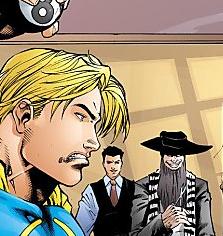
“Night Falls” ODC Theater, 3153 17th St, SF; (415) 863-9834, www.deborahslater.org. Thurs-Sat, 8pm; Sun, 2pm. $17-20. Peregrine is a freelance film writer awoken from bad dreams on the eve of her 60th birthday in this fitful but witty dance-theater rumination on aging and success co-directed by writer Julie Hébert and choreographer Deborah Slater. Played by a restless, irascible Joan Shirle (a force in pajamas and leather jacket with wild graying hair), Peregrine is alone yet not — shadowed by a younger self (Jessica Ferris) and the shade of her aging mother (Patricia Silver) as well as a certain feminine spirit known (in the program) as Prima (Patricia Jiron) who sings snatches of a Beatles song while flashing a flummoxing eight of spades at troubled Peregrine. Set against, and on, a large metal staircase covered by a wall of driftwood curled at the top like a cresting wave (in Giulio Cesare Perrone’s scenic design), Peregrine chews up the night with worry and regret, yet to write tomorrow’s commencement speech for MFA grads despite the job that may be riding on it. Feeling she has nothing to say, wondering where her youth went, and cynical about mentoring students in a ruthless freelance economy, she makes a desperate call to her ex-husband only to retrieve his brother (Robert Ernst) by mistake. He too comes shadowed by a youthful spirit (Stephen Buescher), who flirts shamelessly with Peregrine’s counterpart, but ultimately retreats in hesitation back into his own pain, though not without some good accomplished. From scattered anguish and anxiety, amid a gestural choreography alternately suggesting slow-tumbling physicality and imperfect or vaguely noisome communication, the performers finally coalesce around an individual acceptance of the persistence of the body itself, site and measure of all that — in the wee hours of truthful night — could ever be called success. (Avila)

*”PanderFest 2011″ Stage Werx 446, 446 Valencia, SF; www.panderexpress.com. Thurs/27-Sat/29, 8pm. $20. San Francisco’s Crisis Hopkins and (PianoFight’s S.H.I.T. Show makers) Mission Control join forces for a tag-team evening of sketch and “improv” (quotes kind of necessary this time). Claiming dubiously to fill a need for yet another festival in this city (though at the same time striving for above-average fawning of the public), the show delivers two acts of mostly spot-on comedy by two agreeable ensembles and is thus a fine night out anyway. The program (based rather loosely on online-video–generated audience suggestions, interspersed with the sneezing Panda baby and other YouTube perennials) also inaugurates Stage Werx’s cozy new Mission District venue — the former digs of Intersection for the Arts and a huge improvement over Stage Werx’s old subterranean lair on Sutter Street. Highlights of a ridiculous evening include a two-part Crisis Hopkins sketch detailing a site visit by a ball-wrecking contractor (Christy Daly) to her chary foreman (Sam Shaw) and his withering cherries; and Mission Control’s pointed ’70s TV show homage with a twist, Good Cop, Stab Cop. (Avila)

Stage Listings

0

Stage listings are compiled by Guardian staff. Performance times may change; call venues to confirm. Reviewers are Robert Avila, Rita Felciano, and Nicole Gluckstern. Submit items for the listings at listings@sfbg.com. For further information on how to submit items for the listings, see Picks.

THEATER

OPENING

“Master Harold” … and the Boys Phoenix Theater, 414 Mason, Ste 601, SF; 1-800-838-3006, www.offbroadwaywest.org. $18-40. Opens Sat/15, 8pm. Runs Thurs-Sat, 8pm. Through Nov 19. Off Broadway West Theatre Company performs Athol Fugard’s South African-set drama.

On the Air Pier 29 on the Embarcadero (at Battery), SF; (415) 438-2668, love.zinzanni.org. $117 and up (includes dinner). Opens Thurs/13, 6pm. Runs Wed-Sat, 6pm; Sun, 5pm. Through Dec 31. Teatro ZinZanni’s final performance at Pier 39 riffs on the company’s own struggles to stay in San Francisco. Geoff Hoyle and Duffy Bishop are the headlining guest stars.

red, black & GREEN: a blues (rbGb) Yerba Buena Center for the Arts, 701 Mission, SF; (415) 978-2787, www.ybca.org. $5-25. Opens Thurs/13, 7:30pm. Runs Thurs-Sat, 7:30pm. Through Oct 22. Marc Bamuthi Joseph’s world premiere is a collaborative, multimedia performance work and installation addressing environmental racism, social ecology, and other topics.

BAY AREA

Inanna’s Descent Codornices Park, 1201 Euclid, Berk; www.raggedwing.org. Free. Opens Sat/15, 1-5pm. Runs Sat-Sun, 1pm. Through Oct 30. Special Halloween show Oct 31, 5-8pm. Ragged Wing Ensemble presents its second annual “outdoor, site-specific, ritual performance event for Halloween.”

ONGOING

“AfroSolo Arts Festival” Various venues, SF; www.afrosolo.org. Free-$100. Through Oct 20. The AfroSolo Theatre Company presents its 18th annual festival celebrating African American artists, musicians, and performers.

Alice Down the Rwong Wrabbit Whole Emerald Tablet, 80 Fresno, SF; (415) 500-2323, www.brownpapertickets.com. $15. Fri/14-Sat/15, 9pm. Karen Light and Edna Barrón perform their new comedy based on Alice in Wonderland.

Almost Nothing, Day of Absence Lorraine Hansberry Theatre, 450 Post, SF; (415) 474-8800, www.lhtsf.org. $43-53. Previews Wed/12-Thurs/13, 8pm. Opens Fri/14, 8pm. Runs Wed-Sat, 8pm (also Sat, 2pm); Sun, 2pm. Through Nov 20. Lorraine Hansberry Theatre performs one-act plays by Marcos Barbosa and Douglas Turner Ward.

Desdemona: A Play About a Handkerchief Boxcar Theatre Playhouse, 505 Natoma, SF; www.boxcartheatre.org. $15-35. Wed-Sat, 8pm; Sun, 3pm. Through Nov 5. Boxcar Theatre performs Pauls Vogel’s dark comedy, inspired by the three female characters from Shakespeare’s Othello.

Honey Brown Eyes SF Playhouse, 533 Sutter, SF; (415) 677-9596, www.sfplayhouse.org. $20-50. Tues-Thurs, 7pm; Fri-Sat, 8pm (also Sat, 3pm). Through Nov 5. Bosnia in 1992 is divided in a horrifying civil war, some characteristics of which play out in parallel circumstances for two members of a single rock band in SF Playhouse’s west coast premiere of Stefanie Zadravec’s new play. In the first act, set in Visegrad, a young Bosnian Muslim woman (Jennifer Stuckert) is held at gunpoint in her kitchen by a jumpy soldier (Nic Grelli) engaged in a mission of murder and dispossession known as ethnic cleansing. The second act moves to Sarajevo and the apartment of an elderly woman (Wanda McCaddon) who gives shelter and a rare meal to an army fugitive (Chad Deverman). He in turn keeps the bereaved if indomitable woman company. Director Susi Damilano and cast are clearly committed to Zadravec’s ambitious if hobbled play, but the action can be too contrived and unrealistic (especially in act one) to be credible while the tone — zigzagging between the horror of atrocity and the offbeat gestures of romantic comedy — comes over as confused indecision rather than a deliberate concoction. (Avila)

The Kipling Hotel: True Misadventures of the Electric Pink ’80s Marsh San Francisco, 1062 Valencia, SF; (415) 282-3055, www.themarsh.org. $15-50. Sat, 8:30pm; Sun, 7pm. Through Nov 13. Acclaimed solo performer Don Reed (East 14th) premieres his new show, based on his post-Oakland years living in Los Angeles.

Making Porn Box Car Theatre Studios, 125A Hyde, SF; www.brownpapertickets.com. $25-50. Thurs, 8pm; Fri-Sun, 7pm (also Fri-Sat, 10pm). Through Oct 29. Ronnie Larsen brings back his crowd-pleasing comedy about the gay porn industry.

Not Getting Any Younger Marsh San Francisco, Studio Theater, 1062 Valencia, SF; (415) 826-5750, www.themarsh.org. $15-50. Thurs-Fri, 8pm; Sat, 8:30pm; Sun, 3pm. Through Oct 23. Marga Gomez is back at the Marsh, a couple of too-brief decades after inaugurating the theater’s new stage with her first solo show — an apt setting, in other words, for the writer-performer’s latest monologue, a reflection on the inevitable process of aging for a Latina lesbian comedian and artist who still hangs at Starbucks and can’t be trusted with the details of her own Wikipedia entry. If the thought of someone as perennially irreverent, insouciant, and appealingly immature as Gomez makes you depressed, the show is, strangely enough, the best antidote. (Avila)

Nymph Errant Eureka Theater, 215 Jackson, SF; (415) 255-8207, www.42ndstmoon.org. $20-50. Wed, 7pm; Thurs-Fri, 8pm; Sat, 6pm; Sun, 3pm. Through Oct 23. 42nd Street Moon performs Cole Porter’s madcap 1933 musical.

*The Odyssey Aboard Alma, Hyde Street Pier, San Francisco Maritime National Historic Park, SF; www.weplayers.org. $160. Oct 28-29, Nov 4-6, 11-12, and 18, 12:30pm. Heralding their hugely ambitious Spring 2012 production of The Odyssey, which will take place all over Angel Island, the WE Players are tackling the work on a slightly smaller scale by staging it on the historic scow schooner Alma, which is part of the Maritime National Historical Park fleet docked at the end of Hyde Street Pier. Using both boat and Bay as setting, the essential chapters of the ten-year voyage — encounters with the Cyclops, Circe, the Underworld, the Sirens, Aeolus, the Laestrygonians, and Calypso — are enacted through an intriguing mash-up of narration, choreography, sea chanteys, salty dog stories (like shaggy dog stories, but more water-logged), breathtaking views, and a few death-defying stunts the likes of which you won’t see on many conventional stages. High points include the casual swapping of roles (every actor gets to play Odysseus, however briefly), Ross Travis’ masked and flatulent Prometheus and sure-footed Hermes, Ava Roy’s hot pants-clad Circe, Charlie Gurke’s steady musical direction and multi-instrumental abilities, and the sail itself, an experiential bonus. Landlubbers beware, so much time facing the back of the boat where much of the action takes place can result in mild quease, even on a calm day. Take advantage of the downtime between scenes to walk around and face forward now and again. You’ll want to anyway. (Gluckstern) *Once in a Lifetime American Conservatory Theater, 415 Geary, SF; (415) 749-2228, www.act-sf.org. $10-85. Wed/12-Sat/15, 8pm (also Wed/12 and Sat/15, 2pm); Sun/16, 2pm. Three enterprising small-time New York theater makers head to Hollywood as voice coaches for silent screen actors fumbling the transition to talkies in American Conservatory Theater’s revival of George S. Kaufman and Moss Hart’s first Broadway collaboration. Originally premiered in 1930, the satirical take on the industry and its corruption of art and more is ever apt if not exactly fresh, and not all the comedy in its hefty three acts still lands where it should. That said, you probably couldn’t ask for a better revival of the piece, which retains much to admire and enjoy. Beautifully designed in grand fashion (including wowing sets by Daniel Ostling and snazzy costuming by Alex Jaeger), director Mark Rucker’s slick and savvy production ensures a perfect pace and wonderfully sharp ensemble acting led by the terrific trio of Julia Coffey, Patrick Lane, and John Wernke — but including some notable turns in multiple roles, including by René Augesen, Margot Hall, and Will LeBow. Rucker inserts some choice period film clips (the mesmerizing moments speaking with perhaps inadvertent force to the power of the celluloid medium and its tensions with theater, a sub-theme of the story), while Alexander V. Nichols’ video design adds further moment to this continent-crossing Hollywood escapade. (Avila)

“San Francisco Olympians Festival” Exit Theater, 156 Eddy, SF; www.sfolympians.com. Thurs-Sat, 8pm. Through Oct 28. No Nude Men Productions presents a festival of 12 new full-length plays written by 14 local writers. Each play focuses on one of the Olympian characters from ancient Greece.

ShEvil Dead Cellspace, 2050 Bryant, SF; www.brownpapertickets.com. $25. Sat/15, Oct 21, and 28-29, 8pm. Primitive Screwheads return with a horror play (in which the audience is literally sprayed with blood, so leave the fancy suit at home!) based on the Evil Dead movies.

“Shocktoberfest 12: Fear Over Frisco” Hypnodrome Theatre, 575 10th St, SF; (415) 377-4202, www.thrillpeddlers.com. $25-35. Thurs-Sat, 8pm. Through Nov 19. In its annual season-scented horror bid, Thrillpeddlers joins forces with SF’s Czar of Noir, writer-director Eddie Muller, for a sharply penned triplet of plays that resurrect lurid San Francisco lore as flesh-and-blood action. In the slightly sluggish but intriguing Grand Inquisitor, a solitary young woman modeling herself on Louise Brooks in Lulu (an alluringly Lulu-like Bonni Suval) believes she has located the Zodiac killer’s widow (a sweet but cagey Mary Gibboney) — a scenario that just can’t end well for somebody, yet manages to defy expectations. An Obvious Explanation turns on an amnesiac (Daniel Bakken) whose brother (Flynn de Marco) explains the female corpse in the rollaway (Zelda Koznofski) before asking bro where he hid a certain pile of money. Enter a brash doctor (Suval) with a new drug and ambitions of her own vis-à-vis the hapless head case. Russell Blackwood directs The Drug, which adapts a Grand Guignol classic to the hoity-toity milieu of the Van Nesses and seedy Chinatown opium dens, where a rough-playing attorney (an ever persuasive Eric Tyson Wertz) determines to turn a gruesome case involving the duplicitous Mrs. Van Ness (an equally sure, sultry Kära Emry) to his own advantage. The evening also offers a blackout spook show and some smoothly atmospheric musical numbers, including Muller’s rousing “Fear Over Frisco” (music composed by Scrumbly Koldewyn; accompaniment by Steve Bolinger and Birdie-Bob Watt) and an aptly low-down Irving Berlin number — both winningly performed by the entire company. (Avila)

Sorya! A Minor Miracle (Part One) NOHSpace, Project Artaud, 2840 Mariposa, SF; www.brownpapertickets.com. $12-18. Sun-Mon, 7pm. Through Oct 24. Each year, NOHspace residents Theatre of Yugen present a program of short Kyogen and Noh pieces, demonstrating the building blocks that define their unique approach. Blending classical Japanese theatrical styles with original and contemporary works, the company’s multi-cultural ensemble has been performing their specialized brand of East-West fusion since 1978. This year’s Sorya! program includes two modern-day works written by Greg Giovanni, a Philadelphia-based playwright and Noh artist, directed by Theatre of Yugen artistic director Jubilith Moore, and one traditional comedy, Boshibari (Tied to a Pole), directed by company founder Yuriko Doi. This piece is by far the strongest of the three, a tale of two servants pulling one over their master, who has tied them up in order to prevent them from breaking into the sake cellar. Lluis Valls and Sheila Berotti as Taro and Jiro execute the highly-ritualized aspects of the Kyogen farce with deft mobility and expressiveness, working together to overcome their captivity just enough to enjoy a few drinks before being discovered by their irate master (Sheila Devitt). The other two pieces, one set in Narnia and the other based on an Irish folk ballad, are less compelling, though no less ambitious, and Stephen Siegel and Karen Marek’s joint performance as a pair of squabbling dwarves is worthy of praise. (Gluckstern)

*Tutor: Enter the Enclave Exit Studio, 156 Eddy, SF; (415) 673-3847, www.darkporchtheatre.com. $15-25. Thurs-Sat, 8pm. Through Oct 22. Dark Porch Theatre performs Martin Schwartz’s play, inspired by an 18th century German drama, about a tutor who realizes the creepy family he works for is not quite what they seem.

BAY AREA

Attempts on Her Life Zellerbach Playhouse, Bancroft at Telegraph, UC Berkeley, Berk; tdps.berkeley.edu. $15. Fri/14-Sat/15, 8pm; Sun/16, 2pm. “Annie” never appears onstage but is the much discussed, indeterminate subject of British playwright Martin Crimp’s dazzling 1997 play, which spins the titular “her” into a postmodern cipher-self coughing up — in a shrewd, caustic, at times hilarious slew of discrete but interrelated scenes — the detritus of an international world/netherworld of consumerism, terrorism, media, and murder. The play, which premiered at the cusp of the millennium (and locally in a memorable 2002 production by foolsFURY), retains perhaps all of its original force in these menacing times, but unfortunately much of it is lost or diluted in director Scott Wallin’s production for UC Berkeley’s Department of Theater, Dance, and Performance Studies. The staging (set within a large initially bare stage with audience members on either side arena-style) holds some effective surprises, but is unhelpfully diffused or static at times, while the performance of the polyglot 10-actor ensemble is generally weak (the monologue “Kinda Funny” is one among a handful of notable exceptions), especially when the cast attempts singing and moving together. The decidedly mixed success here leaves room for another attempt soon on this elusive and stimulating work. (Avila)

Bellwether Marin Theatre Company, 397 Miller, Mill Valley; (415) 388-5208, www.marintheatre.org. $34-55. Tues, Thurs-Sat, 8pm (also Sat/15 and Oct 29, 2pm; Oct 20, 1pm); Wed, 7:30pm; Sun, 2 and 7pm. Through Oct 30. Marin Theatre Company performs Steve Yockey’s spooky fairy tale for adults.

Clementine in the Lower 9 TheatreWorks at the Mountain View Center for the Performing Arts, 500 Castro, Mtn View; (650) 463-1960, www.theatreworks.org. $19-69. Tues-Wed, 7:30pm; Thurs-Sat, 8pm (also Sat, 2pm); Sun, 2 and 7pm. Through Oct 30. TheatreWorks presents the world premiere of Dan Dietz’s post-Katrina New Orleans drama.

*A Delicate Balance Aurora Theatre, 2081 Addison, Berk; (510) 843-4822, www.auroratheatre.org. $10-48. Tues, 7pm; Wed-Sat, 8pm; Sun, 2 and 7pm. Extended through Oct 23. Aurora Theatre performs Edward Albee’s comedy of manners.

*Phaedra Ashby Stage, 1901 Ashby, Berk; (510) 841-6500, www.shotgunplayers.org. $17-26. Wed-Thurs, 7pm; Fri-Sat, 8pm; Sun, 5pm. Through Oct 23. Catherine (Catherine Castellanos) is the loveless matron in the impeccably tidy, upper-class home of middle-aged right-wing judge Antonio (Keith Burkland), secretly infatuated with her stepson (Patrick Alparone), the prodigal returning home from jail and rehab for a new start. Catherine’s cold, obsessively ordered run of the household — with heavy-lifting by her cheerful, steadfast housekeeper (a wonderfully genuine Trish Mulholland) — masks a desolation and chaos inside her, a churning emptiness evoked in the deliberately listless pace of act one and the skudding clouds we can see reflected in the walls of designer Nina Ball’s impressively stolid, icily tasteful living room. Portland Center Stage’s Rose Riordan directs a strong cast (which includes Cindy Im, as the stepson’s rehab partner and sexual interest) in a modern-day adaptation of the Greek myth by Adam Bock (The Shaker Chair, Swimming in the Shallows), in a worthy premiere for Shotgun Players. The drama comes leavened by Bock’s well-developed humor and the dialogue, while inconsistent, can be eloquent. The storm that breaks in the second act, however, feels a bit compressed and, especially after the languid first act, contributes to a somewhat pinched narrative. But whatever its limitations, Catherine’s predicament is palpably dramatic, especially in Castellanos’s deeply moving performance — among her best work to date and alone worth giving Phaedra a chance. (Avila)

*Rita Moreno: Life Without Makeup Berkeley Repertory Theatre, Roda Theatre, 2015 Addison, Berk; (510) 647-2949, www.berkeleyrep.org. $14.50-73. Tues-Sun, showtimes vary. Through Oct 30. The life of stage and screen legend Rita Moreno is a subject that has no trouble filling two swift and varied acts, especially as related in anecdote, song, comedy, and dance by the serene multiple–award-winning performer and Berkeley resident herself. Indeed, that so much material gets covered so succinctly but rarely abruptly is a real achievement of this attractively adorned autobiographical solo show crafted with playwright and Berkeley Rep artistic director Tony Taccone. (Avila)

The Taming of the Shrew Bruns Amphitheater, 100 California Shakespeare Wy, Orinda; (510) 809-3290, www.calshakes.org. $35-66. Wed/12-Thurs/13, 7:30pm; Fri/14-Sat/15, 8pm; Sun/16, 4pm. California Shakespeare Theatre’s last show of the season is a high-fashion, pop-art take on Shakespeare’s battle of the sexes.

The World’s Funniest Bubble Show Marsh Berkeley, TheaterStage, 2120 Allston, Berk; (415) 826-5750, www.themarsh.org. $8-50. Sun, 11am. Through Nov 20. Louis “The Amazing Bubble Man” Pearl returns with this kid-friendly, bubble-tastic comedy.

DANCE/PERFORMANCE

Alonzo King LINES Ballet Novellus Theater, Yerba Buena Center for the Arts, 700 Howard, SF; www.linesballet.org. Fri/14-Sat/15 and Oct 21-22, 8pm; Sun/15 and Oct 23, 5pm; Oct 19-20, 7:30pm. $15-65. The company performs its fall home season, featuring two world premieres.

“Hula Show 2011” Palace of Fine Arts Theatre, 3301 Lyon, SF; (415) 392-4400, www.cityboxoffice.com. Sat/15, Oct 21-22, 8pm; Sun/16, 4pm; Oct 23, noon (family matinee) and 4pm. $10-45. Patrick Makuakane’s Na Lei Hulu I Ka Wekiu performs its annual show mixing traditional and contemporary forms of hula, with special guests Golden Gate Men’s Chorus.

*”PanderFest 2011″ Stage Werx 446, 446 Valencia, SF; www.panderexpress.com. Thurs-Sat, 8pm. Through Oct 29. $20. San Francisco’s Crisis Hopkins and (PianoFight’s S.H.I.T. Show makers) Mission Control join forces for a tag-team evening of sketch and “improv” (quotes kind of necessary this time). Claiming dubiously to fill a need for yet another festival in this city (though at the same time striving for above-average fawning of the public), the show delivers two acts of mostly spot-on comedy by two agreeable ensembles and is thus a fine night out anyway. The program (based rather loosely on online-video–generated audience suggestions, interspersed with the sneezing Panda baby and other YouTube perennials) also inaugurates Stage Werx’s cozy new Mission District venue — the former digs of Intersection for the Arts and a huge improvement over Stage Werx’s old subterranean lair on Sutter Street. Highlights of a ridiculous evening include a two-part Crisis Hopkins sketch detailing a site visit by a ball-wrecking contractor (Christy Daly) to her chary foreman (Sam Shaw) and his withering cherries; and Mission Control’s pointed ’70s TV show homage with a twist, Good Cop, Stab Cop. (Avila)

“San Francisco Trolley Dances 2011” Tours leave from SF Public Library, 100 Larkin, SF; (415) 226-1139, www.epiphanydance.org. Sat/15-Sun/16, every 45 minutes from 11am-2:45pm. Free with Muni fare ($2). Ephiphany Productions presents its eighth annual moving festival of local dance companies performing site-specific, outdoor pieces.

“To Bury a Cat: A Clown Show” NOHspace in Project Artaud, 2840 Mariposa, SF; 1-800-838-3006, www.brownpapertickets.com. Fri-Sat, 8pm; Sun, 2pm. $10. Theatre of Yugen’s ARTburst Program presents this performance by Clowns On a Stick.

“Witches of Wonder” Big Umbrella Studios, 960 Divisadero, SF; www.bigumbrellastudios.com. Fri, 7pm. Free. All all-female cast sends up Halloween, Day of the Dead, and “all things goth” in this performance.

Uncomfortable truths

3

arts@sfbg.com

HAIRY EYEBALL Sometimes it seems like Americans would rather undergo a root canal than honestly talk about race in this country. Witness the rounds of recrimination and defensive posturing on all sides that followed the Washington Post’s recent front page story that the hunting camp Texas governor Rick Perry has long frequented was formerly known as “Niggerhead.”

Perry acknowledged that the camp’s original name was “offensive,” and in a move akin to the white paint that Perry’s own father brushed onto the rock on which it is carved, tellingly declared, “[it] has no place in the modern world.” This is a story a lot of people, not just Republican Texans, like to tell themselves about racism — it’s all in the past, or, if racism manifests itself presently, it is a crime committed by only the most egregious and malicious perpetrators. It’s this kind of magical thinking that makes a narrative like The Help, with its privileged-but-sympathetic heroine giving her cartoonishly racist sisters their comeuppance, a guaranteed best-seller and a box-office draw.

How refreshing then is SHIFT, a series of solo projects by Bay Area artists David Huffman, Elizabeth Axtman, and Travis Somerville newly commissioned by the San Francisco Arts Commission. Employing different mediums and narrative strategies—crowd-sourced community intervention (Axtman), historical reconstruction (Somerville), science fiction-tinged Afro Futurism (Huffman) — each artist works through the messy business of how race is lived in America today in ways that are deeply personal, and at times, politically oblique.

Huffman’s contribution, “Out of Bounds,” which takes over most of the SFAC’s Van Ness gallery space (401 Van Ness, SF), packs the most visual impact of SHIFT’s three propositions and also leaves the most dots to connect. At its center is a towering pyramid of 650 basketballs, held in place solely by gravity and a simple wood frame at the pile’s base. The smell of rubber hits your nostrils before you have a chance to take in the piece visually.

Huffman, whose background is in painting, has materialized this formation before in a 2006 series of mixed media canvases which depict similar heaps of balls next to barren trees, as if they were piles of raked autumn leaves. Its current sculptural incarnation is far more monumental, like some arrangement of mythological fruit. But unlike Jeff Koons’ 1985 hermetically-sealed, readymade “Three Ball 50/50 Tank (Two Dr. J. Silver Series, One Wilson Supershot),” Huffman’s pyramid is in fact temporary: the balls will be donated to local charities after the piece is deconstructed.

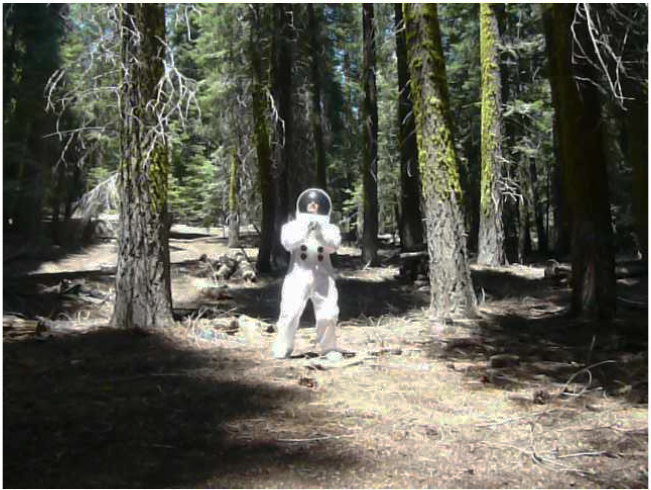
Spheres and pyramids abound throughout “Out of Bounds,” as Huffman — who is African American — uses basketball as a kind of metaphoric lingua franca across his videos (his first pieces in the medium) and abstract paintings of astronomic clusters of balls to convey other forms of travel, whether across racial or temporal lines. Not everything translates, but maybe that’s the point. The sight of a spacesuit-clad Huffman comically embracing his way through a grove of redwoods in the video “Traumanaut Tree Hugger” is both silly and discomfiting, a humorous send-up of the supposed color-blindness of progressive politics and an unintended portrait of total isolation from other humans.

Less ambiguous but certainly more ambitious is Axtman’s ongoing video project “The Love Renegade #308: I Love You Keith Bardwell (Phase 1),” on view at the Van Ness gallery and which the artist is also showing in a series of community screenings. “The Love Renegade” responds to a 2009 incident in which Bardwell, a former Louisiana Justice of the Peace, refused to marry a mixed race couple fearing the rejection they would face by society. In response, Axtman interviewed mixed race couples and the children of mixed race couples who talk about their lives and assure Bardwell that it’s gotten better for them, ending their testimonials with a pledge of unconditional love to Bardwell.

Somerville’s moveable mural “Places I Have Never Been,” on display at SFAC’s Grove Street (155 Grove, SF) window space, is perhaps SHIFT’s most conventional component in terms of its chosen medium. Focusing on six pivotal moments in Bay Area history that affected various minority populations, Somerville has rendered iconic imagery from each event onto the six sides of large cubes that stack on top of one another to create a 10×14 foot wall that when placed together forms a large-scale painting across all its faces. Some of the events, such as the internment of Japanese citizens during WWII or the White Night riots, are more familiar than others (the 1966 Hunters Point uprising that saw residents facing off against 1200 National Guard troops).

Even though I started out this review discussing current events, I’d feel like I was underselling SHIFT if I simply called it timely. The point is that Huffman, Axtman and Somerville have taken the time in the first place to think through one of the most fraught, at times ugly, and always ever-present categories that we must continue to live with. The pieces in SHIFT are discussion prompts not diagnoses. And although they’re articulated with varying degrees of direction and clarity, at least they’re encouraging the conversation about race America never seems to be having to be broached in a way that’s not about blame or personal wrongdoing but accountability to each other.

SHIFT

Through December 10, free

San Francisco Arts Commission Gallery

Various locations, SF

(415) 554-6080

www.sfartscommission.org


A decade of DocFest

2

cheryl@sfbg.com

>>Read even more Docfest reviews here!

FILM The San Francisco Documentary Film Festival (Oct. 14-27), now in its 10th year, is probably my most-anticipated local film event. One of my favorite docs of all time, Cropsey, first crossed my path at the 2009 fest. This year, I didn’t even try to come up with a coherent theme or find one film to focus on — I just started grabbing titles and watching as many of them as possible. It’s been a gluttonous feast of true stories, friends. Short takes follow, with more online at Guardian blog Pixel Vision.

Ecstasy of Order: The Tetris Masters (Adam Cornelius, U.S., 2011) I can’t think of anything more boring than watching someone else play a video game. Especially Tetris. The goofy, good-natured Ecstasy of Order skirts that basic dilemma by focusing on its subjects, all contenders at the 2010 Classic Tetris World Championship. Most everyone involved was a full-on teenage geek back in gaming’s early days; now, with years of experience under their belts, they’re far more skilled and (for the most part) way less dorky. Trouble is, there’s no villain — unlike 2007’s mighty The King of Kong (an obvious inspiration here), a film elevated by its epic good-vs.-blowdried-evil central conflict. By contrast, Ecstasy‘s crew is comprised of friendly misfits who seem to genuinely enjoy playing against each other; without much drama, the stakes don’t seem as high. Oct. 23, 12:30 p.m., and Oct. 25-26, 9:30 p.m., Roxie.

The Furious Force of Rhymes (Joshua Atesh Litle, France/Germany/U.S., 2010) San Francisco native Joshua Atesh Litle’s vivid, cross-cultural study of contemporary hip-hop offers ample examples of how and why, as one German rapper says, music has become “an international language for those without voices.” After a brief recap of hip-hop’s Bronx, NY origins, the film jets to Paris and Berlin, the West Bank and Israel, and Dakar, Senegal, highlighting performers who rhyme about social injustice, political unrest, racism, immigrant struggles, and other issues affecting their daily lives. Kinda makes you sorry that mainstream American hip-hop has become so superficial and swag-obsessed. Fri/14 and Oct. 20, 9:30 p.m., Roxie; Mon/17, 9:30 p.m., Shattuck.

Holy Rollers (Brian Storkel, U.S., 2010) For a time, one of the most successful card-counting outfits in America was “the Churchteam,” a group of 20-somethings who mapped out a businesslike way of relieving casinos of millions of dollars. Two managers trained a pack of players, who would then travel to Las Vegas and other places, armed with stacks of bills (contributed by investors) and the cojones to cheat until they were “backed off” from the blackjack table. (As 2009’s The Hangover, excerpted here, points out, counting cards isn’t illegal — it’s merely “frowned upon.”) Neat story, but the real hook here is that the Churchteam was comprised almost entirely of practicing Christians; their shared faith insured that nobody would steal from the team’s profits. (Of course, when the team started losing, and theft was suspected, all eyes fastened upon the single non-Christian in the pack.) The fast-paced Holy Rollers tends toward the highly enjoyable, but the Churchteam members are so self-satisfied that they prove difficult to root for at times. Holy smugness, bro! Sun/16 and Oct. 20, 7:15 p.m., Roxie; Tues/18, 9:30 p.m., Shattuck.

Scenes of a Crime (Grover Babcock and Blue Hadaegh, U.S., 2011) Scenes of a Crime proves that “good cop/bad cop” interrogation techniques are used in the real world, not just crime films. It also affirms, distressingly, that the American justice system often travels through murky waters. When a baby dies under mysterious circumstances, his father is taken into custody; after an epic interrogation, he confesses to causing his child’s death, complete with a harrowing demonstration. At his trial, experts argue over the medical evidence, but the police-station videotape remains the case’s most pivotal factor. Was the father guilty, or did he deliver a false confession, egged on by the cops’ manipulative questions? The verdict says one thing; after watching Crime, you may believe another. Oct. 22, 12:30 p.m., and Oct. 24, 9:30 p.m., Roxie; Fri/14, 2:45 p.m., Shattuck.

With Great Power: The Stan Lee Story (Will Hess and Nikki Frakes, U.S., 2011) DocFest’s closing-night film defines “hagiography,” but if you don’t love Marvel Comics maestro Stan Lee, you might not have a pulse. Basically everyone ever associated with a Lee-based project (movie stars, directors, artists) pops up to fawn over the 88-year-old dynamo, but most delightful is the man himself, a hilarious, heartfelt character who has clearly spent his entire adult life working at a job he loves, influencing and entertaining millions along the way. With Great Power doesn’t quite come out and say it, but I will: he’s a real-life superhero. Oct. 23, 9:30 p.m., and Oct. 27, 7:15 p.m., Roxie; Oct. 20, 9:30 p.m., Shattuck.

The Woodmans (Scott Willis, U.S., 2010) Francesca Woodman jumped off a building in 1981 when she was 22, despondent over the fact that her photographs hadn’t found a niche in New York’s competitive art world. She was no stranger to competition — she’d grown up with a parents who placed art-making above all other obligations. Fast-forward to the 21st century, and Francesca remains the most-acclaimed Woodman; her haunting black-and-white photos, often featuring the artist’s nude figure, have proven hugely influential in the realms of both fine art and fashion. She was, as the San Francisco Museum of Modern Art website says (an exhibit of her work opens Nov. 5), “ahead of her time.” Scott Willis’ documentary features extensive interviews with her parents, George and Betty, and to a lesser extent Francesca’s brother, Charles (also an artist); the film is both Woodman bio and incisive exploration of the family’s complex dynamics. Most fascinating is Charles, who remarks of his daughter’s posthumous success, “It’s frustrating when tragedy overshadows work.” But after her death, he took up photography, making images that resemble those Francesca left behind. Sat/15, 7:15 p.m., and Oct. 22, 12:30 p.m., Roxie; Sun/16, 12:30 p.m., Shattuck.

SAN FRANCISCO DOCUMENTARY FILM FESTIVAL

Oct 14-27, $11

Roxie Theater

3117 16th St, SF

Shattuck Theatre

2230 Shattuck, Berk

www.sfindie.com


Muslim and proud (and hilarious)

0

THEATER Onstage, a woman and her father battle over modern sensibilities versus religious tradition. The father leads with a left jab and the mantra “in the Koran, in the Koran, in the Koran,” which the daughter counters with a roundhouse punch and “third-wave feminism.” Both characters are being played by Zahra Noorbakhsh, a feisty, spirited, thoroughly modern woman — and a Muslim, an important part of her identity she’s not about to let anyone forget. But believing in God doesn’t mean your interpretation of “God’s law” is going to be the same as your parents’, and her notion that her long-distance, white, atheist boyfriend Duncan ought to move in with her, purely for reasons of economy of course, is not a prospect her devout Iranian parents can whole-heartedly embrace.

“It’s against the Koran, man,” her father states definitively. “What you want me to do?”

What he will do is the greatest draw of the show, provocatively entitled All Atheists Are Muslim, which made its New York International Fringe Festival debut to a sold-out house on August 12, weeks away from the tenth anniversary of 9/11 — a date most New Yorkers are all too aware of. Not that Iran has anything to do with that particular date (even George W. wouldn’t go that far), but the intricacies of Islam are nonetheless of enduring topical interest.

“Growing up Muslim-Iranian, I had to constantly, vehemently defend my faith, my culture, and my family everyday,” Noorbakhsh reminisces. Even today, people she is close with freely equate “Muslim” with “terrorist” in polite conversation — even people who have seen her show and know her personally.

Deciding to apply to the New York International Fringe Festival seemed like a logical way to bring her comedic message of tolerance and inter-cultural exchange to New York, especially after having accompanied her director W. Kamau Bell to the 2009 Fringe to run tech for his show The W. Kamau Bell Curve: Ending Racism in about an Hour. After several months of meeting deadlines for program blurbs, participant fees, and tech specs, Noorbakhsh and her “Authorized Company Representative” (also her atheist boyfriend) have been tirelessly navigating the Fringe from the clusters of black-box theaters that dot the brownstone landscape of the East Village.

Working the post-show crowds of her own and others’ shows, Noorbakhsh exudes big sisterly camaraderie and casual confidence rather than rehearsed marketing speak, and a good percentage of her audiences has been made up of fellow performers — a true sign of Fringe success. Of course the run hasn’t been without its surprises. One front-row audience member abruptly refused to be “converted” (“It says right on the postcard that the first three rows will be converted to Islam,” Noorbakhsh points out with amused exasperation). Along those lines, the emphasis placed on handing out postcards as marketing strategy was a surprise; “in San Francisco, it’s a faux pas,” she says of the practice in the local comedy club scene. Above all, her major sense of frustration has come from trying to attract fellow Persians to the show, a difficulty she has not experienced in California.

“In San Francisco I’m an active member of the Persian community,” she explains. “I’m vocal and participate in many organizations. [In New York], nobody knows me outside of this very bold, divisive, and controversial title.”

That many Iranian-Americans she knows identify as atheist rather than Muslim, distancing themselves as much as possible from Iran’s Islamic regime, is certainly part of the obstacle. It seems it’s not just misguided Caucasian theatre-goers who are guilty of confusing “Muslim” with “terrorist”

“This fear of the word Muslim has to stop,” Noorbakhsh opines. “We’ve got to point out how much people flinch at just the word and how horrifyingly racist and damaging that demonization is.”

At Noorbakhsh’s last show of her New York run, a record 20 people are turned away at the door (including, alas, the long-awaited Persians), and the packed house roars appreciatively at her lovingly-skewered portrayal of her foul-mouthed father (“What the shit hell is this, man?”) and her winsome mother, who offers to buy her a Persian rug if she’ll just get married already. Leading the audience through the terms of the compromise they all agree to in order to preserve the peace, Noorbakhsh makes it possible for the audience to fall in love with her tradition-bound family despite their initial resistance to Noorbakhsh’s American-born sensibilities.

And how do her parents feel about Noorbakhsh’s audiences? “They usually sell my tickets,” laughs Noorbakhsh. “They love it.”

ALL ATHEISTS ARE MUSLIM

Through Oct. 1, $20

Opens Thurs/1, 8 p.m.

Runs Thurs.-Sat., 8 p.m.

Stage Werx Theatre

533 Sutter, SF

(415) 517-3581

www.brownpapertickets.com

Eric Quezada. Presente.

2

By Roberto Lovato and Jason Ferreira

“I’d love to see a garden of flowers there,” whispered Eric Quezada a few days before his final breath on Earth. Looking like a Guatemalan Quixote, a lanky Eric pointed to the front of his Bernal Heights home with an index finger whittled down by a cancer he’d been fighting ferociously for seven years.

Days later, about 150 people brought pots packed with daisies, bougainvilleas, lavender, lots of red roses — and a bright bouquet of candles to bear witness to the life and friendship of a man who had planted his gentle way into our thoughts, our actions and—most especially—our hearts. To see the tearful and trembling faces of the diverse crowd — former Salvadoran revolutionaries, African American internationalists, soccer buddies made over a lifetime, immigrant rights advocates, Aztec dancers, Guatemalan family members, long time and recent Mission residents, queer leaders and the (Latino) Man Who Would Be Mayor — was heartbreaking. But at the same time we were all shining forth the beautiful Mission that Eric spent a lifetime steadfastly tending to with love.

A true revolutionary, our friend, our brother, who died Aug. 24 at 45, Eric Quezada, lived and died organizing his community, La Misión.

San Francisco and the wider community lost more than just a housing activist, a former candidate for supervisor, and an extraordinarily effective standard bearer of the left. We lost a husband-father-son-brother, a loyal friend and mentor, and a spiritual-political figure whose sources of beauty only became obvious after he gently touched you.

The son of Carlos and Clara Quezada, two Guatemalan immigrants known to many Mission residents as the dynamic duo that birthed two soccer stars (Eric and older brother Carlos) and owned CQ Bike shop on 24th Street, the very soft-spoken Eric lived to bridge the human and the political.

Traveling as a child between a San Francisco on the verge of the silicon revolution-based gentrification wave and wartime Guatemala, Eric developed early on a sense of the emotional and political circuits connecting movements and people on the insurgent continent of América. He grew up hearing stories of very involved and engaged family members like aunt, Ana Maria Quezada, who was arrested for protesting and organizing in Argentina during the 1978 World Cup, and his parents, who lived through the military coup that ousted democratically-elected Guatemalan President Jacobo Arbenz. “I remember hearing stories about Arbenz,” Eric once told us, adding, “—and how the U.S. sponsored the coup.”

Eric’s unique vision was also born out of the racism –and the resistance to it-back home in the Bay Area. Eric often talked of how his mother and he once witnessed two police officers harassing several young African American boys in the parking lot of a convenience store. Clara immediately took the officers to task for their racism, refusing to leave until they left the young boys alone. Eric never forgot his immigrant mother’s courage, her transcendent lesson: always stand alongside those who face injustice.

“Eric is a continuum,” fellow organizer and beloved compañera, Lorena Melgarejo, said. “His beliefs, his commitment didn’t stop in public. They are deep in how he thought about life. As a dad, as a friend, as a lover- that’s who he was,” said Lorena.

After Eric told her when they first met that he didn’t want to burden her with his cancer, Lorena responded: “You have no right to stop your life, you can’t close the door to life!” After that, they were never apart. Embracing life, one filled with no regrets, they fell in love immediately. A few years later, upon the arrival of their beautiful daughter Ixchel, Lorena reminded the larger-than-life, activist father that, “You can’t put your personal life on hold because there’ll always be an event, a meeting or some crisis in the world.”

As was obvious to anyone who really got to know him, one of Eric’s primary connectors to that wider, crisis-filled world of politics and culture was something seemingly apolitical: soccer.

“His politics were like his soccer playing,” explained Eric’s uncle, Edgar, who formed an important part of the Sagastume soccer dynasty in late 20th century San Francisco. “When Eric played, he was cool, but tenacious, hard working. He trained meticulously and never gave up. Eric was fond of saying how he “learned about the politics in different countries—Croatia, Greece, Mexico, El Salvador, England, all kinds—from playing in the San Francisco (soccer) leagues. You learned international relations and neighborhood politics at the same time.”

Such a schooling made Eric a ferocious ally of Central American revolutionary movements including the URNG in Guatemala, Sandinistas in Nicaragua, and the FMLN in El Salvador. These same commitments also served him well as a leader in the Venceremos Brigade to Cuba, where he met Fidel Castro, famously causing the Cuban leader to become nostalgic when asked about his memories of meeting Malcolm X in Harlem. Later, in 2002, he met with Hugo Chávez in Venezuela. They talked about everything from 21st century socialism to baseball. Beaming with the pride that only a lifelong—not fair weather—fan can display, Eric swore that Chávez was a huge fan of the San Francisco Giants.

The eclectic internationalism Eric envisioned and embodied was always two-way. He always strived towards reciprocity. Through Grassroots Global Justice and his work at the World Social Forum in Porto Alegre (Brazil), Eric sought to bring to the international stage the struggles of working class San Franciscans: day laborers, the homeless, people with HIV, and undocumented immigrants.

Eric’s journey reflected that of his mentor and dear friend, the legendary Bill Sorro (who himself died of cancer four years ago this very week). Both Bill and Eric were revolutionaries largely unsatisfied with the traditional rhetoric and disarming anger of the left. “We don’t struggle because we hate, we do so because we love. Yes, we may hate oppression but in the end we are fighting for something, we fight out of a place of love.” Eric never wavered in this.

Eric was a jazz man. A saxophone player, he believed in the art of improvisation and experimentation. At a time when the left was floundering, Eric brought a musical spirit to the necessary work of strengthening dialogue, analysis, and education in the community. He co-founded the Center for Political Education (San Francisco’s equivalent of the legendary Brecht Forum), which has served since 1998 as a catalyst for more effective organizing and as a space to build bridges.

Eric understood the centrality of compassionate bridge-building to political success. And like one of his heroes, Monseñor Oscar Romero, he will in his death rise again in his people. For Oscar Grande, a young community organizer with PODER, a Mission-based Latino environmental and economic justice organization, “Eric was instrumental in bringing radical politics and a visionary spirit to Mission politics,” said Grande.

Eric’s involvement in city politics was less about winning elections and electoral power than about the process of teaching the community how to deal with the powers that be. “He was about ‘let’s re-write the laws and get rid of the bums at City Hall so we can get the things our community needs: housing, open space and recreation opportunities at the material level,'” Grande said. But, according to Grande, who describes Eric as an “older bro/mentor,” Eric’s greatest contribution was spiritual.

“There are fewer and fewer schools of politics, places where you learn how to do politics,” said Grande. “Most of those that are still around in the Latino community are about deal-making, cozying up to the politicians. Eric offered an alternative. The spiritual and the political were always there. Those other fools started from the top-down. Eric started from the bottom up.” This was a key principle of the Mission Anti-displacement Coalition that Eric was instrumental in establishing.

During the last five years of his life, Eric’s bottom-up, interconnecting philosophy was realized at Dolores Street Community Services, a housing and community advocacy organization. For Wendy Phillips, longtime friend of Eric and DSCS Interim Executive Director, Eric was instrumental in securing real housing and other resources for different groups and in connecting DSCS and the Mission to immigrant rights, LGBT rights, and other struggles of our time.

“I think helping create MAC was a huge accomplishment of his because it stopped the massive wave of gentrifying capital entering the Mission. He and MAC mobilized hundreds of people to resist and show the board of supervisors and Mayor that the Mission wasn’t going to go down without a fight.” Their efforts resulted in a community rezoning process that has prioritized the creation of affordable housing in the Mission.

Phillips also noted that, while at DSCS, Eric also spearheaded the creation of the San Francisco Immigrant Legal and Education Network, a network of thirteen organizations that provide free legal services for immigrants, and, of course, advocacy. As if describing his soccer-inspired cosmopolitanism, she said, “Before it became obvious to most, Eric sensed that things were getting really bad on immigration and decided to create SFILEN, which unites Latino organizations, African organizations, Arab organizations, and Asian organizations in an effort to defend immigrants citywide.”

Eric’s defense of — and offensives in — La Mision continues to reverberate in and beyond his beloved neighborhood. “My campaign is really reigniting and reasserting the movement that Eric Quezada helped to build and grow,” said John Avalos, a serious contender in the upcoming Mayor’s race. Avalos, who has dedicated his campaign to Eric and his family, believes that Eric best symbolizes the continuation of the “movement of the people to build power against the downtown forces of gentrification and create livable neighborhoods where people can live with dignity.”

Eric Quezada spent his last days accompanied by loved ones. Along with Lorena, Ixchel and his mother, Eric was tended to and accompanied at his bedside by soccer buddies, family members, his closest personal and political friends, all of whom joined him in taking in the soothing sounds of his favorite music: guitarist friends playing boleros and bossa nova, CD’s of Los Lobos and Jorge Drexler, whose song “Todo Se Transforma,” (nothing is lost, everything is transformed) gave solace to Eric until his final breath. From the vantage point of our present heartbreak, it gives the rest of us hope.

In the lingo of the Latino and Latin American musical and political movements that informed Eric’s thought and action and his life in La Mision, “El Compañero Eric Quezada murio conspirando,” Comrade Eric Quezada died conspiring.

While in English the word “conspire” means to “make secret plans jointly to commit an unlawful or harmful act,” in political Spanish the word has an almost opposite meaning. Conspirar is closer to the Latin roots that combine con, meaning “together,” and spirare, the word for “breathing” and the origin of the word, “spirit.”

In this way, Eric conspired for a better world. After his last breath, he has left us a great spirit. We love you, carnal. Compañero Eric Quezada PRESENTE! La Lucha Continua!!!

(Note: The Community Celebration of Eric Quezada will take place on Sunday, September 25, 2011, 2-5 p.m. at Horace Mann Middle School, 3351 23rd Street

Those wishing to help Eric’s family can donate to the MAF — Ixchel Quezada Education Fund, http://missionassetfund.org/ixchel)

Guardian forum tonight: Energy and Environment

19

We’ve got a great lineup for tonight’s Guardian forum on Energy, Environment and Climate Change. I’ll be moderating. The panelists are Antonio Diaz for PODER, Alicia Garza from POWER, former Supervisor Aaron Peskin and Saul Bloom from Arc Ecology. We’ll be talking about energy policy, environmental racism, how climate change will impact the southeast neighborhoods, the privatization of public space, Treasure Island and a lot more.


It starts at 5:30 pm, in the Koret Auditorium at the main library in the Civic Center. Lots of time for audience participation. Hope to see you there.


Our Weekly Picks: August 10-16

0

WEDNESDAY 10

MUSIC

Outdoorsmen

Seeking some pissed-as-shit garage rock from San Francisco? Eschewing the contemporary lyrical idiom of pizzas, fun, and friends, the band Outdoorsmen has more in common with early GG Allin (minus the racism, sexism, and other things about the baddest of rock ‘n’ roll’s bad boys that were generally inexcusable, no matter how good he was otherwise) than the Seeds or 13th Floor Elevators. If you want the raging fury of punk run through too many pedals and spat out in songs like “Summer of Hate” and “Decapitated,” these cats are here to save you from the paisley wave of vintage rock wannabes. Get angry! (Cooper Berkmoyer)

With San Francisco Water Cooler

9 p.m., $6

Hemlock Tavern

1131 Polk, SF

(415) 923-0923

www.hemlocktavern.com


MUSIC

Breakestra

I’ve never quite been able to wrap my head around L.A. band Breakestra. With a tendency to change members and labels as frequently as it switches from one break beat to another, the expectation is inconsistency. But instead, its collective effort manages to reach a level of esteem that puts them somewhere between other encyclopedic genre bands like the Roots and the Dap-Kings (or to go back further, the J.B.’s), reliably grooving across funk, hip-hop, and soul. Its last album, 2009’s Dusk Till Dawn, saw the band resurrecting the feel of a Norman Whitfield-era Temptations track one moment, only to later lay down a proper beat for Chali 2na. (Ryan Prendiville)

With California Honeydrops

9 p.m., $15

Brick and Mortar Music Hall

1710 Mission, SF

(415) 800-8782

www.brickandmortarmusic.com


FRIDAY 12

COMEDY

Dave Attell

Often regarded as the epitome of a “comedian’s comedian” while paying his dues in the New York City stand-up circuit, Dave Attell finally caught his well-earned break in 2001 with the debut of Insomniac, his late night reality show on Comedy Central. His blunt and unabashed style, blue-collar looks, and approachability made him the perfect comic to maneuver the run-ins with all the drunks and freaks on that show, and those same qualities translate to his live performances. As a former writer for Saturday Night Live and contributor to The Daily Show, Attell’s credentials run deep, and his balance of the lewd and the incredibly clever has helped make him one of the best and most-respected comics around. (Landon Moblad)

Fri/12-Sat/13, 8 and 10:15 p.m., $35

Cobb’s Comedy Club

915 Columbus, SF

(415) 928-4320

www.cobbscomedyclub.com


MUSIC

Sadies

Comprised of guitarists Dallas and Travis Good (who are also brothers), drummer Mike Belitsky, and bassist Sean Dean, the Sadies have recorded and toured with everyone from John Doe and Neko Case to Andre Williams and Heavy Trash — all for very good reason. The Canadian rockers seamlessly incorporate country, surf, rockabilly, garage rock, and more into their musical foundation, creating a wide sonic pallet to work with. The band shines just as brightly on its own as in its collaborations, as was the case with its latest excellent release, 2010’s Darker Circles — so expect nothing short of an amazing live set tonight. (Sean McCourt)

With Jesse Sykes and the Sweet Hereafter

9 p.m., $17

Great American Music Hall

859 O’Farrell, SF

(415) 885-0750

www.gamh.com


MUSIC

Javelin

Though you may hear descriptors like electro and hip-hop bandied about to describe Javelin’s music, neither really captures the wide-eyed charm of the group’s eccentric cut-and-paste style. Originally from Providence, RI but now rooted in New York City, the duo is comprised of two cousins who are just as intrigued by MPCs and old, dusty vinyl samples as they are by homemade instruments and beat-up toy keyboards. No Mas, Javelin’s 2010 debut, showed off its ability to filter lo-fi psychedelia, playful electronica, and fractured R&B into a perfectly balanced, collage-style mix of live and electronic sounds. Its follow-up, Candy Canyon, is a 24-minute exercise in cowboy folk and spaghetti Western scores. (Moblad)

With Siriusmo, Pictureplane, Krystal Klear, Vin Sol, and Charles McCloud

10 p.m., $15

103 Harriet, SF

(415) 264-1015

www.1015.com/onezerothree


MUSIC

Trainwreck Riders

What do you get when you cross the epic guitar work of stadium rock and the audacity of punk with the drunken swagger of country? A trainwreck? Trainwreck Riders actually. This San Francisco four-piece will have you stumbling along in commiseration and drifting into rock heaven with its boozy lullabies, but that’s only half the equation. As genuinely beautiful and sad as Trainwreck Riders can be (just check out their single “Christmas Time Blues” — goddamn) it’s just as apt to slam you back to earth with leaden shredding and headbanging goodness. Sing along and dance or just let the melodies carry you away. Trainwreck Riders will make a fan of you yet. (Berkmoyer)

With Pine Hill Haints, Mahgeetah, and Pops

8:30 p.m., $12

Café Du Nord

2170 Market, SF

(415) 861-5016

www.cafedunord.com


MUSIC

DJ Lo Down Loretta Brown a.k.a. Erykah Badu

Following a live performance at Outside Lands, Erykah Badu — the reigning queen of whatever genre she’s in — will be donning her DJ Lo Down Loretta Brown persona at Mezzanine. Whether you catch the soulful singer, who’s reportedly working on material with Flying Lotus, following Big Boi at the festival, or just the DJ set, she’ll be keeping the party going for the Ankh Marketing (the people behind Rock the Bells and plenty of Bay Area hip-hop) seventh anniversary celebration. Ankh has delivered on their events — the last time they brought the Roots’ Questlove for a set (which they’ll repeat Saturday at Public Works) Ghostface Killah popped on stage in the two o’clock hour. (Prendiville)

With D-Sharp

9 p.m. Doors, $25 Advance

Mezzanine

444 Jessie, SF

(415) 625-8880

www.mezzaninesf.com


SATURDAY 13

MUSIC

Inciters

Although it hails from Santa Cruz, the band known as Inciters sounds as though it could have come straight out of England circa the late 1960s, steeped in the rich sound and traditions of Northern Soul, albeit with an energy and attitude all its own. Currently recording its next album, the 11-piece outfit has been rocking stages both locally and internationally since 1995, and tonight finds it both performing an opening slot and also acting as the backing band for genre favorite Dean Parrish, known for 1960s hits like “I’m On My Way.” (McCourt)

With Champions, Soul Fox, Shawn and Miss T, and Mattie Valentine

9 p.m., $8

Rockit Room

406 Clement, SF

www.rock-it-room.com


VISUAL ART

“Scab-Free”

Is there anything more fun than a scab? Pick, pick, pick. The tension between patience and raw fulfillment makes them better than blackheads, dandruff, and ingrown hairs combined. And while blood streams through the gutters to the Bay from the tatted-up flesh of everyone from your barista to rock stars to your aunt, before the scabs and permanent skin art came the sketches and paintings. As the co-owners of Black Heart Tattoo, Scott Sylvia, Tim Lehi, and Jeff Rassier are globally renowned knights with tattoo-machine swords, swivel-stool steeds, and holy grails of pigments. Their canvases, and those of five other Black Heart dudes, may not bleed, but they’ll surely inspire your next inky scab. (Kat Renz)

Through Sept. 3

Opening reception tonight, 7 p.m.-midnight, free

Space Gallery

1141 Polk, SF

(415) 377-3325

www.spacegallerysf.com


FILM

Jaws

Discovery Channel’s annual Shark Week wrapped up August 5. As a floundering nation collapses into Great White Withdrawl Syndrome, Bay Area residents can feed (-ing frenzy) their obsession with bloody, toothy good times at Film Night in the Park’s screening of 1975’s Jaws. One of the first-ever summer blockbusters, Steven Spielberg’s seaside classic actually doesn’t feature much fishy footage, thanks to a cranky mechanical shark that taught all involved a valuable lesson about stories actually being scarier when you don’t reveal too much of the monster. But since Discovery just served up plenty of savage shark porn (Top Five Eaten Alive!), bundle up and enjoy Jaws‘ human standouts: Roy Scheider as the sheriff trying to cope with the deadly waters off his beaches; Richard Dreyfuss as the nerdy ichthyologist; Robert Shaw as the crusty shaaak hunter; and composer John Williams, who spun epic menace from a few simple notes and created one of cinema’s most recognizable themes in the process. (Cheryl Eddy)

8 p.m., donations accepted

Dolores Park

19th St. at Dolores, SF

(415) 272-2756

www.filmnight.org


MUSIC

“Incest Fest”

Incest is really bad if you’re a cheetah — one of the fastest species on Earth is nearly extinct because of its shrinking gene pool. Luckily, the Bay Area metal scene is not the African savannah. Here, such cozy relations are less about genetic mutations and all about a healthy synergy. Our local slaying skills are legendary throughout the headbanging realm, and Incest Fest is searing testimony: a dozen musicians composing five bands: Orb of Confusion (last show! CD release!), Hazzard’s Cure, Floating Goat, Owl, and Hellship. The night’s not only celebrating diverse permutations of heaviness; it’s also the birthday of one of the triple-duty guitarists. Buy the man a drink! And cheers to cheetahs, too. (Renz)

10 p.m., $5

Bender’s Bar and Grill

806 South Van Ness, SF

(415) 824-1800

www.bendersbar.com


TUESDAY 16

MUSIC

Heavy Hawaii

Heavy Hawaii aren’t really that heavy. Actually, they aren’t heavy at all. They are very “Hawaii.” What the hell does that mean, you ask? These minimalist weirdoes from San Diego tap into the same dream state that the islands and their beaches inspired in the Beach Boys and Jan and Dean and a whole generation of vacation-going Americans. It’s surf-pop for a new generation, one reared on shoegaze and surrealism. The classic pop vocals are there, and catchy melodies abound, but the instrumentation is an exercise in simplicity and unsettling strangeness that will leave you swaying like kelp in a creepy underwater forest. (Berkmoyer)

With Bleached and Plateaus 9 p.m., $7

Hemlock Tavern 1131 Polk, SF

(415) 923-0923

www.hemlocktavern.com


The Guardian listings deadline is two weeks prior to our Wednesday publication date. To submit an item for consideration, please include the title of the event, a brief description of the event, date and time, venue name, street address (listing cross streets only isn’t sufficient), city, telephone number readers can call for more information, telephone number for media, and admission costs. Send information to Listings, the Guardian Building, 135 Mississippi St., SF, CA 94107; fax to (415) 487-2506; or e-mail (paste press release into e-mail body — no text attachments, please) to listings@sfbg.com. Digital photos may be submitted in jpeg format; the image must be at least 240 dpi and four inches by six inches in size. We regret we cannot accept listings over the phone.

SF Giants asked to take a stand against racism UPDATED

13

Updated with response from SF Giants at bottom of post

The San Francisco Giants will host the Arizona Diamondbacks tonight (July 31), beginning a three-game series that will determine the first place slot in the National League West. A lot of eyes will be on our 2010 league champions – all the more reason, says a classic Mission District arts and culture organization, for them to take a stand against racist anti-immigration laws.

In early June, community members who had been leaders of the 1960s to ’80s group Casa Hispana de Bellas Artes sent Giants CEO Bill Newcombe a letter with a simple request. They want the baseball team to wear its popular ‘Gigantes’ jerseys while playing the Arizona Diamondbacks and the Atlanta Braves, two squads that hail from states that have recently passed laws codifing racial profiling in the fight against illegal immigration. The letter tells the team “this kind of law has created a paralyzing climate of fear among Latino families, citizen and non-citizen alike.”

San Francisco, the Casa Hispana elders insist, does not swing at discriminatory government. Reminding the Giants organization of its long-standing support of the Latino community, they’re politely encouraging the team to represent its fans by speaking out against discrimination. We caught up with Casa Hispana elder Don Santina for an email interview to explain why his group asked its team for a wardrobe change. The Guardian was unable to reach the SF Giants for comment – but any organizational response we get will be added to this post.


San Francisco Bay Guardian: Tell us about the mission of Casa Hispana de Bellas Artes.

Don Santina: Casa Hispana de Bellas Artes was founded in 1966 in the Mission District by a group of artists and poets to promote cultural advocacy for Latino-Chicano-Raza culture. [Our] group produced and sponsored programs year-round but focused particularly on an annual two-month long Raza/Hispanidad Festival which opened on October 12, Dia de la Raza. Among the multitude of programs, exhibits, performances, and events produced included major undertakings like the Chichen Itza exhibit at SF State, the pre-Colombian artifacts at the De Young and 24th Street BART station opening, the Cisco Kid Festival with Duncan Renaldo, and the Latin American Theatre Festival with Enrique Buenaventura, and low rider car exhibit at the US Presidio. Casa faded into history in 1983 when its major funding sources withdrew. The National Endowment for the Arts was seized by Reaganites.

In 1975 Casa Hispana executive director Amilcar Lobos Yong read a bilingual version of “Casey at the Bat” at Candlestick Park as part of a program in honor of the Giant’s support of the Latino community. Photo by Joe Ramos

SFBG: Why did you send this letter to the Giants?

DS: The elders of Casa wrote to Bill Newcomb’s Giants organization because it had produced a pre-game program in Candlestick Park with Horace Stoneham’s Giants team in 1975 honoring the Giants for their “pioneer recognition of Latin players” in the racist world of major league baseball.  At the event, Casa Poets Theatre read “Casey at the Bat” in English and Spanish before the game and gave awards to the Giants, Juan Marichal, and Tito Fuentes for his works with youth in the Mission District (editor’s note: the awards were presented by long-time Bay Area Latino news legend Luis Echegoyen). Casa people felt that the Giants should continue that anti-racist policy by making a genuine statement against SB 1070 by at least wearing Gigantes uniforms when playing Arizona and Atlanta.


SFBG: What’s been the response from the team? Did they get back to you?

DS: The Giants received Casa’s letter on June 9, and the business has not responded. Casa is disappointed in this lack of response and respect from a San Francisco-based team which has many Latino players.


SFBG: What is a professional sports team role’s in their community? Should they be speaking out on political and social issues? 

DS: A professional sports team has the same responsibilities to the community as any other business; in a word: Spike Lee’s “do the right thing.” Unfortunately, these teams are all mega-corporate businesses with morality based on profit. Dave Zirin has covered this topic very thoroughly.


SFBG: How much of the artists and community members involved with Casa Hispana are baseball fans?

DS: Most of the Casa people love the Giants; however, they also love fútbol, a.k.a. the international game of soccer.   


SFBG: Do you think they’ll be wearing the Gigantes jerseys at AT&T Park tonight?  

DS: We don’t think they’ll wear the Gigantes uniforms without public pressure or embarrassment. [But] if they do, it will be beneficial as a public stand against racial profiling laws. 


UPDATED WEDNESDAY, AUGUST 3: The Guardian contacted Giants spokesperson Shana Daum, who said she couldn’t recall recieving Casa Hispana’s letter but that the Giants would not be wearing their Gigantes jerseys at all during this week’s Arizona series. “We try to support the community, but we don’t want to take a political stance,” she told us.

“There’s other ways for major league baseball to get involved.” Daum cited the team’s annual Fiesta Gigantes celebration during September’s Hispanic Heritage Month, HIV/AIDS awareness days, the team’s pioneering involvement in the It Gets Better campaign. She added “but we appreciate the spirit in which [Casa Hispana’s request to wear the Gigantes jersey] was asked.”

Film Listings

0

Film listings are edited by Cheryl Eddy. Reviewers are Kimberly Chun, Michelle Devereaux, Max Goldberg, Dennis Harvey, Louis Peitzman, Lynn Rapoport, Ben Richardson, and Matt Sussman. For rep house showtimes, see Rep Clock.

SAN FRANCISCO JEWISH FILM FESTIVAL

The 31st San Francisco Jewish Film Festival runs through August 8 at the Christopher B. Smith Rafael Film Center, 1119 Fourth St., San Rafael; Oshman Jewish Community Center, 3921 Fabian Way, Palo Alto; and Roda Theatre at Berkeley Rep, 2025 Addison, Berk. For tickets (most shows $12) and a full schedule, visit www.sfjff.org.

OPENING

*Between Two Worlds See “Whose Voice?” (1:10) Roxie.

The Change-Up This brom-com just might go down as the one where Ryan Reynolds proves his acting chops by playing a creepy Peter Pan and an upstanding family man with Jason Bateman’s physical tics. And it’s almost good enough to wipe out those terrible memories of Reynolds’ dances with CGI in Green Lantern. Yet 2011 summer movies’ MVP Bateman still manages to steal all the best scenes as both the straight man and the kidult-in-a-grown-up’s-body: namely those R-pushing moments he’s changing diapers and taking a face full of baby poo, coming on like a pink-Polo’d jackass at a big-money meeting, and watching the woman of his dreams saunter into the can to cope with backfiring Thai grub. It’s the stuff of fantasy — as well as some clever writing and considerable buddy-buddy chemistry — when career-climbing, do-right lawyer Dave (Bateman) and perpetual playa Mitch (Reynolds) voice envy for each other’s lives while pissing into a magical fountain. The old switcheroo inexplicably occurs the next morning when each chum find himself in the other’s body. Fortunately the Freaky Friday (1976) kookiness that ensues rises a bit above the safe norm by plunging headlong into all the cringey discomfort that comes with watching babies toy with cleavers and electrical outlets. The Change-Up is completely ludicrous, fo’ sho’, and never really strays from the reassuring confines of its story arc, but the laughs accompanying its morning-afters will satisfy more than any new Hangover. (1:52) (Chun)

*Crime After Crime See “Time Served.” (1:33) Elmwood, Roxie, Smith Rafael.

The Devil’s Double Lee Tamahori directs Dominic Cooper in this 80s-set drama about Saddam Hussein’s sinister son Uday and his reluctant body double. (1:48)

The Guard Irish police sergeant Gerry Boyle (Brendan Gleeson) is used to running his small town on his own terms — not in a completely Bad Lieutenant (1992) kind of way, though he’s not afraid to sample drugs and hang with hookers. More like, he’s been running the show for years, and would prefer that big-city cops stay the hell out of his village. Alas, a gang of drug smugglers is doing business in the area, so an officious group of investigators from Dublin (horrors!) and America (in the form of an FBI agent played by Don Cheadle) soon descend. His mother’s dying, his brand-new partner’s missing, and between all the interlopers on both sides of the law, Boyle’s having a hard time having a pint in peace. Good thing he’s not as simple-minded as all who surround him think he is. Writer-director John Michael McDonagh (brother of playwright Martin, who directed 2008’s In Bruges — also starring Gleeson) puts an affable Irish spin on what’s essentially a pretty typical indie comedy, with some pretty typical crime-drama elements layered atop. Boyle’s character is memorably clever, but the film that contains him never quite elevates to his level. (1:36) Embarcadero. (Eddy)

*Magic Trip How to bottle the lysergic thrills and chills of a monumental road trip that marked the close of the Beat Generation era and the dawn of the hippie years? Remarkably, Ken Kesey and his Merry Pranksters did just that — and with the help of directors-writers Alison Ellwood and Alex Gibney, their efforts have been retrieved from the swamps of yesterday. You don’t have to be a Summer of Love easy rider, Kesey reader, Deadhead, or acid gobbler to appreciate the freewheeling energy and epoch-making antics of Magic Trip, which arrives well-outfitted in much invaluable, real-deal-y footage and audio of Kesey, driver Neal Cassady, and the proto-Merry Pranksters, shot during their 1964 trip from La Honda to the World’s Fair in NYC, off, on, and hovering 10 miles above the paint-strewn school bus named Further. Already viewed through the lens of Tom Wolfe’s The Electric Kool-Aid Acid Test, the trip unfolds in all its truly weird, silly, LSD-laden, improvised, awkward, flailing, freeing glory, as the filmmakers gracefully sidestep the audio sync problems that drove Kesey to give up on assembling the film himself. Instead Ellwood and Gibney contextualize the hijinks with voice-over interviews from Pranksters prepped to look back on the journey’s consciousness-expanding trips, both good and bad, and imaginatively animate memorable asides, including a tape recording of Kesey’s first LSD experiments as a Stanford student. “What long, strange trip,” indeed — and this affectionate document viscerally, wonderfully conveys why it changed lives as well. (1:47) Embarcadero. (Chun)

*Pianomania You think your job is detail-oriented, your bosses fussy? Walk a mile in the shoes of Stefan Knupfer, a Steinway technician — i.e. “piano tuner” — who must attend every minute aspect of each instrument’s inner workings, surrounding physical spaces, and their temperature fluctuations, idiosyncratically demanding players, etc. when preparing for either a live performance or studio session. “When I see the kind of life pianists have, I am very happy I can get off the stage when the public comes,” Knupfer explains. Nonetheless, he’s so dedicated to his job he has regular nightmares about strings breaking. His good-humored expertise and ingenuity make for engaging company on a multi-city itinerary, during which we meet a roll call of world-class virtuosi. Following this affable, unflappable protagonist over a year’s course, with an important Bach recording project at its end, this beautifully assembled documentary (a rare one these days shot on 35mm) by Lilian Franck and Robert Cibis should fascinate even those not especially attuned to classical music. (1:33) Opera Plaza. (Harvey)

Rise of the Planet of the Apes Fun fact: according to this origin story starring James Franco, the first supersmart apes were bred right here in San Francisco. (1:50)

Sarah’s Key Kristen Scott Thomas stars as a journalist in France who becomes deeply involved in a story she’s researching about the Jewish family forced by Nazis to vacate the home she now lives in. (1:42) Embarcadero.

ONGOING

Another Earth After serving a prison sentence for a youthful drunk-driving incident that killed two passengers in another car, Rhoda (Brit Marling) emerges no longer a blithe party girl but a haunted loner who prefers working as a high school janitor. Obsessed by her crime, she starts spying on the man it had left widowed and childless, a onetime composer (William Mapother) who like her has retreated into a solitary shell of depression. She finds a way to integrate herself (without revealing her identity) into his threadbare current existence, the two of them bonding over fascination with a newly discovered planet that appears the exact duplicate of Earth — complete with the possibility of our doubles living a parallel existence there. You can take Mike Cahill’s modestly scaled U.S. indie feature (cowritten with actor Marling) as a familiar drama about grief and repentance with a novel gloss of sci-fi, or as a sci-fi story with unusual attention to character emotions and almost no need of fantasy FX. Either way, it’s earnest, well-acted and interesting if not quite memorable; as has been noted elsewhere, the material could have fit just as effectively into a half-hour Twilight Zone episode. (1:32) Embarcadero, Sundance Kabuki. (Harvey)

*Attack the Block The Goonies go to a South London projects, with more gore, guts, and gumption? With good reason, writer, director, and Edgar Wright/Simon Pegg cohort Joe Cornish’s own project, Attack the Block, has been getting raves at fests for its effortless, energetic originality, discernible through its thick, glottal stop-chomping, Jafaican-draped local brogue. The question posed, ever so entertainingly: what happens when you pit the toughest kids on the block against a ferocious pack of outer-space critters — not quite out to serve man but rather sever him limb from limb? We start out seeing this gang of at-risk, risk-taking youth through the peepers of a vulnerable female mugging victim and neighbor, Sam (Jodie Whittaker)—they seem as scary as any alien invader and she wants to bring down the full force of the law on them. But the pack, led by Moses (John Boyega, who charismatically scowls like a young 50 Cent), has more pressing matters at hand: a mysterious creature has come crashing down from out of the sky, and naturally, being nasty terrors, they kill it, bringing down a intergalactic shit storm of trouble. Their favorite refuge: the top-floor weed room overseen by Ron (Pegg sidekick Nick Frost), where they attempt to suss out why they’ve become the prime prey for wolfish aliens out for blood. Throw in chills, bike chases, a resourceful use of elevators and dumpsters, and an epic, eerie dubstep theme by Basement Jaxx, and you have a very fun horror-thriller that declines to preach but manages to bring home a message reminiscent of Night of the Living Dead (1968). Consider this a whole-hearted, double-fisted antidote to the fearful vigilantism of films like 2009’s Harry Brown. (1:28) Metreon. (Chun)

*Beginners There is nothing conventional about Beginners, a film that starts off with the funeral arrangements for one of its central characters. That man is Hal (Christopher Plummer), who came out to his son Oliver (Ewan McGregor) at the ripe age of 75. Through flashbacks, we see the relationship play out — Oliver’s inability to commit tempered by his father’s tremendous late-stage passion for life. Hal himself is a rare character: an elderly gay man, secure in his sexuality and, by his own admission, horny. He even has a much younger boyfriend, played by the handsome Goran Visnjic. While the father-son bond is the heart of Beginners, we also see the charming development of a relationship between Oliver and French actor Anna (Mélanie Laurent). It all comes together beautifully in a film that is bittersweet but ultimately satisfying. Beginners deserves praise not only for telling a story too often left untold, but for doing so with grace and a refreshing sense of whimsy. (1:44) Elmwood, Lumiere. (Peitzman)

Bride Flight Who doesn’t love a sweeping Dutch period piece? Ben Sombogaart’s Bride Flight is pure melodrama soup, enough to give even the most devout arthouse-goer the bloats. Emigrating from post-World War II Holland to New Zealand with two gal pals, the sweetly staid Ada (Karina Smulders) falls for smarm-ball Frank (Waldemar Torenstra, the Dutchman’s James Franco) and kind of joins the mile high club to the behest of her conscience. The women arrive with emotional baggage and carry-ons of the uterine kind. As the harem adjusts to the country mores of the Highlands, Frank tries a poke at all of them in a series of sex scenes more moldy than smoldery. This Flight, set to a plodding score and stuffy mise-en-scene, never quite leaves the runway. Not to mention the whole picture, pale as a corpse, resembles one of those old-timey photographs of your great grandma’s wedding. These kinds of pastoral romances ought to be put out to, well, pasture. (2:10) Opera Plaza. (Ryan Lattanzio)

Buck This documentary paints a portrait of horse trainer Buck Brannaman as a sort of modern-day sage, a sentimental cowboy who helps “horses with people problems.” Brannaman has transcended a background of hardship and abuse to become a happy family man who makes a difference for horses and their owners all over the country with his unconventional, humane colt-starting clinics. Though he doesn’t actually whisper to horses, he served as an advisor and inspiration for Robert Redford’s The Horse Whisperer (1998). Director Cindy Meehl focuses generously on her saintly subject’s bits of wisdom in and out of a horse-training setting — e.g. “Everything you do with a horse is a dance” — as well as heartfelt commentary from friends and colleagues. In the harrowing final act of the film, Brannaman deals with a particularly unruly horse and his troubled owner, highlighting the dire and disturbing consequences of improper horse rearing. (1:28) Opera Plaza. (Sam Stander)

*Cameraman: The Life and Work of Jack Cardiff Cameraman: The Life and Work of Jack Cardiff is to a large extent exactly what is sounds like: a well-made documentary on one of cinema’s most prolific and well-regarded cinematographers. Featuring interviews with the elderly Cardiff himself as well as with Martin Scorsese, Kirk Douglas, Lauren Bacall, and others, Cameraman examines Cardiff’s career, from his beginnings in 1918 as a child actor through his early innovations with color film, his mastery of lighting, and his brief transition into directing. As much as this is a film about Cardiff, though, it’s also about the collaborative process of filmmaking and the artistry of cinematography. With big-name directors and actors soaking up the headlines, it’s easy to forget the talent behind the camerawork. Cardiff, who passed away in 2009 at the age of 94, was a true artist, as at ease with a lens as with a paintbrush. (1:30) Balboa, Smith Rafael. (Cooper Berkmoyer)

Captain America: The First Avenger OK, Marvel. I could get behind 2008’s Iron Man (last year’s Iron Man 2, not so much), but after Thor and now Captain America, I’m starting to get cynical about this multi-year build-up to the full-on Avengers movie, due in May 2012. Can even a superhero-stuffed movie directed by Joss Whedon live up to all this hype? There’s plenty of time to ponder, and maybe worry a little, with Captain America’s backstory-explaining picture now in theaters. Chris Evans stars as the 90-pound weakling who morphs into a supersoldier, thanks to the World War II-era tinkerings of a scientist (Stanley Tucci) and an inventor (Dominic Cooper as Howard Stark, a.k.a. Iron Man’s dad). The original plan for the musclebound shield-bearer (fighting Nazis, natch) gets waylaid a bit when the newly famous Captain America becomes a PR prop for the U.S. government; it’s abandoned entirely when a worse-than-Hitler foe, in the guise of power-obsessed Red Skull (Hugo Weaving), threatens the world. Directed by Spielberg cohort Joe Johnston, Captain America is gee-whiz enjoyable enough, but it’s very nearly the same movie as Thor, which no amount of Tommy Lee Jones (as a sarcastic army colonel) wisecracks can conceal. And here’s an anti-spoiler: there’s no post-credits surprise in this one, so you can bolt as soon as they start to roll. (2:09) Cerrito, Empire, 1000 Van Ness, SF Center, Sundance Kabuki. (Eddy)

Cars 2 You pretty much can’t say a bad thing about a Pixar film. Cars 2 is by no means Ratatouille (2007) or Wall-E (2008), but the sequel to the 2006 hit Cars offers plenty of sleek visuals and one-note gags under its hollow hood. If nothing else, Pixar seems to have overcome the dingy, dark glaze that plagues 3-D films. Directors John Lasseter and Joe Ranft return to beloved autos Lightning McQueen (Owen Wilson) and the “extremely American” Mater (Larry the Cable Guy). This time around, secret agents Finn McMissile (Michael Caine) and Holley Shiftwell (Emily Mortimer) come along for the ride while working to expose sabotage in the alternative fuel industry. Compelling chase sequences, explosions and more than a few jabs at cultural stereotypes follow suit. This is the lightest, silliest Pixar film to date, but you probably don’t have any business seeing it unless you’ve got a kid in tow. (1:52) SF Center. (Lattanzio)

Cowboys and Aliens Here ’tis in a nutshell: the movie’s called Cowboys and Aliens — and that’s exactly, entirely what you’ll get. Director Jon Favreau may never best 2008’s Iron Man (actor Jon Favreau will prob never top 1996’s Swingers, but that’s a debate for another time), but that doesn’t mean he won’t have a good time trying. Cowboys is a genre mash-up in the most literal sense; as the title suggests, it pits Wild West gunslingers (Harrison Ford as a crabby cattleman, Daniel Craig as an amnesiac outlaw) against gold-seeking space invaders who also delight in kidnapping and torturing humans. As stupidly entertaining as it is, this is a textbook example of a pretty OK movie that could have been so much better … if only. If only the alien characters had a little bit more District 9-style personality. If only the story had a shred of suspense — look ye not here for “spooky” and “mysterious;” this shit is 100 percent full-on explosions. If only Craig’s comically fine-tooled physique didn’t outshine his wooden acting. And so forth. (1:58) Balboa, 1000 Van Ness, SF Center. (Eddy)

Crazy, Stupid, Love Keep the poster’s allusion to 1967’s The Graduate to one side: there aren’t many revelations about midlife crises in this cleverly penned yet strangely flat ensemble rom-com, awkwardly pitched at almost every demographic at the cineplex. There’s the middle-aged romance that’s withered at the vine: nice but boring family man Cal (Steve Carell) finds himself at a hopeless loss when wife and onetime teenage sweetheart Emily (Julianne Moore) tells him she wants a divorce and she’s slept with a coworker (Kevin Bacon). He ends up waxing pathetic at a slick nightclub where he catches the eye of the well-dressed, spray-tanned smoothie Jacob (Ryan Gosling), who appears to have taken his ladies man stance from the Clooney playbook. It’s manly makeover time: GQ meets Pretty Woman (1990)! Cut to Cal and Emily’s babysitter Jessica (Analeigh Tipton), who is crushing out on Cal, while the separated couple’s tween Robbie (Jonah Bobo) hankers for Jessica. Somehow Josh Groban worms his way into the mix as the dullard suitor of Hannah (Emma Stone) in a hanging chad of a storyline that must somehow be resolved in this mad, mad, mad, mad — actually, the problem with Crazy, Stupid, Love is that it isn’t really that mad or crazy. It tries far too hard to please everybody in the theater to its detriment, reminding the viewer of a tidy, episodic TV series (albeit a quality effort) like Modern Family more than an actual film. Likewise I yearned for a way to fast-forward through the too-cute Jessica-Robbie scenes in order to get back to the sleazy-smart, punchy complexity of Gosling, playing adeptly off both Carrell and Stone. (1:58) 1000 Van Ness, SF Center, Sundance Kabuki. (Chun)

*Friends With Benefits If you see only one romantic comedy this summer about a sex-sans-pair-bonding pact between a girl and a guy saddled with intimacy issues — well, chances are, if you tend to see movies with premises like this, you probably already saw No Strings Attached. In which case, poor unlucky Friends with Benefits may be filed away in your brain as that other movie about fuckbuddies, the one in which Ashton Kutcher is played by Justin Timberlake and Natalie Portman (in a slightly eerie cosmic echo of last year’s Black Swan) is played by Mila Kunis. But if you see two such movies this summer, and admit it, you probably might, you’ll likely agree that FWB kicks NSA‘s booty call, particularly in the areas of scriptwriting ingenuity, pacing, and the casting subcategory of basic chemistry between romantic leads, with points possibly taken off for shark-jumping use of flash mobs and the fact that the maddeningly sticky song “Closing Time” will now be with you from closing credits ’til doomsday. This is not a searing, psychologically nuanced portrayal of two young people’s struggles to grapple with modern-day sexual mores and their own crippling pathologies — rather, the pair’s emotional baggage mostly seems to be stuffed with packing peanuts, and scenes in which they catalog their sexual proclivities in a humorously businesslike, gently raunchy fashion reveal them to be hearteningly adept at the art of communication. But such moments keep us entertained as the film, salted with light jabs at the genre’s worn-down touchstones yet utterly complicit, depicts the inevitable stages of a non-relationship relationship. (1:44) 1000 Van Ness, Sundance Kabuki. (Rapoport)

*Harry Potter and the Deathly Hallows Part 2 Chances are you aren’t going to jump into the Harry Potter series with Harry Potter and the Deathly Hallows Part 2. So while the movie is probably the best Harry Potter film yet, it’s more a fitting conclusion than a standalone film. For fans of the books, there are no real surprises — this is a close adaptation. And for those Harry Potter movie fans who haven’t read the books, shame on you, and kudos if you managed to not get spoiled. It’s hard for me to offer a serious critical analysis of Part 2, because it represents the end of a long and very emotional journey. (Everyone in that audience was crying. Everyone.) I will say that, as was the case in the book, there are a few overdone, schmaltzy moments that aren’t really necessary. But in the context of the series, they’re forgivable — this may not be the great cinematic event of our generation, but Harry Potter as a whole is sure to be one of our most enduring cultural icons. (2:10) Cerrito, Empire, 1000 Van Ness, Sundance Kabuki. (Peitzman)

Horrible Bosses Lead by a clearly talented ensemble of comic actors, Horrible Bosses is yet another example of a big-budget summer comedy with a promising conceit (see: Bad Teacher) that fails to deliver anything but crude alms to the lowest common denominator. Seth Gordon directs Jason Bateman, Jason Sudeikis, and Charlie Day as three pals fed up with their evil employers (Kevin Spacey, Colin Farrell and Jennifer Aniston, respectively) so they hatch a plan to have them killed. Because the answer to their problem obviously lies in a dive bar in the “bad part of town,” Jamie Foxx plays Motherfucker Jones, their murder consultant and the film’s most likable character-stereotype. In the tradition of The Hangover (2009) and its ilk of beer-guzzling, frat-boy cousins, Horrible Bosses is a disastrous pile-up of idiocy that’s more vapid than vulgar despite a few amusing performances. See it for no other reason than Michael Bluth and Charlie Kelly on coke. (1:33) Elmwood, 1000 Van Ness, Sundance Kabuki. (Lattanzio)

Life, Above All It’s tough enough to simply grow up, let alone care for a parent with AIDS and deal with the suspicions and fears of the no-nothing adults all around you. Rising above easy preaching and hand-wringing didacticism, Life, Above All takes as its blueprint the 2004 best-seller by Allan Stratton, Chandra’s Secrets, and makes compelling work of the story of 12-year-old Chandra (Khomotso Manyaka) and her unfortunate family, unable to get effective help amid the thicket of ignorance regarding AIDS in Africa. After her newborn sister dies, Chandra finds her loyalty torn between her bright-eyed best friend Esther (Keaobaka Makanyane), who’s rumored to hooking among the truck drivers in their dusty, sun-scorched rural South African hometown, and her mother (Lerato Mvelase), who listens far too closely to her bourgie friend Mrs. Tafa (an OTT Harriet Manamela), for her own good. Cape Town native director Oliver Schmitz sticks close to the action playing across his actors’ faces, and he’s rewarded, particularly by the graceful Manyaka, in this life-affirmer about little girls forced to shoulder heart-breaking responsibility far too soon. (1:46) Sundance Kabuki. (Chun)

Life in a Day (1:30) Balboa.

Midnight in Paris Owen Wilson plays Gil, a self-confessed “Hollywood hack” visiting the City of Light with his conservative future in-laws and crassly materialistic fiancée Inez (Rachel McAdams). A romantic obviously at odds with their selfish pragmatism (somehow he hasn’t realized that yet), he’s in love with Paris and particularly its fabled artistic past. Walking back to his hotel alone one night, he’s beckoned into an antique vehicle and finds himself transported to the 1920s, at every turn meeting the Fitzgeralds, Gertrude Stein (Kathy Bates), Dali (Adrien Brody), etc. He also meets Adriana (Marion Cotillard), a woman alluring enough to be fought over by Hemingway (Corey Stoll) and Picasso (Marcial di Fonzo Bo) — though she fancies aspiring literary novelist Gil. Woody Allen’s latest is a pleasant trifle, no more, no less. Its toying with a form of magical escapism from the dreary present recalls The Purple Rose of Cairo (1985), albeit without that film’s greater structural ingeniousness and considerable heart. None of the actors are at their best, though Cotillard is indeed beguiling and Wilson dithers charmingly as usual. Still — it’s pleasant. (1:34) Embarcadero, 1000 Van Ness, Sundance Kabuki. (Harvey)

*The Names of Love Arthur (Jacques Gamblin) is a 40-ish scientist being interviewed about the threat of a bird flu epidemic when his radio broadcast is interrupted by 20-something Baya (Sara Forestier), who denounces him on-air as a “fascist” for frightening the public. But then, Baya tends to use that label rather indiscriminately, applying it to anyone who might conceivably have views to the right of the dial — and Arthur is in fact a solid liberal, which means she can bed him for love. As opposed to the many, many other men she beds as a self-described “political whore,” seeking out conservative types in order to seduce them and hopefully induce an idealogical shift by whispering sweet nothings (“Not all Arabs are thieves,” etc.) as they orgasm. Raised by parents whose emotions are so tightly wound his mother won’t acknowledge her parents were Jews killed at Auschwitz, Arthur has a hard time adjusting to a relationship with a lover who is faithful emotionally but sees promiscuity as her propagandic gift to the world. Meanwhile Baya’s largely Algerian family treats garrulous political argument as the very air they breathe. This odd-couple story written by Baya Kasmi and director Michel Leclerc deals with serious issues in both humorous and respectful fashion, making for one of the more novel, delightful and depthed French romantic comedies in a long time. Added plus: lots of antic gratuitous nudity. (1:42) Clay, Smith Rafael. (Harvey)

*NEDs There is bleak, and there is Scottish bleak. Weighed down by class and roundly ignored by apathetic institutions, the non-educated delinquent is the star of writer-director Peter Mullan’s wrenching but delightful NEDS (2010), a dark and curiously fanciful tale of youth in the housing estates of 1970s Glasgow. John McGill (Conor McCarron) is a bright and talented student with high hopes for a future at university until abuse by peers and teachers alike leads him down the well worn path of drinking, fighting, and gang life with the Young Car-Ds, his older brother Benny’s (Joe Szula) crew. The quiet John can’t escape the tide of history that society has set him upon and soon he’s joined the fray, abandoning his academic promise for a life of Doc Martens and concealed blades. As J. McGill so eloquently explains: “Youse want a NED? I’ll gie youse a fucking NED!” (2:03) Balboa. (Berkmoyer)

*Page One: Inside the New York Times When Andrew Rossi’s documentary premiered at Sundance this January, word of mouth on it was respectable but qualified, with nearly everyone opining that it was good … just not what they’d been led to expect. What they expected was (in line with the original subtitle A Year Inside the New York Times) a top-to-bottom overview of how the nation’s most respected — and in some circles resented — arbiter of news, “style,” and culture is created on a day-to-day as well as longer term basis. That’s something that would doubtless fascinate anyone still interested in print media, or even that realm of web media not catering to the ADD nation. But that big picture and the wealth of minute cogs within isn’t Page One‘s subject. Instead, Rossi focuses on the Gray Lady’s wrestling with admittedly fast-changing times in which newspapers and any other information source on paper seem to constitute an endangered species. This particular Times, however, is such a special case that that crisis might better have been explored by training a camera on a less fabled publication, perhaps one of the many that have succumbed to a once unthinkable, market-shrunk mortality in recent years. The film finds its colorful protagonist in David Carr, an ex-crack addict turned media columnist who retains his cranky, nonconformist edge even as he defends the Times itself from the same out-with-the-old cheerleaders who 15 years ago were inflating the dot-com boom till it burst. Facing one particularly smug champion of the blogosphere at a forum, Carr notes that without a few remaining outlets — like the Times — doing the hard work of serious research and reportage, the web would have nothing to purloin or offer but its own unending trivia and gossip. Page One does what it does entertainingly well, but if you’re looking for insight toward this not-dead-yet U.S. institution as a whole, you’d be better off simply picking up this week’s Sunday edition and reading every last word. (1:28) Opera Plaza. (Harvey)

The Smurfs in 3D (1:43) 1000 Van Ness.

*Tabloid Taking a break from loftier subjects, Errol Morris’ latest documentary simply finds a whopper of a story and lets the principal participant tell her side of it — one we gradually realize may be very far from the real truth. In 1978 former Miss Wyoming Joyce McKinney flew to England, where the Mormon boy she’d grown infatuated with had been posted for missionary work by his church. What ensued became a U.K. tabloid sensation, as the glamorous, not at all publicity-shy Yankee attracted accusations of kidnapping, imprisonment, attempted rape and more. Her victim of love, one Kirk Anderson, is not heard from here — presumably he’s been trying to live down an embarrassing life chapter ever since. But we do hear from others who shed considerable light on the now middle-aged McKinney’s continued protestations that it was all just one big misunderstanding. Most importantly, we hear from the lady herself — and she is colorful, unflappable, unapologetic, and quite possibly stone-cold nuts. (1:28) Lumiere. (Harvey)

Transformers: Dark of the Moon I’ll never understand the wisdom behind epic-length children’s movies. What child — or adult, for that matter — wants to sit through 154 minutes of assaultive popcorn entertainment? It’s an especially confounding decision for this third installment in the Transformers franchise because there’s a fantastic 90-minute movie in there, undone at every turn by some of the worst jokes, most pointless characters, and most hateful cultural politics you’re likely to see this summer. But when I say a fantastic movie, I mean a fantastic movie. It took two very expensive earlier attempts before director Michael Bay figured out that big things require a big canvas. Every shot of Dark of the Moon‘s predecessors seemed designed to hide their effects by crowding the screen. Finally we get the full view — the scale is now rightly calibrated to operatic and ridiculous. The marquee set pieces are inspired and terrifying, eliciting a sense of vertigo that’s earned for once, not imposed by the editing. The human hijinks are less consistent but ingratiatingly batshit, and without resorting to preening self-awareness and elaborately contrived mea culpas. But unfortunately Bay is too unapologetic even to walk back the ethnic buffoonery that not only upsets hippies like me but also seems defiantly disharmonious with the movie he’s trying to make. Bay is like that guy at the party who thinks amping up the racism will prove he’s not a racist. It’s that kind of garbage (plus, I guess, some universal primal hatred of Shia LaBeouf that I don’t really get) that makes people dismiss these movies wholesale. This time it’s just not deserved. I wouldn’t want to meet the asshole who made this thing, but credit where credit is due. It’s a visual marvel with perfectly integrated, utterly tactile, brilliantly choreographed CG robotics — a point that’ll no doubt be conceded in passing as if it’s not the very reason the movie exists. As if it’s not a feat of mastery to make a megaton changeling truck look graceful. (2:34) 1000 Van Ness. (Jason Shamai)

The Tree of Life Mainstream American films are so rarely adventuresome that overreactive gratitude frequently greets those rare, self-conscious, usually Oscar-baiting stabs at profundity. Terrence Malick has made those gestures so sparingly over four decades that his scarcity is widely taken for genius. Now there’s The Tree of Life, at once astonishingly ambitious — insofar as general addressing the origin/meaning of life goes — and a small domestic narrative artificially inflated to a maximally pretentious pressure-point. The thesis here is a conflict between “nature” (the way of striving, dissatisfied, angry humanity) and “grace” (the way of love, femininity, and God). After a while Tree settles into a fairly conventional narrative groove, dissecting — albeit in meandering fashion — the travails of a middle-class Texas household whose patriarch (a solid Brad Pitt) is sternly demanding of his three young sons. As a modern-day survivor of that household, Malick’s career-reviving ally Sean Penn has little to do but look angst-ridden while wandering about various alien landscapes. Set in Waco but also shot in Rome, at Versailles, and in Saturn’s orbit (trust me), The Tree of Life is so astonishingly self-important while so undernourished on some basic levels that it would be easy to dismiss as lofty bullshit. Its Cannes premiere audience booed and cheered — both factions right, to an extent. (2:18) Empire, Lumiere. (Harvey)

*The Trip Eclectic British director Michael Winterbottom rebounds from sexually humiliating Jessica Alba in last year’s flop The Killer Inside Me to humiliating Steve Coogan in all number of ways (this time to positive effect) in this largely improvised comic romp through England’s Lake District. Well, romp might be the wrong descriptive — dubbed a “foodie Sideways” but more plaintive and less formulaic than that sun-dappled California affair, this TV-to-film adaptation displays a characteristic English glumness to surprisingly keen emotional effect. Playing himself, Coogan displays all the carefree joie de vivre of a colonoscopy patient with hemorrhoids as he sloshes through the gray northern landscape trying to get cell reception when not dining on haute cuisine or being wracked with self-doubt over his stalled movie career and love life. Throw in a happily married, happy-go-lucky frenemy (comic actor Rob Brydon) and Coogan (TV’s I’m Alan Partridge), can’t help but seem like a pathetic middle-aged prick in a puffy coat. Somehow, though, his confused narcissism is a perverse panacea. Come for the dueling Michael Caine impressions and snot martinis, stay for the scallops and Brydon’s “small man in a box” routine. (1:52) Bridge. (Devereaux)

Winnie the Pooh (1:09) Elmwood, 1000 Van Ness.

*World on a Wire The words “Rainer Werner Fasbinder” and “science fiction film” are enough to get certain film buffs salivating, but the Euro-trashy interior décor is almost reason enough to see this restored print of the New German Cinema master’s cyber thriller. Originally a two-part TV miniseries, World on a Wire is set in an alternate present (then 1973) in which everything seems to be made of concrete, mirror, Lucite, or orange plastic. When the inventor of a supercomputer responsible for generating an artificial world mysteriously disappears, his handsome predecessor must fight against his corporate bosses to find out what really happened, and in the process, stumbles upon a far more shattering secret about the nature of reality itself. Riffing off the understated cool of Godard’s Alphaville (1965) while beating 1999’s The Matrix to the punch by some 25 years, World on a Wire is a stylistically singular entry in Fassbinder’s prolific filmography. (3:32) Roxie. (Sussman)


Film Listings

0

Film listings are edited by Cheryl Eddy. Reviewers are Kimberly Chun, Michelle Devereaux, Peter Galvin, Max Goldberg, Dennis Harvey, Johnny Ray Huston, Louis Peitzman, Lynn Rapoport, Ben Richardson, and Matt Sussman. For rep house showtimes, see Rep Clock. Due to early Best of the Bay issue deadlines, theater information was incomplete at presstime.

SAN FRANCISCO JEWISH FILM FESTIVAL

The 31st San Francisco Jewish Film Festival runs through August 8 at the Castro, 429 Castro, SF; Christopher B. Smith Rafael Film Center, 1119 Fourth St., San Rafael; Jewish Community Center of San Francisco, 3200 California, SF; Oshman Jewish Community Center, 3921 Fabian Way, Palo Alto; and Roda Theatre at Berkeley Rep, 2025 Addison, Berk. For tickets (most shows $12) and a full schedule, visit www.sfjff.org.

OPENING

Another Earth After serving a prison sentence for a youthful drunk-driving incident that killed two passengers in another car, Rhoda (Brit Marling) emerges no longer a blithe party girl but a haunted loner who prefers working as a high school janitor. Obsessed by her crime, she starts spying on the man it had left widowed and childless, a onetime composer (William Mapother) who like her has retreated into a solitary shell of depression. She finds a way to integrate herself (without revealing her identity) into his threadbare current existence, the two of them bonding over fascination with a newly discovered planet that appears the exact duplicate of Earth — complete with the possibility of our doubles living a parallel existence there. You can take Mike Cahill’s modestly scaled U.S. indie feature (cowritten with actor Marling) as a familiar drama about grief and repentance with a novel gloss of sci-fi, or as a sci-fi story with unusual attention to character emotions and almost no need of fantasy FX. Either way, it’s earnest, well-acted and interesting if not quite memorable; as has been noted elsewhere, the material could have fit just as effectively into a half-hour Twilight Zone episode. (1:32) (Harvey)

*Attack the Block The Goonies go to a South London projects, with more gore, guts, and gumption? With good reason, writer, director, and Edgar Wright/Simon Pegg cohort Joe Cornish’s own project, Attack the Block, has been getting raves at fests for its effortless, energetic originality, discernible through its thick, glottal stop-chomping, Jafaican-draped local brogue. The question posed, ever so entertainingly: what happens when you pit the toughest kids on the block against a ferocious pack of outer-space critters — not quite out to serve man but rather sever him limb from limb? We start out seeing this gang of at-risk, risk-taking youth through the peepers of a vulnerable female mugging victim and neighbor, Sam (Jodie Whittaker)—they seem as scary as any alien invader and she wants to bring down the full force of the law on them. But the pack, led by Moses (John Boyega, who charismatically scowls like a young 50 Cent), has more pressing matters at hand: a mysterious creature has come crashing down from out of the sky, and naturally, being nasty terrors, they kill it, bringing down a intergalactic shit storm of trouble. Their favorite refuge: the top-floor weed room overseen by Ron (Pegg sidekick Nick Frost), where they attempt to suss out why they’ve become the prime prey for wolfish aliens out for blood. Throw in chills, bike chases, a resourceful use of elevators and dumpsters, and an epic, eerie dubstep theme by Basement Jaxx, and you have a very fun horror-thriller that declines to preach but manages to bring home a message reminiscent of Night of the Living Dead (1968). Consider this a whole-hearted, double-fisted antidote to the fearful vigilantism of films like 2009’s Harry Brown. (1:28) (Chun)

Cameraman: The Life and Work of Jack Cardiff See review at www.sfbg.com. (1:30) Balboa.

Cowboys and Aliens Daniel Craig and Harrison Ford star in Jon Favreau’s sci-fi Western. (runtime not available)

Crazy, Stupid, Love Keep the poster’s allusion to 1967’s The Graduate to one side: there aren’t many revelations about midlife crises in this cleverly penned yet strangely flat ensemble rom-com, awkwardly pitched at almost every demographic at the cineplex. There’s the middle-aged romance that’s withered at the vine: nice but boring family man Cal (Steve Carell) finds himself at a hopeless loss when wife and onetime teenage sweetheart Emily (Julianne Moore) tells him she wants a divorce and she’s slept with a coworker (Kevin Bacon). He ends up waxing pathetic at a slick nightclub where he catches the eye of the well-dressed, spray-tanned smoothie Jacob (Ryan Gosling), who appears to have taken his ladies man stance from the Clooney playbook. It’s manly makeover time: GQ meets Pretty Woman (1990)! Cut to Cal and Emily’s babysitter Jessica (Analeigh Tipton), who is crushing out on Cal, while the separated couple’s tween Robbie (Jonah Bobo) hankers for Jessica. Somehow Josh Groban worms his way into the mix as the dullard suitor of Hannah (Emma Stone) in a hanging chad of a storyline that must somehow be resolved in this mad, mad, mad, mad — actually, the problem with Crazy Stupid Love is that it isn’t really that mad or crazy. It tries far too hard to please everybody in the theater to its detriment, reminding the viewer of a tidy, episodic TV series (albeit a quality effort) like Modern Family more than an actual film. Likewise I yearned for a way to fast-forward through the too-cute Jessica-Robbie scenes in order to get back to the sleazy-smart, punchy complexity of Gosling, playing adeptly off both Carrell and Stone. (1:58) (Chun)

Gunless Action comedy about an American cowboy flummoxed by the ways of the Canadian frontier. (1:29)

A Little Help Jenna Fischer stars as a frazzled single mom in this indie comedy. (1:48)

*The Names of Love Arthur (Jacques Gamblin) is a 40-ish scientist being interviewed about the threat of a bird flu epidemic when his radio broadcast is interrupted by 20-something Baya (Sara Forestier), who denounces him on-air as a “fascist” for frightening the public. But then, Baya tends to use that label rather indiscriminately, applying it to anyone who might conceivably have views to the right of the dial — and Arthur is in fact a solid liberal, which means she can bed him for love. As opposed to the many, many other men she beds as a self-described “political whore,” seeking out conservative types in order to seduce them and hopefully induce an idealogical shift by whispering sweet nothings (“Not all Arabs are thieves,” etc.) as they orgasm. Raised by parents whose emotions are so tightly wound his mother won’t acknowledge her parents were Jews killed at Auschwitz, Arthur has a hard time adjusting to a relationship with a lover who is faithful emotionally but sees promiscuity as her propagandic gift to the world. Meanwhile Baya’s largely Algerian family treats garrulous political argument as the very air they breathe. This odd-couple story written by Baya Kasmi and director Michel Leclerc deals with serious issues in both humorous and respectful fashion, making for one of the more novel, delightful and depthed French romantic comedies in a long time. Added plus: lots of antic gratuitous nudity. (1:42) Smith Rafael. (Harvey)

*NEDs There is bleak, and there is Scottish bleak. Weighed down by class and roundly ignored by apathetic institutions, the non-educated delinquent is the star of writer-director Peter Mullan’s wrenching but delightful NEDS (2010), a dark and curiously fanciful tale of youth in the housing estates of 1970s Glasgow. John McGill (Conor McCarron) is a bright and talented student with high hopes for a future at university until abuse by peers and teachers alike leads him down the well worn path of drinking, fighting, and gang life with the Young Car-Ds, his older brother Benny’s (Joe Szula) crew. The quiet John can’t escape the tide of history that society has set him upon and soon he’s joined the fray, abandoning his academic promise for a life of Doc Martens and concealed blades. As J. McGill so eloquently explains: “Youse want a NED? I’ll gie youse a fucking NED!” (2:03) Balboa. (Cooper Berkmoyer)

The Smurfs in 3D You’re welcome, world! Love, America. (1:43)

The Tree A dead man talks to his bereaved family through a fig tree in French director Julie Bertuccelli’s The Tree. In spite of this heavy-handed premise, the film never does what you expect it to. Amid the stark, savage countryside of Australia, Dawn (Charlotte Gainsbourg) and her four kids try to live life without their husband and father. But this proves an especially thorny endeavor since the tree in question seems to be a stubborn, invasive version of him. As in Lars von Trier’s Antichrist (2009), Gainsbourg embodies the role of grieving woman in another overflowingly open performance. Thankfully for us, this time she stays away from the scissors. The sweeping cinematography by Nigel Bluck is lovely to look at, and the young Morgana Davies is inspiring as Dawn’s 8-year-old daughter, Simone. Unlike that other magical realist Tree movie this summer, Bertuccelli’s film can at least be credited for being entirely unpretentious and kind of sweet. (1:40) (Ryan Lattanzio)

*World on a Wire The words “Rainer Werner Fasbinder” and “science fiction film” are enough to get certain film buffs salivating, but the Euro-trashy interior décor is almost reason enough to see this restored print of the New German Cinema master’s cyber thriller. Originally a two-part TV miniseries, World on a Wire is set in an alternate present (then 1973) in which everything seems to be made of concrete, mirror, Lucite, or orange plastic. When the inventor of a supercomputer responsible for generating an artificial world mysteriously disappears, his handsome predecessor must fight against his corporate bosses to find out what really happened, and in the process, stumbles upon a far more shattering secret about the nature of reality itself. Riffing off the understated cool of Godard’s Alphaville (1965) while beating 1999’s The Matrix to the punch by some 25 years, World on a Wire is a stylistically singular entry in Fassbinder’s prolific filmography. (3:32) Roxie. (Sussman)

ONGOING

Bad Teacher Jake Kasdan, the once-talented director of a few Freaks and Geeks episodes and 2002’s underrated Orange County, seems hell-bent on humiliating everyone in the cast of Bad Teacher. Cameron Diaz is Elizabeth, the title’s criminally bad pedagogue who prefers the Jack Daniels method to the Socratic. Her impetus for pounding Harper Lee into her middle school students’ bug-eyed little heads is to cash in on a bonus check to fund her breast-y ambitions and woo Justin Timberlake and his baby voice. The only likable onscreen presence is Jason Segal as a sad sack gym teacher in love with Elizabeth. But he could do so much better. There’s no shortage of racist jokes and potty humor in this R-rated comedy pandering to those 17 and below. When asked if she wants to go out with her coworkers, Elizabeth ripostes, “I’d rather get shot in the face!” That scenario is likely a better alternative than suffering this steaming pile of cash cow carcass. (1:29) (Lattanzio)

Beats, Rhymes & Life Actor Michael Rapaport probably didn’t set out to make a hip-hop Metallica: Some Kind of Monster (2004), but that’s pretty much where his portrait of A Tribe Called Quest ends up. The first half of Beats, Rhymes & Life: The Travels of A Tribe Called Quest is predictably worshipful, slathering on low angles and slow motion to cover mediocre live shows. More effectively, Rapaport traces the Queens group’s brief incubation period and subsequent breakthroughs in what would later be called alternative or, more obnoxiously, conscious hip-hop. A slew of notable followers and contemporaries toast Tribe’s first three albums, but by the time Rapaport catches up to the group’s 2008 reunion even their longtime friends De La Soul are wishing they’d call the whole thing off. The documentary slides into the Monster zone of hurt feelings and passive aggressive behavior in accounting for the group’s split after their inappropriately named 1998 album, The Love Movement. Phife Dawg and Q-Tip are the warring egos, though perennially slighted Phife is really no match for the imperially cool Tip. DJ Ali Shaheed Muhammad is the Kirk Hammett of the outfit, looking on helplessly as the two bigger personalities make a mess of things. There’s still novelty in a story about aging in hip-hop, but Rapaport’s portrait is utterly conventional. He also doesn’t pursue more interesting questions of race and politics that naturally follow the band’s crossover appeal. (1:38) (Goldberg)

*Beginners There is nothing conventional about Beginners, a film that starts off with the funeral arrangements for one of its central characters. That man is Hal (Christopher Plummer), who came out to his son Oliver (Ewan McGregor) at the ripe age of 75. Through flashbacks, we see the relationship play out — Oliver’s inability to commit tempered by his father’s tremendous late-stage passion for life. Hal himself is a rare character: an elderly gay man, secure in his sexuality and, by his own admission, horny. He even has a much younger boyfriend, played by the handsome Goran Visnjic. While the father-son bond is the heart of Beginners, we also see the charming development of a relationship between Oliver and French actor Anna (Mélanie Laurent). It all comes together beautifully in a film that is bittersweet but ultimately satisfying. Beginners deserves praise not only for telling a story too often left untold, but for doing so with grace and a refreshing sense of whimsy. (1:44) (Peitzman)

A Better Life (1:38)

*Bill Cunningham New York To say that Bill Cunningham, the 82-year old New York Times photographer, has made documenting how New Yorkers dress his life’s work would be an understatement. To be sure, Cunningham’s two decades-old Sunday Times columns — “On the Street,” which tracks street-fashion, and “Evening Hours,” which covers the charity gala circuit — are about the clothes. And, my, what clothes they are. But Cunningham is a sartorial anthropologist, and his pictures always tell the bigger story behind the changing hemlines, which socialite wore what designer, or the latest trend in footwear. Whether tracking the near-infinite variations of a particular hue, a sudden bumper-crop of cropped blazers, or the fanciful leaps of well-heeled pedestrians dodging February slush puddles, Cunningham’s talent lies in his ability to recognize fleeting moments of beauty, creativity, humor, and joy. That last quality courses through Bill Cunningham New York, Richard Press’ captivating and moving portrait of a man whose reticence and personal asceticism are proportional to his total devotion to documenting what Harold Koda, chief curator at the Costume Institute at the Metropolitan Museum of Art, describes in the film as “ordinary people going about their lives, dressed in fascinating ways.” (1:24) (Sussman)

Bride Flight Who doesn’t love a sweeping Dutch period piece? Ben Sombogaart’s Bride Flight is pure melodrama soup, enough to give even the most devout arthouse-goer the bloats. Emigrating from post-World War II Holland to New Zealand with two gal pals, the sweetly staid Ada (Karina Smulders) falls for smarm-ball Frank (Waldemar Torenstra, the Dutchman’s James Franco) and kind of joins the mile high club to the behest of her conscience. The women arrive with emotional baggage and carry-ons of the uterine kind. As the harem adjusts to the country mores of the Highlands, Frank tries a poke at all of them in a series of sex scenes more moldy than smoldery. This Flight, set to a plodding score and stuffy mise-en-scene, never quite leaves the runway. Not to mention the whole picture, pale as a corpse, resembles one of those old-timey photographs of your great grandma’s wedding. These kinds of pastoral romances ought to be put out to, well, pasture. (2:10) (Lattanzio)

*Bridesmaids For anyone burned out on bad romantic comedies, Bridesmaids can teach you how to love again. This film is an answer to those who have lamented the lack of strong female roles in comedy, of good vehicles for Saturday Night Live cast members, of an appropriate showcase for Melissa McCarthy. The hilarious but grounded Kristen Wiig stars as Annie, whose best friend Lillian (Maya Rudolph) is getting hitched. Financially and romantically unstable, Annie tries to throw herself into her maid of honor duties — all while competing with the far more refined Helen (Rose Byrne). Bridesmaids is one of the best comedies in recent memory, treating its relatable female characters with sympathy. It’s also damn funny from start to finish, which is more than can be said for most of the comedies Hollywood continues to churn out. Here’s your choice: let Bridesmaids work its charm on you, or never allow yourself to complain about an Adam Sandler flick again. (2:04) (Peitzman)

Buck This documentary paints a portrait of horse trainer Buck Brannaman as a sort of modern-day sage, a sentimental cowboy who helps “horses with people problems.” Brannaman has transcended a background of hardship and abuse to become a happy family man who makes a difference for horses and their owners all over the country with his unconventional, humane colt-starting clinics. Though he doesn’t actually whisper to horses, he served as an advisor and inspiration for Robert Redford’s The Horse Whisperer (1998). Director Cindy Meehl focuses generously on her saintly subject’s bits of wisdom in and out of a horse-training setting — e.g. “Everything you do with a horse is a dance” — as well as heartfelt commentary from friends and colleagues. In the harrowing final act of the film, Brannaman deals with a particularly unruly horse and his troubled owner, highlighting the dire and disturbing consequences of improper horse rearing. (1:28) Smith Rafael. (Sam Stander)

Captain America: The First Avenger OK, Marvel. I could get behind 2008’s Iron Man (last year’s Iron Man 2, not so much), but after Thor and now Captain America, I’m starting to get cynical about this multi-year build-up to the full-on Avengers movie, due in May 2012. Can even a superhero-stuffed movie directed by Joss Whedon live up to all this hype? There’s plenty of time to ponder, and maybe worry a little, with Captain America’s backstory-explaining picture now in theaters. Chris Evans stars as the 90-pound weakling who morphs into a supersoldier, thanks to the World War II-era tinkerings of a scientist (Stanley Tucci) and an inventor (Dominic Cooper as Howard Stark, a.k.a. Iron Man’s dad). The original plan for the musclebound shield-bearer (fighting Nazis, natch) gets waylaid a bit when the newly famous Captain America becomes a PR prop for the U.S. government; it’s abandoned entirely when a worse-than-Hitler foe, in the guise of power-obsessed Red Skull (Hugo Weaving), threatens the world. Directed by Spielberg cohort Joe Johnston, Captain America is gee-whiz enjoyable enough, but it’s very nearly the same movie as Thor, which no amount of Tommy Lee Jones (as a sarcastic army colonel) wisecracks can conceal. And here’s an anti-spoiler: there’s no post-credits surprise in this one, so you can bolt as soon as they start to roll. (2:09) (Eddy)

Cars 2 You pretty much can’t say a bad thing about a Pixar film. Cars 2 is by no means Ratatouille (2007) or Wall-E (2008), but the sequel to the 2006 hit Cars offers plenty of sleek visuals and one-note gags under its hollow hood. If nothing else, Pixar seems to have overcome the dingy, dark glaze that plagues 3-D films. Directors John Lasseter and Joe Ranft return to beloved autos Lightning McQueen (Owen Wilson) and the “extremely American” Mater (Larry the Cable Guy). This time around, secret agents Finn McMissile (Michael Caine) and Holley Shiftwell (Emily Mortimer) come along for the ride while working to expose sabotage in the alternative fuel industry. Compelling chase sequences, explosions and more than a few jabs at cultural stereotypes follow suit. This is the lightest, silliest Pixar film to date, but you probably don’t have any business seeing it unless you’ve got a kid in tow. (1:52) (Lattanzio)

*Cave of Forgotten Dreams The latest documentary from Werner Herzog once again goes where no filmmaker — or many human beings, for that matter — has gone before: the Chauvet-Pont-d’Arc Cave, a heavily-guarded cavern in Southern France containing the oldest prehistoric artwork on record. Access is highly restricted, but Herzog’s 3D study is surely the next best thing to an in-person visit. The eerie beauty of the works leads to a typically Herzog-ian quest to learn more about the primitive culture that produced the paintings; as usual, Herzog’s experts have their own quirks (like a circus performer-turned-scientist), and the director’s own wry narration is peppered with random pop culture references and existential ponderings. It’s all interwoven with footage of crude yet beautiful renderings of horses and rhinos, calcified cave-bear skulls, and other time-capsule peeks at life tens of thousands of years ago. The end result is awe-inspiring. (1:35) (Eddy)

Empire of Silver Love, not money, is at the core of Empire of Silver — that’s the M.O. of a Shanxi banking family’s libertine third son, or “Third Master” (Aaron Kwok) in this epic tug-of-war between Confucian duty and free will. The Third Master pines for his true love, his stepmother (Hao Lei), yet change is going off all around the star-crossed couple in China at the end of the 19th century and the start of the 20th, and the youthful scion ends up pouring his passion into the family business, attempting to tread his own path, apart from his Machiavellian father (Tielin Zhang). Much like her protagonist, however, director (and Stanford alum) Christina Yao seems more besotted with romance than finance, bathing those scenes with the love light and sensual hues reminiscent of Zhang Yimou’s early movies. Though Yao handles the widescreen crowd scenes with aplomb, her chosen focus on money, rather than honey, leaches the action of its emotional charge. It doesn’t help that, on the heels of the Great Recession, it’s unlikely that anyone buys the idea of a financial industry with ironclad integrity — or gives a flying yuan about the lives of bankers. (1:52) (Chun)

*Friends With Benefits If you see only one romantic comedy this summer about a sex-sans-pair-bonding pact between a girl and a guy saddled with intimacy issues — well, chances are, if you tend to see movies with premises like this, you probably already saw No Strings Attached. In which case, poor unlucky Friends with Benefits may be filed away in your brain as that other movie about fuckbuddies, the one in which Ashton Kutcher is played by Justin Timberlake and Natalie Portman (in a slightly eerie cosmic echo of last year’s Black Swan) is played by Mila Kunis. But if you see two such movies this summer, and admit it, you probably might, you’ll likely agree that FWB kicks NSA‘s booty call, particularly in the areas of scriptwriting ingenuity, pacing, and the casting subcategory of basic chemistry between romantic leads, with points possibly taken off for shark-jumping use of flash mobs and the fact that the maddeningly sticky song “Closing Time” will now be with you from closing credits ’til doomsday. This is not a searing, psychologically nuanced portrayal of two young people’s struggles to grapple with modern-day sexual mores and their own crippling pathologies — rather, the pair’s emotional baggage mostly seems to be stuffed with packing peanuts, and scenes in which they catalog their sexual proclivities in a humorously businesslike, gently raunchy fashion reveal them to be hearteningly adept at the art of communication. But such moments keep us entertained as the film, salted with light jabs at the genre’s worn-down touchstones yet utterly complicit, depicts the inevitable stages of a non-relationship relationship. (1:44) (Rapoport)

The Hangover Part II What do you do with a problematic mess like Hangover Part II? I was a fan of The Hangover (2009), as well as director-cowriter Todd Phillips’ 1994 GG Allin doc, Hated, so I was rooting for II, this time set in the East’s Sin City of Bangkok, while simultaneously dreading the inevitable Asian/”ching-chang-chong” jokes. Would this would-be hit sequel be funnier if they packed in more of those? Doubtful. The problem is that most of II‘s so-called humor, Asian or no, falls completely flat — and any gross-out yuks regarding wicked, wicked Bangkok are fairly old hat at this point, long after Shocking Asia (1976) and innumerable episodes of No Reservations and other extreme travel offerings. This Hangover around, mild-ish dentist Stu (Ed Helms) is heading to the altar with Lauren (The Real World: San Diego‘s Jamie Chung), with buds Phil (Bradley Cooper) and Doug (Justin Bartha) in tow. Alan (Zach Galifianakis) has completely broken with reality — he’s the pity invite who somehow ropes in the gangster wild-card Mr. Chow (Ken Jeong). Blackouts, natch, and not-very-funny high jinks ensue, with Jeong, surprisingly, pulling small sections of II out of the crapper. Phillips obviously specializes in men-behaving-badly, but II‘s most recent character tweaks, turning Phil into an arrogant, delusional creep and Alan into an arrogant, delusional kook, seem beside the point. Because almost none of the jokes work, and that includes the tired jabs at tranny strippers because we all know how supposedly straight white guys get hella grossed out by brown chicks with dicks. Lame. (1:42) (Chun)

*Harry Potter and the Deathly Hallows Part 2 Chances are you aren’t going to jump into the Harry Potter series with Harry Potter and the Deathly Hallows Part 2. So while the movie is probably the best Harry Potter film yet, it’s more a fitting conclusion than a standalone film. For fans of the books, there are no real surprises — this is a close adaptation. And for those Harry Potter movie fans who haven’t read the books, shame on you, and kudos if you managed to not get spoiled. It’s hard for me to offer a serious critical analysis of Part 2, because it represents the end of a long and very emotional journey. (Everyone in that audience was crying. Everyone.) I will say that, as was the case in the book, there are a few overdone, schmaltzy moments that aren’t really necessary. But in the context of the series, they’re forgivable — this may not be the great cinematic event of our generation, but Harry Potter as a whole is sure to be one of our most enduring cultural icons. (2:10) (Peitzman)

Horrible Bosses Lead by a clearly talented ensemble of comic actors, Horrible Bosses is yet another example of a big-budget summer comedy with a promising conceit (see Bad Teacher) that fails to deliver anything but crude alms to the lowest common denominator. Seth Gordon directs Jason Bateman, Jason Sudeikis, and Charlie Day as three pals fed up with their evil employers (Kevin Spacey, Colin Farrell and Jennifer Aniston, respectively) so they hatch a plan to have them killed. Because the answer to their problem obviously lies in a dive bar in the “bad part of town,” Jamie Foxx plays Motherfucker Jones, their murder consultant and the film’s most likable character-stereotype. In the tradition of The Hangover (2009) and its ilk of beer-guzzling, frat-boy cousins, Horrible Bosses is a disastrous pile-up of idiocy that’s more vapid than vulgar despite a few amusing performances. See it for no other reason than Michael Bluth and Charlie Kelly on coke. (1:33) (Lattanzio)

Larry Crowne While Transformers: Dark of the Moon may be getting all the attention for being the most terrible summer movie, I’d like to propose Larry Crowne as the bigger offender. No, it doesn’t have the abrasive effects of a Michael Bay blockbuster, but it’s surely just as incompetent. And coming from an actor as talented as Tom Hanks — who co-wrote, directed, produced, and stars in the film —Larry Crowne is insulting. The plot, insofar as there is one, centers around the titular Larry (Hanks), a man who goes to community college, joins a scooter gang led by Wilmer Valderrama, and ends up falling for his cranky, alcoholic teacher Mercedes (Julia Roberts). The scenes are thrown together hapharzadly, with no real sense of character development or continuity. Larry Crowne doesn’t even feel like a romantic comedy until a drunk Mercedes begins kissing and dry humping her student. But hey, who can resist a shot of Larry’s middle-aged bottom as he tries to wriggle into jeans that are just too small? (1:39) (Peitzman)

Life, Above All It’s tough enough to simply grow up, let alone care for a parent with AIDS and deal with the suspicions and fears of the no-nothing adults all around you. Rising above easy preaching and hand-wringing didacticism, Life, Above All takes as its blueprint the 2004 best-seller by Allan Stratton, Chandra’s Secrets, and makes compelling work of the story of 12-year-old Chandra (Khomotso Manyaka) and her unfortunate family, unable to get effective help amid the thicket of ignorance regarding AIDS in Africa. After her newborn sister dies, Chandra finds her loyalty torn between her bright-eyed best friend Esther (Keaobaka Makanyane), who’s rumored to hooking among the truck drivers in their dusty, sun-scorched rural South African hometown, and her mother (Lerato Mvelase), who listens far too closely to her bourgie friend Mrs. Tafa (an OTT Harriet Manamela), for her own good. Cape Town native director Oliver Schmitz sticks close to the action playing across his actors’ faces, and he’s rewarded, particularly by the graceful Manyaka, in this life-affirmer about little girls forced to shoulder heart-breaking responsibility far too soon. (1:46) (Chun)

Midnight in Paris Owen Wilson plays Gil, a self-confessed “Hollywood hack” visiting the City of Light with his conservative future in-laws and crassly materialistic fiancée Inez (Rachel McAdams). A romantic obviously at odds with their selfish pragmatism (somehow he hasn’t realized that yet), he’s in love with Paris and particularly its fabled artistic past. Walking back to his hotel alone one night, he’s beckoned into an antique vehicle and finds himself transported to the 1920s, at every turn meeting the Fitzgeralds, Gertrude Stein (Kathy Bates), Dali (Adrien Brody), etc. He also meets Adriana (Marion Cotillard), a woman alluring enough to be fought over by Hemingway (Corey Stoll) and Picasso (Marcial di Fonzo Bo) — though she fancies aspiring literary novelist Gil. Woody Allen’s latest is a pleasant trifle, no more, no less. Its toying with a form of magical escapism from the dreary present recalls The Purple Rose of Cairo (1985), albeit without that film’s greater structural ingeniousness and considerable heart. None of the actors are at their best, though Cotillard is indeed beguiling and Wilson dithers charmingly as usual. Still — it’s pleasant. (1:34) (Harvey)

*Page One: Inside the New York Times When Andrew Rossi’s documentary premiered at Sundance this January, word of mouth on it was respectable but qualified, with nearly everyone opining that it was good … just not what they’d been led to expect. What they expected was (in line with the original subtitle A Year Inside the New York Times) a top-to-bottom overview of how the nation’s most respected — and in some circles resented — arbiter of news, “style,” and culture is created on a day-to-day as well as longer term basis. That’s something that would doubtless fascinate anyone still interested in print media, or even that realm of web media not catering to the ADD nation. But that big picture and the wealth of minute cogs within isn’t Page One‘s subject. Instead, Rossi focuses on the Gray Lady’s wrestling with admittedly fast-changing times in which newspapers and any other information source on paper seem to constitute an endangered species. This particular Times, however, is such a special case that that crisis might better have been explored by training a camera on a less fabled publication, perhaps one of the many that have succumbed to a once unthinkable, market-shrunk mortality in recent years. The film finds its colorful protagonist in David Carr, an ex-crack addict turned media columnist who retains his cranky, nonconformist edge even as he defends the Times itself from the same out-with-the-old cheerleaders who 15 years ago were inflating the dot-com boom till it burst. Facing one particularly smug champion of the blogosphere at a forum, Carr notes that without a few remaining outlets — like the Times — doing the hard work of serious research and reportage, the web would have nothing to purloin or offer but its own unending trivia and gossip. Page One does what it does entertainingly well, but if you’re looking for insight toward this not-dead-yet U.S. institution as a whole, you’d be better off simply picking up this week’s Sunday edition and reading every last word. (1:28) Smith Rafael. (Harvey)

Pirates of the Caribbean: On Stranger Tides The last time we saw rascally Captain Jack Sparrow (Johnny Depp), he was fighting his most formidable enemy yet: the potentially franchise-ending Pirates of the Caribbean: At World’s End (2007). The first Pirates movie (2003) was a surprise critical success, earning Depp his first-ever Oscar nomination; subsequent entries, though no less moneymaking, suffered from a detectable case of sequel-itis. Overseeing this reboot of sorts is director Rob Marshall (2002’s Chicago), who keeps the World’s End notion of sending Jack to find the Fountain of Youth, but adds in a raft of new faces, including Deadwood‘s Ian McShane (as Blackbeard) and lady pirate Penélope Cruz. The story is predictably over-the-top, with the expected supernatural elements mingling with sparring both sword-driven and verbal — as well as an underlying theme about faith that’s nowhere near as fun as the film’s lesser motifs (revenge, for one). It’s basically a big swirl of silly swashbuckling, nothing more or less. And speaking of Depp, the fact that the oft-ridiculous Sparrow is still an amusing character can only be chalked up to the actor’s own brand of untouchable cool. If it was anyone else, Sparrow’d be in Austin Powers territory by now. (2:05) (Eddy)

*Project Nim This is the story of an individual plucked from their native culture even before birth, separated from parents shortly after, handed over to a chaotic if loving urban foster family, yanked from them to a lavish, isolated country estate, then shipped off to a medical experimentation lab, “rescued” only to be placed in prison like solitary confinement, and … well, things finally get a little better, but isn’t this enough abuse for several lifetimes? Before you call Child Services or the ACLU, be informed that this is not the saga of a human being, but one Nim Chimpsky, a chimpanzee born in U.S. captivity, then set on a highly unusual life course as the subject of a study in animal language acquisition by Columbia University linguist Herbert S. Terrace. Nim did indeed prove remarkably adept at learning sign language to communicate with his teachers/minders — even if Terrace finally belittled that as no more than imitation performed to beg food and other favor. Nim was a prodigy, and for a while a media sensation. He was also a temperamental, physically powerful wild beast who could (and sometimes did) cause considerable harm to those around him. Regardless, both his adaptation to human habitats and animal instincts should have been deal with a great deal more care and consistency — there was no overall plan for his well-being beyond serving (or being abandoned by) whoever his keepers were at any given moment. This latest documentary by James Marsh (2008’s Man on Wire, 1999’s Wisconsin Death Trip) is an involving story whose latter-day interviewees — tumbling rather easily into hero and villain categories, with Prof. Terrance not in the first camp — annotate an enormous amount of archival footage shot throughout Nim’s life. (1:33) (Harvey)

*Rapt Colder than cool — and pokerfaced in its perusal of all the angles — this hostage thriller takes as its starting point the real-life 1978 kidnapping of Belgian aristo Baron Edouard-Jean Empain. Slick industrialist Stanislas Graff (Yvan Attal) is smoothly going through the motions of life — preparing for a sojourn to China alongside heads of state, swinging through his gambling den, indulging in an afternoon tryst with a mistress, then heading home to make fatherly noises for the family. Graff’s seamless, impressively precise kidnapping effectively cock-blocks the routine. Fifty million euros is the ransom, and the kidnappers quickly, brutally demonstrate that they mean bidness. Filmmaker Lucas Belvaux tests the tension at home, in the boardroom, among law enforcement, while the ugly details of Graff’s day-to-day life are laid bare by the French tabloids, much like dismembered body parts — and giving off a whiff of the hypocrisies surrounding ex-IMF chief Dominique Strauss-Kahn. More often behind the camera than before it, Attal offers what might be his best performance as the entitled scion reduced to a cowering bag of bones and scar tissue. He’s well-matched by Anne Consigny as his shell-shocked spouse and Alex Descas as his lawyer, as Belvaux efficiently delivers his core query with almost zero melodrama: who’s the more brutal player in this high-stakes game — the so-called terrorists or the cutthroat captains of industry? (2:05) (Chun)

*Road to Nowhere “Legendary” is a term often applied to artists distinguished by either ubiquity or scarcity. Monte Hellman (1971’s Two-Lane Blacktop) definitely falls in the second camp — nearly 80, he’s just made his first feature in 22 years, causing a flurry of interest in the sparse 10 he made during the prior three decades he was, relatively speaking, active — movies hardly anyone saw when they came out since none were more than a blip on the commercial radar. Hellman’s career has largely been off the map — as a director and editor for hire, often fixing problems (like directors who die mid-production) without screen credit. Whether Road to Nowhere qualifies as summary statement or aberration has already divided viewers since its Venice premiere last fall. It’s a hall of mirrors in which a hotshot filmmaker (Tygh Runyan) making a movie about a woman’s apparent real-life murder casts an alluring non-actress (Shannyn Sossamon) whom an insurance investigator (Waylon Payne) and reporter (Dominique Swain) come to suspect might be playing herself — having faked her own death and adopted a new identity. The mix of noir, reality-illusion puzzle, industry in-jokes, film history name-dropping (as well as archival clips), uneven performances, sometimes stilted dialogue, brief startling violence, and handsome compositions (shot without permits on a hand-held digital camera) can be taken as two hours of delicious gamesmanship or exasperating self-indulgence. But no one can argue that by now Hellman hasn’t earned his right to be difficult. (2:02) Roxie, Smith Rafael. (Harvey)

*Snow Flower and the Secret Fan Working with Lisa See’s novel, director Wayne Wang returns to the crowd-pleasing territory of his wildly popular Joy Luck Club (1993) — fortunately it’s also material that feels intensely personal, even transposed in 21st century China (one of those modern Chinese women, Rupert Murdoch’s wife Wendi bought the rights to the book and provides a financial boost here). Modern-day Nina (Bingbing Li) is about to leave her native Shanghai for NYC and certain success in the banking world when she learns that her best friend, her laotong or sworn sister, Sophia (Gianna Jun), is in a coma. She must piece together the mystery of her friend’s life since they last parted, studying the book written about her 19th century forbearer Snow Flower (also Jun) and her own laotong Lily (Li). An uncredited turn by Hugh Jackman as a caddish boyfriend is beside the point here; Wang’s take on the bond of friendship that ties two women together, beyond the pain of foot-binding, marriage, class, and adversity is tremulously sentimental, in way that will have many would-be Joy Luck Club-ers happily identifying with these sisters from other mothers — and leave everyone else sobbing in the darkness. (1:40) (Chun)

*Super 8 The latest from J.J. Abrams is very conspicuously produced by Steven Spielberg; it evokes 1982’s E.T.: The Extra-Terrestrial as well as 1985’s The Goonies and 1982’s Poltergeist (so Spielbergian in nature you’d be forgiven for assuming he directed, rather than simply produced, the pair). But having Grandpa Stevie blessing your flick is surely a good thing, especially when you’re already as capable as Abrams. Super 8 is set in 1979, high time for its titular medium, used by a group of horror movie-loving kids to film their backyard zombie epic; later in the film, old-school celluloid reveals the mystery behind exactly what escaped following a spectacular train wreck on the edge of their small Ohio town. The PG-13 Super 8 aims to frighten, albeit gently; there’s a lot of nostalgia afoot, and things do veer into sappiness at the end (that, plus the band of kids at its center, evoke the trademarks of another Grandpa Stevie: Stephen King). But the kid actors (especially the much-vaunted Elle Fanning) are great, and there’s palpable imagination and atmosphere afoot, rare qualities in blockbusters today. Super 8 tries, and mostly succeeds, in progressing the fears and themes addressed by E.T. (divorce, loneliness, growing up) into century 21, making the unknowns darker and the consequences more dire. (1:52) (Eddy)

*Tabloid Taking a break from loftier subjects, Errol Morris’ latest documentary simply finds a whopper of a story and lets the principal participant tell her side of it — one we gradually realize may be very far from the real truth. In 1978 former Miss Wyoming Joyce McKinney flew to England, where the Mormon boy she’d grown infatuated with had been posted for missionary work by his church. What ensued became a U.K. tabloid sensation, as the glamorous, not at all publicity-shy Yankee attracted accusations of kidnapping, imprisonment, attempted rape and more. Her victim of love, one Kirk Anderson, is not heard from here — presumably he’s been trying to live down an embarrassing life chapter ever since. But we do hear from others who shed considerable light on the now middle-aged McKinney’s continued protestations that it was all just one big misunderstanding. Most importantly, we hear from the lady herself — and she is colorful, unflappable, unapologetic, and quite possibly stone-cold nuts. (1:28) (Harvey)

*Terri What happens when the camera stops on the quiet, shy and heavy 15-year-old in the corner of the classroom? Terri might be his story — if he cut class regularly to avoid being teased about his man-breasts, wore PJs to school, and befriended an affable, straight-talking Shrek of a teacher. Painfully awkward Terri (Jacob Wysocki) is ignored or mocked by most, left to feed the mice he catches in traps to passing raptors, care for his ailing uncle, and avoid the school bullies as best he can. But assistant principal Mr. Fitzgerald (John C. Reilly), who has a habit of nurturing the school’s misfits, recognizes Terri’s tender heart and takes him under his wing. It’s catching, apparently, as Terri first befriends the hair-pulling Chad (Bridger Zadina) and then Heather, the girl who allows herself be fingered in home ec (Olivia Crocicchia). What transpires among these school outcasts, shaped by director-writer Azazel Jacobs, subtly subverts your conventional teen identity story arc —Terri isn’t the only one here that’s good-hearted. (1:45) (Chun)

*13 Assassins 13 Assassins is clearly destined to be prolific director Takashi Miike’s greatest success outside Japan yet. It’s another departure for the multi-genre-conquering Miike, doubtless one of the most conventional movies he’s made in theme and execution. That’s key to its appeal — rigorously traditional, taking its sweet time getting to samurai action that is pointedly not heightened by wire work or CGI, it arrives at the kind of slam-dunk prolonged battle climax that only a measured buildup can let you properly appreciate. In the 1840s, samurai are in decline but feudalism is still hale. It’s a time of peace, though not for the unfortunates who live under regional tyrant Lord Naritsugu (Goro Inagaki), a li’l Nippon Caligula who taxes and oppresses his people to the point of starvation. Alas, the current Shogun is his sibling, and plans to make little bro his chief adviser — so a concerned Shogun official secretly hires veteran samurai Shinzaemon (Koji Yakusho) to assassinate the Lord. Fully an hour is spent on our hero doing “assembling the team” stuff, recruiting other unemployed, retired, or wannabe samurai. When the protagonists finally commence their mission, their target is already aware he’s being pursued, and he’s surrounded by some 200 soldiers by the time Miike arrives at the film’s sustained, spectacular climax: a small village which Shinzaemon and co. have turned into a giant boobytrap so that 13 men can divide and destroy an ogre-guarding army. A major reason why mainstream Hollywood fantasy and straight action movies have gotten so depressingly interchangeable is that digital FX and stunt work can (and does) visualize any stupid idea — heroes who get thrown 200 feet into walls by monsters then getting up to fight some more, etc. 13 Assassins is thrilling because its action, while sporting against-the-odds ingeniousness and sheer luck by our heroes as in any trad genre film, is still vividly, bloodily, credibly physical. (2:06) (Harvey)

Transformers: Dark of the Moon I’ll never understand the wisdom behind epic-length children’s movies. What child — or adult, for that matter — wants to sit through 154 minutes of assaultive popcorn entertainment? It’s an especially confounding decision for this third installment in the Transformers franchise because there’s a fantastic 90-minute movie in there, undone at every turn by some of the worst jokes, most pointless characters, and most hateful cultural politics you’re likely to see this summer. But when I say a fantastic movie, I mean a fantastic movie. It took two very expensive earlier attempts before director Michael Bay figured out that big things require a big canvas. Every shot of Dark of the Moon‘s predecessors seemed designed to hide their effects by crowding the screen. Finally we get the full view — the scale is now rightly calibrated to operatic and ridiculous. The marquee set pieces are inspired and terrifying, eliciting a sense of vertigo that’s earned for once, not imposed by the editing. The human hijinks are less consistent but ingratiatingly batshit, and without resorting to preening self-awareness and elaborately contrived mea culpas. But unfortunately Bay is too unapologetic even to walk back the ethnic buffoonery that not only upsets hippies like me but also seems defiantly disharmonious with the movie he’s trying to make. Bay is like that guy at the party who thinks amping up the racism will prove he’s not a racist. It’s that kind of garbage (plus, I guess, some universal primal hatred of Shia LaBeouf that I don’t really get) that makes people dismiss these movies wholesale. This time it’s just not deserved. I wouldn’t want to meet the asshole who made this thing, but credit where credit is due. It’s a visual marvel with perfectly integrated, utterly tactile, brilliantly choreographed CG robotics — a point that’ll no doubt be conceded in passing as if it’s not the very reason the movie exists. As if it’s not a feat of mastery to make a megaton changeling truck look graceful. (2:34) (Jason Shamai)

The Tree of Life Mainstream American films are so rarely adventuresome that overreactive gratitude frequently greets those rare, self-conscious, usually Oscar-baiting stabs at profundity. Terrence Malick has made those gestures so sparingly over four decades that his scarcity is widely taken for genius. Now there’s The Tree of Life, at once astonishingly ambitious — insofar as general addressing the origin/meaning of life goes — and a small domestic narrative artificially inflated to a maximally pretentious pressure-point. The thesis here is a conflict between “nature” (the way of striving, dissatisfied, angry humanity) and “grace” (the way of love, femininity, and God). After a while Tree settles into a fairly conventional narrative groove, dissecting — albeit in meandering fashion — the travails of a middle-class Texas household whose patriarch (a solid Brad Pitt) is sternly demanding of his three young sons. As a modern-day survivor of that household, Malick’s career-reviving ally Sean Penn has little to do but look angst-ridden while wandering about various alien landscapes. Set in Waco but also shot in Rome, at Versailles, and in Saturn’s orbit (trust me), The Tree of Life is so astonishingly self-important while so undernourished on some basic levels that it would be easy to dismiss as lofty bullshit. Its Cannes premiere audience booed and cheered — both factions right, to an extent. (2:18) Smith Rafael (Harvey)

*The Trip Eclectic British director Michael Winterbottom rebounds from sexually humiliating Jessica Alba in last year’s flop The Killer Inside Me to humiliating Steve Coogan in all number of ways (this time to positive effect) in this largely improvised comic romp through England’s Lake District. Well, romp might be the wrong descriptive — dubbed a “foodie Sideways” but more plaintive and less formulaic than that sun-dappled California affair, this TV-to-film adaptation displays a characteristic English glumness to surprisingly keen emotional effect. Playing himself, Coogan displays all the carefree joie de vivre of a colonoscopy patient with hemorrhoids as he sloshes through the gray northern landscape trying to get cell reception when not dining on haute cuisine or being wracked with self-doubt over his stalled movie career and love life. Throw in a happily married, happy-go-lucky frenemy (comic actor Rob Brydon) and Coogan (TV’s I’m Alan Partridge), can’t help but seem like a pathetic middle-aged prick in a puffy coat. Somehow, though, his confused narcissism is a perverse panacea. Come for the dueling Michael Caine impressions and snot martinis, stay for the scallops and Brydon’s “small man in a box” routine. (1:52) Smith Rafael. (Devereaux)

Winnie the Pooh (1:09)<\!s>2

 

Dick Meister: New hope for domestic workers

0


With a lot of luck, we may finally take decisive action to guarantee decent treatment for the world’s highly exploited housekeepers, maids, nannies and other domestic workers. There are an estimated 100 million of them, working in more than 180 countries.

Their pay is generally at the poverty level, and very few have fringe benefits such as pensions and employer-paid health care. Few have the protection of unions or labor laws, and they’re often at the mercy of unscrupulous labor contractors.  Almost half of them are not entitled to even one day off per week. About a third of the female workers are denied maternity leave.

The hope for improving the domestics’ slavery-like conditions has arisen from action taken in Geneva this month at the annual meeting of the United Nation’s International Labor Organization – the ILO.

Delegates representing unions, employers and governments voted 396 to 16  for what’s called a “Convention on Domestic Workers.” The non-binding convention spells out how domestics should be treated in UN member countries – most importantly in the pace-setting United States.

In the U.S., as in most other countries, an estimated 80 percent of the domestics are women of color, subject to racial discrimination and physical and sexual abuse.  In the United States, most of them are immigrants as well . They’re easy targets for exploitation, especially since, as elsewhere, domestics mainly work in private unregulated households, usually alone.

What’s more, U.S. domestics lack most of the protections of state and federal labor laws that are granted most U.S. workers outside of agriculture . Most other non-agricultural workers at least have the right to unionize. But domestics don’t even have that basic right.

The National Labor Relations Act specifically denies union rights to anyone “in the domestic service of any family or person.” That’s right. The Depression-era law that was designed to pull poverty-stricken workers out of poverty and build a middle class does indeed prohibit an entire group of exceptionally needy workers  from taking a major step to improve their extremely poor working conditions. The word for that is “un-American.” 

That outrageous legal prohibition has its roots in racism. Pressures from southern states, which objected to granting union rights to the mainly black domestics, was the main reason domestics were excluded from the National Labor Relations Act.

 Some domestics have nevertheless formed union-like organizations to seek better treatment. But they need the force of law behind them.

The ILO convention calls for guaranteeing domestic workers in the United States and everywhere else some of the key rights that unionized workers invariably have, among them, regular working hours, vacations, maternity leaves and Social Security benefits.

Domestics would be promised what amount to contracts with employers that would make clear just what they would be expected to do, for how long, and for how much pay.  Their working conditions would have to include time off of at least 24 hours a week.

Migrant workers would have to be provided with a written job offer of employment or a contract before crossing  the border into another country to work.

It took several years for ILO representatives to adopt the domestic workers convention. It was finally adopted as a direct result of campaigning here and aboard by groups of activists from unions and other organizations. They will  be working for the next few years to get as many nations as possible to implement the ILO convention with their help.

The effort in this country is being led by the National Domestic Workers Alliance, with major support from the AFL-CIO, which has arranged to have some domestic workers represent themselves in ILO meetings and voting.

Among other things, proponents hope to make it clear that “domestic workers are real workers, NOT powerless individuals who are expected to remain in quiet servitude and endure long hours without overtime pay, along with hazardous working conditions without access to health and safety protections.”

Proponents also hope to end the “cultural relativity excuse that sleeping on a mattress in an unheated garage is better than he or she would get in their home country, or that the poor treatment of domestics is a tradition.”  The ILO convention says otherwise and workers in the United States and other countries where it is adopted  “will be armed with the knowledge that there is an international standard that protects them.”

Domestics already are granted labor rights in New York State, and California legislators are considering a proposal to bring them under that state’s labor laws. But winning basic rights for the badly exploited domestic workers elsewhere will be very difficult. But so was convincing ILO representatives to take on the task, the long needed task of granting domestic workers union rights and, with them, the decent wages, hours and working conditions that come with unionization.

Yes, winning the union rights for domestics worldwide will be very difficult. But we know it can be done.  And certainly we know that it should be done. 


Dick Meister, former labor editor of the SF Chronicle and KQED-TV Newsroom, has covered labor and politics for more than a half-century.  He can be reached through his website, dickmeister.com, which includes more than 300 of his columns.


Film Listings

0

SAN FRANCISCO JEWISH FILM FESTIVAL

The 31st San Francisco Jewish Film Festival runs July 21-Aug 8 at the Castro, 429 Castro, SF; Christopher B. Smith Rafael Film Center, 1119 Fourth St., San Rafael; Jewish Community Center of San Francisco, 3200 California, SF; Oshman Jewish Community Center, 3921 Fabian Way, Palo Alto; and Roda Theatre at Berkeley Rep, 2025 Addison, Berk. For tickets (most shows $12) and a full schedule, visit www.sfjff.org.

OPENING

Captain America: The First Avenger Chris Evans trades in his Human Torch togs to play the patriotic Marvel superhero. (2:09) Marina, Shattuck.

*Enforcing the Silence With a taut running time of 59 minutes, Tony Nguyen’s debut doc delves into the mysterious 1981 murder of Lam Duong, a Vietnamese journalist and social activist who lived and worked in the Tenderloin. He’d come to Oberlin, Ohio in the early 1970s as part of a high school exchange program, and ended up staying for college and beyond as war raged in his homeland. Though the program Duong founded after moving to San Francisco, the Vietnamese Youth Development Center, was an asset to the community (providing a place for kids to hang out after school, assisting non-English speakers with complicated social-services forms, etc.), his political views made him a polarizing figure, and may have cost him his life. Was being seen as pro-communist (and speaking out about it, per his first amendment rights) the motive for Duong’s murder? What about the other Vietnamese American journalists also killed in the early 80s? The crimes remain unsolved, but as Nguyen’s film finds through interviews with investigators and people who knew Duong during his short life, the controversy lingers. Enforcing the Silence has its local debut Thurs/21 at 7 p.m., the 30th anniversary of Duong’s murder; half of the proceeds (tickets $5-25) will go to the VYDC. (:59) Roxie. (Eddy)

Friends With Benefits Mila Kunis and Justin Timberlake star in an apparent remake of the Natalie Portman-Ashton Kutcher rom-com No Strings Attached. (1:44) Four Star, Presidio.

Life, Above All It’s tough enough to simply grow up, let alone care for a parent with AIDS and deal with the suspicions and fears of the no-nothing adults all around you. Rising above easy preaching and hand-wringing didacticism, Life, Above All takes as its blueprint the 2004 best-seller by Allan Stratton, Chandra’s Secrets, and makes compelling work of the story of 12-year-old Chandra (Khomotso Manyaka) and her unfortunate family, unable to get effective help amid the thicket of ignorance regarding AIDS in Africa. After her newborn sister dies, Chandra finds her loyalty torn between her bright-eyed best friend Esther (Keaobaka Makanyane), who’s rumored to hooking among the truck drivers in their dusty, sun-scorched rural South African hometown, and her mother (Lerato Mvelase), who listens far too closely to her bourgie friend Mrs. Tafa (an OTT Harriet Manamela), for her own good. Cape Town native director Oliver Schmitz sticks close to the action playing across his actors’ faces, and he’s rewarded, particularly by the graceful Manyaka, in this life-affirmer about little girls forced to shoulder heart-breaking responsibility far too soon. (1:46) Embarcadero. (Chun)

*Rapt Colder than cool — and pokerfaced in its perusal of all the angles — this hostage thriller takes as its starting point the real-life 1978 kidnapping of Belgian aristo Baron Edouard-Jean Empain. Slick industrialist Stanislas Graff (Yvan Attal) is smoothly going through the motions of life — preparing for a sojourn to China alongside heads of state, swinging through his gambling den, indulging in an afternoon tryst with a mistress, then heading home to make fatherly noises for the family. Graff’s seamless, impressively precise kidnapping effectively cock-blocks the routine. Fifty million euros is the ransom, and the kidnappers quickly, brutally demonstrate that they mean bidness. Filmmaker Lucas Belvaux tests the tension at home, in the boardroom, among law enforcement, while the ugly details of Graff’s day-to-day life are laid bare by the French tabloids, much like dismembered body parts — and giving off a whiff of the hypocrisies surrounding ex-IMF chief Dominique Strauss-Kahn. More often behind the camera than before it, Attal offers what might be his best performance as the entitled scion reduced to a cowering bag of bones and scar tissue. He’s well-matched by Anne Consigny as his shell-shocked spouse and Alex Descas as his lawyer, as Belvaux efficiently delivers his core query with almost zero melodrama: who’s the more brutal player in this high-stakes game — the so-called terrorists or the cutthroat captains of industry? (2:05) Lumiere, Shattuck. (Chun)

*Road to Nowhere See “To Hellman and Back.” (2:02) Roxie, Smith Rafael.

ONGOING

Bad Teacher Jake Kasdan, the once-talented director of a few Freaks and Geeks episodes and 2002’s underrated Orange County, seems hell-bent on humiliating everyone in the cast of Bad Teacher. Cameron Diaz is Elizabeth, the title’s criminally bad pedagogue who prefers the Jack Daniels method to the Socratic. Her impetus for pounding Harper Lee into her middle school students’ bug-eyed little heads is to cash in on a bonus check to fund her breast-y ambitions and woo Justin Timberlake and his baby voice. The only likable onscreen presence is Jason Segal as a sad sack gym teacher in love with Elizabeth. But he could do so much better. There’s no shortage of racist jokes and potty humor in this R-rated comedy pandering to those 17 and below. When asked if she wants to go out with her coworkers, Elizabeth ripostes, “I’d rather get shot in the face!” That scenario is likely a better alternative than suffering this steaming pile of cash cow carcass. (1:29) SF Center, Shattuck. (Lattanzio)

Beats, Rhymes & Life Actor Michael Rapaport probably didn’t set out to make a hip-hop Metallica: Some Kind of Monster (2004), but that’s pretty much where his portrait of A Tribe Called Quest ends up. The first half of Beats, Rhymes & Life: The Travels of A Tribe Called Quest is predictably worshipful, slathering on low angles and slow motion to cover mediocre live shows. More effectively, Rapaport traces the Queens group’s brief incubation period and subsequent breakthroughs in what would later be called alternative or, more obnoxiously, conscious hip-hop. A slew of notable followers and contemporaries toast Tribe’s first three albums, but by the time Rapaport catches up to the group’s 2008 reunion even their longtime friends De La Soul are wishing they’d call the whole thing off. The documentary slides into the Monster zone of hurt feelings and passive aggressive behavior in accounting for the group’s split after their inappropriately named 1998 album, The Love Movement. Phife Dawg and Q-Tip are the warring egos, though perennially slighted Phife is really no match for the imperially cool Tip. DJ Ali Shaheed Muhammad is the Kirk Hammett of the outfit, looking on helplessly as the two bigger personalities make a mess of things. There’s still novelty in a story about aging in hip-hop, but Rapaport’s portrait is utterly conventional. He also doesn’t pursue more interesting questions of race and politics that naturally follow the band’s crossover appeal. (1:38) Shattuck, Sundance Kabuki. (Goldberg)

*Beginners There is nothing conventional about Beginners, a film that starts off with the funeral arrangements for one of its central characters. That man is Hal (Christopher Plummer), who came out to his son Oliver (Ewan McGregor) at the ripe age of 75. Through flashbacks, we see the relationship play out — Oliver’s inability to commit tempered by his father’s tremendous late-stage passion for life. Hal himself is a rare character: an elderly gay man, secure in his sexuality and, by his own admission, horny. He even has a much younger boyfriend, played by the handsome Goran Visnjic. While the father-son bond is the heart of Beginners, we also see the charming development of a relationship between Oliver and French actor Anna (Mélanie Laurent). It all comes together beautifully in a film that is bittersweet but ultimately satisfying. Beginners deserves praise not only for telling a story too often left untold, but for doing so with grace and a refreshing sense of whimsy. (1:44) Embarcadero, Piedmont. (Peitzman)

A Better Life (1:38) Opera Plaza, Shattuck.

*Bill Cunningham New York To say that Bill Cunningham, the 82-year old New York Times photographer, has made documenting how New Yorkers dress his life’s work would be an understatement. To be sure, Cunningham’s two decades-old Sunday Times columns — “On the Street,” which tracks street-fashion, and “Evening Hours,” which covers the charity gala circuit — are about the clothes. And, my, what clothes they are. But Cunningham is a sartorial anthropologist, and his pictures always tell the bigger story behind the changing hemlines, which socialite wore what designer, or the latest trend in footwear. Whether tracking the near-infinite variations of a particular hue, a sudden bumper-crop of cropped blazers, or the fanciful leaps of well-heeled pedestrians dodging February slush puddles, Cunningham’s talent lies in his ability to recognize fleeting moments of beauty, creativity, humor, and joy. That last quality courses through Bill Cunningham New York, Richard Press’ captivating and moving portrait of a man whose reticence and personal asceticism are proportional to his total devotion to documenting what Harold Koda, chief curator at the Costume Institute at the Metropolitan Museum of Art, describes in the film as “ordinary people going about their lives, dressed in fascinating ways.” (1:24) Opera Plaza. (Sussman)

Bride Flight Who doesn’t love a sweeping Dutch period piece? Ben Sombogaart’s Bride Flight is pure melodrama soup, enough to give even the most devout arthouse-goer the bloats. Emigrating from post-World War II Holland to New Zealand with two gal pals, the sweetly staid Ada (Karina Smulders) falls for smarm-ball Frank (Waldemar Torenstra, the Dutchman’s James Franco) and kind of joins the mile high club to the behest of her conscience. The women arrive with emotional baggage and carry-ons of the uterine kind. As the harem adjusts to the country mores of the Highlands, Frank tries a poke at all of them in a series of sex scenes more moldy than smoldery. This Flight, set to a plodding score and stuffy mise-en-scene, never quite leaves the runway. Not to mention the whole picture, pale as a corpse, resembles one of those old-timey photographs of your great grandma’s wedding. These kinds of pastoral romances ought to be put out to, well, pasture. (2:10) Opera Plaza. (Lattanzio)

*Bridesmaids For anyone burned out on bad romantic comedies, Bridesmaids can teach you how to love again. This film is an answer to those who have lamented the lack of strong female roles in comedy, of good vehicles for Saturday Night Live cast members, of an appropriate showcase for Melissa McCarthy. The hilarious but grounded Kristen Wiig stars as Annie, whose best friend Lillian (Maya Rudolph) is getting hitched. Financially and romantically unstable, Annie tries to throw herself into her maid of honor duties — all while competing with the far more refined Helen (Rose Byrne). Bridesmaids is one of the best comedies in recent memory, treating its relatable female characters with sympathy. It’s also damn funny from start to finish, which is more than can be said for most of the comedies Hollywood continues to churn out. Here’s your choice: let Bridesmaids work its charm on you, or never allow yourself to complain about an Adam Sandler flick again. (2:04) 1000 Van Ness, Presidio, Shattuck, Sundance Kabuki. (Peitzman)

Buck This documentary paints a portrait of horse trainer Buck Brannaman as a sort of modern-day sage, a sentimental cowboy who helps “horses with people problems.” Brannaman has transcended a background of hardship and abuse to become a happy family man who makes a difference for horses and their owners all over the country with his unconventional, humane colt-starting clinics. Though he doesn’t actually whisper to horses, he served as an advisor and inspiration for Robert Redford’s The Horse Whisperer (1998). Director Cindy Meehl focuses generously on her saintly subject’s bits of wisdom in and out of a horse-training setting — e.g. “Everything you do with a horse is a dance” — as well as heartfelt commentary from friends and colleagues. In the harrowing final act of the film, Brannaman deals with a particularly unruly horse and his troubled owner, highlighting the dire and disturbing consequences of improper horse rearing. (1:28) Lumiere, Shattuck, Smith Rafael. (Sam Stander)

Cars 2 You pretty much can’t say a bad thing about a Pixar film. Cars 2 is by no means Ratatouille (2007) or Wall-E (2008), but the sequel to the 2006 hit Cars offers plenty of sleek visuals and one-note gags under its hollow hood. If nothing else, Pixar seems to have overcome the dingy, dark glaze that plagues 3-D films. Directors John Lasseter and Joe Ranft return to beloved autos Lightning McQueen (Owen Wilson) and the “extremely American” Mater (Larry the Cable Guy). This time around, secret agents Finn McMissile (Michael Caine) and Holley Shiftwell (Emily Mortimer) come along for the ride while working to expose sabotage in the alternative fuel industry. Compelling chase sequences, explosions and more than a few jabs at cultural stereotypes follow suit. This is the lightest, silliest Pixar film to date, but you probably don’t have any business seeing it unless you’ve got a kid in tow. (1:52) 1000 Van Ness, SF Center, Shattuck. (Lattanzio)

*Cave of Forgotten Dreams The latest documentary from Werner Herzog once again goes where no filmmaker — or many human beings, for that matter — has gone before: the Chauvet-Pont-d’Arc Cave, a heavily-guarded cavern in Southern France containing the oldest prehistoric artwork on record. Access is highly restricted, but Herzog’s 3D study is surely the next best thing to an in-person visit. The eerie beauty of the works leads to a typically Herzog-ian quest to learn more about the primitive culture that produced the paintings; as usual, Herzog’s experts have their own quirks (like a circus performer-turned-scientist), and the director’s own wry narration is peppered with random pop culture references and existential ponderings. It’s all interwoven with footage of crude yet beautiful renderings of horses and rhinos, calcified cave-bear skulls, and other time-capsule peeks at life tens of thousands of years ago. The end result is awe-inspiring. (1:35) SF Center, Shattuck. (Eddy)

Empire of Silver Love, not money, is at the core of Empire of Silver — that’s the M.O. of a Shanxi banking family’s libertine third son, or “Third Master” (Aaron Kwok) in this epic tug-of-war between Confucian duty and free will. The Third Master pines for his true love, his stepmother (Hao Lei), yet change is going off all around the star-crossed couple in China at the end of the 19th century and the start of the 20th, and the youthful scion ends up pouring his passion into the family business, attempting to tread his own path, apart from his Machiavellian father (Tielin Zhang). Much like her protagonist, however, director (and Stanford alum) Christina Yao seems more besotted with romance than finance, bathing those scenes with the love light and sensual hues reminiscent of Zhang Yimou’s early movies. Though Yao handles the widescreen crowd scenes with aplomb, her chosen focus on money, rather than honey, leaches the action of its emotional charge. It doesn’t help that, on the heels of the Great Recession, it’s unlikely that anyone buys the idea of a financial industry with ironclad integrity — or gives a flying yuan about the lives of bankers. (1:52) Four Star. (Chun)

The Hangover Part II What do you do with a problematic mess like Hangover Part II? I was a fan of The Hangover (2009), as well as director-cowriter Todd Phillips’ 1994 GG Allin doc, Hated, so I was rooting for II, this time set in the East’s Sin City of Bangkok, while simultaneously dreading the inevitable Asian/”ching-chang-chong” jokes. Would this would-be hit sequel be funnier if they packed in more of those? Doubtful. The problem is that most of II‘s so-called humor, Asian or no, falls completely flat — and any gross-out yuks regarding wicked, wicked Bangkok are fairly old hat at this point, long after Shocking Asia (1976) and innumerable episodes of No Reservations and other extreme travel offerings. This Hangover around, mild-ish dentist Stu (Ed Helms) is heading to the altar with Lauren (The Real World: San Diego‘s Jamie Chung), with buds Phil (Bradley Cooper) and Doug (Justin Bartha) in tow. Alan (Zach Galifianakis) has completely broken with reality — he’s the pity invite who somehow ropes in the gangster wild-card Mr. Chow (Ken Jeong). Blackouts, natch, and not-very-funny high jinks ensue, with Jeong, surprisingly, pulling small sections of II out of the crapper. Phillips obviously specializes in men-behaving-badly, but II‘s most recent character tweaks, turning Phil into an arrogant, delusional creep and Alan into an arrogant, delusional kook, seem beside the point. Because almost none of the jokes work, and that includes the tired jabs at tranny strippers because we all know how supposedly straight white guys get hella grossed out by brown chicks with dicks. Lame. (1:42) SF Center. (Chun)

*Harry Potter and the Deathly Hallows Part 2 Chances are you aren’t going to jump into the Harry Potter series with Harry Potter and the Deathly Hallows Part 2. So while the movie is probably the best Harry Potter film yet, it’s more a fitting conclusion than a standalone film. For fans of the books, there are no real surprises — this is a close adaptation. And for those Harry Potter movie fans who haven’t read the books, shame on you, and kudos if you managed to not get spoiled. It’s hard for me to offer a serious critical analysis of Part 2, because it represents the end of a long and very emotional journey. (Everyone in that audience was crying. Everyone.) I will say that, as was the case in the book, there are a few overdone, schmaltzy moments that aren’t really necessary. But in the context of the series, they’re forgivable — this may not be the great cinematic event of our generation, but Harry Potter as a whole is sure to be one of our most enduring cultural icons. (2:10) Empire, 1000 Van Ness, Presidio, Sundance Kabuki. (Peitzman)

Horrible Bosses Lead by a clearly talented ensemble of comic actors, Horrible Bosses is yet another example of a big-budget summer comedy with a promising conceit (see Bad Teacher) that fails to deliver anything but crude alms to the lowest common denominator. Seth Gordon directs Jason Bateman, Jason Sudeikis, and Charlie Day as three pals fed up with their evil employers (Kevin Spacey, Colin Farrell and Jennifer Aniston, respectively) so they hatch a plan to have them killed. Because the answer to their problem obviously lies in a dive bar in the “bad part of town,” Jamie Foxx plays Motherfucker Jones, their murder consultant and the film’s most likable character-stereotype. In the tradition of The Hangover (2009) and its ilk of beer-guzzling, frat-boy cousins, Horrible Bosses is a disastrous pile-up of idiocy that’s more vapid than vulgar despite a few amusing performances. See it for no other reason than Michael Bluth and Charlie Kelly on coke. (1:33) Four Star, Marina, 1000 Van Ness, Sundance Kabuki. (Lattanzio)

Larry Crowne While Transformers: Dark of the Moon may be getting all the attention for being the most terrible summer movie, I’d like to propose Larry Crowne as the bigger offender. No, it doesn’t have the abrasive effects of a Michael Bay blockbuster, but it’s surely just as incompetent. And coming from an actor as talented as Tom Hanks — who co-wrote, directed, produced, and stars in the film —Larry Crowne is insulting. The plot, insofar as there is one, centers around the titular Larry (Hanks), a man who goes to community college, joins a scooter gang led by Wilmer Valderrama, and ends up falling for his cranky, alcoholic teacher Mercedes (Julia Roberts). The scenes are thrown together hapharzadly, with no real sense of character development or continuity. Larry Crowne doesn’t even feel like a romantic comedy until a drunk Mercedes begins kissing and dry humping her student. But hey, who can resist a shot of Larry’s middle-aged bottom as he tries to wriggle into jeans that are just too small? (1:39) Presidio, SF Center. (Peitzman)

Midnight in Paris Owen Wilson plays Gil, a self-confessed “Hollywood hack” visiting the City of Light with his conservative future in-laws and crassly materialistic fiancée Inez (Rachel McAdams). A romantic obviously at odds with their selfish pragmatism (somehow he hasn’t realized that yet), he’s in love with Paris and particularly its fabled artistic past. Walking back to his hotel alone one night, he’s beckoned into an antique vehicle and finds himself transported to the 1920s, at every turn meeting the Fitzgeralds, Gertrude Stein (Kathy Bates), Dali (Adrien Brody), etc. He also meets Adriana (Marion Cotillard), a woman alluring enough to be fought over by Hemingway (Corey Stoll) and Picasso (Marcial di Fonzo Bo) — though she fancies aspiring literary novelist Gil. Woody Allen’s latest is a pleasant trifle, no more, no less. Its toying with a form of magical escapism from the dreary present recalls The Purple Rose of Cairo (1985), albeit without that film’s greater structural ingeniousness and considerable heart. None of the actors are at their best, though Cotillard is indeed beguiling and Wilson dithers charmingly as usual. Still — it’s pleasant. (1:34) Albany, Embarcadero, 1000 Van Ness, Piedmont, Sundance Kabuki. (Harvey)

*Page One: Inside the New York Times When Andrew Rossi’s documentary premiered at Sundance this January, word of mouth on it was respectable but qualified, with nearly everyone opining that it was good … just not what they’d been led to expect. What they expected was (in line with the original subtitle A Year Inside the New York Times) a top-to-bottom overview of how the nation’s most respected — and in some circles resented — arbiter of news, “style,” and culture is created on a day-to-day as well as longer term basis. That’s something that would doubtless fascinate anyone still interested in print media, or even that realm of web media not catering to the ADD nation. But that big picture and the wealth of minute cogs within isn’t Page One‘s subject. Instead, Rossi focuses on the Gray Lady’s wrestling with admittedly fast-changing times in which newspapers and any other information source on paper seem to constitute an endangered species. This particular Times, however, is such a special case that that crisis might better have been explored by training a camera on a less fabled publication, perhaps one of the many that have succumbed to a once unthinkable, market-shrunk mortality in recent years. The film finds its colorful protagonist in David Carr, an ex-crack addict turned media columnist who retains his cranky, nonconformist edge even as he defends the Times itself from the same out-with-the-old cheerleaders who 15 years ago were inflating the dot-com boom till it burst. Facing one particularly smug champion of the blogosphere at a forum, Carr notes that without a few remaining outlets — like the Times — doing the hard work of serious research and reportage, the web would have nothing to purloin or offer but its own unending trivia and gossip. Page One does what it does entertainingly well, but if you’re looking for insight toward this not-dead-yet U.S. institution as a whole, you’d be better off simply picking up this week’s Sunday edition and reading every last word. (1:28) Lumiere, Smith Rafael. (Harvey)

Pirates of the Caribbean: On Stranger Tides The last time we saw rascally Captain Jack Sparrow (Johnny Depp), he was fighting his most formidable enemy yet: the potentially franchise-ending Pirates of the Caribbean: At World’s End (2007). The first Pirates movie (2003) was a surprise critical success, earning Depp his first-ever Oscar nomination; subsequent entries, though no less moneymaking, suffered from a detectable case of sequel-itis. Overseeing this reboot of sorts is director Rob Marshall (2002’s Chicago), who keeps the World’s End notion of sending Jack to find the Fountain of Youth, but adds in a raft of new faces, including Deadwood‘s Ian McShane (as Blackbeard) and lady pirate Penélope Cruz. The story is predictably over-the-top, with the expected supernatural elements mingling with sparring both sword-driven and verbal — as well as an underlying theme about faith that’s nowhere near as fun as the film’s lesser motifs (revenge, for one). It’s basically a big swirl of silly swashbuckling, nothing more or less. And speaking of Depp, the fact that the oft-ridiculous Sparrow is still an amusing character can only be chalked up to the actor’s own brand of untouchable cool. If it was anyone else, Sparrow’d be in Austin Powers territory by now. (2:05) SF Center. (Eddy)

*Project Nim This is the story of an individual plucked from their native culture even before birth, separated from parents shortly after, handed over to a chaotic if loving urban foster family, yanked from them to a lavish, isolated country estate, then shipped off to a medical experimentation lab, “rescued” only to be placed in prison like solitary confinement, and … well, things finally get a little better, but isn’t this enough abuse for several lifetimes? Before you call Child Services or the ACLU, be informed that this is not the saga of a human being, but one Nim Chimpsky, a chimpanzee born in U.S. captivity, then set on a highly unusual life course as the subject of a study in animal language acquisition by Columbia University linguist Herbert S. Terrace. Nim did indeed prove remarkably adept at learning sign language to communicate with his teachers/minders — even if Terrace finally belittled that as no more than imitation performed to beg food and other favor. Nim was a prodigy, and for a while a media sensation. He was also a temperamental, physically powerful wild beast who could (and sometimes did) cause considerable harm to those around him. Regardless, both his adaptation to human habitats and animal instincts should have been deal with a great deal more care and consistency — there was no overall plan for his well-being beyond serving (or being abandoned by) whoever his keepers were at any given moment. This latest documentary by James Marsh (2008’s Man on Wire, 1999’s Wisconsin Death Trip) is an involving story whose latter-day interviewees — tumbling rather easily into hero and villain categories, with Prof. Terrance not in the first camp — annotate an enormous amount of archival footage shot throughout Nim’s life. (1:33) SF Center. (Harvey)

*Snow Flower and the Secret Fan Working with Lisa See’s novel, director Wayne Wang returns to the crowd-pleasing territory of his wildly popular Joy Luck Club (1993) — fortunately it’s also material that feels intensely personal, even transposed in 21st century China (one of those modern Chinese women, Rupert Murdoch’s wife Wendi bought the rights to the book and provides a financial boost here). Modern-day Nina (Bingbing Li) is about to leave her native Shanghai for NYC and certain success in the banking world when she learns that her best friend, her laotong or sworn sister, Sophia (Gianna Jun), is in a coma. She must piece together the mystery of her friend’s life since they last parted, studying the book written about her 19th century forbearer Snow Flower (also Jun) and her own laotong Lily (Li). An uncredited turn by Hugh Jackman as a caddish boyfriend is beside the point here; Wang’s take on the bond of friendship that ties two women together, beyond the pain of foot-binding, marriage, class, and adversity is tremulously sentimental, in way that will have many would-be Joy Luck Club-ers happily identifying with these sisters from other mothers — and leave everyone else sobbing in the darkness. (1:40) Albany, Piedmont, SF Center, Sundance Kabuki. (Chun)

*Super 8 The latest from J.J. Abrams is very conspicuously produced by Steven Spielberg; it evokes 1982’s E.T.: The Extra-Terrestrial as well as 1985’s The Goonies and 1982’s Poltergeist (so Spielbergian in nature you’d be forgiven for assuming he directed, rather than simply produced, the pair). But having Grandpa Stevie blessing your flick is surely a good thing, especially when you’re already as capable as Abrams. Super 8 is set in 1979, high time for its titular medium, used by a group of horror movie-loving kids to film their backyard zombie epic; later in the film, old-school celluloid reveals the mystery behind exactly what escaped following a spectacular train wreck on the edge of their small Ohio town. The PG-13 Super 8 aims to frighten, albeit gently; there’s a lot of nostalgia afoot, and things do veer into sappiness at the end (that, plus the band of kids at its center, evoke the trademarks of another Grandpa Stevie: Stephen King). But the kid actors (especially the much-vaunted Elle Fanning) are great, and there’s palpable imagination and atmosphere afoot, rare qualities in blockbusters today. Super 8 tries, and mostly succeeds, in progressing the fears and themes addressed by E.T. (divorce, loneliness, growing up) into century 21, making the unknowns darker and the consequences more dire. (1:52) Empire, 1000 Van Ness, Shattuck. (Eddy)

*Tabloid Taking a break from loftier subjects, Errol Morris’ latest documentary simply finds a whopper of a story and lets the principal participant tell her side of it — one we gradually realize may be very far from the real truth. In 1978 former Miss Wyoming Joyce McKinney flew to England, where the Mormon boy she’d grown infatuated with had been posted for missionary work by his church. What ensued became a U.K. tabloid sensation, as the glamorous, not at all publicity-shy Yankee attracted accusations of kidnapping, imprisonment, attempted rape and more. Her victim of love, one Kirk Anderson, is not heard from here — presumably he’s been trying to live down an embarrassing life chapter ever since. But we do hear from others who shed considerable light on the now middle-aged McKinney’s continued protestations that it was all just one big misunderstanding. Most importantly, we hear from the lady herself — and she is colorful, unflappable, unapologetic, and quite possibly stone-cold nuts. (1:28) California, Embarcadero. (Harvey)

*Terri What happens when the camera stops on the quiet, shy and heavy 15-year-old in the corner of the classroom? Terri might be his story — if he cut class regularly to avoid being teased about his man-breasts, wore PJs to school, and befriended an affable, straight-talking Shrek of a teacher. Painfully awkward Terri (Jacob Wysocki) is ignored or mocked by most, left to feed the mice he catches in traps to passing raptors, care for his ailing uncle, and avoid the school bullies as best he can. But assistant principal Mr. Fitzgerald (John C. Reilly), who has a habit of nurturing the school’s misfits, recognizes Terri’s tender heart and takes him under his wing. It’s catching, apparently, as Terri first befriends the hair-pulling Chad (Bridger Zadina) and then Heather, the girl who allows herself be fingered in home ec (Olivia Crocicchia). What transpires among these school outcasts, shaped by director-writer Azazel Jacobs, subtly subverts your conventional teen identity story arc —Terri isn’t the only one here that’s good-hearted. (1:45) Bridge, California. (Chun)

*13 Assassins 13 Assassins is clearly destined to be prolific director Takashi Miike’s greatest success outside Japan yet. It’s another departure for the multi-genre-conquering Miike, doubtless one of the most conventional movies he’s made in theme and execution. That’s key to its appeal — rigorously traditional, taking its sweet time getting to samurai action that is pointedly not heightened by wire work or CGI, it arrives at the kind of slam-dunk prolonged battle climax that only a measured buildup can let you properly appreciate. In the 1840s, samurai are in decline but feudalism is still hale. It’s a time of peace, though not for the unfortunates who live under regional tyrant Lord Naritsugu (Goro Inagaki), a li’l Nippon Caligula who taxes and oppresses his people to the point of starvation. Alas, the current Shogun is his sibling, and plans to make little bro his chief adviser — so a concerned Shogun official secretly hires veteran samurai Shinzaemon (Koji Yakusho) to assassinate the Lord. Fully an hour is spent on our hero doing “assembling the team” stuff, recruiting other unemployed, retired, or wannabe samurai. When the protagonists finally commence their mission, their target is already aware he’s being pursued, and he’s surrounded by some 200 soldiers by the time Miike arrives at the film’s sustained, spectacular climax: a small village which Shinzaemon and co. have turned into a giant boobytrap so that 13 men can divide and destroy an ogre-guarding army. A major reason why mainstream Hollywood fantasy and straight action movies have gotten so depressingly interchangeable is that digital FX and stunt work can (and does) visualize any stupid idea — heroes who get thrown 200 feet into walls by monsters then getting up to fight some more, etc. 13 Assassins is thrilling because its action, while sporting against-the-odds ingeniousness and sheer luck by our heroes as in any trad genre film, is still vividly, bloodily, credibly physical. (2:06) Four Star, Opera Plaza. (Harvey)

Transformers: Dark of the Moon I’ll never understand the wisdom behind epic-length children’s movies. What child — or adult, for that matter — wants to sit through 154 minutes of assaultive popcorn entertainment? It’s an especially confounding decision for this third installment in the Transformers franchise because there’s a fantastic 90-minute movie in there, undone at every turn by some of the worst jokes, most pointless characters, and most hateful cultural politics you’re likely to see this summer. But when I say a fantastic movie, I mean a fantastic movie. It took two very expensive earlier attempts before director Michael Bay figured out that big things require a big canvas. Every shot of Dark of the Moon‘s predecessors seemed designed to hide their effects by crowding the screen. Finally we get the full view — the scale is now rightly calibrated to operatic and ridiculous. The marquee set pieces are inspired and terrifying, eliciting a sense of vertigo that’s earned for once, not imposed by the editing. The human hijinks are less consistent but ingratiatingly batshit, and without resorting to preening self-awareness and elaborately contrived mea culpas. But unfortunately Bay is too unapologetic even to walk back the ethnic buffoonery that not only upsets hippies like me but also seems defiantly disharmonious with the movie he’s trying to make. Bay is like that guy at the party who thinks amping up the racism will prove he’s not a racist. It’s that kind of garbage (plus, I guess, some universal primal hatred of Shia LaBeouf that I don’t really get) that makes people dismiss these movies wholesale. This time it’s just not deserved. I wouldn’t want to meet the asshole who made this thing, but credit where credit is due. It’s a visual marvel with perfectly integrated, utterly tactile, brilliantly choreographed CG robotics — a point that’ll no doubt be conceded in passing as if it’s not the very reason the movie exists. As if it’s not a feat of mastery to make a megaton changeling truck look graceful. (2:34) 1000 Van Ness, Sundance Kabuki. (Jason Shamai)

The Tree of Life Mainstream American films are so rarely adventuresome that overreactive gratitude frequently greets those rare, self-conscious, usually Oscar-baiting stabs at profundity. Terrence Malick has made those gestures so sparingly over four decades that his scarcity is widely taken for genius. Now there’s The Tree of Life, at once astonishingly ambitious — insofar as general addressing the origin/meaning of life goes — and a small domestic narrative artificially inflated to a maximally pretentious pressure-point. The thesis here is a conflict between “nature” (the way of striving, dissatisfied, angry humanity) and “grace” (the way of love, femininity, and God). After a while Tree settles into a fairly conventional narrative groove, dissecting — albeit in meandering fashion — the travails of a middle-class Texas household whose patriarch (a solid Brad Pitt) is sternly demanding of his three young sons. As a modern-day survivor of that household, Malick’s career-reviving ally Sean Penn has little to do but look angst-ridden while wandering about various alien landscapes. Set in Waco but also shot in Rome, at Versailles, and in Saturn’s orbit (trust me), The Tree of Life is so astonishingly self-important while so undernourished on some basic levels that it would be easy to dismiss as lofty bullshit. Its Cannes premiere audience booed and cheered — both factions right, to an extent. (2:18) California, Embarcadero, Empire, Smith Rafael, Sundance Kabuki. (Harvey)

*The Trip Eclectic British director Michael Winterbottom rebounds from sexually humiliating Jessica Alba in last year’s flop The Killer Inside Me to humiliating Steve Coogan in all number of ways (this time to positive effect) in this largely improvised comic romp through England’s Lake District. Well, romp might be the wrong descriptive — dubbed a “foodie Sideways” but more plaintive and less formulaic than that sun-dappled California affair, this TV-to-film adaptation displays a characteristic English glumness to surprisingly keen emotional effect. Playing himself, Coogan displays all the carefree joie de vivre of a colonoscopy patient with hemorrhoids as he sloshes through the gray northern landscape trying to get cell reception when not dining on haute cuisine or being wracked with self-doubt over his stalled movie career and love life. Throw in a happily married, happy-go-lucky frenemy (comic actor Rob Brydon) and Coogan (TV’s I’m Alan Partridge), can’t help but seem like a pathetic middle-aged prick in a puffy coat. Somehow, though, his confused narcissism is a perverse panacea. Come for the dueling Michael Caine impressions and snot martinis, stay for the scallops and Brydon’s “small man in a box” routine. (1:52) Clay, Shattuck, Smith Rafael. (Devereaux)

Winnie the Pooh (1:09) 1000 Van Ness, Presidio.

Zookeeper (1:42) 1000 Van Ness.


Film listings are edited by Cheryl Eddy. Reviewers are Kimberly Chun, Michelle Devereaux, Peter Galvin, Max Goldberg, Dennis Harvey, Johnny Ray Huston, Louis Peitzman, Lynn Rapoport, Ben Richardson, and Matt Sussman. For rep house showtimes, see Rep Clock.

Killed for riding while poor

113

OPINION We sat together: elders, youth, workers, students, and folks. We were on our way to a low-paid job, an overpriced university, a pre-gentrified home and a public school. There was laughter and shouts, murmurs and silence. Then suddenly, there were nine heavily armed police officers and fare inspectors walking through the crowded 14 Mission Muni line. One stopped in front of me and my son.

“I don’t have a transfer, I lost it,” I tentatively answered a cop who asked to see my paperwork as I clutched my son’s stroller and tried to see how close I was to the back door of the bus.

“We will have to write you a citation and you will have to step off the bus — now.” He was yelling at me and was flanked by another officer. I knew I couldn’t make a run for it, but I almost tried.

I thought of this moment when I heard about the 19-year-old man shot by the SFPD while running away from a Muni bus because he didn’t have a transfer in the Bayview July 16.

Shot and killed for not having $2 bus fare.

At a press conference held July 18 at the scene of the shooting, Joanne Abernathy from People Organized to Win Employment Rights made the point: “No one should be shot for not having enough money to ride the bus.”

For the last few years, police presence on Muni has increased — as have attacks on poor people and people of color whose only crime is not having enough money to ride the increasingly expensive so-called public transportation known as Muni. From fare inspectors working for Muni to fully armed officers, they form a terrifying mob waiting menacingly at bus stops in the Mission, Ingleside, Bayview, and Tenderloin, and then enter buses to harass, eject, and cite anyone too poor to ride.

The police said the man pointed a gun. That’s what they consistently claim when rationalizing involved shootings. Several eyewitnesses said otherwise.

But before we get caught up in whether he had a gun or not, let’s stay with the real point: this young man was shot for not having a transfer. He was shot for not having $2. How did we get here?

Even if you are a supporter of the police, you have to see the Les Miserables-esque insanity in this shooting.

Police culture enables, allows, and encourages the use of deadly force — so much so that it seems at times as if killing can happen for any old thing. Throw in institutional racism and classism, and more and more people will not only be incarcerated but killed with impunity.

“Don’t get on the bus again if you don’t have the fare or you might be arrested,” the cop on Muni told me. He ended by giving me a citation and kicking me off the bus. He should have added “killed” to his threat of what would happen to us for riding while poor.

Tiny, also known as Lisa Gray-Garcia, is coeditor of POOR Magazine.


Film Listings

0

Film listings are edited by Cheryl Eddy. Reviewers are Kimberly Chun, Michelle Devereaux, Peter Galvin, Max Goldberg, Dennis Harvey, Johnny Ray Huston, Louis Peitzman, Lynn Rapoport, Ben Richardson, and Matt Sussman. For rep house showtimes, see Rep Clock.

OPENING

Beats, Rhymes & Life See “Buggin’ Out.” (1:38) Shattuck.

*”An Evening With Andy and Jonathan” Before the 80s standup craze dredged up so much bottom-feeding crap, the comedy world had room for a few chameleonic improv innovators like the subjects of this Roxie program hosted by Johnny Legend. Making its theatrical debut is his recent DVD assembly Jonathan Winters: Birth of a Comedy Genius, a compilation bringing together clips from various long-forgotten shows like The NBC Comedy Hour and The Steve Allen Plymouth Show. A man of a thousand voices, Winters (who’s still occasionally active — he voices Papa Smurf in the imminent Smurfs feature) anticipated the manic improvisational glee of Jim Carrey and others as he sped through myriad instantly-created characters, often leaving any fellow players silenced and agog. If these segments predating his peak fame in the late 60s aren’t necessarily stellar in terms of material — it was an era when TV allowed very little that was “edgy” — the performer himself is always a marvel to watch. The co-feature is cult fave My Breakfast with Blassie, the 55-minute semi-staged, all-improv vehicle for the late Andy Kaufman — very much “playing” himself — and his older pro wrestler friend Fred Blassie. Legend co-directed that 1983 oddity, made just a year before the “dadaist” comedian’s untimely death; also on the bill is a one-hour program of ultra-rarities featuring Kaufman, Blassie, Legend and more. Roxie. (Harvey)

Harry Potter and the Deathly Hallows Part 2 Game over. (2:10)

If A Tree Falls: A Story of the Earth Liberation Front If A Tree Falls: A Story of the Earth Liberation Front traces the roots and development of the controversial environmental activist organization through one of its members, Daniel McGowan, as he faces trial for the newly imagined charge of eco-terrorism. McGowan is thoughtful and open about his participation in numerous actions against perceived enemies of Earth, allowing director Marshall Curry to craft an intelligent documentary as much about McGowan and the E.L.F. as the almost insurmountable ethical murkiness of activism in America. Frustrated by the apparent ineffectuality of peaceful protest and faced with the continued despoiling of our planet, McGowan and his peers pose a difficult question: how far is too far? Or, what price do we pay by failing to go far enough? Curry is careful to allow both sides of the debate ample time on screen in a timely consideration of the viability of direct action and the human face behind a media frenzy. (1:30) Shattuck. (Cooper Berkmoyer)

*Project Nim This is the story of an individual plucked from their native culture even before birth, separated from parents shortly after, handed over to a chaotic if loving urban foster family, yanked from them to a lavish, isolated country estate, then shipped off to a medical experimentation lab, “rescued” only to be placed in prison like solitary confinement, and … well, things finally get a little better, but isn’t this enough abuse for several lifetimes? Before you call Child Services or the ACLU, be informed that this is not the saga of a human being, but one Nim Chimpsky, a chimpanzee born in U.S. captivity, then set on a highly unusual life course as the subject of a study in animal language acquisition by Columbia University linguist Herbert S. Terrace. Nim did indeed prove remarkably adept at learning sign language to communicate with his teachers/minders — even if Terrace finally belittled that as no more than imitation performed to beg food and other favor. Nim was a prodigy, and for a while a media sensation. He was also a temperamental, physically powerful wild beast who could (and sometimes did) cause considerable harm to those around him. Regardless, both his adaptation to human habitats and animal instincts should have been deal with a great deal more care and consistency — there was no overall plan for his well-being beyond serving (or being abandoned by) whoever his keepers were at any given moment. This latest documentary by James Marsh (2008’s Man on Wire, 1999’s Wisconsin Death Trip) is an involving story whose latter-day interviewees — tumbling rather easily into hero and villain categories, with Prof. Terrance not in the first camp — annotate an enormous amount of archival footage shot throughout Nim’s life. (1:33) (Harvey)

*Snow Flower and the Secret Fan Working with Lisa See’s novel, director Wayne Wang returns to the crowd-pleasing territory of his wildly popular Joy Luck Club (1993) — fortunately it’s also material that feels intensely personal, even transposed in 21st century China (one of those modern Chinese women, Rupert Murdoch’s wife Wendi bought the rights to the book and provides a financial boost here). Modern-day Nina (Bingbing Li) is about to leave her native Shanghai for NYC and certain success in the banking world when she learns that her best friend, her laotong or sworn sister, Sophia (Gianna Jun), is in a coma. She must piece together the mystery of her friend’s life since they last parted, studying the book written about her 19th century forbearer Snow Flower (also Jun) and her own laotong Lily (Li). An uncredited turn by Hugh Jackman as a caddish boyfriend is beside the point here; Wang’s take on the bond of friendship that ties two women together, beyond the pain of foot-binding, marriage, class, and adversity is tremulously sentimental, in way that will have many would-be Joy Luck Club-ers happily identifying with these sisters from other mothers — and leave everyone else sobbing in the darkness. (1:40) Albany. (Chun)

*Tabloid Taking a break from loftier subjects, Errol Morris’ latest documentary simply finds a whopper of a story and lets the principal participant tell her side of it — one we gradually realize may be very far from the real truth. In 1978 former Miss Wyoming Joyce McKinney flew to England, where the Mormon boy she’d grown infatuated with had been posted for missionary work by his church. What ensued became a U.K. tabloid sensation, as the glamorous, not at all publicity-shy Yankee attracted accusations of kidnapping, imprisonment, attempted rape and more. Her victim of love, one Kirk Anderson, is not heard from here — presumably he’s been trying to live down an embarrassing life chapter ever since. But we do hear from others who shed considerable light on the now middle-aged McKinney’s continued protestations that it was all just one big misunderstanding. Most importantly, we hear from the lady herself — and she is colorful, unflappable, unapologetic, and quite possibly stone-cold nuts. (1:28) California. (Harvey)

*Terri What happens when the camera stops on the quiet, shy and heavy 15-year-old in the corner of the classroom? Terri might be his story — if he cut class regularly to avoid being teased about his man-breasts, wore PJs to school, and befriended an affable, straight-talking Shrek of a teacher. Painfully awkward Terri (Jacob Wysocki) is ignored or mocked by most, left to feed the mice he catches in traps to passing raptors, care for his ailing uncle, and avoid the school bullies as best he can. But assistant principal Mr. Fitzgerald (John C. Reilly), who has a habit of nurturing the school’s misfits, recognizes Terri’s tender heart and takes him under his wing. It’s catching, apparently, as Terri first befriends the hair-pulling Chad (Bridger Zadina) and then Heather, the girl who allows herself be fingered in home ec (Olivia Crocicchia). What transpires among these school outcasts, shaped by director-writer Azazel Jacobs, subtly subverts your conventional teen identity story arc —Terri isn’t the only one here that’s good-hearted. (1:45) California. (Chun)

Trigun: Badlands Rumble Set in a futuristic western border town with as much variety in firepower as in its inhabitants (think Mos Eisley with way more guns), anime import Trigun: Badlands Rumble follows Vash the Stampede, an apparently bungling but actually expert gunslinger, as he attempts to both woo the beautiful and dangerous Amelia and prevent the infamous robber Gasback from pulling off the most daring heist in history. The orgy of destruction that results wears thin, as does the philosophical side to a movie that employs “rolling the dice” as a metaphor at least seven times. Vash’s staunch thou-shalt-not-kill posturing is somewhat intriguing if not wildly incongruous with the level of chaos celebrated by Badlands Rumble; there’s simply no way that everyone lives with the sheer tonnage of lead in the air. I’m guessing this could be a blast for those more familiar with the manga and animated series it’s based upon, but as for the casual viewer, it may leave you somewhat confused. (1:30) Viz Cinema. (Berkmoyer)

*”TV Noir” This-three night retrospective of broadcast episodes from the boob tube’s formative decade — in which it went from being the luxury of a few to the nation’s primary entertainment — spotlights moody crime, procedural, and morality dramas that fit into the medium’s early fast-cheap requirements. Network TV in the 1950s wasn’t yet mostly L.A.-based, and as a result providing a starting point for a lot of actors, writers and directors who’d soon make a splash on Broadway or in Hollywood, as well as established stars willing to slum a bit. Among those whose work you’ll catch in the series’ six separate programs are Leslie Nielsen, Sidney Lumet, Joanne Woodward, Boris Karloff, James Coburn, Robert Aldrich, Blake Edwards, Angie Dickinson, Lee Marvin, and even Harpo Marx. Highlights include Charles Bronson, atypically manic as an ex-con released to terrorize his wife (“Don’t you understand I love you, I’d never hurt you…” [Five seconds later] “You let a cop in here, Laura, and I’ll blow off his head, then yours!”) in an episode from forgotten 1955 series Treasury Men in Action. Jack Palance is swell as usual in “The Kiss Off,” a 1953 segment from long-running omnibus Suspense. And Brian Keith, a long way from the treacle train of Family Affair a decade later, plays Mike Hammer in a failed pilot of that name, the first attempted TV version of Mickey Spillane’s take-no-prisoners private eye. It was excellent but evidently too hardboiled for the tube at the time, although subsequent attempts both big- and small-screen would be more successful. While not all the largely very rare, commercially unavailable materials here qualify as “noir” by even a generous stretch of the imagination, they’re all testaments to the TV’s industry and invention back when many programs were broadcast “live.” Collector-curator Johnny Legend will be on hand to introduce all shows. Roxie. (Harvey)

Winnie the Pooh John Cleese narrates this new animated film about the honey-loving bear and his pals in the Hundred Acre Wood. (1:09)

ONGOING

Bad Teacher Jake Kasdan, the once-talented director of a few Freaks and Geeks episodes and 2002’s underrated Orange County, seems hell-bent on humiliating everyone in the cast of Bad Teacher. Cameron Diaz is Elizabeth, the title’s criminally bad pedagogue who prefers the Jack Daniels method to the Socratic. Her impetus for pounding Harper Lee into her middle school students’ bug-eyed little heads is to cash in on a bonus check to fund her breast-y ambitions and woo Justin Timberlake and his baby voice. The only likable onscreen presence is Jason Segal as a sad sack gym teacher in love with Elizabeth. But he could do so much better. There’s no shortage of racist jokes and potty humor in this R-rated comedy pandering to those 17 and below. When asked if she wants to go out with her coworkers, Elizabeth ripostes, “I’d rather get shot in the face!” That scenario is likely a better alternative than suffering this steaming pile of cash cow carcass. (1:29) 1000 Van Ness, SF Center, Shattuck. (Lattanzio)

*Beginners There is nothing conventional about Beginners, a film that starts off with the funeral arrangements for one of its central characters. That man is Hal (Christopher Plummer), who came out to his son Oliver (Ewan McGregor) at the ripe age of 75. Through flashbacks, we see the relationship play out — Oliver’s inability to commit tempered by his father’s tremendous late-stage passion for life. Hal himself is a rare character: an elderly gay man, secure in his sexuality and, by his own admission, horny. He even has a much younger boyfriend, played by the handsome Goran Visnjic. While the father-son bond is the heart of Beginners, we also see the charming development of a relationship between Oliver and French actor Anna (Mélanie Laurent). It all comes together beautifully in a film that is bittersweet but ultimately satisfying. Beginners deserves praise not only for telling a story too often left untold, but for doing so with grace and a refreshing sense of whimsy. (1:44) Balboa, Piedmont, Sundance Kabuki. (Peitzman)

A Better Life (1:38) Shattuck, Sundance Kabuki.

*Bill Cunningham New York To say that Bill Cunningham, the 82-year old New York Times photographer, has made documenting how New Yorkers dress his life’s work would be an understatement. To be sure, Cunningham’s two decades-old Sunday Times columns — “On the Street,” which tracks street-fashion, and “Evening Hours,” which covers the charity gala circuit — are about the clothes. And, my, what clothes they are. But Cunningham is a sartorial anthropologist, and his pictures always tell the bigger story behind the changing hemlines, which socialite wore what designer, or the latest trend in footwear. Whether tracking the near-infinite variations of a particular hue, a sudden bumper-crop of cropped blazers, or the fanciful leaps of well-heeled pedestrians dodging February slush puddles, Cunningham’s talent lies in his ability to recognize fleeting moments of beauty, creativity, humor, and joy. That last quality courses through Bill Cunningham New York, Richard Press’ captivating and moving portrait of a man whose reticence and personal asceticism are proportional to his total devotion to documenting what Harold Koda, chief curator at the Costume Institute at the Metropolitan Museum of Art, describes in the film as “ordinary people going about their lives, dressed in fascinating ways.” (1:24) Castro. (Sussman)

*Bridesmaids For anyone burned out on bad romantic comedies, Bridesmaids can teach you how to love again. This film is an answer to those who have lamented the lack of strong female roles in comedy, of good vehicles for Saturday Night Live cast members, of an appropriate showcase for Melissa McCarthy. The hilarious but grounded Kristen Wiig stars as Annie, whose best friend Lillian (Maya Rudolph) is getting hitched. Financially and romantically unstable, Annie tries to throw herself into her maid of honor duties — all while competing with the far more refined Helen (Rose Byrne). Bridesmaids is one of the best comedies in recent memory, treating its relatable female characters with sympathy. It’s also damn funny from start to finish, which is more than can be said for most of the comedies Hollywood continues to churn out. Here’s your choice: let Bridesmaids work its charm on you, or never allow yourself to complain about an Adam Sandler flick again. (2:04) 1000 Van Ness, Shattuck, Sundance Kabuki. (Peitzman)

Buck This documentary paints a portrait of horse trainer Buck Brannaman as a sort of modern-day sage, a sentimental cowboy who helps “horses with people problems.” Brannaman has transcended a background of hardship and abuse to become a happy family man who makes a difference for horses and their owners all over the country with his unconventional, humane colt-starting clinics. Though he doesn’t actually whisper to horses, he served as an advisor and inspiration for Robert Redford’s The Horse Whisperer (1998). Director Cindy Meehl focuses generously on her saintly subject’s bits of wisdom in and out of a horse-training setting — e.g. “Everything you do with a horse is a dance” — as well as heartfelt commentary from friends and colleagues. In the harrowing final act of the film, Brannaman deals with a particularly unruly horse and his troubled owner, highlighting the dire and disturbing consequences of improper horse rearing. (1:28) Shattuck, Smith Rafael, Sundance Kabuki. (Sam Stander)

Cars 2 You pretty much can’t say a bad thing about a Pixar film. Cars 2 is by no means Ratatouille (2007) or Wall-E (2008), but the sequel to the 2006 hit Cars offers plenty of sleek visuals and one-note gags under its hollow hood. If nothing else, Pixar seems to have overcome the dingy, dark glaze that plagues 3-D films. Directors John Lasseter and Joe Ranft return to beloved autos Lightning McQueen (Owen Wilson) and the “extremely American” Mater (Larry the Cable Guy). This time around, secret agents Finn McMissile (Michael Caine) and Holley Shiftwell (Emily Mortimer) come along for the ride while working to expose sabotage in the alternative fuel industry. Compelling chase sequences, explosions and more than a few jabs at cultural stereotypes follow suit. This is the lightest, silliest Pixar film to date, but you probably don’t have any business seeing it unless you’ve got a kid in tow. (1:52) 1000 Van Ness, SF Center, Shattuck. (Lattanzio)

*Cave of Forgotten Dreams The latest documentary from Werner Herzog once again goes where no filmmaker — or many human beings, for that matter — has gone before: the Chauvet-Pont-d’Arc Cave, a heavily-guarded cavern in Southern France containing the oldest prehistoric artwork on record. Access is highly restricted, but Herzog’s 3D study is surely the next best thing to an in-person visit. The eerie beauty of the works leads to a typically Herzog-ian quest to learn more about the primitive culture that produced the paintings; as usual, Herzog’s experts have their own quirks (like a circus performer-turned-scientist), and the director’s own wry narration is peppered with random pop culture references and existential ponderings. It’s all interwoven with footage of crude yet beautiful renderings of horses and rhinos, calcified cave-bear skulls, and other time-capsule peeks at life tens of thousands of years ago. The end result is awe-inspiring. (1:35) SF Center, Shattuck. (Eddy)

Green Lantern This latest DC Comics-to-film adaptation fails to recognize the line between awesome fantasy-action and cheeseball absurdity, often resembling the worst excesses of the Christopher Reeve Superman movies. A surprisingly palatable Ryan Reynolds stars as Hal Jordan, the cocky test pilot who is chosen to wield a power ring as a member of an intergalactic police force called the Green Lantern Corps. He must face down Parallax, an alien embodiment of fear, who appears here as a chuckle-inducing floating head surrounded by tentacles. Peter Sarsgaard is effectively nauseating as Hector Hammond, who becomes Parallax’s crony after he is transformed by a transfusion of fear energy. The acting is all over the map, with Blake Lively’s blank-faced love interest caricature as the weakest link, and the effects are hit-or-miss, but scenes featuring alien Green Lanterns should please fans, and you could probably do worse if you’re looking for an entertaining popcorn flick. (1:45) 1000 Van Ness. (Stander)

The Hangover Part II What do you do with a problematic mess like Hangover Part II? I was a fan of The Hangover (2009), as well as director-cowriter Todd Phillips’ 1994 GG Allin doc, Hated, so I was rooting for II, this time set in the East’s Sin City of Bangkok, while simultaneously dreading the inevitable Asian/”ching-chang-chong” jokes. Would this would-be hit sequel be funnier if they packed in more of those? Doubtful. The problem is that most of II‘s so-called humor, Asian or no, falls completely flat — and any gross-out yuks regarding wicked, wicked Bangkok are fairly old hat at this point, long after Shocking Asia (1976) and innumerable episodes of No Reservations and other extreme travel offerings. This Hangover around, mild-ish dentist Stu (Ed Helms) is heading to the altar with Lauren (The Real World: San Diego‘s Jamie Chung), with buds Phil (Bradley Cooper) and Doug (Justin Bartha) in tow. Alan (Zach Galifianakis) has completely broken with reality — he’s the pity invite who somehow ropes in the gangster wild-card Mr. Chow (Ken Jeong). Blackouts, natch, and not-very-funny high jinks ensue, with Jeong, surprisingly, pulling small sections of II out of the crapper. Phillips obviously specializes in men-behaving-badly, but II‘s most recent character tweaks, turning Phil into an arrogant, delusional creep and Alan into an arrogant, delusional kook, seem beside the point. Because almost none of the jokes work, and that includes the tired jabs at tranny strippers because we all know how supposedly straight white guys get hella grossed out by brown chicks with dicks. Lame. (1:42) SF Center. (Chun)

Happy Happy, a documentary by Roko Belic (1999’s Genghis Blues), traces the contented lifestyles of men and women around the globe. Manoj Singh is a Kolkata rickshaw driver sustained by his son’s smile. Anne Bechsgaard’s life is enriched by her co-housing community in Denmark. These soothingly sentimental profiles are intercut with commentary from leading neuroscientists and psychologists. They provide a cursory guide to the rare balancing act that is happiness in the 21st century. A brisk 75 minutes, the film is saturated with thought-provoking tidbits (the Bhutan government aims for gross national happiness instead of GDP) and an ambient backing track that’s heavy on the chimes. However, sometimes there’s the sense that these mechanics of happiness aren’t cinematically compelling enough, and that rifling through a couple Wikipedia pages might offer just as much insight. At its best, Happy sparks a reflection on how many of the unofficial criteria for joy one has fulfilled, and suggests ideas for simple happiness boosters. (1:15) Roxie. (Getman)

Horrible Bosses Lead by a clearly talented ensemble of comic actors, Horrible Bosses is yet another example of a big-budget summer comedy with a promising conceit (see Bad Teacher) that fails to deliver anything but crude alms to the lowest common denominator. Seth Gordon directs Jason Bateman, Jason Sudeikis, and Charlie Day as three pals fed up with their evil employers (Kevin Spacey, Colin Farrell and Jennifer Aniston, respectively) so they hatch a plan to have them killed. Because the answer to their problem obviously lies in a dive bar in the “bad part of town,” Jamie Foxx plays Motherfucker Jones, their murder consultant and the film’s most likable character-stereotype. In the tradition of The Hangover (2009) and its ilk of beer-guzzling, frat-boy cousins, Horrible Bosses is a disastrous pile-up of idiocy that’s more vapid than vulgar despite a few amusing performances. See it for no other reason than Michael Bluth and Charlie Kelly on coke. (1:33) 1000 Van Ness, Sundance Kabuki. (Lattanzio)

Larry Crowne While Transformers: Dark of the Moon may be getting all the attention for being the most terrible summer movie, I’d like to propose Larry Crowne as the bigger offender. No, it doesn’t have the abrasive effects of a Michael Bay blockbuster, but it’s surely just as incompetent. And coming from an actor as talented as Tom Hanks — who co-wrote, directed, produced, and stars in the film —Larry Crowne is insulting. The plot, insofar as there is one, centers around the titular Larry (Hanks), a man who goes to community college, joins a scooter gang led by Wilmer Valderrama, and ends up falling for his cranky, alcoholic teacher Mercedes (Julia Roberts). The scenes are thrown together hapharzadly, with no real sense of character development or continuity. Larry Crowne doesn’t even feel like a romantic comedy until a drunk Mercedes begins kissing and dry humping her student. But hey, who can resist a shot of Larry’s middle-aged bottom as he tries to wriggle into jeans that are just too small? (1:39) 1000 Van Ness, Piedmont, SF Center. (Peitzman)

Midnight in Paris Owen Wilson plays Gil, a self-confessed “Hollywood hack” visiting the City of Light with his conservative future in-laws and crassly materialistic fiancée Inez (Rachel McAdams). A romantic obviously at odds with their selfish pragmatism (somehow he hasn’t realized that yet), he’s in love with Paris and particularly its fabled artistic past. Walking back to his hotel alone one night, he’s beckoned into an antique vehicle and finds himself transported to the 1920s, at every turn meeting the Fitzgeralds, Gertrude Stein (Kathy Bates), Dali (Adrien Brody), etc. He also meets Adriana (Marion Cotillard), a woman alluring enough to be fought over by Hemingway (Corey Stoll) and Picasso (Marcial di Fonzo Bo) — though she fancies aspiring literary novelist Gil. Woody Allen’s latest is a pleasant trifle, no more, no less. Its toying with a form of magical escapism from the dreary present recalls The Purple Rose of Cairo (1985), albeit without that film’s greater structural ingeniousness and considerable heart. None of the actors are at their best, though Cotillard is indeed beguiling and Wilson dithers charmingly as usual. Still — it’s pleasant. (1:34) Albany, Balboa, 1000 Van Ness, Piedmont, Sundance Kabuki. (Harvey)

Monte Carlo (1:48) 1000 Van Ness.

Mr. Popper’s Penguins (1:35) SF Center.

*My Perestroika Robin Hessman’s very engaging documentary takes one very relatable look at how changes since glasnost have affected some average Russians. The subjects here are five thirtysomethings who, growing up in Moscow in the 70s and 80s, were the last generation to experience full-on Communist Party indoctrination. But just as they reached adulthood, the whole system dissolved, confusing long-held beliefs and variably impacting their futures. Andrei has ridden the capitalist choo-choo to considerable enrichment as the proprietor of luxury Western menswear shops. But single mother Olga, unlucky in love, just scrapes by, while married schoolteachers Lyuba and Boris are lucky to have inherited an apartment (cramped as it is) they could otherwise ill afford. Meanwhile Ruslan, once member of a famous punk band (which he abandoned on principal because it was getting “too commercial”), both disdains and resents the new order just as he did the old one. Home movies and old footage of pageantry celebrating Soviet socialist glory make a whole ‘nother era come to life in this intimate, unexpectedly charming portrait of its long-term aftermath. (1:27) Balboa. (Harvey)

*Page One: Inside the New York Times When Andrew Rossi’s documentary premiered at Sundance this January, word of mouth on it was respectable but qualified, with nearly everyone opining that it was good … just not what they’d been led to expect. What they expected was (in line with the original subtitle A Year Inside the New York Times) a top-to-bottom overview of how the nation’s most respected — and in some circles resented — arbiter of news, “style,” and culture is created on a day-to-day as well as longer term basis. That’s something that would doubtless fascinate anyone still interested in print media, or even that realm of web media not catering to the ADD nation. But that big picture and the wealth of minute cogs within isn’t Page One‘s subject. Instead, Rossi focuses on the Gray Lady’s wrestling with admittedly fast-changing times in which newspapers and any other information source on paper seem to constitute an endangered species. This particular Times, however, is such a special case that that crisis might better have been explored by training a camera on a less fabled publication, perhaps one of the many that have succumbed to a once unthinkable, market-shrunk mortality in recent years. The film finds its colorful protagonist in David Carr, an ex-crack addict turned media columnist who retains his cranky, nonconformist edge even as he defends the Times itself from the same out-with-the-old cheerleaders who 15 years ago were inflating the dot-com boom till it burst. Facing one particularly smug champion of the blogosphere at a forum, Carr notes that without a few remaining outlets — like the Times — doing the hard work of serious research and reportage, the web would have nothing to purloin or offer but its own unending trivia and gossip. Page One does what it does entertainingly well, but if you’re looking for insight toward this not-dead-yet U.S. institution as a whole, you’d be better off simply picking up this week’s Sunday edition and reading every last word. (1:28) Smith Rafael. (Harvey)

Pirates of the Caribbean: On Stranger Tides The last time we saw rascally Captain Jack Sparrow (Johnny Depp), he was fighting his most formidable enemy yet: the potentially franchise-ending Pirates of the Caribbean: At World’s End (2007). The first Pirates movie (2003) was a surprise critical success, earning Depp his first-ever Oscar nomination; subsequent entries, though no less moneymaking, suffered from a detectable case of sequel-itis. Overseeing this reboot of sorts is director Rob Marshall (2002’s Chicago), who keeps the World’s End notion of sending Jack to find the Fountain of Youth, but adds in a raft of new faces, including Deadwood‘s Ian McShane (as Blackbeard) and lady pirate Penélope Cruz. The story is predictably over-the-top, with the expected supernatural elements mingling with sparring both sword-driven and verbal — as well as an underlying theme about faith that’s nowhere near as fun as the film’s lesser motifs (revenge, for one). It’s basically a big swirl of silly swashbuckling, nothing more or less. And speaking of Depp, the fact that the oft-ridiculous Sparrow is still an amusing character can only be chalked up to the actor’s own brand of untouchable cool. If it was anyone else, Sparrow’d be in Austin Powers territory by now. (2:05) SF Center. (Eddy)

*Super 8 The latest from J.J. Abrams is very conspicuously produced by Steven Spielberg; it evokes 1982’s E.T.: The Extra-Terrestrial as well as 1985’s The Goonies and 1982’s Poltergeist (so Spielbergian in nature you’d be forgiven for assuming he directed, rather than simply produced, the pair). But having Grandpa Stevie blessing your flick is surely a good thing, especially when you’re already as capable as Abrams. Super 8 is set in 1979, high time for its titular medium, used by a group of horror movie-loving kids to film their backyard zombie epic; later in the film, old-school celluloid reveals the mystery behind exactly what escaped following a spectacular train wreck on the edge of their small Ohio town. The PG-13 Super 8 aims to frighten, albeit gently; there’s a lot of nostalgia afoot, and things do veer into sappiness at the end (that, plus the band of kids at its center, evoke the trademarks of another Grandpa Stevie: Stephen King). But the kid actors (especially the much-vaunted Elle Fanning) are great, and there’s palpable imagination and atmosphere afoot, rare qualities in blockbusters today. Super 8 tries, and mostly succeeds, in progressing the fears and themes addressed by E.T. (divorce, loneliness, growing up) into century 21, making the unknowns darker and the consequences more dire. (1:52) Empire, 1000 Van Ness, Shattuck. (Eddy)

Transformers: Dark of the Moon I’ll never understand the wisdom behind epic-length children’s movies. What child — or adult, for that matter — wants to sit through 154 minutes of assaultive popcorn entertainment? It’s an especially confounding decision for this third installment in the Transformers franchise because there’s a fantastic 90-minute movie in there, undone at every turn by some of the worst jokes, most pointless characters, and most hateful cultural politics you’re likely to see this summer. But when I say a fantastic movie, I mean a fantastic movie. It took two very expensive earlier attempts before director Michael Bay figured out that big things require a big canvas. Every shot of Dark of the Moon‘s predecessors seemed designed to hide their effects by crowding the screen. Finally we get the full view — the scale is now rightly calibrated to operatic and ridiculous. The marquee set pieces are inspired and terrifying, eliciting a sense of vertigo that’s earned for once, not imposed by the editing. The human hijinks are less consistent but ingratiatingly batshit, and without resorting to preening self-awareness and elaborately contrived mea culpas. But unfortunately Bay is too unapologetic even to walk back the ethnic buffoonery that not only upsets hippies like me but also seems defiantly disharmonious with the movie he’s trying to make. Bay is like that guy at the party who thinks amping up the racism will prove he’s not a racist. It’s that kind of garbage (plus, I guess, some universal primal hatred of Shia LaBeouf that I don’t really get) that makes people dismiss these movies wholesale. This time it’s just not deserved. I wouldn’t want to meet the asshole who made this thing, but credit where credit is due. It’s a visual marvel with perfectly integrated, utterly tactile, brilliantly choreographed CG robotics — a point that’ll no doubt be conceded in passing as if it’s not the very reason the movie exists. As if it’s not a feat of mastery to make a megaton changeling truck look graceful. (2:34) Empire, 1000 Van Ness, Sundance Kabuki. (Jason Shamai)

The Tree of Life Mainstream American films are so rarely adventuresome that overreactive gratitude frequently greets those rare, self-conscious, usually Oscar-baiting stabs at profundity. Terrence Malick has made those gestures so sparingly over four decades that his scarcity is widely taken for genius. Now there’s The Tree of Life, at once astonishingly ambitious — insofar as general addressing the origin/meaning of life goes — and a small domestic narrative artificially inflated to a maximally pretentious pressure-point. The thesis here is a conflict between “nature” (the way of striving, dissatisfied, angry humanity) and “grace” (the way of love, femininity, and God). After a while Tree settles into a fairly conventional narrative groove, dissecting — albeit in meandering fashion — the travails of a middle-class Texas household whose patriarch (a solid Brad Pitt) is sternly demanding of his three young sons. As a modern-day survivor of that household, Malick’s career-reviving ally Sean Penn has little to do but look angst-ridden while wandering about various alien landscapes. Set in Waco but also shot in Rome, at Versailles, and in Saturn’s orbit (trust me), The Tree of Life is so astonishingly self-important while so undernourished on some basic levels that it would be easy to dismiss as lofty bullshit. Its Cannes premiere audience booed and cheered — both factions right, to an extent. (2:18) California, Empire, Smith Rafael, Sundance Kabuki. (Harvey)

*The Trip Eclectic British director Michael Winterbottom rebounds from sexually humiliating Jessica Alba in last year’s flop The Killer Inside Me to humiliating Steve Coogan in all number of ways (this time to positive effect) in this largely improvised comic romp through England’s Lake District. Well, romp might be the wrong descriptive — dubbed a “foodie Sideways” but more plaintive and less formulaic than that sun-dappled California affair, this TV-to-film adaptation displays a characteristic English glumness to surprisingly keen emotional effect. Playing himself, Coogan displays all the carefree joie de vivre of a colonoscopy patient with hemorrhoids as he sloshes through the gray northern landscape trying to get cell reception when not dining on haute cuisine or being wracked with self-doubt over his stalled movie career and love life. Throw in a happily married, happy-go-lucky frenemy (comic actor Rob Brydon) and Coogan (TV’s I’m Alan Partridge), can’t help but seem like a pathetic middle-aged prick in a puffy coat. Somehow, though, his confused narcissism is a perverse panacea. Come for the dueling Michael Caine impressions and snot martinis, stay for the scallops and Brydon’s “small man in a box” routine. (1:52) Shattuck, Smith Rafael. (Devereaux)

Zookeeper (1:42) 1000 Van Ness, Shattuck.

TV party

2

TRASH These days we’re used to TV series regularly offering better, more serious, and more relevant drama than mainstream movies, a notion unthinkable not long ago. But even at the height of boob tube silliness, when zero cable alternatives and FCC strictures resulted in mostly bland programming, there was some room for deviation from formula. That room was primarily occupied by TV movies, which began being produced in 1964. By decade’s end they were a broadcast staple, earning strong ratings and lessening the need for networks to purchase old theatrical-release films for broadcast.

In the 1970s TV movies would increasingly take on social issues. That kind of activist edge was still pretty rare, however, when two little-remembered telepics the Vortex Room is showing on Thursday, July 14 first aired. Both are dated relics stylistically but surprisingly prescient politically.

The Man (1972), which was given a brief theatrical release after being made for ABC, was adapted from Irving Wallace’s trashy bestseller by The Twilight Zone‘s Rod Serling — fair enough, since its conceit must have seemed science fiction at the time. James Earl Jones plays a fusty academic Senate president pro tempore suddenly swept into the Oval Office after circumstances wipe out the succession line before him.

Having a “black,” “Negro,” or “jigaboo” (depending on who’s talking and how publicly) commander-in-chief naturally brings out the not-so-latent racism in the various old white male power-mongers used to minority colleagues being powerless token figures. Polite and awed by his position to a fault — he’s no 2008 Barack Obama — our protag nonetheless learns to stand up for himself and his office, even if that means making some decisions unpopular with black voters.

Four years earlier, another trashy novelist (Sidney Sheldon of The Other Side of Midnight) had the pretty good idea of updating (without crediting) Sinclair Lewis’ 1935 cautionary novel It Can’t Happen Here — about a “patriotic” political party pushing the country toward a fascist dictatorship — as a modern action-suspense series. What with Vietnam protests, campus unrest, civil rights struggles, and so forth, the concept of our nation undergoing civil war was evidently too hot for the networks. They passed even after the original script had been shorn of nearly all direct political commentary.

Nonetheless, feature-length pilot Shadow on the Land is fairly strong (and violent) meat for the era. Its hectic portrait of a nation oppressed by governmental “security” brutality, air travel restrictions, etc. on one side, destabilized by a “Society of Man” underground resistance on the other is a metaphor applicable to the Nazi threat of Lewis’ day, Nixon vs. the Left, or post-Patriot Act America. It’s by turns wooden, heavy-handed, shrill, and sophisticated — not exactly good, but still a credible picture of something that could well happen here, perhaps more easily now than in 1968.  

THE UNITED STATES OF VORTEX

The Man, Thurs/14, 9 p.m.;

Shadow on the Land, Thurs/14, 11 p.m., $5

Vortex Room

1082 Howard, SF

www.myspace.com/thevortexroom


Film Listings

0

Film listings are edited by Cheryl Eddy. Reviewers are Kimberly Chun, Michelle Devereaux, Peter Galvin, Max Goldberg, Dennis Harvey, Johnny Ray Huston, Louis Peitzman, Lynn Rapoport, Ben Richardson, and Matt Sussman. For rep house showtimes, see Rep Clock.

OPENING

Beats, Rhymes & Life See “Buggin’ Out.” (1:38) Shattuck.

*”An Evening With Andy and Jonathan” Before the 80s standup craze dredged up so much bottom-feeding crap, the comedy world had room for a few chameleonic improv innovators like the subjects of this Roxie program hosted by Johnny Legend. Making its theatrical debut is his recent DVD assembly Jonathan Winters: Birth of a Comedy Genius, a compilation bringing together clips from various long-forgotten shows like The NBC Comedy Hour and The Steve Allen Plymouth Show. A man of a thousand voices, Winters (who’s still occasionally active — he voices Papa Smurf in the imminent Smurfs feature) anticipated the manic improvisational glee of Jim Carrey and others as he sped through myriad instantly-created characters, often leaving any fellow players silenced and agog. If these segments predating his peak fame in the late 60s aren’t necessarily stellar in terms of material — it was an era when TV allowed very little that was “edgy” — the performer himself is always a marvel to watch. The co-feature is cult fave My Breakfast with Blassie, the 55-minute semi-staged, all-improv vehicle for the late Andy Kaufman — very much “playing” himself — and his older pro wrestler friend Fred Blassie. Legend co-directed that 1983 oddity, made just a year before the “dadaist” comedian’s untimely death; also on the bill is a one-hour program of ultra-rarities featuring Kaufman, Blassie, Legend and more. Roxie. (Harvey)

Harry Potter and the Deathly Hallows Part 2 Game over. (2:10)

If A Tree Falls: A Story of the Earth Liberation Front If A Tree Falls: A Story of the Earth Liberation Front traces the roots and development of the controversial environmental activist organization through one of its members, Daniel McGowan, as he faces trial for the newly imagined charge of eco-terrorism. McGowan is thoughtful and open about his participation in numerous actions against perceived enemies of Earth, allowing director Marshall Curry to craft an intelligent documentary as much about McGowan and the E.L.F. as the almost insurmountable ethical murkiness of activism in America. Frustrated by the apparent ineffectuality of peaceful protest and faced with the continued despoiling of our planet, McGowan and his peers pose a difficult question: how far is too far? Or, what price do we pay by failing to go far enough? Curry is careful to allow both sides of the debate ample time on screen in a timely consideration of the viability of direct action and the human face behind a media frenzy. (1:30) Shattuck. (Cooper Berkmoyer)

*Project Nim This is the story of an individual plucked from their native culture even before birth, separated from parents shortly after, handed over to a chaotic if loving urban foster family, yanked from them to a lavish, isolated country estate, then shipped off to a medical experimentation lab, “rescued” only to be placed in prison like solitary confinement, and … well, things finally get a little better, but isn’t this enough abuse for several lifetimes? Before you call Child Services or the ACLU, be informed that this is not the saga of a human being, but one Nim Chimpsky, a chimpanzee born in U.S. captivity, then set on a highly unusual life course as the subject of a study in animal language acquisition by Columbia University linguist Herbert S. Terrace. Nim did indeed prove remarkably adept at learning sign language to communicate with his teachers/minders — even if Terrace finally belittled that as no more than imitation performed to beg food and other favor. Nim was a prodigy, and for a while a media sensation. He was also a temperamental, physically powerful wild beast who could (and sometimes did) cause considerable harm to those around him. Regardless, both his adaptation to human habitats and animal instincts should have been deal with a great deal more care and consistency — there was no overall plan for his well-being beyond serving (or being abandoned by) whoever his keepers were at any given moment. This latest documentary by James Marsh (2008’s Man on Wire, 1999’s Wisconsin Death Trip) is an involving story whose latter-day interviewees — tumbling rather easily into hero and villain categories, with Prof. Terrance not in the first camp — annotate an enormous amount of archival footage shot throughout Nim’s life. (1:33) (Harvey)

*Snow Flower and the Secret Fan Working with Lisa See’s novel, director Wayne Wang returns to the crowd-pleasing territory of his wildly popular Joy Luck Club (1993) — fortunately it’s also material that feels intensely personal, even transposed in 21st century China (one of those modern Chinese women, Rupert Murdoch’s wife Wendi bought the rights to the book and provides a financial boost here). Modern-day Nina (Bingbing Li) is about to leave her native Shanghai for NYC and certain success in the banking world when she learns that her best friend, her laotong or sworn sister, Sophia (Gianna Jun), is in a coma. She must piece together the mystery of her friend’s life since they last parted, studying the book written about her 19th century forbearer Snow Flower (also Jun) and her own laotong Lily (Li). An uncredited turn by Hugh Jackman as a caddish boyfriend is beside the point here; Wang’s take on the bond of friendship that ties two women together, beyond the pain of foot-binding, marriage, class, and adversity is tremulously sentimental, in way that will have many would-be Joy Luck Club-ers happily identifying with these sisters from other mothers — and leave everyone else sobbing in the darkness. (1:40) Albany. (Chun)

*Tabloid Taking a break from loftier subjects, Errol Morris’ latest documentary simply finds a whopper of a story and lets the principal participant tell her side of it — one we gradually realize may be very far from the real truth. In 1978 former Miss Wyoming Joyce McKinney flew to England, where the Mormon boy she’d grown infatuated with had been posted for missionary work by his church. What ensued became a U.K. tabloid sensation, as the glamorous, not at all publicity-shy Yankee attracted accusations of kidnapping, imprisonment, attempted rape and more. Her victim of love, one Kirk Anderson, is not heard from here — presumably he’s been trying to live down an embarrassing life chapter ever since. But we do hear from others who shed considerable light on the now middle-aged McKinney’s continued protestations that it was all just one big misunderstanding. Most importantly, we hear from the lady herself — and she is colorful, unflappable, unapologetic, and quite possibly stone-cold nuts. (1:28) California. (Harvey)

*Terri What happens when the camera stops on the quiet, shy and heavy 15-year-old in the corner of the classroom? Terri might be his story — if he cut class regularly to avoid being teased about his man-breasts, wore PJs to school, and befriended an affable, straight-talking Shrek of a teacher. Painfully awkward Terri (Jacob Wysocki) is ignored or mocked by most, left to feed the mice he catches in traps to passing raptors, care for his ailing uncle, and avoid the school bullies as best he can. But assistant principal Mr. Fitzgerald (John C. Reilly), who has a habit of nurturing the school’s misfits, recognizes Terri’s tender heart and takes him under his wing. It’s catching, apparently, as Terri first befriends the hair-pulling Chad (Bridger Zadina) and then Heather, the girl who allows herself be fingered in home ec (Olivia Crocicchia). What transpires among these school outcasts, shaped by director-writer Azazel Jacobs, subtly subverts your conventional teen identity story arc —Terri isn’t the only one here that’s good-hearted. (1:45) California. (Chun)

Trigun: Badlands Rumble Set in a futuristic western border town with as much variety in firepower as in its inhabitants (think Mos Eisley with way more guns), anime import Trigun: Badlands Rumble follows Vash the Stampede, an apparently bungling but actually expert gunslinger, as he attempts to both woo the beautiful and dangerous Amelia and prevent the infamous robber Gasback from pulling off the most daring heist in history. The orgy of destruction that results wears thin, as does the philosophical side to a movie that employs “rolling the dice” as a metaphor at least seven times. Vash’s staunch thou-shalt-not-kill posturing is somewhat intriguing if not wildly incongruous with the level of chaos celebrated by Badlands Rumble; there’s simply no way that everyone lives with the sheer tonnage of lead in the air. I’m guessing this could be a blast for those more familiar with the manga and animated series it’s based upon, but as for the casual viewer, it may leave you somewhat confused. (1:30) Viz Cinema. (Berkmoyer)

*”TV Noir” This-three night retrospective of broadcast episodes from the boob tube’s formative decade — in which it went from being the luxury of a few to the nation’s primary entertainment — spotlights moody crime, procedural, and morality dramas that fit into the medium’s early fast-cheap requirements. Network TV in the 1950s wasn’t yet mostly L.A.-based, and as a result providing a starting point for a lot of actors, writers and directors who’d soon make a splash on Broadway or in Hollywood, as well as established stars willing to slum a bit. Among those whose work you’ll catch in the series’ six separate programs are Leslie Nielsen, Sidney Lumet, Joanne Woodward, Boris Karloff, James Coburn, Robert Aldrich, Blake Edwards, Angie Dickinson, Lee Marvin, and even Harpo Marx. Highlights include Charles Bronson, atypically manic as an ex-con released to terrorize his wife (“Don’t you understand I love you, I’d never hurt you…” [Five seconds later] “You let a cop in here, Laura, and I’ll blow off his head, then yours!”) in an episode from forgotten 1955 series Treasury Men in Action. Jack Palance is swell as usual in “The Kiss Off,” a 1953 segment from long-running omnibus Suspense. And Brian Keith, a long way from the treacle train of Family Affair a decade later, plays Mike Hammer in a failed pilot of that name, the first attempted TV version of Mickey Spillane’s take-no-prisoners private eye. It was excellent but evidently too hardboiled for the tube at the time, although subsequent attempts both big- and small-screen would be more successful. While not all the largely very rare, commercially unavailable materials here qualify as “noir” by even a generous stretch of the imagination, they’re all testaments to the TV’s industry and invention back when many programs were broadcast “live.” Collector-curator Johnny Legend will be on hand to introduce all shows. Roxie. (Harvey)

Winnie the Pooh John Cleese narrates this new animated film about the honey-loving bear and his pals in the Hundred Acre Wood. (1:09)

ONGOING

Bad Teacher Jake Kasdan, the once-talented director of a few Freaks and Geeks episodes and 2002’s underrated Orange County, seems hell-bent on humiliating everyone in the cast of Bad Teacher. Cameron Diaz is Elizabeth, the title’s criminally bad pedagogue who prefers the Jack Daniels method to the Socratic. Her impetus for pounding Harper Lee into her middle school students’ bug-eyed little heads is to cash in on a bonus check to fund her breast-y ambitions and woo Justin Timberlake and his baby voice. The only likable onscreen presence is Jason Segal as a sad sack gym teacher in love with Elizabeth. But he could do so much better. There’s no shortage of racist jokes and potty humor in this R-rated comedy pandering to those 17 and below. When asked if she wants to go out with her coworkers, Elizabeth ripostes, “I’d rather get shot in the face!” That scenario is likely a better alternative than suffering this steaming pile of cash cow carcass. (1:29) 1000 Van Ness, SF Center, Shattuck. (Lattanzio)

*Beginners There is nothing conventional about Beginners, a film that starts off with the funeral arrangements for one of its central characters. That man is Hal (Christopher Plummer), who came out to his son Oliver (Ewan McGregor) at the ripe age of 75. Through flashbacks, we see the relationship play out — Oliver’s inability to commit tempered by his father’s tremendous late-stage passion for life. Hal himself is a rare character: an elderly gay man, secure in his sexuality and, by his own admission, horny. He even has a much younger boyfriend, played by the handsome Goran Visnjic. While the father-son bond is the heart of Beginners, we also see the charming development of a relationship between Oliver and French actor Anna (Mélanie Laurent). It all comes together beautifully in a film that is bittersweet but ultimately satisfying. Beginners deserves praise not only for telling a story too often left untold, but for doing so with grace and a refreshing sense of whimsy. (1:44) Balboa, Piedmont, Sundance Kabuki. (Peitzman)

A Better Life (1:38) Shattuck, Sundance Kabuki.

*Bill Cunningham New York To say that Bill Cunningham, the 82-year old New York Times photographer, has made documenting how New Yorkers dress his life’s work would be an understatement. To be sure, Cunningham’s two decades-old Sunday Times columns — “On the Street,” which tracks street-fashion, and “Evening Hours,” which covers the charity gala circuit — are about the clothes. And, my, what clothes they are. But Cunningham is a sartorial anthropologist, and his pictures always tell the bigger story behind the changing hemlines, which socialite wore what designer, or the latest trend in footwear. Whether tracking the near-infinite variations of a particular hue, a sudden bumper-crop of cropped blazers, or the fanciful leaps of well-heeled pedestrians dodging February slush puddles, Cunningham’s talent lies in his ability to recognize fleeting moments of beauty, creativity, humor, and joy. That last quality courses through Bill Cunningham New York, Richard Press’ captivating and moving portrait of a man whose reticence and personal asceticism are proportional to his total devotion to documenting what Harold Koda, chief curator at the Costume Institute at the Metropolitan Museum of Art, describes in the film as “ordinary people going about their lives, dressed in fascinating ways.” (1:24) Castro. (Sussman)

*Bridesmaids For anyone burned out on bad romantic comedies, Bridesmaids can teach you how to love again. This film is an answer to those who have lamented the lack of strong female roles in comedy, of good vehicles for Saturday Night Live cast members, of an appropriate showcase for Melissa McCarthy. The hilarious but grounded Kristen Wiig stars as Annie, whose best friend Lillian (Maya Rudolph) is getting hitched. Financially and romantically unstable, Annie tries to throw herself into her maid of honor duties — all while competing with the far more refined Helen (Rose Byrne). Bridesmaids is one of the best comedies in recent memory, treating its relatable female characters with sympathy. It’s also damn funny from start to finish, which is more than can be said for most of the comedies Hollywood continues to churn out. Here’s your choice: let Bridesmaids work its charm on you, or never allow yourself to complain about an Adam Sandler flick again. (2:04) 1000 Van Ness, Shattuck, Sundance Kabuki. (Peitzman)

Buck This documentary paints a portrait of horse trainer Buck Brannaman as a sort of modern-day sage, a sentimental cowboy who helps “horses with people problems.” Brannaman has transcended a background of hardship and abuse to become a happy family man who makes a difference for horses and their owners all over the country with his unconventional, humane colt-starting clinics. Though he doesn’t actually whisper to horses, he served as an advisor and inspiration for Robert Redford’s The Horse Whisperer (1998). Director Cindy Meehl focuses generously on her saintly subject’s bits of wisdom in and out of a horse-training setting — e.g. “Everything you do with a horse is a dance” — as well as heartfelt commentary from friends and colleagues. In the harrowing final act of the film, Brannaman deals with a particularly unruly horse and his troubled owner, highlighting the dire and disturbing consequences of improper horse rearing. (1:28) Shattuck, Smith Rafael, Sundance Kabuki. (Sam Stander)

Cars 2 You pretty much can’t say a bad thing about a Pixar film. Cars 2 is by no means Ratatouille (2007) or Wall-E (2008), but the sequel to the 2006 hit Cars offers plenty of sleek visuals and one-note gags under its hollow hood. If nothing else, Pixar seems to have overcome the dingy, dark glaze that plagues 3-D films. Directors John Lasseter and Joe Ranft return to beloved autos Lightning McQueen (Owen Wilson) and the “extremely American” Mater (Larry the Cable Guy). This time around, secret agents Finn McMissile (Michael Caine) and Holley Shiftwell (Emily Mortimer) come along for the ride while working to expose sabotage in the alternative fuel industry. Compelling chase sequences, explosions and more than a few jabs at cultural stereotypes follow suit. This is the lightest, silliest Pixar film to date, but you probably don’t have any business seeing it unless you’ve got a kid in tow. (1:52) 1000 Van Ness, SF Center, Shattuck. (Lattanzio)

*Cave of Forgotten Dreams The latest documentary from Werner Herzog once again goes where no filmmaker — or many human beings, for that matter — has gone before: the Chauvet-Pont-d’Arc Cave, a heavily-guarded cavern in Southern France containing the oldest prehistoric artwork on record. Access is highly restricted, but Herzog’s 3D study is surely the next best thing to an in-person visit. The eerie beauty of the works leads to a typically Herzog-ian quest to learn more about the primitive culture that produced the paintings; as usual, Herzog’s experts have their own quirks (like a circus performer-turned-scientist), and the director’s own wry narration is peppered with random pop culture references and existential ponderings. It’s all interwoven with footage of crude yet beautiful renderings of horses and rhinos, calcified cave-bear skulls, and other time-capsule peeks at life tens of thousands of years ago. The end result is awe-inspiring. (1:35) SF Center, Shattuck. (Eddy)

Green Lantern This latest DC Comics-to-film adaptation fails to recognize the line between awesome fantasy-action and cheeseball absurdity, often resembling the worst excesses of the Christopher Reeve Superman movies. A surprisingly palatable Ryan Reynolds stars as Hal Jordan, the cocky test pilot who is chosen to wield a power ring as a member of an intergalactic police force called the Green Lantern Corps. He must face down Parallax, an alien embodiment of fear, who appears here as a chuckle-inducing floating head surrounded by tentacles. Peter Sarsgaard is effectively nauseating as Hector Hammond, who becomes Parallax’s crony after he is transformed by a transfusion of fear energy. The acting is all over the map, with Blake Lively’s blank-faced love interest caricature as the weakest link, and the effects are hit-or-miss, but scenes featuring alien Green Lanterns should please fans, and you could probably do worse if you’re looking for an entertaining popcorn flick. (1:45) 1000 Van Ness. (Stander)

The Hangover Part II What do you do with a problematic mess like Hangover Part II? I was a fan of The Hangover (2009), as well as director-cowriter Todd Phillips’ 1994 GG Allin doc, Hated, so I was rooting for II, this time set in the East’s Sin City of Bangkok, while simultaneously dreading the inevitable Asian/”ching-chang-chong” jokes. Would this would-be hit sequel be funnier if they packed in more of those? Doubtful. The problem is that most of II‘s so-called humor, Asian or no, falls completely flat — and any gross-out yuks regarding wicked, wicked Bangkok are fairly old hat at this point, long after Shocking Asia (1976) and innumerable episodes of No Reservations and other extreme travel offerings. This Hangover around, mild-ish dentist Stu (Ed Helms) is heading to the altar with Lauren (The Real World: San Diego‘s Jamie Chung), with buds Phil (Bradley Cooper) and Doug (Justin Bartha) in tow. Alan (Zach Galifianakis) has completely broken with reality — he’s the pity invite who somehow ropes in the gangster wild-card Mr. Chow (Ken Jeong). Blackouts, natch, and not-very-funny high jinks ensue, with Jeong, surprisingly, pulling small sections of II out of the crapper. Phillips obviously specializes in men-behaving-badly, but II‘s most recent character tweaks, turning Phil into an arrogant, delusional creep and Alan into an arrogant, delusional kook, seem beside the point. Because almost none of the jokes work, and that includes the tired jabs at tranny strippers because we all know how supposedly straight white guys get hella grossed out by brown chicks with dicks. Lame. (1:42) SF Center. (Chun)

Happy Happy, a documentary by Roko Belic (1999’s Genghis Blues), traces the contented lifestyles of men and women around the globe. Manoj Singh is a Kolkata rickshaw driver sustained by his son’s smile. Anne Bechsgaard’s life is enriched by her co-housing community in Denmark. These soothingly sentimental profiles are intercut with commentary from leading neuroscientists and psychologists. They provide a cursory guide to the rare balancing act that is happiness in the 21st century. A brisk 75 minutes, the film is saturated with thought-provoking tidbits (the Bhutan government aims for gross national happiness instead of GDP) and an ambient backing track that’s heavy on the chimes. However, sometimes there’s the sense that these mechanics of happiness aren’t cinematically compelling enough, and that rifling through a couple Wikipedia pages might offer just as much insight. At its best, Happy sparks a reflection on how many of the unofficial criteria for joy one has fulfilled, and suggests ideas for simple happiness boosters. (1:15) Roxie. (Getman)

Horrible Bosses Lead by a clearly talented ensemble of comic actors, Horrible Bosses is yet another example of a big-budget summer comedy with a promising conceit (see Bad Teacher) that fails to deliver anything but crude alms to the lowest common denominator. Seth Gordon directs Jason Bateman, Jason Sudeikis, and Charlie Day as three pals fed up with their evil employers (Kevin Spacey, Colin Farrell and Jennifer Aniston, respectively) so they hatch a plan to have them killed. Because the answer to their problem obviously lies in a dive bar in the “bad part of town,” Jamie Foxx plays Motherfucker Jones, their murder consultant and the film’s most likable character-stereotype. In the tradition of The Hangover (2009) and its ilk of beer-guzzling, frat-boy cousins, Horrible Bosses is a disastrous pile-up of idiocy that’s more vapid than vulgar despite a few amusing performances. See it for no other reason than Michael Bluth and Charlie Kelly on coke. (1:33) 1000 Van Ness, Sundance Kabuki. (Lattanzio)

Larry Crowne While Transformers: Dark of the Moon may be getting all the attention for being the most terrible summer movie, I’d like to propose Larry Crowne as the bigger offender. No, it doesn’t have the abrasive effects of a Michael Bay blockbuster, but it’s surely just as incompetent. And coming from an actor as talented as Tom Hanks — who co-wrote, directed, produced, and stars in the film —Larry Crowne is insulting. The plot, insofar as there is one, centers around the titular Larry (Hanks), a man who goes to community college, joins a scooter gang led by Wilmer Valderrama, and ends up falling for his cranky, alcoholic teacher Mercedes (Julia Roberts). The scenes are thrown together hapharzadly, with no real sense of character development or continuity. Larry Crowne doesn’t even feel like a romantic comedy until a drunk Mercedes begins kissing and dry humping her student. But hey, who can resist a shot of Larry’s middle-aged bottom as he tries to wriggle into jeans that are just too small? (1:39) 1000 Van Ness, Piedmont, SF Center. (Peitzman)

Midnight in Paris Owen Wilson plays Gil, a self-confessed “Hollywood hack” visiting the City of Light with his conservative future in-laws and crassly materialistic fiancée Inez (Rachel McAdams). A romantic obviously at odds with their selfish pragmatism (somehow he hasn’t realized that yet), he’s in love with Paris and particularly its fabled artistic past. Walking back to his hotel alone one night, he’s beckoned into an antique vehicle and finds himself transported to the 1920s, at every turn meeting the Fitzgeralds, Gertrude Stein (Kathy Bates), Dali (Adrien Brody), etc. He also meets Adriana (Marion Cotillard), a woman alluring enough to be fought over by Hemingway (Corey Stoll) and Picasso (Marcial di Fonzo Bo) — though she fancies aspiring literary novelist Gil. Woody Allen’s latest is a pleasant trifle, no more, no less. Its toying with a form of magical escapism from the dreary present recalls The Purple Rose of Cairo (1985), albeit without that film’s greater structural ingeniousness and considerable heart. None of the actors are at their best, though Cotillard is indeed beguiling and Wilson dithers charmingly as usual. Still — it’s pleasant. (1:34) Albany, Balboa, 1000 Van Ness, Piedmont, Sundance Kabuki. (Harvey)

Monte Carlo (1:48) 1000 Van Ness.

Mr. Popper’s Penguins (1:35) SF Center.

*My Perestroika Robin Hessman’s very engaging documentary takes one very relatable look at how changes since glasnost have affected some average Russians. The subjects here are five thirtysomethings who, growing up in Moscow in the 70s and 80s, were the last generation to experience full-on Communist Party indoctrination. But just as they reached adulthood, the whole system dissolved, confusing long-held beliefs and variably impacting their futures. Andrei has ridden the capitalist choo-choo to considerable enrichment as the proprietor of luxury Western menswear shops. But single mother Olga, unlucky in love, just scrapes by, while married schoolteachers Lyuba and Boris are lucky to have inherited an apartment (cramped as it is) they could otherwise ill afford. Meanwhile Ruslan, once member of a famous punk band (which he abandoned on principal because it was getting “too commercial”), both disdains and resents the new order just as he did the old one. Home movies and old footage of pageantry celebrating Soviet socialist glory make a whole ‘nother era come to life in this intimate, unexpectedly charming portrait of its long-term aftermath. (1:27) Balboa. (Harvey)

*Page One: Inside the New York Times When Andrew Rossi’s documentary premiered at Sundance this January, word of mouth on it was respectable but qualified, with nearly everyone opining that it was good … just not what they’d been led to expect. What they expected was (in line with the original subtitle A Year Inside the New York Times) a top-to-bottom overview of how the nation’s most respected — and in some circles resented — arbiter of news, “style,” and culture is created on a day-to-day as well as longer term basis. That’s something that would doubtless fascinate anyone still interested in print media, or even that realm of web media not catering to the ADD nation. But that big picture and the wealth of minute cogs within isn’t Page One‘s subject. Instead, Rossi focuses on the Gray Lady’s wrestling with admittedly fast-changing times in which newspapers and any other information source on paper seem to constitute an endangered species. This particular Times, however, is such a special case that that crisis might better have been explored by training a camera on a less fabled publication, perhaps one of the many that have succumbed to a once unthinkable, market-shrunk mortality in recent years. The film finds its colorful protagonist in David Carr, an ex-crack addict turned media columnist who retains his cranky, nonconformist edge even as he defends the Times itself from the same out-with-the-old cheerleaders who 15 years ago were inflating the dot-com boom till it burst. Facing one particularly smug champion of the blogosphere at a forum, Carr notes that without a few remaining outlets — like the Times — doing the hard work of serious research and reportage, the web would have nothing to purloin or offer but its own unending trivia and gossip. Page One does what it does entertainingly well, but if you’re looking for insight toward this not-dead-yet U.S. institution as a whole, you’d be better off simply picking up this week’s Sunday edition and reading every last word. (1:28) Smith Rafael. (Harvey)

Pirates of the Caribbean: On Stranger Tides The last time we saw rascally Captain Jack Sparrow (Johnny Depp), he was fighting his most formidable enemy yet: the potentially franchise-ending Pirates of the Caribbean: At World’s End (2007). The first Pirates movie (2003) was a surprise critical success, earning Depp his first-ever Oscar nomination; subsequent entries, though no less moneymaking, suffered from a detectable case of sequel-itis. Overseeing this reboot of sorts is director Rob Marshall (2002’s Chicago), who keeps the World’s End notion of sending Jack to find the Fountain of Youth, but adds in a raft of new faces, including Deadwood‘s Ian McShane (as Blackbeard) and lady pirate Penélope Cruz. The story is predictably over-the-top, with the expected supernatural elements mingling with sparring both sword-driven and verbal — as well as an underlying theme about faith that’s nowhere near as fun as the film’s lesser motifs (revenge, for one). It’s basically a big swirl of silly swashbuckling, nothing more or less. And speaking of Depp, the fact that the oft-ridiculous Sparrow is still an amusing character can only be chalked up to the actor’s own brand of untouchable cool. If it was anyone else, Sparrow’d be in Austin Powers territory by now. (2:05) SF Center. (Eddy)

*Super 8 The latest from J.J. Abrams is very conspicuously produced by Steven Spielberg; it evokes 1982’s E.T.: The Extra-Terrestrial as well as 1985’s The Goonies and 1982’s Poltergeist (so Spielbergian in nature you’d be forgiven for assuming he directed, rather than simply produced, the pair). But having Grandpa Stevie blessing your flick is surely a good thing, especially when you’re already as capable as Abrams. Super 8 is set in 1979, high time for its titular medium, used by a group of horror movie-loving kids to film their backyard zombie epic; later in the film, old-school celluloid reveals the mystery behind exactly what escaped following a spectacular train wreck on the edge of their small Ohio town. The PG-13 Super 8 aims to frighten, albeit gently; there’s a lot of nostalgia afoot, and things do veer into sappiness at the end (that, plus the band of kids at its center, evoke the trademarks of another Grandpa Stevie: Stephen King). But the kid actors (especially the much-vaunted Elle Fanning) are great, and there’s palpable imagination and atmosphere afoot, rare qualities in blockbusters today. Super 8 tries, and mostly succeeds, in progressing the fears and themes addressed by E.T. (divorce, loneliness, growing up) into century 21, making the unknowns darker and the consequences more dire. (1:52) Empire, 1000 Van Ness, Shattuck. (Eddy)

Transformers: Dark of the Moon I’ll never understand the wisdom behind epic-length children’s movies. What child — or adult, for that matter — wants to sit through 154 minutes of assaultive popcorn entertainment? It’s an especially confounding decision for this third installment in the Transformers franchise because there’s a fantastic 90-minute movie in there, undone at every turn by some of the worst jokes, most pointless characters, and most hateful cultural politics you’re likely to see this summer. But when I say a fantastic movie, I mean a fantastic movie. It took two very expensive earlier attempts before director Michael Bay figured out that big things require a big canvas. Every shot of Dark of the Moon‘s predecessors seemed designed to hide their effects by crowding the screen. Finally we get the full view — the scale is now rightly calibrated to operatic and ridiculous. The marquee set pieces are inspired and terrifying, eliciting a sense of vertigo that’s earned for once, not imposed by the editing. The human hijinks are less consistent but ingratiatingly batshit, and without resorting to preening self-awareness and elaborately contrived mea culpas. But unfortunately Bay is too unapologetic even to walk back the ethnic buffoonery that not only upsets hippies like me but also seems defiantly disharmonious with the movie he’s trying to make. Bay is like that guy at the party who thinks amping up the racism will prove he’s not a racist. It’s that kind of garbage (plus, I guess, some universal primal hatred of Shia LaBeouf that I don’t really get) that makes people dismiss these movies wholesale. This time it’s just not deserved. I wouldn’t want to meet the asshole who made this thing, but credit where credit is due. It’s a visual marvel with perfectly integrated, utterly tactile, brilliantly choreographed CG robotics — a point that’ll no doubt be conceded in passing as if it’s not the very reason the movie exists. As if it’s not a feat of mastery to make a megaton changeling truck look graceful. (2:34) Empire, 1000 Van Ness, Sundance Kabuki. (Jason Shamai)

The Tree of Life Mainstream American films are so rarely adventuresome that overreactive gratitude frequently greets those rare, self-conscious, usually Oscar-baiting stabs at profundity. Terrence Malick has made those gestures so sparingly over four decades that his scarcity is widely taken for genius. Now there’s The Tree of Life, at once astonishingly ambitious — insofar as general addressing the origin/meaning of life goes — and a small domestic narrative artificially inflated to a maximally pretentious pressure-point. The thesis here is a conflict between “nature” (the way of striving, dissatisfied, angry humanity) and “grace” (the way of love, femininity, and God). After a while Tree settles into a fairly conventional narrative groove, dissecting — albeit in meandering fashion — the travails of a middle-class Texas household whose patriarch (a solid Brad Pitt) is sternly demanding of his three young sons. As a modern-day survivor of that household, Malick’s career-reviving ally Sean Penn has little to do but look angst-ridden while wandering about various alien landscapes. Set in Waco but also shot in Rome, at Versailles, and in Saturn’s orbit (trust me), The Tree of Life is so astonishingly self-important while so undernourished on some basic levels that it would be easy to dismiss as lofty bullshit. Its Cannes premiere audience booed and cheered — both factions right, to an extent. (2:18) California, Empire, Smith Rafael, Sundance Kabuki. (Harvey)

*The Trip Eclectic British director Michael Winterbottom rebounds from sexually humiliating Jessica Alba in last year’s flop The Killer Inside Me to humiliating Steve Coogan in all number of ways (this time to positive effect) in this largely improvised comic romp through England’s Lake District. Well, romp might be the wrong descriptive — dubbed a “foodie Sideways” but more plaintive and less formulaic than that sun-dappled California affair, this TV-to-film adaptation displays a characteristic English glumness to surprisingly keen emotional effect. Playing himself, Coogan displays all the carefree joie de vivre of a colonoscopy patient with hemorrhoids as he sloshes through the gray northern landscape trying to get cell reception when not dining on haute cuisine or being wracked with self-doubt over his stalled movie career and love life. Throw in a happily married, happy-go-lucky frenemy (comic actor Rob Brydon) and Coogan (TV’s I’m Alan Partridge), can’t help but seem like a pathetic middle-aged prick in a puffy coat. Somehow, though, his confused narcissism is a perverse panacea. Come for the dueling Michael Caine impressions and snot martinis, stay for the scallops and Brydon’s “small man in a box” routine. (1:52) Shattuck, Smith Rafael. (Devereaux)

Zookeeper (1:42) 1000 Van Ness, Shattuck.


Film Listings

0

Film listings are edited by Cheryl Eddy. Reviewers are Kimberly Chun, Michelle Devereaux, Peter Galvin, Max Goldberg, Dennis Harvey, Johnny Ray Huston, Louis Peitzman, Lynn Rapoport, Ben Richardson, and Matt Sussman. For rep house showtimes, see Rep Clock. For first-run showtimes, see Movie Guide. Due to the Fourth of July holiday, theater information was incomplete at presstime.

OPENING

A Better Life Demian Bichir (Weeds) stars in this drama about an immigrant family struggling to realize the American dream. (1:38)

Horrible Bosses Jason Bateman and Jennifer Aniston star in this workplace comedy. (1:33)

How to Live Forever After his mother died, documentarian Mark S. Wexler began to seriously contemplate aging and, inevitably, his own death. A certain amount of baby boomer naval-gazing is the inevitable result, but Wexler is curious enough to expand his quest into realms beyond his own graying hair and expanding midsection. The film’s (mostly) tongue-in-cheek title comes into play as he visits scientists, inventors, new age types, cryonics-facility workers, and doctors with various anti-aging philosophies and agendas. But probably the most compelling long-life widsom comes from the elderly folks he visits for practical advice. While the Guinness record-holding 114-year-olds aren’t much for coherent communication, quite a few of the 80-, 90- and 100-somethings Wexler talks to suggest that simply being a spitfire is a key to longevity. Highlights include the late fitness guru Jack LaLanne, enviably energetic in his mid-90s; a 104-year-old Brit who’s a smoker, drinker, and aspiring marathoner; and an 80-year-old tap dancer who decides to compete in a beauty pageant for senior citizens. “I’m older than he is,” she giggles of her boyfriend. “But he can drive at night!” (1:34) (Eddy)

Vincent Wants to Sea An anorexic, an obsessive-compulsive, and someone with Tourette syndrome go on a roadtrip: it’s not the setup to a bad joke, it’s the gist of Vincent Wants to Sea, a mostly fun, sometimes touching, but often improbable film. When Vincent’s mother dies, his father (Heino Ferch) decides it’s time for Vincent (Florian David Fitz — who also wrote the screenplay) to once and for all eradicate his tics and spasms and sequesters him at a summer camp-esque institution in the German countryside. The subsequent escape and journey to the Italian coast (where Vincent hopes to scatter his mother’s ashes) with two fellow patients, the anorexic Marie (Karoline Herfuth) and the Bach-loving compulsive Alex (Johannes Allmayer), is rife with self-discovery and uplifting music, so much so that it sometimes resembles a Levi’s ad more than a feature film. There’s real heart and humor beneath the cheese, but there’s a lot of cheese. (1:36) (Cooper Berkmoyer)

Zookeeper Kevin James graduates from policing mall rats to hanging with talking zoo animals. (1:42)

ONGOING

The Art of Getting By The Art of Getting By is all about those confusing, mixed-up and apparently sexually frustrating months before high school graduation. George (Freddie Highmore) is a trench coat-wearing misanthrope — an old soul, as they say — whose parents and teachers are always trying to put him inside a box and tell him how to think. He finds a kindred sprit in Sally (Emma Roberts) who smokes and watches Louis Malle films. Hot. Heavily scored by the now-ancient songs of early ’00s blog bands, it may all sound like indie bullshit but this one has charm and wit despite its post-trend package. Like a sad little crayon, Highmore is a competent Michael Cera surrogate du jour. Writer-director Gavin Wiesen embraces hell of clichés, but he suitably sums up a generational angst along the way. The film may not always feel real, but it does have real feeling. Look out for great performances from Blair Underwood and Alicia Silverstone. (1:24) (Ryan Lattanzio)

Bad Teacher Jake Kasdan, the once-talented director of a few Freaks and Geeks episodes and 2002’s underrated Orange County, seems hell-bent on humiliating everyone in the cast of Bad Teacher. Cameron Diaz is Elizabeth, the title’s criminally bad pedagogue who prefers the Jack Daniels method to the Socratic. Her impetus for pounding Harper Lee into her middle school students’ bug-eyed little heads is to cash in on a bonus check to fund her breast-y ambitions and woo Justin Timberlake and his baby voice. The only likable onscreen presence is Jason Segal as a sad sack gym teacher in love with Elizabeth. But he could do so much better. There’s no shortage of racist jokes and potty humor in this R-rated comedy pandering to those 17 and below. When asked if she wants to go out with her coworkers, Elizabeth ripostes, “I’d rather get shot in the face!” That scenario is likely a better alternative than suffering this steaming pile of cash cow carcass. (1:29) (Lattanzio)

*Beginners There is nothing conventional about Beginners, a film that starts off with the funeral arrangements for one of its central characters. That man is Hal (Christopher Plummer), who came out to his son Oliver (Ewan McGregor) at the ripe age of 75. Through flashbacks, we see the relationship play out — Oliver’s inability to commit tempered by his father’s tremendous late-stage passion for life. Hal himself is a rare character: an elderly gay man, secure in his sexuality and, by his own admission, horny. He even has a much younger boyfriend, played by the handsome Goran Visnjic. While the father-son bond is the heart of Beginners, we also see the charming development of a relationship between Oliver and French actor Anna (Mélanie Laurent). It all comes together beautifully in a film that is bittersweet but ultimately satisfying. Beginners deserves praise not only for telling a story too often left untold, but for doing so with grace and a refreshing sense of whimsy. (1:44) (Peitzman)

*Bill Cunningham New York To say that Bill Cunningham, the 82-year old New York Times photographer, has made documenting how New Yorkers dress his life’s work would be an understatement. To be sure, Cunningham’s two decades-old Sunday Times columns — “On the Street,” which tracks street-fashion, and “Evening Hours,” which covers the charity gala circuit — are about the clothes. And, my, what clothes they are. But Cunningham is a sartorial anthropologist, and his pictures always tell the bigger story behind the changing hemlines, which socialite wore what designer, or the latest trend in footwear. Whether tracking the near-infinite variations of a particular hue, a sudden bumper-crop of cropped blazers, or the fanciful leaps of well-heeled pedestrians dodging February slush puddles, Cunningham’s talent lies in his ability to recognize fleeting moments of beauty, creativity, humor, and joy. That last quality courses through Bill Cunningham New York, Richard Press’ captivating and moving portrait of a man whose reticence and personal asceticism are proportional to his total devotion to documenting what Harold Koda, chief curator at the Costume Institute at the Metropolitan Museum of Art, describes in the film as “ordinary people going about their lives, dressed in fascinating ways.” (1:24) (Sussman)

Bride Flight Who doesn’t love a sweeping Dutch period piece? Ben Sombogaart’s Bride Flight is pure melodrama soup, enough to give even the most devout arthouse-goer the bloats. Emigrating from post-World War II Holland to New Zealand with two gal pals, the sweetly staid Ada (Karina Smulders) falls for smarm-ball Frank (Waldemar Torenstra, the Dutchman’s James Franco) and kind of joins the mile high club to the behest of her conscience. The women arrive with emotional baggage and carry-ons of the uterine kind. As the harem adjusts to the country mores of the Highlands, Frank tries a poke at all of them in a series of sex scenes more moldy than smoldery. This Flight, set to a plodding score and stuffy mise-en-scene, never quite leaves the runway. Not to mention the whole picture, pale as a corpse, resembles one of those old-timey photographs of your great grandma’s wedding. These kinds of pastoral romances ought to be put out to, well, pasture. (2:10) (Lattanzio)

*Bridesmaids For anyone burned out on bad romantic comedies, Bridesmaids can teach you how to love again. This film is an answer to those who have lamented the lack of strong female roles in comedy, of good vehicles for Saturday Night Live cast members, of an appropriate showcase for Melissa McCarthy. The hilarious but grounded Kristen Wiig stars as Annie, whose best friend Lillian (Maya Rudolph) is getting hitched. Financially and romantically unstable, Annie tries to throw herself into her maid of honor duties — all while competing with the far more refined Helen (Rose Byrne). Bridesmaids is one of the best comedies in recent memory, treating its relatable female characters with sympathy. It’s also damn funny from start to finish, which is more than can be said for most of the comedies Hollywood continues to churn out. Here’s your choice: let Bridesmaids work its charm on you, or never allow yourself to complain about an Adam Sandler flick again. (2:04) (Peitzman)

Buck This documentary paints a portrait of horse trainer Buck Brannaman as a sort of modern-day sage, a sentimental cowboy who helps “horses with people problems.” Brannaman has transcended a background of hardship and abuse to become a happy family man who makes a difference for horses and their owners all over the country with his unconventional, humane colt-starting clinics. Though he doesn’t actually whisper to horses, he served as an advisor and inspiration for Robert Redford’s The Horse Whisperer (1998). Director Cindy Meehl focuses generously on her saintly subject’s bits of wisdom in and out of a horse-training setting — e.g. “Everything you do with a horse is a dance” — as well as heartfelt commentary from friends and colleagues. In the harrowing final act of the film, Brannaman deals with a particularly unruly horse and his troubled owner, highlighting the dire and disturbing consequences of improper horse rearing. (1:28) Smith Rafael. (Sam Stander)

Cars 2 You pretty much can’t say a bad thing about a Pixar film. Cars 2 is by no means Ratatouille (2007) or Wall-E (2008), but the sequel to the 2006 hit Cars offers plenty of sleek visuals and one-note gags under its hollow hood. If nothing else, Pixar seems to have overcome the dingy, dark glaze that plagues 3-D films. Directors John Lasseter and Joe Ranft return to beloved autos Lightning McQueen (Owen Wilson) and the “extremely American” Mater (Larry the Cable Guy). This time around, secret agents Finn McMissile (Michael Caine) and Holley Shiftwell (Emily Mortimer) come along for the ride while working to expose sabotage in the alternative fuel industry. Compelling chase sequences, explosions and more than a few jabs at cultural stereotypes follow suit. This is the lightest, silliest Pixar film to date, but you probably don’t have any business seeing it unless you’ve got a kid in tow. (1:52) Balboa. (Lattanzio)

*Cave of Forgotten Dreams The latest documentary from Werner Herzog once again goes where no filmmaker — or many human beings, for that matter — has gone before: the Chauvet-Pont-d’Arc Cave, a heavily-guarded cavern in Southern France containing the oldest prehistoric artwork on record. Access is highly restricted, but Herzog’s 3D study is surely the next best thing to an in-person visit. The eerie beauty of the works leads to a typically Herzog-ian quest to learn more about the primitive culture that produced the paintings; as usual, Herzog’s experts have their own quirks (like a circus performer-turned-scientist), and the director’s own wry narration is peppered with random pop culture references and existential ponderings. It’s all interwoven with footage of crude yet beautiful renderings of horses and rhinos, calcified cave-bear skulls, and other time-capsule peeks at life tens of thousands of years ago. The end result is awe-inspiring. (1:35) (Eddy)

Conan O’Brien Can’t Stop Conan O’Brien Can’t Stop seems less of a movie title and more like a hushed comment shared between one of the many hangers-on during the filming of the “Legally Prohibited From Being Funny On Television Tour.” Throughout 23 cities’ worth of footage, O’Brien seethes, paces, sweats, yells and beats dead jokes so hard that they spring back to life, as he is wont to do. At this point, the Leno/Coco drama is a bit stale — at least in internet time — but the documentary is a fascinating comedian character study nonetheless. It may be hard to sympathize with a man nursing a bruised ego as he cashes a $45 million dollar check, but it’s easy to see that he’s one of the best late night hosts (temporarily off) the air. Split primarily between clips of O’Brien performing songs on stage with a myriad of celebrity guests and bemoaning how exhausted and frustrated he is, Can’t Stop derives most of its hilarity from the off-the-cuff comments that pepper Conan’s everyday conversations. (1:29) (David Getman)

*The Double Hour Slovenian hotel maid Sonia (Ksenia Rappoport) and security guard Guido (Filippo Timi) are two lonely people in the Italian city of Turin. They find one another (via a speed-dating service) and things are seriously looking up for the fledgling couple when calamity strikes. This first feature by music video director Giuseppe Capotondi takes a spare, somber approach to a screenplay (by Alessandro Fabbri, Ludovica Rampoldi, and Stefano Sardo) that strikingly keeps raising, then resisting genre categorization. Suffice it to say their story goes from lonely-hearts romance to violent thriller, ghost story, criminal intrigue, and yet more. It doesn’t all work seamlessly, but such narrative unpredictability is so rare at the movies these days that The Double Hour is worth seeing simply for the satisfying feeling of never being sure where it’s headed. (1:35) (Harvey)

Empire of Silver Love, not money, is at the core of Empire of Silver — that’s the M.O. of a Shanxi banking family’s libertine third son, or “Third Master” (Aaron Kwok) in this epic tug-of-war between Confucian duty and free will. The Third Master pines for his true love, his stepmother (Hao Lei), yet change is going off all around the star-crossed couple in China at the end of the 19th century and the start of the 20th, and the youthful scion ends up pouring his passion into the family business, attempting to tread his own path, apart from his Machiavellian father (Tielin Zhang). Much like her protagonist, however, director (and Stanford alum) Christina Yao seems more besotted with romance than finance, bathing those scenes with the love light and sensual hues reminiscent of Zhang Yimou’s early movies. Though Yao handles the widescreen crowd scenes with aplomb, her chosen focus on money, rather than honey, leaches the action of its emotional charge. It doesn’t help that, on the heels of the Great Recession, it’s unlikely that anyone buys the idea of a financial industry with ironclad integrity — or gives a flying yuan about the lives of bankers. (1:52) (Chun)

Green Lantern This latest DC Comics-to-film adaptation fails to recognize the line between awesome fantasy-action and cheeseball absurdity, often resembling the worst excesses of the Christopher Reeve Superman movies. A surprisingly palatable Ryan Reynolds stars as Hal Jordan, the cocky test pilot who is chosen to wield a power ring as a member of an intergalactic police force called the Green Lantern Corps. He must face down Parallax, an alien embodiment of fear, who appears here as a chuckle-inducing floating head surrounded by tentacles. Peter Sarsgaard is effectively nauseating as Hector Hammond, who becomes Parallax’s crony after he is transformed by a transfusion of fear energy. The acting is all over the map, with Blake Lively’s blank-faced love interest caricature as the weakest link, and the effects are hit-or-miss, but scenes featuring alien Green Lanterns should please fans, and you could probably do worse if you’re looking for an entertaining popcorn flick. (1:45) (Stander)

The Hangover Part II What do you do with a problematic mess like Hangover Part II? I was a fan of The Hangover (2009), as well as director-cowriter Todd Phillips’ 1994 GG Allin doc, Hated, so I was rooting for II, this time set in the East’s Sin City of Bangkok, while simultaneously dreading the inevitable Asian/”ching-chang-chong” jokes. Would this would-be hit sequel be funnier if they packed in more of those? Doubtful. The problem is that most of II‘s so-called humor, Asian or no, falls completely flat — and any gross-out yuks regarding wicked, wicked Bangkok are fairly old hat at this point, long after Shocking Asia (1976) and innumerable episodes of No Reservations and other extreme travel offerings. This Hangover around, mild-ish dentist Stu (Ed Helms) is heading to the altar with Lauren (The Real World: San Diego‘s Jamie Chung), with buds Phil (Bradley Cooper) and Doug (Justin Bartha) in tow. Alan (Zach Galifianakis) has completely broken with reality — he’s the pity invite who somehow ropes in the gangster wild-card Mr. Chow (Ken Jeong). Blackouts, natch, and not-very-funny high jinks ensue, with Jeong, surprisingly, pulling small sections of II out of the crapper. Phillips obviously specializes in men-behaving-badly, but II‘s most recent character tweaks, turning Phil into an arrogant, delusional creep and Alan into an arrogant, delusional kook, seem beside the point. Because almost none of the jokes work, and that includes the tired jabs at tranny strippers because we all know how supposedly straight white guys get hella grossed out by brown chicks with dicks. Lame. (1:42) (Chun)

Happy Happy, a documentary by Roko Belic (1999’s Genghis Blues), traces the contented lifestyles of men and women around the globe. Manoj Singh is a Kolkata rickshaw driver sustained by his son’s smile. Anne Bechsgaard’s life is enriched by her co-housing community in Denmark. These soothingly sentimental profiles are intercut with commentary from leading neuroscientists and psychologists. They provide a cursory guide to the rare balancing act that is happiness in the 21st century. A brisk 75 minutes, the film is saturated with thought-provoking tidbits (the Bhutan government aims for gross national happiness instead of GDP) and an ambient backing track that’s heavy on the chimes. However, sometimes there’s the sense that these mechanics of happiness aren’t cinematically compelling enough, and that rifling through a couple Wikipedia pages might offer just as much insight. At its best, Happy sparks a reflection on how many of the unofficial criteria for joy one has fulfilled, and suggests ideas for simple happiness boosters. (1:15) Roxie. (Getman)

Kung Fu Panda 2 The affable affirmations of 2008’s Kung Fu Panda take a back seat to relentlessly elaborate, gag-filled action sequences in this DreamWorks Animation sequel, which ought to satisfy kids but not entertain their parents as much as its predecessor. Po (voiced by Jack Black), the overeating panda and ordained Dragon Warrior of the title, joins forces with a cavalcade of other sparring wildlife to battle Lord Shen (Gary Oldman), a petulant peacock whose arsenal of cannons threatens to overwhelm kung fu. But Shen is also part of Po’s hazy past, so the panda’s quest to save China is also a quest for self-fulfillment and “inner peace.” There’s less character development in this installment, though the growing friendship between Po and the “hardcore” Tigress (Angelina Jolie) is occasionally touching. The 3-D visuals are rarely more than a gimmick, save for a series of eye-catching flashbacks in the style of cel-shaded animation. (1:30) (Stander)

Larry Crowne While Transformers: Dark of the Moon may be getting all the attention for being the most terrible summer movie, I’d like to propose Larry Crowne as the bigger offender. No, it doesn’t have the abrasive effects of a Michael Bay blockbuster, but it’s surely just as incompetent. And coming from an actor as talented as Tom Hanks — who co-wrote, directed, produced, and stars in the film —Larry Crowne is insulting. The plot, insofar as there is one, centers around the titular Larry (Hanks), a man who goes to community college, joins a scooter gang led by Wilmer Valderrama, and ends up falling for his cranky, alcoholic teacher Mercedes (Julia Roberts). The scenes are thrown together hapharzadly, with no real sense of character development or continuity. Larry Crowne doesn’t even feel like a romantic comedy until a drunk Mercedes begins kissing and dry humping her student. But hey, who can resist a shot of Larry’s middle-aged bottom as he tries to wriggle into jeans that are just too small? (1:39) (Peitzman)

Midnight in Paris Owen Wilson plays Gil, a self-confessed “Hollywood hack” visiting the City of Light with his conservative future in-laws and crassly materialistic fiancée Inez (Rachel McAdams). A romantic obviously at odds with their selfish pragmatism (somehow he hasn’t realized that yet), he’s in love with Paris and particularly its fabled artistic past. Walking back to his hotel alone one night, he’s beckoned into an antique vehicle and finds himself transported to the 1920s, at every turn meeting the Fitzgeralds, Gertrude Stein (Kathy Bates), Dali (Adrien Brody), etc. He also meets Adriana (Marion Cotillard), a woman alluring enough to be fought over by Hemingway (Corey Stoll) and Picasso (Marcial di Fonzo Bo) — though she fancies aspiring literary novelist Gil. Woody Allen’s latest is a pleasant trifle, no more, no less. Its toying with a form of magical escapism from the dreary present recalls The Purple Rose of Cairo (1985), albeit without that film’s greater structural ingeniousness and considerable heart. None of the actors are at their best, though Cotillard is indeed beguiling and Wilson dithers charmingly as usual. Still — it’s pleasant. (1:34) Balboa. (Harvey)

Monte Carlo (1:48)

Mr. Nice By the second hour of Mr. Nice, star Rhys Ifans and company have exhausted every possible pot smoking flourish. There’s the seductive French inhale by the pool, the suggestive mouth to mouth, the euphoric dragon release in the deserts of Pakistan: all rendered in extreme close-up with improbably thick plumes of white smoke. Mr. Nice is mostly sexy drug use tutorial, though it’s also part biography of real-life drug smuggler Howard Marks. His claim to fame — at least according to the movie’s tagline — is the sheer number of aliases, phone lines, and children he had (43, 89, and 4, respectively). Unexpectedly, it’s the period costuming, cinematography, and the enchanting listlessness of Chloe Sevigny that redeem the film. Mr. Nice is captivatingly interlaced with vintage news and scenery clips from the period and it’s shot in a way that is both hyper-stylized and erratic. Those twists and turns of Marks’s life turn out to be not nearly as suspenseful onscreen as they should be, making the movie less of a traditional drug thriller and more of a mildly interesting reflection on the culture of the period. (2:01) (Getman)

Mr. Popper’s Penguins (1:35)

*My Perestroika Robin Hessman’s very engaging documentary takes one very relatable look at how changes since glasnost have affected some average Russians. The subjects here are five thirtysomethings who, growing up in Moscow in the 70s and 80s, were the last generation to experience full-on Communist Party indoctrination. But just as they reached adulthood, the whole system dissolved, confusing long-held beliefs and variably impacting their futures. Andrei has ridden the capitalist choo-choo to considerable enrichment as the proprietor of luxury Western menswear shops. But single mother Olga, unlucky in love, just scrapes by, while married schoolteachers Lyuba and Boris are lucky to have inherited an apartment (cramped as it is) they could otherwise ill afford. Meanwhile Ruslan, once member of a famous punk band (which he abandoned on principal because it was getting “too commercial”), both disdains and resents the new order just as he did the old one. Home movies and old footage of pageantry celebrating Soviet socialist glory make a whole ‘nother era come to life in this intimate, unexpectedly charming portrait of its long-term aftermath. (1:27) Balboa. (Harvey)

*Page One: Inside the New York Times When Andrew Rossi’s documentary premiered at Sundance this January, word of mouth on it was respectable but qualified, with nearly everyone opining that it was good … just not what they’d been led to expect. What they expected was (in line with the original subtitle A Year Inside the New York Times) a top-to-bottom overview of how the nation’s most respected — and in some circles resented — arbiter of news, “style,” and culture is created on a day-to-day as well as longer term basis. That’s something that would doubtless fascinate anyone still interested in print media, or even that realm of web media not catering to the ADD nation. But that big picture and the wealth of minute cogs within isn’t Page One‘s subject. Instead, Rossi focuses on the Gray Lady’s wrestling with admittedly fast-changing times in which newspapers and any other information source on paper seem to constitute an endangered species. This particular Times, however, is such a special case that that crisis might better have been explored by training a camera on a less fabled publication, perhaps one of the many that have succumbed to a once unthinkable, market-shrunk mortality in recent years. The film finds its colorful protagonist in David Carr, an ex-crack addict turned media columnist who retains his cranky, nonconformist edge even as he defends the Times itself from the same out-with-the-old cheerleaders who 15 years ago were inflating the dot-com boom till it burst. Facing one particularly smug champion of the blogosphere at a forum, Carr notes that without a few remaining outlets — like the Times — doing the hard work of serious research and reportage, the web would have nothing to purloin or offer but its own unending trivia and gossip. Page One does what it does entertainingly well, but if you’re looking for insight toward this not-dead-yet U.S. institution as a whole, you’d be better off simply picking up this week’s Sunday edition and reading every last word. (1:28) Smith Rafael. (Harvey)

*Super 8 The latest from J.J. Abrams is very conspicuously produced by Steven Spielberg; it evokes 1982’s E.T.: The Extra-Terrestrial as well as 1985’s The Goonies and 1982’s Poltergeist (so Spielbergian in nature you’d be forgiven for assuming he directed, rather than simply produced, the pair). But having Grandpa Stevie blessing your flick is surely a good thing, especially when you’re already as capable as Abrams. Super 8 is set in 1979, high time for its titular medium, used by a group of horror movie-loving kids to film their backyard zombie epic; later in the film, old-school celluloid reveals the mystery behind exactly what escaped following a spectacular train wreck on the edge of their small Ohio town. The PG-13 Super 8 aims to frighten, albeit gently; there’s a lot of nostalgia afoot, and things do veer into sappiness at the end (that, plus the band of kids at its center, evoke the trademarks of another Grandpa Stevie: Stephen King). But the kid actors (especially the much-vaunted Elle Fanning) are great, and there’s palpable imagination and atmosphere afoot, rare qualities in blockbusters today. Super 8 tries, and mostly succeeds, in progressing the fears and themes addressed by E.T. (divorce, loneliness, growing up) into century 21, making the unknowns darker and the consequences more dire. (1:52) (Eddy)

*13 Assassins 13 Assassins is clearly destined to be prolific director Takashi Miike’s greatest success outside Japan yet. It’s another departure for the multi-genre-conquering Miike, doubtless one of the most conventional movies he’s made in theme and execution. That’s key to its appeal — rigorously traditional, taking its sweet time getting to samurai action that is pointedly not heightened by wire work or CGI, it arrives at the kind of slam-dunk prolonged battle climax that only a measured buildup can let you properly appreciate. In the 1840s, samurai are in decline but feudalism is still hale. It’s a time of peace, though not for the unfortunates who live under regional tyrant Lord Naritsugu (Goro Inagaki), a li’l Nippon Caligula who taxes and oppresses his people to the point of starvation. Alas, the current Shogun is his sibling, and plans to make little bro his chief adviser — so a concerned Shogun official secretly hires veteran samurai Shinzaemon (Koji Yakusho) to assassinate the Lord. Fully an hour is spent on our hero doing “assembling the team” stuff, recruiting other unemployed, retired, or wannabe samurai. When the protagonists finally commence their mission, their target is already aware he’s being pursued, and he’s surrounded by some 200 soldiers by the time Miike arrives at the film’s sustained, spectacular climax: a small village which Shinzaemon and co. have turned into a giant boobytrap so that 13 men can divide and destroy an ogre-guarding army. A major reason why mainstream Hollywood fantasy and straight action movies have gotten so depressingly interchangeable is that digital FX and stunt work can (and does) visualize any stupid idea — heroes who get thrown 200 feet into walls by monsters then getting up to fight some more, etc. 13 Assassins is thrilling because its action, while sporting against-the-odds ingeniousness and sheer luck by our heroes as in any trad genre film, is still vividly, bloodily, credibly physical. (2:06) (Harvey)

Transformers: Dark of the Moon I’ll never understand the wisdom behind epic-length children’s movies. What child — or adult, for that matter — wants to sit through 154 minutes of assaultive popcorn entertainment? It’s an especially confounding decision for this third installment in the Transformers franchise because there’s a fantastic 90-minute movie in there, undone at every turn by some of the worst jokes, most pointless characters, and most hateful cultural politics you’re likely to see this summer. But when I say a fantastic movie, I mean a fantastic movie. It took two very expensive earlier attempts before director Michael Bay figured out that big things require a big canvas. Every shot of Dark of the Moon‘s predecessors seemed designed to hide their effects by crowding the screen. Finally we get the full view — the scale is now rightly calibrated to operatic and ridiculous. The marquee set pieces are inspired and terrifying, eliciting a sense of vertigo that’s earned for once, not imposed by the editing. The human hijinks are less consistent but ingratiatingly batshit, and without resorting to preening self-awareness and elaborately contrived mea culpas. But unfortunately Bay is too unapologetic even to walk back the ethnic buffoonery that not only upsets hippies like me but also seems defiantly disharmonious with the movie he’s trying to make. Bay is like that guy at the party who thinks amping up the racism will prove he’s not a racist. It’s that kind of garbage (plus, I guess, some universal primal hatred of Shia LaBeouf that I don’t really get) that makes people dismiss these movies wholesale. This time it’s just not deserved. I wouldn’t want to meet the asshole who made this thing, but credit where credit is due. It’s a visual marvel with perfectly integrated, utterly tactile, brilliantly choreographed CG robotics — a point that’ll no doubt be conceded in passing as if it’s not the very reason the movie exists. As if it’s not a feat of mastery to make a megaton changeling truck look graceful. (2:34) (Jason Shamai)

The Tree of Life Mainstream American films are so rarely adventuresome that overreactive gratitude frequently greets those rare, self-conscious, usually Oscar-baiting stabs at profundity. Terrence Malick has made those gestures so sparingly over four decades that his scarcity is widely taken for genius. Now there’s The Tree of Life, at once astonishingly ambitious — insofar as general addressing the origin/meaning of life goes — and a small domestic narrative artificially inflated to a maximally pretentious pressure-point. The thesis here is a conflict between “nature” (the way of striving, dissatisfied, angry humanity) and “grace” (the way of love, femininity, and God). After a while Tree settles into a fairly conventional narrative groove, dissecting — albeit in meandering fashion — the travails of a middle-class Texas household whose patriarch (a solid Brad Pitt) is sternly demanding of his three young sons. As a modern-day survivor of that household, Malick’s career-reviving ally Sean Penn has little to do but look angst-ridden while wandering about various alien landscapes. Set in Waco but also shot in Rome, at Versailles, and in Saturn’s orbit (trust me), The Tree of Life is so astonishingly self-important while so undernourished on some basic levels that it would be easy to dismiss as lofty bullshit. Its Cannes premiere audience booed and cheered — both factions right, to an extent. (2:18) (Harvey)

*The Trip Eclectic British director Michael Winterbottom rebounds from sexually humiliating Jessica Alba in last year’s flop The Killer Inside Me to humiliating Steve Coogan in all number of ways (this time to positive effect) in this largely improvised comic romp through England’s Lake District. Well, romp might be the wrong descriptive — dubbed a “foodie Sideways” but more plaintive and less formulaic than that sun-dappled California affair, this TV-to-film adaptation displays a characteristic English glumness to surprisingly keen emotional effect. Playing himself, Coogan displays all the carefree joie de vivre of a colonoscopy patient with hemorrhoids as he sloshes through the gray northern landscape trying to get cell reception when not dining on haute cuisine or being wracked with self-doubt over his stalled movie career and love life. Throw in a happily married, happy-go-lucky frenemy (comic actor Rob Brydon) and Coogan (TV’s I’m Alan Partridge), can’t help but seem like a pathetic middle-aged prick in a puffy coat. Somehow, though, his confused narcissism is a perverse panacea. Come for the dueling Michael Caine impressions and snot martinis, stay for the scallops and Brydon’s “small man in a box” routine. (1:52) Smith Rafael. (Devereaux)

*Trollhunter Yes, The Troll Hunter riffs off The Blair Witch Project (1999) with both whimsy and, um, rabidity. Yes, you may gawk at its humongoid, anatomically correct, three-headed trolls, never to be mistaken for grotesquely cute rubber dolls, Orcs, or garden gnomes again. Yes, you may not believe, but you will find this lampoon of reality TV-style journalism, and an affectionate jab at Norway’s favorite mythical creature, very entertaining. Told that a series of strange attacks could be chalked up to marauding bears, three college students (Glenn Erland Tosterud, Tomas Alf Larsen, and Johanna Morck) strap on their gumshoes and choose instead to pursue a mysterious poacher Hans (Otto Jespersen) who repeatedly rebuffs their interview attempts. Little did the young folk realize that their late-night excursions following the hunter into the woods would lead at least one of them to rue his or her christening day. Ornamenting his yarn with beauty shots of majestic mountains, fjords, and waterfalls, Norwegian director-writer André Ovredal takes the viewer beyond horror-fantasy — handheld camera at the ready — and into a semi-goofy wilderness of dark comedy, populated by rock-eating, fart-blowing trolls and overshadowed by a Scandinavian government cover-up sorta-worthy of The Girl with the Dragon Tattoo (2009). (1:30) (Chun)

*X-Men: First Class Cynics might see this prequel as pandering to a more tweeny demographic, and certainly there are so many ways it could have gone terribly wrong, in an infantile, way-too-cute X-Babies kinda way. But despite some overly choppy edits that shortchange brief moments of narrative clarity, X-Men: First Class gets high marks for its fairly first-class, compelling acting — specifically from Michael Fassbender as the enraged, angst-ridden Magneto and James McAvoy as the idealistic, humanist Charles Xavier. Of course, the celebrated X-Men tale itself plays a major part: the origin story of Magneto, a.k.a. Erik Lehnsherr, a Holocaust survivor, is given added heft with a few tweaks: here, in an echo of Fassbender’s turn in Inglourious Basterds (2009), his master of metal draws on his bottomless rage to ruthlessly destroy the Nazis who used him as a lab rat in experiments to build a master race. The last on his list is the energy-wrangling Sebastian Shaw (Kevin Bacon), who’s set up a sweet Bond-like scenario, protected by super-serious bikini-vixen Emma Frost (January Jones). The complications are that Erik doesn’t ultimately differ from his Frankensteins — he pushes mutant power to the detriment of those puny, bigoted humans — and his unexpected collaborator and friend is Xavier, the privileged, highly psychic scion who hopes to broker an understanding between mutants and human and use mutant talent to peaceful ends. Together, they can move mountains—or at least satellite dishes and submarines. Jennifer Lawrence as Raven/Mystique and Nicholas Hoult as Hank McCoy/Beast fill out the cast, voicing those eternal X-Men dualities — preserving difference vs. conformity, intoxicating power vs. reasoned discipline. All core superhero concerns, as well as teen identity issues — given a fresh charge. (2:20) (Chun)

Alerts

0

ALERTS

 By Jackie Andrews


THURSDAY, JUNE 23


Radical Women meeting

Attend this round-up of radical women and LGBTQ organizers who work hard to improve their communities to fight against racism, sexism, homophobia, and labor exploitation. Tonight there will be a light summer supper followed by a discussion and brainstorming session inspired by the “It Gets Better” campaign — a national group that provides hope for queer youth around the country. Collaborate with like-minded people who want to make change happen at home and help hammer out a plan to translate the mission of the “It Gets Better” campaign to our local queer community’s needs.

6:15 p.m., $7.50

New Valencia Hall

625 Larkin, SF

(415) 864-1278

www.radicalwomen.org


Medicare for all

Many progressives around the country are less than enthusiastic with the current administration’s reform on health care, which they see as a sellout to corporate interests. The San Francisco chapter of the Progressive Democrats of America presents this public forum on the topic, where Don Bechler, a tireless organizer for single-payer healthcare since 1994, and clinical psychologist Stephen Berman will discuss just how close we are to having a truly universal healthcare.

7 p.m., free

Unitarian Universalist Center

Martin Luther King Room

1187 Franklin, SF

(415) 776-4580

www.pdaamerica.org


SATURDAY, JUNE 25


People’s Movement assembly

Attend this community forum and planning session for next year’s East Bay Social Forum — inspired by the U.S. Social Forum in Detroit last June where more than 20,000 diverse people came together to build strong progressive movements for housing, health, justice, education, immigration, ecology, and peace.

9:30 a.m.–4:30 p.m., free

Lutheran Church of the Cross

1744 University, Berk.

(510) 848-1424

www.eastbaysocialforum.org


TUESDAY, JUNE 28


Clean Air Act

Find out how the Clean Air Act, signed into law by President Nixon in 1970, is the U.S.’s most important and successful law for controlling air pollution and why it is our best hope in curbing climate change. If used effectively, it could significantly reduce greenhouse gases to a level deemed safe by climatologists. Learn how the Clean Air Act works, what kinds of threats it faces from Congress, and how it can be used to protect the planet and our future.

7–10 p.m., free

Unitarian Universalists’ Hall

1744 University, Berk.

(510) 841-4824

www.bfuu.org 


Mail items for Alerts to the Guardian Building, 135 Mississippi St., SF, CA 94107; fax to (415) 437-3658; or e-mail alert@sfbg.com. Please include a contact telephone number. Items must be received at least one week prior to the publication date.

The creepy circumcision comics

92

I’m not the sort to cry racism, or sexism, or anti-thisorthat-ism every time something offends me. There’s stuff that’s intentionally offensive and still funny, stuff that’s unintentionally offensive and harmless and all sorts of other stuff that might be in poor taste but doesn’t rise to the “ism” level. But I have to say: The comics that the anti-circumcision folks are putting out are just creepy.  

The Chron story on this was a classic of its kind, with quotes from both “sides” and an academic interlude. But it all becomes a bit more clear with this comparison of the circumcision comics and some classic graphics from Nazi Germany (thanks to Sen. Mark Leno, who passed these along to me).

I’m not going to claim the authors of the comics were motivated by anti-Semitism; I don’t even know them. But folks, get a clue — this is beyond offensive. Anyone with any sense at all should know better.

Kinetic changes

0

arts@sfbg.com

In 1810, according to the U.S. Census Bureau, Americans were divided between white and black (free and slave). In 1910 “mulatto” and “other” were added. Last year’s respondents had the choice among 15 racial categories, in addition to a space for ones not listed. Assigning people to predetermined slots is becoming so complicated — and controversial — that it’s hard not to wonder what the census form will look like in 2050 when more than 50 percent of the population will be “mixed.”

It’s a question that Raissa Simpson grapples with in her new dance installation piece Mixed Messages, running at San Francisco’s Museum of the African Diaspora (May 21-28). Choreographed for the six dancers of her Push Dance Company and youngsters from the 3rd Street Youth Center and Clinic and beyond, the work uses a sound score by El Kool Kyle that includes comments from multiracial people who face the perennial question, from others and from within themselves, “What are you?”

Simpson is comfortable with multiple identities: ballet, jazz, hip-hop, modern. “For a while, I was greedy — I wanted it all,” she says. At home she grew up eating Filipino food but once she went to college, she took “a lot of African American history and identity classes.” Among her friends, “mixed” is what she calls a form of “friendly street-slang’ in the sense of “Oh, you are mixed. I am a … ” Part of the inspiration for Messages came from a comedy act in which the performers talked about their multiracial heritage. “It was hilarious and absurd,” she remembers. “Everyone started with, ‘Guess what I am?’ “

Yet when she began to explore the subject, she found a lot of resistance from people who didn’t want to talk about it. It simply was too painful. For many, the word “mixed” still resonates with violence, pain, and something forced on them and their ancestors. Being defined — often by what is still the dominant culture — simply by the way they look, infuriates others. Some also consider multiple backgrounds a loss of cultural identity and pressure to choose one over the other. Simpson insists that “it doesn’t have to be that way.”

As a choreographer, Simpson developed her voice locally by dancing with Robert Moses’ Kin and Joanna Haigood’s Zaccho Dance Theatre, two companies that couldn’t be more different from each other. Her five years with Moses, she says, taught her a strong work ethic as well as “the possibilities of movement and how to build a work.” From Haigood, with whom she still performs, she learned “to go deep into a subject matter. Diving into something helped me edit myself as an artist.”

But she has not finished learning from others. During her 2010 Chime fellowship — the Margaret Jenkins mentorship program that pairs younger dancers with more experienced choreographers — she worked with choreographer and cofounder of the WestWave Dance Festival Cathleen McCarthy, also a graduate of the SUNY Purchase dance department. Choreographing her hip-hop opera, Black Swordsman Saga, Simpson credits McCarthy with “knowing how to tell a story” and “how to bring out hidden mysteries and emotions.”

As a dancer, Simpson is still fearless and fierce, the kind of performer who is unstoppable. Her 2008 whirlwind solo, the appropriately named Judgment in Milliseconds, performed in a straight-hair and Afro wig, thrives on split-second emotional and kinetic changes. Most recently, Simpson danced in Haigood’s The Monkey and the Devil, as painful a work about the soul-destroying effect of racism that I have seen. “In order to perform hate, you first have to be friends,” Simpson explains about the difficulties of performing such unremittingly antagonistic choreography.

Watching this dynamo in rehearsal is a surprise. Soft-spoken, calm, and focused, at times she seems almost reticent, perhaps thinking aloud. As she demonstrates an across-the-stage sequence, she tells the dancers exactly what she wants even as she encourages them to find their own way through the phrasing. At one point, she asks for more articulated details that have to run current-like through the whole body. “I am a quiet person,” she tells them, “but I like loud dancers.” 


PUSH DANCE COMPANY: MIXED MESSAGES

Sat., 2 and 4 p.m.; Sun., 1 and 3 p.m.,

Through May 29

Museum of the African Diaspora

685 Mission, SF

www.moadsf.org


Coal company gets punked by the Yes Men

The Yes Men, that prankster-activist group that has ruined many a corporate exective’s day, have struck again. This time their target is the notorious Peabody coal company, which operates environmentally devastating mountaintop removal mining sites in West Virginia and has strip mining operations in Arizona.

It may take a minute to realize that Coal Cares is a fake. Designed to look like a website for a Peabody-funded nonprofit, the faux charity offers free “Puff-Puff” designer inhalers for kids living within 200 miles of a coal plant. The site features a “Kidz Koal Korner” (an interesting spelling choice that could be meant as a subtle reminder of the environmental racism issues associated with coal-fired power plants), and a selection of inhalers with themes ranging from “Miley Cyrus” to “The Bieber” to “Punk / Emo.”

The humor is dark. For example, a kids’ game page features a maze with a drawing of the character “Jimmy” at the beginning and an inhaler at the end. It’s titled, “Help! Jimmy is having trouble breathing. Help him find his inhaler, quick!”

A section called “‘Clean’ Energy” features some over-the-top misinformation about wind power: “Wind technology is another ‘alternative’ wild card. Every single year, gargantuan wind turbines kill literally thousands of birds—especially when the turbines are located in the middle of migration paths. Exploding bats are also a growing problem, as vibrations from turbines causes the rodents’ lungs to burst apart in mid-flight.”

But a press release on the Yes Men’s website reveals that the issues that inspired this hoax are no laughing matter. Peabody was targeted for lobbying against new pollution standards for power plants that have been proposed by the Environmental Protection Agency — rules that the agency has calculated could prevent 120,000 cases of childhood asthma per year in the United States.

The press release noted that the action was dreamed up by a small environmental and public health group called Coal is Killing Kids (CKK), which aims to challenge coal industry lobbying against rules that would strengthen the Clean Air Act. “We don’t have their millions, but we do have a knack for incredibly tasteless jokes,” said Veronica Tomlinson, a pediatrician and member of CKK.

“Sure, it’s kind of tasteless to say that ‘Bieber’ inhalers are a solution to childhood asthma,” said Janet Bellamy, a spokesperson for CKK. “But it’s a great deal more tasteless to cause that asthma in the first place, as coal-fired power plants have been proven to do.” Added CKK spokseperson Justin V. Bond: “It’s even more tasteless to disproportionately kill poor people.”

Cycling race

2

caitlin@sfbg.com

In contrast to the alley cat fixie fiends and placid Venice Beach cruisers, some of Los Angeles’ most ardent bicyclists were going unnoticed and underserved by bike advocacy groups. Working class Latinos are often the only ones on two wheels in several of the city’s most disadvantaged communities — but you weren’t going to catch them at Critical Mass or grabbing a seat at L.A. County Bike Coalition meetings.

The organizers of the community group Ciudad de Luces recognized that these riders, often stuck commuting on the L.A.’s most dangerous roads with substandard safety gear and rickety bikes, needed a voice in the development of the city’s biking infrastructure, and were being missed by the biking movement’s traditional outreach tactics.

The organization started distributing bike lights and Day-Glo visibility vests at day laborer centers; started a weekly bike repair workshop at one of the sites in response to popular demand from workers; and, in 2010, convinced the city to install 73 much-needed bike racks throughout the low income Pico-Union neighborhood. Ciudad de Luces coined a term to describe the community it works with: the invisible riders.

Biking is not a white middle class privilege, but many times the popular face of bike activism is perceived as such. In the case of Ciudad de Luce’s struggle for recognition, that meant the minority communities that do ride aren’t given necessary resources to keep them safe and secure. And according to Jenna Burton of the Oakland community bike group Red, Bike and Green, it also harms cycling’s popularity among some prospective riders.

“If you see something that is predominantly white, it’s automatically not going to be as appealing to the black community,” she said in a phone interview with the Guardian. Burton moved to the Bay Area from the East Coast, and was taken by the strong biking culture. Looking for community, she assumed there had to be some kind of African American bicycle meet-up. (“The Bay Area has everything, right?”) She was surprised to find that one didn’t exist.

Burton realized that blacks were underrepresented in the biking community. When she asked acquaintances about their reluctance to pedal through their daily lives, she found that many were intimidated by the ubiquity of bikes in the area. “It can be really intimidating to get out there for the first time. The culture is so strong here, it seems hardcore to people who are curious about biking.”

“There needed to be a targeted effort toward the black community.” Burton’s solution: create an organization that spoke directly to African Americans about why they should bike. She developed a Black Panthers-style three-point plan to break it down. Black people on average make less money and biking is cheap; black people are subject to chronic health problems and biking makes people stronger; black people are often the subjects of environmental racism and biking is a way to speak out against carcinogenic injustice. To spread the word, the group would hold social rides so riders could see that black bike riders really did exist.

Nick James didn’t own a bike, but when Burton told him about Red, Bike and Green, he was compelled to buy one. Already an activist for HIV/AIDS, education, youth, and health causes, James said in an e-mail interview with the Guardian that he believed Burton had hit upon a way to pull all those social issues together — through an experience that would not only be positive, but fun. Now he uses his bike to get to work and run everyday errands.

“Any space where African Americans can get out stress, laugh, communicate, or heal, I’m there,” he said. “Red, Bike and Green is a space where exercise, socializing, and activism flows seamlessly.”

Core volunteers publicized early rides through word of mouth, often handing out flyers to other black bicyclists that they passed in the streets. They found partners in the East Bay’s burgeoning minority biking advocacy network: Cycles of Change, an umbrella organization that includes the LGBT and minority-run Bikery and Changing Gears Bicycle Shop, and P.O.K.E.R. (People of Kolor Everyday Ridin’).

On Saturday, April 23, Red, Bike and Green held its first ride of 2011. Seventy people rode a route that took them through many of Oakland’s black residential neighborhoods — a tactic that organizers employ, as Burton puts it, to make other black people aware that they can rock some handlebars “to build community in our community.”

Since last year, the rides have attracted cyclists from age seven to 65, families, and strangers who can spend the ride connecting and networking. People have used the rides to announce impending garden harvest surpluses, Oscar Grant protests, and job openings.

As Bay Area bike lanes grow smarter and more numerous, and as gas prices soar and environmental issues become more troublesome, it’s pretty much a done deal that more people are going to be riding bikes. And yes, bike movement, that’s something to ring those bells over. But we have to turn the gears democratically: to really improve access to cycling, the needs of all communities have to be taken into account — and that means getting creative with outreach strategies.

Red, Bike and Green uses bikes to carve out a space for its riders — not only in the velo advocacy movement, but in the social fabric of the Bay Area. Burton is confident that the sight of so many black people rolling by will introduce a thought into the heads of spectators — a thought that really shouldn’t need to be introduced but does anyway: “This is our community, there needs to be space made for us too.”