Politics

Ethics Commission wants to hide its own flaws

3

The Ethics Commission has serious problems. A detailed report by Board of Supervisors Budget Analyst Harvey Rose, comparing SF’s ethics rules and enfocement to that of Los Angeles, found a long list of ways that this city is falling short. The supervisors asked the commission to have a robust discussion of the findings and propose reforms.

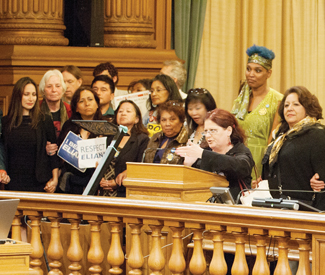
Now Friends of Ethics, made up of a number of former commissioners, activists, and campaign-finance watchdogs, says that the commission is trying to hold a quick hearing that will gloss over much of the criticism of the Rose report. The group wants the hearing delayed until there’s a lot more time to bring a lot more people into the process.

Here’s the letter FOE sent over:

To the Ethics Commission and Staff:

Friends of Ethics is writing with objections and protests regarding the upcoming “Interested Persons” meetings scheduled for December 4 and 10, 2012.

The Commission notified “Candidates, Treasurers and Interested Persons” of meetings “to discuss recommendations of the Budget Analyst report (also known as the Harvey Rose report) comparing programs of the San Francisco Ethics Commission with those of the Los Angeles Ethics Commission.”

The notice was dated November 28, providing only three business days before the first meeting will take place.

The Friends of Ethics bases its protest and objections on the following facts, and by this memo, formally requests that Ethics postpone these meetings until February.

     The proposed Interested Persons meetings do not mention inclusion of a representative from the Board Budget Analyst office to present their report and to discuss its findings. Without their direct involvement, as well as the invited presence of Supervisor Campos who requested the Rose report, the Interested Persons meeting will have only the staff’s views of the report as a basis for discussion. We believe this fails to provide the direct interaction and communication that should be part of this process.

    Ethics was requested by the Board of Supervisors to conduct robust and inclusive outreach to all participants in San Francisco’s political life. Ethics provided Friends of Ethics with the list used to contact Interested Persons about this meeting. We believe the list provided is not an adequate outreach, includes no community-based organizations active in electoral politics, any of the chartered Democratic clubs or other partisan political organizations, or special focus organizations active in San Francisco elections. We believe the lack of an inclusive outreach as evidenced by this list denies the Commission of a full discussion of the issues and is weighted toward the regulated community. We are puzzled by the fact that many people who do receive the Interested Persons notices are not on the list provided by Ethics, and seek a clarification on whether additional lists were used that were not disclosed to us. We also note that the late Joe Lynn, while the Campaign Finance Officer for Ethics, not only conducted extensive outreaches for IP meetings, including contacting past treasurers and press and posting notices on local political blogs and chat boards, but also later informed Director St. Croix in writing about those practices for the purpose of encouraging the continuation of such outreach.

    Ethics provided insufficient time for a review and analysis of recommendations that are significant and meaningful for the operation and success of the Ethics Commission mission. We believe that Ethics has done the bare minimum of notice of a public meeting and failed to take a serious approach to this important issue. Providing notice three days before the meeting, particularly in the holiday period between Thanksgiving and the first of December, means that no organization has an opportunity to place this issue on their agenda for a discussion or to endorse comments to be provided to the Ethics Commission.

    Ethics prepared an agenda that omitted significant and critically important comparisons between the Los Angeles and San Francisco Ethics Commissions that were included in the Rose report. While Ethics did list specific recommendations from the Rose report, the report itself detailed a number of additional differences that are significant to the San Francisco political community as we know it, and that should be part of a discussion of the Rose report.

Among the omitted points are:

    Los Angeles has a private right of action for citizens to act when Ethics does not; in Los Angeles this can include penalties under a civil action. San Francisco has no such provision. We believe this is essential to meaningfully empower citizens to directly seek compliance with our laws.

    Los Angeles requires disclosure of contributors of $100 or more to groups making “third party” expenditures. San Francisco does not require public disclosure of this money stream. Disclosure of donors to third party committees would add transparency, particularly if this has become a strategy to allow city contractors to influence elections.

    Los Angeles prohibits contributions from those seeking permits, while San Francisco does not. Friends of Ethics has determined that over 90 percent of all City Hall lobbying involves permit decisions.

    Los Angeles prohibits commissioners from fundraising for candidates, while San Francisco does not. This is the heart of pay-to-play politics that infects city appointments as commissioners are often the first stop for fundraising on behalf of city elected officials. We note a recent case where a city commissioner hosted a fundraiser that included contributions from city employees from the same department. The candidate returned the contributions, recognizing that commissioners are prohibited from seeking contributions from city employees. However, this demonstrates the potential abuse and underscores that Los Angeles’ policy is a stronger and more easily enforced prohibition. We recommend it.

    Los Angeles prohibits fundraising from city contractors and those seeking city actions. San Francisco allows contractors to fundraise and serve on candidate finance committees, although they may not contribute their own funds. Currently San Francisco also does not require candidates to disclose the names of their Finance Committee members. However, we strongly prefer closing the loophole, as Los Angeles has done, by prohibiting city contractors and permit seekers from fundraising.

    Los Angeles requires a more robust disclosure of “paid by” notification on telephone messages when 200 or more people are called. San Francisco sets the threshold at 500 people. Therefore, “paid by” calls to members of political clubs during the endorsement process would be missed under San Francisco’s standard but included under LA’s standard.

    Los Angeles provides a “Guide for Contributors” that educates donors and reduces confusion on such issues as aggregate contribution limits, prohibitions on officers of organizations receiving city funds, and so forth. This is done at minimal cost and made available on the Internet with no printing or mailing costs. San Francisco does not provide a Guide. Instead, the Ethics staff has recommended that the Commission rewrite the law to overturn specific prohibitions, stating that contributors are confused about the rules. The best approach is Los Angeles, where an educational outreach to contributors is part of their program. We note that San Francisco provides guides and outreach to most others involved in political activities, including committee treasurers, candidates and others but does not include an educational outreach to donors.

    Los Angeles prohibits political contributions from being made at City Hall or other city offices, including offices rented with city funds. San Francisco allows contributions to take place in the mayor’s own office, supervisor’s offices, at Redevelopment, Planning, Port or other offices – in short, anywhere that a donor chooses to make a contribution. We believe allowing contributions to be made in the workplace of city officials undermines public confidence and is inconsistent with other restrictions on the use of city resources for political purposes.

    Los Angeles has a more robust view of what constitutes lobbying and includes attorneys who offer strategic advice even if they do not directly contact a city official. San Francisco does not require registering or disclosing clients from such attorneys involved in orchestrating a favorable result for a paying client. Attorneys who serve as committee treasurers also do not face the same level of public disclosure as lobbyists.

We believe this list of omitted topics, coupled with the unacceptable short timeframe provided for analysis and review by the political community, and the failure to provide adequate outreach, raises serious concerns that Ethics is not engaged in a serious effort to obtain the public’s views on its operations and policies based on the Harvey Rose report.

We further note that Ethics has not provided a public schedule of when it will complete a summary of the Interested Persons meeting and comments, or a schedule for consideration by the full Commission of any recommendations.

In addition, Friends of Ethics requests that the San Francisco Ethics Commission audio record the IP meetings regarding the Rose report and post the recordings on its website, as is done by the Los Angeles City Ethics Commission.  In the past, the San Francisco Ethics Commission made audio recordings of its IP meetings, though they were not posted online.  The Commission’s Directors later discontinued the audio recording altogether, which may have been motivated by valuing the privacy of attendees over public transparency.  Given that the Rose report IP meetings are about comparing San Francisco’s good government laws with Los Angeles’ to consider adopting improvements offered by Los Angeles, Friends of Ethics believes that the first improvement that San Francisco should adopt is the Los Angele set of standard practices for conducting IP meetings.  When it comes to the development of good government law and policy, the public’s right to know is paramount.  Therefore, Friends of Ethics requests that all future IP meetings held by the San Francisco Ethics Commission be audio recorded and the recordings promptly posted online.”

Our reasons for requesting a specific timetable for next steps is based on our observation of lengthy delays in staff action on issues even when raised by the Commission itself. We believe the political community will be unlikely to participate in a process that has no specific and public timetable for action but that could take more than a year to reappear.

For example:

    In July 2011, the Ethics Commission requested that staff draft proposals to close the loophole that allows committees seeking to draft a candidate to fall outside the normal reporting and disclosure requirements. However, staff did not produce a proposal until November 2012, 16 months later, and did so without an Interested Persons meeting to discuss their proposal.

    Also at the July 2011 meeting, the Ethics Commission requested that staff examine the loophole that prevented the Commission from acting in cases of Official Misconduct by a commissioner. Ethics staff still has not produced a proposal to close that loophole.

    Also in 2011, a Superior Court judge suggested that San Francisco adopt a policy prohibiting commissioners from recommending a specific lobbyist to parties seeking a contract or other decision from that commission. Ethics has not prepared any response to that suggestion.

    In June 2012, Rules Committee Chair Jane Kim requested that the Ethics Commission provide some information on the city’s Ethics laws in languages other than English, noting that the rules are as important to donors and committees as they are to the public. The Ethics Commission has taken no steps, including in the election just concluded.

Given this record, we believe that any public process to examine the Harvey Rose Report and build new recommendations must include proposed timelines for action if there is to be public confidence that this process is meaningful.

We also strongly recommend that the Ethics Commission set aside time to allow a full discussion before the Commission itself. We believe that such a discussion should not place a two-minute limit on public members making comments.

For the above reasons and cited facts, Friends of Ethics requests that the Interested Persons meeting on the Harvey Rose Report be postponed until February when the political community will have an opportunity to evaluate the proposals and endorse changes, that the Commission immediately engage in a more robust outreach effort that extends beyond the list provided by Ethics to us, that the conversation be broadened to include all topics of comparison between Los Angeles and San Francisco, and that a proposed timeline for a record of the Interested Persons meeting and action by the Commission be provided.

We submit this protest respectfully and with support for the work of the Commission and specifically for the thorough review of any steps that can improve the Commission and public confidence in our political process.

Signed:

Eileen Hansen, former Ethics Commissioner
Bob Planthold, former Ethics Commissioner
Paul Melbostad, former Ethics Commissioner
Sharyn Saslafsky, former Ethics Commissioner
Bob Dockendorff, former Ethics Commissioner
Joe Julian, former Ethics Commissioner
Oliver Luby, former Ethics Commission staffer
Aaron Peskin, past President, Board of Supervisors
Charles Marsteller, former SF Coordinator, Common Cause
Karen Babbitt, community advocate
Marc Saloman, community advocate
Larry Bush, Publisher, CitiReport

 

Dick Meister: A free choice for U.S. workers

32

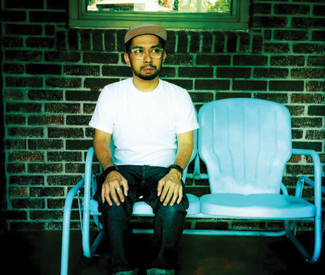
By Dick Meister

Dick Meister, former labor editor of the SF Chronicle and KQED-TV Newsroom,  has covered labor and politics for more than a half-century. Contact him through his website, www.dickmeister.com, which includes more than 350 of his columns.

Now that the electioneering and political posturing is done with, it’s time for President Obama and congressional Democrats to finally deliver on their promises to enact the long delayed Employee Free Choice Act that’s at the very top of organized labor’s political agenda.

EFCA, as it’s sometimes called, has been stalled in Congress for three years. It would give U.S. workers the unfettered right to unionization that would raise their economic and political status considerably.  But that would come at the expense of employers, who have been able to block a large majority of workers from exercising the union rights that labor law has long promised workers.

EFCA would in essence strengthen the 78-year-old National Labor Relations Act – the NLRA – to make it easier for workers to form and join unions.  Which is the clearly stated purpose of the NLRA.

The lack of solid legal protection is a primary reason that, despite the higher pay and benefits and other obvious advantages of union membership, only about 12 percent of the country’s workers belong to unions.

 Surveys show that nearly one-third of all U.S. workers want to unionize but won’t try because they fear employer retaliation – and for good reason. Every year, thousands of workers who do try to unionize are illegally fired or otherwise penalized.

Employers faced with organizing campaigns commonly order supervisors to spy on organizers and force workers to attend meetings at which employers describe unions as dues-snatching outsiders, often asserting falsely that unionization will lead to pay cuts, layoffs, outsourcing of work or even force them out of business. Similar messages are delivered to workers one-on-one by supervisors, frequently along with threats of disciplinary action if they support unionization.

In many of the instances in which workers nevertheless vote for unionization, the employer simply refuses to agree to a contract with the union. Workers who strike to try to force employers to reach an agreement or otherwise follow the law face being permanently replaced.

The NLRA is supposed to protect workers from such actions. But employers have been able to blatantly violate the law because the penalties are slight – usually small fines at most, and they’re often not even imposed. Workers fear complaining to the government, knowing it usually takes months – if not years – for the government to act, and that meanwhile they may lose their jobs.

The most important provision of the Employee Free Choice Act would automatically grant union recognition on the showing of union membership cards by a majority of an employer’s workers – unless the workers opted to have recognition decided by an election.

As the law now stands, only employers can decide whether to use a membership card check or an election to determine their workers’ wishes. Employers almost invariably choose elections because of the opportunity the election campaign gives them to pressure workers into opposing unionization.

Other key provisions of the Free Choice Act would fine employers up to $20,000 for each violation of the law and call for arbitrators to dictate the terms of employers’ contracts with unions winning recognition if the employers stalled for more than four months in contract negotiations with the winners.

The act made it through the House shortly after it was originally introduced in 2003, but was blocked from Senate passage by a Republican filibuster. It seems unlikely that the bill would even get through the House now.

Labor, however, has not backed off, and can still expect the support of President Obama, other key Democrats and civil and human rights groups, religious organizations and other influential union allies to back its demand for passage of the Employee Free Choice Act or something very much like it.

But are labor’s political allies willing – and able – to finally do what they have long promised to do? Are they willing – and able – to join labor in assuring American workers the firm union rights that have too long been denied them?

Dick Meister, former labor editor of the SF Chronicle and KQED-TV Newsroom,  has covered labor and politics for more than a half-century. Contact him through his website, www.dickmeister.com, which includes more than 350 of his columns.


Our Weekly Picks: November 21-27

0

WEDNESDAY 21

Major Powers and the Lo-Fi Symphony

With manic energy and exploratory style, Major Powers and the Lo-Fi Symphony, has garnered a set of reviews likening the band to rock legends, including one extolling on its resurrection of the rock opera genre. With musician blood (Kevin and Dylan Gautschi, sons of Pamela Wood, bass player for Bay Area rock legends Leila and the Snakes) and years of practice (band leader Nicholas Jarvis Powers is a self-taught pianist and songwriter since the age of eight) this trio is well qualified for the praise. And true to the reviews, its intricate arrangements, harmonies, and general flair for the dramatic often channel the spirit of Queen’s Freddie Mercury. As MPATLFS is opening for the upbeat, danceable rock of Solwave, this show should be a great way to kick off your Thanksgiving weekend. (Molly Champlin)

With Solwave, Ressurection Men

$10, 8:30pm

Café Du Nord

2170 Market, SF

(415) 861-5016

www.cafedunord.com


Eats Everything

While Eats Everything may seem to have come out of nowhere in 2011 with the release of attention-seeking track “Entrance Song,” that’s a narrative that ignores the fact that Daniel Pearce had been plugging away as a DJ for quite some time. You can hear it in his omnivorous house sound, in which each bubbly two-step and jungle bounce seems to have carefully digested two decades of electronic music. Since his “debut” Eats Everything has released tracks for SF’s Dirtybird as well as high profile mixes for Resident Advisor and the BBC (which identified Eats Everything as a premiere artist in the rising, resurrected, heavy-heavy bass sound of Bristol, UK).(Ryan Prendiville)

With Ryan Crosson, Bill Patrick, KMLN, Little John, Rich Korach, Dax

9:30pm, $10–$15

Public Works

161 Erie, SF

(415) 932-0955

www.publicsf.com


Indigenous People’s Thanksgiving Sunrise Gathering.

In 1969, the Indians of All Tribes group staged an occupation of Alcatraz Island. After the prison closed, 79 America Indians successfully occupied the island for 19 days, demanding that the government return the land to American Indians with sufficient funding to build a university and cultural center. On the holiday that glosses over the bloodshed of Native American and colonial relations, this celebration should be a positive event that gives thanks to Mother Earth, but also recognizes the inequalities that are present in our society. All are welcome to hear the Native speakers talk about remembrance, gratitude, and the fight for equality. There will be performances by All Nations Singers and traditional Aztec, Pomo, and Pacific Island dance groups. Like the end of a vigil or celebration of new beginnings, the event will take place at sunrise, which should be a beautiful sight from the middle of the bay. (Champlin)

4:45am, $14

Alcatraz Island (Pier 33)

1398 Embarcadero, SF

(415) 641-4482

www.treatycouncil.org


“The JFK Assassination 49 Years Later”

Another murdered president is getting all the headlines lately, thanks to a splashy new Spielberg film — but the puzzle of John F. Kennedy’s untimely death, dramatized by Oliver Stone’s 1991 JFK, remains fascinating both onscreen and off for historians and (conspiracy) theorists. After you’re stuffed with Thanksgiving treats, waddle over to the Roxie for an epic discussion of all things Dealey Plaza and beyond. The evening is anchored by a JFK screening and features enough special guests to fill a presidential limousine, including CIA agent (and Watergate figure) E. Howard Hunt’s eldest son, Saint John Hunt, and Judyth Vary Baker, author of Me and Lee: How I Came to Know, Love, and Lose Lee Harvey Oswald. (Cheryl Eddy)

4:45pm, $10

Roxie Theater

3117 16th St., SF

jasondove.com/jfk/JFKEVENT.html


Henry Rollins

Ah, Thanksgiving. The one time a year you get to set aside all your stress, take the day off, and spend some good quality time with Henry Rollins. Tell your aunties you won’t be bringing the stuffing — you have bigger, less smothering fish to fry. Rollins won’t make you chop anything, take family photos, or leave greasy lipstick marks on your cheek, no — the former Black Flag frontperson is beginning a three-day residency at Yoshi’s to dish up his own smart, searing brand of political commentary and stories from his recent developing world travels. On the road since January of this year, Rollins has taken his Long March tour through nearly every state and dozens of countries before bringing it home to his final destination — California. You’ll laugh, you’ll cry, and you won’t have to help clean up. (Haley Zaremba)

Also Fri/23, Sun/25

7:30pm, $30

Yoshi’s

1330 Fillmore, SF

(415) 655-5600

www.yoshis.com


FRIDAY 23

Delicate Steve

If Vampire Weekend met at Humboldt State instead of Columbia, it might have ended up with a band more like Delicate Steve. Co-opting Afrobeat rhythms, and West African guitar licks a la Tinariwen, and pushing them into jammy, loosely psychedelic territory, the NYC ensemble’s sophomore full-length, Positive Force, hovers continuously between indie rock and white-dude world music, while shrewdly avoiding the pitfalls of both musical traditions. Makes sense, then, that David Byrne signed the band to his Luaka Bop label last year. (Taylor Kaplan)

With Dana Buoy, Raleigh Moncrief

8pm, $12

Rickshaw Stop

155 Fell, SF

(415) 861-2011

www.rickshawstop.com


Kill Paris

This again; it always seem to end up in a club the day after Thanksgiving. The combination of dealing with bigot relatives and overeating (in that order) inevitably leading to the need to burn some calories. (I guess a gym would work as well, but those don’t have booze.) The consistently solid Opulent Temple DJs at the bottom of this eclectic lineup will definitely put down some solid house sets, but also worth checking out is Kill Paris, an EDM up-and-comer with a near fetish for funky ’80s soul and ’90s R&B. Expect to hear Prince, Montell Jordan, and Blackstreet reworked with the sounds of French electro, dubstep, and the fringes of LA’s beat scene. (Prendiville)

With Big Chocolate, Jelo, Opulent Temple DJs (Tekfreaks, Dutch, Dex Stakker, and more)

10pm, $15–$30

1015 Folsom, SF

(415) 431-1200

www.1015.com


SATURDAY 24

Wienerschnitzel wiener dog regional races

Could it be that we have found the true sport of kings? What, pray tell, could be more noble than stockily limbed canines, running as fast as their angular, low-rise bodies can take them across the lacquered floor of a professional basketball arena? Save your horses and greyhounds, for true athletic prowess we will take the Wienerschnitzel weiner dog races. Today’s winner will receive $250 and more importantly (because what the hell is a dog going to do with $250?), a trip to San Diego to compete against the country’s fastest daschunds. (Caitlin Donohue)

Check-in 11:30am, preliminaries noon, free registration

Finals during Warriors game half-time, admission to game $22–$475

Oracle Arena

7000 Coliseum Way, Oakl.

www.wienerschnitzel.com


Richard Cheese and Lounge Against the Machine

There is nothing that Richard Cheese can’t turn into a vocal pop standard, loungifying rock’n’roll, hip-hop, top 40s hits, and everything in between. Previous covers include Nine Inch Nails’ “Closer” and Def Leppard’s “Pour Some Sugar on Me” like you’ve never heard them before (or will again.) The Los Angeles-based cover band and comedic ensemble make a welcome caricature of Las Vegas lounge entertainment, often decked out in tiger striped tuxedos with oversized microphones, and pairing elegant, smooth jazz stylings with blue language and lewd humor. The group has recorded an impressive 10 albums in its 12 years of swank existence. Grab a martini, sit back, and enjoy the ridiculous show. (Zaremba)

With Project: Pimento

9pm, $45

Bimbo’s 365

1025 Columbus, SF

(415) 474-0365

www.bimbos365club.com


MONDAY 26

Zak Kyes

The documentary Helvetica proved that graphic design can be as relevant to your life as the question of whether you should buy Mac or PC. Designer, Zak Kyes will have plenty to say about the unsung importance of things such as font choice and negative space in his lecture at California College of the Arts. In addition, he will discuss how his work has been opening creative avenues between publishing, presentation, architecture, and installation. His collaborations and work across multiple fields won him the prestigious Inform award in 2012, and his resulting exhibition, Zak Kyes Working With… , has been featured in the Museum for Contemporary Art Leipzig, the Graham Foundation in Chicago, and the Architectural Association in London. In our information age, graphic design is useful to anyone who works on a computer, and what better way to learn more about it than from someone who clearly knows his stuff? (Champlin)

Free, 7pm

Graduate Center, CCA San Francisco Campus

1111 Eighth St., SF

(415) 551-9216

www.cca.edu


Dethklok

You may be scratching your head, wondering how a cartoon band could headline a real venue. But hey, the Gorillaz did it, and anything pop can do metal can do harder. Dethklok, the band at the center of Adult Swim’s Metalocalypse, has made a habit of touring alongside genuine, esteemed metal bands, providing some humor to an otherwise dark genre. On tour, the men behind the music get to show their faces, performing fan favorites from the show interspersed by comedy sketches poking fun at moshing, headbanging, and the metal community at large. Turns out, metalheads can take a joke. Though the actual fans don’t have to sign “pain waivers” to see Dethklok like they do on Metalocalypse, they probably would if it was requested of them. Brutal. (Zaremba)

With Machine Head, All That Remain, The Black Dahlia Murder

6:30pm, $25

Fox Theater

1807 Telegraph, Oakland

(510) 302-2250

www.thefoxoakland.com


TUESDAY 27

Alice Cooper

Unlike a certain other Republican rocker that has been making headlines as of late, you can ignore Alice Cooper’s quiet politics and still thoroughly enjoy the output of his very loud 40-plus music career — a career that has influenced untold numbers of other shock rock bands and secured him a spot in the Rock and Roll Hall of Fame last year. From writing anthems such as “I’m Eighteen” and “School’s Out” to bringing wild, vaudeville-style theatrics and horror movie imagery to his stage show, Cooper—who hits the city tonight on his “Raise The Dead Tour” — remains one of the greatest icons in the pantheon of rock. (Sean McCourt)

8pm, $37.50–$57.50

Warfield

982 Market, SF

www.thewarfieldtheatre.com

The Guardian listings deadline is two weeks prior to our Wednesday publication date. To submit an item for consideration, please include the title of the event, a brief description of the event, date and time, venue name, street address (listing cross streets only isn’t sufficient), city, telephone number readers can call for more information, telephone number for media, and admission costs. Send information to Listings, the Guardian, 225 Bush, 17th Flr., SF, CA 94105; or e-mail (paste press release into e-mail body — no attachments, please) to listings@sfbg.com. Digital photos may be submitted in jpeg format; the image must be at least 240 dpi and four inches by six inches in size. We regret we cannot accept listings over the phone.

The master

1

cheryl@sfbg.com

FILM If there’s one thing Hollywood loves more than a biopic, it’s a biopic about someone in showbiz. (Well, OK — first choice is probably someone in politics. But showbiz is a close second.) How better to explain the praise lavished on last year’s mediocre My Week With Marilyn? In retrospect, Marilyn‘s most intriguing element was not Michelle Williams’ decision to go with padding rather than weight gain, it was the scenes filmed backstage at Pinewood Studios, affording viewers a glimpse of what the real Marilyn’s workplace might have looked like.

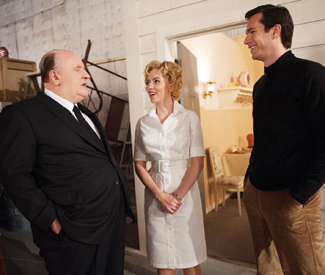
Movie magic in the making is a theme in Hitchcock, too — another biopic about an instantly recognizable celebrity viewed through the lens of a specific film shoot. Here, we have Anthony Hopkins (also sporting padding, one assumes) playing the Master of Suspense, mulling over which project to pursue after the success of 1959’s North by Northwest. Even if you’re not a Hitch buff, it’s clear from the first scene that Psycho, based on Robert Bloch’s true crime-inspired pulpy thriller, is looming. We open on “Ed Gein’s Farmhouse, 1944;” Gein (Michael Wincott) is seen in his yard, his various heinous crimes — murder, grave-robbing, body-part hoarding, human-skin-mask crafting, etc. — as yet undiscovered. Hitchcock, portrayed by the guy who also played the Gein-inspired Hannibal Lecter, steps into the frame with that familiar droll greeting: “Guhhd eevvveeeening.”

And we’re off, following the veteran director as he hunts for new material, determined not to repeat himself and to stay relevant, despite a softened image thanks to his successful TV show. “What if somebody really good made a horror picture?” he muses, and though his wife and collaborator, Alma (Helen Mirren), cautions him against doing something simply because everyone tells him not to, he plows ahead for (partially, it seems) that reason. When he strikes a deal to finance the film himself — because the studio disapproves of its content, much like the censor board will, in an era when showing a toilet flushing onscreen was nearly as scandalous as a shower murder — Psycho becomes even more personal. His reputation (and his continued ability to live in a fancy house and fund his foie gras habit) teeters in the balance.

The filmmaking scenes are fun to watch, peppered with behind-the-scenes moments detailed in Stephen Rebello’s Alfred Hitchcock and the Making of Psycho, the inspiration for John J. McLaughlin’s script. Also important is the contrast between Hitchcock’s contentious relationship with Vera Miles (Jessica Biel) — his onetime protégé who’d dropped out of 1958’s Vertigo due to pregnancy, to the director’s supreme annoyance — and his warm interactions with Janet Leigh (Scarlett Johansson, working hard but perhaps too recognizable to be playing such an icon) and Anthony Perkins (Cloud Atlas‘ James D’Arcy, an uncanny match for Norman Bates).

Hitchcock avoids shot-for-shot replications of Psycho scenes — been there, Gus Van Sant’ed that — but there’s a particularly vivid re-enactment of filming the infamous shower scene. When the knife-wielding stunt double playing Mrs. Bates isn’t slashing vigorously enough, Hitch himself steps in to elicit the proper level of terror from Johansson-as-Leigh’s Marion Crane. There emerges the demanding, perfectionist tyrant suggested by sources beyond the Rebello book; most recently, the made-for-HBO film The Girl featured a particularly lecherous Hitchcock (Toby Jones) as cruel, sexually harassing boss to Tippi Hedren, star of Psycho follow-up The Birds (1963).

But Hopkins’ Hitch offers nothing so extreme, aside from gentle leering at his leading ladies’ ample assets — still enough to make Alma Hitchcock (“a smart, shrewd lady who had a lot of influence over him,” the book praises, in one of few mentions of her) cringe. Feeling overlooked, she begins spending time with the unctuous Whitfield Cook (Danny Huston), a writer who’d worked on Hitchcock’s 1951 Strangers on a Train, but whose current project is the shudderingly-titled Taxi to Dubrovnik.

As the film’s tagline — “Behind every Psycho is a great woman” — suggests, the relationship between Alma and Hitch is, stubbornly, Hitchcock‘s main focus. While Mirren is effective (and I’m all for seeing a lady who works hard behind the scenes get recognition), the Whit subplot exists only to shoehorn more conflict into a tale that’s got plenty already. We can tell Whit is a sleaze from the moment he appears, but the film insists on having him hang around, lure the attention-starved Alma out to his beach house, etc. If this were a real Hitchcock movie, the ruthless director would’ve excised this go-nowhere drama from his first-draft storyboards.

Elsewhere, however, Hitchcock director Sacha Gervasi — making his narrative debut after hit 2008 doc Anvil: The Story of Anvil — shows stylistic flair, working Hitchcock references into the mise-en-scène (lots of birds), and echoing Psycho‘s themes (Hitch as voyeur, peering through window blinds and peepholes) and symbolism (the first time we see Alma, she’s wearing white undergarments, much like our initial glimpse of Marion in Psycho). There are comedic moments that spring from Hitchcock’s own dry wit and canny grasp of showmanship, as when he invites the Hollywood press over to his house to discuss his new project — then proceeds to solemnly pass around gruesome Ed Gein crime scene photos. (Gein pops up throughout the film as a kind of Hitchcock inner demon; clever, but the device gets old quickly.) Also nice: Hitch’s reaction to the audience‘s reaction at Psycho‘s first public screening.

Hopkins, all things considered a pretty obvious casting choice, is 74 — nearly 15 years older than Hitchcock was in 1959 — and is helped along to that famous profile with prosthetics. But his portrayal of the Master renders the great man a likable but flawed artist: still determined to improve his craft after decades in the biz (Psycho was his 47th film); anxious for approval (he finally won an honorary Oscar in 1968); and a consummate professional on-set — but fond of studying hot-young-thing headshots a little too closely in his home office. And while Hitchcock may not best the political biopic that’s its current box-office competition, Lincoln (nor will Hopkins likely upset Daniel Day-Lewis on any award-show podiums), it’s miles better than another Hopkins-starrer in that vein: 1995’s Nixon. 

HITCHCOCK opens Fri/23 in Bay Area theaters.

SF’s newest political pole gets a new name: Moderate progressives

101

A Daily Kos blogger known as Kurykh has posted an interesting and insightful “crash course in San Francisco politics,” in which he correctly identifies the tri-polar dynamic of local politics. Everyone knows the progressives (Ammiano, Avalos, the Guardian) and the so-called moderates (Wiener, Ma, the Chronicle), and so Kurykh dubs the rising third pole (Chiu, Kim, Mayor Lee) “moderate progressives.”

He calls them “the new kids on the block,” noting that they sided with progressives in 2008 but ushered in a new political reality by siding with the moderates in 2010, now serving essentially as the swing votes on major issues and projects.

“Like other progressives, they are pro-tenant and advocate for more social services to the poor. However, they have pro-business and pro-development tendencies and tend to focus on streamlining bureaucracy and effective government,” he wrote of the moderate progressives.

Personally, I think a more accurate label for this rising new power center is “neoliberal” (I just called them “liberals” in my own San Francisco political primer that I wrote a year ago), a political term describing the belief that any reforms or progress needs to be negotiated with capitalists and corporations instead of coming directly through taxes or regulations.

And I think it underestimates the influence that so-called “moderates” who are actually quite conservative when it come to finances and land use – people like Lee fundraiser Ron Conway and Planning Commissioner Michael Antonini – have in influencing Lee and shaping politics in the city.

But I welcome this contribution to helping San Franciscans understand the political dynamics that are governing this city.

Howard Wallace, LGBT icon, dies at 76

6

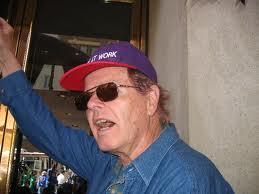
Howard Wallace, a longtime organizer who played a key role in bringing the LGBT movement and labor together in San Francisco, died Nov. 14. He was 76 and had been struggling with Alzhiemer’s disease.

Wallace grew up in Denver, and according to a biography by Andrej Koymasky, was forced to drop out of college when his father saw some United World Federalist literatature he’d brought home and told him to drop of of “commie” politics:

“He put a couple of checks on the dining-room table – the checks for next year’s tuition – and said, ‘Get out [of activism] and you can have those checks.’ I tore them up in his face, and that was the end of my college education.” 

Instead, he began a series of blue-collar jobs that brought him into labor organizing.

By the early 1970s he was in San Francisco, part of a generation of activists that included the late Hank Wilson and Assemblymember Tom Ammiano, who together helped form a group called Bay Area Gay Liberation.

“He made bridges,” Ammiano told me. “He came to BAGL and told us we had to support Cesar Chavez, and some of us were reluctant — you know, it was the Catholic Church, homophobia, all of that. But he convinced us to go on that march, and we were all glad we did.”

Wallace was a founder of the Lesbian-Gay Labor Alliance and later Pride at Work, and he was instrumental in bringing LGBT workers into the labor movement — and also bringing labor support to LGBT causes.

In 1974, Wallace worked with members of the Teamsters Union — not a group always known in those days known for enlightened attitudes towards gay people — on a boycott of Coors beer.  The teamsters were fighting bad labor practices at Coors, including a mandate that all employees take a lie-detector test that incuded the question “are you a homosexual?”

Working with both sides, Wallace got the LGBT community to sign on to the boycott, got Coors out of many of the bars in the Castro — and made lasting connections between local labor leaders and the LGBT community.

“He’s the one who brought Harvey Milk into the Coors boycott,” Ammiano recalled. “And he was never afraid to call out labor leaders when they were being homophobic.”

Like all great organizers, he could be persistent to the point where he was sometimes infuriating — but always, always pure of heart. “He was a character,” Ammiano said. “I never knew what color his hair would be, but I always knew what color his politics would be.”

Tommi Avicolli Mecca, a longtime activist and writer on LGBT history, said Wallace was “a giant among us. He was always there, for the rights of union members, the poor and working class, antiwar activists … you could always count on Howard to be there.”

Mecca noted that Wallace “saw the connections between the LBGT movement and disenfranchised people everywhere. He saw the queer struggle as part of a larger struggle for social and economic justice.”

He will be sorely missed, but as Mecca said, “we will always have his legacy; future generations can look back and understand what our movement was about.”

Said Ammiano: “I hope he and Hank Wilson are up there tipping a few back and talking about Lenin vs. Trotsky.”
 
A memorial is pending, and I’ll keep you posted as updates are available.

UPDATE NUMBER 1: State Sen. Mark Leno told me that Wallace “was not only a dear friend but a teacher. His values were strongly intact.” Leno recalled chairing the fundraising drive for the LGBT Center, a huge undertaking, and accepting a check from Coors for $5,000. “I though I had done due diligence, I knew the boycott was over, but Howard came to our board meeting and convinced us that the LGBT Center had to be above reproach.” 

(I’m sure Howard Wallace didn’t use those exact words).

“It was after that that we became good friends,” Leno said.

UPDATE NUMBER 2: From Gabriel Haaland, Pride at Work co-vice-president (SEIU< SF): I don’t know if most progressives know how much Howard gave to us all. I know there are so many who considered him a mentor and an inspiration. For those of you who don’t know him, Howard had a way of connecting the dots across so many issues. A legend and a hero for sure. A fearless warrior for justice, Howard was both passionate and gentle in his own way… He gave so much of himself and taught me so much in the rashness of my younger years. Even in death, he continues to inspire me to be better than I was before, more in integrity. I honor those who took such good care of him in the last year, like Kathy Lipscomb, Carl Finamore, Tab Buckner, Eileen Hansen, and Susan
Englander. I will miss him.

Popping up

0

le.chicken.farmer@gmail.com

CHEAP EATS Another new restaurant has sprung up at the corner of Castro and 18th St. across from Walgreens. Korean, this time.

CHEAP SPORTS

by Hedgehog

There are several problems inherent with writing a pirate sports column embedded within a “food” column in any free weekly paper, even when the “food” column isn’t written by your domesticated partner. Which mine is. And don’t think I haven’t suspected that’s how I landed the gig in the first place.

In the second place, local politics is what passes for sport in this paper. You all don’t really care about rec center racquetball, pickup soccer, baseball, or women’s flag football. And that list pretty near completes the length and breadth of my sports experience around here. It’s enough to make me want to hang up my cleats and walk out on Chicken Farmer’s strike. But enough about me. And you. And the Bay Area sports scene.

Last week, while I was in Los Angeles, Kristy Kreme told me about something I’d never heard of or ever even imagined possible:

Trampoline dodge ball.

For the uninitiated, I’ll elucidate: I’m talking about dodge ball, but played on a trampoline.

What?

Yes. It really happens! Kristy played it in the Valley but it can occur anywhere there is a trampoline park. These are giant rooms of interconnected trampolines, so that you have a basketball court-sized bouncing surface. On which to play dodge ball. How brilliant is that?

Here is where I leave the purview of underappreciated so-called sports writer and offer up my opinion in the civic arena, editorialist-style: Can we get some of that there Prop B money allocated to convert the now-dormant Mission playground swimming pool into a trampoline park? Now? It would be one sure way to silence your detractors who cried “fiscal irresponsibility” and so forth.

Trampoline dodgeball.

Pretty please?

Cheap Eats continued …

Yeah! A free one, because the House of Air in the Presidio costs like 15, 16 clams an hour. Per person! Most people I know can’t afford those kinds of clams-per-hour, not to mention per person.

But speaking of the metric system, my friend the Maze has moved to Palo Alto and I had the honor of helping him pack his kitchen. Not to mention pick up lunch.

And that is how I knew that there was a new Korean restaurant called Kpop at the corner of Castro and 18th, where that stupid soup place used to be, and before that I forget what.

Well, so I grabbed an order of kimchee fried rice and an order of bulgogi on my way to the Maze’s box-strewn mess of an ex-place, and we had us a little mid-afternoon lunch break.

OK.

The place wraps its takeout orders like microwave hospital cafeteria food: in plastic containers with plastic wrap stuck over the top, which is weird and hard to open.

And pointless.

What are you trying to prove, Kpop?

The sausage in the kimchi fried rice was pretty weak. It kind of seemed like little pieces of hot dogs, only not as yummy. And the fried egg on top of the fried rice … somehow it managed to be both overdone and underdone at the same time. There wasn’t hardly any juice at all left to the yolk, yet the sunny side was still slimy.

The bulgogi was alright. Nothing special.

Gasp, it’s not my new favorite restaurant; but I will give it another chance, because it’s only been open for a couple weeks. And I love the idea of Korean food a short walk from home.

I just wish this one had bigger portions, or at least better portions. Or, hell, the same size and quality of portions for a slightly smaller price. I would settle for that.

KPOP

Mon-Thu, Sun 11am-11pm; Fri-Sat 11am-2am

499 Castro St., SF

(415) 252-9500

MC,V

No alcohol


Dick Meister: Labor’s big day

2

By Dick Meister

Dick Meister, former labor editor of the SF Chronicle and KQED/TV Newsroom, has covered labor and politics for more than a half century. Contact him through his website, www.dickmeister.com, which includes more than 350 of his columns.

Now that the election dust has settled, it’s clear that organized labor was a big winner locally, statewide and nationally.

In San Francisco, more than half the winning candidates for local office had labor backing, as did all local candidates for state office and all but two of the winning city propositions.

Labor did as well statewide, with voters soundly rejecting State Prop 32 that would have greatly diminished unions’ political strength.  Defeating the proposition was by far labor’s most important election goal.

Almost as important was Prop 30, which will provide badly needed increases in funding for education and other local services and reduce the state budget deficit.  Funding will come primarily from higher taxes on the wealthy.

Prop 38, which labor successfully opposed, would have provided only increased education funding and that wouldn’t even have included funding for the community colleges that provide vital job training. Funds for Prop 38 would have come from taxes on everyone, including the poor. 

Labor’s campaigning nationally was done largely – and extensively – for President Obama and Democrats who had hoped to substantially increase the party’s narrow margin in the Senate and even regain control of the House.

But though they failed to elect more friendly congressional Democrats who would back labor’s political agenda, unions can correctly assume that Obama will be as friendly to labor in his second term as he was in is first four years in office.  Pro-labor measures that unions might fail to push through Congress could very well be enacted through presidential executive orders, if not through presidential pressures on Congress.

Labor’s election victories included increases in the minimum wage rates in Albuquerque, San Jose and Long Beach, and the defeat of anti-union measures in several states.

Labor Notes’ Samantha Winslow reported, for instance, that unions helped defeat a measure in Illinois that would have changed the state constitution to require a three-fifths majority vote by the legislature to increase public employee pensions, while requiring only a simple majority to make pension cuts. It would have superseded collective bargaining over pension improvements at the state and local levels

Unions also played a major role in helping groups fighting voter suppression in Ohio and elsewhere, and in the successful re-election campaign of Ohio Sen. Sherrod Brown, one of the Senate’s most labor- friendly members.

Labor’s political efforts obviously aren’t going to end with the election over. Unions already are planning drives to protect Social Security, Medicare and Medicaid from benefit cuts.

“Some legislators and their backers on Wall Street are already set on reaching a ‘grand bargain’ in the next eight weeks,” says AFL-CIO President Richard Trumka. He says they’re aiming to raise the retirement age for Social Security and the eligibility requirements for Medicare and Medicaid.

Trumka has a better idea.  He says “Congress must let the Bush tax cuts expire for the wealthiest 2 percent and make no cuts to Social Security, Medicare or Medicaid.”

Those are among the most important of the many tough political issues now facing unions and their supporters in San Francisco, and throughout California and the rest of the country. As the election proved beyond doubt, unions have what’s needed to seriously challenge their opponents and in the process provide important help to us all.

Dick Meister, former labor editor of the SF Chronicle and KQED/TV Newsroom, has covered labor and politics for more than a half century. Contact him through his website, www.dickmeister.com, which includes more than 350 of his columns.

Stage Listings

0

Stage listings are compiled by Guardian staff. Performance times may change; call venues to confirm. Reviewers are Robert Avila, Rita Felciano, and Nicole Gluckstern. Submit items for the listings at listings@sfbg.com. For further information on how to submit items for the listings, see Picks.

THEATER

OPENING

History: The Musical Un-Scripted Theater, 533 Sutter, SF; www.un-scripted.com. $10-20. Opens Thu/15, 8pm. Runs Thu-Sat, 8pm (no show Nov 22). Through Dec 22. The Un-Scripted Theater Company performs "an unscripted romp through Western history."

ONGOING

Carmelina Eureka Theatre, 215 Geary, SF; www.42ndstmoon.org. $25-75. Wed/14, 7pm; Thu/15-Fri/16, 8pm; Sat/17, 6pm; Sun/18, 3pm. 42nd Street Moon performs the "forgotten musical" that inspired the Broadway hit Mamma Mia!

Elektra Geary Theater, 415 Geary, SF; www.act-sf.org. $20-110. Wed/14-Sat/17, 8pm (also Sat/17, 2pm); Sun/18, 2pm. Academy Award winner Olympia Dukakis stars in Sophocles’ Greek tragedy.

Foodies! The Musical Shelton Theater, 533 Sutter, SF; www.foodiesthemusical.com. $30-34. Fri-Sat, 8pm (no show Sat/17). Open-ended. AWAT Productions presents Morris Bobrow’s musical comedy revue all about food.

The Foreigner Mission Dolores Academy Auditorium, 3371 16th St, SF; (650) 952-3021. Free (donations requested). Fri/16, 7:30pm; Sat/17-Sun/18, 3pm. 16th Street Players perform Larry Shue’s comedy about an Englishman in the American South.

Geezer Marsh San Francisco, 1062 Valencia, SF; www.themarsh.org. $30-100. Sat/17, 8pm; Sun/18, 7pm. Geoff Hoyle’s popular solo show about aging returns.

The Hundred Flowers Project Thick House, 1695 18th St, SF; www.crowdedfire.org. $10-35. Wed/14-Sat/17, 8pm. Reinvention is as American as apple pie — allowing every individual to shed the limitations of the past and move constantly forward. Of course it’s not an exclusively American concept, a point Christopher Chen makes early on in his latest play, The Hundred Flowers Project. A group of Asian American actors gather to collaborate on a play about the Maoist Cultural Revolution, focusing first on the idea of China as a "country of only beginnings … built on the idea of no past," while wrestling with the implications of creating and recreating history as you go along, including, eventually, their own. Ultimately the ideal overtakes their earnest intentions and hijacks the play to serve its own dictatorial end, each actor reduced to an insubstantial shadow of their former "selves," from the over-eager Sam (Ogie Zulueta) to the penitent philanderer Mike (Wiley Naman Strasser) to his somewhat wary ex, Lily (Anna Ishida). Their identities gobbled up by the restless juggernaut the play has morphed into after a triumphal five-year world-tour they hover constantly just on the edges of a dangerous discovery, their once lively sense of purpose replaced by an almost willful inability to question their roles or their fate. Chen’s sprawling, Orwellian tour de force is further bolstered by an army of adroit designers and the competent hand of director Desdemona Chiang, who one hopes is a slightly more benign force than the director of the play-within-the-play, Mel (Charisse Loriaux). (Gluckstern)

Lost Love Mojo Theatre, 2940 16th St, Ste 217, SF; www.mojotheatre.com. $28. Wed/14-Sat/17, 8pm. Modern love and modern life: it’s all a wash in this very funny and smart play from playwright-director Peter Papadopoulos about two pairs of lost souls thrown together in the shoals of a soggy apocalypse. Mitzy (a sure Elena Spittler) is a stunned bride whose just lost her wedding party and everyone she knew — except the valet, Tito (a perfectly deadpan Carlos Flores, Jr.), a loose canon if ultimately goodhearted, who finds himself clinging to the same rock after some unmentioned catastrophe. Meanwhile, Jan (a brilliantly, manically articulate Kimberly Lester) has gone from just sexy crazy to all-out nuts for her girlfriend Barb (a sharp, sympathetic Jessica Risco), whose recent infidelity has apparently triggered Jan’s meltdown, key symptoms of which include an obsession with a certain downbeat French existentialist on the Discovery Channel (a spritely Roy Eikleberry in an outrageous French accent so mal it’s bon), and shedding all material possessions in their mutually decorated apartment. What happens when they all end up together? The possibilities, if not endless, spell end times for the old world. The welcome inaugural production by newcomers Mojo Theatre turns out to have preempted Hurricane Sandy with its own storm of the century, proving rather timely as well as dramatically very worthwhile. Director Papadopoulos makes excellent use of modest resources in staging the action with dynamic contrasts and choice detailing, across a set of finely tuned ensemble performances, as the eccentricities and common sense at war within and between his characters begin slowly and surely to unravel a life out of balance, merrily and mercifully making way for who knows what. (Avila)

Phaedra’s Love Bindlestiff Studios, 185 Sixth St, SF; www.doitliveproductions.com. $15. Wed/14-Sat/17, 8pm. Although she didn’t make it into the 21st century herself, British playwright Sarah Kane (1971-1999) left behind a small group of plays that continue to test the complacency of an age lulled into thinking itself ultimately rational and civilized. In Kane’s cutting, brutally funny reworking of Seneca’s play (itself an adaptation of Euripides’ Hippolytus), the titular lovelorn queen (an amiably tormented Whitney Thomas) throws herself shamelessly at her stepson, royal slob Hippolytus (a sharp yet low-key Michael Zavala, channeling mumblecore nihilism) despite, or because of, his pungent contempt for everyone around him. The play’s main action, however, takes place after Phaedra has killed herself, leaving a note accusing Hippolytus of rape and setting in motion a downfall that is his own perverse salvation. Despite occasionally flagging momentum, director Ben Landmesser and newcomers Do It Live! (in their second outing since last season’s debut, an agile staging of Sam Shepard’s Suicide in B Flat) deliver a worthy production of this clever gem. While a sporadic, low-murmuring sound design (by Hannah Birch Carl) infuses the atmosphere with a muffled libidinal menace, the thrust stage brings us close to the action, rubbing our noses in the fetid whisperings and fumblings of royal parasites and their dialectical kin, the infantilized, desensitized masses. Kane’s Hippolytus, meanwhile, turns from a sort of repellent Hamlet without motive to a Genet-like criminal-saint whose martyrdom is a solitary ecstasy of stark perception. (Avila)

The Rainmaker Shelton Theater, 533 Sutter, SF; www.sheltontheater.org. $38. Fri-Sat, 8pm. Through Dec 22. Shelton Theatre preforms N. Richard Nash’s classic drama.

"ReOrient 2012 Festival and Forum" Z Space, 450 Florida, SF; www.goldenthread.org. $20. Series A runs Thu/15-Sat/17, 8pm; Sun/18, 7pm. Series B runs Sat/17-Sun/18, 8pm. After a three-year hiatus, Golden Thread Productions’ ReOrient Festival of short plays from and about the Middle East is back (coupled with an impressive two-day forum of talks, panels, workshops, and performance around art and politics in the wake of the Arab Spring and other momentous developments across the region). The first of two series of plays, Series A, includes War & Peace, a short symbolical comedy by 20th-century Egyptian literary giant Tawfiq Al-Hakim (handily translated by May Jayyusi and David Wright) that distills imposing social forces into a three-way ménage between a smart, free-spirited woman (a vibrant Lena Hart), her secret suitor in a showman’s coattails and cane (a comically fervent Jesse Horne), and her jealous husband, a violent-tempered military officer (a suave yet stentorian Garth Petal). Sharply directed by Hafiz Karmali, it’s an effervescent little farce that in its power dynamics, and the elusive happiness of the characters, neatly limns bigger themes never timelier in Egypt (or here). It’s followed by Farzam Farrokhi’s 2012, directed by Sara Razavi, a low-key second-coming cum coffee klatch among three laid-back, cell phone-obsessed messiahs (Cory Censoprano, Horne, Roneet Aliza Rahamim) from the three Abrahamic religions that sets an unexpected tone but never really amounts to much. Far more dramatic is Birds Flew In by Yussef El Guindi (of Golden Thread hit Language Rooms, among others), a monologue by a single Arab American mother mourning her deceased soldier-son and wondering where she might have gone wrong. Delivered with unsentimental grit by Nora El Samahy, it’s a strongly voiced if familiar story that registers ambivalence with facile patriotism and violent nationalism, yet unconvincingly retreats at the last moment into a familiar red-white-and-blue corner. Silva Semericiyan’s Stalemate, directed by Desdemona Chiang, is a triptych of scenes between changing pairs of men (played by Censoprano and Horne) that aims at a transnational snapshot of ingrained patterns of male aggression (from Fleet Street to Red Light Amsterdam to war-torn Baghdad) but comes across too weakly and a little confusingly. Durected by Christine Young, Jen Silverman’s In the Days That Follow — set in Boston amid clichés of American openness, innocence and possibility (albeit charmingly personified by Censoprano) — is the longest piece and the most dramatically interesting, if also somewhat strained, positing a 22-year-old Jewish Israeli translator and IDF veteran (Rahamim) as the instigator of peaceful dialogue and mutual affection with an older and politically hardened Palestinian Lebanese poet (El Samahy). Finally, in Mona Mansour and Tala Manassah’s sweet but drifting meta-theatrical, The Letter, directed by Razavi, a Palestinian American physicist (Petal) and his philosopher daughter (Hart) mount an amateur theater piece to respond to the 2011 controversy over CUNY’s blocking of an honorary degree to Tony Kushner based on an attack by a CUNY board member on Kushner’s opposition to Israel’s occupation of Palestine. (Avila)

Roseanne: Live! Rebel, 1760 Market, SF; www.brownpapertickets.com. $25. Wed/14, 7 and 9pm. Lady Bear, Heklina, D’Arcy Drollinger, and more star in this tribute to the long-running sitcom.

Shocktoberfest 13: The Bride of Death Hypnodrome, 575 10th St, SF; www.thrillpeddlers.com. $25-35. Thu/15-Sat/17, 8pm. Thrillpeddlers’ seasonal assortment of yeasty Grand Guignol playlets is a mixed bag of treats, but it all goes so nicely with the autumnal slink into early nights and dark cravings. Fredrick Whitney’s Coals of Fire is lightly amusing, if far from smoking, as a two-hander about a blind older matron (Leigh Crow) who discovers her young companion (Zelda Koznofski, alternating nights with Nancy French) has been secretly schtupping her husband. I’m a Mummy is a short, not very effective musical interlude by Douglas Byng, featuring the bright pair of Jim Jeske and Annie Larson as Mr. and Mrs., respectively. The titular feature, The Bride of Death, written by Michael Phillis and directed by Russell Blackwood, proves a worthy centerpiece, unfolding an intriguing, well-acted tale about a reporter (Phillis) and his photographer (Flynn DeMarco) arriving at a stormy castle to interview a strangely youthful Grand Guignol stage star (Bonni Suval) making her film debut. After another, this time more rousing musical number, Those Beautiful Ghouls (with music and lyrics by Scrumbly Koldewyn; directed and choreographed by D’Arcy Drollinger), comes the evening’s real high point, The Twisted Pair by Rob Keefe, acted to the bloody hilt by leads Blackwood and DeMarco as the titular duo of scientists driven mad by an experimental batch of ‘crazy’ glue. All of it comes capped, of course, by the company’s signature lights-out spook show. (Avila)

Speed-the-Plow Actors Theatre of San Francisco, 855 Bush, SF; www.actorstheatresf.org. $26-38. Wed-Sat, 8pm. Extended through Dec 21. Actors Theatre of San Francisco performs the David Mamet drama.

"Strindberg Cycle: The Chamber Plays in Rep" Exit on Taylor, 277 Taylor, SF; www.cuttingball.com. $10-50 (festival pass, $75). Thu/15, 7:30pm; Fri/16-Sat/17, 8pm (also Sat/17, 2pm); Sun/18, 5pm. The first pair in the Cutting Ball Theater’s cycle of five newly-translated August Strindberg chamber plays, Storm and Burned House share much in common. Written in 1907, five years before Strindberg’s death, they are the most straightforward, least supernaturally-charged of the five, whose characters are haunted by memories rather than actual ghosts, and whose cloak and dagger domestic intrigues foreshadow Alfred Hitchcock as much as they do Harold Pinter. Both star a commanding pair of veteran Bay Area actors James Carpenter and Robert Parsons as elderly brothers, whose ability to move forward in the present is impeded by memories of past mistakes. In Storm, Carpenter plays the role of an elderly cuckold, whose wife left him five years previous and who, in the words of Parsons, "murdered" his reputation. In Burned House, Carpenter returns to his childhood home from America, a long-lost prodigal son, only to find it has burned to the ground, and with it, any hope of reconciling an unpleasant past. In both, an atmosphere of muted mendacity and stifling unease crowds the stage like an unnamed character whose presence is little acknowledged but felt acutely by all the principles. Gloomy and hostile, bereft of even the slightest glimmer of hopefulness, Storm and Burned House will appeal most to Strindberg completists, post-naturalists, and admirers of new translations (of which Paul Walsh has done a stellar job). (Gluckstern)

The Submission New Conservatory Theatre Center, 25 Van Ness, SF; www.nctcsf.org. $25-45. Wed-Sat, 8pm (no shows Nov 21-22); Sun, 2pm. Through Dec 16. New Conservatory Theatre Center performs Jeff Talbott’s drama about a playwright who falsifies his identity when he enters his latest work into a prestigious theater festival.

Superior Donuts Gough Street Playhouse, 1622 Gough, SF; www.custommade.org. $25-30. Thu-Sat, 8pm; Sun, 7pm. Through Dec 2. Custom Made Theatre performs Tracy Letts’ poignant, Chicago-set comedy.

Twelfth Night, or What You Will Phoenix Theatre, 414 Mason, Sixth Flr., SF; www.ninjazofdrama.com. $10. Thu/15-Sat/17, 8pm (also Sat/17, 3pm). Ninjaz of Drama perform the Shakespeare classic.

The Waiting Period Marsh San Francisco, 1062 Valencia, SF; www.themarsh.org. $15-50. Thu-Fri, 8pm; Sat, 5pm. Extended through Dec 8. Brian Copeland (comedian, TV and radio personality, and creator-performer of the long-running solo play Not a Genuine Black Man) returns to the Marsh with a new solo, this one based on more recent and messier events` in Copeland’s life. The play concerns an episode of severe depression in which he considered suicide, going so far as to purchase a handgun — the title coming from the legally mandatory 10-day period between purchasing and picking up the weapon, which leaves time for reflections and circumstances that ultimately prevent Copeland from pulling the trigger. A grim subject, but Copeland (with co-developer and director David Ford) ensures there’s plenty of humor as well as frank sentiment along the way. The actor peoples the opening scene in the gun store with a comically if somewhat stereotypically rugged representative of the Second Amendment, for instance, as well as an equally familiar "doood" dude at the service counter. Afterward, we follow Copeland, a just barely coping dad, home to the house recently abandoned by his wife, and through the ordinary routines that become unbearable to the clinically depressed. Copeland also recreates interviews he’s made with other survivors of suicidal depression. Telling someone about such things is vital to preventing their worst outcomes, says Copeland, and telling his own story is meant to encourage others. It’s a worthy aim but only a fitfully engaging piece, since as drama it remains thin, standing at perhaps too respectful a distance from the convoluted torment and alienation at its center. (Avila)

BAY AREA

Acid Test: The Many Incarnations of Ram Dass Marsh Berkeley, 2120 Allston, Berk; www.themarsh.org. $15-50. Thu-Fri, 8pm; Sat, 5pm. Through Nov 24. Lynne Kaufman’s new play stars Warren David Keith as the noted spiritual figure.

The Kipling Hotel: True Misadventures of the Electric Pink ’80s Marsh Berkeley, 2120 Allston, Berk; www.themarsh.org. $20-50. Sat, 8:30pm; Sun, 7pm. Extended through Dec 16. This new autobiographical solo show by Don Reed, writer-performer of the fine and long-running East 14th, is another slice of the artist’s journey from 1970s Oakland ghetto to comedy-circuit respectability — here via a partial debate-scholarship to UCLA. The titular Los Angeles residency hotel was where Reed lived and worked for a time in the 1980s while attending university. It’s also a rich mine of memory and material for this physically protean and charismatic comic actor, who sails through two acts of often hilarious, sometimes touching vignettes loosely structured around his time on the hotel’s young wait staff, which catered to the needs of elderly patrons who might need conversation as much as breakfast. On opening night, the episodic narrative seemed to pass through several endings before settling on one whose tidy moral was delivered with too heavy a hand, but if the piece runs a little long, it’s only the last 20 minutes that noticeably meanders. And even with some awkward bumps along the way, it’s never a dull thing watching Reed work. (Avila)

Richard the First: Part One, Part Two, Part Three Berkeley City Club, 2315 Durant, Berk; www.centralworks.org. $14-25. Thu/15-Sat/17, 8pm; Sun/18, three-part marathon, 2, 5, 8pm. This Central Works Method Trilogy presents a rotating schedule of three plays by Gary Graves about the king known as "the Lionheart."

Richard III Live Oak Theatre, 1301 Shattuck, Berk; www.aeofberkeley.org. $12-15. Fri/16-Sat/17, 8pm. Actors Ensemble of Berkeley performs the Shakespeare classic.

Sex, Slugs and Accordion Marsh Berkeley, 2120 Allston, Berk; www.themarsh.org. $10. Wed/14, 8pm. Jetty Swart, a.k.a. Jet Black Pearl, stars in this "wild and exotic evening of song."

The Sound of Music Julia Morgan Theatre, 2640 College, Berk; www.berkeleyplayhouse.org. $15-35. Thu-Sat, 7pm (also Sat, 2pm); Sun, noon and 5pm. Through Dec 2. Berkeley Playhouse opens its fifth season with the Rodgers and Hammerstein musical.

Toil and Trouble La Val’s Subterranean, 1834 Euclid, Berk; www.impacttheatre.com. $10-20. Thu-Sat, 8pm (no show Nov 22). Through Dec 8. Impact Theatre presents Lauren Gunderson’s world premiere comedy inspired by Macbeth.

The White Snake Berkeley Repertory Theatre, Roda Theatre, 2025 Addison, Berk; www.berkeleyrep.org. $29-99. Opens Wed/14, 8pm. Runs Tue and Thu-Sat, 8pm (also Nov 29, Dec 13, and Sat, 2pm; no matinee Dec 1; no show Nov 22); Sun, 2 and 7pm. Through Dec 23. Mary Zimmerman (Metamorphoses) returns to Berkeley Rep with this classic romance adapted from a Chinese legend.

Wilder Times Aurora Theatre, 2081 Addison, Berk; www.auroratheatre.org. $32-60. Tue, 7pm; Wed-Sat, 8pm; Sun, 2 and 7pm. Through Dec 9. Aurora Theatre performs a collection of one-acts by Thornton Wilder.

The World’s Funniest Bubble Show Marsh Berkeley, 2120 Allston, Berk; www.themarsh.org. $8-50. Sun, 11am; Nov 23-25, 11am. Through Nov 25. Louis "The Amazing Bubble Man" Pearl brings his lighter-than-air show back to the Marsh.

PERFORMANCE/DANCE

BATS Improv Bayfront Theater, B350 Fort Mason Center, SF; www.improv.org. $20. "Theatresports," Fri, 8pm, through Dec 21. "Family Drama," Sat, 8pm, through Nov 24.

"The Buddy Club Children’s Shows" Randall Museum Theater, 199 Museum Wy, SF; www.thebuddyclub.com. Sun/18, 11am. $8. Magician Timothy James performs.

"Clone Zone" Dance Mission Theater, 3316 24th St, SF; clonezone.brownpapertickets.com. Fri/16-Sat/17, 8pm; Sun/18, 7pm. $20. Anna and the Annadroids perform a multi-media dance theater piece inspired by video games and Carl Jung.

"Comedy Bodega" Esta Noche Nightclub, 3079 16th St, SF; www.comedybodega.com. Thu, 8pm. Ongoing. No cover (one drink minumum). This week: Caitlin Gill, Wonder Dave, and friends.

"The Comikaze Lounge: A Showcase of Smart Comedy" Café Royale, 800 Post, SF; www.comikazelounge.com. Wed/14, 8pm. Free. Comedy with Brendan Lynch, Griffin Daley, Drew Harmon, and more.

"Fauxgirls!" Infusion Lounge, 124 Ellis, SF; www.fauxgirls.com. Thu/15, 8pm. Free. Drag revue with Victoria Secret, Alexandria, Chanel, Maria Garza, and more.

"Illuminique Under the Dome" Westfield SF Centre, 865 Market, SF; westfield.com/sanfrancisco. Thu/15, 4:30pm. Free. Dancers from the San Francisco Ballet’s Nutcracker perform a demonstration for children at this launch event for the shopping center’s new 3D holiday light display.

International Taiko Festival Yerba Buena Center for the Arts Theater, 700 Howard, SF; www.ybca.org. Fri/16-Sat/17, 8pm (also Sat/17, 2pm). $32-38. With Grand Master Seiichi Tanaka and San Francisco Taiko Dojo, and more.

"Life with Laughter" Garage, 715 Bryant, SF; www.brownpapertickets.com. Fri/16, 8:30pm. $10-20. Variety show featuring comedy, storytelling, spoken word, and music.

"New Frequencies Fest 2012" Yerba Buena Center for the Arts, 701 Mission, SF; www.ybca.org. Fri/16-Sat/17, 8pm. $20-25. Fri/16: "Women, Strings, and Song" with women songwriters and composers performing live; Sat/17: Dafnis Prieto Proverb Trio and a lively celebration of the African Diaspora.

"Our Daily Bread" CounterPULSE, 1310 Mission, SF; www.counterpulse.org. Thu/15-Sun/18, 8pm. $20-30. Amara Tabor-Smith’s Deep Waters Dance Theater performs a work inspired by food traditions.

"Round One Cabaret" Alcove Theater, 414 Mason, Ste 502, SF; roundonecabaret.brownpapertickets.com. Fri/16-Sat/17, 8pm. $30. Not Quite Opera presents this showcase of new songs by Bay Area composers.

San Francisco International Hip Hop Festival Palace of Fine Arts Theater, 3301 Lyon, SF; www.cityboxoffice.com. Program A: Fri/16, 8pm and Sun/18, 2pm. Program B: Sat/17, 8pm and Sun/18, 7pm. $39.99 (combo tickets, $75). Sixteen hip-hop dance companies from the Bay Area, the East Coast, Europe, and more perform at this 14th annual event.

"San Francisco Magic Parlor" Chancellor Hotel Union Square, 433 Powell, SF; www.sfmagicparlor.com. Thu-Sat, 8pm. Ongoing. $40. Magic vignettes with conjurer and storyteller Walt Anthony.

"The Way Tomorrow Was: A Retro-Future Burlesque and Bellydance Revue" 50 Mason Social House, 50 Mason, SF; www.lightreclaimed.com. Sat/17, 10pm. $12-20. Retro space-age performances.

BAY AREA

Mills Repertory Dance Company Lisser Theatre, Mills College, 5000 Macarthur, Oakl; www.brownpapertickets.com. Fri/16-Sat/17, 8pm (also Fri/16, 1pm). Also Sun/18, 3pm at Dance Mission Theatre, 336 24th St., SF. $12-15. Fall concert with works by Sonya Delwaide, Shinichi Iova-Koga, Katie Faulkner, and others.

"Yes, Bay Area: The Selected Tweets of Lyrics Born: A Reading with Beats" Pegasus Books Downtown, 2349 Shattuck, Berk; (510) 649-1320. Sun/18, 7:30pm. Free. The musican shares his first book at this "musically enhanced literary reading" presented by First Person Singular’s On Book series.

Shit happened

0

CASH FOR TRASH

Recology, the city’s garbage monopoly, has a problem: It charges residential customers only for the black cans full of unrecyclable material headed for the landfill — but thanks to city policy and environmental consciousness, there’s less and less traditional trash out there. Ultimately, the company wants to get rid of the big black cans altogether.

So a business model based on offering free recycling and compost doesn’t work any more — and everyone has known for some time that it had to change.

But there was no discussion of rate changes earlier this year; in fact, Recology folks said there were no plans for an immediate rate hike in the works. That’s because the June ballot included a measure that would have created competitive bidding for the city’s garbage contract — and the last thing Recology wanted was the threat of a rate hike to drive voters toward amending the 1932 City Charter provision that gives just one company complete control over the lucrative waste franchise.

Ah, but the June election is long over, and Recology beat back that effort — so the rate hike we all expected is now on the table.

On Sept. 11, Recology informed the city that it intends to apply for a new rate structure — and while the process is long and convoluted, we’ll see the details in a few weeks, and you can expect to start paying more for your service by next summer.

There’s no formal proposal yet — that will come in December. The director of the Department of Public Works has to approve it, and so does a Rate Board made up of the city administration, the controller and the head of the Public Utilities Commission. But both Recology and the city say there will be some significant changes in the way San Franciscans pay to have their refuse removed.

“We can’t focus our financial operations on a black can if we’re trying to get rid of it,” Recology spokesperson Eric Potashner told us.

Douglas Legg, the finance director at the Department of Public Works agrees. “As we’ve been pushing diversion, the blue and green cans have been pretty heavily subsidized.”

But shouldn’t good habits, like recycling, be subsidized? Should people who recycle and compost more be penalized? “That’s the challenge,” Potashner said.

And in the end, it’s going to be more than a shift in which bins cost how much. There’s no doubt that your bills will be rising, perhaps by a significant amount. “I assume it will go up,” Legg said. “There hasn’t been a cost-of-living increase since 2010.”

Which, of course, brings back the competitive bidding point. If others had a chance to make a play for the city contract, might rates be lower? Or might the city get more out of the deal?

Retired Judge Quentin Kopp, who helped spearhead the campaign for competitive bidding, thinks so. “If we had competitive bidding,” he told us, “these rate hikes would be more moderate.”

OPENING THE LAST CLOSET DOOR

While most everyone’s attention was focused on electoral politics in late October, Supervisors David Campos and Christina Olague were talking about a different level of political issue, one that’s still a huge taboo: Gay men in professional sports. At an Oct. 30 press conference, the two LGBT supes joined with representatives of The Last Closet, an SF-based campaign that’s trying to get gay professional athletes to come out.

It’s remarkable (or maybe, sadly, it isn’t) that in 2012, not one openly gay man has played in any of the Big Five pro sports (football, basketball, hockey, baseball and soccer). There are, everyone knows, plenty of gay athletes, and the NFL, NBA, NHL, MLB and various soccer associations all have gay players. Some of them have come out after they’ve retired. But on the field (or on the floor, or on the ice)? No way.

Why does anyone care? Because youth sports are still, even in this town, full of homophobic language and homophobic attitudes, and it’s hard to imagine what young LGBT football or basketball players have to endure. Even one gay player could make a world of difference.

“What I saw with the San Francisco Giants, all of the Latino players, was such a source of pride to Latino boys and girls,” Campos told us. “We can’t feel that in the LGBT community. We know there are gay baseball players, but the LGBT youth don’t have those role models to look up to.”

The Last Closet campaign emerged out of a documentary film project that sought to look at homophobia in pro sports. “It became clear that some members of the sports hierarchy were not going to make themselves available to speak about this taboo subject,” the group’s website notes.

In fact, Fawn Yacker, one of the project directors, told us that nobody in a senior position in any sports organization was willing to talk — and that’s turned the movie into a political campaign. “We want the fans to push the sports leaders to address this,” she said.

In fact, all The Last Closeters want right now is for the commissioners of the major sports leagues to make a statement that homophobia is unacceptable and that the leagues will do everything possible to make sure that out gay players are accepted. Seems like a pretty simply no-brainer — but so far, not one sports official has gone along.

It’s pretty crazy, considering that it’s almost inevitable that a few major sports athletes will come out in the next few years — and the leagues are going to look foolish if they pretend it’s not going to happen. Any bets on which sport is going to be the first? “I don’t know,” Yackey said. “I think it might be hockey.” 

Protest — and run for office

1

OPINION Millions of Americans are eager, even desperate, for a political movement that truly challenges the power of Wall Street and the Pentagon. But accommodation has been habit-forming for many left-leaning organizations, which are increasingly taking their cues from the party establishment: deferring to top Democrats in Washington, staying away from robust progressive populism, and making excuses for the Democratic embrace of corporate power and perpetual war.

It’s true that many left-of-center groups are becoming more sophisticated in their use of digital platforms for messaging, fundraising and other work. But it’s also true that President Obama’s transactional approach has had demoralizing effects on his base. Even the best resources — mobilized by unions, environmental groups, feminist organizations, and the like — can do only so much when many voters and former volunteers are inclined to stay home.

For people fed up with bait-and-switch pitches from Democrats who talk progressive to get elected but then govern otherwise, the Occupy movement has been a compelling and energizing counterforce. Its often-implicit message: protesting is hip and astute, while electioneering is uncool and clueless. Yet protesters’ demands, routinely focused on government action and inaction, underscore how much state power really matters.

To escape this self-defeating trap, progressives must build a grassroots power base that can do more than illuminate the nonstop horror shows of the status quo. To posit a choice between developing strong social movements and strong electoral capacity is akin to choosing between arms and legs. If we want to move the country in a progressive direction, the politics of denunciation must work in sync with the politics of organizing — which must include solid electoral work.

Movements that take to the streets can proceed in creative tension with election campaigns. But even if protests flourish, progressive groups expand and left media outlets thrive, the power to impose government accountability is apt to remain elusive. That power is contingent on organizing, reaching the public and building muscle to exercise leverage over what government officials do — and who they are. Even electing better candidates won’t accomplish much unless the base is organized and functional enough to keep them accountable.

Politicians like to envision social movements as tributaries flowing into their election campaigns. But a healthy ecology of progressive politics would mean the flow goes mostly in the other direction. Election campaigns should be subsets of social movements, not the other way around.

For progressives, ongoing engagement with people in communities has vast potential advantages that big money can’t buy — and (we hope) can’t defeat. But few progressive institutions with election goals have the time, resolve, resources or patience to initiate and sustain relationships with communities. For the most part, precinct organizing is a lost art that progressives have failed to revitalize. Until that changes, the electoral future looks bleak.

Norman Solomon is founding director of the Institute for Public Accuracy and co-founder of rootsaction.org. A longer version of this piece appears in the Nov. 24 edition of The Nation.

Dick Meister: We all need a higher minimum wage

5

By Dick Meister

Bay Guardian columnist Dick Meister, former labor editor of the SF Chronicle and KQED/TV Newsroom, has covered labor and politics for more than a half-century. Contact him through his website, www.dickmeister.com.

Election’s over, the good guy won, so what now for working people? Labor’s wish list for our re-elected president and the new Congress is long, but certainly the most basic item is raising the pay of our poorest workers by raising the minimum wage.

 About four million workers have been living in poverty or near-poverty at the current minimum of $7.25 an hour – $15,000 a year at most before taxes and other deductions. And that’s assuming the workers manage to find full time, year-round jobs.

There’s been no lack of congressional bills to raise the minimum since it was last raised in 2007, the latest introduced this year by two Democrats, Sen. Tom Harkin of Iowa and Rep. George Miller of California.  Their bill would increase the rate to $9.80 an hour by 2014, index the rate to rise automatically with any rise in the cost of living after that, and set the rate for tipped workers at 70 percent of the minimum.

 Raising the minimum would help us all. The National Employment Law Project (NELP) estimates that increased consumer spending generated by the proposed raise would create the equivalent of more than 100,000 full time jobs. Other estimates indicate that every dollar increase in wages for workers at the minimum would create more than $3,000 in new spending after a year.

It’s often argued by those opposing a raise that a raise would be mainly a burden on small businesses, but NELP found that more than two-thirds of minimum wage workers are employed by large companies.  There’s no doubt many of the larger employers could easily afford a raise, especially since, as NELP notes, most of them are fully recovered from the Great Recession and are back making strong profits.

It’s not surprising that the opposition to a raise is led by corporate employers, but how does the general public feel about raising the minimum? A poll conducted in February of this year showed that nearly three-fourths of likely voters nationwide would support raising the federal minimum to $10 an hour and indexing it to inflation.

States, counties and cities can set their own minimums, as long as they at least equal the federal rate, and voters in 18 states and several cities have by substantial margins approved minimums greater than the federal rate.

In 2004 and 2006, state wage rates above the federal minimum were approved by voters in Arizona, Colorado, Florida, Missouri, Montana, Nevada and Ohio. As for a federal raise, President Obama pledged during his initial election campaign in 2008 that he’d seek an increase to $9.50 an hour. But he did not do that, and said nothing about a raise during his re-election campaign this year.

Meanwhile, however, voters have recently raised the minimum rates in three cities, Albuquerque, San Jose and Long Beach.  NELP’s executive director, Christine Owens, hails the raises as a “major victory for workers.”

The rate in Albuquerque jumped a whole dollar to $8.50 an hour and will automatically adjust to future increases in the cost of living. NELP calculates that will affect an estimated 40,000 workers, generate $18 million in new consumer spending and support creation of 160 new jobs as businesses expand to meet the increased demand.

The minimum wage in San Jose rose from $8 an hour, the current California rate, to $10. NELP says that should raise the pay of almost one-fifth of the citywide workforce, boost consumer spending by $190 million and support creation of 200 new full-time jobs.

The raise in Long Beach does not apply to all workers there, but does set a higher minimum for hotel workers, who are essential to the success of the city’s booming hospitality industry. Their minimum pay will rise to $13 an hour from an average of only $10.  They will also get five paid sick leave days per year.

City minimums in California and elsewhere in the country range up to San Francisco’s rate that will reach $10.55 an hour next year.

NELP’s Owens notes that “with growing numbers of working people relying on low-wage jobs to make ends meet, the voters recognize that raising the minimum wage fulfills our basic obligation to ensure that work provides a path out of poverty. Higher wages for the lowest-paid workers in our economy will promote upward economic mobility and help accelerate post-recession recovery.”

It’s time for the president and Congress to recognize that vital truth.

Bay Guardian columnist Dick Meister, former labor editor of the SF Chronicle and KQED/TV Newsroom, has covered labor and politics for more than a half-century. Contact him through his website, www.dickmeister.com.

Election makes the Board of Supervisors tougher to predict

20

I’m still a bit too bleary-eyed for serious political analysis on D5 or other races today, but I’ll offer a few of my own post-election observations and those that politicos Alex Clemens and David Latterman delivered during their usual political wrap-up at the SPUR office this afternoon, noting how this election has altered local political dynamics.

“The Board of Supervisors as a whole is becoming a helluva lot more interesting,” Clemens said, noting that progressive District 5 just elected London Breed, the most moderate candidate in that race, while conservative District 7 gave the most progressive candidates, Norman Yee and FX Crowley, its top two spots (with Crowley the likely winner once ranked choices ballots are tallied).

The result is that both the progressive and moderate blocs lost their most reliable votes to the squishy center, so that “determining what’s going to happen before it happens just got more difficult,” a dynamic that could play out most strongly on land use issues.

“I think land use politics is going to be even more interesting,” Clemens said, with Latterman adding, “In this city, all politics really comes down to land use.”

Assessor Phil Ting’s election to the Assembly also now paves the way for Mayor Ed Lee to appoint his replacement, with Sup. Carmen Chu widely considered the clear favorite, which would in turn give Lee an appointment to her District 4 seat on the board.

Yet Clemens speculated that Lee may wait to replace Chu until after the next Board of Supervisors is seated in early January – which would allow that person to finish her final two years and still run for an additional two full terms, whereas the Charter would otherwise limit that person to one more term – which could complicate an already complicated election for board president. Sups. Jane Kim and Scott Wiener are the likeliest contenders, but anything could happen.

“Counting to six from 10 is going to be so much fun to watch,” Clemens said, although he added, “I believe in the era of Ed Lee, it’ll all be worked out beforehand.”

Neither Clemens nor Latterman agreed that the overwhelming expenditures on political hit pieces (mostly against D1 Sup. Eric Mar, who won a surprisingly big margin of victory) by allies of Lee, or the fact that they turned on Sup. Christina Olague in nasty fashion, would diminish Lee’s public standing or the aura of civility he’s tried to cultivate.

Personally, I don’t agree, and it think progressives have been given an opportunity to highlight the money-driven nature of the agenda that Lee and his billionaire backer Ron Conway have for San Francisco. It’s also significant that the most anti-progressive candidates – Lee’s City College appointee Rodrigo Santos, D1’s David Lee, and D7’s Mike Garcia – all fell far short of victory.

Progressives now have a chance to set a positive, proactive agenda for the city, of the kind eloquently voiced by new school board member Matt Haney, whom Clemens thanked for running such a strong and positive campaign, as well as top City College finisher Steve Ngo and Sup. David Campos, who shared an election night campaign party and positive message about progressive prospects.

“That’s what me, Steve, and David were saying here tonight,” Haney told me, calling for an end to the adversarial style of practicing politics. “Our values are love and compassion.”

Latterman and Clemens did acknowledge that that record-breaking spending against Mar may have backfired, but they gave more credit to Mar’s campaign. “You don’t bet against [Mar campaign manager] Nicole Derse in a ground game in the last week of the campaign,” Latterman said.

Derse, who was there, noted its innovative voter identification efforts and strong grassroots volunteer push, a drive partially helped by those reacting to the big-money attacks. Latterman also acknowledges that the strange and controversial videos attacking Mar didn’t help, telling the crowd, “And tactically, don’t have the Realtors make the videos.”

As for District 5, neither politico claimed to fully understand the complex variables that shaped the race.

“It’s hard to unravel what happened here,” Latterman said of the D5 race, noting the complicated dynamics created by Olague’s mayoral appointment, her vote to reinstate Sheriff Ross Mirkarimi, Julian Davis’ problems, and the outside spending. He praised Breed’s campaign, calling it a “a solid win,” but he also said Breed’s independence helped her and she might have suffered the same fate as Olague if she had gotten the appointment from Lee back in January: “I think Supervisor Breed doesn’t win this race; challenger Breed did.”

D5 race displays key SF political dynamics

70

There’s so much to say about the District 5 supervisorial race, whose top five finishers’ parties I attended tonight, gathering interesting perspectives from each candidate. But given the late hour, I’m just going to run a few thoughts and quotes and save most of it for a more in-depth report tomorrow, because there’s a fascinating story to be told here.

Christina Olague, John Rizzo, and Julian Davis – respectively the second through fourth place candidates – each presented as more progressive than the likely winner, London Breed, who has an 8-point lead going into the final ballot tally and ranked choice tabulation. They and their allies raised concerns that renters were undermined by Breed’s victory in one of the city’s most progressive districts.

“It was a lie. I’m a renter, I live in a rent-controlled apartment,” she told us just before midnight outside in party at Nickie’s on Haight. “I will do everything to protect rent control. I will work with the Tenants’ Union. I’m here to be everybody’s supervisor.”

She pledged to work productively with all the progressive groups who opposed her, such at SEIU Local 1021, whose members “ take care of my mom at Laguna Honda,” while others are her friends.

“The pettiness of politics is over and it’s time to move forward,” Breed said.

It was a widely sounded theme among jubilant progressives tonight, but D5’s (likely) runner-up Olague sounded a bit of bitterness when we caught up with her a little after 11pm as she was leaving her party at Rassela’s on Fillmore. “The Left and the Right both came at me,” she told us.

She felt unfairly attacked by progressives after being appointed to the D5 seat by Mayor Ed Lee, saying her only bad vote was in favor of the 8 Washington luxury condo project, which Sup. Eric Mar also backed without losing progressive support. “From the beginning, people were hypercritical of me in ways that might not be completely fair.”

Then, this fall, Mayor Lee’s people – chief of staff Steve Kawa, tech point person Tony Winnicker, and billionaire backer Ron Conway – turned on her after a series of votes culminating in the one to reinstate Sheriff Ross Mirkarimi, resisting what she labeled “a power play” aimed at progressives.

Yet she believes her key vote in favor of CleanPowerSF, coming after her support for Sup. John Avalos getting new revenue out of the business tax reform Prop. E, was really what turned Conway and the downtown crowd against her and attracted outrageous attacks that she condoned domestic violence and supported Big Oil.

“They don’t want to say it, but it was the whole thing around CleanPowerSF. Do you think PG&E wanted to lose its monopoly?” she said. “It’s not about disloyalty, it’s about power.”

Julian Davis was similarly deflective about his campaign’s fourth place finish, despite having a strong presence on the streets today and lots of energy at his crowded campaign party at Club Waziema, after he weathered a loss of prominent progressive endorsements over his handling of sexual misconduct allegations.

“It’s been a challenging few weeks, but I’ve kept my head held high in this campaign,” Davis said, decrying the “self-fulfilling prophecy of the local media” that didn’t focus on the progressive endorsers who stayed with him, such as former D5 Sup. Matt Gonzalez and the SF Tenants Union.

Third place finisher John Rizzo, whose party at Murio’s Trophy Room party reflected his less-than-exuberant campaign, was generally positive about the night, although he expressed some concerns about the agenda of the “people putting up hundreds of thousands of dollars” into this race and the D1 contest, where progressive favorite Eric Mar won a strong victory.

I stopped by Breed’s party twice tonight: at the end, and a little before 10pm, when the results were coming over the television proclaiming that voters in Maryland approved same-sex marriage and Colorado voter legalized marijuana – and the room erupted in cheers – and Oregon voters rejected legalizing weed, drawing big boos.

Breed’s was a liberal crowd, a D5 crowd, and a largely African American crowd. Rev. Arnold Townsend, who is on the Elections Commission and local NAACP board, told me as I left Breed’s party the second time, “It’s a good election for my community. The black community was energized by this.”

New school board member Matt Haney, whose party at Brick & Mortar was my final stop of the night, also likes Breed and said her likely victory was another part of “a good night for progressive San Francisco,” which stands for important egalitarian values. “We are the ones about equity and compassion. That’s what this city is about.”

Obama wins: Rejoicing at SF Dem HQ

1

The crowd just went nuts at the SF Democratic Party headquarters on Market Street when the big TV screen flashed, “Obama Re-Elected.”

Downstairs from the rejoicing, a poster on the wall claimed that volunteers made 29,050 calls over the weekend on the Democratic incumbent’s behalf — upstairs, of course, was the payoff for all that hard work and the party.

State Sen. Mark Leno told us “San Francisco was the most productive campaign office in the state,” having hundreds of volunteers a day.

LGBT activist Gary Virginia was happy and relieved by this victory. “I feel there’s so much at stake in the LGBT community in the White House with this election.”

But there’s more to come. “I’m a little worried about the ballot measures,” SF Dem chair Mary Jung tod us.

Sup. Scott Wiener was watching the other races countrywide. “Elizabeth Warren, what an amazing voice to have in the US Senate.” he said.

DCCC member Matt Dorsey was focused on local races like D5 and D7, “I think those are going to be the most exciting races to follow.”

FOLLOW OUR FULL ELECTION COVERAGE ON OUR POLITICS BLOG 


This much is true

0

cheryl@sfbg.com

FILM The San Francisco Documentary Film Festival returns for its 11th year with a typically strong program — whether you like your docs quirky, political, musical, experimental, or just plain strange, DocFest has you covered. Plus, there’s an “80s New Wave Sing-a-Long,” because who doesn’t love screaming Spandau Ballet with a few hundred pals? Read on for more recommendations.

Sorry, recent San Francisco transplants, but you’ll never get to experience the Jejune Institute, an alternate reality game that started attracting players in 2008 and closed up shop in 2011. Participants, lured by flyers or word-of-mouth, began by visiting an office on California Street, where they’d watch a video imparting new age philosophy; they’d then be given instructions for a sort of scavenger hunt in nearby Chinatown. They learned of a missing girl named Eva, and of new meanings for the words “elsewhere” and “nonchalance.”

Was it real? Was it fake? Whatever the truth, it was definitely fun for dedicated players, for whom the narrative continued and got more complicated; there were spontaneous dance parties, a subterranean rescue mission, and a culminating seminar on “socio-reengineering.” The genius of Spencer McCall’s The Institute  is its tone. Some interviewees are clearly in character, while others — including creator Jeff Hull, who cites Oakland’s Children’s Fairyland as an inspiration — proffer both straight talk and ambiguity, keeping some of the mystery of this fake-cult-that-earned-a-cult-following alive.

Another locally-made film, Sam Banning’s thoughtful Cruel and Unusual, takes a look at the negative effects of California’s Three Strikes Law (and by the time DocFest starts, you’ll know if Proposition 36, aimed at reforming the law, has passed). The film charts several cases, including the ordeal of Kelly Turner, sentenced to life for the decidedly non-violent crime of forging a check. Her story has a happy ending, but as the film shows, she’s one among thousands who’ve received similarly harsh sentences for proportionally minor crimes.

Broadway stardom has always been an elusive prize, but it’s become an even tougher pursuit now that many musicals compete for ticket buyers by casting high-profile film and TV actors. Stephanie Riggs’ The Standbys  goes behind the scenes with three professional understudies. Even if you’re not a musical-theater fan, it’s not hard to sympathize with these folks — “Gotta dance!” types who suffer the psychological strain of always being ready to not perform. (And on the rare occasion they get to step in, they inevitably face a cranky, disappointed audience: “Who’s this clown? Where’s Nathan Lane?”) The lifestyle fosters more offstage drama than on, as when the affable Ben Crawford finally ascends to leading-man status in Shrek the Musical — a triumph after all those hours spent sitting backstage in elaborate greenface — only to be set adrift when the show closes.

As careers go, show biz is brutal, but politics may be worse, and Ann Richards’ Texas is probably the most inspiring yet depressing film in DocFest. That’s not the fault of filmmakers Keith Patterson and Jack Lofton, but rather history itself: the feisty, big-haired Texas liberal was knocked out of office by George W. Bush, her opponent in the 1995 gubernatorial race. But just because Texas has gone the way of Bush and (ugh) Rick Perry shouldn’t take away from Richards’ considerable accomplishments — like her prison-reform work, among the good turns detailed here — or diminish her personality, which was as towering as her coiffure.

Though numerous famous friends and admirers (Dolly Parton, Bill Clinton) chime in with words of praise, the footage of Richards just being Richards (at press conferences, on talk shows, and giving speeches — particularly her instantly legendary appearance at the 1988 Democratic National Convention) speaks for itself. If only Richards, who died in 2006, was still around; there’d be no one better suited to rip into the current crop of women-hating Republicans.

Shot like a thriller, Thymaya Payne’s Stolen Seas is an eye-opening exploration of Somali piracy, with re-enactments (using actual audio recordings) of tense ransom negotiations between a Danish shipping company executive and a man retained by pirates to act as their translator. The film also delves into Somalia’s troubled history and recent past, exposing the origins of the piracy epidemic — surprise, surprise: the United States has a hand in it — and the purely business reasons why it will likely continue more or less unchecked.

Though it’s an East Coast tale, Bay Area activists may spot kindred spirits in the subjects of Suki Hawley and Michael Galinsky’s Battle for Brooklyn, about community members and business owners who organized against a fat-cat developer’s plan to construct the Brooklyn Nets’ new arena in their neighborhood. The central figure is Daniel Goldstein, a graphic designer turned rabble-rouser whose home is located within the project’s footprint. Filmed over seven years, Battle for Brooklyn offers a well-articulated takedown of the shady politics surrounding the deal, with the happy added bonus of seeing Goldstein marry a fellow activist and father a daughter as the fight progresses.

Two more to add to your list: Eating Alabama, filmmaker Andrew Beck Grace’s chronicle of his year-long quest to dine only on food grown by Alabama farmers (yeah, it sounds like a blog instead of a doc, but Grace’s adventures in local foodie-ism, which give way to broader insights, are thought-provoking); and Nisha Pahuja’s The World Before Her (also a recent selection at the 3rd I South Asian Film Festival), which reveals some startling contrasts and similarities between Miss India pageant contestants and girls who are being indoctrinated into the country’s Hindu fundamentalist movement.

SAN FRANCISCO DOCUMENTARY FILM FESTIVAL

Nov 8-21, most films $10-$12

Brava Theater

2781 24th St., SF

Roxie Theater

3117 16th St., SF

Shattuck Cinema

2230 Shattuck, Berk.

www.sfindie.com


Stage Listings

0

Stage listings are compiled by Guardian staff. Performance times may change; call venues to confirm. Reviewers are Robert Avila, Rita Felciano, and Nicole Gluckstern. Submit items for the listings at listings@sfbg.com. For further information on how to submit items for the listings, see Picks.

THEATER

OPENING

The Foreigner Mission Dolores Academy Auditorium, 3371 16th St, SF; (650) 952-3021. Free (donations requested). Opens Fri/9, 7:30pm. Runs Fri, 7:30pm; Sat-Sun, 3pm. Through Nov 18. 16th Street Players perform Larry Shue’s comedy about an Englishman in the American South.

The Submission New Conservatory Theatre Center, 25 Van Ness, SF; www.nctcsf.org. $25-45. Previews Wed/7-Fri/9, 8pm. Opens Sat/10, 8pm. Runs Wed-Sat, 8pm (no shows Nov 21-22); Sun, 2pm. Through Dec 16. New Conservatory Theatre Center performs Jeff Talbott’s drama about a playwright who falsifies his identity when he enters his latest work into a prestigious theater festival.

Superior Donuts Gough Street Playhouse, 1622 Gough, SF; www.custommade.org. $25-30. Opens Thu/8, 8pm. Runs Thu-Sat, 8pm; Sun, 7pm. Through Dec 2. Custom Made Theatre performs Tracy Letts’ poignant, Chicago-set comedy.

BAY AREA

The White Snake Berkeley Repertory Theatre, Roda Theatre, 2025 Addison, Berk; www.berkeleyrep.org. $29-99. Previews Fri/9-Sat/10 and Tue/13, 8pm; Sun/11, 2pm. Opens Nov 14, 8pm. Runs Tue and Thu-Sat, 8pm (also Nov 29, Dec 13, and Sat, 2pm; no matinee Dec 1; no show Nov 22); Sun, 2 and 7pm. Through Dec 23. Mary Zimmerman (Metamorphoses) returns to Berkeley Rep with this classic romance adapted from a Chinese legend.

ONGOING

Carmelina Eureka Theatre, 215 Geary, SF; www.42ndstmoon.org. $25-75. Wed, 7pm; Thu-Fri, 8pm; Sat, 6pm (family matinee Sat/10, 1pm); Sun, 3pm. Through Nov 18. 42nd Street Moon performs the “forgotten musical” that inspired the Broadway hit Mamma Mia!

Elektra Geary Theater, 415 Geary, SF; www.act-sf.org. $20-110. Opens Wed/31, 8pm. Runs Wed-Sat and Nov 13, 8pm (also Wed/7, Sat/10, and Nov 17, 2pm); Sun, 2pm. Through Nov 18. Academy Award winner Olympia Dukakis stars in Sophocles’ Greek tragedy.

Fat Pig Boxcar Theatre Studio, 125A Hyde, SF; www.brownpapertickets.com. $20. Thu/8-Sat/10, 8pm. Theater Toda presents Neil LaBute’s dark comedy about a man who faces scrutiny from his friends when he falls for a plus-sized woman.

Foodies! The Musical Shelton Theater, 533 Sutter, SF; www.foodiesthemusical.com. $30-34. Fri-Sat, 8pm (no show Nov 17). Open-ended. AWAT Productions presents Morris Bobrow’s musical comedy revue all about food.

Geezer Marsh San Francisco, 1062 Valencia, SF; www.themarsh.org. $30-100. Sat, 8pm; Sun, 7pm. Through Nov 18. Geoff Hoyle’s popular solo show about aging returns.

The Hundred Flowers Project Thick House, 1695 18th St, SF; www.crowdedfire.org. $10-35. Wed-Sat, 8pm. Through Nov 17. Reinvention is as American as apple pie — allowing every individual to shed the limitations of the past and move constantly forward. Of course it’s not an exclusively American concept, a point Christopher Chen makes early on in his latest play, The Hundred Flowers Project. A group of Asian American actors gather to collaborate on a play about the Maoist Cultural Revolution, focusing first on the idea of China as a “country of only beginnings … built on the idea of no past,” while wrestling with the implications of creating and recreating history as you go along, including, eventually, their own. Ultimately the ideal overtakes their earnest intentions and hijacks the play to serve its own dictatorial end, each actor reduced to an insubstantial shadow of their former “selves,” from the over-eager Sam (Ogie Zulueta) to the penitent philanderer Mike (Wiley Naman Strasser) to his somewhat wary ex, Lily (Anna Ishida). Their identities gobbled up by the restless juggernaut the play has morphed into after a triumphal five-year world-tour they hover constantly just on the edges of a dangerous discovery, their once lively sense of purpose replaced by an almost willful inability to question their roles or their fate. Chen’s sprawling, Orwellian tour de force is further bolstered by an army of adroit designers and the competent hand of director Desdemona Chiang, who one hopes is a slightly more benign force than the director of the play-within-the-play, Mel (Charisse Loriaux) (Gluckstern)

Lost Love Mojo Theatre, 2940 16th St, Ste 217, SF; www.mojotheatre.com. $28. Wed-Sat, 8pm. Through Nov 17. Modern love and modern life: it’s all a wash in this very funny and smart play from playwright-director Peter Papadopoulos about two pairs of lost souls thrown together in the shoals of a soggy apocalypse. Mitzy (a sure Elena Spittler) is a stunned bride whose just lost her wedding party and everyone she knew — except the valet, Tito (a perfectly deadpan Carlos Flores, Jr.), a loose canon if ultimately goodhearted, who finds himself clinging to the same rock after some unmentioned catastrophe. Meanwhile, Jan (a brilliantly, manically articulate Kimberly Lester) has gone from just sexy crazy to all-out nuts for her girlfriend Barb (a sharp, sympathetic Jessica Risco), whose recent infidelity has apparently triggered Jan’s meltdown, key symptoms of which include an obsession with a certain downbeat French existentialist on the Discovery Channel (a spritely Roy Eikleberry in an outrageous French accent so mal it’s bon), and shedding all material possessions in their mutually decorated apartment. What happens when they all end up together? The possibilities, if not endless, spell end times for the old world. The welcome inaugural production by newcomers Mojo Theatre turns out to have preempted Hurricane Sandy with its own storm of the century, proving rather timely as well as dramatically very worthwhile. Director Papadopoulos makes excellent use of modest resources in staging the action with dynamic contrasts and choice detailing, across a set of finely tuned ensemble performances, as the eccentricities and common sense at war within and between his characters begin slowly and surely to unravel a life out of balance, merrily and mercifully making way for who knows what. (Avila)

Phaedra’s Love Bindlestiff Studios, 185 Sixth St, SF; www.doitliveproductions.com. $15. Wed-Sat, 8pm. Through Nov 17. Although she didn’t make it into the 21st century herself, British playwright Sarah Kane (1971-1999) left behind a small group of plays that continue to test the complacency of an age lulled into thinking itself ultimately rational and civilized. In Kane’s cutting, brutally funny reworking of Seneca’s play (itself an adaptation of Euripides’ Hippolytus), the titular lovelorn queen (an amiably tormented Whitney Thomas) throws herself shamelessly at her stepson, royal slob Hippolytus (a sharp yet low-key Michael Zavala, channeling mumblecore nihilism) despite, or because of, his pungent contempt for everyone around him. The play’s main action, however, takes place after Phaedra has killed herself, leaving a note accusing Hippolytus of rape and setting in motion a downfall that is his own perverse salvation. Despite occasionally flagging momentum, director Ben Landmesser and newcomers Do It Live! (in their second outing since last season’s debut, an agile staging of Sam Shepard’s Suicide in B Flat) deliver a worthy production of this clever gem. While a sporadic, low-murmuring sound design (by Hannah Birch Carl) infuses the atmosphere with a muffled libidinal menace, the thrust stage brings us close to the action, rubbing our noses in the fetid whisperings and fumblings of royal parasites and their dialectical kin, the infantilized, desensitized masses. Kane’s Hippolytus, meanwhile, turns from a sort of repellent Hamlet without motive to a Genet-like criminal-saint whose martyrdom is a solitary ecstasy of stark perception. (Avila)

The Rainmaker Shelton Theater, 533 Sutter, SF; www.sheltontheater.org. $38. Fri-Sat, 8pm. Through Dec 22. Shelton Theatre preforms N. Richard Nash’s classic drama.

“ReOrient 2012 Festival and Forum” Z Space, 450 Florida, SF; www.goldenthread.org. $20. Series A runs Thu-Sat, 8pm; Sun, 7pm. Through Nov 18. Series B runs Nov 16-17, 8pm. After a three-year hiatus, Golden Thread Productions’ ReOrient Festival of short plays from and about the Middle East is back (coupled with an impressive two-day forum of talks, panels, workshops, and performance around art and politics in the wake of the Arab Spring and other momentous developments across the region). The first of two series of plays, Series A, includes War & Peace, a short symbolical comedy by 20th-century Egyptian literary giant Tawfiq Al-Hakim (handily translated by May Jayyusi and David Wright) that distills imposing social forces into a three-way ménage between a smart, free-spirited woman (a vibrant Lena Hart), her secret suitor in a showman’s coattails and cane (a comically fervent Jesse Horne), and her jealous husband, a violent-tempered military officer (a suave yet stentorian Garth Petal). Sharply directed by Hafiz Karmali, it’s an effervescent little farce that in its power dynamics, and the elusive happiness of the characters, neatly limns bigger themes never timelier in Egypt (or here). It’s followed by Farzam Farrokhi’s 2012, directed by Sara Razavi, a low-key second-coming cum coffee klatch among three laid-back, cell phone-obsessed messiahs (Cory Censoprano, Horne, Roneet Aliza Rahamim) from the three Abrahamic religions that sets an unexpected tone but never really amounts to much. Far more dramatic is Birds Flew In by Yussef El Guindi (of Golden Thread hit Language Rooms, among others), a monologue by a single Arab American mother mourning her deceased soldier-son and wondering where she might have gone wrong. Delivered with unsentimental grit by Nora El Samahy, it’s a strongly voiced if familiar story that registers ambivalence with facile patriotism and violent nationalism, yet unconvincingly retreats at the last moment into a familiar red-white-and-blue corner. Silva Semericiyan’s Stalemate, directed by Desdemona Chiang, is a triptych of scenes between changing pairs of men (played by Censoprano and Horne) that aims at a transnational snapshot of ingrained patterns of male aggression (from Fleet Street to Red Light Amsterdam to war-torn Baghdad) but comes across too weakly and a little confusingly. Durected by Christine Young, Jen Silverman’s In the Days That Follow — set in Boston amid clichés of American openness, innocence and possibility (albeit charmingly personified by Censoprano) — is the longest piece and the most dramatically interesting, if also somewhat strained, positing a 22-year-old Jewish Israeli translator and IDF veteran (Rahamim) as the instigator of peaceful dialogue and mutual affection with an older and politically hardened Palestinian Lebanese poet (El Samahy). Finally, in Mona Mansour and Tala Manassah’s sweet but drifting meta-theatrical, The Letter, directed by Razavi, a Palestinian American physicist (Petal) and his philosopher daughter (Hart) mount an amateur theater piece to respond to the 2011 controversy over CUNY’s blocking of an honorary degree to Tony Kushner based on an attack by a CUNY board member on Kushner’s opposition to Israel’s occupation of Palestine. (Avila)

Roseanne: Live! Rebel, 1760 Market, SF; www.brownpapertickets.com. $25. Wed, 7 and 9pm. Through Nov 14. Lady Bear, Heklina, D’Arcy Drollinger, and more star in this tribute to the long-running sitcom.

Shocktoberfest 13: The Bride of Death Hypnodrome, 575 10th St, SF; www.thrillpeddlers.com. $25-35. Thu-Sat, 8pm. Through Nov 17. Thrillpeddlers’ seasonal assortment of yeasty Grand Guignol playlets is a mixed bag of treats, but it all goes so nicely with the autumnal slink into early nights and dark cravings. Fredrick Whitney’s Coals of Fire is lightly amusing, if far from smoking, as a two-hander about a blind older matron (Leigh Crow) who discovers her young companion (Zelda Koznofski, alternating nights with Nancy French) has been secretly schtupping her husband. I’m a Mummy is a short, not very effective musical interlude by Douglas Byng, featuring the bright pair of Jim Jeske and Annie Larson as Mr. and Mrs., respectively. The titular feature, The Bride of Death, written by Michael Phillis and directed by Russell Blackwood, proves a worthy centerpiece, unfolding an intriguing, well-acted tale about a reporter (Phillis) and his photographer (Flynn DeMarco) arriving at a stormy castle to interview a strangely youthful Grand Guignol stage star (Bonni Suval) making her film debut. After another, this time more rousing musical number, Those Beautiful Ghouls (with music and lyrics by Scrumbly Koldewyn; directed and choreographed by D’Arcy Drollinger), comes the evening’s real high point, The Twisted Pair by Rob Keefe, acted to the bloody hilt by leads Blackwood and DeMarco as the titular duo of scientists driven mad by an experimental batch of ‘crazy’ glue. All of it comes capped, of course, by the company’s signature lights-out spook show. (Avila)

“Strindberg Cycle: The Chamber Plays in Rep” Exit on Taylor, 277 Taylor, SF; www.cuttingball.com. $10-50 (festival pass, $75). Thu, 7:30pm; Fri-Sat, 8pm (also Sat, 2pm); Sun, 5pm. Through Nov 18. Cutting Ball performs a festival of August Strindberg in three parts: The Ghost Sonata, The Pelican and The Black Glove, and Storm and Burned House.

The Waiting Period Marsh San Francisco, 1062 Valencia, SF; www.themarsh.org. $15-50. Thu-Fri, 8pm; Sat, 5pm. Extended through Dec 8. Brian Copeland (comedian, TV and radio personality, and creator-performer of the long-running solo play Not a Genuine Black Man) returns to the Marsh with a new solo, this one based on more recent and messier events` in Copeland’s life. The play concerns an episode of severe depression in which he considered suicide, going so far as to purchase a handgun — the title coming from the legally mandatory 10-day period between purchasing and picking up the weapon, which leaves time for reflections and circumstances that ultimately prevent Copeland from pulling the trigger. A grim subject, but Copeland (with co-developer and director David Ford) ensures there’s plenty of humor as well as frank sentiment along the way. The actor peoples the opening scene in the gun store with a comically if somewhat stereotypically rugged representative of the Second Amendment, for instance, as well as an equally familiar “doood” dude at the service counter. Afterward, we follow Copeland, a just barely coping dad, home to the house recently abandoned by his wife, and through the ordinary routines that become unbearable to the clinically depressed. Copeland also recreates interviews he’s made with other survivors of suicidal depression. Telling someone about such things is vital to preventing their worst outcomes, says Copeland, and telling his own story is meant to encourage others. It’s a worthy aim but only a fitfully engaging piece, since as drama it remains thin, standing at perhaps too respectful a distance from the convoluted torment and alienation at its center. (Avila)

BAY AREA

Acid Test: The Many Incarnations of Ram Dass Marsh Berkeley, 2120 Allston, Berk; www.themarsh.org. $15-50. Thu-Fri, 8pm; Sat, 5pm. Through Nov 24. Lynne Kaufman’s new play stars Warren David Keith as the noted spiritual figure.

An Iliad Berkeley Repertory Theatre, Roda Theatre, 2015 Addison, Berk; www.berkeleyrep.org. $14.50-77. Wed/7 and Sun/11, 7pm (also Sun/11, 2pm); Thu/8-Sat/10, 8pm (also Sat/10, 2pm). Director Lisa Peterson and actor Denis O’Hare’s adaptation of the Homeric epic poem (in Robert Fagles’ translation) puts the narrative of the Trojan War in the hands of a Homeric storyteller (played by an indefatigable but somewhat histrionic Henry Woronicz) who, finding himself backstage before an audience, reluctantly warms to yet another retelling of the ninth year of the ten-year battle. The narrative comes underscored by bassist Brian Ellingsen (as a shy hipster Muse, arriving late to the theater on his bicycle), and comes peppered with contemporary analogies to drive home, in a rather stock and limited way, the “timeliness” of such a timeless story. This can be heavy-handed (as in a long chronological listing of foreign wars from ancient to modern delivered with a strained intensity) or even jarringly banal (as when entry into battle is described with reference to everyday road rage). Indeed, the whole production is likely to bring to mind one of those special-assembly days in grade school, where a traveling actor delivers an accessible amount of good-for-you classics to a half-bored auditorium of children. Meanwhile, the story’s over-the-top patriarchal and class biases and general authoritarianism mostly get a pass. The complacency of it all simply belies the war-is-hell message. (Avila)

The Kipling Hotel: True Misadventures of the Electric Pink ’80s Marsh Berkeley, 2120 Allston, Berk; www.themarsh.org. $20-50. Sat, 8:30pm; Sun, 7pm. Extended through Dec 16. This new autobiographical solo show by Don Reed, writer-performer of the fine and long-running East 14th, is another slice of the artist’s journey from 1970s Oakland ghetto to comedy-circuit respectability — here via a partial debate-scholarship to UCLA. The titular Los Angeles residency hotel was where Reed lived and worked for a time in the 1980s while attending university. It’s also a rich mine of memory and material for this physically protean and charismatic comic actor, who sails through two acts of often hilarious, sometimes touching vignettes loosely structured around his time on the hotel’s young wait staff, which catered to the needs of elderly patrons who might need conversation as much as breakfast. On opening night, the episodic narrative seemed to pass through several endings before settling on one whose tidy moral was delivered with too heavy a hand, but if the piece runs a little long, it’s only the last 20 minutes that noticeably meanders. And even with some awkward bumps along the way, it’s never a dull thing watching Reed work. (Avila)

Richard the First: Part One, Part Two, Part Three Berkeley City Club, 2315 Durant, Berk; www.centralworks.org. $14-25. Thu-Sat, 8pm; Sun, 5pm (three-part marathon Sun/11 and Nov 18, 2, 5, 8pm). Through Nov 18. This Central Works Method Trilogy presents a rotating schedule of three plays by Gary Graves about the king known as “the Lionheart.”

Richard III Live Oak Theatre, 1301 Shattuck, Berk; www.aeofberkeley.org. $12-15. Fri-Sat, 8pm. Through Nov 17. Actors Ensemble of Berkeley performs the Shakespeare classic.

Sex, Slugs and Accordion Marsh Berkeley, 2120 Allston, Berk; www.themarsh.org. $10. Wed, 8pm. Through Nov 14. Jetty Swart, a.k.a. Jet Black Pearl, stars in this “wild and exotic evening of song.”

The Sound of Music Julia Morgan Theatre, 2640 College, Berk; www.berkeleyplayhouse.org. $15-35. Thu-Sat, 7pm (also Sat, 2pm); Sun, noon and 5pm. Through Dec 2. Berkeley Playhouse opens its fifth season with the Rodgers and Hammerstein musical.

Toil and Trouble La Val’s Subterranean, 1834 Euclid, Berk; www.impacttheatre.com. $10-20. Thu-Sat, 8pm (no show Nov 22). Through Dec 8. Impact Theatre presents Lauren Gunderson’s world premiere comedy inspired by Macbeth.

Wilder Times Aurora Theatre, 2081 Addison, Berk; www.auroratheatre.org. $32-60. Previews Wed/7, 8pm. Opens Thu/8, 8pm. Runs Tue, 7pm; Wed-Sat, 8pm; Sun, 2 and 7pm. Through Dec 9. Aurora Theatre performs a collection of one-acts by Thornton Wilder.

The World’s Funniest Bubble Show Marsh Berkeley, 2120 Allston, Berk; www.themarsh.org. $8-50. Sun, 11am; Nov 23-25, 11am. Through Nov 25. Louis “The Amazing Bubble Man” Pearl brings his lighter-than-air show back to the Marsh.

PERFORMANCE/DANCE

BATS Improv Bayfront Theater, B350 Fort Mason Center, SF; www.improv.org. $20. “Theatresports,” Fri, 8pm, through Dec 21. “Family Drama,” Sat, 8pm, through Nov 24.

“Comedy Bodega” Esta Noche Nightclub, 3079 16th St, SF; www.comedybodega.com. Thu, 8pm. Ongoing. No cover (one drink minumum). This week: Pippi Lovestocking.

“Comedy Returns to El Rio” El Rio, 3158 Mission, SF; www.brownpapertickets.com. Mon/12, 8pm. $7-20. Stand-up with David Hawkins, Samson Koletkar, Stefani Silverman, Kate Willett, and host Lisa Geduldig.

“Dr. Zebrovski’s Hour of Power” Garage, 715 Bryant, SF; zebrovski.brownpapertickets.com. Fri/9-Sat/10, 8pm. $9.99-19.99. Commercial and infomercial parodies.

“Literary Death Match: All Jew Review” Contemporary Jewish Museum, 736 Mission, SF; www.thecjm.org. Thu/8, 7pm. $10. A read-off with celebrity judges Nato Green, Ayelet Waldman, and Josh Kornbluth.

“Numb” Z Space, 450 Florida, SF; www.simonamstell.com. Fri/9-Sat/10, 8pm. $20. British comedian Simon Amstell performs his new show.

“Passion and Soul: Direct from Spain” Brava Theater Center, 2781 24th St, SF; www.brava.org. Sun/11, 7pm. $30-40. Flamenco de Raiz performs.

“Round One Cabaret” Alcove Theater, 414 Mason, Ste 502, SF; roundonecabaret.brownpapertickets.com. Fri-Sat, 8pm. Through Nov 17. $30. Not Quite Opera presents this showcase of new songs by Bay Area composers.

“San Francisco Magic Parlor” Chancellor Hotel Union Square, 433 Powell, SF; www.sfmagicparlor.com. Thu-Sat, 8pm. Ongoing. $40. Magic vignettes with conjurer and storyteller Walt Anthony.

“Show/Off” Box Factory, 865 Florida, SF; www.underthegoldengate.com. Thu/8, 9pm. $5 suggested donation. Live taping of Under the Golden Gate’s new internet program, a drag and variety show starring Pristine Condition and DJ Dank.

“SF International Festival Lounge Cabaret” Joe Goode Annex, 401 Alabama, SF; www.sfiaf.org. Sat/10, 8pm. $25-50. Performance cabaret with Rhodessa Jones, Paul Flores, inkBoat, and more.

“Take 5” and “Unplugged” ODC Dance Commons Studio B, 351 Shotwell, SF; www.odctheater.org. Fri/9, 5pm (“Take 5”); Fri/9, 7pm (“Unplugged.”) $5-20. A showcase of five minutes’ worth of three new works, followed by discussion, precedes ODC/Dance’s popular in-progress series.

The practice of politics

119

steve@sfbg.com

ESSAY San Francisco’s progressive movement needs restoration and renewal. Our focus on immediate fights and indignities has blurred our perspective on the larger, longer struggle for a more just, sustainable, and inclusive society. It’s time to regain that vision by taking a new path and practicing a different kind of politics.

Back-to-back local scandals involving progressive male politicians treating women badly have spawned waves of ugly reactions and recriminations on all sides. Those frustrations have bubbled up against an overwhelming tidal wave of money from wealthy individuals and corporations used to deceive and divide the voting public on the local and national levels.

Real concerns about domestic violence have been reduced to an election-year weapon, cheapening an important issue. Stubborn injustices like lack of gender equity in pay and promotions and access to contraception have been countered with mythical “binders full of women,” a new take on the old dodge of personal responsibility. Unacceptable groping or grabbing is alternatively denied, dismissed, or blamed on the women. Little has changed except the modern polish on our dated pronouncements.

The turbulence of this political year has tested our tolerance and we’ve lost our balance, if not our minds from time to time. But we can learn from our mistakes. San Franciscans should be leading the way forward, not just with our gadgets and technological innovations, but with the example we set in how we practice our politics.

Perhaps I’m not the best one to call out my comrades and propose our next steps. I’m a single, straight man, and I’ve fought as fiercely as anyone on behalf of the Guardian’s progressive values and worldview, sometimes resorting to the same nastiness that we’ve seen bubbling over this year.

But as I’ve covered this year’s high-profile political scandals involving Ross Mirkarimi and Julian Davis for the Guardian — and read the vitriolic comments reacting to my stories and expressed in public forums — it has caused me to rethink my own approach and that of the progressive movement. So I want to offer my insights, make amends, and contribute to the dialogue that our community desperately needs to have.

***

Let me start by saying that I understand why people perceive political conspiracies against Mirkarimi, Davis, and other progressive politicians in San Francisco. Wealthy interests really do have a disproportionate influence over the decisions that are shaping this city’s future, to the detriment of the working and creative classes.

A small group of powerful people installed Ed Lee as mayor using calculated deceptions, and he has largely been carrying out their agenda ever since, practicing dirty politics that have fractured and debilitated the progressive movement. In this election cycle, we saw the willingness of Lee’s deep-pocketed benefactors, such as right-wing billionaire Ron Conway, to shatter previous spending records to achieve their unapologetically stated goal of destroying San Francisco’s progressive movement.

But if we want to replace economic values with human values — emphasizing people’s needs over property and profits, which is the heart of progressivism — we can’t forget our humanity in that struggle. Choosing conflict and the politics of division plays into the hands of those who seek to divide and conquer us. We need to embody the change we want to see and build new systems to replace our ailing political and economic models.

When Mayor Lee decided in March to suspend Sheriff Mirkarimi without pay and without any investigation — and by the way, showing no interest in hearing from the alleged victim, Eliana Lopez — progressives had good reason to be outraged. Domestic violence advocates and the Chronicle’s editorial writers may not see it this way, but I understand why it seemed politically motivated.

I also understand why people wanted Mirkarimi gone, believing that someone who admitted to domestic violence couldn’t possibly remain San Francisco’s chief elected law-enforcement officer. This was a black-and-white issue for them, and they saw progressive opposition to his removal as condoning his actions, despite our arguments that his criminal punishment was separate from the question of what the standard should be for removing an elected official from office.

Both sides fervently believed in their respective positions and were largely talking past one another, unable to really communicate. Positions hardened and were charged with emotion until they boiled over during the Oct. 9 hearing on Mirkarimi’s removal.

But there’s never any excuse for booing or making derogatory comments to domestic violence advocates who braved a hostile crowd to offer their opinions on the issue. Tolerance and respect for differing opinion are core progressive tenets, and our faith in those values must override our emotional impulses, which only feeds a fight that we lose just by fighting.

It was against this backdrop — and partially as a result of this polarized climate — that revelations of Davis’ bad behavior toward women were made public. Davis is a friend of mine, and I was aware that he could act like an over-entitled jerk toward women, particularly during his worst period several years ago, although I had no idea how bad it really was.

As with many political scandals, the issue here wasn’t just the original incidents, but how someone responds to them. That’s the mark of someone’s character and integrity. Most people do the wrong thing sometimes, but if we learn from our mistakes and truly make amends — which isn’t something we claim, but something offered to us if our intentions seem true — then we become better people.

As we said in our editorial withdrawing our endorsement from Davis a few weeks ago, being a progressive has to be more about the movement than the person, and it’s time that we remember that. So as a movement, the moment has arrived to come clean, admit our flaws, start anew, and try to lead by our example rather than our rhetoric or our stands on the issues.

***

They say confession is good for soul, so let me give it a shot. Shortly after Sup. Jane Kim took office in 2010, we had a series of confrontational conflicts over some votes she made and her failure to come clean about what her relationship was with Willie Brown, which seemed to me related. She offered a misleading answer to my question and then said she wouldn’t answer any more questions from me, which infuriated me because I believe politicians have a duty to be accountable. And so I continued to be hard on her in print and in person.

Now, I realize that I was being something of a bully — as political reporters, particularly male reporters, have often been over the years. I want to offer a public apology for my behavior and hope for forgiveness and that our relationship — which was a friendly one since long before she took office — can be better in the future.

While I felt that I was treating Kim like I would any politician, and I probably was, the fact is that the style of combative political exchanges — embodied in the last decade by Mirkarimi, Chris Daly, Aaron Peskin, and many others, mostly men but some women like Carole Migden — is what has brought the progressive movement and San Francisco politics in general to the lowly point that we now find ourselves.

My old friend and ex-girlfriend Alix Rosenthal and other political women I know have long tried to impress upon me the value of having more females in office, regardless of their ideology, as long as they aren’t actual conservatives. I have always bristled at that idea, believing ideology and political values to be more important than identity politics, which has been used as a wedge to divide the progressive movement.

At first, I supported Davis because I saw in him a progressive warrior. But most progressives know in our hearts that nobody wins wars. We are all diminished just for fighting them, and their fallout can be felt in unexpected ways for years to come. Even though I agreed with the Board of Supervisors decision to reinstate Mirkarimi, I felt sad and sick watching the celebrations that followed, and I understood that winning that battle might do real damage to the progressive movement.

So I’m proposing that we just stop fighting. We need to stop demonizing those we don’t agree with. “We are not the enemy,” Domestic Violence Consortium head Beverly Upton told supervisors at the Mirkarimi hearing, and she’s right. We can still disagree with her position, and we can say so publicly and call for her to talk to Lopez or take other steps, but we shouldn’t make her an enemy.

***

Having written this essay before the Nov. 6 election, I don’t know the outcome, but I do know progressive power is waning just as we need it most. Landlords and Realtors are intent on rolling back renter protections, while technology titans and other corporate leaders will keep pushing the idea that city government must serve their interests, something the mayor and most supervisors already believe. And they’re all overtly hostile to progressives and our movement.

Against this onslaught, and with so much at stake, the temptation is to fight back with all our remaining strength and hope that’s enough to change the dynamics. But it won’t. Now is the time to organize and expand our movement, to reach out to communities of color and the younger generations. We need to grow our ability to counter those who see San Francisco as merely a place to make money, and who are increasingly hostile to those of us standing in their way.

It may sound trite, but we need to meet their hate with our love, we need to counter their greed with our generosity of spirit. In the year 2012, with all the signs we see in the world that the dominant economic and political systems are dying, we need to work on building our capacity to create new systems to replace them. If they want to build a condo for a billionaire, we should find a way to build two apartments for workers. If they want to bend the campaign rules and dump millions of dollars into one of their candidates, we should use free media and bodies on the street to stand up for someone with more integrity.

Our heroes are people like MLK and Gandhi, and — and most recently and perhaps more relevantly, Arundhati Roy, Amy Goodman, and Aung San Suu Kyi — and we should heed their examples now more than ever. I’m not going to presume to lay out a specific agenda or new tactics, leaving that leadership to those who embody the new approaches and visions that I’m willing to learn and lend my energies and experience to supporting.

But the one essential truth that I’ve come to embrace is that our current struggles and paradigms are as unsustainable as the system that we’re critiquing. It’s time to embrace a new way of doing things, and to join the vast majority of people around the world in creating a new era.

Vote early and often

1

The most expensive, ugliest, longest and most money-dominated election in my memory is finally winding down, and unless something really weird happens, Obama’s going to win another term. It’s likely the Democrats will control the Senate and the GOP will retain a narrow edge in the house, meaning four more years of gridlock (and possibly the end of Rep. Nancy Pelosi’s career).

But the real message will be the role of big money — not just ordinary big money, but billionaire money — in California and San Francisco elections.

The state ballot has become a billionaire playground, with four of the ten initiatives created, written, put on the ballot and funded by stinking rich individuals who have their own personal and political agendas. In San Francisco, billionaires Ron Conway and Thomas Coates are trying to buy the District 5 election. An Arizona group linked to the Koch brothers is trying to shut down Prop. 30 (and leave the state in fiscal disaster).

And I’ve never seen as much real-estate money go into one supervisorial district.

We know both presidential campaigns are billion-dollar operations, and a lot of the same bad money is going into each of them. But on the local level, it’s a very different situation. There’s a concerted campaign here to drive progressives out of local office and install people more friendly to landlords and developers — at a time when the city’s going to be facing the greatest displacement pressure since the first dot-com boom. You don’t see the Association of Realtors putting hundreds of thousands of dollars into local races very often; there’s an opportunity here and they see it and they want to weaken tenant protections so they can make more money.

One of the best arguments in favor of district elections is that money doesn’t necessarily buy electoral success. In a district with roughly 30,000 voters, it’s possible to practice old-fashioned grassroots retail politics, to win by knocking on doors and going to house parties and meeting people. It’s not all about TV ads. And if that holds up with this election, Sup. Eric Mar — with a far superior field operation — will survive the blistering assault he’s under in District 1. If David Lee — who has taken the Mitt Romney approach and refused to speak to reporters (they might ask him a question or two about his inaccurate campaign dirt) — wins, it will be the greatest blow to democracy in San Francisco that we’ve seen in years.

On the other hand, if the D1 voters reject all that money and sleaze and Mar wins — and if the District 5 voters reject the billionaire money and someone other than London Breed wins — San Francisco will be sending a profound message: We don’t want your dirty money here, and our votes are not for sale.

Polls are open until 8. Vote early and often.

The billionaire attack on D5

155

The attack on Sup. Christina Olague, funded by a couple of right-wing billionaires, is in full swing in District 5, with mailers, robocalls, a social-media buy and even TV ads. It’s a disgraceful effort to buy an election in the final week, a flood of sleaze that’s outrageous even by modern political standards.

On the surface, the PAC called San Francisco Women for Responsibility and an Accountable Supervisor is talking about domestic violence. One mailer features a woman whose daughter was killed by an abuser saying she is “appaled” that Sheriff Ross Mirkarimi still has his job — and that Olague voted not to throw him out. A 60-second TV ad features Ivory Madison, the Mirkarimi neighbor whose video was the centerpiece of the campaign to oust the sheriff.

But the PAC is entirely funded by Ron Conway, his wife Gayle, and Thomas Coates. Conway hasn’t been a leading voice on domestic violence issues, and neither has Coates — they are business people who are primarily interested in making money. In the case of Conway, he’s someone who has publicly announced that he wants to “take San Francisco back” from progressives and install more big-business-friendly politicians at City Hall. Coates is a real-estate investor who has spent a lot of time and money fighting to limit tenant-protection laws.

Why are these two so interested in the D5 race? Well, in an email, Conway told me that “the Committee that my wife Gayle and other women, including longtime anti-domestic violence advocates, have formed and that I and others support exists solely to oppose Christina Olague because she put her own politics ahead of women and the victims and survivors of domestic abuse.”

But it’s eminently clear that there’s a larger agenda here, that the wealthy donors are using the domestic violence issue to get rid of a supervisor who they see as not sufficiently friendly to their economic interests. And there’s probably a bit of payback involved: Olague defied the mayor with her Mirkarimi vote — and while a lot of observers still say this was all a setup to demonstrate her independence in time for the election, Conway, one of the mayor’s closest allies and advisors, clearly didn’t get that message.

Coates lives in Los Angeles. Conway lives in Pacific Heights. Neither of them has any connection the D5 — except for their desire to get rid of Olague. They’ve taken a real, serious issue — domestic violence — and used it to their own political advantage.

We haven’t endorsed Olague, but we know a shady scam when we see one, and that’s exactly what this is. The voters of District 5 should reject this kind of outside-influence politics and not let a couple of billionaires decide the future of their the city.