obama

Here’s lookin’ at you, kids

1

arts@sfbg.com

SFIAAFF As the mainstream movie industry undergoes a senior moment and tips toward grandfatherly nostalgia, this year’s San Francisco International Asian American Film Festival seems to be in the throes of a youth movement. You can trace the growth spurt from Eduardo W. Roy Jr.’s reproduction production line Baby Factory and the childhood Xmas fantasy of Kim Sung-Hoon’s Ryang-Kang-Do: Merry Christmas, North! to Wang Xiaoshuai’s coming-of-age snapshot 11 Flowers and the teen gang wars of Byron Q’s Bang Bang. A closer look at three — Christopher Woon’s Hmong hip-hopper doc Among B-Boys, Akira Boch’s girl-band indie The Crumbles, and Takashi Miike’s tot action farce Ninja Kids — finds the disparate troika taking aim at shared themes of bonding and identity.

Among B-Boys gives outsiders an hour-long, respectful immersion in the lives of Hmong breakdancers, here “getting lost” in their impressively athletic moves and speaking for themselves, away from the flinty-eyed filter of Gran Torino (2008). In his quest to follow the Velocity/Soul Rivals and Underground Flow crews, Woon takes his camera from Oklahoma to Left Coast exurbia where the kids are attempting to dream with acrobatic handstands, freezes, and crazy-fancy footwork — and finding their efforts rewarded with trophies.

Their triumphs in gritty gyms and community centers are made that much more poignant in the context of their parents’ memories of war, displacement, and poverty. The elders’ stealth contributions to the CIA’s shadowy adventures in Laos casts a pool of lingering darkness on these hip-hoppers, who are striving to carve out a life for themselves while coping with the unique challenges that the Hmong have encountered in the states. As Joua Xiong, the rare B-girl in the Soul Rivals Crew, explains, “Hmong mean ‘the Free,’ and that’s basically what we are: we don’t have a certain country, but we don’t really know our original customs because we’re so mixed up. We have a lot of Thai, Lao, Chinese in us, and we’ve been running away so much from people trying to destroy our customs and make us conform with them.”

Cast away in a semi-rural Merced, Fresno, and Sacto, these kids appear to be finding another kind of freedom. “It’s not just breaking,” says Soul Rivals’ Kyle Vong. “It’s the culture of hip-hop — it’s about teaching yourself to understand life in general and expressing yourself.”

The awkward slackers and damaged hipsters of The Crumbles seem to be worlds away from the humble, proud B-boys of the Central Valley: theirs is a sun-strafed, paved-over Los Angeles habitat of coffee shops, taco trucks, bookstores, budding filmmakers, and living room-bound band practice. Darla (Katie Hipol) is slouching nowhere fast when her zany, charismatic cool-girl chum Elisa (Teresa Michelle Lee) enters the picture, looking for a place to crash.

Elisa’s wacky, erratic, and unreliable, but she’s also capable of generating real excitement — and a mean little keytar hook — and the girls’ band, the Crumbles, gets off the couch and threatens to get all involved to bust out of their shells. Though director Boch never quite dips into the deep background of his characters’ various dysfunctions — the threatened readings of Darla and Elisa’s psychic friend never quite sheds light — the first-time feature filmmaker has a real feel for the drifting, up-for-anything quality of Cali 20-somethings and an appreciation for their highs and lows that makes this familiar, loving, lets-put-on-show-kids update compelling.

With kindred ultraviolence vet Martin Scorsese throwing himself into his own kiddie roller-coaster of a cinematic ride with last year’s Hugo, it makes some sense that Takashi Miike — whose 2010 13 Assassins might have bested both Ichi the Killer (2001) and 1999’s Audition for sheer bloodletting — would enter the children’s field with such gusto. Manga fans will appreciate Miike’s broadly farcical, spoofy élan with comic book touches — down to the freeze-frame mucus drips, the CGI hatched-background stills denoting way-ramped-up action, and fourth-wall-bust-outs/pop-up trivia interludes by your “friendly ninja trivia commentator.”

http://www.youtube.com/watch?v=HVjoh-jG36o

Rantaro — your archetypal geek toddler, complete with thick glasses and bad haircut — has left the family farm and been sent off to ninja nursery school to learn all about deadly boomeranging stars, big-headed villains with testicular chins, and ninja master-slash-hair stylists. Does Rantaro, er, find himself amid the rigors of class, attacks from dastardly ninja outfits, and a final challenge that has him literally biting the dust? And does it matter when Miike digs in with such glee to lampoon the samurai genre, and kick up dust with the ankle-nibblers in this insanely comical alternate universe of ninja mini-mes?

SAN FRANCISCO INTERNATIONAL ASIAN AMERICAN FILM FESTIVAL

March 8-18, various Bay Area venues, most shows $12

www.caamedia.org

DOCS AND SHOCKS: MORE FROM THE SF INTERNATIONAL ASIAN AMERICAN FILM FESTIVAL

SFIAAFF Documentary fans, prioritize Give Up Tomorrow, Michael Collins’ probing examination of a high-profile murder case in the Philippines. If the Paradise Lost films got your blood boiling, expect to rage even harder at the unbelievably shifty way the events detailed here unfolded.

As with the West Memphis Three, the crime at Tomorrow‘s heart is horrific: in 1997, two sisters in their early 20s were kidnapped, raped, and murdered. Or were they? Only one body was found, and it was never quite confirmed that the dead woman was actually one of the missing sisters. Of course, that didn’t stop authorities (almost all of whom had ties to a local drug lord, who was also connected to the victims’ family) from fingering a group of local teens, including Paco Larrañaga — who became the case’s main target, despite the fact that dozens of his culinary-school classmates swore he was with them, hundreds of miles from the crime scene, at the time of the alleged murders.

Give Up Tomorrow offers a searing study of a corrupt court system, and the heartbreak that happens when a cause célèbre falls victim to the short attention span of the international activist community. Without spoiling all of its twists and turns, know that this story is better than any fictionalized crime drama, and more powerfully wrenching for being true.

Other docs worth checking out include Mr. Cao Goes to Washington, an insightful look at the American political system via Joseph Cao, who was the first Vietnamese American elected to Congress. But that wasn’t the most unique thing about him: he was a Republican, elected amid post-Katrina disarray in one of New Orleans’ traditionally African American and staunchly Democratic districts. S. Leo Chiang’s film follows Cao as he makes hard choices in the year leading up to his battle for re-election, including voting first for, then against, President Obama’s health care reform bill. (Reason for the switch: he’s passionately anti-abortion.) Even if you don’t agree with his views, Cao puts a human (and surprisingly honest) face on the great divide between the political parties in this country.

More hopeful is No Look Pass, Melissa Johnson’s quite enjoyable documentary about first-generation Burmese American Emily Tay, a basketball superstar who turns pro after graduating Harvard (eat your heart out, Jeremy Lin), and, oh yeah — happens to be a lesbian. No Look Pass also screened at the San Francisco Independent Film Festival, and it’s not hard to see why it appeals to a wide range of audiences: Tay is an inspiring figure on the court, and endearingly awkward off it, especially when trying to relate to her deeply traditional parents.

Even more uplifting, and perfectly compressed at 39 minutes, is Lucy Walker’s Oscar-nominated The Tsunami and the Cherry Blossom, which examines the “beauty and terror” of nature, as perceived by Japanese survivors of the recent earthquake and tsunami — and the spiritual significance of the cherry blossom, which is shown to be a key element in the country’s healing process.

Genre fans! I Am a Ghost, the world-premiere latest from prolific local H.P. Mendoza (2006’s Colma: The Musical), starts slowly but — holy ghost! — stick with it, and you’ll be shriekingly rewarded. And another recent IndieFest selection, Marlon N. Rivera’s satirical The Woman in the Septic Tank, returns to delight another wave of crowds with its tale of three ambitious filmmakers (and a hell of a leading lady) determined to make the most popular Filipino movie of all time. Best line: “Fuck Cannes, bro! We’re talking Oscars!” (Cheryl Eddy)

Cannabis’ unlikely new crusader: Pat Robertson?

20

File this one under #OKsure: Televangelist and all-around dubious individual Pat Robertson has come out in support of the decriminalization of marijuana.

Of course, it’s all the liberals’ fault. Robertson made the following comments on the March 1 episode of the 700 Club. (Many thanks to Tom Angell of Law Enforcement Against Prohibition for providing us with the link fest, lookit this hilarious retraction his network posted when Robertson made similar comments in December!)

Even though these prisoners may have been sentenced by some court for some offense, should they be behind bars? Here’s the thing, we have over 3,000 – the number must be much higher than that, but over 3,000 federal crimes.

And every time the liberals pass a bill, I don’t care what it involves! They stick criminal sanctions on it. They don’t feel that there’s any way that people are going to keep a wall unless they can put them in jail. And so we have the jails that are filled with people who are white collar criminals and I’ve became sort of a hero of the hippie culture I guess when I said I think we ought to decriminalize the possession of marijuana.

I just think it’s shocking how many of these young people wind up in prison and they get turned into hardcore criminals because they had a possession of a very small amount of controlled substance. I mean, the whole thing is crazy! And we’ve said, we’re conservatives, we’re tough on crime – that’s baloney! It’s costing us billions and billions of dollars.

Look at California. California is spending more money on prisons than it spends on schools! I mean there’s something wrong about the equation, there’s something wrong. 

Here’s the video itself (start at 20:40 and go until 29:25) — the comments precede a pretty interesting segment on how the NAACP, the Tea Party, and a group called Prison Fellowship, a faith-based counseling group for prisoners and families founded by a Watergate ex-con and one-time Nixon aide.

Despite his classist assertion that white collar criminals shouldn’t get jail time, we’re with ya, homeslice. Hero of the hippie culture, yes you are. 

And so, our nominally-progressive president now has a less tenable position on the War on Drugs than one of our country’s head crazies (who — let us not forget despite his newfound stoner ways — was the one who announced that Haiti was hit by those earthquakes in 2010 because it was “cursed” by a “pact to the devil.”)

Holler back, President Obama? Personally, we’d be happy if his attorneys would just stop shutting down our local dispensaries


The losing bets

26

By Darwin BondGraham

news@sfbg.com

Wall Street’s massive taxpayer funded bailout, initiated by the Bush administration and carried forward under President Obama, never really ended — it just shifted from federal to local sources of funding. Even while local and state governments have been forced to cut back on crucial services, wealthy banks and investment firms are being padded with enormous cash flows sucked directly from the already strained budgets of cities, counties, and public agencies.

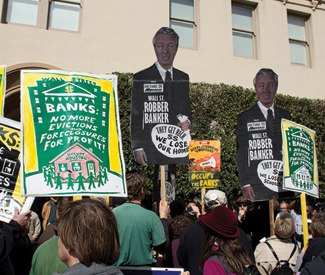
That’s the message a growing chorus of activists in the Bay Area are bringing before the boards, councils, and commissions that entered into complex financial deals with Wall Street banks, deals that turned toxic in the crash of 2008. Activists want elected officials and the banks to cancel the contracts and refund the public.

The Bay Area is the epicenter of this renewed movement for financial justice. Last week, teachers from Peralta College, organizers with the Alliance of Californians for Community Empowerment (ACCE), Oakland religious leaders, and Occupy Oakland activists organized four protests contesting what they say is bank predation on local communities.

At issue are arcane financial instruments called interest rate swaps. Sold by banks to virtually every sizable government and local agency in the US through the 2000s, rate swaps promised governments the ability to “swap” their potentially costly variable rate payments on bonds into a synthetic fixed rate. Seeking to protect local taxpayers during the volatile 2000s, when floating interest rates were rising, local leaders eagerly signed on.

But the economic meltdown turned those tools into golden handcuffs for local government agencies. Taxpayers are now forced to regularly pay millions to the banks simply because variable interest rates, at the urging of the Federal Reserve, have fallen far below the synthetic rates. These deals might seem numbingly complex, but the effects on local communities are clear and painful.

“The Metropolitan Transportation Commission is paying upwards of $53 million a year on rate swaps,” said Alia Phelps of ACCE at a protest on Feb. 21 outside of the former Bank of America building at 555 California Street. “This is money that isn’t going to keep routes in service, that isn’t paying drivers, nor going to repair buses, or to keep fares lower. We need these swaps renegotiated.”

That protest included visits to half a dozen banks. Activists demanded branch managers fax a letter to their corporate headquarters calling on the banks to voluntarily renegotiate swaps signed with the Metropolitan Transportation Commission (MTC), the Bay Area’s regional transportation authority, which has lost over $100 million on toxic swap deals.

In 2002 the Bay Area Toll Authority (BATA), a state-level agency operated by the MTC, issued more than $1 billion in bonds to pay for repairs and seismic upgrades of regional toll bridges. Three financial giants stepped forward promising to lower MTC’s long-term borrowing costs on these bonds by using interest rate swaps. Ambac, Solomon Smith Barney and Morgan Stanley signed deals with the MTC to cover $300 million in debt.

“With this transaction, we are getting the peace of mind of a fixed debt payment at a significant discount from traditional price levels,” MTC’s Chief Financial Officer Brian Mayhew said at the time of the deal.

Basically the swap agreement had the MTC paying a fixed interest rate of 4.1 percent to the banks, while the banks paid 65 percent of the London Interbank Offered Rate (LIBOR), a key benchmark used in global financial markets. Whichever party’s sum happened to be higher when payments came due would pay the difference. The advantage of the deal, in the eyes of the MTC’s managers, was that it would lock-in a low interest rate on MTC’s debt, potentially saving as much as $45 million.

“We think it’s a good time to lock in these low rates,” Mayhew said in 2002.

Fast forward to 2009. A year into the financial crisis, interest rates collapsed. LIBOR, which had been fluctuating around 5 percent and reached a peak of 5.8 percent in September of 2007, plummeted to virtually zero. The flow of payments became entirely one-sided, from MTC to banks that offered this deal. The advantage of the swap evaporated, and it became a toxic asset. While the Federal Treasury would offload similar toxic assets from the “too big to fail banks” using the TARP program, local governments were stuck with them.

As Ambac careened toward bankruptcy in 2010 due to its absurdly over-leveraged portfolio of credit default swaps, the MTC was forced to terminate its swap agreement with the company, paying the exorbitant sum of $104 million, after already having paid out $23 million in interest. All of this was essentially bridge toll money, surrendered by drivers crossing the seven state-owned bridges administered by BATA: the Bay, Antioch, Benicia-Martinez, Carquinez, Dumbarton, Richmond-San Rafael, and San Mateo bridges.

The drain on MTC funds indirectly affects all of its programs, including operational support for AC Transit, Muni, and other regional bus and train services. According to its most recent Comprehensive Annual Financial Report, MTC and its transit agency partners are on the hook for another $235 million in interest rate payments due on swaps with a rogue’s gallery of banks including Wells Fargo, Morgan Stanley, Citigroup, Bank of America, JP Morgan, Bank of New York, and Goldman Sachs. All of this money will be diverted from the MTC’s various transit infrastructure, planning, and operations accounts.

“The big picture is service cuts, pay cuts, work speed ups, fare hikes, route eliminations, and other things that harm working people who ride transit,” said retired Muni worker Ellen Murray.

The MTC’s quarter-billion dollar rate swap nightmare is only the most obvious part of a more systemic problem. Until at least 2030, given current conditions, San Francisco’s Airport Commission must make costly rate swap payments to numerous banks, including JP Morgan Chase, Goldman Sachs, Depfa, Bank of America, and Merrill Lynch, on agreements associated with more than a half-billion in debt. Much of this is linked to commercial paper issued to pay for infrastructure at the Airport (SFO).

Unlike the MTC, SFO’s financial managers were more prudent in entering swap agreements, and therefore secured better terms that have produced a net savings. “The Airport has saved about $92 million to date,” Assistant Deputy Airport Director Kevin Kone told us, referring mostly to gains made between 2005 and late 2007.

But since 2008, SFO’s swaps have been losing money. When Lehman Brothers collapsed, and Bear Stearns imploded and was absorbed into JP Morgan, SFO was forced to terminate swaps with both companies, costing $6.7 million. Last year SFO paid $6.65 million to terminate a rate swap agreement with Ireland’s Depfa Bank. In September, the Airport paid another $4.6 million to end yet another rate swap with JP Morgan. These specific swap agreements, Kone says, “were functioning as they should have early on, providing savings,” but now they’re draining public funds.

SFO’s seven remaining swaps have a negative value of $67 million, according to San Francisco’s 2011 Comprehensive Annual Financial Report. As with the MTC, SFO’s debts will ultimately be paid by passengers and taxpayers. Kone says nobody really knows how much these swaps could ultimately impact the airport, either in terms of cost or savings.

“If interest rates rise, they could have a positive cost savings impact on the airport,” he said.

Joe Keffer of the Service Employees International Union (SEIU) Local 1021 said at the Feb. 21 rally that Oakland has already paid Goldman Sachs $26 million on a swap that dates back to 1997, and that under current market conditions, the city will have to pay roughly another $25 million until the contract expires in 2021.

Oakland’s toxic deal with Goldman Sachs is now the subject of much scrutiny. The newly formed Coalition for Economic and Social Justice —made up of churches, labor unions, neighborhood groups, and Occupy Oakland activists— took up the issue with the City Council on Feb. 21, packing the chamber with one of the more diverse activist coalitions in recent memory.

“We’re here to implore you to get the City of Oakland out of this toxic relationship,” Rev. Daniel Buford of the Allen Temple Baptist Church told the council.

Members of the Oakland City Council are sympathetic to this message. In a letter sent last June, Council member Rebecca Kaplan implored Goldman Sachs CEO Lloyd Blankfein to spare Oakland’s taxpayers: “By bringing the contract to conclusion with no penalty fees, and negotiating a reasonable exit strategy, you would be demonstrating good faith to public taxpayers in the most substantial way.” At the conclusion of public comment Tuesday night, Oakland Council member Libby Schaaf promised the public action on the swap.

In a Valentine’s Day protest the previous week, 50 activists visited the Oakland offices of Morgan Stanley. Faculty and students from the Peralta Community College system went there demanding the bank renegotiate a rate swap that is estimated to have cost the college $1.6 million last year. The same day the college’s board of trustees discussed the need to cut $12 million more from the budget in 2012. Morgan Stanley CEO James Goreman’s pay for 2011 was $14 million, opponents of the swap point out.

Peralta student and Bay Area transit activist Adam Ross attempted to reach the 9th floor offices of Morgan Stanley in a small delegation to deliver a letter demanding the bank renegotiate the swap: “There were signs on the door saying the office was closed. They probably got tipped off and locked the doors.”

Afterward, Caesar Swaby of Riders for Transit Justice addressed the rally, connecting dots for the different constituencies present: “Morgan Stanley is taking money from Peralta College, causing classes to be cut. Morgan Stanley is also taking money from transit riders. Morgan Stanley has a $3 million rate swap with the MTC, causing cuts to bus and train services.”

A Morgan Stanley representative declined to comment for this report. Goldman Sachs did not return calls and emails. A spokesperson for the MTC was unable to be reached by deadline.

The Obama budget, beyond the politics

3

Man, the way the president’s talking it sounds as if he’s appointed the General Assembly of OccupySF to write his budget plans. He’s going to make everyone pay a fair share of taxes. He’s going to invest in affordable higher education. He’s going to spend $350 billion on jobs programs. Just about everyone in the news media is calling it a “populist budget.

I love the politics. It’s the year Occupy will dominate the national political debate, and for Obama to decide that he wants to hitch his wagon to the tax-the-rich star can only be a positive development. Washington is listening, and is starting to talk. We’re making progress.

But we haven’t made that much. Because the actual Obama budget isn’t such a radical departure from what he and his predecessors have been doing for years: Spending far too much on the military, cutting tax rates for high incomes and leaving largely intact the class divide.

There’s a good NYT analysis here but you have to go through it carefully. Here’s what our populist leader wants to do:

1. He’s going to spend $613.9 billion on the military, more than most other departments combined. When you add in the $64 billion we’re spending to clean up the human costs of former wars (which isn’t enough) and the $40 billion we’re spending on Homeland Security, that’s a big, big number. Yeah, it’s about 2 percent less than last year. It’s still far too large, dwarfing all other federal spending. And we’re supposed to be winding down wars.

2. He’s not going to raise the marginal tax rate on the rich. In fact, he’s talking about lowering it. That’s crazy, that’s criminal, that’s a recipe for continued deficits and increased wealth disparity. All he’s proposing is to raise the tax rate on stock dividends — yeah, that’s something that mostly benefits the wealthy (although also some middle-class retired people), but it’s a tiny fraction of the money that would be available if the top bracket was raised just a little bit. His goal for new taxes? About $20 billion a year. Peanuts.

3. He’s not investing heavily in critical transportation priorities like high-speed rail. The funding for the transpo system of the nation’s future: $47 billion over six years. That’s less than $8 billion a year, which won’t build much track. His annual commitment to a project that would create tens of thousands of jobs and go a long way to end fossil-fuel reliance? About what the Pentagon will spend every four days. Whoopee.

So while I get the rhetoric, and it demonstrates that he’s going to make a few nods to the left during the campaign, I wouldn’t get too excited about this budget. It’s really business as usual.


Federal government sets its sights on 12 more SF dispensaries

19

Bad news for medical marijuana patients in the Bay Area: as reported by the SF Examiner, the DEA has requested records from the city’s Department of Public Health for 12 of San Francisco’s existing 21 cannabis dispensaries. This is the same move the DEA made before sending the threatening letters to five other cannabis collectives last fall. Those five dispensaries are now closed.

In fall of 2010, US Attorney Melinda Haag targeted five SF dispensaries in school zones with letters declaring them in violation of federal law. In the face of potential jail time for dispensary staff and even the landlords of the buildings that housed the dispensaries, they shut their doors. Now, more than 50 percent of the city’s dispensaries could have to follow suit. 

The really upsetting part about all of this? The sheer randomness of it all. In our recent Cannabis Issue, the Guardian interviewed Assemblymember Tom Ammiano, who said that in his meeting with Haag over the matter, the US Attorney said the orders to persue the dispensaries came from above. “She said she was only doing what the boss was telling her to do,” Ammiano told the Guardian. “We had a hard time with that.” The Obama Administration has been frustratingly opaque about the motives behind, and future plans for, persecuting an industry that Attorney General Eric Holder once called a “low priority” for federal law enforcement. 

The Guardian has sent an email to Mayor Ed Lee for his comments on the request for records, and will update this post when we hear back. Even then-Mayor Gavin Newsom, as the Examiner pointed out, sent a letter in 2008 to Congress to encourage it to act against the DEA’s attempts to intervene in California’s medical marijuana industry.

Assemblymember Ammiano and Senator Mark Leno are leading the efforts to establish a statewide regulatory board cannabis that would, among other things, demonstrate to the feds that the industry is being well-regulated in California. Americans for Safe Access and UFCW (the union representing cannabis workers in California) have also introduced a ballot initiative called the Medical Marijuana Regulation, Control, and Taxation Act that would establish a regulating board made of patients, government representatives, medical professionals, and cannabis industry folks. A poll conducted by Probolsky Research recently put voter support for that measure at 59.2 percent.  

But who knows if California voters will get a chance to regulate marijuana as they see fit. If these requests for records proceed as the last round of them did, SF could be down to nine dispensaries in a city with not only a large base of cannabis patients, but also a thriving cannabis culture. 

The dispensaries whose records were requested by the DEA were: 

Bay Area Safe Alternatives Collective

Emmalyn’s

Good Fellows Smoke Shop

Grass Roots

The Green Cross

Hope Net

Re-Leaf Herbal Center

SF Medical Cannabis Club

Shambala Healing Center

Valencia Street Caregivers

Vapor Room

Waterfall Wellness

Catholic hospitals and birth control

7

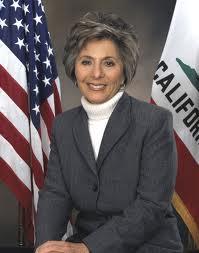
I’m glad Sen. Barbara Boxer, along with Sens. Patty Murray and Jeanne Shaheen, are supporting the Obama administration’s decision to mandate contraceptive coverage at Catholic hospitals. I read the Wall Street Journal editorial denouncing it as an assault on religious freedom, and I think there’s something that is too easily overlooked here.

Religious institutions like the Catholic Church are not just churches these days; they’re major employers and the operators of major health-care facilities that are intertwined with insurance companies. And for a lot of employees and patients, there isn’t any choice.

People who work for the hundreds of nonprofit social-service agencies run by the Catholic Church aren’t necessarily Catholics, or even religious. They might be receptionists, or janitors, or computer systems operators, or counselors who needed a job and happened to get hired by an agency that needed their (secular) skills. Jobs are hard to come by these days; a person who works in an administrative job at a Catholic nonprofit and is trying to pay the rent and support a family may not have the option of simply leaving because she doesn’t agreed with the Church’s position on birth control. She’s got a health plan paid for by her employer, just like most of the rest of us, and if that plan doesn’t cover contraception, she’s SOL. It’s not fair.

My health-insurance plan recently decided not to do business any more with Brown and Toland medical group and instead contract with Hill Physicians. I had nothing to do with that decision, which was based on some financial negotiations around reimbursement rates that were entirely out of my control, part of an ongoing fight between major hospital groups, physician groups and insurance companies that leave patients entirely out of the loop.

So I had to leave the doctor I’d been seeing for many years (who was a member of Brown and Toland and affiliated with the Sutter-owned California Pacific Medical Center) and I was reassigned to a new doctor, who is a member of Hill — and because of economic issues that have nothing to do with religion, my Hill doc is affiliated with Catholic Healthcare West. So now any major medical treatment I need is at St. Mary’s, or St. Francis, or Seton — all excellent hospitals, and I have no complaints. My new doctor is great, and frankly, the medical staff who are part of what happens to be a Catholic Church affiliated hospital chain aren’t a whole lot different from the medical staff at the secular CPMC — skillful, devoted, caring, and so far as I can tell, entirely free of any type of evangelism. I have no idea what, if any, religious affiliation the doctor who patched my broken hand back together last year had; it wasn’t an issue. Who cares?

But still: It’s a Catholic hospital chain. With all the issues that creates. And it’s part of the city’s public-health infrastructure. A lot of us didn’t choose a religious-based medical center; our insurance company did that for us.

Catholic Healthcare West just changed its name to Dignity Health, apparently for marketing reasons (interesting that they chose the name of a longtime group of gay Catholics) but according to the group’s website:

All of our Catholic hospitals, as well as those that may join the system at a later date, will continue to be Catholic and follow the Ethical and Religious Directives for Catholic Health Care Services (ERDs).

Among the rules that guide those ERDs:

First, Catholic health care ministry is rooted in a commitment to promote and defend human dignity; this is the foundation of its concern to respect the sacredness of every human life from the moment of conception until death. … Catholic health care does not offend the rights of individual conscience by refusing to provide or permit medical procedures that are judged morally wrong by the teaching authority of the Church.

I’m all for religious freedom. But under our current healthcare system, a lot of people have no choice as to their employer or their health-care system. And as long as that’s the case, I don’t see why the Church (which has to pay payroll tax on its employees and abide by the state’s employment laws) shouldn’t fall under the same health-insurance rules as everyone else.


Making history: Joanne Griffith’s ‘Redefining Black Power’ project comes to the Bay

0

“Joanne [Griffith]’s work is centered on one theme: not to offer information as a point of journalistic fact, but to act as a conduit for debate and conversation, especially around issues relating to the African diaspora experience.” So writes Brian Shazor, director of the Pacifica Radio Archives, in the foreward to Griffith’s new book Redefining Black Power: Reflections on the State of Black America (City Lights Books, 206pp, $16.95). Griffith will be presenting her work, part of an interactive project to archive the state of African Americans in the United States in the Bay Area this week — starting tonight (Wed/8) at the Museum of the African Diaspora.

This shouldn’t have to be said, but in these times of reductive news media it does: Obama isn’t the only black voice that needs to be heard, during this Black History Month or any other month. Inspired by the archives of progressive African American voice kept by LA’s Pacifica Radio Archives, Griffith — a leading progressive voice herself, having reported on issues from around the African diaspora for the BBC and NPR — transcribes her interviews with leading thoughtmakers for the book, set up as a series of dialogues. Hear from political prisoner Ramona Africa why Obama is “the new crack,” journalist Linn Washington, Jr. on media matters, green jobs leader Van Jones on hybrid activism. The president is used as a theme of the book, but the interviews use him as a lens to look at issues that range far beyond the White House.

Griffith and the other minds behind Redefining Black Power want these interviews to serve as a jumping off point for other unheard voices. Head over to the book’s website and you’ll find directions on how to add your point of view to those of the better-known activists and professionals already immortalized in the Pacifica archives. You can go to one of Griffith’s upcoming readings (details below) for inspiration. Or better yet, read our recent email interview with her and then do that. 

SFBG: Explain where the interviews in the book came from. How did you become acquainted with the Pacifica Radio Archives. Why are they important for people to hear?

JG: The idea for the Redefining Black Power Project, of which the book is part, was born out of the historic audio held in the Pacifica Radio Archives; a national treasure trove of material charting America’s history from a progressive perspective dating back to 1949. Within the collection are key recordings from the civil rights, black power and black freedom movement, including Rosa Parks, Shirley Chisholm, Jesse Jackson, Malcolm X, James Baldwin, Lorraine Hansberry, Dr. Martin Luther King Jr., Bobby Seale, Elaine Brown, and so many others. But it was one recording of Fannie Lou Hamer addressing the 1964 Democratic National Convention that sparked the idea for Redefining Black Power. The director of the Pacifica Radio Archives, Brian DeShazor, heard the tape and wanted to find a permanent way to preserve and share the voices held in the archives with a wider audience, and what better way than through the written word. Brian approached City Lights Books with the idea, and this book is the result, drawing on the voices of history to link us to the election of Barack Obama, one of the most significant moments in the social and political history of the United States. Through this project, we hope to preserve the voices, opinions and perspectives of African-Americans in this so called ‘Age of Obama’ for historians to digest and explore in years to come. 

How did I get involved? As a complete audio nut, I always make a point of visiting local radio stations wherever I travel in the world. Back in 2007, I was in Los Angeles, called KPFK to arrange a visit and was introduced to the Pacifica Radio Archives. Speaking with Brian DeShazor, we came up with an idea to share the historic collection with a UK audience and I’ve been doing this every Sunday evening on BBC Radio 5 Live in the UK for over four years. Because of this work and the extensive list of people I have interviewed over the years, Brian invited me to do the interviews for the Redefining Black Power project. Through this book, we delve into the role of the activist from different perspectives; the legal system, the media, religion, the economy, green politics and emotional justice. All were recorded between September 2009 and August 2011. To be clear though, this book is not an anthology of black leaders speaking on the Obama presidency. This is simply a taster of opinions on the subject, but everyone is encouraged to participate with their thoughts and opinions at www.redefiningblackpower.com and come out to the many events we’re hosting throughout February, including here in the Bay Area at the Museum of African Diaspora from 7 p.m. on Wednesday Feb 8 and at Marcus Books in Oakland with guest panelists Hodari Davis from Youth Speaks and social justice activist Dereca Blackmon on Thursday Feb 9 from 6.30 p.m.

SFBG: Has there been an interview you’ve conducted in which your subject’s answers have deeply surprised you? 

JG: Every interview had its own surprise; from Ramona Africa describing President Obama as ‘the new crack’ and why she refused to vote, to economist Dr. Julianne Malveaux revealing the financially precarious situations many African Americans find themselves in; from high foreclosure rates and high unemployment to the low levels of accumulated wealth for black women. Very sobering statistics. Michelle Alexander, too, the author of The New Jim Crow: Mass Incarceration in the Age of Colorblindness really shocked me when she said that more African American men are currently incarcerated than were enslaved in 1850. 

However, it was Dr Vincent Harding, the man behind Dr. Martin Luther King Jr’s “Beyond Vietnam” speech that surprised me the most. A true veteran of the civil rights movement, he made the point that the election of President Obama was never the goal of the movement; instead he prefers to call the work “the movement for the expansion and deepening of democracy in America.” Put this way, it made me realize more than ever, that the work we do today is not in isolation, but part of a wider movement, stretching back all the way to slavery. And the work isn’t over. 

SFBG: Your introduction ends with a quote from Kanye and Jay-Z’s Watch the Throne album. What role, if any, does hip-hop play in the book?

JG: Hip-hop doesn’t play a role in this book, other than this quote, but it will feature heavily in the next volume of Redefining Black Power which will focus on the reflections of black entertainers, writers, poets and performers on this moment in US history.  

SFBG: What would be the best way the United States could spend Black History Month?

JG: Black history — regardless of whether it is the United States or the UK where I moved from or anywhere else — should be acknowledged daily; this is the only way for us to keep memories alive and never forget where transformative change, like the election of President Obama, comes from. 

Listening to recordings like those held in the Pacifica Radio Archives with our youth would be a great place to start. I spent a couple of days with a group of students in Detroit, sharing the archive material and getting them to discuss their thoughts on the recordings; Audre Laude, James Baldwin, Muhammad Ali, Nelson Mandela, and others. Every one of them said they wished they had heard these voices before. It gave them a context to their own lives that didn’t exist previously, while encouraging them to never give up; too many people have suffered for them to let less than favorable circumstances stop them now. 

SFBG: Who should read this book? How should it be used?

JG: Use it as a conversation starter to discuss issues in your own community. Parents, use it as a way to engage your children in history. Students, use it as a resource for papers on race and the Obama presidency. Most importantly, everyone, share your thoughts at www.redefiningblackpower.com. This book is not the end of the project; we’re only getting started. 

Joanne Griffith’s Redefining Black Power author readings:

Wed/8 7 p.m., free with $10 museum admission

Museum of the African Diaspora

685 Mission, SF

(415) 358-7252

www.moadsf.org


Thu/9 6:30-8 p.m., free

Marcus Books

3900 Martin Luther King Jr. Way, Oakl.

(510) 652-3244

www.marcusbookstores.com


The story of hip-hop

0

By Courtney Garcia

MUSIC From the start, Ice-T was a versatile chameleon, the product of an integrated culture, and a student of the marginalized.

Born in New Jersey, raised in the Crenshaw District of LA, he joined the Crips then pursued the army to pay his bills. His career was blazed in rap, though he once flipped the game to heavy metal. Multifaceted talent that he is, Ice would later grow even more famous on television.

It’s no surprise, then, that he now adds the title of director to his resume, with the debut of his first documentary, Something From Nothing: The Art of Rap, at this year’s Sundance Film Festival. The feature length endeavor is the pioneering artist’s tribute to the culture that bred him, beat him, and made him who he is; it’s a culture he feels is slowly slipping from his grasp. It’s a story as much about the traditions of hip-hop as it is a fervent call to action, told through the eyes of its maker and his impressive posse of friends.

The premise, nevertheless, is simple: this is the story of hip-hop. “It’s a lot of life lessons because you’re not only hearing about rap, but experiences and struggles,” explained Ice during a one-on-one breakfast interview at The Lift in Park City, Utah. He was present for the screenings, along with Grandmaster Caz and Chuck D, both of whom appear in the film.

Other notable feature players include Eminem, Dr. Dre, Kool Moe Dee, Kanye West, Royce da 5’9,” Common, Rakim, KRS-One, Bun B, and Snoop Dogg. “You’re hearing people who you thought woke up successful talk about how they thought about quitting, how they had to find their voice,” Ice said. “I wanted to catch these guys when they were vulnerable, to show they’re real people, and that success doesn’t come without some blows.”

Ice got into rap initially to avoid falling back into gang life, first experimenting with turntables while enlisted in the military. Musically, he made his name as an underground artist before signing with Warner Music/Sire Records, and eventually winning a Grammy for his song, “Back On the Block.” He would follow such success with a branch into acting, currently starring in the primetime series, Law & Order: Special Victims Unit. And while his schedule is more than demanding, he found time between shoots to direct this documentary, a film he believes had to be made to challenge the fallacious imagery of hip-hop in American culture.

“This movie is not about the money or the cars, it’s about the craft,” he says. “The only questions we get asked by the press were, you know, ‘Who are you having sex with?’ ‘How high do you get?’ ‘Who don’t you like?’ They don’t care about your work…I wanted people to see the hip-hop I know, not the hip-hop that’s been given out until now. You’re getting this image that’s not real.”

Something From Nothing begins on the streets of New York, and follows the beat to the sunny coast of Los Angeles. Interviewing the gamut of rap’s finest, Ice catches his friends at the record store, in the studio, on their patio and at the diner. They eat; they smoke; they talk hip-hop. Some, like Kanye, freestyle for the camera; others spit the rhymes they can’t get out of their heads.

In one of the more poignant scenes, Ice speaks with Eminem about his toil to commit to the trade amidst extreme discouragement, and the moment he realized it was his raison d’etre. Equally surreal, the filmmaker travels to Dr. Dre’s lavish estate in the Hollywood Hills, where the two converse about the late, Tupac Shakur.

Because the name ‘Ice-T’ signifies authority, the strength of this film is his access to the inside, exposing tales most people would never have a chance to hear. He hits on every shade of the genre, from gangster rap to native tongue, the poetics of Q-Tip to the in-your-face anarchy of Immortal Technique.

Introducing the film at Sundance, he described his impetus as a dissatisfaction with the current state of hip-hop, and an earnest aim to improve the situation.

Later, he elaborated. “To me, the most pinnacle moment in the movie was when Mos Def quoted Q-Tip saying ‘rap is not pop; rap never had pop ambitions.’ It’s a counterculture. Now it’s become pop, and how you gonna get mad at the kids? They want to eat; they want to make money; they want to live. If you ask me what my dream is, I would love to see a 19 year-old Public Enemy come out of nowhere; I would love to see the new 18 year-old Ice Cube just come kick in the door, and start telling motherfuckers, ‘Fuck the bling, this is what’s good. Let’s talk about Obama, let’s talk about Occupy Wall Street. Let’s go in.'”

He added, “It will never get radio play, but I believe if a young group of kids really nailed it, they could get a movement going. And it’s needed. I took Rage Against the Machine out as my opening act, so of course I want to see that. The terrain is wide open.”

It’s rare to catch Ice-T without his signature shades, and somehow it’s obvious he truly is the OG he claims. Yet his inner sincerity and passion show through in this project, an ode to the first platform to ever give him a voice. He sold the rights to film after the Sundance showings to The Indomina Group for worldwide distribution; a theatrical release is planned for summer.

“Music has that power to give people emotion, and that’s what’s lacking right now,” he reiterated. “They’re not using art form at full power. They’re just rubbing the surface of it.”

The marriage decision, for better and for worse

7

The Ninth Circuit Court of Appeals judges cited both Groucho Marx (“marriage is a great institution, but who wants to live in an institution?”) and Marilyn Monroe (what if the movie was called “Who Wants to Enter Into a Domestic Partnership With a Millionaire?”) in discussing the importance of the word “marriage.” Justice Stephen Reinhardt’s ruling made clear that the only purpose of Proposition 8 was to “lessen the status and dignity of gays and lesbians in California.” The decision makes clear that the law against same-sex marriage is by its nature discriminatory.

But in the end, the ruling was very narrow. If you read the entire decision, it’s not a sweeping affirmation of the legal rights of Americans to marry the person of their choice. The court basically concluded that California voters had no legal right to take away marriage rights that had previously existed. Since the state Supreme Court had granted marriage equality, and 18,000 people got married before Prop. 8 passed, the ballot measure was in fact a reduction in rights, which, the court said, requires a different level of scrutiny and analysis.

The Chronicle calls it a “wise decision,” but in political terms, it’s a bit wimpy: It stops far short of where Judge Vaughn Walker went in his original ruling on this case, which essentially said that marriage is a fundamental right for all.

The good news: If the ruling stands up, same-sex marraige will be legal in the state of California. The bad news: If the ruling stands up, it’s likely that it will apply only to California.

But that could be good news in a sense, too. Here’s why.

The proponents of Prop. 8 are going to appeal to the U.S. Supreme Court. Everyone knows that. And if the 9th Circuit had come out with a sweeping ruling stating that the right of gays and lesbians to marry is fundamental and can’t be abridged under any circumstances, it’s almost certain the the Supreme Court would hear the case. That might be wonderful; the Supremes could come down with a decision like Brown v. Board of Education  that forever changes the civil rights landscape and ensures full equality for the LGBT community in every aspect of society.

On the other hand, I worry that if this current Supreme Court heard Brown, five members might have sided with the Board of Education.

In other words, there are four very conservative justices who could easily proclaim the sanctity of heterosexual marriage in a ruling that would set us back years — and depending on how Justice Anthony Kennedy was feeling that day, he could go either way. So giving the current Supreme Court a chance to rule on the larger issue was, and is, risky. Now, Justice Reinhardt’s decision repeatedly cited a case that Kennedy had personally written, the 1996 Romer v. Evans, which would have made it harder for the swing judge to reverse the 9th Circuit — but you never know.

As it is, there’s a good chance now that the High Court will just take a duck. That would mean that same-sex marriage was restored to legal status in California (and there’s no way that another Prop. 8 will ever pass in this state, ain’t happening, don’t waste your money, bigots — this train is only going in one direction, and the population has already changed enough that same-sex marriage would easily win at the polls). And it will be legal in eight other states and D.C., and the movement will continue and in a few years, it will be legal everywhere, without the U.S. Supreme Court making the final call. (Or Kennedy will retire and Obama will be re-elected and it won’t matter because the Supreme Court will no longer have a troglodyte majority.)

And even if the court takes the case, it’s possible that Kennedy would go along with the narrow ruling (Reinhardt has been around a long time and he’s no fool — he knows who his audience is on a final appeal, and it’s one Supreme Court justice). It’s possible Kennedy might agree that you can’t take away existing rights, which would be good news for California and not terrible news for the rest of the country.

That’s the cautious approach. I’m the sort who usually wants to push issues as far as we can (wouldn’t a showdown over the defining LGBT issue of the day at the Supreme Court be exciting? Wouldn’t it be amazing to see Justice Scalia try to argue, in 2012, that it’s okay to deny marriage rights to lesbians and gay people?) And I believe that both the legal and political ground is shifting fast on this issue and we might get a grounbreaking Supreme Court decision the way we did in Lawrence v. Texas. But the downside is potentially huge.

So while I was disappointed in the rather limited scope of the decision, I suspect a lot of the lawyers who support marriage equality are quietly pleased. This is a big victory, and it might actually last.


Downtown action: Sex shop Feelmore510 celebrates one year of community pleasure

2

The sex shop Feelmore510 is located on the corner of Oakland’s Telegraph and 17th streets, across from an Obama campaign office, in between a pawn shop and the oldest African-American owned shoe store in town. The neighborhood is in transition, a place with old roots and a lot of new blooms – most businesses on this stretch of Telegraph opened within the last five years. Feelmore510 will celebrate its one-year anniversary Sun/12 when owner Nenna Joiner helps host Town Love, a new party at Hibiscus’ Rock Steady.

But those businesses aren’t the shop’s only neighbors. This fall, Feelmore510 also lived alongside Occupy Oakland’s City Hall encampment. Though many local business owners have expressed anxiety about the effect that protests were having on their sales, Joiner is in full support of the movement. She sometimes walked over to visit friends who were “occupying,” and was happy to donate safe sex supplies to the camp. “Sex is a basic need for survival,” she said in a recent in-store interview with the Guardian. Joiner allows protestors to chill in the store and talk politics — as long as they aren’t running from the cops.

Joiner envisions her store as more than just a place to shop – it’s also a community center. On a recent afternoon, Joiner shook each customer’s hand and asked them their name. Her goal is that all comers can shop for augmentations to their love life in comfort. 

A cross-section of Oakland’s entire population converges in this particular area of downtown. Joiner sees everyone from rich vintage porn collectors — drawn to her extensive selection of old magazines and videos — to people who ask to pay with California welfare benefit cards. 

Her best-selling items, which are taken home by customers who are male, female, straight, bi, and trans, are the queer porn films that Joiner herself directed, edited, and produced. 2010’s Tight Places features diverse actors and she made Hella Brown with a cast of all African American women. Hella Brown is made in a semi-documentary style – Joiner shot interviews with over 50 queer and trans subjects about their sexual proclivities while making the movie. 

Artfully-displayed contraptions at downtown Oakland’s favorite sex shop. 

Joiner’s films are unique in the way that they showcase different sexual practices and different body types from mainstream porn, which is often geared towards a heterosexual male audience. Her films show women of all shapes, having queer sex — fellating strap-ons and other acts you might not catch in other kinds of porn. While the films are not shot with the straight male audience in mind, that group does seem to enjoy them, often buying the first film and then returning for more. Joiner sees her films as educational tools, especially for what she calls the “brown community,” where things like transitioning from one gender to another are often socially stigmatized and restricted by financial limitations. 

“Queer women of color possess a whole different intelligence and mentality,” she says, adding that many women have a certain shyness about “packing,” (wearing a flaccid prosthetic penis underneath clothing) and getting cosmetic gender modification surgery. Joiner fully embraces her role as an educator in the Oakland queer community. 

Joiner refers to dildos as “prosthetics,” – she says that this language is less alienating to those unfamiliar with their usage. She keeps a packer on prominent display, in order to provoke people into asking questions, which can open up a dialogue about passing as a man, transitioning, or simply stuffing one’s jock with something more substantial than a tube sock. She says customer preference in prosthetics can vary. Many want a life-like phallus, while others request dildos that don’t look like penises, going for glass, sculptural, or abstract designs.

Joiner feels that she is at the intersection of several different communities in Oakland. Joiner goes to two church services every Sunday. She buys passing school kids lunch at Ms. Tina’s, the little sandwich shop next door. She’s active in the queer scene, and she’s also a small business owner who encourages other vendors to promote their own businesses by using her store as a launchpad. 

“Having a space allows other people to identify with a vision of opening their own space.” When she first opened her store, naysayers questioned her brick-and-mortar approach over the Internet. But she says a website cannot replace the tactile satisfaction of a place to gather, to talk, to share. She uses her store to hold classes on topics rarely discussed other places, like sex industry work.

Joiner wants the toys she sells to be safe and fun for anyone, and to open up a conversation about sex, gender, and pleasure with Feelmore510. It works – her space encourages one to think of sex in a different, more open way. Joiner’s toys are all just tools for lovers to transfer feeling, power, and energy between each other. There is no single way to have sex, just endless different first-time experiences. It’s a new kind of space in an old part of Oakland, open for all comers to explore their most innovative sexual selves.


Feelmore510 one-year anniversary party at Town Love

Sun/12 5-11 p.m., $5

Rocksteady at Hibiscus

1745 San Pablo, Oakl.

(888) 477-9288

Facebook: Feelmore510 anniversary party at Town Love


Some reality about the jobs report

6

The Obama Administration is thrilled with the new employment figures, and it’s clear the president will use this as a key part of his campaign (as long as the recovery keeps going and doesn’t sputter again). The Republicans, of course, are complaining that it’s not enough, that “we could do better,” but that sounds awfully hollow and fits into the narrative that the GOP doesn’t want anything to improve this year because the entire goal of the party is to defeat Obama in the fall.

But really, while it’s encouraging, the new unemployment figures are still bogged down by two things: The labor force is growing faster than the nation is creating jobs — and layoffs in the public sector are still a drag on the recovery.

There’s a pretty good analysis on DailyKos, talking about the labor force issue. But there’s more: Among people without a college education, the jobs picture is still really bleak. Same for people who have been unemployed for a while now and for youth. I could go on and on about the failure of trickle-down spending, but the reality is that the economy is still far too top heavy to all for a real recovery. Income inequality isn’t just a political and moral issue; it’s an economic downer. The U.S. economy depends overwhelmingly on consumer spending, and since all of the new new wealth of the past 20 years has gone to the very rich, most consumers don’t have enough money to spend enough to keep the economy buzzing. And a few new IPOs that make a few more people rich isn’t going to solve the problem.

Note that the one sector of the economy that is still losing jobs is government. That’s a result of low taxes that can’t fund public services (and can’t provide the generally decent unionized jobs, including jobs for people without college degrees, that exist in the public sector).

I was intrigued by the Congressional Budget Office report comparing federal and private-sector workers, which the Republicans (and, I’m sure, some of my beloved trolls on this blog) will use as evidence that government is bloated and public-sector workers are overpaid. But that’s not exactly what the report says:

CBO found that those without a college degree fared better as federal employees, since their pay was 36% higher than that of private-sector employees–particularly when it came to benefits. Those with advanced degrees such as doctorates, however, were generally better off in private industry, strictly from a monetary viewpoint–government pay was 18% lower than that of comparable individuals in the private sector.

In other words, federal pay is a lot more like the private sector used to be, back before the United States became one of the most socially stratifed societies in the developed world. The folks at the bottom do better, and the folks at the top don’t get as rich, and the gap between the highest paid and the lowest paid is a lot smaller.

Which is one reason that Republicans hate public-sector unions and government employment — it’s better for the 99 percent.

The college tuition problem

18

President Obama wants to solve the horrible problem of college tuition costs and student loans by offering tax breaks and telling schools to keep their costs down. Memo to the prez: Holding the line on tuition increases won’t do it. Tuition is already way to high. Student loan requirements are already way too crippling.


It would be nice if governments would just raise the tax money necessary to subsidize costs at public universities again. But until that happens, there’s another interesting idea I heard on KPFA the other day: Why not do a federal bailout for students?


The Federal Reserve bought up trillions in toxic bank debt. Why not use the same principle to buy up the debt of a generation of college students, reduce the payments to an affordable level and do what other countries do, which is to waive all payments until the students get a job? What a great investment in the future — and what a great way to stimulate the economy. Put money in the pockets of young college graduates and guess what? They’ll spend it. Trust me on this.


I wonder if anyone in Washington is even thinking about this. If so, it’s awfully quiet.

Meister: So, what about the state of the unions, Mr. President?

2

By Dick Meister

Dick Meister, former labor editor of the SF Chronicle and KQED-TV Newsroom, has covered labor and politics for more than a half-century. Contact him through his website, www.dickmeister.com, which includes more than 350 of his columns.

Unions? Organized labor? The AFL-CIO? Those words were nowhere to be heard in President Obama’s State of the Union address, despite labor’s vital role in the economy and strong support for Obama. The continued support of the labor movement is essential if the president is to carry out the bold plans he outlined and if he is to be re-elected.

The president’s failure to mention one of the country’s most important economic and political institutions was unfortunate. It was perhaps understandable, however, given the anti-union climate stirred up by attacks on public employee unions and their allies.

Obama’s failure to mention unions and their leaders was ignored in the post-speech pronouncements of AFL-CIO President Richard Trumka and other major unionists. They in fact proclaimed the speech a victory because of its endorsement of policies widely supported by labor.

“It was clear throughout the president’s speech that the era of the one percent is over,” Trumka declared. “We demanded a strong stand on behalf of working families – and the president delivered.”

Trumka cited, in particular, Obama’s promise to thoroughly investigate “misconduct in the mortgage industry that wrecked our economy,” his promise to invest in jobs and infrastructure, and his proposed tax rules that would help the 99 percent.

President Randi Weingarten of the American Federation of Teachers praised Obama for making it clear “that children and our future must be priorities,” and for noting “what America’s teachers have long understood. We can’t test our way to a middle class, we must educate our way to a middle class.”

Praise, too, from President Leo Gerard of the United Steelworkers Union. He singled out Obama’s promise to work “to bring manufacturing back to America.” Gerard said, “The president’s commitment to discourage job outsourcing and promote insourcing is a ticket to a better economy.” It was most welcome news, added Trumka, to the millions of Americans who are unemployed.

President Gerald McEntee of the American Federation of State, County and Municipal Employees described the president’s speech as “a comprehensive plan to move our country forward, bolster job creation and find real solutions for the problems confronting our country.”

McEntee noted that “in today’s political environment, it takes guts to stand strong with working families – even when we make our voices heard, loud and clear, because the toxic influence of money in politics – which the president spoke out against – is powerful.”

So, although Obama made no mention of organized labor in his address, he said much that greatly pleased labor, and made promises to carry out measures high on labor’s economic and political agendas.

As the AFL-CIO’s Trumka declared, Obama showed he “listened to the single mom working two jobs to get by, to the out-of-work construction worker, to the retired factory worker, to the student serving coffee to help pay for college.” The president, in short, “voiced the aspirations and concerns of those who are too often ignored.”

Trumka cited the similarities between Obama’s approach and that of the Occupy Wall Street movement. Like the occupiers, the president is “speaking out forcefully against the staggering increase in inequality” between the one percent and the 99 percent. The president’s speech, Trumka added, demonstrated “a focus on job creation Republican House and Senate leaders should follow.”

It’s clear, certainly, that as long as Obama continues on his current path, he’ll have strong labor support. But should he stray, it’s clear that labor will forcefully remind him of his promises and of the needs of those who work for a living – or who are attempting to work for a living.

Whatever Obama does is certain to be in startling contrast to his Republican predecessor, George W. Bush, one of the most virulently anti-labor presidents in U.S. history. Obama has already rescinded several of Bush’s executive orders that limited the union rights of some workers and has replaced openly anti-labor Bush appointees to labor-related federal agencies, boards and commissions with his openly pro-labor appointees, including Secretary of Labor Hilda Solis.

Imagine Bush, or any of his GOP allies, actually saying, as Obama did, that “we need to level the playing field for workers and the unions that represent their interests because we know you cannot have a strong middle class without a strong labor movement.”

Important words. But they need to be heard – and acted on – by the millions of Americans who know little or nothing of unions and their important position in our economic and political lives.

President Obama failed to take advantage of a great opportunity to explain the true nature of unions and their importance to the country-at-large and make clear the often vicious anti-unionism of his political enemies. He missed a chance to explain the crucial role labor is certain to play in attempts to carry out essential reforms.

Obama needed to speak out forcefully to try to counter the anti-unionism that is limiting the chances of many Americans to find decent jobs at decent pay and a strong voice in workplace and community matters.

Obama missed an important opportunity. But if he stays true to his promises, the president will have plenty of other chances to show the country the true nature of the labor movement and its opponents, to speak out in favor of unions and the importance of their members, leaders and supporters, and to carry out his proposed and much needed reforms designed to help the nation’s working people.

Dick Meister, former labor editor of the SF Chronicle and KQED-TV Newsroom, has covered labor and politics for more than a half-century. Contact him through his website, www.dickmeister.com, which includes more than 350 of his columns.


Occupy and the State of the Union

2

Have all of the Occupy actions made any difference? Gee — I wonder.


I wonder if a president who acted a year ago as if economic justice wasn’t even an issue in this country would have devoted a substantial part of his State of the Union speech to fairness in tax policy. I wonder if he would have said this:


Right now, we’re poised to spend nearly $1 trillion more on what was supposed to be a temporary tax break for the wealthiest 2 percent of Americans. Right now, because of loopholes and shelters in the tax code, a quarter of all millionaires pay lower tax rates than millions of middle-class households. Right now, Warren Buffett pays a lower tax rate than his secretary.


Do we want to keep these tax cuts for the wealthiest Americans? Or do we want to keep our investments in everything else –- like education and medical research; a strong military and care for our veterans?


Or this:


Tax reform should follow the Buffett Rule. If you make more than $1 million a year, you should not pay less than 30 percent in taxes. And my Republican friend Tom Coburn is right: Washington should stop subsidizing millionaires. In fact, if you’re earning a million dollars a year, you shouldn’t get special tax subsidies or deductions. On the other hand, if you make under $250,000 a year, like 98 percent of American families, your taxes shouldn’t go up. You’re the ones struggling with rising costs and stagnant wages. You’re the ones who need relief.


Now, you can call this class warfare all you want. But asking a billionaire to pay at least as much as his secretary in taxes? Most Americans would call that common sense.


or this:


No American company should be able to avoid paying its fair share of taxes by moving jobs and profits overseas. From now on, every multinational company should have to pay a basic minimum tax.


Now: Not saying any of that is going to happen right away, or even that Obama will put tax reform at the top of the agenda. And changing the tax code to charge people like Mitt Romney 30 percent is nowhere near enough; in the 1960s, those people paid 80 percent of their marginal dollars in federal taxes. The Repubs in Congress won’t let any of this happen anyway.


But all of the major newspapers (which a year ago didn’t even know how to spell economic injustice) made his pitch for greater fairness in the economy the lead of their reports and all of the headlines talked about it. And when pollster Stan Greenberg tracked the responses of Democrats, Republicans and independents to the speech, the vast majority were pleased by and agreed with the commments that I cited above. That’s not just 80 percent of the Dems but 70 percent of the GOP voters.


The other thing Obama said — in indirectly — is that government is important. Beyond the flag-waving salute to the troops and the talk about the Navy Seals (Yay! We killed a guy! No arrest, no trial, just summary execution!), Obama was setting the tone for a debate over the role of the public sector in America. He talked about building the Hoover Dam, the Golden Gate Bridge and the interstate highway system. He talked about the importance of public support for research. That’s a direct contradiction to what the Republicans are saying about making government much smaller and less significant in people’s lives. I wonder what happens if the Republican candidate and Obama get out of the platitudes are actually have that discussion this fall.


Of course, he also said the solution to most business problems was tax cuts and incentives, which is not only GOP dogma but silly, since tax cuts for business almost never have the intendent effect. Tax penalties won’t keep companies from moving offshore (although I still support the idea), and tax cuts won’t bring them back.


It’s notable that Obama didn’t mention corporate personhood, which is going to be a huge part of the Occupy agenda this year. And that’s something that could actually change business behavior. Corporate charters are granted by the government — and with a few changes in law, could be revoked by the government, too. Screw your workers, cheat on taxes and move jobs to low-wage non-union areas where children work 14 hours a day making your products? Guess we’ll have to revoke your corporate charter. No more protection for personal liability for the owners and shareholders. Too bad.


And while his populist stuff struck a chord, the energy and environmental policy suggestions were just horrible. Yeah, I’m for ending tax breaks for oil companies — but opening up 75 percent of the potential offshore areas to drilling? Encouraging more natural gas drilling? Not much in the way of serious talk about investing a fraction of that money in renewables?


Oh, and I love this: Obama’s going to force natural gas drillers to “disclose the chemicals they use.” That’s going to keep us safe, yesiree. Thank you, mister driller, for telling me how your poisoning my water. Not that I can do anything about it, of course; you can keep right on going. But now, thanks to our bold president, I know about it.


Occupy the natural gas wells. I’m ready to go.


Legal, not legal

4

caitlin@sfbg.com

HERBWISE It’s been a weird year to start a marijuana column. Shortly after we started Herbwise, which was intended to be our weekly look at marijuana culture and events, politics reared its ugly head, rendering it necessary to go to hearings at the State Building, call up California Assembly members, and occasionally wade through seas of legalese. Such is the state of cannabis under ongoing federal prohibition, but it’s been a particularly dramatic year.

And in some moments, news and culture reporting melded together in the marijuana world. Take, for example, the case of Oakland’s Harborside Health Center, which is often called the largest dispensary in the world (it is certainly the largest in California). After years of painstakingly crafting a working relationship with city government, the business was heavily audited by the IRS. The federal agency decided Harborside — and 40 other California dispensaries — fell under the jurisdiction of Section 280E of the Internal Revenue Code, which denies the right for businesses involved in illegal drug trafficking to claim standard business expenditures. The collective now owes $2.4 million in back taxes, an amount that founder Steve DeAngelo asserts will bankrupt it if his business is forced to pay up.

Despite the ever-growing acceptance of the plant in the United States — a Gallup poll put the number at 50 percent in the fall of 2011 — medical marijuana is under attack by the federal government. Last fall, US Attorney for Northern California Melinda Haag sent out letters to the landlords of roughly a dozen Bay Area dispensaries threatening them with civil forfeiture, or possibly four decades in prison, if they failed to move this “trafficking” off their property within 45 days. The letters targeted dispensaries considered to be in a school zone.

Most left without a fight. In San Francisco, the Tenderloin’s Divinity Tree Patients Wellness Cooperative, the Market Street Collective on Upper Market, and the Mission District’s Medithrive and Mr. Nice Guy were among the businesses that shut their doors, some completely and some to transition into delivery-only services. [UPDATE: Attorney Matt Kumin tells the Guardian that Divinity Tree and Medithrive have filed a “coordinated federal lawsuit” through his office in protestation of the closures]

Fairfax’s sole dispensary, Marin Alliance for Medical Marijuana, was forced to close after 15 years of legal operation overseen by long-time cannabis activist Lynette Shaw. The 7,500-person Marin County berg’s town council passed a resolution supporting the Alliance, which served as a symbol of popular support for legal cannabis in a county beset with some of the highest breast cancer rates in the country.

Assemblymember Tom Ammiano and Sen. Mark Leno have been the most outspoken California politicians in coming out against the federal government’s meddling with the state’s cannabis. At a press conference at San Francisco’s State Building in October 2011, Ammiano announced his frustration that the feds would “upset the will of the people” by curtailing safe patient access. Proud to be an elected gay official, he promised to continue to crusade for an issue that he says disproportionately affects the LGBTQ community.

One of the steps Ammiano took was to meet with Haag to discuss what could be done to assuage her concerns with the industry. “That was very, very disappointing,” Ammiano commented on this initial talk. In a recent phone interview with the Guardian, he remembered that Haag implied that the order was coming from above, from high up in the Obama Administration.

Ammiano doubts her assertion that she had little discretion in the matter. “She said she was only doing what the boss was telling her to do. We had a hard time with that.”

He does think that the Obama Administration is sending its attorneys mixed messages — case in point, US Attorney General Eric Holder’s repeated comments that federal interference in state-legal marijuana operations would be “a low priority.” Ammiano also makes the connection between the attacks on cannabis and the self-sustaining industries behind the War on Drugs. “The DEA, some of the diehards, this is like a jobs program for them,” he said.

His meeting with California Attorney General Kamala Harris went more smoothly. Ammiano says Harris, who voiced cautious support for the industry last fall, was eager for a more comprehensive regulatory system to be put into place, but she supported Proposition 215 — the 1996 measure that legalized medical marijuana in California — on principle.

Faced with an ambiguous future, medical cannabis’ proponents — politicians, activists, entrepreneurs, and patients — are putting forth plans for just such a system. This year will be the playing field for a passel of campaigns to take medical marijuana out of the under-supervised arena in which it’s found itself.

Three ballot initiative campaigns seek to address the issue. Two — Regulate Marijuana Like Wine and Repeal Prohibition — would legalize cannabis use for adults across the board. Another, which has perhaps the most likely chance to succeed in the $2 million process of getting onto the ballot, is being put forth by patient advocacy group Americans for Safe Access, the United Food and Commercial Workers (the union that represents many cannabis workers in California), and marijuana collectives. It’s called the Medical Marijuana Regulation, Control, and Taxation Act.

“We decided to focus on medical because we figured that taking that further step at this point is unwise given the federal government’s actions over the last months,” said attorney George Mull, who is part of the team that proposed the measure. If passed, the initiative would establish a 21-member state regulatory board comprised of doctors, industry folk, patients, activists, government officials, and others. A state supplemental tax on cannabis would be levied and local governments would be required to allow one dispensary per 50,000 residents. Ammiano said that he and Leno were also working on proposing legislation that would provide regulations.

But the future of medical marijuana in California remains somewhat cloudy. “I’m worried that even if we come up with the regulations, the feds will find something else,” said Ammiano. Complicating the matter, the California Supreme Court moved unanimously on Jan. 18 to review the power that cities and counties have to make their own laws concerning cannabis accessibility — plus, it plans to look at the old disconnect between state and federal law on the matter..

So much for the politics of marijuana in 2012. Away from the headlines, it’s plain to see that the plant is increasingly accepted in popular culture. On a local level, East Bay YouTube stoner Coral Reefer continues to tweet to thousands of followers every time she sparks a bowl, and on the national stage, Miley Cyrus admits to smoking “way too much fucking weed,” after seeing the birthday cake friends had gotten her. (It had Bob Marley’s face on it.)

On television, the United States is learning about Harborside’s travails — but not just from the news shows. Discovery Channel shot a season of reality TV following DeAngelo and his staff, telling the stories of patients and about the reality of running a dispensary for a show they entitled Weed Wars even before the final $20 million IRS ruling. As the collective is being persecuted by the feds, its fan base across the country grows.

Will Discovery Channel renew Weed Wars for a second season? Regardless of the network’s views on the protagonists’ profession, if the cameras are kept rolling they’re sure to capture another year of interesting times for California cannabis.


Will Obama bring the populist fire in tonight’s speech?

13

President Barack Obama has a choice for how he uses his State of the Union speech this evening. He could follow the advice of Blue Dog Democrats like Mark Penn, who wrote in The Hill today that Obama should avoid “rhetoric that could be interpreted as class warfare.” Or he can find his inner populist and give the speech that the 99 percent needs to hear by announcing that the rich and the Right have already declared that war, and now he intends to win it on behalf of the people.

I’m rooting for the latter, but fearful that Obama is no William Jennings Bryant – or either of the Presidents Roosevelt – and that he is just not up for seizing this moment and going to war with the powerful plutocrats who are ruining this country.

But there are signs that Obama is at least prepared to “double down on taxing the rich,” as the Christian Science Monitor put it today. Certainly, all signs indicate that he will at least raise the economic inequity issue again tonight, and it’s a positive sign that the invited audience will include Debbie Bosanek, the secretary to billionaire investor Warren Buffet that he famously complained shouldn’t be paying his same tax rate. Certainly, Obama intends to push for his “Buffet rule” that would tax investment returns as income rather than at lower capital gains rates.

But those sorts of reasonable arguments aren’t enough. Obama has been calling for higher taxes on the rich throughout his presidency, albeit never as forcefully as he did on the presidential campaign trail in 2008. And since then, he’s repeatedly betrayed that pledge in cutting deals with Republicans in Congress, exacerbating historically high concentrations of wealth and betraying his own stated principles.

The Occupy movement and most of the left – and even segments of the Tea Party right that complain about the economic elites – no longer trust Obama and the Democrats to fight for the interests of the commoner. We’ve become cynical about putting any hopes in a president poised to shatter campaign fundraising records this year.

Yet as Obama prepares to run for reelection against either a vulture capitalist or hypocritical moralist – both of whom will be openly shilling for the 1 percent – he should realize that it’s both good policy and good politics to capitalize on the opportunity that the Occupy movement has opened up, join the class war, and help us finally win it and seize the resources we need to deal with this country’s myriad problems.

Today’s Chronicle includes a front page story about Rep. Nancy Pelosi’s hopes that Democrats will pick up the 25 seats needed to retake the House of Representatives this year – along with analysts poo-pooing that possibility. The only hope they offered for Pelosi’s plan is a meltdown by the Republican presidential nominee.

But that sort of clear contrast between Democrats and Republicans won’t simply happen on its own, it is something that Obama and the Democrats will need to force by finally relying more on populist ire than using campaign contributions from the wealthy to tarnish their opponents. Simply winning the presidential election won’t help Obama break this country’s political gridlock, he needs to make this race about the undue power of the rich and the Right and win it on those terms.

Pelosi acknowledged that her best hopes for gaining a substantial number of Congressional seats are in California, but they don’t seem to realize that the real potential here is with changing the political dialogue and tapping the 58 percent of California voters who said in a November Field Poll that they agree with the economic critiques that sparked the Occupy movement (and even higher percentages have supported taxing millionaires). Even those who didn’t join the Occupy movement agree with its basic analysis that the few are exploiting the many.

There is a simmering populist discontent that will play out in unpredictable ways this year. And it’s possible that many of the left will never trust Obama until his deeds finally match his words. But there is no larger mainstream political podium in this country than the State of the Union speech, and if Obama misses this opportunity to declare his allegiance with the 99 percent – and his willingness to fight for us – then we may all just be in for the nastiest yet most meaningless presidential election in modern history.

Calvin Trillin: Newt lays into Mitt

0

It’s “pious baloney.” Yes, pious baloney.

What Mitt speaks, Newt says, is remarkably phony:

His citizen pose is all hooey;

He’s hungered for office like Thomas E. Dewey.

And what he was doing those years spent at Bain

Was not create jobs but cause working stiffs pain.

While Newt covers Mitt’s smooth exterior with blotches,

Obama’s campaign staff just carefully watches.

Calvin Trillin: Deadline poet (The Nation 1/30/2012)

Staying on track

0

steve@sfbg.com

After weeks of attacks from critics of the high-speed rail system now being built in California — a campaign that even came home to San Francisco City Hall last week, when Sup. Sean Elsbernd challenged Mayor Ed Lee on the issue and called for a hearing — Gov. Jerry Brown and other supporters have stepped up efforts to keep the train from being derailed.

With seed money from a $10 billion bond measure that California voters approved in 2008 and an initial federal grant of $3.3 billion to help build the Central Valley section of the track, the California High Speed Rail Authority is working on construction of a bullet train that would carry riders from San Francisco to downtown Los Angeles in about 2.5 hours, traveling at speeds of up to 220 mph. That project is slated to cost nearly $100 billion, and the next phase would extend service to Sacramento and San Diego.

But Republicans in Congress and the California Legislature began to balk at funding the project last year. Earlier this month, a report by the California High-Speed Peer Review Group recommended that the Legislature indefinitely delay issuing $2.7 billion in rail bonds, citing the uncertainty of future funding sources and problems with the project’s business plan.

“It does not take a rocket scientist to see the future of high-speed rail is in serious doubt,” Elsbernd said at the Jan. 10 Board of Supervisors meeting, where he used the monthly mayoral question time to ask Lee, “What is Plan B with Transbay Terminal if the high-speed rail money does indeed go away? What do we do?”

The Transbay Terminal is now being rebuilt downtown. The first phase includes a $400 million “train box” being built with high-speed rail funds, and the next phase will require billions of dollars more to build train tunnels into the station from the current Caltrain terminus at 4th and King streets.

“I’m committed to seeing the full implementation of high speed rail, which includes having a northern terminus at the Transbay center,” Lee replied, refusing to entertain the idea that the bullet trains won’t be coming into San Francisco, a stand he communicated to state officials in a recent letter. “I want to state my unwavering support for the notion of high-speed rail. It is the future of transportation in this state.”

Lee acknowledged that cost estimates for the project have gone up and there are uncertainties over future funding, but he said the state will need to make the investment either way. “California is growing and those people need to move up and down the state. The question is do we make transportation investments on bigger, wider highways and airport runways? I’d say no, that this perpetuates a car-dependent culture.”

Instead, Lee says the state must find a way to build high-speed rail, whatever the obstacles. But Elsbernd called for a hearing on the issue before the Board of Supervisors, telling the Guardian that he supports the project, “but high-speed rail is in trouble and we need to acknowledge that.”

Meanwhile Gov. Brown — who has rejected calls to delay issuing the rail bonds — was working behind-the-scenes to get the project back on track. Sources say he asked for CHSRA Executive Director Roelof van Ark and CHSRA Board Chair Tom Umberg to resign, which they did at the Jan. 12 meeting, with Brown appointee Dan Richard becoming the new chair.

Richard and fellow new Brown appointee Mike Rossi spearheaded the creation of a proposed new business plan for the project that was unveiled in November. While it addresses some of the criticisms of the project, it raises fresh concerns about whether the bullet trains will arrive in Transbay Terminal.

In fact, it calls for high-speed rail service to end in San Jose, where S.F.-bound riders would have to transfer to Caltrain, largely to placate citizens and politicians on the peninsula who have objected to trains rocketing through their communities and filed lawsuits challenging the project.

“That business plan is unrealistic and unreasonable,” said Quentin Kopp, the former state senator from San Francisco who authored of the original legislation to create high-speed rail and has helped shepherd the project. He said having to transfer twice from S.F. to L.A. would discourage riders and hurt the project.

Kopp isn’t a fan of the Transbay Terminal rebuild, which he derides as “a real estate project” because its funding plan relies on significant private residential and commercial development; he’s called for the trains to stop at the current Caltrain station for financial reasons. But Elsbernd — who also chairs the Peninsula Corridor Joint Powers Authority, which operates Caltrain — wants to ensure the Transbay project is completed and worth the investment.

“I’m terrified that we continue moving along and then we end up with that being just a big, beautiful bus terminal,” he told us.

Adam Alberti, a spokesperson for the TJPA, said California needs to have improved rail service to handle a growing population and the Transbay Terminal is being build to accommodate that, whether it be Amtrak, Caltrain, or high-speed rail trains coming into the station.

“We are steadfast in our belief that it makes sense to have high-speed rail in California,” he said. “When it does happen, we will have the infrastructure already in place to receive it.”

Furthermore, he expects that the CHSRA business plan, which is the subject of a public comment period that ends Jan. 17, will extend the service beyond San Jose. “They’ll lose significant ridership and revenues if they don’t bring it into San Francisco,” Alberti said.

Sen. Mark Leno, who chairs the Senate Budget Committee, also expressed confidence that current efforts to derail high-speed rail won’t be successful.

“What is the alternative if we don’t do this? California will grow by 10-20 million people in the next decade. There’s no way we could build enough freeways and airport expansions to handle that,” Leno told us. “I don’t think we have the option not to make this work.” Leno also said he was pleased to see top political leaders stepping up to defend the project: “I’m impressed by the governor’s steadfastness, as well as President Obama’s stand. Leadership from the top is important, particularly during difficult times like this.”

Editor’s notes

0

tredmond@sfbg.com

When I was working on my college paper, the vice-president for academic affairs, a rather serious man named William Brennan, delivered a lecture on some obscure topic to a group of, I think, economic majors, and somehow, a Wesleyan Argus reporter was there to cover it. The young journalist gave a fair rendition of the event, and the headline an editor wrote was about the most accurate thing I’ve ever seen in a newspaper. It read:

“Brennan bores small crowd.”

The New York Times, which never runs headlines like that, is having an internal debate over — seriously — whether its reporters should be free to tell the truth.

That’s right: The Public Editor, Arthur S. Brisbane, asked in his Jan. 12 column whether “reporters should challenge ‘facts’ that are asserted by newsmakers they write about.”

In other words, if the president tells an obvious, outright lie, should the Times point that out — or just repeat his inaccurate statement as fact, since in fact the president said it?

Should newspaper reporters be reporters, or stenographers?

It’s so silly, but it reminds me of what’s always annoyed me about the skilled, highly trained and often brilliant staff people at the Times: They’re not allowed to tell the truth.

After just about every press conference on the War in Iraq, for example, I would have written:

“President Bush lied to the public again today, noting — in direct contrast to the evidence on the ground — that the war is going well and that the invasion had nothing to do with oil.”

I know the Times would never go that far, but Brisbane actually had to ask:

“On the campaign trail, Mitt Romney often says President Obama has made speeches ‘apologizing for America,’ a phrase to which Paul Krugman objected in a Dec. 23 column, arguing that politics has advanced to the ‘post-truth’ stage.

“As an Op-Ed columnist, Mr. Krugman clearly has the freedom to call out what he thinks is a lie. My question for readers is: should news reporters do the same?”

Huh? Should reporters be able to report that the likely Republican candidate for president is making stuff up that he knows or ought to know has no basis in factual reality? Is that something the voters need to know?

And the big papers wonder why they’re losing readers.

Occupy Nation

15

news@sfbg.com

The Occupy movement that spread across the country last fall has already changed the national discussion: It’s brought attention to the serious, systemic problem of gross inequities of wealth and power and the mass hardships that have resulted from that imbalance.

Occupy put a new paradigm in the political debate — the 1 percent is exploiting the 99 percent — and it’s tapping the energy and imagination of a new generation of activists.

When Adbusters magazine first proposed the idea of occupying Wall Street last summer, kicking off on Sept. 17, it called for a focus on how money was corrupting the political system. “Democracy not Corporatocracy,” the magazine declared — but that focus quickly broadened to encompass related issues ranging from foreclosures and the housing crisis to self-dealing financiers and industrialists who take ever more profits but provide fewer jobs to the ways that poor and disenfranchised people suffer disproportionately in this economic system.

It was a primal scream, sounded most strongly by young people who decided it was time to fight for their future. The participants have used the prompt to create a movement that drew from all walks of life: recent college graduates and the homeless, labor leaders and anarchists, communities of colors and old hippies, returning soldiers and business people. They’re voicing a wide variety of concerns and issues, but they share a common interest in empowering the average person, challenging the status quo, and demanding economic justice.

We chronicled and actively supported the Occupy movement from its early days through its repeated expulsions from public plazas by police, particularly in San Francisco, Oakland, and Berkeley. We supported the right of the protesters to remain — even as we understood they couldn’t and shouldn’t simply stay forever. Occupy needed to evolve if it was to hold the public’s interest. The movement would ultimately morph into something else.

That time has come. This spring, Occupy is poised to return as a mass movement — and there’s no shortage of energy or ideas about what comes next. Countless activists have proposed occupying foreclosed homes, shutting down ports and blocking business in bank lobbies. Those all have merit. But if the movement is going to challenge the hegemony of the 1 percent, it will involve moving onto a larger stage and coming together around bold ideas — like a national convention in Washington, D.C. to write new rules for the nation’s political and economic systems.

Imagine thousands of Occupy activists spending the spring drafting Constitutional amendments — for example, to end corporate personhood and repeal the Citizens United decision that gave corporations unlimited ability to influence elections — and a broader platform for deep and lasting change in the United States.

Imagine a broad-based discussion — in meetings and on the web — to develop a platform for economic justice, a set of ideas that could range from self-sustaining community economics to profound changes in the way America is governed.

Imagine thousands of activists crossing the country in caravans, occupying public space in cities along the way, and winding up with a convention in Washington, D.C.

Imagine organizing a week of activities — not just political meetings but parties and cultural events — to make Occupy the center of the nation’s attention and an inspiring example for an international audience.

Imagine ending with a massive mobilization that brings hundreds of thousands of people to the nation’s capitol — and into the movement.

Occupy activists are already having discussions about some of these concepts (see sidebar). Thousands of activists are already converging on D.C. right now for the Occupy Congress, one of many projects that the movement can build on.


DEFINING MOMENTS

Mass social movements of the 20th Century often had defining moments — the S.F. General Strike of 1934; the Bonus Army’s occupation of Washington D.C.; the Freedom Rides, bus boycotts and Rev. Martin Luther King Jr.’s March on Washington; Earth Day 1970; the Vietnam War teach-ins and moratoriums. None of those movements were politically monolithic; all of them had internal conflicts over tactics and strategies.

But they came together in ways that made a political statement, created long-term organizing efforts, and led to significant reforms. Occupy can do the same — and more. At a time of historic inequities in wealth and power, when the rich and the right wing are stealing the future of generations of Americans, the potential for real change is enormous.

If something’s going to happen this spring and summer, the planning should get under way now.

A convention could begin in late June, in Washington D.C. — with the goal of ratifying on the Fourth of July a platform document that presents the movement’s positions, principles, and demands. Occupy groups from around the country would endorse the idea in their General Assemblies, according to procedures that they have already established and refined through the fall, and make it their own.

This winter and spring, activists would develop and hone the various proposals that would be considered at the convention and the procedures for adopting them. They could develop regional working groups or use online tools to broadly crowd-source solutions, like the people of Iceland did last year when they wrote a new constitution for that country. They would build support for ideas to meet the convention’s high-bar for its platform, probably the 90 percent threshold that many Occupy groups have adopted for taking action.

Whatever form that document takes, the exercise would unite the movement around a specific, achievable goal and give it something that it has lacked so far: an agenda and set of demands on the existing system — and a set of alternative approaches to politics.

While it might contain a multitude of issues and solutions to the complicated problems we face, it would represent the simple premise our nation was founded on: the people’s right to create a government of their choosing.

There’s already an Occupy group planning a convention in Philadelphia that weekend, and there’s a lot of symbolic value to the day. After all, on another July 4th long ago, a group of people met in Philly to draft a document called the Declaration of Independence that said, among other things, that “governments … deriv[e] their just powers from the consent of the governed … [and] whenever any Form of Government becomes destructive of these ends, it is the Right of the People to alter or to abolish it, and to institute new Government, laying its foundation on such principles and organizing its powers in such form, as to them shall seem most likely to effect their Safety and Happiness.”


ON THE ROAD

If the date is right and the organizing effort is effective, there’s no reason that Occupy couldn’t get close to a million people into the nation’s capital for an economic justice march and rally.

That, combined with teach-ins, events and days of action across the country, could kick off a new stage of a movement that has the greatest potential in a generation or more to change the direction of American politics.

Creating a platform for constitutional and political reform is perhaps even more important than the final product. In other words, the journey is even more important than the destination — and when we say journey, we mean that literally.

Occupy groups from around the country could travel together in zig-zagging paths to the Capitol, stopping and rallying in — indeed, Occupying! — every major city in the country along the way.

It could begin a week or more before the conference, along the coasts and the northern and southern borders: San Francisco and Savannah, Los Angeles and New York City, Seattle and Miami, Chicago and El Paso, Billings and New Orleans — Portland, Oregon and Portland, Maine.

At each stop, participants would gather in that city’s central plaza or another significant area with their tents and supplies, stage a rally and general assembly, and peacefully occupy for a night. Then they would break camp in the morning, travel to the next city, and do it all over again.

Along the way, the movement would attract international media attention and new participants. The caravans could also begin the work of writing the convention platform, dividing the many tasks up into regional working groups that could work on solutions and new structures in the encampments or on the road.

At each stop, the caravan would assert the right to assemble for the night at the place of its choosing, without seeking permits or submitting to any higher authorities. And at the end of that journey, the various caravans could converge on the National Mall in Washington D.C., set up a massive tent city with infrastructure needed to maintain it for a week or so, and assert the right to stay there until the job was done.

The final document would probably need to be hammered out in a convention hall with delegates from each of the participating cities, and those delegates could confer with their constituencies according to whatever procedures they prescribe. This and many of the details — from how to respond to police crackdowns to consulting of experts to the specific scope and procedures of this democratic exercise — would need to be developed over the spring.

But the Occupy movement has already started this conversation and developed the mechanisms for self-governance. It may be messy and contentious and probably even seem doomed at times, but that’s always the case with grassroots organizations that lack top-down structures.

Proposals will range from the eminently reasonable (asking Congress to end corporate personhood) to the seemingly crazy (rewriting the entire U.S. Constitution). But an Occupy platform will have value no matter what it says. We’re not fond of quoting Milton Friedman, the late right-wing economist, but he had a remarkable statement about the value of bold ideas:

“It is worth discussing radical changes, not in the expectation that they will be adopted promptly, but for two other reasons. One is to construct an ideal goal, so that incremental changes can be judged by whether they move the institutional structure toward or away from that ideal. The other reason is very different. It is so that if a crisis requiring or facilitating radical change does arrive, alternatives will be available that have been carefully developed and fully explored.”

After the delegates in the convention hall have approved the document, they could present it to the larger encampment — and use it as the basis for a massive rally on the final day. Then the occupiers can go back home — where the real work will begin.

Because Occupy will wind up spawning dozens, hundreds of local and national organizations — small and large, working on urban issues and state issues and national and international issues.


WASHINGTON’S BEEN OCCUPIED BEFORE

The history of social movements in this country offers some important lessons for Occupy.

The notion of direct action — of in-your-face demonstrations designed to force injustice onto the national stage, sometimes involving occupying public space — has long been a part of protest politics in this country. In fact, in the depth of the Great Depression, more than 40,000 former soldiers occupied a marsh on the edge of Washington D.C., created a self-sustaining campground, and demanded that bonus money promised at the end of World War I be paid out immediately.

The so-called Bonus Army attracted tremendous national attention before General Douglas Macarthur, assisted by Major George Patton and Major Dwight Eisenhower, used active-duty troops to roust the occupiers.

The Freedom Rides of the early 1960s showed the spirit of independence and democratic direct action. Raymond Arsenault, a professor at the University of South Florida, brilliantly outlines the story of the early civil rights actions in a 2007 Oxford University Press book (Freedom Rides: 1961 and the Struggle for Racial Justice) that became a national phenomenon when Oprah Winfrey devoted a show and a substantial online exhibition to it.

Arsenault notes that the rides were not popular with what was then the mainstream of the civil rights movement — no less a leader than Thurgood Marshall thought the idea of a mixed group of black and white people riding buses together through the deep south was dangerous and could lead to a political backlash. The riders were denounced as “agitators” and initially were isolated.

The first freedom ride, in May, 1961, left Washington D.C. but never reached its destination of New Orleans; the bus was surrounded by angry mobs in Birmingham, Alabama, and the drivers refused to continue.

But soon other rides rose up spontaneously, and in the end there were more than 60, with 430 riders. Writes Arsenault:

“Deliberately provoking a crisis of authority, the Riders challenged Federal officials to enforce the law and uphold the constitutional right to travel without being subjected to degrading and humiliating racial restrictions … None of the obstacles placed in their path—not widespread censure, not political and financial pressure, not arrest and imprisonment, not even the threat of death—seemed to weaken their commitment to nonviolent struggle. On the contrary, the hardships and suffering imposed upon them appeared to stiffen their resolve.”

The Occupy movement has already shown similar resolve — and the police batons, tear gas, pepper spray, and rubber bullets have only given the movement more energy and determination.

David S. Meyer, a professor at U.C. Irvine and an expert on the history of political movements, notes that the civil rights movement went in different directions after the freedom rides and the March on Washington. Some wanted to continue direct action; some wanted to continue the fight in the court system and push Congress to adopt civil rights laws; some thought the best tactic was to work to elect African Americans to local, state and federal office.

Actually, all of those things were necessary — and Occupy will need to work on a multitude of levels, too, and with a diversity of tactics.

Single-day events have had an impact, too. Earth Day, 1970, was probably the largest single demonstration of the era — in part because it was so decentralized. A national organization designed events in some cities — but hundreds of other environmentalists took the opportunity to do their own actions, some involving disrupting the operations of polluters. The outcome wasn’t a national platform but the birth of dozens of new organizations, some of which are still around today.

There’s an unavoidable dilemma here for this wonderfully anarchic movement: The larger it gets, the more it develops the ability to demand and win reforms, the more it will need structure and organization. And the more that happens, the further Occupy will move from its original leaderless experiment in true grassroots democracy.

But these are the problems a movement wants to have — dealing with growth and expanding influence is a lot more pleasant than realizing (as a lot of traditional progressive political groups have) that you aren’t getting anywhere.

All of the discussions around the next step for Occupy are taking place in the context of a presidential election that will also likely change the makeup of Congress. That’s an opportunity — and a challenge. As Meyer notes, “social movements often dissipate in election years, when money and energy goes into electoral campaigns.” At the same time, Occupy has already influenced the national debate — and that can continue through the election season, even if (as is likely) neither of the major party candidates is talking seriously about economic justice.

That’s why a formal platform could be so useful — candidates from President Obama to members or Congress can be presented with the proposals, and judged on their response.

Some of the Occupy groups are talking about creating a third political party — a daunting task, but certainly worth discussion.

But the important thing is to let this genie out of the bottle, to move Occupy into the next level of politics, to use a convention, rally, and national event to reassert the power of the people to control our political and economic institutions — and to change or abolish them as we see fit.

OCCUPY AMERICA IS ALREADY UNDERWAY

All across the country, Occupy organizers are developing and implementing creative ways to connect and come together, many of which we drew from for our proposal. We hope all of these people will build on each other’s ideas, work together, and harness their power.

From invading the halls of Congress to “occutripping” road trips to ballot initiatives, here is a list of groups already working on ways to Occupy America:


OCCUPY CONGRESS

Occupy Congress is an effort to bring people from around the country — and, in many cases, from around the world — to Washington DC on Jan. 17. The idea is to “bring the message of Occupy to the doorstep of the capital.” The day’s planned events include a “multi-occupation general assembly,” as well as teach-ins, idea sharing, open mics, and a protest in front of the Capitol building.

A huge network of transportation sharing was formed around Occupy Congress, with a busy Ridebuzz ridesharing online bulletin board, and several Occupy camps organizing buses all around the country, as well as in Montreal and Quebec.

There are still two Occupy tent cities in DC, the Occupy DC encampment at McPherson Square and an occupation called Freedom Plaza, just blocks from the White House. Both will be accepting hundreds of new occupiers for the event, although a poster on the Occupy Congress website warns that “the McPherson Square Park Service will be enforcing a 500 person limit.”

www.occupyyourcongress.info


OCCUPY BUS

The Occupy Bus service was set up for Occupy Congress, but organizers say if the idea works out, it can grow and repeat for other national Occupy calls to action. They have set up buses leaving from 60 cities in 28 U.S. states as well as Canada’s Quebec province. The buses are free to those who can’t afford to pay, and for those who pay, all profits will be donated to Occupy DC camps.

If all goes to plan, buses will be packed with passengers, their gear, and bigger donations for the event, as the “undercarriages of a bus are voluminous.” What gear do they expect each occupier to bring? “One large bag, one small bag, and a tent.”

congress.occupybus.com


DENVER OCCUTRIP

Many occupations have put together car and busloads of people to road trip to other occupations, hoping to learn, teach, network, and connect the movement across geographic barriers. One example is the Denver Occutrip, in which a handful of protesters toured West Coast occupations. The tenacious Occupy Denver recently made headlines when, rather than allow police to easily dismantle their encampment, a couple of occupiers set the camp on fire. It sent delegates to Occupations in Las Vegas, Los Angeles, Long Beach, Oakland, San Francisco, Berkeley, and Sacramento.

Sean Valdez, one of the participants, said the trip was important to “get the full story. What I’d been told by the media was that Occupy Oakland was pretty much dead, but we got there and saw there are still tons of dedicated, organized people working on it. It was important to see it with our own eyes, and gave a lot of hope for Occupy.”

Like lots of road-tripping Occupiers, they made it to Oakland for the Dec. 12 West Coast Port Shutdown action there. In fact, “occutrippers” from all around the country have flocked to Bay Area occupations in general, and especially the uniquely radical Occupy Oakland.

www.occupydenver.org/denver-occutrip-road-trip/


OCCUPY THE CONSTITUTION

An Occupy Wall Street offshoot — Constitution Working Group, Occupy the Constitution — argues that many of the Occupy movements concerns stem from violations of the constitution. They hope to address this with several petitions on issues such as corporate bailouts, war powers, public education, and the Federal Reserve bank. The group hopes to get signatures from 3-5 percent of the United States population before the list of petitions is “formally served to the appropriate elected officials.”

www.givemeliberty.org/occupy


THE 99% DECLARATION

This is a super-patriotic take on the Occupy movement, described on its website as an “effort run solely by the energy of volunteers who care about our great country and want to bring it back to its GLORY.” The group’s detailed plan includes holding nationwide elections on the weekend of March 30 to choose two delegates from “each of the 435 congressional districts plus Washington, D.C. and the U.S. Territories.”

These delegates would write up lists of grievances with the help of their Occupy constituents, then convene on July 4, 2012 in Philadelphia for a National General Assembly. They plan to present a unified list of grievances to Congress, the President, and the Supreme Court. If the grievances are not addressed, they would “reconvene to organize a new grassroots campaign for political candidates who publicly pledge to redress the grievances. These candidates will seek election for all open Congressional seats in the mid-term election of 2014 and in the elections of 2016 and 2018.”

www.the-99-declaration.org/


MOVE TO AMEND/OCCUPY THE COURTS

Move to Amend is a coalition focusing on one of the Occupy movement’s main concerns: corporate personhood. The group hopes to overturn the Citizens United vs. Federal Elections Commission ruling and “amend our Constitution to firmly establish that money is not speech, and that human beings, not corporations, are persons entitled to constitutional rights.”

The group has drafted a petition, signed so far by more than 150,000 people, and established chapters across the country. Its next big step is a national day of action called Occupy the Courts on Jan. 20. On the anniversary of the Citizens United ruling, the group plans to “Occupy the US Supreme Court” and hold solidarity occupations in federal courts around the country.

www.movetoamend.org/


THE OCCUPY CARAVAN

The Occupy Caravan idea originated at Occupy Wall Street, but the group has been coordinating with occupations across the country. If all goes according to plan, a caravan of RVs, cars, and buses will leave Los Angeles in April and take a trip through the South to 16 different Occupations before ending up in Washington DC.

Buddy, one of the organizers, tells us that the group already has “a commitment right now of 10 to 11 RVs, scores of vehicles, and a bio-diesel green machine bus. This caravan will visit cities, encircle city halls, and visit the local Occupy groups to assert their presence, and move on to the next, not stopping for long in each destination.”

This caravan is all about the journey, calling itself a “civil rights vacation with friends and family” and planning to gather “more RVs, more cars, more supporters…and more LOVE” along the way.

occupycaravan.webs.com

OCCUPY WALL STREET WEST

The Occupy movement in San Francisco has been relatively quiet for the past few weeks, but it’s planning to reemerge with a bang on Jan. 20, with an all-day, multi-event rally and march that aims to shut down the Financial District.

The protest is an effort to bring attention to banks’ complicity in the housing crisis plaguing the United States, and how that process manifests itself here in San Francisco.

At least 20 events are planned, centered in the Financial District. The plans range from teach-ins at banks to “occupy the Civic Center playground” for kids to a planned building takeover where hundreds are expected to risk arrest. A list of planned events can be found at www.occupywallstwest.org/wordpress/?page_id=74.

The day is presented by the Occupy SF Housing Coalition, which includes 10 housing rights and homeless advocacy groups. Dozens of other organizations will be involved in demonstrations throughout the day. “We’re asking the banks to start doing the right thing,” said Gene Doherty, a media spokesperson for the Occupy SF Housing Coalition. “No more foreclosures and evictions for profits. On the 20th, we will bring this message to the headquarters of those banks.”




Newt Gingrich, commie radical

11

Actually, more likely Newt Gingrich, Scorched Earth Opportunist, but whatever, we’ll take it: Newt — he the friend of plutocrats and one-time lobbyist for predatory lenders — is launching an assault on Mitt Romney, calling him, in essence, a capitalist pig who exploits the workers.

The fact that it’s true makes the story even more fun. As does the fact that Romney has run so far to the right in the primaries that Obama — by any standard in serious trouble — now has a natural line of attack against the candidate most likely to offer him a credible challenge.

Here’s CalBuzz:

The Occupy Wall Street movement has succeeded in pushing the issue of the nation’s vast wage and wealth disparity onto the agenda of the 2012 campaign. While Republicans in the past have been successful in dismissing discussion and debate about the Third World levels of wealth concentration in the U.S. as unpatriotic “class warfare,” the inarguable facts about the massive gap between the wealthiest Americans and everyone else are now well-known by many mainstream voters, at a time when Romney stands as a central casting character representing the 1%.

Paul Hogarth at BeyondChron says that ” many of us wish that Democrats had the chutzpah to be this scathing and direct,” and I can’t argue with that. The good news is that the Newtclear Bombs in South Carolina will probably work: Romney’s going to win the nomination, and everybody knows it, but the blitz of revenge ads may wound Romney enough to convince the Obama folks that this is the line of attack to use during the general election.

In other words, Newt is pushing the Democratic party to the left, legitimizing the class warfare that the Republicans so love to denounce as unAmerican.

How much do we love this?

Alerts

0

yael@sfbg.com

THURSDAY 12

Dinner for the 99 percent

Rebecca Solnit, author of A Paradise Built in Hell, will speak with her brother, long-time activist and OccupySF organizer David Solnit, about “hope, strategy and actions to build a better world.” A dinner featuring gluten-free spaghetti and real or tofu meatballs will be served. Following dinner, hosts will screen a documentary of the life and work of Martin Luther King Jr.. This event will raise money for the San Francisco 99% Coalition.

6 p.m., $10-20

Unitarian Universalist Center

1187 Franklin, SF

(415) 608-1585

www.occupysf.org/2012/01/09/spaghetti-dinner-for-the-99


FRIDAY 13

The shame of Guantanamo

Historian, journalist, and author of The Guantanamo Files, Andy Worthington, will join investigative reporter Jason Leopold for a “freewheeling interview” discussing the history of torture and illegal detention without accountability spanning the George W. Bush and Barack Obama presidencies. This event marks the 10-year anniversary of the opening of the Guantanamo Bay Prison.

Noon-2 p.m., free

Louis B. Mayer Lounge, UC Hastings College of the Law

198 McAllister, SF

www.andyworthington.co.uk


SATURDAY 14

Run on the banks

The Occupy Housing Coalition will demonstrate to protest evictions of renters for condo conversions in the Mission District. Join them to demand that Wells Fargo stop all pending evictions for profit.

Noon, free

16th and Mission, SF

www.occupysf.org/2012/01/07/run-on-the-banks-mission-district-january-14


SUNDAY 15

Mission community forum

For the first time, Occupy SF will hold its weekly community forum, a space to air general concerns and foster discussion, outside the Financial District. Come speak about topics specific to the Mission community, and discuss how to build a broad movement that “mirrors the diversity of San Francisco.”

6-8 p.m., free

Location TBA

Email Lisa Guide: lgru3221@gmail.com


MONDAY 16

MLK Day gathering

Celebrate the life of Martin Luther King Jr. and “call for a ceasefire in the streets” after a tragic year of 110 homicides in Oakland. A community gathering will include gospel, spoken word, drama, and time to talk with your neighbors.

10 a.m.-noon, free

Regeneration Church

238 E. 15th, Oakl

(510) 508-4888

www.regenerationweb.com/node/86

Stuck in reverse

18

Some days, you wake up, check the news, and wonder just what the hell happened to this country. And I’m not talking about that nutty right-wing view that we’ve strayed from the original vision laid out for us by the authors of the Constitution or the Bible. I have just the opposite view: I’m wondering why those people seem so intent on dragging us back into the bad old days of bygone centuries, when white male property owners ran things as they saw fit.

A dangerously intolerant religious fundamentalist who longs for the Puritan days, Rick Santorum, essentially tied for first place in the Iowa Republican presidential caucuses. And he was part of an entire field of candidates that wants to revoke women’s reproductive and LGBT rights, deny that industrialization has affected the environment and should be addressed, dismantle already decimated government agencies, simply let the strong exploit the weak, and hope that Jesus comes back to save us from ourselves. Their strange reverence for the Constitution apparently stems from wanting to drag us back into the 18th century.

And don’t even get me started on President Barack Obama and his worthless Democratic Party, which is only a bit better than the truly heinous Republicans. At least Obama says some of the right things – like wanting to raise taxes on millionaires, reverse Bush-era attacks on civil liberties, respect states’ medical marijuana laws, and use diplomacy rather than only bellicosity with concerning countries like Iran – even though he acts in contradiction of those statements, over and over again.

It’s no better in the Golden State, where the yestercentury crowd now wants to abandon plans for a high-speed rail system that has already been awarded $3.5 billion in federal transportation funding and for which California voters authorized another $10 billion in bond funding. Why? Because a panel headed by an Orange County douchebag says the business plan isn’t detailed enough and the money for the entire $100 billion buildout isn’t nailed down yet. Well guess what? California also doesn’t have a plan for when its highway and airport systems get overwhelmed by population growth over the next 20 years. And criticizing the viability of high-speed rail – something most other advanced countries figured out how to build decades ago – isn’t exactly going to help secure private equity commitments. It’s a super fast train, folks – not some scary satanic iron horse from the future – people will pay to ride it.

But the situation must be better here in liberal San Francisco, right? Wrong! Mayor Ed Lee, the San Francisco Chronicle, and all their business community allies continue to relentlessly push their belief that the main job of government is to create private sector jobs, even though most economists say a politician’s ability to do so is limited at best.

Lee is pushing for all city legislation to be measured by whether it creates private sector jobs, as if protecting the environment, preserving public sector jobs, or safeguarding the health, welfare, and workers’ rights of citizens weren’t also under the purview of local government. A Chronicle editorial today called Lee the most “realistic city leader in memory. He’s all about creating jobs, repaving streets, sprucing up faded Market Street and fixing Muni’s flaws,” the same goals the paper was focused on a century ago.

But the main trust of the editorial was calling for Lee to also focus on homelessness. Not poverty, mind you, but homelessness. “A decrease in jobless numbers is important, but so are fewer shopping carts pushed along sidewalks and a drop in the numbers of mentally ill in doorways and on park benches,” they wrote. In other words, they just don’t want to see poor people on the streets, because that newspaper and its fiscally conservative editorial writers and base of readers certainly haven’t been calling for a fairer distribution of this city’s wealth, or even higher taxes on the rich that might fund more subsidized housing programs or mental health treatment. I get the feeling they’d be content to just allow shanty towns on our southern border where our low-wage workers can live, just like the Third World cities that they seem to want to emulate.

Ugh, so depressing, so ridiculous, so regressive. I think I’m going back to bed now.