obama

The rich, the poor and the state of SF

68

The latest Forbes 400 is out, the list of the richest Americans, and a record number (according to my annual record-keeping) now live in San Francisco. This is a city with 18 people on the top-billionaires list — and since the list cuts off at $1.1 billion, there are a lot of really, really rich San Franciscans who didn’t quite make it this year. School Board candidate Sam Rodriguez told us his research shows that there are 80,000 millionaires in the city, meaning one in ten San Franciscans is worth a cool mil, and while some of that is just homeowners who bought 20 years ago and now have property worth $1 million — and I haven’t verified his data anyway — it’s hard to argue that this is anything but a very wealthy city.

(It also has, according to Forbes, the second-hippest neighborhood in the nation, and that would be the Mission, which is reaching that fully-gentrified stage where nobody young can afford to live there anymore so it won’t be hip much longer.)

The list comes out at the same time that figures show nearly 7 million Californians are living in poverty, and household income for most people has been stagnant — at best — for more than a decade.

It was a great year for the top 400, though — their median income was up rather dramatically. It seems that, whatever Mitt Romney may say in public or in private, the Obama administration hasn’t been bad at all for the 1 percent.

I keep asking, and I know it’s tiresome, but: Why, in a city with 18 billionaires, do we still have to clear out homeless encampments?

Why are the public schools holding (literally) bake sales to buy paper and pencils? Why have we cut the number of acute psychiatric care beds at SF General from 40 to 10? If San Francisco can’t even talk about taxing the billionaires, is there any hope for the rest of the country?

FYI, here’s The SF 18 (complied by Anna Sterling):

    1
    Riley Bechtel
    $2.9 B
    Chairman and CEO, Bechtel Corp.
    2
    Stephen Bechtel, Jr.
    $2.9 B
    Former Chairman, Bechtel Corp.
    3
    Doris Fisher
    $2.9 B
    Cofounder, Gap
    4
    Dustin Moskovitz
    $2.7 B
    CEO, Asana
    5
    Ray Dolby
    $2.4 B
    Founder and director emeritus, Dolby Laboratories
    6
    John Fisher
    $2.3 B
    President, Pisces, Inc.
    7
    William Randolph Hearst, III
    $2.3 B
    Source of Wealth: Hearst Corp
    8
    Marc Benioff
    $2.2 B
    Chairman and CEO, Salesforce.com
    9
    James Coulter
    $2.1 B
    Source of Wealth: Leveraged buyouts, Self-made
    10
    Gordon Getty
    $2 B
    President and Chairman, Ann & Gordon Getty Foundation
    11
    Phoebe Hearst Cooke
    $1.9 B
    Source of Wealth: Hearst Corp
    12
    Michael Moritz
    $1.9 B
    Partner, Sequoia Capital
    13
    John Pritzker
    $1.8 B
    Source of Wealth: Hotels, investments
    14
    Robert Fisher
    $1.7 B
    Director, Gap
    15
    William Fisher
    $1.7 B
    Director, Gap
    16
    Peter Thiel
    $1.4 B
    Partner, Founders Fund
    17
    Thomas Steyer
    $1.3 B
    Founder & Co-Senior Managing Partner, Farallon Capital Management
    18
    Jack Dorsey
    $1.1 B
    CEO, Square, Inc.


Torture, for real

3

OPINION Last week I walked into my favorite café in SoMa and noticed the barista wearing a t-shirt emblazoned with the black and orange word “torture.”

I froze. I knew I was holding up the line but I didn’t care. I had to ask about that shirt.

“Oh, it’s to promote the San Francisco Giants,” he said. He continued speaking, not noticing my umbrage. “So do you want your coffee hot or cold today?”

I wanted to keep talking about that shirt, but I didn’t know what to say. “I will have my coffee cold please,” I told him.

For the past ten years, torture has never been far from me. When I worked at Amnesty International, it was two doors down in the person of my colleague Kumar, who was tortured in Sri Lanka for advocating for Tamil rights. When I was on Capitol Hill as a foreign policy aide in the House of Representatives, I saw lawmakers justify President Obama’s lackadaisical attitude towards US torture.

One of the first things I learned at Amnesty International is the power and the responsibility of words. Human-rights work is about finding and verifying stories and then giving those stories names: war crime, rape, genocide … torture. It’s in the naming that our action begins. When we use the word torture it carries weight—and can heal wounds—because for so many people, their torture is denied, rationalized, or trivialized.

When I see the word torture on a t-shirt I do more than cringe: I mourn how far we are as a nation from a serious discussion of the use of torture by our own government.

Just last week Attorney General Eric Holder announced that the Justice Department was closing the last two cases examining harsh CIA interrogation tactics during the Bush administration.

According to the ACLU, “(CIA) Interrogators were told they could use, among other tactics, extended sleep deprivation; ‘stress positions’ such as forced-standing, handcuffing in painful crouched positions and shackling people to the ceiling, usually for hours or even days; confining prisoners to small, coffin-like boxes with air and light cut off; extended forced nudity; sensory bombardment; extreme temperatures; hooding; and physical beatings, including slamming prisoners into walls.”

I can understand and I can attest that watching your team blow a lead in the bottom of the ninth is painful, excruciating even. It might cause you to drink or curse or smoke more. But it’s not torture. It doesn’t violate the core of your being. It doesn’t terrorize your nights.

Standing in line at the café that day, I thought of my friend Firoze who was tortured so badly he can no longer have sex. I wonder what he would say if were staring at the Barista with the “torture” t-shirt.

He would probably laugh and say it’s just a game. And then he might say what he told me each time we met: “People have no idea.”

Zahir Janmohamed recently completed a fellowship at the San Francisco Writers’ Grotto and is writing a book about Juhapura, the largest ghetto of Muslims in India

.

Obama’s appeal to SF’s divided Left draws mixed reactions

26

President Barack Obama has a divided political base, as local Democrats who showed up at the Laborers Local 261 hall last night to hear his nomination acceptance speech were immediately reminded by leftist protesters. And despite the belief by some true believers that his speech won over its target audience, I have my doubts.

Courage to Resist and its allies from Code Pink, the Occupy movement, and other groups targeted this Democratic County Central Committee watch party (and 24 others around the country) with an appeal that Obama free Bradley Manning, the US soldier accused of turning over classified documents to Wikileaks who has been kept in solitary confinement for almost two years without trial.

“President Obama needs to live up to his promise to protect whistleblowers,” said Jeff Paterson, founder of Courage to Resist and himself a Gulf War resister (and coincidentally the ex-boyfriend of newly elected DCCC member Kat Anderson). For more on that protest, read this.

DCCC member Hene Kelly (and a phalanx of SFPD cops) helped keep the entrance clear – something the good-natured protesters didn’t seem to threaten – and said she understood their perspective: “They’re here because they have a right to ask President Obama to free Bradley Manning, and I agree with them.”

But inside, DCCC Chair Mary Jung wasn’t so happy about this rain on their parade, telling the Guardian that she supported the ideas behind Occupy but said, “I think the message is misdirected at us,” ticking off Democratic Party positions on same sex marriage, immigration reform, and other issues.

When I told her that the protest was actually about Manning, whose fate is pretty clearly in the hands of Obama and his appointees, she offered this hopeful assessment: “I would hope it’s going to work it’s way through the courts as it’s supposed to. There is a process.”

When I tried to get District Attorney George Gascon’s take on whether that process comports with normal legal and civil rights standards, he told us, “I have no opinion. I need to digest the information a little more.” (That was more than Willie Brown offered, with the former mayor, unregistered political lobbyist, and San Francisco Chronicle columnist responding to my questions with, “I’m a columnist. I don’t make comments to other newspapers,” after he gave a speech to the gathered Democrats.)

But it didn’t take Gascon long to digest Obama’s speech, telling us afterward, “I think he hit it out of park. If this doesn’t get the enthusiasm up, nothing will.”

Yet my reaction, and most that I’ve heard since then from people who listened to the speech, wasn’t quite so enthusiastic. Yes, Obama had some good lines, and yes, he fairly effectively countered many of the Republican misrepresentations of his record and ability to quickly turn around the failing economy he inherited. And yes, I think the substance and messaging were more progressive than his centrist acceptance speech of four years ago.

“Times have changed and so have I,” Obama declared at one point.

But this is a party that still shares the same basic paradigm as the Republican Party, this story of American exceptionalism, protected by noble military “heroes” and guided by altruistic virtues, working within an economic system that can just keep growing and expanding the prosperity of US citizens indefinitely – the kind of rhetoric that still drove the crowd to a jingoistic chant of “USA, USA, USA!” at one point.

Yet it was a crowd where not a single person in the local hall applauded or cheered for this line by Obama: “Our country only works when we accept our obligation to each other and future generations.” He’s right, but he’s also been running the country in a way that robs from future generations in many realms (debt, infrastructure, global warming, energy, education, etc.) and doesn’t address our obligation to the protesters out front and the valid perspective that they represent.

“There are many shades of blue in the Democratic Party. We’re all blue,” Jung told me.

Perhaps that true, because I felt a little blue coming away from this event, but maybe not in the sense that Jung intended.

Protesters tell Obama to free Bradley Manning

3

Led by veterans from Iraq Veterans Against the War and Veterans for Peace, supporters of army PFC Bradley Manning protested in some 35 US cities tonight. The protests were planned to coincide with the Democratic National Convention, to demand that President Obama pardon Manning.

They also demanded that the President “retract and apologize for remarks made in 2011, in which he said Bradley Manning ‘broke the law.’” 

Manning allegedly released more than 700,000 classified files to Wikileaks, including the “Collateral Murder” video which depicts over a dozen Iraqis, including two Reuters employees, being shot without provocation from an Apache helicopter. 

Manning was arrested in Iraq in May 2010, and remains in jail, awaiting trial. His court martial may begin in February.

In San Francisco, supporters of Manning called for his release at a rally at 16th and Mission plaza. Speakers also decried Obama for wars that the United States continues to fight, for drone strikes, and for failing to close Guantanamo Bay.

Several veterans spoke to the crowd of about 60.

Jeff Paterson, founder of the war resister and conscientious objector support network Courage to Resist, spoke about the group’s work on Manning’s behalf.

“We ended Bradley’s torture at Quantico base,” Paterson said. The group also raised more than $200,000 for Manning’s legal defense fund.

Paterson told the crowd they won’t stop until Manning is free. 

“President Barack Obama can end this today by pardoning Bradley Manning,” Paterson said.

Paterson is known as the first US soldier to refuse to fight in Iraq. He was a Marine from 1986-1991, refusing deployment when he was stop-lossed in 1990. He was jailed for three months.

Joshua Shepherd, who served in the Navy for six years ending in 2008, also spoke at the rally.

“Our foreign policy is built upon lies,” said Shepherd. “Bradley Manning was instrumental in exposing our generation’s lies.”

Shepherd said that he began to question US foreign policy on a port visit in Nagasaki during his deployment.

“As far as I was concerned, we were pulling in for three days to enjoy our time in Nagasaki. And we were in a war ship,” Shepherd remembers.

But as they pulled into the shore, Shepherd said, “I saw the shore packed with protesters and they were terribly angry that we were there.” A visit to the Atomic Bomb Museum during his time in Nagasaki also influenced Shepherd, who now organizes with Iraq Veterans Against War. 

“It’s a process to turn around once you’ve joined the military and committed so much of yourself to this institution,” Shepherd told protesters today.

Shepherd was one of six veterans arrested at Obama campaign headquarters in Oakland Aug. 16. 

After the rally, protesters marched and protested a group watching Obama’s DNC speech.

“I find it hypocritical that Obama promised to protect whistle blowers four years ago,” said David Zebker, a San Francisco CPA who attended march.

While campaigning in 2008, President Obama promised to protect whistleblowers, saying their “acts of courage and patriotism, which can sometimes save lives and often save taxpayer dollars, should be encouraged rather than stifled.”

“No person was harmed from the information he released,” Paterson said of Manning. “He’s a whistle blower in every classic sense of the word.”

Hoping for change in Obama’s acceptance speech

22

Four years ago, when I watched Barack Obama accept the Democratic Party’s presidential nomination in Denver’s Mile High Stadium, I was hopeful about the prospects for change, but disappointed by his safely centrist acceptance speech. This year, opting to watch tonight’s speech on television rather than being there, the only hope I feel is that Obama will finally focus on fighting for the 99 percent, which seems like his best chance of keeping his job.

Frankly, I had just about given up on two-party politics – cynical about the feckless Democrats, refusing to be driven by fear of Republican boogie-men, ready to advocate for the Guardian to endorse Green Party nominee Jill Stein – when the Democrats speaking at the DNC rediscovered their populism and turned their rhetorical guns on the predatory rich who are exploiting most Americans.

“People feel like the system is rigged against them,” Elizabeth Warren, the consumer advocate and Senate candidate from Massachusetts, told the convention last night. “And here’s the painful part: They’re right.”

Yes, they are right. Most people understand that both the political and economic systems are rigged games controlled by powerful interests, for powerful interests. And it’s good to hear top Democrats sounding that theme again, as First Lady Michelle Obama did Tuesday night and former President Bill Clinton did last night.

Obama has been battered by his bi-partisan approach these last four years. Aggressive conservatives fought his every move, demonizing the first black president in ways that defy reason, labeling him a socialist taking over the health care for pushing health care reform that left insurance companies in charge and requires people to buy coverage, an idea long advocated by Republicans. And Progressives felt like Obama sold them out on issue after issue, from extending tax breaks on the rich to propping up predatory banks to escalating the wars on drugs and Afghanistan.

Now, Obama finds himself in a tight race with a Republican ticket that insanely wants to “double down on trickle down,” as Clinton put it. And if Obama thinks his centrist approach of four years ago is going to win this race – and, more importantly, break the debilitating political gridlock that his conciliatory approach and conservative intransigence have created – then all of us concerned about rising plutocracy could be sorely disappointed.

At this point, I’m not yet ready to place my hope back in a president whose unwillingness to fight for traditional Democratic Party values has delayed meaningful action on this country’s most pressing problems. But tonight, in setting the tone and themes for this election and his second term, my hope is that he makes a change and begins to fight for my side and my vote.

Where to watch: Rather than surrounded by tens of thousands of hopeful Democrats in a stadium, like four years ago, I’ll be surrounded by a few dozen hopeful Democrats at a watch party sponsored by the San Francisco Democratic County Central Committee. Join us at the Laborer’s Local 261, 3271 18th Street, San Francisco. It is from 6-8:30pm and the suggested donation is $25.

The real issue for the Dems in November

5

Lots of fun with convention democracy on Day Two, when the chair of the event, LA Mayor Antonio Villaraigosa, got caught up in the scam that happens almost every year, when the party rank-and-file doesn’t want to do what leadership says, and the unruly hordes have to be tamed. I’ve seen this happen at the state level (where Art Torres pulled a classic years ago to cut off party reformers at the knees) and it happens at the national level, too — typically not in prime time.

But this time around, the whole world got to see how it works.

It goes like this: When the American Israeli Political Action Committee (AIPAC) decided that the party’s official platform wasn’t sufficiently radically pro-Israel, and President Obama started feeling the pressure, the party leaders realized that they had to make a last-minute change. Party platforms are drafted by a fairly broad group, and I suspect the majority of the party faithful are concerned that Israeli settlements are making any longterm peace agreement impossible and are getting a little impatient with the same old “Israel is always right” position. So the 2008 plank asserting that Jerusalem is the capital of Israel (a meaningless statement designed largely to appeal to the AIPAC crowd and infuriate Palestinian supporters, since at least three major religions consider Jerusalem a holy city and and both Israel and Palestine claim it as a political center) didn’t make it in this time around.

Oh, but AIPAC howled and the Romney camp was going to use that against Obama (that and the again-meaningless use of the word “God”), the it had to be amended. On the convention floor. Which requires a two-thirds vote.

But the way Davey D described in on KPFA — generally confirmed by video and other reports on the scene — Villaraigosa had a bit of a problem, namely that he didn’t have anywhere near two-thirds of the delegates behind him. He tried three times; every time, it appeared that the vote was, at best, even — and if he’d actually done a roll call, he probably would have lost. And then the president would be in the embarassing position of having his own party reject his efforts — and whoa, the Romney folks would have gone to town.

So Mr. Chair had no choice but to pretend he had the votes, to rule from on high that he’d heard two-thirds say Aye when everyone knew that was bogus, and just put the issue away. Gotta love it.

But that’s all sideshow. The real problem the Democrats face this fall — and it’s only starting to get any real attention — is the blatant efforts by Republicans to suppress the votes of African Americans, Latinos, seniors, and poor people. That’s the core constituency that elected Obama four years ago, and since the swing-state votes are going to be super close, all Romney needs is a few percentage points to take the White House.

The tactic of choice this year is mandating voter ID — that is, telling people they can’t vote unless the present a government-issued identification card. Rep. Karen Bass, the former California Assembly Speaker, was on KPFA talking about the problem, and she noted that there are probably 25 million Americans who don’t have a valid government-issued ID.

Granted, a lot of the states that have passed these laws (Texas, for example) were never going to go for Obama anyway. But there are voter-suppresion laws now on the books in Wisconsin and Pennsylvania, two critical battlegrounds. And while the courts have tossed out some, others are still in effect — and the ones that are on hold are also on appeal.

And even if the courts chuck the worst of the laws, the message will have gotten out: If you’re on the margins, don’t bother to try to vote.

Remember: It only takes a couple of percentage points, a few hundred thousand discouraged or disenfranchised voters, to swing the half-dozen states that will determine the direction of this country for the next four years. If I were Obama, I’d stop worrying about AIPAC and Jerusalem and God and put all of my efforts into making sure that my folks actually get to cast ballots. Because that could be the only issue that matters Nov. 6.

Warren, Clinton, and the Demo divide

4

Talk about a contrast.

Tonight was all about the two sides of the Democratic Party, the two visions of how the party should approach policy, two utterly divergent approaches to the world that can hardly even be called “wings” of one party. And yet, they both got rousing cheers — and even the progressives were all hot about ol’ Bill.

Okay — the guy’s a pro. He’s one of the best off-the-cuff, unscripted public speakers in America, even if he doesn’t know when he’s done. He had all the right talking points, all the great ways to demolish everything that the Romney team has been saying. He can talk about the “real world” from experience, since for eight years he sorta ran it.

But let’s remember — this is the guy who threw millions off welfare (and now brags about it), who was responsible for the deregulation of Wall Street and the telecom industry, a guy who the financial world loved and whose policies were pretty close to what the mainstream of the Republican Party supported just a few years earlier.

I got to meet Clinton a few years ago at an alternative newsweekly convention in Little Rock, and I asked him why he didn’t consider same-sex marriage a civil-rights issue. He ducked and said in essence that America wasn’t ready for it.

And just before he took the stage, Elizabeth Warren — who talks seriously about regulating big business, who wasn’t afraid to say “corporations are not people” — was on stage. She talked like a member of the Democratic Wing of the Democratic Party, like someone who believes that too few have too much at the expense of the rest of us.

It’s not odd to have a wide spectrum of opinion in a major political party (except that the GOP doesn’t allow that any more). But it’s startling to see two speakers who might as well come from different planets, not just different parties, sharing the podium — and getting the same wild applause.

I get it — it’s all about the show. But it’s also all about people forgetting what Clinton was about.

The Dems open with a contrast

18

You couldn’t have scripted it better (and that’s what it was, carefully scripted). The contrast between the mayor of San Antonio, Julian Castro, grandson of immigrants, child of a working-class family, and the first lady, Michelle Obama, daughter of a disabled blue-collar public employee, teling their life stories just reminded everyone about the life of that other candidate. Yeah, the one who told students to borrow money from their parents to start a business.

Castro was good because of who he is, and he’s a fine speaker, and the HuffPo  thinks he’s been vaulted into the national spotlight, but this wasn’t a speech that’s going to change anyone’s life. Not like the keynote eight years ago. It was good campaign speech, some nice slaps at the Republicans, and a good line: The GOP wants to take back America — back to what and to when?

But Michelle Obama stole the show. I was listening in the car with my daughter, on the way home from her gymnastics class, and Viv — who generally tolerates nothing on the radio except Katy Perry and Lady Gaga and Kesha and J. Lo and like that — was actually quiet for a few minutes, and at one point asked me the same question I was asking myself:

Why isn’t she the president?

But she isn’t and her husband is, and we all have a lot of issues with him, and I’m not here to defend this administration. But the stark contrasts between the candidates and the conventions can’t be ignored. Davey D, who’s doing an awesome job of covering both conventions, talked about walking around the RNC and not seeing any black people (Colorlines looked carefully and found exactly 89) and from his perspective (and he’s certainly not a Democratic synchophant) the DNC was worlds away.

By most accounts, Mitt Romney didn’t get much bounce from his nomination speech, but most accounts — that is, the national polls — mean very little at this point. The next election will be won or lost in about six swing states, and the GOP clearly thinks it will be a “base” election, that there are enough right-wing types in those states to make the difference if they’re motivated. I don’t know if Obama can say or do anything that will change that.

But for those handful of undecided voters, most of whom are not rich, the Dems have a tailored message. And so far, it’s working well.


PR problems

0

caitlin@sfbg.com

HERBWISE Though I’ll admit the waves of federally-mandated dispensary closures that have washed over the Bay in recent months make it hard to keep in mind, I can’t shake the feeling that the key to legalization is not burning effigies of US Attorney Melinda Haag and harassing Barack Obama when he comes to town. Though those things can be fun.

These nonsensical days of the government blocking our access to cannabis will only stop when regular old citizens realize that the War on Drugs is not making them any safer.

Which is why I’m talking to Kristina Barnes about her porch rowdies. The mother of two, who is a project manager for an energy conservation company, moved to the Mission a year and a half ago. Along some of her neighbors and an agent from the Mission Miracle Mile Business Improvement District, Barnes wrote a letter in protest of property owner Gus Murad’s plan to put a weed dispensary into part of the Mission Street building that until recently housed his restaurant Medjool.

The letters were sent to the city’s Planning Commission, but also to Haag, causing East Bay Express reporter David Downs to call Barnes and her crew “snitches,” and “clueless, craven, money-hungry carpetbaggers,” whose primary goal was to gentrify the Mission. One of the letters, he reported, even used what I like to call “the g-word,” as a positive term, calling into question the protesters’ basic grasp of SF’s social climate.

Fine, I chortled a little at the snitches part.

But I live really close to Morado Collective’s proposed site. It troubled me that my neighbors thought that “this shop will invite loads more undesirable people to our neighborhood,” as Barnes’ letter put it.

The perception of the pot clubs as a dangerous, disruptive place is sadly, common — Haag has used it as justification for her crusade, even though a UCLA study published in the July issue of the Journal of Studies on Alcohol and Drugs found zero evidence that dispensaries raise crime rates.

I needed to know where the negative image was coming from. So I called Barnes up to find out why she didn’t want high-quality nuggets near her family.

Turns out, Barnes does not support medical marijuana. “There’s a lot of misleading legality about it,” she said. “If I were to guess, 80 percent of the people [who frequent dispensaries] have no reason to be there.” In other neighborhoods, she told me, she’s seen people exit clubs and give joints to friends.

She thinks the Morado Collective will adversely affect her block. “My primary concern is that it’s really selfish,” she told me. “We moved into a neighborhood that has the promise of getting a little cleaner and better.” More saliently, she was concerned that her porch would look like an attractive place to smoke that newly-purchased bud. People use it as a smoke spot already, she said.

Of course, there was no reason to base this conversation on conjecture. Until it was shuttered by the feds earlier this summer, Shambhala Healing Center welcomed patients at 2441 Mission — across the street from the Morado Collective’s future home. (The dispensary is now delivery-only.) Had Barnes’ porch been inundated by Shambhala’s patrons? Had such disruptions diminished in the months since the club closed its doors?

Actually, she was unaware that she’d been living around the corner from a dispensary since she moved to the neighborhood. Granted, Shambhala looked like a yoga studio from the outside. “I can’t believe I didn’t know the other one was there,” Barnes said. It was unclear if this fact was enough to affect her views on disruptive dispensaries, but one hopes it was food for thought.


ALSO, LOGIC PROBLEMS

While researching this column, I also spoke with Philip Lesser of the MMMBID, who told me his neighborhood group was firmly in favor of medical marijuana, likening pot clubs to medical centers. But, he said, the Morado Collective’s spot between fancy restaurants Foreign Cinema and Lolinda “just doesn’t seem like the appropriate place to have a doctor’s office.”

What would be appropriate? “I’m thinking that anything that could better promote the arts and entertainment,” he ventured, adding that Alamo Draft House is set to open a five-screen movie theater in another Murad property across the street.

But — what makes you want to go to the movies more than weed?


Live Shots: Desaparecidos at the Regency Ballroom

0

A wave of nostalgia rolled fierce last night through the Regency Ballroom. It was everywhere – on stage with the Desaparecidos, a reformed group of five accomplished Omaha musicians, who seemed to lean on one another for comfort during noisy breakdowns, bending backward and lurching forward while playing all the tracks off their one album together, Read Music, Speak Spanish (Saddle Creek Records, 2002). It was in the rapturous, screaming crowd, mosh-pitting past its prime, and pumping skinny fists to the beat. And up on the balcony, it rose on my arms in the form of an endless series of goose pimples. Nostalgia sans irony.

In between tracks off Read Music, Speak Spanish, the band jumped out of the past and into the (possible?) future with brand new songs, including the recently released “MariKKKopa” and one that group leader Conor Oberst said they just named, “Anonymous.”

Oberst, ever the emotive front person, threw his long pony hair back and kicked his red bandana-swaddled leg up during the intense guitar swells and his mid-lyric yelps of “woo!” The singer-guitarist-Bright Eyes mastermind also talked about the disparity between the rich and the poor, the problems with a two-party system, Arizona’s sheriff, Obama’s short-comings (fewer cheers there), and a whole lot about the RNC. I also think he called someone a witch?

As one balcony-percher noted, “he’s preaching to the choir.” And another, “I feel like this political rhetoric was more interesting 10 years ago.” That would be when the band first came out, railing against the American dream. Still, it was nice to hear that someone out there in the music biz still cares; and that there are relatively mainstream bands still willing to stand up for what they believe. Sure, Desaparecidos is a cult favorite on an indie label, but Oberst supposedly dated Winona Ryder, so it’s not like he’s exactly under the radar. Anyways, I can’t recall if he discusses such issues during Bright Eyes sets as well, but he certainly seems more intense with all the fury of Desaparecidos. And his vocals were stronger than ever.

The most nostalgic track of all (at least in my general area) was “Manana.” Rousing lyrics being, “We will learn, we will love, we will work to change each other/We will spread, we will cover the earth like air and water/Tomorrow is blank, well, just fill it in with our little answers/If we are stopped, well, just start again.” And ending with an intro callback, Oberst howling “Yes, today we are giving birth to our own fu-tur-r-re.”

Down in the crowd below Oberst, the pit ebbed and flowed. There were crowd-surfers and rising plumes of smoke. After a tight hour and 15-minute set, Desaparecidos played a brief encore that included the Clash’s “Spanish Bombs,” during which time a rapid fan tried to get at Oberst and a guitar tech and security guards snapped into action. Oberst put his hands out, saying “it’s fine, it’s fine.” After finishing the cover, Oberst ran up to drummer Matt Baum and apologized for something, then kissed him on the mouth.

The band closed out with screamy “Hole in One.” Baum cracked hard into his drums then whipped the sticks onto the stage. The whole thing was over before 11pm, like some sort of back-in-time dream.

All photos by Chris Stevens. 

Dick Meister: Let’s count our blessings on Labor Day!

2

By Dick Meister

Dick Meister, former labor editor of the SF Chronicle and KQED-TV Newsroom, has covered labor and politics for more than a half-century. Contact him through his website, www.dickmeister.com, which includes more than 350 of his columns.

OK, it’s time to celebrate Labor Day, time to celebrate the labor movement that won a wide range of benefits for working people. That includes, of course, a paid day off on Labor Day and other holidays or extra pay for working on the holidays. But there’s much more than that. Much more.

We can also thank unions for:

* The eight-hour workday with meal and rest breaks.

* Forty-hour work weeks and three-day holiday weekends.

* Overtime pay and paid vacations, sick leave and maternity leave.

 * Major help in the enactment of anti-child labor law laws and increased public education funding.

* Medicare and retirement and disability benefits.

* Job security and other workers’ rights.

* A strong political voice for unions that helped enact Social Security, unemployment insurance, workers compensation, health and safety and minimum wage laws and has helped elect pro-worker office holders.

* Important help in the passage of key civil rights and civil liberties laws that have particularly helped political dissidents, women and minorities and military veterans.

Certainly not every worker enjoys all the union-backed benefits. But even the non-union workers who make up the vast majority of working people these days have many of the benefits. And, thanks to the efforts of unions, they have the opportunity to win all of the benefits.

You can be sure that on this Labor Day, as on all others, political candidates will have lots to say about unions.  You can expect, however, that not much will be heard from Republicans. Their usual ranting in behalf of their moneyed backers about the evils of “Big Labor” and “union bosses” will be muted, lest they offend potential blue-collar supporters. Democrats undoubtedly will voice their usual support for union members and workers generally, many sincerely, some simply in hopes of gaining blue-collar support.

Union opponents seem to forget that unions are democratic organizations, whose members generally have a strong voice in their unions’ activities.  Union officers are elected, after all, and so are answerable to their members.

Union positions on political candidates and issues, as well as financial contributions to candidates, are not dictated by union officers, despite what anti-union politicians assert. Union positions and union political spending are determined by the votes of union members, usually on the recommendations of their Committees on Political Education (COPE). Officers who don’t reflect their members’ position face replacement by membership vote.

Once, Labor Day meant big parades in cities nationwide. But no more. Although union numbers continue shrinking, unions are surely here to stay. They’ve fought their way into the Establishment. They still parade here and there, but no longer feel that parading is necessary to show their strength and importance.

Unions are much more likely to mark Labor Day with the political activity that has become as important to them as economic activity since their arrival into the ranks of the economically accepted.

Thus the Labor Day messages of union leaders will stress politics. That will largely include support for President Obama, despite union complaints that he has not worked hard enough to overcome congressional opposition to pro-labor reforms that he’s proposed or supported. From labor’s point-of-view, Obama is nevertheless very much preferable to Mitt Romney, just as most other Democrats are preferable to their Republican opponents.

Despite much opinion to the contrary, the union stress on politics, rather on winning broader public support for unionization, does not mean that all unions have reached a permanent, unshakeable position in society.

Nor does it mean that unions are not still fighting battles that are as almost as significant as those of the 1930s and 1940s that drew broad support from a public which sometimes frowns on unions, now that they have secured the strong position in society which the public helped them win.

Labor influence is not measured strictly by the number of union members, because of labor’s strong influence in politics and because the wages and conditions of unionized workers set the standard for all workers. Yet numbers are important, and unions generally have been struggling just to keep overall membership steady.

Currently, only about 12 percent of privately employed workers are unionized. But while their numbers have remained low, the figure for unionized public employees has grown to nearly 40 percent. That has put public employee unions in the vanguard of the labor movement, and given the movement new, badly needed strength, although also raising strong political opposition to public employee unions.

There are some fairly solid reasons for the decline in union membership overall, ironically including the unions’ loss of their position as underdogs, the widespread granting of union conditions to non-union workers and illegal employer interference in voting by workers on whether to unionize.

Perhaps the most important reason for the decline in union membership has been a fundamental change in the workforce. Once dominated by blue-collar production workers, it has come to be dominated by white-collar service workers. But organized labor sometimes has been slow to move into white-collar fields outside of public employment.

Labor Day should cause us to reflect on the great importance of the labor movement’s vital mission – its organizing of workers to win economic and political strength and helping elect pro-worker officeholders, its help in creating jobs and otherwise aiding the millions of Americans who remain unemployed or otherwise in economic distress.

So while you may not be able to see a parade on Labor Day, labor is still doing many other things well worth watching, and well worth supporting.

A footnote: Despite what the standard history books say, the first real Labor Day celebration was not held in New York City in 1882, but 14 years earlier right here in San Francisco. That was on February 21, 1868. Three thousand paraded the city’s streets by torchlight to mark enactment of the 8-hour-day law in California.

Happy Labor Day!

Dick Meister, former labor editor of the SF Chronicle and KQED-TV Newsroom, has covered labor and politics for more than a half-century. Contact him through his website, www.dickmeister.com, which includes more than 350 of his columns.

March for women’s rights this Sunday

7

As the war on women rages on, Defend Women’s Rights marches will fight back Sunday.

This week started off with Missouri Rep. Todd Akin’s comments that seemed to suggest a belief that women who are raped are less likely to get pregnant. This was just one more drop in the bucket, if the bucket is reasons why men who don’t understand how reproduction works shouldn’t get to legislate policy that affects it. Remember when Michigan Rep. Lisa Brown was barred from participating in a House debate after daring to say the word vagina during an abortion debate? As Brown said at the time, “If I can’t say the word vagina, why are we legislating vaginas?”

People at the Republican National Convention in Tampa next week who find vaginas “lewd,” and yet work tirelessly to strip away reproductive rights, will surely be offended by some of what protesters are bringing to the convention. People with CODE PINK, for example, will be dressed in giant fluffy vagina costumes.

Women’s rights, of course, is broader than just reproductive rights. And a range of issues, including immigrants right, the pay gap, housing and welfare will be addressed at nationwide protests Sunday.

The Aug. 26 day of action is scheduled to coincide with both the RNC and Women’s Equality Day, which celebrated the passage of the 19th Amendment in 1920. Women fought tooth and nail for rights before, since and after that day, and Women Organized to Resist and Defend (WORD), the group behind the day of action, sees itself as part of that tradition.

“We realized that we really needed to have a group that was ready to fight right now for women’s rights,” said Meghann Adams, an organizer with WORD.

For the march’s organizers, the Democratic National Convention happening in Charlotte right after the RNC is just as much reason to march. As they note on their website, “While President Obama is not a right-wing pro-lifer, we cannot count on him or any politician to defend our rights. In fact, in order to reach a budget compromise with Republican Speaker of the House John Boehner in July 2011, President Obama said, “I’ll give you abortion in D.C.”

“If you can’t make it to protest in Tampa and Charlotte, join or organize a protest in your community,” their statement reads. “There is a long, proud tradition of women in the United States mobilizing and fighting to win equality and respect. Let’s continue this legacy this summer!”

The march will leave from 24th and Mission at noon on Sunday, Aug. 26.

Election 2012: Here’s the beef

0

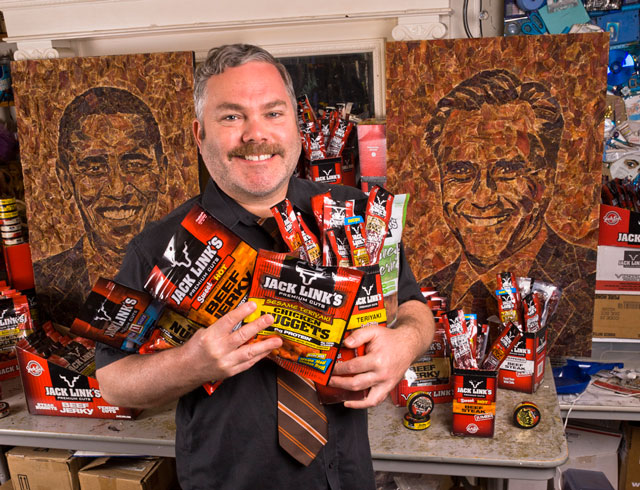
Fabulous food-and-junk-drawer-oriented collage artist (and legendary SF club denizen) Jason Mecier is back in our virtual orbit lately. His meme explosion beef jerky portraits of Obama and Romney seem to be everywhere. And his wonderful makeup-y likeness of Phyllis Diller, RIP, is giving us sad LOLs. But wait, the “meatraits” of Obameat and Meat Romney are sponsored! And there’s a video! Let’s go to the jerky tape:

Why?

44

steve@sfbg.com

Just a couple years ago, it seemed like the golden age of marijuana in San Francisco, the birthplace of the movement to legalize medical pot and a national leader in creating an effective regulatory framework to govern an industry that had become a legitimate, respected member of the business community.

More than two dozen patient cooperatives jumped through a variety of bureaucratic hoops to become licensed dispensaries, most of them opening storefront businesses that were often the most attractive, clean, and secure retail outlets on their blocks, sometimes in gritty stretches of SoMa, the Tenderloin, or the Mission.

“Pretty much everyone involved agrees that San Francisco’s system for distributing marijuana to those with a doctor’s recommendation for it is working well: the patients, growers, dispensary operators, doctors, politicians, police, and regulators with the planning and public health departments,” I wrote in “Marijuana goes mainstream” (1/28/10).

Since then, San Francisco’s medical marijuana industry has only become more established and professional, complying with new city regulations (such as changing how edibles are packaged to avoid tempting children), paying taxes and fees — and making very few waves. According to city officials, there have been almost no complaints from anyone about the dispensaries — and in San Francisco, people complain about everything.

But in the last six months, the full force of the federal government has brought the hammer down hard on this budding business sector, forcing the closure of eight brick-and-mortar dispensaries and instilling paranoia and insecurity in those that remain.

In just the past few weeks, two of the city’s oldest and most respected dispensaries –- HopeNet and the Vapor Room -– were forced to close their doors.

There’s been little rhyme or reason to which clubs get those dreaded letters warning operators and landlords to shut it down or be subject to asset forfeiture and prison time — and the officials involved have refused to explain their actions, except with moralistic anti-drug statements or unsupported accusations.

“These are people who played by the rules and paid their taxes, and now they’re being punished for it,” said Assembly member Tom Ammiano, a leader in creating a state regulatory framework to govern the distribution of medical marijuana, which California voters legalized in 1996. “This is pure thuggery. They are ignoring due process out of blind prejudice and ambition.”

Ammiano met with Melinda Haag, the US Attorney for the Northern District of California, who has coordinated the local crackdown from her 11th floor office in the Federal Building near City Hall, shortly after she announced her intentions to go after medical marijuana. He said she was like a throwback to a less enlightened era.

“In talking to Haag, not only is she a bit of a bully, but she’s totally uneducated about the issue,” Ammiano told us. When she told him that her office has received many complaints about the dispensaries, he asked to see them -– even making a formal Freedom of Information Act document request –- but she has yet to produce them. “Her duplicity is very moralistic, it’s like going back 100 years.”

Neither Haag nor anyone from the White House or Justice Department would grant an interview to the Guardian to discuss the reasons for and implications of the crackdown, or to answer the list of written questions her office asked us to submit. Instead, Haag gave the Guardian this statement and refused to respond to our follow-up questions:

“Although all marijuana stores are illegal under federal law, I decided to use our limited resources to address those that are in close proximity to schools, parks and playgrounds and operations so large that they constitute marijuana superstores. I hope that those who believe marijuana stores should be left to operate without restriction can step back for a moment and understand that not everyone shares their point of view, and that my office has received many phone calls, letters and emails from people who are deeply troubled by the tremendous growth of the marijuana industry in California and its influence on their communities.”

But in San Francisco, where more than 80 percent of residents consistently support medical marijuana in polls and at the ballot box, most people don’t share Haag’s point of view. And city officials contest many of her claims, from saying the dispensaries are “left to operate without restriction” to her implication that they promote crime or endanger children to the haphazard way she has targeted dispensaries to the characterization that many people are “deeply troubled by the tremendous growth of the marijuana industry.”

In fact, to talk to city officials, virtually nothing Haag says is true.

“We’re not getting nuisance complaints [about the dispensaries],” Dr. Rajiv Bhatia, the city’s medical director who oversees regulation of the dispensaries by the Department of Public Health, told the Guardian. “We’ve had very few complaints over the years and good cooperation with the storefront part of the regulations.”

Almost across the board, city officials and club operators praise one another and the cooperative relationship they’ve established over the last four years. Some of San Francisco’s biggest dispensaries have somehow avoided Haag’s wrath, but their once-open operators are now afraid to speak publicly, warily checking the mailbox each day. A thriving industry eager to pay its taxes and submit to regulation is being driven back underground, with all the uncertainty and hazards that creates.

“The question everyone is asking: Why here, why now, why these businesses? Nobody knows the answer,” Bhatia said. “We’re left to speculate and guess about motives.”

MULTI-AGENCY ATTACK

The federal crackdown has been stunning in both its speed and breadth, with various federal agencies coordinating their attacks. The IRS is auditing the biggest clubs and denying write-offs for routine business expenses, the DEA is threatening asset forfeiture efforts, and Haag and the DOJ are threatening prison time and court injunctions.

Underlying all of that is President Barack Obama, who pledged not to use federal resources to go after those in compliance with state law in the 17 states where medical marijuana is legal. Then, last year, Attorney General Eric Holder suddenly announced a new policy: “It will not be a priority to use federal resources to prosecute patients with serious illnesses or their caregivers who are complying with state laws on medical marijuana, but we will not tolerate drug traffickers who hide behind claims of compliance with state law to mask activities that are clearly illegal.”

When we sought an explanation and clarification from the White House Communications Office about why well-established medical marijuana collectives carefully operating under California law were suddenly deemed “drug traffickers” that wouldn’t be tolerated, they refused to answer and referred us to a statement Obama made to Rolling Stone magazine.

“What I specifically said was that we were not going to prioritize prosecutions of persons who are using medical marijuana. I never made a commitment that somehow we were going to give carte blanche to large-scale producers and operators of marijuana -— and the reason is, because it’s against federal law. I can’t nullify congressional law,” Obama told the magazine.

That simplistic explanation – which conveniently ignores how people are supposed to get this medicine – has infuriated local growers and patients. It’s particularly galling for those who supported Obama and took him at his word in the last election, and who don’t understand why he is suddenly escalating the federal war on drugs, ignoring local laws and values, and re-criminalizing their communities.

FUNERAL PROCESSION

Hundreds of medical marijuana supporters gathered on Aug. 1 for a New Orleans-style funeral procession at the Lower Haight intersection near where Vapor Room had operated -– without incident and with praise as a model business from three successive district supervisors –- from 2004 until the previous day.

The mood was festive and defiant on that sunny afternoon, where advocates from both sides of the bay gathered to express solidarity with the closed clubs and resolve to battle through the recent setbacks.

“I’m feeling the fight,” Steve DeAngelo, star of the reality television show Weed Wars and head of Oakland’s Harborside Health Center, which received Haag’s shut-down-or-else letter last month, told the Guardian. “I don’t think we can allow taking a few hits to break our spirit….We started this struggle to win it and we’re not going to stop until we do.”

Local politicians and business leaders also came to offer their support.

“As president of the Lower Haight Merchants Association, I’m upset that Vapor Room had to shut down,” Thea Selby, who is also running for the District 5 supervisorial seat, told us. “The Vapor Room did a lot of good for this neighborhood and was a great business.”

Marchers, most clad in black, carried “Cannabis is Medicine: Let States Regulate” and other signs -– as well as a makeshift coffin and massive puppet depicting a scowling Haag -– and danced down the middle of the street as Brass Mafia horns belted out lively jazz tunes. By the time the procession reached Haag’s office at the Federal Building, a chill fog had darkened the skies and the mood.

DeAngelo took the bullhorn first and called out Obama directly: “Either you were lying, sir, or your employees are out of step with your policies.” Steph Sherer, executive director of the DC-based Americans for Safe Access, told the crowd, “We need to tell Obama to lose Haag or lose California.”

Ammiano and the other mostly Democratic Party politicians who spoke tried to avoid putting Obama directly into the crosshairs of the angry activists, although he did say those executing this crackdown “are harming Obama’s chances of winning.” He also urged activists to put the pressure on politicians in Sacramento and Washington DC: “We need to be a voice in reshaping what’s happened in these last few months.”

Ammiano said the crackdown “empowers the cartels and the people who use violence,” contrasting that with San Francisco’s civilized approach to regulating marijuana.

“We in San Francisco have been a model for how to regulate this industry and we have been successful. We are not going to let the federal government interfere with our rights in this city,” Sup. David Campos told the crowd.

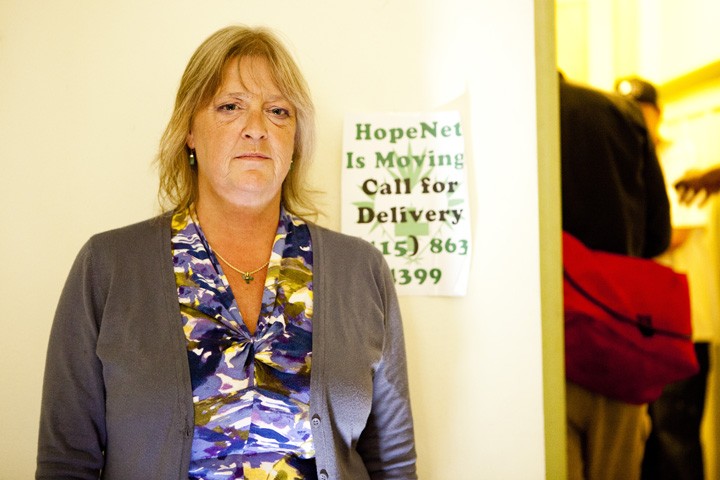
Cathy Smith, the founder of HopeNet, who was still reeling from watching her club gutted and shuttered the day before, also sounded an angry and defiant tone, urging supporters to make their voices heard by Haag and others.

“Everybody that’s here needs to go up to this evil woman’s office tomorrow and tell them what we think,” Smith said.

The general feeling was that if the feds can target model clubs like HopeNet and Vapor Room –- which had deep community roots and generous compassionate care programs for low-income patients -– then all clubs are in danger.

“I’m very upset that we’re losing two great medical marijuana dispensaries where patients could medicate on site,” said David Goldman, a local ASA activist and member of the city’s Medical Cannabis Task Force, noting how important that is for patients who live in apartments that ban smoking.

HopeNet and Vapor Room were some of the only dispensaries in town where smoking was allowed on site, because they were more than 1,000 feet from schools, playgrounds, or day care facilities, the city’s standard. Bhatia said that’s a very strict standard in a city as dense as San Francisco, which is why only four clubs ever met it.

Yet the feds saw things differently, ostensibly targeting HopeNet because a small private school opened two blocks away last year, and the Vapor Room because the feds didn’t use the city’s standard of being more than 1,000 feet from the playground at Duboce Park, instead deciding the dispensary was a community menace because it was a little under 1,000 feet from that dog-friendly park’s nearest patch of grass.

LAST DAYS

Vapor Room founder Martin Olive was a bundle of complicated emotions on the club’s last day in business (it will still operates as delivery-only, just like HopeNet, Medithrive, and a few other shuttered clubs have done). Initially, he didn’t want to talk to us: “I’m trying to keep a lower profile because it’s scary out there now.”

But he slowly opened up and tried to describe the feeling of watching his proudest accomplishment so rapidly undone by the one-two punch of a letter from the merchant services company cutting off credit card access (just like every dispensary in the city, returning pot sales to a cash-only status) followed days later by Haag’s shut-down letter.

“It’s complicated emotions that I’m feeling -– let down, confused. At the end of the day, I don’t understand why this is happening,” Olive said. “It’s a community tragedy, it really is.”

Vapor Room was a welcoming gathering place for its members and a supporter of a variety of community events and causes.

“I’ve always treated this as if it were just a nice coffee house. I’m not an outlaw,” Olive said. “I almost forgot I was breaking federal law. It was so normal, so legitimate.”

In fact, some club owners say their establishments helped clean up rough streets. “We took care of the entire block. Before us, it was all dealers, so there’s a safety issue,” HopeNet’s Smith told me as the once-welcoming club on 9th Street near Howard was reduced to bare walls.

Patients were also feeling the pain, including a 48-year-old ex-con who said he was paroled two years ago after serving 25 years in prison for attempted murder. “I have anger issues, big time. The only thing that keeps me calm and quiet and not blowing up is medical marijuana,” he told us, seething, before praising HopeNet’s “homelike environment” and supportive community. “It’s important to sit and relax in an environment that is comfortable and safe. All this is doing is pushing us into the streets.”

DRIVEN UNDERGROUND

Before going through his latest official misconduct battles and fighting to return to his job as the elected sheriff, Ross Mirkarimi was the District 5 supervisor who sponsored the creation of the city’s medical marijuana regulatory system, the product of a long and arduous legislative process.

“We developed the system out of stark necessity because neither local government nor state government gave a roadmap to the dispensaries,” Mirkarimi said. “Prop. 215 legalized medical marijuana, but there were no rules around it.”

After an intensely collaborative process that lasted more than a year, the city in 2005 adopted a process for licensing dispensaries that balanced the needs of this nascent industry with concerns by police, patients, disability rights activists, neighborhood groups, and health officials. Mirkarimi said that maybe it’s time for city officials to consider an idea he floated a few years ago of having the city itself directly distribute medical marijuana through General Hospital.

“I still think that’s a good idea, particularly if the feds are going to force medical marijuana dispensaries back into the dark ages.” For all his praise of the city’s dispensaries, Dr. Bhatia will admit that the industry still needed better oversight -– dealing with issues such as standards for growing and transporting cannabis, fiscal transparency, and potency and dosage standards –- but the federal crackdown has scuttled his efforts to expand the city’s regulatory system.

“This DEA action stops us from making progress on the regulation of clubs that we need to make,” Bhatia said. “There are lots of issues, but we had just finished getting the clubs into their housing.” Now the industry is being driven back underground.

Ironically, Haag and other federal officials have accused dispensary operators of profiteering, which they’ll certainly be more free to do now that local officials have lost their leverage to begin regulating the finances of the supposedly nonprofit patient collectives that officially operate each dispensary.

“That was one of the areas that we never developed the tools or capacity to look at,” said Bhatia, who proposed more transparent record-keeping by dispensaries last year, only to have the operators express concern about how the feds might use that information, which turned out to be an understandable fear.


Dick Meister: Obama needs labor–again!

1

By Dick Meister

Dick Meister, former labor editor of the SF Chronicle and KQED-TV Newsroom, has covered labor and politics for more than a half-century. Contact him through his website, www.dickmeistersf.com, which includes more than 350 of his columns.

Organized labor, which played a major role in President Obama’s 2008 election campaign, thankfully has launched what seems certain to become an even greater and perhaps decisive effort in behalf of Obama’s re-election this year.

We should all be thankful for that, given the reactionary policies Mitt Romney and his Republican cohorts promise to put in place should they win, and the positive reforms Obama and the Democrats promise.

Four years ago, 250,000 AFL-CIO activists campaigned for Obama’s election. But the AFL-CIO says the number of union volunteers campaigning for Obama and his Democratic allies in Congress this year will reach at least 400,000, and be waged among union and non-union members alike.


That’s not an unrealistic expectation, considering what happened in 2008.  One-fifth of all voters that year were union members or in union households, and fully two-thirds of them supported Obama, and the ratio was even higher in so-called battleground states.

The AFL-CIO calculates that union volunteers knocked on some 10 million doors to make their pitch for Obama in 2008, handed out 27 million leaflets and mailed out 57 million more.  The number of union voters alone reached a record high of more than 3 million.

The AFL-CIO claims its campaign “made the difference in critical states.”  Maybe it did, maybe not. But it is clear that organized labor significantly influenced the vote everywhere – and undoubtedly will do so again.

The AFL-CIO is certainly not going to match the billions being spent on the campaigns of Romney and his big business allies. But labor has the ground troops that can and will spread the pro-Democratic and pro-labor message widely, however much unions are outspent.

It’s true enough that labor has been unhappy with Obama’s failure to deliver on many of the promises he made to unions during the 2008 campaign, primarily his failure to overcome Congressional opposition to pro-labor reforms he’s proposed or supported.

 But there’s no doubt Obama’s administration has been a pro-labor administration. Federal agencies dealing with collective bargaining, job safety and other labor matters have been labor-friendly, in sharp contrast to their clearly anti-labor positions under George Bush. What’s more, Obama has spoken out forcefully to the country in behalf of unions, their demands and their needs.

He’s urged passage of virtually every measure advocated by labor in Congress. That includes bills guaranteeing millions of Americans the right to unionization that has long been denied them, prohibiting employers from permanently replacing strikers, raising the minimum wage and indexing it to inflation so it would rise as the cost-of-living rises.  Bush rarely even uttered the word, “union, ” much less voiced any pro-union sentiments or support for such union-backed measures.

People on the political left continue to clamor for more from Obama, and they should. But they must realize he’s the best we can reasonably expect in today’s political and economic climate. Give him four more years and who knows?

Yes, Barack Obama is not Franklin Roosevelt.  But neither is he George Bush – nor Mitt Romney.

Dick Meister, former labor editor of the SF Chronicle and KQED-TV Newsroom, has covered labor and politics for more than a half-century. Contact him through his website, www.dickmeistersf.com, which includes more than 350 of his columns.

If you want my advice

0

CAREERS AND ED In July, the unemployment rate in California was 11 percent. Which got us thinking: what’s the smart way to job hunt these days? We’re not the only ones — this month, the Commonwealth Club is hosting a series of lectures and workshops called “The Future of Work.” We tapped two of the series’ experts for email interviews, asking Marty Nemko, author of Cool Careers For Dummies, and Joel Garfinkle, Oakland-based career coach, for their takes on the matter. They offered two points of view on today’s dreary job market. Upside? Nemko, who spoke on August 1, is positive that more workers will be needed to implement upcoming immigration reform. Of course, he also foresaw growth in “bio-chemical terrorism.” Oh, the future.

San Francisco Bay Guardian: Tell us about your Commonwealth Club event.

Marty Nemko: [My focus was] on which careers are likely to burgeon [in] the result of [an] Obama win — which ones polls and Intrade [a speculative, crowd-sourced website] betting suggest will occur. I’ll also talk about how to survive and even thrive during what may be America’s decline and fall.

Joel Garfinkle: Working hard and being good at what you do is not enough to attain the level of success you truly deserve. So what exactly makes one person more successful than another? The answer: leveraging and applying perception, visibility, and influence better than anyone else.

SFBG: What kinds of issues are older workers facing in terms of getting new jobs?

MN: It’s very tough to convince an employer that a 40-year old with no experience is better than a 25-year old with experience. In this job market, the employer doesn’t have to settle.

JG: Mid-life career transitions occur because after years of success, many of my clients find that they lack fulfillment. Success isn’t enough anymore to satisfy them. [But] it’s difficult to make a mid-life career transition due to the lack of financial stability that exists when making the change. Learning of new skills in a different profession can be a daunting and intimidating task.

SFBG: What are some place that are still proving fruitful for job searchers?

MN: Some of my predicted areas for growth are auditing for corporations, the US Treasury, and the IRS; immigration-related bureaucrats that will be needed after Obama gets comprehensive immigration reform after the election; health care advocates to help people get the health care they need as ObamaCare is implemented; and bio-chemical terrorism. Anything mandated will be the last sort of employment to get cut. Lastly, multicultural marketers to address the tastes of the fastest-growing ethnic groups.

JG: Information technology is still growing. About two-thirds of hiring manages have been adding staff this year and will continue to add headcount to the IT departments. Health care is still pretty in-demand due to rising ages in the US. And many employers have had difficulty finding and hiring enough engineers.

SFBG: Should people still be striving for their dream job? Is that idea still relevant?

MN: It’s in the Bay Area’s drinking water. If there was a motto on the San Francisco flag, it would be “Do what you love and who cares if the money follows. My parents will support me.”

JG: The increase in collective desire to love one’s job comes from something missing in a person’s life. Statistics over the years have stayed consistent in stating that over two-thirds of Americans are unhappy in their jobs. The task is to recognize that people are uniquely special, have something to give, have a talent no one else shares in quite the same way.

MARTY NEMKO: “KEYS TO BEATING THE ODDS IN STARTING A BUSINESS”

(next lecture) Thu/9 6pm, $20

Commonwealth Club 

595 Market, Second Floor, SF

JOEL GARFINKLE: “GETTING AHEAD AND TAKING YOUR CAREER TO THE NEXT LEVEL”

Aug. 30, 7pm, $15 

Silicon Valley Bank

3005 Tasman, Santa Clara

(415) 597-6700

www.commonwealthclub.org


Alerts

0

WEDNESDAY 8

Speak up: stop and frisk Southeast Community Complex, 1800 Oakdale, SF; Stop and frisk — the controversial, pretty much definitely Fourth Amendment-violating policy that police in New York cling to despite protest and that Mayor Ed Lee recently proposed implementing in San Francisco — just won’t go away, despite opposition from pretty much everyone. This panel discussion and opportunity to debate issues relating to the proposed stop and frisk policy. The event is presented by the Osiris Coalition and filmmaker Kevin Epps.

First District 5 debate of the season Park Branch Library, 1833 Page, SF; District 5 is in the center of San Francisco, and much of the excitement of November’s city elections will center on its race for supervisor. A wide range of candidates will vie for the coveted spot that Ross Mirkarimi left to become sheriff. All of the candidates have promised to show up to this first debate in the hotly contested race. The debate is presented by District 5 Democratic Club, the District 5 Neighborhood Action Committee, and the Wigg Party.

THURSDAY 9

Occupy the Bay Berkeley Fellowship of Unitarian Universalists’ Hall, 1924 Cedar, Berk; www.bfuu.org. 7pm, $5-10 suggested donation. Filmmakers Name Name and Namey Namey have been documenting Occupy in the Bay Area since the fall. Come reminisce, learn, and be inspired by their film at its premier. You made this history happen, celebrate it, baby!

SATURDAY 11

Black Riders Liberation Party La Peña Cultural Center, 10pm, $5-10. The Black Riders Liberation Party considers itself the new generation of the Black Panther Party, organizing similar programs to stop police violence and gang violence and feed communities. This Saturday, the Party parties. Come celebrate the Black Riders and meet organizers, bring a canned food donation for a discount.

Pistahan Yerba Buena Gardens, Mission and Third St., SF; www.pistahan.net. 11am, free. This giant annual Filipino celebration goes all weekend. Start off the weekend with a parade from Beale and Market streets to Yerba Buena Gardens, where the festival of music, food, performance and education begins.

Foreclosure victory block party 376 Bradford, SF; www.occupybernal.org. 10am, free. Shortly after we named Ross Rhodes a Local Hero (Best of the Bay 2012) for his work protecting his home and those of his Bernal Heights neighbors from unjust foreclosure, he received a loan modification agreement. Come celebrate with Ross and others from Occupy Bernal with a block party at his house. There will be educational presentations about banks’ predatory role in the foreclosure crisis and efforts to fight back in the morning, followed by general partying.

SUNDAY 12

Lessons from Vermont Eric Quezada Center, 518 Valenica, SF; www.collectiveliberation.org. 3-5pm, free. Yes, we have the Affordable Care Act, but it leaves much to be desired, unless you’re in Vermont. There, Governor Peter Shumlin signed universal healthcare into law in May 2011. But of course, Shumlin didn’t do this alone. Come hear a presentation from some of the organizers who won this victory, all the way from the Vermont Workers’ Center.

MONDAY 13

Undocumented and unafraid Asian Law Caucus, 55 Columbus, SF; www.asianlawcaucus.org. 12-1:30pm, free. The Asian Pacific Islander undocumented student group ASPIRE will lead this talk on the immigration rights struggle. The last talk in the Asian Law Caucus-led summer brown bag series is especially timely as undocumented youth work on figuring out if and how they might benefit from President Obama’s policy directive giving limited amnesty to undocumented college students, and what it means for family and friends, especially those already in ICE custody. This talk on the issues youth without legal status face and how to keep building towards the DREAM Act, which would offer broader protections that Obama’s policy.

TUESDAY 14

Milk Club District 5 debate Eric Quezada Center, 518 Valencia, SF; www.milkclub.org. 7-8:30 p.m., free. A District 5 supervisors race debate hosted by the Harvey Milk Democratic Club. Milk Club President Glendon Hyde, aka Anna Conda, says candidates will cover drug policy, public space, sex worker rights, the housing crisis, queer seniors’ issues, and much more. As an extra special bonus, the debate will be hosted by transgender performer Ben McCoy and the Guardian Managing Editor Marke Bieschke.

Two of SF’s most venerable cannabis dispensaries get shut down

7

Sadness, anger, and confusion hung thick in the fragrant, smoky air of two of San Francisco’s oldest and most prominent medical marijuana dispensaries – HopeNet in SoMa and Vapor Room in Lower Haight – during their last day in business yesterday, the latest victims of an aggressive federal government crackdown on the industry.

Throughout the day, vendors, patients, neighbors, and well-wishers stopped in to say goodbye and commiserate over a trend that just doesn’t make sense to them, or to the local politicians and city officials that have spent years setting up a regulatory structure that had legitimized the cannabis industry, which thrived as the rest of the economy suffered through the recent recession.

“I’ve always treated this as if it were just a nice coffee house. I’m not an outlaw,” said Martin Olive, whose Vapor Room was a friendly community gathering place and active member of the local business community that gave away free bags of vaporized marijuana to low-income patients on a daily basis. “I almost forgot I was breaking federal law. It was so normal, so legitimate.”

Despite previous promises to respect state laws legalizing medical marijuana, President Barack Obama and federal agencies under his control did a sudden about-face last year, with the Drug Enforcement Agency threatening landlords with property seizure, the Justice Department threatening prison sentences, and the Internal Revenue Service doing audits and refusing to allow routine business expenses.

The result has been the forced closure of eight of San Francisco’s 24 licensed dispensaries in the last seven months, with more closures likely in the coming months. Almost all of the remaining clubs have been forced to deal only in cash after the feds threatened their bankers and credit card companies. The industry that grows and sells California’s biggest cash crop is essentially being driven back underground, hurting patients and the sometimes gritty neighborhoods that dispensaries had improved with security systems and a flow of customers that put more eyes on the streets and cash in the pockets of nearby stores and restaurants.

“The people that live here are afraid the neighborhood is going to come back in here. We took care of the entire block. Before us, it was all dealers, so there’s a safety issue,” HopeNet founder Cathy Smith told me as the once-welcoming club on 9th Street near Howard was reduced to bare walls, noting that the owner of the Starbucks on the corner told her he expects his business to drop by 15 percent.

Olive shared the concerns expressed at HopeNet, which he considers “a sister dispensary,” one that also had a generous compassion program for giving cannabis to low-income patients and offering other free services like yoga.

“I’m curious to see what this neighborhood looks like in six months. I know what it was like six months before we got here,” Olive said of his club’s opening in 2004.

But for now, it’s over. Vapor Room continued to do business for most of the day yesterday, but HopeNet was already stripped bare and essentially shut down, and by 3:30pm they removed the cash register and their pot stock. “The signs are down, we’re no longer a pot club, break out the beer,” announced Smith’s son, Bill, a member of the cooperative, referring to one of the many tight restrictions of what the city allowed in clubs. “I’m the only one making light of things today, as a coping mechanism. I laugh so we don’t cry.”

Like the patients, vendors, and local officials we spoke to – who you’ll hear from in an upcoming Guardian cover story looking the end of medical marijuana’s golden age – Olive and Smith are grappling with a federal crackdown they say has myriad downsides and no benefits to anyone but federal agencies that profit from drug-related seizures and the criminal syndicates that now have less competition.

Both Olive and Smith say they voted for Obama in 2008, they believed his statements that he wouldn’t go after businesses that complied with state and local law, and now they feel betrayed.

“I feel fucked by it, betrayed is too easy a word,” Howard said.

“It’s complicated emotions that I’m feeling – let down, confused – at the end of the day, I don’t understand why this is happening,” Olive said. “It’s a community tragedy, it really is.”

Like MediThrive and other recently shuttered clubs, both Vapor Room and HopeNet will still be operating as delivery-only services, but the future seems less certain now that their direct, brick-and-mortar connection to their community has been severed.

They urge those concerned about the crackdown to contact their political representatives, and to turn out today (Wed/1) at 4pm for a funeral march that starts at Haight and Steiner streets near the now-shuttered Vapor Room and goes to the Federal Building on Golden Gate Avenue, where there will be a rally and speeches starting at 5pm.

Dab’ll do ya

0

caitlin@sfbg.com

HERBWISE The neatly-dressed line of donors waiting outside the Fox Theatre on July 21 gawked at the procession coming down Broadway Avenue. Was it the impassioned protesters in wheelchairs, the oversized fake joint, or the realization that stoners could be so… vehement that had them transfixed?

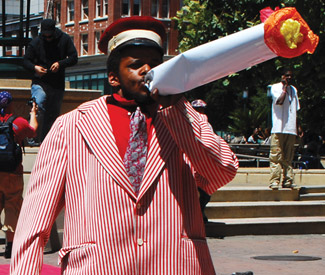
"Obama keep your promise!" On the occasion of the President’s fundraising trip to Oakland — his first to the Bay Area since medical cannabis cornerstone Harborside Health Center was ordered to close in a letter from US Attorney Melinda Haag — medical marijuana had turned out for an unwelcoming party. Obama’s administration has been messing with weed, and patients weren’t about to go quietly into the night. A crowd of hundreds took a lap around the theater, starting and ending at Frank Ogawa-Oscar Grant Plaza.

Of course, the President wasn’t there to see it. Obama was hours late for his announced appearance at the Fox at 3pm.

Pre-march, sharing space in an Oaksterdam University classroom with a bank of healthy marijuana plants, OU president Dale Sky Jones welcomed members of the media to a panoramic look at today’s cannabis advocates. Jim Gray, ex-assistant US Attorney and current Libertarian Party vice presidential candidate spoke, and Harborside’s Steve Deangelo asserted that "if the US Attorneys can come after a dispensary like Harborside, no dispensary in this country is safe." Patients finished out this chorus of voices. The father of a medical marijuana patient — his young boy has Dravet Syndrome, a type of infant epilepsy — despaired that, should Harborside go under, his offspring would never get the right kind of medicine.

"What am, going to ask a drug dealer ‘do you have CBD?’" he asked, hands and voice shaking. "You’re going after the wrong drug."

DABBING 101


Oddly enough, considering the drama surrounding its legality, cannabis culture continues to grow unabated. Consider this: there are forms of ingestion that even I, your somewhat-dedicated pot columnist, remain unacquainted with. This is annoying, so upon pot Internet celebrity Coral Reefer’s 1000th tweet regarding "dabbing," I called her out on it. Would she be willing to teach me the ways of this mysterious process?

She would! Dabbing means inhaling the vapor the results from melting butane, or even super-melt cold water-extracted hash. Intriguingly, it resembles nothing so much as smoking crack with a bong, but never you mind, vapor has a lower impact on your lungs and increased potency means its a quicker process than smoking "flower," or regular dried buds.

So: heat up your dabbing surface. Reefer had no less than four kinds of set-ups for dabbing in her apartment, including a "skillet," or flat disc that attaches to any glass-on-glass bong (most dabbing kits will work with your pre-existing water pipe) and various kinds of "nails," or round, rimmed surfaces specifically made for dabbing. Wait until it’s red hot. Take your specially-designed metal pick, or "dabber," and with it rub some concentrate, called "super-melt" or "wax" at most dispensary, onto your post-red-hot surface. Inhale. Clear. Inhale. Repeat process.

Dick Meister: Good news–and bad–about jobs

2

By Dick Meister

Dick Meister, former labor editor of the SF Chronicle and KQED-TV Newsroom, has covered labor and politics for more than a half century. Contact him through his website, www.dickmeister.com

It’s of course good news that unemployment among workers in private industry has been steadily declining. But that comes along with the bad news that unemployment among public employees has been growing – and with it a decline in vital government services.

A recent  report in the New York Times has made that very clear.  Reporters Shaila Dewan and Motoko Rich noted that government payrolls grew in the early part of the recovery from the Great Recession in 2009, mainly because of federal stimulus measures. But they said that since then, “the public sector has shrunk by 706,000 jobs.  The losses appeared to be tapering off earlier this year, but have accelerated for the last three months, creating the single biggest drag on the recovery in many areas.”

Albeit slowly, the economy generally has been improving, with state tax revenues expected to go beyond pre-recession levels by next year.  Yet the Times’ reported that “governors and legislatures are keeping a tight rein on spending, whether to refill depleted rainy day funds or because of political inclination.”

Holding tight won’t be easy, with the costs of health care, social services, education and employee pensions steadily rising, and property taxes and other tax revenues steadily shrinking.  More than a dozen states have tried to do it by trimming their aid to local governments. And that will undoubtedly lead to more public worker layoffs, more unemployment and more reductions in important public services.

Local governments already have been making budget cuts that far outweigh the slight economic relief that’s come with a recent growth in state and federal jobs.  It’s certain to worsen, since more than 25 percent of municipalities are planning layoffs this year. 

President Obama has proposed easing the financial plight of states and their employees by providing $30 billion more for teachers, police officers and firefighters.  Such aid is essential if public services – and the compensation of those who provide them – are to be maintained at a significant yet reasonable level.

Predictably, the  conservatives who don’t really care for government are in a snit over Obama’s proposal.  The Times quoted Michael D. Tanner, a senior fellow at the Cato Institute, as complaining that the additional public sector jobs  “must be paid for with more debt and taxes borne by the private sector.”

Now, isn’t that a revelation! Imagine that, people taxing themselves and hiring people to provide services they and everyone else needs if they are to live a decent life, if they are to find meaningful work.

We need more, not less government, and we can provide it by employing for reasonable compensation many of the millions of Americans now suffering from unemployment. We need to open more government jobs for them so they may help provide essential services.

The lack of sufficient public workers, as the Times said, “can mean longer response times to fires, larger class sizes, and in some cases lawsuits when short-staffed agencies are unable to provide the required services.”

The Times quoted Mike Whited, president of the firefighters union local in Muncie, Ind., who said the area which could be reached within eight minutes after an alarm was sounded was cut in half.

The Times said, “Mr. Whited chafed at portrayals of public workers as overpaid or greedy, saying his union and others had made concessions, including paying more for their health insurance and forfeiting raises. I think a lot of people don’t understand what we do. They’re looking for somebody to blame, and I think they’re being led the wrong way.”

One of the hardest hit cities, Trenton, New Jersey, has laid off fully one-third of its police force, hundreds of school district workers and at least 150 other public employees, and now faces loss of 60 more firefighters.

More than half the job losses in local governments have come in education.  Thousands of teachers have been laid off throughout the country, and thousands more are being threatened with layoffs.

 Many teachers have agreed to help ease their school districts financial problems by taking unpaid “furlough days” or agreeing to less pay and benefits than they had sought or had been granted in contract negotiations.

The widespread teacher layoffs have nevertheless continued. In Cleveland, for instance, more than 500 teachers were laid off this spring because  of a claimed $66 million budget shortfall. That came after two years of cutbacks and $25 million in concessions, teachers union leader David Quolke told the Times’ reporters.

One consequence: Some classes will have more than 40 students, a serious hardship on students and teachers alike.

Relatively large teacher layoffs and cuts in public jobs and services generally have hit every state hard, including the largest, wealthiest and most influential states.  In California, for example, Gov. Jerry Brown is threatening to eliminate 15,000 state jobs.

The Times said Pennsylvania “has shed 5,400 government jobs this year, and many school districts and social service agencies are contemplating more layoffs.”

Yes, it will take higher taxes and more public debt in Pennsylvania, California and everywhere else to combat the severe economic problems that have left millions of Americans without the jobs  and public services they so badly need.

Dick Meister, former labor editor of the SF Chronicle and KQED-TV Newsroom, has covered labor and politics for more than a half century. Contact him through his website, www.dickmeister.com

There goes the SF Democratic Party

41

We all knew that the progressives didn’t win a majority on the Democratic County Central Committee, but for a while there it looked as if there might still be a chance to elect someone who isn’t one of the most conservative members of the panel as the chair. But no: Mary Jung, who works for PG&E, now controls the San Francisco Democratic Party.

Jung was elected unanimously July 27, which means the progs realized they didn’t have a candidate who could get a majority. Most of the other leadership roles are from the conservative side of the party. Yes, Alix Rosenthal is second vice-chair, but it’s clear who is going to be in charge of the party — and it’s not the folks who have run it for the past four years.

The slate-card committee, which has the key job of creating and delivering the powerful endorsement card, will be dominated by conservatives, Jung and Tom Hsieh, with only one progressive, Rafael Mandelman. It’s pretty much a train wreck all around.

Samson Wong (who is a good guy) says it’s a new era of civility, which is the same thing we used to say about City Hall (and I agree with him that it’s historic: The mayor, the president of the board and the chair of the party are now Asians). But when civility means you stop fighting (loudly, even if you lose) for things that matter in the name of keeping the peace, I’m against it.

In a press release, the DCCC’s new corresponding secretary, Matt Dorsey, notes that the local party’s priorities this fall are re-electing Barack Obama (who will win California even if the SF DCCC members all take a six-month nap) and restoring Democratic control of the House (which won’t be decided in the Bay Area). No mention of electing progressives to the Board of Supervisors — which is where the local party really matters.

The race to watch will be D1, where incumbent Eric Mar is part of the progressive bloc that lost the DCCC. We’ll see what happens.


President or no president, medical marijuana shows up in Oakland

2

So the President was late. Around the time the “Fire Melinda Haag” press conference (as it had been called in emails I’d received from the various cannabis advocacy groups) at downtown Oakland’s federally-threatened Oaksterdam University was starting, one attendee drily mentioned that Obama was reported to still be in Las Vegas.

“I mean, I know the private jets can get you places really quickly and all, but still.”

It didn’t matter — medical marijuana had assembled in Oakland, the world cannabis community was watching, and there was going to be a show of numbers, regardless of what Air Force One was doing or when the President’s scheduled appearance at the Fox Theater a block away would actually get going.

But first, the formal press conference at Oaksterdam. Grow lights warmed the pot plants on one side of the room as dispensary founders, politicians, and patients said their piece on stage. 

“Name the advantages of continuing the drug war,” said Oaksterdam University president Dale Sky Jones (OU founder Richard Lee on stage a few feet to her right.) “We continue the failed drug policy that targets young people of color.”

“This is simply not the right thing to do,” said Jim Gray, a retired Orange County superior court judge and former assistant US Attorney. “It will not result in less marijuana being sold or consumed in Oakland or anywhere else.” Later on, during the march that would take medical marijuana users on a lap around the Fox, some protesters were seen lofting signs with the ex-official’s name on it — he’s the Libertarian Party’s nomination for vice president. His crowd-pleasing efforts struck gold at Oaksterdam in the form of a quip. “I think going forward, the slogan should be ‘the hempire strikes back.”

Steve Deangelo, founder of Harborside Health Center, was adamant in his call for an immediate freeze on all enforcement actions until courts deemed them consistent with the Obama administration’s policy. Deangelo and the patients that depend on his dispensary have a lot to lose should their call go unheard: a recent letter sent to Harborside by US Attorney Melinda Haag ordered the collective’s closure based on the rationale that it is a “marijuana superstore.”

“If the US Attorneys can come after a dispensary like Harborside,” Deangelo told the assembled crowd, “No dispensary in this country is safe.” Commonly referred to as the best-known dispensary in the country, Deangelo’s dispensary and its staff were the subject of last year’s Discovery Channel reality series Weed Wars

Perhaps the most poignant voices from the day were those of the consumers who will be most affected by the loss of safe and accessible medical-grade marijuana. Yvonne Westbrook-White, a multiple sclerosis sufferer, credited cannabis with getting her out of the house that day and appealed to the President to keep his promise to leave state-legal dispensaries alone.

Jason David’s baby son has Dravet Syndrome, a rare disease with epilepsy-like symptoms. He told the crowd at Oaksterdam that a non-psychoactive cannabinoid tincture had made his boy go from acting like a zombie to being a bubbly kid that greets people at church and at home alike. His voice and hands trembled as he thought out loud about what he would do if Harborside went the way of so many other cannabis businesses in the Bay Area.

“What am, going to ask a drug dealer ‘do you have CBD?’ You’re going after the wrong drug.”

An hour later, feet from the massive Obama-as-cop “Dear Leader” design that members of Chalkupy had painstaking sketched out the same day, a crowd that police later estimated at 800 to 1000 people were ready to march for their cannabis rights. The route took us up Broadway, past the lines of Obama fans patiently waiting for their president to show, down 20th Avenue to San Pablo Avenue, and right back to Oakland’s City Hall.

Would things continue to go as peacefully through the President’s eventual visit? All signs pointed to yes when your Guardian journalist left around 4:30pm, but one protester put it rather succinctly. “Today’s not over yet,” he said.