

“Pupils were all shot multiple times with a semiautomatic, officials say.” New York Times Sunday edition (December 16, 2012). Guardian artist Louis Dunn comments. Click on the artwork to view the full-size image.
New York Times
The end of the world as we know it

steve@sfbg.com
It’s easy to dismiss all the hype surrounding the auspicious date of December 21, 2012. There’s the far-out talk of Mayan prophecy and the galactic alignment. There’s the pop-culture lens that envisions the apocalypse. There are the extraterrestrials, about to return.
But even the true believers in Mayan folklore and its New Age interpretations say there’s no end of the world in sight. Time doesn’t end when the Mayan cycle concludes; it’s actually a new beginning.
And even some of the most spiritually inclined on the 12/21 circuit agree that it’s highly unlikely that anything of great moment will happen during this particular 24-hour period in history. The sun will rise and set; the winter solstice will pass; we’ll all be around to see tomorrow.
In fact, instead of doomsday, the most optimistic see this as a signpost or trigger in the transformation of human consciousness and intentions. Their message — and it isn’t at all weird or spacey or mystical — is that the world badly needs to change. And if all the attention that gets paid to this 12/21 phenomenon reminds people of what we have to do to save the planet and each other, well — that’s worth getting excited about.
Check out the news, if you can bear it: Global warming, mass extinctions, fiscal cliffs, social unrest. Now stop and turn the channel, because we’re also writing another story — technological innovation, community empowerment, spiritual yearning, social exploration, and global communication.
Both ancient and modern traditions treat the days surrounding the solstice is a time for reflection and setting our intentions for the lengthening, brightening days to come. And if we take this moment to ponder the course we’re on, maybe the end of the world as we know it might not be such a bad thing.
THE LONG VIEW
The ancient Mayans — who created a remarkably advanced civilization — had an expansive view of time, represented by their Long Count Calendar, which ends this week after 5,125 years. Like many of our pre-colonial ancestors whose reality was formed by watching the slow procession of stars and planets, the Mayans took the long view, thinking in terms of ages and eons.
The Long Count calendar is broken down into 13 baktuns, each one 144,000 days, so the final baktun that is now ending began in the year 1618. That’s an unfathomable amount of time for most of us living in a country that isn’t even one baktun old yet. We live in an instantaneous world with hourly weather forecasts, daily horoscopes, and quarterly business cycles. Even the rising ocean levels that we’ll see in our lifetimes seem too far in the future to rouse most of us to serious action.
So it’s even more mind blowing to try to get our heads around the span of 26,000 years, which was the last time that Earth, the sun, and the dark center of the Milky Way came into alignment on the winter solstice — the so-called “galactic alignment” anticipated by astrologists who see this as a moment (one that lasts around 25-35 years, peaking right about now) of great energetic power and possibility. The Aztecs and Toltecs, who inherited the Mayan’s calendar and sky-watching tradition, also saw a new era dawning around now, which they called the Fifth Sun, or the fifth major stage of human development. For the Hindus, there are the four “yugas,” long eras after which life is destroyed and recreated. Ancient Greece and early Egyptians also understood long cycles of time clocked by the movement of the cosmos.
Fueled by insights derived from mushroom-fueled shamanic vision quests in Latin America, writer and ethnobotanist Terence McKenna developed his “timewave” theories about expanding human consciousness, using the I Ching to divine the date of Dec. 21, 2012 as the beginning of expanded human consciousness and connection. And for good measure, the Chinese zodiac’s transition from dragon to snake also supposedly portends big changes.
In countries with strong beliefs in myth and mystical thinking, there’s genuine anxiety about the Dec. 21 date. A Dec. 1 front page story in The New York Times reported that many Russians are so panicked about Armageddon that the government put out a statement claiming “methods of monitoring what is occurring on planet Earth” and stating the world won’t end in December.
Here in the US, the National Aeronautics and Space Administration was also concerned enough about mass hysteria surrounding the galactic alignment and Mayan calendar that it set up a “Beyond 2012: Why the World Won’t End” website and has issued press statements to address people’s eschatological concerns.
So what’s going to happen? There are authors, scholars, and researchers who have devoted big chunks of their lives to the topic. Two of the most prominent are Daniel Pinchbeck, author of 2012: The Return of Quetzacoatl and star of the documentary film 2012: A Time for Change and John Major Jenkins, who has written nearly a dozen books on 2012 and Mayan cosmology over the last 25 years.
“I never proposed anything specific was going to happen on that date. I think of it as a hinge-point on the shift,” Pinchbeck told me.
But there are those who hope and believe that the end of 2012 marks an auspicious moment in human evolution — or at least that it represents a significant step in the transformation process — and they seem fairly patient and open-minded in their perspectives on the subject.
“The debunking type isn’t some rational skeptic. They are true believers in the opposite,” Jenkins said. “We don’t know what’s going to happen. We’ve been filtering 2012 through some kind of Nostradomus filter.”
Jenkins and others like him have been clear in stating that they aren’t expecting the apocalypse. Instead, they emphasize the view by the Mayans and other ancient thinkers that this is a time for renewal and transformation, the dawning of a new era of cooperation.
“I think the Maya understood that there are cycles of time,” Jenkins said. “2012 was selected by the Maya to target this rare procession of the equinoxes.”
If the ancients had a message for modern people, it was to learn from our observations about what’s going on all around us. As Jenkins said, “They recognized their connection to the natural world and the connection of all things.
ACHIEVING SYNTHESIS
Many Bay Area residents are now headed down to Chichen Itza, Mexico, where the classic Mayans built the Pyramid Kukulkan with 365 faces to honor the passing of time — and where the Synthesis 2012 Festival will mark the end of the Mayan calendar with ceremonies and celebrations.
“It’s probably one of the most pointed to and significant times ever,” Synthesis Executive Producer Michael DiMartino told me, noting that his life’s work has been building to this moment. “As a producer, I’m very focused on the idea of spiritual unity and events with intention.”
DiMartino told me he believes in the significance of the galactic alignment and the ending of the Mayan calendar, but he sees the strength of the event as bringing together people with a wide variety of perspectives to connect with each other.
“We’re at a crossroads in human history, and the crossroads are self-preservation or self-destruction,” he said. “Synthesis 2012 is the forum to bring people together into a power place.”
Debra Giusti, who is co-producing Synthesis, started the Bay Area’s popular Harmony Festival in 1978, and co-wrote the book Transforming Through 2012. “Obviously, the planet has been getting out of balance and there is a need to go back to basics,” Giusti told me.
They are reaching out to people around the world who are doing similar gatherings on Dec. 21, urging them to register with their World Unity 2012 website and livestream their events for all to see. “We are launching this whole global social network to help develop solutions,” DiMartino said. (You can also follow my posts from Chichen Itza on the sfbg.com Politics blog).
Two of the keynote speakers at Synthesis 2012 are a little skeptical of the significance of the Mayan calendar and the galactic alignment, yet they are people with spiritual practices who have been working toward the shift in global consciousness they say we need.
“It’s more of a marker along the way,” Joe Marshalla, an author, psychologist, and researcher, told me. “We’ve been in this transition for almost 30 years.”
Marshalla said his speech at the festival will be about using certain memes to focus people’s energy on creating change, starting with letting go of the thoughts and structures that divide us from each other and the planet and replacing them with a new sense of connection.
“Everyone is waking up to the deeply held knowledge of the one-ness of all the planet, that we are in this together,” Marshalla said. “I think the world is waking up to the fact there are 7 billion of us and there are a couple hundred thousand that are running everything.”
Caroline Casey, host of KPFA’s “Visionary Activist Show” and a keynote speaker at the Synthesis Festival, takes a skeptical view of the Mayan prophecies and how New Age thinkers have latched onto them. “Everything should be satirized and there will be plenty of opportunities for that down there,” she said, embracing the trickster spirit as a tool for transformation.
But the goal of creating a new world is one she shares. “Yes, let’s have empire collapse and a big part of that is domination and ending the subjugation of nature,” she said. Rob Brezsny, the San Rafael resident whose down-to-earth Free Will Astrology column has been printed in alt-weeklies throughout the country for decades, agrees that this is an important moment in human evolution, but he doesn’t think it has much to do with the Mayans.
“My perspective on the Mayan stuff tends to be skeptical. It might do more harm than good,” Brezsny told me. “It goes against everything I know, that it’s slow and gradual and it takes a lot of willpower to do this work.”
READING THE STARS
The ancient Maya based their calendar and much of their science and spirituality on observations of the night sky. Over generations, they watched the constellations slowly but steadily drifting across the horizon, learning about a process we now know as precession, the slight wobble of the Earth as it spins on its axis.
Linea Van Horn, president of the San Francisco Astrological Society, said there is something simple and powerful about observing natural cycles to tap into our history and spirituality. “All myth is based in the sky, and one of the most powerful markers of myth is precession,” she said.
DiMartino said it wasn’t just the Maya, but ancient cultures around the world that saw a long era ending around now. “They each talk about the ending and beginning of new cycles,” he said. “Prophecies are only road signs to warn humanity about the impacts of certain behaviors.”
Casey’s a bit more down-to-Earth. “This has nothing to do with the galactic center,” Casey said, decrying the “faux-hucksterism” of such magical thinking, as opposed to the real work of building our relationships and circulating important ideas in order to raise our collective consciousness.
Van Horn has been focused on this galactic alignment and its significance for years, giving regular presentations on it since 2004. “The earth is being flooded with energies from the galactic center,” she said.
Issac Shivvers, an astrophysics graduate student and instructor at UC Berkeley, confirmed the basic facts of the alignment with the galactic center and its rarity, but he doesn’t believe it will have any effect on humans.
“The effect of the center region of the galaxy on us is negligible,” he said, doubting the view that cosmic energies play on people in unseen ways that science can’t measure. In fact, Shivvers said he is “completely dismissive” of astrology and its belief that alignments of stars and planets effect humans.
Yet many people do believe in astrology and unseen energies. A 2009 poll by the Pew Research Center’s Forum on Religion & Public Life found that 25 percent of Americans believe in astrology. A similar percentage also sees yoga as a spiritual practice and believes that spiritual energy is located in physical things, such as temples or mountains.
This moment is really about energy more than anything else. It’s about the perception of energies showering down from the cosmos and up through the earth and human history. It’s about the energy we have to do the hard work of transforming our world and the vibrational energy we put out into the world and feel from would-be partners in the process ahead.
“If you’re a liberal person without a spiritual grounding, it does look pretty bleak,” Pinchback said, noting the importance of doing the inner work as the necessary first step to our political transformation.
And both Casey and Brezsny believe in rituals. “Humans have been honoring the winter solstice for 26,000 years,” she said. “Every winter solstice is a chance to say what is our guiding story that we want to illuminate.”
GLOBAL TIPPING POINT
The world is probably not going to end on Dec. 21 — but it could end in the not-too-distant future for much of life as we know it if we don’t change our ways. Humans are on a collision course with the natural world, something we’ve known for decades.
In the last 20 years, the scientific community and most people have come to realize that industrialization and over-reliance on fossil fuels have irreversibly changed the planet’s climate and that right now we’re just trying to minimize sea level rise and other byproducts — and not even with any real commitment or sense of urgency.
The latest scientific research is even more alarming. Scientists have long understood that individual ecosystems reach tipping points, after which the life forms within them spiral downward into death and decay. But a report released in June by the Berkeley Initiative in Global Change Biology has found that Earth itself has a tipping point that we’re rapidly moving toward.
“Earth’s life-support system may change more in the next few decades than it has since humans became a species,” said the report’s lead author, Anthony Barnosky, a professor of integrative biology at UC Berkeley.
While the Earth has experienced five mass extinctions and other major global tipping points before, the last one 11,700 years ago at the end of the last ice age, Barnoksy said, “today is very different because humans are actually causing the changes that could lead to a planetary state shift.”
The main problem is that humans simply have too big a footprint on the planet, with each of us disturbing an average of 2.27 acres of the planet surface, affecting the natural world around us in numerous ways. The impact will intensify with population growth, triggering a loss of biodiversity and other problems.
“The big concern is that we could see famines, wars, and so on triggered by the biological instabilities that would occur as our life-support system crosses the critical threshold towards a planetary-state change,” Barnosky said. “The problem with critical transitions is that once you shift to a new state, you can’t simply shift into reverse and go back. What’s gone is gone for good, because you’ve moved into a ‘new normal.'”
Barnoksy said he’s not sure if the trend can be reversed, but to minimize its chances, humans must improve our balance with nature and avoid crossing the threshold of transforming 50 percent of the planet’s surface (he calculates that we’ll hit that level in 2025, and reach 55 percent by 2045). That would require reducing population growth and per-capita resource use, speeding the transition away from fossil fuels, increasing the efficiency of food production and distribution, better protection and stewardship of natural areas, and “global cooperation to solve a solve global problem.”
His conclusion: “Humanity is at a critical crossroads: we have to decide if we want to guide the planet in a sustainable way, or just let things happen.”
Perhaps it’s not merely a coincidence that our knowledge of the need for a new age is peaking in 2012. “It’s not surprising the world is in a crisis as we approach this date,” Jenkins said. “I don’t know how it works, but there is a strange parallel with what the ancient Maya foresaw.”
But the change that we need to make isn’t about just buying a Prius, composting our dinner scraps, and contributing to charities. It requires a rethinking of an economic system that requires steady growth and consumption, cheap labor, unlimited natural resources, and the free flow of capital.
“Basically, we are going to have to have a rapid shift in global consciousness,” Pinchbeck said. “You would not be able to create a sustainable economy with the current monetary system. It’s just not possible.”
Yet to even contemplate that fundamental flip first requires a change in our consciousness because, as Pinchbeck said, “We have created a stunted adult population that isn’t able to think in terms of collective responsibility.”
Brezsny said humanity shouldn’t need a galactic alignment or Mayan prophecy to feel the compelling need to take collective action: “I can’t think of any bigger wake-up call than to know that we’re in the middle of the biggest mass extinction since the dinosaur age.”
What comes next is really about how humans use and guide their energies, or as DiMartino said, “We, through our actions and intentions, create the world and take the path that we are creating.”
CATASTROPHISM HAS LIMITS
It may be the end of the world as we know it, but sounding that warning may not be the best way to motivate people to action, according to a new book, Catastrophism: The Apocalyptic Politics of Collapse and Rebirth.
Two of the book’s authors — Sasha Lilley, a writer and host of KPFA’s “Against the Grain,” and Eddie Yuen, an Urban Studies instructor at the San Francisco Art Institute — recently spoke about the limits of catastrophism as a catalyst for political change at Green Arcade bookstore.
Christian conservatives have long sounded the apocalyptic belief that Jesus will return any day now. Yet Lilley said those on the left have had a long and intensifying connection to catastrophism — “seen as a great cleansing from which a new society is born” — based mostly around the belief that capitalism is a doomed economic system and the view that global warming and other ecological problems are reaching tipping points.
As committed progressives, Lilley and Yuen share these basic beliefs. “Capitalism is an insane system,” Lilley said, while Yuen said climate change and loss of biodiversity really are catastrophes: “We are living in an absolutely catastrophic moment in the history of the planet.”
Yet they also think it’s a fallacy to assume capitalism will collapse under its own weight or that people will suddenly — on Dec. 21 or at any other single moment — decide to support drastic reductions in our carbon emissions. These changes require the long, difficult work of political organizing — which has been underway for a long time — whereas Lilley called catastrophism “the result of political despair and lack of faith in our ability to take mass radical action.”
It’s tempting to believe that capitalism is one crisis away from collapse, or that people will be ripe for revolution as economic conditions inevitably get worse, but Lilley said that history proves otherwise. “Capitalism renews itself through crisis,” she said, whether it was the collapse of the banking system in 2008 or weathering the anti-globalization and Occupy Wall Street protests.
Sounding the alarm that capitalism and climate change will devastate communities doesn’t motivate people to action.
“It focuses on fear as a motivating force, but I think it really backfires on the left,” Lilley said. “It’s really immobilizes people…It’s paralyzing and deeply problematic.”
In fact, she said, “It’s important that we don’t succumb to what’s been called the left’s Rapture.”
DEATH AND REBIRTH
So what if the sky doesn’t fall Dec. 21 — and solutions don’t fall from the sky either? Are we are just going to die?
Yes, we are, at least in old forms, a process that can be cause for celebration and empowerment.
“Really, what’s happening is a psychological death, an identity death of what it means to be human on the planet,” Marshalla said.
He compared it to the five stages of grief identified by author Elizabeth Kubler-Ross: denial, anger, bargaining, depression, and then finally acceptance. Marshalla thinks humans are in the depression stage, verging on accepting that our old way of life is dying.
Part of that acceptance involves embracing new self-conceptions. When humans developed the prefrontal lobe in our brains, it allowed us to not only climb to the top of the food chain, but to achieve unprecedented control over the natural world.
But at this point, we’ve become too smart for our good, rationalizing behavior that our heart knows is out of balance, causing us to forget essential truths that we once knew, such as our power to create our reality and the humility to live in harmony with the natural world.
We learn apathy and competitiveness the same way we can learn empowerment and cooperation. “The goal is to bring on that peaceful, loving state of mind where we see all of us as equal,” Marshalla said, noting that it doesn’t really matter whether that’s achieved through traditional religion, meditation, political organizing, or belief in ancient prophecies and energies showering down from the galactic center.
“It’s less about being right than finding any way to lift us up, so whatever thoughts take us there,” he said. “It’s whatever causes us to realize that shift is upon us.”
Whether the universe and mythology have anything to do with it, the hold they have on human imagination, belief, and intention is still a powerful force — and maybe it can create self-fulfilling prophecies that a new age of global consciousness and cooperation is dawning.
“That’s the best thing the Dec. 21 date can be, a ritual of acknowledging that we’re in the midst of a fundamental transformation,” Brezsny said. “The activists believe this may be a good moment, a good excuse to have a transformative ritual and to take advantage of that. We need transformative rituals.”
The ancient Mayans and the energies of the galactic center may not deliver the solutions we need, although I’m certainly willing to wait a few days — or even a few years — to receive this moment with an open heart and open mind. Why not? Let’s all bring our own visions and prophets, mix them into the cauldron, and watch what bubbles up.
Golden Gate Park magic mushroom finally classified, just in time for high season
Hurray for science! Thanks to it and people who believe in it, a small tan spore that has been sprouting happily for Bay Area trippers for decades has a name: Psilocybe allenii. Our friends at the Psychedelic Society of San Francisco tipped us off to the fact that PSSF lecturer and mycologist Alan Rockefeller had helped pen a definitional paper that introduced the little guys. Rockefeller will be leading a Society mushroom hunt — open to all comers — in Golden Gate Park on Thu/20. He told us hippies have been hunting Psilocybe allenii in the park for ages, previously using its informal name Psilocybe cyanofriscosa, which sounds suspiciously close to “San Francisco” to us.
We got in touch with Rockefeller and his cohort Peter Werner by email to hear about our new fungal friend. They only used a few words that we didn’t understand, but we’re willing to put up with it because they are very smart people.
PLEASE NOTE: Do not eat wild mushrooms without someone who knows what they’re doing. Really.
San Francisco Bay Guardian: How was Psilocybe allenii discovered?
Alan Rockefeller: [John W. Allen] found it in wood chip landscaping [where it grows] October through January. It grows in cities, in areas where lots of people go. John is not the first person to find the mushroom, it has been well known for a long time. It was named after him because he picked it and mailed it to [Czech mycologist] Jan Borovicka. The earliest collection that I know of is a photo by Paul Stamets, taken in Golden Gate Park in 1976, and published in Mushrooms Demystified by David Arora. In that photo, there are three Psilocybe cyanescens and three Psilocybe allenii, all labeled Psilocybe cyanescens.
It’s been an open secret for many years that there is a new psilocybin mushroom that needs to be described. Literally hundreds of people have found it. People have been calling it “Psilocybe cyanofriscosa” since 2006, but that name is not proper Latin and was never validly published. New species of mushrooms must be named using proper Latin, and need to be described in a peer reviewed scientific journal.
http://www.youtube.com/watch?v=69VhBQVLjVU&feature=plcp
SFBG: How was it determined to be psychedelic?
AR: All mushrooms which stain blue where damaged and have either a dark purple brown or black spore print are psychedelic.
This species has been eaten by many psilocybin mushroom enthusiasts and they say it’s one of the strongest mushrooms known. The only mushroom which may be stronger is the closely-related Psilocybe azurescens. That species is very similar but has a cap that is umbonate, and there is a two base pair difference in the ITS gene. Psilocybe allenii occurs from BC, Canada to Los Angeles, and is common in San Francisco. Psilocybe azurescens only occurs within 20 miles of the Oregon/Washington border, in coastal dune grasses in the mouth of the Columbia river. (Correction: John W. Allen wrote to us to assure us that Psilocybe azurescens grow quite prolifically in the Seattle Puget Sound area)
Psilocybe cyanescens is also very common in San Francisco. It is almost as potent. If you go to Golden Gate Park in December you will see hundreds of hippies looking at the wood chip landscaping for Psilocybe cyanescens and Psilocybe allenii.
SFBG: How common is it to find new psychedelic/otherwise mushroom strains?
Peter Werner: Mushrooms in general? Finding new species is quite common, because fungi are not nearly as well investigated as plants, in spite of being a kingdom that, if anything, contains more species. (Albeit, mushroom-forming fungi are a small subset.) I couldn’t give you exact numbers, but there are probably a number of new species described in California each year. In really mycologically-underexplored areas, say Belize or Guyana, a mycologist may make a large collection in an hour, over half of which will be species that have never been scientifically described. Dennis Desjardin, the eminent mycologist at SFSU, once said that if he never went out in the field again, he could spend the rest of his life naming undescribed species deposited in the SFSU herbarium.
>>MORE SHOTS OF THE ‘SHROOM AVAILABLE HERE
In terms of Psilocybe in this part of the world, people find new species less often, because most of the West Coast species were described during a great wave of interest in the 1960s and ’70s. Still, there are several papers each year describing new Psilocybe species from various parts of the world, including from North America.
SFBG: How many species of mushrooms are there?
PW: [First you have to not just] define “species.” but define “mushroom”! The terms “mushroom” and “truffle” describe pretty much any macroscopically visible fungus with a distinct fruiting body, that are above-ground or underground, respectively. But definitions vary — the terms are not scientific ones. To take a stab at the number, I’d say the majority of mushroom and truffle species fall into the basidiomycete subdivision Agaricomycotina, and the Tree of Life web pages (which are a good general source for such things) estimates some 20,000 named species. (Named being the keyword here, undescribed species making up a possibly much greater number worldwide.) There are another about 1700 named species in the order Pezizales, which include the majority of fleshy ascomycetes (morels, cup fungi, true truffles, etc.)
In terms of fungi in general, that runs into the many millions, most of which are unnamed. Estimates range from over 600 thousand to over 5 million. A good article on estimating the earth’s biodiversity, including estimates of fungi, was run in the New York Times science pages last year.
SFBG: Are there any events coming up that laypeople might be interested in/invited to? Do you have to be a mushroom expert to be a part of the Society?
AR: I am leading a mushroom hunt in Golden Gate Park on Dec. 20 at noon, it is open to the public. You don’t need to be a mushroom expert to attend. I think that I am the only mushroom hunter that attends these events. Information on where exactly to meet will be posted on the SF Psychedelics Society website.
Thrill ride
emilysavage@sfbg.com
Tofu and Whiskey Arbiter of good taste, Thrill Jockey Records is officially 20 years old. In another era, in another business, this would merely be a back-slapping milestone. In the present stuck-barreling-downwards roller coaster of the music industry, it’s an anniversary worthy of widespread jubilation.
“It’s a mind-boggling number of years,” label founder Bettina Richards says during a phone call from the main office in Chicago, where the label’s been based since 1995.
And how else would a record label celebrates its birthday than with a series of familial concerts? There have been shows booked in key Thrill Jockey cities such as New York (where it began in ’92), London, San Francisco, LA, Chicago. Those shows (some of which have already gone down) boast lineups packed with label notables Tortoise, the Sea and Cake, Trans Am, Liturgy, Future Islands, and Matmos.
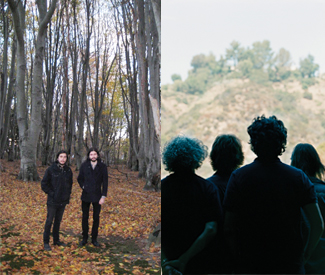
The San Francisco version of the traveling Thrill Jockey rodeo will be headlined by the label’s Bay Area acts: psych-rockers Wooden Shjips and drone duo Barn Owl, along with Liturgy, Trans Am, Man Forever, and Eternal Tapestry (Dec. 13, 8pm, $18. Independent, 628 Divisadero, SF; www.theindependentsf.com).
SF is considered a key Thrill Jockey city for a handful of reasons; there’s the aforementioned connection with Wooden Shjips and Barn Owl, plus, one of the label’s earliest releases was a band from here called A Minor Forest. And there’s another super-secret new signing set for 2013 (sorry, you won’t learn more than that here). “We’ve had a long, fond affection for the way San Franciscans can create super individual sounds,” Richards says.
Though they create different styles of music, Wooden Shjips and Barn Owl had some similarities that stood out to Richards when she was in the process of signing each. “They both share this transportive quality…taking you to an entirely different realm. With the Wooden Shjips, it’s an active feeling of motion, and with Barn Owl, it’s really an escape. It’s hard to put into words, but they both do something compelling to me.”
It’s that compulsion that’s lead Richards to many of her choices for the roster. She tells this story about one one the label’s most beloved acts: “Trans Am, way back in 1993, were the B-side of a seven-inch that John McEntire from Tortoise had recorded, and he gave me the seven-inch. It just happened that a week later they were playing. I saw them and was like, ‘oh my god, I love them.'”
While most of the acts have been found through musician friends and pals of the label, there’s the occasional random encounter, like Sidi Toure, the gifted Malian singer-songwriter. His CD arrived via snail-mail to the Chicago office right before Christmas last year. “We don’t usually get packages from Mali. I was on a drive to go see my folks, popped it in, and I just couldn’t believe it.” I tell Richards I had the same initial reaction to Toure’s mesmerizing compositions. “And the weirder thing,” she adds, “was that he sent it because he’s a really big Radian fan, which is a band from Austria with like, atonal drums. You just wouldn’t have guessed that, right?”
Austrian prog band HP Zinker was the first band she ever signed — at the time (’92), she was living New York City and was still bartending and working at a record shop. In fact, she did that for the first eight years of the label. The band lived in a decaying squat where White Zombie used to reside, and they all ended up moving in to Richards’ studio apartment. Richards lets out a raucous laugh recalling those early days.
From signing HP Zinker, to the label’s 330th release planned for next year, Thrill Jockey has maintained a comparatively sparkling reputation as a label that treats its artists well.
I asked Wooden Shjips drummer Omar Ahsanuddin why the label is so beloved and he replied: “Because they know their shit, are music fans, and mostly because [Richards] is a straight-shooter. As Phil Manley once told me: if you like getting paid on time, you’ll like Thrill Jockey.”
Barn Owl’s Jon Porras said, “It’s great to work with a label that trusts an artistic vision…Thrill Jockey upholds a level of professionalism and is open to unconventional ideas.”
“I think one of the main things, at least to me, is that these bands would be doing what they’re doing whether anybody is paying attention or not,” says Richards. “This is something they’re compelled to do. And in the same sense, we’re compelled to put it out, whether it makes sense or not.”
And that’s important in this current musical climate, a time when the mainstream labels are floundering, record sales have plummeted, and free music is a click away. “Trying to combat it would be like trying to swim against the tide. You’d exhaust yourself and get nowhere. Instead, we just try to adapt,” Richards says. “We’re small, so we’re flexible and can adapt quickly. The people that work here are super music geeks, that keeps them really involved.”
One shift has been the number of releases it puts out. It jumped a few years back from 10 releases a year, to three or four a month, including small print, specific collector releases, which appeal to the super music geek market.
In a nostalgic mood, given the anniversary shows, I ask Richards to look back and pick out what she’d want her legacy to be, after this thrill ride is over: “I hope people are as attached to some of the bands and the records that I am. I hope to, as an octogenarian, sit in my house and blast a Barn Owl record and really feel the same feeling I felt the first time I heard it. And I hope it’s as treasured to them as it is to us.”
Warm, fuzzy feelings abound.
REED FLUTE THERAPY
In these stressful last days of the year, we likely all need a modicum of relaxation, just a taste. Local reed flute master Eliyahu Sills, best known as part of the the Qadim Ensemble, has just released an acoustic solo tribute to the sacred music of Sufism; a haunting record meant to assist in meditation, yoga, and just some overall relaxation techniques. Song of the Reeds is 10 songs of original improvisations, created on a flute made from a reed; can’t get more organic than that. www.qadimmusic.com.
THE BABIES
That Vivian Girls-Woods collaboration just keeps getting cuter. It’s fascinating how it really feels split between the two out-fronts: Cassie Ramone and Kevin Morby, one part jingly lo-fi girl-group, one part folky, acoustic forest-dweller. With all the fuzz and tender melodies on half of the songs, it gets inevitable comparisons to Best Coast, but that’s only a shade of its output. Check the new karaoke-filled, warped VHS-style video for “Baby,” off Our House on the Hill, released this month on Woodsist, then go back and try alternating tracks such as “On My Time” or “Get Lost.” It makes for an engrossing, push me/pull you dynamic that will translate nicely to the stage. Plus, the Brooklyn band plays with our own headlining post-punk heroes, Grass Widow.
Thu/6, 9pm, $12
Bottom of the Hill, 1233 17 St., SF. www.bottomofthehill.com
ANTIBALAS
Another Brooklyn export: infectious 11-piece Afrobeat band Antibalas is coming our way, with its first full-length album in five years — a self-titled LP released in August on Daptone Records — horns blazing. The long-running act has been making a big, boisterous noise since the late ’90s, and closely followed in Fela Kuti’s steps, yet has suffered in relative obscurity until recently. Earlier this year, the New York Times asserted its belief that a post-Fela! world (i.e. the rise of crossover acts like Vampire Weekend, and the wildly popular run of Fela! on Broadway), might finally “catch up” and catch on to the skill of Antibalas. With Afrolicious DJs Pleasuremaker and Senor Oz.
Mon/10, 8pm, $23
Great American Music Hall, 859 O’Farrell, SF. www.slimspresents.com
FAIR: The press turns its back on Private Bradley Manning
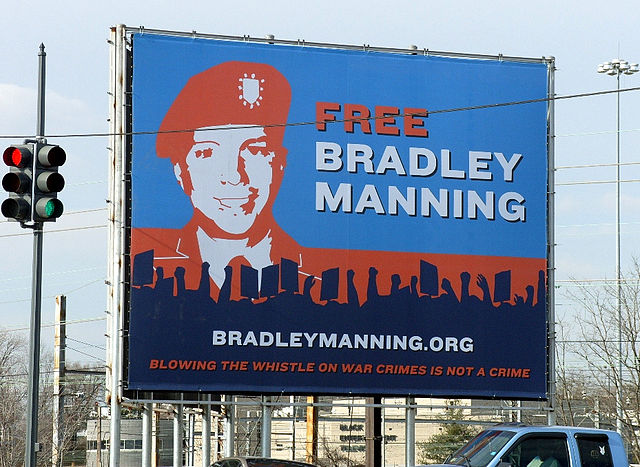
FAIR, the national media watchdog organization, has written an excellent critique of the coverage of the Bradley Manning case, one of the more shameful episodes in U.S.military and journalism history. KPFA’s “Democracy Now” radio program headed by Amy Goodman (9-10 weekdays) has also done regular superlative coverage. Here is FAIR’s report (B3):
Turning Their Back on Bradley Manning: Whistleblower speaks but press doesn’t listen
As the alleged source of many of the most vital WikiLeaks reports of the past several years, U.S. Army Private Bradley Manning shed considerable light on how the United States has prosecuted the Iraq and Afghan wars. Other State Department cables reportedly leaked by Manning conveyed vital information about U.S. foreign policy.
Manning has, in other words, been connected to a lot of news (FAIR Media Advisories, 4/7/10, 12/16/10, 7/30/10): the video of a 2007 U.S. helicopter attack in Baghdad that killed several civilians (two Reuters journalists died in the attack); the revelation that hundreds of U.S. attacks on civilians in Afghanistan had been recorded by the military– but were unreported elsewhere; the cache of diplomatic cables that uncovered U.S. efforts to stymie legal investigations into torture, U.S. involvement in airstrikes in Yemen; and much more.
But the developments at his trial last week–including the first time Manning has spoken about his treatment–are evidently not newsworthy.
Manning has been held in conditions that have been criticized as psychological torture, including long periods of solitary confinement in a tiny cell, forced nudity and sleep deprivation.
Last week, the military trial at Fort Meade centered on the question of whether these pre-trial conditions were unlawful. Arrested in May 2010, Manning faces 22 counts associated with the leaks of classified material–including the government argument that Manning’s leaks constitute aiding the enemy, apparently because some of the materials he leaked made their way onto the computers of Al-Qaeda figures.
The government maintained that Manning’s treatment was based on a judgment that he was a suicide risk. But the court proceedings included testimony from military psychiatrists who disagreed, and recommended against holding Manning under such “clinically inappropriate” conditions–recommendations that were ignored at the Quantico military facility where Manning was confined (Guardian, 11/28/12).
These dramatic developments, in particular the testimony from Manning (11/29/12), were mostly unreported in corporate media. The New York Times ran a brief Associated Press wire story (11/30/12). Manning’s story was mentioned by just one of the three big network newscasts (CBS Evening News, 11/29/12). There was a brief mention on the PBS NewsHour (11/30/12), mostly about suicide risk.
CNN did regular reporting on the trial throughout the week. According to the Nexis news database, Manning’s trial last week was not mentioned on the liberal MSNBC channel until a discussion on Up With Chris Hayes (12/1/12). Democracy Now!, which has closely followed the Manning case for the past two years, featured thorough analysis of the trial.
It is not hard, on any level, to see the relevance of the Manning trial. As the Guardian’s Ed Pilkington argued on Up With Chris Hayes (12/1/12), the government’s argument in the case will have a chilling effect, which should obviously concern journalists:
You have to bear in mind that the main charge, charge No. 1 against him, is aiding the enemy. Now this is a massively chilling thing. What he’s being accused of is by posting something via WikiLeaks on the Internet, that by doing so he effectively gave it to Osama bin Laden. They don’t have to show–in the prosecution’s mind, the government’s mind–they don’t have to show that he intended to do that. They’re just saying by the sheer act of putting it on the Internet, it was available to Al-Qaeda.
Indeed, the notion that such trials constitute a threat to freedom of the press was part of the reason that the leak investigation of New York Times reporter Judith Miller was so closely followed by corporate media. Many outlets and editorial pages proclaimed the proceedings an attack on journalism itself–even though in that case, the reporter in question was seeking to protect a government source who was peddling information intended to diminish a government critic (Extra!, 9-10/05).
In the Manning case, the whistleblower apparently responsible for releasing documents that formed the basis for literally thousands of reports of incredible international significance is challenging government mistreatment. The questions about the case have been longstanding. As NPR’s All Things Considered noted (11/26/12), the secrecy around the proceedings has been “so intense that reporters and human rights groups have sued to get access to information.”
All that in mind, the minimal attention to Manning’s trial last week tells us how little corporate media care about the mistreatment of a government whistleblower. The revelations about U.S. foreign policy Manning allegedly made possible were news; the military’s abusive retaliation against him apparently is not.
FAIR, the national media watchdog organization, has written an excellent critique of the Bradley Manning case, one of the more shameful episodes in military and journalism history. Here is its report (B3):
Turning Their Back on Bradley Manning
Whistleblower speaks–but press doesn’t listen
As the alleged source of many of the most vital WikiLeaks reports of the past several years, U.S. Army Private Bradley Manning shed considerable light on how the United States has prosecuted the Iraq and Afghan wars. Other State Department cables reportedly leaked by Manning conveyed vital information about U.S. foreign policy.
Manning has, in other words, been connected to a lot of news (FAIR Media Advisories, 4/7/10, 12/16/10, 7/30/10): the video of a 2007 U.S. helicopter attack in Baghdad that killed several civilians (two Reuters journalists died in the attack); the revelation that hundreds of U.S. attacks on civilians in Afghanistan had been recorded by the military– but were unreported elsewhere; the cache of diplomatic cables that uncovered U.S. efforts to stymie legal investigations into torture, U.S. involvement in airstrikes in Yemen; and much more.
But the developments at his trial last week–including the first time Manning has spoken about his treatment–are evidently not newsworthy.
Manning has been held in conditions that have been criticized as psychological torture, including long periods of solitary confinement in a tiny cell, forced nudity and sleep deprivation.
Last week, the military trial at Fort Meade centered on the question of whether these pre-trial conditions were unlawful. Arrested in May 2010, Manning faces 22 counts associated with the leaks of classified material–including the government argument that Manning’s leaks constitute aiding the enemy, apparently because some of the materials he leaked made their way onto the computers of Al-Qaeda figures.
The government maintained that Manning’s treatment was based on a judgment that he was a suicide risk. But the court proceedings included testimony from military psychiatrists who disagreed, and recommended against holding Manning under such “clinically inappropriate” conditions–recommendations that were ignored at the Quantico military facility where Manning was confined (Guardian, 11/28/12).
These dramatic developments, in particular the testimony from Manning (11/29/12), were mostly unreported in corporate media. The New York Times ran a brief Associated Press wire story (11/30/12). Manning’s story was mentioned by just one of the three big network newscasts (CBS Evening News, 11/29/12). There was a brief mention on the PBS NewsHour (11/30/12), mostly about suicide risk.
CNN did regular reporting on the trial throughout the week. According to the Nexis news database, Manning’s trial last week was not mentioned on the liberal MSNBC channel until a discussion on Up With Chris Hayes (12/1/12). Democracy Now!, which has closely followed the Manning case for the past two years, featured thorough analysis of the trial.
It is not hard, on any level, to see the relevance of the Manning trial. As the Guardian’s Ed Pilkington argued on Up With Chris Hayes (12/1/12), the government’s argument in the case will have a chilling effect, which should obviously concern journalists:
You have to bear in mind that the main charge, charge No. 1 against him, is aiding the enemy. Now this is a massively chilling thing. What he’s being accused of is by posting something via WikiLeaks on the Internet, that by doing so he effectively gave it to Osama bin Laden. They don’t have to show–in the prosecution’s mind, the government’s mind–they don’t have to show that he intended to do that. They’re just saying by the sheer act of putting it on the Internet, it was available to Al-Qaeda.
Indeed, the notion that such trials constitute a threat to freedom of the press was part of the reason that the leak investigation of New York Times reporter Judith Miller was so closely followed by corporate media. Many outlets and editorial pages proclaimed the proceedings an attack on journalism itself–even though in that case, the reporter in question was seeking to protect a government source who was peddling information intended to diminish a government critic (Extra!, 9-10/05).
In the Manning case, the whistleblower apparently responsible for releasing documents that formed the basis for literally thousands of reports of incredible international significance is challenging government mistreatment. The questions about the case have been longstanding. As NPR’s All Things Considered noted (11/26/12), the secrecy around the proceedings has been “so intense that reporters and human rights groups have sued to get access to information.”
All that in mind, the minimal attention to Manning’s trial last week tells us how little corporate media care about the mistreatment of a government whistleblower. The revelations about U.S. foreign policy Manning allegedly made possible were news; the military’s abusive retaliation against him apparently is not.
Twitter, tax breaks and the New York Times

Just about everyone who watches news media is calling it the Story of the Week, and it’s probably going to be one of the top stories of the year, my (informal) nominee for a Pulitzer: Louise Story at the New York Times exposes how corporate America shakes down state and local governments — who often get little in return. The biggest perp over the years has been the automotive industry, which Story says first perfected this kind of blackmail (though Southern Pacific Railroad did pretty well in its day). But now just about every big company tries to demand a tax break or threatens to leave town.
In in the end, there’s no evidence that tax breaks, or the lack of tax breaks, is the most important factor in corporate relocations. There’s even less evidence that all these billions of dollars in public money actually help create jobs, pay for themselves, or are the best way to invest in economic development:
One corporate executive, Donald J. Hall Jr. of Hallmark, thinks business subsidies are hurting his hometown, Kansas City, Mo., by diverting money from public education. “It’s really not creating new jobs,” Mr. Hall said. “It’s motivated by politicians who want to claim they have brought new jobs into their state.”
It’s hard to imagine any sane person reading all the way through the story and now wanting to feel like this poor guy:
“I just shake my head every time it happens, it just gives me a sick feeling in the pit of my stomach,” said Sean O’Byrne, the vice president of the Downtown Council of Kansas City. “It sounds like I’m talking myself out of a job, but there ought to be a law against what I’m doing.”
Story even weighs in on San Francisco’s deal with Twitter, which, she notes, was hardly a struggling startup at the time:
Twitter was not short on money — it soon received a $300 million investment from a Saudi prince and $800 million from a private consortium. The two received Twitter equity, but San Francisco got a different sort of deal. The city exempted Twitter from what could total $22 million in payroll taxes, and the company agreed to stay put. The city estimates that Twitter’s work force could grow to 2,600 employees, although the company made no such promise. … Like many places, San Francisco has been cutting its budget. Public parks have lost about $12 million in recent years, though workers at Twitter will not lack for greenery. The company’s plush new office has a rooftop garden with great views and amenities. Enjoying the perks, one employee sent out a tweet: “Tanned on Twitter’s new roof deck this morning as some dude served me smoothie shots. This is real life?”
Randy Shaw, who loves and worships Twitter and the tax break it demanded, takes the Times to task on this section, arguing that Story got the deal wrong. Actually, neither of them has the true story — what Twitter was most freaked about was the prospect that the city’s payroll tax might apply to the huge wealth in stock options it will be dispensing when it goes public. That’s about a $40 million tax break.
So what if the city just said that it wasn’t going to tax stock options as payroll? Wouldn’t that have satisfied Twitter — without the city giving up payroll taxes on a large swath of mid-Market and surrounding areas? Could we instead have used some of that payroll tax money to protect the vulnerable small businesses that are getting forced out by the Twitter tech boom?
In the end, considering the pluses and minuses (displacement of existing small businesses and their jobs is a minus), will this dead really help create net new jobs for unemployed San Franciscans? (At least automotive manufacturing jobs are unionized and people without advanced degrees can qualify.)
I bet when the numbers are all crunched a decade from now, we’ll learn that this local tax break, like the others Story discusses, did nothing good for San Francisco.
Kitty Pryde on Riff Raff, candy, and going viral

What exactly does it mean to be a pop star these days? Does it mean you have masses of eager (young) fans, breathless feature articles, and a healthy growing buzz on so-called tastemaker sites? Can you do it without a major label, without a proper album, without really touring? Seems like the answer for now is…maybe. It’s a world we’re all just beginning to crack open. One thing I know for sure, Florida teen rapper Kitty Pryde wouldn’t have blown up quite like this before the web.
She made her mark on Youtube, with casual, adorable bedroom rap track and video “Okay Cupid,” along with an ode to a certain youthful pop star (“Justin Bieber”). There’s been plenty of speculation about Pryde. If she’s actually a teenager. If she’s “in on the joke.” If she’ll sign to a major label and crush it. These questions are sort of beside the point. So far, her output has been cheerful, weird, fun, and uniquely telling of young life in America in 2012. Or, as the New York Times put it in its CMJ rundown, Pryde “offered cute, comedic expositions of unrequited crushes.”
When I mentioned to managing editor Marke B. that I was surprised Pryde hadn’t yet played SF, he reminded me of this shocking fact: she only started gaining attention six short months ago. The web, that constantly cranking gauge of what’s cool/what’s not, it turns over so rapidly, last month seems like eons ago. Perhaps that’s what happened to Kreayshawn?
We’re not here to talk about Kreay though today; we’re here to chat with Pryde, about life in a fishbowl, her namesake comic book character, her upcoming releases, Riff Raff, and what she wants you to bring to her debut SF show at DNA Lounge this Fri/9 (lots and lots of candy):
SFBG What’s new with you? It seems like every week there’s a new track, or a new free-style video, something.
Kitty Pryde Everything is new. My whole life is changing and it’s really weird and scary so I’m trying to channel everything outwards so I don’t go crazy. I haven’t released a track in a while because I’m saving the good ones for my mixtape that I’m releasing at the beginning of December! But I’ve just been dropping lil hints and stuff along the way so people know that I didn’t quit rap and start back up at the mall.
https://www.youtube.com/watch?v=3SDYus7iKC8
SFBG How did your Halloween costume contest go? [Pryde asked fans to send in photos dressed like her.]
KP It was pretty funny: it seems like everyone has basically the same idea of what I wear all the time. I haven’t chosen a winner still…there was one girl who went all out, and posed with my boyfriend for a photo at a party in New York while I was at home in Florida and I can’t decide if I think that’s creepy or hilarious. both, I guess. maybe she’ll win.
SFBG Do you feel pressure to always be posting on social media sites?
KP I don’t necessarily feel pressure to be posting…if anything people are pressuring me not to post by being so horrible sometimes. i just like to use social media as an outlet for my personality so it doesn’t build up and explode my town. I live in a really small town.
SFBG What’s been the best thing you’ve received from a fan?
KP My favorite email is still the one from a guy who wanted me to know that his little brother was too afraid to come out to his friends and family as gay, and used my “Justin Bieber” song to do so. There are also a series of videos that these film students made of their roommate – they secretly recorded him while he looked at my blog and photos of me and talked about how he was in love with me and stuff and then they posted the videos on tumblr to embarrass him. That was the best.
https://www.youtube.com/watch?v=STmBMsMMfzI
SFBG When did you first realize a lot of people were interested in “Okay Cupid” – it went viral – was it a surprise?
KP At first I thought it was just a weird lucky thing, because Danny Brown had listened to it and tweeted it to his followers and I was on cloud nine from that for a few days. Then I came home one day to a story about myself in the New York Times, and a few minutes later saw a post about myself going around tumblr with like thousands of notes, and it was all downhill from there.
SFBG Was there a song, album, or artist that made you want to start rapping?
KP Not really….it was more a combination of being bad at everything but poetry and being good at making people laugh. I put them together.
SFBG Your name’s from a comic book – what made you choose it?
KP My first name is Kitty. I wanted to choose a different last name so I wouldn’t have to put my own on my music. Kitty Pryde always struck me as a badass because she can phase through anything…I have the same power, i think.
SFBG How did you meet Riff Raff? Why did you two decide to collaborate?
KP Riff Raff sent me a message on Twitter a few days after the “Okay Cupid” explosion online. He asked if I wanted to do a track, and I said sure and sent him a beat thinking nothing would ever come of it. A week later he was in my city with a film crew calling me to come through.
SFBG Who are your dream collaboraters?
KP There are so many. I want to work with Action Bronson, Danger Mouse, David Byrne, Imani Coppola, Lana del Rey. there are a thousand more.
https://www.youtube.com/watch?v=2NNbeS-_EEA
SFBG Do you have plans to record another EP or full-length? Would you want to sign to a label?
KP I’m currently in the process of recording a lot a lot of things. The label stuff is a lil’ secret right now. You’ll see how it goes.
SFBG What are your favorite websites, snacks, beverages?
KP My favorite websites are all either theme park news forums or diaper fetish blogs. not because I have a diaper fetish, I just enjoy the culture. I live on coffee and other heavily caffeinated things and that’s all…
SFBG Are you still based in Daytona?
KP I live in the heartcloud.
SFBG Can you tell me a bit about your live show?
KP Most of the time it’s really embarrassing for me because I have no idea how to put on a performance and nobody ever taught me, so basically I just act the same way I always do in front of a lot of people. I also take advantage of the opportunity to throw glitter and feathers and confetti on strangers. I do my best to make sure everyone has the most fun time ever – I want to bring my fans into my heartcloud!
SFBG What are your hopes for the San Francisco show?
KP I hope nobody accidentally sees my butt, and I hope someone brings me a lot of candy.
Kitty Pryde
#Y3K with Main Attrakionz, Hottub, Friendzone, Matrixxman, Marco de la Vega
Fri/9, 10pm, $13, all ages
DNA Lounge
375 11th St., SF
www.dnalounge.com
SF Stories: Laura Fraser
46TH ANNIVERSARY SPECIAL
People marvel that I manage to live in San Francisco on what I make as a freelance writer. They wonder if I have a trust fund, secretly write speeches for CEOs, or run a phone-sex business on the side. They figure I must somehow make over six figures to live in a three-bedroom flat in the Haight with high ceilings, hardwood floors, a big kitchen, and a garden as big as a park.
No: I’m able to be a writer in San Francisco because of rent control.
If it weren’t for rent control, I would not live in the city I love, which has been my home since 1984, when I scored an apartment on Waller Street with one woman I’d met in a magazine collective called Processed World and another who’d just gotten off the Green Tortoise bus.
At first I wasn’t sure I wanted the apartment. It was filthy; the living room had been subdivided into four sections with hanging sheets, and only cockroaches dared to enter the kitchen. It was $750 a month, which seemed astronomical to us at the time. But it was so rundown that no one had ever bothered to rip away the original wainscoting, Victorian cabinets, hardwood floors, or clawfoot tub, so it had a lot of charm under its grime. The landlord — an entrepreneurial hippie who bought about ten buildings when the Haight was at its most depressed — insisted we do community service as part of our rent. We pooled our money, took the place, and began scrubbing and painting.
Over the years, by sheer luck, I never moved. Instead, people moved in with me. I lived with a constant parade of roommates, most of them artists or people who worked for nonprofits. There was a drummer, a guitarist, and a composer. Maria was a young journalist from Mexico City who came here to write about migrant farm workers. Stevious was a political refugee from South Africa who worked at Mother Jones. Gail was a chef who left to join the circus. Natalie taught English to new immigrants. Julia was an avant-garde theatre director. Danielle was a filmmaker who wanted to make a documentary about Ghana, where she’d lived in the Peace Corps. Vince worked for the alternative press. All these people had moved to San Francisco because they wanted to do something creative or humanitarian, and to Waller Street, because our rent made that possible.
During the dot-com boom, my flat became a refuge. Two friends, a photographer and a musician, had been effectively evicted by a landlord who made life so hellish they’d leave, so he could raise the rent at a time when Mission rents went up 40 percent in a year. They had nowhere to go, so they moved in with me. It was a very San Francisco story: the guy was my great-grand-ex, who used to live in the flat above me when we dated, and now he was living in my house with his girlfriend. We cooked and played music and got along fine, until they moved into a flat they could afford — in Oakland.
Until the dot-com years, thanks to rent control, you could make a living as an artist or activist and manage to live in San Francisco, even if it meant eating a lot of burritos. Today, that’s not possible, unless you’re as old as I am and somehow had the luck to hang on to the second apartment you moved into after college. I may envy people who had the foresight to buy real estate in the 1980s or 1990s, but the fact is, I didn’t have the money then, either, for what now seems like a laughably low down payment. Rent control is my equity. The neighbors who live in the mirror-image apartment in my building are not artists or activists; they are tech people, whose rent is double mine, and who do make six figures.
Recently, a talented young novelist visited my flat and was amazed at how spacious it is. He’s struggling to keep on living in San Francisco, and I don’t know how he and his wife manage writing and running an international creative nonprofit while paying our city’s rents, especially with a child. I do know that unless San Francisco makes room for people like him, as it made room for me, with rent control, we will lose the distinctive character of our city—or what remains of it. Rent control made it possible for me to be a writer, but 25 years later, it’s a lot harder for him.
Rent control is essential to keeping San Francisco’s creative character. But it isn’t sufficient if the city wants to help young people who are trying to embark on creative careers outside of the tech sector in San Francisco today. We need affordable housing; we need rent controls to extend to vacant apartments; mainly, we need to want to keep San Francisco weird.
Laura Fraser is the author of the New York Times bestseller An Italian Affair, among other books.
Local censored 2012
BEHIND THE MIRKARIMI CASE
In early January, details from the police investigation of then-Sheriff-elect Ross Mirkarimi bruising his wife’s arm during an argument were leaked to the San Francisco Chronicle and other news outlets. The key piece of evidence was a 45-second video that Mirkarimi’s wife, Eliana Lopez, made with her neighbor, Ivory Madison, displaying the bruise and saying she wanted to document the incident in case of a child custody battle. That video convinced many of Mirkarimi’s guilt, and a majority of Ethics Commissioners say they found it to be the main evidence on which Mirkarimi should be removed from office on official misconduct charges (the Board of Supervisors was scheduled to vote on Mirkarimi’s removal on Oct. 9, after Guardian press time).
But that video was only a small part of the overwhelming and expensive case that Mayor Ed Lee brought against Mirkarimi, including the more serious charges of abuse of power, witness dissuasion, and impeding a police investigation, all of which go more directly to a sheriff’s official duties. All of those charges got lots of media coverage and they helped cement the view of many San Franciscans that Mirkarimi engaged in a pattern of inappropriate behavior, rather than making a big momentary mistake. Yet most of the media coverage during the six months of Ethics Commission proceedings ignored the fact that none of the evidence that was being gathered supported those charges. Indeed, all those charges were unanimously rejected by the commission on Aug. 16, a startling rebuke of Lee’s case but one that was not highlighted in many media reports, which focused on the one charge the commission did uphold: the initial arm grab.
THE NEXT DOT-BOMB
In the late 1990s, San Francisco was in a very similar place to where it is now. The first dot-com boom was full bloom, driving the local economy and creating countless young millionaires — but also rapidly gentrifying the city and driving commercial and residential rents through the roof (great for the landlords, bad for everyone else). And then, the bubble popped, instantly erasing billions of dollars in speculative paper wealth and leaving this a changed city. The city’s working and creative classes suffered, but the political backlash gave rise to a decade with a progressive majority on the Board of Supervisors.
The era ended in 2010 when Ed Lee was appointed mayor, and he began ambitious agenda of pumping up a new dot-com bubble using tax breaks, public subsidies, and relentless official boosterism to lure more tech companies to San Francisco. Lee has been successful in his approach, in the process driving up commercial rents and housing prices. By some estimates, about 30 percent of the city’s economy is now driven by technology companies.
Yet there have been few voices in the local media raising questions about this risky, costly, and self-serving economic development strategy. The Bay Citizen did a story about Conway’s self interested advice, the New York Times did a front page story raising these issues, and San Francisco Magazine just last month did a long cover story questioning how much tech is enough. But most local media voices have been silent on the issue, and much of the damage has already been done.
OLD POWERBROKERS RETURN TO CITY HALL
More than a decade ago, then-Mayor Willie Brown and Chinatown power broker Rose Pak worked together to empower big business, corrupt local politics, and clear the path for rampant development — an approach that progressives on the Board of Supervisors repudiated and slowed from 2000-2010. But Brown, Pak, and a new generation of their allies have returned in power in City Hall, and it’s as bad as it ever was.
Many San Franciscans know of their high-profile role appointing Lee to office in early 2011. But their influence and tentacles have extended far beyond what we read in the papers and watch on television, starting in 2010 when their main political operatives David Ho and Enrique Pearce ran Jane Kim’s supervisorial campaign, beating Debra Walker, a veteran of the fights against Brown’s remaking of the city.
Now, this crew has the run of City Hall, meeting regularly with Mayor Lee and twisting the arms of supervisors on key votes. Pearce and Ho persuaded longtime progressive Christina Olague to co-chair the scandal-plagued Run Ed Run campaign last year, she was rewarded this year with Lee appointing her to the Board of Supervisors. Pearce has been her close adviser, and most of her campaign cash has been raised by Brown and Pak. Even progressive Sup. Eric Mar admits that Pak in raising money for him, a troubling sign of things to come.
THE REAL OCCUPY STORY
The Occupy San Francisco camp that was cleared by police last week may have been mostly homeless people. And major news media outlets from the start reported that Occupy was dangerous, filthy, and a civic eyesore.
But last fall, the camps were comprised of a huge variety of people that chose to live part or full time on the streets. Students, people with 9-5 jobs, people with service jobs, and the unemployed were all represented. Wealthy people who lived in the financial districts where camps popped up mixed with working-class people who came from suburbs and small towns. Families came out, welcomed in the “child spaces” set up in many Occupy camps throughout the country. Most camps also boasted libraries, free classes, kitchens, food distribution, and medical tents.
As news media focused on gross-out stories of pee on the streets and graphic descriptions of drunk occupiers, they managed to ignore the complex systems that were built in the camps. Nor did anyone mention that homeless people have the right to protest, too.
Former girlfriend defends Mirkarimi

By Evelyn Nieves
For months, I’ve watched as Ross Mirkarimi has been slandered as a “wife beater”—by the mayor of San Francisco, no less—and vilified in the press based on lies, half-truths and innuendo. It has been heart-breaking, nauseating, to witness.
I know for a fact that Ross is no abuser. He and I were a couple for eight years. For most of that time, we lived together. Not once did Ross even come close to making me feel unsafe in his presence. He never threatened me. He would walk away or cry “uncle” rather than argue. He simply had no stomach for it.
When the news broke last January that Ross, newly elected as San Francisco’s Sheriff but not yet sworn in, might be arrested on domestic violence charges, I was sure the accusation wouldn’t stick. Not once people knew the facts.
I was naïve.
By now, everyone knows that Ross and his wife, Eliana Lopez, got in an argument in their car on New Year’s Eve. She wanted to take their toddler to her native Venezuela, and Ross, bereft the last time a one-month trip to Venezuela stretched into several, balked. Eliana moved to exit the car and Ross held her, a second too long, causing a bruise. Eliana called a friend and made a videotape of the bruise the next day in case she and Ross ended up in a custody battle. Four days later, without Ross’s wife knowing, the friend called police.
The hell that broke loose is worthy of an Errol Morris documentary. The San Francisco District Attorney, a political opponent, sent four investigators to interview all of Ross’s neighbors. That never happens in a misdemeanor case–it costs too much time and money. Anti-domestic violence advocates began calling for Ross’s head even before he was charged.
We all want to stop abusers in their tracks. But let’s make sure we are properly identifying the abuser.
Early on, in January, the Bay Citizen interviewed me. I expected the other local newspapers to contact me or pick up my quotes, which essentially said that Ross never, ever came close to abusing me. But no reporter from the local dailies that were splashing all kinds of hearsay on their front pages ever contacted me. This even after I contacted them to try to correct falsehoods being reported as fact.
I was fully prepared to testify had Ross’s case gone to trial. I knew facts that would contradict lies made to condemn him. I still wish the case had gone to trial. But at the time that Ross pled guilty to “false imprisonment”–for turning his car around to go home when the argument threatened to spill out into a restaurant he and his wife planned to enter–his lawyer told me she believed that Ross could not get a fair trial. The last straw was when the judge refused a change of venue.
So Ross pleaded guilty so he could have his wife and son back, end the hysteria and try to go and do his job.
Instead, the mayor used Ross’s guilty plea as an excuse to suspend him without pay—without any due process—starting several more months’ of investigation, interrogation and character assassination at Ethics Commission hearings. And for what? In the end, the five-member Ethics Commission, three of whom are appointed by the Mayor, found Ross guilty of only one charge: grabbing his wife’s arm. One member wondered what the people would say if they decided not to uphold the Mayor’s rash suspension and declaration of “official misconduct.” Well, in the few times that I’ve met with Ross in the last few months, he was stopped everywhere by people of every demographic group. Old, young, progressive, moderate, and of every ethnicity. All wanted to express their support and their contempt for what has happened to him. All blamed politics.
I had not seen Ross much in the years since we parted. I moved to another side of the city, moved in different circles. But, in essence, he has not changed much.
The last time I saw him before this case exploded was before Christmas. On a Saturday morning, Ross was in his District Five supervisor uniform—gray suit, white shirt, wingtips. He had already gone to one neighborhood meeting and was on his way to another, even though his official duties as supervisor were over and he was supposed to be on vacation. I kidded him about this, and he shrugged and said, “Well, you know me.”
I do. And so I’ll say with confidence that Ross does not deserve what he has endured. He deserves vindication, and the chance to do the job he was elected to do.
Evelyn Nieves is a longtime journalist and former New York Times bureau chief.
The Mirkarimi vote: Will there be some profiles of courage?
(See the postscript for the Chronicle’s shameful crucifixion coverage of Mirkarimi and a timely, newsworthy oped it refused to run by Mirkarimi’s former girl friend. And how Chronicle columnist Debra Saunders ran the Nieves piece on her blog. Damn good for you, Debra Saunders.)
On Jan. 6, 2011, the Bay Citizen/New York Times broke a major investigative story headlined “Behind-the-Scenes Power Politics: The Making of Ed Lee.” The story by Gerry Shih detailed how then Mayor Gavin Newsom, ex-Mayor Willie Brown, and his longtime political ally Rose Pak orchestrated an “extraordinary political power play” to make Ed Lee the interim mayor to replace Newsom, the lieutenant governor-elect.
The story also outlined the start of a chain of events that leads to the vote by the San Francisco Board of Supervisors on Tuesday on whether Sheriff Ross Mirkarimi keeps his job.
Shih reported that “word had trickled out” that the supervisors had narrowed the list of interim candidates to three—then Sheriff Michael Hennessey, former Mayor Art Agnos, and Aaron Peskin, then chairman of the city’s Democratic party. But the contenders “were deemed too liberal by Pak, Brown, and Newsom, who are more moderate.”
Over the next 48 hours, Pak, Brown, and the Newsom administration put together the play, “forging a consensus on the Board of Supervisors, outflanking the board’s progressive wing and persuading Lee to agree to become San Francisco’s first Asian-American mayor, even though he had told officials for months that he had no interest in the job,” Shih wrote.
The play was sold on the argument that Lee would be an “interim mayor” and that he would not run for mayor in the November election. The Guardian and others said at the time that the play most likely envisioned Lee saying, or lying, that he would not run for mayor and then, at the last minute, he would run and overpower the challengers as an incumbent with big downtown money behind him. This is what happened. That is how Ed Lee, a longtime civil servant, became the mayor and that is how the Willie Brown/Rose Pak gang won the day for the PG&E/Chamber of Commerce/big developer bloc and thwarted the progressives.
Let us note that the other three interim candidates would most likely never have done what Lee did and suspend Mirkarimi for pleading guilty to misdemeanor false imprisonment in an arm-bruising incident with his wife Eliana. In fact, Hennessey supported Mirkarimi during the election and still does and says he is fit to do the job of sheriff.
This was a political coup d’etat worthy of Abe Ruef, the City Hall fixer at the start of the century. “This was something incredibly orchestrated, and we got played,” Sup. John Avalos told Shih. Sup. Chris Daly was mad as hell and he voted for Rose Pak because, he told the Guardian, she was running everything in City Hall anyway. Significantly, the San Francisco Chronicle missed the story and ever after followed the line of its columnist/PG&E lobbyist Willie Brown and Pak by supporting Lee for mayor without much question or properly reporting the obvious power structure angles and plays.
This is the context for understanding a critical part of the ferocity of the opposition to Mirkarimi. As the city’s top elected progressive, he was a politician and force to be reckoned with. His inaugural address as sheriff demonstrated his creative vision for the department and that he would ably continue the progressive tradition of Richard Hongisto and Hennessey. That annoyed the conservative law enforcement folks. He could be sheriff for a good long time, keep pushing progressive issues from a safe haven, and be in position to run for mayor when the time came. So he was a dangerous character.
To take one major example, the PG&E political establishment and others regard him as Public Enemy No. 1. Among other things, he managed as an unpaid volunteer two initiative campaigns during the Willie Brown era. They were aimed at kicking PG&E out of City Hall, enforcing the public power provisions of the federal Raker Act, and bringing the city’s cheap Hetch Hetchy public power to its residents and businesses for the first time. (See Guardian stories since 1969 on the PG&E/Raker act scandal.)
He then took the public power issue into City Hall when he became a supervisor and aggressively led the charge for the community choice aggregation (cca) project. His work was validated in the recent 8-3 supervisorial vote authorizing the city to start up a public power/clean energy program. This is the first real challenge ever to PG&E’s private power monopoly.
Significantly, Willie is now an unregistered $200,000 plus a year lobbyist for PG&E. He writes a column for the San Francisco Chronicle promoting, among other things, his undisclosed clients and allies and whacking Mirkarimi and the progressives and their issues on a regular basis. And he is always out there, a phone call here, an elbow at a cocktail party there, to push his agenda. The word is that he’s claiming he has the votes to fire Mirkarimi.
The point is that the same forces that put Lee into office as mayor are in large part the same forces behind what I call the political assassination of Mirkarimi. And so, when the Mirkarimi incident emerged, there was an inexorable march to assassination. Maximum resources and pressure from the police on Mirkarimi. And then maximum pressure from the District Attorney. And then maximum pressure from the judicial process (not even allowing a change of venue for the case after the crucifixion media coverage.) And then Lee calls Mirkarimi “a wife beater” and suspends him with cruel and unusual punishment: no pay for him, his family, his home, nor legal expenses for him or Eliana for the duration.
And then Lee pushes for maximum pressure from the City Attorney and the Ethics Commission to try Mirkarimi and force the crucial vote before the election to put maximum pressure on the supervisors. Obviously, the vote would be scheduled after the election if this were a fair and just process.
Lee, the man who was sold as consensus builder and unifier, has become a polarizer and punisher on behalf of the boys and girls in the backroom.
And so the supervisors are not just voting to fire the sheriff. Mirkarimi, his wife Eliana, and son Theo, 3, have already paid a terrible price and, to their immense credit, have come back together as a family.
The supervisors got played last time and voted for a coup d’etat to make Lee the mayor, rout the progressives, and keep City Hall safe for Willie Brown and Rose Pak and friends. This time the stakes are clear: the supervisors are now voting on the political assassination of the city’s top elected progressive and it’s once again aimed at helping keep City Hall safe for PG&E, the Chamber, and big developers.
The question is, will there be some profiles of courage this time around? b3
P.S.1 Julian Davis for District 5 supervisor: “Supes mum on sheriff,” read the Sunday Chronicle head. Nobody would say how he/she would vote. And poor Sup. Sean Elsbernd claimed that he would be “holed all Sunday in his office reading a table full of thick binders of official documents related to the case plus a few that he’s prepared for himself containing some case law.” (Anybody wonder how he’s going to vote? Let’s have a show of hands.)
The last time I saw Julian Davis he was holding a “Stand with Ross” sign at a Mirkarimi rally on the City Hall steps. With Davis, there would be no second guessing and hand wringing on how he would vote. That’s the problem now with so many neighborhood supervisors who go down to City Hall and vote with Willie and downtown. Davis would be a smart, dependable progressive vote in the city’s most progressive district (5), and a worthy successor to Matt Gonzalez and Ross Mirkarimi. If Davis were on the board now, I’m sure he would stand with Ross and speak for Ross, no ifs, ands, or buts. And his vote might be decisive.
P.S. 2 The Chronicle’s shameful crucifixion of Mirkarimi continues The Chronicle has refused to run a timely and newsworthy op ed piece from Evelyn Nieves, Mirkarimi’s former girl friend. She wrote an op ed piece for the Chronicle four days before the Tuesday vote. Nieves is an accomplished journalist who for several years was the San Francisco bureau chief for the New York Times. She told me that she was notified Monday morning that the Chronicle didn’t have room for the op ed in Tuesday’s paper. I sent an email to John Diaz, Chronicle editorial page editor, and asked him why the Chronicle couldn’t run her op ed when the paper could run Willie Brown, the unregistered $200,000 plus PG&E lobbyist who takes regular whacks at Mirkarimi, as a regular featured column in its Sunday paper. No answer at blogtime.
This morning, I opened up the Chronicle to find that the paper, instead of running the Nieves piece today or earlier, ran an op ed titled “Vote to remove Mirkarmi,” from Kathy Black, executive director of the Casa de las Madres, the non profit group that advocates against domestic violence. It has been hammering Mirkarimi for months. On the page opposite, the Chron ran yet another lead editorial, urging the supervisors to “Take a Stand” and vote for removal because “San Francisco now needs its leaders to lead.” It was as if Willie was not only directing the Chronicle’s news operation but writing its editorials–and getting paid both by PG&E and the Chronicle. And so the Chronicle started out with shameful crucifixion coverage of Mirkarimi and then continued the shameful crucifixion coverage up until today. Read Nieves on Ross.
Well, the honor of the Chronicle was maintained by columnist Debra Saunders, virtually the Chroncle’s lone journalistic supporter of Mirkarmi during his ordeal. Many Chronicle staffers are privately supportive of Ross, embarrassed by Willie’s “journalism,” and critical of the way the Chronicle has covered Mirkarimi. Saunders posted the Nieves column her paper refused to print on her Chronicle blog. Damn good for you, Debra Saunders.
Downtown development

LIT/VISUAL ARTS The term “Mission School” was coined in these pages by Glen Helfand in 2002 to describe a loose-knit group of artists based around the Mission District who were then just beginning to break through into international art world success. These artists — including Barry McGee, Margaret Kilgallen, Chris Johanson, Alicia McCarthy, Rigo 23 and others — made use of found materials and shared an informal aesthetic that was influenced as much by the low rent streets of the city around them as a relaxed, collective Bay Area vibe.
A decade later, it seems safe to say that the Mission School was probably the last major art movement of its kind in this country, and itself the end of an era. For over three decades, significant art and music breakthroughs in this country were linked to specific urban neighborhoods (hip-hop to the South Bronx; Warhol’s Factory to downtown Manhattan, riot grrrl to Olympia, Wash.; grunge to Seattle; Fort Thunder in Providence, RI, etc.) Today, with the rise of the importance of MFA programs as a means to enter the art world, and the lack of locality fostered by the internet, the era of geographic specificity as arts incubator has perhaps passed us for good.
Two new books take us back to those freer, more experimental days at the inception of the SoHo and East Village arts scenes of New York in the 1970s and 80s. 112 Greene Street: The Early Years (1970-1974) (Radius Books, 192 pp., $50) is a brief, but invigorating oral history from the early years of what we now know as SoHo. This just-released catalog to last year’s exhibition at Zwirner Gallery in Chelsea brings to life the sense of discovery and improvisation of the nascent neighborhood scene that centered around the legendary pioneering alternative arts space and its north star, the late Gordon Matta-Clark.
In October 1970, when Jeffrey Lew and Matta-Clark opened 112 Greene Street in the storefront of a “rundown former rag picking factory,” the area south of Houston Street was a wasteland of abandoned former textile factories known as Hell’s Hundred Acres. The space, with its lack of heat, and its raw walls, uneven floors, and poor artificial lighting resembled the city then falling apart all around it. The ruins of the city not only influenced the work; sometimes they literally became work.
Alan Saret remembers walking near Canal Street with Matta-Clark one night when a cornice simply fell off a building right in front of them. Saret found some other cornices on the ground nearby and paid the crew of a passing city garbage truck to haul them back to 112 Greene where they became part of a sculpture piece he called Cornices.
Far from the uptown galleries where Manhattan art world power then was consolidated, 112 Greene’s isolation and state of decay fostered a certain kind of “anything goes” artistic freedom and collaborative spirit. For the first opening at 112 Greene, Matta-Clark jackhammered a hole in the basement floor and filled the area with dirt, where he planted a cherry tree that he kept alive all winter with grow lamps. For a later exhibition, George Trakas wanted to do a two-story sculpture, so he simply cut a hole in the floor so his piece could rise up out of the basement into the main floor. The only rule seemed to be that work had to be created on site and could not be made for sale.
Perhaps predictably, with this last rule, the space could barely keep its doors open. Yet, there is a timeless lesson here for those running arts spaces today: the downfall of 112 Greene came ironically only after it finally achieved financial stability. When Lew landed a big NEA grant in 1973, pure art experimentation and spontaneity gradually gave way to formal scheduling and programming guidelines from the funders in DC, who demanded more and more say in the operation of the space. “The excitement that anything could happen waned as paperwork and schedules were enforced,” remembers Lew. The core group of artists slowly drifted away from 112 Greene, just as the original SoHo, too, was beginning to change all around them into the high-end shopping district it is today.
The SoHo model has become a cynical real estate gentrification strategy, as developers create prefab arts — and shopping — neighborhoods in empty warehouse districts across the country from Miami to Portland, Ore. to Brooklyn. But if, say, Bushwick’s art scene feels less like a real place than the shores of a desert island where hundreds of young artists have been randomly washed up by the storms of the global economy, 112 Greene Street reminds us that the first art neighborhoods were formed organically around genuine community. In 1971, Matta-Clark and artist Carol Goodden started an artist-run collective restaurant in SoHo called Food. By all accounts, Food was not some relational aesthetic stunt; it was a well loved and sincere attempt to provide cheap meals, a gathering place, and jobs to artists in the scene.
112 Greene Street ends before Matta-Clark’s untimely death from pancreatic cancer at age 35 in 1978, and before the artist would famously take the work he developed in the ruins of 112 Greene out into the ruins of the city with a practice he dubbed “Anarchitecture.” He took the city as his canvas, transforming raw space by sawing dramatic cuts in the floors and facades of abandoned buildings in the South Bronx and industrial parts of New Jersey. But the charm and dreamy freedom of the era 112 Greene Street depicts comes through in Matta-Clark’s film, Day’s End. In it, Matta-Clark works calmly with a blowtorch, cutting holes in the steel ceiling of an abandoned city pier on the Hudson River (with no apparent fear of getting caught) as the space slowly fills with radiant light.
A decade later, another artist who would die too young, David Wojnarowicz, would also find a wide-open playground in the rotting piers along the river. Wojnarowicz would spend hours at the piers, writing about what he saw there, having sex with strangers, and drawing murals or writing poetry on the crumbling walls. Wojnarowicz delighted in the ruins and saw the piers as a sign that America’s empire was fading away before his eyes. That today we know it was actually only Wojnarowicz’s world that was about to disappear is just one of the many poignant aspects of Cynthia Carr’s beautiful new book, Fire in the Belly: The Life and Times of David Wojnarowicz (Bloomsbury USA, 624 pp., $35), the first comprehensive biography to date of the artist, writer, and activist who died of AIDS at the age of 39 in 1992.
On the run from an abusive father, Wojnarowicz started sleeping with older men for money while living on the streets in his teens. Drawn to other criminals and outlaws, his first published writings were based on interviews he did with street hustlers, travelers, and homeless people he met in skid row waterfront diners and on hitchhiking trips. In the works of Jean Genet, he found a literary moral universe that helped him make sense of his own worldview. One of his earliest surviving works, a collage entitled St. Genet, depicts the French writer wearing a halo in the foreground while in the background, Jesus is tying off to shoot up. While Wojnarowicz would continue to use such blunt religious imagery in his work, the collage resonates in other ways. Carr reports that it was Kathy Acker who first called Wojnarowicz “a saint” when she appeared with him at his final public reading in 1991. The identification of Wojnarowicz’s life and work with the tragic loss of so many daring, outlaw artists to AIDS is so complete that Wojnarowicz has become a patron saint to young queer and activist artists today, his life story surrounded by an aura of myth.
Carr, a former arts reporter for the Village Voice, carefully picks apart myth from fact: Wojnarowicz didn’t actually start selling his body for money at age nine as he often claimed and he also wasn’t a founding member of ACT UP as many people suppose (though he did participate in some ACT UP protests). Yet, the complex and more human Wojnarowicz that Carr leaves us with is no less inspiring a figure — a self-taught artist whose lifelong struggle to make meaningful art out of his own experience, sexuality, and ultimate diagnosis with an incurable disease would almost by chance place him front and center in the story of the AIDS crisis and the great culture wars of the late 1980s and early ’90s.
Carr, a resident of the East Village now for four decades, became friends with Wojnarowicz late in his life, and she refreshingly breaks journalistic “objectivity” to insert her own eyewitness perspective into the narrative at many key junctures. One senses Fire in the Belly is so good precisely because it is a story only Carr could personally tell. Built on years of observation, Fire in the Belly has the ambitious scope and rich detail of a novel, and, more than a biography, is the story of a fabled East Village scene now irrevocably lost.
Wojnarowicz arrived in a gritty East Village where whole blocks had been abandoned to heroin dealers and bricked up tenements. A nihilistic neighborhood arts scene embraced the decay of the streets as an aesthetic, and galleries like Civilian Warfare Studios presented a giddy cocktail of downtown punk and queer culture mixed with the freshly born graffiti and hip-hop scenes of the South Bronx. Carr relates now-famous events like Gracie Mansion’s “Loo Division” show (mounted in the bathroom of her E. Ninth Street walkup), Keith Haring painting on the snow on the street in front of his show at Fun Gallery, and the exploits of the Wrecking Crew — a team including Wojnarowicz and other artists who would binge on acid and stay awake for days, filling galleries with creepy and crazed collaborative installations.
The artists’ isolation would not protect them from the art world for long. Soon, limos were disgorging passengers at openings on the heroin and rat-filled terra incognita east of First Avenue. East Village stalwarts like Jean-Michel Basquiat and Haring became rich and internationally famous, and even Wojnarowicz became a fairly established up-and-coming art star. The rags-to-riches story of the East Village scene might be the same kind of innocent tale of lost Bohemia as that of 112 Greene, were it not for the AIDS crisis shadowing it the whole time. Carr skillfully juxtaposes the narrative of openings and parties with chronological news reports of the then-unknown new disease. Carr describes a party on Fire Island in July 1981: writer Cookie Mueller read a story from the New York Times out loud to the room about a strange, new “gay cancer”. Photographer Nan Goldin, who was present, remembers today, “We all just kind of laughed.”
Carr’s tale picks up suspense after Wojnarowicz himself is diagnosed with AIDS. Over a breathtaking two-year period, Wojanrowicz embarks on an urgent mission to complete every single art project he’d ever hoped to accomplish in the time left to him in life. In the process he almost reluctantly becomes the fiery AIDS activist we remember today. While working on his career retrospective, he also battles the harassment of his landlord who is determined to evict Wojnarowicz and convert his loft in the gentrifying East Village into a cinema multiplex. He struggles to complete his memoir, even as his work becomes the focus of battles over government funding of art. Soon, Republicans denounce the dying man’s work as obscene and anti-Christian on the floors of Congress, and Wojnarowicz becomes a target of conservative Mississippi preacher Reverand Donald Wildmon’s public attacks. Wojnarowicz absorbed these attacks and the era’s stunning homophobia and turned them into what became the most powerful work of his career, the myth of his own life.
Carr’s book stands along with recent work like Sarah Schulman’s Gentrification of The Mind as a corrective to the uncritical nostalgia for the lost New York City of the 1970s and 80s that seems to have flowed like a river from Patti Smith’s 2009 memoir, Just Kids. These works unromantically detail what has been lost and then lovingly describe exactly how painfully it was all lost. Yet, perhaps all is not lost. While arts neighborhoods like the ones described in 112 Greene Street and Fire in the Belly seem like a thing of the past, the towering myths left behind by figures like Matta-Clark and Wojanrowicz still bring young artists against all odds to the rehabbed neighborhoods of San Francisco and New York today. Everytime Sara Thustra serves a meal at an opening at Adobe Books on 16th Street or Homonomixxx shuts down a Wells Fargo bank, we walk, if just for a short time, the streets of our old familiar city.
David Wojnarowicz: Cynthia Carr and Amy Scholder in Conversation
Wed/3, 7:30pm, free
Lecture Hall
San Francisco Art Institute
800 Chestnut, SF
www.sfai.edu/event/CynthiaCarr
Rich appetites

emilysavage@sfbg.com
CHEAPER EATS “By the way, I have the best peanut sauce recipe ever. I would say it’s one of the top three things about me, my peanut sauce recipe.” Author-blogger-chef Gabi Moskowitz mentions over brunch at the Dolores Park Cafe in her Mission neighborhood.
“I develop crushes on peanut sauces and tinker until I get them just right. And — sidebar — peanut sauce, if you make a batch of it and keep it in your fridge, you’re like, 50 percent on your way to dinner.”
Moskowitz is full of helpful asides like this. She initially was discussing her Vietnamese spring rolls recipe, a popular dish she wrote about on her blog — BrokeAss Gourmet — and subsequently included in her first cookbook, The BrokeAss Gourmet Cookbook (Egg & Dart, 224pp, $16.95), released this spring. The book’s subtitle? “Recipes To Keep Your Taste Buds Happy and Your Wallet Thick.”
But the peanut sauce digression is probably the best representation of Moskowitz’s personality. The former kindergarten teacher is friendly and funny, obsessed with good food, and the consummate teacher, always looking for a way to make things better and cheaper. She just wants you to love her peanut sauce and much as she does.
And that’s why the formula for BrokeAss Gourmet dot com, and The Brokeass Gourmet Cookbook, works so well. It’s simple but creative dishes, made with inexpensive components (each ingredient is listed with a price), and explained in a relatable way. Moskowitz always dishes on how she came to these recipes, be it after a rude ex-boyfriend criticized another meal, or a when a close friend fell ill and needed something warm and appetizing in her belly.
The book includes pantry staples and recipes for meals such as lamb-feta burgers, sundried tomato ricotta gnocchi, and garlic-lemon-rosemary chicken (“Third Date Chicken”), which she deems the sluttier version of the legendary “Engagement Chicken.”
The blog, which began in 2009, saw near-instant success, after MSN Money covered it just two weeks after the launch. The morning of the article, Moskowitz says she awoke to see 30,000 hits over 24 hours. Just before the launch, she became aware of the other brokeass, Broke-Ass Stuart — who wrote a popular lifestyle book and runs his own site — and contacted him to let him know. He was fine with the name, as he didn’t plan to cook or include recipes on his own site, and Moskowitz says it was the start of a great friendship. The two support each other on their respective sites.
On the BrokeAss Gourmet site, the chedder-thyme knishes and brown butter pumpkin mac and cheese are the long-running top posts. When Moskowitz was featured in an iPad food app called Appetites, the New York Times wrote it up and included a mention of that creamy fall mac and cheese recipe.
When it came to choosing which posts to include in the cookbook, Moskowitz said she wanted it to be a “really excellent first cookbook for someone” and to show that it’s possible to eat well on a budget.
“I grew up in Sonoma County; I live in the Mission in San Francisco, where food is king. It’s not enough for me to just eat, I think it’s really important to eat well, and to eat fresh food. Even when I was making no money at all, I wasn’t willing to compromise my lifestyle in that way, I wanted to make it work.”
Now that the initial buzz of the cookbook has slowed down a bit, Moskowitz is still wildly busy, keeping up with the blog posts, working on some top-secret TV projects, and finishing the manuscript for her second book: The Brokeass Gourmet Pizza Dough Cookbook. That one is about the different meals you can make with pizza dough, besides the obvious (naan, cinnamon rolls, calzones, donuts, Italian stromboli appetizers).
As with much of her food writing, the concept came from a personal experience. She was invited to a potluck dinner party a few years back and the host asked her to bring a main course. “I had this huge batch of pizza dough and 15 minutes before I was supposed to leave, the host called to say the party was canceled. I was like, ‘ah man, I have all this stuff!’ and I’d basically spent my grocery budget on it, but I found that I could do a million and a half things with pizza dough.”
While she did make a great many dishes with that leftover dough, her weekly go-to meal staple is a bit different. She has a $15.94 Duc Loi Supermarket trip nailed (of course, did a post about it). And her personal comfort dish is built with it: soba or rice noodles with that crush-worthy peanut sauce, shredded vegetables, and shallow-fried cube sprouted tofu. Sometimes garnished with crushed peanuts or sprouts and chili paste.
“I’ll make a big batch of it and seal it in the fridge if I’m having a busy week, and then that’s just what I’ll eat at the end of the day.” Even as the conversation comes to an end, and the Dolores Park Cafe dishes are pushed aside, Moskowitz is still giving tips on low-cost eats.
Guardian voices: Finally, rights for domestic workers

The national domestic workers’ movement is on the cusp of making history in California. Any day now, the state’s Domestic Bill of Rights (AB 899) – only the second such piece of legislation in the country – could be passed on the Senate floor, finally bringing respect and recognition to 200,000 workers who have been systematically excluded from labor laws for 74 years.
In what could be the final hours of this hard-fought, multi-year campaign, grassroots domestic worker leaders are counting on a rising tide of public support to finally bring victory. Earlier in the month, the New York Times endorsed the bill (sponsored by our own Assemblyman Tom Ammiano), and last week’s video of support from “Rec & Park” actress Amy Poehler has led to a new surge in national support. You can learn about the group’s work and weigh in here, today.
I’ve been inspired by the National Domestic Workers Alliance since its founding in 2007, and have been carefully watching its cutting-edge approach to women’s leadership, grassroots organizing, worker rights, and movement-building. But it was not until last week, when I talked at length with one of the movement’s grassroots leaders, that the politics of this struggle became personal.
On Aug. 21, I spoke to Emiliana Acopio, a caregiver with a gentle but strong voice, fiercely proud of the love and care she provides to elderly people and a determined leader of the CA Domestic Worker Bill of Rights campaign. She was on her way to Sacramento with hundreds of domestic workers and their supporters, for possibly the 12th time (she’s lost count), to educate legislators about domestic workers’ need for basic rights like a minimum wage, overtime, and the right to at least one day of rest each week. And in the process, she educated me.
I don’t think of myself as someone who depends on a domestic worker. But Acopio helped me to recognize that my 94 year-old grandfather’s mind, body, and spirit are all in such amazing shape in no small measure because of the devoted daily care of a remarkable woman named Sandra. I love my Grandpa Lee like a second father, but the home he treasures is in Delaware and my home is here, 3,000 away. He is famously sharp for 94, still able to tell hilarious and detailed coming-of-age stories from more than 70 years ago. He still sings in the church choir every Sunday. But the reality is that every day, he needs help.
Sandra arrives every morning at the same time. Grandpa is already sitting in his favorite chair, awaiting her arrival. She asks about Grandpa’s night, how he’s feeling today. She makes his coffee, with just the right amount of the same sugar and creamer he’s been using for decades. She puts ice in his cereal, just the way he likes it. At the kitchen counter, she carefully counts out his many medications and pounds them into a little paste. She pauses in front of all those bottles, making note of which refills are needed. She mixes her perfect little paste with applesauce and gently sets the bowl and spoon in front of him. His day begins.
Sandra is not a biological relative, but the care and compassion she shows to my Grandpa Lee far exceeds what some of my own kin are capable of. She tell us that she does it as a labor of love — but the reality is that she is a caregiver worker, and like Acopio and 2.5 million other domestic workers in the nation, she does not have the labor protections that most US workers take for granted. Her wages and working conditions are completely dependent on my family’s sense of fairness. Should we fail or forget to pay her wages, she has little recourse. Should we lose our minds and begin demanding much more work for no more pay, what could she do? She is not a wealthy woman, and her family needs the income just as much as my Grandfather needs her support.
Acopio knows about the fundamental vulnerability of domestic workers – working behind closed doors, under-valued and exploited in the privacy of other people’s homes:
They hired me to take care of their elderly parents but then expected me to cook, clean, and care for the entire family. And they were very disrespectful to me. I did all I could to make sure their needs were met, and it was important to me that their aging family members felt loved and respected. But it hurt me, especially as a Filipina taking care of a Filipino family, that I was not given that same basic respect. That’s what this is all about. Our work makes all other work possible; we need the Domestic Workers Bill of Rights because we deserve respect, recognition, and dignity.
Acopio shared with me the challenges of organizing domestic workers, the need to share personal stories and organizing victories to break through the immobilizing fear so many women – mostly immigrant women of color – face. We were talking on the phone with the help of a translator, and it wasn’t until the interview was over that her translator explained to me that Acopio – grassroots leader, fighter for worker rights, and a longtime caregiver for the elderly – was elderly herself. At 79, she continues to work to help provide for her family back home in the Philippines.
It’s been 74 years since federal labor law finally gave most US workers rights like the eight-hour day, overtime, and breaks. But farmworkers and domestic workers were intentionally excluded from that law. The legacy of white supremacy and slavery meant that at the time, fully 65 percent of all Black workers labored in one of those two occupations, and there was a white elite interested in keeping it that way. Black domestic workers and civil rights leaders lobbied against this clearly racist exclusion, but that legacy of racism remains with us to this day.
Despite the organized efforts of Black domestic workers and other women of color – like the groundbreaking campaigns of the National Domestic Workers Union founded by Black domestic worker Dorothy Bolden in 1968 – it wasn’t until the National Domestic Worker Alliance consolidated more than 30 domestic worker organizations and won the groundbreaking NY Domestic Worker Bill of Rights in 2010 that hundreds of thousands of women of color workers finally have basic labor protections.
While the historic role of Black women as domestic workers – as exploited workers, courageous organizers, and even as the critical foot soldiers of the victorious Mongtomery Bus Boycott — is unfortunately ignored or misrepresented in the media, history books, and even sometimes in multi-racial settings, it is never, ever too late to fight the legacy of racism in the United States. The modern-day domestic worker’s movement is largely led by Asian and Latina immigrant women, and their fierce, creative, multi-generational and holistic approach to building this movement has lessons for everyone who cares about justice.
Time Magazine named NDWA director Ai-Jen Poo as one of the world’s most influential people back in April of this year. It was incredible, and provided an entirely new level of national attention to campaigns like the CA Domestic Worker Bill of Rights. But media attention is not the victory that 2.5 million workers want – it’s protection under the law.
What my grandfather’s caregiver receives in wages could not ever properly compensate her for her labor of love. All domestic workers – caregivers, childcare providers and housekeepers– do their work with care and compassion. They also have the right to basic respect, recognition and rights in the workplace. The thousands of stories of wage theft, failure to provide time for rest for live-in workers, and never-ending vulnerability to other acts of exploitation are simply unacceptable.
Stand with me, thousands of organized domestic workers, hundreds of domestic worker employers, the AFL-CIO, the state NAACP and more than 14,000 petition-signers; support the CA Domestic Worker Bill of Rights today. Call your Senator or Governor Jerry Brown today at (916), 445-2841. Go here for more information and help make history.
The end of work as we know it

I read Player Piano in high school, when all of us were suburban kids were discovering Vonnegut. (We were also discovering Herman Hesse, for reasons I will never understand, and we talked about Slaughterhouse Five and The Glass Bead Game as if we were some sort of intellectuals. I read a couple of the Hesse books and found them dry and pointless. I loved Vonnegut, particularly God Bless You Mr. Rosewater.)
At any rate, even in the 1970s, Player Piano didn’t seem that far away, and it was one of the formative books of my crazy political consciouness of the time, and it got me thinking, years later, about unemployment. When I was first out in San Francisco, all of my friends were busy — and not many of them were working for pay at a traditional job. And I thought, as the nation went into a deep recession and everyone talked about creating jobs, that what people really needed was money, not jobs. For almost everyone I knew — people involved in politics and art and theater and writing and troublemaking — a job was just a way to pay the rent. And if we didn’t have to work to make ends meet, so much the better. We all had a lot to do, much of which would never earn us any money; get rid of the damn jobs and we could do it all a lot better.
Yes, as Vonnegut made very clear, people got, and get, a lot of their self-worth from what they do for a living, particularly if it’s skilled work. But maybe that’s not the way it always ought to be — particularly if the day when robots take over almost all manufacturing is rapidly approaching.
John Markoff of the New York Times has a mind-bending piece about robots taking over jobs that even a few years ago were too complicated to be done by machines:
The falling costs and growing sophistication of robots have touched off a renewed debate among economists and technologists over how quickly jobs will be lost. This year, Erik Brynjolfsson and Andrew McAfee, economists at the Massachusetts Institute of Technology, made the case for a rapid transformation. “The pace and scale of this encroachment into human skills is relatively recent and has profound economic implications,” they wrote in their book, “Race Against the Machine.” In their minds, the advent of low-cost automation foretells changes on the scale of the revolution in agricultural technology over the last century, when farming employment in the United States fell from 40 percent of the work force to about 2 percent today. The analogy is not only to the industrialization of agriculture but also to the electrification of manufacturing in the past century, Mr. McAfee argues.
The “debate” can go on as long as you want, but the reality is that a lot of what we now call “work” will soon be done by machines — sooner than a lot of us think — and that will mean, if nothing else changes, a nightmarish society where the gap between the rich and poor is even worse and the middle class is in a free-fall collapse. Consider:
In one example, a robotic manufacturing system initially cost $250,000 and replaced two machine operators, each earning $50,000 a year. Over the 15-year life of the system, the machines yielded $3.5 million in labor and productivity savings.
So who gets that $3.5 million? Not to be all Marxist or anything, (heaven forbid), but right now, under modern industrial capitalism, none of it goes to the displaced workers. In theory, the robots could allow them to do something else with their lives — teach, or mentor kids, or paint, or learn to speak a couple new languages, or build a new house to retire in, or whatever. The robots don’t need to be paid, and that “productivity savings” could go directly to the wealth of society as a whole, making life better for all of us. But it won’t — the whole $3.5 million is kept by the factory owner, and the displaced worker gets nothing — except depression, a lower standard of living, and the opportunity to scramble for a job that takes less skill and pays less.
If we’re going to survive as a stable society, two things are going to have to happen. We’re going to have to accept that “work” in the traditional sense is not going to be the only, or even main, source of people’s income — and that’s okay. And the only way that’s going to work is if we mandate that the saving from more efficient technology go to everyone, not just the elite.
Pretty radical shit, huh? I must be out of my mind. Kind of like that ol’ Commie Kurt was in 1952, when he saw this coming.
Dick Meister: Good news–and bad–about jobs
By Dick Meister
Dick Meister, former labor editor of the SF Chronicle and KQED-TV Newsroom, has covered labor and politics for more than a half century. Contact him through his website, www.dickmeister.com
It’s of course good news that unemployment among workers in private industry has been steadily declining. But that comes along with the bad news that unemployment among public employees has been growing – and with it a decline in vital government services.
A recent report in the New York Times has made that very clear. Reporters Shaila Dewan and Motoko Rich noted that government payrolls grew in the early part of the recovery from the Great Recession in 2009, mainly because of federal stimulus measures. But they said that since then, “the public sector has shrunk by 706,000 jobs. The losses appeared to be tapering off earlier this year, but have accelerated for the last three months, creating the single biggest drag on the recovery in many areas.”
Albeit slowly, the economy generally has been improving, with state tax revenues expected to go beyond pre-recession levels by next year. Yet the Times’ reported that “governors and legislatures are keeping a tight rein on spending, whether to refill depleted rainy day funds or because of political inclination.”
Holding tight won’t be easy, with the costs of health care, social services, education and employee pensions steadily rising, and property taxes and other tax revenues steadily shrinking. More than a dozen states have tried to do it by trimming their aid to local governments. And that will undoubtedly lead to more public worker layoffs, more unemployment and more reductions in important public services.
Local governments already have been making budget cuts that far outweigh the slight economic relief that’s come with a recent growth in state and federal jobs. It’s certain to worsen, since more than 25 percent of municipalities are planning layoffs this year.
President Obama has proposed easing the financial plight of states and their employees by providing $30 billion more for teachers, police officers and firefighters. Such aid is essential if public services – and the compensation of those who provide them – are to be maintained at a significant yet reasonable level.
Predictably, the conservatives who don’t really care for government are in a snit over Obama’s proposal. The Times quoted Michael D. Tanner, a senior fellow at the Cato Institute, as complaining that the additional public sector jobs “must be paid for with more debt and taxes borne by the private sector.”
Now, isn’t that a revelation! Imagine that, people taxing themselves and hiring people to provide services they and everyone else needs if they are to live a decent life, if they are to find meaningful work.
We need more, not less government, and we can provide it by employing for reasonable compensation many of the millions of Americans now suffering from unemployment. We need to open more government jobs for them so they may help provide essential services.
The lack of sufficient public workers, as the Times said, “can mean longer response times to fires, larger class sizes, and in some cases lawsuits when short-staffed agencies are unable to provide the required services.”
The Times quoted Mike Whited, president of the firefighters union local in Muncie, Ind., who said the area which could be reached within eight minutes after an alarm was sounded was cut in half.
The Times said, “Mr. Whited chafed at portrayals of public workers as overpaid or greedy, saying his union and others had made concessions, including paying more for their health insurance and forfeiting raises. I think a lot of people don’t understand what we do. They’re looking for somebody to blame, and I think they’re being led the wrong way.”
One of the hardest hit cities, Trenton, New Jersey, has laid off fully one-third of its police force, hundreds of school district workers and at least 150 other public employees, and now faces loss of 60 more firefighters.
More than half the job losses in local governments have come in education. Thousands of teachers have been laid off throughout the country, and thousands more are being threatened with layoffs.
Many teachers have agreed to help ease their school districts financial problems by taking unpaid “furlough days” or agreeing to less pay and benefits than they had sought or had been granted in contract negotiations.
The widespread teacher layoffs have nevertheless continued. In Cleveland, for instance, more than 500 teachers were laid off this spring because of a claimed $66 million budget shortfall. That came after two years of cutbacks and $25 million in concessions, teachers union leader David Quolke told the Times’ reporters.
One consequence: Some classes will have more than 40 students, a serious hardship on students and teachers alike.
Relatively large teacher layoffs and cuts in public jobs and services generally have hit every state hard, including the largest, wealthiest and most influential states. In California, for example, Gov. Jerry Brown is threatening to eliminate 15,000 state jobs.
The Times said Pennsylvania “has shed 5,400 government jobs this year, and many school districts and social service agencies are contemplating more layoffs.”
Yes, it will take higher taxes and more public debt in Pennsylvania, California and everywhere else to combat the severe economic problems that have left millions of Americans without the jobs and public services they so badly need.
Dick Meister, former labor editor of the SF Chronicle and KQED-TV Newsroom, has covered labor and politics for more than a half century. Contact him through his website, www.dickmeister.com
The British press: “Nowhere Man” and “Mitt the Twit”
I like one liners that make the point.
As Maureen Dowd put it in her Sunday (7/29/2012) column in the New York Times on “Mitt’s Olympic Meddle,”
“The alarming thing about Romney is that he has been running for president for years, but he still doesn’t know how to read a room.”
The NY Times and class struggle

The NY Times isn’t exactly a revolutionary left-wing publication — and while columnist Paul Krugman routinely talks about the income and wealth divide, it’s not typically a staple of how the Times cover the news. But David Leonhardt is starting a blog on the decline in the middle class and is going to turn it into an article during the later parts of the presidential campaign — and amazingly enough, he’s got it pretty much right:
In addition to the slow growth in overall size of the pie, the share that has been going to anyone but the richest Americans has been declining. The top-earning 1 percent of households now bring home about 20 percent of total income, up from less than 10 percent 40 years ago. The top-earning 1/10,000th of households — each earning at least $7.8 million a year, many of them working in finance — bring home almost 5 percent of income, up from 1 percent 40 years ago. In the simplest terms, the relatively meager gains the American economy has produced in recent years have largely flowed to a small segment of the most affluent households, leaving middle-class and poor households with slow-growing living standards.
It’s simple, and it’s pretty clear — as is the fact that it’s not random but the result of specific policies. From one of the (many intelligent) comments (my trolls, please take note):
The middle class is an artificial construct, something deliberately created through the enactment of policy. It emerged in the U.S. largely because of political, economic and social changes that were imposed: the New Deal, the Great Society, the creation of the suburbs and highway systems, strong unions that demanded fair wages and protections, etc. All of these developments happened only because people willed them and fought to ensure economic expansion benefited regular people. It could have just as easily gone the other way; indeed, it IS going the other way now (and has been for the last 30 years or so). The choices today are different: to let the markets decide, to deregulate and bolster corporations, to exacerbate the wealth divide, to enforce an unfair tax system, to shift essential costs (healthcare, environmental remediation, etc.) to the taxpayer, and so on. And so the middle class erodes. It should come as no surprise.
What’s talked about less in this NYT piece is the role of government in redistributing income. The idea that the US tax system should take more than half of the income people earn beyond a certain point is hardly radical; as early as the 1920s, the highest earners turned over as much as 70 percent to the government — and unlike today’s billionaires, they actually paid it. The JP Morgans of the world got really really rich AND paid high taxes AND gave a lot of money to public enterprises (public libraries, public museums etc.).
That as much as unionization and post-War industrialization created the middle class.
Another interesting comment:
Our “free-market” policies of the last 30 years have favored efficiency and productivity above all else. The result has been sending American jobs overseas on a massive scale. Now we have inexpensive tee-shirts and computers, but vast unemployment and underemployment. Instead, I believe our culture should favor creating as many high paying middle-class jobs as possible without regard to “productivity”. This requires protective trade barriers. Yes, prices will go up, but for a more affluent society, it’s a cheap price to pay.
Obama talks a good line about the middle class, but he’s not offering any specific ideas that would fundamentally change the direction of US economic policy. In fact, the biggest issue in the campaign isn’t even an issue.
Oh, and by the way: I have to note that Randy Shaw at BeyondChron is now talking about the important of “class diversity.” He’s right — there need to be more tenants (and working-class tenants) on the Planning Commission and Board of Appeals. There also needs to be a consciousness of class issues in general at City Hall — and a discussion of how policies that favor high-tech companies, like those of his beloved Mayor Lee, are pretty clearly NOT in the interests of protecting class diversity in the city.
Dick Meister: Labor and the media
By Dick Meister
Dick Meister, former labor editor of the SF Chronicle and KQED-TV Newsroom, has covered labor and politics for more than a half-century. Contact him through his website, www,dickmeister,com, which includes more than 350 of his columns.
The coming of the Internet has had a profound impact on media coverage of working people and their unions. No, the mainstream media have not expanded their generally limited and shallow labor reporting or their generally anti-labor editorial positions. But there now are dozens of non-mainstream websites and blogs, such as the Bay Guardian’s, that provide in-depth labor coverage. The print versions of union newspapers and newsletters could never reach the very much larger audience that’s now available via the Internet.
There are even pro-labor broadcast outlets, such as Pacifica Radio’s KPFT in Houston, that cover labor issues in depth. The broadcasts and labor websites and blogs expose many people to labor activities and issues they may not otherwise have heard of, or understand – including pro-labor views,
Use of the Internet also has made it easier for unions to communicate with their own members.
But there’s still a major problem. Those pro-labor online outlets don’t necessarily reach the general audience that labor needs to reach. They primarily or solely reach only labor supporters and union members who often are in effect talking only to each other.
That may be good for the morale of unions and union supporters and provide them ammunition to use in their struggles. But unions need to reach a broader audience if they are to effectively combat the anti-unionism that’s so commonly voiced in the mainstream media.
How would they do that? That’s not for me to say, but I am confident that it can be done. After all, unions got their message out in the pre-Internet years when the media were at least as ant-labor as they are today, probably even more so.
The pre-Internet newspapers that unions had to rely on to spread their message were at best indifferent to working people and their unions. That basic situation hasn’t much changed. As in those days, it isn’t so much that the mainstream media are anti-union – though they are that – but that their labor coverage is generally limited. In-depth reporting of labor issues is as rare as pro-labor editorials.
As in the pre-Internet days, many of today’s media outlets are not much interested in covering labor except in a clearly anti-labor manner. They devote their closest attention to critics of union actions and especially the attacks on the public employees who have become the vanguard of the labor movement and thus the main target of anti-union forces.
But at least the Internet gives unionized workers and their supporters an option, and their militant actions, such as those opposing Wisconsin Gov. Scott Walker, have forced many in the previously labor-indifferent media to pay close attention to their activities, however much they may disparage them.
But it remains that despite the complexity of labor issues and the importance of labor to many of their readers, very few of today’s newspapers have reporters who are assigned to cover labor exclusively. mainstream radio and TV stations have never had such reporters.
Some media outlets assign labor coverage to business reporters, who typically cover labor from the generally adversarial approach of their business sources. They’re concerned with the effect of labor on business, and, of course, labor’s role in politics, which is also usually covered from a non-union, if not anti-union point of view.
Internal union matters such as the election of officers are generally ignored unless there’s a scandal involved. Strikes that draw lots of public attention are heavily covered, but with the stress on the strikes’ affect on the general public rather than on the issues involved. Only very rarely does a mainstream media outlet side with a striking union or even explain the union’s position thoroughly.
Part of the reason for this is simply that newspapers and other mainstream outlets generally are themselves in adversarial relationships with unions – those that represent their employees.
During the formative years of American unions long before the Internet, when unions engaged in highly visible and often exciting organizing attempts, newspapers had little choice but to cover their activities in some detail. Union activity was news, big news, as it has again become just recently with massive pro-worker demonstrations nationwide.
But there is a major difference between then and now. In those pre-Internet years labor was covered extensively and usually by reporters assigned to that specific task. Virtually every newspaper had a labor reporter or two.
But the number of labor reporters has declined steadily ever since organized labor established itself and became merged into the middle class, ever since its activities lost their novelty, and were expanded to encompass complex matters far beyond the easily covered issue of simply seeking union recognition.
The major turning point came just after World War II. At first there was a great deal of newsworthy labor activity, including many strikes and other highly visible actions as union members sought to make up for the compensation they lost under the tight wage and price controls that prevailed during the war years.
But after that surge of postwar strikes, labor turned to less exciting, less visible activities that are not as easily covered as are strikes and related matters. That takes expert labor reporters and few have been available. That basic situation has not changed over the past half-century.
There have been some important exceptions to the dismal mainstream media coverage of labor in recent years, notably including the country’s major newspaper of record. The New York Times still covers labor fairly and in some detail, and its labor reporter, Steven Greenhouse, is among the best U.S. reporters of any kind.
Most media outlets, however, are still concerned primarily with labor’s militant actions and cover even those superficially. Most see no need for coverage that goes beyond the surface excitement, no need for expert reportage, although some recent labor actions, such as those of the Occupy Wall Street movement, have forced the media to look closer at some issues that previously have been only superficially examined – if examined at all.
There are, in any case, too few mainstream reporters who are adequately versed in labor matters. There are too few who have the trust of workers and their unions, which naturally hesitate to provide them much of the information that’s needed to adequately and fairly explain labor’s positions. The result has been labor coverage that’s generally shallow, often uninformed and frequently biased.
Unfortunately, that is unlikely to change any time soon.
Dick Meister, former labor editor of the SF Chronicle and KQED-TV Newsroom, has covered labor and politics for more than a half-century. Contact him through his website, www,dickmeister,com, which includes more than 350 of his columns.
Immigration artivism: Jose Antonio Vargas at La Peña tonight

When it comes to activist journalists (as it often does in these parts), they don’t get much more relevant than Jose Antonio Vargas. The anniversary of the 31-year old Filipino’s revelation that he is an illegal immigrant — in the New York Times Magazine, after earning a Pulitzer for his team’s reporting on the Virginia Tech shooting no less – may have shook President Obama granting administrative relief to DREAM Act-eligible youngsters. Head to La Peña Cultural Center today (Tue/26) to hear him reimagine our country’s dialogue on immigration rights.
Did you know that our President coordinates policy decisions with media coverage? Ha! But in this case we’re fine with the media blitz. To honor Vargas’ self-outing essay, one year later Time Magazine has put illegal immigrant identity — and the mugs of Vargas and others — on its cover. It’s part of an editorial package that examines a question that shouldn’t be that hard to answer, but is: what is an American?
In the midst of this media blitz, Vargas and his Define American project alight upon the East Bay’s radical cultural center, along with Time illustrator Julio Salgado, whose sharp illustrations have become associated with the DREAM Act. Salgado’s work as a queer, openly undocumented American has helped shift the conversation on the subject of who belongs in this country.
The two will be talking about how important cultural organizing is in the drive for immigration reform as part of La Peña’s Immigrant Voices Festival celebrating 37 years of the center in action. The festival is being planned by a core group of young volunteers — some of whose parents founded the center — called La Peña’s Second Generation.
If you can’t make it to the event this afternoon, at least follow Vargas on Twitter, where you’ll encounter gems like the one below:

“ARTivism: We Are American”
Tue/26 6-9pm, $5 suggested donation
La Peña Cultural Center
3015 Shattuck, Berk.
(510) 849-2568
Mecke joins crowded District 5 supervisorial race
Progressive activist Quintin Mecke jumped into the District 5 supervisorial race today, echoing gentrification concerns raised this week by the Guardian and The New York Times and promising to be an independent representative of one of the city’s most progressive districts, a subtle dig at Sup. Christina Olague’s appointment by Mayor Ed Lee.
“The City is at an economic crossroads. As a 15 year resident of District 5, I cannot sit idly by while our City’s policies force out our residents and small businesses, recklessly pursuing profits for big business at whatever cost,” he began a letter to supporters announcing his candidacy, going on to cite the NYT article on the new tech boom that I wrote about earlier this week.
“What we do next will define the future of San Francisco; the city is always changing but what is important is how we choose to manage the change. One path leads to exponential rent increases, national corporate chain store proliferation, and conversion of rent-controlled housing. The other path leads to controlled and equitable growth, where the fruits of economic development are shared to promote and preserve what is great about this City and our district,” Mecke wrote.
Mecke came in second to Gavin Newsom in the 2007 mayor’s race and then served as the press secretary to Assembly member Tom Ammiano before leaving that post last week to run for office. Mecke joins Julian Davis and John Rizzo in challenging Olague from her left, while London Breed and Thea Selby are the leading moderates in a race that has 10 candidates so far, the largest field in the fall races.
Although he never mentioned Olague by name, Mecke closed his message by repeatedly noting his integrity and independence, a theme that is likely to be a strong one in this race as Olague balances her progressive history and her alliance with the fiscally conservative mayor who appointed her.
“Politics is nothing without principles; and it’s time now to put my own principles into action in this race,” Mecke wrote. “District 5 needs a strong, independent Supervisor. I am entering this race to fight for the values that I believe in and to fight to preserve what is great about District 5 and the city. I have brought principled independence to every issue I’ve worked on and that’s what I’ll continue to bring to City Hall.”
In an interview with the Guardian, Mecke said he sees the campaign as a “five-month organizing project” to reach both regular voters and residents of the district who haven’t been politically engaged, including those in the tech sector. He’d like to see the perspective of workers represented in discussions about technology, not simply the narrow view of venture capitalist Ron Conway that Mayor Lee has been relying on.
“Local politics needs new blood,” Mecke said, “it needs to hear from these people.”
NYT joins SFBG in questioning the new tech bubble

While most of the mainstream media in San Francisco continues to parrot Mayor Ed Lee’s belief that the new tech boom (and the tax breaks Lee extends to subsidize it) is good for everyone, The New York Times today ran a front page story raising concerns about its role in raising rents and hurting this city’s diversity.
Not only did the Times finally join the Bay Guardian in challenging the relentless boosterism of Lee and the tech industry titans who helped place him in Room 200, but Times reporter Norimitsu Onishi even referenced our April 10 “Is Oakland Cooler than San Francisco?” cover package as capturing “the prevailing angst.”
As we also noted in our Feb. 14 cover package about the new tech bubble and its fallout (“The bubble is back”), Twitter’s long-anticipated arrival in the mid-Market area this month has caused commercial landlords to jack up rents in the area, while the Google-busers and other tech workers who want to live somewhere cool have been driving residential rents through the roof.
The San Francisco Chronicle and their “pro-business” ilk have studiously ignored the trend, but it’s gotten so bad that even Lee was forced to address it last week. As he unveiled his budget and plugged his proposal for an affordable housing trust fund, Lee said, “I know there are anxieties out there because rents are starting to sneak up.”
Yet so far, proposals by Lee and other politicians who pushed the Twitter tax break – mostly notably Sup. Jane Kim, whose District 6 constituents are being hit with higher rents – have done little to offset the damage caused by exempting Twitter from paying business taxes on the 1,800 new employees it is hiring as taxpayers pay for a new Muni line and police substation for them.
The Times was also able to get good interviews on the topic with Lee and his venture capitalist sponsor, Ron Conway – both of whom refused to return our calls for the Guardian stories – and got them to sound like the corporatist shills they are. Lee had the temerity to compare his corporate tax break to civil rights struggles: “It’s economic civil rights. You get people a job, you build their economic foundation, and then, if you set the right tone, they will start helping you build communities. We can’t do it with government-funded programs. We have do it with the private sector.”
Yeah, you certainly can’t do it with government-funded programs if you’re focused on cutting business taxes and funding corporate welfare programs, even as he acknowledges that government subsidies are necessary to build housing affordable by the working class of San Francisco.
And from Conway, the Republican billionaire, we get this bit of wisdom: “So this boom is going to be very, very sustainable and it’s going to have a permanent impact, a permanent positive impact, on the culture and economy of San Francisco.”
Sure, it’s positive if you want San Francisco to be simply a city of rich people, served by working class people who get bused in from the surrounding suburbs, which seems to be Conway’s plan. That, and making boatloads of money by having city taxpayers subsidize all the tech companies he’s invested in.
That was the conclusion by the UC Berkeley economist that the Times interviewed, that despite all the happy talk from Lee and Conway, this boom is benefiting the upper middle class at the expense of the poor and middle class. And we at the Guardian are happy that we finally have another big media voice challenging the self-serving lies coming out of City Hall these days.