Media

Stage Listings

0

Stage listings are compiled by Guardian staff. Performance times may change; call venues to confirm. Reviewers are Robert Avila, Rita Felciano, and Nicole Gluckstern. Submit items for the listings at listings@sfbg.com.

THEATER

OPENING

The Barbary Coast Revue Stud Bar, 399 Ninth St, SF; eventbrite.com/org/4730361353. $10-40. Opens Wed/23, 9pm. Runs Wed, 9pm (no show Nov 27). Through Dec 18. Blake Wiers’ new “live history musical experience” features Mark Twain as a tour guide through San Francisco’s wild past.

BAY AREA

Don’t Dress For Dinner Center REPertory Company, 1601 Civic, Walnut Creek; www.centerrep.org. $33-52. Previews Fri/25-Sat/26, 8pm; Sun/27, 2:30pm. Opens Tue/29, 7:30pm. Runs Wed, 7:30pm; Thu-Sat, 8pm (also Nov 23, 2:30pm); Sun, 2:30pm. Through Nov 23. Center REP performs Marc Camoletti’s sequel to his classic farce Boeing-Boeing.

The Pianist of Willesden Lane Berkeley Repertory Theatre, Thrust Theatre, 2015 Addison, Berk; www.berkeleyrep.org. $29-89. Previews Fri/25-Sat/26 and Tue/29, 8pm; Sun/27, 7pm. Opens Oct 30, 8pm. Runs Tue and Thu-Sat, 8pm (also Nov 7, Dec 5, and Sat, 2pm; no matinee Nov 9; no show Nov 28); Wed and Sun, 7pm (also Sun, 2pm). Through Dec 8. Mona Golabek stars in this solo performance inspired by her mother, a Jewish pianist whose dreams and life were threatened by the Nazi regime.

ONGOING

Bengal Tiger at the Bagdad Zoo SF Playhouse, 450 Post, SF; www.sfplayhouse.org. $30-100. Tue-Thu, 7pm; Fri-Sat, 8pm (also Sat, 3pm); Sun/27, 2pm. Through Nov 16. In Rajiv Joseph’s Pulitzer-nominated Bengal Tiger at the Bagdad Zoo, the dead quickly outnumber the living, and soon the stage is littered with monologist ghosts lost in transition. In Joseph’s world, at least, death is but another phase of consciousness, a plane of existence where a man-eating tiger might experience a crisis of conscience, and a brash young soldier with a learning disability might suddenly find himself contemplating algebraic equations and speaking Arabic —knowledge that had eluded his comprehension in life. Will Marchetti’s portrayal of the titular tiger is on the static side, though his wry intelligence and philosophical awakening comes as a welcome contrast to the willfully obtuse world view of the American soldiers (Gabriel Marin and Craig Marker) guarding him. But it’s Musa (Kuros Charney), a translator for the Americans and a former gardener and topiary “artist,” who eventually emerges as the play’s most fully realized character and also the most tragic, becoming that which he dreads the most, a beast in a lawless land, egged on by the ghost of his former employer, the notoriously sadistic Uday Hussein (Pomme Koch). At times, director Bill English’s staging feels too understated and contained for a play that’s so muscular and expansive (an understatement not carried over into Steven Klems’ appropriately jarring sound design) focused less on its metaphysical implications than on its mundane surface, but however imperfect the production and daunting the script, it remains a fascinating response to an unwinnable war — the war against our own animal natures. (Gluckstern)

BooKKeepers: A True Fiction Southside Theatre, Fort Mason Center, Marina at Laguna, SF; www.generationtheatre.com. $20-35. Thu/24-Sat/26, 8pm; Sun/27, 3pm. GenerationTheatre presents Roland David Valayre’s Kafka-inspired fantasy.

BoomerAging: From LSD to OMG Marsh San Francisco, 1062 Valencia, SF; www.themarsh.org. $15-50. Tue/29, 8pm. Will Durst’s hit solo show looks at baby boomers grappling with life in the 21st century.

Carrie: The Musical Victoria Theatre, 2961 16th St, SF; www.rayoflighttheatre.com. $25-36. Wed-Sat, 8pm (also Sat/26, 11:30pm; Nov 2, 2pm). Through Nov 2. Teen bullying is très topical at the moment, making Stephen King’s terrifying tale of a telekinetic girl pushed to the breaking point by her unsympathetic classmates ripe for revival. Although it flopped on Broadway in 1988, Carrie: The Musical has aged more gracefully than you might expect, thanks to the relative timeliness of its overarching theme and a judicious 2012 facelift of its script and score. In Ray of Light Theatre’s slam-dunk production, Carrie unfolds a bit like an after-school special on scapegoating, except with show tunes and, of course, the stratospheric consequences of the final, tragic revenge sequence. The songs themselves are mainly forgettable in terms of hooks and lyrics, but the vibrant young cast makes the most of them, with excellent harmonizing and powerful range. Amanda Folena’s tight choreography borrows the sinuous hip rolls and stomp of a Janet Jackson routine and just a touch of twerk, while Joe D’Emilio’s lighting and Erik Scanlon’s video design work in unholy symbiosis to create the supernaturally charged ambience of Carrie’s world. As Carrie, Cristina Ann Oeschger really shines, embodying the heartbreaking fragility of a lonely outcast whose optimism has not yet been entirely crushed, while Heather Orth as her frighteningly pious mother, Margaret White, reveals the vulnerability of her equally lonely character that many portrayals miss altogether. Standouts among the solid supporting cast include Jessica Coker as a compassionate gym teacher and Riley Krull as the ultimate mean girl. (Gluckstern)

The Disappearance of Mary Rosemary Phoenix Theatre, 414 Mason, SF; secondwind.8m.com. $15-25. Thu/24-Sat/26, 8pm. Script-wise, Second Wind Production’s J.M. Barrie adaptation The Disappearance of Mary Rosemary might well be the unique ghost story of the season. But in contrast to their masterfully suspenseful The Woman in Black (staged in 2009), Disappearance fails to sustain that charged atmosphere of unease that defines the best terror tales. It begins promisingly enough in a purportedly haunted parlor being shown to a young soldier (Ryan Martin) by its taciturn caretaker (Juanita Wyles). After she leaves him alone in the room, lights flicker, his video camera spontaneously begins to play, and a mysterious light emerges from under a locked door, all evidence pointing to either a supernatural event, or to a PTSD-style mental breakdown. Cutting to the same parlor 29 years before, where domestic tranquility prevails, a lot of that initial tension gets lost, and even though the equally unexplainable events that ensue prove to be much bigger in actual scale, they don’t quite manage to scare so much as to puzzle. Of the performances, Gigi Benson’s matter-of-fact matriarch is by far the most nuanced, and her chemistry with her stage husband (Dave Sikula) is far more convincing than that of their daughter and son-in-law (Caroline Elizabeth Doyle and Brian Martin). Finally, a very unexpected twist turns this story of a young woman who never grows old into one who has grown perhaps too fast, uncomfortably invoking V.C. Andrews rather than J.M. Barrie, and not for the better. (Gluckstern)

Dirty Little Showtunes New Conservatory Theatre Center, 25 Van Ness, SF; www.nctcsf.org. $25-45. Wed-Sat, 8pm; Sun, 2pm. Through Nov 10. New Conservatory Theatre Center presents the return of Tom Orr’s bawdy Broadway parody.

First Stage Werx, 446 Valencia, SF; www.firsttheplay.com. $25-35. Thu-Sat, 8pm; Sun, 2pm. Through Nov 3. Altair Productions, the Aluminous Collective, and PlayGround present the world premiere of Evelyn Jean Pine’s play, which imagines a 20-year-old Bill Gates’ experiences at a 1976 personal computer conference.

Foodies! The Musical Shelton Theater, 533 Sutter, SF; www.foodiesthemusical.com. $32-34. Fri-Sat, 8pm. Open-ended. AWAT Productions presents Morris Bobrow’s musical comedy revue all about food.

Forbidden Fruit Garage, 715 Bryant, SF; www.brownpapertickets.com. $25. Fri/25-Sat/26 and Mon/28, 8pm. Back Alley Theater and Footloose present the West Coast premiere of Jeff Bedillion’s stylized love story that takes on social and religious conformity.

444 Days Z Below, 470 Florida, SF; www.goldenthread.org. $10-45. Thu-Sat, 8pm (also Sat, 3pm); Sun, 3pm. Through Nov 3. Golden Thread performs Torange Yeghiazarian’s drama about an Iranian revolutionary and an American diplomat who encounter each other 25 years after first meeting during the hostage crisis at the US Embassy in Tehran.

Geezer Marsh San Francisco, 1062 Valencia, SF; www.themarsh.org. $25-50. Wed/23-Thu/24, 8pm; Sat/26, 5pm. Geoff Hoyle’s hit solo show, a comedic meditation on aging, returns to the Marsh.

Gruesome Playground Injuries Tides Theatre, 533 Sutter, SF; www.tidestheatre.org. $20-40. Wed-Sat, 8pm. Through Nov 9. Tides Theatre performs Rajiv Joseph’s drama about two people who first meet as eight-year-olds in the school nurse’s office.

Hedwig and the Angry Inch Boxcar Theatre, 505 Natoma, SF; www.boxcartheatre.org. $27-43. Thu-Sat, 8pm. Open-ended. John Cameron Mitchell’s cult musical comes to life with director Nick A. Olivero’s ever-rotating cast.

Lovebirds Marsh San Francisco, 1062 Valencia, SF; www.themarsh.org. $15-100. Thu-Fri, 8pm; Sat, 8:30pm. Through Nov 9. Workshop performances of Marga Gomez’s 10th solo show, about different characters seeking romance in the 1970s.

Randy Roberts Live! Alcove Theatre, 414 Mason, SF; www.randyroberts.net. $40. Thu-Sat, 9pm. Through Nov 2. The famed female impersonator performs. He will also perform a different show with jazz pianist Tammy L. Hall: Mon/28, 7pm, $20, Martuni’s, 4 Valencia, SF.

The Scion Marsh San Francisco, 1062 Valencia, SF; www.themarsh.org. $15-100. Fri/25, 8pm; Sat/26, 8:30pm. Popular solo performer Brian Copeland (Not a Genuine Black Man, The Waiting Period) performs a workshop production of his latest, “a tale of privilege, murder, and sausage.” The show has its official world premiere Jan 9, 2014.

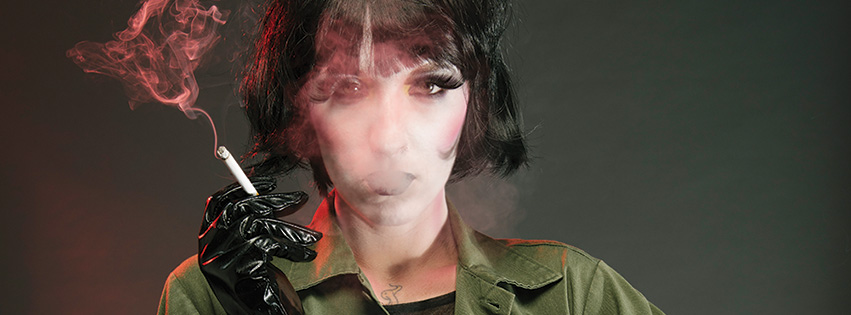
Sex and the City: LIVE! Rebel, 1760 Market, SF; trannyshack.com/sexandthecity. $25. Wed, 7 and 9pm. Open-ended. It seems a no-brainer. Not just the HBO series itself — that’s definitely missing some gray matter — but putting it onstage as a drag show. Mais naturellement! Why was Sex and the City not conceived of as a drag show in the first place? Making the sordid not exactly palatable but somehow, I don’t know, friendlier (and the canned a little cannier), Velvet Rage Productions mounts two verbatim episodes from the widely adored cable show, with Trannyshack’s Heklina in a smashing portrayal of SJP’s Carrie; D’Arcy Drollinger stealing much of the show as ever-randy Samantha (already more or less a gay man trapped in a woman’s body); Lady Bear as an endearingly out-to-lunch Miranda; and ever assured, quick-witted Trixxie Carr as pent-up Charlotte. There’s also a solid and enjoyable supporting cast courtesy of Cookie Dough, Jordan Wheeler, and Leigh Crow (as Mr. Big). That’s some heavyweight talent trodding the straining boards of bar Rebel’s tiny stage. The show’s still two-dimensional, even in 3D, but noticeably bigger than your 50″ plasma flat panel. (Avila)

Shakespeare Night at the Blackfriars (London Idol 1610) Phoenix Arts Association Annex Theatre, 414 Mason, SF; www.subshakes.com. $20-25. Fri-Sat, 8pm; Sun, 7pm. Through Nov 17. Subterranean Shakespeare performs George Crowe’s comedy about a playwriting contest between Ben Jonson, Thomas Middleton, Frances Beaumont, and the ghost of Christopher Marlowe.

“Shocktoberfest 14: Jack the Ripper” Hypnodrome, 575 10th St, SF; www.thrillpeddlers.com. $25-35. Thu-Sat and Oct 29-30, 8pm. Through Nov 23. It’s lucky 14 for the Thrillpeddlers’ annual Halloween-tide Shocktoberfest, and while there are few surprises in this year’s lineup, there’s plenty of reliable material to chew on. Opening with A Visit to Mrs. Birch and the Young Ladies of the Academy, a ribald Victorian-era “spanking drama,” the fare soon turns towards darker appetites with a joint Andre De Lorde-Pierre Chaine work, Jack the Ripper. Works by De Lorde — sometimes referred to as the “Prince of Fear” — have graced the Hypnodrome stage over the years, and this tense Victorian drama, though penned in the 30s, is suitably atmospheric. Although it becomes pretty evident early on who dunnit, it’s the why that lies at the heart of this grim drama, and in the course of that discovery, the play’s beleaguered lawmen reveal themselves to be no less ruthless than the titular Ripper (John Flaw) in pursuit of their quarry. Norman Macleod as Inspector Smithson particularly embodies this unwholesome dichotomy, and Bruna Palmeiro excels as his spirited yet doomed bait. Inspired by Oscar Wilde’s Salome, the Thrillpeddlers’ piece by the same name is perhaps the weak link in the program, despite being penned by the ever-clever Scrumbly Koldewyn, and danced with wanton abandon by Noah Haydon. Longtime Thrillpeddlers’ collaborator Rob Keefe ties together the evening’s disparate threads under one sprawling big top media circus of murder, sex, ghosts, and sensationalism with his somewhat tongue-in-cheek, San Francisco-centric The Wrong Ripper. (Gluckstern)

Sidewinders Exit on Taylor, 277 Taylor, SF; www.cuttingball.com. $10-50. Thu, 7:30pm; Fri-Sat, 8pm (also Sat, 2pm); Sun, 5pm. Through Nov 17. Cutting Ball opens its 15th season with the world premiere of Basil Kreimendahl’s absurdist romp through gender queerness.

The Taming Thick House, 1695 18th St, SF; www.crowdedfire.org. $10-35. Wed/23-Sat/26, 8pm. Crowded Fire Theater presents the world premiere of Lauren Gunderson’s modern farce.

The Voice: One Man’s Journey into Sex Addiction and Recovery EXIT Theatre, 156 Eddy, SF; www.theexit.org. $15-25. Fri/25-Sat/26, 8pm. David Kleinberg performs his autobiographical solo show.

The Wizard of Oz Orpheum Theatre, 1192 Market, SF; www.shnsf.com. $45-210. Wed/23-Sat/26, 7pm (also Sat/26, 1pm); Sun/27, 1 and 6:30pm. Andrew Lloyd Webber’s new stage adaptation of the classic, complete with a Dorothy (Danielle Wade) chosen through a Canadian reality-show competition.

The World’s Funniest Bubble Show Marsh San Francisco, 1062 Valencia, SF; www.themarsh.org. $8-11. Sun/27, 11am. Soapy, kid-friendly antics with Louis Pearl, aka “The Amazing Bubble Man.”

BAY AREA

Can You Dig It? Back Down East 14th — the 60s and Beyond Marsh Berkeley, 2120 Allston, Berk; www.themarsh.org. $15-50. Sat/26, 8:30pm; Sun/27, 7pm. Don Reed’s new show offers more stories from his colorful upbringing in East Oakland in the 1960s and ’70s. More hilarious and heartfelt depictions of his exceptional parents, independent siblings, and his mostly African American but ethnically mixed working-class community — punctuated with period pop, Motown, and funk classics, to which Reed shimmies and spins with effortless grace. And of course there’s more too of the expert physical comedy and charm that made long-running hits of Reed’s last two solo shows, East 14th and The Kipling Hotel (both launched, like this newest, at the Marsh). Can You Dig It? reaches, for the most part, into the “early” early years, Reed’s grammar-school days, before the events depicted in East 14th or Kipling Hotel came to pass. But in nearly two hours of material, not all of it of equal value or impact, there’s inevitably some overlap and indeed some recycling. Reed, who also directs the show, may start whittling it down as the run continues. But, as is, there are at least 20 unnecessary minutes diluting the overall impact of the piece, which is thin on plot already — much more a series of often very enjoyable vignettes and some painful but largely unexplored observations, wrapped up at the end in a sentimental moral that, while sincere, feels rushed and inadequate. (Avila)

I and You Marin Theatre Company, 397 Miller, Mill Valley; www.marintheatre.org. $37-58. Tue, Thu-Sat, 8pm (also Thu/24, 1pm; Nov 2, 2pm); Wed, 7:30pm; Sun, 2 and 7pm. Through Nov 3. Lauren Gunderson’s world premiere explores how Walt Whitman’s words affect the lives of two teenagers.

Lettice and Lovage Hillbarn Theatre, 1285 East Hillsdale, Foster City; www.hillbarntheatre.org. $23-38. Thu-Sat, 8pm; Sun, 2pm. Through Nov 3. Hillbarn Theatre, now in its 73rd season, performs Peter Shaffer’s raucous comedy.

Metamorphoses South Berkeley Community Church, 1802 Fairview, Berk; www.infernotheatre.org. $10-25. Thu and Sat-Sun, 8pm; Fri, 9pm (no show Nov 9). Through Nov 23. Additional performance Nov 9, 8pm, $5-20, Laney College, 900 Fallon, Oakl. Inferno Theatre performs a multimedia, contemporary adaptation of Ovid’s classic.

Red Virgin, Louise Michel and the Paris Commune of 1871 Berkeley City Club, 2315 Durant, Berk; www.centralworks.org. $15-28. Thu-Sat, 8pm; Sun, 5pm. Through Nov 24. Central Works presents a new play (with live music) by Gary Graves about the Paris Commune uprising.

Rich and Famous Dragon Theatre, 2120 Broadway, Redwood City; www.dragonproductions.net. $15-35. Thu-Sat, 8pm; Sun, 2pm. Through Nov 3. Dragon Theatre performs John Guare’s surreal musical comedy.

strangers, babies Ashby Stage, 1901 Ashby, Berk; www.shotgunplayers.org. $20-35. Wed-Thu, 7pm; Fri-Sat, 8pm; Sun, 5pm. Through Nov 17. Shotgun Players present Linda McLean’s drama about a woman confronting her past.

Vanya and Sonia and Masha and Spike Roda Theatre, 2015 Addison, Berk; www.berkeleyrep.org. $35-89. Wed/23, 7pm; Thu/24-Fri/25, 8pm. Berkeley Rep performs Christopher Durang’s comedy about a dysfunctional family in rural Pennsylvania.

Warrior Class Mountain View Center for the Performing Arts, 500 Castro, Mtn View; www.theatreworks.org. $19-73. Tue-Wed, 7:30pm; Thu-Sat, 8pm (also Sat, 2pm); Sun, 2 and 7pm. Through Nov 3. TheatreWorks performs Kenneth Lin’s incisive political drama.

PERFORMANCE/DANCE

Alonzo King LINES Ballet Fall Home Season 2013 Yerba Buena Center for the Arts, Lam Research Theater, 700 Howard, SF; www.linesballet.org. Fri/25-Sat/26 and Nov 1-2, 8pm; Sun/27 and Nov 3, 5pm; Oct 30-31, 7:30pm. $30-65. Featuring the SF premiere of Writing Ground, a collaboration with writer Colum McCann, and a world-premiere new work set to Bach.

Alonzo King LINES Ballet Training Program fall showcase Z Space, 450 Florida, SF; www.zspace.org. Wed/23, 7:30pm. $20. The company’s artists-in-training perform original and diverse works by Maurya Kerr, Dexandro Montalvo, and other choreographers.

BATS Improv Bayfront Theater, B350 Fort Mason Center, SF; www.improv.org. $20. “Horror Super Scene,” Fri/25, 8pm; “Improvised Farce,” Sat/26, 8pm.

“Broadway Bingo” Feinstein’s at the Nikko, Hotel Nikko, 222 Mason, SF; www.feinsteinssf.com. Wed, 7-9pm. Ongoing. Free. Countess Katya Smirnoff-Skyy and Joe Wicht host this Broadway-flavored night of games and performance.

Caroline Lugo and Carolé Acuña’s Ballet Flamenco Peña Pachamama, 1630 Powell, SF; www.carolinalugo.com. Sat/26, 6:15pm. $15-19. Flamenco performance by the mother-daughter dance company, featuring live musicians.

CounterPULSE 1310 Mission, SF; www.counterpulse.org. “Forest Fringe SF” with CounterPULSE and the University of Chichester, Thu/24-Sat/27, 8pm, $10-30; “Beware the Band of Lions (They’re Dandy Lions)” with Bandelion, Sun/27, Nov 3, 10, and 17, 3pm, free (reservations required as space is extremely limited; to request an invitation, email info@dandeliondancetheater.org).

“Crissy Broadcast” Crissy Field, SF; www.airfieldbroadcasts.org. Sat/26, 10am and 4pm; Sun/27, noon. Free. Composer Lisa Bielawa brings her “Airfield Broadcasts” series to Crissy Field. It’s a “massive, spatialized symphony involving more than 800 professional, student, and amateur musicians,” all performing live together.

Feinstein’s at the Nikko Hotel Nikko, 222 Mason, SF; www.feinsteinssf.com. “Lightning Strikes” with Joey Arias and Kristian Hoffman, Thu/24, 8pm. $25-35 (plus $20 food and beverage minimum). “My Generation: The Contemporary American Songbook” with Tony Desare, Fri/25, 8pm; Sat/26, 7pm, $40-50.

“The Hula Show 2013” Palace of Fine Arts Theatre, 3301 Lyon, SF; www.cityboxoffice.com. Fri/25-Sat/26, 8pm; Sun/27, 3pm (children’s matinee Sun/27, noon). $15-90. Patrick Makuakane and his Na Lei Hulu I Ka Wekiu dance troupe perform 20 world premieres, a blend of traditional hula and hula performed to modern music.

“The Kepler Story” Morrison Planetarium, California Academy of Sciences, 55 Music Concourse Dr, SF; www.calacademy.org. Sun/27, 6:30pm. $15. Cal Academy and Motion Institute team up to produce this “immersive performance work” about astronomer Johannes Kepler.

“Long Story Short” Exit Studio Theatre, 156 Eddy, SF; www.arenhaun.com. Fri/25-Sat/26, 8pm. $15. Slacker Theater presents comic short plays by Aren Haun.

“Mission Position Live” Cinecave, 1034 Valencia, SF; www.missionpositionlive.com. Thu, 8pm. Ongoing. $10. Stand-up comedy with rotating performers.

“Okeanos Intimate” Aquarium of the Bay, Pier 39, SF; www.capacitor.org. Sat, 4:30 and 7pm. $20-30 (free aquarium ticket with show ticket). Extended through Dec 28. Choreographer Jodi Lomask and her company, Capacitor, revive 2012’s Okeanos — a cirque-dance piece exploring the wonder and fragility of our innate connection to the world’s oceans — in a special “intimate” version designed for the mid-size theater at Pier 39’s Aquarium of the Bay. The show, developed in collaboration with scientists and engineers, comes preceded by a short talk by a guest expert — for a recent Saturday performance it was a down-to-earth and truly fascinating local ecological history lesson by the Bay Institute’s Marc Holmes. In addition to its Cirque du Soleil-like blend of quasi-representational modern dance and circus acrobatics — powered by a synth-heavy blend of atmospheric pop music — Okeanos makes use of some stunning underwater photography and an intermittent narrative that includes testimonials from the likes of marine biologist and filmmaker Dr. Tierney Thys. The performers, including contortionists, also interact with some original physical properties hanging from the flies — a swirling vortex and a spherical shell — as they wrap and warp their bodies in a kind of metamorphic homage to the capacity and resiliency of evolution, the varied ingenuity of all life forms. If the movement vocabulary can seem limited at times, and too derivative, the show also feels a little cramped on the Aquarium Theater stage, whose proscenium arrangement does the piece few favors aesthetically. Nevertheless, the family-oriented Okeanos Intimate spurs a conversation with the ocean that is nothing if not urgent. (Avila)

“POR. TRAI. TURE” Kunst-Stoff Arts, 1 Grove, SF; www.linsdans.org. Sat/26-Sun/27, 8pm. $10-15. Lindsey Renee Derry presents an evening-length solo show with choreography by Derry as well as José Navas, Sidra Bell, Alex Ketley, and Iratxe Ansa.

“San Francisco Magic Parlor” Chancellor Hotel Union Square, 433 Powell, SF; www.sfmagicparlor.com. Thu-Sat, 8pm. Ongoing. $40. Magic vignettes with conjurer and storyteller Walt Anthony.

“SF Recovery Theatre Tours the Tenderloin” Various Tenderloin venues, SF; www.sfrecoverytheatre.org. Fri/25, 12:30pm, 4pm, and 6pm; Tue/29, 3pm; Oct 31, 2pm. Donations accepted. The company visits different Tenderloin hotels to perform versions of Porgy and Bess and Night at the Black Hawk.

“A Show of Hands” Jewish Community Center of San Francisco, 3200 California, SF; www.garrettmoulton.org. Thu/24 and Sat/26, 1pm; Fri/25, 3:30pm. Free. Garrett and Moulton Productions present a site-specific New Music USA commission that explores the powers and possibilities of human hands.

“Solo Sunday: Life Without the Dull Parts” Stage Werx Theatre, 446 Valencia, SF; www.brownpapertickets.com. Sun/27, 7pm. $12. With Christian Cagigal, Jonathan Ehrlich, Xiaojuan Shu, and Angela L. Neff.

13th Floor Dance Theater Studio B at ODC Dance Commons, 351 Shotwell, SF; www.13thfloordance.org. Sat-Sun, 8pm. Through Nov 2. $18-23. Jenny McAllister’s company performs the world premiere of Being Raymond Chandler.

“Tickled Pink! Comedy Showcase” Café Royale, 800 Post, SF; www.tpinkcomedy.com. Thu/24, 8pm. Free. With Ronn Vigh, David Gborie, Casey Ley, Gloria Magaña, and host Stefani Silverman.

Zhukov Dance Theatre SFJazz Center, 201 Franklin, SF; www.zhukovdance.org. Oct 29-30, 8pm. $25-55. The company marks its sixth annual season, “Product 06,” with world premieres by Yuri Zhukov and guest choreographer Idan Sharabi.

BAY AREA

Nederlands Dans Theater Zellerbach Hall, UC Berkeley, Bancroft at Telegraph, Berk; calperfs.berkeley.edu. Wed/23-Thu/24, 8pm. $30-92. The Dutch dance masters perform Sehnsucht (2009) and Schmetterling (2010).

“Shine, Perishing Republic! Robinson Jeffers Speaks” Pegasus Books, 1855 Solano, Berk; www.1stpersonsingular.com. Wed/23, 7:30pm. Free. Dramatic reading.

“Stand Up! Women Write Resistance!” Rebound Bookstore, 1611 Fourth St, San Rafael; www.reboundbookstore.com. Sat/26, 4-6pm. Free. Spoken word with Gail Entrekin, Rebecca Foust, Susan Kelly DeWitt, and Dawn McGuire. *


 

Alerts

0

WEDNESDAY 23

An Evening with the Authors of DOLLAROCRACY First Congressional Church, 2345 Channing Way, Berk. 7:30-9:30pm, $15. John Nichols and Robert McChesney will discuss their new book, DOLLAROCRACY: How the Money and Media Election Complex is Destroying America. The authors will address issues such as the forces they believe have robbed national elections of their meaning, the far-reaching and drastic consequences of these developments for the American democratic process, and proposed solutions.


THURSDAY 24

8 Washington Debate First Unitarian Universalist Society, Martin Luther King Room, 1187 Franklin, SF. Doloresmp@gmail.com. 7-9pm, free. Jon Golinger, campaign manager of No Wall on the Waterfront, will debate Alec Bash, supporter of the 8 Washington project. The luxury waterfront development is the subject of Ballot Propositions B and C, which will appear on the Nov. 5 ballot. Golinger is an attorney and environmental activist; Bash is a former city planner. The San Francisco chapters of Progressive Democrats of America and Unitarian Universalists for Peace are sponsors of this event.


FRIDAY 25


MisLEAD: America’s Secret Epidemic San Francisco Main Library, 100 Larkin, SF. www.misleadmovie.com 2-5pm, FREE. Screening of the new feature-length documentary directed by Tamara Rubin, an Oregon mother whose sons were poisoned by lead. The film follows Rubin as she travels around the country meeting with experts and other parents of poisoned children. It showcases the on-the-ground effects of the lead-poisoning epidemic and investigates how lead poisoning was ever allowed to become such a serious problem in the US. Free lead check swabs will be given to all attendees and the event will include an educational session on how to properly use the swabs. SATURDAY 26 Our Mission: No Eviction! Brava Theater, 2781 24th St, SF. tinyurl.com/noevict. 8pm, $10–$35. An evening of art, performances, and tributes to Mission artists Rene Yañez and Yolanda Lopez. All proceeds will go to the artists’ legal expenses in fighting their eviction from the Mission home where they have lived for thirty-five years. Their plight is part of a rash of evictions of artists and working class communities from San Francisco in recent years, especially in the Mission District. Yañez and Lopez are pillars in the San Francisco arts community, and rallying around them is an opportunity to protest the larger issue of evictions throughout San Francisco.

BART reaches tentative deal with unions, ending the strike

79

The BART strike ended this morning — the second four-day strike of the current labor contract impasse, both of which hobbled the  Bay Area’s transportation system — after the district reached a tentative contract with its three unions late last night.

The agreement was spurred by the tragic deaths of two BART employees on Saturday and by yesterday’s National Transportation Safety Board revelation that the train that struck the workers was being used by the district to train drivers, presumably in preparation for offered limited public service during the strike.

“We are pleased to announce that we have reached a tentative agreement with union leadership that will bring the trains back into service, starting tomorrow, while union members consider the agreement and vote on it,” BART General Manager Grace Crunican said in a public statement issued at 10pm last night, withholding details of the deal. “This is a good package for our union members while still allowing the District to make the necessary investments in our infrastructure. That investment is critical to the future of the Bay Area.”

Union sources tell the Guardian that Saturday’s tragedy definitely created the conditions to reach an agreement, with the district softening its hardline insistence on its “last, best, and final offer” and the unions agreeing to some work rule changes, which they say the district and media had mischaracterized their position on. Technological modernizing will go through, but the unions retained authority over safety and other working conditions. 

For more on the breakdowns that led to the strike, the circumstances surrounding Saturday’s accident, and the aftermath of that tragedy, read tomorrow’s Guardian print edition, which goes on line this evening. 

INFOGRAPHIC: Brown signs legislation creating two tiers of college tuition, for the rich and the poor

6

For six California community colleges, when the classes get crowded, those with money will get in, and the poor will struggle. 

On Oct. 10, Gov. Jerry Brown signed Assembly Bill 955, allowing six allegedly overcrowded community colleges to charge $200 per unit instead of the state-mandated $46 for their most in-demand classes. 

The bill was sponsored by Assemblymember Das Williams (D- Santa Barbara), and would effect College of the Canyons, Crafton Hills College, Long Beach City College, Oxnard College, Pasadena City College, and Solano Community College. But state officials and local activists fear this is the first step towards steeply increasing community college fees.

At a California Community College Board of Governors meeting last month, state Chancellor Brice Harris said the tuition hikes could lead to less funding from Sacramento.

“The next time the budget goes in the tank, they’ll tell (us), ‘we can’t give it to you, tell your colleges to raise fees,’” he said. “We have had historically free and open equal access. This bill fundamentally changes that equation.”

When reached for comment, a spokesperson for Harris said he was unavailable.

Shanell Williams, student trustee at City College of San Francisco and an activist who’s fought student inequality at the state level before, echoed Harris’ sentiments back when AB955 was first on the table. “AB955 creates a system of haves and have nots,” she said. “Students that cannot afford to pay more will essentially be denied access.”

A two-tiered payment system was tried once before at Santa Monica College last year. Students protested and were pepper sprayed in an incident that blew up in the news media.

In light of the new tuition hike, we’ve created an infographic to help put the new costs in context. Check it out below, and link to it directly here.

For our previous coverage on AB955, click here.

Best of the Bay 2013: BEST ANTI-GENTRIFICATION ELECTRO-PUNK SINGLE

0

It certainly touched a nerve. “Hey gurl, where you moving to? Moving to the East Bay, living life the broke way. SF keep your money. FUCK YOUR MONEY!” Esta Noche drag star Persia and local electro duo Daddies Plastik’s “Google Google Apps Apps” single came bouncing through the Web early this summer and ricocheted off hyperlocal blogs, paradoxically gaining speed through the power of social media. A bouncy yet sardonic party track that seriously skewers the tech industry and its effects on the San Francisco cost of living, the song (and wacky-genius video featuring the whole freak posse) successfully captured the rage of a city caught up in a tragic transition. It was an anger Persia herself felt when Esta Nocha, the Mission’s Latino gay bar, was in danger of closing. But she took that rage and turned it into summer anthem gold. Hey girl, could you tag me in that pic?

www.soundcloud.com/persia415

Best of the Bay 2013 Editors Picks: Arts and Entertainment

0

ARTS AND ENTERTAINMENT

EDITORS PICKS

Editors picks are chosen by Guardian editors for special recognition for brightening the Bay Area experience.

BEST BAWDY BOWIE WORSHIP

It takes a lot to stand out in this town. Bands and entertainers are a dime a dozen, and quality cover or innovative, hilarious “tribute” acts fill venue lineups year-round. The First Church of the Sacred Silversexual, however, is a glittery entity all its own. Raucous and roiling with glam-rock glee, it’s an orgasmic sensation of all things David Bowie wrapped in tinfoil and pumped full of sparkly gospel soul. The boisterous crew of theatrical musicians and singers packs onto stages and blows the Bowie horn: All ye who enter here, know the Thin White Duke’s (or Ziggy Stardust’s, or Alladin Sane’s) name. The oft-adoring crowd, with lyrics sheets in hand, responds in time. It’s a Suffragette City spectacle that “tap dances on the lines between religion and revelry, beatitude and blasphemy, rock show and revival.” Wham, bam, thank you ma’am!

www.sacredsilversexual.com


BEST SECRET VERSE

Tired of hum-drum literary events involving lecterns, monotones, and rumpled suit jackets? Has Janey Smith got the antidote for you. One part poetry reading, one part beer bust, and one part urban exploration escapade, literary gatherings at the Squat turn the pedestrian concept of a reading into a situational ritual. After assembling in Smith’s lower Haight apartment for mingling and judicious imbibing, the crowd is ushered silently to a secret location: an abandoned flat lit by dozens of tea candles with a small pile of rubble on the floor serving as a podium for the invited poets. The echo of empty rooms, the brave flickers of candlelight, and the rapt attention of the crowd makes poetry at the Squat resonate that much more, attracting a stalwart crew of hardcore wordsmiths and armchair literati alike.

851thesquat.tumblr.com


BEST HIP-HOP NAMECHECK

Jaunty East Bay rapper-producer IamSu! has released a barrage of clever mixtapes and collaborated with the likes of big-timers like 2 Chainz, Wiz Khalifa, Juvenile, E-40, and Roach Gigz — but his career can be traced back to Youth Radio, a nonprofit media center based in Oakland. Like so many others before and since, the talented 23-year-old MC got his start there at age 15 and learned all about the art of beat making. Fast-forward a decade and IAmSu! (born Sudan Ahmeer Williams) is getting some serious love for attention-grabbing lyrics, bold beats, and his casual return to hyphy, not to mention team efforts with his crew HBK (Heart Break Kids) Gang. He still reps his hometown even while sending it up in hits like “Goin’ Up” feat. Khalifa, nonchalantly tossing out rhymes like “Ask around I got hell of love in the Bay/Get money give a fuck what a hater say” over a wobbly beat in a video directed by Kreayshawn and featuring cameos by locals like Gigz. He may be bursting outside the bounds of the Bay, but his output remains a family affair.

www.hbkgang.com


BEST JAZZ FLIGHT

The home base for SFJazz was decades in the making, but the popular nonprofit jazz organization finally got its own permanent home this year — and the SFJazz Center‘s sparkling new glass building is a marvel of modern sound. The $63 million, state-of-the-art facility includes balconies, perches, a fancy restaurant, and a smaller performing space for up-and-comers. But the main bowl-shaped auditorium deep inside the venue is where all that jazzy action comes alive, a circular space with platforms that can accordion and retract to make room for different kinds of setup. Resident artistic directors like Jason Moran have made good use of that unique space; during his stay, Moran opened up the bottom level for an actual skateboarder’s half-pipe with live skating demos, and also widened it up for a Fats Waller dance party. And of course a diverse roster of jazz greats — McCoy Tyner, Eddie Palmieri, Esperanza Spaulding, Hugh Masekela, Bill Frissell — have reached the new rafters with their flights of sound.

201 Franklin, SF. (866) 920-5299, www.sfjazz.org


BEST THREE-POINT SWISH

At first, the idea of opening a successful gay sports bar in the Castro might have struck some as either a shameful back-in-the-closet move (only manly men allowed, no swishing!) or another apocalyptic omen of gay assimilation (we’ve become the jocks who beat us up!). But then you watch the diverse crowds — including, yes, the swishy — pack into Hi Tops to cheer on our major championship teams and our lesser-recognized sports organizations and heroes. You see the Sports Illustrated picture of two male 49ers fans enthusiastically kissing — the first such photo to appear in that magazine. You check out the super-spiffy design of the place, which repurposes vintage bleachers, b-ball court floors, lockers, and cage lights. You sample the playful drink menu, which features an actual cocktail made with Muscle Milk, and a bar menu that twists standard game day food in a slightly gourmet direction. Finally, you see how owners Jesse Woodward, Dana Gleim, and Matt Kajiwara have created a community of like-minded queer sports fans who can finally express their mutual admiration openly, proudly, and loudly. Holy crap, is that a ball in your hand?

2247 Market, SF. (415) 551-2500, www.hitopssf.com


BEST PEACH OF A PLAYWRIGHT

We’re declaring 2012-2013 the theatre season of Lauren Gunderson, y’all. Ever since this prolific Georgia native’s Exit, Pursued by a Bear debuted at Crowded Fire Theater in 2011, Gunderson’s scripts are smart, sassy, and fueled by revenge and science. “I think I write about scientists more than I write about science,” she told Creative Loafing Atlanta. “You could say that science is the landscape and ether of the plays, but the hearts and dreams of the scientists are what we’re really watching.” That empathetic approach to science may help explain why her plays have the taken tech-nerdy Bay Area by storm. This season alone saw the Bay Area-based productions of no fewer than five of her scripts: Emilie La Marquise du Chatalet Defends Her Life Tonight by the Symmetry Theatre Company in Berkeley, Toil and Trouble at Impact Theatre, By and By with the Shotgun Players, The Taming with Crowded Fire Theater, plus I and You at the Marin Theatre Company. Love a rising star? There’s still time to bolster your “I saw her back when” cred when both TheatreWorks and SF Playhouse produce her works in early 2014.

www.laurengunderson.com


BEST MIDWEEK THROWDOWN

For fans of great house music, packed dance floors, cute crowds, and sweating out the workweek, Wednesdays are the new Fridays, thanks to the stellar Housepitality party crew. Promoters and DJs Mikey Tello and Miguel Solari, along with about a dozen fantastic resident local DJs, bring in international underground superstars every week to get us over hump day (and play havoc with our Thursday mornings). But the Housepitalers go beyond merely roping in midweek talent — they’ve built a devoted community of new and old school dance mavens, crossing generational divides through the spirit of darned good music and a loving vibe. Now in their third year, they also dig deep to introduce the Bay to fresh talent and obscure legends: not too many parties on Earth can boast bringing in “DJ’s DJ” (and an inventor of Detroit techno) D. Wynn one week and then contemporary Bulgarian live acid house act Kink the next. Who needs sleep, anyway?

Wednesdays, 10pm-2am at F8, 1192 Folsom, SF. www.housepitalitysf.com


BEST CYBER-GLADIATORIAL WARFARE

Humans beware. The great robot revolution is nigh, and builders of combat robots have done us no favors by creating machines whose sole function is to destroy. Way to go, guys. But, on second thought, maybe it’s for the best that these “combots” exist, and are still obeying their owners by fighting battles — exclusively with each other — inside a giant, bulletproof pen at the annual International RoboGames. This gives us an opportunity now to study their moves — before they launch their surprise attack on the human race. Combots have advantages such as brute force, whirling blades, super-sumo skills, and general imperviousness to pain. There are even androids that perform kung fu (shudder). But by observing them in action now, we can start formulating our defense strategy ahead of time. Thanks, RoboGames, for giving us this opportunity for the past decade.

www.robogames.net


BEST DEFENDER OF INDIE AISLES

Along with closely-affiliated nonprofit San Francisco Neighborhood Theater Foundation, CinemaSF has stepped up to keep a pair of historic theaters located in non-trendy neighborhoods — the Vogue and the Balboa — alive and thriving, especially after a Kickstarter campaign earlier this year raised dough to ease the Balboa’s digital-upgrade costs. (The Vogue, thankfully, was already 21st century-ready.) It would be an easy moneymaker to simply screen the latest Hollywood releases, and while both theaters do show first-run stuff, they also offer exclusive and special-interest programming on the side, such as the Balboa’s “Popcorn Palace” kiddie series, and the Vogue’s hosting of San Francisco Film Society events like November’s “Taiwan Film Days.” Have we mentioned how awesome it is not to always watch a movie on your laptop alone in your tiny room, or be bombarded by sense-numbing multiplex gimmickry? Here’s to many more years of great indie flicks shared in great spaces with friendly film fans.

www.voguesf.com


BEST BEAUX-ARTS REVIVAL

After 33 years of provoking thought and conversation about contemporary ideas and letters, City Arts and Lectures has a brand-new venue for hosting its famed series of onstage chats with boldfaced names (recent roll-call: Margaret Atwood, Richard Dawkins, Christopher Guest, Zadie Smith, Jaron Lanier, Marc Maron, Jhumpa Lahiri). But the Nourse Theater isn’t actually new at all — it was built in 1927, which makes it nearly as old as the Castro Theatre. The late Beaux-Arts beauty, once used as the High School of Commerce theater, sat neglected and closed for over 30 years. Now spiffily refurbished (think plush new seats and top-of-the-line sound and lighting) under the guidance of City Arts & Lectures founder Sydney Goldstein, with fabulously Rococo-like architectural details preserved, the hulking building on Hayes is fully revived and ready for heady artistic musings and bleeding-edge pronouncements.

275 Hayes, SF. www.cityarts.net/nourse


BEST GAY LEATHER BIKER ROCK AND ROLL RESURRECTION

When it was announced in 2011 that legendary Soma gay leather biker bar the Eagle Tavern was closing, much of the queer population was stunned. Sure, although charitable Sunday afternoon beer busts and renowned Thursday Night Live local rock showcases were packed, the large bar and patio were not exactly swarmed the rest of the time — and the owners had recently sunk much of their money into the revamped Hole in the Wall Saloon. But the Eagle’s closure became a flashpoint for what many saw as the homogenization of SF’s gay population and the gentrification of traditional queer spaces. A determined activist coalition rallied the city’s political forces and helped find new gay buyers — Alex Montiel and Mike Leon — who vowed to keep the spot’s rough-and-tumble, rock and roll gay vibe while revamping the interior and programming to appeal to a new generation of sexy, bearded, kinky men and friends. The SF Eagle flew again in 2013, and has been by all accounts a success: still down and dirty, but the coolest “new” gay hangout in the city.

398 12th St, SF. www.sf-eagle.com


BEST YEARLY WIDDERSHINS

How long does it take to make a tradition? Surely a longevity spanning four decades denotes a yearly gathering that has taken hold of a group’s psyche. If this is indeed the case, consider the pagan faction Bay Area Reclaiming’s Spiral Dance a full-blown, locally born folkway. The rite takes place each year during the Halloween season, or Samhain, as the pagan holiday of death and regeneration is best known. During the gathering — which also serves as Reclaiming Bay Area’s biggest fundraiser of the year — dance, acrobatics, elaborate altars, and song mark a program largely geared around the spiral dance itself, in which group members move in a whorl (widdershins, as the counterclockwise movement is known in faiths from Wicca to Judaism) that invokes rebirth as the cold season approaches. It’s a gorgeous, all-inclusive sight, regardless of the number or character of the deities to which you pay homage. (You’re invited too, atheist babes.)

www.reclaimingspiraldance.org


BEST PUNK-LIT SPIT ‘N SHINE

Oh, how we love Sister Spit — that incubator of radical feminist artists and punk-lit creators, host for two decades of some the best Bay Area spoken word performances. But the performance series (birthed by Michelle Tea and Sini Anderson back in 1994, and then again in 2006) may well hold more significance to those outside of the Bay. After all, when Sister starting touring in the late ’90s, packing its erudite rabble-rousers into a series of ramshackle vans, towns like Detroit and Tucson got a very special dose of San Francisco’s “talented, tattooed, and purple pigtailed” poets, writers, sexual outlaws, and more. Cultural ambassadors, we deem them all. The series continues to go on the road — with writers like Ali Liebgott, Eileen Myles, Robin Akimbo, and many more — and grow. Earlier this year publisher City Lights debuted its new Sister Spit imprint with a glorious anthology of pieces performed at past events, Sister Spit: Writing, Rants and Reminiscence from the Road.

www.sisterspit.com


BEST PET SOUNDS

Different Fur Studios is esteemed by the current generation of music fans for churning out a staggering variety of hip music from San Francisco — A B & the Sea, Main Attrakionz, Lilac, the She’s — and beyond. Given the storied studio’s long history, however, it’s no wonder it’s still helping define the sound of the Bay. It was founded in 1968, at the height of San Francisco sonic weirdness, by Patrick Gleeson, an energetic electronic music composer who brought in the likes of Herbie Hancock, Jonathan Richman and the Modern Lovers, Stevie Wonder. The Fur stands on end: alert to the changing times and latest trends. Nowadays, it’s known for being highly Web-savvy, recording live iTunes-exclusive tracks, and uploading videos of in-studio sessions (like those of Little Dragon, Girls, Toro Y Moi, Big K.R.I.T., and more). Praise be to a different Pat — current owner and engineer Patrick Brown — who as a champion of local acts and labels alike keeps tradition alive in the heart of the Mission.

www.differentfurstudios.com


BEST GAYMER HANGOUT

Gay gamers often have friends they can brag to about their Xbox Live gamerscore. And they often have friends they can take to the club. And never shall those two groups of friends meet. Yet for one glorious weekend in Japantown last August, LGBT nerds united to celebrate indie queer games and to dress in Princess Peach drag (her five o’clock shadows were fetching). GaymerX was the first LGBT video game convention in the nation, and its panels included executives from gaming super-giant Electronic Arts, where gaymers lobbied for more inclusion in a white-male-hetero-normative-dominated industry. The dance floor was rocking, as Pikachu, Kratos, Mario and a host of other costumed fans shook their pixilated tail feathers. The voice actress who portrayed the killer robot from Portal, GLAaDOS, even helped two beautiful bear boys get married on stage with her signature song “Still Alive.” And best of all, the convention announced its second run for next July at an even bigger space. As Mario would say, “Let’s-a-go!”

www.gaymerconnect.com


BEST “HOUSE” MUSIC

Hang out with rad musicians like Peter Case, Alejandro Escovedo, Nataly Dawn, Sean Hayes, The Mother Hips, Ben Kweller, Heather Combs, John Vanderslice, and Chuck Prophet at a genial house party — and then watch them play a full concert in the living room? This convivial scene (you may actually be able to pet a cat while singing along) is what KC Turner’s House Concert series is all about. Here, nothing separates the performers from their patrons, save a few extra inches of legroom and the use of a microphone. In the music business, it seems almost inevitable that you’ll wind up selling some portion of your soul to make a living, but so far the fresh-faced, formidably-prolific KC Turner seems to be avoiding that fate by helping to create the world — and by extension, the music business — he wants to live in. We are all the better for it. Just please try not to spill any wine on the rug.

www.kcturnerpresents.com


BEST BURST OF PAN-ASIAN PRIDE

In 1973, Japantown’s Nihonmachi Street Fair was devised along the lines of community protest — in the face of sweeping neighborhood redevelopment, the celebration of Japanese heritage was a line in the sand, a declaration that one of SF’s unique neighborhoods would not be erased by the vagaries of urban renewal. (Nihonmachi means, roughly, “Japantown.”) Forty years later, it is an enduring statement of the power of community, and the festival considers itself a representation of the Pan-Asian cultural experience in San Francisco. During the early August weekend of Nihonmachi, awesome food, unique crafts, and musical performances fill the streets, and Asian traditions like the Chinese Lion Dance, Hawaiian music, and Filipino acrobatics fill the stages. An estimated 30,000 people attended this year — fest organizers wager they were largely first-time fans of this neighborhood triumph, which only confirms the community’s deepening roots.

www.nihonmachistreetfair.org


BEST PLAYING FIELD LEVELER

One game has the player land on a purple planet and get asked out on a date by a giant sea monster. Another has you shimmy a bumble-bee’s booty in the right sequence to win. Some of the games touch serious subjects like coming out for the first time, or dealing with poverty. And you can make one, too! The games on DIY text-based gaming platform Twine are wild and varied, but they’re always first person narratives. Remember “Choose Your Own Adventure” books? It’s kind of like that. Birthed three years ago by Chris Klimas, Twine really took off in the past year after being trumpeted by Anna Anthropy, a game designer known for “Dys4ia,” which chronicled her start in hormone replacement therapy. That’s the beauty of Twine: it’s a format suited to telling very personal stories in an interactive way. You don’t need to know any programming at all to make a free Twine game — it’s all text, so you just need to know how to write. And the games that result are presented as web pages containing a maze of hyperlinks: a pretty good metaphor for life.

www.auntiepixelante.com/twine


BEST BOOMBOX AFFAIR

The spirit of the underground is still alive in Larry Gonello Jr.’s world. The ace renegade soulful house and techno DJ was everywhere this year — from official street festival to not-so-official one, from licensed afterhours loft party to extralegal sunrise beach rave — joining in the fabulous mobile soundsystem tradition pioneered by great tricyclist Amandeep Jawa’s speaker-wired Trikeasaurus Rex, Monkeylectric’s Off-Grid Party Trailer, or anyone whose strapped an old transistor radio onto a bike during critical mass and rocked the freak out to Michael Jackson. Gonello’s Boombox Affair, though, usually went one better: wiring together an array of large, vintage, insanely covetable boom boxes to form a wall of sound at his pop-up dance parties. Adding a couple innocuous bass bins, he creates a DIY soundsystem that looks cool as hell while moves the crowd. “Sick” is the word usually uttered by first-time viewers. But by the time that overused yet totally appropriate word is swallowed up by beats, they’re already dancing.

www.boomboxaffair.com


BEST STICK TO THE SCRIPT

Books on tape, books on schmape. If you’re looking for the words of great literature to leap off the page (or titanium dioxide electrophoretic screen, if you’re Kindlin’), look no further than the 20-year-old tradition that is Z Space’s Word for Word series. In 1993, the legend goes, Susan Harloe and JoAnne Winter founded the company in order to “tell great stories with elegant theatricality, staging performances of classic and contemporary fiction.” The first production, of Dorothy Parker story “The Standard of Living,” played to a packed house. Seventy staged works — from classics like Sherwood Anderson’s homey Winesburg, Ohio and Tennessee Williams’ homo-textual “Two on a Party” to cutting edge contemporary works like Siobhan Fallon’s resonant Iraq War-fallout story cycle “You Know When the Men Are Gone” and Nathan Englander’s post-Holocaust domestic tale “What We Talk About When We Talk About Anne Frank” (performed at the Jewish Community Center) — and a tour of France later, the inimitable W4W troupe just took on the title story of Dan Chaon’s 2012 collection Stay Awake for Litquake. In a delightful meta-move, Word for Word will stage 36 stories by SF’s patron saint of the theater, Sam Shepard, in May 2014.

www.zspace.com/w4w


BEST DANCE SÉANCE

Everybody’s saying the feisty, freaky soul of San Francisco is dying. Finally someone did something about it, in the form of resurrecting one of the city’s most treasured cult arts figures, Ed Mock. A black, gay, free-spirited improvisational dance pioneer who died of AIDS in 1986: welp, you can’t get much more “vanishing San Francisco” than that. (Ntozake Shange’s For Colored Girls Who Have Considered Suicide When the Rainbow Is Enuf premiered in his studio. Enuf said.) The fact that Mock and his eponymous dance company heavily encouraged, trained, and influenced a generation of young artists surely helped cement his immortality. So much so that former student and UC Berkeley dance instructor Amara Tabor-Smith, who met Mock when she was 14 and joined his company three years later, joined with several collaborators in June to bring his specter back to the byways of our fair town. He Moved Swiftly But Gently Down the Not Too Crowded Street: Ed Mock and Other True Tales in a City That Once Was consisted of 11 site-specific performances that journeyed through Mock’s life, from “A Roomful of Black Men” in LaSalle Pianos to various “acts of improvisatory disruptions” up and down Valencia Street. You could feel Mock smiling fearlessly, glorious in a giant pink tutu, back on the streets.


BEST HIP-HOP NAMECHECK

0

Jaunty East Bay rapper-producer IamSu! has released a barrage of clever mixtapes and collaborated with the likes of big-timers like 2 Chainz, Wiz Khalifa, Juvenile, E-40, and Roach Gigz — but his career can be traced back to Youth Radio, a nonprofit media center based in Oakland. Like so many others before and since, the talented 23-year-old MC got his start there at age 15 and learned all about the art of beat making. Fast-forward a decade and IAmSu! (born Sudan Ahmeer Williams) is getting some serious love for attention-grabbing lyrics, bold beats, and his casual return to hyphy, not to mention team efforts with his crew HBK (Heart Break Kids) Gang. He still reps his hometown even while sending it up in hits like “Goin’ Up” feat. Khalifa, nonchalantly tossing out rhymes like “Ask around I got hell of love in the Bay/Get money give a fuck what a hater say” over a wobbly beat in a video directed by Kreayshawn and featuring cameos by locals like Gigz. He may be bursting outside the bounds of the Bay, but his output remains a family affair.

www.hbkgang.com

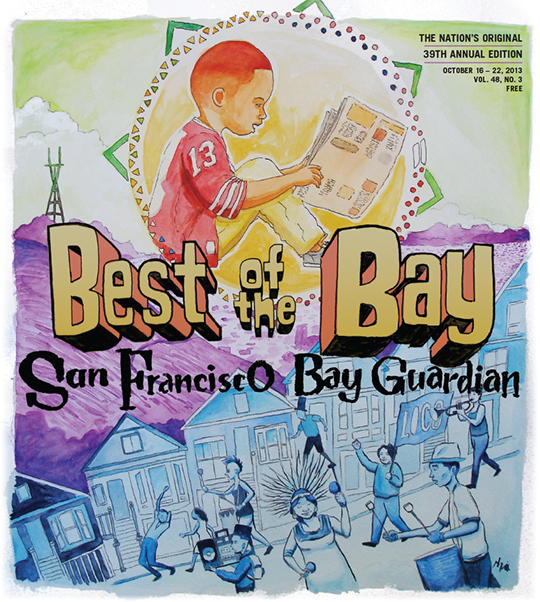
ABOUT THE ARTIST: Robert Trujillo

0

Born and raised in the Bay Area, Robert Trujillo is a visual artist and father who employs the use of illustration, storytelling, and public art to tell tales. These tales manifest in a variety of forms and they reflect the artist’s cultural background, dreams, and political and personal beliefs. “My motivation to do what I do is to be a positive and nurturing influence on my son,” he says. “It is to honor my ancestors and my family by passing on our visual art traditions, to give, to learn, to challenge the educational system both public and private, and to make sure more artwork that fuses ethnic studies, political commentary, personal history, and dynamic visual styles using a variety of media is prominent, loud, unapologetic — and just what some of us need.”


BEST OF THE BAY 2013

0

SONGS OF THE CITY

By Marke B.

marke@sfbg.com

Visitors flock to the Bay Area for its enchanting sights, of course. But if you’ve lived here for a while, you know the actual sounds of San Francisco and its neighbors weave the true spell that binds us. Cable car clang and fog horn blast, “ding-ding” of bike bells and cries of wild parrots. The wave organ and the Audium, the BART station busker and the underground dance floor, the protest and the crackdown, the echoes of the Beats and the roar of the stadium crowd.

Jazz and hip-hop floating through the Fillmore. Paleta carts and acoustic guitars ringing in Dolores Park. Pretty French tourists asking directions downtown. (Or maybe they’re Croatian?) “Woo!” girls partying in the Marina. Robyn pumping from Castro cars.

Free bluegrass, fine reggae, geeky ringtones, player pianos, new operas, earnest indie, sick bass. “I Left My Heart…,” “San Francisco, Open Your…,” “If You’re Going To….” Paul McCartney leading 50,000 people in a “Hey, Jude” singalong at Outside Lands. Everybody make some noise!

(Outside your window, just before dawn, a couple argues halfheartedly, and a nearby walk sign chirps.)

Even that golden moment every late sunny afternoon when, no matter what’s going on, a lovely hush falls across the city, as if in preparation for the soon-incoming fog.

This is the local wall of sound we honor in this edition of Best of the Bay, our 39th annual celebration of the people, places, and things that make living here such a great experience.

More than 15,000 of our readers voted in our Best of the Bay Readers Poll this year for their local, independent favorites in more than 200 categories like Best Burrito, Best Band, Best Strip Club, Best Shoe Store, Best Place to Watch the Sunset, Best Drag Queen, and beyond. You’ll find the results inside — as well as 150 Best of the Bay Editors Picks highlighting some Guardian favorites, old and new, that we think deserve some special recognition for brightening our lives this year. Rest assured, there’s a whole lot to love in the Bay.

In 1974, Esquire magazine asked us for ideas for its Best of the USA issue, which led us to publish the original Best of the Bay. Thirty-nine years later — and 47 years after we opened our doors — we’re still going strong, powered by our readers and the idea that the strength of our community can make the world a better place.

Editing this year’s issue was a hoot. I shower grateful smooches on all my fabulous collaborators, especially creative ace Brooke Ginnard; the awesome Guardian editorial, sales, and production staff; and the ever-supportive Hunky Beau, my own personal Best of the Bay.

But most of all we thank you, dear reader, for your generous participation, for making the Bay Area such an astounding place to live, and for turning us on to great new things this year. Enjoy the celebration on the pages that follow. But first close your eyes for a minute, and listen to this audaciously beautiful place we call home.


ABOUT THE ARTIST

Born and raised in the Bay Area, Robert Trujillo is a visual artist and father who employs the use of illustration, storytelling, and public art to tell tales. These tales manifest in a variety of forms and they reflect the artist’s cultural background, dreams, and political and personal beliefs. “My motivation to do what I do is to be a positive and nurturing influence on my son,” he says. “It is to honor my ancestors and my family by passing on our visual art traditions, to give, to learn, to challenge the educational system both public and private, and to make sure more artwork that fuses ethnic studies, political commentary, personal history, and dynamic visual styles using a variety of media is prominent, loud, unapologetic — and just what some of us need.”


BEST OF THE BAY STAFF

CREATIVE DIRECTOR

BROOKE GINNARD

EDITOR

MARKE B.

ILLUSTRATOR

ROBERT TRUJILLO

COPY EDITOR

STEWART APPLIN

CONTRIBUTING WRITERS

REBECCA BOWE, CAITLIN DONOHUE, CHERYL EDDY, NICOLE GLUCKSTERN, STEVE JONES, JOE FITZGERALD RODRIGUEZ,, EMILY SAVAGE, AMBER SCHADEWALD, DAVID SCHNUR

PHOTOGRAPHER

EVAN DUCHARME

CONTRIBUTING PHOTOGRAPHERS

MOSHEN CHAN, SHAWN CONNOLLY, MOLLY DECOUDREAUX, MARIA DEL RIO, TYLER DRISCOLL, NICOLE GLUCKSTERN, TIM GRIFFITHS, BETH LABERGE, AMANDA RHOADES, WES ROWE, TABLEHOPPER

BART negotiations continue as unions withhold strike threat UPDATED

105

With the 60-day cooling off period ordered by Gov. Jerry Brown coming to an end on Thursday, raising the specter of another Bay Area Rapid Transit shutdown, BART’s two main unions announced yesterday that they were holding off on calling a strike for now. [UPDATE 10/11: BART unions today issued a 72-hour strike notice, meaning they could strike on Monday].

“We’ve listened to the public and we share their concern about a disruption in service at the end of the cooling-off period.  We do not want to strike. That is why we’re not giving a 72-hour notice at this time, because we want to leave every opportunity open to try to get this deal done. Of course we are keeping all options on the table,” Service Employee International Union Local 1021 and Amalgamated Transit Union Local 1555 said in a joint statement.

Some media reports indicate that there has finally been some progress in the long-stalled negotiations, with a framework on pensions being agreed to, although the two sides still seem far apart on wages, benefits, and the length of the contract.

The unions cast it this way: “To this point of doing everything possible to avoid a strike: over the past 10 days, the unions have moved publicly three times, to BART’s zero times. If this were a score in the baseball playoffs – we, the Oakland A’s would be three and they, the Detroit Tigers would be zero. 

“At this point, if there is a disruption in service at the end of the cooling-off period, it will be for one reason and for one reason alone: our elected BART leadership has not shown leadership.”

BART Board President Tom Radulovich disputed that the concessions have been one-sided, but he said that, “They continue to want to negotiate in the media and we’re not really down with that.”

Asked to characterized where things stand and the prospects for resolving the impasse without another strike, Radulovich said, “We’re still cranking away and trying to get it done…It’s really not up to us whether there’s a strike or not. We just have to get this done.”

Meanwhile, while conservatives clamor to use the situation to get the Democrat-controlled Legislature to ban unions from striking (good luck with that one), Sup. John Avalos held a hearing yesterday at City Hall to examine some of the larger issues at play in the impasse, such as retirement security, that the Guardian covered in our July 9 issue.

Asked how the hearing went, Avalos told the Guardian, “We talked a lot about how BART has been villifying workers in the court of public opinion in an effort to weaken workers’ bargaining power.”


Help us keep raising hell

70

EDITORIAL The last couple years have been some of the most difficult and precarious in the Guardian’s 47 years of printing the news and raising hell in San Francisco. We’ve been struggling to survive and thrive, both the newspaper and the larger progressive political and alternative arts communities the Guardian is a part of, at a moment when this city needs us more than ever.

But the good news is that people are awakening to what has been lost as our resources have waned. We see it in the resurgent movements against evictions and gentrification and for better transit and bike lanes, in a rare referendum campaign challenging the 8 Washington project and its lies, in the lively online discussions we facilitate, and in the community support that the Guardian and other nascent progressive media projects are receiving.

Most people don’t trust the mainstream political, economic, and media institutions to understand or explain what’s happening to San Francisco and the greater Bay Area. Technology has created an explosion of new media outlets, but it’s come at the price of common narratives and gathering places where we can join together, discuss the issues, and then assert our collective will.

This is where the Guardian comes in, and it’s why we must find the way to grow through these tough years and regain our standing as the premier forum for discussing and promoting San Francisco’s values and needs. And for that, we need your help and support.

In some ways, it’s a situation similar to when Bruce B. Brugmann and Jean Dibble started the Bay Guardian in October 1966, when San Francisco was at the epicenter of social movements and technological innovation that were challenging entrenched economic interests and the inertia of the status quo.

The Guardian gave voice to new ideas about human rights and responsibilities, sexuality and identity, art and expression, diversity and tolerance, and many of the other issues and values that have animated San Francisco for the last half-century. Along with papers such as the Village Voice, Boston Phoenix, and Chicago Reader, the Guardian helped create the model for alternative newsweeklies that came to proliferate in every major US city, expanding the political and cultural dialogue in the country.

But that model is faltering. The Phoenix, which was founded the same year as the Guardian, closed its doors earlier this year, falling victim to the same economic pressures that are plaguing the entire newspaper industry. And the Voice soldiers on as a relatively apolitical corporate clone of its former feisty self after being bought out by a Phoenix-based chain driven by the kind of bottom-line Wall Street values that alt-weeklies were originally launched to oppose.

Regular readers of the Guardian know how we’ve fought for our independence and sustainability over the last year (see “On Guard,” June 19, and “New Guardian leadership wants your input,” July 23), and that we’ve approached it in a way that was consistent with our values on transparency, fearless truth-telling, and partnership with our progressive community.

And now, on the Guardian’s anniversary, we are recommitting to the mission stated on our masthead, “to print the news and raise hell,” while updating that mission for the digital age in myriad ways, some of which we’ll be announcing soon. This region is at a crossroads, choosing between greedy, myopic elitism and egalitarian sustainability, and we need strong media voices like the Guardian to clarify that choice.

For that, we need your help. Read the paper and then pass it to a friend. Post our stories to your favorite online forum. Buy an ad to promote your business, event, or cause. Participate in our community forums, including our Oct. 23 discussion of high-rises and waterfront development at the LGBT Center. Send us good story tips. And, most importantly, help us promote the idea that an informed and engaged citizenry is the foundation of democracy — and the only way to save the soul of San Francisco.


Drive time

0

arts@sfbg.com

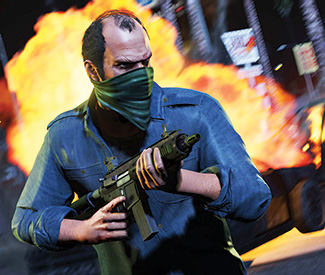
GAMER Yes, it’s time to talk again about the game in which you steal cars and kill prostitutes. And it’s another chance for the national news media to organize roundtables to discuss violence in video games, and the effects it might be having on the nation’s youth.

Let’s be honest: You know right now, before reading this article, whether or not the Grand Theft Auto series — which released GTA V (Rockstar North, Rockstar Games; PS3, Xbox 360) last month, and made a cool $1 billion in its first three days on sale — is something you want to play. And for developer Rockstar North, that’s both a blessing and a curse.
Perhaps surprising for those who haven’t played a game in the GTA series, the biggest draw isn’t the rampant violence but the experience of exploring a carnival funhouse version of present-day America.

GTA V’s look-alike setting of contemporary Los Angeles and its surrounding countryside, including windmill-strewn hills, mountain ranges, and a great salt sea is more than scenery. Billboards for fake reality shows and overwrought radio commercials shilling products like lap-band surgery and bottled water serve to drive home the absurdity of modern life. Buildings don’t just give the impression of a real city; each one has character, and often times a backstory. It is a city that feels alive. Amid the hail of gunfire, it’s easy to forget that Rockstar consistently pushes the limits of what a sandbox world can look like, with a level of detail that is unprecedented in a game of this size.

The story is divided among three protagonists: Michael, the ex-criminal trying to enjoy retirement in a posh house in the hills; Franklin, the hungry young gangster who dreams of making the big time; and Trevor, the lunatic. Though he is by far the most compelling character, it’s easy to see why Trevor isn’t the star of his own game — his complete lack of respect for human life or the rules of society make him an untenable prospect for a lead character in a title of this visibility. But, while his morals are despicable, he possesses a code of honor that’s difficult not to respect on some level.

Eventually, the three characters meet and perform heists and other criminal activities, and you are often allowed to switch from one character to another on the fly. Compared to GTA IV, the narrative — concerning a betrayal nine years previous and a number of government blackmail schemes — is wound much more tightly around the gameplay, and the draw of completing missions is in fleshing out the characters, rather than performing chores (something players have harped on in the past). However, the game does sometimes struggle, as if almost too big for its current-generation breeches. Pop-in and frame rate drops and ultra-compressed video prove that GTA V unfortunately is still working within the strict limits of the PlayStation 3 and Xbox 360.

Is it the biggest and best Grand Theft Auto game ever? Absolutely, but such a feat is no surprise considering the legacy the series has developed. And, being aware of that legacy is paramount to tempering your expectations; as much as the GTA series is targeted for being controversial and edgy, the formula isn’t exactly risky. People want to be told they can do anything they want. Buy a yacht. Do yoga. Trade on the stock market. Shop for cargo shorts. Drive a car out of an airplane and take a selfie to post on the internet when you land. For all its little refinements, GTA V doesn’t stray far from its roots as an over-the-top pastiche of crime movies and low-brow comedy.

Community reaction to 2008’s ambitious-but-flawed GTA IV has shifted so dramatically since its release that it’s tempting to be overly critical of GTA V’s more grating or game-y elements rather than risk being out-of-touch a year on. Ultimately this is a game that gives you exactly what you came for. But you knew that already.

Project Censored

17

joe@sfbg.com

This year’s annual Project Censored list of the most underreported news stories includes the widening wealth gap, the trial of Pfc. Bradley Manning for leaking classified documents, and President Obama’s war on whistleblowers — all stories that actually received considerable news coverage.

So how exactly were they “censored” and what does that say of this venerable media watchdog project?

Project Censored isn’t only about stories that were deliberately buried or ignored. It’s about stories the media has covered poorly through a sort of false objectivity that skews the truth. Journalists do cry out against injustice, on occasion, but they don’t always do it well.

That’s why Project Censored was started back in 1976: to highlight stories the mainstream media missed or gave scant attention to. Although the project initially started in our backyard at Sonoma State University, now academics and students from 18 universities and community colleges across the country pore through hundreds of submissions of overlooked and underreported stories annually. A panel of academics and journalists then picks the top 25 stories and curates them into themed clusters. This year’s book, Censored 2014: Fearless Speech in Fearful Times, hits bookstores this week.

What causes the media to stumble? There are as many reasons as there are failures.

Brooke Gladstone, host of the radio program On the Media and writer of the graphic novel cum news media critique, The Influencing Machine, said the story of Manning (who now goes by the first name Chelsea) was the perfect example of the media trying to cover a story right, but getting it mostly wrong.

“The Bradley Manning case is for far too long centered on his personality rather than the nature of his revelations,” Gladstone told us. Manning’s career was sacrificed for sending 700,000 classified documents about the Iraq war to WikiLeaks. But the media coverage focused largely on Manning’s trial and subsequent change in gender identity.

Gladstone said that this is part of the media’s inability to deal with vast quantities of information which, she said, “is not what most of our standard media does all that well.”

The media mangling of Manning is number one on the Project Censored list, but the shallow coverage this story received is not unique. The news media is in a crisis, particularly in the US, and it’s getting worse.


WATCHING THE WATCHDOGS

The Project for Excellence in Journalism, which conducts an annual analysis of trends in news, found that as revenue in journalism declined, newsrooms have shed 30 percent of their staff in the last decade. In 2012, the number of reporters in the US dipped to its lowest level since 1978, with fewer than 40,000 reporters nationally. This creates a sense of desperation in the newsroom, and in the end, it’s the public that loses.

“What won out is something much more palpable to the advertisers,” says Robert McChesney, an author, longtime media reform advocate, professor at University of Illinois, and host of Media Matters from 2000-2012. Blandness beat out fearless truth-telling.

Even worse than kowtowing to advertisers is the false objectivity the media tries to achieve, McChesney told us, neutering its news to stay “neutral” on a topic. This handcuffs journalists into not drawing conclusions, even when they are well-supported by the facts.

In order to report a story, they rely on the words of others to make claims, limiting what they can report.

“You allow people in power to set the range of legitimate debate, and you report on it,” McChesney said.

Project Censored stories reflect that dynamic — many of them require journalists to take a stand or present an illuminating perspective on a set of dry facts. For example, reporting on the increasing gulf between the rich and the poor is easy, but talking about why the rich are getting richer is where journalists begin to worry about their objectivity, Gladstone said.

“I think that there is a desire to stay away from stories that will inspire rhetoric of class warfare,” she said.

Unable to tell the story of a trend and unable to talk about rising inequality for fear of appearing partisan, reporters often fail to connect the dots for their readers.

One of Project Censored stories this year, “Bank Interests Inflate Global Prices by 35 to 40 Percent,” is a good example of the need for a media watchdog. Researchers point to interest payments as the primary way wealth is transferred from Main Street to Wall Street.

It’s how the banks are picking the pockets of the 99 percent. But if no politician is calling out the banks on this practice, if no advocacy group is gaining enough traction, shouldn’t it be the media’s role to protect the public and sound the battle cry?

“So much of media criticism is really political commentary squeezed through a media squeezer,” Gladstone said, “and it comes out media shaped.”


SHAPING THE MEDIA

McChesney says journalism should be a proactive watchdog by independently stating that something needs to be done. He said there’s more watchdog journalism calling out inequity in democracies where there is a more robust and funded media.

And they often have one thing we in US don’t — government subsidies for journalism.

“All the other democracies in the world, there are huge subsidies for public media and journalism,” McChesney said. “They not only rank ahead of us in terms of being democratic, they also rank ahead of us in terms of having a free press. Our press is shrinking.”

No matter what the ultimate economic solution is, the crisis of reporting is largely a crisis of money. McChesney calls it a “whole knife in the heart of journalism.”

For American journalism to revive itself, it has to move beyond its corporate ties. It has to become a truly free press. It’s time to end the myth that corporate journalism is the only way for media to be objective, monolithic, and correct.

The failures of that prescription are clear in Project Censored’s top 10 stories of the year:

1. Manning and the Failure of Corporate Media

Untold stories of Iraqi civilian deaths by American soldiers, US diplomats pushing aircraft sales on foreign royalty, uninvestigated abuse by Iraqi allies, the perils of the rise in private war contractors — this is what Manning exposed. They were stories that challenge the US political elite, and they were only made possible by a sacrifice.

Manning got a 35-year prison sentence for the revelation of state secrets to WikiLeaks, a story told countless times in corporate media. But as Project Censored posits, the failure of our media was not in the lack of coverage of Manning, but in its focus.

Though The New York Times partnered with WikiLeaks to release stories based on the documents, many published in 2010 through 2011, news from the leaks have since slowed to a trickle — a waste of over 700,000 pieces of classified intelligence giving unparalleled ground level views of America’s costly wars.

The media quickly took a scathing indictment of US military policy and spun it into a story about Manning’s politics and patriotism. As Rolling Stone pointed out (“Did the Media Fail Bradley Manning?”), Manning initially took the trove of leaks to The Washington Post and The New York Times, only to be turned away.

Alexa O’Brien, a former Occupy activist, scooped most of the media by actually attending Manning’s trial. She produced tens of thousands of words in transcriptions of the court hearings, one of the only reporters on the beat.

2. Richest Global 1 Percent Hide Billions in Tax Havens

Global corporate fatcats hold $21-32 trillion in offshore havens, money hidden from government taxation that would benefit people around the world, according to findings by James S. Henry, the former chief economist of the global management firm McKinsey & Company.

The International Consortium of Investigative Journalists obtained a leak in April 2013, revealing how widespread the buy-in was to these tax havens. The findings were damning: government officials in Canada, Russia, and other countries have embraced offshore accounts, the world’s top banks (including Deutsche Bank) have worked to maintain them, and the tax havens are used in Ponzi schemes.

Moving money offshore has implications that ripped through the world economy. Part of Greece’s economic collapse was due to these tax havens, ICIJ reporter Gerard Ryle told Gladstone on her radio show. “It’s because people don’t want to pay taxes,” he said. “You avoid taxes by going offshore and playing by different rules.”

US Senator Carl Levin, D-Michigan, introduced legislation to combat the practice, SB1533, The Stop Tax Haven Abuse Act, but so far the bill has had little play in the media.

Researcher James Henry said the hidden wealth was a “huge black hole” in the world economy that has never been measured, which could generate income tax revenues between $190-280 billion a year.

3. Trans-Pacific Partnership

Take 600 corporate advisors, mix in officials from 11 international governments, let it bake for about two years, and out pops international partnerships that threaten to cripple progressive movements worldwide.

The Trans-Pacific Partnership is a trade agreement, but leaked texts show it may allow foreign investors to use “investor-state” tribunals to extract extravagant extra damages for “expected future profits,” according to the Public Citizen’s Global Trade Watch.

The trade watch group investigated the TPP and is the main advocate in opposition of its policies. The AFL-CIO, Sierra Club, and other organizations have also had growing concerns about the level of access granted to corporations in these agreements.

With extra powers granted to foreign firms, the possibility that companies would continue moving offshore could grow. But even with the risks of outsized corporate influence, the US has a strong interest in the TPP in order to maintain trade agreements with Asia.

The balancing act between corporate and public interests is at stake, but until the US releases more documents from negotiations, the American people will remain in the dark.

4. Obama’s War on Whistleblowers

President Obama has invoked the Espionage Act of 1917 more than every other president combined. Seven times, Obama has pursued leakers with the act, against Thomas Drake, Shamai Leibowitz, Bradley Manning, Stephen Kim, Jeffrey Sterling, John Kiriakou and most recently, Edward Snowden. All had ties to the State Department, FBI, CIA, or NSA, and all of them leaked to journalists.

“Neither party is raising hell over this. This is the sort of story that sort of slips through the cracks,” McChesney said. And when the politicians don’t raise a fuss, neither does the media.

Pro Publica covered the issue, constructing timelines and mapping out the various arrests and indictments. But where Project Censored points out the lack of coverage is in Obama’s hypocrisy — only a year before, he signed The Whistleblower Protection Act.

Later on, he said he wouldn’t follow every letter of the law in the bill he had only just signed.

“Certain provisions in the Act threaten to interfere with my constitutional duty to supervise the executive branch,” Obama said. “As my Administration previously informed the Congress, I will interpret those sections consistent with my authority.”

5. Hate Groups and Antigovernment Groups on Rise across US

Hate groups in the US are on the rise, according to a report by the Southern Poverty Law Center. There are 1,007 known hate groups operating across the country, it wrote, including neo-Nazis, Ku Klux Klan, white nationalists, neo-Confederates, racist skinheads, black separatists, border vigilantes, and others.

Since 2000, those groups have grown by over half, and there was a “powerful resurgence” of Patriot groups, the likes of which were involved in the Oklahoma City bombing in 1995. Worst of all, the huge growth in armed militias seems to have conspicuous timing with Obama’s election.

“The number of Patriot groups, including armed militias, has grown 813 percent since Obama was elected — from 149 in 2008 to 1,360 in 2012,” the SPLC reported.

Though traditionally those groups were race motivated, the report noted that now they are gunning for government. There was a smattering of news coverage when the SPLC released its report, but not much since.

6. Billionaires’ Rising Wealth Intensifies Poverty and Inequality

The world’s billionaires added $241 billion to their collective net worth in 2012. That’s an economic recovery, right?

That gain, coupled with the world’s richest peoples’ new total worth of $1.9 trillion (more than the GDP of Canada), wasn’t reported by some kooky socialist group, but by Bloomberg News. But few journalists are asking the important question: Why?

Project Censored points to journalist George Monbiot, who highlights a reduction of taxes and tax enforcement, the privatization of public assets, and the weakening of labor unions.

His conclusions are backed up by the United Nations’ Trade and Development Report from 2012, which noted how the trend hurts everyone: “Recent empirical and analytical work reviewed here mostly shows a negative correlation between inequality and growth.”

7. Merchant of Death and Nuclear Weapons

The report highlighted by Project Censored on the threat of nuclear war is an example not of censorship, strictly, but a desire for media reform.

Project Censored highlighted a study from the The Physicians for Social Responsibility that said 1 billion people could starve in the decade after a nuclear detonation. Corn production in the US would decline by an average of 10 percent for an entire decade and food prices would make food inaccessible to hundreds of millions of the world’s poorest.

This is not journalism in the classic sense, Gladstone said. In traditional journalism, as it’s played out since the early 20th century, news requires an element of something new in order to garner reporting — not a looming threat or danger.

So in this case, what Project Censored identified was the need for a new kind of journalism, what it calls “solutions journalism.”

“Solutions journalism,” Sarah van Gelder wrote in the foreword to Censored 2014, “must investigate not only the individual innovations, but also the larger pattern of change — the emerging ethics, institutions, and ways of life that are coming into existence.”

8. Bank Interests Inflate Global Prices by 35 to 40 Percent

Does 35 percent of everything bought in the United States go to interest? Professor Margrit Kennedy of the University of Hanover thinks so, and she says it’s a major funnel of money from the 99 percent to the rich.

In her 2012 book, Occupy Money, Kennedy wrote that tradespeople, suppliers, wholesalers, and retailers along the chain of production rely on credit. Her figures were initially drawn from the German economy, but Ellen Brown of the Web of Debt and Global Research said she found similar patterns in the US.

This “hidden interest” has sapped the growth of other industries, she said, lining the pockets of the financial sector.

So if interest is stagnating so many industries, why would journalists avoid the topic?

Few economists have echoed her views, and few experts emerged to back up her assertions. Notably, she’s a professor in an architectural school, with no formal credentials in economics.

From her own website, she said she became an “expert” in economics “through her continuous research and scrutiny.”

Without people in power pushing the topic, McChesney said that a mainstream journalist would be seen as going out on a limb.

“The reporters raise an issue the elites are not raising themselves, then you’re ideological, have an axe to grind, sort of a hack,” he said. “It makes journalism worthless on pretty important issues.”

9. Icelanders Vote to Include Commons in Their Constitution

In 2012, Icelandic citizens voted in referendum to change the country’s 1944 constitution. When asked, “In the new constitution, do you want natural resources that are not privately owned to be declared national property?” its citizens voted 81 percent in favor.

Project Censored says this is important for us to know, but in the end, US journalism is notably American-centric. Even the Nieman Watchdog, a foundation for journalism at Harvard University, issued a report in 2011 citing the lack of reporting on a war the US funneled over $4 trillion into over the past decade, not to mention the cost in human lives.

If we don’t pay attention to our own wars, why exactly does Project Censored think we’d pay attention to Iceland?

“The constitutional reforms are a direct response to the nation’s 2008 financial crash,” Project Censored wrote, “when Iceland’s unregulated banks borrowed more than the country’s gross domestic product from international wholesale money markets.”

Solutions-based journalism rears its head again, and the idea is that the US has much to learn from Iceland, but even Gladstone was dubious.

“Iceland is being undercovered, goddamnit! Where is our Iceland news?” she joked with us. Certainly I agree with some of this list, Bradley Manning was covered badly, I was sad the tax haven story didn’t get more coverage. But when has anyone cared about Iceland?”

10. A “Culture of Cruelty” along Mexico–US Border

The plight of Mexican border crossings usually involves three types of stories in US press: deaths in the stretch of desert beyond the border, the horrors of drug cartels, and heroic journeys of border crossings by sympathetic workers. But a report released a year ago by the organization No More Deaths snags the 10th spot for overlooked stories in Project Censored.

The report asserts that people arrested by Border Patrol while crossing were denied water and told to let their sick die. No More Deaths conducted more than 12,000 interviews to form the basis of its study in three Mexican cities: Nacos, Nogales and Agua Prieta. The report cites grossly ineffective oversight from the Department of Homeland Security. This has received some coverage, from Salon showcasing video of Border Patrol agents destroying jugs of water meant for crossers to a recent New York Times piece citing a lack of oversight for Border Patrol’s excessive force.

The ACLU lobbied the United Nations High Commissioner for Human Rights to call international attention to the plight of these border crossers at the hands of US law enforcement.

If ever an issue flew under the radar, this is it.

Problems arise from Due Process for All amendments

At today’s (Tue/1) meeting, the San Francisco Board of Supervisors is expected to grant final approval to Sup. John Avalos’ historic legislation, Due Process for All, which limits cooperation between local law enforcement and federal immigration authorities under the Secure Communities program (S-Comm). But now that amendments have been incorporated in an effort to fend off a mayoral veto, the San Francisco Sheriff’s Department has raised questions about whether the law can actually be implemented as written.

With the aim of reducing deportations and extending the Constitutional right to due process to all San Francisco residents, the legislation prohibits local law enforcement from complying with requests by Immigration and Customs Enforcement officials to detain individuals who are otherwise eligible for release from custody. The requests are made under S-Comm, an information-sharing program between ICE, the California Department of Justice and the FBI that allows authorities to check fingerprints against immigration databases.

ICE issues civil detainer requests, which aren’t mandatory, asking local agencies to hold individuals for up to 48 hours to make time for the detainee to be taken into immigration custody. While warrants must be supported by probable cause, there is no such requirement for a detainer request.

An earlier draft of Avalos’ legislation barred the Sheriff’s department from ever honoring such requests. But now that the legislation has been amended with “carve-outs” directing the sheriff to comply with the ICE requests in certain cases, Sheriff Assistant Legal Counsel Mark Nicco is uncertain about whether his staff will actually be able to do the things the law requires of them.

“I ask that there be a consult about operational concerns. It’s the unintended consequences which brings me here before you today,” Sheriff Ross Mirkarimi told supervisors at the Sept. 24 meeting.

“The sheriff does want to comply with the intent and details of this legislation,” Nicco told us. But as things stood late last week, there were “concerns about whether we’d be able to implement certain aspects.” Nicco said his office has been meeting with the City Attorney and Avalos since the Sept. 24 meeting, in an effort to iron out some of those problems. “We want guidance on what their intent is, and for them to understand our physical roadblocks and operational issues,” he said.

The amended legislation directs the sheriff’s department to detain someone in response to an ICE request in cases where that person has been “convicted of a violent felony in the seven years immediately prior.” But the definition states, oddly, “the date an individual is convicted starts from the date of release.”

That’s confusing, Nicco told us. For one thing, there’s a big difference between the date someone is convicted of a crime, and the date they’re released after having served time as punishment for that crime. Unless the person was arrested and held in San Francisco, Nicco said, “The date of release from a prior conviction is not something … we can easily determine.”

The second criteria for when a person can be detained for ICE presents another obstacle, Nicco said. According to the amended law, someone can be held if “a magistrate has determined that there is probable cause to believe the person is guilty of a violent felony and has ordered the individual to answer to the same.”

But Nicco said the Sheriff’s department has no ready access to this information. “We do not have access to whether a person has been held to answer a certain charge,” he explained. “We would have to go to Superior Court and request information.”

The carve-outs were added, in part, to garner enough votes for a veto-proof majority approval. Mayor Ed Lee had threatened to veto the law as it was previously written, and police chief Greg Suhr had expressed concerns that it would shield violent felons from deportation.

But those exceptions to the rule have resulted in a lack of clarity and obstacles to implementation, Nicco said. “If it were flat-out, no ICE detainers, it wouldn’t be an issue,” he noted.

A coalition of advocates from immigrant communities plans to attend the Tue/1 meeting to celebrate the final approval of the law, even though it is a compromised version.

“The amendments, unfortunately, do allow potentially unconstitutional immigration ‘holds’ under very limited circumstances,” advocates with the California Immigrant Policy Centered noted in a media advisory. “But the ordinance will protect most San Franciscans from the abusive requests.” 

Tim’s San Francisco

11

steve@sfbg.com

Longtime Bay Guardian editor Tim Redmond, who left the paper in June, is launching a new media project, continuing more than 30 years of work as one of San Francisco’s premier progressive voices by starting an online publication under a new nonprofit organization.

The San Francisco Progressive Media Center promises to deliver original news, arts, and cultural reporting on a daily basis, differentiating itself from local blogs that serve mostly to aggregate stories written by other media outlets and offer commentary on that reporting.

“Democracy can’t survive without reporters and I want to have reporters out there covering the news everyday. San Francisco has always needed a liberal daily newspaper,” Redmond told us, predicting that online reporting outlets representing various perspectives will eventually rise to compete with the limited local coverage offered by the San Francisco Chronicle and Examiner.

“I will focus on all the things I care about in San Francisco,” Redmond told us, listing land use issues, housing costs, and media criticism as some examples of his interests.

Redmond has remained remarkably upbeat and positive since his clash with the San Francisco Print Media Co. — whose purchase of the Guardian he engineered last year to save the financially troubled, locally owned newspaper — ended his long run with the Guardian (see “On Guard,” June 19).

“I’m just moving on and doing my own thing. I’m excited about my new project and I’m raising a lot of money for it,” Redmond said. “I’m getting a tremendous amount of community support. I hope to have 50-60 grand on hand by the end of the month.”

To help reach that goal, Redmond and his supporters will throw a fundraiser on Sept. 26 at the El Rio. Despite being a stalwart of the left, Redmond said he’s getting support from across the ideological spectrum. “I have spent 30 years building a reputation in town as someone who doesn’t take cheap shots and I’m fair,” was how Redmond explained his broad support.

Although he’s still awaiting IRS approval of his nonprofit status, Redmond has already assembled a board of notable progressive luminaries to help him, including Eric Weaver, Laura Fraser, Calvin Welch, Alicia Garza, Gen Fujioka, Gabriel Haaland, and Giuliana Milanese.

“I wanted a board that reflects the diversity of San Francisco’s left,” Redmond said, noting that board explicitly has no editorial control.

Haaland said that Redmond has long been an important progressive voice in San Francisco and he’s happy to see that voice continue, particularly under the new nonprofit model that he’s creating.

“Having an independent, progressive media is more important than ever, and being a nonprofit takes it to another level of independence,” Haaland told us.

Welch said the new publication is arriving just in time to help expose important issues that will affect the future of San Francisco.

“I think we’re at a critical point in this city’s history,” Welch told us, citing the growing public unease with intensified waterfront development and other economic and sociopolitical trends. “The timing is impeccable and people would be interested to read online what Tim and others’ takes are on what’s happening in the city.”

San Francisco Progressive Media Center will be the latest effort to expand the city’s media landscape amid the downsizing of the once-dominant Chronicle and Examiner (see “Media experiments,” 5/25/10). Those ventures have included the San Francisco Public Press, SF Appeal, and the Bay Citizen, which had a high-profile launch in 2009 followed by being folded into the Center for Investigative Reporting last year (see “Compressing the press,” 2/22/12).

Redmond is finalizing details of his new project and has yet to announce the name for his new publication, which he plan to launch next month. [UPDATE: At the Sept. 26 event, Redmond announced that his new publication will be called 48 Hills: The Secrets of San Francisco.” There are 47 named hills in San Francisco – and as those of us who have spent their lives fighting for social and economic justice know, there’s always one more hill to climb.“]

In the meantime, he’s been blogging at Tim’s San Francisco (timssanfrancisco.blogspot.com) and preparing to teach an investigative reporting class at City College of San Francisco. On the new site, Redmond plans to feature some video and other multimedia content, but he said “this is not a techie venture, this is a content-driven venture.” And while seeking to showcase a variety of voices, Redmond will set the tone for the publication, telling us, “I’m interested in working with anyone in this city, but I’m the editor.”

Redmond said he still supports the Guardian, even if he has concerns about its parent company’s growing list of media holdings, which also includes the San Francisco Examiner, SF Weekly, and a large share of the Bay Area Reporter. Redmond said that media consolidation works for the community only when there is a diversity of other voices.

“I’m glad Todd [Vogt, CEO of San Francisco Print Media Co.] bought the Guardian and kept it going, and I’m glad the Guardian is still alive,” Redmond said. “I’ve been working for someone else my whole life…and it’s time for me to move on and do something new.”

Press Up! San Francisco Progressive Media Center fundraiser and launch party. Fiery speeches, refreshments, music. Sept. 26, 6-9pm, El Rio, 3158 Mission, SF. Donations of $25, $50, $100, or $250 can be made at the door or at tinyurl.com/SFPMCcontribute.

Blow your mind

6

rebecca@sfbg.com

SEX Examples of Americans’ obsession with sex abound. It seemed the mainstream media would never get over Miley Cyrus’ ostentatious twerking at the Video Music Awards. Politician Anthony Weiner managed to live down his sexting scandal, only to mar his comeback with still more sexting. Robin Thicke’s “Blurred Lines” broke records for its searing popularity, but its rape-y message inspired a feminist parody, substituting the lyrics “you’re a good girl” with “you’re a douchebag.”

One researcher in the field of human sexuality estimates that 95 percent of all the sexual activity humans have — in every society — is for pleasure, not for reproduction. Despite the fact that almost everyone is apparently having sex for the sake of sex, we still live in a country where certain public schools stick to abstinence-only sex education with zero information about birth control. Meanwhile, right-wing opposition to women’s reproductive rights threatens to send laws governing access to abortion and contraceptives hurtling back to the Dark Ages.

Given the ongoing cultural clash, it’s fitting that San Francisco — famous for its sexual institutions like the Folsom Street Fair, Kink.com, Good Vibrations, and the Lusty Lady (may she rest in peace) — is poised to lead the way in offering one of the only Ph.D. programs in human sexuality nationwide.

San Francisco already boasts numerous pioneers in sexual education and related studies. City College of San Francisco, for example, began offering one of the first gay literature courses in the country in 1972, leading to the 1989 establishment of the first Gay and Lesbian Studies Department nationwide. And the National Sexuality Resource Center at San Francisco State University was created to promote sexual literacy, with the goal of replacing misinformation about sexuality and dispelling negative attitudes with evidence-based research on sexual health, education and rights.

The newest Ph.D. program will be housed at the California Institute of Integral Studies (CIIS, www.ciis.edu), and is scheduled to get under way in 2014. Gilbert Herdt, an anthropologist who founded SF State’s National Sexuality Resource Center and has been working in the field of human sexuality for some 35 years, is the program director.

Formerly a professor at Stanford and the University of Chicago, Herdt had long dreamed of creating a Ph.D. program with a multidisciplinary approach to human sexuality, an effort he believes would have been stymied a decade ago by political resistance.

“A lot of people are shocked when they realize there is only one Ph.D. program in the United States on human sexuality,” Herdt notes, referencing a program offered at Philadelphia’s Widener University focused on sex education. The CIIS program will be the first accredited doctoral program in human sexuality in the western United States.

It took decades for women’s studies and gender studies to be considered Ph.D.-worthy academic disciplines, Herdt points out. But when it comes to this endeavor, “there’s one big difference: Human sexuality remains a taboo in the United States.”

Consider this. In the Netherlands, Germany and France, sex education in schools can begin as early as kindergarten. Here in the US, states such as Florida still lack comprehensive programs offering in-depth information on sexually transmitted disease or contraception. It might not come as much of a surprise that Western Europe has lower rates of unwanted teen pregnancy, HIV and STDs.

Sex ed was eroded as part of a political backlash. “In the ’70s, there began to be a series of moral campaigns — some were directed against abortion … some were directed against homosexuality,” Herdt notes. “When Reagan was elected, it ushered in a whole new social campaign — and for the first time, opposition to sex education and opposition to abortion was joined, and served as a bridge to connect different groups who had previously never been working together: groups that were against gun control, groups that were against abortion rights, and groups that were against homosexuality.”

All of which has led to the current state of affairs, and as things stand, “I consider the United States one of the most backward countries when it comes to comprehensive sexual education and positive values regarding sexual behavior,” Herdt says. But he’s hoping to play a role in changing that.

The Ph.D. program at CIIS seeks to train a new generation of experts in human sexuality with a pair of concentrations. The first centers on clinical practice for contemporary practitioners, marriage and family therapists or psychiatrists. The current training requirement for clinicians on human sexuality is a measly eight hours, which “just shows the disregard that society has for sexual pleasure, and sexual wellbeing and relationship formation, and so on,” in Herdt’s view.

The second concentration centers on sexual policy leadership. Asked to identify some of the most pressing policy issues of concern to sexologists, the program director said existing gaps in comprehensive sex education is a top priority, and predicted transgender rights would intensify as a major issue. “I also feel that the Republican assault on women’s bodies, women’s contraceptive and reproductive rights — this is a huge and very dangerous area.”

Herdt became involved with CIIS through a conference called Expanding the Circle, which merges the LGBT community with individuals working in higher education from throughout the country. Prior to that, he ran the National Sexuality Resource Center at SF State. Asked why he’d looked to CIIS rather than a major university to house the program, Herdt responded, “these large premier institutions, such as Stanford and Berkeley — you know, they have many, many extremely important programs … But they do have a more traditional emphasis when it comes to disciplines.”

At CIIS, on the other hand, he found openness to the kind of academic program he envisioned. Pepper Schwartz, a professor of sociology at the University of Washington, columnist and author of numerous books on sex, will be a professor there along with Sean Cahill, director of Health Policy Research at The Fenway Institute and co-author of LGBT Youth in America’s Schools.

Promoting sexual literacy is just as important of a program goal as influencing policy, Herdt said. “Americans really continue to have very sex-negative attitudes when it comes to the body, the integration of sexuality with all the elements of their lives. So many people feel that sex is fragmented in their lives, and they don’t have a holistic sense of wellbeing.”

While advancements in neuroscience, psychology and other forms of research have all served to further our understanding of sexuality, Herdt bristles at the idea that it is all hard-wired.

“I’m very much aware that Americans continue to have a view that when it comes to the important things in sexuality, they’re all hard-wired in the brain,” he says. “I do not agree with that view. I believe that the most important things in human sexuality are the things we learn in society. The values we learn, the ethics, the way we can form relationships. The way we learn to love. Or not to love, to hate. These are such tremendously important issues in human sexuality and human development.” He added, “Let’s put it in its proper way: It’s interactive.”

Alerts: September 25 – October 2, 2013

0

WEDNESDAY 25

Radical archiving and cataloging as social history 518 Valencia, SF. 518valencia.org. The Shaping San Francisco public talks series continues with a discussion defining a “radical archive,” exploring the role that nontraditional archives play in the interpretation and preservation of peoples’ history, the role of ordinary people in the preservation of these archives and more. Joining the discussion will be Lincoln Cushing of Docs Populi, as well as Claude Marks and Nathaniel Moore, both of the Freedom Archives.


Solar Energy Panel Discussion David Brower Center, 2150 Allston, Berk. https://solarenlightenment.eventbrite.com. 6-9pm, free. Andreas Karelas, the Executive Director of Revolv, and Jackson Koeppel of Soulardarity will lead a panel discussion on the use of solar energy and how it works. They will also attempt to clear up a few common misconceptions about solar power. Doors open at 5:30pm. Those who can’t attend can tune in on Ustream.


THURSDAY 26


Press up! El Rio, 3158 Mission, SF. 6pm, donations $25 and up. tinyurl.com/sfpmccontribute. An independent press is crucial. Join Tim Redmond, former editor-publisher of the Bay Guardian, as he launches the nonprofit San Francisco Progressive Media Center, dedicated to publishing a new online news source and keeping local journalism alive and independent of corporate, non-local interests. Co-hosts include Tom Ammiano, David Campos, Alicia Garza, Giuliana Milanese and Gabriel Haaland.

Syria: Secrets and lies Unitarian Universalist Center, 1187 Franklin, SF. sanfranpda@aol.com. 7-9pm, free. Dr. Steven Zunes, a professor of politics and international studies at the University of San Francisco and Middle Eastern studies program chair, will examine whether the US is about to go to war again on unverifiable or perhaps false pretexts; why the Administration is so committed to this conflict, and how can we understand the actual facts behind the recently documented atrocities in Syria. Sponsored by the Progressive Democrats of American and Unitarian Universalists for Peace, SF.


SATURDAY 28 14th Annual World Veg Festival San Francisco County Fair Building, Lincoln & Ninth, Golden Gate Park, SF. http://worldvegfestival.com. 10am-6:30pm, $10 suggested donation. This festival will feature cooking demonstrations, speakers and live entertainment, including an eco-fashion show. Visitors will have the opportunity to sample and purchase vegetarian cuisine. The event is presented by the SF Vegetarian Society and sponsored by Varnashram, In Defense of Animals and Friends of Animals. An organic vegan dinner will be available each night for $26; sign up online.

SATURDAY 29 Grito De Lares Celebration Mission Cultural Center for Latino Arts, 2868 Mission, SF. tinyurl.com/larescelebration. 4:30-7 p.m., free. Celebrate Grito De Lares, a holiday commemorating the birth of Puerto Rico as a nation, at the MCCLA on Sunday. 145 years ago this past Sept. 23, Puerto Rican revolutionaries entered the town of Lares to proclaim the birth of the Puerto Rican nation. At the bilingual event there will be a commemoration of the revolution, a discussion panel and a poetry reading in addition to Puerto Rican food and music.