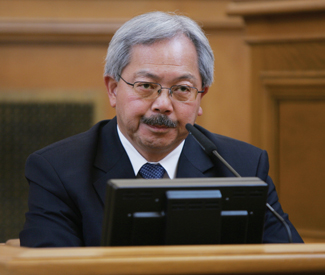
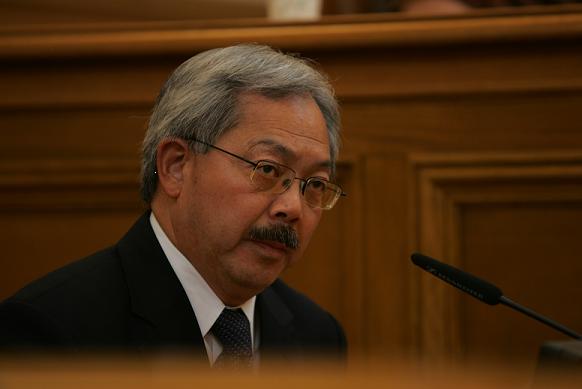
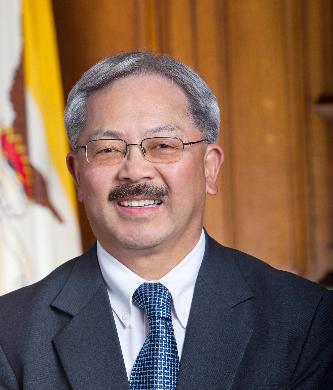
Mayor Lee

Guardian Voices: A place for rage

23

Just a few weeks ago, my partner came home from work in South San Francisco to tell me some horrifying news. A cop had killed a boy she knew, a Black eighth grader named Derrick Gaines. We looked at each other in the way we do when there is too much to say, our eyes wet, our hearts racing, our rage too big for words. We held our son extra tight that night.

Ayoka went to the funeral last Thursday, and was finally able to shed a few of what felt like a mountain of tears inside of her. She supported family and friends who were overwhelmed with grief, and listened to people’s efforts to make sense of this madness. But for anyone who can see the humanity of this young Black man, there is no way for his murder to make any damn sense at all.

I don’t know and I don’t care if Derrick was what the news calls “a good kid” or a “troubled kid,” a “gangbanger” or a straight-A student. What I do know, what matters to my heavy heart, and what is at the source of my rage, is that Derrick was a human being, that he was a kid, that a cop killed him needlessly and that he will most likely get away with it. There will be no apologies, no accountability, no recognition that the cop had many other options than to shoot and kill. And the absence of all this will be another silent attack on our psyche, an unstated affirmation of Black inferiority, of the lesser value of Black lives.

Derrick’s tragic murder has captured less attention than that of Trayvon Martin, but they both have weighed especially heavily on my heart. Both young, Black and male, they were supposedly “looking suspicious” in a non-Black neighborhood. Both Derrick and Trayvon were teenagers minding their business. Neither was in the midst of committing a crime – which would not in any case justify their murder but does draw attention to the degree to which their Blackness itself was apparently the crime being committed.

Both Derrick and Trayvon are dead, no one is safer, and Derrick’s four-year-old brother is left to struggle with the reality that his big brother will never be coming home again. I’ve been to more than my fair share of police accountability protests. But today, on this 4th of July, something is rising up in me that is new. It has to do with the place for rage.

Anybody Black in America has a strategy, conscious or not, for dealing with rage. Some of us are lucky and stumble upon socially productive paths – we serve, we organize for change, we become leaders in our church. Others are less lucky and make choices that lead to violence and self-destruction. Some of us stay permanently in a place of rage, and become one kind of crazy or another.

I confess to having been, for all these years, a fairly reasonable sister, reticent to fully voice my heartbreak, pain and rage about the state of my people. But I’m reconsidering this path.

The moment clearly calls for a new way. We may have a Black president, but these are dark times. It’s Trayvon and Derrick. It’s the Supreme Court’s racist ruling on SB1070, allowing the blatant racial profiling of the “papers please” provision to move forward. All the talk about government agents stopping black and brown people in the street takes me back to slave times, when we needed papers to leave the plantation, when white men were paid to hunt for fugitive slaves, and why my great great great grandfather took his family to Canada after the passage of the Fugitive Slave Act of 1850. It was time to protect his family and leave the madness of the United States of America.

The Black Community faces Depression-level unemployment, a resurgence racist Right and a level of state violence in our everyday lives that is largely invisible to most non-Black people. We have the greatest number of Black people incarcerated of any time in American history; there are more Black men under the control of the criminal justice system today than there were in slavery in 1850. In supposedly progressive San Francisco, Mayor Lee is openly considering New York’s notoriously racist “stop and frisk” policing policy. And even without such a draconian measure, the data already tell us that the majority of Black boys in San Francisco have been stopped, harassed, or arrested by the local cops by the time they become adults.

In the face of what can only be considered extreme conditions, extreme violence and extreme disenfranchisement amongst my people, I confess that I have failed to take the extraordinary measures that are plainly necessary.

See, the thing is, I had good home training and was socialized to be a nice Black girl. I can code-switch and communicate with nearly anyone with a passion that generally gains respect. Even when in the midst of political battle I don’t scream and holler, and have allowed any number of white people to do and say racist things and get away unharmed. Like so many of us, I try to be a Black person with dignity, without losing my shit. As Michael Jackson would say, I’m a lover not a fighter. This strategy has helped me gain social status, an elite education, and some middle class comforts of American life.

So what to do with this rage? What’s the path beyond reasonableness that does not lead to self-destruction? On this 4th of July, I’m remembering our freedom fighters Frederick Douglass and Harriet Tubman, and asking them for wisdom. In my own way and in these times, I want to walk with faith and fearlessness as they did, and not be afraid to put my body on the line for freedom. What sacrifices will we all need to make? What creature comforts or career plans will we need to put aside? What will it take to build a movement that lifts up the value of Black life and our place in a better, more just society?

In Michelle Alexander’s stunning book The New Jim Crow, she makes a clear case that since we won the formal battle against Jim Crow in the 1960s, “We have not ended racial caste in America; we have merely redesigned it.” This contemporary, supposedly colorblind, system of mass incarceration and social control of Black people makes our work more complicated, our moral outrage less understandable and our courage ever more necessary.

Let’s build a movement for racial justice, honor our rage, and find a way to be the Frederick Douglass’ and Harriet Tubmans of the 21st century that these times require.

To support Derrick Gaines’ family, donations can be made at any Wells Fargo to the ‘Derrick Gaines Memorial Fund’ account #: 1636477653.

You can check out Michelle Alexander’s work on the New Jim Crow here. And stay tuned for community organizing against attempts to bring “Stop and Frisk” to SF.

Under oath

19

steve@sfbg.com

Mayor Ed Lee and suspended Sheriff Ross Mirkarimi each took some lumps on June 29 as they were cross-examined by opposing attorneys in front the Ethics Commission, which is conducting the official misconduct case that Lee brought against Mirkarimi over a Dec. 31 domestic violence incident. But the hearings proved unexpectedly dramatic when the room was suddenly cleared for an undisclosed security threat — following testimony by Lee that a city commissioner alleges included perjury.

The incident raises a number of issues that officials hadn’t yet answered by Guardian press time. Was the security threat real? If so, why wasn’t the room or the rest of City Hall properly secured after the mayor was whisked away? If not, who ordered the room cleared and why?

Undersheriff Paul Miyamoto, who ran against Mirkarimi last year, told the Guardian that the San Francisco Police Department notified his office that a caller claimed to have planted bombs outside of City Hall and on the Golden Gate Bridge. Deputies conducted a search and found nothing, and his office didn’t order the recess of the hearing. “We did not evacuate anyone,” he told us.

Speculation about the incident was heightened during the break when Debra Walker, a Mirkarimi supporter and longtime member of the city’s Building Inspection Commission, told the Guardian that Lee committed perjury when he denied speaking with any members of the Board of Supervisors before filing official misconduct charges. Lee was responding to a direct and pointed question from Mirkarimi attorney Shepherd Kopp — one that that Lee’s attorneys had unsuccessfully objected to.

Specifically, Walker said that her longtime friend and political ally Sup. Christina Olague — who Lee appointed to serve the last year of Mirkarimi’s term for the District 5 seat — had told her repeatedly that Lee had asked her advice before filing the charges against Mirkarimi, and that Olague’s advice was that Lee should ask for Mirkarimi’s resignation but drop the matter if he refused.

That allegation, which was first reported on the Guardian’s Politics blog shortly after the commission went into recess (Olague had not yet returned a call from the Guardian asking whether she had spoken to Lee about Mirkarimi), prompted reporters to confront Olague in the hallway outside her supervisorial office, where she tersely denied the allegation and then took refuge behind closed doors.

When the reporters lingered and persisted, waiting for a more complete answer, Olague finally emerged, reiterated her denial, refused to speculate about why her friend Walker would make that claim, and said, “We’re not allowed to discuss this matter with anyone before it comes to the board…I may have to recuse myself from voting on this.”

It was unclear why she thought recusal might be necessary, but if she does disqualify herself from voting on Mirkarimi’s removal later this summer after Ethics completes its investigation and makes its recommendations to the board, that would hurt Lee’s effort to get the nine votes needed to remove Mirkarimi.

When the Ethics Commission hearing resumed after a couple hours, Lee was again placed in a position of denying specific factual allegations that others have made, again raising the possibility that he committed perjury in his sworn testimony, which could expose him to felony criminal charges while undercutting his moral authority to remove Mirkarimi over the single misdemeanor count of false imprisonment that he pleaded guilty to in March.

The second instance was when Kopp asked Lee, “Did you ever extend any offer through third parties that you would find him another job if he resigned?”

“I don’t recall offering Sheriff Mirkarimi any job,” Lee replied.

Kopp specifically asked whether that job offer had been extended on Lee’s behalf by permit expediter Walter Wong or by San Francisco Democratic Party Chair Aaron Peskin, to which Lee replied, “Absolutely not.”

Mirkarimi supporters have told the Guardian that Peskin had made that offer, which Mirkarimi refused, shortly before the party chair publicly called for Mirkarimi’s resignation. The outgoing message on Peskin’s cell phone said he was unavailable and wouldn’t be checking his messages until July 5. Mirkarimi’s attorneys said they’re still figuring out how to respond to the developments and had no comment, but Walker said she’s willing to testify under oath.

But the dramas underscore the treacherous grounds opened up by these unprecedented proceedings, the first involving the Ethics Commission and the broadened definition of official misconduct placed into the City Charter in 1996. As baseball great Barry Bonds and former President Bill Clinton learned, being forced to testify under oath about sensitive topics can be a tough trap to negotiate.


MIRKARIMI TESTIMONY

Deputy City Attorney Peter Keith also seemed to be trying to spring that perjury trap on Mirkarimi as he took the stand on the morning of June 29 following an hour on the stand at the previous night’s hearing. Keith reminded Mirkarimi that he was advised not to discuss his testimony with anyone and asked, “Who have you spoken to since last night?”

“My attorneys,” Mirkarimi answered.

“What did you say to them?” Keith asked, drawing objections about attorney-client privilege that Commission Chair Benedict Hur sustained.

“Did you stop for coffee?” Keith then asked, seemingly concerned that Mirkarimi may have discussed his testimony with someone at the coffee shop that morning, which Mirkarimi denied. Keith let the allegation go but maintained an accusatory, hectoring tone throughout the next three hours that he had Mirkarimi on the stand, two more hours than he had told the commission he would need.

Much of the time was spent trying to establish support for the allegation that Mirkarimi had dissuaded witnesses and sought to thwart the police investigation, which was triggered by a call from Ivory Madison, a neighbor to whom Mirkarimi’s wife, Eliana Lopez, had confided. But the testimony yielded little more than the city’s unsupported inference that Mirkarimi must have directed Lopez and his campaign manager, Linnette Peralta Haynes, to contact Madison after she had called the police and urged her to stop cooperating with them.

Mirkarimi has maintained that he did nothing to dissuade Madison or anyone from talking to police, and that he wasn’t aware of the investigation or that Madison had made a videotape of Lopez showing a bruise on her arm until hours after the police were involved. He even sent a text to Lopez saying there was nothing he could do, as he noted.

“It was after 4pm on January 4 when I first learned of any of this,” Mirkarimi testified, later adding, “I was very clear to her in saying you can’t unring the bell, we have to follow through with this.”

Yet Lee and the deputy city attorneys who are representing him also maintain that they needn’t prove witness dissuasion or other allegations they have made, and that the Dec. 31 incident and Mirkarimi’s guilty plea to a single misdemeanor count of false imprisonment are enough to constitute official misconduct and warrant his removal, an interpretation that Mirkarimi’s attorneys dispute.

Keith sought to hammer home how Mirkarimi should have admitted to and publicly atoned for his crime right away rather than telling reporters it was a “private family matters” (which Mirkarimi admitted was a mistake) or fighting the charges by trying to discredit Madison publicly, an allegation he denies.

After unsuccessfully trying to get Mirkarimi to admit to directing efforts to question Madison’s credibility in local media accounts, Keith asked, “Did you ever direct anyone not to attack Ivory Madison?”

“I never directed anyone to attack or not attack,” Mirkarimi replied.

Keith also clarified that Mirkarimi denies the allegation Madison made that the physical abuse on Dec. 31 went beyond grabbing Lopez’s arm once in the car, as the couple has maintained. “It’s your testimony there was no punching, pulling, or grabbing in the house?” Keith asked, which Mirkarimi confirmed.

Yet Keith said that given the totality of what happened, Mirkarimi should have known he couldn’t continue on as sheriff. “Under those circumstances, wouldn’t resigning be the honorable thing to do?” Keith said, to which Mirkarimi replied that it’s a hard question and that he’s doing what he thinks is right.

Faced with friendlier questions from his own attorney, David Waggoner, Mirkarimi apologized for his actions, saying “I feel horrible and ashamed,” but that he was “sad and scared” to have his family torn apart against their will. He also said that he believes he can still be effective as sheriff because “what makes San Francisco special is our forward-thinking approach to criminal justice.”

Longtime Sheriff Michael Hennessey — who endorsed Mirkarimi and continues to support him — established a variety of programs emphasizing redemption and rehabilitation, hiring former convicts into top jobs in the department to emphasize a belief in restorative justice that Mirkarimi ran a campaign promising to continue.

“Never in my wildest dreams did I think I would be an example of what this redemption process looks like,” Mirkarimi said, choking back tears.

But Keith had the last word before Mirkarimi left the stand, belittling the idea that Mirkarimi offers an example to follow by noting how much probation time and court-ordered counseling he still has to undergo and asking, “The process of redemption doesn’t happen overnight, right?”


LEE ON THE STAND

Under questioning by Kopp, Mayor Lee admitted that he doesn’t have a written policy on what constitutes official misconduct, that his decisions are made on “a case by case basis,” and that he’s not sure whether conviction of a crime would always constitute official misconduct “because I’ve never confronted this before.”

“Were you aware that many members of the Sheriff Department have criminal convictions?” Kopp asked. Lee said he was not aware. Asked whether he was aware that Sheriff Hennessey had hired a convicted murderer into a top command staff position (see “The unlikely sheriff,” 12/21/11), Lee said he wasn’t.

Lee’s insistence that Mirkarimi’s crime makes him unable to deal effectively with other officials was also attacked by Kopp, who asked, “Isn’t it true that people get elected who have disagreements with other city officials?” He pointed out that City Attorney Dennis Herrera had nasty conflicts with Lee when they ran against each other for mayor last year, but that they’re working well together now.

Kopp also drilled into Lee about his decision to bring official misconduct charges before conducting an investigation or speaking with any witnesses besides Madison — an answer Lee blurted out just as city attorneys objected to the question. Much of Madison’s written testimony has been rejected by the commission as prejudicial hearsay evidence (see “Mayor vs. Mirkarimi,” July 27).

But the public’s perception of this case, if not it’s outcome, could turn on whether Lee is holding Mirkarimi to standards that he himself — as someone appointed mayor on a later-broken promise not to run for a full term — couldn’t meet. It was what Kopp seemed to be driving at before the bomb scare.

“You have asserted in your written charges that Sheriff Mirkarimi’s conduct fell below the standard of decency, good faith, and right action that is impliedly required of all public officials, correct?” Kopp asked.

“Yes,” Lee replied.

“We expect certain things of our elected officials, right?” Kopp asked.

After a long pause, in which Lee appeared to be thinking through his answer, he replied, “That’s generally true, yes.”

“And when the charter speaks of official misconduct, it doesn’t say we expect a certain standard for the sheriff, a different standard for the mayor, a different standard for the DA, a separate standard for the assessor, it just speaks in general terms about official misconduct for public officials, right?” Kopp asked.

Kaiser objected to the question on three counts, sustained on the grounds that it calls for a legal conclusion.

“Do you yourself believe there’s a separate standard for sheriff than for other elected officials?” Kopp asked, and this time the city’s objection was overruled and Lee replied, “It should be the same standard.”

“And would you agree with me that one of the things that is expected of elected officials is for them to be honest and forthright when dealing not only with their constituents, but with other elected officials?” Kopp asked, his final question before Chair Benedict Hur announced that the hearing would be suspended and the room would need to be cleared.

After the hearing reconvened, Kopp drew parallels to other city officials who remained on job after scandals, including former Mayor Gavin Newsom (who had an affair with a subordinate who was married to his campaign manager), former Sheriff Dick Hongisto (who was jailed for refusing to carry out a court’s eviction order), and current Fire Chief Joanne Hayes White (whose husband reported that she hit him in the head with a pint glass).

Asked about the latter case, Lee responded, “I don’t know all the circumstances around that and I don’t believe I was mayor at the time.”


Mayor and Mirkarimi testify in Ethics probe before dramatic disruption

261

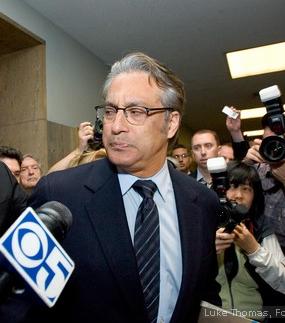
After Sheriff Ross Mirkarimi endured about four hours of questioning in his official misconduct proceedings, mostly from Deputy City Attorney Peter Keith, Mayor Ed Lee took the stand a little after 1pm. But just as Mirkarimi attorney Shepherd Kopp was beginning to pin Lee down on the selective manner in which he decided to launch these unprecedented proceedings, the commission suddenly announced the hearing was being suspended and the room would need to be cleared immediately.

There is speculation that there was a bomb threat or other security emergency, but officials have so far offered no explanation for the dramatic development or whether the hearing would reconvene today. Yet the room is still half-filled with journalists and audience members, some speculating that that the clearing of the room was simply an effort to get the unusually grim-faced Lee off the hot seat.

Kopp’s questioning included pointed questions about whether he consulted any members of the Board of Supervisors before deciding to bring official misconduct charges against Mirkarimi in March. The city’s objection was overruled after Kopp noted that the supervisors will ultimately decide Mirkarimi’s fate. Forced to answer under oath, Lee said no, he didn’t speak to any supervisors before filing charges.

But progressive activist Debra Walker says Sup. Christina Olague — women who are close political allies and speak regularly — has repeatedly told her that Mayor Lee asked her opinion before filing the charges. If true, that would mean Mayor Lee committed perjury, which is a felony. Yet as reporters confronted Olague outside her office, she denied ever speaking with Lee about the case and then barricaded herself in her office.

When the reporters lingered and persisted, she finally emerged, reiterated her denial, refused to speculate about why her friend Walker would make that claim, and said, “We’re not allowed to discuss this matter with anyone before it comes to the board…I may have to recuse myself from voting on this.”

It was unclear why she thought recusal might be necessary, but if she does that would hurt Lee’s effort to get the nine votes on the board needed to remove Mirkarimi.

We’ll have complete analysis of the testimony and other developments in next week’s Guardian.


Ed Lee gets frisky

33

I knew Mayor Ed Lee was going to be more friendly to developers that I would have liked, and I knew he’d be a tough sell on new taxes, but I didn’t expect to see him talking about a program that has racial profiling and civil liberties issues written all over it.

Yeah, we could find some weapons if we simply gave up all rights to privacy. Yeah, if we put a metal detector on Market Street and strip-searched everyone who passed by we’d find some contraband. But seriously — I don’t think even my crazy trolls think this is a good idea.


Why do Lee, Chiu, and others want to stifle economic growth?

16

Why do Mayor Ed Lee, Board of Supervisors President David Chiu, and San Francisco’s two major daily newspapers want to punish success? Because that’s exactly what their proposal to create a new gross receipts tax for businesses – in which corporations would be taxed more as they grow, thus encouraging economic stagnation – would do.

Right now, the city taxes businesses through a payroll tax, levying taxes based on the number of employees the company has. But under a gross receipts tax that would replace the payroll tax, employees have a disincentive to be productive and efficient and increase their companies’ profits because that would expose those companies to more of the city’s onerous tax burden.

Why would investors and employees want to grow a business in San Francisco when that would only submit them to higher taxes. Clearly, this is anti-business measure that is likely to plunge our local economy back into the depths of the recession. Don’t our leaders understand the need to help this fragile economic recovery?

Okay, okay, in case you haven’t guessed it yet, the previous three paragraphs are satire of the ridiculously overblown and misleading political rhetoric used by Lee and other critics of the city’s payroll tax, which they deride as as “job killer” that makes companies not want to hire new employees.

“Mayor Lee and Board President David Chiu proposed a gross receipts tax as an alternative to the City’s current payroll tax, which punishes companies for growing and creating new jobs in San Francisco,” Lee’s office wrote in a press release it distributed last week.

Yet my argument that a gross receipts taxes “punishes companies for growing” is just as logically sound as Lee’s argument that the payroll tax discourages companies from “creating new jobs” – and both arguments are also complete hyperbolic bullshit. But it’s seductively simple and widely parroted bullshit.

“To attract more companies to San Francisco and encourage existing employers to hire more employees, it is past time to do away with this tax,” our new neighbors down the hall, the editors of the Examiner, wrote in their editorial today, a oft-repeatedly refrain from the Chronicle and SF Chamber of Commerce as well. It later added that switching tax methods “wouldn’t penalize companies for employing people or paying them well. And city policy wouldn’t give employers any incentive to shed employees during a downturn.”

But the reality is that the 1.5 percent payroll tax is too small to really be a factor in the decision by corporations to add new employees, something they are already loath to do unless forced to by rising demand. It is simply one imperfect gauge of the size of a company and its ability to pay local taxes, just as the gross receipts tax is.

Health insurance costs, which Lee’s CPMC deal doesn’t adequate contain, is a far bigger factor in a company’s hiring decisions. So is commercial rent, which Lee’s corporate welfare policies are causing to go up downtown and throughout the city.

For decades, conservatives have tried to sell the general public on bogus trickle down economic theories that we all benefit from corporate tax cuts and that people will simply stop working if you tax them, ideas that should have been discarded as they were discredited. But they’re back with a vengeance, in supposedly liberal San Francisco of all places, actively peddled by key Lee supporters like billionaire venture capitalist Ron Conway, who only recently dropped his Republican party affiliation in favor of declined to state.

But it’s time to call out this voodoo economics for what it is: self-serving bullshit that ought to be rejected by citizens of a city that prides itself as being more educated and enlightened than the rubes in the flyover states that have been so thoroughly manipulated by the Republican Party and Blue Dog Democrats, to the detriment of our entire country.

Now, the Examiner’s argument that the business tax reform proposal would broaden and stabilize the tax base is a sound and meaningful argument, which is why the concept enjoys widespread support from across the ideological spectrum and is worth doing (although progressives rightful argue that if the tax base is being broadened then the city should reap some benefits from that, logic that Lee inexplicably resists).

Yet as the City Hall debates that will shape the details of business tax reform begin in a couple of weeks, it’s time to drop this misleading “job killer” label that has been promulgated by Republicans and other fiscal conservatives over the last decade and have an honest debate over what’s best for San Francisco’s private and public sectors.

Guardian voices: The zombie condo converters

28

What is the shelf life of  a really bad public policy concerning housing in  San Francisco?

When it comes to condo conversions of existing rent controlled apartments, the answer is that there is no limit on how many times this bad idea is taken off the shelf. Like a bad summer zombie movie, this undead keeps  walking, no matter what San Franciscans say.

A little history.  In 1982 Supervisor Willie Kennedy, not a bomb-throwing tenant advocate by any stretch, sponsored legislation that limited the  conversion of existing apartments to condos to no more than 200 a year. The measure did not touch new constriction, allowing unlimited condominium construction. Indeed, from 1983 to 2000, some 12,200 new condos were built, an average of some 680 units a year. Since 2000, nearly 100 percent of all new residential constriction is built as condos; there is no limit on renting a condo, but an annual limit in converting an existing apartment. Clearly, condos are a tenure type of housing that is dramatically expanding.

The reason Kennedy and the at-large elected Board of Supervisors voted for the annual limit was to protect rent-controlled apartments, a type of housingthat can’t be expanded. San Francisco’s 1978  rent control ordinance exempted all new construction from being under rent control. So rent-controlled apartments were a fixed number — all apartments built before 1978 — banned by law from ever being expanded. 

Yet those apartments are the largest number of affordable housing units available to moderate and middle income households. Thus, there’s a rational desire to preserve them by a public policy that limits their conversion to condos because they are declining in numbers.

And San Francisco voters understand and support this very rational policy.

In 1989, realtors and speculators tried to overturn the annual limit, proposing a measure that said if 51 percent of a building’s existing tenants voted for a conversion, then the building could be converted with no annual limit. This proposal laid out a future of a Hobbesian society here in San Francisco with one set of well-to-do tenants fighting another set of less-well-off tenants, building by building. San Francisco voters defeated the measure 63-37.

But in the land of the living dead condo converters, no is never the answer.
 
In 2002, Gavin Newsom, Tony Hall and Leland Yee, Plan C, and the Chamber of Commerce placed another measure on the ballot to repeal the annual limit. It too, was  rejected: 60 percent voted no, and 40 percent yes. The measure was defeated in all of the supervisorial districts except  Newsom’s D2, Tony Hall’s D7, and Leland Yee’s D4.

Tenant and affordable housing advocates were not unmoved by the desire of tenants, especially in privately owner rental housing facing Ellis Act and TIC evictions, to seek the protection of home ownership. In 2008 they supported an amendment to the Subdivision Code carving out from the annual limit conversions of apartments by nonprofit, limited equity housing
co-ops.

Now were are confronted again by a desire to allow more conversions of rent controlled units by private buyers who bought into the TIC dodge around the annual condo conversion limit.

Since TIC’s do not require a sub-division map, creating legally recognized separate units, they became “grey market” condos. With hot mortgage money flowing during the bubble, TIC owners could get financing. Now, banks are actually following some laws and will not lend to buy a legally grey TIC.  Thus the move to get them converted to legal condos.
 
This is, in its most basic form, yet another bailout caused by speculative capitalism. We seem to no longer believe in the market as an economic system, in which bad economic decisions result in economic loss for the folks involved. We now seem to believe in the “market society” — in which those with money get to keep it no matter what bad decisions they make.

What this is all about is not really homeownership but about home sales. After all, if you have a TIC you already have a home. You want to convert it to a condo not to live in, but to sell. To make it easier to sell TICs would make it harder to sell the thousands of already approved but stalled new condos.

Mayor Lee administration want to stimulate these stalled condo developments, claiming they will create constriction jobs. The Farrell and Wiener condo conversion plan undercuts these efforts and, of course, will create no jobs for anyone but realtors and moving companies.

This is called a “contradiction of capitalism,” when one set of capitalists seek, to the disadvantage of another group of capitalists, to get the government to intervene on their behalf.  But it does prove once again that Lenin was right when he said that one could count on one set of capitalists to compete with each other to sell rope to hang another set.

It’s really bad economic policy, and even worse housing policy.

The Mirkarimi case: Did the city want to settle?

132

The real news in the Ross Mirkarimi case isn’t the sheriff attempting to get the city to pay his legal fees; that’s just something he had to try but it was a long shot at best. The story that’s come out in bits and pieces since we broke it is far more interesting:

City Attorney Dennis Herrera, with or without the knowledge of his client the mayor, offered to begin discussions with Mirkarimi around settling the case — and the conflicting accounts of what went on show haw harsh this legal proceding has become.

Whatever you think about Mirkarimi’s actions on New Year’s Eve — and I’ve said many times that what he did was unacceptable — the intensity of the prosecution, particularly in the removal proceding, is unprecedented.

Some of the political fallout is clearly Mirkarimi’s fault. He bruised his wife, got bad advice early on, said the wrong things, and didn’t do enough to repair the damage. But now Mirkarimi’s lawyer is charging that the city attorney used a nasty legal gambit to try to convince the embattled sheriff to resign.

David Waggoner, in a TV interview with KGO’s Dan Noyes, and later in discussions with me, said that City Attorney Dennis Herrera offered to look for a way to keep the video of Mirkarimi’s wife out of the public eye — if Mirkarimi would take a financial settlement and resign from his elected position.

Mirkarimi told me the offer he heard from his lawyer put him in a terrible bind: Franky, the video contains nothing that hasn’t already been out, and won’t be the defining issue in the official misconduct case now before the Ethics Commission. But his wife, Eliana Lopez, was adamant that she didn’t want the 45-second clip on the Internet, where she — and more important, their three-year-old son — will have to live with it forever.

“They were using the needs of my family to pressure me,” Mirkarimi said.

Waggoner was pretty specific about his recollection of the settlement discussions. He said that after Herrera contacted him to say that he was willing to discuss settling the case, Waggoner made it clear that keeping the video sealed had to be part of any deal.

“We hung up, and then he called me back five minutes later to say that his government team was working on it, and he thought they could keep the video under seal,” Waggoner said. “The mayor and the city attorney were using the video as leverage.”

Hererra confirmed that he reached out to Waggoner to see if Mirkarimi’s legal team was interested in settlement discussions. But told me that Waggoner’s story was “absolutely, categorically untrue.” He insisted that he had no choice but to release the video, since several media outlets had requested it under the San Francisco Sunshine Ordinance.

In a statement issued June 8, Hererra attacked not only Mirkarimi but his attorneys:

“Everyone involved in this case was well aware of the City’s legal obligations under the Sunshine Ordinance (which Ross Mirkarimi himself had a hand in drafting).  The City invoked the maximum allowable two-week extension after receiving Sunshine requests for the video, to allow other parties to seek a protective order.  But opposing counsel dropped the ball.  They didn’t get a protective order.  They didn’t seek Supreme Court review.  They didn’t raise the issue at the Ethics Commission hearing.  And as far as I know, [Lopez’s counsel Paula] Canny didn’t even bother to show up at the hearing.  So, I think it’s a little absurd now to be playing martyr.  These are lawyers representing a former lawmaker.  They have no excuse for not knowing the law.”

Wow. Sounds like the usually level-headed Herrera is one pissed-off attorney.

Interestingly, Mayor Lee told Noyes that he didn’t know anything about any settlement discussions. Either that’s false (the mayor could have been instructed by Herrera not to say anything) or Herrera was going ahead without the mayor’s knowledge or permission.

So let’s set aside for the moment the back-and-forth about who’s telling the truth and what was really involved in the negotiations. Here’s what’s not in any serious dispute:

Herrera, representing the mayor, was sufficiently motivated to settle the case before it got to the Ethics Commission that he personally called Mirkarimi’s attorney to see if there was any possibility of finding a way out. Again: Attorneys in the most bitter lawsuits are advised to seek settlement. But this isn’t in court, and no judge mandated a settlement conference.

Which suggests that the city attorney and possibly the mayor would be a lot happier if this case just went away. Maybe Lee doesn’t like the drama. Maybe Herrera thinks it would be best for Mirkarimi and the city to put this in the past and move on.

Or maybe they aren’t sure this case is such a slam-dunk winner.

There’s another interesting twist, too: Mirkarimi told me that he asked the Probation Department for permission to fly to Venezuala to see his son. There were no conditions on his guilty plea barring him from travelling outside of the country (what — they think he won’t come back? That he has run through all of his money and put himself heavily in debt to fight a case that he’s now going to run away from?) But when he made a formal request, it was denied.
That’s right — probation officials refused to let him go visit his son. Forget Mirkarimi — that’s not fair to the three-year-old kid who did nothing wrong at all and is suffering for it.

Mayor Lee’s business tax reform will include new revenue

30

Mayor Ed Lee has acquiesced to labor’s demand that the business tax reform measure being negotiated for the November ballot raise tens of millions of dollars in new revenue, rather than being revenue-neutral as Lee and business leaders had previously insisted, according to Guardian sources in both the business and progressive communities who are involved in the ongoing negotiations.

As we previously reported, SEIU Local 1021 had demanded that the measure – which must be submitted to the Board of Supervisors by Tuesday – raise $30-50 million in additional revenue to prevent cuts to city services and to recapture money the city lost when the largest downtown corporations sued the city in 2001 to invalidate its gross receipts tax. If not, the union threatened to qualify a competing ballot measure that would raise the money, something neither side wants.

Sources say the Mayor’s Office has agreed to structure the tax to raise at least $25 million in new revenue, and some believe they will settle on $30 million, which is being supported by the big technology companies and is probably enough for labor to sign onto the deal.

But a complicating factor is the fact that Lee’s representatives are simultaneously negotiating another ballot measure to create an Affordable Housing Trust Fund that will also need to generate revenue, most likely through an increase in the real estate transfer tax, something the commercial landlords are opposing.

The business community has opposed any tax increases, but it is split between the big technology companies who helped elect Lee and more traditional businesses, including the FIRE (Finance, Insurance, and Real Estate) companies that all observers say are likely to get hit with a higher tax burden whatever the outcome of the current negotiations.

There is an urgency to get this deal done now because of the fast-approaching deadline to introduce ballot measures to the board, and the fact that under state law revenue measure can be passed with only a simple majority of voters only in presidential election years.


Sutter’s CPMC deal isn’t healthy

28

At 10am on Friday, June 15, at the main chambers of the Board of Supervisors, the first of a series of public hearings will be held on specific aspects of the  development agreement governing the $1.9 billion Sutter Health/California Pacific Medical Center proposal to expand and centralize the giant health-care outfit’s health center by building a new 555 bed hospital at Geary and Van Ness. The deal involves demolishing the existing 220-bed hospital at St. Luke’s at Mission and Cesar Chavez and rebuilding a new 80-bed facility, expanding the Ralph K. Davies hospital at Duboce and Noe and closing down the old Children’s Hospital in Laurel Heights.

The hearing will be the first before the Board of Supervisors. Thus far, the project has been before only the executive branch: the Planning Commission and the mayor. After a brief introduction on the overall project the hearing will focus on the issue of jobs.

This is the largest project to be negotiated by the Lee administration — and although the mayor introduced it to the board in May, not one supervisor has yet joined him to sponsor the legislation. That’s an an odd situation given the importance of the project – and the fact that Mayor Lee can usually count on an automatic four votes from the conservative faction of the board. But not this time.

The hearing was requested by a coalition of more than 60 community, neighborhood, labor, and environmental organizations — San Franciscans for Healthcare, Housing, Jobs and Justice (SFHHJJ) — which has been closely following the project for the last two years.  Members of the coalition have already appealed the project’s environmental impact report, passed last month by the Planning Commission, and SFHHJJ has developed a series of amendments to the agreement that it has been pressing on the Board of Supervisors.  Board President David Chiu agreed to set a series of hearings on the project before it voted on, along with the determination of the appeal of the EIR, in  late July.  SGHHJJ hopes to use the hearings to get across the serious shortcoming of the agreement.  In addition, depending upon the appeal of the EIR,  a law suit may well be filed by some members of the Coalition.

In short, what starts next Friday is a big deal.

Not only is it a big deal in the development war that is at the heart of San Francisco politics, but it also is a big deal given what may well be done by the Supreme Court in deciding the constitutionality of all or part of the Affordable Health Care Act. If Obama’s health reform is struck down by the court, in all or in part, which seems almost certain, Sutter/CPMC’s plan will most definitely take on even more importance for the future of health care and its costs in San Francisco.

Sutter currently controls about a third of the market for health care in San Francisco.  With the construction of this project, it will control about 40 percent — a portion most knowledgable observers feel will give it market dominance  and an ability to actually set health care costs in San Francisco. Sutter’s business model — as shown in Berkeley when it took over Alta Bates and elsewhere in the state – demonstrates that  with a dominate market position, it jacks up prices.

As the San Francisco Chronicle noted in 2010: “…Sutter Health Co. has market power that commands prices 40 to 70 percent higher than its rivals per typical procedure — and pacts with insurers that keep those prices secret”.

A US Supreme Court that weakens or strikes down health care reform will simply re-establish the status-quo ante, a situation in which Sutter will thrive.

And that’s why the board’s conservative members are not supporting Mayor Lee’s deal: it simply does not protect the city — itself a major health care consumer for both its workforce and Healthy San Francisco — from Sutter’s history of turning market power into high health care charges.

SFHHJJ want the development agreement amended to place a cap on the costs charged to the city, allowing Sutter no more than 115 percent of the average charged  by  San Francisco’s other private, nonprofit hospitals.  It also wants Sutter/CPMC low charity care payments pegged at an average of what other nonprofit hospitals contribute, and it is calling for rebuilding St. Luke’s in San Francisco medically underserved south east to 180 beds, not the sure-to-fail size of 80 beds.

But there’s even more to deplore about the proposed deal.

In housing, although the EIR showed that a demand would be created for some 1,500 new two-bedroom homes, Sutter/CPMC agreed to only provide funds to build about 90 such homes. Such a massive shortfall will boost housing prices all other San Franciscans will pay.

The project’s impact on public transit at the Geary / Van Ness intersection will be large and ongoing. More than 20,000 new car trips will be generated at that intersection by the new hospital. Plans for a Bus Rapid Transit raised roadway for the 38 Geary — the most used bus line in the city — will have to be altered at an unknown price since the project calls for all auto traffic to enter the site on the Geary Avenue side.

Again, San Francisco taxpayers will be on the hook to pay for these new costs.

But it is the jobs aspect of the deal that is the most distressing. Sutter/CPMC has a long history of labor disputes with its workforce. Last year it replaced nurses who took a day off to protest their working conditions, and a replacement nurse hired by Sutter accidentally killed a patient. Sutter/CPMC refuses to agree to hire all of its 6,000 current employees for the new facilities. It’s requiring them all to apply as new workers, losing all of their seniority, with a real prospect that many currently employed San Francisco residents will lose their jobs once the new facility opens. All that Sutter/CPMC has agreed to do is hire 50 residents a year for four years – 200 new local jobs, total.

The  June 15 hearing will focus on the jobs issue and public comment is sure to be hot on this laughable “commitment” agreed to by the “jobs” administration.

Calvin Welch is a longtime community organizer living in San Francisco. He currently teachs a course in the development history of San Francisco at San Francisco State University and the University of San Francisco.

Mecke joins crowded District 5 supervisorial race

26

Progressive activist Quintin Mecke jumped into the District 5 supervisorial race today, echoing gentrification concerns raised this week by the Guardian and The New York Times and promising to be an independent representative of one of the city’s most progressive districts, a subtle dig at Sup. Christina Olague’s appointment by Mayor Ed Lee.

“The City is at an economic crossroads. As a 15 year resident of District 5, I cannot sit idly by while our City’s policies force out our residents and small businesses, recklessly pursuing profits for big business at whatever cost,” he began a letter to supporters announcing his candidacy, going on to cite the NYT article on the new tech boom that I wrote about earlier this week.

“What we do next will define the future of San Francisco; the city is always changing but what is important is how we choose to manage the change. One path leads to exponential rent increases, national corporate chain store proliferation, and conversion of rent-controlled housing. The other path leads to controlled and equitable growth, where the fruits of economic development are shared to promote and preserve what is great about this City and our district,” Mecke wrote.

Mecke came in second to Gavin Newsom in the 2007 mayor’s race and then served as the press secretary to Assembly member Tom Ammiano before leaving that post last week to run for office. Mecke joins Julian Davis and John Rizzo in challenging Olague from her left, while London Breed and Thea Selby are the leading moderates in a race that has 10 candidates so far, the largest field in the fall races.

Although he never mentioned Olague by name, Mecke closed his message by repeatedly noting his integrity and independence, a theme that is likely to be a strong one in this race as Olague balances her progressive history and her alliance with the fiscally conservative mayor who appointed her.

“Politics is nothing without principles; and it’s time now to put my own principles into action in this race,” Mecke wrote. “District 5 needs a strong, independent Supervisor. I am entering this race to fight for the values that I believe in and to fight to preserve what is great about District 5 and the city. I have brought principled independence to every issue I’ve worked on and that’s what I’ll continue to bring to City Hall.”

In an interview with the Guardian, Mecke said he sees the campaign as a “five-month organizing project” to reach both regular voters and residents of the district who haven’t been politically engaged, including those in the tech sector. He’d like to see the perspective of workers represented in discussions about technology, not simply the narrow view of venture capitalist Ron Conway that Mayor Lee has been relying on.

“Local politics needs new blood,” Mecke said, “it needs to hear from these people.”

Reading Ed Lee’s mind

15

Political reporters love to believe we can read politician’s minds; it makes us feel important. (And Lord knows, these days we need something to make us feel important.) So let me go way out on a limb here and tell you what Mayor Lee is thinking right now:

1. Gotta minimize Prop. B. It was an aberration, a bunch of rich Nimbys from Telegraph Hill, nothing more to see here. Certainly not a public referendum on my Rec-Park director, Phil Ginsburg, and his efforts to make money by renting out city parks for private events. No no no, just ignore it and maybe it will go away.

2. We won back the Democratic Party. Good move to take a page from Aaron Peskin’s book and run a bunch of elected officials and former elected officials with high name recognition in a low-turnout election. Bevan Dufty, who happens to work for me, would make an excellent chair; should be easy to make that happen.

3. What if we look at the DCCC race in the 17th District as a first-pass primary for the 2014 Assembly seat when Tom Ammiano — who’s just way too independent and won’t get with my program — is termed out? Hmmm … David Chiu, who I can mostly deal with, is in first place — but John Avalos and David Campos are more popular than my pal Scott Wiener. And if the progressives get behind Campos, he’ll be tough to beat. Hmmm….

4. That oddball Michael Breyer ran for Assembly pretending he was me. He even put out a mailer with my mustache on the front suggesting that he’ll be just like I am (except that he’s white and has no experience and no credible program and isn’t going to win). But he got a lot of votes with the Ed Lee card and I could totally control him. Can’t support him over Phil Ting, of course, but maybe I can get him some help behind the scenes.

5. This was an unusual election with radically low turnout. I know I can’t read too much into it. If the DCCC were on the ballot in November, or if there were a real presidential primary to bring people out to vote, the results would be very different. But still: All that new housing for rich people that my mentor Willie Brown and my friend Gavin Newsom got started seems to be having an impact. The city’s getting more conservative. Let’s just keep that one going and I’m home free.

6. What’s up with Lincecum? Damn those Padres.

Nah — the mayor’s too nice a guy to be thinking like that. Right?


Mayor Lee’s priorities are wrong

0

By Margaret Brodkin

OPINION There was much back slapping at City Hall last week as officials congratulated themselves on what was described as a welcome “philosophical shift” in San Francisco politics.

The beneficiary of the acclaim and virtual political consensus was Mayor Ed Lee’s proposed budget, the largest in history — including an unexpected windfall of new revenue. The budget’s signature element, described in glowing terms by the San Francisco Chronicle’s C.W. Nevius and warranting its own special mayoral press conference, is the expansion of the police and fire budgets — an $82 million increase over two years.

Amid last week’s ovations was an unsettling silence from voices normally willing to cut through obscure numbers and rhetoric. Not one official commented that the best way to ensure public safety is to build strong children, families, and communities.

The cumulative impact of the devastating state budget and years of inadequate funding on families and children should not permit celebration. In light of millions in unanticipated revenue, politicians should not be satisfied with addressing urgent needs simply by sparing a few city departments from cuts, as appeared to be the case. Here’s what they should be thinking about:

• Our schools face the worst budget cuts ever, with SFUSD preparing to lay off 400 employees, reduce the already-too-short school year, increase class size, eliminate most school bus lines and all high school after-school programs, and under-fund everything from food to special education.

• Our childcare system is being gutted by the state, with $20 million in losses this year on top of $9 million from last year. This will impact thousands of families and result in the closure of centers and family childcare homes. Many fewer parents will be eligible for childcare subsidies (no one with two kids earning more than $37,500 a year will qualify) — pushing parents out of work and onto “welfare,” and children out of quality care and into unsafe settings.

• Support systems for children with disabilities are being eliminated and reduced through simultaneous cuts in multiple agencies.

• Young people entering community colleges or state universities face years of uncertainty — including whether their campuses will even exist. Already, the majority of SF students who enter City College are unable to graduate — stymied by costs, lack of educational support, or the inability to get classes they need.

It appears that little of the new millions will address these problems. The mayor’s budget does not even fully fund the voter-approved Public Education Enrichment Fund, passed in 2004 to provide essential services to public schools and preschools. Funding falls short by more than $10 million. Providing schools the funds to which they are legally entitled is the least we can do when the city lands millions in new resources.

Let’s be clear: crime is at historic lows — and has gotten that way with 200 fewer officers than the mayor is now advancing. There is little rationale to suddenly swell the ranks, at a cost of $140,000 per officer. The Fire Department’s inefficiencies have been well documented by city budget experts, and many cost-saving recommendations have yet to be implemented.

Before signing off on a budget they have not yet discussed in public (as it appeared to last week), the Board of Supervisors must evaluate fiscal options in full view. Private meetings with the mayor are no substitute for a robust debate now that the revenue facts are known. This is the city’s first two-year budget, and its policy direction will impact us all for years to come.

What looks to Nevius like a positive “drama-free, signature moment” for San Francisco, looks to many advocates for children and families like an abdication of responsibility.

Margaret Brodkin is a former executive director of Coleman Advocates for Children, director of the Department of Children, Youth and their Families and New Day for Learning, and a veteran of numerous budget processes

The circus begins

199

steve@sfbg.com

Mayor Ed Lee and his attorneys are presenting a voluminous yet largely speculative case against suspended Sheriff Ross Mirkarimi in their effort to remove him for official misconduct, broadening the case far beyond their most damning core accusation -– that Mirkarimi dissuaded witnesses from telling police that he bruised his wife’s arm during an argument on Dec. 31. And so far, there’s no evidence to support that key allegation.

In fact, Mirkarimi and his attorneys insist there was no effort to dissuade witnesses, one of many unsupported aspects to a case they say should never have been filed without stronger evidence. And they say the mayor’s team is now compensating for the weakness of its case by piling on irrelevant accusations and witnesses in an effort that amounts to character assassination.

There are even signs that the city is nervous about its case. Knowledgeable sources told the Guardian that the City Attorney’s Office last week offered to settle the case with Mirkarimi, offering a substantial financial settlement if he would agree to resign, an offer that Mirkarimi rejected.

It was one of a series of rapidly unfolding developments that also included a raucous Ethics Commission hearing, the disclosure of phone records by Mirkarimi’s side, a new list of charges, and the city’s release of the video Mirkarimi’s wife, Eliana Lopez, made with neighbor Ivory Madison, documenting the bruise in case of a child custody battle over their son.

Lopez has maintained that Mirkarimi never abused her and that she’s been hurt most by the efforts to prosecute him and remove him from office.

“I hope they realize after reflection that what they have done is irreparable and perpetually damaging to me and my family,” Lopez said in a statement condemning the city’s release of a video that she fears will remain online for her children and grandchildren to see.

Yet all indications are this spectacle is only going to grow more sordid, divisive, and sensational as it moves forward — belying the statement Lee made last week as he introduced his annual budget: “As many of you know, I’m a person who does not like a whole lot of drama.”

SIMPLE OR COMPLEX?

The May 29 Ethics Commission hearing to begin setting standards and procedures for the official misconduct proceedings against Mirkarimi illustrated two sharply divergent views on when elected officials should be removed from office. It also displayed the increasingly bitter acrimony and resentments on each side, emotions only likely to grow more pronounced as the hearings drag on for months against the backdrop of election season.

Both sides would like to see the decision as a simple one. Lee and his team of attorneys and investigators say Mirkarimi’s bruising of his wife’s arm and his unwillingness to cooperate with their investigation of what followed make him unfit for office. Mirkarimi and his lawyers admit his crime, but they say that’s unrelated to his official duties and that the rest of Lee’s charges against him are speculative and untrue.

Yet there’s nothing simple about this official misconduct case — or with the implications of how each side is trying to counter the others’ central claims. So despite the stated desires of some Ethics commissioners to narrow the scope of their inquiry and limit the number of witnesses, San Franciscans appear to be in for a long, dramatic, and divisive spectacle, with Mirkarimi’s fate decided by the Board of Supervisors just a month or so before the five supervisors who have been his closest ideological allies face reelection. Nine of 11 votes are required to remove an official.

The Mayor’s Office wants to call the most witnesses and present an elaborate (and expensive) case that includes a number of outside experts on law enforcement and domestic violence, painting a portrait of Mirkarimi as a serious wife-batterer whose past and future actions can be divined from that malevolent distinction, making him obviously unable to continue as San Francisco’s chief law enforcement officer.

“The extent of the abuse was far greater than what Mr. Mirkarimi has testified to,” claimed Deputy City Attorney Peter Keith, going on to say “there were attempts to control what she ate,” an apparent reference to Mirkarimi’s decision not to take Lopez to a restaurant for lunch on Dec. 31 because they were having a heated argument. He also repeatedly referred to Mirkarimi as a batterer and said “batterers behave in a certain way.”

Mirkarimi attorney Shepard Kopp calls that portrayal exaggerated and unfair, ridiculing the Mayor’s Office claims that its domestic violence expert, attorney Nancy Lemon, can predict Mirkarimi’s behavior based on grabbing his wife’s arm once: “Apparently she’s some kind of clairvoyant in addition to being an expert,” Kopp told the commission as he unsuccessfully sought Lemon’s removal from the witness list.

Ethics Commission Chair Benedict Hur took the lead role in trying to limit the witness list, focusing on stripping it of the various law enforcement experts who plan to describe how different agencies might react to dealing with Mirkarimi. “What I don’t understand is how his ability to do his job relates to whether he committed official misconduct,” Hur said.

Mirkarimi’s team says its case could be very simple, with only Lee and Mirkarimi called as live witnesses — but the attorneys reserved the right to offer testimony to counter false or damaging claims made by the Mayor’s Office.

Hur tried to limit the case to just witnesses and arguments that relate to Mirkarimi’s actions, but he was outvoted by those who wanted to let the city argue how those actions would affect perceptions of Mirkarimi by the many people that a sheriff must interact with.

In the end, the commissioners agreed to trim the eight expert witnesses sought by the mayor down to three and to cut its 17 proposed fact witnesses down to 12, calling 15 total witnesses. Mirkarimi’s team will call 10 witnesses, down from an initial 17. All witnesses will submit written declarations and then be subjected to live cross-examination if any of their testimony is disputed.

EVIDENCE AND SPECULATION

The speculative and prejudicial nature of some of the city’s case was attacked at the hearing by Mirkarimi’s attorneys and the large crowd that came to support him.

Commissioner Paul Renne asked the Mayor’s Office attorneys why they hadn’t summarized the expected testimony of their expert witnesses and “How are any of those opinions relevant to the issues in this case?”

“I have not had time to work with the witnesses to see what their opinions are,” replied Deputy City Attorney Sherry Kaiser, prompting Kopp to incredulously note, “The mayor is preparing the expert witnesses without knowing what their testimony will be. How can I respond to that?”

The issues of bias and conflicts of interest also came up surrounding what sources should be called as witnesses. Mirkarimi’s team wanted longtime Sheriff Michael Hennessey, Mirkarimi’s predecessor, while the Mayor’s Office pushed for Acting Sheriff Vicki Hennessy to convey how the Sheriff’s Department should function.

“Vicki Hennessy was a political appoint of Mayor Lee,” Waggoner objected, although the commission decided to use that appointee.

On several critical procedural questions, the commission sided with the Mayor’s Office, ruling that the commission decision needn’t be unanimous, that guilt could be established based on a preponderance of the evidence rather than beyond a reasonable doubt, and that normal rules of evidence won’t apply, with some hearsay evidence allowed on a case-by-case basis.

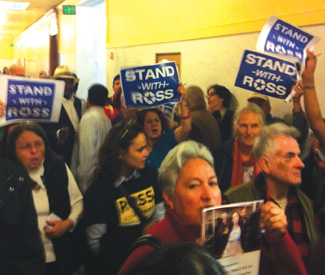
The pro-mayor decisions angered the roughly 200 Mirkarimi supporters who packed the commission hearing and an overflow room, many bearing blue “We stand with Ross” stickers and flyers, which had “Respect Eliana” on the flip side. There were only a couple of Mirkarimi critics at the hearing wearing white “I support Casa de las Madres” stickers, referring to the domestic violence group that has been calling for Mirkarimi’s removal since shortly after the incident went public.

Mirkarimi got a rousing welcome from the crowd when he arrived at the hearing, his voice choking up and eyes welling with tears as he said, “I cannot tell you, on behalf of me and my family, how grateful we are.”

The crowd was boisterous during the proceedings, loudly reacting to some claims by the deputy city attorneys and offering comments such as “Ed Lee is the one you should put on trial,” with Hur finally recessing the hearing after an hour and having deputies warn audience members that they would be removed for speaking out.

Renne, a career litigator and the District Attorney’s Office appointee to the commission, raised the most doubts about both the standard of guilt and rules of evidence being lower than in criminal proceedings, telling his colleagues, “I have some reservations.”

PHONE LOGS

Mirkarimi’s team also released to the Chronicle and the Guardian redacted phone records from Mirkarimi, Lopez, and Linnette Peralta Haynes — a family friend and social worker who served as Mirkarimi’s last campaign manager. The city has sought to portray Haynes, who has not been cooperating with the investigation, as a conduit to Mirkarimi’s efforts to dissuade Lopez and Madison from going to the police on Jan. 4.

Mirkarimi previously told the Guardian that he was unaware that Lopez had told Madison about the abuse incident or that they had made a video of her injury until several hours after Madison had called the police and they had come to the house to talk to Lopez, during which time Mirkarimi was in a series of meetings at City Hall.

The phone records seem to support that claim. They show that Lopez and Haynes — who is close to Lopez and recently went to Venezuela to visit her — exchanged a series of telephone calls on Jan. 4 starting at 11am. Their longest conversation, nearly 40 minutes, occurred at 11:18am.

Neither woman could be reached to describe the substance of that call. At 12:24pm, Lopez sent Madison — with whom she had been communicating by phone and text over the previous couple days — a text message indicating that she didn’t want Madison to report the incident to police, but that she would instead go to her doctor to document the injury.

A minute later, Madison called the police to report that Lopez had been abused by Mirkarimi.

Starting an hour later, the records show, Haynes and Lopez called each other but didn’t connect until 3:31, when they had a nearly 14-minute phone conversation, presumably discussing the fact that police had visited the house, with Lopez reportedly giving the phone to Madison at one point so Haynes could talk to her.

Yet the phone records indicate that neither Lopez nor Haynes tried to reach Mirkarimi until after that conversation, despite the city’s claims that Mirkarimi “or his agents” used his power to dissuade witnesses, most notably Lopez and Madison. The first attempt to reach Mirkarimi was at 3:46pm when Haynes called him twice but didn’t connect. Lopez then sent Mirkarimi a text message at 3:53pm asking “Where are you and where is the car,” but she got not reply. She texted him again at 4:18pm to say “Call me. It’s an emergency.”

Lopez made one last appeal to Madison in a 4:18pm phone conservation that lasted four minutes and 27 seconds and then she finally reached Mirkarimi by phone at 4:23pm. Mirkarimi and attorney David Waggoner say this is the first time that he became aware that Lopez had talked to neighbors and that the police had been called. Their conversation lasted a little more than five minutes.

Mirkarimi called Haynes at 5:12pm and they spoke for seven minutes. At 5:51pm, an increasingly panicked Lopez sent a text to Mirkarimi saying, “You have to call [Sheriff Michael] Hennessey and stop this before something happen. Ivory is giving the investigators everything. Use your power.” To which Mirkarimi responded 10 minutes later, “I cannot. And neither can he. You have to reject Madison’s actions. We both do. I cannot involve new people.”

NEW CHARGES

On June 1, the city released an amended list of charges against Mirkarimi that was intended to be a more specific list of accusations, as Waggoner requested during the May 29 Ethics Commission hearing. In it, the city asserts that the charter language essentially gives the city two avenues by which to remove officials, defining distinct “wrongful behavior” and “required conduct” clauses. Violation of either, they contend, is enough to remove an official.

“Official misconduct means any wrongful behavior by a public officer in relation to the duties of his or her office, willful in its character, including any failure, refusal or neglect of an officer to perform any duty enjoined on him or her by law…,” begins the charter language. This “wrongful behavior” section has long been in the charter, referring to specific actions by public officials to neglect their duties.

The second “required conduct” clause of this sentence — which was created in 1996, never vetted by the courts, and which Mirkarimi’s attorneys say is unconstitutionally vague — continues, “…or conduct that falls below the standard of decency, good faith and right action impliedly required of all public officers and including any violation of a specific conflict of interest or governmental ethics law.”

In trying to indict Mirkarimi for actions before he was sworn in as sheriff, the city attempts to argue that his official duties really began with his election, claiming that in this interim period he “had the duty and the power in his official capacity as Sheriff-Elect to work with the Sheriff’s Department and its officials to prepare himself to assume the full duties of Sheriff.” And if that’s not enough, the city argues that he was chair of the Board of Supervisors Public Safety Committee during that same Nov. 8-Jan. 8 time period, further subjecting his actions to official misconduct scrutiny.

The “wrongful actions” charges against Mirkarimi were listed in the document as domestic violence, abuse of office, impeding a police investigation, and “crime, conviction, and sentence,” while the “breach of required conduct” charges were listed simply as his sheriff and supervisorial roles.

The document then attempts to paint an expansive portrait of the Sheriff’s official duties, going beyond the narrow construction of the charter to include the general law enforcement duties listed in state law, interactions with various government and nonprofit groups, administrative responsibilities as a city department head, and passing mentions in the California Family Code that police officers “must enforce emergency protective orders in domestic violence cases.”

Yet the promise that the rest of the document would detail Mirkarimi’s wrongful actions with greater specificity than the previous list of official charges doesn’t seem to be met by this document, which repeats the same narrative of actions that Waggoner had criticized for vagueness.

For example, on the pivotal charge that he dissuaded witnesses and impeded the police investigation, the new charges say that during the period from Dec. 31-Jan. 4, “Sheriff Mirkarimi participated in and condoned efforts to dissuade witnesses from reporting this incident to police and/or cooperating with police investigators,” without describing any specific witnesses or actions that he took.

And by the mayor’s team’s own admissions, the prosecutors don’t know what Mirkarimi did to dissuade witnesses, which they hope to learn through future testimony.

The closest the new document comes to directly tying Mirkarimi’s actions to the official misconduct language is with Mirkarimi’s plea to a misdemeanor false imprisonment charge: “False imprisonment of a spouse is a crime of domestic violence. The California Penal Code considers spousal abuse to be a ‘crime against public decency and good morals.'”

Mirkarimi disagrees with that interpretation, noting that he and his attorneys specifically considered whether pleading to false imprisonment -– a general charge with many possible meanings -– would violate the city’s official misconduct provisions, and he told the Guardian that he was assured by his attorneys it didn’t. Mirkarimi told us he would not have entered the plea and would have instead fought the charges in court if he thought it would disqualify him from serving as sheriff.

Waggoner told us that “The Mayor’s Amended Charges are further evidence that this entire ordeal is a political hatchet job reminiscent of a Soviet show trial. Far from being a careful analysis of any actual evidence, the new charges are vague, redundant, and conflate the offices of Sheriff and Supervisor.”

But ultimately, the case against Mirkarimi is a political one, not a legal case subjected to the normal standards of evidence and procedure. And whether Mirkarimi keeps his job will be a decision made by politicians based on a variety of factors, some of which have little relation to whatever happened on Dec. 31 and Jan. 4.

What’s next: the Ethics Commission will meet on June 19 to rule on more of the outstanding issues in the case and begin hearing testimony. To review the long list of documents from the case, visit www.sfethics.org.

Oakland gets jilted

0

By Frank Artrage

news@sfbg.com

After a secret whirlwind courtship that lasted a mere five months, Mayor Ed Lee and the Golden State Warriors tied the knot May 22 at Piers 30-32, announcing their unexpected union at the site they intend to occupy with a new basketball arena by 2017.

The Warriors’ entrepreneurial new owners — Joe Lacob and Peter Guber — say they love this “iconic site” and promised to build a “spectacular sports and entertainment complex” that is “architecturally significant.”

But what about Oakland, the team’s unceremoniously jilted current homemaker? The perception from the East Bay is that Lacob and Guber were duplicitous and underhanded in their dealings with city officials that were desperately trying to retain the city’s three main sports franchises — the Oakland Athletics baseball club, the Oakland Raiders football team, and the Golden State Warriors basketballers — all of whom have recently signaled interest in moving.

Several sources told us that the Warriors’ new owners have been lying to Oakland officials about their intentions for months. For example, Oakland City Councilmember Larry Reid told me “that when our staff had conversations with the new owners, they always indicated they hadn’t yet come to a final decision.”

Reid told me what happened next. “I get a call Sunday night at 9:30 telling me about their move like a thief in the night.” Reid said. “It’s upsetting.”

On the fan site GoldenStWarriors, Lacob seemed to belittle Oakland. In an 18-minute video, Lacob predicts that Oakland will be left with only one sports team someday. “I think they’re challenged,” he said when asked what’s wrong with Oakland, adding the city is in “a difficult situation.”

Sports talk radio hosts, fan sites, and bloggers, however, seem to be evenly divided on the move. Even hardcore Oakland and Warriors blogger Ethan Sherwood Strauss prefers the San Francisco site. At his Warriorsworld site, Strauss wrote: “I’d never leave Oakland…. I have everything at arm’s length. There’s food from around the world, teeming farmers markets, lush green hills, Redwood trees, Mosswood Park, Grand Lake Theatre — this is all within two miles.”

But: “Guess which is the better place for the Golden State Warriors? It’s that west bay city national broadcasters keep showing during Warriors games while pretending Oakland doesn’t exist.”

Thus far, neither Oakland Mayor Jean Quan nor Mayor Lee have made any comments regarding the other side’s situation or whether their mutually reported “good relationship” has been strained. But it must be devastating to Quan, given all of her work and hoopla over her recent announcements surrounding her ambitious plans for the “Coliseum City” project.

Not unlike the Warriors’ “world class arena” planned for their new San Francisco home, Coliseum City, according to Quan, will be a “world-class sports and entertainment district.” Ryan Phillips, writing on the Oakland North blog in March, said that the project includes “building hotels, retail, office and residential space in the Coliseum complex…as well as building an Oakland Airport Business Park just across the freeway on the way to the airport. The business park will be developed to attract tech companies.”

Mayor Quan issued a press release following the Warriors’ bombshell to announce that she remains “bullish” on her Coliseum City project. Her new spin is that, “Coliseum City is a long-term development project that was never dependent on any one tenant. It was always a larger project than just one sports team.”

But if there’s even one team missing from the original trinity, then they have no choice but to lower their expectations and scale back their plans. Therefore, the Warriors’ move could trigger a complete unraveling of not only her recent plans to keep the Oakland A’s baseball team in Oakland, but also efforts to keep any team there.

For example, a case study published by the Airport Area Business Association (AABA) in conjunction with Coliseum City principal and manager Oakland-based JRDV Urban International, and students at UC Berkeley’s Haas School of Business found, The Coliseum complex presents a unique opportunity to prepare a pioneering business model that generates revenue for both public and private interests.”

Presciently, in the wake of this announced move by the Warriors and how that hurts Oakland, the study asked: “Are the withdrawal of redevelopment monies, the negative perception of Oakland (and especially Deep East Oakland) by investors and the soft commercial real estate market insurmountable? Can the City of Oakland and Alameda County garner the public support required to approve the necessary public financing and inspire investor confidence?”

Manning up, Councilmember Reid told me that Oakland bears some responsibility for this fiasco. “I’ve been agitating for 10 years to get this Coliseum project going. But let me tell you about two critical mistakes Oakland has made over the last decade,” he said. “One, Oakland has always taken the position that these teams had no place to go. Well, you see where that thinking got us today…Two, 10 years ago the decision was made to invest in the old [Oakland] Army Base. Yet, to this day, not one spade of dirt has been unearthed to symbolize any kind of progress is underway there. In fact, the whole project is at a standstill.”

Maybe, but Oakland and Warriors’ fans should not despair. It is not a done deal because a million things could go wrong. For example, this will be the fifth attempt to develop Piers 30-32 into something spectacular over the last several years.

Also, environmental groups and local activists are already squawking about the site. It has to pass a notoriously tough approval process of at least four major agencies. Financing might fall through, at least until Warriors ownership present to the press, government, and citizens some details: Tuesday’s press conference was basically a pep rally — the only thing missing were the pom-poms. Finally, Pier 30-32 and the site have yet to pass muster over the environmental and safety concerns and myriad other requirements of the California Environmental Quality Act (CEQA).

If any obstacle dooms the Warriors’ plans, Oakland’s Assistant City Administrator Fred Blackwell said they’d keep the door open for these prodigal owners: “And in the end, we will leave a space for the Warriors after they are exhausted from the CEQA litigation and cost increases required to be on the San Francisco Waterfront.”

“In a nutshell,” according to a City Hall press aide, Blackwell “means that waterfront development is expensive and requires an extensive and complex environmental review and permitting process involving review and approval by a number of local, state, and sometimes federal agencies.”

But what if it is a success? Oakland loses even more than just the Warriors. At least one politician pointed out, and I also heard this on 95.7 FM The Game, that what’s to stop circuses, ice shows, and major rock stars from ditching Oakland and following the Warriors to this splashy and scenic new entertainment venue?


Mayor Lee signs watered-down limits on SFPD spying

6

Flanked by members of Coalition for a Safe San Francisco, Police Chief Greg Suhr, and Sup. Jane Kim, Mayor Ed Lee today signed legislation that calls for San Francisco Police officers working with the FBI’s Joint Terrorism Task Force to respect privacy rights in the California Constitution and local laws and calling for annual reports on SFPD-FBI activities.

Coalition members trumpeted what they called “historic civil rights legislation,” but this watered-down version of legislation that Lee vetoed last month doesn’t offer the same guarantees and codification of privacy principles as the previous version, which was approved on a 6-5 vote of the Board of Supervisors, whereas this new version won unanimous approval.

Its endorsement by the most conservative supervisors – those most deferential to the SFPD, politicians who routinely vote against even the most innocuous progressive legislation – is a sure indicator that the legislation doesn’t really do much to clips the wings of the SFPD, which initiated this controversy with a secret 2007 agreement with the FBI that federalized local officers.

That was precisely the objection to the initial legislation that were offered by Lee and Suhr, that it codified local privacy protections with specific limits on SFPD officers engaging in surveillance on citizens who had broken no laws, and that it subjected any future agreements with the FBI to approval by the Police Commission. The new legislation is far more vague.

“It is a step in the right direction, there’s no doubt it’s progress, but whether it’s real progress depends on the implementation,” says John Crew, an expert on police practices with the American Civil Liberties Union-Northern California, which unearthed the 2007 secret memo.

Crew has worked on this issue for years and has been troubled by the FBI’s claims that local laws don’t apply to federalized agents, with the SFPD’s resistance to allowing specific limits to be codified in local law, and with the deferential position Lee has taken to the SFPD. Crew said the strongest part of the new ordinance is the explicit statement that local officers can’t ignore local and state laws, but the details of how that’s applied weren’t really addressed in this new version.

“The question now is will there be a vigilant, meaningful, and sustained effort to implement this law and will there be sufficient transparency,” Crew said.

Two of the strongest advocates for the new law, Nasrina Bargzie of the Asian Law Caucus and Zahra Billoo of CAIR-SFBA, say the compromise version addressed their main issues and is worth celebrating, but they agree with Crew that its strength will ultimately depend on how it is implemented.

“We don’t see this as the end. We need to make sure it is implemented properly,” Billoo said, calling it a “watered down version” of the stronger and more specific initial legislation.

For example, the legislation calls for annual reports on FBI-SFPD activities, but it doesn’t go into much detail on what those reports will include.

“Part of what we’re going to do is communicate with the stakeholders about what we expect those reports to look like,” said Nasrina Bargzie, a coalition member from the Asian Law Caucus, noting that they would like to base them on the work that has been done in Portland, Ore., which has been a leader on the issue. “It’s going to require us to watch those trouble spots during implementation.”

While the vetoed legislation would have given the Police Commission more authority over future SFPD-FBI agreements, the signed version simply calls for public hearing before the Police Commission when there are new agreements. “Ultimately, it will come down to political will at the Police Commission” to enforce privacy protections, Crew said.

He called San Francisco “one of the strongest communities of concern about civil rights in the country,” and as long as that remains the case then this legislation could be an important vehicle for protecting civil rights. But the real question is what happens when there’s another terrorist scare and the JTTP decides civil liberties are secondary to beliefs that the police state and its surveillance efforts needs to be beefed up. Or when the police state decides to simply refuse to disclose is activities.

20 percent by 2020

52

steve@sfbg.com

There’s no doubt that San Francisco is one of the best cities in the United States for bicyclists, a place where near universal support in City Hall has translated into regular cycling infrastructure improvements and pro-cyclist legislation, as a slew of activists and politicians will attest to on May 10 after dismounting from their Bike to Work Day morning rides.

But even the most bike-friendly U.S. cities — including Portland, Ore., Davis, Chicago, and New York City — are still on training wheels compared to our European counterparts, such as Amsterdam and Copenhagen, where around 30 percent of all vehicle trips are by bike. By comparison, even the best U.S. cities are still in the low single digits. [Correction: Davis, which stands alone among U.S. cities, is actually at about 15 percent bike mode share]

Board President David Chiu and other city officials proposed to aggressively address that gap two years ago after returning from a fact-finding trip to Europe that also included Ed Reiskin, executive director of the San Francisco Municipal Transportation Agency (SFMTA), the agency charged with implementing city policies that favor transit riders, cyclists, and pedestrians over motorists.

Chiu sponsored legislation setting the goal of having 20 percent of all vehicle trips in San Francisco be by bike by the year 2020 and calling for the SFMTA to do a study on how to meet that goal. It was overwhelmingly approved by the Board of Supervisors and signed by Mayor Ed Lee, who has regularly cited it and proclaimed his support for what it now official city policy.

But the city will fail to meet that goal, probably by a significant amount, unless there is a radical change on our roadways.

The latest SFMTA traffic survey, released in February, showed that bikes represent about 3.5 percent of vehicle trips, a 71 percent increase in five years. While the San Francisco Bicycle Coalition (SFBC) lauded that gain as “impressive,” it would mean a 571 percent increase in the next seven years to meet the 2020 goal.

The SFMTA study on how to meet the goal is long overdue, with sources telling us its potentially controversial conclusions have it mired by internal concerns and divisions. SFMTA spokesperson Paul Rose told us in March that it was coming out in April, and now he won’t say when to expect it and he won’t even make its authors available to answer our questions.

“We want to make sure everything is addressed before the plan is finalized,” he told us, acknowledging that it’s been a difficult process. “The challenge of reaching the goal is ambitious.”

Chiu acknowledges that the goal he set probably won’t be met and expressed frustration with the SFMTA. “I’m disappointed that two years after we set that goal, there is still no plan,” he told us, adding that to make major gains “will take leadership at the top” and a greater funding commitment to this cost-effective transportation option: “We’re spending budget dust on something that we say is a priority for the city.”

Reiskin also seemed to acknowledge the difficulty in meeting the goal when we asked him about it and he told us, “To get to 20 percent would be a quantum leap, no question, but the good news is there’s strong momentum in the right direction.”

Yet on Bike to Work Day, it’s worth exploring why we’re failing to meet our goal and how we might achieve it. What would have to happen, and what would it look like, to have 20 percent of traffic be people on bikes?


CLOSING THE GAP

SFBC Executive Director Leah Shahum said that all the group’s studies show safety concerns are by far the biggest barrier to getting more people on bikes. Most people are simply scared to share space with automobiles, so SFBC’s top priority has been creating more bikes lanes, particularly lanes that are physically separated from traffic, known as cycletracks, like those on a portion of Market Street.

“We’ve seen it time and again, when you build, they will come,” Shahum said. “People want to feel safe. They want dedicated space on the roadways.”

SFBC’s Connecting the City proposal calls for the creation of four crosstown colored cycletracks totaling 100 miles. Other bike activists emphasize the importance of projects that close key gaps in the current bike network, such as the dangerous section along Oak and Fell streets that separates the Panhandle from the Wiggle, scary spots that deter people from cycling.

That safety concern — and the possibilities for making cycling a more attractive option to more people — extends to neighborhood streets that don’t have bike lanes, where Shahum said measures to slow down automobile traffic and increase motorist awareness of cyclists would help. “What we’re talking about is a calmer, safer, greener, neighborhood-focused street,” she said.

Bike advocates say the goal is to make cycling a safe and attractive option for those 8 to 80 years old, a goal that will require extensive new bike infrastructure — not just new bike lanes, but also more dedicated bike parking — as well as education programs for all road users.

“What I hope is on the drawing board is infrastructure that will make more people feel safe riding, particularly women,” SFMTA board member Cheryl Brinkman, a regular cyclist, told us.

Shahum also praised the Bay Area Rapid Transit District’s new Bike Plan, which seeks to double the percentage of passengers who bike to stations (from 4 percent now up to 8 percent in 10 years), saying Muni should also take steps to better accommodate cyclists. And she praised the city’s bike-sharing program that will debut in August, making 1,000 bikes available to visitors.

But to realize the really big gains San Francisco would need to hit 20 percent by 2020 would take more than just steadily increasing the mileage of bike lanes, says Jason Henderson, a San Francisco State University geography professor who is writing a book on transportation politics. It would take a systemic, fundamental shift, one either deliberately chosen or forced on the city by dire circumstances.

“If gasoline goes to $10 per gallon, sure, we’ll get to 20 percent just because of austerity,” Henderson said. But unless energy prices experience that kind of sudden shock, which would idle cars and overwhelm public transit, thus forcing people onto bikes, getting to 20 percent would take smart planning and political will. In fact, it will require the city to stop catering to drivers and accommodating cars.

Henderson noted that bicycle mode share is as high as 10 percent in some eastern neighborhoods, such as the Mission District, Lower Haight, and in some neighborhoods near Civic Center. “In this part of the city, Muni is crowded and young people get tired of Muni being such a slow option,” Henderson said. “If you live within a certain radius of downtown, it’s easier to bike.”

To build on that, he said the city needs to limit the number of parking spaces built in residential projects in the city core even more than it does now, as well as adding substantially more affordable units. “The most bikeable parts of the city have massive rent increases,” he said. “We have to make sure affordable housing is wrapped around downtown.”

Henderson said city leaders need to show more courage in converting car lanes and street parking spaces into bike lanes, creating bike corridors that parallel those focused on cars or transit, and exempting most bike projects from the detailed environment review that slow their implementation. At the same time, he said the city needs to drastically expand Muni’s capacity to give people more options and compensate for bike improvements that may make driving slower.

“If you want 20 percent bike mode share, you need 30 percent on transit,” he said, noting that public transit ridership in San Francisco is now about 17 percent, far less than in the great bike cities of Amsterdam and Copenhagen, which made a commitment to reducing reliance on the automobile starting in the 1970s. “It’s like a puzzle.”


BARRIERS AND BACKLASH

The kind of active urban planning that Henderson advocates would be anathema to many San Franciscans, particularly people like Rob Anderson, the blogger and activist who sued San Francisco over the lack of studies supporting its Bike Plan and created a four-year court injunction against bike projects that just ended two years ago.

“The only way you could get to 20 percent is creating gridlock in San Francisco. I don’t think it’s going to happen. City Hall is adopting a slogan as transportation policy,” he told us. “It’s a statement of pro-bike, anti-car principle, but it’s not a realistic transportation policy.”

Anderson considers bicycles to be dangerous toys that will never be used by more than a small minority of city residents, believing the majority will always rely on automobiles and there will be a huge political backlash if the city continues to take space from cars for bikes or open space.

Many city officials and cycling advocates say making big gains means convincing people like Anderson that bicycles are not just a viable transportation option, but an important one to facilitate given global warming, oil wars, public health issues, and traffic congestion that will only worsen as the population increases.

“We need to help all San Franciscans see cycling as a legitimate transportation option,” Chiu said. Or as Shahum put it, “It’s prioritizing space for biking, walking, and transit over driving.”

Shahum said the city’s political leaders seem to get it, but she doesn’t feel the same sense of urgency from the city’s planners.

“I feel like the bureaucracy needs to get on board. We have strong political support and the public support is growing,” Shahum said. “We’ve set ambitious, worthwhile, and I think achievable goals, yet nobody is holding the city accountable….It can’t just be a political platitude, it needs to be an actual plan with measureables and people held accountable.”

She cited studies showing that the most bike-friendly cities in the U.S. are spending between $8 million and $40 million a year on bike infrastructure and education programs, “but San Francisco is spending more like $2-3 million, which is peanuts…San Francisco has got to start putting its money where its mouth is to improve biking numbers.”

It’s cheap and easy to stripe new bike lanes. “It’s one of the best investments we can make in terms of mode share,” Reiskin said. That makes cycling advocates question the city’s true commitment to goals like the 2020 policy. “We will need more investment,” Chiu said, “but compared to other modes of transportation, it is far cheaper per mile.”


POLITICAL WILL

So why then has San Francisco slipped back into a slow pace for doing bike projects following a year of rapid improvements after the bike injunction was lifted? And why does the city set arbitrary goals that it doesn’t know how to meet? The answer seems to lie at the intersection of the political and the practical.

“We need a more detailed and comprehensive strategy that says this is where we need to be in five years and this is how we get there,” Sup. David Campos, who chairs the San Francisco Transportation Authority, told us. “I feel like the commitment is there, but it’s a question of what resources you have to devote to that goal.”

But it’s also a question of how those resources are being used, and whether political leaders are grabbing at low-hanging fruit rather than making the tough choices to complete the city’s bike network and weather criticisms like those offered by Anderson.

It often seems as if SFMTA is still prioritizing political projects or experimenting in ways that waste time and money. For example, the most visible improvement to the bike network in the last year, and the one most often cited by Mayor Lee, is the new cycletracks on JFK Drive in Golden Gate Park. But they do little to make cycling more attractive and they may even exacerbate tensions between cyclists and drivers.

It was one of two major bike projects that Mayor Lee announced on Bike to Work Day last year, and it seemed to have more to do with politicians announcing more bike lane mileage that with actually improving the bike network.

The other project Lee announced, just a few blocks of bike lanes on Fell and Oak streets, really was a significant bike safety advance that SFBC has been seeking for several years. But Lee failed to live up to his pledge to install them by the end of 2011 after neighbors complained about the lost parking spots, and the project was pushed back to next year at the earliest.

“We’re talking about three blocks. It’s relatively small in scope but huge in impacts,” Shahum said of the project. “If the pace of change on these three blocks is replicated through the city, it’ll take hundreds of years to meet the [20 percent] goal.” But Lee Press Secretary Christine Falvey said: “The mayor is very much committed to the aggressive goals set to get to 20 percent by 2020 and the city is moving in the right direction. He has also always supported the Oak Fell project and we’re seeing progress.” Yes, but not the kind of progress the city would need to make to meet its own goal. “Chicago is really the leader right now,” Shahum said, noting Chicago Mayor Rahm Emanuel’s commitment to building 25 miles a year of new cycletracks and the city’s advocacy for getting more federal transportation money devoted to urban cycling improvements. “Where does San Francisco fit in this? Do we want to be at that level or not?”

Dufty fights Mayor Lee’s dehumanization of homeless people

65

I’ve had some pretty sharp disagreements with Bevan Dufty, but in this case, he’s on the right track: Mayor Lee’s idea of launching an ad campaign to discourage contributions to panhandlanders is ugly, dehumanizing, and a civic disgrace.

Homeless people are people. They’re not animals at Yosemite (“please don’t feed the bears.”) They’re not some sort of public-relations problem for downtown hotels. They’re San Franciscans who for one reason or another have lost the ability to pay rent. That’s not a crime and it shouldn’t be the end of their humanity.

You want to stop agressive panhandling? It’s relatively easy. Increase general assistance grants and make sure that everyone in the city has enough money to eat and get a place to sleep. Oh, but that involves raising taxes — and it also requires a dramatic change in attitude at City Hall. A guaranteed minimum income wasn’t always considered a crazy radical idea; 40 years ago, it was part of the mainstream of American political thought. Now, anybody who isn’t working — for whatever reason — is considered drunk, lazy, a freeloader, a drag on all of the rest of us. Except that a lot of the rest of us are one paycheck away from the same fate.

I always give to panhandlers. I know some of them take the money and buy booze or drugs; I spend part of my money on such things, too, and I don’t even live on the street. If I did, I suspect the beer-and-bourbon portion of my net spending would increase significantly. I know some have substance-abuse problems; I suspect that the buck or two I hand over isn’t going to make that any better or worse, but it might very well keep someone in need of a drink or a fix decide it’s not necessary to rob a passer-by or break a car window to get the money.

Even the “agressive” panhandlers I encounter tend to calm down if you treat them politely. If I have no cash, I look them in the eye, say I’m sorry and would love to help but I can’t do it right now. In more than 30 years walking the streets of San Francisco, treating panhandlers like the human beings they are, I’ve never once had a problem. And I don’t expect to.

Let’s do an ad campaign to discouarge residents and tourists from continuing to allow their tax money to go for loopholes and benefits for large corporations. Don’t feed the rich; they’re already too fat. How about it, Ed?


“This was such a wipeout psychologically”: Mirkarimi tells the story Lee didn’t want to hear

89

As Ross Mirkarimi and his legal team prepare for a trio of legal hearings that could determine the future of his career, the suspended sheriff sat down with the Guardian for nearly two hours in his first extended interview recounting what happened during that fateful New Year’s Eve conflict with his wife, their actions in its aftermath, and whether any of it should cost him his job.

As the story continues to unfold, and the facts come out, it’s becoming more and more clear that neither of two central players – Mirkarimi’s wife, Eliana Lopez, and the neighbor who called the police, Ivory Madison – had any idea how this would play out, or, apparently, any desire for the incident to bring down the elected sheriff.

Mirkarimi has been in a bind for much of the last four months: Because of a pending criminal case, he hasn’t been able to tell his side of the story. And since he pled guilty instead of going to trial, his version of events is only now beginning to trickle out.

And the interview made clear that the man who has in the past been accused of arrogance has lost a lot of his ego.

“This was such a wipeout psychologically,” Mirkarimi said. “It makes me immensely insecure and has left me in vulnerable state.”

He looks it – the elected sheriff’s face is drawn, almost haggard. His once-frequent smile and laughter is almost gone.

>>Read our full Mirkarimi coverage here.

He’s a politician who freely admits he had marital troubles, was in some ways a bad husband, treated his wife poorly and, in an incident sparked by his own anger, physically hurt her. He knows he’s let down his supporters and damaged his once-bright political future.

He’s struggling to keep his job, arguing that the incident has been blown out of proportion and inappropriately used to remove him from elected office, with Mayor Ed Lee showing a reckless disregard for the truth before making the rare decision to institute official misconduct proceedings.

And you don’t have to endorse Mirkarimi’s actions or even agree that he should stay in office to find indications that the mayor’s case against him is shaky and at times clearly unfair.

Judge Harold Kahn will hear arguments today [April 19] that the City Attorney’s Office should be barred for overseeing the official conduct proceedings, and the next day he will hear Mirkarimi’s main challenges to Lee’s actions, including the arguments that the city’s official misconduct statute is unconstitutionally broad and that Mirkarimi was denied due process before being suspended without pay.

Then, on April 23, the Ethics Commission will convene to discuss procedures for handling the case.

Some key issues that could affect the outcomes of the city and court processes involve what Mirkarimi actually did – as opposed to what others have suggested he did. The whole thing may hinge on whether the sheriff did anything to hinder the domestic violence investigation, what his plea deal to official misconduct entailed – and whether the mayor made efforts to differentiate between fact and rumor.  

But let’s start at the beginning, just before lunchtime on New Year’s Eve, with a story that Mirkarimi told in great detail as we peppered him with questions seeking details on what happened, what his motivations and thoughts were at critical junctures, and what it all meant.

Around 11:45 am on Dec. 31, Mirkarimi, Lopez, and their nearly three-year-old son, Theo, got into their red 1998 Dodge Caravan to go to lunch at Delfina Pizzeria. Just before leaving their house on Webster Street, the couple had started talking about how Lopez wanted to take Theo on a trip to her native Venezuela to visit her father, who is battling cancer.

“It was not an unfamiliar topic,” Mirkarimi said, recounting how it had become an issue of increasing concern by him after her three previous trips had each been extended. They had been having marital problems, and he told us he was concerned that she might not come back – or that Theo could be at risk of kidnapping.

“We didn’t have a plan and there was no permission,” Mirkarimi said, with “permission” meaning his written permission to take their son out of the country, which he had learned from a lawyer was required. “The body of our quarrel on Dec. 31 is we need a plan.”

But Lopez told him in the car than she had also talked to an attorney and she contested that it was as clear-cut as Mirkarimi claimed. He later learned that the “attorney” Lopez was referring to was their neighbor, Ivory Madison, a writer who had attended law school and noted her “legal training” on the www.redroom.com website she ran with her husband, lawyer Abraham Mertens. But Madison hadn’t taken the bar exam and wasn’t licensed to practice law in California.

“This was a sucker punch, it really walloped me,” Mirkarimi said of the news that Lopez was speaking with an attorney, and it made him angry. “I was acting inappropriately, I swore at my wife and said ‘where is this coming from?’ So I could have handled it better.”

“I decided, because we were quarreling, to make the unilateral decision against Eliana’s wishes to turn the car around,” he said.

This, he contends, was the act that constituted false imprisonment, the misdemeanor charge that he pled guilty to last month in exchange for prosecutors dropping misdemeanor charges of domestic violence, dissuading a witness, and child endangerment. Mirkarimi contends this was the only point in their conflict in which he restrained his wife’s freedom. Other reports suggest that he didn’t let her leave the house shortly after the conflict, which he denies.

Mirkarimi’s criminal attorney, Lidia Stiglich, told us false imprisonment is a very broad term, and because it was such low-level charge, there wasn’t a specific action it covered. In other words there’s nothing factual in the legal record or anywhere supporting the notion that Mirkarimi actually held his wife against her will.

“You don’t need to agree to a factual basis to plead to a misdemeanor,” Stiglich said, noting that Mirkarimi’s interpretation is reasonable, but prosecutors might mean something different by it. “We can agree to disagree,” she said, although she acknowledges that vagueness has opened him up to a variety of interpretations in the political arena.

In other words, the notion that a sheriff, who oversees the jails, has pled guilty of false imprisonment looks just terrible, and has been been played up in the press. But it’s not clear that he actually imprisoned anyone, beyond refusing to take his wife and son to lunch. It’s an oddity of law, and the nuance doesn’t play well in a scandal-crazed media.  

But back to the day of the incident.

“I was loud, I was gruff, I was just pissed off, and I am ashamed of my behavior,” Mirkarimi said. By the time they got back home, the sheriff-elect had calmed down, but Lopez was getting increasingly angry at being mistreated.

He said she quickly got out of the car and was brusquely trying to remove Theo, who was crying and upset over his parents’ conflict, from his car seat. “I got scared because Theo was in danger a little bit,” he said, his voice choking up and eyes filled with tears, saying that he reached back and grabbed Lopez’s right arm, with three fingers under her arm, while he was still seatbelted into the front seat.

“Eliana reacted like, get away from me, and she tugged her arm,” he said. “The incident was minutes.”

Inside the house, tensions quickly de-escalated, he said, and they didn’t discuss the conflict again that day. They went grocery shopping together, brought home takeout for dinner, and Lopez went out briefly that night while Mirkarimi stayed home with their son.

But the next morning, she showed him the bruise that had formed on her right bicep where he grabbed her. “She said, ‘Look,’ and it just crushed me,” Mirkarimi said, adding that he apologized for hurting her and that he agreed to go to couples counseling.

Lopez had been asking her husband to seek counseling for some time, he acknowledged, and he’d been putting it off. “I take full blame that that didn’t happen earlier,” he said.

Then, mid-morning, Lopez told him that she was going to talk with their neighbors, Madison and Mertens, who Mirkarimi considered “nice people. They were supporters during my race, but I didn’t know them that well.” He said that he didn’t think much of it or worry that she might talk about the previous day’s incident, although he said he did make the connection after she left that perhaps this was the “lawyer” Lopez has referred to the day before – something she later confirmed.

From Mirkarimi’s perspective, the next few days were uneventful. The family left for a long-planned vacation to Monterey the next day, staying at the Intercontinental Hotel and taking Theo to the Monterey Bay Aquarium. He said they talked “a little” about their New Year’s Eve conflict. “We were trying to gauge each other and our comfort level in talking about this,” he said. 

But Mirkarimi didn’t know about the storm that was brewing. He said he had no idea that Lopez had heeded Madison’s suggestion on Jan. 1 to make a video in which Lopez tearfully recounted the grabbing incident and displayed her bruise. Lopez, a former Venezuelan soap opera star, has consistently denied publicly that Mirkarimi ever abused her and has said, directly and through attorney Paula Canny, that the video was intended solely to be used in child custody proceedings if their marriage continued to devolve and that Lopez assumed she was getting legal advice and that the communications were private and subject to attorney-client privilege.

But Madison, who has not returned calls from the Guardian or other media outlets, wrestled with whether to go to the police and sought counsel on the question from several people, as information obtained by Mirkarimi’s team during discovery showed, including Phil Bronstein, the former editor for the Examiner and Chronicle who now chairs the board of the Center for Investigation and Bay Citizen.

Madison had two phone conversations with Bronstein, the veteran journalist told us. He said he knew Madison socially and “she gave me a brief narrative of the events.

“I said you should do whatever you think you should do to keep Eliana safe,” Bronstein told us.

Bronstein said he doesn’t know what happened between Mirkarimi and Lopez, but he understood from Madison that she was acting on behalf of Lopez, that the two women were communicating by text and e-mail, and that “I got the impression that Eliana was still trying to figure out what she wanted to do.”

“Eliana was continuing to e-mail with Ivory, saying he was being nicer now,” Bronstein said, but Madison was still concerned enough that she didn’t want to let the incident go, so Bronstein said she decided to call the San Francisco Police Department on Jan. 4 to get information on whether domestic violence incidents could be reported several days after they occurred, a decision he learned about after the fact.

“Ivory called the police hotline hypothetically to get information on when they can file,” Bronstein said, recounting a phone conversation they had on the afternoon of Jan. 4. But he said Madison was told by police that she could be charged with obstruction of justice for not reporting a crime – which isn’t exactly true under California law – and that SFPD had sent officers to her house to discuss the matter.

Shortly after that visit from police, Madison called Bronstein to tell him the story. “She was surprised that an inquiry had triggered a police investigation,” Bronstein said. Madison’s initial refusal to turn the videotape over to police, who needed a court order to seize it, is another indication that perhaps she didn’t want this case to explode the way it did.

In one version of events that Bronstein has discussed, Madison told him she wanted to help Lopez get in touch with three people who might be able to talk to Mirkarimi and convince him to seek counseling. Madison asked Bronstein if he had phone numbers for Aaron Peskin, Mike Hennessey and Art Agnos.

The odd thing about that is that Lopez already knew the three, and that their contact information was in the couple’s house.

But Mirkarimi had no idea any of this was going on, or even that his wife had discussed their conflict with Madison and made the videotape. “Everything happened on the 4th of January and literally I was the last one to know,” Mirkarimi told us.

Months later, Mertens wrote an op-ed for the Chronicle (“A neighbor’s side of Ross Mirkarimi case,” 3/20) in which he alleges Mirkarimi “paid a team of lawyers to relentlessly attempt to discredit, dissuade, and harm my wife,” although he didn’t return Guardian calls seeking comment or clarification of what he meant.

“The last time I spoke to Eliana was when she called me on Jan. 4. I recognized what I thought was Ross’ voice in the background as Eliana pressured me to destroy evidence and lie to the police. Then she repeatedly called Ivory, demanding that Ivory destroy the video, e-mail and texts from Eliana about the incident,” Mertens wrote. The allegation was parroted in the city’s official misconduct charges against Mirkarimi, which claim he “or his agents” sought to destroy evidence and obstruct the investigation.

But Mirkarimi and his lawyers say the charge is simply untrue. “The idea that he sought to get the videotape back or destroy it is nonsense,” Waggoner said, noting that Mirkarimi wasn’t even home as these events unfolded – on that fateful January day, he attended a ceremony marking the demolition of the old jail and then was in a long Budget Committee meeting, followed by a farewell celebration from the Local Agency Formation Commission. In other words, he couldn’t have been “in the background” during that call.

In fact, as far as we can tell, there is no evidence anywhere that Mirkarimi ever contacted Madison or Mertens. “I never talked to Ivory Madison and I never talked to her husband, Abraham Mertens, after any of this happened,” Mirkarimi said.

Mirkarimi said that Lopez first told him that she had told Madison about the grabbing incident by phone on the afternoon of Jan. 4, shortly after Madison told her in the street that she had called the police and they were on the way. Lopez didn’t know what to do and wanted to come meet her husband near City Hall. The officers that came tried to talk to Lopez, but she refused.

“She was panicked because she thought things were getting out of control with this neighbor and she asked for my recommendation,” Mirkarimi said, noting that Lopez literally ran from their home to City Hall and met Mirkarimi outside on Grove Street. It was then, he said, that Lopez first told Mirkarimi about making the videotape.

Mirkarimi said he greeted the news with stunned disbelief, and that his first instinct was to try to help his panic-stricken wife, but that he didn’t know what to do. “She was petrified about what was going on…She was frantic and I was getting frantic too,” he said. “I didn’t have a remedy, except oh my God, I think we need an attorney.”

They made a couple calls to find an attorney, and he said Lopez had the idea of having their friend, Linnette Peralta Haynes, a domestic violence advocate with the Our Family Coalition, reach out to Madison about why she had gone to police and what could be done at that point. “I had no idea what they were going to talk about,” Mirkarimi claims. Peralta Haynes didn’t return our calls and she is reportedly being sought as a witness by the City Attorney’s Office in the official misconduct proceedings.

Mirkarimi is adamant that he never did anything to gain possession of the videotape, dissuade his wife or any other witnesses from talking to police or prosecutors, or otherwise interfere with the investigation, even though Lopez was appealing to him to do something.

“She really wanted me to stop it, and I was like, dear, this bell has already rung and I don’t think we can unring it,” Mirkarimi said.

Lopez has said publicly that she felt betrayed by Madison, and Canny filed motions to suppress the video on the grounds of attorney-client privilege, conflicts that seem to have soured the relationship between the two women and fed feelings by Mertens that Madison was wronged for doing the right thing during the media circus that followed.

As a result, as part of Mirkarimi’s plea deal last month, the District Attorney’s Office insisted that Mirkarimi publicly apologize to Madison. It was an odd demand, since nobody (other than an op-ed writer in the Chron who gave no substantiation for his charges) had ever said that Mirkarimi had any contact at all with Madison.

DA’s spokesperson Stephanie Ong Stillman explained the insistence to us this way: “Ivory Madison’s actions were courageous. She found herself in a difficult situation trying to protect a friend who was in danger. In a surprising and disappointing turn, she was vilified for this act of courage. She suffered much unnecessary public scrutiny.”

Stillman wouldn’t deviate from that prepared statement when we asked specifically what Mirkarimi had done to Madison – or if there was any indication that the sheriff had ever done anything to “vilify” her – but she did said that the insistence on that direct apology was about encouraging witnesses of domestic violence, an underreported crime, to come forward. “We didn’t want other witnesses to be discouraged from reporting crimes after seeing what Ivory Madison went through,” she said.

Yet Stiglich said Canny’s motions and the divisions that developed between Lopez and Madison had nothing to do with Mirkarimi: “There were lot of actions taken by Eliana’s lawyers that caused a backlash that affected Ross.”

It’s not a minor issue: The allegation that Mirkarimi attempted to dissuade witnesses and used his official position to gain advantage is central to the mayor’s formal misconduct charges. But Mirkarimi and Stiglich maintain that there is nothing in the public record that supports the charge that he dissuaded witnesses or that he used his position as sheriff to gain advantage either before or after the incident.

“I was very surprised to see the allegation from the Mayor’s Office about dissuasion [of witnesses or interfering with the investigation] because there was no evidence of that,” Stiglich said. “He was the last person to know there was a video and that police were involved.”

It appears that Mirkarimi thought his guilty plea would end the case – and it was crafted not to give the mayor any grounds for removal. “I would not have entered a plea in a way that would inhibit my ability to be sheriff,” Mirkarimi said. “This was a very lucid conversation.”

In fact, he said, his instinct was to fight the charges all the way. “We were dying to go to trial,” Mirkarimi said.

But the cops and the DA’s Office did an excellent job of creating pre-trial publicity that made it almost impossible for Mirkarimi to get an impartial jury pool. Jury surveys showed that more than 70 percent of the potential jurors had already formed a negative opinion about Mirkarimi based on news coverage, he said.  

He has belatedly sought to address other oft-repeated misimpressions, disputing telling his wife that he would get custody because “I am a powerful man” (he says he told her the U.S. has powerful child custody laws) and saying journalists have distorted his comment that the conflict was “a private matter.”

In a charge that will be central to the upcoming legal battles, Mirkarimi and his attorneys say Mayor Lee wasn’t interested in hearing from Mirkarimi or discovering the truth about what happened before deciding to suspend Mirkarimi without pay and bring official misconduct charges against him. That, they say, denied the elected sheriff his due-process rights.

In his sworn affidavit in the case, Lee characterized his March 19 meeting with Mirkarimi – which he began by asking Mirkarimi to resign within 24 hours or be suspended – this way: “I explained to Sheriff Mirkarimi that I wanted to give him an opportunity to talk to me about this issue. It was a free flowing conversation with no time constraints. Sheriff Mirkarimi told me that he has not yet told his side of the story. I said, Okay, and waited for him to tell me his side of the story. He did not. Instead, after pausing, he asked me whether the suspension was based on his conduct as Sheriff. I responded that it was based on his conduct as a public official. I paused again and waited for Sheriff Mirkarimi to give me whatever information he thought important. He did not. Instead, Sheriff Mirkarimi asked me whether the suspension would be with or without pay. I told him it would be without pay. After giving him another chance to ask questions or give more information, I told Mr. Mirkarimi to consider my instruction to resign over the next 24 hours.”

But Mirkarimi said that narrative isn’t accurate or complete. He had sought to talk with Lee the previous week to explain what happened, but Lee refused. And when he showed up to talk to Lee on the March 19, he brought Sheriff’s Department legal counsel Freya Horne with him and asked that she be included in the conversation, but Lee refused, so there were no witnesses to the conversation.

“I went into that meeting with the express purpose to tell the mayor everything…As soon as I walk in the door, he gives me a little bit of preamble and then asks me to resign,”Mirkarimi said. “I said I’d really like you to talk to Eliana, can I give you her phone number? Nothing…I was asking questions and I wasn’t getting answers.”

Asked why he didn’t just start telling the full story, as Lee’s narrative indicates he was ready to hear, Mirkarimi insists that Lee simply informed him of the decision he had made and didn’t want to hear anything else. “He wanted the meeting to end after a minute, and I dragged it out by asking questions,” Mirkarimi said of the 15-minute meeting. Asked why he didn’t take a more forceful position, insisting on Horne being there or telling his full story, Mirkarimi said, “I’m the guy who’s trying to be contrite, not the one to walk in there with muscle.”

But now that those lines have been drawn, Mirkarimi says he intends to mount a vigorous defense, and he has some serious muscle on his legal team, including Waggoner and Shepard Kopp, who has worked on a variety of high profile cases.

Waggoner said the mayor’s affidavit, which he made under penalty of perjury, “is not truthful,” noting the inconsistency between telling Mirkarimi that he had made a decision to suspend him and saying he wanted to hear his side of story.

“That claim is undermined by his statements after when he describes how the meeting went down,” Waggoner said, saying he’s hopeful that the courts will agree that Lee acted inappropriately. “All that language undermines his initial claim that the purpose of the meeting was to gather information.”

That’s a central question: Did the mayor give the sheriff a chance to defend himself before making the highly unusual decision to suspend him? Or did Lee base that decision on evidence (like Mertens’ opinion piece) that lacked substantiation without giving Mirkarimi a chance to rebut it?

In other words, was Lee’s decision already made when he met with Mirkarimi? And if so, did the city’s chief executive deny another elected official the basic legal right to a fair hearing?

That’s what the courts will address.

Then if the case moves forward, the Ethics Commission will hold hearings –and again, Mirkarimi is at a disadvantage. The Mayor’s Office, through the city attorney, is already sending subpoenas to witnesses and preparing testimony. The defense can’t do that – because there are, at this point, no rules of evidence, no rights for the defense to compel testimony and, frankly, nothing for Mirkarimi’s lawyers to go on.

Four of the five members of the Ethics Commission are lawyers. At some point, they’re going to have to find a way to make this case comply to the rule of law.


Lee veto protects the SFPD’s ability to spy on you

15

Mayor Ed Lee yesterday vetoed legislation that would have banned San Francisco Police Department officers working with the FBI from conducting covert surveillance on law-abiding citizens. Not terrorists, not criminals, not foreign spies, but people like you (well, people like you who are Muslim, protesters, visitors to certain websites, or people who otherwise have caught the attention of the FBI) who are not even suspected of criminal activity.

While Lee says he will support a so-called “consensus ordinance” introduced yesterday by Sup. Jane Kim, the sponsor of the vetoed measure, his veto letter makes clear that he wants San Francisco to reserve the right to spy on whoever the FBI wants to, echoing post-9/11 fear-mongering and right-wing bait-and-switch tactics while still trying to placate civil libertarians with his rhetoric.

“This ordinance intends to amend the Administrative code to require the San Francisco Police Department to either terminate a counterterrorism Memorandum of Understanding with the Federal Bureau of Investigation or materially restrict the interaction between the two law enforcement bodies,” his veto letter begins.

That MOU with the FBI is the one that the SFPD secretly entered into back in 2007 (which was exposed last year by the American Civil Liberties Union after a long public records court battle) that placed SFPD officers under FBI control without recognizing state and local privacy and civil rights restrictions. The resulting scandal caused the SFPD to apologize and work with the Police Commission on a general order clarifying that local officers must obey those restrictions, which Lee, Police Chief Greg Suhr, and some supervisors have maintained is good enough.

But six members of the Board of Supervisors didn’t agree with this “trust us” approach, noting that future chiefs and Police Commissioners can change the policy at any time, and saying protecting the privacy and civil rights of city residents and visitors is an important enough issue to be formally codified in local law.

John Crew, the police practices expert for the ACLU, has said that the only reason to oppose the ordinance is if officials want to reserve the right to spy on law-abiding citizens, and Lee seemed to signal as much by writing “the restrictions it places on our Police Department overly constrain their ability to protect our City from very real threats.” And he enumerated those “threats” by equating those being spied on for their political beliefs or because of their ethnicity with terrorists who want to blow us up.

“Recently, the United States Department of Homeland Security raised San Francisco’s risk rating – we are now considered the fourth-highest terrorism target risk in the nation along with cities like New York and Washington, DC. Protecting San Franciscans is the most important responsibility I have as Mayor. This goal, however, does not justify a trampling of constitutionally protected principles, and we have a government structure in place to ensure this dichotomy never materializes,” Lee wrote.

See what he did there? There was nothing in this measure that limited the FBI or SFPD’s ability to monitor suspected terrorists, which they’re already free to broadly define, particularly since 9/11 and the USA Patriot Act and other police state changes, including the very creation of the Orwellian-named Department of Homeland Security. But civil libertarians have been trying to hold the line and prevent the FBI – which has a long and sordid history of spying on law-abiding citizens and using that intel for political sabotage – from going after anyone who looks different or criticizes this country’s leaders or policies.

It’s great that Lee, who was a civil rights attorney decades ago, gives lip service to that concern and says he’s willing to work with the Coalition for a Safe San Francisco on legislation that would allow a hearing by the Police Commission of any future JOAs with the FBI after it’s been signed. But Kim’s statement that, “It’s a compromise that essentially will accomplish the same thing” just isn’t true, as the activists who pushed this tell us. The vetoed measure was already a compromise, with Kim making many amendments at the request of Suhr and repeatedly delaying final consideration of the measure so any other concerns could be addressed.

The JOA should have been suspended and rewritten, as the city of Portland, Oregon did when these same concerns were raised there, with no detriment to its relationship with the FBI. But even that request to suspend our JOA had already been removed from the watered down ordinance that Lee vetoed. “When we work together to create solutions that represent our shared values, we make San Francisco a safer, better City together,” Lee piously wrote, glossing over his unwillingness to work with the coalition before vetoing the measure. “He won’t even meet with civil rights groups on this,” Crew told me last week, as the Coalition was trying to talk with Lee to head off a veto.

Activists like Shahid Buttar, executive director of Bill of Rights Defense Committee and a member of the Coalition, are trying to look on the bright side and they say they’re happy that Lee now wants to work with activists on the issue. But the compromise and consensus are what’s been happening over the last several months – now, it’s simply Lee bowing to the SFPD rather than trying to regulate it and trying to save face on a bad veto.

As Buttar told us, “It’s disappointing that Mayor Lee would choose to overrule the voice of residents of the city and their representatives on the Board of Supervisors.”