Mayor Ed Lee

The unanswered question: How do we bridge SF’s affordable housing gap?

186

Nobody has a good answer to San Francisco’s most basic housing problem: How do we build the housing that existing city residents need? It was a question the Guardian has been posing for many years, and one that I again asked a panel of journalists and housing advocates on Friday, again getting no good answers.

The question is an important one given Mayor Ed Lee’s so-called “affordability agenda” and pledge to build 30,000 new housing units, a third of them somehow affordable, by 2020. And it’s a question that led to the founding 30 years ago of Bridge Housing, the builder of affordable and supportive housing that assembled Friday’s media roundtable.

“There really isn’t one thing, there needs to be a lot of changes in a lot of areas to make it happen,” was the closest that Bridge CEO Cynthia Parker came to answering the question.

One of those things is a general obligation bond measure this fall to fund affordable housing and transportation projects around the Bay Area, which Bridge and a large coalition of other partners are pushing. That would help channel some of the booming Bay Area’s wealth into its severely underfunded affordable housing and transit needs.

When I brought up other ideas from last week’s Guardian editorial for capturing more of the city’s wealth — such as new taxes on tech companies, a congestion pricing charge, and downtown transit assessment districts — Parker replied, “We’d be in favor of a lot of that.”

Yet it’s going to take far more proactive, aggressive, and creative actions to really bridge the gap between the San Francisco Housing Element’s analysis that 60 percent of new housing should be below-market-rate and affordable to those earning 120 percent or less of the area median income, and the less than 20 percent that San Francisco is actually building and promoting through its policies.

Stated another way, about 80 percent of housing we’re building is for a small minority of city residents, or the wealthy people that these developers hope to attract to the city. And we’re not building housing for the vast majority of city residents. That is a recipe for gentrification, displacement, and destruction of San Francisco as a progressive-minded city.

Parker parroted Lee and other pro-development boosters, including SPUR, in arguing that city needs to make it easier and faster for developers to build new housing of all types. “In San Francisco, we do need to expedite the [housing] entitlement process,” Parker said.

But when asked whether meeting or exceeded Lee’s housing production goals would ever bring the price of market-rate housing down to the level where someone more 120 percent of AMI — which HUD recently set at $81,550 for single San Franciscans, or $116,500 for a family of four — Parker conceded that it wouldn’t.

The bottom line for San Francisco and its overheated real estate market is we can never built our way to affordability. The only way to build housing that most people can afford is with public subsidies, and San Francisco just isn’t asking enough from its wealthy individuals, corporations, and developers to create an Affordable Housign Trust Fund that is anywhere near big enough to meet the real demand.

That kind of assertion seems radical by the standards of today’s skewed political (and online) discourse. But when I raised it to a panel that included Bridge Housing officials, members of SPUR and HOPE SF, and a panel of journalists from such pro-development outlets as San Francisco Business Times, San Francisco Magazine, SocketSite, The Registry SF, KQED, and TechCrunch (as well as the more Guardian-aligned Mother Jones), nobody had any good answers or remedies to that basic question that we’ve raised again and again.

Instead, some of the business journalists offered a more sober assessment of what’s to come than most of this city’s pro-development boosters, noting a few signs of irrational exhuberance in the local economy.

The Registry’s Vladimir Bosanac said he’s observed a recent trend of developers buying up unentitled land, indicating more optimism in the sustainability of this development boom than market conditions might warrant. Adam Koval of SocketSite, an early predicter of the last dom-com crash, also voiced sketicism in the pervasive “this time is different” faith in the tech sector, noting how realms such as gaming and online coupons are losing steam and predicting that commercial rents are plateauing.

“I think there are some real gut checks coming up,” Koval said of the tech sector and the sustainability of its growth and valuations.

Perhaps it’s also time for a gut check by Mayor Lee and others who argue that we can build our way to housing affordability without any major new efforts to capture more of the wealth now being generated in San Francisco, wealth that might not be here later if we continue avoiding the question of how to provide the housing that San Francisco needs. 

The miraculous and mysterious, disappearing, reappearing Clean Power SF data

38

The fight for clean power in San Francisco just got a whole lot dirtier.

In an update to the City’s Climate Action Strategy report, a prominent section discussing goals to use renewable energy featured CleanPowerSF — and then suddenly it didn’t.

For those not in the know, CleanPowerSF is a renewable energy initiative meant to give San Franciscans 100 percent renewable energy, while making us a hell of a lot less reliant on the local monopoly: PG&E. The initiative, pushed by Supervisors John Avalos, David Campos and other progressive allies, faced long-time blowback from Mayor Ed Lee.

As the Guardian has reported before, it’s a central city policy to reduce emissions by 25 percent below 1990 levels by 2017, and 80 percent below those levels by 2050.

To reach those goals many feel we need CleanPowerSF, but the mayor seems to have scrubbed it out of his environmental report without so much as a how-you-do.

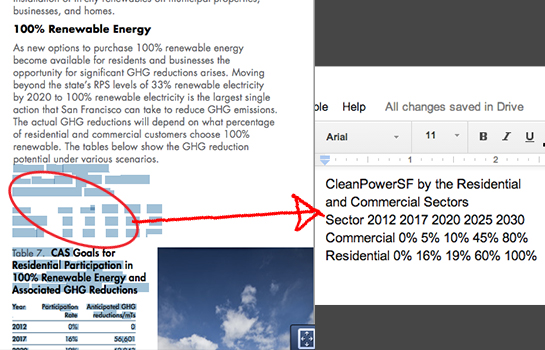
The change was made apparent by a prominent blank white space on page 17 of the Climate Action Strategy report, and was discovered by Supervisor John Avalos’ office. When you highlight the blank space with your cursor, copy the section, then paste it into a document, you can see the goals of CleanPowerSF laid out plain as day.

CleanPowerSF by the Residential

and Commercial Sectors

Sector               2012   2017   2020   2025   2030

Commercial   0%       5%       10%     45%     80%

Residential     0%       16%     19%     60%     100%

The scrubbed information shows CleanPowerSF helping the city reach its renewable energy goals. The numbers are hidden in the Climate Action Strategy report, like a message in a bottle, or a painted egg hidden under a bush on Easter. 

It’s as if someone didn’t want to delete the CleanPowerSF entry entirely, and instead turned the text white in order to signal that the text used to be there. Perhaps the preparer of this report was foiled by the technological wonder known as cut-and-paste. Or more intriguingly, perhaps this was the first-ever case of activist report writing (in which case: Dear subversive report writer, please send us documents through BayLeaks).

Whether the information was left in accidentally or on purpose, it’s now clear that the mayor is dead set on scrubbing CleanPowerSF from city records, even at the expense of the city’s environmental goals. 

Above is the report. Check it out for yourself, page 17 (in the report’s numbering, not the digital numbering).

At the mayor’s Question Time today, where supervisors ask pre-planned and pre-announced questions of the mayor, Supervisor Avalos pinned Mayor Lee down on the document scrub-out.

“In your letter of introduction to the 2013 CAS you wrote the need for action has never been more evident,” Avalos said. “The Climate Action Strategy goes on to state that moving onto 100 percent renewable energy is the biggest single step the city can take to reduce greenhouse gas emissions. And yet there was an attempt to scrub CleanPowerSF… from the Climate Action Strategy.”

The version of the Climate Action Strategy included a whited out table on CleanPower SF… that table was unceremoniously removed in a new version posted two days later,” he said.

The mayor’s answer was filled with some equivocations and some fabrications. 

“We should not move forward with a program that contracts with a fossil fuel company in Texas, it doesn’t produce enough local jobs or environmental benefits,” he said. “Supervisor, I’m glad you mentioned the Climate Action Strategy.” 

Retired San Francisco Public Utilities Commission Executive Director Ed Harrington told  Guardian Editor Steven T. Jones exactly why CleanPowerSF was needed, in a story of his back in 2012: “This program before you has the only chance of reaching those goals. There’s nothing else.” 

Asking Mayor Ed Lee to explain the disappearance of the information from the report.

After question time, this reporter and a few others questioned the mayor as he walked back to his office.

What was behind the scrubbing of the CleanPowerSF data? Why did it suddenly vanish from the report?

“I don’t think I have a real answer for that,” the mayor said.

SF bans water bottles

27

San Francisco continues to lead the way in the nation’s environmental policy, with the Board of Supervisors on March 4 voting unanimously to bar the city from buying plastic water bottles and to ban distribution of plastic water bottles smaller than 21 ounces on city property starting Oct. 1. The ban excludes city marathons and other sporting events.

"We all know with climate change, and the importance of combating climate change, San Francisco has been leading the way to fight for our environment," Board President David Chiu, who authored the legislation, said at the hearing. "That’s why I ask you to support this ordinance to reduce and discourage single-use, single-serving plastic water bottles in San Francisco."

Chiu held up a water bottle at the board meeting, a quarter of the way full with oil, to illustrate how much oil is used in the production and transport of plastic water bottles. He also reminded San Franciscans that the current fad of buying bottled water only started in the 1990s when the bottled water industry mounted a huge ad campaign that got Americans buying bottled water.

Somehow, Chiu noted, "for centuries, everybody managed to stay hydrated." (Francisco Alvarado)

Mass action against Keystone XL

Nine environmental activists were arrested in San Francisco for marching through the financial district and entering One Spear Tower on March 3, the building that houses local offices of the State Department, to express opposition to the proposed Keystone XL pipeline.

A day earlier, a mass protest against the oil pipeline was staged outside the White House in Washington, D.C. Roughly 200 protesters were arrested after using plastic zip ties to lock themselves to the White House fence.

Meanwhile, thousands more have made a vow — at least in the sense of clicking to add their name to a petition — to engage in peaceful civil disobedience if President Barack Obama grants ultimate approval for the oil infrastructure project, which would transport 830,000 barrels of crude oil from Canada to the Gulf Coast.

Nonprofit Credo Action has created an online petition urging people to get ready to respond with peaceful civil disobedience if the pipeline wins final approval. (Rebecca Bowe)

City weighs lawsuit over Airbnb

The San Francisco City Attorney’s Office is finally preparing to take action against the illegal short-term housing rentals facilitated by Airbnb, something we’ve been hearing that the Examiner also reported on March 6 ("SF landlords could face legal fight over rentals on Airbnb, other services"), an action that would address the company’s apparent stall tactics.

Despite a business model that violates a variety of San Francisco laws — most notably zoning, planning, and tenant regulations — and Airbnb’s flagrant flouting of a two-year-old city ruling that it should be collecting and paying the city’s transient occupancy tax (see "Into thin air," Aug. 6), the City has appeared unwilling or unable to enforce its laws or address these issues.

"We’re aware of multiple housing allegations, including some that community leaders have brought to us," City Attorney’s Office spokesperson Matt Dorsey told the Guardian, confirming that the office is considering taking legal action to enforce local laws governing short-term housing rentals but refusing to provide details.

Board of Supervisors President David Chiu took on the problem over a year ago, working with the company and its critics to develop compromise legislation that would legalize and tax the activities of Airbnb and its hosts, but the multi-layered legal and logistical challenges in doing so have so far proven too much for the otherwise effective legislator.

"My staff has held meetings with Planning staff and its enforcement team to discuss enforcement and related challenges. We’ve also been in touch with the City Attorney’s Office on these issues," Chiu told the Guardian, saying he and his staff have recently been focused on other tenants and secondary unit legislation, but they "plan to refocus on our shareable housing efforts soon." (Steven T. Jones)

Blaming pedestrians

ABC7 News Investigative Team’s new "investigative report" on pedestrian safety stirred controversy last week as street safety advocates called out the video for its insensitivity towards pedestrian deaths and lax attitude towards unsafe drivers.

Streetsblog SF and others in San Francisco said the report engaged in "victim blaming."

ABC7’s pedestrian safety coverage comes on the heels of a number of high-profile traffic collision deaths, including that of 6-year-old Sofia Liu, killed on New Year’s Eve. Since then, the Walk First program to create safer streets has garnered more attention, culminating in Mayor Ed Lee’s announcement today to partially fund safety improvements to the city’s most dangerous intersections, to the tune of $17 million — improvements that languished due to funding gaps since the program was announced in April.

But making all the needed improvements though would cost $240 million, according to city estimates, and that funding has yet to be identified. Suffice to say, the traffic enforcement debate still rages in San Francisco, with emphasis on the word ‘rage.’

"We’ve seen ‘blame the pedestrians’ from police and in the media," Leah Shahum, executive director of the San Francisco Bike Coalition, said at a pedestrian safety hearing in January. Police Chief Greg Suhr that night apologized for his officers’ lax enforcement of drivers, and focus on pedestrians, and pledged to change policies to focus on drivers going forward.

It’s too bad ABC 7’s I-Team didn’t get that memo.

"In San Francisco, simply stepping off the curb can be deadly," ABC reporter Dan Noyes narrates in their video report. The word ‘deadly’ is capped off with a Hollywood-style musical flourish, like a horror movie moments before the big scare.

"Pedestrians are making mistakes over and over again," Noyes narrates. The video cuts to pedestrian after pedestrian looking at cell phones, jaywalking, or otherwise engaging in unsafe behavior. It’s fair to say the piece, headlined "I-Team investigates what’s causing pedestrian deaths," places responsibility of pedestrian safety squarely on the shoulders of pedestrians. (Joe Fitzgerald Rodriguez)

High-speed challenges

The California High Speed rail project has been facing resistance that threatens to derail the project. Not only has public support for the $68 billion project wavered in recent years, now the project faces a legal battle that could delay the project before the first rail is laid.

On March 4, Sacramento County Superior Court Judge Michael Kenny ruled that a lawsuit brought on by King County can go to trial. The lawsuit raises questions about the legality of using 2008’s voter-approved Prop 1A funding, $9.95 billion worth of bonds, to upgrade and electrify Caltrain’s tracks and incorporate them into the high speed system.
Another concern was that the proposed high-speed system would not be able to pull through with its promise of a 2 hour 40 minute nonstop ride from downtown San Francisco to Los Angeles’ Union Station if the high speed system had to share tracks with Caltrain.

The lawsuit also threatens to leave San Francisco’s new $4.5 billion Transbay Terminal without its planned underground high speed rail station, which could be disastrous for that project as well.

None of this seems to faze Rod Diridon, executive director of the Mineta Transportation Institute based out of San Jose State University and former founding board member of the California High-Speed Rail Authority Board. He told the Guardian: "I think that [the project] will happen now. I think that our wonderful governor and our legislative leaders are going make it happen now…. If it was delayed it would only be a matter of time before it came back." (Francisco Alvarado)

Housing round-up: LGBT tenants, a singing protest, and a very sad mural

At today’s (Tue/11) Board of Supervisors meeting, Sup. David Campos is introducing legislation to encourage large-scale developers to protect the housing rights of the LGBT community.

Same-sex couples nationwide are more likely to experience discrimination in their search for senior housing, a study by the Washington, D.C. based Equal Rights Center found.

To investigate, testers posed as gay or straight couples with otherwise nearly identical credentials, then submitted inquiries on senior housing in 10 different states. They discovered that in 96 out of 200 tests, those posing as lesbian, gay or bisexual residents experienced at least one type of adverse, differential treatment.

Meanwhile, according to the National Center for Transgender Equality, one in five transgender U.S. residents has been refused a home or apartment, and more than one in ten has been evicted, because of their gender identity.

Federal law does not expressly prohibit discrimination based on sexual orientation or gender identity. California law does, as do laws in 19 other states. Given these gaps in legal protection, real-estate providers can adopt their own policies to prohibit LGBT discrimination.

Campos’ proposal would require large-scale developers who wish to build in San Francisco to prove their commitment to equal housing opportunities.

“We want to know whether a developer hoping to build in San Francisco is protecting LGBT housing rights when they own or manage housing in states where legal protections don’t exist,” Campos explained. “By collecting this information, we can highlight best practices and urge those who do not have these policies to do the right thing.”

Under the legislation, developers would indicate whether they have national policies prohibiting LGBT discrimination. The Human Rights Commission would compile those policies and present it annually to the Board of Supervisors.

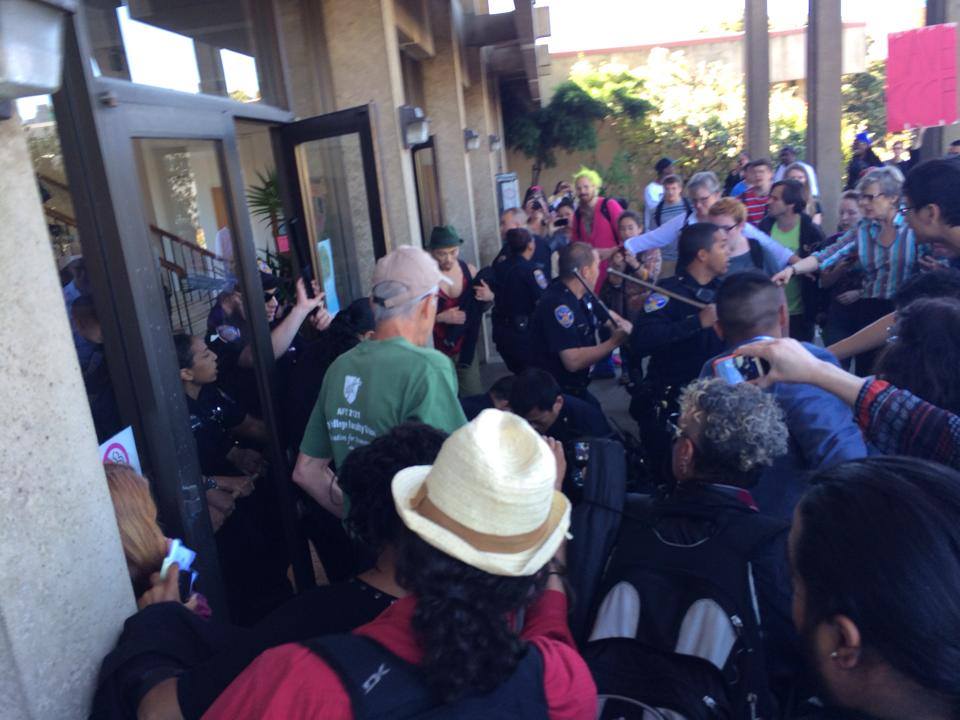
Elsewhere on the housing front, POOR Magazine founder Lisa Gray-Garcia (aka “Tiny”) led a group of anti-eviction activists into City Hall this morning, where they broke into song to call attention to the eviction of a family from a public-housing unit in the Fillmore neighborhood. They linked the eviction with a broader trend of African American out-migration from San Francisco, and sang spirituals.

Gray-Garcia reported that the group, which she estimates at roughly 30 people, encountered resistance from the Sheriff’s deputies who provide security in City Hall. “They said we were an unlawful assembly because we were singing,” she said. So the protesters proceeded upstairs, whispering, to stand outside Mayor Ed Lee’s office. Then they broke into song again, she said.

“We’re talking about a family about to be evicted tomorrow, that’s how serious this is,” Gray-Garcia told us. She said she’d spoken to someone from the mayor’s office, Carl Nicita, who “to his credit, he listened to us and he said ‘I’m going to tell the mayor.’” (We’re working on finding out more about the eviction and how the city will respond.) 

As a final housing-related tidbit, head over to the Mission to check out the new Clarion Alley “Wall of Shame” mural, featuring a list of what the artists perceive to be the root forces of gentrification (Both Google buses and corporate giveaways to tech companies made the list).

Inscribed on some tombstones near the bottom: “So long San Francisco, As We Knew It. (Historic Counter-Culture & All.)”

On the flip side, the artists also included a list of solutions.

Bryan Augustus contributed to this report.

Wired measures tech bus trips in a day

34

The vaunted Google Bus pilot program is now in legal limbo as local activists appeal the deal to regulate the shiny behomoths, on environmental grounds. As we wait and see what the next step will be, one technology journalist decided to figure out for himself what the SFMTA says the pilot program aims to do: track the number of tech buses running around San Francisco.

Well, to be fair, Kevin Poulsen, investigations editor at Wired magazine, only tracked the buses flying by his home. But the process doesn’t seem too tough to replicate.

As he writes in his Wired post: 

“Last week, it occurred to me that I might start monitoring the local Wi-Fi environment to determine how often the Apple Bus really comes by. My wife guessed 10 times a day. I’d have said 20.”

So essentially, he used the Apple bus’ Wi-Fi, provided for their employees, to track movements of the bus. He didn’t make any bets on it, but if he had, it seems his wife would’ve lost. 

“After a week of reverse-wardriving, it appears the Apple Bus passes my house an average of 36 times a day, and is uncannily punctual, especially in the a.m., when the first bus reliably pops up on my Wi-Fi radar between 6:23:33 and 6:23:56 every morning.

The second bus passes four or five minutes later, the third 25-minutes after that, another at 6:58, give or take a minute. By 10 a.m. as many as 15 more Apple buses have passed. After that they become infrequent, and die out entirely a few minutes after 2:00 p.m., before they return in force at 5:00 p.m. — presumably taking Apple workers home. The last bus registers at about 10:15 at night.”

macadresses

The wifi trail shows how many times particular tech buses drove by this Wired journalist’s house.

Why care about tracking them in the first place? It’s about the impact of livability in the surrounding area, an idea that so far hasn’t been factored in to the $1 per stop, per day argument made by Mayor Ed Lee and the city.  Poulsen writes:

These buses are huge, intimidating, Greyhound-sized affairs, many of them double-deckers, that feel outsized on a relatively quiet street of single-family homes. I haven’t stockpiled much umbrage over them, but some of my neighbors who’ve lived here longer hate the buses. There’s something disconcerting about having your street turn into a major artery in the transportation infrastructure of a company 45 miles away, without so much as a mailer (“Hi! We’re Apple. We’ll be using your street for a while.”).

When the outrage over the $1 per stop, per day number spiked recently, a Google spokesperson said in a release, “San Francisco residents are rightly frustrated that we don’t pay more to use city bus stops. So we’ll continue to work with The City on these fees, and in the meantime will fund Muni passes for low-income students for the next two years.”

Until the SFMTA figures out ways to mitigate the impact of these buses, let’s hope more tech-inclined people track their impacts on the city. You can see the original Wired story here

SF votes to ban plastic water bottles on city property

26

San Francisco continues to lead the way in the nation’s environmental policy, with the Board of Supervisors today [Tues/4] voting unanimously to bar the city from buying plastic water bottles and to ban distribution of plastic water bottles smaller than 21 ounces on city property starting Oct. 1. The ban excludes city marathons and other sporting events.

“We all know with climate change, and the importance of combating climate change, San Francisco has been leading the way to fight for our environment,” Board President David Chiu, who authored the legislation, said at the hearing. “That’s why I ask you to support this ordinance to reduce and discourage single-use, single-serving plastic water bottles in San Francisco.”

Chiu held up a water bottle at the board meeting, a quarter of the way full with oil, to illustrate how much oil is used in the production and transport of plastic water bottles. He also reminded San Franciscans that the current fad of buying bottled water only started in the 1990s when the bottled water industry mounted a huge ad campaign that got Americans buying bottled water.

Somehow, Chiu noted, “for centuries, everybody managed to stay hydrated.”  

Proponents say they hope the ban will put a dent in the nearly 60 million water bottles Americans use daily and decrease the amount of plastics that take up room in the oceans and landfills.

“We applaud Supervisor Chiu and San Francisco’s leadership in the movement to think outside the bottle,” said Katherine Sawyer, Campaign Organizer of Think Outside the Bottle at Corporate Accountability International, which took part in a taste test event comparing SF tap water to bottled water before the hearing. “By taking this step, San Francisco continues to be a pioneer, paving the way for cities, states, and national parks across the country to follow suit and buck the bottle. Not only does this measure eliminate wasteful spending on such an eco-unfriendly product, but it also opens doors to increased investment in the most essential of municipal services—water.”

The ban will return to the board next week for a final vote, after which it will head to Mayor Ed Lee for his signature. 

Crooked cops

2

steve@sfbg.com

It’s a bombshell police scandal befitting San Francisco’s restive mood, dropping at a time when simmering class tensions have been making national news, and one more example of how the poor are getting trammeled by those with power.

As politicians and tech titans were trying to make the gritty central city more welcoming to corporations and their workers three years ago, a half-dozen plain-clothed police officers were allegedly abusing poor people, illegally busting into their rooms, stealing anything that had value, forcing criminals to sell stolen drugs for them, and repeatedly telling lies in police reports.

When the targets of these abuses complained to the authorities, they were dismissed or ignored. Only when Public Defender Jeff Adachi and his investigators found and publicly revealed damning video surveillance from the targeted single-room occupancy hotels did federal authorities launch an investigation.

Adachi held press conferences in March and May of 2011 showing officers brutalizing SRO residents and leaving their rooms with laptops and other valuables that were never booked as evidence. When Greg Suhr was sworn in as police chief in April 2011, he put the officers on administrative duties, forced some to give up their weapons, changed department policies to deter cops from barging into people’s rooms without warrants or probable cause, and cooperated with the Federal Bureau of Investigation on the case.

That investigation resulted in federal grand jury indictments that were unsealed on Feb. 27, charging six SFPD cops with a variety of serious charges, including civil rights violations and conspiracies, theft, extortion, drug conspiracies, and falsification of records.

They are Officers Arshad Razzak, Richard Yick, and Raul Eric Elias, who worked in Southern Station, dealing with residents of SoMa SROs; and Sgt. Ian Furminger, Officer Edmond Robles, and Reynaldo Vargas (who Suhr says was dismissed from SFPD for unrelated reasons as the investigation got underway), who worked in Mission Station, where the drug conspiracy allegedly took place, on top of shakedowns in Mission District SROs.

All defendants are facing more than 20 years in prison (except Elias, who faces 10 years for civil rights conspiracy and one year for deprivation of rights under color of law). The Southern Station defendants are also facing $250,000 in fines. The Mission Station defendants face $1 million in fines on the drug conspiracy charges, which allegedly involved having informants sell a few pounds worth of marijuana seized by police.

Attorney Michael Rains, who represents Razzak and has been designated by the San Francisco Police Officers Association as a spokesperson for the others, told the Guardian that all the defendants had difficult undercover jobs in the murky world of informants and drug dealers.

“There was sloppiness in the reporting [in officials police reports], but sloppiness doesn’t rise to the level of criminal activity,” Rains told us, questioning the credibility of witnesses who have criminal records and the reliability and context of the video evidence.

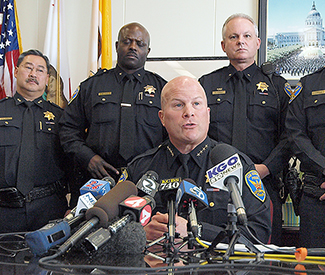
But Suhr strongly condemned the behavior outlined in the criminal complaints, telling reporters that other SFPD officers connected to the case may still face disciplinary action and that, “My officers know I will not have dishonest cops among us.”

He called the indictments a serious blow to the SFPD, appearing to choke up with emotion.

“Our department is shaken,” Suhr, who has been with the SFPD more than 30 years, told reporters. “This is as serious a matter as I’ve ever encountered in the Police Department.”

Yet Suhr also distanced himself from scandal, telling reporters, “This conduct occurred before my time as chief.”

Most of the alleged crimes happened under former Police Chief and current District Attorney George Gascón shortly before he made that transition, one in which critics at the time raised concerns about whether he could be an effective watchdog of SFPD misconduct. That conflict of interest was what sent this case to the feds.

“It is extremely disappointing that the officers violated the trust of the community and tarnished the reputation of all the hard working men and women in uniform,” Gascón said in a press release.

During a brief press conference that afternoon, Gascón denied responsibility for the misconduct: “Anytime you have a large organization, you are going to have people who operate outside the boundaries of what is acceptable.”

Asked by the Guardian when he became aware of allegations that his officers were abusing SRO residents, he said, “We became aware at the same time everyone else did, when the videos came out.”

Gascón’s Press Secretary Alex Bastian cut the press availability off after 10 minutes so Gascón could prepare for his State of Public Safety speech that afternoon, but Bastian told the Guardian he would get answers to our questions about the office’s police accountability record.

“When appropriate, we ensure the integrity of the system is not compromised by referring cases to other prosecuting agencies. In the abundance of caution, when this case was brought to my attention, I referred the case to the federal authorities to safeguard a thorough investigation and guarantee maximum consequences,” Gascón said in a prepared response, while Bastian ignored our requests for more responsive answers to our questions.

But Adachi says these indictments are just the tip of the police misconduct iceberg, charging that police officers routinely lie in police reports and in court to justify illegal searches and other abuses of defendants who are poor or have drug problems, knowing that judges and juries tend to believe cops over criminals.

“The indictments today are a victory for ordinary San Franciscans,” Adachi told reporters, emphasizing that in addition to personally profiting from the shakedowns, these officers were also submitting false testimony in perhaps hundreds of cases, including about 100 that his office has gotten dismissed. “These allegations not only involve violations of the constitutional rights of our clients, but also lying on police records that were used to send individuals to prison based on the testimony of these officers.”

Residents and employees of the Henry Hotel, one of four SROs involved in this case, told the Guardian that the indictments are a rare repudiation of police mistreatment of SRO residents, which they say continues to the day.

“A lot of these people need help. They need guidance. They need a program. They need somebody to motivate them to go to their programs, not a fucking cop who keeps harassing them,” Jessie Demmings, a manager at the 132-room Henry Hotel on Sixth Street, told the Guardian. “They try to take that one step to go forward and then when you come outside you get greeted by a fucking cop having a bad day.”

Even though new SFPD policies prohibit officers from using passkeys to enter people’s rooms without a warrant, Demmings said it still happens. “The reason why we give the passkey is because they always threaten we’re gonna kick in the door, we gonna have a batting ram come and bust the door in,” he said.

Adachi cited his office’s long history of cases in which “officers were barging into rooms without warrants and they were lying about it in police reports.”

Cases of police abuse are handled by the city’s Office of Citizen Complaints, but its work is shrouded in secrecy, thanks to the California Peace Officers Bill of Rights, and officers rarely face serious consequences for their actions.

“We do have complaints with regard to the conduct within the SROs and we have made policy recommendations to the chief,” OCC Director Joyce Hicks told reporters at the SFPD press conference. She called the indictments “extra serious because it implicates the Fourth Amendment and people’s rights.”

Adachi said that after revealing the videos in 2011, he persuaded Mayor Ed Lee to fund two positions in his office investigating police misconduct, but the Mayor’s Office defunded those positions after a year and ignored Adachi’s calls to restore them (as well as Bay Guardian calls for comment on the issue).

“We felt like the public needs to know about this,” Adachi said of the behavior revealed by the federal investigation. “What happened today is significant, and I think it will have deterrent effect.”

Sabrina Rubakovic and Brian McMahon contributed to this report.

Is Newsom on the wrong side of high-speed rail history?

38

As California struggles to reduce its greenhouse gas emissions and meet the long-term transportation needs of a growing population, officials from Gov. Jerry Brown to Mayor Ed Lee have steadfastly supported the embattled California High-Speed Rail Project, which Lt. Gov. Gavin Newsom recently withdrew his support from. California now has until July 1 to find funds to match the federal grants.

It’s not exactly surprised that this calculating and politically ambitious centrist would cave in to conservatives like this, particularly as Newsom tries to set himself up to succeed Brown in four years. But it’s a sharp contrast to more principled politicians like Brown, and to those trying to create the transportation system future generations will need, as President Barack Obama took a step toward doing today by announcing new federal transportation funding.

US Transportation Secretary Anthony Fox is also taking part in the three-day High Speed Rail Summit, sponsored by the United State High-Speed Rail Association, that began yesterday in Washington DC. Its theme is Full Speed Ahead.

“Secretary Foxx’s experience at the local level as mayor of Charlotte is extremely valuable for shaping national transportation policy. We look forward to working with the Secretary to advance high speed rail in America across party lines,” USHSRA President and CEO Andy Kunz said in a press release. 

While Newsom’s new tact may play well with myopic, penny-pinching, car-dependent moderate and conservative voters, many of his allies and constituents were furious with his about-face on a project that promises to get riders from downtown San Francisco to downtown Los Angeles in less than three hours. 

Among those unhappy is San Francisco resident Peter Nasatir, who forwarded the Guardian a well-written letter that he has sent to Newsom’s office:

Dear Lt. Gov. Newsom,

I am a long time San Francisco resident, and although I have criticized many of your policies, I’ve always respected your commitment to be at the forefront of controversial issues.  Even if the issue could have wrecked your political career, you still had the guts to take the lumps for a righteous cause.

That is why I’m so shocked you would publically decry the High-Speed Rail project.  Yes there are cost overruns.  Yes the public is sour to it today, but what would you propose as an alternative:  more freeways, more runways?  Every expert in the field has already signed off that runways and freeways have expanded as far as they can.  Are you not a leading voice in demanding technical innovation in all levels of government? 

In your book, Citizenville, did you not put forth the clarion call for citizens to embrace technological change?  Did you not say that San Francisco was behind the likes of Estonia and South Korea in terms of digital governance?  Is it not fair to say that California is behind Europe and Asia when it comes to high speed rail?

Could you have said something along the lines that the trajectory the project is going is troubling, but Californians for generations to come will benefit from it.  This project must be saved, because to do otherwise will send California back 60 years.

You are a political maverick who had put his career on the line many times with such controversial positions as same-sex marriage, and walking the picket line with hotel workers on Union Square.  High-speed rail is coming.  The economy demands it, the environment demands it, and Central Valley population growth demands it.  You may get some votes from moderates in the short run, but in the long run, you have positioned yourself as the most prominent person in the state to be on the wrong side of history.


Peter Nasatir


Climate fight is a street fight

41

STREET FIGHT

Prolonged warm-weather droughts seem a normal part of California life, but the intensity of drought impacts — shrinking snowpack, intense wildfires, crop failures, and the devastation of wildlife habitat and fisheries — is likely accentuated by global warming.

So it’s not enough to simply save water. In this drought, our sense of urgency about global warming should be ramped up. The science from the Intergovernmental Panel on Climate Change, respected scientists like James Hansen, and even the World Bank (historically no friend to radical ecologists) all stress that droughts will get worse unless greenhouse gas emissions peak in the next decade.

The science is clear. If we are to avoid a disastrous future of ecological upheaval, violence, and forced mass migrations of hundreds of millions of people (many of whom produce the least amount of carbon emissions) then we must dramatically reduce emissions now, and we must do it in a globally fair and equitable way. And to be fair and equitable, we must reduce driving. Here’s why.

Globally, transportation is the fastest growing sector of greenhouse emissions, owing in large measure to the expansion of global automobility. Presently 500 million passenger cars are in use (approximately one-third of them in the United States), but by 2030, this figure is expected to reach 1 billion worldwide.

This increase in automobility will contribute substantially to the “trillionth ton” of cumulative carbon emissions, which is an emissions threshold signaling global climate catastrophe. Today we are more than halfway there (556 billion tons). At current rates of consumption, including America’s ownership of 800 cars and trucks per 1,000 persons, we hit the trillionth ton in 28 years.

To avoid this, we must keep as much fossil fuel as possible in the ground. Because the United States is disproportionately responsible for at least 27 percent of the cumulative carbon emissions since industrialization, and has a disproportionate number of cars compared to the rest of the world, we in the United States have a particular responsibility to keep carbon in the ground.

If China, which has produced 10 percent of global emissions so far, had the same per capita car ownership rate as the United States, there would be over 500 million more cars, doubling the current worldwide rate. This would be madness. It would be worse than building the Keystone pipeline, which is what Hansen called “game over” for the global climate because it’s a spigot into the sticky, tarlike oils in Alberta which, if fully tapped, would be a carbon time bomb.

Ask yourself this: If China (and possibly India) successfully copy American-style driving, how much tar sands would that require? What kind of world would that look like? And if Americans (and especially environmentalists) expect the global middle class in China and India to stand aside while we keep on driving, that is stark, crass, and inequitable.

Many well-meaning environmentalists and progressives think that driving a Prius or buying an electric car will be adequate in mitigating this conundrum. They must reconsider. There is no “green” car when a global middle class replicates American driving patterns.

If the world’s fleet of gasoline-powered automobiles magically shifts to electric, hydrogen fuel cells, or biofuels, the change will draw resources away from industrial, residential, and food systems, or it will have to involve an entirely new layer of energy production (more tar sands). Massive quantities of coal and petroleum will be needed to scale-up to wind turbines, solar panels, nuclear, and other arrays of energy, as well as for all the new “clean cars.”

Are environmentalists still planning to drive around the Bay Area while waiting for this magic? I sure hope not.

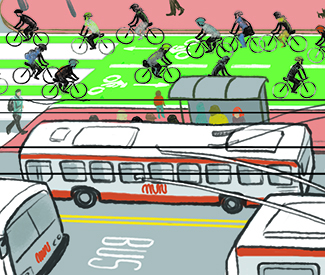
In these global warming days, with drought on everyone’s mind, we must avoid wasting precious water washing cars, and we must reallocate street space with fewer cars in mind. A critical piece of the puzzle is to prioritize public transit and bicycles over automobiles by building exclusive transit and bicycle lanes, remove the lanes and curbside parking available to cars, install signal prioritization for transit and bicycles at intersections, queue-jumping so that transit can bypasses traffic stalled at intersections, restrictions on turns for automobiles, and transit stop improvements including bus stop bulb-outs and amenities.

Reconfigured streets must furthermore exclude car-oriented land uses like more off-street parking in the 92,000 new housing units projected for San Francisco by Plan Bay Area. These units, whatever size or income, should be completely car-free. And this must include removal of existing parking beneath homes, replacing garages with housing and returning the privatized curb cut to the public.


VISIONS FOR HAIGHT

In many respects, the Haight Street corridor is a model for the kind of global warming mitigation strategy the rest of America should follow. The corridor has high density, transit dependent, and car-free households (over 30 percent in the Upper Haight and almost 50 percent in the Lower Haight/Hayes Valley) It has several walkable neighborhood commercial districts, as well as several hundred units of new housing (some of which are below market rate) under construction in Hayes Valley. Almost 25,000 passengers take the Haight buses (6-Parnassus and 71-Haight Noriega) daily, making it one of the busiest combined transit corridors in the city.

But the buses are crowded and often stuck in traffic, so the SFMTA has plans to improve service by increasing frequency, converting more of the existing route into faster “limited” service whereby some buses stop only at key points and removing the “jog” at Laguna and Page which adds delay to the inbound buses.

As I’ve written before, the Muni staff has a good plan known as the Transit Effectiveness Project, with a modest reallocation of street space for higher transit reliability, attracting more ridership, and potentially enabling San Franciscans to conveniently reduce driving to half of all trips by 2018 (it was at 62 percent in 2012). But on both ends of Haight Street, the city has fumbled. While not a disaster, hopefully Muni can learn some lessons and tweak the plans.

On the eastern end, Muni will shift buses off Page Street, converting a short segment of Haight back to two-way. The new two-way Haight includes a transit-only lane between Laguna and Gough/Market streets, which will dramatically improve travel times and reliability. Part of it will enable buses to bypass queues of cars making the right turn from Haight onto Octavia.

Where this scheme falls short is in the plans to simply give former bus stops on Page to private cars for parking. A more progressive plan would instead use the space to help make room for needed bicycle improvements on Page between Laguna and Market. Nearby are multiple housing construction sites where curbside parking has been temporarily removed — such as at the 55 Laguna site. The city has a great opportunity to innovate with transit-first policies at all of these construction sites.

Instead of turning space over to private cars when construction concludes, the city could instead build more bus lanes, pedestrian space, curbside car sharing, and bicycle space. The city could also return some of the space to parking, but only in exchange for parking removal upstream, such as at Haight and Fillmore, where bus stop improvements are sorely needed.

Throughout the city, there are block-by-block opportunities like these, where the city can help the climate instead of giving away parking. As the city discontinues bus stops and sees more housing construction, the policy should be to use curbside space for bicycles, pedestrians, or curbside car share — not simply giving it away to private car parking.

Meanwhile, at the other end of Haight, the city has also fumbled in proposing to reroute the 6-Parnassus, an important electric trolley bus line, off the Frederick-Cole-Parnassus segment. Bus riders in the Upper Haight are incensed. At a recent public meeting, a crowd of 90 people balked at the cut. Muni planners defended the proposal, arguing that ridership is low in the hilly segment above, and that a less productive segment would be shifted to the more crowded Haight Street.

This might seem logical but it may also be shortsighted, especially since the existing segment has overhead trolley wires. Drought notwithstanding, the electric trolley buses are the greenest motorized mobility in San Francisco, propelled by hydroelectricity from Hetch Hetchy.

Taking a longer and more progressive view, it might be useful to think of the debate over the 6-Parnassus this way: If the city is hoping to wean motorists from their cars by achieving the laudable goal of having 30 percent of all trips in the city by transit (up from 17 percent today), cutting service, even in relatively low ridership routes, is counterproductive. It raises the question: Is the ridership level low because the service was poor to begin with, including such irritating factors as less frequency, less reliability, or fewer hours of service? What would ridership levels look like if these less-crowded routes had high frequency, all-day and late-night service with high reliability?

Moreover, what would demand for these routes look like if parking were substantially reduced throughout the city while car-travel lanes were removed, creating space for bicycle lanes and transit lanes? Or what if there were a regional gasoline tax, a congestion charge, or other measures that priced automobility closer to its real social cost, thus producing higher demand for transit?

Surely, reducing the footprint of transit service, however inefficient that service might seem now, is not creating a template necessary for carrying 1.4 million daily passengers in the future, which is what it would take to reach significant emissions reduction goals and 30 percent mode share. Removing segments like the 6-Parnassus on Frederick will only make it harder to rebuild and accomplish that goal. And for political expediency it will also make it harder for Mayor Ed Lee to sell his transportation funding ballot proposals to progressive voters in November.

Muni planners ought to ditch the proposal to reroute the 6-Parnassus, and instead focus on maximizing improved reliability and transit efficiency on the other end of Haight Street by removing parking and prioritizing transit and bicycling on Haight and Page respectively.

Thinking globally about climate change means acting locally, on the streets of San Francisco.

Street Fight is a monthly column by Jason Henderson, a professor at San Francisco State University’s Department of Geography and Environment.


Muni fare shakedown

43

Update: Just a day after the release of this article, advocacy group POWER announced that Google pledged to pay for Free Muni For Youth for two years. “This validates both the success and necessity of the Free Muni for Youth program,”said Bob Allen, leader in the FreeMuni for Youth coalition, in a press release. “We need tech companies in San Francisco and throughout the region to work with the community to support more community-driven solutions to the displacement crisis.” 

The funding though is promised only for two years, and when that timeframe is up the question will still remain — will Muni’s operating budget pay for something Mayor Ed Lee could find funding for elsewhere? Additionally, Google hasn’t announced funding for free Muni for seniors or the disabled, another program up for consideration in the San Francisco Municipal Transportation Agency’s new budget. That may change if and when it is approved by the SFMTA for the next budget year. 

“I think it’s a positive step in the right direction,” Superivsor David Campos, the sponsor of Free Muni For Youth, told us. “But there are still questions about what it means in terms of the long term future of the program. It’s only a two year gift.” 

“We have asked for a meeting with Google and the mayor’s office and the coalition to talk about long term plans, to find out more information about what this means.” 

There’s a tie that binds all Muni riders. From the well-heeled Marina dwellers who ride the 45 Union to Bayview denizens who board the T-Third Sunnydale line, we’ve all heard the same words broadcast during sleepy morning commutes.

“Please pay your fare share.”

The play on words (also seen on Muni enforcement signage) would be cute if it didn’t perfectly represent how Muni riders may now be stiffed. A slew of new budget ideas hit the San Francisco Municipal Transportation Agency Board of Directors last week (Feb. 18), and who will pay for it all is an open question.

The first blow to riders is a proposed single-ride fare hike from the current $2 to $2.25.

Other proposals include expanding the Free Muni for Youth program, rolling out a new program offering free Muni for seniors and the disabled, and a fare hike to $6 for the historic F streetcar.

The odorous price jumps (and costly but promising giveaways) are moving forward against a backdrop of a Muni surplus of $22 million, which the board has until April to decide how to use, and a controversial decision by Mayor Ed Lee to make a U-turn on charging for parking on Sundays.

The meter decision would deprive Muni of millions of dollars.

“We’re not proposing anything here, just presenting what we can do,” SFMTA Director Ed Reiskin told the SFMTA board at City Hall last week.

There’s still time to change the SFMTA board’s mind on the proposals between now and final approval of the budget in April. But who will end up paying for a better Muni?


FARE HIKES NOT FOUGHT

In 2010, the SFMTA instituted a policy to raise Muni fares along with inflation and a number of other economic factors, essentially putting them on autopilot. The SFMTA board still has to approve the fee hikes, which may rise across the board.

fares One-time fares may jump to $2.25. Muni’s monthly passes would see an increase by $2 next year and more the following year. The “M” monthly pass will be $70 and the “A” pass (which allows Muni riders to ride BART inside San Francisco) will be $81.

Muni needs the money, Reiskin said.

“To not have (fares) escalate as fuel and health care costs increase, you can’t just leave one chunk of your revenues flat,” he told the Guardian. Muni’s operating budget will expand from $864 million this year to $958 million in 2016. “Salary and benefit growth is the biggest driver of that,” Reiskin said.

Mario Tanev, spokesperson for the San Francisco Transit Riders Union, said the hike was expected.

“We’re not necessarily against the inflation increase,” he said. “But though the parking fines SFMTA levies are inflation adjusted, other rates (against drivers) are not. There are many things in our society that disincentivize transit and incentivize driving.”

Drivers enjoy heavy subsidies to their lifestyle on the federal, state, and local levels, from parking lot construction, the cost of gasoline, and now it seems, renewed free Sunday parking meters. The new fare increases are hitting transit riders just as the mayor is poised to yank funding from Muni to put in the pockets of drivers.


PLAYING POLITICS

When the paid Sunday meter pilot began in early 2013, it was a rare flip in a city that often treats Muni like a piggy bank: money was floated from drivers and dropped onto the laps of transit.

A report from SFMTA issued December 2013 hailed it as a success for drivers as well: Finding parking spaces in commercial areas on Sundays became 15 percent easier, the study found, and the time an average driver spent circling for a space decreased by minutes.

Even some in the business community call it a success, since a higher parking turnover translates to more customers shopping.

Jim Lazarus, senior vice president of public policy at the Chamber of Commerce, is a supporter of the paid Sunday meters. “You can drive into merchant areas now where you couldn’t before,” he told us.

Eliminating Sunday meter fees would punch a $9.6 million hole in Muni’s budget next year, by SFMTA’s account.

The timing couldn’t be worse. On the flip side the Free Muni for Youth program, which targets low-income youth in San Francisco, may expand next year at an estimated cost of about $3.6 million, and a program to offer free Muni for the elderly and disabled would cost between $4 and $6 million — close to the same the same amount that would be lost by the meter giveback.


BOOSTING SAN FRANCISCO FAMILIES

“As an 18-year-old in high school it was a struggle to get to school, it was a struggle to find 75 cents or two dollars to get home,” Tina Sataraka, 19, told the SFMTA board last week. As a Balboa High School student, Sataraka had a 30-minute commute from the Bayview. She’s not alone.

A study by the San Francisco Budget & Legislative Analyst’s office found that 31,000 youth who faced similar financial hurdles had signed up for the Free Muni for Youth pilot program, a resounding success in a city where the youth population is dwindling. Authored by Sup. David Campos, the program may redefine “youth” to include 18-year-olds, who are often still in high school.

But initial grant funding for the program has dried up, so now Muni will foot the bill.

Not one to say “I told you so,” Sup. Scott Wiener said there were reasons for objecting to the program a year ago.

“My biggest, fundamental objection to the program was less that they were giving free fares to kids, and more that they were taking it out of Muni’s operating budget,” Wiener told us. “They need to find a way to pay for it, perhaps from the General Fund, and not just taking the easy and lazy way out.”

The Budget & Legislative Analyst recommended several options for alternative funding: special taxes on private shuttle buses (Google buses), or an increased vehicle license fee specially earmarked for the youth bus program. So far, Mayor Ed Lee hasn’t shown an interest.

“There haven’t been discussions of having the Board of Supervisors fund free Muni for youth,” Reiskin told us. The same goes for the mayor. And though Reiskin was cautious and political about the possibility of Sunday meters becoming free again, he didn’t sound happy about it.

“As for what’s behind [the mayor’s] call for free Sunday parking, that didn’t come from us,” Reiskin told us. “That came from him.”


NOVEMBER RISKS

Mayor Lee’s office didn’t answer our emails, but politicos, including Wiener and Chronicle bromance Matier and Ross, indicated the mayor may be reversing on Sunday parking meters to appease the driving voter electorate.

There are two measures up on the November ballot, and one is aimed right at drivers’ wallets.

The two measures, a $1 billion vehicle license fee hike, and a $500 million transportation bond, are both aimed at shoring up the SFMTA’s capital budget. An October poll paid for by the mayor showed 44 percent of San Franciscans in favor of a vehicle fee hike, and 50 percent against, according to the San Francisco Chronicle.

Reiskin said the loss of those two ballot measures would be crippling to Muni’s future.

“The improvements we’re trying to make to make Muni more reliable, more attractive, those won’t happen. This is our funding source for that,” he said.

The mayor is busy smoothing the potholes towards the bonds’ success in the November election, but it seems he’s willing to pile costs onto Muni and its riders to do it.

Correction 2/26: An editing error led to the erroneous calculation of Free Muni For Youth at near $9 million. Free Muni For Youth is only estimated to cost the SFMTA $3.6 million. It is the combination of Free Muni For Youth and free Muni for the disabled and elderly that equal about $9 million. 


Ammiano and Leno seek to reform the Ellis Act and slow SF evictions [UPDATED]

110

State lawmakers from San Francisco are launching a two-pronged attack on the Ellis Act, which real estate speculators are increasingly using to evict tenants from rent-controlled apartments and cash in on a housing market that’s been heated up by demand from high-paid employees of the booming tech sector.

Assemblymember Tom Ammiano today introduced Assembly Bill 2405, which would allow the San Francisco voters or the Board of Supervisors to declare a mortorium on Ellis Act evictions when the city’s state-mandated affordable housing goals aren’t being met.

Sen. Mark Leno is also planning to introduce his own Ellis Act reforms by today’s legislative deadline for introducing new bills. He’s been working on a reform package with Mayor Ed Lee, but Leno is keeping the details under wraps under Monday at 9am when the pair will hold a press conference outside a Chinatown apartment building to announce their proposal.

Both proposals face an uphill battle in Sacramento given that San Francisco is one of only a couple jurisdictions in the state that have rent control, which Ellis Act was designed to undermine by allowing landlords to get out of the rental business and remove apartments for the market. And the real estate industry industry is expected to strongly oppose the reforms.

“It will, of course, be very difficult, but Mr. Ammiano has been talking about this for months and he’s committed to doing something,” his Press Secretary Carlos Alcala told the Guardian.   

UPDATE 2/24] Leno and Mayor Lee — flanked by other supporters of the legislation, including Sups. David Campos and David Chiu, rival candidates to succeed Ammiano — this morning announced the introduction of Senate Bill 1439. It would authorize San Francisco to prohibit those who buy rental properties to invoke the Ellis Act and evict tenants for at least five years, and only allow only one Ellis Act eviction for the life of each property. 

“The original spirit of California’s Ellis Act was to allow legitimate landlords a way out of the rental business, but in recent years, speculators have been buying up properties in San Francisco with no intention to become landlords but to instead use a loophole in the Ellis Act to evict long-time residents just to turn a profit,” Leno said.

Ammiano’s press release follows, followed by Leno’s:


Ammiano Introduces Bill to Stem Evictions from Affordable Housing


SACRAMENTO – Assemblymember Tom Ammiano today introduced AB 2405 to empower local jurisdictions to stop the erosion of affordable housing stock.


“San Francisco is seeing a terrible crisis,” Ammiano said. “The people who have made our city the diverse and creative place that it is are finding it harder and harder to stay in San Francisco. The rash of Ellis Act evictions has only made it worse.”

Ellis Act evictions are permitted under certain circumstances when a property owner is taking a rent-controlled unit out of the rental market. However, some owners have been abusing these provisions and improperly evicting tenants from rent-controlled units. The problem is not restricted to San Francisco, although the city is going through a particularly critical loss of affordable housing.

AB 2405 would allow local jurisdictions – by means of a Board of Supervisors or public vote – to enact a moratorium on Ellis Act evictions when the local housing element is not met. Also, the bill would hide no-fault evictions from tenant records or credit checks in unlawful detainer cases, and would place Ellis Act unlawful detainer cases on civil court calendars.

“Experience shows you can’t build your way out of an affordable housing crisis,” Ammiano said. “We have to do what we can to preserve what affordable housing we have. This is one piece of that effort.”

New Legislation Closes Ellis Act Loophole for San Francisco

Senator Mark Leno Joins Mayor Ed Lee, Tenant Advocates, Labor Groups and Business Leaders

to Stop Speculative Evictions in San Francisco


SAN FRANCISCO – Senator Mark Leno today joined San Francisco Mayor Ed Lee, other elected officials, tenant advocates, labor groups and business leaders to introduce legislation closing a loophole in the Ellis Act that allows speculators to buy rent-controlled buildings in San Francisco and immediately begin the process of evicting long-term renters. Aiming to mitigate the negative impacts of a recent surge in Ellis Act evictions in San Francisco, Senate Bill 1439 authorizes San Francisco to prohibit new property owners from invoking the Ellis Act to evict tenants for five years after the acquisition of a property, ensures that landlords can only activate their Ellis Act rights once, and creates penalties for violations of these new provisions.


“The original spirit of California’s Ellis Act was to allow legitimate landlords a way out of the rental business, but in recent years, speculators have been buying up properties in San Francisco with no intention to become landlords but to instead use a loophole in the Ellis Act to evict long-time residents just to turn a profit,” said Senator Leno, D-San Francisco. “Many of these renters are seniors, disabled people and low-income families with deep roots in their communities and no other local affordable housing options available to them. Our bill gives San Francisco an opportunity to stop the bleeding and save the unique fabric of our City.”


Ellis Act evictions in San Francisco have tripled in the last year as more than 300 properties were taken off the rental market. This spike in evictions has occurred simultaneously with huge increases in San Francisco property values and housing prices. About 50 percent of the city’s 2013 evictions were initiated by owners who had held a property for less than one year, and the majority of those happened during the first six months of ownership.


“We have some of the best tenant protections in the country, but unchecked real estate speculation threatens too many of our residents,” said Mayor Lee. “These speculators are turning a quick profit at the expense of long time tenants and do nothing to add needed housing in our City. These are not the landlords the Ellis Act was designed to help, and this legislation gives San Francisco additional tools needed to protect valuable housing and prevent further Ellis Act speculator evictions, which has already displaced working families and longtime San Franciscans. This carve out is a good policy for San Francisco, and I thank Senator Leno for being a champion on this issue. Together we have built a large coalition of renters, labor and business leaders to fight this battle in Sacramento to support middle income and working families here in our City.”


“Rents in San Francisco are at an all-time high. My former neighbors and I, working families and seniors, were displaced from the place we called home for several decades,” said Gum Gee Lee. “Those that have yet to receive an Ellis Act notice continue to live in fear, fear that they too will be evicted from their homes. For seniors such as myself who rely on public transportation and access to social and health services within our community, Ellis evictions cut our lifeline, our independence to thrive. For working class families such as my former neighbors from Jackson Street, they continue to struggle to survive in San Francisco. San Francisco is our home.”


Enacted as state law in 1985, the Ellis Act allows owners to evict tenants and quickly turn buildings into Tenancy In Common (TIC) units for resale on the market. In San Francisco, the units that are being cleared are often rent controlled and home to seniors, disabled Californians and working class families. When these affordable rental units are removed from the market, they never return.


Senate Bill 1439 will be heard in Senate policy committees this spring.

Healthy San Francisco enrollees can stay – for now

Thousands of Healthy San Francisco enrollees will soon face a dilemma.

Federal health care reform will hold them to the “individual mandate,” a requirement to obtain health insurance – but Healthy San Francisco doesn’t count. Roughly 70 percent of uninsured San Franciscans currently rely upon the city-administered program, created by San Francisco’s Health Care Security Ordinance, to access medical care.

Anyone who doesn’t satisfy the individual mandate will be made to fork over $95 as a penalty – but that noncompliance fee will skyrocket to $625 in 2015.

Meanwhile, people who are eligible for subsidized health insurance under the Affordable Care Act will automatically become ineligible for Healthy San Francisco under current rules, according to San Francisco Department of Public Health Deputy Director of Health Colleen Chawla.

For many – especially those currently experiencing health problems – this change spells trouble.

The prospect of becoming suddenly ineligible for Healthy San Francisco will leave thousands of residents in the bind of being unable to rely on the system they now use to access care, while also being unable to afford the new insurance option  – and so far, city officials have found no clear resolution to this dilemma.

Assemblymember Tom Ammiano, who authored the legislation that created Healthy San Francisco as a member of the Board of Supervisors, admonished the Department of Public Health last week for turning away enrollees, conveying to program participants that only those who are undocumented would be eligible to remain in Healthy San Francisco.

“It’s really outrageous,” Ammiano told the San Francisco Chronicle.

Ammiano’s legislative aide, Carlos Alcala, said the Assemblymember was aghast at DPH’s approach, because “this is what Healthy San Francisco was intended for – the city agreed to be committed to helping people who can’t afford insurance.”

Alcala said that over the course of the last week, numerous conversations had taken place between Ammiano’s staff and DPH staff, including Director Barbara Garcia.

On Feb. 18, the San Francisco Health Commission approved a temporary solution, signing off on a resolution that creates a “transition period” allowing Healthy San Francisco enrollees to remain in the program until the end of the 2014.

“SFDPH is making every effort to help San Franciscans enroll in the best health insurance option available to them,” according to the resolution. “Still, navigating the various options can be confusing and SFDPH wants to be sure that no one is left without health care options particularly during this time of transition.”

For some, the change under ACA will mean migrating from Healthy San Francisco to subsidized health insurance under Covered California, the state-administered program created by the ACA. But for low-wage earners and others struggling to make ends meet in pricey San Francisco, the monthly Covered California premiums may be unaffordable; even the options with lower premiums come with $5,000 deductibles and high co-payments.

The transition period extends Healthy San Francisco eligibility through December for San Franciscans who qualify for Covered California but haven’t enrolled.

Prior to this stopgap measure – apparently largely a product of the discussions between DPH and Ammiano – many would have faced being cut off from Healthy San Francisco in March, when full ACA implementation kicks in.

“Healthy San Francisco eligibility has not changed,” Garcia confirmed at the Feb. 18 meeting. “But the world around it has changed.”

The Department of Public Health’s mantra since the start of ACA implementation, repeated by Garcia at the Health Commission meeting, is that “health insurance is better than Healthy San Francisco.”

But for those who cannot afford the new subsidized health insurance option, “better” may remain out of reach.

“When people come in for renewal … we will counsel them to make sure they know that health insurance is better, and counsel them on affordability,” Chawla noted at the meeting. She added that if participants wish to remain in Healthy San Francisco, they will be able to do so – for now.

To be eligible for Healthy San Francisco, enrollees must live on a combined family income at or below 500 percent of the federal poverty level ($57,450 per year); be a San Francisco resident; have been uninsured for at least 90 days; not be eligible for Medi-Cal, and be between the ages of 18 and 64.

Between now and December, when the transition period comes to an end, DPH and other city agencies will presumably try and hash out a solution for people who are threatened with a loss of access to medical services.

In 2013, San Francisco Mayor Ed Lee re-convened an ad-hoc body called the Universal Healthcare Council to address the looming problem of how ACA implementation would affect the city’s existing healthcare policies. However, the final report produced by that group did not offer much in the way of guidance.

Instead of drawing any solid conclusions, the various stakeholders drafted a set of recommendations – many of which stood in direct contradiction to one another.

That report is supposed to help city officials identify a solution going forward.

Deena Lahn, Director of Policy at the San Francisco Community Clinic Consortium, thanked the health commissioners for approving the transition period during the Feb. 18 meeting, saying nobody was sure what would happen in March, when thousands of Healthy San Francisco enrollees would have been suddenly unable to access services through the program.

“We had been especially concerned about people needing their medications,” she told them.

The price of growth

20

joe@sfbg.com

San Francisco is booming, but will its infrastructure be able to keep up with its population growth?

The problem is acutely illustrated in the southeast part of San Francisco, where long-stalled development plans were finally greenlit by the adoption of the Eastern Neighborhoods Community Plan a few years ago.

The Mission, Potrero Hill, Dogpatch, and Mission Bay districts have attracted more attention from developers than any other sector of San Francisco, according to the Planning Department. Bayview and Hunters Point are also now attracting lots of investment and building by developers.

But when development projects don’t pay the full cost of the infrastructure needed to serve those new residents — which is often the case in San Francisco and throughout California, with its Prop. 13 cap on property tax increases — then that burden gets passed on the rest of us.

Mayor Ed Lee’s recent call to build 30,000 new housing units by 2020 and the dollar sign lures of waterfront development have pressed the gas pedal on construction, while giving short shrift to corresponding questions about how the serve that growth.

growthimage

Infrastructure needs — such as roads, public transit, parks, and the water and sewer systems — aren’t as sexy as other issues. But infrastructure is vital to creating a functional city.

That kind of planning (or lack thereof) impacts traffic congestion, public safety, and the overall livability of the city. And right now, the eastern neighborhoods alone face a funding gap as high as $274 million, according to city estimates highlighted by area Sup. Malia Cohen.

That’s why Cohen went looking for help, though that’s not exactly what she found.


MEETING DEMAND

Cohen has asked Mayor Lee about the lack of adequate investment in critical infrastructure again and again. She asked his staffers, she asked his aides. At the Feb. 11 Board of Supervisors meeting, during the mayor’s question time, she was determined to ask one more time.

Cohen asked the mayor about how to fund infrastructure needs in the eastern neighborhoods and whether the city should use a new, rarely used fundraising option called an Infrastructure Financing District, or IFD.

“When the city adopted the Eastern Neighborhoods Plan, we were aware of a significant funding gap that existed for infrastructure improvement,” she said to the mayor. She asked if he would slow down development while the city caught up with infrastructure improvements, or commit more funding.

Cohen asked pointedly, “Would you support an IFD for the eastern neighborhoods?”

The mayor’s answer was in the foreign language known as bureaucratese, offering a firm “only if we have to.”

“Strategically planning for growth means making long-term investments in infrastructure,” he said. “And the most important thing that we can do right now is to work together to place and pass two new revenue generating bonds measures on the November 2014 ballot.”

But his proposed $500 million general obligation bond and $1 billion local vehicle license fee increase would just go to citywide transportation projects, where the city faces $6 billion in capital needs over the next 15 years, according to a task force formed by the mayor.

That’s small comfort for the people of the eastern neighborhoods, who are already ill-served by Muni and will have other needs as well. It’s a situation likely to get worse as the population there increases, unless the city finds a way to make serious new investments.


CITY VS. NEIGHBORHOOD

Development impact fees go to the city’s General Fund, paying for the planning work, building inspections, and a share of citywide infrastructure improvements. The problem with that strategy, opponents say, is that there are then no promises that the money will make its way back to the neighborhood that generated the funding in the first place.

Neighborhood advocates see a need to address the problems created by new development by capturing fees before they get to the General Fund. IFDs do just that. Though the nuts and bolts of how an IFD works are complex, the gist is this: Once implemented, an IFD sets up a special area in a neighborhood where a portion of developer impact fees are captured to exclusively fund infrastructure where the development is.

“So the idea that growth should pay for growth was the notion,” Tom Radulovich, executive director of the nonprofit group Livable City, told us. But with money flowing into the General Fund rather than being earmarked for specific neighborhoods, Radulovich said,the infrastructure is going to come much later than the development. (The city) delivers projects slowly, if at all.”

IFDs are largely untested in California, and have only one recent use in San Francisco, on Rincon Hill, where a deal with developers cut by then-Sup. Chris Daly has morphed into an IFD created by his successor, Sup. Jane Kim. The neighborhood will now see new funding, and a new park, as a result of development there.

“This is a HUGE step towards getting the public infrastructure improvements needed to correct livability deficiencies in Rincon Hill,” read a newsletter from the Rincon Hill Neighborhood Association in 2011. “What does this mean for those of us living (here)? It means the Caltrans property at 333 Harrison Street has a short future as a commuter parking lot, because the front portion will become our first neighborhood park.”

The benefits are tangible, but putting an IFD into action is onerous. California Senate documents describe the hurdles involved: The county (or city) needs an infrastructure plan, it must hold public hearings, every local agency that will contribute property tax revenue must approve the plan, and the IFD needs to go to ballot and obtain two-thirds voter approval, a high mountain to climb.

Gov. Jerry Brown has called for lowering the voter threshold for IFDs to 55 percent in his newest budget. The mayor used the governor’s rationale as reason to avoid an IFD for the eastern neighborhoods when speaking on the topic last week. But that may not be his only reason.

“Even if we get the changes that we seek, it’s important to point out that IFDs don’t create more money for our city, they fund specific capital improvements by earmarking money in the General Fund for a particular purpose,” Lee said.

In other words, IFDs take money from a city that is already wrestling with underfunded citywide infrastructure needs. “Earmarking general funds isn’t something that we do lightly,” Lee told Cohen.

But Peter Cohen, co-director of the Council of Community Housing Organizations, put it this way to us: “Should the eastern neighborhoods be the cash cow for the General Fund?”


BOOMTOWN

With more than 10,000 housing entitlements, the eastern neighborhoods are where San Francisco will experience its biggest growing pangs.

“The eastern neighborhoods are ground zero for development in San Francisco,” Keith Goldstein, a long time member of the Eastern Neighborhoods Citizens Advisory Committee, told a Nov. 14 Board of Supervisors Government Oversight Committee hearing on the issue.

Sups. Cohen and David Campos spent the majority of the meeting trying to find solutions, but none were forthcoming. Instead they were met with presentations on the neighborhood’s myriad needs, but few on how they would be funded.

Muni is also starved for resources in the area, where the T-line is notorious for its “switchbacks” that leave riders stranded before completing its run.

“This is a topic I’ve advocated a lot,” Sup. Scott Wiener told us. “When you have a growing population, these folks absolutely have to have service.”

At the meeting, Planning Director John Rahaim put the problem simply: “There’s a lack of development fee funding.” The officials that day from the SFMTA, Planning Department, and the Department of Public Works presented plans that relied heavily on state and federal funding to meet the new construction and infrastructure needs, a funding gap of $274 million.

“We’re really struggling to maintain the infrastructure the city has,” Brian Strong, director of capital planning, said at the meeting. “For the General Fund itself, we’re deferring $3.9 billion in capital projects the city deemed high priority. We just don’t have the funds.”

The Mayor’s Office didn’t respond to our questions about how to solve the problem, but Sup. Cohen said she’s hopeful he’ll support an IFD in her district.

“When we introduced the plan five years ago, we knew there was a gap in terms of what we expected to collect. In terms of development impact fees, we’re still in that place,” she told us. “I just want to get shit done.”

One report seems to agree with Cohen on the importance of IFDs. In 2009, a major report on development in the eastern neighborhoods was filed to then-Mayor Gavin Newsom. It recommended the city “commission a consultant study to inform the formation of an IFD,” saying it was the best tool available to fund infrastructure in the eastern districts.

The top signature on the report belonged to then-City Administrator Ed Lee. Now that he’s mayor, a mayor calling for rapid growth, can he find a way to pay for the infrastructure to serve those new residents?

Can we rediscover radical action on this marriage equality anniversary?

38

San Francisco’s political establishment will rightly celebrate itself this afternoon [Wed/12] at 5pm with a ceremony in City Hall marking the 10th anniversary of the unilateral decision to start issuing marriage licenses to same-sex couples, kicking off what became known as the Winter of Love.

It was the greatest thing that then-Mayor Gavin Newsom did during his seven-year tenure in Room 200, a bold and principled stand for civil rights that started California down the long and arduous road toward marriage equality.

“It was a proud moment for San Francisco, and some of my most meaningful moments in public service,” Mayor Ed Lee wrote in a guest editorial in today’s Examiner, referring to the minor role that he played as a city administrator at the time.

But that kind of political leadership and willingness to take radical action in the face of injustice — or even the recognition during this kumbaya moment that what Newsom did far exceeded his actual legal authority — seems to be absent in today’s City Hall, which overvalues civility and compromise.

Real estate speculators and greedy capitalists are rapidly changing the face of San Francisco, killing its diversity and some would say its very soul, and the Mayor’s Office hasn’t done anything of any real substance to address the problem. While Mayor Lee gives lip service to protecting the city “for the 100 percent,” it is his supporters from the 1 percent that are acting with impunity to evict our workers, artists, and valued cultural institutions.

So as San Francisco officials pat themselves on the back this afternoon at City Hall, celebrating what was indeed an important and historic effort, our hope is that they will remember the radical spirit of that fateful moment and apply it to the pressing problems that have ignited such populist outrage today.