Mayor Ed Lee

Staying power

68

rebecca@sfbg.com

Despite the rain on Feb. 8, organizers of a citywide tenants’ convention at San Francisco’s Tenderloin Elementary School wound up having to turn people away at the door. The meeting was filled to capacity, even though it had been moved at the last minute to accommodate a larger crowd than initially anticipated.

“Oh. My. God. Look at how many of you there are!” organizer Sara Shortt, executive director of the Housing Rights Committee, called out as she greeted the hundreds in attendance. “Tenants in San Francisco, presente!”

The multiracial crowd was representative of neighborhoods from across the city, from elderly folks with canes to parents with small children in tow. Translators had been brought in to accommodate Chinese and Spanish-speaking participants.

Six members of the San Francisco Board of Supervisors also made an appearance: Sups. John Avalos, David Campos, Eric Mar, Malia Cohen, Jane Kim, and Board President David Chiu.

In recent weeks, the convention organizers had convened a series of smaller neighborhood gatherings to solicit ideas for new policy measures to stem the tide of evictions and displacement, a problem that has steadily risen to the level of the defining issue of our times in San Francisco.

tenants1

Ana Godina, an organizer with the SEIU, went to the convention with her daughter Ella, 5. Godina drove from Sacramento to support her colleagues. Three of her fellow union members have been evicted recently, all of them Tenderloin and Mission residents. Guardian photo by Amanda Rhoades

While several legislative proposals are on track to move forward at the Board of Supervisors, the meetings were called to directly involve impacted communities and give them an opportunity to shape the legislative agenda on their own terms, according to various organizers.

Addressing the crowd, Shortt recalled what she termed “some amazing jiu jitsu” during last year’s tenant campaigns, which resulted in a 10-year moratorium on condo conversions rather than simply allowing a mass bypass of the condo lottery, as originally proposed.

That measure, which won approval at the Board of Supervisors last June, was designed to discourage real estate speculators from evicting tenants to convert buildings to tenancies-in-common, a shared housing arrangement that’s often a precursor to converting rent-controlled apartments into condos.

That effort brought together the founding members of the Anti Displacement Coalition, and momentum has been building ever since. “This is the beginning of a movement today,” Gen Fujioka of the Chinatown Community Development Center, one of the key organizations involved, told the gathering. “We are shaking things up in our city.”


MAINTAINING DIVERSITY

Around 160 participants attended the first in a series of neighborhood tenant conventions in the Castro on Jan. 10. The one in the Richmond a week later drew so many participants that organizers had to turn people away to appease the fire marshal.

“The idea of the neighborhood conventions was to solicit ideas,” explained Ted Gullicksen, head of the San Francisco Tenants Union. “The idea of this event is to review existing ideas and ultimately rank them.” From there, the campaign will pursue a ballot initiative or legislative approval at the Board of Supervisors.

tenants2

Ted Gullicksen, director of the San Francisco Tenants Union, and his dog Falcor. Guardian photo by Amanda Rhoades

But first, a few speakers shared their stories. Gum Gee Lee spoke about being evicted from her Chinatown apartment last year along with her husband and disabled adult daughter, an event that touched off a media frenzy about the affordable housing crisis taking root in San Francisco.

“There were times that were very stressful for me. I would call places only for the owner to say, ‘I’ll get back to you,’ but they never did,” she said of that ordeal.

“To see everyone here, all kinds of people, it makes me really happy,” she later told the Bay Guardian through a translator. “I just hope they don’t get evicted.”

Mike Casey, president of UNITE-HERE Local 2 and an executive committee member of the San Francisco Labor Council, also made a few comments at the forum.

“Having the ability to live and vote in this city makes a difference,” he pointed out, saying workers who have to commute long distances for political actions because they’ve been displaced from San Francisco are less likely to get involved.

“The struggle of our time is the widening gap between the rich and the poor,” Casey added. “That is exactly what this struggle is about: to maintain that diversity. What we need to move forward on is bold, effective, measurable change that makes sure we are able to protect the fabric of this community.”

Maria Zamudio, an organizer with Causa Justa/Just Cause, emphasized the idea that the problem of evictions in San Francisco is less of a market-based problem and more of a threat to the city’s existing, interwoven communities.

“Those are our neighborhoods and our communities,” Zamudio said. “We’re fighting for the heart of San Francisco. Fighting for strong tenant protections is a necessary struggle if we are going to keep working class San Franciscans in their homes.”


ELLIS ACT UNDER FIRE

As Gullicksen noted at the start of the convention, San Francisco rents have ballooned in recent years, rising 72 percent since 2011.

“We are seeing the most evictions we have seen in a long, long, long, long time,” Gullicksen said. “Most Ellis evictions are being done by one of 12 real estate speculators — evicting us and selling our apartments, mostly to the tech workers.”

Even though median market-rate rents now hover at around $3,400 per month in San Francisco, low-income tenants can avoid being frozen out by sudden rental spikes because rent-control laws limit the amount rents may be increased annually.

But that protection only applies to a finite number of rental units, those built before 1979. That’s why tenant advocates speak of the city’s “rent-controlled housing stock” as a precious resource in decline. Long-term tenants with rent control — in the worst cases, elderly or disabled residents who might be homeless if not for the low rent — are often the ones on the receiving end of eviction notices.

From 2012 to 2013, according to data compiled by the Anti Eviction Mapping Project, the use of the Ellis Act increased 175 percent in comparison with the previous year. That law allows landlords to evict tenants even if they’ve never violated lease terms. Advocates say real estate speculators frequently abuse Ellis by buying up properties and immediately clearing all tenants.

Concurrently with local efforts agitating for new renter protections, organizers from throughout California are pushing to reform the Ellis Act in Sacramento.

Assemblymember Tom Ammiano has promised to introduce a proposal by the Feb. 21 deadline for submitting new legislation, and Sen. Mark Leno is working in tandem with San Francisco Mayor Ed Lee on a parallel track to pursue some legislative tweaks aimed at softening the blow from the Ellis Act.

“Our goal is to change the conversation in Sacramento, where tenants’ concerns are routinely ignored,” said Dean Preston, director of Tenants Together, a statewide organization based in San Francisco.

tenants3

Those who didn’t speak English were given head sets so they could listen to each of the speakers comments, which were translated into either Spanish or Chinese. Guardian photo by Amanda Rhoades

On Feb. 18, busloads of protesters will caravan to Sacramento from San Francisco, Oakland, and Fresno for a rally. Preston said they’ve got three demands: reform the Ellis Act, restore a $191 million fund that provides financial assistance for low-income and senior renters, and pass Senate Bill 391, which would provide new funding for the construction of affordable housing.

Even though the law is technically intended to allow property owners to “go out of the business” of being a landlord, Ellis Act evictions in San Francisco are most often carried out by speculators who purchase real estate already occupied by tenants, Gullicksen said.

“Our focus is on the most immediate problem, which is the misuse of the Ellis Act by real estate speculators,” Preston said. “It’s urgent to address that specific use. That’s what Ammiano and Leno are looking at, is ‘what’s the best way to stop speculative use?'”


LOCAL POLICY CHANGES SOUGHT

Tyler McMillan of the Eviction Defense Collaborative said his group is often the last resort for tenants threatened with the loss of their rental units. “Too often, we face a losing fight at court,” he said. “We need to write better laws that work better to keep people in their homes.”

The legislative proposals moving forward at the local level seek to attack the problem of evictions and displacement from several angles. On Feb. 3, Sup. David Campos introduced legislation to require landlords who invoke the Ellis Act to pay a higher relocation fee to displaced tenants, equaling two years’ worth of the difference between the tenants’ rent and what would have been considered market rate for that same unit.

“It is time that we recognize that tenants must receive assistance that is commensurate with market increases in rent if we are to truly address our affordability crisis and check the rampant growth of Ellis Act evictions,” Campos said.

As things stand, relocation assistance payments are around $5,261 per tenant, and are capped at $15,783 per unit, with higher payments required for elderly or disabled tenants. But at current market rates, a tenant would not last more than a few months in the city relying solely on the relocation fee to cover rental payments.

Surveying the strong turnout at the tenant convention, Campos said, “There is a movement that’s happening in San Francisco to take our city back, and to make it affordable for all of us.” Yet he noted that he is concerned there will be major pushback from the San Francisco Apartment Association and the real estate industry, formidable interests that oppose the relocation fee increase.

Meanwhile, Sup. Mar has proposed an ordinance that would require the city to track the conversion of rental units to tenancies-in-common, a housing arrangement where multiple parties own shares of a building through a common mortgage. Speculators who buy up properties and immediately evict under the Ellis Act often angle for windfall profits by immediately converting those units to TICs.

Campos is also working on legislation that would regulate landlords’ practice of offering tenants a buyout in lieu of an eviction, a trend advocates say has resulted in far greater displacement than Ellis Act evictions without the same kind of public transparency.

Peter Cohen of the Council on Community Housing Organizations said there’s “no silver bullet” to remedy San Francisco’s affordable housing crisis. “This process is going to come up with another bundle of things,” he said. “All of that is also complimentary to the state campaign. You could have five, six, or seven policy measures going forward — and all of them winnable.”

An idea Cohen said has received traction is the idea of imposing an anti-speculation tax to discourage real estate brokers who abuse the Ellis Act by buying up properties and evicting all tenants soon thereafter (see “Seeking solutions,” for details).

During a breakout session at the tenant convention, longtime LGBT activist Cleve Jones piped up to say, “Harvey Milk proposed the anti-speculation tax back in 1979.”

It wasn’t successful at that time, but Cohen said that given the current level of concern about housing in San Francisco, it’s being talked about in some circles as the most winnable ballot initiative idea.


TENANTS FIGHTING BACK

At the Feb. 8 convention, tenants shared stories of challenging orders to vacate their rental properties. “The most important thing that has brought us to the victories we’ve had so far is that tenants have stayed in their homes,” Shortt said. “Tenants have fought, tenants have sought help, tenants have organized.”

Tenants from a North Beach building owned by real estate broker Urban Green shared their story of banding together and successfully challenging an Ellis Act eviction. Chandra Redack, a nine-year resident of 1049 Market St., where tenants continue battling with owners who submitted eviction notices last fall, described to the Bay Guardian how her small group of tenants has continued to organize in the face of ongoing pressure, including the owners’ recent refusal to accept rent checks.

“Our organizations only can support tenants when they stand up and fight,” said Fujioka. “The tenants’ resistance themselves is part of the strategy. If we don’t have rights, we are going to create them.”

Paula Tejeda, a longtime resident of the Mission District originally from Chile, told the Bay Guardian that she’d been threatened with an eviction from her home of 17 years, a Victorian flat on San Carlos Street.

“I thought I was dealing with an Ellis Act, now he’s trying his best for a buyout,” she explained.

Living in that rent-controlled unit made it financially feasible for her to contribute to the Mission community as a small business owner, as well as a poet, author, and active member of the arts community, she said. Tejeda is the proprietor of Chile Lindo, an empanada shop at 16th and Van Ness streets.

“Having the rent control made it possible for me to build Chile Lindo, go back to college and get my MBA,” she said. That in turn gave her the resources to employ one full-time and three part-time staff members, she said.

When she was initially faced with the prospect of moving out, “I wanted to shut down and leave, and go back to Chile,” she said. “We are suffocated, as a society that cares only about the bottom line.”

But surveying the hordes of tenants milling about at the convention, she seemed a bit more optimistic. “The fact that this is happening to everyone at the same time,” she reflected, “is kind of like a mixed blessing.”

tenants4

Free lunch, had some vegan options. Guardian photo by Amanda Rhoades

Seeking solutions

A number of policy ideas emerged from the neighborhood tenant conventions, which were held by the San Francisco Anti Displacement Coalition in the Mission, Chinatown, Haight/Richmond, Castro, SoMa, and the Tenderloin.

Here’s a list of what tenants came up with at those forums, which attendees ranked in ballots collected at the event. The ideas will most likely result in a November ballot initiative and one or more legislative proposals, which organizers plan to announce in the near future.

Anti-speculation tax: One idea is to impose a tax on windfall profits garnered by speculators who buy up housing and then sell it off without maintaining ownership for at least six years. The tax would be structured in such a way that the quicker the “flip,” the higher the tax. This would require voter approval.

Eviction moratorium: This proposal is to put a yearlong freeze on certain kinds of “no-fault evictions,” instances where a tenant is ousted regardless of compliance with lease terms. State law would prohibit it from applying to Ellis Act evictions. It might potentially require voter approval.

Department of Rent Control Enforcement and Compliance: This new department, which could be done by local legislation, would create a new city department with the mission and mandate to enforce existing tenant-protection laws and conduct research on eviction trends.

Relocation assistance: While Sup. David Campos is working on legislation to upgrade relocation assistance payments to displaced tenants who face eviction under the Ellis Act, this proposal would do the same for all other forms of “no-fault” evictions. This would require voter approval.

“Excessive rents” tax: While the Costa-Hawkins state law does not allow for cities to control rents in vacant units, this proposal would create a tax on new rental agreements where rents exceed an affordability threshold.

Housing balance requirement: This proposal would make it so that approval of new market-rate housing would be restricted based on whether affordable housing goals were being met. It would create new incentives to build affordable.

Legalize illegal units: This would provide a way to legalize the city’s “illegal” housing units that nevertheless provide a safe and decent source of affordable housing. (Board President David Chiu has already introduced a version of this proposal.)


Fight for higher minimum wage resumes

0

An event at the San Francisco Women’s Building on Feb. 6 marked the 10-year anniversary of San Francisco’s minimum wage ordinance, passed by voters in 2003 with Proposition L. The landmark initiative not only raised the minimum wage in San Francisco to $8.50 per hour, but stipulated that the amount would rise every year to reflect inflation. Thanks to Prop. L, San Francisco now boasts the highest minimum wage in the nation, at $10.74.

But in pricey San Francisco, it still isn’t enough.

“Who thinks living in San Francisco is really expensive?” asked one of the event organizers and staff member of the Chinese Progressive Association, Shaw San Liu. All hands in the room shot up before the Spanish and Mandarin translators even had a chance to repeat the question.

Raising the minimum wage in San Francisco has been a hot topic recently, and Mayor Ed Lee even endorsed a significant increase back in December. While a wage of $15 per hour has been floated, nothing has been set in stone.

In addition to celebrating the 10-year anniversary of the minimum wage ordinance, Thursday’s event was also the official launch of the Campaign for a Fair Economy, a push to support the city’s lowest-paid workers and close the ever-growing wealth gap.

Raising the minimum wage is only part of the campaign, and advocates are also fighting for accountability from large chain businesses, stricter enforcement of existing labor standards, and expanding access to jobs for disadvantaged workers.

“San Francisco has led the way for employment policies in the past,” said Kung Feng, lead organizer for Jobs With Justice, which is helping to lead the campaign. “We need to continue that.”

Despite San Francisco’s long legacy of championing workers’ rights, there is still a tough battle ahead. Currently, the minimum wage in the city automatically goes up every year to match inflation (on Jan. 1, 2014, it rose from $10.55 to $10.74). Any further increase requires voter approval.

While it seems a higher minimum wage does have strong support and has already been endorsed by major political figures, there’s still a powerful lobby against it from some businesses and restaurant associations.

Alerts: February 12 – 18, 2014

0

WEDNESDAY 12


10th Anniversary: Winter of Love City Hall Rotunda, Civic Center Plaza, SF. (415) 554-5977. 5-6pm, free. Celebrate 10 years since the historic day when then-Mayor Gavin Newsom took a courageous stand against marriage discrimination in San Francisco, and married thousands of same-sex couples in San Francisco’s City Hall. A decade later, loving same-sex couples can legally marry in San Francisco and throughout California. It’s time to celebrate with family and friends. Lt. Gov. Gavin Newsom and San Francisco Mayor Ed Lee will attend.


Winning Divestment: Student Struggles for Peace and Justice Mission Cultural Center for Latino Arts, 2868 Mission, SF. MEPeaceSF@AFSC.org. 6-8:30pm, free. A panel discussion will bring activists together to address the power, controversy and effectiveness of divestment as a tool for economic activism in different movements: the movement against apartheid in South Africa, the struggle for Palestinian rights, the global movement to avert the climate crisis. Film clips will accompany the panel, followed by an open conversation moderated by journalist, activist, and author Nora Barrows-Friedman.


THURSDAY 13


Kamala Harris: Do Your Job, Prosecute Killer Cops! State Building, 1515 Clay, Oak. www.justice4alanblueford.org. 3-5pm, free. The Justice for Alan Blueford Coalition (JAB) submitted a letter to CA Attorney General Kamala D. Harris at the State March Against Police Brutality on October 22, demanding that she prosecute Miguel Masso for the murder of Alan Blueford. Since then, she has responded by refusing to reopen the investigation. Join in a statewide campaign to demand that Attorney General Harris do her job and investigate citizen deaths.

FRIDAY 14

Dance Across the Golden Gate Bridge Southeast End of Golden Gate Bridge, SF. www.onebillionrising.org/events. 8am, free. One Billion Rising for Justice is a global call to women survivors of violence and those who love them to gather safely in community outside places. This year, they are escalating their efforts, calling on women and men everywhere to rise, release, dance, and demand justice. Join them for an early morning dance across the Golden Gate Bridge.

SUNDAY 16

Radical Women & Freedom Socialist Party Meeting New Valencia Hall, 747 Polk, SF. www.radicalwomen.org. 1pm, free. Obamacare: not as universal as you may think. The focus of this month’s meeting of the Radical Women & Freedom Socialist Party is a leftist critique of the Affordable Care Act, plus cost-effective alternatives that would provide humane treatment to all. Come and discover the criticism you aren’t used to hearing about in the news.

Advocates for higher minimum wage celebrate past success and look ahead

Balloons, snacks, cake, live music, an open wine bar and nearly 100 guests marked a Thu/6 celebration at the Women’s Building in San Francisco’s Mission district. You might never guess a party this fun would be held to celebrate the birthday of a city ordinance.

February marks the 10-year anniversary of San Francisco’s minimum wage ordinance, passed by voters in 2003 with Proposition L. The landmark initiative not only raised the minimum wage in San Francisco to $8.50 per hour, but stipulated that the amount would rise every year to reflect inflation. Thanks to Prop. L, San Francisco now boasts the highest minimum wage in the nation, at $10.74.

But being the nation’s highest still isn’t enough.

“Who thinks living in San Francisco is really expensive?” asked one of the event organizers and staff member of the Chinese Progressive Association, Shaw San Liu. All hands in the room shot up before the Spanish and Mandarin translators even had a chance to repeat the question.

Raising the minimum wage in San Francisco has been a hot topic recently, and Mayor Ed Lee even endorsed a significant increase back in December. The number that keeps floating around is $15 per hour, but nothing has been set in stone.

In addition to celebrating the 10-year anniversary of the minimum wage ordinance, Thursday’s event was also the official launch of the Campaign for a Fair Economy, a push to support the city’s lowest-paid workers and close the ever-growing wealth gap.

Raising the minimum wage is only part of the campaign, and advocates are also fighting for accountability from large chain businesses, stricter enforcement of existing labor standards, and expanding access to jobs for disadvantaged workers.

“San Francisco has led the way for employment policies in the past,” said Kung Feng, lead organizer for Jobs With Justice, a group that fights for workers’ rights. “We need to continue that.”

To say that San Francisco is leading the way is no understatement. In addition to having the highest minimum wage in the country, SF was also the first place in the U.S. to mandate paid sick leave, and the Health Care Security Ordinance works to guarantee medical benefits for all workers in the city.

Despite San Francisco’s long legacy of championing workers’ rights, there is still a tough battle ahead. Currently, minimum wage in the city automatically goes up every year to match inflation (on Jan. 1, 2014, it rose from $10.55 to $10.74). Any further increase requires voter approval.

While it seems a higher minimum wage does have strong support and has already been endorsed by major political figures, there’s still a powerful lobby against it from some businesses and restaurant associations. Despite the upcoming battle, advocates seemed optimistic.

“Who in here can tell me the significance of the Year of the Horse?” Liu of CPA asked the audience, referring to the ongoing Lunar New Year. A small woman sitting in the front row excitedly responded, “Maa dou gung sing!”

“Success comes in the horse year,” Liu explained. “And this will be a year of success and accomplishments for workers rights in San Francisco.”

Fresh out

21

Rebecca@sfbg.com

Food stirs strong passions in San Francisco. Protests have been mounted against foie gras and live chicken sales, and epic battles have been fought over chain grocery stores’ proposals to open up shop in certain neighborhoods.

When Whole Foods opened in the Upper Haight in 2011 amid no shortage of neighborhood controversy, Rachel Levin wrote in The Bold Italic that her glee at beholding offerings such as Kombucha on tap belied her nagging conscience about patronizing a chain retailer in an area dotted with local businesses. Internal conflict ensued; the writer confessed feeling “totally conflicted.”

But a very different food-related dilemma is currently plaguing residents in Bayview Hunters Point, a racially diverse, low-income area in the city’s southeast sector.

Six months after the Upper Haight Whole Foods flung open its doors to guilt-ridden and guilt-free patrons alike, a different grocery store was welcomed with much fanfare.

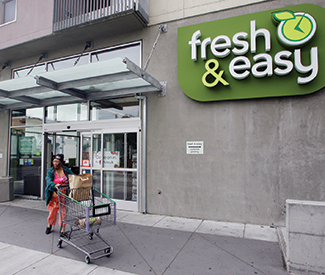
Five years had passed from the time when Fresh & Easy Market had agreed to do business in the Bayview to the day it finally opened for business. The store launch, held in late August of 2011, was treated as a celebratory affair — after much involvement by city officials, it marked the first time in 20 years that the low-income community would have a grocery store.

“The opening of Fresh & Easy on Third Street creates jobs for the community and will help make the neighborhood a place where families will want to stay and thrive,” Mayor Ed Lee said at the time.

But just over two years later, Fresh & Easy was closed. Tesco, the British parent company that owned the grocery chain, fell into financial trouble and unloaded its West Coast stores onto an affiliate of Yucaipa companies, headed by Los Angeles billionaire Ronald Burkle. Other San Francisco Fresh & Easy locations survived the transition, but the Bayview store didn’t make the cut.

Now it’s back to square one, and the neighborhood is once again without a grocery store where one can purchase fresh food. That’s especially problematic considering that Bayview residents suffer from diet-related illnesses such as heart disease and diabetes at much higher rates than other city residents.

And ever since Fresh & Easy closed, Sup. Malia Cohen, who represents District 10 where Bayview is located, has discovered that attracting a new grocery retailer to that neighborhood is like pulling teeth.

“Safeway was absolutely closed to the idea,” Cohen reports. “They cited safety concerns.”

When she first contacted Safeway representatives to pitch the idea of having the grocery retailer move into the vacant Fresh & Easy location, their response was to ask her office to track down emergency service call data in the surrounding neighborhood. “They said they couldn’t get the information,” Cohen said. “I said, that’s interesting, it’s public information.”

Safeway also cited concerns about the configuration of the vacant space and the size of the parking lot, Cohen said. She noted that the grocer has shown generosity in the past by making Safeway gift card donations to needy Bayview residents, but “that also presents a challenge. It’s a hike to get to the grocery store.”

Safeway spokesperson Wendy Gutshall did not answer questions about why the retailer was unwilling to consider moving to the area, and wrote in an email to Bay Guardian, “There are no plans at this time with respect to a new location in the Bayview.”

Cohen was frustrated, but undeterred. “I think there’s a certain level of racism and classism that blinds retailers from even exploring these communities,” she said. “I really want the community to be able to have healthy food options — not discounted toss-aways.”

Next on Cohen’s list was Trader Joe’s. “The conversation went well,” she noted, adding that she’s targeting the chain because numerous residents have told her they would shop there. “I’m optimistic — although they did express a desire to be in Noe Valley. Or the Castro.”

Asked whether the company would consider opening a store in the Bayview, Trader Joe’s spokesperson Alison Mochizuki would only say, “At this time, it’s not in our two-year plan to open a location in that area.”

Cohen said she’d also reached out to Kroger, Sterling Farms, and 99 Ranch Market to gauge interest. Meanwhile, nearby Visitation Valley will be getting its own grocery store, with an anticipated opening in June: discount retailer Grocery Outlet.

The closure of Fresh & Easy left some Bayview residents without jobs. Gloria Chan, spokesperson of the Office of Economic and Workforce Development, a city agency that works closely with Mayor Ed Lee, noted that OEWD had “deployed its rapid response team to assist [displaced Fresh & Easy] employees during the transition, and provided information on workforce services including unemployment assistance.”

Investment firm Fortress Investment Group acquired the vacant Fresh & Easy site in December, Chan added. “OEWD reached out to the Fortress Investment Group and expressed interest and the need for ensuring a grocery retail outlet continues to remain in the now vacant location,” she wrote. “OEWD remains diligent in pursuing a grocery retail outlet in the Bayview and have also spoken to various food operators.”

But so far, nothing has fallen into place, and Cohen says the mayor’s office could be offering more support. “We have the density needed to support a store — households, age range, all the qualifying data points,” Cohen said. “I do have my fingers crossed.”


Residents vs. tourists

64

steve@sfbg.com

Evictions and displacement have become San Francisco’s top political issues, amplified by protests against tech companies that are helping gentrify the city. Yet Airbnb, which facilitates the conversion of hundreds of San Francisco apartments into de facto hotel rooms, has so far avoided that populist wrath.

Tenants use the online, short-term rentals to help make rent in this increasingly expensive city, a point that the company often emphasizes.

“For thousands of families, Airbnb makes San Francisco more affordable,” Airbnb spokesperson Nick Papas wrote to the Guardian by email, citing a company survey finding that “56 percent of hosts use their Airbnb income to help pay their mortgage or rent.”

But it’s also true that Airbnb allows hundreds of rent-controlled apartments to be removed from the permanent housing market — in violation of local tenant, zoning, tax, and other laws — something that has united tenant, landlord, hotel, and labor groups against it (see “Into thin air,” 8/6/13).

“The problem is Airbnb is so easy and attractive that you can take a unit out from under rent control forever,” San Francisco tenant attorney Joseph Tobener told the Guardian.

“We’re getting 15 calls a week on Airbnb,” he said, describing four categories of complaints: landlords evicting tenants to increase rents through Airbnb, tenants complaining about neighbors using Airbnb, tenants being evicted for getting caught illegally subletting through Airbnb, and Airbnb hosts who can’t get guests to leave (city law gives even short-term residents full tenant rights, except in hotels).

There isn’t good public data on how many units are being taken off the market, but Airbnb generally lists well over 1,000 housing units in San Francisco at any given time, with its smaller competitors (such as Roomorama and VRBO) adding hundreds more.

The San Francisco Rent Board listed 326 no-fault evictions (Ellis Act, owner move-in, capital improvement) in its 2012-13 annual report. That number is almost certain to rise in the 2013-14 report due out in March, and it is compounded by an unknown number of buyouts that pressure tenants to voluntarily leave, all of it creating a displacement crisis that has galvanized the city.

“Isn’t it far more likely that more units are being lost [from the rental market] through Airbnb?” San Francisco Magazine recently quoted a UC Berkeley professor as saying in an article questioning whether Ellis Act evictions are really a “crisis.”

So Airbnb is clearly having a big impact on the city’s affordable housing crisis. Yet Airbnb is largely flying under the political radar in its hometown and ducking questions about its impacts.

“Airbnb has all the statistics we need to assess its impacts on the city’s housing market,” Tobener said. The company refuses to disclose such data. Airbnb’s customers need to consider their impacts to the city’s affordable housing crisis, Tobener added, because “there are social consequences to the decisions we make.”


STALLED IN LIMBO

Last year I discovered Airbnb was flouting a ruling that it should be paying the city’s 15 percent transient occupancy tax (“Airbnb isn’t sharing,” 3/19/13), a nearly $2 million per year tax dodge.

Yet Airbnb, which has quickly grown from a small start-up into a company worth nearly $3 billion, has some powerful friends in Mayor Ed Lee and venture capitalist Ron Conway, who invests in both Airbnb and Mayor Lee’s political campaigns and committees.

So the company has stonewalled Guardian inquiries for the last year as it has worked with Board of Supervisors President David Chiu on legislation that tries to bring the company’s business model into compliance with local laws. That hasn’t been easy, as Chiu told us.

“It has been difficult to corral the different stakeholders to get on the same page,” Chiu said. “Airbnb has been like unraveling an onion. The more progress we make, the more issues come up.”

Janan New, executive director of the San Francisco Apartment Association, says it shouldn’t be so hard. “They need to enforce the law. They need to collect the hotel tax. They don’t need new laws,” she told us.

While the city is unlikely to simply follow New’s advice, the displacement issue adds another layer to Airbnb’s onion, one that sources say has become an issue of growing concern within the company, which has finally begun to respond to Guardian inquiries.

Those concerns have also been compounded as Airbnb is now being sued by one of Tobener’s clients, Chris Butler, who says he was evicted from his rent-controlled Russian Hill apartment so the landlord could make more money through Airbnb (see “Airbnb profits prompted SF eviction, ex-tenant says,” SF Chronicle, 1/22/14).

“We strongly support rules that keep people in their homes, and the vast majority of Airbnb hosts are regular people just trying to make ends meet,” Airbnb told the Guardian. “Whatever happened in this case, we certainly do not support unscrupulous landlords who evict long term tenants solely to turn their apartments into short-term rentals, but it is important to note that experts have found such cases to be extremely rare.”

Airbnb didn’t respond to our follow-up questions, but those “expert” findings appear to be a reference to a study the company commissioned late last year from Berkeley-based Rosen Consulting Group entitled “Short-Term Rentals and Impact on Apartment Market.”

But that study of Airbnb’s impact to rental housing in San Francisco doesn’t really draw the conclusions that company seems to think and hope it does.


MISLEADING NUMBERS

One number that the study and Airbnb have repeatedly sought to highlight is the claim that “90 percent of Airbnb hosts in San Francisco use Airbnb to occasionally rent out only the home in which they live,” as the company put it to us.

“Airbnb users generally do not identify themselves as utilizing short-term rentals as a business. In fact, 90 percent of Airbnb hosts [in San Francisco] indicated that they live in the home listed on Airbnb,” was how the study put it.

“It’s trash. They pick and choose the data they want to share,” Tobener said of the study and the 90 percent figure, which he says was derived from a 2011 user survey before the local housing market exploded. Rosner Consulting told us it stands by the study but won’t discuss it.

The figure also lumped in those with multiple rooms in their homes that have traditionally been rented by local residents and covered by rent-control laws. It also discloses that 10 percent of Airbnb hosts are renting out outside units simply as a business, a figure that has likely risen over the last three years.

The study does disclose that there were 1,576 properties booked through the company in August 2012, which the study notes was just 0.4 percent of the 378,000 homes in San Francisco, which Airbnb uses to dismiss its impacts on the market.

But the study includes only macroeconomic data, rather than looking at the company’s impact on certain socioeconomic groups — such as those making 120 percent or less of median area income, the people being evicted from and priced out of the city — or the supply of rent-controlled housing.

“The average gross income per Airbnb property in the previous 12 months was $6,722, or an average of $564 per month,” the study discloses, choosing to use average rather than median figures even though they’re considered less accurate gauges of income and housing data.

Customers who only use Airbnb once or twice will skew those averages way down. Yet the study then compares that number to the “average market-rate apartment rent in San Francisco, which was $2,498 per month in mid-2013. The average income generated is insufficient to cover monthly rental expenses in full.”

Which tells us nothing about how Airbnb is impacting either rent-controlled housing or the median income San Franciscans who rely on it. According to the US Census Bureau, the median rent in San Francisco was $1,463 in 2012 and 64 percent of San Franciscans rent their homes.

“The study is bullshit,” Tobener said. “They could pull data and tell us how many people are renting full units on Airbnb, but they don’t.”

Yet the company claims that it is concerned about these issues and working with the city.

“We believe our community of hosts should pay applicable taxes and we are eager to discuss how this might be made possible. We’ve reached out to officials in San Francisco and we continue to have productive discussions with city leaders,” Airbnb told the Guardian. “These issues aren’t always easy, but if we work together, we can craft fair, responsible, clear rules that ensure San Francisco continues to benefit from home-sharing.”

Yet neither Airbnb nor its political supporters seem to want to have this public discussion. The company has stopped responding to our inquiries, again, and when we asked the Mayor’s Office about Airbnb’s impacts to the affordable housing market, we got this response and a refusal to directly answer either the original or follow-up questions: “The Mayor has prioritized preserving, stabilizing and growing the City’s housing stock. His policy priorities include protecting residents from eviction and displacement, including Ellis Act reform and stabilizing and protecting at-risk rent-controlled units, through rehabilitation loans and a new program to permanently stabilize rent conditions in at-risk units.”

Yet Airbnb continues to have an impact on those “at-risk rent-controlled units” that few people seem to want to discuss.

Presidio Trust decides on museum proposals

The Presidio museum showdown has come to an end for now, and the winner of the hotly contested mid-Crissy Field site is (drum roll, please) … no one.

Not the Golden Gate National National Park Conservancy. Not the Bridge Institute. And no, not Star Wars creator George Lucas.

At an impromptu press conference this afternoon, Presidio Trust Chair Nancy Hellman Bechtle said the board unanimously voted to not move forward with any of the museum proposals.

“This is the most spectacular site in the country,” Bechtle told reporters. “We simply do not believe any of the projects were right for this location.”

Since November of 2012, The Bridge Institute, the Golden Gate National Parks Conservancy’s Presidio Exchange, and filmmaker and Star Wars creator George Lucas’ personal pop art collection have all competed for a patch of uber-desirable real estate a stone’s throw from the Golden Gate Bridge.

The site is currently occupied by Sports Basement, whose planned move will be unaffected by the decision to reject the museum proposals, a spokesperson for the Presidio told the Guardian.

In January the three teams were made to re-submit their three proposals to the Presidio Trust, which cited Goldilocks reasons for not liking the various proposals. The Lucas Cultural Arts Museum was too big, the Presidio Exchange was too programmatically vague, and the Bridge Institute didn’t have enough of the green stuff (money).

But unlike Goldilocks, in the end the Presidio Trust did not find any porridge that was just right. However, it did offer to assist with finding alternative sites in the Presidio for the museums to find homes.

“There are a number of sites in the Presidio that are possible places to build,” said Presidio Trust Executive Director Craig Middleton. “We are really early in these conversations.”

The Lucas Cultural Arts Museum’s spokesperson, David Perry, said there are many cities vying for Lucas’ pop and cultural art museum.

“We’ve been getting requests to look at other sites for this museum, we’re going to look at those sites,” Perry said. We asked if he was referring to Chicago, where Lucas has expressed interest in building the museum before.

“I’ve heard all kinds of cities,” Perry said.

When we asked Perry how Lucas felt when he heard the news, he answered a bit oddly, if candidly.

“I spoke with George this morning,” he said.  “And as my grandmother used to say, if ‘ifs’ and ‘buts’ were candies and nuts, we’d all have a Merry Christmas.”

Above: Hit “play” to hear Lucas Cultural Arts Museum spokesperson David Perry tell us how his grandmother would have reacted to the Presidio Trust’s decision. 

Okay then.

Notably, the Lucas proposal was endorsed by Mayor Ed Lee, tech venture captalist Ron Conway, and a host of other well-heeled and monied backers. In a letter to the Trust, Congresswoman Nancy Pelosi publicly urged its members to hurry up on a decision, and to choose something that would bring in “a vibrant cross section of visitors to the Presidio, with particular attention to inner-city youth.”

We asked Becthle what influence, if any, opinions from powerful politicians had on the Trust’s ultimate decision.

“They’re very interested in California and the city,” she responded. “Sure I listen to [Sen. Dianne Feinstein], and to Nancy, but I think it was most important to do what was right with the park, and not to please one side or the other.”

Public weighs in on dueling museum proposals at Presidio Trust hearing

2

The fate of development Crissy Field is still up in the air after a townhall meeting last night [Mon/27] at the Presidio, where nearly 150 community leaders and residents spoke out on three rival museum proposals, in addition to a large group that supports no proposal at all.

“I don’t think any of them are taking history into consideration,” said SF resident Mike Brassington. “It’s a national historic landmark, and to my knowledge none of the groups care about the history.”

The three groups in question are vying for the highly coveted spot on mid-Crissy Field now occupied by Sports Basement, and each has submitted a proposal to the Presidio Trust laying out its development plans. The first is a project from Star Wars creator George Lucas, who hopes to open an interactive museum dedicated to illustration, digital art, and animation. The proposed facility, which would be funded from Lucas’ personal finances, has already been endorsed by influential leaders such as Rep. Nancy Pelosi, Gov. Jerry Brown, and SF Mayor Ed Lee.

“Arts education is critical to our students, and the whole city of San Francisco is their classroom,” said SF Board of Education Vice President Hydra Mendoza on behalf of the Mayor’s Office, speaking to the Presidio Trustees during the meeting. “The Lucas Cultural Arts Museum will create a rich new environment for our students.”

The Golden Gate National Park Conservatory (GGNPC) is the official sponsor for the second proposal, the Presidio Exchange, which is more commonly referred to as the PX. The PX — which is endorsed and funded by powerful groups such as National Geographic, the California Academy of Science, and the Aspen Institute — would be a conservatory and cultural center for both locals and tourists. The PX building, at 55,000 square feet, is the smallest facility and just over half the size of the other two.

“All of our partners can bring a lot of content to the Presidio,” said David Shaw, member of the GGNPC. “This is the most important issue of our time: the intersection of human culture and the natural world.”

The third and final proposal, known simply as The Bridge, is seen as the least competitive due to its lack of funding. Indeed, a spokesperson for The Bridge admitted to the Trustees that while the project had “no firm or solid” financial resources, they “do have the right idea.” While their efforts are noble, the “right idea” isn’t likely to earn a vote of confidence when millions of dollars are on the line.

Using the couple hundred members in the audience as a gauge, the PX project seemed to be the most popular, receiving the most robust applause out of the proposals. During the public comment portion, when any community member can hold the floor for up to two minutes, many people asked the Trustees to hold off on a decision. Virtually everyone who suggested a postponed decision also made clear that the PX was the least of the three evils, and if something had to be built, it should be the Presidio Exchange.

Charlotte Hennessy, who is on the board for the Presidio Historical Association and carries a sign that reads, “May the farce be with you,” agrees that the best solution is to put Crissy Field back as it used to be before all of the over-development. Just as a police officer arrives to escort Hennessy off of the premises toward the “First Amendment area” for carrying a sign, she shares her ideal vision for the future of the Presidio.

“Space,” Hennessy said. “Just open space.”  

The Presidio Trustees gave no timeframe for making a decision.

Local journalists starting to catch onto Airbnb’s subversion of SF’s rental market

45

Airbnb and other so-called “shared housing” sites allow hundreds of rent-controlled apartments in San Francisco to be essentially removed from the housing market, part of a concern that has caught populist fire recently with protesters and politicians pledging to do something about evictions and displacement.

Yet I’ve been one of the few local journalists to hound Airbnb over its illegal business model and refusal to pay nearly $2 million per year in transient occupancy taxes that it owes the city. But that may be beginning to change, as pair of mainstream local publications in the last week have cautiously waded into what outside journalists from Time magazine (which specifically mentioned my reporting on the issue) to German public television have already seen as a big and important issue.

The San Francisco Chronicle today has a story about a lawsuit from a tenant subjected to an owner-move-in eviction, with said owners then turning around to rent units in the building out through Airbnb. And San Francisco Magazine also mentioned Airbnb in its controversial article criticizing concerns over evictions.

“Isn’t it far more likely that more units are being lost [from the rental market] through Airbnb?” the magazine quoted a UC Berkeley professor as saying, comparing Airbnb to Ellis Act evictions. Hey, SF Mag, don’t you think that’s a good question that might be worth exploring?

Janan New, executive director of the San Francisco Apartment Association, told me this week that she found 1,100 rent-controlled San Francisco apartments listed on Airbnb — almost all of it in violation of local tenant and zoning laws — a fact that she personally conveyed to Mayor Ed Lee, who supports Airbnb, shares a funding source with the company (venture capitalist Ron Conway), and has been dismissive of the issue.

“They need to enforce the law like they do in New York City,” New told us, referring to a city that has cracked down on Airbnb’s subversion of its rent control laws. She’s lobbied City Hall, documented the problem, and threatened to sue the city: “I’ve done everything I can possibly think of.”

Meanwhile, Board of Supervisors President David Chiu has been negotiating with Airbnb for almost a year on legislation that would attempt to legalize and regulate its activities here in San Francisco, telling us “it has been difficult to corral the different stakeholders to get on the same page” and no longer offering any predictions when it might be complete.

I was already working on a story about Airbnb (which still won’t respond to my inquiries) for our next issue [UPDATE: It looks like I’ll hold that story for our Feb. 5 issue], so I’ll have more to say about this then. And in the meantime, here’s my latest message to the Mayor’s Office of Communications trying to get some kind of response to this issue, which it has ignored for the last 24 hours:

“I’m about to write about the rampant illegal behavior by Airbnb customers again, which seems increasingly relevant to the “affordability agenda” that Mayor Lee is touting, so I wanted to check in to see whether the mayor is still offering his unqualified support to this company, despite its violations of local housing, zoning, and planning laws and refusal to collect and pay the transient occupancy tax.

“Janan New with the SF Apartment Association says she’s raised this directly with Mayor Lee, including informing him recently that more than 1,100 rent-controlled apartments in San Francisco are listed on Airbnb, all in violation of local law, and she’s frustrated that he’s unwilling to enforce the law, as New York City has been doing. Meanwhile, the Airbnb legislation that David Chiu has been working on for the last year is hopelessly stalled, at least partly because Airbnb has the mayor’s support and is unwilling to compromise while it’s making some much profits off of its illegal behavior in San Francisco.   

“A recent San Francisco Magazine article (http://www.modernluxury.com/san-francisco/story/the-eviction-crisis-wasnt) even quotes a UC Berkeley professor saying that Airbnb is likely taking more rent-controlled units off the market than the Ellis Act. Considering the mayor is pursuing Ellis Act reform, why does he continue to ignore the impact that Airbnb is having on the city?”


Tenant battle brewing

44

rebecca@sfbg.com

Benito Santiago, 63, was born and raised in San Francisco. But now that he’s received an eviction notice from the apartment he’s lived in since 1977, he isn’t sure what the future holds.

“This is roots for me,” Santiago told us. “I have more affinity for San Francisco than the Philippines,” his family’s place of origin.

He works part-time with disabled youth enrolled in San Francisco public schools. “The idea that I built a rapport with these students here … to be put in a position where I wouldn’t be able to work with them, I’m a little saddened and depressed by it,” he said. “If I’m homeless, I can’t be taking care of these kids. I mean — it’s a worst-case scenario.”

He’s been exploring alternative housing options, and trying to stay positive. He says he’s even trying to “change the rate of vibration” of the real estate speculators seeking to oust him as part of his pre-dawn meditation and ritualistic movement practice, a routine he developed to mitigate the chronic pain he dealt with after being hit by an automobile when he was crossing the street in 1980.

“Hopefully, they can have some compassion,” he said.

Santiago is hoping to get a temporary extension to stave off his eviction, and he’s been looking into publicly subsidized below-market rate apartments. But rent for even the most affordable of those places would eat up 75 percent of his monthly income, he said. Unless he can find an affordable arrangement somewhere, he might end up having to leave the city.


GROWING MOVEMENT

Santiago has been a part of a growing movement underway in San Francisco to reform the Ellis Act and introduce meaningful legislation at the local level to protect the city’s renters.

In recent weeks, the San Francisco Anti Displacement Coalition, made up of a wide range of organizations including the San Francisco Tenants Union, has hosted a series of neighborhood tenant conventions to solicit ideas that will be boiled down at a citywide tenants’ gathering scheduled for Feb. 8. At that meeting, organizers plan to hash out a strategy and possibly solicit ideas for a ballot initiative.

The tenant conventions are happening on a parallel track with efforts to reform the Ellis Act, which allows landlords to remove apartments from the rental market and evict tenants.

“Our goal is to ban the use of the Ellis Act in certain circumstances,” explained Dean Preston of Tenants Together, a nonprofit focused on strengthening the rights of renters.

“More than half of Ellis Acts are performed by people who bought the properties within the past six months,” he told us. “Their whole purpose is to buy it and kick everyone out. It was supposed to be for long-term landlords to get out of the business” of being landlords, he added. Instead, “it’s being completely abused.”

Sen. Mark Leno is working with Mayor Ed Lee on a response that would seek to lessen the impact the Ellis Act has had in San Francisco. Meanwhile, Assemblymember Tom Ammiano is spearheading a separate effort.

“At this time, he’s not really ready to say which avenue he’s taking” in terms of a legislative strategy, said Carlos Alcalá, Ammiano’s communications director. “Because that can rule out that avenue.”

Preston said he’s been through waves of evictions before, but the organizing now taking place has been especially effective at drawing attention to the issue. Oftentimes, “the speculators are not from within the city or even within the state,” he pointed out. “That has fueled a lot of activism and courage.”

For Santiago, the organizing has given him heart during a difficult time. “I’m hearing a lot of sad stories,” he said, “and I am not alone.”

By the people

3

rebecca@sfbg.com

A growing number of people seem to be convinced that “civic innovation” is sexy.

Tech-oriented events at San Francisco City Hall, like hackathons for improving government services, have become increasingly common. App developers are gaga over the idea of revolutionizing government through software, and the concept is gaining momentum.

To borrow an analogy referenced in an essay by tech publisher Tim O’Reilly, some software purveyors are moving away from the idea of government as a vending machine: “When we don’t get what we expect, our ‘participation’ is limited to protest—essentially, shaking the vending machine.”

Instead, they’re latching onto the idea of government as an open platform that citizens can tinker with.

That’s exciting. Can it lead to a government that is more responsive to the people, as enthusiasts predict? Can we really hack away the ineffective and irresponsive parts of the public sector?

Or is some of this just hype and libertarian idealism from a cash-drenched tech sector seeking business opportunities and greater political influence?


HACK THE LAW

Sup. Mark Farrell recently proposed doing away with an outmoded and widely disregarded law disallowing bicycle storage in garages. The legislative tweak matters because it was spurred by feedback submitted through a new website, SanFranciscoCode.org.

Operated by a private nonprofit organization called the OpenGov Foundation, the website presents an interactive, online version of the city’s municipal code with an open platform where anyone can easily comb through the thicket of city laws and leave comments on specific sections, using the software as a magnifying glass.

Farrell touted the website — launched in partnership with Mayor Ed Lee’s Office of Civic Innovation last September — as a tool that could spur “a more transparent and accountable city government.”

“I see this leading to better engagement,” said Jess Montejano, Farrell’s legislative aide. Seamus Kraft, executive director of the OpenGov Foundation, has been compiling all the comments submitted via SanFranciscoCode.org, and recently sent a memo with all user feedback to each member of the Board of Supervisors.

“Our mission is to put as much public information into the public’s hands as possible,” Kraft said, “so that people can access their laws the way they deserve in 2013.”

The idea that a law would be changed instantly based on public comments is a new take on an old concept, with shades of being enamored by that shiny new thing. After all, many supervisors have a habit of turning their backs, or very obviously zoning out, during public comment sessions at weekly board meetings.

Yet anyone with an Internet connection can run with this new portal for citizen engagement. How about a reinvigorated response to San Francisco’s Sit/Lie Ordinance? A torrent of online commentary about the public nudity ban? Not everyone has the same idea about what it means to fix a broken law.

In some respects, City Hall appears to be lending itself out as a laboratory in which to test the wide-ranging theories of civic innovators. Mayor Lee has greeted the technology sector with arms wide open, and empowered the Office of Civic Innovation to foster tech-fueled government fine-tuning.

With the rise of amply funded organizations such as Code for America, droves of programmers stand at the ready, eager to chip in and do their part to help transport the public sector out of the analog ages.

A recent brigade of Code for America fellows partnered with the city’s Department Health and Human Services to create an app that automatically notifies food stamp recipients via text when they are about to be automatically dis-enrolled. The idea is to give recipients advance notice so they can take steps to renew their enrollment.

Other initiatives, such as the Department of Public Health’s release of an open data set to reveal housing inspection records, can arm citizens with useful knowledge — like empowering apartment hunters to spot a slumlord from a mile away.

The use of tech for transparency holds potential: What if each and every public record — down to every last email, calendar appointment, or police report — were instantly uploaded to a publicly accessible database, easy to locate, and fully searchable? Would that be a check against corruption?

Ron Bouganim, a San Francisco-based venture capitalist and mentor to the very Code for America teams industriously improving city government through technology, recently filed paperwork with the Securities and Exchange Commission to create GovTech. It’s a new kind of venture capital fund, specifically devoted to fostering companies looking to find their way in the “civic innovation” sector.

Bouganim laid out the dynamics driving the civic innovation trend: First, “2008-2009 was like a nuclear bomb,” he explained. “The financial crisis was a cataclysmic event. The money is not coming back, ever.”


THE NEW NORMAL?

This new normal, characterized by dramatically depleted public-sector finances, has helped make government more open to working with startups instead of trusted brands like IBM, Bouganim said, since startups can help government “do more with less.”

Bouganim also said adoption of cloud computing has changed the game. Whereas governments were initially hesitant to move their data to the cloud, the recent migration has made it possible for companies seeking government contracts to price below the “procurement threshold,” a price point that triggers a long public approval process before a purchase can go through. Now that technology has helped software developers slice through red tape, startups are flooding in, eager to land public sector contracts.

The city’s Entrepreneurship in Residence webpage (entrepreneur.sfgov.org), which markets a program rolled out by the Office of Civic Innovation, says it all. Sporting a gleaming picture of San Francisco City Hall, it bears the caption: “Develop products & services for the $142 billion public sector market.”

Bouganim wasn’t willing to say much in the way of GovTech’s plans, but he mentioned that his accelerator provides mentorship for startups that are paired with government agencies, and hinted that his initial investments would lead to “a dramatic impact on government savings.”

An underlying goal of the whole civic innovation movement, Bouganim added, “is to fundamentally change this concept that government is over there, and I am over here. We the people are the government, we’ve just lost touch with it.”

Bouganim responded to the Guardian’s call within 15 minutes, mentioning he was in London. “I wanted to get back to you so you didn’t think I was ignoring you,” he said, “because that would be awful.”

But the well-compensated public servants at the Mayor’s Office of Civic Innovation evidently had no such compunction. The Bay Guardian placed multiple calls to that office for this story, only to be met with radio silence.

And that’s a quandary. One cannot trumpet lofty goals of citizen engagement while habitually walling off government critics, and still expect to be taken seriously. And therein lies the rub with civic innovation: Even if technology is neutral, politics will never be so.

Nickels and dimes… or transit for our times?

14

STREET FIGHT Much has been written about the so-called “Google buses” and San Francisco’s latest round of gentrification. It’s a horrible mess and the city’s trifling $1 charge per bus stop will do little to address the broader structural problem that these buses lay bare.

Ordinary people cannot ride them, nor do the people who clean and cook for the tech world. Like tour buses, they are clunky and inappropriate for many neighborhood streets. While they do substitute for some car trips, an ad hoc private transit system does not reflect the kind of thoughtful regional planning needed to truly reduce car use in the Bay Area.

But the controversy over the private commuter buses does show that there is great potential for a public regional express bus system. Consider that in 1980, 9 percent of commuters in San Francisco left the city every day to go to work. In 2010, outbound commuters approached 25 percent. Owing to regional political fragmentation, Muni cannot provide intercounty service and thus is not the travel mode of choice for many of these commuters. And although Caltrain and BART offer some regional service, the sprawling locations of suburban firms often make regional rail impractical or at the very least time-consuming owing to unavoidable multiple transfers to local buses.

So in noteworthy ways, the rise of private transit is an immediate reaction to poor regional transit connections. Yet rather than sidestepping failed regional planning by encouraging an inequitable, two-tiered, private system, we need to expand and regionalize the existing public bus systems. San Francisco’s mayor and Board of Supervisors have seats at the table of regional planning and ought to use the controversy over private buses as an opportunity to kickstart the implementation of a regional public bus system accessible to all.

For example, something like AC Transit’s Transbay routes should be extended through San Mateo and Santa Clara counties, perhaps operated by BART or Caltrain as part of the next iteration of Plan Bay Area. This network would use reallocated express lanes on 101 and I-280 and use transit priority lanes on arterials like 19th Avenue in San Francisco and El Camino Real in San Mateo. Regional property assessments on the corporations and developers, in part already possible within the existing BART district (one should be created for Caltrain), could be used to fund such a system. Congestion charging on 101 and I-280 should also be deployed and those funds used for electrifying Caltrain and developing the parallel and complementary regional bus system.

Of course there will be opposition to a regional public bus system as there already is to progressive regional planning. Transit-connected, walkable communities in the South Bay, for example, have been made all but illegal by decades of conservative middle and upper class, anti-density, anti-tax homeowners in suburban localities. As recently as last year, this Tea Party-style conservative politics dampened Plan Bay Area, resulting in a weak regional housing plan with an underfunded and lackluster transit vision. This conservative approach stifles our collective sense of what is possible and the fear-mongering has rendered regional planners virtually impotent. Yet it can and must be overcome.

Some progressives may find it convenient (and in some cases justifiable) to target tech workers right now, but they could also direct energy into shaping the next round of Plan Bay Area. Remember that Plan Bay Area is a living document, a work in progress. The current version of the plan, weak on transit funding, has been subdued by a loud, irrational mob of Tea Party cranks bent on sabotaging anything that hints of progressive ideas. Plan Bay Area is also stifled by a regional business class that wants to keep the status quo and that is comfortable with the neoliberal model of private transit.

So while a smattering of dedicated and hard-working progressive transit activists showed up and attempted to shape Plan Bay Area last year, in the coming years the plan needs a broader progressive movement — including transit, housing, social justice, and environmental activists — to demand a more visionary regional transportation plan that connects all of the Bay Area. I am hopeful that this would not only steer regional planning in a progressive direction, but many of the tech workers who are now on the private buses would gladly join in the cause.


THE POLITICS OF SUNDAY PARKING

Speaking of hopeful, last month the SFMTA reported that Sunday metering, implemented last January, is a resounding success. Switching-on the meters doubled parking availability on Sundays, which is invariably what small businesses, most of which are open on Sunday, want to see.

Sunday meters increased the number of cars using city-owned garages and decreased the time cars circled in search of parking from an average of four minutes to two — de-cluttering streets in commercial districts. While this might seem like a boon to drivers, it also means less pollution, safer conditions for pedestrians and cyclists, less delay for Muni, and a much needed enhancement of revenue for operating public transit.

So it is mystifying that such success would be ignored by Mayor Ed Lee, who instead has proposed to discontinue Sunday metering. This is doubly confusing because, based on existing travel behavior to many commercial districts, 25 percent of people arrived by driving, while 31 percent took transit and 25 percent walked. So what the mayor is effectively saying to the pedestrian and transit-using majority is you matter little. What does matter is the few whining motorists who called him to complain about being “nickel and dimed.”

The mayor talks a good game when saying he is truly concerned about pedestrian and cyclist safety, and insisting that he wants to fix Muni. But gutting a reliable source of operating funds and pandering to car drivers who will dangerously circle for parking is inconsistent.

Lee says money isn’t an issue because his proposed General Obligation bond (which must be approved by voters) will patch the lost revenue from Sunday metering. But the GO bond will incur further debt and only fund existing capital needs, while parking meters provide a debt-free steady revenue stream for Muni. It’s also slightly misleading because the bond would not cover Muni operations, while revenue from Sunday metering does pay for operations.

The mayor’s pandering also put the SFMTA Board of Directors, which has been working out parking management and Muni finance, on the spot. Ultimately, it has to vote to preserve or scrap Sunday metering in the coming months. Now the directors have to decide if they support transit-first or the mayor’s pandering.

Unfortunately, when it comes to parking policy, the way that the Board of Supervisors has behaved lately suggests it will either jump on the mayor’s bandwagon and pander to motorists or cower in silence as good public policy is trashed. Not a good situation at City Hall, where transit riders seem to be routinely thrown under the bus by the political establishment.

Street Fight is a monthly column by Jason Henderson, an urban geography professor at San Francisco State University.

Protect pedestrians

0

More than 50 public commenters spoke at the Jan. 16 joint Police Commission and Board of Supervisors Neighborhood Services and Safety Committee meeting, and all sounded one message loud and clear: Drivers can maim and kill pedestrians with near impunity in San Francisco, and that must end.

"I’m here very simply to urge you to end the carnage on our streets," said Natalie Burdick of the nonprofit Walk SF. "These crimes cost the city millions annually, and untold value in terms of squandered human capital."

Pedestrian deaths reached a high last year, with 21 killed in traffic collisions. Sup. Eric Mar highlighted the lack of funding in Mayor Ed Lee’s Pedestrian Strategy, which has a funding gap of $5-18 million. But SFPD’s failure to cite motorists was the main criticism.

"The fact is these statistics have been consistent that two-thirds of pedestrian accidents are the fault of the driver," Sup. Scott Wiener said at the outset of the meeting. "It’s the fact of the situation."

State of the City: spin over substance

5

It was maddening to watch Mayor Ed Lee deliver his annual State of the City address on Jan. 17. This was pure politics, from the staged backdrop of housing construction at Hunters Point Shipyard to the use of “regular people” props to the slate of vague and contradictory promises he made.

“This place, the shipyard, links our proud past to an even more promising future,” was how Lee began his hour-plus, invite-only address.

Later, he touted the housing construction being done there by Lennar Urban as emblematic of both his promise to bring 30,000 new housing units online by 2020 — the cornerstone to what he called his “affordability agenda” — and the opposition to unfettered development that he is pledging to overcome.

“A great example is the place we’re standing right now. This took us too long,” Lee said after decrying the “easy slogans and scapegoating” by progressive activists who place demands on developers.

But that implication was bullshit. As we’ve reported, progressive and community activists have long encouraged Lennar Urban (which has a close relationship to Lee) to speed up development on this public land that it was given almost a decade ago, particularly the long-promised affordable housing, rather than waiting for the real estate market to heat up.

That was just one of many examples of misleading and unsupported claims in a speech that might have sounded good to the uninformed listener, but which greatly misrepresented the current realities and challenges in San Francisco.

For example, Lee called for greater investments in the public transit system while acknowledging that his proposal to ask voters this November to increase the vehicle license fee isn’t polling well. And yet even before that vote takes place, Lee wants to extend free Muni for youth and repeal the policy of charging for parking meters on Sundays without explaining how he’ll pay for that $10 million per year proposal.

Lee also glossed over the fact that he hasn’t provided funding for the SFMTA’s severely underfunded bicycle or pedestrian safety programs, yet he still said, “I support the goals of Vision Zero to eliminate traffic deaths in our city.”

Again, nice sentiment, but one disconnected from how he’s choosing to spend taxpayer money and use city resources. And if Lee can somehow achieve his huge new housing development push, Muni and other critical infrastructure will only be pushed to the breaking point faster.

Even with his call to increase the city’s minimum wage — something that “will lift thousands of people out of poverty” — he shied away from his previous suggestion that $15 per hour would be appropriate and said that he needed to consult with the business community first: “We’ll seek consensus around a significant minimum wage increase.”

But Mayor Lee wants you to focus on his words more than his actions, including his identification with renters who “worry that speculators looking to make a buck in a hot market will force them out.”

Yet there’s little in his agenda to protect those vulnerable renters, except for his vague promise to try to do so, and to go lobby in Sacramento for reforms to the Ellis Act.

Lee also noted the “bone dry winter” we’re having and how, “It reminds us that the threat of climate change is real.” Yet none of the programs he mentions for addressing that challenge would be as effective at reducing greenhouse gas emissions as the CleanPowerSF program that Lee and his appointees are blocking, while offering no other plan for building renewable energy capacity.

Far from trying to beef up local public sector resources that vulnerable populations increasingly need, Lee said, “Affordability is also about having a city government taxpayers can afford.”

Manhattanization revisited

116

joe@sfbg.com

The housing crisis is spurring pro-development arguments that threaten to hasten the “Manhattanization of San Francisco,” a buzzphrase from another era that led to local controls on high-rise development.

The city is getting richer and less diverse, and the unaddressed displacement of longtime residents has fueled populist outrage. Now, politicians are finally getting the message, but some are offering solutions that may reopen old civic wounds.

They say that the answer to the housing affordability crisis is to build massive amounts of new housing, and to build it higher and more densely than city codes and processes currently allow.

Sup. Scott Wiener wrote a scathing indictment of the city’s alleged aversion to housing production in the San Francisco Chronicle on Jan. 13, slamming a planning process that he says slows necessary construction.

“This disconnect — saying that we need more housing while arbitrarily finding reasons to kill or water down projects that provide that housing — is having profound effects on our city and its beautiful diversity, economic and otherwise,” Wiener wrote.

Though he mentioned affordable housing, the need to build all kinds of housing was the crux of his argument. It’s the same kind of developer-friendly rhetoric that whips people into a frenzy with faux common sense: build more, and the market will take care of everyone.

But there are flaws to that simplistic argument. Housing advocates (and Guardian editorials) have long argued that market rate units — the median price of which just surpassed $1 million — don’t trickle down to maintain the city’s economic diversity. More supply may help, but with insatiable demand for housing here, it won’t help much with affordability for the working class.

The next day, Wiener introduced legislation to loosen density requirements when developers build below-market-rate housing units on site, creating an incentive to build more of the units that affordable housing advocates say are most valuable.

“Long term, I’m concerned about young persons that can come here,” he told the Guardian. “It’s not just about building more housing.”

Pushing a pro-development agenda while playing lip service to an affordable housing push is all the rage in San Francisco nowadays, with Mayor Ed Lee calling for building 30,000 new housing units by 2020, supporting the rapid growth calls by SPUR, Housing Action Coalition, and other pro-growth groups.

But Peter Cohen, co-director of the Council of Community Housing Organizations, says supply and demand logic doesn’t apply to the San Francisco housing market for a number of reasons.

He pointed to a paper by CCHO cohort Calvin Welch, who teaches a class on the politics of housing development at USF and SFSU. Welch cites data from the City Controller’s Office showing that when San Francisco increases supply, the market responds by raising the average housing price. Contrary to all the supply and demand claims, when we produce more, things get more expensive.

Why?

“In classic economic theory prices are set by supply and demand only when the market is ‘competitive’ when neither consumers nor suppliers have the ‘market power’ to set the price by themselves,” Welch wrote. “Clearly, that is not the case in San Francisco…of the City’s 47 square miles, only 13 square miles is available for housing uses.”

“There is no ‘free land’ in San Francisco,” he wrote. “The owners have total ‘market power’ over its price.”

But that’s the kind of complex argument that has a tough time penetrating the public consciousness. The idea isn’t as catchy as “supply and demand.”

“I think frankly this whole thing about build, build, build — it’s an easy answer to something that’s complex,” Cohen told us. “It resonates. It sounds like the easy path to sound like you know what you’re talking about.”

That simplistic thinking is dangerous, though, because San Francisco is quickly becoming Manhattanized. Since 2002, New York City Mayor Michael Bloomberg rezoned over 37 percent of New York City, according to The New York Times, causing the construction frenzy many are seeking for San Francisco.

Bloomberg added 40,000 buildings in his time as mayor, but that boom had mixed results. It arguably hastened the Big Apple’s gentrification, especially in Manhattan, one of the few US locales denser than San Francisco.

From 2000 to 2010, Manhattan’s ranks of white people swelled by 58,000. During the same period, the wealthy home of Wall Street lost 29,000 African Americans and 14,000 Latinos. More alarming is the income disparity there.

From 1990 to 2010, the city that never sleeps, and its neighborhoods, increasingly became a land of have and have-nots. Census maps showed that while 1990 Manhattan had economic diversity, now the median income hovers over $75,000 for most blocks of that famous borough.

Articles from the Times and NYC-based housing advocacy organizations frequently describe Manhattan as a haven of wealthy white yuppies. Sound familiar?

San Francisco is quickly following suit. The same census maps that show the swell of wealth in Manhattan show a swell of wealthy folk in San Francisco.

BMR housing set-asides help, and Mayor Lee has promised to ramp up BMR production, calling for about 10,000 units by the year 2020. But any serious increase in housing production carries its own cost in a city where public transit and other vital infrastructure are already underfunded and would need serious new investments.

In his Jan. 17 State of the City speech, Mayor Lee warned against demonizing the tech industry or with pitting one group against another. “San Francisco changes us more than any group of newcomers will change San Francisco,” he said to the invite-only crowd.

The difference now is the wealth that threatens to gentrify San Francisco’s weird soul, the one we’ve hung onto since a man named Joshua Norton declared himself Emperor of the United States and was hailed as a San Franciscan icon.

“Manhattanization” is not just a buzz term or a scare tactic: It’s representative of a specific set of zoning and construction policies that many San Franciscans are now advocating for, which will change the demographics and politics of this city, whether we like it or not.

San Francisco’s chief economist addresses supply and demand in terms of housing — it’d take over 100,000 new housing units to make a dent in housing prices in San Francisco.

New, final Presidio museum proposals are in

9

The final round of project proposals for the Crissy Field Presidio site are in, and boy do they sure look… almost exactly the same as the last round. 

The Presidio Trust was fairly critical of each of the three finalists for the current site of the Sports Basement, which will soon lose its prime real estate. The Bridge Institute, the Golden Gate National Parks Conservancy’s Presidio Exchange, and Star Wars creator George Lucas’ personal pop art collection are all duking it out for a little patch of green (which is worth a lot of green) by the Golden Gate Bridge. 

Everyone in San Francisco has an opinion on who should win the spot: Mayor Ed Lee and tech venture capitalist Ron Conway want George Lucas’ museum to win (as do most tech folks with money), every environmental group out there wants the Presidio Exchange to get the space (including the Sierra Club), and the Chronicle’s design writer John King just wants Lucas to use the old Palace of Fine Arts site, dammit.

The Presidio Trust, a presidentially appointed entity, has the final say. And what it said last time was this: give us new proposals.

The Lucas proposal was too big, and the Trust felt it needed to be “redesigned to be more compatible with the Presidio.” The Presidio Exchange, it said, struggled to find a theme programatically. It lacked focus. As for the Bridge Institute? The Trust was worried it didn’t have the money to build with at all. 

Now everyone is back with new plans, in force.

George Lucas responded to the critique that his museum was just too darn big:
“Relative to the issue of ‘ensuring the building’s compatibility with the Presidio’ we are submitting two new design concepts for your consideration that we believe address the issues of massing and height. We have worked diligently the past few weeks with our architects at Urban Design Group and other members of our team to develop a new design that we believe will meet the criteria outlined by the Trust while providing the best home for the collection and its diverse cultural and educational programs. We are submitting two designs for your consideration, with the intent that if the Lucas Cultural Arts Museum is chosen for the Crissy Field site, you will identify the design you would like to see further developed.”

So it’s the same beast, just you know, smaller.

The Presidio Exchange folks, on the other hand, decided that since their programs lacked clarity, they’d make a flow chart. It’s good to know that they strive for consistency.

pdxgraph

pdxfinal

The final conceptual image of the PDX.

And as for funding the Bridge Institute? It wants to put a member of the Presidio Trust to work helping it raise money.

“The trust and Trust Board would make its network of contacts available to the BRIDGE fundraising team, and assist in making positive contacts with those contacts as part of the fundraising efforts of the organization,” it wrote. In other words, Presidio Trust, help us raise the dough, please. Presidio Trust President Nancy Hellman Bechtle is wealthy, but there’s no telling if she’d tap her wealthy friends to help the Bridge Institute. 

“We appreciate the effort each team has made to further develop its proposal for the Mid-Crissy Field site,” Becthle said, in a press release. “In the weeks ahead we will evaluate the revised proposals, weigh the wide range of public comments, and make a decision that will stand the test of time. This is a remarkable opportunity for the Presidio and San Francisco and we look forward to the public’s continued engagement.”

Love the designs or hate them, the public’s last chance to comment will be at the Public Board  of Directors Meeting to be held on Monday, Jan. 27, 6:30 pm in Herbst at the Presidio.

You can read all the museum proposals for yourself, here.

And while you’re at it, check out our front page story covering the founding of the Presidio, and how that history shaped the museum proposals.


State of the City speech filled with unsupported promises

178

It was maddening to watch Mayor Ed Lee deliver his annual State of the City address this morning. This was pure politics, from the staged backdrop of housing construction at Hunters Point Shipyard to the use of “regular people” props to the slate of vague and contradictory promises he made.

“This place, the shipyard, links our proud past to an even more promising future,” was how Lee began his hour-plus, invite-only address.

Later, he touted the housing construction being done there by Lennar Urban as emblematic of both his promise to bring 30,000 new housing units online by 2020 — the cornerstone to what he called his “affordability agenda” — and the opposition to unfettered development that he is pledging to overcome.

“A great example is the place we’re standing right now. This took us too long,” Lee said after decrying the “easy slogans and scapegoating” by progressive activists who place demands on developers.

But that implication was complete bullshit. As we and others have reported, progressive and community activists have long encouraged Lennar Urban (which has a close relationship to Lee) to speed up development on this public land that it was given almost a decade ago, particularly the long-promised affordable housing, rather than waiting for the real estate market to heat up.

That was just one of many examples of misleading and unsupported claims in a speech that might have sounded good to the uninformed listener, but which greatly misrepresented the current realities and challenges in San Francisco.

For example, Lee called for greater investments in the public transit system while acknowledging that his proposal to ask voters this November to increase the vehicle license fee isn’t polling well. And yet even before that vote takes place, Lee wants to extend free Muni for youth and repeal the policy of charging for parking meters on Sundays without explaining how he’ll pay for that $10 million per year proposal.

“Nobody likes it, not parents, not our neighborhood businesses, not me,” Lee said of Sunday meters, ignoring a study last month by the San Francisco Muncipal Transportation Agency showing the program was working well and accomplishing its goals of increasing parking turnover near businesses and bringing in needed revenue.

Lee also glossed over the fact that he hasn’t provided funding for the SFMTA’s severely underfunded bicycle or pedestrian safety programs, yet he still said, “I support the goals of Vision Zero to eliminate traffic deaths in our city.”

Again, nice sentiment, but one that is totally disconnected from how he’s choosing to spend taxpayer money and use city resources. And if Lee can somehow achieve his huge new housing development push, Muni and other critical infrastructure will only be pushed to the breaking point faster.  

Lee acknowledges that many people are being left out of this city’s economic recovery and are being displaced. “Jobs and confidence are back, but our economic recovery has still left thousands behind,” he said, pledging that, “We must confront these challenges directly in the San Francisco way.”

And that “way” appears to be by making wishful statements without substantial support and then letting developers and venture capitalists — such as Ron Conway, the tech and mayoral funder seated in the second row — continue calling the shots.

Even with his call to increase the city’s minimum wage — something that “will lift thousands of people out of poverty” — he shied away from his previous suggestion that $15 per hour would be appropriate and said that he needed to consult with the business community first.

“We’ll seek consensus around a significant minimum wage increase,” he said, comparing it to the 2012 ballot measures that reformed the business tax and created an Affordable Housing Fund (the tradeoff for which was to actually reduce the on-site affordable housing requirements for developers).

But Mayor Lee wants you to focus on his words more than his actions, including his identication with renters who “worry that speculators looking to make a buck in a hot market will force them out.”

Yet there’s little in his agenda to protect those vulnerable renters, except for his vague promise to try to do so, and to go lobby in Sacramento for reforms to the Ellis Act. While in Sacramento, he says he’ll also somehow get help for City College of San Francisco, whose takeover by the state and usurpation of local control he supported.   

“City College is on the mend and already on the path to full recovery,” Lee said, an astoundingly out-of-touch statement that belies the school’s plummeting enrollment and the efforts by City Attorney Dennis Herrera and others to push back on the revocation of its accreditation.

Lee also had the audacity to note the “bone dry winter” we’re having and how, “It reminds us that the threat of climate change is real.” Yet none of the programs he mentions for addressing that challenge — green building standards, more electric vehicle infrastructure, the GoSolar program — would be as effective at reducing greenhouse gas emmisions as the CleanPowerSF program that Lee and his appointees are blocking, while offering no other plan for building renewable energy capacity.

Far from trying to beef up local public sector resources that vulnerable city residents increasingly need, or with doing environmental protection, Lee instead seemed to pledge more of the tax cutting that he’s used to subsidize the overheating local economy.

“Affordability is also about having a city government taxpayers can afford,” Lee said. “We must be sure we’re only investing in staffing and services we can afford over the long term.”

How that squares with his pledges to put more resources into public transit, affordable housing development, addressing climate change, and other urgent needs that Lee gives lip service to addressing is anybody’s guess.