Mayor Ed Lee

Lee panders to motorists and undermines SFMTA with Sunday metering repeal

36

First Mayor Ed Lee ignores the rising cost of living in San Francisco (fueled partly by his own corporate welfare for the tech industry and commercial landlords), and now he’s using his sudden concern about gentrification as an excuse to make parking meters free again on Sundays, a blatant bit of political pandering that blows a $6 million annual hole in Muni’s budget.

Maybe it’s understandable that a politician worried about his reelection prospects with restive voters would take a page from the playbook of former Gov. Arnold Schwarzenegger, who slashed the state’s vehicle license fee to win that office. But what makes this move stink even more is it’s being supported by the San Francisco Municipal Transportation Agency, a supposedly independent (yet mayoral appointed) body whose top officials methodically and courageously have made a strong case for Sunday metering.

“We’re just willing to partner with the mayor to address affordability,” SFMTA spokesperson Paul Rose told us, admitting the agency hasn’t yet identified a funding source to fill that gap if Sunday metering is repealed on July 1 as proposed. Sunday meters were budgeted for $1 million in revenue, but they actually brought in $6 million in the last year because of more tickets than expected, feeding the outrage of motorists who feel entitled to use public roads for free. 

We’re waiting for calls back from SFMTA Executive Director Ed Reiskin and Chairman Tom Nolan to find out whether they no longer stand by the arguments they’ve been making for Sunday metering, claiming it helps the local economy by making parking spaces available in neighborhood commercial districts and that it’s consistent with the city’s official transit-first policy.

“What does this say about the city’s commitment to the policy of promoting transit first?” San Francisco Bicycle Coalition Executive Director Leah Shahum said, saying she was shocked by the announcement given how underfunded the SFMTA’s transit, bicycle, and pedestrian improvement programs all are. “Why in the world are we even talking about this?”

Lee claims this is about affordability, telling the Chronicle “it was just nickel-and-diming people to death,” yet his own plans call for asking voters to approve more than $6.3 billion in taxes to fund Muni’s needs over the next 15 years, including a proposal to increase the sales tax in 2016, a regressive tax that will hit those already struggling harder than Sunday metering does to the 70 percent of San Francisco households that have an automobile.

Lee has also proposed ballot measures for this November that would increase the vehicle license fee and issue a $500 million general obligation bond, paid for on the property taxes of all city households. His own polls show the measures could be difficult sells to voters, and it’s not clear why he won’t wait for those results before ending Sunday metering.

When we asked mayoral Press Secretary Christine Falvey about all this, she selectively answered our questions with the following response: “The mayor believes a comprehensive funding strategy to not just maintain, but improve Muni performance, pedestrian and bike safety and the condition of our roads is what will finally turn the corner on improving San Francisco’s Transportation System. That’s why he has spent the better part of a year with the Transportation 2030 Taskforce, that recommended several ways to support these goals, including a $500 million general obligation bond, which the mayor supports. Because of a strong economy, the mayor believes it’s time to eliminate parking fees for six hours on Sundays and permanently fund Free Muni for low income youth to help working families in San Francisco and ease the affordability issues he hears about from families across the City.”

But at this point, that’s just political rhetoric, and Lee’s “comprehensive funding strategy” remains a vague and distant dream — one that will soon be $6 million a year tougher to make a reality. 

Lies, damned lies, and statistics

0

When is a public opinion poll a valid representation of how people feel? That turns out to be a tricky and ever-evolving question, particularly in San Francisco — thanks to its prevalence of tenants and technology — and even more particularly when it concerns the approval rating of Mayor Ed Lee.

Traditionally, the central requirements for public opinion polls to be considered valid is that respondents need to be representative of the larger population and they need to be selected at random. Polls are often skewed when people need to opt-in, as is the case in most online polls.

So the Guardian took issue with claims that 73 percent of voters approve of the job that Mayor Lee is doing, a figure derived from an opt-in online poll focused on “Affordability and Tech” that was conducted by University of San Francisco Professors Corey Cook and David Latterman and released to the San Francisco Chronicle on Dec. 9. That figure quickly wallpapered the comment section of the Guardian’s website as the answer to any criticism of Mayor Lee, his policies, or the city’s eviction and gentrification crises.

“Any survey that relies on the ability and/or availability of respondents to access the Web and choose whether to participate is not representative and therefore not reliable,” is how The New York Times Style Guide explains that newspaper’s refusal to run such polls, a quote we used in our Jan. 10 Politics blog post on the subject, and we quoted an academic making a similar point.

We also interviewed and quoted Latterman discussing the challenges of doing accurate and economical polling in a city with so many renters (64 percent of city residents) and so few telephone landlines. “San Francisco is a more difficult model,” Latterman told us. “So Internet polling has to get better, because phone polling has gotten really expensive.”

So we ran our story dubbing the poll “bogus” — and the next day got angry messages from Cook and Latterman defending the poll and educating us on efforts within academia to craft opt-in online polls that are as credible as traditional telephone polls.

“The author is so quick to dismiss the findings of the study, which is based upon accepted methodology, and which had nothing to do with mayoral approval scores, that he actually misses the entire thrust of the study — that voters in San Francisco are deeply ambivalent about the current environment, concerned about the affordability crisis, and not trusting of local government to come up with a solution,” Cook wrote in a rebuttal we published Jan. 13 on the Politics blog.

Cook told us the survey’s methods are endorsed by the National Science Foundation and peer-reviewed academic papers, including a Harvard University study called “Does Survey Mode Still Matter?” that concludes “a carefully executed opt-in Internet panel produces estimates that are as accurate as a telephone survey.”

That study went to great lengths to create a sample group that was representative of the larger population, while Cook and Latterman both admit that their survey’s respondents had a disproportionate number of homeowners. But they say the results were then weighted to compensate for that and they stand by the accuracy of their work.

Yet Cook also notes that the mayoral approval rating number wasn’t even part of the package they developed from this survey, it was just a finding that they decided to give the Chronicle. “I don’t think the 73 percent means anything,” Cook told us, noting that snapshot in time doesn’t reflect Lee’s actual popularity going forward, despite how Lee supporters focused on it. “The number they use politically is not a meaningful number.”

What Cook found more significant is the “tepid support” for Lee indicated by the poll, including the 86 percent that expressed concern about affordability in the city, a concern that cuts across all demographic groups. Most respondents had little faith in City Hall to address the problem and many felt the tech industry should be doing more to help, particularly companies that have received tax breaks.

Safety Scramble

1

joe@sfbg.com

On New Year’s Eve, six-year-old Sofia Liu was struck and killed when a driver using the Uber rideshare app allegedly failed to yield to her and her family as they progressed through a crosswalk. The girl’s mother and brother survived, but their tear-stained faces were soon all over news networks in heartbreaking reports of their loss. No less sad, 86-year-old Zhen Guang Ng was struck and killed that same night by a driver who allegedly failed to stop at a stop sign in the Crocker-Amazon district. These incidents aren’t isolated.

In 2012, 16 pedestrians were killed in vehicle collisions in San Francisco. That number jumped to 21 in 2013, according to the SFPD, and the new year has brought new collisions and more pedestrian deaths.

Already, the SFPD and other city agencies are scrambling for political cover, and advocacy groups are rushing in to call for changes they say will save lives. On Jan. 16, myriad groups will try to sell their version of safer city streets at a joint meeting between the Board of Supervisors’ Neighborhood Services & Safety Committee and the city’s Police Commission.

As the debate continues to unfold, the road to pedestrian safety looks to be bumpy, and the first pitfall may be the Police Department itself.

Enforcement

At the Jan. 8 Police Commission hearing, the SFPD played defense.

A host of groups were calling out the cops: Cabbies wanted more enforcement against rideshare drivers, the San Francisco Bicycle Coalition wanted more incident tracking. Nobody seemed happy with the current state of affairs around pedestrian safety.

Cmdr. Mikail Ali, tall and broad shouldered, approached the podium to give what amounted to the SFPD’s rebuttal. His presentation boiled down to this: Fewer cops equals fewer traffic citations, and fewer citations are dangerous.

“We did see a decrease in traffic citations issued last year,” Ali said. On the screens around the room, he displayed a chart showing two sloping red lines, one representing police staffing levels and another representing total citations. The charts showed a drop of 127 officers, and 20,000 fewer traffic citations, 2012-2013.

All told, the SFPD had 1,644 officers and issued 87,629 traffic citations last year.

But the idea that bringing on more cops is the only effective strategy for pedestrian safety seemed out of sync with a different aspect of Ali’s presentation, in which he conveyed a plan to “Focus on Five.”

Under that plan, police station captains are urged to boost traffic enforcement around the five intersections in their districts that have been identified as most dangerous. Though Ali said the approach was showing progress, the SFPD has yet to release data on how this enforcement approach has played out.

“Right now we don’t have full transparency into their reporting,” said Natalie Burdick of Walk SF, a pedestrian advocacy nonprofit. “We do have data showing they are issuing citations. What we don’t know yet … is has there been an increase in citations from Focus on Five?”

To be fair, it’s a new program, but data is key to many efforts geared toward improving pedestrian safety. The SFPD’s data shows that Focus on Five represents 22 percent of their citations, but it’s still unknown where they occurred and what incidents spurred the citations.

The Bike Coalition also wants more enforcement data from the SFPD.

“We’re hearing a lot of incidents go unreported,” said Leah Shahum, executive director of the Bicycle Coalition. Incidents that normally don’t get written up, like an accident that only results in a bruise or a scrape, are just as important to record, she said, because thorough reports can help identify problem intersections. “Without solid, good accounting to show where things are happening, we’re not going to necessarily see change,” she said.

But that would require a cultural shift in the SFPD, Shahum said. For now, the police seem as interested in blaming the pedestrians as they do the drivers.

Victim blaming

The first shots fired by the SFPD on pedestrian safety amounted to a public relations gaffe.

“YOU’VE BEEN HIT BY A CAR! … It’s little comfort to know you had the right of way, while you recover from serious injury in the hospital,” reads an SFPD flyer, the message typed next to a picture of a chalk outline on pavement. “Distracted walking is one BIG reason pedestrians get hit by vehicles,” it continues. To emphasize the point, the chalk outline is wearing headphones connected to an iPhone.

Streetsblog San Francisco reporter Aaron Bialick, in his article about the flyers, responded to them thusly: “The SFPD has gone off the deep end with this one, folks.”

His response is understandable. With a choice of two perpetrators, one walking across the street, and another behind the wheel of a two-ton steel killing machine, one would think the latter would be the obvious target. Shahum thinks the problem goes deeper than bad messaging, saying the SFPD’s enforcement is skewed.

“We’ve seen some officers not knowing people’s rights when walking or biking. We’ve seen ‘blame the pedestrians’ from police, in the media,” she said. “We’re hearing things like ‘you should’ve been riding on the sidewalk,’ [showing] a really basic lack of understanding” about regulations cyclists must adhere to.

This issue came to a head when Sgt. Richard Ernst pulled up to a streetside memorial for cyclist Amelie Le Moullac, who died in a fatal collision last August, to lecture those gathered on bicycle safety.

As Guardian Editor Steven T. Jones noted in his article at the time, “apparently Ernst didn’t stop at denouncing Le Moullac for causing her own death, in front of people who are still mourning that death. Shahum said Ernst also blamed the other two bicyclist deaths in SF this year on the cyclists, and on ‘you people’ in the SFBC for not teaching cyclists how to avoid cars.”

Still, Shahum sees potential for change. “This is the area where I think we’re seeing the most promises from them,” she said.

At the Police Commission meeting, Ali noted the challenges police face when assessing traffic collisions. Training officers in the methods to deduce how a collision occurred is no easy task.

“It requires a high degree of science,” Ali said. “Geometry, physics, basic mathematics. Its not just about getting facts from people, but making conclusions from physical evidence.”

Chief Greg Suhr expressed confidence that the new recruits to come out of the academy were abreast of the latest techniques, and commissioners said they may use the need for traffic enforcement as a call to the mayor to help bring more officers into the SFPD’s ranks.

Enforcement and police culture are just some ways pedestrian safety needs to be addressed. Walk SF, the San Francisco Bicycle Coalition and the SFPD all will present their cases at the joint meeting on Thu/16. But as many of them would note, many of these promises have been made before.

Slow momentum

“We’re going to re-engineer streets around at least five schools and two areas that have the highest levels of concentration of senior injuries every year,” Mayor Ed Lee said at a press conference, responding to pedestrian deaths that rocked San Francisco.

No, this wasn’t after the New Year’s Eve fatalities. It was last April, when the mayor trumpeted an ambitious program to make the strets of San Francisco safer.

The San Francisco Pedestrian Strategy identifies 44 miles of the city’s most dangerous streets and intersections in need of upgrades. The goal was to improve five miles of city streets a year, with bulb outs (for better pedestrian visibility), raised crosswalks, new crossing signals, new traffic lights, and narrowing lanes.

One of the high priority intersections identified for improvements was Polk and Ellis — where Sofia Liu was killed on New Year’s Eve.

safetymap

A map of high priority corridors — the most dangerous streets for pedestrians in San Francisco.

That intersection hasn’t yet seen upgrades under the Pedestrian Strategy, Burdick of Walk SF told us.

“Any one or combination of the safety benefits of bulb-outs (or other improvements) could definitely have been the difference between life and death for Sofia,” she said. Walk SF works with city agencies to try to make sure these changes are happening, but she says the city hasn’t been transparent about the effort.

“We know there’s been some progress, but we don’t yet know if we’re doing enough each year to account for getting something done,” she said.

To get a sense of the city’s progress on this front, the Guardian contacted the Planning Department, which referred us to the Municipal Transportation Agency. The MTA did not respond before press time.

“That’s another thing at the hearing with the board (and Police Commission) we’ll be pushing,” Burdick said. “For engineering enforcement work to happen, it’s got to be paid for.”

According to public records outlining the city’s Pedestrian Strategy, the plan needs $65 million a year to hit proposed targets. The lion’s share, more than half, would go toward infrastructure improvements.

Burdick called that amount into question, saying the city had only allocated $17 million. A Pedestrian Strategy report confirmed that the program faces a $5-18 million a year funding gap.

Enforcement, a culture of victim blaming and inadequate funding all pose major challenges to pedestrian safety in San Francisco. Hopefully the joint Board of Supervisors and Police Commission meeting will finally result in some answers.

The joint Board of Supervisors’ Neighborhood Services & Safety Committee and Police Commission meeting will be held Thursday, Jan. 16, at 5pm, Room 250.


“Poll” showing 73 percent approval for Mayor Lee was flawed

78

There was a poll conducted in late November by the University of San Francisco, the results of which were released in conjunction with the San Francisco Chronicle, claiming that 73 percent of San Franciscans approve of Mayor Ed Lee’s performance.

It didn’t take long for Lee’s supporters to begin touting the figure as fact; soon after the poll appeared on SFGate.com on Dec. 9, the results wallpapered the comment section of the Guardian’s website as the answer to any criticism of Mayor Lee, his policies, or the city’s eviction and gentrification crises. 

After all, it was a big number that seems to suggest widespread support. But closer analysis shows this “online poll” wasn’t really a credible poll, and that number is almost certainly way over-inflated. [Editor’s update 1/13: The authors of this survey contest the conclusions of this article, and we have changed the word “bogus” in the original headline to “flawed.” The issue of the reliability of opt-in online surveys is an evolving one, so while we stand by our conclusions in this article that the 73 percent approval figure is misleading and difficult to support, we urge you to read Professor Corey Cook’s response here and our discussion of this issue in this week’s Guardian.]

The problems with the USF “poll” are numerous, but the most glaring of those issues has to do with its lack of random selection. According to the New York Times Style Guide, a poll holds value in what’s called a “probability sample,” or the notion that it represents the beliefs of the larger citizenry.

The USF poll registered responses from 553 San Franciscans. That number itself isn’t the issue, or it wouldn’t be if those 553 individuals were procured through a random process. But they weren’t, and it wasn’t even close.

The survey participants were obtained via an “opt-in” list that, according to David Latterman — a USF professor, co-conductor of the poll, and downtown-friendly political consultant — meaning that anyone who participated in this particular poll had previously stated they were willing to participate in a poll. This phenomenon is known as self-selecting.

“We work with a rather large national firm and they have a whole series of opt-in panels,” Latterman told the Guardian. “So they’ve got lists of thousands of people who have basically said, ‘Yes, we’ll take a poll.’ And the blasts go out to these groups of people.”

That means that even prior to conducting the poll, results had already been tailored toward a certain set of citizens and away from anything that could be classified as “random.” And even the Chronicle acknowledged in the small type that “Poll respondents were more likely to be homeowners,” further narrowing the field down to one-third of city residents, and generally its most affuent third.

Even if pollsters could match the demographics of the polled with the “true demographics” as Latterman called them, it still wouldn’t address the issue of self-selection. But that’s not all: The list of “opt-in” participants, which was acquired through a third party vendor, according to Latterman, only contained English-speaking registered voters. And anyone contacted was contacted via email, another red flag in the world of accurate of polling data.

Interestingly, the USF “poll” also found that 86 percent of respondants said that lack of affordability was a major issue in the city, while 49.6 percent of that same group considered housing developers to be most at fault for the astronomical real estate prices. So, to recap: This poll, touted by many people as gospel in the comment section of this site, found that while the City is totally unaffordable, the man in charge of the City is barely culpable for that situation, and he remains incredibly popular.

According to the NYT Style Guide, “Any survey that relies on the ability and/or availability of respondents to access the Web and choose whether to participate is not representative and therefore not reliable.” 

Uh oh. 

Russell D. Renka, professor of Political Science at Southeast Missouri State, conveyed far stronger feelings on the matter in his paper “The Good, the Bad, and the Ugly of Public Opinion Polling,” saying that a self-selected sample “trashes the principle of random selection… A proper medical experiment never permits someone to choose whether to receive a medication rather than the placebo.”

Strike two.

He then writes, “Any self-selected sample is basically worthless as a source of information about the population beyond itself.”

Strike three.

So then why were such frowned-upon methods used in this poll?

Latterman attributes the tactics to many things, but mostly to the rapidly changing technological landscape of San Francisco, coupled with the high costs of alternative methods and a large renters market. 

“San Francisco is a more difficult model,” Latterman said. “So Internet polling has to get better, because phone polling has gotten really expensive.”

But even if Internet polling needs to improve, it is still important to prominently note that in original source material, lest you give folks the wrong ideas. Or even just misinformed ones. Unless what you’re trying to present is less about polling that trying to sell San Franciscans on the idea that Mayor Lee enjoys widespread support.


Rise of the machines

3

joe@sfbg.com

CAREERS AND ED As digital gizmos invade our pockets and our lives, the fear of machines replacing human work is as pervasive as ever. But of course that fear isn’t unique to the computer age.

As far back as the 1800s folk legend John Henry competed against a great railroad-building machine, hammering holes for railroad tracks in dirt and rock with the power of his arms.

In that tall tale of flesh versus steel, man won against automaton, and time marched on. The industrial revolution’s tech advances put farmers out of jobs, industrial robots put American factory workers out of jobs, calculators put abacuses out of jobs. So what’s new this time around?

Apparently, it’s a matter of speed.

MIT professors Andrew McAfee and Erik Brynjolfsson, authors of Race Against The Machine: How the Digital Revolution is Accelerating Innovation, Driving Productivity, and Irreversibly Transforming Employment and the Economy (Digital Frontier Press) say our modern robots are becoming so advanced, so quickly, that we can’t retrain our workers fast enough to keep up.

“Now the pace is accelerating, it’s faster than ever before in history, as a consequence we’re not creating jobs at the pace we need to,” Brynjolfsson told 60 Minutes anchor Steve Kroft in a segment on robots in November.

The nation’s unemployment rate was 7 percent last November, the most recent number available from the Bureau of Labor Statistics. That’s not counting the millions of underemployed people in the United States, working low or minimum wage jobs that don’t pay the bills.

Those workers are slowly being replaced by machines, from bank tellers (ATMs) to the Golden Gate Bridge toll takers (“pay-by-plate” systems). San Francisco weathered the job loss well, at least on paper. As Mayor Ed Lee is quick to tout, the city’s unemployment rate was at a low of 5.3 percent in September last year.

Maybe that’s because we’re in the eye of the storm. The Bay Area tech boom is a robotics boom too, and even small startups could innovate, upending entire industries.

San Francisco-based Momentum Machines calls its upcoming burger maker the “next generation” of fast food. They don’t mean Captain Picard serving up beef patties; they do mean burger disruption.

Momentum Machines’ burger machine can do everything a human can do, faster. It makes 360 hamburgers per hour, medium rare, or well done (if you please). It slices tomatoes, doles out pickles, and throws everything on a bun. The company promises this will “democratize” fast food — because everything in tech must be itemized, democratized, and then evangelized.

The company said this will, in the words of its website, “free up” all the hamburger line cooks in the restaurant.

Perhaps more telling is this section of its website, tucked well down at the bottom of its page.

“We want to help the people who may transition to a new job as a result of our technology the best way we know how — education. Our goal is to offer discounted technical training to any former line cook of a restaurant that uses our device,” they wrote.

Momentum Machines declined to be interviewed, citing a busy upcoming project. (Double-cheeseburgers?)

We also reached out to Super Duper Burger, and a spokesperson straight-out laughed at the idea of a robot burger cook. But that doesn’t mean economic forces won’t push the machines to eventually take over.

If thousands of fast food workers were replaced by machines, what would their next jobs be?

If the MIT professors are right, the robot revolution will not be stopped. Like the Terminators, they keep coming, and John Connor won’t save us. But maybe we can find peace and coexist.

That’s what they do at Kink.com.

Deep inside the Mission District brick fortress known as the Armory, over 35 robotic porn stars sit on shelves, waiting. They’re the talent of the website Fucking Machines, started by the Bay Area’s fine purveyors of pornographical pleasure, Kink.com.

John Henry has nothing on a fucking machine named Fuckzilla, a “Johnny 5” (from the movie Short Circuit) look-alike whose arms operate as high-power vibrators. While two women mount his appendages and scream for their lives, a webcam mounted in his face gives viewers an up-close view of the action.

The actresses who use them were not available for interview. But the filmmakers say they go gaga over it.

“The directors ask the girls ‘why do you like machines more?’ They always say it’s because (the machines) don’t get tired,” Sam, a videographer at Kink.com told us.

The machines are powerful too. The Intruder MK II has a fucking speed up to 500 RPM and exerts a torque (twist strength) of 3 foot-pounds. “One of our highest counts was a woman who went through 58 orgasms in a four hour period,” Kink.com videographer Aaron Farmer said.

I asked the pornographers if they lost any porn star employees since gaining the high-stamina bots. Turns out it was a noob question: most talent are freelancers and contractors in the industry, unless they run their own website.

So the machines aren’t displacing any jobs there. But they did create some.

“I was hired for Fucking Machines,” Aaron Farmer, the five-year videographer and sometimes director at Kink.com told us. They even have a machine shop in the armory, which while used for other purposes, also helps maintain the nearly 40 Fucking Machines on site, and even builds new ones.

Somewhere along the way, Kink.com outsmarted us all, riding the wave of tech disruption that one day may affect us all. Let’s hope we’re ready.


Start the mayor’s race now

4

EDITORIAL

We hope you enjoyed last week’s cover package, “The Rise of Candidate X,” a parable about politics and the media in San Francisco. While it was clearly a fantastical tale, it also had a serious underlying message that we would like to discuss more directly here. Bold actions are needed to save San Francisco. It will take a broad-based coalition to keep the city open to all, and that movement can and should morph into a progressive campaign for the Mayor’s Office, starting now.

While 22 months seems like an eternity in electoral politics, and it is, any serious campaign to unseat Mayor Ed Lee — with all the institutional and financial support lined up behind him — will need to begin soon. Maybe that doesn’t even need to involve the candidate yet, but the constellation of progressive constituencies needs to coordinate their efforts to create a comprehensive vision for the city, one radical enough to really challenge the status quo, and a roadmap for getting there.

It’s exciting to see the resurgence of progressive politics in the city over the last six months, with effective organizing and actions by tenant, immigrant rights, affordable housing, anti-corporate, labor, economic justice, LGBT, environmental, transit, and other progressive groups.

Already, they’ve started to coordinate their actions and messaging, as we saw with the coalition that made housing rights a centerpiece of the annual Milk-Moscone Memorial March. Next, we’d like to see progressive transportation and affordable housing activists bridge their differences, stop fighting each other for funding within the current zero-sum game of city budgets, and fully support a broad progressive agenda that seeks new resources for those urgent needs and others.

Yet City Hall is out of touch with the growing populist outrage over trends and policies that favor wealthy corporations and individuals, at the expense of this city’s diversity, health, and real economic vitality (which comes from promoting and protecting small businesses, not using local corporate welfare to subsidize Wall Street). The San Francisco Chamber of Commerce recently gave this Board of Supervisors its highest-ever ranking on its annual “Paychecks and Pink Slips” ratings, which is surely a sign that City Hall is becoming more sympathetic to the interests of business elites than that of the average city resident.

This has to change, and it won’t be enough to focus on citizens’ initiatives or this year’s supervisorial races, which provide few opportunities to really change the political dynamics under the dome. We need to support and strengthen the resurgent progressive movement in this city and set its sights on Room 200, with enough time to develop and promote an inclusive agenda.

San Francisco has a strong-mayor form of government, a power that has been effectively and repeatedly wielded on behalf of already-powerful constituents by Mayor Ed Lee and his pro-downtown predecessors. Lee has used it to veto Board of Supervisors’ actions protecting tenants, workers, and immigrants; and the commissions he controls have rubber-stamped development projects without adequate public benefits and blocked the CleanPowerSF program, despite its approval by a veto-proof board majority.

Maybe Mayor Lee will rediscover his roots as a tenant lawyer, or he will heed the prevailing political winds now blowing through the city. Or maybe he’ll never cross the powerful economic interests who put him in office. But we do know that the only way to get the Mayor’s Office to pursue real progressive reforms is for a strong progressive movement to seek that office.

New York City, which faces socioeconomic challenges similar to San Francisco’s, has exciting potential right now because of the election of Mayor Bill de Blasio, who waged a long and difficult campaign based on progressive ideals and issues. By contrast, San Francisco seems stuck in the anachronistic view that catering to capitalists will somehow serve the masses.

The Mayor’s Office has been a potent force for blocking progressive reforms over the last 20 years. Now is the time to place that office in service of the people.


Why Muni won’t earn a dime off the tech buses

174

Every day mammoth private buses squeeze into San Francisco public bus stops, and every day they contribute to the delay of countless Muni buses. Riders walk around the Google, Apple and Genentech luxury rides and into the street to board their grimy, underfunded public transit system. 

Now finally, the mayor has announced the near-approaching implementation of a pilot program to permit and regulate the tech industry’s private coaches. If approved by a vote from the SFMTA Board of Directors on Jan. 21, the pilot will begin. The only catch is, though they’ll charge those companies for the cost of implementing the program, the San Francisco Municipal Transportation Agency won’t make any money off of the tech shuttles.

The chronically underfunded Muni won’t get a lift from Google. Yesterday (Mon/6) we finally got an explanation as to why.

On the 8th floor of the SFMTA offices, the transit agency’s director Ed Reiskin told reporters that his hands were tied by California Proposition 218, which limits what new revenue municipalities can raise without voter approval.

“Only the voters of San Francisco can enact a tax that generates excess revenue,” he said. 

“This isn’t new,” Reiskin said, but he’s only half right. Though Prop. 218 was passed in 1996, this is the first time anyone at the MTA has touted it as a reason not to profit off of the tech shuttles.

We even asked Mayor Ed Lee this question just a month ago, and got a two-minute response that did not once include Prop. 218

Part of this might have to do with the nebulous quality of Prop. 218. An implementation guide from the California Budget Analyst office puts it this way: “Proposition 218’s requirements span a large spectrum, including local initiatives, water standby charges, legal standards of proof, election procedures, and the calculation and use of sewer assessment revenues. Although the measure is quite detailed in many respects, some important provisions are not completely clear.”

The waters of Proposition 218 are murky: is the government charging for the use of Muni stops a fee or a tax? In that grey area lies the answer on whether the city truly can’t charge tech buses to help fix Muni, or if this is just political cover for a government who doesn’t want to piss off tech.

Tellingly, that’s pretty much what Reiskin said.

“There’s a lot of benefit these services (buses) are bringing to San Francisco,” Reiskin told us after the press conference. “We wanted to resolve the conflicts without killing the benefit.”

“I imagine if we sat down with them and said ‘we wanna start taxing you guys’ they’d say ‘screw it, we don’t want to do the shuttles.’”

The 18-month pilot will recoup an estimated $1.5 million, the estimated cost of the project, according to the SFMTA. The project would give approval for use of 200 Muni stops by private shutle providers, out of 2,500 Muni stops in the system. We’ve reached out to California’s budget analyst office to dig into Proposition 218. 


Clean Power SF still moving forward

10

news@sfbg.com 

Dec. 19 marked the 100th anniversary of the Raker Act, federal legislation that specifically called for San Francisco to directly distribute the water and electricity generated by the O’Shaughnessy Dam to its residents and for their benefit. The city does so with the water, through the San Francisco Public Utilities Commission, but Pacific Gas & Electric used its power and connections to take control of the electricity and keep it, corrupting the political system for nearly a century in the process.

“The result: San Francisco has paid through the nose to PG&E for its power and the city loses about $30 million a year in profits it would get from a public system,” journalist J.B. Neilands wrote in the March 27, 1969 issue of the Bay Guardian, the first of dozens of stories we’ve written on the topic, spanning many unsuccessful public power campaigns, each one dominated by millions of dollars in PG&E spending.

Meanwhile, San Francisco’s longstanding effort to develop a municipal renewable energy program has been stymied by politics, but certain aspects of the plan are advancing nevertheless.

At a Dec. 13 meeting of the Local Agency Formation Commission (LAFCo), a committee comprised of members of the Board of Supervisors that has been working to develop CleanPowerSF for years, Sup. London Breed called for putting out a Request for Proposals to develop a concrete plan for building out local renewable energy infrastructure. LAFCo adopted the motion.

With plans for solar panel arrays or wind power facilities that would generate hundreds of megawatts of electricity for the municipal energy program, the build-out is a key aspect of the plan that could lead to job creation and stable electricity rates in the long term.

Earlier this year, members of the San Francisco Public Utilities Commission, a body composed of mayoral appointees, refused to approve a not-to-exceed rate for the program, effectively obstructing any forward progress.

“This does not get around the political problem we have,” said Eric Brooks, a longtime advocate of CleanPowerSF. “On Aug. 13, from [the SFPUC’s] standpoint, they put the program on hold.” Nevertheless, “the idea is to work on all the other things, and get those things done.”

Project proponents plan to bring on a consultant to hash out more tangible goals with regard to job creation, and then use those shovel-ready plans to bring trade unions on board.

The political pressure against CleanPowerSF, fueled by groups associated with PG&E in political alignment with Mayor Ed Lee, is formidable. Yet Breed and others remain undeterred. “We want labor to be a partner on this,” Breed told the Bay Guardian. “We want to make sure that it’s clear, and more importantly, we want it to be a strong proposal. … My goal is to make it difficult for them to oppose it.”

Lee: Prioritize Affordable Housing

13

joe@sfbg.com 

Mayor Ed Lee announced an executive directive on Dec. 18 for all San Francisco government departments with a hand in housing development, to prioritize construction of affordable units.

The Department of Building Inspection, Mayor’s Office of Housing, Planning Department and others have all been directed to tailor their activities to the directive — a stark indicator of just how potent this issue has become after months of high-profile evictions and progressive organizing and demonstrations.

“It isn’t always on the private sector, we’ve got to have a stake in the action as well,” Lee told reporters. “(San Francisco) is expensive. But we don’t have to accept it. We can do something.”

With the tech-fueled housing crisis pricing out San Franciscans left and right, and Ellis Act evictions surging 170 percent in the last three years, the city is in dire need of housing help. But as progressives have noted before, you can’t simply build your way out of this crisis, as Lee acknowledged.

“The other part of this directive is to also get the other departments to work with me and the private sector to build more housing in all the different spectrums, and middle class housing,” Lee said.

Peter Cohen, co-director of the Council of Community Housing Organizations, said Lee’s plan sounded like a step in the right direction. “The proof’s in the pudding, of course,” he said. “It’s the kind of directive that I wish, honestly, would come out a year ago. The answer has been, let’s keep building and hope it fixes itself.”

Lee made his announcement at the nearly finished Natoma Family Apartments, a new affordable housing development. The building will have 60 units, and will open in January. The number of San Franciscans who applied to live there? 2,806.

Homeless for the holidays

0

news@sfbg.com

As temperatures dropped in recent weeks, those who care for San Francisco’s homeless snapped into action.

Shelters stopped requiring reservations, making any beds still open after 8pm available to anyone who needed them. General Hospital’s Emergency Room treated the annual uptick of hypothermia cases, working closely with the city’s Homeless Outreach Team. Seven people in the Bay Area died as a result of cold weather in the last month — mercifully, none in San Francisco.

“Just one homeless person passing from being cold is way too many,” Carol Domino, program director at Mother Brown’s Drop-In Center, told the Guardian.

When the cold hit, Mother Brown’s staff could be found scouting encampments near its location in Bayview. Besides a respite from the weather, it offers bathrooms, showers, access to case management services, and other resources, as well as two hot meals a day in its dining room. But there’s one thing it can’t offer: a warm bed.

But that may change. A proposal for a 100-bed homeless shelter next door to Mother Brown’s gained political footing this year, despite controversy and a divided neighborhood.


SHELTER IN BAYVIEW

Behind the shelter effort is Gwendolyn Westbrook, director of the United Council of Human Services. Westbrook says the idea didn’t come from her, but from Barbara J. “Mother” Brown, the local legend who served hot meals out of the back of a Cadillac Seville before founding Bayview Hope Homeless Resource Center and Mother Brown’s Dining Room in 2001.

“People have come in here needing a place to sleep for as long as it’s been open,” Westbrook said. Brown’s solution was to set out folding chairs where people could sleep. Nowadays, 80 people rest in the chairs on a typical night.

Before Brown died in 2005, Westbrook remembers, she made it clear to her successor how much she wanted shelter beds where clients could lie down.

Of her clients, Westbrook says, “it’s a lot of people who are from this area, grew up in this area. Some people never leave this district. Their homes might have gone into foreclosure, or somebody died that set them back and triggered something mentally, and now they’re on the street. So this is a safe haven for them. This is a place where they can come and just relax.”

Even as the cost of living soars and the neighborhood changes, Westbrook says, her clients hold on.

“Most of our clients won’t leave the Bayview,” she said. “Some of them have told me, ‘well if I die, just cremate me and put my ashes up on Third Street. Spread them on Third Street.’ That’s how much they love this neighborhood.”

Human Services Agency (HSA) director Trent Rhorer witnessed the chair arrangement during an August 2011 visit to Mother Brown’s. He called the sight “simply not acceptable from a view of humanity.”

When Rhorer learned that a warehouse next door had recently been put up for rent, the shelter idea was born. The HSA applied for a forgivable loan from the state’s Emergency Housing and Assistance Program (EHAP). In January 2012, the project was approved for $978,000.

On Nov. 19, the Board of Supervisors voted to accept the grant, and on Dec. 10, it assigned the next two steps: city adoption of the lease for the property and creation of a special use district. The rezoning process could take six months to a year at the Planning Commission, and if the shelter ultimately goes through, construction is not likely to begin before 2015.

Until then, shelter options in Bayview-Hunters Point will stay slim. There is no single adult shelter with beds in the neighborhood. The closest thing is Providence Baptist Church at 1601 McKinnon. There, staff lay out mats on the gym floor each night.

“In Bayview-Hunters Point, that’s it. Providence is the shelter,” said Nick Kimura, shelter client advocate with the San Francisco Coalition on Homelessness.

In Mayor Ed Lee’s 2013 State of the City address, he said he was “proud to support” efforts to expand services for the homeless in Bayview—specifically “Sup. Cohen’s effort, aided by a federal grant — to build a new 100-bed shelter”

The only problem: that was the first Cohen said she had heard of it.

“My first concern was how the proposal came about,” Cohen told us. “I wasn’t made aware of it until it was announced.”


SHIFTING POLITICS

After Lee’s announcement, there were two community meetings, one in March at the police station and one in April at the YMCA. The idea gained support from the Southeast Community Facility Commission and the San Francisco branch of the NAACP.

A wave of opposition also grew, including the neighborhood organization Bayview Residents Improving Their Environment (BRITE), and a handful of businesses led by David Eisenberg, president of Micro-Tracers, a food testing company next door to Mother Brown’s.

On July 16, Cohen herself came out against the shelter. Cohen said her decision came after “meeting with residents about their concerns and fears.”

Neighborhood residents are a shifting demographic. The African American population has declined by 10 percent since Mother Brown’s was founded in 2001. The Asian population increased slightly in the same time period, and the white population has more than doubled.

Homelessness in the neighborhood has also increased. According to the city’s biannual homeless count, the number hovered around 400 until January 2011, when the number jumped to 1,151. It had 1,278 homeless people in 2013.

After Cohen declared her opposition, the meetings went back behind closed doors. In September, David Curto, director of contracts at the HSA, said that “[city homeless czar] Bevan Dufty and other folks in the Mayor’s Office are trying to revive it.” On Oct. 9, Lee met with a group of neighbors. And on Oct 30, the shelter proposal made its public reappearance.

Sups. John Avalos, Eric Mar, and Mark Farrell of the city’s Budget and Finance Committee heard the issue. They were tasked with voting on whether to accept the EHAP loan, a question that would be put to the Board of Supervisors if it passed.

Out in the gallery, the two sides sat divided down the aisle like squabbling families at a wedding. House left were the shelter’s supporters, a mix of residents and community leaders and staff of Mother Brown’s and their clients, some with their shoes pulled on only half way over feet swollen from sleeping in their chairs. On the right, BRITE members, an ad hoc group called Protect MLK Pool and Playground, Eisenberg, and other community members in opposition.

The shelter became a vehicle for a debate about larger changes in Bayview. BRITE member David Armagnac saw no need for shelter beds in the neighborhood that he has “seen transform and emerge into an ever-increasing vibrant area.” Bayview business owner Carla Eagleton wanted economic and quality of life impact reports on the proposed shelters “as it relates to the city’s only remaining blue collar industrial area, MLK Park, surrounding neighborhoods and the Third Street corridor, which the city of San Francisco has spent billions of dollars to revitalize.”

Meanwhile, resident Sandy Thompson testified that “for you guys to move in and make yourself comfortable,” many of her neighbors have been displaced. “Make the homeless comfortable, just like you guys are making yourself comfortable, because they need a place too,” Thompson said.

A client of Mother Brown’s talked about being homeless in the neighborhood her family had been in for generations. “My grandparents are the ones that migrated from the south, that came up here to work on those shipyards,” she said. “Think about that parent who is working at McDonalds, or working a low, minimum-wage job. They can’t afford the new housing that’s coming in, that’s being developed. Yes, we love it. We love to look at the property that we cannot live in.”

Both sides made passionate pleas, but shelter supporters won over the Budget and Finance Committee.

“It’s very rare that I get moved from hearing public comment. I hear a lot of public comment, and sometimes I feel like my heart is hardened to everything. But not today,” Avalos said.

Farrell agreed: “It’s rare that you get touched here, because we do hear so much public comment all the time. And the personal stories are pretty incredible.”


INSIDE MOTHER BROWN’S

Inside Mother Brown’s cool blue walls, there’s no shortage of incredible personal stories. Lonnel McCall took a break from helping to cook dinner at Mother Brown’s kitchen to describe what the place has meant for him.

“I didn’t have nothing, not even ambitions. I felt I was a loser. I had no self-esteem,” he remembers. “I was smoking crack under the bridge and all that stuff.”

He now has a job as a hotel chef and lives in a HOPE House home. He rolled up his sleeves to reveal cuts and burns, the battle scars of a chef.

“These are my cook wounds,” he said, “instead of dope wounds.”

But for a period, McCall slept in the chairs. “It’s hard. Your ankles swell up,” he said.

Wade Verdun also slept in the chairs and went through HOPE House.

“I’ve got my own place now, got my own car. I’m no longer on drugs. And I’ve got a two-year-old son,” Verdun said. “This place saved my life, to tell you the truth.” Smiling, he patted his belly. “I’ve never been this fat. Trust me.”

If the shelter does get built, Westbrook hopes, it can lead to more happy endings like McCall’s and Verdun’s.There are already too many sad stories.

On Dec. 19, candles lit the dusk on the steps of City Hall in a vigil for the homeless people who have died in San Francisco. The vigil was organized by Night Ministry, a crisis intervention and counseling service that operates in the Tenderloin from 10pm to 4am. Reverend Lyle Beckman, director of Night Ministry, said that he got the names of 22 deceased homeless people from the Department of Public Health, but knew it was low. During the vigil, attendants came forward with the names of more dead, until the number reached 100.

Beckman said the crisis line gets busy this time of year. “We always see more conversations around holiday time,” he said. “When people have memories of it being a family time and then they’re not connected with their family in some way, it can bring isolation and loneliness.”

In a city of chosen families, Mother Brown’s “children” have found a way to heal that kind of loneliness. Perhaps McCall put it best when he described the first time he came back to his native Bayview and found Mother Brown’s after decades of isolation.

“When I came in through the door — this is God’s truth — I felt like I was at home,” he said. Soon, people like McCall may find a bed, too, when they walk through that door. Maybe for Christmas 2015.

A century after the Raker Act, San Franciscans are still illegally denied public power

27

The San Francisco Examiner has a good story on today’s 100th anniversary of the signing of the Raker Act, federal legislation that allowed San Francisco to build a dam in Hetch Hetchy Valley, a campaign championed most fervently at the time by the Examiner’s then-Publisher William Randolph Hearst.

The article was a good roundup of issues related to the Raker Act, and it included ongoing efforts by the group Restore Hetch Hetchy to try to tear down the dam, but there was a key aspect of the Raker Act that the Examiner left out, one that has been championed by the Bay Guardian over the years.

The Raker Act specifically called for San Francisco to directly distribute the water and electricity generated by the O’Shaughnessy Dam to its residents and for their benefit. The city does so with the water, through the San Francisco Public Utilities Commission, but Pacific Gas & Electric used its power and connections to take control of the electricity and keep it, corrupting the political system for nearly a century in the process.

“The result: San Francisco has paid through the nose to PG&E for its power and the city loses about $30 million a year in profits it would get from a public system,” journalist J.B. Neilands wrote in the March 27, 1969 issue of the Bay Guardian, the first of dozens of stories we’ve written on the topic, spanning many unsuccessful public power campaigns, each one dominated by millions of dollars in PG&E spending.

Section 6 of the Raker Act says that the city “is prohibited from ever selling or letting to any corporation or individual, except a municipality or municipal water district or irrigation district, the right to sell or sublet the water or the electric energy” generated by the dam.

That long-standing violation could become an issue that threatens San Francisco’s control over its main source of clean water and power if Save  Hetch Hetchy gains traction in the courts with a lawsuit that it is pledging to file.

While PG&E doesn’t wield the same strong influence that it once did at City Hall, thanks partly to years of aggressive overreach that soured many local officials on the powerful utility, it does still retain close ties to former Mayor Willie Brown (an attorney who has been on retainer with PG&E for years) and current Mayor Ed Lee, who has sabotaged the latest half-step toward public power, CleanPowerSF.    

Mayor Lee addresses Google bus controversy

116

At a press conference on affordable housing today, the Guardian asked Mayor Ed Lee about San Francisco’s favorite pinata: tech buses. The monstrous private shuttles, which daily whisk tech workers away to Silicon Valley, currently use Muni bus stops without paying fines, like most private autos do. 

In Guardian News Editor Rebecca Bowe’s article in the print edition of the Bay Guardian this week, the San Francisco Municipal Transportation Agency spokesperson Paul Rose tells her that although there is a proposal in the works to regulate them, the SFMTA won’t profit a single dime from the plan. 

“We are developing these policies to better utilize the boarding zones for these shuttle providers,” Rose said. “What we’re trying to do is provide a more efficient transportation network.”

But everyone in San Francisco who has ever ridden Muni knows that it struggles to run on time, and chronic underfunding is a perennial Muni problem. It even hurts the city’s bottom line, depressing our economy by over $50 million a year, according a report from the city earlier this May.

The report also highlights the cost to overhaul Muni between now and the year 2020: over $167 million would be needed to overhaul the system.

So why not make a few bucks from tech companies using Muni stops, who, according to the city, cause Muni delays? 

We asked Mayor Ed Lee that very question at a press conference today. You can listen to his answer in the audio embedded below, or read the transcript for yourself. 

San Francisco Bay Guardian: “Housing is one aspect of this, but transportation is another. The MTA’s plan to deal with tech buses is cost neutral. Is that a missed opportunity to get additional funding for Muni?”

Mayor Ed Lee: “Not a missed opportunity. That’s the essence of that 2030 task force, transportation task force, that we put together where they send a report to me, I’m in a process of reviewing all aspects of that. 

Muni officials themselves were directly involved in producing that very comprehensive review along with our Planning Department and many in fact all of the departments here had implemented them.

Transportation is not just about Muni, it’s about all the modes of how people get around the city. You can’t forget that, because that’s a really big part of the task force’s work.

How to get people walking. How to get them bicycling safer and more. How to get cars less, and the cars that do, get them through where they have to go without stalling and congesting. 

How do you invest in Muni? In its assets, in its transportation, in all of its aspects. How do you work with taxis and all the other car-sharing and automobile sharing companies. It’s not just about taxis, by the way. I hear from my taxi friends as I walk around City Hall, they don’t want to be left behind so we want to bring them in to see the new exciting use of Uber carshare and Lyft… all of those modes have to be paid attention to at the highest level, including investing in the assets of Muni.

I want Muni to be the choice.”

Earlier in the press conference Lee voiced his opposition to all of the hatred pointed at tech companies. 

“People, stop blaming tech, tech companies,” he said. “They want to work on a solution. I think it’s unfortunate that some voices want to pit one economic sector they view as successful against the rest of our challenge. The reality is they’re only eight percent of our economy.” 

We tried to ask a follow up question, but at the end of his answer on Muni, the mayor’s spokesperson Christine Falvey told the Guardian “We’re going to go on a tour now, this is off topic.”

Mayor Lee orders affordable housing push

26

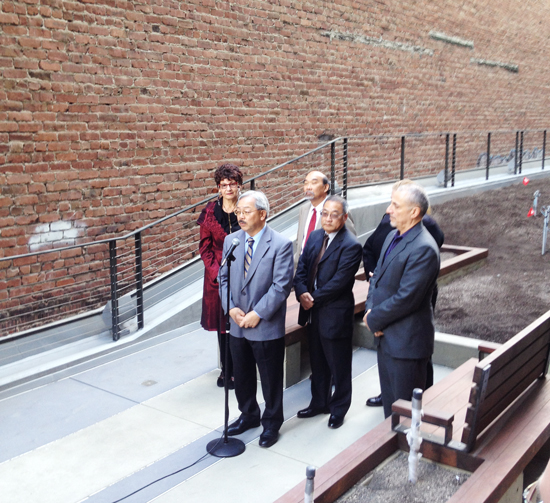
Mayor Ed Lee stood on the rooftop terrace between high brick walls of the soon-to-be-built Natoma Family Apartments, and in the distance, the buzz and clanks of nearby construction echoed his message of the day: Build, baby, build. 

Today (Wed/18) the mayor announced an executive directive for all San Francisco government departments with a hand in housing development to prioritize construction of affordable units, from completely below market rate (BMR) projects to those that have a mix of BMR and market rate units. 

The Department of Building Inspection, Mayor’s Office of Housing, Planning Department and others involved with approving development will all reorient their priorities towards getting new affordable housing built — a stark indicator of just how potent this issue has become after months of high-profile evictions and progressive organizing and demonstrations.

“It isn’t always on the private sector, we’ve got to have a stake in the action as well,” Lee told reporters gathered at the Natoma apartment building. 

“(San Francisco) is expensive,” he said, “but we don’t have to accept it. We can do something.”

With the tech-fueled housing crisis pricing out San Franciscans left and right, and Ellis Act evictions surging 170 percent in the last three years, the city is in dire need of housing help. Even the national media has picked up on San Francisco’s rising inequality, even if some local media outlets have been slower to react.  

But as progressives have noted before, you can’t simply build your way out of this crisis, as Lee acknowledged. His directive carries a promise to incentivize an emphasis on middle class housing, which has been particularly lacking in the housing now being built. 

“The other part of this directive is to also get the other departments to work with me and the private sector to build more housing in all the different spectrums, and middle class housing,” Lee said.  

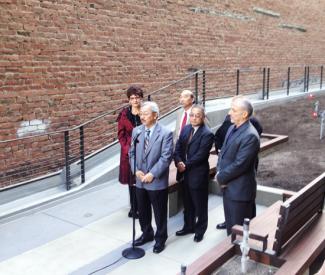
New Housing Project at Natoma street

Mayor’s Office of Housing Director Olson Lee speaks to a reporter on the deck of a community garden at the new Natoma Family Apartments, which will open in January. 

City rules will also change to protect current housing stock. Now, when a loss of housing is proposed, it will need to go through the Planning Commission for a discretionary review hearing. The mayor also formed a working group of city department heads to make recommendations to the mayor on how to preserve and create new affordable rental stock in San Francisco.

“It isn’t always on the private sector, we’ve got to have a stake in the action as well,” Lee said.

The promise of more housing in the city almost sounds too good to be true. Will the mayor’s plans reverse San Francisco’s affordable housing crisis? 

Peter Cohen, co-director of the Council of Community Housing Organizations, said it sounded like a step in the right direction. “The proof’s in the pudding, of course,” Cohen told the Guardian. “It’s the kind of directive that I wish, honestly, would come out a year ago. The answer has been, let’s keep building and hope it fixes itself.”

By prioritizing affordable housing and mixed use housing, the mayor is using the leverage of government to get developers to do the right thing. “If developers are pushed to put more units they’ll do it,” Cohen said.

Let’s hope the new push from the mayor has come in time to stunt the crisis. Even at the Natoma property where he made the announcement, the need of San Franciscans for affordable housing was palpable.

The new Natoma affordable housing building has 60 units, and will open in January. How many San Franciscans applied to live there? 2,806. 

Plans for SF clean energy program still underway, despite political opposition

San Francisco’s longstanding effort to develop a municipal renewable energy program has been stymied by politics, but Sup. London Breed has taken up the cause of advancing aspects of the plan that haven’t been obstructed.

At a Dec. 13 meeting of the Local Agency Formation Commission (LAFCo), a committee comprised of members of the Board of Supervisors that has been working to develop CleanPowerSF for years, Breed called for putting out a Request for Proposals to develop a concrete plan for building out local renewable energy infrastructure. LAFCo adopted the motion. 

With plans for solar panel arrays or wind power facilities that would generate hundreds of megawatts of electricity for the municipal energy program, the build-out is a key aspect of the plan that could lead to job creation and stable electricity rates in the long term.

“Part of what I think is important in developing a plan is to make sure that if there are people who oppose it, that we have answers,” Breed said. “And we have clear answers, so that we’re communicating what the real, true accurate message is: There is real possibility for local jobs.”

Earlier this year, members of the San Francisco Public Utilities Commission, a body composed of mayoral appointees, refused to approve a not-to-exceed rate, effectively obstructing any forward progress on the green municipal power program. But some advocates who are thinking long-term have merely taken the setback as an opportunity to put some time and energy into crafting a well thought out plan that serves the interests of job seekers and environmentalists alike, which would ulimately be politically difficult to oppose.

The rate approval was a necessary step toward inking a contract with Shell Energy North America, the contractor selected by the SFPUC to procure renewable energy on the open market until a build-out gets off the ground.

Just before the commissioners made their decision, opponents of the plan who are affiliated with Pacific Gas & Electric Company – the utility giant that stands to lose customers if CleanPowerSF goes forward – plastered San Francisco residences with flyers denouncing the program and Shell’s involvement. The mailers were paid for by IBEW 1245, the International Brotherhood of Electrical Workers union that represents PG&E employees.

Breed reflected on that messaging as an unfortunate setback. “It created, I think, the challenges that we’re facing getting this program moving forward,” she said. “We need a clear communication strategy. We need a clear understanding of the build-out.”

Eric Brooks, a longtime advocate of CleanPowerSF who has attended hundreds of meetings to help shape the plan on behalf of his nonprofit, Our City, said he was pleased with the latest direction LAFCo talks had taken. He recently penned an editorial for the Bay Guardian calling on LAFCo to take control of the program.

“This does not get around the political problem we have,” he said. “Politically, the program isn’t moving forward. On Aug. 13, from [the SFPUC’s] standpoint, they put the program on hold.” Nevertheless, “the idea is to work on all the other things, and get those things done.” Once there is a practical plan spelling out how the city will move forward with building out green renewable energy infrastructure, he said, it could serve to “show the building trade unions what’s possible.”

From what Brooks said and what was voiced at the meeting, it seems the political strategy of project proponents will be to bring on a consultant to hash out more tangible goals with regard to job creation, and then use those shovel-ready plans to bring trade unions on board. From there, Brooks hopes there may be more leverage to push for approval – or perhaps to pursue an alternative management structure that gets around the SFPUC, such as joining with another municipality to form a Joint Powers Authority that would oversee the program.

Sup. David Campos, who has been a key supporter of CleanPowerSF along with Sup. John Avalos, did voice some reservations about moving forward with the RFP. “We are here,” halted from moving forward, “even though we have a program that has been approved by the Board of Supervisors,” he pointed out. “How do we avoid going down the path of doing additional work, only to find ourselves in the same predicament?”

The political pressure against CleanPowerSF, fueled by groups associated with PG&E in political alignment with Mayor Ed Lee, is formidable. Nevertheless, advocates from environmental organizations such as 350.org, the Sierra Club and others have kept pushing for the program out of a conviction that it represents an opportunity to curb greenhouse gas emissions and combat climate change at the local level.

“This is a very important move,” said June Brashares, a steering committee member of the Local Clean Energy Alliance. “A key piece of work that has not yet been done is the selection of actual sites all over the city for the installation of hundreds of megawatts of local clean energy projects that will make up CleanPowerSF.”

UPDATE: After we posted this, Breed returned a phone call from earlier in the day. She shared some thoughts about the program:

“I just think we’re overdue, to do it. The fact that we have five commissioners appointed, not necessarily elected, [blocking the program] disturbs me,” she said.

Asked why she’s supportive of CleanPowerSF, Breed said, “It’s not just about the choice. It’s also about the environment, and the future. There’s a lot of money in energy in general, and part of that money should go back to the local economy through those jobs.”

When we asked her about the strategy for advancing the program, she responded, “We want labor to be a partner on this. We want to make sure that it’s clear, and more importantly, we want it to be a strong proposal … My goal is to make it difficult for them to oppose it.”

Finally, questioned on whether she was worried about the political opposition, Breed responded, “I can’t do my job in fear that someone may oppose it. I have to do it based on what I think is truly right for the city of San Francisco.”

With more bikes on the roads, Folsom Street gets a makeover

7

As anyone who has traveled the streets of San Francisco knows, there’s an increasing number of bicyclists out there. And the just-released biennial bike count from San Francisco Municipal Transportation Agency attempts to quantify that increase: 14 percent since 2011.

The agency counted bikes at 51 key intersections around the city during the afternoon/evening commute from Sept. 10-19, counting a total of 23,225 bikes. Comparing 40 counted intersections in 2011, that’s a 14 percent increase; or a 96 percent increase since 2005 when comparing the 20 intersections measured then.

The San Francisco Bicycle Coalition trumpeted the report as good news, including in its press release this quote from Mayor Ed Lee: “Every year we are seeing more people riding a bicycle in San Francisco, and the latest bicycle count data proves it.” And SFBC Executive Director Leah Shahum said, “It’s clear that if we build it, they will come. No other mode of transportation is growing as fast or has a higher return on investment in terms of improving our city for everyone.”

But the reality is that the city is lagging far behind its own stated goals to make cycling a safer and more attractive transportation options, largely because of a severe underinvestment in its cycling network. The report notes that the city has invested $3.3 million in its bike network since 2011, but that was mostly playing catch-up from when a court injunction stalled all bike projects in the city for four years.

The SFMTA report doesn’t calculate the critical number in terms of how we’re really doing — transportation mode share, or the percentage of overall vehicle trips taken by bike — an estimate it is now working on in a separate study at the end of January.

An American Community Survey in 2012 put SF bike mode share at less than 4 percent, which is a far cry from the 20 percent by 2020 that is the city’s official goal, one it has little chance of meeting without a serious increase in infrastructure investment and other changes. The SFMTA’s own stated goal is 8-10 percent mode share by 2018, the result of failure to make needed investments, which amounts to an admission that the city’s official goal is little more than political pandering.

“We’re still moving forward on all the goals that we set to accomplish, but we do have funding needs,” SFMTA spokesperson Paul Rose told us, instead emphasizing the agency’s goal of attaining a 50-50 split between private automobile use and all other modes of transportation, including Muni and cycling.

The SFBC has worked in close partnership with the city, but the continuation of Shahum’s quote in her press release also indicates that she’d like to see the city doing more to promote safe cycling: “It’s time for the City to truly invest in our bicycle network, and ensure that our City’s streets are welcoming and comfortable for the growing number of people riding.”

But the city is moving forward with some bike improvements, including a makeover of Folsom Street now underway.

In the wake of some high-profile cases of motorists running over cyclists in San Francisco this year, including the Aug. 14 death of Amelie Le Moullac at the intersection of Folsom and 6th Streets, the San Francisco Municipal Transportation Agency has taken a lane from drivers to create safer cycling along seven key blocks of fast-moving Folsom Street.

The project on one-way Folsom Street between 11th and 4th streets creates an extra wide bike lane with bright green cycling signage on the roadway, with that green lane narrowing and breaking up as it approaches the right turns on 10th, 8th, and 6th streets. The idea is communicate with both motorists and cyclists about how to safely merge and avoid having cars make the unsafe “right hook” turns that are dangerous to cyclists.

“Right now, the project is almost complete and it should be complete by the end of the month,” Rose told the Guardian.

He said the design was discussed and subjected to community outreach efforts during community plan meetings in recent years, but that it was recently accelerated as a $250,000 pilot project with help from Sup. Jane Kim’s office following public concerns about how dangerous that fast-moving strip is to cyclists.

Rose said the traffic flows in the project area will be carefully monitored to see how it’s working, and the agency hopes to learn from that data “so it will inform future projects.” 

SF Board of Supervisors approves new tenant protections

11

The Board of Supervisors today (Tues/17) gave unanimous final approval to legislation aimed at giving renters in the city additional protections against being displaced by real estate speculators, and initial approval to legislation protecting tenants from harassment by landlords, both part of a wave of reforms moving through City Hall to address rising populist concerns about gentrification and evictions.

The anti-eviction legislation, created by Sup. John Avalos and co-sponsored by Sups. Eric Mar and David Campos, seeks to preserve rent-controlled and affordable housing by restricting property-owners’ abilities to demolish, merge, and convert housing units, three of the most common ways that affordable housing units are being eliminated in the city.

There was no discussion of the Avalos legislation today as it was approved on second reading, belying last week’s initial discussion, which got a little heated at times. “San Francisco is facing a crisis,” Avalos said last week as he conveyed the importance of passing the ordinance before the end of the year. “We’ve been called on by our constituents to declare a state of emergency for renters in the city.”

Last month, Campos held a high-profile hearing at the board on the city’s affordable housing and eviction crisis, and won approval for his legislation to double how much tenants being evicted under the Ellis Act receive. Today’s board meeting also includes a first reading of legislation by Campos to help protect tenants in rent-controlled apartments from being harassed by landlords seeking to force them out and increasing rents.

“We have heard about tenants being locked out of their apartments. We have heard about loud construction work being done…for the purpose of forcing the tenants out,” Campos said today of his legislation to allow targetted tenants to have complaints heard by the Rent Board rather than having to file a lawsuit. Later, Campos said the legislation sends the message “that is not something that is going to be tolerated in San Francisco.”

Campos’ legislation also received unanimous approval and little discussion, even by supervisors who generally side with landlords over tenants, perhaps including just more potent this issue has become. Board President David Chiu also today introduced a resolution to support his work with Mayor Ed Lee and Sen. Mark Leno to amend the Ellis Act at the state level, hoping to give the city more control over its rent-controlled housing. 

Avalos last week said he is so convinced of the urgency of the current situation that he responded to concerns voiced during the Land Use and Economic Development Committee Meeting on Dec. 9 about how the new legislation would work in the cases of temporary evictions and residential hotels by immediately making amendments to the ordinance without objection.

Nonetheless, further questions arose during the Dec. 10 meeting. Sups. Norman Yee and Katy Tang expressed reservations about the legislation applying in the case of owner move-in (OMI) evictions.

“I would love to support the piece, but this part just doesn’t make sense to me,” Yee concluded. “I’m not getting how it hurts the tenants.”

While Avalos explained that OMI evictions still take affordable housing off the market, he agreed to compromise by reducing the ordinance’s 10-year moratorium on demolishing, merging and converting housing units to five years.

Then, Sup. London Breed spoke up.

“This might not be popular for me to say as a legislator, but I’m very confused,” she began. “I know we have this crisis of Ellis Acts around the city, but I really feel pressured, and that this legislation is being rushed. I can’t support something that I don’t completely understand the impacts of. I just need more time.”

While Breed did not have the chance to review the legislation before the meeting, she had found the time to prepare speeches about President Nelson Mandela’s passing last week and her alma mater Galileo High School’s recent football victory.

Concurring with Breed, Cohen stated, “I understand that we are in a crisis of protecting our rental stock units, but I’m hesitant. Connect the dots for me, how does this save rentals? Or conserve affordable housing? What are we trying to do here?”

Kim reprimanded her fellow board members for not attending the meeting prepared, then stated, “I would support moving the ordinance forward today. The situation we are facing here in the city is extremely challenging…and this legislation is one of the tools we have for it.”

Sup. Scott Wiener and David Chiu echoed Kim’s support, commending Avalos for promptly addressing their former issues with his amendments and additions.

When Cohen used her time on the floor to respond to Kim’s admonition by stating, “I certainly do my homework. I don’t want to be made to feel bad for not getting it on the first time,” Campos suggested that it might be a good time to put the discussion on hold and open the floor for public comments.

While members of the community stepped up to the visitors’ podium, Yee and Campos met at the back of the room while Breed conversed with Sophie Hayward of the Planning Department, who had reviewed the ordinance before it was presented for recommendations. After further discussion with Avalos himself, Yee returned to his seat to speak with Tang. Satisfied with what she learned from Hayward, Breed came over to discuss the ordinance with Campos and Avalos. Cohen remained seated for the duration of the time, speaking with no one.

After the conclusion of public comments, Avalos reiterated the importance of passing the ordinance as soon as possible. “We have been called on by scores, hundreds of people, to preserve this stock,” he stated. “This legislation will help keep families in San Francisco.”

The ordinance was passed unanimously in its first reading, but the fight is not over. Breed for one made it clear that, while she understood the ordinance better after her preceding discussions, she was only giving it her support because she knew the legislation would be up for further review in a week, when all the supervisors will have had time to study it more closely.

With the affordable housing and displacement issues only generating more heat in the last week, today there was only prompt, unanimous approval and no discussion.