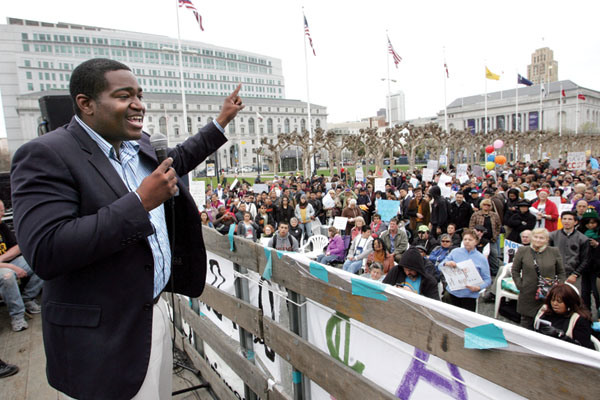
Mayor Ed Lee

Official SF bike count shows big increase, but not big enough to meet city goals

98

As anyone who has traveled the streets of San Francisco knows, there’s an increasing number of bicyclists out there. And the just-released biennial bike count from San Francisco Municipal Transportation Agency attempts to quantify that increase: 14 percent since 2011.

The agency counted bikes at 51 key intersections around the city during the afternoon/evening commute from Sept. 10-19, counting a total of 23,225 bikes. Comparing 40 counted intersections in 2011, that’s a 14 percent increase; or a 96 percent increase since 2005 when comparing the 20 intersections measured then.

The San Francisco Bicycle Coalition trumpeted the report as good news, including in its press release this quote from Mayor Ed Lee: “Every year we are seeing more people riding a bicycle in San Francisco, and the latest bicycle count data proves it.” And SFBC Executive Director Leah Shahum said, “It’s clear that if we build it, they will come. No other mode of transportation is growing as fast or has a higher return on investment in terms of improving our city for everyone.”

But the reality is that the city is lagging far behind its own stated goals to make cycling a safer and more attractive transportation options, largely because of a severe underinvestment in its cycling network. The report notes that the city has invested $3.3 million in its bike network since 2011, but that was mostly playing catch-up from when a court injunction stalled all bike projects in the city for four years.

The SFMTA report doesn’t calculate the critical number in terms of how we’re really doing — transportation mode share, or the percentage of overall vehicle trips taken by bike — an estimate it is now working on in a separate study.

An American Community Survey in 2012 put SF bike mode share at less than 4 percent, which is a far cry from the 20 percent by 2020 that is the city’s official goal, one it has little chance of meeting without a serious increase in infrastructure investment and other changes. The SFMTA’s own stated goal is 8-10 percent mode share by 2018, the result of failure to make needed investments, which amounts to an admission that the city’s official goal is little more than political pandering.

“We’re still moving forward on all the goals that we set to accomplish, but we do have have funding needs,” SFMTA spokesperson Paul Rose told us, insteading emphasizing the agency’s goal of attaining a 50-50 split between private automobile use and all other modes of transportation, including Muni and cycling.

The SFBC has worked in close partnership with the city, but the continuation of Shaham’s quote in her press release also indicates that she’d like to see the city doing more to promote safe cycling: “It’s time for the City to truly invest in our bicycle network, and ensure that our City’s streets are welcoming and comfortable for the growing number of people riding.”

Tech leaders must engage their critics

33

EDITORIAL It’s time for San Franciscans to have a public conversation about who we are, what we value, and where we’re headed. In the increasingly charged and polarized political climate surrounding economic displacement, the rising populist furor needs to be honestly and seriously addressed by this city’s major stakeholders.

Whether or not the technology industry that is overheating the city’s economy is to blame for the current eviction crisis and hyper-gentrification, it’s undeniable that industry and it’s leaders need to help solve this problem. They are rolling in money in right now, including tens of millions of dollars in city tax breaks, and they need to offer more than token gestures to help offset their impacts.

As we were finalizing stories for this issue on Dec. 9, the Guardian newsroom was roiled by our rollercoaster coverage of a protest blockade against a Google bus, which has become a symbol for the insulated and out-of-touch nouveau-riche techies in the emerging narrative of two San Franciscos.

Our video of an apparent Google-buser shouting at protesters “if you can’t afford it, it’s time for you to leave” went viral and burned up the Internet (and our servers) even as we discovered and reported that he was actually a protester doing some impromptu street theater.

But there was a reason why his comments resonated, and it’s the same reason why The New York Times and other major media outlets have been doing a series of stories on San Francisco and the problems we’re having balancing economic development with economic security, diversity, infrastructure needs, and other urban imperatives.

Rents have increased more than 20 percent this year, the glut of new housing coming online now is mostly unaffordable to current residents, even that new construction has done little to slow real estate speculators from cannibalizing rent-controlled apartments, and the only end in sight to this trend is a bursting of the dot-com bubble, which would cause its own hardships.

We need this city’s political leaders to convene a summit meeting on this problem, and Mayor Ed Lee and his neoliberal allies need to bring tech leaders to the table and impress upon them that they must engage with their critics in a meaningful way and be prepared to share some of their wealth with San Franciscans. Not only is the future of the city at stake, so is its present, because the housing justice movement won’t be ignored any longer. The good news is that San Francisco has a golden opportunity to test whether democracy can help solve the worst aspects of modern capitalism, offering an example to others if we succeed. But if our political leaders don’t create good faith avenues for meaningful reforms, San Francisco may offer a far messier and more contentious lesson.

No poetry or magic in being a robot

I felt yesterday like I had been scooped after reading Jennifer Maerz’s post in the Bold Italic, which asked: Is Talking About High Rents So Often Crippling Our City?

She linked to the blog of “robotics genius” Kal Spelletich, who is a friend of mine. We’ve been getting into heated discussions on this very topic for months. Kal makes fantastical interactive machines that do things like spit fire, harness random mechanical motion to produce musical notes on a piano or a violin, or engulf you in an aromatic bundle of fennel, just for an instant. His creations are robots.

I spent a bit of time in his studio, a giant waterfront warehouse in the southeastern part of the city where strange, sharp-edged contraptions hang from the ceilings. I shared stories about the articles I was writing, increasingly on evictions and the dearth of affordable housing in San Francisco. But as we dissected the problem, Kal rejected what he saw as a narrative of desperation that has been formulated in response to the city’s affordable housing crisis.

He had his own rant, saying his community’s impulse to make art was being hindered by anxiety-producing discussions over loss of living space. These constant, embittered discussions were not only tiresome but toxic to creativity, he said, and distracting people from actually engaging in their life’s work.

But something about his argument irked me, since the idea that people should bow out gracefully and pursue their creative endeavors someplace else sounded akin to surrender, while the stories I gravitate toward feature individuals who find a way to dig in and stand their ground. And taken as a whole, the greater the exodus of artists and idealists from San Francisco, the more watered-down the city’s cultural soup starts to feel. We debated it endlessly.

Here’s how Kal phrased it on his blog. “We don’t hang and talk about the revolution or our exciting new piece we are working on any more. The wind has been taken out of our sails.  We react to the corporatists and capitalists, we are not proactive. Our dialogue has been taken from us. I feel like we have played right into their hands in more ways than one.”

He concluded it by saying, “The head fuck, stress and wasted energy. … There is nothing poetic or magic about it. And I do not see any answer for it in the Bay Area.”

I reflected on our discussions again when I read Mayor Ed Lee’s interview in the New York Times a couple weeks ago, in which Lee commented that “tech workers aren’t robots.” In a city bursting at the seams with makers and dreamers with high aspirations, those who possess coding skills are favored, since their work is perceived as having economic potential. Lee seemed very concerned with creating an environment in which they can thrive.

As the mayor told interviewer Willy Staley: “What I learned with tech companies is I gotta give people room to experiment, and also to make what might later on be a mistake. This is the attitude I want to build within San Francisco — give some time to the tech community. At the end of the day, tech workers are not robots: they feel, they think, they have values.”

That philosophy – the idea that people are people, and need room to breathe, experiment, maybe even maybe mess up – actually makes sense as a core value. The problem, as I see it, is that the economic reality of San Francisco makes it such that this recognition is extended exclusively to the tech set, while the same leeway is not granted to other kinds of makers, or to those pursuing a kind of success that can’t be defined strictly in financial terms. At the end of the day, all San Franciscans feel, think, and have values – but only some are receiving support for their work in the form of funding or policies that facilitate their success.

While one class is being encouraged to try, and forgiven when they fail, a different set – the creative or activist types who aren’t doing it for the money – are being sent the message that they must behave like tightrope walkers, or maybe robots, if they want to remain.

There are some signs of creative resistance – a community rallying together in memory of its heroes, some mischievous comic relief, here and there. By tapping into imagination instead of draining it all away with worry, this could prove to be the start of something.

City College Trustee resigns, protesting state takeover

28

Democracy is a thing of the past at City College of San Francisco, and now one member of its elected board has had enough. City College Trustee Chris Jackson announced today that he is resigning from the college board to protest the state takeover of the school, and he explains his reasoning in an op-ed in this week’s Guardian.

“I came to City College to do good work,” Jackson told the Guardian. “At this point it’s impossible to do that work I set out to do. That’s why I’m leaving.”

Jackson was first elected to City College’s board in 2008, but in 2013 he was a trustee in name only. The day City College was told it would lose its accreditation was also the day it lost its Board of Trustees. Those democratically elected by San Francisco voters to lead City College were pushed aside by California Community College Chancellor Brice Harris.

It was a state takeover, and the board was rendered powerless.

The seven-member board holds no more meetings, drafts no more legislation, casts no more votes. The public cannot hold elected officials accountable when things go wrong — because the man in charge is no longer someone San Francisco elected.

Robert Agrella is the “super” trustee, appointed by the state chancellor to make unilateral decisions regarding City College’s future, something they say is necessary to save the school. Agrella holds no public comment sessions, and told the Guardian previously that personal emails to him would suffice. Agrella hardly ever answers his phone, we’ve found.

Paul Feist, a spokesperson for the California community college state chancellor’s office, said that the takeover was necessary to make the hard decisions needed to save City College quickly.

Tremendous progress has been made since July, with key positions having been filled, collective bargains agreements reached and fiscal controls implemented,” Feist told the Guardian. 

To Jackson, it’s a mockery of democracy.

“If my resignation can bring a light to this public policy issue, I hope it does,” he said.

In the last month a vote by the California Community College Board of Governors made Agrella’s stay indefinite. Legally, he won’t leave until the state tells him he has to.

There is not a formal timeline for returning governance of CCSF to local trustees, but it is hoped that this happens soon after the college demonstrates it has addressed the deficiencies identified by [its accreditors],” Feist said. “The state has no interest in running City College indefinitely under a special trustee arrangement.” 

To those who wonder what this all means, and to understand Jackson’s grievance, one look only as far as two of Agrella’s latest unilateral decisions.

A performing arts center long planned to be built by City College was canned by the super trustee, citing funding concerns.

“Clearly, the college is in no position to make this commitment at this time,” Agrella told the San Francisco Chronicle when he cancelled the project. It was $6 million shy of its estimated $95 million cost.

The school’s only performance venue is the Diego Rivera Theater. It is the lone theater serving a school of 85,000 students (and sometimes more) but it seats only hundreds, and is dilapidated and crumbling.

That was the first of Agrella’s motions to overturn decisions by the Board of Trustees, but his next decision was directly challenged by Trustee Chris Jackson.

Just last month the super trustee overturned a decision by the board to drop Wells Fargo as its bank. Last year, the board voted to find a more ethical bank to do business with, instead of one that foreclosed San Francisco homes and held questionable ties to the student loan industry.

An investigation by the San Francisco Examiner found that after Wells Fargo exerted pressure on Agrella and promised the school at least $500,000 in grants, the super trustee repealed the decision to shop for a new bank.

The unilateral decisions of Agrella make Jackson furious, but it’s not as if he didn’t see it coming.

In a September 2012 meeting, the Board of Trustees faced a decision: Does it ask the state for a special trustee? It was quickly communicated to the trustees that if they didn’t ask for one, one would be imposed anyway.

It was a false choice. A public relations move designed to make the board look like they sought help when newspapers and TV stations asked them about the super trustee. In the end, no matter what decision they made the state would take control of the school.

“This special trustee, while not ideal, I don’t personally like, I think it’s appropriate for right now. But we need to understand how long they’ll be there, and what position need to be in for them to leave,” Jackson said.

“I hope this board doesn’t just cede power to the special trustee,” he said.

That was a year ago. Now five months without the board, City College has lost the vision a local politician can bring.

“I’ve certainly called him the conscience of the board,” Alisa Messer, the faculty union president at the college, said of Jackson.

“Chris made himself accessible to those who felt besieged. He’s for the underdog, regardless of being black or brown,” former student trustee William Walker told us.

“I’m just really sad to see Chris go,” said the current student trustee, Shanell Williams, who first met Jackson while on San Francisco’s youth commission.

All of them mentioned Jackson’s work to secure childcare for the two City College campuses in the Bayview. When City College’s accreditors tasked them with scaling down its mission of who to serve, Jackson championed the college’s GED program and won. He also worked closely with the group Students Making a Change, which endeavors to close the achievement gap for students of color at City College.

Jackson’s departure leaves a seat open on the board which Mayor Ed Lee can make an appointment to fill. But the legality of an appointment while the board is effectively out of power is an open question. The Guardian contacted the mayor’s office to find an answer, but did not hear back from them before press time.

“I think the thing San Franciscans ought to be asking is: Do we even have a board, and when are we going to?” Messer said.

As for Jackson, he’s looking forward to concentrating on his family and his career. He currently works at a nonprofit which helps people in Africa and India find new jobs in tech.

“I’ll have more time to spend with my daughter,” he said.  “I’ll have more time to focus on my own professional career, and am looking to go to law school.”

The 30 year old Jackson said he wants to be an attorney to help young men like D’Paris Williams, who was stopped for a traffic citation at Valencia Gardens in a case of alleged racial profiling. Jackson, who lives in the Bayview, wants to defend the people in his community.

“I want to be a part of that,” he said.

Update: Commenters and sources that called the Guardian rightly asked what Chris Jackson’s Ethics Commission fines had to do with his stepping down. Jackson was late filing his campaign reports and was fined about $3,000 by the commission. When the Guardian spoke to them a few months ago about this, they told us it was a routine matter and that Jackson was complying with their requests for payment. Jackson had already reached a payment agreement well before his resignation, which does not affect the fine, he said. 

BART standoff continues as board modifies contract

1

The BART Board of Directors voted 8-1 on Nov. 21, with conservative young Director Zakhary Mallett in dissent, to approve a hard-won contract with its unions, after removing Section 4.8, the paid family leave section that the district says was inserted by mistake.

The motion also directed management to negotiate a settlement over that issue with its unions, which have already approved the contract and now must decide whether they are willing to do so again without that provision or whether the possibility of another BART strike is once again looming.

The next day, BART’s largest unions, SEIU Local 1021 and ATU Local 1555, issued a joint statement: “We consider the Board’s actions to be unprecedented and illegitimate, and we’re considering our next steps, including possible legal action. The BART Board of Directors has disregarded the vote of more than 2,000 BART workers and has chosen to subvert the collective bargaining process, and we take their actions seriously.”

After meeting in closed session for about two hours, Vice President Joel Keller began the open session with a motion to remove Section 4.8 from the contract, approve the rest, and direct management to negotiate with the unions.

Mallett, the 25-year-old newbie who lives in unincorporated West Contra Costa County but whose District 7 includes part of San Francisco, spoke first: “Even before this hiccup, I was not in the position to support this contract. I find it too costly.”

But he was the only one to take that stance, with the rest of the directors calling the underlying contract a fair compromise, even if all said they couldn’t support the paid family leave provision that would add anywhere between $4 million and $44 million to a contract that was already going to cost the district an additional $67 million.

Director Gail Murray noted that the unions had given up raises for years when BART had budget deficits, and now that the district is running surpluses, it’s reasonable to give workers raises that amount to about 2 percent per year for four years.

“Our employees kept the system going…They’re the reason why we keep 40-year-old cars still running,” Murray said, later adding, “To say this contract is not a good contract is wrong.”

The rest of the board agreed, even while acknowledging it is more than they hoped to pay given the district’s capital needs and aggressive expansion plans.

“We’re probably paying more for this than we anticipated we would pay, and labor is probably giving up more than they want to, but that’s the nature of collective bargaining,” Keller said, who also began what turned into a chorus of criticism for how district negotiators signed off on a provision the board never agreed to.

“We ended on a sloppy note and that’s regrettable,” Keller said, pledging that if he’s elected president next month — an ascension that is customary for the vice president — he plans to launch a full investigation into what happened.

“I’m pained that we put ourselves in such adversarial positions with each other and that we lost the lives of two employees,” Director John McPartland said of the protracted labor negotiations and the fatalities that occurred while the unions were on strike Oct. 19. He called the contract “more than fair and equitable.”

Director James Fang, who represents western San Francisco, sounded the strongest criticisms of BART management and negotiators. “Yes, it was a mistake, but nobody has come forward and said ‘there was a mistake and I’m responsible,” Fang said, later adding, “The ones who signed this must be held to account.”

Fang then went further, albeit without specifics, when he said, “Every bit of management advice we’ve received has not worked out to the district’s best interests.”

Director Robert Raburn echoed Fang’s calls for accountability: “I’m still not clear on how that [contract provision] arrived and it hasn’t been accounted for by anyone at the district who said ‘I am responsible.'”

But he also said that the provision was clearly an error and not something arrived at through the negotiations: “Both parties agreed on a $67 million package and we should keep that intact because it’s fair.”

Reached by the Guardian while union leadership was conferring to plan next steps, SEIU Local 1021 Political Director Chris Daly told us, “We are about as up in the air as we’ve ever been.”

He called it “unlikely” that union leadership would simply submit the board-revised contract to an up-or-down vote by union membership, saying that he doesn’t think it would be approved.

And Daly echoed the concerns expressed by several BART directors about how this mistake happened and why nobody has taken responsibility or been held accountable: “If I were on that board, I’d have the general manager’s head, there’s no two ways about it.” (Steven T. Jones)

SF General reduces psych care

A 22-bed psychiatric unit at San Francisco General Hospital will be taken out of service, and reopened only if the facility experiences a high caseload of patients exhibiting the worst signs of psychiatric crisis.

As of Nov. 19, five patients were receiving care in that unit, 7B, according to spokesperson Rachael Kagan. None had symptoms that rose to the level of requiring acute care. Instead, they were classified as sub-acute patients, a distinction that essentially means they didn’t present an immediate threat to themselves or others.

But under a new policy that will take effect after they have been released, all 22 beds in 7B will be closed — unless they are needed for acute patients who do reach that critical threshold. The unit will be staffed only if patients can’t be accommodated in the hospital’s other acute psych unit, which has 21 beds.

The decision was made in response to a changing financial picture under federal health care reform, Kagan explained.

“There is a big push … to ensure hospitals are only providing acute care,” Kagan said, and this trend is driving efforts to reduce sub-acute patients. “It fiscally makes more sense,” she added, because insurers pay higher rates for acute care than for lower levels of treatment.

Yet some hospital staff members are nervous about the implications of this shift, because it means fewer patients will be able to access psychiatric care at SF General unless they represent a danger to themselves and/or the general public — at a time when demand for these services is on the rise.

“To us, it’s a matter of priority for the city,” said Brenda Barros, an employee at SF General who is active with hospital union SEIU 1021. “Do you want to take care of these people, or don’t you?”

Some staff members are doubtful that 7B will reopen. An internal SF General memo issued Nov. 18 informed the 7B staff: “Our census will be gradually reduced until we won’t have any more patients. Then 7B will be closed.” The memo added, “this came from [SF General CEO] Sue Currin due to budgetary constraints.”

However, a second internal memo went out the following day, to “clarify” the first one. In that message, Nursing Director Kathy Ballou wrote: “We are not closing psych beds or any beds.” Instead, beds in 7B would be closed unless “we get acute patients needing that level of care,” she wrote. “As in other hospitals, we are accountable to our operating budget.”

Further complicating matters, said Barros, is that patients can fluctuate rapidly between needing acute care and a lower level of attention. “They absolutely can swing back and forth.” She added that patients initially requiring a lower level of care could experience worsening conditions if they’re unable to secure an appointment in time to get help, and delays are very common.

Kagan emphasized that the unit wasn’t being closed down, but did confirm that sub-acute patients would no longer be able to receive treatment in 7B. Instead, those patients will be placed with various service providers throughout the city, she said. “The goal is to move the patients to their appropriate placement.”

Meanwhile, this shift coincides with an overall rise in citywide demand for psychiatric services. According to a report delivered to the Police Commission earlier this year, SF General had 6,293 patient admissions for psychiatric holds in 2012, a sharp increase from 5,837 in 2009.

While there were deep cuts to the city’s Department of Public Health during the economic downturn, Mayor Ed Lee has recently trumpeted a boost to city coffers thanks to growing economic activity. But if the city’s financial health has improved, it seems odd that its safety-net hospital would be put into the position of reducing psych care due to budgetary pressures when that kind of care is sorely needed.

For Barros, it’s a matter of whether or not city officials will decide to allocate more funding for mental health services. “If they don’t have enough money in Public Health,” she said, “then they need to put more into Public Health.” (Rebecca Bowe)

Activists organize, and some journalists chronicle, a progressive resurgence in SF

131

While Mayor Ed Lee jets around the world, still too focused on fueling the economic fire that is gentrifying San Francisco and displacing its diverse population — and as the San Francisco Chronicle and other downtown boosters niggle on the margins of the city’s biggest issue — local activists and some media outlets are paying attention and pushing back.

The New York Times ran an excellent Sunday piece about the growing populist backlash here against Mayor Lee’s economic policies and his friends and benefactors in the tech industry, a story that the Santa Rosa Press Democrat also put on its front page, but which the Chronicle only briefly mentioned today on its business page in a short story wrapping all the high-end housing now coming online. Instead, on Sunday the Chron ran this pro-landlord garbage

Meanwhile, as we report in tomorrow’s edition of the Guardian, more than 20 local organizations have combined forces this year to organize and promote tomorrow’s (Wed/27) annual memorial march marking the 1978 assassinations of Mayor George Moscone and Sup. Harvey Milk in City Hall, which will this year focus on their legacy of advocating for renters and keeping this city affordable by and welcoming of the working class and outsiders of all types.

We’ve said it before and we’ll say it again: this is a struggle for the very soul of San Francisco, and it’s a struggle that we at the Guardian renew our commitment to with every issue we print. See you all on the streets tomorrow night starting at 7pm in Milk Plaza and Castro and Market.    

SF General reduces psychiatric care

A 22-bed psychiatric unit at San Francisco General Hospital will be taken out of service, and re-opened only if the facility experiences a high caseload of patients exhibiting the worst signs of psychiatric crisis, the Bay Guardian has learned.

As of Nov. 19, five patients were receiving care in that unit, 7B, according to spokesperson Rachael Kagan. None had symptoms that rose to the level of requiring acute care. Instead, they were classified as sub-acute patients, a distinction that essentially means they didn’t present an immediate threat to themselves or others.

But under a new policy that will take effect after they have been released, all 22 beds in 7B will be closed – unless they are needed for acute patients who do reach that critical threshold. The unit will be staffed only if patients can’t be accommodated in the hospital’s other acute psych unit, which has 21 beds.

The decision was made in response to a changing financial picture under federal health care reform, Kagan explained.

“There is a big push … to ensure hospitals are only providing acute care,” Kagan said, and this trend is driving efforts to reduce sub-acute patients. “It fiscally makes more sense,” she added, because insurers pay higher rates for acute care than for lower levels of treatment.

Yet some hospital staff members are nervous about the implications of this shift, because it means fewer patients will be able to access psychiatric care at SF General until they represent a danger to themselves and/or the general public – at a time when demand for these services is on the rise.

“To us, it’s a matter of priority for the city,” said Brenda Barros, an employee at SF General who is active with hospital union SEIU 1021. “Do you want to take care of these people, or don’t you?” 

Some staff members are doubtful that 7B will reopen. An internal SF General memo issued Nov. 18 informed 7B staff: “Our census will be gradually reduced until we won’t have any more patients. Then 7B will be closed.” The memo added, “this came from [SF General CEO] Sue Currin due to budgetary constraints.”

However, a second internal memo went out the following day, to “clarify” the first one. In that message, Nursing Director Kathy Ballou wrote: “We are not closing psych beds or any beds.” Instead, beds in 7B would be closed unless “we get acute patients needing that level of care,” she wrote. “As in other hospitals, we are accountable to our operating budget.”

Further complicating matters, said Barros, is that patients can fluctuate rapidly between needing acute care and a lower level of attention. “They absolutely can swing back and forth.” She added that patients initially requiring a lower level of care could experience worsening conditions if they’re unable to secure an appointment in time to get help, and delays are very common.

Kagan emphasized that the unit wasn’t being closed down, but did confirm that sub-acute patients would no longer be able to receive treatment in 7B. Instead, those patients will be placed with various service providers throughout the city, she said. “The goal is to move the patients to their appropriate placement.”

Meanwhile, this shift coincides with an overall rise in citywide demand for psychiatric services. According to a report delivered to the Police Commission earlier this year, SF General had 6,293 patient admissions for psychiatric holds in 2012, a sharp increase from 5,837 in 2009.

While there were deep cuts to the city’s Department of Public Health during the economic downturn, Mayor Ed Lee has recently trumpeted a boost to city coffers thanks to growing economic activity. But if the city’s financial health has improved, it seems odd that its flagship safety-net hospital would be put into the position of reducing psych care due to budgetary pressures when that kind of care is sorely needed.

For Barros, it’s a matter of whether or not city officials will decide to allocate more funding for mental health services. “If they don’t have enough money in Public Health,” she said, “then they need to put more into Public Health.”

Eviction epidemic spurs legislative solutions

3

Tenants, organizers and residents impacted by Ellis Act evictions packed the Board of Supervisors Chambers at San Francisco City Hall Nov. 14 for a hearing on eviction and displacement in San Francisco. As more and more residents face ousters only to be priced out, lawmakers and advocates are floating legislative fixes to try and reverse the trend before it reaches the soaring levels of the displacement epidemic that impacted the city during the first dot-com boom.

“It seems to me that we have a tale of two cities,” Sup. David Campos, who requested the hearing, said at the start of the discussion, held at the Board of Supervisors’ Neighborhood Services and Safety Committee. “We must act urgently to address this crisis, which I believe is a crisis,” he added. “We are fighting, I think, for the soul of San Francisco.”

Fred Brousseau of the San Francisco Budget and Legislative Analyst’s office shared his recent analysis on eviction and displacement trends across the city.

Overall evictions in San Francisco rose from 1,242 to 1,716 over the past three years, he said, reflecting an increase of 38.2 percent. Ellis Act evictions rose by 169.8 percent in that same time frame.

Almost 42 percent of individuals impacted by eviction had some form of disability, Brousseau noted, while 49 percent had incomes at or below the federal poverty level. On the whole, a total of nearly 43 percent of San Francisco households are “rent-burdened,” a term that officially means devoting more than 30 percent of household income toward rent, the study found.

Ted Gullicksen of the San Francisco Tenants Union emphasized that tenant buyouts, frequently offered in lieu of an eviction, are also driving displacement, although those transactions aren’t reflected in city records. “There are about three of them for every Ellis Act eviction,” he said. “When you consider them in combination with Ellis, the numbers are very dramatic.”

Throughout the afternoon, tenants shared their stories and fears about getting frozen out of San Francisco by eviction. “I’m looking at shopping carts, and I’m terrified,” one woman told supervisors during public comment. “You have to do something. It might not be enough for me right now, but you can’t do this to any more people.”

Campos is working with Assembly Member Tom Ammiano on a proposal to grant San Francisco the authority to place a moratorium on Ellis Act evictions. He’s also pursuing legislation that would create a mechanism at the San Francisco Rent Board to allow tenants to register formal complaints about landlord harassment and other kinds of pressure.

“I am eager to introduce a bill in January,” Ammiano noted. “One option might be a law that will allow the local jurisdictions, like San Francisco, to suspend the Ellis Act or establish a moratorium, because of the emergency housing situation. Another possibility is working to make sure that landlords are not skirting Ellis eviction requirements by improperly pressuring tenants to leave. We must do something, but we have to work together to make it successful.”

Meanwhile, Mayor Ed Lee recently announced that he is working with Sen. Mark Leno on legislation to curb Ellis Act evictions by requiring additional permits or hearings before they proceed. They’re also contemplating floating more stringent regulations on the sale and resale of properties where tenants have been evicted under Ellis.

At the end of the day, it’s clear that housing advocates are gaining momentum as the spike in tenant ousters continues in pricey San Francisco, where rents are the highest in the nation.


Parents under pressure

In recent weeks, the San Francisco Unified School District has held a series of community forums to ask parents what they think kids need in order to thrive in school. The meetings were held as part of a policymaking process leading up to next year’s renewal of two important funds – the Children’s Fund and the Public Education Enrichment Fund, which account for some $100 million in funding combined.

There were huge turnouts – a Chinatown forum, where Mayor Ed Lee was reportedly in attendance, attracted more than 180 participants, while a Nov. 14 meeting at Cesar Chavez Elementary in the Mission District drew a crowd of between 80 and 90.

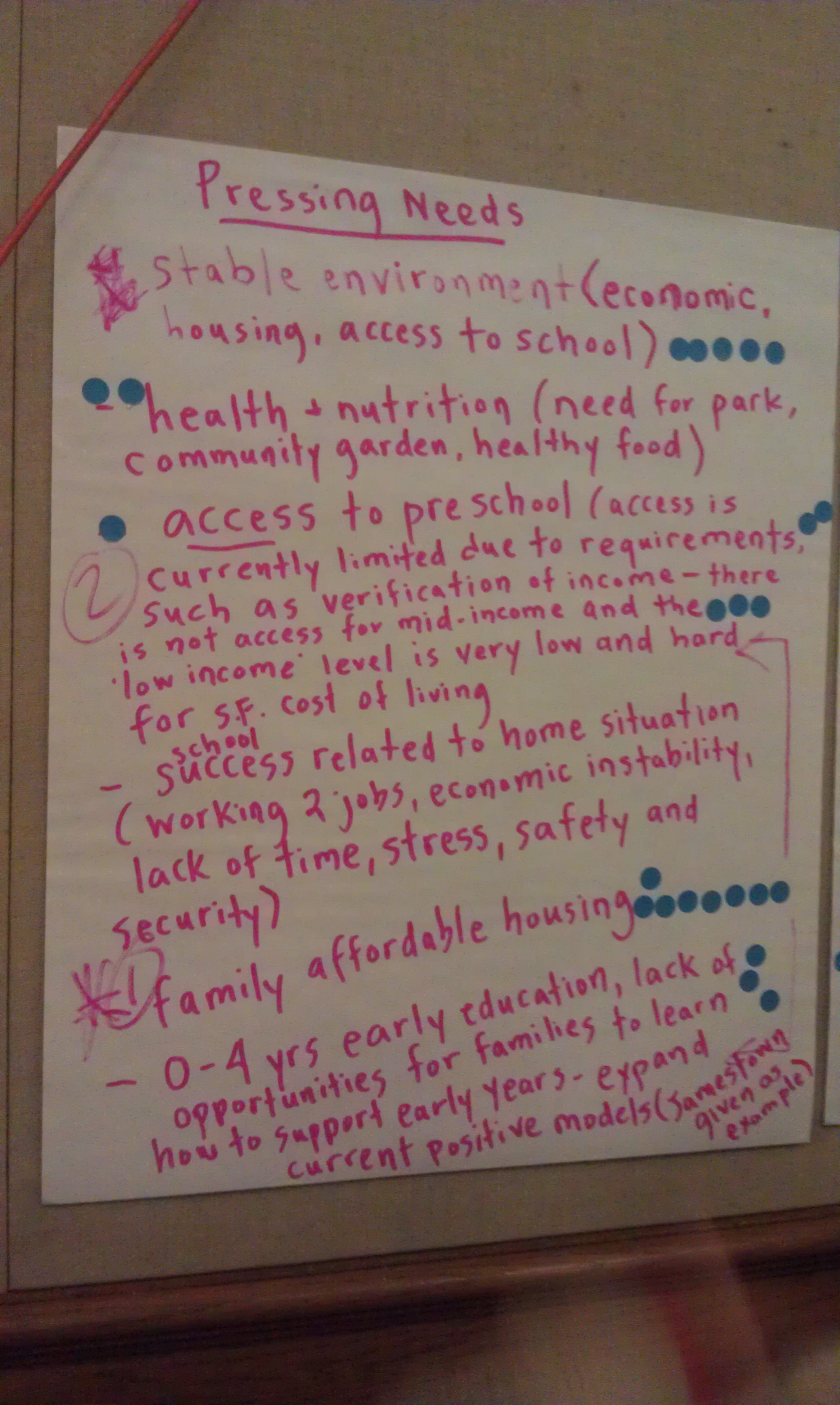
The parents weren’t exactly asking for more museum field trips for their kids. During breakout sessions where facilitators wrote group members’ concerns on flip pads, a few recurring themes emerged. “Job security for parents,” one read. “Affordable housing,” another stated. “It’s a shame to have to talk about lack of funds given wealth and corporations in SF,” more parent feedback stated.

Maria Su, director of the San Francisco Department of Children, Youth and their Families, thanked parents for coming and told them, “We know how hard it is and how challenging it is to survive in the city. But that doesn’t mean we should give up.”

The event provided a glimpse into just how tough it is for families to get by in a city where a hefty cost of living amounts to serious pressure. “The sacrifices they make is, their children will have access to resources you can’t get anywhere else,” said Mario Paz with the Good Samaritan Family Resource Center, who works with a lot of Latino immigrant families.

A report digesting the findings of stakeholder focus groups distilled the pressures facing families. “Many participants commented on … the extraordinarily high cost of living in San Francisco,” it noted, which “contributes to both financial and emotional strain on the part of our many working class and lower income residents.”

Hundreds attend hearing to call for action on evictions

Tenants, organizers and residents impacted by Ellis Act evictions packed the Board of Supervisors Chambers at San Francisco City Hall today, Thu/14, for a hearing called by Sup. David Campos on eviction and displacement in San Francisco.

“It seems to me that we have a tale of two cities,” Campos said at the outset of the hearing, which was held by the Board of Supervisors Neighborhood Services and Safety Committee. “The vast majority of individuals are struggling to stay in San Francisco. We must act urgently to address this crisis, which I believe is a crisis.” He added, “We are fighting, I think, for the soul of San Francisco.”

Tony Robles of Senior and Disability Action, who showed up at the hearing wearing a black hooded sweatshirt with pobre (the Spanish word for “poor”) printed across the front, expressed his frustration with the surge of evictions taking place in the booming economic climate. “We have been overlooked – the workers, communities of color … it’s almost as if we are an afterthought,” he said.

Fred Brousseau of the San Francisco Budget and Legislative Analyst’s office delivered a report on his recent analysis of eviction and displacement trends across the city.

Overall evictions in San Francisco rose from 1,242 in 2010 to 1,716 in 2013, reflecting an increase of 38.2 percent, according to San Francisco Rent Board Data highlighted in Brousseau’s report. 

Ellis Act evictions in particular increased by 169.8 percent in that same time frame, he said, with the most recent data showing a total of 162 Ellis Act evictions over the twelve months ending in September 2013. That number reflects units evicted, not how many tenants were impacted.

Ted Gullicksen of the San Francisco Tenants Union emphasized that tenant buyouts, frequently offered in lieu of an eviction, are also driving displacement even though these transactions aren’t reflected in city records.

“We need to get in control of these buyouts,” he said. “There are about three of them for every Ellis Act eviction. When you consider them in combination with Ellis, the numbers are very dramatic.”

Brousseau also showed a slide profiling the people who’ve been impacted by evictions citywide. Almost 42 percent had some form of disability, the data revealed, while 49 percent had incomes at or below the federal poverty level.

On the whole, Brousseau said, a total of nearly 43 percent of San Francisco households are “rent-burdened,” a term that officially means devoting more than 30 percent of household income to monthly rental payments.

Throughout the afternoon, tenants shared their stories and fears about getting frozen out of San Francisco by eviction. “I’m looking at shopping carts, and I’m terrified,” one woman told supervisors during public comment. “You have to do something. It might not be enough for me right now, but you can’t do this to any more people.”

Hene Kelly noted that elderly tenants are being disproportionately impacted by Ellis Act evictions. “They don’t have the reserves, they don’t have the jobs, and they don’t have the money to be able to move if they are evicted,” she said. Referencing landlords and speculators who are driving displacement, she added, “It makes me think of cabaret. Money, money, money, money, money makes the world go round.”

Campos noted that he is working with Assembly Member Tom Ammiano on a proposal to grant San Francisco the authority to place a moratorium on Ellis Act evictions.

He’s also working toward legislation that would create a mechanism at the San Francisco Rent Board allowing tenants to register complaints of harassment or other forms of pressure from landlords seeking to drive them out.

His proposal also envisions doubling the amount of relocation assistance that landlords would have to provide to tenants, in the case of no-fault evictions. He also mentioned the possibility of regulating buyouts, by requiring landlords to record these transactions with the rent board, and possibly prohibiting property owners from charging market-rate rent directly after completing a tenant buyout.

Meanwhile, Mayor Ed Lee recently announced that he is working with Sen. Mark Leno on legislation that is meant to reduce Ellis Act evictions. That proposal would require additional permits or hearings before an Ellis Act eviction could go forward, and place more stringent regulations on the sale and resale of properties where tenants have been evicted under the state law.

Just a couple weeks ago, a coalition of housing advocates proposed a sweeping package to turn the tide on evictions.

At the end of the day, it’s clear that housing advocates are gaining momentum as the spike in tenant ousters continues in pricey San Francisco, where rents are the highest in the nation.

“We’ve never been late on our rent,” noted Beverly Upton, executive director of the San Francisco Domestic Violence Consortium, who is battling an Ellis Act eviction. “We’ve paid for every improvement ever done in 25 years. And now we have to leave.” She appealed for legislators to take action for the sake of the city’s future, asking, “Once the advocates and the organizers and the people who care are gone, who will be left in our city?”

Tale of two parties: Voters reject 8 Washington project

21

From the Election Night victory party for opponents of the 8 Washington waterfront luxury condo project, the overwhelming defeat of developer-backed Propositions B and C seemed to go beyond just this project. It sounded and felt like a blow against Mayor Ed Lee’s economic policies, the gentrification of the city, and the dominion that developers and power brokers have at City Hall.

“What started as a referendum on height limits on the waterfront has become a referendum on the mayor and City Hall,” former Board of Supervisors President Aaron Peskin told the large and buoyant crowd, a message repeated again and again at the Nov. 5 gathering.

Former Mayor Art Agnos also cast the victory over 8 Washington as the people standing up against narrow economic and political interests that want to dictate what gets built on public land on the waterfront, driven by larger concerns about who controls San Francisco and who gets to live here.

“This is not the end, this is the beginning and it feels like a movement,” Agnos told the crowd. “We’ll have to tell the mayor that his legacy,” a term Lee has used to describe the Warriors Arena he wants to build on Piers 30-32,” is not going to be on our waterfront.”

Campaign Manager Jon Golinger also described the victory in terms of a political awakening and turning point: “We are San Francisco and you just heard us roar!”

Campaign consultant Jim Stearns told the Guardian that he thought the measures would be defeated, but everyone was surprised by the wide margin — the initiative B lost by 25 percentage points, the referendum C was 33 points down — which he attributed to the “perfect storm” of opposition.

Stearns cited three factors that triggered the overwhelming defeat: recent populist outrage over the city’s affordability crisis, concerns about waterfront height crossing ideological lines, and “a tone deaf City Hall that didn’t want to hear there were any problems with the project.”

Among the key project opponents who have sometimes stood in opposition to the city’s progressives was former City Attorney Louise Renne, who blasted City Hall and called the Planning Department “utterly disgraceful,” telling the crowd, “Get your rest, more to come, San Francisco.”

Both progressive and political moderates often share a distrust of the close connections between powerful developers and the Mayor’s Office, and that seemed to play out in this campaign and at the polls.

“San Francisco, this victory is for you,” Renne said. “And to all those developers out there: Do not mess with our waterfront. We’re not going to stand for it.”

Meanwhile, it was a very different scene over at the Yes on B and C party.

Developer Simon Snellgrove, whose 8 Washington project was soundly rejected despite his spending almost $2 million on the campaign, was in no mood to comment. “I’m having a little private party tonight,” he told us, “and I don’t want to talk to the press.”

Rose Pak, a consultant for the San Francisco Chinese Chamber of Commerce who is well-known for her ties to powerful interests in the city, had a small circle of guests around her throughout the night and spent some time catching up with Snellgrove. Asked to comment, Pak said, “I don’t know the Bay Guardian,” and stopped making eye contact. At previous events, Pak has lectured Guardian reporters about what she sees as the paper’s shortcomings.

“I think this project got caught up in a lot of other things,” Jim Lazarus, the vice president for public policy at the San Francisco Chamber of Commerce, told us. “There was a lot of I think mistaken concern about the impact.”

He criticized the focus on building heights and the idea that it was about something more than just a waterfront development project. But this was the outcome, he said, because “an unholy alliance of people got together to oppose the project.”

Perhaps “unholy alliance” is in the eyes of the beholder, but the voters of San Francisco seemed to prefer the alliance that opposed 8 Washington and all that it has come to represent in San Francisco. 


Alerts: November 13 – 19, 2013

0

Thursday 14

Forum: Our children, our city Cesar Chavez Elementary School, 825 Shotwell, SF. ourchildren-ourcity.wikispaces.com. 6-9pm, free. Mayor Ed Lee and San Francisco Unified School District Superintendent Richard Carranza will join with other city leaders for this forum on public education in the city. The Children’s Fund and the Public Education Enrichment Fund, which together provide more than $100 million for young people in the public education system, will soon expire. Are there smarter and more effective ways for parents, educators and city officials to work together? Show up to share your opinions and ideas. Mayor Ed Lee, San Francisco Unified, and senior leaders from the City and SFUSD invite you to share your opinions and ideas.

Watch a film about climate change aboard a famous ship Pier 15, 698 Embarcadero, SF. tinyurl.com/PostcardsofClimateChange. 6-7:30pm or 8-9:30 p.m., free. RSVP required. Join Greenpeace on the deck of their intrepid environmental crusading vessel, the Rainbow Warrior, which is temporarily berthed in the San Francisco Bay. “Postcards from Climate Change,” was inspired by the unprecedented destruction wrought by Hurricane Sandy. Greenpeace began collating climate change stories from the affected region and expanded its reach to the rest of the country.

Friday 15

Social Impact Film Festival The New Parkway Theater, 474 24th St., Oakl. Events.compathos.com. 6-11pm Friday, 5pm-12am Sat/16. Sponsored by the Compathos Foundation, the Relevate! Social Impact Film Forum will bring together community leaders to deepen an understanding of issues relevant to the Bay Area. With the theme New Worlds are Possible, it will include screenings of award-winning documentaries and nonfictional shorts by filmmakers and young, Oakland-based media artists tackling issues such as human rights, immigration, crime and violence, environmental and related heath issues and social injustice. Tickets can be purchased online in advance. Ticket proceeds benefit Compathos’ Youth Media Travel Abroad Program, which facilitates youth media and social justice. Cosponsored by KPFA.

Tuesday 19

Forum on a new county jail First Unitarian Universalist Center, 1187 Franklin, SF. 1-3pm. A debate is underway about a proposal to build a long-term jail, to replace seismically unsound county jails at San Francisco’s Hall of Justice. The planned facility would be smaller than the current jail and incorporate more space for programming and family visitation. But some prison justice advocates question the idea of building a new jail at all. At this forum, representatives from the San Francisco Sheriff’s Department and Californians United for a Responsible Budget, which seeks to reverse mass incarceration, will debate the best way forward for prison and restorative justice.

How San Francisco should really be helping the Philippines

49

There were a couple good stories in today’s San Francisco Chronicle related to concerns the Guardian and its readers have sounded in recent months: Mayoral appointees blocking CleanPowerSF against the will of the elected Board of Supervisors, and the massive scale of the proposed Warriors Arena, which is now getting slightly downsized.

It was getting a little lonely beating the drum over the anti-democratic actions of the Mayor Ed Lee and his minions to undermine the only plan San Francisco has to substantially decrease its greenhouse gas emissions and meet its own ambitious goals for addressing climate change. Glad to see the Chronicle turn up the heat, at least in its news section (unlike the neocon neanderthals that write the paper’s editorials).

While the mainstream media sometimes does good work, it usually fails to connect the dots, which is an important journalistic function. So if I would find fault with the otherwise solid and long overdue story by reporters Marisa Lagos and David R. Baker, it would be with its failure to note that CleanPowerSF is really the only plan for seriously addressing climate change, which is one of the biggest and most impactful challenges we face.

This morning on KQED’s Forum, while discussing the devastating typhoon that struck the Philippines — one of the strongest ever recorded — they did connect the dots between the severity of that storm and the warming oceans of the world, albeit in fairly detached and non-urgent way.

So please allow me to connect another dot.

“Our hearts go out to all of those who have suffered in the Philippines from possibly the world’s strongest storm. The people of the Philippines are in our thoughts and prayers today, and we will continue to support them in the days and months ahead as we learn the true impact caused by Typhoon Haiyan,” Mayor Lee said Friday in a prepared statement sent to the media. “San Francisco stands ready to aid in the rebuilding and recovery efforts. The work of rebuilding communities begins immediately, and San Francisco understands how important a sustained, vigorous recovery effort is. Our City stands ready with the Bay Area Filipino-American community to assist today and into the future to help in the rebuilding efforts in the Philippines.”

What he didn’t mention was climate change. While it’s great that San Franciscans stand ready to address the effects of this and other natural disasters — which all the global warming models show will become stronger and more frequent — why aren’t we willing to show more leadership in addressing the root cause of this problem?

Instead of collaborating with developers on ever more ambitious schemes to build expensive buildings on a waterfront that will already be challenged by rising seas, the Mayor’s Office should be channeling its energies into making San Francisco a role model for other 21st century cities to follow.

The real challenges that we and other cities around the world face now are how to address poverty, the energy and transportation needs of a growing population, and a planet in peril; instead, this Mayor’s Office is focused on poaching Oakland’s basketball team and building more housing for the 1 percent.

If Mayor Lee is serious about the sympathies he’s expressing for vulnerable populations in the developing world, then he and allies should do more than send care packages when they are devastated by the byproducts of the wasteful and overly consumptive economic policies that they are promoting.  

Filipino group snubs mayor over evictions

4

The board members of a local Filipino heritage organization, with ties to a high-profile eviction defense battle at San Francisco’s International Hotel in the late 1970s, have declined to an accept an award that San Francisco Mayor Ed Lee had planned to extend to them as part of a Filipino American History celebration because they are angry about a growing trend of senior evictions.

In a written statement sent to the media by board member Tony Robles, the Manilatown Heritage Foundation explained that it couldn’t accept the award as long as “elders are being preyed upon, evicted and given a de facto death sentence thereof.”

The Manilatown Heritage Foundation board members were informed by Board of Supervisors President David Chiu that Lee had planned to recognize the I-Hotel as part of an annual cultural history celebration at City Hall, the statement noted.

“Part of the occasion was to honor the I-Hotel and its many tenants and activists for its contribution to Filipino American history,” board members explained.

In 1976, the I-Hotel was targeted for demolition, prompting a historic eviction defense battle led by housing activists who rallied to the defense of the impacted tenants. As a young attorney who worked with the Asian Law Caucus, Ed Lee was involved in that fight — as an activist defending tenants’ rights to stay. He frequently referred to this chapter of his personal history while running for mayor in 2011, to demonstrate his sensitivity to concerns about affordable housing.

But now that Lee is well into his mayoral term, a surge of evictions of low-income seniors is worsening on his watch. Tenant defense organizations such as Eviction Free San Francisco are showing up outside landlords’ homes and offices to protest eviction notices that threaten to push low-income seniors with few options out of the city.

“The I-Hotel fight was for dignity and it lived by the premise that housing is a human right,” the group’s statement explained. “The fight for the I-Hotel galvanized the community around the fight for affordable housing, particularly for seniors who sacrificed much and on whose shoulders we stand. The fight included tenants, elders, activists, artists and students who recognized that the real estate developers and financial interests were out of control—power unchecked.”