Local

Party Radar: Red Bull Thre3style hypes up the Bay

0

Every year, the musical magi at Red Bull scoop up a gaggle of disparately-styled local DJs and feed them into the hype machine, spitting out a DJ battle blast, surprisingly full of fun and Bay Area pride. Although compared to years past, the upcoming 2013 SF Red Bull Thre3style (Thu/24, 8pm at The Independent, $15) has been scaled back somewhat — only five competitors this year, instead of the usual eight, and all of them are hip-hop/electro heavy dudes — it’s still gonna be a hair-raising time, and a chance to check out some talent outside your micro-niched nightlife comfort zone. 

Plus, the competition is kinda tricky!

Here’s the gimmick: This year’s competitors — D-Sharp, J Espinosa, Dstrukt, Richie Panic, Mei-Lwun — have to include at least three genres in their 15 minute sets (mashups don’t count!), while keeping the crowd pleased. I have seen this go seriously awry in years past, which is part of the general craziness. (The winner gets to travel around and win something big, I forget what.)

Another fun 3style thing — the DJs usually ham it up (and if I know Richie Panic, which I do, mentally intimately, he will realllly turn up the ham), which makes you appreciate how self-effacing a lot of the DJ scene here usually is, despite the oft-bombastic music.

Anyway, I usually balk at branded events, but Red Bull really invested early in local nightlife scenes and brings out actual talent — this ain’t no Rock Star EDM crap, Red Bull gives you wings and standards. Just don’t OD on all the fun, k?

Here are some of my favorite sets from years past =– including one of the final appearances of DJ Solomon, RIP


SF Sketchfest founders reminisce (and look ahead) on the eve of their 12th event

0

The first SF Sketchfest, in 2002, was a good excuse to find a stage and some quality time for its organizers’ own sketch comedy troupe, Totally False People, but it has since become an annual comedy conclave of the first order. SF Sketchfest founders David Owen, Cole Stratton, and Janet Varney talk about the growth and philosophy of their annual comedy extravaganza and the humble beginnings that gave it rise.

San Francisco Bay Guardian Is SF Sketchfest a full time job by now?

David Owen Yeah, I think it is. It definitely gets more intense a few months out, but we’re always working on it, we’re always percolating ideas, as well as trying to do events throughout the year. We had a presence at Outside Lands this past year. We’re always trying to do stuff. But this time of year especially, from fall on, is beyond full-time for us.

SFBG Has it had to change a lot structurally as it has grown, or are you still pretty much running it as you always have?

Janet Varney We earned some pretty simple lessons along the way, including Cole, Dave, and I not driving every single headliner to and from the airport, and sell tickets at the box office, and sell our concessions, which is what we were doing the first few years.

DO The growth has been gradual. Over 12 years it’s been a little bit like a snowball, each year we add a little bit more. There are more performers, more shows, there’s more logistics, more general stuff to deal with. Twelve years in, it’s grown to a place none of us ever imagined. We never imagined we’d even get to the second or third year and have one Kid in the Hall, let alone have all the Kids in the Hall and all these comedy legends, who are our heroes. You said humble beginnings, that’s absolutely right. It was a local festival, just for us to perform at, and 12 years later we’re still surprised that it’s so many shows, with so many people that we like.

SFBG Have you gained a new perspective on comedy that you didn’t have before?

DO When we started, we were just fresh out of college and we wanted to write our stuff and perform it. Cole is still performing, he can speak to that, but from my point of view, just seeing it as a producer now, I think our first couple of years we thought, “Oh, there might be an audience in the Bay Area for this kind of comedy.” And now it’s clear that there is. There’s a big appetite for it, because we keep adding shows and people keep coming.

We’ve learned that laughter is important, that people really want to get out of the house, and in the dead of winter, to come to a comedy club or a theater and experience something with a group of people where they’re all laughing. There’s nothing else like that. I have to say that I’ve really learned that getting out and laughing is important for people. It’s a fun thing that people like to do. Hopefully we’re providing something that’s unique and different from other festivals or other shows.

JV We’re so proud of San Francisco and the way San Francisco receives the comedy we bring to the table. Cole and I live in Los Angeles now, Dave is still in the city, but we all have this fierce love of San Francisco. It’s such a wonderful way for us to interact with the people in the city that we love. We feel like they back us up every year by being the most savvy, enthusiastic, great, smart audiences. That’s why performers come back here year after year as well, they love performing for San Francisco audiences. The festival couldn’t be what it is if we didn’t have those kind of people, as Dave said, showing up to laugh together.

Cole Stratton What made our festival a little different form the start was, you know, we started as performers, we came at it from that vantage point — it’s about the comedy; it’s about making it as artist and performer friendly as we can. I think why a lot of people embraced it early on was that it wasn’t about doing work that there’s a lot of pressure on. It was come have fun with each other, try some stuff — let’s have fun and really celebrate comedy.

The audiences in the Bay Area totally get that too. There’s been this tremendous energy at all our shows. Everyone feels a part of something that’s really fun, unique, and different. That’s been the spirit of the festival year after year.
 
SFBG Is the social or political significance of comedy something you guys think about?

JV Absolutely. I think the three of us respond to comedians who are brave in that way. Who are willing to hold a mirror up, to what happens to us in society and what happens to us as humans, but who are willing to get really personal. We love silly comedy, comedy that isn’t necessarily about anything; we love the absurd, we love lighthearted, sort of childlike comedy. But we also respond really strongly to people who are unafraid to say, hey, this is me, are you like this? This is ridiculous.

Obviously those comedians become beloved because they are humbling themselves and they’re also reminding everybody in the audience that it’s ok to be a human being.

DO It can be cathartic, to come away from a show where someone has talked about mortality or heartbreak or environmental problems in the world — and all the things that trouble us — it can be cathartic to come from a comedy show and you’ve laughed about it, you’ve thought about it, you’ve learned a little bit about it. But I want to add that in our programming there isn’t an agenda — like, ok, we need to have ten socially conscious comedians, and we need to have five absurd ones.

Our only agenda is: Does it make the three of us laugh? That’s how we decide what’s going to be in the festival. We don’t spend a whole lot of time thinking about what’s going to make the most number of people laugh? We just hope people like our taste. Our taste, as Janet said, it really runs the gamut from infantile, silly, ridiculous stuff, stupid stuff, all the way up to really smart, socially aware, critical comedy. We like all of that stuff. As long as it’s funny. That’s what matters.

SFBG Are people approaching you more than the other way around at this point?

JV It’s still both. We’re very lucky because we’ve had wonderful experiences with people we sort of chased down and invited in the beginning. We have a lot of returning guests year after year that we’re still excited to welcome back, and audiences are excited about. People like David Wain, who want to come here year after year and are always thinking ahead as to what kind of new, interesting show they can bring to the table so that they’re keeping it fresh but still returning to the festival multiple times.

We still have our wish list. We still have our people that we like to chase down, and cross our fingers and hope for the best. The comedy community, luckily it can be kind of close. We’re really lucky in that we have this amazing pool of references. But we still write letters with our fingers crossed, and hope for the best, as much as people reach out to us and ask to come back, or we have agents calling us whereas before we might not get our phone calls returned.

SFBG The podcast has really become a major new platform for comedy, as the lineup this year reflects. Are you searching out new outlets as well as new shows?

DO The three of us all spend a lot of time scouting and looking around and trying to keep our finger on the pulse, just seeing as much as we can, whether it’s in person or online. We try to stay clicked in to what’s going on out there. But we’re also looking for something that’s new. What can we do that is a totally new format? We love standup and sketch and improv and film stuff, but we also like doing things like game shows, or live talk shows.

This year we have a walking tour of the Asian Art Museum led by Canadians, or we have a show that mixes comedians and musicians, or Reggie Watts with a dance troupe. We try to see how we can do something at this festival that you’re really not going to see anywhere else. Not just something that’s on tour or that you’ve seen on TV. What can we debut at the festival, premiere as a brand new idea or a brand new concept or format? Those are things we think about and try to pursue.

SFBG Is the tour of the Asian Art Museum by Canadians an example of an original idea?

DO That one, no. That was a show that existed in New York. They did it at the Metropolitan. They’re going to be doing it in San Francisco for the first time, but that specific show was not our idea. We do come up with concepts that we think might be good for somebody, and we’ll pitch them, and if the artist is into it then it might come to fruition.

[For example,] we’re doing a show called Yacht Rock Heroes. Mustache Harbor is this amazing San Francisco band that does covers of ’70s and ’80s soft rock classics, Toto and Hall & Oates and those kinds of things. We thought it would be fun to have comedians come out and cover the song with the band as kind of a mash up. Mustache Harbor liked the idea, and we found comedians who were into it, so we kind of put it together from there.

SFBG How did you all first meet?

DO Cole and I were in the same floor in the dorms at SF State as freshmen. He was on one side and I was on the other. Everyone else on the floor was either a jock or a party animal…

JV [Laughing] That’s the first time I’ve heard someone say “party animal” in a serious way. I just love that that happened.

DO Yeah. There was a nerd on one side, and a nerd on the other. We were both into comedy and movies and music. And everyone else was into, like, swimming.

CS I lived in the dorms for like a year or whatever. I remember it was time to push on when — there was one communal restroom and I had to walk all the way down to it in the middle of the night, and there was a party going on, and I looked down. Someone had thrown a starfish into the hall. Like pulled it out of an aquarium and threw it into the hall. I was like, “Ok, someone just murdered a starfish on my floor. I think it’s time to go anywhere else.”

DO And then we became roommates, and we were working at the same video store and were roommates for, god, how many years? Three or four years. Five maybe. And then Janet — Janet, where did we first meet, at the Castro Theatre?

JV Yeah, I think we met at the Talking Heads show, Stop Making Sense. It was the anniversary screening. Actually, we love this story because Dave and I met and  — Cole, you were there too, yeah? I don’t know why I only remember Dave. Cole, we met before this interview, right? We all went to an anniversary screening of Stop Making Sense with David Byrne in attendance. He actually was sitting right in front of us. We love that everything came full circle, and that we ended up doing a screening of True Stories at the Castro Theatre with David Byrne.

DO Cole and I had a mutual friend — this didn’t happen right away but not long after we all met, this guy wanted to start a sketch comedy group. We were all theater and film majors, and we were putting on plays or making little films. And this guy wanted to start in comedy. We were all into it. There was about maybe six or seven of us who started meeting up, trying to write sketches. One by one people sort of fell away, and then there was four, the three of us and Gabriel Diani. And that’s how Totally False People started.

SFBG Where was your first gig? Where would you perform at the beginning?

JV We started doing shorts at a couple of the comedy clubs, and I think, was Rooster T. Feathers the first gig?
 
CS That was the very first show, Rooster T. Feathers in, Sunnyvale? Yeah. Our thinking was let’s make sure we’re at least 45 minutes outside the city limits if it doesn’t go well.
 
JV We went up on a stand-up, kind of a showcase night. We did a few different shows there. On one occasion someone called and left a voicemail after we performed saying that they didn’t enjoy our, quote, play-acting. We were trying to do sketch on this standup comedy stage and apparently people did not know what to do with us. We were going up there with like costumes and wigs…

DO That was our first review: “Did not enjoy the play-acting.”

CS And we thought, let’s start a festival!
 
SF Sketchfest: The San Francisco Comedy Festival
Jan 24-Feb 10, prices vary
Various venues, SF
www.sfsketchfest.com


Roe v. Wade anniversary inspires flash mob, pro-choice rally, and pro-life march in SF

Remember when a dance revolution broke out in Justin Herman Plaza during Occupy San Francisco? This coming Saturday, the same choreographers behind that flash mob for economic justice plan to reignite the public square, this time with a flash mob organized in collaboration with the Silver Ribbon Campaign to commemorate the 40th Anniversary of Roe v. Wade.

“Roe v. Wade is an invitation to really celebrate women, women’s rights and women’s reproductive rights,” says Magalie Bonneau-Marcil, director of Oakland nonprofit Dancing without Borders, who will direct the Jan. 26 flash mob. She expects between 400 and 500 dancers to descend upon the plaza.

The performance is part of a larger event, Women Life & Liberty, organized to commemorate the landmark Supreme Court decision that made abortion legal in the United States. The Trust Women Silver Ribbon Campaign is organizing the free celebration in tandem with the National Organization for Women and a coalition of more than 20 local partners.

“Our sense was, it’s an opportunity to claim and reclaim, and revive our activism around the issues that this event is about,” Silver Ribbon Campaign Director Ellen Shaffer told the Guardian. The rally is part of a national effort that has also launched an “online march” for reproductive rights.

Birth control champion Sandra Fluke, who became the center of a firestorm after being lambasted by Rush Limbaugh for testifying before Congress on the need for access to birth control, will speak at the rally.  Other speakers will include filmmaker and Webby Awards Founder Tiffany Shlain, and San Francisco Supes Malia Cohen, David Campos, David Chiu and Eric Mar, who joined the board in adopting a December resolution commemorating the 40th anniversary of Roe v. Wade.

Meanwhile, an international campaign to end violence against women will also play a role in this weekend’s events. Upon returning to the Bay Area after a dance festival in Europe, Bonneau-Marcil says she saw Eve Ensler’s music video promoting VDay’s 1 Billion Rising Campaign, created to spark a global movement to end violence against women. “I was so moved,” she says.

Inspired, she began making preparations for the Jan. 26 performance and an upcoming Feb. 14 flash mob, to be staged in front of San Francisco City Hall in league with VDay’s global movement.

With recent outrage fueled by the rape and fatal attack in India, the public performances are timely. Bonneau-Marcil describes the public dance gatherings as a way for participants to “share a prayer to create a world free of violence and sexual oppression.” 

But there’s likely to be drama, as the Women Life & Liberty celebration is one of two dueling events. Walk for Life West, essentially the polar opposite of the Trust Women Silver Ribbon Campaign, is being spearheaded by San Francisco pro-lifers Dolores Meehan and Eva Muntean. Now in its ninth year, the annual event will bring hordes of anti-abortion activists to San Francisco, wielding dead fetus photos. They’ll travel from as far away as Nevada, Canada and “all over the Midwest,” according to Muntean. “We have 200 buses coming from all over the West Coast,” she said.

The anti-abortion rally will feature speakers such as Rev. Clenard Childress, who has built a career out of telling right wing Christians that the pro-choice movement is racist. (Seems Childress also spends his spare time penning inflammatory columns suggesting that acceptance of LGBT rights is “a sign of the end times.”)

The pro-life rally will converge at Civic Center Plaza and progress to – where else? – Justin Herman Plaza. There, according to the event page, revelers from the transformative flash mob may still be celebrating. Expect an awkward buzz kill.

This being San Francisco, plans are already being hatched to counter-protest the anti-abortion event. (Muntean emphasized that Walk for Life West should not be interpreted as counter-protest to the Women Life & Liberty event, by the way.)

Stop Patriarchy, made of up activists who are pro-choice, anti-Democratic party, and even anti-pornography since they deem it to be part of the war on women, plans to stage “boisterous and confrontational political protests throughout the week, taking on the Pro-Lifers who will be in San Francisco,” according to a press release. They’ll be there counter-protesting the Walk for Life with banners and signs declaring, “Abortion On Demand and Without Apology!”

Bonneau-Marcil, the flash mob director, says she’s trying to stay out of any back-and-forth that may come from warring factions. “We’re not pointing fingers,” she says. Instead, she’s on a mission to help dancers move in harmony to “access a place where, it’s not about opinions. It’s just about remembering who we are as human beings.”

The Women, Life & Liberty rally will be held at Justin Herman Plaza from 10 a.m. to noon. The Dancing Without Borders flash mob performance will take place at 11:30. Anyone can join the flash mob after attending two rehearsals: more info here. The Walk for Life West rally will converge at 12:30 at Civic Center Plaza and begin the procession to Justin Herman at 1:30. More info here, here and here.

Film Listings

0

Film listings are edited by Cheryl Eddy. Reviewers are Kimberly Chun, Dennis Harvey, Lynn Rapoport, and Sara Maria Vizcarrondo. For rep house showtimes, see Rep Clock. For complete film listings, see www.sfbg.com.

OPENING

Beware of Mr. Baker This mesmerizing bio-doc about volatile, wildly talented drummer Ginger Baker (Cream, Blind Faith) begins with the 70-something musician clocking director Jay Bulger in the face. After this opening, Bulger — who also wrote a deeply compelling article about Baker for Rolling Stone last year — wisely pulls himself out of the narrative, instead turning to a wealth of new interviews (with Baker, his trademark red locks faded to gray, and many of his musical and personal partners, including Eric Clapton and multiple ex-Mrs. Bakers), vintage performance footage, and artful animation to weave his tale. Baker’s colorfully-lived, improbably long life has been literally all over the map; he overcame a hardscrabble British childhood to find jazz and rock stardom, and along the way jammed with Fela Kuti in Nigeria (where he picked up his fierce love of polo), broke many hearts (his own kids’ among them) and lost multiple fortunes, spent a stint in the US, and eventually landed at his current farm in South Africa. Two constants: his musical genius, and his frustratingly jerky behavior — the consequence of a naturally prickly personality exacerbated by copious drug use and bitterness. A must-see for musicians and those who love them. (1:30) Roxie. (Eddy)

Hansel & Gretel: Witch Hunters Jeremy Renner and Gemma Arterton star in this fairy-tale action film directed by Tommy Wirkola (2009’s Dead Snow). (1:41) California.

In Another Country This latest bit of gamesmanship from South Korea’s Hong Sang-soo (2000’s Virgin Stripped Bare by Her Bachelors) has Isabelle Huppert playing three Frenchwomen named Anne visiting the same Korean beachside community under different circumstances in three separate but wryly overlapping stories. In the first, she’s a film director whose presence induces inapt overtures from both her married colleague-host and a strapping young lifeguard. In the more farcical second, she’s a horny spouse herself, married to an absent Korean man; in the third, a woman whose husband has run away with a Korean woman. The same actors as well as variations on the same characters and situations appear in each section, their rejiggered intersections poking fun at Koreans’ attitudes toward foreigners, among other topics. Airy and amusing, In Another Country is a playful divertissement that’s shiny as a bubble, and leaves about as much of a permanent impression. (1:39) (Harvey)

Movie 43 An A-list ensemble cast (Hugh Jackman, Halle Berry, Kate Winslet) and multiple directors (Peter Farrelly, James Gunn, Bob Odenkirk) combine their star power for this 12-chapter comedy film. (1:37)

Parker "Jason Statham" is pretty much a distinct genre at this point, yeah? (1:58) Shattuck.

Quartet See "Smith Happens." (1:38) Embarcadero.

ONGOING

Amour Arriving in local theaters atop a tidal wave of critical hosannas, Amour now seeks to tempt popular acclaim — though actually liking this perfectly crafted, intensely depressing film (from Austrian director Michael Haneke) may be nigh impossible for most audience members. Eightysomething former music teachers Georges and Anne (the flawless Jean-Louis Trintignant and Emmanuelle Riva) are living out their days in their spacious Paris apartment, going to classical concerts and enjoying the comfort of their relationship. Early in the film, someone tries to break into their flat — and the rest of Amour unfolds with a series of invasions, with Anne’s declining health the most distressing, though there are also unwanted visits from the couple’s only daughter (an appropriately self-involved Isabelle Huppert), an inept nurse who disrespects Anne and curses out Georges, and even a rogue pigeon that wanders in more than once. As Anne fades into a hollow, twisted, babbling version of her former self, Georges also becomes hollow and twisted, taking care of her while grimly awaiting the inevitable. Of course, the movie’s called Amour, so there’s some tenderness involved. But if you seek heartwarming hope and last-act uplift, look anywhere but here. (2:07) Smith Rafael. (Eddy)

Broken City Catherine Zeta-Jones’ measured performance and killer wardrobe run away with this uneven political thriller about a made-up Manhattan with real(-ish) problems. Russell Crowe is only slightly improving his record post-Les Mis, as he plays another harried and morally confused agent "for the people." Here, he’s Mayor Hostetler, a swaggering politico with fingers in New York’s real estate cookie jar and the sort of "get shit done" directive that results in bodies lying in NYC’s overfilled gutters. Good thing he has Mark Wahlberg in his back pocket, a cop who slipped a murder wrap and now scrapes the bottom for gigs as a private detective. Seven years ago Billy Taggart (Wahlberg) was seeking vigilante justice for the victim of a rape-murder in the city’s biggest ghetto. The victim became a household name but the killer was let off, leading to cries about the validity of NY’s justice system and to allusions to the Central Park Five. Broken City is less about a broken City and more about broken Men, and there are certain elements that seem too subtle for a story built on such bald-faced and predictable strategy. Between a script that’s struggling to demonstrate moral compromise and integrity, and direction (by Allen Hughes) that’s as sensitive to nuance as a border collie, it’s hard to find much beyond Zeta-Jones’ shoe stylings to admire. (1:49) 1000 Van Ness, SF Center. (Vizcarrondo)

Gangster Squad It’s 1949, and somewhere in the Hollywood hills, a man has been tied hand and foot to a pair of automobiles with the engines running. Coyotes pace in the background like patrons queuing up for a table at Flour + Water, and when dinner is served, the presentation isn’t very pretty. We’re barely five minutes into Ruben Fleischer’s Gangster Squad, and fair warning has been given of the bloodletting to come. None of it’s quite as visceral as the opening scene, but Fleischer (2009’s Zombieland) packs his tale of urban warfare with plenty of stylized slaughter to go along with the glamour shots of mob-run nightclubs, leggy pin-curled dames, and Ryan Gosling lounging at the bar cracking wise. At the center of all the gunplay and firebombing is what’s framed as a battle for the soul of Los Angeles, waged between transplanted Chicago mobster Mickey Cohen (Sean Penn) — who wields terms like "progress" and "manifest destiny" as a rationale for a continental turf war — and a police sergeant named John O’Mara (Josh Brolin), tasked with bringing down Cohen’s empire. The assignment requires working under cover so deep that only the police chief (Nick Nolte) and the handpicked members of O’Mara’s "gangster squad" — ncluding Gosling, a half-jaded charmer who poaches Cohen’s arm candy (Emma Stone) — know of its existence. This leaves plenty of room for improvisation, and the film pauses now and again to wonder about what happens when you pit brutal amorality against brutal morality, but it’s a rhetorical question, and no one shows much interest in it. Dragged down by talking points that someone clearly wanted wedged in (as well as by O’Mara’s ponderous voice-overs), the film does better when it abandons gravitas and refocuses on spinning its mythic tale of wilder times in the Golden State. (1:53) Metreon, 1000 Van Ness. (Rapoport)

The Last Stand With gun control issues dominating the news, what better time to release a movie that lovingly glorifies the wonders of excessive firepower? Fortunately for star Arnold Schwarzenegger, making his return to leading-man status after that little fling with politics, The Last Stand is stupidly enjoyable enough to make any such PC-minded realizations relatively fleeing ones. When a Mexican drug lord (who also happens to be an expert race-car driver) escapes from federal custody and begins speeding home in a super-Corvette, the lead FBI agent (Forest Whitaker, slumming big-time) realizes his only hope is a teeny Arizona border town that happens to be overseen by Sheriff Schwarzenegger. (Other residents include a couple of hapless deputies; an Iraq war vet; and a gun nut played by a cartoonishly obnoxious Johnny Knoxville.) Can this ragtag crew hold off first the drug lord’s advance team (led by a swaggering Peter Stormare), and then the head baddie himself? Duh. The biggest surprise The Last Stand offers is that it’s actually pretty fun — no doubt thanks to the combo of Korean director Kim Jee-woon (2008’s eccentric The Good, The Bad, and the Weird; 2003’s spooky A Tale of Two Sisters) and the heft of Schwarzenegger’s still-potent charisma. (1:47) Metreon, 1000 Van Ness. (Eddy)

The Law in These Parts Ra’anan Alexandrowicz’s documentary is a rather extraordinary historical record: he interviews numerous retired Israeli judges and lawyers who shaped and enforced the country’s legal positions as occupiers of Palestinian land and "temporary guardians" of a Palestinian populace living under foreign occupation. The key word there is "temporary" — in using here a different (military rather than civil) justice from the one Israeli citizens experience, Israel has been able to exert the extraordinary powers of an invading force in wartime. But what is "temporary" about an occupation that’s now lasted nearly 45 years? How can the state justify (under Geneva Convention rules, for one thing) building permanent Jewish settlements that now house about half a million Israelis on land that is as yet not legally Israel’s? By constantly changing the terms and laws of occupation, they do just that. If many policies have been perhaps necessary to control terrorist attacks, one can argue that they and other policies have created the climate in which oppositional fervor and terroristic acts were bound to flourish. That, of course, is a political-ethical judgement far beyond the public purview of the judges and others here, whose dry legalese admits no personal culpability — and indeed sometimes seems almost absurdly divorced from real-world ethics and consequence, which of course serves an increasingly rigid governmental stance just fine. Without preaching, The Law in These Parts raises a number of discomfiting questions about bending law to suit an agenda that in any other context would seem frankly unlawful. (1:40) Roxie. (Harvey)

Mama From bin Laden to wild babes in woods, Jessica Chastain can’t seem to grab a break. Equipped with just the bare outlines of a character, however, she’s one of the few pleasures in this missed-opportunity of a grim, ghostly fairy tale. Expanding his short of the same name, director Andres Muschietti kicks off his yarn on a sadly familiar note in these days of seemingly escalating gun violence: little sisters Victoria and Lily have disappeared from their home, shortly after their desperate father (Game of Thrones‘ Nikolaj Coster-Waldau) has gone on a shooting spree. They repair to an abandoned cabin scattered with mid-century modern furniture. Five years on, the girls’ scruffy artist uncle Lucas (also Coster-Waldau) is still searching for them, supported by his punk rock girlfriend Annabel (Chastain). The little girls lost are finally found by trackers — and they appear to be hopelessly feral, with the angelic-looking Victoria (Megan Charpentier), acting as the ringleader and the younger, bedraggled Lily (Maya Dawe) given to sleeping under beds and eating on all fours next to the dog bowl. The arty couple take them in and move into a "test house" provided by the sisters’ enthralled therapist (Daniel Kash), obviously psyched to study not one but two Kaspar Hausers. The traumatized kids are clearly haunted by their experience — in more ways than one — as inexplicable bumps go off, night and day, and Misfits t-shirt-clad Annabel discovers the real meaning of goth while getting in touch with her seemingly deeply buried maternal urges. Unfortunately, despite possessing the raw material for a truly scary outing that plunges to the core of our primal instincts (what’s scarier than an unsocialized kid that’s capable of anything?) and showing off Muschietti’s occasional instances of cinematic flair (as when multiple rooms are shown using split-screens), Mama ends up running away from the filmmaker and is finally simply spoiled by its mawkishly sentimental finale. It doesn’t help that the inadequate script sports logic holes that a mama could drive a truck though. (1:40) Metreon, 1000 Van Ness. (Chun)

On the Cheap Listings

0

On the Cheap listings by Cortney Clift. Submit items for the listings at listings@sfbg.com. For further information on how to submit items for the listings, see Picks.

WEDNESDAY 23

“From Vision to Icon: Building the Golden Gate Bridge” Sports Basement, 1590 Bryant, SF. www.sfwalksandtalks.com. 7pm, free. Local writer, producer, and narrator Peter Moylan presents the story of the Golden Gate Bridge, exploring all the triumphs and challenges encountered throughout its creation The lecture will be told with over 120 historic photos in the live documentary style SF Walks and Talks is known for.

THURSDAY 24

“Pixilated Drift” Johansson Projects, 2300 Telegraph, Oakl. www.johanssonprojects.net. Through March 16. Noon-6pm, free. The show will feature Andrew Benson’s hypnotic pixel prints, David O’ Brien’s explosive and abstract video stills, and Tamara Albaitis’ sound sculptures, sure to be as entrancing and mysterious to look at as they are to listen to.

FRIDAY 25

“Full Wolf Moon” Cotton Mill Studios, 1091 Calcot, Oakl. www.f3oakland.com. 6-10pm, free. F3 at the Cotton Mill will be showing off resident and guest artists’ new work in the collective’s eighth event. The evening will be a bit of a cultural smorgasbord with various galleries and studios open throughout the building, live music, dance, and spoken word in the “Wolf Den,” a design bazaar, and food trucks. Free shuttle transportation will be provided to the Cotton Mill Studios from the Fruitvale BART station from 6-10:30pm.

Fundraiser for KPOO Radio Mercury Café, 201 Page, SF. 7-10pm, free. For over 40 years local nonprofit radio station has been discussing issues facing underserved communities such as GLBT folks, low-income families and young people as well as playing music largely absent in mainstream media. But KPOO has recently lost a significant source of funding due to budget cuts. Head over to Mercury Café for a night of food, drinks, and music to help keep the station on the air. 10 percent of all sales will go to KPOO.

“Deviant Type Press Benefit Show” Temescal Arts Center, 511 Eighth St., Oakl. 7pm, $10 donation suggested. Hosted by Jezebel Delilah X, this evening will consist of readings by Mia McKenzie, fat activist Virgie Tovar, Sister Spit-Valencia queer author Michelle Tea, and Manish Vaidya. After the readings Bay Area band Gaymous rocks.

SATURDAY 26

“All You Can Dance” Alonzo King LINES Dance Center, 26 Seventh St., fifth floor, SF. www.linesballet.org. 1-5pm, $5. Whether you’ve been itching to brush up on your ballet skills or wanting to test your talent in Zimbabwean dance, the $5 entry fee allows you try out any and all classes on today’s schedule. Offering everything from Bollywood dance to Pilates to Argentinean tango, you’re free to dance ’til you drop.

Roe Vs. Wade 40th anniversary celebration Justin Herman Plaza, SF. www.oursilverribbon.org. 10am-noon, free. Reproductive rights pioneer Pat Maginnis, president of the San Francisco Board of Supervisors David Chiu, and other speakers will be addressing women’s issues today in remembrance of the legendary court case that gave us our reproductive rights. It may not technically be a carnival, but there will be face-paining, airbrush tattoos, balloon artists, a bubble artist, and a performance by One Billion Rising, a radical gang of flash mobbers.

SUNDAY 27

“San Francisco Poet Laureate Alejandro Murguía’s Inaugural Address” San Francisco Main Library, Koret Auditorium, 100 Larkin, SF. www.sfpl.org. 1-3pm, free. Murguía will give his inaugural address as the city’s sixth poet laureate and speak about the connection Latino history and San Francisco history have to one another as well as how poetry has affected the local Latino community. A reception will follow his wise words, so you’ll have ample time to chew them over.

“Drunken Spelling Bee” Café Royal, 800 Post, SF. www.caferoyale-sf.com. 6pm, free. Hosted by Jimi Moran, this event is exactly what it sounds like. Maybe you dominated in your sixth grade spelling bee, but how are your skills after a few beers? No iPhone spell checks allowed.

“Oakland Youth Orchestra ‘Russian Romance’ Winter Concert” Holy Names University, 3500 Mountain, Oakl. www.oyo.org. 3pm, free. Get classy Sunday afternoon at what is sure to be something far better than an average high-school music recital. The 75 musicians who make up the Oakland Youth Orchestra range from ages 12 to 22 but possess musical skills far beyond their years. The concert will include festive pieces by Dimitri Shostakovich, Pyotr Ilyich Tchaikovsky, and Sergei Rachmaninov.

MONDAY 28

Berkeley Arts & Letters presents Adam Mansbach’s Rage is Back The Marsh Berkeley, 2120 Allston, Berk. www.berkeleyarts.org. 7:30pm, $5/students, $12/advance. The author of the No. 1 New York Times bestseller Go the F**k to Sleep is back to tell the story of a clever kid, the father who left him, and the greatest graffiti stunt New York City has ever seen in his new book titled Rage is Back. Today Mansbach will read and discuss his new release. The Marsh Cabaret Bar will be open before, during, and after the program.

TUESDAY 29

Recology art exhibit and panel discussion Reception at 503 Tunnel, SF. 5-7pm, free. Panel discussion at 401 Tunnel, SF. 7pm, free. Exhibition also on display Fri/25, 5-9pm; Sat/26, 1-3pm. www.recologysf.com. Recology’s artist in residence program will exhibit work created by Michael Damm, Julia Goodman, and Jeff Hantman over the past four months, made from scavenged materials found at the dump. After the exhibit, head a few doors down to catch the artists talking about their experience working to create art in trashland.

Old joy — and pain

1

cheryl@sfbg.com

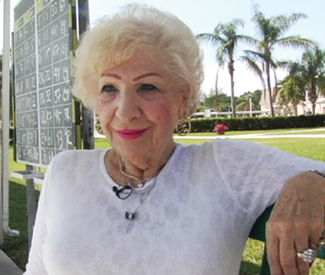
FILM Film editor Sari Gilman — her resume includes 2007’s Ghosts of Abu Ghraib and 2002’s Blue Vinyl — made her directorial debut with the 30-minute documentary Kings Point, a bittersweet exploration of a Florida retirement community. The film first screened locally as part of the 2012 San Francisco Jewish Film Festival, and will air on HBO in March. In the meantime, it’s been nominated for an Oscar for Best Documentary Short. I caught up with Gilman to talk about her film — and little gold men.

San Francisco Bay Guardian Congratulations on your nomination! You knew your film was on the shortlist, but were you surprised when you made the final cut?

Sari Gilman Thank you! You know, I had no idea. I have worked very hard in my life to try not to predict the future. [Laughs.] I was very happy when I found out, but I don’t think it would have destroyed me if it hadn’t happened. Obviously, though, it’s a total thrill and a complete honor, and more than I ever expected when I started making this movie.

SFBG Do you get to, like, walk the red carpet?

SG I do! I gotta get a dress! I mean, not that anyone’s going to care who I’m wearing, but for me, it’ll be fun.

SFBG What’s your connection to Kings Point, the place, and what made you want to create a documentary about it?

SG My grandmother moved to the community in 1978, when I was about nine years old. I visited her there many times a year for 30 years. About 15 years in, I was starting to get involved in storytelling and still photography, and I was always really fascinated with the place on a couple of different levels: socially, it sort of seemed like it was a summer camp for old people, and then visually — it’s 7500 identical one- and two-bedroom condominium units, spread out over miles. So there’s a lot of architectural homogeneity. These long hallways that look exactly the same, with these palm-tree shadows on them. It seemed like a natural place to start exploring.

SFBG Since you knew the residents already, was it easier to get them to open up in interviews?

SG I think so. None of the subjects in the final film were people that I knew personally before I started making it, but some of them did know my grandmother, and they all knew me as the granddaughter of someone who lived there. I think that’s what made it easy for them to talk to me. I also shared a lot with them about my grandmother’s experience and my experience there, so the interviews weren’t so much interviews as they were conversations. Obviously, we cut my voice out in most cases, but I think that I was able to get the kind of candid stories that I got because I was on the other end of the camera talking to them.

SFBG Though you’ve worked extensively as an editor on other people’s films, you didn’t edit Kings Point. Why was that?

SG As an editor, I knew how badly I needed an editor. I know that directors need to have a collaborator to provide perspective, and look at the footage with a little more of an objective eye. I got incredibly lucky in that I was able to hire Jeffrey Friedman [co-director, with Rob Epstein, of 2010’s Howl and 1995’s The Celluloid Closet, among others], who is a local luminary and an amazing filmmaker who edits occasionally. He was actually my mentor when I was learning how to edit in the 1990s in San Francisco, so working with him on my first film was a really great experience.

SFBG The tone of the film is unique in the way that it balances light-hearted moments with the sort of sad undertone that runs throughout.

SG That was the biggest challenge. I knew there was going to be sadness and darkness, and humor and lightness, and I had a sense of what I wanted that to be, but I knew from the beginning that it would be hard to achieve. Jeffrey and I spent a lot of time achieving the tone. It was kind of like salt and sugar — “A little sprinkle here, oh, now it’s too dark, let’s add more of the other.” The feeling that I wanted to evoke, more than anything, was that certain feeling that I had when I was visiting there.

SFBG Had you always intended for Kings Point to be a short film?

SG No, I actually intended it to be a feature. It was in the cutting room that we decided to make it a short. A large part of that was because of the tone, actually — we had enough story to keep it going, but the tone of those stories were shifting the film in a direction that I wasn’t comfortable with. It was a little more of that “cute old person” movie. Kitschy, kind of, “Look at the old people doing belly dancing,” or whatever.

I was extremely sensitive to the fact that most people, when they heard about the film, would think that’s what they were going to be seeing. I was a little crazy-determined not to make that movie, because that wasn’t what my experience was. That’s not what I saw. In cutting it down, we got rid of a lot of the lighter stuff, which is what helped us achieve the tone that we did.

SFBG There have been several films with themes about aging lately: Amour, Quartet, and The Best Exotic Marigold Hotel (all 2012) come to mind. Why do you think that is?

SG Oh, I definitely want to see Amour. I think it’s a moment whose time has come. As a population, the baby boomers have now started to retire, and in the next 20 years, we are going to see a major shift in the demographics of this country. There will be many, many more elderly than there are now. I think that people are starting to think about aging issues in a new way.

I truly hope Kings Point will encourage people to have those kinds of discussions. Nobody likes to grow old or think about what’s going to happen, but the truth is that we kind of need to. There’s a bit of a denial about the realities of aging; there’s so much emphasis placed on being independent, self-reliant, and remaining active. On the cover of AARP Magazine, you always see pictures of, like, 75-year-olds on bicycles riding to the beach. And that’s great, and everyone wants that to be their experience, but not everyone is so lucky. *

www.kingspointmovie.com

Editor’s notes

3

EDITORIAL Airports are special. There are schools and roads and buildings — and rest stops on the New Jersey Turnpike — named after famous and not-so-famous people, but airports, particularly major international airports, are, in a word, monumental. Tens of millions of people, many of them immigrants, have come through Kennedy Airport in New York, a place named after an inspirational leader who was killed before his time. We’re not so enamored with Reagan National in Washington, but the guy was a hugely influential president of the United States. Lt. Colonel O’Hare was a war hero.

That’s why the idea of naming San Francisco International Airport after Harvey Milk is so wonderful — and entirely appropriate.

There are lots of politicians in the world, and there have been many civic leaders who have done great things in and for San Francisco. But Harvey Milk was different, and special.

Milk was the first openly person gay person elected to public office in a major American city. He was an inspiration to tens of thousands of people, and his speeches, his signature line — “you’ve gotta give them hope — and his role as an LGBT icon made a better life possible for generations of young people who faced, and often still face, oppression, discrimination and fear.

It’s important to remember that, although he only served 11 months in office, Milk changed San Francisco, changed America, and changed the world. His bold actions forced the nation to accept a marginalized community. He represented the best of San Francisco, the essential spirit of rebellion, the demand for justice and the passion for equality that defines this city in the world.

And the struggle he embodied isn’t even close to over: All over the world, LGBT people are beaten, denied basic rights, killed for who they are. And if San Francisco can’t make a giant global statement against that, nobody can.

The renaming of SFO wouldn’t just honor a local political figure. I would make an international statement. The airport is a major West Coast hub, and people from all over the globe pass through its gates. While many of them won’t care who the airport is named for, others will — and an appropriate display in the terminals would educate countless visitors, many from countries and cultures where LGBT people are still not accepted, about the role Milk played in changing society’s attitudes.

We don’t take lightly the naming of civic institutions. There’s too much opportunity for political mischief, for someone like former mayors Willie Brown or Dianne Feinstein — neither of whom changed the city in a positive way or made dramatic statements — to get honored. That’s one reason that the San Francisco Airports Commission has declined to name anything after anyone who is still alive.

Sup. David Campos, who is promoting this idea, has taken the right approach: A decision this serious ought to go before the voters. The supervisors should place his charter amendment on the ballot, and the people of San Francisco should tell the world that the legacy of Harvey Milk is alive — and out there, our front, for everyone to see.

All kinds of work and one play

0

arts@sfbg.com

THEATER SF Sketchfest, running this year Jan. 24-Feb. 10, has changed the face of comedy in the Bay Area. It has done this by importing faces, many very funny faces, and mingling them with a complement of local ones. The precise composite changes yearly but, 12 years on, the juggernaut founded by David Owen, Cole Stratton, and Janet Varney has developed one of the largest comedy profiles in the country. My spellcheck may still not recognize improv as a word, but there’s no denying the influence this festival has had on the Bay Area’s exposure to the greater world of comedy.

Fans of drama may wish to know that this year’s comedy feast — which again unfolds across everything from standup to game shows to film-related events — also includes a little theatrical soufflé called SEX a.k.a. Wieners and Boobs, a 1998 work for the stage penned by State cofounders Joe Lo Truglio, Michael Showalter, and David Wain. The play, although hardly what you’d call regional fare, has since been published, and gleefully mounted by amateur companies here and there. But its creators — who famously went on to other things, including films such as Wet Hot American Summer (2001) — are only now revisiting the work themselves.

Lo Truglio explains that the genesis of the play was owed to Maria Striar, founder of New York’s Clubbed Thumb theater company, who in 1998 called up her old Brown University classmate Showalter with a last-minute invitation.

“They were doing a summer series, and one of the plays had dropped out,” recalls Lo Truglio by phone from Los Angeles. “So Maria called Michael Showalter and said, ‘Do you guys have anything you want to do?’ He said yes immediately. The catch was that we didn’t have anything ready. So we had to write the play in about three days.”

They started with the title, according to Lo Truglio, only because Striar needed to place an ad in the paper the next day. Coming out of theatrical left field, he acknowledges that a grabber was in order. “We just came up with that title to get people to come see it,” he explains. Taking no chances, the ad also promised a scene from David Mamet’s Glengarry Glen Ross — a claim the authors later make good on in one of the play’s brasher non-sequiturs.

The plot was borrowed from High Noon and set in a Teaneck, New Jersey menaced by a cranky desperado named Tad Theaterman. That narrative spine supports some wayward elephantine flesh, including a meta-theatrical opening scene involving a Q&A with the audience, and the aforementioned segue into Mamet (pronounced “mam-AY” in the play). Other moments were derived from previously untapped material, as Lo Truglio remembers.

“We had some bits that might have come from, probably not the State, but some stuff that David [Wain] and Showalter did at Stella, when they were doing live shows in Time Cafe on Lafayette in New York City. I also performed there and did some characters. I think a few characters and maybe a couple of the scenes in SEX were born out of that. But the majority was just this new-sheriff-in-town idea. We have a scene from Glengarry Glen Ross, because we just thought would be so cool to perform. [The process] went along those lines: what kind of thing would we like to see in a play? What bit do we have that we haven’t been able to use anywhere else?”

San Francisco audiences will be the first to see what this late 20th-century opus looks like in the garish light of a new millennium, with its creators in the roles they originated 15 years ago.

“I have no idea how it’s going to play after so many years,” admits Lo Truglio. “It’s very vignettey, which is a new word I’m coining. Looking back now, I think we would have cut out a lot of it. But it’s only about 55 pages anyway.”

A glance at the script suggests there’s still gold in them there pages, and anyway it’s hard to imagine the play’s triumvirate disappointing an audience reared on the State and all the subsequent work it has spawned. For his part, Lo Truglio looks forward to returning to a festival he recalls fondly and sees as essential.

“It’s fantastic that Janet Varney and the rest of those guys have created an annual event where really the best people in comedy go to perform,” he enthuses. “I think it’s important. It’s very similar to the way I feel about Marc Maron’s podcast, which I think is a terrific, really important record of some amazingly talented comics and actors. At Sketchfest there are so many people who are interested in comedy, different types of comedy, that it creates a terrific environment for it to thrive.” 

SEX A.K.A. WIENERS AND BOOBS

Feb. 8, 8pm, $30

Marines Memorial Theatre

609 Sutter, SF

www.sfsketchfest.com


The Performant: Manic pixies

4

‘Manic Pixie Dream Girl’ and ‘The Witch House’ roil with fantastickal energies

It was only a matter of time before the familiar genre of the comic book movie migrated to the stage. But don’t expect any muscle-bound jocks in colorful spandex roaming the aisles of A.C.T.’s intimate mid-Market venue, The Costume Shop. Not only is the titular “Manic Pixie Dream Girl,” of their current production not a superhero with mutant powers bestowed upon her by a quirk of DNA or gamma rays, but in a twist, the comic book involved actually originates from the play — not the other way around.

The play centers mainly around a youthfully shiftless, struggling painter Tallman (Joshua Roberts), whose dire straits and afternoon drinking habits lead to a chance encounter with one of cinematic fiction’s most enduring tropes, the Nathan Rabin-dubbed MPDG Lilly (Lyndsy Kail), a woman who “exists solely in the fevered imaginations of sensitive writer-directors to teach broodingly soulful young men to embrace life and its infinite mysteries and adventure.”

It’s a problematic relationship model on so many levels it’s hard to even know where to begin. Lilly is conveniently mute so she never has to share her feelings, or even her last name, but somehow, within an afternoon of their meeting, she’s moved into Tallman’s hovel, from which he is about to be evicted (by his ex-girlfriend’s new lover, smarmy real estate agent Rick [Lucas Hatton] no less). She never expresses a desire for anything beyond colorful scarves and starburst candy, and Tallman, in the middle of a painting frenzy, is so self-absorbed he can’t bring himself to question his “luck.” Even his sympathetic-to-a-point best friend Porter (Michael Barrett Austin) becomes disgusted with his lack of awareness. “Liking the way someone makes you feel is not the same as liking an actual person,” he observes astutely before abandoning Tallman to his fate.

The comic book, or rather, graphic novel, is represented as a series of projections which serve as backdrop and counterpoint to the live action unfolding onstage. Drawn by local actor and graphic artist Rob Dario, the panels form a silent but urgent backdrop to the narrative, adding visual heft to the bare bones set of stools, a humble futon, and primer-splotched countertop/bar. Or rather, presumably they do. Due to technical glitches, many of the images refused to project when cued, and the promise of a wholly symbiotic graphic-novel-play was under-realized the evening I went to see it.

But the images that did make it through, deceptively simple black-and-white line drawings somewhat reminiscent of the art of Brian Wood, gave Tallman’s inner struggles an external medium to be expressed through as his mysterious affair unfolded. Doubtlessly constrained by budget and time considerations, what the company failed to produce (but should have) was a companion comic as takeaway. I could have filed it next to my oft-referenced Transmetropolitan collection.

Meanwhile, up the road a ways at The Garage, Morgan Bassichis’ “The Witch House” involves a whole panoply of characters who are not quite pixies, but certainly manic. A pair of pre-adolescent boys dabbling in witchcraft set off for Salem in order to cast a spell for a third youth, and all three find themselves possessed by the restless spirits of witch trial accusers Abigail Williams, Ann Putnam Jr., and Mary Walcott.

A fairly oblique examination of gender roles and the justice system, what “The Witch House,” does offer is a wealth of intriguing visuals mainly provided by the largish cast of “bees” (also shades of the accused) who writhe and dance across the stage, simulating the emotional storms brewing thereon. Also, the company has designed a series of original “playing cards” to give away, with art by Lis Goldschmidt and a poetic speech penned by Bassichis, a savvy promotional tactic that even PlayGround (who coproduced “Manic Pixie Dream Girl”) can learn from.

Sea-level rise and development in SF

25

It’s good the Chronicle is taking on climate chance and sea-level rise. It’s good that Carolyn Lochhead is writing about the reality that storms like Hurricane Sandy are part of our future and that all types of coastal development are now at risk. It’s scary:

Naval bases, power plants, ports, highways – trillions of dollars of investment – sit on U.S. coasts because it once made sense to put them there. As people flocked to the shores, tiny beach towns became cities. Congress is hardly maintaining roads and bridges; its appetite for giant new sea walls around New York Harbor has yet to be tested. “You may be able to have the government rebuild New Orleans, and maybe you could have the government rebuild from Sandy,” said John Englander, author of “High Tide on Main Street,” a book on how rising seas will affect the coasts. “But as sea level rises and reclaims shoreline all around the United States and all over the world, governments can’t afford to reimburse that. It’s not just Miami, it’s Charleston, it’s downtown Seattle, it’s Sacramento, it’s every coastal city and city on rivers.”

 Oh yes — and it’s San Francisco, where sea-level rise doesn’t seem to be an issue in the city’s plan for massive real-estate development on the waterfront.

 The Chron has a map of what the Bay Area might look like after a two-foot increase in sea levels and a six-foot increase. It looks like this.

Of course, it might be okay because we can build super-tech levee that will create artificial waterfalls and protect us all from living on islands.

(You could argue that climate change isn’t about new technology, but that would be no fun — and would require actual political leadership.)

Anyway, here’s the problem with the Chron’s map: It makes San Francisco look just fine. The entire city is in white, safe from that pesky inundation that will ruin lesser parts of the bay.

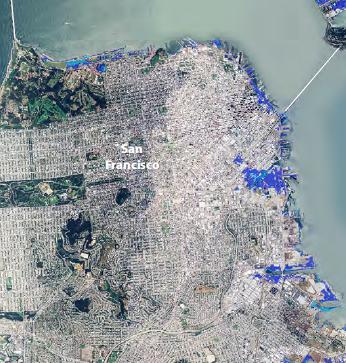
Thing is, the Bay Conservation and Development Commission has spent a ton of time on sea-level rise, and has its own map, that’s a bit more accurate, or at least more detailed — and that shows some major-league problems for this city.

Check out the areas in blue: It’s most of the northen and eastern waterfront. That includes not only Mission Bay, where the city is pinning its hopes for a biotech boom, but also the site of the Warriors Arena, 8 Washington, and 75 Howard. In other words, the plan to make the waterfront into a heavily developed entertainment and residential neighborhood isn’t going to work for very long — unless everyone gives up his or her car and buys a boat. Or unless we, the taxpayers of San Francisco, spend billions protecting all this development that doesn’t make sense in the first place.

Oh, Treasure Island’s going to be a much smaller island, too.

It’s entirely possible — and likely — that state, federal, and local tax money will go to protect some essential, vulnerable coastal areas. It makes no sense to try to move both the San Francisco and Oakland airports; we’re going to build barriers to protect them. But how are we going to protect an arena that’s built out over the water when the water starts to lap up to the doors? Who’s paying for that?

The Chron has done a good job asking the questions at the national level — but, just as we so often see with economic inequality and tax policy, nobody wants to bring the message home.

Oakland to decide on controversial stop-and-frisk advocate Bill Bratton

On Tuesday, Oakland City Council will consider approving a $250,000 contract for an outside security consulting team, which could include controversial roving police chief and private security contractor William Bratton. With Oakland’s understaffed police department facing a 23 percent rise in violent crime over the past year, the Council’s Public Safety Committee unanimously recommended last week that the full Council approve a new round of funding for Boston-based police consultant Strategic Policy Partnership LLC. The firm intends to bring on Bratton as part of a new team of private policing experts to advise OPD.

At the five-hour Public Safety Committee meeting on Jan. 15, Oakland activists crowded into the chamber to voice concerns that Bratton—a nationally known proponent of “zero tolerance” policing and New York City’s extremely controversial stop-and-frisk policy—would be tapped as a member of the consulting team. Pressure from the community prompted committee members to tack on a provision suggesting that an alternative to Bratton be considered in the final contract.

Oakland Mayor Jean Quan and Police Chief Howard Jordan both voiced enthusiastic support for Bratton’s appointment.  In a letter sent last Wednesday urging the Council to approve the contract, Quan wrote: “Bratton is uniquely suited to helping us perfect how that system works here.” She went on to promise that racial profiling would not be tolerated in Oakland.

Oakland attorney Dan Siegel, a former legal advisor to Quan, expressed dismay over Bratton’s possible consultancy to a lively group of protesters outside last Tuesday’s meeting. “Stop-and-frisk does not work,” he said. “Bratton is exactly what we do not need in the city of Oakland.”

Although Bratton did not attend last Tuesday’s meeting, he has publicly expressed interest in working in Oakland, despite the vocal opposition.  “I’m still very desirous of working in Oakland … I think the assistance that I can provide will be of value to the city,” Bratton told the Oakland Tribune following Wednesday’s protests.

From Boston, to Los Angeles, to New York, Bratton has implemented and championed a controversial mix of anti-crime measures, making him one of the nation’s most divisive and visible law enforcement officials. 

Lauded by supporters as America’s “Top Cop,” he has twice served as president of the influential Police Executive Research Forum (PERF), which was responsible for coordinating a police response to the Occupy Wall Street Movement. He also serves as vice chair of the Homeland Security Advisory Council.

Serving as police chief in New York from 1994 to 1996 and Los Angeles from 2002 to 2009, Bratton built a national reputation as an outspoken proponent of stop-and-frisk, a tactic often linked with racial profiling. According to data compiled by the New York ACLU, the procedure disproportionally targets black and Latino residents. Earlier this month, a U.S. District Court Judge in New York deemed stop-and-frisk to be unconstitutional and issued an injunction limiting the policy in the Bronx. In July, when San Francisco Mayor Ed Lee suggested exploring stop-and-frisk in San Francisco, local civil liberties advocates balked.

Bratton is also an unabashed supporter of zero-tolerance policing, a method that stems from the “broken-windows theory” and encourages police to make arrests for minor infractions such as graffiti, litter, panhandling, prostitution or other petty offenses which are presumed to create an environment that breeds serious crime.

Bratton’s controversial tactics have been credited with reducing crime rates during his tenure in New York and Los Angeles. His work to diversify the LAPD and build closer ties between police and the community also drew praise from the Los Angeles chapter of the ACLU.

But in Oakland, local police reform advocates question the long-term efficacy of Bratton’s methods.

Rachel Herzing, co-director of Oakland-based Critical Resistance, an advocacy group that is part of a coalition of local organizations mobilizing against Bratton, charges that he deals in “quick fixes.” In the long run, she argues, his methods do not reduce crime but rather relocate it.

Bratton’s “all cops, no services approach does not work anywhere, and will not work in Oakland,” Herzing told the Guardian. “The aggressive sweeps Bratton is known for in New York ultimately just displace people, and drive them away from essential services. [These tactics] aren’t appropriate policing responses.”

The public outcry at last Tuesday’s Public Safety Committee meeting drew responses from new Council members Lynette Gibson McElhaney and Dan Kalb. McElhaney, whose District 3 includes some of the city’s lower-income neighborhoods plagued with high crime rates, told colleagues that Bratton may come with “too much baggage.” Ultimately, McElhaney said, his presence in Oakland might prove to be counterproductive.

Speaking to the Guardian on Jan. 21, McElhaney said she was not yet sure if she would vote to approve the contract. “We are wrestling with some very big issues here,” she said.  “I am clearly concerned about some of Bratton’s tactics but I am also interested in his results in some of the cities he has worked in. I do know he has lowered homicide rates.”

She added that the overarching goal of addressing crime in Oakland should not be lost in the debate surrounding Bratton. “There’s the totality of the contract I’m considering… in the end, I’m more interested in the outcome as opposed to the individuals.”

In an effort to diffuse controversy at the Jan. 15 meeting, McElhaney and Kalb successfully amended the committee recommendation to urge Strategic Policy Partnership to consider potential alternatives to Bratton.

But given Bratton’s national profile and controversial approach to policing, his inclusion in the consulting contract will likely take center stage at the full Council Meeting on Tuesday. Both Bratton’s opponents and supporters plan to arrive in force at Tuesday’s Council meeting, and as of yet it’s uncertain which side will prevail.

The inauguration and the economic divide

112

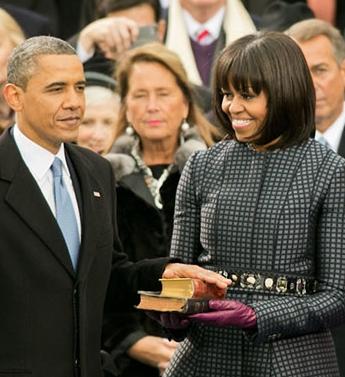
Second inaugration speeches are hard; you have to be political without sounding partisan, inspiring without being divisive — and promise change and progress even if you haven’t accomplished what you wanted in the first term. The Obama address surprised me: He went left, making clear that he wants economic and social equality to be his final legacy. It’s getting rave reviews in the lib-blogosphere, where it’s been described as the speech liberals have been begging him to give for years. You can’t argue with the content — he mentions gay rights, global climate change, equal pay, protecting social security, economic inequality, the need for collective effort … he even talks about reforming the tax code.

So now comes the hard part: The struggle for economic justice has to go beyond a compromise plan that limits higher tax rates to people earning more than $400,000 a year.

In fact, the best thing I read this weekend was a NY Times piece by Nobel-Prize-winning economist Joseph Stiglitz, who argues forcefully that continued economic inequality is prolonging the recession. It’s also destroying the nation’s future:

Our skyrocketing inequality — so contrary to our meritocratic ideal of America as a place where anyone with hard work and talent can “make it” — means that those who are born to parents of limited means are likely never to live up to their potential. Children in other rich countries like Canada, France, Germany and Sweden have a better chance of doing better than their parents did than American kids have. More than a fifth of our children live in poverty — the second worst of all the advanced economies, putting us behind countries like Bulgaria, Latvia and Greece. Our society is squandering its most valuable resource: our young.

Stiglitz says what few in Washington want to admit: We can’t get the economy going again without rebuilding the middle class, and we can’t do that without higher taxes on the rich and a lot more public investment in education. Oh, and all this talk of how it’s out of our control is bullshit:

There are all kinds of excuses for inequality. Some say it’s beyond our control, pointing to market forces like globalization, trade liberalization, the technological revolution, the “rise of the rest.” Others assert that doing anything about it would make us all worse off, by stifling our already sputtering economic engine. These are self-serving, ignorant falsehoods. Market forces don’t exist in a vacuum — we shape them. Other countries, like fast-growing Brazil, have shaped them in ways that have lowered inequality while creating more opportunity and higher growth. Countries far poorer than ours have decided that all young people should have access to food, education and health care so they can fulfill their aspirations.

Makes me think about some of what I hear out of San Francisco City Hall. Oh, we can’t do anything about economic inequality; that’s a national issue. Or maybe it’s a state issue. I bet there’s not an elected official in town today who woudn’t proclaim complete agreement with everything Obama just said — and there are very few of them who are trying to bring that message back home.

In San Francisco, we give tax breaks for businesses that create high-end jobs that drive poor people out of town. We happily seek development without considering the impact it will have on existing vulnerable populations. We even struggle over free Muni for low-income youth. We do nothing — nothing — to reclaim wealth from the 1 percent and put it into local housing, public education, and job-training that could make a dent in our local economic inequality.

Mr. Mayor: Are you even paying attention?


Heads Up: 7 must-see concerts this week

0

What a momentous way to kick off the week: Barack Obama’s second inauguration falling on MLK Jr. Day, and with tear-inducing performances by Beyonce and James Taylor, to boot. It doesn’t get much more U-S-A than that. Oh, and there was that whole SF football win on Sunday.

Celebrate your fleeting pride swell with a week-long journey through challenging live music; stop by former local Jhameel’s return concert, the annual SF Tape Music Festival, Luke Sweeney’s Wet Dreams Dry Magic at Mission Creek Oakland, Blond:ish at Monarch, and Gaucho at Cyprian’s, as the group recognizes Django Reinhardt’s birthday.

Also, it’s technically sold out, but “UnderCover presents Joni Mitchell’s Blueat Freight and Salvage tonight (Mon/21) may have some standing room tickets at the door ($24.50). Plus, there are still some presale available for tomorrow night’s show (Tue/22).

Here are your must-see Bay Area concerts this week/end:

Jhameel
Jhameel, our beloved multi-instrumentalist On the Rise star, returns from LA – for the night at least. The formerly Bay Area-based pop songwriter has been hard at work down south in the sun, polishing his futuristic Michael Jackson vibes, writing a new album, and recording more drunk videos for his devoted followers. For this show, he promised those fans he’d sing his damn heart out.
With Giraffage, Coast Jumper
Wed/23, 8:30pm, $10
Cafe Du Nord
2170 Market, SF
www.cafedunord.com
http://www.youtube.com/watch?v=HiN8CWzNNPI

The Tambo Rays
“If you’re looking for a San Francisco-based band to adore in the new year, keep your eye on the Tambo Rays. The punkish young chillwave foursome released Kaleidoscope, its debut EP, last summer and has speedily garnered an enthusiastic audience. The group — a collaboration between brother and sister Brian and Sara DaMert along with friends Greg Sellin and Bob Jakubs — makes catchy, introspective pop music characterized by B. DaMerts’ crooning vocals and a hazy wall of dissonance.” — Mia Sullivan
With Evil Eyes, Moonbell, Jesus Sons
Wed/23, 9pm, $6
Brick and Mortar
1710 Mission, SF
(415) 371-1631
www.brickandmortarmusic.com
http://www.youtube.com/watch?v=1p4WNQaBpAg

Luke Sweeney and Wet Dreams Dry Magic
Luke Sweeney recently released his solo debut, Ether Ore, the album name a reference to the singer-guitarist’s spirit animal, Elliot Smith. It’s a sweet, fresh start for Sweeney as an indie solo artist (“recorded on 1/2″ tape in a living room…over the span of a few days in April 2012”), but you likely know his previous work in VOWS and his excellent current band, lo-fi pop dreamers Wet Dreams Dry Magic, headlining tonight as part of the Mission Creek Oakland Music and Arts Festival.
With Soft Bombs, French Cassettes
Thu/24, 9pm, $10
Uptown
1928 Telegraph, Oak.
www.uptownoakland.com
http://www.youtube.com/watch?v=VVVhS1xOVc4&feature=plcp

The Walkmen and Father John Misty
The sonic gods have blessed us with this lineup. Separately, both acts would be worthy of a Heads Up shout-out, together they’re an emotional goldmine – bringing together the tender post-punk of the Walkmen, and hip-swinging indie-folk of singer-songwriter Father John Misty (a.k.a. J. Tillman of Fleet Foxes).
Thu/24, 8pm, $25.
Fillmore
1805 Geary, SF
www.livenation.com
http://www.youtube.com/watch?v=6QaFK_GvO_s

San Francisco Tape Music Festival
The Tape Music Festival reminds us of the more idiosyncratic San Francisco of yore, the one we’re all desperately trying to hold on to, despite blooming micro-apartments, bans on nudity, and the like. Go, support this, “America’s only festival devoted to the performance of audio works projected in three-dimensional space.” This year, there will be a retrospective of the works of Bernard Parmegiani – an influential Parisian composer of acousmatic tape music – along with a piece by Japanese sound artist Ryoji Ikeda, classics by Luciano Berio and Hugh Le Caine, local composers Pamela Z and Andrea Williams, and more.
Fri/25-Sun/27, 8pm, $15 ($35 festival pass)
ODC Theater
3153 17th St., SF
sfsound.org/tape
http://www.youtube.com/watch?v=cXAevrYhicI

Blond:ish
“In a section of the music industry where club promoters and marketers all too frequently rely on glamor headshots layered over photoshopped neon clouds, London based but Montreal bred Anstascia D’elene and Vivie Ann Bakos have smartly chosen a name that immediately undercuts appearances. (Plus the tag-line: “not all dumbs are blonde.”) With that out of the way, this posh, Kompakt-approved duo has spent the last couple of years making a real name for itself, releasing credible 4×4 house sets and EPs with callbacks to ’60s psychedelia and ’80s new wave, while providing remixes for Todd Terje, Pete Tong, and Tomas Barfod.” — Ryan Prendiville
With DJ M3, Anthony Mansfield
Sat/26, 9pm, $10-20
Monarch
101 Sixth St., SF
(415) 284-9774
www.monarchsf.com
http://www.youtube.com/watch?v=qtjQTHZ4Wrg

Gaucho: Django Reinhardt’s birthday
If you play any form of gypsy jazz, you have Django Reinhardt to thank for that. Popular local band, Gaucho – which recently passed the decade mark as a group together, no small feat in band-land – recognizes this relationship with an evening dedicated to Reinhardt, during the week of what would have been his 102nd birthday (he was born Jan. 23). If you’d like to wish bonne anniversaire to the master, there’s no better spot this weekend for hot gypsy jazz, ragtime, and pre-war blues.
With Kally Price and the Old Blues and Jazz Band
Sat/26, 8pm, $12
SF Live at Cyprian’s
297 Turk, SF
www.noevalleymusicseries.com
http://www.youtube.com/watch?v=Mn5WWGnggkw

Democratic Party tries to block non-Democrats

66

Once again, the San Francisco Democratic Party is considering ousting local Democratic clubs that endorse non-Democrats in nonpartisan races. It’s crazy, and it goes back to the Matt Gonzalez era, and I don’t understand why somebody keeps bringing it up. But there it is.

The local party operation, run by the Democratic County Central Committee, has to rewrite parts of its bylaws this year anyway, thanks to changes in state election law. (For one thing, terms on the DCCC will now run four years, not two, and elections will coincide only with presidential primaries.)

And among the proposed changes is an item to ban chartered Democratic clubs from endorsing, say, a candidate for San Francisco supervisor or school board who isn’t a registered Democrat.

Now: It’s always been pretty clear that if you’re a part of the Democratic Party, and your club has official party sanction, you shouldn’t be endorsing Republicans (or even Greens) over Democrats. So Dem clubs have to support Dems for president, Congress, etc. (Of course, with our top-two primaries it’s possible, if highly unlikely, that a race for state Assembly could now feature a pair of candidates neither of whom is a Democrat, which would make things sticky. And under the proposed bylaws, a Democratic Club could still chose one of them.)

But never mind that — the real issue is local government. Local races, by state law, are nonpartisan, and there ahve been plenty of progressive candidates who weren’t registered Dems. In fact, this all goes back to the anger the establishment ginned up after Matt Gonzalez, a Green, very nearly toppled Gavin Newsom for mayor — with the support of a lot of progressive Democrats. The Harvey Milk Club went with Gonzalez and some Newsomite tried to make an issue of the Club’s charter.

Jane Kim was a Green when she was first elected to the School Board. Ross Mirkarimi was elected supervisor as a Green. And while the Green Party is in something of a state of disarray right now, it could make a comeback. And perhaps more important, the fastest-growing group of voters is decline-to-state — and it’s pretty likely that we’ll see someone who isn’t a member of any party run for office in the next few years.

There’s a reason the state Constitution made local races nonpartisan — and there’s no reason Democrats can’t endorse the candidates they think are the best in those races, without regard to party affiliation. The Milk Club, not surprisingly, is strongly against this, and so am I. It comes up Dec. 23; let’s shoot it back down.


The Performant: Books and beats

0

Starting the New Year off right with Clown Foolery and Los Rakas

It’s a Friday night and the Booksmith is full of clowns. Seriously, it’s like a clown convention in here. Fully half the oddience are off-duty clowns, and the rest of us just kind of look like we should be. We’ve gathered together for the monthly clown jam/variety show Literary Clown Foolery, the first of the year, appropriately themed New Year’s Resolutions.

True, the free beer and cheese puffs at the door seem to run slightly counter to the kinds of resolutions that get a lot of attention around this time of year. But they are the perfect accompaniment to loosening up any natural inhibitions one might otherwise feel when seated within spitting distance of a whole passel of unpredictable clowns, so no one’s complaining.

“I like your glasses” a poker-faced clown in polka dots announces from the “stage” as she scans our expectant faces with her own unsmiling, bespectacled eyes. This is Gretchen (known outside of clown makeup as Tristan Cunningham), assistant to Dr. Schmidtt (Polina Smith), and she has a list of resolutions that reads in part like this: “get lucky, do the horizontal boogie, ride the bologna pony, have a hot meat injection…” You get the gist. Dr. Schmidtt, an expert in all things, decides to assist Gretchen by putting her on a diet of cookies and inviting an actual life coach (a charming Elaine Margarita Williams) onstage to help her set her goal. As Gretchen embarks on her quest to seduce someone, anyone, appearances by musical guests Mustard (Masha Matin) and Carl and Beatrice and juggling/belly-dancing interludes from Jon Deline of Pi Clowns using a series of silly monikers, punctuate the performance.

Scheduled for every second Friday, Literary Clown Foolery may be set inside a bookstore, but it’s way more lively than your average literary event, kind of a combination of vaudeville, sketch, and conference lecture, with books mainly serving as incidental backdrop. But since it certainly does inspire pre-and-post-show browsing, it appears to be a win for all concerned (except for Gretchen unfortunately, who overdoes the cookies and fails to find the bologna pony, or bookworm, of her dreams).

******

Saturday at Slim’s was bouncing with that special off-the-wall energy that all-ages shows seem to inspire, an excitability that contrasts refreshingly to the too-cool for school vibe you might encounter elsewhere. Squeezing in just in time for the last of Mission-born rapper A-1’s set, I recognize a couple of tracks from his latest mixtape “Thurl” including the Lana Del Rey-sampling “Now You Do” while the intriguingly shrouded Davin Gruesome shambles around the stage in his signature facemask and 49’ers gear like a revenant of home-grown rap.

But it’s Oakland-based Los Rakas that blow the stage up with a full band featuring at least three percussionists, keyboards, and electronic beats, while the two vocalists, Raka Rich and Raka Dun (Ricardo Giliam  and Abdull Dominguez) hold forth in spirited tandem. As cold as it is outside, the warm infusion of infectious Afro-Caribbean rhythms, Spanish-language flow, and powerful stage presence of the two Panama-American cousins heat things right up.

Taking their name from a Panamanian phrase “rakataka” (used roughly in the same way “ghetto” might be used here), Los Rakas preach the gospel of self-acceptance and pride, though they’re certainly not shy about including less weighted topics like ladies and weed smoking to their mix. They’ve been fortunate enough to share the stage with some pretty big names in the past, (including DJ Questlove, Ozomatli, Cypress Hill, Erykah Badu, and Manu Chao) and as headliners at Slim’s they appear comfortable with their role, filling the stage easily with their sometimes raunchy humor and energetic rapport. From all appearances, Los Rakas’ New Year looks off to a good start, and judging from the crowd’s enthusiastic response, so is ours.

The (bad) Warriors deal, by the numbers

36

Rudy Nothenberg, who ran Muni and the city’s water system, was chief administrative officer, negotiated the deal for the Giants ballpark, and served under six San Francisco mayors, stopped by the office last week to talk to us about the Warriors Arena. We’ve had our fights with Nothenberg (as we would with anyone who was that close to Willie Brown and Dianne Feinstein) but the guy knows more about City Hall, public works, private development, and infrastructure finance than almost anyone alive. So we were happy to hear what he had to say.

Let’s be clear, here: Nothenberg lives near where the arena is slated to be built, and, as he was quick to tell us, he doesn’t want it in his backyard. But he also presented a compelling case that San Francisco is getting ripped off. And he had a few pointed things to say about the lack of negotiating skills among the members of Mayor Ed Lee’s administration.

Back when Nothenberg was talking to the Giants about a stadium at Third and King — at that point a district of dilapidated and underused warehouses — always kept a card in his back pocket. “I always knew that if things didn’t work out and we didn’t build the stadium, that would be okay too,” he said. In other words: You can’t get a good deal if you’re not prepared to walk away. And when it comes to the Warriors proposal, the mayor has made it so clear that this is his legacy that the team knows the city will never walk away. So one side of the talks can demand pretty much anything, and the other side has no leverage.

Oh, and it doesn’t hurt that just about every development lawyer, political consultant, and lobbyist in town is already working on the project. “They have co-opted everyone,” Nothenberg — no stranger to the dark side of politics — told us.

The exact terms of the deal are still not public, which is a bit odd since the city has already started its environmental review. (Can you really do an environmental impact report on a project when you don’t know what the project actually is? Two difference state courts have come to opposite conclusions, so for now the answer is: maybe.)

But there’s enough information out there for Nothenberg to give us a basic rundown on the financing — and it doesn’t look good. “The Port is really not getting anything out of the deal,” he said. The city will get some increased sales and business taxes, and the Warriors will have to pay housing and transit fees. But there won’t be a lot of new property tax revenue, since that will all go to pay for the arena.

Here’s how Nothenberg laid out his analysis:

The Warriors have to spend $120 million to replace Piers 30-32. (Costs a lot to build such a huge structure over the water.) To make the team whole, the city will sell the Warriors a seawall lot on the other side of the Embarcadero for $30 million, then give the $30 million right back to the team. Then the city will set up an Infrastructure Finance District — the 2013 equivalent of a redevelopment agency — use the future tax increments to fund a $50 million bond. The Warriors get the bond money; the city pays it back. Oh, and then the city gives the team $30 million worth of rent credits, meaning the Warriors will probably never pay any rent at all for the use of that public property. And to make it sweeter, San Francisco will pay the Warriors 13 percent interest on the rent-credit money.

Meanwhile, the local taxpayers will have to come up with a huge amount of money to increase Muni capacity, since the existing transit can’t possibly handle the load of the new arena. Yes, the Warriors, like any developer, will have to pay a modest transit impact fee — “but it’s laughable to thing that this will ever cover the capital and operating costs,” Nothenberg said.

To summarize: The wealthy owners of a professional sports team will get free waterfront land to build an immensely valuable new arena. The city will pay to bring the fans there and get them home, deal with the traffic impacts — and get almost nothing in return.

Good one, Mr. Mayor.

Hyatt agrees to job hazard analysis in settlement

Nenita Ibe, who will turn 71 in February, says she still hasn’t fully recovered from a shoulder injury she sustained in March of 2009 during her housekeeping shift at the Hyatt Santa Clara. As she was lifting up a hefty padded mattress to tuck the sheets underneath, a task she’d completed hundreds of times before and continued to perform hundreds of times after, “I heard a crack in my shoulder,” she recalls.

Ibe says the pain worsened over time as she continued performing her housekeeping duties – tucking sheet corners, pushing heavy carts, standing on the sides of bathtubs or on top of toilet lids to clean overhead bathroom tiles, crouching down to pick up discarded towels or disinfect floors. In June of 2012, she underwent surgery to alleviate the chronic shoulder pain. “It feels better,” she told the Guardian, “but I feel pain when I have to use it too much.” She’s now following doctor’s orders to refrain from working, and relies on disability coverage to help make ends meet. Ibe says her workers’ compensation claim has yet to be resolved.

Repetitive motion injuries have been a flashpoint for UNITE HERE Local 2, a hotel workers’ union that helped kick off a campaign calling for a global boycott against the Hyatt hotel chain last summer. Several weeks ago, the Hyatt Fisherman’s Wharf reached a settlement with California’s Occupational Safety and Health Administration (Cal/OSHA) resolving a set of citations, two of which pertained to repetitive motion injuries.

Local 2 trumpeted the deal as a “landmark” agreement because it will establish an eight-member Housekeeping Committee tasked with identifying best practices to prevent exposure to such injuries. Hyatt Fisherman’s Wharf isn’t unionized, but Local 2 has been trying to facilitate union formation at that facility.

“It’s not an exaggeration to say that this is unprecedented,” Local 2 spokesperson Julia Wong told the Guardian. Half the committee will be made up of non-management housekeepers selected by their coworkers, she added. “It’s an incredible opportunity because it’s a requirement that housekeepers themselves have a voice in how these best practices are developed.”

“I’m happy about the news,” Ibe said. “They should listen to the experienced room cleaners.”

The settlement stemmed from a set of citations issued by Cal/OSHA in November of 2011, following a regulatory investigation launched in response to worker complaints filed one year earlier. Regulators initially pinned Hyatt with two “serious” violations relating to ergonomic issues: A failure to minimize exposure to housekeeper repetitive motion injuries, and a failure to conduct mandatory training to warn workers about ergonomic health problems. Hyatt immediately appealed the citations.

The appeal process ended in December, when Hyatt Fisherman’s Wharf agreed to the settlement with Cal/OSHA, pledging to convene the Housekeepers Committee and perform a job hazard analysis with the guidance of a certified health professional, among other things. The Hyatt Fisherman’s Wharf will pay a $6,460 fine, and Cal/OSHA withdrew the serious ergonomic citations as part of the agreement.

Hyatt spokesperson Pete Hillan emphasized that “there was no evidence found” backing up initial ergonomic charges filed against Hyatt Fisherman’s Wharf, and criticized the hotel workers’ union for wasting taxpayer dollars by calling on state regulators to investigate. “What was found at Fisherman’s Wharf was the equivalent of lagging paperwork,” Hillan said. He insisted, “Hyatt is a very safe place to work.”

Local 2 represents hotel workers at the Grand Hyatt and Hyatt Regency in San Francisco. Both of those remain under boycott, Wong said, “because the workers have been without a contract for three-and-a-half years now.”

Localized Appreesh: Adios Amigo

3

Localized Appreesh is our thank-you column to the musicians that make the Bay. To be considered, contact emilysavage@sfbg.com.

What began life as a side-project for Il Gato drummer Johnny Major has grown into a hyper melodic, can’t-miss, feel-good group to know. Or as I breathlessly wrote after catching an early show at the Hemlock: Adios Amigo is pure indie-pop bliss, in the vein of Broken Social Scene and the Shins. 

In this one, Major leads as singer-songwriter-guitarist, backed by guitarist Rahi Kumar, bassist Alex Coehn, drummer Stephen Wills, Claire Grinton on keys and fiddle, and percussionist Catalina Atria – along with warm multi-part harmonies put forth by all those involved.

The band released Dos last year, and starts 2013 off right with a headlining gig at Cafe Du Nord. Learn more about Adios Amigo below, but first check out the video for plucky “Chicken” and see how long you can hold out without cracking a grin.

http://www.youtube.com/watch?v=G4X7QxfE2jw
Video Credit: Caitlyn Adkins

Year and location of origin: 2011, San Francisco

Band name origin: Sitting in a cubicle in SOMA, dreaming of escaping to South America, I came up with the name.  It means ‘Goodbye Friend’.

Band motto: “¡Hasta la victoria siempre!” – “Until victory, always!”

Description of sound in 10 words or less: Grandiose, jangly, guitar-driven, harmonic psych-pop

Instrumentation: Two Guitars, one bass, one keyboard, one drum set.

Most recent release: Dos EP – June, 2012.

Best part about life as a Bay Area band: Living in one of the most beautiful cities in the world, being a part of one of the best music scenes in the world, playing awesome venues, great food, liberals.  

Worst part about life as a Bay Area band: The rent.  Too high.

First album ever purchased: Green Day’s Dookie, or the Forrest Gump soundtrack.

Most recent album purchased/downloaded:
 Tame Impala, Lonerism.

Favorite local eatery and dish: The Little Chihuahua — Garlic Shrimp Burrito. Everyday.

Adios Amigo
With City Tribe, Ghost Tiger
Thu/17, 9pm, $10
Cafe Du Nord
2170 Market, SF
www.cafedunord.com

New steps

0

arts@sfbg.com

THEATER/DANCE Choreographer Mary Armentrout’s itinerant, site-specific performance installation, reveries and elegies, passed through CounterPULSE last weekend. A post-solstice meditation on dislocation and flux, it was also the harbinger of a striking new season at the SOMA performance incubator. In fact, reveries and elegies, true to its theme of displacement, can be considered the odd one out among programming whose defining structure is the duet.

A broad range of interpretation and subversion of that basic form comprises CounterPULSE’s Queer Series, running January through March and showcasing new work from artists as diverse and far-flung as New York’s Faye Driscoll, the Minneapolis-based BodyCartography Project, San Francisco’s Annie Danger, Berlin-based American Jeremy Wade, and conjoined local choreographic dynamo Jarry (aka Jesse Hewit and Laura Arrington).

If you’ve followed the vicissitudes of programming at CounterPULSE even intermittently, a glance at this year’s calendar prompts a double take for the careful concentration of work and the thematic consistency it evinces, in addition to its impressive international lineup. The rigorous queering of the duet structure underlined by the series, for instance, comes further elaborated through complimentary work like DavEnd’s well-received 2012 debut, F.A.G.G.O.T.S.: the Musical! (which turns on a duet of sorts with a wall mirror) as well as some rich auxiliary events.

The latter include a talk on gender by Judith Butler (on February 16) and, on February 28 (the eve of Danger’s genuflection to sexual healing and empowerment, The Great Church of the Holy Fuck), a screening of Community Action Center (2010), the aesthetically and politically astute, 69-minute, queer, trans, women-centered celebration/subversion of 1970s porn by A.K. Burns and A.L. Steiner. (That program includes a post-screening Q&A with Steiner, whose film was recently acquired by the Museum of Modern Art).

The duet form (and the act of reimagining it) is an apt metaphor for the programming model behind the season too, which represents something of a departure from business as usual.

CounterPULSE’s Julie Phelps, central in the development of the season and currently serving as interim artistic and executive director for Jessica Robinson Love (who is on sabbatical), explained that the Queer Series and the season as a whole had emerged from some serious rethinking at the organizational level.

“We were sort of primed to embark on this new season, which [comes directly] after our strategic planning process, where we really identified who we are, how we do what we do, and what limits we still have on our impact.”

Phelps says one limit they identified was a single-minded commitment to the bottom line that was keeping certain kinds of work almost permanently out of reach — for example, much work by touring artists from out of the state or country, for which there is relatively little foundational money available for tapping.

“We’re actually, financially, a very conservative organization,” says Phelps, “which has brought with it a lot of stability — very important especially in the young years of an organization, but ultimately stopping us from taking risk on vision. We were always on a break-even model. Either it needs to be some mix of foundation support or some other kind of funding with some tickets sales. The bottom line always has to equal zero. So we’ve been pushing ourselves to think bigger about the types of risks that we can take.”

That’s far from inviting recklessness, Phelps stresses, but it does mean modifying notions of financial success and failure, bringing them in line with an artistic spirit of experimentation and what might be thought of as the useful flop.

“Actually, failure is just as valid a result as success,” says Phelps. “When we had been building failure out of every income model we had, we’d also been building out risk from some of the artistic selections, and from the way we were making artistic selections. We’ve really only just recently moved into curating in the first place. Before we were like, we have a space, if you want to do a show, come ask us and we’ll work it out. [In this] season, every artist was someone we approached and worked with, found out ways that they could intersect with CounterPULSE, what was financially viable for us and for them, what was artistically interesting for us and for them — actually build something from the inside out, instead of the outside in.”

Despite the considerate design in the program, Phelps calls it more art than science and insists it’s all “still a very organic process,” noting that the queer label is at least partly one of sheer convenience.

“I mean, ‘queer’ is basically the only banner that you could fly over that season, and only because it is so indistinct — because actually each of these works is hugely different. So there’s still a patchwork element to it, but it’s a little bit more deliberate [than usual],” she explains, laughing at the metaphor carrying her away. “At least the patches were picked out, and the fabric was cut to shape before they were added to the quilt this time.” *

www.counterpulse.org


Alerts

0

THURSDAY 17

Refugee Hotel

Contemporary Jewish Museum, 736 Mission, SF. 6:30-8pm. Join photographer Jim Goldberg, photographer Gabriele Stabile, and journalist Juliet Linderman for a discussion about Refugee Hotel, a collection of photography and interviews documenting the arrival of refugees to the United States. Hosted by Voice of Witness, a nonprofit book series published by McSweeney’s Books that illuminates contemporary human rights issues. Free before 5pm; admission is $5 after. Advance tickets encouraged. info@thecjm.org; 415.655.7881. If you can’t make the Thursday event, consider dropping by Gallery Carte Blanche (973 Valencia St, SF) Friday/18 at 6 pm, when Voice of Witness will host a talk and book signing for Refugee Hotel, followed by a reception.


SATURDAY 19

Protest Citizens United at Chevron Refinery

March departs Richmond BART station at noon; rally at Chevron Gate 14 (corner of Castro and Chevron Way), 1pm, Richmond. Chevron is widely known in these parts for letting loose a toxic plume of smoke that blackened skies last year when the refinery caught fire. What you may not have heard is that the oil behemoth also bears the distinction of being the single-largest contributor to a so-called Super PAC (for the GOP, naturally) since the Citizens United decision. On the third anniversary of the Supreme Court’s notorious ruling, which opened the floodgates to skyrocketing corporate contributions to political campaigns, activists are planning a march and rally outside the Chevron Oil Refinery. Live music from the Brass Liberation Orchestra will accompany the 2.5-mile walk, local activists and community leaders will speak at the rally.


MONDAY 21

Fracking in California

Gazebo Room, CPMC Davies Campus, 45 Castro Street, SF. 7-9 p.m. Fracking, or hydraulic fracturing, is an environmentally damaging oil and gas–drilling technique that involves injecting high volumes of pressurized water, sand and toxic chemicals deep into the earth. It’s already taking place in nine California counties, according the Center for Biological Diversity. TransitionSF will host a free presentation on fracking with speakers Rose Braz, Climate Campaign Director of the Center for Biological Diversity; and Adam Scow, California Campaigns Director for Food & Water Watch. The talk will cover the environmental effects of fracking and offer ideas on how environmentalists can take action against it. Free.