Local

Stage Listings

0

THEATER

OPENING

Geezer Marsh, 1062 Valencia, SF; (415) 282-3055. $25-100. Opens Thurs/25, 8pm. Runs Thurs, 8pm; Sat-Sun, 5pm. Through Sept 18. Geoff Hoyle returns to the Marsh with his acclaimed solo show.

BAY AREA

The Merry Wives of Windsor Old Mill Park, 375 Throckmorton, Mill Valley; www.curtaintheatre.org. Free. Opens Sat/27, 2pm. Runs Sat-Sun and Sept 5, 2pm. Through Sept 18. Curtain Theatre performs Shakespeare’s Falstaff-centric comedy.

Of Dice and Men La Val’s Subterranean, 1834 Euclid, Berk; www.impacttheatre.com. $10-20. Previews Thurs/25-Fri/26, 8pm. Opens Sat/27, 8pm. Runs Thurs-Sat, 8pm. Through Oct 1. Impact Theatre performs Cameron McNary’s comedy about a group of adult Dungeons and Dragons players.

Sense and Sensibility Mountain View Center for the Performing Arts, 500 Castro, Mtn View; (650) 463-1960, www.theatreworks.org. $19-69. Previews Wed/24-Fri/26, 8pm. Opens Sat/27, 8pm. Runs Tues-Wed, 7:30pm; Thurs-Sat, 8pm (also Sat, 2pm); Sun, 2 and 7pm. Through Sept 18. TheatreWorks performs Roger Parsley and Andy Graham’s adaptation of the Jane Austen novel.

The Tempest Dominican University of California, Forest Meadows Amphitheater, 1475 Grand, San Rafael; (415) 499-4488, www.marinshakespeare.org. $20-35. Performance times vary; check website for schedule. Through Sept. 25. Marin Shakespeare Company presents Shakespeare’s romance with a steampunk twist.

ONGOING

“AfroSolo Arts Festival” Various venues, SF; www.afrosolo.org. Free-$100. Through Oct 20. The AfroSolo Theatre Company presents its 18th annual festival celebrating African American artists, musicians, and performers.

American Buffalo Actors Theatre of San Francisco, 855 Bush, SF; (415) 345-1287, www.actorstheatresf.org. $26-38. Wed-Sat, 8pm. Extended through Sept 17. Actors Theatre of San Francisco performs the David Mamet crime classic.

The Book of Liz Custom Made Theatre, 1620 Gough, SF; www.custommade.org. $25-32. Thurs/25-Sat/27, 8pm; Sun/28, 7pm. Custom Made Theatre performs David and Amy Sedaris’ comedy about an unconventional nun.

Exit, Pursued By a Bear Boxcar Playhouse, 505 Natoma, SF; www.crowdedfire.org. $10-35. Wed-Sat (Wed/24-Sat/27 and Sept 7-17), 8pm. Through Sept 17. Crowded Fire performs Lauren Gunderson’s new play, a feminist revenge comedy.

Gilligan’s Island: Live On Stage! 2011 Garage, 975 Howard, SF; www.brownpapertickets.com. $10-20. Sat/27-Sun/28, 8pm. Moore Theatre and SAFEhouse for the Performing Arts presents this updated, ribald take on TV’s classic castaways.

A Midsummer’s Night Dream This week: Dolores Park, 19th St at Dolores, SF; www.womanswill.org. Free (donations requested). Sat/27-Sun/28, 2pm. Woman’s Will performs the Shakespeare favorite.

The Nature Line Phoenix Theater, 414 Mason, SF; www.sleepwalkerstheatre.com. $17-20. Thurs/25-Sat/27, 8pm. With The Nature Line, Sleepwalkers Theatre concludes playwright J.C. Lee’s ambitious apocalypse trilogy, “This World and After.” Now well into the post-apocalyptic age, Aya (Charisse Loriaux) buries her miscarriages in the hardscrabble earth, tended by a blind one-breasted s/he named T (Amy Prosser) who plants a would-be garden and collects tattered love letters from a past when people could still physically — and emotionally — touch one another. All that’s been banished now, Aya’s friend Arty (Ariane Owens) tells us, along with the onetime plague of “sadness.” The few humans remaining huddle in the antiseptic arms of a corporate entity represented by a bossy nurse (Janna Kefalas) and her spacey assistant (Lissa Keigwin), who manage an artificial insemination clinic fueled by a stable of four comic-book–reared studs, or “dudes” in the argot of the future (a sensitive crooner smitten with Aya, played by Joshua Schell, and a boisterously adolescent fantastic three played by the roundly hilarious Roy Landaverde, Jeff Moran, and Jomar Tagatac). If Lee’s title suggests “line” as both lineage and division, the play recovers a timeless order by challenging the artificial lines between persons; people and “nature”; past, present, and future; or dream and reality. Director Mina Morita’s staging is fleet and at times poetic, while she gets generally solid performances from her cast (the more comical parts working best). Imaginative, just a little risqué, and reminiscent in its heightened vernacular, low humor, and romantic optimism of word-struck apocalypto-dramas like Liz Duffy Adams’ Dog Act, Nature is a well-constructed narrative with a theme and dialogue that can feel alternately eloquent and heavy-handed. (Avila)

Peaches en Regalia Stage Werx, 533 Sutter, SF; www.wilywestproductions.com. $12-24. Thurs/25-Sat/27, 8pm. The new comedy by Bay Area playwright Steve Lyons borrows its title from a Frank Zappa instrumental and stamps it on the menu of a local diner (tangibly evoked in Wes Cayabyab and Quinn J. Whitaker’s spiffy set design), where new employee and recent college graduate Peaches (an endearingly offbeat Sarah Moser) revels in her impulse decision to leave a job at an investment bank to work at a place with such an auspicious side dish. We meet Peaches, as well as best friend Joanne (Nicole Hammersla), nebbish customer Norman (Philip Goleman), and confident guy’s guy Syd (Cooper Carlson), through a set of discrete monologues, each illustrated with mute help from the other characters. Philosophies of life and hidden desires are all on display but the plot is a prix fixe menu of romance, marriage, and parenthood as deliberate encounters lead to unexpected matches. Sharp performances crisply directed by Sara Staley add zest to otherwise average comic fare, but the writing has several inspired flights of zaniness too. Questionable whether the second act’s course is warranted, however, since it’s plot to pull into parenthood a reluctant Norman — for whom the pace of events collapses nine months and more into a dizzying time warp — is a bit too I Love Lucy to concentrate on without itching to change the channel. (Avila)

Tigers Be Still SF Playhouse, 522 Sutter, SF; www.sfplayhouse.org. $30-50. Tues-Wed, 7pm; Thurs-Sat, 8pm (also Sat, 3pm). Through Sept 10. SF Playhouse performs Kim Rosenstock’s quirky comedy.

True West NOHspace, 2840 Mariposa, SF; 1-800-838-3006, www.truewestsf.com. $10-28. Wed-Sat, 8pm. Through Sept 17. Expression Productions presents Sam Shepard’s tale of two brothers.

Waiting for Giovanni Decker Theater, New Conservatory Theatre Center, 25 Van Ness, SF; www.nctcsf.org. $25-36. Previews Wed/24-Fri/26, 8pm. Opens Sat/27, 8pm. Runs Wed-Sat, 8pm; Sun, 2pm. Through Sept 18. This world-premiere play by Jewelle Gomez in collaboration with Harry Waters Jr. imagines a split-second of indecision in the mind of author James Baldwin.

BAY AREA

Candida Bruns Memorial Amphitheater, 100 California Shakespeare Theatre Way, Orinda; www.calshakes.org. $35-66. Tues-Thurs, 7:30pm; Fri-Sat, 8pm (also Sept 3, 2pm); Sun, 4pm. Through Sept 4. Cal Shakes artistic director helms this taken on George Bernard Shaw’s classic about a housewife torn between her husband and a new suitor.

The Complete History of America (abridged) Dominican University of California, Forest Meadows Amphitheater, 1475 Grand, San Rafael; (415) 499-4488, www.marinshakespeare.org. $20-35. Performance times vary; check website for schedule. Through Sept. 25. Marin Shakespeare Company performs Adam Lon, Reed Martin, and Austin Tichenor’s three-person romp through American history.

Madhouse Rhythm Cabaret at Marsh Berkeley, 2120 Allston, Berk; (415) 282-3055, www.themarsh.org. $15-35. Thurs/25, 7:30pm. Joshua Walters performs his hip-hop-infused autobiographical show about his experiences with bipolar disorder.

Not a Genuine Black Man Marsh Berkeley, TheaterStage, 2120 Allston, Berk; 1-800-838-3006, www.themarsh.org. $20-50. Sat, 5pm (also Sept 8 and 22, 7:30pm). Through Sept 24. This is it: the final extension of Brian Copeland’s solo show about growing up in (nearly) all-white San Leandro.

Reduction in Force Berkeley City Club, 2315 Durant, Berk; (510) 558-1381, www.centralworks.org. $14-25. Thurs/25-Sat/27, 8pm (also Sat/27, 5pm); Sun/28, 5pm. Central Works performs “an economic comedy about back-stabbing, ass-kissing, and survival of the sneakiest.”

The Road to Hades John Hinkel Park, Southampton Ave, Berk; (510) 841-6500, www.shotgunplayers.org. $10 (suggested donation; no one turned away for lack of funds). Sat-Sun, 3pm. Through Sept 11. Shotgun Players presents a new comedy written by and starring veteran comedian and clown Jeff Raz.

Seven Guitars Marin Theatre Company, 397 Miller, Mill Valley; (415) 388-5208, www.marintheatre.org. $34-55. Tues and Thurs-Sat, 8pm (also Thurs/25, 1pm; Sept 3, 2pm); Wed, 7:30pm; Sun, 2 and 7pm. Through Sept 4. Marin Theatre Company performs August Wilson’s 1940s-set entry into his series of plays about the African-American experience.

Strange Travel Suggestions Cabaret at Marsh Berkeley, 2120 Allston, Berk; (415) 282-3055, www.themarsh.org. $20-50. Fri/26, 8pm; Sat/27, 5pm. Jeff Greenwald returns with a new version of his hit show of improvised monologues about travel.

Toke Ashby Stage, 1901 Ashby, Berk; www.brownpapertickets.com. $25. Thurs-Sat, 8pm; Sun, 5pm. Through Sept 11. Swirl Media presents Deedee Kirkwood’s pot-fueled comedy.

2012: The Musical! This week: Veterans’ Memorial Park, Main at Third St, Napa; www.sfmt.org. Free. Wed/24, 7pm. Also Thurs/25, 7pm, Montclair Ball Field, 6300 Moraga, Montclair; Sat/27-Sun/28, 3pm, San Lorenzo Park, Dakota at Ocean, Santa Cruz. Continues through Sept 25 at various Bay Area venues. San Francisco Mime Troupe mounts their annual summer musical; this year’s show is about a political theater company torn between selling out and staying true to its anti-corporate roots.

PERFORMANCE/DANCE

“Crazy Ain’t Nothing But Love Misspelled” Stage Werx Theatre, 533 Sutter, SF; www.brownpapertickets.com. Sun, 7pm. $12. Presented by Solo Sundays, this evening includes performances by Maria Affinito, David Caggiano, and Vanessa Alabarces.

Gray Garage, 975 Howard, SF; www.brownpapertickets.com. Thurs, 8pm. $10. The Oakland-based solo performer presents excerpts from Burst and the work-in-progress Self-ish.

“Hubba Hubba Revue Summer Camp” DNA Lounge, 375 11th St, SF; www.hubbahubbarevue.com. Fri, 10:15pm. $15. The burlesque and variety revue returns with a summer camp there.

“Rustling Silk” CounterPULSE, 1310 Mission, SF; www.brownpapertickets.com. Fri-Sat, 8pm. $15-20. This Avy K Productions project is inspired by the world of ancient nomadic horsemen, with music, dance, video, and live painting. 


Stage listings are compiled by Guardian staff. Performance times may change; call venues to confirm. Reviewers are Robert Avila, Rita Felciano, and Nicole Gluckstern. Submit items for the listings at listings@sfbg.com. For further information on how to submit items for the listings, see Picks. For complete listings, see www.sfbg.com.

Workin’ at the car wash

Worker advocates with La Raza Centro Legal and the San Francisco Day Labor Program are partnering with city officials for a creative approach to addressing the pervasive issue of wage theft: A worker-owned car wash.

On Aug. 17, attorneys from La Raza joined with City Attorney Dennis Herrera to announce that a lawsuit had been filed against the owners of Tower Car Wash for longstanding labor law violations that resulted in workers earning less than minimum wage. The complaint, filed jointly with the city and La Raza, seeks to recover up to $3 million in compensation, penalties, and interest for the cheated workers.

The Tower Car Wash lawsuit, along with other high-profile complaints alleging wage theft that the city has filed against the owners of Dick Lee Pastry and Danny Ho, who allegedly cheated day laborers out of the money they were owed, would never have come to fruition if low-wage workers hadn’t come forward. Individuals like Tower Car Wash employee Rosa Ochoa, who’s involved with La Raza’s Colectiva de Mujeres, have publicly challenged their employers for labor violations, a tough stand in a state with exceptionally high unemployment in the midst of a recession.

“What we feel like is really important about this lawsuit is that for us, it’s about worker empowerment,” says Workers’ Rights Coordinating Attorney Kate Hegé of La Raza. “It wouldn’t be possible without these workers being able to come forward.”

The idea for a worker-owned car wash emerged out of a desire to advance the goal of worker empowerment, Hegé notes. With help from Sup. David Campos, interim Mayor Ed Lee, and pro bono assistance from the law firm Orrick, Herrington & Sutcliffe, La Raza and the San Francisco Day Labor Program hope to establish a regular car wash on weekdays in the city-owned lot on Bayshore and Alemany boulevards, the location of the Alemany Farmer’s Market and the Alemany Flea Market on Saturdays and Sundays.

“We’ve been working with the city for the past several months to start a green, worker-owned car wash cooperative where workers of the San Francisco Day Labor Program would not only administer it, but work and gain benefits,” Renee Saucedo, Community Empowerment Coordinator at La Raza, told the Guardian. “The main thing about this day labor car wash is that it’s going to be run by the workers themselves.”

The project comes on the heels of a broader local effort to improve protections for low-wage workers. Earlier this month, the Board of Supervisors approved the Wage Theft Prevention Ordinance, crafted in partnership with the Progressive Workers Alliance to strengthen the the city’s Office of Labor Standards & Enforcement.

Project Dog brings out the purebred in rescue dogs

0

“I once split my pants photographing a Finnish spitz on the cliffs above Sutro Baths,” the lovely, energetic Kira Stackhouse laughed over drinks at Blackbird Bar in the Castro last week. She was recounting some very interesting stories about her ambitious Project Dog — an attempt to meticulously photograph woofy representatives of all 170 official American Kennel Club registered breeds next to purebred counterparts from dog rescue agencies.

“A big part of my mission is to photograph as many of these dogs as I can in iconic San Francisco and Bay Area settings, sometimes I’m trying to shoot five or six dogs a day. It’s not like I travel around with a change of clothes –but apparently there’s no lengths I won’t go to! So I just tried to hold my legs together until I got the shot.”

Stackhouse, who left a high profile job in marketing to expand her Nuena Pets photography business, launched a Kickstarter campaign earlier this month to help fund a full-color coffeetable book that will come out of Project Dog. (The campaign wraps up in three more days.) I asked her to explain the motivations behind the project — which has become a viral hit in the Bay Area and beyond, and has garnered several local accolades —  and what she hoped to accomplish. 

“It was weird how the idea came about. I love pets, but I always thought of myself as more into cats — until I got a dog of my own a couple years ago and fell completely in love. The dog was a purebred from a breeder, a Boston terrier. And when I would take him out, people would give me such shit about not going to an animal rescue place.

“So I thought, ‘You know, most people don’t know that rescued animals can be purebred — or that almost all official breed groups contain rescue organizations.’ It dawned on me that one way to get this message out would be to start a project that gets these dogs side by side in a format that would be instantly recognizable and appealing to people.

A sample layout from the forthcoming Project Dog book, featuring Basenjis — one from a breeder and one from an animal rescue organization.

“On top of that, I wanted this to be a community effort — so I asked people to submit their purebreds for picture consideration and tell stories about them on the Project Dog site. People really got into that — some of the stories are so funny, and we attracted entries from people like the mayor of Carmel! Then I could see what was out there and choose which dogs to photograph.

“But another community function I wanted to fulfill was building a platform to host the debate about purebred rescue dogs. People feel passionately — some owners are afraid rescue purebreds will diminish the ‘brand’ of the dogs, and some rescue dog fans are really vocal about their opposition to breed fetishization. This is somewhere they can all go at it.

And of course, I get to photograph some really beautiful dogs — and get really creative in a way I feel can benefit the community.”

It’s true, she does — some of the photos and test layouts for the book are stunning. But Project Dog, which is partnered with the SPCA, is also helping to enlarge perceptions of rescue dogs, usually knee-jerked as mangy mutts (not that those aren’t cute!), when in fact any kind of dog can find itself in need of a loving home. The Project Dog motto is, “Every dog is a work of art,” and Stackhouse’s dedication is proving that true. 

Preorder the Project Dog book for three more days on the Project Dog Kickstarter.

Live Shots: Stepology at Herbst Theater, 8/21/2011

0

At most performance rehearsals, there isn’t the need to do a sound-check with the drummer and the dancers. At a tap show, it’s a must. The beats are coming from both parties, so those amps better be set to pitch perfect.

This past weekend, metal-soled kicks took the stage, for a performance by the very talented Stepology, a local tap dance organization who is trying to preserve those classic tip-tappity steps through its annual Bay Area Tap Fest program. I stopped by the Stepologists’ final rehearsal to get a taste of what they were up to, and was very glad I did. 

As a child, I had a large portrait of Fred Astaire in my bedroom (no joke!) and remember spending hours watching classics like Holiday Inn and Swing Time with my grandmother. They were such entertaining and silly movies. Those classics definitely had an influence on me, because I too took tap lessons and started dressing in long vintage skirts that made a perfect bell shape when I twirled.

Stepology is keeping that genuine spark of classy foot moves alive, while adding in some modern sensibility, with live contemporary music and clever originality. I’m sure anyone who sees the troupe perform will feel just a bit of nostalgia — and excitement for the future of this art form.

Fred, showing off the moves in Holiday Inn:

Who doesn’t support Ed Lee?

37

One of the more interesting things about the Democratic County Central Committee’s mayoral endorsements was the lack of support for Mayor Ed Lee among the eight state and federal office holders who sit on the panel.


Under the party charter, any Democrat who lives in the city and represents San Francisco in Sacramento or Washington gets to vote at the DCCC. So U.S. Senator Dianne Feinstein, U.S. Reps. Nancy Pelosi and Jackie Speier, state Senators Mark Leno and Leland Yee, State Assembly Members Tom Ammiano and Fiona Ma and Attorney General Kamala Harris all had a say in who the party would support for mayor. None of those people ever show up at the meetings, but they’re allowed to appoint an alternate to represent their views.


And only Feinstein voted to endorse Lee.


Pelosi’s alternate didn’t show up for the endorsement meeting. Speier abstained. Yee voted for himself. Leno voted No Endorsement. Ammiano suported Avalos. Harris abstained. Fiona Ma voted for Bevan Dufty.


Not a rousing show of support for the incumbent.


(It would have been interesting if Lt. Governor Gavin Newsom were still on the DCCC, but Gav has moved to Marin, and he will now have the distinct honor of serving on that county’s committee.)


Meanwhile: I almost want to ignore Randy Shaw’s attempt to portray the DCCC (and some white progressives in general) as racist for not supporting any of the Asian candidates, since I think it’s too easy to throw that word around in this city, and journalists ought to be pretty careful when they do it. White people (like me and Randy Shaw) need to be particularly sensitive to race issues in the media — and I do think there are real tensions between some old-line progressives and emerging Asian political leaders who don’t always agree with progressives on issues. But that sensitivity should include not sensationalizing race or using race to score political points.


That said, it’s worth noting that of the four Asians on the Board of Supervisors, the DCCC endorsed three (Eric Mar, David Chiu, and Carmen Chu). The only one who didn’t get the DCCC nod for supervisor was Shaw’s candidate in District 6, Jane Kim.


Oh, and the Number 1 candidate endorsed by the Democratic Party is Latino. And the two fastest-growing non-white political populations in the city are Asians and Latinos.


You can fight forever about the politics of the DCCC endorsement and why the panel only chose two candidates. The Guardian will almost certainly support three, since that’s how RCV works. Why Yee, who has the support of both SEIU Local 1021 and the Sierra Club, got only two votes at the DCCC is a fair question. Why Chiu, who is a member of the DCCC, didn’t win the third slot is also an interesting political question. But I honestly don’t think race was a factor. Maybe I’m wrong.    


And as for the whole flap about Aaron Peskin, Rose Pak and the People’s Republic of China (based, by the way, on Peskin’s comments in a Falun Gong newspaper): I met with Rose Pak a few weeks ago, and in the course of talking about Leland Yee (who I will be profiling in the Aug. 31 Guardian) she told me that some progressives were accusing her of being a Communist — a reference to comments by Peskin and Chris Daly linking her to the PRC. She called it “red baiting.”


Just for the record: I’d by happy if Pak WAS a communist — maybe she’d be more interested in income redistribution, progressive taxation and land reform in San Francisco. I like communists. I even got me a picture of ol’ Leon Trostky hangin’ in my office (along with a picture of John Ross, another noted pinko). And years ago, when I had a garage, I really did have a commie flag tacked up on the wall. A friend bought it for me in the Soviet Union back in the day, and one of the reasons I loved it was that it was so poorly made that it started to unravel the minute I stuck the tacks in it, and the colors weren’t quite right, and the silkscreened hammer and sickle was way off center. Go team.


Seriously, I think the era when the label “Communist” was a serious smear is long over. Nobody cares any more. Besides, China isn’t really a Communist country these days, is it? I’m not an expert on the Chinese economy, but it seems much more hyper-capitalist to me. And it’s safe to say that there’s no Cuba-style forced economic equality in China, a country that has a handful of billionaires and a lot of very poor people and may have even worse income distribution than the United States.


Maybe we could talk about the issues?

Incident by incident, the Bayview police report on the fan mayhem at Candlestick Park

0

One of the most fascinating local  communiques is issued  regularly to subscribers by the Bayview District Police Station, reporting on incidents handled by the police that cover the Potrero Hill, Bayview,  and Hunters Point districts.

Below, incident by incident, is the district’s PDF report of Monday (8/22/11) on the fan violence at the San Francisco 49er vs. Oakland Raiders game Saturday (8;20/11) at Candlestick Park.

http://test.sfbg.com/PDFs/a_MON_Recap_08-22-11.pdf

Food cart captures: Snaps from the Street Food Festival

1

We still had five blocks to walk, but we could already smell the medley of exotic flavors wafting up the street. Sam Love and I were headed to the third annual SF Street Food Festival, which took over blocks and blocks of Folsom Street this past Saturday, bringing together street food vendors from La Cocina, San Francisco, and even a few from across the country to share edible wares with local foodies.

Signs lined the street, warning us to “pace yourself.” This was no joke. It was hard to decide where to start, but we chose to stick with the stars of the event: the entrepreneurial women of La Cocina. When we finally picked a vendor line to wait in, some of were snaking half way down the block.

We started with some tamales from Alicia’s Tamales Los Mayas. They were creamy and delicate, and as Alicia put it with a huge smile on her face, “stuffed with love.” We could have eaten a whole suitcase full of those babies. Yum!

Then we moved on to a more tactile eating experience, stopping at Eji’s Ethiopian Gourmet for some spongy injera topped with lentils and cabbage. Using the bread as utensil, we scooped the perfectly spiced veggies up, letting them drip satisfyingly down our chins.

After a pit stop for some agua fresca, we made one more beeline to Los Cilantos, to grab an elote (how had I never had one of these before!), which is roasted corn on the cob, smothered in mayo and parmesan cheese. So good. So good!

I have no idea how many zillions of people showed up for the festival on Saturday, but I do know that everyone at the stands was working their butts off to make sure no one went home hungry.


San Franciscans want higher taxes

94

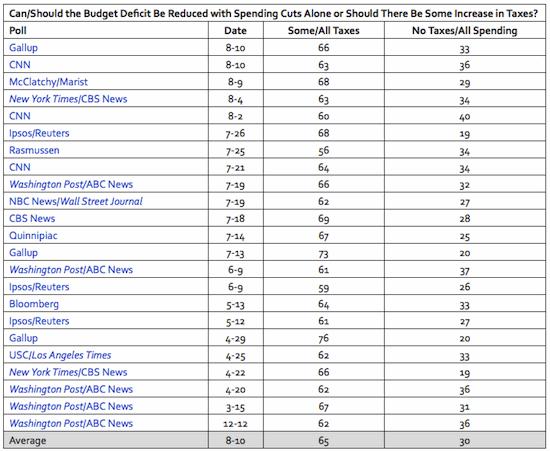
At least, I assume they do. That would seem to be the what the evidence shows. Because in 23 polls taken over the past nine months, Americans say they support higher taxes  as a part of the budget solution — by an average margin of 65-30. And by almost every measure, San Franciscans are more liberal than Americans as a whole. So it’s likely that if those polls collected data just from this city, we’d see closer to 75 percent of the voters saying they support higher taxes, particularly on the rich and big corporations.


And since San Francisco is so far out on the cutting edge on so many other issues, I have to wonder: Why is everyone at City Hall so afraid of taxes? Why is progressive taxation (and not pension reform) the central issue in the mayor’s race?


Gavin Newsom build his political career on a plan to cut welfare payments for homeless people. Jeff Adachi is trying to get elected mayor by campaigning to cut city employee pensions. Dennis Herrera is talking about his efforts to legalize same-sex marriage. But there’s not a single politician in town who has made fair taxation the centerpiece of a citywide campaign. Although it’s likely that three-quarters of city residents would support at least the concept of higher local taxes on the local rich, this isn’t a signature issue for anyone running for anything. 


Doesn’t that seem a little odd?

Inside the V.I.P. cocktail party with Willie Brown

The Alliance for Jobs and Sustainable Growth hosted a V.I.P. reception just before a mayoral candidate forum held at UCSF Aug. 16, and former Mayor Willie Brown appeared to be the guest of honor. Although the theme of the event was technically “honoring San Francisco’s mayors” — former Mayor Frank Jordan was there, someone indicated that former Mayor Art Agnos was in the room, former Mayor Gavin Newsom was invited but didn’t show, and Mayor Ed Lee was of course in attendence — Brown seemed to be given more prominent recognition than any of the others.

The moment he strolled in, Sup. Mark Farrell, who was doing introductions for the the affair, scrambled onstage to announce Brown’s presence and deliver a warm welcome, and everyone applauded. Within minutes, the former mayor was seen chatting with a crowd that included Mayor Lee and several others. Soon after, Brown and former Mayor Frank Jordan were summoned to the stage to say a few words.

Once in the limelight, Brown cracked a few jokes. He said he felt for the 36 mayoral candidates, who are forced to campaign in an era when the Internet threatens to reveal videos and photos of them at any time to thousands of online viewers. “I’m glad they didn’t have that kind of communication system when I was running,” he said. “I can’t imagine the photographs you’d have of me floating around doing things I shouldn’t have been doing.”

As for his own time in Room 200, “I enjoyed every single solitary minute of it, and if I really thought I had great skills, I would be number 37,” he said, drawing more applause.

Then again, common wisdom says it isn’t necessary for Brown to bother campaigning in order to gain access to Room 200 these days. Later that same evening, during his own turn in the spotlight at the mayoral debate, Mayor Lee came under fire from Board President David Chiu, who revealed that Lee had privately confided to him about a week before he announced his candidacy that he was having a difficult time saying no to Brown and influential Chinatown business consultant Rose Pak when it came to launching a campaign for a full term.

Chiu’s pointed question for the mayor was what had changed in his mind since that conversation, but Lee referenced neither Brown nor Pak in his answer. Instead, he said he’d changed his mind after witnessing his success in changing the tone of government and getting things done in City Hall.

Back at the V.I.P. reception, Brown and Jordan were invited onstage again, this time to receive awards presented by the Alliance for Jobs and Sustainable Growth. But first Steve Falk, president and CEO of the San Francisco Chamber of Commerce, reminded the crowd that there was still time to buy a drink before the debate got underway. He said, “Debates are much more interesting after three drinks.”

Before Falk presented Brown with a commemorative plaque, he said, “It’s tough to put in a few sentences the life and times of Willie Brown,” and proceeded to note that, with his term in the California Assembly and time serving as mayor of San Francisco behind him, Brown “has now followed his friend Herb Caen into an honest line of work as a columnist for the San Francisco Chronicle.”

Being a newspaper columnist doesn’t mean Brown is always kind to members of the local media. While mixing through the crowd minutes after receiving his award, he fired some harsh words at a well-known City Hall reporter who had recently published some unflattering articles about the “Run, Ed, Run” effort to encourage Lee to seek a full term.

In recent months, Brown’s columns have provided the public at large with a rare glimpse into Mayor Lee’s dining experiences in San Francisco. In February, Brown wrote in one of his columns that he went out to North Beach Restaurant at sat at the window table with Lee, Brown’s “friend” Sonya Molodetskaya, and Jack Baylis, who serves as the US Group Executive of Strategic Development for AECOM, one of the city’s largest contractors and a sponsor of the Alliance for Jobs and Sustainable Growth Event. (Baylis was on the invite list for the V.I.P reception, too.)

Apparently, AECOM had something to celebrate that same day — according to an Aug. 16 press release, an AECOM joint venture was just awarded a $150 million contract for program management services for the San Francisco Public Utilities Commission’s wastewater improvement program.

The V.I.P. reception had representation from many key players in the downtown business community, with sponsorship from AT&T, AECOM, Pacific Gas & Electric Co., Wells Fargo, Motorola, California Pacific Medical Center, the San Francsico Chamber of Commerce, the Building Owners and Managers Association, the San Francisco Police Officer’s Association, Shorenstein Properties, and others. Several labor unions, including the United Association of Plumbers & Pipefitters Union Local 38, United Brotherhood of Carpenters and Joiners of America Local Union No. 22, and United Food and Commercial Workers Union Local 5 were also listed as sponsors. Guests included district supervisors, developers, lobbyists, business owners, mayoral candidates, media spokespeople, executives from the health care industry, and other political insiders.

Clearly, there were many people in the room who wanted to get on Brown’s good side.

Sweet streets: Gelatin dessert art at this weekend’s Street Food Festival

0

As the foodie masses descend on the Mission for Sat/20’s Street Food Festival, they’ll be met with a diverse representation of what San Francisco eats. In this corner, fancy brick and mortar spots: Slanted Door, 15 Romolo, and Rye are but a few representatives of the eateries that are taking grills and spatulas into the fresh air this weekend. But for sheer culinary comeliness, the big guys have a serious contender when it comes to Sweets Collection arty gelatin creations. 

Graduates of the La Cocina street food incubator program will total a solid 50 percent of the 60 vendors in attendance at the festival. The varying styles of food preparation are meant to express the breadth of eats in San Francisco, but also to reinforce the fact that the huarache you buy at your local farmer’s market has the culinary chops to stand up against many places that take Visa.

According to the website, in a perfect world the festival would “get rid of all the white tents, and just do it block party style, but that’s not so cool with the Health Department, so you will have to imagine it with us.”

Rosa Rodriguez would surely be invited if the fest turned into a block party. She lives in the Mission, and has been creating her Sweets Collection intricate gelatin creations, in which graceful flowers bloom in edible gel, for a year now. We mentioned certain circumstances under which her treats might prove particularly awesome in the paper today, and here’s more on Rodriguez from an email interview we conducted with her last week. (You can also check out food writer Virginia Miller’s adventuresome picks for the fest here.) 

Sweets Collection got its name when Rodriguez realized her treats wouldn’t look amiss in an art gallery

SFBG: Tell us a little about yourself. How did you start Sweets Collection?

RR: My name is Rosa Rodriguez, I have two children, one is 15 years old and named Dayra, and Hasam is eight years old, we are from Durango, Mexico. I’m a single mother. When we are not doing artistic desserts, my children go to school and I take English classes and work on my business. I became unemployed in 2009, and in 2010 I had the idea of starting my own business to cover household expenses and share the art of my greatest passions.


SFBG: Can you tell us a little about gelatin art?

RR: Arte floral en gelatina has become a centerpiece of Mexican culture. Evening parties in Cancun often have intricate gelatin dessert flowers served in glass, personalized gelatin desserts are in demand at corporate events in Mexico, and no birthday is complete without fun gelatin designs on the cake.  


SFBG: Most of your work I’ve seen is of flowers. Do you do any other kinds of designs?

RR: I am fascinated by flowers, but do figures, characters or any design. You can get your favorite hobby, movie, or fantasy adventure in a gelatin dessert.


SFBG: What are you bringing to the Street Food Festival this weekend?

RR: Sweets Collection will participate by offering fanciful jello shots at two bars that will be located on Folsom and 23rd streets. But we also have a booth on that intersection, selling designs that the entire family can enjoy. Last year was my first year, like me, many people were impressed by the art to gelatin and I hope that this year more people came by our Booth , to know and taste the art you can eat.


SFBG: What does it taste like?

RR: This artistic dessert is made with passion. They’re handcrafted and they taste how they look… delicious.


San Francisco Street Food Festival

Sat/20 11 a.m.- 7 p.m., free

Folsom between 22nd and 26th sts. and surrounding area, SF

www.sfstreetfoodfest.com

Fairer trade?

6

news@sfbg.com

Many people will pay more for a cup of coffee if a significant amount of that money goes to the people who grew its beans, helping improve their lives and communities. That’s the idea behind Fair Trade Certified coffee.

But Fair Trade may not be as lucrative for coffee farmers as people are led to believe, and uncertified San Francisco roasters such as Four Barrel, Ritual Roasters, and Blue Bottle appear to be making more significant impacts on the growers they buy from.

Fair Trade was once just a name for ethical commerce and an idea to fairly pay the farmers growing our food, but Fair Trade Certified* is now a trademarked term owned by Fair Trade USA*, based here in the Bay Area. To label their coffee with the Fair Trade certification, coffee farmers must buy into the system and abide by strict standards set by the cooperatives that oversee their production.

Although Fair Trade Certified coffee sells at significantly higher prices than generic coffee, the coffee producers often don’t see the majority of the increased profits. That’s because all the parties involved in the system take shares of that increased price.

“The buyer buys the coffee at a hiked price, assuming the price is trickled down to the farmer, but it isn’t,” says Masumi Patzel, a political scientist who made a recent research trip to the coffee farms of Guatemala. “The people who are benefiting from Fair Trade are the exporters.”

The coffee producers only receive a fraction of the final cost of the coffee, says Patzel, and her research has shown it hasn’t done much to improve conditions in coffee-growing communities.

“What are these farmers going do? How are they going to feed their families?” she asks.

Patzel says that in Guatemala, a country of mostly farmers and peasants, more than half of all personal income is spent on food (compared to about 20 percent in the U.S.), food prices have risen 80 percent in the last 10 years, and nearly half the population suffers from malnourishment.

Buying into the Fair Trade system and switching to the monitored system of growing coffee can be costly for the Guatemalan farmers who are struggling to get by. “They are just not making the cut,” she says, noting that on the farms she visited, farmers only drank instant coffee because they couldn’t afford the coffee they grew.

Yet Fair Trade USA spokesperson Stacy Geagan Wagner says Fair Trade has helped farmers. “Fair Trade is essentially an agreement between producers, industry and consumers,” she says. “Fair Trade agrees to pay a fair price for the products.”

At Fair Trade USA, which oversees the label, that “fair price” comes to at least $1.40 per pound of coffee beans, with an added 20-cent community development premium given to the farmers and a possible 30-cent organic incentive.

“Essentially the farmers always get higher then market price,” Wagner says, “because they get the premium, the organic incentive and the minimum price.”

However, the International Coffee Organization’s most recent composite had the average worldwide coffee price at $2.15 per pound, higher than the Fair Trade price. To work with the ever fluctuating coffee market, Fair Trade Certified coffee farmers are either paid the minimum of $1.40, or the current market price, whichever is higher.

“The Fair Trade minimum covers the cost of sustainable production,” says Wagner, “so they don’t starve to death when the market crashes.”

Some of San Francisco’s most popular coffee roasters have chosen to buy their coffee directly from the farms that grow it, bypassing the Fair Trade system and paying the farmers significantly more while forming a strong relationship between producer and roaster. Without the middlemen, there is suddenly a smaller separation between the farmer growing the coffee and the consumer purchasing it.

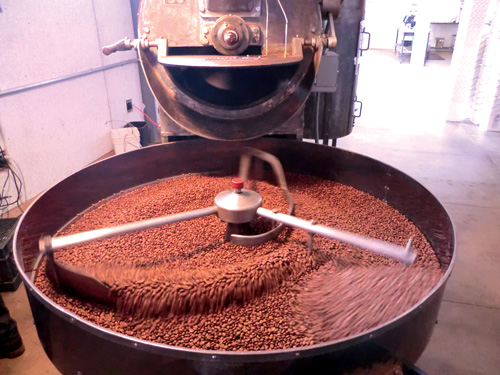
I saw that illustrated on my recent visit to the Ritual Roasters facility where roasters convert raw beans procured worldwide into aromatic coffee. As I was drinking a cup of very fresh coffee, owner Eileen Hassi showed me pictures of the exact farm where my coffee had been grown.

She had made a recent trip to this Costa Rican coffee farm, and taken pictures of the farm, the processing facilities, and the owners. It is this visible connection, as well as high quality coffee, that contribute to the growing popularity of some San Francisco independent roasters.

Local roasters Ritual, Four Barrel and Blue Bottle Coffee Co. follow this model of buying coffee directly from the producers and forming beneficial relationships. Some roasters call this direct trade.

“For me, it’s the only way to get the best quality coffee and the only way that you can continue to get the best coffee is to pay good money for it,” says Four Barrel owner Jeremy Tooker. “If you pay your pickers better then they pick better coffee.”

Hassi believes that the cost of coffee will continue to increase because of a volatile, heavily fluctuating market, increased consumption, and global warming causing some places to lose their capability of producing coffee.

“If all of us in the developed world want to keep drinking coffee,” she says, “we need to get used to paying a lot more for it.”

James Freeman, owner of Blue Bottle Coffee Co., says he believes there’s a place for Fair Trade. “It’s a certification and, like all certifications, there’s the pluses and the minuses,” he says. Yet his coffee is uncertified and purchased directly from producers and organic cooperatives. “The cheapest we buy coffee for is probably two, two-and-a-half times the fair trade minimum,” he says. “In a way it’s better for fewer farmers, but at least it’s better.”

Wagner disputes several San Francisco roasters’ claims that the $3–<\d>$4 minimum price they pay is double Fair Trade’s. “The market has been over $3 on many occasions in the past year,” she says, reiterating FairTrade’s policy to pay producers either the Fair Trade minimum or the market price. “So to say you’re paying double the fair trade minimum without knowing what is going on that is actually you distorting the information…We love people’s efforts to trade more directly with farmers, but we do not appreciate spreading misinformation about Fair Trade. That doesn’t help anyone.”

Fair Trade’s popularity stems from its altruistic image, and to lose this image through “misinformation” might do damage to its popularity. But challenging people’s assumptions about Fair Trade could help raise its standards, which Patzel says need to be “upgraded and improved”.

“It is my belief,” she says, “that the FTA [Fair Trade Association] and other certifying entities may want to consider how to improve the Fair Trade calculator, ensuring that it is not the exporters that are making the majority of the income and instead, increase the wealth distribution starting at the very base and bottom of the pyramid, not in the middle.”

Even Wagner concedes, “We’ve made significant impact but we can do more.”

Patzel says Fair Trade farmers may not even be treated better than convention coffee farmers. “Just because a farmer is producing Fair Trade coffee does not mean — not at all — that they are being treated better than farmers who are not. It depends on what kind of relationship they have with the producer,” she says. “It really is a case by case basis.”

Gilbert Ramirez has been working to run a cooperative in Costa Rica for 25 years that is 70 percent Fair Trade. For him, the monetary increase between Fair Trade and conventional coffee is 15-20 percent.

“But if we’re taking into account the added value, I’d say that we get 50 percent more in added value when we work through Fair Trade,” says Ramirez. “There’s a long list of things we consider added value, and the largest added value Fair Trade allows us is knowledge.”

Ramirez says he believes that Fair Trade has significantly helped his community. “Farmers are happy in Fair Trade because it’s a model that respects them. And it’s a model that gives farmers a guide on how to develop themselves better.”

In 2010 his cooperative received $8 million in premiums to invest in the community. And yet he says, “The situation is a bit difficult because the cost of living has gone up a lot. In Costa Rica, there’s a higher cost of living than in other countries. We have a really high tax environment in Costa Rica, and also really low production so it doesn’t allow the country to have a lot of economic development.” In the end, consumers can choose to buy a pound of Peet’s Fair Trade Coffee for $15.95, or a pound of Ritual’s Los Crestones coffee for $22.50 and know that it was produced in Costa Rica by Grace Calderón Jiménez before I probably watched it being roasted here in San Francisco.

* This article was changed to correct the name of the organization and its trademark.

So much for civility

0

rebeccab@sfbg.com

The San Francisco mayor’s race went from a lackluster affair to a dynamic match as the Aug. 12 filing deadline drew near and two prominent city officials who had previously said they wouldn’t run tossed their hats into the ring.

Mayor Ed Lee’s Aug. 8 announcement that he’d seek a full term prompted several of his opponents to use their time onstage at candidate forums to decry his reversal and question his ties to the moneyed, influential backers who openly urged him to run. Several days later, Public Defender Jeff Adachi’s last-minute decision to run for mayor signaled more tension yet to come in the debates.

At this point, eight current city officials are running campaigns for higher office, and the dialogue is beginning to take on a tone that is distinctly more biting than civil. Adachi, who had not yet debated onstage with his opponents by press time, told reporters he was running because he wanted “to make sure there’s a voice in there that’s talking about the fiscal realities of the city.”

Adachi authored a pension reform ballot measure that rivals the package crafted by Lee, labor unions, and business interests (see “Awaiting consensus,” May 31, 2011). At an Aug. 11 candidate forum hosted by the Alice B. Toklas Democratic Club, the San Francisco Young Democrats, and the City Democratic Club, all of the top-tier candidates who were present indicated that they would support Lee’s pension reform measure and not Adachi’s.

“The reforms that I have championed are reforms that are absolutely needed, along with action,” Adachi told reporters moments after making his candidacy official. He added that after watching the mayoral debates, “I became convinced that either the candidates don’t get it, or they don’t want to get it.”

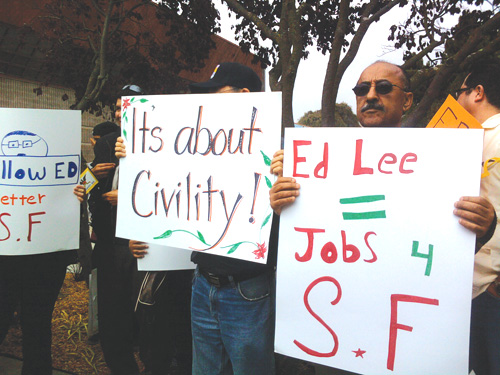
Those fighting words will likely spur heated exchanges in the months to come, but until Adachi’s entrance into the race, it was Lee who took the most lumps from opponents. Even Board President David Chiu, a mayoral candidate whose campaign platform is centered on the idea that he’s helped restore civility to local government, had some harsh words for Lee during an Aug. 11 mayoral debate.

“I do regret my decision to take Ed Lee at his word when he said he would not run,” Chiu said in response to a question about whether he regretted any of his votes. He also said his first interaction with Lee after the mayor had announced his candidacy was “a little like meeting an ex-girlfriend after a breakup.”

Lee, whose pitch on the campaign trail features a remarkably similar narrative about transcending political squabbling in City Hall, became the target of boos, hisses, and noisemaker blasts when a boisterous crowd packed the Castro Theater for an Aug. 8 candidate forum. He received one of the most forceful rebukes from Sen. Leland Yee, an opponent whom Lee supporters are especially focused on defeating.

“Had the mayor said that he would in fact run, he may not have gotten the votes for interim mayor,” Yee said. “Will you resign from your post,” he asked, challenging Lee, “in order to then run for mayor?” Days later, Yee had developed a new mantra about throwing power brokers out of City Hall instead of “wining and dining with them.”

Yet Lee said his decision to enter the race wasn’t because of the push from his backers, but because of how well things have gone during his brief tenure in Room 200. “Things have changed at City Hall, particularly in the last seven months,” he told reporters Aug. 8. “And because of that change, I changed my mind.”

In yet another twist, former Mayor Art Agnos — whom progressives had looked to as a potential appointee to the vacant mayor’s seat back in December, before Lee was voted in to replace former mayor and Lieutenant Governor Gavin Newsom — delivered a surprise endorsement of City Attorney Dennis Herrera shortly after Lee declared. The decision was particularly significant since Agnos first hired Lee to serve in city government, and has a long history of working with him.

“[Herrera] is an independent person who will empower neighborhoods … and won’t be beholden to power brokers,” Agnos said. He also told the Guardian he wasn’t surprised that Lee had opted to run, given the role former Mayor Willie Brown and influential business consultant Rose Pak had played in orchestrating Lee’s appointment.

“Anybody who is an astute political observer saw the signs from the very beginning,” Agnos said. In response to a comment about his unique vantage point as a would-be caretaker mayor, he said, “I would’ve kept my word and not run for reelection.”

Intense focus on Lee’s flip-flop, and on the Progress for All-backed “Run, Ed, Run” effort that was the subject of an Ethics Commission discussion that same week, stemmed at least in part from the threat the incumbent mayor represents to other candidates. A CBS 5-SurveyUSA poll suggested he became an instant front-runner.

Yet questions about “Run, Ed, Run” — some raised by observers unaffiliated with any campaigns — also served to spotlight the candidate’s longstanding ties with backers closely connected to powerful business interests that stand to lose big if their links to city government aren’t preserved.

Retired Judge Quentin Kopp issued an open letter to District Attorney George Gascón Aug. 1 urging him to convene a criminal grand jury to investigate whether illegal and corrupt influencing had occurred when Pak — a close friend of Lee’s and a key driver behind the “Run, Ed, Run” effort — reportedly recruited executives of Recology to gather signatures urging Lee to run.

Recology, which handles the city’s waste, was recently awarded a $112 million city contract, and Lee’s scoring of the company and recommendation to raise rates in his previous capacity as city administrator benefited the company. Brown received substantial campaign donations from Recology in previous bids for mayor. Kopp is the coauthor of a ballot initiative asking San Francisco voters if the company’s monopoly on city garbage contracts should be put out to bid.

“A criminal grand jury is vital in order to put people under oath and interrogate them,” Kopp said. “They would put Willie Brown under oath, put Pak under oath, put [Recology President Mike Sangiacomo] under oath, put [Recology spokesperson Sam Singer] under oath … That’s the course of action that should be pursued by this.”

Although Kopp told the Guardian that he hadn’t yet received a response from Gascón, DA candidates Sharmin Bock, Bill Fazio, and David Onek nevertheless seized the opportunity to publicly and jointly call for Gascón to recuse himself from any investigation into Progress for All. Gascón has a conflict of interest, they argued, since he reportedly sought Pak’s advice when deciding whether to accept Newsom’s offer to switch from his previous post as police chief to his current job as top prosecutor.

The Ethics Commission determined unanimously Aug. 8 that the activities of Progress for All, the committee that was formed to encourage Lee to run, had not run afoul of election laws despite director John St. Croix’s opinion that it had filed improperly as a general purpose committee when it ought to have been a candidate committee, which would have placed caps on contribution limits.

“The Ethics Commission has spoken, and they’ve supported our position,” Progress for All consultant Enrique Pearce of Left Coast Communications told the Guardian.

St. Croix did not return Guardian calls seeking comment, but an Ethics Commission press release included a caveat: “Should facts surface that coordination occurred between Mayor Lee and [Progress for All], such allegations will be investigated under the Commission’s enforcement regulations.”

At a Lee support rally organized by his official campaign team on Aug. 11, volunteers who arrived with “Run, Ed, Run” materials produced by Progress for All were told they could not display those signs and T-shirts; the same people were on a first-name basis with one of Lee’s campaign team members.

Pressed on the question of whether there was any coordination between agents of Progress for All and Lee, Pearce said the Ethics Commission discussion had focused on whether Lee had been a candidate. “Whether or not he’s a candidate has nothing to do with whether or not he has dinner with Rose [Pak],” Pearce noted. He insisted that there had not been coordination, and that the efforts to encourage Lee to run and to support Lee as a candidate were totally separate.

Sup. John Avalos, who is running for mayor on a progressive platform, recalled at an Aug. 8 candidate forum how things unfolded when Lee’s name first came up as an appointee for interim mayor.

Avalos reminded people that he had called for postponing the vote back in December because he hadn’t even had a chance to sit down and meet with Lee, who was in Hong Kong at the time. With behind-the-scenes deals orchestrating his appointment, Avalos said, “We saw City Hall turning into one big back room.”

Drag me from hell

0

emilysavage@sfbg.com

MUSIC Noah “DJ Dials” Bennett Cunningham wants to galvanize your pleasure center.

“You know how you can think back to that one night? That punk show or cool house party or the first time you saw Björk, and it’s just, the night you’ll never forget? I want to do that for other people. I want to make lasting memories,” he says from his perch in Four Barrel Coffee as he grabs Rosamunde french fries from his bag.

A DJ since age 12, the 27-year-old also works as a producer and video artist. His next big gig, in collaboration with Tri Angle Records and 120 Minutes club night, is an event likely to stir brain waves: it’s a showcase of witch house — a controversial genre also known, interchangeably, as grave rave, based goth, drag, or “pop music for the unconscious,” as San Francisco producer oOoOO has been known to describe his own sound.

It’s contentious because it’s all over the map. At its most basic, a combination of hip-hop and goth cultures, many music snobs and bloggers declared it dead on arrival. Even those associated with it seem to at least avoid using the term “witch house” itself. It’s said with an apologetic shoulder shrug.

This may be due to its murky origins. Essentially, it was coined by Denver’s Travis Egedy, a.k.a Pictureplane, sometime around 2009, partially as a joke, to describe his own music. Years later, the name remains and the scene is still burgeoning. There are some skilled musicians and producers creating this sound, including a smattering of national acts, and, locally, oOoOO (pronounced “oh”).

The August 19 showcase at 103 Harriet marks the first local live show (not just DJ set) for oOoOO — newly returned from an international tour — along with Clams Casino, White Ring, Shlohmo, Babe Rainbow, Water Borders, and D33J.

For this particularly significant event, Cunningham is working behind the scenes as the producer and co-host along with Marco De La Vega, the mastermind behind year-old witch house club night 120 Minutes at Elbo Room. Both agree that the biggest misconception about this type of music is that it’s already dead.

“It’s still new, it’s what’s happening right now,” says De La Vega. “The goth scene has a tendency to focus very strongly on the past, so all this music was the first kind of stuff where I was like, ‘Wow, this is actually happening, this makes sense for now. This is contemporary.'”

This much we know: those associated with witch house often make use of darker rhythms with creepy melodies over top, chopped and screwed hip-hop or slowed-down pop music samples, along with hypnotic and dark droning synths and howling, reverberated female vocals.

And yet, many musicians identified with this mutating, nearly indefinable genre wage battle against it. They, understandably, eschew the label for fear of pigeonholing.

“The way we look at it is that there are a few bands that were doing stuff independently and have been grouped by people trying to make it in to one cohesive term,” says Bryan Kurkimilis, one half of New York’s White Ring. “It’s nice and flattering to be part of something like that, but we had no genre in our head when we started. We’re consistently trying to evolve our sound.”

The music itself, of course, varies greatly, especially in this particular showcase. While oOoOO samples sputtering pop vocals, Shlohmo is more associated with L.A’s avant-garde beat scene, and Clams Casino’s repertoire includes making beats for based god Lil B. Toronto’s Babe Rainbow creates dark chopped and screwed hip-hop; White Ring bleeds more toward 80s synth and includes the lush, eerie voice of singer Kendra Malia.

“What motivates me, is putting Shlohmo and Babe Rainbow — who aren’t really considered witch house — next to oOoOO, White Ring, and Water Borders even, to show that it doesn’t really matter what the genre is; it’s that feeling, it’s the mood. It’s the place where it comes from,” Cunningham says. *


TRI ANGLE RECORDS SHOWCASE: 2011 REALITY TOUR

With oOoOO, White Ring, Clams Casino, Shlohmo, Babe Rainbow , Water Borders, D33j

Fri/19, 10 p.m., $15

103 Harriet at 1015 Folsom

1015 Folsom, SF

1015.com

Familiar but strange

0

arts@sfbg.com

THEATER In 1934, Broadway hosted its longest-running opera to that time, the serenely unconventional Four Saints in Three Acts. The brainchild of writer Gertrude Stein and composer Virgil Thomson, the production famously featured an all–African American cast (for the first time in roles not geared to depicting African American life), a scenic design covered in cellophane, music that mingled hints of Parisian modernism with a boisterous collage of vernacular American forms, and a libretto of unfathomable if evocative wordplay that merrily eschewed narrative — or even consistency with the title (acts were actually five, saints were many). It was weird. And people liked it.

In deciding upon a topic for the opera, Stein had taken on the lives of saints (especially Theresa and Ignatius, who figure prominently) as representative of the lives of artists. It was a secular work, and apotheosis, that ultimately concerned both her and Thomson, neither of them otherwise religious. As it turned out, the opera not only hailed the arrival of avant-garde ideas into the mainstream, but catapulted Stein into the stratosphere of celebrity.

“In Stein’s personal story the opera was a very large chapter,” explains Frank Smigiel, associate curator of public programs at the San Francisco Museum of Modern Art, currently presenting The Steins Collect: Matisse, Picasso, and the Parisian Avant-Garde. “In addition to The Autobiography of Alice B. Toklas, [Four Saints] radically transformed Stein from an experimental writer known for collecting other artists into a popular artist in her own right.”

One good apotheosis deserves another. This weekend SFMOMA, in association with Yerba Buena Center for the Arts, presents Four Saints in Three Acts: An Opera Installation, as part of The Steins Collect. While the exhibition already includes footage and ephemera from Stein and Thomson’s landmark opera (with even more footage on view in the concurrent Gertrude Stein exhibition at nearby Contemporary Jewish Museum), audiences will now have the chance to see a full staging of the work. Meanwhile, the production’s team of collaborators promises as much a re-envisioning as a revival.

This is as it should be, suggests Smigiel, who spearheaded the idea for the revival about a year ago as he and his colleagues were asking themselves how they might expand on the exhibition.

“If you look at all the other artists in the Steins Collect exhibition, they’re all working not just on canvases,” he says, speaking by phone from his office at SFMOMA. “It was a creative community that was crossing disciplines in ways people might not always know about. One of our aims was to rev up the avant-garde energy of the exhibition. There’s a way, when you go to a show with Matisse and Picasso, they can just look canonical now to us. One of the hopes is that there’s still something about Stein’s language and the opera that’s going to have a bit of shake-up to it. It won’t just appear as a rolling out of a canonical piece, and people wondering, ‘What was this again?'”

To that end, Smigiel approached local company Ensemble Parallèle, acclaimed specialists in contemporary chamber opera, having been impressed by their recent production of Alban Berg’s Wozzeck, including its shrewd use of visual media. He also sought out Italian-born, San Francisco–based composer, performer, and musicologist Luciano Chessa, an expert in the period whom he had worked with before. Equally inspired was Smigiel’s call to Kalup Linzy, whose video-performance practice mixes soap opera genre with drag, original songs, lip-sync, and themes of family, community, sexuality, and otherness through the prism of his African American Southern upbringing and later Brooklyn milieu.

After a process of deciding how they might re-approach the work, Chessa landed on the idea of resetting the text that Thomson had excised in his own 1950s version of the opera. The result is its own piece, entitled A Heavenly Act, which will immediately precede Four Saints without an intermission (the entire program will run a fleet 90 minutes). Linzy developed video projections as the predominant visual element in the production.

Chessa and Linzy offered further insight into the collaboration, and their respective processes, during a break from a rehearsal last week. Although neither knew the opera very well before embarking on the revival, each found points of contact and familiarity with their own work.

“I knew it mostly because of [Canadian filmmaker] John Greyson’s [2009 operatic documentary] Fig Trees,” explains Chessa. In conceiving A Heavenly Act, Chessa says he wanted to account for both Thomson’s own musical influences as well as the legacy he has left in the work of later composers.

“I couldn’t be approaching the text naively as if I was discovering it for the first time,” he says. “There is a history of setting Stein in the 20th century, which I ended up discovering by analyzing the work and also the development of Thomson’s fortunes in the 20th century. Because Stein’s text is very wordy, Thomson used the technique of having it chanted. So my idea was to bring this element of chant, but do it in a different way, using different lines of text moving at different speeds, creating clusters of textures.”

Adds Linzy, “We kept things very loose and abstract, kind of organic. It didn’t have to be so strict.” Linzy — who in the production also performs a song Chessa wrote for him set to Stein’s words — shot a cast of friends as angels against a green screen, usually with movement informed by music tracks Chessa had forwarded. But in at least one case, Linzy didn’t receive the track for a corresponding scene.

“There’s a dance scene [in A Heavenly Act] where [Chessa] did a waltz, but we danced to Donna Summer’s ‘Bad Girls,'” explains Linzy. “But seeing it against the waltz, really slowed down, it’s almost like the angels got high off LSD and just went too far. But we were moving to Donna Summer, we were discoing. That’s what I like. He had sent the tracks but somehow I didn’t get that particular one. So I was like, ‘Oh, we’ll just disco it out.’ And so that’s what we did, and it’s the most amazing thing.”

FOUR SAINTS IN THREE ACTS: AN OPERA INSTALLATION

Thurs/18, 7:30 p.m. (preview); Fri/19-Sat/20, 8 p.m.; Sun/21, 2 p.m., $10-85.

Novellus Theater

700 Howard, SF

(415) 978-2787

www.ybca.org


Green buds

56

steve@sfbg.com

CANNABIS Most marijuana sold in Bay Area dispensaries is grown indoors, where the ability to precisely control conditions creates the kind of buds — strong, dense, crystal-covered, fragrant, beautiful — that consumers have come to expect. But that perfection comes at a high price, both financially and environmentally.

So some local leaders in the medical marijuana movement have begun to nudge the industry to return to its roots, to the days before prohibition and the helicopter raids of the Campaign Against Marijuana Planting chased the pot growers indoors. They say it’s time for California to start growing more of its cannabis outdoors again, in the soil and sunlight, just like the rest of the state’s crops.

Growers have long known how inefficient it is to grow indoors. All they need to do is look at their huge monthly energy bills. Between the powerful grow lights, constantly running air conditioners, elaborate ventilation systems, pumps and water purifiers, and heaters used for drying and curing, this is an energy-intensive endeavor.

But a widely circulated study released in April — “Energy Up in Smoke: The Carbon Footprint of Indoor Cannabis Production” by Evan Mills, a researcher with Lawrence Berkeley National Laboratory — revealed just what a huge cumulative toll the practice was taking on California and the planet.

It found that indoor pot production accounts for about 8 percent of California household energy use, costing about $3 billion annually and producing about 4 millions tons of greenhouse gases each year, the equivalent of 1 million automobiles. Producing one joint was the equivalent of driving 15 miles in a 44 mpg car.

“The emergent industry of indoor Cannabis production results in prodigious energy use, costs, and greenhouse-gas pollution. Large-scale industrialized and highly energy-intensive indoor cultivation of cannabis is driven by criminalization, pursuit of security, and the desire for greater process control and yields,” Mills wrote in the report’s summary.

Yet while opponents of marijuana seized on the report to condemn the industry, proponents say there’s a very simple solution to the problem: grow it outdoors. And with the artisanship and quality in the fields and greenhouses now rivaling that of indoor buds, the biggest barriers to moving most marijuana production outdoors are federal laws and the biases of pot consumers.

“There’s a misconception out there that indoor is better marijuana than outdoor, but we don’t think that’s true,” Erich Pearson, who runs the San Francisco Patient and Resource Center (SPARC) dispensary and sits on the city’s Medical Cannabis Task Force. “Marijuana is a plant that came from the earth and that’s where we should grow it, just like our food.”


INDOOR VS. OUTDOOR

There are definitely some benefits to growing indoors, beyond just the ability to hide it from the prying eyes of law enforcement. The grow cycles are shorter, allowing for multiple harvests around the year. The generally small operations and precise control over growing conditions also tend to produce the best-looking buds, which command the highest prices and win the top prizes in competitions.

Kevin Reed, who runs Green Cross — a venerable medical marijuana delivery service that works closely with an established group of growers — told us there are several reasons why indoor buds have dominated the marketplace.

“The most important factor is local laws and regulations and the enforcement of those various laws. A second factor is space and climate — obviously outdoor cultivation will flourish is some places better than other. And, a final factor is sustainability of the market; indoor cultivators can produce crops on a year-round basis, providing some stability in the market over the long-term, especially in the event of crop failure or other unforeseen and unexpected disasters,” Reed told us.

Yet he also said, “If cultivated correctly and with care, there should be no difference between the same strain grown in- or outdoors.” And he said that from an environmental standpoint, outdoor is clearly superior: “So far as environmental factors are concerned, there is little doubt in my mind that outdoor cultivation is kinder to Mother Earth.”

Wilson Linker, with Steep Hill Laboratories, Northern California’s largest tester of medical marijuana, said that outdoor plants generally have more vegetative growth because of the longer light cycles, meaning that “indoor tests generally higher in cannabanoids, with THC [marijuana’s main psychoactive compound] in particular.”

But he and other marijuana experts also say that the quality of the buds ultimately depends on a wide variety of factors, from the strain used to the expertise of the cultivators to the time and care taken by the trimmers.

“I’ve seen outdoor that can compete with the best indoor strains,” said David Goldman, who runs San Francisco’s Americans for Safe Access (ASA) chapter, sits on the city’s Medical Marijuana Task Force, and is active in rating the various dispensaries and pot strains in terms of quality, using magnifying glasses to investigate the trichomes and other characteristics. “I would match the best outdoor I know up with anybody’s indoor, any day.”

Even when indoor buds look better, Pearson said, that doesn’t means they are better. Looks can be deceiving, he said, noting how local consumers now accept that those perfect-looking, genetically modified apples and tomatoes in the store aren’t as tasty or good for you as their ugly, organic counterparts.

“It’s not all about appearance,” he said, noting that marijuana grown in the sunshine is more robust and complex than its indoor cousins.

“We’re starting to find [outdoor] strains that were scoring just as high as indoor,” says Rick Pfrommer, the purchasing manager for Oakland’s Harborside Health Center.

And that’s especially true when the cannabis is grown in greenhouses, where it gets natural sunlight but growing conditions can be controlled better than in the fields.

“Greenhouses can attain a level of cosmetic attractiveness that is right up there with indoor,” Pfrommer said.

“There are a lot of products coming out of greenhouses that even trained eyes can’t tell the difference with [compared to indoors],” Linker said. “Greenhouses are the future.”

Or at least they might be the future if there is a change in the federal laws, which still view any marijuana cultivation as a crime — which is why indoor grows flourished in the first place.


LINGERING PROHIBITION

Rising demand for medical marijuana has created some regulatory pushback, even in pot-friendly San Francisco, where the Department of Public Health announced earlier this year that it wanted to create a registry of growers that work with the dispensaries in order to weed out the illegal growing operations.

“In the last few years, there’s been a proliferation of both illegal and legal cultivators,” Dr. Rajiv Bhatia, San Francisco’s environmental health director, told us earlier this summer. “We’re asking for this information to try to steer them back toward legal cultivation.”

Reed, Goldman, and other industry representatives strongly condemned the move, mostly on the grounds that creating lists of growers could subject them to federal prosecution, so the idea was shelved for now. But Bhatia said the problem remains, and in San Francisco, it’s a problem created largely by the demand for cannabis grown indoors.

But allowing for a more widespread conversion to sustainably grown marijuana will require a relaxation of the federal enforcement to allow for more land cultivation and the development of high-tech greenhouses.

“A lot of that rests in the hands of law enforcement,” Pearson said.

But it isn’t just the cops. Consumers are also supporting indoor grows.


SUPPLY AND DEMAND

Pfrommer said there are many factors that influence whether customers choose indoor or outdoor, or what he calls the “bag appeal” that causes customers to zero in on one strain among the 40 or so that can be offered at one time.

Generally, indoor grows are smaller operations, allowing greater care in the tending and processing of the buds, whereas outdoor grows usually produce large crops harvested all at once, “so frequently people won’t manicure it as well,” Pfrommer said.

Smell is another big factor, Pfrommer said, and that’s one area where he thinks outdoor actually has an advantage. “Outdoor generally has a more pungent smell,” he said. “Cannabis is very sensitive to the environment, so it can pick up elements from the soil, the wind, and the surroundings. It picks up different qualities.”

For that reason, he also said, “I personally find outdoor to taste better when it’s grown well,” comparing it to the subtle qualities that various appellations can give to fine wines.

The final factor is price, and that’s one area where outdoor has a distinct advantage. SPARC is currently selling quarter-ounces of greenhouse-grown Big Buddha Cheese with a THC content of more than 17 percent for just $70. And when the buds from open outdoor fields arrive this fall, they’ll be as low as $50.

“This,” Pearson said, holding up a beautiful bud of greenhouse-grown Green Dragon, “was grown at a fraction of the cost of indoor and it’s outstanding.”

“That’s why indoor sells for so much more,” Goldman said, ” because it costs so much more to grow.”

So if outdoor cannabis is cheaper, better for the environment, less risky for the industry, and just as good, why are the indoor stains still so much more popular?

“You’re looking a 20-plus years of indoor being the standard,” Pfrommer said, noting that the hardest part of creating a more substantial changeover in people’s buying habits is their expectations.

He said Harborside started offering more outdoor strains three years ago, “but the market wasn’t responding as strongly.” In other words, people still preferred indoor.

Yet things are changing, prompted partly by the Mills study. “That was what kicked off this latest round,” Pfrommer said. “There is a small but growing awareness among the regular marijuana consumers about the costs of growing indoors…The consciousness is starting to shift, but it’ll be slow, probably over the next two seasons.”

Harvests usually take place during the full moons in September and October, after which they are cured and processed for about four weeks, finally coming to market around Thanksgiving.

“It’s mostly an education process,” Pfrommer said. “We’re going to have a vigorous push around harvest time this year.”

“We’re trying to transition completely to outdoor because the environmental toll is less, the cost is less, the yield is higher, and our testing is showing that the quality is just as good,” said Nick Smilgys, who has done both marketing and purchasing at SPARC. “It just makes more sense to grow it outdoors.”

Our Weekly Picks: August 17-23

0

WEDNESDAY 17

FILM

Better than Something

Before his death in 2008 at the age of 29, Jimmy Lee Lindsey Jr., a.k.a. Jay Reatard, released more material in ten years than most musicians dream of in a lifetime. He was at the peak of his career, and documentarians Alex Hammond and Ian Markiewicz were able to spend a week filming with Reatard just before he passed. The result is Better than Something, a feature length film about the life and death of Jay Reatard with footage culled from live performances, interviews, and the personal time the crew spent with him. Catch a glimpse into the mind of a man who rocked hard, lived fast, and, unfortunately, died young — the essential rock and roll fable. (Cooper Berkmoyer)

7:30 and 9:30 p.m., $10

Roxie Theater

3117 16th St., SF

(415) 863-1087

www.roxie.com


MUSIC

Diamond Head

Formed in 1976, U.K rockers Diamond Head would go on to become one of the leaders of a musical movement known as the “new wave of British heavy metal.” Diamond Head heavily influenced bands like Metallica, which covered Diamond Head tunes such as “Am I Evil” in its early days, and continue to do so today. Lead by founding member and guitarist Brian Tatler — who has been cited as a major influence by metal titans including Megadeth’s Dave Mustaine — the band’s current lineup is hitting the states for the very first time. In Europe, Diamond Head plays huge festivals; don’t miss this rare headbanger’s dream show. (Sean McCourt)

9 p.m., $15–$20

Elbo Room

647 Valencia, SF

(415) 552-7788

www.elbo.com


THURSDAY 18

COMEDY

SF Improv Festival

Making shit up. It’s become a serious job skill in the new non-economy, where bullshitting, winging it, and blind leaps have taken the place of an industrial base and steady employment. What I’m saying, I guess, is that you can totally rationalize going to the SF Improv Festival on economic grounds. But you don’t have to treat it like career day, even if it is a local and nationwide convention of expert improvisers where anything can happen. It’s must-see, or might-see, as is the case with New York’s famed Improv Everywhere, popping up in Union Square earlier this week. Founder Charlie Todd appears in conversation tonight as part of the festival. Improv festival highlights include group performances and workshops for careerists. Check the website for the complete program. (Robert Avila)

Through Aug. 27, most events $10–$25

Eureka Theater

215 Jackson, SF

www.sfimprovfestival.com


PERFORMANCE

Henson Alternative: Stuffed and Unstrung

Brian Henson started working with his dad Jim Henson when he was just a child. As fans know, he has gone on to be an incredibly talented artist in his own right, and has worked on a wide variety of well-known projects. His latest creation is the hilarious stage show Henson Alternative: Stuffed and Unstrung, which features a cast of 80 puppets and six puppeteers, and combines the imaginative world of puppetry with the mapcap world of improv comedy. In the adult-oriented show, audience members will offer story suggestions while the skilled puppeteers will bring the zany action to life on stage — with the amount of guaranteed laughs in store, even Statler and Waldorf would be impressed. (McCourt)

Thurs/18 and Aug. 25, 8 p.m.; Fri/19-Sat/20 and Aug. 26-27, 7 and 10:30 p.m., $30–$65

Curran Theatre

445 Geary, SF

1-888-746-1799

www.shnsf.com


MUSIC

EDAN

In Edan’s perfect world, hip-hop probably never would have evolved past the old-school beats and playful lyricism of late 1980s rappers like Big Daddy Kane and Slick Rick. A shaggy-haired, Berklee College of Music-trained white kid from the suburbs of Baltimore, Md. might seem like an odd choice to carry the retro torch in a world of auto-tune and over-polished production, but he pulls it off with impressive conviction, showcasing his quirky delivery and clever wordplay along the way. Beauty and the Beat, Edan’s 2005 LP, is an underground classic overflowing with 1960s rock and psychedelia-inspired beats, dusty funk grooves, eclectic samples, and the lighthearted sense of humor that has made him one of the more interesting personalities in alternative, vintage-minded hip-hop. (Landon Moblad)

With Cut Chemist and Mr. Lif

9 p.m., $20

Mezzanine

444 Jessie, SF

(415) 625-8880

www.mezzaninesf.com


MUSIC

James Pants

Skipping out on prom to go record shopping with Peanut Butter Wolf in his hometown of Austin, Tex. led James Pants to an internship at the idiosyncratic Stones Throw record label. Apparently, he learned a lot over there. Since his debut album Welcome (2008) — supposedly culled from 100 demos — initially pegged him as a DIY weirdo with a serious fetish for cheap 70s soul and cheaper 80s hip-hop, subsequent releases have been surprising in the best way. (2010’s New Tropical EP is a summer dance party essential.) His latest, a self-titled album, focuses on a creepy, 50s-style Twin Peaks pop rock sound, with anachronistic synths and krautrock beats thrown in according to Pants’ unpredictable logic. (Ryan Prendiville)\

9 p.m., free with RSVP

Clift Hotel

495 Geary, SF

www.morganshotelgroup.com/rsvp/clift-sessions.html


MUSIC

U.S. Bombs

U.S. Bombs have cultivated an incendiary reputation thanks to singer, legendary skateboarder, and all around “Master of Disaster,” Duane Peters. Combining sounds culled from old school influences like the Clash and mixing them with the raw adrenaline pumping attitude needed to attack a half pipe, the band’s lineup has gone through several variations, but no matter which members of punk rock royalty he has behind him, Peters is guaranteed to steal the spotlight and make for a show you won’t likely soon forget. (McCourt)

With Meat Sluts and Johnny Mapcap and the Distractions.

9 p.m., $10

Thee Parkside

1600 17th St., SF

(415) 252-1330

www.theeparkside.com


FRIDAY 19

MUSIC

RUN DMT

Things I learned this week: English muffins are better cooked on the stovetop, kites are fun, there are two acts with the name RUN DMT. One is from Baltimore, Md. plays psych rock, and is sometimes covered in maple syrup. The other is from Austin, Tex., DJs electronic, and has a good hand for dubstep or just plain bass heavy remixes across genres (having reworked Busta Rhymes, Butthole Surfers, and Cutty Ranks). It’s the second, producers Lemiwinks and Parson, that will be making their SF debut after a tour including sets at NY’s Camp Bisco and Portland, Ore.’s Fire in the Canyon festivals, so leave your waffles at home. (Prendiville)

With DJs BOGL vs DIALS

9 p.m., $10

Rickshaw Stop

155 Fell, SF

(415) 861-2011

www.rickshawstop.com


SATURDAY 20

FILM

Labyrinth

For those of us that grew up in the 1980s, it may be hard to believe, but it has now been 25 years since the beloved film Labyrinth was released. Although the movie’s human actors — including David Bowie and Jennifer Connelly — were great in their roles, to us kids back then, the real stars were the amazing puppets that were brought to life by the geniuses at the Jim Henson Company. At tonight’s screening and celebration, puppeteers Brian Henson, David Goelz, and Karen Prell will appear in conversation with Adam Savage of Mythbusters for a look behind the scenes at how they created creatures and characters such as “Hoggle,” “Didymus,” and “The Worm.”(McCourt)

5 p.m., $15

Castro Theatre

429 Castro, SF

www.sfsketchfest.com


MUSIC

Ray Manzarek and Robby Krieger

Last month may have marked the 40th anniversary of the death of Jim Morrison, but his band’s powerful music has lived on for both original fans and the multiple generations that have come since his passing. Celebrating that mythical force, Ray Manzarek and Robby Krieger of the Doors are on tour performing the group’s classic songs, giving audiences a taste of what it was like back at the Whisky A Go Go circa 1966. No one will ever be able to really fill the shoes (or leather pants) of the Lizard King, but guest vocalist Dave Brock does a great job singing alongside the original guitarist and keyboard player, keeping the Doors’ music and spirit alive and well in 2011. (McCourt)

9 p.m., $45

Regency Ballroom

1290 Sutter, SF

www.theregencyballroom.com


SUNDAY 21

MUSIC

“Daytime Realness”

“It’ll be the perfect way to spend a lazy gay Sunday,” says Hard French gadabout DJ Carnita of his and Heklina’s shiny new drag patio dance party. Daytime Realness’ second installation wants to sun-soak your soul in 30 years of backyard jams — yacht rock, early ’90s Top 40 hip-hop, disco, funk — brought to you by Vienetta Discotheque’s Stanley Frank, DJ BootieKlap, and DJ Rapid Fire. Did I mention drag? Hourly performances to keep your ass stationed in the El Rio backyard, served with a side of chicken ‘n’ waffles. “It’s really amazing seeing all these queens in full face in the middle afternoon. I mean, it’s a little jarring,” chirps Temprano. Step into the light, y’all. (Caitlin Donohue)

3-8 p.m., $6-8

El Rio

3158 Mission, SF

(415) 282-3325

www.elriosf.com


MUSIC

Apache “What can you say about a band with songs like “Fingerbanger” and “Faster Louder” that doesn’t speak for itself? Apache, from Oakland, likes rock ‘n’ roll. And fingerbanging, apparently. (Also, really, MS Word? Fingerbanging isn’t in your spell check repertoire?) Apache plays long hair-sporting, flared jean-wearing, sunglasses at night rock music that’s heavy enough to satisfy garage purists and snotty enough to keep it fun. Stripped down and straight-forward, Apache is a no-duh addition to Burger Record’s ever expanding empire and a credit to the East Bay’s reputation as one of the last frontiers for the “fuck you” punk attitude we’ve all come to know and love, even when it means getting kicked in the shins every now and then. (Berkmoyer)

With Daddy Long Legs and the Fever Machine

9 p.m., $6

Knockout

3223 Mission, SF

(415) 550-6994

www.theknockoutsf.com


TUESDAY 23

MUSIC

Steve Lake When word got round that Steve Lake, founding member of seminal anarcho-punk band Zounds, was still touring, the news left many a little surprised. I think we’ve gotten so accustomed to the idea of “growing old and settling down,” of the people we admire packing it in at 27 or fading away, that we’ve forgotten how vital a musician can be even as his youth dwindles. Zounds was one of the more inspired and intelligent bands of the early British punk scene, and Steve Lake was at its heart. Although his solo material sounds more like Billy Bragg than Crass or Omega Tribe, the man that wrote “Subvert” and “Dirty Squatters” is still going strong. (Berkmoyer)

With Tommy Strange

9 p.m., $7

Hemlock Tavern

1131 Polk, SF

(415) 923-0923

www.hemlocktavern.com


The Guardian listings deadline is two weeks prior to our Wednesday publication date. To submit an item for consideration, please include the title of the event, a brief description of the event, date and time, venue name, street address (listing cross streets only isn’t sufficient), city, telephone number readers can call for more information, telephone number for media, and admission costs. Send information to Listings, the Guardian Building, 135 Mississippi St., SF, CA 94107; fax to (415) 487-2506; or e-mail (paste press release into e-mail body — no text attachments, please) to listings@sfbg.com. Digital photos may be submitted in jpeg format; the image must be at least 240 dpi and four inches by six inches in size. We regret we cannot accept listings over the phone.

Stage Listings

0

OPENING

Exit, Pursued By a Bear Boxcar Playhouse, 505 Natoma, SF; www.crowdedfire.org. $10-35. Previews Thurs/18-Fri/19, 8pm. Opens Sat/20, 8pm. Runs Wed-Sat (Aug 24-27 and Sept 7-17), 8pm. Through Sept 17. Crowded Fire performs Lauren Gunderson’s new play, a feminist revenge comedy.

Waiting for Giovanni Decker Theater, New Conservatory Theatre Center, 25 Van Ness, SF; www.nctcsf.org. $25-36. Previews Fri/19-Sat/20 and Aug 24-26, 8pm; Sun/21, 2pm. Opens Aug 27, 8pm. Runs Wed-Sat, 8pm; Sun, 2pm. Through Sept 18. This world-premiere play by Jewelle Gomez in collaboration with Harry Waters Jr. imagines a split-second of indecision in the mind of author James Baldwin.

BAY AREA

Toke Ashby Stage, 1901 Ashby, Berk; www.brownpapertickets.com. $25. Opens Thurs/18, 8pm. Runs Thurs-Sat, 8pm; Sun, 5pm. Through Sept 11. Swirl Media presents Deedee Kirkwood’s pot-fueled comedy.

ONGOING

Act One, Scene Two SF Playhouse, Stage Two, 533 Sutter, SF; (415) 869-5384, www.un-scripted.com. $10-20. Thurs/18-Sat/20, 8pm. Un-Scripted Theater Company hosts a different playwright each night, performing the first scene of an unfinished play and then improvising its finish.

“AfroSolo Arts Festival” Various venues, SF; www.afrosolo.org. Free-$100. Through Oct 20. The AfroSolo Theatre Company presents its 18th annual festival celebrating African American artists, musicians, and performers.

American Buffalo Actors Theatre of San Francisco, 855 Bush, SF; (415) 345-1287, www.actorstheatresf.org. $26-38. Wed-Sat, 8pm. Through Sept 3. Actors Theatre of San Francisco performs the David Mamet crime classic.

Bedtime in Detroit Boxcar Theatre Studios, 125A Hyde, SF; www.boxcartheatre.org. $15. Thurs/18-Sat/20, 8pm; Sun/21, 4pm. Boxcar Theatre’s first-ever Directing Lab Performance is of Ellen K. Anderson’s drama, set in Detroit on Devil’s Night.

Billy Elliot Orpheum Theater, 1192 Market, SF; www.shnsf.com/shows/billyelliot. $35-200. Wed/17-Sat/20, 8pm (also Sat/20, 2pm); Sun/21, 2 and 7:30pm. As a Broadway musical, Billy Elliot proves more enjoyable than the film. The movie’s T. Rex score may have been a major selling point, but it was a bit maudlin for a story that needed no help in that department. The musical naturally has a sentimental moment or three, but it’s much more often funny, muscular in its staging (with repeatedly inspired choreography from Peter Darling), and expansive in its eclectic score (Elton John) and well-wrought book and lyrics (Lee Hall). Moreover, Stephen Daldry (who also directed the 2000 film) plays up bracingly the too-timely class politics of the modest 1980s English mining town besieged by Margaret Thatcher’s neoliberal regime in the latter’s ultimately successful bid to crush the once-powerful miners union. The cast is likewise very strong. The second act is not as strong as the first, but as crowd-pleasing entertainment the musical burrows deep and more often than not comes up with gold. (Avila)

The Book of Liz Custom Made Theatre, 1620 Gough, SF; www.custommade.org. $25-32. Thurs-Sat, 8pm; Sun, 7pm. Extended through Aug 28. Custom Made Theatre performs David and Amy Sedaris’ comedy about an unconventional nun.

Gilligan’s Island: Live On Stage! 2011 Garage, 975 Howard, SF; www.brownpapertickets.com. $10-20. Sat-Sun, 8pm. Through Aug 28. Moore Theatre and SAFEhouse for the Performing Arts presents this updated, ribald take on TV’s classic castaways.

A Midsummer Night’s Dream Steve Silver Theater, 1101 Eucalyptus (on the Lowell High School campus), SF; www.bathwater.org. $20. Thurs/18-Sat/20, 7:30pm. Bathwater Productions performs an acrobatic version of the Shakespeare classic.

A Midsummer’s Night Dream This week: McLaren Park, Mansell St, SF; www.womanswill.org. Free (donations requested). Sat/20-Sun/21, 2pm. Performances continue at Bay Area parks through Aug 28. Woman’s Will performs the Shakespeare favorite.

The Nature Line Phoenix Theater, 414 Mason, SF; www.sleepwalkerstheatre.com. $17-20. Thurs-Sat, 8pm. Through Aug 27. With The Nature Line, Sleepwalkers Theatre concludes playwright J.C. Lee’s ambitious apocalypse trilogy, “This World and After.” Now well into the post-apocalyptic age, Aya (Charisse Loriaux) buries her miscarriages in the hardscrabble earth, tended by a blind one-breasted s/he named T (Amy Prosser) who plants a would-be garden and collects tattered love letters from a past when people could still physically — and emotionally — touch one another. All that’s been banished now, Aya’s friend Arty (Ariane Owens) tells us, along with the onetime plague of “sadness.” The few humans remaining huddle in the antiseptic arms of a corporate entity represented by a bossy nurse (Janna Kefalas) and her spacey assistant (Lissa Keigwin), who manage an artificial insemination clinic fueled by a stable of four comic-book–reared studs, or “dudes” in the argot of the future (a sensitive crooner smitten with Aya, played by Joshua Schell, and a boisterously adolescent fantastic three played by the roundly hilarious Roy Landaverde, Jeff Moran, and Jomar Tagatac). This all takes place at the edge of a vast, reportedly menacing frontier. Lured by an enchanting dream, and urged by T, Aya crosses over into this forbidding land, followed willy-nilly by everyone else, only to find another Eden of sorts, inhabited by the, at first, unrecognized figures of Aya’s lost and future familia (Soraya Gillis and Carla Pantoja) — a poignant moment comes in a bilingual reunion that magically erases barriers of language and time. Indeed, if Lee’s title suggests “line” as both lineage and division, the play recovers a timeless order by challenging the artificial lines between persons; people and “nature”; past, present, and future; or dream and reality. Director Mina Morita’s staging is fleet and at times poetic, while she gets generally solid performances from her cast (the more comical parts working best). Imaginative, just a little risqué, and reminiscent in its heightened vernacular, low humor, and romantic optimism of word-struck apocalypto-dramas like Liz Duffy Adams’ Dog Act, Nature is a well-constructed narrative with a theme and dialogue that can feel alternately eloquent and heavy-handed. That said, its final image remains an apt conclusion for the trilogy as a whole, amid another Eden where the first kiss, and first heartbreak, starts the beating all over again. (Avila)

Peaches en Regalia Stage Werx, 533 Sutter, SF; www.wilywestproductions.com. $12-24. Thurs-Sat, 8pm. Through Aug 27. The new comedy by Bay Area playwright Steve Lyons borrows its title from a Frank Zappa instrumental and stamps it on the menu of a local diner (tangibly evoked in Wes Cayabyab and Quinn J. Whitaker’s spiffy set design), where new employee and recent college graduate Peaches (an endearingly offbeat Sarah Moser) revels in her impulse decision to leave a job at an investment bank to work at a place with such an auspicious side dish. We meet Peaches, as well as best friend Joanne (Nicole Hammersla), nebbish customer Norman (Philip Goleman), and confident guy’s guy Syd (Cooper Carlson), through a set of discrete monologues, each illustrated with mute help from the other characters. Philosophies of life and hidden desires are all on display but the plot is a prix fixe menu of romance, marriage, and parenthood as deliberate encounters lead to unexpected matches. Sharp performances crisply directed by Sara Staley add zest to otherwise average comic fare, but the writing has several inspired flights of zaniness too. Questionable whether the second act’s course is warranted, however, since it’s plot to pull into parenthood a reluctant Norman — for whom the pace of events collapses nine months and more into a dizzying time warp — is a bit too I Love Lucy to concentrate on without itching to change the channel. (Avila)

Tigers Be Still SF Playhouse, 522 Sutter, SF; www.sfplayhouse.org. $30-50. Tues-Wed, 7pm; Thurs-Sat, 8pm (also Sat, 3pm). Through Sept 10. SF Playhouse performs Kim Rosenstock’s quirky comedy.

True West NOHspace, 2840 Mariposa, SF; 1-800-838-3006, www.truewestsf.com. $10-28. Wed-Sat, 8pm. Through Sept 17. Expression Productions presents Sam Shepard’s tale of two brothers.

2012: The Musical! This week: Washington Square Park, Columbus at Union, SF; www.sfmt.org. Free. Sat/20, 2pm. Also Sun/21, 2pm, Yerba Buena Gardens, Mission at Third St, SF. Continues through Sept 25 at various Bay Area venues. San Francisco Mime Troupe mounts their annual summer musical; this year’s show is about a political theater company torn between selling out and staying true to its anti-corporate roots.

What Mamma Said About Down There SF Downtown Comedy Theater, 287 Ellis, SF; www.sfdowntowncomedytheater.com. $15. Thurs/18-Sat/20, 8pm. Sia Amma returns with her solo comedy.

BAY AREA

Candida Bruns Memorial Amphitheater, 100 California Shakespeare Theatre Way, Orinda; www.calshakes.org. $35-66. Tues-Thurs, 7:30pm; Fri-Sat, 8pm (also Sept 3, 2pm); Sun, 4pm. Through Sept 4. Cal Shakes artistic director helms this taken on George Bernard Shaw’s classic about a housewife torn between her husband and a new suitor.

Communicating Doors Live Oak Theatre, 1301 Shattuck, Berk; www.aeofberkeley.org. $12-15. Fri/19-Sat/20, 8pm. Actors Ensemble of Berkeley performs Alan Ayckbourn’s “time-travel-battle-of-the-sexes comedy.”

The Complete History of America (abridged) Dominican University of California, Forest Meadows Amphitheater, 1475 Grand, San Rafael; (415) 499-4488, www.marinshakespeare.org. $20-35. Performance times vary; check website for schedule. Through Sept. 25. Marin Shakespeare Company performs Adam Lon, Reed Martin, and Austin Tichenor’s three-person romp through American history.

Madhouse Rhythm Cabaret at Marsh Berkeley, 2120 Allston, Berk; (415) 282-3055, www.themarsh.org. $15-35. Thurs, 7:30pm. Through Aug 25. Joshua Walters performs his hip-hop-infused autobiographical show about his experiences with bipolar disorder.

Not a Genuine Black Man Marsh Berkeley, TheaterStage, 2120 Allston, Berk; 1-800-838-3006, www.themarsh.org. $20-50. Sat, 5pm (also Sept 8 and 22, 7:30pm). Through Sept 24. This is it: the final extension of Brian Copeland’s solo show about growing up in (nearly) all-white San Leandro.

Reduction in Force Berkeley City Club, 2315 Durant, Berk; (510) 558-1381, www.centralworks.org. $14-25. Thurs-Sat, 8pm (also Sat/20 and Aug 27, 5pm); Sun, 5pm. Through Aug 28. Central Works performs “an economic comedy about back-stabbing, ass-kissing, and survival of the sneakiest.”

The Road to Hades John Hinkel Park, Southampton Ave, Berk; (510) 841-6500, www.shotgunplayers.org. $10 (suggested donation; no one turned away for lack of funds). Sat-Sun, 3pm. Through Sept 11. Shotgun Players presents a new comedy written by and starring veteran comedian and clown Jeff Raz.

Seven Guitars Marin Theatre Company, 397 Miller, Mill Valley; (415) 388-5208, www.marintheatre.org. $34-55. Tues and Thurs-Sat, 8pm (also Aug 25, 1pm; Sat/20 and Sept 3, 2pm); Wed, 7:30pm; Sun, 2 and 7pm. Through Sept 4. Marin Theatre Company performs August Wilson’s 1940s-set entry into his series of plays about the African-American experience.

Strange Travel Suggestions Cabaret at Marsh Berkeley, 2120 Allston, Berk; (415) 282-3055, www.themarsh.org. $20-50. Fri, 8pm; Sat, 5pm. Through Aug 27. Jeff Greenwald returns with a new version of his hit show of improvised monologues about travel.

“2011 New Works Festival” TheatreWorks at Lucie Stern Theatre, 1355 Middlefield, Palo Alto; (650) 463-1960, www.theatreworks.org. $19-29. Schedule varies. Through Sun/21. TheatreWorks presents its annual festival of new musicals and plays, performed in workshop or staged-reading form, plus a panel discussion.

PERFORMANCE/DANCE

“Four Saints in Three Acts: An Opera Installation” Novellus Theater, 700 Howard, SF; (415) 978-2787, www.ybca.org. Previews Thurs, 7:30pm. Runs Fri-Sat, 8pm; Sun, 2pm. $10-85. SFMOMA and YBCA present this new production of Virgil Thomson and Gertrude Stein’s opera.

“Free Preview of SF Fringe Festival” Exit Theatre, 156 Eddy, SF; RSVP to carrpool@pacbell.net. Sat, 8pm. Free. Check out excerpts from Fringe-bound works by local companies.

“Help is on the Way XVII: Gotta Sing! Gotta Dance!” Herbst Theatre, 401 Van Ness, SF; www.helpisontheway.org. Sun, 7:30pm. $50-125. Performers including Lea Salonga, Shirley Jones, Kim Nalley, Paula West, and more join forces to raise money for local AIDS service organizations, presented by the Richmond/Ermet AIDS Foundation.

“House Special” ODC Theater, 3153 17th St, SF; (415) 863-9834, www.odctheater.org. Sat, 8pm. $15-18. Julie Caffey, Christine Bonasea, and Raisa Punkii present works-in-progress as part of ODC’s summer shared-residency program.

“A Mix Tape for Ophelia” CounterPULSE, 1310 Mission, SF; www.counterpulse.org. Fri-Sat, 8pm. $20. CounterPULSE and Collage Theater present this multimedia exploration of adolescence through a Shakespearian, queer lens.

“SF Live!” 50 Mason Social House, 50 Mason, SF; www.50masonsocialhouse.com. Mon, 9:30pm. Free. Ongoing. Comedy and music showcase.

“2011 Bay Area Rhythm Exchange” Herbst Theatre, 401 Van Ness, SF; (415) 392-4400, www.cityboxoffice.com. Fri-Sat, 8pm. $17-25. Stepology presents this tap dance festival, featuring Melinda Sullivan, Channing Cook Holmes, the Barbary Coast Cloggers, and more.

“The Wounded Stag” Marsh, 1062 Valencia, SF; www.themarsh.org. Tues, 7:30pm, $10. Musical performance and monologues with multi-instrumentalist Andrew Goldfarb (a.k.a. the Slow Poisoner) and absurdist performance artist Dan Carbone.


Performance times may change; call venues to confirm. Reviewers are Robert Avila, Rita Felciano, and Nicole Gluckstern. Submit items for the listings at listings@sfbg.com. For further information on how to submit items for the listings, see Picks. For complete listings, see www.sfbg.com.

Film Listings

0

OPENING

Amigo John Sayles’ career is a fascinating one too varied to fully examine here; suffice it to say, the man’s first big gig was writing 1978’s Piranha before he became the indie auteur behind such notables as 1984’s The Brother from Another Planet, 1987’s Matewan, 1988’s Eight Men Out, and 1996’s Lone Star. He favors large ensemble casts, socially-conscious themes, and an unhurried pace that allows the exploration of various plot threads. Amigo is possibly most similar to 1997’s Men With Guns, in that it’s largely subtitled, is set in a foreign country (here, the Philippines), and plays out against a backdrop of political and military unrest. The film takes place during the Philippine-American War, circa 1900, as U.S. troops (led by Sayles favorite Chris Cooper) roam the just-freed-from-Spain jungles searching for rebels who threaten America’s claim to the land. Also in the mix are town leader Rafael (Filipino superstar Joel Torre), his guerilla brother (Ronnie Lazaro), and a crooked priest (Yul Vázquez) fond of incorrectly translating between sides. Amigo‘s an important film simply because it educates about a little-known conflict — frankly, America’s conduct as occupiers is so cruel that it’s no surprise the history books gloss over it — but it’s slow-moving and heavy-handed, with a tone that pitches uneasily between humor and tragedy. (2:08) Stonestown. (Eddy)

*The Arbor An audaciously conceived and genuinely haunting chronicle of a family, The Arbor reinvents two of the most debased forms of nonfiction film: the venerating portrait of an artist who died young and the voyeuristic confession of abuse. The locus here is the short, bottle-strewn life of Andrea Dunbar, a brilliant playwright whose work distilled the manners and speech of the West Yorkshire housing projects. The Arbor effectively stages some of this work in a park near the same apartments, but the project’s focus is Dunbar’s shambling private life and its devastating effect on friends, lovers, and daughters. Our emotions are strained by their collective fury and grief, but never cheated. Curiously, Clio Barnard accomplishes this by being up front in her manipulations. After collecting interviews with the key players, she cast actors to lip sync the answers — that is, the voices are documentary while the images are staged, an uncanny effect that becomes even more so when Barnard stitches together responses to narrate a single event. The technique is eerie and literally disembodying. In the same way that one affected by trauma may experience a separation from his or her self, so the image of the actor speaking comes unglued from the “real” voice — and so too is there a crucial hesitation in our assigning authenticity to a single, undivided subject. There are shades of Greek tragedy in The Arbor‘s patient, distanced unfolding of its characters’ fates. The speakers are imagined as a chorus, and though the drama is offscreen, long since buried, the pain still lives. (1:34) Roxie. (Goldberg)

*Bellflower Picture Two Lane Blacktop (1971) drifters armed with “dude”-centric vocabulary and an obsession with The Road Warrior (1981) and its apocalypse-wow survivalist chic. There are so many pleasures in this janky, so-very-DIY, heavy-on-the-sunblasted-atmosphere indie that you’re almost willing to overlook the clichés, the dead zones, and the annoying characters. Seeming every-dudes Woodrow (director-writer-producer Evan Glodell) and Aiden (Tyler Dawson) are far too obsessed with tricking out their cars and building a flamethrower for their own good — the misfits must force themselves out of the metal shop of the mind to meet women. So when Woodrow goes up against Milly (Jessie Wiseman) in a cricket-eating contest at a bar, it’s love at first bite. Their meet-gross morphs into a road trip and eventually a relationship, while the flamethrower nags, unexplained, in the background, like an unfired gun — or an unconsummated, not-funny bromance. These manifestations of male fantasy — muscle cars, weapons, and tough chicks — are cast in a dreamy, saturated, and burnt-at-the-edges light, as Glodell and company weave together barely articulated reveries and bad-new-west imagery with a kind of fuck-all intelligence, culminating in a finale that will either haunt you with its scattershot machismo-romanticism or leave you scratching your noggin wondering what just happened. (1:46) (Chun)

Conan the Barbarian Jason Momoa (Game of Thrones), Rose McGowan, and Ron Perlman star (in 3D) in this latest take on the Robert E. Howard hero. (1:42)

*The Future See “Fear and Longing.” (1:31)

Fright Night Don’t let the spooky trailer fool you: the Fright Night remake is almost as silly as the original. In fact, it follows the 1985 film closely, as young Charley Brewster (Anton Yelchin) comes to realize that his neighbor Jerry (Colin Farrell) is a vampire. The biggest change is a smart one — this Fright Night transforms late-night TV host Peter Vincent into Criss Angel-type illusionist Peter Vincent (David Tennant). The casting is spot on all-around, and frankly, Farrell is a lot more believable than Chris Sarandon as the seductive bad boy. The only real problem with the new Fright Night — other than the unnecessary 3D — is that it never fully commits to camp the way the original did. There’s a bit too much back-and-forth between serious scares and goofy blood splatters. Luckily, it’s still an entertaining remake that doesn’t crap all over a classic. It’s also a great reminder that vampires don’t have to be moody — remember, they used to be fun. (2:00) (Peitzman)

Griff the Invisible See “Fortress of Meh.” (1:33) Shattuck.

Gun Hill Road See “Once Upon a Time in the Bronx.” (1:28) Sundance Kabuki.

*One Day See “Deep in the Heart.” (1:48) Balboa.

*Senna When Ayrton Senna died in 1994 at the age of 34, he had already secured his legacy as one of the greatest and most beloved Formula One racers of all time. The three-time world champion was a hero in his native Brazil and a respected and feared opponent on the track. This eponymous documentary by director Asif Kapadia is nearly as dynamic as the man himself, with more than enough revving engines and last minute passes to satisfy your lust for speed and a decent helping Ayrton’s famous personality as well. Senna was a champion, driven to win even as the sometimes-backhanded politics of the racing world stood in his way. A tragic figure, maybe, but a legend nonetheless. You don’t have to be an F1 fan to appreciate this film, but you may wind up one by the time the credits roll. (1:44) Embarcadero, Smith Rafael. (Cooper Berkmoyer)

Sholem Aleichem: Laughing in the Darkness This documentary cuts to the chase right at the beginning: yeah, Sholem Aleichem was the guy who wrote the Tevye stories that inspired Fiddler on the Roof. But filmmaker Joseph Dorman isn’t trying to make Fiddler: Behind the Musical. Instead, he takes an in-depth look at the life, writing career, and cultural significance of “one of the great modern Jewish writers — and our greatest Yiddish writer,” per the film’s press notes. Fans of Jewish lit will be particularly engaged by Sholem Aleichem’s tale; raised in a shtetl in what’s now the Ukraine, he moved around Europe and to the United States pursuing various careers, but always writing the popular stories that addressed not just Jewish life, but broader issues facing turn-of-the-last-century Jews, including the cross-generational conflicts that make up much of Fiddler‘s plot and humor. That said, this film does rely an awful lot on PBS-style slow pans over black-and-white photos and intellectual talking heads; one suspects the subject himself (so devoted was he to entertaining the regular folk who gobbled up his tales) would’ve preferred his life story to unfold in a livelier fashion. (1:33) Opera Plaza. (Eddy)

Spy Kids: All the Time in the World Robert Rodriguez just can’t stop making these. (1:29)

ONGOING

Another Earth After serving a prison sentence for a youthful drunk-driving incident that killed two passengers in another car, Rhoda (Brit Marling) emerges no longer a blithe party girl but a haunted loner who prefers working as a high school janitor. Obsessed by her crime, she starts spying on the man it had left widowed and childless, a onetime composer (William Mapother) who like her has retreated into a solitary shell of depression. She finds a way to integrate herself (without revealing her identity) into his threadbare current existence, the two of them bonding over fascination with a newly discovered planet that appears the exact duplicate of Earth — complete with the possibility of our doubles living a parallel existence there. You can take Mike Cahill’s modestly scaled U.S. indie feature (cowritten with actor Marling) as a familiar drama about grief and repentance with a novel gloss of sci-fi, or as a sci-fi story with unusual attention to character emotions and almost no need of fantasy FX. Either way, it’s earnest, well-acted and interesting if not quite memorable; as has been noted elsewhere, the material could have fit just as effectively into a half-hour Twilight Zone episode. (1:32) Opera Plaza, Shattuck. (Harvey)

*Attack the Block The Goonies go to a South London projects, with more gore, guts, and gumption? With good reason, writer, director, and Edgar Wright/Simon Pegg cohort Joe Cornish’s own project, Attack the Block, has been getting raves at fests for its effortless, energetic originality, discernible through its thick, glottal stop-chomping, Jafaican-draped local brogue. The question posed, ever so entertainingly: what happens when you pit the toughest kids on the block against a ferocious pack of outer-space critters — not quite out to serve man but rather sever him limb from limb? We start out seeing this gang of at-risk, risk-taking youth through the peepers of a vulnerable female mugging victim and neighbor, Sam (Jodie Whittaker) — they seem as scary as any alien invader and she wants to bring down the full force of the law on them. But the pack, led by Moses (John Boyega, who charismatically scowls like a young 50 Cent), has more pressing matters at hand: a mysterious creature has come crashing down from out of the sky, and naturally, being nasty terrors, they kill it, bringing down a intergalactic shit storm of trouble. Their favorite refuge: the top-floor weed room overseen by Ron (Pegg sidekick Nick Frost), where they attempt to suss out why they’ve become the prime prey for wolfish aliens out for blood. Throw in chills, bike chases, a resourceful use of elevators and dumpsters, and an epic, eerie dubstep theme by Basement Jaxx, and you have a very fun horror-thriller that declines to preach but manages to bring home a message reminiscent of Night of the Living Dead (1968). Consider this a whole-hearted, double-fisted antidote to the fearful vigilantism of films like 2009’s Harry Brown. (1:28) Metreon. (Chun)

Beats, Rhymes & Life Actor Michael Rapaport probably didn’t set out to make a hip-hop Metallica: Some Kind of Monster (2004), but that’s pretty much where his portrait of A Tribe Called Quest ends up. The first half of Beats, Rhymes & Life: The Travels of A Tribe Called Quest is predictably worshipful, slathering on low angles and slow motion to cover mediocre live shows. More effectively, Rapaport traces the Queens group’s brief incubation period and subsequent breakthroughs in what would later be called alternative or, more obnoxiously, conscious hip-hop. A slew of notable followers and contemporaries toast Tribe’s first three albums, but by the time Rapaport catches up to the group’s 2008 reunion even their longtime friends De La Soul are wishing they’d call the whole thing off. The documentary slides into the Monster zone of hurt feelings and passive aggressive behavior in accounting for the group’s split after their inappropriately named 1998 album, The Love Movement. Phife Dawg and Q-Tip are the warring egos, though perennially slighted Phife is really no match for the imperially cool Tip. DJ Ali Shaheed Muhammad is the Kirk Hammett of the outfit, looking on helplessly as the two bigger personalities make a mess of things. There’s still novelty in a story about aging in hip-hop, but Rapaport’s portrait is utterly conventional. He also doesn’t pursue more interesting questions of race and politics that naturally follow the band’s crossover appeal. (1:38) Shattuck. (Goldberg)

*Beginners There is nothing conventional about Beginners, a film that starts off with the funeral arrangements for one of its central characters. That man is Hal (Christopher Plummer), who came out to his son Oliver (Ewan McGregor) at the ripe age of 75. Through flashbacks, we see the relationship play out — Oliver’s inability to commit tempered by his father’s tremendous late-stage passion for life. Hal himself is a rare character: an elderly gay man, secure in his sexuality and, by his own admission, horny. He even has a much younger boyfriend, played by the handsome Goran Visnjic. While the father-son bond is the heart of Beginners, we also see the charming development of a relationship between Oliver and French actor Anna (Mélanie Laurent). It all comes together beautifully in a film that is bittersweet but ultimately satisfying. Beginners deserves praise not only for telling a story too often left untold, but for doing so with grace and a refreshing sense of whimsy. (1:44) Lumiere. (Peitzman)

Bride Flight Who doesn’t love a sweeping Dutch period piece? Ben Sombogaart’s Bride Flight is pure melodrama soup, enough to give even the most devout arthouse-goer the bloats. Emigrating from post-World War II Holland to New Zealand with two gal pals, the sweetly staid Ada (Karina Smulders) falls for smarm-ball Frank (Waldemar Torenstra, the Dutchman’s James Franco) and kind of joins the mile high club to the behest of her conscience. The women arrive with emotional baggage and carry-ons of the uterine kind. As the harem adjusts to the country mores of the Highlands, Frank tries a poke at all of them in a series of sex scenes more moldy than smoldery. This Flight, set to a plodding score and stuffy mise-en-scene, never quite leaves the runway. Not to mention the whole picture, pale as a corpse, resembles one of those old-timey photographs of your great grandma’s wedding. These kinds of pastoral romances ought to be put out to, well, pasture. (2:10) Opera Plaza. (Ryan Lattanzio)

*Bridesmaids For anyone burned out on bad romantic comedies, Bridesmaids can teach you how to love again. This film is an answer to those who have lamented the lack of strong female roles in comedy, of good vehicles for Saturday Night Live cast members, of an appropriate showcase for Melissa McCarthy. The hilarious but grounded Kristen Wiig stars as Annie, whose best friend Lillian (Maya Rudolph) is getting hitched. Financially and romantically unstable, Annie tries to throw herself into her maid of honor duties — all while competing with the far more refined Helen (Rose Byrne). Bridesmaids is one of the best comedies in recent memory, treating its relatable female characters with sympathy. It’s also damn funny from start to finish, which is more than can be said for most of the comedies Hollywood continues to churn out. Here’s your choice: let Bridesmaids work its charm on you, or never allow yourself to complain about an Adam Sandler flick again. (2:04) Shattuck. (Peitzman)

Buck This documentary paints a portrait of horse trainer Buck Brannaman as a sort of modern-day sage, a sentimental cowboy who helps “horses with people problems.” Brannaman has transcended a background of hardship and abuse to become a happy family man who makes a difference for horses and their owners all over the country with his unconventional, humane colt-starting clinics. Though he doesn’t actually whisper to horses, he served as an advisor and inspiration for Robert Redford’s The Horse Whisperer (1998). Director Cindy Meehl focuses generously on her saintly subject’s bits of wisdom in and out of a horse-training setting — e.g. “Everything you do with a horse is a dance” — as well as heartfelt commentary from friends and colleagues. In the harrowing final act of the film, Brannaman deals with a particularly unruly horse and his troubled owner, highlighting the dire and disturbing consequences of improper horse rearing. (1:28) Opera Plaza, Shattuck. (Sam Stander)

Captain America: The First Avenger OK, Marvel. I could get behind 2008’s Iron Man (last year’s Iron Man 2, not so much), but after Thor and now Captain America, I’m starting to get cynical about this multi-year build-up to the full-on Avengers movie, due in May 2012. Can even a superhero-stuffed movie directed by Joss Whedon live up to all this hype? There’s plenty of time to ponder, and maybe worry a little, with Captain America’s backstory-explaining picture now in theaters. Chris Evans stars as the 90-pound weakling who morphs into a supersoldier, thanks to the World War II-era tinkerings of a scientist (Stanley Tucci) and an inventor (Dominic Cooper as Howard Stark, a.k.a. Iron Man’s dad). The original plan for the musclebound shield-bearer (fighting Nazis, natch) gets waylaid a bit when the newly famous Captain America becomes a PR prop for the U.S. government; it’s abandoned entirely when a worse-than-Hitler foe, in the guise of power-obsessed Red Skull (Hugo Weaving), threatens the world. Directed by Spielberg cohort Joe Johnston, Captain America is gee-whiz enjoyable enough, but it’s very nearly the same movie as Thor, which no amount of Tommy Lee Jones (as a sarcastic army colonel) wisecracks can conceal. And here’s an anti-spoiler: there’s no post-credits surprise in this one, so you can bolt as soon as they start to roll. (2:09) SF Center, Shattuck, Sundance Kabuki. (Eddy)

The Change-Up This brom-com just might go down as the one where Ryan Reynolds proves his acting chops by playing a creepy Peter Pan and an upstanding family man with Jason Bateman’s physical tics. And it’s almost good enough to wipe out those terrible memories of Reynolds’ dances with CGI in Green Lantern. Yet 2011 summer movies’ MVP Bateman still manages to steal all the best scenes as both the straight man and the kidult-in-a-grown-up’s-body: namely those R-pushing moments he’s changing diapers and taking a face full of baby poo, coming on like a pink-Polo’d jackass at a big-money meeting, and watching the woman of his dreams saunter into the can to cope with backfiring Thai grub. It’s the stuff of fantasy — as well as some clever writing and considerable buddy-buddy chemistry — when career-climbing, do-right lawyer Dave (Bateman) and perpetual playa Mitch (Reynolds) voice envy for each other’s lives while pissing into a magical fountain. The old switcheroo inexplicably occurs the next morning when each chum find himself in the other’s body. Fortunately the Freaky Friday (1976) kookiness that ensues rises a bit above the safe norm by plunging headlong into all the cringey discomfort that comes with watching babies toy with cleavers and electrical outlets. The Change-Up is completely ludicrous, fo’ sho’, and never really strays from the reassuring confines of its story arc, but the laughs accompanying its morning-afters will satisfy more than any new Hangover. (1:52) Four Star, Marina, 1000 Van Ness, Shattuck. (Chun)

Cowboys and Aliens Here ’tis in a nutshell: the movie’s called Cowboys and Aliens — and that’s exactly, entirely what you’ll get. Director Jon Favreau may never best 2008’s Iron Man (actor Jon Favreau will prob never top 1996’s Swingers, but that’s a debate for another time), but that doesn’t mean he won’t have a good time trying. Cowboys is a genre mash-up in the most literal sense; as the title suggests, it pits Wild West gunslingers (Harrison Ford as a crabby cattleman, Daniel Craig as an amnesiac outlaw) against gold-seeking space invaders who also delight in kidnapping and torturing humans. As stupidly entertaining as it is, this is a textbook example of a pretty OK movie that could have been so much better … if only. If only the alien characters had a little bit more District 9-style personality. If only the story had a shred of suspense — look ye not here for “spooky” and “mysterious;” this shit is 100 percent full-on explosions. If only Craig’s comically fine-tooled physique didn’t outshine his wooden acting. And so forth. (1:58) 1000 Van Ness, Presidio, SF Center. (Eddy)

Crazy, Stupid, Love Keep the poster’s allusion to 1967’s The Graduate to one side: there aren’t many revelations about midlife crises in this cleverly penned yet strangely flat ensemble rom-com, awkwardly pitched at almost every demographic at the cineplex. There’s the middle-aged romance that’s withered at the vine: nice but boring family man Cal (Steve Carell) finds himself at a hopeless loss when wife and onetime teenage sweetheart Emily (Julianne Moore) tells him she wants a divorce and she’s slept with a coworker (Kevin Bacon). He ends up waxing pathetic at a slick nightclub where he catches the eye of the well-dressed, spray-tanned smoothie Jacob (Ryan Gosling), who appears to have taken his ladies man stance from the Clooney playbook. It’s manly makeover time: GQ meets Pretty Woman (1990)! Cut to Cal and Emily’s babysitter Jessica (Analeigh Tipton), who is crushing out on Cal, while the separated couple’s tween Robbie (Jonah Bobo) hankers for Jessica. Somehow Josh Groban worms his way into the mix as the dullard suitor of Hannah (Emma Stone) in a hanging chad of a storyline that must somehow be resolved in this mad, mad, mad, mad — actually, the problem with Crazy, Stupid, Love is that it isn’t really that crazy. It tries far too hard to please everybody in the theater to its detriment, reminding the viewer of a tidy, episodic TV series (albeit a quality effort) like Modern Family more than an actual film. Likewise I yearned for a way to fast-forward through the too-cute Jessica-Robbie scenes in order to get back to the sleazy-smart, punchy complexity of Gosling, playing adeptly off both Carrell and Stone. (1:58) Marina, 1000 Van Ness, SF Center, Shattuck, Sundance Kabuki. (Chun)

*Crime After Crime In 1983, Deborah Peagler was sentenced to 25 years to life for first-degree murder in the death of her former boyfriend Oliver Wilson, whom two local L.A. gang members had strangled — supposedly at her behest. Encouraged to plead guilty to avoid the death penalty, Peagler had a juryless trial and was quickly shunted off to prison. There she was repeatedly turned down for parole despite spending the years of her incarceration as a church leader, mentor, and tutor to other inmates; a highly skilled electronics-assembly supervisor; earning two degrees; and sustaining good long-distance relationships with her two daughters. Even most of the victim’s surviving relatives had come to believe she should have been released years earlier. For her part, Peagler always claimed she intended Wilson to be beaten, but had not asked for or condoned his murder. What was missing (or suppressed) from the original trial were the myriad reasons she’d wanted to frighten him away from herself and her family, including the fact that he’d frequently beaten her. Walnut Creek attorneys Nadia Costa and Joshua Safran agreed to take on Peagler’s case pro bono, and they launched what turned into years of effort during which her cause becomes a public cause célèbre, and indications emerge of some very ugly misconduct by the District Attorney’s office. This battle is chronicled in Bay Area filmmaker Yoav Potash’s documentary Crime After Crime. It’s a story with plenty of lurid and tragic revelations, ranging from child sexual abuse to terminal illness to hidden evidence of perjury. The film won’t exactly stoke your faith in the justice system, but this thoroughly engrossing document does affirm that there is hope good people can and will fight the system. (1:33) Smith Rafael. (Harvey)

The Devil’s Double Say hello to my little friend, again— and rest assured, it’s not a dream and you’re seeing double. New Zealand filmmaker Lee Tamahori gets back to his potboiler roots with this campy, claustrophobic look back at the House of Saddam Hussein, based on a true story and designed to win over fans of Scarface (1983) with its portrait of mad excess and deca-dancey ’80s-ish soundtrack. The craziest poseur of all is Hussein’s son Uday (Dominic Cooper), a petty dictator-in-the-making — and, according to this film, a full-fledged murderous pedophile — who chomps cigars and wraps his jaws around schoolgirls while Cooper happily chews scenery. Uday needs a double to sidestep all those troublesome assassination attempts, so he enlists look-alike childhood friend Latif (also Cooper) to get the surgery, pop in the overbite, bray like a madman, make appearances in his stead, and function as a kind of pet human. Never mind Ludivine Sagnier, glassy-eyed and absurd in the role of Uday’s favorite sex kitten Sarrab — Double is completely Cooper’s, who seizes the moment, investing the morally upstanding Latif with a serious sincerity with just his eyes and body language and infusing evil odd job Uday with a dangerous, comic-book unpredictability. To his credit, Cooper imbues such cult-ready, blow-the-doors-off lines as “I love cunt! I love cunt more than god!” with, erm, believability, even as the denouement rings somewhat false. (1:48) California, SF Center, Sundance Kabuki. (Chun)

*Final Destination 5 The thing about my undying love for the Final Destination series is that it’s completely legitimate and 100 percent sincere. You know exactly what you’re getting with each new movie, and these films never try to tell you otherwise. Yes, everyone will die. Yes, the deaths will be creative and disgusting. Yes, the quality of acting will be sacrificed for some of the more expensive splatter effects. For those of us who understand what the series is all about, Final Destination 5 is a triumph. It’s gory, wickedly funny, and a notable improvement on previous sequels. Not to mention the fact that Tony “Candyman” Todd gets a beefed-up role. For once, the 3D is actually a big help, with some of the best in-your-face effects I’ve seen. As for non-fans, I can’t say Final Destination 5 has much to offer. You have to embrace the absurdity and the mission statement before you can fully appreciate death by laser eye surgery. (1:32) 1000 Van Ness. (Peitzman)

*Friends With Benefits If you see only one romantic comedy this summer about a sex-sans-pair-bonding pact between a girl and a guy saddled with intimacy issues — well, chances are, if you tend to see movies with premises like this, you probably already saw No Strings Attached. In which case, poor unlucky Friends with Benefits may be filed away in your brain as that other movie about fuckbuddies, the one in which Ashton Kutcher is played by Justin Timberlake and Natalie Portman (in a slightly eerie cosmic echo of last year’s Black Swan) is played by Mila Kunis. But if you see two such movies this summer, and admit it, you probably might, you’ll likely agree that FWB kicks NSA‘s booty call, particularly in the areas of scriptwriting ingenuity, pacing, and the casting subcategory of basic chemistry between romantic leads, with points possibly taken off for shark-jumping use of flash mobs and the fact that the maddeningly sticky song “Closing Time” will now be with you from closing credits ’til doomsday. This is not a searing, psychologically nuanced portrayal of two young people’s struggles to grapple with modern-day sexual mores and their own crippling pathologies — rather, the pair’s emotional baggage mostly seems to be stuffed with packing peanuts, and scenes in which they catalog their sexual proclivities in a humorously businesslike, gently raunchy fashion reveal them to be hearteningly adept at the art of communication. But such moments keep us entertained as the film, salted with light jabs at the genre’s worn-down touchstones yet utterly complicit, depicts the inevitable stages of a non-relationship relationship. (1:44) Sundance Kabuki. (Rapoport)

*The Future Dreams and drawings, cats and fantasies, ambition and aimlessness, and the mild-mannered yet mortifying games people play, all wind their way into Miranda July’s The Future. The future’s a scary place, as many of us fully realize, even if you hide from it well into your 30s, losing yourself in the everyday. But you can’t duck July’s collection of moments, objects, and small gestures transformed into something strangely slanted and enchanted, both weird and terrifying, when viewed through July’s looking glass. Care and commitment — to oneself and others — are two vivid threads running through The Future. Cute couple Sophie (July) and Jason (Hamish Linklater) — unsettling look-alikes with their curly crops — appear at first to be sailing contently, aimlessly toward an undemanding unknown: Jason works from home as a customer-service operator, and Sophie attempts to herd kiddies as a children’s dance instructor. But enormous, frightening demands beckon — namely the oncoming adoption of a special-needs feline named Paw-Paw (voiced by July as if it’s a traumatized, innocent child). Lickety-splitsville, they must be all they can be before Paw-Paw’s arrival. The weirdness of the familiar, and the kindness of strangers, become ways into fantasy and escape when the couple bumps up against the limits of their imagination. This ultra-low-key horror movie of the banal is obviously remote territory for July (2005’s Me and You and Everyone We Know). The Future is her best film to date and finds her tumbling into a kind of magical realism or plastic fantastic, embodied by a talking cat that becomes the conscience of the movie. (1:31) Shattuck. (Chun)

Glee: The 3D Concert Movie (1:30) 1000 Van Ness.

The Guard Irish police sergeant Gerry Boyle (Brendan Gleeson) is used to running his small town on his own terms — not in a completely Bad Lieutenant (1992) kind of way, though he’s not afraid to sample drugs and hang with hookers. More like, he’s been running the show for years, and would prefer that big-city cops stay the hell out of his village. Alas, a gang of drug smugglers is doing business in the area, so an officious group of investigators from Dublin (horrors!) and America (in the form of an FBI agent played by Don Cheadle) soon descend. His mother’s dying, his brand-new partner’s missing, and between all the interlopers on both sides of the law, Boyle’s having a hard time having a pint in peace. Good thing he’s not as simple-minded as all who surround him think he is. Writer-director John Michael McDonagh (brother of playwright Martin, who directed 2008’s In Bruges — also starring Gleeson) puts an affable Irish spin on what’s essentially a pretty typical indie comedy, with some pretty typical crime-drama elements layered atop. Boyle’s character is memorably clever, but the film that contains him never quite elevates to his level. (1:36) Embarcadero, Shattuck, Sundance Kabuki. (Eddy)

*Harry Potter and the Deathly Hallows Part 2 Chances are you aren’t going to jump into the Harry Potter series with Harry Potter and the Deathly Hallows Part 2. So while the movie is probably the best Harry Potter film yet, it’s more a fitting conclusion than a standalone film. For fans of the books, there are no real surprises — this is a close adaptation. And for those Harry Potter movie fans who haven’t read the books, shame on you, and kudos if you managed to not get spoiled. It’s hard for me to offer a serious critical analysis of Part 2, because it represents the end of a long and very emotional journey. (Everyone in that audience was crying. Everyone.) I will say that, as was the case in the book, there are a few overdone, schmaltzy moments that aren’t really necessary. But in the context of the series, they’re forgivable — this may not be the great cinematic event of our generation, but Harry Potter as a whole is sure to be one of our most enduring cultural icons. (2:10) Empire, 1000 Van Ness, Sundance Kabuki. (Peitzman)

The Help It’s tough to stitch ‘n’ bitch ‘n’ moan in the face of such heart-felt female bonding, even after you brush away the tears away and wonder why the so-called help’s stories needed to be cobbled with those of the creamy-skinned daughters of privilege that employed them. The Help purports to be the tale of the 1960s African American maids hired by a bourgie segment of Southern womanhood — resourceful hard-workers like Aibileen (Viola Davis) and Minny (Octavia Spencer) raise their employers’ daughters, filling them with pride and strength if they do their job well, while missing out on their own kids’ childhood. Then those daughters turn around and hurt their caretakers, often treating them little better than the slaves their families once owned. Hinging on a self-hatred that devalues the nurturing, housekeeping skills that were considered women’s birthright, this unending ugly, heartbreaking story of the everyday injustices spells separate-and-unequal bathrooms for the family and their help when it comes to certain sniping queen bees like Hilly (Bryce Dallas Howard). But the times they are a-changing, and the help get an assist from ugly duckling of a writer Skeeter (Emma Stone, playing against type, sort of, with fizzy hair), who risks social ostracism to get the housekeepers’ experiences down on paper, amid the Junior League gossip girls and the seismic shifts coming in the civil rights-era South. Based on the best-seller by Kathryn Stockett, The Help hitches the fortunes of two forces together — the African American women who are trying to survive and find respect, and the white women who have to define themselves as more than dependent breeders — under the banner of a feel-good weepie, though not without its guilty shadings, from the way the pale-faced ladies already have a jump, in so many ways, on their African American sisters to the Keane-eyed meekness of Davis’ Aibileen to The Help‘s most memorable performances, which are also tellingly throwback (Howard’s stinging hornet of a Southern belle and Jessica Chastain’s white-trash bimbo-with-a-heart of-gold). (2:17) Balboa, California, Empire, 1000 Van Ness, Presidio, SF Center, Sundance Kabuki. (Chun)

Horrible Bosses Lead by a clearly talented ensemble of comic actors, Horrible Bosses is yet another example of a big-budget summer comedy with a promising conceit (see Bad Teacher) that fails to deliver anything but crude alms to the lowest common denominator. Seth Gordon directs Jason Bateman, Jason Sudeikis, and Charlie Day as three pals fed up with their evil employers (Kevin Spacey, Colin Farrell and Jennifer Aniston, respectively) so they hatch a plan to have them killed. Because the answer to their problem obviously lies in a dive bar in the “bad part of town,” Jamie Foxx plays Motherfucker Jones, their murder consultant and the film’s most likable character-stereotype. In the tradition of The Hangover (2009) and its ilk of beer-guzzling, frat-boy cousins, Horrible Bosses is a disastrous pile-up of idiocy that’s more vapid than vulgar despite a few amusing performances. See it for no other reason than Michael Bluth and Charlie Kelly on coke. (1:33) 1000 Van Ness. (Lattanzio)

*Magic Trip How to bottle the lysergic thrills and chills of a monumental road trip that marked the close of the Beat Generation era and the dawn of the hippie years? Remarkably, Ken Kesey and his Merry Pranksters did just that — and with the help of directors-writers Alison Ellwood and Alex Gibney, their efforts have been retrieved from the swamps of yesterday. You don’t have to be a Summer of Love easy rider, Kesey reader, Deadhead, or acid gobbler to appreciate the freewheeling energy and epoch-making antics of Magic Trip, which arrives well-outfitted in much invaluable, real-deal-y footage and audio of Kesey, driver Neal Cassady, and the proto-Merry Pranksters, shot during their 1964 trip from La Honda to the World’s Fair in NYC, off, on, and hovering 10 miles above the paint-strewn school bus named Further. Already viewed through the lens of Tom Wolfe’s The Electric Kool-Aid Acid Test, the trip unfolds in all its truly weird, silly, LSD-laden, improvised, awkward, flailing, freeing glory, as the filmmakers gracefully sidestep the audio sync problems that drove Kesey to give up on assembling the film himself. Instead Ellwood and Gibney contextualize the hijinks with voice-over interviews from Pranksters prepped to look back on the journey’s consciousness-expanding trips, both good and bad, and imaginatively animate memorable asides, including a tape recording of Kesey’s first LSD experiments as a Stanford student. “What long, strange trip,” indeed — and this affectionate document viscerally, wonderfully conveys why it changed lives as well. (1:47) Lumiere. (Chun)

Midnight in Paris Owen Wilson plays Gil, a self-confessed “Hollywood hack” visiting the City of Light with his conservative future in-laws and crassly materialistic fiancée Inez (Rachel McAdams). A romantic obviously at odds with their selfish pragmatism (somehow he hasn’t realized that yet), he’s in love with Paris and particularly its fabled artistic past. Walking back to his hotel alone one night, he’s beckoned into an antique vehicle and finds himself transported to the 1920s, at every turn meeting the Fitzgeralds, Gertrude Stein (Kathy Bates), Dali (Adrien Brody), etc. He also meets Adriana (Marion Cotillard), a woman alluring enough to be fought over by Hemingway (Corey Stoll) and Picasso (Marcial di Fonzo Bo) — though she fancies aspiring literary novelist Gil. Woody Allen’s latest is a pleasant trifle, no more, no less. Its toying with a form of magical escapism from the dreary present recalls The Purple Rose of Cairo (1985), albeit without that film’s greater structural ingeniousness and considerable heart. None of the actors are at their best, though Cotillard is indeed beguiling and Wilson dithers charmingly as usual. Still — it’s pleasant. (1:34) Albany, Embarcadero, 1000 Van Ness, Piedmont, Sundance Kabuki. (Harvey)

*My Perestroika Robin Hessman’s very engaging documentary takes one very relatable look at how changes since glasnost have affected some average Russians. The subjects here are five thirtysomethings who, growing up in Moscow in the 70s and 80s, were the last generation to experience full-on Communist Party indoctrination. But just as they reached adulthood, the whole system dissolved, confusing long-held beliefs and variably impacting their futures. Andrei has ridden the capitalist choo-choo to considerable enrichment as the proprietor of luxury Western menswear shops. But single mother Olga, unlucky in love, just scrapes by, while married schoolteachers Lyuba and Boris are lucky to have inherited an apartment (cramped as it is) they could otherwise ill afford. Meanwhile Ruslan, once member of a famous punk band (which he abandoned on principal because it was getting “too commercial”), both disdains and resents the new order just as he did the old one. Home movies and old footage of pageantry celebrating Soviet socialist glory make a whole ‘nother era come to life in this intimate, unexpectedly charming portrait of its long-term aftermath. (1:27) Balboa. (Harvey)

*The Names of Love Arthur (Jacques Gamblin) is a 40-ish scientist being interviewed about the threat of a bird flu epidemic when his radio broadcast is interrupted by 20-something Baya (Sara Forestier), who denounces him on-air as a “fascist” for frightening the public. But then, Baya tends to use that label rather indiscriminately, applying it to anyone who might conceivably have views to the right of the dial — and Arthur is in fact a solid liberal, which means she can bed him for love. As opposed to the many, many other men she beds as a self-described “political whore,” seeking out conservative types in order to seduce them and hopefully induce an idealogical shift by whispering sweet nothings (“Not all Arabs are thieves,” etc.) as they orgasm. Raised by parents whose emotions are so tightly wound his mother won’t acknowledge her parents were Jews killed at Auschwitz, Arthur has a hard time adjusting to a relationship with a lover who is faithful emotionally but sees promiscuity as her propagandic gift to the world. Meanwhile Baya’s largely Algerian family treats garrulous political argument as the very air they breathe. This odd-couple story written by Baya Kasmi and director Michel Leclerc deals with serious issues in both humorous and respectful fashion, making for one of the more novel, delightful and depthed French romantic comedies in a long time. Added plus: lots of antic gratuitous nudity. (1:42) Clay, Piedmont, Shattuck, Smith Rafael. (Harvey)

*Point Blank Not for nothing did Hollywood remake French filmmaker Fred Cavaye’s last film, Anything for Her (2008) as The Next Three Days (2010) — Cavaye’s latest, tauter-than-taut thriller almost screams out for a similar rework, with its Bourne-like handheld camera work, high-impact immediacy, and noirish narrative economy. Point Blank — not to be confused with the 1967 Lee Marvin vehicle —kicks off with a literal slam: a mystery man (Roschdy Zem) crashing into a metal barrier, on the run from two menacing figures until he is cornered and then taken out of the action by fate. His mind mainly on the welfare of his very pregnant wife Nadia (Elena Anaya), nursing assistant Samuel (Gilles Lellouche) has the bad luck to stumble on a faux doctor attempting to make sure that the injured man never rises from his hospital bed. As police wrangle over whose case this exactly is — the murder of an industrialist seems to have expanded the powers of the stony-faced, monolithic Commandant Werner (Gerard Lanvin) — Samuel gets sucked into the mystery man’s lot, a conspiracy that allows them to trust no one, and seemingly impossibly odds against getting out of the mess alive. Cavaye never quite stops applying the pressure in this clever, unrelenting cat-and-mouse and mouse-and-his-spouse game, topping it with a nerve-jangling search through a messily chaotic police station. (1:24) Embarcadero. (Chun)

*Rise of the Planet of the Apes “You gotta love a movie where the animals beat up on the humans,” declared my Rise of the Planet of the Apes companion. Indeed, ape must not kill ape, and this Planet of the Apes prequel-cum-remake of Conquest of the Planet of the Apes (1972) takes the long view, back to the days when ape-human relations were still high-minded enough to forbid smart apes from killing those well-armed, not-so-bright humanoids. I was a fan of the original series, but honestly, I approached Rise with trepidation: I dreaded the inevitable scenes of human cruelty meted out to exploited primates — the current wave of chimp-driven films seems focused on holding a scary, shaming mirror up to the two-legged mammalian violence toward their closest living genetic relatives. It’s a contrast to the original series, which provided prisms with which to peer at race relations and generational conflict. But I needn’t have feared this PG-13 “reboot.” There’s little CGI-driven gore, apart from the visceral opening and the showdown, though the heartbreak remains. Scientist Will (James Franco, brow perpetually furrowed with worry) is working to find a medicine designed to supercharge the brain in the wake of Alzheimer’s — a disease that has struck down his father (John Lithgow). When the experimental chimp that responds to his serum becomes violently aggressive, the project is shut down, although the primate leaves behind a surprise: a baby chimp that Will and his father name Caesar and raise like a beloved child in their idyllic Bay Area Victorian. Growing in intelligence as he matures, Caesar finds himself torn by an existential dilemma: is he a pet or a mammal with rights that must be respected? Rise becomes Caesar’s story, rendered in heart-wrenching, exhilarating ways — to director Rupert Wyatt and his team’s credit you don’t miss the performance finesse of Roddy McDowell and Kim Hunter in groundbreaking prosthetic ape face in the original movies — while resolving at least one question about why humans gave up the globe to the primates. One can only imagine the next edition will take care of the lingering question about how even the cleverest of apes will feed themselves in Muir Woods. (1:50) Empire, 1000 Van Ness, Presidio, SF Center, Sundance Kabuki. (Chun)

*Salvation Boulevard The ridiculous and ill-reputed worlds of ex-Deadheads and evangelical mega-churches collide in director George Ratliff’s Salvation Boulevard, based on Larry Beinhart’s novel of the same name. When proselytizing pastor Dan Day (Pierce Brosnan) accidentally murders an atheist professor (Ed Harris), churchgoer Carl (Greg Kinnear) tries to forget what he saw. He soon finds himself embroiled in plots involving a kidnapping in Mexico and the fundamentalist takeover of his town. Carl’s god-fearin’, brainwashed wife (Jennifer Connelly) isn’t the least bit understanding, and instead takes to painting demons to exorcise her grief. Though the film often struggles to find a consistent tone, its lampoon of spiritual hogwash (i.e. purity balls) and the sheer inanity of the situational comedy makes for pleasantly amusing satire. The real saint of the film — and no surprise here — is Marisa Tomei as a pothead security guard named Honey. (1:35) Opera Plaza, Shattuck. (Lattanzio)

Sarah’s Key (1:42) Albany, Embarcadero, Piedmont.

Sex and Zen: Extreme Ecstasy (2:09) Four Star.

30 Minutes or Less In some ways, 30 Minutes or Less is reminiscent of 2008’s Pineapple Express: both are stoner action comedies about normal people shoved into high-stakes criminal activity. But while Pineapple Express was an exciting addition to the genre, 30 Minutes or Less is a flimsy 80-minute diversion that still feels like a waste of time. Jesse Eisenberg plays Nick, a pizza delivery boy who is forced to rob a bank after two would-be criminals strap a bomb to his chest. Strangely, Eisenberg was more charming as Mark Zuckerberg in The Social Network (2010) — and his buddy Chet (Aziz Ansari) doesn’t exactly up the likability factor. There’s actually the potential for an interesting story here: something darker seems appropriate, given that 30 Minutes or Less was inspired by a true story with a very unhappy ending. But the film completely fumbles, delivering an action comedy that’s neither tense nor funny. That means the pizza’s free, right? (1:29) 1000 Van Ness, Presidio, SF Center, Shattuck. (Peitzman)

The Tree of Life Mainstream American films are so rarely adventuresome that overreactive gratitude frequently greets those rare, self-conscious, usually Oscar-baiting stabs at profundity. Terrence Malick has made those gestures so sparingly over four decades that his scarcity is widely taken for genius. Now there’s The Tree of Life, at once astonishingly ambitious — insofar as general addressing the origin/meaning of life goes — and a small domestic narrative artificially inflated to a maximally pretentious pressure-point. The thesis here is a conflict between “nature” (the way of striving, dissatisfied, angry humanity) and “grace” (the way of love, femininity, and God). After a while Tree settles into a fairly conventional narrative groove, dissecting — albeit in meandering fashion — the travails of a middle-class Texas household whose patriarch (a solid Brad Pitt) is sternly demanding of his three young sons. As a modern-day survivor of that household, Malick’s career-reviving ally Sean Penn has little to do but look angst-ridden while wandering about various alien landscapes. Set in Waco but also shot in Rome, at Versailles, and in Saturn’s orbit (trust me), The Tree of Life is so astonishingly self-important while so undernourished on some basic levels that it would be easy to dismiss as lofty bullshit. Its Cannes premiere audience booed and cheered — both factions right, to an extent. (2:18) California, Lumiere. (Harvey)

*The Trip Eclectic British director Michael Winterbottom rebounds from sexually humiliating Jessica Alba in last year’s flop The Killer Inside Me to humiliating Steve Coogan in all number of ways (this time to positive effect) in this largely improvised comic romp through England’s Lake District. Well, romp might be the wrong descriptive — dubbed a “foodie Sideways” but more plaintive and less formulaic than that sun-dappled California affair, this TV-to-film adaptation displays a characteristic English glumness to surprisingly keen emotional effect. Playing himself, Coogan displays all the carefree joie de vivre of a colonoscopy patient with hemorrhoids as he sloshes through the gray northern landscape trying to get cell reception when not dining on haute cuisine or being wracked with self-doubt over his stalled movie career and love life. Throw in a happily married, happy-go-lucky frenemy (comic actor Rob Brydon) and Coogan (TV’s I’m Alan Partridge), can’t help but seem like a pathetic middle-aged prick in a puffy coat. Somehow, though, his confused narcissism is a perverse panacea. Come for the dueling Michael Caine impressions and snot martinis, stay for the scallops and Brydon’s “small man in a box” routine. (1:52) Bridge, Shattuck. (Devereaux)

*Vigilante Vigilante Eschewing any pretense of objectivity and adopting a civic-journalism approach, Bay Area director Max Good and producer Nathan Wollman exhaustively explore the issues at stake in the current graffiti and street art scene by focusing on some unexpected, once-hidden antagonists: the so-called buffers, graffiti abatement advocates, and self-styled vigilantes who obsessively paint over graffiti in cities like Los Angeles (Joe Connolly) and New Orleans (Fred Radtke). Good wraps his interviews with well-known street artists like Shepard Fairey, cultural critics such as Stefano Bloch, and graf advocates a la SF author Steve Rotman around his central pursuit: he’s trying to uncover the identity of the Silver Buff, the mysterious figure who has splashed silver over artwork and tags in Berkeley for more than a decade. After capturing the Buff on camera in the wee hours of the morn, the documentarian get his story — it’s Jim Sharp, a stubborn preservationist intent on “beautifying” the blight, tearing down street posters, picking up trash, and covering over what he sees as vandalism, even if he has to damage the property he claims to be cleaning up. In a witty twist on if-you-can’t-beat-’em-join-’em, Good and Wollman ratchet their tale up a notch when they follow Sharp with colorful paint of their own, brilliantly driving home an appeal for freedom of expression and a reclamation of public space. (1:26) Roxie. (Chun)

The Whistleblower (1:58) Embarcadero, Shattuck, Smith Rafael.


Film listings are edited by Cheryl Eddy. Reviewers are Kimberly Chun, Michelle Devereaux, Max Goldberg, Dennis Harvey, Louis Peitzman, Lynn Rapoport, Ben Richardson, and Matt Sussman. For rep house showtimes, see Rep Clock.


Big Boi, big deal: Outside Lands 2011 pics

2

All photos by Erik Anderson Imagery and Caitlin Donohue

I’m just going to go ahead and say it because I’ve had a few days to think about it: that was the best year of Outside Lands yet. Not just because of the weather — even though my singed epidermis is ample proof that the sun was out and about in Speedway Meadows this weekend — but because after four years of hype, the sold-out festival is finally justified in its claim that it’s among the top five biggest and best in the country.

So who cares if Big Boi didn’t show up (at least we got beach ball humor from Dave Chappelle, who seems to be showing his face more around these parts lately) — a bonus appearance from M.I.A. during Deadmau5 evens it all out in the cosmic sense of things. And who could be mad at Sir Lucious when Bay hip-hop repped as hard as it did with K. Flay and Latryx featuring Jazz Mafia? Not to mention local turns by show-stoppers tUnE-yArDs, who are not rappers but proved on Sunday afternoon that the group might have enough swagger to qualify. Oh — and yeah, the headliners. Arcade Fire, you really did deserve all the buzz. 

Like I’ve said in the past, some of the best parts of this festival took place off of any stage (and I’m not talking about the Loyd Family Players’ impromptu shows in the transition areas of the fest). The half-moon of Eco Lands stalls gave the three-day affair a little purpose beyond entertainment — everyone from Wavy Gravy’s Seva Foundation to the Wigg Party was there, the latter doling out chalkboard necklaces so that fest attendees could have a forum to share their thoughts with the guy standing behind them at Beirut. (“Free hugs” was a common refrain.)

The trippy little path from the main entrance out to the Twin Peaks Stage provided a welcome respite from the crowds, a nice improvement on the at-times-gridlocked inter-set migrations of past years. Plus, festival organizers stuffed it with sideshows — a dessert food court, a lackluster Mexican food court regrettably dubbed “the Mission,” and a phenomenal art installation by Monica Canilao and other local creatives: a fabric-parachute hinterland that fluttered soothingly in the breezes that whipped in from park’s edge Ocean Beach (bummer that a lot of it got ripped down by last-day rowdies). Coupled with a windchime swing and a wacky, remant-built castle, the OL consciousness-expanders finally had a place to breathe deep and reflect. 

Anyway, good job everyone on staying hydrated. See ya next year.

See also Emily Savage’s take on day three of the fest

Tim Carr is a “Fame Whore” (maybe)

0

We were tickled earlier this year by local songsmith Tim Carr’s clever “Shake Your Caboose” video — now comes a Gaga-ripping, kiddy-hip clip for “Fame Whore” from his forthcoming album The Shadows, due out in December. How many infantilized SF club kids can you spot? 

An unresponsive landlord could mean the end of Sixth Street’s DA Arts

0

All photos by Allison Ekevara / The Aperturist

“When I was growing up, the space was empty the whole time.” And as it stands, Sixth Street resident and photographer Reynaldo Ruetas Cayetano Jr. will be seeing the storefront gallery where his collective Inks of Truth created a community art project stand empty once again. 

“No one’s even been back in to turn off the lights,” he told the Guardian when he stopped by our offices last week. On August 6, Inks of Truth was holding a release party for its new zine – until the owner of 135 Sixth Street (which also houses the Sunshine Hotel, an SRO) stopped by to kick everyone out.

Cayetano grew up across the street from the DA Arts building, which occupies a central space on Sixth and Minna streets. It was once a liaison office for the city’s district attorney, filled with file cabinets. But the space became a creative hub in 2006 when Tenderloin Housing Clinic started leasing it to display art by local residents. 

Years of gallery shows culminated in THC turning artistic control of the space over to Ujima Artists, a group that hosted four to five shows before, THC artistic director Patrick Flanagan remembers, members began squatting in the small space, which faces onto Sixth Street and has massive windows. 

“It was a total party scene,” says Flanagan, who told the Guardian he ignored the misuse until he found crack vials in the gallery. Ujima Artists were kicked out, but the PR damage done to the gallery may have been too late to correct.

But Cayetano was ready for his crack at DA Arts. He contacted Flanagan, and within a month Inks of Truth had cleaned out the space. Mikio “Ears” Rose airbrushed galaxy designs across the walls, and on April 1 of this year, the group held a block party that attracted young artists, older Sixth Street residents, and everyone in between. On the gallery walls: black-and-white photos of the neighbors that rendered Sixth Street in all its grittiness, but also showed all the striving and community on the block.

“Not everyone can just go in there and have this community event. Knowing how my neighborhood is, I wanted [the people that live on Sixth Street] to be comfortable,” says Cayetano. 

Inks of Truth made a concerted effort to include everyone – not just artists and conventional art lovers, but the low-income elderly folk and those dealing with addiction. The gallery became a space for those who’d never shown an interest in art before, passers-by excited by their likenesses on the wall asking collective members where they could get a camera of their own.

Cayetano says his events rendered the neighborhood become a more inclusive place. “Basically, every time we had a show at DA Arts we all had a hood pass.”

But was the gallery’s owner impressed by the changes taking place on his ground floor?

Apparently not. When Flanagan, Cayetano, and Inks of Truth member Chris Beale attempted to set up a meeting with the owner of DA Arts and the Sunshine Hotel about extending THC’s lease on the place past May 28, Surajnaben Indrasinh Solanki was less than enthusiastic. In fact, he would hardly get back to them at all. 

“The guy’s not saying anything. He’s not even giving us an offer,” says Flanagan, who along with the Inks of Truth members left phone numbers and messages for Solanki at the Sunshine Hotel’s front desk to little avail. (The Guardian had a similar experience – Sunshine Hotel staff would hang up on us when we called to speak with Solanki, and leaving contact information in person at the front desk didn’t yield a call back). 

Eventually, the three managed to set up a meeting with Solanki on August 1. When the day came, he stood them up. 

“It reflects his style of overseeing that space,” says Cayetano.

Later that week Flanagan (who lives across Minna Street at the Rose Hotel and flips the lights on at DA Arts every evening to illuminate the corner and the art inside the gallery) ran into Solanki. “He told me not to go into the space, that we weren’t supposed to be in there, and that’d he call the police.”

Which Flanagan could have done – but he didn’t. “The ball’s was in his court,” he told the Guardian, frustrated that Solanki wouldn’t communicate with the Inks of Truth team about the future of the building. “So I said, let’s keep putting on shows.” 

When asked why he thought Solanki didn’t express any interest in the young people holding their events at DA Arts, Flanagan had two theories: that the owner is reluctant to get involved in any more leases because he’d like to be able to sell the building (which is in a SF Redevelopment Agency project area), or maybe because he was wary of Flanagan’s history as a tenant organizer. 

At any rate, Flanagan told Cayetano to go along with the previously-scheduled zine release party. 

So they did – and for a few hours, Inks of Truth and the rest of Sixth Street got to see their images published and bound (you can too – go here for a copy of Sixth Sense). That’s when Solanki finally showed up, yelling for everyone to get out. 

The collective grabbed everything from the gallery – framed photography, boxes of zines, the bottles of red wine that were being shared, everything but the Best of the Bay award they’d won the week before – and migrated across the street to Rancho Parnassus, a cafe that’s hosted Inks of Truth shows in the past. 

There, they rearranged the photos on the cafe tables and regrouped. Cayetano hyped the group up for October’s Sixth Street art walk, and reassured everyone that Inks of Truth would still have a presence on Sixth Street, with or without DA Arts. 

Reflecting on the tribulations the collective has undergone, Cayetano’s not ready to let go of his dream of bringing pride to his neighborhood. “We’re not here just to have a show and disappear,” he says. “Sixth Street is the heart for me.”


Warren Buffet’s money

10

Just about everyone I know has been emailing and posting and talking about the Warren Buffett New York Times oped piece on the mega-rich (and I’m not alone — it’s the single most emailed piece on nytimes.com today). I appreciate what Buffett has to say; I’m glad he’s willing to point out that the “shared sacrifice” we’re hearing about from Washington doesn’t include any sacrifices at all from the people who can most afford to give up a little. But that’s not my favorite line; here’s the real crucial argument:


Back in the 1980s and 1990s, tax rates for the rich were far higher, and my percentage rate was in the middle of the pack. According to a theory I sometimes hear, I should have thrown a fit and refused to invest because of the elevated tax rates on capital gains and dividends.


I didn’t refuse, nor did others. I have worked with investors for 60 years and I have yet to see anyone — not even when capital gains rates were 39.9 percent in 1976-77 — shy away from a sensible investment because of the tax rate on the potential gain. People invest to make money, and potential taxes have never scared them off. And to those who argue that higher rates hurt job creation, I would note that a net of nearly 40 million jobs were added between 1980 and 2000. You know what’s happened since then: lower tax rates and far lower job creation.


Get it? Raising tax rates on investments and on the income of the very rich doesn’t impede job creation. RIch people don’t stop working or investing when they have to pay higher taxes. (And local business taxes don’t have a measurable impact on job creation or preservation in San Francisco.)


Here’s where Buffett’s argument bothers me: The guy’s got more money than he can ever spend. He’s going to give most of it away. If he really believes in what he wrote, why doesn’t he use some of that vast wealth to fund a campaign to educate American voters about the truth about taxes and jobs? Imagine what a billion dollars — a modest fraction of his wealth — could do to change the political dynamic in this country. Imagine a concerted advertising and PR campaign, similar to what the right wing has used over the years to promote its pro-corporate agenda, making the case that higher taxes on the rich are good for the economy, that government spending on job creation is a positive thing and that the central dynamic that dominates discussion in both parties is entirely wrong?


Warren: You can do it. I know there are plenty of great charities out there that can use your money, but that won’t change the world. This might.

City workers union backs Yee — and Avalos

18

The press release I got from Leland Yee’s campaign made it sound as if Yee had won a major victory over progressive supervisor John Avalos:


SAN FRANCISCO – Senator Leland Yee has landed the first choice endorsement of the largest organization of city workers – Service Employees International Union (SEIU 1021) – in his campaign for San Francisco Mayor. The move by the 54,000 member union is a complete rejection of the city’s top official, interim Mayor Ed Lee.


The endorsement comes after Yee has landed virtually every major labor endorsement in the race, including the California Nurses Association, California School Employees Association, International Brotherhood of Electrical Workers, San Francisco Building and Construction Trades Council, Laborers International Union, United Brotherhood of Carpenters, Communication Workers of America, and the American Federation of State, County, and Municipal Employees, among others.


Yee has also been endorsed by the major environmental groups, including the Sierra Club and San Francisco Tomorrow.


“I am proud to be the labor candidate in this race and honored to receive the endorsement from SEIU 1021 and our city’s workforce, who run our city and provide us essential services,” said Yee. “SEIU 1021 represents some of our lowest paid and hardest working employees, including healthcare workers, nurses, and janitors. Together, we have fought to ensure greater transparency and accountability at City Hall and within state government. I look forward to working with SEIU as we move San Francisco forward.”


Local 1021 is among the most progressive unions in the city — and when it comes to local politics, one of the most effective. Candidates backed by 1021 get the union’s volunteer work and wealth of political organizing skill, and it can make a huge difference.


Avalos, the leading progressive in the race, would seem a natural for the SEIU nod, and at first glance, it appeared that one of labor’s best friends at City Hall had been stiffed. You don’t learn until the end of the Yee release what really happened:


SEIU 1021 also endorsed John Avalos as a first or second choice and Bevan Dufty as a third choice.


Yep — Yee didn’t win the endorsement outright. Local 1021 was split between Yee supporters and Avalos supporters, and wound up doing a dual endorsement. Here’s what the official 1021 statement says:


The delegates were in support of both Supervisor John Avalos and State Senator Leland Yee, both progressives with strong labor credentials and records, both having been in SEIU at one time, and both friends. The delegates reasoned that with so many candidates in the race, neither could win without the others second votes, so they made a dual endorsement of them, asking members and supporters to vote their choice of first or second between them.


Dufty came in third in part because he did (and does) really well in these kinds of interviews. Watch the candidates on the trail — Dufty is funny, relaxed, personable … the kind of guy you want to go have a beer with. The others often come off as stiff and scripted. That doesn’t mean I’m necessarily voting for Dufty, who has been on the wrong side of too many issues. But in a crowded field, his personality stands out.


What does this mean? It means that SEIU members can and will work for both Yee and Avalos, which is good news for Avalos and probably better news for Yee. The senator has been working hard to get as many Avalos/Yee dual endorsements or 1-2 endorsements as he can, since any apparent connection between the two helps Yee with the progressive vote. And while I understand and appreciate the rights of candidates to promote themselves and hype every endorsement they get in the best terms possible, this one was a bit misleading. 

Outside Lands, day three

0

Ah, Golden Gate Park on a crisp, sunny Sunday morning. Well, afternoon. There’s nothing else like it. When I finally made my way out to Outside Lands, the highly recognizable vocal stylings of tUnE-yArDs were piping through the brush and bramble. Sweaty, shirtless men – fried to a near-crisp –  rain danced far back from the Sutro Stage. And those free-jazzing saxophonists that I mentioned in the pre-festival rundown were indeed beside Merrill Garbus.

Next up, I high-tailed it to foodlands, where I shared gourmet tator tots from Q and later, a falafel snow cone – not as odd as it sounds – from Straw. As we munched, I caught a few songs by the legendary Mavis Staples, but apparently missed it when Arcade Fire singer Winn Butler came out to join Staples in a cover of “The Weight.”

I then hit the Twin Peaks stage for !!!, a dance-punk band I’ve had ongoing mixed feelings about, but I have to say: they put on a good live show yesterday. Nic Offer, wearing teensy jean shorts, sprang across stage, arms open wide, shaking his hips and calling on the crowd to get moving. On route to the set, I overheard a girl yell, “Is that how you say that? ‘Chick, chick, chick’?!”

I’m glad I ran out of !!! during the last couple of songs, so I could be front and center for local garage rocker Ty Segall, working it in the unrelenting (read: not that hot) San Francisco sun. Segall opened with a new song then headbanged his way through older favorites. It was a small stage, but Segall’s show was highly attended. He asked if the crowd would circle pit, then took it back and recommended they just pogo. A few crowd-surfed, at least one lost a shoe.

Major Lazer was a whole otherworldly affair. While dapper Diplo and Switch stood behind a table of mixed electronics and laptops, a hypeman hopped around stage whipping a towel while a woman in a bright tropical onesie and neon pink slotted shades ran back and forth, bending into contortionist-yoga poses.

I watched a few John Fogerty songs –  all CCR – and thought how proud my father would be if he knew my proximity to Mr. Fortunate Son. I wanted to get prime viewing distance to Beirut so I made my way back to the Sutro Stage. With a mighty three-horn brass section (when Zach Condon wasn’t playing his ukulele) and a particularly lovely accordion, Beirut played songs off 2006’s Gulag Orkestar and 2007’s the Flying Club Cup, along with at least one track off upcoming release the Ripe Tide.

The exhilaration was palpable for Arcade Fire over at the Polo Fields/Lands End main stage. Thunderous screams rang out as each musician appeared on stage. Behind the band there was a marquee movie screen showing fuzzy, nostalgic images of tree-lined streets, warm sunsets, and cars on open roads – fitting in nicely with themes of its most recent album, the Suburbs. I’ll admit it, I got a little choked up. In the other direction, there was a sea of people, shrouded in the purple-blue lights of the stage, with lit-up booths lined up past them, and the dark tops of trees out in the park beyond those.