Labor

Dick Meister: Labor and the media

1

By Dick Meister

Dick Meister, former labor editor of the SF Chronicle and KQED-TV Newsroom, has covered labor and politics for more than a half-century. Contact him through his website, www,dickmeister,com, which includes more than 350 of his columns.

The coming of the Internet has had a profound impact on media coverage of working people and their unions. No, the mainstream media have not expanded their generally limited and shallow labor reporting or their generally anti-labor editorial positions. But there now are dozens of non-mainstream websites and blogs, such as the Bay Guardian’s, that provide in-depth labor coverage. The print versions of union newspapers and newsletters could never reach the very much larger audience that’s now available via the Internet.

There are even pro-labor broadcast outlets, such as Pacifica Radio’s KPFT in Houston, that cover labor issues in depth. The broadcasts and labor websites and blogs expose many people to labor activities and issues they may not otherwise have heard of, or understand – including pro-labor views,

Use of the Internet also has made it easier for unions to communicate with their own members.

But there’s still a major problem. Those pro-labor online outlets don’t necessarily reach the general audience that labor needs to reach. They primarily or solely reach only labor supporters and union members who often are in effect talking only to each other.

That may be good for the morale of unions and union supporters and provide them ammunition to use in their struggles. But unions need to reach a broader audience if they are to effectively combat the anti-unionism that’s so commonly voiced in the mainstream media.

How would they do that? That’s not for me to say, but I am confident that it can be done. After all, unions got their message out in the pre-Internet years when the media were at least as ant-labor as they are today, probably even more so.

The pre-Internet newspapers that unions had to rely on to spread their message were at best indifferent to working people and their unions. That basic situation hasn’t much changed. As in those days, it isn’t so much that the mainstream media are anti-union – though they are that – but that their labor coverage is generally limited. In-depth reporting of labor issues is as rare as pro-labor editorials.

As in the pre-Internet days, many of today’s media outlets are not much interested in covering labor except in a clearly anti-labor manner. They devote their closest attention to critics of union actions and especially the attacks on the public employees who have become the vanguard of the labor movement and thus the main target of anti-union forces.

But at least the Internet gives unionized workers and their supporters an option,  and their militant actions, such as those opposing Wisconsin Gov. Scott Walker,  have forced many in the previously labor-indifferent media to pay close attention to their activities, however much they may disparage them.

But it remains that despite the complexity of labor issues and the importance of labor to many of their readers, very few of today’s newspapers have reporters who are assigned to cover labor exclusively.  mainstream radio and TV stations have never had such reporters.

Some media outlets assign labor coverage to business reporters, who typically cover labor from the generally adversarial approach of their business sources. They’re concerned with the effect of labor on business, and, of course, labor’s role in politics, which is also usually covered from a non-union, if not anti-union point of view.

Internal union matters such as the election of officers are generally ignored unless there’s a scandal involved. Strikes that draw lots of public attention are heavily covered, but with the stress on the strikes’ affect on the general public rather than on the issues involved. Only very rarely does a mainstream media outlet side with a striking union or even explain the union’s position thoroughly.

Part of the reason for this is simply that newspapers and other mainstream outlets generally are themselves in adversarial relationships with unions – those that represent their employees.

During the formative years of American unions long before the Internet, when unions engaged in highly visible and often exciting organizing attempts, newspapers had little choice but to cover their activities in some detail.  Union activity was news, big news, as it has again become just recently with massive pro-worker demonstrations nationwide.

But there is a major difference between then and now. In those pre-Internet years labor was covered extensively and usually by reporters assigned to that specific task. Virtually every newspaper had a labor reporter or two.

But the number of labor reporters has declined steadily ever since organized labor established itself and became merged into the middle class, ever since its activities lost their novelty, and were expanded to encompass complex matters far beyond the easily covered issue of simply seeking union recognition.

The major turning point came just after World War II. At first there was a great deal of newsworthy labor activity, including many strikes and other highly visible actions as union members sought to make up for the compensation they lost under the tight wage and price controls that prevailed during the war years.

But after that surge of postwar strikes, labor turned to less exciting, less visible activities that are not as easily covered  as are strikes and related matters. That takes expert labor reporters and few have been available. That basic situation has not changed over the past half-century.

There have been some important exceptions to the dismal mainstream media coverage of labor in recent years, notably including the country’s major newspaper of record. The New York Times still covers labor fairly and in some detail, and its labor reporter, Steven Greenhouse, is among the best U.S. reporters of any kind.

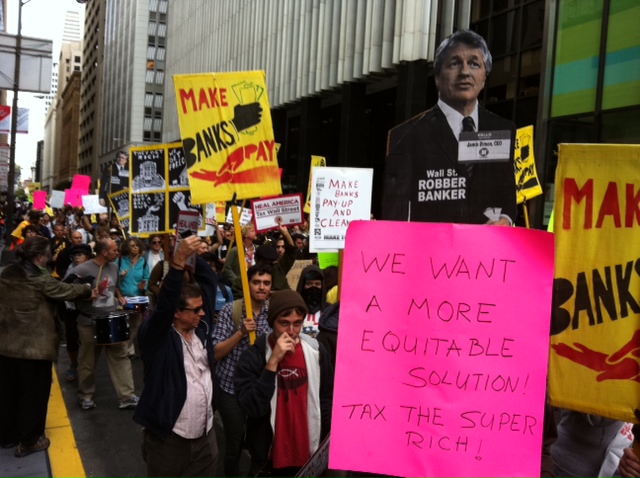
Most media outlets, however, are still concerned primarily with labor’s militant actions and cover even those superficially. Most see no need for coverage that goes beyond the surface excitement, no need for expert reportage, although some recent labor actions, such as those of the Occupy Wall Street movement, have forced the media to look closer at some issues that previously have been only superficially examined – if examined at all.

There are, in any case, too few mainstream reporters who are adequately versed in labor matters. There are too few who have the trust of workers and their unions, which naturally hesitate to provide them much of the information that’s needed to adequately and fairly explain labor’s positions. The result has been labor coverage that’s generally shallow, often uninformed and frequently biased.

Unfortunately, that is unlikely to change any time soon.

Dick Meister, former labor editor of the SF Chronicle and KQED-TV Newsroom, has covered labor and politics for more than a half-century. Contact him through his website, www,dickmeister,com, which includes more than 350 of his columns.

Burning Man takes anti-scalper and traffic control measures as tickets arrive

64

Most physical tickets to Burning Man were mailed out last week and, as many expected after a controversial ticket lottery with higher-than-expected demand, ticket scalpers were offering hundreds of tickets for more than double face value on websites such as eBay and StubHub. But Black Rock City LLC, the SF-based company that stages the event, over the weekend introduced some counter-measures to combat the scalpers and reiterated its request for burners to heed the culture’s decommodification ethos and refuse to pay more than face value for tickets.

“I don’t think any burner should buy a ticket for above face value,” Marian Goodell, the BRC board member who handles communications, told the Guardian. She said they’ve worked through the crisis of veteran burners – those who build much of Black Rock City’s infrastructure each year – not getting tickets.

“It’s sorting itself out, so I don’t think people need to go to the StubHubs out there. They can ignore the scalpers,” she said.

BRC already canceled a secondary open sale of what was to be the final 10,000 tickets, instead selling them through established theme camps and art collectives, fairly effectively getting them out to most burners who wanted them. Then, in the wake of getting federal permits for a higher than expected population cap of 60,900 this year, BRC on Sunday announced the release of an extra 2,000 tickets this year.

Half of those were dumped into the Secure Ticket Exchange Program (STEP) system that BRC created for people who unsuccessfully sought tickets during the main sale of 40,000 tickets in January. To further deter scalpers, those who hadn’t registered for that main sale – who are barred from buying through STEP – can try to snag one of the 1,000 tickets that BRC will offer during an online sale on Aug. 3, which requires registration on Aug. 1.

“We think the 1,000 tickets we put into the open sale will help pull the rug out from under the scalpers,” event founder Larry Harvey, who chairs the board, told us.

Harvey and Goodell also say BRC has been hard at work solving related issues as well, including concerns that the biggest ever population for this massive, isolated, temporary city in Nevada’s Black Rock Desert – where waits to get on or off the playa during peak hours can be four hours or longer – will create traffic nightmares.

“More lanes will be open more often,” Goodell said, explaining they will beef up the number of volunteers helping to get people in and out, as well as those working the lines at Will Call, which all the STEP ticket buyers were forced to use as another anti-scalper measure.

The event traditionally opens at midnight on the Sunday night before Labor Day weekend (Aug. 26 this year), but those in the know have known it was actually possible to get in a few hours early during the last couple years. This year, BRC will formalize that arrangement to help with traffic ingress, officially opening the gates to all attendees at 6pm.

Goodell said BRC will also be coordinating with big art projects and doing communications efforts with all attendees encouraging people to stagger entrance and departure times as much as possible to spread out the peak and lessen wait times. “We really want participants to educate themselves and think about their expectations,” she said.

As an additional measure, BRC will be moving up the final official event of the week – the burning of the Temple on the last Sunday night (Sept. 2) – from 9 pm to dusk to facilitate more people hitting the road that night.

Both Goodell and Harvey acknowledged that it’s been difficult to sort through the problems created by the huge demand for tickets this year, but they say that most of those who want tickets will have them and this should be a banner year in terms of the art and other offerings in this strange and bountiful experimental city.

“There were fears there would be less art this year, but there’s going to be more art than ever before,” Harvey said. Asked which piece he’s most excited to see this year, he said Yoga Robot by Colorado artist Scott Harris. To peruse some of the other art installations this year, click here to see check out art projects that got grants from BRC, which is only a small part of what attendees will see on the playa this year.

The malling of San Francisco

110

steve@sfbg.com

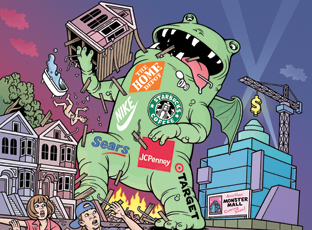
Shopping malls filled with national chain stores and restaurants are in many respects the antithesis of San Francisco. They’re the bane of any metropolis that strives to be unique and authentic. And those just happen to be qualities that make tourism this city’s number one industry.

The logic of modern capitalism, and its relentless growth into new markets, has already placed a Target or a Walmart, and a Nordstrom, Macy’s, Ross, or a JCPenney — along with a bevy of Starbucks, Applebee’s, Jamba Juice, and McDonald’s and myriad other formulaic corporate eateries — in just about every town in the country.

Do people really need them here, too? And in a city renowned worldwide for its scenic beauty and temperate (albeit sometimes foggy) climate, do people want to shop in the enclosed, climate-controlled malls popularized in the small or suburban towns that many residents came here to escape?

For me, the answer is no. Frankly, malls have an aura of artificiality that gives me the creeps — but I freely acknowledge that not everyone feels that way. Some San Franciscans may like malls and chain stores while others don’t.

But it doesn’t really matter what any of us think. Left unchecked, it’s the market that matters — and the logic of the market gives chain stores a huge competitive advantage over the mom-and-pops. Their labor and supply costs are lower, their financial resources are more extensive and appealing to commercial landlords, and their business models are based on constantly opening new stores.

All cities have to do is just say yes. And San Francisco has been increasingly saying yes to malls and chain stores.

The economic desperation that set in since the financial crash of 2008 has overcome the trend of resistance to so-called “formula retail establishments” that had been building in San Francisco during the years before the recession.

So now, rather than dying from neglect, the Metreon mall has been brought back to life by a huge Target store set to open this fall, the second Target (the other one at Masonic and Geary) going into a city that had once eschewed such national mega-retailers.

Just down the street, in the heart of the city’s transit-rich commercial center, the CityPlace mall that had been abandoned by its previous owners after winning city approval two years ago is now being built by new owners and set to open next spring with “value-based” national chain stores like JCPenney.

Projects funded with public money aren’t immune either. The new Transbay Terminal transit center now under construction will have its own mini-mall, with 225,000 square feet of retail, much of it expected to house national chains. Even more retail will be built on the ground floor of the dozen other nearby residential and office buildings connected to the project.

And it isn’t just these new malls going in a stone’s throw from the Westerfield Mall, Crocker Galleria, San Francisco Center, and other central city malls. All over town, national chains like the Whole Foods and Fresh & Easy grocery stores are replacing Cala Foods and other homegrown markets, or going into other commercial shells like the S&C Ford building on Market near the Castro.

Just a few years ago, the approval of Home Depot on Bayshore Boulevard (since then sold and opened as Lowe’s, another national chain) was a hugely controversial project approved by the Board of Supervisors on a closely watched 6-5 vote. Now, Lennar is building an entire suburban-style complex of big box stores on Candlestick Point, hundreds of thousands of square feet — without much controversy at all.

Even Walmart — the dreaded poster child for huge corporations that use their market power to drive down wages or force local stores out of business — is reported to be actively looking to open “a couple” of stores in San Francisco (see “Walmart sets sights on San Francisco,” June 24, San Francisco Chronicle).

To Livable City Executive Director Tom Radulovich and others who have long encouraged San Francisco to embrace the kind of urbanism advocated by famed author and activist Jane Jacobs — which emphasizes unique, neighborhood-based development that enhances public spaces and street life — accepting the malls feels like giving up on more dynamic urban models.

“It’s sort of an admission of failure,” Radulovich said. “It’s the failure of urbanism in San Francisco.”


MID-MARKET SYMBOLISM

Mid-Market Street is a bellwether for the type of city San Francisco may become. Every mayor since at least Dianne Feinstein in the late 1970s has called for the redevelopment of Mid-Market into a more active and inviting commercial and social corridor, and few have done so more fervently than Mayor Ed Lee.

Several city studies have explored a wide variety of ways to accomplish that goal, from eliminating automobiles and transforming Market Street into a lively pedestrian promenade to using redevelopment money, tax breaks, and/or flashy lighted signs to encourage distinctive development projects unique to San Francisco.

“But the city failed, so the market filled the void,” Radulovich said.

It isn’t that all shopping malls or enclosed commercial areas are necessarily bad, Radulovich said, citing the influential work by writer Walter Benjamin on the roles the enclosed “arcades” of Paris played in public life. “They work when they are an extension of public spaces,” Radulovich said.

Yet that isn’t what he sees being built in San Francisco, where what gets approved and who occupies those spaces is largely being dictated by private developers who are more interested in their bottom lines than with the creation of a vibrant urban environment where people are valued as more than mere consumers or workers.

San Francisco isn’t alone in allowing national chains to increasingly dominate commercial spaces. In fact, Stacy Mitchell, a researcher with the Institute for Local Self-Reliance, said that until recently San Francisco was one of the best big US cities in controlling the proliferation of chain stores.

But the city has lost ground since its anti-chain high water mark in 2007, when voters approved Proposition G, which expanded the controls on formula retail outlets — generally requiring them to get a conditional use permit and go through public hearings — that the Board of Supervisors had approved in 2004.

Those controls are only as good as the political will to reject a permit application, and that doesn’t happen very often. A memo prepared last July for the Planning Commission — entitled “Informational Presentation on the Status of Formula Retail Controls” — found that of the 31 formula retails applications the city received since 2007, just three were rejected by the commission, six were withdrawn, and 22 were approved.

It’s gotten even worse since then, as the two Targets and other chains have been courted and embraced by Mayor’s Lee’s administration, whose key representatives didn’t respond to Guardian interview requests by press time.

Mitchell said it’s not nearly as bad in San Francisco as it is in Chicago, New York City, New Orleans, and other iconic US cities whose commercial spaces have been flooded with chains since the recession began.

“It’s nothing compared to the no-holds-barred stuff going on in New York City right now,” Mitchell said. “Walking down Broadway now is like a repeating loop of the stores you just saw further up the street.”

It isn’t that these cities are actively courting the national chains in most cases. It’s just that in the absence of strong local controls, developers and large commercial landlords just prefer to deal with chains, for a variety of reasons.

“If you’re just going with the flow of what developers are doing,” she said, “you always end up with national chains.”

And that’s what San Francisco has started to do.


MALLS LIKE CHAINS

Stephen Cornell, the owner of Brownie’s Hardware and a board member of the nonprofit advocacy group Small Business California, said chains have a huge competitive advantage over local businesses even before either one opens their doors.

“In general, landlords tend to like chains more,” said Cornell, whose business has struggled against Lowe’s and other corporate competitors. “The landlord always worries: is this guy going to make it and do they have the funds to back it up?”

Big corporate chains have lawyers and accountants on staff, and professional systems established for everything from buying goods to opening new stores, whereas most local entrepreneurs are essentially figuring things out as they go along.

“They’re very good at selling themselves,” Cornell said. “They’re going to manipulate the system perfectly, whether it’s the city and its codes or dealing with neighborhood merchants.”

And for large malls, Cornell said the problem is even worse. Brokers that fill malls have standing relationships with the national chains — most of which are publicly traded corporations seeking to constantly expand and gain market share — and no incentive to seek out or take a chance on local entrepreneurs.

“Chains have a lot of advantages,” Cornell said.

Mitchell said there are two main ways in which malls favor national chains over local businesses. In addition to the relationship between mall brokers and national chains, malls are often built with financing from financial institutions that require certain repayment guarantees.

“What they want to see are credit-worthy clients signed onto those places, and that means national chains with a credit rating from Standard & Poors,” Mitchell said, noting how that “automatically locks out” most local businesses.

Cornell also noted that national chains have already figured out how to maximize their efficiency, which keeps their costs down even though that often comes in the form of fewer employees with lower pay — and less reliance on local suppliers, accountants, attorneys, and other professionals — which ends up hurting the local economy. In fact, big chains suck money out of the city and back to corporate headquarters.

“All those people are making money and spending money here, so you have to look at the full circle,” Cornell said.

Mitchell said there are often simple solutions to the problem. For example, she said that city officials in Austin, Texas recently required the developer of a large shopping mall to set aside a certain percentage of the units for locally owned businesses.

So rather than hiring a national broker to find tenants, the developer hired a local broker to contact successful independent businesses in the area who might be interested in expanding, and the project ended up greatly exceeding the city’s minimum requirements.

Mechanisms like that, or like the formula retail controls pioneered in San Francisco, give her some hope. But she said, “Whether the counter-trends will be enough to counter the dominant trend, I don’t know.”


PUBLIC SUBSIDIES

The increased malling of San Francisco isn’t simply the result of official neglect. Often, the city’s policies and resources are actively encouraging the influx of chain stores. A prime example is the massive redevelopment project on Hunters Point and Candlestick Point that city voters approved in 2008 after mega-developer Lennar and most San Francisco political officials pushed the project with a well-funded political campaign.

“If you’re selling the land to Lennar for a dollar, and then building all the automobile infrastructure for people to get there, then that’s a massive public subsidy,” Radulovich said of the big-box mall being built on what was city-owned land on Candlestick Point.

That public subsidy creates a cycle that makes San Francisco less intimate and livable. Creating commercial spaces on the city’s edge encourages more people to drive on congested regional roadways. These spaces are filled with national chain stores that have a direct negative impact on small, locally owned stores in neighborhood commercial districts all over the city, causing some of these businesses to fail, meaning local residents will need to travel further for the goods they once bought down the street.

“Those neighborhoods are going to be less walkable as a result,” Radulovich said, noting how the trend contradicts the lip service that just about every local politician gives to supporting local businesses in neighborhood corridors. “There’s a certain schizophrenia to San Francisco’s economic development strategy.”

Sup. Eric Mar has been working with Jobs with Justice San Francisco and other groups to tweak city policies that have allowed the chains to proliferate. Last year, Mar held high-profile hearings in City Hall on how national chains impact local businesses, which pointed to the need for additional protections (see “Battling big box,” Jan. 3).

This year, he’s working on rolling out a series of legislative initiatives designed to level the playing field between local interests and those of Wall Street and the national chains it champions.

Last month, the Board of Supervisors approved Mar’s legislation to add banks to the city’s formula retail controls, a reaction to Chase Bank and other national banks snapping up vacant stores in neighborhood commercial corridors such as Divisadero Street.

Now he’s working on legislation that would mandate minimum labor and community benefit standards for chain stores — including grocery outlets such as Fresh & Easy — and study how chains affect San Francisco’s overall economy.

“There should be good neighbor policies when they come into a neighborhood,” Mar said. “Some neighborhoods are so distressed they may want a big box grocery story coming in, but we need to try to mitigate its negative impacts.”

One of his partners in that effort is his brother, Gordon Mar of Jobs with Justice, who argues the city needs to have a clearer picture of how national chains impact local communities.

“We’ve definitely seen an increase in corporate chain stores coming into San Francisco in the last year, and nobody has really been tracking it,” he said.

While the Planning Department’s quarterly pipeline report shows that applications for retail outlets has held steady at about 3 million square feet on the way in recent years, it doesn’t break out how much of that is national chains — let alone how that impacts the city’s economy and small business sector.

The city’s Legislative Analyst is now studying the matter and scheduled to release a report later this summer, which Gordon Mar said will be helpful in countering the narrow “jobs” rhetoric that now dominates City Hall.

“They are exploiting the economic recession by saying they’re bringing much needed jobs into the city and serving low-income residents,” he said. “But when you bring out the facts about the impact of these low-road retail stores on neighborhoods and small businesses, there is a net loss of jobs and a lowering of labor standards.”


VALUING MALLS

Yet the fate of those controls is uncertain at best, particularly in a tough economic environment in which the city needs revenue, people are desperate for jobs, and many residents have seen their buying power stagnate, making the cheap goods offered by Target and Walmart more attractive.

“It’s complicated stuff,” Michael O’Connor, a local entrepreneur and former member of the Small Business Commission who favors formula retail controls, told us. “Stores like Target do appeal to lower income families…The progressive agenda needs to understand that working-class families need somewhere to shop.”

O’Connor acknowledges how small businesses like those he owns, including a clothing store, often can’t compete with national chains who buy cheap goods in bulk. So he said he favors protections in some neighborhoods while allowing chains in others, telling us, “I don’t have a problem with the Target going into the Metreon.”

That argument also held sway with city officials when they considered approving the CityPlace project two years ago, which was presented as a mall filled with “value-based” stores that would be affordable to median income San Franciscans.

“At the time, the decision was around whether a value-based retail operation made sense in that location, and the answer was an emphatic ‘yes,'” Barbary Coast Consulting founder Alex Clemens, who represented the project, told us.

On a national or global level, there are good arguments against reliance on national chains selling cheap imported goods, which has created a huge trade deficit between the US and countries such as China that costs American jobs — ironically, the very things that some use as arguments for approving chain stores.

“The recession has created a climate of desperation where cities are more easily swayed by the jobs argument,” Mitchell said, noting the falsity of those arguments by pointing to studies showing that the arrival of chain stores in cities usually creates a net loss in employment. Finally, supporters of chain stores say the cash-strapped city needs the property and sales tax revenue “Because they say they’ll produce a lot sales tax revenue, they’re going to get away with all kinds of shit,” Cornell said, arguing that shouldn’t justify city policies that favor big corporations, such as tax breaks and publicly financed infrastructure. “I certainly don’t think [city officials] should be giving them any advantages.” There are few simple solutions to the complex and interconnected problems that result from the malling of San Francisco and other cities. It’s really a question of balance — and the answer of whether San Francisco can regain its balance has yet to be answered. “Given the mayor’s approach to economic development, it’s inevitable that we’ll have more coming into the city,” Sup. Mar said. “But the ’50s car culture, and the model of malls that came in the ’60s, don’t build communities or strong neighborhoods.”


Alerts

0

WEDNESDAY 11

Students organizing for CCSF Student Union upper level lounge, CCSF Ocean Campus, 50 Phelan, SF; www.ccsfwill.blogspot.com. 5-8pm, free. At an emergency community meeting concerning the threatened closure of City College of San Francisco July 9, many meetings were called, including the organizing to form a student union, to campaign for the parcel tax initiative to get money to CCSF, and to organize in solidarity with labor. This meeting is discussing support for the parcel tax, which could send $15 million City Colleges way if it passes in November. Come organize with labor on this issue. This meeting is a working group on student response to the accreditation report.

THURSDAY 12

It calls you back 826 Valencia, SF; www.826valencia.org. A book reading and film screening with Luis Rodriguez, a poet, journalist, and fiction writer and author of the best-selling memoir Always Running, La Vida Loca, Gang Days in L.A. He will read from his new sequel and screen Rushing Waters, Rising Dreams: How the Arts are Transforming a Community, documenting how Tia Chucha’s Centro Cultural and Bookstore is bringing art and community to the once devastated post-industrial San Fernando Valley.

Happiness Happiness Institute, 1720 Market, SF; www.meetup.com/SF-Free-School. An afternoon of yoga and a workshop on community building. This event is presented by a collaboration between the Bay Area Community Exchange Time Bank, the San Francisco Free School, and the Happiness Institute- three of the organizations that work on spending time and energy in the gift economy.

FRIDAY 13

4 days for Kenneth Harding Jr. around Bayview-Hunters Point, July 13-16; www.tinyurl.com/4days4kenny. On July 16, 2011, 19-year-old Kenneth Harding Jr. was killed. He was stopped by police and asked for his transfer when off-boarding the Muni T train—he ran, and police began shooting. As far as the SFPD is concerned, the case is settled; they say Harding drew a gun and shot back at them, and the fatal bullet was his own. His family, friends, and the movement resisting police murder of black youth disagree. On this anniversary of his death, commemorate Kenny with four days of events. On July 13, a community speak out at NOI Mosque at 26a 3rd & Revere at 7pm. On July 14th, a free community hip hop show. On July 15th a free community meal at 3rd and Palou St from 10am-2pm. And on July 16th, join Kenneth Harding’s mother and a broad coalition of community and labor to shut down Muni in honor of Kenneth Harding.

SATURDAY 14

Occupy Bohemian Grove Monte Rio Amphitheater, 9925 Main, Monte Rio; www.occupybohemiangrove.com. Noon, free. What, you’ve never heard of Bohemian Grove? It’s just the private club of CEOs, politicians, and their favorite performers that meet every year for debauchery and rituals such as the “Cremation of Care” at the Owl Shrine. The rich and powerful go camping among the redwoods every year, and although business talk is frowned upon, they often make deals, including, notoriously, a 1942 Manhattan Project planning meeting that led to the atomic bomb. Many anti-war activists and others who are pissed off that the 1 percent meets in this strange private camping party to plot acts of war and environmental destruction will be setting up their own protest encampment outside Bohemian Grove this year. The kick-off on Saturday will include musical performances and speakers, including the Fukushima Mothers and Cindy Sheehan.

Tardeada/ women’s social for women’s rights, 2969 Mission, SF; www.defendwomensrights.org. 2pm, $3-10. Women Organized to Defend and Resist are planning a nationwide protest August 26 to defend women’s rights. This Saturday, come share food, entertainment and political conversation to meet and bond with others who won’t stand for attacks on women’s rights.

Dick Meister: “We want bread and roses, too”

0

By Dick Meister

Dick Meister, former labor editor of the SF Chronicle and KQED-TV Newsroom, has covered labor and politics for more than a half-century. Contact him through his website, www.dickmeister.com, which includes more than 350 of his columns.

 “Our lives shall not be sweated from birth until life closes;

Hearts starve as well as bodies, give us bread, but give us roses!”

–From a poem by James Oppenheim

Bread and roses. It was the battle cry of the thousands of striking women and their supporters who marched through the streets of Lawrence, Massachusetts, in 1912, in the heart of the textile industry. Although it’s been 100 years since they marched, their militancy and bravery remain among the brightest highlights in the long history of the American labor movement.

The three-months long strike in Lawrence, led by the Industrial Workers of the World (IWW) pitted the 25,000 workers – half of them women under 20, many as young as 14 – against the violently anti-labor textile mill owners, who were strongly backed by the press, politicians , school officials, and clergy.

Striking was difficult for the workers, who had only their poverty-level wages to live on. They had barely enough to pay the rent for the run-down, disease-ridden shacks and tenement flats where most of them lived. Many were constantly in debt, having to borrow money to meet their bare necessities. Health care and other fringe benefits were virtually unheard of, and more than one-third of the workers died in their mid-twenties.

Working conditions were brutal. They commonly worked 12 hours a day in the hot, dusty and dangerous textile mills for but $6 to $8 a week. The workers had neither the leisure time nor the means to improve the quality of their lives, no time or money to enjoy the good things of life – the roses.

They desperately needed the help that unionization could provide them, but that could come only through a strike that would impose even more hardships on the already extremely hard-hit workers.  They hesitated about actually walking off the job, but finally were convinced that striking would bring long-term benefits to them, their families and their communities.

The mill workers moved into action after employers unilaterally cut their already rock-bottom pay even more.  They marched to the mills and throughout Lawrence to the tune of militant labor songs by IWW bard Joe Hill and others, holding high  placards that declared ,”We Want Bread and Roses too,” a demand that soon would be taken up by labor and feminist groups nationwide.

It wasn’t easy, bringing the workers together. They belonged to two-dozen different national groups, speaking 72 languages. They had been purposely kept apart by employers, who kept them in ghettoes by setting up separate housing areas for different nationalities, lest they forget their ethnic differences and join together to challenge their miserable pay and unhealthy conditions.

Employers got their friends in City Hall to enact an ordinance preventing strikers from picketing individual mills, but strikers responded by the extraordinary act of forming a picket line around the perimeters of the entire textile mill district. Thousands of pickets were on the line 24 hours a day throughout the 10-week-long strike.

Some spent part of their evenings hoping to disturb the sleep of strikebreakers who employers had hired to replace them, loudly serenading them with IWW songs.

Thousands paraded through the streets of Lawrence regularly, until the city enacted an ordinance forbidding parades and mass meetings. They switched to sidewalk parades of up to four-dozen strikers and supporters, who locked arms, blocking shoppers and others from entering downtown businesses.

Eventually, martial law was declared, enforced by violent police and militiamen, who charged in to try to break up the marches and other demonstrations. They even tried to block strikers from putting their children on trains that would take them to safety with sympathizers in other cities.  The city called in the Army to block the trains from moving, which led to the killing of a woman striker and the beating of many others, including several children and two pregnant women who had miscarriages.

Then the authorities arrested two of the IWW’s principal leaders for murder, on grounds that their illegal acts had provoked police into the action that led them to kill a striker.

The widespread publicity about the strike finally helped pressure employers to settle. The terms were modest, primarily granting the workers union recognition, a 15 percent pay increase and a 54-hour workweek with overtime pay at double the regular rate.  But the mere recognition of the workers’ right to make and be granted any demands was crucial.  It inspired many other workers, especially women, to also assert their basic rights and brought strong support nationally for many workers who sought decent treatment.

What’s more, many textile mill owners, fearing they also might be struck, granted pay raises totaling almost $15 million to an estimated 438,000 workers throughout New England and elsewhere.

A much longer and lasting result was that the strike put the needs of working women on labor’s agenda for the first time and showed that women could very well provide decisive leadership and indeed win bread – and roses.

Dick Meister, former labor editor of the SF Chronicle and KQED-TV Newsroom, has covered labor and politics for more than a half-century. Contact him through his website, www.dickmeister.com, which includes more than 350 of his columns.


Faces of feminism

7

Is San Francisco still on the cutting edge of women’s issues? I recently spent a sunny Saturday morning buried in the radical archives of Bolerium Books (www.bolerium.com) — which is by the way, an amazing resource for anyone researching labor, African American, First Peoples, and queer history, among other things. Me, I was looking into our city’s rich history of feminist activism, inspiration for our upcoming Guardian “Bay Area Feminism Today” panel discussion. The event will unite amazing females from across the city who have but one thing in common: they’re pushing the envelope when it comes to the definition of what a “women’s issue” is, in a time when very few people claim feminism as their primary crusade. We’ll be talking more about their exciting projects –- but also touching on more universal issues. What is San Francisco’s role in fighting the nationwide attack on reproductive rights? How is our progressive community doing in terms of supporting women and maintaining a feminist perspective on issues?

Women’s work: it’s alive and kicking, and it deserves its moment in the spotlight. Meet our panelists here, in preparation for the real deal. 

THE GUARDIAN PRESENTS: “BAY AREA FEMINISM TODAY”

Wed/11 6-8pm, free

City College of San Francisco Mission campus

1125 Valencia, SF

www.sfbg.com/bayareafeminismtoday


STEPHANY ASHLEY

St. James Infirmary programs director, ex-president of Harvey Milk LGBT Democratic Club


For me, sex worker rights are a feminist issue because they are about body autonomy. As much as reproductive choice is a feminist issue, so too is the right to determine the ways in which we use our bodies, change our bodies, and take care of our bodies. When people are criminalized for their HIV status, denied access to hormones and safe gender transitions, or are afraid to carry condoms because it might lead to police harassment or arrest — these are all feminist issues. At St. James Infirmary (www.stjamesinfirmary.org), we provide healthcare and social services from a peer-based model, so community is really the central aspect of the project. I was excited to chair the Harvey Milk LGBT Democratic Club (www.milkclub.org) last year, because I wanted to keep raising sex workers rights issues as part of the LGBT agenda. At St. James, nearly 70 percent of our community members are LGBTQ, so it’s really critical that sex workers rights are treated as a queer issue, a feminist issue, and a labor issue.

CELESTE CHAN

Artist and founder of Queer Rebels

My partner KB Boyce and I started our production company Queer Rebels (www.queerrebels.com) to honor the feminist and queer of color artists and elders who paved the way. Our main project is “Queer Rebels of the Harlem Renaissance,” a performance extravaganza which took place June 28-30. Such an exciting time! The Harlem Renaissance legacy remains with us to this day. It was an explosion of art, intellect, and sexual liberation led by queer Black artists. I’m also a board member at Community United Against Violence (www.cuav.org). CUAV was formed in the wake of Harvey Milk’s assassination and the White Night riots, and does incredible work to address violence within and against the LGBTQ community. Another way I’m involved with women’s issues is through Femme Conference (www.femme2012.com). In a culture where femininity is both de-valued and the expected norm, Femme Con creates a vital feminist space — this year it takes place in Baltimore, Maryland.

EDAJ

DJ and promoter of queer nightlife

I work in nightlife to provide space for communities that often don’t have spaces to come together. For 15 years, I have been providing music for women as the resident DJ at Mango (every fourth Sunday at El Rio, www.elriosf.com). I also work to support my fellow LGBT veterans by promoting their visibility through my nightlife projects. Ex-Filipino Marine and two-spirit drag king Morningstar Vancil’s story has inspired me to work on creating a space that raises awareness about LGBT veterans, especially women living with disabilities. I also think it’s important to do outreach in the Black LGBT community to help strengthen support for organizations such as the Bayard Rustin LGBT Coalition (www.bayardrustincoalition.com), a group that is not only fighting for Black LGBT equality, but is focused on social change for all oppressed people. After 10 years of executive producing the Women’s Stage at SF Pride, I was honored as a grand marshal this year at an event hosted by the BRC and Soul of Pride. It was beautiful to see so many Black LGBT people dedicated to moving global equality forward. Although there is a need to reach out to everyone in the Black LGBT community, naturally my goal is to first focus on connecting more women, a group that has always been less visible.

JUANA FLORES

Co-director of Mujeres Unidas y Activas

My organization Mujeres Unidas y Activas (www.mujeresunidas.net) is based on a double mission: personal transformation and community power for social justice. MUA is a place where women arrive through different challenges in their lives. We try to provide emotional support and references so that they don’t feel like they’re alone, so that they have strength to begin the process of healing and making changes. Those can include issues of domestic violence, problems with teenage children, labor or housing issues — when they arrive at MUA they begin the process of developing their self esteem and becoming stronger. They also begin to participate in trainings and making changes in their community and to the system through civic and political participation. At MUA, women find a home. They feel comfortable because they’re always welcome. We’re developing strong leadership, leadership that is at the table when it comes to making decisions about our campaigns, like our letter of labor rights and the help we give to victims of domestic violence through our crisis line. Every day our members are developing their ability to be involved in the organization and community, and making changes in their personal and familial lives.

ALIX ROSENTHAL

Attorney and elected member of the SF Democratic County Central Committee

As an elected member of the SF DCCC (www.sfdemocrats.org), the governing body of the SF Democratic Party, I am working to involve the party in recruiting more women to run for political office locally. In the June 2012 election, I assembled a slate of the female candidates for DCCC — we called ourselves “Elect Women 2012.” It was a controversial effort, because it included both progressives and moderates. In the wake of a highly contentious and factional term on the DCCC, we hoped to prove that moderates and progressives can work together to re-energize Democrats in this important presidential election cycle. Running for office in San Francisco is a high stakes game; it is costly and requires an extensive political network. And so the DCCC is where many future candidates get their start — it is where they build the connections necessary to run for higher office, and where they hone their fundraising abilities. By recruiting and supporting women candidates for the DCCC, I am hoping to build a “farm team” of female candidates within the party. This year, I am proud that the seven women incumbents on the DCCC retained our seats in the June election, and that we achieved parity by electing four new women to the party’s governing board. I look forward to seeing what these women can accomplish together.

LAURA THOMAS

Deputy state director of Drug Policy Alliance

Ending the failed war on drugs is a women’s issue because women are far too often bearing the brunt of that failure, losing their freedom, children, economic independence, safety, health, and sometimes their lives as victims of the war on drugs. Women in prison in California can be shackled during childbirth, lose custody of their children because they use legal medical marijuana. They’re vulnerable to HIV and hepatitis C because they or their partners don’t have access to sterile syringes for injecting drugs. My major project for the Drug Policy Alliance (www.drugpolicy.org) is mobilizing San Francisco to show the rest of the world how effective progressive drug policy can be. I want to see San Francisco open the first supervised injection facility in the United States, to end new HIV and hepatitis C infections among people who use drugs. I want us to truly have effective, culturally appropriate substance use treatment for everyone who requests it. I want San Francisco to end the cycle of undercover drug buys-incarceration-recidivism. I want us to address the appalling racial disparities in who gets arrested, convicted, and incarcerated for drug offenses here. I want us to aggressively defend our ground-breaking, well-regulated medical cannabis dispensary system against all federal intervention. San Francisco is leading the way in the United States in addressing the harms of drug use and drug prohibition but we have a lot more we can do.

MIA TU MUTCH

Transgender activist and SF Youth Commission officer

I’ve worked for a plethora of LGBTQ organizations and have been on several national speaking tours. I currently serve as media and public relations officer of the San Francisco Youth Commission, and use my position to promote LGBTQ safety and overall health. I’ve partnered with several city departments in order to create a cultural competency video that will train all service providers on best practices for working with LGBTQ youth. As a vocal advocate against hate crimes and sexual assaults, I’m working with local groups to create a community patrol in the Mission to prevent violence against women and transgender people. I’m also the founder of Fundraising Everywhere for All Transitions: a Health Empowerment Revolution! (FEATHER), a collective aimed at making gender-affirming transitions more affordable for low income transgender people. I work to create avenues of equality for those who benefit the least from patriarchy by creating a culture of safety and support for people of all genders.

Brown, Pak, and Olague

38

Christina Olague was a great planning commissioner. I’ve always liked her, and when she was appointed we pointed out how strongly she was rooted in the progressive community.

Olague has strong progressive activist credentials, from working with the Mission Anti-Displacement Coalition to protect low-income renters during the last dot-com boom to her more recent community organizing for the Senior Action Network. She co-chaired the 2003 campaign that established the city’s minimum wage and has been actively involved in such progressive organizations as the Milk Club, Transit Riders Union, and the short-lived San Francisco People’s Organization.

She also served two terms on the Planning Commission — appointed by Board of Supervisors then-President Matt Gonzalez in 2004 and reappointed by then-President Aaron Peskin in 2008 — where she was known for doing her homework on complicated land use issues and usually landing on the progressive side of divided votes.

We’ve had some disagreements since she took office — particularly around 8 Washington. (I also disagreed with the Labor Council on that one, and only three of the supervisors agreed with me.) And it’s not the first time an elected official I supported turned around and infuriated me on a development vote.

I want Olague to succeed; I want her to come to us in the fall with a record that makes us want to endorse her for a full four-year term. She’s been talking seriously about violence in the district and about young people, predominantly African Americans, getting killed. I feel like she wants to do the right thing.

But her reelection effort is starting to feature some bad actors.

At a recent fundraiser in Chinatown, former Mayor Willie Brown, who ranks as one of the most corrupt public officials in modern San Francisco history and whose administration was a disaster for poor and working-class people (he once even said that poor people ought to just get out of town because this city is too expensive for them), stood up and made a speech, warmly endorsed Olague and said he would be with her “all the way.” Olague then thanked Rose Pak, the Chinatown power broker, for “all of her support over the last few months.”

This makes me nervous. And it hasn’t helped my nerves that I’ve been trying to talk to Olague about these issues for the last week, and she keeps avoiding the conversation by not returning calls or cutting conversations short when I do reach her.

Willie Brown, with his Chron column, has taken on this funny, warm, man-about-town persona, but when he was running City Hall, everything was about money. He cut deals right and left that destroyed communities and neighborhoods. He oversaw, aided and encouraged what we called the “Economic Cleansing of San Francisco.” Tens of thousands of working-class people, artist, writers, young people … were driven out of the city by a steamroller of gentrification — all with the mayor’s blessing.

Now he’s working as a private attorney, and last time we checked was getting $200,000 a year to represent PG&E. We have no idea what other big corporate clients he has or what he does for them — but it’s clearly not writing legal briefs and handling litigation. He gets paid for being a political fixer. For the bad guys.

And he’s going to be with Olague “all the way.”

Damn.

The People’s School

0

yael@sfbg.com

Oakland elementary schools that were packed with kids until a few weeks ago are now closed for the summer — and five are closed for good. In October the school board voted to close them in a move that would save about $2 million per year.

But many Oakland Unified School District (OUSD) residents are not pleased. At the Oct. 26 meeting where the vote was cast, 500 protested. Concerned parents and teachers have been petitioning and meeting with school board members and Superintendent Tony Smith for months, trying to reverse the decision.

“No one wants to close schools, but the OUSD made this difficult decision because it’s in the best long-term interest of students,” reads a June 22 press release.

Resistance to that decision now continues at one school that was supposed to close June 18. To the dismay of the district, it remains open. Lakeview Elementary is the site of a sit-in and free school, orchestrated by parents and teachers.

“Lakeview has strengths,” the June 22 press release goes on to say. “It has shown improved academic performance in recent years and, boasts a strong sense of community and close alignment with its afterschool programs.” But low rankings in attendance and test scores overshadowed those strengths in the decision to close the school.

Yet it seems that “strong sense of community” seems to be more powerful than the school board thought.

SENSE OF COMMUNITY

Joel Velasquez, a parent of three and PTA member who has had children at Lakeview for 10 years, didn’t think it would come to this.

“I’ve watched everything that went on as a parent here for 10 years,” Velasquez said. When the school was threatened, “I probably spent 20 hours a week meeting, talking, emailing, researching, sending, forwarding — I mean, this is something that has been ongoing.”

“I met with Tony Smith for an hour,” Velasquez said. “I sat with board members.”

But as the end of the school year approached, he was growing more desperate, so he ended up making an announcement: “On the last day of school, I’m not going to leave. And I hope that people join me.”

They did. Lakeview’s building is slated to be turned into administrative offices, and that process was scheduled to begin two weeks ago.

Now, the school that should be filling up with district employees’ office supplies still has children running around its grounds. Organizers opened the People’s School for Public Education, and classes, taught by an army of credentialed teachers and qualified volunteers, run from 9am to 3pm, Monday through Friday.

At a June 27 visit, I toured the school and sat in during a Social Justice class. In the People’s School’s organic garden, a smiling gardening teacher had to stop an overzealous six-year-old from drowning the kale. “They love watering!” he shrugged. Another child, still mesmerized 30 minutes after the official end of music class, improvised on the djembe along with the drumming teacher. From a balcony, a volunteer called to him: “There’s ice cream!” he looked up, considered, and then kept drumming.

The group of kids has grown since the school opened June 15, as parents hear about the summer school and come see it for themselves. The Lakeview sit-in is unlike other recent occupations in the careful vetting process each visitor gets. After all, protecting the kids and their education is the most important goal of the project. But during school hours, parents are permitted to come inside and stay with their children as long as they want, seeing what the school is like.

Still, getting parents to send their children to a summer camp that isn’t technically legal isn’t always easy. “I think our society, not just parents, are really reluctant to do something like this,” Velasquez said. “But I see it as a positive service to the community. We’re using the building for what it’s intended to be used for.”

Julia Fernandez, a high school math teacher, got involved with the effort to save the schools through the Occupy Oakland Education Committee, and her two children, ages 2 and 4, are enrolled in the summer school.

As a nine-year resident of Oakland, Fernandez says, the cuts affect her and her family. She’s taking part in the demonstration partly “for my own kids,” Fernandez said. She said the cuts “affect the school where my kids would go. It’s likely that it’s going to be closed or turned into a charter school.”

“But the thing that motivates me the most is all these attacks that are happening against people,” Fernandez said. She guessed that it was adversity of many kinds, not just school closures, that motivated many parents to join the protest and send their kids to the People’s School.

“People are really upset about all the attacks that are being done on regular working class people. People are losing their homes, they’re getting laid off, and now their schools are closing. It just seems like all these services, all these rights people should have, are being taken away”

MORE THAN MONEY

Organizers emphasize that the money saved seems paltry, just $2 million for five functioning schools.

“Think about it, this is not very much,” Velasquez said. “And they’re wasting almost $4 million to do these transitions to close the schools. They’re spending more than the savings.”

OUSD spokesperson Troy Flint confirmed that the savings will be “in the $2 million range,” and that the total cost of the transition is about $3.7 million.

These expenses include about $117,000 one-time moving related costs and about $200,000 in staffing, including paying a transition director.

They also include $95,000 in transportation costs, which may not be one-time expenditures; they may “as needed for an additional year or more,” Flint said in an email.

Meanwhile, about 1,000 students will be displaced by the move. Many will move to Grass Valley and Burckhalter, and these school’s capacities will be expanded with portable classrooms.

“The promise that we made to students was that we would guarantee students at the closing school a place at a school that was higher performing than the one we were leaving. We were able to live up to that promise,” Flint said.

However, there was a problem: “Most of the schools that perform in the top tier are already subscribed to capacity, so we had to expand the capacity using portables.”

Will these high performing schools remain high-performing as an influx of new students show up at their doors in the fall? After all, Oakland has many more elementary schools than comparable districts, a result of the small schools movement, a policy adopted in 2000 that led to the closure of some larger schools, which were replaced by smaller ones. According to a study conducted by Brown University’s Annenburg Institute for Education Reform, Oakland small schools are “safer, calmer, and more welcoming to families” than the schools they replaced.

But as private donations from those excited about small schools, notably the Bill and Melinda Gates Foundation, run out — along with federal and state money — Oakland may be reverting to larger institutions.

And as the OUSD sees it, that may not be a bad thing.

“To build toward the day when every OUSD school is a high-quality school, we need to concentrate our time, attention and resources in a manageable number of sites instead of spreading ourselves too thin,” he said in an email. “Quality over quantity is the goal when we can’t do both and the current financial environment prevents us from properly caring for 101 schools.

THE NEIGHBORHOOD PROBLEM

One of the reasons for the stated school closure is that it ranked in “the bottom quarter of elementary schools in terms of the number of children living within a half-mile of the school or within the attendance area” and the “lowest percentage of neighborhood students attending the school (30 percent).”

The school is also 99 percent children of color.

As Oakland Tribune education reporter Katy Murphy has written, about half of students in Oakland attend schools outside their district. As a statement from the group Decolonize Oakland points out, “We have to question why the families of black and brown students who live outside of Adams Point have chosen Lakeview.”

Maybe it’s that strong sense of community? All of the other schools slated for closure are also in the flatlands and serve mostly African American and Latino students.

Root, formerly Occupy the Hood Oakland, has played a big part in the organizing. So has Education for the 99 Percent, Occupy Oakland’s education working group, and other Occupy Oakland volunteers.

“A lot of people from Occupy have been extremely supportive and we wouldn’t be able to do this action without that support,” Velasquez said. “For example, the food, they have come every single day to feed, not just breakfast, lunch and dinner, but snacks and drinks.”

The sit-in has also received support from labor groups. A letter signed by more than 50 teachers’ union leaders and local school employees declares, “An injury to one is an injury to all. Let’s seize this opportunity to fight alongside parents, students, and community. We will mobilize our members to support this struggle.”

LEADERSHIP?

The demonstration has not, however, received support from the city of Oakland. Officers from the OUSD Police Service has visited the school several times (and Velasquez says they have done so without warning, despite agreeing to call first to avoid scaring children). Oakland police have been on site as well, and the protesters have received warnings to leave.

“I still remain hopeful that the protesters will see that the most forward-looking resolution to the standoff is to disperse peacefully and to concentrate their efforts on improving the school district for the year 2012/2013 and beyond,” Flint told me. “Right now we still believe that if there’s a relatively prompt resolution to the standoff, we’ll be able to meet our targets to get the facilities ready.”

“It’s not clear why they’re doing this sit-in in Oakland, an overwhelmingly Democratic district where Republicans can’t get elected,” Flint said. “The fundamental problem with this issue is all the Republicans have taken a no taxes pledge.”

Velasquez agrees. “It’s criminal what the state of California is doing right now,” he said. “But we’re focusing our attention on Tony Smith and the board because they’re accepting these conditions, and they shouldn’t…So if they feel that way, why are they not doing something about it, instead of accepting the conditions, and hurting the families and the students? Most importantly the kids.” Flint said the board would be willing to work with the group, but that the sit-in is pointless. “I don’t view this current action as something that is providing us any additional leverage,” he said, though he noted that his office had not attempted to use the sit-in to pressure the state. “We’ve coordinated people across the state, sending in postcards and petitions,” he explained. But when asked what worked best, he said nothing has. “I can’t name a time we’ve been successful,” he said, “because I don’t think we’ve been successful.” As budget cuts sweep the country many governments are feeling this kind of defeatism. The Peoples School for Public Education may not last forever. But they’ve taught 30 kids for free for more than two weeks now, and despite limited time and resources, show no sign of stopping.

Show trial

0

arts@sfbg.com

THEATER The set (by Beowulf Boritt) is almost unassuming in its simplicity: just a trio of receding frames arching over the stage, each progressively more askew, and beneath them a jumble of aluminum chairs piled to one side. Still, such simplicity also hints at, and soon delivers, rich complexity.

The chairs become many things over the course of the evening but first of all a bus stop, where an African American woman (C. Kelly Wright) in 1950s dress waits and remembers. This mute opening scene then gives way to a reverie and nightmare — a memory and history that take the form of a highly fraught “entertainment” — as a man in a white suit and a black string bow tie (Hal Linden), invariably recalling the Old South if only via the emblem of a certain fast-food chicken franchise, comes onto the stage and pronounces the start of the show.

That would be a minstrel show, a notorious artifact of 19th and 20th century American popular culture, which returns with subversive vengeance in The Scottsboro Boys — the iridescent 2010 Broadway musical by the famed song-making team of John Kander and the late Fred Ebb, in collaboration with equally-no-slouch associates David Thompson (book) and Susan Stroman (director and choreographer). Making an impressive Bay Area debut at American Conservatory Theater, The Scottsboro Boys revisits the trials and the international cause célèbre sparked by the false accusation of rape leveled by two white women at nine freight-train–hopping African American youths (all teenagers ranging in age from 13 to 19) in Depression-era Alabama.

If this seems a heavy subject for a musical, that hardly prevents The Scottsboro Boys from being exquisitely well wrought and enthralling, thanks to an excellent score (channeled wonderfully by Eric Ebbenga’s pit orchestra), Stroman’s devilishly potent staging and choreography, and a strikingly multifaceted, charismatic cast that includes a memorable Clifton Duncan as Haywood Patterson, upon whose memoir, Scottsboro Boy, the narrative partly draws (David Bazemore, Cornelius Bethea, Nile Bullock, Christopher James Culberson, Eric Jackson, Jared Joseph, James T. Lane, JC Montgomery, Clifton Oliver, and Clinton Roane make up the rest of the outstanding ensemble).

At the same time, it’s precisely the mesh-clash of form and content —recalling similar canny deployments of popular theatrical forms Kander and Ebb’s Cabaret and Chicago — that makes Scottsboro a vigorous, if sometimes simplified excavation of the case, as well as this country’s ongoing convolutions over race, sex, ethnicity, and class. A productive tension arises between the show’s exquisite spectacle and the often uncomfortable, even macabre content of the storyline. In just one example, a winning tap number erupts in the young men’s shared jail cell, inspired by the terrifying proximity of the electric chair. So charged a number generates as much thought as emotion, as the audience shifts uneasily in a place where popular entertainment mingles pleasure and complicity, truth and artifice.

The subversive appropriation of minstrelsy is not unique to Scottsboro —there’s the San Francisco Mime Troupe’s 1965 production of Minstrel Show, Or Civil Rights in a Cracker Barrel, Suzan-Lori Parks’ use of minstrel tropes in Topdog/Underdog and The America Play, and Spike Lee’s 2000 film Bamboozled, for instance — but the musical deploys it with its own intent, humanizing the young men whose lives were permanently altered by their arrest and the subsequent trials, which became international news when the Communist-led International Labor Defense got involved, sending in celebrated New York attorney Samuel Liebowitz as the new defense counsel. That the trials were themselves the lesser evil in a white Southern regime of lynching and mob justice (waiting, essentially, just outside the walls of the jailhouse) is never lost on the audience either.

Thompson’s admirable book, meanwhile, in the figure of the woman at the bus stop (an unnamed Rosa Parks) bearing witness to the events of the past, draws a line from the Scottsboro case to the later Civil Rights Movement. But, ironically, the use of Rosa Parks obscures as much as it reveals if we think of her as a lone actor who sparks a revolt against an unjust system. She too was a member of a movement culture, one that had built on the activism of the 1930s that first brought the Scottsboro case to light. *

THE SCOTTSBORO BOYS

Extended through July 22, $20-$95

American Conservatory Theater

415 Geary, SF

www.act-sf.org

Guardian voices: The labor agreement that changed SF

18

This year marks the 53rd anniversary of the beginnings of  negotiations between the International Longshoreman’s and Warehouseman’s Union and the Pacific Maritime Association over what came to be known as the “Mechanization and Modernization Agreement.”  Signed in October, 1960, after months of talks,  the “M and M agreement” transformed San Francisco’s economy forever, moving its founding industry — shipping and trans shipping — to the East Bay, opening up the land once devoted to maritime uses to real estate development, and setting off the modern political era of San Francisco.

The agreement allowed containerization to come into the San Francisco Bay, making obsolete  the finger piers along San Francisco’s waterfront and the ILWU’s “gangs” that worked on them, hand-loading “break bulk” cargo into the holds of cargo ships. The new technology of shipping cargo in a single  container that could be transported by truck, train, and ship without unloading  transformed maritime trade.

During World War II, shipbuilding and shipping were  fundamental in the effort to move billions of tons of supplies and millions of troops across the global battlefield. In both cases the  San Francisco Bay was ground zero in that in that effort.

Kaiser and Bechtel, two Bay Area-based construction companies, wildly successful in undertaking huge construction projects during the New Deal, were urged to build ships during the war. Kaiser in Richmond and Bechtel in Sausalito constructed  huge shipyards that  built cargo ships by the hundreds, bringing tens of thousands of workers to the Bay Area and changing the demographics of the region for ever. These huge industrial centers didn’t last after the war, and while they transformed who lived in the region, they didn’t really have a lasting economic impact.

But wartime changes in cargo handling did.

For as long as San Francisco had been a city, it depended on its port as the base of its economy. The Gold Rush happened here in part because we had a port and the world rushed in on ships. The enduring fortunes were made during that period by merchants and shipping companies were totally dependent on shipping and cargo handling.

At the heart of the maritime economy was the longshoreman who, by hand, loaded and unloaded ships’ holds. The demand for speed during WWII saw the then-revolutionary introduction of the fork lift truck on the piers of San Francisco, replacing hands with a machine for the first time in the history of the San Francisco waterfront.

But that was only the beginning. New ship designs and new shipping techniques were invented to meet the needs of global war. Since most of the Pacific islands that were the military objectives of the war had no ports or piers, ships were designed that could land directly on a beach and unload preloaded trucks.  Preloaded containers were simply stacked on the decks of Liberty ships, avoiding the need to load the cargo below decks.  By the Korean War these containers were in such regular use by the Army that ships were modified to carry only them, replacing below-deck cargo entirely.

Since ports and piers had been major targets during the war and required extensive rebuilding in both Europe and Asia,  new cargo handling techniques were built into these new facilities, making US ports, undamaged by the war, outmoded and old fashioned.  If US ports were to keep up they had to be modernized.  But who would pay for these new facilities: the shipping business or the government?

San Francisco was still governed by an unbroken line of Republican Mayors during this key period: the anti-New Deal, pro-Mussolini Angelo Rossi; the shipping line owner and anti- ILWU leader Roger Lapham; the pro-real-estate development Elmer Robinson; and finally, the last Republican Mayor of San Francisco, the pro-urban-renewal stalwart George Christopher. These four had no desire to rebuild the waterfront and make the ILWU even stronger. Indeed, Robinson and his successor Christopher had a vision of the waterfront as prime real estate, not working waterfront.

And so, with no commitment to the maritime industry from the city’s leadership and with technological change making the status quo impossible to maintain, Harry Bridges and the leadership of the ILWU cut the best deal they could for their existing members: the 1960 M and M agreement, which gave all existing longshore workers lifetime jobs and very good pay — but sealed the fate of San Francisco waterfront.

By 1962 the Port of Oakland had built its first container facility, and that same year, the first containership, the S.S. Elizabethport, docked and begin loading. By the mid 1970’s, the ILWU was no longer a force in the San Francesco labor movement, its leadership taken by the Building Trades unions  whose  numbers increased as the development boom, fueled by land made vacant by the loss of the maritime industry, grew.

For the rest of the Bay Area, it was San Francisco’s model of waterfront as real estate development that was followed, not Oakland’s investment in cargo shipping. By 1965, development of the Bay was so intense that the McAteer-Petris Act was passed, creating the Bay Conservation and Development Commission, a regional body aimed at limiting the powers of local governments (like San Francisco) in filling and over-developing the Bay.

The 8 Washington battle, the struggle over the Hunters Point shipyard, and the looming battle over the use of a port pier for the Warriors arena all have their history deeply rooted in the 1960 M and M agreement.

In this second decade of the 21st century, our greatest challenge is creating and sustaining meaningful employment. Would our prospects be better if we had somehow been able to keep some maritime uses at the port? Would families in Bay View-Hunters Point be more able to buy homes in their own neighborhood if the same kinds of jobs that allowed their grandparents to buy theirs still existed? Would the boom-or-bust cycle of our real-estate dependent local economy been so disruptive if we had a more steady state base of a maritime sector — which kept the Great Depression from being so devastating in San Francisco in the1930s?

These questions are real — and should show that the shape of our economy is made by us and the decisions we make, locally, not solely by techological change, global trends or the far-too-palsied invisible hand of the free market.

CPMC’s new numbers threaten St. Luke’s and the mayor’s deal

9

Can San Franciscans trust California Pacific Medical Center (CPMC) not to shutter St. Luke’s Hospital once the company gets what it wants from the city? And has the Mayor’s Office, in its desire to please the business community and building trades, accepted and promoted a bad deal that doesn’t adequately protect the city’s interests?

Those are some of the questions that arose Monday during a hearing on CPMC’s $2.5 billion, multi-hospital development proposal before the Board of Supervisors Land Use Committee when officials from the Mayor’s Office revealed that the development agreement they negotiated with CPMC might not be good enough to keep St. Luke’s open.

As we’ve reported, CPMC (a subsidiary of Sutter Health, a not-for-profit corporation that nonetheless has a well-earned reputation for profiteering and other bad corporate behavior) is seeking to build a 550-bed regional luxury hospital atop Cathedral Hill. In exchange, the development deal requires CPMC to rebuild St. Luke’s, a seismically unsafe hospital in the Mission District that is relied on by many low-income San Franciscans (as well as the city, which would otherwise have to shoulder more of that burden at General Hospital).

After years of stalled negotiations between CPMC and two consecutive mayors, Mayor Ed Lee announced a deal in March that would have CPMC build a smaller version of St. Luke’s (with just 80 beds) and agree to keep it open for at least 20 years as long as CPMC’s operating margins didn’t dip below 1 percent in two consecutive years.

Activists had criticized the deal as too small, too short, and without enough guarantees, but Mayor’s Office officials have consistently said they were confident it was enough to keep St. Luke’s from being shuttered. But now, based on new revenue projections offered by CPMC, even those officials have lost confidence in the deal and say it needs to be renegotiated.

“These new 2012 projections, while still showing CPMC will not breach the 1 percent margin, do not offer the same comfort level we previously had,” Ken Rich of the Mayor’s Office of Economic and Workforce Development told the committee.

The news hit like a bombshell, shaking the confidence of even supervisors who strongly supported the deal, such as Sup. Scott Wiener, who called it a “surprising, critical piece of information” and said, “It’s very, very important that this issue is quickly resolved.”

For supervisors who were already skeptical of the deal and CPMC – such as Sup. David Campos, whose District 9 includes St. Luke’s – it was further evidence that this was a bad deal that needed more work before being brought to the board. The Planning Commission has already approved the project and the full board was scheduled to consider it in just a few weeks.

“What does that say about the way the negotiation was done?” Campos told us. “How half-baked can something be? What have we done to verify the numbers that CPMC gave us? And what does this say about CPMC?…If the numbers on St. Luke’s aren’t accurate, how can we trust the rest of what they’re telling us?”

Yet during the hearing, when Campos tried to get reassurances from CPMC officials and requested that the board be allowed to review the company’s financial records, he was rebuffed and belittled by CPMC attorney Pam Duffy – who later tersely apologized for her comments after Committee Chair Eric Mar criticized them as “insulting to the board.”

Campos had questioned Rich about why the city was relying on CPMC rather than independently assessing the numbers. “Maybe if you had done an audit, you wouldn’t be in this position of being surprised by the numbers that were given to you,” Campos told Rich.

But Rich said “projections are guesses, we can’t ever guarantee that they are right,” noting that CPMC had revised its revenue estimates downward for the years after St. Luke’s would open (when it would be absorbing the high costs of construction), making its profit margin slimmer. “CPMC took a more conservative approach to forecasting the rate of increase in hospital charges as well as patient volumes in light of the greater uncertainty in health care finance,” Rich said.

So Campos asked whether the supervisors could review CPMC’s data. Rich, who has reviewed it, replied, “The conditions under which we were shown CPMC’s projections is that those are confidential.”

Campos noted that it is the board’s job to review and approval this deal to determine whether it’s in the city’s best interests, which shouldn’t simply involve trusting CPMC. “Why should the executive branch of the government see those numbers but not the legislative branch?” he asked.
“It’s really not our call,” said Rich, noting that he had no objections to the request.

But when Campos asked CPMC’s Duffy, she offered a legalistic refusal, and when Campos tried to explain his reasoning, she said, “I heard your speech a moment ago” and added, “this isn’t really a game of gotcha.”

When Campos said the board was simply exercising its due diligence over an important project. she said “nothing unusual or untoward has occurred here, and the suggestion that might be the case, I think it unfair.”

But Campos wasn’t alone in wanting more reassurance from CPMC, who supervisors, labor leaders, and community activists have criticized for its secrecy and bad faith negotiating tactics with both the city and its employee unions.

“This announcement is shocking, on a number of levels,” Board President David Chiu said at the hearing, noting that he had met with CPMC officials just days earlier and they hadn’t mentioned the new developments, instead assuring him that their operating margins were high and the deal protected St. Luke’s. “It’s not a great way to build the trust we’ll need to move this forward.”

Rich said he had learned of the new numbers 12 days earlier, drawing a rebuke from Campos and others who said the supervisors should have been notified earlier. But Rich said that he was hoping that the problem would be solved through negotiations with CPMC before the hearing, but that talks over the issue have so far been fruitless.

“We would have vastly preferred to have an agreement in hand,” Rich told the committee, reassuring the supervisors that the Mayor’s Office will not support the project until the St. Luke’s issue is resolved to its satisfaction.

But Sup. Malia Cohen criticized CPMC as an untrustworthy negotiating partner. “CPMC has an interesting corporate culture,” she said, noting that the company has repeatedly misled supervisors and community leaders, accusing it of being “disingenuous in its negotiations.”

Chiu emphasized that this is a make-or-break issue: “This is an escape clause that could allow St. Luke’s – and what St. Luke’s means to the city – to not be operational. So this is an incredibly important question.”

Campos said this latest episode only added to his suspicion that CPMC will play games with its finances to shutter St. Luke’s – whose construction must be completed before CPMC can build Cathedral Hill Hospital – once it gets the lucrative regional medical center that it really wants.

“How do we know they aren’t transferring money out of CPMC into Sutter in order to shut down St. Luke’s?” Campos said, adding that he wants to see a clear guarantee that St. Luke’s will remain open as a full-service hospital. “This deal, as far as I’m concerned, is not ready for prime time.”

Eat your veggies and join a union

0

Mom and the AFL-CIO have an intriguing new message for America’s working people: “Eat Your Veggies  – and Join a Union.”

Many moms know, of course, that unionized workers are paid better than their non-union counterparts, have better benefits, better working conditions and stronger voices in what goes on at their workplaces, as well as in off-the-job political activities.

And now comes a Duke University study  –  “Unions – They Do a Body Good ” – which suggests, as the AFL-CIO notes, “that labor unions also are good for your health.” It would indeed be difficult to effectively argue with that conclusion, whether you are pro or anti-union.

 The Duke study was based on a sampling of more than 11,000 full-time union and non-union workers who answered questions about their general health. It showed that , whatever the reason, there are many more unionized workers who consider themselves healthy than there are non-union workers who say they’re healthy.

On the surface, the numbers might not seem significant – 85 percent of unionized workers said they were in good health compared with 82 percent of non-union workers. But that 3 percent gap between 82 and 85 percent represents 3.7 million workers – 3.7 million more healthy union members than healthy non-members.

But why so many more healthy union members? The study’s lead author, doctoral student Megan Reynolds, speculates – correctly I think – that the generally higher pay and benefits earned by union members “help hold off the anxiety that comes with trying to pay rent and feed a family on basement-level wages.”

She notes that  “decent employer-paid health insurance means you’re seeing the doctor when needed. Paid vacation means your body and soul are getting a rest now and then. Grievance procedures and increased job security help you breathe a bit easier.”

Reynolds and co-author David Brady, a Duke sociology professor, believe their study  clearly illustrates “that union membership is another factor – like age, education level and marital status – that affects a person’s health.”

The AFL-CIO, and hopefully your mom, agree. Veggies are indeed good for you, and so are unions. The likelihood of better health for union members should give union organizers a compelling new pitch to make in their attempts to sign up new members.

Better pay, better benefits, a stronger voice on the job and elsewhere – and better health. What more could a worker or a mother ask?

Dick Meister, former labor editor of the SF Chronicle and KQED-TV Newsroom, has covered labor and politics for more than a half-century. Contact him through his website, www.dickmeister.com, which includes

7 spots for mental regeneration this week

0

Pride is over, and we’re willing to wager your depleted brain cells could stand for some stimulus. Whether you’re into sitting in dimly-lit rooms in North Beach listening to fiction read in a thick Hungarian accent, or dressing to the nines and perusing some edgy new performance art, here are seven cultural hot spots in the city this week.

László Krasznahorka

A Hungarian author emerges from his reclusivity in the hills of Szentlászló in order to present the San Francisco literati with a reading from his novel of scheming, sex, failure, hope, communism, freaky farm collectives, tango, and the devil. Sounds like a can’t-miss situation. City Lights will host celebrated author László Krasznahorka to read Satantango (yes, that’s satan-tango), the book that inspired the seven-and-a-half hour film by remodernist filmmaker, Béla Tarr. 25 years after its original publication date, the novel has finally been translated by George Szirtes, so now we plebeian Californians can get our Hungarian apocalyptic fix. 

Thu/28 7:30pm, free

City Lights Bookstore

261 Columbus, SF

(415) 362-8193

www.citylights.com

Kala Art Institute artist talks 

The busy thoroughfare of Berkeley’s San Pablo Avenue makes an appropriately unsettling backdrop for the Kala Art Institute’s first night of artist talks. From large-scale industrial sculpture, to dystopian watercolor, to engineered photographs of imaginary landscapes, artists Randy Colosky, Vanessa Marsh, and Alison Frost’s work treads an uncanny path between real and surreal. It defamiliarizes the familiar in a fashion of which even Freud would be proud. This series of talks features discussions from Kala fellows during their residencies at the gallery, so look forward to more free inspiration (and free refreshments, which are, um, always a welcome addition for any easel-toting San Francisco artist) in July, August, and September.

Wed/27, 7pm, free 

Kala Gallery 

2990 San Pablo, Berk 

(510) 841-7000

www.kala.org

Raw SF Solstice 

Despite its strictly fashionable cocktail attire mandate and swanky SOMA venue, June’s Raw SF installation offers something for even the freakiest. With a mission to showcase and support emerging, underground artists during the first 10 years of their careers, RAW displays innovative visual art, film, fashion, music, hair and makeup artistry, photography, modeling, and performance art. San Francisco’s installation attendees can also expect henna, organic refreshments, food trucks, a DJ, and a ceremonial tea service.

Thu/28, 7pm-12am, $10 pre-sale tickets, $15 door, $5 after-party (after 9pm)

1015 Folsom, SF

(888) 729-7545

www.rawartists.org

Readers Café and Bookstore poetry series

In support of the San Francisco Public Library, the dusty shelves of Readers Café and Bookstore will be available after hours for the last installment of the shop’s Thursday night poetry readings. Palestinian American poet and historical children’s fiction writer Lorene Zarou-Zouzounis and San Francisco beatnik Martin Hickle will read from their respective collections, and special prices on food and drink will be on offer as you contemplate questions of life and poetry while you gaze out at the Bay from this Fort Mason storefront. 

Thu/28, 6:30pm, free

Readers Bookstore

Building C, Room 165, Fort Mason Center, SF

(415) 771-1076

www.friendssfpl.org

“Evolve: A Woman’s Journey”

Turn what was intended to be a sangria-fueled and nail-painting girls’ night into a celebration of femininity with some real punch. The Fort Mason center showcases Patrick Stull’s work in a diverse series of art from almost all mediums – digital, oil, graphite, sculpture, casting, mixed media, and even original music that chronicles the emotional and physical experience of pregnancy. Much of the art is built to a life-size scale to deal with a subject matter that is as life-large as it gets. 

Fri/29, 9pm, $25

Fort Mason Center

2145 3rd St., SF

www.patrickstull.com

“Only Birds Sing the Music of Heaven in This World”

A million thanks to whoever decided to make food trendy. Combining some of the things NorCal natives hold dear (that’d be food, art, and agriculture) the Museum of Craft and Folk Art hosts a show with curator Harrell Fletcher that displays past and contemporary representations of agriculture, farming, and labor. With a certain focus on alternative farming project imagery, the show links agriculture art with social activism and community building through engaging with various genres, including folk art, outsider art, and craft. 

Sat/30, 11am-6pm, GA $5

Museum of Craft and Folk Art

51 Yerba Buena, SF

(415) 227-4888 

www.mocfa.org

Librotraficante Bay Area Banned Book Reading

As school board officials threaten to ban ethnic studies books and authors — not to mention the subject entirely — in Arizona, Libotraficante is hosting this afternoon of readings from banned books. With more than a dozen performers set to read from controversial tomes, the event is sure to be anything but boring. 

Sun/1 noon-4:30pm, free

Koret Auditorium, San Francisco Public Library

100 Larkin, SF

www.sfpl.org

Corporations are people, but I guess unions aren’t

15

So seven of the Supreme Court Justices, including all of the ones who voted for corporate free speech in Citizens United, have decided that unions aren’t the same as corporations and don’t have the same political rights.

The court ruled 7-2 that unions can’t use their members’ dues for political campaigns unless they ask first. That doesn’t sound so awful; gee, if you’re going to take my money and spend it on a candidate I don’t like, shouldn’t I get a chance to say no? (Of course, that’s already the case, and this ruling is pretty narrow — the union wanted to raise the money and offer refunds to members who asked. The court says you have to ask first.)

But the distinction here is interesting. Corporations don’t have to ask their shareholders in advance before they donate money to political campaigns. In fact, they don’t have to ask shareholders — who, in theory, are the members of the corporation, the owners, the ones whose financial interests are most directly at stake — at all.

Pacific Gas and Electric Co. can use millions of dollars of its shareholders’ money to support candidates and causes — and if you’re one of the poor retired workers who holds PG&E stock as part of your pension, you think you have any say? No, you don’t.

So what this does is further erode the power of the one large established group that can sometimes spend close to what big business does, and that’s organized labor.

Guardian voices: Outside the Bay Area Bubble

7

This week I’m back in the midwest, where my roots are strong and my mother is approaching her retirement years. I’m thinking about the vast geographic and cultural distance –both real and imagined — between the San Francisco, California where I now live, and the great state of Iowa, which made me so much of who I am.

Here I am, sweating through a ridiculously muggy midwest summer heatwave, thinking about how it is that I am black, a lifelong social justice activist and organizer, and a married, dyke mama who hails from a small, working-class Iowa town where sweet corn and tomatoes once grew in my own backyard.

When I tell people that I’m from Cedar Rapids, Iowa, there is a kind of shocked silence I’ve become accustomed to. I’m used to people’s confusion about how I – given my politics and identities — could possibly be from such a place. And, while I find it extremely problematic, I’ve also gotten used to a dismissive arrogance about Iowa, a comfortable ignorance about the heartland, and a total failure to comprehend why I long for my Nana’s lilac-lined house at 1339 10th Street and why I have so much hope for middle America.

I work, organize and am raising a family in the “Bay Area bubble” but being from Iowa has developed in me core values that are decidedly anti-bubble, and deeply pro-working America. My ancestors built the wealth of this nation, and I consider the whole place mine – to love and rage over, to listen to and understand, to organize and to challenge. I have not committed my life to social change just for a privileged few on the East and West Coasts. This is, fundamentally about all of us, the 99 percent in San Francisco, through the heartland, down South and all the way to upper tip of Maine.

My four-year-old son was born in San Francisco, and he is a proud Frisco kid through and through. We have a multi-racial community that dances and organizes for justice together, he considers Salvadoran pupusas a special treat, and he loves remembering the day the Giants won the World Series and it seemed like everyone in the city was a member of the same big family.

But today, I’m writing from a cramped apartment in a seven-story public housing building in Michigan where my mother now lives with her scores of books, photography equipment and cute dresses from QVC. She and I are from a clan of Gibsons, black folks from working-class Iowa where my great grandparents worked on the railroads, and where my grandfather slaughtered pigs and went on strike with his white coworkers to defend the gains of their union.

We’re from the Iowa, where my mother attended black churches as a child and found Islam as an adult, and where she, as a struggling single mother, read black feminist poetry and first fought battles with Ronald Reagan’s backwards welfare policies.

We’re from the Iowa that is a center of agribusiness and everything that’s bad about corporate food production in this country. We’re from the Iowa that rallied for Jesse Jackson’s run for president, voted for same-sex marriage, and where Obama won the caucuses back in 2008.

But Iowa has also gone from unionized, inter-racial meatpacking plants to non-union poultry factories that exploit undocumented Latino workers from as far away as El Salvador and Guatemela. We’re from the Iowa that is indeed mostly white, where my first best friend grew up – a sweet white working class red head – and our mothers shared survival stories of single, working-poor motherhood. And I’m from the Cedar Rapids, Iowa that, unlike San Francisco, is actually growing its black population and is home to a thriving center of African American community history.

For most of my adult life, as I’ve been marching against war and racism, I’ve also been defending this Iowa, fighting against the tendency toward self-righteous superiority I’ve found among too many activists in the Bay and on the East Coast. It’s the same arrogance that the Right exploits in its scandalous but effective pseudo-populist campaigns against so-called liberal elitism.

It’s my experience that people on the left think they know what it means to be Iowan. Iowans are used as stand-in for a stereotypical idea of backwards, irrationally racist white America that ‘doesn’t vote its class interests’; Iowa is a convenient marker for everything less cool, hip, cosmopolitan and liberal than, well, San Francisco.

This kind of dismissive arrogance leads to a refusal to develop, in any meaningful, long-term way, an organizing agenda for the majority of the country, and has been one of the errors of progressive politics for a long time.

We can change this. When we are thinking about the politics of immigration policy, Occupy Wall Street, gay marriage, the movement against corporate food policy, or the politics of race, poverty and labor unions, we have to think about Iowa. Think about the white working class Republicans. Think about my mom’s friend in Iowa, raised on an old fashioned farm and now leading an organic farming collective there. Think about the proud struggle for small farms, union work, and participatory democracy there.

And think about what it will really take to make the Bay, Iowa and the whole nation a place where we can all develop our full human potential, have true mutual respect for one another, and are able to struggle through our deep divisions without exclusionary moral superiority, top-down “we know what’s best for you” politics and where all of us who want to live out our old age on a quiet lilac-lined porch in Iowa, can do so in peace and dignity.
As we make our plan to build a new progressive majority, let’s stay open-minded and take our organizing to a whole new level.

Bringing the heat

9

On June 13, more than 400 people, mainly from law enforcement and non-profits, gathered for a conference in downtown Oakland’s Marriott Hotel. Outside, a group of angry protesters gave impassioned speeches before trying to enter the hotel. The complex set of issues involved? The conference was organized to discuss tactics for arresting and charging child sex traffickers, but the protesters said that the conference would do nothing but further the state’s harmful impact on the lives of sex workers.

I wasn’t able to attend the conference itself; the Alameda County District Attorney’s office decided at the last minute that press would not be permitted inside. But from the conference’s description and a talk with Casey Bates, head of DA’s Human Exploitation and Trafficking Unit (HEAT), it seemed that the conference was mostly focused on improving efforts to by law enforcement to find people underage people who are having sex for money and prosecute their “traffickers,” a designation not much different than “pimps.”

According to Bates, the HEAT unit has focused on people selling sex on the street and online, and most are from California or nearby states, although he hopes the efforts can expand to people who are trafficked in from other countries.

Under the law, anyone selling sex under 18 years of age is classified as a CSEC- commercially sexually exploited child.

As DA Nancy O’Malley emphasizes on the HEAT unit website, “We have been fighting to shatter the perception of children as prostitutes and criminals undeserving of protection.  These young people are victims of child abuse.”

The sex workers rights movement, organized by people in the sex industry who see their work as legitimate, has largely called for decriminalization of prostitution and other forms of sex work since the movement off in the 1960s, with new concerns in the 21st century. Many groups have argued that police increase the violence in the lives of prostitutes, harassing and arresting them while not taking violence against sex workers seriously. The much older anti-trafficking movement, (or, as it was called at the beginning of the 20th century, anti- “white slavery,”) has many proponents who disagree, saying all prostitution involves some form of coercion. The two movements have a long history of conflict, and on June 13, this dynamic was thrust into the public eye.

Policing the problem

This conference was described as “comprehensive event designed to enhance the capacity of law enforcement and practitioners to combat commercial sex trafficking of children (CSEC).” 

“Of course we support refuges, housing, and other services for these children,” said Rachel West, an organizer with US Prostitutes Collective. “Why aren’t the police focused on that instead of spending hours on the net looking for women, or going out on the street doing street sweeps?”

But US Prostitutes Collective, part of the International Prostitutes Collective, which has been campaigning for decriminalization of prostitution since 1975, didn’t organize last week’s protest. This time it was Occupy Patriarchy, an Occupy Oakland affiliated group.

Occupy Oakland has not been shy about calling out police behaviors, from infamous incidents like the tear gas-heavy offensive on the Occupy Oakland camp last fall to shootings of local teenagers. The HEAT Conference, which was organized by the DA’s office and played host to law enforcement from across the country, was no exception.

“Whose inside this conference?” said one demonstrator who spoke during a 20-minute speak-out in front of the hotel that afternoon. “61 official speakers are law enforcement agents, DA workers, or politicians with anti-sex worker reputations. 39 speakers are individuals or representatives of non-profits. The vast majority of these work directly with law enforcement or politicians to criminalize sex workers. Where is the voice of the sex workers?” 

“What we find disturbing as anti-capitalists and anti-authoritarians is these police who, to sex workers, are oppressing us,” Clarissa McFaye, one of the demonstrators, told me in an interview. “We know that police are a very violent, fearsome presence in the lives of all sex workers, and we feel the only way that we can abolish child trafficking and exploitative forms of labor, which is all labor in actuality, is to abolish the police state.”

“They think working to enforce criminalization isn’t going to help child victims of sexual slavery. We know they exist, but we don’t feel this is a solution. We don’t think enhancing the ability to arrest people is a solution,” said McFaye.

“We really appreciate a lot of the effort that some of the non profits are doing,” McFaye continued, “We want to talk to them and form a sense of camaraderie with them and tell them that we don’t need the cops. We don’t want them. They’re bad for us.” 

Sex workers rights groups have long spoken out about police treatment of prostitutes. Stories of police harassing sex workers, going through with sexual acts while undercover before making prostitution arrests, and demanding sex in exchange for letting an arrest slide are fairly common. As McFaye told me, “they’re condoning child trafficking because they make deals with pimps.”

“Not to mention that hella cops are tricks,” she added.

Pimps and traffickers, children and minors

The HEAT Unit’s website lists 237 charges and 160 convictions made by the unit between 2006 and 2011. The statistics include trafficking as defined by California Penal Code Section 236.1, California’s Human Trafficking Statute. But they also include charges and convictions for pimping and pandering, sexual assault, kidnapping, and burglary, and the website specifies that “these statistics do not differentiate between child and adult victims, though the majority of HEAT victims are minors.”

The anti-trafficking statute defines a human trafficker as “Any person who deprives or violates the personal liberty of another with the intent to effect or maintain a felony violation of ” one of several anti-pimping, pandering, and solicitation Penal Code violations.

This includes Penal Code section 266 which defines a pimp as someone who, knowing another person has commercial sex, “lives or derives support or maintenance in whole or in part from the earnings or proceeds of the person’s prostitution.” 

But for Bates, “The way a pimp-prostitute relationship works is the pimp takes 100 percent of the cash.”

I brought up the pimp question with Cyd Nova, harm reduction services coordinator at San Francisco’s for sex workers-by sex workers health clinic, the St. James Infirmary.

“I know a lot of street-based sex workers who are totally independent,” said Nova. “Some do split their money with pimps or managers.”

Nova also said pimping’s legal definition can often have questionable consequences. “Legally that would be most peoples partners, children, friends.”

“I have met sex workers who have had their partners charged under pimping codes, which was not their relationship with that person,” Nova told me.

Many “pimping” relationships fall somewhere in between “peoples partners, children, and friends” and “the pimp takes 100 percent of the cash.” Sex workers, a criminalized class, often experience violence from both pimps and clients- but fear for their own consequenes if they report the crimes. I asked Bates his opinion on granting immunity from prostitution charges or a person who comes forward to report all too common violations committed against sex workers like rape, assault and theft.

“We do this all the time in the context of other types of crime that we work with. If it’s a murder, we may be willing to negotiate with our witness to determine whether or not is appropriate to give immunity for the person to testify against this other person, in exchange they won’t be prosecuted for the crime that they committed.”

But Nova said that striking that deal can be a major problem.

“One thing that is an issue for people forced into the industry is they are unable to receive services until they agree to testify against their trafficker. This doesn’t work for the majority of people, and it’s a major issue when you’re talking about services for trafficking victims,” he said.

At the St. James Infirmary, “We have people who have been in situations where they feel that they wanted to leave, but are not willing to bring criminal charges against the person,” he continued.

Nova also described a distinction between the terms “child” and “minor.”

“People have choices in how they use their bodies, and that includes youth. We are living in a world where sometimes people have to choose options that are not ideal,” he said. 

McFaye painted a similar picture, saying that “sex work is a form of work that all genders do sex work can make a lot more money than other options.”

“It allows me to do my political work as well as work a few times a week, instead of working at McDonalds. When I was 17 years old I tried to get a job, couldn’t find anything but shitty house cleaning jobs. Then some sex workers I knew showed me the ropes, and my life’s been a lot better ever since,” she said.

I described a similar situation, in which a minor chooses prostitution to make desperately needed money or escape an abusive situation, to Bates. “There are going to be people that make that claim,” he responded. “There’s no doubt about it. Part of the phenomenon is that a lot of people that are being abused, when they’re being abused, don’t even realize that they’re being abused. That’s a big issue,” said Bates. “People have made the claim, they did what they had to do in a difficult circumstance, and they don’t really see themselves as being a victim of crime. And what I’m suggesting is, that’s not uncommon, it’s part of the victimology actually.” 

He added, “I’m speaking specifically to people that are being trafficked. What you described doesn’t sound as much like a trafficking situation.”

But the law doesn’t allow for that kind of nuance. 

“That is a clear distinction that we want to draw. This is focused on commercial sexual exploitation of children,” Bates said. “When you become 18, you’re given a set of rights and you’re treated differently under the law.”

Solutions

The HEAT Unit’s model is unique, and if the conference has its intended consequences, it may be replicated throughout the country.

For minors that the HEAT unit identifies as CSEC, “The goal is to try to stabilize them, to figure out what services they need, what situation they came from and figure out how we can get that child back on track,” Bates told me.

“Sometimes, that requires that we detain them for a period of time so we can figure out what services are necessary. That’s somewhat controversial, because some people say that’s not appropriate. We believe that it’s in the interest of these girls initially, to figure out what’s necessary. That to turn them back on the street means to turn your back on them, period.”

Many sex workers’ rights groups, however, argue for antoher solution entirely- decriminalization of prostitution. Part of the argument for decriminalization is that sex workers would feel more comfortable coming to police with reports that they are their colleagues had been victims of crimes like rape, assault or theft. 

As Nova said, “California is currently using anti-trafficking federal funds to target all sex workers. They say, if we arrest a bunch of sex workers, some of them are going to be trafficked. This has not proven to be very effective, whereas decriminalization would result in people, who are in coercive work situations, feeling more comfortable coming forward and asking for help.

“They need an evaluation of what kind of practices are going on and what results they’re turning out,” Nova said. “A study where they have conversations with people who have been arrested and detained and talk about what their life was like, what was detrimental and what was beneficial.”

For some of the more anarchist-leaning protesters, however, the police should play no role in the solution.

“What we think would help is if we as sex workers come together is if we come together and combat this exploitation,” McFaye told me.

I asked if there was anything the police could do.

“No,” said McFaye. “They can turn in their badges. That’s what they could do.” 

When the sex workers’ rights movement took off in the ’60s, they joined the debate that had been going on surrounding prostitution and policing for a century. The movement continues- and on Wednesday, a distinctly anti-capitalist side of it made noise. These groups may be piping up more, as the Californians Against Sexual Exploitation (CASE) Act, which would increase funding and resources for policing sex traffickers, goes to the ballot this November.

Dick Meister: Dolores Huerta merits our highest honor

0

By Dick Meister

Dick Meister, former labor editor of the SF Chronicle and KQED-TV Newsroom, is co-author of “A Long Time Coming: The Struggle To Unionize America’s Farm Workers” (Macmillan). Contact him through his website, www.dickmeiste.com, which includes more than 350 of his columns.

How fitting it is that Dolores Huerta has been awarded the Presidential Medal of Freedom.  Her many years of hard and invaluable work for union rights and civil rights generally deserve no less than the country’s highest civilian honor, bestowed on her May 30 by President Obama.

Huerta, now a vibrant 80 years old, has had a remarkable career spanning more than a half-century. She’s probably best known for her work with Cesar Chavez in the founding and operations of the United Farm Workers union. But that’s been just part of her lifelong and extraordinarily successful and courageous fight for economic and social justice.

Huerta, five-foot-two, 110 pounds, hardly looks the part. What’s more, she’s had 11 children to raise along the way, much of the time as a single mother. She’s traveled the country, speaking out and joining demonstrations in behalf of a wide variety of causes.

She’s lobbied legislators to win important gains for Latino immigrants and others.  She was a leader in the worldwide grape boycott that forced growers to agree in 1970 to the country’s first farm union contracts. Which she negotiated despite her utter lack of experience in negotiating. She remains a leading Latina, feminist, labor and anti-war activist, and a key role model for women everywhere.

Huerta started out as an elementary school teacher in Stockton, California, in 1955. But she quickly tired of “seeing little children come to school hungry and without shoes.”

That, and her anger at “the injustices that happened to farm workers” in the area, led Huerta to quit teaching to join the Community Services Organization, the CSO, which helped local Chicanos wage voter registration drives and take other actions to win a political and economic voice.

Cesar Chavez, who was general director of the 22-chapter CSO, stressed above all what he called “grass roots organizing with a vengeance.” Huerta agreed, and generally agreed with Chavez on tactics as well. That included an unwavering commitment to non-violence.

But where Chavez was shy, she was bold and outspoken. She had to be if she was to assume the leadership to which her commitment had drawn her. Mexican-American men did not easily grant leadership to women, most certainly not to small, attractive women like Huerta.

She was assigned to the State Capitol in Sacramento as the CSO’s full-time lobbyist. It was an unfamiliar task, but during two years at the capitol, Huerta pushed through an impressive array of legislation, including bills that extended social insurance coverage to farm workers and immigrants and liberalized welfare benefits.

Huerta soon realized, however, that legislation could not solve the real problems of the poor she represented. What they needed was not government aid passed down from above to try to ease their poverty, but some way to escape the poverty.  The way out, Huerta concluded, was farm labor organizing.

Chavez agreed. And in 1962, when the other CSO leaders and members rejected his plans for organizing farm workers, he quit the CSO to start organizing on his own. Huerta soon followed, helping create the organizations that evolved into the United Farm Workers, the United Farm Workers with Chavez as president and Huerta as vice president and chief negotiator, later as secretary-treasurer. She, like Chavez, was paid but five dollars a week plus essential expenses.

Chavez quarreled frequently with Huerta. That was inevitable, given Huerta’s excitable temperament and the harsh discipline Chavez imposed on himself and his close associates. But they were always headed in the same direction. And though Chavez was not entirely immune to the Mexican ideal of male supremacy, he was not the traditional macho leader by any means, He marveled at Huerta for being “physically, spiritually and psychologically fearless – absolutely.”

Like Chavez, she believed fervently in getting people to organize themselves, to get them to set their own goals and decide for themselves how to reach them. Huerta directed the message particularly to the many women among the farm workers.

She joined their picket lines outside struck fields, defying growers, sheriff’s deputies and other sometimes violent opponents.  As one picket said, “Dolores was our example of something different. We could see one of our leaders was a woman, and she was always out in front, and she would talk back.”

Huerta paid a heavy physical price for her militancy. She nearly died in 1988 after being clubbed by a policeman while demonstrating with about 1,000 others outside a fundraiser for the presidential campaign of then Vice President George H.W. Bush, who had ridiculed the UFW and the grape boycott. Huerta’s spleen was ruptured and had to be removed, leading to a near fatal loss of blood.

She was operated on for other serious problems in 2000.  Huerta stepped down as a UAW officer that year to join Democrat Al Gore’s presidential campaign, and has remained active in UFW and Democratic Party affairs, notably by lobbying for immigrant rights, helping train a new generation of organizers and joining campaigns to improve the lot of janitors, nursing home employees and other highly exploited workers.

Dolores Huerta has shown us, beyond doubt, that injustice can be overcome if we confront it forcefully, if we heed the demand she has been known to shout in urging passers-by to join picket lines and other demonstrations: “Don’t be a marshmallow! Stop being vegetables! Work for justice!”

Dick Meister, former labor editor of the SF Chronicle and KQED-TV Newsroom, is co-author of “A Long Time Coming: The Struggle To Unionize America’s Farm Workers” (Macmillan). Contact him through his website, www.dickmeiste.com, which includes more than 350 of his columns.


Guardian Voices: On losing

80

I’m turning 43 today and feeling glad to be alive. I would love to be writing about the joy of raising children and the mysteries of the universe. But instead, today I’m thinking about last week’s elections, about losing and the nature of long-term struggle. I’m thinking about being born black in 1969, and how, in fact, our side has been losing my whole life. And while this sobering reality about the balance of forces in the nation could make a sane person completely despondent, today I’m considering it a challenge to radically rethink the way we progressives try to change the world. 

The truth is that despite historic victories and truly incredible grassroots organizing over the last several decades, we’ve been getting our asses kicked for a long, long time. Since the right and the state got together to crush people’s movements of the 1960s. Since the Republicans built this rightwing coalition, began pushing wedge politics, winning the hearts and minds of white working people, and winning elections all over the country. And since capitalism shifted gears in the 1970s – we call it neoliberalism now — and the war on poverty was pushed aside to make way for the war on poor people specifically and working people generally. Since then, our cities have lost good jobs, union members, safety net services, and in San Francisco, more than half of the entire black population.

Thanks to Fox News, billionaire Republicans, and fragmentation on the left, conservative ideas about government, about individual vs. institutional responsibility, and about the supposed virtues of free markets have taken a powerful hold over the thinking of most Americans. One result: Last week in Wisconsin, despite the truly historic mobilization against the right’s Scott Walker, labor and social justice forces lost a big one. And here in San Francisco, in the heart of the “left coast,” progressives lost control of the Democratic Party to that special brand of “moderate” big-business Democrats who are socially liberal but have been making me embarrassed to be a registered Democrat since – well, since Bill Clinton was in the White House.

Clinton’s “ending welfare as we know it” third-way politics made it ok to talk about ending poverty while at the same time helping people get rich at the expense of poor people all over the world. Gavin Newsom was our local version – more socially liberal, and therefore successfully confusing to a lot of people, but he was nonetheless made of the same cloth.

Are you ready for the good news? Well, not quite yet. I didn’t mention the economic crisis.

If this were a boxing match, I don’t think the referees would have trouble judging this one. The current economic crisis was indeed once a crisis for capitalists — some financial institutions were forced to close shop, other lost billions and Wall Street seemed for a while to be in complete disarray. At one point, one third of Americans supported the Occupy movement and thought socialism was something to consider.

But even taking the ongoing Eurozone crisis into account, the US corporate elites in 2012 are more like a dazed prize fighter momentarily wobbly on his feet than a boxer who’s down for the count. Now, four years after the financial crash, the crisis is primarily a crisis for the rest of us, and our suffering is real. Even the middle class has taken serious punches, and our communities are badly bruised.

Good political spin will not change these real conditions. And the problem is not that organizers and activists, here in the Bay and around the country, aren’t brave and brilliant and working just remarkably hard. And even creating new forms of activism and alliances for the 21st century. But we have to think differently about how we do politics.

Most fundamentally, after so many years of losing in one way or another, too many social justice activists have lost hope of ever winning a truly more just society. Too many of us have settled for short-term gains, defensive fights, and building organizational power.

Don’t get me wrong – I’m deeply committed to local organizing that builds leadership and political power and win’s concrete improvements in people’s lives. But we will certainly never see the society we hold in our dreams without a bold, audacious belief that we can in fact win and govern our city, our state, and the entire country. Like the right – which was, objectively speaking, once weak and playing defense — progressive forces have to share a common belief that we too can build a majority, that we can govern the entire country based on values of racial justice, equity, sustainability and the collective good.  There’s a big difference between losing and feeling, en masse, like losers.

There is so much already in motion to build upon, so much potential to seize the opportunities that this historic moment provides. Inspired by Arab Spring, we too can be bold and audacious in our visions of what’s possible. After we rally against what’s wrong, let’s make plans for how we are really going to solve the crises of the 21st century and make the world a better place. Local political battles are essential opportunities to build new leadership (especially in communities of color), to change everyday people’s consciousness, and defend the ground we’ve already won. Across the nation, more organizations should take lessons from efforts like the National Domestic Workers Alliance, San Francisco Rising, CA Calls, and the national Unity Alliance that are breaking the fragmentation of progressive forces, moving beyond organizational ego, and consolidating people power. But above all, we have to let go of the idea that it’s someone else’s role to run the world or that having power is just for self-serving politicians. Unafraid of power and determined to slug it out, let’s make my next forty years about how we turned it around, had the Right on the run, built a movement and a society that we are proud to leave our children.

We are not down for the count. We are still in the ring swinging. Our opponent is powerful, and we’re already weak from a long fight, but we have the capacity to regroup, take advantage of our opponent’s weaknesses and make the most of our strengths, plot a new offensive strategy, and win — and win decisively. Losing is part of political struggle, it’s part of history, but there are more rounds to go. And what’s even better, unlike boxing, in the real world of building a movement for social justice, we engage in the struggle together. What happens next is up for grabs, and history is ours to make.

N’Tanya Lee was formerly the director of Coleman Advocates and one of the founding members of San Francisco Rising. She’s a veteran organizer with racial justice and LGBT and youth movement struggles in New York City, Michigan and the Bay. She now works on national movement building projects, advises local social justice leaders and is raising a son with her wife in Southeastern San Francisco.

No deal yet on business tax reform as competing measure are introduced

21

Mayor Ed Lee and his business community allies failed to reach an agreement with labor and progressives by today’s deadline for submitting fall ballot measures to the Board of Supervisors, leading progressive Sup. John Avalos to introduce a business tax reform measure that would compete with Lee’s proposal.

The Avalos measure would raise $40 million in new General Fund revenue to restore recent cuts to city services while Lee’s would essentially be revenue-neutral, although Lee did tweak the formulas to raise about $13 million in new revenue that would be dedicated to a new Affordable Housing Trust Fund, which would be created by another ballot measure that Lee was having a hard time funding in the face of business community opposition.

“I don’t believe trickle down economics works, except for the 1 percent,” Avalos told the Guardian, arguing the importance of recovering revenue that the city lost when the biggest downtown corporations sued the city in 2001 to invalidate a gross receipts tax. Both the Lee and Avalos measures would gradually convert the current payroll tax into a new version of the gross receipts tax, which is preferred by most of the business community.

So, will voters in the fall be faced with competing ballot measures? Probably not, according to the same sources from the business and progressive sides of the negotiations who told us last week that it appeared a deal was in the offing, something they still believe.

“This is the beginning of the negotiations,” said the business community source, noting that both measures won’t be approved until next month, with discussions about merging them ongoing. “I’m sure this is part of the process and they will agree on a number.”

Our labor source agreed, predicting the two sides will come to an agreement because neither side wants competing ballot measure, but noting that Lee appears to be trying to create divisions between the progressive revenue coalition and the affordable housing advocates. “That’s just positioning on their part, but it doesn’t feel like good faith bargaining,” the source said.

Mayoral Press Secretary Christine Falvey seemed to leave the door open for compromise, telling the Guardian, “The Mayor believes that to be successful, we should continue building consensus around business tax reform and that it’s important that the business community continue to be key partners in that effort.”

Lee is trying to placate an emboldened business community, which has taken a hard line position on opposing new taxes even while seeking ever more tax breaks and public subsidies. In fact, Sup. Mark Farrell had another business tax cut on today’s board agenda, cutting the payroll tax for small businesses at a cost of more than $2 million to city finances.

“I believe we need to do all we can to incentivize job growth in our small business community,” Farrell said.

Avalos said he agrees with helping small businesses – which is why both his and Lee’s business tax reform measure shifts more of the tax burden to the large corporations that have been so profitable in recent years – but that “we should not be putting a hole in the city’s budget to do so.”

In a sign of just how strong the business community has become at City Hall compared to the progressive movement that had a board majority just two years ago, the tax cuts were approved on a 10-1 vote, with only Avalos opposed.

Suspended state

0

news@sfbg.com

In May, a rip appeared in the social safety net that catches many of the people whose careers have been derailed by the continuing economic crisis when Californians lost eligibility for federal relief money under the Fed-Ed portion of the federal unemployment insurance extension program.

The news of the funding loss came to program recipients in a letter from the California Employment Development Department (EDD). According to data obtained from the EDD by the Bay Guardian, 1,994 San Franciscans were among the more than 92,000 people statewide who were cut from the unemployment roles earlier then expected, as the maximum length of benefits was reduced suddenly from 99 weeks to 79 weeks.

A nuance in the legislation that regulates state-by-state eligibly for Fed-Ed caused California’s early exit from the program, while individuals in other states with lower unemployment rates and stronger employment prospects remain eligible for longer coverage. New York state, with an unemployment rate of 8.5 percent, 2.4 points lower then California’s rate, continues to receive Fed-Ed funding.

Ironically, that’s because the recession has lingered longer here than elsewhere, and unemployed Californians are now being punished for being stuck for so long in such a slow economy.

“In order for a state to qualify for the Fed-Ed extension program you have to have a high unemployment rate and certainty California does have a high unemployment rate,” EDD Deputy Director Loree Levy told us. “It is just not 10 percent higher than what it has been over the last three years, and that is a requirement of the program. So the good news is that California’s economy is improving. It is unfortunate news for a lot of the long-term unemployed individuals who will now be doing without these extension benefits.”

In San Francisco, the economy is definitely improving. The Bureau of Labor Statistics (BLS) reports that the San Francisco metropolitan area, which includes San Francisco and San Mateo counties, saw the second highest 12-month rise in employment nationally, creating more than 25,000 jobs, a 2.7 percent leap in employment. This big jump, the second highest nationally, reduced the city’s unemployment rate to 7 percent in April, leaving San Francisco a rare rose in a sea of briars.

But that’s little consolation to people in industries that have yet to recover, from construction to education to other government jobs.

While the city’s economy has been buoyed by tourism, technology, and a segment of pre-existing affluence that has weathered the economic crisis, the statewide the picture is much different. The state’s “improving economy” left more than two million Californians unemployed in May, 10.9 percent the state’s workforce.

When statewide unemployment ticked up slightly in April, the state’s three-month average registered as 8 percent higher than the three-year average, missing by a statistical sliver the federal program’s threshold 10 percent increase. This triggered the BLC, which tracks unemployment across the nation, to notify the California EDD that funding of the Fed-Ed program would cease.

The trouble with this metric as a benchmark for benefits dispersion is when discouraged workers self identify as having stopped looking for a job, they are no longer included in the unemployment figures used by the BLS to determine Fed-Ed eligibility. If a fraction of these workers had identified themselves as seeking work, the Fed-Ed relief would have continued to flow into California.

If the state edges back across that threshold in the coming months, Fed-Ed money will flow into the state again, but those recently cut from the unemployment roles who did not exhaust their Fed-Ed eligibility time will not qualify to be re-added to the program.

The program’s loss could have a significant impact on the state’s economy going forward.

“In the three years since Fed-Ed was passed, more than 912,00 people in California have relied on the benefits,” Levy says. “That has brought $5 billion of federal funds into the ailing state economy. It has had a tremendous impact on the economy and when you add in a multiplying effect from money spent out there from these benefits on local businesses, it can be almost a $10 billion effect on the economy.”

As the economic crisis drags on, federal stimulus and relief programs that were planned with a short downturn in mind dry up, a political climate of austerity in government spending has taken its place. Individuals caught in the fallout of the economic crisis increasingly find themselves with nowhere to turn.

Only one out of three unemployed workers statewide currently receive any unemployment benefits, and before the end of Fed-Ed, a staggering 700,000 people who had been receiving benefits during the economic crisis exhausted the previous maximum 99 weeks without finding work.

“What happens when we require people to go out and get jobs when there are no jobs? That’s a nightmare. People are being cut off with no place to turn,” Princeton professor of economics Paul Krugman said at the Commonwealth Club of San Francisco last month. “Benefits that are emergency benefits should not depend on some arbitrary timeline for the individual but for the duration of the emergency. If we have a flood, you don’t say ‘We are only going to help flood victims for three days.’ We help them until the flood recedes.”

Of those Californians who still do receive an unemployment check, over half have been out of work for more than six months, the period at which normal state funding ends and federally emergency extension programs take over. The remaining federal unemployment extension program enacted during the economic crisis — the Emergency Unemployment Compensation program — is set to phase out on Dec. 23 of this year. That is bad news for Californians locked out of the labor market who have exhausted the normal six months of state funded benefits.

Responding to the release of May’s week jobs report, House Minority Leader Nancy Pelosi (D-SF) said the report, “Makes clear that we have more work to do to restore security and opportunity for the middle class. The time is now for Republicans to join us in moving forward on behalf of the middle class.”

Without the renewal by Congress of federal unemployment extension deep in the presidential election cycle, another larger surge in people booted from the unemployment roles will be locked in competition for the state’s paltry offering of new job creation — a punishing musical chairs game with real life stakes.

Hospital standoff

2

steve@sfbg.com

The controversial and long-awaited proposal by California Pacific Medical Center (CPMC) to build a 550-bed luxury hospital atop Cathedral Hill and to rebuild St. Luke’s Hospital has finally arrived at the Board of Supervisors — where it appears to have little support.

So far, not one supervisor has stepped up to sponsor the deal, and board members say it will have to undergo major changes to meet the city’s needs. “There are still a lot of questions that remain,” Sup. David Campos told us, citing labor, housing, community benefits, and a long list of other issues that he doesn’t believe CPMC has adequately addressed. “It tells me there’s still more work to be done.”

CPMC, which is Sacramento-based nonprofit corporation Sutter Health’s most lucrative affiliate, has been pushing the project for almost a decade. Its advocates have subtly used a state seismic safety deadline for rebuilding St. Luke’s — a hospital relied on by low-income residents of the Mission District and beyond — as leverage to build the massive Cathedral Hill Hospital it envisions as the Mayo Clinic of the West Coast.

But the project’s draft environmental impact report shows the Cathedral Hill Hospital would have huge negative impacts on the city’s transportation system and exacerbate its affordable housing crisis. And CPMC has been in a pitched battle with its labor unions over its refusal to guarantee the new jobs will go to current employees or local residents and be unionized. There are also concerns with the market power CPMC will gain from the project, how that will affect health care costs paid by the city and its residents, and with the company’s appallingly low charity care rates compared to other health care providers (see “Lack of charity,” 12/13/11).

CPMC had refused to budge in negotiations with the Mayor’s Office under two mayors, for which Mayor Ed Lee publicly criticized the company’s intransigence last year. But under pressure from the business community and local trade unions who support the project, Lee cut a deal with CPMC in March.

That development agreement for the $2.5 billion project calls for CPMC to pay $33 million for public transit and roadway improvements, $20 million to endow community clinics and other social services, and $62 million for affordable housing programs, nearly half of which would go toward helping its employees buy existing homes.

While those numbers seem large, community and labor leaders from San Franciscans for Healthcare, Housing, Jobs and Justice (SFHHJJ), which formed in opposition to the project, say they don’t cover anywhere near the project’s full impacts. And given that CPMC made about $180 million in profit last year in San Francisco alone — money that subsidizes the rest of Sutter’s operations — they say the company can and should do better.

“This is about standing up to corporate blackmail,” SFHHJJ member Steve Woo, a community organizer with the Tenderloin Neighborhood Development Corporation, told us.


PIVOTAL PROJECT

CPMC is perhaps the most high-profile project the board will consider this year, one that will impact the city for years, so the political and economic stakes are high.

The Planning Commission voted 5-1 on April 26 to approve the deal and its environmental impact report, citing the project’s economic benefits and the looming deadline for rebuilding St. Luke’s. The Board of Supervisors was scheduled to consider the appeal of that decision on June 12 (after Guardian press time), but activists say supervisors planned to continue the item until July 17.

In the meantime, the board’s Land Use Committee has scheduled a series of hearings on different aspects of the project, starting June 15 with a project overview and presentation on the jobs issue, continuing June 25 with a hearing on its impacts to the health care system. Traffic and neighborhood impacts would be heard the next week, and then housing after that.

Calvin Welch, a progressive activist and nonprofit affordable housing developer, said the project’s EIR makes clear just how paltry CPMC’s proposed mitigation measures are. It indicates that the project’s 3,000 new workers will create a demand for at least 1,400 new two-bedroom housing units. Even accepting that estimate — which Welch says is low given that many employees have families and won’t simply be bunking with one another — the $26 million being provided for new housing construction would only create about 90 affordable studio apartments.

“We’re going to end up, if we want to house that workforce, subsidizing CPMC,” Welch told us.

Compounding that shortcoming is the fact that the Cathedral Hill Hospital is being built in a special use district that city officials established for the Van Ness corridor — where there is a severe need for more housing, particularly affordable units. The SUD calls for developers to build three square feet of residential for every square foot of non-residential development.

“That would require building 3 million square feet of residential housing with this project,” Welch said. “We don’t think $26 million meets the housing requirement for this project, let alone what was envisioned by this [Van Ness corridor] plan.”

SFHHJJ is calling for CPMC to provide at least $73 million for affordable housing, with no more than 20 percent of that going to the company’s first-time homebuyer assistance program. That assistance program does nothing to add to the city’s housing stock and critics call it a valuable employee perk that will only increase the demand for existing housing — and thus drive up prices.

But the business community is strongly backing the deal, and the trade unions are expected to turn out hordes of construction workers at the hearing to make this an issue of jobs — rather than a corporation paying for its impacts to the community.

“After a decade of discussion, debate and compromise, the city’s departments, commissions, labor, business and community groups all agree on CPMC,” San Francisco Chamber of Commerce President Steve Falk wrote in a June 8 e-mail blast entitled “Message to the Board of Supervisors: Don’t Stand in the Way of Progress.”

“The fate of our city’s healthcare infrastructure now lies solely with the Board of Supervisors,” the Chamber says. “When it comes time to vote, let’s insist they make the right choice.”

Yet it’s simply inaccurate to say that labor and community groups support the deal, and both are expected to be well-represented at the hearings.


CARE FOR WHOM?

Economic justice issues related to health care access and costs are another potential pitfall for this project. SFJJHH activists note that no supervisors have signed on to sponsor the project yet — which is unusual for something this big — and that even the board’s most conservative supervisors have raised concerns that the city’s health care costs aren’t adequately contained by the deal.

“There’s a significant amount of dissatisfaction with the deal, even among conservatives,” SFJJHH member Paul Kumar, a spokesperson for the National Union of Healthcare Workers, told the Guardian.

On the progressive side, a big concern is that CPMC is proposing to rebuild the 220-bed St. Luke’s with only 80 beds, which activists say is not enough. And even then, CPMC is only agreeing to operate that hospital for 20 years, or even less time if Sutter’s fortunes turn around and the hospital giant begins losing money.

CPMC Director of Communications Kathryn Graham, responding by email to questions and issues raised by the Guardian, wrote generally and positively about CPMC and the project without addressing the specific concerns about whether housing, transportation, and other mitigation payments are too low.

On the jobs issue, she wrote, “Our project will create 1,500 union construction jobs immediately—and preserves and protects the 6,200 health care professional jobs that exist today at the hospitals. Currently, nearly 50 percent of our current employees live in San Francisco. During the construction phase of this project, we are committed to hire at least 30 percent of workers from San Francisco. We will create 500 permanent new jobs in just the next five years—200 are guaranteed to be local hires from underserved San Francisco neighborhoods. We don’t know where you got the ridiculous idea that our employees must reapply for jobs at our new hospitals. That is incorrect.”

Yet CPMC has resisted requests by the California Nurses Association and other unions to be recognized at the new facility or to agree to card-check neutrality that would make it easier to unionize. And union representatives say CPMC has offered few assurances about staffing, pay, seniority, and other labor issues.

As one CNA official told us, “If they aren’t going to guarantee jobs to the existing employees, those are jobs lost to the city.”

“We’re giving Sutter a franchise over San Francisco’s health care system for 30 to 40 years, so we should ensure there are basic worker and community protections,” Kumar said.

Welch and other activists say they believe CPMC is prepared to offer much more than it has agreed to so far, and they’re calling on the supervisors to be tougher negotiators than the Mayor’s Office was, including being willing to vote down the project and start over if it comes down to that.

“They make too much money in this city to just leave town,” Welch said of CPMC’s implied threat to pull out of San Francisco and shutter St. Luke’s. “It’s bullshit.”

Mayor Lee’s business tax reform will include new revenue

30

Mayor Ed Lee has acquiesced to labor’s demand that the business tax reform measure being negotiated for the November ballot raise tens of millions of dollars in new revenue, rather than being revenue-neutral as Lee and business leaders had previously insisted, according to Guardian sources in both the business and progressive communities who are involved in the ongoing negotiations.

As we previously reported, SEIU Local 1021 had demanded that the measure – which must be submitted to the Board of Supervisors by Tuesday – raise $30-50 million in additional revenue to prevent cuts to city services and to recapture money the city lost when the largest downtown corporations sued the city in 2001 to invalidate its gross receipts tax. If not, the union threatened to qualify a competing ballot measure that would raise the money, something neither side wants.

Sources say the Mayor’s Office has agreed to structure the tax to raise at least $25 million in new revenue, and some believe they will settle on $30 million, which is being supported by the big technology companies and is probably enough for labor to sign onto the deal.

But a complicating factor is the fact that Lee’s representatives are simultaneously negotiating another ballot measure to create an Affordable Housing Trust Fund that will also need to generate revenue, most likely through an increase in the real estate transfer tax, something the commercial landlords are opposing.

The business community has opposed any tax increases, but it is split between the big technology companies who helped elect Lee and more traditional businesses, including the FIRE (Finance, Insurance, and Real Estate) companies that all observers say are likely to get hit with a higher tax burden whatever the outcome of the current negotiations.

There is an urgency to get this deal done now because of the fast-approaching deadline to introduce ballot measures to the board, and the fact that under state law revenue measure can be passed with only a simple majority of voters only in presidential election years.