Labor

Full circle

52

steve@sfbg.com

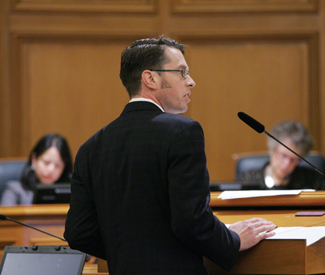
When Mayor Ed Lee suspended Sheriff Ross Mirkarimi in March, he publicly took the position that it was an act of official misconduct when Mirkarimi grabbed his wife’s arm during a Dec. 31 argument, subsequently pleaded guilty to false imprisonment, and was placed on probation for three years.

Lee and his allies said that under those conditions, Mirkarimi could no longer effectively function as the city’s top elected law enforcement officer and that his actions clearly violated the City Charter’s ban on "conduct that falls below the standard of decency, good faith and right action impliedly required of all public officers."

The City Attorney’s Office, through deputies Peter Keith and Sherri Kaiser, has maintained that position throughout the investigation and Ethics Commission proceedings over the last five months. On August 16, on a 4-1 vote, the commission agreed and recommend the Board of Supervisors find its former colleague guilty of official misconduct, which would almost certainly result in his removal from office.

But that simple set of facts and interpretations belies the ugly spectacle that Lee and the City Attorney’s Office actually decided to create — at great cost to taxpayers, Mirkarimi’s reputation, and the public’s faith in the proceedings — over the last five months.

Instead of sticking by their initial position, Lee and his attorneys decided to pile on a long list of other official misconduct charges: dissuading witnesses to his crime, impeding a police investigation, abusing his authority in several ways, engaging in a pattern of abuse of women, refusing to cooperate with a city investigation, lying to officers in a scheme to keep a gun, and other charges.

Almost all of those accusations were included in the original written charges that Lee filed on March 21 — before the city had actually begun its investigation to learn whether there was any evidence to support them. Keith and Kaiser continued to make all those accusations right up until the end.

When the Ethics Commission finally deliberated on August 16, going through each of the main factual allegations against Mirkarimi, one by one, it unanimously agreed that there wasn’t enough evidence to support any of those other charges, even using the "preponderance of evidence" standard that is lower than the "beyond reasonable doubt" standard used in criminal cases.

So in the end, the case against Mirkarimi ended at the same place where it began: with the question of whether pleading guilty to a misdemeanor act of domestic violence warrants the removal of an elected official. But the implications and repercussions of what has transpired over these last five months could be felt for many years, in ways that it’s impossible to predict today.

WHAT IS OFFICIAL MISCONDUCT?


With very few legal precedents to guide them, the commissioners spent most of the nine-hour hearing on Aug. 16 wrestling with how to interpret the city’s untested new official misconduct language, how directly the wrongful behavior must relate to the office, and whether broadly interpreting those two issues gives too much power to the mayor.

Underlying that discussion is the question of whether the statute and the city’s interpretation of it will eventually be struck down as unconstitutionally vague by the courts, which Mirkarimi will likely turn to if the board removes him from office. But the commission pointedly refused to enter that debate, with Commissioner Jamienne Studley saying, "I don’t think determining constitutionality is what I signed on for as a commissioner."

Chair Benedict Hur, the sole dissenter in recommending a finding of official misconduct, expressed far more concern about the precedent they were setting than with the fate of Mirkarimi, whose actions he strongly condemned as "clearly wrongful and unlawful."

"There has to be a direct relationship of the behavior to the office held," Hur said. "If we don’t find a nexus, we are opening this provision up to abuse down the road."

Commissioner Paul Renne led the charge in interpreting misconduct in the broadest possible way, arguing it didn’t even have to be related to his official duties. "There’s nothing in that clause that says the misconduct has to relate to the office," Renne said.

But Hur called that a "dangerous precedent," saying he has "grave concerns" about how such a broad interpretation could be applied in the future. "I have a lot of concerns about where you draw the line if you don’t relate it to official duties," he said.

For example, could members of the Board of Supervisors be removed after getting arrested at demonstrations — as has happened many times before in connections with labor and other disputes — or even for using colorful language with constituents or colleagues that might violate a future mayor’s "standard of decency?"

Mirkarimi attorney Shepherd Kopp said there’s a good reason why recall is the preferred means of removing an elected officials accused of wrongdoing, calling the charter "an imperfect document" that can’t cover all circumstances — indeed, it doesn’t allow for the removal of mayors, even those who commit serious crimes — noting that "this is a rarely brought proceeding and it can have the effect of contravening the will of the electorate."

"These proceedings," Kopp said, "are far too susceptible to the vagaries of politics."

THE PILE-ON


Lee’s decision to overcharge Mirkarimi could be a costly one. The City Attorney’s Office won’t release expenses associated with ongoing legal actions like this one, but most indications are that it will run into the millions of dollars, perhaps many millions depending on how Mirkarimi fares in the courts if he is removed and challenges the city’s actions.

According to the City Attorney’s Office, the official misconduct proceedings against former Sup. Ed Jew in 2007 cost the city $381,505 in legal fees, but that was a relatively short and simple proceeding, with just one Ethics Commission hearing and couple of state court appearances before the case was settled.

By contrast, the case against Mirkarimi has already entailed five months of detailed exchanges between the two sides’ attorneys, covering a wide array of legal issues, and months-long investigations of matters only tangentially related to the core charge. The city has paid out money for expert witness. Mayor Lee cast a wide net to catch the fish that he had already hooked before setting out to sea.

Even if the Jew case had played out to completion, it would likely have cost just a fraction of what Mirkarimi’s will, for a simple reason: Mayor Lee acted quickly and brought a broad array of charges before investigating them. Then-Mayor Gavin Newsom investigated whether Jew really lived in the city and then brought just that narrow charge.

The simple residency question was enough to warrant Jew’s removal, and Newsom didn’t even need to get into the far more serious corruption charges related to Jew being caught with $80,000 in marked bills as part of an FBI extortion sting, for which Jew is still serving a five-year term in federal prison.

Lee has refused to justify his decision to pile on the charges and introduce defamatory declarations unsupported by direct evidence, such as the long declaration of key witness Ivory Madison, most of which was stricken from the record after Commissioner Paul Renne called it "clearly hearsay, clearly having the intention of poisoning the well" and said "a first-year lawyer should know that much of it is inadmissible and it should not have been given to us."

Even though Keith apologized to Renne and the commission, Lee and his lawyers continued to defend much of that declaration and use it as the basis for many of their most incredible accusations.

"You received a great deal of evidence, most of it from the mayor and most of it unchallenged," Keith said in his closing statement, glossing over the multitude of challenges and the fact that most evidence doesn’t support the city’s charges.

Mayoral Press Secretary Christine Falvey wouldn’t address a list of Guardian questions about overcharging the case and continuing to rely on discredited evidence. Instead, the Mayor’s Office stands by this Aug. 16 prepared statement: "I am pleased that the members of the Ethics Commission, following a careful review of the evidence, and in the face of a sustained campaign to distract and misdirect them from the facts, agreed with me that Ross Mirkarimi’s actions constitute official misconduct and fall below the ethical conduct we expect of the sheriff."

City Attorney’s Office spokesperson Matt Dorsey said his office also stands by the process: "We respect Ethics Commissioners’ differing opinions about the remaining counts. But nothing about the commission’s conclusions would cause us to pursue these charges of official misconduct differently if we had to do it over again."

But Mirkarimi’s team says it is Lee who has repeatedly sought to distract and misdirect the public, whether through unsubstantiated claims in his charging documents or Lee’s public statements that Mirkarimi "beats his wife" and other comments that blow a single arm-grab out of proportion.

"What the commission has effectively done is agreed with us that’s the only issue," Mirkarimi attorney David Waggoner told reporters after the hearing, noting that he had offered to stipulate to those facts from the beginning and avoid a prosecution that his closing brief deemed "a dog and pony show." Mirkarimi also told reporters that "the piling on of these charges has weighted us down" and complicated his defense. He added, "I leave this process concerned that the will of the voters is being undermined."

THE PRICE OF OVERKILL


Perhaps it was understandable for the city to use over-the-top tactics on Mirkarimi, who has certainly been weakened by proceedings that generated reams of fodder to be used against him in future elections if he survives the board’s removal vote. But the tactic also seems to have hardened the stance of Mirkarimi’s supporters and fed their conviction that this was a politically motivated prosecution and misuse of public resources.

During more than three hours of public testimony on Aug. 16, with each speaker strictly limited to less than two minutes each, speakers overwhelmingly favored Mirkarimi and condemned the city case as overkill.

"Some of the things done in this case, and the levels this has gone to, is outrageous," said Brenda Barros, who works in the city’s public health clinic and said these resources could be better applied to help the "seriously abused women" she works with. Barros called the city’s case "a political witch hunt."

"I think Mayor Lee has overstepped his boundaries and I think you should find that as well," said Pedro Fernandez, a private investigator and former San Francisco Police officer.

David Elliott Lewis, a member of the city’s Mental Health Board, noted that the Sheriff’s Department has no civilian oversight, making the role of an elected sheriff who is progressive and independent of the city’s good-old-boy police culture all the more important. "Those who claim otherwise are really politically motivated," he said.

One issue left unresolved by the Ethics Commission is whether Mirkarimi should be removed even though the case against him was substantially whittled down. In fact, several commissioners indicated during the hearing that they thought the findings and punishment were separate issues.

"Do you agree that it is a two-step process we have to deal with?" Renne asked Keith, referring to the official misconduct finding and whether Lee abused his discretion by removing Mirkarimi.

"There is a determination of, are the consequences appropriate to the wrongful action," Keith replied.

But later, when attorney Scott Emblidge — who is volunteering his legal services to both the Ethics Commission and Board of Supervisors on this case — offered his interpretation that the charter language requires removal of officials found to have committed official misconduct, the commission accepted that and opted not to consider recommending a lesser punishment to the Board of Supervisors.

Mirkarimi’s team objected to the commission’s rewriting of new charges based on its evidentiary findings, and things got so confusing by the end that the commission decided to meet one more time in early September to finalize its recommendation.

So the case probably won’t get to the board until mid-September. Nine votes are required to remove Mirkarimi and the charter requires the board act within 30 days, meaning that final vote will be just a few weeks before the Nov. 6 election, timing that will only increase perceptions that politics will largely determine its outcome.

Alerts

0

WEDNESDAY 22

Lockout ruling victory march Castlewood Country Club, 707 Country Club Circle, Pleasanton; www.endthelockout.org. 5-6pm, free. Castlewood Country Club workers have been out of work and replaced by low-paid, non-union workers for two years. They haven’t stopped fighting to get their jobs back, and on Aug. 17, the National Labor Relations Board ruled that the lockout is illegal and Castlewood Country Club must reinstate their jobs. Come march for victory for the workers. Also, come march for support on the road ahead, as the country club will likely appeal or delay the process.

FRIDAY 24

Heal the Streets graduation celebration Nile Hall, Preservation Park, 668 13th St., Oakl; www.ellabakercenter.org. 5-7pm, free. "If we truly want to address violence, we must engage youth impacted by it so they can heal, have positive alternatives, and take action." That’s the philosophy of the Ella Baker Center’s Heal the Streets program, where young people spend 10 months in theater workshops and conversation, coming up with practical and creative ideas. Friday, they will be graduating from the program, presenting their theater piece and their findings. Come celebrate with them.

SATURDAY 25

American Indian market and pow wow 56 Julian, SF; www.friendshiphousesf.org. 10am-6pm, free. This eighth annual street festival features a pow wow, dance, hand drum contest and dance contests (both with cash prizes), and vendor booths with arts and crafts and food. In 1953, Congress passed a resolution to seize more than a million acres of American Indian land. This resulted in massive displacement and movement of Native Americans to major cities, including the Bay Area. To provide support and a community center, Friendship House was founded in San Francisco. Now, it still provides several programs, including this annual street festival.

SUNDAY 26

National day of action for women’s rights 24th and Mission, SF; www.defendwomensright.org. 12pm, free. On this day in 1920, the 19th Amendment passed, finally giving women the right to vote. This year, attacks on women spread throughout the country. The day before the Republican and Democratic national conventions, protests will be held in several cities nationwide to show that the people will not tolerate attacks on reproductive rights. Women Organized to Resist and Defend asked dozens of women why they will be marching, and the answers, shown in photos on their website, range from "to shut down sexual assault" to "women’s health is not secondary" to "ICE and homeland security perpetuate violence against women." Will you march?

Shifts in feminism in Japan’s anti-nuke movement Omiiroo Gallery, 400 Franklin, Oakl; nonukesaction.wordpress.com. 6pm, free. After the Fukushima nuclear disaster last year, a movement of Japanese parents who no longer trusted the government’s word that the nuclear industry was safe took root. Parents formed study groups on radiation and used their own Geiger counters at home and at their children’s schools. Mari Matsumoto, a Tokyo writer who was in the middle of it, focuses on feminism and reproductive labor in the context of nuclear radiation. She will be speaking at this event, along with a screening of the film "How nukes got to Japan." The event is a potluck, and seating is available, but organizers recommend you bring a pillow to sit on the floor in case it runs out.

MONDAY 27

Eyewitness from Tahrir Square Audre Lorde Room, The Women’s Building, 3543 18th St., SF; www.occupyforumsf.org. 6pm, free. Gihan Abou Zeid had years of experience working to end violence against women and coordinating with various UN efforts before she became involved in the Egyptian Revolution. She has since helped to found Mayadin Al-Tahrir (Liberation Places), an effort to bring the liberation that was found in Tahrir Square to new places all over Egypt. After the successful ousting of Hosni Mubarak, many women have continued to protest sexual assaults and other violence. Zeid will speak on women’s experiences in the revolution and the ongoing fight for gender justice.

What will Jerry do?

14

A few good bills have emerged from the madness of the end of the Legislative session in Sacramento — including measures by Assemblymember Tom Ammiano and Sen. Leland Yee — and now we have to wait for the governor, who isn’t thinking much beyond Prop. 30.

Jerry’s always odd and unpredictable, but this year, I’m told, he’s focused almost entirely on getting his tax measure approved. He’s told everyone in the state how much everything will suck if we don’t vote Yes, and he’s made it something of a referendum on his leadership. If it goes down, he’s facing almost unthinkable cuts to education and public services — cuts that will make him hugely unpopular. When class sizes go up and UC rejects qualified students and cops get laid off, the voters won’t blame themselves for rejecting Prop. 30; they’ll blame the guv. And Jerry knows it.

So he’s gone all in on this one — and he’s viewing everything he does, including every bill he might sign, through that lens.

Which leaves some very worth legislation up in the air — or rather, since it’s Jerry Brown, up in the ozone.

Ammiano managed to win approval for a measure that would allow the news media to interview inmates in state prisons — something that the California Department of Corrections and Rehabilitation has blocked since 1996. Right now, the only way reporters get access to the inside of prisons is on special tours that CDCR sets up — and the jailers get to decide which “random” inmates can talk to the press. It’s pretty basic — In San Francisco, the Sheriff’s Department allows reporters to talk to any prisoner who consents to an interview, and nothing bad has happened. We spend so many billions of dollars on prisons, and we know so little about where it goes. Even the prison guard’s union (Jerry’s BFFs) supports this. Jerry? Who knows.

Another Ammiano bill, AB 889, would require that domestic workers (people who do child care, housecleaning etc.) get basic labor rights, including lunch breaks and overtime. Seems like a no-brainer (and no, it doesn’t apply to your casual high-school babysitter). Lots of support, and it’s hard to see what this has to do with tax policy, but nobody’s sure about the guv.

And everyone’s really unsure what will happen with Sen. Leland Yee’s latest attempt to give juveniles who are sentenced to life without parole at least some opportunity to get out of prison before they die. SB 9 is pretty moderate — it states that a person convicted of a crime as a youth who has already served 15 (FIFTEEN) years can petition a court to reduce the sentence to 25 (TWENTY FIVE) years. Nobody’s getting out without serving some long, hard time, but since someone who is an accessory to murder at 15 almost certainly doesn’t have the brain development of an adult, and no other industrialized nation in the world allows LWOP for anyone under 18, and since there are only 300 people in the who state prison system who would be eligible for sentence changes under this law, I can’t imagine anyone opposing it. Seriously, Jerry. Can you veto something like this? The Jesuits would go batty.


Country Country Club workers plan picket after step towards victory

0

Workers at Castlewood Country Club in Pleasanton, represented by UNITE HERE Local 2850, received a favorable decision from Administrative Law Judge Clifford Anderson of the National Labor Relations Board on Monday. He found that the club owes all 61 union workers two years of back pay– and their jobs back.

“For the workers it feels like a relief to be believed in some way,” said Local 2850 organizer Sarah Norr. “The workers have been saying for two years that Castlewood was not really trying to reach a compromise.”

The food service workers and janitors of Local 2850 at Castlewood haven’t worked in two years. Instead, they picket the club and march. But they’re not on strike– they would love to go back to work. They’re on lockout.

In Feb. 2010, the club tried to hike up their health care costs, significantly increase the hours per week that would be considered full-time, and cut pay. After heated negotiations, the club refused to allow workers to return to their jobs and hired non-union replacements.

Negotiations have continued since, but according to Norr, they haven’t been productive. In Aug. 2010 the management presented a new set of proposals, which Norr called worst than the first. It would have allowed for the club to keep on the temporary workers that had replaced the union workers during the lockout and do away with seniority in scheduling and layoffs, as well as allowed for increased subcontracting. That was when the union filed a complaint with the NLRB.

In Aug. 2011, the General Counsel of the NLRB issued a decision that there was sufficient evidence to prosecute Castlewood for violating federal labor law. After hearing nine days of testimony for various stakeholders on both sides, Judge Anderson ruled that the alleged violations had occured.

He found that the lockout was illegal, and recommended that the NLRB order Castlewood to reinstate the locked-out workers and pay them two years of back wages and benefits.

Jerry Olson, Castlewood Country Club’s general manager, told us that the club hasn’t decided yet if they will be complying with the judge’s order.

“We just received the ruling today in the mail, and we’re considering all our options,” Olson said Aug. 21. “We certainly respect the administrative law judge.”

“We were surprised,” said Olson. “We expected to win the case.”

“It’s important for folks to understand that this doesn’t guarantee that its all over,” Norr said. “Castlewood does have the option of asking for a review of the case from the NLRB in Washington, DC.” Such a review could take years, prolonging the lockout but also increasing the amount of back pay the club would need to pay if they lose.

Workers plan to picket the club Aug. 22 at 5pm, celebrating their victory and demanding that the club comply.

“We’re thrilled about the decision, but we know we could still have a long fight in front of us,” said Castlewood janitor Francisca Carranza in a press release. “We’ll be here for as long as it takes to get our jobs back and win a fair contract with health care for our kids. We know people in the community will stand behind us, just like they always have over the past two years.”

The end of work as we know it

21

I read Player Piano in high school, when all of us were suburban kids were discovering Vonnegut. (We were also discovering Herman Hesse, for reasons I will never understand, and we talked about Slaughterhouse Five and The Glass Bead Game as if we were some sort of intellectuals. I read a couple of the Hesse books and found them dry and pointless. I loved Vonnegut, particularly God Bless You Mr. Rosewater.)

At any rate, even in the 1970s, Player Piano didn’t seem that far away, and it was one of the formative books of my crazy political consciouness of the time, and it got me thinking, years later, about unemployment. When I was first out in San Francisco, all of my friends were busy — and not many of them were working for pay at a traditional job. And I thought, as the nation went into a deep recession and everyone talked about creating jobs, that what people really needed was money, not jobs. For almost everyone I knew — people involved in politics and art and theater and writing and troublemaking — a job was just a way to pay the rent. And if we didn’t have to work to make ends meet, so much the better. We all had a lot to do, much of which would never earn us any money; get rid of the damn jobs and we could do it all a lot better.

Yes, as Vonnegut made very clear, people got, and get, a lot of their self-worth from what they do for a living, particularly if it’s skilled work. But maybe that’s not the way it always ought to be — particularly if the day when robots take over almost all manufacturing is rapidly approaching.

John Markoff of the New York Times has a mind-bending piece about robots taking over jobs that even a few years ago were too complicated to be done by machines:

 The falling costs and growing sophistication of robots have touched off a renewed debate among economists and technologists over how quickly jobs will be lost. This year, Erik Brynjolfsson and Andrew McAfee, economists at the Massachusetts Institute of Technology, made the case for a rapid transformation. “The pace and scale of this encroachment into human skills is relatively recent and has profound economic implications,” they wrote in their book, “Race Against the Machine.” In their minds, the advent of low-cost automation foretells changes on the scale of the revolution in agricultural technology over the last century, when farming employment in the United States fell from 40 percent of the work force to about 2 percent today. The analogy is not only to the industrialization of agriculture but also to the electrification of manufacturing in the past century, Mr. McAfee argues.

The “debate” can go on as long as you want, but the reality is that a lot of what we now call “work” will soon be done by machines — sooner than a lot of us think — and that will mean, if nothing else changes, a nightmarish society where the gap between the rich and poor is even worse and the middle class is in a free-fall collapse. Consider:

In one example, a robotic manufacturing system initially cost $250,000 and replaced two machine operators, each earning $50,000 a year. Over the 15-year life of the system, the machines yielded $3.5 million in labor and productivity savings.

So who gets that $3.5 million? Not to be all Marxist or anything, (heaven forbid), but right now, under modern industrial capitalism, none of it goes to the displaced workers. In theory, the robots could allow them to do something else with their lives — teach, or mentor kids, or paint, or learn to speak a couple new languages, or build a new house to retire in, or whatever. The robots don’t need to be paid, and that “productivity savings” could go directly to the wealth of society as a whole, making life better for all of us. But it won’t — the whole $3.5 million is kept by the factory owner, and the displaced worker gets nothing — except depression, a lower standard of living, and the opportunity to scramble for a job that takes less skill and pays less.

If we’re going to survive as a stable society, two things are going to have to happen. We’re going to have to accept that “work” in the traditional sense is not going to be the only, or even main, source of people’s income — and that’s okay. And the only way that’s going to work is if we mandate that the saving from more efficient technology go to everyone, not just the elite.

Pretty radical shit, huh? I must be out of my mind. Kind of like that ol’ Commie Kurt was in 1952, when he saw this coming.


Dick Meister: The billionaire’s bill of rights

8

By Dick Meister

Dick Meister, former labor editor of the SF Chronicle and KQED-TV Newsroom, has covered labor and politics for more than a half-century. Contact him through his website, www.dickmeister, which includes more than 350 of his columns.

Billionaire corporate interests and other well financed anti-labor forces are waging a major drive to stifle the political voice of workers and their unions in California that is certain to spread nationwide if not stopped – and stopped now.

At issue is a highly deceptive measure, Proposition 32, on the November election ballot, that its anti-labor sponsors label as an even-handed attempt to limit campaign spending. But actually, it would limit – and severely – only the spending of unions while leaving corporations and other moneyed special interests free to spend as much as they like.

Unions would be prohibited from making political contributions with money collected from voluntary paycheck deductions authorized by their members, which is the main source of union political funds.

 But there would be no limits on corporations, whose political funds come from their profits, their customers or suppliers and the contributions of corporate executives. Nor would there be any limit on the political spending of the executives or any other wealthy individuals. What’s more, corporate special interests and billionaires could still give unlimited millions to secretive “Super PACs” that can raise unlimited amounts of money anonymously to finance their political campaigns.

The proposition would have a “devastating impact” on unions, notes Professor John Logan, director of labor and employment studies at San Francisco State University, writing in  the Hill’s Congress blog.  As he says, it would likely all but eliminate political spending by unions while greatly increasing political spending by business interests and wealthy individuals.

 Anti-labor interests are already outspending unions nationwide by a ratio of more than $15 for every $1 spent by unions. Between 2000 and 2011, that amounted to  $700 million spent by anti-labor forces, while unions spent just a little more than $284 million.

 Proposition 32 would even restrict unions in their communications with their own members on political issues. That’s because money raised by payroll deductions pays for the preparation and mailing of communications to union members, including political materials.

Unfortunately, there’s even more – much more –to Proposition 32. It also would prohibit unions from making contributions to political parties and defines public employee unions as “government contractors” that would be forbidden from attempting to influence any government agency with whom they have a contract.

That restriction applies not only to unions. It also would cover political action committees established by any membership organization,  “any agency or employee representation committee or plan,” such as those seeking stronger civil rights or environmental protections.

Proposition 32 seeks to weaken, that is, any membership group which might seek reforms opposed by wealthy individuals or corporations and their Republican allies.  It’s no wonder the measure is actively opposed, not only by organized labor, but also by the country’s leading good-government groups, including Common Cause and the League of Women Voters.

Yet the proposition’s sponsors have the incredible gall to bill their measure as genuine campaign finance reform. They obviously hope that claim, which Common Cause accurately describes as a “laughable deception,” will win over the many voters who have been demanding reforms and who, in their eagerness, will fail to recognize the measure’s true nature.

“This is not genuine campaign finance reform,” as San Francisco State’s John Logan says, “but a bill of rights for billionaires.”

The losers would include teachers, nurses, police, firefighters and other union members and those who benefit from the essential services they provide – students, the elderly, and the ailing, the poverty stricken, those who work and live in unsafe conditions and other needy citizens, and consumers, environmentalists and others who also are neglected by the profit-chasing corporate interests that dominate political and economic life.

Make no mistake: Lots of money is being funneled into the Proposition 32 campaign by some of the same wealthy backers who bankrolled such anti-labor efforts as the campaign that blocked the massive attempt to recall virulently anti-labor GOP Gov. Scott Walker of Wisconsin this year.

Should the anti-union forces also prevail, it will undoubtedly lead to what Logan says “will promote a tsunami of ballot initiatives in 2013 at the local level and in 2014 at the state level designed to drive down working conditions in both the public and private sectors.”

Logan adds, “Lacking the ability to oppose these reactionary measures under the new election rules, California’s workers could soon face the weakest labor standards in the country”. But if the measure is rejected, it “may slow the momentum behind other attempts to increase the corrosive impact of money in politics.”

It’s true that some states already have laws and regulations seriously limiting labor’s influence. But it’s certain that victory by the anti-labor forces in California will slow any attempts at reform in other states and lead as well to attempts to impose anti-union measures elsewhere, as well as expanding those that already exist.

The stakes are huge. If the 1 percent have their way in California, the country’s largest state, other states are certain to follow.

For more from John Logan, check his piece in the East Bay Express, “If you liked Citizen United, you’ll love Prop 32.” http://www.eastbayexpress.com/ebx/if-you-liked-citizens-united-youll-love-prop-32/Content?oid=330613

Dick Meister, former labor editor of the SF Chronicle and KQED-TV Newsroom, has covered labor and politics for more than a half-century. Contact him through his website, www.dickmeister, which includes more than 350 of his columns.

Off the walls

3

arts@sfbg.com

VISUAL ART As the Cindy Sherman retrospective draws huge crowds to the San Francisco Museum of Modern Art’s fourth floor, visitors will find it the gateway drug par excellence for a neighboring show just a few steps away. Taking in Sherman’s frozen drag — in which visual art harnesses performance as both subject and tactic — is already to broach the invigorating dialogue underway in “Stage Presence: Theatricality in Art and Media.”

>>Drag artists re-enact Cindy Sherman portraits: view our “Tastes of Cindy” photo essay

The eclectic group show, curated by SFMOMA’s Rudolf Frieling, gathers choice pieces from the museum’s collection, plus some vital loans, to consider the increasing role of theatricality as theme and strategy in contemporary art since the 1980s.

It further includes a “live art” component courtesy of the museum’s curator of public programs, Frank Smigiel — a weekly performance series that continues through Labor Day weekend in a commissioned space adjacent to the gallery, a lush little jewel box of a theater-cinema designed by Bay Area artist Tucker Nichols. This week’s performance piece is a highly anticipated appearance by Los Angeles-based troupe My Barbarian: Broke People’s Baroque Peoples’ Theater, a raucous, multi-layered work that figures the American financial system as a garishly absurd spectacle of waste. (In addition to this site-specific series, a performance finale takes place October 4 in the museum’s atrium: Rashaad Newsome’s Shade Compositions, a choreographed choral work for 20 women of color.)

Whether live or otherwise, the bridging of the visual and performing arts in “Stage Presence” encompasses a truly wide range of work. Highlights include some fascinating projected pieces on view in one or another of the floor’s darkened recesses — each one furnished with a glass window allowing visual access from the gallery proper, whether or not one wants to venture into the screening room.

One of these is Charles Atlas’s Hail the New Puritan (1986), which collapses the visual and performing arts by way of a made-for-BBC faux-documentary portrait of Scottish dancer-choreographer Michael Clark, supposedly captured over the course of one monumental but half-desultory day as he and his company rehearse his New Puritan (1984). With endless interruptions and segues — and a soundtrack sharpened by ample doses of post punk’s jolly downers, the Fall (whose Mark E. Smith and Brix Smith even appear in a staged TV “interview” with Clark) — Hail the New Puritan remains a gorgeous work whose ’80s-era aesthetic (a little like Godard meets Culture Club) retains a questioning and mocking insouciance.

http://www.youtube.com/watch?v=PLm0tgyH4cc

It’s such jubilant indifference, including toward previous standards of seriousness or taste, that has contributed to a significant turn in much new work in the 1980s. Frieling, in an email correspondence from Europe, describes it as “a moment where the historic era of performance art and conceptualism had been challenged by a more exuberant, playful, and hybrid way of working — Charles Atlas, Peter Fischli and David Weiss, or Robert Wilson [all represented in the show] being three examples from that time despite their huge differences.”

Other salient themes running through the show explore the conceptual and practical possibilities in rehearsal, reenactment, and the speech act. To this end, the installation Today Is Not a Dress Rehearsal — which repurposes video of a Judith Butler lecture and other materials from an eponymous three-day collaborative performance by Mika Tajima (with her group New Humans) and Charles Atlas in the museum’s atrium in 2009 — offers subtle food for thought amid a visual and aural repositioning of a privileged form of address.

Also intriguing along similar lines is Sharon Hayes’s restrained yet progressively enthralling four channel video work, Symbionese Liberation Army (SLA) Screeds #13, 16, 20, & 29 (2003). In each of four television screens fixed with audio headphones, viewers see and hear the artist reciting from memory each of Patty Hearst’s four video messages to her parents while a hostage of the SLA in 1974, with prompting from an unseen audience each time she veers even slightly from the script. It becomes, especially in the era of Occupy, a resonant occasion for a collective act of remembering as well as re-presenting, re-creating, resituating, and reformulating an iconic but elusive link to a radical past.

“Rethinking formats of presentation is a key to many of the works and the whole show,” says Frieling. “We were ultimately interested in art works that stress this open process while reflecting about the conscious act of staging.” *

“STAGE PRESENCE: THEATRICALITY IN ART AND MEDIA”

Through Oct. 8, $11-$18

San Francisco Museum of Modern Art

151 Third St., SF

www.sfmoma.org


Creating activist scholars: extended interview with Andrej Grubacic

16

For this week’s paper, we talked with with Andrej Grubacic, the new head of the anthropology department at the California Institute for Integral Studies. Here’s the extended interview with Grubacic, where he talks more about the new Anthropology and Social Change program, as well as the history of anarchist schools, how his grandmother influenced his politics growing up in Yugoslavia, and the state of the occupy movement.

San Francisco Bay Guardian: What’s the structure of the new program going to look like?

Andrej Grubacic: It’s going to be called Anthropology and Social Change, and we have two levels. One is MA, the other is PhD. Philosophically speaking and politically speaking, in the age of occupy and all of these movements, the great question for me was how to organize a department that’s actually going to be useful for all of these social struggles and that activism that’s happening outside of education. I’ve been in academia as a scholar-activist for a long time. And what I’ve discovered is the most painful thing in my experience is the separation. The fact of actual separation between the grassroots knowledges, produced outside of the academia, and academic knowledge produced within the universities. So the best things, the way that I was thinking about this was that what we should do on both levels, MA and PhD, is to construct a space of translation of different knowledge. So to put these two knowledges, one produced outside of academia and the other produced in the university, in dialogue.

So we have Boots Riley for example, he’s going to be teaching community organizing, or organizing for social justice. Then we’re going to have Sasha Lilley teaching an eminently practical course on how to create and produce radical radio. So you’re going to get activist media skills. Then we’re going to have a few other people teaching also different skills, and knowledge that’s inspired by art, bringing artists in, and knowledge that’s inspired by people who are thinking about social theory and social emancipation. We’re going to create something really exciting. 

SFBG: Do you think the students who attend are going to be the same kind of mix of academics, artists, activists, and people who want to organize within their own communities here in San Francisco?

AG: I think so. That’s the idea. The idea is to make this department work for the students, but also for the people in San Francisco Bay Area. And we can do that by bringing students who are interested in local work, and I think that’s going to be a pretty amazing. If we are of course able to do things right, but I think that we will be. So Chris Carlsson for example, he’s going to be teaching labor and ecological history of San Francisco, so a very local topic. We’re going to be teaching courses on activist ethnography, and activist ethnography is the center for the whole program, which is how can we relate to community– and this is where we’re also using the term integral– in an integral way? Meaning how do we integrate community into every step of the research process? And the traditional anthropology, as you probably know, is all about participant observation. We would like to have instead observant participants. People who are involved with the communities. People who are trying to dissolve the distinction between the researcher, between who’s on the outside, and who’s on the inside. And they’re creating something together. 

SFBG: I saw when you spoke at the University of the Commons launch. You were talking about how there’s a wave of radical activity going on at schools throughout the world.

AG: Oh yeah.

SFBG: This is obviously very different, because this is an institution putting out something radical, but do you think it fits into that trend right now?

AG: I think it does. Because if you know my biography, I’ve been travelling through all of these experiences in schools for many many years now. I had to leave Yugoslavia where I’m from because of my oppositional political activity and, you know, I finally arrived here to work at New College of California which was also a private institution, and I was very inspired by the department of Activism and Social Change, and I completely fell in love with the history of radical schools in San Francisco. Now I don’t know how much you know about them, but they’re, like, great stuff. There was a liberation school, there were Black Panther schools, of course. There is a great history of alternative schools and experiments. So New College was a private institution, but still, many of my activist friends, who became friends later, have actually been through New College and they got their MA s in activism and social change or media studies. So CIIS actually took many of these people, many of the professors from these programs, and invited them here. So in a certain sense, I think what was done in terms of Activism and Social Change, and orientation to social justice and emancipation, was that at New College we are still keeping that spirit alive. But, in communication- and I think this is the crucial thing for our department- we are doing this in communication with radical educational experiments, movement-based experiments from all over the world. Manolo Callahan, who is going to be teaching here next semester, he is one of the people involved in University of the Earth- Universidad de la Tierra in Oaxaca and in Chiapas, so we are creating relationships with them. Which you know are completely radical experiences outside of institutions, they call themselves deprofessionalized intellectuals. We have already relationships with the Activism and Social Change department in Leeds, in England, they have a great school there. With people in Brazil, the landless workers movements. We’re in touch with people from Ecuador and people form Bolivia. So it’s a whole network of educational, tendency of educational experiences that this department is now creating.

SFBG: Do you have economics courses here?

AG: Yeah.

SFBG: So are there classes that are non-capitalist economics?

AG: Yes, it’s called radical political economy. We are trying to understand political economy from a feminist perspective, from an anarchist perspective, from a post-colonialist- so in that sense we are engaging multiple emancipatory frameworks of understanding social reality. So I myself, I come from the anarchist experience in social science, in politics. We have people who are feminists- Roxanne Dunbar-Ortiz for example. She’s sort of a legend in San Francisco Bay Area and she’s teaching three courses. Roxane Dunbar-Ortiz is going to be teaching about Native American struggles. As it pains me to say, that kind of a focus is mostly missing not only in private but also in public universities now. 

SFBG: So could you tell me a little more about the anarchist background you come from?

AG: I became an anarchist fairly early on, I was 13 or something. Because I was living in Yugoslavia. At that time, Yugoslavia was a socialist state. And because it was a socialist state for me it was a very interesting place to grow up, because you see socialism, real existing socialism, and you see many things that are beautiful about socialism. But you also see many things that are not so beautiful. And I was thinking about the alternatives to it. And for me it was really, sounds cheesy, but a conversation with my grandmother that decided it. She was a communist; she was a Yugoslav revolutionary communist. And Yugoslavia was falling apart, Yugoslavia was in a series of really brutal ethnic wars back in the 90s, and my grandmother, this lifelong communist, told me– my question was, are you still a communist? Do you still believe in communism in the context of this country falling apart? And she said yes, I do, I think that we have chosen a path to communism that was wrong. But I think the responsibility of your generation is to find a different path. The ideal is OK, the ideal is good. It’s a different path that you’re generation needs to find, and you have a great responsibility to do so. And the alternative that I discovered that seemed to me, back when I was 13 years old, and it still does, rational– as an alternative to the Marxist-Leninst way of getting from here to there, right– is anarchism. So for me anarchism, or libertarian socialism is another name that people are using, is a way of organizing for social justice and creating an egalitarian system that takes democracy very seriously. It’s like democracy without a state. 

SFBG: What happened that made you leave Yugoslavia?

AG: I was raised a Yugoslav. So I was raised to be a citizen of a country that doesn’t exist anymore. And on one hand, you had people who were Serbian nationalists, and I couldn’t really get along with those. On the other hand you had people who were neoliberal capitalists, who thought that everything coming from Europe and the United States was great and I couldn’t really agree with those either. And being a young academic, I was a historian at the time and working within the university, there was a great deal of pressure to get me out of the university. So it became very unpleasant. So I already had a relationship with Noam Chomsky, and Chomsky was following everything that was happening to me in Yugoslavia. And he told me at some point OK, it’s time for you to go. So he got me out of Yugoslavia, moved me to the United States or helped me move to the United States, introduced me to a man whose name is Immanuel Wallerstein, a great, amazing sociologist, who helped me get to his program at the Center for the Study of Economics, Historical Systems, and Civilization at SUNY-Binghamton to finish my graduate studies. So that was a– it was a long journey. 

Let’s just say that it was an active disagreement with the political class active at that time in Yugoslav-Serbia. It was actually funnily enough still called Yugoslavia. We only had two countries of the former Yugoslavia, Serbia and Montenegro. But the political cultures and political groups in power were either Serbian nationalists or these hyper-capitalists, right. And going after them, because I was publishing and I was doing a lot of things, was– let’s say, not smart career choice. But it made it possible for me to meet people like Chomsky and some other people. And they liked what I was doing and they were concerned that, for health reasons, United States might be a better environment.

SFBG: Even within these more welcoming academic environments, do you feel your activism or anarchism is stifled in some way?

AG: I had a bad experience here at one university, a local university here in San Francisco, and it wasn’t a good experience. That felt unpleasant and it felt very stifling. CIIS is very different. Actually this is the first place where I think that I was hired because I was an anarchist, or I am an anarchist. It’s kind of funny. But in other places, in Yugoslavia and there was another institution here, I had problems because of my politics. Here, that was exactly the reason I was hired. So it gives you an idea that the school is very different than most other universities. 

SFBG: Could there be such a thing as an anarchist school?

AG: I hope University of the Commons can become something like an anarchist school. Anarchist schools actually used to exist. And they still exist. But the really big one was Francisco Ferrer in Spain. It was called Modern School. It was created in 1904. It became so huge– especially after Francisco Ferrer was killed by the Spanish state in 1909- that there were 60 schools only in Spain and there were I don’t know how many schools in the United States but the last one closed only in 1958 in New Jersey. Modern Schools were amazing places. One could also argue that Yasnaya Polyana of Leo Tolstoy was also an anarchist school. It was in many ways. 

But anarchist schools were schools where you had a few elements. Integral education was number one. Education of the whole person. You don’t only educate somebody as an intellectual but you aim at education of the whole person. The other thing was something that anarchists called reality of the encounter. Which means that all the questions in pedagogical practice needs to come from real questions posed by life itself. So you need to do something that’s practical. Another thing was the complementary role of the teacher, which means the teacher needs to be a facilitator who listens and who offers something in return. But the first thing, the first kind of show of interest, comes from the student. So the role of the teacher is complementary. Another huge thing was something Proudhon called démoédie, or self-government of the school. So school becomes a place where you teach students arts of self-government and self-management. Schools are organized in the spirit of direct democracy. Another thing which was Paul Goodman, famous anarchist educator, his idea was to organize decentralized “teeny schools,” as he called them. So to have a small teaching environment. To have students go to the bank to be taught about mathematics, to go to a museum and then to teach them about geography, to do these things. And then the most important thing for anarchist schools on all levels is the idea of natural motivation and natural learning which was first formulated by Tolstoy. The idea is the students have this natural motivation to learn. And what you do is basically you create an environment where that kind of learning becomes possible. And another thing for anarchist schools was the idea of spontaneous order. So there is no imposed order by the teacher, but there is a spontaneous order that the students themselves discover. In other words, discipline is– I think this is Tolstoy’s, the word that he used– discipline is being discovered, not imposed. What would that mean for a university is a different question. I think the one obvious thing would be that everybody, students and professors, there needs to be a horizontal relationship between them. There needs to be an atmosphere of collective production of knowledge in the classroom. There cannot be a curriculum that’s linear. It needs to be dialogical, it needs to be participatory, you need to talk about this and co-create a syllabus. You need to be as horizontal and participatory as possible. You need to be as imaginative as possible in diminishing your own role as a teacher, which is a very tricky thing, without becoming a populist in the classroom, you know. Empowering students, and finding appropriate structure together with students. Again we are coming back to the idea of listening. We need to listen to the students and together with them, create an atmosphere in the classroom that’s going to be genuinely transformative. 

SFBG: I’d love to ask you more about how this will relate to anarchism and occupy.

AG: In terms of anarchism, we are gonna have- this is going to be one of the few places where anarchism is going to be studied. So anarchist social theory, anarchist education, anarchist ideas in general. We are going to study them, seriously, because they need to be recognized seriously. They’re part of- it’s a beautiful history, it’s a beautiful tradition. How important it is, I think, is revealed, by the recent rediscovery or reinvention of anarchism at occupy. So I think that it’s more relevant than ever to create a space where anarchism will be studied. 

In terms of occupy, occupy is going through the process of fragmentation right now, and they are looking for a new political space of conversation I think. So the way that we can relate to occupy, I think, is to have our students participate in whatever different movements occupy helped. Because you know that occupy now how occupy patriarchy, there is decolonize, there are many different groups. So I expect our students to be involved in occupy, and I expect us to be able to offer a space where many of the debates related to occupy can happen. So, and you know there is an actual affinity. When Silvio Federici comes, or John Holloway, or Michael Hardt, or any of these people, these are the people that occupy people read, and these are some of the bibles of the occupy movement. So what are we going to do is, we are going to make them available and accessible to these people who come here, and we are going to bring here,  and we are going to take them to the occupy movements and we are going to invite people from the occupy movements to come here. But we are also going to do more I think. What we can do, and this is now only a plan an idea, is to invite the movement itself, not only occupy but different movements, and say, OK, please come here and tell us what would you like us to do. And one person from our department had this idea and I think it is brilliant. So to have the movement, different movements– is it food, is it the environment, is it one of the occupy-related movements- come here. We provide the space. And they tell us- social theorist, social scientists, people in the academia, they tell us what do they need us to do. It comes back to this idea of listening. So give a movement or movements a real possibility and opportunity to speak. Because usually academics, we are people who speak. Well we would like to see academics become people who actually listen. 

SFBG: I agree that occupy is basically an anarchist movement and a lot of the tenants of anarchism are being used in it. And I think this is a time when, in the mainstream, people are talking about anarchism more. But for a lot of people it has the image of people who wear black and smash stuff. So I’m curious, how does black bloc, or property damage, relate to the anarchism that’s going to be studied in the department?

AG: It doesn’t relate at all. The anarchism that we are going to study is– in Katrina, the Common Ground collective. That for me is a great example. Common Ground collective is a relief group of activists who went there from all over the place, they went to New Orleans, they were all anarchists and they said OK, we don’t believe in charity, we believe in solidarity. And they built a common ground center and they did relief work with the community for a couple of years. And there is a new book about it by a person who actually came here and spoke, one of the New Orleans activists, Scott Crow. And this is the kind of anarchism I am myself inspired by, the constructive side, not the destructive side. So how to build alternatives in the present for people, what sometimes referred to as prefigurative politics. How to think about positive stuff, constructive stuff. Building alternatives that are going to be persuasive enough– not about breaking windows. I don’t see any particular point in breaking windows. And I think it’s an unfortunate thing that people would reduce anarchism to that. If you think about it, the most important public intellectuals in the United States, one of them recently died, Howard Zinn, and Noam Chomsky thankfully is still alive, they’re both anarchists. So this is the kind of anarchism that I subscribe to, and both of them were my mentors. And I studied with Howard. I studied with Noam, he was the chair of my PhD committee. So these are the people whose anarchism I take very seriously, and this is the kind of anarchism that I like. 

SFBG: But it’s hard to ignore organizing tactics.

AG: But even orgnanizing tactics– black bloc as a tactic comes from the autonomen movement in Germany, which was not an anarchist movement. It comes from the 80s. People dressed in black in Germany, you know, doing property destruction thinking that property destruction is going to contribute to the tactical efficiency of a particular action. Then it went through the environmental movement in particular places, in the environmental movement here in the United States. And it’s being used not only by anarchists, it’s being used by people who would call themselves communists, left, anti-state communists, by different varieties, autonomous Marxists. So it’s not only a tactic that anarchists use. And, you know, it’s a tactic. Anarchism is far broader. 

SFBG: Than just tactics.

AG: Yes. If you would ask me what is the most distinguishing, for me, character of anarchism I would say prefigurative politics– creating the new within the shell of the old—the idea of direct democracy, and the idea of direct action. Direct action being producing alternatives within the present, and direct democracy, behaving in the way that general assemblies are being set up. So that is I think the greatest lesson that anarchism can teach, direct democracy and direct action. 

SFBG: Occupy Oakland, they only had their camp for less than two months, but so much happned.

AG: They did great things. I really feel bad when I read mainstream media completely dismissing that experience. I was there, and the amount of work that went into keeping the medical facilities there, to helping homeless, feeding homeless, helping people with medicine, with immediate healthcare, taking care of children, creating children-friendly spaces, I mean it was amazing. Sure there were problems, of course there are going to be problems. But the stuff that people did there was just incredible. And the general strike, and shutting the port, and all of that, these were great things.

SFBG: And part of the reason the city started cracking down on it was when police tried to enter the space, people wouldn’t let them in.

AG: And they shouldn’t let them in, because the way police behave in Oakland was just outrageous.

This interview has been edited for length.

Dick Meister: Obama needs labor–again!

1

By Dick Meister

Dick Meister, former labor editor of the SF Chronicle and KQED-TV Newsroom, has covered labor and politics for more than a half-century. Contact him through his website, www.dickmeistersf.com, which includes more than 350 of his columns.

Organized labor, which played a major role in President Obama’s 2008 election campaign, thankfully has launched what seems certain to become an even greater and perhaps decisive effort in behalf of Obama’s re-election this year.

We should all be thankful for that, given the reactionary policies Mitt Romney and his Republican cohorts promise to put in place should they win, and the positive reforms Obama and the Democrats promise.

Four years ago, 250,000 AFL-CIO activists campaigned for Obama’s election. But the AFL-CIO says the number of union volunteers campaigning for Obama and his Democratic allies in Congress this year will reach at least 400,000, and be waged among union and non-union members alike.


That’s not an unrealistic expectation, considering what happened in 2008.  One-fifth of all voters that year were union members or in union households, and fully two-thirds of them supported Obama, and the ratio was even higher in so-called battleground states.

The AFL-CIO calculates that union volunteers knocked on some 10 million doors to make their pitch for Obama in 2008, handed out 27 million leaflets and mailed out 57 million more.  The number of union voters alone reached a record high of more than 3 million.

The AFL-CIO claims its campaign “made the difference in critical states.”  Maybe it did, maybe not. But it is clear that organized labor significantly influenced the vote everywhere – and undoubtedly will do so again.

The AFL-CIO is certainly not going to match the billions being spent on the campaigns of Romney and his big business allies. But labor has the ground troops that can and will spread the pro-Democratic and pro-labor message widely, however much unions are outspent.

It’s true enough that labor has been unhappy with Obama’s failure to deliver on many of the promises he made to unions during the 2008 campaign, primarily his failure to overcome Congressional opposition to pro-labor reforms he’s proposed or supported.

 But there’s no doubt Obama’s administration has been a pro-labor administration. Federal agencies dealing with collective bargaining, job safety and other labor matters have been labor-friendly, in sharp contrast to their clearly anti-labor positions under George Bush. What’s more, Obama has spoken out forcefully to the country in behalf of unions, their demands and their needs.

He’s urged passage of virtually every measure advocated by labor in Congress. That includes bills guaranteeing millions of Americans the right to unionization that has long been denied them, prohibiting employers from permanently replacing strikers, raising the minimum wage and indexing it to inflation so it would rise as the cost-of-living rises.  Bush rarely even uttered the word, “union, ” much less voiced any pro-union sentiments or support for such union-backed measures.

People on the political left continue to clamor for more from Obama, and they should. But they must realize he’s the best we can reasonably expect in today’s political and economic climate. Give him four more years and who knows?

Yes, Barack Obama is not Franklin Roosevelt.  But neither is he George Bush – nor Mitt Romney.

Dick Meister, former labor editor of the SF Chronicle and KQED-TV Newsroom, has covered labor and politics for more than a half-century. Contact him through his website, www.dickmeistersf.com, which includes more than 350 of his columns.

Creating activist scholars

13

yael@sfbg.com

This semester, the California Institute for Integral Studies (CIIS) will start a new Anthropology Department featuring teachers who are grassroots organizers with decades of experience, including Boots Riley, Roxane Dunbar-Ortiz, Sasha Lilley, and Chris Carlsson.

The program’s goal is to create “activist scholars,” to get students into communities outside the institution, and to use their research and intellectual opportunities at the school to move social justice projects forward. And the man who organized it all is an unrepentant anarchist.

“The most distinguishing character of anarchism for me is prefigurative politics — creating the new within the shell of the old,” Adrej Grubacic, the new department head, told us.

His classes come at a time when anarchism is being more widely discussed in the US than it has been for generations. Non-hierarchical general assemblies and consensus-based “direct democracy,” long practiced in anarchist and other leftist circles, swept across the country along with the Occupy movement last year.

Anarchists have been associated in the public eye with everything from spirit-fingered affirmations to the masked, black-clad protesters smashing bank windows and scrawling anti-corporate messages on walls. But Grubacic says it’s more than that.

As anarchism exploded into practice in Occupy’s tent cities, it was also experiencing a renaissance in the ivory tower. The North American Anarchist Studies Network was founded in November 2009, and since has brought together a growing number of professors who want to explore and teach anarchism through annual conferences.

Big names such as Yale Anthropology Professor James Scott have declared themselves anarchists. In a country where the study of economics is usually code for the study of capitalism, professors longing to talk alternatives are coming forward in droves.

It’s more than a little ironic that, within an ideology focused on a lack of hierarchy, it can be hard for those on the street to connect with those in the lecture halls. So how can the academic-types truly support The People?

From Zapatista schools in Mexico to universities run by the Landless Worker’s Movement in Brazil to popular universities throughout Canada and Europe, people all over the world have developed institutions based on anarchist and Marxist principles.

Now, in San Francisco, Grubacic is hoping to do the same.

A historian who was an anarchist by age 13, Grubacic grew up in socialist Yugoslavia, a country engulfed in brutal civil war by the time he reached his 20s.

“I was raised a Yugoslav,” Grubacic says. “So I was raised to be a citizen of a country that doesn’t exist anymore.”

He was teaching history at the University of Belgrade, but his political beliefs became a problem.

“The political cultures and political groups in power were either Serbian nationalists or these hyper-capitalists,” Grubacic told me. “And going after them, because I was publishing and I was doing a lot of things, was—let’s say, not a smart career choice.”

It was with input from his mentor, famed leftist writer and academic Noam Chomsky, that Grubacic left the crumbling Balkan state for his own safety. After a frustrating stint at University of San Francisco, he found CIIS.

“This is the first place where I think that I was hired because I was an anarchist, or I am an anarchist. It’s kind of funny,” Grubacic says.

Founded in 1968, CIIS grew out of the California Institute of Asian Studies, and has quietly taught holistic approaches to psychology and integrative approaches to psychology, spirituality and the humanities since then . Today 60 percent of CIIS students are studying clinical or counseling psychology. The Anthropology and Social Change program is part of the School of Consciousness and Transformation.

“It’s the only department like it in the United States,” Grubacic says. “This is going to be one of the few places where anarchism is going to be studied.”

“So anarchist social theory, anarchist education, anarchist ideas in general. We are going to study them, seriously, because they need to be recognized seriously. It’s a beautiful history, it’s a beautiful tradition,” he says. “How important it is, I think, is revealed, by the recent rediscovery or reinvention of anarchism at Occupy. So I think that it’s more relevant than ever to create a space where anarchism will be studied.”

A CIIS education doesn’t come cheap. Two years in the masters program costs at least $35,000, and to earn a PhD will cost more than $60,000. Scholarships and financial aid are available, but Grubacic called the question of access to this program “a huge question.”

“It’s troubled me from the very beginning,” he says. “We are creating an experiment. It’s a social justice, community-based program in a private school.”

He hopes, however, that students will learn applicable skills in the program. Classes on radio, film, and writing, Grubacic says, will give students practical skills. “They will be able to continue, either as academics and go to get their PhDs, or to join the non-governmental sector, to work with NGOs, to work with community groups, to work with labor groups.”

Not the most lucrative professions, perhaps, but likely the chosen fields for many Anthropology and Social Change students.

Grubacic calls creating a program based on teaching grassroots and subversive knowledge in an elite institution “a paradox,” and one he’s not alone in. Grubacic got advice on the issue, he said, from Anibal Quihano, a Peruvian scholar known for his theories on colonial power who now teaches sociology at the Binghamton University in New York.

In fact, Grubacic practically convened a conference of post-colonial and anarchist scholars to help develop Anthropology and Social Change. Grubacic sent the program’s description around to everyone from his buddy Chomsky to Immanuel Wallerstein to World Social Forum organizer Boaventura de Sousa Santos. He got advice, too, from organizers at the Popular University of Quebec and the Popular University of Social Movements, a school in São Paulo, Brazil run by the landless workers’ movement there.

“The deciding thing about our own methodology was that we would like to listen, both to the voices coming from the past, so people who are doing similar things before us, and to people who are doing similar things right now,” Grubacic said. “We also went — and this is the third form, let’s say, of listening — to the people in the community.”

He reached out to contacts and friends of professors in the university, as well as hanging out in gathering places and striking up conversations with those who showed up. He told one story of doing this covert outreach in the Tenderloin National Forest, the botanical garden and neighborhood spot just 10 blocks from CIIS’s building on Mission and 11th streets.

“Some people were completely uninterested and thought, what’s the purpose? Who are you, with this weird accent? Go home,” Grubacic laughed. Some, though, were more receptive, including a woman who said the program could help with those fighting against San Francisco’s problem of environmental racism.

“This person told me that she thinks activists can come to a particular community, do an ethnography, do research, and then present that research to people in the city, and show the people who have power in the city to make decisions why such behavior is unjust,” Grubacic said.

In the end, that is essentially how the program will work. Students will partner with local organizations, neighborhood groups, or other affiliated people working on social justice goals, doing research to help further their goals.

“The document they’re going to produce after two years of activist research is going to be written for that community,” Grubacic said. “We are the second readers. We are less important in the process. What they do has to be useful to the community. They have to be passionate about working with that community group. And they have to produce something that’s going to be useful to what that community group does.”

In addition to classes and research projects, students will participate in “convivias,” one of the most unique aspects of the program. People from the public, scholars, and others with special knowledge will hammer out ideas with students in week-long “political laboratories.” Revolutionary art will be practiced in a convivia called “Atelier of Insurrectionary Imagination.” And Grubacic and his students will turn a certain vacant part of the CIIS building into an “Emergency Library,” a place for books as well as what the program description calls “scholars on call, responding to the emergent needs of the communities in struggle, who might be in need of legal advice, activist companionship, scholarly input, or a media suggestion.” The convivias have corresponding student work-study positions — yes, there will be a paid Emergency Librarian.

CIIS spokesperson James Martin said Grubacic brings a lot to the school: “The thing I’m really excited about is that we’re engaging the local community. We live in San Francisco for a reason. This is one of the places in the world where all these intellectuals come together who have the passion to try and change things.”

Despite the paradoxes and problems that come when the elite meets the grassroots, Grubacic has high hopes. “We need to redefine what it means to be an intellectual who works within academia,” he said. “And the only way to do this is to become a part of a larger social movement’s formation, that is aimed at changing society. We cannot offer much. But we can offer something.”

Compromise measures

3

news@sfbg.com

San Franciscans are poised to vote this November on two important, complicated, and interdependent ballot measures — one a sweeping overhaul of the city’s business tax, the other creating an Affordable Housing Trust Fund that relies on the first measure’s steep increase in business license fees — that were the products of intense backroom negotiations over the last six months.

Mayor Ed Lee and his business community allies sought a revenue-neutral business tax reform measure that might have had to compete against an alternative proposal developed by Sup. John Avalos and his labor and progressive allies, who sought around $40 million in new revenue, although both sides wanted to avoid that fight and find a compromise measure.

Meanwhile, Mayor Lee was having trouble securing business community support for the housing trust fund that he pledged to create during his inaugural address in City Hall in January. So he modified his business tax proposal to bring in $13 million that would be dedicated to the Affordable Housing Trust Fund, but that didn’t satisfy the Avalos camp, who insisted the city needed more general revenue to offset cuts to city services and help with the city’s structural budget deficit.

Less than a day before the competing business reform measures came before the Board of Supervisors on July 24, a compromise was finally struck that would bring $28.5 million a year, with $13 million of that set aside for the affordable housing fund, tying the fate of the two measures together and creating a kumbaya moment at City Hall that was reminiscent of last year’s successful pension reform deal between labor and the business community.

But there was one voice raised at that July 24 meeting, that of Sup. David Campos, who asked questions and expressed concerns over whether this deal will adequately address the “crisis” faced by the working class in a city that will continue to gentrify even if both of these measures pass. Affordable housing construction still won’t meet the long-term needs outlined in the city’s Housing Element that indicates 60 percent of housing construction would need public subsidies to be affordable to current city residents.

It’s also worth asking why a business tax reform measure that doubles the tax base — just 8.4 percent of businesses in San Francisco now pay the payroll tax, whereas 16.4 percent would pay the gross receipts tax that replaces it — doesn’t increase its current funding level of $410 million (the $28.5 million comes from increased business license fees). Some industries — most notably the technology and restaurant industries that have strongly supported Mayor Lee’s political ambitions — could receive substantial tax cuts.

Politics is about compromise, and Avalos tells us that in the current political climate, these measures are the best that we can hope for and worthy of progressive support. And that may be true, but it also indicates that San Francisco will continue to be more welcoming to businesses than the working class residents struggling to remain here.


SOARING HOUSING COSTS

As Mayor Lee acknowledged during his inaugural speech, the boom times in the technology industry has also been driving up commercial and residential rents, he sought to create “housing for the 100 percent.”

The median rent in San Francisco has been steadily rising, jumping again in June an astounding 12.9 percent over June of last year, according to real estate monitor RealFacts, leaving renters shelling out on average an extra $350 a month to landlords.

Driven by a booming tech industry and a lag in new housing, the average San Francisco apartment now rents for $2,734. That’s an annual increase of $4,000 per unit over last year, in a city that saw the highest jumps in rent nationally in the first quarter of 2012. Even prices for the average studio apartment have edged up to $1,800 a month.

The affordability gap between housing and wages in the city is stark. Somebody spending a quarter of their income on rent would need to be making $85,000 a year just to keep up with the average studio. With a mean wage of $64,820 in the San Francisco metro area, even middle class San Franciscans have a difficult time affording a modest apartment. For the city’s lowest paid workers, even earning the country’s highest minimum wage of $10.25 an hour, even devoting every earned dollar to rent still wouldn’t pay for the average small studio apartment.

For those looking to buy a home in the city, it can be a huge hurdle to put aside a down payment while keeping up with the city’s high rents. Almost 90 percent of San Franciscans cannot afford a market rate home in the city. The average San Francisco home price was up 1.9 percent in June over May, climbing to $713,500, or a leap of $50,000 per unit over last year’s prices.

In the 2010 census, before the recent boom in the local real estate market, San Francisco already ranked third in the nation for worst ratio between income and home ownership prices, behind Honolulu and Santa Cruz.

But as the city leadership grapples to mitigate the tech boom’s effects, the lingering recession and conservative opposition to new taxes have gutted state and federal funds for affordable housing. Capped off last December by the California Legislature’s decision to dissolve the State Redevelopment Agency, a major source of money for creating affordable housing, San Francisco has seen a drop of $56 million in annual affordable housing funds since 2007.

Trying to address dwindling funding for affordable housing, the Board of Supervisors voted 8-2 on July 24 to place the Affordable Housing Trust Fund measure on the fall ballot. Only the most conservative supervisors, Sups. Sean Elsbernd and Carmen Chu, opposed the proposal. Sup. Mark Farrell, who has signaled his support for the measure, was absent.

“Creating a permanent source of revenue to fund the production of housing in San Francisco will ensure that San Francisco is a viable place to live and work for everyone, at every level of the economic spectrum. I applaud the Board of Supervisors,” Mayor Lee said in response.

At the heart of the program, the city hopes to create 9,000 new units of affordable housing over 30 years. The measure would set aside money to help stabilize the ongoing foreclosure crisis and replenish the funds of a down payment assistance program for those earning 80 to 120 percent of the median income.

To do so, the city anticipates spending $1.2 billion over the 30-year lifespan of the program, with a $20 million annual contribution the first year increasing $2.5 million annually in subsequent years. It would fold some existing funding in with new revenue sources, including $13 million yearly from the business tax reform measure. Language in the housing fund measure would allow Mayor Lee to veto it is the business tax reform measure fails.

The board was forced to delay consideration of the business tax measure until July 31 because of changes in the freshly merged measures. That meeting was after Guardian press time, although with nine co-sponsors on the board, its passage seemed assured even before the Budget and Legislative Analysts Office had not yet assessed its impacts, as Campos requested on July 24.

“I do believe that we have to ask certain questions when a proposal of this magnitude comes forward,” Campos said at the hearing, later adding, “When you have a proposal of this magnitude, you’re not going to be able to adjust it for some time, so you want it to be right.”

The report that Campos requested, which came out in the late afternoon before the next day’s hearing, agreed that it would stabilize business tax revenue, but it raised concerns that some small businesses exempt from the payroll tax would pay more under the proposal and that it would create big winners and losers compared to the current system.

For example, it calculated that between the gross receipts tax and business license fee, a sample full service restaurant would pay 69 percent less taxes and a supermarket 33 percent less taxes, while a commercial real estate leasing firm would pay 46.7 percent more tax and a large engineering firm would see its business tax bills more than double.

Board President David Chiu, who has co-sponsored the business tax reform measure with Mayor Lee since its inception, agreed that it is a “once in a decade reform,” calling it a “compromise that reflects the best sense of that word.” And that view, that this is the best compromise city residents can expect, seems to be shared by leaders of various stripes.


BACKING THE COMPROMISE

The business community and fiscally conservative politicians have long called for the replacement of the city payroll tax — which they deride as a “job killer” because it uses labor costs to gauge the size of company’s size and ability to pay taxes — with a gross receipts tax that uses a different gauge. But the devil has been in the details.

Chiu praised the “dozens and dozens and dozens of companies that have worked with us to fine-tune this measure,” and press reports indicate that representatives of major corporations and economic sectors have all spent hours in the closed door meetings shaping the complicated formulas for how they will be taxed, which vary by industry.

When the Guardian made a Sunshine Ordinance request to the Mayor’s Office for a list of all the business representatives that have been involved in the meetings, its spokespersons said no such list exists. They have also asked for a time extension in our request to review all documents associated with the deliberations, delaying the review until next week at the earliest, after the board approves the measure.

But the business community seems to be on board, even though some economic sectors — including real estate firms and big construction companies — are expected to face tax hikes.

“The general reaction has been neutral to favorable, and I expect we’ll be supportive,” Jim Lazarus, the vice president of public policy for the San Francisco Chamber of Commerce, who participated in crafting the proposal but who said the Chamber won’t have an official position until it votes later this week.

Lazarus noted the precipitous rise in annual business license fees — the top rate for the largest companies would go from just $500 now to $35,000 under the proposal, going up even more in the future as the Consumer Price Index rises — “but some of it will be offset by a drop in the payroll tax,” Lazarus said.

He also admitted that the new tax system will be “hugely complicated” compared to the payroll tax, with complex formulas that differ by sector and where economic transactions take place. But he said the Chamber has long supported the switch and he was happy to see a compromise.

“I’m assuming it will pass. I don’t believe there will be any major organized opposition to the measure,” Lazarus said.

Labor and progressive leaders also say the measure — which exempts small businesses with less than $1 million in revenue and has a steeply progressive business license fee scale — is a good proposal worth supporting, even if they didn’t get everything they wanted.

“We fared pretty well, the royal ‘we,’ with the mayor starting off from the position that he wanted a revenue-neutral proposition,” Chris Daly, who unsuccessfully championed affordable housing ballot measures as a supervisor before leaving office and becoming the political director for SEIU Local 1021, the largest union of city employees.

Both sides say they gave considerable ground to reach the compromise.

“Did we envision $28.5 million in new revenue? No,” said Lazarus, who had insisted from the beginning that the tax measure be revenue-neutral. “But we also didn’t envision the Affordable Housing Trust Fund.”

Daly and Avalos also said the measures need to be considered in the context of current political and economic realities.

“We were never going to be able to pass — or even to craft — a measure to meet all of the unmet needs in San Francisco,” Daly said. “Given the current political climate, we did very well.”

“If we had a different mayor who was more interested in serving directly the working class of the city, rather than supporting a business class that he hopes will serve all the people, the result might have been different,” Avalos said. “But what’s significant is we have a tax measure that really is progressive.”

Given that “we have an economic system that is based on profits and not human needs,” Avalos said, “This is a good step, better that we’ve had in decades.”


THE HOUSING CRISIS

The tax and housing measures certainly do address progressive priorities — bringing in more revenue and helping create affordable housing — even if some progressives express concerns that conditions in San Francisco could get worse for their vulnerable, working class constituents.

“I don’t know if the proposal before us is aggressive enough in terms of dealing with a crisis,” Campos told his colleagues on July 24 as they discussed the housing measure, later adding, “As good as this is, we are truly facing a crisis and a crisis requires a level of response that I unfortunately don’t think we are providing at this point.”

Not wanting to let “the perfect be the enemy of the good,” Campos said he still wanted to be able to support both measures, urging the board to have a more detailed discussion of their impacts.

“I wish this went further and created even more funding for critically needed affordable housing,” Sup. Eric Mar said before joining Campos in voting for the proposal anyway. “I think they need to build 60 percent of those units as below market rate otherwise we face more working families leaving the city, and the city becoming less diverse.”

Yet affordable housing advocates are desperate for something to replace the $56 million annual loss in affordable housing the city has faced in recent years, creating an immediate need for action and potentially allowing Lee to drive a wedge between the affordable housing advocates and labor if the latter held out for a better deal.

Many have heralded the mayor’s process in bringing together developers, housing advocates, and civic leaders to build a broad political consensus for the measure, particularly given the three affordable housing measures crafted by progressives over the last 10 years were all defeated by voters.

“One of the goals of any measure like this is for it to gain broad enough support to actually pass,” Sup. Scott Wiener said at a Rules Committee hearing on the measure.

In the measure’s grand bargain, developers receive a reduction in the percentage of on-site affordable housing units they are required to build, from 15 percent of units to 12 percent. The city will also buy some new housing units in large projects, paying market rate and then holding them as affordable housing — the buying power of which could be a boon to developers while creating affordable housing units.

At its root, the measure shifts some of the burden of funding affordable housing from developers to a broader tax base and locks in that agreement for 30 years, which could also spur market rate housing development in the process.

A late addition to the proposal by Farrell would create funding to help emergency workers with household earnings up to 150 percent of average median income buy homes in the city, citing a need to have these workers close at hand in the event of an earthquake or other emergency.

While some progressives have grumbled about the givebacks to developers and the high percentage of money going to homebuyer assistance in a city where almost two-thirds of residents rent, affordable housing advocates are pleased with the proposal.

“Did we gain out of this local package? Yes, we got 30 years of local funding. We came out net ahead in an environment where cities are crashing. We essentially caught ourselves way early from the end of redevelopment funds,” said Peter Cohen, executive director of the San Francisco Council of Community Housing Organizations.

Without it, Cohen says many affordable housing projects in the existing pipeline would be lost. “This last year was a bumpy year, and we will not be back to the same operation level for a number of years,” Cohen said. “There was a dip and we are coming out of that dip. It will take us a while to get back up to speed.”

The progressive side was also able to eliminate some of the more controversial items in the original proposal, including provisions that would expand the number of annual condo conversions allowed by the city and encourage rental properties to be converted into tenancies-in-common.

With ballot measures notoriously hard to amend, the Affordable Housing Trust Fund measure is a broad outline with many of the details of how the fund would be administered yet to be filled in. If passed, it will be up to Olson Lee, head of the Mayors Office on Housing and former local head of the demised redevelopment agency, to fill in the details, folding what was essential two partnered affordable housing agencies into a single local unit.

But even the most progressive members of the affordable housing community said there was no other alternative to addressing affordable housing in the wings — which is indeed a crisis now that redevelopment funds are gone — making this measure essential.

As Sara Shortt of the Housing Rights Committee of San Francisco told the Rules Committee, “We lost a very important funding mechanism. We have to replace it. We have no choice.”

Protest song

0

arts@sfbg.com

MUSIC Woody Guthrie would have turned 100 this summer, and numerous centennial celebrations mean that hundreds of people probably have “This Land is Your Land” stuck in their heads at this exact moment. But Guthrie was as much a political icon as he was a catchy folk singer. His “Union Maid” was the anthem of countless labor struggles, and he wrote a regular column for a communist newspaper. “This Land is Your Land” itself was penned in response to the complacent patriotism of “God Bless America.”

Political movements, of course, have always had soundtracks. Before Guthrie was singing the working man’s songs, the Wobblies were writing their own. Slaves sung — or whispered — about freedom as they traveled the Underground Railroad, and civil rights activists bellowed “We Shall Overcome” on marches and in jail. And for several years, the folk music scene was synonymous with the anti-Vietnam War movement.

While there is no one quite like Bob Dylan on the radio right now, or hoards of activists (that we know of) crooning from jail cells, plenty of local musicians are keeping up the tradition of writing and performing protest songs. If you ask any of them whether they’re primarily musicians or primarily activists, they’ll answer that the two identities are inseparable — and that 100 years after Woodrow Guthrie was born in Okemah, Oklahoma, the intersection of art and politics is still a completely natural one.

For Bonnie Lockhart, a member of the East Bay group Occupella, music inspired her to become a lifelong activist, and politics later supported her career as a musician. Growing up in conservative Orange County, she listened to civil rights songs on the radio. “I remember being so moved by the music. I had no context in which to understand what was going on in the South but because that music moved me, I pursued it and found out,” she explained. “It drew me into understanding that something was terribly wrong in our country and that people were doing something incredibly exciting about it.” Later, her involvement in the Women’s Movement gave her courage to pursue a musical career.

Activists have long recognized the power of song to raise morale and create cohesion. “Music is a powerful force for unity,” said Arthur Holden of the Musicians Action Group (MAG).

The amorphous MAG emerged from the more organized Bay Area Progressive Musicians Association, and now consists of a small group of veteran activists and anyone else wants to join them at demonstrations. Initially, music was a crucial political tool. “The police were not happy having picket lines blocking things and nobody knew what to do with a bunch of people with instruments,” said MAG clarinetist Gene Turitz. “When we saw the police coming we would get between the strikers and the police. It would at least stymy them.”

Now, one of the group’s primary goals is to preserve the sounds of historical struggles. MAG is one of the rare groups that continues to perform the Communist anthem “The Internationale.”

“Whenever we do it at a demonstration, someone comes over to us with tears running down their cheeks [in recognition],” Turitz said. The classic pieces have equal importance for those hearing them for the first time, Turitz said, recalling playing “Bread and Roses,” a tune about the Triangle Shirtwaist Factory strike, at a march on Cesar Chavez Day. “A guy in a Latino union group comes over and says, ‘That’s the most beautiful song, what’s it about?’ When I tell him, he gets thrilled. It’s that kind of thing we’re trying to preserve.”

Today, the concept of political musicians achieving commercial success might sound oxymoronic, and groups like Peter, Paul and Mary might seem a thing of the progressive past. “When I was coming up in the ’70s, you could record for real companies,” said Lockhart. “It was still capitalism but it wasn’t this voracious. The record labels weren’t into being monopolies, they were into having a niche.”

Others pointed to a more fragmented, diffused political scene to explain the lack of politics on the radio. But many believe that music is just as integral in contemporary struggles as it was in the past, even if the audience it reaches is smaller and the format is more innovative.

“I think our younger generation is just as engaged in art for social change,” said Talia Cooper, a 26-year-old Oaklander who performs original political songs at rallies. Some current Bay Area groups, such as the Brass Liberation Orchestra, consist mostly of younger musicians.

Cooper, who records under the name Entirely Talia, remembered going to long Occupy lectures at the beginning of the movement and watching the crowd become re-energized when she lead them in song.

“People go to demonstrations and passively listen to speakers. There’s just so much listening people can do,” said Occupella’s Hali Hammer. “When they’re singing, they’re directly involved.”

“I used to think it was cheesy for people to say that revolutions need art,” Cooper said. “But if you think about what gets people to show up, it’s the beautiful posters, or the flashmob with the dancers, or the singing.”

Occupella meets Mondays from 5-6pm at the weekly “Tax the Rich” demo on Solano Avenue at Fresno Avenue, Berkeley.

Dick Meister: Good news–and bad–about jobs

2

By Dick Meister

Dick Meister, former labor editor of the SF Chronicle and KQED-TV Newsroom, has covered labor and politics for more than a half century. Contact him through his website, www.dickmeister.com

It’s of course good news that unemployment among workers in private industry has been steadily declining. But that comes along with the bad news that unemployment among public employees has been growing – and with it a decline in vital government services.

A recent  report in the New York Times has made that very clear.  Reporters Shaila Dewan and Motoko Rich noted that government payrolls grew in the early part of the recovery from the Great Recession in 2009, mainly because of federal stimulus measures. But they said that since then, “the public sector has shrunk by 706,000 jobs.  The losses appeared to be tapering off earlier this year, but have accelerated for the last three months, creating the single biggest drag on the recovery in many areas.”

Albeit slowly, the economy generally has been improving, with state tax revenues expected to go beyond pre-recession levels by next year.  Yet the Times’ reported that “governors and legislatures are keeping a tight rein on spending, whether to refill depleted rainy day funds or because of political inclination.”

Holding tight won’t be easy, with the costs of health care, social services, education and employee pensions steadily rising, and property taxes and other tax revenues steadily shrinking.  More than a dozen states have tried to do it by trimming their aid to local governments. And that will undoubtedly lead to more public worker layoffs, more unemployment and more reductions in important public services.

Local governments already have been making budget cuts that far outweigh the slight economic relief that’s come with a recent growth in state and federal jobs.  It’s certain to worsen, since more than 25 percent of municipalities are planning layoffs this year. 

President Obama has proposed easing the financial plight of states and their employees by providing $30 billion more for teachers, police officers and firefighters.  Such aid is essential if public services – and the compensation of those who provide them – are to be maintained at a significant yet reasonable level.

Predictably, the  conservatives who don’t really care for government are in a snit over Obama’s proposal.  The Times quoted Michael D. Tanner, a senior fellow at the Cato Institute, as complaining that the additional public sector jobs  “must be paid for with more debt and taxes borne by the private sector.”

Now, isn’t that a revelation! Imagine that, people taxing themselves and hiring people to provide services they and everyone else needs if they are to live a decent life, if they are to find meaningful work.

We need more, not less government, and we can provide it by employing for reasonable compensation many of the millions of Americans now suffering from unemployment. We need to open more government jobs for them so they may help provide essential services.

The lack of sufficient public workers, as the Times said, “can mean longer response times to fires, larger class sizes, and in some cases lawsuits when short-staffed agencies are unable to provide the required services.”

The Times quoted Mike Whited, president of the firefighters union local in Muncie, Ind., who said the area which could be reached within eight minutes after an alarm was sounded was cut in half.

The Times said, “Mr. Whited chafed at portrayals of public workers as overpaid or greedy, saying his union and others had made concessions, including paying more for their health insurance and forfeiting raises. I think a lot of people don’t understand what we do. They’re looking for somebody to blame, and I think they’re being led the wrong way.”

One of the hardest hit cities, Trenton, New Jersey, has laid off fully one-third of its police force, hundreds of school district workers and at least 150 other public employees, and now faces loss of 60 more firefighters.

More than half the job losses in local governments have come in education.  Thousands of teachers have been laid off throughout the country, and thousands more are being threatened with layoffs.

 Many teachers have agreed to help ease their school districts financial problems by taking unpaid “furlough days” or agreeing to less pay and benefits than they had sought or had been granted in contract negotiations.

The widespread teacher layoffs have nevertheless continued. In Cleveland, for instance, more than 500 teachers were laid off this spring because  of a claimed $66 million budget shortfall. That came after two years of cutbacks and $25 million in concessions, teachers union leader David Quolke told the Times’ reporters.

One consequence: Some classes will have more than 40 students, a serious hardship on students and teachers alike.

Relatively large teacher layoffs and cuts in public jobs and services generally have hit every state hard, including the largest, wealthiest and most influential states.  In California, for example, Gov. Jerry Brown is threatening to eliminate 15,000 state jobs.

The Times said Pennsylvania “has shed 5,400 government jobs this year, and many school districts and social service agencies are contemplating more layoffs.”

Yes, it will take higher taxes and more public debt in Pennsylvania, California and everywhere else to combat the severe economic problems that have left millions of Americans without the jobs  and public services they so badly need.

Dick Meister, former labor editor of the SF Chronicle and KQED-TV Newsroom, has covered labor and politics for more than a half century. Contact him through his website, www.dickmeister.com

Janitors continue pressure as negotiations’ close draws near

19

As contract negotiations with several employers come to an end August 1, the SEIU Local 87 janitors union has been coming out in force. More than 1,000 rallied in Union Square and marched over the weekend. Today, 500 janitors marched through the financial district.

“If we don’t get no contract, you don’t get no peace,” the crowd chanted as it marched down Market, before turning on First towards Mission. The group periodically stopped to picket intersections.

In negotiations with the city, the Westfield Mall, and Macy’s, janitors risk a significant increase in monthly healthcare costs.

Members have voted to strike if demands are not met.

“Our members clean up after companies that got bailed out, and we’re getting screwed,” said Olga Miranda, president of Local 87.

“We depend on our hands. We work hard for our money, We’re not looking for hand-outs.” a union janitor who preferred to be quoted as Elhady said.

“The trash can outside your office? The bathroom? The hallways? No matter how dirty it is, we do it,” Elhady said. “And we’re not given respect.”

After marching, leaders switched from English to Chinese to Spanish to Arabic as they rallied the crowd to continue fighting for health care benefits.

“We clean these buildings, and we’re proud of it,” Miranda said to cheers from the crowd. “Don’t take away my family’s health and welfare.”

Miranda laid out the next few days, telling that if they have not heard that a resolution has been reached by midnight August 1, “it means we have no contract.” However, she said that the strike would not begin immediately Wednesday.

Another action is planned for tomorrow at 2pm.

Workers launch global Hyatt boycott, hundreds picket at Union Square

1

As shoppers scurried around Union Square yesterday, a picket that drew more than 300 people could be heard for blocks. The grand-scale noise-making was in front of the Grand Hyatt, where workers and supporters demonstrated against what they say is unsafe and unfair treatment of hotel workers.

UNITE HERE Local 2 has been supporting a boycott of a couple Hyatt locations in San Francisco for years now. But this week the national union, along with a broad coalition of supporters, has called for a worldwide boycott of the hotel chain.


Wong says the boycott will end if the Hyatt capitulates to three demands. Two of these are a “fair and mutual process for non-union workers to organize” and to “agree to a fair contract for thousands of unionized Hyatt workers that have been without contract for three years.” But the most important, according to Local  2 spokesperson Julia Wong, is to implement the workplace safety measures that the Occupational Safety and Health Administration (OSHA) recently outlined in a letter to the Hyatt corporation and its CEO, Thomas J. Pritzker.

Year after year, boycott organizers say, Hyatt adds new worker abuses to its track record.

“In 2009, Hyatt fired 100 housekeepers in Boston and replaced them with temporary workers making minimum wage,” Wong said. Rose Sia, a 31-year San Francisco Hyatt worker, recalls being alarmed that Boston workers who had held their jobs for 15 and 20 years were made to train their minimum wage-earning replacements. “They were treated like trash that day,” Sia said.

In a July 2011 incident, Hyatt workers in Chicago were picketing in 100-degree weather when their employers turned on heat lamps to beat down on them.

“They’re continuing to spread subcontracting around in more cities,” Wong said. “In Baltimore there used to be 40 or 50 in-house housekeepers. Now there are only eight or nine, and everybody else is subcontracted.”

Most recently a Hyatt worker in Indianapolis, Elvia Bahena, was fired, she believes, as a direct result of speaking out about her negative workplace experiences at a city council meeting.

Mona Wilson, who has worked at the Grand Hyatt since 1980, says that learning the difference between how union and non-union hotel workers are treated at Hyatt was an “eye-opening experience.”

Many Hyatt workers must clock in 30 every week to receive heathcare benefits, and meeting that quota can be a struggle. “I’ve met with people who work in banquets,” Wilson said. “The guys that move the tables around. They bring them all in, they’ll rush them through to hurry up and finish the job, and then send them home before the shift is over, so they never make enough hours to qualify for healthcare. I’ve met with one guy whose been working there for three years and he hasn’t been able to get healthcare.”

“He’s a regular hired worker, but it’s a non-union hotel,” Wilson said.

Even in San Francisco, where most Hyatt workers are unionized and experience relatively fair treatment, Hyatt workers have seen their workloads increase to back-breaking proportions and had to fight to get raises and benefits.

Sia says Local 2 has been instrumental in improving working conditions. “They are the ones helping us get our pension, get our raise, get everything. Without the union, we’re nothing,” she said.

Workers in San Francisco have been locked in contract negotiations for three years. One of their key issues is the freedom to protest in solidarity with other workers, which Sia says is particularly important as non-union Hyatt workers continue to suffer abuses.

http://www.youtube.com/watch?v=UCbsAl4bQwM
Picketers sing labor songs at yesterday’s demonstration

Hotel workers are largely women, and UNITE HERE’s Hyatt Hurts campaign has always called out their mistreatment as a feminist issue. They protested on International Women’s Day, focusing on two sisters who experienced disrespectful treatment and objectification of their bodies at the Hyatt Santa Clara. A few weeks later, the Reyes sisters met with Gloria Steinem, who pledged her support for the boycott.

Women’s rights groups like the National Organization of Women, the National Women’s Health Network, and the Feminist Majority Foundation have endorsed the worldwide boycott of Hyatt hotels. GLBT rights groups like the National Gay and Lesbian Task Force, the National Stonewall Democrats, the National Black Justice Coalition, and Pride at Work have also signed on. So has the national AFL-CIO.

A more unusual supporter, the NFL Players Association, is also getting behind the boycott, promising that the organization will not spend it’s money at Hyatt and discourage players from staying there.

“Many football players were raised by hardworking men and women who punch time cards just like the hotel workers at Hyatt. This is why we decided to get in the game and support Hyatt housekeepers who suffer abuse and debilitating injuries at work,” said DeMaurice Smith, the association’s executive director.

This kind of support is keeping spirits high for union organizers and workers as they escalate their tactics, but the fight may not be over any time soon.

“It took us seven years to bid the Mariott,” said Chito Cuellar, head of UNITE HERE’s hotel division. “It took us five years to defeat Park 55. It’s been three years that we’ve been fighting the Hyatt. And we don’t know how long it’s going to take, but we know we’re going to win.”

Two calls to investigate SF restaurant surcharges as consumer fraud

49

The surcharges that many San Francisco restaurants charge their customers – ostensibly to help cover their employee health care obligations, although in practice it has often just padded their profits – should be investigated by the District Attorney’s Office as consumer fraud, according to Sup. David Campos and San Francisco’s Civil Grand Jury, which recently issued a scathing report scrutinizing the practice.

Campos raised the issue during Tuesday’s Board of Supervisors meeting, calling for a criminal investigation and City Hall hearing. He even questioned whether businesses that have been so hostile to city’s Health Care Security Ordinance – the landmark 2008 measure that created the Health San Francisco universal care program and required businesses to help pay for their employees’ health coverage – should benefit from the tax cuts it would receive under a business tax reform ballot measure the board also considered that day.

“In the restaurant industry, we have an issue that remains unresolved,” Campos said during the business tax debate, after earlier in the meeting calling for the DA “to begin an investigation for fraud against the people of San Francisco by businesses that use this surcharge.”

DA’s Office spokesperson Stephanie Ong Stillman confirmed that the office is looking at the issue: “The Grand Jury report was just released and we are in the process of evaluating the results.”

Mayor Ed Lee last year vetoed legislation by Campos that would have banned the practice and prevented businesses from simply pocketing money from Employer Health Reimbursement Accounts they create to comply with the mandate (federal law bars the city from dictating how businesses cover employee health care) at the end of each year. Lee later signed a watered down version sponsored by Board President David Chiu requiring employers to keep the money in the fund for two years, to let their employees know about the fund on a quarterly basis, and to dedicate surcharge revenue to employee health care.

Rob Black, executive director of Golden Gate Restaurant Association – which unsuccessfully sued the city over the employer mandate and appealed the case all the way to the US Supreme Court – criticized Campos and the Grand Jury, saying they were relying on data from last year and that the situation has improved since Chiu’s legislation went into effect (Chiu told us data collection from his legislation will allow the city to better assess what’s happening).

“Supervisor Campos know this information is based on data that was prior to the new ordinance,” Black told us, acknowledging that many restaurants profited from the surcharges “but that was before the law was changed.” Campos responded by saying the grand jury concluded that the Chiu legislation didn’t go far enough the prevent the abuses, which are tough to detect because they are based on self reporting by the businesses.

The Grand Jury looked at 38 restaurants, of which 25 used the surcharges and 22 use the reimbursement accounts rather than either health insurance or Healthy San Francisco, which health care experts uniformly say are better options for employees. It analyzed data submitted to the city by these 22 restaurants with a total of 1,562 employees, finding that of the more than $2 million earmarked for the health reimbursement funds, just $123,612 was paid to employees and $1.9 million was kept by the employers.

Black said the quarterly noticing requirement in the Chiu legislation is already helping with the low reimbursement rate: “My hope is, and my belief is, we’re going to see significant…improvements in utilization rates in people taking advantage of their benefits, and that’s great.”

The grand jury also looked specifically at the health care surcharges collected by 18 restaurants with almost $64 million in gross revenue. Despite collecting almost $2.2 million in the surcharges it placed on customers bills, they reimbursed their employees for $1.16 million medical expenses and kept the more than $1 million that remained as profits.

Black criticized the grand jury for selectively picking the restaurants in its study and for targetting private sector businesses rather than the public agencies it traditionally investigates. “They’re outside of what the government charter calls for,” he said.

But Mark Busse, the chair of the Grand Jury Health Committee that led the study, told the Guardian that while it’s unusual to look at the private sector, there was a legitimate public policy interest here and its work was approved and overseen by Presiding Judge Katherine Feinstein (who happens to be the daughter of US Sen. Dianne Feinstein, San Francisco’s former mayor).

He also denies hand-picking the restaurants, saying he asked jurors to simply keep the receipts from all restaurants they frequented. While that may not be representative of all restaurants, he said it was a large enough sample to draw some conclusions and that he was more surprised than anyone at their findings.

“I thought our results would be totally different. I didn’t think they would be that abusive, I really didn’t. I thought we would find we have some outstanding restaurants and entrepreneurs,” Busse said, adding that he was alarmed by their actual findings. “It turned our stomachs. It makes us sick. It is not a level playing field. There are legitimate businesses that accept the spirit of the law and are taking care of their employees, but a lot of them aren’t.”

Given that these employees handle the food of city residents, he said that they should get the health care to which they’re entitled. As Busse told us, “The intention of the jury was to make sure the workers are getting health care and the customers aren’t getting deceived.”

7/27 Update: We heard back from the Mayor’s Office, whose Chief Deputy Communications Director Francis Tsang wrote: “Mayor Lee is a strong supporter of the Healthcare Security Ordinance. The Civil Grand Jury surveyed only 38 restaurants and its report restates facts we already know – some businesses add a surcharge and in the past, it was not well regulated.  Working with Supervisors, Mayor Lee strengthened practices effective January 2, 2012 to ensure employees could make better use of the program.  We will know the results in 2013, when we collect and report on 2012 data informed by the new regulations.”

Best of the Bay 2012: Local Heroes

9

2012 Local Heroes

Alex Tom and Shaw San Liu

Alex Tom and Shaw San Liu — the executive director and lead organizer for the Chinese Progressive Association, which celebrates its 40th anniversary on Aug. 4 — have laid the groundwork for a progressive resurgence in San Francisco by organizing Chinese immigrants and actively building close and mutually supportive relationships with working-class allies throughout the city.

The two have been involved in just about every recent effort to counter the pro-corporate neoliberalism that has come to dominate City Hall these days. They have seized space with Occupy San Francisco and they have supported labor unions and helped to create the Progressive Workers Alliance. They have fought foreclosures and pushed for affordable housing reforms, and they have protected vulnerable immigrant workers from wage theft by unscrupulous employers.

“Shaw San and Alex are incredibly talented organizers and movement builders who are managing to do the nearly impossible,” said N’Tanya Lee, who worked closely with the pair as the director of Coleman Advocates for Children and Youth. “They have built an authentic base of working-class Chinese immigrants who are interested in fighting for change in their community, and are creating a grassroots organization at the forefront of building multi-racial alliances to combat the divide-and-conquer strategies that are confronting us.”

Liu, who joined CPA six years ago, said she’s always inspired to see the old photographs on the walls of CPA’s office, and to read the history of CPA’s organizing and advocacy on behalf of working people. She said the organization has always understood the need to forge alliances with labor unions and other progressive interests.

“The organization itself has been, since its inception, playing a critical role in bridging the needs of Chinese interests with other communities,” Liu said. “I’ve always seen my role as bridge building.”

Today — with stagnant real wages, a deteriorating social safety net, and growing power by corporations that enjoy unprecedented political clout thanks to Citizens United and other court rulings — the need to organize people across cultural lines is more important than ever, even if that begins by addressing the individual needs of each community.

“Always at our core, it’s about empowering our folks to be able to voice their own struggles and visions,” Liu said.

Working to build that capacity within the Chinese immigrant community is hard and important work, Liu said, but it’s equally important to connect with the struggles of working class people from other communities, uniting to effectively counter the political dominance of employers and property owners.

Lui framed the struggle as: “How do we build unity and not have that be lip service?”

Tom and Liu have demonstrated that they know how to do just that, despite the diversity of sometimes-conflicting interests on the left and in a working class squeezed by recession and feelings of economic uncertainty.

“The issue that will unify people is good jobs that are accessible to everyone,” Liu said.

Yet she also said that working class organizing is needed to counter the simplistic “jobs” rhetoric coming from City Hall, which politicians are using to advocate for tax cuts to big corporations.

“More and more, it exposes itself as a total lie,” Liu said of the argument that the city should be facilitating private sector job creation with business tax cuts. “So much points to the fact that the US economic system doesn’t benefit everyone … When we talk about jobs, we talk about what kinds of jobs we want and for whom.”


2012 Local Heroes

Stardust and Ross Rhodes

Ross Rhodes and Stardust, like all of the people involved in Occupy Bernal, are neighbors. But until Stardust helped found the group — a local take on Occupy focused on stopping unjust foreclosures and evictions — they didn’t know each other.

Now they do, and if it wasn’t for Occupy Bernal, Rhodes is sure he would no longer have the house that his parents bought in 1964.

A former college football star, Rhodes injured his knees and back playing. He lives on disability payments, volunteering at the 100 Percent College Prep Club, and bringing home-cooked meals to seniors in his area. He also coached kids in the Junior 49ers program until it became too hard on his injuries.

Stardust, an ESL teacher and oboe player in the Bay Area Rainbow Symphony and the SF Lesbian/Gay Freedom Band, has been working for LGBT rights, women’s rights, and online civil rights for years. When Occupy took off, he gravitated toward the neighborhood fights against foreclosures.

Like people all over the US, Rhodes and his wife were fooled several years ago by a pick-a-payment loan plan. At the time, World Savings was peddling the deals through neighborhoods, promising potential borrowers that they could send their kids to college, buy a car, take vacations — and modify their loans after a year.

But when Rhodes started to apply for loan modifications, he was denied. He kept receiving letters asking for more information, often the same information he had already given — a common story that led to part of the Homeowners Bill of Rights that will guarantee a single point of contact from the bank. He was stumped when he was told he needed more income — the bank said it wouldn’t accept payments that were more than 30 percent of a borrower’s income, and Rhodes was getting a fixed disability check.

He found another income source as a homecare provider, but after all the time that the bank wouldn’t accept his payments, Rhodes was marked as someone who wasn’t making payments, and was tracked for foreclosure.

Meanwhile, Occupy Bernal was working on more than 100 similar cases in its neighborhood. The organizers hadn’t quite convinced Mayor Ed Lee to help at that point, but Rep. Pelosi’s staffers were on their side, getting banks to prioritize the cases of those working with Occupy Bernal. They worked with other community groups like Alliance of Californians for Community Empowerment (ACCE) to do physical occupations of homes. But for those who had received a notice of default and a notice of sale — two steps in the foreclosure process that precede the auction of a property — Stardust was there with another tactic.

He spearheaded Occupy the Auctions. He shows up at City Hall at 1:30 every day and tries to disrupt foreclosure auctions. He’s been there continuously since April 27, 2012, and has stopped dozens of home sales. When fighting the eviction of a neighbor, he is sometimes backed by more than 100 people. But many days it’s just Stardust.

Now, Rhodes is in a loan modification process. Rather than conflicting and confusing machine-generated paper work, he gets regular calls about the status of his modification from a point person in Wells Fargo’s executive complaint office. He testified in Sacramento in favor of the Homeowners Bill of Rights, which passed July 2. He’s also become an Occupy Bernal organizer on top of his other volunteer pursuits.

Stardust battles mega-banks and the city’s wealthiest in his work. But he says the biggest challenge is helping people to get over the shame they feel when they realize they are facing foreclosure. “It’s not their fault,” he says. “It’s the system.”

Friends of Ethics

In the summer of 2011, at the behest of the Ethics Commission, the Board of Supervisors put on the ballot a measure that would have loosened some of the rules for campaign consultant reporting, and would have allowed further changes in the city’s landmark ethics laws without a vote of the people. It had unanimous support on the board — and frankly, technical changes in campaign laws are not the kind of sexy stuff that gets the public angry.

But a small group, led in part by five former ethics commissioners, took on the task of defeating the measure. The activists also took on the challenge of defeating Prop. E, which would have allowed the supervisors to amend future measures passed by the voters.

Despite being outspent by tens of thousands of dollars, Friends of Ethics — a small grassroots operation — prevailed. Both measures were defeated (32 percent to 67 percent in the case of Prop. E, the worst loss of all the local measures on the ballot).

The group is great at forming coalitions: in the case of the No on E and F campaign, Friends of Ethics reached out to some 30 organizations that formally joined in opposing the measures after hearing presentations.

The members of FOE are a fractious group of organizers and shit-disturbers who don’t always get along or agree on other issues. But they’ve come together to do something nobody else does: make protecting and expanding political reform laws a front-line priority.

And the battle goes on. Not long after the November 2011 election, Supervisor Scott Wiener introduced legislation that would have led to less disclosure of political contributions before an election, and would have made it easier to conceal who was making contributions and paying for campaign mailers. The Wiener bill would weaken campaign contribution limit, giving the wealthiest donors greater power in elections.

When the amendments were heard at a well-attended Rules Committee in June (with plenty of public comment from Friends of Ethics), the supervisors sent the amendments back to the Ethics Commission to be rewritten.

The next step for the Friends of Ethics is to work with interested supervisors to push for changes to the city’s campaign laws that will actually benefit the public, such as increased transparency in election contributions and expanded campaign restrictions for those receiving contracts and other benefits from the city.

In an era defined by the US Supreme Court’s Citizens United case and a nationwide assault on fair elections, it’s critical work.

Friends of Ethics can be reached at sfethicsfriend@gmail.com

2012 Local Heroes

The Occupy movement

When Adbusters magazine called for people to show up on September 17, 2011, in New York City to protest the way Wall Street was holding the country hostage, no one could have predicted what would emerge.

It was the start of a movement, and San Francisco heeded the call. About 100 people gathered in the city’s Financial District. They started camping. And the effort exploded.

In the first few weeks, camps sprung up across the country. In Chicago and Los Angeles, in Bethel, Alaska and Tuscaloosa, Alabama, people were drawn together. But, unlike most protests, they stayed together. Night after night.

Along the way, a certain prevailing narrative from outside observers never quite got it right. First the camps were dismissed as nothing but bratty college students and hippies. Then they were called dirty and filled with homeless people. (Occupy challenged the whole idea of a monolithic homeless population. Once they had a home in the Occupy tent cities, homeless people were just — shocker — people.)

By December, when most of the campers had been kicked out, the narrative shifted. Occupy was resting, hibernating, many declared. Some snickered at the fair-weather activists who would only come out in the sunshine.

But in the Bay Area, at least, that hibernation story was simply false. On December 12, Occupy Oakland brought out thousands for its second port shutdown, in solidarity with port workers. On January 20, downtown banks were forced to close for the day and people in the streets celebrated Occupy San Francisco’s shutdown of the financial district. A week later, 400 were arrested when thousands tried to turn a vacant Oakland building into a community center. This was no hibernation.

Actions in some way inspired or fueled by Occupy have continued into the spring and summer. On March 1, Occupy, with a focus on student debt and accessible education, formed the 99 Mile March. Dozens marched from the Bay Area to Sacramento to join thousands of students and supporters in calling for an end to cuts to education; hundreds then occupied the Capitol building. On April 22, Occupy, with a focus on food justice, formed the Gill Tract Occupy the Farm action. Hundreds took a UC Berkeley-stewarded tract of land slated for a baseball diamond and a Whole Foods and planted it, turning it into a farm with rows of crops, a kids space, and a permaculture garden. On June 15, Occupy formed the Lakeview sit-in and Peoples School for Public Education, which taught day camp to children and refused to leave a beloved Oakland elementary school, one of five slated for closure.

Police eventually won the many-months battle with most Occupy groups in the Bay Area. The camps are mostly gone, though a tenacious group keeps its 24-hour protest in front of the Federal Reserve.

But because of Occupy — and its accompanying burst in resistance, creativity, and the belief that we really can, and must, come together to do something — dozens of Bay Area residents remain in homes that were facing foreclosure. Hundreds of people who felt forgotten and abandoned have found community. Thousands have been inspired to start their own projects and work with others.

When Adbusters called Occupy Wall Street to action, it was under the banner of “democracy not corporatocracy.” That ain’t an easy project. But it has already made the world a better and more hopeful place. 

Best of the Bay 2012: BEST LITERARY VALHALLA

0

For lovers of esoteric literature, 2141 Mission is a dream come true. The unassuming storefront (the building’s ground floor is occupied by the standard hodgepodge of Mission District discount stores) belies a cluster of alternative bookstores on its upper levels. Valhalla Books is flush with titles in their debut printing; Libros Latinos holds exactly that; lovers of law history will find their joy in the aisles of Meyer Boswell; and the building’s largest shop, Bolerium Books, holds records of radical history — volumes and magazines that together form a fascinating look at the gay rights, civil rights, labor, and feminist movements (and more!). Most visitors make the pilgrimage with something specific in mind, but walk-ins are welcome as long as they have a love of the printed page.

Bolerium Books, No. 300. (415) 863-6353, www.bolerium.com; Libros Latinos, No. 301. (415) 793-8423, www.libroslatinos.com; Meyer Boswell, No. 302. (415) 255-6400, www.meyerbos.com; Valhalla Books, No. 202. (415) 863-9250

Best of the Bay 2012 Editors Picks: Shopping

0

Best of the Bay 2011 Editors Picks: Shopping

BEST CHARGE AHEAD

Though electric bikes far outnumber cars in communities from Chinas crowded cities to mountainous towns in the Swiss Alps, they have yet to catch on here in the States. Regardless of the reason, and despite SF’s hilly terrain — quite possibly the perfect venue for the bikes’ charms — the owners of New Wheel make this list for sheer entrepreneurial derring-do. Karen and Brett Thurber went ahead and opened the city’s first e-bike-focused store, where they also do repair, hawk sleek Euro-designed accessories, and host the neighborhood’s first e-bike charging station. The station, designed as a gas pump from that not-so-distant era when we needed to drive cars to work (we are writing you from the future), also charges cell phones, digital cameras, and more — quite the charge for the Bernal Heights community.

420 Cortland, SF. (415) 524-7362, www.newwheel.net


BEST FRESH PREP

Guardian photo by Brittany M. Powell

Holy Vampire Weekend, Kanye — no need to waste your time drooling over the archives of Street Etiquette, the sharpest neo-preppy style blog of our time. Fulfill your up-to-the-minute Ivy League-ish yearnings (with a dash of street-level snazz) at Asmbly Hall, the Fillmore men’s and women’s clothing shop for the sophisticated prepster. The natty clothes aren’t priced too outrageously (button-down shirts are around $80), and familiar classics are tweaked with unique elements like scalloped collars and stripy inseams. Husband-wife owners Ron and Tricia Benitez have reworked an old mattress store into an absolutely lovely space with brick walls and blond wood floors. Here’s where you’ll score that funky two-tone cardigan, irreplaceable Macarthur shirt, or dreamy summer beach dress. You’ll have to supply your own air of undergrad gravitas.

1850 Fillmore, SF. (415) 567-5953, www.asmblyhall.com


BEST SHUTTERBUG SECRET

Hidden in a corner of the beloved Rooky Ricardo’s Records store is the domain of Glass Key Photo owner and photography enthusiast Matt Osborne. From a funky wedge of floor space, Osborne offers a top-notch, well-edited, and cheap selection of cameras, film, and darkroom gear. Much of his treasure is stored in an old-school refrigerator case, making for an appealingly bizarre shopping experience. Customers thirsty for hard-to-find photographic gear should check out Glass Key before the bigger-name stores — even if the refrigerator doesn’t hold the key to your photographic fantasies, Osborne is happy to special order what he doesn’t have. He also earns rave reviews for his camera repair skills, and sells root beer to thirsty shutterbugs.

448 Haight, SF. (415) 829-9946, www.glasskeyphoto.com


BEST VINTAGE MEGAVAULT

It is no secret that San Francisco has thrifting issues. Due to the admirable commitment to cheaply bought fashion (and high incidence of broke, under-employed drag queens), most of our used clothing stores are heavily picked over — or well-curated, with ghastly price tags to match. Those sick of fighting could do worse than steer their Zipcars north. In Sebastopol sits Aubergine, a high-ceilinged mega-vault stuffed with vintage slips, half-bustiers — clearly geared toward the Burning Man strumpet — menswear, and the occasional accessibly priced Insane Clown Posse T-shirt. Racks on racks on racks on racks — and if you need a break from bargain browsing, you’re in luck. The shop has its own cafe and full bar, where many nights you’ll find live music from gypsy dance to jazz drumming.

755 Petaluma, Sebastopol. (707) 827-3460, www.aubergineafterdark.com


BEST BLEMISH-VANISHING BOTANICS

The charming, chatty cashiers at the Benedetta Skin Care kiosk in the Ferry Building have clear, shiny skin, but it’s not due to the local produce from the farmers market outside. Based in the Petaluma, Benedetta offers organic, botanics-based, sustainably packaged products that actually work. Take a tip from your freshly scrubbed lotion sellers: rather than loofah-ing your skin to a pulp with packaged peroxides that — let’s face it — sound kind of scary when you actually read the fine print, refresh with the line’s perfectly moist Crème Cleanser that leaves skin smelling like a mixture of rosemary and geranium. From anti-aging creams to deodorants and moisturizing mist sprays, this small company offers treats for all skin types — perfect for popping in next to your small-producer cheese wheels and grass-fed charcuterie.

1 Ferry Building, SF. (415) 263-8910, www.benedetta.com


BEST TOME TRADE

Interested in perpetuating a bibliophilic mythos among your houseguests? Turned on by the image of sitting quietly by a roaring fireplace, sipping a brandy, and reading Kafka amid towers of dusty tomes? Well, the Bay Area Free Book Exchange has those tomes for you to own. Since its opening in 2009, the Exchange has given away more than 245,000 free books for the sole joy of making knowledge accessible in book form. The nonprofit is run by a collection of book-lovers in El Cerrito who sell some of the donated volumes on eBay in order to pay rent, electricity, and other expenses. The rest of the stories, however, make their way to the Exchange’s storefront, where every weekend customers are invited to take up to 200 titles at once. Stock your bathroom with freaky medical guides? Actually read the books you snap up? We’ll let you work out the ethics on your own.

10520 San Pablo, El Cerrito. (510) 705-1200, www.bayareafreebookexchange.com


BEST INDIE KITCHEN MENAGERIE

Guardian photo by Godofredo Vasquez/SF Newspaper Co.

It can be hard to beat the sheer variety offered by your Ikeas and Bed Bath & Beyonds when it comes to fresh new flatware or an upgrade on your trusty college-era rice cooker. Lucky for local business fans (which we assume you are if you’re this deep into our Best of the Bay issue), there’s a little-guy alternative: Clement Street’s Kamei Restaurant Supply. Kamei has dishes for every occasion: light blue earthenware plates with fetching designs of cherry blossom trees, coffee mugs shaped like barn owls and kitty cats, tea sets, sake sets, and every cooking utensil a chef could desire — plus paper umbrellas with koi fish prints and flip-flops. Maybe ‘cuz with all the savings you’ll spot in Kamei, you’ll be able to afford more beach trips.

525 Clement, SF. (415) 666-3699


BEST CUMMUNITY CENTER

Guardian photo by Amber Schadewald

Nenna Joiner’s done a number on us. In a Bay Area full of superlative sex shops, her Feelmore510 — which opened a year and a half ago — has run away with our sex-positive souls. What makes her business stand out? It could be her rainbow of pornos (Joiner herself makes skin flicks that have an emphasis on racial, sexual, and body-type diversity) or, it could be the pretty store design, with erotic art displayed in the shop’s plate-glass windows. You’ll often find Joiner at her store as late as 1:30am: besides outfitting her customers with stimulating gear, she hosts in-store sex ed lectures and movie screenings. “Sex is a basic need for survival,” she told the Guardian in an interview earlier this year. We agree, and that’s why Feelmore510’s a new East Bay necessity.

1703 Telegraph, Oakl. (510) 891-0199, www.feelmore510.com


BEST AU NATUREL FOR OENOPHILES

Much of the wine we drink is stuffed full of chemical preservatives. Purists like wine critic Alice Feiring have raised a hue and cry over the industry’s reluctance to force producers to label these ingredients. We have to give it up to a little shop off of Polk Street for supporting the so-called “natural wine” movement which encourages additive-free imbibement. Biondivino is charming enough in its own right: library-style shelves full of luscious Italian pours, among which proprietor Ceri Smith has made sure to include many natural wines. And because these bottles tend to be produced by small scale vineyards, Biodivino helps support the little guys, too. Sure, sometimes all you can spring for is a bottle of three-buck Chuck (natural wines can be pricey) — but props to Smith for giving consumers the choice.

1415 Green, SF. (415) 673-2320, www.biondivino.com


BEST DIY PANDA BAIT

“If just owning a bamboo bike was the end goal, we’d just build them for you,” said Justin Aguinaldo in a Guardian interview back in February. “For us, it’s about empowering more people and providing them with the value of creating your own thing.” Aguinaldo’s Tenderloin DIY cycling hub Bamboo Bike Studio doesn’t just produce two-wheeled steeds whose frames are made of easily-regenerated natural materials — it teaches you useful bike-making skills so that you can be the master of your own self-powered transportation destiny. Buy your bike parts (kits start at $459), and then get yourself to tinkering. After a weekend-long session with Bamboo Bike Studio’s expert bike makers, you’ll have a ride that’s ready for the hurly-burly city streets.

982 Post, SF. www.bamboobikestudio.com


BEST LITERARY VALHALLA

For lovers of esoteric literature, 2141 Mission is a dream come true. The unassuming storefront (the building’s ground floor is occupied by the standard hodgepodge of Mission District discount stores) belies a cluster of alternative bookstores on its upper levels. Valhalla Books is flush with titles in their debut printing; Libros Latinos holds exactly that; lovers of law history will find their joy in the aisles of Meyer Boswell; and the building’s largest shop, Bolerium Books, holds records of radical history — volumes and magazines that together form a fascinating look at the gay rights, civil rights, labor, and feminist movements (and more!). Most visitors make the pilgrimage with something specific in mind, but walk-ins are welcome as long as they have a love of the printed page.

Bolerium Books, No. 300. (415) 863-6353, www.bolerium.com; Libros Latinos, No. 301. (415) 793-8423, www.libroslatinos.com; Meyer Boswell, No. 302. (415) 255-6400, www.meyerbos.com; Valhalla Books, No. 202. (415) 863-9250


BEST EXQUISITE ADZES

Some chefs drool over the copper pots at posh cooking stores. Artists lovingly caress the sable brushes in painting shops. But what aspirational retail options exist for the you, the craftsman? Home Despot? Perish the thought! Luckily, your days of retail resentment are over. At the Japan Woodworker, you can fondle high-end power tools to deplete your paycheck, plus tools hand-made in traditional Japanese style — like pull saws, chisels, and adzes — which are not only beautiful, but quite affordable. If you’re the type of person who savors doing things the slow way, the tools found here will do much to imbue your projects with love and care. And if you’re not, perhaps it’s time you paid a little more attention to detail — a very Japanese value, indeed.

1731 Clement, Alameda. (510) 521-1810, www.japanwoodworker.com


BEST BUSHELS OF BUDS

Ever rolled your eyes at the endless articles on flower arranging found in home magazines — as if you had the money or the time? Then you might be due for a visit to the San Francisco Flower Mart. The SoMa gem sells cut flowers of every description at wholesale prices, making it the perfect playground for those looking to get plenty of practice, per-penny, poking stems into vases. And if your Martha Stewart moment doesn’t seem imminent, there are plenty of other fixin’s — giant glass balls, decorative podiums, fish tanks, driftwood, grosgrain ribbons, flamingo-themed party supplies — to rifle through. It’s the perfect place to while away your lunch break: it smells great, and it even has a perky little cafe to caffeinate your midday visit.

640 Brannan, SF. (415) 392-7944, www.sfflmart.com


BEST NEIGHBORHOOD FIXTURES

Photo by Godofredo Vasquez/SF Newspaper Co.

Hey, you with the dreams of a better bathroom! There’s no need to put up any longer with that cracked toilet bowl, that faulty faucet, that perma-grody bathtub, or that shower head that suddenly switches into “destroy” mode at the worst possible moment (i.e. right in the middle of herbal-rinsing your long, lustrous hair). Head down — or direct your responsible landlord down — to the cluster of independent home supply stores at the intersection of Bayshore Avenue and Industrial Street in Bayview-Hunter’s Point. There you’ll find K H Plumbing Supplies, a huge family-owned and operated bathroom and kitchen store with everything you need to fulfill your new fixture fantasies. The staff is extra-friendly and can gently guide you toward affordable options in better-known name brands. Even if you have only a vague idea as to which of the thousand bath spouts will reflect your unique personality, they’ll find something for you to gush over.

2272 Shafter, SF. (415) 970-9718


BEST GET LIT

Back in college, you probably had that friend who dressed up as a Christmas tree on Halloween and had to dance near a wall outlet all night so he could stay plugged in. Or … maybe you didn’t. Either way, costumes that light up are no longer just for burner freaks and shortsighted frat bays. With a little help from Cool Neon, anyone can get lit in an affordable el-wire wrapped masterpiece of their own creation. Wanna cover your car with LEDs? This place can do it. Creative signage for your business? No problem for these neon gods. And even if you’re just missing the sparkly, lit-up streets of the holiday season, Cool Neon can oblige: its Mandela Parkway façade is a light show in itself.

1433 Mandela, Oakl. (510) 547-5878, www.coolneon.com


BEST ART SQUAWK

Sure, on any given Sunday the Rare Bird is flush with vintage duds for guys and gals, antique cameras, birdhouses, jewelry, and trinkets. But for all you birds looking to truly find your flock, fly in to this fresh store on third Thursdays during the Piedmont Avenue Art Walk. Rare Bird proprietress Erica Skone-Reese hatched the event a year ago, and has chaired the art walk committee ever since, giving all those art-walk lovers who Murmur, Stroll, and Hop (all names of Bay Area art walks, for the uninitiated) a place to home in between first Fridays. Can’t make it when the Ave.’s abuzz? No worries. Rare Bird curates an always-changing list of featured artisans — like Featherluxe, who’ll fulfill your vegan feather-extension needs should you have them — and recently began offering classes in all art forms trendy and hipster, from terrarium making to silhouette portraiture.

3883 Piedmont, Oakl. (510) 653-2473, www.therarebird.com


BEST PLACE TO STASH YOUR NERDS

Got nerdy friends you just can’t understand? Feel bad asking them to explain, for the tenth time, the difference between RPG, GMT, MMP, and D&D? WOW them with a trip to Endgame. Not only will they find others who speak their language, but — because they can spend hours browsing board games, card games, toys, and trinkets — you’ll have them out of your hair … at least until you can look up what the heck they’re talking about on Urban Dictionary. Add an always-open game room, plus swapmeets, mini-cons, and an online forum, to equal more nerd-free hours than you can shake a pack of Magic Cards at. Just be careful you don’t find yourself lonely, having lost your dweeby mates to Endgame’s undeniable charms. Or worse: venture in to drag them out and risk being won over, yourself.

921 Washington, Oakl. (510) 465-3637, www.endgameoakland.com


BEST KNOBS OF GLAMOUR

In addition to being part of a string of friendly neighborhood hardware stores, Belmont Hardware‘s Potrero Hill showroom brims unexpectedly with rooms of fancy doorknobs, created by the companies who design modern-day fittings for the likes of the White House and the Smithsonian. A gold-plated door handle with an engraving of the Sun King? A faucet set featuring two crystal birds with out-stretched wings, vigilantly regulating your hot and cold streams of water? It’s all at Belmont Hardware. With a broad range of prices (you can still go to them for $10 quick-fix drawer knobs and locks, don’t worry) and an even broader scope of products, Belmont represents a world where hardware can inspire — check out the local chain’s four other locations for more ways to bring the glory home.

Various Bay Area locations. www.belmonthardware.com


BEST ONE-UP ON INSTAGRAM

The square aspect ratio and grainy filters of everyone’s favorite $1 billion photography app turn perfectly good shots crappy-cool with the swipe of a finger, allowing smart phone users everywhere to take photos way back. But to take photos way, way back, you have to be in the Mission for a tintype portrait at Photobooth. These old-timey sheet-steel images were once popular at carnivals and fairs; even after wet plate photography became obsolete, tintypes were deemed charmingly nostalgic — a sort of prescient irony that pre-dated hipsterism yet neatly anticipated it. Perhaps that same appreciative irony applied to the tintype’s tendency — due to long exposure time — to make subjects look vaguely, yet somehow quaintly, sociopathic. Or, as the Photobooth website delicately puts it, “Traditionally, tintypes recorded the intensity of the individual personality.”

1193 Valencia, SF. (415) 824-1248, www.photoboothsf.com


BEST REALITY TV-STYLE SCORES

Gold Rush Alaska? Deadliest Roads? Swamp Life? Though you love ’em, it’s hard to apply what you’ve learned during those late-night trashy-television-and-junk-food binges. But fans of Storage Wars and American Pickers, rejoice! At the Santa Cruz Flea Market, you’ll meet folks who locker for a living and travel hours to sell their scores — everything from fur coats to antique fuel tanks. Pick through yourself to see what invaluable treasures turn up: belt-driven two-seater motorcycle? Check. Handmade blown glass, Civil War memorabilia, bootlegger’s copper still? Check, check, check. Come for the farm-fresh produce, aisles of leather boots, plastic whosee-whatsits and electronics of dubious provenance, or, if Man Versus Food is more your style, challenge a massive stuffed baked potato or shrimp ceviche tostada.

Fridays, 7am; Saturdays, 6am; Sundays, 5:30am; $1-$2.50. 2260 Soquel, Santa Cruz. (831) 462-4442, www.scgoodwill.org


BEST HOGWARTS GREENHOUSE FOR MUGGLES

They may not scream when you uproot them or ensnare you with insidious vineage, but the exceptional succulents, epiphytes, and bromeliads at Crimson Horticultural Rarities will certainly tickle your fancy — in a perfectly harmless way. Find everything necessary to cook up an enchanted garden or adorn your dorm room (four-poster bed not included) in singular style. Proprietresses Leigh Oakies and Allison Futeral indulge your desires with oddities ranging from the elegant to the spectacular to the slightly creepy, and will even apply their botanical wherewithal to help you create a whimsical wedding. Or, if your potions kit needs restocking, Crimson can supply sufficient dried butterflies and taxidermied bird wings to oblige you. (Collected, cruelty-free, from California Academy of Sciences.)

470 49th St., Oakl. (510) 992-3519, www.crimsonhort.com


BEST POLKA PURVEYOR

Though Skylar Fell fell in love with the squeezebox via a happy exposure to the punks of the East Bay’s Accordion Plague back in the 1990s, she knows to pay homage to the masters. Fell apprenticed with master repairman Vincent J. Cirelli at his workshop in Brisbane (in business since 1946!) and at Berkeley’s now-defunct Boaz Accordions before opening Accordion Apocalypse in SoMa. The shop, which both sells and repairs, also stocks new and antique instruments in well-known brands (to accordionists, that is) Scandalli, Horner, Roland, and Gabanelli. Fell will fix you up if you bust a button on your beloved accordion, and she has made her store into a hub for lovers of the bellows — check out the website for accordion events coming up in or out of the city.

255 10th St., SF. (415) 596-5952, www.accordianapocalypse.com


BEST ILLUMINATI

Situation: You’ve just moved into a new place, only to look up and discover that the previous owner somehow Frankensteined three different desk lamps from the more aesthetically challenged end of the 1990s into a living room light fixture. It must die. Worse: Your aunt just gifted you the most generic Walmart wall sconces ever for your housewarming present, and she is coming to stay next month. Perhaps worst of all: You’ve just discovered a gorgeous 1930s pendant lamp in the basement, but it’s banged up terribly and who the heck knows if it works? Solution to everything: the wizards at Dogfork Lamp Arts, headed by owner Michael Donnelly. Services include restoring and rewiring antique lamps and light fixtures, and even reinventing ugly ones — making glowing swans of your awkward mass-market ducklings. (We discovered Dogfork’s magic at the new Local’s Corner restaurant in the Mission, where a pair of Pottery Barn lamps were transformed into wonderfully intriguing, post-steampunk sconces.) Rip out that gross track lighting and put up something unique.

199 Potrero, SF. (415) 431-6727, www.dogfork.com


BEST STYLE FOR APOCALYPSE SURVIVAL

Triple Aught Designs fills a post-North Face niche almost too-perfectly: the outdoor apparel company is locally based (it’s headquartered in the Dogpatch) and personable (the recently opened outlet in Hayes Valley offers a friendly, intimate shopping experience). It is also light-years ahead in terms of tech and design: hyper-strong micro-thin jackets and hoodies in futuristic battleground colors so styley we’d seriously consider sporting them on the dance floor, plus elbow armor and space pens that zip right past wilderness campouts and into Prometheus territory. We’re particularly enamored of the Triple Aught backpacks — these strappy beauts could have been nabbed from a boutique on Tatooine, a perfect look for riding out the coming apocalypse.

660 22nd St.; 551 Hayes, SF (415) 318-8252, www.tripleaughtdesign.com


BEST SPLASH OF GREEN

Guardian photo by Godofredo Vasquez/SF Newspaper Co. 

Need a bit of gentle encouragement before you open your home to an exquisite orchid? Will it take a little nudge before carnivorous pitcher plants share space with your beloved ironic porcelain figurines? Maybe a delicate hand is called for when it comes to developing a chic terrarium habit. Michelle Reed, the owner of indoor plant paradise Roots, has no problem with all that — her gorgeous little boutique is there to help green up your apartment and let the sunshine in. Besides delectable, mood-brightening plants for your inner sanctum, the store also stocks a healthy selection of local art to elevate your interior design aesthetic, as well as a neat array of planters and supplies (we’re in love with the heart-shaped wall planters that look like little light sconces). Let your tight, high-rent space breathe a little easier with help from Roots’ little friends.

425 S. Van Ness, SF. (415) 817-1592

Dick Meister: A sure path to economic health

0

By Dick Meister 

Guardian columnist Dick Meister is former labor editor of the SF Chronicle and KQED-TV Newsroom. He has covered labor and politics for more than a half-century. Contact him through his website, www.dickmeister.com, which includes more than 350 of his columns.

It’s way past time to raise the pitifully low federal minimum wage. That would provide badly needed help to the millions who are living in poverty or near-poverty at the current rate of $7.25 an hour, and would help all Americans by stimulating the sagging economy.

Democratic Sen. Tom Harkin of Iowa and Democratic Rep. Jesse Jackson Jr. of Illinois are carrying bills that would set a new minimum of $10 an hour. They’re pressing hard – as they very well should – to get the general public and their allies in Congress to fully appreciate the widespread good that would come from helping some of the country’s neediest workers.

“We’ve bailed out banks, we’ve bailed out corporations, we’ve bailed out Wall Street, we’ve tried to create sound fundamentals in the economy,” Jackson noted. “Now it’s time to bail out working people who work hard every day and still make only $7.25. The only way to do that is to raise the minimum wage.”

It’s been five years since the minimum was last raised, from $5.15 an hour to the current level. States, cities and counties are allowed to set their own minimums, as long as they at least equal the federal rate, and 18 states and several cities and counties have enacted minimums greater than the federal rate. But even their rates are below what’s needed for a decent living.

About four million workers are now paid at or below the federal minimum and obviously need help if they are to escape poverty. Even those paid at the full minimum earn a mere $15,000 a year before taxes and other deductions.  They are among some 28 million workers whose earnings – and spending  – would immediately increase under the proposed bills.

Legislation to raise the minimum has been called for repeatedly in the years since the last raise in 2007, but has gained only relatively minimal support in Congress and the White House. President Obama pledged during his election campaign to get the rate increased to $9.50 an hour by 2011, but has taken no public action. Mitt Romney, Obama’s Republican opponent in his re-election campaign this year, has wavered. He once voiced support for a raise, but later said he opposed an increase.

Polls have clearly shown strong public support for a raise. That support is likely to grow significantly if the economic benefits that a raise would undoubtedly bring to all Americans can be clearly shown – and it can.

It’s simple: Raise the pay of working people, and as the workers buy more goods and services with their new earnings, the businesses that sell them will hire more people to provide what they want to buy with the extra money they’ve earned at a higher minimum wage.

The National Employment Law Project estimates that the increased consumer spending generated by the proposed raise would create the equivalent of more than 100,000 full-time jobs. Other estimates indicate that every dollar increase in wages for workers at the minimum creates more than $3,000 in new spending after a year.

And so the cycle goes, round and round:  More pay, more spending on goods and services, more hiring of people to provide them, more important government services and the taxes to support them, a healthier and wealthier economy.

Guardian columnist Dick Meister is former labor editor of the SF Chronicle and KQED-TV Newsroom. He has covered labor and politics for more than a half-century. Contact him through his website, www.dickmeister.com, which includes more than 350 of his columns.


Guardian Voices: There’s something happening here

25

There are distinct signs of the rebirth of a grassroots  balanced-growth  movement in San Francisco, and some small indication that it’s even beginning to shift, ever so slightly,  the politics of the Board of Supervisors.  This is very good news for the vast majority of San Franciscans.

First, a little history.

Land use and the approval of major development projects lie at the very heart of San Francisco politics. Developers and their allies (the building trades, contractors, bankers, architects, land-use lawyers, consultants, and  permit expeditors) are the primary source of political money for candidates for local office. Since the freeway and urban renewal fights of the 1960s, the very definition of  progressive  politics in San Francisco has been the attempt to build a political base of  residents to resist that money.  So-called moderates are simply the political extension of the pro-development lobby using its money to consolidate developer control of the public approval process.

In most cities, land-use issues — zoning, permits, urban design — is left to elites. Not so in San Francisco. Here, land use is talked about at neighborhood meetings and on street corners. The heart the reason is our compact size: 46.7 square miles, and the prohibition of filling in any more of the Bay to create new land. There is no vacant land in San Francisco. Any new major development almost always displaces something already there.  Development is a zero sum game, with winner and losers.  And the losers  leave town.

Land-use politics is about staying here — and that creates real interest among San Francisco residents.

The funding for major development in San Francisco has dramatically changed in the 45 years since the freeway and anti-urban-renewal fights of the mid-1960s. Back then, it was public sector money that fueled development. Yet, with that money, due to the actions of  progressive politicians like Phil and John Burton and George Moscone, came its own remedy: votes to not accept the public money for freeways (Moscone) and votes creating either laws that either prohibited displacement or funded legal assistance to the poor, empowering  them to stop government agencies through litigation (the Burtons at both the state and federal level).

Since the money for freeways and urban renewal was from the government, the focus of the early balanced growth  forces was on government itself, through massive lobbying campaigns to affect officials’ votes (the freeway fight), or the use of government-funded lawyers  to protect poor people’s  interests ( the WACO and TOOR lawsuits against redevelopment).

All of that changed starting in the 1970s, when Richard Nixon and later Ronald Reagan deregulated oversight of urban development by creating a system of  block grants and ended funding for legal assistance for the poor.  Large-scale development was effectively privatized, moving it from being designed, funded, and approved at public meetings by government officials following regulations to being designed and funded in private — and having a Kabuki-play-like public approval process with little real oversight. With the passage of Prop 13 in 1978, which limited the main source of local government revenue — property taxes — local governments became even more reliant on private developer money to create new revenue.

The popular response to this change in the development process in San Francisco was the emergence of a politics that relied on the old progressive-era reforms of the initiative, referendum, and recall. Through a series of initiatives, the community sought to impose regulations on the development process, culminating in the 1986 Proposition M, which actually limited the amount of high-rise office space developers could build, completely imposing the popular will over a supine set of local officials and politicians. Indeed, ten years earlier, again through the initiative processes, the very nature of the Board of Supervisors was changed from a developer-friendly at-large system to a district-election system. Hotly opposed by real estate and development interests, district elections in its brief three years of existence (repealed in the wake of the Moscone-Milk assassinations, even though they were both strong supporters of the system and their assassin opposed it…ironies abound in San Francisco politics) saw limits placed on condo conversions and the passage of rent control.

In each of these multi-year efforts, a citywide coalition was formed, including an ever-expanding set of communities and neighborhoods.  Common interests were defined that cut across race, class, and geography and issues of community (neighborhood) control and funding for essential services like Muni, affordable housing, childcare, and employment training were placed on the table – and developers had to address them if they wanted projects approved.

The point is that balanced growth came from community-based political forces, not elected officials.  Broad movements were built — in the end, encompassing elements of labor. These were victories won not by elected officials but by a popular movement.

In 2000, in the wake of  the dot-com bust, another balanced-growth measure, Prop. L, aimed at cutting then-Mayor Willie Brown’s power over development, was paired with the new district election system — and a broad coalition of forces including labor, community and neighborhood organizations won a major progressive victory.

Every candidate for supervisor who supported the balanced-growth measure won. Every candidate who opposed it and supported Brown lost. While Prop L narrowly lost, its policies and objectives were passed as ordinances by the new Board of Supervisors (banning live-work lofts, closing loopholes in the planning code, requiring neighborhood-based plans for the Mission, SOMA, and Potrero Hill).

But as is so often the case, the victory of 2000 led to the slow dissolution of the coalition that created it. Folks had won. Our supervisors could handle all these issues; we no longer had to. By the end of the term of the supervisors elected as the class of 2000, very little of that citywide coalition existed any more.

With the Great Recession of 2008, advances were rolled back.  Fees on local developers for affordable housing, childcare and transit were deferred in order to stimulate development.  A new era of “moderation” was announced by elected officials, led by Mayor Gavin Newsom. Desires to “attract and retain”  business saw new tax concessions in the name of “jobs” and a new willingness to use open space and public facilities for “private/public partnerships” was announced.

By 2012 any concept of balanced growth had been replaced with a new era of “cooperation” between city officials and developers.

Until recently, that is.

It should be clear to all that for the last four years, City Hall has been eager to approve any scheme presented by private developers — from the America’s Cup nonsense to highrise luxury condos on the waterfront. The siren song of the developers — more revenue if you approve our project — has been proven false again and again, as the revenue never really matches the real costs of these projects. The city’s essential services continue to shrink. Transit fees are too low to pay for the actual new costs of Muni. The affordable housing  fees are too little to actually meet the affordable housing needs of the new, poorly-paid workers employed in the retail and service industry that is always a part of these projects.

More and more of our parks and public open spaces are made available to private users, while few if any new public parks or open spaces are being created.  Indeed, the Department of Parks and Recreation often opposes new public parks — because it can’t maintain what it has.

So it is with fondness that these old eyes see the stirring of what appears to be the awakening political  giant of a new controlled-growth movement.

Here’s how it’s happening: The formation of a multi-neighborhood coalition to oppose fee increases at the Arboretum leads to a bigger coalition to oppose artificial turf  fields in western Golden Gate Park, which leads to an even-bigger coalition placing a policy statement against the privatization of Coit Tower on the ballot and winning.

These are important indications of a broad dissatisfaction with the endless private-public-partnership ( in which all the costs are public and all the profits are private) babble from Rec and Park.

The submission by a broad based coalition of more than 30,000 signatures to place the 8 Washington on the ballot — the first land-use referendum in decades — is an incredibly important achievement, and shows the popular sentiment against much of the City Hall happy talk about development on the waterfront.

But it was the unanimous ( yes, unanimous) vote by the Board of Supervisors last Tuesday to hold California Pacific Medical Center accountable for its constant shape shifting  on its massive project at Geary and Van Ness that shows, perhaps, the outline of the potential future of the balanced-growth movement in San Francisco.

Six supervisors stated their willingness to turn down the environmental impact report on the project unless Sutter/CPMC committed to a project that addressed not only the promise to keep St. Luke’s open for at least 20 years but also hired more San Franciscans, corrected the traffic nightmare predicted for Geary and Van Ness, provided more affordable housing for its own low-income new workforce, and committed  to cap the city’s health care costs as a result of CPMC’s market control the new project would create.

There is always the possibility that the two-week delay will go nowhere, but this kind of talk from this Board of Supervisors to a huge private developer simply has not occurred in the recent past.  No one from Room 200 showed up to twist supervisors’ arms in favor of Sutter.  Sutter was on its own and got rolled.

The coalition that fought Sutter to a standstill at the board, that defined the inadequacies of  the project listed by the supervisors, was a multi-neighborhood, multi-issues organization composed of community, neighborhoods, and labor. Middle class “Baja” Pacific Heights residents and low income seniors from Bernal Heights, non-profit affordable housing advocates and trade unionists, tenant organizers from the Tenderloin and Sierra Club members from the Haight-Ashbury; single moms from the Bayview and Filipino youth from the South of Market.

It was a San Francisco coalition, one that has been working together for nearly three years, blending issues, making concessions to one another and staying together.  A group like this with a set of demands such as these has not prevailed at City Hall for nearly a decade.  It still may not, indeed the chances are slim that its full demands will be achieved.

But this group moved the Board of Supervisors in a way not seen in years.  If the folks mobilized about our parks and the folks mobilized about our waterfront and the folks mobilized about CPMC get together, we have something very big happening. And it might be just in time to make a real difference.
It reminds me of an old saying: “ The people alone are the makers of world history.”

On the Cheap Listings

0

Submit items for the listings at listings@sfbg.com. For further information on how to submit items for the listings, see Picks.

WEDNESDAY 18

Free comedy showcase Café Royale, 800 Post, SF. www.comikazelounge.com. Third Wednesdays, 8pm, free. Much-loved SF funny people Jessica Sele, Duat Mai, Chris Remmers, and Miles K. Bandie Posey will get their comedy on alongside tonight’s headliner Kaseem Bently.

Pint Sized Plays Plough and Stars, 116 Clement, SF. sftheaterpub.wordpress.com. 8pm-10pm, free. 10 new plays by local playwrights will take you on a whirlwind of adventures, all packed into a one-and-a-half hour show. Kick back with live music and beer, and enjoy the ride.

THURSDAY 19

Evening Telegraph Hill stairway hike Marconi Monument, Lombard and Kearny, SF. www.sfcityguides.org. 5:30pm, free. Panoramic views of the Bay will greet you when you summit the 300-plus steps at Filbert Street. Keep your eyes peeled for a glimpse of wild parrots that live in the florid gardens of the 1850s cottages that dot the way.

Roller disco party Mighty, 119 Utah, SF. www.119utah.com. 9pm, $5. Strap on your disco attire and groove on wheels to the funky beats of the 1980s and ’90s. Bring your own quads, or rent a pair from the man who calls himself David “Skate Godfather” Myles.

FRIDAY 20

Friday nights at the de Young: African Diaspora and Gaultier de Young Museum, 50 Hagiwara Tea Garden, SF. deyoung.famsf.org. 5pm-8:45pm, free. This evening is about Africa and her American descendents. Dance to traditional African music in Wilsey Court, take in an artist demonstration by artist-in-residence alumnus Ramekon O’Arwisters, and create art of your own. Later, C. Derrick Jones of aerial troupe Catch Me Bird will give a special lecture entitled “Love Letters” to celebrate his uncle Aaron Douglas, a pioneer of the Harlem Renaissance movement.

Rock piano and “That 80s Show” Madrone, 500 Divisadero, SF. www.madroneartbar.com. 4pm, free. Okay so gag us with a spoon, but this night is going to be totally killer. Girls (and boys) who just want to have fun can meet the beat with DJ Lebowitz in honor of all things 1980s. Strap on the spandex, neon leggings, shoulder pads, plastic bracelets, and retro specs. DJ’s Dave Paul and Jeff Harris want to take you there.

James Connolly, a Working Class Hero ILWU Local 34, 801 Second St., SF. www.laborfest.net. 7pm, free. James Connolly fought to set up a working-class republic in Ireland, and in the US. He was a trade unionist, Irish Republican, and socialist internationalist who founded the Irish Republican Socialist Party and supported the Easter Rising as commander of the Dublin Brigade. In the course of that battle, he was wounded and then executed by the British military. Learn about the man behind the movement at this film screening about his life, put on by Labor Fest.

SATURDAY 21

Renegade Craft Fair Fort Mason Center, SF. www.renegadecraftfair.com. Also Sun/22. 11am-7pm, free. Unless your beloved harbors a fierce dislike for handmade items (they exist, trust) you will be able to find them a perfect present at this twee explosion of 250 crafters and their wares. In its fifth year of San Francisco, it will be stocked with goodies — not to mention a bar to loosen your consumerism inhibition.

Literary Death Match Elbo Room, 647 Valencia, SF. www.literarydeathmatch.com. 6:30pm, $7. An assortment of literati will light up the stage with bookish hijinks and whimsy. Tonight’s four readers include Tinsel Town bard Steve Abee (King Planet), Iranian fiction force Siamak Vossoughi , the sizzling Veronica Christina (Sex and Design Magazine), and poetic pacesetter Chiwan Choi

(The Flood and Abductions). Three celebrity judges include Ethel Rohan (Cut through the Bone), femme fatale chanteuse Veronica Klaus, and the Guardian’s own managing editor and social flutterpuss, Marke B.

“The Queen is Dead”: Morrissey and The Smiths Dance Party Milk Bar, 1840 Haight, SF. www.milksf.com. 9pm, $5 There is a light that never goes out at tonight’s Brit pop dance party featuring the music of the Smiths, Morrissey, and other post punk, new wave sounds.

Midnight Mystery Ride Secret location (posted to their website the day of the ride), SF. www.midnightmystery.org Third Saturdays, 11:59pm, free. Do you enjoy surprises? Plan to ride your bicycle somewhere in the city tonight for this mysterious two-wheeled journey. Watch the event website the day of the ride to find out which local bar will serve as a rendezvous point for your fellow adventurers. Bring a sense of adventure (and, if you want, some provisions to share at the ride destination).

SUNDAY 22

LaborFest Book Fair and Poetry Night Mission Cultural Center for Latino Arts, 2868 Mission, SF. www.laborfest.net. 10am-9pm, free. For the fifth year in a row, this all-day event features a wide range of local speakers and authors. Their topics are united in the common theme of labor justice. Ruth Goldstein will touch on the history of the Coit Tower, John Curl on the cooperative movement’s history in the US, and Sean Burns will talk about his book, Archie Green: The Making of Working Class Hero. Other topics include (but are not even close to limited to) the 100th anniversary of the Bread and Roses strike, autoworkers under the gun, and the class struggles of print workers and artists.

Pioneers of Early Stop Motion Animation The Tannery, 708 Gilman, Berk. www.berkeleyundergroundfilms.blogspot.com. 7:30pm-9:30pm, free. Archivists Tom Stathes of the Bray Animation Project and Steve Stanchfield of Thunderbean Animation bring you a cartoon parade of rare silent films from the early pioneers of stop motion animation.

East Bay SPCA Adoptathon Jack London Square, 70 Washington, Suite 207, Oakl. www.eastbayspca.org. 10am-3pm, free. Before you peruse the nearby Jack London Square Farmers Market today visit this pet adoption extravaganza. The Adoptathon features more than 300 adoptable animals from 35 Bay Area rescue groups and shelters. Meet cats, dogs, rabbits, birds, and reptiles available for adoption, and enjoy a variety of activities like arts and crafts for kids, professional behavior advice at an “Ask the Trainer” booth, and dog training demonstrations. Purchase a low-cost microchip to track your pooch, or browse 13 local animal supply vendors selling everything from organic food to specialty pet accessories.

TUESDAY 24

Meow Mix: Avant Garde Performance Art The Stud, 399 Ninth St., SF. www.thestudsf.com. 11pm, free. This variety show provides just that: a variety. Pippi Lovestocking kicks off a night of acts that range from elegant to sleazy. Hosts Ferosha Titties and DJ Dirty keep the balls of all size rolling all night, and promise a fabulous time.

Noir to nerds: 8 artsy-cultural happenings you could check out this week

0

Remember the time you lived in one of the most exciting, cultured places in the world? Hold up, that’s right now. Check our picks for 8 amazing — and oftentimes free — ways to spend your nights and days this week.

Jim Nisbet: Old and Cold

Jim Nisbet’s protagonist is old, cold, and totally cool. A confusing infusion of mystery, Dexter-style serial murder, and flat-out noir creepiness, Nisbet’s Old and Cold follows the wrongdoings of a man who lives under a bridge and will do anything for a martini. All the action is enveloped within our dear city’s seven miles of dive bars, beaches, and grey sidewalk.

Wed/16, 7pm, free

City Lights Bookstore 

261 Columbus, SF

www.citylights.com 

Nerd Nite! 

What’s better than a gregarious gaggle of boozed-up nerds? Robin Marks, Nick Bouskill, and Justin Benttinen will each give three snarky-smart 30-minute lectures at the Rickshaw as a part of the monthly lecture series Nerd Nite. Covering a broad span of topics — peer-reviewed journal satire, to the nasty nuances of nitrogen, to a history of bizarre invention and innovation in San Francisco — the lecture series even offers a brief break for DJs. Drink, dance, and dig the dork.

Wed/18, 7:30-11pm, $9

Rickshaw Stop

155 Fell, SF

www.rickshawstop.com 

Pint Sized Plays 

Usually stationed in the Tenderloin’s Cafe Royale, San Francisco Theater Pub’s Pint Sized Plays is making a special performance at the Plough and the Stars. With more than 10 directors crammed into 90 minute show, variety is guaranteed: there’ll be images of love and loss from Megan Cohen’s Beeeeeeaar, Stuart Bousel and Megan Cohen’s Llama let us follow the travails and triumphs of a llama at a crossroads, and William Bivin’s Celia Sh**s makes an appearance reminding us that, well, everybody sh**s. 

Wed/18, 8pm, free

The Plough and the Stars

116 Clement, SF

sftheaterpub.wordpress.com

Renegade Craft Fair 

Your dreams of glass-blown bug figurines, artisan jewelry, and paper-mache wall hangings have been answered. The fifth annual Renegade Craft Fair makes its appearance at the Fort Mason Festival Pavilion for a day of showcasing unique, artisan products from over 250 emerging crafters. Enjoy a day of (hopefully) sunshine, food, drink, and, most importantly, art that you can actually use. 

Sat/21-Sun/22, 11am-7pm, free

Fort Mason, SF

www.renegadecraft.com

Brave New Voices International Youth Poetry Grand Slam 

America’s youth has something to say and you’re going to listen, dammit. The creativity and eloquence of these performers aged 13 to 19 are not to be taken lightly at the 15th annual BNV grand slam finals. BNV was created by Youth Speaks in 1998 to represent a forum of dialogue for a new, socially-aware, mutually respecting, and artistically-active generation of young individuals who are anything but shy. The competition and festival runs from July 17-21, with the the culminating grand slam competition offering an inspiring and hopeful alternative to your regular Saturday night. 

Sat/21 7pm, $20

Fox Theater

1807 Telegraph, Oakl.

www.youthspeaks.org

LaborFest book fair and poetry reading 

The annual LaborFest kicks off the arts portion with an all-day reading series at the Mission Cultural Center for Latino Arts. Speakers, poets, and authors like award-winning Sean Burns with his biography, Archie Green, The Making of a Working Class Hero will be present as testament to the longstanding collaboration between labor, community, and art. 

Sun/22, 10am-9pm, free

Mission Cultural Center for Latino Arts

2868 Mission, SF

www.laborfest.net

Dana Johnson and Paula Priamos

Dana Johnson and Paula Priamos paint an ironically dark picture of sunny Southern California as they read from their two books Elsewhere, CA and The Shyster’s Daughter. Johnson’s novel follows the search for self-discovery of Avery, a black girl growing up in Los Angeles who doesn’t seem to fit in to her community’s vision of ideal femininity and ideal blackness. Priamos’ book takes a memoir-turned-noir tone, remembering her own family’s actions and anxieties after the conviction of murderer Kevin Cooper for murdering an innocent family in a neighborhood not far from their very own. 

Mon/23, 7pm, free

Books, Inc.

601 Van Ness, SF

www.booksinc.net

Sketch Tuesdays

The ultimate place to see and be seen. Sketch Tuesdays brings a night of live art making and artist-to-buyer exchange to 111 Minna. This Tuesday’s artsy attendees can look forward to an all-female lineup of live artists and International Museum of Women, a full bar, music from DJ Pre-K, and current exhibition, “Shinkasen Conspiracy” by Last Gasp Publishing. 

Tue/24, 6-10pm, free

111 Minna, SF

www.sketchtuesdays.com

Morning Muni shutdown commemorates death of Kenneth Harding, Jr.

34

More than 50 protesters disrupted Muni service for about an hour this morning before peacefully leaving to march down Market, in commemoration of the death of Kenneth Harding, Jr., on July 16, 2011.

After gathering at 14th and Market, the group marched to the intersection of Duboce and Church, where Muni trains headed outbound exit the tunnel. Soon, at least four outbound trains and two inbound trains were backed up.

Buses replaced their service.

Some passengers were angered, while most took literature from protesters on their way to catch another train. A few joined in the picket line. Drivers, meanwhile, were mostly nonchalant. “I’m just enjoying the show,” said one driver.

“They shoot us down, we shut it down,” protesters chanted. They also mentioned the names of Raheim Brown Jr., Derrick Gaines, Oscar Grant, and other young African American Bay Area men killed by police.

As a police line closed in, one protester shouted at cops, “you are all complicit!” The group left the intersection around 7:30 without much confrontation with police.

Denika Chatman, Harding’s mother, has been organizing a movement demanding that the police who shot him be charged with murder since his death.

Harding, 19, was stopped by police last year as part of a ticket check while exiting the T train at third and Palou. He ran, and police shot at him. He fell and bled for about thirty minutes, while police surrounded him, before he was taken to a hospital.

Police say Harding pulled a gun out as he ran and shot at them, and that the fatal bullet in his neck was his own. They say that, since the bullet that killed him was from a .380-caliber handgun and police carry .40 caliber guns, Harding shot himself. No gun was found on Harding, but police acquired a gun a week after the shooting that they believe Harding used.

Police have pointed to a video which they say shows a man picking up the gun at the scene, while Harding’s family members and supporters say the object is a cell phone.

By no accounts did police know Harding’s identity before shooting.

Officers Richard Hastings and Matthew Lopez have recieved medals of valor for their handling of the incident.

Dorian Maxwell, a whistleblower former Muni driver who refused to operate his bus and made noise about unsafe conditions on Muni, attended the protest as well. He said Labor Black and Brown, one of the organizations who planned the protest, supported him after he risked his job.

“Your life is in danger if you’re riding the Muni,” Maxwell told the crowd, pointing out what he identified as partially flat tires on a nearby 22 Fillmore.

“We wanted to combine the brutality of the police with the workers getting victimized,” said protest organizer Charles Du Bois.

Chatman has also connected her demonstrations to the movement for free Muni tickets for youth.

“I wanted to organize a Muni shutdown, and it just started growing from there,” Chatman said. It was in honor of Kenny, and to unite the community as well. Because a lot of them witness these horrible murders and I wanted to do something to give back to a community that has supported me since this happened.”

After marching down Market stopping traffic every few blocks, the group ended with a speak-out in front of SFMTA headquarters. There were no arrests. A vigil is planned for 5pm at Third and Palou, in Mendell Plaza, the spot when Harding died. Supporters call the plaza Kenny’s Plaza in Harding’s honor.