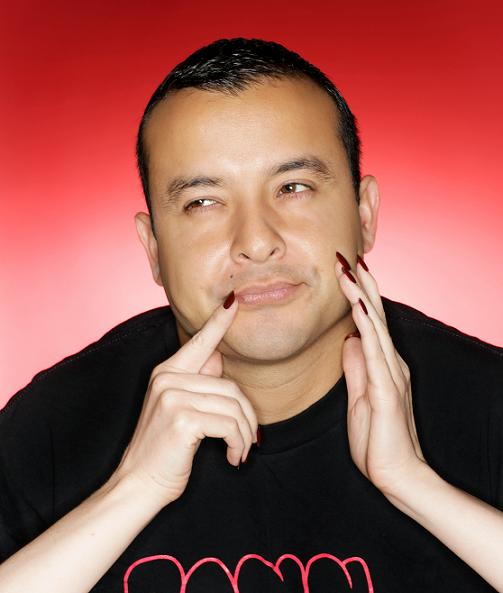
Interview

Hippies do it better

0

caitlin@sfbg.com

HERBWISE I am not given overmuch to squealing over technology, particularly weed technology. Over the past few months I have sampled candy cane-flavored rolling papers, a cannabis aphrodisiac shot, the Ziggy Marley-endorsed Marijuana Man comic book.

Mind you, I’m not complaining. But –- minus perhaps Humboldt Hemp Wicks –- none of those products have found their way into my everyday retinue. Until, that is, the subject of last week’s Herbwise, Randy Thompson of the vaporizer website Puff it Up, introduced me to a singular machine.

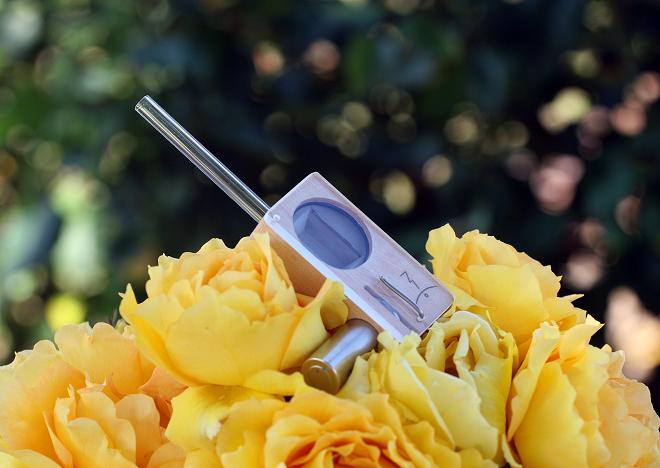
The Magic-Flight Launch Box is a thing of beauty. A clean maple wood box barely larger than a matchbox, it makes the black plastic tabletop models I once associated with vaporizing look clunky, wasteful. Vaporizing, university studies show, cuts down on the lung-coating tar that results from pipes and joints. Plus, it imparts a much cleaner marijuana taste –- perfect for the scores of cannabis connoisseurs who are popping up across the Bay Area.

Operating the Launch Box is simple. Insert the glass mouthpiece into the small round hole, a battery (two lithium batt’s and a recharger come with the starter kit) into the large round hole, press down for about five seconds, and inhale. No wall jack, no noise, no black plastic. The back of the box is engraved with a manifesto on what love is.

Obviously, hippies made it. Namely, a one Forrest Landry, who in a recent phone interview with the Guardian explained that the Launch Box’s ingenious design is a reflection of a New Age philosophy he’s cultivated over decades.

“Understanding the nature of communication allows us to understand the nature of community,” Landry says. “The vaporizer as a device is a communication event. We’re helping people breathe easier because of what we do.” The Launch Box’s backside is engraved with Landry’s personal philosophy on love (precious!)

He says the internationality of the product extends to the mindset of the company’s staff, who convene in a workshop located just outside San Diego. “Working with these tools is a kind of meditation. Doing this kind of work allows for an expanded awareness. You’re not aware just of how the tool is cutting the wood.”

Once an East Coast software developer, Landry changed careers upon his migration to California (to follow a lady love, he tells me). “I was thinking about what community of folks I want in my life.”

The answer was cannabis folks –- or more accurately, herbal folks, since the Launch Box can be used to ingest other plants like St. John’s wort (a useful tool for fighting seasonal affective disorder) and tobacco. Magic-Flight plans to start selling its own herbal blends in the next few months that can be vaporized solo or with cannabis.

The last thing that Landry wants is for Magic-Flight to be considered an activist company –- but that’s not to say that there’s nothing the federal government can learn from his philosophy.

“We’re not trying to shift the laws or policies per se, but we’re promoting the idea that love is enabling choice. We’re hoping the government realizes that enabling choice is a good thing.”

The story of hip-hop

0

By Courtney Garcia

MUSIC From the start, Ice-T was a versatile chameleon, the product of an integrated culture, and a student of the marginalized.

Born in New Jersey, raised in the Crenshaw District of LA, he joined the Crips then pursued the army to pay his bills. His career was blazed in rap, though he once flipped the game to heavy metal. Multifaceted talent that he is, Ice would later grow even more famous on television.

It’s no surprise, then, that he now adds the title of director to his resume, with the debut of his first documentary, Something From Nothing: The Art of Rap, at this year’s Sundance Film Festival. The feature length endeavor is the pioneering artist’s tribute to the culture that bred him, beat him, and made him who he is; it’s a culture he feels is slowly slipping from his grasp. It’s a story as much about the traditions of hip-hop as it is a fervent call to action, told through the eyes of its maker and his impressive posse of friends.

The premise, nevertheless, is simple: this is the story of hip-hop. “It’s a lot of life lessons because you’re not only hearing about rap, but experiences and struggles,” explained Ice during a one-on-one breakfast interview at The Lift in Park City, Utah. He was present for the screenings, along with Grandmaster Caz and Chuck D, both of whom appear in the film.

Other notable feature players include Eminem, Dr. Dre, Kool Moe Dee, Kanye West, Royce da 5’9,” Common, Rakim, KRS-One, Bun B, and Snoop Dogg. “You’re hearing people who you thought woke up successful talk about how they thought about quitting, how they had to find their voice,” Ice said. “I wanted to catch these guys when they were vulnerable, to show they’re real people, and that success doesn’t come without some blows.”

Ice got into rap initially to avoid falling back into gang life, first experimenting with turntables while enlisted in the military. Musically, he made his name as an underground artist before signing with Warner Music/Sire Records, and eventually winning a Grammy for his song, “Back On the Block.” He would follow such success with a branch into acting, currently starring in the primetime series, Law & Order: Special Victims Unit. And while his schedule is more than demanding, he found time between shoots to direct this documentary, a film he believes had to be made to challenge the fallacious imagery of hip-hop in American culture.

“This movie is not about the money or the cars, it’s about the craft,” he says. “The only questions we get asked by the press were, you know, ‘Who are you having sex with?’ ‘How high do you get?’ ‘Who don’t you like?’ They don’t care about your work…I wanted people to see the hip-hop I know, not the hip-hop that’s been given out until now. You’re getting this image that’s not real.”

Something From Nothing begins on the streets of New York, and follows the beat to the sunny coast of Los Angeles. Interviewing the gamut of rap’s finest, Ice catches his friends at the record store, in the studio, on their patio and at the diner. They eat; they smoke; they talk hip-hop. Some, like Kanye, freestyle for the camera; others spit the rhymes they can’t get out of their heads.

In one of the more poignant scenes, Ice speaks with Eminem about his toil to commit to the trade amidst extreme discouragement, and the moment he realized it was his raison d’etre. Equally surreal, the filmmaker travels to Dr. Dre’s lavish estate in the Hollywood Hills, where the two converse about the late, Tupac Shakur.

Because the name ‘Ice-T’ signifies authority, the strength of this film is his access to the inside, exposing tales most people would never have a chance to hear. He hits on every shade of the genre, from gangster rap to native tongue, the poetics of Q-Tip to the in-your-face anarchy of Immortal Technique.

Introducing the film at Sundance, he described his impetus as a dissatisfaction with the current state of hip-hop, and an earnest aim to improve the situation.

Later, he elaborated. “To me, the most pinnacle moment in the movie was when Mos Def quoted Q-Tip saying ‘rap is not pop; rap never had pop ambitions.’ It’s a counterculture. Now it’s become pop, and how you gonna get mad at the kids? They want to eat; they want to make money; they want to live. If you ask me what my dream is, I would love to see a 19 year-old Public Enemy come out of nowhere; I would love to see the new 18 year-old Ice Cube just come kick in the door, and start telling motherfuckers, ‘Fuck the bling, this is what’s good. Let’s talk about Obama, let’s talk about Occupy Wall Street. Let’s go in.'”

He added, “It will never get radio play, but I believe if a young group of kids really nailed it, they could get a movement going. And it’s needed. I took Rage Against the Machine out as my opening act, so of course I want to see that. The terrain is wide open.”

It’s rare to catch Ice-T without his signature shades, and somehow it’s obvious he truly is the OG he claims. Yet his inner sincerity and passion show through in this project, an ode to the first platform to ever give him a voice. He sold the rights to film after the Sundance showings to The Indomina Group for worldwide distribution; a theatrical release is planned for summer.

“Music has that power to give people emotion, and that’s what’s lacking right now,” he reiterated. “They’re not using art form at full power. They’re just rubbing the surface of it.”

Downtown action: Sex shop Feelmore510 celebrates one year of community pleasure

2

The sex shop Feelmore510 is located on the corner of Oakland’s Telegraph and 17th streets, across from an Obama campaign office, in between a pawn shop and the oldest African-American owned shoe store in town. The neighborhood is in transition, a place with old roots and a lot of new blooms – most businesses on this stretch of Telegraph opened within the last five years. Feelmore510 will celebrate its one-year anniversary Sun/12 when owner Nenna Joiner helps host Town Love, a new party at Hibiscus’ Rock Steady.

But those businesses aren’t the shop’s only neighbors. This fall, Feelmore510 also lived alongside Occupy Oakland’s City Hall encampment. Though many local business owners have expressed anxiety about the effect that protests were having on their sales, Joiner is in full support of the movement. She sometimes walked over to visit friends who were “occupying,” and was happy to donate safe sex supplies to the camp. “Sex is a basic need for survival,” she said in a recent in-store interview with the Guardian. Joiner allows protestors to chill in the store and talk politics — as long as they aren’t running from the cops.

Joiner envisions her store as more than just a place to shop – it’s also a community center. On a recent afternoon, Joiner shook each customer’s hand and asked them their name. Her goal is that all comers can shop for augmentations to their love life in comfort. 

A cross-section of Oakland’s entire population converges in this particular area of downtown. Joiner sees everyone from rich vintage porn collectors — drawn to her extensive selection of old magazines and videos — to people who ask to pay with California welfare benefit cards. 

Her best-selling items, which are taken home by customers who are male, female, straight, bi, and trans, are the queer porn films that Joiner herself directed, edited, and produced. 2010’s Tight Places features diverse actors and she made Hella Brown with a cast of all African American women. Hella Brown is made in a semi-documentary style – Joiner shot interviews with over 50 queer and trans subjects about their sexual proclivities while making the movie. 

Artfully-displayed contraptions at downtown Oakland’s favorite sex shop. 

Joiner’s films are unique in the way that they showcase different sexual practices and different body types from mainstream porn, which is often geared towards a heterosexual male audience. Her films show women of all shapes, having queer sex — fellating strap-ons and other acts you might not catch in other kinds of porn. While the films are not shot with the straight male audience in mind, that group does seem to enjoy them, often buying the first film and then returning for more. Joiner sees her films as educational tools, especially for what she calls the “brown community,” where things like transitioning from one gender to another are often socially stigmatized and restricted by financial limitations. 

“Queer women of color possess a whole different intelligence and mentality,” she says, adding that many women have a certain shyness about “packing,” (wearing a flaccid prosthetic penis underneath clothing) and getting cosmetic gender modification surgery. Joiner fully embraces her role as an educator in the Oakland queer community. 

Joiner refers to dildos as “prosthetics,” – she says that this language is less alienating to those unfamiliar with their usage. She keeps a packer on prominent display, in order to provoke people into asking questions, which can open up a dialogue about passing as a man, transitioning, or simply stuffing one’s jock with something more substantial than a tube sock. She says customer preference in prosthetics can vary. Many want a life-like phallus, while others request dildos that don’t look like penises, going for glass, sculptural, or abstract designs.

Joiner feels that she is at the intersection of several different communities in Oakland. Joiner goes to two church services every Sunday. She buys passing school kids lunch at Ms. Tina’s, the little sandwich shop next door. She’s active in the queer scene, and she’s also a small business owner who encourages other vendors to promote their own businesses by using her store as a launchpad. 

“Having a space allows other people to identify with a vision of opening their own space.” When she first opened her store, naysayers questioned her brick-and-mortar approach over the Internet. But she says a website cannot replace the tactile satisfaction of a place to gather, to talk, to share. She uses her store to hold classes on topics rarely discussed other places, like sex industry work.

Joiner wants the toys she sells to be safe and fun for anyone, and to open up a conversation about sex, gender, and pleasure with Feelmore510. It works – her space encourages one to think of sex in a different, more open way. Joiner’s toys are all just tools for lovers to transfer feeling, power, and energy between each other. There is no single way to have sex, just endless different first-time experiences. It’s a new kind of space in an old part of Oakland, open for all comers to explore their most innovative sexual selves.


Feelmore510 one-year anniversary party at Town Love

Sun/12 5-11 p.m., $5

Rocksteady at Hibiscus

1745 San Pablo, Oakl.

(888) 477-9288

Facebook: Feelmore510 anniversary party at Town Love


Bronstein and mergers are not what local journalism needs

11

Local, independent, public interest journalism – which is what Warren Hellman sought to create by founding the Bay Citizen in 2009 – could be undermined by a proposed merger between that newsroom and the Center for Investigative Reporting (CIR) under the leadership of former San Francisco Chronicle Editor Phil Bronstein.

It is unseemly that Bronstein is claiming support for the idea from Hellman, who died in December, making comments to the Bay Citizen that misrepresent Hellman’s intentions. How do I know? Because I spoke with Hellman about his concerns about the Bay Area media landscape and what it needed several times before he announced its creation – a story that I broke on the Guardian website, scooping this incipient newsroom and others by a day.

“We’re forming a new media news center. Basically, it will be a not-for-profit 501c3 that will be source of Bay Area news,” Hellman said in that article. “It will focus on local news events, including politics and the arts, the kind of thing that is just dying at the Chronicle.”

That interview was a culmination of conversations that I’d had with Hellman on the subject for more than a year. He thought the Chronicle was doing a terrible job at covering the city – a legacy that began under the leadership of Bronstein, who was always more concerned with high-profile projects that might win awards and with expanding the paper’s reach and focus into suburbia than the bread-and-butter local coverage of issues and events that were important to San Franciscans.

In his comments to Bay Citizen, Bronstein (who has not returned our request for comment) cynically leaves the impression that Hellman would have supported his takeover bid, and that what he wanted was a combination of investigative reporting and quirky features like “Rascal of the Week, Crook of the Week, hilarious stuff.”

He might as well be describing the Chronicle, which was not what Hellman was seeking to duplicate. Nor was he pursuing the CIR model of using philanthropy and grants to fund journalism projects that would run in the Chronicle and other mainstream newspapers. No, what Hellman wanted was more media outlets with less dependence on advertising revenue, not to simply subsidize a newspaper that he thought was lacking.

Frankly, this whole proposal is very suspicious. Bronstein officially left Hearst Newspapers, which owns the Chronicle, just last month to play an unspecified new role at CIR, where he sits on the board. He and other Chronicle brass opposed and belittled the Bay Citizen when it was created, but since then, the Bay Citizen has been real bright spot on the local media landscape, often scooping the Chronicle on important stories that run in the New York Times, for which BC supplies content. And now, Bronstein wants to execute a deal that would potentially kill that competition.

I’m really not sure what’s going on at the Bay Citizen these days, or why all its top brass seems to be jumping ship. But it’s clearly not all bad. The departure of top executive Lisa Frazier – who consulted on BC’s creation and then gave herself a ridiculously high salary – seems like good news, at least for BC’s bottom line. I acknowledge that some kind of change might be needed.

But whatever happens, it should be about maintaining and improving strong local news coverage. The BC board only has one token journalist on it, and that’s not a good sign. CIR does good work and has a good journalistic ethos, but its board should realize that merging with BC (and cutting almost $2 million from their combined operations, as Bronstein is reportedly proposing) is bad for local journalism and bad for San Francisco.

Corporate journalism is the problem to which nonprofit journalism was the supposed antidote. That was Hellman’s vision. But we’re all in trouble if this experiment gets co-opted by a longtime Hearst company man, the very person who undermined local coverage and public interest journalism in the first place, a corporatist with a history of undermining competition with his illegal Chronicle-Examiner JOA, his backroom deal with Media News Group, and other bottom line tactics.

That’s bad enough, but to falsely invoke the spirit of the recently deceased to justify it, that’s just disgusting.

Breathe Owl Breathe’s newest project is a dark, DIY children’s book

0

Breathe Owl Breathe, the ethereal, off-folk-band from the Lower Peninsula of Michigan, is on tour promoting its recent project, The Listeners/These Train Tracks — a children’s book with accompanying two-song record. Fans familiar with the band will not be surprised to hear it made a book for kids, or that the two stories are surreal and odd. The Listeners is about a mole and an ostrich – one blind, the other only technically a bird –  that find each other in the darkness and form a band.

Fans will also not be surprised to find those darkly emotional sub-currents throughout — this whole project fits in perfectly with the persona of the band. Breathe Owl Breathe made its 2010 album Magic Central while holed up in a cabin in Michigan for the winter, and you can feel it. The album has an I’m-snowed-in-and-going-stir-crazy vibe.

And its live performances are just as interesting and weird, and for a folk band, conceptual — it’s borderline performance art (choreographed hand motions for their song “Swimming,” performed in animal masks). The band’s tour make a stop in San Francisco this Monday, Feb. 6 at Bottom of the Hill.

In a 2008 interview, Micah Middaugh, the band’s front person, likened Breathe Owl Breathe’s music itself to swimming. In a recent phone interview from Michigan, Trevor Hobbs, the percussionist, said their sound evolved to be more like adventuring: like “when you are stepping out to go cross-country skiing but you do not really know where you are going to go.”

This sort of childlike whimsy, a promotion of  living and strangeness, is the hallmark of the band’s style, but it always seems to be cut with something dark, sometimes lyrics or melodies, sometimes images that populate its music videos. “Own Stunts” includes quick cuts of Andréa Moreno-Beals, cellist and singer for the band, outside in a nighttime snow being pulled into the shadows by the spindly branches of a tree.

http://www.youtube.com/watch?v=YTEkELB7mFk

The Listeners/These Train Tracks is both fanciful and eerie. It is also hand produced — Middaugh, the band’s singer and songwriter, over a three year period, wrote the stories that double as lyrics for the songs, drew the images, and carved them into wood blocks. The whole book is letterpressed and it’s made in Michigan, like Magic Central and everything else about this band.

While the book should pique the interests of the craft-focused, D.I.Y. artist, or anyone that likes kids books or indie-folk, it’s not targeted for any specific audience— it’s child-like, but the band is only performing at adult venues. “There are subtle tones of navigating through the world with people you love,” Hobbs said.

And expect Monday’s show to be high energy as the band is “inspired by artists that like to captivate the room,” Hobbs said. Middaugh introduced “Lion’s Jaw” at a festival in August by telling the crowd “so you are moving through life, and little do you know, you are being carried by a large lion.” He then asked everyone to feel the loose skin on the back of their necks where the lion picks them up. But “do not be afraid in the lion’s jaw,” he told the crowd.

Breathe Owl Breathe
With Laura Gibson, Morgan Manifacier
Mon/6, 9 p.m., $12
Bottom of the Hill
1233 17th St., SF
www.bottomofthehill.com

The key is patients

14

HERBWISE “Never in a million years would I have chosen to do this,” wrote Randy Thompson’s mother in the September 1997 issue of Good Housekeeping. The title of Karen Thompson’s article was “I Broke the Law to Save My Son.” Her choice? To allow Randy to use marijuana to mitigate the gastrointestinal irritation, nausea, vomiting, and lack of appetite he suffered chronically from his Crohn’s Disease.

Two months after Karen’s article appeared, the magazine published letters it had received in response under the header “A Controversial Choice.” One respondent, a Crohn’s sufferer who opted to have her small bowels re-sectioned to mitigate her symptoms, claimed to be “disgusted” with the Thompsons: “It was the best decision I ever made. How foolish of Simon’s parents to not exhaust all medical possibilities before allowing him to smoke pot.”

Today Randy, undeterred by such suggestions, helps other cannabis users to find healthy ways to smoke. He is the sole proprietor of a San Jose vaporizer distribution company, Puff It Up (www.puffitup.com). Medical studies have suggested that using vaporizers dramatically cuts down the amount of tar ingested compared to smoking joints.

Johnson’s company is entirely staffed by patients — he has had his card since before Proposition 215 passed — and tries to stock the “little guys” of the vaporizer world, like San Diego’s Magic-Flight company. Surprisingly, Puff It Up doesn’t sell Volcano vaporizers, the most popular “vape” brand whose products you’ve probably seen filling massive plastic bags with smoke on a dorm room coffee table somewhere.

Randy says Volcanoes, which begin at $539 for a starter package, just aren’t practical. “Simplicity, that’s what we’re going for,” he says. Thompson’s favorite vaporizers — which he proceeded to pull out of his backpack by the handful at his Guardian interview on a sunny day on the Zeitgeist patio — are the kind of affordable, easy-to-use, portable tools you would expect people to use for self-administering medicine. Many of the models he brought go for under $200.

“We’re non-evil,” he says of Puff It Up’s small box approach. “We don’t like to think of ourselves as profit-driven, we’re just trying to get the word out that there’s a better way to smoke.”

Randy is still dealing with blowback from his decision to be involved with marijuana. Like many greater Bay Area dispensaries, Puff It Up received a letter from the Department of Justice a few months ago threatening punitive action if it did not stop selling vaporizers, which exist in a legal netherworld.

In the 1997 article, the Thompsons went by aliases. But in 2012, Randy is done with hiding. He thinks it’s important to stick his neck out for the medicine that he says has made his life better so that other people might have the same option.

In the struggle to make cannabis accessible to everyone who needs it, he thinks patients have a big role to play. Says Randy: “People need to stand up and say ‘I’m human too.'” 

Next week in Herbwise: We test out Randy Thompson’s favorite vaporizer — does the Magic Flight live up to its name?


Our Weekly Picks: February 1-7

0

WEDNESDAY 1

Kapowski

Oakland-based indie pop quartet Kapowski is celebrating the release of its debut album, Boy Detective, with a party at Rickshaw Stop. With influences including George Gershwin, the Velvet Underground, and David Bowie, it’s no wonder Kapowski’s sound seems very much its own unique creation — sort of a dreamy, eerie, dissonant electric piano-driven march. While Thursday marks the release of the band’s debut album, Kapowski’s vibe has been slow cooking since front man and group visionary Jesse Rimler began collaborating with bassist Jon Gondo during middle school. (Mia Sullivan)

With Mwahaha and Bells

8 p.m., $10

Rickshaw Stop

155 Fell, SF

(415) 861-2011

www.rickshawstop.com


THURSDAY 2

Mostly British Film Festival

February is traditionally an uber-boring month for cinemaniacs — but fret not, local film fans: you need not resort to queuing up at the megaplex to weep at Channing Tatum’s romantic troubles. Not only is IndieFest looming (opening night is Feb. 9), but the Mostly British Film Festival — co-presented by the San Francisco Neighborhood Theater Foundation and the California Film Institute — kicks off tonight, with 28 new and vintage films from the U.K. (duh), Ireland, Australia, and South Africa. Highlights include Ken Loach’s latest, political thriller Route Irish; a complete screening of Michael Apted’s “Up” documentary series; and swinging London time capsule Performance (1970). (Cheryl Eddy)

Through Feb. 9, $12.50

Vogue Theatre

3290 Sacramento, SF

Christopher B. Smith Rafael Film Center

1118 Fourth St., San Rafael

www.mostlybritish.org


moe.

There’s nothing quite like seeing a jam show. They tend to involve hours of emphatic lyric shouting, sensual hip swinging, and persistent head nodding. The air smells more like pot than oxygen, lulling you into a stupor that causes you to forget you’ve been expressively swaying to the same song for thirty minutes. While lesser known than Phish and its omnipotent predecessor, the Grateful Dead, moe. has developed a similarly fanatical fan base by producing fun, danceable jams, perfecting the art of improvisation, and consistently engaging audiences at live venues. moe.’s been at it since 1989 and shows no signs of subsiding into irrelevance. Not to be missed. (Sullivan)

Thurs/2-Fri/3, 9 p.m., $30

Independent

628 Divisadero, SF

(415) 771-1421

www.theindependentsf.com


“Elegy”

A beatific child, arms outstretched, rides a polar bear through a snowy landscape. A baby rhinoceros ascends through a pink cloudscape, glowing halo floating above its wrinkly gray ears. A brown-robed Saint Francis gazes upon a bleeding fawn — but, wait a second, what’s that falling space junk in the background? And how’d that toy robot get in there? Menlo Park native David Michael Smith’s drawings and paintings “hearken back in style to elegant Renaissance Madonnas and saints, while simultaneously borrowing images from contemporary pop culture,” according to Dana DeKalb’s essay in the catalogue for “Elegy,” his new solo exhibition. The drawings and paintings, many situated in elaborate frames constructed by the artist, have an effect that’s as calming as it is unsettling. (Eddy)

Through March 17

Reception tonight, 5:30 p.m.-7:30 p.m., free

Scott Richards Contemporary Art

251 Post, Ste. 425, SF

(415) 788-5588

www.srcart.com


Dengue Fever

During a trip to Cambodia in the 1990s, Zac Holtzman became enamored with ’60s Cambodian pop and set out to create a sound that integrated the genre’s powerful female vocals with the psychedelic surf sound of the American ’60s. Enter Dengue Fever — a six-piece rock band whose Cambodian female vocalist, Chhom Nimol, sings in Khmer and English (sometimes in the same song, often wearing something sparkly), while Holtzman puts down a dazed, surf riff reminiscent of “Wipe Out” with his double-necked guitar chapei. Dengue Fever is set to shake the Great American Music Hall on Thursday and Slim’s Friday, to the delight of Bay Area indie pop fusion enthusiasts. (Sullivan)

With Secret Chiefs 3

8:30 p.m., $20–<\d>$44.95

Great American Music Hall

859 O’Farrell, SF

(415) 885-0750

www.gamh.com


FRIDAY 3

“WTF with Marc Maron”

Part comedy discussion and part no holds barred interview program, Marc Maron’s WTF podcast has emerged as can’t miss listening for anyone curious about the thought processes of modern comedians and performers. The stripped-down feel and anything goes attitude of the show has led to some incredibly personal moments — Todd Glass coming out on a recent episode immediately comes to mind — that are respectfully ushered along by Maron’s neurotic but attentive and no bullshit personality. In a special live taping of the show, he’ll be chatting with a handful of eclectic guests that includes political satirist Will Durst, Arden Myrin (Chelsea Lately), and original Saturday Night Live cast member, Laraine Newman. (Landon Moblad)

10:30 p.m., $25

Cobb’s Comedy Club

915 Columbus, SF

(415) 928-4320

www.cobbscomedyclub.com


SATURDAY 4

“Between Me and the Other World”

Dissecting wounds in under-reported aspects of American history has allowed Joanna Haigood to create some of the Bay Area’s most remarkable dance theater works. So there is every reason to look forward to her newest endeavor, “Between Me and the Other World,” which examines W.E.B. Du Bois’ concept of “double-consciousness,” as analyzed in his The Souls of Black Folk. Using the “veil” as a metaphor, Du Bois eloquently explained the fractured state of being imposed on people who are not allowed to be themselves. Written in 1903, his observations have stood the test of time. For “Between” Haigood, in addition to her own dancers, has enlisted first-rate collaborators in Antony Brown for the music and David Slzasa for the design. This is a work in progress showing and includes a post-performance discussion. (Rita Felciano)

2 p.m., free

ODC Theater

3153 17th St., SF

(415) 822-6744

www.zaccho.org


Bob Odenkirk with The Birthday Boys in “Seven-Man Sweater”

Bob Odenkirk (Mr. Show) joins up-and-coming Upright Citizens Brigade troupe The Birthday Boys for two Saturday night performances of “Seven-Man Sweater.” Gaining steam over the past couple years with videos for Funny or Die and writing jobs for the MTV Movie Awards, The Birthday Boys create comedy that successfully blends smart satire and pop culture send-ups. The Los Angeles-based troupe’s style should mesh well with Odenkirk — a legend of the sketch form — in this sure to be hilarious mix of live performance and video shorts. (Moblad)

8 p.m. and 10:30 p.m., $20

Eureka Theatre

215 Jackson, SF

(415) 788-7469

www.sfsketchfest.com


Exodus

In the 1980s, thrash reaffirmed the faster-is-better trajectory of heavy metal that was already developing in the mechanistic speed and rhythm of acts like Judas Priest, replacing the big, rounded tones and psychedelic aftertaste of the ’70s with piston-like riffs and angular dual-guitar leads. Thrash, the supremely-aggro next step in this sequence, exists today as something of a brief and punctual link in the great, forbidding chain of heavy metal, but one whose dogged endurance (see: Slayer) guarantees it a permanent appeal. The show brings together fellow Bay Area thrash legends Possessed, Heathen and Forbidden in a memorial for Paul Baloff, the late vocalist of Exodus, who died 10 years ago. (Tony Papnikolas)

With Mad at Sam, Angerhead, Mudface, Hysteria, Hell Fire, and the Venting Machine

6 p.m., $30

Oakland Metro

630 Third St., Oakl.

(510) 763-1146

www.oaklandmetro.org


SUNDAY 5

Apocalypse Cakes Reading + Eating”

The world is ending soon. Why not eat as much dessert as possible before the inevitable? And why not get into the end-times spirit by whipping up one of Shannon O’Malley’s concoctions from Apocalypse Cakes: Recipes for the End? O’Malley’s book (an offshoot of her tasty and notorious blog) has all the recipes you’ll need to celebrate doomsday, as long as you have a sense of humor: Black Deforestation Cake, Impending Meteorite Rock Candy Cake, Whore of Babylon Fruit Tart, Shifting Poles Pineapple Upside-Down Cake, and, yes, 2012 Mayan Chocolate Cupcakes. Swing by Omnivore Books for a reading and tasting — the countdown is on, so calories totally don’t count. Right? (Eddy)

3 p.m., free

Omnivore Books

3885a Cesar Chavez, SF

www.apocalypsecakes.com


MONDAY 6

Thee Silver Mt Zion

You know how the creation of epic classical music appears to be on the edge of madness, at least, the way it’s depicted in Amadeus (1984)? All ferocious scribblings, and sore hands from tearing furiously into instruments with the passion of a particular set of notes pumping through the veins for hours, days, months. Bloody hands arise, ‘I’ve got it!’ This is how I picture Thee Silver Mt. Zion working. A modern, Canadian, post-punk version of that. Perhaps it’s because of the frequent title reworkings that suggests hyper attention to detail: A Silver Mt. Zion, The Silver Mt. Zion Memorial Orchestra & Tra-La-La Band, Thee Silver Mt. Zion Memorial Orchestra and Tra-La-La Band with Choir and Thee Silver Mountain Reveries. As part of the Godspeed You! Black Emperor collective, the Montreal-based band gained notoriety for its likewise stunning arrangements, droning movements, improvisational jazz style, and punk ethos. With name changes, lineup shifts, and sound tweaks over the past decade, it’s a wonder they’ve yet to collapse. (Emily Savage)

With Matina Roberts

Great American Music Hall

859 O’Farrell, SF

(415) 885-0750

www.gamh.com


TUESDAY 7

Leni Stern and the Masters of African Percussion

When German-born guitarist Leni Stern traveled to Mali in 2005, she met master musician Bassekou Kouyate, and became entranced with the local percussion instruments and style — later releasing albums such as 2007’s Africa and 2010’s Sa Belle Belle Ba, incorporating the West African sound. A lifelong musician (she won Gibson’s Female Jazz Guitarist of the Year award for five consecutive years) and traveler, she was inspired, to the say the least. At Yoshi’s, she’ll play guitar, n’goni ba, and jeli n’goni, alongside Kofo on talking drum, Alioune Faye on djembe, and Mamadou on bass and additional percussion. (Savage)

8pm, $16.

Yoshi’s

1330 Fillmore, SF

(415) 655-5600

www.yoshis.com


The Guardian listings deadline is two weeks prior to our Wednesday publication date. To submit an item for consideration, please include the title of the event, a brief description of the event, date and time, venue name, street address (listing cross streets only isn’t sufficient), city, telephone number readers can call for more information, telephone number for media, and admission costs. Send information to Listings, the Guardian Building, 135 Mississippi St., SF, CA 94107; fax to (415) 487-2506; or e-mail (paste press release into e-mail body — no text attachments, please) to listings@sfbg.com. Digital photos may be submitted in jpeg format; the image must be at least 240 dpi and four inches by six inches in size. We regret we cannot accept listings over the phone.

Headshots for the homeless? Photographer Joe Ramos connects art and social work

6

Images of homelessness are not hard to come by. These scenes are often pathetic, clichéd. In the worst cases, the homeless are portrayed as inhuman heaps of blanket and facial disfigurement, people reduced to their time spent sleeping on the streets or begging for money. But in “Acknowledged,” photographer Joe Ramos’ exhibit at the Main Library that opens Sat/28, unhoused subjects are shown in a way that’s truly radical: as people just like us.

The tradition of using poor peoples’ image as exploitative art can be traced back to Jacob Riis’s photos of New York City tenement housing in his 1890 photojournalism book How the Other Half Lives. The project launched a spate of tenement tourism among the upperclass in New York City — a phenomenon which finds its equivalent today in the slum tours conducted in Mumbai, Rio, Nairobi, and other developing cities.

The stated intention of these enterprises is admirable: to raise awareness of a societal problem that needs to be addressed. But their results can be a dehumanization and objectification of the “other half,” the poor becoming art and entertainment rather than harbingers of a culture gone awry and, most importantly, fellow human beings. 

But that is why Ramos’s photography project is so exceptional. Instead of randomly snapping pictures of the homeless on the street, the photographer works for Project Homeless Connect, a non-profit that provides medical and social services to the homeless in San Francisco. For the past six years, Ramos has been photographing program participants — he told the Guardian, at their own request.

The results are striking, studio-style portraits in both color and black-and-white. For “Acknowledged””s exhibition, many of the pictures are displayed alongside stories and interviews. Respect, empathy, and a strange glamor suffuse each portrait. 

Like John Steinbeck, Ramos was born and raised in Salinas, California. Mentored by Richard Conrat, the former assistant of the famed photographer of Dust Bowl families, Dorothea Lange, Ramos brings a neo-Depression era aesthetic to his work. As the child of farmhands, he understands poverty. Ramos’ subjects are not the other — they are unmistakably like any of us, after a bout of bad luck or a few missed paychecks.

In a recent phone interview with the Guardain, Ramos was emphatic about his project’s goals. “There are as many reasons for being homeless as there are homeless people,” he said. “Not all of them are out on the street. Many are in the shelter system. There are families with children in the school system who are technically homeless.” 

He said because of this invisible class of struggling, unhoused people, most of us don’t associate homelessness with anything other than the panhandler on the corner of Geary and Powell Streets. Through his work, Ramos wants to show the true face of homelessness — in all its complexity, dignity, and humanity.

“Acknowledged” features portraits of well-dressed, loving families. There is the man in a business suit with haunting eyes who lost his way after accidentally causing a fatal accident. There are transgender adults who faced harsh family rejection, discrimination, and unemployment as a result of their need to express what they felt inside.

Ramos says that after hearing his subjects’ stories, he finds himself befriending them, seeing them again and again. He has photographed some of them up to 10 times. After each photo is developed, he sends a copy to his subject, or their subject’s family upon request. Sometimes his portraits are used to show family back home that estranged members are doing all right. 

Ramos subjects pose on a completely voluntary basis. While his project is undoubtedly artistic, it’s hard not to see it through another lens: as a free studio portrait service for those who would never be able to record their lives in any other way. The surprising sense of ease visible in the photos’ faces makes sense. These people are clients, not art objects. They feel at ease because they feel acknowledged. 


“Acknowledged”: Joe Ramos photo exhibit

Through March 25

Opening program (including expert panel on SF homelessness): 

Sat/28 2 p.m., free

San Francisco Public Library

100 Larkin, SF

(415) 557-4000

www.sfpl.org


CORRECTION: An earlier version of this article mistakenly identified Joe Ramos’ mentor. He was actually taught by Richard Conrat. The Guardian apologizes for the error. 

The sex heard ‘round the world: [SSEX BBOX] documentary premieres

1

Scenes from [SSEX BBOX], the global sexuality documentary project whose long-awaited first episode will premiere at the Center of Sex and Culture on Mon/30:

One. A protest in Berlin, where a presentation is being made on the 16th century physical punishments that religious institutions imposed on sexually “immoral” people. 

Two. A conversation between two transgendered men living in Brazil.

Filmed in the form of interviews and group discussions, [SSEX BBOX] is a social justice film project that takes viewers on tour through the different understandings of gender and sexuality from around the globe. The documentary engages the ongoing conversation regarding the cultural, social, and even linguistic implications that are intertwined within sexuality. It will air 15 10-minute episodes bi-weekly from January to August 2012 — but the Mon/30 screening will offer the chance to talk face-to-face with the team behind the project. 

[SSEX BBOX] sexuality out of the box! from SSEX BBOX on Vimeo.

Priscilla Bertucci, the executive producer and director of [SSEX BBOX], holds that in an environment where something so primary as a noun is categorized as male or female, sexism and strict gendering become strongly embedded in cultural perceptions of sexuality. Looking back at the project, she commented to the Guardian in a recent phone interview:

SF and Berlin are pioneering cities in that there is a lot of sexual education and many years of work have been [put into those places towards] bringing about awareness. [Exploring sexuality] is definitely more difficult in Barcelona and Brazil where there are still a lot judgments.  People perceive gender as male or female, straight or gay, and don’t really think of what may be outside of this divided box. 

On location with [SSEX BBOX]. Photo by Danila Bustamante

When shooting in Sao Paulo, Bertucci encountered numerous individuals who had never been exposed to the idea of alternative sexual orientations. That lack of experience wasn’t a surprise to her — she was raised there:

I grew up in Brazil and I experienced a gap in information first hand. In places like Sao Paulo, there is a huge lack of sex education in schools and sex educators in general. When I was very young, I was aware of the gay and lesbian community. But at some point, I started not fitting in the box because I would sometimes be attracted to men and I didn’t really identity as bisexual. But later, I became aware that I could identify as queer or gender queer. But it took me a long time and I had to go out and learn a lot of things on my own. A project like [SSEX BBOX] helps people understand that they don’t have to choose [from] a binary.

Bertucci’s film features interviews with sex activists, educators, psychotherapists, and average citizens from all over the spectrum of sexuality. The documentary was mostly edited here in San Francisco, but its crew was comprised of a globetrotting crew of directors and cinematographers traveling through Sao Paulo, Berlin, and Barcelona. 

The international affair was made possible through efficient Skype meetings and Dropbox, and [SSEX BBOX] will continue to embrace the web as a way to distribute their films. The team also launched a pocket-size zine in fall of 2011 that included photography, personal narratives, cartoons, paintings, and writings on gender expression which you can order online in digital or paper form.


[SSEX BBOX] documentary premiere 

Mon/30 7:30-11 p.m., free. 

Center for Sex and Culture

1349 Mission, SF

(415) 902-2071

www.sexandculture.org

This is our country, too: Fred Korematsu’s daughter on her father’s civil rights legacy

1

“One never knows after someone dies what happens to their legacy. Sometimes it becomes a part of history and sometimes it grows,” Karen Korematsu -remarked in a phone interview with the Guardian this week. Her father, civil rights activist Fred Korematsu, will be honored statewide with his own official day on Mon/30. You can celebrate his legacy locally at the Oakland Museum of California’s Lunar New Year event on Sun/29, where Karen will be speaking about her dad’s contribution to our cultural heritage.

“In the case of my father, his legacy seems to be growing,” Karen continued. “His story resonates and remains important to people.” Last year was the first time California celebrated the Fred Korematsu Day of Civil Liberties and the Constitution. This year, events from a photo exhibition in the Smithsonian National Portrait Gallery, panel discussions, and teacher workshops in Humboldt, San Diego, Davis, San Francisco, and San Jose will commemorate his work.

The Oakland Museum of California’s celebration will be especially meaningful — Korematsu was born and raised in Oakland.  The event will include remarks from Oakland Mayor Jean Quan, a talk by Karen, performances by students from the Korematsu Discovery Academy in Oakland, vocalist Shirley Kazuyo Muramoto, and koto player Brian Mitsuhiro, and a screening of the Emmy Award-winning Of Civil Wrongs and Rights: the Fred Korematsu Story.

The elder Korematsu was a civil rights hero who refused to be incarcerated in the Japanese internment camps during World War II. When President Roosevelt signed Executive Order 9066 on February 19, 1942 requiring Japanese Americans to be placed in internment camps, the 23-year-old Korematsu refused to report. He attempted to continue his life as a normal American citizen, but was spotted and arrested in San Leandro three months later. Convicted for violating military orders, he lived for several months at the Tanforan assembly center in San Bruno and subsequently was transferred to Topaz, Utah — one of the 10 incarceration camps that were set up for Japanese Americans during WWII — where his family was also being held. 

Korematsu refused to let go of the belief that his civil liberties as guaranteed by the constitution were being directly violated. He appealed his case to the U.S. Supreme Court to no avail. 

That is, until 1983, when researcher Aiko Herzig-Yoshinaga and professor Peter Irons brought to light previously-suppressed documents detailing the FBI and military intelligence agencies’ conclusion that Japanese Americans were not threats to national security. 

Korematsu’s case was re-opened by a legal team of pro bono attorneys and at long last, his conviction was overturned in a federal court in San Francisco. In 2011, the U.S. Department of Justice released an admission of error in the case of the Japanese American internment camp. 

Karen is disappointed that her father didn’t live to see the apology. But she sees the confession as an important step towards bringing “accountability to people in government who need to take responsibility in making sure that decisions are always in the best interests of all Americans.”

She holds that actions like those of her father are especially relevant today, in these times of anti-immigrant sentiment. “He took a stance against racial profiling in issues such as national security and immigration,” she said. 

Following 9/11, Fred, along with the Japanese American Citizen League, spoke out against the national security measures the U.S. government was taking towards Muslim inmates being held at Guantanamo Bay. He became an active member of the National Coalition for Redress and Reparations. He assisted in the passage of a bill that prompted an official apology from the U.S. government, granting $20,000 for each surviving Japanese American who was incarcerated.

Today, Fred’s legacy lives on through the work of the Korematsu Institute. Founded in 2009 through the Asian Law Caucus, the institute’s mission is to advance pan-ethnic civil and human rights through education. 

Karen said that one of the many ventures of the institute is creating supplemental curriculum for K-12 schools to provide historical information that is missing in textbooks. She believes that her father’s story is an important lesson for children. “It tells the truth about American history, the Constitution, and their own backgrounds,” she said. 

Sensitive to the current financial troubles of California’s school system, the Korematsu Institute raises funds independently to create educational kits that it distributes to schools free-of-cost. 

Upon her father’s death, Karen believed that she had been passed on the torch in terms of challenging prejudice through education — so that nothing similar to the Japanese internment camps will ever happen again. “It’s heartwarming to tell my father’s story and see his legacy grow,” she concluded.


Lunar New Year celebration

Sun/29 noon-4:30 p.m., free with museum admission

Oakland Museum of California

1000 Oak, Oakl.

(510) 318-8400

www.museumca.org


Hot sexy events: January 18-24

0

Thankful. I am thankful for San Francisco sex. Just got back from the AVN awards in Vegas this weekend and couldn’t get over the fake boobs (literally — mountainous cleavage), rubber ducky-esque lips, and rote couplings that took over the Hard Rock Hotel for the better part of the week. Don’t get me wrong, the weekend was all kinds of wonderful and there were buffets and penthouse hot tubs filled with Tina Horn, Princess Donna, and Akira Raine — salacious tweeting and rumors of Robin Leach and deep red carpet conversations about being forced to wear condoms. But for me, SF.

Also, the trailer for James Franco’s new movie based on the life of Kink.com actress-writer Lorelei is out: 

Why am I so stoked on this city? Read on about what San Francisco does best: weird, original, affirming sex events in the City By the Bay. Here’s four reasons that’ll make you glad you’re here (pervert).


Good Vibrations’ Lakeshore store opening

Once an employee-owned store in the Mission, Good Vibes has expanded into a nationwide business, powered by an Ohio sex toy corporation, and teaching everyone from Florida to Washington about the power of gadgets in the bedroom through an award-winning sales and education website. (Read our interview with the company’s C.O.O. and staff sexologist Carol Queen here.)The empire gets one bigger today, with the opening of Good Vibes’ first Oakland brick and mortar location. Kandi Burress of Real Housewives of Atlanta will be on hand to promote her superlative line of vibrators, Bedroom Kandi

Sat/28 6-9 p.m., free

Good Vibrations

3219 Lakeshore, Oakl.

(510) 788-2389

www.goodvibes.com


Perverts Put Out: Midwinter Edition

Accepting his honor at this year’s Guardian Goldies art awards, performance provacateur Philip Huang utilized a neti pot in ways surely frowned up by the Health Department. The man is inappropriateness, embodied — just ask those “God Hates Fags” people, he’s crashed their protests with a colander head, carrying a sign that says “No Fags on the Moon.” So what does a Huang do at a reading made for and by pervy weirdos? You’ll just have to attend the latest edition of Perverts Put Out, to find out. Tonight’s event also features sexy solliquies by horehound stillpoint, Sherilyn Connelly, and Jen Cross. 

Sat/28 7:30 p.m., $10-15

Center for Sex and Culture

1349 Mission, SF

www.sexandculture.org


John Leslie one-year memorial

Harken back to your best memories of golden age porn star John Leslie, who passed away in 2010. Center for Sex and Culture will be hosting this memory circle for friends of his work — which includes Talk Dirty To Me (1980), Nothing To Hide (1981), and Talk Dirty To Me, Part II (1982). One of the first actor-cum-director hyphenates in adult film, the man was big back in the days of well-budgeted productions. Perhaps this will also be a look back on the long, strange road the porn industry has traveled over the past few decades (after all, Leslie did finish out his career directing gonzo releases). 

Sun/29 5:30 p.m., free

Center for Sex and Culture

1349 Mission, SF

(415) 902-2071

www.sexandculture.org


[SSEX BBOX] premiere 

Name the sexiest cities in the world. Did Sao Paolo, Berlin, and San Francisco make it on there? They’re the obvious choices, of course — and fertile territory for this global documentary project. The team behind [SSEX BBOX] chased tail around the globe, chatting with all orientations and genders about what makes them tingle below (above) the equator.

Mon/30 8:30 p.m., free

Center for Sex and Culture

1349 Mission, SF

(415) 902-2071

www.ssexbbox.com


Like the Oscars, only sluttier: the Guardian reports from the AVN Awards red carpet

10

All Guardian photos by Caitlin Donohue unless otherwise noted

“We gotta get 500 girls through here in two hours.” 

Pre porn star-strutting, the faces on the red carpet before the AVN Awards 2012 were grim. Vegas raged around us journalists, the Hard Rock Hotel – site of the awards ceremony, countless before-during-after-parties, and annual fan expo – awash in men trying to appear nonchalant and tired women in heels. We had many rivers to cross and many starlets to question before the awards ceremony would begin.

The Guardian team was stationed between Howard Stern’s ex-security guard (sample question from the gent, who was wildly popular with the more silicon-ed of the starlets who roamed the runway: “What is the strangest thing you’ve ever put in your asshole?”) and a dapper Frenchman from his country’s first porno channel XXL. 

We’d been chatting up porn stars for days (most significantly, Courtney Trouble’s queer porn posse and the lesbian beauties from Jincey Lumpkin’s Juicy Pink Box about the growth of queer adult films – read about those interviews in the Feb. 8 print edition) – but this was different, red carpet-different. 

For one thing, Dave Navarro was there, escorting two women in sequin thigh-high boots and highly customized steampunk-y ballgowns, both of their skirts’ significantly missing a front section. Robin Leach had ducked out on his anticipated appearance, but an under-done Chyna of WWF fame – also winner in the Best Celebrity Sex Tape category for Backdoor to Chyna – was there, as was a sloppy Dave Attell, manic in the hours leading up to his awards host gig. Creator of “Girls Gone Wild” Joe Francis lurked through en route to presenting a lifetime achievement award, longingly gazing in our direction for an interview that was not forthcoming. 

And of course those 500 porn stars (they weren’t all women), who lined up at the mouth of the red carpet area like so many shiny cattle. Popular looks for the evening included shattered mirror Gaga-inspired bodices, drop-back, crack-baring harem dresses. The self-proclaimed “Valley’s goldstar lesbian” Lily Cade and legendary sex goddess Nina Hartley were notable exceptions to the cleavage-baring carnival at hand — they wore suits. “I’m a fucking professional, so I’m going to dress like a professional,” Cade told us that day at the Expo as she gamely sold her all-girl titles from a booth unfortunately stationed next to a man hawking bargain basement adult DVDs.

Princess Donna found a last-minute date in Bobbi Starr (good choice, Starr took the honors for Female Performer of the Year), porn educatress-onscreen legend Nina Hartley gamely chatted ass acessories with Howard Stern’s buddy and waxed thoughtful on the current state of queer porn with the Guardian. We met porn stars excited about their budding hip-hop careers, porn stars excited about the new Fleshlight modeled after their various orifices, porn stars who were just plain excited. 

Our favorite line of red carpet questioning was as follows:

– What are you up for tonight?

– What was your favorite scene from last year?

– What do you think of the new condom regulations in LA? Is this going to dramatically affect the industry? Cue fallen smiles and synaptic struggles. For the record, talent was divided between the “I’m sexy and people are going to watch me regardless and the “get your laws off my genitals” camps – no one really thought the anti-AIDS measure was a positive thing.

And then it was the awards ceremony, we which will sum up like so.

BIG WINNERS

Portrait of a Call Girl – This drama is reportedly awesome if you like your porn with lots of crying in it. Kudos to lead Jessie Andrews, who was also the most calm actor that made her way across the red carpet. It won Best Feature, Best Director – Feature, and Andrews took Best Actress.

Asa Akira – The woman, thanks in large part to her work in Asa Akira is Insatiable 2, walked with no less than seven awards this year. Though her outburst after winning for Best All-Sex Release was memorable (“my ex boyfriend broke up with me over this movie, so fuck yeah!”), she is indelibly etched in my mind by her acceptance speech for Best Anal Scene, an honor she also took home in 2011. To whit: “Thank you to my asshole for putting up with all my shenanigans.” Akira’s partner for said award-winning anal shenanigans was named Nacho Vidal, which we will now be bestowing on my most swarthy future male child. Vidal was nominated twice in the Anal category – making him and Akira a powerhouse couple not to be denied. 

Good Vibrations – The SF-based chain walked with the Best Boutique award, and since it’s our Bay-Bay that makes us happy. (But does it still qualify as a boutique? Read our interview with the chain’s leaders last week and decide for yourself.)

Too Short — Perfomed a song to close out the show entitled “I Need a Porno Bitch.” He got them — about twenty game female actors swarmed the stage as he happily name-checked many of them in his lyrics. 


BIG LOSERS

Whoever was responsible for the Joint’s A/V and technical performance – Truly, everything that could have possibly gone wrong here, did. We’re talking no clips for the Best Actress nominees, people walking off into exits with no outlet onstage (okay, maybe that was the presenters’ fault). The ceremony’s fail screen – a static shot of a galaxy of stars – played so often we became accustomed to it, like a running joke you can’t get your friend to stop telling.

Two-time Female Performer of the Year Tori Black, who was arrested on charges of domestic battery along with her five-month-old son’s father at the Hard Rock in the wee hours of Friday morning. Black says she hadn’t drank in awhile (baby) and stirred up a scene after hitting the town Saturday night. Nothing to see here folks!

Anyone requiring more than four hours of sleep per night, or that enjoys daylight and monogamy.

For a full list of this year’s AVN winners, you should definitely, definitely go here because of winning titles like Mission Asspossible and Internal Damnation 4

Ding dong, you’re dead

0

TRASH It takes a certain kind of sicko to fall in love with Italian horror, what with all the oozing maggots, spurting jugulars, WTF plot twists, weird zooms, jarring musical cues, and supporting characters who do completely bizarre things that are never explained.

Sickos take note: Yerba Buena Center for the Arts is screening an uncut 35mm print of Lucio Fulci’s 1981 The House By the Cemetery. HUGE. Within the gore-splattered Fulci canon, House is maybe not as well-known as 1981’s The Beyond, 1980’s City of the Living Dead, or 1979’s Zombie (which made a recent local appearance thanks to Blue Underground, the cult champions also responsible for this showing of House). But it’s no less essential or enjoyable than the others, despite suffering from one nearly insurmountable flaw. (More on that that in a minute.)

House‘s story is actually pretty straightforward, as Fulci flicks go. After a mysterious murder-suicide claims his colleague, professor Norman Boyle (Paolo Malco) uproots his family, including wife Lucy (Fulci scream queen Catriona MacColl) and young son Bob (Giovanni Frezza), from New York City to small-town Massachusetts, where he plans to finish the dead man’s research. Fate or something worse means the Boyles will be bunking in “the Freudstein place,” a notorious mansion once occupied by “a certain Dr. Freudstein — a turn-of-the-century surgeon with a penchant for illegal experiments.” Uh-oh. That the family is merely renting this sinister abode is ignored by the film’s ad campaign: “Read the fine print. You just may have mortgaged your life!”

That may be so, but the truth is Bob’s dubbed-over voice is the scariest thing in this movie. Among the House DVD extras is an interview with a grown-up Frezza; the first thing out of his mouth is an apology. (His later filmography includes Lamberto Bava’s ludicriously amazing 1985 Demons, so he’s off the hook as far as I’m concerned.) It’s a distraction that elevates Bob from a mere rip-off of the kid in 1980’s The Shining, an obvious House influence, to eardrum-torturing moppet from hell.

http://www.youtube.com/watch?v=zbIiJeCpCgY

Fortunately, the rest of House is weird enough to cushion this sonic godawfulness, or at least blunt it a bit; it helps that the other kid in the movie — Silvia Collatina as Mae, the Scatman Crothers to Bob’s Danny Torrance — sounds perfectly normal. There are plenty of juicy bits for Italian horror geeks, including Ania Pieroni as a creepy, glaring babysitter (doing a slight variation on her creepy, glaring Mother of Tears in Dario Argento’s 1980 Inferno) and Carlo De Mejo (star of City of the Living Dead) as a helpful librarian. The traditional Fulci cameo casts the director as Dr. Boyle’s bow tie-wearing academic peer, uttering the immortal line “I adore New England!”

Speaking of, the titular house actually exists, though it’s not actually located by a cemetery as advertised. Also the setting for Umberto Lenzi’s 1988 Ghosthouse (sickos know Lenzi’s name well, thanks to grindhouse nuggets like 1981’s Cannibal Ferox and 1980’s Nightmare City), it’s the historically significant Ellis House in Scituate, Mass. No word, however, if the arts association that now maintains the property accommodates curious horror fans — or if the basement décor is still keepin’ it funky. 


THE HOUSE BY THE CEMETERY

Fri/27-Sat/28, 10 p.m., $8

Yerba Buena Center for the Arts

701 Mission, SF

www.ybca.org

Legal, not legal

4

caitlin@sfbg.com

HERBWISE It’s been a weird year to start a marijuana column. Shortly after we started Herbwise, which was intended to be our weekly look at marijuana culture and events, politics reared its ugly head, rendering it necessary to go to hearings at the State Building, call up California Assembly members, and occasionally wade through seas of legalese. Such is the state of cannabis under ongoing federal prohibition, but it’s been a particularly dramatic year.

And in some moments, news and culture reporting melded together in the marijuana world. Take, for example, the case of Oakland’s Harborside Health Center, which is often called the largest dispensary in the world (it is certainly the largest in California). After years of painstakingly crafting a working relationship with city government, the business was heavily audited by the IRS. The federal agency decided Harborside — and 40 other California dispensaries — fell under the jurisdiction of Section 280E of the Internal Revenue Code, which denies the right for businesses involved in illegal drug trafficking to claim standard business expenditures. The collective now owes $2.4 million in back taxes, an amount that founder Steve DeAngelo asserts will bankrupt it if his business is forced to pay up.

Despite the ever-growing acceptance of the plant in the United States — a Gallup poll put the number at 50 percent in the fall of 2011 — medical marijuana is under attack by the federal government. Last fall, US Attorney for Northern California Melinda Haag sent out letters to the landlords of roughly a dozen Bay Area dispensaries threatening them with civil forfeiture, or possibly four decades in prison, if they failed to move this “trafficking” off their property within 45 days. The letters targeted dispensaries considered to be in a school zone.

Most left without a fight. In San Francisco, the Tenderloin’s Divinity Tree Patients Wellness Cooperative, the Market Street Collective on Upper Market, and the Mission District’s Medithrive and Mr. Nice Guy were among the businesses that shut their doors, some completely and some to transition into delivery-only services. [UPDATE: Attorney Matt Kumin tells the Guardian that Divinity Tree and Medithrive have filed a “coordinated federal lawsuit” through his office in protestation of the closures]

Fairfax’s sole dispensary, Marin Alliance for Medical Marijuana, was forced to close after 15 years of legal operation overseen by long-time cannabis activist Lynette Shaw. The 7,500-person Marin County berg’s town council passed a resolution supporting the Alliance, which served as a symbol of popular support for legal cannabis in a county beset with some of the highest breast cancer rates in the country.

Assemblymember Tom Ammiano and Sen. Mark Leno have been the most outspoken California politicians in coming out against the federal government’s meddling with the state’s cannabis. At a press conference at San Francisco’s State Building in October 2011, Ammiano announced his frustration that the feds would “upset the will of the people” by curtailing safe patient access. Proud to be an elected gay official, he promised to continue to crusade for an issue that he says disproportionately affects the LGBTQ community.

One of the steps Ammiano took was to meet with Haag to discuss what could be done to assuage her concerns with the industry. “That was very, very disappointing,” Ammiano commented on this initial talk. In a recent phone interview with the Guardian, he remembered that Haag implied that the order was coming from above, from high up in the Obama Administration.

Ammiano doubts her assertion that she had little discretion in the matter. “She said she was only doing what the boss was telling her to do. We had a hard time with that.”

He does think that the Obama Administration is sending its attorneys mixed messages — case in point, US Attorney General Eric Holder’s repeated comments that federal interference in state-legal marijuana operations would be “a low priority.” Ammiano also makes the connection between the attacks on cannabis and the self-sustaining industries behind the War on Drugs. “The DEA, some of the diehards, this is like a jobs program for them,” he said.

His meeting with California Attorney General Kamala Harris went more smoothly. Ammiano says Harris, who voiced cautious support for the industry last fall, was eager for a more comprehensive regulatory system to be put into place, but she supported Proposition 215 — the 1996 measure that legalized medical marijuana in California — on principle.

Faced with an ambiguous future, medical cannabis’ proponents — politicians, activists, entrepreneurs, and patients — are putting forth plans for just such a system. This year will be the playing field for a passel of campaigns to take medical marijuana out of the under-supervised arena in which it’s found itself.

Three ballot initiative campaigns seek to address the issue. Two — Regulate Marijuana Like Wine and Repeal Prohibition — would legalize cannabis use for adults across the board. Another, which has perhaps the most likely chance to succeed in the $2 million process of getting onto the ballot, is being put forth by patient advocacy group Americans for Safe Access, the United Food and Commercial Workers (the union that represents many cannabis workers in California), and marijuana collectives. It’s called the Medical Marijuana Regulation, Control, and Taxation Act.

“We decided to focus on medical because we figured that taking that further step at this point is unwise given the federal government’s actions over the last months,” said attorney George Mull, who is part of the team that proposed the measure. If passed, the initiative would establish a 21-member state regulatory board comprised of doctors, industry folk, patients, activists, government officials, and others. A state supplemental tax on cannabis would be levied and local governments would be required to allow one dispensary per 50,000 residents. Ammiano said that he and Leno were also working on proposing legislation that would provide regulations.

But the future of medical marijuana in California remains somewhat cloudy. “I’m worried that even if we come up with the regulations, the feds will find something else,” said Ammiano. Complicating the matter, the California Supreme Court moved unanimously on Jan. 18 to review the power that cities and counties have to make their own laws concerning cannabis accessibility — plus, it plans to look at the old disconnect between state and federal law on the matter..

So much for the politics of marijuana in 2012. Away from the headlines, it’s plain to see that the plant is increasingly accepted in popular culture. On a local level, East Bay YouTube stoner Coral Reefer continues to tweet to thousands of followers every time she sparks a bowl, and on the national stage, Miley Cyrus admits to smoking “way too much fucking weed,” after seeing the birthday cake friends had gotten her. (It had Bob Marley’s face on it.)

On television, the United States is learning about Harborside’s travails — but not just from the news shows. Discovery Channel shot a season of reality TV following DeAngelo and his staff, telling the stories of patients and about the reality of running a dispensary for a show they entitled Weed Wars even before the final $20 million IRS ruling. As the collective is being persecuted by the feds, its fan base across the country grows.

Will Discovery Channel renew Weed Wars for a second season? Regardless of the network’s views on the protagonists’ profession, if the cameras are kept rolling they’re sure to capture another year of interesting times for California cannabis.


Local musicians reinterpret Nick Drake’s “Pink Moon” at the Rickshaw Stop

4

Had you been skeptical about the “UnderCover Presents: Nick Drake’s Pink Moon” event Sunday night at the Rickshaw Stop you wouldn’t have been alone. It had the potential to be disastrous. Coordinating the sound alone must have posed a considerable challenge. How do you get 11 eclectic local bands — 50 performers each with specific sound needs — to play one song from one album without frazzling intervals between each performance and each set up? And then of course there’s the album to consider, Nick Drake’s Pink Moon. How can the bands perform the covers without butchering the album?
 
In the case of coordination and sound, it was a flawlessly organized UnderCover event, co-produced by Faultline Studios. Band set ups were seamless, the sound was first-rate, and the visuals by Joe Case that projected behind the stage were diverting. There were also pre-recorded interviews with band members shown before each performance, which made for an altogether different concert experience. With regards to Pink Moon, if you had hoped to hear covers that faithfully honored the songwriter’s final album, the event was likely a let down, but not a catastrophe.
 
Pink Moon is an odd choice for this kind of an event. For one, it’s terse — with only 11 songs, it clocks in at 28 minutes, and so each band is on stage for only a moment. It’s essentially a bleak piece of songwriting as well, recorded with only guitar and vocals, aside from the light piano on the title track. As John Wood, who produced Pink Moon said in a 1979 radio interview, “[Drake] was very determined to make this very stark, bare record and he definitely wanted it to be him more than anything.” However, the event’s music director Darren Johnston saw this as an invitation. He in fact chose the album because of its sparseness and the endless ways to approach it. “It’s not even my favorite Nick Drake album,” he said in one of the pre-recorded interviews.
 
It’s worth noting that many of the bands did not seem to be Drake aficionados, nor did they pretend to be. A series of pre-recorded interviews showed that they were unaware that a “pink moon” or “bloody moon” represents imminent disaster in other cultures, and that Drake was possibly foretelling his antidepressant overdose, which happened two years after the album was released.
 
Needless to say then, the bands tweaked and reinvented the songs on Pink Moon. If the result wasn’t sensitive tributes to Nick Drake, it was still seasoned musicians putting on compelling performances. Music Director Darren Johnston’s own band, Brass Menažeri, started the night off with the title track, “Pink Moon” which was a rumpus of snorting tubas, trumpets, and French horns. It was followed by the Oakland pop band Kapowski who managed to churn out a memorable piano take on “Place to Be.” The Real Vocal Quartet turned some heads with their cover of “Road,” sticking to the song in the beginning, then veering into a blasting collage of strings before coming back up, rather reluctantly, for another verse.
 
The performance that best embodied Pink Moon was the saxophone player David Boyce’s rendition of — interestingly enough— the only instrumental on the album, a song called “Horn.” With an array of effect pedals, Boyce withdrew from with the original song, but managed to embody the whole album with it. He puffed away and evoked its desolation, adding layer upon layer of drifting, sometimes ear-splitting sounds that encapsulated something like panic and nausea.
 
In many ways, you wanted to hear these bands doing their own material and performing longer sets. It was a shame that we only got a taste of the Billie Holiday inspired voice of singer Kally Price, for instance, who was spell-binding in the very, very brief amount of time she was up on stage.

Brass Menažeri (“Pink Moon”)
Kapowski! (“Place to Be”)
Real Vocal String Quartet (“Road”)
Kally Price (“Which Will”)
David Boyce (“Horn”)
Pocket Full of Rye (“Things Behind the Sun”)
Broken Shadows Family Band (“Know”)
Freddi Price (“Parasite”)
Ramon and Jessica (“Free Ride”)
Aaron Novik (“Harvest Breed”)
Jazz Mafia (“From the Morning”)

All photos by Jessica Trimmer

The bad kind of pain: Kitty Stryker talks sexual abuse in the BDSM community

35

In a culture where pain equates to pleasure and sexual power is deliberately manipulated for ecstatic highs, how far is too far? Kitty Stryker and Maggie Mayhem are two local activists who are confronting rape and abuse within the BDSM community. The two are gearing up to take a workshop they’ve prepared on the subject called “Safe/Ward” on the road. You can support their educational tour at a Center for Sex and Culture fundraising event on Tue/24.

Stryker and Mayhem have been spreading word about their efforts through blogs and online confessionals, which — Stryker was proud to tell the Guardian in recent interview — has helped to open up a dialouge about these issues in the sex-positive community. The workshop Kitty and Maggie hosted locally in August was a huge success, and the duo have been invited to present their project at Momentum, a feminist sexuality conference taking place March 30 through April 1 in Washington, D.C. 

On Tuesday, the sextivists will be hosting a mini-workshop-party to help raise funds for the big journey. They promise nothing short of titillating raffles, awesome art and performances, tasty drinks — there’s even rumors of a kissing-spanking booth. Read on to learn more about what inspired the “Consent Culture” tour, and what it’s like to bring up these issues in the sex-positive community.


San Francisco Bay Guardian: What is “Safe/Ward” and inspired this project? 

Kitty Stryker: “Safe/Ward” is a workshop that Maggie Mayhem and I put together. The purpose is to talk about consent culture. Basically, we realized that we have had very similar negative experiences in the BDSM scene. When we started talking about these abusive situations more, we realized this was more of a widespread problem. It wasn’t just us. So we started a workshop talking about consent and abuse in the BDSM community and how to promote a more consensual environment. 


SFBG: What goes on in these workshops? 

KS: We generally like to ask the people who come to talk about their experiences.  We also watch a lot of videos regarding consent and we discuss how abuse is generally never seriously confronted. For example, consent — especially in regards to kinky sex — is joked about and made a punch line. These jokes about safe-wording have a darker undercurrent since essentially we are laughing about the lack of consent. We like to talk about why this is problematic. And one of the main issues we’ve noticed is that many people don’t feel comfortable going to their community leader or dungeon monitors about their sexual assaults. In the workshop, we provide some actual steps that party hosts can make to make their space safer.


SFBG: What is a major issue that you find important to address?

KS: The concept of safe-wording. I wrote a piece called “I Never Called it Rape,” and the responses were very intense. There’s this “victim blaming attitude” people like to take. Many people responded saying that maybe if I safe-worded, I wouldn’t have been abused. But there’s not always a definite time to safe-word sometimes, because such unexpected and out of the ordinary situations come up. And who really is going to safe-word in a culture where the person who safe-words is called a wimp?  Sex is supposed to be fun. It’s not a competition. And there’s this attitude that if you are a submissive who safe-words, you’re a difficult submissive. When it should be that you are a better submissive because you are communicating. It’s kind of surreal that people are being so defensive about it. 


SFBG: What is one crucial aspect of consent culture that “Safe/Ward” encourages people to become aware of from the workshop? 

KS: That BDSM is not about who is the most able to withstand torture. It’s about consent and respect. We talk about consent all the time, but it’s a little bit more nuanced within the BDSM community. We’re playing with sex and power, and neglecting the possibility of rape and abuse is symptomatic of our unwillingness to talk about consent and the reality that it’s not always there. 


“Consent Culture” fundraiser 

Tue/24 7-10 p.m., donation suggested

Center for Sex and Culture

1349 Market, SF

(415) 902-2071

www.sexandculture.org

“In the big butt category, there’s four awards”: What’s it like to vote in the AVN Awards?

6

Guardian culture editor Caitlin Donohue will be live Tweeting the AVNs this year. For the latest in Lycra and non-judgemental observations, follow her @caitlindonohue

Once a year, the porn industry gathers to honor its own. Cash is dropped on sparkly stripper gowns, breasts are wedged into places that are too small for them, too-little or too-much time is spent on crafting acceptance speeches and: Viagra. Sometimes Flo Rida is there (this year Coolio will captain the official after-party) – but like an enthusiastic blow job, the Adult Video News Awards are always a triumphant good time. This weekend the ceremony and attendant fan expo are at the Hard Rock Hotel in Vegas. The Guardian’s going to be there on the red carpet, obviously – but we thought we’d get you all hot-and-bothered with some sage words from two industry insiders – who happen to be members of the academy to boot.

Your skin flick experts are Chris Thorne and Steve Javors, who graciously submitted to phone interviews with us last week. Thorne is the founding editor of Xcritic.com, a Portland-based website that reviews stacks upon stacks of adult DVDs round-the-calendar. Thorne’s been voting in the awards for two years now, but has been following them “since the Tera Patrick-Jenna Jameson era.”

Javors is the managing editor of AVN Magazine, so he’s not only a voter in the awards, he also decides the nominations. It’s a small porn world, after all. He’s been voting for the awards for five years, our veteran judge. He’s confident that this year’s awards will continue to be the screaming climax of a time they’re always been. “We have a pretty successful formula,” he told us. “I think the challenge is just to top what we did last year.”

On being an AVN voter: 

Chris Thorne: It’s punishing. It’s punishing. I don’t think anybody quite realizes the magnitude of the task that is voting in the AVNs. It is by far the most demanding thing you can do in the adult industry.  The box of DVDs – we had two stacks of them, both around six feet high. We’re talking about high 800s to a thousand titles. Some titles are nominated for specific scenes, so you’re like okay, I’ve watched that scene, I don’t have to watch the rest of [the movie].

Big winner predictions:

CT: This year’s field is not as clear-cut as it was in years past. There were a lot of really good performances and good films, but in years past it was pretty darn clear that one or two movies would take it and go. Digital Playground’s Pirates and Pirates 2 — when those films came out it was pretty clear that they were above and beyond everything else that was going on. In terms of handicapping it, I think it’s going to be a difficult year. 

Steve Javors: I think Bobbi Starr had a spectacular year. She’s been a critics’ favorite for a few years now. She distinguished herself more so this year, she’s one to look out for. Also, the star of Portrait of Call Girl, Jessie Andrews, that movie should do well. With Jessie it’s her wide-eyed innocence that grabs you. She’s naturally beautiful, she’s 19, she looks like a girl form an American Apparel ad. I thinks that’s her appeal. I think this is going to be her star vehicle. She’s so sweet, so accommodating, super-professional.

Dark horse picks:

CT: I am particularly enamored with a company called New Sensations, their Romance series. [Xcritic.com] named one of the films from that series as our top title of the year. That was called Lost and Found. This was an interesting year for porn, it’s adjusted quite a bit for the recession – it’s found in the last couple years that it’s not recession-proof. One of the things it’s done is try to expand its audience. Lost and Found is a romantic comedy with sex. Also, Wicked Picture’s Horizon, Elegant Angel’s Stephen Soderberg-esque Portrait of a Call Girl, and Digital Playground’s Top Guns and Fighters. Vivid did a few notable parodies: Spiderman XXX, Superman XXX, The Incredible Hulk XXX, Wicked’s Rocki Whore Picture Show, that was really good! Sometimes you see something and you’re like, there’s actual filmcraft involved, it’s not just two hours of people fucking with a loose plot attached.

SJ: Brooklyn Lee might be one of those. Last year was her first full year in the business and she came out doing incendiary scenes in Spiderman XXX from Axel Braun and Vivid.

On the best part of the AVN Awards:

CT: In terms of the awards show, it’s gone from cool, to watching-paint-dry-boring, to absolute absurd. You never know if this year it’s going to be a good year or a bad year. My favorite parts are not on the program. Everyone knows each other, especially the performers. Some of them know each other quite intimately. They’re “on” when they’re on the red carpet, but there are some nice moments when they don’t have to be on and performing. Everybody kind of comes together, so there’s this nice opportunity to connect. 

On the worst part:

CT: The middle part of the awards show. It starts out really fun and exciting but there are hundreds of awards. Somewhere in the middle there it can feel like there’s no end in site. It’s like, there’s an award for best porn soundtrack? In the big butt category there’s four awards. Sometimes the acceptance speeches are longer than the Academy Awards. 

On who was cheated this year out of a nomination:

CT: Y’know, they nominate so many people. There are so many nominations. I think the nominations are extensive enough that they cover their bases. Sometimes there’s 15 nominations in a category.

On the evergreen appeal of DVD porn:

SJ: When people say the DVD market is dying – it’s not what it once was, but going through the list of nominees this year, you can see products that people want to buy. Viewership has moved to the Internet, but there’s tons of stuff that people want to own. Parodies have really propped up the DVD market. It’s unbelievable the quality of the parodies that have come out. It needs to be that way because otherwise you upset the fans. If you read the chat boards and go to Comic Con, see what goes on with the fans that are new audiences to porn – they’ve taken to these parodies in a big way. 

On his voting critiera for the Best Double Penetration Scene category: 

CT: How we evaluate sex scenes is not necessarily rocket science. Great sex scenes boil down to a couple key critieria. One, chemistry between the performers. It’s like fine wine, you know it when you see it. When two performers like each other — or maybe they don’t like each other but they have real chemistry. Two, you look at presentation – how do the three performers work with each other? Is it exciting to watch? Do you look at it and say wow, that looks painful? When you look at [a sex act] that’s – I don’t want to say on the fringe – you want to see it presented in a way that is exciting, titillating, it fulfills a fantasy that the viewer might have. Third, how is it shot? Are we close up and center on the penetration? Good directors can present scenes in a way where it’s not just that. 

On the evolution of the awards:

SJ: it’s really evolved, it’s become this gigantic event. Even if you’re not a fan, everyone and their mother has heard of the AVN Awards. It’s now broadcasted on Showtime, seen by millions of people – they’re still repeating last year’s show. It’s in its 29th year and it’s changed from a smaller ceremony for industry people in a small ballroom in Vegas to this grand spectacle that is certainly on par with the Golden Globes or other Hollywood awards show. Girls spend thousands of dollars on their dresses, Dave Attel is hosting this year. Dave’s a perfect fit for our business. He’s a big fan of the business, he knows all the girls. 

Correction: An earlier version of this article identified Rocki Whore Picture Show as a Vivid Entertainment production. It was actually made by Wicked Pictures.

A Bay Area kind of stand-up: Frankie Quinones of For the People Comedy

2

Common knowledge states that if you’re serious about becoming a stand-up comedian on the West Coast, you move to Los Angeles. But Frankie Quinones created the diversity of For the People Comedy here in San Francisco and despite his rising star on the stand-up scene, he’s sticking around for the moment.

Maybe that’s because Carmelita lives here. “She’s taken on a whole thing of her own, her own career,” says the Ventura County native of his sassed-up, club-going Latina sexpot. “Carmelita’s got her own list of things to do in 2012.” You can check out Quinones — and possibly Carmelita or his popular “Cholo Whisperer” skit — at the next For the People event at Cobb’s on Thu/19. 

Carmelita was created back in 1996 in Quinones’ high school improv class. She hails from Quinones’ stable of characters inspired by – well, what else – the people he sees on an everyday basis. In Carmelita’s case that’s his female family members, mixed with Quinones’ own mannerisms. “She’s really confident, but not really conceited,” he says. 

Her star vehicle was “Eh-So Eh-Spicy,” in which she half-dishes, half-raps about men looking at her tits in line at the store and courts suitors in a San Francisco bar. You’re definitely laughing at her, but somehow, Quinones escapes reducing the brash Carmelita into a stereotype like so many other male comedian’s female alter egos. Carmelita shares set time with a host of Quinones’ other personas, including a hippie character named Sun Diamond whose mannerisms are culled from the patchouli-scented denizens of our fair city.

Quinones is proud of being a Latino comic, part of a tradition that also includes his personal role models Gabriel “Fluffy” Iglesias and Paul Rodriguez, who his parents used to watch on TV when he was young. He often performs at Latino comedy nights in Los Angeles, but in San Francisco — where successful Latino comics are well-known for relocating quickly down south when fame beckons — he’s used to being the only Hispanic name on otherwise all-black and all-white bills.

His comedy often dances along the edge of racial tensions, ultimately resolving them in a feel-good way. In “Cholo Whisperer,” a upper-middle class suburban couple hires an expert to deal with the shanking, 40-drinking gangster (played by Quinones) they’ve adopted after being charmed by their neighbor’s cholo. The cholo whisperer, who walks with a mystic’s bauble-topped scepter but dresses in everyday street wear and a blue bandana, teaches the white husband how to be “the jefe,” a role that mainly involves puffing out his chest and barking short orders. 

“Some people think I’m stupid for not moving to LA already,” says Quinones, drinking a Negra Modelo in front of his combination plate on a sidewalk tables at the Valencia Street Puerto Alegre. “But I feel like I’m doing something for the San Francisco comedy scene.” You can check out For the People’s new monthly gig every last Wednesday at SoMa’s Sofa nightclub on Eighth Street and Minna. Quinones crafts the program for these nights with the newbie comedy fan in mind — usually they’ll feature stand-ups from all kinds of backgrounds, even a live DJ for musical interludes. 

“I’ve always been that fool in my family, like ah, fucking Frankie,” Quinones laughs. “People in my life are not surprised that I’m a stand-up comedian.”

Maybe that’s why they’ve been so supportive. “I have a good team of homies that believe in this as much as I do,” says Quinones, who says the word of mouth hype his group of friends give him is invaluable in promoting his shows – indeed, a word from a mutual friend was how I heard about his work. “Our brand of comedy is like, this is all of us, together. It’s like, I’m no better than you because I’m on stage. I try to create a family vibe so that when people come in they feel a part of it.”

Just don’t heckle him – that positivity has its limits. “If somebody heckles me that’s the green light,” he laughs forbodingly, for a moment seeming like the snarky comedians we’re used to from network television and BET. That impression doesn’t last long before we’re back to the group experience: “But my goal is to make it funny for everyone.”


For the People Comedy

Thu/19 8 p.m., $15

Cobb’s Comedy Club

915 Columbus, SF

(415) 928-4320

www.cobbscomedyclub.com

Get Gorey

1

marke@sfbg.com

SUPER EGO Wax up your handlebar mustache, dust off your stripy topcoat, burnish your steampunk petticoats, and oil those wheezy accordions: The Edwardian Ball, that phenomenal annual gathering of exquisitely decked-out freaks, is back for its 12th installment of mannered mayhem. This time it aims to quell any kvetching about crowding by stretching itself over five official local events (and a satellite ball in Los Angeles next month). But the Fri/20 World’s Faire and the Sat/20 Ball itself will still be the main attraction for thousands of Friends of Ed.

Where did it come from, the distinctly San Franciscan style that the Edwardian Ball represents, the curious — and, in some pale lights, socially conservative — amalgamation of circus revivalism, steampunk mechanicals, Wild West gumption, burlesque peekaboo, 1990s anarcho-sincerity, and more than a hint of Burning Man fairy dust? The ball itself, launched in 2000 by Justin Katz of “premiere pagan lounge ensemble” Rosin Coven and Mike Gaines of the neo-cirque Vau de Vire Society, delectably conflates affection for Edwards Gorey, author, and Windsor, British king, producing a turn-of-the-last-century high-brow goth fantasia that’s impossible to resist. There’s more than a hint of Burtonesque Scissorhands-worship in there as well, bringing our Ed count to three. (Check out my revealing interview with founder Katz.)

Like absinthe, the ball’s drink of choice, I savor this native subculture most in small, strong doses — sometimes its sheer mass can overwhelm, and its style seems always in a state of coalescence rather than expansion. (An Edwardian Ball in 2112 would, and probably should, be much like the one this week, hover-bikes notwithstanding.) That’s why the ball’s a perfectly cromulent occasion to check in on the dark-eyed, ruby-red, velvety feast of one of our essential undergrounds. Promenade, anyone?

Fri/20: Edwardian World’s Faire Kinetic Steam Works, Cyclecide, Vau de Vire, games, and more

Sat/21: Edwardian Ball 2012 “The Iron Tonic” with Jill Tracy, The Fossettes, Miz Margo and more

Both at Regency Ballroom, 1300 Van Ness, SF. All ages, see www.edwardianball.com for prices, times, and more events.

BENEFITS FOR DJ TOPH ONE Beloved “wino” Toph One got struck while riding his bike by a hit-and-run driver on Sun/8 and was hospitalized with a broken pelvis and internal bleeding. The DJ, bike activist and annual AIDS Rider, and party promoter (of the incredibly long-running Red Wine Social and Pepper) is OK and in good spirits now. And the great Bay Area nightlife scene is banding together once again to help out a friend in need. There are going to be two big benefits — all proceeds going to Toph’s bills — that are also serving as major bay talent summits. One’s at Public Works (Fri/20, 9 p.m.-3 a.m., $10. 161 Erie, SF. www.publicsf.com) with J-Boogie, Jimmy Love, Matt Haze, Pleasure Maker, E Da Boss, Chris Orr, and many more. The other’s at SOM (Sun/22, 8 p.m., $10–$20 but no one turned away. 2925 16th St., SF. www.som-bar.com) with Billy Jam, Sake One, DJ Pause, Rolo 1-3, Rascue, Jah Warrior Shelter Hi-Fi, and tons more. Get well soon, buddy — and anyone with information on the crime please call the anonymous police tip line at (415) 575-4444 or send a tip by text message to TIP411.


LAURENT GARNIER

One day, I will write an entire book about French techno polymath Laurent Garnier’s seminal 1993 “Acid Eiffel,” a monumental track whose throbbing chords (not quite nabbed from Mr. Fingers), squiggling acid jabs, and cheeky whale-song bass figures pretty much audibly nailed where my rave-fatigue head was at back then. He hasn’t been here in a decade: this time he arrives as part of the trio LBS (Live Booth Sessions) with Garnier DJing and knob-twisting, Benjamin Rippert on keyboards and Scan X on “machines.” They’ll be tearing through a whole host of electronic styles at this installment of the whip-smart As You Like It roaming party (co-produced with Public Works), throwing some brilliant corners on Garnier’s signature ecstatic style. With M3, Rich Korach, Briski, and P-Play.

Thu/19, 9 p.m.-3 a.m., $15–$25. Public Works, 161 Erie, SF. www.publicsf.com


THE QUEEN IS DEAD

Honey, is she ever! There has actually been quite an uptick in Smiths tribute nights (maybe making up for Morrissey’s string of Bay Area concert cancellations?). And this monthly one, celebrating a year on Saturday, is the Frankly Mr. Shanklyest of them, with a wide range of melancholy jangle-pop tunes and DJ Mario Muse on decks. Unhappy birthday!

http://www.youtube.com/watch?v=8oYsQ1Ra1hI

Sat/21, 9 p.m., $5. Milk, 1840 Haight, SF. www.milksf.com


OCTAVE ONE

The classic Detroit techno Burden Brothers whose seminal “I Believe” and “Black Water” will always get me on the dance floor hollering and waving my arms around like the homosexual muppet I am have been touring successfully. Catch them on the swell Club Six sound system.

Fri/20, 9 p.m.-4 a.m., $15. www.clubsix1.com


SOUKI

Kooky-rad monthly queer and friends party Dial Up dials up a special Friday night with Berlin ‘s Souki, whose deep-but-friendly techno prowess is making recent waves. She’ll be performing a live PA, sure to get funky.

Fri/20, 9 p.m.-3:30 a.m., free before 10 p.m., $6 after. Public Works, 161 Erie, SF. www.publicsf.com


DUBSTEP PRODUCER BATTLE FINALE

Some great beats have come out of the rounds leading up to this grand wobble finale — nice to see so much local talent holding forth (and stretching the often narrow dubstep definition.) Come jiggle and support finalists Fivel, Taso, and Kontrol Freqs at the new Fuel Lounge (formerly Etiquette).

Fri/20, 9 p.m., $5 before 10 p.m., $10 after. Fuel, 1108 Market, SF. www.fuelsf.com 


Rep Clock

0

Schedules are for Wed/18-Tues/24 except where noted. Director and year are given when available. Double and triple features are marked with a •. All times p.m. unless otherwise specified.

ALA COSTA CENTER 1300 Rose, Berk; missreplacosta.eventbrite.com. $15. Miss Representation (Siebel Newsom, 2011), Fri, 7. Benefits Ala Costa’s Adult Transition Program for young adults with developmental disabilities.

BALBOA 3630 Balboa, SF; www.brownpapertickets.com. $17.50-20. “Opera and Ballet at the Balboa Theatre:” Don Giovanni, from La Scala, Wed, 7:30; Caligula, from the Paris Opera Ballet, Sat-Sun, 10am.

CASTRO 429 Castro, SF; (415) 621-6120, www.castrotheatre.com. $7.50-10. •Lenny (Fosse, 1974), Wed, 2:50, 7, and American: The Bill Hicks Story (Harlock and Thomas, 2009), Wed, 4:55, 9:05. “SF Sketchfest:” “Night of the Shorts III: The Search for Schlock,” with Kevin Murphy and Bill Corbett, Thurs, 8. This event, $30; for tickets and more info, visit www.sfsketchfest.com. “Noir City X:” •Dark Passage (Daves, 1947), Fri, 7, and The House on Telegraph Hill (Wise, 1951), Fri, 9:30; •Okay, America (Garnett, 1932), Sat, 1, 4, and Afraid to Talk (Cahn, 1932), Sat, 2:40; •The Killers (Siegel, 1964), Sat, 7, with Angie Dickinson on-stage interview after the film, and Point Blank (Boorman, 1967), Sat, 9:45; •Laura (Preminger, 1944), Sun, 3, 5, 9, and Bedelia (Comfort, 1946), Sun, 7; •Gilda (Vidor, 1946), Mon, 7, and The Money Trap (Kennedy, 1965), Mon, 9:20; •Unfaithfully Yours (Sturges, 1948), Tues, 7, and The Good Humor Man (Bacon, 1950), Tues, 9:15. Advance tickets (double features, $10-15) and more info at www.noircity.com.

CHRISTOPHER B. SMITH RAFAEL FILM CENTER 1118 Fourth St, San Rafael; (415) 454-1222, www.cafilm.org. $6.75-10.25. “For Your Consideration: A Selection of Oscar Submissions from Around the World:” A Simple Life (Hui, 2011), Wed, 6:30; Patagonia (Evans, 2010), Wed, 9; Once Upon a Time in Anatolia (Ceylan, 2011), Thurs, 7:15. Hipsters (Todorovsky, 2009), Wed-Thurs, call for times.

PACIFIC FILM ARCHIVE 2575 Bancroft, Berk; (510) 642-5249, bampfa.berkeley.edu. $5.50-9.50. “Film 50: History of Film, Cinema, and the Other Arts:” “Course Introduction: The Language of Cinema,” with lecture by Marilyn Fabe, Wed, 3:10. This event, $5.50-11.50. “Henri-Georges Clouzot: The Cinema of Disenchantment:” Manon (1949), Wed, 7; Miquette and Her Mother (1949), Fri, 9; The Wages of Fear (1953), Sat, 8:10. “Austere Perfectionism: The Films of Robert Bresson:” Au hasard Balthazar (1966), Thurs, 7; Mouchette (1967), Sat, 6:30. “Howard Hawks: The Measure of Man:” Fazil (1928), Fri, 7; A Girl in Every Port (1928), Tues, 7.

ROXIE 3117 and 3125 16th St, SF; (415) 863-1087, www.roxie.com. $6.50-10. “It’s the Paul Meinberg! Show!”: Bachelor’s Daughters (Stone, 1946), Wed, 7. Battle for Brooklyn (Galinsky and Hawley, 2010), Thurs, 7, 9. Drive (Winding Refn, 2011), Wed-Thurs, 7. Everyday Sunshine: The Story of Fishbone (Anderson and Metzler, 2010), Wed-Thurs, 9.

SFFS | NEW PEOPLE CINEMA 1746 Post, SF; www.sffs.org. $10-11. “Four Samurai Classics:” Harakiri (Kobayashi, 1962), Wed, 1:30, 6; Yojimbo (Kurosawa, 1961), Wed, 4:15, 9:15; Sanjuro (Kurosawa, 1962), Thurs, 2:45, 8:45; Seven Samurai (Kurosawa, 1954), Thurs, 5. Fullmetal Alchemist: The Sacred Star of Milos (Murata, 2011), Jan 20-26, 2, 4:30, 7, 9:15.

VICTORIA THEATER 2961 16th St, SF; www.start-somewhere.com. $10-20. Miss Representation (Siebel Newsom, 2011), Tues, 6. Benefits StartOut’s new Lesbian Entrepreneurship mentoring program.

YERBA BUENA CENTER FOR THE ARTS 701 Mission, SF; (415) 978-2787, www.ybca.org. $6-8. Red Desert (Antonioni, 1964), Thurs and Sat, 7:30; Sun, 2.

Chem Dawg to the rescue

17

caitlin@sfbg.com

HERBWISE The Kings of Destruction, more popularly known as KOD, were an hour and a half late for our interview. Being that the hip-hop-graff-clothing-medical-marijuana-advocacy collective is from the East Bay and we had arranged to meet at the Guardian Potrero Hill office, I figured I’d better look for them.

I didn’t have to go far: all five of the group’s members who had stopped by were sitting amid SF political activists in the Guardian conference room, mistakenly ensconced in a discussion of the new supervisoral district lines. They’d introduced themselves along with everyone else, but then faltered when the meeting’s facilitator asked to what he owed the pleasure of having Oakland residents at the table.

All good. Soon enough I have Dogz One, Lil’ Zane, Josh, Tase 1, and Don Juan assembled on the roof standing around a picnic table and talking about marijuana. They’ve brought some of their products for show ‘n’ tell; t-shirts emblazoned with characters culled from local marijuana strains. They’ve brought Grape Ape, a gorilla pulling on a joint with a purple berry-emblazoned baseball hat. Another shirt features Chem Dawg, a husky that figures in an upcoming KOD comic book in which the character (Dogz One is his alter-ego) will fight the government’s attempts to keep marijuana from the people. Pending designs include Girl Scouts Cookies, which will feature a woman wearing a midriff-bearing scout uniform in honor of the SF-specific strain rumored to smell of pastries (those buds available locally at the Green Door dispensary).

Kings of Destruction started out as a graffiti crew, and though members still throw up pieces on walls occasionally (“go down around the train tracks, you’ll see some things,” counsels Don Juan) now its focus is on — state — legal activities: music, clothing, and the catalyst for this interview, advocating for medical marijuana. Though I’m unable to hear samples of the tracks before press time, the group tells me members have been in the studio laying down tracks about their medicine, and they hope to join this spring’s Prohibition Tour (www.prohibitiontour.com), a California college event series that plans to raise awareness among students this spring with lectures and musical performances.

“Oakland has been on the forefront of the medical marijuana movement, so we’re trying to keep everything alive so that everyone can keep their medicine,” says Don Juan. Many in the group are patients and growers themselves who naturally find themselves in the activist role around friends and family who don’t use weed.

KOD sees marijuana as a healthy alternative to pharmaceuticals — many of which have adversely affected friends’ lives in their East Bay community. A prime example is bo, as the promethazine-codeine cough syrup that figures prominently in Bay Area hip-hop these days is popularly called. Compared to the dangers of that kind of drug, KOD members say, the federal government’s resistance to legalizing marijuana seems foolish. Not that there aren’t side effects of marijuana: “You might get a little hungry, might go to sleep,” says Don Juan. “You might just lay back instead of getting mad when somebody cusses you out,” adds Tase 1.

In closing, I ask KOD to tell me a story about the group and marijuana. They give each other looks and chuckle. Finally Tase 1 steps up to the plate. “One time, we were going to do something bad. And then we smoked some weed.” 

Find KOD clothing at www.kronicoverdose.com


Wall played

0

Also in this issue, Guardian writer Matt Sussman on who got the hype — and who earned it — in the galleries at Art Basel Miami 2011

VISUAL ART The popular face of Miami is made of aqua blue views and chrome rims, but the parts of Wynwood that haven’t been covered by murals yet look more like asphalt and the muted tones of low-cost rentals. Since the 1950s it’s been largely a Puerto Rican neighborhood. It’s also where many African Americans moved when they got priced out of the Overtown neighborhood to the south, where they were originally relegated by Jim Crow laws.

But, in a high-low art tornado last month, Wynwood is also where I learn that the popular legend labeling the Mission District the neighborhood with the most densely-packed street art in the world is total bunk.

Wynwood’s main drag Second Avenue is Clarion Alley on acid. Having come straight from Miami International Airport, my rental car barely inches down the strip, so omnipresent are the weaving, goggling packs of urban art voyeurs in oversized silk shirt-dresses and vertiginous wedge heels or where’d-you-get-’em sneakers. The only sign of the neighborhood’s year-round residents are the sporadic flaggers in self-bought orange vests waving cars into parking spots.

Angry sharks, Persian cat-women, color-washed streetcars, and owls sitting shotgun in convertibles — sometimes layered on top of each other — grace walls here. Designs pour off walls and onto the sidewalk. Here, the fairytale nymphs and walking houses of Os Gemeos on a fancy restaurant; there, a massive black-and-white photo wheatpaste by JR of bulging, watching eyes that echo the look of passers-by. I nearly break my neck on Mexico City artists Sego and Saner’s horned beetle-men, who clutch amulets and wear fanged leopard masks on the backs of their heads. Absolut Vodka has occupied a parking lot with a temporary open-air club, dotting it with human-sized aerosol cans and fencing it off with chainlink. It’s enough to make any street art fan lose their shit, or at least the rental car.

I’ve parachuted into the middle of Miami’s yearly art inferno, a.k.a. the week that the Art Basel art fair comes to town. Since 2002, this Swedish import has filled Miami Beach Convention Center with astronomically-priced works from over 260 international galleries. Umpteen ancillary art and design fairs populate deco hotel-land and its surrounds during this time — the city becomes one largely, loudly turned-out gallery opening.

Wynwood, with its surplus of 80-foot blank walls, hosts many an art collection — but it’s most visible contribution to the scene is its dense network of murals. Of these, the undisputed center is a compound of buildings grouped around a courtyard of marquee works dubbed Wynwood Walls. The properties were purchased by (in)famous neighborhood rejuvenator Tony Goldman in 2004. Many hold Goldman responsible for the gentrification of Soho, South Beach, and city center Philadelphia.

Wynwood Walls is his carefully orchestrated attempt to use the allure of street art to change the area’s economic fortune. Shortly before Art Basel 2011, Goldman produced a series of YouTube shorts dubbed “Here Comes the Neighborhood,” in which longtime graffiti photographer Martha Cooper cheerfully opines “Now we’ve got something [street art] that people are calling the biggest art movement in history of the world. And it just might be.”

The night of my arrival, the amount of in-progress murals at which the crawling traffic gives one an opportunity to gawk is striking. At least a dozen artists labor within a four-block radius, greeting fans, drinking beers and staring up at their half-finished creations contemplatively.

Such was the mood in which I find Buenos Aires street artist Ever, who along with an assistant is completing a massive wall featuring two disembodied heads emitting his signature riotously colorful cognitive mapping hives, which in the past he’s painted emerging from the brains of Mao Tse-Tung and his own younger brother. Ever was flown up by a community-based Atlanta street art festival, Living Walls, to paint a Second Avenue parking lot wall as part of the festival’s first project outside of Georgia.

It’s not his first international street art festival, but Ever is among the artists under-impressed with the Basel-time scene in Wynwood.

“It’s like the alcohol. I hate the shit — but one drink more!” We talk when the dust of Basel has long settled; Ever, fellow street and gallery artist Apex, and I perched around Apex’s studio in a Market and Sixth Street garment factory building.

Apex, who has been to Miami during Basel week four times, and twice to paint the crystallized, color-saturated “super burner” murals he is known for, explains that for him, the problem is exploitation. Street artists typically paint walls for a pittance or for free, in a neighborhood where businesses are making boatloads of money off spectators that come to marvel.

“You have, like, Tony Goldman, he gives a certain amount of money, property owners make money, but artists, a few make money,” Apex explains. “The rest, no. Artists get caught in the excitement of it. But who is getting paid off of it?”

“Who wins,” Ever adds.

“If someone is making money off of it, you should know who that is,” concludes Apex.

But the two artists agree that Art Basel week is an excellent education in the workings of the high art world for aspiring professionals, and that the camaraderie that flourishes between street artists can be important, inspirational.

And of course, the parties. Basel is known for them — 2011 featured everything from the $200-a-ticket “Fuck Me I’m Famous” David Guetta show to surprise kudos for the partykids from Pharrell onstage at Yelawolf’s Saturday night gig at a castle-shaped outdoor club in Wynwood. On my first night in town, the whole Living Walls gang — organizers, artists, errant alternative journalist from San Francisco — pile into cars and hit the Design District to check out the opening of the group show of Primary Flight, a local collective that got its start commissioning murals wall-by-wall in Wynwood.

“We started noticing we weren’t the breadwinners of the galleries,” Primary Flight founder Books Bischof tells me in a phone interview. “It was like fuck you, we’re going to take to the streets. We’re all curators in a sense, so we might as well get up and be seen.” Bischof logged time connecting with local graffiti crews and Wynwood’s homeless population to make sure he had community support for bringing the art crowd into the neighborhood during Basel week. He somewhat resents Goldman’s “just buy it” approach. “When we learned about [his Wynwood building purchases] we were like, well that’s kind of fucked.” (Though officially the two camps exist amicably, Goldman told me he upon arriving in the neighborhood he found Primary Flight’s piecemeal approach to its murals “helter-skelter.”)

But along with Wynwood’s art scene, Primary Flight has grown. In addition to its mural program — through which Apex painted his 2011 Miami wall — attendees at the collective’s gallery space could take in traditional paintings and sculptures, but also Mira Kum’s “I Pig, Therefore I Am” installation featuring the artist in the nude, living with two pigs in a small enclosure for 104 hours. “We represent artists with a street art, fuck you swagger,” comments Bischof.

Things are much more established now in Wynwood, which by most counts serves as Miami’s arts district year-round. There are expensive coffeeshops and bars, fine restaurants, precious florists, and blocks of galleries selling accessible art. (During Art Basel week, one of these is given over to an artist who specializes in kawaii food art printed onto affordable decals and posters. An entire wall is covered in swirly-topped ice cream cones in a hundred color options.)

Though professional street art certainly existed prior to his engagement, this upscaling can largely be attributed to Goldman’s speculative interest. Goldman’s PR agency sends me press materials dubbing Wynwood “the next great discovery in the Goldman Properties portfolio.” His company’s general methodology is to buy up historic buildings in socioeconomically depressed neighborhoods and fill them with upscale businesses that attract more pedestrian traffic.

There is little doubt that Goldman envisions the future of Wynwood as a place where housing units rent for far more than many of its current residents can afford. His team has spent considerable time and effort working with Miami’s city council on creating live-work zoning in Wynwood (not unsimilar to the type of zoning that loaded San Francisco’s SoMa with high cost condos). After the Basel hangover has dissipated, I get a chance to talk with him.

“When I went to Wynwood and I had boxy warehouse buildings, it was a much different challenge for me,” says Goldman during our decorous phone interview. “Now I could be free. Some people would look at ugly buildings and empty parking lots and loading zones — what I saw was an international outdoor street art museum. Huge canvas opportunities.” He bought six of those buildings in the center of the neighborhood, two of which now house spendy restaurants run by his son and daughter.

Goldman is not completely without street art cred. Since 1984, he has owned a massive wall on Manhattan’s Bowery and Houston Streets that has hosted murals from Keith Haring, Barry McGee, and Shepard Fairey. “[Street art] is freer in a lot of ways than walking in a museum, which a lot of street artists consider graveyards,” he says. “Not that I agree with them, not that I disagree with them either. I think Wynwood Walls is one place that has validated the art form as an important contribution to contemporary art.”

But Wynwood Walls also serves as the main attraction to an area in which Goldman Properties has monetarily invested. “It [is] a center place that the arts district really didn’t have, a town square, a centerpiece that was defined architecturally,” reflects Goldman. “It served its purpose.”

But perhaps this use of street art as tool of gentrification is not so incongruous. After all, most if not all professional street artists are able to create murals only by selling gallery-ready pieces. Ever tells of painting a mural for Coca-Cola with studiomate Jaz, only to use his paycheck to create three more public walls. “The reality of art is you always need a rich person,” he says.

Which is, more or less, to say that even in Wynwood, professional street art is not entirely soulless. Take for example one of Ever’s favorite Wynwood pieces, done by Spanish artist Escif. The wall was so popular, in fact, it merited a cameo in a “Here Comes the Neighborhood” episode. And not for its bright colors or revolutionary design; it’s just black capital letters on a flat white background.

But it does have a pretty direct message for good-intentioned folks in Wynwood. It says: “Remember, u’re not doing it for the money.”


“Toto, I don’t think we’re in Kansas anymore”: Good Vibrations’ company leaders on getting big

0

What will be the San Francisco-in-the-aughtteens equivalent of the creation of Good Vibrations in the Mission District in 1977? Let’s hope some fresh new sexuality invention is fomenting that will be rocking our beds in three decades with the robustness that Good Vibes has shown. From that initial single location, the well-lit place for women to shop for vibrators has expanded to encompass not only six brick-and-mortar shops (five in the Bay Area, one in Massachusetts) — but also a robust online business that has taken the original founders’ dreams of teaching America how to have safer, better sex and made it a reality. In 2007, the one-time worker-owned co-op turned corporation was sold to GVA-TWN, a Cleveland, Ohio sex toy company. 

But the engineers behind the Good Vibes brand say it hasn’t stopped growing. Last week, on the occasion of the brand’s new branch opening (on Lakeshore Avenue in Oakland Jan. 28, details below) the Guardian conducted email interviews with the company’s chief operating officer Jackie Strano and staff sexologist Carol Queen. The woman waxed pleasurably — dammit, now everything is sounding dirty — on the company’s possible digital education programs of the future, Carol Queen shared her views on a future with a Good Vibes location in every American city, plus we reveal what the hell a SESA is, and how it can help improve your orgasms.


San Francisco Bay Guardian: Good Vibrations’ store locations have been growing in leaps and bounds recently. Have online sales been burgeoning at an equal rate?

Jackie Strano, chief operating officer: We are up in double-digit percentages and are grateful for our loyal and fabulous customers. It’s a good place to be after some hard and lean years. We have been committed to keeping expenses down and making the company healthy again. We are still here 35 years later and have learned some hard lessons along the way. We’re grateful for everyone who visits goodvibes.com and who writes and yelps about us. We have always relied on grass roots word of mouth and are proud that our stellar reputation is still intact.

Carol Queen, staff sexologist: We also have always known how significant it is to people to have access to a live experience in one of our brick-and-mortar stores. This is the context within which the Good Vibrations difference was developed, and it really does matter to people when they can see and touch the products, leaf through the books, and talk to a Sex Educator Sales Associate (SESA).


SFBG: What is the company’s vision of success? How big does it want to get? Are there going to be Good Vibes in Kansas someday?

CQ: If we were in Kansas, would Dorothy have to stop saying “Toto, I don’t think we’re in Kansas anymore?” Actually, there has been a faction since co-op days that wanted Good Vibrations to be everywhere — we devoted an entire annual planning meeting to this in about 1997! And we have certainly discussed the possibility of expanding into other regions. Success in that context would mean that people in a much wider range of the US would know about and have access to a Good Vibes store and that we would be able to influence other cities with our values about sex education and culture, as we have in the Bay Area.

JS: Success is paying all your bills, making payroll, opening new stores, introducing new products, being the go-to source for reliable and accurate information on sexual health, and pushing out campaigns like our Ecorotic rating system. But success is also being agents for social change for 35 years and success to me is hearing from someone or meeting someone who says we helped change their life for the better. The original company vision was to have a store in every city so people would have access to a safe and welcoming space to learn more about sex and sexual health. This was before the Internet exploded and companies like Amazon ever existed. We have similar goals still, but overall success is staying solvent and profitable while we reach the masses and keep changing people’s lives for the better.


SFBG: Are there plans to expand the educational opportunities the company’s known for?

JS: Absolutely. We have been active in this arena over the last year, especially where we have sponsored college tours of certified sex educators and we are currently pursuing digital channels for our education department to be featured. We are the only company in our sector that employs two Ph.D.s on staff and we continue to train our staff with the program originated by us. We also partner with many bloggers, authors, and educators at large.

CQ: Wherever we expand, there will be educational programming; we will develop it hand-in-hand with the new area’s existing resources, and take advantage of the fact that many sex educators today travel widely to teach and offer workshops. Charlie Glickman, my colleague in the education department of GV, already does SESA trainings (our in-house staff sex-ed trainings) via webconferencing, so who knows, there may also be more virtual opportunities for education that we can develop.


SFBG: Do you still consider it a San Francisco company?

JS: Yes of course. We are proud of our roots here. Mind you we have been part of the greater Bay Area, including Berkeley and Oakland for decades but our headquarters are here. Our website serves the world and we have stores in Berkeley, Oakland, and Brookline, Massachusetts. We have partnered with many national organizations throughout the years but we are always involved in local communities of all genders, races, and classes here in the Bay Area, including San Francisco where we have four stores.

CQ: At our core, absolutely. We could only have been founded and grown in San Francisco.


SFBG: How has the way Good Vibes markets itself changed over the years?

JS: It’s interesting to look at old catalogs and marketing collateral because the message and logo hasn’t changed much at all, but the collateral and graphics change as we morphed from proprietary illustrations to branded photos and other campaigns depending upon what event we were sponsoring or what season we were calling out. As I said before, we have always relied on grassroots word-of-mouth and customer loyalty, and I think that social media helps translate that perfectly in this day and age. We have always marketed ourselves as the clean, well-lit, women-focused vibrator store where people feel safe and welcomed. We will never change our mantra that “pleasure is your birthright.” We may have an event called “Mommy’s Playdate,” as some of us get older and have kids (ha ha), and our newer stores have a more boutique imprint and overall feel — but we still just want to have fun and hope that people get that when they think of us. We are extremely pleased that things have gotten more mainstream around sexuality, and that sexual health and education are more accepted in the daily dialogue, but we are spoiled by being in some coastal cities and progressive areas. There is still a lot of work to do for everyone to feel safe and welcomed and we are tireless in our efforts to change the world and not just our own backyard.

CQ: We’re very much the same AND different when it comes to marketing. For the first 15 years or so of GV’s existence we did little beyond guerilla marketing — our fully-developed education program began as a way to get new people to enter the store. Then as now, our number one source of new customers is word-of-mouth, though we now have social networking to help boost that — [it’s not just] people bringing their Kansas cousin in to buy a Hitachi Magic Wand! That said, my own role at Good Vibrations developed to try to leverage editorial opportunities. We were the first company to offer a Ph.D. sexologist as a press commentator or expert, and by the end of the 1990s we were judiciously buying advertising in national publications, not just local ones. The other very-much-noticed change was when we began using photos, not just drawn graphics, in our ads and catalogs.


SFBG: Are there any product areas that the company would like to expand into? What about trans-oriented gear?

CQ: Well, we do have some trans-related products, especially for transmen — in fact, our wholesale division distributes packers (along with lots of vibrators and other toys) to other stores around the world. This has been the biggest in-house change lately, in fact — that we are taking charge of this part of the product line and marketing it to other companies, not just selling these items exclusively. I believe our next ideas for product development will involve the wealth of informational content we’ve developed over the years.

JS: Yes we are very keen on product development and bringing new offerings to market especially that are non-toxic and good for you. We carry a lot of products that are transgender-oriented and actually have a transgendered shopping guide on our web site. We were the first ones to do so, others have copied us now but we were the first. We also have a sex and gender policy we are very proud of that is built into the company handbook and culture. 


Good Vibrations’ Lakeshore store opening

Jan. 28 6-9 p.m., free

Good Vibrations

3219 Lakeshore, Oakl.

(510) 788-2389

www.goodvibes.com