Interview

Film Listings

0

Film listings are edited by Cheryl Eddy. Reviewers are Kimberly Chun, Dennis Harvey, Lynn Rapoport, and Sara Maria Vizcarrondo. For rep house showtimes, see Rep Clock.

CAAMFEST

The Center for Asian American Media Fest runs March 14-24. Venues include the Castro Theatre, 429 Castro, SF; New People Cinema, 1746 Post, SF; Great Star Theater, 636 Jackson, SF; Pacific Film Archive, 2575 Bancroft, Berk; and Sundance Kabuki Cinemas, 1881 Post, SF. For tickets (most films $12) and complete schedule, visit www.caamedia.org. For commentary, see "Truth and Daring" and "In the Blood."

OPENING

The ABCs of Death Variety is the spice of life, yet this international omnibus with 26 directors contributing elaborate micro-shorts on various methods of death — one per alphabetical letter — is like eating dried dill or cilantro for two-plus hours. It’s pungent, but what might color a complex stew proves insufferable in this narrow one. Just why it seems narrow is anyone’s guess — this should have been a genius idea. Yet there are almost no outstanding or memorable contributions, despite the wide-open invitation to extreme content. Filmmakers include Jorge Michel Grau (2010’s We Are What We Are), Simon Rumley (of brilliant 2006 feature The Living and the Dead), Srdjan Spasojevic (2010’s A Serbian Film), cult-favorite actress Angela Bettis, and many more. Nearly all seem to have spent far more than their allotted $5000 budget. There are segments parodying exploitation cinema and video games; offering hyperbolic Terminator-style sci-fi; line-drawing and claymation segments; plus plenty of gross-out narratives. Yet it’s all surprisingly crappy (not least an episode called "Toilet"), with precious few more than halfway decent episodes. The sum impact is of a mean-spirited project that brings out the vacuously shock-value prone worst in everyone involved. (2:03) Clay. (Harvey)

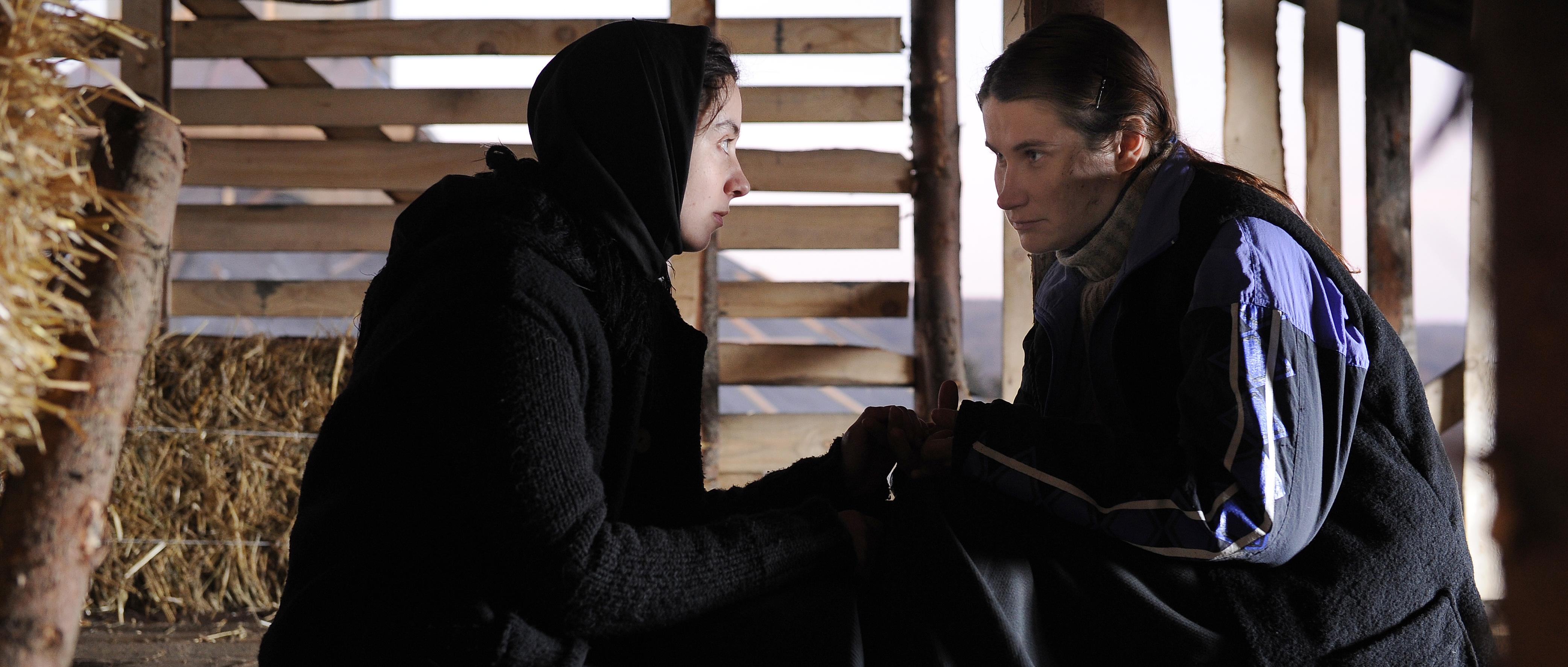
Beyond the Hills Cristian Mungiu — one of the main reasons everyone’s all excited about the Romanian New Wave — follows up his Palme d’Or winner, 2007’s 4 Months, 3 Weeks and 2 Days, with another stark look at a troubled friendship between two women. Beyond the Hills‘ Voichita and Alina (Cosmina Stratan and Cristina Flutur, who shared the Best Actress prize at the 2012 Cannes Film Festival; for his part, Mungiu won Best Screenplay) were BFFs and, we slowly realize, lovers while growing up at a Romanian orphanage. When they aged out of the facility, the reserved Voichita moved to a rural monastery to become a nun, and the outburst-prone Alina pinballed around, doing a stint as a barmaid in Germany before turning up in Voichita’s village, lugging emotional baggage of the jealous, needy, possibly mentally ill, and definitely misunderstood variety. It can’t end well for anyone, as all involved — dismissive local doctors, Alina’s no-longer-accommodating foster family, the priest (Valeriu Andriuta), and the other nuns — would rather not spend any time or energy caring for a troubled, destitute outsider. Even Voichita can only look on helplessly as an exorcism, a brutal and cruel procedure, is decided upon as Alina’s last, best hope. Based on a real 2005 incident in Moldavia, Mungiu’s unsettling film is a masterpiece of exquisitely composed shots, harsh themes, and naturalistic performances. For an interview with Mungiu, visit www.sfbg.com/pixel_vision. (2:30) Embarcadero, Shattuck. (Eddy)

The Call Brad Anderson (2004’s The Machinist) directs Halle Berry as a 911 operator who has to save a girl (Abigail Breslin) from a killer. (1:34) Shattuck.

Don’t Stop Believin’: Everyman’s Journey The director of 2003’s Imelda returns with this portrait of a way more sympathetic Filipino celebrity: Arnel Pineda, plucked from obscurity via YouTube after Journey’s Neil Schon spotted him singing with a Manila-based cover band. Don’t Stop Believin‘ follows Pineda, who openly admits past struggles with homelessness and addiction, from audition to 20,000-seat arena success as Journey’s charismatic new front man (he faces insta-success with an endearing combination of nervousness and fanboy thrill). He’s also up-front about feeling homesick, and the pressures that come with replacing one of the most famous voices in rock (Steve Perry doesn’t appear in the film, other than in vintage footage). Especially fun to see is how Pineda invigorates the rest of Journey; as the tour progresses, all involved — even the band’s veteran members, who’ve no doubt played "Open Arms" ten million times — radiate with excitement. (1:45) Sundance Kabuki. (Eddy)

A Fierce Green Fire: The Battle for a Living Planet San Franciscan Mark Kitchell (1990’s Berkeley in the Sixties) directs this thorough, gracefully-edited history of the environmental movement, beginning with the earliest stirrings of the Audubon Society and Aldo Leopold. Pretty much every major cause and group gets the vintage-footage, contemporary-interview treatment: the Sierra Club, Earth Day, Silent Spring, Love Canal, the pursuit of alternative energy, Greenpeace, Chico Mendes and the Amazon rainforests, the greenhouse effect and climate change, the pursuit of sustainable living, and so on. But if its scope is perhaps overly broad, A Fierce Green Fire still offers a valuable overview of a movement that’s remained determined for decades, even as governments and corporations do their best to stomp it out. Celebrity narrators Robert Redford, Ashley Judd, and Meryl Streep add additional heft to the message, though the raw material condensed here would be powerful enough without them. (1:50) Opera Plaza, Shattuck, Smith Rafael. (Eddy)

The Incredible Burt Wonderstone Steve Carell, Steve Buscemi, and Jim Carrey star in this comedy about rival Las Vegas magicians. (1:40) Presidio.

Reincarnated Reinvention is the name of the game for some mercurial, inventive pop artists, but for rapper Snoop Dogg, now going by the moniker Snoop Lion — you get the scoop on the name change in this doc — transformation turns out to be unexpectedly serious, earnest business. Flirting with Cheech and Chong travelogue comedy, Reincarnated ostensibly spins off the making of the hip-hop artist’s forthcoming 12th album of the same name in Jamaica, with smokin’ production help from Diplo’s Major Lazer gang. The camera is there for many standard behind-the-music moments — sessions with family and adulation in the musical-fertile Trenchtown — along with many not-quite-ready-for-prime-times spent lighting up with other musicians, growers up in the mountains, and reggae forebears like Bunny Wailer. But there’s more going on beneath the billowing smoke: providing the context for today’s high times and ultimately chronicling the rhyme-slinger’s life and times and his path to Jamaica, reggae, and Rastafarian spirituality and culture, Vice Films director Andy Capper lays the foundation for Snoop’s shift from rap to Rastafari by revisiting his gangster youth, the rise and fall of Death Row Records, the passing of 2Pac and Nate Dogg, and the music that made the man’s name —and continues to give us a reason to care. The easy, sexy charisma that made Snoop a star is on full display here, and doubtless his latest experiences on reality TV have made Capp’s job that much easier when it came to digging deeper, while the clouds of herb, Cali and Jamaican alike, give viewers a taste of the fun, and possibly healing, attendant with life with the Doggfather. (1:36) Opera Plaza. (Chun)

Stoker See "Family Plot." (1:38) California.
Upside Down This sci-fi romance from Argentine-French director Juan Solanas is one of those movies that would look brilliant as a coffee-table photo book — nearly every shot is some striking mix of production design, CGI, color grading, and whatnot. Too bad, though, that it has to open its mouth and ruin everything. Jim Sturgess and Kirsten Dunst play star-crossed lovers who live on adjacent twin planets with their own opposing gravitational forces. Nonetheless, they somehow manage to groove on one another until the authorities — miscegenation between the prosperous residents of "Up Top" and the exploited peasants of "Down Below" being forbidden — interfere, resulting in a ten-year separation and one case of amnesia. But the course of true love cannot be stopped by evil energy conglomerates, at least in the movies. Sturgess’ breathless narration starts things off with "The universe…full of wonders!" and ends with "Our love would change the entire course of history," so you know Solanas has absolutely no cliché-detecting skills. He does have a great eye — but after a certain point, that isn’t enough to compensate for his awful dialogue, flat pacing, and disinterest in exploring any nuances of plot or character. Dunst is stuck playing a part that might as well simply be called the Girl; Sturgess is encouraged to overact, but his ham is prosciutto beside the thick-cut slabs of thespian pigmeat offered by Timothy Spall as the designated excruciating comic relief. If the fact that our lovers are called "Adam" and "Eden" doesn’t make you groan, you just might buy this ostentatiously gorgeous but gray-matter-challenged eye candy. If you think Tarsem is a genius and 1998’s What Dreams May Come one of the great movie romances, you will love, love, love Upside Down. (1:53) Embarcadero. (Harvey)

War Witch They should give out second-place Oscars. Like, made of silver instead of gold. In that alternate-universe scenario, Canadian writer-director Kim Nguyen’s vivid, Democratic Republic of the Congo-shot drama might’ve picked up some hardware (beyond its many film-fest accolades) to go with its Best Foreign Language Film nomination. War Witch couldn’t stop the march of Amour, but it’s deeply moving in its own way — the story of Komona (played by first-time actor Rachel Mwanza), kidnapped from her village at 12 and forced to join the rebel army that roams the forests of her unnamed African country. Her first task: machine-gunning her own parents. Her ability to see ghosts (portrayed by actors in eerie body paint) elevates her to the status of "war witch," and she’s tasked with using her sixth sense to aid the rebel general’s attacks against the government army. But even this elevated position can’t quell the physical and spiritual unease of her situation; idyllic love with a fellow teenage soldier (Serge Kanyinda) proves all too brief, and as months pass, Komona remains haunted by her past. The end result is a brutal yet poetic film, elevated by Mwanza’s thoughtful performance. (1:30) Elmwood, Roxie. (Eddy)

ONGOING

Adventures of Serial Buddies (1:31) 1000 Van Ness.

Amour Arriving in local theaters atop a tidal wave of critical hosannas, Amour now seeks to tempt popular acclaim — though actually liking this perfectly crafted, intensely depressing film (from Austrian director Michael Haneke) may be nigh impossible for most audience members. Eightysomething former music teachers Georges and Anne (the flawless Jean-Louis Trintignant and Emmanuelle Riva) are living out their days in their spacious Paris apartment, going to classical concerts and enjoying the comfort of their relationship. Early in the film, someone tries to break into their flat — and the rest of Amour unfolds with a series of invasions, with Anne’s declining health the most distressing, though there are also unwanted visits from the couple’s only daughter (an appropriately self-involved Isabelle Huppert), an inept nurse who disrespects Anne and curses out Georges, and even a rogue pigeon that wanders in more than once. As Anne fades into a hollow, twisted, babbling version of her former self, Georges also becomes hollow and twisted, taking care of her while grimly awaiting the inevitable. Of course, the movie’s called Amour, so there’s some tenderness involved. But if you seek heartwarming hope and last-act uplift, look anywhere but here. (2:07) Four Star, Smith Rafael. (Eddy)

Argo If you didn’t know the particulars of the 1979 Iranian Revolution, you won’t be an expert after Argo, but the film does a good job of capturing America’s fearful reaction to the events that followed it — particularly the hostage crisis at the US embassy in Tehran. Argo zeroes in on the fate of six embassy staffers who managed to escape the building and flee to the home of the sympathetic Canadian ambassador (Victor Garber). Back in Washington, short-tempered CIA agents (including a top-notch Bryan Cranston) cast about for ways to rescue them. Enter Tony Mendez (Ben Affleck, who also directs), exfil specialist and father to a youngster wrapped up in the era’s sci-fi craze. While watching 1973’s Battle for the Planet of the Apes, Tony comes up with what Cranston’s character calls "the best bad idea we have:" the CIA will fund a phony Canadian movie production (corny, intergalactic, and titled Argo) and pretend the six are part of the crew, visiting Iran for a few days on a location shoot. Tony will sneak in, deliver the necessary fake-ID documents, and escort them out. Neither his superiors, nor the six in hiding, have much faith in the idea. ("Is this the part where we say, ‘It’s so crazy it just might work?’" someone asks, beating the cliché to the punch.) Argo never lets you forget that lives are at stake; every painstakingly forged form, every bluff past a checkpoint official increases the anxiety (to the point of being laid on a bit thick by the end). But though Affleck builds the needed suspense with gusto, Argo comes alive in its Hollywood scenes. As the show-biz veterans who mull over Tony’s plan with a mix of Tinseltown cynicism and patiotic duty, John Goodman and Alan Arkin practically burst with in-joke brio. I could have watched an entire movie just about those two. (2:00) SF Center, Sundance Kabuki. (Eddy)

Barbara The titular figure (Nina Hoss) looks the very picture of blonde Teutonic ice princess when she arrives — exiled from better prospects by some unspecified, politically ill-advised conduct — in at a rural 1980 East German hospital far from East Berlin’s relative glamour. She’s a pill, too, stiffly formal in dealings with curious locals and fellow staff including the disarmingly rumpled, gently amorous chief physician Andre (Ronald Zehrfeld). Yet her stern prowess as a pediatric doctor is softened by atypically protective behavior toward teen Stella (Jasna Fritzi Bauer), a frequent escapee from prison-like juvenile care facilities. Barbara has secrets, however, and her juggling personal, ethical, and Stasi-fearing priorities will force some uncomfortable choices. It is evidently the moment for German writer-director Christian Petzold to get international recognition after nearly 20 years of equally fine, terse, revealing work in both big-screen and broadcast media (much with Hoss as his prime on-screen collaborator). This intelligent, dispassionate, eventually moving character study isn’t necessarily his best. But it is a compelling introduction. (1:45) Opera Plaza, Shattuck. (Harvey)

Birth Story: Ina May Gaskin and the Farm Midwives When Ina May Gaskin had her first child, the hospital doctor used forceps (against her wishes) and her baby was sequestered for 24 hours immediately after birth. "When they brought her to me, I thought she was someone else’s," Gaskin recalls in Sara Lamm and Mary Wigmore’s documentary. Gaskin was understandably flummoxed that her first experience with the most natural act a female body can endure was as inhuman as the subject of an Eric Schlosser exposé. A few years later, she met Stephen Gaskin, a professor who became her second husband, and the man who’d go on to co-found the Farm, America’s largest intentional community, in 1971. On the Farm, women had children, and in those confines, far from the iron fist of insurance companies, Gaskin discovered midwifery as her calling. She recruited others, and dedicated herself to preserving an art that dwindles as the medical industry strives to treat women’s bodies like profit machines. Her message is intended for a larger audience than granola-eating moms-to-be: we’re losing touch with our bodies. Lamm and Wigmore bravely cram a handful of live births into the film; footage of a breech birth implies this doc could go on to be a useful teaching tool for others interested in midwifery. (1:33) New Parkway, Roxie. (Vizcarrondo)

Dead Man Down Pee. Yew. This Dead Man reeks, though surveying the cast list and judging from the big honking success of director Niels Arden Oplev’s previous film, 2009’s The Girl With the Dragon Tattoo, one would hope the stench wouldn’t be quite so crippling. Crime boss (Terrence Howard) is running panic-stricken after a series of spooky mail-art threats — and it isn’t long before we realize why: his most handy henchman Victor (Colin Farrell) is the one out to destroy him after the death of his wife and daughter. The wrinkle in the plot is the moody, beautiful, and scarred French girl Beatrice (Noomi Rapace) who lives across the way from Victor’s apartment with her deaf mom (Isabelle Huppert) and has plans to extract her own kind of vengeance. Despite Rapace’s brooding performance (Oplev obviously hopes she’ll pull a Lisbeth Salander and miraculously hack this mess — unsure about whether it’s a shoot-’em-up revenge exercise or a Rear Window-ish misfit love story — into something worthwhile) and cameos by actors like Dominic Cooper and F. Murray Abraham, they can’t compensate for the weak writing and muddled direction, the fact that Victor conveniently dithers instead of putting an end to his victim’s (and our) agony, and that the entire mis-en-scene with its Czechs, Albanians, et al, which reads like a Central European blood feud played out in Grand Central Station — just a few components as to why Dead Man stinks. (1:50) Metreon, 1000 Van Ness, Presidio, Shattuck. (Chun)

Django Unchained Quentin Tarantino’s spaghetti western homage features a cameo by the original Django (Franco Nero, star of the 1966 film), and solid performances by a meticulously assembled cast, including Jamie Foxx as the titular former slave who becomes a badass bounty hunter under the tutelage of Dr. Schultz (Christoph Waltz). Waltz, who won an Oscar for playing the evil yet befuddlingly delightful Nazi Hans Landa in Tarantino’s 2009 Inglourious Basterds, is just as memorable (and here, you can feel good about liking him) as a quick-witted, quick-drawing wayward German dentist. There are no Nazis in Django, of course, but Tarantino’s taboo du jour (slavery) more than supplies motivation for the filmmaker’s favorite theme (revenge). Once Django joins forces with Schultz, the natural-born partners hatch a scheme to rescue Django’s still-enslaved wife, Broomhilda (Kerry Washington), whose German-language skills are as unlikely as they are convenient. Along the way (and it’s a long way; the movie runs 165 minutes), they encounter a cruel plantation owner (Leonardo DiCaprio), whose main passion is the offensive, shocking "sport" of "Mandingo fighting," and his right-hand man, played by Tarantino muse Samuel L. Jackson in a transcendently scandalous performance. And amid all the violence and racist language and Foxx vengeance-making, there are many moments of screaming hilarity, as when a character with the Old South 101 name of Big Daddy (Don Johnson) argues with the posse he’s rounded up over the proper construction of vigilante hoods. It’s a classic Tarantino moment: pausing the action so characters can blather on about something trivial before an epic scene of violence. Mr. Pink would approve. (2:45) Metreon, Sundance Kabuki. (Eddy)

Emperor This ponderously old-fashioned historical drama focuses on the negotiations around Japan’s surrender after the bombings of Hiroshima and Nagasaki. While many on the Allied side want the nation’s "Supreme Commander" Emperor Hirohito to pay for war crimes with his life, experts like bilingual Gen. Bonners Fellers (Matthew Fox) argue that the transition to peace can be achieved not by punishing but using this "living god" to wean the population off its ideological fanaticism. Fellers must ultimately sway gruff General MacArthur (Tommy Lee Jones) to the wisdom of this approach, while personally preoccupied with finding the onetime exchange-student love (Kaori Momoi) denied him by cultural divisions and escalating war rhetoric. Covering (albeit from the U.S. side) more or less the same events as Aleksandr Sokurov’s 2005 The Sun, Peter Webber’s movie is very different from that flawed effort, but also a lot worse. The corny Romeo and Juliet romance, the simplistic approach to explaining Japan’s "ancient warrior tradition" and anything else (via dialogue routinely as flat as "Things in Japan are not black and white!"), plus Alex Heffes’ bombastic old-school orchestral score, are all as banal as can be. Even the reliable Jones offers little more than conventional crustiness — as opposed to the inspired kind he does in Lincoln. (1:46) Albany, Embarcadero, Piedmont, Sundance Kabuki. (Harvey)

Escape from Planet Earth (1:35) Metreon.

56 Up The world may be going to shit, but some things can be relied upon, like Michael Apted’s beloved series that’s traced the lives of 14 disparate Brits every seven years since original BBC documentary 7 Up in 1964. More happily still, this latest installment finds nearly all the participants shuffling toward the end of middle-age in more settled and contented form than ever before. There are exceptions: Jackie is surrounded by health and financial woes; special-needs librarian Lynn has been hit hard by the economic downturn; everybody’s favorite undiagnosed mental case, the formerly homeless Neil, is never going to fully comfortable in his own skin or in too close proximity to others. But for the most part, life is good. Back after 28 years is Peter, who’d quit being filmed when his anti-Thatcher comments provoked "malicious" responses, even if he’s returned mostly to promote his successful folk trio the Good Intentions. Particularly admirable and evidently fulfilling is the path that’s been taken by Symon, the only person of color here. Raised in government care, he and his wife have by now fostered 65 children — with near-infinite love and generosity, from all appearances. If you’re new to the Up series, you’ll be best off doing a Netflix retrospective as preparation for this chapter, starting with 28 Up. (2:24) Magick Lantern, Opera Plaza. (Harvey)

The Gatekeepers Coming hard on the heels of The Law in These Parts, which gave a dispassionate forum to the lawmakers who’ve shaped — some might say in pretzel form — the military legal system that’s been applied by Israelis to Palestinians for decades, Dror Moreh’s documentary provides another key insiders’ viewpoint on that endless occupation. His interviewees are six former heads of the Shin Bet, Israel’s secret service. Their top-secret decisions shaped the nation’s attempts to control terrorist sects and attacks, as seen in a nearly half-century parade of news clips showing violence and negotiation on both sides. Unlike the subjects of Law, who spoke a cool, often evasive legalese to avoid any awkward ethical issues, these men are at times frankly — and surprisingly — doubtful about the wisdom of some individual decisions, let alone about the seemingly ever-receding prospect of a diplomatic peace. They even advocate for a two-state solution, an idea the government they served no longer seems seriously interested in advancing. The Gatekeepers is an important document that offers recent history examined head-on by the hitherto generally close-mouthed people who were in a prime position to direct its course. (1:37) Embarcadero, Shattuck. (Harvey)

A Good Day to Die Hard A Good Day to Die Hard did me wrong. How did I miss the signs? Badass daddy rescues son. Perps cover up ’80s era misdeeds. They’re in Russia&ldots;Die Hard has become Taken. All it needs is someone to kidnap Bonnie Bedelia or deflower Jai Courtney and the transformation will be complete. What’s more, A Good Day is so obviously made for export it’s almost not trying to court the American audience for which the franchise is a staple. In a desperate reach for brand loyalty director John Moore (2001’s Behind Enemy Lines) has loaded the film with slight allusions to McClane’s past adventures. The McClanes shoot the ceiling and litter the floor with glass. John escapes a helicopter by leaping into a skyscraper window from the outside. John’s ringtone plays "Ode to Joy." The glib rejoinders are all there but they’re smeared by crap direction and odd pacing that gives ample time to military vehicles tumbling down the highway but absolutely no time for Bruce’s declarations of "I’m on VACATION!" Which may be just as well — it’s no "Yipee kay yay, motherfucker." When Willis says that in A Good Day, all the love’s gone out of it. I guess every romance has to end. (1:37) Metreon. (Vizcarrondo)

Happy People: A Year in the Taiga The ever-intrepid Werner Herzog, with co-director Dmitry Vasyukov, pursues his fascination with extreme landscapes by chronicling a year deep within the Siberian Taiga. True to form, he doesn’t spend much time in the 300-inhabitant town nestled amid "endless wilderness," accessible only by helicopter or boat (and only during the warmer seasons); instead, he seeks the most isolated environment possible, venturing into the frozen forest with fur trappers who augment their passed-down-over-generations job skills with the occasional modern assist (chainsaws and snowmobiles are key). Gorgeous cinematography and a curious, respectful tone elevate Happy People from mere ethnographic-film status, though that’s essentially what it is, as it records the men carving canoes, bear-proofing their cabins, interacting with their dogs, and generally being incredibly self-reliant amid some of the most rugged conditions imaginable. And since it’s Herzog, you know there’ll be a few gently bizarre moments, as when a politician’s summer campaign cruise brings a musical revue to town, or the director himself refers to "vodka — vicious as jet fuel" in his trademark droll voice over. (1:34) Magick Lantern, Smith Rafael. (Eddy)

Harvest of Empire This feature spin-off from Juan Gonzalez’s classic nonfiction tome aims to temper anti-immigration hysteria with evidence that the primarily Latino populations conservatives are so afraid of were largely invited or driven here by exploitative US policies toward Latin America. Dutifully marching through countries on a case-by-case basis, Peter Getzels and Eduardo Lopez’s documentary covers our annexing much of a neighboring country (Mexico) and using its citizens as a "reserve labor force;" encouraging mainland immigration elsewhere to strengthen a colonial bond (Puerto Rico); covertly funding overthrow of progressive governments and/or supporting repressive ones, creating floods of political asylum-seekers (Guatemala, Cuba, Nicaragua, El Salvador); and so on and so forth. Our government’s policies were often justified in the name of "fighting the spread of Communism," but usually had a more pragmatic basis in protecting US business interests. The movie also touches on NAFTA’s disastrous trickle-up effect on local economies (especially agricultural ones), and interviews a number of high achievers from immigrant families (ACLU chief Anthony Romero, Geraldo Rivera) as well as various activists and experts, including Nobel Peace Prize winner Rigoberta Menchu, while sampling recent years’ inflammatory anti-immigrant rhetoric. There’s a lot of important information here, though one might wish it were packaged in a documentary with a less primitive, classroom-ready episodic structure and less informercial-y style. (1:30) Shattuck. (Harvey)

Identity Thief America is made up of asshole winners and nice guy losers — or at least that’s the thesis of Identity Thief, a comedy about a crying-clown credit card bandit (Melissa McCarthy) and the sweet sucker (Jason Bateman) she lures into her web of chaos. Bateman plays Sandy, a typical middle-class dude with a wife, two kids, and a third on the way. He’s always struggling to break even and just when it seems like his ship’s come in, Diana (McCarthy) jacks his identity — a crime that requires just five minutes in a dark room with Sandy’s social security number. Suddenly, his good name is contaminated with her prior arrests, drug-dealer entanglements, and mounting debt; it’s like the capitalist version of VD. But as the "kind of person who has no friends," Diana is as tragic as she is comic, providing McCarthy an acting opportunity no one saw coming when she was dispensing romantic advice on The Gilmore Girls. Director Seth Gordon (2011’s Horrible Bosses) treats this comedy like an action movie — as breakneck as slapstick gets — and he relies so heavily on discomfort humor that the film doesn’t just prompt laughs, it pokes you in the ribs until you laugh, man, LAUGH! While Identity Thief has a few complex moments about how defeating "sticking it to the man" can be (mostly because only middle men get hurt), it’s mostly as subtle as a pratfall and just as (un-)rewarding. (1:25) 1000 Van Ness, SF Center. (Vizcarrondo)

Jack the Giant Slayer (1:55) Metreon, 1000 Van Ness.

The Jeffrey Dahmer Files Chris James Thompson’s The Jeffrey Dahmer Files, a documentary with narrative re-enactments, is savvy to the fact that lurid outrageousness never gets old. It also plays off the contrast between Dahmer’s gruesome crimes and his seemingly mild-mannered personality; as real-life Dahmer neighbor Pamela Bass recalls here, the Jeff she knew ("kinda friendly, but introverted," Bass says) hardly seemed like a murdering cannibal. Though homicide detective Pat Kennedy and medical examiner Dr. Jeffrey Jentzen both share compelling details about the case, Bass’ participation is key. Not only did she have to deal with the revelation that she’d been living next to a killer ("I remember a stench, an odor"), she found herself surrounded by a media circus, harassed by gawkers, and blamed by strangers for "not doing anything." Even after she’d moved, the stigma of having been Dahmer’s neighbor lingered — lending a different meaning to the phrase "serial-killer victim." Essental viewing for true-crime fiends. (1:16) Roxie. (Eddy)

The Last Exorcism Part II When last we saw home-schooled rural Louisiana teen Nell (Ashley Bell), she had just given birth to a demon baby in an al fresco Satanic ritual that also saw the violent demise of her father and brother, not to mention the visiting preacher and film crew who’d hoped to debunk exorcisms by recording a fake one. (They were mistaken on many levels.) We meet her again now … about five minutes later, as a traumatized survivor placed in a New Orleans halfway house for girls in need of a "fresh start." Encouraged to view her recent past as the handywork of cult fanatics rather than supernatural forces, she’s soon adjusting surprisingly well to independence, secular humanism, and life in the big city. But of course malevolent spirit "Abalam" isn’t done with her yet. This sequel eschews the original’s found-footage conceit, stoking up a goodly fire of more traditional atmospherics and scares, albeit at the cost of simplified character and plot arcs. As PG-13 horror goes, it’s quite creepy — even if the finale paints this series into a corner from which it will require considerable future writing ingenuity to avoid pure silliness. (1:28) 1000 Van Ness, SF Center. (Harvey)

Life of Pi Several filmmakers including Alfonso Cuarón, Jean-Pierre Jeunet, and M. Night Shyamalan had a crack at Yann Martel’s "unfilmable" novel over the last decade, without success. That turns out to have been a very good thing, since Ang Lee and scenarist David Magee have made probably the best movie possible from the material — arguably even an improvement on it. Framed as the adult protagonist’s (Irrfan Khan) lengthy reminiscence to an interested writer (Rafe Spall) it chronicles his youthful experience accompanying his family and animals from their just shuttered zoo on a cargo ship voyage from India to Canada. But a storm capsizes the vessel, stranding teenaged Pi (Suraj Sharma) on a lifeboat with a mini menagerie — albeit one swiftly reduced by the food chain in action to one Richard Parker, a whimsically named Bengal tiger. This uneasy forced cohabitation between Hindu vegetarian and instinctual carnivore is an object lesson in survival as well as a fable about the existence of God, among other things. Shot in 3D, the movie has plenty of enchanted, original imagery, though its outstanding technical accomplishment may lie more in the application of CGI (rather than stereoscopic photography) to something reasonably intelligent for a change. First-time actor Sharma is a natural, while his costar gives the most remarkable performance by a wild animal this side of Joaquin Phoenix in The Master. It’s not a perfect film, but it’s a charmed, lovely experience. (2:00) 1000 Van Ness, SF Center, Sundance Kabuki. (Harvey)

Like Someone in Love A student apparently moonlighting as an escort, Akiko (Rin Takanashi) doesn’t seem to like her night job, and likes even less the fact that she’s forced into seeing a client while the doting, oblivious grandmother she’s been avoiding waits for her at the train station. But upon arriving at the apartment of the john, she finds sociology professor Takashi (Tadashi Okuno) courtly and distracted, uninterested in getting her in bed even when she climbs into it of her own volition. Their "date" extends into the next day, introducing him to the possessive, suspicious boyfriend she’s having problems with (Ryo Kase), who mistakes the prof for her grandfather. As with Abbas Kiorostami’s first feature to be shot outside his native Iran — the extraordinary European coproduction Certified Copy (2010) — this Japan set second lets its protagonists first play at being having different identities, then teases us with the notion that they are, in fact, those other people. It’s also another talk fest that might seem a little too nothing-happening, too idle-intellectual gamesmanship at a casual first glance, but could also grow increasingly fascinating and profound with repeat viewings. (1:49) Opera Plaza. (Harvey)

Lincoln Distinguished subject matter and an A+ production team (Steven Spielberg directing, Daniel Day-Lewis starring, Tony Kushner adapting Doris Kearns Goodwin, John Williams scoring every emotion juuust so) mean Lincoln delivers about what you’d expect: a compelling (if verbose), emotionally resonant (and somehow suspenseful) dramatization of President Lincoln’s push to get the 13th amendment passed before the start of his second term. America’s neck-deep in the Civil War, and Congress, though now without Southern representation, is profoundly divided on the issue of abolition. Spielberg recreates 1865 Washington as a vibrant, exciting place, albeit one filled with so many recognizable stars it’s almost distracting wondering who’ll pop up in the next scene: Jared Harris as Ulysses S. Grant! Joseph Gordon-Levitt as Robert Lincoln! Lena Dunham’s shirtless boyfriend on Girls (Adam Driver) as a soldier! Most notable among the huge cast are John Hawkes, Tim Blake Nelson, and a daffy James Spader as a trio of lobbyists; Sally Field as the troubled First Lady; and likely Oscar contenders Tommy Lee Jones (as winningly cranky Rep. Thaddeus Stevens) and Day-Lewis, who does a reliably great job of disappearing into his iconic role. (2:30) Metreon, Sundance Kabuki. (Eddy)

Lore Set in Germany amid the violent, chaotic aftermath of World War II, Lore levels some brutally frank lessons on its young protagonist. Pretty, smart 14-year-old Lore (Saskia Rosendahl) is tasked with caring for her twin brothers, sister, and infant brother when her SS officer father (Hans-Jochen Wagner) and true-believer mother (Ursina Lardi) depart. Her seemingly hopeless mission is to get what’s left of her family across a topsy-turvy countryside to her grandmother’s house, a journey that’s less a fairy tale than a kind of inverted nightmare — yet another dystopic vision — as seen by children who must beg, barter, and scrounge to survive when they aren’t singing songs in praise of the Third Reich. Enter magnetic mystery man Thomas (Kai Malina), who offers Lore life lessons about the assumed enemy. Tarrying briefly to savor the sensual pleasure of a river bath or the beauty of a spring landscape, albeit one riddled with bodies, director and co-writer Cate Shortland rarely averts her eyes from the sexual and psychological dangers of her charges’ circumstances, making us not only care for her players but also imparting the dark magic of a world destroyed then born anew. (1:48) Embarcadero, Shattuck. (Chun)

No Long before the Arab Spring, a people’s revolution went down in Chile when a 1988 referendum toppled the country’s dictator, Augusto Pinochet, thanks in part to an ad exec who dared to sell the dream to his countrymen and women — using the relentlessly upbeat, cheesy language of a Pepsi Generation. In No‘s dramatization of this true story, ad man Rene Saavedra (Gael Garcia Bernal) is approached by the opposition to Pinochet’s regime to help them on their campaign to encourage Chile’s people to vote "no" to eight more years under the brutal strongman. Rene’s well-aware of the horrors of the dictatorship; not only are the disappeared common knowledge, his activist ex (Antonia Zegers) has been beaten and jailed with seeming regularity. Going up against his boss (Alfredo Castro), who’s overseeing the Pinochet campaign, Rene takes the brilliant tact in the opposition’s TV programs of selling hope — sound familiar? — promising "Chile, happiness is coming!" amid corny mimes, dancers, and the like. Director-producer Pablo Larrain turns out to be just as genius, shooting with a grainy U-matic ’80s video camera to match his footage with 1988 archival imagery, including the original TV spots, in this invigorating spiritual kin of both 2012’s Argo and 1997’s Wag the Dog. (1:50) Embarcadero, Piedmont, Shattuck. (Chun)

Oz: The Great and Powerful Providing a backstory for the man behind the curtain, director Sam Raimi gives us a prequel of sorts to 1939’s The Wizard of Oz. Herein we follow the adventures of a Depression-era Kansas circus magician named Oscar (James Franco) — Oz to his friends — as he cons, philanders, bickers with his behind-the-scenes assistant Frank (Zach Braff), and eventually sails away in a twister, bound for a Technicolor land of massively proportioned flora, talking fauna, and witches ranging from dazzlingly good to treacherously wicked. From one of them, Theodora (Mila Kunis), he learns that his arrival — in Oz, just to clarify — has set in motion the fulfillment of a prophecy: that a great wizard, also named Oz, will bring about the downfall of a malevolent witch (Rachel Weisz), saving the kingdom and its cheery, goodhearted inhabitants. Unfortunately for this deserving populace, Oz spent his last pre-twister moments with the Baum Bros. Circus (the name a tribute to L. Frank Baum, writer of the Oz children’s books) demonstrating a banged-up moral compass and an undependable streak and proclaiming that he would rather be a great man than a good man. Unfortunately for the rest of us, this theme is revisited ad nauseam as Oz and the oppressively beneficent witch Glinda (Michelle Williams) — whose magic appears to consist mainly of nice soft things like bubbles and fog — stand around debating whether he’s the right man for the task. When the fog clears, though, the view is undeniably pretty. While en route to and from the Emerald City, Oz and his companions — among them a non-evil flying monkey (voiced by Braff) and a rather adorable china doll (Joey King) — wander through a deliriously arresting, Fantasia-esque landscape whose intricate, inventive construction helps distract from the plodding, saccharine rhetoric and unappealing story line. (2:07) California, 1000 Van Ness, Presidio, SF Center, Sundance Kabuki. (Rapoport)

Quartet Every year there’s at least one: the adorable-old-cootfest, usually British, that proves harmless and reassuring and lightly tear/laughter producing enough to convince a certain demographic that it’s safe to go to the movies again. The last months have seen two, both starring Maggie Smith (who’s also queen of that audience’s home viewing via Downton Abbey). Last year’s The Best Exotic Marigold Hotel, in which Smith played a bitchy old spinster appalled to find herself in India, has already filled the slot. It was formulaic, cute, and sentimental, yes, but it also practiced more restraint than one expected. Now here’s Quartet, which is basically the same flower arrangement with quite a bit more dust on it. Smith plays a bitchy old spinster appalled to find herself forced into spending her twilight years at a home for the elderly. It’s not just any such home, however, but Beecham House, whose residents are retired professional musicians. Gingerly peeking out from her room after a few days’ retreat from public gaze, Smith’s Jean Horton — a famed English soprano — spies a roomful of codgers rolling their hips to Afropop in a dance class. "This is not a retirement home — this is a madhouse!" she pronounces. Oh, the shitty lines that lazy writers have long depended on Smith to make sparkle. Quartet is full of such bunk, adapted with loving fidelity, no doubt, from his own 1999 play by Ronald Harwood, who as a scenarist has done some good adaptations of other people’s work (2002’s The Pianist). But as a generator of original material for about a half-century, he’s mostly proven that it is possible to prosper that long while being in entirely the wrong half-century. Making his directorial debut: 75-year-old Dustin Hoffman, which ought to have yielded a more interesting final product. But with its workmanlike gloss and head-on take on the script’s very predictable beats, Quartet could as well have been directed by any BBC veteran of no particular distinction. (1:38) Albany, Clay, Marina, Smith Rafael. (Harvey)

Safe Haven Over a decade and a half, as one Nicholas Sparks novel after another has hit the shelves and inexorably been adapted for the big screen, we’ve come to expect a certain kind of end product: a romantic drama that manages, in its treacly messaging and relentless arc toward emotional resonance, to give us second thoughts about the redemptive power of love. The latest, Safe Haven, directed by Lasse Hallström (2011’s Salmon Fishing in the Yemen, 1993’s What’s Eating Gilbert Grape), follows the formula fairly dutifully. Julianne Hough (2012’s Rock of Ages) plays Katie, a Boston woman on the run from the kind of terrifying event that causes a person to dye their hair platinum blond and board a Greyhound in the middle of the night, a trauma whose details are doled out to us in a series of flashbacks. Winding up in a small coastal town in North Carolina, she meets handsome widower and father of two Alex (Josh Duhamel), who runs the local general store and takes a shine to the unfriendly new girl. Viewers of last year’s Sparks adaptation The Lucky One will find some familiar elements (the healing balm of a good man’s love, cloying usage of the paranormal), as will viewers of 1991’s Sleeping with the Enemy, another film that presents the fantasy of a fresh start in Smalltown, U.S.A. (1:55) Metreon. (Rapoport)

Side Effects Though on the surface Channing Tatum appears to be his current muse, Steven Soderbergh seems to have gotten his smart, topical groove back, the one that spurred him to kick off his feature filmmaking career with the on-point Sex, Lies, and Videotape (1989) and went missing with the fun, featherweight Ocean’s franchise. (Alas, he’s been making claims that Side Effects will be his last feature film.) Here, trendy designer antidepressants are the draw — mixed with the heady intoxicants of a murder mystery with a nice hard twist that would have intrigued either Hitchcock or Chabrol. As Side Effects opens, the waifish Emily Taylor (Rooney Mara), whose inside-trading hubby (Tatum) has just been released from prison, looks like a big-eyed little basket of nerves ready to combust — internally, it seems, when she drives her car into a wall. Therapist Jonathan Banks (Jude Law), who begins to treat her after her hospital stay, seems to care about her, but nevertheless reflexively prescribes the latest anti-anxiety med of the day, on the advice of her former doctor (Catherine Zeta-Jones). Where does his responsibility for Emily’s subsequent actions begin and end? Soderbergh and his very able cast fill out the issues admirably, with the urgency that was missing from the more clinical Contagion (2011) and the, ahem, meaty intelligence that was lacking in all but the more ingenious strip scenes of last year’s Magic Mike. (1:30) Four Star, Metreon, 1000 Van Ness, Presidio, Shattuck, Sundance Kabuki. (Chun)

Silver Linings Playbook After guiding two actors to Best Supporting Oscars in 2010’s The Fighter, director David O. Russell returns (adapting his script from Matthew Quick’s novel) with another darkly comedic film about a complicated family that will probably earn some gold of its own. Though he’s obviously not ready to face the outside world, Pat (Bradley Cooper) checks out of the state institution he’s been court-ordered to spend eight months in after displaying some serious anger-management issues. He moves home with his football-obsessed father (Robert De Niro) and worrywart mother (Jacki Weaver of 2010’s Animal Kingdom), where he plunges into a plan to win back his estranged wife. Cooper plays Pat as a man vibrating with troubled energy — always in danger of flying into a rage, even as he pursues his forced-upbeat "silver linings" philosophy. But the movie belongs to Jennifer Lawrence, who proves the chops she showcased (pre-Hunger Games megafame) in 2010’s Winter’s Bone were no fluke. As the damaged-but-determined Tiffany, she’s the left-field element that jolts Pat out of his crazytown funk; she’s also the only reason Playbook‘s dance-competition subplot doesn’t feel eye-rollingly clichéd. The film’s not perfect, but Lawrence’s layered performance — emotional, demanding, bitchy, tough-yet-secretly-tender — damn near is. (2:01) Marina, 1000 Van Ness, Piedmont, SF Center, Shattuck, Sundance Kabuki. (Eddy)

Snitch (1:35) Metreon.

21 and Over (1:33) Metreon, 1000 Van Ness.

Warm Bodies A decade and a half of torrid, tormented vampire-human entanglements has left us accustomed to rooting for romances involving the undead and the still-alive. Some might argue, however, that no amount of pop-cultural prepping could be sufficient to get us behind a human-zombie love story for the ages. Is guzzling human blood really measurably less gross than making a meal of someone’s brains and other body parts? Somehow, yes. Recognizing this perceptual hurdle, writer-director Jonathan Levine (2011’s 50/50, 2008’s The Wackness) secures our sympathies at the outset of Warm Bodies by situating us inside the surprisingly active brain of the film’s zombie protagonist. Zombies, it turns out, have internal monologues. R (Nicholas Hoult) can only remember the first letter of his former name, but as he shambles and shuffles and slumps his way through the terminals of a postapocalyptic airport overrun by his fellow corpses (as they’re called by the film’s human population), he fills us in as best he can on the global catastrophe that’s occurred and his own ensuing existential crisis. By the time he meets not-so-cute with Julie (Teresa Palmer), a young woman whose father (John Malkovich) is commander-in-chief of the human survivors living in a walled-off city center, we’ve learned that he collects vinyl, that he has a zombie best friend, and that he doesn’t want to be like this. We may still be flinching at the thought of his and Julie’s first kiss, but we’re also kind of rooting for him. The plot gapes in places, where a tenuous logic gets trampled and gives way, but Levine’s script, adapted from a novel by Isaac Marion, is full of funny riffs on the zombie condition, which Hoult invests with a comic sweetness as his character staggers toward the land of the living. (1:37) Metreon, 1000 Van Ness. (Rapoport)

Zero Dark Thirty The extent to which torture was actually used in the hunt for Osama Bin Ladin may never be known, though popular opinion will surely be shaped by this film, as it’s produced with the same kind of "realness" that made Kathryn Bigelow’s previous film, the Oscar-winning The Hurt Locker (2008), so potent. Zero Dark Thirty incorporates torture early in its chronology — which begins in 2003, after a brief opening that captures the terror of September 11, 2001 using only 911 phone calls — but the practice is discarded after 2008, a sea-change year marked by the sight of Obama on TV insisting that "America does not torture." (The "any more" goes unspoken.) Most of Zero Dark Thirty is set in Pakistan and/or "CIA black sites" in undisclosed locations; it’s a suspenseful procedural that manages to make well-documented events (the July 2005 London bombings; the September 2008 Islamabad Marriott Hotel bombing) seem shocking and unexpected. Even the raid on Bin Ladin’s HQ is nail-bitingly intense. The film immerses the viewer in the clandestine world, tossing out abbreviations ("KSM" for al-Qaeda bigwig Khalid Sheikh Mohammed) and jargon ("tradecraft") without pausing for a breath. It is thrilling, emotional, engrossing — the smartest, most tightly-constructed action film of the year. At the center of it all: a character allegedly based on a real person whose actual identity is kept top-secret by necessity. She’s interpreted here in the form of a steely CIA operative named Maya, played to likely Oscar-winning perfection by Jessica Chastain. No matter the film’s divisive subject matter, there’s no denying that this is a powerful performance. "Washington says she’s a killer," a character remarks after meeting this seemingly delicate creature, and he’s proven right long before Bin Ladin goes down. Some critics have argued that character is underdeveloped, but anyone who says that isn’t watching closely enough. Maya may not be given a traditional backstory, but there’s plenty of interior life there, and it comes through in quick, vulnerable flashes — leading up to the payoff of the film’s devastating final shot. (2:39) Metreon, 1000 Van Ness, Presidio, Sundance Kabuki. (Eddy)

Unexplored terrain

0

arts@sfbg.com

MUSIC From David Bowie and Brian Eno’s forays into ambience, to the unrelenting pulse of trance and house, minimalist icon Steve Reich’s propulsive compositions have irreversibly shaped the pop world’s development since the 1970s. Now, four decades into his career, Reich is reversing the formula with “Radio Rewrite:” a new piece adapted from and inspired by the recordings of alt-rock institution Radiohead.

This Saturday, Stanford University is set to host the US premiere of “Radio Rewrite,” performed by acclaimed new-music ensemble Alarm Will Sound, in a program comprised entirely of Reich’s works.

Credited alongside Philip Glass, Terry Riley, and LaMonte Young for introducing minimalism to classical music, Reich is often cited as the most influential living composer. After moving west from his native NYC to study composition at Mills College in Oakland, and finding his voice with a series of groundbreaking, spoken-word tape loops (’65’s “It’s Gonna Rain” ’66’s “Come Out,”), he headed back east to form his own large ensemble: Steve Reich and Musicians.

The sound Reich achieved with this group was refreshing and unprecedented, combining pianos, strings and mallet instruments to create glassy, resonant textures, and mechanical rhythms that mirrored NYC’s industrial, caffeinated soul. His flagship composition, “Music for 18 Musicians,” (1976) showed a remarkable ability to breathe life into rigid structures, resulting in, arguably, the richest, lushest, most approachable recording of the Minimalist era.

Reich is noted for cutting against the grain of classical traditionalism. The percussive drive of his music reflects his beginnings as a bebop drummer, as well his time spent studying West African percussion and Indonesian gamelan. “Music for 18 Musicians” was released in ’76 by ECM, the esteemed jazz label, earning him cultural capital far beyond the confines of the so-called “new-music ghetto.” And, in 2008, Reich premiered “2×5,” his first piece written for rock-band instrumentation, electric guitars and all. Though Reich might be classified as a classical composer, he remains a musical omnivore.

Similarly, guitarist and composer Jonny Greenwood has built a reputation over the past decade as Radiohead’s experimenter-in-chief, by employing exotic instruments (Ondes Martenot, anyone?) and imaginative guitar techniques, as well as delving into the classical world with compositions of his own. After testing the waters with “Popcorn Superhet Receiver” in 2006, and penning the acclaimed score to Paul Thomas Anderson’s There Will Be Blood, (2007) Greenwood flew to Krakow, Poland in 2011 to take part in Sacrum Profanum: a festival dedicated to Reich’s music, where the two musicians would first meet.

Before Greenwood caught his ear with a solo rendition of 1987’s “Electric Counterpoint,” (a piece written for 14 guitarists), Reich had been unaware of Radiohead. “It was a great performance and we began talking,” Reich told the Independent (UK) recently, in anticipation of “Radio Rewrite”‘s world premiere in London.

“I found his background as a violinist and his present active role as a composer extremely interesting when added to his major role in such an important and innovative rock group,” Reich continues in the Independent article. “When I returned home I made it a point to go online and listen to Radiohead, and the songs ‘Everything in its Right Place’ and ‘Jigsaw Falling into Place’ stuck in my mind.”

In an interview with the Herald Scotland, Reich described his affinity for the two pieces, explaining, “‘Everything’ is a very rich song. It’s very simple and very complex at the same time. What does it mean? Maybe it’s about a relationship, maybe I should ask (Radiohead bandleader) Thom Yorke, but he wouldn’t tell me, I wouldn’t get anywhere with that… For ‘Jigsaw,’ it’s the harmonic jumps of the piece, it’s a beautiful tune.”

Two years later, Reich has re-interpreted both songs as the foundation for “Radio Rewrite.” The five-movement piece takes significant creative liberties, barely resembling the source material at times, Reich explains.

“It was not my intention to make anything like ‘variations’ on these songs, but rather to draw on their harmonies and sometimes melodic fragments and work them into my own piece. This is what I have done. As to whether you actually hear the original songs, the truth is — sometimes you hear them and sometimes you don’t.”

Instrumentation for “Radio Rewrite” consists of flute, clarinet, two vibes, two pianos, electric bass, and a string quartet. Other works included in the all-Reich program are “Clapping Music,” (featuring Mr. Reich, himself) “Piano Counterpoint,” (1985) “City Life,” (1995), “Four Genesis Settings from The Cave,” (1993) and “New York Counterpoint.” (1985)

Debuting the piece is NYC’s Alarm Will Sound, one of the most aggressively modern classical ensembles currently working. Having performed works by Aphex Twin, and collaborated with Dirty Projectors, the 20-piece seems aptly chosen to tackle “Radio Rewrite”‘s inherent genre-ambiguity.

Considering Reich’s enormous influence, the opportunity to witness him approach a younger generation’s music for the first time is a significant one. Implied within “Radio Rewrite” is a collision between two musical worlds, and the exploration of new, unpredictable terrain. Live music rarely seems so promising.

MUSIC BY STEVE REICH

Performed by Alarm Will Sound

Sat/16, 8pm, $25–$60

Bing Concert Hall

327 Lausen, Stanford

650) 725-2787

live.stanford.edu

Cristian Mungiu on his stark, stunning ‘Beyond the Hills’

0

Cristian Mungiu — one of the main reasons everyone’s all excited about the Romanian New Wave — follows up his Palme d’Or winner, 2007’s 4 Months, 3 Weeks and 2 Days, with another stark look at a troubled friendship between two women. Beyond the Hills‘ Voichita and Alina (Cosmina Stratan and Cristina Flutur, who shared the Best Actress prize at the 2012 Cannes Film Festival; for his part, Mungiu won Best Screenplay) were BFFs and, we slowly realize, lovers while growing up at a Romanian orphanage.

When they aged out of the facility, the reserved Voichita moved to a rural monastery to become a nun, and the outburst-prone Alina pinballed around, doing a stint as a barmaid in Germany before turning up in Voichita’s village, lugging emotional baggage of the jealous, needy, possibly mentally ill, and definitely misunderstood variety. It can’t end well for anyone, as all involved — dismissive local doctors, Alina’s no-longer-accommodating foster family, the priest (Valeriu Andriuta), and the other nuns — would rather not spend any time or energy caring for a troubled, destitute outsider. Even Voichita can only look on helplessly as an exorcism, a brutal and cruel procedure, is decided upon as Alina’s last, best hope.

Based on a real 2005 incident in Moldavia, Mungiu’s unsettling film is a masterpiece of exquisitely composed shots, harsh themes, and naturalistic performances. I conducted the following email interview with Mungiu ahead of Beyond the Hills‘ Fri/15 Bay Area release.

http://www.youtube.com/watch?v=cL_5U73udXM

San Francisco Bay Guardian Both Beyond the Hills and 4 Months, 3 Weeks and 2 Days are about female friendships — troubled female friendships, to be specific, with shared secrets and repressed emotions. What interests you about these relationships, and telling these kinds of stories?

Cristian Mungiu My films are story-driven rather than character driven and I always start from some true story that I heard about. So, as much as these films could be depicted as films about female relationships, for me the starting points were different. For 4 Months, I mostly wanted to talk about freedom, compromise, responsibility, and circumstances when such an important issue as maternity is involved. In Beyond the Hills I was interested in understanding how violence progresses in a small community and I needed to talk about different kinds of love, social responsibility, and indifference, about the differences between religion and superstition, about the relationship between the level of education and free will.

I don’t think in terms of male/female characters when I think about my characters: I believe that as a storyteller, you either understand the human nature or you don’t — gender is irrelevant.

SFBG Both films also deal with medical issues, though in Beyond the Hills Alina’s suffering is more abstract and seems to be tied into a number of factors: her illness is mental, not physical; also, she is poor and has no family looking out for her. Does the portrayal of doctors and hospitals in Beyond the Hills reflect Romania’s treatment of “outsiders,” and what do you hope audiences take away from this?

CM It would be wrong to consider that the portrayal of the doctors in Beyond the Hills can be generalized to all doctors in Romania nowadays. I don’t think that any film should be taken as a relevant portrait of a country — it would be the same mistake we use to make in the ’80s, thinking about US as being primarily a country of mobsters (after watching The Godfather — that was very popular and highly appreciated).

I would rather say that Beyond the Hills speaks about dysfunctional institutions in general, about the side effects of incompetence and of superstitions in society — and it shows how empathy for the one next to you is influenced by poverty and how the decision to help him is influenced by your level of education.

SFBG Beyond the Hills might show the most realistic (and therefore, probably one of the scariest), take on an exorcism ever filmed. Why did you choose to take on a topic that’s primarily horror-movie element? Is it true the film is based on a true incident, and how did you hear about it?

CM The film is inspired by a couple of non-fictional novels documenting a real incident that happened in Romania in 2005. It was on the first page on the newspapers for weeks and months, it shattered the Romanian public opinion, and it generated a more general debate about the role of religion in the modern society and about some of the rituals in churches.

The film’s the main story line is quite close to what happened in reality so I didn’t choose to bring in an exorcism scene — it was pretty much there already — I just tried to treat it as non-spectacular and as realistic as possible, as it was important for me to avoid the possible tabloid perspective about this issue. It is part of a certain kind of realism that we are looking for in our films — a realism which is present at all levels — from the way of treating the subject to the
way of shooting and to handling filmic time — every scene is depicted in just one continuous shot in the film, no matter how complex or long it is.

SFBG Nuns are another familiar movie element — I’m thinking of everything from The Sound of Music to Sister Act to (most closely) Black Narcissus. How do you go about recreating such a private, closed-off world, and what were the challenges involved in doing that?

CM The greatest challenge always is to fight stereotypes: yours and others. I based my portrayal of the nuns on my observation about religious people, about the psychology of people living in small isolated communities and on my experience of talking to institutionalized children – but at the end of the day, again, we need to understand that nuns are also human beings with emotions, fears, doubts, and so on.

One of the major challenges was to instruct the actresses about the appropriate behavior and attitude their character would have in each given situation and to specifically ask them never to be judgmental about their characters. The screenplay was already depicting in detail most of the monastery routine — and before the shooting we sent the girls to a monastery — to spend some time with some real nuns because there are small things that, as an actor, you need to notice yourself.

SFBG The stark, austere landscape of Beyond the Hills is practically a character in the story. How did you find that location and what approach did you take to filming to heighten the story’s elements? I especially appreciated how key moments — Alina being carried into the church, for instance — happen in the background of long shots.

CM We started by visiting the site of the real incident and then we scouted for a barren hill with some solemnity, no electricity poles around — and having a direct view to a small town. It was quite a complicated scouting and finally we came across this hill — some 100 kilometers up- north Bucharest — where we built the whole Monastery and all the surrounding buildings.

When you decide to only shoot long takes you need to learn how to use the depth of field, the off camera, and the sound. My idea was that it’s more important to show the characters’ reaction to what happens than what happens — and therefore I decided for example that in the most of the violent scenes we’ll be with the camera on the nuns and not on Alina. A crucial decision regards the wideness of the framing — we try to match it always with the content of the scene and with its degree of intimacy. But filmmaking is not a science and you need to keep your mind free and your eyes open, to experiment on the set and to feel which is the most powerful and appropriate way of shooting each moment.

SFBG What does the title mean to you?

CM It refers to realities which are not in full view, which happen somewhere deep down — in our mind or in the world — but I don’t think film titles should be perfectly explicit in connection to the story.

Beyond the Hills opens Fri/15 in Bay Area theaters.

Flip on the Night Light: free show alert

0

We’ve been hearing a lot about the Night Light thanks to its hosting of quality local shows; in the past year there have been performances by Warm Soda, Burnt Ones, Religious Girls, Jaberi and Deutsch, and the like. This Saturday, to celebrate 12 months of life, the bar-venue is hosting a free party, and there’ll be eight bands, seven DJs, and three comedians to check out throughout the night. Yes, all free.

First off, a little background. The Night Light is split-level Jack London Square area building with a bar on the bottom level, and a show venue up top. I’ll let the flowery press release give you the rest: “The decor is influenced by Speakeasy era bars, with flocked velvet wall paper, leather couches, and a darkly stained interior. The alcohol inventory focuses heavily on providing a wide selection of whiskies, and the cocktail menu offers new twists on Prohibition fare.” Doesn’t that cozy?

http://www.youtube.com/watch?v=BS3i-YkeXLI

Here’s the good stuff: to celebrate the one-year anniversary, owners Doug Kinsey and Johnny “Scobey” Nackley (see interview above) are offering all-night happy hour, and a complimentary midnight champagne toast – might as well be New Years.

The performances: DJs Delgado and Odiaka from Fresh Jamz and Miggy Stardust will spin downstairs, beginning at 7pm. In the venue section upstairs, there’ll be sets by live bands Clipd Beaks, Spaceburn, Mahgeetah, Bam! Bam!, Old and Gray, Frankie and the Aztecs, Lessons, and Tastyville; DJs Protoghost, Inti Inti, and Rick Moranis (aw, nice to see that name again, even it’s in a different context), along with live comedy by Clark O’Kane, Joey Devine, and Sean Keane.

http://www.youtube.com/watch?v=0L70HBXwotA

Night Light Anniversary Party
With Clipd Beaks, Spaceburn, Mahgeetah, and more
Sat/9, 7pm, free
Night Light
311 Broadway, Oakl.
www.thenightlightoakland.com

Attorney who conducted whistleblower cops’ deposition says questions remain

The Guardian broke the story last week about an Oakland school police officer, Sgt. Jonathan Bellusa, who came forward as a “whistleblower” in sworn testimony. The day after a group of Oakland-based police-accountability activists leaked an uncertified draft of the officer’s deposition to the media, NBC Bay Area aired an interview with Bellusa, who was involved in the January 2011 fatal shooting of a 20-year-old African American man, Raheim Brown.

Bellusa, who is now on leave from employment, alleges that there was a cover-up in the investigation of the shooting incident by the Oakland School Police Department, which operates independently from the Oakland Police Department as a division of the school district. Shortly after posting the story, the Guardian received a call back from attorney Adante Pointer, who conducted Bellusa’s deposition. Pointer said he didn’t know how the activist group, Against Hired Guns, got a copy of the document but he did point out that all witnesses get a copy of their deposition transcripts.

“I’ve taken a number of depositions over the course of my career, but this is the first time I’ve ever had a police officer admit that their employer was putting pressure on them to give testimony in a particular way,” said Pointer, who works for the Law Offices of John Burris, which is representing Brown’s family in a civil suit against the school police department. “It’s very eye-opening,” he added, particularly if Bellusa’s allegations ring true and “public funds and public resources are being used to cover up this death.”

But Pointer added that some of the things Bellusa stated about the facts of the shooting did not add up with the stories given by Sgt. Barhin Bhatt, who fired the weapon, or witness Tamisha Stewart, Brown’s friend who was seated in a vehicle next to him when he was shot. Bellusa “held firm to this idea that he had been stabbed three to four times with this screwdriver,” Pointer said, referencing a part in the deposition when Bellusa testified he had been hit with the butt end of a screwdriver and feared he would be stabbed in the throat.

But that doesn’t jive with the account of Stewart, who stated in her sworn testimony that the screwdriver stayed in the car ignition during the whole encounter, Pointer told the Guardian. Stewart was held in jail following the shooting for several weeks, and during that time she discussed what had happened with family and friends in telephone conversations, Pointer told the Guardian. What Stewart did not know was that her phone calls, placed from a phone provided by the jail, were being surreptitiously recorded. Pointer said his firm had been provided with tapes of the calls.

In those recorded conversations, “She was candid about everything else,” according to Pointer. “And she said she never saw Raheim try to stab [Bellusa].” Bhatt, meanwhile, told Pointer in his own deposition that he started firing because he saw Brown make a move toward the gear shifter, Pointer said, which also doesn’t add up with Bellusa’s account.

All of which goes to show that, whistleblower cop or no, questions continue to surround the fatal shooting of Brown.

Oakland school cop comes forward as a whistleblower

Two years after his involvement in a police shooting that took the life of a 20-year-old African American man, an Oakland School Police Department officer has come forward as a “whistleblower” in sworn testimony, making allegations of unethical behavior within a department that is already under the scrutiny of federal investigators.

In a deposition delivered earlier this month as part of a civil suit, police Sergeant Jonathan Bellusa gave a detailed account of what transpired just before his patrol partner, Sgt. Barhin Bhatt, fired several rounds and killed Raheim Brown as the youth was positioned in the passenger’s seat of a car outside a high school dance in January of 2011.

Bellusa gave testimony that in the months that followed, he came under retaliatory pressure from within the department and was “uncomfortable” with various aspects of how the investigation unfolded.

An unedited, uncertified transcript of Bellusa’s deposition, which contains some grammatical and punctuation errors because it was transcribed by an automated system, was made public Feb. 28 by a group of activists organized under a project called “Against Hired Guns.” The group sent a detailed summary and analysis of the deposition, as well as the unedited transcript, to reporters. The activists also posted the contents on a website, againsthiredguns.wordpress.com.

Asked who is behind Against Hired Guns, spokesperson Cat Brooks said they are Oakland activists “who have been doing this work either together on campaigns, or separately inside of our own groups, that see strength in numbers rather than apart. We in general are tired of having flashpoint reactions to police corruption or violence, and are interested in bringing as many people or groups together as possible to have a sustained campaign that is focused on eradicating police violence.”

Bellusa is currently on leave from employment at the Oakland school police department, and the Guardian was unable to reach him by phone on the number listed on the OUSD website. “He’s been gone for quite awhile,” OUSD spokesperson Troy Flint told the Guardian when reached by phone. Asked to comment on the myriad allegations raised in Bellusa’s testimony, Flint said, “We’re going to refrain from comment until we’ve seen the actual suit.”

The deposition was conducted by Attorney Adante Pointer of the Law Offices of John Burris, in connection with a civil rights suit that is being filed against OUSD by Brown’s mother, Lori Davis. Reached by phone, Pointer confirmed that he had taken Bellusa’s deposition several weeks ago, and was surprised that its contents had been made public, since it “is not complete yet.” He added, “I’m thinking to myself, who put that out there?” As of press time, Pointer had not returned a follow up phone call.

Brooks declined to answer questions about how the activists obtained a copy of the uncertified transcript.

Allegations of retaliation for whistleblowing

Roughly a month after the shooting incident, Bellusa said in his deposition, former OUSD Police Chief Pete Sarna let out “a boisterous yell with his [fist] up in the air” and seemed “excited” that “we as a department don’t have to worry about anything.” According to Bellusa’s testimony, Sarna had just received word that his “friend” Pete Peterson had “agreed to do the investigation” of the fatal shooting of Brown.

Asked if he felt pressured by supervisors to make statements consistent with Bhatt’s account of the shooting incident, Bellusa stated, “I have felt that if I gave statements that went against the district that I would be thrown in jail for perjury.”

In the months after the shooting, Bellusa testified that he filed a formal complaint alleging that Sarna drunkenly made racist remarks to an African American sergeant in July of 2011. Sarna resigned the following month.

Bellusa also testified that on an August morning in 2011, after he’d filed the complaint against Sarna for allegedly making racial slurs, he overheard a conversation between OUSD General Counsel Jacqueline Minor and Superintendent Tony Smith. “I over heard Jackie Minor… say they were not going to let John get away with this,” he stated.

In another incident, Bellusa testified that a different OUSD officer informed him that “Chief Sarna’s assistant, Jenny Wong, told a bunch of officers something like: ‘Don’t worry, Sarna is going to beat this case. He’s going to fire John [Bellusa].’”

After Sarna stepped down, Bhatt was briefly appointed interim police chief, unleashing an outcry from OUSD parents outraged that an officer would be promoted to the top post after shooting and killing Brown just months before. Alameda County prosecutors had since cleared Bhatt of any wrongdoing in the shooting that resulted in Brown’s death.

In response to the backlash, Bhatt was removed and replaced with Police Chief James Williams in September of 2011. The shooting of Brown, coupled with Sarna’s alleged use of racial slurs, prompted a federal grand jury investigation into the OUSD police force last year. Bellusa noted in his testimony that he had described his experience to federal investigators.

Taken as a whole, Bellusa’s testimony renders a disturbing internal portrait of the Oakland School Police Department, which consists of about a dozen officers and operates independently of the Oakland Police Department as a division of the school district.

The alarming account raises serious questions about internal operations of the department, particularly since it is an independent force operated by the school district at a time when funding cuts have placed the public school system under tremendous budgetary pressure, resulting in recent school closures.

Allegations of corruption

A detailed summary of the transcript provided by Against Hired Guns highlights more disturbing allegations made by Bellusa in the course of his testimony. Among them:

  • Bellusa asserted that he witnessed Bhatt pour Wild Turkey into a glass while he was on duty. He also said he felt concerned about Bhatt after observing him “clean his firearm for a long period of time.”                                                                      
  • Bellusa testified that he “found out” that Sarna and Lou Silva, a former OUSD officer and current district-wide Campus Security and Safety Manager, were “sending their personal cars down to a shop on 16th Avenue… [and] were overcharging the police cars,” apparently in order to have their personal cars repaired for free or at a deep discount.
  • Bellusa testified, “I found out that he [Sarna] called another officer [and] told him [not to report] what had happened in front of the African American who is a witness to the … racial slurs.”

Officer-involved shooting

Brown was shot and killed outside a dance at Oakland’s Skyline High School on Jan. 22, 2011. He was sitting in the passenger’s seat of a Honda with a friend, Tamisha Stewart, who was in the driver’s seat. Bellusa and Bhatt pulled up behind them in an unmarked patrol car after noticing the lights of the Honda were flashing. Bhatt made his way to the driver’s window, Bellusa testified, while he flanked the rear passenger’s side of the car.

As Bhatt began a verbal exchange with Stewart, Bellusa testified that he noticed Brown was “fidgety” rather than cooperative, which he interpreted as a “red flag.” He opened the passenger door, crouched into what he described as a “catcher’s stance,” and initiated a verbal exchange with Brown. Shortly after opening the door, Bellusa said he made observations that led him to conclude that the car had been stolen.

When Pointer asked him where his hands were at that point, Bellusa stated, “They were on his lap,” according to the transcript. “Were they holding anything?” Pointer asked. “No,” Bellusa responded. “And so did you ask him to step out of the car when you’re having this conversation with him?” Pointer asked. “Not at that time,” Bellusa answered. 

Bellusa said Brown then grabbed a screwdriver and stuck into the ignition of the vehicle, directing Stewart to drive. This prompted a struggle between Brown and Bellusa. According to a summary of the transcript written by the group of activists:

“Bellusa lunged into the car, grabbing [Brown] from behind as Brown was leaned over toward the ignition. …Bellusa tried to hold Brown, and then grabbed him, pulling Brown’s shirt and ripping it. Bhatt, leaning in through the driver’s window, hit Brown with his flashlight. … Brown had not yet made any aggressive move toward anyone, according to Bellusa’s description of events.”

A struggle ensued, and Bellusa testified that at one point Brown bit Bellusa’s wrist, prompting Bellusa to pull his hand away and use his “hammer fist” to strike him. Brown then grabbed the screwdriver from the car’s ignition, and “I believe that the backside of the screwdriver [was what] he used at that point to strike me in the chest,” Bellusa testified.

“As the struggle ensued and neither fighter gave in,” activists wrote, “[Brown] turned the screwdriver around and tried to make contact with Bellusa.”

According to Bellusa’s sworn testimony, “I was afraid that I was going to get stabbed in the throat clear as day.” He told his partner to shoot Brown: “I just screamed shoot him, shoot him,” he testified.

The Against Hired Guns summary describes what happened next. “As Bellusa pulled himself out of the car, two shots were quickly fired through the driver’s open window … by Bhatt before his gun jammed. Raheim Brown, Jr. had two bullets lodged in his body. It took Sergeant Bhatt five to ten seconds to clear the chamber of his gun, during which time he said loudly: ‘Fuck! Fuck!’ By this time, Bellusa was out of the car and at a safe distance, he said in his deposition. When asked whether he thought Brown was still a risk after the first two shots, Bellusa replied plainly: ‘No,’ and said that by this point, he had his own gun out. When asked why he didn’t pull his trigger, he replied: ‘Just like I said my statement with OPD, I didn’t see a threat.’

‘Tell me … about the gun’ 

Bellusa explained in his deposition that he’d noticed a gun sitting in the side pocket of the vehicle during the incident, but did not alert Bhatt that the gun was there until after the shooting had occurred. When Pointer asked, “And prior to you screaming ‘shoot him, shoot him’ you hadn’t said anything related to the gun?” Bellusa responded: “No.”

Shortly after the shooting, Bellusa testified he had an interaction with Sarna, then-OUSD chief, and Smith, the OUSD superintendent. According to details included in the deposition, this conversation took place at Oakland Police Department (OPD) headquarters, after Bhatt and Bellusa had been separated, prior to any formal interview with OPD regarding the shooting.

According to Bellusa’s testimony, Smith questioned him directly. “He said specifically ‘John, tell me where the gun was. Tell me everything you can remember about the gun and what it looked like.’”

Penetrating the Thin Blue Line

An introductory statement from Against Hired Guns notes that Bellusa “will likely be considered a ‘good’ cop” for publicly airing these allegations and making an unusual break from the code of silence that typically binds police departments.

Yet the activists aren’t willing to let the sergeant off the hook so easily. Asked why they took steps to preempt release of this information, Brooks, the spokesperson for Against Hired Guns, told the Guardian, “We thought that it was important so that the debate could be framed as part of the larger context of police and violence in Oakland, as opposed to this cop has now done something good, which makes him a good cop. … He was still present the night Raheim was murdered.”

Against Hired Guns wrote in an analysis included in press materials, “It has now been over two years since Raheim’s family lost him to the violence of policing.  They have relentlessly searched for justice and still do not know exactly what happened to him. At the very least, Bellusa or any of the people or agencies he spoke with, could have explained the context of Raheim’s killing to his family members, who continue to grieve and struggle with the loss of their son, father and lover.” 

The activists’ summary frames the issue in this way: “Sergeant Bellusa has now penetrated the ‘thin blue line’ that shields corrupt, abusive, violent police officers and departments. We are releasing this information as part of … a series that places the statements of Bellusa’s testimony in the larger overall context of policing in our society [and] the ‘thin blue line’ that protects officers from any consequences.”

Film Listings

0

Film listings are edited by Cheryl Eddy. Reviewers are Kimberly Chun, Dennis Harvey, Lynn Rapoport, and Sara Maria Vizcarrondo. For rep house showtimes, see Rep Clock.

OPENING

Jack the Giant Slayer Bryan Singer directs this live-action, CG-enhanced spin on the classic fairy tale. (1:55) Presidio.

The Jeffrey Dahmer Files See "American Horror Story." (1:16) Roxie.

The Last Exorcism Part II Ashley Bell reprises her role as the possession-prone Nell. (1:28)

Lore Set in Germany amid the violent, chaotic aftermath of World War II, Lore levels some brutally frank lessons on its young protagonist. Pretty, smart 14-year-old Lore (Saskia Rosendahl) is tasked with caring for her twin brothers, sister, and infant brother when her SS officer father (Hans-Jochen Wagner) and true-believer mother (Ursina Lardi) depart. Her seemingly hopeless mission is to get what’s left of her family across a topsy-turvy countryside to her grandmother’s house, a journey that’s less a fairy tale than a kind of inverted nightmare — yet another dystopic vision — as seen by children who must beg, barter, and scrounge to survive when they aren’t singing songs in praise of the Third Reich. Enter magnetic mystery man Thomas (Kai Malina), who offers Lore life lessons about the assumed enemy. Tarrying briefly to savor the sensual pleasure of a river bath or the beauty of a spring landscape, albeit one riddled with bodies, director and co-writer Cate Shortland rarely averts her eyes from the sexual and psychological dangers of her charges’ circumstances, making us not only care for her players but also imparting the dark magic of a world destroyed then born anew. (1:48) Embarcadero, Shattuck. (Chun)

No Long before the Arab Spring, a people’s revolution went down in Chile when a 1988 referendum toppled the country’s dictator, Augusto Pinochet, thanks in part to an ad exec who dared to sell the dream to his countrymen and women — using the relentlessly upbeat, cheesy language of a Pepsi Generation. In No‘s dramatization of this true story, ad man Rene Saavedra (Gael Garcia Bernal) is approached by the opposition to Pinochet’s regime to help them on their campaign to encourage Chile’s people to vote "no" to eight more years under the brutal strongman. Rene’s well-aware of the horrors of the dictatorship; not only are the disappeared common knowledge, his activist ex (Antonia Zegers) has been beaten and jailed with seeming regularity. Going up against his boss (Alfredo Castro), who’s overseeing the Pinochet campaign, Rene takes the brilliant tact in the opposition’s TV programs of selling hope — sound familiar? — promising "Chile, happiness is coming!" amid corny mimes, dancers, and the like. Director-producer Pablo Larrain turns out to be just as genius, shooting with a grainy U-matic ’80s video camera to match his footage with 1988 archival imagery, including the original TV spots, in this invigorating spiritual kin of both 2012’s Argo and 1997’s Wag the Dog. (1:50) Embarcadero. (Chun)

Phantom Ed Harris and David Duchovny star in this Cold War tale set aboard a Russian nuclear submarine. (1:37)

A Place at the Table Obesity gets all the concern-trolling headlines, but America’s hunger crisis is also very real — and the two are closely related to each other, as Kristi Jacobson and Lori Silverbush’s sobering, informative documentary investigates. A Place at the Table assembles a mix of talking-head experts, celebrities (actor and longtime hunger activist Jeff Bridges; celebrity chef Tom Colicchio, who’s married to Silverbush), and (most compellingly) average folks dealing with "food insecurity:" a Philadelphia single mom who joins the Witnesses to Hunger advocacy project; a pastor in small-town Colorado who oversees his struggling community’s crucial food bank; the Mississippi elementary-school teacher who uses her own struggles with diabetes to educate her students about nutrition. The film digs into the problem’s root causes (one being a government that prefers to subsidize mega-farming corporations that produce ingredients used in processed food), and conveys its message with authentic urgency. (1:24) Embarcadero, Shattuck. (Eddy)

The Sweeney Based on the 1970s British TV series, Nick Love’s action drama is bolstered enormously by Ray Winstone’s snarling-bulldog lead performance. He plays skull-cracking cop Regan, head of an elite unit that has relied upon freely violent, rule-bending methods to bust many an in-progress armed robbery. As his worried boss (Homeland‘s Damian Lewis) warns, internal affairs has taken an interest in Regan’s activites, and the situation isn’t helped by the fact that Regan is having an affair with a comely co-worker (Hayley Atwell) who is married to IA’s prick-in-chief (Steven Mackintosh). When a Serbian assassin enters the picture and monkey-wrenches Regan’s career, love life, and tenuously calibrated moral compass, all hell predictably breaks loose. Shot in moody, London-appropriate gray and blue monochrome, and featuring bravura set pieces (a shootout in Trafalgar Square) and a supporting cast that includes rapper Ben Drew (a.k.a. Plan B) and Downtown Abbey‘s Allen Leech, The Sweeney doesn’t surprise much with its beat-by-beat plot. But it’s enjoyable — maybe not enough to travel to Antioch (its only local theatrical opening) to see it, but worth a look on its simultaneous VOD release. (1:52) AMC Deer Valley. (Eddy)

21 and Over Even an important med-school interview can’t get in the way of some wild birthday shenanigans, because YOLO, amirite? (1:33)

ONGOING

Amour Arriving in local theaters atop a tidal wave of critical hosannas, Amour now seeks to tempt popular acclaim — though actually liking this perfectly crafted, intensely depressing film (from Austrian director Michael Haneke) may be nigh impossible for most audience members. Eightysomething former music teachers Georges and Anne (the flawless Jean-Louis Trintignant and Emmanuelle Riva) are living out their days in their spacious Paris apartment, going to classical concerts and enjoying the comfort of their relationship. Early in the film, someone tries to break into their flat — and the rest of Amour unfolds with a series of invasions, with Anne’s declining health the most distressing, though there are also unwanted visits from the couple’s only daughter (an appropriately self-involved Isabelle Huppert), an inept nurse who disrespects Anne and curses out Georges, and even a rogue pigeon that wanders in more than once. As Anne fades into a hollow, twisted, babbling version of her former self, Georges also becomes hollow and twisted, taking care of her while grimly awaiting the inevitable. Of course, the movie’s called Amour, so there’s some tenderness involved. But if you seek heartwarming hope and last-act uplift, look anywhere but here. (2:07) Albany, Clay, Smith Rafael. (Eddy)

Argo If you didn’t know the particulars of the 1979 Iranian Revolution, you won’t be an expert after Argo, but the film does a good job of capturing America’s fearful reaction to the events that followed it — particularly the hostage crisis at the US embassy in Tehran. Argo zeroes in on the fate of six embassy staffers who managed to escape the building and flee to the home of the sympathetic Canadian ambassador (Victor Garber). Back in Washington, short-tempered CIA agents (including a top-notch Bryan Cranston) cast about for ways to rescue them. Enter Tony Mendez (Ben Affleck, who also directs), exfil specialist and father to a youngster wrapped up in the era’s sci-fi craze. While watching 1973’s Battle for the Planet of the Apes, Tony comes up with what Cranston’s character calls "the best bad idea we have:" the CIA will fund a phony Canadian movie production (corny, intergalactic, and titled Argo) and pretend the six are part of the crew, visiting Iran for a few days on a location shoot. Tony will sneak in, deliver the necessary fake-ID documents, and escort them out. Neither his superiors, nor the six in hiding, have much faith in the idea. ("Is this the part where we say, ‘It’s so crazy it just might work?’" someone asks, beating the cliché to the punch.) Argo never lets you forget that lives are at stake; every painstakingly forged form, every bluff past a checkpoint official increases the anxiety (to the point of being laid on a bit thick by the end). But though Affleck builds the needed suspense with gusto, Argo comes alive in its Hollywood scenes. As the show-biz veterans who mull over Tony’s plan with a mix of Tinseltown cynicism and patiotic duty, John Goodman and Alan Arkin practically burst with in-joke brio. I could have watched an entire movie just about those two. (2:00) Marina, Opera Plaza, Sundance Kabuki. (Eddy)

Beasts of the Southern Wild A year after winning the Grand Jury Prize at Sundance (and a Cannes Camera d’Or), Beasts of the Southern Wild proves capable of enduring a second or third viewing with its originality and strangeness fully intact. Magical realism is a primarily literary device that isn’t attempted very often in U.S. cinema, and succeeds very rarely. But this intersection between Faulkner and fairy tale, a fable about — improbably — Hurricane Katrina, is mysterious and unruly and enchanting. Benh Zeitlin’s film is wildly cinematic from the outset, as voiceover narration from six-year-old Hushpuppy (Quvenzhané Wallis) offers simple commentary on her rather fantastical life. She abides in the Bathtub, an imaginary chunk of bayou country south of New Orleans whose residents live closer to nature, amid the detritus of civilization. Seemingly everything is some alchemical combination of scrap heap, flesh, and soil. But not all is well: when "the storm" floods the land, the holdouts are forced at federal gunpoint to evacuate. With its elements of magic, mythological exodus, and evolutionary biology, Beasts goes way out on a conceptual limb; you could argue it achieves many (if not more) of the same goals Terrence Malick’s 2011 The Tree of Life did at a fraction of that film’s cost and length. (1:31) Opera Plaza. (Harvey)

Beautiful Creatures In the tiny South Carolina town of Gatlin, a teenage boy named Ethan Wate (Alden Ehrenreich) finds himself dreaming about a girl he’s never met (Alice Englert), until she shows up at school one day with an oddly behaving tattoo on her wrist and the power to disrupt local weather patterns when she loses her temper. Thus begins Richard LaGravenese’s adaptation of the first installment in Kami Garcia and Margaret Stohl’s four-book YA series the Caster Chronicles. The girl of Ethan’s dreams, Lena Duchannes, is the youngest member of a reclusive local family long suspected by the town’s inhabitants of performing witchcraft and otherwise being in league with Satan. They’re at least half right, though Lena and her relatives (among them Jeremy Irons, Emma Thompson, and Emmy Rossum) prefer the term caster to witch, a slur inflicted on them by mortals. As for the diabolical part, casters are, it seems, slaves to essentialism: their coming-of-age rite at age 16 entails learning whether their true nature will turn them toward the forces of darkness or light. Lena’s special birthday, as it happens, is coming up, a circumstance complicating the romance that sparks between her and Ethan. Though the altitude is lower, and the sweeping pans of coniferous forests have been replaced by claustrophobic shots of swampland and live oaks draped with Spanish moss, comparisons to the Twilight franchise are inevitable. But while we’re not unfamiliar with the arc of a human teenage protagonist who is drawn into the orbit of an alluring supernatural and finds life forever changed, Beautiful Creatures‘ young lovers are more relatable, less annoying and creepy, and smaller targets for an SNL spoof. (2:04) 1000 Van Ness, SF Center. (Rapoport)

Bless Me, Ultima A mysticism that melds the Latin American shamanism with old-world Catholicism suffuses this bildungsroman of a memory movie, warmly rendered by director Carl Franklin, perhaps best known for his noirish tendencies in Devil in a Blue Dress (1995) and One False Move (1992). Here, working with Rudolfo Anaya’s landmark Chicano novel and material steeped in curandera, or shamanistic, folkways, he continues to exhibit that close attention to detail and the emotional truth of his characters that he brought to his more sensational genre work. This is a smaller, yet no less powerful, story: Antonio (Luke Ganalon) is the youngest son of a vaquero father (Benito Martinez) and a mother (Dolores Heredia) who hails from a farming family — yet perhaps his most important connection is with the woman who midwifed him, Ultima (Miriam Colon), who is taken in by his family out of respect for her deep folk magic and knowledge as a healer. Under Ultima’s close tutelage — while faithfully attending church and working his uncles’ fields —Antonio learns about life and the earth’s bounty, dangers, and cycles, particularly when one of his uncles falls prey to wicked brujas who practice blood sacrifice and Ultima is called in to help him. All of which makes for emotionally resonant storytelling that imparts the impact of Anaya’s tale and his reverence for spiritual practice — of all sorts — and our planet’s power and magic. (1:46) SF Center, Sundance Kabuki. (Chun)

Chronicle of My Mother (1:59) Four Star.

Dark Skies The Barretts are a suburban family stuck together with firm-enough glue of love and habit, even if they’re suffering from some unfortunately typical current problems: architect dad (Josh Hamilton) has been out of work for some time, mom’s (Keri Russell) own job isn’t going gangbusters, they’re mortgaged to the hilt, and the fiscal prognosis is not good. These issues are stressing their marriage, and that vibe is stressing their sons, a 13-year-old (Dakota Goya) and a 6-year-old (Kadan Rockett). So initially it seems somebody might be acting out when they begin experiencing nocturnal disturbances that could be chalked up to an intruder if there were any sign of forced entry. But soon the disturbances grow inexplicable by any normal standard, and it begins to seem they might be having unwelcome "visitors" of the evil-E.T. kind. Writer-director Scott Stewart’s prior features were breathless, ludicrous, FX-cluttered fantasy action films (2010’s Legion, 2011’s Priest); this goes in the opposite direction by carefully building atmosphere, character, and credibility while withholding spectacle for as long as possible. That’s an admirable approach, and Dark Skies duly holds attention — but one wishes the basic ideas were a little more original, and the payoff a little more substantial. (1:35) Metreon, 1000 Van Ness. (Harvey)

Django Unchained Quentin Tarantino’s spaghetti western homage features a cameo by the original Django (Franco Nero, star of the 1966 film), and solid performances by a meticulously assembled cast, including Jamie Foxx as the titular former slave who becomes a badass bounty hunter under the tutelage of Dr. Schultz (Christoph Waltz). Waltz, who won an Oscar for playing the evil yet befuddlingly delightful Nazi Hans Landa in Tarantino’s 2009 Inglourious Basterds, is just as memorable (and here, you can feel good about liking him) as a quick-witted, quick-drawing wayward German dentist. There are no Nazis in Django, of course, but Tarantino’s taboo du jour (slavery) more than supplies motivation for the filmmaker’s favorite theme (revenge). Once Django joins forces with Schultz, the natural-born partners hatch a scheme to rescue Django’s still-enslaved wife, Broomhilda (Kerry Washington), whose German-language skills are as unlikely as they are convenient. Along the way (and it’s a long way; the movie runs 165 minutes), they encounter a cruel plantation owner (Leonardo DiCaprio), whose main passion is the offensive, shocking "sport" of "Mandingo fighting," and his right-hand man, played by Tarantino muse Samuel L. Jackson in a transcendently scandalous performance. And amid all the violence and racist language and Foxx vengeance-making, there are many moments of screaming hilarity, as when a character with the Old South 101 name of Big Daddy (Don Johnson) argues with the posse he’s rounded up over the proper construction of vigilante hoods. It’s a classic Tarantino moment: pausing the action so characters can blather on about something trivial before an epic scene of violence. Mr. Pink would approve. (2:45) Metreon, 1000 Van Ness, Sundance Kabuki. (Eddy)
Escape from Planet Earth (1:35) Metreon, 1000 Van Ness, Shattuck.

56 Up The world may be going to shit, but some things can be relied upon, like Michael Apted’s beloved series that’s traced the lives of 14 disparate Brits every seven years since original BBC documentary 7 Up in 1964. More happily still, this latest installment finds nearly all the participants shuffling toward the end of middle-age in more settled and contented form than ever before. There are exceptions: Jackie is surrounded by health and financial woes; special-needs librarian Lynn has been hit hard by the economic downturn; everybody’s favorite undiagnosed mental case, the formerly homeless Neil, is never going to fully comfortable in his own skin or in too close proximity to others. But for the most part, life is good. Back after 28 years is Peter, who’d quit being filmed when his anti-Thatcher comments provoked "malicious" responses, even if he’s returned mostly to promote his successful folk trio the Good Intentions. Particularly admirable and evidently fulfilling is the path that’s been taken by Symon, the only person of color here. Raised in government care, he and his wife have by now fostered 65 children — with near-infinite love and generosity, from all appearances. If you’re new to the Up series, you’ll be best off doing a Netflix retrospective as preparation for this chapter, starting with 28 Up. (2:24) California, Opera Plaza. (Harvey)

The Gatekeepers Coming hard on the heels of The Law in These Parts, which gave a dispassionate forum to the lawmakers who’ve shaped — some might say in pretzel form — the military legal system that’s been applied by Israelis to Palestinians for decades, Dror Moreh’s documentary provides another key insiders’ viewpoint on that endless occupation. His interviewees are six former heads of the Shin Bet, Israel’s secret service. Their top-secret decisions shaped the nation’s attempts to control terrorist sects and attacks, as seen in a nearly half-century parade of news clips showing violence and negotiation on both sides. Unlike the subjects of Law, who spoke a cool, often evasive legalese to avoid any awkward ethical issues, these men are at times frankly — and surprisingly — doubtful about the wisdom of some individual decisions, let alone about the seemingly ever-receding prospect of a diplomatic peace. They even advocate for a two-state solution, an idea the government they served no longer seems seriously interested in advancing. The Gatekeepers is an important document that offers recent history examined head-on by the hitherto generally close-mouthed people who were in a prime position to direct its course. (1:37) Embarcadero, Shattuck. (Harvey)

A Good Day to Die Hard A Good Day to Die Hard did me wrong. How did I miss the signs? Badass daddy rescues son. Perps cover up ’80s era misdeeds. They’re in Russia&ldots;Die Hard has become Taken. All it needs is someone to kidnap Bonnie Bedelia or deflower Jai Courtney and the transformation will be complete. What’s more, A Good Day is so obviously made for export it’s almost not trying to court the American audience for which the franchise is a staple. In a desperate reach for brand loyalty director John Moore (2001’s Behind Enemy Lines) has loaded the film with slight allusions to McClane’s past adventures. The McClanes shoot the ceiling and litter the floor with glass. John escapes a helicopter by leaping into a skyscraper window from the outside. John’s ringtone plays "Ode to Joy." The glib rejoinders are all there but they’re smeared by crap direction and odd pacing that gives ample time to military vehicles tumbling down the highway but absolutely no time for Bruce’s declarations of "I’m on VACATION!" Which may be just as well — it’s no "Yipee kay yay, motherfucker." When Willis says that in A Good Day, all the love’s gone out of it. I guess every romance has to end. (1:37) Metreon, 1000 Van Ness, Sundance Kabuki. (Vizcarrondo)

Happy People: A Year in the Taiga The ever-intrepid Werner Herzog, with co-director Dmitry Vasyukov, pursues his fascination with extreme landscapes by chronicling a year deep within the Siberian Taiga. True to form, he doesn’t spend much time in the 300-inhabitant town nestled amid "endless wilderness," accessible only by helicopter or boat (and only during the warmer seasons); instead, he seeks the most isolated environment possible, venturing into the frozen forest with fur trappers who augment their passed-down-over-generations job skills with the occasional modern assist (chainsaws and snowmobiles are key). Gorgeous cinematography and a curious, respectful tone elevate Happy People from mere ethnographic-film status, though that’s essentially what it is, as it records the men carving canoes, bear-proofing their cabins, interacting with their dogs, and generally being incredibly self-reliant amid some of the most rugged conditions imaginable. And since it’s Herzog, you know there’ll be a few gently bizarre moments, as when a politician’s summer campaign cruise brings a musical revue to town, or the director himself refers to "vodka — vicious as jet fuel" in his trademark droll voice over. (1:34) California, Opera Plaza, Smith Rafael. (Eddy)

The Hobbit: An Unexpected Journey Make no mistake: the Lord of the Rings trilogy represented an incredible filmmaking achievement, with well-deserved Oscars handed down after the third installment in 2003. If director Peter Jackson wanted to go one more round with J.R.R. Tolkien’s beloved characters for a Hobbit movie, who was gonna stop him? Not so fast. This return to Middle-earth (in 3D this time) represents not one but three films — which would be self-indulgent enough even if part one didn’t unspool at just under three hours, and even if Jackson hadn’t decided to shoot at 48 frames per second. (I can’t even begin to explain what that means from a technical standpoint, but suffice to say there’s a certain amount of cinematic lushness lost when everything is rendered in insanely crystal-clear hi-def.) Journey begins as Bilbo Baggins (a game, funny Martin Freeman) reluctantly joins Gandalf (a weary-seeming Ian McKellan) and a gang of dwarves on their quest to reclaim their stolen homeland and treasure, batting Orcs, goblins, Gollum (Andy Serkis), and other beasties along the way. Fan-pandering happens (with characters like Cate Blanchett’s icy Galadriel popping in to remind you how much you loved LOTR), and the story moves at a brisk enough pace, but Journey never transcends what came before — or in the chronology of the story, what comes after. I’m not quite ready to declare this Jackson’s Phantom Menace (1999), but it’s not an unfair comparison to make, either. (2:50) Metreon, Shattuck. (Eddy)

Identity Thief America is made up of asshole winners and nice guy losers — or at least that’s the thesis of Identity Thief, a comedy about a crying-clown credit card bandit (Melissa McCarthy) and the sweet sucker (Jason Bateman) she lures into her web of chaos. Bateman plays Sandy, a typical middle-class dude with a wife, two kids, and a third on the way. He’s always struggling to break even and just when it seems like his ship’s come in, Diana (McCarthy) jacks his identity — a crime that requires just five minutes in a dark room with Sandy’s social security number. Suddenly, his good name is contaminated with her prior arrests, drug-dealer entanglements, and mounting debt; it’s like the capitalist version of VD. But as the "kind of person who has no friends," Diana is as tragic as she is comic, providing McCarthy an acting opportunity no one saw coming when she was dispensing romantic advice on The Gilmore Girls. Director Seth Gordon (2011’s Horrible Bosses) treats this comedy like an action movie — as breakneck as slapstick gets — and he relies so heavily on discomfort humor that the film doesn’t just prompt laughs, it pokes you in the ribs until you laugh, man, LAUGH! While Identity Thief has a few complex moments about how defeating "sticking it to the man" can be (mostly because only middle men get hurt), it’s mostly as subtle as a pratfall and just as (un-)rewarding. (1:25) 1000 Van Ness, SF Center, Sundance Kabuki. (Vizcarrondo)

The Impossible Spanish director Juan Antonio Bayona (2007’s The Orphanage) directs The Impossible, a relatively modestly-budgeted take on the 2004 Indian Ocean tsunami, based on the real story of a Spanish family who experienced the disaster. Here, the family (Naomi Watts, Ewan McGregor, three young sons) is British, on a Christmas vacation from dad’s high-stress job in Japan. Beachy bliss is soon ruined by that terrible series of waves; they hit early in the film, and Bayona offers a devastatingly realistic depiction of what being caught in a tsunami must feel like: roaring, debris-filled water threatening death by drowning, impalement, or skull-crushing. And then, the anguish of surfacing, alive but injured, stranded, and miles from the nearest doctor, not knowing if your family members have perished. Without giving anything away (no more than the film’s suggestive title, anyway), once the survivors are established (and the film’s strongest performer, Watts, is relegated to hospital-bed scenes) The Impossible finds its way inevitably to melodrama, and triumph-of-the-human-spirit theatrics. As the family’s oldest son, 16-year-old Tom Holland is effective as a kid who reacts exactly right to crisis, morphing from sulky teen to thoughtful hero — but the film is too narrowly focused on its tourist characters, with native Thais mostly relegated to background action. It’s a disconnect that’s not quite offensive, but is still off-putting. (1:54) Metreon. (Eddy)

Life of Pi Several filmmakers including Alfonso Cuarón, Jean-Pierre Jeunet, and M. Night Shyamalan had a crack at Yann Martel’s "unfilmable" novel over the last decade, without success. That turns out to have been a very good thing, since Ang Lee and scenarist David Magee have made probably the best movie possible from the material — arguably even an improvement on it. Framed as the adult protagonist’s (Irrfan Khan) lengthy reminiscence to an interested writer (Rafe Spall) it chronicles his youthful experience accompanying his family and animals from their just shuttered zoo on a cargo ship voyage from India to Canada. But a storm capsizes the vessel, stranding teenaged Pi (Suraj Sharma) on a lifeboat with a mini menagerie — albeit one swiftly reduced by the food chain in action to one Richard Parker, a whimsically named Bengal tiger. This uneasy forced cohabitation between Hindu vegetarian and instinctual carnivore is an object lesson in survival as well as a fable about the existence of God, among other things. Shot in 3D, the movie has plenty of enchanted, original imagery, though its outstanding technical accomplishment may lie more in the application of CGI (rather than stereoscopic photography) to something reasonably intelligent for a change. First-time actor Sharma is a natural, while his costar gives the most remarkable performance by a wild animal this side of Joaquin Phoenix in The Master. It’s not a perfect film, but it’s a charmed, lovely experience. (2:00) 1000 Van Ness. (Harvey)

Lincoln Distinguished subject matter and an A+ production team (Steven Spielberg directing, Daniel Day-Lewis starring, Tony Kushner adapting Doris Kearns Goodwin, John Williams scoring every emotion juuust so) mean Lincoln delivers about what you’d expect: a compelling (if verbose), emotionally resonant (and somehow suspenseful) dramatization of President Lincoln’s push to get the 13th amendment passed before the start of his second term. America’s neck-deep in the Civil War, and Congress, though now without Southern representation, is profoundly divided on the issue of abolition. Spielberg recreates 1865 Washington as a vibrant, exciting place, albeit one filled with so many recognizable stars it’s almost distracting wondering who’ll pop up in the next scene: Jared Harris as Ulysses S. Grant! Joseph Gordon-Levitt as Robert Lincoln! Lena Dunham’s shirtless boyfriend on Girls (Adam Driver) as a soldier! Most notable among the huge cast are John Hawkes, Tim Blake Nelson, and a daffy James Spader as a trio of lobbyists; Sally Field as the troubled First Lady; and likely Oscar contenders Tommy Lee Jones (as winningly cranky Rep. Thaddeus Stevens) and Day-Lewis, who does a reliably great job of disappearing into his iconic role. (2:30) Metreon, Shattuck. (Eddy)

"Oscar Nominated Short Films 2013: Animated" If you caught Wreck-It Ralph, nominated in the Best Animated Feature category, you’ve already seen John Kahrs’ Paperman, about a junior Mad Men type who bumbles through his pursuit of a lovely fellow office drone he spots on his commute. (Clearly, its charm won over Oscar voters, since it picked up the gold man Feb. 24.) Or, if you saw Ice Age: Continental Drift, you’ve seen Maggie Simpson in The Longest Daycare, starring Homer and Marge’s wee one as she grapples with the social order at the Ayn Rand School for Tots. Among the stand-alones, Minkyu Lee’s Adam and Dog features a quick appearance by Eve, too, but the star is really the scrappy canine who gallops through prehistory playing the world’s first game of fetch with his hairy master. Two minutes is all PES (nom de screen of Adam Pesapane) needs to make Fresh Guacamole — which depicts grenades, dice, and other random objects as most unusual ingredients. The only non-US entry, UK director Timothy Reckart’s Head Over Heels, is about an elderly married couple whose relationship has deteriorated to the point where they (literally) no longer see eye to eye on anything. The program is rounded out by three more non-Oscar-nominated animated shorts: Britain’s The Gruffalo’s Child, featuring the voices of Helena Bonham Carter and Robbie Coltrane; French art-thief caper Dripped; and New Zealand’s sci-fi tale Abiogenesis. (1:28) Opera Plaza, Shattuck, Smith Rafael. (Eddy)

"Oscar Nominated Short Films 2013: Documentary" (3:29) Smith Rafael.

"Oscar Nominated Short Films 2013: Live Action" (1:54) Opera Plaza, Shattuck, Smith Rafael.

Quartet Every year there’s at least one: the adorable-old-cootfest, usually British, that proves harmless and reassuring and lightly tear/laughter producing enough to convince a certain demographic that it’s safe to go to the movies again. The last months have seen two, both starring Maggie Smith (who’s also queen of that audience’s home viewing via Downton Abbey). Last year’s The Best Exotic Marigold Hotel, in which Smith played a bitchy old spinster appalled to find herself in India, has already filled the slot. It was formulaic, cute, and sentimental, yes, but it also practiced more restraint than one expected. Now here’s Quartet, which is basically the same flower arrangement with quite a bit more dust on it. Smith plays a bitchy old spinster appalled to find herself forced into spending her twilight years at a home for the elderly. It’s not just any such home, however, but Beecham House, whose residents are retired professional musicians. Gingerly peeking out from her room after a few days’ retreat from public gaze, Smith’s Jean Horton — a famed English soprano — spies a roomful of codgers rolling their hips to Afropop in a dance class. "This is not a retirement home — this is a madhouse!" she pronounces. Oh, the shitty lines that lazy writers have long depended on Smith to make sparkle. Quartet is full of such bunk, adapted with loving fidelity, no doubt, from his own 1999 play by Ronald Harwood, who as a scenarist has done some good adaptations of other people’s work (2002’s The Pianist). But as a generator of original material for about a half-century, he’s mostly proven that it is possible to prosper that long while being in entirely the wrong half-century. Making his directorial debut: 75-year-old Dustin Hoffman, which ought to have yielded a more interesting final product. But with its workmanlike gloss and head-on take on the script’s very predictable beats, Quartet could as well have been directed by any BBC veteran of no particular distinction. (1:38) Albany, Embarcadero, Piedmont, Presidio, Smith Rafael. (Harvey)

Safe Haven Over a decade and a half, as one Nicholas Sparks novel after another has hit the shelves and inexorably been adapted for the big screen, we’ve come to expect a certain kind of end product: a romantic drama that manages, in its treacly messaging and relentless arc toward emotional resonance, to give us second thoughts about the redemptive power of love. The latest, Safe Haven, directed by Lasse Hallström (2011’s Salmon Fishing in the Yemen, 1993’s What’s Eating Gilbert Grape), follows the formula fairly dutifully. Julianne Hough (2012’s Rock of Ages) plays Katie, a Boston woman on the run from the kind of terrifying event that causes a person to dye their hair platinum blond and board a Greyhound in the middle of the night, a trauma whose details are doled out to us in a series of flashbacks. Winding up in a small coastal town in North Carolina, she meets handsome widower and father of two Alex (Josh Duhamel), who runs the local general store and takes a shine to the unfriendly new girl. Viewers of last year’s Sparks adaptation The Lucky One will find some familiar elements (the healing balm of a good man’s love, cloying usage of the paranormal), as will viewers of 1991’s Sleeping with the Enemy, another film that presents the fantasy of a fresh start in Smalltown, U.S.A. (1:55) 1000 Van Ness, SF Center. (Rapoport)

Side Effects Though on the surface Channing Tatum appears to be his current muse, Steven Soderbergh seems to have gotten his smart, topical groove back, the one that spurred him to kick off his feature filmmaking career with the on-point Sex, Lies, and Videotape (1989) and went missing with the fun, featherweight Ocean’s franchise. (Alas, he’s been making claims that Side Effects will be his last feature film.) Here, trendy designer antidepressants are the draw — mixed with the heady intoxicants of a murder mystery with a nice hard twist that would have intrigued either Hitchcock or Chabrol. As Side Effects opens, the waifish Emily Taylor (Rooney Mara), whose inside-trading hubby (Tatum) has just been released from prison, looks like a big-eyed little basket of nerves ready to combust — internally, it seems, when she drives her car into a wall. Therapist Jonathan Banks (Jude Law), who begins to treat her after her hospital stay, seems to care about her, but nevertheless reflexively prescribes the latest anti-anxiety med of the day, on the advice of her former doctor (Catherine Zeta-Jones). Where does his responsibility for Emily’s subsequent actions begin and end? Soderbergh and his very able cast fill out the issues admirably, with the urgency that was missing from the more clinical Contagion (2011) and the, ahem, meaty intelligence that was lacking in all but the more ingenious strip scenes of last year’s Magic Mike. (1:30) California, Metreon, 1000 Van Ness, Presidio, Sundance Kabuki. (Chun)

Silver Linings Playbook After guiding two actors to Best Supporting Oscars in 2010’s The Fighter, director David O. Russell returns (adapting his script from Matthew Quick’s novel) with another darkly comedic film about a complicated family that will probably earn some gold of its own. Though he’s obviously not ready to face the outside world, Pat (Bradley Cooper) checks out of the state institution he’s been court-ordered to spend eight months in after displaying some serious anger-management issues. He moves home with his football-obsessed father (Robert De Niro) and worrywart mother (Jacki Weaver of 2010’s Animal Kingdom), where he plunges into a plan to win back his estranged wife. Cooper plays Pat as a man vibrating with troubled energy — always in danger of flying into a rage, even as he pursues his forced-upbeat "silver linings" philosophy. But the movie belongs to Jennifer Lawrence, who proves the chops she showcased (pre-Hunger Games megafame) in 2010’s Winter’s Bone were no fluke. As the damaged-but-determined Tiffany, she’s the left-field element that jolts Pat out of his crazytown funk; she’s also the only reason Playbook‘s dance-competition subplot doesn’t feel eye-rollingly clichéd. The film’s not perfect, but Lawrence’s layered performance — emotional, demanding, bitchy, tough-yet-secretly-tender — damn near is. (2:01) Four Star, Marina, 1000 Van Ness, Piedmont, SF Center, Shattuck, Sundance Kabuki. (Eddy)

Snitch (1:35) Metreon, 1000 Van Ness.

Warm Bodies A decade and a half of torrid, tormented vampire-human entanglements has left us accustomed to rooting for romances involving the undead and the still-alive. Some might argue, however, that no amount of pop-cultural prepping could be sufficient to get us behind a human-zombie love story for the ages. Is guzzling human blood really measurably less gross than making a meal of someone’s brains and other body parts? Somehow, yes. Recognizing this perceptual hurdle, writer-director Jonathan Levine (2011’s 50/50, 2008’s The Wackness) secures our sympathies at the outset of Warm Bodies by situating us inside the surprisingly active brain of the film’s zombie protagonist. Zombies, it turns out, have internal monologues. R (Nicholas Hoult) can only remember the first letter of his former name, but as he shambles and shuffles and slumps his way through the terminals of a postapocalyptic airport overrun by his fellow corpses (as they’re called by the film’s human population), he fills us in as best he can on the global catastrophe that’s occurred and his own ensuing existential crisis. By the time he meets not-so-cute with Julie (Teresa Palmer), a young woman whose father (John Malkovich) is commander-in-chief of the human survivors living in a walled-off city center, we’ve learned that he collects vinyl, that he has a zombie best friend, and that he doesn’t want to be like this. We may still be flinching at the thought of his and Julie’s first kiss, but we’re also kind of rooting for him. The plot gapes in places, where a tenuous logic gets trampled and gives way, but Levine’s script, adapted from a novel by Isaac Marion, is full of funny riffs on the zombie condition, which Hoult invests with a comic sweetness as his character staggers toward the land of the living. (1:37) 1000 Van Ness, SF Center, Shattuck. (Rapoport)

Zero Dark Thirty The extent to which torture was actually used in the hunt for Osama Bin Ladin may never be known, though popular opinion will surely be shaped by this film, as it’s produced with the same kind of "realness" that made Kathryn Bigelow’s previous film, the Oscar-winning The Hurt Locker (2008), so potent. Zero Dark Thirty incorporates torture early in its chronology — which begins in 2003, after a brief opening that captures the terror of September 11, 2001 using only 911 phone calls — but the practice is discarded after 2008, a sea-change year marked by the sight of Obama on TV insisting that "America does not torture." (The "any more" goes unspoken.) Most of Zero Dark Thirty is set in Pakistan and/or "CIA black sites" in undisclosed locations; it’s a suspenseful procedural that manages to make well-documented events (the July 2005 London bombings; the September 2008 Islamabad Marriott Hotel bombing) seem shocking and unexpected. Even the raid on Bin Ladin’s HQ is nail-bitingly intense. The film immerses the viewer in the clandestine world, tossing out abbreviations ("KSM" for al-Qaeda bigwig Khalid Sheikh Mohammed) and jargon ("tradecraft") without pausing for a breath. It is thrilling, emotional, engrossing — the smartest, most tightly-constructed action film of the year. At the center of it all: a character allegedly based on a real person whose actual identity is kept top-secret by necessity. She’s interpreted here in the form of a steely CIA operative named Maya, played to likely Oscar-winning perfection by Jessica Chastain. No matter the film’s divisive subject matter, there’s no denying that this is a powerful performance. "Washington says she’s a killer," a character remarks after meeting this seemingly delicate creature, and he’s proven right long before Bin Ladin goes down. Some critics have argued that character is underdeveloped, but anyone who says that isn’t watching closely enough. Maya may not be given a traditional backstory, but there’s plenty of interior life there, and it comes through in quick, vulnerable flashes — leading up to the payoff of the film’s devastating final shot. (2:39) Four Star, 1000 Van Ness, Presidio, SF Center, Sundance Kabuki. (Eddy)

Morale, management, and money

3

rebecca@sfbg.com

The lack of a director at the Fine Arts Museums comes at a time when staff members say morale is low and some key employees have been dismissed. The agency is still suffering from the fallout of the firing of Lynn Orr, former Curator in Charge of European Art, who was stationed at the Legion of Honor and is widely respected in international art circles.

Orr planted the seed to bring Dutch paintings to the de Young in 2007, when she traveled to Maastricht and had tea with the former chief of collections at Mauritshuis, The Royal Picture Gallery. He’d told her that museum renovations would soon be in the works, so she encouraged him to schedule a tour and add San Francisco to the list of venues.

Yet when “Girl with a Pearl Earring: Dutch Paintings from the Mauritshuis” opened at the de Young on January 26, Orr was not invited, she told the Guardian.

“I was told on Tuesday before Thanksgiving at 4:30 in the afternoon that I was terminated immediately, with no prior discussion, no prior warning,” Orr explained. When she demanded to know why she was being fired, “they said it was for performance reasons,” she recounted. However, “They gave no specific examples.”

Orr was employed at the museum for 29 years, and considered it her life’s work. Her recent Victorian exhibit had been lauded in Apollo Magazine, an arts publication, and she had brought other celebrated exhibitions to the museum over the years. “The job of curator not just doing exhibitions,” she explained. “It’s being the steward of the city of San Francisco’s public collection.” The de Young’s European collection, she added, is “one of the most distinguished collections in the country. It generates a huge amount of scholarly research and correspondence. It’s an important city asset.”

Since June, Orr said, more than half a dozen staff members have been fired from the de Young. Among them “are seasoned professionals who have been with the museum for decades,” she explained. While some city employees hold some staff positions at the FAMSF, Orr’s employer was COFAM. An email forwarded to the Guardian showed that the most recent notice of termination was handed down to Bill White, who managed the de Young’s Exhibition Design department and worked at the museum for more than three decades. His assistant is also being let go. Reached by phone at the museum on Feb. 21, White told the Guardian he was unable to discuss his pending termination.

Orr said she was deeply affected by the news that two more long-term staff members would no longer be a part of the museum. In the meantime, she has hired an attorney and plans to challenge her own abrupt dismissal. “To fire me after 29 years without any prior notice, having received nothing but very positive feedback regarding my performance during that entire time, and to then refuse to provide me any detail or information about the supposed performance issues,” Orr said, “not only seems deceptive and unprofessional — but also affects my professional reputation.” Yet she is heartened by the fact that many have rallied to her defense. “I’ve heard from almost 100 people directly: Former directors, former colleagues, arts historical and curatorial colleagues all across the country.”

In another incident raising serious questions about leadership at FAMSF, records provided to the Guardian show that museum staff were involved in reducing the value of a painting on government forms, apparently to avoid customs payments.

An oil painting was being sent to Paris in September 2012 for authentication, where experts at the Wildenstein Institute would determine whether it was the work of Italian painter Amedeo Modigliani. Its value, originally reported on an accompanying pro forma export invoice at $500,000, could have risen considerably depending on the results of the evaluation.

At the last minute, however, when the painting was already on a pallet at the airport, museum staff learned that they would be subjected to a nonrefundable customs fee amounting to $35,000. To resolve the matter, “the decision is to have Maria issue a new Pro Form [sic] Invoice with a value of $15,000 so that the French customs fee would be lower,” Director of Registration Therese Chen wrote in an email to several staff members including Maria Reilly, then a senior registrar. Reilly, another staff member who has since been let go from the museum, balked. “With all due respect, I am quite uncomfortable working with two sets of values for one painting,” she responded via email, documentation shows.

Orr, the European exhibits curator, was also included on that thread. “I think $15,000 is absolutely unacceptable,” she wrote in an email in response. When asked during a telephone interview about this email thread, Orr confirmed to the Guardian that the exchange was authentic, and added that she had been overruled.

Ken Garcia, spokesperson for the museums, told us: “For security reasons, we do not disclose information about the value of works in the Fine Art Museums of San Francisco’s collection. Although we can’t discuss the value of specific works in our collections, we can say that prior to expert authentication, the estimated values of art works naturally fluctuate and may be difficult to determine.”

An undated statement sent to the Guardian expressing “points of great concern amongst a broad range of professional staff” at FAMSF suggests that, while no one is prepared to come forward and say so publicly, some employees are unhappy with the way things are going at the museums. “While recognizing and appreciating the dedication and support of all the Board of Trustees, members of FAMSF staff are alarmed with recent decisions made and the current lack of clear direction of the museums,” the statement begins. It concludes with, “The general morale among staff is at a low point. Many believe that the recent personnel decisions … will make it difficult to attract the caliber of staff that is needed to move the Museums forward in the coming years.”

Garcia declined to discuss personnel issues, citing employee privacy. There’s no evidence that Dede Wilsey had anything whatsoever to do with the dismissals, the morale problems, or the financial issues. But she is the president of the board, and it’s happening on her watch.

Just chill

0

arts@sfbg.com

MUSIC Four years ago, in the waning days of the aughts, the befuddling adlib term “chillwave” forged in the throes of the blogosphere, accompanied nearly every story about acts like Neon Indian, Washed Out, and Toro Y Moi. For the uninitiated, chillwave is a cheap, slap-on label used to describe grainy, dancey, lo-fi, 1980s inspired music, and most importantly is a disservice to any band associated with it. Luckily for music writers and listeners alike, this term has died a relatively swift death.

Toro Y Moi, the one-man bedroom project of Chaz Bundick, has exponentially progressed since the chillwave era, in addition to his relocation to Berkeley in August 2011. Bundick is currently on a sold-out tour with his live band and will headline two sold-out Noise Pop shows at the Independent this weekend.

His latest LP, Anything In Return, which came out last month on Carpark Records and was recorded in full in the Bay Area, is a fruitful expansion beyond his earlier albums Causers of This and Underneath the Pine, and a shining foray into experimental styles and sounds.

Anything In Return marks an ambitious departure from anything Bundick has done in the past; Bundick describes it to me as a “bigger sounding album, more accessible and poppy.” The result is a fluent and delicate fabrication of funk grooviness, R&B introspection, and swirling pop melodies. The success — and more importantly, the ethos of the effort — is highly indebted to the late sacrosanct hip-hop producer J Dilla. If Anything in Return signifies a reinvention of Toro Y Moi, then J Dilla and his “try anything, do anything” mantra are its guiding light.

Such a transformation can be daunting to some, but as Bundick notes during our phone call, Dilla “makes everything seem like it’s alright to try.” One of the few Dilla tributes outside of the Paid Dues and Rock the Bells festivals.

Though maturation and cheer remain central themes in terms of sound side of things, Anything in Return is loaded with confessions about Bundick grappling with his relationship and the strain the life of a touring musician has placed on it. The gripes are most poignant on tracks like “Cola” and “Say That,” where he laments the state of flux his and his girlfriend’s different lives have placed on their relationship and the resulting insecurities that arise from such limbo.

His new life in the Bay Area — he moved out here from his hometown of Columbia, South Carolina because his girlfriend enrolled in a grad program at Cal — is expectedly represented in Anything in Return‘s character and aural makeup. One of the first and last things heard on the opening track “Harm in Change” is the crisp noise of a BART train accelerating as it leaves a station — most likely one of the three Berkeley stations.

So far Bundick has fluidly adjusted to life in Berkeley and in the Bay Area in general and signals his health as the biggest benefactor of his relocation. Coming from BBQ-laden South Carolina, the recent vegetarian convert is grateful for the Bay Area’s wealth of veggie options; in a recent interview with SFStation, he listed the revered Berkeley institution Cheese Board Pizza as his favorite food joint. And like pretty much anyone who moves here, he’s been biking, busing, and BARTing more and more.


TORO Y MOI

With Sikane, Dog Bite, DRMS (Fri.), James and Evander (Sat)

Fri/1-Sat/2, 8pm, sold out

Independent

628 Divisadero, SF

www.theindependentsf.com

The World’s Best Artist©: Getting weird with Mitch O’Connell

0

Can you guess which of the 290 pages of Mitch Connell‘s jampacked new, puffy-covered-like-cheap-tablecloth art anthology he is most proud of? It is not the vaguely seedy Hanna Barbera art, commissions all for Warner Brothers that were never utilized commercially. It’s not the illustrations for porno mags, the public works benches in Chicago, several Newsweek covers, untold numbers of event flyers, or his late-1980s pop art aerial views of reclining women hoisting hot dogs.

It’s the crazy shit he drew after he discovered his wife had been chronically cheating on him. You thought the rest of it was wacky!

But hoist a copy of Mitch O’Connell: The World’s Best Artist — you should, it’s awesome — and there’s no telling where you’ll get lost amid the artist’s decades of work. The book is a (puffy-covered) homage to an insane career of drawing and illustration, accomplished by a man (PS, not this guy) who has managed to raise a family on his skills while steadfastly pushing the bounds of good taste. The Chicago-based artist is coming to the Bay Area tonight (Thu/21, Berkeley) and tomorrow (Fri/22, San Francisco) for book tour dates. If you like insane, and talent, and professionally insane talent, you’ll most likely be there. 

We email-interviewed him, to talk.

SFBG: You did a few series of drawings for Warner Bros., how on earth did that come about? What was your highest hope for that collaboration?

 Mitch O’Connell: After doing this drawing thing forever, it would be hard NOT to accumulate a long list of clients. If I hadn’t, I’d be writing this from my cardboard box estate situated on the sidewalk of Michigan Avenue.

I’ve done little bits and pieces for Warner Brothers over the years, working with art directors who must have just seen my art here and there, but the “Hanna Barbera” series was the most fun and involving. I think I pushed a few of the paintings into PG-13 territory, but they encouraged me to be irreverent. Which might not have been a good thing. Once they got the finished art and started pondering how it might look on a kid’s lunchbox it seems they rethought their initial enthusiasm and put the job on the shelf. Where it’s still collecting dust. But I still like ’em!

Your next lunchbox

SFBG: You’re favorite and/or most disturbing tattoo you’ve done?

MO: ALL the tattoos I actually tattooed into peoples flesh were disturbing. Mostly because the clients kept on squirming, screaming, and bleeding. How the hell am I supposed to get any work done with those type of folks?! Actually, now I’m just sticking with simply designing the tattoos, and leaving the actual permanent engraving to the professional tattooists. It was much too nerve-wracking trying to get the art right the first time. As for my best ones, I’m working on my fourth set off flash [ink newbs: “flash” refers to the 11″x14″ sheets of sample ink that hang in tattoo parlors] now, and I like how it’s turning out the best of all. But I’m biased. Tattoo shops, start clearing some room on the walls!

SFBG: How long did your “covering up the naughty bits” gig for Fox Magazine last?

MO: The Fox mascot will hopefully be on the cover blocking out nipples and vaginas as long as there’s a Fox magazine. I did the painting a dozen years ago, it’s all up to them where/when/how often it appears. The more the merrier!

SFBG: Besides its puffy cover (please explain that feature) what are you most proud about with this book?

MO: The graphic design work of my pal Joseph Allen Black (yes, that would be www.josephallenblack.com). He took my rough placement of where I wanted everything and made it look stunning. Think of me as the guy who delivers the 4000-pound block of marble to Michelangelo. As for the puffy glittery cover, a) I loved the look, and b) wanted my book to stand out from the millions of others. At least I’ll have a better chance of folks actually picking it up out of curiosity. Then, considering what’s inside, the better chance of them putting it back.

I kid! They’ll LOVE it!

SFBG: Advice for aspiring freelance illustrators?

MO: Try to be more creative, distinctive, easy to work with, and talented than anyone else. Sadly, you’ll never be able to be the best, because I’ve already copyrighted it.

SFBG: We must know: What does makes you the World’s Best Artist?

MO: One reason was that no matter who reviews it, they have to use the title [of the book]. That way if the opinion is “Mitch O’Connell the World’s Best Artist sucks!” I can turn that into “‘The world’s best artist!,’ raves the New York Times!”

Also, if you keep on repeating something, at some point folks might start falling for it. Think “weapons of mass destruction,” “trickle down economics,” and “guaranteed to add inches to your penis!”. And I’m STILL waiting for my money back!

Mitch O’Connell: The World’s Best Artist book tour

Thu/21, 7-9pm, free

Pegasus Books

2349 Shattuck, Berk. 

www.pegasusbookstore.com


Fri/22, 7-9pm, free

Mission Comics and Art

3520 20th St., SF

www.missioncomicsandart.com

Nite Trax: DJ Sprinkles lays it out

32

The phenomenal house DJ and experimental musicmaker on mainstream visibility, transgender globalism, Bay Area queer culture, and the “shopping mall diversity” of the current dance music scene.

Techno has always had room for theorists and intellectuals, from Derrick May to the Mille Plateaux label roster, and social activists, like Moodymann and Underground Resistance. Most of that discourse usually takes place musically, however, with concepts emerging from the vinyl itself. The celebrated DJ Sprinkles, a.k.a. Terre Thaemlitz, the American head of Japan-based label Comatonse, tops all that by making intellectually grounded music glimmering with poetic touches and expounding in interviews and writing on such heady, heated topics as essentialism, gender idenitity, surveillance, and authenticity. She leads workshops, goes on speaking engagements, and isn’t afraid to let loose in interviews. (For example — see below — rather than “born this way” platitudes, she considers her queer identity “beat this way.”) 

It’s a beautiful thing, especially in the rare context of controversial truth and radical opinion pouring from the mouth and keyboard of an outspoken transgender major player on the stubbornly homogenous global house-techno DJ scene. Of course, it all comes down to the music — we’ll get a treat when Sprinkles (who chose the name because he wanted something that sounded “totally pussy” in opposition to macho DJ culture, to buck the testosteronal scene) performs Sun/24 at Honey Soundsystem — and Sprinkles certainly has the goods. He’s released umpteen pieces in an astoundng breadth of genres under multiple pseudonyms over the past 20 years. Masterpiece deep house album “Midtown 120 Blues” siezed the top of several best of 2009 charts and was, typically, followed by Soulnessless, a 30-hour “mp3 album” of music and video. Because why the hell not?

I got a chance to exchange emails with Sprinkles before her appearance here. It’ll be an interesting return to the Bay Area, where she lived for several years before decamping to Japan. Here’s all she had to say.    

http://www.youtube.com/watch?v=UY79cyv8pH8

SFBG It’s been 13 years since you lived in Oakland, is that correct? Can you tell me why you decided to leave and what it was like to live here then, with regards to the music, political, and queer scene?

DJ SPRINKLES Yes, it’s been a long time. I used to live across the street from a hotel where the Unabomber once stayed. Honestly, I can’t say I miss California. I never really connected with any queer or transgendered communities in SF or Oakland. Whenever I tried, they seemed immersed in West Coast spiritualism and zodiac bullshit, which I found completely alienating. Most of the transgendered people I met there were prone to metaphysics — by which I mean they were ideologically (and economically and medically) invested in defining their transgenderism in relation to a perceived split between their “physical bodies” and their “true inner selves.” I’m an anti-essentialist, non-op, materialist, anti-spiritualist… so that clearly wasn’t a match with my own transgendered identity.

There was also a weird conservatism in SF’s queer scenes that I associated with the fact a lot of people in SF had been raised in conservative Midwestern towns, so they were in SF to “live the life.” I felt there was a lot of unacknowledged parody and role play going on — people trying to overcome a life of repression and closets by wrapping themselves in rainbow flag culture. Yet, when going to buy groceries or such, I still found myself being harassed as a “fag” on the street like in any other town in the US. I felt my four years there was all quite standard. I don’t really think of the Bay Area as a “special place” for being queer and transgendered.

US identity politics have a particularly inextricable link to the concept of the ghetto — not only as a place of economic strife and forced communal ostracization from a “white middle-class mainstream,” but also as a self-invested “safe space” for non-mainstream social movements. This is part of migrant culture. For example, after my grandparents passed through Ellis Island, they immediately moved to a place where people spoke the same language as their homeland, etc. The Castro, New York’s West Village, Little Italy, China Town… these are all migrant-based communities formed by people seeking safety in numbers in the face of not being welcome elsewhere — these two dynamics of “safety” and “alienation” are inseparable to most US identity politics. So these communal zones all display the problems and contradictions of cultural identification that plague mainstream US culture as an “immigrant nation” that is simultaneously “anti-immigrant” – because the “immigrant” is a brutal reminder that there are no “real Americans” beyond Native Americans, which the majority are not. And of course, the fact that recent generations of immigrants are primarily people of color does not jibe with conventional black/white US race discourse, which continues to be largely devoid of other browns, as well as the concept of the person of color as a willing immigrant (as opposed to the descendant of a slave). This history and context is peculiar to the US social landscape, and it creates a lot of weird identity essentialisms and hostilities around gender, sexuality, race, ethnicity, class…

Not to say other countries don’t have their own fucked up ways of causing and dealing with social problems, but moving to Japan and realizing that pretty much the entirety of Western identity politics did not function here was a big life experience. It was like leaving the Earth’s gravitational pull — it didn’t mean gravity no longer existed, but almost everything I had internalized and believed I understood about my relationship to gravity was no longer helpful in understanding the dynamics of dominations at work in this other context. I wasn’t freed of gravity, but lost in weightlessness. I had to learn to feel weight in a completely different way. This is why so many of my projects dealing with my own immigration and cultural issues consistently invoke the rather limited and problematic US language of black/white race relations. It is a critical gesture intended to highlight the limitations of my having been raised amidst that US language and social conditioning, yet now living within a non-US context with few tools to work with.

Because music’s value is so often tied to an essentialist concept of racial authenticity, it becomes difficult and risky to ask an audience to question their relationships to the very value systems through which they likely purchased the album – but that is also why I choose to work with audio. Not because of its possibilities, but its all-too-clear limitations. Since I am unable to believe in the authenticity or purity of identities of any kind, when I invoke “identifiable” sounds (a “queer” sound, a “black” sound, etc.) I am doing so to question the social relationships around their construction, proliferation, and distribution. The moment we become lazy about our use of those “identifiable” sounds — the minute we take it for granted that the essentialist associations they have come to carry are unquestionable and real reflections of material social experiences — everything becomes one-dimensional and shallow. This is why almost all music is one-dimensional and shallow! [Laughs.] For example, if I can beat a dead horse, my problem with Madonna’s “Vogue” is not that it was “inauthentic,” but that its terms of discourse misrepresented its relationship to vogueing by actively erasing the very contexts of Latina and African-American transgendered culture that inspired it (via lyrics about “It makes no difference if you’re black or white, a boy or a girl”… it TOTALLY made a difference, and THAT SOCIAL REALITY is where any real discussion on vogueing BEGINS.). So I’m interested in these other directions of audio discourse that cannot even occur if one is preoccupied with conflated essentializations of identity and sound. There is never a true point of origin for anything. It’s all referential and contextual. In my opinion, there is no point in discussions focussing on identifying the source of a sound or style — that is a hopelessly futile exercise, although it is the dominant exercise! It’s a distraction from the real discussions needing to be held, and those are discussions on relations of domination.

As a DJ in the late ’80s and early ’90s, there were a lot of drag queens asking me to play Madonna’s “Vogue” when it first came out. I refused, but I could understand their requests. We all have very complicit and complex relationships to dominations, and a perverse desire to celebrate our visibility within the dominant mainstream, no matter how unfamiliar or distorted that reflection may be… often because we are conditioned to feel so unhappy with what we see in the mirror to begin with. Mainstream visibility is like getting approval of the Father. It’s a mental and abusive process. It is also totally standard. So I get it… But there is also that which remains unrepresented and invisible to most. That which existed, and may have already been lost, but did so without seeking approval of the Father. And again, this is generally not a freed or liberated space, but a space of intense hatred for the Father. These are difficult things to speak of and represent, because any act of representation has the potential to be a violation of the cultural site it wishes to speak of. So to speak of them requires obfuscating or complicating the usual functions of language – not through vague poetry, but unexpected flashes of clarity coming from unexpected vectors.

http://www.youtube.com/watch?v=R2iKF_11WbY

SFBG You left during the first Internet boom I believe, and now SF is in the middle of a second one (although a bit different than the first —  the first wave seemed to have much more geeks and freaks in it, while this one seems much more regimented and Ivy League, even while many longtime residents are still feeling the results of “global recession”). When was the last time you were back here? And what are some of your recent thoughts on how house music is being affected by economic circumstances?

DJ SPRINKLES I was only back once about 10 years ago, visiting friends for a few days. When I moved away at the end of 2000, internet and web development had already undergone a rigid formalization. Years earlier, a web designer did a bit of everything. By 2000, developers were already split into specific teams focussing on interface, coding, page flow, etc… all processes were specialized, departmentalized, corporatized. I hadn’t heard about the “second internet boom” there, but the way you describe it doesn’t surprise me since it would surely be an extension of that regimentation that took place in the first boom.

And in a way, the same can be said of this “second boom” (third?) around house music. In the same way almost all websites have taken on the same continuity and feel, so has electronic dance music. You buy an album, and all the tracks sound similar — as opposed to the old days when an electronic dance track like Donna Summer’s “I Feel Love” was tacked on to the end of an otherwise standard soul-band album that didn’t sonically match it at all. Today’s music consumer experience is much more streamlined and organized, which affects how people produce an album as well. Younger generations — 20-somethings — grew up amidst this homogenization, so I am fairly sure they do not feel what I am speaking of… although they may recognize it as a historical process.

I try to play with discontinuity and mixing things up, like in my K-S.H.E album, “Routes not Roots,” which had monologues and ambient tracks interspersed between house cuts. But I once made the mistake of reading people’s blog comments, and they really seemed upset about this kind of thing. “Way to ruin the mix,” or “Why the fuck didn’t you put that monologue at the end of the album?” They have no patience for non-homogeneity. The same goes for my Comatonse Recordings website itself — people seem utterly confused and helpless. If one doesn’t do everything completely standard and at the same level, people get disoriented. It’s a kind of cultural compression going on, similar to audio compression, where everything has to be “punched up” to the same intensity or people feel lost. What the fuck is so wrong with being lost? Why would you expect — let alone insist — your interactions with non-mainstream media to be completely mainstream in process?

http://www.youtube.com/watch?v=B8iF7JQiz50

SFBG I’ve been hanging out recently with the new, young generation of ACT-UP activists who are transcending mere ’90s revival and undertaking a lot of energizing political discourse and action. Were you involved in the queer activist movement back then — or now? Would you characterize your musical project as a form of activism, especially in its more intellectual and challenging aspects?

DJ SPRINKLES That’s nice to hear. Although you use the term “action,” I assume the real interesting stuff has little to do with demos and “direct actions,” and more to do with communal education initiatives, etc.? My direct action days were mostly during the late ’80s and early ’90s, while living in New York. Most of those activities were in conjunction with various caucuses in ACT-UP, and WHAM! (Women’s Health Action & Mobilization).

I do consider my audio and other projects “political” — in theme, and also in their attempts to (dis)engage with standard industry practices. But clearly this is something different than direct action “activism” or community outreach, because my main social engagements are with people working for labels, distributors, music festivals, museums, and other culture industries. Maybe “culture jamming” is a better way to put this kind of political activity. Personally, I found myself distanced from direct action groups because the terms of identification they cultivated out of strategic necessity so often folded back into essentialisms that excluded me on a personal level. So I was always advocating for the recognition and acceptance of something other than myself (like the way “born this way” ideologies take over discussions of LGBT rights… I consider myself more “beat this way,” my queer identity being primarily informed by material ostracism and harassment than by some mythological self-actualization and pride). That, combined with the mid-’90s move away from direct action toward CBO’s (Community Based Organizations) — largely because the tactics of direct action had been so thoroughly coopted by mainstream media – was pretty much the end of my serious direct action involvements. Over the years, enunciating this process has become the core political act of my projects and activities. I do not do this to discourage people from forms of direct action, but as a simultaneous form of critical analysis that hopefully contributes in other ways to our various attempts to react to dominations.

SFBG Do you feel that, as the means of production and distribution have been more and more democratized in the past decade, house and techno music-making and DJing have been living up to their potential as a form of resistance to mainstream capitalism and culture, or do you feel they’ve become more homogenized and/or annexed by neoliberal, bourgeois culture?

DJ SPRINKLES I do not believe the means of production and distribution have become more democratized. I take issue with the way people always confuse “commercial accessibility” with “democratization.” The breadth and variation of today’s music production strategies is no more than a shopping mall diversity. We are all working with similar software on similar platforms. Mac, Windows, Unix… Banana Republic, Abercrombie & Fitch, The Gap… Having said that, if these musics had a potential, I believe it was lost back in the ’90s when anti-sampling legislation (mostly focusing on hip-hop) laid the groundwork for today’s electronic music. It basically reinvigorated house with “musicianship,” “authorship,” and all that crap which used to play far less of a role in this genre’s early days. And the younger generation – basically, today’s 20-somethings who grew up after the whole sampling debates — really don’t seem to understand how record label legal departments work.

So they list up all the samples they recognize in a track in the comment fields of music websites, which is putting the producers they wish to support at risk. There is no sense of how we can cultivate — let alone protect — “underground” media and information in this online era. Everything is about “sharing,” when in fact we need to be developing a parallel discourse around meaningful information distribution patterns, including strategically withholding information from the web. The cliché idea of making “everything accessible for everyone” is not only naîve, but negates the social and cultural specificities that give certain forms of media their alternative values, in particular collage and sampling. Anyone who has used a random image taken from a Google image search on their blog page, and then gotten an email from Getty Images’ legal department asking for back royalties, knows what I’m talking about. Treating subcultural musics as though they are meant for “everyone” — whether this is being done by fans, or the labels and online distributors themselves — is the biggest sign of people not understanding the media they are dealing with. And since all of that is SOP these days, it’s pretty much a sign that the sample-based genres of house is dead. Is talking about house’s political potential in 2013 really all that different than the trend of talking about the radical politics of ’60s rock during the ’80s?

http://www.youtube.com/watch?v=v4M3-t9lw7o

SFBG I feel like, with parties like Honey Soundsystem, there is a huge resurgence of interest in an underground queer dance music culture — a kind of new underground opposed to corporate or low-quality dance music (yet still taking place in corporate spaces). Is this phenomenon occurring in Japan as well? Do you feel there are specific possibilities with this, not just in terms of opportunity for queer DJs to travel but of transformation of queer discourse and politically actualizing a new generation?

DJ SPRINKLES Hey, low-quality is where it’s at. It’s what it’s all about. What was Chicago house if not low quality? It’s important to place value within the “low” in order to counter conventional associations between the terms “good,” “high quality” and “upper class.” I’m not talking about celebrating kitsch, or that kind of petit-bourgeois trivialization of the “low.” I’m talking about finding other values in the “low” that cannot find expression within a language developed to express everything in terms of “low vs. high.” This is ultimately about the identification of other values amidst class struggle.

I don’t think house resonates as a queer medium anymore. Those days are over. Today it is primarily a white, heterosexual, European phenomenon. That was the case early on. I mean, how many Americans became aware of house music in the ’80s by buying Chicago house sold back to us on UK compilations? The US has always treated its own history of electronic music like utter shit… The US is such a fucking rock’n’roll shithole. So I think for people to appreciate house music’s queer roots, and to actively invest in those themes today, requires people becoming deliberate and explicit about those interests. But whether that deliberate action would focus on “queer visibility” or not is another issue. It doesn’t have to focus on “visibility” — especially since visibility has become such an oppressive aspect of dominant LGBT movements. Explicitness can also be about closets. Not only the usual closets born of heterosexism, but less considered closets around sexuality and gender that have been formed by the actions of the “born this way” LGBT mainstream. Well, that’s the direction I try to take it… reflecting on, and constructing, queer and transgendered histories that are as skeptical of Pride[TM] as they are angry about violence. And I do believe, globally speaking, queer and transgendered experiences are much more informed by violence than pride. So this should be reflected in how and where we make noise. In my opinion, music that functions in completely standard ways – socially and economically – does not have much potential for reflecting queer or transgendered contexts in politically precise, helpful or meaningful ways. You end up with essentialist, humanist shit like Lady Gaga’s, “Born This Way.” She is not somebody I would consider an ally.

You know, American media is so fixated on the idea that sexuality and gender must either be biologically predetermined, or a personal choice. The “it’s not a choice” argument is a common theme in television shows, etc. Both of these options revolve around a fiction of free will. Like, if it’s not a choice, then the only other possibility must be some supra-social, biological reason that cannot be questioned. Both of these conclusions preserve the status quo brutality of how culture forces gender and sexual binaries upon us. The thought that our absence of choice might be rooted in social tyrannies – not biological predispositions – remains unthinkable. The mainstream has it half right when they say, “it’s not a choice,” but it’s a half-truth that has been twisted into a decoy from the real issues at hand – the inescapability of the hetero/homo and female/male paradigms. We are given no other choices through which to understand our genders and sexualities. Sexuality is far greater than two or three. The same goes for gender — and yes, I’m speaking biologically, human bodies are way more diverse than A or B. To argue that the reason you deserve rights under a humanist democratic system is because of genetics is a retreat into feudalist logic. It’s the same as an aristocrat arguing that their rights and privileges were deserved because of their family blood-line and DNA. “Born this way” is antithetical to any democratic argument for rights rooted in a social capacity for understanding and transformation. It is astounding that the majority of people cannot comprehend that any “born this way” argument is a complete obliteration of their social agency. “I can’t help it, so give me the same rights as you…” Fuck that. We shouldn’t be asking to participate in the rights and privileges of those who have oppressed us. We should be trying to divest those groups of privileges. That is the best way to help ourselves and minimize the violence we enact on others.

Humanist legislative practices are still rooted in feudal ideologies, and I am convinced the long-term repercussions of this is a cultural entrenchment that makes any democratic project (including US-brand democracy, socialism or communism) an impossibility. We can already see how the post-Cold War world is retreating into clan-based, privatized, anti-state organization structures. Capitalism is increasingly liberated of democratic agendas because — surprise! — capitalism works better with slavery. Capitalism is not about the distribution of wealth, and everyone’s equal chance to partake in a petit-bourgois lifestyle. It is about the isolation of wealth. There is no doubt in my mind that today’s moral insistence that all people must work at whatever job society throws them, and the accompanying presumption that all lower-class unemployed people are “lazy” (which is perpetuated by many lower-class peoples themselves), is an argument for slavery: forced labor in return for base subsistence at best. How is that not the reality of poverty under globalized capitalism?

…and that’s why I hate Lady Gaga. [Laughs.]

http://www.youtube.com/watch?v=y-JtoRxqK8s

SFBG You have some fascinatingly poetic thoughts about the intersection of transgender issues and immigration, the idea of “living as a ghost” in politicized and police-monitored spaces. Do you have any current thoughts on how globalization continues to affect transgender issues?

DJ SPRINKLES I think the fact that the world’s two largest economies around gender transitioning are in Thailand and Iran, yet the aesthetics of those economies follow largely western models of beauty and body, says a lot about how globalization affects transgendered issues. Thailand’s dominant transgendered culture revolves around the “Ladyboy” — a very essentialist transgendered model that is rooted in heterosexism and the cultural/ideological necessity for some men to “unbecome-man” in order for “straight men” to have sex with other men. Western transgendered discourses love to fetishize the “Ladyboy” as some kind of locally celebrated and accepted third-world transgendered native other, but this is patent orientalism. It refuses to envision how the strict regimentation of social codes for those transgendered people can be oppressive, or how the mythical “transgendered native’s special place at the edge of the village, possibly as a shaman” is a form of segregation. People also never address how such cultures are invariably patriarchies, and their models for transgenderism almost exclusively revolve around the MTF paradigm. And far as I know, Thailand has still not lifted their government prohibition on homosexual government employees, which is relatively new legislation passed just a few years back. This is all part of that context of transgendered production.

Meanwhile, Iran is a country where Islamic law prohibits homosexuality by fatwah. Since the ’70s, gender transitioning has been promoted as a way for men who have sex with men to avoid the death penalty, although many transitioned people still face the possibility of being murdered by their families or local communities. The cost of their procedures is partially subsidized by the Iranian government itself. While some Westerners have attempted to portray that as “progressive,” clearly it is the opposite. Many post-op transsexuals find themselves ghettoized, unemployed and cut off from the family structures that play such important roles in Iran’s social structure.

In both Thailand and Iran one can see how the global growth of gender-transitioning economies is connected to heterosexism and homophobia — something current Western gender analyses attempt to separate from gender transitioning through clear ideological divisions between gender and sexuality. While I believe these divisions between gender and sexuality are important and do have social value in the West, it is clear that the West is not the world. And the West has surely not overcome its heterosexism and homophobia, either. I believe it is more than coincidence that the global proliferation of gender transitioning technologies is happening parallel to medical industries’ attempts to divest of their previously blatant attempts to cure homosexuality, due to such methods falling out of cultural favor in the West and elsewhere. I also believe it is more than coincidence that today’s inescapable “born this way” arguments serve and justify today’s medical agendas so well.

For sure, my stance on medical transitioning has always been that I support peoples’ abilities to transform their bodies as they see necessary. Considering how few options for gender identification are offered to us, I can understand how a person can become no longer able to live within one’s body as it has been defined and shaped by social gender constraints. But, for obvious reasons, I am unable to believe those medical systems which propagated today’s gender binary are capable or willing to offer us a way out of our gender crises. Those industries move us further and further away from cultural environments that enable transgendered people to build medically unmediated relationships to our bodies. I just can’t accept that the medical industry’s methods for mediating our suffering are the only way. It really angers me… particularly since so many transgendered people are impoverished and without health care…

Hmm, you’re probably getting an idea as to why I am never invited to perform my more thematic projects in the US — just to DJ some house and go back home to Japan. [Laughs.]

SFBG Speaking of essentialism, ha: Any food or restaurants you miss from living here?

DJ SPRINKLES Mexican food…! It’s shockingly absent in Japan… and when you do find some, you generally wish you hadn’t. But what a weak note upon which to end this interview. [Laughs.]

Go South

0

cheryl@sfbg.com

FILM San Francisco is a town of many film festivals: SF IndieFest wraps up Thu/21, and the Center for Asian American Media Festival (formerly the San Francisco International Asian American Film Festival) kicks off March 14. Lest you suffer fest withdrawal, the gap between is filled nearly end-to-end by Cinequest — San Jose’s 23rd annual salute to cinema that has a Silicon Valley-appropriate focus on technological innovations.

One example of that focus: Sony-sponsored 4K digital screenings of Taxi Driver (1976), Dr. Strangelove (1964), and Lawrence of Arabia (1962). While there’s no replacing the experience of seeing these classics projected on film, these restorations promise to render even Travis Bickle’s grimy apartment in eye-poppingly sharp relief. (“You talkin’ to me, or you checkin’ out my dirty dishes?”)

If the idea of burning highway miles to see movies you’ve already snagged on Blu-ray doesn’t appeal, Cinequest has corralled a genuine Hollywood icon for its Maverick Spirit Award: Harrison Ford. He’ll attend in person to discuss his career and, no doubt, field many a question about his rumored involvement in the upcoming Star Wars sequel-reboot-spinoff-thing — to be directed by J.J. Abrams, a past Maverick recipient himself. Other 2013 Maverick winners include Salman Rushdie, who’ll receive his award after the closing-night screening of Deepa Mehta’s Midnight’s Children, based on Rushdie’s 1981 Booker Prize-winning novel; and Chuck Palahniuk, who’ll be honored after a screening of a short film he scripted, Romance (one theme: Britney Spears), among others.

Cinequest’s largest component is, of course, its actual film programming, with a wide array of shorts, narratives, and docs. The fest kicks off with Sally Potter’s downbeat coming-of-age tale Ginger & Rosa. It’s the 1960s, nuclear war is a real possibility, and nuclear-family war is an absolute certainty, at least in the London house occupied by Ginger (Elle Fanning), her emotionally wounded mother (Mad Men‘s Christina Hendricks), and her narcissistic-intellectual father (Alessandro Nivola). Ginger’s teenage rebellion quickly morphs into angst when her BFF Rosa (Beautiful Creatures‘ Alice Englert) wedges her sexed-up neediness between Ginger’s parents. Hendricks (playing the accordion — just like Joan!) and Annette Bening (as an American activist who encourages Ginger’s political-protest leanings) are strong, but Fanning’s powerhouse performance is the main focus — though even she’s occasionally overshadowed by her artificially scarlet hair.

Horror fans: the number one reason to haul your carcass to Cinequest is Year of the Living Dead, a ghoulishly delightful look back at the making of 1968’s Night of the Living Dead. Rob Kuhns’ doc skews more cultural-legacy than fanboy, deploying a variety of talking heads (critics Mark Harris and Elvis Mitchell, Walking Dead producer Gale Anne Hurd, filmmaker Larry Fessenden) to explain why Night — offering just as much social commentary as any film from the Vietnam and Civil Rights era, except with way more squishy entrails — endures on so many levels. The best part, though, is the extended interview with George A. Romero, grinning and chuckling his way through anecdotes and on-set memories. On directing his amateur actors: “Just do your best zombie, man!”

Also highly enjoyable is Tom Bean and Luke Poling’s Plimpton! Starring George Plimpton as Himself, an affectionate portrait of the longtime Paris Review editor and “professional collector of experiences” who wrote books, articles, and made TV specials about his delight in being “the universal amateur.” His endeavors included playing football with the Detroit Lions, hockey with the Boston Bruins, and the triangle with the New York Philharmonic, among even more unusual pursuits. Some called him a dilettante (to his face while he was alive, and in this doc, too), but most of the friends, colleagues, and family members here recall Plimpton — born to an upper-crust New York family, he was friends with the Kennedys and worshipped Hemingway — as an irrepressible adventurer who more or less tailored a journalism career around his talents and personality.

Less upbeat but just as fascinating is Clayton Brown and Monica Long Ross’ The Believers, which starts in 1989 as University of Utah scientists Martin Fleischmann and Stanley Pons hold a press conference to announce they’ve discovered cold fusion — a way to make clean, cheap, plentiful power by fusing atoms instead of splitting them. But the initial excitement over their announcement soon gave way to skepticism and widespread dissent; eventually, their careers were in ruins, and by 1996, cold fusion was reduced to being a plot device for Keanu Reeves in Chain Reaction.

With new input from nearly everyone who was involved in the controversy (save the intensely private Pons, who’s seen in archival footage), The Believers captures cold fusion’s slow and spectacular fall from favor, while giving equal screen time to visionaries who believe it may still be possible. More importantly, its broader message explores what happens — or more pointedly, what doesn’t happen — when a radical idea appears, seemingly out of nowhere, to challenge an established way of thinking.

CINEQUEST

Feb. 26-March 10, $5-$50

Various venues, San Jose

www.cinequest.org


Travels well

0

caitlin@sfbg.com

STREET SEEN I was going to write this column about what it was like to be art star Kehinde Wiley’s model. It was supposed to be an eloquent reflection on musedom, and I’d locked down a post-performance chat with Ethiopian Israeli rapper Kalkidan, who stars in several of Wiley’s portraits in the current show at the Contemporary Jewish Museum.

But you know what, Tel Aviv to San Francisco is a long flight and I’ll wager that if you followed up the same journey with two hip-hop sets in front of the opening night Contemporary Jewish Museum hoi polloi — whose hosted-bar pink cocktails gave birth to some very art-world dance moves — you would wind up much the same way Kalkidan did for our chat. Call it jet lag. Our interview veered towards monosyllabic, though I did manage to gather he’d seen the Wiley paintings in which he stars two times before, when the exhibition toured LA and New York. And that he’s an Aquarius.

“Leviathan Zodiac”

… Leaving me to my own devices with you, dear reader. Well, not entirely. I did have a chance to ask Wiley about the direction he gives to his “painfully young and present models,” as he calls them, mere minutes after his flight touched down from New York. (Right before another journalist saw fit to ask him about Frank Ocean? Has a moratorium been decreed on talking to black queers, or anyone even tangentially related to hip-hop, about anything else?)

Insight into Wiley’s models seems central to his gorgeous “World Stage” series, for which he poses young men of color in classic historical poses, with ornate backgrounds and rarified postures mimicking 18th and 19th European portraiture, among other influences. The conceit started when the San Francisco Art Institute grad moved to New York, and he’s painted other chapters of “World Stage” starring men in India, Nigeria, Brazil, China, and elsewhere.

Kalkidan on “World Stage: Israel” opening night at the Contemporary Jewish Museum. Photo by David Schnur

Coupled with his subjects’ vivid streetwear, which Wiley and his assistants (the artist is well-known for employing staff that contribute the pieces’ background, if not more) render faithfully, and region-specific background motif, the series is a gorgeous homage to modern brown and black manhood, with a swagger that is decidedly hip-hop.

“There is an aspect of black American creative culture that has become globalized. Every country finds their own response to this evolving reality,” reads a Wiley quote that greets visitors to the CJM exhibit. How has a culture that’s made its way everywhere still so vilified?

Wiley allowed to our group of arthounds at the preview that he does tend to capture men who are gorgeous — you won’t miss the fact once surrounded by his canvas gods — but that his choice has less to do with his own personal preferences. “You can’t know who’s zooming who,” he said. “Nor is it a particular interest of mine.” I overheard curator Karen Tsujimoto tell another reporter that she didn’t believe sexuality played a role in his work.

I guess I buy that. Wiley said that painting beautiful men is about highlighting factors rarely pulled out to the front in the art world. “Male beauty seems to be the elephant in the room when it comes to the history of painting,” he reflected.

“The World Stage: Israel” Through May 27. Contemporary Jewish Museum, 736 Mission, SF. www.thecjm.org

BOYCHILD DOES BIG APPLE

I’d be wrong if I didn’t laserpoint out that drag (is that term adequate still?) babe boychild for bringing genderphucked Bay Area fierce to the runway for the Hood By Air-New York Fashion Week collection named, yeah, “boychild.” You know you’re the buzz when you’re overshadowing rapper A$AP Rocky, who also walked in the show. The look? Wetsuits and sportswear with glittering detail: canary yellow do-rags with blonde extensions, pearl-headphone earrings, French manicure. Strong, kinda freaky, hella pretty. Just like our child.

Celebrate Black History Month with four days of sf|noir food and drink

0

This month, you can observe Black History Month by attending a filmmaking discussion, a childrens dance class, by going to a lecture at USF — check out this and this event rundown for inspiration. And given how food-oriented we are as a region, it was only natural that eventually you’d be able to eat and drink while celebrating African American heritage, not to mention the black culinary geniuses that add to it here in the Bay. 


Sample wines poured by the Sterlings of Esterlina Vineyards (top) and bites made by Michele Wilson of Gussie’s Chicken & Waffles at sf|noir’s Feb. 23 gala

The organization that is sponsoring the four-day extravaganza was born one afternoon at North Beach Jazz Festival, the nine-day affair that Herve Ernest organized for eight years. He realized that the crowd in attendance was really, really white.

“There was an African American band on stage, but I could count on two hands the amount of black faces I saw,” he tells me in a phone interview. He realized that if African American culture was going to remain a presence in a city where black people were being rapidly displaced, concerted efforts would have to be made.

“That’s when the conceptual idea for what became sf|noir started happening,” Ernest continues. He started the organization, which sponsors read-ins, dance, and concerts, not only to get superlative cultural programming to black audiences, but also to “ensure the presentation of black arts and culture in San Francisco” — a city whose black population has dropped from 12 to less than three percent in the 19 years since Ernest first settled here. 

This year, his group is offering days of events that highlight some of the area’s most successful black food entrepreneurs. “It’s something that is very relevant here,” says Ernest. “It’s a foodie town, food events happen all the time. We thought it was high time to create a food and wine event that looks at African American cuisine.” 

So, belly up. Go here for more info: 

Remixology

Three mixologists — including Otis bartenders Phil Shell and Damon White — present cocktails found throughout the African diaspora. Entry is free, you have to pay for your own drinks though. 

Feb. 21, 6-9pm, free. Otis, 25 Maiden Lane, SF

Wine tasting with Omar White

After 15 years at Chez Panisse, believe that wine consultant White has some knowledge about local vinos. He’s lent his expertise to Pizzaolo and the East Bay’s Hibiscus and is here today to teach about the in’s and out’s of the wine tasting process. Register in advance for this one — participation is limited to 25 thirsty souls. 

Feb. 22, 6-9pm, $20. 18 Reasons, 3674 18th St., SF

http://www.youtube.com/watch?feature=player_embedded&v=U1eW77Pw4PQ

Wine and Food Gala

Food from nine restaurants well-versed in African American cuisine (Farmerbrown, Cedar Hill, and tomorrow’s brunch host Miss Ollie’s for starters), 20 local and international winemakers, and two dessert specialists — The Brown Sugar Lady and PieTisserie — are all serving up at this four-hour dinner party. 

Feb. 23, 7-11pm, $60. The Atrium, 101 Mission, SF

Oakland Jazz Brunch 

Hibiscus’ chef Sarah Minton has a new project in this Old Oakland corner restaurant. She’ll be offering up the place’s Carribean-toned menu for brunch today, while the Marcus Shelby Trio helps you finish the sf|noir series strong.

Feb. 24, 11am-3pm, free entrance, a la carte menu. Miss Ollie’s, 901 Washington, Oakl. 

Is your cat the Devil? Learn its historical precedence at demonic kitty lecture

5

Has your cat spit fire recently? Exhibited fluency in multiple languages simultaneously? Levitated? Flown? If so, your furry feline may be experiencing the troublesome symptoms of housing a demon. And fire can really do a number on those expensive drapes.

Luckily for you, occult expert Paul Koudounaris is coming to SF this Friday, and as part of David Normal’s “Crazyology” art exhibit will be shedding light on the dark world of demonry in his lecture series, looking at both historical and modern accounts of devilish domestics.

Koudounaris stumbled upon this cryptic world of bedeviled kitties during research for his upcoming book Heavenly Bodies. Initially seeking evidence of angelic cat spirits, like the fluffy white Swiss apparition rumored to protect both the town Bürglen and the remains of St. Maximus, Koudounaris realized that the wealth of information on supernatural kitties was located on the dark side.  

Even the goddess Bast, one of the most enduring Egyptian cat figureheads, was revered for her dark side. According to records from Herodotus, Koudouanris explains in an email interview with the Guardian. “Debauchery was part of the celebration of Bast. One source I found indicated that rapes and assaults were totally acceptable during the celebration of Bast, because it was believe that the spirit of Bast had taken over the perpetrators during the festival. ”

While the how’s and why’s of cats becoming possessed remain unexplained, accounts of these Luciferian faring felines are centuries-old.

And given the responses to Koudounaris’ lectures, still relevant today. “I started doing this lecture as a kind of series” he says, “People who had not been to it would come to me and say, ‘oh, you should talk about my roommate’s cat, that thing is a total demon.’ But [they didn’t] mean bad kitty, [they meant] possessed by demons, or at least suspected of it.” Throughout his research Koudounaris has seen enough bones that he doesn’t spook at just any apparition.

After completing his Ph.D. in art history at UCLA in 2004, Koudounaris was left waiting for some kind of otherworldly inspiration to direct and supplement his extensive training. Inspiration struck in 2006, in the seedy lobby of a Czech hostel.

“I had spent a day in Melnik , where I visited an extraordinary charnel house in the crypt under the Church of Sts. Peter and Paul,” wrote Koudounaris on his website, “It was gritty and dirty — decidedly not sanitized for tourists — but the arrangements of the bones showed genius, not just in formal artistic principles, but also in their understanding of philosophy and theology.”

For the next four years, his interest in the bizarre left him mausoleum-bound and underground, photo-documenting his journey into innumerable holes, crypts, and churches around Europe.

The Empire of Death, his recently-released book, documents this journey in rich color printed photographs, visually raising from the dead the largely forgotten history of ossuaries.

While he’s by no means a bone collector,  Koudounaris, is certainly an archaeologist of sorts, exhuming the forgotten, the unbelievable, and even the seemingly bizarre. His work breathes new life into forgotten chapters of history, like that of devil cats.

One such chapter belongs to the United States, and a cat that haunts the Presidential homestead.

D.C., short for the District of Columbia (but also Demon Cat) has been purportedly haunting the White House since the Civil War days. Legend has it that General Nathan Bedford Forest, who was also the Grand Wizard of the Ku Klux Klan, was responsible for invoking this common cat with demonic duties. D.C. was “initially related to the death of Lincoln,” says Koudounaris, “hence the suspicion that the confederacy was involved, apparently as an attempt to undermine the Union through a decidedly guerrilla tactic of sending in a demonically-possessed cat.”

D.C.’s historic haunting’s have even garnered him his own Wikipedia page. According to Koudounaris, D.C.  “has a tendency to reappear and presage national disasters — the last account of it was right before the 9/11 attacks. It also appeared before Pearl Harbor and the Kennedy assassination, when it appeared and told JFK to “go fuck off.”

Koudounaris muses, “Do you think they have to brief every new president? ‘Sir, now that you have taken the Oath of Office, there is something we must tell you. If you happen to see a black cat that metamorphs, disappears, and speaks to you in tongues, it’s a demon, sir.'”

Humor is clearly unfiltered when one deals with darkness daily.

A cat owner himself, he notes that chances of actually encountering a demonically-possessed cat is rather rare, but rogue demons have been known to take form in even the most docile of kitties. ‘I don’t consider this something most of us should be worried about. But if your cat starts spitting fire–well, get the hell away from it.”

Paula Koudounaris demonic cat lecture

8pm, free

1000 Van Ness, atrium, SF

www.empiredelamort.com


West Memphis blues

3

arts@sfbg.com

FILM At this point, it’s hard to imagine a present-day murder trial more painstakingly documented than that of the so-called West Memphis Three. The subject of four documentaries, with a feature film in the works (starring Colin Firth and Reese Witherspoon, no less), and inspiring at least as many books, websites, and countless articles, the story of the three teenagers convicted of the brutal killings of three small boys has never quite dropped from public attention.

Still, despite its relatively high profile, almost two decades have passed since the crime, and the defendants’ quest to have their convictions overturned has taken literally half their lives — a journey they’re still traveling, despite a surprise 2011 deal cut with the state of Arkansas that allowed them to walk out of prison, free men but convicted felons. According to the newest documentary in the canon, West of Memphis, that’s just too long to wait for justice.

West of Memphis can be considered both a crash course for those who somehow missed the Bruce Sinofsky and Joe Berlinger-directed Paradise Lost trilogy of documentaries which preceded it, as well as a telling portrait of a deeply-flawed criminal justice system at work. It’s an evenly-paced montage of talking heads, archival trial footage, and interviews with investigators and legal experts, with additional focus on the personal life and relationship between death row inmate Damien Echols and his wife Lorri Davis, who met while he was incarcerated.

The doc traces the entire case, from the initial news reports of the disappearances of eight-year-olds Christopher Byers, Michael Moore, and Steve Branch, to the supporter-funded, post-conviction investigation and appeals process still unfolding today. Produced by Echols, Davis, and power-duo filmmakers Peter Jackson and Fran Walsh, West of Memphis centers specifically on Echols’ case, in distinct contrast to the Paradise Lost films.

“There were a lot of different reasons for that,” director Amy Berg explains. “[One was] because Damien was on death row, he was taking a different journey through the legal system [than fellow defendants Jason Baldwin and Jesse Misskelley Jr., who were sentenced to life imprisonment instead].”

Another reason: access. Echols and Davis were not only central to the narrative of the film, they were also instrumental in getting Berg acclimated to West Memphis. Their contacts became her contacts, and their story became her focal point.

Over the years, Echols’ defense team had gradually amassed testimony from a slew of high-powered experts — profilers, forensic pathologists, and DNA testers — all of which pointed away from the West Memphis Three, and in some cases suggested new suspects. But despite this seemingly compelling material, Echols’ appeal hit a wall in 2008, when then-Circuit Court judge David Burnett, who had presided over the original trials, denied a new hearing, citing “inconclusive evidence.” It was then that Jackson and Walsh, who had privately bankrolled much of the investigation leading to the DNA appeal, began to think about making a documentary.

“We’d been shut down by the court system,” Davis says. “We didn’t know what else to do to get this information about the case out to the public.” That’s when Berg, whose 2006 doc Deliver Us from Evil was nominated for an Academy Award, was approached by Jackson about the possibility of filming the continuing saga of the West Memphis Three. A former investigative journalist, Berg’s experience in the field led to some very interesting interview footage of subjects hitherto undocumented, including two young men — friends of a nephew to victim Branch’s stepfather — whose rather late-in-the-game affidavits may turn out to be the impetus for the state to reopen the investigation that the West Memphis Three have been hoping for.

“Amy just has this amazing ability to wait it out,” Davis says. “People would just open up to her.”

But where were these witnesses before West of Memphis? There’s been a reward offered on new information for years, and it seems like there’s been plenty of opportunity for folks to come forward before now.

“There’s such a culture of fear in Arkansas, and in the South in general,” Berg considers. “I really think everyone was concerned for their own well-being.”

It remains to be seen if breaking the long silence of a cluster of perjurers and procrastinators will translate into a reopening of the case; word is there’s some movement in that direction. But for now, at least, the public finally has a chance to hear the testimonies that the West Memphis Three have waited so long to present.

WEST OF MEMPHIS opens Fri/8 in San Francisco.

Starting slow and ramping up

1

SEX It’s the end of an era at local sex toy and education company Good Vibrations: Dr. Charlie Glickman is stepping down from his position as education program manager for the national retailer.

But Glickman is leaving for another adult education adventure: bringing the joys of prostate play to mainstream society. Joining up with San Francisco-based sex educator, Aislinn Emirzian, Glickman has co-authored The Ultimate Guide to Prostate Pleasure; Erotic Exploration for Men and Their Partners, set to be published by Cleis Press in February. The book is all about easy and pleasurable anal play, prostate massage, toys, pegging and anal intercourse, positions, common concerns, and safer sex techniques.

Glickman told the Guardian in an interview about that the book has been in the works for years. Though it’s not the first guide to prostate play, he feels as though he’s tapping into the zeitgeist, that our culture is finally ready for pegging and prostate pleasuring.

The man should know. Since 1996, the sex educator has been on the frontlines of trying to get accurate sexual health information to the Bay Area, and has taught many a prostate class through Good Vibes. His book release party on Thu/31 kicks off a North American prostate play workshop tour sponsored by the sex toy company, and looks to target an audience that mirrors the people who have shown up in Glickman’s sex ed workshops throughout the years: male-female couples, solo women, gay men, the college-aged to senior citizens.

Throughout the course of their research, the book’s authors interviewed over 200 men of all sexual orientations and their partners to capture a wide spectrum of perspectives on how prostate play expands one’s sexual menu, and what holds men back from experiencing its joys. Pegging is the term used to describe men being penetrated by women, often within a heterosexual context. Glickman and Emirzian’s guide is both a 101 on prostate anatomy and sensation, and an examination of the stigmas associated with prostate play.

But one’s prostate play comfort level is not determined by one’s sexuality alone, according to the authors. Reluctance to experiment — even among gay men — can be due to a perceived threat to masculine identity with which anal penetration is often associated.

Glickman says that the first challenge to exploring prostate pleasure exists on a physical level. “For most straight men, and topping queer men, sex happens outside your body as penis-oriented sex.”

“The basic story goes like this,” he continues in the guide. “Real men don’t get fucked — that’s for women, fags, and sissies. Because receiving penetration is usually viewed as the woman’s role in sex, a man may be worried that he isn’t fulfilling the man’s role if he takes a turn catching instead of pitching.”

Leaving the “get it up, get it in, get it off” mentality behind and moving into a receptive role can result in a new feeling of vulnerability. But men can expand the scope of what sex means to them by exploring the world of prostate play. According to Glickman, letting go of ass-based insecurity can open up a whole new world of sexual pleasure.

“Many straight men have said ‘I tried this and it completely changed our sex life,'” Glickman says. Getting to know the prostate can be a game changer.

And The Ultimate Guide is far from being a book for straight men. Glickman and Emirzian are adamant that most gay porn doesn’t adequately explore prostate stimulation, and the guide is also geared towards homosexual men — and for prostate players from the beginner to the advanced.

For example, in the chapter titled, “Prostate Massage,” one can learn all about how to use fingers properly: “When it comes to the prostate, poking is exactly what you don’t want to do! It may have felt great on your shoulder just now, but the prostate is another matter entirely,” says the guide. “We’ve spoken with a lot of men who complained about finger tips poking and stabbing their prostate, which can feel too intense, uncomfortable, or even painful.”

That chapter also includes sections on “starting slow and ramping up” and “rhythm and variety.” Another common misnomer that Glickman puts some ink towards correcting is the idea that bigger is always better when it comes to butt play. Did you know there is a difference between anal sensation and prostate stimulation? While anal sensations are affected by size of penetrating object, incredible prostate pleasure can be found with just one finger or a finger-sized toy. Tips like these aren’t meant to reduce men’s anxiety about being penetrated, especially those who have only seen anal sex in porn.

The book seeks to address both psycho-social concerns while providing practical how-to advice by carefully delineating between the multiple ways that the prostate can be stimulated and sexual orientation.

Another quote from the text: “The important thing to know is that whether you like anal penetration is about what kinds of sexual stimulation work for you; who you want to do it with is about your sexual orientation. While there can be some correlation between the two, one doesn’t imply anything about the other. If you’re gay and you don’t like anal play, you’re still gay. If you’re straight (or bi or any other sexual orientation) and you enjoy it, that doesn’t make you gay.”

THE ULTIMATE GUIDE TO PROSTATE PLEASURE BOOK LAUNCH

Thu/31, 6:30-8:30 p.m., free

Good Vibrations

603 Valencia, SF

(415) 522-5460

www.goodvibes.com


Bratton controversy divides Oakland community as council approves contract 7-1

Following a highly attended and closely watched meeting on Tuesday, Oakland City Council voted 7-1 to approve a $250,000 contract to hire a team of police consultants which includes controversial stop-and-frisk advocate Bill Bratton. During an eight-hour meeting that went until 2 a.m., hundreds of residents crammed into the council chambers to weigh in, some voicing concerns about what Bratton would mean for Oakland and others offering support for bringing him on to advise the Oakland Police Department (OPD) on combating crime.

While several council members voiced reservations about Bratton’s association with the controversial stop-and-frisk policy, only District 6 Councilmember Desley Brooks voted against the contract. Brooks stressed that any effort to fight crime in Oakland would require more than aggressive policing, and must address the root causes of criminal activity.

“A vote against this contract tonight is not about not being serious about crime,” she said. “It’s about [how] we need to do the real work. The real work to address crime in this community.”

Speaking to the SF Bay Guardian after the meeting, District 3 Councilmember Lynette Gibson McElhaney echoed many of Brook’s concerns. “Of course we have deal with poverty and access to education,” she said. “But that isn’t going to stop the bleeding now.” But in the end, McElhaney deferred to Jordan. “It’s about supporting the police chief who says he needs new resources to get the job done,” she said.

African American clergymen Bishop Bob Jackson, Bishop Frank Pincard and Reverend Gregory Payton voiced support for the contract. Jackson, who leads the 7,500-member Acts Full of Gospel Church in East Oakland, lamented a wave of violent crime that claimed more than 130 lives in 2012. “It’s gotten way out of control,” he said. “If Bratton can help stop the bloodshed, then I am for Bratton.”

Yet opponents of the contract expressed concern that Bratton’s support for stop-and-frisk policing would further exacerbate tensions between OPD and the community. “Stop-and-frisk will blow up in our face,” said Adam Blueford, whose teenage son Alan Blueford was fatally shot by Oakland police last May.

This clip was originally posted to Vimeo by Daniel Arauz.

George Holland, president of the Oakland branch of the NAACP, echoed these concerns, saying the NAACP opposes stop-and-frisk because “it invariably leads to racial profiling.”

In a presentation outlining the details of the $250,000 contract, Jordan stated that despite Bratton’s support for stop-and-frisk, there were no plans to implement the controversial tactic in Oakland.  “I do not support stop-and-frisk, I will not condone it, and we will practice constitutional policing,” the police chief assured the crowd.

But the practice, which was deemed unconstitutional earlier this month by a federal court ruling on its use in the Bronx in New York, is central to Bratton’s philosophy on policing. In a recent interview, Bratton told CBS San Francisco, “For any city to say they don’t do ‘stop-and-frisk’…I’m sorry, they don’t know what the hell they’re talking about … Any police department in America that tries to function without some form of ‘stop-and-frisk,’ or whatever terminology they use, is doomed to failure. It’s that simple.”

SF Sketchfest founders reminisce (and look ahead) on the eve of their 12th event

0

The first SF Sketchfest, in 2002, was a good excuse to find a stage and some quality time for its organizers’ own sketch comedy troupe, Totally False People, but it has since become an annual comedy conclave of the first order. SF Sketchfest founders David Owen, Cole Stratton, and Janet Varney talk about the growth and philosophy of their annual comedy extravaganza and the humble beginnings that gave it rise.

San Francisco Bay Guardian Is SF Sketchfest a full time job by now?

David Owen Yeah, I think it is. It definitely gets more intense a few months out, but we’re always working on it, we’re always percolating ideas, as well as trying to do events throughout the year. We had a presence at Outside Lands this past year. We’re always trying to do stuff. But this time of year especially, from fall on, is beyond full-time for us.

SFBG Has it had to change a lot structurally as it has grown, or are you still pretty much running it as you always have?

Janet Varney We earned some pretty simple lessons along the way, including Cole, Dave, and I not driving every single headliner to and from the airport, and sell tickets at the box office, and sell our concessions, which is what we were doing the first few years.

DO The growth has been gradual. Over 12 years it’s been a little bit like a snowball, each year we add a little bit more. There are more performers, more shows, there’s more logistics, more general stuff to deal with. Twelve years in, it’s grown to a place none of us ever imagined. We never imagined we’d even get to the second or third year and have one Kid in the Hall, let alone have all the Kids in the Hall and all these comedy legends, who are our heroes. You said humble beginnings, that’s absolutely right. It was a local festival, just for us to perform at, and 12 years later we’re still surprised that it’s so many shows, with so many people that we like.

SFBG Have you gained a new perspective on comedy that you didn’t have before?

DO When we started, we were just fresh out of college and we wanted to write our stuff and perform it. Cole is still performing, he can speak to that, but from my point of view, just seeing it as a producer now, I think our first couple of years we thought, “Oh, there might be an audience in the Bay Area for this kind of comedy.” And now it’s clear that there is. There’s a big appetite for it, because we keep adding shows and people keep coming.

We’ve learned that laughter is important, that people really want to get out of the house, and in the dead of winter, to come to a comedy club or a theater and experience something with a group of people where they’re all laughing. There’s nothing else like that. I have to say that I’ve really learned that getting out and laughing is important for people. It’s a fun thing that people like to do. Hopefully we’re providing something that’s unique and different from other festivals or other shows.

JV We’re so proud of San Francisco and the way San Francisco receives the comedy we bring to the table. Cole and I live in Los Angeles now, Dave is still in the city, but we all have this fierce love of San Francisco. It’s such a wonderful way for us to interact with the people in the city that we love. We feel like they back us up every year by being the most savvy, enthusiastic, great, smart audiences. That’s why performers come back here year after year as well, they love performing for San Francisco audiences. The festival couldn’t be what it is if we didn’t have those kind of people, as Dave said, showing up to laugh together.

Cole Stratton What made our festival a little different form the start was, you know, we started as performers, we came at it from that vantage point — it’s about the comedy; it’s about making it as artist and performer friendly as we can. I think why a lot of people embraced it early on was that it wasn’t about doing work that there’s a lot of pressure on. It was come have fun with each other, try some stuff — let’s have fun and really celebrate comedy.

The audiences in the Bay Area totally get that too. There’s been this tremendous energy at all our shows. Everyone feels a part of something that’s really fun, unique, and different. That’s been the spirit of the festival year after year.
 
SFBG Is the social or political significance of comedy something you guys think about?

JV Absolutely. I think the three of us respond to comedians who are brave in that way. Who are willing to hold a mirror up, to what happens to us in society and what happens to us as humans, but who are willing to get really personal. We love silly comedy, comedy that isn’t necessarily about anything; we love the absurd, we love lighthearted, sort of childlike comedy. But we also respond really strongly to people who are unafraid to say, hey, this is me, are you like this? This is ridiculous.

Obviously those comedians become beloved because they are humbling themselves and they’re also reminding everybody in the audience that it’s ok to be a human being.

DO It can be cathartic, to come away from a show where someone has talked about mortality or heartbreak or environmental problems in the world — and all the things that trouble us — it can be cathartic to come from a comedy show and you’ve laughed about it, you’ve thought about it, you’ve learned a little bit about it. But I want to add that in our programming there isn’t an agenda — like, ok, we need to have ten socially conscious comedians, and we need to have five absurd ones.

Our only agenda is: Does it make the three of us laugh? That’s how we decide what’s going to be in the festival. We don’t spend a whole lot of time thinking about what’s going to make the most number of people laugh? We just hope people like our taste. Our taste, as Janet said, it really runs the gamut from infantile, silly, ridiculous stuff, stupid stuff, all the way up to really smart, socially aware, critical comedy. We like all of that stuff. As long as it’s funny. That’s what matters.

SFBG Are people approaching you more than the other way around at this point?

JV It’s still both. We’re very lucky because we’ve had wonderful experiences with people we sort of chased down and invited in the beginning. We have a lot of returning guests year after year that we’re still excited to welcome back, and audiences are excited about. People like David Wain, who want to come here year after year and are always thinking ahead as to what kind of new, interesting show they can bring to the table so that they’re keeping it fresh but still returning to the festival multiple times.

We still have our wish list. We still have our people that we like to chase down, and cross our fingers and hope for the best. The comedy community, luckily it can be kind of close. We’re really lucky in that we have this amazing pool of references. But we still write letters with our fingers crossed, and hope for the best, as much as people reach out to us and ask to come back, or we have agents calling us whereas before we might not get our phone calls returned.

SFBG The podcast has really become a major new platform for comedy, as the lineup this year reflects. Are you searching out new outlets as well as new shows?

DO The three of us all spend a lot of time scouting and looking around and trying to keep our finger on the pulse, just seeing as much as we can, whether it’s in person or online. We try to stay clicked in to what’s going on out there. But we’re also looking for something that’s new. What can we do that is a totally new format? We love standup and sketch and improv and film stuff, but we also like doing things like game shows, or live talk shows.

This year we have a walking tour of the Asian Art Museum led by Canadians, or we have a show that mixes comedians and musicians, or Reggie Watts with a dance troupe. We try to see how we can do something at this festival that you’re really not going to see anywhere else. Not just something that’s on tour or that you’ve seen on TV. What can we debut at the festival, premiere as a brand new idea or a brand new concept or format? Those are things we think about and try to pursue.

SFBG Is the tour of the Asian Art Museum by Canadians an example of an original idea?

DO That one, no. That was a show that existed in New York. They did it at the Metropolitan. They’re going to be doing it in San Francisco for the first time, but that specific show was not our idea. We do come up with concepts that we think might be good for somebody, and we’ll pitch them, and if the artist is into it then it might come to fruition.

[For example,] we’re doing a show called Yacht Rock Heroes. Mustache Harbor is this amazing San Francisco band that does covers of ’70s and ’80s soft rock classics, Toto and Hall & Oates and those kinds of things. We thought it would be fun to have comedians come out and cover the song with the band as kind of a mash up. Mustache Harbor liked the idea, and we found comedians who were into it, so we kind of put it together from there.

SFBG How did you all first meet?

DO Cole and I were in the same floor in the dorms at SF State as freshmen. He was on one side and I was on the other. Everyone else on the floor was either a jock or a party animal…

JV [Laughing] That’s the first time I’ve heard someone say “party animal” in a serious way. I just love that that happened.

DO Yeah. There was a nerd on one side, and a nerd on the other. We were both into comedy and movies and music. And everyone else was into, like, swimming.

CS I lived in the dorms for like a year or whatever. I remember it was time to push on when — there was one communal restroom and I had to walk all the way down to it in the middle of the night, and there was a party going on, and I looked down. Someone had thrown a starfish into the hall. Like pulled it out of an aquarium and threw it into the hall. I was like, “Ok, someone just murdered a starfish on my floor. I think it’s time to go anywhere else.”

DO And then we became roommates, and we were working at the same video store and were roommates for, god, how many years? Three or four years. Five maybe. And then Janet — Janet, where did we first meet, at the Castro Theatre?

JV Yeah, I think we met at the Talking Heads show, Stop Making Sense. It was the anniversary screening. Actually, we love this story because Dave and I met and  — Cole, you were there too, yeah? I don’t know why I only remember Dave. Cole, we met before this interview, right? We all went to an anniversary screening of Stop Making Sense with David Byrne in attendance. He actually was sitting right in front of us. We love that everything came full circle, and that we ended up doing a screening of True Stories at the Castro Theatre with David Byrne.

DO Cole and I had a mutual friend — this didn’t happen right away but not long after we all met, this guy wanted to start a sketch comedy group. We were all theater and film majors, and we were putting on plays or making little films. And this guy wanted to start in comedy. We were all into it. There was about maybe six or seven of us who started meeting up, trying to write sketches. One by one people sort of fell away, and then there was four, the three of us and Gabriel Diani. And that’s how Totally False People started.

SFBG Where was your first gig? Where would you perform at the beginning?

JV We started doing shorts at a couple of the comedy clubs, and I think, was Rooster T. Feathers the first gig?
 
CS That was the very first show, Rooster T. Feathers in, Sunnyvale? Yeah. Our thinking was let’s make sure we’re at least 45 minutes outside the city limits if it doesn’t go well.
 
JV We went up on a stand-up, kind of a showcase night. We did a few different shows there. On one occasion someone called and left a voicemail after we performed saying that they didn’t enjoy our, quote, play-acting. We were trying to do sketch on this standup comedy stage and apparently people did not know what to do with us. We were going up there with like costumes and wigs…

DO That was our first review: “Did not enjoy the play-acting.”

CS And we thought, let’s start a festival!
 
SF Sketchfest: The San Francisco Comedy Festival
Jan 24-Feb 10, prices vary
Various venues, SF
www.sfsketchfest.com