Interview

Party Radar: Edwardian Ballers to take over city, doff top hats

0

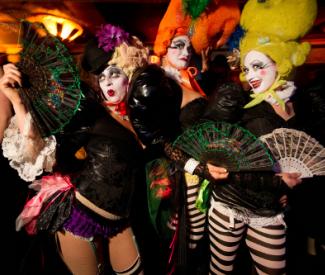
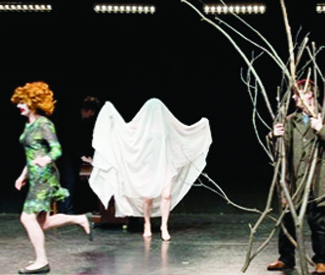
Is Steampunk the Next Big Fashion Trend?” asked Time today. LOL-choke. Let’s just tune up our corsets and revel all weekend in burner-tinged retro-futurism at the Edwardian Ball (Fri/18 and Sat/19 at the Regency).

To wet your steamwhistle, here are pics from last year and an interview with founder Justin Katz


LAnce Armstrong and the SF financier

1

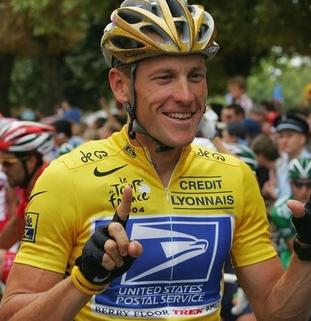
According to the Chron, the owner of the bicycle team that employed Lance Armstrong has been subpoenaed as part of the federal investigation into Lance Armstrong’s alleged doping. (Why is this a federal issue? Um, because some US Attorney wants to make headlines. And because the US Postal Service, which sponsored the team, was involved.)

Thomas Weisel, a legend of Silicon Valley, hasn’t said much publicly about the whole situation, although the Center for Investigative Reporting cites a lawsuit suggesting that he knew at least something nasty:

According to the Center for Investigative Reporting, testimony in an earlier arbitration case involving a dispute over Armstrong’s bonuses suggest Weisel was made aware by team members and doctors of doping concerns on three occasions, beginning in 1996 (before Armstrong joined the USPS team), all to no avail. After publicly expressing concerns about Armstrong in 2001, former team member Greg LeMond said he was told by Weisel, according to the arbitration documents, “What you’re saying about Lance isn’t good for you. You be careful.”

But Weisel was happy to talk to the San Francisco Business Times, which just posted a summary or an earlier interview. You have to be a subscriber to read the whole thing (and you know what? I pay for a subscription every year because there’s stuff in the BT that you never see anywhere else, particularly if you’re watching development issues). Here the gist:

Wiesel denies everything.

“I never had one discussion with one coach or one rider about doping,” he said. “And to my knowledge, the guys that were running my program – Mark Gorski (Postal general manager) and (operations director) Dan Osipow – they did not either. People say ‘Jesus, you had to know this was going on because everyone was doing it,’” Weisel said. “That’s not true. I never thought it was. I don’t think many cycling teams were deploying that practice. And we certainly had part of our rider contract where if a person tested positive, they were off the team. We were very explicit there.”

Okay then.

Bicycling is a lot more harsh than baseball — Barry Bonds might not get into the Hall of Fame (although if he does, so should Pete Rose), but he hasn’t been stripped of any of his batting titles and nobody’s talking about changing his stats. It all reminds me of a friend who played for the University of Miami back in the 1980s, when Suntan U won national football titles. “Everyone juiced,” he told me. “Everyone. You want to play, you juice. You want to get the the NFL, you juice.”

Cheating — except that everyone was doing it. Horribly unhealthy, but so is playing football at that level. When the rewards are so high, and the competition so intense, and winning is all that matters, people cheat. (See: Wall Street, where Weisel plays. See: Corporate America.)

Lance Armstrong is reportedly worth about $100 million. Bonds, about the same. Would they do it the same way again — or retire in a more relative obscurity with a lot less money?

And why are those the choices?


Spies on the corner

23

rebecca@sfbg.com

In the Netherlands city of Eindhoven, the streetlights lining a central commercial strip will glow red if a storm is coming. It’s a subtle cue that harkens back to an old phrase about a red sky warning mariners that bad weather is on the way. The automated color change is possible because satellite weather data flows over a network to tiny processors installed inside the lampposts, which are linked by an integrated wireless system.

Lighting hues reflecting atmospheric changes are only the beginning of myriad functions these so-called “smart streetlights” can perform. Each light has something akin to a smartphone embedded inside of it, and the interconnected network of lights can be controlled by a central command center.

Since they have built-in flexibility for multiple adaptations, the systems can be programmed to serve a wide variety of purposes. Aside from merely illuminating public space, possible uses could include street surveillance with tiny cameras, monitoring pedestrian or vehicle traffic, or issuing emergency broadcasts via internal speaker systems.

The smart streetlights aren’t just streetlights — they’re data collection devices that have the potential to track anything from pedestrian movements to vehicle license plate numbers. And, through a curious process distinctly lacking in transparency, these spylights are on their way to San Francisco.

BIG PLANS

On Minna between Fourth and Sixth streets in downtown San Francisco, the San Francisco Public Utilities Commission has installed a pilot project to test 14 streetlights that are connected by a wireless control system. The city agency plans to gauge how well this system can remotely read city-owned electric meters, wirelessly transmit data from tiny traffic cameras owned by the Municipal Transportation Agency, and transmit data from traffic signals.

The pilot grew out of San Francisco’s participation in an international program called the Living Labs Global Award, an annual contest that pairs technology vendors with officials representing 22 cities from around the world. At a May 2012 LLGA awards summit in Rio de Janeiro, far outside the scope of the city’s normal bidding processes, a Swiss company called Paradox Engineering won the right to start testing the high-tech lights in San Francisco. Within six months, Paradox Engineering and the SFPUC had the Minna streetlights test up and running.

Meanwhile, the city has issued a separate Request for Proposals for a similar pilot, which will test out “adaptive lighting” that can be dimmed or brightened in response to sensors that register pedestrian activity or traffic volume. The city is negotiating contracts with five firms that will test out this technology in three different locations, according to Mary Tienken, Project Manager for LED Streetlight Conversion Project for the SFPUC.

Under the program, five vendors will be chosen to demonstrate their wireless streetlights on 18 city-owned lights at three test sites: Washington Street between Lyon and Maple streets; Irving Street between 9th and 19th avenues; and Pine Street between Front and Stockton streets.

LED streetlights are energy-efficient and could yield big savings — but the lights do far more than shine. The RFP indicates that “future needs for the secure wireless transmission of data throughout the city” could include traffic monitoring, street surveillance, gunshot monitoring and street parking monitoring devices.

So far, the implications of using this technology for such wide-ranging objectives have barely been explored. “San Francisco thought they were upgrading their 18,000 lamps with LEDs and a wireless control system, when they realized that they were in fact laying the groundwork for the future intelligent public space,” LLGA cofounder Sascha Haselmeyer stated in an interview with Open Source Cities. “Eindhoven is pioneering this with … completely new, intelligent lighting concepts that adapt to the citizen not just as a utility, but a cultural and ambient experience. So many questions remain,” he added, and offered a key starting point: “Who owns all that data?”

LUMINARIES IN LIGHTING

Phillips Lighting, which was involved in installing the Eindhoven smart streetlights system, played a role in launching the San Francisco pilot. Paradox Engineering recently opened a local office. Oracle, a Silicon Valley tech giant, is also involved — even though it’s not a lighting company.

“Oracle, of course, manages data,” Haselmeyer explained to the Guardian when reached by phone in his Barcelona office. “They were the first to say, ‘We need to understand how data collected from lampposts will be controlled in the city.'”

According to a press release issued by Paradox Engineering, “Oracle will help managing and analyzing data coming from this ground-breaking system.” Oracle is also a corporate sponsor of the LLGA program. It has been tangentially involved in the pilot project “because of a longstanding relationship we had with the city of San Francisco,” Oracle spokesperson Scott Frendt told us.

Paradox was selected as the winner for San Francisco’s “sustainability challenge” through LLGA, which is now housed under CityMart.com, “a technology start-up offering a professional networking and market exchange platform,” according to the company website.

In May of 2012, the SFPUC sent one of its top-ranking officials, Assistant General Manager Barbara Hale, to Rio for the LLGA awards summit. There, technology vendors of all stripes showcased their products and mingled with local officials from Barcelona, Cape Town, Glasgow, Fukuoka and other international cities. San Francisco was the only US city in attendance. San Francisco will even host the next summit this coming May at Fort Mason.

In Rio, Paradox was lauded as the winning vendor for San Francisco’s LLGA streetlights “challenge.” It didn’t take long for the company to hit the ground running. “Soon after the Rio Summit on Service Innovation in Cities, where we were announced winners for San Francisco, we started discussing with the SFPUC the objectives and features of the pilot project,” Paradox announced on the LLGA website. “Working closely with the SFPUC, we also had the opportunity to build solid partnerships with notable industry players such as Philips Lighting and Oracle.”

WINNERS’ CIRCLE

On Nov. 15, Paradox hosted an invite-only “networking gala” titled “Smart Cities: The Making Of.” The event brought together representatives from Oracle, the SFPUC, Phillips, LLGA, and the Mayor’s Office of Civic Innovation, “to learn about the challenges of urban sustainability in the Internet of Things era,” according to an event announcement.

“The project we’re piloting with the SFPUC is highly innovative since it puts into practice the new paradigm of the ‘Internet of Things,’ where any object can be associated with an IP address and integrated into a wider network to transmit and receive relevant information,” Gianni Minetti, president and CEO at Paradox, stated in a press release.

The event was also meant to celebrate Paradox’s expansion into the North American urban lighting space, a feat that was greatly helped along by the LLGA endeavor. But how did a Swiss company manage to hook up with a San Francisco city agency in the first place — and win a deal without ever going through the normal procurement process?

San Francisco’s involvement in LLGA began with Chris Vein, who served as the city’s Chief Technology Officer under former Mayor Gavin Newsom. (Vein has since ascended to the federal government to serve as Deputy U.S. Chief Technology Officer for Government Innovation for President Barack Obama.)

To find the right fit for San Francisco’s wireless LED streetlights “challenge” under the LLGA program, a judging panel was convened to score more than 50 applicant submissions received through the program framework. Judges were selected “based upon knowledge and contacts of people in the SFPUC Power Enterprise,” Tienken explained. The scoring system, Haselmeyer said, measures sustainability under a rubric developed by the United Nations.

Jurists for San Francisco’s streetlight program were handpicked from the SFPUC, the San Francisco Department of Technology, Phillips, and several other organizations. An international jurist is designated by LLGA for each city’s panel of jurists, Haselmeyer said, “so as to avoid any kind of local stitch-up.”

He stressed that “the city is explicitly not committing to any procurement.” Instead, vendors agree to test out their technology in exchange for cities’ dedication of public space and other resources. Tienken, who manages the city’s LED Streetlight Conversion Project, noted that “Paradox Engineering is not supposed to make a profit” under the LLGA program guidelines. “We’ll pay them a $15,000 stipend,” she said, the same amount that will be awarded to the firms that are now in negotiation for pilot projects of their own.

“San Francisco is using this to learn about the solution,” Haselmeyer added. “This company will not have any advantage,” when it comes time to tap a vendor for the agency’s long-term goal of upgrading 18,500 of its existing streetlights with energy-saving LED lamps and installing a $2 million control system.

At the same time, the program clearly creates an inside track — and past LLGA participants have landed lucrative city contracts. Socrata, a Seattle-based company, was selected as a LLGA winner in 2011 and invited to run a pilot project before being tapped to power data.SFgov.org, the “next-generation, cloud-based San Francisco Open Data site” unveiled by Mayor Ed Lee’s office in March of 2012.

The mayor’s press release, which claimed that the system “underscores the Mayor’s commitment to providing state of the art access to information,” made no mention of LLGA.

PRIVACY AND PUBLIC SPACE

Throughout this process of attending an international summit in Rio, studying applications from more than 50 vendors, selecting Paradox as a winner, and later issuing an RFP, a very basic question has apparently gone unaddressed. Is a system of lighting fixtures that persistently collects data and beams it across invisible networks something San Franciscans really want to be installed in public space?

And, if these systems are ultimately used for street surveillance or traffic monitoring and constantly collecting data, who will have access to that information, and what will it be used for? Haselmeyer acknowledged that the implementation of such a system should move forward with transparency and a sensitivity to privacy implications.

“Many cities are deploying sensors that detect the Bluetooth signal of your mobile phone. So, they can basically track movements through the city,” Haselmeyer explained. “Like anything with technology, there’s a huge amount of opportunity and also a number of questions. … You have movement sensors, traffic sensors, or the color [of a light] might change” based on a behavior or condition. “There’s an issue about who can opt in, or opt out, of what.”

Tienken and Sheehan downplayed the RFP’s reference to “street surveillance” as a potential use of the wireless LED systems, and stressed that the pilot projects are only being used to study a narrow list of features. “The PUC’s interest is in creating an infrastructure that can be used by multiple agencies or entities … having a single system rather than have each department install its own system,” Tienken said. The SFPUC is getting the word out about the next batch of pilots by reaching out to police precinct captains and asking them to announce it in their newsletters, since “streetlighting is a public safety issue,” as Tienken put it.

Haselmeyer acknowledged that public input in such a program is important: “It’s very important to do these pilot projects, because it allows those community voices to be heard. In the end, the city has to say, look — is it really worth all of this, or do we just want to turn our lights on and off?”

LIGHTS, BUT NO SUNSHINE

One company that is particularly interested in San Francisco pilot is IntelliStreets, a Michigan firm that specializes in smart streetlights. IntelliStreets CEO Ron Harwood told the Guardian that his company was a contender for the pilot through LLGA; he even traveled to Rio and delivered a panel talk on urban lighting systems alongside Hale and a representative from Oracle.

A quick Google search for IntelliStreets shows that the company has attracted the attention of activists who are worried that these lighting products represent a kind of spy tool, and a spooky public monitoring system that would strip citizens of their right to privacy and bolster law enforcement activities.

“It’s not a listening device,” Harwood told the Guardian, when asked about speakers that would let operators communicate with pedestrians, and vice-versa. “So you can forget about the Fourth Amendment” issues.

Harwood seemed less concerned about the activists who’ve decried his product as a modern day manifestation of Big Brother, and more worried about why his company was not chosen to provide wireless LED streetlights in San Francisco. After being passed over in the LLGA process, Harwood said IntelliStreets responded to the RFP issued in the weeks following the Rio summit. Once again, Harwood’s firm didn’t make the cut.

Since his company provides very similar services to those described in the RFP, Harwood said he was “confused” by the outcome of the selection process. IntelliStreets’ Chief Administration Officer Michael Tardif was more direct. “Clearly we think this was an inside deal,” Tardif told the Guardian. Tienken, for her part, declined to discuss why San Francisco had rejected IntelliStreets’ application.

And when a public records request was submitted to the agency last August for details on San Francisco’s participation in LLGA, the response was opaque at best. “After a duly diligent search we find that there are no documents responsive to your request,” an SFPUC public records coordinator responded via email. “The San Francisco Public Utilities Commission is not a participant, nor is involved with Living Labs Global Award. Please know that we take our obligations under the Sunshine Ordinance very seriously.” That was just an honest mistake, Sheehan tells the Guardian now by way of explanation. In the public records division, “Clearly, nobody had any familiarity with LLGA.”

The Haight Street Banksy rat is looking for a good home

1

Kerfuffle attended the publication of my Street Seen column on the reappropriated Banksy street art that popped up at Context art fair during Art Basel week in Miami last month.

Hamptons gallerist Stephen Keszler wrote to tell me that my account of him taking two of the pieces from Palestine and affixing $400,000 price tags to the them was so boring that it made him fall asleep in the bathtub (probably just part of growing old, darling.)

But I also received an interesting communique from a man who claimed responsibility for getting the Banksy rat originally painted on Haight Street’s Red Victorian hotel and cafe to Miami. He says it needs a home.

Brian Greif wanted to clarify that the San Francisco rat was not under control of Keszler or Robin Barton of London’s Bankrobber gallery, Keszler’s partner in the Banksy scheme (Keszler and his staff had neglected to mention this fact in our back-and-forths.) Greif actually wants to donate the rat to a museum, but the process is proving a little complicated.

“I hate to see something important, beautfiul, something I think should be preserved painted over a day later, a month later, a year later,” Greif told me in a phone interview. Greif, who is general manager at KRON and self-described artist active in the SF creative community, had been considering making a documentary on street art when Banksy came to town in April 2010 for his spree of SF stencil art. (Now largely removed by thieving art merchants or painted over, the trip’s sole remaining piece is the bird and tree design on Public Works. The nightclub’s integrated the design into a multi-artist collage mural.)

Greif decided that the process of saving a Banksy piece from obliteration would make for the perfect documentary plot. But it took months to get clearance to remove the rat from the Red Vic. Owner Sami Sunchild was incensed when Banksy “vandalised” her building, as she described it to me when I contacted her to find out how the rat wound up in Miami. (She declined to comment about the rat’s fate.) Greif says the rat was scheduled to be painted over when he finally got permission to remove it intact in December 2010.

But then he couldn’t figure out what to do with the thing. Museums, you see, require authentication from the artist or estate to display a work, and Banksy won’t authenticate street pieces past sporadically putting them on his website for as long as they exist IRL.

A deal with SFMOMA fell through, Greif says. Enter Keszler, who Greif and his documentary team originally interviewed in the role of “bad guy” after the gallerist relocated pieces that the artist had completed on his trip to the West Bank. When Keszler found out about Greif’s rat, he asked to show it alongside his own Banksys at Context. 

“At first I wasn’t sure about that,” says Greif. Banksy’s representative agency Pest Control has condemned Keszler for his reappropriation of the Bethlehem murals. “My partner in the documentary and I discussed. We thought it could be a good part for the documentary.” He consulted street artist friends about the morality of the situation and they told him to go for it as long as he intended the piece to wind up in a museum and not a private collection. Last month, the rat was reassembled for the first time since being removed from its original wall in Miami. Conde Nast named the rat one of the hottest draws of the Art Basel season.

Though he hoped to find a museum interested in displaying the piece through the Miami exposure, Greif was instead deluged with private buyers untroubled by the lack of authentication. The highest offer he received, he says, was $500,000.

But financial gain from once-public art wasn’t the goal when he fought to safely remove the rat. “I think street art is one of the most important movements ever,” Greif told me. He wants the piece to be seen. And now he’s saddled with an incredibly valuable piece of wall. 

Anyone know of a worthy venue for the rodent? Contact Greif at bjgreif@gmail.com. 

Clergy summons sexy undead (local Episcopalian priest pens racy vamp novel)

0

It is perhaps indicative of my professional scope that I was nervous to talk to Amber Belldene, Bay Area author of a “racy romance” vampire novel (her words.) But be advised, my anxiety was due less to her literary pursuits and more with the fact that she is an ordained Episcopalian priest. Religion, it would seem, is a harder passion to penetrate for me than undead sex scenes. 

On her end, Belldene sees no conflict between the two. “Romance novels are really about love, and so is being Christian,” the neatly-attired writer, who “fell down a slippery vampire slope” when she was a young thing told me during her visit to my office. The tagline on her website reads “Mystically Sexy Paranormal Romance…because Desire is Divine.” [sic]

Blood Vine, Belldene’s debut novel, does present a few conflicts with the Christian faith, however. For one, the protagonist is undead. What would Jesus do? 

Though she came to her calling via a mystical experience in her early teens, the priest is far from one of those religious types who seek ban Harry Potter as a tool of the devil. “For me, fiction is just fiction,” she explains. And when she was bedbound pregnant with her twins, she felt the renewal of the connection to vampire novels she had as a child — so much so that she began to devour blood-based books at rates of one to two a day. (For the record, she started with Discovery of Witches and has never read the Twilight series, although she is fond of True Blood.) 

“It was a gut interest,” she says of this affinity for fanged folk. Vampire lit, she felt, “turns our hunger and longing for things into something visceral. [Vampires are] our exaggeration of our human traits.”

And longevity makes for some interesting plot lines. Belldene (her pen name — to protect those she works with, she also won’t reveal the place where she serves as priest) says she banged out Blood Vine rather quickly, and was able to get women-owned, indie publishing house Omnific to print the book on a per-order basis. The day of our interview she still didn’t have a copy of the thing, a fact that she shrugged off in a rather confusing, if charming manner.

She was inspired by some grapevines at a winery she visited in Sonoma County upon discovering that the vines had come from Croatia. The vines, as is obvious from the title, play a starring role in the book. “I think it sounds sillier than it reads,” the author half-apologies as she explains the plot. It is: hunky Andre Maras the vampire lives on a Sonoma vineyard. Far from his homeland, he is wasting away — a common vampire trait when separated from one’s birthplace, Belldene tells me. He hits upon grafting vines from his native country onto plants in California in the hopes of deriving ancestral pep from the wine made from the berries. 

Since Andre wants the best for all his fellow vamps, he starts producing the wine on a mass scale. And since that of course entails a cohesive publicity campaign, he hires a PR firm — a PR firm who assigns a rep, Zoey Porter, to his account that he finds quite comely. The rest is neck bites. (Figure of speech, I haven’t read it and you know how these undead novels go, surely it’s not that simple.)

>>ANDRE THE VAMPIRE INTERVIEWS BELLDENE ABOUT BEING A SEXY STORY-WRITING MINISTER? IT’S TRUE!

The plot is far from X-rated, Belldene tells me, but “this is solidly romance. But on the spicy level, not sweet and sensual.” 

What’s been the reaction from those who know her as a holy woman? Mainly positive, the priest of seven years says, and she counts among her supporters prominent members of the Bay Area Episcopalian scene, although many “appreciate the fact I have a pen name.” And for those who have been a bit more confused by the unholy Andre and crew, Belldene has practiced tolerance as any good Christian would. “I have been supportive of their questions,” she says. 

Belldene has two sequels to the novel in the works, 

Dapper down

3

caitlin@sfbg.com

CAREERS AND ED When Ford Models announced that its newest menswear model was a woman — Olympic swimmer and New York artist Casey Legler — in the same month that Yves Saint Laurent chose Saskia de Brauw as the face of its spring-summer 2013 menswear collection, it became clear that men’s fashion was opening itself to the fact that not all people who wear suits and sport rugged looks are male-identified.

But not every butch looking for a fly three-piece has the gamine, broad-shouldered physique of Legler and de Brauw. What’s a dapper gent to do?

Enter the new wave of menswear (or, “masculine of center,” as we’ve seen the look defined on some style blogs) brands specifically tailored to the female-born or identified. Happily, downtown San Francisco’s Crocker Galleria will be the site of the first permanent menswear store to cater to the genderqueer.

“My mother started teaching me [to sew] when I was eight,” Tomboy Tailors’ 48-year-old, butch-identified owner Zel Anders writes me in an email interview. Anders has long been a fan of suits over dresses when it came to formal occasions, but was frustrated that she could never find a well-fitting outfit — even here in the Bay Area, where she’s lived since she was 17. She says the process of suit shopping grew painful, and found it necessary to steel herself before hitting the dressing rooms.

No such toughening up will be necessary at the new shop, which has already garnered a loyal Internet following despite the fact that it won’t open its doors until February 2nd. Tomboy Tailors’ staff will help customers find suits that fit right across the chest, hips, thighs, and seat, customizing them so that each garment fits its new owner.

The store will stock not only its in-house line (Anders especially touts its three-button, notch lapel suit for heavier clientele), but items from other brands selected for a pangender crowd — including a selection of men’s shoes in smaller sizes, like a Dalton wing-tip lace-up Oxford and saddle shoes from Carlos Santos and Walk-Over.

“I am having so much fun just watching people ponder and choose from the several hundred fabrics that they have as options,” Anders says about her Tomboy Tailors experience to date. ” Not only do they have to think about what color they want their suit to be, but they have to decide if they want a solid, herringbone, pinstripe, chalk stripe, plaid, or even a bird’s eye, nail’s head, or houndstooth check pattern to the fabric.” Finally, options.

Tomboy Tailors is hardly the only option for fly transpeople, dapper dames, and other genderqueers — transgressive men’s fashion site dapperQ (www.dapperq.com) recently published a list of fab online labels like Marimacho (www.marimachobk.com), The Original Tomboy (www.theoriginaltomboy.com), Saint Harridan (www.saintharridan.com), and Androgynous (www.androgynousfashion.com) that all have a mission to provide fashion for all points on the gender-fashion spectrum.

TOMBOY TAILORS OPENING PARTY

Feb. 2, 2-6pm, free

Tomboy Tailors

Crocker Galleria

50 Post, first floor, SF

www.tomboytailors.com


Actual pain

0

emilysavage@sfbg.com

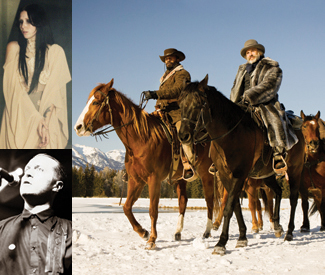
TOFU AND WHISKEY Ah, the tormented love song. Chelsea Wolfe does it well. Vocally, she transfixes, sometimes sounding like she’s calmly wringing every ounce of blood from a relationship totem, at other points whispering cries of help from a enveloping darkness, the vibrations of the plucked-hard guitar strings reverberating in the distance. This rush of gloom and pain, in a genre she’s past described as “doom folk,” came forth in a fierce package in 2011’s electric Apokalypsis, and steadily zigzags beautifully through 2012’s meandering Unknown Rooms: A Collection of Acoustic Songs.

This weekend, the LA-via-Sacramento singer-guitarist comes to SF with a fellow dark folk spirit, King Dude (Fri/11, 9pm, $15. Great American Music Hall, 859 O’Farrell, SF. www.slimspresents.com). The two once recorded a split seven-inch together, and have played a few shows here and there, but this will be their first full tour together, which surprises King Dude, as tells me via phone from his homebase in Seattle, because they’re longtime pals who “got on like a house on fire” when they first met.

They’re both on the spectrum of a bubbling rebirth of neofolk and gothic Americana roots, inspired by acts like Death in June, and seen elsewhere in musicians like Emily Jane White and Father John Misty, but really driven recently by Wolfe and Dude, in unique ways.

Though King Dude — a.k.a Seattle’s T.J. Cowgill of black metal bands Teen Cthulhu and Book of Black Earth, and clothing label Actual Pain — also has some experience with tortured love songs. His baritone vocals often sound as if there’s a gravelly demon inside, clawing to get out. The lyrics of his 2012 release, Burning Daylight, tend to reflect inner, unearthly struggles, the occult, fears of death, and tragic old world tales. Or as he told another publication, he’s inspired by “death, religion, love, Lucifer, nature, primal feelings.” Most of the tracks have fully imagined narratives.

There’s the song “Barbara Anne” in which he growls, “I’ll shoot that man in the head if he hurts you, Barbara Anne” and “I’ll run away with you if you’ll have me, Barbara Anne.” It’s the tale of small-town love, set in 1940s, around two characters — a boy and the girl he wants, who’s been wronged by the town. “I think it’s probably the best love song I’ve ever written,” Cowgill says. “The kid is like: ‘I’ll kill everybody in the town for you, if that’s alright with you.’ That’s the most loving thing I think anybody can say for somebody else.”

In his reality, his allegiances lie with his musician wife, Emily, and their seven-year-old black lab, Pagan, the latter of which is currently at the vet getting checked before King Dude heads out on tour with Wolfe, just to make sure everything is OK.

For the complete King Dude interview, see sfbg.com/noise.


UNCHAINED MELODIES

There have been countless articles dissecting every shot of Quentin Tarantino’s newest revenge fantasy, Django Unchained. From “the Django moment” (when white people laugh) to Kerry Washington’s costume designer’s secrets to “Why Django Had to Be a Spaghetti Western,” bloggers and squawkers have been raising important, sometimes frivolous theories about the controversial, often brutal film, set in an alternate version of the antebellum era of the Deep South. But what stood out to me, was the Django Unchained soundtrack; no big shocker, given the director.

The music takes over and transports immediately, with “Django (Main Theme)” by Luis Bacalov and Rocky Roberts, a powerful, full-throated song that was also the title track to the 1966 Spaghetti Western, Django. The opening credits are startling enough, setting a vividly emotional tone, but the song adds the outlining whomp, the exclamation mark. The dusty plucking and Elvis-like vibrato of “Jane-gooo” just stick in your brain. While on “Little Steven’s Underground Garage” show on Sirius Radio, Tarantino discussed his reasoning behind the music in the film. Of the theme he said, “When I came up with the idea to do Django Unchained, I knew it was imperative to open it with this song.”

The soundtrack weaves through ominous and plucky original Spaghetti Western themes, Brother Dege’s twangy stomper “Too Old To Die Young,” John Legend’s funky blacksploitation-style anthem “Who Did That To You” (which ended up on the soundtrack after Legend recorded it on cassette and mailed it to Tarantino), and pummeling hip-hop bangers, “Unchained (the Payback/Untouchable)” — a mashup of James Brown’s “The Payback” and 2Pac’s unreleased “Untouchable” — and “100 Black Coffins” by Rick Ross and Jamie Foxx.

Tarantino said on the radio show that this was the first time he’d included new music in one of his films, and it was thanks to the star and title character, Jaime Foxx, who ran into rapper Rick Ross at the BET Awards and invited him back to the set to work on a song together. The song is clearly influenced by the surroundings, with a Western whistle underneath a molasses beat and lyrics like “revenge is the sweetest.” and “I need 100 black coffins for 100 bad men/…I need 100 black bibles while we send ’em all to hell.”

There’s also the deceivingly calmer moments thanks to songs like Jim Croce’s “I Got a Name,” as Django is given his freedom, which left another lump in my throat. That track also has the needle drop and minimal fuzz of the record collector nerd Tarantino is. He’ll often use his own vinyl on the soundtracks. It’s a “whole record experience,” as he describes it. “Pops and crackles be damned.”


NEVER SLOWING DOWN?

It’s true, prolific garage rocker Ty Segall has yet another new band. This one’s called Fuzz, and it includes Segall on drums and vocals (just like in his pre-Ty Segall Band band, Traditional Fools!) and longtime collaborator-pal Charlie Moothart on guitar. The dudes just released new single “This Time I Got a Reason,” played Vacation last weekend, and will be a part of Noise Pop 2013: Feb. 28 at the Knockout ($8).


CANNIBAL OX

After a period of moody silence, underground Harlem rap duo Cannibal Ox has returned — to the stage, at least. Vast Aire and Vordul Mega announced a one-off reunion show in NY late last year, and that must have gone well, ’cause now they’re heading our way on a full tour. Also noteworthy: Aire and Mega only put out one album as Cannibal Ox, 2001 indie hit The Cold Vein, produced by El-P. Now they’re working on a 2013 followup on Iron Galaxy Records.

With Keith Masters, Double AB, Kenyattah Black, I Realz

Sun/13, 9pm, $15. Brick and Mortar Music Hall, 1710 Mission, SF. www.brickandmortarmusic.com.

Bigger than Bigelow

2

cheryl@sfbg.com

FILM There was hella hoopla over Kathryn Bigelow being the first woman to win an Oscar for Best Director, for 2010’s The Hurt Locker. It’s a good possibility she’ll soon be the first woman to win two directing Oscars, if Zero Dark Thirty‘s remarkable haul of critical kudos continues into statuette season.

But even if Zero (more on that below) doesn’t claim cinema’s top prize, Bigelow will probably win another Best Directing Oscar before another woman anyway. She’s just about the only female director making films that work Oscar’s magic formula: critically praised, culturally significant, headline-grabbing, and popularly loved (with box-office hauls to match). Women may be making inroads on the screenwriting end of things (and you’ll find lauded female names among documentary, foreign-language, and film-producing credits), but the most successful post-millennial female directors — Sofia Coppola (a Best Original Screenplay winner for 2003’s Lost in Translation), Catherine Hardwicke, Andrea Arnold, Debra Granick, Lisa Cholodenko, Lynn Shelton, Kelly Reichardt, and Sarah Polley, to name a few — haven’t been able to tick enough of those golden boxes.

Whether or not a film wins an Oscar is hardly a measure of its true worth. But hoisting a Best Directing Oscar does count for something important, particularly in an industry that largely runs on male power. Bigelow’s success is particularly notable because she does not make so-called “women’s pictures,” whatever that may mean (she did make a vampire flick long before Hardwicke, though, as fans of 1987’s Near Dark will recall). With the exception of 2000’s little-seen The Weight of Water and 1989’s Blue Steel (would anyone remember that movie, if not for Derek Zoolander?) — with honorable mention for Angela Bassett’s formidable supporting turn in 1995’s Strange Days — Bigelow’s films tend to be, uh, “men’s pictures.”

http://www.youtube.com/watch?v=cAtWcvCxPhc

The surfing, skydiving, bank-robbin’ three-punch of Point Break (1991) allowed Keanu Reeves to set a course for action-hero superstardom (without it, he’d never have been cast in 1994’s Speed); though the film features a traditional romantic subplot, it’s mostly about the bromance between Reeves’ undercover FBI agent and Patrick Swayze’s New Age macho man. K-19: The Widowmaker (2002) was Bigelow’s first foray into a military milieu; its tale of trouble aboard a Soviet nuclear submarine, circa 1961, was couched in a $100 million production that neither earned back its budget nor convinced anyone of Harrison Ford’s ability to do a Russian accent. (Interestingly, the film’s Rotten Tomatoes summary foreshadows the reception to date of Zero Dark Thirty: “A gripping drama even though the filmmakers have taken liberties with the facts.”)

Bigelow rebounded with The Hurt Locker (2008) — scooping up her accolades in front of ex-husband and former film-production partner James Cameron, whose 2008 Avatar grossed billions but didn’t win over Academy voters. Set during the Iraq War, The Hurt Locker follows the high-stakes, high-tension routine of a three-man bomb disposal team. It launched actor Jeremy Renner to stardom, and earned a screenwriting Oscar for Mark Boal, a journalist who’d been embedded with a US Army bomb squad. Along with the 2008 HBO mini-series Generation Kill (based on a book written by a journalist embedded with the Marines at almost the same time as Boal), The Hurt Locker — a tense, gritty thriller shot using hand-held cameras — was one of the first large-scale docu-dramas based on the months immediately following the 2003 invasion.

After the Oscars, rumor had it that Bigelow and Boal’s next film would be a South American “drug parable,” with big names like Tom Hanks and Johnny Depp floated as possible stars. Clearly, a more exciting project took precedence — one that’s already raked in critic’s association prizes, and raised the ire of government types, including Sen. Dianne Feinstein, who insist that it has “taken liberties with the facts.”

Front-loaded with equal parts acclaim and controversy, Zero Dark Thirty moves into wider release this week, and larger audiences will be able to make up their own minds about it. It’s certainly edgier than another 2012 film about CIA heroics. (There’s no waterboarding in Argo.) “What I want you to know is that Zero Dark Thirty is a dramatization, not a realistic portrayal of the facts,” CIA Acting Director Michael Morell explained in a recent statement, taking issue not just with the depiction of “enhanced interrogation techniques” (that’s “torture” to you and me), but also the way the film singles out one character as masterminding the operation to take down Osama bin Laden.

“The point was to immerse the audience in this landscape, not to pretend to debate policy,” Bigelow responded in an interview with entertainment site the Wrap. “Was it difficult to shoot? Yes. Do I wish [torture] was not part of that history? Yes, but it was.”

The extent to which torture was actually used in the hunt for bin Laden may never be known, though popular opinion will surely be shaped by this film, as it’s produced with the same kind of “realness” that made The Hurt Locker so potent. Zero Dark Thirty incorporates torture early in its chronology — which begins in 2003, after a brief opening that captures the terror of September 11, 2001 using only 911 phone calls — but the practice is discarded after 2008, a sea-change year marked by the sight of Obama on TV insisting that “America does not torture.” (The “any more” goes unspoken.)

Most of Zero Dark Thirty is set in Pakistan and/or “CIA black sites” in undisclosed locations; it’s a suspenseful procedural that manages to make well-documented events (the July 2005 London bombings; the September 2008 Islamabad Marriott Hotel bombing; the December 2009 bombing of Camp Chapman in Afghanistan) seem shocking and unexpected. Even the raid on bin Laden’s HQ is nail-bitingly intense. The film immerses the viewer in the clandestine world, tossing out abbreviations (“KSM” for al-Qaeda bigwig Khalid Sheikh Mohammed) and jargon (“tradecraft”) without pausing for a breath. It is thrilling, emotional, engrossing — the smartest, most tightly-constructed action film of the year.

At the center of it all: a character allegedly based on a real person whose actual identity is kept top-secret by necessity. She’s interpreted here in the form of a steely CIA operative named Maya, played to likely Oscar-winning perfection by Jessica Chastain. No matter the film’s divisive subject matter, there’s no denying that this is a powerful performance. Maya is the perfect Bigelow lead; she succeeds in a male-dominated world by focusing solely on her job and her ultimate goal, sexism and gender politics be damned. “Washington says she’s a killer,” a character remarks after meeting this seemingly delicate creature, and he’s proven right long before bin Laden goes down.

Some critics have argued that the character is underdeveloped, but anyone who says that isn’t watching closely enough. Maya may not be given a traditional back story (all we know is she was recruited into the agency after high school), or any outside life to speak of (even Renner’s unhinged Hurt Locker vet is shown going home to a wife and kid), or the desire to distract herself with romance (“I’m not the girl who fucks … it’s unbecoming” she explains at one point, dismissing a colleague’s inquiry into her social life). But there’s plenty of interior life there, and it comes through in quick, vulnerable flashes — leading up to the payoff of the film’s devastating final shot.


ZERO DARK THIRTY opens Fri/4 in Bay Area theaters.

Honoring Edward Kennedy for defying and defeating political censorship in WWII

2

The campaign to award a posthumous Pulitzer Prize to Edward Kennedy, the Associated Press reporter who defied political censorship to break the story of the German surrender on May 7, 1945, was given a historic boost at the 135th annual meeting of the California Press Association on Dec. 7, 2012 at the Marines Memorial Building in San Francisco.

See the video of the Cal Press panel on Kennedy after the jump.

Honoring Edward Kennedy from The Intermountain News on Vimeo.

Video Credit: Craig Harrington, publisher of the Intermountain News in Burney

The association unanimously approved the first ever resolution by a news organization in support of Kennedy and it hosted the first ever panel discussion on Kennedy. Cal Press, as it is affectionately known in the newspaper business, is the oldest press organization west of the Mississippi and one of the oldest in the country. It was founded in 1876 at the Palace Hotel in San Francisco.

The resolution noted what happened to Kennedy after he broke the 36-hour embargo on the story. “Whereas the story made page one in nearly every newspaper, it angered General Dwight Eisenhower, the supreme allied commander, and all the other newsmen Kennedy had scooped. The military lifted his war correspondent’s credential, he was threatened with court martial and was fired by the Associated Press.”

The resolution explained that “unbeknownst to the reporters at the time, that suppression was the result of an agreement between U.S. President Harry Truman and British Prime Minister Winston Churchill to allow Russian Premier Joseph Stalin to hold a second surrender ceremony in Berlin.”

Kennedy broke the embargo, Cal Press explained, after “he learned that news of the German surrender was being broadcast to Germany from a radio station in Flensburg, Germany. He contacted military censors and said that since the story was being reported in Germany, the security of Allied troops was no longer an issue and he intended to defy censorship and report the news, which he proceeded to do by using a military phone line thereby registering the biggest scoop of the entire war.”

The resolution noted that Kennedy’s story is now the subject of two major efforts to “rectify the journalistic injustice by awarding him a Pulitzer Prize posthumously.” The resolution was written by Jim Ewert, general counsel of the California Newspaper Publishers Association.

One effort is a campaign launched from Modoc County by Ray A. March, editor of the Modoc Independent News monthly newspaper, to win a posthumous Pulitzer Prize for Kennedy’s hard news international reporting. March worked for Kennedy as a reporter on the Monterey Peninsula Herald a half century ago. Kennedy was the editor and associate publisher of the Herald until his death at age 58 in November 1963 when he was struck by a car while a pedestrian in Monterey.

The Kennedy campaign, the resolution stated, “is supported by 54 noteworthy professional reporters, editors, and photographers, that include San Francisco Chronicle editor Ward Bushee, Pulitzer-prize winning photographers Kim Komenich and Sal Veder, San Francisco Chronicle Science editor David Perlman, former San Francisco Bay Guardian owner Bruce Brugmann, former AP legal reporter Bob Egelko and Frank McCulloch, former senior editor at the Los Angeles Times and the Sacramento Bee, and Eric Brazil,  a retired Examiner and Chronicle reporter, who co-chairs the effort with March.”

The panel gave life and substance to the resolution. Brugmann introduced Bushee as the moderator, who read the eloquent Pulitzer nominating letter from McCulloch. Bushee introduced March, and Perlman, 93, who was a reporter for the old New York Herald-Tribune shortly after World War II,  and Julia Kennedy Cochran, Kennedy’s daughter who discovered her father’s unpublished memoir among his belongings after his death. She got the manuscript published as a major book by Louisiana State University Press. It is titled “Ed Kennedy’s War: V-E Day, Censorship, and the Associated Press.”

The LSU Press and Tom Curley, former AP president and CEO, entered the book in the Pulitzer competition on the basis of its literary qualities. Curley had issued a formal apology in 2011, saying that AP’s repudiation of Kennedy “was a terrible day for the AP. It was handled in the worst possible way…Kennedy did everything right.” In a later interview, he elaborated, “Once the war is over, you can’t hold back information like that. The world needed to know.”

Sixty seven years after Kennedy defied and defeated political censorship, the Cal Press sent its resolution to the Pulitzer board as a formal part of the Kennedy nomination. It said that Cal Press “honors Edward Kennedy for his distinguished example of reporting on international affairs and his courage in the face of potential personal and professional hardship to share with the world one of the most important events of the 20th century.”

 Cal Press concluded that it “applauds and endorses the efforts of Ray A. March, Eric Brazil, and the 54 noteworthy journalists and calls upon the Pulitzer Prize Board and Columbia University to recognize Edward Kennedy for journalistic excellence and posthumously award him with a Pulitzer prize for his groundbreaking coverage of the end of WWII in Europe.”

The 135th meeting of the California Press Association was an historic occasion with an historic pronouncement to right an historic wrong in American history. We’ll keep you posted.  B3


Stage might

1

arts@sfbg.com

YEAR IN THEATER In addition to Christmas lights, the seasonal landscape would not be the same without a thick, shiny coating of awards. We reflect on some highs (and a few lows) from the year in theater with a nod of appreciation here, a nod of respect there, or just a nod, short and involuntary, before the house lights jolt us awake again.

Best theme, or, the year of living nervously Every year it seems like an unplanned, unintentional theme emerges from the collective theatrical hive mind, and this year it was definitely our ever-uneasy relationship with technology. From Mugwumpin’s Future Motive Power, an electric ode to the oft-overlooked genius of inventor Nikola Tesla; to Josh Costello’s dynamic adaptation of Cory Doctorow’s tech-age YA novel Little Brother at Custom Made Theatre Co.; to a stunning revival of Philip Glass’ 1976 opera Einstein on the Beach — technology’s omnipresence seeped onto the stage.

An incomplete list of other plays that variously explored this theme in 2012: Machine at the Crucible, FWD: Life Gone Viral at the Marsh, The Hundred Flowers Project at Crowded Fire, Status Update at Center REP, She Was a Computer by Cara Rose DeFabio, Zombie Vixens From Hell by Virago Theatre Company, and a quintet of newly-translated August Strindberg chamber plays at Cutting Ball Theater. (Nicole Gluckstern)

Best ensemble Choreographer-performer Keith Hennessy’s experimental project Turbulence (a dance about the economy) was the most unusual and fascinating piece to appear this year, hands down, and it featured a deceptively chaotic eruption of performances by a highly skilled ensemble of artist-generators whose sheer present-mindedness made me toss out my zafu in frustration. (Robert Avila)

Best “The Peasants are Revolting!” Just like a case of herpes, you just can’t keep a good revolution down, and who better to tackle the over-the-top outrageousness and poke-to-the-establishment’s-eye of Peter Weiss’ Marat/Sade than the wild and wily Thrillpeddlers? Set in a dilapidated insane asylum spray-painted with “Occupy” slogans and bathroom humor, starring the Marquis de Sade (Jeff Garrett) and a fully engaged complement of rabble and aristocracy, and stuffed with show tunes and moments of questionable taste, Marat/Sade played out like it was written expressly for the notoriously ribald and exhibitionistic Thrillpeddlers, right down to the “copulation pantomime.” (Gluckstern)

Pithiest acronym for a musical: Actor-musician-playwright DavEnd’s rowdy and saucy and smart new musical F.A.G.G.O.T.S. the Musical, directed by D’Arcy Drollinger, had a very long title (Fabulously Artistic Guys Get Overtly Traumatized Sometimes: The Musical!) but all too short a run when it premiered this year at CounterPULSE — so it was great to learn it’s coming back in February 2013. (Avila)

Best armchair cultural revolution The experience of watching The Hundred Flowers Project at Crowded Fire was like being trapped in a distilled version of Mao’s Great Proletarian Cultural Revolution, and all its ostentatious unpredictability. An unstable yet mesmerizing territory of shifting alliances and heightened paranoia, implicating even the colluding silent majority of the audience, Christopher Chen’s epic sprawl created a landscape of Big Brother totalitarianism with the deceptively innocuous building blocks of social media technology and theatricality. A recurring theme in the piece is that of zeitgeist, and Chen admirably captured the nervous implications of our own. (Gluckstern)

Best couple to give George and Martha a run for their money Megan Trout and Joe Estlack as Beth and Jake in Sam Shepard’s A Lie of the Mind at Boxcar Theatre. Trout and Estlack were powerhouses, terrifying and devastating by turns, but director Susannah Martin’s production was a winner all around, fitting nicely into Boxcar’s generally outstanding four-play Sam Shepard festival. (Avila)

Most glam-infused baker’s dozen Another from Boxcar: its summertime take on beloved rock musical Hedwig and the Angry Inch was certainly the most vibrant live production of it I’ve ever seen. Filling the stage with 12 Hedwigs and one very kickass Yitzhak (Anna Ishida), director Nick A. Olivero enhanced the rock club vibe with his unique line-up of “fractured” Hedwigs in skintight gear dripping with sweat and glitter, a guest DJ, and plenty of interaction with the rowdy Hed-heads who packed the house. (Gluckstern)

Best supporting cast Rami Margron in Precious Little at Shotgun. A fine three-member ensemble (also featuring Zehra Berkman and Nancy Carlin) was made to seem much larger thanks especially to Margron’s nimble work as, alternately, a streetwise graduate student, the nebbishy daughter of an aging research subject, a chirpy medical counselor, a relentlessly talkative little girl, and an entire crowd of visitors to the zoo. (Avila)

Most pleasurable peeks behind the mask Although the subject matter of each play were completely different, what The Elaborate Entrance of Chad Deity (at Aurora Theatre) and Truffaldino Says No (at Shotgun Players) had in common was their unmasking of traditionally disguised figures whose role in life is to entertain: professional wrestlers and commedia dell’arte stock characters. Masks off, a pair of truly memorable characters emerged — fall guy in the ring Macedonio “Mace” Guerra (Tony Sancho), and Truffaldino (William Thomas Hodgson), set to follow in the pratfalling footsteps of his father, the famous Arlecchino (Stephen Buescher). While neither play was entirely without flaw, these winsome protagonists bore their respective identity crises with wit, bravery, and heart. (Gluckstern)

Most prescient debut Mojo Theatre. It was in the immediate aftermath of Hurricane Sandy, many miles away from the storm’s path, in an obscure upstairs theater of the old Redstone Building on 16th Street, that Lost Love, a little jewel of an existentialist comedy from director-playwright Peter Papadopoulos, marked the San Francisco debut of impressive newcomers Mojo Theatre — and prefigured the day’s events with humane intelligence and uncanny meteorological instincts. (Avila)

Best example of “I might as well have slept in and just read the press release” The art of the interview is a delicate balance of research and serendipity, and just as important as knowing what questions to ask is knowing when to let the subject take the lead — which made interviewing the truly legendary playwright Eve Ensler on her newest piece, Emotional Creature (performed at Berkeley Rep), so frustrating. She never deviated from her well-worn script with any fresh insights, to the point where it didn’t seem to matter what my questions were. My only consolation is the fact that every other interview I’ve read with Ensler on the topic has unfolded almost word-for-word the same as my own — so at least I know I’m not alone. (Gluckstern)

Sexiest scene in which the actors don’t move (but the stage does) Alex Moggridge and Marilee Talkington at a slowly rotating pub table in Mark Jackson’s Salomania at Aurora. Eros and Thanatos seemed in a slow dance with each other in this striking flirtation between a jaded frontline soldier and a war widow recently liberated from stultifying domesticity. (Avila)

Most graceful bow Becoming Grace at the Jewish Theatre. Naomi Newman’s potent solo play, built from the words and writing of author Grace Paley, closed the 34th and final season of San Francisco’s esteemed Jewish Theatre (formerly Traveling Jewish Theatre). (Avila)

Best musical theater collaboration The Ratcatcher at the Imaginists. This Santa Rosa company is a must see for lovers of smart, intimate, community-based theater, and their latest, a re-telling of the Pied Piper of Hamelin legend, is a pitch-perfect dystopian fairytale featuring a memorable cast and an irresistible musical score by full-partners in the production, the Crux. It’s worth the drive, but here’s hoping they bring it down to SF sometime. (Avila)

Best death scene Michael Zavala in Phaedra’s Love at Bindlestiff Studio. Do It Live!’s worthy production of Sarah Kane’s reworking of the Hippolytus myth climaxes with Hippolytus (a hipster hedonist in Zavala’s capable rendering), castrated and disemboweled, but finally interested in life. (Avila) *


Short takes by Robert Avila:

Best impersonation of a pervy authority figure Sara Moore as Mr. Roper in Three’s Company at Finn’s Funhouse

Best argument for going color blind Red at Berkeley Rep

Best approximation of a teenager Ann Lawler as Theresa in 100 Saints You Should Know, at Theater Rhino

Worst approximation of teenagers Jesus in India, at the Magic Theatre

Best actual teenagers Director Nick A. Olivero’s excellent, age-appropriate cast in Dog Sees God at Boxcar

Most existentially satisfying use of a digital delay Sara Kraft’s TRUTH++ at the This Is What I Want festival at SOMArts

Best lounge act without a lounge Anne McGuire (and Anne McGuire) and Wobbly in Music Again at San Francisco Museum of Modern Art

Meet your weiner: Sammy Davis reps the Bay in national dachshund races

5

December 27th, friends. That is the day that Sammy Davis competes for our honor. Davis is a weiner dog, winner of this year’s regional Wienerschnitzel Wiener Nationals (which took place during half-time of a Warriors game on November 24th, in case you missed it.) We scored an interview with his owner Sabrina Seiden, who along with partner Patrick Major is currently rubbing Davis’ tiny shoulders in preparation for December 27th’s Holiday Bowl in San Diego, where their pup — the 2007 national champ, fancy! — will expend every drop of energy in his wirey little body in pursuit of bringing home the top honor for the Bay. 

San Francisco Bay Guardian: What kind of wiener is Sammy Davis? How did you know he was a winner?

Sabrina Seiden: Sammy Davis is a Double Dapple black and tan Tweenie. Tweenie means he is in between a standard and mini size. We knew he was a winner when we picked him because of his determination and alpha personality.

SFBG: How did you guys prepare for the race? Give me your game day routine.

SS: Certain secrets cannot be revealed, but we’re willing to let you in on a few tips. To train for the Wienerschnitzel Wiener Nationals, Patrick does a series of conditioning activities with Sammy Davis, which includes practicing running out of his kennel using his favorite squeaky ball as bait. The week of the race, we stop training to build up his energy and eagerness to see his toy ball again. On game day we make sure he eats two hours before the race and we have motivational talks with Sammy Davis to get him pumped up. As soon as we dress him in his Wienerschnitzel Wiener Nationals race vest he’s ready to go!

SFBG: Narrate the race itself for us.

SS: I hold Sammy Davis while Patrick waits at the finish line with the squeaky ball. Now remember, it’s been a week since Sammy Davis has seen his favorite toy so he’s more than eager to dash down the race track. During the qualifying heat, Sammy Davis was really squirmy and focused on Patrick and his ball. I could barely hold him and thought he would jump out of my arms. When I placed him in the Wienerschnitzel Wiener National starting gates, he was determined to get to his ball once again. I leaned down and told him “go, go, go!” and he shot out and won his heat. Patrick noticed that the other dogs hadn’t even left the box and Sammy Davis was already three quarters of the way down the track.

Winning form: Sammy Davis on his November 30th gameday

During the final race we were both worried he wouldn’t run because it was so loud in the stadium, and he was shaking. Sammy Davis doesn’t like loud noises and tends to want to run and hide. We gave him our pep talk to keep him focused. I put him in the Wienerschnitzel starting gates earlier than usual to make him feel more secure and help settle his nerves. When Patrick watched him down at the other end of the track Sammy Davis had a determined look, which gave Patrick reassurance that he was going to be the champion!

Now it’s times to train for the Wienerschnitzel Wiener National Finals in San Diego! This is Sammy Davis’ second trip to Southern California. Warm weather and the $1,000 grand prize will be the perfect way to ring in the New Year.

SFBG: Where does Sammy hope to go with his career? What does success look like for him?

SS: Success to Sammy Davis is making people happy. Sammy Davis is an example of how dogs can help their owners overcome tough times with the comfort of their unconditional love. Patrick was sick for a long time and Sammy Davis’ companionship was key to his recovery. Sammy Davis and Patrick are a winning team on and off the Wienerschnitzel race tracks.

Patrick Major and Sabrina Seiden (right) with a boatload of cash and their intrepid canine Sammy Davis

SFBG: Does Sammy Davis eat wieners?

SS: Sammy Davis is on a strict dog food-only diet, but he does love to steal bagels with cream cheese when he can.

SFBG: What does he think of Scott Weiner’s recent nudity ban?

SS: We’re so proud of Sammy Davis’ accomplishments at the Wienerschnitzel Wiener Nationals and think a little exposure of our winning wiener doesn’t hurt anybody.

W. Kamau Bell plays the Fillmore, but doesn’t hold back for the home crowd

0

A word of advice to the person who shouted, “who’s your favorite clothing designer?,” at W. Kamau Bell during his December 9th show at the Fillmore: a guy who wears a “Legalize Arizona” t-shirt during a night he considers one of the biggest moments of his career probably doesn’t give a shit about fashion. (Initially befuddled by the question, Bell eventually responded “Dickies.”) In addition, to the person who asked Bell whether or not he thought was a whore for being on TV, if he is a one … well you paid for your ticket to the show, right?

Glad we could get that out of the way first.

Bell’s Fillmore gig in the city where he resided for 15 years was one of seven on his Kamau Mau Uprising tour – the name an obvious nod to his radical political leanings. But perhaps none of the other venues held as much significance for him as this one. As he told me in our recent Guardian interview, “in some sense that’s bigger than getting a TV show, when they said that I was going to play the Fillmore.”

The comic’s giddiness in reuniting with the people of his adopted homeland (he grew up in Chicago) was evident as his 6’4” frame came lumbering onto the stage, just moments after opener Dave Thomason’s set. Thomason supposedly was going to go off stage and then come back on to introduce Bell, but Bell apparently didn’t get the memo and strolled right into the spotlight sans introduction from Thomason.

You don’t have to be Nate Silver (a.k.a., White Jesus, according to Bell) to predict how a show like this was going to begin. When a local comedian leaves town to get his own TV show in New York – Totally Biased With W. Kamau Bell was recently renewed for a second season – it’s pretty much de rigueur that he opens by regaling the crowd with an anecdotal New York show biz story followed by some softball home crowd-pleasers.

And that’s how it happened. Bell told a story about the time he appeared on The View with Taylor Swift and his towncar was swarmed by six or seven deranged teenyboppers. As for the home crowd pleaser, Bell teased the East Bay denizens about their reluctance to cross the bridge for pretty much any reason. Low hanging fruit? Sure. Could he have easily flipped which side of the Bay he was joshing? Sure. Was it necessary? Absolutely! Broad home crowd pleasers are hypeman-stand-ins in the world of live comedy.

Once we got past the “homecoming” novelty (it never fully went away) Bell hit full stride, thwacking the audience with his favorite subject: race! A palpable liberal queasiness was rife in the historic theater when Bell struck his harshest notes, especially those recounting his own experiences with racism — he once got called the n-word twice in one night in the Mission.

And then as kicker, he chucked sexuality in the mix:

“Hey I’ve lived in San Francisco for 15 years, I never had any beef with gay people, I had way more beef with Chinese people than gay people. Way more, not even close and that’s why I don’t think we should let Chinese people get married. If there’s one point I’m making tonight it’s that Chinese people should not be allowed to get married…That’s the funny thing about San Francisco, it has this reputation of being gay but it’s way more Asian than gay and on some level, gay trumps Asian.”

For the record W. Kamau Bell isn’t actually against Chinese marriage.

Bell’s best quality is his ability to derive humor from seemingly humorless racial topics, distributing laughter equally among the crowd. At no point during the show did it seem like a certain joke got more laughs from people of a certain race. No one else can make the Fillmore ignite in uproarious laughter with a joke skewering the supposed notion that black people were responsible for Prop. 8 passing.

Bell’s “I’m glad to be back!” moment played out exactly like it was scripted. It took place in the perfect setting. Nostalgia and a familiar audience drove Bell’s success at the Fillmore. His biggest challenge, of course, lies ahead: replicating those fuzzy feelings in TV land. 


Choked out

0

news@sfbg.com

When a struggle occurs in jail, it happens behind closed doors where the only witnesses are usually on opposite sides of the law. And when a struggle between these adversaries results in death of an inmate, a lot of questions emerge, questions that can linger for years if not publicly addressed.

Three years ago, a 31-year old inmate named Issiah Downes died in a San Francisco jail cell following a confrontation with deputies. After a yearlong investigation, San Francisco Chief Medical Examiner Amy Hart determined the death was a homicide. Weeks later, Downes’ mother Esther filed a wrongful death suit against the city, which was ultimately settled for $350,000, a significant sum that could have been even higher if she wasn’t too ill to pursue a trial.

Yet the deputies involved remain on the job, working in the jail, with nobody ever punished for what at least one witness said was a homicide that should have had consequences for more than just city taxpayers.

According to the lawsuit, on September 7, 2009 Downes complained about the televisions in his unit being turned off. Deemed a disturbance, he was transferred to a segregated area of the jail. The transfer turned into a scuffle involving multiple deputies who forced Downes to the ground. He was then moved into a “safety cell” where another struggle broke out and he was held prone on the floor while deputies allegedly applied pressure to his back and neck. After complaining that he could not breathe, Downes lost consciousness and was soon declared dead.

The lawsuit named the deputies involved with restraining Downes as Mel Song, Juan Guitron, Edward Gutierrez, Ken Lomba, Kevin Macksound, and Dan White. No charges were pressed against anyone. What’s more, the Sheriff Department’s Communications Director Susan Fahey confirmed that all the deputies named as defendants in the civil suit are still employed by the department in the jail.

While the story has slowly faded from the headlines, one witness has been knocking on doors across San Francisco in an attempt to tell his version of events and bring some light to this man’s murky death. Dennis Damato was in jail at the time and remembers it being a quiet day as he and other inmates watched college football. “Miami played Florida State,” Damato told the Guardian. “I was on a top bunk at the end of the row.”

From his bunk, Damato saw Downes step into the hallway outside the cell and he says Downes was not resisting deputies or being confrontational. “There was no commotion. This guy wasn’t doing anything,” says Damato, who saw a deputy approach and stand beside Downes. “He (Downes) was just standing there nice and quiet and [a deputy] was standing to his left. I did not see them communicate.”

Damato says he looked away for a moment to check the score of the game and when he turned back, he saw the deputy attacking Downes, who was in handcuffs. “He was bent over, handcuffs in front of him, and the deputy had him in a choke hold,” Damato told us. “Mr. Downes was saying he can’t breathe. His eyes were bulging while being choked and brought down.”

Damato says Downes was already on the floor when more deputies arrived to assist and roughly 15 minutes passed before they dragged Downes to a secluded room. Convinced that Issiah Downes was murdered, Damato has reached out to everyone from the DA’s office to the Sheriff’s Department but he says he was shut down at every turn: “They’d say ‘it’s over with. Go home.'”

The deputies could not be reached for comment because the Sheriff’s Department didn’t make them available or release their contact information as we requested.

After Downes’ death the Medical Examiner’s Office investigated and the subsequent report confirms that Downes suffered blunt trauma to his neck (in addition to his torso and extremities), consistent with Damato’s claim that Downes was strangled.

“Were it not for the physiologic stresses imposed by the struggle and restraint, there is no reasonable medical certainty that Mr. Downes would have died at the moment he did.” Assistant ME Judy Melinek, M.D. Concluded in her report. “The manner of death, homicide, indicates that the volitional actions of others caused or contributed to this death.”

Although Chief Medical Examiner Amy Hart said her findings did not speak to any unlawful behavior on the part of the deputies, Esther Downes’ attorney, Geri Green, says, “I think it was very brave of her to call it a homicide,” noting that the finding strengthened the family’s case against the city.

That “homicide” call came after a yearlong investigation that included analyzing a prone restraint method called “figure four,” which incident reports from deputies say Downes was placed in moments before his death. In a figure four, a person lies in a prone position, hands held behind his/her back with knees bent and feet held in the air. Prone restraint is not uncommon but it is controversial as its various methods have lead to deaths.

Downes weighed more than 300 pounds and the autopsy found evidence of pressure on his neck and back. The report summarizes an interview with a trainer for the Sheriff’s Department who said the hold is often difficult to accomplish on an overweight person. Additionally, other inmates reported hearing Downes yell that he could not breathe and a jail nurse said she could hear loud moaning coming from the safety cell where Downes was restrained.

Fahey said the department looked into the matter. “The department conducts its own internal investigation but its report is not public record,” Fahey told us. The Police Department also investigated but in an email, spokesperson Albie Esparza said the results are confidential under laws protecting peace officers. “The case file was handled by SFPD, however those are not public records under section 6254(f) of the Government Code, which protects case files, even after a case has been terminated.”

Ellen Hirst, a spokesperson for then-Sheriff Mike Hennessey, told reporters at the time that the department believed all procedures were executed properly. The department’s official “Safety Cell Use” policies, which we reviewed, state “A prisoner may remain restrained, with handcuffs, waist chains, and/or leg irons as necessary, while in the safety cell to prevent self-inflicted injury” for no more than one hour. Yet the department’s “Use of Force” policies state, “Choking and the use of carotid restraint are not allowed by the SFSD.”

The ME concluded the cause of death to be probable respiratory arrest during prone restraint with morbid obesity. That conclusion, along with the report’s other findings, lead Esther Downes’ to charge in her lawsuit that the deputies used excessive force and illegal and unconstitutional restraint procedures on her son and “in an effort to conceal the homicide, conspired to cover up the cause and manner of death.”

Attorney Ben Nissenbaum is an associate with the renowned John Burris Law firm in Oakland, which has done extensive work on civil rights and police brutality including the Rodney King case. He says the need to further subdue an inmate in a segregated area of the jail is suspicious.

“Why would you restrain a person in a safety cell?” says Nissenbaum. “They’re already restrained. All you have to do is close the door.”

He also noted that safety cells — unlike the rest of a jail facility — are not equipped with surveillance cameras. “There are no cameras or video inside the safety cells and that is common knowledge among deputies,” Nissenbaum told us.

Although the Sheriff Department’s investigation report is not public record, it doesn’t appear that it found any criminal conduct. San Francisco District Attorney’s Office spokesperson Stephanie Ong Stillman told us, “We would have to be presented with something showing criminal conduct before we prosecute anyone…When someone dies in jail, it’s a Sheriff’s investigation.”

Over at City Hall, the City Attorney’s Office — which deals with civil suits against the City — wasn’t exactly eager to pursue the matter. “We have to consider the cost for the city of taking the case to trial,” says City Attorney spokesperson Matt Dorsey, adding that a trial is often not in the city’s best interest.

The case didn’t go to trial and was officially closed on May 18, 2011, two months after San Francisco settled with Esther Downes for $350,000. She died last June near her home in Hawaii and her surviving relatives declined comment on the lawsuit or Issiah Downes.

Like many of those who find their way into the judicial system, Downes had personal problems. He was morbidly obese, suffered from schizophrenia, received counseling for suicide (at one point he tried to gouge one of his eyes, leaving him partially blind), and had previous convictions for involuntary manslaughter, robbery, assault with a deadly weapon, and battery of a police officer. Yet he was paying his debts to society and getting help. He was a member of what public officials like to call “society’s most vulnerable”, which might turn out to be a great understatement if his mother’s conspiracy charge and Dennis Damato’s story are true.

YEAR IN MUSIC 2012: Digital scraps and analog curiosities

3

arts@sfbg.com

YEAR IN MUSIC Are we being punked? Is this all some kind of stupid joke?

Upon first listen, the sound-world of Berlin-London duo Hype Williams (not the music-video director, mind you) is practically guaranteed to provoke a bewildered response. Incorporating half-baked hooks, brutishly cut-and-pasted samples, apathetic vocals, inept musicianship, crude effects, and grainy production into a gnarled, genreless mishmash, its approach gives off a superficial whiff of laziness and inconsequence.

After further inspection, however, Hype Williams reveals itself as a vital, innovative force in modern music, paving the way for a new form of artistic synthesis in an age when information flows like unchecked tap water.

The impulse to pillage the art-world for scraps and fragments, and reassemble them within a new framework, (see: postmodernism) has a diverse history, from The White Album to the writings of Thomas Pynchon; yet, it was once widely perceived as a snooty, elitist activity reserved for outsider artists, avant-gardists, and other seemingly unreachable, black turtleneck-wearers.

Hype Williams operates at the forefront of what I like to call “new postmodernism,” recycling musical idioms as a kneejerk response to the Internet’s constant outpouring of accessible information. Whereas pre-Internet postmodernism required relative effort, calculation, and resources to connect the dots between musical forms, anyone in 2012 with a laptop, a WiFi connection, a pirated copy of Ableton or Logic, and a Bandcamp account, was a legitimate artist, granted easy access to an infinite sea of musical possibilities.

http://www.youtube.com/watch?v=4ZK7SVm8hvE

You know how Brian Eno said his instrument of choice is the recording studio? In 2012, the people’s instrument was the iTunes library/MIDI keyboard combo: easier, and cheaper, to learn than the guitar, with a wider sonic range, to boot.

Given the declining relevance of record labels, studios, expensive gear, marketing campaigns, and other barriers preventing would-be artists from crafting and distributing their work, it was easier and cheaper to be a recording artist/collagist in 2012 than ever before. Hype Williams explored the potential of this new musical landscape more relentlessly, and enthusiastically, than perhaps anyone else this past year, rendering it, in my view, 2012’s most essential musical entity.

Within the context of new postmodernism, Hype Williams’ 2012 output sounds less like goofy amateurism than an unfiltered current of creative energy. On this year’s Black is Beautiful LP, released by Hyperdub under the pseudonym Dean Blunt and Inga Copeland (which may, or may not, be their real names), haphazard beats and keyboard melodies are seemingly recorded in one take, prioritizing creative flow and forward movement over the refinement of previously committed ideas.

The tracks are generically titled (“Track 2,” “Track 8”), opting to skip ahead to the next project in lieu of assigning an identity to the last one. Each of the album’s 15 pieces is a non sequitur to the one before it, evoking the scatterbrained impatience brought on by the Internet age.

“Venice Dreamway” (the only properly titled track of the bunch) slaps a rollicking, free-jazz drum solo over an ominous synth drone, while “Track 8” strongly resembles an underwater level from Super Mario Bros.; “Track 10” is an extended, weed-addled dub workout, spilling over the 9-minute mark, while the 35-second “Track 6” consists of little more than a shambolic MIDI flute melody. “Track 5” is a reckless, sloppily executed take on an otherwise competent vocal pop song; and, interestingly enough, “Track 2” is a cover of Bobby and Joe Emerson’s “Baby,” a ’70s R&B obscurity that Ariel Pink’s Haunted Graffiti also reinterpreted on this year’s Mature Themes.

Highly regarded among DIY enthusiasts, Ariel Pink is often credited for rescuing postmodernism from the artistic elite, and thus providing the roadmap to Hype Williams’ aesthetic. In an interview this past September, I asked Pink to rattle off a list of favorite books, albums, films, and visual artists: a request he (politely) declined. “Favorites? No,” he explained. “My aesthetic is too all-inclusive. That’s the best part, and the worst part about it. It doesn’t make me a very loyal fan of any one thing in particular. But, at the same time, I love everything.”

Aside from fuzzy, queasy texture, this “all-inclusive” philosophy is the primary link between Hype Williams’ and Ariel Pink’s output. Just as Pink’s kaleidoscopic lo-fi pop makes no judgments between “good” and “bad” musical influences, forcing the entire art-world through his sonic meat grinder, one can picture Hype Williams hoarding digital scraps and analog curiosities, recycling them indiscriminately into new forms.

United by a simultaneous love for, and indifference to, all forms of art, both Pink and Hype Williams seem motivated not by ironic detachment or hipster posturing, (see: Hippos In Tanks, Not Not Fun) but by the pure joy and freedom of using everything available.

Another proponent of the all-inclusive strategy, SF party curator Marco de la Vega, orchestrated a club night at Public Works this past April, headlined by Hype Williams, with additional sets by Gatekeeper, Teengirl Fantasy, and Total Accomplishment.

De la Vega described his aesthetic to the Guardian as “the embodiment of this idea that there is such a huge cross-section between various musical genres, and particular production styles of music, so rap, electronic… post-dubstep, post-anything. There’s this huge intersection between all these scenes that doesn’t actually have, strangely, its own outlet.”

Named “Public Access,” the event set an ideal context for Hype Williams’ art, recognizing its position at the crossroads of musical approaches. The duo’s performance (its second US appearance, ever) was a wild success, the most engaging “laptop set” I’ve ever witnessed, and perhaps the best live show I saw in all of 2012.

With strobe lights flashing, and the stage enshrouded in fog, Blunt and Copeland were rendered completely invisible, reinforcing their mysterious public image, and keeping the specifics of their musical process under wraps.

Making full use of the club environment, and its thumping, punishing sonic capabilities, they delivered a seamless, hour-long barrage of heavy, industrial beats, cavernous drones, mysterious field recordings, and characteristically skewed melodies, with the occasional, approachable pop hook thrown in to provide a grounding influence.

With all too many live bands churning out unimaginative replications of their own studio output, Hype Williams’ set was striking, immersive, and wholly refreshing. Ear-splittingly loud, and physically exhausting, it exposed the dark underbelly of the post-everything, all-inclusive approach, daring the audience to submit to its overwhelming, cacophonous potential.

If Black is Beautiful exhibited the joyful liberation of new postmodernism, Blunt and Copeland’s live set was the equivalent of a system overload: inclusive to the point of devastation.

Between an LP for Hyperdub, a handful of web-only mixtapes, and a live SF performance for the ages, Hype Williams spent 2012 re-evaluating the significance, and egalitarian capacity, of postmodernism, in an age when anyone with a WiFi connection can go digital-dumpster-diving for musical scraps to quilt together as they please. As long as casual musicians keep on harnessing the vast creative potential at their fingertips, and “professionals” like Blunt and Copeland continue to expose the waning relevance of the art-world’s precious institutions, our culture of musicianship is bound to inch closer and closer towards democracy.


TAYLOR KAPLAN’S TOP 10 ALBUMS OF 2012

1. Hiatus Kaiyote: Tawk Tomahawk (self-released)

2. Lone: Galaxy Garden (R&S)

3. Scott Walker: Bish Bosch (4AD)

4. Zammuto: s/t (Temporary Residence)

5. Tame Impala: Lonerism (Modular)

6. Laurel Halo: Quarantine (Hyperdub)

7. Field Music: Plumb (Memphis Industries)

8. THEESatisfaction: awE naturalE (Sub Pop)

9. Nik Bärtsch’s Ronin: Live (ECM) 10. d’Eon: LP (Hippos In Tanks)

YEAR IN MUSIC 2012: Waiting for Four-O

0

arts@sfbg.com

YEAR IN MUSIC I’m at the Marina in Berkeley with J-Stalin around noon, waiting for producer-rapper Droop E to arrive so he and J can shoot a video for his upcoming EP, Hungry & Humble. I was invited, not by Droop but by his “Pops,” Bay Area legend E-40, to do an interview for 40’s epic, two-album collaboration with Too Short, History (HeavyOnTheGrind/EMI, 2012).

“Shiiit, me and you go way back, patna,” 40 said the week before over the phone, recalling prior interviews. “I just gotta film a cameo then we’ll do it there.” But since scheduling the article, I haven’t been able to reach him, either directly or by publicist, so Stalin took pity on me and brought me along to the shoot.

“I’m going on tour with Trae tha Truth,” Stalin says, referring to the Houston rapper signed to T.I.’s Grand Hustle label. “He flew out here and Ghazi from Empire Distribution picked him up from the airport; when Trae got in the car, he was like, ‘Who is J-Stalin? I need to work with him.'”

That word of Stalin has spread to Houston is an encouraging sign in the usually bleak landscape of Bay Area rap, and couldn’t come at a better time as the West Oakland MC prepares his fourth “official” solo album, On Behalf of the Streets, Pt 2. Like J’s debut, OBOTS2 is produced entirely by the Mekanix; the difference six years later is Stalin’s now the second bestselling local rapper after E-40 — according to Rasputin Records — and the Mekanix are among the Bay’s hottest producers, working with everyone from 40 on down. In the absence of local radio or major label support, the stakes continue to increase for the author of Memoirs of a Curb Server (Livewire/Fontana, 2012) and the proprietors of The Chop Shop (ZooEnt, 2012).

The day stretches on, tedious yet fascinating. Droop E’s got a serious film crew here and armed security to boot; the only thing missing is a permit. And 40. Various rappers drift in and out, like Cousin Fik, latest star of DJ Fresh’s ongoing Tonite Show series, or Lil Blood and Boo Banga, who released a syrup-drenched duo disc Cream Soda and Actavis (Livewire) this year. A member of Stalin’s Livewire crew from Oakland’s Dogtown neighborhood, Blood’s prepping his own official debut, Meet the Driver and the Shooter, for February. He takes off his ski hat and shows off his scalp, revealing an entrance wound and an exit wound about an inch and a half apart. Everybody laughs, but they don’t think it’s funny. It’s a stark reminder of how little insulation there is between the industry and the street out here.

HYPHY 2.0

Between takes, I get in some questions with Droop E. Besides launching his own career, Droop has had a big hand in his dad’s, co-executive producing four volumes of Revenue Retrievin’ (2010-11) and three of Block Brochure (2012) for his HeavyOnTheGrind imprint of 40’s Sick Wid It Records. Yet the 24-year-old veteran — who, as a teen, was one of the architects of hyphy, along with Rick Rock, Traxamillion, and ShoNuff — lives up to his EP’s title.

“I’m a partner but I’m still a protégé,” he says. “I’m learning a lot, seeing my Pops get into a whole nother mode of beastin’ and just making our own sound.”

That sound, judging from Block Brochure and History, has grown suspiciously more hyphy lately, in the wake of Drake’s double platinum “The Motto,” an overt homage to the Bay Area music of half a decade ago.

“That ended up being beneficial,” Droop says, “because look at the sound now in the Bay and L.A. ‘The Motto’ opened it up again.”

Given the bizarre local backlash against hyphy beginning mid-2007 — forcing its originators to prematurely back away from the sound — this is a remarkably philosophical purchase. Reached by phone, Traxamillion agrees, as his own 2012 disc My Radio (SMC) finds him revisiting the implications of the sound.

“I’m not mad,” he says. “I felt like I had an influence on music on a national level.”


OUT HERE TRYNA FUNCTION

The next night, I’m in a Dublin club, where we’re not allowed to drink, because this is a movie. Sympathetic to my long wait, Droop E’s somehow procures me some Jameson’s and the tawny liquid immediately catches E-40’s eye. “Gable, what you got there?” Dressed in a black pinstriped suit, 40 has finally arrived for his cameo, a series of elaborate tracking shots of him pouring a shot and toasting. Finally, I manage to catch him in an unoccupied moment and remind him about the interview; can we tape a few questions? He fixes me with a look of contempt.

“Nah, I ain’t fuckin’ with you.”

I feel the blood drain from my face. Then, with agonizing slowness, a smile begins to creep across his lips.

“Nah, I’m just playin’,” he says. “Let’s do it.”

Delays are nothing new to the Vallejo MC; he and Too Short first began announcing History in the late ’90s while they were both on Jive, but Jive never let it happen.

“It was 10 years in the making, but it didn’t take 10 years to make,” 40 says. “God work in mysterious ways so now’s the perfect time because we get all the marbles. We superindependent. We got a distribution deal through EMI.”

40’s made the most of his new freedom, only releasing albums in pairs and trios since parting with Warner after The Ball Street Journal (2008). Where BSJ bore clear signs of corporate overthink, 40’s prolific post-Warner output makes it obvious that he does his best work with a free hand. At age 45, the rapper scored one of his biggest hits this year with Block Brochure‘s “Function,” which in turn has provided a convenient new label to replace the toxic term “hyphy.” History‘s two volumes are thus divided into Mob Music and Function Music.

“Function music is more club, party music,” 40 says. “The difference between function music and mob music, function is the feel of the new era; we’re covering two and a half to three decades of music. We been doing it since the mid-’80s and here it’s almost 2013. Some people wish they could have one hit; I have had many hits in my life.”

“There’s people who don’t like me but I’ve carved my name into the history books,” he concludes. “There’ll never be another E-40 ever because I’m too different. One thing about the Bay Area: we some trendsetters and we got haters and they talk about us but they duplicate us later.”


2012: Don’t call it the Apocalypse

17

There’s been growing media coverage of the widely anticipated 12/21/2012 date – which marks the end of the Mayan Long Count calendar, a rare Winter Solstice galactic alignment, and associated New Age predictions – with journalists and skeptics scoffing at doomsday predictions that it will trigger the apocalypse.

Yet as I’ve researched the prophecies, predictions, and possibilities associated with 2012, it seems that the only significant people offering up such end-of-days views are those seeking to mock them, shoot them down, or whip up hysteria. And nobody is feeling more frustration over this straw man media hype than author/researcher John Major Jenkins, who has written more about the significance of this date than anyone.

Before Jenkins would even let me interview him, he had me read the “Guide to 2012” that he prepared for those interested in writing about the subject, which he begins by reinforcing the accuracy of the 12/21/2012 date and clarifying its significance. “The doomsday assumption is not found in Maya tradition,” wrote Jenkins, who has researched the subject for 25 years and written nearly a dozen books on Mayan cosmology and beliefs. “The evidence indicates that Maya concept for cycle endings (such as 2012) is transformation and renewal.”

That idea – that we’re leaving an age focused on competition and consumption and entering an era of greater cooperation and connection – has been emphasized by everyone that I’ve interviewed on the concept. That includes New Age authors, a professor who studied Mayan folklore, political activists seeking a shift now to avoid real ecological and economic catastrophes later, and astrologers focused on the alignment of the earth, sun, and dark center of the Milky Way for the first time in 13,000 years (when that alignment occurred on the Summer Solstice, double that period for the last time it appeared this way on the longest night of the year, which some view as a more significant catalyst for change).

“I feel like the collective has been unable to receive the basic message I’ve been trying to give,” Jenkins told me, a hint of irritation in his voice as he recounted his painstaking research into Mayan artifacts and beliefs, the significance of which lies largely with their connection to the natural world that many modern people have lost. “That doesn’t seem to be what the collective wants or what the mainstream media want to say.”

Jenkins expresses almost equal frustration with those who seek to discredit or misrepresent his work as he does with those who have appropriated it for their own political or self-aggrandizing purposes. “We don’t know what’s going to happen,” he said. “We’ve been filtering 2012 through this kind of Nostradamus lens.”

Yet beyond his main point of simply understanding and honoring the Mayan people, Jenkins does hope that people use this moment as a prompt to create a transformation in global consciousness: “The challenge is for us to engage in and participate in the world in a more sustainable way and get past the domination mode.” And by “moment,” Jenkins and others emphasize that 12/21/2012 is the peak of moment lasting weeks, months, or years, depending on people’s perspectives.

Rob Brezsny, the San Rafael resident whose down-to-earth Free Will Astrology column has been printed in alt-weeklies throughout the country for decades, told us he respects Jenkins’ work and sympathizes with his current plight. “He gets it from both sides,” Brezsny said, noting how Jenkins gets attacked by both the skeptics and true believers.

Brenzsny is also a little skeptical about all the hype and focused hope surrounding 2012 – mostly because he thinks such magical thinking discounts the need for the long, hard work involved in either spiritual or political transformations – but he does believe in the importance of markers and rituals like those associated with the 12/21/2012 date.

“I think most people these days understand that how the world proceeds is through spectacles,” Brezsny told me. “The activists believe this may be a good moment, a good excuse to have a transformational ritual and to take advantage of this time. We need transformational rituals…Rituals have been a way to marshal our emotional and spiritual resources.”

Both Jenkins and Brezsny acknowledge the difficulty, even the danger, of relying too much on this moment to spark the sociopolitical renewal the world needs. “It’s a complex phenomenon as far as cultural change, and the recognition that things need to be done differently,” Jenkins said.

Yet Brezsny said that to achieve the kind of fundamental transformation that humans need to address issues like global warming and the mass extinctions now underway, that begins with a personal awakening and realization of our connection to one another and the planet. We need to set aside our egos and selfish desires, listen to one another, regain our connection to the natural world, and learn to work together. As Brezsny said, “For me, so much of what the revolution is about is how we treat each other moment to moment.”

These are just two of the dozens of sources that I’ve been interviewing about the 2012 predictions and possibilities, which I’ll take an in-depth look at from a variety of perspectives for the Guardian’s long Dec. 19 cover story (we’ll also include listings and other resources for how to spend that much-anticipated moment, such as the World Unity 2012 online hub).

Then I’ll be traveling through Mayan country in the Yucatan from Dec. 17-23, interviewing fellow pilgrims and wisdom keepers, visiting Tulum and other significant sites, and attending the Synthesis Festival in Chichen Itza, Mexico (and perhaps the Day Zero Festival in Playa del Carmen), so I hope you’ll follow along with my regular postings on this site. See you on the other side.

Free the free

2

VISUAL ART It starts with the streets. Walls, the texture of walls, rough and colored in swirls of graffiti letters. Walls you feel you could reach out and touch their cold and grit. Establishing shots — the streets of San Francisco in the dot-com era. The photos are of their times: an unattended shopping cart in the streets appears as early as page three. Soon follows the spray-painted legend, “Don’t let the good times fool you.”

The pictures are inscrutable, their sequence seemingly random. Yet other than the gnomic title (Friendship Between Artists is an Equation of Love and Survival), the only text in Xara Thustra’s self-published new book’s 500 pages is a brief intro from the author insisting that the book is meant to be read from left to right, from top and bottom in the order the photos appear. There are no captions or prompts to lead the viewer. It is the mute gravity of the photos that pulls you in. What is happening here? It’s like finding a box of photos on a trash pile in the Mission — old furniture, clothes out on the curb, a pile of books and CDs. Why is all this stuff in the trash? Did the owners die? Or get evicted? Photos of strangers. You go from one photo to the next and the outline of a missing life starts to appear. What is happening here?

The action moves in and out of the streets, cinematic — the interiors dark, claustrophobic. The streets provide narration. Everything is spray painted. Demand Community Control. Everything bright, everything clean. Everything they build be like fuck you, fuck you, fuck you. Familiar everyday locations have become enlisted as battlegrounds. At the Dolores Park tennis courts, someone has hung a screen on the fence, painted so that it reads “Sink the Ship” in shimmery, see-through letters. A subliminal message to the tennis players visible on the other side? Or a secret signal to an unseen underground army?

Cut to the interior. Some dim locations start to become recognizable: a performance crammed into a corner of Adobe Books, a crowd seen through a doorway at the old Needles and Pens. The images are at times grainy and low res, like bad cell phone photos or surveillance camera footage. Much is shot in indistinct rooms or hallways, tightly cropped. The people in the interiors model homemade clothing or stare back at us from unmade beds. They are dancing in high heels or fucking each other, holding whips and dildos. No one is smiling. Instead they stare defiantly into the camera as if to ask, “Who are you to watch? Which side are you on?” This is not the careless and fashionable hedonism of Ryan McGinley photos. Instead, like the subjects of Nan Goldin photos, the people in these images know how much their search for freedom costs, and who will have to pay.

Meanwhile, the battle in the streets continues. Scum bags dressed as imposter yuppies stand in front of the mall on Market Street, holding handmade signs reading, “The bombs are dropping, lets go shopping!” An effigy of Gavin Newsom burns at 18th and Castro. Back inside, homeless guys from Fifth and Market calmly eat free breakfast at the 949 Market Squat. More drab interiors, more surveillance footage, and then what is happening here? Scenes of naked people grimly carving designs into each other with razors, holding dripping, bleeding arms up to the camera. It must be 2005, I think, when we all started to give up on ever stopping the war and just started hurting each other.

Full disclosure: I am in this book. I might be too close to the people and events depicted to discern whether the images are strictly documentary or whether their arrangement is intended to create a new story. But the juxtapositions, eerie and dreamlike, pack a wallop. In one two page spread, my dead friend, Pete Lum, stairs from the left page into another photograph on the right of an unknown drag queen out front of Aunt Charlie’s on Turk Street. Their eyes seem to meet across the gutter of the book and across time and space, as if sharing a secret the rest of us cannot know.

Ultimately, perhaps the one indisputable narrative of the book is the tremendous progression in Xara Thustra’s artwork, as the early agitprop graffiti by “Heart 101” in support of street protests slowly morphs into a far more ambitious project, an ongoing collaboration with countless others through performance, print, and cinema to abandon protest and instead collectively embody through art the autonomy and ethics of a truly different world. Perhaps inevitably then, Friendship Between Artists is both a monumental achievement and something of an anti-climax. The protests, the willful art world obscurity, the dead friends — what did it all add up to?

I am certain, anyway, that nothing in the book was conceived with the idea that it would one day appear in an art book. Instead, the interventions, experiments, and protests detailed herein, while at times quite joyous, were, as the book’s title suggests, originally part of a deadly serious struggle to keep oppositional culture alive in San Francisco, and for many that struggle now feels lost. But life must go on, and this is no museum piece.

The book’s 500 pages positively overflow with life, salvaging from oblivion the raw, visceral feel of 15 years of ephemeral underground freedom. While some will be haunted by the suspicion that the answer to the above question is “not enough,” the people in these photos stare into the camera and demand we consider instead a hard-earned and far more redemptive possibility: that this isn’t an art project, it’s how we live. This isn’t representation of a different reality, but about being a different reality. And fuck you, anyway, because being free is its own reward.

For an interview with Xara Thustra, visit sfbg.com/pixel_vision.

XARA THUSTRA BOOK RELEASE AND SOLO SHOW

Thu/6, 7-9pm, free

Needles and Pens

3252 16th St., SF

www.needles-pens.com


London diary

0

arts@sfbg.com

THEATER Tom Cruise, clad in military drag, descended last week by RAF helicopter into Trafalgar Square in what is best described as forced entertainment but was in fact a time-wasting scene from his upcoming blockbuster All You Need Is Kill. Not quite simultaneously but with considerably more stealth, I advanced into South London’s Battersea area, in a completely uncoordinated foray, to see the latest from famed Sheffield-based pomo theater artists Forced Entertainment.

Battersea Arts Centre, a bright red and white 1893 former town hall, is midway through a restoration process called “playgrounding” (putting artists and audiences at the center of the architectural redesign), and its many arches, rococo balustrades, and mosaic tile floors thrive amid an attractive combination of new paint and weathered surfaces. The place is an enviable model for an arts organization: a warm and bustling hub of community activity that is also a serious arts incubator and presenter, boasting 72 performance-tested spaces and a live-in residency program geared to the truly experimental and exceptional.

A nice place for Forced Entertainment to land, enthused artistic director Tim Etchells in a short interview before the evening’s program. He said FE was in fact lucky to find itself there, space in London being at a premium. This is apparently true for even so internationally successful and storied a group as Forced Entertainment.

And speaking of stories, audiences would be up to their ears and eyes in them that night — or rather the loose ends of stories, volleys, and nose-dives from a meta-narrative barrage that manifested itself across a series of readings, performances, and neon. The sign aglow in the Café Bar, where I spoke with Etchells, said simply, “end of story.” Another one said, “Shouting Your Demands from the Rooftop Should Be Considered a Last Resort.”

(All the variously colored neon phrases spread throughout the foyer and adjoining bar were by Etchells, whose many projects outside FE include visual art and writing. The evening kicked off with a book launch of his Vacuum Days, a large hospital-green compendium of daily headlines and announcements — the result of a 2011 internet-based project in which Etchells riffed on the news of the moment in dada-esque fashion. Flipping through the pages was an instant reminder of two things: it had been a hell of a year, and headlines are always loaded.)

The centerpiece of the evening was The Coming Storm. Forced Entertainment’s latest piece (in an unbroken line of group-devised work going back to the company’s founding in 1984) begins unassumingly, with the six performers in their street clothes lined up onstage facing the audience. One of them holds a microphone, and begins by slowly articulating the necessary ingredients of a “good story.” Soon the other performers grow visibly dubious and restless, until one snatches the microphone away and weighs in with a whopper of a tale, never completed, because also interrupted by another greedy storyteller.

And so on through aggressive, sly, and puerile mic-swipings and gradual, unexpected permutations — as those without the microphone do any manner of things to create their own counter-narratives or merely sabotage the one dominating at the moment. It’s a confluence of fractured accounts arranged like a 20-car pile-up, or a game of keep away, or a gentle dance of despair, with occasional live score, random costume changes, and a cluster of branches embraced (and debunked) as a soothing shelter of forest.

The Coming Storm ends up an exercise in failure and resilience at once, since even if no one completes a tale, the audience rushes to fill the void —our minds trained to shape every squiggle into a recognizable human form, however personal or outlandish the starting point. In that rowdy mutual tangle comes quiet reflection from the interstices of language and history.

It left one in just the right frame of mind to receive the last performance of the night, Sight Is the Sense that Dying People Tend to Lose First, Etchells’ monologue for New York actor Jim Fletcher (lately of the title role in Elevator Repair Service’s acclaimed production, Gatz).

Sight proved no return to narrative but rather a concatenation of eccentric observations and pronouncements, undertaken by a nameless po-faced character standing center stage and meeting the audience’s gaze in a free-associative unburdening of “meaning,” desultory definitions that went along the lines of “Socks are gloves for the feet. Snow is cold. Water is the same thing as ice. In America things are bigger. America is a country. Korea is also a country.” Then, some time later, “Cats are afraid of dogs. Dogs like to chase cats. Some dogs like to bite the tire of a passing car.” Throughout this eccentric cataloguing and its naïve reverie, the audience again acts to complete the work wordlessly. Subtle suggestions come, vistas briefly open, demurring exceptions and musings flicker by, as the audience is tossed one wry bone after another, and a slow vague pathos accumulates.

Burning Man’s new Cargo Cult art theme intrigues

5

Burning Man founder Larry Harvey sent burners scrambling to Wikipedia on Friday when he announced the art theme for the 2013 event, “Cargo Cult,” and posed the intriguing question, “Who is John Frum?” It was perhaps the most esoteric and obscure theme ever, but one that I heard only positive reactions to at a couple of burner-populated parties over the weekend, including the Black Rock Art Foundation’s Artumnal Gathering.

The theme draws from stories of indigenous cultures in the South Pacific that have been awed by the advanced technology of American visitors, forming cults and rituals to beckon them and their airplanes back. As an art theme, it then morphs into our own modern fascination with the cargo dropped on us by mysterious visitors, whether they be multinational corporations or extraterrestrial life forms.

As Harvey wrote in a description of the theme that’s well-worth reading, “All we can do is look beyond the sky and pray for magic that will keep consumption flowing.” The base of eponymous Man will be a crudely formed flying saucer, artistically trying to summon back alien visitors and their transformative gifts (that is, if they didn’t already arrive on 12/21/12).

In an interview with the Guardian, Harvey cast the Cargo Cult theme as the first one since 1996’s Hellco, in which a demonic corporation had supposedly taken over Burning Man, to have a theme that he called “satirical,” although he’s quick to say this satire sparks layers of meaning as people ponder it.

“People seem to be imagine this in multiple dimensions and that was the intention,” Harvey said, noting the nods it gives to consumerism, religion, anthropology, metaphysics, and a variety of other disciplines and frames of reference. “You see all kinds of glosses on it.”

He said the kernel of the idea began with a rumination on Polynesian themes, sparked by reading Paul Theroux’s book The Happy Isles of Oceania: Paddling the Pacific. When he hit on the notion of cargo cults, Harvey said the ideas and possibilities of it began to immediately expand in his imagination.

They continued to grow ever outward as he collaborated with others on it, include Stuart Mangrum, a Cachophony Society stalwart who Harvey worked with on the Hellco theme (possibly raising the questions for old-school burners, “Who is John Law?” and might he someday return?), and the architect Lewis Zaumeyer, who designed the Man’s UFO base before he died earlier this year

Harvey said the theme prompt is already triggering lots of creative interpretations. “It’s a spur to invention. People are finding all kinds of ways to riff off of it,” Harvey said of that creative, collaborative spark that he tries to provide. “This is what Burning Man has always been about and what we try to give to the world.”

Unlike past years, when themes such as Fertility, Rites of Passage, Metropolis, and Evolution have been easy to safely ignore, Harvey said the intrigue and excitement around the 2013 theme is causing the event organizers to plan on incorporating references and reminders throughout Black Rock City.

“We want to work this in more thoroughly into the event than we’ve done before,” Harvey said, hoping that it prompts all kind of unpredictable and imaginative manifestations. “The beauty of it is it’s ambiguous even when you look at it in the academic literature.”