History

Oil pipeline protest coming to San Francisco

Forward on Climate, an event billed as the largest climate rally in history, will have a presence in San Francisco on Feb. 17. With most activity centered in Washington, D.C., organizers of the nationwide mobilization hope to convince President Barack Obama to reject the development of the Keystone XL pipeline, an extension of a tar-sand oil pipeline that connects Alberta, Canada and multiple Midwest cities.

In San Francisco, protesters plan to surround the U.S. State Department building at One Market Plaza to demonstrate opposition the pipeline project. “Since the pipeline crosses the international boundary with Canada, the State Department has to approve the permit, so symbolically that’s why we chose it,” explained Taylor Hawke of 350 Bay Area.

More than 70 organizations are partnering to promote the event, including 350.org, the Sierra Club, the National Resources Defense Council, CREDO Action and others. Sup. John Avalos will join student groups, indigenous organization Idle No More, and others in speaking at the rally. Organizers expect a turnout of more than 2,000 with participants traveling to San Francisco from Chico, Sacramento, Santa Cruz and University of California campuses at Davis and Merced.

Jessica Dervin-Ackerman of 350 Bay Area says activists “intend to send a strong message to President Obama that immediate action is needed to stop climate disruption and to protect current and future generations,” and that “the U.S. needs to be an international leader in the diplomacy of cutting greenhouse-gas emissions.” A recent HSBC report underscored the role of national governments in fighting climate change, noting that 90 percent of the world’s oil and gas is held by governments or state-owned oil companies.

Some climate activists aren’t waiting until Feb. 17 to get their message across. Protestors from 350.org and the Sierra Club, along with many other organizations, sat outside the gates of the White House Feb. 13 in an act of civil disobedience meant to raise awareness about the Keystone XL pipeline extension. Many were arrested, including actress Daryl Hannah, and released the following day.

Bill McKibben, co-founder of 350.org, touched on Obama’s apparent contradiction on climate change in a recent Rolling Stones article. While the President has made promises to work on wind and solar energy, McKibben said, he’s also emphasized a goal of “producing more oil and gas here at home.” The pipeline would financially benefit the Canadian government, which is anxious to export its most lucrative commodity. The tar sands in Alberta contain as much as 240 gigatons of carbon, representing half the amount carbon scientists say can be “safely” burned by 2050.

Big oil companies stand to lose the most if the Forward on Climate movement succeeds. Oil reserves represent corporate assets that lay buried underground, and that’s where organizations like 350.org want them to stay. “The key to everything is this,” Hawke said: “From the latest science, we now know that the climate crisis is the greatest moral issue of our time.”

TransCanada, the pipeline developer, claims the project would provide tens of thousands of jobs, but the U.S. State Department estimates that it would be closer to five or six thousand temporary construction jobs. A more sustainable approach, says Frances Aubrey of 350.org, would be to create new jobs by investing in renewable energy. The only ones who will benefit from fossil fuels, she added, are the oil companies and the politicians whose campaigns they fund. “Oil companies are willing to change the planet beyond what people can survive,” says Aubrey, “to make a profit.”

No talking

0

arts@sfbg.com

FILM The 2013 San Francisco Silent Film Festival isn’t until July, but the fest’s Silent Winter offshoot offers a day packed full of classic delights to tide over its legions of fans until summer. The Castro Theatre plays host to four features and one shorts program, all of which boast live musical accompaniment.

Silent Winter’s earliest (1916) and latest films (1927) are both buoyed by charismatic leading ladies: Marguerite Clark, in J. Searle Dawley’s Snow White, and Mary Pickford in Sam Taylor’s My Best Girl. Clark, who found early fame as a Broadway star, was already in her 30s by the time film acting became a viable career option. No matter — she’s believably girlish as the princess with “skin white as snow,” hated by her jealous stepmother, whose own beauty comes courtesy of witchcraft. (Dig the proto-Witchiepoo who helps the conniving queen in her various evil schemes, and her giant kitty helper, too.) A teenage Walt Disney saw the film in 1917 and made animation history with the same story 20 years later — though his heroine lacks Clark’s easy effervescence.

Pickford’s own joie de vivre has been exhaustively documented, but she’s particularly charming in My Best Girl, a late-career film that marked her final silent film, as well as her only onscreen pairing with the man who’d become her third husband, Buddy Rogers (in a marriage that would last from 1937 until her death in 1979). Watching My Best Girl is an excellent reminder that the romantic comedy structure still used with great frequency today — boy meets girl, boy loses girl, boy wins girl back just in time for a happy ending — is very much an old-school invention. Here, Pickford plays sassy shopgirl Maggie, who has no idea her cute new co-worker, Joe (Rogers), is actually the store owner’s son pulling an Undercover Boss.

Though My Best Girl is ostensibly a comedy, Pickford’s standout scenes are the film’s most melodramatic: first, when she conveys equal parts mortification and heartbreak when she realizes who her new crush really is, and later, when she pretends to be a gold-digging jazz baby to chase him away, believing he’s too good for her. Sob. Suck it, Reese, Julia, and whoever else — Mary (who was actually Canadian) is America’s sweetheart forever.

Buster Keaton, another actor (and director) much-beloved by silent film fans, is spotlighted in “Think Slow, Act Fast,” a program of three early shorts. The Scarecrow (1920), about a pair of farm hands battling over the farmer’s comely daughter, features a winning turn by one of Hollywood’s first canine stars — Luke, a pit bull owned by Keaton mentor Fatty Arbuckle. One Week (1920) follows a hapless newlywed couple as they attempt to assemble their pre-fab house; it’s a set-up that offers ample opportunity to showcase Keaton’s physical-comedy gifts. Third entry The Play House (1921) opens with what was a dazzling special-effects achievement at the time, as multiple Keatons play all of the parts in a minstrel show (yes, there’s blackface). After this Keaton-opoly is revealed to be a backstage dream, the rest of the short follows the comedian as he woos a twin he can’t quite tell apart from her sister — pausing here and there to crash different shows, including one where he impersonates a monkey.

Rounding out Silent Winter are a freshly restored Douglas Fairbanks classic, Raoul Walsh’s high-flying fantasy The Thief of Bagdad (1924); and Nosferatu (1922) director F.W. Murnau’s take on Faust (1926), his final German film.

SILENT WINTER

Sat/16, $5–<\d>$15

Castro Theatre

429 Castro, SF

www.silentfilm.org

Bowled over

3

le.chicken.farmer@gmail.com

CHEAP EATS It started when our friend Stringbean texted that their mom and pop were going to New Orleans, where should they tell them to eat? Hedgehog was preparing a long, thorough, annotated email response while I texted back one word: Bacchanal. And then we both looked at each other and started to cry.

The two weeks leading up to the Super Bowl were tough — even tougher than the two days after. I actually listen to sports talk radio, see, on my way to and from work, and all anyone was talking about, even more than football, see, was po’ boys, etouffe, jambalaya, and gumbo.

And even when they weren’t, they were talking about Hurricanes and Pimm’s Cups and how many everybody had and then-what-happened. Until I even started to miss that side of it — which I never much participated in anyway.

Almost by accident, on Super Bowl Sunday morning, we had brunch at the Front Porch, and I’m trying not to say “new favorite restaurant” anymore; but sweet baby Jesus the shrimp and grits!

Poor Hedgehog is still kicking herself for going with chicken and waffles. Chawing on her fingers, rending her garments, and thrashing in her sleep . . . you would think she called for a fade route on fourth-and-goal at the five, or something.

“We get to go back,” I keep telling her, over me-made chicken and other anti-depressants. “Possibly as soon as next weekend!”

But I do see her point. It was one of the wonkiest mal-orders in Meal History. She’s gluten-free, and so are shrimp and grits. Whereas waffles are not. San Francisco A.G. (Anno Gravy’s) is not a fried chickeny town. It’s just not, and probably never will be. I can go on and on: she wasn’t hungry. We’d just had breakfast and were going after brunch to Binko’s Super Bowl party, where there would be giant vats of chili gurgling on the stove.

She even asked me if she should order the chicken and waffles and do you know what I said? I said, “No!”

But she audibilized at the line-of-scrimmage and the rest is mystery.

Possibly she was distracted by the radiance of our brunching companion, Lalalala “Happy” Valentina, one of my favorite people to sit around a campfire with, although we haven’t sat around one for several years. Her dad played pro baseball. Made it briefly to the majors, I forget who with, and Hedgehog gets flustered around the progeny of ex-major-league-baseball players.

So there was that.

Luckily, I kept my own wits about me and ordered what Hedgehog should have ordered: shrimp and grits. So good. So so so so . . . whereas the fried chicken was just so so. I mean, sustainable, free-range, vegetarian, home-schooled chicken, no doubt, but that is exactly why we will never be a fried chickeny town. We care too much.

Even I do.

But at least it was fried to-order. You know because they warn you it takes 25 minutes. Fine. Hedgehog and Happy had a lot to talk about. For a long time they’ve both been on the nuts-and-boltsy end of making TV and picters, and both have big, good, sometimes somewhat similar ideas about writing and producing. One gets the feeling if they put their big good heads together, either amazing things or lawsuits will happen.

I’m telling you: best shrimp and grits I’ve had this side of Luke. Fluffy and flavorful, with a poached egg nestled into the top of it. As you read this, I’m realizing just now, writing it, Hedgehog will be eating at Luke without me. It’s already in our calendar: Happy Valentine’s Day, dang it. She’ll be in New Orleans, working for a week, and I’ll be here haunting the Front Porch.

Beignets, fried okra, gumbo, red beans and rice, even po’ boys . . . all of it’s at least a little overpriced, but what I love is the atmosphere is down-to-earth. The front porch itself. The checkered floor, wooden tables, what Happy’s li’l son calls “the chocolate bar ceiling” . . . Wait, there’s nothing down-to-earth about a chocolate bar ceiling. Or any other kind, come to think of it.

I just can’t believe it took me this long to get there.

THE FRONT PORCH

Dinner: Mon.-Sat., 5:30-10:30pm; Sun., 5-10pm; Brunch: Sat.-Sun., 10am-2:30pm

65A 29th St., SF

(415) 695-7800

AE/D/MC/V

Full bar


Latin highs

0

virginia@sfbg.com

APPETITE Nothing replaces actually experiencing a cuisine served in its place of origin, but regional dinners are one way of traveling vicariously (and, perhaps, with less of a carbon footprint).

Occasionally, you get more than a meal, as with a January 23 dinner at Oakland’s Latin American haven, Bocanova (www.bocanova.com), which hosts the monthly Rick’s Supper Club, highlighting South American cuisine. As a lucky few dug into wild shrimp and lobster ceviche or smoky, steamed mussels, dinner sponsor LAN Airlines surprised attendees with free round trip tickets to fly to any South American destination… a freak out “Oprah moment.” In lieu of that kind of bell and whistle, here are two restaurants fiercely dedicated to uncovering the subtlety of their chosen cuisine.


OLIVETO

Every year I’d anticipate legendary Whole Hog dinners at Oakland’s temple to regional Italian cuisine, Oliveto, which recently celebrated its 25th anniversary. I dropped off after chef of 15 years, Paul Canales departed — he just opened buzzed-about restaurant-bar-music venue Duende. But I returned this year to the warm and stylish upstairs restaurant (there’s a more casual cafe downstairs). Just over a year ago, young chef Jonah Rhodehamel took over. With consummate host-proprietors Bob and Maggie Klein thankfully still running the restaurant, Oliveto maintains its purpose as a culinary community stalwart akin to Chez Panisse (community journal, whole-animal history, food activism), with regional Italian focus and themed dinners.

Rhodehamel honors Oliveto history while unafraid to experiment. Pastas ($15-18), which remain the highlight, might be a traditionally-influenced spaghettini neri of squid ink pasta, shrimp, and chili pepper, but he’ll add chocolate to tomato-braised oxtail corzetti, use red winter wheat in penne alla Bolognese, or infuse Floriani Red Flint corn polenta under duck giblet ragu with intense lavender vanilla notes. The fritto misto ($13) stands out from what is often merely a pile of fried food. Rhodehamel fries up the unusual: scungil (whelk), herring, blood orange, and shirako (cod milt, ahem, I mean, sperm).

The only lackluster starter was miniscule pan-fried frog’s legs ($14) with a parsley sformatino (like savory panna cotta). Charcoal-grilled meats are impeccable: buttery, crispy pork porterhouse ($30) sits amidst cannellini beans and braised chard, while rare Piedmontese ribeye ($36) is crispy on the exterior, radiant pink inside, next to creamed spinach and Yukon Gold potatoes. Espresso chocolate stracciatella ice cream ($8) is a lush, caffeine finish, though after trying all recent desserts, I’d also take fluffy ricotta cheesecake ($8) with candied kumquats.

5655 College Ave., Oakl. (510) 547-5356, www.oliveto.com


GITANE

Since opening in 2008, Gitane is easily one of our sexiest restaurants. Ducking into an alley, down a couple steps into the lush reds, tapestries, and chandelier glow of a tiny, two level space… so begins your seduction by a lover who knows how. Executive chef Bridget Batson has been here since the beginning. In November, the restaurant shifted directions with the addition her husband, co-executive chef Patrick Kelly (of La Folie and Napa’s Angèle), and chef de cuisine David Martinez.

Staying true to the meaning of gitane — gypsy woman — the new menu wanders gypsy-like through Southern Spain, changing cities (Andalusia, Sevilla, Valencia) every few weeks. In keeping with the celebratory setting, the appropriately deemed “passport” tasting menu is $65 for five courses (wine pairings from new wine director, Sarah Knoefler, $45), available in the intimate upstairs dining room. Bar and alley/patio seating offers an a la carte menu ($12-36) or bar bites.

Though they’ve combined Spanish and Moroccan influence since day one, Bridget and Patrick’s recent Spain travels allow them to now dig deeper into regional Spanish cuisine. The first regional focus was Valencia. The tasting menu began with a salad of baby beets, fuyu persimmon, Marcona almonds, citrus, nasturtium paired with honeysuckle notes of a Musva Moscatel from Valencia. Moving on, Dungeness crab and cuttlefish were touched with sea urchin vinaigrette and pineapple. A delight of fatty Iberico pork cheeks, Matsutake mushroom and raw Nantucket Bay scallops sat in a brilliant golden raisin-saffron-mushroom coulis. Fourth course: pan-roasted duck breast in tempranillo chili puree accented by oloroso sherry-compressed pears (yes!) The finish? A winning pumpkin creme caramel.

An à la carte meal yielded an over-salted but beautifully seared scallop with crispy sweetbreads ($16). I preferred crisped, roasted artichokes piled with sunchokes and Manchego cheese ($13), or an entree of rabbit (conejo) two ways ($32): roasted saddle and a dreamy riletta, accompanied by braised snails and caramelized squash. Ramon Garcia remains Bar Manager, still serving refreshing cocktails ($12) like an elegantly smoky Chimenea: mezcal, rye, allspice dram, maple syrup, orange bitters.

6 Claude Lane, SF. (415) 788-6686, www.gitanerestaurant.com

Subscribe to Virginia’s twice-monthly newsletter The Perfect Spot, www.theperfectspotsf.com


Silents are golden

0

The 2013 San Francisco Silent Film Festival isn’t until July, but the fest’s Silent Winter offshoot offers a day packed full of classic delights to tide over its legions of fans until summer. Sat/16, Castro Theatre plays host to four features and one shorts program, all of which boast live musical accompaniment.

Silent Winter’s earliest (1916) and latest films (1927) are both buoyed by charismatic leading ladies: Marguerite Clark, in J. Searle Dawley’s Snow White, and Mary Pickford in Sam Taylor’s My Best Girl. Clark, who found early fame as a Broadway star, was already in her 30s by the time film acting became a viable career option. No matter — she’s believably girlish as the princess with “skin white as snow,” hated by her jealous stepmother, whose own beauty comes courtesy of witchcraft. (Dig the proto-Witchiepoo who helps the conniving queen in her various evil schemes, and her giant kitty helper, too.) A teenage Walt Disney saw the film in 1917 and made animation history with the same story 20 years later — though his version of the fairy-tale heroine lacks Clark’s easy effervescence.

Pickford’s own joie de vivre has been exhaustively documented, but she’s particularly charming in My Best Girl, a later-career film that marked her final silent film, as well as her only onscreen pairing with the man who’d become her third husband, Buddy Rogers (in a marriage that would last from 1937 until her death in 1979). Watching My Best Girl is an excellent reminder that the romantic comedy structure still used with great frequency today — boy meets girl, boy loses girl, boy wins girl back just in time for a happy ending — is very much an old-school invention. Here, Pickford plays sassy shopgirl Maggie, who has no idea her cute new co-worker, Joe (Rogers), is actually the store owner’s son pulling an Undercover Boss.

Though My Best Girl is ostensibly a comedy, Pickford’s standout scenes are the film’s most melodramatic: first, when she conveys equal parts mortification and heartbreak when she realizes who her new crush really is, and later, when she pretends to be a gold-digging jazz baby to chase him away, believing he’s too good for her. Sob. Suck it, Reese, Julia, and whoever else — Mary (who was actually Canadian) is America’s sweetheart forever.

Buster Keaton, another actor (and director) much-beloved by silent film fans, is spotlighted in “Think Slow, Act Fast,” a program of three early shorts. The Scarecrow (1920), about a pair of farm hands battling over the farmer’s comely daughter, features a winning turn by one of Hollywood’s first canine stars — Luke, a pit bull owned by Keaton mentor Fatty Arbuckle. One Week (1920) follows a hapless newlywed couple as they attempt to assemble their pre-fab house; it’s a set-up that offers ample opportunity to showcase Keaton’s physical-comedy gifts. Third entry The Play House (1921) opens with what was a dazzling special-effects achivement at the time, as multiple Keatons play all of the parts in a minstrel show (yes, there’s blackface). After this Keaton-opoly is revealed to be a backstage dream, the rest of the short follows the comedian as he woos a twin he can’t quite tell apart from her sister — pausing here and there to crash different shows, including one where he impersonates a monkey.

Rounding out Silent Winter are a freshly restored Douglas Fairbanks classic, Raoul Walsh’s high-flying fantasy The Thief of Bagdad (1924); and Nosferatu (1922) director F.W. Murnau’s take on Faust (1926), his final German film.<0x00A0><cs:5>2<cs:>

SILENT WINTER
Sat/16, $5–$15
Castro Theatre
429 Castro, SF
www.silentfilm.org

Norman Solomon: Washington’s war-makers are in a bunker

2

Norman Solomon is co-founder of RootsAction.org and founding director of the Institute for Public Accuracy. His books include “War Made Easy: How Presidents and Pundits Keep Spinning Us to Death.” He writes the Political Culture 2013 column

With the tenth anniversary of the Iraq invasion coming up next month, we can expect a surge of explanations for what made that catastrophe possible. An axiom from Orwell — “who controls the past controls the future” — underscores the importance of such narratives.

I encountered a disturbing version last week while debating Col. Lawrence Wilkerson, former chief of staff to Secretary of State Colin Powell. Largely, Wilkerson blamed deplorable war policies on a “bubble” that surrounds top officials. That’s not just faulty history; it also offers us very misleading guidance in the present day.

During our debate on Democracy Now, Wilkerson said: “What’s happening with drone strikes around the world right now is, in my opinion, as bad a development as many of the things we now condemn so readily, with 20/20 hindsight, in the George W. Bush administration. We are creating more enemies than we’re killing. We are doing things that violate international law. We are even killing American citizens without due process. . .”

But why does this happen?

“These things are happening because of that bubble that you just described,” Colonel Wilkerson told host Amy Goodman. “You can’t get through that bubble” to top foreign-policy officials, “penetrate that bubble and say, ‘Do you understand what you’re doing, both to American civil liberties and to the rest of the world’s appreciation of America, with these increased drone strikes that seem to have an endless vista for future?’”

Wilkerson went on: “This is incredible. And yet, I know how these things happen. I know how these bubbles create themselves around the president and cease and stop any kind of information getting through that would alleviate or change the situation, make the discussion more fundamental about what we’re doing in the world.”

Such a “bubble” narrative encourages people to believe that reaching the powerful war-makers with information and moral suasion is key — perhaps the key — to ending terrible policies. This storyline lets those war-makers off the hook — for the past, present and future.

Hours after my debate with Wilkerson, I received an email from Fernando Andres Torres, a California-based journalist and former political prisoner in Chile under the dictatorship of General Augusto Pinochet. Referring to Wilkerson as “that bubble guy,” the email said: “Who they think they are? No accountability? Or do they think the government bubble gives them immunity for all the atrocities they commit? Not in the people’s memory.”

Later in the day, Torres sent me another note: “Not sure if we can call it a bubble, ’cause a bubble is easy to break; they were in a lead bunker from where the bloody consequences of their action can pass unnoticed.”

Wilkerson’s use of the bubble concept is “a tautology, a contradiction implicit,” wrote the co-editor of DissidentVoice.org, Kim Petersen, in an article analyzing the debate. “Often people escape culpability through being outside the loop. After all, how can one be blamed for what one does not know because one was not privy to the information. Can one credibly twist this situation as a defense? Wilkerson and other Bush administration officials were in the loop — privy to information that other people are denied — and yet Wilkerson, in a strong sense, claims to be a victim of being in a bubble.”

In that case, the onus is shared by those inside and outside the bubble. Wilkerson said as much when I mentioned that a decade ago, during many months before the invasion, my colleagues and I at the Institute for Public Accuracy helped to document — with large numbers of news releases and public reports — that the Bush administration’s claims about Iraqi weapons of mass destruction were full of holes.

From there, our debate swiftly went down a rabbit hole, as Wilkerson took me to task for not getting through the bubble that surrounded him as chief of staff for Secretary of State Powell. “I didn’t see a single one of your reports,” Wilkerson said. “So, nobody called me from your group. Nobody tried to get in — nobody tried to get into my office and talk to me from your group. Other groups did, but your group never got into my office, never called me on the phone — never talked to me. Other groups did. Why didn’t you?. . . You didn’t call. . . You didn’t call. . . You did not call.”

Non-apology apologies have been a forte of former impresarios of the Iraq war. It speaks volumes that Col. Wilkerson has been more apologetic than most of them. The scarcity of genuine public remorse is in sync with the absence of legal accountability or political culpability.

The partway apologies are tethered to notable narcissism. It’s still mainly about them, the seasoned ones who have worked in top echelons of government, whose self-focus is enduring. At the same time, scarcely a whisper can be heard about renouncing the prerogative to launch aggressive war.

So, when faced with occasional media questions about Powell’s WMD speech to the U.N. Security Council six weeks before the Iraq invasion, both Wilkerson and Powell routinely revert to the same careful phrasing about their own life sagas. Interviewed by CNN in 2005, after his three years as Secretary of State Powell’s chief of staff, Wilkerson described his key role in preparing that speech as “the lowest point in my life.” Last week, in our debate, he called the U.N. presentation “the lowest point in my professional and personal life.”

As for Colin Powell, guess what? That U.N. speech was “a low point in my otherwise remarkable career,” he told AARP’s magazine in 2006. Yet the U.N. speech gave powerful propaganda support for the invasion that began the Iraq war — a war that was also part of Powell’s “otherwise remarkable career.”

So, too, a dozen years earlier, was the Gulf War that Powell presided over as chairman of the Joint Chiefs of Staff in early 1991. On the same day that the Associated Press cited estimates from Pentagon sources that the six-week war had killed 100,000 Iraqi people, Powell told an interviewer: “It’s really not a number I’m terribly interested in.”

The illustrious and sturdy bow on the entire political package is immunity — a reassuring comfort to retired and present war leaders alike. Former Bush officials and current Obama officials have scant reason to worry that their conduct of war might one day put them in a courtroom dock. They’ve turned their noses up at international law, lowered curtains on transparency and put some precious civil liberties in a garbage compactor with the president’s hand on the switch.

Normalizing silence and complicity is essential fuel for endless war. With top officials relying on their own exculpatory status, a grim feedback loop keeps spinning as the increasingly powerful warfare state runs roughshod over the principle of consent of the governed. Top officials dodge responsibility — and pay no penalty — for lying the country into, and into continuing, horrendous wars and other interventions.

Without an honest reckoning of what did and didn’t happen in the lead-up to the Iraq war, a pernicious message comes across from Wilkerson, Powell and many others: of course we stuck it out and followed orders, we had private doubts but fulfilled our responsibilities to maintain public support for the war.

It’s a kind of role modeling that further corrodes the political zeitgeist. The upshot is that people at the top of the U.S. government — whether in 2003 or 2013 — have nothing to lose by going along with the program for war. In a word: impunity.

Norman Solomon is co-founder of RootsAction.org and founding director of the Institute for Public Accuracy. His books include “War Made Easy: How Presidents and Pundits Keep Spinning Us to Death.” He writes the Political Culture 2013 column.

Who really lives in those fancy condos?

25

Interesting piece in the NY Times about the growing number of high-end condos in the city that are empty most of the year. Thurns out that the more expensive the housing, the more likely it will be owned by somebody who hardly ever lives there:

Pieds-à-terre exist throughout the New York City condo market, a separate little world of vacation homes and investment properties. But the higher up you go in price, the higher the concentration is likely to be of owners who spend only a few months, a few weeks or even just a few days each year in their apartments. This very costly form of desolation means that some of the city’s most expensive residential buildings stand mostly dark, lonesome and empty on the inside.

Worth thinking about as the voters prepare to weigh in on the 8 Washington project, which will be the most expensive new condos in the city’s history, and 75 Howard, another set of high-end condos.

New York City has no idea how many of these fancy properties are occupied on only a very part-time basis:

There are no reliable statistics on the number of pieds-à-terre in New York City, but real estate experts say that global economic jitters have drawn more and more astonishingly wealthy people into the market in recent years. They come from all over, whether Monaco, Moscow or Texas, looking for a safe place to put their money, as well as a trophy, and perhaps a second — or third or fourth or fifth — home while they’re at it.

And as far as I know, and I’ve been watching this for a long time, the city’s never done that sort of study, either. We’re getting ready to turn over large, valuable portions of the waterfront to developers who want to build housing for the very rich — and we don’t even know if the people who buy this units are actually going to live here.

Shouldn’t we at least be asking that question?

BART could shed light on shady contest between rival developers for Millbrae station

8

The BART Board of Directors will next week consider rival private development proposals for property it owns adjacent to BART’s Millbrae station, the latest step in a long and potentially lucrative process that has been highly politicized and marred by accusations of unethical behavior.

As we reported in November, BART Director James Fang was criticized for his close ties to developer Lawrence Lui and his Justin Development Corp., whose hotel and office building proposal for the site Fang had lobbied the Millbrae City Council to support without fully disclosing his relationship with Lui or the existence of another proposal for the site that BART is still considering.

The rival proposal by Republic Urban Properties is a housing and office project with some high-profile backers, including BART Director Joel Keller, that have been leading an aggressive legal and public relations effort coordinated by Singer Associates, which is insisting that the board’s discussion of the item on Feb. 14 be done in open session.

“We think an open session is vital to the transparency of this project given its history,” Singer’s Adam Alberti told the Guardian. He claims the Republic Urban proposal is a “transit-oriented project” that is best suited to the site and more lucrative to BART than the hotel-based proposal. “We hope they consider the project on its merits.”

Because the project involves real estate negotiations, the board is allowed under state law to consider the matter in closed session, and it has been placed on the agenda in both open and closed session. Board President Tom Radulovich told us, “At least some part of it will be open, and there is an interest in having as much of it open as possible.”

Keller also said that he will push for a full open discussion of the project merits. “I think the discussion of the proposal should be done in public, in open session, and there’s nothing that requires it to be in closed session,” Keller told us, adding that while he has long-supported Republican Urban project, he is keeping an open mind. “Whichever way the discussion goes, the public will be well-served.”

BART staff hasn’t prepared recommendations or a staff report for the board to consider, and part of the problem so far is that they have been too deferential to Fang and Keller, both longtime directors. Radulovich is critical of how BART staff has handled this project.

“Staff did everything they could to make this as political and non-fact-based as possible,” Radulovich said. “It’s just a really corrupt process and the people who are going to lose on this is the public….They’ve turned this into a lobbying contest because BART let them do that.”

While Republic Urban may have the inside track on that lobbying contest with the BART board, Lui’s team might have recently pulled ahead with the Millbrae City Council, which would ultimately have to approve any project at the site.

In a Jan. 30 letter to Radulovich signed by four of the five council members, including Mayor Gina Papan, Millbrae officials say they want a hotel and retail outlets at the site. “In moving forward, the Council agrees that the most beneficial use of BART Sites 5 and 6 is a mixed-use development which includes a hotel element. This type of project is ideal for this location and our city,” they wrote, noting that it is a key transportation hub. “A mixed-use development including hotel will bring much needed revenue to our city and BART, and establish Millbrae as a destination to do business, eat, shop, recreate, or stay and sleep. This is an exciting opportunity for everyone.”

Yet the letter also reiterates the city’s position that it is not willing to share transient occupancy tax revenues with BART, which Fang and Lui had previous said was a possibility and which could be key to making that project pencil out for BART, which uses long-term leases of its properties to subsidize it operating revenues.

Neither Fang — who previously told us he’s done nothing wrong and blamed Urban Republic for politicizing the process — nor a BART spokesperson returned our calls for comment. Keller said that the Republic Urban project seems to be better for BART, but he said, “If I can be persuaded the hotel project is better for BART, I’m open to it.”

The Millbrae BART station connects with Caltrain and other San Mateo County public transit systems, and it could become an even more important station once the California High-Speed Rail Project gets built, making Millbrae station the first access point to the greater Bay Area via BART for riders coming from Southern California.

Celebrate Black History Month with four days of sf|noir food and drink

0

This month, you can observe Black History Month by attending a filmmaking discussion, a childrens dance class, by going to a lecture at USF — check out this and this event rundown for inspiration. And given how food-oriented we are as a region, it was only natural that eventually you’d be able to eat and drink while celebrating African American heritage, not to mention the black culinary geniuses that add to it here in the Bay. 


Sample wines poured by the Sterlings of Esterlina Vineyards (top) and bites made by Michele Wilson of Gussie’s Chicken & Waffles at sf|noir’s Feb. 23 gala

The organization that is sponsoring the four-day extravaganza was born one afternoon at North Beach Jazz Festival, the nine-day affair that Herve Ernest organized for eight years. He realized that the crowd in attendance was really, really white.

“There was an African American band on stage, but I could count on two hands the amount of black faces I saw,” he tells me in a phone interview. He realized that if African American culture was going to remain a presence in a city where black people were being rapidly displaced, concerted efforts would have to be made.

“That’s when the conceptual idea for what became sf|noir started happening,” Ernest continues. He started the organization, which sponsors read-ins, dance, and concerts, not only to get superlative cultural programming to black audiences, but also to “ensure the presentation of black arts and culture in San Francisco” — a city whose black population has dropped from 12 to less than three percent in the 19 years since Ernest first settled here. 

This year, his group is offering days of events that highlight some of the area’s most successful black food entrepreneurs. “It’s something that is very relevant here,” says Ernest. “It’s a foodie town, food events happen all the time. We thought it was high time to create a food and wine event that looks at African American cuisine.” 

So, belly up. Go here for more info: 

Remixology

Three mixologists — including Otis bartenders Phil Shell and Damon White — present cocktails found throughout the African diaspora. Entry is free, you have to pay for your own drinks though. 

Feb. 21, 6-9pm, free. Otis, 25 Maiden Lane, SF

Wine tasting with Omar White

After 15 years at Chez Panisse, believe that wine consultant White has some knowledge about local vinos. He’s lent his expertise to Pizzaolo and the East Bay’s Hibiscus and is here today to teach about the in’s and out’s of the wine tasting process. Register in advance for this one — participation is limited to 25 thirsty souls. 

Feb. 22, 6-9pm, $20. 18 Reasons, 3674 18th St., SF

http://www.youtube.com/watch?feature=player_embedded&v=U1eW77Pw4PQ

Wine and Food Gala

Food from nine restaurants well-versed in African American cuisine (Farmerbrown, Cedar Hill, and tomorrow’s brunch host Miss Ollie’s for starters), 20 local and international winemakers, and two dessert specialists — The Brown Sugar Lady and PieTisserie — are all serving up at this four-hour dinner party. 

Feb. 23, 7-11pm, $60. The Atrium, 101 Mission, SF

Oakland Jazz Brunch 

Hibiscus’ chef Sarah Minton has a new project in this Old Oakland corner restaurant. She’ll be offering up the place’s Carribean-toned menu for brunch today, while the Marcus Shelby Trio helps you finish the sf|noir series strong.

Feb. 24, 11am-3pm, free entrance, a la carte menu. Miss Ollie’s, 901 Washington, Oakl. 

Dick Meister: The pioneering black porters

1

By Dick Meister

Bay Guardian columnist Dick Meister, former labor editor of the SF Chronicle and KQED-TV Newsroom, has covered labor and politics for more than a half-century. Contact him through his website, www.dickmeister.com, which includes more than 350 of his columns.

It’s Black History Month, a good time to honor the Brotherhood of Sleeping Car Porters, one of the most important yet too often overlooked leaders in the long struggle for racial equality and union rights.

The union, the first to be founded by African Americans, was involved deeply in political as well as economic activity, joining with the NAACP to serve as the major political vehicle of African Americans from the late 1930s through the 1950s.

Together, the two organizations led the drives in those years against racial discrimination in employment, housing, education and other areas that laid the groundwork for the civil rights movement of the1960s.

The need for a porters’ union was painfully obvious. Porters commonly worked 12 or more hours a day on the Pullman Company’s sleeping car coaches for less than $100 a month. And out of that, they had to pay for their meals, uniforms, even the polish they used to shine passengers’ shoes. And they got no fringe benefits.

In order to meet their basic living expenses, most porters had to draw on the equally meager earnings of their wives, who were almost invariably employed as domestics.

It was a marginal and humiliating experience for porters. They were rightly proud of their work, a pride that showed in their smiling, dignified bearing. But porters knew that no matter how well they performed, they would never be promoted to higher-paying conductors’ jobs. Those jobs were reserved for white men.

Porters knew most of all that their white passengers and white employers controlled everything. It was they alone who decided what the porters must do and what they’d get for doing it.

When a passenger pulled the bell cord, porters were to answer swiftly and cheerfully. Just do what the passengers asked – or demanded.  Shine their shoes, fetch them drinks, make their beds, empty their cuspidors, and more. No questions, no complaints, no protests. No rights. Nothing better epitomized the vast distance between black and white in American society.

Hundreds of porters who challenged the status quo by daring to engage in union activity or other concerted action were fired. But finally, the administration of President Franklin D. Roosevelt granted workers, black and white, the legal right to unionize. And finally, in 1937 the Brotherhood of Sleeping Car Porters won a union contract from Pullman.

The contract was signed exactly 12 years after union president and founder A. Philip Randolph had called the union’s first organizing meeting in New York City. It was a long arduous struggle, but it brought the porters out of poverty. It won them pay at least equal to that of unionized workers in many other fields, a standard workweek, a full range of employer financed benefits.  Most important, porters won the right to continue to bargain collectively with Pullman on those and other vital matters.

Union President Randolph and Vice President C.L. Dellums, who succeeded Randolph in 1968, led the drive that pressured President Roosevelt into several key actions against discrimination. That included creation of a Fair Employment practices Commission in housing as well as employment.

FDR agreed to set up the commission – a model for several state commissions – and take other anti-discrimination steps only after Randolph and Dellums threatened to lead a march on Washington by more than 100,000 black workers and others who were demanding federal action against racial discrimination.

Randolph and Dellums struggled as hard against discrimination inside the labor movement . . . particularly against the practice of unions setting up segregated locals, one for white members, one for black members.

Randolph, elected in 1957 as the AFL-CIO’s first African–American vice president, long was known as the civil rights conscience of the labor movement, often prodding federation President George Meany  and other conservative AFL-CIO leaders to take firm stands against racial discrimination.

The sleeping car coaches that once were the height of travel luxury have long since disappeared. And there are very few sleeping car porters in this era of less-than-luxurious train travel. The Brotherhood of Sleeping Car Porters is gone, too. But before the union disappeared, it had reached goals as important as any ever sought by an American union or any other organization.

Bay Guardian columnist Dick Meister, former labor editor of the SF Chronicle and KQED-TV Newsroom, has covered labor and politics for more than a half-century. Contact him through his website, www.dickmeister.com, which includes more than 350 of his columns.

Is your cat the Devil? Learn its historical precedence at demonic kitty lecture

5

Has your cat spit fire recently? Exhibited fluency in multiple languages simultaneously? Levitated? Flown? If so, your furry feline may be experiencing the troublesome symptoms of housing a demon. And fire can really do a number on those expensive drapes.

Luckily for you, occult expert Paul Koudounaris is coming to SF this Friday, and as part of David Normal’s “Crazyology” art exhibit will be shedding light on the dark world of demonry in his lecture series, looking at both historical and modern accounts of devilish domestics.

Koudounaris stumbled upon this cryptic world of bedeviled kitties during research for his upcoming book Heavenly Bodies. Initially seeking evidence of angelic cat spirits, like the fluffy white Swiss apparition rumored to protect both the town Bürglen and the remains of St. Maximus, Koudounaris realized that the wealth of information on supernatural kitties was located on the dark side.  

Even the goddess Bast, one of the most enduring Egyptian cat figureheads, was revered for her dark side. According to records from Herodotus, Koudouanris explains in an email interview with the Guardian. “Debauchery was part of the celebration of Bast. One source I found indicated that rapes and assaults were totally acceptable during the celebration of Bast, because it was believe that the spirit of Bast had taken over the perpetrators during the festival. ”

While the how’s and why’s of cats becoming possessed remain unexplained, accounts of these Luciferian faring felines are centuries-old.

And given the responses to Koudounaris’ lectures, still relevant today. “I started doing this lecture as a kind of series” he says, “People who had not been to it would come to me and say, ‘oh, you should talk about my roommate’s cat, that thing is a total demon.’ But [they didn’t] mean bad kitty, [they meant] possessed by demons, or at least suspected of it.” Throughout his research Koudounaris has seen enough bones that he doesn’t spook at just any apparition.

After completing his Ph.D. in art history at UCLA in 2004, Koudounaris was left waiting for some kind of otherworldly inspiration to direct and supplement his extensive training. Inspiration struck in 2006, in the seedy lobby of a Czech hostel.

“I had spent a day in Melnik , where I visited an extraordinary charnel house in the crypt under the Church of Sts. Peter and Paul,” wrote Koudounaris on his website, “It was gritty and dirty — decidedly not sanitized for tourists — but the arrangements of the bones showed genius, not just in formal artistic principles, but also in their understanding of philosophy and theology.”

For the next four years, his interest in the bizarre left him mausoleum-bound and underground, photo-documenting his journey into innumerable holes, crypts, and churches around Europe.

The Empire of Death, his recently-released book, documents this journey in rich color printed photographs, visually raising from the dead the largely forgotten history of ossuaries.

While he’s by no means a bone collector,  Koudounaris, is certainly an archaeologist of sorts, exhuming the forgotten, the unbelievable, and even the seemingly bizarre. His work breathes new life into forgotten chapters of history, like that of devil cats.

One such chapter belongs to the United States, and a cat that haunts the Presidential homestead.

D.C., short for the District of Columbia (but also Demon Cat) has been purportedly haunting the White House since the Civil War days. Legend has it that General Nathan Bedford Forest, who was also the Grand Wizard of the Ku Klux Klan, was responsible for invoking this common cat with demonic duties. D.C. was “initially related to the death of Lincoln,” says Koudounaris, “hence the suspicion that the confederacy was involved, apparently as an attempt to undermine the Union through a decidedly guerrilla tactic of sending in a demonically-possessed cat.”

D.C.’s historic haunting’s have even garnered him his own Wikipedia page. According to Koudounaris, D.C.  “has a tendency to reappear and presage national disasters — the last account of it was right before the 9/11 attacks. It also appeared before Pearl Harbor and the Kennedy assassination, when it appeared and told JFK to “go fuck off.”

Koudounaris muses, “Do you think they have to brief every new president? ‘Sir, now that you have taken the Oath of Office, there is something we must tell you. If you happen to see a black cat that metamorphs, disappears, and speaks to you in tongues, it’s a demon, sir.'”

Humor is clearly unfiltered when one deals with darkness daily.

A cat owner himself, he notes that chances of actually encountering a demonically-possessed cat is rather rare, but rogue demons have been known to take form in even the most docile of kitties. ‘I don’t consider this something most of us should be worried about. But if your cat starts spitting fire–well, get the hell away from it.”

Paula Koudounaris demonic cat lecture

8pm, free

1000 Van Ness, atrium, SF

www.empiredelamort.com


Out of the Batcloset

0

marke@sfbg.com

VISUAL ARTS “When I first saw the 1970s comics version of Batman by Neal Adams, I got a bit weak-kneed — though I was too young to know what that meant at the time,” comics artist Justin Hall (“No Straight Lines: Four Decades of Queer Comics,” “Glamazonia”) told me over a beer at his Mission apartment. “Here was a more realist Batman, with muscles and chest hair … and he had gotten rid of Robin at that point, which left room for me!”

Venturing into a comic nerds’ den — especially one containing Hall and Rick Worley (“A Waste of Time”), two of SF’s comicus nerdii ne plus ultras — can make for a heady experience, involving intricately detailed discussions on topics as varied as copyright infringement, Tijuana Bibles, Bob Dylan vs. Roy Lichtenstein, Alfred Hitchcock’s lesbian subtexts, the evolution of the muscle daddy in popular culture, and recent scandals like that of Vertigo Comics executive editor Karen Berber’s rather abrupt departure from the DC Comics fold.

In short, in this case, a delectable mental Bat Cave full of Gotham arcana pertaining to the hoariest slash-fic topic this side of Kirk/Spock, the enduring homo subtext of the Dynamic Duo. With “Batman on Robin,” a group art show at Mission: Comics and Art opening Fri/8, Hall and Worley are displaying the works of dozens of comics artists willingly tackling the theme — and finding that beyond the Boom! Pow! Splat! of the men-in-tights 1960s camp TV classic or the suggestively archetypal narrative of brooding, rich, handsome Bruce taking in and mentoring (and, in the ’40s, even sharing a bed with) young orphaned circus hustler Dick, there are innumerable points of entry and intrepretation for queer fans.

Of course, that candy-colored, vaguely existentialist TV show does have a lot to answer for, along with its direct descendants. “I’m pretty sure I first encountered Batman when the Tim Burton movie came out in 1989,” Worley told me. “I saw a table display at a B. Dalton in a mall, and I was intrigued because it was the first time I had ever seen comic books displayed like that in a bookstore. The comics there were Grant Morrison’s Arkham Asylum and Frank Miller’s Dark Knight Returns, and my mom wouldn’t let me look at them because she said they were too dark. I would have been about seven, and in the case of those comics she was probably right. So obviously, that just made Batman all the more intriguing to me.

“The first time I actually saw something with Batman in it, though, was probably afternoon reruns of the Adam West show, and I’m pretty sure I enjoyed it because I really wanted to bang Burt Ward as Robin. The Robin costume has always been hot to me since then.”

But once Worley and Hall put out the call to other artists for their graphic interpretations of Batman-Boy Wonder relations, they were inundated by all sorts of personal takes.

“The pieces we have in our show are amazing,” Worley said. “We have paintings, like a Gustav Klimt homage by Andrew Guiyangco. We have more indie style comics. We have some more Yaoi looking-ones, a cute chibi one, one by Brad Rader in a very classic ’40s Batman illustration style, only with Robin butt-naked. We have a story of a lesbian encounter between Batwoman and Catwoman by Tana Ford, which she did with sort of JH Williams-style layouts. Justin’s doing a Batman Kama Sutra. There’s so much stuff.”

The broader history of interpretations of the Dynamic Duo’s sexuality is full of twists and turns. “I think what has changed most over time is the awareness of gay identity,” Worley said. “If you were gay in the ’40s, there was almost nothing gay available for you to see. It was exciting when you found things [in comics]. I think what’s happened in the meantime is a kind of convergence. As people don’t have to be closeted, figuring out if somebody is or isn’t gay isn’t as much a part of gay life. Now in comics, there are superheroes who are gay, you don’t have to find signs and create your own interpretations of ones who may or may not be. And if you’re a gay writer trying to include that subject matter in a comic you’re writing, you don’t have to encode it, either. But because mainstream superhero comics are dealing with characters who were created decades ago and who have been worked on by hundreds of artists, those characters have now accumulated the baggage of all those interpretations and it’s part of what is always present when they’re being used.”

Hall adds: “In his 1954 book Seduction of the Innocent, Fredrick Wertham pointed their relationship out as particularly unwholesome, and so I think it’s fair to say that ever since Robin burst onto the scene in his little green Speedo and elfin shoes, there have been suspicions about the goings on in the Bat Cave. The Batman-Robin fantasy has changed some over time, as queer relationships have become more normalized and mainstream. But many readers still have a perverse joy in finding unintended homo subtext in work like the Batman comics.”

“BATMAN ON ROBIN”

Opening reception Fri/8, 7pm, free.

Show run through March 3.

Mission: Comics and Art

3520 20th St., Suite B

www.tinyurl.com/batmanonrobin


Film Listings

0

Film listings are edited by Cheryl Eddy. Reviewers are Kimberly Chun, Dennis Harvey, Lynn Rapoport, and Sara Maria Vizcarrondo. For rep house showtimes, see Rep Clock.

INDIEFEST

The 15th San Francisco Independent Film Festival runs Feb 7-21 at the Brava Theater, 2781 24th St, SF; the Roxie, 3117 16th St, SF; and the Vortex Room, 1082 Howard, SF. For complete schedule and tickets (most shows $12), visit www.sfindie.com. For commentary, see "Muppets, Manholes, and Mayhem" and "Short Takes."

OPENING

Identity Thief When Melissa McCarthy steals Jason Bateman’s identity, this movie happens. (1:25) Four Star, Marina.

John Dies at the End See "Weird Tales." (1:40) California, Embarcadero.

Shanghai Calling Hotshot lawyer Sam Chao (Daniel Henney) is his NYC firm’s top choice to be their man in Shanghai — much to his chagrin, since he puts the American in Chinese American. But off to the bustling, rapidly-expanding city he goes, knowing exactly only one word of Chinese ("fart"), and a classic fish-out-of-water comedy follows. His first day on the job, he bungles a billion-dollar deal, and spends the rest of the movie trying to set things right for his prickly client (Alan Ruck) — with the help of his ambitious assistant (Zhu Zhu), a perky relocation expert (Eliza Coupe), a fried-chicken mogul who runs an American-style bar (Bill Paxton), and a reporter who goes by the improbable moniker of "Awesome Wang" (Geng Le). Along the way, of course, he does some personal soul-searching, realizing there’s more to life than fancy-restaurant reservations and a high-stakes career. Writer-director Daniel Hsia’s Shanghai Calling doesn’t break any new ground, but it’s an undeniably entertaining tale of culture clash, backed up by an appealing cast to boot. (1:40) Presidio. (Eddy)

Side Effects Though on the surface Channing Tatum appears to be his current muse, Steven Soderbergh seems to have gotten his smart, topical groove back, the one that spurred him to kick off his feature filmmaking career with the on-point Sex, Lies, and Videotape (1989) and went missing with the fun, featherweight Ocean’s franchise. (Alas, he’s been making claims that Side Effects will be his last feature film.) Here, trendy designer antidepressants are the draw — mixed with the heady intoxicants of a murder mystery with a nice hard twist that would have intrigued either Hitchcock or Chabrol. As Side Effects opens, the waifish Emily Taylor (Rooney Mara), whose inside-trading hubby (Tatum) has just been released from prison, looks like a big-eyed little basket of nerves ready to combust — internally, it seems, when she drives her car into a wall. Therapist Jonathan Banks (Jude Law), who begins to treat her after her hospital stay, seems to care about her, but nevertheless reflexively prescribes the latest anti-anxiety med of the day, on the advice of her former doctor (Catherine Zeta-Jones). Where does his responsibility for Emily’s subsequent actions begin and end? Soderbergh and his very able cast fill out the issues admirably, with the urgency that was missing from the more clinical Contagion (2011) and the, ahem, meaty intelligence that was lacking in all but the more ingenious strip scenes of Magic Mike. (1:30) California, Presidio. (Chun)

Top Gun 3D MAVERICK! (1:50)

West of Memphis See "West Memphis Blues." (2:26) Embarcadero.

ONGOING

Amour Arriving in local theaters atop a tidal wave of critical hosannas, Amour now seeks to tempt popular acclaim — though actually liking this perfectly crafted, intensely depressing film (from Austrian director Michael Haneke) may be nigh impossible for most audience members. Eightysomething former music teachers Georges and Anne (the flawless Jean-Louis Trintignant and Emmanuelle Riva) are living out their days in their spacious Paris apartment, going to classical concerts and enjoying the comfort of their relationship. Early in the film, someone tries to break into their flat — and the rest of Amour unfolds with a series of invasions, with Anne’s declining health the most distressing, though there are also unwanted visits from the couple’s only daughter (an appropriately self-involved Isabelle Huppert), an inept nurse who disrespects Anne and curses out Georges, and even a rogue pigeon that wanders in more than once. As Anne fades into a hollow, twisted, babbling version of her former self, Georges also becomes hollow and twisted, taking care of her while grimly awaiting the inevitable. Of course, the movie’s called Amour, so there’s some tenderness involved. But if you seek heartwarming hope and last-act uplift, look anywhere but here. (2:07) Albany, Embarcadero, Clay, Smith Rafael. (Eddy)

Argo If you didn’t know the particulars of the 1979 Iranian Revolution, you won’t be an expert after Argo, but the film does a good job of capturing America’s fearful reaction to the events that followed it — particularly the hostage crisis at the US embassy in Tehran. Argo zeroes in on the fate of six embassy staffers who managed to escape the building and flee to the home of the sympathetic Canadian ambassador (Victor Garber). Back in Washington, short-tempered CIA agents (including a top-notch Bryan Cranston) cast about for ways to rescue them. Enter Tony Mendez (Ben Affleck, who also directs), exfil specialist and father to a youngster wrapped up in the era’s sci-fi craze. While watching 1973’s Battle for the Planet of the Apes, Tony comes up with what Cranston’s character calls "the best bad idea we have:" the CIA will fund a phony Canadian movie production (corny, intergalactic, and titled Argo) and pretend the six are part of the crew, visiting Iran for a few days on a location shoot. Tony will sneak in, deliver the necessary fake-ID documents, and escort them out. Neither his superiors, nor the six in hiding, have much faith in the idea. ("Is this the part where we say, ‘It’s so crazy it just might work?’" someone asks, beating the cliché to the punch.) Argo never lets you forget that lives are at stake; every painstakingly forged form, every bluff past a checkpoint official increases the anxiety (to the point of being laid on a bit thick by the end). But though Affleck builds the needed suspense with gusto, Argo comes alive in its Hollywood scenes. As the show-biz veterans who mull over Tony’s plan with a mix of Tinseltown cynicism and patiotic duty, John Goodman and Alan Arkin practically burst with in-joke brio. I could have watched an entire movie just about those two. (2:00) Balboa, Piedmont, Presidio, Sundance Kabuki. (Eddy)

Beasts of the Southern Wild A year after winning the Grand Jury Prize at Sundance (and a Cannes Camera d’Or), Beasts of the Southern Wild proves capable of enduring a second or third viewing with its originality and strangeness fully intact. Magical realism is a primarily literary device that isn’t attempted very often in U.S. cinema, and succeeds very rarely. But this intersection between Faulkner and fairy tale, a fable about — improbably — Hurricane Katrina, is mysterious and unruly and enchanting. Benh Zeitlin’s film is wildly cinematic from the outset, as voiceover narration from six-year-old Hushpuppy (Quvenzhané Wallis) offers simple commentary on her rather fantastical life. She abides in the Bathtub, an imaginary chunk of bayou country south of New Orleans whose residents live closer to nature, amid the detritus of civilization. Seemingly everything is some alchemical combination of scrap heap, flesh, and soil. But not all is well: when "the storm" floods the land, the holdouts are forced at federal gunpoint to evacuate. With its elements of magic, mythological exodus, and evolutionary biology, Beasts goes way out on a conceptual limb; you could argue it achieves many (if not more) of the same goals Terrence Malick’s 2011 The Tree of Life did at a fraction of that film’s cost and length. (1:31) New Parkway, Opera Plaza. (Harvey)

Beware of Mr. Baker This mesmerizing bio-doc about volatile, wildly talented drummer Ginger Baker (Cream, Blind Faith) begins with the 70-something musician clocking director Jay Bulger in the face. After this opening, Bulger — who also wrote a deeply compelling article about Baker for Rolling Stone last year — wisely pulls himself out of the narrative, instead turning to a wealth of new interviews (with Baker, his trademark red locks faded to gray, and many of his musical and personal partners, including Eric Clapton and multiple ex-Mrs. Bakers), vintage performance footage, and artful animation to weave his tale. Baker’s colorfully-lived, improbably long life has been literally all over the map; he overcame a hardscrabble British childhood to find jazz and rock stardom, and along the way jammed with Fela Kuti in Nigeria (where he picked up his fierce love of polo), broke many hearts (his own kids’ among them) and lost multiple fortunes, spent a stint in the US, and eventually landed at his current farm in South Africa. Two constants: his musical genius, and his frustratingly jerky behavior — the consequence of a naturally prickly personality exacerbated by copious drug use and bitterness. A must-see for musicians and those who love them. (1:30) Roxie. (Eddy)

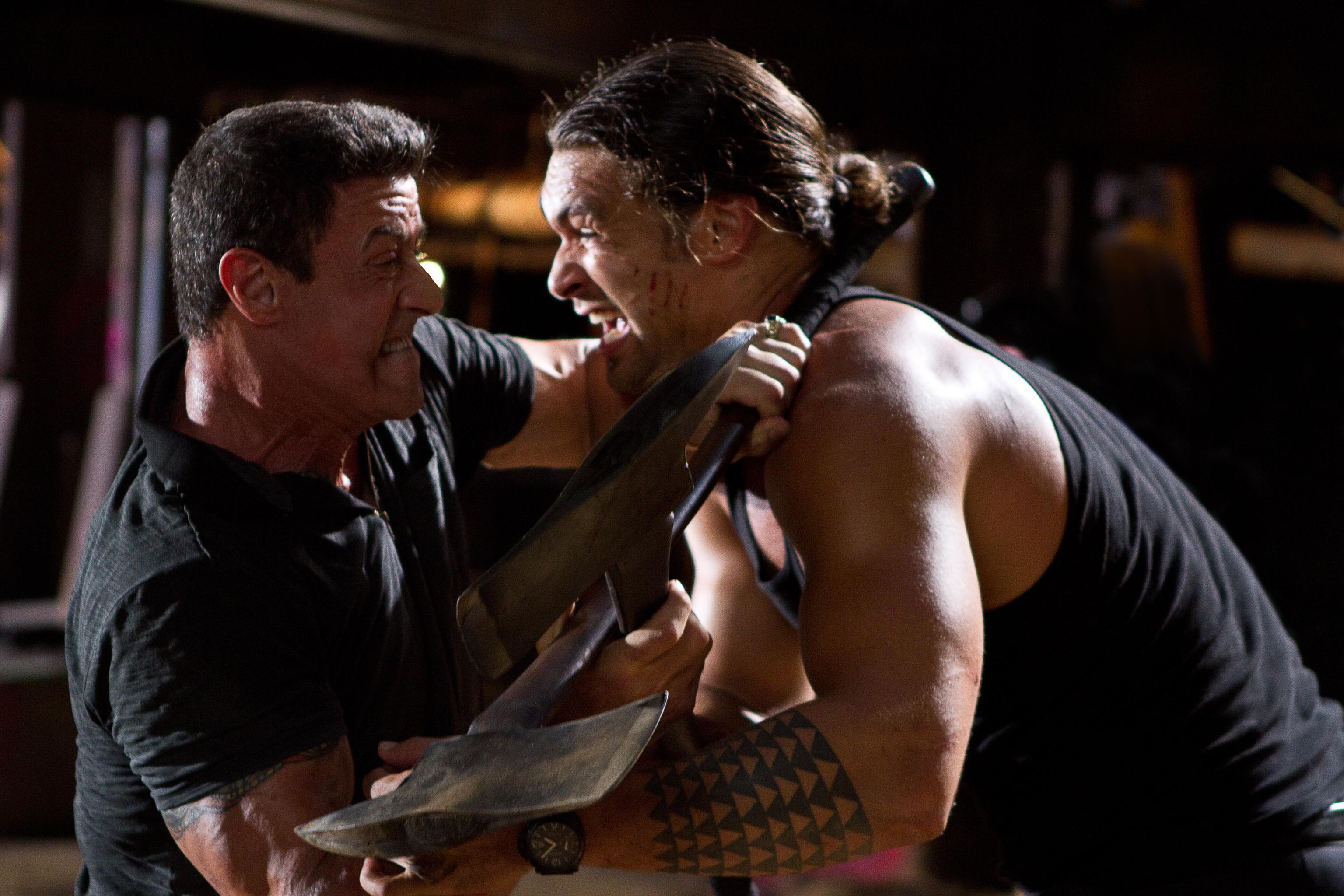
Bullet to the Head Not to be mistaken for the John Woo passion play, this head wound of a revenge flick instead pits a hired assassin (Sylvester Stallone) against an outsider cop (Sung Kang), the corroded action star who emerged from the thicket of ’70s Italian American iconic actors against a smooth-faced Asian American indie actor associated with the Fast and Furious franchise. Sly’s James Bonomo and his partner have been set up by a set of tepid bad guys (Oz fave Adewale Akinnuoye-Agbaje, here sleep-raging his way through Bullet; a very unpumped Christian Slater; and Jason Momoa, who glowers like he’s still playing a warlord on Game of Thrones). So Bonomo and Kang’s Taylor Kwon — the former’s got the brawn, the latter’s got the smartphone with access to criminal databases — must reluctantly team up to mete out some kind of justice. Yawn. The uninspired oh-so-gritty camera effects don’t help matters when it comes to staving off the sleepies induced by this tired enterprise — director Walter Hill certainly seems to have succumbed to the big snooze. The only real fun to be gleaned here is in watching your random, uh, ax fight and studying the Stallone’s weirdly crumbling yet inert rubble of face, which almost seems to scream to us about — yo, not Adrian, but the ravages of age, surgery, and excess. (1:32) Metreon, 1000 Van Ness. (Chun)

Django Unchained Quentin Tarantino’s spaghetti western homage features a cameo by the original Django (Franco Nero, star of the 1966 film), and solid performances by a meticulously assembled cast, including Jamie Foxx as the titular former slave who becomes a badass bounty hunter under the tutelage of Dr. Schultz (Christoph Waltz). Waltz, who won an Oscar for playing the evil yet befuddlingly delightful Nazi Hans Landa in Tarantino’s 2009 Inglourious Basterds, is just as memorable (and here, you can feel good about liking him) as a quick-witted, quick-drawing wayward German dentist. There are no Nazis in Django, of course, but Tarantino’s taboo du jour (slavery) more than supplies motivation for the filmmaker’s favorite theme (revenge). Once Django joins forces with Schultz, the natural-born partners hatch a scheme to rescue Django’s still-enslaved wife, Broomhilda (Kerry Washington), whose German-language skills are as unlikely as they are convenient. Along the way (and it’s a long way; the movie runs 165 minutes), they encounter a cruel plantation owner (Leonardo DiCaprio), whose main passion is the offensive, shocking "sport" of "Mandingo fighting," and his right-hand man, played by Tarantino muse Samuel L. Jackson in a transcendently scandalous performance. And amid all the violence and racist language and Foxx vengeance-making, there are many moments of screaming hilarity, as when a character with the Old South 101 name of Big Daddy (Don Johnson) argues with the posse he’s rounded up over the proper construction of vigilante hoods. It’s a classic Tarantino moment: pausing the action so characters can blather on about something trivial before an epic scene of violence. Mr. Pink would approve. (2:45) Balboa, Metreon, 1000 Van Ness, Sundance Kabuki. (Eddy)

Gangster Squad It’s 1949, and somewhere in the Hollywood hills, a man has been tied hand and foot to a pair of automobiles with the engines running. Coyotes pace in the background like patrons queuing up for a table at Flour + Water, and when dinner is served, the presentation isn’t very pretty. We’re barely five minutes into Ruben Fleischer’s Gangster Squad, and fair warning has been given of the bloodletting to come. None of it’s quite as visceral as the opening scene, but Fleischer (2009’s Zombieland) packs his tale of urban warfare with plenty of stylized slaughter to go along with the glamour shots of mob-run nightclubs, leggy pin-curled dames, and Ryan Gosling lounging at the bar cracking wise. At the center of all the gunplay and firebombing is what’s framed as a battle for the soul of Los Angeles, waged between transplanted Chicago mobster Mickey Cohen (Sean Penn) — who wields terms like "progress" and "manifest destiny" as a rationale for a continental turf war — and a police sergeant named John O’Mara (Josh Brolin), tasked with bringing down Cohen’s empire. The assignment requires working under cover so deep that only the police chief (Nick Nolte) and the handpicked members of O’Mara’s "gangster squad" — ncluding Gosling, a half-jaded charmer who poaches Cohen’s arm candy (Emma Stone) — know of its existence. This leaves plenty of room for improvisation, and the film pauses now and again to wonder about what happens when you pit brutal amorality against brutal morality, but it’s a rhetorical question, and no one shows much interest in it. Dragged down by talking points that someone clearly wanted wedged in (as well as by O’Mara’s ponderous voice-overs), the film does better when it abandons gravitas and refocuses on spinning its mythic tale of wilder times in the Golden State. (1:53) Metreon, 1000 Van Ness. (Rapoport)

Hansel & Gretel: Witch Hunters So here’s something you may not have been wondering: what exactly happened to Hansel and Gretel after they killed the gingerbread-house witch and made their way to freedom? Did they really live happily ever after? Did they land in the foster care system? Did they enter adulthood bearing the deep psychic wounds a person might well suffer after shoving a living creature into an oven and listening to her agonized howls as she burned alive? Or did they realize they’d discovered their life’s vocation without even having to complete the Myers-Briggs test? Shutting his eyes and pointing at random, director and screenplay cowriter Tommy Wirkola (2009’s Dead Snow) chooses the latter scenario, keeping his eyes closed to stab out some weak dialogue and half a plot for a script that leans heavily on the power of 3D technology to send eviscerated-witch guts and other biological shrapnel flying toward the eyeballs of audience members. Hansel (why, Jeremy Renner?) and Gretel (Gemma Arterton) have grown up to share the intense sibling bond and wandering ways you might expect from a brother and sister abandoned at a tender age to starve and be rent limb from limb by wild animals. They’ve also taken full advantage of a niche witch-slaying market in and around the gloomy forest where they made their first kill. When they’re hired to track down a particularly loathsome practitioner of the dark arts (Famke Janssen) who’s been snatching up local children, multidimensional mayhem ensues. Arterton’s Gretel is pretty much a badass and the brains of the operation, while Renner’s Hansel is more of a strong, silent, and occasionally shit-faced type. Neither makes for a particularly memorable protagonist, but that flat look on their faces could just be disappointment or boredom with the material. (1:41) Metreon, 1000 Van Ness, Shattuck. (Rapoport)

A Haunted House (1:25) Metreon.

The Hobbit: An Unexpected Journey Make no mistake: the Lord of the Rings trilogy represented an incredible filmmaking achievement, with well-deserved Oscars handed down after the third installment in 2003. If director Peter Jackson wanted to go one more round with J.R.R. Tolkien’s beloved characters for a Hobbit movie, who was gonna stop him? Not so fast. This return to Middle-earth (in 3D this time) represents not one but three films — which would be self-indulgent enough even if part one didn’t unspool at just under three hours, and even if Jackson hadn’t decided to shoot at 48 frames per second. (I can’t even begin to explain what that means from a technical standpoint, but suffice to say there’s a certain amount of cinematic lushness lost when everything is rendered in insanely crystal-clear hi-def.) Journey begins as Bilbo Baggins (a game, funny Martin Freeman) reluctantly joins Gandalf (a weary-seeming Ian McKellan) and a gang of dwarves on their quest to reclaim their stolen homeland and treasure, batting Orcs, goblins, Gollum (Andy Serkis), and other beasties along the way. Fan-pandering happens (with characters like Cate Blanchett’s icy Galadriel popping in to remind you how much you loved LOTR), and the story moves at a brisk enough pace, but Journey never transcends what came before — or in the chronology of the story, what comes after. I’m not quite ready to declare this Jackson’s Phantom Menace (1999), but it’s not an unfair comparison to make, either. (2:50) Metreon, Shattuck. (Eddy)

The Impossible Spanish director Juan Antonio Bayona (2007’s The Orphanage) directs The Impossible, a relatively modestly-budgeted take on the 2004 Indian Ocean tsunami, based on the real story of a Spanish family who experienced the disaster. Here, the family (Naomi Watts, Ewan McGregor, three young sons) is British, on a Christmas vacation from dad’s high-stress job in Japan. Beachy bliss is soon ruined by that terrible series of waves; they hit early in the film, and Bayona offers a devastatingly realistic depiction of what being caught in a tsunami must feel like: roaring, debris-filled water threatening death by drowning, impalement, or skull-crushing. And then, the anguish of surfacing, alive but injured, stranded, and miles from the nearest doctor, not knowing if your family members have perished. Without giving anything away (no more than the film’s suggestive title, anyway), once the survivors are established (and the film’s strongest performer, Watts, is relegated to hospital-bed scenes) The Impossible finds its way inevitably to melodrama, and triumph-of-the-human-spirit theatrics. As the family’s oldest son, 16-year-old Tom Holland is effective as a kid who reacts exactly right to crisis, morphing from sulky teen to thoughtful hero — but the film is too narrowly focused on its tourist characters, with native Thais mostly relegated to background action. It’s a disconnect that’s not quite offensive, but is still off-putting. (1:54) Metreon, Presidio, Shattuck. (Eddy)

Jack Reacher (2:10) Metreon.

The Last Stand With gun control issues dominating the news, what better time to release a movie that lovingly glorifies the wonders of excessive firepower? Fortunately for star Arnold Schwarzenegger, making his return to leading-man status after that little fling with politics, The Last Stand is stupidly enjoyable enough to make any such PC-minded realizations relatively fleeing ones. When a Mexican drug lord (who also happens to be an expert race-car driver) escapes from federal custody and begins speeding home in a super-Corvette, the lead FBI agent (Forest Whitaker, slumming big-time) realizes his only hope is a teeny Arizona border town that happens to be overseen by Sheriff Schwarzenegger. (Other residents include a couple of hapless deputies; an Iraq war vet; and a gun nut played by a cartoonishly obnoxious Johnny Knoxville.) Can this ragtag crew hold off first the drug lord’s advance team (led by a swaggering Peter Stormare), and then the head baddie himself? Duh. The biggest surprise The Last Stand offers is that it’s actually pretty fun — no doubt thanks to the combo of Korean director Kim Jee-woon (2008’s eccentric The Good, The Bad, and the Weird; 2003’s spooky A Tale of Two Sisters) and the heft of Schwarzenegger’s still-potent charisma. (1:47) Metreon. (Eddy)

Life of Pi Several filmmakers including Alfonso Cuarón, Jean-Pierre Jeunet, and M. Night Shyamalan had a crack at Yann Martel’s "unfilmable" novel over the last decade, without success. That turns out to have been a very good thing, since Ang Lee and scenarist David Magee have made probably the best movie possible from the material — arguably even an improvement on it. Framed as the adult protagonist’s (Irrfan Khan) lengthy reminiscence to an interested writer (Rafe Spall) it chronicles his youthful experience accompanying his family and animals from their just shuttered zoo on a cargo ship voyage from India to Canada. But a storm capsizes the vessel, stranding teenaged Pi (Suraj Sharma) on a lifeboat with a mini menagerie — albeit one swiftly reduced by the food chain in action to one Richard Parker, a whimsically named Bengal tiger. This uneasy forced cohabitation between Hindu vegetarian and instinctual carnivore is an object lesson in survival as well as a fable about the existence of God, among other things. Shot in 3D, the movie has plenty of enchanted, original imagery, though its outstanding technical accomplishment may lie more in the application of CGI (rather than stereoscopic photography) to something reasonably intelligent for a change. First-time actor Sharma is a natural, while his costar gives the most remarkable performance by a wild animal this side of Joaquin Phoenix in The Master. It’s not a perfect film, but it’s a charmed, lovely experience. (2:00) 1000 Van Ness, New Parkway, SF Center. (Harvey)

Lincoln Distinguished subject matter and an A+ production team (Steven Spielberg directing, Daniel Day-Lewis starring, Tony Kushner adapting Doris Kearns Goodwin, John Williams scoring every emotion juuust so) mean Lincoln delivers about what you’d expect: a compelling (if verbose), emotionally resonant (and somehow suspenseful) dramatization of President Lincoln’s push to get the 13th amendment passed before the start of his second term. America’s neck-deep in the Civil War, and Congress, though now without Southern representation, is profoundly divided on the issue of abolition. Spielberg recreates 1865 Washington as a vibrant, exciting place, albeit one filled with so many recognizable stars it’s almost distracting wondering who’ll pop up in the next scene: Jared Harris as Ulysses S. Grant! Joseph Gordon-Levitt as Robert Lincoln! Lena Dunham’s shirtless boyfriend on Girls (Adam Driver) as a soldier! Most notable among the huge cast are John Hawkes, Tim Blake Nelson, and a daffy James Spader as a trio of lobbyists; Sally Field as the troubled First Lady; and likely Oscar contenders Tommy Lee Jones (as winningly cranky Rep. Thaddeus Stevens) and Day-Lewis, who does a reliably great job of disappearing into his iconic role. (2:30) 1000 Van Ness, SF Center, Shattuck, Sundance Kabuki. (Eddy)

LUV Baltimore native Sheldon Candis drew from his own childhood for this coming-of-age tale, which takes place in a single day as 11-year-old "little man" Woody (Michael Rainey Jr.) tags along with his uncle, Vincent (Common), recently out of jail and rapidly heading back down the criminal path. With both parents out of the picture, Woody’s been raised by his grandmother (Lonette McKee), so he idolizes Vincent even though it’s soon clear the short-tempered man is no hero. Of course, things go horribly awry, bloody lessons are learned, tears are shed, etc. Despite the story’s autobiographical origins, the passable LUV suffers greatly by inviting comparisons to The Wire — the definitive docudrama examining drug crime in Baltimore. Most blatantly, sprinkled into an all-star cast (Dennis Haysbert, Danny Glover, Charles S. Dutton) are supporting characters played by Wire icons Michael K. "Omar" Williams (as a cop) and Anwan "Slim Charles" Glover (as a meaner Slim Charles, basically). Perhaps if you’ve never seen the show this wouldn’t be distracting — but if that’s the case, you should really be watching The Wire instead of LUV anyway. (1:34) New Parkway. (Eddy)

Mama From bin Laden to wild babes in woods, Jessica Chastain can’t seem to grab a break. Equipped with just the bare outlines of a character, however, she’s one of the few pleasures in this missed-opportunity of a grim, ghostly fairy tale. Expanding his short of the same name, director Andres Muschietti kicks off his yarn on a sadly familiar note in these days of seemingly escalating gun violence: little sisters Victoria and Lily have disappeared from their home, shortly after their desperate father (Game of Thrones‘ Nikolaj Coster-Waldau) has gone on a shooting spree. They repair to an abandoned cabin scattered with mid-century modern furniture. Five years on, the girls’ scruffy artist uncle Lucas (also Coster-Waldau) is still searching for them, supported by his punk rock girlfriend Annabel (Chastain). The little girls lost are finally found by trackers — and they appear to be hopelessly feral, with the angelic-looking Victoria (Megan Charpentier), acting as the ringleader and the younger, bedraggled Lily (Maya Dawe) given to sleeping under beds and eating on all fours next to the dog bowl. The arty couple take them in and move into a "test house" provided by the sisters’ enthralled therapist (Daniel Kash), obviously psyched to study not one but two Kaspar Hausers. The traumatized kids are clearly haunted by their experience — in more ways than one — as inexplicable bumps go off, night and day, and Misfits t-shirt-clad Annabel discovers the real meaning of goth while getting in touch with her seemingly deeply buried maternal urges. Unfortunately, despite possessing the raw material for a truly scary outing that plunges to the core of our primal instincts (what’s scarier than an unsocialized kid that’s capable of anything?) and showing off Muschietti’s occasional instances of cinematic flair (as when multiple rooms are shown using split-screens), Mama ends up running away from the filmmaker and is finally simply spoiled by its mawkishly sentimental finale. It doesn’t help that the inadequate script sports logic holes that a mama could drive a truck though. (1:40) California, Metreon, 1000 Van Ness. (Chun)

Les Misérables There is a not-insignificant portion of the population who already knows all the words to all the songs of this musical-theater warhorse, around since the 1980s and honored here with a lavish production by Tom Hooper (2010’s The King’s Speech). As other reviews have pointed out, this version only tangentially concerns Victor Hugo’s French Revolution tale; its true raison d’être is swooning over the sight of its big-name cast crooning those famous tunes. Vocals were recorded live on-set, with microphones digitally removed in post-production — but despite this technical achievement, there’s a certain inorganic quality to the proceedings. Like The King’s Speech, the whole affair feels spliced together in the Oscar-creation lab. The hardworking Hugh Jackman deserves the nomination he’ll inevitably get; jury’s still out on Anne Hathaway’s blubbery, "I cut my hair for real, I am so brave!" performance. (2:37) 1000 Van Ness, SF Center, Shattuck, Sundance Kabuki. (Eddy)

Movie 43 (1:37) Metreon, 1000 Van Ness.

Searching for Sugar Man The tale of the lost, and increasingly found, artist known as Rodriguez seems to have it all: the mystery and drama of myth, beginning with the singer-songwriter’s stunning 1970 debut, Cold Fact, a neglected folk rock-psychedelic masterwork. (The record never sold in the states, but somehow became a beloved, canonical LP in South Africa.) The story goes on to parse the cold, hard facts of vanished hopes and unpaid royalties, all too familiar in pop tragedies. In Searching for Sugar Man, Swedish documentarian Malik Bendjelloul lays out the ballad of Rodriguez as a rock’n’roll detective story, with two South African music lovers in hot pursuit of the elusive musician — long-rumored to have died onstage by either self-immolation or gunshot, and whose music spoke to a generation of white activists struggling to overturn apartheid. By the time Rodriguez himself enters the narrative, the film has taken on a fairy-tale trajectory; the end result speaks volumes about the power and longevity of great songwriting. (1:25) New Parkway. (Chun)

"Oscar Nominated Short Films 2013: Animated" If you caught Wreck-It Ralph, nominated in the Best Animated Feature category, you’ve already seen John Kahrs’ Paperman, about a junior Mad Men type who bumbles through his pursuit of a lovely fellow office drone he spots on his commute. Or, if you saw Ice Age: Continental Drift, you’ve seen Maggie Simpson in The Longest Daycare, starring Homer and Marge’s wee one as she grapples with the social order at the Ayn Rand School for Tots. Among the stand-alones, Minkyu Lee’s Adam and Dog features a quick appearance by Eve, too, but the star is really the scrappy canine who gallops through prehistory playing the world’s first game of fetch with his hairy master. Two minutes is all PES (nom de screen of Adam Pesapane) needs to make Fresh Guacamole — which depicts grenades, dice, and other random objects as most unusual ingredients. The only non-US entry, UK director Timothy Reckart’s Head Over Heels, is about an elderly married couple whose relationship has deteriorated to the point where they (literally) no longer see eye to eye on anything. The program is rounded out by three more non-Oscar-nominated animated shorts: Britain’s The Gruffalo’s Child, featuring the voices of Helena Bonham Carter and Robbie Coltrane; French art-thief caper Dripped; and New Zealand’s sci-fi tale Abiogenesis. (1:28) Embarcadero, Shattuck. (Eddy)

"Oscar Nominated Short Films 2013: Documentary" (3:29) Opera Plaza.

"Oscar Nominated Short Films 2013: Live Action" (1:54) Embarcadero, Shattuck.

Parker (1:58) Metreon, 1000 Van Ness, Shattuck.

Quartet Every year there’s at least one: the adorable-old-cootfest, usually British, that proves harmless and reassuring and lightly tear/laughter producing enough to convince a certain demographic that it’s safe to go to the movies again. The last months have seen two, both starring Maggie Smith (who’s also queen of that audience’s home viewing via Downton Abbey). Last year’s The Best Exotic Marigold Hotel, in which Smith played a bitchy old spinster appalled to find herself in India, has already filled the slot. It was formulaic, cute, and sentimental, yes, but it also practiced more restraint than one expected. Now here’s Quartet, which is basically the same flower arrangement with quite a bit more dust on it. Smith plays a bitchy old spinster appalled to find herself forced into spending her twilight years at a home for the elderly. It’s not just any such home, however, but Beecham House, whose residents are retired professional musicians. Gingerly peeking out from her room after a few days’ retreat from public gaze, Smith’s Jean Horton — a famed English soprano — spies a roomful of codgers rolling their hips to Afropop in a dance class. "This is not a retirement home — this is a madhouse!" she pronounces. Oh, the shitty lines that lazy writers have long depended on Smith to make sparkle. Quartet is full of such bunk, adapted with loving fidelity, no doubt, from his own 1999 play by Ronald Harwood, who as a scenarist has done some good adaptations of other people’s work (2002’s The Pianist). But as a generator of original material for about a half-century, he’s mostly proven that it is possible to prosper that long while being in entirely the wrong half-century. Making his directorial debut: 75-year-old Dustin Hoffman, which ought to have yielded a more interesting final product. But with its workmanlike gloss and head-on take on the script’s very predictable beats, Quartet could as well have been directed by any BBC veteran of no particular distinction. (1:38) Albany, Embarcadero, Piedmont, Smith Rafael. (Harvey)

The Rabbi’s Cat A rabbi, a Muslim musician, two Russians (a Jew and a boozy Christian), and two talking animals hop into an antique Citroën for a road trip across Africa. No, it’s not the set-up for a joke; it’s the premise for this charming animated film, adapted from Joann Sfar’s graphic novel (the author co-directs with Antoine Delesvaux). In 1930s Algiers, a rabbi’s pet cat suddenly develops the ability to talk — and read and write, by the way — and wastes no time in sharing opinions, particularly when it comes to religion ("God is just a comforting invention!") When a crate full of Russian prayer books — and one handsome artist — arrives at the rabbi’s house, man and cat are drawn into the refugee’s search for an Ethiopian city populated by African Jews. Though it’s not suitable for younger kids (there’s kitty mating, and a few bursts of surprising violence) or diehard Tintin fans (thanks to a randomly cranky spoof of the character), The Rabbi’s Cat is a lushly illustrated, witty tale of cross-cultural clashes and connections. Rockin’ soundtrack, too. (1:29) Smith Rafael. (Eddy)

Rust and Bone Unlike her Dark Knight Rises co-star Anne Hathaway, Rust and Bone star Marion Cotillard never seems like she’s trying too hard to be sexy, or edgy, or whatever (plus, she already has an Oscar, so the pressure’s off). Here, she’s a whale trainer at a SeaWorld-type park who loses her legs in an accident, which complicates (but ultimately strengthens) her relationship with Ali (Belgian actor Matthias Schoenaerts, so tremendous in 2011’s Bullhead), a single dad trying to make a name for himself as a boxer. Jacques Audiard’s follow-up to 2009’s A Prophet gets a bit overwrought by its last act, but there’s an emotional authenticity in the performances that makes even a ridiculous twist (like, the kind that’ll make you exclaim "Are you fucking kidding me?") feel almost well-earned. (2:00) Opera Plaza, Shattuck. (Eddy)

The Sessions Polio has long since paralyzed the body of Berkeley poet Mark O’Brien (John Hawkes) from the neck down. Of course his mind is free to roam — but it often roams south of the personal equator, where he hasn’t had the same opportunities as able-bodied people. Thus he enlists the services of Cheryl (Helen Hunt), a professional sex surrogate, to lose his virginity at last. Based on the real-life figures’ experiences, this drama by Australian polio survivor Ben Lewin was a big hit at Sundance this year (then titled The Surrogate), and it’s not hard to see why: this is one of those rare inspirational feel-good stories that doesn’t pander and earns its tears with honest emotional toil. Hawkes is always arresting, but Hunt hasn’t been this good in a long time, and William H. Macy is pure pleasure as a sympathetic priest put in numerous awkward positions with the Lord by Mark’s very down-to-earth questions and confessions. (1:35) Opera Plaza. (Harvey)

Silver Linings Playbook After guiding two actors to Best Supporting Oscars in 2010’s The Fighter, director David O. Russell returns (adapting his script from Matthew Quick’s novel) with another darkly comedic film about a complicated family that will probably earn some gold of its own. Though he’s obviously not ready to face the outside world, Pat (Bradley Cooper) checks out of the state institution he’s been court-ordered to spend eight months in after displaying some serious anger-management issues. He moves home with his football-obsessed father (Robert De Niro) and worrywart mother (Jacki Weaver of 2010’s Animal Kingdom), where he plunges into a plan to win back his estranged wife. Cooper plays Pat as a man vibrating with troubled energy — always in danger of flying into a rage, even as he pursues his forced-upbeat "silver linings" philosophy. But the movie belongs to Jennifer Lawrence, who proves the chops she showcased (pre-Hunger Games megafame) in 2010’s Winter’s Bone were no fluke. As the damaged-but-determined Tiffany, she’s the left-field element that jolts Pat out of his crazytown funk; she’s also the only reason Playbook‘s dance-competition subplot doesn’t feel eye-rollingly clichéd. The film’s not perfect, but Lawrence’s layered performance — emotional, demanding, bitchy, tough-yet-secretly-tender — damn near is. (2:01) Four Star, 1000 Van Ness, Piedmont, Presidio, SF Center, Shattuck, Sundance Kabuki, Vogue. (Eddy)

Skyfall Top marks to Adele, who delivers a magnificent title song to cap off Skyfall‘s thrilling pre-credits chase scene. Unfortunate, then, that the film that follows squanders its initial promise. After a bomb attack on MI6, the clock is running out for Bond (Daniel Craig) and M (Judi Dench), accused of Cold War irrelevancy in a 21st century full of malevolent, stateless computer hackers. The audience, too, will yearn for a return to simpler times; dialogue about "firewalls" and "obfuscated code" never fails to sound faintly ridiculous, despite the efforts Ben Whishaw as the youthful new head of Q branch. Javier Bardem is creative and creepy as keyboard-tapping villain Raoul Silva, but would have done better with a megalomaniac scheme to take over the world. Instead, a small-potatoes revenge plot limps to a dull conclusion in the middle of nowhere. Skyfall never decides whether it prefers action, bon mots, and in-jokes to ponderous mythologizing and ripped-from-the-headlines speechifying — the result is a unsatisfying, uneven mixture. (2:23) Metreon. (Ben Richardson)

Sound City Dave Grohl adds "documentary director" to his ever-lengthening resume with this tribute to the SoCal recording studio, where the grimy, funky décor was offset by a row of platinum records lining its hallway, marking in-house triumphs by Fleetwood Mac, Tom Petty, Cheap Trick, Neil Young, and others (even, yep, Rick Springfield). Top acts and producers (many of whom appear in the doc to dish and reminisce) were lured in by a unique recording console, installed in the early 1970s, whose legend grew with every new hit it helped engineer. Despite its reputation as a hit factory — and the attraction of its laid-back vibe and staff — old-school Sound City began to struggle once the highly-polished sound of digital technology overtook the music industry. That is, until Grohl and Nirvana recorded Nevermind there, keeping the studio alive until the unstoppable march of Pro Tools hammered the final nails in. Or did it? Sound City‘s final third follows Grohl’s purchase of the studio’s iconic console ("A piece of rock ‘n’ roll history," he proclaims, though he installs it in a swanky refurbished space) and the recording of an album featuring luminaries from the studio’s past … plus Paul McCartney. The resulting doc is nostalgic, sure, but insider-y enough to entertain fans of classic rock, or at least anyone who’s ever sneered at a drum machine. (1:46) Roxie. (Eddy)

Stand Up Guys Call it oldster pop, call it geriatricore, just don’t call it late for its meds. With the oncoming boomer elder explosion, we can Depends — har-dee-har-har — on the fact that action-crime thrillers-slash-comedies like 2010’s Red, 2012’s Robot and Frank, and now Stand Up Guys are just the vanguard of an imminent barrage of grumpy old pros locking and loading, grousing about their angina, and delivering wisdom with a dose of hard-won levity. As handled by onetime teen-comedy character actor Fisher Stevens, Stand Up Guys is a warm, worthy addition to that soon-to-be-well-populated pantheon. It grows on you as you spend time with it — much like the two aging reprobates at its core, Val (Al Pacino) and Doc (Christopher Walken). Val, the proverbial stand-up guy who took the fall for the rest of his gang, has just completed a 25-year-plus stint in the pen. There to meet him is his only pal, and former partner in crime, Doc, who has been leading a humble life but has one last hit to commit for their old boss Claphands (Mark Margolis), who’s inexplicably named after a Tom Waits song. Sex, drugs, and some Viagra commercial-esque bluesy guitars are in order, but first Val and Doc must find their drive, in the form of their old driver buddy Hirsch (Alan Arkin), who they break out of a rest home, and, perhaps, their moral compass, which arrives with the discovery of a victim (Vanessa Ferlito) of baddies much less couth than themselves. The pleasure comes with following these stand-up guys as they make that leap from craven self-preservation to heroism, which might seem implausible to some. But to the cast’s, and Stevens’s, credit, they make it work — and even give the sentiment-washed finale a swashbuckling buddy-movie romanticism, the kind that a young Tarantino might dislike and an older Tarantino would be loathe to begrudge his lovable louses. (1:34) 1000 Van Ness, SF Center, Shattuck, Sundance Kabuki. (Chun)

Warm Bodies A decade and a half of torrid, tormented vampire-human entanglements has left us accustomed to rooting for romances involving the undead and the still-alive. Some might argue, however, that no amount of pop-cultural prepping could be sufficient to get us behind a human-zombie love story for the ages. Is guzzling human blood really measurably less gross than making a meal of someone’s brains and other body parts? Somehow, yes. Recognizing this perceptual hurdle, writer-director Jonathan Levine (2011’s 50/50, 2008’s The Wackness) secures our sympathies at the outset of Warm Bodies by situating us inside the surprisingly active brain of the film’s zombie protagonist. Zombies, it turns out, have internal monologues. R (Nicholas Hoult) can only remember the first letter of his former name, but as he shambles and shuffles and slumps his way through the terminals of a postapocalyptic airport overrun by his fellow corpses (as they’re called by the film’s human population), he fills us in as best he can on the global catastrophe that’s occurred and his own ensuing existential crisis. By the time he meets not-so-cute with Julie (Teresa Palmer), a young woman whose father (John Malkovich) is commander-in-chief of the human survivors living in a walled-off city center, we’ve learned that he collects vinyl, that he has a zombie best friend, and that he doesn’t want to be like this. We may still be flinching at the thought of his and Julie’s first kiss, but we’re also kind of rooting for him. The plot gapes in places, where a tenuous logic gets trampled and gives way, but Levine’s script, adapted from a novel by Isaac Marion, is full of funny riffs on the zombie condition, which Hoult invests with a comic sweetness as his character staggers toward the land of the living. (1:37) 1000 Van Ness, SF Center, Sundance Kabuki. (Rapoport)

Zero Dark Thirty The extent to which torture was actually used in the hunt for Osama Bin Ladin may never be known, though popular opinion will surely be shaped by this film, as it’s produced with the same kind of "realness" that made Kathryn Bigelow’s previous film, the Oscar-winning The Hurt Locker (2008), so potent. Zero Dark Thirty incorporates torture early in its chronology — which begins in 2003, after a brief opening that captures the terror of September 11, 2001 using only 911 phone calls — but the practice is discarded after 2008, a sea-change year marked by the sight of Obama on TV insisting that "America does not torture." (The "any more" goes unspoken.) Most of Zero Dark Thirty is set in Pakistan and/or "CIA black sites" in undisclosed locations; it’s a suspenseful procedural that manages to make well-documented events (the July 2005 London bombings; the September 2008 Islamabad Marriott Hotel bombing) seem shocking and unexpected. Even the raid on Bin Ladin’s HQ is nail-bitingly intense. The film immerses the viewer in the clandestine world, tossing out abbreviations ("KSM" for al-Qaeda bigwig Khalid Sheikh Mohammed) and jargon ("tradecraft") without pausing for a breath. It is thrilling, emotional, engrossing — the smartest, most tightly-constructed action film of the year. At the center of it all: a character allegedly based on a real person whose actual identity is kept top-secret by necessity. She’s interpreted here in the form of a steely CIA operative named Maya, played to likely Oscar-winning perfection by Jessica Chastain. No matter the film’s divisive subject matter, there’s no denying that this is a powerful performance. "Washington says she’s a killer," a character remarks after meeting this seemingly delicate creature, and he’s proven right long before Bin Ladin goes down. Some critics have argued that character is underdeveloped, but anyone who says that isn’t watching closely enough. Maya may not be given a traditional backstory, but there’s plenty of interior life there, and it comes through in quick, vulnerable flashes — leading up to the payoff of the film’s devastating final shot. (2:39) Marina, 1000 Van Ness, SF Center, Sundance Kabuki. (Eddy)


On the Cheap Listings

0

Submit items for the listings at listings@sfbg.com. For further information on how to submit items for listings, see Picks.

WEDNESDAY 6

Urban dance at the library Merced Branch Library, 155 Winston, SF. www.sfpl.org. 4:30, free. For ages seven to 18. In celebration of Black History Month, Sergio Suarez of the All the Way Live Foundation will share his knowledge of street dance history — covering everything from the Memphis jook to Oakland TURF to LA crump. Children and teens will also have a chance to watch acclaimed Bay Area dancers Beatz n Pieces, Agatron, Fluidgirl, and Too Wet.

THURSDAY 7

“Bacon, Babes and Bingo” El Rio, 3158 Mission, SF. www.baconbabesandbingo.com. 7-11pm, $10. With endless ways to win prizes — from donning superlative pig-related accessories to spinning the “squeal wheel” — tonight is a shining night for bacon. To keep up with the theme, vendor BaconBacon will be serving up a variety of pork-related goodies. If all this isn’t compelling enough, there will also be burlesque, music, and free snacks courtesy of Rock Candy Snack Shop.

FRIDAY 8

Gray Loft Gallery’s second annual Love Show Gray Loft Gallery, 2889 Ford, third floor, Oakl. Through February 23. www.greyloftgallery.com. Opening reception: 6-9pm, free. Photographs, paintings, collages, sculptures, jewelry, textiles, and handmade cards, all exploring themes of love will be on display tonight in this unconventional work-live warehouse and gallery in Oakland’s Jingletown district.

“On The Edge” erotic photography exhibition Gallery 4N5, 683 Mission, SF. www.eroticartevents.com. 4-10pm. $5. Also open Sat/9, 1-10pm and Sun/10, noon-5pm. Free on Sunday. If the thought of a teddy-bear-and-Hallmark-card kind of Valentines Day puts you straight to sleep, this exhibit might be what you’ve been looking for. Featuring 400 pieces of fine nude art and extreme erotica photographs by 20 photographers, this event is sure spice up your holiday. Mingle with some of the photographers and stay for the leather fashion show at 7:30pm.

“Mortified’s Doomed Valentine’s Show” DNA Lounge, 375 11th St., SF. www.dnalounge.com. Doors open at 6:30pm. Show starts at 7:30pm, $14-21. Sat/8, 7:30pm at the Uptown, 1928 Telegraph, Oakl. “Mortified” is a nationally-loved, comic excavation of the artifacts of teenage angst (i.e. journals, home movies, letters, poems, etc.) shared by the original authors. Complete with a house band, these stories cover topics such as worst hand job, first puff, and Bible camp. Some of these stories may make you cringe with sheer awkwardness but they might make your high school experience seem slightly less tragic.

SF Beer Week Various Bay Area locations. www.sfbeerweek.org. Through Feb. 17. Every year this celebration of the Bay’s burgeoning microbrew macroculture exceeds our expectations and in 2013 we’ll be raising our steins yet again. Check the website for info on tastings, food-beer pairing dinners, educational offerings, and what special brew your favorite bar will be pouring on what night.

SATURDAY 9

“My Perverted Sucky Valentine Puts Out!” Center for Sex and Culture, 1349 Mission, SF. 8pm, $10-25 donation suggested. If you’ve fallen victim to a romantic rejection or two, you should know you’re not alone. In fact, tonight is a spoken word extravaganza focusing on topics such as: hot heartbreak, lust gone wrong, and ill-advised hookups. And let’s hear it for sponsoring sex-positive culture: your donations go to help the Center for Sex and Culture and St. James Infirmary continue those institutions’ rad, empowering programming.

Rare Device Valentine’s Trunk Show Rare Device, 600 Divisadero, SF. www.raredevice.net. Noon-6pm, free. Treat your Valentine (or yourself) with some awesome, locally-crafted goodies this afternoon. Between Zelma Rose’s cross stitched accessories, Jen Hewett’s lively prints, Emily McDowell’s inspirational illustrations, and Karrie Bakes’ gluten-free treats you are sure to walk away with something sweet.

Cupid’s Undie Run The Republic, 3213 Scott, SF. www.cupidsundierun.com. Pre-festivities start at noon, run begins at 2:30pm, $30. Register online. Strip down and sweat up for this mile long run around the Marina and Lombard Street. While your best lingerie gets all sweaty, you’ll also be helping to raise funds to benefit the Children’s Tumor Foundation. Warm up at the Republic before and afterwards with pre and post-run festivities.

SUNDAY 10

SPCA’s Be MineValentine’s Adopt-a-thon 201 Alabama, SF. www.sfspca.org. 10am-6pm, free. Nothing says “I love you” more than a puppy. Join the SF SPCA this weekend for its annual adoption extravaganza. Head over Friday night for a cocktail party, Saturday afternoon for dog and cat behavior seminars, or today for a puppy kissing booth, foster care bake sale, and prize wheel. All adoption fees are waived this weekend for animals from SF SPCA, SF Animal Care and Control, Muttville Senior Dog Rescue, and Family Dog Rescued.

MONDAY 11

“Edible Valentine Workshop” Autumn Express, 2071 Mission, SF. www.autumnexpress.com. 5-6pm. $10 if you register before Feb. 8, $15 at the door. Whether you’re still in school or not, passing out Valentine’s Day cards is fun. Head over to sustainability-oriented print shop Autumn Express to decorate some cookies and chocolate bars with icing and candies and whip up some cards for your big-kid class.

THURSDAY 14

One Billion Rising performance ritual First Presbyterian Church, 2619 Broadway, Oakl. www.bayarearising.org. 7-8:30pm, $10-100 donation suggested. Free for youth under 17. Purchase tickets online. Put your Valentines Day towards a good cause this year at a fundraiser for International Development Exchange (IDEX), an organization working to empower impoverished women across the globe. The evening will be a mix of spirituality, politics, and performances from local groups such as Youth Speaks and Mission Dance Brigade.

Dogpatch Wine Works date night Dogpatch Wine Works, 2455 Third St., SF. www.dogpatchwineworks.com. 6-8pm, $40. Few things spell out romance quite like wine and chocolate. Stroll around Dogpatch Wine Works’ tasting room sipping on some vino and snacking on locally-crafted Recchiuti chocolate. After your palette is satisfied you can tour the 15,000 square foot working winery.

“Returning Cupid’s Fire” Cartoon Art Museum, 655 Mission, SF. www.cartoonart.org. 7-9pm, $10. If you are Valentine-less and planning on having a night in with Ben and Jerry, it’s time to change your plans. San Francisco comedians Ivan Hernandez, Colleen Watson, and Mike Capozzola feel your pain and will be performing anti-Valentine’s Day themed stand-up routines tonight. Refreshments will be served.

Tout Sweet Pâtisserie tasting Tout Sweet Pâtisserie in Macy’s Union Square, 170 O’Farrell, third floor, SF. (415) 385-1679, www.toutsweetsf.com. 7-8:30pm, $55 per person. Reservations recommended. Yigit Pura, chef and owner of this sweet shop, is now offering tastings at Tout Sweet, which for our purposes means a three-course dessert menu featuring a rotating selection of seasonal offerings, each paired with local artisanal wine and beer. If you already have some sweet Valentine’s Day plans don’t fret, Pura has more tastings scheduled for March 14 and April 11.

Hella Vegan Eats V-Day pop up dinner Dear Mom, 2700 16th St., SF. www.dearmomsf.com. 5pm-midnight, free. The Oakland–based traveling food vendor will be in the city to once again take over Mission bar Dear Mom. We are hoping their doughnut burger with secret sauce will be on tonight’s menu.

Valentine’s Day at the Armory Club The Armory, 1800 Mission, SF. tickets.armorystudios.com. 7:30 and 9:30, $55. Start the evening off on the upper floor of the historic Armory then head to a workshop led by porn starlet Rain DeGrey that focuses on teaching couples how to make fantasies reality. Afterward, enjoy specialty cocktails and aphrodisiac-themed appetizers at the luxe Armory Club across the street.


Trail to historic gay Boy Scouts vote started in the Bay Area

23

This Wednesday, the Boy Scouts of America’s (BSA) Executive Board will consider removing the controversial ban on gay members and allow each individual troop to adopt its own policy on gay scouts. The board publicly reaffirmed the anti-gay policy just last summer, but recent pressure from gay rights groups, corporate sponsors, and Bay Area troops has forced the governing body to revisit the blanket prohibition on gay members.  

Opposition to the Boy Scout’s ban first surfaced in Northern California in the late 1980s when Tim Curran, an Eagle Scout and aspiring scoutmaster, sued the Mount Diablo Boy Scout Council for discrimination after being denied the position. Curran took the suit to the Supreme Court and lost. The court’s landmark decision in Curran v. Mount Diablo Council of the Boy Scouts of America continues to provide the legal justification for the BSA’s anti-gay policies.

Since the ruling, the San Francisco Bay Area has emerged as a key battleground in the struggle for gay membership in the scouts. Local troops often clash with the national organization over the ban and many local scout leaders publicly denounce the policy as discriminatory and hateful.

In October, openly gay East Bay scout Ryan Andresen was denied his Eagle Scout badge by the Mt. Diablo-Silverado Council due to his sexual orientation. Although officials with the council voiced reservations about denying Andresen, they are bound by BSA national policy that has long maintained homosexuality is inconsistent with the scouts oath to be “morally straight.”  

Andresen’s father resigned his position as an assistant scoutmaster, and Andresen’s mother organized an online petition which collected nearly half a million signatures protesting her son’s expulsion. The incident is sparking a widespread public debate about the Scout’s discrimination policy. Andresen appeared on national TV, and his petition garnered high profile support from California politicians like Lt. Gov. Gavin Newsom and US Sen. Barbara Boxer.

Andresen’s national profile and the publicity surrounding his case inspired outrage among local scouts and adult leaders. Steve Tennant, committee chair of Palo Alto Troop 57, said the parents and volunteers in his troop felt compelled to act. “We were all outraged and we immediately started thinking about how we could go about changing this policy,” he told the Guardian.

The controversy quickly galvanized parents and scouts throughout the Bay Area to more openly challenge the gay ban. From San Francisco to Palo Alto, parents and scouts penned public letters of protest decrying the policy and and urging the local Mt. Diablo-Silverado Council to reconsider Andresen.

Parents in Tennant’s Troop 57, located just a few miles from Andresen’s troop, unanimously adopted a non-discrimination policy both to voice solidarity with Anderson and to avoid potential discrimination in their own troop.

“It was just a matter of time until a kid in our troop faced the same situation as Ryan. I would rather resign my position than kick a kid out of the Scouts for being gay,” Tennant, whose two sons are currently scouts, told the Guardian. “Seeing the reaction of our parents and seeing the support for Ryan convinced me personally to stay involved with the Scouts,” he added.  

Eagle Scouts from Andresen’s district also mobilized against the ban. Trevor Wallace, an Eagle Scout from the nearby Troop 57, helped to organize meetings to pressure the Mt. Diablo-Silverado Council to allow Andresen to earn his badge. “My troop has been completely outraged by what happened to Ryan,” Wallace told the Guardian. “I got my Eagle Scout badge the same time Ryan was supposed to get his… discriminating against him like this is old fashioned and wrong.”

Michael and Andrew Dotson, a father-son scoutmaster duo who lead San Francisco’s Troop 88, echoed the concerns of Wallace and Tennant. “I want the boys to feel safe and be able to be open,” Michael Dotson told the Guardian. “Troop 88 would be very accepting of gay members once the ban is removed. And I hope it is.”

Andrew Dotson, a recent Eagle Scout who now works as his father’s assistant scoutmaster also opposes the ban. Growing up in San Francisco, he encountered plenty of gay scouts. But because of the national policy, the boys in his troop had to stay formally in the closet or risk expulsion. “I just don’t think that’s right,” he told the Guardian. “Scouting should be open to everybody.

Andresen’s case and the outpouring of support from other Bay Area scouts drew the attention of Zack Wahls, founder of Scouts for Equality, a national organization founded last summer to pressure the BSA Executive Board d to revisit the gay-ban.  

Wahls credits Andresen and his supporters with providing the necessary grassroots pressure to potentially change the national policy.

“It’s important to remember that only seven months ago, the Scouts were adamant that this policy was not going to change,” Wahls told the Guardian. “What happened in those seven months was that we harnessed online tools and worked with people like Ryan to highlight the negative impact this ban has on the local level.”

Wahl and Boy Scouts for Equality also targeted corporations and sympathetic members of the BSA board.  Over the summer, board members Randall Stephenson, CEO of AT&T, and James Turley, CEO of Ernst & Young, announced publicly their opposition to the ban. Since September, several major corporate sponsors, including Intel and UPS, announced that they would rescind financial support for the BSA until the national organization lifted the ban.  

Ahead of the board meeting, BSA officials reiterated that lifting the ban would not force any individual troops to change their own membership policies. “The Boy Scouts would not, under any circumstances, dictate a position to units, members, or parents,” BSA spokesperson Deron Smith told the New York Times. “This would mean there would no longer be any national policy regarding sexual orientation.

For many scouts in the Bay Area, however, removing the national ban is just the beginning. The end goal is the adoption of a national non-discrimination policy. But given the Boy Scouts history of strident opposition to gay rights, reconsidering the ban is significant development. “I think a national policy will take time,” reflected Michael Dotson of Troop 88, “but this is a good first step.”


Stallone, Walken, zombies, Oscar shorts, and more: new movies!

0

Yes you can find time to see a movie this otherwise football-y weekend. The ongoing Noir City and Sketchfest still have a lot of great upcoming programming, Sly Stallone is back in evocatively-titled action flick Bullet to the Head, a zombie finds love in Warm Bodies (review below), and all the Academy Award-nominated shorts are now available for big-screen viewing, for anyone who takes winning the office Oscar pool as seriously as … the Superbowl.

And speaking of the big game, the Roxie will be hosting its annual “Men in Tights” viewing party, a benefit for the theater and the upcoming SF IndieFest. So you can have your pigskin, and eat your popcorn too. GO NINERS!


“Oscar Nominated Short Films 2013: Animated” If you caught Wreck-It Ralph, nominated in the Best Animated Feature category, you’ve already seen John Kahrs’ Paperman, about a junior Mad Men type who bumbles through his pursuit of a lovely fellow office drone he spots on his commute. Or, if you saw Ice Age: Continental Drift, you’ve seen Maggie Simpson in The Longest Daycare, starring Homer and Marge’s wee one as she grapples with the social order at the Ayn Rand School for Tots. Among the stand-alones, Minkyu Lee’s Adam and Dog features a quick appearance by Eve, too, but the star is really the scrappy canine who gallops through prehistory playing the world’s first game of fetch with his hairy master. Two minutes is all PES (nom de screen of Adam Pesapane) needs to make Fresh Guacamole — which depicts grenades, dice, and other random objects as most unusual ingredients. The only non-US entry, UK director Timothy Reckart’s Head Over Heels, is about an elderly married couple whose relationship has deteriorated to the point where they (literally) no longer see eye to eye on anything. The program is rounded out by three more non-Oscar-nominated animated shorts: Britain’s The Gruffalo’s Child, featuring the voices of Helena Bonham Carter and Robbie Coltrane; French art-thief caper Dripped; and New Zealand’s sci-fi tale Abiogenesis. (1:28) (Cheryl Eddy)

http://www.youtube.com/watch?v=Z8SbmPhavhs

“Oscar Nominated Short Films 2013: Documentary” Selections include San Francisco filmmaker Sari Gilman’s poignant study of a Florida retirement community, Kings Point; Cynthia Wade’s Mondays at Racine, about a beauty salon that provides free services for women who have lost their hair to cancer treatments; Sean Fine and Andrea Nix’s Inocente, a profile of a young, homeless, aspiring artist; Redemption, Jon Alpert and Matthew O’Neill’s take on New York dumpster divers; and Open Heart, Keif Davidson’s look at Rwandan children who travel to Sudan for high-risk surgery. (3:29)

“Oscar Nominated Short Films 2013: Live Action” Selections include Bryan Buckley’s Asad, about a Somali boy who must choose between fishing and piracy; Sam French’s Buzkashi Boys, about two young friends coming of age in war-torn Kabul, Afghanistan; Shawn Christensen’s babysitting yarn Curfew; Tom Van Avermaet’s supernatural love story Death of a Shadow; and another (sort-of) love story, Canadian Yan England’s Henry. (1:54)

Sound City Dave Grohl adds “documentary director” to his ever-lengthening resume with this tribute to the SoCal recording studio, where the grimy, funky décor was offset by a row of platinum records lining its hallway, marking in-house triumphs by Fleetwood Mac, Tom Petty, Cheap Trick, Neil Young, and others (even, yep, Rick Springfield). Top acts and producers (many of whom appear in the doc to dish and reminisce) were lured in by a unique recording console, installed in the early 1970s, whose legend grew with every new hit it helped engineer. Despite its reputation as a hit factory — and the attraction of its laid-back vibe and staff — old-school Sound City began to struggle once the highly-polished sound of digital technology overtook the music industry. That is, until Grohl and Nirvana recorded Nevermind there, keeping the studio alive until the unstoppable march of Pro Tools hammered the final nails in. Or did it? Sound City‘s final third follows Grohl’s purchase of the studio’s iconic console (“A piece of rock ‘n’ roll history,” he proclaims, though he installs it in a swanky refurbished space) and the recording of an album featuring luminaries from the studio’s past … plus Paul McCartney. The resulting doc is nostalgic, sure, but insider-y enough to entertain fans of classic rock, or at least anyone who’s ever sneered at a drum machine. (1:46) Roxie. (Cheryl Eddy)

Stand Up Guys Call it oldster pop, call it geriatricore, just don’t call it late for its meds. With the oncoming boomer elder explosion, we can Depends — har-dee-har-har — on the fact that action-crime thrillers-slash-comedies like 2010’s Red, 2012’s Robot and Frank, and now Stand Up Guys are just the vanguard of an imminent barrage of grumpy old pros locking and loading, grousing about their angina, and delivering wisdom with a dose of hard-won levity. As handled by onetime teen-comedy character actor Fisher Stevens, Stand Up Guys is a warm, worthy addition to that soon-to-be-well-populated pantheon. It grows on you as you spend time with it — much like the two aging reprobates at its core, Val (Al Pacino) and Doc (Christopher Walken). Val, the proverbial stand-up guy who took the fall for the rest of his gang, has just completed a 25-year-plus stint in the pen. There to meet him is his only pal, and former partner in crime, Doc, who has been leading a humble life but has one last hit to commit for their old boss Claphands (Mark Margolis), who’s inexplicably named after a Tom Waits song. Sex, drugs, and some Viagra commercial-esque bluesy guitars are in order, but first Val and Doc must find their drive, in the form of their old driver buddy Hirsch (Alan Arkin), who they break out of a rest home, and, perhaps, their moral compass, which arrives with the discovery of a victim (Vanessa Ferlito) of baddies much less couth than themselves. The pleasure comes with following these stand-up guys as they make that leap from craven self-preservation to heroism, which might seem implausible to some. But to the cast’s, and Stevens’s, credit, they make it work — and even give the sentiment-washed finale a swashbuckling buddy-movie romanticism, the kind that a young Tarantino might dislike and an older Tarantino would be loathe to begrudge his lovable louses. (1:34) (Kimberly Chun)

http://www.youtube.com/watch?v=1FVyUL1Q06M

Warm Bodies A decade and a half of torrid, tormented vampire-human entanglements has left us accustomed to rooting for romances involving the undead and the still-alive. Some might argue, however, that no amount of pop-cultural prepping could be sufficient to get us behind a human-zombie love story for the ages. Is guzzling human blood really measurably less gross than making a meal of someone’s brains and other body parts? Somehow, yes. Recognizing this perceptual hurdle, writer-director Jonathan Levine (2011’s 50/50, 2008’s The Wackness) secures our sympathies at the outset of Warm Bodies by situating us inside the surprisingly active brain of the film’s zombie protagonist. Zombies, it turns out, have internal monologues. R (Nicholas Hoult) can only remember the first letter of his former name, but as he shambles and shuffles and slumps his way through the terminals of a postapocalyptic airport overrun by his fellow corpses (as they’re called by the film’s human population), he fills us in as best he can on the global catastrophe that’s occurred and his own ensuing existential crisis. By the time he meets not-so-cute with Julie (Teresa Palmer), a young woman whose father (John Malkovich) is commander-in-chief of the human survivors living in a walled-off city center, we’ve learned that he collects vinyl, that he has a zombie best friend, and that he doesn’t want to be like this. We may still be flinching at the thought of his and Julie’s first kiss, but we’re also kind of rooting for him. The plot gapes in places, where a tenuous logic gets trampled and gives way, but Levine’s script, adapted from a novel by Isaac Marion, is full of funny riffs on the zombie condition, which Hoult invests with a comic sweetness as his character staggers toward the land of the living. (1:37) (Lynn Rapoport)

‘United in Anger’ reveals ACT-UP’s surprising intricacies

0

In the end, it was the women who saved us — and we, in turn, helped save them.

As a gay man, this was one of the lessons I took from Jim Hubbard and Sarah Schulman’s brilliant, sometimes harrowing film, United in Anger: A History of ACT-UP, which I caught yesterday at the GLBT History Museum in the Castro, and which screens again tonight Fri/1 at 6pm at the San Francisco Art Institute. The 93-minute movie, bristling with mindblowing archival footage, swiftly but effectively traces the AIDS Coalition to Unleash Power movement from its rambunctious beginnings in 1987 in New York, through its major actions like the die-in inside St. Patrick’s Cathedral and the storming of the NIH headquarters in Maryland, to its eventual, sad dissipation under the weight of endless death in the mid-1990s. There is a lot of great retro fashion in this, btw.

But what sets United in Anger apart from other AIDS-related documentaries is its special attention to the broader sociological implications of a movement that united not just middle-class white gay men looking to save themselves (a commonly held view of ACT-UP that is specifically addressed throughout the film) but also lesbians, people of color, the poor, the homeless, trans people, and straight men and women people in general. Still, as firm as it is in its convictions, it’s never strident, letting the facts and footage carry the case in incredibly moving and sometimes, frankly, aesthetically beautiful ways. 

http://www.youtube.com/watch?v=X4ZacAyc4b8  

One particularly effective narrative thread is that of how many women were involved in ACT-UP, who have basically vanished from the common telling of the story. (Another excellent AIDS doc, the SF-centric We Were Here, also directly addresses this point, but not as broadly).

Those women knew this would happen, of course. They even called themselves “Invisible Women.” In United in Anger these women are not just given a voice, in effect the whole movie is turned over to them, fantastically, as it documents not just the early movement when hundreds of lesbians and straight women (mothers, sisters, lovers) joined ACT-UP, but the grueling, four-year struggle to get the Centers for Disease Control to redefine the meaning of AIDS to include the related diseases that women with HIV were experiencing, thus granting those women disability and social security benefits, along with better access to treatment. It’s worth it to remember that for years women died of HIV, but not officially AIDS — mostly because AIDS was then considered a white gay man’s disease, and “womens’ symptoms” were anathema to that stereotype.

This successful attempt at redefinition, which many devoted their last days to making, had huge implications for the fight for universal healthcare (indeed, footage shows some ACT-UP descendants rallying for it in 2007, with an unspoken glance towards Obamacare) and is firmly set in the lineage of women’s rights and the fight for abortion access.  

Another revelation for many will be the conscious inclusion of people of different backgrounds and means in ACT-UP — Asians, African-Americans, the poor, the homeless, the freaks — who are not just highlighted in the film, but shown to be, in the end, ACT-UP’s major impetus. United in Anger doesn’t shy of implying that ACT-UP was an expression of the great liberal impulse to fight for equality and visibility, linking it not just to the Civil Rghts movement (from which ACT-UP explicity borrowed such effective strategies as affinity groups and canny press manipulation) but the epic historical battle to wrest power away from the wealthy yet ignorant and award it back to the people. And ACT-UP did have its practical personal triumphs. As one interviewee says, “I wouldn’t be here — the medicines I take now to stay alive wouldn’t be here if we hadn’t been dragged screaming across the street by police 20 years ago.”

The best part of the movie, for me, was that it takes the time to give every activist it shows a name — and (its own suspense) a set of birth-to-death dates appears all too frequently beneath that name. But beyond immortalizing its players, United in Anger shows ACT-UP to be a classic and inspiring convulsion of the liberal spirit, brought on by tragedy, eventually fading away like a cloud of human ashes, yet living on as an example of what can happen when people join together out of anger and compassion. And it ain’t preachy about it, either.  


Dynamic duo

0

arts@sfbg.com

DANCE The Bebe Miller Company’s A History at Yerba Buena Center for the Arts last weekend proved to be both exhilarating and frustrating. First, the good: watching two gorgeous dancers engage each other in one encounter after another — both huge and tiny — for over an hour. Gradually, they emerged as two completely different and yet ever-so-compatible characters.

Angie Hauser can look almost demure, but there is such fierceness to her presence that you don’t want to get on the wrong side of that intensity. Darrell Jones, a tall, lanky dancer with limbs that can (and do) shoot in all directions simultaneously, is unstoppable — yet he also has teasing sense of humor about him. If Hauser could be almost earnest in her focus, Jones brought an often relaxed, quasi-casual quality to their work.

In the program notes, Miller says that History is a work about making work, specifically about having worked with Hauser and Jones for the last decade. On video Miller is a tiny figure, planted like a tree in a lush meadow, telling us that her body — and by implication that of her dancers — is "possessed by past dances." So History is a piece about excavating shards, remembering, or as one of the texts says, "remember remembering," everything that goes into the creative process. That’s a tough assignment. While conceptually intriguing, the 70-minute work didn’t completely convince because it didn’t stand as its own artifact with its own parameters. Hence the frustration.

History‘s collaborators, including the choreographer and her long-time dramatist Talvin Wilks, conceived of the work as a multi-media experience in which spoken and projected text, video images, and live dance would collide with each other. Unfortunately, the co-existence of these elements too often didn’t spark, proving to be more distracting than illuminating. Viewing History thus became an exercise in both reveling in and rebelling against the experience.

Even as History continued to slip one’s grasp, it was beautiful to watch. Mimi Lien’s semi-transparent panels enveloped the dancers in a neutral yet luminous space. At its best moments, Lily Skove’s video ran alongside the dancers and sometimes almost reached to grab them. The opening and closing images resonated particularly well. Michael Wall and Darren Morze’s score ranged from soft humming to a dance-y tune that sent the performers into paroxysms of joyous.

But it was Hauser and Jones who carried History. Their rich interactions were in a constant state of flux. Some were funny, some contentious; others were intimate, still others playful. Their sense of ease with each other may have developed over the last decade, but on stage it didn’t make any difference where it came from. Hauser is the verbal dynamo to Jones’ high-speed physicality; when she exploded into one of her speed monologues, he responded with a tease, or by simply rolling off their shared bed. They wearily watched each other using space, but also companionably loped around the periphery and engaged in hand games at the table. They did things as ordinary as taking off a partner’s shoe, or kneading one another like a piece of rising dough. If he came close, she flipped him off with a gesture. In an extended contact-improv inspired section, their bodies attempted to fuse almost to the point of eroticism. But they didn’t go all the way there.

One of History’s ingenuous devices was the use of headphones — the big, old-fashioned kind. The dancers raced to them periodically for a kind of grounding. Were they gateways to the past or did the simple act of listening — or yakking back — offer a respite from the physicality of moving? The headphones also highlighted the differences between the two dancers. Hauser devoured whatever she got from them, while Jones’ reactions were a lot more nonchalant.

Ultimately one walks away from History, imperfect vehicle that it is, with a sense of two dancers whose humanity is so closely integrated with what they do that you couldn’t tell the difference between the person and the persona. It was a rich idea to take home.

Rep Clock

0

Schedules are for Wed/30-Tue/5 except where noted. Director and year are given when available. Double and triple features marked with a •. All times pm unless otherwise specified.

BAY MODEL 2100 Bridgeway, Sausalito; www.tiburonfilmfestival.com. Free. "Tiburon Film Society:" Banganà (Sincich, 2012), Tue, 6.

CASTRO 429 Castro, SF; (415) 621-6120, www.castrotheatre.com. $8.50-11. Noir City: The 11th Annual San Francisco Film Noir Festival: •The Sniper (Dmytryk, 1952), Wed, 1:30, 7, and Experiment in Terror (Edwards, 1962), Wed, 3:30, 9; •The Other Woman (Haas, 1954), Thu, 7:30, and The Come-On (Birdwell, 1956), Thu, 9:15; •Man in the Dark (Landers, 1953), Fri, 7:30, and Inferno (Ward Baker, 1953), Fri, 9; •Street of Chance (Hively, 1942), Sat, 1, 6; The Chase (Ripley, 1946), Sat, 2:35, 7:30; and The Window (Tetzlaff, 1949), Sat, 4:20, 9:15; •Smooth as Silk (Barton, 1946), Sun, 12:30; Mary Ryan, Detective (Berlin, 1949), Sun, 1:50; Strange Impersonation (Mann, 1946), Sun, 3:20; and Fly By Night (Siodmak, 1942), Sun, 4:45; •Night Editor (Levin, 1946), Sun, 7:30, and High Tide (Reinhardt, 1947), Sun, 9. More info at www.noircity.com; advance tickets ($10-15) at www.brownpapertickets.com.

CHRISTOPHER B. SMITH RAFAEL FILM CENTER 1118 Fourth St, San Rafael; (415) 454-1222, www.cafilm.org. $6.75-$10.25. Amour (Haneke, 2012), call for dates and times. Quartet (Hoffman, 2012), call for dates and times. The Rabbi’s Cat (Sfar and Delesvaux, 2011), call for dates and times. Sparrows (Beaudine, 1926), Thu, 7. With live piano accompaniment and introduction by Mary Pickford expert Christel Schmidt. This event, $12. "World Ballet on the Big Screen:" "An Evening With Sol León and Paul Lightfoot from the Netherlands Dance Theater," Sun and Tue, 6:30. This event, $15.

CLAY 2261 Fillmore, SF; www.landmarktheatres.com. $9-10. "Midnight Movies:" Night of the Living Dead (Romero, 1968), Sat, midnight. With host Miss Misery.

MECHANICS’ INSTITUTE 57 Post, SF; (415) 393-0100, milibrary.org/events. $10 (reservations required as seating is limited). "CinemaLit Film Series: Hollywood Dames: In the Name of Love:" Letter from an Unknown Woman (Ophüls, 1948), Fri, 6.

NEW PARKWAY 474 24th St, Oakl; www.thenewparkway.com. Free. "Documentary Film Series:" The Loving Story (Buirski, 2011), Tue, 7.

PACIFIC FILM ARCHIVE 2575 Bancroft, Berk; (510) 642-5249, bampfa.berkeley.edu. $5.50-9.50. "Film 50: History of Cinema: The Cinematic City:" Metropolis (Lang, 1926), Wed, 3:10. With lecture by Marilyn Fabe; advance tickets (special pricing: $5.50-$11.50) recommended as programs often sell out. "Alfred Hitchcock: The Shape of Suspense:" North by Northwest (1959), Wed, 7; Suspicion (1941), Fri, 9. "Campus Connections: Playwright-Director Stan Lai:" The Peach Blossom Land (1992), Thu, 7. "The Sounds of Silence:" Silence (Collins, 2012), Fri, 7; "A Kind of Hush: Experimental Works," Sun, 5. "Screenagers: 15th Annual Bay Area High School Film and Video Festival," Sat, 3. "On Location in Silent Cinema:" Études sur Paris (Sauvage, 1928), Sat, 6. "African Film Festival 2013:" How to Steal 2 Million (Vundla, 2011), Sat, 8:20; Our Beloved Sudan (Elsanhouri, 2011), Sun, 2:30; Broken Stones (Felin, 2012), Tue, 7.

ROXIE 3117 and 3125 16th St, SF; (415) 863-1087, www.roxie.com. $6.50-11. Beware of Mr. Baker (Bulger, 2012), Wed-Thu, 7, 9. Yes, We’re Open (Wong, 2012), Wed, 7:15. First Generation (Fenderson and Fenderson, 2011), Thu, 7. Presented by ScholarMatch with a post-screening discussion moderated by Dave Eggers. Sound City (Grohl, 2012), Jan 31-Feb 6, call for times. Dorothy Vernon of Haddon Hall (Neilan, 1924), Fri, 7:15. With introduction by Mary Pickford expert Christel Schmidt. "SF Sketchfest:" The Bitter Buddha (Feinartz, 2012), Sat, 1, with subject Eddie Pepitone in person, Sat, 1; "The Benson Movie Interruption:" The Notebook (Cassavetes, 2004), Sat, 4:20; "On Cinema with Tim Heidecker and Gregg Turkington:" Beyond the Doors (Buchanan, 1984), Sat, 7; "Olde English: The Exquisite Corpse Project with Colin Mahan in ‘Preview: The Movie!’," Sat, 10; American Splendor (Springer Berman and Pulcini, 2003), Tue, 9. More info and advance tickets (these events, $15-20) at www.sfsketchfest.com. "Superbowl XLVII: Men in Tights," Sun, 3. Superbowl viewing party; $10 donation to benefit SF IndieFest and the Roxie. "A Tribute to Arch Hall, Jr:" The Choppers (Jason, 1961), Mon, 6:30; The Sadist (Landis, 1963), Mon, 8; Wild Guitar (Steckler, 1962), Mon, 9:45. Hosted by Johnny Legend.

SUNDANCE KABUKI 1881 Post, SF; www.sundancecinemas.com. $15. "Sundance Film Festival USA:" In a World… (Bell, 2012), Thu, 7:15. With director Lake Bell in person.

YERBA BUENA CENTER FOR THE ARTS 701 Mission, SF; www.ybca.org. $8-10. "The Wooster Group On Screen:" Rumstick Road (1977), Sun, 2.

Film Listings

0

Film listings are edited by Cheryl Eddy. Reviewers are Kimberly Chun, Dennis Harvey, Lynn Rapoport, and Sara Maria Vizcarrondo. For rep house showtimes, see Rep Clock.

OPENING

Bullet to the Head Walter Hill directs this tale of a hired gun (Sylvester Stallone) and a cop (Sung Kang) who become unlikely partners in vengeance. (1:32)

"Oscar Nominated Short Films 2013: Animated" If you caught Wreck-It Ralph, nominated in the Best Animated Feature category, you’ve already seen John Kahrs’ Paperman, about a junior Mad Men type who bumbles through his pursuit of a lovely fellow office drone he spots on his commute. Or, if you saw Ice Age: Continental Drift, you’ve seen Maggie Simpson in The Longest Daycare, starring Homer and Marge’s wee one as she grapples with the social order at the Ayn Rand School for Tots. Among the stand-alones, Minkyu Lee’s Adam and Dog features a quick appearance by Eve, too, but the star is really the scrappy canine who gallops through prehistory playing the world’s first game of fetch with his hairy master. Two minutes is all PES (nom de screen of Adam Pesapane) needs to make Fresh Guacamole — which depicts grenades, dice, and other random objects as most unusual ingredients. The only non-US entry, UK director Timothy Reckart’s Head Over Heels, is about an elderly married couple whose relationship has deteriorated to the point where they (literally) no longer see eye to eye on anything. The program is rounded out by three more non-Oscar-nominated animated shorts: Britain’s The Gruffalo’s Child, featuring the voices of Helena Bonham Carter and Robbie Coltrane; French art-thief caper Dripped; and New Zealand’s sci-fi tale Abiogenesis. (1:28) Embarcadero. (Eddy)

"Oscar Nominated Short Films 2013: Documentary" Selections include San Francisco filmmaker Sari Gilman’s poignant study of a Florida retirement community, Kings Point; Cynthia Wade’s Mondays at Racine, about a beauty salon that provides free services for women who have lost their hair to cancer treatments; Sean Fine and Andrea Nix’s Inocente, a profile of a young, homeless, aspiring artist; Redemption, Jon Alpert and Matthew O’Neill’s take on New York dumpster divers; and Open Heart, Keif Davidson’s look at Rwandan children who travel to Sudan for high-risk surgery. (3:29) Embarcadero.

"Oscar Nominated Short Films 2013: Live Action" Selections include Bryan Buckley’s Asad, about a Somali boy who must choose between fishing and piracy; Sam French’s Buzkashi Boys, about two young friends coming of age in war-torn Kabul, Afghanistan; Shawn Christensen’s babysitting yarn Curfew; Tom Van Avermaet’s supernatural love story Death of a Shadow; and another (sort-of) love story, Canadian Yan England’s Henry. (1:54) Embarcadero.

Sound City Dave Grohl adds "documentary director" to his ever-lengthening resume with this tribute to the SoCal recording studio, where the grimy, funky décor was offset by a row of platinum records lining its hallway, marking in-house triumphs by Fleetwood Mac, Tom Petty, Cheap Trick, Neil Young, and others (even, yep, Rick Springfield). Top acts and producers (many of whom appear in the doc to dish and reminisce) were lured in by a unique recording console, installed in the early 1970s, whose legend grew with every new hit it helped engineer. Despite its reputation as a hit factory — and the attraction of its laid-back vibe and staff — old-school Sound City began to struggle once the highly-polished sound of digital technology overtook the music industry. That is, until Grohl and Nirvana recorded Nevermind there, keeping the studio alive until the unstoppable march of Pro Tools hammered the final nails in. Or did it? Sound City‘s final third follows Grohl’s purchase of the studio’s iconic console ("A piece of rock ‘n’ roll history," he proclaims, though he installs it in a swanky refurbished space) and the recording of an album featuring luminaries from the studio’s past … plus Paul McCartney. The resulting doc is nostalgic, sure, but insider-y enough to entertain fans of classic rock, or at least anyone who’s ever sneered at a drum machine. (1:46) Roxie. (Eddy)

Stand Up Guys Call it oldster pop, call it geriatricore, just don’t call it late for its meds. With the oncoming boomer elder explosion, we can Depends — har-dee-har-har — on the fact that action-crime thrillers-slash-comedies like 2010’s Red, 2012’s Robot and Frank, and now Stand Up Guys are just the vanguard of an imminent barrage of grumpy old pros locking and loading, grousing about their angina, and delivering wisdom with a dose of hard-won levity. As handled by onetime teen-comedy character actor Fisher Stevens, Stand Up Guys is a warm, worthy addition to that soon-to-be-well-populated pantheon. It grows on you as you spend time with it — much like the two aging reprobates at its core, Val (Al Pacino) and Doc (Christopher Walken). Val, the proverbial stand-up guy who took the fall for the rest of his gang, has just completed a 25-year-plus stint in the pen. There to meet him is his only pal, and former partner in crime, Doc, who has been leading a humble life but has one last hit to commit for their old boss Claphands (Mark Margolis), who’s inexplicably named after a Tom Waits song. Sex, drugs, and some Viagra commercial-esque bluesy guitars are in order, but first Val and Doc must find their drive, in the form of their old driver buddy Hirsch (Alan Arkin), who they break out of a rest home, and, perhaps, their moral compass, which arrives with the discovery of a victim (Vanessa Ferlito) of baddies much less couth than themselves. The pleasure comes with following these stand-up guys as they make that leap from craven self-preservation to heroism, which might seem implausible to some. But to the cast’s, and Stevens’s, credit, they make it work — and even give the sentiment-washed finale a swashbuckling buddy-movie romanticism, the kind that a young Tarantino might dislike and an older Tarantino would be loathe to begrudge his lovable louses. (1:34) (Chun)

Warm Bodies Zombies need love too! (1:37)

ONGOING

Amour Arriving in local theaters atop a tidal wave of critical hosannas, Amour now seeks to tempt popular acclaim — though actually liking this perfectly crafted, intensely depressing film (from Austrian director Michael Haneke) may be nigh impossible for most audience members. Eightysomething former music teachers Georges and Anne (the flawless Jean-Louis Trintignant and Emmanuelle Riva) are living out their days in their spacious Paris apartment, going to classical concerts and enjoying the comfort of their relationship. Early in the film, someone tries to break into their flat — and the rest of Amour unfolds with a series of invasions, with Anne’s declining health the most distressing, though there are also unwanted visits from the couple’s only daughter (an appropriately self-involved Isabelle Huppert), an inept nurse who disrespects Anne and curses out Georges, and even a rogue pigeon that wanders in more than once. As Anne fades into a hollow, twisted, babbling version of her former self, Georges also becomes hollow and twisted, taking care of her while grimly awaiting the inevitable. Of course, the movie’s called Amour, so there’s some tenderness involved. But if you seek heartwarming hope and last-act uplift, look anywhere but here. (2:07) Clay, Smith Rafael. (Eddy)

Argo If you didn’t know the particulars of the 1979 Iranian Revolution, you won’t be an expert after Argo, but the film does a good job of capturing America’s fearful reaction to the events that followed it — particularly the hostage crisis at the US embassy in Tehran. Argo zeroes in on the fate of six embassy staffers who managed to escape the building and flee to the home of the sympathetic Canadian ambassador (Victor Garber). Back in Washington, short-tempered CIA agents (including a top-notch Bryan Cranston) cast about for ways to rescue them. Enter Tony Mendez (Ben Affleck, who also directs), exfil specialist and father to a youngster wrapped up in the era’s sci-fi craze. While watching 1973’s Battle for the Planet of the Apes, Tony comes up with what Cranston’s character calls "the best bad idea we have:" the CIA will fund a phony Canadian movie production (corny, intergalactic, and titled Argo) and pretend the six are part of the crew, visiting Iran for a few days on a location shoot. Tony will sneak in, deliver the necessary fake-ID documents, and escort them out. Neither his superiors, nor the six in hiding, have much faith in the idea. ("Is this the part where we say, ‘It’s so crazy it just might work?’" someone asks, beating the cliché to the punch.) Argo never lets you forget that lives are at stake; every painstakingly forged form, every bluff past a checkpoint official increases the anxiety (to the point of being laid on a bit thick by the end). But though Affleck builds the needed suspense with gusto, Argo comes alive in its Hollywood scenes. As the show-biz veterans who mull over Tony’s plan with a mix of Tinseltown cynicism and patiotic duty, John Goodman and Alan Arkin practically burst with in-joke brio. I could have watched an entire movie just about those two. (2:00) Balboa, Embarcadero, 1000 Van Ness, Presidio, Sundance Kabuki. (Eddy)

Beasts of the Southern Wild A year after winning the Grand Jury Prize at Sundance (and a Cannes Camera d’Or), Beasts of the Southern Wild proves capable of enduring a second or third viewing with its originality and strangeness fully intact. Magical realism is a primarily literary device that isn’t attempted very often in U.S. cinema, and succeeds very rarely. But this intersection between Faulkner and fairy tale, a fable about — improbably — Hurricane Katrina, is mysterious and unruly and enchanting. Benh Zeitlin’s film is wildly cinematic from the outset, as voiceover narration from six-year-old Hushpuppy (Quvenzhané Wallis) offers simple commentary on her rather fantastical life. She abides in the Bathtub, an imaginary chunk of bayou country south of New Orleans whose residents live closer to nature, amid the detritus of civilization. Seemingly everything is some alchemical combination of scrap heap, flesh, and soil. But not all is well: when "the storm" floods the land, the holdouts are forced at federal gunpoint to evacuate. With its elements of magic, mythological exodus, and evolutionary biology, Beasts goes way out on a conceptual limb; you could argue it achieves many (if not more) of the same goals Terrence Malick’s 2011 The Tree of Life did at a fraction of that film’s cost and length. (1:31) Four Star. (Harvey)

Beware of Mr. Baker This mesmerizing bio-doc about volatile, wildly talented drummer Ginger Baker (Cream, Blind Faith) begins with the 70-something musician clocking director Jay Bulger in the face. After this opening, Bulger — who also wrote a deeply compelling article about Baker for Rolling Stone last year — wisely pulls himself out of the narrative, instead turning to a wealth of new interviews (with Baker, his trademark red locks faded to gray, and many of his musical and personal partners, including Eric Clapton and multiple ex-Mrs. Bakers), vintage performance footage, and artful animation to weave his tale. Baker’s colorfully-lived, improbably long life has been literally all over the map; he overcame a hardscrabble British childhood to find jazz and rock stardom, and along the way jammed with Fela Kuti in Nigeria (where he picked up his fierce love of polo), broke many hearts (his own kids’ among them) and lost multiple fortunes, spent a stint in the US, and eventually landed at his current farm in South Africa. Two constants: his musical genius, and his frustratingly jerky behavior — the consequence of a naturally prickly personality exacerbated by copious drug use and bitterness. A must-see for musicians and those who love them. (1:30) Roxie. (Eddy)

Broken City Catherine Zeta-Jones’ measured performance and killer wardrobe run away with this uneven political thriller about a made-up Manhattan with real(-ish) problems. Russell Crowe is only slightly improving his record post-Les Mis, as he plays another harried and morally confused agent "for the people." Here, he’s Mayor Hostetler, a swaggering politico with fingers in New York’s real estate cookie jar and the sort of "get shit done" directive that results in bodies lying in NYC’s overfilled gutters. Good thing he has Mark Wahlberg in his back pocket, a cop who slipped a murder wrap and now scrapes the bottom for gigs as a private detective. Seven years ago Billy Taggart (Wahlberg) was seeking vigilante justice for the victim of a rape-murder in the city’s biggest ghetto. The victim became a household name but the killer was let off, leading to cries about the validity of NY’s justice system and to allusions to the Central Park Five. Broken City is less about a broken City and more about broken Men, and there are certain elements that seem too subtle for a story built on such bald-faced and predictable strategy. Between a script that’s struggling to demonstrate moral compromise and integrity, and direction (by Allen Hughes) that’s as sensitive to nuance as a border collie, it’s hard to find much beyond Zeta-Jones’ shoe stylings to admire. (1:49) 1000 Van Ness, SF Center. (Vizcarrondo)

Django Unchained Quentin Tarantino’s spaghetti western homage features a cameo by the original Django (Franco Nero, star of the 1966 film), and solid performances by a meticulously assembled cast, including Jamie Foxx as the titular former slave who becomes a badass bounty hunter under the tutelage of Dr. Schultz (Christoph Waltz). Waltz, who won an Oscar for playing the evil yet befuddlingly delightful Nazi Hans Landa in Tarantino’s 2009 Inglourious Basterds, is just as memorable (and here, you can feel good about liking him) as a quick-witted, quick-drawing wayward German dentist. There are no Nazis in Django, of course, but Tarantino’s taboo du jour (slavery) more than supplies motivation for the filmmaker’s favorite theme (revenge). Once Django joins forces with Schultz, the natural-born partners hatch a scheme to rescue Django’s still-enslaved wife, Broomhilda (Kerry Washington), whose German-language skills are as unlikely as they are convenient. Along the way (and it’s a long way; the movie runs 165 minutes), they encounter a cruel plantation owner (Leonardo DiCaprio), whose main passion is the offensive, shocking "sport" of "Mandingo fighting," and his right-hand man, played by Tarantino muse Samuel L. Jackson in a transcendently scandalous performance. And amid all the violence and racist language and Foxx vengeance-making, there are many moments of screaming hilarity, as when a character with the Old South 101 name of Big Daddy (Don Johnson) argues with the posse he’s rounded up over the proper construction of vigilante hoods. It’s a classic Tarantino moment: pausing the action so characters can blather on about something trivial before an epic scene of violence. Mr. Pink would approve. (2:45) Metreon, 1000 Van Ness, Presidio, Sundance Kabuki. (Eddy)

Gangster Squad It’s 1949, and somewhere in the Hollywood hills, a man has been tied hand and foot to a pair of automobiles with the engines running. Coyotes pace in the background like patrons queuing up for a table at Flour + Water, and when dinner is served, the presentation isn’t very pretty. We’re barely five minutes into Ruben Fleischer’s Gangster Squad, and fair warning has been given of the bloodletting to come. None of it’s quite as visceral as the opening scene, but Fleischer (2009’s Zombieland) packs his tale of urban warfare with plenty of stylized slaughter to go along with the glamour shots of mob-run nightclubs, leggy pin-curled dames, and Ryan Gosling lounging at the bar cracking wise. At the center of all the gunplay and firebombing is what’s framed as a battle for the soul of Los Angeles, waged between transplanted Chicago mobster Mickey Cohen (Sean Penn) — who wields terms like "progress" and "manifest destiny" as a rationale for a continental turf war — and a police sergeant named John O’Mara (Josh Brolin), tasked with bringing down Cohen’s empire. The assignment requires working under cover so deep that only the police chief (Nick Nolte) and the handpicked members of O’Mara’s "gangster squad" — ncluding Gosling, a half-jaded charmer who poaches Cohen’s arm candy (Emma Stone) — know of its existence. This leaves plenty of room for improvisation, and the film pauses now and again to wonder about what happens when you pit brutal amorality against brutal morality, but it’s a rhetorical question, and no one shows much interest in it. Dragged down by talking points that someone clearly wanted wedged in (as well as by O’Mara’s ponderous voice-overs), the film does better when it abandons gravitas and refocuses on spinning its mythic tale of wilder times in the Golden State. (1:53) Metreon, 1000 Van Ness. (Rapoport)

Hansel & Gretel: Witch Hunters So here’s something you may not have been wondering: what exactly happened to Hansel and Gretel after they killed the gingerbread-house witch and made their way to freedom? Did they really live happily ever after? Did they land in the foster care system? Did they enter adulthood bearing the deep psychic wounds a person might well suffer after shoving a living creature into an oven and listening to her agonized howls as she burned alive? Or did they realize they’d discovered their life’s vocation without even having to complete the Myers-Briggs test? Shutting his eyes and pointing at random, director and screenplay cowriter Tommy Wirkola (2009’s Dead Snow) chooses the latter scenario, keeping his eyes closed to stab out some weak dialogue and half a plot for a script that leans heavily on the power of 3D technology to send eviscerated-witch guts and other biological shrapnel flying toward the eyeballs of audience members. Hansel (why, Jeremy Renner?) and Gretel (Gemma Arterton) have grown up to share the intense sibling bond and wandering ways you might expect from a brother and sister abandoned at a tender age to starve and be rent limb from limb by wild animals. They’ve also taken full advantage of a niche witch-slaying market in and around the gloomy forest where they made their first kill. When they’re hired to track down a particularly loathsome practitioner of the dark arts (Famke Janssen) who’s been snatching up local children, multidimensional mayhem ensues. Arterton’s Gretel is pretty much a badass and the brains of the operation, while Renner’s Hansel is more of a strong, silent, and occasionally shit-faced type. Neither makes for a particularly memorable protagonist, but that flat look on their faces could just be disappointment or boredom with the material. (1:41) California, Metreon, 1000 Van Ness. (Rapoport)

A Haunted House (1:25) Metreon.

The Hobbit: An Unexpected Journey Make no mistake: the Lord of the Rings trilogy represented an incredible filmmaking achievement, with well-deserved Oscars handed down after the third installment in 2003. If director Peter Jackson wanted to go one more round with J.R.R. Tolkien’s beloved characters for a Hobbit movie, who was gonna stop him? Not so fast. This return to Middle-earth (in 3D this time) represents not one but three films — which would be self-indulgent enough even if part one didn’t unspool at just under three hours, and even if Jackson hadn’t decided to shoot at 48 frames per second. (I can’t even begin to explain what that means from a technical standpoint, but suffice to say there’s a certain amount of cinematic lushness lost when everything is rendered in insanely crystal-clear hi-def.) Journey begins as Bilbo Baggins (a game, funny Martin Freeman) reluctantly joins Gandalf (a weary-seeming Ian McKellan) and a gang of dwarves on their quest to reclaim their stolen homeland and treasure, batting Orcs, goblins, Gollum (Andy Serkis), and other beasties along the way. Fan-pandering happens (with characters like Cate Blanchett’s icy Galadriel popping in to remind you how much you loved LOTR), and the story moves at a brisk enough pace, but Journey never transcends what came before — or in the chronology of the story, what comes after. I’m not quite ready to declare this Jackson’s Phantom Menace (1999), but it’s not an unfair comparison to make, either. (2:50) Metreon, 1000 Van Ness, Sundance Kabuki. (Eddy)

The Impossible Spanish director Juan Antonio Bayona (2007’s The Orphanage) directs The Impossible, a relatively modestly-budgeted take on the 2004 Indian Ocean tsunami, based on the real story of a Spanish family who experienced the disaster. Here, the family (Naomi Watts, Ewan McGregor, three young sons) is British, on a Christmas vacation from dad’s high-stress job in Japan. Beachy bliss is soon ruined by that terrible series of waves; they hit early in the film, and Bayona offers a devastatingly realistic depiction of what being caught in a tsunami must feel like: roaring, debris-filled water threatening death by drowning, impalement, or skull-crushing. And then, the anguish of surfacing, alive but injured, stranded, and miles from the nearest doctor, not knowing if your family members have perished. Without giving anything away (no more than the film’s suggestive title, anyway), once the survivors are established (and the film’s strongest performer, Watts, is relegated to hospital-bed scenes) The Impossible finds its way inevitably to melodrama, and triumph-of-the-human-spirit theatrics. As the family’s oldest son, 16-year-old Tom Holland is effective as a kid who reacts exactly right to crisis, morphing from sulky teen to thoughtful hero — but the film is too narrowly focused on its tourist characters, with native Thais mostly relegated to background action. It’s a disconnect that’s not quite offensive, but is still off-putting. (1:54) SF Center, Sundance Kabuki. (Eddy)

In Another Country This latest bit of gamesmanship from South Korea’s Hong Sang-soo (2000’s Virgin Stripped Bare by Her Bachelors) has Isabelle Huppert playing three Frenchwomen named Anne visiting the same Korean beachside community under different circumstances in three separate but wryly overlapping stories. In the first, she’s a film director whose presence induces inapt overtures from both her married colleague-host and a strapping young lifeguard. In the more farcical second, she’s a horny spouse herself, married to an absent Korean man; in the third, a woman whose husband has run away with a Korean woman. The same actors as well as variations on the same characters and situations appear in each section, their rejiggered intersections poking fun at Koreans’ attitudes toward foreigners, among other topics. Airy and amusing, In Another Country is a playful divertissement that’s shiny as a bubble, and leaves about as much of a permanent impression. (1:39) Opera Plaza. (Harvey)

Jack Reacher (2:10) Metreon.

The Last Stand With gun control issues dominating the news, what better time to release a movie that lovingly glorifies the wonders of excessive firepower? Fortunately for star Arnold Schwarzenegger, making his return to leading-man status after that little fling with politics, The Last Stand is stupidly enjoyable enough to make any such PC-minded realizations relatively fleeing ones. When a Mexican drug lord (who also happens to be an expert race-car driver) escapes from federal custody and begins speeding home in a super-Corvette, the lead FBI agent (Forest Whitaker, slumming big-time) realizes his only hope is a teeny Arizona border town that happens to be overseen by Sheriff Schwarzenegger. (Other residents include a couple of hapless deputies; an Iraq war vet; and a gun nut played by a cartoonishly obnoxious Johnny Knoxville.) Can this ragtag crew hold off first the drug lord’s advance team (led by a swaggering Peter Stormare), and then the head baddie himself? Duh. The biggest surprise The Last Stand offers is that it’s actually pretty fun — no doubt thanks to the combo of Korean director Kim Jee-woon (2008’s eccentric The Good, The Bad, and the Weird; 2003’s spooky A Tale of Two Sisters) and the heft of Schwarzenegger’s still-potent charisma. (1:47) Metreon, 1000 Van Ness. (Eddy)

Life of Pi Several filmmakers including Alfonso Cuarón, Jean-Pierre Jeunet, and M. Night Shyamalan had a crack at Yann Martel’s "unfilmable" novel over the last decade, without success. That turns out to have been a very good thing, since Ang Lee and scenarist David Magee have made probably the best movie possible from the material — arguably even an improvement on it. Framed as the adult protagonist’s (Irrfan Khan) lengthy reminiscence to an interested writer (Rafe Spall) it chronicles his youthful experience accompanying his family and animals from their just shuttered zoo on a cargo ship voyage from India to Canada. But a storm capsizes the vessel, stranding teenaged Pi (Suraj Sharma) on a lifeboat with a mini menagerie — albeit one swiftly reduced by the food chain in action to one Richard Parker, a whimsically named Bengal tiger. This uneasy forced cohabitation between Hindu vegetarian and instinctual carnivore is an object lesson in survival as well as a fable about the existence of God, among other things. Shot in 3D, the movie has plenty of enchanted, original imagery, though its outstanding technical accomplishment may lie more in the application of CGI (rather than stereoscopic photography) to something reasonably intelligent for a change. First-time actor Sharma is a natural, while his costar gives the most remarkable performance by a wild animal this side of Joaquin Phoenix in The Master. It’s not a perfect film, but it’s a charmed, lovely experience. (2:00) Four Star, 1000 Van Ness, SF Center. (Harvey)

Lincoln Distinguished subject matter and an A+ production team (Steven Spielberg directing, Daniel Day-Lewis starring, Tony Kushner adapting Doris Kearns Goodwin, John Williams scoring every emotion juuust so) mean Lincoln delivers about what you’d expect: a compelling (if verbose), emotionally resonant (and somehow suspenseful) dramatization of President Lincoln’s push to get the 13th amendment passed before the start of his second term. America’s neck-deep in the Civil War, and Congress, though now without Southern representation, is profoundly divided on the issue of abolition. Spielberg recreates 1865 Washington as a vibrant, exciting place, albeit one filled with so many recognizable stars it’s almost distracting wondering who’ll pop up in the next scene: Jared Harris as Ulysses S. Grant! Joseph Gordon-Levitt as Robert Lincoln! Lena Dunham’s shirtless boyfriend on Girls (Adam Driver) as a soldier! Most notable among the huge cast are John Hawkes, Tim Blake Nelson, and a daffy James Spader as a trio of lobbyists; Sally Field as the troubled First Lady; and likely Oscar contenders Tommy Lee Jones (as winningly cranky Rep. Thaddeus Stevens) and Day-Lewis, who does a reliably great job of disappearing into his iconic role. (2:30) 1000 Van Ness, Presidio, SF Center, Sundance Kabuki. (Eddy)

Mama From bin Laden to wild babes in woods, Jessica Chastain can’t seem to grab a break. Equipped with just the bare outlines of a character, however, she’s one of the few pleasures in this missed-opportunity of a grim, ghostly fairy tale. Expanding his short of the same name, director Andres Muschietti kicks off his yarn on a sadly familiar note in these days of seemingly escalating gun violence: little sisters Victoria and Lily have disappeared from their home, shortly after their desperate father (Game of Thrones‘ Nikolaj Coster-Waldau) has gone on a shooting spree. They repair to an abandoned cabin scattered with mid-century modern furniture. Five years on, the girls’ scruffy artist uncle Lucas (also Coster-Waldau) is still searching for them, supported by his punk rock girlfriend Annabel (Chastain). The little girls lost are finally found by trackers — and they appear to be hopelessly feral, with the angelic-looking Victoria (Megan Charpentier), acting as the ringleader and the younger, bedraggled Lily (Maya Dawe) given to sleeping under beds and eating on all fours next to the dog bowl. The arty couple take them in and move into a "test house" provided by the sisters’ enthralled therapist (Daniel Kash), obviously psyched to study not one but two Kaspar Hausers. The traumatized kids are clearly haunted by their experience — in more ways than one — as inexplicable bumps go off, night and day, and Misfits t-shirt-clad Annabel discovers the real meaning of goth while getting in touch with her seemingly deeply buried maternal urges. Unfortunately, despite possessing the raw material for a truly scary outing that plunges to the core of our primal instincts (what’s scarier than an unsocialized kid that’s capable of anything?) and showing off Muschietti’s occasional instances of cinematic flair (as when multiple rooms are shown using split-screens), Mama ends up running away from the filmmaker and is finally simply spoiled by its mawkishly sentimental finale. It doesn’t help that the inadequate script sports logic holes that a mama could drive a truck though. (1:40) Metreon, 1000 Van Ness. (Chun)

The Master Paul Thomas Anderson’s much-hyped likely Best Picture contender lives up: it’s easily the best film of 2012 so far. Philip Seymour Hoffman stars as Lancaster Dodd, the L. Ron Hubbard-ish head of a Scientology-esque movement. "The Cause" attracts Freddie Quell (Joaquin Phoenix, in a welcome return from the faux-deep end), less for its pseudo-religious psychobabble and bizarre personal-growth exercises, and more because it supplies the aimless, alcoholic veteran — a drifter in every sense of the word — with a sense of community he yearns for, yet resists submitting to. As with There Will Be Blood (2007), Anderson focuses on the tension between the two main characters: an older, established figure and his upstart challenger. But there’s less cut-and-dried antagonism here; while their relationship is complex, and it does lead to dark, troubled places, there are also moments of levity and weird hilarity — which might have something to do with Freddie’s paint-thinner moonshine. (2:17) Albany, Sundance Kabuki. (Eddy)

Les Misérables There is a not-insignificant portion of the population who already knows all the words to all the songs of this musical-theater warhorse, around since the 1980s and honored here with a lavish production by Tom Hooper (2010’s The King’s Speech). As other reviews have pointed out, this version only tangentially concerns Victor Hugo’s French Revolution tale; its true raison d’être is swooning over the sight of its big-name cast crooning those famous tunes. Vocals were recorded live on-set, with microphones digitally removed in post-production — but despite this technical achievement, there’s a certain inorganic quality to the proceedings. Like The King’s Speech, the whole affair feels spliced together in the Oscar-creation lab. The hardworking Hugh Jackman deserves the nomination he’ll inevitably get; jury’s still out on Anne Hathaway’s blubbery, "I cut my hair for real, I am so brave!" performance. (2:37) 1000 Van Ness, SF Center, Sundance Kabuki. (Eddy)

Movie 43 (1:37) Marina, Metreon, 1000 Van Ness.

Parker (1:58) Metreon, 1000 Van Ness, Shattuck.

The Perks of Being a Wallflower Move over, Diary of a Wimpy Kid series — there’s a new shrinking-violet social outcast in town. These days, life might not suck quite so hard for 90-pound weaklings in every age category, what with so many films and TV shows exposing, and sometimes even celebrating, the many miseries of childhood and adolescence for all to see. In this case, Perks author Stephen Chbosky takes on the directorial duties — both a good and bad thing, much like the teen years. Smart, shy Charlie is starting high school with a host of issues: he’s painfully awkward and very alone in the brutal throng, his only friend just committed suicide, and his only simpatico family member was killed in a car accident. Charlie’s English teacher Mr. Andersen (Paul Rudd) appears to be his only connection, until the freshman strikes up a conversation with feline, charismatic, shop-class jester Patrick (Ezra Miller) and his magnetic, music- and fun-loving stepsister Sam (Emma Watson). Who needs the popular kids? The witty duo head up their gang of coolly uncool outcasts their own, the Wallflowers (not to be confused with the deeply uncool Jakob Dylan combo), and with them, Charlie appears to have found his tribe. Only a few small secrets put a damper on matters: Patrick happens to be gay and involved with football player Brad (Johnny Simmons), who’s saddled with a violently conservative father, and Charlie is in love with the already-hooked-up Sam and is frightened that his fragile equilibrium will be destroyed when his new besties graduate and slip out of his life. Displaying empathy and a devotion to emotional truth, Chbosky takes good care of his characters, preserving the complexity and ungainly quirks of their not-so-cartoonish suburbia, though his limitations as a director come to the fore in the murkiness and choppily handled climax that reveals how damaged Charlie truly is. (1:43) Opera Plaza. (Chun)

Quartet Every year there’s at least one: the adorable-old-cootfest, usually British, that proves harmless and reassuring and lightly tear/laughter producing enough to convince a certain demographic that it’s safe to go to the movies again. The last months have seen two, both starring Maggie Smith (who’s also queen of that audience’s home viewing via Downton Abbey). Last year’s The Best Exotic Marigold Hotel, in which Smith played a bitchy old spinster appalled to find herself in India, has already filled the slot. It was formulaic, cute, and sentimental, yes, but it also practiced more restraint than one expected. Now here’s Quartet, which is basically the same flower arrangement with quite a bit more dust on it. Smith plays a bitchy old spinster appalled to find herself forced into spending her twilight years at a home for the elderly. It’s not just any such home, however, but Beecham House, whose residents are retired professional musicians. Gingerly peeking out from her room after a few days’ retreat from public gaze, Smith’s Jean Horton — a famed English soprano — spies a roomful of codgers rolling their hips to Afropop in a dance class. "This is not a retirement home — this is a madhouse!" she pronounces. Oh, the shitty lines that lazy writers have long depended on Smith to make sparkle. Quartet is full of such bunk, adapted with loving fidelity, no doubt, from his own 1999 play by Ronald Harwood, who as a scenarist has done some good adaptations of other people’s work (2002’s The Pianist). But as a generator of original material for about a half-century, he’s mostly proven that it is possible to prosper that long while being in entirely the wrong half-century. Making his directorial debut: 75-year-old Dustin Hoffman, which ought to have yielded a more interesting final product. But with its workmanlike gloss and head-on take on the script’s very predictable beats, Quartet could as well have been directed by any BBC veteran of no particular distinction. (1:38) Embarcadero, Smith Rafael. (Harvey)

The Rabbi’s Cat A rabbi, a Muslim musician, two Russians (a Jew and a boozy Christian), and two talking animals hop into an antique Citroën for a road trip across Africa. No, it’s not the set-up for a joke; it’s the premise for this charming animated film, adapted from Joann Sfar’s graphic novel (the author co-directs with Antoine Delesvaux). In 1930s Algiers, a rabbi’s pet cat suddenly develops the ability to talk — and read and write, by the way — and wastes no time in sharing opinions, particularly when it comes to religion ("God is just a comforting invention!") When a crate full of Russian prayer books — and one handsome artist — arrives at the rabbi’s house, man and cat are drawn into the refugee’s search for an Ethiopian city populated by African Jews. Though it’s not suitable for younger kids (there’s kitty mating, and a few bursts of surprising violence) or diehard Tintin fans (thanks to a randomly cranky spoof of the character), The Rabbi’s Cat is a lushly illustrated, witty tale of cross-cultural clashes and connections. Rockin’ soundtrack, too. (1:29) Smith Rafael. (Eddy)

Rust and Bone Unlike her Dark Knight Rises co-star Anne Hathaway, Rust and Bone star Marion Cotillard never seems like she’s trying too hard to be sexy, or edgy, or whatever (plus, she already has an Oscar, so the pressure’s off). Here, she’s a whale trainer at a SeaWorld-type park who loses her legs in an accident, which complicates (but ultimately strengthens) her relationship with Ali (Belgian actor Matthias Schoenaerts, so tremendous in 2011’s Bullhead), a single dad trying to make a name for himself as a boxer. Jacques Audiard’s follow-up to 2009’s A Prophet gets a bit overwrought by its last act, but there’s an emotional authenticity in the performances that makes even a ridiculous twist (like, the kind that’ll make you exclaim "Are you fucking kidding me?") feel almost well-earned. (2:00) Opera Plaza. (Eddy)

The Sessions Polio has long since paralyzed the body of Berkeley poet Mark O’Brien (John Hawkes) from the neck down. Of course his mind is free to roam — but it often roams south of the personal equator, where he hasn’t had the same opportunities as able-bodied people. Thus he enlists the services of Cheryl (Helen Hunt), a professional sex surrogate, to lose his virginity at last. Based on the real-life figures’ experiences, this drama by Australian polio survivor Ben Lewin was a big hit at Sundance this year (then titled The Surrogate), and it’s not hard to see why: this is one of those rare inspirational feel-good stories that doesn’t pander and earns its tears with honest emotional toil. Hawkes is always arresting, but Hunt hasn’t been this good in a long time, and William H. Macy is pure pleasure as a sympathetic priest put in numerous awkward positions with the Lord by Mark’s very down-to-earth questions and confessions. (1:35) Opera Plaza. (Harvey)

Silver Linings Playbook After guiding two actors to Best Supporting Oscars in 2010’s The Fighter, director David O. Russell returns (adapting his script from Matthew Quick’s novel) with another darkly comedic film about a complicated family that will probably earn some gold of its own. Though he’s obviously not ready to face the outside world, Pat (Bradley Cooper) checks out of the state institution he’s been court-ordered to spend eight months in after displaying some serious anger-management issues. He moves home with his football-obsessed father (Robert De Niro) and worrywart mother (Jacki Weaver of 2010’s Animal Kingdom), where he plunges into a plan to win back his estranged wife. Cooper plays Pat as a man vibrating with troubled energy — always in danger of flying into a rage, even as he pursues his forced-upbeat "silver linings" philosophy. But the movie belongs to Jennifer Lawrence, who proves the chops she showcased (pre-Hunger Games megafame) in 2010’s Winter’s Bone were no fluke. As the damaged-but-determined Tiffany, she’s the left-field element that jolts Pat out of his crazytown funk; she’s also the only reason Playbook‘s dance-competition subplot doesn’t feel eye-rollingly clichéd. The film’s not perfect, but Lawrence’s layered performance — emotional, demanding, bitchy, tough-yet-secretly-tender — damn near is. (2:01) Four Star, 1000 Van Ness, Presidio, SF Center, Sundance Kabuki, Vogue. (Eddy)

Skyfall Top marks to Adele, who delivers a magnificent title song to cap off Skyfall‘s thrilling pre-credits chase scene. Unfortunate, then, that the film that follows squanders its initial promise. After a bomb attack on MI6, the clock is running out for Bond (Daniel Craig) and M (Judi Dench), accused of Cold War irrelevancy in a 21st century full of malevolent, stateless computer hackers. The audience, too, will yearn for a return to simpler times; dialogue about "firewalls" and "obfuscated code" never fails to sound faintly ridiculous, despite the efforts Ben Whishaw as the youthful new head of Q branch. Javier Bardem is creative and creepy as keyboard-tapping villain Raoul Silva, but would have done better with a megalomaniac scheme to take over the world. Instead, a small-potatoes revenge plot limps to a dull conclusion in the middle of nowhere. Skyfall never decides whether it prefers action, bon mots, and in-jokes to ponderous mythologizing and ripped-from-the-headlines speechifying — the result is a unsatisfying, uneven mixture. (2:23) Metreon, Sundance Kabuki. (Ben Richardson)

Zero Dark Thirty The extent to which torture was actually used in the hunt for Osama Bin Ladin may never be known, though popular opinion will surely be shaped by this film, as it’s produced with the same kind of "realness" that made Kathryn Bigelow’s previous film, the Oscar-winning The Hurt Locker (2008), so potent. Zero Dark Thirty incorporates torture early in its chronology — which begins in 2003, after a brief opening that captures the terror of September 11, 2001 using only 911 phone calls — but the practice is discarded after 2008, a sea-change year marked by the sight of Obama on TV insisting that "America does not torture." (The "any more" goes unspoken.) Most of Zero Dark Thirty is set in Pakistan and/or "CIA black sites" in undisclosed locations; it’s a suspenseful procedural that manages to make well-documented events (the July 2005 London bombings; the September 2008 Islamabad Marriott Hotel bombing) seem shocking and unexpected. Even the raid on Bin Ladin’s HQ is nail-bitingly intense. The film immerses the viewer in the clandestine world, tossing out abbreviations ("KSM" for al-Qaeda bigwig Khalid Sheikh Mohammed) and jargon ("tradecraft") without pausing for a breath. It is thrilling, emotional, engrossing — the smartest, most tightly-constructed action film of the year. At the center of it all: a character allegedly based on a real person whose actual identity is kept top-secret by necessity. She’s interpreted here in the form of a steely CIA operative named Maya, played to likely Oscar-winning perfection by Jessica Chastain. No matter the film’s divisive subject matter, there’s no denying that this is a powerful performance. "Washington says she’s a killer," a character remarks after meeting this seemingly delicate creature, and he’s proven right long before Bin Ladin goes down. Some critics have argued that character is underdeveloped, but anyone who says that isn’t watching closely enough. Maya may not be given a traditional backstory, but there’s plenty of interior life there, and it comes through in quick, vulnerable flashes — leading up to the payoff of the film’s devastating final shot. (2:39) Balboa, Marina, 1000 Van Ness, SF Center, Sundance Kabuki. (Eddy