History

Housing stability for all

9

OPINION San Francisco is in the midst of a housing affordability crisis. It’s way too expensive to live here, and for those fortunate enough to have housing they can afford, we need to provide stability. This need for housing stability applies to renters as well as homeowners. If we’ve learned anything from the foreclosure crisis, homeowners are not all rich, and they are not all stable in their housing.

Last week’s Guardian argued against legislation I’m co-sponsoring, which provides one-time relief to owners of tenancies-in-common (TICs) — mostly middle- and working-class first-time homeowners who reside in their units — while providing strong protection to renters. While the editorial correctly stressed the need to support rent control, it failed to acknowledge the need to support housing stability for homeowners as well.

Rent control is one of the pillars of our city. It stabilizes housing prices, recognizes that housing isn’t just another commodity, keeps communities intact, and helps maintain San Francisco’s diverse fabric. I’ve long supported rent control, as reflected by my voting record. I supported a series of rent control measures designed to reduce evictions, including requiring sales disclosure of a unit’s eviction history, requiring increased relocation benefits to evicted tenants, outlawing harassment of tenants, and restricting use of the Ellis Act by real-estate speculators. As a member of the Board of Supervisors, I authored successful legislation to ban conversion of rent-controlled units to student dorms and to provide temporary affordable units to renters displaced by disasters.

The current legislation I’m co-sponsoring will provide needed relief to struggling TIC owners, many of whom are experiencing serious financial distress, while protecting the small number of tenants who live in these units. TIC owners have group mortgages, meaning that if one owner defaults, all owners default. They pay double the interest rate other homeowners pay and usually cannot refinance. The legislation will allow them to convert their units to condos and obtain their own mortgages, at lower rates and less foreclosure risk.

While some caricature TIC owners as speculators and wealthy people, that’s untrue. Many TIC owners are quite middle class, former renters who scraped together a down payment to purchase a home. Many are teachers, social workers, public employees, and other workers who are anything but speculators. These are people who, if they didn’t own TICs, would be renting. They aren’t Martians who dropped out of the sky. They’re our neighbors, co-workers, and fellow San Franciscans. They are part of the city’s fabric.

Under the legislation, owner-occupied TICs that are in the condo lottery will be able to convert to condos by paying a fee of $20,000 per unit, with the proceeds dedicated to affordable housing. Buildings with Ellis Act and other problem evictions are typically prohibited from condo converting in San Francisco, under a 2006 law, and that restriction applies to this legislation. In other words, this legislation won’t encourage Ellis Act evictions. Moreover, buildings that aren’t owner-occupied can’t condo convert. Nor can buildings with more than six units. The legislation is one-time in nature and not an ongoing invitation to condo convert.

The legislation covers very few units with tenants — 85% are owner-occupied — and protects this small number of tenants by mandating they receive lifetime leases, with full rent and eviction controls identical to our rent control laws. This protection is stronger than what most tenants receive in buildings that win the condo lottery currently.

Renters and homeowners both deserve housing stability. This legislation moves us in that direction.

Supervisor Scott Wiener represents District 8.


Life after the death penalty

18

Tell me: Does any sane person really believe that the world would be a better and safer place if Rick Stevens had been executed by the state of California?

The guy was all fucked up on drugs when he shot three men. Horrible crime. He spent most of his adult life in prison. And now, at 72, he’s out on the streets — where the odds that he will ever hurt anyone again are infintessimally small.

Instead of spending millions and millions of dollars to kill him, the state gave him a life sentence, with the possibility of parole, which was finally granted. It’s hard to argue that justice wasn’t done.

This was the legacy of the Rose Bird Court, the most progressive Supreme Court in California history, from back when Jerry Brown was a young governor. Bird and her colleagues didn’t like the death penalty, and ultimately ruled that the state’s executiion process was unconstitutional. So people like Stevens got a second chance.

Not saying he should have gone free; nobody says that. But the state saved money, and saved a life, by failing to carry out the ultimate punishment. And I think we’re all better off for it.

On the Cheap Listings

0

On the Cheap listings by Cortney Clift. Submit items for the listings at listings@sfbg.com. For further information on how to submit items for the listings, see Picks.

WEDNESDAY 23

“From Vision to Icon: Building the Golden Gate Bridge” Sports Basement, 1590 Bryant, SF. www.sfwalksandtalks.com. 7pm, free. Local writer, producer, and narrator Peter Moylan presents the story of the Golden Gate Bridge, exploring all the triumphs and challenges encountered throughout its creation The lecture will be told with over 120 historic photos in the live documentary style SF Walks and Talks is known for.

THURSDAY 24

“Pixilated Drift” Johansson Projects, 2300 Telegraph, Oakl. www.johanssonprojects.net. Through March 16. Noon-6pm, free. The show will feature Andrew Benson’s hypnotic pixel prints, David O’ Brien’s explosive and abstract video stills, and Tamara Albaitis’ sound sculptures, sure to be as entrancing and mysterious to look at as they are to listen to.

FRIDAY 25

“Full Wolf Moon” Cotton Mill Studios, 1091 Calcot, Oakl. www.f3oakland.com. 6-10pm, free. F3 at the Cotton Mill will be showing off resident and guest artists’ new work in the collective’s eighth event. The evening will be a bit of a cultural smorgasbord with various galleries and studios open throughout the building, live music, dance, and spoken word in the “Wolf Den,” a design bazaar, and food trucks. Free shuttle transportation will be provided to the Cotton Mill Studios from the Fruitvale BART station from 6-10:30pm.

Fundraiser for KPOO Radio Mercury Café, 201 Page, SF. 7-10pm, free. For over 40 years local nonprofit radio station has been discussing issues facing underserved communities such as GLBT folks, low-income families and young people as well as playing music largely absent in mainstream media. But KPOO has recently lost a significant source of funding due to budget cuts. Head over to Mercury Café for a night of food, drinks, and music to help keep the station on the air. 10 percent of all sales will go to KPOO.

“Deviant Type Press Benefit Show” Temescal Arts Center, 511 Eighth St., Oakl. 7pm, $10 donation suggested. Hosted by Jezebel Delilah X, this evening will consist of readings by Mia McKenzie, fat activist Virgie Tovar, Sister Spit-Valencia queer author Michelle Tea, and Manish Vaidya. After the readings Bay Area band Gaymous rocks.

SATURDAY 26

“All You Can Dance” Alonzo King LINES Dance Center, 26 Seventh St., fifth floor, SF. www.linesballet.org. 1-5pm, $5. Whether you’ve been itching to brush up on your ballet skills or wanting to test your talent in Zimbabwean dance, the $5 entry fee allows you try out any and all classes on today’s schedule. Offering everything from Bollywood dance to Pilates to Argentinean tango, you’re free to dance ’til you drop.

Roe Vs. Wade 40th anniversary celebration Justin Herman Plaza, SF. www.oursilverribbon.org. 10am-noon, free. Reproductive rights pioneer Pat Maginnis, president of the San Francisco Board of Supervisors David Chiu, and other speakers will be addressing women’s issues today in remembrance of the legendary court case that gave us our reproductive rights. It may not technically be a carnival, but there will be face-paining, airbrush tattoos, balloon artists, a bubble artist, and a performance by One Billion Rising, a radical gang of flash mobbers.

SUNDAY 27

“San Francisco Poet Laureate Alejandro Murguía’s Inaugural Address” San Francisco Main Library, Koret Auditorium, 100 Larkin, SF. www.sfpl.org. 1-3pm, free. Murguía will give his inaugural address as the city’s sixth poet laureate and speak about the connection Latino history and San Francisco history have to one another as well as how poetry has affected the local Latino community. A reception will follow his wise words, so you’ll have ample time to chew them over.

“Drunken Spelling Bee” Café Royal, 800 Post, SF. www.caferoyale-sf.com. 6pm, free. Hosted by Jimi Moran, this event is exactly what it sounds like. Maybe you dominated in your sixth grade spelling bee, but how are your skills after a few beers? No iPhone spell checks allowed.

“Oakland Youth Orchestra ‘Russian Romance’ Winter Concert” Holy Names University, 3500 Mountain, Oakl. www.oyo.org. 3pm, free. Get classy Sunday afternoon at what is sure to be something far better than an average high-school music recital. The 75 musicians who make up the Oakland Youth Orchestra range from ages 12 to 22 but possess musical skills far beyond their years. The concert will include festive pieces by Dimitri Shostakovich, Pyotr Ilyich Tchaikovsky, and Sergei Rachmaninov.

MONDAY 28

Berkeley Arts & Letters presents Adam Mansbach’s Rage is Back The Marsh Berkeley, 2120 Allston, Berk. www.berkeleyarts.org. 7:30pm, $5/students, $12/advance. The author of the No. 1 New York Times bestseller Go the F**k to Sleep is back to tell the story of a clever kid, the father who left him, and the greatest graffiti stunt New York City has ever seen in his new book titled Rage is Back. Today Mansbach will read and discuss his new release. The Marsh Cabaret Bar will be open before, during, and after the program.

TUESDAY 29

Recology art exhibit and panel discussion Reception at 503 Tunnel, SF. 5-7pm, free. Panel discussion at 401 Tunnel, SF. 7pm, free. Exhibition also on display Fri/25, 5-9pm; Sat/26, 1-3pm. www.recologysf.com. Recology’s artist in residence program will exhibit work created by Michael Damm, Julia Goodman, and Jeff Hantman over the past four months, made from scavenged materials found at the dump. After the exhibit, head a few doors down to catch the artists talking about their experience working to create art in trashland.

Mestranda Cigarra kicks ass

4

caitlin@sfbg.com

HEALTH AND WELLNESS It is impossible to climb the stairs to the San Francisco chapter of Abadá Capoeira and not know that you are in the Mestranda’s house.

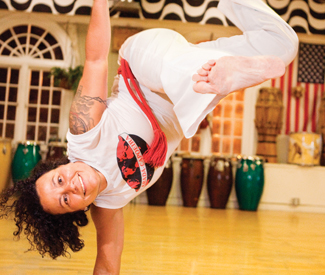
Márcia Treidler founded the Mission District capoeira school, and she is there in the first photograph you see when you come in off the street. In it, she strikes her customary pose, an improbable one-handed flip (kick?) Her washboard abs challenge visitors to trade sedentary habits for the rich traditions and fat-carving core moves of the Brazilian martial arts form, the love of which made Treidler beg her mom for classes as a teenager, brought her from Brazil to the Bay Area, and led her to start a chapter of her teacher’s school right here in San Francisco.

In person, seated at a table next to Abadá’s statue of Iemanjá, orisha goddess of the Southern seas and patron deity of Rio de Janeiro, Treidler is hardly as intimidating. Mestranda Cigarra (her capoeira-given name) is in fact incredibly patient while explaining Brazilian history and basic tenets of the martial arts form to a stranger. She does do it for a living, after all.

Sharing information is a guiding principle of capoeira, which began as a covert form of fighting practiced by African slaves in Brazil who certainly couldn’t rely on written record to educate new generations in the martial art. After escaping servitude, some used their martial skills against the law enforcement sent after them. Capoeira helped fend off colonial attacks on their newly formed quilombos, the settlements ex-slaves built in remote locales.

Even after abolishing slavery in 1888, the Brazilian government considered capoeira subversive. It was officially banned in 1890, a tool used by authorities to put black men in jail. When waves of immigration brought new labor forces to the country and left many Africans jobless, public perception often equated capoeira with criminal activity.

The sport’s rise to acceptance and spread to other countries is a relatively recent occurrence. Treidler, who is now one of two of the highest ranking females in her school Abadá’s 41,000-member international organization, started practicing 31 years ago in Rio de Janeiro. She lived in Botafogo, a middle class beachfront neighborhood. At the time, capoeira still wasn’t considered respectable — and certainly not an obvious choice for an ambitious young woman. After becoming entranced by the sport at a school performance, the current Mestranda had to work on her mother for a year before she would agree to finance her classes.

“Women in capoeira was not popular at all,” Treidler says. “[My mother] was like ‘are you crazy? What are you thinking?'” Treidler had been active in sports — swimming and gymnastics — since she was six, but her mother insisted on observing capoeira classes before she’d agree to let her high school age daughter enroll.

“The [sport’s] reputation was really bad at the time,” Treidler remembers. “But when I first started, I never stopped.” Prepped by her athletic background, she took easily to capoeira’s acrobatics. She graduated through levels quickly, and struck a deal with her instructor to pay when she could after her mother withdrew financial support. Treidler credits the sport with teaching her patience, and became close with Mestre Camisa, the founder of Abadá.

The importance of their relationship today means Abadá students benefit from the vision of the founder, who still lives in Brazil. “She follows his vision 100 percent,” Treidler’s student and fellow Abadá instructor Antonio Contreras says. Camisa and Treidler are in constant contact, and he was present at the school’s January batizado graduation ceremony at Dance Mission Theater.

Eighty-plus students take classes at Abadá San Francisco chapter. They perform at places like the Academy of Sciences and in the Ethnic Dance Festival. The studio also offers Portuguese classes. Although there are only three adult Brazilians who currently take classes, the studio is somewhat of a center for Brazilian culture here in the city. Displays that tell of the legacy of capoeira line the walls in the main room, interspersed with statues of figures in traditional poses. Brazil’s world-famous street art duo Os Gemeos have whimsically rendered Abadá practitioners in large paintings that hang in the studio’s front stairwell, alongside the Mestranda’s portrait.

It is perhaps indicative of Treidler’s own start in the sport that her students are nothing if not diverse. At the recent batizado, the spotlight lingered on tiny children, middle-aged practitioners, developmentally-disabled capoeiristas sparring, flipping, playing musical instruments, and smiling tremendously in an immense roda, the circle of practitioners that encloses a capoeira presentation.

Treidler is the only instructor that Contreras, her only other full-time teacher at Abadá SF has ever had. An ex-personal shopper, he has called the studio home since 2000, when the sounds of single-stringed berimbaus and tambourine-like pandeiros pulled him into the studio after dinner at a Mission Street restaurant. He was amazed by the maculelê, the traditional dance that accompanies capoeira, and impressed by Treidler’s presence.

“I was like, ‘whoa, who’s that’ — this larger than life person,” he remembers. He was back that Tuesday for his first class. A cardio-weights gym rat who still employs a personal trainer, Contreras says that first day was the best workout of his life. He started noticing the changes in his body “immediately.”

“To me, it was very natural to learn from Márcia,” Contreras says, sitting next to a jar full of juice one afternoon at the studio. “The advantage is that she had it tough. She identifies with the difficulties you face because she has had her own.” He himself felt unflexible and uncoordinated when he first started his practice. He’s convinced that many instructors would have given up on him long ago.

But Treidler’s teaching eventually brought Contreras to a level of mastery that compelled him to quit his day job, to stop having to rush to the school from the stores every day at 5:45pm. Contreras says that the decision to commit to teaching is a natural part of capoeira.

Unlike other martial arts forms, in which the progressively more masterful levels of belt reward physical mastery of the form and discipline, capoeira reserves the next stage of training — and corresponding 10 colors of cords worn around your hips — for those who have displayed their ability to role model for others.

Treidler originally made ends meet here in San Francisco by working construction jobs, starting to teach capoeira a few times a week at SoMa’s Rhythm and Motion dance studio. She was deemed eligible for an “alien of extraordinary ability” visa by the US government and opened her first studio on Mission in between 19th and 20th Streets, moving to the current space 11 years ago.

Capoeira’s divergent skill sets — singing, playing musical instruments, sparring, and dancing — do seem to be a sport that can reward many kinds of students. Treidler resists generalizing when it comes to her students, but will say that the “women are very rational. Men identify with the power. I think that’s why it’s unique. We help each other in class.”

Capoeira is a good opportunity to let go of the “I’m sorry” hair trigger that plagues some females. “Women are too careful with each other,” the Mestranda says. “It’s like, I’m sorry? There’s no sorry! You get out of the way. That’s the challenge, for women not to think about it so much.” It’s difficult to picture Treidler hesitating — but then, she has been in rodas since she was 17 years old.

At the batizado in December, the Mestranda’s values of inclusion are as visible among her white-uniformed students as the high fives they can’t stop giving each other in the roda. After each class of graduates’ names are called, honorees “play games” — capoeira terminology for the minute-long sparring sessions that show off the flowing acrobatics and feigned violence of the sport. These run the gamut from the younger kids’ hyper, sky-high flips — done alongside each other as much as at each other — to the more focused bouts between older students. The latter range in tone from comical to rapid-fire serious. Everyone looks really good — er, healthy.

After a 2012 packed with performances, Treidler’s ready to expand her flock, make it possible for her part-time instructors to follow her path and leave their construction or restaurant job to focus on their passion for the sport. “What’s next you know?” she asks, somewhat rhetorically. “How can we use capoeira to make the world a better place?”

Abadá Capoeira 3221 22nd St., SF. (415) 206-0650, www.abada.org


King: I have a dream. Obama: I have a drone

5

A simple twist of fate has set President Obama’s second Inaugural Address for January 21, the same day as the Martin Luther King Jr. national holiday.

Obama made no mention of King during the Inauguration four years ago — but since then, in word and deed, the president has done much to distinguish himself from the man who said “I have a dream.”

After his speech at the March on Washington for Jobs and Freedom in August 1963, King went on to take great risks as a passionate advocate for peace.

After his Inaugural speech in January 2009, Obama has pursued policies that epitomize King’s grim warning in 1967: “When scientific power outruns moral power, we end up with guided missiles and misguided men.”

But Obama has not ignored King’s anti-war legacy. On the contrary, the president has gone out of his way to distort and belittle it.

In his eleventh month as president — while escalating the U.S. war effort in Afghanistan, a process that tripled the American troop levels there — Obama traveled to Oslo to accept the Nobel Peace Prize. In his speech, he cast aspersions on the peace advocacy of another Nobel Peace laureate: Martin Luther King Jr.

The president struck a respectful tone as he whetted the rhetorical knife before twisting. “I know there’s nothing weak — nothing passive — nothing naive — in the creed and lives of Gandhi and King,” he said, just before swiftly implying that those two advocates of nonviolent direct action were, in fact, passive and naive. “I face the world as it is, and cannot stand idle in the face of threats to the American people,” Obama added.

Moments later, he was straining to justify American warfare: past, present, future. “To say that force may sometimes be necessary is not a call to cynicism — it is a recognition of history; the imperfections of man and the limits of reason,” Obama said. “I raise this point, I begin with this point because in many countries there is a deep ambivalence about military action today, no matter what the cause. And at times, this is joined by a reflexive suspicion of America, the world’s sole military superpower.”

Then came the jingo pitch: “Whatever mistakes we have made, the plain fact is this: The United States of America has helped underwrite global security for more than six decades with the blood of our citizens and the strength of our arms.”

Crowing about the moral virtues of making war while accepting a peace prize might seem a bit odd, but Obama’s rhetoric was in sync with a key dictum from Orwell: “Who controls the past controls the future; who controls the present controls the past.”

Laboring to denigrate King’s anti-war past while boasting about Uncle Sam’s past (albeit acknowledging “mistakes,” a classic retrospective euphemism for carnage from the vantage point of perpetrators), Obama marshaled his oratory to foreshadow and justify the killing yet to come under his authority.

Two weeks before the start of Obama’s second term, the British daily The Guardian noted that “U.S. use of drones has soared during Obama’s time in office, with the White House authorizing attacks in at least four countries: Afghanistan, Pakistan, Yemen and Somalia. It is estimated that the CIA and the U.S. military have undertaken more than 300 drone strikes and killed about 2,500 people.”

The newspaper reported that a former member of Obama’s “counter-terrorism group” during the 2008 campaign, Michael Boyle, says the White House is now understating the number of civilian deaths due to the drone strikes, with loosened standards for when and where to attack: “The consequences can be seen in the targeting of mosques or funeral processions that kill non-combatants and tear at the social fabric of the regions where they occur. No one really knows the number of deaths caused by drones in these distant, sometimes ungoverned, lands.”

Although Obama criticized the Bush-era “war on terror” several years ago, Boyle points out, President Obama “has been just as ruthless and indifferent to the rule of law as his predecessor.”

Boyle’s assessment — consistent with the conclusions of many other policy analysts — found the Obama administration’s use of drones is “encouraging a new arms race that will empower current and future rivals and lay the foundations for an international system that is increasingly violent.”

In recent weeks, more than 50,000 Americans have signed a petition to Ban Weaponized Drones from the World. The petition says that “weaponized drones are no more acceptable than land mines, cluster bombs or chemical weapons.” It calls for President Obama “to abandon the use of weaponized drones, and to abandon his ‘kill list’ program regardless of the technology employed.”

Count on lofty rhetoric from the Inaugural podium. The spirit of Dr. King will be elsewhere.

Norman Solomon writes a weekly column based on his experiences as a journalist, author, and political activist since the late 1960s. He’s the founding director of the Institute for Public Accuracy, co-founder of RootsAction.org and a longtime media critic. After running for Congress in the new district that stretches from the Golden Gate Bridge to to the Oregon border, he finished 174 votes short of getting through the June 2012 primary. 

Damnation investigation

0

arts@sfbg.com

FILM It’s a peculiarity of our moment that the worse things get, the more people seem inclined to think everyone else is going to hell. Their interpretation of the Bible (or Quran, or whatever) is seemingly absolute, yet God seems to stay on their side no matter which way the worldly wind might blow. Righteous judgment of others has practically become the American way, not that we were ever less than an opinionated bunch.

There is much talk of “God’s love,” but in popular and pious discourse these days it seems exclusively to be tough love — the emphasis on cautionary corrective smack downs and threats of everlasting hellfire rather than comfort and salvation, to an often lunatic degree. Just when did so many get so interested in, even quite eager about, waggling a finger at those presumed to be headed Down There?

Documentarian Kevin Miller has an answer: 9/11. At least that provides an easy and dramatic turning point, from which a great many Americans seemed to become experts in who should be doomed to sizzle in that never-ending frying pan. As one political pundit put it on CNN soon after the Twin Towers tragedy, America now had a license to “Blow them all away in the name of the Lord.” A national desire for revenge was understandable. But that event did seem to trigger a fundamental shift in our society, and the public discourse hasn’t much calmed down since.

Miller’s Hellbound? uses reactions to 9/11 as one recurrent measure of why the “eternal conscious torment” theory of hell — as opposed to annihilationism, in which only the righteous experience immortality (the rest are simply destroyed), let alone namby-pamby, forgiveness-based universalism — holds such sway today. All three concepts are equally supported by Biblical passages; various historians and theologians here note how hesitantly Judaism first accepted the notion of a punitive afterlife (apparently inherited from Zoroastrianism), and how debate of such slippery ideas was often — not always, but often — considered a healthy part of religious devotion through the history of Christianity. After all, so many events and messages in the Bible are open to interpretation — not to mention the drastic changes in understanding that can occur when you take into consideration the linguistic, historical, political, and social contexts in which they were originally written (then frequently revised).

Yet as everyone knows, today a great number of people — some loud and influential — overlook all that in the hard certainty that they understand exactly what the Bible means and what God is saying. Particularly what and whom he doesn’t like, which inevitably points fingers at others (the gays, the welfare cheaters, the Muslims, Piers Morgan) rather than oneself. Miller spends a fair amount of time chatting up the hate-a-holics of Westboro Baptist Church, and while you might groan anytime they get a public forum, he actually engages with them sufficiently to avoid a yelling contest — and to demonstrate how “Not only do I damn you but God damns you too” bile is a cartoon masquerading as evangelical faith.

After all, as one calmer voice puts it, playing “paper Pope” as a smug individual interpreter of Biblical condemnation runs counter to a vast majority of what’s actually in that book.

“The irony is that you have this teacher named Jesus and then you essentially side with his enemies in [your] behavior,” says Crazy for God author Frank Schaeffer. “Evangelicism is for America what the Pharisees were in ancient Israel. These guys wreak vengeance on the people who bring the good news about a loving god … because that message puts the gatekeepers out of a job.”

Why would God create enormous numbers of folk — say, all those non-Christian ones — just to send them to Hades? If you’re a Buddhist or a Sikh raised in religious isolation, how have you exercised a personal “choice” against the true God that justifies sending you there? Don’t ask, just shut up, feel the fear, and hate who I hate — or such seems to be the message of many prominent “Christians” of late. But: “If you have a paradigm that doesn’t allow you to ask questions, there’s something wrong with your paradigm,” as another scholar puts it here.

In fact, Jesus was all about the loving enemies, plenty of the Bible suggests ultimate reconciliation and “washing of sins” for all, and isn’t making God hateful just a way of justifying the hate we feel ourselves? Maybe hell was merely meant to be “your condition, not a place … the malice we feel within our own conscience that ‘burns’ us,” an Orthodox rabbi says. God’s justice as restorative and healing, embracing all — the dread word is not heard in Hellbound?, but one could easily imagine many fervent believers of today feeling that that long-running yet currently unfashionable interpretation is dangerously close to, y’know, Socialism. *

HELLBOUND?

Thu/17-Sat/19, 7:30pm (also Sat/19, 4pm); Sun/20, 2 and 4pm

Yerba Buena Center for the Arts

701 Mission, SF

www.ybca.org


Sacred space

5

emilysavage@sfbg.com

MUSIC There will be no bad seats at the new SFJazz Center in Hayes Valley; or at least, that’s the goal.

The brand new jazz venue in the heart of town, a three-story, glass-encased structure with a circular concrete stadium bowl of an auditorium, educational components, rehearsal spaces, a cafe run by the Slanted Door’s Charles Phan, and multiple bars opens Mon/21. It’s a $63 million, 35,000-square-foot addition to Performing Arts Row, near Van Ness-adjacent locations such as the Davies Symphony Hall, and the War Memorial Opera House. It’s the birth of a nonprofit jazz institution.

In the auditorium, 700 seats encircle and hover above a central stage — chairs behind the stage, up in the balcony, and practically up in the artists’ faces on the ground level. Because the room so surrounds the stage, there’s a direct sight line for every instrument being played, every hand grasping a horn, tickling keys, or plucking strings. There are platforms that can accordion and retract, making that enviable space near the stage open up into a temporary dance floor.

And all the seats have cup-holders. We’re a long way from the smoke-filled, underground jazz clubs of the past.


EXCITING AS ALL HELL

And from those seats in the Robert N. Miner auditorium, patrons will see an impressive first season of SF Jazz at its new home. Fans already have high expectations, given SF Jazz’s 30 years of hosting concerts and festivals at other venues like the Paramount in Oakland, and smaller clubs like Amnesia. Now with its own multi-use facility, the nonprofit has taken eclectic routes with its programming and contributions.

“This first season, when you look at some of the things we’re doing here, it’s just exciting as all hell,” says founder and executive artistic director Randall Kline, barely able to contain that excitement, clad in a hardhat and reflective vest on the first level of the still-under-construction building. “[These events] fully take advantage of what we can do with the theater — something we couldn’t do when we didn’t have our own place.”

For starters, there’s a sold-out opening night celebration Jan. 23, hosted by Bill Cosby, along with a grand opening week of shows spotlighting McCoy Tyner, the SFJazz Collective, and more, followed by a week of big band with the Realistic Orchestra (Jan. 31), and swing with Lavay Smith and Her Red Hot Skillet Lickets (Feb. 3).

In March, virtuoso Indian percussionist Zakir Hussain will perform four nights, and in April there will be a Weimar Germany themed weekend with Ute Lemper, Max Raabe and the Palast Orchester, and a screening of the classic Metropolis (1927), with live music by the Clubfoot Orchestra.

But even more to Kline’s point: there will be five resident artistic directors for the 2013 through ’14 season (along with Kline’s overall vision). The five — Jason Moran, Regina Carter, Bill Frisell, John Santos, and Miguel Zenon — are musicians with distinctive backgrounds and viewpoints, programming four days of thematic events.


ENCOMPASSING GEOGRAPHIES

For his days, Santos hand-picked colleagues and artists working and performing in the Caribbean style. He chose De Akokan, a duo made up of Cuban singer-songwriter-composer Pavel Urkiza and Puerto Rican saxophonist-composer Ricardo Pons, because “they’re phenomenal artists…and they rarely come here.” He also invited cutting edge trombonist-composer Papo Vazquez, who lives in New York but is steeped in the Afro-Puerto Rican tradition.

During a phone call a few hours before my hard-hatted venue walk-through with Kline, architect Mark Cavagnero, and Marshall Lamm, who does public relations for the center, Santos discusses his anticipation and interest in the upcoming schedule.

The Bay Area bred percussionist will also be premiering his own Filosofia Caribena II, which refers to Caribbean philosophies and traditions — those that have informed his entire body of work. “[It] blends all the experiences of Black American music with Caribbean traditions, and it goes into the whole socio-political aspect of how the music really represents resistance and the identity of a whole group of people that identify culturally, even though we don’t live in Cuba or Puerto Rico, but we certainly grew up in and maintained those traditions.”

Adding, “Jazz was born in that environment, in New Orleans, in the Caribbean community. We’re making those connections between jazz and the Caribbean roots.”

Frisell’s batch of shows, beginning April 18, will include multimedia pieces with projections and orchestras, readings of Allen Ginsber’s Kaddish, and Hunter S. Thompson’s The Kentucky Derby is Decadent and Depraved (the latter of which is rumored to be narrated by Tim Robbins).

Moran’s residency likely represents the scope of the auditorium’s versatility best: he’ll open with a solo acoustic piano night (May 2), followed by a “Fats Waller Dance Party” with Meshell Ndegeocello that utilizes the dance-floor, then break out the inspired, possibly nutty, concept of a skateboarding jazz piece. There will be an actual half-pipe on the lower level of the room — seats pushed back — with professional skateboarders riding back and forth in the curved structure to Moran’s musical accompaniment.


FOCAL POINT

It’ll be one of many configurations for that striking room. The specifics of the auditorium were big challenges for architect Cavagnero — the acoustics, the balance of sound (such as making sure solo piano and thundering skateboarding dips both fill the space equally), isolating street noise, creating those excellent sight lines from every angle.

“The idea of the building was to make the big concrete room the sacred space for music, the focus space,” says Cavagnero, walking up the stairs in the building’s glass-encased entryway. “That was going to be the closed, sacred space, [and] everything else would wrap around it and be as open and public as we could make it.”

To that end, the rest of the building has floor-to-ceiling glass, and the staircase has no columns supporting it, just thin titanium rods that double as the guardrail. The second floor has bars on either ends and terraces with glass doors that fully open, along with tiled murals representing the history of jazz in the city, with long-gone clubs painted throughout.

It’s clear that this building is meant to be more than a standard music venue, the goal is to be an institution.

“So, if the paradigm is: clubs are harder to run and have live music, well, if we could have the same kind of vibrant music in an institution that supported that kind of thing, to build up a community of people that cared about that kind of thing — which is the gamble I guess we’re making here in this building — we can build it for the jazz community,” says Kline. “[The goal is to have] a great place to hang out and hear live music, where new artists can grow and premiere, and be nurtured.”

And it is hard to run live jazz venues in the city. Nearing the end of 2012, the owners of Oakland’s Yoshi’s filed for involuntary bankruptcy to put its San Francisco location in Chapter 11 if it couldn’t meet an agreement with its partners, the Rrazz Room switched venues under a cloud of controversy stemming from an allegedly racist former manager of its then-location, and Savanna Jazz had to fight off foreclosure.

“We have not seen an increased interest for the art form [recently] primarily because the economy is down significantly and the arts are usually the first to suffer,” says Savanna Jazz co-owner Pascal Bokar.

Because of this, I ask Bokar if other jazz club owners in the city see the center as a contentious new rival. He categorically denies that assertion.

“Jazz is an art form and it has no competition, every club and club owner adds to the fabric of our community and SFJazz is the big brother. I know how hard it is to promote jazz and [Kline] has been working at it for several decades,” he says. “He deserves tremendous credit for bringing this to San Francisco. SFJazz is a very powerful organization and I think that there is an opportunity for [it] to partner with the smaller venues like Savanna Jazz. The smaller venues are the incubators of local talent and I think that they would benefit from a closer relationship, which in turn would solidify community commitment.”

It may be the older sibling to smaller clubs, but given the economy, and the tough climate for all music venues in San Francisco really, the SF Jazz Center does also feel like a gamble itself. But to extend and belabor the metaphor, Kline’s got a good hand.

Santos describes the center to me as a “bold experiment.”

“The amount of money that it has taken to build that place and keep the doors open is phenomenal, and in a lot of ways, it’s a step out into the darkness,” he says. “But I see the potential of it as just limitless. It can be such an incredible thing, if the community supports it. That’s what I’m hoping will happen.”


NATIONAL ART FORM

Santos points out that the jazz center is unique in its fans and patrons differing from the typical performing arts donor, and will have specific obstacles because of that.

“In a way, it’s abstract, when you think of it like, OK, there it is, next door to the symphony hall, to the ballet, to the opera, within one block of those institutions. It’s wonderful to have jazz there, and standing toe-to-toe with those institutions, and getting the respect it deserves. Getting public support from the city and the country and the state, as it should be, because jazz is our national art form. The symphony and the ballet and the opera are not.”

“The difficult part is that the opera and the symphony and the ballet have traditional well-heeled audiences of supporters. Jazz does not. Jazz is grassroots; it’s working class. The audience for jazz and the community from where jazz comes out of is not a deep-pocket kind of community. And that’s where the challenge lies.”

If anyone can face that, it’s Kline. It’s part of his whole bootstrapping essence, how he’s kept SFJazz up, running, and prominent for the better part of three decades. From its humble beginnings as the three-day Jazz in the City festival, promoted solely by Kline, to the Summerfest, the SFJazz High School All-Stars group, the monthly Hotplate series, and finally, the SFJazz Center.

Leaning against the guardrail on the second floor of the building, gazing out through the wall of glass to the greater Hayes Valley neighborhood, Kline smiles as he talks of the city’s history with jazz, his own life mirroring it for quite some time. “I’ve been here since 1976, and I’ve seen a lot of patterns in the scene; it ebbs and flows, the economy changes. This building is a reflection of the sociology; we’re trying to be relevant, so we’ve chosen a different model, we’ve chosen institution.”

It’s one of a few times that will come up in my conversations with those involved with the center.

“Could we apply that older model for culture to a younger, vibrant art form that’s relevant to the city?” he asks, rhetorically. “That’s the aim here, to try something that’s of our time.”

Jazz hands: Some SFJazz season highlights


MCCOY TYNER

A rare old school jazz legend in the center’s inaugural season — stunning and dapper pianist Tyner will “consecrate” the space by performing with the SFJazz house band.

Jan. 24, 7:30pm, $50–$150


MONTCLAIR WOMEN’S BIG BAND

Swing is still huge in SF, and this celebration of the classic big band sound pairs the 17-member Montclair Women with the 20-member Realistic Orchestra (who’ve big-banded Bjork) for a wall of swingin’ sound. The SFJazz High School All-Stars Orchestra opens.

Jan. 31, 7:30pm, $25


AFRO-CUBAN ALL STARS

Oh heck yes.

Feb. 22-24, 7:30pm, $25–$65


MARIZA

The gorgeous longing of Portuguese fado washes over the Bay in the form of the wonderfully voiced Mariza, a spellbinding star whose repertoire spotlights acoustic melancholy melodies from Brazil, Cape Verde, North Africa, and beyond.

Mar. 14-17, 7:30pm, $25–$65


“JOHN SANTOS: FILOSOFÍA CARIBEÑA II”

Beloved Bay Area bandleader and jazz evangelist digs deep in his knowledge of Cuban, Latin, and indigenous Caribbean styles to deliver a heady trip through ancient Iberian influences and contemporary island expressions.

Mar. 23, 7:30pm, $25–$65


METROPOLIS

San Francisco’s Club Foot Orchestra performs its renowned futuristic soundtrack to Fritz Lang’s silent sci-fi masterpiece.

Apr. 14, 7:30pm, $20–$40


“ALLEN GINSBERG’S KADDISH” AND “HUNTER S. THOMPSON’S THE KENTUCKY DERBY

Überhip guitarist Bill Frissell, an SFJazz resident artistic director, applies his downtown cool pedigree to two überhip literary iconoclasts. He’ll be conducting an ace team of musicians for multimedia presentations of Ginsberg’s epic poem of mourning and Thompson’s notorious, uproarious 1970 article about the grand horse race. With visual design by Ralph Steadman for both programs, classic counterculture will be out in force.

Ginsberg: Apr. 18, 7pm and 9:30pm, $35–$80

Thompson: Apr. 20, 7:30pm and Apr. 21, 4pm and 7pm, $35–$80


BANDWAGON AND LIVE SKATEBOARDING

“Jazz wild card” and MacArthur Genius pianist Jason Moran gets contemporary with new trio Bandwagon, performing a rolicking set as a who’s-who of SF skateboarders shows off the flexibility of the new center.

May 4, 7:30pm, $20–$40


Much weirdness at the City College Board

44

And you thought the election of the new old Board of Supervisors president was odd. Check out what happened with the Community College Board: After weeks of telling everyone in sight how horrible it would be if any of the three old-timers who helped screw up the school (Natalie Berg, Lawrence Wong and Anita Grier) got elected board prez, current board president John Rizzo won another term — with the support of Berg, Wong, and Grier. And left some of his progressive allies either scratching their heads or fuming.

The backstory: A couple of weeks ago, Rizzo got word that prog colleague Chris Jackson was considering supporting Grier for the top post. That would have given Grier the four votes she needed, since Berg, Wong and her all vote together most of the time. And it would have screwed the progressives, who managed with considerable effort to hold onto a one-vote majority at a critical time in the board’s history, while the college is trying to win reaccreditation. Why bother to win at the polls if you’re just going to turn control over to the other side? I mean, the GOP doesn’t vote for Nancy Pelosi for speaker.

So Rizzo asked former sup. Aaron Peskin, who remains one of the town’s most savvy political operators, to help out. Peskin put an immense amount of time into working out the details and cutting through the various interest-group problems. (Example: By tradition, the top vote-getter becomes board president. That would be Steve Ngo. But the teacher’s union is mad at Ngo because he wants to put more money into the school’s reserves even if it means laying off teachers. So Jackson, a longtime labor guy, couldn’t vote for him. Jackson had already told Grier he’d vote for her, so he’d have to be convinced to withdraw that promise. And on and on.) In the end, after a lot of wrangling (while trying to avoid the fact that the Brown Act prohibits the four progressives from talking to each other outside of a public meeting) Peskin managed to find a solution: Four people were willing to vote for newcomer Rafael Mandelman. Okay, that works.

The vote was Jan. 10. The night before, Berg called Rizzo to say that she didn’t want Mandelman, but would agreed to support … Rizzo. Presumably (she won’t take my phone calls so I don’t know for sure) she had already talked to, or was about to talk to, Grier and Wong to seal the deal. That, of course, would be a direct Brown Act problem, but nobody seems to care about the state’s landmark open-government law anyway (witness the BOS leadership fight, where everyone was talking to everyone else behind the scenes).

So Rizzo agrees that would be dandy, never tells his colleagues on the left — and when the vote goes down, he gets nominated by and re-elected with the support of the people he’s been bad-mouthing all over town for the past couple of weeks. In the end, the progs saw the handwriting on the wall and went along and made it unanimous.

I called Rizzo after the vote and he told me that he hadn’t expected Berg’s offer, but that “it avoided a fight at the meeting, and that’s a good thing for the state accreditors. It shows the board isn’t divided.” Actually, the board IS divided, and Rizzo has been part of that divide, and if the special trustee hasn’t figured that out yet, he’s not terribly observant.

He told me he should have given his allies a heads-up, but “that would have violated the Brown Act.” (Clue phone: The whole deal that re-elected him was a blatant violation of the Brown Act.)

Mandelman just joined the board, and wasn’t pushing for the top job, although he’d agreed to do it. So he’s not that upset. But he was a bit bemused when I talked to him. “To have the two-week shitstorm stirred up by John, who then forms a partnership with the people he’s despising, and not to tell any of us, is wierd,” Mandelman said.

Peskin’s more direct. “Politics is all about keeping your word,” he told me. “This is exactly not how you do politics.”


SFBOS grab bag: Diva Breed, Yee’s jig, delayed Chiu, and more

10

Now that the dust has settled from this week’s San Francisco Board of Supervisors inauguration and presidential vote, I thought I’d return to a few random gems that were still stuck in my notebook, waiting to see the light of day.

Under the heading of There’s a New Diva under the Dome, new D5 Sup. London Breed didn’t wait for the official noon inauguration prescribed by the City Charter to take her oath of office, instead holding a packed event at 10am in the North Light Court, where her oath was administered by a key supporter, Attorney General Kamala Harris.

“I held a swearing in earlier to be able to have a large crowd of supporters,” was how Breed explained it to her colleagues later, and it’s certainly true that attendance at the official event was limited by the size of the room. But it’s equally true that gathering a who’s who list of local power brokers to applaud Breed’s ascendance as a key swing vote sends the signal that she expects to be at the table when the big deals get cut.

President David Chiu, who is also no stranger to political power plays, sounded a tone of humble leadership after maneuvering himself with closed-door negotiations into an unprecedented third consecutive term as president, noting that there is still much more work to do.

In fact, Chiu said he was almost late for Breed’s event because, “my bike light got stolen, the Muni bus was late, and then I had a hard time catching a cab.”

Sup. Eric Mar revisited his reelection race last year with a huge understatement – “In my campaign, I had to do a little more work than my colleagues did.” – noting that he and his supporters overcame an unprecedented $1 million in spending against them: “We sent a strong message that the Richmond District is not for sale and never will be.”

Sup. John Avalos gave credit for his surprisingly easy reelection campaign to a unlikely but deserving source: journalist Chris Roberts, who uncovered evidence that Avalos challenger Leon Chow didn’t really live in the district, which he reported in SF Appeal, forcing Chow to withdraw from the race. Avalos called Roberts “an honorary member of our campaign.”

Meetings like this are often just dripping in sanctimony, and this one was no exception, so it was nice to see a moment of genuine child-like exuberance from new D7 Sup. Norman Yee, who at 63 is about twice as old as most of his colleagues. As he thanked supporters and laid out his goals, Yee suddenly seemed overcome by this opportunity, smiling broadly, doing a little jig, and declaring, “Darn, I’m excited!”

I was less impressed by the rambling mini-lecture that Cohen gave on the topic of leadership before she withdrew her nomination as president. “That’s what leadership is about, stepping forward, outside your comfort zone, and doing things,” said the supervisor with a scant legislative record as she quit the race for president before her colleagues were even given the chance to vote on what she said was the importance of having a women of color in charge. “Every person here has that leadership quality within them.”

From both supervisors and the general public, there were also a number of statements made about the history of the board presidency that were not quite right, particularly as it pertained to Cohen and Jane Kim nominating one another for president and the issue women of color being nominated for that slot.

So, for the record, the last time a woman of color (former D10 Sup. Sophie Maxwell) was nominated for board president was 10 years ago. The last time a woman served as president was Barbara Kaufman (1997-99). And the last time there was a woman of color serving as president was Doris Ward, who served from 1991 to mid-1992 when she left to become Assessor. Also, the last three-term president was John Molinari, who served from 1979-83 and ’85-’87.

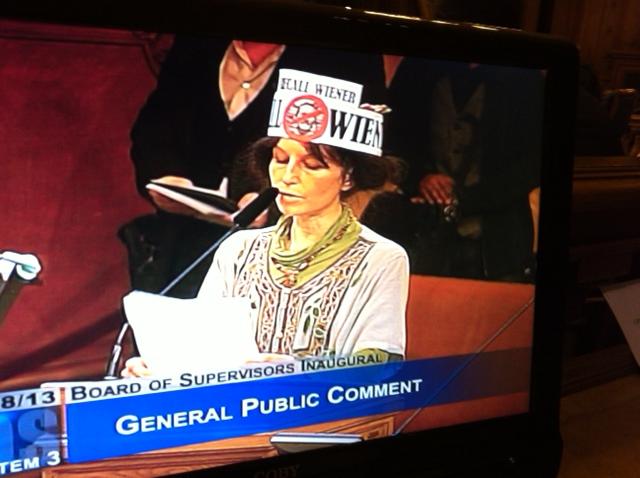
The most colorful moment in public comment was when nudism activist Gypsy Taub came clad in homemade hat that urged people to oppose and recall Sup. Scott Wiener. But because Wiener had already said he wouldn’t accept a nomination as president, she turned her criticism on Chiu, who was also slammed by another leftist speaker who told supervisors, “If you can’t prevent David Chiu from being president, we deserve to be slaves.”

Finally, the meeting included an unremarkable speech by Mayor Ed Lee, who pledged to work with each supervisor and offered this unsupported claim, “We continue to make sure this city is successful for everyone.”

The Performant: Music men

0

Mark Growden’s solo show and variations on a theme with Hand to Mouth 

There’s something so charmingly unassuming about the Red Poppy Art House — a by-now venerable institution on the Mission District’s quirk-centric music scene — it makes you want to invite it home for a Hangtown Fry and mimosas. From the mismatched chairs to the frayed curtains, the whitewashed walls to the cramped toilet, the Red Poppy’s overall ambiance is that of a sort of ramshackle country parlor, right down to the upright piano.

Though you’d never mistake him for a church lady, Bay Area bard Mark Growden does exude a touch of the rustic — a down-home demeanor rooted in his rural Northern California upbringing. From the moment he opened his set on Friday night at the Red Poppy with a haunting, desert lament played ingeniously on his signature set of bicycle handlebars, it was as if he were unfolding a map of the hidden pockets of America and inviting us on an introspective journey through them.

Assisted ably by trumpeter Chris Grady, who employed a number of mutes throughout the show, probably to keep him from blowing the heads off the front row seated literally at his feet, Growden worked his way through a repertoire of old songs and new which hearkened to the barroom backrooms of the South, the windswept plains of the American West, and the lonesome riverbanks of the Truckee, and the Mississippi.

Though much of Growden’s music is tinged with a fragile darkness, the mood of the evening was light, jovial, the banter flying thick and fast between stage and oddience, and slyly humorous counterpoint provided by Grady. By the time it came around to the group sing-a-long, we were all good friends, a chummy crew, no doubt assisted in part by the closeness of our quarters, the conviviality of claustrophilia.

Music was also the theme at monthly comedy event Hand to Mouth at the Dark Room Theatre. Since 2011, Hand to Mouth has been hosting eclectic lineups of funny-persons who are encouraged to perform sets that relate to a pre-announced topic, and much of the fun comes from discovering how each comic will interpret the theme.

Sure, there were a few comics who merely riffed on the topic by dissing bands they didn’t like or making fun of raves, easy targets all, but co-host James Fluty broke the trend by coming out onstage with a guitar and playing a lewd ballad about Mormons (take that Trey Parker and Matt Stone) and Jesse Elias shattered what was left of it by giving a totally hilarious power-point presentation he called “A Lecture of Music History.” Ostensibly a comparison of the evolution of classical to contemporary music, Elias spent time comparing music from “Der Gloeckner von Notre Dame” and “Wicked,” introducing us to the “orchestra hit” sample, and comparing the “two distinct sounds referred to as ‘electric piano’” which involved a straight-faced comparison of various video games soundtracks versus Disney credits music.

Keeping it weird, DJ Real (a.k.a. Nick Stargu) contributed a retiree version of a NIN tune (“I Want to Play Some Canasta”), the Unwatchables sold their souls to the devil in order to be able to play the blues for Bruce Willis, and Drennon Davis ended the show on a literal high note by turning himself into a radio with the help of a loop station and station-appropriate DJ patter that ranged from the growling bro-down of hard rock station “Radio K-O-C-K” to the passive-aggressive mellow of “Free Jazz Radio” (“just want to clarify something about our name, we are not ‘free’. We are listener-supported.”)

It would appear allowing comedians to stretch their creativity to encompass yet redefine a specific theme is as good for them as it was for us—and makes it easy to look forward to their February installment at Lost Weekend Video, when the theme will be “Jobs”. Hell, I’ve got a few jokes about that myself….

Our Weekly Picks: January 9-15

0

WEDNESDAY 9

RADAR Reading Series

Like a literary-focused Parisian salon, but with vibrant SF genderfucking and homemade desserts, this monthly showcase of emerging, underground writers and artists is routinely the most enticing potpourri of need-to-know talent. The RADAR Reading Series is part of local treasure/Sister Spit(ter) Michelle Tea’s nonprofit, RADAR Productions. This time, there’s visual artist D-L Alvarez, Gaga Feminism author Jack Halberstam (who writes often of gender queerness, pop culture, and bad TV), transnational interdisciplinary artist and cultural organizer Favianna Rodriguez, and author Grace Krilanovich — whose 2010 debut novel, The Orange Eats Creep,was named one of Amazon’s top science fiction/fantasy books that year. With Tea hosting the follow-up Q&A, you know there will be cookies on hand. (Emily Savage)

6pm, free

San Francisco Public Library, Main Branch

Latino Reading Room

100 Larkin, SF

www.radarproductions.org


THURSDAY 10

“Unknown but Knowable States”

Dorothea Tanning’s surreal paintings provide a window into the female subconscious with as much style and punch as her male contemporaries. There will be a few of these crisp, symbolic painting in the upcoming exhibit, Known but Unknowable States, but it will also show a different side of her work — one that could easily fit in with ethereal figure painting seen in contemporary art. The most striking works are what she called “prism” paintings, which twist the female form into abstract visions with soft brushwork and unique color combinations. To go along with these will be some of her soft sculptures of strange creatures made of fabric, fur, and a sewing machine. (Molly Champlin)

Through March 2

Opening reception, 5pm, free

Gallery Wendi Norris

161 Jessie, SF

(415) 346-7812

www.gallerywendinorris.com


The Art and Legacy of Crime Photographer Weegee

It should come as no surprise that Eddie Muller took a shining to the work of 1930s and ’40s press photographer Arthur Fellig, a.k.a. Weegee. Muller’s the founder of the SF Noir Film Festival, whose hardboiled flicks go perfectly with Weegee’s steely-gazed shots of crime scenes. The photographer is widely credited with bringing aesthetic concern to crime scene photography. Today, Muller explains why the man’s work still matters now, in the era of Instagram and meme mania, with this talk, punctuated by video interludes. (Caitlin Donohue)

6:30-8pm, $5

Contemporary Jewish Museum

736 Mission, SF

(415) 655-7800

www.thecjm.org


FRIDAY 11

“Risk is This…”

If you want to see what Cutting Ball Theatre’s next season might look like, you’d do well to check out this season’s new experimental plays festival, “Risk is This….” Past festivals have foreshadowed full productions of some of Cutting Ball’s most memorable pieces including Marcus Gardley’s “…and Jesus Moonwalks the Mississippi” and Eugenie Chan’s “Tontlawald”, and this year’s lineup looks to be just as full of future potential, with new plays written by Sean San José, Dipika Guha, and Basil Kreimendahl, plus exciting new translations of Alfred Jarry’s “Ubu Roi” and the Capek brothers’ “Insect Play.” Presented over five weekends of staged readings, the five plays range topically from transgenderism to crack-cocaine to the corrupting influence of power — which certainly sounds like the very definition of risk to us. (Nicole Gluckstern)

Fridays and Saturdays through Feb. 9

8pm, free–$20 donation

EXIT on Taylor

177 Taylor, SF

(415) 525-1205

www.cuttingball.com


“Alfred Hitchcock: The Shape of Suspense”

Alfred Hitchcock is just coming off his best year in decades, with a biopic starring Anthony Hopkins and the news that his 1958 psychological drama Vertigo leapfrogged past the almighty Citizen Kane (1941) in at least one “best films of all time…ever…full stop” poll of influential film critics. Not bad for a guy who died in 1980. The Pacific Film Archive shines a well-timed spotlight on the prolific Master of Suspense with an extensive retrospective of works well-known (1954’s Rear Window, 1959’s North by Northwest, 1960’s Psycho, and — of course — Vertigo) and more obscure (1931’s Rich and Strange, 1937’s Young and Innocent, 1947’s The Paradine Case) — not to mention often-overshadowed underdogs like the series kick-off film, made by Hitch in his pre-Hollywood days: 1935’s The 39 Steps. (Cheryl Eddy)

Through April 24, 7pm, $5.50–$9.50

Pacific Film Archive

2575 Bancroft, Berk.

bampfa.berkeley.edu


Mister Lies

Nick Zanca played in several punk bands in high school until he was introduced to electronic music and production in college. This happened about a year ago. Since then he’s caused quite the stir, catching a record deal and tour as Mister Lies. The deep, almost spiritual electronica, or “experimental avant-garde pop” as he prefers, draws inspiration from diverse artists — spanning Steve Reich to Missy Elliot. His generally downtempo vibe might be better scheduled at four in the morning. But hey, there’s no right time to unwind your mind a bit, particularly when it’s Mister Lies’ gospel-infused sound paired with the smooth dream pop of San Francisco local, Giraffage. (Champlin)

With Some Ember

9:30pm, $12

Bottom of the Hill

1233 17th St., SF

(415) 621-4455

www.bottomofthehill.com


SATURDAY 12

“Rituals of Water”

The most recent work of local artist, Rodney Ewing, manages to distil a lot of history and ideas into a coherent show about water. This theme is embedded even in the creation of the art: the large scale paintings are made of ink, salt, and mostly, water. Through figures and words that seem to be dissolving on paper, he looks at four moments in the history of African American people, the transatlantic slave trade, baptism, civil rights, and Hurricane Katrina. Though his works are heavily political, they don’t seek to make a statement. Instead they perform a sort of ritual in which the viewer and artist strengthen African history by reclaiming memories and stories once lost through diaspora. (Champlin)

Through March 1

Opening reception, 6pm, free

IcTus Gallery

1769 15th St., SF

(510) 912-0792

www.ictusgallery.com


Mary Armentrout

Old Will wasn’t exactly thinking about installation pieces when he proclaimed, “all the world’s a stage.” Still there is something about the connection between “living” and “performing” that today many dance artists explore by stretching that fragile tie between the two. One way is by abandoning the proscenium theater for more flexible environments. Few, however, go as far as the ever adventuresome Mary Armentrout who is traveling her “reveries and elegies,” essentially a solo piece for herself, from two Oakland locations first to CounterPULSE this weekend, then (Feb. 23-24) to Bakers’ Beach. Each time she shows these “reveries,” she will do the same, of course, not at all. Ideally one would see the whole cycle but since Armentrout has assembled the piece from fragments, fragments is what we’ll get. And that’s OK. (Rita Felciano)

Also Sun/13, 4:15pm, $20

CounterPULSE

1310 Mission, SF

(510) 845-8604

www.eventbrite.com


Kicker

Newish Bay Area band Kicker features members of Neurosis, Filth, and Dystopia, and sounds like late ’70s anarcho-punk à la Subhumans. Which makes perfect sense, really, as lead vocalist Pete the Roadie grew up in England, went to the same school as Subhumans and Organized Chaos, and has been a part of the worldwide punk scene since that formative year of ’77. Really need another reason to go to this $5 Bender’s show? OK: Bad Cop/Bad Cop — the LA rock’n’roll band with members of Cocksparrer tribute act Cunt Sparrer — opens the whole thing up. (Savage)

With Pang!

10pm, $5

Bender’s

800 S. Van Ness, SF

(415) 824-1800

www.bendersbar.com


MONDAY 14

The Great American Pop-Up

The Great American Pop-Up is back. Because who wants to make dinner on a Monday night? At the first installment, patrons scarfed chocolate raspberry cookies, sustainable sushi, and salty spiced sausages. At this second round — again inside the iconic Tenderloin site, recently named one California’s most beautiful music venues — a few of those patron-pleasing vendors will return: sustainable sushi via Rice Cracker Sushi, Asian fusion dishes via Harro-Arigato and Ronin, along with Dora’s Donuts and Donna’s Tamales. The house Chef James Whitmore will be whipping up dishes, and there will be some crafty vendors including a Yes & Yes Designs booth, should you be in the market for one-of-a-kind jewelry made from recycled books as a delicious side dish to your sushi. DJs Children of the Funk will provide the background beats to your fine (club) dining experience. (Savage)

Great American Music Hall

859 O’Farrell, SF (415) 885-0750

www.slimspresents.com


TUESDAY 15

Shabazz Palaces

The retro-future of space hip-hop is here, in disparate senses among headliner Shabazz Palaces and opener Ensemble Mik Nawooj. Led by Palaceer Lazaro — formerly of jazz-rap group Digable Planets — and multi-instrumentalist Tendai “Baba” Maraire, Seattle’s Shabazz Palaces are part of a cosmic collective of forward-thinking artists, including Sub Pop labelmates, THEESatisfaction. Their latest release, 2011’s Black Up, was a vortex of jazz, soul, and rap with African percussion keeping the beat. And then there’s Ensemble Mik Nawooj, the East Bay crew behind that alternate universe chamber hip-hop opera, Great Integration, a similarly genre-busting production that follows five malevolent lords who control the physical world, and the assassin who slays them. Prepare to elevate your mind. Countdown to launch. (Savage)

With Ensemble Mik Nawooj, Duckwrth, DJ Orfeu

9pm, $15

New Parish

579 18th St., Oakl.

(415) 371-1631

www.thenewparish.com


The Guardian listings deadline is two weeks prior to our Wednesday publication date. To submit an item for consideration, please include the title of the event, a brief description of the event, date and time, venue name, street address (listing cross streets only isn’t sufficient), city, telephone number readers can call for more information, telephone number for media, and admission costs. Send information to Listings, the Guardian, 225 Bush, 17th Flr., SF, CA 94105; or e-mail (paste press release into e-mail body — no attachments, please) to listings@sfbg.com. Digital photos may be submitted in jpeg format; the image must be at least 240 dpi and four inches by six inches in size. We regret we cannot accept listings over the phone.

War of the waterfront

40

tredmond@sfbg.com

There’s a blocky, unattractive building near the corner of Howard and Steuart streets, right off the Embarcadero, that’s used for the unappealing activity of parking cars. Nobody’s paid much attention to it for years, although weekend shoppers at the Ferry Building Farmers Market appreciate the fact that they can park their cars for just $6 on Saturday and Sunday mornings.

But now a developer has big plans for the 75 Howard Street site — and it’s about to become a critical front in a huge battle over the future of San Francisco’s waterfront.

Paramount Partners, a New York-based real-estate firm that also owns One Market Plaza, wants to tear down the eight-story garage and replace it with a 350-foot highrise tower that will hold 186 high-end condominiums. The new building would have ground-floor retail and restaurant space and a public plaza.

It would also exceed the current height limit in the area by 150 feet and could be the second luxury housing project along the Embarcadero that defies the city’s longtime policy of strictly limiting the height of buildings on the waterfront.

It comes at a time when the Golden State Warriors are seeking permission to build a sports arena on Piers 30 and 32, just a few hundred feet from 75 Howard.

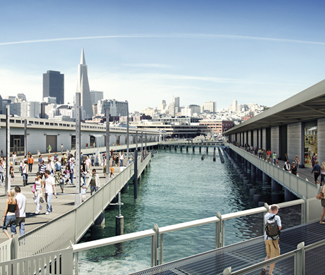
Between the proposed 8 Washington condo project, the arena, and 75 Howard, the skyline and use of the central waterfront could change dramatically in the next few years. Add to that a $100 million makeover for Pier 70, the new Exploratorium building on Pier 15, and a new cruise ship terminal at Pier 27 — and that’s more development along the Bay than San Francisco has seen in decades.

And much of it is happening without a coherent overall plan.

There’s no city planning document that calls for radically upzoning the waterfront for luxury housing. There’s nothing that talks about large-scale sports facilities. These projects are driven by developers, not city planners — and when you put them all together, the cumulative impacts could be profound, and in some cases, alarming.

“There hasn’t been a comprehensive vision for the future of the waterfront,” Sup. David Chiu told me. “”I think we need to take a step back and look at what we really want to do.”

Or as Tom Radulovich, director of the advocacy group Livable City, put it, “We need to stop planning the waterfront one project at a time.”


Some of the first big development wars in San Francisco history involved tall buildings on the waterfront. After the Fontana Towers were built in 1965, walling off the end of the Van Ness corridor in a nasty replica of a Miami Beach hotel complex, residents of the northern part of the city began to rebel. A plan to put a 550-foot US Steel headquarters building on the waterfront galvanized the first anti-highrise campaigns, with dressmaker Alvin Duskin buying newspaper ads that warned, “Don’t let them bury your skyline under a wall of tombstones.”

Ultimately, the highrise revolt forced the city to downzone the waterfront area, where most buildings can’t exceed 60 or 80 feet. But repeatedly, developers have eyed this valuable turf and tried to get around the rules.

“It’s a generational battle,” former Sup. Aaron Peskin noted. “Every time the developers think another generation of San Franciscans has forgotten the past, they try to raise the height limit along the Embarcadero.”

The 8 Washington project was the latest attempt. Developer Simon Snellgrove wants to build 134 of the most expensive condominiums in San Francisco history on a slice of land owned in part by the Port of San Francisco, not far from the Ferry Building. The tallest of the structures would rise 136 feet, far above the 84-foot zoning limit for the site. Opponents argued that the city has no pressing need for ultra-luxury housing and that the proposal would create a “wall on the waterfront.”

Although the supervisors approved it on a 8-3 vote, foes gathered enough signatures to force a referendum, so the development can’t go forward until the voters have a chance to weigh in this coming November.

Meanwhile, the Paramount Group has filed plans for a much taller project at 75 Howard. It’s on the edge of downtown, but also along the Embarcadero south of Market, where many of the buildings are only a few stories high.

The project already faces opposition. “The serious concerns I had with 8 Washington are very similar with 75 Howard,” Chiu said. But the issues are much larger now that the Warriors have proposed an arena just across the street and a few blocks south.

“Because of the increase in traffic and other issues around the arena, I think 75 Howard has a higher bar to jump,” Sup. Jane Kim, who represents South of Market, told me.

Kim said she’s not opposed to the Warriors’ proposal and is still open to considering the highrise condos. But she, too, is concerned that all of this development is taking place without a coherent plan.

“It’s a good question to be asking,” she said. “We want some development along the waterfront, but the question is how much.”

Alex Clemens, who runs Barbary Coast Consulting, is representing the developer at 75 Howard. He argues that the current parking garage is neither environmentally appropriate nor the best use of space downtown.

“Paramount Group purchased the garage as part of a larger portfolio in 2007,” he told me by email. “Like any other downtown garage, it is very profitable — but Paramount believes an eight-story cube of parking facing the Embarcadero is not the best use of this incredible location.”

He added: “We believe removing eight above-ground layers of parked cars from the site, reducing traffic congestion, enlivening street life, and improving the pedestrian corridor are all benefits to the community that fit well with the city’s overall goals. (Of course, these are in addition to the myriad fees and tax revenues associated with the project.)”

But that, of course, assumes that the city wants, and needs, more luxury condominiums (see sidebar).


Among the biggest problems of this rush of waterfront development is the lack of public transit. The 75 Howard project is fairly close to the Embarcadero BART station, but when you take into account the Exploratorium, the arena, and Pier 70 — where a popular renovation project is slated to create new office, retail, and restaurant space — the potential for transit overload is serious.

The waterfront at this point is served primary by Muni’s F line — which, Radulovich points out, “is crowded, expensive, low-capacity, and not [Americans with Disabilities Act]-compliant.”

The T line brings in passengers from the southeast but, Radulovich said, “if you think we can serve all this new development with the existing transit, it’s not going to happen.”

Then there are the cars. The Embarcadero is practically a highway, and all the auto traffic makes it unsafe for bicycles. The Warriors arena will have to involve some parking (if nothing else, it will need a few hundred spaces for players, staff, and executives — and it’s highly unlikely people who buy million-dollar luxury boxes are going to take transit to the arena, so there will have to be parking for them, too. That’s hundreds of spaces and new cars — assuming not a single fan drives.

The 75 Howard project will eliminate parking spaces, but not vehicle traffic — there will still be close to 200 parking spaces.

And all of this is happening at the foot of the Bay Bridge, the constantly clogged artery to the East Bay. “Oh, and there’s a new community of 20,000 people planned right in the center of the bridge, on Treasure Island,” Peskin pointed out.

Is it possible to handle all of the people coming and going to the waterfront (particularly on days where there’s also a Giants game a few hundred yards south) entirely with mass transit? Maybe — “that’s the kind of problem we’d like to have to solve,” Radulovich said. Of course, the developers would have to kick in major resources to fund transit — “and,” he said, “we don’t even know what the bill would be, and we don’t have the political will to stick it to the developers.”

But a transit-only option for the waterfront is not going to happen — at the very least, thousands of Warriors fans are going to drive.

The overall problem here is that nobody has asked the hard questions: What do we want to do with San Francisco’s waterfront? The Port, which owns much of the land, is in a terrible bind — the City Charter defines the Port as an enterprise department, which has to pay for itself with revenue from its operations, which made sense when it was a working seaport.

But now the only assets are real estate — and developing that land, for good or for ill, seems the only way to address hundreds of millions of dollars in deferred maintenance and operating costs on the waterfront’s crumbling piers. And the City Planning Department, which oversees the land on the other side of the Embarcadero, is utterly driven by the desires of developers, who routinely get exemptions from the existing zoning. “There is no rule of law in the planning environment we live in,” Radulovich said. So the result is a series of projects, each considered on its own, that together threaten to turn this priceless civic asset into a wall of concrete.

Disappearing poles

5

steve@sfbg.com

Political dynamics on the Board of Supervisors moved into uncertain new territory this week with the inauguration of two new members -– London Breed and Norman Yee –- who break the mold in representing districts that have long been predictable embodiments of opposite ideological poles.

Breed and Yee are both native San Franciscans with deep roots in their respective districts, which they tapped to win hotly contested races against challengers who seemed more closely aligned with the progressive politics of Dist. 5 and the fiscally conservative bent of Dist. 7. Both tell the Guardian that they represent a new approach to politics that is less about ideology and more about compromise and representing the varied concerns of their diverse constituencies.

“I don’t see everything as a compromise, but I want to be sure we find compromises where we can and don’t let personalities get in the way,” said Yee, whose background working in education and facilitating deals as a school board member belies District 7’s history of being represented by firebrand opponents of the progressive movement.

Some of the strongest champions of the pro-tenant, anti-corporate progressive agenda have come from the Haight and Dist. 5, a role that Breed has no intention of playing. “When you talk about the progressives of San Francisco, I don’t know that I fit in that category,” Breed told us. “I’m a consensus builder. I want to get along with people to get what I want.”

Yet what Breed says she wants are housing policies that protect renters and prevent the exodus of African-Americans, and development standards that preserve the traditional character of neighborhoods against corporate homogenization. “I don’t see the difference between my causes and progressive causes,” she said, claiming a strong independence from some of the monied interests that supported her campaign.

We spoke a few days before the Jan. 8 vote for board president (which was scheduled after Guardian press time, and which you can read about at the SFBG.com Politics blog). Neither Yee nor Breed would tip their hands about who they planned to support -– the first potential indication of their willingness to buck their districts’ ideological leanings.

Breed had raised some progressive eyebrows by telling the Guardian and others that she admired moderate Sup. Scott Wiener and would support him for president, but she had backtracked on that by the time we spoke on Jan. 5, telling us, “I’m going into this with an open mind.

“I’m waiting on my colleagues to decide who has the most votes,” Breed said, ing a candid take on valuing compromise over conflict. “I really would like to see us walk into this all together.”

Yee had similar comments. “They’re all competent people and can be leaders, it just depends on where they want to lead us,” he said. “I value people who can work with anyone and see themselves as facilitators more than as dictators.”

Both Breed and Yee come from humble roots that they say give them a good understanding of the needs of the city’s have-nots. Breed was raised in the public housing projects of the Western Addition, an experience that makes her want to solve the current dysfunction in the San Francisco Housing Authority.

“I can’t tell you what needs to be done, but I can tell you something is wrong,” Breed told us. “My goal is to get to the bottom of it and be extremely aggressive about it.”

Yee grew up in Chinatown, his father an immigrant who worked as a janitor, his mother a garment worker. They later lived in the Sunset and the Richmond, and Yee moved into his district’s Westwood Park neighborhood 26 years ago.

When Yee was eight years old, the family saved enough money to open a grocery store at 15th and Noe, and he said that he basically ran the store in his teen years while his father continued working another job.

That was where Yee developed his deep appreciation for the role that small, neighborhood-serving businesses play in San Francisco. In an era before credit cards, he would offer credit lines to local customers struggling to make ends meet; that experience showed him how stores like his family’s were essential parts of the city’s social and economic fabric.

“That’s why I value small businesses,” Yee said, calling that his top focus as a supervisor. “They’re going to have a bigger voice now.”

Yee draws a clear distinction between the interests of small business and that of the larger corporations that dominate the powerful San Francisco Chamber of Commerce. Asked where he might have placed on the Chamber’s recent scorecard ranking supervisors’ votes — where Yee’s predecessor, Sean Elsbernd, got the highest marks — Yee said, “Probably not on their A list. They are just one entity in San Francisco and I’m not going to be judged just by them.”

At 63 years old, Yee is by far the oldest member of the youngest Board of Supervisors in recent memory, while Breed, at 38, is closer to the current average. Yee hopes his age and experience will help him forge compromises among all the supervisors.

“People draw their lines, but I try to listen to people and see where their lines are,” Yee said. “It’s a balancing act, but at the same time, there’s things I’ve been working on all my life, like education and safety net issues, and this district does care about those things. At the same time, they care about their homes. Are these issues in conflict? I don’t think they have to be.”

Dark side of the Dude

3

More than a year ago, in his rundown on “top substances that have influenced music,” promoter-DJ Marco De La Vega said this: “I…raid my own medicine cabinet, take a couple Vicodin, and listen to a stack of records including [Girls],Tamaryn, King Dude, Chelsea Wolfe, and Zola Jesus.”

Already a fan of the others mentioned in that paragraph, I sought out King Dude (a.k.a T.J. Cowgill) and found that I’d already known his previous work, intimately. I’d seen his black metal band Teen Cthulhu in high school, and for many years had the band’s sticker plastered on my black Nissan Maxima, later discovering his band that rose from the ashes of Teen Cthulhu: Book of Black Earth.

It was his turns as founder-creative director of his own clothing label, Actual Pain (Kanye has worn it, OK?), and solo “darkly spiritual acoustic-folk” singer-songwriter that have been the most surprising. Like previous King Dude releases, 2012’s Burning Daylight (Dais) is a desolate affair, with subtle plucking and Cowgill’s darkly raspy vocals meditating on death, murder, spirituality, and love – or as I wrote in this week’s Tofu and Whiskey print music column (Jan. 9 issue), it sounds like “a gravelly demon inside, clawing to get out.”

Yet, behind that gloomy facade, Cowgill was friendly as hell during our phone call, even in the face of adversity. While his beloved dog was going through tests at the vet, he chatted about the occult, personal influences (John Lomax, prison songs, Death in June), his musical relationship with tour-mate Chelsea Wolfe (they arrive at the Great American Music Hall this Fri/11), the differences between his many bands, and deep-seated psychological fears:

San Francisco Bay Guardian Where are you right now?

T.J. Cowgill  I’m at the vet with my dog, everything’s OK. She’s been dog aggressive a little lately, so we’re just making sure. Dogs don’t have a way to tell you when they’re sick. My dog is really nice. She’s a big black lab, and she’s usually nice but she tried to bite a dog yesterday. She’s seven, and hasn’t been to the vet in a long time, but I’m about to leave on tour, so I want to make sure she’s OK before I go.

SFBG What’s her name?

Cowgill Her name’s Pagan.

SFBG OK, so that leads into my first real question: where did you find this interest in the occult?

Cowgill It’s just how I was raised. My dad and his wife were Born Again Christians – they got saved at this church in a small town in Oregon, and that was probably when I was six or seven. Before that they were basically atheists. My mom though has always been a neo-Pagan Witch, her own breed or religion. She would teach me how to meditate, she had healing crystals. So my mother taught me that stuff sometimes out of the year, and then my dad would be telling me that it’s all devil worship. It was back and forth.

I just had to figure out why all these adults in my life were crazy. And I just had a profound interest in the history of religion in general, because of it. Where do these beliefs come from? How are people so fractured when it comes to spirituality? 

https://www.youtube.com/watch?v=BiSnI8vyxx0

SFBG Can you tell me about the process for ‘Burning Daylight?’ What was influencing you at the time you were making it?

Cowgill That record in particular, I was listening to a bunch of early field recordings, by like, John Lomax, a lot of prison songs, and a lot of early American country-blues. But it’s across the board; some of it is influenced by country stars like Roy Orbison and Johnny Cash. John Lee Hooker, a lot of his guitar playing influenced how I played guitar on that record. In all, I was just going for an early American, turn of the century vibe. An alternate score to maybe There Will Be Blood.

SFBG It does have a little bit of a darker feel to it…

Cowgill Totally, it’s really dark. I thought when I recorded like, ‘this isn’t that dark.’ But then I play it and some songs are the darkest, most depressing shit. When I was writing it, it didn’t feel like that at all. Then of course you send it off to press, to the labels, and you don’t think about it anymore, because you’re sick [of hearing it]..I record, mix, and master everything that I release, or I have so far. And so it’s like, I don’t want to hear those fucking songs for a good amount of time. It was almost three months before I listened to it again, and I was like, ‘Jesus Christ, this is the darkest fucking record.’ Who wants to sit around and listen to this?

SFBG People are drawn to the darker stuff.

Cowgill Definitely. It represents a side of every single human being. The themes were like, love causing people to murder, the need to accomplish something, preventing your own death by any means necessary. And while working on the record, I was going to this incredibly dark place. My wife noticed, everybody noticed. I would get into arguments with people, or fistfights, I got arrested, you know? I’m like, how bad am I trying to get myself into trouble to understand this, or to get this narrative correct. I’m not normally like that.

SFBG Each song does feel like its own narrative, a vignette with a scene of specific characters, like in ‘Barbara Ann,’ there’s a story of murdering for love, but is it really a love song?

Cowgill I think it’s probably the best love song I’ve ever written. Just simply because it is this character, this young kid. It’s from the perspective of this 12-year-old kid singing to another 12-year-old, this girl Barbara Anne. In my mind it takes place in a small town in the ’40s and it’s this kid who’s wildly in love but doesn’t really even know what love is.

He’s more in love than anybody has been in love before, and is willing to do anything for Barbara Anne, who’s not even a bad person but she has had some bad things happen to her in the town. So the kid is like: I’ll kill everybody in the town for you, if that’s alright with you. That’s the most loving thing I think anybody can say for somebody else.

To get into a character, if you’re trying to tell a story – and all my songs have a fairly strong narrative – it helps to give some life to the characters that you might not even talk about in the song.

SFBG How different is that from the way you’d write for your other bands like Teen Cthulhu and Book of Black Earth?

Cowgill Completely different. I have to take into consideration the feelings and religious or political stances of the people I’m in a band with. I don’t feel, in the past, that I’ve ever been able to just write whatever I wanted; there was a bit of a filter – and it’s not like they were asking me, don’t write songs about this or censoring, but I was sort of self-censoring, to not associate them with something they didn’t want to affiliate with.

SFBG Is this the first time then that you’ve really been able to write exactly how you wanted?

Cowgill Exactly. I realized early on the power of that for me, and how much I liked it. I love it. My creativity or output is much higher than it is in other bands. It’s a far more difficult process with a band. I’m in another band called CROSS with Travis [Namamura] from Teen Cthulhu and my friend Larry [Perrigo], who was in Wormwood, and that’s a collaborative band. It’ll take us months to write a single song and with King Dude, I could do a song a day.

Granted, the songs are completely fucking different. My songs are blues and folk-influenced, so the framework’s already there. In CROSS, it’s inspired a lot by Finnish black metal, so it’s a weirder process. Everybody in that band CROSS looks at it as a different band. I look at it as complete Bathory worship as a guitar player, the bass player [Perrigo] listens to Finnish Black Metal, and then [drummer Namamura] listens to hardcore and heavy metal. 

SFBG So how did you choose folk and blues as the direction for your personal project?

Cowgill It just kind of came out that way, I think. I have a strange guitar tuning I use, it’s just a little different than a normal tuning and it forces everything into a minor key, and it makes the song sound sadder, somber, with a sense of longing. When you strum an acoustic guitar with a C chord, it just sounds kind of folky.

Plus I was listening to like, a lot of British folk at the time when I started it. I listened to bands like Trees and Fairport Convention and even Krautrock too. Death in June obviously, and all the neofolk stuff was greatly influential on me.

Although, I didn’t ever really consider myself part of that scene, I just knew a little bit about. I just started discovering it around that time. Actually, I started King Dude before I heard Death in June. My friend Mary – who is a lifelong goth [laughs] –  heard the recording I did and said, ‘This sounds like Current 93 and Death in June.’ And I was like, ‘what are those bands?’ And just dived in and fell in love with both of those bands and it really influenced what I was writing.

SFBG How did you end up working with Chelsea Wolfe? This is your first tour together, but you’ve also recorded together in the past?

Cowgill We recorded a split seven-inch, we wrote two songs together and performed on each other’s material. My wife, Emily, played drums on both of the songs. And Ben Chisholm, her boyfriend who plays bass in the band, played on both songs. So it was very collaborative. That was a year and a half or two years ago. We’ve only done a couple of shows together in our lives. That’s so weird, I’ve known them for so long.

SFBG How did you first meet?

Cowgill There’s this guy Todd Pendu, Pendu Sound Recordings. He put out her early stuff. He also was a big King Dude fan. He thought I should met Chelsea and that we should do a split together. It was weird, meeting Chelsea with a pretense. It was that awkward moment when your friend is trying to set you up with someone.

I was like, I don’t know if she’s an asshole, I don’t know if she’s on heroin. I don’t know anything about her. There’s all kinds of things that would make me not want to work with someone. But as luck would have it, we got on like a house on fire. We’re similar in a lot of aesthetics and things, and Tom was right.

SFBG For the record, she’s not an asshole or a heroin addict...

Cowgill It’s really good that’s she’s not. It’s beyond just, ‘oh she’s cool.’ We’re friends. Ben wrote the intro for my last record, Love. We share music with each other before it comes out. It’s a great friendship. We’re really stoked [for the tour].

https://www.youtube.com/watch?v=bP-MBHdka90

SFBG What else do you have planned for 2013?

Cowgill I have a record called Fear. It’s a lot different than Burning Daylight. The songs are a lot more ’60s pop rock, British Invasion type of stuff. But lyrically it’s much much darker.

Burning Daylight is about death, an angry emotion, but Fear is about your deepest, darkest fears – the things that keep you awake at night; I’m exploring deep-seated psychological stuff. It’s been enlightening. The lyrics are more personal, maybe not such fictional characters. So that’s a huge step for me, I’ve never done that before. Lyrically and musically, I think it’s the best stuff I’ve written.

I’m about to tour for two months, so it’ll probably be a fall release. About a record a year is what I aim for.

SFBG And you’re still doing the Actual Pain [clothing line]?

Cowgill That’s a full-time operation as well. Luckily, [Emily] helps so much. We’re partners in the business as well as in life. And we have a couple of employees now. So it’s a little easier for me to leave and tour. For the past couple of years, it’s been too hard for me to leave for more than a week. Actual Pain is doing really well and growing a lot, and in that growth I experience a little more freedom.

King Dude
With Chelsea Wolfe
Fri/11, 9pm, $15
Great American Music Hall
859 O’Farrell, SF
www.slimspresents.com

Appetite: 12 reasons to love Nevada City and Grass Valley

22

Imagine if the Wild West collided with a European village. There might be winding, narrow streets through neighboring towns, plotting through pine trees. Old West saloons, wood sidewalks and columns, classic homes in walkable small towns. Not far from Lake Tahoe, at the foothills of the Sierra Mountains, there are two such tiny towns. The Gold Country towns of Grass Valley, a charming, relaxed Old West town, and its sister merely four miles away, Nevada City, the smaller, more funky-artsy and visually striking of the two. Historically, I’d trek 30 minutes off the 80 on the way back from Lake Tahoe to spend an afternoon in these towns, particularly when fall leaves are at their peak. This fall, I decided to spend the weekend here instead of Tahoe – and a restorative weekend it was.

While you’re in Grass Valley, foodies and cooks don’t miss Tess’ Kitchen Store, three floors of every cooking accoutrement you can think of, and Back Porch Market, a small but well-curated gourmet deli of cheese, salumi, wine and gourmet foods (P.S. inhaling the house pasta sauce cooking as you enter is intoxicating).


In Grass Valley, Big A Drive In may look a little forlorn, a historic drive-in serving freezes, malts, burgers and hot dogs, but their cheeseburger is unexpectedly classic and satisfying – some even say the best in the area. If there in the fall, take the slower but lovely drive along Colfax Highway at least one way to and from the 80 freeway so you can stop off at Bierwagen’s Donner Trail Fruit & Farm Market, an idyllic apple farm selling jams, pies, an array of seasonal produce, and, yes, apples.

Between nature, architecture, food, and even unexpected nightlife, here are just a few reasons to love these Gold Country towns.

1. NEW ENGLAND VIBRANT FALL COLORS AND CHRISTMAS CELEBRATIONS – When friends from New England told me this was THE spot they’d go for equally radiant fall colors, I was skeptical. But from my first visit in November years past, I walked through neighborhoods of old Victorians and 1800s homes, awash in the brilliant reds, yellows and oranges of my favorite season, dramatically cast against the green of mountain pines.

Besides warm fall days, crisp mountain nights and stunning fall colors, winter is a festive time in these two towns that pull out all the stops for Christmas. There’s a Victorian Christmas street festival complete with horse-drawn carriages and wandering carolers, and the Sierra Foothills Christmas Festival, known locally as Cornish Christmas, as the early, late 1800s population of Grass Valley was predominantly Cornish. Now just wish for snow for added magic.

2. ROADHOUSE EXTRAORDINAIRE: THE WILLO The Willo has been around for decades, a roadhouse on Highway 49, about 15 minutes drive from Grass Valley. Part redneck party in the rowdy bar, part retro dream with neon sign shining like a beacon from a dark, two-lane road in the middle of the pines, it is easily my favorite restaurant in the region.

Locavores and dainty eaters beware. This place is about thick cuts of NY steak (you cook or they cook on the big grill between the restaurant and bar) and local character. For less than $20, one can pig out on hearty, old school fare. Although requested “cheese” with a $1.85 baked potato is a deli slice, taste does not suffer here. When you ask for medium rare steak, you get it: juicy, delicious.

In fact, after numerous meals at more modern restaurants in the area, even those with local ingredients and attention to produce and meat sources, most were highly inconsistent and well behind  even average big city standards. With The Willo, I felt like I got exactly what I came for: local flair, delicious food appropriate for bracing mountain air. We brought our own bottle of wine ($10 corkage), well worth it considering what was on offer, although the festive bar was doing just fine with big name liquor brands and country on the jukebox.

The dated, wood-paneled dining room is lined with Elvis, The Duke (John Wayne), and scripture verse clocks, while a Friday night only special of BBQ pulled pork sandwich ($12) is surprisingly good ‘que, and hard-working waitresses ensure you’re right at home with a “hon” and a smile. Dining at this packed roadhouse felt like the kind of meal my grandparents would have enjoyed, of the celebratory, unfussy kind in my childhood.

3. UNEXPECTED NIGHTLIFE AND MUSIC SCENE – Though I struggled to find strong restaurants outside of The Willo or Sushi in the Raw, Nevada City nightlife, though not in the same breath as a big city, can get surprisingly rowdy. Being here days before Halloween meant Day of the Dead parties, concerts at historic Miners Foundry with everyone in costume, revelers wandering the streets, reminiscent of raucous nights in party towns like Savannah and New Orleans.

There wasn’t an evening I didn’t catch street musicians singing along the streets, a few of them exceptional, like a girl with a soulful, R&B voice belting along to one guy beatboxing, the other with a guitar. On sleepier nights, the historic Mine Shaft Saloon is the dive bar in town. Crusty bartenders, chatty locals, plenty of personality, and bowls of hot and sour soup arrive through the swinging door at next door’s Fred’s Szechuan Chinese Restaurant.

4. WINE COUNTRY – As with many parts of California, the Sierra Foothills is home to a strong community of wineries. The best afternoon of my recent weekend was spent driving around local vineyards, off scenic country roads, tucked in between valleys and mountain views. My other afternoon highlight was an hour tasting wine with Alex Szabo of Szabo Vineyards in his downtown Nevada City tasting room. With big personality and opinionated passion for wine, he’s lived in Europe and San Francisco, now winemaking here. He knew every local who came through the door, his friendly repartee and stories of his Hungarian family with winemaking roots back to 1780 particularly engaging – he grew up taking “a few pulls of wine from the jug” in his Grandpa’s basement.

His tasting room is full of hand-crafted pieces like a striking bar made from red gum eucalyptus trees salvaged in Berkeley’s Tilden Park after a fire. Launching Szabo in 2003 with 40 acres (15 of them vines, the rest sustainable forest), Szabo’s winemaking style is “balanced wines that you can still grab onto.” He mentioned being the only winemaker in area growing all his own grapes on premises, and his wines do represent balance rather than merely bold fruit. Tasting through a flight ($6), I noted the pleasant funkiness of a 2010 Grenache ($23 a bottle) which he describes as a “dusty Spanish road”, but was surprised to find I preferred the Zinfandel, a varietal I rarely gravitate towards ($18 a bottle). Though there are intense blackberry notes, there’s no residual sugar and the berry is balanced by tannins and an earthiness. Balance is also found in a sweet dessert wine, an off-dry 2011 Muscat redolent of orange blossom with a creamy mouthfeel. Best of all, his Voila, at $28 a bottle, is the highest priced of any of Szabo wine.

5. GOURMET ICE CREAM – Every time I’m in Nevada City, I don’t miss ice cream at Treats. Gourmet flavors hit the mark, like plum shiso or saffron rose pistachio. Childhood favorites like Swiss orange chip, and a handful of daily gelatos (such as chocolate cherry), are made with big city-quality and standards.

6. CORNISH HISTORY
– With over 60% of Grass Valley’s population being Cornish in the late 1800’s, the influence of Cornwall, England, can be felt in the fact that this small town has more than one pasty shop. But there is only one you need to visit: Marshall’s. These flaky, filled pastries are certainly old school – even the tiny shop evokes 1970’s. Marshall’s has been churning them out for decades, with your choice of vinegar or ketchup alongside a classic beef and potato or sweet, spiced apple in sugary vanilla sauce.

7. CAFFEINE FIX
– Hipsterization has even reached this small foothills town, but it’s a pleasure at Curly Wolf, an espresso house with Victorian wallpaper and couches on Nevada City’s main street. This form of retro/Old World hipster feels right home off wood sidewalks, serving properly prepared cappuccinos, coffees, cold brew iced coffee, even a chocolate orange espresso reminiscent of a Caffe Nico at LA’s Caffe Luxxe.

In Grass Valley, Caroline’s Coffee Roasters is a roaster and shop of the old school kind, not necessarily a coffee geek’s dream. But when in Grass Valley, it’s where locals congregate on a Saturday morning talking arts and sports (the SF Giants, naturally) over bracing cups of coffee.

8. SUSHI HOTSPOT – One doesn’t expect to find a sushi haven in towns this small. In fact, I’ve been to bigger towns around the country that lack a sushi restaurant as good as Sushi in the Raw. The fish is fresh and pristine and the environment in a converted Victorian boasts quirky charm, feeling like a hidden big city gem.

That being said, sushi aficionados and purists, while delighting at house pickled ginger and only sustainable fish will also notice an excess of sauce on or with most sushi, a “no-no” many a hardcore sushi master from Japan has warned us against. Though wishing I could taste the cleanness of fish apart from muddles of sauce (and this is coming from a sauce fanatic), Sushi in the Raw is still one of the better meals to be found in the area, though good luck getting a reservation. You MUST call ahead no matter the night of the week – they book weeks in advance. Husband/wife owners, Susan Frizzle and Executive Chef Kaoru “Ru” Suzuki, have created that small town rarity: a coveted hot spot everyone seems dying to get into.

Octopus/tako salad ($11.50), though thoughtfully presented, was surprisingly bland  drowning in spicy sauce with kelp, carrots and shredded nori, and the popular black truffled sashimi ($10/17), made with “best fish of the day” (each piece was different: salmon, yellowtail, kanpachi, albacore, trout) was overwhelmed by Italian black truffle, truffle salt, soy vinaigrette and French black truffle oil (tasting a number of truffle sashimi dishes over the years, a light hand is needed). While a sashimi platter arrives with five different bright cuts of fish, again, one is served a generous side of three sauces… with sashimi! So the drowning continues.

Rolls/maki are solid, like the Susan Roll ($14.50) of avocado, mango, smelt roe, crab mix, green onion, ginger, while scallop shooters ($3 each or $4 “drunken”) are vividly fresh with green mussel, mango and quail egg, particularly fun ordered drunken with a shot of shochu. On the drink side, a plum refresher ($4) is a lovely way to go with organic plum wine, lightened but not diluted by lemon, ice and sparkling water. “Ru’s pick” for sake, Kikusui KaraKuchi Dry ($5.50 glass/$33 bottle) is a crisp, pleasant accompaniment.

9. JUICE CENTRAL – As with a number of small California towns, you’ll find a healthy dose of hippies and back-to-the-earth folk. In Nevada City, Fudenjuce is a blissed out roadside hut with outdoor picnic tables, serving wraps, salads and rice bowls – but go for the juice. Though you may reek afterwards, a garlic heavy Immune Enhancer is an eye-opener with carrot, apple, parsley, spinach, ginger, while Planet Favorite is tart with lots of lemon, carrot, apple. Unlike most juice shops, everything, even 24 oz. pours, are affordably under $7. Only downside is that wheatgrass shots tasted sickly sweet – I like wheatgrass for that fresh-cut grass taste and wished it had been noted that it was sweetened so I could opt out. http://www.fudenjuce.com

Flour Garden Bakery
is mainly a bakery but also whips up a few fresh (and a couple thankfully green) juices in the Neal Street shopping center location of downtown Grass Valley.

10. GRAB A PINT – Though far from my top California brewery, Ol’ Republic Brewery is the first local brewery in town. The sterile, low ceiling space does have a front patio and Saturday nights draw live bands and crowds. The IPA English Ale strikes a fine balance of hoppy notes, and their range includes Bavarian Black Lager, Dead Canary (German lager), Celtic Red, Schwarzbier and Export Stout. Pretty much across the street from Ol’ Republic, Jernigan’s Tap House & Grill has a rotating draft selection of beers from around California.

11. AND ONE MORE ROADHOUSE: THE OLD 5 MILE HOUSE – Just follow the bikers (motorcycles parked out front) who congregate at The Old 5 Mile House, an 1890 roadhouse and former stagecoach stop off forested Highway 20 just 5 miles out of Nevada City. You’ll find a cozy, dark wood respite with fireplace, bocce area and back patio under massive trees. It’s a bar with decent beer selection and surprisingly tart, tasty margaritas, and a restaurant with far better-than-expected food. Recommended dishes: Piadine (aka pizza crust topped with salad) – the arugula version with tender skirt steak, chimichurri sauce, red onions and blue cheese ($14.99), the pizzas (some are better than others), and hearty 5 Mile Corned Beef Hash ‘n Eggs ($10.99).

12. HOT TUBBING UNDER THE STARS
– Though my room felt a bit cavelike on the bottom floor with only one small window and minimal light at Grass Valley Courtyard Suites (ask for an upstairs room with more windows), the room was otherwise comfortable, the owners and service exceptionally friendly, with an unexpectedly pleasant hotel breakfast in a cozy dining room, a day spa and comfortable gym,  easily walkable in old town Grass Valley, and best of all, the hot tub next to the pool was the ideal way to unwind every night. The stars appeared in all their glory and crisp foothill air invigorated as I relaxed in soothing, hot waters. http://www.gvcourtyardsuites.com

Subscribe to Virgina’s twice-monthly newsletter, The Perfect Spot, www.theperfectspotsf.com

Capo’s

9

virginia@bayguardian.com

APPETITE Tony’s Pizza Napoletana reigns for my favorite all-around pizza experience, because of its range of impeccable pies, from New York to Neapolitan. I’m no stranger to these categories, especially after years of living in what’s become a damn great pizza town. As an 11-time world pizza champion, Tony Gemignani has done the impossible: win 2007’s World Champion Pizza Maker prize at Italy’s World Pizza Cup, the only American and non-Neapolitan to do so. What makes Tony’s special is painstaking detail to which each style is prepared, right down to flour and ovens used, whether authentic versions of Detroit pizza cooked in a 550 degree gas oven, or a Jersey tomato pie that could make one weep with its garlic and tomato purity.

Enter Capo’s (“boss” in Italian), Gemignani’s new Chicago pizza endeavor. Consulting four scions of Chicago’s legendary pizza families (Marc Malnati of Lou Malnati’s, Leo Spitziri of Giordano’s, Jeff Stolfe from Connie’s, Tony Troiano of JB Alberto’s), he chose three ovens — one wood-fired and two brick, heated to different degrees depending on recipe — and is the only West Coast restaurant using Ceresota flour from one of Illinois’ oldest mills, a staple of Chicago’s most revered pizzerias.

Capo’s Prohibition-era setting (pressed tin ceiling included) is entirely my scene. From the doorman to a stylish host, it evokes a decades-old North Beach haunt, not a newcomer. Red leather booths named after Chicago mobsters, a functioning 1930’s telephone booth, a restored, 1960’s panoramic painting (found in the floor boards) of Adolf Restaurant once housed in the space… Capo’s is an ode to Chicago and San Francisco’s rich Italian-American immigrant history.

Sweet-spicy house Calabrese sausage ($18) in roasted peppers, caramelized onions, and light tomato cream sauce is dreamy. An antipasti platter ($12) feels sparse compared to antipasti “salads” of my New Jersey youth, dense with meat and cheese, but meats here are hand-sliced daily on an antique slicer in Capo’s front window. I rarely seeing Chicago specialties mostaccioli or conchiglie ($12 in pesto or tomato sauce, $13.50 in meat sauce) on West Coast menus; Tony’s mostaccioli is a beaut. Appropriately cheesy, baked in a wood-fired oven, red meat sauce seals the deal. Capo’s signature dish, quattro forni ($13), is limited to 20 a day due to the preparation required and well worth ordering. Like a glorified garlic bread, or as a waitress described it, doughnut, puffed bread is cooked four times in different ovens, doused in tomato sauce, mozzarella, garlic. If you have room and a warm whiskey crisp is available for dessert, get it.

Then there’s the pizza. While I’ve savored excellent thin crust in Chicago, even after multiple tries at original locations of legendary chains or solo favorites, I’ve yet to find deep dish remotely comparable to Capo’s or Bay Area deep dish havens, Zachary’s and Little Star. I won’t give up the hunt, but thus far for me eating deep dish here is better than going to Chicago (though I’d happily eat my way through Chicago any day).

Appropriate for a Chicago-influenced spot, there are four types of pies: deep dish, cast iron pan, stuffed, and cracker-thin ($17-35). You can’t go wrong. Meat blissfully dominates most pies (unless you build your own), whether folds of Italian beef, thinly shaved in authentic Chi-town fashion, or house Calabrese, fennel, or Italian sausages, shown off in the likes of the Sam Giancana or Old Chicago pies. Italian Stallion pizza, which I prefer in cracker-thin form, showcases Italian beef, heightened by a drizzle of horseradish cream and insanely good sweet-hot peppers you’ll find on a number of Capo’s pies. Flour-based crust gets texture and complexity from a dusting of cornmeal, while Tony reveals a key to its perfection: European butter and a bit of lard. Fresh cheese oozes, unlike chewy wads of low-quality mozzarella I’m faced with in some of Chicago’s venerable deep dish houses.

Elmer Mejicanos heads up a whiskey-centric bar program, housing over 100 American-dominant whiskies, while Tony mentions finding a few antique whiskey bottles dating back to the 1920s in the basement (when are we pouring?) Building your own Old Fashioned is a key menu focus, alongside a short-but-sweet cocktail list ($12). After trying every one on the menu, I’ve re-ordered only The Silencer. Carpano Antica takes the form of ice cubes melting in Campari, Seltzer Sister Soda and crystals of brandy — an ideally bitter, bright aperitif. A glass of Chianti or Montepulciano is well-suited to all that red sauce: Tony’s longtime business partner Marni McKirahan runs the wine program, also highlighting rare Midwest wineries.

If I seem to be gushing, perhaps I am. Visiting three times in the first month alone, I’ve sampled almost every listed pizza and cocktail. Some new openings are exciting, fresh, visionary. A spare few respect the past, even perfect it.

641 Vallejo, SF. (415) 986-8998, www.sfcapos.com

Subscribe to Virgina’s twice-monthly newsletter, The Perfect Spot, www.theperfectspotsf.com


Still the fairest

1

arts@sfbg.com

FILM One of the few upbeat by-products of the increasing infantilization of popular movies is that the same impulse to dumb down live action for permanently adolescent tastes also raises the bar for animation, which no longer has to target grade schoolers as its primary audience. Even not-so-special 2012 had more sophisticated and interesting animated features than you’d find in any given year a couple decades or more ago. Wreck-It Ralph won’t win the Best Picture Oscar. But it will almost certainly be better than whatever movie does.

The notion that adults actually want to see full-length cartoons, however, seemed preposterous to myriad soon-to-be-crow-eating people 75 years ago. That was when Walt Disney unleashed Snow White and the Seven Dwarfs on the public — to an enormous success no one had predicted. In fact, all bets were placed on “Disney’s folly” sinking the studio that had foolishly invested all its resources (and a lot of borrowed money) in a venture whose cost overruns and dim prospects had been the talk of Hollywood. (No doubt a few studio heads were happily anticipating hiring Walt’s newly at-liberty talent at cut rates for their own animation divisions.)

http://www.youtube.com/watch?v=5kWr9e4JN5I

Of course, the naysayers were proven wrong — opening up the floodgates to more cartoon features, then Disney live-action films, nature documentaries, TV series, theme parks … a whole empire of “brand” that for better and worse has shaped American culture (and its perception abroad) ever since. The double-disc 2009 DVD release of Snow White features, among its extras, one latter-day observer calling the film “one of the great American success stories of all time.” (The official Disney history offered up in such self promotional products is relentlessly hyperbolic. The same package also offers an “all-new music video” rendition of “Someday My Prince Will Come” by one Tiffany Thornton that is so horrifyingly kitsch you can be sure it will be erased from the official Disney history forthwith.) Snow White would set a record for being the highest-grossing film of all time — but not for long, since a little thing called Gone with the Wind came out in 1939 and stole that title for another quarter-century.

I doubt Mr. Disney could have imagined the world in which his Snow White — which plays the Castro in a newly restored digital print this week, by the way — would be celebrating that septuagenarian anniversary. One in which prevailing tastes decreed two big-budget live-action spins on that same Bavarian fairy tale would be among 2012’s major releases for grown-ups; a mass murder of his target demographic would dominate year-end news; and the unions he famously opposed would be popularly vilified.

That ripple effect is more than this movie should have to bear — let alone that it was apparently Hitler’s favorite. Because Snow White is still a charmer, gorgeous in the depth and detail of its backgrounds, seamless in traversing the bridge between score and song, and timelessly adorable (to use the heroine’s favorite adjective).

It seems less dated than just about any other movie from 1937, even if Snow White herself remains an insipid blank with the voice of Betty Boop doing operetta. (Subsequent Disney cartoon heroines would be feistier, though heroes would remain problematic — Walt’s animators found Snow’s Prince Charming so difficult to depict they wound up simply cutting his screen time to the bone.) The most one can say for her is that she seems to have majored in Home Ec, though the evil queen hooked on being “fairest of them all” kick-started a fine legacy of excellent Disney villains. (Notably absent were such grisly original fairy-tale details as the step mum’s death from dancing in red-hot iron shoes at Snow’s wedding.)

You can blame Snow White for cementing Disney’s transition from the rambunctious to the harmless. But 75 years later that formula still works — in this instance, at least. The art itself remains near-timeless, even if the subsequent Pinocchio (1940) and Bambi (1942) are arguably much better films. Few movies had anywhere near the same impact, on the medium’s development or life in general.

It had a more direct impact on the Radio City Music Hall, whose seats had to be replaced after a record-breaking run because children kept wetting themselves during the scarier sequences. Adorable! 

SNOW WHITE AND THE SEVEN DWARFS

Wed/2-Sun/6, 1:30, 3:45, 6, and 8:15pm

Castro Theatre

429 Castro, SF

www.castrotheatre.com