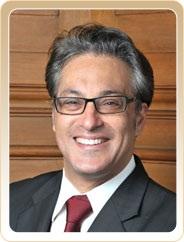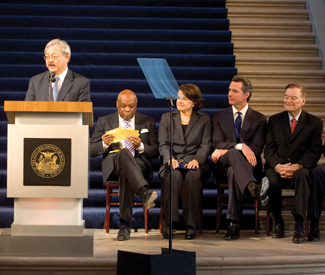
Ed Lee

Who gets to live here?

38

yael@sfbg.com

Housing policy — which determines who will be able to live in San Francisco — has been a hot topic at City Hall these days.

At a Board of Supervisors Land Use and Economic Development Committee meeting on Feb. 13, representatives from the Mayors Office of Housing (MOH) reported on the state of middle-income housing in San Francisco, at the request of Sup. Scott Wiener. “Middle class” people make up 28 percent of the city’s population, a 10 percent decrease in the past two decades, and to reverse that decline would cost about $4.3 billion in housing subsidies, or more than half the city’s annual budget.

Wiener, who insists that “middle income and low income housing are not mutually exclusive,” said he’s raising the issue because the needs of the shrinking middle class are not being addressed. But during the public comment period, a long procession of low-income residents say city housing policies have kept them on the brink of homelessness. The takeaway message was: don’t embark on new housing efforts until you can enforce the ones that are already in place.

Also underscoring the desperate state of many San Francisco residents, Assessor-Recorder Phil Ting released a report Feb. 16 that contains shocking statistics about invalid foreclosures and illegal evictions in San Francisco. Ting found that 99 percent of all foreclosure proceedings in San Francisco in the past four years have contained paperwork irregularities, and in 84 percent of cases, banks or lenders have committed fraud or broke other laws.

With the loss of the redevelopment agencies, Mayor Ed Lee’s proposal for a housing trust fund, renewed calls for more condo conversions, and a new focus on middle income housing incentives, the conversation on housing in San Francisco is heating up.


MOVING TOWARDS RENTAL

San Francisco’s housing market is 64 percent rentals and 36 percent ownership, according to MOH. So despite the focus of politicians and developers on homeownership, housing policy in San Francisco mostly involves renters, many of whom face myriad threats.

Rents can be so steep that market-rate rental housing is becoming increasingly accessible only for parts of the middle class and the highest income brackets in the city. People in San Francisco tend to pay a huge chunk of their income towards rent.

The federal Housing and Urban Development Agency considers it reasonable for a households to pay 30 percent of their income towards rent; but for the city’s very low income households, rent is typically nearly 60 percent of income. For middle income households, the average percent paid toward rent has increased since 1990, but remains below 30 percent.

Those people fall mainly into the middle-income bracket, those earning 80-120 percent of Area Median Income (AMI.) Planning Director John Rahaim said that for the very low-income population (0-50 percent AMI) all rental housing is “virtually off-limits.”

So, for the middle class, renting a place in San Francisco is tough. For the low and very-low income, it’s next to impossible. And that reality threatens the city’s diversity.

“The highest rent burden still falls on lower income residents, many of whom pay 70 percent of their income as rent,” Sup. Eric Mar, who also sits on the Land Use Committee, said at the hearing. “In my district, people have whole families living in their living room or extra bedroom.”

But things may be looking up for renters. MOH’ Brian Cheu said developers believe that the market trends are heading towards construction of new rental housing after being almost exclusively owner-occupied units for many years. Cheu said there are 725 rental units in the pipeline for the next five to ten years, more than twice the new housing units meant for ownership slated for that time period.

Most of this will be market rate housing, and thus still unaffordable for a good deal of the population. But for those making around 100 percent of AMI — the middle class that Wiener hopes to serve — there are more rental units on the way.

“Any increase in supply of rental housing would help,” said San Francisco Tenants Rights head Ted Gullickson, “because there’s been virtually no new rental housing built in San Francisco is last 20 years.”

Even as Wiener promised to continue to prioritize the needs low-income residents, the foreclosure crisis was barely acknowledged at the Feb. 13 hearing. Many low-income residents say they are not sure they can trust the city’s claim that “this is not a matter of us vs. them.”

At public comment, many community members spoke of the housing troubles that they were already facing. Yue Hua Yu, who spoke at the Feb. 13 hearing, lives with her family of four in a single residency occupancy hotel room (SRO), units intended for single occupants.

“We would support a policy that protects the city’s affordable housing stock,” said a statement from Wing Hoo Leumg, president of the Chinatown Community Tenants Association.

Renting may be the realistic choice for most San Franciscans, but homeownership remains an important goal and achievement for many families, and the main obsession of many politicians.

Part of the middle class exodus is unmistakably due to better homeownership rates in Oakland, Daly City, Marin, and other surrounding areas. But there are neighborhoods with higher rates of homeownership than others, including Bayview-Hunters Point.

BHP has long been a prime spot for low-income homeowners, but it’s slated for extensive new housing construction in the coming decades that could compromise its affordability. It is also an area hit hard by the foreclosure crisis: there have been 2,000 foreclosures in Bayview in the past four years, according to Ed Donaldson, housing counseling director at the San Francisco Housing Development Corporation.

Rising prices and the foreclosure crisis have played a large part in the large-scale African American out-migration that has devastated San Francisco communities in recent decades.


APARTMENTS OR CONDOS?

One of the biggest points of controversy in the homeownership debate has been the issue of condo conversion, which was brought up again this past week at the Feb. 14 Board of Supervisors meeting, when Sup. Mark Farrell asked Lee if he would support legislation to let 2400 tenancy-in-common (TIC) owners bypass legal limits and fastrack towards condo conversion.

Farrell framed this as “a vehicle to allow residents of our city to realize their goal of homeownership.”

On Jan. 16, the city held its annual condo conversion lottery, in which 200 lucky TIC owners win the chance to convert their units into condos, thereby legally becoming homeowners. TICs and condo conversion have long been fraught with controversy in San Francisco, where there is never enough housing for everyone who wants it.

Condo conversion proponents say that turning a TIC — usually a building that used to be rental housing that has been purchased by a group of people that own it in common — into condos is a cheap way to become a homeowner in a city as expensive as San Francisco.

But tenants rights advocates have long opposed this process on the basis that it depletes the city of its rental housing stock. “When you have more condo conversions, you have more evictions, and it’s harmful to low-income residents” Gullicksen said.

This controversy, and the struggle to maintain a balance between opportunities for homeownership and reasonable rents has raged in San Francisco for years. In 1982, the Board of Supervisors passed a limit of 200 condo conversions per year as a compromise. There are no regulations, however, on converting rental housing to TICs.

“This has come up almost every single year for years and years about this time,” said Peter Cohen, organizer with the Council of Community Housing Organizations.

This year, however, proponents are not simply reiterating a request to bypass the condo conversion lottery. Plan C, a coalition of San Francisco moderates, is pushing for adding a fee to condo conversion, ranging from $10,000 to $25,000, which would go towards an affordable housing fund.

Mayor Lee said that he is open to considering a change in condo conversion policy, “providing it balances our need for revenue for affordable housing, the value that responsible homeownership brings to the city, and the rights of tenants who could be affected by a change in policy.”


WHOSE TRUST FUND?

This comes at a time when the city is facing a loss of millions per year for affordable housing with the dissolution of the redevelopment agency (see “Transfer of power, Jan. 31).

That dissolution led to Mayor Lee’s plan for an affordable housing trust fund, to be voted on as a ballot measure this November. The kick-off for that plan also began recently, with a press conference and big-tent meeting to discuss what it might look like.

On the day after the Land Use Committee meeting, where he started the conversation on “middle class” housing, Wiener posed a question to Lee at a Board of Supervisors meeting, asking how the mayor plans to “ensure that the housing trust fund that comes out of the process you have convened will meaningfully address the need for moderate/middle income housing.”

Some are concerned that too much of the trust fund could be allocated outside low-income demographics. “There’s a limited size pie of resources,” Cohen said. “Just in a matter of the last months, we lost the redevelopment agency. The city is madly scrambling to try to replace that through housing trust fund, and working to get us back to somewhere close to where we were…Is that pie, that has dramatically shrunk, going to be stretched further for another income band?”

That question will be important when the proposal goes to vote in November. According to Donaldson, many low-income homeowners will not vote for the measure unless it addresses their needs. The specifics of the measure calling for the trust fund are still being worked out. But, it will likely be funded by an increase of the transfer tax paid when homes change ownership.

Yet that proposal was the subject of an unusual political broadside from the San Francisco Association of Realtors, which last week sent out election-style mailers attacking the idea. “Brace yourself for an unexpected visit from the city’s tax collector,” the mailer warns, showing the hand of government bursting through the wall of a home, urging people to contact Lee’s office.

The measure may also see opposition from low-income communities, especially if, as Wiener has urged in the past week, it allocates a chunk of funds towards middle-income housing.

“It’s hard to find people who will support it. They’re saying, ‘what’s in it for me? Why would I vote for a transfer tax that I’m going to have to pay to help finance the building of affordable housing or middle-income housing. Why support programs that will support middle income people, who make more money than existing homewoners?” explained Donaldson. To agree on a way forward for housing in San Francisco, policymakers will need to reconcile a range of interests. In the worst-case scenario, the profit interests of realtors and developers will overtake the interests of San Francisco families struggling to continue to live in the city they love. But housing advocates are willing to work together to come to a solution. “Let’s put everything on the table, and let’s figure it out. In the spirit of cooperation, and with the understanding that each respective constituent group is not going to get everything that they want, but let’s put all the cards of the table,” said Donaldson.

Editor’s Notes

1

“San Francisco’s economy is moving in the right direction,” Mayor Ed Lee told the Examiner last week. “My economic development and job creation policies are setting San Francisco on a path toward economic recovery.”

The normally modest mayor is making a rather sweeping statement there — the US economy is improving in general, and I don’t think the mayor can take credit for all of it. But he’s absolutely correct that he’s promoted policies that are aimed at bringing more tech companies in to San Francisco, and over the next few years, they will no doubt create a lot of high-paid jobs for people with specific skills that require a high degree of training and education.

Is that “the right direction” for the city? I lived here the last time that San Francisco was part of a tech boom, and I’m not so sure.

See, bringing all sorts of new wealth into town sounds good on the surface, and for some people — particularly real-estate speculators, landlords and purveyors of high-end services — it is. But in a city that has limited space and nearly unlimited demand for housing, lots of new rich people and lots of high-paid people looking for places to live puts pressure on the existing residents, particularly the poor and the working class. It screws the middle class, too — if you’re a teacher or a nurse and you want to buy a house in San Francisco during a boom, you’re S.O.L. You can barely afford to rent — and if you’re already renting, you’re constantly at risk of losing your home, and your ability to live in this city, because your landlord can make more money kicking you out and selling the place as a tenancy in common to someone with more money.

There’s no way to build enough new affordable rental housing, or housing that middle-class families can buy, to keep up with the demand. It’s impossible. Developers won’t do that — there’s too much money to be made in high-end housing for anyone in the private marketplace to waste time on anything else.

The only way to preserve the middle class in the upcoming boom that Lee is promoting is to aggressively protect existing rental housing stock — which means preventing condo conversions and TICs and the stuff that gets promoted as “middle-class housing.” The only way to prevent massive displacement of people and existing businesses is to regulate space in the city more tightly than anyone has ever done — which will, by its nature, make it harder for the newcomers and new millionaires to find places to live.

That’s the tradeoff. That’s the fact that Lee and his allies don’t seem to want to grasp

Gascon and mayoral corruption

1

EDITORIAL The indictments of two executives of an airport shuttle company on charges of laundering campaign money are, in themselves, a rarity and something to celebrate: the district attorney of San Francisco is actually attempting to enforce the laws against political corruption. That’s unusual in this city, and worthy of note.

But at this point, the entire sum total of prosecutions involving the scandal-ridden campaign of Mayor Ed Lee amounts to a pair of cases against people who made what appear to be illegal contributions. As of today, the message that’s being sent is that nobody in the Lee campaign did anything wrong. And that seems a little bit curious.

Lee’s late entry into the race — after he’d promised for months not to run — and his refusal to abide by the rules of public financing forced his supporters to raise a large amount of money very quickly. There were so-called independent expenditure committees collecting donations and running parallel campaigns that, by law, should have been entirely distinct from Lee and his official effort. We’ve always been dubious about the supposed lack of coordination.

Then there were the well-documented instances of irregularities serious enough that every other candidate in the race asked for state and federal monitors to watch the election. Several eyewitnesses told local reporters that they saw volunteers for one of the supposedly independent groups filling out absentee ballots for voters, using a special template that ensured the votes would go for Lee. Some said they saw ballots being collected at a makeshift voting booth. In a video provided by the campaign of State Sen. Leland Yee, it appears that volunteers were both filling out ballots and placing them in bags — both clear violations of law.

Gascon’s announced investigations of all the allegations — but more than three months later, nothing has come of it. His office won’t confirm or deny whether investigations are ongoing or whether any further indictments may be forthcoming. But at the Chinese New Year Parade, Chinatown powerbroker and Lee ally Rose Pak announced that she had heard Gascon was investigating her.

There’s been plenty of time to collect evidence, and Gascon has a responsibility to let the public know, as quickly as possible, what’s happened to the rest of the allegations. If everyone in the Lee campaign is really innocent, and none of the independent groups supporting the mayor did anything wrong, he should say that, and present the evidence.

It doesn’t help Lee, the city, or the integrity of the voting process to have these cases drag out. Gascon needs to conclude them, expeditiously.

Lackluster finish to case that made serious political charges

9

A jury awarded the City and County of San Francisco $24,498 yesterday following its deliberations of a complicated civil case filed by the city in 2003 against a minority-owned computer services company accused of fraud and breach of contract, a company that countersued with a claim of being harmed by top city officials.

But that paltry sum and the jury’s verdict of shared responsibility in failing to root out corruption in city government belied the more politically significant accusations made through depositions in the case that Mayor Ed Lee and former Mayor Willie Brown overrode city staff to give contracts to a “fraudulent” yet politically connected company, which proved to be a tangential issue that was left largely unexplored at trial.

In CCSF vs. Cobra Solutions, the jury found that both the city and Cobra Solutions failed in their responsibilities to prevent a former Department of Building Inspection information technology manager, Marcus Armstrong, from fraudulently bilking the city out of at least $482,000 between 1999 and 2001. An alleged Armstrong accomplice, Government Computer Sales, Inc. – which witnesses said Brown and Lee improperly certified, and which they say they don’t remember – fled and was never brought to justice.

Cobra Solutions, which was awarded master contract status in 1998, was bound by a provision in its agreement with the city that required Cobra to “supervise” sub-contractors. The allegation of fraud against Cobra, however, was effectively dropped from the city’s complaint, but not until the end of the trial when consideration of fraud was omitted from the city’s closing arguments.

The award to the city was the difference between the monies paid by the city to Cobra Solutions ($269,739.93) and the monies paid by Cobra Solutions to Armstrong’s phony companies ($245,241.93), or the markup Cobra Solutions received from the city following the submission of several fraudulent invoices from two phony sub-contractor companies, Monarch Enterprises and Mindstorm technologies, set up by Armstrong.

Following the verdict announcement, a juror who did not want to be identified, said there wasn’t a single piece of evidence that was most compelling, but that, “the city proved its case. Cobra failed to prove its case.” The “vast majority” of jurors shared that opinion, the juror said. “It wasn’t even close.”

“The jury thought there was obviously a failure to supervise,” the juror continued. “[Cobra Solutions] took on work without even knowing who the party was that was working for them. Who was Monarch?”

Several invoices from Armstrong’s phony companies contained different addresses that the juror described as “a bit of a red flag.”

“If I’m in business, I’m not going to have someone working for me who I don’t know, and I’m not going to be paying them checks,” the juror said.

“The city also bore responsibility” in its failure to detect Armstrong’s kickback scheme, the juror said, mirroring the same sentiment echoed by then-City Controller Ed Harrington, who took the stand and conceded the city’s internal controls – as well as those of Cobra Solutions – failed to detect Armstrong’s kickback scheme.

Cobra had sought damages for breach of contract (the city’s failure to pay monies owed Cobra) and due process violations in connection with the city’s alleged debarment of Cobra from doing further business with the city.

“I’m disappointed,” said Cobra Solutions founder and president James Brady. “Life goes on. We’ll continue to move forward and repair our damaged reputation, raise our grandchildren, and focus on our families.”

Asked about the issue of sub-contractor supervision, Brady said, “I don’t think anybody could supervise a con man and the city was negligent in hiring this guy – they wouldn’t even bring him in the courtroom – so it’s just betrayal. And it’s a sad day that you hire con man and you won’t take any responsibility for his actions and you blame the small business. That’s not the American way.”

On the jurors finding that Cobra was not intentionally or defacto debarred from doing further business with the city, Brady said, “I think they got it wrong. I have no doubt about that.”

“The jury missed a lot of important facts,” said Mr. Brady’s wife, Deborah Brady, a co-founder of Telecon, the parent company of Cobra Solutions. The city had originally sued Telecon in its case-in-chief, but pursued no claims against Telecon at trial. “I don’t know how they missed them, but they missed them.”

Ms. Brady said the city gave another company, Desktop, the opportunity to defend itself against debarment, but “they never gave us that opportunity.”

“Judith Blackwell, she told the whole story in terms of Monique Zmuda saying they wanted us out, that we’re crooks,” Ms. Brady continued. “They accused us… and never gave us the opportunity to respond, ever.” Monique Zmuda is the deputy City Controller.

“I feel really betrayed by a city that I used to really love and [City Attorney] Dennis Herrera, who is our private attorney, betrayed us,” a tearful Ms. Brady said. “Ed Lee, who claims he barely knew us, betrayed us. Ed Harrington? I don’t know what that was all about, or Monique Zmuda… but Ed Lee and Dennis Herrera, they let down really good people who used to live in this city and loved this city and did all that we could to do good in the community and this city. “

“So I pretty much call it, ‘The City of Betrayal.’”

Cobra’s lead counsel in the case, Whitney Leigh, told us, “The jury made its decision. We’re concerned that the jury was allowed to find that Cobra could have breached the contract by refusing to submit to an audit by the City Attorney. So we believe there are some issues that need to be researched, so we’ll be looking at those issues.”

Asked if there would be post-trial motions, Leigh said, “Post trial motions and/or appeal.”

“Obviously we’re disappointed,” Leigh added, “but we’ll review the transcripts and see what options are available.”

Because of the possibility of an appeal, Herrera was unable to comment on the verdict or to discuss city’s costs in trying the case, said Herrera spokesperson Matt Dorsey.


Mayor Lee’s vanishing bike lanes

77

By Morgan Fitzgibbons

OPINION When Mayor Ed Lee announced in February 2011 that he understood both the critical importance and the severe dangers inherent in the current bicycle infrastructure along the dual three-block stretches of Fell and Oak between Scott and Baker, a shot went through the community of people who had worked for so long to bring awareness to this troubled path.

Finally, it seemed, we had a mayor who understood that if San Francisco was serious about living up to its own nearly 40-year-old pledge to be a transit-first city, a narrow bike lane sandwiched between parked cars and fast-moving traffic on Fell Street and a complete absence of any bicycle infrastructure on Oak simply wouldn’t do.

Finally, we had a mayor who wouldn’t be satisfied with mere words on a page, who had the courage to carve out one single safe bike route from the east side of town to the west, to create a viable alternative to automobile transportation, to prepare our city for the inevitable challenges presented by climate change, peak oil, and economic collapse, and to do it in the face of the predictable objections from a few small-picture citizens who couldn’t look at the 60 square feet of a parking spot and imagine anything other than a privately owned two-ton pile of steel taking up precious public space.

The community of people who had waited nearly 40 years for the city to live up to its own word kept on waiting throughout 2011, patiently allowing the Municipal Transportation Agency to perform its due diligence, attending multiple public meetings in the hundreds, and delivering a resounding verdict: bring us our separated bike lanes. Make this neighborhood a better place to live. Begin the long work of preparing our city for a way of living that doesn’t center around the automobile.

With the public process complete and the calendar turning to nearly one year since Lee called for the MTA to “move quickly” to create separated bike lanes on Fell and Oak, the MTA handed down a jarring announcement. The Fell and Oak Bikeways were being delayed because the agency needed to take extra time to do all that could be done to find nearby replacements for the 80 parking spots set to be removed for the bike lanes.

That’s right — in a city that has for 40 years had an explicit policy of giving preference to transit options that weren’t the automobile, in a city that, nevertheless, has over 440,000 public parking spots and zero safe, accessible bike routes from the east side of town to the west, the creation of a separated bikeway that the vast majority of the community wants, and that the mayor’s own newly appointed District Supervisor, Christina Olague, is in support of, was being delayed by nearly a year so that the loss of private automobile parking would be as small as possible.

How does this happen? In a word: fear. The mayor and MTA are afraid of ruffling a few feathers to do what they know is right.

Cities like New York, Portland, and Minneapolis are leapfrogging us in building the cities of tomorrow. Chicago is creating 100 miles of separated bike lanes in the next four years. Don’t call us America’s Greenest City — you’re thinking of the San Francisco of 40 years ago.

Morgan Fitzgibbons is co-founder of the Wigg Party, a Western Addition neighborhood sustainability group

How business was done

8

news@sfbg.com

A complicated civil lawsuit alleging corruption and fraud and involving several prominent current and former city officials — including Mayor Ed Lee, who took the witness stand to discuss actions he took as city purchaser a decade ago — could end up costing city taxpayers as much as $10 million.

City and County of San Francisco vs. Cobra Solutions and Telecon was being deliberated by jurors in Superior Court at press time. It centers on a fraud and kickback scheme engineered by convicted felon Marcus Armstrong, a former Department of Building Inspection information technology manager who bilked the city out of at least $482,000 between 1999 and 2001 (see “Dirty Business,” 2/8/11). His scheme was exposed by an FBI investigation following a whistleblower’s complaints in September 2001 that sub-contractors were not being paid.

The City Attorney’s Office accused Cobra Solutions of participating in Armstrong’s fraud, but Cobra’s owners denied being part of the scheme and they say their business was wrongfully damaged when their contracts were frozen by city officials.

Armstrong created two phony companies, Monarch Enterprises and Mindstorm Technologies, and ordered master contractor Cobra Solutions to use the phony sub-contractor companies to provide technology services to the city’s Computer Store (a list of approved contractors) under an agreement awarded to Cobra by the Committee on Information Technology (COIT). It also partnered with another company alleged by the city to be fraudulent, Government Computer Sales, Inc. (GCSI), whose principals fled and whose whereabouts are unknown.

Cobra Solutions founder and president James Brady had raised questions about Armstrong as early as 2000, questions that triggered an unfruitful investigation by the city. Brady maintained in court testimony that Cobra, unaware of Armstrong’s fraud, relied on him to sign off on work services that Armstrong’s phony companies were supposed to have supplied to the city.

The Computer Store was set up by then-Purchaser Ed Lee under the administration of then-Mayor Willie Brown to centralize technology procurement across departments. Now-Mayor Lee was deposed in the case and called to the witness stand on Feb. 6, where he said he awarded Cobra Solutions the highest-rated ranking among several vendors being evaluated by COIT for master contract award status. Each of the other city evaluators, including Deputy Controller Monique Zmuda, also ranked Cobra the top service provider.

According to Armstrong’s guilty plea agreement, GCSI partnered with Armstrong to defraud the City out of $240,000. Deborah Vincent James — then-director of COIT and now deceased — testified in a pre-trial deposition that GCSI was “fraudulent,” that city staffers recommended against certifying the company, and that it was only awarded master contract status because of its political ties to Brown, who directed Lee to overrule the staff recommendation. In his deposition, Lee claimed he could not remember GCSI.

Vincent-James and former Purchasing Directory Judith Blackwell forwarded whistleblower complaints about GCSI to the City Attorney’s Office in early 2001, but neither that office nor the Controller’s Office acted on the complaints until GCSI had gone bankrupt and GCSI’s owners, two foreign nationals, had disappeared.

Of note, Lee was not questioned about his and Brown’s involvement in awarding GCSI its master contract status in 1998. Time restrictions placed on attorneys by Judge James McBride limited the scope of witness examinations, so the most politically explosive charges went largely unexplored in court.

The city completed a subsequent investigation in January 2003 that resulted in stopped payments to Cobra, contract termination, and the city’s civil lawsuit filed by City Attorney Dennis Herrera against Cobra in April 2003. Following Herrera’s filing against Cobra, Herrera demanded an audit of Cobra which Cobra refused, citing a conflict of interest. Herrera had previously represented Cobra in private practice before he was elected City Attorney in 2001.

A trial court ruled in that Herrera had a conflict of interest, disqualifying Herrera and his office from participating in the Cobra case, a ruling later upheld by the California Supreme Court. Yet the suit alleges Herrera and his office continued to supply work to various City agencies and to effectively prevent Cobra from doing further business with city. By withholding the $2 million Cobra was owed by the City, COIT was able to disbar Cobra from entering into master contract agreements with the city, claiming Cobra was fiscally “non-responsible,” according to court testimony.

Blackwell, in her testimony at trial, said the determination of Cobra’s non-responsibility was used as a “pretext” for Cobra’s disbarment, a procedure that should have triggered a hearing to allow Cobra to defend itself against debarment. That never happened.

An FBI investigation into Armstrong’s kickback scheme resulted in Armstrong pleading guilty to mail fraud, wire fraud, and obstruction of justice in July 2003. No criminal charges were ever brought against Cobra Solutions or Telecon and yet the city’s outside law firm, Cotchett, Pitre & McCarthy LLP, which tried the case on behalf of the city, held on to the city’s allegation of fraud committed by Cobra and Telecon throughout the case and trial until closing arguments on Feb. 9.

In his closing arguments, attorney Ara Jabagchourian made no mention of Telecon, effectively dropping the city’s claims against Telecon, and constricted the city’s damage claims against Cobra. He asked the jury to award the city up to $266,000, money paid to Cobra for work authorized and signed-off by the city, via Armstrong, for breaching a provision in the contract agreement between the city and Cobra that requires the master contractor to “supervise” sub-contractors.

But Cobra’s lawyers — the firm of Gonzalez & Leigh, which includes former Board of Supervisors President Matt Gonzalez, who took a leave from his current job as deputy public defender to consult on the case — says it is the city that should pay for fatally harming a business without just cause.

“The City and City Attorney’s office falsely accused Cobra and Telecon of stealing $2.4 million dollars from the City, destroying these companies and ruining the lives of good, decent people who were the victims of a city tech official who should not have been hired in the first place,” said attorney Whitney Leigh. “Then the City Attorney made it worse, flatly defying an order disqualifying the City Attorney’s Office and instead driving efforts to run Cobra and Telecon out of business just because Cobra raised the issue of the conflict of interest. I’ve been unable to find any case in which an attorney has so flagrantly ignored a disqualification order.”

Herrera can’t comment on the case, but his office previously told the Guardian, “Immediately upon discovery of Cobra’s role, the office screened Herrera off from further involvement in the investigation and all matters related to it in accordance with a stringent ethical screening policy Herrera established when he took office.”

The-City Controller Ed Harrington, who exerted significant influence over contract awards and debarment proceedings as chair of COIT, conceded in court testimony that internal controls failed to detect Armstrong’s scheme.

“In the case of Marcus Armstrong, the control within the city failed and the control within Cobra failed,” Harrington, now head of the San Francisco Public Utilities Commission, told the court. “We had both controls in place. If they had worked, the city would have been protected. Both failed.”

Cobra is seeking damages for breach of contract (the city’s failure to pay monies owed Cobra), and civil rights due process violations in connection with the city’s apparent conspiracy to bar Cobra from doing further business with the city.

A business valuation expert testified Cobra Solutions was valued between $5.2 million and $8.8 million based on future lost profits from the city’s debarment. With attorney fees and court costs, the city could be on the hook for as much as $10 million.

The city has subsequently established more stringent controls as it relates to the authorization of work assigned to master contractors and sub-contractors. The jury was expected to resume deliberations on Feb. 14 and deliver its verdict by week’s end. Check the SFBG.com Politics blog for the latest.

Is SF’s DA investigating Rose Pak?

18

Well, Ms. Pak thinks he is. At the Chinese New Year parade, where she wields the mic at the reviewing stand and typically makes nasty comments about local politicians, she was relatively muted this year –– except when D.A. George Gascon rode by. “I read in the blogs that you’re still investigating me,” she shouted. “What the hell did I do? I just elected the first Chinese American mayor. You will find nothing, except that I swear a lot.”

Gascon has for more than four months been investigating irregularities in the Ed Lee campaign, including charges of illegal campaign contributions and voter fraud. Gascon’s office issued a press release Feb. 14 announcing the indictments of Go Lorries and two of its senior employees. The airport shuttle outfit allegedly laundered campaign money by asking its employees each to donate the maxium $500 to Lee’s campaign and then paying them back from company funds. From the release:

The defendants are accused of making an unlawful $11,500 campaign contribution from GO Lorrie’s to the Ed Lee campaign by passing it through GO Lorrie’s drivers and staff. … “Campaign finance and disclosure laws help to ensure fairness and transparency in our elections,” said District Attorney George Gascón, “and my office takes the violation of these laws very seriously.  After a thorough investigation, we have found clear evidence to charge Go Lorrie’s and two of its employees with making illegal campaign contributions.”

Nobody from the Lee campaign has been charged with anything.

So what about the other apparent violations? Is that still under investigation? Is Rose Pak a target? I asked Stephanie Ong Stillman, Gascon’s spokesperson, and she told me that she can’t confirm or deny that there’s any further investigations under way or that any specific individual is under investigation.

So I’m glad to see the Go Lorries indictment, which marks a rare instance of somebody taking campaign laws seriously. But there’s a lot more here, and I hope Gascon doesn’t think that nailing one company that everyone will insist acted on its own with no support from or connection to a pretty darn sleazy campaign will end the controversy.


Why is this not a structural budget deficit?

30

The economy’s improving. Tax revenue is up. So why is the city still facing a budget deficit of more than $200 million? Easy: San Francisco has, and will continue to have, a structural budget deficit. The amount of money that comes in from taxes in all but an unusual boom year isn’t enough to cover the cost of providing the services the city has taken on. Some of those services are things that the state and feds used to provide. Some are things that San Francisco does because it’s a decent and humane city. All of those things cost money, and our tax base doesn’t generate enough to pay for them.

It’s easy to blame the problem, as the Examiner does, on “employee costs.” But city employees have already taken significant pay cuts and layoffs. The pension-reform plan passed last year reduced costs further. The reality is that the city has never taken seriously the need to raise enough revenue to cover its operating costs. That’s why we see headlines like this every single year, and it’s not going to change.

And that’s why city officials who deny that there’s a structural problem are kidding themselves.

By the way: The economy’s improving around the nation. It’s not just because of Ed Lee.

Would Sept. elections be better than RCV?

25

A proposal by Supervisors Sean Elsbernd and Mark Farrell to end San Francisco’s experiment with Ranked Choice Voting will come before the board Feb. 14, and RCV suporters are organizing to fight it. According to an email I just got from Steve Hill, one of the leaders in the RCV movement, “the vote is going to be close.”

The first version of the Elsbernd-Farrell legislation would have returned the city to the pre-RCV situation — the general election for city offices would take place in November, and runoffs in any race where nobody got a majority (almost every contested city race these days) would take place in December. 

The December turnout in Board of Supervisors races was always way lower that the turnout in the November election (although that hasn’t always been the case in mayoral races — more people voted in the Matt Gonzalez-Gavin Newsom runoff than voted in that year’s general election).

But the two conservative supervisors have backed off that plan and replaced it with another one: The first election (in effect, the primary) would be held in September, with the runoff in November.

Some years, that would be three elections in the city in five months — the normal June state election, a September city election, and a November general election.

I realize that a lot of people, including some of my friends on the left, aren’t thrilled with RCV. If the mayor’s race had a runoff, it would have been a head-to-head contest between Ed Lee and Dennis Herrera, and that would have been fun. (Where would David Chiu, who got stabbed in the back by Lee and who criticized him during the general election, have gone in the runoff? What about Leland Yee?)

But I have to say, a September election seems like a really terrible idea. When are the candidates going to campaign — during August, when about half of the city is out of town? Would the candidates all have to trek out to Burning Man? (You can’t send direct mail flyers to the playa.) Maybe you hold the election late in September — but then the absentee ballots would arrive when, over Labor Day weekend? Talk about low turnout.

The whole idea of RCV was to get more people involved in electing their representatives at City Hall. You can talk about whether it helps the left or the right or incumbents or whatever, but it’s really all about turnout. One election: More people vote. Two elections: Fewer people vote. September election: Very few people vote.

Then in November, when the turnout is highest, the choice will be lowest, because the candidates who did well in the low-turnout election (typically the more conservative candidates) will be the only ones on the ballot.

On balance, I’m sticking with RCV — but if you have to change it, why not make the primary election in June? There’s already a June election in even-numbered years, it’s no added expense — and there’s the additional value of forcing candidates for mayor and supervisor to declare their intentions and get in the race early on. No more Ed Lee August surprise.

I asked Elsbernd about it and he told me that New York City holds its primary in September, and that’s an effective model. And, he pointed out, there’s no June primary in the odd-numbered years, when the mayor, sheriff, city attorney, treasurer and public defender are on the ballot.

True — but if you’re going to have a special municipal election anyway, June makes more sense to me. People are used to voting in June. I worry about September.

Federal government sets its sights on 12 more SF dispensaries

19

Bad news for medical marijuana patients in the Bay Area: as reported by the SF Examiner, the DEA has requested records from the city’s Department of Public Health for 12 of San Francisco’s existing 21 cannabis dispensaries. This is the same move the DEA made before sending the threatening letters to five other cannabis collectives last fall. Those five dispensaries are now closed.

In fall of 2010, US Attorney Melinda Haag targeted five SF dispensaries in school zones with letters declaring them in violation of federal law. In the face of potential jail time for dispensary staff and even the landlords of the buildings that housed the dispensaries, they shut their doors. Now, more than 50 percent of the city’s dispensaries could have to follow suit. 

The really upsetting part about all of this? The sheer randomness of it all. In our recent Cannabis Issue, the Guardian interviewed Assemblymember Tom Ammiano, who said that in his meeting with Haag over the matter, the US Attorney said the orders to persue the dispensaries came from above. “She said she was only doing what the boss was telling her to do,” Ammiano told the Guardian. “We had a hard time with that.” The Obama Administration has been frustratingly opaque about the motives behind, and future plans for, persecuting an industry that Attorney General Eric Holder once called a “low priority” for federal law enforcement. 

The Guardian has sent an email to Mayor Ed Lee for his comments on the request for records, and will update this post when we hear back. Even then-Mayor Gavin Newsom, as the Examiner pointed out, sent a letter in 2008 to Congress to encourage it to act against the DEA’s attempts to intervene in California’s medical marijuana industry.

Assemblymember Ammiano and Senator Mark Leno are leading the efforts to establish a statewide regulatory board cannabis that would, among other things, demonstrate to the feds that the industry is being well-regulated in California. Americans for Safe Access and UFCW (the union representing cannabis workers in California) have also introduced a ballot initiative called the Medical Marijuana Regulation, Control, and Taxation Act that would establish a regulating board made of patients, government representatives, medical professionals, and cannabis industry folks. A poll conducted by Probolsky Research recently put voter support for that measure at 59.2 percent.  

But who knows if California voters will get a chance to regulate marijuana as they see fit. If these requests for records proceed as the last round of them did, SF could be down to nine dispensaries in a city with not only a large base of cannabis patients, but also a thriving cannabis culture. 

The dispensaries whose records were requested by the DEA were: 

Bay Area Safe Alternatives Collective

Emmalyn’s

Good Fellows Smoke Shop

Grass Roots

The Green Cross

Hope Net

Re-Leaf Herbal Center

SF Medical Cannabis Club

Shambala Healing Center

Valencia Street Caregivers

Vapor Room

Waterfall Wellness

Meet the new supervisor

10

Christina Olague, the newest member of the Board of Supervisors, faces a difficult balancing act. She was appointed by Mayor Ed Lee, whom she supported as co-chair of the controversial “Run Ed Run” campaign, to fill the vacancy in District 5, an ultra-progressive district whose voters rejected Lee in favor of John Avalos by a 2-1 margin.

So now Olague faces the challenge of keeping her district happy while staying on good terms with the Mayor’s Office, all while running in her first campaign for elected office against what could be a large field of challengers scrutinizing her every vote and statement.

Olague has strong progressive activist credentials, from working with the Mission Anti-Displacement Coalition to protect low-income renters during the last dot-com boom to her more recent community organizing for the Senior Action Network. She co-chaired the 2003 campaign that established the city’s minimum wage and has been actively involved in such progressive organizations as the Milk Club, Transit Riders Union, and the short-lived San Francisco People’s Organization.

“One of the reasons many of us are so supportive of Christina is she is grounded in the issues of low-income San Franciscans,” said Gabriel Haaland, who works with SEIU Local 1021 and accompanied Olague to a recent interview at the Guardian office.

She also served two terms on the Planning Commission — appointed by Board of Supervisors then-President Matt Gonzalez in 2004 and reappointed by then-President Aaron Peskin in 2008 — where she was known for doing her homework on complicated land use issues and usually landing on the progressive side of divided votes.

“Coming from the Planning Commission, she can do a lot of good,” said Tom Radulovich, executive director of Livable City and a supporter who has worked with Olague for 15 years. “We lost a lot of collective memory on land use issues,” he said, citing the expertise of Chris Daly and Aaron Peskin. “We do need that on the board. There is so much at stake in land use.”

Olague disappointed many progressives by co-chairing Progress for All, which was created by Chinatown power broker Rose Pak to push the deceptive “Run Ed Run” campaign that was widely criticized for its secrecy and other ethical violations. At the time, Olague told us she appreciated how Lee was willing to consider community input and she thought it was important for progressives to support him to maintain that open door policy.

In announcing his appointment of Olague, Lee said, “This is not about counting votes, it’s about what’s best for San Francisco and her district.” Olague also sounded that post-partisan theme, telling the crowd at her swearing-in, “I think this is an incredible time for our city and a time when we are coming together and moving past old political pigeonholes.”

With some big projects coming to the board and the working class being rapidly driven out of the city, progressives are hoping Olague will be a committed ally. There’s some concern, though, about her connections to Progress For All campaign’s secretive political consultant, Enrique Pearce.

Pearce has become a bit of a pariah in progressive circles for his shady campaign tactics on behalf of powerful players. In 2010, his Left Coast Communications got caught running an independent expenditure campaign partly funded by Willie Brown out of Pearce’s office, even though Sup. Jane Kim was both its beneficiary and his client — and that level of coordination is illegal. Last year, Pearce was hired by Pak to create the “Run Ed Run” campaign and write the hagiographic book, The Ed Lee Story, which also seemed to have some connections with Lee’s campaign. The Ethics Commission hasn’t fined Pearce for either incident, and he didn’t return a Guardian call for comment.

Olague told us not to worry. “He’s a friend…and I think it’s an exaggerated concern,” she said, confirming but minimizing his role so far. Yet she hired one of Pearce’s former employees, Jen Low, as one of her board aide. Olague’s other aides are Chris Durazo from South of Market Community Action Network (SOMCAN) and Dominica Henderson, formerly of the SF Housing Authority.

Debra Walker, a progressive activist who served on the Building Inspection Commission and has worked with Olague for decades, said she’s a reliable ally: “She’s from the progressive community and I have no equivocation about that.”

Olague makes no apologies for her alliances, saying that she is both independent and progressive and that she should be judged by her actions as a supervisor. “People will have to decide who I am based on how I vote,” she said, later adding, “I support the mayor and I’m not going to apologize for that.”


OLAGUE’S PRIORITIES

Olague was born in Merced in 1961 to a Mexican immigrant father who fixed farming equipment and a stay-at-home mother. She went to high school in Fresno and moved to the Bay Area in 1982. She attended San Francisco State University but had to drop out to help support her family, working at various stock brokerage firms in the Financial District. She later got a degree in liberal studies from California Institute of Integral Studies.

In 1992, Olague’s mother was in serious car accident that left her a quadriplegic, so Olague spent the next seven years caring for her. After her mother died, Olague left the financial services industry and became a community organizer for the Mission Anti-Displacement Coalition, battling the forces of gentrification and then-Mayor Brown and becoming an active player in the ascendant progressive movement.

But Olague never abided progressive orthodoxy. She backed Mark Leno over the more progressive Harry Britt in their 2002 Assembly race and backed Leno again in 2007 when he ran for state Senate against Carole Migden. She also voted for the Home Depot project on Bayshore Boulevard despite a progressive campaign against the project.

Olague worked with then-Sup. Chris Daly to win more community benefits and other concessions from developers of the Trinity Plaza and Rincon Tower projects, but now she is critical of Daly’s confrontational tactics. “Daly’s style isn’t what I agree with anymore,” Olague said, criticizing the deals that were cut on those projects to approve them with larger than required community benefits packages. “I think we romanticized what we got.”

So how does Olague plan to approach big development proposals, and is she willing to practice the brinksmanship that many progressives believe is necessary to win concessions? While she says her approach will be more conciliatory than Daly’s, she says the answer is still yes. “You push back, you make demands, and if you don’t think it’s going to benefit the city holistically, you just fucking say no,” Olague said.

Walker said Olague has proven she can stand up to pressure. “I think she’ll do as well as she did on the Planning Commission. She served as president and there is an enormous amount of pressure that is applied behind the scenes,” Walker said. “She’s already stood up to mayoral pressure on some issues.”

Yet even some of Olague’s strongest supporters say her dual — and perhaps dueling — loyalties to the Mayor’s Office and her progressive district are likely to be tested this year.

“It’ll be challenging for her to navigate,” Radulovich said. “The Mayor’s Office is going to say I want you to do X and Y, and it won’t always be progressive stuff, so it’ll be interesting to see how that plays out.”

But he said Olague’s land use expertise and progressive background will likely count for more than any bitter pills that she’s asked to swallow. “Sometimes, as a policy maker, you have to push the envelope and say we can get more,” he said. “It helps if you’re willing to say no to things and set boundaries.”

When we asked Olague to lay out her philosophy on dealing with land-use issues, she said that her approach will vary: “I have a very gray approach, project by project and neighborhood by neighborhood.”

Only a couple weeks into her new role, Olague said that she’s still getting a lay of the land: “I’m in information gathering mode, meeting with neighborhood groups to try to figure out what their issues are.”

But Olague said she understands that part of her job is making decisions that will disappoint some groups. For example, after Mayor Lee pledged to install bike lanes on Fell and Oak streets to connect the Panhandle to The Wiggle and lessen the danger to bicyclists, he recently stalled the project after motorists opposed the idea.

“I’m a transit-first person, for sure. I don’t even drive,” Olague said of her approach to that issue, which she has now begun to work on. “We’ll try to craft a solution, but then at some point you have to fall on one side or the other.”


THE “JOBS” FOCUS

One issue on which Olague’s core loyalities are likely to be tested is on the so-called “jobs” issue, which both Lee and Olague call their top priority. “Jobs and economic revitalization are very important,” she told us.

Progressives have begun to push back on Lee for valuing private sector job creation over all other priorities, such as workers’ rights, environmental safeguards, and public services. That came to a head on Jan. 26 at the Rules Committee hearing on Lee’s proposed charter amendment to delay legislation that might cost private sector jobs and require extra hearings before the Small Business Commission. Progressives and labor leaders slammed the proposal as unfair, divisive, unnecessary, and reminiscent of right-wing political tactics.

But when we interviewed Olague the next day, she was reluctant to criticize the measure on the record, even though it seemed so dead-on-arrival at the Board of Supervisors that Mayor Lee voluntarily withdrew it the next week.

Olague told us job creation is important, but she said it can’t squeeze out other priorities, such as protecting affordable rental housing.

“We always have to look at how the community will benefit from things. So if we want to incentivize for businesses, how do we also make it work for neighborhoods and for people so that we don’t end up with where we were in the Mission District in the ’90s?” she said.

Olague also said that she didn’t share Lee’s focus on jobs in the technology sector. “There’s a lot of talk of technology, and that’s fine and I’m not against that, and we can see how it works in the city. But at the same time, I’m concerned about folks who aren’t interested necessarily in working in technology. We need other types of jobs, so I think we shouldn’t let go of the small scale manufacturing idea.”

Local control of cops

1

news@sfbg.com

Sup. Jane Kim has introduced legislation to the Board of Supervisors calling for a re-examination of the San Francisco Police Department’s participation in some aspects of the Joint Terrorism Task Force, which was created by the Federal Bureau of Investigations to do domestic surveillance.

The proposed ordinance would prohibit the SFPD from working with the JTTF to collect intelligence on individuals in the absence of criminal wrongdoing, which has been a concern of civil libertarians since last year when a secret memo revealed that local officers were under FBI command and not bound by local and state restrictions on such surveillance (see “Spies in blue,” 4/26/11).

Kim said the ordinance was necessary to ensure the “requirement of reasonable suspicion before we do any type of investigation of criminal activity. And we don’t base it on ethnic identification or religious practice as some of the members of the community have been experiencing the last couple of years.

“Our office is sponsoring this because many members of the Arab, Asian and the Muslim community worship in the district and own many small businesses,” she said.

Critics of the relationship between local and federal law enforcement agencies, facilitated through participation in the JTTF, have long raised concerns about racial profiling and unnecessary spying ordered at the federal level, and carried out by SFPD inspectors assigned full time to the task force.

Federal regulations governing FBI intelligence gathering are weaker than standards set by San Francisco and California’s Constitution. In 1990, the San Francisco Police Commission established rules requiring that intelligence-gathering involving any First Amendment activity be based on reasonable suspicion of significant criminal activity. Those rules reflect the California Constitutional requirement of an “articulable criminal predicate” before law enforcement agencies engage in intelligence-gathering activity.

However, because the SFPD inspectors assigned to the JTTF work under the direction of the FBI, the local regulation and control of law enforcement is effectively limited in JTTF investigations.

“It’s important that a clear prohibition against policing based on race, ethnicity, national origin, or religion applies to all of our officers, all of the time,” said John Crew, police practices expert for the Northern California chapter of the American Civil Liberties Union. The ACLU is one of more than 30 civil rights and community organizations participating in the Coalition for Safe SF, which helped develop the proposed ordinance.

According to the coalition, current rules prevent the SFPD from barring its inspectors assigned to the JTTF from joining FBI agents in collecting intelligence on San Franciscans without any “particular factual predication.”

“The purpose of this legislation is to restore local control, civilian oversight, and transparency over the SFPD’s participation in FBI intelligence-gathering,” stated attorney Nasrina Bargzie of the Asian Law Caucus, which is part of the coalition.

The coalition was a major participant in the San Francisco Human Rights Commission hearing in 2010 on the issue of baseless spying and racial profiling in JTTF investigations. The result was a comprehensive report, endorsed by the Board of Supervisors last spring.

But in 2011, the ACLU and Asian Law Caucus learned that key protections for civil liberties — including civilian oversight of intelligence activity and safeguards to limit intrusive tactics — were thrown out the window and replaced by a secret Memorandum of Understanding with federal law enforcement in 2007.

Under the MOU, SFPD paid officers work out of the local FBI office. The secure nature of their work means they must seek federal permission to even talk to their superiors in the SFPD about their work, effectively removing them from the local chain of command. Despite mandated requirements on local law enforcement, the MOU does not allow for any civilian oversight of the work of officers assigned to the JTTF.

San Francisco Chief of Police Greg Suhr said he believes that the concerns have already been addressed. In his first days in office, Chief Suhr issued a binding Bureau Order #2011-07 setting forth the requirement that officers comply with local standards.

An excerpt of the order reads, “SFPD officers shall work with the JTTF only on investigations of suspected terrorism that have a criminal nexus. In situations where the statutory law of California is more restrictive of law enforcement than comparable federal law, the investigative methods employed by SFPD officers working on JTTF investigations shall conform to the requirements of such California statutes.”

“With this Bureau Order, the language of the 2007 Memorandum of Understanding no longer applies and SFPD personnel are bound by the provisions of the 2011 Order,” SFPD Public Information Officer Albie Esparza told the Guardian.

But Crew said that as long as the MOU between the SFPD and federal law enforcement remains in place, Suhr’s order at best creates contradictory policy. “The Memorandum of Understanding is a binding legal contact with the federal government. Which do you think will take legal precedence when it comes up against a local police chief’s departmental order?” said Crew, who urged the department to clarify the matter by withdrawing from the MOU, a step the SFPD has thus far been unwilling to take.

A letter from Sept. 28 of last year to Coalition for Safe SF from FBI Special Agent Stephanie Douglas regarding the contradiction clarifies the matter. “I do retain the right to assign FBI JTTF cases,” states Douglas, who goes on to assert it is she who makes the confidential judgment of which cases fall afoul of the state and city rules and which do not.

After years of intelligence-gathering authorized under a secret memorandum, public mistrust in the SFPD’s relationship to federal law enforcement persists. Kim says she believes the proposed ordinance will still help make San Francisco safer. “It increases the trust of the community members that are working with public safety in reporting, and in cooperating around many of the actual criminal activities that might be going on in the city,” she said.

The proposed legislative approach of regulating the scope of local participation in federal JTTF work is not unprecedented. The city has the option of terminating the MOU with 30 days notice, a step that the city of Portland, Oregon has taken to prevent its police force from spying on citizens in violation of local and state law.

In December, the city of Berkeley suspended its agreement with the Northern California Regional Intelligence Center (an arm of the Joint Terrorism Task Force) as part of a broad review of that city’s relationship to other local and federal law enforcement agencies (see “Policing the police,” 12/13/11).

“What this is about is maintaining local control of law enforcement and ensuring the civil liberties of the people of San Francisco,” Crew said. “Don’t San Franciscans deserve the same protection of their civil liberties as the people of Portland?”

Kim was joined by Sups. David Compos and John Avalos in sponsoring the ordinance. Supervisors are expected to vote on the whether to adopt the ordinance this spring after the measure is heard by the city’s Public Safety Committee following the normal 30-day hold. The measure seems to have the support it needs to pass the Board of Supervisors, but it remains unclear whether Mayor Ed Lee, who did not answer our inquiries, will sign it.

San Francisco celebrates same-sex marriage ruling

30

While the usual procession of heterosexual couples beamed as they said their wedding vows on City Hall’s Grand Staircase this morning, a historic celebration took place in the South Light Court: hundreds applauded the announcement that same-sex couples are a big step closer to achieving equality in the basic right to marry.

The Ninth Circuit Court of Appeals held today that Proposition 8, which eliminated same sex marriage rights for couples in California, violates the Equal Protection Clause of the U.S. Constitution.

The court ruled that Prop. 8 served no purpose but to discriminate against one class of people, and the Constitution does not allow for “laws of this sort.”

The ruling specifically addressed the arguments advanced by proponents of Prop 8 that gay marriage would interfere with childrearing and religious freedom in the state.

“All parties agree that Proposition 8 had one effect only. It stripped same-sex couples…of the right to obtain and use the designation ‘marriage’ to describe their relationships. Nothing more, nothing less,” the judges wrote.

The ruling does not mean that marriage licenses will immediately be issued to same sex couples. A stay on the ruling has not been lifted. But the stay could be lifted in as early as 21 days from now. But more probably, it will take months or even years; the case is likely to go to the U.S. Supreme Court.

Chief Deputy City Attorney Terry Stewart – the lead attorney that defended San Francisco’s 2004 decision to issue marriage licenses to same-sex couples, which later triggered the Prop. 8 campaign – said the city is eager to see marriage equality, and that “city mechanisms and machinery stand ready to do whatever we can to expedite the process.”

The decision was based partly on logic that, since LGBTQ Californians already have parental rights and the right to domestic partnerships, denying them the right to marry could not be rationalized. City Attorney Dennis Herrera said that this is a “narrow decision,” meaning that if the Supreme Court upholds the ruling, it would apply only to California.

There remains a possibility that the Supreme Court will reject the case, and in that situation the Ninth Circuit decision striking down Prop. 8 would take immediate affect.

Members of the Bay Area coalition of Welcoming Congregations were present at the announcement.

“I’m jubilant,” said Rev. Roland Stringfellow of the Pacific School of Theology in Berkeley. “When it comes to equality, this is something we preach.”

He adding that his church had been performing same-sex marriages since the 1970s, and that he eagerly awaits legal recognition of his own union with his partner.

Sup. Scott Wiener acknowledged, “the fight is not over yet.”

But he said, “Every so often we get a court ruling that reaffirms our faith in the judicial system…this is a time for us to come together and celebrate.”

California political leaders issued several statements praised the court’s decision.

“The court has rendered a powerful affirmation of the right of same-sex couples to marry. I applaud the wisdom and courage of this decision,” said Gov. Jerry Brown.

Mayor Ed Lee issued a statement saying:
“I celebrate the decision by the Ninth Circuit Court today. This is a great day for marriage equality and a great day for California families. The Court affirmed today that there is nothing in the Constitution that allows discrimination and we are on our way to protecting the fundamental rights of everyone in our State. And, we will continue the fight until everyone is treated equally.  

“San Francisco stands ready to begin marrying same sex couples, and we remain as deeply committed to the fight for marriage equality today as we did nearly eight years ago when then Mayor Gavin Newsom started one of the most important civil rights issues of our generation to ensure equality for all.

“I would also like to acknowledge the tireless work of our City Attorney Dennis Herrera and his team in defense of marriage equality and the California Constitution these last eight years. Together, we will take this fight all the way to the nation’s highest court, if necessary.”

Conflicted Chron buries the lead in city corruption case

67

UPDATE 2/15: READ OUR CURRENT STORY ON THE CASE HERE. The San Francisco Chronicle’s Matier and Ross love to poke snarky fun at progressives such as Matt Gonzalez, as they did again today when they wrote about his work on the Cobra Solutions vs. San Francisco case, for the second time. But they waited until the last paragraph in this second-to-last item in their column to reveal the real news: Mayor Ed Lee was deposed in the case last week and may be called as a witness.

Wow, talk about burying the lead. Here you have a sitting mayor implicated in a major corruption scandal – acting on orders from then-Mayor Willie Brown, who last year helped elevate Lee into Room 200 (and who just happens to write a weekly column for the Chronicle) – in a case that could cost city taxpayers $16 million.

The Chron hasn’t really covered the substance of the case, but Guardian readers may remember our investigative report on it last year. That’s when we unearthed evidence that Ed Lee, who was the city purchaser at the time, approved a fraudulent city contract – overruling city staff in the process – allegedly on orders from Brown.

It’s a complicated case and a long story well worth reading, but essentially it involves a company called Government Computer Sales Inc. (GCSI) that had ties to Brown. It’s accused of improperly getting a multi-million-dollar city contract with Lee’s help and then soliciting kickbacks from its subcontractors, including Cobra Solutions.

Cobra claims it didn’t know payments to GCSI were kickbacks and that it was damaged by the accusations and being frozen out of its city work by the City Attorney’s Office (under Dennis Herrera, who has his own interesting conflicts in the case). Also implicated in the case are SFPUC Director (and then-Controller) Ed Harrington; Monique Zmuda, still a top official in the Controller’s Office; and Steve Kawa, the chief-of-staff for Lee, Brown, and Gavin Newsom, and a powerful player at City Hall.

In a deposition, a city computer operations manager named Deborah Vincent-James testified that she and other city staffers knew GCSI was a fraudulent company, but that they were placed in the Computer Store (a list of qualified city contractors) to do work for the Department of Building Inspection on orders from above: “[Lee] was directed by the Mayor’s Office and told to do an evaluation process. They evaluated them. They were put in the store.”

UPDATE 2/7: Mayor Lee took the witness stand in court yesterday, where he was questioned by attorney Whitney Leigh about overruling staff to certify GCSI, which the City Attorney’s Office has deemed a fraudulent company that has since left town and evaded justice. More on what he said later.

Gavin Newsom (suddenly) cares about economic justice

37

I was eating my (late) breakfast as I was listening to Gavin Newsom on KQED’s Forum this morning, and at first it was just the usual lofty rhetoric about education … and then Michael Krasny asked the lieutenant governor about the Occupy movement, and I almost threw up my whole wheat bagel and peanut butter.

Cuz Gav — the mayor who would never even consider asking the city’s wealthiest to pay more taxes, who ran for governor and then lite gov on a platform that he’d balanced the city budget without raising taxes, the guy who was a great friend of the city’s 1 percent, had the nerve to sing the praises of Occupy and complain about economic injustice.

Seriously: Gav ranted on for about five minutes about how low the taxes are on rich people. He announced that his company just set up a new winery and hired a bunch of people — and taxes were never an issue. He acted like someone who reads my shit.

One of the messages of Occupy — and one of the reasons that the movement exists not just in Washington and Manhattan but in cities all over the country — is that economic injustice needs to be addressed everywhere. It’s not just about the Bush tax cuts or even Jerry Brown’s tax-hike initiative; it’s also about local government trying to address the wealth and income gap and the impacts of 1 percent domination — at home.

Gavin had seven years to do that. He didn’t even try. Worse, when the progressives on the board tried, he’d veto anything that remotely smacked of a tax hike on the rich or a way to force the 1 percent to share the wealth with the 99 percent. (Does anyone think he would have allowed Occupy to stay at Justin Herman Plaza as long as Ed Lee did? Not a chance.) Now he wants to take advantage of the popularity of the movement for his own advancement.

Fucking sick.

Transfer of power

4

yael@sfbg.com

Feb. 1 marks the first day that San Francisco and other California cities no longer have redevelopment as a tool for building affordable housing or dealing with urban blight, but questions remain about how the power and functions of the San Francisco Redevelopment Agency (SFRA) will now be used.

On Dec. 29, the California Supreme Court upheld the validity of Assembly Bill 26, which dissolved all redevelopment agencies throughout the state and redirected the property tax revenue they accumulated to prevent deep cuts to public schools.

Redevelopment agencies, established in California in 1948, were charged with revitalizing “blighted” areas of cities. There were 400 such agencies throughout California, funded by incremental increases in property taxes within a redevelopment zone. Agencies could borrow against that revenue source to subsidize development projects.

AB 26 mandated that all cities dissolve their redevelopment agencies by Feb. 1 and transfer assets to successor agencies meant to “expeditiously wind down the affairs of the dissolved redevelopment agencies,” according the bill’s text.

A resolution passed by the Board of Supervisors on Jan. 24 authorized the transfer of SFRA affordable housing assets to the Mayor’s Office of Housing (MOH) and its non-housing assets to the city’s Department of Administrative Services. It also created a board to oversee the implementation of the SFRA’s ongoing projects.

Now, San Francisco is faced with the task of continuing to fund affordable housing projects and other development without the SFRA, and the board’s resolution laid out some of the terms for how the city will do that, although much remains to be determined.

Mayor Ed Lee appointed all members of the oversight board, which includes Planning Director John Rahaim; MOH Director Olson Lee; Nadia Sesay, director of the Mayor’s Office of Public Finance; and Bob Muscat, director of International Federation of Professional and Technical Engineers, Local 21.

In recent weeks, some groups have raised concerns that these appointees are not representative of the communities impacted by the ongoing redevelopment projects that they will be entrusted with overseeing, and that too much power is concentrated in the Mayor’s Office.

“One of our biggest concerns is that the oversight body could be made much more accountable and democratic,” said Jeron Browne of People Organized to Win Employment Rights (POWER)-Bayview. Much of Bayview-Hunters Point is no longer under the authority of the Planning Commission or any regular zoning laws since it was declared a redevelopment project site in 2000.

Sup. Malia Cohen, who represents the area, added an amendment to the board’s resolution that would impose term limits on oversight board positions. “I understand that there are a number of concerns that have been raised about the composition of the board. However, given the short time frame and the technical nature of the board and its obligations, I’m very comfortable with these appointees that they will be able to make decisions necessary to make the projects move forward. Additionally, with the inclusion of staggering terms we will be able to ensure that there is ample opportunity to include representation from affected communities,” Cohen said at the meeting.

The board also passed an amendment to “clarify that the land use controls granted by the oversight board are consistent with previous land use authority granted by the Board of Supervisors and the redevelopment commission,” as a response to concerns that the oversight board will have too much power over land use in project areas.

Tiffany Bohee, interim director of the SFRA, said that the court’s ruling was the “least desirable possible outcome.” Bohee said the SFRA has spent recent weeks analyzing all enforceable obligations outlined by the ruling to make sure that the transition complies with the law and is as fair as possible to SFRA employees.

The positions that these 101 workers filled at the SFRA will no longer exist as of Feb. 1, and layoffs are underway. However, most will remain employed throughout a transition period that ends March 31, and Bohee said that many will find work in city agencies that will be charged with continuing the work of the SFRA, such as MOH and the Planning Department.

MOH was historically responsible for allocating federal housing grants to city agencies. In past decades, federal budget cuts have severely limited the grants to build affordable housing. Now, although MOH has some power over city housing policy and allocation of funds to build housing, many of those responsibilities had been transferred to the Planning Department — or, until recently, the Redevelopment Agency.

The Planning Department is governed by the Planning Commission with four mayor-appointed members and three members appointed by the Board of Supervisors. The Planning Department implements planning standards and signs off on structural changes to the city, ranging from homeowner requests to alter houses to developer requests to build high-rises.

In many ways, the Redevelopment Agency was redundant, shadowing work done by the Planning Department. When an area was designated an SFRA project area, the planning code and zoning restrictions no longer applied, and developers working in partnership with the city had the power to define new land-use regulations.

Many critics of the SFRA said that private developers were able to use this lack of regulation to take advantage of the significant amount of money reserved for the agency. Deepening this concern was the fact that the Redevelopment Commission, which oversaw the SFRA, was composed entirely of mayoral appointees, which some felt were less accountable to the public interest than the Planning Commission.

Some feel that the oversight board, composed entirely of mayoral appointees, will repeat the same lack of accountability to neighborhoods.

“The city is setting up a planning commission for the 1 percent. And the Planning Commission that we have is the for the 99 percent,” said Tom Radulovich, executive director of Livable City, which works on land use issues. He said that with the dissolution of the SFRA, the city has an opportunity to facilitate the construction of affordable housing in a more democratic fashion. His organization expressed concerns to the Board of Supervisors, cautioning that the Oversight Board should not have undue power over land-use in development project areas and that the new structure in city government for facilitating development projects should be created with the input of communities. The Board of Supervisors made clear Jan. 24 that the Oversight Board and its appointees are a temporary measure to comply with AB26 by the Feb. 1 deadline. As Sup. Christina Olague said, “I just want to assure the public that this isn’t the end-all, be-all of this discussion, that it will be ongoing, and we welcome any of your concerns at any time.”

Mayor Lee’s call for more hearings gets wary reception

41

Labor and the Left came out strongly against Mayor Ed Lee’s proposed charter amendment to require all city legislation be delayed and subjected to hearings by the Small Business Commission and other commissions if it might cost private sector jobs, putting its prospects of making the ballot in doubt.

 “This legislation is one, unnecessary; two, unbalanced; and three, divisive,” Mike Casey, president of the San Francisco Labor Council – whose executive committee voted unanimously to oppose the legislation – said during today’s Rules Committee hearing on the measure.

He and other labor leaders noted that members of the business community have plenty of opportunities to weigh in on legislation it opposes, but Lee’s proposal would elevate employers’ interests far above those concerning the environment, consumers, public health, or workers. “This legislation gives one stakeholder undue power in the democratic process, which is undemocratic,” said Kate Hegé of La Raza Centro Legal, which represents day laborers and other immigrants.

Teacher Ken Tray of United Educators of San Francisco said, “Often times ‘jobs’ is used as a red herring to divert the city from doing what it needs to do.” It was a common theme, as opponents of the proposal noted that paid sick leave, the local minimum wage, and requiring employee health benefits were all fiercely opposed by the business community. “Anything that raises workers up, we’re told it’s a job killer,” said Larry Bradshaw of SEIU Local 1021.

Small business representatives – a bit sheepishly, given the tenor of the hearing, and without support from their downtown brethren – said they were simply looking for the ability to express their concerns. “We’ve tried to let small business have a voice at the Board of Supervisors,” said longtime small business advocate Scott Hauge, a regular at City Hall.
Keith Goldstein of Potrero Dogpatch Merchants Association said, “We feel we don’t have a say in this process.”

Mayor’s Office board liaison Jason Elliott emphasized that Lee’s charter amendment would create a delay and an extra hearing or two, but that supervisors would still be free to approve the legislation anyway. “This is about public participation and feedback,” Elliott said.

But Sup. David Campos, who led the questioning of Elliott, wasn’t buying it. “What’s the reason behind this? Is there a specific reason the Mayor’s Office has decided to do this now and through a charter amendment?” Campos said, probing for instances in which the Mayor’s Office thought the business community hadn’t been heard.

Elliott continued to say it was about emphasizing jobs and taking more public input, but he couldn’t explain what’s lacking currently or what’s muting employers. Campos thanked the Mayor’s Office for being willing to work with supervisors and accept amendments – including many introduced today, which delayed the vote on the measure until next week.
But Campos questioned the need for the legislation, comparing it to the hollow jobs rhetoric from the current field of Republican presidential candidates. “It’s not just the number of jobs you have, it’s the quality of those jobs,” Campos said.

(Side note: the Mayor’s Office issued a press release today celebrating the first two businesses to take advantage of last year’s controversial mid-Market payroll tax exemption, Zendesk and Pearl’s Deluxe Burgers, which created 56 jobs between them. And to help create those great burger joint jobs, Pearl’s got Redevelopment Agency assistance, a low-interest city loan, and an exemption from the payroll tax. For hiring burger flippers that probably make minimum wage. But I digress…)

Campos said that everyone in City Hall wants to see more good jobs in the city, “but I don’t believe this is a constructive approach.” Sup. Jane Kim echoed the sentiment, saying private sector job creation isn’t the only imperative. “Lowering our minimum wage to $3 or $1 an hour would create plenty of jobs in San Francisco,” she said.

Even the more conservative third committee member, Sup. Mark Farrell, said he tends to agree with his committee colleagues and made the motion to continue the item until next week, when its prospects for passage look weak unless Lee can convince them that there’s more to this measure than just political grandstanding.

How should San Franciscans vote?

36

The Board of Supervisors Rules Committee will consider competing proposals for changing how elections are conducted in San Francisco tomorrow (Thu/26) at 2 p.m., taking public testimony and voting on which ideas should go before voters in June.

Sups. Sean Elsbernd and Mark Farrell propose to end the ranked-choice voting (RCV) system and go back to runoff elections, while Sups. David Campos and John Avalos propose modifying RCV to allow more than three candidates to be ranked and changing the public campaign financing system to make qualifying more difficult and thus thin the electoral herd a bit. They would also consolidate odd-year elections for citywide offices into a single year, a proposal that Sup. Scott Wiener is also offering as a stand-alone measure.

“We believe our current election system fundamentally works. However, we heard concerns from voters during our last election that it was difficult to discern the different ideas and ideologies of the numerous candidates in the race. We are introducing an ordinance today that is designed to address this concern,” Avalos said in a public statement on Jan. 10 when their measure was introduced.

That package came in reaction to the proposal to repeal the RCV system that voters approved in 2002, a campaign that has been strongly promoted for years by political moderates, downtown groups such as the San Francisco Chamber of Commerce, and the San Francisco Chronicle and other mainstream media outlets.

During a forum at the San Francisco Planning and Urban Research Association last week, Elsbernd debated Steven Hill – the author and activist who created the city’s RCV system – on the issue. Much of it came down to differences over how to gauge the will of voters and allow them to make good decisions.

Hill’s argues that runoff elections – which have traditionally been held in December, although the current proposal could create either June/November or September/November elections – tend to have very low turnout of voters (who tend to be more white, rich, and conservative than in general elections). And they are usually dominated by nasty, corporate-funded independent expenditures campaigns designed to sully the more progressive candidate.

“Let’s face it, December was just a terrible time of year for an election,” Hill said, adding that September would be just as bad, June is too early, and both options would also likely have low turnouts.

Hill said that while RCV may have flaws, so does every electoral system, but that RCV is an accurate gauge of voter preference. He displayed charts and statistics showed that the winning candidate in every election since RCV started has won a majority of the continuing ballots, which are those that remain after a voter’s first three choices have been eliminated.

But Elsbernd seized on that idea to say, “Continuing ballots, that’s what this issue is all about.” He made the distinction between continuing ballots and total ballots cast, saying the latter is what’s important and that few winners under RCV receive a majority of total ballots cast.

“Our elected officials should be elected by a majority of the votes cast,” Elsbernd said.

He said that runoff elections offer voters a clear distinction between different candidates and their ideologies, and he even dangled a proposition that might have appealed to progressives in the last mayor’s race: “Wouldn’t we have loved our month of Ed Lee debating John Avalos about the future of San Francisco?”

Elsbernd cited crowded field free-for-all races like the District 10 race of 2010, in which Malia Cohen came from behind to win using RCV, saying they muddy up the contests. “The benefit of the runoff is you get that true one on one,” Elsbernd said, calling for “real discussion, real debates, about what San Franciscans want.”

Yet Hill said the crowded fields of candidates in some recent races wasn’t caused by RCV, a system that promotes real democracy by giving voters more than one choice of candidates rather than being stuck with the lesser of two evils. And rather than showing the problems with RCV, Hill said Cohen’s election (an African-American woman elected to serve a largely African-American district) and that of Mayor Jean Quan in Oakland (who came from behind to beat Don Perata, who many perceived as a corrupt party boss) show how RCV can help elevate minority and outsider candidates.

All those arguments – and many, many more – will likely be made during what’s expected to be a long afternoon of public testimony.

Mirkarimi’s not going anywhere

107

Sheriff Ross Mirkarimi may be guilty of domestic violence, and if he is — as I’ve said repeatedly — it’s a serious crime and he should be held accountable. It will be very hard for him to remain in office with a DV conviction, even if it’s just a misdemeanor.


But right now, the charges are just that — charges. In the eyes of the law, he’s innocent until proven guilty. So I don’t see how Mayor Ed Lee can suspend him.


Lee’s under a lot of pressure, and under the City Charter, he has the sole authority to suspend an office holder for “official misconduct,” which is defined as “wrongful behavior by a public officer in relation to the duties of his or her office.” If there’s a suspension, the Ethics Commission and the Board of Supervisors would both have to vote to remove Mirkarimi permanently.


But here’s the thing: Lee has no evidence of official misconduct — not unless the district attorney decides to turn over to the mayor all of the files in the criminal case, at which point Ethics and the supes would be holding mini trials of their own on evidence that hasn’t been adjudicated in court (and a court may rule some of it inadmissable).


That doesn’t seem likely (and it would be very odd for the D.A. to join the mayor in what would amount to a second prosecution).


And all of this would be going on at a time when the actual criminal trial is only four weeks away.


The courts have interpreted “official misconduct” fairly narrowly. If Mirkarimi is convicted, then the city attorney can get into the argument over whether domestic violence has any “relation to the duties” of the Sheriff’s Office, and since he’s a law-enforcement officer, that might not be too hard to argue. Certainly the charge of influencing a witness would be subject to that interpretation. So after a conviction, Lee would be in a position to think seriously about suspension — if Mirkarmi didn’t step down on his own.


But right now, there’s no conviction. In terms of the court system (that would have to get involved) Mirkarimi isn’t guilty of anything yet.


Mirkarimi could decide to take a leave of absence, although he doesn’t seem inclined to do that. But whatever the merits of the case, and whatever the political arguments about whether the sheriff can do his job in the middle of this media circus, I — admittedly as a nonlawyer — can’t see how Lee could possibly invoke the suspension provisions of the Charter.


Maybe I’m missing something. 

Staying on track

0

steve@sfbg.com

After weeks of attacks from critics of the high-speed rail system now being built in California — a campaign that even came home to San Francisco City Hall last week, when Sup. Sean Elsbernd challenged Mayor Ed Lee on the issue and called for a hearing — Gov. Jerry Brown and other supporters have stepped up efforts to keep the train from being derailed.

With seed money from a $10 billion bond measure that California voters approved in 2008 and an initial federal grant of $3.3 billion to help build the Central Valley section of the track, the California High Speed Rail Authority is working on construction of a bullet train that would carry riders from San Francisco to downtown Los Angeles in about 2.5 hours, traveling at speeds of up to 220 mph. That project is slated to cost nearly $100 billion, and the next phase would extend service to Sacramento and San Diego.

But Republicans in Congress and the California Legislature began to balk at funding the project last year. Earlier this month, a report by the California High-Speed Peer Review Group recommended that the Legislature indefinitely delay issuing $2.7 billion in rail bonds, citing the uncertainty of future funding sources and problems with the project’s business plan.

“It does not take a rocket scientist to see the future of high-speed rail is in serious doubt,” Elsbernd said at the Jan. 10 Board of Supervisors meeting, where he used the monthly mayoral question time to ask Lee, “What is Plan B with Transbay Terminal if the high-speed rail money does indeed go away? What do we do?”

The Transbay Terminal is now being rebuilt downtown. The first phase includes a $400 million “train box” being built with high-speed rail funds, and the next phase will require billions of dollars more to build train tunnels into the station from the current Caltrain terminus at 4th and King streets.

“I’m committed to seeing the full implementation of high speed rail, which includes having a northern terminus at the Transbay center,” Lee replied, refusing to entertain the idea that the bullet trains won’t be coming into San Francisco, a stand he communicated to state officials in a recent letter. “I want to state my unwavering support for the notion of high-speed rail. It is the future of transportation in this state.”

Lee acknowledged that cost estimates for the project have gone up and there are uncertainties over future funding, but he said the state will need to make the investment either way. “California is growing and those people need to move up and down the state. The question is do we make transportation investments on bigger, wider highways and airport runways? I’d say no, that this perpetuates a car-dependent culture.”

Instead, Lee says the state must find a way to build high-speed rail, whatever the obstacles. But Elsbernd called for a hearing on the issue before the Board of Supervisors, telling the Guardian that he supports the project, “but high-speed rail is in trouble and we need to acknowledge that.”

Meanwhile Gov. Brown — who has rejected calls to delay issuing the rail bonds — was working behind-the-scenes to get the project back on track. Sources say he asked for CHSRA Executive Director Roelof van Ark and CHSRA Board Chair Tom Umberg to resign, which they did at the Jan. 12 meeting, with Brown appointee Dan Richard becoming the new chair.

Richard and fellow new Brown appointee Mike Rossi spearheaded the creation of a proposed new business plan for the project that was unveiled in November. While it addresses some of the criticisms of the project, it raises fresh concerns about whether the bullet trains will arrive in Transbay Terminal.

In fact, it calls for high-speed rail service to end in San Jose, where S.F.-bound riders would have to transfer to Caltrain, largely to placate citizens and politicians on the peninsula who have objected to trains rocketing through their communities and filed lawsuits challenging the project.

“That business plan is unrealistic and unreasonable,” said Quentin Kopp, the former state senator from San Francisco who authored of the original legislation to create high-speed rail and has helped shepherd the project. He said having to transfer twice from S.F. to L.A. would discourage riders and hurt the project.

Kopp isn’t a fan of the Transbay Terminal rebuild, which he derides as “a real estate project” because its funding plan relies on significant private residential and commercial development; he’s called for the trains to stop at the current Caltrain station for financial reasons. But Elsbernd — who also chairs the Peninsula Corridor Joint Powers Authority, which operates Caltrain — wants to ensure the Transbay project is completed and worth the investment.

“I’m terrified that we continue moving along and then we end up with that being just a big, beautiful bus terminal,” he told us.

Adam Alberti, a spokesperson for the TJPA, said California needs to have improved rail service to handle a growing population and the Transbay Terminal is being build to accommodate that, whether it be Amtrak, Caltrain, or high-speed rail trains coming into the station.

“We are steadfast in our belief that it makes sense to have high-speed rail in California,” he said. “When it does happen, we will have the infrastructure already in place to receive it.”

Furthermore, he expects that the CHSRA business plan, which is the subject of a public comment period that ends Jan. 17, will extend the service beyond San Jose. “They’ll lose significant ridership and revenues if they don’t bring it into San Francisco,” Alberti said.

Sen. Mark Leno, who chairs the Senate Budget Committee, also expressed confidence that current efforts to derail high-speed rail won’t be successful.

“What is the alternative if we don’t do this? California will grow by 10-20 million people in the next decade. There’s no way we could build enough freeways and airport expansions to handle that,” Leno told us. “I don’t think we have the option not to make this work.” Leno also said he was pleased to see top political leaders stepping up to defend the project: “I’m impressed by the governor’s steadfastness, as well as President Obama’s stand. Leadership from the top is important, particularly during difficult times like this.”

Editorial: Mayor Lee, support Prop. 13 reform

4

EDITORIAL You want a quick way to cut a huge chunk out of the city’s budget deficit? A way to save essential services without having to put a tax increase before the voters?

Just force the owners of large commercial properties to pay their property taxes.

It’s an open secret in California that the biggest properties are bought and sold under a loophole in the Proposition 13 that prevents city’s from reassessing them. It’s a fairly easy scam, one that almost never happens with lower-priced residential property: Instead of selling, say, a large commercial office building, the owners simply incorporate the building as a limited liability corporation and then sell shares in the LLC. That doesn’t count as a property transfer under Proposition 13, so the building is never reassessed.

That means a building that may have sold for $500 million still pays taxes on an earlier assessment, which is often far, far lower. That loophole alone is costing San Francisco millions of dollars a year, according to Assessor Phil Ting.

The California Tax Reform Association, in a May, 2010 report, notes that many of the biggest mergers, acquisitions, and property sales in the state over the past 30 years have taken place with legal tricks that keep property taxes artificially low.

Assembly Member Tom Ammiano has introduced a bill, AB 448, that would classify any substantive transfer of property, even if it’s done through subsidiaries and corporate shells, as a sale and allow counties to reassess the property. It’s a fairly mild step, far short of a split-roll measure that would treat commercial and residential property differently. In fact, Ting told us, 99 percent of all commercial sales (mostly smaller properties) don’t use the loophole. It’s just (once again) the 1 percent taking advantage of everyone else.

Los Angeles Mayor Antonio Villaraigosa has contacted Ammiano and asked to testify and help pass the bill. But at press time, Ammiano had heard nothing from San Francisco Mayor Ed Lee. (Lee’s spokesperson, Christine Falvey, told us she didn’t think the bill was still alive. It is.)

Lee needs to take a high-profile position in support of this bill — and he needs to encourage every other mayor in the state to do the same. The Board of Supervisors ought to pass a resolution of support — and push the County Supervisors Association of California to make this bill a top priority.

Making even a minor, eminently reasonable change in Prop. 13 is tough, and Ammiano’s best chance is if local elected officials really push for this. It’s crazy that Mayor Lee isn’t leading the way.