Economy

Why is this not a structural budget deficit?

30

The economy’s improving. Tax revenue is up. So why is the city still facing a budget deficit of more than $200 million? Easy: San Francisco has, and will continue to have, a structural budget deficit. The amount of money that comes in from taxes in all but an unusual boom year isn’t enough to cover the cost of providing the services the city has taken on. Some of those services are things that the state and feds used to provide. Some are things that San Francisco does because it’s a decent and humane city. All of those things cost money, and our tax base doesn’t generate enough to pay for them.

It’s easy to blame the problem, as the Examiner does, on “employee costs.” But city employees have already taken significant pay cuts and layoffs. The pension-reform plan passed last year reduced costs further. The reality is that the city has never taken seriously the need to raise enough revenue to cover its operating costs. That’s why we see headlines like this every single year, and it’s not going to change.

And that’s why city officials who deny that there’s a structural problem are kidding themselves.

By the way: The economy’s improving around the nation. It’s not just because of Ed Lee.

Dick Meister: The plight of the pregnant worker

0

By Dick Meister

Dick Meister, former labor editor of the SF Chronicle and KQED-TV Newsroom, has covered labor and politics for more than a half-century. Contact him through his website, www.dickmeister.com, which includes more than 400 of his columns.

Dina Bakst of the Work and Family Legal Center reminds us of an important fact that few people seem to realize  – – that getting pregnant can cause a woman to lose her job, despite the laws banning employment discrimination against women and the disabled.

Bakst asked, in a recent New York Times column, that we imagine a woman who, seven months pregnant, was fired from her job as a cashier because she needed a few extra bathroom breaks.

That actually happened. So did the firing of a pregnant worker from her retail job after she gave her supervisors a doctor’s note asking that she not be required to do any heavy lifting or climbing of ladders during the month- and- a-half before she went on maternity leave.

A federal judge ruled in that case that firing the woman was fair because her employers were not legally obligated to accommodate her needs. A peculiar interpretation of the law, no? If that wasn’t illegal discrimination, then what is?

Bakst said that sort of thing happens regularly to pregnant workers. But why? Bakst blames it on a gap between anti-discrimination and disability laws.

It’s true enough that state and federal laws specifically ban discrimination against pregnant workers, and that those laws include the Americans With Disabilities Act. That law requires employers to provide reasonable accommodations to disabled employees, including, those with medical complications stemming from pregnancy.

But there’s a catch–– a big catch. Since pregnancy itself is not considered a disability, employers are not required to accommodate most pregnant workers in any way – – not in any way whatsoever.

The result, said Bakst, is that “thousands of pregnant women are pushed out of jobs that they are perfectly capable of performing – put on unpaid leave or simply fired –when they request an accommodation to help maintain a healthy pregnancy.”

Many of the women involved are single mothers or a family’s main breadwinner. And a high number of them are low-income women, many in physically demanding jobs.

A couple of New York legislators have come up with bills that would greatly lessen the problems facing pregnant workers in their state, and hopefully set a pattern for enactment of similar laws elsewhere. Lord knows, they’re badly needed.

The proposed New York law would require employers to provide reasonable accommodations for pregnant women whose health care providers say they need them – – unless that would be an undue hardship for the employer.

A few states have enacted laws requiring private employers to provide at least some accommodations such as providing a seat for employees who must spend long periods standing, allowing more frequent restroom breaks, limiting heavy lifting, or transferring pregnant employees to less strenuous or less hazardous jobs.

Bakst said those laws “have been used countless times to help pregnant women keep their jobs.”

Bakst, and no doubt others, see such laws as a public health necessity. Which they certainly are. Without such protections, pregnant workers fear asking for the accommodations they need for their own health and that of their unborn children, lest they be fired for asking.

Bakst also pointed out that “women who can work longer into their pregnancies often qualify for longer periods of leave following child birth, which facilitates breastfeeding, bonding with and caring for a new child and a smoother and healthier recovery from childbirth.”

Women who are forced early into unpaid maternity leaves lose pay, of course, and possibly lose chances for promotions that may be available during the period they are off work. It’s even worse for pregnant workers who are simply fired. They not only lose pay, but they also have a tough time finding new jobs in today’s weak economy.

There are some important pluses for employers who provide accommodations for pregnant employees. Less turnover, for instance, and greater worker loyalty and productivity. What’s more, Bakst noted, “With minor job modifications, a woman might be able to work up until the delivery of her child and return to work fairly soon after giving birth.”

That would save her employer the time and cost of finding a replacement. There’s this, too: “Employers could be responsible for much higher medical costs if their workers were afraid to ask for accommodations and instead continued doing work that endangered their pregnancies.”

This is hardly a minor matter. Three-fourths of the women now entering the workforce will become pregnant on the job. None of them – not a one – should have to face the blatant discrimination that’s now commonly faced by pregnant workers.

Dick Meister, former labor editor of the SF Chronicle and KQED-TV Newsroom, has covered labor and politics for more than a half-century. Contact him through his website, www.dickmeister.com, which includes more than 400 of his columns.

This art will move you: 1AM SF Gallery’s homage to truck graffiti

0

“Graffiti is anti-corporation,” says Optimist, a long time Bay Area street artist in a Guardian phone interview. “Whereas advertisements on billboards are trying to sell you something, graffiti is trying to open your eyes to see who else is alive out there.” Spurred by this love of street art, Optimist partnered up with fellow street artist Plantrees to curate “Truck Show SF,” a group show which opens at 1AM SF gallery on Fri/10.

At the root of graffiti is an earnest longing for social emancipation, self-expression, and communication. Sadly, graffiti writers are often misunderstood, seen as vandals or gang members. “Truck Show” was put together to fight these stereotypes. The group show is a look at graffiti writers’ move from tagging on subway trains to box-style delivery trucks, and how this transition represents the ceaseless human desire for self-expression and unrestricted communication.

By making the show a charity event, Optimist says he wants to show that graffiti isn’t about “the ego or the fame of the name,” but is something that has the potential to serve as a creative outlet for the youth. “Truck Show SF” will feature 80 Bay Area writers. All profits will be dedicated to the non-profit organization Visual Element, a visual arts program in East Oakland that uses graffiti and mural painting programs to empower high school students.

The graffiti writers in the show range from burgeoning young artists to people who have been involved in graffiti for over 20 years. The sheer number of different individual artists who are coming together for a greater cause is notable. “People always say graffiti writers are taking away from society and they’re selfish,” adds Optimist. “This is a chance for graffiti writers to still do graffiti but at the same time give back to the younger generation who really needs the help.”

Graffiti has been around forever, of course. But long after the cave painting days, the art form experienced a rebirth in the 1970s and ‘80s in New York when a miserable economy bred social dissatisfactions in inner-city neighborhoods. During that era, the idea of the subway train as a moving canvas that could extend writing to the farthest corners of a city took hold. But due to transit regulations and chemical buffering methods which made it nearly impossible to spray on subways, graffiti had to conquer new ground. Optimist says that “the art of graffiti [has transitioned] from underground to up above ground and in to the streets.” Nowadays, you’ll see more graffiti on delivery trucks, which zoom through inner cities all throughout America.

“Graffiti is mostly concerned with letters and hand writing, so it’s all about inventing your own style to express yourself through the confines of the letters,” Optimist continues.

With “Truck Show,” Optimist wanted to show just how completely those confines could be ruptured. The exhibit showcases not only classic letterings, but the emerging style of graffiti shown in galleries.

One of the show’s artists Leon Loucher gets self-referential — he painted an entire night scene as the backdrop behind a figure spraying the first stages of his graffiti piece on a truck. Another artist, Alex Pardee, is more set on experimenting with surrealism. He paints insect-like creatures that burst out of trucks. Artists like Saze used the opportunity to make humorous responses to anti-graffiti sentiments, creating cut-outs of infamous buffers like Jim Sharp, placing the images in front of toy models and paintings of trucks.

“Graffiti is all about the moment,” says Optimist. And although the gallery is removed from the city streets, the pieces it will feature aim to capture the dynamism, action, and spontaneity that drive street art. To emphasize the liveliness of the art form, the actual sides of tagged trucks were brought in and placed amongst a collaged installation to grace the walls of 1AM.

In addition to the obvious similarities of a graffiti-themed art exhibition, Optimist was able to connect the street scene with his 1AM show by virtue of limited resources. “Graffiti writers usually have to deal with their work being next to or in the same space as [pieces done by] people they dislike.” He hopes that this show will achieve something the streets often fail to do, which is to create “a collective of graffiti writers who are joining forces to give back to something much greater – the youth.”


“Truck Show SF” opening reception

Fri/10 6:30 – 9:30 p.m., free.

1AM Gallery

1000 Howard, SF

(415) 861-5089

www.1amsf.com


Making history: Joanne Griffith’s ‘Redefining Black Power’ project comes to the Bay

0

“Joanne [Griffith]’s work is centered on one theme: not to offer information as a point of journalistic fact, but to act as a conduit for debate and conversation, especially around issues relating to the African diaspora experience.” So writes Brian Shazor, director of the Pacifica Radio Archives, in the foreward to Griffith’s new book Redefining Black Power: Reflections on the State of Black America (City Lights Books, 206pp, $16.95). Griffith will be presenting her work, part of an interactive project to archive the state of African Americans in the United States in the Bay Area this week — starting tonight (Wed/8) at the Museum of the African Diaspora.

This shouldn’t have to be said, but in these times of reductive news media it does: Obama isn’t the only black voice that needs to be heard, during this Black History Month or any other month. Inspired by the archives of progressive African American voice kept by LA’s Pacifica Radio Archives, Griffith — a leading progressive voice herself, having reported on issues from around the African diaspora for the BBC and NPR — transcribes her interviews with leading thoughtmakers for the book, set up as a series of dialogues. Hear from political prisoner Ramona Africa why Obama is “the new crack,” journalist Linn Washington, Jr. on media matters, green jobs leader Van Jones on hybrid activism. The president is used as a theme of the book, but the interviews use him as a lens to look at issues that range far beyond the White House.

Griffith and the other minds behind Redefining Black Power want these interviews to serve as a jumping off point for other unheard voices. Head over to the book’s website and you’ll find directions on how to add your point of view to those of the better-known activists and professionals already immortalized in the Pacifica archives. You can go to one of Griffith’s upcoming readings (details below) for inspiration. Or better yet, read our recent email interview with her and then do that. 

SFBG: Explain where the interviews in the book came from. How did you become acquainted with the Pacifica Radio Archives. Why are they important for people to hear?

JG: The idea for the Redefining Black Power Project, of which the book is part, was born out of the historic audio held in the Pacifica Radio Archives; a national treasure trove of material charting America’s history from a progressive perspective dating back to 1949. Within the collection are key recordings from the civil rights, black power and black freedom movement, including Rosa Parks, Shirley Chisholm, Jesse Jackson, Malcolm X, James Baldwin, Lorraine Hansberry, Dr. Martin Luther King Jr., Bobby Seale, Elaine Brown, and so many others. But it was one recording of Fannie Lou Hamer addressing the 1964 Democratic National Convention that sparked the idea for Redefining Black Power. The director of the Pacifica Radio Archives, Brian DeShazor, heard the tape and wanted to find a permanent way to preserve and share the voices held in the archives with a wider audience, and what better way than through the written word. Brian approached City Lights Books with the idea, and this book is the result, drawing on the voices of history to link us to the election of Barack Obama, one of the most significant moments in the social and political history of the United States. Through this project, we hope to preserve the voices, opinions and perspectives of African-Americans in this so called ‘Age of Obama’ for historians to digest and explore in years to come. 

How did I get involved? As a complete audio nut, I always make a point of visiting local radio stations wherever I travel in the world. Back in 2007, I was in Los Angeles, called KPFK to arrange a visit and was introduced to the Pacifica Radio Archives. Speaking with Brian DeShazor, we came up with an idea to share the historic collection with a UK audience and I’ve been doing this every Sunday evening on BBC Radio 5 Live in the UK for over four years. Because of this work and the extensive list of people I have interviewed over the years, Brian invited me to do the interviews for the Redefining Black Power project. Through this book, we delve into the role of the activist from different perspectives; the legal system, the media, religion, the economy, green politics and emotional justice. All were recorded between September 2009 and August 2011. To be clear though, this book is not an anthology of black leaders speaking on the Obama presidency. This is simply a taster of opinions on the subject, but everyone is encouraged to participate with their thoughts and opinions at www.redefiningblackpower.com and come out to the many events we’re hosting throughout February, including here in the Bay Area at the Museum of African Diaspora from 7 p.m. on Wednesday Feb 8 and at Marcus Books in Oakland with guest panelists Hodari Davis from Youth Speaks and social justice activist Dereca Blackmon on Thursday Feb 9 from 6.30 p.m.

SFBG: Has there been an interview you’ve conducted in which your subject’s answers have deeply surprised you? 

JG: Every interview had its own surprise; from Ramona Africa describing President Obama as ‘the new crack’ and why she refused to vote, to economist Dr. Julianne Malveaux revealing the financially precarious situations many African Americans find themselves in; from high foreclosure rates and high unemployment to the low levels of accumulated wealth for black women. Very sobering statistics. Michelle Alexander, too, the author of The New Jim Crow: Mass Incarceration in the Age of Colorblindness really shocked me when she said that more African American men are currently incarcerated than were enslaved in 1850. 

However, it was Dr Vincent Harding, the man behind Dr. Martin Luther King Jr’s “Beyond Vietnam” speech that surprised me the most. A true veteran of the civil rights movement, he made the point that the election of President Obama was never the goal of the movement; instead he prefers to call the work “the movement for the expansion and deepening of democracy in America.” Put this way, it made me realize more than ever, that the work we do today is not in isolation, but part of a wider movement, stretching back all the way to slavery. And the work isn’t over. 

SFBG: Your introduction ends with a quote from Kanye and Jay-Z’s Watch the Throne album. What role, if any, does hip-hop play in the book?

JG: Hip-hop doesn’t play a role in this book, other than this quote, but it will feature heavily in the next volume of Redefining Black Power which will focus on the reflections of black entertainers, writers, poets and performers on this moment in US history.  

SFBG: What would be the best way the United States could spend Black History Month?

JG: Black history — regardless of whether it is the United States or the UK where I moved from or anywhere else — should be acknowledged daily; this is the only way for us to keep memories alive and never forget where transformative change, like the election of President Obama, comes from. 

Listening to recordings like those held in the Pacifica Radio Archives with our youth would be a great place to start. I spent a couple of days with a group of students in Detroit, sharing the archive material and getting them to discuss their thoughts on the recordings; Audre Laude, James Baldwin, Muhammad Ali, Nelson Mandela, and others. Every one of them said they wished they had heard these voices before. It gave them a context to their own lives that didn’t exist previously, while encouraging them to never give up; too many people have suffered for them to let less than favorable circumstances stop them now. 

SFBG: Who should read this book? How should it be used?

JG: Use it as a conversation starter to discuss issues in your own community. Parents, use it as a way to engage your children in history. Students, use it as a resource for papers on race and the Obama presidency. Most importantly, everyone, share your thoughts at www.redefiningblackpower.com. This book is not the end of the project; we’re only getting started. 

Joanne Griffith’s Redefining Black Power author readings:

Wed/8 7 p.m., free with $10 museum admission

Museum of the African Diaspora

685 Mission, SF

(415) 358-7252

www.moadsf.org


Thu/9 6:30-8 p.m., free

Marcus Books

3900 Martin Luther King Jr. Way, Oakl.

(510) 652-3244

www.marcusbookstores.com


Some reality about the jobs report

6

The Obama Administration is thrilled with the new employment figures, and it’s clear the president will use this as a key part of his campaign (as long as the recovery keeps going and doesn’t sputter again). The Republicans, of course, are complaining that it’s not enough, that “we could do better,” but that sounds awfully hollow and fits into the narrative that the GOP doesn’t want anything to improve this year because the entire goal of the party is to defeat Obama in the fall.

But really, while it’s encouraging, the new unemployment figures are still bogged down by two things: The labor force is growing faster than the nation is creating jobs — and layoffs in the public sector are still a drag on the recovery.

There’s a pretty good analysis on DailyKos, talking about the labor force issue. But there’s more: Among people without a college education, the jobs picture is still really bleak. Same for people who have been unemployed for a while now and for youth. I could go on and on about the failure of trickle-down spending, but the reality is that the economy is still far too top heavy to all for a real recovery. Income inequality isn’t just a political and moral issue; it’s an economic downer. The U.S. economy depends overwhelmingly on consumer spending, and since all of the new new wealth of the past 20 years has gone to the very rich, most consumers don’t have enough money to spend enough to keep the economy buzzing. And a few new IPOs that make a few more people rich isn’t going to solve the problem.

Note that the one sector of the economy that is still losing jobs is government. That’s a result of low taxes that can’t fund public services (and can’t provide the generally decent unionized jobs, including jobs for people without college degrees, that exist in the public sector).

I was intrigued by the Congressional Budget Office report comparing federal and private-sector workers, which the Republicans (and, I’m sure, some of my beloved trolls on this blog) will use as evidence that government is bloated and public-sector workers are overpaid. But that’s not exactly what the report says:

CBO found that those without a college degree fared better as federal employees, since their pay was 36% higher than that of private-sector employees–particularly when it came to benefits. Those with advanced degrees such as doctorates, however, were generally better off in private industry, strictly from a monetary viewpoint–government pay was 18% lower than that of comparable individuals in the private sector.

In other words, federal pay is a lot more like the private sector used to be, back before the United States became one of the most socially stratifed societies in the developed world. The folks at the bottom do better, and the folks at the top don’t get as rich, and the gap between the highest paid and the lowest paid is a lot smaller.

Which is one reason that Republicans hate public-sector unions and government employment — it’s better for the 99 percent.

Jeffrey Sachs: The necessity for sustainable development

2

By Jeffrey D. Sachs
Jeffrey D. Sachs is Professor of Economics and Director of the Earth Institute at Columbia University. He is also Special Adviser to United Nations Secretary-General on the Millennium Development Goals.

ADDIS ABABA – Sustainable development means achieving economic growth that is widely shared and that protects the earth’s vital resources. Our current global economy, however, is not sustainable, with more than one billion people left behind by economic progress and the earth’s environment suffering terrible damage from human activity. Sustainable development requires mobilizing new technologies that are guided by shared social values.

United Nations Secretary-General Ban Ki-moon has rightly declared sustainable development to be at the top of the global agenda. We have entered a dangerous period in which a huge and growing population, combined with rapid economic growth, now threatens to have a catastrophic impact on the earth’s climate, biodiversity, and fresh-water supplies. Scientists call this new period the Anthropocene – in which human beings have become the main causes of the earth’s physical and biological changes. 

The Secretary-General’s Global Sustainability Panel has issued a new report that outlines a framework for sustainable development. The GSP rightly notes that sustainable development has three pillars: ending extreme poverty; ensuring that prosperity is shared by all, including women, youth, and minorities; and protecting the natural environment. These can be termed the economic, social, and environmental pillars of sustainable development, or, more simply, the “triple bottom line” of sustainable development.

The GSP has called for world leaders to adopt a new set of Sustainable Development Goals, or SDGs, that will help to shape global policies and actions after the 2015 target date for achieving the Millennium Development Goals (MDGs). Whereas the MDGs focus on reducing extreme poverty, the SDGs will focus on all three pillars of sustainable development: ending extreme poverty, sharing the benefits of economic development for all of society, and protecting the Earth.

It is, of course, one thing to set SDGs and quite another to achieve them. The problem can be seen by looking at one key challenge: climate change. Today, there are seven billion people on the planet, and each one, on average, is responsible for the release each year of a bit more than four tons of carbon dioxide into the atmosphere. This CO2 is emitted when we burn coal, oil, and gas to produce electricity, drive our cars, or heat our homes. All told, humans emit roughly 30 billion tons of CO2 per year into the atmosphere, enough to change the climate sharply within a few decades.

By 2050, there will most likely be more than nine billion people. If these people are richer than people today (and therefore using more energy per person), total emissions worldwide could double or even triple. This is the great dilemma: we need to emit less CO2, but we are on a global path to emit much more.

We should care about that scenario, because remaining on a path of rising global emissions is almost certain to cause havoc and suffering for billions of people as they are hit by a torrent of droughts, heat waves, hurricanes, and more. We have already experienced the onset of this misery in recent years, with a spate of devastating famines, floods, and other climate-related disasters.

So, how can the world’s people – especially its poor people – benefit from more electricity and more access to modern transportation, but in a way that saves the planet rather than destroys it? The truth is that we can’t – unless we improve dramatically the technologies that we use.

We need to use energy far more wisely while shifting from fossil fuels to low-carbon energy sources. Such decisive improvements are certainly possible and economically realistic.

Consider the energy inefficiency of an automobile, for example. We currently move around 1,000 to 2,000 kilograms of machinery to transport only one or just a few people, each weighing perhaps 75 kilograms (165 lbs.). And we do so using an internal combustion engine that utilizes only a small part of the energy released by burning the gasoline. Most of the energy is lost as waste heat.

We could therefore achieve huge reductions in CO2 emissions by converting to small, lightweight, battery-powered vehicles running on highly efficient electric motors and charged by a low-carbon energy source such as solar power. Even better, by shifting to electric vehicles, we would be able to use cutting-edge information technology to make them smart – even smart enough to drive themselves using advanced data-processing and positioning systems.

The benefits of information and communications technologies can be found in every area of human activity: better farming using GPS and micro-dosing of fertilizers; precision manufacturing; buildings that know how to economize on energy use; and, of course, the transformative, distance-erasing power of the Internet. Mobile broadband is already connecting even the most distant villages in rural Africa and India, thereby cutting down significantly on the need for travel.

Banking is now done by phone, and so, too, is a growing range of medical diagnostics. Electronic books are beamed directly to handheld devices, without the need for bookshops, travel, and the pulp and paper of physical books. Education is increasingly online as well, and will soon enable students everywhere to receive first-rate instruction at almost a zero “marginal” cost for enrolling another student.

Yet getting from here to sustainable development will not just be a matter of technology. It will also be a matter of market incentives, government regulations, and public support for research and development. But, even more fundamental than policies and governance will be the challenge of values. We must understand our shared fate, and embrace sustainable development as a common commitment to decency for all human beings, today and in the future.

Jeffrey D. Sachs is Professor of Economics and Director of the Earth Institute at Columbia University. He is also Special Adviser to United Nations Secretary-General on the Millennium Development Goals.

Copyright: Project Syndicate, 2012.
www.project-syndicate.org

The college tuition problem

18

President Obama wants to solve the horrible problem of college tuition costs and student loans by offering tax breaks and telling schools to keep their costs down. Memo to the prez: Holding the line on tuition increases won’t do it. Tuition is already way to high. Student loan requirements are already way too crippling.


It would be nice if governments would just raise the tax money necessary to subsidize costs at public universities again. But until that happens, there’s another interesting idea I heard on KPFA the other day: Why not do a federal bailout for students?


The Federal Reserve bought up trillions in toxic bank debt. Why not use the same principle to buy up the debt of a generation of college students, reduce the payments to an affordable level and do what other countries do, which is to waive all payments until the students get a job? What a great investment in the future — and what a great way to stimulate the economy. Put money in the pockets of young college graduates and guess what? They’ll spend it. Trust me on this.


I wonder if anyone in Washington is even thinking about this. If so, it’s awfully quiet.

Burning Man ticket requests far exceed supply

21

Burners’ worst fears are about to come true: they’ll be denied tickets to Burning Man when the results of the new lottery-based system are announced on Wednesday. But organizers say if everyone stays calm and relies on their community then they’ll probably still get tickets.

Substantially more people registered for tickets than organizers expected, so much so that they believe burners and their allies ordered way more tickets than they’ll need this year because of concerns about the new ticketing system and the fact that the event sold out early for the first time last year.

“It’s big enough that we believe that all the demand for tickets is not new folks,” Larry Harvey – chair of SF-based Black Rock City LLC, which stages the event – told the Guardian. He refused to say how many people registered for tickets, but the LLC did say each registrant ordered 1.7 tickets, indicating a higher than usual number ordering the maximum of two tickets.

If it’s true that most burners bought more than they needed, that also means there will be lots of tickets circulating through the Burning Man community, so Harvey and fellow board member Marian Goodell are urging everyone to not overreact, don’t buy expensive tickets from scalpers, and take advantage of the LLC’s new aftermarket ticket exchange program that will go online in a few weeks.

“If someone is looking for a ticket, we don’t want them to go to eBay or Craigslist, we want them to turn to their community,” Harvey said. “We think the community is a better distributor than anyone.”

Goodell emphasized that the burner ethos calls for people to only sell tickets for face value – which is $240-390 for the 40,000 tickets going out next week – and she said she believes there will be enough tickets to satisfy demand if people don’t panic and feed the scalpers’ market. Those who don’t follow that advice could also end up with counterfeit tickets, whereas the LLC will verify tickets it swaps.

“The secondary market is the community, and we don’t want people to feel they have a commodity in their hand that will help them make the rent,” she told us. “You’re really hurting your community if you’re treating this like a commodity.”

But the unknown factor is how many ticket buyers are more profit-minded than community-minded, particularly after tickets were selling for almost double-face-value on average after tickets sold out last year, according to a study by SeatGeek. Goodell said only burners can keep the scalpers’ market in check.

“We’re being optimistic, but we were able to get more than 50,000 people to remove their trash [from Black Rock City every year],” Goodell said. “We know we can train people to behave in ways that are more community-minded.”

Many people criticized Burning Man for replacing the usual Internet ticket sales with the lottery system this year, but Harvey and Goodell both said they think the over-registration problem had more to do with tickets selling out last year than the new system.

Still, Harvey told us the transition could have been handled better: “If we had it to do over, we might do some things differently.”

As for whether the new system will end up being OK, Goodell said, “We won’t know how it’s working until we get to the event and see if people are happy.” But in short run, she said, “I’m going to have a lot more unhappy people than I was counting on.”

In addition to managing ticket exchanges through its website, BRC does still have one more ticket sales session planned for March 28, when 10,000 tickets will be sold online in a first come, first served system, like first day sales used to be.

As I chronicle in my book, The Tribes of Burning Man: How an Experimental City in the Desert is Shaping the New American Counterculture, Burning Man has grown from a small gathering on Baker Beach in 1986 to a thriving year-round culture that builds a temporary city of more than 50,000 people in Nevada’s Black Rock Desert in late summer. Burners build the city and its art from scratch with their own resources, almost everything in this gift economy is offered for free, and everyone is encouraged to participate in its creation, enjoyment, and cleanup.

The event doubled in size since I started covered it in 2004, and it has spawned a network of regional events around the world, as well as offshoot organizations such as Black Rock Arts Foundation (which funds and facilitates public art off the playa), Burners Without Borders (which does disaster relief and other good works), and the Burning Man Project (a newly created nonprofit that will take over operations of the event in coming years).

The LLC is currently negotiating with the U.S. Bureau of Land Management for permits that will allow the event to grow up to 70,000 people within five years, but Goodell cautioned against those who might see growth as an answer to this year’s problems.

“Honestly, I don’t want more people until we do a little tweaking to the departure process,” Goodell said, noting that people waited as much as nine hours this year to get off the playa and onto the two-lane highway that leads to the Black Rock Desert.

I asked whether they were entertaining any big new ideas for managing the growth of the event, such as how the popular Coachella music festival this year created two events with identical lineups to handle demand. Harvey didn’t say specifically that was an option, but he did refer to his essay discussing this year’s art theme, Fertility 2.0, which just belatedly went online.

“If you read my theme,” he told me, “it’s all about the expansion of the culture.” Among other sentiments, Harvey wrote, “We are living in an age of mass production and consumption that is unsustainable. But culture, as a living system, has the power to create and recreate itself.”

Meister: So, what about the state of the unions, Mr. President?

2

By Dick Meister

Dick Meister, former labor editor of the SF Chronicle and KQED-TV Newsroom, has covered labor and politics for more than a half-century. Contact him through his website, www.dickmeister.com, which includes more than 350 of his columns.

Unions? Organized labor? The AFL-CIO? Those words were nowhere to be heard in President Obama’s State of the Union address, despite labor’s vital role in the economy and strong support for Obama. The continued support of the labor movement is essential if the president is to carry out the bold plans he outlined and if he is to be re-elected.

The president’s failure to mention one of the country’s most important economic and political institutions was unfortunate. It was perhaps understandable, however, given the anti-union climate stirred up by attacks on public employee unions and their allies.

Obama’s failure to mention unions and their leaders was ignored in the post-speech pronouncements of AFL-CIO President Richard Trumka and other major unionists. They in fact proclaimed the speech a victory because of its endorsement of policies widely supported by labor.

“It was clear throughout the president’s speech that the era of the one percent is over,” Trumka declared. “We demanded a strong stand on behalf of working families – and the president delivered.”

Trumka cited, in particular, Obama’s promise to thoroughly investigate “misconduct in the mortgage industry that wrecked our economy,” his promise to invest in jobs and infrastructure, and his proposed tax rules that would help the 99 percent.

President Randi Weingarten of the American Federation of Teachers praised Obama for making it clear “that children and our future must be priorities,” and for noting “what America’s teachers have long understood. We can’t test our way to a middle class, we must educate our way to a middle class.”

Praise, too, from President Leo Gerard of the United Steelworkers Union. He singled out Obama’s promise to work “to bring manufacturing back to America.” Gerard said, “The president’s commitment to discourage job outsourcing and promote insourcing is a ticket to a better economy.” It was most welcome news, added Trumka, to the millions of Americans who are unemployed.

President Gerald McEntee of the American Federation of State, County and Municipal Employees described the president’s speech as “a comprehensive plan to move our country forward, bolster job creation and find real solutions for the problems confronting our country.”

McEntee noted that “in today’s political environment, it takes guts to stand strong with working families – even when we make our voices heard, loud and clear, because the toxic influence of money in politics – which the president spoke out against – is powerful.”

So, although Obama made no mention of organized labor in his address, he said much that greatly pleased labor, and made promises to carry out measures high on labor’s economic and political agendas.

As the AFL-CIO’s Trumka declared, Obama showed he “listened to the single mom working two jobs to get by, to the out-of-work construction worker, to the retired factory worker, to the student serving coffee to help pay for college.” The president, in short, “voiced the aspirations and concerns of those who are too often ignored.”

Trumka cited the similarities between Obama’s approach and that of the Occupy Wall Street movement. Like the occupiers, the president is “speaking out forcefully against the staggering increase in inequality” between the one percent and the 99 percent. The president’s speech, Trumka added, demonstrated “a focus on job creation Republican House and Senate leaders should follow.”

It’s clear, certainly, that as long as Obama continues on his current path, he’ll have strong labor support. But should he stray, it’s clear that labor will forcefully remind him of his promises and of the needs of those who work for a living – or who are attempting to work for a living.

Whatever Obama does is certain to be in startling contrast to his Republican predecessor, George W. Bush, one of the most virulently anti-labor presidents in U.S. history. Obama has already rescinded several of Bush’s executive orders that limited the union rights of some workers and has replaced openly anti-labor Bush appointees to labor-related federal agencies, boards and commissions with his openly pro-labor appointees, including Secretary of Labor Hilda Solis.

Imagine Bush, or any of his GOP allies, actually saying, as Obama did, that “we need to level the playing field for workers and the unions that represent their interests because we know you cannot have a strong middle class without a strong labor movement.”

Important words. But they need to be heard – and acted on – by the millions of Americans who know little or nothing of unions and their important position in our economic and political lives.

President Obama failed to take advantage of a great opportunity to explain the true nature of unions and their importance to the country-at-large and make clear the often vicious anti-unionism of his political enemies. He missed a chance to explain the crucial role labor is certain to play in attempts to carry out essential reforms.

Obama needed to speak out forcefully to try to counter the anti-unionism that is limiting the chances of many Americans to find decent jobs at decent pay and a strong voice in workplace and community matters.

Obama missed an important opportunity. But if he stays true to his promises, the president will have plenty of other chances to show the country the true nature of the labor movement and its opponents, to speak out in favor of unions and the importance of their members, leaders and supporters, and to carry out his proposed and much needed reforms designed to help the nation’s working people.

Dick Meister, former labor editor of the SF Chronicle and KQED-TV Newsroom, has covered labor and politics for more than a half-century. Contact him through his website, www.dickmeister.com, which includes more than 350 of his columns.


Why the public thinks government is fat

10

Polls from the PPIC are typically pretty accurate, so I have no reason to doubt the results of a recent one showing that a majority of Californnians still think government can be cut substantially without a reduction in services. It’s hard to fathom; as Brian at Calitics notes,


Cuts to government expenditures mean direct cuts to services. There is simply no way to provide the same level of services for an ever decreasing amount of money. Go take a look at your local government offices and then compare it to the offices of your local bank corporate office.  There are no fancy waterfalls and lavish breakrooms offering wide selections of Odwalla and Rice Krispies, there are just a dwindling level of state employees working ever harder to keep up.  


So, while most voters strongly support raising taxes on the rich, 59 percent also think that government can easily be cut just by eliminating waste. Even Arnold Schwarzenegger, who took office pledging the same thing, left saying there wasn’t much waste left to cut. And while I fully believe that any organization that spends $80 billion a year is going to have some things in the budget that don’t belong — it’s simply humanly impossible to run anything, public or private, that big without some employee sleeping in the supply room or somebody sneaking cookies on the company dime — it’s also the case that what’s missing in the California budget is more important than what’s being mis-spent.


Why don’t people get this? Part of the reason is a 30-year concerted campaign by the right wing to convince people that the public sector is a waste of money. But part of the reason is also that the news media, by its very nature, is much more likely to report on waste in government than similar (or worse) waste in the private sector.


For one thing, it’s easy: Government records are public. Figuring out how Enron, which kept its records private, stole $40 billion from the state of California is really, really hard. There’s also the (correct) notion that the government is spending OUR money, so we ought to watch where it goes.


And of course, corrupt politicians like Willie Brown give everyone in government a bad name, and there are plenty of them.


But remember: The government typically spends a lot of our money on private contracts with companies that don’t make their records public. How many employees of the contractors building the Central Subway are sleeping on the job, double-billing, charging fancy lunches and wasting the public’s dollars? That takes a lot more digging — weeks of investigative reporting — and it’s not the sort of stuff that can just pop up in a Matier and Ross column, the way a city worker who pulls in a lot of overtime can (and does).


I think there’s also a general lack of interest in exposing corporate wrongdoing. PG&E’s records are public, and all the money the company spends is OUR money (we’re ratepayers, and we have no choice). But how much do you see about overpaid PG&E executives compared to how much you see about (far less) overpaid city employees? PG&E has hundreds of executives making far more than the most bloated City Hall salaries, and they all have nice pensions — but you never hear about PG&E needing pension reform, or how the utility needs to tighten its belt to keep rates low in a recession.


When you’re bombarded day after day with stories about a deputy sheriff or a nurse who works a huge amount of overtime and takes home $150,000 a year, you can’t help but think that the public sector’s wasting your money. But the private sector does a lot worse.


And sure, under capitalism, a wasteful private company should pay the price in the marketplace — but we all know that a lot of the big private companies don’t really compete much (see: the financial sector), and when it comes to regulated utilities like PG&E, they don’t compete at all. You think ATM fees and checking account fees and all the other shit that banks hit us with isn’t in part a result of waste, fraud and bloated payrolls? Isn’t that my money, too?


Occupy and the State of the Union

2

Have all of the Occupy actions made any difference? Gee — I wonder.


I wonder if a president who acted a year ago as if economic justice wasn’t even an issue in this country would have devoted a substantial part of his State of the Union speech to fairness in tax policy. I wonder if he would have said this:


Right now, we’re poised to spend nearly $1 trillion more on what was supposed to be a temporary tax break for the wealthiest 2 percent of Americans. Right now, because of loopholes and shelters in the tax code, a quarter of all millionaires pay lower tax rates than millions of middle-class households. Right now, Warren Buffett pays a lower tax rate than his secretary.


Do we want to keep these tax cuts for the wealthiest Americans? Or do we want to keep our investments in everything else –- like education and medical research; a strong military and care for our veterans?


Or this:


Tax reform should follow the Buffett Rule. If you make more than $1 million a year, you should not pay less than 30 percent in taxes. And my Republican friend Tom Coburn is right: Washington should stop subsidizing millionaires. In fact, if you’re earning a million dollars a year, you shouldn’t get special tax subsidies or deductions. On the other hand, if you make under $250,000 a year, like 98 percent of American families, your taxes shouldn’t go up. You’re the ones struggling with rising costs and stagnant wages. You’re the ones who need relief.


Now, you can call this class warfare all you want. But asking a billionaire to pay at least as much as his secretary in taxes? Most Americans would call that common sense.


or this:


No American company should be able to avoid paying its fair share of taxes by moving jobs and profits overseas. From now on, every multinational company should have to pay a basic minimum tax.


Now: Not saying any of that is going to happen right away, or even that Obama will put tax reform at the top of the agenda. And changing the tax code to charge people like Mitt Romney 30 percent is nowhere near enough; in the 1960s, those people paid 80 percent of their marginal dollars in federal taxes. The Repubs in Congress won’t let any of this happen anyway.


But all of the major newspapers (which a year ago didn’t even know how to spell economic injustice) made his pitch for greater fairness in the economy the lead of their reports and all of the headlines talked about it. And when pollster Stan Greenberg tracked the responses of Democrats, Republicans and independents to the speech, the vast majority were pleased by and agreed with the commments that I cited above. That’s not just 80 percent of the Dems but 70 percent of the GOP voters.


The other thing Obama said — in indirectly — is that government is important. Beyond the flag-waving salute to the troops and the talk about the Navy Seals (Yay! We killed a guy! No arrest, no trial, just summary execution!), Obama was setting the tone for a debate over the role of the public sector in America. He talked about building the Hoover Dam, the Golden Gate Bridge and the interstate highway system. He talked about the importance of public support for research. That’s a direct contradiction to what the Republicans are saying about making government much smaller and less significant in people’s lives. I wonder what happens if the Republican candidate and Obama get out of the platitudes are actually have that discussion this fall.


Of course, he also said the solution to most business problems was tax cuts and incentives, which is not only GOP dogma but silly, since tax cuts for business almost never have the intendent effect. Tax penalties won’t keep companies from moving offshore (although I still support the idea), and tax cuts won’t bring them back.


It’s notable that Obama didn’t mention corporate personhood, which is going to be a huge part of the Occupy agenda this year. And that’s something that could actually change business behavior. Corporate charters are granted by the government — and with a few changes in law, could be revoked by the government, too. Screw your workers, cheat on taxes and move jobs to low-wage non-union areas where children work 14 hours a day making your products? Guess we’ll have to revoke your corporate charter. No more protection for personal liability for the owners and shareholders. Too bad.


And while his populist stuff struck a chord, the energy and environmental policy suggestions were just horrible. Yeah, I’m for ending tax breaks for oil companies — but opening up 75 percent of the potential offshore areas to drilling? Encouraging more natural gas drilling? Not much in the way of serious talk about investing a fraction of that money in renewables?


Oh, and I love this: Obama’s going to force natural gas drillers to “disclose the chemicals they use.” That’s going to keep us safe, yesiree. Thank you, mister driller, for telling me how your poisoning my water. Not that I can do anything about it, of course; you can keep right on going. But now, thanks to our bold president, I know about it.


Occupy the natural gas wells. I’m ready to go.


Occupy is back — with horns and glitter

8

yael@sfbg.com

On Jan. 20, hundreds of activists converged on the Financial District in a day that showed a reinvigorated and energized Occupy movement.

The day of action was deemed “Occupy Wall Street West.” Despite pouring rain, the numbers swelled to 1,200 by early evening.

Critics have said that the Occupy movement is disorganized and lacks a clear message. Some have decried its supposed lack of unity. Others have even declared it dead.

But the broad coalition of community organizations that came together to send a message focused on the abuses of housing rights by corporations and the 1 percent sent a clear message:

The movement is very much alive.


A FULL SCHEDULE

Protesters packed the day with an impressive line-up of marches, pickets, flash mobs, blockades, and everything in between.

The action began at 6:30 a.m., when dozens chained and locked themselves together, blocking every entrance to Wells Fargo’s West Coast headquarters at 420 Montgomery Street. The bank didn’t open for business that morning.

Another group of protesters did the same thing at the Bank of America Building around the corner. A dozen blockaded one of the bank’s entrances from 8:30 a.m. to 6 p.m., preventing its opening. A group organized by Act Now to Stop War and End Racism (ANSWER) closed down the Bank of America branch at Powell and Market for several hours.

The Bank of America branch at Market and Main was also closed when activists turned it into “the Food Bank of America.” Several chained themselves for the door, while others set up a table serving donated food to hundreds of people.

Meanwhile, activists with the SF Housing Rights Coalition and Tenants Union occupied the offices of Fortress Investments, a hedge fund that has overseen the destruction of thousands of rent controlled apartments at Parkmerced. Direct actions also took place at the offices of Bechtel, Goldman Sachs, and Citicorp.

Hundreds picketed the Grand Hyatt at Union Square in solidarity with UNITE HERE Local 2 hotel workers.

A group of about 600 left from Justin Herman Plaza at noon and marched to offices of Fannie Mae, Wells Fargo, and the Immigration and Customs Enforcement Agency (ICE) in a protest meant to draw attention to housing and immigrant-rights issues.

“It’s not just a corporate problem. The government has been complicit in these abuses as well,” said Diana Masaca, one of the protest’s organizers.

More than 100 activists from People Organized to Win Employment Rights (POWER) and the Progressive Workers Alliance “occupied Muni,” riding Muni buses on Market Street with signs and chants demanding free transit for youth in San Francisco.

Another 200 participated in an “Occupy the Courts” action at the Ninth Circuit Court of Appeals, in protest of the Citizens United Supreme Court decision and corporate personhood.


GLITTER AND BRASS

Exhausted, soaked protesters managed to keep a festive spirit throughout the day, with colorful costumes, loud music, and glitter — lots of glitter.

The Horizontal Alliance of Very Organized Queers (HAVOQ) and Pride at Work brought the sparkly stuff, along with streamers and brightly colored umbrellas, to several different actions. Many painted protest slogans onto their umbrellas, proclaiming such sentiments as “I’ll show you trickle down” and “Not gay as in happy, queer as in fuck capitalism.”

According to protester Beja Alisheva, “HAVOQ is about bringing fabulosity to the movement with glitter, queerness, and pride. All day we’ve been showing solidarity between a lot of different types of oppression.”

There was also the Occupy Oakland party bus — a decked-out former AC transit bus — and carnival, a roving party that shut down intersections and bank entrances in its path while providing passengers a temporary respite from rain.

The Brass Liberation Orchestra, a radical marching band that has been energizing Bay Area protests for a decade, showed up in full force with trumpets, drums, trombones, and a weathered sousaphone.

The Interfaith Allies of Occupy also used horns to declare their message. About 30 participated in a mobile service, sounding traditional rams’ horns and declaring the need to “lift up human need and bring down corporate greed.”

Said Rabbi David J. Cooper of Kehela Community Synagogue in Oakland: “Leviticus 19 says, do not stand idly by in the face of your neighbor’s suffering. Well, we’re all neighbors here. Ninety-nine percent of us are suffering in some way, economically or spiritually. And maybe that number is 100 percent.”


FOCUS ON HOUSING

A coalition called Occupy SF Housing called for and organized the day of action, but the messages ranged from environmental to anti-war to immigrant rights.

Many groups did focus in on housing-related issues — and a takeover of a vacant hotel building stressed the urgency and need to house homeless San Francisco residents.

Housing protests included an anti wage-theft occupation led by the Filipino Community Center and the National Alliance for Filipino Concerns at the offices of CitiApartments, an action at the offices of Fortress Investments to demand a halt to predatory equity, and an “Occupy the Auction” demonstration in which protesters with Occupy Bernal stopped the day’s housing auction (at which foreclosed homes are sold) at City Hall.

“A lot of the displacement in this city is happening because of banks and because of things that are out of peoples’ control,” said Amitai Heller, a counselor with the San Francisco Tenants Union. “People will live in a rent controlled apartment for 20 years thinking that they have their retirement planned. A lot of the critiques of the movement are, if you couldn’t afford it you should move. But these people moved here knowing they could afford it because of our rent controls.”


LIBERATE THE COMMONS

Most of the early protests drew a few hundred people. But when the 5 p.m. convergence time rolled around, many people got off work and joined the march. A rally at Justin Herman Plaza brought about 600; by the time the march joined up with others at Bank of America on Montgomery and California, the numbers had doubled.

The evening’s demonstration, deemed “liberate the commons,” was also more radical than other tactics throughout the day; organizers hoped to break into and hold a vacant building, the 600-unit former Cathedral Hill Hotel at 1101 Van Ness.

When protesters arrived at the site, police were waiting for them. Wearing riot gear and reinforced by barricades, the cops successfully blocked the Geary entrance to the former hotel.

The darkness, rain, and uncertainty created a chaotic environment as protesters decided how to proceed. Some attempted to remove barricades; others chanted anti-police slogans.

Soon, cries of “Medic! We need a medic!” pierced the air. A dozen or so protesters had been pepper sprayed.

Police Information Officer Carlos Manfredi later claimed that the pepper spray was in response to “rocks, bottles and bricks” thrown by protesters. He also claimed that one officer was struck in the chest by a brick, and another “may have broken his hand.”

But I witnessed the entire incident, and I can say that no rocks, bottles or bricks were thrown at police.

When protesters opted to march down Van Ness, apparently towards City hall, several broke windows at a Bentley dealership at 999 Van Ness.

The march then turned around and headed back up Franklin, ending at the former hotel’s back entrance. There, it became clear that some protesters had successfully entered the building; they unfurled a banner from the roof reading “liberate the commons.”

Soon, many other protesters streamed into the building. They held it, with no police interference, for several hours.

Around 9:30, police entered the building and arrested three protesters for trespassing. About 15 others remained in the building, but left voluntarily by midnight.

This building has been a target of protest campaigns in San Francisco since it was purchased by California Pacific Medical Center, which closed the hotel in 2009. There are plans underway for a hospital to open at the site in 2015.

The project has been met with opposition from unions such as SEIU United Healthcare Workers West and UNITE HERE Local 2. The California Nurses Association (CNA) has also come out against the hospital proposal. In fact, it was the target of a CNA protest earlier in the day Jan. 20, when protesters created a “human billboard” reading “CPMC for the 1 percent.”

At a Jan.18 press conference, CNA member Pilar Schiavo said that at the former Cathedral Hill Hotel site, “A huge hospital is being planned with is being likened by Sutter to a five-star hotel. At the same time, Sutter is gutting St. Lukes Hospital, which is essential to providing healthcare for residents in the Mission, the Excelsior and Bayview- Hunter’s Point.”

Homes Not Jails, a group that finds housing for the homeless, often without regard to property rights, was crucial to planning the “Liberate the Commons’ protest. The group insists that the 30,000 vacant housing units in San Francisco should be used to shelter the city’s homeless, which they estimate at 10,000.


RAINY REBIRTH

Wet and cold conditions were not what Occupy SF Housing Coalition organizers had in mind they spent weeks planning Occupy Wall Street West, which was billed as the reemergence of the Occupy Movement in San Francisco for 2012.

Yet for many, the day was still a success.

“The rain’s a downer. But I think it speaks to the power of the movement, the fact that all these people are still out getting soaked,” said Heller on Jan. 20.

Perhaps hundreds of “fair-whether activists” did forgo the day’s events to stay out of the cold. If that’s the case, then occupy protesters with big plans for the spring should be pleased.

At this rate, it seems that Occupy will survive the winter- and emerge with renewed energy in 2012.


This article has been to corrected. We originally reported that a demonstration at the offices of Citi Apartments was led by the Chinese Progressive Association (CPA). In fact, it was led by the Filipino Community Center and the National Alliance for Filipino Concerns, and supported by a number of organizations including the Progressive Workers Alliance, of which CPA is a member organization. We regret the error.


Protesters “occupy” vacant building

38

After a long day of protest that began at 6 a.m., 1200 joined a march affiliatiated with Occupy SF  last night. The march aimed to “liberate the commons”; organizers said they succeeded when they were able to enter a vacant building, the former Cathedral Hill Hotel at 1101 Van Ness.

The march left from Justin Herman Plaza just after 5 p.m. and arrived at the former hotel around 7 p.m. after rallying at several sites along the way.

There, protesters were greeted by a police line and barricades protecting the buildings.

SFPD Officer Carlos Manfredi reports that protesters tried to remove barricades with the hooks of their umbrellas, and then threw “rocks, bottle and bricks” at police. Police responded by pepper spraying a dozen protesters.

Many eyewitness reports confirm manipulation of barricades, but deny that anything was thrown at police, instead attributing the pepper spray usage to anti-police slogans chanted by the crowd.

After the confrontation, the march turned down Van Ness. Some protesters broke windows at a Bentley dealership at 999 Van Ness.

The march soon turned back around, and protesters regrouped near the building’s back entrance on Franklin between Geary and Post.

There, the crowd looked up to see figures on the roof unfurl a banner reading “Liberate the Commons.” The back door was then opened from the inside by activists, largely from Homes Not Jails, who had broken into the building.

Soon after, demonstrators began streaming into the building.

Police arrived around 8 p.m. and redirected traffic, blocking Geary between Van Ness and Franklin, while a mass of several hundred protesters continued to block Franklin street between Post and Geary.

At 8:30, Manfredi said that police had no plans to rush into the “occupied” building.

“RIght now officer safety is our number one priority so we’re not going to go in there and rush into this event. Obviously Van Ness and Geary is a very busy street…We’re monitoring the situation, we’re talking with the owner, and we’re going to come up with a game plan…We’re going to see if we can open up some line of communication and speak to them, and see if we can come to some form of resolution,” Said Manfredi.

Manfredi also discussed the difficulties police find in communicating with Occupy SF protesters, noting that “a lot of times with these protesters, there’s not one single person responsible for leading the pack. So it’s very difficult, when you talk to one person they may not agree with the other ten. So that’s where the problem comes in.”

This “leaderless” quality, as well as privileging immediate human needs like shelter and food over some aspects of capitalism such as property rights, has been a running theme in the Occupy movement. Homeless advocacy was a large part of the Occupy SF focus in past months, as the encampment at Justin Herman Plaza created a community of homeless and housed activists.

Homes Not Jails, an organization that has been working with Occupy SF, was crucial in planning the “liberate the commons” protest. The group insists that the 30,000 vacant housing units in San Francisco should be used to shelter the city’s homeless, which they estimate at 10,000. San Francisco’s Human Services Agency reports the number of homeless at 6,455.

The cold rain pouring down throughout the night’s events increased the urgency many felt to find shelter for homeless colleagues. Said one demonstrator, “if we can prevent just one homeless person from dying of exposure in the rain tonight, the building takeover was worth it.”

The former Cathedral Hill Hotel, which has been vacant since it closed in 2009, is now owned by Sutter Health and California Pacific Medical Center, with plans to open a hospital at the site in 2015.

The project has been a target of several protests campaigns, including opposition from SEIU-United Healthcare Workers West, UNITE HERE Local 2, and the California Nurses Association (CNA). They also say the hospital will not cater to patients with medicare and medicaid.

At a press conferenece Jan. 18, CNA member Pilar Schiavo announced a protest at the site for the afternoon of Jan. 20.

Said Schiavo, “A huge hospital is being planned which is being likened by Sutter to a five-star hotel. At the same time, Sutter is gutting St. Lukes Hospital, which is essential to providing health care for residents in the Mission, the Excelsior and Bayview-Hunter’s Point. We know that the five-star hospital’s not aimed at serving the 99 percent, and we must hold Sutter accountable to all communities, not just those fortunate enough to have private insurance.”

Police cleared the street of protesters and entered the building around 9:30. Those who wished to were allowed to leave; several did, while about 15 remained. Protesters discussed plans to continue the building occupation through the night.

But most protesters providing support from the outsid had left by midnight, and those inside decided to leave voluntarily, according to organizer Craig Rouskey.

This post has been updated.

“Occupy Wall Street West” hopes to see massive protest

14

A coalition from across San Francisco is hoping to make tomorrow – Friday, Jan. 20 – a monumental day in the history of Bay Area activism, the Occupy movement, and the fight against home foreclosures and other manifestations of corporate greed.Organizers call the day of protests, marches, street theater, pickets, and more “Occupy Wall Street West.”

Those that urged Occupy protesters to focus in on a list of demands should be pleased, as the day includes a list of demands on banks, including a moratorium on foreclosures and an end to predatory and speculative loans.


Organizers note that Occupy SF Housing, the coalition that planned the day, is separate from OccupySF. In fact, a subset of the group known best for its months-long tent city at Justin Herman Plaza was only one part of a substantial coalition that planned this day of action. Among others, the coalition includes the SF Housing Rights Committee, Homes Not Jails, Alliance of Californians for Community Empowerment (ACCE), and Occupy Bernal, a neighborhood-focused Occupy group specifically aimed at preventing evictions and foreclosures.

Justin Herman Plaza – or Bradley Manning Plaza, as many in OccupySF like to refer to the park just across from the Ferry Building – will be a crucial meeting point. A press spokesperson said that “down at Bradley Manning Plaza at 6 a.m.,12 p.m., and 5 p.m., we’re going to be launching various segments of the protests, and there will be information desks and education all for those who are interested.”

Organizers hope to culminate the day with a mass march at 5 p.m. A map of the planned actions can also be found here.

Many of the groups in the coalition have focused on specific cases of homeowners and tenants facing eviction and foreclosure; tomorrow, they bring their power to the Financial District.

Vivian Richardson, a member of the coalition who has also worked with ACCE and the newer Foreclosure Fighters group in Bayview, says that she remains in her home after being threatened with foreclosure due to community support.

“On my own, I tried everything to get out of this bad loan… I fought for two years on my own, only to have my home foreclosed on and taken away,” Richardson said at a press conference held yesterday.

“With the help of my community, unions, and ACCE members throughout the state, we generated over 1,400 emails and a few hundred calls to the CEO of [lender] Aurora Bank, and within one hour they called me to reopen my case,” she said. “As of today, the bank has voided the sale of my home and rescinded the foreclosure.”

Groups hoping to prevent foreclosures have had many success stories like Richardson’s. But tomorrow, they will put pressure on large corporate banks.

As SF Housing Rights Committee Executive Director Sarah Shortt said at the rally, “What we’re trying to do here is draw connections between some of those issues and the banking industry… I think that’s one of the most important pieces of the Occupy movement: starting to educate ourselves and each other about how ubiquitous the toll that’s been taken on cities, neighborhoods, communities by banking industry and the one percent.”

The focus is on housing, but in typical Occupy fashion, protesters will draw connections between all kinds of concerns that they see as abuses by banks and corporations.

According to OccupySF member Lisa Guide, the day is about “war profiteering, unjust foreclosures and evictions for profits by the big banks, exploitation of labor and union workers, and liberation of the commons for public good, among many other [issues].”

Guide also mentioned that Jan. 20 is “the eve of the Citizens United Supreme Court case, the court case that gave corporations the power to buy our government.” Simultaneous actions are planned to protest Citizens United, including an Occupy the Courts action at the Ninth District Court of Appeals at noon, to coincide with a national call to “Occupy the Courts

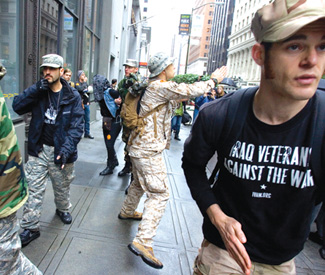
More than 55 organizations are involved in the day of action, and their focuses go beyond housing rights. These include students from Occupy SF State, Occupy Modesto Junior College, and other campus Occupy groups; anti-war organizations such as Iraq Veterans Against the War; environmental organizations such as the Rainforest Action Network; several unions, including UNITE HERE Local 2 and the California Nurses Association; the Chinese Progressive Alliance; and the Interfaith Allies of Occupy, which will be hosting an all-day “respite area” at Saint Patrick’s Roman Catholic Church at 756 Mission.

The array of events planned for Friday is overwhelming. There are demonstrations, pickets, and occupations planned at dozens of banks and corporations throughout the Financial District. Street theater is planned in several places, including an adaptation of A Christmas Carol by the San Francisco Mime Troupe at Justin Herman Plaza at noon and a show from Iraq Veterans Against the War that, according to IVAW member Jason Matherne, a Navy veteran who served in Qatar, “is called Operation First Casualty, because the first casualty of war is the truth.”

Matherne said, “corporations are profiting off the war at the expense of the 99 percent. Specifically, the Bechtel Corporation is using–misusing–billions of dollars to rebuild the infrastructure in Iraq.”

Tomorrow should be big. In a press release, organizers claim that “this is predicted to be the largest street protest of the Financial District since anti-war protests in 2003.”

Whatever the turnout, the Saint Patrick’s “respite” should be a boon, as weather reports indicate rain for tomorrow. Luckily, as Vicki Gray, a Deacon in the Episcopal Diocese of California, Occupy supporter and Interfaith Organizer, said of the sanctuary: “All are welcome. It will be warm, it will be quiet, and you will be loved.”

Supervisors make the Chamber of Commerce happy

7

You want a sense of what’s happened to politics at City Hall? Here you go: the San Francisco Chamber of Commerce is thrilled.


The Chamber just released its 2011 voting scorecard on the Board of Supervisors (which it calls the “Paychecks and Pink Slips Scorecard,” as if most of the stuff the Chamber supports had anything to do with actual job creation), and guess what? The board is more pro-downtown than it has been in a while:


The 2011 year-end scorecard reveals marked improvement in city’s efforts to create jobs and grow the economy. Overall, the Board of Supervisors received a score of 82 percent (equivalent to a B – grade), up from 60 percent (or a D – grade) in 2010. Individual rankings also improved, with five supervisors increasing their scores by at least 15 percent since last year. In 2011, a solid majority of supervisors voted in favor of jobs, the economy and government efficiency more than 75 percent of the time.


The top performer: Sup. Scott Wiener, who voted with the Chamber 88 percent of the time. Second best: Supervisor David Chiu (82%). The worst (or best, depending how you see downtown’s agenda of low taxes, reduced public services and minimual regulations) was Sup. John Avalos, who scored 56%.


The reality is that some of the Chamber’s key votes were relatively noncontroversial things that everone on the board supported — for example, a law sponsored by Sups. Ross Mirkarimi, Eric Mar, David Campos and Wiener making it easier for small cafes and restaurants to host live music and a measure restricting restaurant waste, both of which passed unanimously. There were some votes where nearly everyone opposed the Chamber — the cell phone disclosure requirements and the ban on yellow pages. And on a couple of them, even Chamber darlings Sean Elsbernd and Mark Farrell were on the wrong side — they voted against a tax exclusion for stock options because they wanted even greater tax reductions.


But on the key votes, you can see where the majority of the board lies: Six, sometimes seven votes with downtown, five, sometimes four with the rest of us. Not exactly a progressive majority. 

Way out East

0

THEATER The shows have been as varied and changeable as the weather this January in New York City, where the annual conference of the Association of Performing Arts Presenters (APAP) acts as catalyst for, by now, no less than four new-work festivals in the realms of theater, dance, and contemporary performance.

Near the beginning of the month, it got cold enough at night to make your nose hairs chime like little Christmas tree bells. “Every time you sneeze,” a friend explained to me, “a whole shitload of angels get their wings.”

This cheerful seasonal exchange took place in the Lower East Side during a frigid tromp to American Realness, a three-year-old festival offering a vital focus on contemporary dance and performance. Spread across three stages at the Abrons Art Center, American Realness is the brainchild of Ben Pryor, the festival’s 29-year-old curator and producing director, and once again features an eye-catching list of leading and emerging artists.

Indeed, 2012’s 11-day program (Jan. 5-15) is really pulling out the stops. Performances I’ve seen thus far have run a wide gamut, in every way, but have consistently attracted capacity houses to American Realness’s intriguing blend of the known, infamous, and brand new.

In addition to full-blown productions, the festival has added a new free series this year, “Show and Tell,” offering an opportunity to hear artists discuss their work or to glimpse work-in-progress. One recent afternoon was given over to a three-way discussion among songwriter and performance-maker Holcombe Waller, Cynthia Hopkins (at Yerba Buena Center for the Arts recently with The Success of Failure (Or, the Failure of Success)), and Miguel Gutierrez (last seen locally in July at the Garage with his solo, Heavens What Have I Done) about contemporary song-based performance. The Bay Area’s Keith Hennessy was on hand a couple of days earlier to discuss his collaborative project, Turbulence: A Dance About the Economy, which just had a two-night showing in December at CounterPulse. (Hennessy also premiered Almost, a “spontaneous performance action,” during the last week of the festival.)

American Realness opened with an evening lineup that included other San Francisco favorites, namely Laura Arrington Dance and New York–based Big Art Group. Arrington offered the New York premiere of Hot Wings (a piece born of her 2010 CounterPulse residency) to a sold-out house in the Abrons Art Center’s 100-seat Experimental Theater; while Caden Manson/Big Art Group debuted Broke House, a purposefully chaotic, multimedia camp meltdown loosely based on Chekhov’s Three Sisters, which sprawled across the proscenium stage in the 300-seat Playhouse Theater. The 99-seat Underground Theater, meanwhile, a cozy, brutalist semi-circle carved into the concrete basement, saw a U.S. premiere from Eleanor Bauer and Heather Lang (The Heather Lang Show by Eleanor Bauer and Vice Versa).

Those three initial shows together sounded an eclectic key that has been sustained throughout. The cold weather not so much. A few days later it was unseasonably warm. People tried to act concerned about it. Surely this was another sign of impending climactic collapse. But it was just too nice to care very hard about why it might be wrong.

The relaxed mood encouraged by the sudden warming trend was further augmented by an intimate little walking tour called Elastic City. Artists Todd Shalom and Niegel Smith conduct small groups of people around the grounds of the Abrons Art Center, training everyone’s attention, with a gentle and inviting playfulness, on the smallest and most quotidian details imaginable — with low-key but delighting results. A passage down one maintenance hallway, for instance, was an invitation to notice any little detail that caught the eye and stimulated the imagination and to share it with anyone around you, turning the seemingly bare walls into a topography that might have given a 16th-century explorer the chills, or … a woody. At one point, our guides led us outside barefoot onto the wide concrete steps in front of the building, for what was no doubt originally conceived of as a brief but striking encounter with the winter elements. Everyone stood there comfortably, however, thankful for the temperate bath of fresh air. “Yeah, it’s not very cold,” agreed Shalom. “Actually, it’s not cold at all.”

A couple more memorable moments as of this writing: Daniel Linehan spinning in a circle for a very long time, declaiming, “This is not about anything” — and variations on that theme. The young choreographer-performer (who’s worked with Big Art as well as Miguel Gutierrez, among others) delivered these poetically schematic lines at intricate length, in a voice precisely doubled by an offstage “doppelganger” piped through a nearby speaker, demonstrating a fairly wowing memory and focus, while alternating both the speed and shape of his whirling form to create a kinetic sculpture of transfixing beauty.

The stunning solo Not About Everything faltered only momentarily for me, when Linehan, pulling out and “reading” a self-conscious letter about his own art and practice from his pocket, shifted from mathematical-geometric abstraction to the all-too-specific. It was an almost rude awakening from a kind of syntactic ecstasy — the motive, unmooring meaninglessness of the mantra — back into the semantics of worldly and solipsistic concerns. It was saved ultimately by a combination of Linehan’s acuity and alacrity as a thinker and performer, however, and it was as fine, moving, and memorable a solo as any seen thus far.

Ann Liv Young presented a desultory piece called Sleeping Beauty Part I that held few surprises for anyone remotely familiar with her work. But the audience was caught off guard at one point at least, as Sleeping Beauty, having completed a Showgirls-style dance of seduction, pleads for understanding from her Prince Charming (a blowup doll sitting in the first row of the packed Experimental Theater). At that moment a soap machine above the stage suddenly erupted with a noisy rush of air and fluff, casting a snow-like arc of fine goo down onto the heads of maybe a third of the house, producing amusement and irritation in more or less equal measure. Only one patron actually got up and left. The rest sat stoically, trying to stifle coughs and sneezes for the next 20 minutes as the finer, mistier particles of whatever is in that stuff began lining breathing passages.

The remainder of the show was given over to an invitation to have your Polaroid portrait taken with the Sleeping Beauty (two bucks a pop). There were enough takers to drag this process out about half an hour. Then the performers left the stage. More ALY concessions were on sale as you exited.

www.tbspmgmt.com/AMERICAN_REALNESS_.html

Exporting our brains

0

By Gary Brechin

The chancellor was absent as University of California police, kitted out in battle gear, vigorously beat and arrested students and professors at on the Berkeley campus. Called to account by the academic senate two weeks later, Robert Birgeneau explained that he had been on a trip through Asia at the time. The trip, he said, concluded with a “phenomenally successful,” though unspecified, mission to Shanghai, so he did not hear how badly things went at home until the following day.

What Chancellor Birgeneau and the dean of Berkeley’s College of Engineering did on the trip was sign an agreement to open a 50,000-square-foot building in Shanghai’s Zhangjiang High-Tech Park two days after clubs fell on Cal students agitated by what they perceive as the progressive privatization and commercialization of their university. According to The New York Times, the new branch will give U.C. an Asian beachhead by opening “a large research and teaching facility as part of a broader plan to bolster its presence in China.” Other premier American universities such as Duke, NYU, and Stanford are, for a price, establishing similar “partnerships” that China “hope[s] will form the base of a modern high-tech economy.”

As U.S. funding dries up, college administrators hope that such collaborations will “support fundraising efforts that target wealthy Chinese alumni” — not to mention attracting their children, who are more able to pay ever-rising tuition than American students.

California’s business elite until recently oversaw the establishment and growth of a prestigious 12-campus system that was meant to do for the Golden State what the university now will do for China.

The promise of a virtually free and high quality education for Californians worked well to that end until 1978 when voters overwhelmingly passed Proposition 13 to cut their taxes.

Starved of funding, California’s public schools plummeted from the best to near worst — but many believed that the University of California’s crucial role in the state’s and the nation’s economy would immunize it from the rot consuming the rest of the Golden State’s educational apparatus. But as California piled up multi-billion dollar deficits, U.C inevitably joined the rest of the public sector on the dream factory’s cutting room floor.

As with any organism fighting for its life, available money has moved like blood from regions the university administration considers expendable to those regarded as vital profit centers — like business, biotechnology, sports, and online learning initiatives — as well as lavish executive pay packages.

Last year, for example, the university’s flagship campus at Berkeley quietly divested itself of its outstanding Water Resource Center Archives to save the cost of four clerical positions and thus free space for the expanding College of Engineering. At UC San Diego, three specialty libraries closed altogether while a fourth — the largest oceanographic library in the world — will close in 2012.

Advanced communications and information technology will be among the first areas of research undertaken by the College of Engineering’s new partnership with Chinese industries seeking to overtake California’s fabled Silicon Valley.

For centuries, city states and nations jealously guarded their home industries to the point of sending assassins to dispatch those trading secrets with rivals. Decades of neoliberalism have encouraged today’s elites to do the opposite. Availing themselves of the deregulation and lowered trade barriers for which they paid and the communications technology they developed, they exported their industries and jobs to wherever labor costs are lowest and environmental constraints absent. Derelict factories, ruined towns, failing infrastructure, and prisons now pock those countries still imagining themselves members of the First World.

The screams of students belabored for asking where their university is going and for whom raises the question whether intelligence will be our last export, or whether it was among our first.

Gray Brechin is a three-time U.C. Berkeley alumnus and visiting scholar in the UBC Department of Geography. He is the author of Imperial San Francisco: Urban Power, Earthly Ruin. A version of this piece ran first in the Anderson Valley Advertiser.

Free to be you and me

0

caitlin@sfbg.com

FREE UNIVERSITY OF SAN FRANCISCO

Like many progressive organization, this year-old network of unpaid teachers and unpaying students has found new energy in Occupy’s protests. Unlike many, it’s not stumbling when it comes to the next step in the movement. FUSF has teamed with Occupiers to develop its upcoming round of five-week classes, which will start in February. At press time, courses included “Introduction to Political Economy,” a class on subversive writers, and Chuck Sperry’s “Occupy Art” guide to bringing down the system with propaganda design.

Spring term: Feb. 5-March 4. 10 a.m.-5:30 p.m. Viracocha, 998 Valencia, SF. www.freeuniversitysf.org

IMPACT BAY AREA

Some education strengthens your mind — some education strengthens your soul. Into the latter category falls self defense non-profit Impact Bay Area’s free-to-the-public “Introduction to Personal Safety” classes. Open to ages 12 and up at Sports Basements across the Bay Area, the course teaches you how to keep your eyes open when walking the neighborhoods, with the end goal of living life with less fear and more fun.

Next class: Feb. 8, 6-8 p.m. Register at www.eventbrite.com/event/2704831223. Sports Basement, 1590 Bryant, SF. www.impactbayarea.org

EAST BAY FREE SKOOL

Not to state the obvious, but we live in the Bay Area. Henceforth, we can stop looking at learning the Spanish language as an extracurricular activity, and more as something that we can do to bring our community closer together. That’s exactly the motivation behind the East Bay Free Skool’s Spanish-English Collective, an educational meet-up which unites bilingual teachers and students for some real pragmatic, communication-based learning. Free Skool is big on knowledge that brings the 99 percent together — check its website for other amazing free classes, from anti-gentrification workshops to herbal medicine primers.

Various venues, Bay Area. tiny.cc/ebfreeskool

CITY COLLEGE OF SAN FRANCISCO

At many of CCSF’s 10-plus campuses across the city, you can take courses absolutely free of charge — and sign up for them at any point in the semester. What can you learn? GED prep, introductory construction skills, economics, US contemporary writers, and tai chi, to name but a few of the offerings. How has this vast resource network escaped the chopping block in California’s beleaguered public school system? We almost don’t want to press the issues — let’s just sign up while these courses still exist.

Various campuses, SF. www.ccsf.edu

CW ANALYTICAL

You’ve planted your own garden, gotten your card, and are committed to heightening endocannabinoid levels in your medical marijuana patient family and friends — but do you really know what you’re doing making weed edibles? This marijuana laboratory offers intermittent classes for the cannabis food newbie or vet that teach about quality control, presentation, and applicable regulations.

Next class: “Labeling Your Medical Edible,” Jan. 19, noon. RSVP to reserve class space and to emily@cwanalytical.com. (510) 545-6984, www.cwanalytical.com


Who will push progressive taxes in 2012?

47

Mayor Ed Lee talked to the Examiner about his plans for the next year, and it’s a lot of the usual political crap: I’m going to create jobs, I’m going to bring people together and promote civility, ho hum. But he did mention, briefly, the need to change the city’s business tax, and here’s how he put it:

We have given ourselves four months to reach out to all the business groups. There will be different views and opinions. You can have a hybrid [between a payroll and gross receipts tax], and you can also have a phase-in period of time. We want to have a good conversation with everybody and get their best ideas, and then use those ideas to craft what we think could be on the ballot. We’re not saying it has to be on the November ballot, but it could be. We want to have something that is not job punishing, but also something that does not decrease our revenue.

First: He’s going to reach out to all the business groups — but what about everyone else in the city? The level of business taxes has a direct impact on city services; is that not part of the equation? Clearly, he’s talking about something that’s at best revenue-neutral, something that “does not decrease our revenue.”

And please, don’t tell me about “job punishing” — it makes me even crazier than I already am. Look: There has to be a business tax in San Francisco. And any time you tax businesses, you take money for the city that could be used for other things. In some cases — not that many — the extra money might be used to hire a few people. In reality, for most businesses, the payroll tax is absolutely NOT a factor in job creation. It sounds bad — Gasp! a tax on jobs! — but the truth is that payroll is a rough approximation for the size of a company, and that’s what the city uses as a tax base.

Of course, we could change that to a gross receipts tax — another rough approximation for the size of a company. It’s also imperfect — some companies have a lot of money (VC funding, for example) and a lot of employees, but at this point not much in the way of sales. Some companies (supermarkets, for example) have high gross receipts but relatively low profit margins. And, of course, if you do a gross receipts tax the same people who complain about the payroll tax will have a new line: The GR tax penalizes growth! It penalizes success! The more money you make the more you pay! Unfair! Un-American! Job killer!

Because some people in this town (mostly big business types) just want lower taxes, period — not different taxes, lower taxes

So let’s get rid of the “job killer” rhetoric and start talking about what the city’s tax policy should be. And it should go like this: The individuals and businesses with the most money should pay the highest tax rates. The rich don’t pay their fare share anywhere in the U.S., and while the mayor and the supervisors can’t change federal policy, they can do their part on a modest level at home.

This a great year for tax reform in San Francisco. The spirit of Occupy is very much alive. There is, for the first time in decades, a national discussion about income and wealth inequality. There’s strong evidence that the middle class is vanishing in San Francisco. And, thanks to the wierdness of state law, in 2012, when there’s an election for the Board of Supervisors, a tax measure can pass with a simple majority vote In many ways, this is the single most important policy issue in the city, the one that defines who pays for what and who gets what and whether (public sector) jobs are created or destroyed and what kind of a city we want to be.

So let’s take it seriously. Instead of allowing Mayor Lee and the (big) business folks set the agenda, the progressives really need to move forward on a tax-reform plan that looks at making big business pay more and small business pay less — and that brings in another $250 million a year for the local coffers If gross receipts is the flavor of the day, I’m good with that — but not a flat tax. Exempt, say, the first $250,000 (or the first $500,000, whatever, run the numbers and see what we can afford). Put a 1 percent tax on the next million, a 1.5 percent tax on all receipts between $1.5 million and $5 million, a 2 percent tax on $5 million to $10 million and 3 percent on everything higher. Adjust the numbers either way, but that’s the general idea. Then add in a tax on commercial rents (again, exempt the first $500,000 or whatever) to make sure the the big landlords (who get away with murder under Prop. 13) are paying, too. And yes, based on market supply and demand, some will try to pass that on to their tenants, but companies (including a lot of law firms) that rent enough space to be paying millions of dollars a year in rent can afford to modest tax hike.

It will take the city controller or the city’s economist to do the math and see what the options are and how you get to $250 million net new revenue, so my proposal is just a start. But somebody needs to take this on, some member of the Board of Supervisors — or else we’ll just be responding to what the Chamber of Commerce wants. Who wants to be the champion of Tax Reform for the 99 Percent? Time is getting short.

Daly is back in a progressive leadership role

45

Chris Daly, a pivotal organizer of progressive politics during his decade on the San Francisco Board of Supervisors, has returned to a high-profile role in the movement. Last month, he went to work for Service Employees International Union Local 1021, the city’s largest public employee year. And today, he was named its interim political director.

“I’m excited and I think everyone here is excited to have Chris’s talent and experience and energy on this team,” local President Roxanne Sanchez, who was elected as part of a progressive reform slate in 2010, told the Guardian. “Part of the vision of the executive board, and the mandate that we were elected on, is to build a long-lasting sense of power at the rank-and-file level.”

Even before lending support to the Occupy movement and its challenge to the power of the richest 1 percent of society, Local 1021 was targeting banks and other downtown financial institutions with its Fight for a Fair Economy campaign. Now Daly can continue pushing that agenda and connecting the dots between the consolidation of wealth and the hardships faced by workers and local government.

“The spark has been the Occupy movement, but it’s been 1021 that has been helping to instigate some of these possible next steps…It has an opportunity to be successful if there’s some institutional support for it,” Daly said of San Francisco’s progressive movement, which suffered a setback when he and other board progressives were termed out, and a bit of a revival in the fall with the emergence of OccupySF.

“Occupy is going to need some foundation to continue its work,” Daly said. “Without organizational or structural support, that could have been a one-time thing.”

But now, during an important election year when the union’s contracts with the city expire, Daly sees an opportunity to forward the interests of both union members and the broader progressive movement. Both Daly and Sanchez say educating their members and the general public about the importance of progressive issues is essential to advocating for their members, who are among the city’s lowest paid workers and those who have suffered the most layoffs in recent years.

“If there’s not a notion of the distribution of wealth and the 99 percent, we won’t be successful,” Daly said. “Downtown is powerful, and labor needs to be here to offset the power of downtown. Without that, we’re stuck.”

Sanchez said the reorganization now underway in her union, of which hiring Daly is a key component, is about turning the clock back on the labor movement and returning to an agenda of broadly building working class power, as unions did in the ’30s and ’40s before becoming more bureaucratic institutions in the ’50s.

“Chris, and his perspective of building community strength, is our focus,” Sanchez said. “This is the time when unions have to help move a working family agenda and to push back on the opportunistic wealthy interests in this society.”

In the year since he left the board, Daly has been running the bar he purchased, The Buck (formerly Buck Tavern) – which became like a progressive clubhouse and gathering spot – as well as helping John Avalos’s mayoral run and other campaigns. Daly says he wants to maintain that role by continuing to tend bar on Friday nights, but he plans to pour most of his energies into a new role that is really a continuation of his old role.

“For me, it was never about being on the Board of Supervisors. It was about trying to make the progressive movement strong and more effective…In some ways, I was one of the unofficial political directors of progressive San Francisco,” Daly told us. “I have a strong motivation to build a progressive political program, and now I have the opportunity to do that.”

Stuck in reverse

18

Some days, you wake up, check the news, and wonder just what the hell happened to this country. And I’m not talking about that nutty right-wing view that we’ve strayed from the original vision laid out for us by the authors of the Constitution or the Bible. I have just the opposite view: I’m wondering why those people seem so intent on dragging us back into the bad old days of bygone centuries, when white male property owners ran things as they saw fit.

A dangerously intolerant religious fundamentalist who longs for the Puritan days, Rick Santorum, essentially tied for first place in the Iowa Republican presidential caucuses. And he was part of an entire field of candidates that wants to revoke women’s reproductive and LGBT rights, deny that industrialization has affected the environment and should be addressed, dismantle already decimated government agencies, simply let the strong exploit the weak, and hope that Jesus comes back to save us from ourselves. Their strange reverence for the Constitution apparently stems from wanting to drag us back into the 18th century.

And don’t even get me started on President Barack Obama and his worthless Democratic Party, which is only a bit better than the truly heinous Republicans. At least Obama says some of the right things – like wanting to raise taxes on millionaires, reverse Bush-era attacks on civil liberties, respect states’ medical marijuana laws, and use diplomacy rather than only bellicosity with concerning countries like Iran – even though he acts in contradiction of those statements, over and over again.

It’s no better in the Golden State, where the yestercentury crowd now wants to abandon plans for a high-speed rail system that has already been awarded $3.5 billion in federal transportation funding and for which California voters authorized another $10 billion in bond funding. Why? Because a panel headed by an Orange County douchebag says the business plan isn’t detailed enough and the money for the entire $100 billion buildout isn’t nailed down yet. Well guess what? California also doesn’t have a plan for when its highway and airport systems get overwhelmed by population growth over the next 20 years. And criticizing the viability of high-speed rail – something most other advanced countries figured out how to build decades ago – isn’t exactly going to help secure private equity commitments. It’s a super fast train, folks – not some scary satanic iron horse from the future – people will pay to ride it.

But the situation must be better here in liberal San Francisco, right? Wrong! Mayor Ed Lee, the San Francisco Chronicle, and all their business community allies continue to relentlessly push their belief that the main job of government is to create private sector jobs, even though most economists say a politician’s ability to do so is limited at best.

Lee is pushing for all city legislation to be measured by whether it creates private sector jobs, as if protecting the environment, preserving public sector jobs, or safeguarding the health, welfare, and workers’ rights of citizens weren’t also under the purview of local government. A Chronicle editorial today called Lee the most “realistic city leader in memory. He’s all about creating jobs, repaving streets, sprucing up faded Market Street and fixing Muni’s flaws,” the same goals the paper was focused on a century ago.

But the main trust of the editorial was calling for Lee to also focus on homelessness. Not poverty, mind you, but homelessness. “A decrease in jobless numbers is important, but so are fewer shopping carts pushed along sidewalks and a drop in the numbers of mentally ill in doorways and on park benches,” they wrote. In other words, they just don’t want to see poor people on the streets, because that newspaper and its fiscally conservative editorial writers and base of readers certainly haven’t been calling for a fairer distribution of this city’s wealth, or even higher taxes on the rich that might fund more subsidized housing programs or mental health treatment. I get the feeling they’d be content to just allow shanty towns on our southern border where our low-wage workers can live, just like the Third World cities that they seem to want to emulate.

Ugh, so depressing, so ridiculous, so regressive. I think I’m going back to bed now.

Battling big box

1

news@sfbg.com   

In neighborhood commercial districts, national chains and other formula retail stores such as PETCO, Target, Subway, Walmart, and Starbucks are hot button issues for residents who don’t want to see San Francisco turn into a strip mall or have local money pulled from the community.

Sup. Eric Mar and other city officials want to make sure local small businesses aren’t being unnecessarily hurt by competition from national chains, which is why he called a hearing on Dec. 5 to discuss big box retailers and their impacts on San Francisco’s small businesses, neighborhoods, workers, and economy.

“There is no vehicle to see the impacts of big business on the city,” Mar told us, saying he is contemplating legislation to do just that.

Mar was part of city efforts to keep formula pet stores from locating in the Richmond area, working with a coalition of pet food small businesses concerned about PETCO and Pet Food Express trying to move into the area. But it isn’t just pet stores.

“There is a perception that Walmart might make a move into the city since we already have stores like Fresh n’ Easy,” Mar’s Legislative Aide Nick Pagoulatos told us.

The city doesn’t have a comprehensive analysis on how these companies impact San Francisco. Mar says he wants to “have a clear scale of their influence and see what we need to do to protect small business in San Francisco.”

History of wariness

In 2004, the Board of Supervisors adopted the first Formula Retail Use Control legislation, an ordinance that “prohibited Formula Retail in one district; required Conditional Use Authorization in another; and established notification requirements in all neighborhood commercial districts.”

The Planning Code changed again after a voter ballot initiative in 2007, Proposition G, required any formula retail use in neighborhood commercial districts to obtain a conditional use permit, which gave neighboring businesses a chance to weigh in during a public hearing.

Mar said the intent wasn’t to bar big box retail from entering the city, but to simply give neighborhoods a voice. But now, he said the city needs to take a more comprehensive look at what’s coming and how they will impact the city.

Small Business Commissioner Kathleen Dooley echoed the concern, which extends even beyond city limits. “I’ve heard through the rumor mill that Lowe’s in South San Francisco is going to close and

Walmart is looking to take that space since they know they’d never get into the city,” she told us. “It’s bad enough that Target is opening stores [in San Francisco]. They are the quintessential big box because they sell everything.”

Target is in the process of opening a massive store inside the Metreon in SoMa, and another store at Geary and Masonic. Mar isn’t diametrically opposed to the big box industry, but he thinks those companies should be appropriately situated.

“I’ve seen that people in Richmond are positive toward big box like Target coming into the district, but some are nervous that it will take down business,” he told us. “There are some property spaces that are supposed to be for big box, like the property at Geary and Masonic where the old Sears and Toys”R”Us used to be.”

But it’s not easy to figure out what other big box stores have their sights set on the city. The Planning Department’s list of projects in the pipeline aren’t always filed under the name of the business, making it difficult to stay vigilant.

For example, while application #3710017 at 350 Mission Street describes the project as a “95,000 sq. ft. building of office, retail and accessory uses,” it isn’t clear what businesses are actually setting up shop. And these days, some big box stores are coming in smaller boxes.

Prototype stores such as Unleashed by PETCO are specifically designed to squeeze into smaller property spaces so they can get into neighbor corridors that are typically reserved for small businesses.

More help needed

During the Dec. 5 hearing before the Land Use and Economic Development Committee, Sup. Scott Wiener echoed Mar concerns, commenting that he wants to see how the Planning Commission could “improve the Conditional Use process since we see a pushback of strong neighborhood activity.”

Dooley recalled an issue from 2009 when the Small Business Commission formally asked the Planning Commission not to authorize a PETCO in the Richmond because “the surrounding area was already well served by pet stores.” The board ultimately stopped PETCO, but Pet Food Express did locate a store nearby, which Dooley said has already taken a toll on the locally owned pet food suppliers.

“Big box stores carry a huge number of products that impact other stores,” she said. “Big box is a category killer in the neighborhood…the Planning Commission needs new criteria for formula retail because there are several different types.”

Some superstores require parking lots, taking up additional land, and increasing traffic in certain neighborhoods. Yet one trait that most chain stores have in common is that they extract more money from San Francisco than locally owned businesses, whose revenues tend to circulate locally.

“With every dollar spent at local stores, 65 cents will go back into the community, while only a quarter will be returned from a big box.” Rick Karp, owner of the 50-year-old Cole Hardware, said at the hearing, citing various studies on the issue.

Small business owners are asking for economic impact reports to be included in project applications from chain stores to see just how they measure up to their locally owned counterparts.

When Lowe’s entered his district, Karp says he lost 18 percent of his business and was forced to eliminate six full-time jobs. He appealed to city officials to “keep big box out of San Francisco because it impacts the efficacy of neighborhood shopping.”

Once chain stores puts the locals out of business, the consumer is stuck with set prices and reduced variety. But critics say it isn’t just consumers and small business owners who suffer, but workers as well. They singled out Walmart as notorious for union-busting and poor labor standards.

“We can use our land use ordinances and powers to set a basic minimum labor standard. Big box must abide by that and also include health care if implemented in local government [legislation],” Mar said.

But Steven Pitts, a labor policy specialist at UC Berkeley, told us there is a connection between low prices and low wages.

“People who work at Walmart are poorer than those who shop there,” he told us. “Therefore, if prices were raised to increase wages for employees, the burden wouldn’t be on people of lower income.”
Opposing Walmart

To illustrate how Walmart would adversely affect San Francisco’s workforce, the hearing included two employees of Walmart, Barbara Collins and Ronald Phillips from Placerville, who helped create Organization United for Respect at Walmart (OURWalmart) to push for better benefits and labor standards.

“We want to hold Walmart accountable,” said Collins, whose last annual income from Walmart was $15,000 annually, a salary she realized couldn’t support her four children. “Walmart says they pay living wages. No, they don’t.”

Phillips said that Walmart has “a tendency to fire people for any reason and then does not have to pay for the benefits… I was one of these people, but I was rehired.”

For the past three months, Phillips says she has worked at least six days and 40 hours per week, but that she still qualified for welfare assistance.

Also at the hearing, SF Locally Owned Merchants Alliance unveiled a study showing that formula retail costs nearly as many jobs as it creates. A domino effect occurs when stores close because fewer customers circulate to other nearby stores.

But the group noted that consumer habits are probably even more important than city regulations. The SFLOMA study found that if 10 percent of San Franciscans shifted their spending to locally owned small businesses, consumers would create 1,300 jobs and $190 million in the city.

And that would be good for everyone: owners, consumers, and workers. Steven Cornell, owner of Brownie’s Hardware, said that small business pays good wages, typically above the minimum wage, as well as sick leave, health coverage, and other benefits. As he told the hearing, “Local businesses have been doing this for 20 to 30 years since we are already invested in the community.”