Economy

Following court ruling, SF Redevelopment seeks a “legislative fix”

1

Redevelopment agencies were dealt a statewide hit after a unanimous ruling Dec. 29 by the California Supreme Court decided not only that lawmakers had the ability to terminate the agencies, but that those agencies could not continue forward with redevelopment projects as smaller entities.


Assembly Bills 1X 26, which eliminates redevelopment agencies but makes existing redevelopment housing projects an “enforceable obligation,” and 1X 27, which would have required agencies to make payments to the state of California in exchange for continuing to exist in smaller form, both came under scrutiny by the state Supreme Court. AB26 was upheld, but AB27 was considered illegal.

While large-scale redevelopment projects in San Francisco have generated no shortage of criticism and controversy, Mayor Ed Lee described the decision as disappointing and harmful for the city’s future.

“Redevelopment has not only played a critical role in creating jobs, transforming disadvantaged communities and delivering affordable housing, but it has spurred economic growth for our entire City at a time when we needed it most,” Lee said in a statement issued earlier today.

Gov. Jerry Brown introduced the idea of eliminating redevelopment agencies about a year ago as part of budget cuts designed to revitalize the state economy, as the Guardian reported last January. Today’s decision, which leaves the state with $1.7 billion more to work with in the first year of implementation of this plan, may help cushion the blow as state legislators seek to balance the budget.

However, the San Francisco Redevelopment Agency isn’t giving up.

“We are aggressively looking at solutions, most likely a legislative fix, to provide for redevelopment to continue,” S.F. Redevelopment Agency executive director, Tiffany Bohee, told the Guardian. “The state will do what it needs to do to fill the hole [in the state budget] but there are unintended consequences.”

Private funding from companies like Lennar Homes supplementing state funding has made the continuation of redevelopment projects in San Francisco’s Mission Bay, Bayview Hunters Point Shipyard, and Treasure Island possible. Lee maintains that these areas will remain unaffected.

The legislation does, however, affect future projects. “We call on the state to find a legislative solution to this problem” Lee’s statement noted. “And while we are committed to working with the state, we have already started to look at local solutions and alternatives.”

Bohee echoed the mayor’s resolve. “We are committed to the long haul and focused on what the next steps are,” she said.

Doom lens

0

cheryl@sfbg.com

YEAR IN FILM As everyone and John Cusack knows, 2012 is it. And not in a “billboard-buying Alameda radio preacher Harold Camping’s bungled Rapture predictions” kind of way. This is an all-in situation. The Mesoamerican Long Count calendar, a complicated and ancient system most enthusiastically explained by conspiracy theorists, winds up its 13th 144,000 day cycle on December 21, 2012. TL; DR: we’re toast.

Though pesky, facts-knowing Latin American archaeology scholars have suggested that this doesn’t actually mean the end of the world is nigh, good luck dissuading zillions of bloggers, survivalists, religious fanatics, super-volcano watchers, and people who lie awake at night, biting their fingernails over the Large Hadron Collider. Imminent catastrophe awaits! Are you ready?

Enter Hollywood, which in its 100-plus year history has never had any qualms about exploiting society’s extant feelings of fear and dread. In 2009, 2012 prophesized global destruction (“Mankind’s earliest civilization warned us this day would come!”) as only a film with a lavish special effects budget could. Yet it offered last-act hope, a preferred tactic of master of disaster Roland Emmerich — who, having ice-aged, Godzilla’d, and alien-invaded the planet in a succession of go-boom films over the past 15 years, switched gears in 2011 with Shakespeare mystery Anonymous. (Last-ditch artistic atonement, perhaps?)

The apocalyptic films of 2011 took a different approach, opting to emphasize existential terror instead of fireballs, with no happy endings in sight. Lars von Trier’s Melancholia inspects the one percent by peering into the lives of two privileged sisters: depressed Justine (Kirsten Dunst) and anxious Claire (Charlotte Gainsbourg). The film’s first half unfolds at Justine’s lavish wedding reception — held at Claire’s horsy estate — which devolves into a mini-disaster movie of its own. The stretch limo carrying the newlyweds is too bulky to navigate the property’s narrow, curving driveway, until the bride slides behind the wheel and gets the tires pointed in the right direction. It’s Justine’s last moment of glee, as her marriage-jinxing erratic behavior soon gives way to crippling malaise.

As it turns out, a newly-discovered planet, conveniently named Melancholia, is heading toward earth. A collision course is not guaranteed, but it’s pretty obvious where things are heading, and this is not the kind of movie that sends Bruce Willis into space with drilling equipment to save the day. As Claire whips herself into a panic, clicking through fear mongering websites (Melancholia‘s only evidence of a world beyond the mansion’s well-manicured grounds), Justine accepts the impending apocalypse with cool detachment. “The earth is evil,” she tells her sister. “We don’t need to grieve for it.”

Though there’s no looming threat from outer space, the sky looks plenty ominous to Curtis (Michael Shannon), troubled protagonist of Jeff Nichols’ Take Shelter. Nightmares of the I-wake-up-screaming variety have become a regular thing, and though Curtis desperately needs the health insurance provided by his construction job — his daughter (Tova Stewart) is about to get an operation to restore her hearing — he’s become obsessed with upgrading the storm shelter in his backyard. Friends and neighbors, initially supportive, become angry and confused. A public meltdown is inevitable: “There is a STORM coming like nothing you have ever seen, and not A ONE OF YOU is prepared for it!” he bellows at a community dinner, spewing fire like a small-town Cassandra.

There’s more: Curtis’ mother is schizophrenic. Is history repeating, or are his visions actually prophetic? Is Nichols hinting at Biblical themes, or is he making a statement about mental illness, or the destruction of the American dream? The film’s provocative finale could be interpreted a variety of ways; though there’s no Melancholia-style conclusion, Take Shelter‘s message remains memorably unsettling.

But even if the world doesn’t actually take a buy-out in 2012, it’ll get there someday — as Terrence Malick’s dreamy Tree of Life, which is more or less the story of everything that has ever and will ever happen, points out. For film fans, the signs of a dying planet are all too clear. Just take a look at the top-grossing movies of 2011: all of them are either sequels or part of a series. Transformers: Dark of the Moon relieved ticket buyers of over $352 million, even though previous installment Transformers: Revenge of the Fallen (2009) was scientifically proven to have sucked the soul out of anyone who watched it. (True story.)

With the crap economy making even gigant-o-stars nostalgic for their $20 million paydays, the Hollywood-industrial complex concentrated on proven moneymakers, with a few notable exceptions (bless you, Bridesmaids). In 2011, all bets were off. No cult property was too sacred to remake, no “reboot” deemed unnecessary, no superhero with the word “green” in his name unworthy of an entire feature film, no use of 3D too gratuitous. Original ideas were placed on the endangered species list, unless you counted the very small handful of smarter films that somehow managed to break through (look hard; most of them came out in December). Though there’s always a chance that entertainment aimed at the masses will have a brain (2012’s The Dark Knight Rises looks promising), that’s all there is. A chance.

Worse yet: recent news that major film studios plan to stop releasing 35mm prints from their archives. Rep houses will be forced to show films either digitally or not at all. It’s a cost-cutting measure that will deny future generations the irreplaceable delight of watching a movie projected from film, as was intended by the artist who made it. (Somewhere, Stanley Kubrick is seething.) Why bother going to see an old movie at all, if you’re just gonna be watching the equivalent of blown-up DVD? Might as well stay home and watch the Kardashians shop for shoes that cost more than your rent.

Man, maybe I am ready for 2012 after all. At least there’s an alternative end-times scenario to look forward to: the adaptation of Max Brooks’ excellent novel World War Z, about a world rebuilding itself after a zombie holocaust. Its not-so-coincidental release date? December 21, 2012. You’ve been warned. 

www.thepetitionsite.com/1/fight-for-35mm/


Occupy and the hostile media

8

OPINION Every progressive movement in U.S. history was portrayed negatively by mainstream media at the time it was happening. It’s no surprise that the media portray the Occupy Wall Street movement in the same light.

During the Montgomery bus boycott, mainstream media outlets interviewed black folks who were against it and talked about how the boycott was misguided and hurt the local economy. The day after the boycott started, the Montgomery Advertiser ran a story featuring the manager of the bus lines saying that bus drivers were being shot at and rocks were being thrown at them.

During the rest of the civil rights movement, protesters who were fire-hosed and otherwise brutalized were called “violent protesters” in the mainstream media, which again featured interviews with people saying that the protests were wrongheaded.

During the Anti-Vietnam War movement, the mainstream media portrayed protesters as out of touch, violent, and dirty. There was a picture in the San Francisco Chronicle of a guy who was throwing back a tear gas canister that had been shot at the peaceful crowd. This was shown as proof of protesters being wild, out of touch, and violent. The Black Panther Party had free breakfast programs and was beloved worldwide — but every mainstream media outlet that covered it, covered it negatively.

There has never been any strike, work stoppage, or union action that was supported by the mainstream media at the time that it was happening.

The mainstream press didn’t support the Anti-Apartheid movement and doesn’t support the boycott, disinvestment and sanctions movement for Palestine.

The mainstream press is always on the wrong side of history because it’s always on the side of the status quo, which is capitalist exploitation and oppression.

Here’s an example: Every article about the port shutdown featured a trucker speaking against the shutdown. However, the Occupy movement received and circulated a letter from an organization representing hundreds of port truckers which thanked us all for this action in support of their struggle. None of those folks were interviewed by media.

Another example: In any movement we will make in the U.S. that is multi-racial, there will be real problems to fix around race. These are good problems, because they come from the fact that a lot of different groups of people who normally wouldn’t work together are doing so now.

But the article in the Chronicle that supposedly showed that Occupy Oakland doesn’t connect with black folks was poor and unethical journalism. The paper quoted only two black folks; one said the answer is to tell other Black folks to “Stop The Violence.” Okay. But the Chron didn’t interview any of the folks in the neighborhood around Gayla Newsome who was put back into her foreclosed home. They didn’t interview anyone from the neighborhood around 10th and Mandela, where the Tactical Action Committee has made a foreclosed Fannie Mae home into a community center with workshops for the community. They didn’t interview anyone involved with Occupy Oakland’s November 19th march, which was 2,000 strong and focused on school closures. They didn’t interview any of the many black union members who have worked with us. They didn’t interview anyone in the People Of Color Caucus, or anyone else who is black and works with Occupy Oakland.

Don’t be surprised at the media’s negative portrayal of our movement. It’s happening because we are growing, we are effective, and we are right. *

Boots Riley is a musician and activist.

Dick Meister: A decent living for all?

11

Dick Meister, former labor editor of the SF Chronicle and KQED-TV Newsoom, has covered labor and politics for more than a half-century. Contact him through his website, www.dickmeister.com, which includes more than 350 of his columns.

Finally there’s some good news for the millions of Americans who must to live on pay at or close to the legal minimum wage. Eight states are raising their minimum wage on January First, in line with state laws requiring the minimum to keep pace with inflation.

The raises to come are modest by any measurement. But any increase must be welcomed as desperately needed and hopefully as a major start toward increasing the minimum wage everywhere to a level that will provide a decent living to all working Americans, many of them living in poverty or near-poverty.

The minimum wage is just as important now as it was in 1938, when the wage law was enacted as part of the Fair Labor Standards Act, with a promise of guaranteeing workers “a standard of living necessary for health, efficiency and general wellbeing.”

The federal rate was set at 25 cents an hour, with states and local governments free to set their own minimums, as long as they are above the federal rate.

Today’s rates are much higher, of course, although barely adequate. The federal rate is $7.25 an hour, only about $15,000 a year for full-time workers before taxes and other deductions. Eighteen states, more than 100 cities and counties and the District of Columbia have higher rates, but their rates also are clearly inadequate.

During his 2008 election campaign, President Obama proposed raising the minimum to  $9.50 an hour by 2011. But even though that would merely adjust the minimum wage for inflation, Congress and the White House have done little to make it happen.

Some of Obama’s Republican opponents in Congress actually have called for the minimum wage to be abolished, largely because their big money backers in the restaurant business, who employ about 60 percent of all minimum wage workers, are against it, as are many other business and corporate interests.

Congress’ failure to act has left it up to the states. The eight that are raising their rates on New Year’s Day include Arizona, Colorado, Florida, Montana, Ohio, Oregon, Vermont and Washington.  Their rates will increase by 28 to 37 cents an hour to between $7.64 and $9.04. The National Employment Law Project (NELP) calculates that will bring nearly 1.4 million full-time minimum wage workers an extra $582 to $770 per year.

Another 400,000 will get raises as pay rates are adjusted upward to reflect new minimum wage rates. It’s not just individual workers who will benefit from the raises. Like all low-wage workers, they must spend virtually every cent they earn, thus raising the overall demand for goods and services and the hiring of new employees to help provide them.

NELP estimates that the increased consumer spending generated by the raises will add $366 million to the gross domestic product and create the equivalent of more than 3,000 full-time jobs. Other estimates indicate that every dollar increase in wages for workers at the minimum creates more than $3,000 in new spending after a single year.

And we shouldn’t forget that those earning the minimum include many of our most valuable yet needy and exploited workers.  Most work in the service or retail fields, as domestics providing home health care for the elderly and other household services or caring for the children of working mothers, for example. Others work in agriculture.

Many can’t find full-time jobs even at the bare minimum.  More than one-third are the main or sole support of their families. Almost two-thirds are women, many of them single mothers. One-third are African-American, Latino or Asian. Many are recently arrived immigrants. Only a few belong to unions or have other protections aside from the law.

But wouldn’t a minimum wage increase cause businesses to cut back their hiring, as opponents of minimum wage raises claim? No. Studies show that even during times of high unemployment, raising the minimum does not lead to a loss of jobs. Actually, the number of jobs has grown after each of the 19 times the federal minimum has increased over the past 73 years.

Consider this, too: Taxpayers are providing billions of dollars in subsidies to employers of minimum wage workers, since much of the money paid out in public assistance goes to families whose working mothers do not earn enough to be self-supporting. Private charities provide additional millions in aid.

There’s no doubt employers are shifting a significant part of their labor costs to the general public, and no doubt that welfare costs could be reduced substantially if the minimum wage they had to pay was raised to a decent level.

Think of the benefits to society generally if the minimum wage workers who now must depend on government assistance could earn enough to make it on their own.

Think of the benefits to employers. As several studies have shown, raising workers’ pay raises workers’ morale and with it, their productivity, while decreasing absenteeism and replacement costs.

Think of the benefits to small retail businesses. Opponents of a minimum wage increase say they’d be hurt the most by a higher minimum wage, but it’s far more likely they’d be among the greatest beneficiaries. For minimum wage workers have no choice but to spend most of their meager earnings in neighborhood stores for food and other necessities.

Tiffany Williams of the Institute for Policy Studies says raising the minimum wage “would be a step toward restoring dignity for millions of workers, enabling many ordinary working Americans to become part of the economic recovery rather than its collateral damage.”

Hard to argue with that, or with Christine Owens, NELP’s executive director,  who says the minimum wage increases “represent bright spots on an otherwise bleak economic horizon. Workers’ buying power is the secret weapon in the fight to get our economy back on track. States are taking action to protect that critical buying power. Congress should follow their example to realize those benefits for the national economy.”

Let the minimum wage raises in eight states be just the beginning of raises in all states.  Let all Americans have the right to a decent living

Dick Meister, former labor editor of the SF Chronicle and KQED-TV Newsoom, has covered labor and politics for more than a half-century. Contact him through his website, www.dickmeister.com, which includes more than 350 of his columns.

Making CleanPowerSF work

4

EDITORIAL The way the San Francisco Chronicle describes it, the city’s new green power program “won’t come cheap.” That’s a line that Pacific Gas and Electric Co. will use over and over again in the next few months as the city finally prepares to get into the retail electricity business, 98 years after Congress mandated public power for San Francisco. Clean Power SF will offer 100 percent clean energy — and yes, right now, this spring, it will cost a little bit more than buying nuclear and coal power from PG&E.

But that price differential will change dramatically in the next few years — if the city goes forward not just with buying and aggregating power from the commercial market but developing renewable energy on its own.

That’s the key to the future of CleanPowerSF — and as a proposed contract to get the system up and running comes to the Board of Supervisors, the need for a city build-out of at least 210 megawatts of energy generation capacity is, and must be, an essential part of the plan.

The fact that the city, at long last, is moving toward implementing this program is a testament to the work of Sup. Ross Mirkarimi, who pushed it for years, and Sup. David Campos, who more recently took over the lead role. Both deserve immense credit for their work.

As Rebecca Bowe reports in this week’s issue, there’s some disagreement about the contract proposed by the San Francisco Public Utilities Commission. The deal with Shell Energy North America would have the energy giant buy green power wherever it can, deliver it to San Francisco customers along PG&E’s lines — and charge enough to pay for the power and overhead expenses. That, initial reports say, could raise the bill of an average customer somewhere between $7 and $50 a month, depending on use. For most residential customers, the increase is going to be on the low end.

The problem is that the PUC estimates from the start that two-thirds of the potential customers will drop out of the program and stick with PG&E. That’s an abysmal projection, reflecting in part the PUC’s long reluctance to take the program seriously, in part a failure to plan an aggressive marketing campaign — and in part the lack of a long-term vision for the program.

The bottom line is simple: As long as the city is buying energy from somebody else, there are going to be problems. Right now, renewable energy demand exceeds supply, so prices are high. That’s going to fluctuate over the next decade.

But it’s entirely possible for the city to build its own renewable infrastructure and generate power that will beat PG&E’s prices in the short-term future — and will be far, far less expensive a decade down the road. Clean Power SF will never work to its full potential unless the city owns a significant part of the generation system. (Ultimately, the city will never see the full economic benefits of public power until it buys out PG&E or builds its own delivery system.)

The PUC included — at the demand of public-power advocates — a clause in the contract stating that a city build-out was part of the plan. The proposal before the board only includes the contract with Shell — but the final deal should include specific plans for how much local power will be generated, how it will be funded — and how it will ultimately replace the power Shell is providing. The city should start right now looking for sites (there’s lots of surplus city land) and seeking bids for construction, and if the PUC can’t come up with enough revenue-bonding money, the board should put a comprehensive clean energy bond on the November ballot.

The Local Clean Energy Alliance estimates that building 210 megawatts of clean power in San Francisco would generate nearly 1,000 direct jobs and as many as 4,300 indirect jobs. That sort of program would be a boost to the economy and guarantee the city stable energy sources for the future. And it would allow the PUC to market Clean Power SF not as a plan that will cost consumers more today — but as a plan that the city can all-but guarantee will save you money, substantial amounts of money, over the next 10 years.

Guardian editorial: Making Clean Power SF work

1

EDITORIAL The way the San Francisco Chronicle describes it, the city’s new green power program “won’t come cheap.” That’s a line that Pacific Gas and Electric Co. will use over and over again in the next few months as the city finally prepares to get into the retail electricity business, 98 years after Congress mandated public power for San Francisco. Clean Power SF will offer 100 percent clean energy — and yes, right now, this spring, it will cost a little bit more than buying nuclear and coal power from PG&E.

But that price differential will change dramatically in the next few years — if the city goes forward not just with buying and aggregating power from the commercial market but developing renewable energy on its own.

That’s the key to the future of Clean Power SF — and as a proposed contract to get the system up and running comes to the Board of Supervisors, the need for a city build-out of at least 210 megawatts of energy generation capacity is, and must be, an essential part of the plan.

As Rebecca Bowe reports in the Guardian, there’s some disagreement about the contract proposed by the San Francisco Public Utilities Commission. The deal with Shell Energy North America would have the energy giant buy green power wherever it can, deliver it to San Francisco customers along PG&E’s lines — and charge enough to pay for the power and overhead expenses. That, initial reports say, could raise the bill of an average customer somewhere between $7 and $50 a month, depending on use. For most residential customers, the increase is going to be on the low end.

The problem is that the PUC estimates from the start that two-thirds of the potential customers will drop out of the program and stick with PG&E. That’s an abysmal projection, reflecting in part the PUC’s long reluctance to take the program seriously, in part a failure to plan an aggressive marketing campaign — and in part the lack of a long-term vision for the program.

The bottom line is simple: As long as the city is buying energy from somebody else, there are going to be problems. Right now, renewable energy demand exceeds supply, so prices are high. That’s going to fluctuate over the next decade.

But it’s entirely possible for the city to build its own renewable infrastructure and generate power that will beat PG&E’s prices in the short-term future — and will be far, far less expensive a decade down the road. Clean Power SF will never work to its full potential unless the city owns a significant part of the generation system. (Ultimately, the city will never see the full economic benefits of public power until it buys out PG&E or builds its own delivery system.)

The PUC included — at the demand of public-power advocates — a clause in the contract stating that a city build-out was part of the plan. The proposal before the board only includes the contract with Shell — but the final deal should include specific plans for how much local power will be generated, how it will be funded — and how it will ultimately replace the power Shell is providing. The city should start right now looking for sites (there’s lots of surplus city land) and seeking bids for construction, and if the PUC can’t come up with enough revenue-bonding money, the board should put a comprehensive clean energy bond on the November ballot.

The Local Clean Energy Alliance estimates that building 210 megawatts of clean power in San Francisco would generate nearly 1,000 direct jobs and as many as 4,300 indirect jobs. That sort of program would be a boost to the economy and guarantee the city stable energy sources for the future. And it would allow the PUC to market Clean Power SF not as a plan that will cost consumers more today — but as a plan that the city can all-but guarantee will save you money, substantial amounts of money, over the next ten years.


The Bonds trial: What a phenomenal waste

6

What a phenomenal waste of everyone’s time and money.

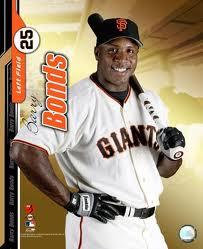
After eight years, millions of dollars in taxpayer money, and endless trees killed for newspaper stories, Barry Bonds was just sentenced to spend a month on his Beverly Hills estate.

If I take steroids and lie about it, can I spend a month there, too?

Seriously — other than the publicity the U.S. Attorney’s Office got for prosecuting the Home Run King, what has all of this accomplished? Are any of us safer now that Bonds has been forced to live under house arrest for 30 days and do 250 hours of community service (that he was going to do anyway)?

I’ve always agreed with Dave Zirin on this one:

After all the public money, drama, and hysterics, this is what we’re left with. He was “evasive.” Keep in mind that we live in a country where the US Department of Justice has not pursued one person for the investment banking fraud that cratered the US economy in 2008. Not one indictment has been issued to a single Bush official on charges of ordering torture or lying to provoke an invasion of Iraq. Instead, we get farcical reality television like the US vs. Barry Bonds.

Did Bonds take a “performance enhancing drug?” Again, Zirin:

The cortisone shot into Curt Schilling ankle in the 2005 playoffs was a performance enhancer. The Viagra coursing through Bob Dole’s veins is a performance enhancer. Whatever keeps that smile glued to Laura Bush’s face is a performance enhancer.

Please: There are real crimes happening all the time, from war crimes to political corruption and fraud, things that actually change the lives of human beings for the worse. And the U.S. Department of Justice has proudly used our taxpayer money to send Barry Bonds home for a month.

I’m so proud of our justice system.

A really dumb article about bookstores

35

You never know what you’re going to get on Slate, which tends toward the neo-liberal and sometimes libertarian, but I just read a particularly awful piece by technology writer Farhad Manjoo, who thinks that local bookstores are economically inefficient and should just go away:

Compared with online retailers, bookstores present a frustrating consumer experience. A physical store—whether it’s your favorite indie or the humongous Barnes & Noble at the mall—offers a relatively paltry selection, no customer reviews, no reliable way to find what you’re looking for, and a dubious recommendations engine.

For a tech writer, Manjoo has a remarkably shoddy understanding of economics:

After all, if you’re spending extra on books at your local indie, you’ve got less money to spend on everything else—including on authentically local cultural experiences. With the money you saved by buying books at Amazon, you could have gone to see a few productions at your local theater company, visited your city’s museum, purchased some locally crafted furniture, or spent more money at your farmers’ market. Each of these is a cultural experience that’s created in your community. Buying Steve Jobs at a store down the street isn’t.

He conveniently ignores that fact that money spent a locally owned, independent business stays in the community — and thus creates more local economic activity and more jobs (not to mention tax revenue for local government). Money spent at Amazon goes to an out-of-town operation that doesn’t even pay state sales tax. You want to read about the well-documehted economic value of shopping at a local story, you can find plenty here and here and here.

And let’s talk about the One Percent — would you rather that your money helps the owner of a small local store buy food for his or her kids, or see the money go to one of the richest people in the world?

But there’s another point here. Like local coffee shops, local bookstores are places where people gather and have actual human interactions. I see my neigbors there; we talk about what we’re reading. When I’m done with books, I can sell them back — and someone else can buy them, used, and I can use the money to buy another new book. Which is a pretty efficient economic system.

And there are things you can’t put a price on: At Red Hill Books, the allegedly inefficent, overpriced local bookstore in Bernal Heights, the employees know me and my kids — and when my daughter, who is a voracious reader, finishes one series of books, they know what to recommend next.

That’s not a “recommendations engine” — that’s a live person.

If Farhad Manjoo wants to live in robo-world where a machine tells you what to eat, drink and read, fine — but I still think human beings, inefficient as we are, do a better job at selling books.


Alerts

0

alert@sfbg.com

WEDNESDAY 14

Is Global Revolution Possible?

The Arab Spring and Occupy movements were catalysts to a worldwide introspection and discontent toward countries’ economic and political systems. Change is necessary in order to place human interest over economic gain. The big questions are on the table with Shimaa Helmy, revolutionary activist in Cairo, Egypt, and Sid Patel, OccupySFer and contributor to SocialistWorker.org.

7 p.m., free

Redstone Building, Third Floor Conference Room

2940 16th St., SF

www.norcalsocialism.org

iso@norcalsocialism.org


THURSDAY 15

Occupy Chevron

The multi-billion-dollar oil corporation Chevron is appealing its property tax assessment for its Richmond refinery and other Contra Costa County facilities, trying to get $150 million back from revenues going to the cash-strapped county and its school district. So the Richmond Progressive Alliance and other groups are organizing a protest outside the hearing of the Contra Costa County Assessment Appeals Board in Martinez. Stop Chevron’s slick lawyers from bullying the community and taking more away from the 99 percent.

11:30 a.m. gathering, rally at noon, free

651 Pine, Martinez Contact: Eduardo Martinez

(510) 412-2260

www.richmondprogressivealliance.net

info@richmondprogressivealliance.net


Rally Against Budget Cuts

The state deadline for mid-year budget cuts approaches and Gov. Jerry Brown’s $2.5 billion additional take backs from public education and other social services launches another stint of heavy austerity measures. Why steal from the poor and the state when you can take taxes from the rich? Sisters United Front for Survival and CalWORKS invite all to congregate and try to save what is left of California services.

5 p.m., free

California State Building

455 Golden Gate, SF

(415) 864-1278

baradicalwomen@earthlink.net


SUNDAY 18

Resist ICE raid

Over 200 workers at the Pacific Steel Castings foundry in Berkeley were fired as a result of a “silent raid’ by the Immigration and Customs Enforcement branch. ICE claims the employees had no legal immigrant status, but this massive firing is damaging the East Bay economy and job market since many of these steel workers had been employees for decades. A community coalition stands in solidarity for those displaced and out of work.

2-4 p.m., free but suggested donations include food, toys, clothing to help families

St Mark’s Hall

159 Harbour Way, Richmond

(510) 233-5215

For more info call Rev. Debbie Lee at 510-903-7106 ext. 319

Or Francisco Herrera at 510-903-7106 ext. 302


Mail items for Alerts to the Guardian Building, 135 Mississippi St., SF, CA 94107; fax to (415) 437-3658; or e-mail alert@sfbg.com. Please include a contact telephone number. Items must be received at least one week prior to the publication date.

Guardian editorial: And now we recommend a national Occupy Day

9

EDITORIAL In less than three months, the Occupy movement has changed the national political debate — and possibly the course of U.S. history. A small group of protesters, derided in the mainstream media, grew to a massive outpouring of anger at economic inequality. It’s no coincidence that politicans at all levels have begun to respond. At least five different measures aimed at raising taxes on the rich are in the works in California. In Kansas Dec. 6, President Obama made one of the most progressive speeches of his career, talking directly about the need for economic justice.

While even some supposed allies say the encampments weren’t effective, the truth is that the out-front, in-your-face tactic of holding nonstop protests in the financial heart of places like Manhattan and San Francisco got attention. The visibility of the Occupy camps forced everyone to pay attention. The U.S. economy is in a crisis; less disruptive tactics wouldn’t have worked. But now most of the emcampments are gone, broken up by police forces and scattered from the central areas of major cities. It’s crucial that this growing and powerful national movement not fall apart after the almost inevitable crackdown on one style of protest. Occupy needs to look forward and plan its next steps.

Some of that is already happening, with Occupy activists targeting home foreclosures and marching on West Coast ports. But it’s worth considering another tactic, too: Occupy ought to begin planning now for a massive spring mobilization in Washington and a series of nationwide actions that could bring millions more people into the movement.

Part of the strategy of the Occupy camps was to maintain a presence, day after day — and that made perfect sense when the movement was starting. But single-day events, if organized on a massive scale as part of a larger campaign, can have a profound and lasting impact.

The original Earth Day — April 22, 1970 — involved 20 million people across the United States. There were events in hundreds of cities and thousands of high school and college campuses. It brought together old-school, sometime stodgy conservation groups with radical young environmentalists, the United Auto Workers with people concerned about pollution from car exhaust. It was, by any reasonable account, the birth of the modern American environmental movement.

The other great thing about Earth Day — and the reason it makes a great model for the Occupy movement — is that it was largely a grassroots event. Although there was a national office, most of the work was done spontaneously, in local communities, with no top-down direction.

And everyone — from Washington D.C. to the state capitols and city halls — paid attention.

Mass marches and mobilizations helped end the Vietnam War, spark the Civil Rights Movement and fight the anti-labor politics of the Reagan Administration. None of those events took place in isolation, any more than a national Occupy Day would take place in isolation. The nation’s ready for major economic change — and organizing a national event alone could help make stronger connnections among the broad constituency that is the 99 percent.


Lowe’s: The anti-Muslim neighbor on Bayshore

9

I don’t shop at Lowe’s. Don’t go to Home Depot or Wal-Mart (those folks have enough money as it is), either. I don’t like big-box retail in general, and I was opposed to bringing a big-box, out-of-state chain to build a store on Bayshore Boulevard. I think shopping local and spending your money with small merchants who are part of the community is good for the economy. 

But thanks to lobbyist Jack Davis, who was hired at some vast sum of money to bring Home Depot to San Francisco, and then-Mayor Willie Brown, who bought Davis’s line, Home Depot won permission to build on Bayshore — and when the Georgia-based company decided not to bother and left the site vacant, Lowe’s (based in North Carolinia) stepped in.

And now we know what an excellent neighbor the giant retail outlet has turned out to be. Lowe’s has decided to pull its ads from the Discovery Channel’s All-American Muslim show because some right-wing Christian nut-group objects to anything that doesn’t demonize the Islamic religion and all who follow it.

What a fine, upstanding company to welcome to San Francisco.

Occupy’s next steps

6

EDITORIAL In less than three months, the Occupy movement has changed the national political debate — and possibly the course of U.S. history. A small group of protesters, derided in the mainstream media, grew to a massive outpouring of anger at economic inequality — and it’s no coincidence that politicians at all levels have begun to respond. At least five different measures aimed at raising taxes on the rich are in the works in California. In Kansas Dec. 6, President Obama made one of the most progressive speeches of his career, talking directly about the need for economic justice.

While even some supposed allies say the encampments weren’t effective, the truth is that the out-front, in-your-face tactic of holding nonstop protests in the financial heart of places like Manhattan and San Francisco got attention. The visibility of the Occupy camps forced everyone to pay attention. The U.S. economy is in a crisis; less disruptive tactics wouldn’t have worked. But now most of the encampments are gone, broken up by police forces and scattered from the central areas of major cities. It’s crucial that this growing and powerful national movement not fall apart after the almost inevitable crackdown on one style of protest. Occupy needs to look forward and plan its next steps.

Some of that is already happening, with Occupy activists targeting home foreclosures and marching on West Coast ports. But it’s worth considering another tactic, too: Occupy ought to begin planning now for a massive spring mobilization in Washington and a series of nationwide actions that could bring millions more people into the movement.

Part of the strategy of the Occupy camps was to maintain a presence, day after day — and that made perfect sense when the movement was starting. But single-day events, if organized on a massive scale as part of a larger campaign, can have a profound and lasting impact.

The original Earth Day — April 22, 1970 — involved 20 million people across the United States. There were events in hundreds of cities and thousands of high school and college campuses. It brought together old-school, sometime stodgy conservation groups with radical young environmentalists, the United Auto Workers with people concerned about pollution from car exhaust. It was, by any reasonable account, the birth of the modern American environmental movement.

The other great thing about Earth Day — and the reason it makes a great model for the Occupy movement — is that it was largely a grassroots event. Although there was a national office, most of the work was done spontaneously, in local communities, with no top-down direction.

And everyone — from Washington D.C. to the state capitols and city halls — paid attention.

Mass marches and mobilizations helped end the Vietnam War, spark the Civil Rights Movement and fight the anti-labor politics of the Reagan Administration. None of those events took place in isolation, any more than a national Occupy Day would take place in isolation. The nation’s ready for major economic change — and organizing a national event alone could help make stronger connections among the broad constituency that is the 99 percent.

Dick Meister: Unemployment is slamming public employees

18


By Dick Meister

Dick Meister, former labor editor of the SF Chronicle and KQED-TV Newsroom, has covered labor and politics for more than a half-century. Contact him through his website, www.dickmeister.com, which includes more than 350 of his columns.

The latest job reports show that public employees, those favorite targets of Republicans and other government budget slashers, are being hit particularly hard by the country’s severe unemployment problems.

As the New York Times reported, 20,000 government workers were laid off in November alone, most of them state, county and city employees.

The public workers’ unemployment numbers have been steadily increasing for the past several years, at the same time that the jobless figures for workers in private employment actually have been decreasing.

In fact, private employers have been adding jobs since the end of 2009, a year after the beginning of the Great Recession. More than a half-million government jobs have been lost since the recession began.

The Times noted that in most cases, the layoffs were made because of declining tax revenues, or reduced federal aid “because of Washington’s inexplicable decision to focus more on the deficit in the near term than on jobs.”

The layoffs mean “a lower quality of life . . . fewer teachers, pothole repair crews and nurses.” It’s been happening all over the country, of course. The Times cited as a typical example what’s been happening in the Indiana city of Marion, population 30,000.

Marion city officials recently announced what they called a “radical reorganization” of city services that will mean laying off 15 of the city’s 58 police officers and 12 of its 50 firefighters. Radical, indeed. That’s more than 25 percent of Marion’s police and firefighters.

As elsewhere, the layoffs of course reduce vital public services, but it’s important to note that they also of course have a serious impact on those who lose their jobs. The impact has been especially harsh on African- American workers.

The Times’ Timothy Williams reported that one-fifth of the nation’s millions of black workers “have entered the middle class through government employment” and tend to make 25 percent more than other African-American workers. But now tens of thousands are being forced to leave both their jobs and the middle class.

The Times cited as a prime example the city of Chicago, which is scheduled to lay off more than 200 employees in the next fiscal year, two-thirds of them African-Americans.

It shouldn’t be surprising, then, that the African-American jobless rate has risen to more than 15 percent nationwide, almost double the rate for other workers.

As the Times said, the effect has been severe – “destabilizing black neighborhoods and making it harder for young people to replicate their parents’ climb up the economic ladder.” Their rise was made largely by the government jobs that they’re now losing without much hope of finding other jobs, given the current tattered state of the economy and continued job discrimination against African-American workers generally.

It certainly would be hard to disagree with the Times’ conclusion that much of the public job losses and consequent cutbacks in public services stem from the fact that many Republicans “don’t regard government jobs as actual jobs, and are eager to see them disappear. Republican governors around the Midwest have aggressively tried to break the power of public unions while slashing their workforces, and Congressional Republicans have proposed paying for a payroll tax cut by reducing federal employment rolls by 10 percent through attrition.”

That 10 percent, the Times pointed out, is 200,000 jobs. And, surprise! Many of those jobs “would be filled by blacks and Hispanics and others who tend to vote Democratic.” So, said the Times, those workers “are considered politically superfluous” by the GOP.

But, the Times concluded, “every layoff, whether public or private, is a life, and a livelihood, and a family. And too many of them are getting battered by the economic storm.”

Dick Meister, former labor editor of the SF Chronicle and KQED-TV Newsroom, has covered labor and politics for more than a half-century. Contact him through his website, www.dickmeister.com, which includes more than 350 of his columns.


Michael Goldstein, 1953-2011

7

news@sfbg.com

San Francisco lost a valued champion of progressive causes on Dec. 2 when Michael Goldstein lost his battle with stage 4 lymphoma after surviving nearly 20 years living with HIV, a disease that helped awaken his political activism.

Michael was born in 1953 in New Mexico, where he was raised. His grandparents had come to New Mexico after surviving the Holocaust, and Michael came to the San Francisco in the early 1980s. Like many gay men of his generation, Michael came here to find community, to create family, and to be welcomed when much of the country was still hostile to the LGBT community.

He worked at Neiman Marcus, dressing “the San Francisco A list,” as he used to say. He studied at City College towards a paralegal certificate and was heavily involved in student politics. He landed a job at AIDS Legal Research Panel, where he worked when he was diagnosed HIV-positive in the mid-’80s.

The news hit hard, and the treatment he began took its toll. The HIV drugs were harsh then and there were many horrible side-effects with these early drugs. At that time, there was very little information or education about HIV/AIDS and there was even less support, from families and from the public.

Our San Francisco political community became Michael’s family. He was also blessed with an amazing friend in Lorae Lauritch. They worked together at NM, became roommates, and lived together with some incredible cats that were dear to him, including Paloma, Huey, Cadeau, and Missy.

Michael was a proud feminist who valued the women in his life and community, leading him to endorse a pair of successive female candidates for the Castro’s District 8 seat on the Board of Supervisors: Eileen Hansen in 2002 and Alix Rosenthal in 2006.

Over the years, Michael served as an elected member of the Democratic County Central Committee (serving as vice president), served as President of the Harvey Milk LGBT Democratic Club, and was appointed to a San Francisco City College citizen oversight board, where his questioning helped bring attention to mishandling of funds at that institution.

Michael was determined, opinionated, persistent, intolerant of bullshit, prickly, always questioning. He challenged us all to move a common agenda, come together beyond our own personal ambitions, but to also never back down out of convenience or feigned civility. “Civility doesn’t make change,” he often said.

I came to know Michael as many came to know him. Michael always showed up in support of every one of our causes. He not only showed up, he advised, opined, debated, argued, protested, got arrested, drafted policy, and so much more. Campaign after campaign, issue after issue — our friendships grew around our passion for politics, our deep concerns about everything, and a strong and unwavering belief that anyone can help make change.

Michael believed that and Michael lived that.

In the past few years, many of us noticed that Michael wasn’t feeling well. We pushed him to go to the doctor. This is a man who spent hours fighting to push through HIV/AIDS policy and funding, healthcare reform, Healthy SF — and he did not have healthcare, had not seen a doctor in nearly 10 years, and was not treating his HIV.

As many know, Michael and I were like brother and sister…often bickering back and forth on whatever was going on. We “debated” like the dear friends we had become. His lack of healthcare was one of the more important issues I would bring up often. As a long term survivor of this condition, Michael knew the score.

As the symptoms of this disease ravaged his body, he retreated from us and attempted to make sense of the unimaginable alone.

Finally at the end of September, Michael was admitted to General Hospital. With the amazing care of Ward 5A, Diane Jones, and all the amazing General Hospital workers, as well as Laguna Honda Staff and at his final resting place UCSF — his care, though coming too late, was the best in the world and gave Michael a fighting chance. He was clearly comforted and supported by his community in his final days, support that mattered so much to him.

If you knew Michael, you know there is a “what comes out of this” part. We all got to really see the results of the hard work we all participated in to rebuild General Hospital, to rebuild Laguna Honda, and to provide healthcare access to everyone, even the poorest among us. Michael, personally, was able to experience the fruits of our collective labor over these years.

He also experienced some areas where there really is a need for some work. We need to remember that AIDS/HIV is still killing people every day. We must improve people’s access to healthcare. We need to protect patients’ access to medical cannabis, even in General Hospital. We need services and we need housing, particularly affordable housing for those who need it, people struggling through this bad economy.

These are our issues and this is our agenda on the left that we have been fighting for.

I will never forget Michael. One of the last real discussions we had about politics was around election time, with Michael remembering the 2010 elections. Michael was probably more upset about what has come out of that election — the beginning of a political shift to the right in San Francisco — than many.

He has been such an integral part of the work that brought our progressive community together and he was devastated by the events tearing it apart. More than anything, he wanted to bring us together, but he ran out of time.

Michael had an agenda. His agenda was to move forward our agenda. It is time to come together and do that.

Debra Walker is an artist, activist, DCCC member, and city commissioner who ran for the District 6 seat on the Board of Supervisors last year.

Homes for the 99 percent

0

news@sfbg.com

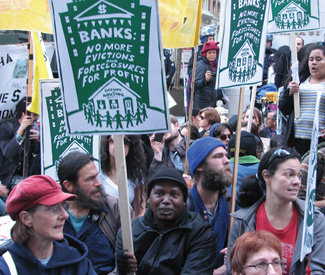
Pressed by foreclosures, evictions, and an economic crisis with the gnawing tenacity of an early winter flu, San Franciscans protested in neighborhoods throughout the city on Saturday, Dec. 3. Marches from four of the city’s most impacted neighborhoods merged in the Financial District to pressure landlords, banks, and what the Occupy movement has dubbed the 1 percent to ease the spreading hardship surrounding housing in San Francisco.

“The 99 percent tenants and homeowners can no longer let the 1 percent banks and real estate speculators destroy our city and our lives so we’re marching in the neighborhoods and on the streets today,” asserted the statement read by the Occupy SF Housing coalition to the crowd gathered in the Financial District. The message echoed through the glass and granite corridors in front of Wells Fargo, passed along in a thousand voices by the now ubiquitous “mic check” style of Occupy crowd communication.

Housing advocates warned that a steady stream of foreclosures, climbing rents, and lagging job opportunities are driving even native San Franciscans out of the city for the relatively affordable housing in the East Bay or forcing them out of the region altogether, transforming the face of San Francisco into an older, whiter, wealthier demographic.

Throughout the economic crisis, San Francisco as a whole has posted lower foreclosure rates than surrounding counties. At first glance, San Francisco, with one in 880 homes facing foreclosure, looks like a safe harbor in the state’s troubled residential real estate market compared with the statewide foreclosure rate of one home in 243, according RealtyTrac. That represents 55,312 residential units across the state. Nationally, one in 563 homes was in some stage of foreclosure as of October 2011, the most recently released numbers.

However, a near absence of foreclosures in affluent, stable, San Francisco neighborhoods like Pacific Heights and Noe Valley hide troubling foreclose rates in the city’s blue collar ZIP codes that far exceed national and statewide levels. In the 94124 zip code that includes the Bayview and Hunters Point, one in 180 homes received foreclosure filings, higher then Oakland’s overall average rate of one in 245 homes — levels that reflect the experience of some of the nation’s most hard hit areas.

Of the 1,513 homes currently listed on the San Francisco housing market, 1,255 were in the pre-foreclosure, auction, or bank-owned stages of the foreclosure process, representing roughly 82 percent of the available housing stock.

At the downtown headquarters of Wells Fargo, Occupy protesters were placing some of the blame for the deepening hardship at the feet of the big banks. According to the Occupy SF Housing coalition, Wells Fargo is the mortgage lender for 226 homes in San Francisco that are in some stage of foreclosure. That represents about 18 percent of the total homes in San Francisco under foreclosure.

In neighborhoods like Hunters Point, these evictions have turned into an economic cascade of household wealth in decline, even for those who have managed to hold onto their homes.

With foreclosures flooding the market, the median sales price for homes in Hunters Point from Aug. 11 to Oct. 11 was $167,500. This represents a decline of 13.2 percent, or $25,500 per home on average, compared to the prior quarter. Sales prices have depreciated 62.6 percent over the last five years in Hunters Point, wiping out equity families have built over years, and leaving those who hang on stuck in underwater mortgages, where their debt far exceeds the value of their home.

“Predatory equity loans make a quick profit (for the lender) at the expense of home owners in the Bayview,” said Grace Martinez of the Alliance of Californians for Community Empowerment (ACCE). “There are 11 homeowners on a two-block stretch of Quesada in default or have already lost their homes.”

While the Obama administration has tried to ease the foreclosure crisis through the federally subsidized Home Affordable Modification Program (HAMP), only a small percentage of people who apply through their mortgage holder for relief under the program receive a loan adjustment. At Wells Fargo, only one in five borrowers applying for HAMP relief have received a loan modification.

Protesters sitting in the streets in front of Wells Fargo demanded that the company establish a moratorium on all foreclosures until it reforms its loan modification practices, halts the eviction of homeowners who have faced foreclosure, and instead offers them a rental option to keep them in their homes — a solution they say will ease the suffering of those caught in the middle of the banking crisis.

The banking and real estate driven economic crash has lead to the largest drop in home ownership nationally since the Great Depression. At the same time that home ownership has become increasingly out of reach for many San Franciscans, increases in rental rates and high competition for rental units are driving out many blue collar San Franciscans from the transit-friendly Mission District, in favor of a generally younger, wealthier, more educated, tech-savvy population.

As rallies took place across the city Saturday in the lead up to the afternoon’s Wells Fargo protest, a group of concerned residents and community groups gathered at 24th and Mission to highlight San Francisco’s other housing crisis — the rental market. The other marches started in the Castro, the Bayview, and the Tenderloin.

Much of the turnover of long-occupied rent controlled housing units in San Francisco comes as a result of the Ellis Act, a state law that allows evictions when an owner’s family wants to move in or when the unit is taken off the rental market. Brenda Nedina’s family is facing an Ellis Act eviction at 874 Shotwell Street.

“I’ve lived in that unit my whole life. My family has lived in the unit for 28 years,” said the tearful, 25-year-old San Franciscan native. “We would love to stay here, but with rents so high, it is not likely that we would find a place in San Francisco.”

Nedina, who works a service industry job at Pier 39, says the economic crisis has made it more difficult for her survive in San Francisco. She has had to cut down her college course load to get by in the tough economy. The troubles will get more complicated if her family is priced out of the city, as critical health services that they rely on are available through their San Francisco residency.

“A lot of people suffer through this as a private problem, but we are making it a public problem, and if the problem belongs to all of us then so does the solution,” said Maria Poblet of Just Cause, hugging a tearful Nedina as she addressed a crowd gathered at 24th and Mission streets.

Latino families like Brenda’s continue to be forced out of the Mission District by rising rent, and less economic opportunity for them in the recession. According to the 2010 U.S. Census, the past decade has seen a 22 percent decrease in the Mission’s Latino population.

“Landlords often abuse the Ellis Act as a way to remove tenants from rent controlled units,” Just Cause organizer Maria Zamudio told the Guardian. “I’m occupying Kaleidoscope free speech zone art space on 24th and Folsom. My slumlord landlord is not down with that mission,” said artist and gallery proprietor Sara Powell, also facing a Ellis Act eviction after pressuring her landlord to address substandard building maintenance issues. Powell’s landlord withdrew a standard eviction process that housing advocates said was unlikely to succeed before launching the Ellis Act eviction.

“With the help off the 99 percent and with right on our side we are going to fight this and we are going to win,” said Powell, whose gallery next door to Philz Coffee is a cornerstone of the neighborhood’s multi-ethnic arts scene. The San Francisco Rent Board has received more than 4,000 petitions to remove rental units from the real estate market since 1999 through the Ellis Act. While Ellis Act evictions have seen some decline during the economic crisis, more Ellis Act evictions are now concentrated in the Mission District, where 40 percent of all Ellis Act petitions are now filed. At the same time, evictions based on breach of lease throughout the city are on track to double pre-recession numbers this year as more and more San Franciscans are have trouble earning enough to keep up with the city’s exorbitant rental rates. According to Just Cause, the average rent for a two-bedroom apartment in the Mission District is now $2,497. “The only way to keep our Chinese, Latino, Arabic, English speaking neighborhood is to fight like hell for our homes,” said Poblet. “Even before Wall Street was occupied, we have been defending this neighborhood. This is the neighborhood of the 99 percent.”

Editor’s notes

0

tredmond@sfbg.com

The private sector that Republicans see as our economic savior has been creating jobs. Not a lot, a few hundred thousand a month, but some. And yet the unemployment rate remains stubbornly high.

There’s a reason for that, one politicians from San Francisco to Washington D.C. don’t want to talk about. But the New York Times put it nicely in a Dec. 5 editorial:

“While the private sector has been adding jobs since the end of 2009, more than half a million government positions have been lost since the recession…”

“The cutbacks hurt more than just services. As Timothy Williams of the Times reported last week, they hit black workers particularly hard. Millions of African Americans — one in five who are employed — have entered the middle class through government employment, and they tend to make 25 percent more than other black workers. Now tens of thousands are leaving both their jobs and the middle class.”

Remember: Most of the biggest employers in this city are not corporations; they’re government agencies. The City and County of San Francisco, the University of California, the State of California, the United States Postal Service, City College and the San Francisco Unified School District drive the local economy more than any one private company. Between them, those public-sector operations employ more than 60,000 people. The largest single private employer, Wells Fargo, has fewer than one sixth of that number.

Most of the those public-sector jobs are unionized and offer decent benefits. They are such an important part of the city’s economic development future that it’s impossible to talk about jobs in San Francisco unless you start the conversation with the public sector.

Mayor Ed Lee is about to enter negotiations with unions representing 24,000 city employees. His office is already indicating that cost savings will be a big part of the discussion. I know there are cost savings out there — you can’t spend $2 billion on payroll and not have some waste somewhere in the package.

But if he’s serious about his campaign mantra — jobs, jobs, jobs — I hope he remembers what the Republicans don’t: Government jobs count, too.

Bank of America frets about Occupy

An internal Bank of America email has surfaced, making it clear that the megabank is concerned about the national day of action against evictions and foreclosures being carried out today, Dec. 6, by the Occupy Wall Street movement. The leaked internal memo suggests BofA is taking Occupy housing actions very seriously.

According to the email, which was sent to BofA’s third-party Field Services suppliers, the nationwide protests “could impact our industry.”

“We believe protests will likely take place tomorrow at auction sites, homes that are being foreclosed, homes in the eviction stage, and vacant homes,” the BofA memo notes. “We want to make sure that we are all prepared.”

It goes on to emphasize three points: do not engage with the protesters, ensure that vacant homes are secured, and report “media incidents” to 800-796-8448. I called that number to verify that the email was real, and sure enough, a spokesperson confirmed that it was.

The memo concludes with proof that the Bank of America has been paying close attention to activist websites. “The website occupyourhomes.org has a story posted of a Bank customer we are researching,” the email notes. “The web site has an event finder that can help identify upcoming protests.”

After the Guardian called the BoFA to determine whether the email was real, media relations representative Jumana Bauwens followed up with this statement:

“As a matter of normal course of business, when we are alerted to activities that may affect our real estate owned properties, we inform our third party contractors. This is standard operating procedure. The safety of our associates and third party contractors is our first priority. It is the bank’s policy to protect and secure our properties for the investors who own them. Bank of America is committed to helping our customers with home retention solutions and other foreclosure avoidance programs. Foreclosure is always our last resort.”

Dick Meister: Six ways to heal the economy

8


By Dick Meister

 Dick Meister, former labor editor of the SF Chronicle and KQED-TV Newsroom, has covered labor and politics for more than a half-century. Contact him through his website, www.dickmeister.com, which includes more than 350 of his columns.

The AFL-CIO has come up with an ambitious six-point plan for healing our very sick economy – one of the best plans that have yet been suggested by anyone.

Point one calls for rebuilding the school, transportation and energy systems by spending at least $2.2 trillion to restore crumbling 20th century infrastructure. As the AFL-CIO says, it would be an investment that would put millions of people to work while laying the foundation for the nation’s long-term growth and competitiveness with other nations.

Point two is as direct: “Revive U.S. manufacturing and stop exporting good jobs overseas.”  That would involve, among many other steps, reforming and enforcing tax policies that are currently encouraging U.S. companies to have manufacturing done in other countries. And enhance Buy America standards, increase investment in job training and oppose free trade deals.

Point three: Provide federal help for hiring people to do at least part of the work that needs to be done nationwide. That could create millions of jobs in distressed communities, especially communities of color, where much of the work is badly needed. In doing so, pay competitive wages and do not replace existing jobs.

Point four: Help federal, state and local governments avoid more of the layoffs and cutbacks of public services that have been a major drag on the economy. Congress should make a commitment to not lay off any more federal employees. It should prevent more state and local layoffs by providing increased federal funding of Medicaid when unemployment is high and providing additional federal funds directly to communities “to save and create jobs and protect and restore public services.”

Point five: Extend unemployment benefits for at least a year to those whose benefit payout time has expired. “Our economy continues to suffer from a massive shortfall of consumer demand . . . the primary reason why businesses are not hiring.”

The AFL-CIO calls for combining the extension of benefits with providing relief to homeowners facing foreclosure. If banks lowered the principal balance on mortgages to current market value, the AFL-CIO calculates that “over $70 billion a year would be pumped back into the economy, millions of families would be able to stay in their homes and over one million jobs would be created.”

Point six: “Reform Wall Street so that it helps Main Street create jobs.” That would mean channeling capital into productive sectors of the economy – more lending to small businesses, for instance – and enacting a federal financial speculation tax to discourage harmful speculation and “make Wall Street pay to rebuild the economy it helped destroy.” The government should “enforce tough safeguards to stop the kind of cheating and massive fraud on Wall Street that precipitated the crisis of 2008.”

Many of those who did indeed cause the crisis are still in control, many still doing just what brought on the economic ailments that so deeply affect the country. It will take a lot to loosen their tight grip on the economy. But it can be done if we are wise enough to adopt reforms such as the AFL-CIO advocates.

Dick Meister, former labor editor of the SF Chronicle and KQED-TV Newsroom, has covered labor and politics for more than a half-century. Contact him through his website, www.dickmeister.com, which includes more than 350 of his columns.

More backroom policy talks with the California Public Utilities Commission

On Dec. 8 and 9, high-ranking state government officials will attend a private conference with executives from Pacific Gas & Electric Co. (PG&E), Chevron, AECOM, and other major energy industry players at Cavallo Point, a luxury resort in Marin County to talk about distributed generation, a decentralized system for renewable power. It’s a gathering of top governmental officials and industry leaders to talk about policy issues with far-reaching effects on California’s energy future, but members of the general public are not invited.

As officials pack their bags for the conference at the plush resort, California Sen. Leland Yee is preparing two separate pieces of legislation designed to promote transparency within the California Public Utilities Commission (CPUC) and to make it harder for energy company executives to transition seamlessly into posts at the CPUC, the governing body that regulates utilities.

The conference is being organized by the California Foundation for the Environment and the Economy (CFEE), a nonprofit funded by investor-owned utilities and other corporations that wield tremendous influence in the Bay Area.

The Guardian spotlighted CFEE in an article about California Public Utilities Commission (CPUC) President Michael Peevey, who regularly participates in educational travel excursions funded indirectly by the companies his commission oversees.

When CFEE spokesperson PJ Johnston was interviewed for that article, he justified CFEE events by saying, “The idea for us was that it made sense to have someplace where it was nonconfrontational to engage in policy, work-type discussions,” and added they’re “all about policy, on the 30,000-foot level.”

Peevey will be attending this conference, according to a list of participants posted on CFEE’s website. So will PUC commissioners Mark Ferron, Michael Florio, and Nancy Ryan. By press time, the CPUC had not returned calls seeking comment about why commissioners are participating.

More than a dozen California senators and assembly members are listed as conference participants, as are the director and deputy director of Gov. Jerry Brown’s Office of Planning and Research, Ken Alex and Wade Crowfoot. (Crowfoot previously served in former Mayor Gavin Newsom’s administration as an environmental advisor. Newsom now serves at the state’s lieutenant governor.) Executives from Shell Energy North America, the Alliance of Automobile Manufacturers, Southern California Edison, and other heavy hitters in the industry will attend the conference too.

The conference agenda features educational sessions on distributed generation and state renewable energy goals. Several environmental and consumer advocacy groups will be present as well.

Mark Toney, executive director of The Utility Reform Network (TURN), a consumer advocacy group, also plans to attend. “Events like this give the utility industry and energy regulators an opportunity to have policy discussions and to influence policy decisions outside of the political process. It’s a privileged space,” Toney acknowledged. “We don’t think this is a good way to make policy.”

Yet he said advocacy groups like his own face a dilemma when deciding whether to participate in such events. “On one hand, we could decide we want to have nothing to do with it. But if TURN isn’t represented, then the view of ratepayers and consumers won’t be represented by anybody.” He stressed that while TURN attends daylong conferences hosted by CFEE in order to gain access and hopefully have a positive influence within that priveleged space, the group does not participate in travel excursions organized by the organization, which have drawn controversy in the past. “It’s kind of a judgment call,” he added.

Closed-door, backroom policy discussions aren’t the only CPUC transparency problem drawing scrutiny lately. Recent press reports have spotlighted instances of the CPUC denying public access to safety reports, a highly sensitive issue given the fatal pipeline explosion that destroyed a neighborhood in San Bruno last year.

On Nov. 29, Sen. Yee announced he would introduce legislation in early 2012 to subject the CPUC to the California Public Records Act, by stripping away provisions that allow the commission to block the release of information. It would place the body on the same footing as other state agencies with regards to information sharing.

“If you want anything out of the PUC, it takes an affirmative vote of the commission,” explained Adam Keigwin, Yee’s legislative aide. Secretary of State and former Assembly Member Debra Bowen initiated a similar push for transparency at the CPUC in 2006, but the effort did not go anywhere. On Nov. 30, Yee sent a letter to Peevey, the CPUC president, asking for the results of a study on transparency issues that the commission was supposed to undertake nearly six years ago when Bowen was pushing for the bill.

Keigwin added that Yee is also looking at legislation that would bar utility executives from serving on the PUC for a certain length of time, so as to prevent undue influence.

The food divide

4

news@sfbg.com

Antonia Williams is part of a slow, quiet food revolution. After battling obesity for much of her adult life, the 26-year-old lifelong Bayview resident did some research. “I realized it had a lot to do with the food I consumed,” she told us. “As a result of growing up in the neighborhood, I suffer from obesity. I’m overweight because of the lack of options for good healthy food.”

“It’s what I grew up on, McDonald’s and a lot of fried food for dinner,” she recalls. “The grocery stores in the area were very limited in what they offered. I believe my parents weren’t as educated or aware” about health and nutrition.

Williams managed to escape this bad foods trap, change her personal diet, and now works as a “food guardian” for the nonprofit Southeast Food Access (SEFA), helping to bring more nutritious fare to the Bayview.

The complex of challenges Williams faced simply to eat well—the fast food all around her, the dearth of grocery stores, and lack of awareness—reflects the array of systemic barriers to good food that keep tens of thousands of San Franciscans in chronically poor health.

Under the weight of recession and double-digit unemployment, San Francisco’s chronic food divide has grown deeper and wider. From regions of the city like Bayview, Excelsior, and other Southeast neighborhoods, to seniors surviving on marginal fixed incomes, to the city’s swelling unemployed and underemployed who rely on food pantries, access to fresh food is a daily geographic and economic battle.

Roughly one in five San Franciscans each day has no reliable source of adequate sustenance and must scramble for food from soup kitchens, food pantries, or other “emergency” supplies that have become a structural part of the city’s food system, according to the San Francisco Food Bank.

Each month, more than 100,000 families rely on the Food Bank to help feed themselves — nearly double the amount from 2006. Economic recession has dramatically increased the number of city residents using food stamps (known as “CalFresh”) each month, rising from 29,008 in 2008 to 44,185 in 2010.

Yet even that rise belies a far deeper need: only 47 percent of those qualifying for CalFresh are actually accessing benefits, according to a data analysis by California Food Policy Advocates; at minimum, more than 40,000 additional city residents are entitled to get this help, and thus eat better.

Across the city, parallel economic and food divides compound one another, spelling serious trouble for people’s basic nutrition and health — in turn depleting their energy, cognition, and ability to do everything from succeeding in school to getting a job.


BEYOND GROCERY STORES

In Bayview, where poverty and unemployment run about double citywide averages, these geographic and economic food divides come to a head. District 10, encompassing Bayview/Hunters Point (BVHP), features some of the city’s most grocery-impoverished neighborhoods, and has the highest rates of CalFresh usage.

This confluence of lack and need—compounded by a prevalence of fast food and liquor stores over fresh food offerings—has inspired Antonia Williams and other residents to fight for better food in their neighborhoods.

As one of four paid Food Guardians for SEFA, Williams spends about 20 hours a week examining grocery store shelves in Bayview, talking with consumers and food retailers, and educating both about the need for more fresh non-processed foods.

One recent victory: armed with customer survey data, she convinced the Bayview Foods Co. to stock low-sodium tomato paste. Next on Williams’ food improvement list is getting more low-sodium products, less cholesterol, and more fiber on the shelves.

These may sound like small steps, but they’re part of a larger effort to get healthier food in Bayview, where chronic diseases such as obesity, diabetes and heart disease are rampant. “I think a lot of people just don’t know the link between the food we are eating and these chronic diseases,” says Williams.

The Bayview is among the city’s most food-deprived districts, with just 63 percent of residents living within a half-mile of a supermarket (in Excelsior, it’s 57 percent), compared with 84 percent citywide. That ratio improved somewhat with the arrival this August of Fresh & Easy supermarket on Third Street, but access to fresh produce remains limited — a situation that numerous studies show contributes greatly to chronic undernourishment and disease.

Indeed, statistics show Bayview area residents suffer by far the city’s “highest rates of everything negative,” as former district supervisor Sophie Maxwell puts it: obesity, diabetes, heart disease, and cancer.

Ironically, the Bayview’s Third Street is home to the city’s bustling produce warehouses, which rattle early every morning with trucks and crates full of fruits and vegetable, “but you have to go out of the district to get it,” says Maxwell, who helped spearhead a Food Security Task Force while in office. “I was very much aware of [the food access problem] because of what I had to do to get food myself.”

Much of Third Street remains a boulevard of liquor stores and fried and fast food. According to Tia Shimada of California Food Policy Advocates, “A lot of what we see instead of food deserts is food swamps, where the amount of healthy nutritious food available is overwhelmed by all the fast food and junk food.”

Despite a seemingly diverse landscape of food businesses, “There’s a saturation in neighborhoods with unhealthy choices,” SEFA’s Tracey Patterson argues. “When the cheapest choice in front of you is fatty comfort food and fast food, that’s what you get accustomed to eating. The easier options quickly become habit.”

Kenny Hill, a 23-year-old food guardian and Bayview resident, puts it like this: “What we have in our community, that’s what we eat.” But he says history and culture play a role, too. “We need to change the culture of what’s considered good…Growing up eating salad, people would say, ‘Why are you eating that? That’s white people’s food.'”

In other words, it takes more than getting a grocery store—which itself involved a nearly 20-year struggle for Bayview residents and leaders. “Food access is just one part of the issue. Even if you get a grocery store, that doesn’t solve the problem,” says Patterson, whose group, SEFA, espouses “three pillars” to fix the area’s food problems: more grocery stores; education and health literacy; and expanded urban agriculture. “None on their own is enough.”


HUNGER CROSSES LINES

Getting a job isn’t enough either, statistics show. A recent study by the USDA cited by the Food Security Task Force shows that 70 percent of families nationwide with “food insecure” children have at least one member working full-time. And in San Francisco, the task force found, “39 percent of the households that receive weekly groceries through the SF Food Bank include at least one working adult. Only 18 percent of clients are homeless.”

At least by federal definitions of poverty, food insecurity isn’t just for poor people anymore — particularly in San Francisco, where exorbitant housing and other costs compound people’s struggles to meet their food needs. “If you just look at the poverty level, you’re missing a lot of people who are struggling to make ends meet,” says Colleen Rivecca, advocacy coordinator with St. Anthony’s Foundation. “Hunger and health and housing are so interconnected.”

Indeed, while the Federal Poverty Level for a family of three is $18,310, cost-of-living research by the INSIGHT Center for Community Economic Development found that in San Francisco, this family would need almost $40,000 more than that to make ends meet.

Rivecca says the ongoing recession is simultaneously deepening the food divides and undermining efforts to address it. For instance, SSI recipients must make do with $77 a month less than they got in 2009, while California is the only state where SSI cannot be supplemented by food stamps.

According to the Food Security Task Force, San Francisco “has an inordinately high number of residents who are elderly, low-income and/or blind and disabled — over 47,000 residents receive SSI.” Many are homebound, socially isolated, and living in SRO units without kitchens, and no means of preparing their own food. So it’s no surprise that these same people, who need help the most, often get it the least.

Due to “misconceptions about what qualifies,” says CFPA’s Kerry Birnbach, only 5 percent of Californians eligible for Social Security participate in CalFresh. “Senior citizens are more isolated, and the more isolated you are, the less likely you are to know about it.” Birnbach says that leads to lower nutrition, less energy, and greater hospitalization rates. “It’s not having food on the table — choosing between food and medicine.”

A 2006 study by the San Francisco Department of Aging and Adult Services found that while the city’s elders “received approximately 12.2 million free meals through all of the programs in the City including food pantries, free dining rooms, and home delivered meals, the gap between the number of meals served and the number of meals needed was somewhere between 6 [million] and 9 million meals annually.”


BAND-AID FOOD SYSTEM

As television cameras made clear on Thanksgiving, there’s no shortage of food and meal giveaway programs, soup kitchens run by churches and nonprofits — a whole constellation of ad hoc benevolence spread across the city. But this kind of “emergency food assistance” has become a structural part of the city’s dietary landscape.

Another main ingredient in the city’s food infrastructure is seemingly cheap fast food, which for many poor people becomes the diet of first and last resort. Sup. Eric Mar recalls meeting with teenage mothers and hearing one parent speak about dumpster diving at McDonald’s for what she called “fancy dinner.”

“The cheapest possible food like McDonald’s is seen as a luxury,” says Mar, who last year passed legislation preventing fast food chains from selling kids meals with toys unless they improved their nutrition content. “Poor people rely on whatever’s out there, and when McDonald’s or Burger King sells cheap, it undercuts families’ efforts to get healthy.”

District 10 Sup. Malia Cohen sees the impacts of fast food and junk food every day in Bayview. “There is no infrastructure out there to de-program people” from long-standing fast food habits. “I don’t fault people for eating fast food, but I do want them to think twice and know they have a choice.”

So what is the choice, and how will the city address its deep food divides, which cut across geographic and demographic lines?

So far, it’s a patchwork project. As one step, the supervisors in April passed a new zoning ordinance designed to encourage more urban food production. In Bayview, Cohen says, “We’re looking at urban agriculture as something that’s viable” to feed low-income residents.

Despite the arrival of Fresh & Easy, BVHP remains a critical flashpoint for the food security fight. Markets for fresh produce are few and far between. In 2006 the Department of the Environment teamed with Girls 2000 and Literacy for Environmental Justice to create the Bayview Hunters’ Point Farmers Market, but for a variety of reasons, the customer base wasn’t sufficient for farmers to keep selling there, and the project stalled. Now there is talk of reviving a farmers market in the area.

But for larger, more structural change to take hold, Mar argues, the food gap “has to be a citywide goal and priority.” And, he notes, bigger forces — notably agribusiness lobbies and congressional agriculture committees — make local progress more difficult. “It’s hard because the Farm Bill allows these food companies and commodity groups to keep their prices lower, and small businesses and producers have a hard time keeping their prices low,” encouraging more fast food and obesity and other diet-related diseases.


GREEN GLIMMERS

On a chilly gray late afternoon the day before Thanksgiving, we met with Patterson, Williams, and two other food guardians at Bridgeview Community Garden on the corner of Newhall and Revere in Bayview. Perched on a small chunk of slope overlooking houses and freeway traffic, the plot offers a thriving little harvest of tomatoes, kale, leeks, basil, and other vegetables and herbs. It’s not a lot of food, but along with other nearby agriculture, such as Quesada Gardens and the larger Alemany Farm, it helps bolster residents’ weekly dose of fresh produce.

Equally important, it gives budding food activists like Antonia Williams and Kenny Hill reason to believe things can change. After yanking a healthy crop of leeks from the soil, fellow food guardian Jazz Vassar, 25, notes, “There are a lot of community organizations doing good work here. We have high hopes to change things.”

Even as they work to nourish a different food future, the food guardians are acutely aware of the jagged rocks and stubborn old roots that need to be cleared. Asked what the city should do about Bayview’s many-layered food struggles, Hill responds: “Realize there is a problem in Bayview, and allocate resources here. There are statistics that this is a food desert, there are high rates of crime—people have to wake up and see that people here have been disenfranchised.”

It’s not about having the city do it for them, says Hill. “Give us something to latch on to so we can help ourselves.”

Former Bay Guardian city editor Christopher D. Cook is the author of Diet for a Dead Planet: Big Business and the Coming Food Crisis.

Hungry much?

4

By Hugh Biggar

news@sfbg.com

Here’s something to chew on with your bagel and coffee—assuming you can afford that in these trying times. Roughly, 2.3 million Californians are receiving official help getting enough to eat, but nearly 3 million others who qualify are not.

In fact, California’s low enrollment in the federal food stamp program, known officially as the Supplemental Nutrition Assistance Program or in California, CalFresh, is costing the state both socially and economically.

“There’s a deepening crisis,” Matthew Sharp, a senior advocate with the nonprofit California Food Policy Advocates, said. “California’s high housing costs and extreme unemployment are two forces that have put pressure on households.”

Despite increasing need, however, less than half of those eligible for Cal Fresh assistance receive it, placing California next to last nationally. In other states, about 75 percent of those eligible for federal food stamp help take part, and some states are well above that threshold. Oregon, for instance, reaches about 90 percent of those who qualify.

In California, though, just about 43 percent of those eligible take part.

Socially, this means, of course, that millions of people are not getting enough to eat, leading to a range of other issues including health problems and hungry children underperforming at school. (In California, about 17 percent of children live in poverty, including roughly 3 million who qualify for free or reduced price meals.)

Economically, low participation in CalFresh also leaves money on the table at time when businesses and California’s tax bureau are badly in need of funds. While the money per day may seem small, $4.50 for individual or about the cost of that bagel and coffee, it can still go a long way. Weekly CalFresh assistance equals $31 for an individual, or $325 monthly for a family of four.

“Food stamps stimulate the economy in a variety of ways,” explained Chris Wimer, associate director of the Stanford Center for the Study of Poverty and Inequality.

For instance, the U.S. Department of Agriculture—the federal administrator of the food stamp program—has found that every $5 spent from food stamps generates about $9 in related economic activity.

Additionally, CFPA has found that boosting California’s food stamp participation to the 75 percent level would generate about $131 million in sales tax revenue, including $27 million for non-general fund expenses.

But instead, low enrollment means California’s loses out on about $5 billion annually or nearly $9 billion in related economic activity. On the county level, this includes losses as well. Los Angeles County is estimated to lose out on $1.3 billion in direct assistance and $2.4 billion in related activity; Alameda County, $106 million and $191 million; San Diego County, $354 million and $634 million.

At the same time, the level of need continues to increase due to a stalled economy and flat wages.

“Overall wages have dramatically declined, particularly in the services industries such as hotel workers,” Sharp said from CFPA’s Los Angeles office, noting that falling incomes have made Cal Fresh an increasingly common supplement to family’s budgets.

In addition, the type of person in need of help has also shifted, and can include college students, those with jobs but not making enough to get by, and senior citizens.

“The variety of households taking part has increased astronomically,” Sharp said. “This includes families that have never struggled with unemployment before and it has had a staggering effect on them.”

Elizabeth Kneebone, a senior research associate at the Brookings Institution, also said the changing face of poverty now increasingly includes the suburbs as well as inner-city neighborhoods. In California, inland cities such as Riverside and Fresno have seen rapid spikes in suburban poverty, she said, sometimes double the levels in urban areas. (In a report published this month, Kneebone also determined that Fresno ranked fifth nationally for neighborhoods with extreme poverty.)

Despite this grim news, California is making some strides towards helping those in need.

In October, for example, Gov. Jerry Brown signed into law several bills that eliminated obstacles to CalFresh enrollment. Assembly Bill 6, for example, ended California’s unusual requirement that mandated that everyone 18 and over in a household receiving CalFresh be finger printed. New laws have also ended a rule requiring CalFresh participants to file quarterly reports. Instead, California will switch to simplified semi-annual, or roughly twice a year reporting, beginning in 2013.

But there are still challenges and threats ahead.

“The recession has erased a lot of the social gains made during the 1990s, so it will take a number of years to make that up,” said Caroline Danielson of the Public Policy Institute of California in Oakland. She also points to a need for smarter policies such as placing jobs closer to communities and public transit.

There is also concern that the current deficit reduction talks at the federal level could also add to the burden on households, increasing their need for supplemental help.

“The [deficit reduction talks] could reduce support for low-income families,” Stanford’s Wimer said. While the food stamp program may not be target, he added, related services such as a women and child component known as WIC could be on the chopping block.

“We’ll have to see how it plays out,” added CFPA’s Sharp. “But right now there is extreme pressure on households and they are struggling to find adequate resources. It is certainly not unreasonable to try to close that 50 percent [CalFresh] gap.”

This story was funded by a grant from the Sierra Health Foundation to do independent reporting on the topic of food access in California.

Will Occupy message reach Sacramento?

26

One of the early tests of the political impact of the Occupy movement will come in the next two months, as California prepares to make drastic further cuts in education and social services for the poor and the Democratic governor begins — cautiously and hesitantly — to talk about new revenues.

The numbers from the Legislative Analysts Office are fairly bleak — the state budget relied on $4 billion in revenue that hasn’t been collected. That’s because Gov. Brown and the Democrats in the Legislature assumed that the economy would pick up more than it has. We don’t know what the final shortfall will be — but because the budget deal included automatic trigger cuts, it’s clear that K-12 education, CSU and UC are going to get hit again, as will, for example, medical assistance for the disabled.

So just as students and faculty all over the state are protesting existing cuts and tuition hikes, more are on the way. I expect this will go over extremely well on the campuses.

The cops may be poised to shut down OccupySF, but this is a movement that isn’t about to go away. And if the governor and the Democrats in the Legislature (who are going to be running from new districts next fall) start to feel the heat and realize that the Occupy movement is already influencing the political debate and will, directly or indirectly, be playing a major role in state and national politics, they’re going to have to respond.

How? Well, the Legislature can always decide to scrap the cuts and raise taxes now. Unlikely, since that would require a two-thrids vote and the Republicans still care more about their no-taxes pledge than they do about the tens of thousands of people (including in their own districts) who are taking to the streets to protest economic inequality.

More likely the talk will be about November, 2012, and what sort of revenue measures Jerry Brown wants to put on the ballot. And that’s where the politics of Occupy can have a significant impact.

There are so many ways to go with tax measures; the easiest, in some ways, is to talk about the state sales tax, which bothers the GOP hardliners (like any tax) but bothers the big-business world a lot less. Most of any sales tax hike would be paid by consumers and the poor would pay more than the rich; typically, big business groups are willing to accept a sales tax hike before they’ll go for anything more progressive.

Obviously, the best option is to do exactly what Occupy is talking about, and raise the income tax on the top brackets (and cut corporate loopholes, and pass an oil severance tax). And that’s what will drive the California Chamber of Commerce types absolutely mad.

But I think a there’s a way to make this a winner at the polls, and a winner for the legislators who push it — and maybe even a winner for a Dem or a moderate Republican in some of the potential swing districts. Just call it a One Percent Tax — that is, a tax on the One Percent. Could be a combination of income taxes and corporate taxes, as long as it’s a package carefully written to target largely the wealthiest in the state.

Hard for anyone these days to oppose something that is totally defined and promoted that way. Gives the Occupy movement something to vote for. Could save jobs, keep classrooms open, keep sick people alive … I see no downside at all.