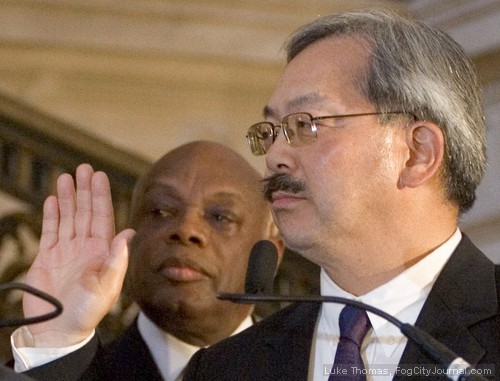
David Chiu

New forms

0

caitlin@sfbg.com

STREET SEEN What’s in a lookbook? When you’re a styling collective that works with one-of-a-kind vintage items, the question is somewhat challenging. Only one person can buy each outfit in Retrofit Republic‘s newest “Tastemakers” style book, after all.

But co-founder Julia Rhee explains to me in an email that her brand is about way more than call-and-response trend manufacturing. “We could’ve exclusively sourced from the big box stores when we started our business,” she writes. “But we wanted to show clients that we don’t have to live in a throwaway culture that constantly churns out fast fashion with no regard to the environment.”

Rhee and co-founder Jenny Ton counsel clients who make appointments at their private showroom for styling tips that unique pieces that don’t quite fit can be adjusted. “When in doubt, roll it, cuff it, belt it,” she says.


“Tastemakers” lookbook: Brown Boi Project founder B. Cole


>>CLICK HERE TO READ LAST YEAR’S SFBG PROFILE ON RETROFIT’S STYLE 

Angie Chang, founder of Women 2.0 and Bay Area Geek Girl dinners

 Given the preponderance of grown-and-sexy types at the release party for their newest lookbook on April 13 at the SoMa-sleek Tank18 tasting room, it would seem that SF (a town whose picked-over thrift stores should tip you off on our luv for secondhand) is down for the Retrofit message.

Or maybe there’s another message the party people were responding to. Because instead of populating their campaigns with traditional models, Retrofit is known for making mannequins out of the Bay’s social changers. “Tastemakers” features food justice activist-sustainable chef Bryant Terry, feminist tech networker Angie Chang, founder of genderqueer youth leadership advocates Brown Boi Project B. Cole. Past books have included Supervisors Jane Kim and David Chiu.

Founder of Four Barrell Coffee Jeremy Tooker

“As people of color, we’re not often given the space to be positively highlighted and affirmed that we are beautiful,” Ton writes. “So instead of waiting for that space and change to happen, we decided to take it into own hands, on our terms, to be the change we want to see in fashion and in this world.”

CAN YOU SAY Мишка?

Мишка lookbook photos by Chris Brennan

Five-panel ball caps printed with fresh fruit, outer galaxy scenes, or Harvey Comics panels. A cutely patterned cut-and-sew collection that includes button-downs speckled with astrological signs, classical sculptures interspersed with spray paint bursts, pot leaves and one-eyed skeleton heads arranged in Nordic ski sweater patterns. This is the look of Мишка (pronounced “Mishka,” in case your Cyrillic skills are rusty), the Brooklyn brand that opens its first SF store this week.

Are we really becoming the outer borough to Silicon Valley’s Manhattan? The fact that Мишка, a Greenpoint brand, is opening up its first store in the city next to a tattoo shop on 25th Street in the Mission is one sign that: yep, maybe. Or maybe it says more about how the Internet is globalizing hipster culture — the brand already has stores in Tokyo and Los Angeles.

Мишка is the kind of low brow movie-inspired streetwear brand (read: many hats and t-shirts) that inspires hordes of young enthusiasts so gung ho that the brand’s national marketing coordinator Leigh Barton tells me, her bloodshot eyeball-adorned fingernails lightly gripping a cappuccino cup in a Haight Street coffee shop a few blocks from where she was hosting last week’s warehouse sale, kids will show up to stores ready to work for free, just for good vibes and freebies to further their sartorial addiction.

The company already has a passionate Bay Area fan base, and co-founder Mikhail Bortnik tells me in an email the feeling is mutual. “The art, music, and culture that has been oozing out of the city for decades has influenced our brand and art greatly,” he writes.

SF store manager Chris Brennan actually shot a lookbook last summer featuring the Bay’s new crop of hip-hop heartthrobs: Chippy Nonstop, Antwon, and Trill Team 6 were among the models — which makes sense given that Мишка’s a hybrid project — Bortnik and co-founder Greg Rivera also run Мишка Records, which recently released Cakes Da Killa’s rad sophomore effort The Eulogy and had its hand in Das Racist’s early mixtape glory as well. Keep an eye out to see how the company will be contributing to the ongoing rhythms and melodies here in the Bay.

Мишка SF opening party Fri/12, 7-9pm, free. Мишка, 3422 25th St., SF. www.mishkasf.com


SF declares Pay Equity Day as it lowers salaries for women’s jobs

87

The Board of Supervisors today declared April 9 Pay Equity Day in San Francisco, in recognition of the persistent national gap between male and female financial compensation. But with the city locked in a dispute with SEIU Local 1021 over pay cuts to jobs dominated by women and workers of color, the day took on special local significance. Ahead of the declaration, union members, activists, and supervisors rallied in front of City Hall, chanting against San Francisco’s wage inequality and the general climate of fiscal austerity.

Women in San Francisco earn just 84 cents for every dollar paid to their male counterparts. Although this figure is slightly higher than the national average of 77 cents per dollar, the discrepancy represents a yearly wage gap of $9,968 per year, according to the National Partnership for Women and Families. At today’s press conference in front of City Hall, Sup. Malia Cohen called the gap “unconscionable in a country as wealthy as ours.”

Cohen was joined by Sups. David Chiu and David Campos, who both spoke out against gender-based wage gaps. “It is important for men to speak out,” Chui said. “It wasn’t women who made the decision for pay to be unequal.” Campos went a step further, promising to vote against any budget that further entrenches unequal pay. “I will not support any budget that reflect this discrepancy,” he said.

SEIU Local 1021, which represents over half of city employees, is currently locked in a budget dispute with the city over pay cuts that would adversely affect women and workers of color. The city Department of Human Resources has recommended that the city cut the salaries of 16 categories of city workers, including personnel clerks and nursing technicians, which are disproportionately females and workers of color. The dispute was recently sent to an arbitrator.

At today’s event, local SEIU leaders and the San Francisco Women’s Political Committee (SFWPC) continued to pressure the city to reconsider the salary cuts. SFWPC President Laura Hahn called persistent pay inequality “embarrassing.”

“If we can’t achieve it here in San Francisco where are we going to do it?” she asked.

Former Supervisor Chris Daly, who now works as political director for SEIU 1021, echoed Hahn’s concerns and charged that the proposal to cut pay for female-dominated categories calls into question the city’s long term commitment to pay equity.

“If you ask Mayor Lee if he supports wage equality, of course he will say yes,” Daly told us. “But in reality, his Department of Human Resources is rolling back progress.” Daly’s repeated requests for Mayor Lee to intervene in the wage-cut arbitration have not yet been answered.
But for the DHR, the recommended cuts have more to do with fiscal reality than gender equality. At a March 7th budget hearing, DHR director Micki Callahan said, “It would be improper to base any decision on demographics.”

She voiced concern over the “root causes” of pay discrepancy, but indicated that these issues fall outside the purview of her department. Spokespeople for the the DHR department have repeatedly assured us that the proposed budget cuts have nothing to do with gender, but rather reflect an effort to bring city salaries in line with market forces.

Mayor Lee’s trip to China raises questions of ethics and influence

86

[UPDATED(x3)] Mayor Ed Lee barely had time to unpack from his recent political junket to Paris before he was off on his current trip to China – both of which were paid for and accompanied by some of his top political supporters and among the city’s most influential power brokers. No wonder Lee doesn’t have time to weigh in on Airbnb’s tax dodge, the condo conversion stalemate, or other important city issues.

Local good government advocate Charles Marsteller learned of the current China trip from Willie Brown’s column in Sunday’s San Francisco Chronicle, whose editors (including Editor Ward Bushee, who we’re still waiting to hear back from about this trip) consider it a “man about town” column immune from conflict-of-interest policies that normally require journalists to disclose who is paying them on the side.

“I’m here with Mayor Ed Lee for my seventh official visit,” Brown cheerfully wrote, although readers were left to wonder just what official business Brown might be conducting with our mayor and his entourage. So, being an expert on political disclosure laws, Marsteller went down to the Ethics Commission to pull the Form SFEC-3.216(d) that state law requires elected officials to file before leaving on trips paid for by outside interests.

But it wasn’t there, so Marsteller filed an official complaint with the commission, telling us, “I did so to impress upon our Elected and other City Officials the need to properly report gifts in a timely way and in the manner as called for by State law and on the forms provided by the SF Ethics Commission.” 

When we contacted mayoral Press Secretary Christine Falvey, she forwarded us a copy of the form that should have been filed before the trip and told us, “I’m not going to answer the question about why we failed to file the appropriate forms with the Ethics Commission, as we worked closely with the City Attorney’s office to exceed reporting requirements by all appropriate deadlines.” [UPDATE: The time stamp on the form indicated it was filed on May 25, before the trip, even though it wasn’t publicly available at the Ethics Commission office when Marsteller went down to look for it].

The form indicates that Lee’s portion of the trip was paid for by the San Francisco Chinese Chamber of Commerce, whose influential leader Rose Pak conspired with Brown to get Lee appointed mayor more than two years ago. This is also the same Rose Pak who was admonished by the state’s Fair Political Practices Commission for illegally funding another political junket to China in 2009 with Sups. David Chiu and Eric Mar and then-Sup. Carmen Chu, who Lee appointed as Assessor earlier this year.

Those officials were forced to repay the expenses after the FPPC found that Pak, that time acting under the auspices of the Chinese New Year Festival Committee, was not allowed to make gifts exceeding $420 per official that year. “Please be advised that since the Chinese New Year Festival Committee is not an organization that falls under Section 501(c)(3) of the Internal Revenue Code, no public official may accept gifts of any type from this organization valued in excess of the applicable limit,” FPPC counsel Zachary Norton wrote in an Aug. 22, 2011 enforcement letter to Pak.

In other words, because this committee and “other 501(c)(6) chamber of commerce organization[s]” are in the business of actively lobbying top elected officials for favorable policies, rulings, and projects, they are barred by ethics law from giving them the gifts of big overseas political junkets. As Marsteller noted in his complaint letter, violations are punishable by fines of $5,000 per violation, or if they are “willful violations of the law” – which doing the same thing you were sanctioned for just two years ago certainly might be considered – the criminal penalties are $10,000 per violation or up to a year in jail.

Mayor Lee’s portion of the trip cost the Chamber $11,970, according to the form. But this time, to get around the FPPC restrictions, Pak seems to have passed the hat among various business elites to fund the trip. The mayor’s form shows that 41 people paid up to the current gift limit of $440 “to defray the cost of the mayor’s trip.”

They include Pak, Brown, four people from Kwan Wo Construction, three from American Pacific International Capital, two each from Boyett Construction, Young Electric, and Bel Builders, Harbor View Holdings Director Gorretti Lo Lui, and SF Immigration Rights Commissioner Sonya Molodetskaya – most of whom were also part of the trip’s 43-member delegation.

Among others who tagged along for the trip are Public Works Director Mohammed Nuru (who has a history of political corruption under Mayors Brown and Newsom and no clear business being on a Chinese trade delegation, but who doesn’t love a free trip?!), Kofi Bonner from Lennar Home Builders, Harlan Kelly with the SFPUC, Jay Xu with the Asian Art Museum, the wives of Lee and Bonner, Kandace Bender with San Francisco International Airport, and Mark Chandler with the Mayor’s Office of International Trade and Commerce.

It’s not clear who paid for those other public officials or even what they were doing there. [UPDATE: Department of Public Works spokesperson Rachel Gordon told us that Nuru paid for the trip himself, but that he’ll be studying China’s instrastructure, from its separated bikesways to greening of public rights-of-way, as well as meeting with Chinese businesses involved in the redevelopment of Hunter’s Point. “He’s been looking at a lot of the infrastructure in China,” Gordon said. “I expect a dozen if not more ideas when he returns.”] Then again, it also wasn’t clear why venture capitalist Ron Conway – Lee’s top campaign fundraiser and possible reason for publicly subsidizing big tech companies, including many that Conway funds – joined and helped sponsor Lee’s recent trip to Paris. This is just how business gets done in San Francisco.

“Willie Brown is the former Mayor of San Francisco,” Falvey told us when we asked why Brown was on the trip and what its purpose was. “The purpose of the trip is to promote San Francisco, its local manufacturing, cultural exchanges, he is signing an MOU and meeting with high level, new Chinese government officials.”

[UPDATE 4/5: Marsteller has withdrawn his complaint from the Ethics Commission alleging the mayor’s form wasn’t filed on time, but he and another citizen have filed separate complaints with the FPPC alleging the trip and its funding mechanism may violate the agency’s 2011 ruling against Pak.]

No progress in condo conversion standoff, despite the Chron’s spin

93

Perhaps it was just an unfunny April Fool’s Day joke or some wishful political spin, but the San Francisco Chronicle’s April 1 article about how tenancy-in-common owners and their political supporters are pushing legislation that would allow them to bypass the condo conversion lottery seriously misrepresented the city’s biggest current political standoff.

Nevermind the article’s over-the-top bias in favor of those poor, hard-luck TIC owners, like the featured Pacific Heights couple forced to raise their baby in a closet when all they really want to do is flip the apartment they bought for a profit. Or how the Chron all-but-ignored the fact that these TICs were rent-controlled apartments in a city where two-thirds of citizens rent. That kind of top-down view of the world is pretty typical for the Chron, even in its news stories, despite the paper’s strained claim to “objectivity.”

No, the article’s real sin was to get the basic facts wrong on where this political stalemate now stands, presenting the wishful spin of one side as if it were the latest news. Between the headline, “Owners seeking condo conversions may have shot” and the first deckhead, “Making progress” (which plays off this paragraph. “’I think we’re making progress in our discussions and negotiations,’ said [sponsoring Sup. Mark] Farrell, while noting the talks with tenant advocates, TIC owners, and real estate interests are ‘far from the finish line.’”) the article leaves the impression current negotiations may produce a compromise.

But the problem is that there aren’t any current negotiations between the two sides, and there haven’t been for weeks, according to tenant and other involved sources. In fact, they say there’s been no movement in this standoff since almost a month ago when I last reported that tenant groups and progressive supervisors were preparing a set of hostile amendments to the legislation.

They would allow a one-time condo lottery bypass for the nearly 2,500 TIC owners in the pipeline in exchange to shutting down the lottery for many years and preventing any conversions of rent-controlled apartments into condos until city builds a comparable amount of new affordable housing, and then probably restricting condo conversions to smaller buildings after that to protect large rent-controlled apartment buildings from real estate speculators.

That proposed compromise, which the article barely mentions before letting Farrell say “his legislation poses no threat to rent control,” would help the poor Pacific Heights couple at the center of the article. But the real estate industry and its conservative allies don’t really care about that couple as much as they do maintaining the flow of rental units into the real estate market, which is why the negotiations have broken down.

Instead, the Chron has Sup. London Breed – who is indeed a swing vote of the issue, but not one that tenant groups are counting on given how close she is to Plan C and the landlord lobby – citing a compromise proposal that would prevent the new condo owners from selling their properties for five years to discourage real estate speculation.

Perhaps that’s something the TIC owners and real estate interests that the article relies on think is a realistic compromise, but it’s not something that has been seriously discussed with tenant groups, mediating Sup. David Chiu, or the other interests that would be needed to pass this legislation.

Sara Shortt, the token tenant activist that the Chron talked to for the article, confirmed to us that there is no real compromise deal in the works and preventing the creation of new condos from existing apartments is a bottom-line issue that unites everyone who is now opposed to this legislation.

“The Plan C/Realtor etc. won’t concede on our key issue: restriction on future conversions in exchange for the bypass. We have given as much as we can give and they have given virtually nothing in return,” Shortt, executive director of the Housing Right Committee, told us by email.

Even Sup. Scott Wiener, who co-sponsors the legislation with Farrell, told us there has been “no change from before,” when negotiations broke down. But the legislation is on the April 15 agenda for the Land Use and Economic Development Committee – for the fifth time, with most hearings canceled because of the lack of negotiating progress.

If the Realtors and Plan C (which is dominated by real estate and banking interests) stick to their intransigent position – hurting this poor Pac Heights couple in the process, which the Chron fails to note – then tenants and progressive supervisors are likely to amend the legislation and call the bluff of those who claim this issue is simply about poor TIC owners stuck with shared mortgages.

Airbnb’s tax and tenant law violations headed for hearings

80

As Airbnb continues to avoid making any public comment on the $1.8 million annual Transient Occupancy Tax obligation to the city that it appears to be dodging, with the complicity of the Mayor’s Office, Board of Supervisors President David Chiu is getting closer to introducing legislation to regulate so-called “shared housing” and holding public hearings on the issues it raises.

In addition to the tax issue, there are concerns that Airbnb, VRBO.com, and other Internet-based sites that facilitate short-term rentals of San Francisco apartments are increasingly being used to circumvent local tenant protections, often after evicting tenants from the apartments using the Ellis Act. That state law allows owners to leave the rental business and convert to other uses, and landlords can argue that Airbnb is a commercial use and not a residential use.

“I’ve been deep into a lot of these issues in my conversations with a lot of community stakeholders around Airbnb and the area of shareable housing and I’m hoping very soon to have a package of proposals in this area. And at that point, we’ll have public hearings on the topics that you describe,” Chiu told us when we asked about the tax and tenants issues.

Among those involved in Chiu’s negotiations with Airbnb is Ted Gullicksen, executive director of the San Francisco Tenants Union, who says the negotiations have been slow-going but he’s generally happy with how they’re proceeding and hopeful that the resulting legislation will rein in rampant current abuses of zoning, tax, and other regulations that city officials have been ignoring.

“All you have to do is sit in front of the computer for a few hours and you can identify a lot of the lawbreakers. But there’s no enforcement by the city,” he said, noting that the Tax Collector’s Office is the notable exception among city departments, such as the Planning and Building departments. “The taxes shouldn’t even be an issue because they’re illegal uses.”

For example, while landlords may be able to get around rental restrictions triggered by an Ellis Act eviction by calling the use for shared housing websites “commercial,” that’s usually a violation of local planning codes prohibiting commercial use of residential property. Chiu’s legislation approved late last year banning “hotelization,” in which entire apartment buildings are cleared of tenants and rented out on a short-term basis, allows nonprofit groups like the Tenants Union to help enforce the ban.

“We’ve been researching the buildings we want to go after with complaints and lawsuits,” Gullicksen said. “It’s a pretty widespread problem.”

He said the VRBO.com appears to be a bigger culprit in terms of being used by landlords to avoid tenant protections than Airbnb, whose hosts are evenly split between tenants and landlords. But as the biggest shared housing service in San Francisco, the tax issues are bigger for Airbnb and the city.

“We don’t mind the limited use of someone’s principal residence for short-term rental, where we’re concerned is about the whole buildings,” Gullicksen said.

Whether the issue is avoiding taxes or circumventing tenant protections, the complicated issues surrounding shared housing are long overdue for some public discussions and scrutiny, and it sounds like that’s what we’re see later this spring or summer.

Sutter/CPMC agrees to a contract with its nurses in SF, clearing the path for its hospital deal

10

Ending a long and contentious labor impasse and setting the stage for the city to approve the pair of new hospitals that Sutter Health and its California Pacific Medical Center affiliate want to build in San Francisco, the California Nurses Association today announced that it has reached a tentative contract agreement with the hospital corporations.

As we’ve reported, reaching a deal with its nurses seemed to be the last major hurdle for Sutter/CPMC to overcome before the community-labor coalition would fully support the compromise hospital deal that a city-CPMC negotiating team announced on March 5. The nurses helped force that hard-won deal in part by aggressively advocating for St. Luke’s Hospital to remain financially viable and open to the low-income community it serves.

“We are delighted to finally reach a contract deal. It’s been six years of a very contentious relationship,” Eileen Prendiville, a registered nurse who works at CPMC’s California Campus, told the Guardian. She said that the nurses are thrilled to have attained good job security and patient advocacy standards while ensuring St. Luke’s stays open. “Working with a coalition of labor and community, we were successful at changing the face of healthcare in San Francisco.”

Under a previous agreement reached last year between CPMC and the Mayor’s Office, St. Luke’s would have had just 80 beds and could have been closed if the corporations revenues sagged. But activists and the Board of Supervisors were able to kill it and force the corporations back to the bargaining table.

In today’s print edition of the Guardian, I cover the movement to value caregiving in our uncaring economic system and the key role that CNA has played has in that growing movement. In San Francisco, CNA has faced down lawsuits, lock-outs, and harsh union-busting tactics as it pushed for contracts with strong patient advocacy protections.

Sup. David Campos, who help negotiate the latest hospital deal, said he was “thrilled” to hear Sutter/CPMC reached a deal with CNA. “We’ve always said it’s really important as we finalize the agreement that there is protection for the workers,” Campos told us.

Board President David Chiu, another key negotiator in the recent deal, told us, “I’m tremendously excited that there’s finally an agreement between oru nurses and CPMC, and thank the parties for their hard work in reaching this point. Along with the agreement we recently arrived at for the new Cathedral Hill and St. Luke’s campuses, this is an important moment for our city’s health care futue.”

CPMC spokespersons didn’t immediately respond to our calls for comment, but we’ll update this post if and when we hear back. The CNA press release announcing the deal and its details follows:


Nurses Reach Agreement with Sutter California Pacific

RNs Hail Community Support, Decision to Keep St. Luke’s Open 


Registered nurses at two San Francisco Sutter hospitals, California Pacific Medical Center and St. Luke’s Hospital, have, at long last, reached agreement with hospital officials on a new collective bargaining contract for the 800 RNs who work at the two facilities, the California Nurses Association said today.

The agreement expands patient protections, strengthens the nurses’ bargaining and job security rights, and provides for economic gains. It must still be ratified by CPMC and St. Luke’s nurses who will vote on the pact in membership meetings soon.

The RNs emphasized that they are especially pleased with the overall political and community framework, announced earlier this month, that preserves St. Luke’s after years of uncertainly and threats of closure for the historic hospital that serves a medically underserved community in San Francisco.

CNA Executive Director RoseAnn DeMoro praised the unity of the nurses over the long contract fight and the broad public support for nurses as critical to protecting St. Luke’s and winning a new agreement for the nurses.

“San Francisco nurses have worked extremely hard, with the widespread support of a very broad community coalition and the support of a number of community leaders, including members of the Board of Supervisors, to protect this vital community resource. We are proud of the efforts of everyone who has held the line for maintaining St. Luke’s,” DeMoro said.

For the first time, the RNs at both hospitals will be under one contract with equal job security and seniority rights. The pact includes safe patient handling provisions to stem patient falls and injuries to patients and nurses. Additionally it obligates the employer to provide for meal and rest breaks and stipulates that new technology not supplant RN professional judgment.

On economics, all the RNs will receive across the board pay increases of 6 percent over the next 34 months, as well as additional pay based on years of service in the San Francisco hospitals, at other Sutter facilities, and foreign nursing experience.

“We are delighted to finally reach a contract settlement with Sutter/CPMC,” said California Pacific campus RN Susan Blaschak RN.  “Our contract provides for continued patient advocacy and will keep our professional nursing standards high for years to come.”

“The process has been tumultuous but in the end we had a vision and we were successful in performing the ultimate in patient advocacy – saving St Luke’s,” said Jane Sandoval, a St. Luke’s RN and CNA board member. “In addition, with our collective bargaining agreement we have preserved patient care standards, having a voice in that and in our professional integrity.”

“Working with a coalition of labor and community groups, we have been successful in changing the face of healthcare for San Francisco’s future. St Luke’s will not only remain open it will offer more healthcare services to residents in the community south of Market,” said Eileen Prendiville RN at the California Pacific campus of CPMC.

“Our contract settlement was also made possible by the strong support for the nurses by San Franciscans for Healthcare, Housing, Jobs and Justice as well as elected leaders who knew San Franciscans overall would be best served by a fair collective bargaining agreement,” said Sandoval.

CNA also calls on Sutter officials in its headquarters in Sacramento, and other Sutter regions to view the San Francisco agreement as a new opportunity to resolve outstanding contract fights with RNs in the East Bay and North Bay.

Nurses have now reached agreement with CNA-represented Sutter hospitals in the past nine months at Mills-Peninsula in Burlingame and San Mateo, Sutter Santa Rosa, Sutter Lakeside in Lakeport, and Sutter VNA in Santa Cruz.

Contracts remain unresolved at Alta Bates Summit in Berkeley and Oakland, Eden in Castro Valley and San Leandro, Sutter Delta in Antioch, Sutter Solano in Vallejo, and Sutter Novato.

“Every one of those disputes could also be resolved if those hospital’s officials would approach negotiations with a desire to stop the war on their nurses, remove unwarranted and punitive concessions demands, and show the community served by their hospitals that they desire a cooperative relationship with nurses based on therapeutic healing for their patients,” said Sandoval.

Campaign to ban bottled water sales in national parks targets GGNRA

43

UPDATED A national campaign to ban the sale of disposal plastic water and soda bottles in our national parks – which is being actively opposed by Coca-Cola and others who bottle and sell water, that most basic of life-sustaining resources – has arrived in San Francisco as it targets Yosemite and the Golden Gate National Recreation Area.

“We have thousands of people in the area who are very supportive and working hard on this,” Alyse Opatowski, an organizer with Corporate Accountability International’s Think Outside the Bottle campaign, told the Guardian.

Opatowski and a host of local supporters – including Board of Supervisors President David Chiu, Sierra Club Chapter Executive Director Michelle Meyer, and Hans Florine, who holds a world record for speed climbing in Yosemite – will rally tomorrow (Wed/27) at 10:30am in Crissy Field to publicize the campaign and hold a blind taste tasting comparing San Francisco tap water to bottled waters.

And we know who wins that one, right? San Franciscans are justifiably proud of our water, the best urban water in the country, arriving to us through what’s essentially a gravity-fed straw from the Hetch Hetchy Reservoir adjacent to Yosemite. Even though that project broke famed naturalist John Muir’s heart a century ago, it was a engineering marvel and enduring source of clean power and water that we voted overwhelmingly to protect in November when voters rejected a study of the sentimentalists’ dream of removing it.

But back to the issue at hand: activists say that selling single-use water bottles in the national parks in antithetical to environmental stewardship. Health advocates have made some progress in curtailing our addiction to soda, but those crafty soda companies responded by commodifying that which is available basically for free in every locality in the country. And they aren’t about to give up that market without a fight.

Coca-Cola – whose spokespeople haven’t yet returned out calls for comment – gives lots of money to the National Parks Foundation and has used that influence to stall efforts to have the National Parks Service ban bottled water. So the campaign is targetting individual regions, including the GGNRA, which seems well positioned to advance the cause.

Cheers to that.

UPDATE 3/27: American Beverage Association spokesperson Chuck Finnie issued a prepared statement to us that began, “Eliminating plastic bottles altogether isn’t the answer because it limits personal choice and doesn’t address the bigger picture. People should have the choice to decide how they drink water in a National Park — from a bottle of water, from a water fountain, or from a refillable container. While making that choice, they should be educated on the benefits of recycling and ways to do so.”

The real CPMC story

10

OPINION The recently announced terms for the development of California Pacific Medical Center’s hospitals at Cathedral Hill and St. Luke’s generated front-page and lead stories in the local news media. But nearly without exception, only part of the story was reported. Missing from most accounts of the terms of the new deal, which dramatically changed last year’s failed draft development agreement negotiated by Mayor Ed Lee, was the decisive role played by a community/labor coalition, San Franciscans for Healthcare, Housing, Jobs and Justice.

Key details of the agreement have yet to be finalized, and provisions of the terms announced on March 5th need to be improved. But the new agreement, in virtually all respects, is an improvement over the old one. And on the same day the terms of the new deal was announced one of the union members of the coalition, the National Union of Healthcare Workers signed a contact with CPMC that protected union organizing rights, job security at Cathedral Hill and full employer paid health care — issues that had been unresolved over the last few years. Still missing is an ageement between Sutter and its nurses, a critical component of labor peace.

The basic structure of the current terms mirror almost exactly the positions outlined by the SFHHJJ over the last year, including a requirement for labor peace with all unions at CPMC. This was no accident; it was the result of the efforts of the community/labor coalition. When the old deal was stalled at the Board of Supervisors in early 2013 and it was clear that the Mayors Office had no idea how to proceed, the members of the coalition came up with a framework to get discussions going again. The key ingredient was the involvement of a skilled an knowledgeable mediator, mutually respected by all parties and the participation of Sutter Corp. in Sacramento — the real party able to make actual binding corporate commitments, not the subsidiary the mayor had dealt with.

The second step was to agree to a framework of issues that would form the substance of negotiations — and the coalition’s own comprehensive set of positions served as that framework.

The next step was to get a critical mass of supervisors to agree to participate in the negotiations. Two Supervisors, David Chiu and David Campos, agreed to the coalition’s framework and the use of a third-party mediator. They added a third supervisor, Mark Farrell, to their group in order to assure buy-in from the full board.

Finally, the mediator had to be found and in that the coalition (and the rest of the city) simply were lucky that Lou Girardo was willing and able to provide his own special skills and credibility.

The SFHHJJ is not the first community/labor coalition in San Francisco history. Such coalitions were present in both the District 1 and District 5 supervisors races last year with mixed success, and in 2008 a community/labor coalition fought for revenue measures, again with mixed success but real unity. A new labor/community coalition has emerged to oppose Scott Wiener’s ill-advised weakening of our local California Environmental Policy Act procedures.

As the Democratic Party transforms itself into ever greater political irrelevancy by becoming the home of moderate Republicanism at all levels of government, community and labor co-operation seems to be growing over an increasing number of issues, showing a level of political vibrancy impossible to ignore.

Calvin Welch is a longtime community organizer in San Francisco and is a member of the SFHHJJ CPMC Negotiating Committee

Pizza delivery drones?

Well, this is intriguing. According to an event announcement for an upcoming talk this Wednesday, there are some bizarre new developments on the “innovation in San Francisco” front. “New plans are being launched to help entrepreneurs launch their dreams,” the San Francisco Technology Democrats informs us, “from mobile apps to making pizza delivery drones available.”

Drones? For pizza delivery? Shouldn’t someone warn the American Civil Liberties Union?

In any case, the talk aims to give curious techies, policy wonks, activists and others an opportunity to pose questions to Board of Supervisors President David Chiu and Chief Innovation Officer Jay Nath concerning San Francisco’s Open Data Portal, proposed revisions to Open Data laws, and similar topics of interest. It will be held Wed/20 from 6:30 to 9:30 p.m. at the Marine’s Memorial Club Fireplace Room, 609 Sutter, in San Francisco.

Editor’s Notes

7

tredmond@sfbg.com

EDITOR’S NOTES I wasn’t invited to the meeting where Mayor Ed Lee (and Willie Brown and Rose Pak) sat down with representatives of Lennar Corp. and a Chinese investment consortium to try to finalize a deal for Treasure Island. But I can tell you with near-absolute certainty that what comes out will not be good for San Francisco.

I can tell you that because every major project the mayor has negotiated has been bad for the city.

The way the California Pacific Medical Center project came down is a perfect example. The mayor worked directly with Sutter Corp., which owns CPMC, last spring, and in March, came out with a proposal that he and his allies presented as the best the city and the hospital giant could do.

It was awful.

CPMC would pay nowhere near enough in housing money to offset the new jobs it was creating. St. Luke’s, the critical public health link in the Mission, would be cut to 80 beds, below what it needed to be sustainable. Only about five percent of the 1,500 new jobs would go to existing San Francisco residents.

It was also pretty much dead on arrival at the Board of Supervisors, where a broad-based group of community activists pushed for big changes — and won. Sups. David Campos, David Chiu, and Mark Farrell stepped into the void created by a lack of mayoral leadership and forced Sutter to accept a much better deal, with St. Luke’s at 120 beds, vastly increased charity care, a guarantee that 40 percent of the new jobs will go to San Franciscans, and a much-better housing and transit component.

The mayor got rolled; he was ready to accept what everyone with any sense knew was better for Sutter than for his constituents. He clearly didn’t know how to say what the supervisors said: This won’t work, and we’d rather walk away from the whole deal than accept a crappy outcome.

That’s exactly what’s going on with the Warriors’ arena — the mayor is giving away the store. And he, with Brown and Pak at his side, will do the same at Treasure Island.

The balance of power in the city is moving to the board. And for good reason — the supervisors seem to be able to get things done.

Supervisors approve Western SoMa Plan, rejecting expanded office development

145

The Board of Supervisors today approved the Western South of Market Community Plan, the first step to ending a development moratorium that has been in place since the citizen-based planning process that developed the plan began in 2005, but not before some supervisors made a last-ditch effort to allow more office development and nightlife.

“I have real concerns over the plan,” Sup. Scott Wiener said as the plan came before the full board for the first time, continuing an effort to modify the plan that he began a few weeks ago when it was before the Land Use and Economic Development Committee.

While some of Wiener’s colleagues echoed his concerns and those raised by the business and entertainment communities, most decided to defer to the area’s Sup. Jane Kim and the Western SoMa Task Force that developed the plan. It was approved on a 10-1 vote, with Wiener in dissent. It will guide development and set land use rules for the Western SoMa area after being approved on second reading by the board next week.

Wiener led the critique of the plan’s restrictions on office development in most of the plan area, particularly around the transit hub of 4th and King streets, concerns that were echoed by Sups. London Breed and Malia Cohen, likely indicating that the business community has been lobbying supervisors on the issue.

But Kim said she is concerned about the area’s artists, nonprofits, and light industrial businesses – dubbed Production Distribution and Repair (PDR) in the city planning code – being squeezed out if the area is opened up to more office development.

“Office space is hot right now and it’s pushing out PDR uses,” Kim said. “Zoning is an importance tool, otherwise everything will turn into offices in South of Market.”

Wiener, Breed, and other supervisors also sounded their support for the entertainment community that has lobbied for changes in the plan, winning greater protections for nightlife at earlier hearings – including a ban on residential development on the raucous 300 block of 11th Street and persuading owners of “the purple building” to switch from residential to office – pushing for removal of more of the plan’s restrictions on attaining limited live music permits.

“I also have some real concerns with how the plan treats nightlife and entertainment,” Wiener said, while Breed said, “As a big supporter of the arts, I’m concerned there are limited live performances in the plan.”

Kim noted that the plan tried to strike a balance in the conflict between nightlife and housing, and she said that expanding the ability business in areas zoned Regional Commercial District (RCD) shouldn’t be done in just in a part of town where there conflicts have often been difficult to resolve.

“If you’re going to permit it in the RCD areas, it should be citywide rather than just in Western SoMa,” Kim said, noting that she’s open to futher discussions after the plan is approved.

Sup. David Campos and other supervisors urged their colleagues not to tinker with the compromises and hard-won balance in the plan. “I’m not 100 percent happy with every aspect of the plan, but I do think some deference should be given to the district supervisor,” Campos said.

Wiener agreed that deference to the desires of district supervisors is an important consideration, “but there are times when this board does not vote the same as their supervisors,” citing as an example the board’s approval of the controversial 8 Washington luxury condo project over the objections of Board President David Chiu.

Afterward, Terrence Alan of the California Music and Culture Association, which had lobbied for expanded protections of nightlife, told us, “Entertainment as a whole fared well.” But he said that they would continue pushing for greater citywide nightlife protections, including supporting Wiener’s proposal to expand the limited live music permits to include DJs.

The 8 Washington shit show

9

The latest problem with the 8 Washington condo project emerged March 12 when the Chron reported on a new study that shows construction of the most pricey condos in San Francisco history could threaten a major sewer line that serves a quarter of the city. That report, which is pretty scathing, came the same day the SF Public Utilities Commission voted to sign off on environmental approvals and sewage easements that would allow the developer to move forward with preliminary design work — even though the project will be the subject of a voter referendum in November.

The engineering report says, among other things, that construction on the project (involving significant excavation and the driving of 100-foot pilings) could cause the ground around a main sewer pipe to shift by as much as 5 1/2 inches, when “the normally accepted limit for tolerable ground movement is less than an inch.” That’s kind of a problem, since the North Force sewer pipe handles an awful lot of shit, and would be very expensive to repair.

There’s also an underground sewage vault that could be damaged by the construction work.

And the developer isn’t helping much. As Brian Henderson, chief engineer for the PUC, told the commissioners, “we’ve agreed to disagree about these issues.”

In other words, the 8 Washington folks are giving the city a big FU — and still asking for approval to begin work on a project that more than 30,000 voters insisted go on the ballot first.

That ought to be enough reason for the commission to put this whole thing on hold, wait until some more studies are completed (and the PUC engineering staff is satisfied that the developer won’t shatter a sewage main). After all, no construction work can begin until after November anyway; what’s the rush?

Well, Commissioner Francesca Vietor asked that very question: What happens if we say no? General Manager Harlan Kelly hemmed and hawed. Assistant General Manager Mike Carlin said the developer “would have no incentive” to work on a better design. And all of the PUC senior staff said there’s no reason to worry, since this would all come back again once negotiations with the developer are completed.

Oh, and by the way, they said, the Port of San Francisco has asked for this. (Actually, no: According to Sup. David Chiu, Port officials have said they do not intend to push for any preliminary approvals for 8 Washington until after November.)

Carlin insisted that there was no reason to be concenred about the data in the report that the city had commissioned and spent more than $100,000 on. “We are very diligent about protecting our infrastructure,” he said, adding that existing building codes protected the city’s interests anyway. See, if your neighbor digs a new foundation and screws up your foundation, your neighbor has to pay to fix it.

So no worries; about 200,000 San Franciscans might be unable to flush the toilet for a while, but in the end, the developer (a limited liability company controlled by Simon Snellgrove) will be on the hook for the repairs, after the lawyers are all done fighting it out.

In fact, the very concept that the commission might not go along with this deal seemed foreign to Carlin, who from the beginning talked about “what you will be approving today” — as if the votes were already lined up and his job was just to instruct the puppets so they understand what they’re supposed to be doing.

Among the items the commission “would be approving:” a change in the environmental findings related to design changes that, by the way, might make the sewage problem worse. The PUC staff found that the changes would have no impact on the environment; that finding came two days before the sewage report arrived.

And, of course, as land-use lawyer Sue Hestor noted, the environmental documents alone are 125 pages. “When did you get them, and when did you get a chance to read them,” she asked. None of the commissioners answered.

In the end, there were no surprises — Commissioner Ann Moller Caen made the motion to approve, Commissioner Anson Moran seconded, and on a voice vote, the deal was approved.

Now let me predict what’s going to happen. Kelly and the PUC staff will negotiate with Snellgrove and come back and tell the commissioners that they still don’t have the assurances they need, not really, but there’s no choice any more because the PUC already voted to approve the environmental findings and the easements, and the developer has spent millions on design changes, and now it’s too late to go back.

That’s how things work in this city.

And when, as I predict, the voters kill this whole thing in November, the PUC is going to look foolish.


Nurses still waiting for CPMC to fully embrace San Francisco

25

Labor and community activists cheered this week’s news of a much-improved deal between the city and California Pacific Medical Center to build two new hospitals in San Francisco, and there are hopeful signs that frosty local relations with this sometimes-stubborn corporate behemoth may improve. But they also say they are withholding full support for the deal until CPMC reaches a contract agreement with the California Nurses Association.

CPMC and its parent, Sutter Health, have had a nasty running battle with CNA over the six years since their last contract expired that has included strikes, lockouts, lawsuits, harsh union-busting tactics, and the pooling of bad blood on both sides. But CPMC announced a labor agreement with its other major union, National Union of Healthcare Workers, on the day after the hospital deal was announced and there are signs that a deal with CNA could also be imminent.

“We’ve made some progress and we have the makings of a settlement on the table, but we’re not there yet. Yet now is the time,” Fernando Losada, CNA’s collective bargaining director for California.

It was CNA and other labor groups that effectively partnered with community organizations and progressive members of the Board of Supervisors last year to kill the hospital deal that CPMC cut with the Mayor’s Office and to force the much-improved agreement that was announced on Tuesday. “It’s all about necessity and their being able to implement their plans,” Losada said of CPMC’s designs on San Francisco. “Obviously, the full of implementation of their plans were thwarted with the help of some good community organizing.”

And Losada said he expects that labor-community coalition to stand firm on expecting CPMC to reach a fair agreement with the nurses, who are seeking more job security and benefit concessions than CPMC has been willing to make so far.

“The successful community organizing that we played an active role in putting together has had a lot to do with them being more forthcoming at the bargaining table,” Losada said. “We like where this has ended up, particularly on the St. Luke’s [Hospital] issue [guaranteeing a larger and more viable new hospital than originally proposed]. But we can’t support this wholeheartedly and we won’t if our nurses are left out in the cold.”

Gordon Mar of San Franciscans for Healthcare, Housing, Jobs, and Justice, which formed up around the CPMC negotiations with the city, said that most community groups will also insist on CPMC reaching an agreement with CNA before the project moves forward.

“A contract for CNA is the last remaining big issue the coalition would like to see resolved,” Mar, who also works with the labor group Jobs With Justice, told us. “We at Jobs With Justice would not support the deal unless the CNA dispute is resolved.”

Paul Kumar, a consultant with NUHW who represented the coalition during the negotiations between CPMC and the city, as represented mostly by Sups. David Campos, David Chiu, and Mark Farrell, said he was happy to see CPMC reach agreements with the city and NUHW, but that it’s too soon to conclude the corporate has turned over a new leaf.

“I think it’s premature because relationships take a long time to transform themselves, but there are transformative moments, and it’s our duty to make the best of them. This may be one of them,” Kumar told us. “They’re obviously now trying to pursue their business interests in alignment with their community instead of without regard to their community, which has characterized their behavior in the past.”

Kumar said the coalition that overcame last year’s aggressive and uncompromising effort by CPMC to push through a deal that was bad for the city has learned a lot from that fight and evened out the playing field. “It’s up to us to try to build on their breakthrough,” Kumar said.

CPMC spokesperson Dean Fryer was unable to put the Guardian on contact with Sutter officials that our sources say may be responsible for the softening of CPMC’s tough negotiating stance in San Francisco, or to offer a comment on the changing dynamics in the company.

He stressed that CPMC has “a lot of interface with various communities in San Francisco” and said the company “does more charity care than anyone in San Francisco.” But he’s only been with CPMC for a few months and was unaware of studies last year showing CPMC actually does the least per-capita charity care of any hospital in San Francisco, a major point of controversy that resulted in improved charity care commitments in the latest agreement.

As for the prospects of an agreement with its nurses, “I can’t address CNA, that has been ongoing and it’s something I can’t comment on.”

NUHW – which represents medical technicians, administrative staff, and hospital workers other than nurses and doctors – announced that it reached a deal with CPMC at 12:30am on Tuesday that includes no labor concessions, retroactive wage increases, job security provisions, fully employer-paid health coverage, an improved pension, and maintenance of retiree health coverage.

Losada said he was happy to see the CPMC agreement with the city include strong local hiring requirements for construction workers, a predominantly male workforce, and now it’s time for CPMC to do right by its nurses, “an overwhelmingly female workforce.”

“As it stands, they have no protections and no guarantees they’ll be hired in the new facilities,” he said, noting how frustrating it’s been to get any assurances from CPMC as it has pursued this hospital deal over many years. “It’s always been about issues of job security, and affordable health care, ironically.”

Condo conversion compromise in the works despite Realtors’ resistance

180

[UPDATED BELOW] Negotiations between tenant advocates and real estate interests (including the political advocacy group Plan C) over the controversial condo lottery bypass legislation haven’t gone well or found common ground. But sources tell the Guardian that Sup. Jane Kim and Board President David Chiu, who has been mediating the dispute, are preparing to introduce compromise amendments that have the support of the San Francisco Tenants Union and other tenant advocates if a deal can’t be worked out with real estate interests.

Details are still being hammered out with advocates and the City Attorney’s Office, so the hearing scheduled for this Monday at the Land Use and Economic Development Committee will likely be postponed until March 25. But the basic deal is to allow the roughly 2,000 tenancies-in-common now seeking to convert into condos to do so in exchange for a long moratorium on new condo conversions, possibly indexed to construction of new affordable housing for the renters who comprise nearly two-thirds of San Franciscans.

The original legislation by Sups. Mark Farrell and Scott Wiener is being strongly backed by both current TIC owners who want the ability to refinance and Plan C and other real estate interests that want to continue converting ever more rent-controlled apartments into condos, rather than abiding the city’s current limit of 200 per year, awarded through a lottery system. The SFTU has strenuously resisted opening up those flood gates, but it’s open to clearing out the backlog in exchange to shutting the gates for awhile (see my story in this week’s Guardian for more on the political dynamics surrounding this issue).

“We’re hopeful that a majority of the board will support amendments which will significantly protect tenants and which will allow a version of the Wiener-Farrell legislation to be approved,” SFTU head Ted Gullicksen told us.

Progressives on the board oppose the legislation as currently written, and the swing votes are thought to be Sups. London Breed (which Plan C supported in the last election in exchange for what it says was her promise to support more condo conversions, an assurance she denies making), Norman Yee (who was brought into the Chiu-mediated negotiations), and Malia Cohen, with just one of them needed to force changes to the legislation.

But the real estate interests – including Plan C, the Association of Realtors (whose government affairs director we left a message for and are waiting to hear back from, and we’ll update below if/when we do), San Francisco Apartment Association, and other downtown-based groups – who are pushing for more condo conversions are likely to strongly resist the amendments. They simply want more rent-controlled apartments turned into condos they can sell, period.

Their perspective is reflected in SF Apartment Magazine, put out by the San Francisco Apartment Association, which every month offers advice to real estate investors and apartment building owners on various ways to buy apartment buildings, evict tenants or increase their rents, and convert the buildings to TICs or condos.

It runs a regular column called “TIC Corner” with the latest tricks for financing acquisitions and getting rid of those pesky tenants. In the November 2012 issue, for example, attorney D. Andrew Sirkin wrote excitedly about a new Securities and Exchange Commission rule that will now allow owners to advertise the sale of apartment buildings as TIC/condo investments, which he said “will dramatically ease the regulatory burden for real estate entrepreneurs wishing to raise money for apartment acquisitions and make it much easier to find investors.”

Another feature story in the magazine, “The ABCs of OMIs,” teaches these investors all the tricks for evicting tenants from their buildings, while “Roommate Roulette” offers advice to owners of rent-controlled buildings for keeping new roommates of existing tenants off the lease so they can charge market rate rents as soon as possible.

And, of course, the magazine is filled with ads for San Francisco apartment buildings that are for sale and just waiting to be cleared of tenants and turned into amazing real estate investment opportunities. Gullicksen says it is this mentality, applied to what even Mayor Ed Lee has called the city’s “precious few rent-controlled apartments,” that has animated the opposition to the Wiener-Farrell legislation. SFTU had planned a rally for Monday called “Stop Rent Control Attack,” which has now been postponed until March 25.

UPDATE 3/11: Sup. Wiener got back to us and said, “I hope we can move to a compromise and I don’t want to prejudge that compromise.” Asked about the concept of approving TICs in the pipeline in exchange for halting on all condo conversions for some number of years, he said, “It’s definitely something to explore, a pause in the lottery, and I’m open to that. But the devil is in the details.”

Compromised position

16

steve@sfbg.com

When Mayor Ed Lee came to the Board of Supervisors for his monthly “question time” appearance Feb. 12, Sup. David Chiu tried to get some sense of where the mayor stood on a controversial piece of legislation that would allow more condominium conversions.

Chiu explained the complexities and implications of an issue where the two sides have dug in and appear to have little common ground, and he asked the mayor for some guidance.

“What is your position on this pending legislation?” he asked. “What protections would you support to prevent the loss of rent-controlled housing in our increasingly unaffordable city? How would you address the concern that if we allow the current generation of tenancy in common owners to convert, we will replace then with a new generation of TIC owners and additional real estate investments that will lead us right back to an identical debate within a short time?”

But if Chiu and other board members were looking for leadership, direction or a clue of where the mayor might stand, they didn’t get it. Lee said he understood both sides of the issue and hoped they could reach a consensus solution — without offering any hints what they might look like or how to achieve it. “I can’t say that I have a magic solution to this issue that will make everyone happy,” the city’s chief executive explained.

Asked by the Guardian afterward why he didn’t take a position and whether he might be more specific about how he’d like to see this conflict resolved, he replied, “I actually did take a position, even though it didn’t sound like it, because I actually believe they have good points on both sides.”

That’s a typical answer for a mayor who rose to power preaching the virtues of civility and compromise and striving to replace political conflict with consensus. But now several major, seemingly intractable issues are facing the city — and insiders say Lee’s refusal to take a strong stand is undermining any chance for successful.

The lack of mayoral leadership has been maddening to both sides involved in the negotiations over the condo-conversion legislation. Tenant advocates say the mayor’s waffling hardened the positions on both sides and emboldened the group Plan C and its allies in the real estate industry to reject the compromises offered by supervisors and tenant advocates.

“It’s very unhelpful,” San Francisco Tenants Union head Ted Gullicksen said of Lee’s refusal to take a stand. “Someone needs to kick the realtors in the butt, and that’s not happening. They have no impetus at all to compromise.”

Then there’s the case of California Pacific Medical Center’s proposed new hospital, a billion-dollar project that would transform the Cathedral Hill neighborhood and have lasting impacts on health care in San Francisco.

The mayor’s eagerness to get the deal done — even if it wasn’t the best deal for the city — led to a proposal that fell apart last year under scrutiny by the Board of Supervisors. That project has now been in mediation for months — and sources tell us they’re getting close to a deal that has little resemblance to the anything offered by the Mayor’s Office.

California Nurses Association Director of Public Policy Michael Lighty, who has been involved with the CPMC negotiations, said Lee’s unwillingness to take a strong and clear stand, or to help mediate the dispute once the deal blew up, is why this negotiation has been so difficult and protracted.

“If he had engaged stakeholders and the supervisors, we wouldn’t have had to go to the brink last summer,” he said. “You’ve got to have clear objectives and be willing to fight for those, and that means saying no…If you’re willing to accept any deal and just put political spin on it, this is what you get.”


ADMINISTRATOR-IN-CHIEF

Neither Lighty nor others involved in the CPMC negotiations would discuss details of the pending deal, as per the instructions of mediator Lou Giraudo. But they did talk to the Guardian about the political shortcomings that led to such a protracted mediation process on a project that has been in the works for many years and involving a looming state deadline to replace the seismically unsafe St. Luke’s Hospital.

Lighty called Lee’s conciliatory approach to CPMC “an administrative orientation and not a political one,” noting that what worked during Lee’s long career as a city administrator may not be working well now that he’s in the Mayor’s Office dealing with issues where consensus isn’t always possible.

“I don’t think it’s a very sophisticated view and I don’t think it’s one that produces the best results,” Lighty said.

Lighty did say the negotiations were getting close to resolution. “What comes before the board is going to be vastly superior to what the mayor and CPMC proposed,” he said. “I think what you’ll find whenever this comes out is it will repudiate the mayor’s approach.”

He contrasted Lee’s style to that of his predecessor, Gavin Newsom, who took positions on most controversial issues and would often get involved with forcing his allies to cut deals. For example, shortly after taking office on 2004, Newsom demanded that his allies in the hospitality industry end their lockout of hotel workers, and when they refused he turned on them and even famously joined workers on the picket line, pressuring the hotels to soon end the lockout.

“Why did you need to bring in an outside mediator for CPMC? Why didn’t the mayor do that?” Lighty asked, noting that Lee has stayed away from the current negotiations.

Ken Rich from the Mayor’s Office of Economic and Workforce Development has been in those meetings but didn’t return our call. Mayoral Press Secretary Christine Falvey has also ignored repeated messages seeking comment on the issues raised in this story.

Rudy Nothenberg, who negotiated big deals on behalf of five successive mayors before Lee and who has been critical of the Warriors Arena deal that the Mayor’s Office has negotiated, said Lee’s unwillingness to take strong stands with developers is hurting the city.

“I was able to say I’m going to get the best deal I can for the city,” Nothenberg told us, saying he approached all negotiations, including the construction of AT&T Park, with the understanding from the mayors he worked for that he could simply say no to bad deals. “You need to bargain for the city as if these guys walked away, well, then that’s okay too.”

Sup. David Campos, who has been trying to get CPMC to strengthen its commitment to keeping St. Luke’s open as a full-service hospital, agreed that, “There have to be times when you’re willing to say no.” And on the CPMC project, Campos said that fell to the supervisors when the Mayor’s Office wasn’t willing to. “It was clear that the board was not going to approve it,” Campos said, “and sometimes you have to do that to get to a result you can live with,”

UCSF Political Science Professor Corey Cook said the problem is less with Lee’s overall philosophy than with what is strategically smart on individual issues.

“The mayor’s strength is in trying to come up with consensus measures,” Cook told us, calling the approach “generally a good one” and saying “the decider isn’t always who you want, then you get George W. [Bush].” Yet Cook also said intractable problems like the condo conversion debate may require a different approach. “Sometimes you do need to stake out clear ground to limit the terms of the debate.”


CHIU’S CENTRAL ROLE

Chiu has at least been willing to put his energies behind his belief in compromise, taking an active role in the CPMC and condo negotiations, as well as complicated current negotiations involving how to legalize but limit Airbnb’s shared housing business in San Francisco, which involves landlord-tenant-neighbor dynamics, regulation of private leases, and complex land use and taxation issues.

“It’s been a very long month. I’ve been going around the clock on several challenging negotiations,” Chiu told the Guardian. “The most important things to work on are often the ones that are the most difficult to get done.”

Chiu was reluctant to discuss the negotiations, calling it a sensitive moment for each of them. But he did admit that he was disappointed in Lee’s non-answer to his publicly posed question. “I had hoped for a little more direction,” Chiu said. And while these negotiations haven’t shaken his faith in compromise, he did say, “It depends on the substance of the issue whether there are common ground solutions that are superior to two warring sides.”

But all involved in the condo debate say it appears we’ll be stuck with the latter. “The two sides are so far apart that I don’t know what a compromise that both sides would live with would even look like,” Campos said. “There are certain issues where I don’t think compromise or consensus is possible.”

On this one, tenant advocates are trying to protect a finite supply of rent-controlled housing and real estate interests want to convert that same housing into condos. “If the issue was just existing TIC owners, we would come to an agreement,” Gullicksen said. “But clearly the agenda of Plan C and the realtors is they just want more condos.”

Plan C board member Kat Anderson told us, “I have a simple approach to this: Home ownership is important to me.”

She was undeterred by arguments that thousands of new condos are now being built in San Francisco, but there’s a steadily dwindling number of rent-controlled apartments in a city where two-thirds of San Franciscans are renters.

Anderson made it clear that she wants to not only allow the backlog of condo applicants to be approved, but she doesn’t want to slow the flow of condo conversions for a few years thereafter or place TICs themselves under the cap, compromises offered by Gullicksen. “The worry is that if you change the system, it will never come back and we’ll lose our tiny toehold of 200 units [that the lottery allows to be converted to condos annually],” Anderson said. And so we end up with the very thing Lee sought to avoid: a big, nasty, divisive public fight that will probably end up being decided by big money and deceptive campaign mailers rather than a civil, deliberative political process. And the mayor has nobody to blame but himself.


“Unlikely trio” of supervisors saves CPMC hospital deal

37

An ideologically diverse trio of supervisors, a community-minded mediator, and a deliberate negotiations process (one that that involved local stakeholders and verified corporate claims) has managed to do what the Mayor’s Office couldn’t: reach an agreement that seems to be a good deal for the city and has broad political support for California Pacific Medical Center to build two new full-service hospitals in town.

It differs from the disastrous deal announced by Mayor Ed Lee last year in key ways. St. Luke’s Hospital – a staple of care for low-income San Franciscans that must to rebuilt to meet new state earthquake safety standards – will be about 50 percent larger than previously proposed, while the new luxury hospital that CPMC has been trying to build on Cathedral Hill will be about 50 percent smaller.

That simple flip alleviated much of the Cathedral Hill project’s impact on traffic and affordable housing – which CPMC will still pay $14 million and $36.5 million respectively to mitigate, more than in the previous agreement and part of a roughly $80 million payment to the city – and overcame community concerns about the company’s commitment to St. Luke’s.

The new deal also has stronger local hiring requirements and more stringent guarantees that CPMC will serve MediCal patients and provide more charity care to the poor, regardless of the company’s financial situation, while maintaining contributions to community-based organizations at the same level as under the previous agreement.

In many ways, the agreement repudiates the deal cut last year by Mayor Ed Lee, which CPMC refused to significantly modify or even support with verifiable financial claims even as it fell apart in spectacular fashion under scrutiny last year by the Board of Supervisors, particularly during hearings at the Land Use Committee chaired by Sup. Eric Mar.

That flawed deal was rushed to completion just as the Saleforce headquarters expansion that had been trumpeted by Lee and the America’s Cup real estate deal both fell apart, which sources tell the Guardian put pressure on Lee to quickly deliver something to the business community and building trades (read tomorrow’s Guardian for more on Lee’s approach to tough negotiations and its implications).

But today’s press conference to announce the new deal at St. Luke’s was a forward-looking celebration of what was universally lauded as a big victory for the community. And most of the credit seems to go to mediator Lou Giraudo, who owns Boudin Bakery, and Sups. David Campos, David Chiu, and Mark Farrell, who all stepped up late last summer to salvage the project.

“There are two stories: the deal itself and the process,” Giraudo told the crowd. He said that he had some trepidation going in and that all he knew of the supervisors was what he read in the newspapers, and that the three represented the left (Campos), right (Farrell), and center (Chiu). Giraudo said they were the keys to making this deal happen.

“I have never been so impressed by politicians to come together as one,” Giraudo said, praising the trio for working hard, bringing in outside expertise to verify CPMC’s financial claims, and working with their constituencies. “We depoliticized together and then we built trust.”

Farrell also praised both the deal – “It ensures we have access to quality health care for years to come in San Francisco.” – and the process, in which the three supervisors worked well together. “I think about the future of the Board of Supervisors and us working together as colleagues,” he said. “None of us have spent more time on anything than we have CPMC.”

Campos echoed the point. “I really cannot be more proud of the work that we as the Board of Supervisors did here,” Campos said, noting how they had all committed to work together for the good of the city, demonstrating “how we, as the Board of Supervisors, can work on even the most difficult issues and resolve them.”

He also praised his constituents in the community coalition of labor, housing, and social justice advocates – including San Franciscans for Healthcare, Housing, Jobs, and Justice – who had pushed for a better deal for San Francisco. “This is a victory for them at the end of the day,” Campos said, singling out their consultant Paul Kumar for helping shape a deal that ensures that, “St. Luke’s plays a large role in the CPMC system.”

Kumar, a consultant with the National Union of Healthcare Workers who wasn’t at the event, later told the Guardian, “This is a victory for democratic planning.” He noted that CPMC and its parent company, Sutter Health, are notoriously hard-nosed negotiators and that he’s hoping this agreement represents a turning point in their relationship with the community and their employees.

“The question is if we can parlay this into a better and more responsible relationship between Sutter and the city,” Kumar said.

Chiu – who has been at the center of several difficult city negotiations in recent years, and who helped lead the board’s charge against CPMC last year – told the conference, “When we started this process, I was not hugely optimistic we would get here,” calling the supervisors “an unlikely trio.” But he praised all parties involved for working to get a deal with strong local hiring and charity care provisions.

“This is a comprehensive project,” Chiu said.

When Lee spoke, he praised the deal and the crucial role played by the three supervisors. “This project would not have gotten done without their direct involvement,” said Lee, who didn’t attend any of the dozens of negotiating sessions, although Ken Rich from the Mayor’s Office was involved. Yet the unusually grim-faced mayor also seemed to bring up the only doubts expressed about the deal, saying “The job is never done, this is an announcement about where we are today” and vaguely warning that, “It’s sensitive, people do have trepidation about what this will mean to them going forward.”

Afterward, Lee took reporters’ questions while walking steadily to his car, without pausing to get into what he was alluded to or why this deal seems so much better than the one he cut, except to say that the “health care landscape has changed.” Later, a mayoral staffer who would only speak on background, said one key to this deal was that CPMC had decided that demand for hospital beds would drop in the future and that they needed fewer in San Francisco.

CPMC CEO Dr. Warren Browner, who had some tough clashes with supervisors last year, didn’t go into the reasons behind the sweetened deal during his presentation (except to contest Giraudo’s comment that he had fought through “deal fatigue and was weary at times” by saying that he actually had a lingering case of “walking pneumonia” that he thanked CPMC’s medical staff for helping to cure.).

After comparing the negotiations to the legend of Sisyphus repeatedly pushing a boulder uphill, Browner said, “We are looking forward to going through the process and putting shovels in the ground, hopefully in 2013.”


Terms of the deal, which were formally introduced at today’s Board of Supervisors meeting, include:

  • Permits for a 120-bed St. Luke’s Hospital, 274-bed Cathedral Hill Hospital (or an additional 30 beds if St. Luke’s operates at 75 percent capacity), medical office buildings at both hospitals, a parking garage with up to 990 spaces (limited to CPMC staff and patients only) on Cathedral Hill, and a new Neurosciences Institute at Davies Medical Center.

  • St. Luke’s Hospital will have a number of specified services – including acute care, senior and community health care, labor and delivery, intensive care, cancer treatment, mental health services, and outpatient care – to ensure it remains a full-service hospital.

  • CPMC caring for 30,000 charity care and 5,400 Medi-Cal managed care patients per year, limits on healthcare cost increases to city employees, and CPMC endowing a new $9 million Healthcare Innovation Fund to increase capacity at local clinics.

  • CPMC contributing $36.5 million to the city’s affordable housing fund and paying $4.1 million to replace the homes it displaces on Cathedral Hill.

  • At least 30 percent of construction job and 40 percent of the permanent entry-level positions in the new facilities will be San Franciscans, and CPMC will contribute $4 million to job training.

  • To offset transportation impacts at Cathedral Hill, CPMC will give $14 million to the SFMTA and “institute a robust transportation demand management program,” as well as spending $13 million on pedestrian safety and streetscape improvements at all its San Francisco facilities.


Big waterfront projects prompt study of new transportation ideas

18

The massive development projects being proposed along San Francisco’s central waterfront – from the proposed Warriors Arena at Pier 30 through the Giants’ housing/retail project at Pier 48 down to Forest City’s sprawling proposal around Pier 70 – will create huge challenges for the city’s already overtaxed transportation system.

Nobody is more aware of that issue than Warriors President Rick Welts as he seeks approval to build a 17,500-seat arena with just a smattering of parking spaces. “We’re investing a billion dollars in this property, and if people aren’t comfortable getting to it and leaving it, we have a problem,” Welts told a gathering of the California Music and Culture Association on Tuesday night, responding to a local resident who raised the concern. “We have to get that right, it’s at the top of our list.”

With Muni and BART already at capacity during peak hours, and thousands of new housing units being built in the coming years both along the waterfront and from nearby SoMa down through the Eastern Neighborhoods Plan area, city transportation planners are trying to get ahead of potential problems created by the development boom.

“We’re now taking a step back and looking at the long-term needs from the Exploratorium down to Pier 70,” says San Francisco Municipal Transportation Agency planner Peter Albert, who is leading a comprehensive waterfront transportation study that will inform the environmental studies done for each of these projects. “What we get is an environmental review that is much smarter because we have all this advanced planning….EIRs are important, but they aren’t really planning.”

Albert is looking at everything from working with various transportation agencies to beef up bus, train, and ferry services to the area; using these projects to complete the ambitious but underfunded and long-stalled Blue-Greenway bicycle path along the waterfront; accelerating capital projects that are already in the SFMTA’s queue; and exploring a dozen or so new ideas.

“What’s also coming out of this are new ideas we’re coming up with, things we weren’t even thinking of that may make sense,” Albert told us, noting that he’ll be doing his first presentation of some of these ideas to the SFMTA Board of Directors on March 5.

They include extending new streetcar service along the Embarcadero to the Caltrain station at 4th and King or possibly all the way out to the Anchor Steam Brewing-anchored project at Pier 48 (which would probably involve construction of new streetcar turn-arounds); better integrating the Central Subway project into Mission Bay and the Embarcadero with new bus and rail connections around 20th and 3rd streets; and expansion of the Embarcadero BART station to increase its peak capacity.

Welts said BART will be an important connector to the new Warriors Arena, noting that the walking distance from Pier 30 to the Embarcadero station is actually about the same distance as the Coliseum BART station is from the entrance to the Warriors’ current arena. He said that he’s excited about Albert’s work and wants to cooperate with helping the city meet its transportation needs: “We have a lot of process to go through and we’re embracing that process.”

Funding the needed improvements will be a challenge, particularly because new development projects generally don’t pay for their full impacts to the transportation system, as SFMTA head Ed Reiskin and Sup. Scott Wiener have told the Guardian. On Monday, Wiener amended the Western SoMa Community Plan to increase how much developers would pay in transportation impact fees.

Albert said funding for the needed improvements to the area’s transportation system would come from a combination of mitigation fees from the developers, reprioritizing the SFMTA’s existing capital budget, and securing state and federal transportation grants by developing impactful projects that are shovel-ready, thanks to this advanced planning effort.

These three waterfront development projects alone could have huge impacts. The Warriors Arena would host more than 200 concerts and sporting events per year, drawing anywhere from a few thousand to more than 17,500 people. The Giants’ Pier 48 proposal involves 27 acres of new development, including retail, office, Anchor Brewing, and about 1,500 homes. And Forest City’s proposal for Pier 70 involves about 1,000 homes, 2.2 million square feet of office space, and 275,000 square feet of retail and light manufacturing.

Addressing the waterfront’s transportation challenges, Board of Supervisors President David Chiu told the Guardian, “It is possibly the most difficult and important question surrounding the Warriors project, and I’ve encouraged all parties to make sure they get it right.”

Western SoMa Plan changed to lessen development impacts to nightlife and Muni

14

The Western SoMa Community Plan had its first hearing before the Board of Supervisors Land Use and Economic Development Committee today, with dozens of speakers praising the eight-year citizen-based planning effort that developed it but with much of the testimony criticizing the plan’s emphasis on facilitating housing development to the exclusion of other goals.

As we’ve reported, the nightlife community has in recent months been pushing for changes to the plan that would better protect nightclubs from complaints and pressure from nearby residents, particularly along 11th Street. Area Sup. Jane Kim has supported that effort and those concerns were echoed by Sup. Scott Wiener, the committee chair and a strong nightlife advocate.

“I have had significant concerns about this plan…and I’m hoping we can address them over the course of this hearing,” Wiener said.

Wiener also opened another front of attack on the plan by noting that it doesn’t adequately pay for the impact that thousands of new housing units would have on Muni and other aspects of the transportation system. In particular, he criticized a policy in the plan that would let 13 large properties get increased density in exchange for higher affordable housing fees that would be offset by lower transit and other impact fees paid to the city.

“What are we doing to make sure our transportation system keeps pace?” Wiener asked of Planning Department staff, later asking again, “Where would we get the money to improve transit for these increased residents?” Wiener didn’t get back any answers that seemed to satisfy him, so he asked for a more detailed report when the plan returns next week for a second hearing. That concern was echoed by the third committee member, Board President David Chiu, who said, “Building housing without money for transit will lead to long-term problems.”

The concern seemed to revive a losing fight that Wiener led in December over expanding who pays the city’s Transit Impact Development Fee, which pitted transportation advocates against affordable housing activists. Fernando Marti of the Council of Community Housing Organizing rued the revival of that conflict. “We’ve been here before, pitting [transportation against affordable housing needs] as if it were a zero sum game,” Marti told the committee, noting the importance of policies to balance out market rate housing and calling it a “plan for stability in a neighborhood facing large-scale gentrification.”

Marti’s COCHO colleague Peter Cohen, who was closely involved with the plan’s creation, also urged the committee not to tweak the housing policies or the revenues it creates for affordable housing. “This is a major upzoning,” Cohen said. “In 20 years, perhaps all the market rate stock [of housing in the plan area] will be gentrified.”

But the issue raised most often during more than two hours of public testimony involved nightlife and the need to strike a better balance between housing development and entertainment, much of the input stirred up by the California Music and Culture Association, a industry-backed trade group that formed largely in response to crackdowns on clubs in SoMa.

“It’s often said San Francisco can plan more for fun, and this is a great opportunity to do that,” said Guy Carson, a CMAC founder who owns Cafe du Nord. Longtime nightlife advocate Terrence Alan took part in the Western SoMa Task Force for four years before resigning in frustration, and he told the committee, “We are bringing up issues we felt marginalized in bringing up earlier.”

But several people involved with the task force, as well as speakers representing development interests, urged supervisors to pass the place without significant modifications. “There are dozens or hundreds of compromises in this plan,” Cohen said, urging supervisors not to upset that careful balance.

Task Force Chair Jim Meko – whose leadership was widely praised in the testimony – detailed the extensive outreach and detailed work that went into the plan, and offered a simple plea to the committee: “Please pass this plan so we can get on with our lives.”

The committee unanimously voted to support the change made to the plan by the Planning Commission to ban new residential development on the raucous 300-block of 11th Street, but to reverse the commission’s decision to grandfather in one final 24-home residential project on that block, in the so-called “purple building” at 340 11th Street. A number of other small changes to the plan were also unanimously approved.

But Kim objected to Wiener’s motion to eliminate the plan provision that would reduce the transit and open space fees and raise the affordable housing fees that developers of those 13 large parcels would pay. “I don’t think it’s good policy to reduce transit impact fees when we’re increasing population,” Wiener said.

“This has gone through an extensive community process,” Kim countered, adding that, “I hate that we’re always having this discussion about transit versus affordable housing.”

But Chiu sided with Wiener and the amendment was approved on a 2-1 vote with Kim in dissent. Yet Chiu held open the possibility of changing his mind next week when the plan returns to committee for a final vote – the delay prompted by the other revisions in the plan – when Planning staff will provide more information on the fee structure and its impacts.

If the committee gives final approval to the plan next Monday, it could be before the full board for approval the next day.

Supervisors consider Western SoMa Plan, lots of new condos, and “the purple building”

129

The fate of the “purple building” – which has become caught up in the clash between nightlife and residential interests on the clubgoer-saturated 300-block of 11th Street – remains undecided as the Western SoMa Community Plan heads into its first hearing before the Board of Supervisors Land Use and Economic Development Committee on Monday.

As we reported in this week’s paper, a unique citizen-based task force has spent the last eight years developing the plan, which will allow thousands of units of new housing – most of it along Folsom Street – to move forward once the plan gets final approval from the board. But the California Music & Culture Association and other nightlife advocates successfully amended the plan to ban new housing on that 11th Street block as the Planning Commission approved it in December.

Yet the commission also decided to grandfather in a 24-home project at 340 11th Street, the so-called purple building, which nightlife advocates say would put those new residents on a collision course with Slim’s, DNA Lounge, and other big nightclubs on that busy block. As we went to press, both sides and District 6 Sup. Jane Kim were all hopeful that a compromise was imminent, likely involving switching from residential to office.

But with just days to go before that hearing, building owner Tony Lo still hasn’t decided whether to make the change or fight it out in front of the supervisors. His architect John Goldman – whose residential design for the site was placed on hold by the city since shortly after he submitted it in 2005 – had hoped to hear by now but he’s still waiting for Lo to make the call.

“Based on my analysis, it looks feasible to change to offices if you want to do it, and I mean feasible financially and architecturally and planning-wise,” Goldman today told the Guardian, referring to what he told Lo.

Meanwhile, Western SoMa Task Force Chair Jim Meko – who has not been supportive of tweaking the plan after all the work he oversaw – yesterday sent out an email blast to stakeholders and supporters urging them to attend Monday’s hearing and show support for the plan.

“You don’t often get a chance to participate in making decisions about your own neighborhood from start to finish. Some special interest groups are expected to come out of the woodwork to take pot shots at the Plan so the hundreds of participants in this process need to make their voices heard. Your testimony at the hearing next week will make all the difference,” Meko wrote.

The hearing starts at 10am in board chambers in City Hall. This item might have been heard later in the day considering the agenda opens with a continuation of the controversial condo lottery bypass legislation, on which Board President David Chiu and others have been trying to forge a compromise between tenant advocates and homeowner groups. But committee Chair Scott Wiener just told us that item “will be continued. No compromise yet.”

Plan C, and the C stands for Condo conversions

229

No politically savvy San Franciscan has ever really bought the rhetoric espoused by the so-called “moderate” political action group Plan C that it’s all about finding middle ground between what its website calls “a ‘downtown’ machine, and a far-left, dogmatic, so-called ‘progressive’ machine.” As if that unbalanced labeling wasn’t enough of a indicator, the fact that its funding comes from all the biggest cogs in the downtown machine should be.

But now, as the group’s members aggressively work to open the flood gates on converting San Francisco’s rent-controlled apartments into privately controlled condominiums, it’s become more clear than ever that the C stands for Condo and that the financially motivated group is moving the agenda of the real-estate and investment interests that dominate its Board of Directors.

City Hall sources connected to the ongoing meetings that Sups. David Chiu and Mark Farrell have been holding with stakeholders on the controversial condo lottery bypass legislation sponsored by Farrell and Sup. Scott Wiener say there were indications of possible compromise that came out of the first mediation meeting.

That one primarily involved the tenant advocates who have led the charge against the legislation and the representatives for tenancy-in-common owners seeking to buy a bypass to the city’s condo conversion lottery that only allows 200 new condos per year. There were whispers that came from that meeting of a compromise that would allow a one-time bypass in exchange for shutting down the lottery for several years, or indexing it to the construction of new housing for low-income San Franciscans.

Since then, the sources say, Plan C and their partners in the real-estate industry have dominated the meetings with their dogmatic advocacy for indefinitely allowing the maximum number of condo conversions. Despite public statements by Farrell and Wiener that they just want to clear out some backlog without encouraging more landlords to convert apartments to TICs in the future, Plan C just wants to feed more affordable apartments into the expensive real estate market.

Some basic research on the group and its Board of Directors seems to show that this position is about financial self-interest rather than values or ideology.

Plan C Co-Chair Steve Adams is a regional manager for Sterling Bank & Trust, which has consistently been one of the city’s top TIC lenders and which recently sponsored a forum encouraging more conversion of apartments, promising to increase its loan volume, and painting a rosy picture of the TIC financing market that belies Wiener’s claims that TIC owners can’t get financial relief and need the city’s intervention.

One of the key presenters at that symposium was TIC attorney Lyssa Paul, who is also a Plan C board member and someone who makes her living creating more TICs. Other members of the 12-member board who make their living in the real estate industry and benefit directly for TICs conversions are Amanda Jones and Brian Hecktman. Other bankers or investment managers on the board that benefit from the TIC business are Ashley Lyon and Bob Gain.

Co-Chair Mike Sullivan is a venture capital attorney who created Plan C in 2001 and used it to help then-Sup. Gavin Newsom sell his Care Not Cash homelessness plan and run for mayor. Randy Brasche is in software marketing and got involved in the issue being frustrated with the condo lottery and [[CORRECTION/DELETION: last year]] forming the San Francisco TIC Coalition.

Board member David Fix is [[CORRECTION/ADDITION: the former]] president of the Small Property Owners of San Francisco, so it’s possible that his interest is as much ideological as financial, particularly given his past public statements against rent control. That may also be the case with Baha Hariri, a principal at A&F Properties and the former political director of the downtown-funded-and-created Committee on Jobs.

Among the downtown players that fund Plan C, which was sitting on $73,872 in the bank as of the start of this year, are the Committee on Jobs, the San Francisco Association of Realtors, PG&E, San Francisco Apartment Association, Small Property Owners of San Francisco, Shorenstein Realty, the San Francisco Chamber of Commerce, and venture capitalist Ron Conway.

So Plan C appears to be little more than Plan A’s deceptive effort to push Plan Condo. BTW, I’ve been waiting more than 24 hours now to get a call back from the Plan C board, after leaving a message with its only paid administrator, Richard Magary, who told me Sullivan and his colleagues are all quite busy now. But I’ll be happy to update this post if and when I hear back.

2/22 UPDATE: Still no call back from Plan C, but Fix made a comment requesting the two minor corrections above. C’mon, Plan C, gimme a call, what are you so afraid of?

Supes scramble to find TIC deal

158

Some San Francisco supervisors are scrambling to find an acceptable compromise that would prevent condo-conversion legislation by Sups. Scott Wiener and Mark Farrell from becoming a bitter battle that could be a no-win situation for centrists.

Board President David Chiu is meeting with tenant groups and trying to craft an alternative to the proposal, which would allow some 2,000 tenancy in common units to convert to condominiums. Wiener says the legislation is needed to provide housing stability to people in the almost-but-not-quite-a-condo world of TICs. Tenant activists who have met with Chiu say he’s discussing ways to limit speculation, which might include a five-year ban on the resale of converted condos. But that won’t be anywhere near enough for the tenant groups.

In fact, tenant and landlord groups are both talking to Sup. Norman Yee, who will be one of the swing votes, and who could introduce a series of amendments to the Wiener/Farrell bill that would be more palatable to tenants.

“They’ve had a couple of meetings,” Yee told me. “We’re just examining the issues to see if there’s a compromise. It would be great if we could work something out so the supervisors could feel better about voting on this.”

But any deal, Ted Gullicksen of the San Francisco Tenants Union told me, would require “structural reform of the future condo-conversion process.”

Yee could probably get away with that — he’s never relied on landlords or real-estate interests for his campaign money, and there aren’t that many TIC owners in his district, which is largely single-family homes. This won’t be a vote that will make or break his future in District 7.

On the other hand, it could be a huge issue for Sup. London Breed, who represents a district with a huge majority of tenants and the most progressive voting record in the city. Breed insists that she hasn’t made up her mind on the issue, and she told me she agrees she’s on the hot seat here: Much of her political and financial support came from Plan C and real-estate interests that want more condo conversions, but she would face furious policial fallout if she voted against tenants. “I am open to a compromise, but only if it’s good policy for the city,” she said.

Supervisors David Campos and John Avalos are strongly against the TIC bill, and it’s likely that Sups. Eric Mar (who got immense support from tenants in his recent re-election) and Jane Kim (who didn’t support the measure in committee) will oppose it unless it’s altered in a way that tenants can accept.

Naturally, Farrell and Wiener are on the yes side, as is, almost certainly, Sup. Carmen Chu.

That leaves Breed, Chiu, Yee, and Sup. Malia Cohen — and three of them have to vote Aye for the bill to pass. Chiu wants to run for state Assembly from the tenant-heavy side of the city, but, as always, he’s looking for a way to avoid an ugly fight.

The problem is that the tenants aren’t going to sign off on anything modest; if they’re going to accept the conversion of 2,000 units that used to be rental housing, they’re going to want to be absolutely certain it doesn’t happen again — and that there are new rules in place that halt the rampant assault on existing rent-controlled housing.

So either the folks in the center — Yee, Breed, Chiu, and Cohen — are going to have to force the landlords to accept some long-term reforms that they won’t like, or politicans like Breed are going to be forced to take a yes or not vote that could come back to haunt them.


Earthquake safety legislation could hit renters hard

42

Pending legislation that would require seismic retrofitting of thousands of properties at the building owners’ expense could hit renters harder than anyone, causing evictions and increasing rents by up to 10 percent, impacts that tenant advocates are trying to get the Mayor’s Office and sponsoring Supervisors David Chiu and Scott Wiener to address.  

As stated in the Earthquake Safety Implementation Program (ESIP) Workplan, retrofit costs are expected to range from $10,000 to $20,000 per dwelling unit. In a five-unit building, this could add up to as much as $100,000. According to a public statement by Mayor Ed Lee, before the first retrofit is required, they will “develop financial incentives and assistance programs to help defray costs for property owners.”

But with apartment owners allowed to pass the cost of the work on to their tenants — a class of San Franciscans already being hit with rising rents, a wave of evictions, and legislation that would encourage more conversation of apartments into condos — this earthquake safety measure could make their situation even worse.

“We have concerns about this, mainly that landlords will be able to pass on the costs to tenants and that landlords will use it as a pretext to evict long-term tenants with affordable rents, so we’ll be working to increase tenant protections in this plan,” says Ted Gullicksen from the San Francisco Tenants Union.

According to the San Francisco Rent Board (SFRB) website, for seismic work that is required by law, 100 percent of the capital improvement cost may be passed through to the tenants, regardless of property size, over a period of 20 years. The increases are subject to an annual limitation of 10 percent of the tenant’s base rent. Gullicksen says that rent increases will be up to $100 a month for many tenants, which is on top of the annual 1.9 percent increase landlords are allowed to impose in rent-controlled apartments.

Another worry for long-term tenants is the possibility of eviction. The SFRB also states some of the just cause evictions these landlords could use would be “…non-payment or habitual late payment of rent… to perform capital improvements which will make the unit temporarily uninhabitable while the work is being done, and… to perform substantial rehabilitation of a building that is at least 50 years old, provided that the cost of the proposed work is at least 75 percent of the cost of new construction.” This would mean rent increases and nearly any construction could be the reason a long-term tenant would be evicted.

This seismic retrofitting could drive up rent prices around the city and be one more obstacle tenants have to face. As Gullicksen said, “I think the mayor and sponsors don’t understand the impact this will have on tenants, so we will look to educate them and press for amendments to lower the rent increases.”

Editor’s notes

37

tredmond@sfbg.com

EDITORS NOTES This is how dysfunctional the San Francisco housing market has become:

The Chron reported in late January that young people who are just arriving in San Francisco are paying exorbitant rents for tiny spaces — $500 for a laundry room, $600 for an upper bunk — and often living in substandard conditions.

And on Feb. 11, The New York Times reported that a significant number of high-end condos in that city were vacant almost all the time, owned by the uber-rich who used them as pieds a terre — something that’s going on increasingly in San Francisco.

The Times notes:

“The higher up you go in price, the higher the concentration is likely to be of owners who spend only a few months, a few weeks or even just a few days each year in their apartments. This very costly form of desolation means that some of the city’s most expensive residential buildings stand mostly dark, lonesome and empty on the inside.”

I called Brad Paul, a former deputy mayor for housing and a longtime expert on development in San Francisco and read him that quote. “As my nine-year-old son would say, ‘You think?'” he said. My kids would be shorter: “Duh.”

The more housing you build that only multimillionaires can afford, the more likely your serving a population that has three or four other houses and just wants this one for the couple of weeks a year that they jet into San Francisco.

Planning Commission member Katherine Moore has mused about the problem in public, noting that in her Nob Hill neighborhood, there are more and more dark apartments.

Who cares? Everyone should — for a couple of reasons. For one, empty neighborhoods are no good for small businesses. They’re also not as safe. And it just seems so ass-backward: A city that can’t provide decent affordable housing for current residents, much less for the next generation of immigrants who keep the place lively, is giving up valuable land to build housing for people who aren’t going to live here at all.

That’s what the fight over the new condo projects on the waterfront, 8 Washington and 75 Howard, ought to be about.

At the very least, the city ought to get some data here. It’s not that hard — just check property records against the tax documents filed for homeownership exemptions. As Sup. David Chiu told me, “It would be good for us to know if San Francisco’s high-end condos are actually being used.”

Maybe we should find that out before we build any more. You think?