David Chiu

Two good questions for Mayor Lee

74

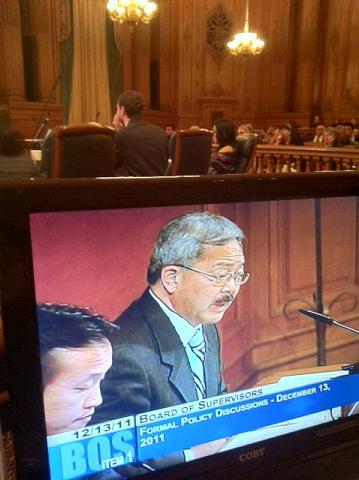
UPDATED When Mayor Ed Lee appears before the Board of Supervisors this afternoon (Tues/12) for the voter-mandated monthly “Formal Policy Discussions” (aka Question Time), he will be asked a couple of good, relevant questions with no easy answers. This is exactly what voters and progressive supervisors intended, a serious policy discussion, rather than sterile, hollow ritual that our current crop of politicians have turned it into.

The first question is by Sup. Eric Mar, who asks, “The Municipal Transportation Agency recently released its Draft Bicycle Strategy, which lays out an aggressive plan to upgrade San Francisco’s bicycle facilities. It supports biking for everyone, including seniors, families, and persons with disabilities. However, I am hearing growing concerns both in my district and city-wide about the mismatch between verbal commitments to better bicycling and budget realities. Currently, bicycle projects account for just 0.46 percent of all MTA capital. This is not enough to get us to the goals laid out in the Bicycle Strategy. How will you fund the Bicycle Strategy to make San Francisco a national leader in bicycling safety and use?”

Great question! This report, which came out in December, has the modest, realistic goal of increasing the share of vehicle trips taken by bike from 3.5 percent last year up to 8-10 percent by 2018. That already seems to abandon the official city goal – heavily touted by Lee and Board President David Chiu – of 20 percent by 2020. But even this new plan isn’t fully funded, so the question is simply asking the mayor whether he will put his money where his mouth is.

The second question comes from Chiu, who is trying to find a way to mediate the very real and challenging dispute between the city’s renters and those trying to convert more apartments into condos. Understanding where Lee stands on the issue is important to solving this problem, and Chiu’s question seems to genuinely seek guidance from the chief executive.

He asks, “Mr. Mayor, the Board of Supervisors is considering legislation to allow existing owners of Tenancies in Common (TICs) to bypass the condominium conversion lottery and be converted after the payment of a fee. I recently asked supporters of the legislation and tenant advocates to engage in negotiations, which Supervisor Farrell and I are hosting.

“What is your position on this pending legislation? What protections would you support to prevent the loss of rent-controlled housing in our increasingly unaffordable city? How would you address the concern that if we allow the current generation of TIC owners to convert, we will replace then with a new generation of TIC owners and additional real estate investments that will lead us right back to an identical debate within a short time?”

Again, excellent questions that go right to heart of one of the central struggles facing this city: Who gets to live here? And given Lee’s role in relentlessly promoting taxpayer-subsidized economic development strategies that are gentrifying the city and fueling this clash, one could argue that he has a moral obligation to help find a solution to this problem, or at the very least to say where he stands so voters can judge him accordingly.

Mayor Lee received these questions last week, so he and his staff have had plenty of time to think about them and prepare real, substantive answers. Will we get real answers or just the normal political platitudes that kick the can down the road in dealing with these pressing problems? We’ll see. Tune in at 2 pm to SFGOVTV to watch yourself, or check back here later and I’ll tell you what Mayor Lee said.

4PM UPDATE: And the winner is…meaningless political platitudes, misleading data, and shameless fence-sitting.

“I can’t say that I have a magic solution to this issue that will make everyone happy,” was how Mayor Lee answered Chiu’s question about the condo lottery bypass legislation, after saying he understood the positions of TIC owners who want to convert to condos and tenant groups concerned about the loss of what he called “the precious few rent-controlled units.”

Lee said he hopes that the two sides can find a “consensus solution” to the problem, which seems to indicate that he does indeed believe in magic considering the diametrically opposed viewpoints of the two sides and the zero sum game this issue represents. Afterward, I told the mayor that he didn’t seem to take a position on the issue and asked him to elaborate on what should be done, and he maintained that, “I actually did take a position, even though it didn’t sound like it, because I actually believe they have good points on both sides.”

Yet when KCBS reporter Barbara Taylor tried to help discern what that position may be, asking whether we could at least say that Lee didn’t support the legislation in its current form, he wouldn’t even agree to that weak stance. No, his position was that both sides have good points, even though they’re opposing points, and he’s hoping for the best. Next question.

Lee didn’t provide a clear or responsive answer on the bike question either. He reiterated his support for cycling improvements and said, “SFMTA’s prime responsibility is to ensure the streets are safe for all San Franciscans, and that includes bicyclists.” And he tried to dispute Mar’s point about how less than a half of 1 percent of the agency’s capital budget goes to bicycling improvements.

“To look at the percentage might not tell the whole story,” Lee said, citing how the SFMTA and the Transbay Joint Powers Authority are now seeking about $40 million in state and federal grants for transportation projects that would include cycling infrastructure improvements.

And that might have seemed like a somewhat responsive answer to the casual listener who isn’t aware that the price tag for improvements identified in the SFMTA Bicycle Strategy total about $200 million, of which the agency has only identified about $30 million in available funding. So the question of “How will you fund the Bicycle Strategy?” remains unanswered.

Perhaps it was too much to expect straight answers from a politician.

Out of place

414

news@sfbg.com 

In his State of the City address last week, Mayor Ed Lee cheerfully characterized San Francisco as “the new gravitational center of Silicon Valley.” He touted tech-sector job creation. “We have truly become the innovation capital of the world,” Lee said, “home to 1,800 tech companies with more than 42,000 employees — and growing every day.”

From a purely economic standpoint, San Francisco is on a steady climb. But not all residents share the mayor’s rosy outlook. Shortly after Lee’s speech, renowned local author Rebecca Solnit published her own view of San Francisco’s condition in the London Review of Books. Zeroing in on the Google Bus as a symbol of the city’s housing affordability crisis, she linked the influx of high-salaried tech workers to soaring housing costs. With rents trending skyward, she pointed out, the dearth of affordable housing is escalating a shift in the city’s cultural fabric.

“All this is changing the character of what was once a great city of refuge for dissidents, queers, pacifists and experimentalists,” Solnit wrote. “It has become increasingly unaffordable over the past quarter-century, but still has a host of writers, artists, activists, environmentalists, eccentrics and others who don’t work sixty-hour weeks for corporations — though we may be a relic population.”

LIMITED OPTIONS

The issue of housing in San Francisco is highly emotional, and there is perhaps no greater flashpoint in the charged debate than Ellis Act evictions.

When the housing market bounces upward, Ellis Act evictions tend to hit long-term tenants whose monthly payments, protected by rent control, are a comparative bargain. Even if they’ve submitted every payment on time and upheld every lease obligation for 20 years, these renters can find themselves in the bind of being forced out.

And they don’t just lose their homes; often they lose their community. San Francisco has become so expensive that many Ellis Act victims are tossed out of this city for good.

Enacted in 1986, the state law allows a landlord to stop renting units, evict all tenants, and sell the building for another purpose. Originally construed as a way for landlords to “go out of business” and move into their properties, the Ellis Act instead gained notoriety as a driving force behind a wave of evictions that slammed San Francisco during the tech boom of the late 90s. Between 1986 and 1995, just 29 Ellis evictions were filed with the San Francisco Rent Board; in the 1999-2000 fiscal year alone, that number ballooned to a staggering 440.

Under the current tech heyday, there are indications that Ellis Act evictions are gaining fresh momentum. The San Francisco Rent Board recorded 81 this past fiscal year, more than double that of the previous year, and there appears to be an upward trend.

TIC CONTROVERSY

Buildings cleared via the Ellis Act are typically repackaged as tenancies-in-common (TIC), where several buyers jointly purchase a multi-unit residence and each occupy one unit. Realtors often market TICs as a path to homeownership for moderate-income individuals, creating an incentive for buyers to enter into risky, high-interest shared mortgages in hopes of later converting to condos with more attractive financing.

The divide between TIC owners and renters came into sharp focus at a contentious Jan. 28 hearing, when a Board of Supervisors committee met to consider legislation that would allow some 2,000 TIC units to immediately convert to condos without having to wait their turn in a requisite lottery system.

One TIC owner said he was financially burdened, but had only entered into the arrangement because “I wanted to stay here and raise my family, but we couldn’t afford a single family home.” Yet tenants brought their own set of concerns to the table, saying the temptation to create TICs was putting a major dent in the city’s finite stock of rent-controlled units — the single greatest source of affordable housing in San Francisco.

“My feeling is, let’s stop doing TICs,” Tommi Avicolli Mecca, a tenants right activist with the Housing Rights Committee, told the Guardian following the hearing. “The city has to just start making sure that the condos that are built are the kind of thing [TIC buyers] can afford. Instead, we cannibalize our rental stock? That’s a reasonable way? You evict one group of people to house another: How does that make sense?”

The grueling five-hour hearing illustrated the sad fact that San Franciscans in a slightly better economic position were being pitted against economically disadvantaged renters. The two groups were bitterly divided, and all seemed weary, furious, and frustrated by their housing situations.

The condo-conversion legislation, co-sponsored by Sups. Scott Wiener and Mark Farrell, did not move forward that day. Instead, Board President David Chiu made a motion to table the discussion until Feb. 25, to provide time for “an intensive negotiation process.” Chiu, who rents his home, added: “While I myself would like to become a homeowner someday … I do not support the legislation in its current form.”

Sup. Jane Kim sought to appeal to the tenants as well as the TIC owners. “It’s very tragic that we have set up a situation where [TICs and renters] are pitted against one another,” she said. She hinted at what a possible alternative to might look like. “We should be looking at a ban of scale,” she said. “If we allow 1,800 potential units to go thru this year, are we willing to do a freeze for the next 8 to 10 years?”

It’s unclear what will happen in the next few weeks, but if this legislation makes it back to the full board in some form, the swing votes are expected to be Sups. London Breed, Malia Cohen and Norman Yee.

CASH OR EVICTION?

New protections were enacted following the late-90s frenzy to discourage real-estate speculators from using the Ellis Act to turn a profit on the backs of vulnerable seniors or disabled tenants. Yet a new wave of investors has discovered they can persuade tenants to leave voluntarily, simply by offering buyouts while simultaneously wielding the threat of an Ellis Act eviction. “The process got more sophisticated,” explains San Francisco Rent Board Deputy Director Robert Collins.

Once a tenant has accepted a check in lieu of eviction, rent-controlled units can be converted to market rate, or refurbished and sold as pricey condos, without the legal hindrances of an eviction blemish. Buyouts aren’t recorded with the Rent Board, and the agency has no real guidance for residents faced with this particular dilemma. “We don’t have the true number on buyouts,” says Mecca. “We don’t know how many people have left due to intimidation.”

Identity-wise, renters impacted by the Ellis Act defy categorization. A contingent of monolingual Chinese residents rallied outside City Hall recently to oppose legislation they believed would give rise to evictions; in the Mission, many targeted tenants are Latinos who primarily speak Spanish. From working immigrants, to aging queer activists, to disabled seniors, to idealists banding together in collective houses, the affected tenants do have one thing in common. When landlords or real-estate speculators perceive that their homes are more valuable unoccupied, their lives are susceptible to being upended by forces beyond their control.

The upshot of San Francisco’s affordability crisis is a cultural blow for a city traditionally regarded as tolerant, forward thinking, and progressive. In the words of Rose Eger, a musician who faces an Ellis Act eviction from her apartment of 19 years, “it changes the face of who San Francisco is.

Out of the Castro

By Tim Redmond

You can’t get much more Castro than Jeremy Mykaels. The 62-year old moved to the neighborhood in the early 1970s, fleeing raids at gay bars in Denver. He played in a rock band, worked at the old Jaguar Books, watched the rise of Harvey Milk, saw the neighborhood transform and made it his home.

He’s lived in a modest apartment on Noe Street for 17 years, and for the past 11 has been living with AIDS. Rent control has made it possible for Mykaels, who survives on disability payments, to remain in this city, in his community, close to the doctors at Davis Hospital who, he believes, have saved his life.

And now he’s going to have to leave.

In the spring of 2011, his longtime landlords sold the building to a real-estate investment group based in Union City — and the new owners immediately sought to get rid of all the tenants. Two renters fled, knowing what was coming; Mykaels stuck around. In September of 2012, he was served with an eviction notice, filed under the state’s Ellis Act.

He’s a senior, he’s disabled, his friends are mostly dead and his life is in his community — but none of that matters. The Ellis Act has no exceptions.

Mykaels spent a fair amount of his life savings fixing up his place. The walls are beige, decorated with nice art. Dickens the cat, who is chocolate brown but looks black, wanders in and out of the small bedroom. Mykaels has been happy there and never wanted to leave; “this,” he told me, “is where I thought I would live the rest of my life.”

There’s no place in the Castro, or even the rest of the city, where he can afford to move. Small studios start at $2,500 a month, which would eat up all of his income. There is, quite literally, nowhere left for him to go.

“A lot of my friends have died, or moved to Palm Springs,” he said. “But this is where my doctors are and where I’m comfortable. I’m not going to find a support system like this anywhere else in the world.”

Mykaels is the face of San Francisco, 2013, a resident who is not part of the mayor’s grand vision for bringing development and high-paying jobs into the city. As far as City Hall is concerned, he’s collateral damage, someone whose life will have to be upended in the name of progress.

But Mykaels isn’t going easily. The former web designer has created a site — ellishurtsseniors.org — that lists not only his address (460 Noe) and the names of the new owners (Cuong Mai, William H. Young and John H. Du) but the addresses of dozens of other properties that are facing Ellis Act evictions. His message to potential buyers: Boycott.

“Do not buy properties where seniors or the disabled have been evicted for profit by real estate speculators using the Ellis Act,” the website states.

Mykaels is a demon researcher — his site is a guide to 31 properties with 94 units where seniors or disabled people are being evicted under the Ellis Act. In some cases, individuals or couples are filing the eviction papers, but at least 14 properties are owned by corporations or trusts.

Mai told me that he knew a disabled senior was living in the building when he and his two partners bought it, but he said his plan all along was to evict all the tenants and turn the three-unit place into a single-family house. He said he hasn’t decided yet whether to sell building; “I might decide to live there myself.” (Of course, if he wanted to live there himself, he wouldn’t need the Ellis Act.)

Mai said he “felt bad about the whole situation,” and he had offered to buy Mykaels out. The offer, however, wouldn’t have covered more than a few months of market rent anyplace else in the Castro.

By law, Mykaels can stay in his apartment until September. If he can’t stave off the eviction by then, San Francisco will lose another longtime member of the city community.


Dark days in the Inner Sunset

By Rebecca Bowe

The living room in Rose and Willie Eger’s Inner Sunset apartment is where Rose composes her songs and Willie unwinds after playing baseball in Golden Gate Park. Faded Beatles memorabilia and 45 records adorn the walls, and a prominently displayed poster of Jimi Hendrix looms above a row of guitar cases and an expansive record collection.

It’s a little worn and drafty, but the couple has called this 10th Ave. apartment home for 19 years. Now their lives are about to change. On Jan. 5, all the tenants in their eight-unit building received notice that an Ellis Act eviction proceeding had been filed against them.

“The music that I do is about social and political things,” explains Rose, dressed from head-to-toe in hot pink with a gray braid swinging down her back. Determined to derive inspiration from this whole eviction nightmare, she’s composing a song that plays with the phrase “tenants-in-common.”

Cindy Huff, the Egers’ upstairs neighbor, says she began worrying about the prospect of eviction when the property changed hands last summer. Realtor Elba Borgen, described as a “serial evictor” in online news stories because she’s used the Ellis Act to clear several other properties, purchased the apartment building last August, through a limited liability corporation. The notice of eviction landed in the mailbox less than six months later. (Borgen did not return Guardian calls seeking comment.)

“With the [average] rent being three times what most of us pay, there’s no way we can stay in the city,” Huff says. “The only option we would have is to move out of San Francisco.” She retired last year following a 33-year stint with UCSF’s human resources department. Now, facing the prospect of moving when she and her partner are on fixed incomes, she’s scouring job listings for part-time work.

The initial notice stated that every tenant had to vacate within 120 days, but several residents are working with advocates from the Housing Rights Committee in hopes of qualifying for extensions. Huff and the Egers are all in their fifties, but some tenants are seniors—including a 90-year-old Cuban woman who lives with her daughter, and has Alzheimer’s disease.

Willie works two days a week, and Rose is doing her best to get by with earnings from musical gigs. Both originally from New York City, they’ve lived in the city 35 years. When they first moved to the Sunset, it resembled something more like a working-class neighborhood, where families could raise kids. The recent tech boom has ushered in a transformation, one that Rose believes “changes the face of who San Francisco is.” Willie doesn’t mince words about the mess this eviction has landed them in. “I call it ‘Scam-Francisco,'” he says.

The trio recently joined tenant advocates in visiting Sup. Norman Yee, their district supervisor, to tell their stories. Yee, who is expected to be one of the swing votes on an upcoming debate about condo-conversion legislation vehemently opposed by tenant activists, reportedly listened politely but didn’t say much.

As for what the next few months have in store for the Egers? “I can’t really visualize the outcome,” Rose says. “I can only visualize the day-to-day fight. And that’s scary.”


Fighting for a home in the Mission

By Tim Redmond

Eleven years ago, Olga Pizarro fell in love with Ocean Beach. A native of Peru who was living in Canada, she visited the Bay Area, saw the water and decided she would never leave.

Fast forward to today and she’s built a home in the Mission, renting a small room in a basement flat on Folsom Street. The 55-year-old has lived in the building for eight years; polio has left her wearing a leg brace and she can’t climb stairs very well, but she still rides her bike to work at the Golden Gate Regional Center. She’s a sociologist by training; the walls in her room are lined with bookshelves, with hundreds of books in Spanish and English.

The place isn’t fancy, and it needs work, but it’s hard to find a ground-floor apartment in the Mission that’s affordable on a nonprofit worker’s salary. Since 2011, when she moved in, she and her three housemates have been protected by rent control. And Pizarro’s been happy; “I love the neighborhood,” she told me.

The letter warning of a pending eviction arrived Jan. 16. A new owner of the building wants to turn the place into tenancies in common and is prepared to throw everyone out under the Ellis Act. There’s no place else in town for Pizarro to go.

“I’ve looked and looked,” she said. “The cheapest places are $2,500 a month or more. Maybe I’ll have to move out of the city.”

Pizarro’s building is owned by Wai Ahead, LLC, a San Francisco partnership registered to Carol Wai and Sean Lundy. I couldn’t reach Wai or Lundy, but their attorney, Robert Sheppard, had plenty to say. “San Francisco is going the way of New York,” he told me. “Manhattan is full of co-ops that used to be rentals, and lower-income people are moving to Brooklyn and Queens. That’s happening here with Oakland and further out.” He argued that TICs, like co-ops, provide home-ownership opportunities for former renters.

Sheppard, who for years represented tenants in eviction cases, said the Ellis Act is law, and America is a capitalist country, and “as long as there is a private housing market, there will be shifts of people as the housing market shifts.” He agreed that it’s not good for lower-income people to lose their homes, but “the poor will always be hurt by a changing economy. It’s called evolution.”

Pizarro told me she’s shocked at how expensive housing has become in the Mission. “It’s gotten so gentrified,” she said. “People show up in their BMWs. It’s starting to feel very isolated.”

She’s fighting the eviction. “I didn’t intend it to be this way,” she explained. “I just want to live here.” Lacking any family in the area, the Mission has become her community — “and I’m frustrated by the violence of how expensive it is.”


Affordability goes out of style

By Rebecca Bowe

Hester Michael is a fashion designer, and her home doubles as a project space for creating patterns, sewing custom clothing, weaving cloth, and painting. She’s lived in her Outer Sunset two-bedroom unit for almost two decades, but now she faces an Ellis Act eviction. Michael says she initially received notice last June. The timing was awful -– that same month, her husband passed away after a long battle with terminal illness.

“I’ve been here 25 years. My friends are here, and my business. I don’t know where else to go, or what else to do,” she says. “I just couldn’t picture myself anywhere else.”

Michael rents the upstairs unit of a split single-family home, a kind of residence that normally isn’t protected by rent control. Yet she leased the property in 1994, getting in under the wire before that exemption took effect. Since she pays below-market-rate rent in a home that could be sold vacant for top dollar, a target was essentially inscribed on her back when the property changed hands in 2004. That’s about when her long battle with the landlords began, she says.

From the get-go, her landlords indicated that she should look for a new place, Michael says, yet she chose to remain. The years that followed brought things falling into disrepair, she says, and a string of events that caused her feel intimidated and to fear eviction. Finally, she consulted with tenant advocates and hired an attorney. A complaint filed in superior court alleges that the property owners “harassed and retaliated [Michael] when she complained about the defective and dangerous conditions …telling [her] to move out of the property if she did not like the dangerous conditions thereat … repeatedly making improper entries into [the] property, and wrongfully accusing [her] of causing problems.”

Records show that Angela Ng serves as attorney in fact for the property owner, Ringo Chung Wai Lee. Steven Adair MacDonald, an attorney who represents both landlords and tenants in San Francisco housing disputes, represents the owners. “An owner of a single family home where the rent is controlled and a fraction of market has virtually no other choice but to terminate the tenancy,” MacDonald said when the Guardian reached him by phone. “They’ve got to empty it, and the only way to empty it is the Ellis Act.”

While Michael received an extension that allows her to remain until June 5, she fears her custom sewing business, Hester’s Designs, will suffer if she has to move. There’s the issue of space. “I have so much stuff in this house,” she says. And most of her clients are currently located close by, so she doesn’t know where her business would come from if she had to relocate. “A lot of my clients don’t have cars,” she says, “so if I live in some suburb in the East Bay, forget it. I’ll lose my business.”

The prospect of eviction has created a major dilemma for Michael, who first moved to San Francisco in 1987. While moving to the East Bay seems untenable, she says renting in San Francisco feels out of reach. “People are renting out small, tiny bedrooms for the same price as I pay here,” she says. With a wry laugh, she adds: “I don’t think there’s any vacant apartments in San Francisco -– unless you’re a tech dude and make seven grand a month.”

City considers making building owners do seismic upgrades

84

City Hall sources have confirmed the basic details of a San Francisco Public Press report from Friday afternoon that the Board of Supervisors will consider requiring the owners of soft-story buildings of three stories or more to seismically retrofit them by 2020 – at the expense of building owners, something sure to rouse controversy.

The legislation was developed and introduced by the Mayor’s Office and it’s being sponsored by the board’s two most prolific and effective supervisors, Board President David Chiu and Sup. Scott Wiener, which is probably a signal that city officials know this one is going to be “challenging,” as one source told us.

Details are still being hammered out before the measure is introduced at tomorrow’s board meeting, including some of the financing options that would be open to property owners. But after voters in 2010 narrowly rejected Measure A, a bond that would have provided low-cost loans for the seismic retrofits, property owners could be forced to dig deep to ensure their buildings don’t collapse in an earthquake.

Wiener confirmed that the legislation would be mandate on building owners without public money attached: “It would be a mandate that they within a certain time frame do an earthquake retrofit,” Wiener told the Guardian.

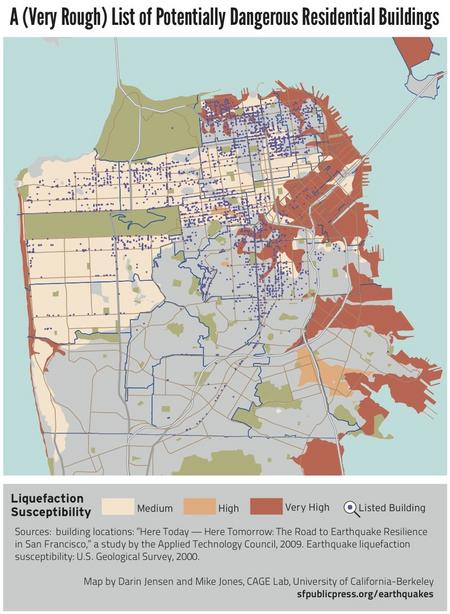
As the Public Press reported, the legislation would apply to all wood-framed buildings of three stories or more built before 1978, with smaller buildings and single-family homes exempted. In the most recent print edition of the Public Press, extensive coverage of the city’s earthquake vulnerabilities estimated that about 58,000 San Franciscans live in the nearly 3,000 soft-story buildings deemed dangerous places to be when the next big earthquake hits.

Wiener said city officials have been deeply involved with negotiations with various effected groups, including building owners and their tenants, who could face displacement as the work is done or higher rents if landlords pass through those costs. Wiener said the legislation is bound to evolve as talks and hearings continue: “There are a lot of variables and the introduction is really just a preliminary step.”

Supes call for stronger SRO safety measures

It’s no secret that tenants living in single room occupancy hotels (SROs) often grapple with health and safety issues, from bedbug infestations to plumbing problems.

At a committee hearing this afternoon, members of the Board of Supervisors will consider legislation [PDF] introduced by Sup. Eric Mar that would amend the housing code to require owners of SROs to install grab bars in common-area bathrooms, and to provide working phone jacks in each SRO unit.

These measures may seem relatively small, but Tony Robles of the Senior & Disability Action Housing Collaborative says installing grab bars can go a long way toward preventing falls, a leading cause of injury deaths for people older than 65.

In SROs, “there’s a lot of folks who have mobility problems,” Robles explains. “Many are disabled, or elders.” He said knows an elderly woman living in an SRO who recently fell and now faces hip surgery.

“This legislation is about safety, and it’s about quality of life,” Robles said. “It’s not just affluent folks who deserve to live in reasonably habitable conditions.”

Last June, advocates with Senior Action Network and several SRO collaboratives published detailed findings [PDF] from an in-depth survey of 151 SRO residents living in Chinatown, the Mission, SoMa and the Tenderloin. Most respondents were older than 55, and 62 percent identified as having a disability.

The in-depth study found that safety issues topped the list of residents’ concerns. Many respondents said they feared falling on the stairs or in the shower, and less than half reported having grab bars in their bathrooms.

The legislation, which was co-sponsored by Supervisors Jane Kim, David Campos and David Chiu, would also require SRO operators to install working phone jacks in residents’ rooms, which can be critical for tenants who need a way to communicate in case of an emergency.

According to the study findings, these low-income tenants face a host of other issues too:

“About one-third or more of survey respondents said their hotel had a problem with bedbugs, other infestations, visitor policy violations, electrical problems, unsanitary bathrooms, and harassment/ disrespect. One-fifth of respondents also cited problems with heat, plumbing, personal safety, fire safety, and maintenance and repairs. 
More than half (53%) had no access to a kitchen in their building, and 18% of respondents said they skip meals due to lack of resources or facilities.”

San Francisco has more than 500 residential hotels, according to city records, with more than 19,000 units. An estimated 8,000 seniors and adults with disabilities live in SROs.

Robles remarked that it took courage for the SRO residents to speak up in hopes of improving their living conditions. “Tenants in theses SROs oftentimes are intimidated to say anything,” he said. “Some folks might have feared reprisal.”

Condo conversion legislation on hold for now

Following a contentious five-hour hearing, a committee of the Board of Supervisors postponed voting on a controversial housing proposal, and agreed to revisit the issue on Feb. 25. Over the next few weeks, opposing sides are expected to negotiate a possible alternative.

Authored by Sups. Scott Wiener and Mark Farrell, the proposed condo conversion impact fee would have allowed as many as 2,000 tenancy-in-common (TIC) units to be immediately converted to condos for a fee, allowing owners to bypass a housing lottery system that places an annual cap on conversions.

While TIC owners voiced frustration about the backlogged lottery system, tenants expressed fears that the legislation could give rise to a wave of Ellis Act evictions if landlords or speculators interpreted it as a signal that lucrative condo conversion would be easier to achieve.

Prior to the hearing, a group of tenants gathered in front of City Hall in a show of opposition to the condo-conversion legislation, waving signs that read, “Stop the Attack on Rent Control.”

“The reality is, if this legislation passes, there will be more evictions in San Francisco,” said Tommi Avicolli Mecca of the Housing Rights Committee, who spoke at the rally.

Tenant advocates worry that the legislation would result in a permanent loss of affordable, rent-controlled units from the city’s housing stock, at a time when rents are soaring. When landlords rent out their condos or TICs in San Francisco, there’s a key difference: TICs are covered by rent control, but condos are exempt.

“I’ve been evicted three times,” one woman said while addressing members of the Land Use & Economic Development Committee. “I know so many people who have gotten evicted. I don’t know anyone who’s won their case against eviction.”

During the hearing, Farrell adopted a defensive tone against critics who’d described the proposal as an attack on rent control. “The tactics that these opponents have deployed is out of line,” he said. To assuage concerns, he noted that he and Wiener had included a provision guaranteeing lifetime leases for existing tenants in units that qualified for condo conversion under the program.

But Sup. Jane Kim drilled down on this detail, questioning whether such an agreement would be legally enforceable in the long run. In response, a representative from the City Attorney’s office said he thought the provision was on solid legal ground, but noted that the specific matter “has not been litigated before,” meaning there is still a question as to whether it could withstand a court challenge. When Kim asked if any funding was set aside to enforce these lifetime leases, the response was “no.”

Board President David Chiu proposed holding off on a vote for several weeks. “I do not support the legislation in its current form,” he said. If the current generation of TIC owners were allowed to convert this time, he explained, the next generation’s frustrations with the housing lottery would only “lead us back to an identical debate in a short period of time.”

Kim echoed this point. “My concern was that … folks were looking at this legislation as an ice-break for more condo conversion,” she said just after a public comment session that lasted several hours. And she acknowledged that there is a larger problem to consider. “It’s very tragic that we have set up a situation where [TICs and renters] are pitted against one another,” she said.

Herrera steps up his crackdown on surcharge fraud by restaurants

46

City Attorney Dennis Herrera has stepped up his efforts to ensure San Francisco restaurants aren’t committing consumer fraud with their healthcare surcharges – by pocketing money collected from diners ostensibly to cover their city obligation to provide health coverage to employees – offering an amnesty period for following city law.

At a City Hall press conference on Friday – flanked by Sups. David Campos and David Chiu, Assembly member Tom Ammiano, and local restaurant employees – Herrera announced an investigation and enforcement effort targeting dozens of local business who have reported spending less on employee health care than they collect from customers for that purpose. They will receive letters this week urging voluntarily compliance during an amnesty period, after which they could be hit with lawsuits and civil penalties.

“The enforcement program we’re launching today isn’t simply to protect employees and consumers from surcharge fraud – it’s also to protect the vast majority of competing restaurants that follow the law and provide health care benefits to their workers,” said Herrera. “We San Franciscans take great pride in a vibrant local restaurant scene that enriches our neighborhoods, employs thousands of our residents, and serves millions of tourists each year. And it’s unfortunate that the illegal business practices of a relative handful of bad actors require the creation of this enforcement initiative.”

The City Attorney’s Office is refusing to release the list of restaurants that will receive the letters, calling it an ongoing investigation that exempts the list from public disclosure. But the office did furnish reporters who asked with a spreadsheet from the city’s Office of Labor Standards Enforcement, which ensures compliance with the landmark Health Care Security Ordinance that Ammiano authored as a supervisor, going into effect in 2008 and creating the Healthy San Francisco program.

That list includes many well-known restaurants. Topping the list is Mina Group LLC (which includes restaurants Michael Mina, RN74, Bourbon Steak, and Clock Bar) collecting $539,806 and spending $211,809, Wayfare Tavern collecting $303,207 and spending $68,018, Layers LLC (owners of Paxti’s Pizza, which Herrera’s reached a settlement with two weeks ago), Squat & Gobble collecting $160, 498 and spending nothing on employee health care. Others on the list include Cheesecake Factory, Max’s Opera Cafe, Asia SF, Burgermeister, Folsom Pie, Cafe Bellini, and One Market Restaurant.

Golden Gate Restaurant Association Executive Director Rob Black lashed out at Herrera’s office for releasing that list and media outlets for publishing it, claiming that he’s talked to many of those restaurateurs and that they had filled out the forms wrong or that they simply hadn’t yet spent the surcharges collected even though the funds may be set aside for employee health care.

“They aren’t committing fraud, which is the accusation by the city attorney, just because of errors in filling out a form,” Black said, urging the public to reserve judgment until the investigation is complete.

But it’s hard to feel too bad for GGRA or the member restaurants that aggressively contested and then sued the city over the health care law, appealing it all the way to the Supreme Court, then turned around when they lost and used deceptive (and sometime fraudulent) surcharges to single out those costs for customers.

According to a press release put out by Herrera’s office:

“The City Attorney’s target letter outlined conditions worst-offender restaurants must take steps to meet by a deadline of April 10, 2013 to come into legal compliance, and avoid civil litigation by Herrera’s office for pocketing customer surcharge money intended to fund employee health care benefits.  
* Worst-offenders must provide an accounting to City Attorney investigators for all health care surcharges collected during the period from 2009 to 2011, along with health care expenditures pursuant to the Health Care Security Ordinance, or HCSO, for that time period.
* Worst-offenders must distribute 50 percent of unallocated health care surcharge funds  to employees who worked for the company during the time surcharges were imposed on customers, covering the years 2009 to 2011, in accordance with City Attorney instructions.
* Worst-offenders must remit amounts unredeemed by their eligible employees to the San Francisco City Attorney’s Office for the purpose of funding future enforcement of the HCSO and other consumer protection laws.
* Worst-offenders must attest that they will refrain from committing further consumer fraud and remain in full compliance in good faith with the HCSO going forward, in accordance with City Attorney instructions.”

In his press conference, Herrera emphasized the “relative handful” of restaurants targeted by his office, just a few dozen in a city with thousands of restaurants. But he also said that his office is aware of restaurants that use the surcharge without even reporting to the OLSE as required, so both the amnesty program and his investigation goes beyond just the restaurants who get letters.

“I’m tremendously gratified by this very statesmanlike and generous gesture by the City Attorney’s Office, Mr. Herrera in particular,” Ammiano said. “I feel somewhat parental toward this program, the Health San Francisco program. It was a hard fight to get it and it’s been successful, so any attempts to sully it, minimize it, or water it down get my dander up.”

Roe v. Wade anniversary inspires flash mob, pro-choice rally, and pro-life march in SF

Remember when a dance revolution broke out in Justin Herman Plaza during Occupy San Francisco? This coming Saturday, the same choreographers behind that flash mob for economic justice plan to reignite the public square, this time with a flash mob organized in collaboration with the Silver Ribbon Campaign to commemorate the 40th Anniversary of Roe v. Wade.

“Roe v. Wade is an invitation to really celebrate women, women’s rights and women’s reproductive rights,” says Magalie Bonneau-Marcil, director of Oakland nonprofit Dancing without Borders, who will direct the Jan. 26 flash mob. She expects between 400 and 500 dancers to descend upon the plaza.

The performance is part of a larger event, Women Life & Liberty, organized to commemorate the landmark Supreme Court decision that made abortion legal in the United States. The Trust Women Silver Ribbon Campaign is organizing the free celebration in tandem with the National Organization for Women and a coalition of more than 20 local partners.

“Our sense was, it’s an opportunity to claim and reclaim, and revive our activism around the issues that this event is about,” Silver Ribbon Campaign Director Ellen Shaffer told the Guardian. The rally is part of a national effort that has also launched an “online march” for reproductive rights.

Birth control champion Sandra Fluke, who became the center of a firestorm after being lambasted by Rush Limbaugh for testifying before Congress on the need for access to birth control, will speak at the rally.  Other speakers will include filmmaker and Webby Awards Founder Tiffany Shlain, and San Francisco Supes Malia Cohen, David Campos, David Chiu and Eric Mar, who joined the board in adopting a December resolution commemorating the 40th anniversary of Roe v. Wade.

Meanwhile, an international campaign to end violence against women will also play a role in this weekend’s events. Upon returning to the Bay Area after a dance festival in Europe, Bonneau-Marcil says she saw Eve Ensler’s music video promoting VDay’s 1 Billion Rising Campaign, created to spark a global movement to end violence against women. “I was so moved,” she says.

Inspired, she began making preparations for the Jan. 26 performance and an upcoming Feb. 14 flash mob, to be staged in front of San Francisco City Hall in league with VDay’s global movement.

With recent outrage fueled by the rape and fatal attack in India, the public performances are timely. Bonneau-Marcil describes the public dance gatherings as a way for participants to “share a prayer to create a world free of violence and sexual oppression.” 

But there’s likely to be drama, as the Women Life & Liberty celebration is one of two dueling events. Walk for Life West, essentially the polar opposite of the Trust Women Silver Ribbon Campaign, is being spearheaded by San Francisco pro-lifers Dolores Meehan and Eva Muntean. Now in its ninth year, the annual event will bring hordes of anti-abortion activists to San Francisco, wielding dead fetus photos. They’ll travel from as far away as Nevada, Canada and “all over the Midwest,” according to Muntean. “We have 200 buses coming from all over the West Coast,” she said.

The anti-abortion rally will feature speakers such as Rev. Clenard Childress, who has built a career out of telling right wing Christians that the pro-choice movement is racist. (Seems Childress also spends his spare time penning inflammatory columns suggesting that acceptance of LGBT rights is “a sign of the end times.”)

The pro-life rally will converge at Civic Center Plaza and progress to – where else? – Justin Herman Plaza. There, according to the event page, revelers from the transformative flash mob may still be celebrating. Expect an awkward buzz kill.

This being San Francisco, plans are already being hatched to counter-protest the anti-abortion event. (Muntean emphasized that Walk for Life West should not be interpreted as counter-protest to the Women Life & Liberty event, by the way.)

Stop Patriarchy, made of up activists who are pro-choice, anti-Democratic party, and even anti-pornography since they deem it to be part of the war on women, plans to stage “boisterous and confrontational political protests throughout the week, taking on the Pro-Lifers who will be in San Francisco,” according to a press release. They’ll be there counter-protesting the Walk for Life with banners and signs declaring, “Abortion On Demand and Without Apology!”

Bonneau-Marcil, the flash mob director, says she’s trying to stay out of any back-and-forth that may come from warring factions. “We’re not pointing fingers,” she says. Instead, she’s on a mission to help dancers move in harmony to “access a place where, it’s not about opinions. It’s just about remembering who we are as human beings.”

The Women, Life & Liberty rally will be held at Justin Herman Plaza from 10 a.m. to noon. The Dancing Without Borders flash mob performance will take place at 11:30. Anyone can join the flash mob after attending two rehearsals: more info here. The Walk for Life West rally will converge at 12:30 at Civic Center Plaza and begin the procession to Justin Herman at 1:30. More info here, here and here.

On the Cheap Listings

0

On the Cheap listings by Cortney Clift. Submit items for the listings at listings@sfbg.com. For further information on how to submit items for the listings, see Picks.

WEDNESDAY 23

“From Vision to Icon: Building the Golden Gate Bridge” Sports Basement, 1590 Bryant, SF. www.sfwalksandtalks.com. 7pm, free. Local writer, producer, and narrator Peter Moylan presents the story of the Golden Gate Bridge, exploring all the triumphs and challenges encountered throughout its creation The lecture will be told with over 120 historic photos in the live documentary style SF Walks and Talks is known for.

THURSDAY 24

“Pixilated Drift” Johansson Projects, 2300 Telegraph, Oakl. www.johanssonprojects.net. Through March 16. Noon-6pm, free. The show will feature Andrew Benson’s hypnotic pixel prints, David O’ Brien’s explosive and abstract video stills, and Tamara Albaitis’ sound sculptures, sure to be as entrancing and mysterious to look at as they are to listen to.

FRIDAY 25

“Full Wolf Moon” Cotton Mill Studios, 1091 Calcot, Oakl. www.f3oakland.com. 6-10pm, free. F3 at the Cotton Mill will be showing off resident and guest artists’ new work in the collective’s eighth event. The evening will be a bit of a cultural smorgasbord with various galleries and studios open throughout the building, live music, dance, and spoken word in the “Wolf Den,” a design bazaar, and food trucks. Free shuttle transportation will be provided to the Cotton Mill Studios from the Fruitvale BART station from 6-10:30pm.

Fundraiser for KPOO Radio Mercury Café, 201 Page, SF. 7-10pm, free. For over 40 years local nonprofit radio station has been discussing issues facing underserved communities such as GLBT folks, low-income families and young people as well as playing music largely absent in mainstream media. But KPOO has recently lost a significant source of funding due to budget cuts. Head over to Mercury Café for a night of food, drinks, and music to help keep the station on the air. 10 percent of all sales will go to KPOO.

“Deviant Type Press Benefit Show” Temescal Arts Center, 511 Eighth St., Oakl. 7pm, $10 donation suggested. Hosted by Jezebel Delilah X, this evening will consist of readings by Mia McKenzie, fat activist Virgie Tovar, Sister Spit-Valencia queer author Michelle Tea, and Manish Vaidya. After the readings Bay Area band Gaymous rocks.

SATURDAY 26

“All You Can Dance” Alonzo King LINES Dance Center, 26 Seventh St., fifth floor, SF. www.linesballet.org. 1-5pm, $5. Whether you’ve been itching to brush up on your ballet skills or wanting to test your talent in Zimbabwean dance, the $5 entry fee allows you try out any and all classes on today’s schedule. Offering everything from Bollywood dance to Pilates to Argentinean tango, you’re free to dance ’til you drop.

Roe Vs. Wade 40th anniversary celebration Justin Herman Plaza, SF. www.oursilverribbon.org. 10am-noon, free. Reproductive rights pioneer Pat Maginnis, president of the San Francisco Board of Supervisors David Chiu, and other speakers will be addressing women’s issues today in remembrance of the legendary court case that gave us our reproductive rights. It may not technically be a carnival, but there will be face-paining, airbrush tattoos, balloon artists, a bubble artist, and a performance by One Billion Rising, a radical gang of flash mobbers.

SUNDAY 27

“San Francisco Poet Laureate Alejandro Murguía’s Inaugural Address” San Francisco Main Library, Koret Auditorium, 100 Larkin, SF. www.sfpl.org. 1-3pm, free. Murguía will give his inaugural address as the city’s sixth poet laureate and speak about the connection Latino history and San Francisco history have to one another as well as how poetry has affected the local Latino community. A reception will follow his wise words, so you’ll have ample time to chew them over.

“Drunken Spelling Bee” Café Royal, 800 Post, SF. www.caferoyale-sf.com. 6pm, free. Hosted by Jimi Moran, this event is exactly what it sounds like. Maybe you dominated in your sixth grade spelling bee, but how are your skills after a few beers? No iPhone spell checks allowed.

“Oakland Youth Orchestra ‘Russian Romance’ Winter Concert” Holy Names University, 3500 Mountain, Oakl. www.oyo.org. 3pm, free. Get classy Sunday afternoon at what is sure to be something far better than an average high-school music recital. The 75 musicians who make up the Oakland Youth Orchestra range from ages 12 to 22 but possess musical skills far beyond their years. The concert will include festive pieces by Dimitri Shostakovich, Pyotr Ilyich Tchaikovsky, and Sergei Rachmaninov.

MONDAY 28

Berkeley Arts & Letters presents Adam Mansbach’s Rage is Back The Marsh Berkeley, 2120 Allston, Berk. www.berkeleyarts.org. 7:30pm, $5/students, $12/advance. The author of the No. 1 New York Times bestseller Go the F**k to Sleep is back to tell the story of a clever kid, the father who left him, and the greatest graffiti stunt New York City has ever seen in his new book titled Rage is Back. Today Mansbach will read and discuss his new release. The Marsh Cabaret Bar will be open before, during, and after the program.

TUESDAY 29

Recology art exhibit and panel discussion Reception at 503 Tunnel, SF. 5-7pm, free. Panel discussion at 401 Tunnel, SF. 7pm, free. Exhibition also on display Fri/25, 5-9pm; Sat/26, 1-3pm. www.recologysf.com. Recology’s artist in residence program will exhibit work created by Michael Damm, Julia Goodman, and Jeff Hantman over the past four months, made from scavenged materials found at the dump. After the exhibit, head a few doors down to catch the artists talking about their experience working to create art in trashland.

Chiu’s committee assignments keep the moderates in charge

42

A week after engineering his unanimous re-election to an unprecedented third consecutive term as president of the Board of Supervisors, David Chiu today announced his assignments to board committees, placing fiscal conservatives into two of the most powerful posts and making himself a key swing vote on the Land Use Committee.

“I believe these committee assignments reflect a balanced approach and the diverse interests and talent of the supervisors,” Chiu said just after 4pm during the Roll Call portion of today’s meeting.

But some progressive activists were immediately grousing about some of the selections, which seem to reflect Chiu’s neoliberal approach to governance, preventing progressives from doing much to challenge development interests or the appointment of Establishment insiders to city commissions.

The Land Use Committee is perhaps the most powerful and impactful, particularly as the Warriors arena and other controversial waterfront developments and the CPMC hospital deal come to the board. Scott Wiener – a moderate who is already perhaps the most prolific supervisor – gains far more power as he is named to chair that committee. It is balanced out by Chiu and Sup. Jane Kim, both of whom have some progressive impulses on land use issues but also personal ambitions and a penchant for cutting deals. Developers have to be happy about this lineup.

Sup. Mark Farrell was named chair of the Budget Committee, succeeding Sup. Carmen Chu – a pair that are indisputably the most conservative supervisors on the board. While progressive Sups. Eric Mar and John Avalos will help balance out the permanent committee, their influence will be offset by the temporary members added during budget season: Sups. London Breed and Wiener.

That roster essentially puts Breed in the swing vote role, which should immediately give her some clout. Chiu’s defenders note that Budget’s balance of power is essentially status quo (with Breed now in the same swing vote role that Sup. Malia Cohen played) – and that the committee’s work last year was supported by labor and business interests alike.

Chiu is proposing to combine the Public Safety and City Operations & Neighborhood Services committees, naming Sup. David Campos as chair, Mar as vice-chair, and new Sup. Norman Yee as its third member. Yee, who nominated Chiu for president last week, was also rewarded with a chair on the Rules Committee – controlling appointments, it arguably the board’s third most influential committee after Land Use and Budget – with that committee filled out by Breed and Sup. Malia Cohen.

Speculation that Cohen and Kim would be rewarded for withdrawing their nominations as president before the vote last week don’t seem to have materialized in these appointments. Cohen was also named to the Government Operations Committee, along with Campos, which Sup. Carmen Chu will chair. That doesn’t give Cohen, who told us that she wanted to be on Land Use, much power.

Similarly, Kim was named chair of the City & School District Committee – nice, but not exactly a political launching pad – and Kim’s only real power on Land Use will come when Chiu is opposing some project, as he did with the controversial 8 Washington project that Kim and seven of her colleagues supported.

Aaron Peskin, Chiu’s predecessor as board president, said that he vaguely saw some semblance of Chiu’s claimed strategy of having conservative committee chairs balanced out by liberal majorities (although even that depends on how you define your terms). Yet Peskin questions that approach, and sees committees unlikely to really gel around good decisions or policies.

“It’s a recipe for dysfunction,” Peskin told us. “But it certainly will be fun to watch.”

Herrera takes on restaurants that use bogus healthcare surcharges

66

City Attorney Dennis Herrera fired a warning shot across the bow of San Francisco restaurants that use a customer surcharge ostensibly to pay for employee health care – while in reality, many restaurateurs simply pocket the money and offer substandard health care options to employees – over the weekend when his office announced a settlement with Patxi’s Chicago Pizza.

The tone of the press release announcing the $320,000 settlement was generally positive, with Patxi’s claiming it was an innocent error and Herrera praising the owner’s cooperation in an agreement that improves the health care coverage of Patxi’s employees, compensates employees for the error, and ensures all surcharges tacked onto customers’ bills go to employee health care. Yet Herrera also included a warning to other restaurants.

“But today’s settlement should send a strong message that San Francisco is serious about making sure that restaurants keep their promises to their customers about health care surcharges. I look forward to announcing a larger, more global effort in the coming days to address this issue, to make sure health care surcharge money goes to the workers rather than being pocketed by business owners,” Herrera said in the release, signaling an effort to resolve with civil enforcement something that the political system has failed to do.

This became a hugely contentious issue in 2011 when the Golden Gate Restaurant Association (GGRA) and San Francisco Chamber of Commerce aggressively opposed reform legislation by Sup. David Campos that would have required that all surcharges be spent on health care and prevented employers from raiding health savings accounts at the end of each year. Mayor Ed Lee vetoed that measure but signed a watered down version by Sup. David Chiu – moves that Herrera criticized while running for mayor.

GGRA (whose Executive Director Rob Black didn’t return our call) aggressively fought the city’s Health Care Security Ordinance requirement that employers provide minimal health coverage to their workers, taking it all the way to the US Supreme Court. After losing that battle, many restaurants began adding a 3-5 percent surcharge of customers’ bills, even while offering employees what experts say is the worst form of health coverage, healthcare savings accounts, and often blocking their employees efforts to use them.

An investigative report in the Wall Street Journal showed how many San Francisco restaurants were essentially committing consumer fraud by pocketing the surcharges, elevating the issue, but the District Attorney’s Office has consistently refused to treat this as a criminal matter, despite calls for action by the Civil Grand Jury. So Herrera’s willingness to use civil sanctions, and his warning of more to come, was enthusiastically welcomed by Campos and other advocates.

“I’m very happy with what the City Attorney’s Office is doing,” Campos said. “It’s time for this kind of legal action.”

Campos had already pledged to reevaluate the issue later this year as data comes in about how the compromise regulations by Chiu and Lee are working, threatening to take it to the ballot if necessary and calling it an important issue for all San Franciscans.

“It’s not just about protecting workers and consumers, but also protecting businesses that play by the rules and comply with the law,” said Campos, noting that many restaurants have admirably refused to use the surcharge, shortchange their employees, or support GGRA’s litigation against the city. “It’s about fairness.”

SFBOS grab bag: Diva Breed, Yee’s jig, delayed Chiu, and more

10

Now that the dust has settled from this week’s San Francisco Board of Supervisors inauguration and presidential vote, I thought I’d return to a few random gems that were still stuck in my notebook, waiting to see the light of day.

Under the heading of There’s a New Diva under the Dome, new D5 Sup. London Breed didn’t wait for the official noon inauguration prescribed by the City Charter to take her oath of office, instead holding a packed event at 10am in the North Light Court, where her oath was administered by a key supporter, Attorney General Kamala Harris.

“I held a swearing in earlier to be able to have a large crowd of supporters,” was how Breed explained it to her colleagues later, and it’s certainly true that attendance at the official event was limited by the size of the room. But it’s equally true that gathering a who’s who list of local power brokers to applaud Breed’s ascendance as a key swing vote sends the signal that she expects to be at the table when the big deals get cut.

President David Chiu, who is also no stranger to political power plays, sounded a tone of humble leadership after maneuvering himself with closed-door negotiations into an unprecedented third consecutive term as president, noting that there is still much more work to do.

In fact, Chiu said he was almost late for Breed’s event because, “my bike light got stolen, the Muni bus was late, and then I had a hard time catching a cab.”

Sup. Eric Mar revisited his reelection race last year with a huge understatement – “In my campaign, I had to do a little more work than my colleagues did.” – noting that he and his supporters overcame an unprecedented $1 million in spending against them: “We sent a strong message that the Richmond District is not for sale and never will be.”

Sup. John Avalos gave credit for his surprisingly easy reelection campaign to a unlikely but deserving source: journalist Chris Roberts, who uncovered evidence that Avalos challenger Leon Chow didn’t really live in the district, which he reported in SF Appeal, forcing Chow to withdraw from the race. Avalos called Roberts “an honorary member of our campaign.”

Meetings like this are often just dripping in sanctimony, and this one was no exception, so it was nice to see a moment of genuine child-like exuberance from new D7 Sup. Norman Yee, who at 63 is about twice as old as most of his colleagues. As he thanked supporters and laid out his goals, Yee suddenly seemed overcome by this opportunity, smiling broadly, doing a little jig, and declaring, “Darn, I’m excited!”

I was less impressed by the rambling mini-lecture that Cohen gave on the topic of leadership before she withdrew her nomination as president. “That’s what leadership is about, stepping forward, outside your comfort zone, and doing things,” said the supervisor with a scant legislative record as she quit the race for president before her colleagues were even given the chance to vote on what she said was the importance of having a women of color in charge. “Every person here has that leadership quality within them.”

From both supervisors and the general public, there were also a number of statements made about the history of the board presidency that were not quite right, particularly as it pertained to Cohen and Jane Kim nominating one another for president and the issue women of color being nominated for that slot.

So, for the record, the last time a woman of color (former D10 Sup. Sophie Maxwell) was nominated for board president was 10 years ago. The last time a woman served as president was Barbara Kaufman (1997-99). And the last time there was a woman of color serving as president was Doris Ward, who served from 1991 to mid-1992 when she left to become Assessor. Also, the last three-term president was John Molinari, who served from 1979-83 and ’85-’87.

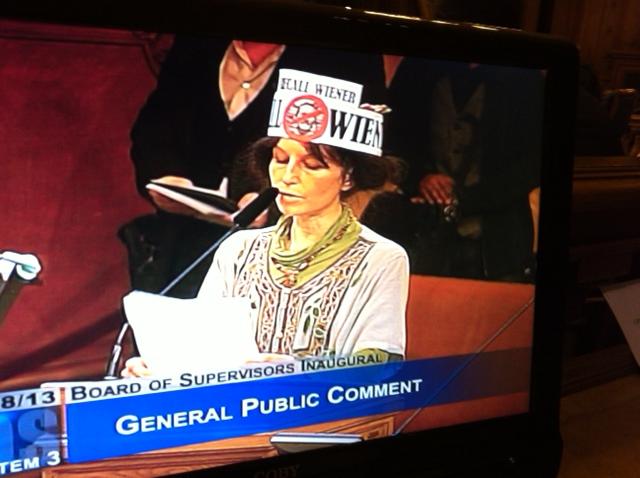
The most colorful moment in public comment was when nudism activist Gypsy Taub came clad in homemade hat that urged people to oppose and recall Sup. Scott Wiener. But because Wiener had already said he wouldn’t accept a nomination as president, she turned her criticism on Chiu, who was also slammed by another leftist speaker who told supervisors, “If you can’t prevent David Chiu from being president, we deserve to be slaves.”

Finally, the meeting included an unremarkable speech by Mayor Ed Lee, who pledged to work with each supervisor and offered this unsupported claim, “We continue to make sure this city is successful for everyone.”

War of the waterfront

40

tredmond@sfbg.com

There’s a blocky, unattractive building near the corner of Howard and Steuart streets, right off the Embarcadero, that’s used for the unappealing activity of parking cars. Nobody’s paid much attention to it for years, although weekend shoppers at the Ferry Building Farmers Market appreciate the fact that they can park their cars for just $6 on Saturday and Sunday mornings.

But now a developer has big plans for the 75 Howard Street site — and it’s about to become a critical front in a huge battle over the future of San Francisco’s waterfront.

Paramount Partners, a New York-based real-estate firm that also owns One Market Plaza, wants to tear down the eight-story garage and replace it with a 350-foot highrise tower that will hold 186 high-end condominiums. The new building would have ground-floor retail and restaurant space and a public plaza.

It would also exceed the current height limit in the area by 150 feet and could be the second luxury housing project along the Embarcadero that defies the city’s longtime policy of strictly limiting the height of buildings on the waterfront.

It comes at a time when the Golden State Warriors are seeking permission to build a sports arena on Piers 30 and 32, just a few hundred feet from 75 Howard.

Between the proposed 8 Washington condo project, the arena, and 75 Howard, the skyline and use of the central waterfront could change dramatically in the next few years. Add to that a $100 million makeover for Pier 70, the new Exploratorium building on Pier 15, and a new cruise ship terminal at Pier 27 — and that’s more development along the Bay than San Francisco has seen in decades.

And much of it is happening without a coherent overall plan.

There’s no city planning document that calls for radically upzoning the waterfront for luxury housing. There’s nothing that talks about large-scale sports facilities. These projects are driven by developers, not city planners — and when you put them all together, the cumulative impacts could be profound, and in some cases, alarming.

“There hasn’t been a comprehensive vision for the future of the waterfront,” Sup. David Chiu told me. “”I think we need to take a step back and look at what we really want to do.”

Or as Tom Radulovich, director of the advocacy group Livable City, put it, “We need to stop planning the waterfront one project at a time.”


Some of the first big development wars in San Francisco history involved tall buildings on the waterfront. After the Fontana Towers were built in 1965, walling off the end of the Van Ness corridor in a nasty replica of a Miami Beach hotel complex, residents of the northern part of the city began to rebel. A plan to put a 550-foot US Steel headquarters building on the waterfront galvanized the first anti-highrise campaigns, with dressmaker Alvin Duskin buying newspaper ads that warned, “Don’t let them bury your skyline under a wall of tombstones.”

Ultimately, the highrise revolt forced the city to downzone the waterfront area, where most buildings can’t exceed 60 or 80 feet. But repeatedly, developers have eyed this valuable turf and tried to get around the rules.

“It’s a generational battle,” former Sup. Aaron Peskin noted. “Every time the developers think another generation of San Franciscans has forgotten the past, they try to raise the height limit along the Embarcadero.”

The 8 Washington project was the latest attempt. Developer Simon Snellgrove wants to build 134 of the most expensive condominiums in San Francisco history on a slice of land owned in part by the Port of San Francisco, not far from the Ferry Building. The tallest of the structures would rise 136 feet, far above the 84-foot zoning limit for the site. Opponents argued that the city has no pressing need for ultra-luxury housing and that the proposal would create a “wall on the waterfront.”

Although the supervisors approved it on a 8-3 vote, foes gathered enough signatures to force a referendum, so the development can’t go forward until the voters have a chance to weigh in this coming November.

Meanwhile, the Paramount Group has filed plans for a much taller project at 75 Howard. It’s on the edge of downtown, but also along the Embarcadero south of Market, where many of the buildings are only a few stories high.

The project already faces opposition. “The serious concerns I had with 8 Washington are very similar with 75 Howard,” Chiu said. But the issues are much larger now that the Warriors have proposed an arena just across the street and a few blocks south.

“Because of the increase in traffic and other issues around the arena, I think 75 Howard has a higher bar to jump,” Sup. Jane Kim, who represents South of Market, told me.

Kim said she’s not opposed to the Warriors’ proposal and is still open to considering the highrise condos. But she, too, is concerned that all of this development is taking place without a coherent plan.

“It’s a good question to be asking,” she said. “We want some development along the waterfront, but the question is how much.”

Alex Clemens, who runs Barbary Coast Consulting, is representing the developer at 75 Howard. He argues that the current parking garage is neither environmentally appropriate nor the best use of space downtown.

“Paramount Group purchased the garage as part of a larger portfolio in 2007,” he told me by email. “Like any other downtown garage, it is very profitable — but Paramount believes an eight-story cube of parking facing the Embarcadero is not the best use of this incredible location.”

He added: “We believe removing eight above-ground layers of parked cars from the site, reducing traffic congestion, enlivening street life, and improving the pedestrian corridor are all benefits to the community that fit well with the city’s overall goals. (Of course, these are in addition to the myriad fees and tax revenues associated with the project.)”

But that, of course, assumes that the city wants, and needs, more luxury condominiums (see sidebar).


Among the biggest problems of this rush of waterfront development is the lack of public transit. The 75 Howard project is fairly close to the Embarcadero BART station, but when you take into account the Exploratorium, the arena, and Pier 70 — where a popular renovation project is slated to create new office, retail, and restaurant space — the potential for transit overload is serious.

The waterfront at this point is served primary by Muni’s F line — which, Radulovich points out, “is crowded, expensive, low-capacity, and not [Americans with Disabilities Act]-compliant.”

The T line brings in passengers from the southeast but, Radulovich said, “if you think we can serve all this new development with the existing transit, it’s not going to happen.”

Then there are the cars. The Embarcadero is practically a highway, and all the auto traffic makes it unsafe for bicycles. The Warriors arena will have to involve some parking (if nothing else, it will need a few hundred spaces for players, staff, and executives — and it’s highly unlikely people who buy million-dollar luxury boxes are going to take transit to the arena, so there will have to be parking for them, too. That’s hundreds of spaces and new cars — assuming not a single fan drives.

The 75 Howard project will eliminate parking spaces, but not vehicle traffic — there will still be close to 200 parking spaces.

And all of this is happening at the foot of the Bay Bridge, the constantly clogged artery to the East Bay. “Oh, and there’s a new community of 20,000 people planned right in the center of the bridge, on Treasure Island,” Peskin pointed out.

Is it possible to handle all of the people coming and going to the waterfront (particularly on days where there’s also a Giants game a few hundred yards south) entirely with mass transit? Maybe — “that’s the kind of problem we’d like to have to solve,” Radulovich said. Of course, the developers would have to kick in major resources to fund transit — “and,” he said, “we don’t even know what the bill would be, and we don’t have the political will to stick it to the developers.”

But a transit-only option for the waterfront is not going to happen — at the very least, thousands of Warriors fans are going to drive.

The overall problem here is that nobody has asked the hard questions: What do we want to do with San Francisco’s waterfront? The Port, which owns much of the land, is in a terrible bind — the City Charter defines the Port as an enterprise department, which has to pay for itself with revenue from its operations, which made sense when it was a working seaport.

But now the only assets are real estate — and developing that land, for good or for ill, seems the only way to address hundreds of millions of dollars in deferred maintenance and operating costs on the waterfront’s crumbling piers. And the City Planning Department, which oversees the land on the other side of the Embarcadero, is utterly driven by the desires of developers, who routinely get exemptions from the existing zoning. “There is no rule of law in the planning environment we live in,” Radulovich said. So the result is a series of projects, each considered on its own, that together threaten to turn this priceless civic asset into a wall of concrete.

Behind today’s unanimous vote for Chiu

37

For all the high-minded talk about diversity and working together on behalf of the public – and the relentless praising of their political colleagues and supporters – today’s unanimous re-election of David Chiu as president of the Board of Supervisors once again demonstrated that much of the people’s business is done behind closed doors.

As most of the supervisors acknowledged publicly or in comments to the Guardian, in recent days there was a flurry of meetings about the president vote among the supervisors, despite the prohibition in the state’s Brown Act against “seriatim meetings,” in which elected officials have serial meetings with each other until an quorum of supervisors has illegally discussed some topic.

How else could Malia Cohen, Jane Kim, and Scott Wiener – all hopefuls for the president’s seat who withdrew themselves from consideration before a vote was cast – have all known that Chiu had the votes he needed to win an unprecedented third consecutive term? But they did know, as they all told the Guardian.

“The reality was the support wasn’t there,” Cohen told reporters after the vote when asked why she withdrew her nomination just before the supervisors were about to vote, just after Kim had done the same thing, leaving Chiu as the sole nominee.

I asked whether she was promised anything in return for withdrawing from consideration, and Cohen said, “There’s always negotiations involved in everything, from committee assignments to appointment to regional bodies…The full story will come out later.”

Cohen even obliquely suggested that Chiu – who is known to have his sights set on Tom Ammiano’s Assembly seat, which comes open in two years – may not serve his full two years as president and that was part of the backroom discussions. In the more immediate future, Cohen said she wants to serve on the Land Use Committee, so don’t be surprised if Chiu appoints her as chair of that powerful body.

“It may seem like a small setback today, but it sets the stage for greater conversations going forward,” Cohen said of her decision to voluntarily step down.

Kim also told reporters that she knew Chiu had the votes – saying “we know there was broad support for David for another term” – and that the decision that she and Cohen made to nominate one another was mostly symbolic, intended to make a point about the need for women of color to be in leadership positions: “I thought it was important that we put the dialogue out there.”

Kim said she really appreciated the opportunity to speak with more fellow supervisors privately in the last few days than she had before. “All of this was last minute. There were really only discussions in the last three days,” Kim told me. “I got a good sense of people’s policies and priorities.” As for Kim’s priorities, she said she wants to serve on the Budget Committee, so don’t be surprised when Chiu names her as chair.

Wiener also told me that he realized a couple days ago that he didn’t have the votes but that Chiu did. “It would have been an honor to serve as board president, but it wasn’t in the cards,” Wiener said.

Some of what the cards showed was made clear as the nominations for president opened today and new Dist. 7 Sup. Norman Yee spoke first and nominated Chiu, thus making it clear that Kim probably didn’t have the six votes she needed. As former Sup. Chris Daly, a veteran vote counter, told me, “Norman Yee and Eric Mar could have made Jane Kim board president. They were the deciding bloc, but it would taken both of them.”

Yet Mar told us that he was caught off guard by how the voting unfolded today. “I was surprised that people dropped out before the vote,” he told me.

Yet he acknowledged that it was perhaps a smart move by the progressive supervisors, who voted against Chiu two years ago and were punished with bad committee assignments, to instead get behind Chiu now and hand him a unanimous victory.

“I think that was the hope when people dropped out. It would have been hard if they didn’t, but these negotiations [with Chiu over committee assignments] will go on over the next few days,” Mar said, noting that he will push for strong representation by supporters of labor and other progressive constituencies on key committees.

Asked about his negotiations with fellow supervisors, Chiu would only say, “My conversation with everyone was very consistent.” As for his pending decision on committee assignments, he told me, “We have a board that is very diverse and we’ll have committees that reflect that.”

During his speech in Board Chambers, Chiu talked about running the board in a way that would let each supervisor have her/his moments in the spotlight to provide leadership on issues they care about, comparing it to the San Francisco Giants and the contributions that so many players made to their World Series sweep.

“They took turns making the big plays,” Chiu said, going on to tick off the list of how he’ll help his colleagues shine. “Whether it’s Sup. Mar advocating for a healthy environment, Sup. Farrell addressing out looming health care costs, whether it’s Sup. Chu disciplining our budget, Sup. Breed getting the jobs that young people need, Sup. Kim making sure that all our kids graduate, Sup. Yee making sure that small businesses succeed, Sup. Wiener fighting for better transportation options, Sup. Campos fighting against wage theft, or Sup. Cohen curbing gun violence, and Sup. Avalos delivering on local hire, by the end of our season, if we’re going to help each other succeed in getting these things done, we are all going to win.”

The next board president

9

EDITORIAL The president of the Board of Supervisors does more than bang the gavel at meetings, tell people to put their clothes back on, and run for higher office. It’s a powerful position largely because the president makes appointments — to the Planning Commission, the Police Commission — and unilaterally decides who serves on which board committees.

Two years ago, Sup. David Chiu, who won the top post in 2009 with progressive support, wanted re-election, and the left wasn’t siding with him anymore. So he cut a deal with the conservative members, appointing the right-wing of the board to plum committee posts — and making life harder for progressives who wanted to pass Legislation or prevent bad developments from happening.

He clearly likes the job and would love to hold it for a third term. But that won’t be easy — Sup. Scott Wiener, who is to the right of Chiu on many issues, is also interested, as is Sup. Jane Kim, who has always been close to Chiu, and Sup. David Campos, who is one of the leading progressives. None of the candidates can count to six right now, so somebody’s going to have to back down or make a deal.

And before that happens, the candidates ought to tell us something about what they plan to do.

Chiu’s 2011 committee appointments were a bit of a shocker, although, in retrospect, the horse trading shouldn’t have surprised anyone. In fact, after he made his decisions, and put Carmen Chu, one of the most conservative supervisors, in charge of the Budget and Finance Committee and put the conservative Scott Wiener and the moderate Malia Cohen on Land Use and Economic Development, and put conservative Sean Elsbernd in charge of two committees, he told us that he felt he had no choice. If the progressives had voted for him, he wouldn’t have had to reward the conservatives.

This time around, with two new supervisors taking office (a more centrist Norman Yee replacing Elsbernd and a more moderate London Breed replacing Christina Olague) everything is up in the air. The progressives still have a solid three votes, and can sometimes count on Jane Kim and Chiu. That’s not enough to elect a president, but it’s coming pretty close.

Based on experience, skills, and temperament, our first choice for board president is Campos, who would be fair to everyone, approachable, and a voice for open government and community participation. But if Campos can’t get six votes, he and his progressive colleagues should ask anyone who want their support to be open about what he or she plans to do.

Who will be on the budget committee? Rules? Land Use? Where will he or she look for candidates for commissions? We know it would look unsightly if, say, Chiu named in advance his preferences for key committees — and then those people voted for him. But the reality is, those discussions are happening anyway, those deals being cut — and it’s happening behind closed doors, where the public (and the other supervisors) can’t watch.

Let’s bring all of the discussions into the sunshine, and have an open debate about the next board president.


The new board president

204

The last time the San Francisco supervisors elected a new board president, the progressives got a swift kick in the ass. David Chiu, who had been elected to the top slot two years earlier with the unanimous support of progressives, disappointed some of his allies and wasn’t going to get their votes. But he wanted to keep his job, so he turned to the conservatives — and with the support of the folks on the right, he won another term. The he turned around and put the center-right folks in charge of some key committees. Price of the deal.

Now he’s looking for a third two-year term — but this time there aren’t any easy alliances. Several of his colleagues are also in the running, from across the political spectrum. And nobody right now has the magical six votes.

Scott Wiener on one side, David Campos on the other, Jane Kim closer to Chiu … somebody’s going to have to back down or cut a deal. And that’s where these things tend to get squirrly.

Me, I think Campos would be perfect for the job, not only because I agree with him most of the time but because he’s reliable, fair, and cares about public empowerment and input. That wouldn’t be to Chiu’s advantage — the two are likely to be facing off in a tough state Assembly contest when Tom Ammiano is termed out in two years, and the last thing Chiu would want is to have his rival in such a high-profile spot. So it’s not likely either of those two will be voting for the other.

I haven’t always agreed with Kim, but she’s more on the progressive side than not, and she’s really smart. You could see that as she took apart the city attorney’s arguments during the Ross Mirkarimi debate. Wiener has one of the most ambitious legislative agendas of any current board member and has proven to be an effective (sometimes dangerously effective) politician.

Wiener can probably get votes from the most conservative side, Mark Farrell and Carmen Chu, and might be able to line up, say, Malia Cohen and possibly even newcomer London Breed. But that’s not six — and that assumes that Chiu doesn’t make a play for those votes the way he did last time. Campos will get the progressives (John Avalos and likely Eric Mar), but that’s not six either. And with Kim and Chiu going after some of the same people, nobody’s going to come close in the first round.

That is, unless somebody cuts a series of backroom deals.

So my suggestion is this: Let’s demand that all of them tell us up front who they would put on which committees. Sure, it looks like pandering if Wiener promises Budget and Finance Chair to Cohen, who then votes for him — but that stuff is going to happen anyway, and I’d rather have it out in the open.


Supervisors approve nudity ban on close vote

139

Over the objections of progressive supervisors and under threats of a lawsuit from nudists and civil liberties advocates, the San Francisco Board of Supervisors today voted 6-5 to outlaw public nudity in the city. Supervisors voting against the ban were David Campos, Christina Olague, John Avalos, Eric Mar, and Jane Kim.

Sup. Scott Wiener, who sponsored the measure, cast it as a last resort to deal with what has become daily displays of nudity in the Castro district he represents (and most recently around City Hall as his legislation was being considering in committees), noting that, “Public nudity is part of San Francisco and is appropriate in some circumstances.” His legislation makes exceptions for permitted events such as the Folsom Street Fair and Bay-to-Breakers.

But Wiener said that “public nudity can go too far,” as he says it has over the last two years in the Castro’s Jane Warner Plaza, and that “freedom of expression and acceptance does not mean you can do whatever you want.”

Campos echoed some of the legal concerns that critics of the legislation have raised, noting that, “As a lawyer, I do worry about when you ban specific conduct and then you have exceptions to that.” He also questioned whether Wiener has done enough to try to mediate the increasingly divisive conflict he’s been having with the nudist community and whether this was an appropriate use of scarce police resources.

“I don’t believe we’re at the point of saying this becomes a priority over violent crime,” Campos said, noting that he’s been unable to get more police foot patrols to deal with a recent spate of violent crimes in the Mission, which shares a police station with the Castro.

Avalos said it was absurd to focus city resources on this victimless issue when the city is wrestling with far more serious problems, such as poverty and violence, and he played a clip from the film Catch 22 where a soldier goes naked to a ceremony to highlight that absurdity. “I will refuse to put on this fig leaf, I just can’t do it,” Avalos said.

Mar said he sympathized with Wiener’s concerns, but agreed with Campos that Wiener could have done more to mediate this situation before both sides dug in: “I really don’t think we need citywide legislation, particularly overbroad legislation, to deal with a problem isolated to one neighborhood.”

Wiener seemed stung by the comments and said he could cite example of each supervisor pushing resolutions or ordinances that dealt with similarly trivial issues, comparing it to refusing to deal with a constituent’s pothole complaint until that supervisor fixed Muni and solved the city’s housing problem. But Campos pushed back, calling the comparison ridiculous and saying there was no reason for a citywide ban to deal with such an isolated issue.

Nudists at the hearing reacted angrily to the approval and started to disrobe before President David Chiu ordered deputies to intervene and abruptly recessed the hearing. Now, it will likely be up to the courts to decide whether Wiener’s concerns about weiners can withstand legal scrutiny.

Realtors and tech spending big to flip the Board of Supervisors

93

Wealthy interests aligned with Mayor Ed Lee, the real estate industry, big tech companies, and other downtown groups are spending unprecedented sums of money in this election trying to flip the balance of power on the Board of Supervisors, with most of it going to support supervisorial candidates David Lee in D1 and, to a lesser degree, London Breed in D5.

The latest campaign finance statements, which were due yesterday, show Lee benefiting from more than $250,000 in “independent expenditures” from just two groups: the Alliance for Jobs and Sustainable Growth PAC, which got its biggest support from tech titans Mark Benioff and Ron Conway; and the Coalition for Responsible Growth, funded by the San Francisco Association of Realtors.

Lee’s campaign has also directly spent another nearly $250,000 on its race to unseat incumbent Sup. Eric Mar – bringing total expenditures on his behalf to more than $500,000, an unheard-of amount for a district election. Mar has spent $136,000 and has $24,100 in the bank, and he is benefiting from another $125,000 that San Francisco Labor Council unions have raised on his behalf.

Breed has benefited from more than $40,000 in spending on her behalf by the two groups. Her campaign is also leading the fundraising field in her district, spending about $150,000 so far and sitting on more than $93,000 in the bank for a strong final push.

Incumbent D5 Sup. Christina Olague has done well in fundraising, but the reports seem to indicate that her campaign hasn’t managed its resources well and could be in trouble in the final leg. She has just $13,369 in the bank and nearly $70,000 in unpaid campaign debts, mostly to her controversial consultant Enrique Pearce’s firm.

Slow-and-steady D5 candidates John Rizzo and Thea Selby seem to have enough in the bank ($20,000 and $33,000 respectively) for a decent final push, while Selby also got a $10,000 boost from the the Alliance, which could be a mixed blessing in that progressive district. Julian Davis still has more than $18,000 in the bank, defying the progressive groups and politicians who have pulled their endorsements and pledging to finish strong.

In District 7, both FX Crowley and Michael Garcia have posted huge fundraising numbers, each spending around $22,000 this year, but Crowley has the fiscal edge going into the final stretch with $84,443 in the bank compared to Garcia’s less than $34,000. But progressive favorite Norman Yee is right in the thick of the race as well, spending $130,000 this year and having more than $63,000 in the bank.

The following is a detailed look at the numbers (we didn’t do Districts 3, 9, and 11, where the incumbents aren’t facing serious or well-funded challenges) for the biggest races:


Independent Expenditures


Alliance for Jobs and Sustainable Growth PAC

The downtown-oriented group is run by notorious campaign attorney Jim Sutton. It has raised $447,500 this year, including $225,000 in this reporting period (Oct. 1 to Oct. 20).

It has spent $107,808 this period and $342,248 this reporting period. It has $243,599 in the bank and $105,334 in outstanding debt.

Donors include: Salesforce CEO Mark Benioff ($100,000), venture capitalist Ron Conway ($35,000), San Francisco Police Officers Association ($25,000), Healthplus Share Services out of Walnut Creek ($20,000), Committee on Jobs ($47,500), and Operating Engineers Local 3 ($10,000)

The Alliance has spent $143,763 this year, including $16,921 in this reporting period, supporting D1 supervisorial candidate David Lee and attacking his opponent Eric Mar; and $10,205 each in support of D5 candidates Thea Selby and London Breed.


Coalition for Sensible Growth (with major funding by the SF Association of Realtors)

Raised nothing this reporting period but $225,000 this year.

Spent $75,636 this period and $287,569 this year. Has $170,744 in the bank and $152,000 in outstand debts.

It has spent $101,267 supporting D1 candidate David Lee, $26,405 support of David Chiu in D3, $2,739 each supporting FX Crowley and Michael Garcia in D7, $12,837 opposing Norman Yee in D7, $29,357 backing London Breed in D5, and $20,615 promoting Prop. C (the Housing Trust Fund).

The San Francisco Labor Council Labor & Neighbor PAC has raised $84,563 for its various member unions and spent $93,539 this year on general get-out-the-vote efforts.

The Labor Council also supports three Teachers, Nurses and Neighbors groups supporting Eric Mar in D1 (raising $125,000 and spending $85,437), FX Crowley in D7 (raising $50,000 and spending $40,581), and Christina Olague in D5 (raising $15,000 and spending $15,231)


Supervisorial Races:

District 1

Eric Mar

Raised $18,270 this period, $135,923 this year, and got no public finances this period.

He has spend $61,499 this period, $187,409 this year, and has $24,180 in the bank with no debt.

Donors include: Sup. David Chiu ($250), board aides Judson True ($100) and Jeremy Pollock ($100), redevelopment attorney James Morales ($200), developer Jack Hu ($500), engineer Arash Guity ($500), community organizer James Tracy ($200), Lisa Feldstein ($250), Marc Salomon ($125), Petra DeJesus ($300), and Gabriel Haaland ($200).

David Lee

Raised $4,174 this period, $140,305 this year, and no public financing matches this period.

He has spent $245,647 this year and $55,838 this period. He has $5,871 in debts and $26,892 in the bank.

Donors include the building trades union ($500), property manager Andrew Hugh Smith ($500), Wells Fargo manager Alfred Pedrozo ($200), and SPO Advisory Corp. partner William Oberndorf ($500).

District 5

John Rizzo

Raised $5,304 this period (10/1-10/20), $29,860 this year, and $14,248 in public financing

He has $19,813 in the bank

Donors are mostly progressive and environmental activists: attorney Paul Melbostad $500), Hene Kelly ($100), Bernie Choden ($100), Dennis Antenore ($500), Clean Water Action’s Jennifer Clary ($150), Matt Dorsey ($150), Arthur Feinstein ($350), Jane Morrison ($200), and Aaron Peskin ($150).


Julian Davis

Raised $8,383 this period, $38,953 YTD, and got $16,860 in public financing in this period (and $29,510 in the 7/1-9/30 period).

He has $67,530 in YTD expenses, $18,293 in the bank, and $500 in debts.

Some donors: Aaron Peskin ($500), John Dunbar ($500), Heather Box ($100), Jim Siegel ($250), Jeremy Pollock ($200), BayView publisher Willie Ratcliff ($174), and Burning Man board member Marian Goodell ($400). Peskin and Dunbar both say they made those donations early in the campaign, before Davis was accused of groping a woman and lost most of his progressive endorsements.


London Breed

Raised $15,959 this period, $128,009 YTD, got $95,664 in public financing this period.

Total YTD expenditures of $150,596 and has $93,093 in the bank

Donors include: Susie Buell ($500), CCSF Board member Natalie Berg ($250), Miguel Bustos ($500), PG&E spokesperson and DCCC Chair Mary Jung ($250), SF Chamber of Commerce Vice President Jim Lazarus ($100), Realtor Matthew Lombard ($500), real estate investor Susan Lowenberg ($500), Municipal Executives Association of SF ($500), Carmen Policy ($500), SF Apartment Association ($500), SF’s building trades PAC ($500), and Sam Singer ($500).


Christina Olague

Raised $7,339 this period, $123,474 YTD, and got $39,770 in public financing this period.

Has spent $54,558 this period, $199,419 this year, has $13,367 in the bank, and has $69,312 in outstanding debt.

Donors include: former Mayor Art Agnos ($500), California Nurses Association PAC ($500), a NUHW political committee ($500), the operating engineers ($500) and electrical workers ($500) union locals, Tenants Together attorney Dean Preston ($100), The Green Cross owner Kevin Reed ($500), SEIU-UHW PAC ($500), Alex Tourk ($500), United Educators of SF ($500), and United Taxicab Workers ($200).

Some expenses include controversial political consultant Enrique Pearce’s Left Coast Communications ($15,000), which documents show is still owed another $62,899 for literature, consulting, and postage.


Thea Selby

Raised $5,645 this period, $45,651 YTD, and got $6,540 in public financing this period.

Spent $29,402 this period, $67,300 this year, and has $33,519 in the bank.

Donors include:

David Chiu board aide Judson True ($100), One Kings Lane VP Jim Liefer ($500), SF Chamber’s Jim Lazarus ($100), Harrington’s Bar owner Michael Harrington ($200), and Arthur Swanson of Lightner Property Group ($400).


District 7


Norman Yee

Raised $8,270 this period and $85,460 this year and received $65,000 in public financing.

Spent $15,651 this period, $130,005 this year, and has $63,410 in the bank and no debt.

Donors include: Realtor John Whitehurst ($500), Bank of America manager Patti Law ($500), KJ Woods Construction VP Marie Woods ($500), and Iron Work Contractors owner Florence Kong ($500).


FX Crowley

Raised $5,350 this period, $163,108 this year, and another $25,155 through public financing.

He spent $76,528 this period, $218,441 this year, and has $84,443 in the bank and $7,291 in unpaid debt.

Donors include: Alliance for Jobs & Sustainable Growth attorney Vince Courtney ($250), Thomas Creedon ($300) and Mariann Costello ($250) of Scoma’s Restaurant, stagehands Richard Blakely ($100) and Thomas Cleary ($150), Municipal Executives Association of SF ($500), IBEW Local 1245 ($500), and SF Medical Society PAC ($350)


Michael Garcia

Raised $8,429 this period, $121,123 this year, and $18,140 through public financing.

He spent $45,484 this period, $222,580 this year, and has $33,936 in the bank.

Donors include: Coalition for Responsible Growth flak Zohreh Eftekhari ($500), contractor Brendan Fox ($500), consultant Sam Lauter of BMWL ($500), Stephanie Lauter ($500), consultant Sam Riordan ($500), and William Oberndorf ($500)


Mirkarimi case — the aftermath

98

So many things to think about after last night’s Board of Supervisors vote on Ross Mirkarimi. It was a dramatic moment in local politics, a clear rejection of the mayor by four supes, including one of his appointees, a show of political courage by some and weakness by others.

But before I get into that, let me say:

I argued against removing Mirkarimi, for a lot of reasons. One of the most important is the precedent here — the City Charter gives the mayor too much power, the ability to singlehandedly remove an elected official for what the city attorney’s office concluded was pretty much any reason at all. There is no definition of “official misconduct” — and the way this case was presented, it could be interpreted really broadly. That’s dangerous, and the supervisors (or four of them, anyway) knew it.

I’m also a believe in restorative justice, in redemption, in the idea that people can do bad things and turn themselves and their lives around.

Still, it’s important to remember that what Mirkarimi did on New Year’s Eve, 2011, was awful, unacceptable. He was, at the very least, a total asshole and a jerk, treating his wife in a way that was — again, at the very least — psychologically abusive. Some of the comments at the board meeting were way off base; some speakers attacked the domestic violence community and made it sound as if Mirkairmi’s crime was pretty minimal.

I agree with David Chiu that the city’s going to have to come together after this — and the progressives who supported Mirkarimi are going to have to reach out to, and work with, the DV advocates. Because domestic violence is no joke, is no “private matter,” is still a major, serious issue in this city, and the worst possible outcome would be a reversal in San Francisco’s progressive policy on handling these cases.

I wish the audience hadn’t erupted in cheers when the final votes were cast. I heard Mirkarimi on Forum this morning, and when Michael Krasny asked if he was “elated,” he indicated that he was. Wrong answer: Nobody should be happy about what happened here. Mirkarimi’s biggest political and personal flaw has always been his ego, which at times bordered on arrogance, and that has to end, today. The sheriff needs to be humble about what happened to him, recognize that nobody “won” this ugly chapter in city history, and get back to work trying to mend fences with his critics. He’s facing the very real possibility of a recall election, and if he acts like he’s been totally vindicated, it’s going to happen.

This is a chance for Mirkarimi to take the notion of restoration and redemption seriously — by doing what Sup. John Avalos suggested at the hearing. He has to become a changed man. He has to show the world that he really, really gets it. Starting now.

Speaking of change …. the Number One Profile in Courage Award goes to Sup. Christina Olague. Olague was under immense pressure from the mayor, who wanted her vote badly. And because of the rotation of the votes, she had to go early, when it wasn’t clear at all which way this was going to turn out. And she came through, 100 percent solid. She made all the right points, and once she said she was going to vote against the mayor’s charges, the whole thing was over. At that point, there was no way David Campos or John Avalos could or would go the other way, so Mirkarimi had his three votes. I have been critical of Olague, but in this case, I want to give full credit: She did the right thing, when it wasn’t easy. She may have just won the election. (Let me clarify that — she may have kept herself from losing the election.)

Sup. Jane Kim was brilliant in her questioning of the mayor’s representatives and her analysis of the case. She showed real leadership and helped set the stage for what happened by pointing out the flaws in the mayor’s case.

And of course, Campos and Avalos, the undeniable, solid left flank of the board, came through.

It wasn’t easy for any of these four supervisors, and they all deserve immense credit.

Not so Eric mar, who I realize is in a tough race, but … when Olague, who has been accused of being too close to the mayor, had the courage to stand up, Mar, who has nearly universal progressive support, did not.

This is a great opportunity for the city to start talking about restorative justice in a serious way. Let’s get started.


Supervisors reinstate Mirkarimi, rejecting Lee’s interpretation of official misconduct

181

The Board of Supervisors has voted to reinstate Sheriff Ross Mirkarimi and reject the official misconduct charges that Mayor Ed Lee brought against Mirkarimi for grabbing and bruising his wife’s arm during a New Year’s Eve argument, for now ending an ugly saga that has polarized San Franciscans.

The vote was 7-4, two votes shy of the nine needed to sustain the charges and remove Mirkarimi, who now resumes the position voters elected him to in November with back pay going back to March when Lee suspended him. Sups. Christina Olague, David Campos, John Avalos, and Jane Kim voted in Mirkarimi’s favor, condemning the domestic violence incident but saying that it didn’t meet what is and should be a high and clear standard for overruling the will of voters, a concern also voiced by Sup. Mark Farrell. 

“I do take this job seriously, that we are public policy makers,” said Kim, a lawyer who emphasized their duty to set clear standards for officials during these unprecedented proceedings rather than being swayed by emotional responses to conduct by Mirkarimi that she called “incredibly egregious.”

But for most of the supervisors, that was enough. Sup. Eric Mar, who is in the middle of difficult reelection campaign against the more conservative and well-financed David Lee, said he thought is was important to have “zero tolerance” for domestic violence and his vote was “in the service of justice and a belief it will combat domestic violence.”

Earlier in the hearing, Kim had led the questioning of Deputy City Attorney Sherri Kaiser, whose broad interpretation of official misconduct standards and inability to set clear guidelines troubled Kim, just as it had earlier to Ethics Commission Chair Benedict Hur, the sole vote on that body against removal after it conducted six months worth of hearings.

“I agree with Chairman Hur, I think we need to take the most narrow view of official misconduct,” Kim said, echoing a point that had also been made by Campos, who quoted Hur’s comment from the Aug. 16 hearing where the commission voted 4-1 to recommend removal: “I have a lot of concern about where you draw the line if you don’t relate this to official duties.”

Farrell also shared that concern, which he raised in questioning Kaiser and during the final board deliberations almost seven grueling hours later. 

“I worry a great deal about the potential for abuse in this charter section,” Farrell said, warning this and future mayors to use great caution and restraint before bringing official misconduct charges. Yet he still found that the “totality of the circumstances” warranted removal because Mirkarimi had compromised his ability to be the top law enforcement officer.

Each supervisor expressed what a difficult and joyless decision this was, and even those who supported Mirkarimi strongly condemned his actions and the efforts by some of his supporters to minimize the seriousness of his actions and the need for him to change.

“I have tremendous mixed feelings about Ross Mirkarimi,” Avalos said, noting his many proud progressive accomplishments but adding, “I’ve always seen Ross as someone who has deep flaws….[This saga] offers a chance for personal transformation and I think that’s something Ross really needs to do.”

Mirkarimi seems humbled by the hearing, and the stinging criticism of his former colleagues and his one-time allies in the domestic violence community, and he pledged to work on “regaining their trust” as he tries to embody the city’s long-held value on redemption.

“I appreciate all the comments of by the Board of Supervisors and I hear the message. The next step is mending fences and moving forward,” Mirkarimi said. Later, he told reporters, “We’re absorbing all the comments that were made by the Board of Supervisors. They are my former colleagues and I take it very seriously.”

That need to heal the deep and emotional divide between San Franciscans who see this case in starkly different ways – which was on vivid display during the hours of public testimony – was sounded by several supervisors. “We will need to come together as a city on this,” Board President David Chiu said.

Most of those who spoke during the nearly four hours in public comments favored Mirkarimi and condemned the efforts to remove him as politically motivated, overly judgmental, and setting a dangerous precedent rather than resorting to usual method for removing politicians after a scandal: recall elections.

“If anything happens to the man, it should come back to me to make that decision. Don’t do their dirty work for them,” one commenter said.

The most politically significant person to speak during public comment was former Mayor Art Agnos, who said he was a friend and supporter of Mirkarimi, but he was more concerned with the scary implications of this decision. “I respectfully urge that this Board protect all elected officials from the dangerous discretion used in this case and reinstate Sheriff Ross Mirkarimi.”

Most of those who spoke against Mirkarimi were domestic violence advocates, who were adamant that Mirkarimi be removed, casting it as a litmus test for whether the city takes their issue seriously. “This is a disciplinary proceeding, it is not election stealing,” said Beverly Upton, head of the Domestic Violence Consortium, who has lead the campaign to oust Mirkarimi since the incident was made public.

But the two sides seemed to be speaking past one another, each expressing righteous indignation that people didn’t see the issue like they did, indicating how polarizing these long-lingering proceedings have become and how difficult to heal that rift may be.

“It made my stomach turn to hear some of the comments that were made,” Sup. Carmen Chu said, condemning the actions of Mirkarimi supporters in vocally or visibly supporting one another. “That was wrong, this is not a joyous event.”

Yet Farrell said he was also concerned that Mirkarimi’s opponents would go after supervisors who made a principled stand against removing him. “I hope no one takes pot shots at the people who voted against this,” he said.

That principled stand – condemning Mirkarimi’s behavior but having a high standard for removing an elected official – was a trail blazed by Hur, who opened the hearing by presenting the Ethics Commission’s findings and a decision that he was the sole vote against. He noted the “challenge of my presentation” but made careful efforts to accurately represent the views of the commission majority.

Yet he ended up using almost half of his time at the podium — his allotted 10 minutes plus a few extra minutes to respond to questions from supervisors — to stress the danger of broadly interpreting the city’s official misconduct language and not requiring direct connection to an official’s duties.

“Public policy suggests we should interpret this more narrowly than proposed by the majority,” Hur said, later adding that his colleagues on the commission “did not provide a clear basis for how official misconduct is delineated.”

When Sup. Malia Cohen asked what he meant by the “public policy” interest at stake here, he replied, “The need to have policies that are clear…It does benefit the public when the laws are clear.” (Cohen later voted to remove Mirkarimi, stating with little explanation, “I believe the reading of the charter is narrow and appropriately applied in this case.”)

The issue of what qualifies as official misconduct — and whether there is a predictable way for officials to know where that line is drawn, or whether it’s entirely up to the discretion of mayors — was also highlighted by Kaiser’s long presentation, but probably not in the way she intended.

Kaiser appealed to people’s sense of outrage about the initial arm-grab and subsequent guilty plea — claiming Mirkarimi “attacked his wife” and “this conduct was serious!” — and seemed to think that was an adequate test of whether bad behavior by an elected official warrants his unilateral removal from office.

Kaiser took issue with Hur’s contention that a lack of clear, limiting standards gives too much power to future mayors to remove their political enemies for minor incidents.

“The mayor certainly does not agree with Hur’s argument for a bright line rule,” Kaiser said. She mocked the notion that mayors would abuse this expanded power. “The check on that is the Ethics Commission, and the check on that is this body.” Kaiser’s position was that the statute should be read as broadly as possible and that the process should be trusted to protect against political manipulations.

But Chiu also took issue with that standard, saying “having clarity in the law seems to make sense” and asking Kaiser how officials can know what standards they’re expected to meet.

“I don’t agree and I didn’t mean to convey the standard is murky,” Kaiser replied, but as she tried to elaborate, her standard began to seem ever murkier.

“It depends on the circumstance,” Kaiser said. “But that doesn’t make it too vague to apply. It makes it more nimble.”

A nimble standard might suit mayors just fine, but the idea seemed to bother the supervisors, even Farrell, who told Kaiser that her position “seems to me very contradictory.”

At the end of the hearing, Campos returned to Kaiser’s “nimble” comment as a reason for rejecting that argument and Lee’s charges: “I don’t think the analysis made me comfort. She said the interpretation was nimble, but I don’t know the difference between nimble and vague, and I think they are one in the same.”

“Most cases will be clear, but there are decisions on the periphery,” Kaiser told Farrell during the earlier questioning, not making it clear which category she’d put the Mirkarimi case into.

Kim was the next to try to pin Kaiser down on whether there’s a discernible standard for the city to apply to this and future cases, saying she’d like to see a “bright line rule or a test.” Kaiser said that it depends on the office, but that a law enforcement officer shouldn’t commit a crime.

“Then any misdemeanor the sheriff pleads to is official misconduct, is that right?” Kim asked.

No, she said, the conduct must be while someone is in office — seemingly contradicting her earlier point – and found to be so by the board and commission. But then she said, “It is true that any misdemeanor relates to the duties of a sheriff.”

Kim persisted: “This is where I get stuck. When does it fall below the standard of decency?”

“The charter doesn’t answer that question. It’s a case-by-case determination,” Kaiser said.

“What’s to guide us in the future?” Kim asked.

But again, there was no clear answer, it’s simply for mayors to decide. “It is a discretionary decision,” Kaiser said.

Kim, a lawyer, questioned whether the stance by Kaiser and Lee could lead the courts to strike down the city’s untested statute. “Does that open us up to the vagueness issue, which would make the clause unconstitutional?” Kim asked.

But Kaiser said San Francisco voters wanted to give the mayor wide power to interpret misconduct when they approved the broad new official misconduct language in 1995, part of a complete overhaul of the City Charter.

“Voters made a considered choice to put suspend and remove procedures in the charter,” she said, trying to counter the argument that recall elections should be used to remove elected officials. “These suspension and removal procedure is more nimble. It’s less expensive than a recall.”

Yet with a final price tag expected to be in the millions of dollars and proceedings lasting seven months, it’s debatable whether this process was really cheaper and more nimble.

Mirkarimi attorney David Waggoner began his presentation by saying, “There’s no question that on Dec. 31, 2011, Ross Mirkarimi made a terrible mistake.”

But it was a mistake that Mirkarimi admitted to, accepted the criminal punishment that followed his guilty plea, endured a forced six-month separation from his family, had his job and salary taken from him, was the target of a media and political campaigns that have deeply damaged his reputation, “his entire life’s work was destroyed almost in an instant.” All for pleading to a low-level misdemeanor.

“At the end of the day, the punishment does not fit the crime,” Waggoner said.

He noted that just three elected officials have been removed for official misconduct in the city’s history, each time for serious felonies. But now, it’s being applied to a misdemeanor with arguments that broaden a mayor’s ability to remove political adversaries.

“You must decide whether to uphold or overturn the will of the voters,” Waggoner told the supervisors.

He even took a swipe at the domestic violence advocates who have led the campaign to remove Mirkarimi: “Ironically, the very advocates who should be defending Eliana Lopez have been attacking her.”

Taking over from Waggoner, Mirkarimi’s other attorney, Shepard Kopp, said Mirkarimi had no official duties before taking the oath of office, and the charter makes clear there needs to be connection. “It says misconduct has to occur while an official is in office.”

Kopp also brought the focus back to the precedent in this historic case. “The other problem with the mayor’s position is it doesn’t give you any guidance or future mayors any guidance,” Kopp said, later adding, “To follow the mayor’s position is not workable policy and it doesn’t have any support under the law.”

Supervisors questioned Kopp and Waggoner, but it didn’t seem to reveal any new insights, simply reinforcing their points that official misconduct should be a rarely used tool applied only to serious crimes.

In her final five-minute final rebuttal, rather than letting her co-counsel Peter Keith speak or trying to mitigate some of the damage from her earlier testimony, Kaiser seemed to double-down on her tactic of using emotional arguments rather than addressing legal standards for removal.

She alleged Mirkarimi’s team offered “a theory that domestic violence doesn’t matter if you’re sheriff,” prompting an audible negative reaction from the crowd that Chiu gaveled down. That reaction was even louder and more outraged when Kaiser implied Mirkarimi “threatens the life of a family member.”

Those sorts of characterizations fed much of the crowd’s stated belief that this case was a “political witchhunt” designed to destroy a progressive leader, and the opposition expressed to some domestic violence advocates testimony could be used against the larger progressive community.

But Agnos, who sat in the audience throughout the long hearing, told us the frustration was understandable. “The crowd, after nine months of agony, expressed a lot of emotions, and that is inherent in mass crowds,” he said. “They didn’t mean ill will to the domestic violence community. There was no malevolent intent there.”

Supervisors who voted to reinstate Mirkarimi said they want to make clear their commitment to combating domestic violence. “I worry that this case has set us back because of the tensions around how we responded,” Avalos said.

“I think it’s important that no matter how we feel about this that we come together as a city,” Campos said. “People on both sides have legitimate viewpoints on this issue.”

Credit to the supervisors. Seriously.

35

Politicians get a lot of shit, and they generally deserve it. But I have to say: After listening to almost all of the debate over the removal of Ross Mirkarimi — and watching the 4-7 vote to keep him in office — I was impressed by the supervisors who got it right, took it seriously and provided thoughful and credible debate.

Profiles in Courage Awards to John Avalos, David Campos, Jane Kim and Christina Olague. I haven’t always agreed with all of them, and Randy Shaw said that Olague would never vote with Mirkarimi because his supporters were dissing her, but she stood up to immense pressure and did the right thing. Jane Kim was very lawyerly, but came to the right conclusion. Avalos and Campos were articulate and pointed out the problems with giving the mayor this much power.

David Chiu was a disappointment, Eric Mar even more so. I expected more of both of them. But Chiu handled a tough meeting very well, giving all sides a chance and showing immense patience. Credit for running the show well, even if he voted the wrong way.

But overall, an intelligent discussion with the right outcome. More tomorrow.