Cars

The zero-sum future

74

tredmond@sfbg.com

It’s going to take longer, sometimes, to get from here to there. Acres of urban space are going to have to change form. Grocery shopping will be different. Streets may have to be torn up and redirected. The rules for the development of as many as 100,000 new housing units in San Francisco will have to be rewritten.

That’s the only way this city — and cities across the country — can meet the climate-change goals that just about everyone agrees are necessary.

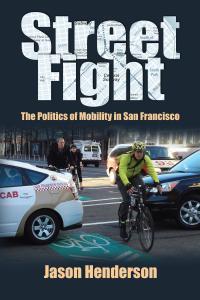
Jason Henderson, a geography professor at San Francisco State University, lays out that case in a new book. He argues, persuasively, that the era of easy “automobility” — a time when people could just assume the ease and convenience of owning and using a private car as a primary means of transportation — has come to an end.

Henderson isn’t suggesting that all private vehicles go away; there are places where cars and trucks will remain the only way to move people and supplies around. But in the urban and suburban areas where most Americans live, the automobile as the default option simply has to end.

“In 10 years, there will be less automobility,” he told me in a recent interview. “It’s a simple limit to resources.”

And the sooner San Francisco starts preparing for that, the better off the city and its residents are going to be.


BIG NUMBERS

Henderson’s book, Street Fight: The Politics of Mobility in San Francisco, focuses largely on the Bay Area. But as he points out, the lessons apply all over. The numbers are daunting: Cities, Henderson reports, “use 75 percent of the world’s energy and produce 78 percent of global greenhouse gas emissions.” He adds: “Transportation is the fastest growing sector of energy use and [greenhouse gas] emissions, and this fact is in great measure owing to the expansion of automobility.”

And the United States is the biggest culprit. This nation has 4 percent of the world’s population — and 21 percent of the world’s cars.

To turn around the devastating impacts of climate change, “America will need not only to provide leadership, but also to decrease its appetite for excessive, on demand, high-speed automobility.”

And buying a lot of Priuses, or even electric cars, isn’t going to do the job. “Americans must undertake a considerable restructuring of how they organize cities, and that must include the rethinking of mobility and the allocation of street space.”

The Bay Area is about to enter into a long-term planning cycle that, according to groups like the Association of Bay Area Governments, will involve increased urban density. ABAG, according to its most recent projections, would like to see some 90,000 new housing units in San Francisco.

That’s got plenty of problems — particularly the likelihood of the displacement of existing residents. Henderson agrees that more density is going to be needed in the Bay Area — but he’s surprisingly bullish on the much-denigrated suburb.

“It’s actually quick and easy to retrofit suburbia,” he told me.

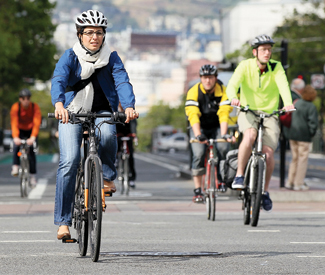
And like so much of what he discusses in his book, the primary solution is the old, venerable, human-powered contraption known as the bicycle.

“Existing communities like Walnut Creek are eminently bikeable,” Henderson told me. He suggests expanding development in three-mile circles around BART stations — after getting rid of all the parking. “We could easily get 20 to 30 percent of the trips by bike,” he noted.

In fact, he argues, it’s easier to put bicycle lanes and paths in the suburbs than in San Francisco. The streets tend to be wider, there’s more room in general — and it’s fairly simple to provide barriers from cars that make biking safe for everyone.

In fact, a lot of European cities are less dense than San Francisco — and have far fewer drivers. Even in California, the city of Davis is famous for its bike culture; “In Davis,” Henderson said, “There are all these children riding their bikes to school.”


ACRES OF PARKING

One of the most profound changes San Francisco is going to have to make involves coming to terms with the immense amount of scarce space that’s devoted to cars. Parking spaces may not seem that big — but when you combine the 300-square-foot typical space (larger than many bedrooms and offices) with the space needed for getting into and out of that space, it adds up.

“Parking for 130 cars amounts to about an acre, and the aggregate of all non-residential off-street parking is estimated to be equal in area to several New England states.”

Cars need more than a home parking space — they need someplace to park when they’re used. So in a city like San Francisco that has more than 350,000 cars, a vast amount of urban land must be devoted to parking. In fact, Henderson estimates that parking space in San Francisco amounts to about 79.4 million square feet — or about 79,400 two-bedroom apartments. Off-street parking alone takes up space that could house 67,000 two-bedroom units.

And it’s hella expensive. Building parking adds as much as 20 percent to the cost of a housing unit. He cites studies showing that 20 percent more San Franciscans could afford to buy a condo unit if it didn’t include parking.

But the city still mandates off-street parking for all new residential construction — and while activists have managed to get the amount reduced from a minimum of one parking space per unit to a maximum of around eight spaces per 10 units, that’s still a whole lot of parking.

And if San Francisco is expected to absorb 90,000 more housing units, under current rules that’s 72,000 more cars — which means a demand for 72,000 more parking spaces near offices, shopping districts, and parks. Crazy.

So how do you get Americans, even San Franciscans, to give up what Henderson calls the “sense of entitlement that we can speed across town in a private car?” Some of it requires the classic planning measures of discouraging or banning parking in new development (AT&T Park works quite well as a facility that is primarily accessed by foot and transit). Some of it means putting in the resources to improve public transit.

And a lot of it involves shifting transportation modes to walking and bicycles.

San Francisco has had significant success increasing the use of bikes in the past few years. But there are limits to what you can do by tinkering around the edges, with a few more bike lanes here and there.

There are, for example, the hills. And there’s grocery shopping for a family. Those things need bigger shifts in the use of urban space.

San Francisco’s street grid, for example, sends travelers straight up some nearly impossible inclines. Young, healthy people in great physical condition can ride bikes up those hills, but children and older people simply can’t.

Henderson suggests that the city could install lifts in some areas, but there’s another, more radical (but less energy-intensive) solution: Reroute the grid.

If city streets wound around the sides of hills, instead of heading straight up, walking and biking would be far easier. That would involve major changes, particularly since there’s housing in the way of any real route changes — but in the long term, that sort of concept should, at least, be on the table.

Bikes with cargo trailers make a lot of sense for shopping, Henderson told me — and once big supermarkets get rid of all that parking, the price of food will come down.


THE POLITICS OF NEO-LIBERALS

The biggest challenge, though — and the heart of Henderson’s book — is political. Transportation, he argues, is inherently ideological: “It matters how you get from here to there.” And he notes that progressives, who are willing to think about social responsibility, not just individual rights, see the choices very differently than the neo-liberals, who in this city are often called “moderates.” If the neo-libs have their way, he says, the changes will be too little, too late, and mostly ineffective.

Because Americans are facing a series of choices — and there are no solutions that preserve the old way of life without sacrificing the future of the planet. It’s entirely a zero-sum game: We can slow global climate change, or we can keep driving cars. (Oh, and electric cars — which still require large amounts of power, mostly from fossil-fuel plants — aren’t going to solve the problem any time soon.)

We can shift to bicycles and transit as our primary ways to get around, or we can leave our kids an ecological disaster of unprecedented scope. We can overhaul the entire way we think about urban planning — to make streets friendly to bikes and buses — or we can go down a deadly path of no return.

We can accept the fact that moving around cities may be a little slower, particularly while we adapt. Or we can join the climate-change deniers. “There are a lot of neo-liberals out there who say we can’t start controlling automobility until we have a gold-plated transit system,” Henderson told me. “But this is not a chicken and egg problem. First you have to create the urban space. Then you can build a better system.”
Parking breaks

9

steve@sfbg.com

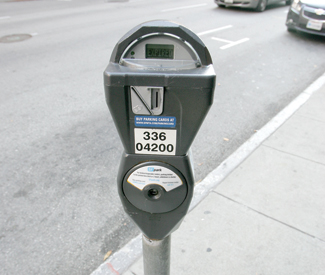
This was the moment these indignant motorists had been waiting for. The elected supervisors were finally going to get the unelected bureaucrats at the San Francisco Municipal Transportation Agency to back off of plans to manage street parking and install new parking meters in their Western SoMa, northeast Mission, Potrero Hill, and Dogpatch neighborhoods.

Anger and frustration over the parking program has been building for more than a year (see "Pay to park," 1/24/12), and when Sup. Mark Farrell called a May 2 hearing before the Neighborhood Services and Safety Committee, SFMTA’s critics put out the call and dozens showed up to voice their displeasure.

Farrell opened the hearing with a clear statement about where he stands on the issue: "I am very much against expanding parking meters into our residential neighborhoods." He also expressed opposition to the SFMTA’s extension of meter hours to evenings and Sundays and said that would be the subject of another upcoming hearing.

"I think we’re frankly on the wrong track," said Sup. Malia Cohen, who isn’t on the committee but showed up just to voice the frustrations of her District 10 constituents and to help grill SFMTA head Ed Reiskin. She repeated the populist criticisms of the SFMTA, calling its goals "unattainable" and its critics "reasonable," and accusing the agency of not having a comprehensive parking management plan.

"I look forward to you saying, ‘I quit, you win, no more parking meters,’" Cohen said to Reiskin, throwing red meat to the seething crowd, which erupted into loud, raucous, sustained applause and shouts of appreciation at the comment.

Those comments frame a defining problem in San Francisco: The city can’t get to its sustainability and climate-change goals without reducing car use (see "Zero-sum future, p. 12) — but even mild attempts to reduce parking create populist furor.

When Reiskin took the podium to deliver his presentation, he struck an even, diplomatic tone, saying that he understands people’s concerns about the issue. "Parking is a challenging, sensitive, and difficult issue. Parking matters to people," he said.

But then he went on to explain that voters and previous supervisors charged the SFMTA with managing the city’s entire transportation system — Muni, cars, bikes, cabs, pedestrians, and parking — in accordance with the city’s Transit-First policy, which calls for active promotion of alternatives to private automobile use in this dense and growing city.

Then he responded directly to Cohen’s challenge: "I would have to respectfully decline the suggestion that we don’t manage parking. We have an obligation under the Charter to do so."

BALANCING ACT


Reiskin rejects the frequent accusation that SFMTA is anti-car — and the suggestion that the agency should focus on improving Muni before it can realistically expect people to rely less on private automobiles. The reality, he said, is that the city can’t make Muni or bicycling more attractive without regulating automobiles in general and parking in particular.

He said drivers who circle the blocks looking for parking spots constitute 20-30 percent of traffic in this highly congested city, and they are the worst sorts of drivers to have on the roads. They clog traffic by stopping frequently or double-parking, they drive in bike lanes, they do dangerous U-turns, and they are often inattentive and distracted, presenting a danger to pedestrians and cyclists.

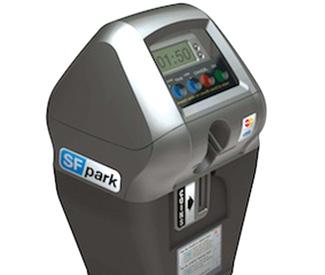
The agency’s SF Park program tries to alleviate some of that problem by using market-based pricing at meters and garages to promote turnover in high-demand areas and to ensure the availability of parking spots. But in Potrero Hill and the few other parts of the city that still have unregulated street parking, other issues arise, such as out-of-town commuters parking for free all day and limiting availability in a region slated for lots of new development in the coming years.

"Parking management matters," Reiskin said, adding that without it, "we won’t be able to achieve our goals of having an efficient transit system."

He cited policies in the Eastern Neighborhoods Plan that the supervisors approved that call for parking management and noted growth projections that could draw another 100,000 people into San Francisco in the next 20 years.

"The competition we feel today in the public right-of-way will only grow more intense," Reiskin said.

Farrell argued that families and many individuals need cars to get around: "The use of a car is simply necessary." Reiskin acknowledged that cars are still the top transportation choice in San Francisco and they will remain so for the foreseeable future. But he said that each person who opts to use a bike, Muni, or to walk is an important gain in the efficiency of the overall transportation system, given how much space cars take up, so eliminating free parking is an important incentive.

"There is a clear relationship between transportation choices and costs," Reiskin said. "If there is free parking, a lot more people will choose to drive."

Farrell then repeated the other big criticism that gets aimed at the SFMTA over its parking management program, that it’s simply a "revenue grab" that uses meter and parking citation revenue to make Muni and cycling improvements. But Reiskin said the $200 million in revenues from parking have been fairly consistent, with increases in meter revenue being offset by declining revenue from citations (which he attributed to longer meter hours and new payment options) and lowering the rates in city parking garages to make them more competitive with street parking.

"We’re lowering your rates as much as we’re raising them," Reiskin said after noting that, "We’d much rather get the revenue through the meter than through citations."

Finally, Farrell got down to the crux of the criticism from car owners: why can’t everything else wait until the SFMTA makes Muni more efficient and attractive? This is a car-dominant culture, and people won’t take the bus until it’s easy and reliable. Bike advocates make a similar argument, saying completion of a safe system of bike lanes is the only way to substantially increase cycling in the city. But Reiskin said the SFMTA has to do everything at once lest traffic congestion slow the entire system.

"I know it’s a challenge for you, but it’s a challenge for us with how to respond to it as well," Reiskin replied to Farrell. "I don’t think we have the luxury of putting one part on hold while we make up for decades of underinvestment in public transit."

Sup. David Campos said he understands the frustrations of his northeast Mission constituents and he thought the SFMTA was right to delay the implementation of parking management programs there (the revised plan comes out this summer). But he noted that many of his constituents can’t afford to own a car and they need SFMTA to actively promote other transportation options: "We do need to find a way to do everything and balance this out."

FRUSTRATION WITH SFMTA


No neighborhood epitomizes the tricky balancing act on parking polices more than the northeast Mission, with its tight mix of residential and production, distribution, and repair businesses in a neighborhood where growing parking demand will be exacerbated by plans to convert the parking lot at 17th and Folsom streets into a park.

That was where the anger at the SFMTA’s approach to parking reached a fever pitch last year, spawning opposition groups such as the Northeast Mission Coalition. Angela Sinicropi, who heads that group, is calling for new preferential parking permits for local residents and the PDR businesses in the area.

"It’s not a preference or a choice. Vehicles are a necessary part of these businesses," said Sinicropi, who owns a photography business called Syntax Studio. "We need long-term, all-day parking."

She said her members appreciate SFMTA staff working with residents, but they’re still frustrated by the agency’s reliance on parking meters as the main parking management tool. Others simply slammed the SFMTA — which was set up as an independent agency that would be somewhat immune from political pressures — as out-of-control.

"The problem with the MTA is their lack of transparency and accountability," Rob Francis said.

"MTA has lost its way. They shouldn’t be focused on parking. They should focus on transit," said Potrero Hill resident Jim Wilkins. "As taxpayers, we pay for the streets. We pay to maintain those streets. So we should be given priority on those streets."

"Keep things as they are and be respectful of taxpayers," said Walter Bass, a Potrero Hill property owner, blaming the "bike people" for skewing the agency’s priorities. "SFMTA has lost the privilege to manage parking in San Francisco."

Reiskin sat in the front row listening to angry tirades against him and his agency for more than an hour, yet he stuck by his position that managing parking is far from a privilege — it is a difficult duty and one he doesn’t intend to shirk, even as he tries to heed the public’s concerns.

In the end, the supervisors didn’t really chasten the SFMTA, as its critics had hoped for.

Farrell seemed content to declare, "There are no other plans to expand parking meters throughout San Francisco," after Reiskin said he’s not planning to go beyond the five parking management areas now being created.

"I hope MTA was listening to the public comments and concerns," Cohen offered, hoping the hearing will somehow alleviate the shitstorm from some of her car-driving constituents.

And Campos closed with perhaps the only real conclusion that could be drawn from this hearing: "This won’t be the last time we’ll be talking about this issue."

Editor’s notes

1

EDITORS NOTES It’s a good thing the Giants were at home Friday night, or I might have tried to drive across the Bay Bridge. Always a bad idea after work, always a worse idea on a Friday, when the backup starts somewhere around SF General Hospital. I spent almost two hours getting past Berkeley one Friday when I thought we could leave at 3:30 and beat the traffic. When the Giants are in town, it’s impossible.

It’s so crowded nobody drives there any more. Or something like that. I didn’t.

Instead, I got on my bike and rode to BART, took the Richmond train to North Berkeley, and rode a few blocks to a birthday party on University Avenue. Cost $7.70, I think, for the round trip. Took less than an hour each way, including biking home up Bernal Hill. The late train back was party central, with the bridge and tunnel crowd all decked out in club finery and a woman singing full-volume along with her phone.

“How was I?” she asked me. “Ready for American Idol,” I said.

I could have been stuck in traffic.

This is how life is going to have to be in the future, and it’s not a bad picture. One of the main reasons I like riding my bike in San Francisco, and I hate driving, is that I know exactly how long it’s going to take me to get somewhere on two wheels. On four, it could be 15 minutes, or it could be an hour.

The thing is, we’re so used to the idea that cars are the fastest way to get around — and in some places, sometimes they are. If we fixed up the city the way we should (which would mean changing not only the lane patterns but the directions of some streets) cars would almost always be the worst and slowest way to go most places.

Either way, in this Bike to Work Day issue, were explore the idea that speeding around town at 30 miles an hour in your personal can isn’t a natural right of all people. In fact, Jason Henderson, a professor at San Francisco state who I interviewed argues that the most environmentally sound thing we can do in urban areas might be to … slow down.

Hard to imagine, that. This city runs on speed: Tech speed, work speed, party speed, frenetic speed … I can’t imagine not being in a serious rush for a large part of my day. It’s nice, sometimes, to think about the alternative.

Bike hot spots

16

steve@sfbg.com

When a four-year-long court injunction against new bicycling improvement projects in San Francisco was finally lifted in 2010, there was great hope in the cycling community that the city would rapidly move forward on completing its long-planned network of bike lanes.

Feeding that optimism, Mayor Ed Lee, Board President David Chiu, and other top officials set ambitious goals to increase cycling, even though they did little to provide funding that was up to the task or overcome political opposition that inevitably arises to projects that take space from cars (see “20 percent by 2020,” 5/8/12).

San Francisco is still a long way from emerging into even double-digits in terms of the percentage of vehicle trips taken by bike, and a big part of that is many people don’t feel safe or comfortable fighting with cars for space on the roads. They want bike lanes throughout the city, ideally more of the physically separated cycletracks that debuted a few years ago on Market Street.

So, on Bike to Work Week 2013, we’re taking a look some of the cycling hot spots in the city, places where the San Francisco Bicycle Coalition and other advocates have been pushing for pivotal bike safety improvements, the opposition they’ve encountered, and the status on those improvements.

Polk Street: This has become the hottest of hot spots in recent weeks, with an SFMTA plan for cycletracks shot down by local residents and businesses who complained about the loss of parking spaces on this narrow and increasingly congested corridor. SFBC is organizing to restore the bike lanes, starting with a May 14 event at its office.

Masonic Boulevard: Cars turning left from Fell onto Masonic, which bisects the bike-friendly Panhandle, used to be one of the most dangerous spots in the city, a problem that was largely solved with a special bike-signal light. Next, the SFMTA is proposing to take a lane from cars on that fast-moving thoroughfare and install bikes lanes all the way to Geary, with important funding decisions on that project coming up this summer.

Fell and Oak Streets: There’s finally been some recent progress to this short but important east-west connection after years of delays and broken promises. Cycletracks on each busy street to connect the Wiggle to the Panhandle were approved in October, with an appeal denied the next month as Fell got new striping. But it was only in the last week that Oak finally got two blocks of temporary bike lanes, with parking spaces still standing in the way of the final block.

Second Street: After years of political haggling and community meetings, the SFMTA is finally on the verge of approving bicycle and pedestrian improvements on this dangerous car-clogged artery. The latest plans call for one-way cycletracks running next to the sidewalks on both sides of the street separated by a raised median with street trees separating riders from rows of parked and moving cars. Look for community meetings on the project in June.

Caesar Chavez Boulevard: This busy street got some much needed improvements earlier this year, with good bike lanes on the eastern portion, clearer signage for automobiles approaching the confusing maze as Chavez crosses I-280, and pedestrian safety improvements. Now the city just needs to continue what it started and complete the bike-lane link all the way to Valencia.

Market Street: Cyclist demand is causing mini Critical Masses everyday during the morning and evening commutes on mid-Market Street. Yet despite the fact that the last two mayors long ago called for private cars to be removed from this showplace thoroughfare, Market is a traffic mess and will probably remain so for awhile without fresh political will. The Better Market Street project has delayed improvements to 2017, and its planners this year offered the daffy idea of banning bikes from Market and forcing them over to Mission.

Mansell Street: Improving people’s ability to safely ride bikes to and through McLaren Park, the SFMTA has designed and approved a road diet along Mansell that includes a two-way cycletrack and pedestrian path from Brazil to University, after a series of multilingual community meetings.

Embarcadero: To help improve access to and views of the waterfront during this year’s America’s Cup, the SFBC is aggressively pushing for a pilot project with a two-way cycletrack along the bay side of the roadway. Meanwhile, the SFMTA is now doing a long-term transportation study that will inform approval of the Warriors Arena and the Giants/Anchor Stream development at Pier 48, which will hopefully fund the Blue-Greenway bike path along the waterfront.

T-Third passengers unhappy about train service disruptions

Around 20 residents from San Francisco’s Bayview neighborhood lined up at the San Francisco Municipal Transportation Agency board meeting May 7 to voice complaints that all too often, the T-Third light rail transit vehicles leave passengers stranded on train platforms, taking rail cars out of service before the end of the line and leaving riders to wait for the next arrival.

Organized by People Organized to Win Employment Rights, an organization better known as POWER that has campaigned around Muni issues before, the riders asked the SFMTA board to address the T train turnarounds, and called on the transit agency to run all trains through to the end of the line in the city’s Southeast neighborhoods.

Muni service disruptions along the T-Third occur most frequently at 23rd and Third, Armstrong and Third, and Williams and Third, based on SFMTA data. The passengers expressed frustration that even though the T-Third technically runs all the way to Sunnydale, a Visitation Valley housing complex, it often stops short of the final destination and causes delays on an already lengthy commute. The topic of Muni “switchbacks” picked up momentum earlier this year after District 4 Sup. Katy Tang vowed to take up the issue of train turnarounds, which also impact transit passengers in the Sunset. 

Jackie Wysinger, who walks with a cane and resides at a senior center nearby Armstrong and Third streets, told SFMTA board members that she’s no longer able to drive and depends upon the T train to get around.

“We need better transportation,” Wysinger said. “The T train turns around right there, and they do it regularly,” leaving passengers with no choice but to walk or wait in discomfort. “It’s just bad on the senior citizens.”

Claudia Bustamante, a member of POWER who spoke in Spanish through a translator, related a story of traveling back to the Bayview on the T-third on Monday night. “We were on the T-train and there was a person in a wheelchair, and another woman crying,” she said. “But the driver said, ‘sorry, this is the last stop. Everybody has to get off.’ … They kicked us off. This happens not just to me, but to the members of the African American community in Bayview. And this needs to stop.”

Jim Hill, who told SFMTA board members that he’s lived in the Bayview for 51 years, said he’s experienced train service disruption at 23rd Street on a regular basis. “I don’t understand why a man would turn a train around that’s full of people,” he said. “I have experienced 45 minutes to an hour before another train comes.”

Hill added, “I don’t think a person should have to work all day, and have to stand up from the time they get off work, until they get home.”

Gloria Dean, a Bayview resident who penned an editorial in the San Francisco BayView newspaper in March, characterized the frequent disruptions to service in Bayview Hunters Point as “shameful racism” in her opinion piece. She recounted one evening when her commute from Oakland to Third and LaSalle took from 6:45pm until 9:08pm. Since her husband is battling health problems, “it’s important for me to get home” following her evening classes at Mills College in Oakland, Dean wrote.

Juana Teresa Tello, an organizer with POWER, stressed that while switchbacks are known to occur on other lines, Bayview residents tend to have fewer transportation options. “It’s the highest concentration of people in public housing,” Tello pointed out. “It’s people who need the transit system the most.”

There was no SFMTA agenda item on the topic of turnarounds on the T-Third line, so residents aired their grievances about the issue during public comment. Once they had all finished speaking, SFMTA board chair Tom Nolan indicated that the item should be added to the board meeting agenda “sometime in the near future.”

In response to a query submitted several weeks ago, SFMTA spokesperson Paul Rose sent the Bay Guardian a detailed response to questions about train turnarounds at the 23rd and Third stop.

“Trains going to 23rd Street on the T-Third are typically going to our maintenance yard located near 25th Street and Illinois at the end of their shift,” Rose explained in an email. “These trains are J, K, L, M, and N trains that travel in service as T-Third trains to the yard and accept passengers all the way to the last stop before the yard – 23rd Street. The alternative is to have the trains travel ‘not in service’ to the yard from the subway and accept no passengers.

“The vehicles returning to the yard and traveling from the subway only to 23rd Street add additional frequency between the subway and 23rd Street but are not scheduled full trips to Sunnydale,” Rose acknowledged.

The 23rd Street stop marks the end of a stretch of recently installed condominium complexes in San Francisco’s Dogpatch neighborhood, an increasingly popular residential area for Silicon Valley commuters who have easy access to the highway to travel south to tech campuses.

Finally, Rose stressed that “We minimize unscheduled train turnarounds as much as possible … Supervision is also told to only perform these turnarounds when there is another train within five minutes or less,” he added, “to minimize passenger inconvenience.”

The warriors arena: How are you going to get there?

51

The Warriors and the all-star lineup of nearly every political consultant in town launched a new public relations offensive this week with the release of a new, spiffy set of drawings and a rewritten plan for a waterfront arena. And opponents of the project pretty much shrugged and said: So, what?

Sure, it looks nicer than it did before. Sure, there’s a pedestrian walkway around the arena. Yeah, there’s glass on the inside that will give spectators a nice view of the Bay. Oh, and there’s room for a cruise ship terminal, to give the whole thing a veneer of maritime use.

But the problems with this project have never been the architecture of the 12-story structure or the inevitably dubious links to the water. “The design was never the point,” Randy Shandobil, a spokesman for the Waterfront Alliance, told us. “Is this the best place to put a big arena?”

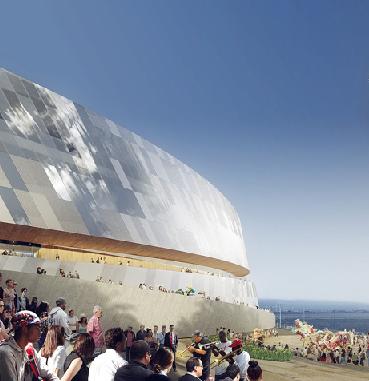
The new plan calls for a slightly smaller arena — 125 feet high instead of 135 — with slightly less retail space and seating inside. The glass sides will not only allow fans to look out, but allow people walking around the outside to view in and see something going on inside. The scoreboard will probably be visible; the actually play on the floor less so.

The visuals presented by the architects, Snøhetta and AECOM, indicate that the arena will perch on a large pad raised significantly above the level of the current Piers 30-32. From the ground level, the arena looks like a giant flying saucer, taller than AT&T Park, that’s plopped down below the Bay Bridge.

Craig Dykers, a representative of the architects, told a Board of Supervisors committee May 6 that the arena will fill a need for some sort of project along the open stretch of waterfront from the Ferry Building to AT&T Park. His presentation made it sound as if that undeveloped area was by nature a blight; thousands of joggers, walkers, bicyclists and people enjoying the unimpeded views of the Bay might disagree.

In fact, the project will change more than the two piers; it will create a busy residential and commercial shopping district that will increase foot and vehicle traffic even when there are no games or concerts scheduled.

This is, by any standard, a very different project from what the Warriors first proposed back in November, 2012. That’s why the Waterfront Alliance is asking that the scoping sessions for the environmental impact report on the project ought to go back to square one.

No matter what you think about the design, or the views, or the impact on the city’s priceless waterfront, there’s a problem that’s glaringly obvious, and Sup. Scott Wiener made the point very clearly:

This absolutely has to be a transit-first arena. There’s no way that part of the city can handle even half of the 5,000 cars that have been counted at the Warrior’s current home, Oracle Arena in Oakland. And much of that impact is going to fall on the subway, or light-rail vehicle system.

“It absolutely has to have good LRV service,” Wiener said.

The problem: “Our current system is not even meeting our current needs. I have a lot of constituents who say, when there’s a Giants game you just don’t take the subway because there’s not going to be any capacity. We’re close to a breaking point now, even past it. and our ten-year capital plan puts to the side most of Muni’s unmet capital needs.”

Jennifer Matz, the Mayor’s Office point person on waterfront development, said she agreed with Wiener. “I recognize this challenge,” she said. “There needs to be more of a holistic approach.”

But Wiener wasn’t backing down. Adding the capacity that will be needed to serve the new arena, and the new Giants development, and the new residents moving into the waterfront neighborhood, is not going to be cheap. “Where,” he asked, “is the money going to come from?”

Peter Albert, who works for the Municipal Transportation Agency, is looking into the number of passengers that will be riding Muni — and BART, and Caltrain — and the capacity those systems plan to add. But he had no answer to Wiener’s question.

That’s because there is only one answer: The taxpayers will have to come up with something in the range of a billion dollars to solve Muni’s capacity problems in the next few years — or else the developers will. And right now, there’s not a lot of political will at City Hall to ask for either.

Bay to Breakers will have video surveillance, license plate scans, and secret “FBI assets”

19

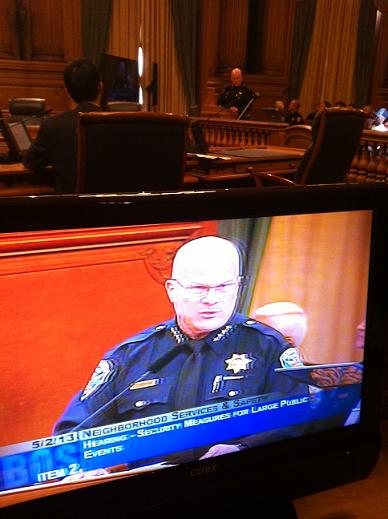
Police video surveillance was in the spotlight during yesterday’s City Hall hearing on security measures at large events, as supervisors voiced a desire to strike the right balance between security and civil liberties. And while they got some reassurance and small signs of restraint from the SFPD, they also learned about secretive new security measures that go beyond what the public was aware of.

San Francisco Police Chief Greg Suhr clarified misleading media reports (a Chronicle story then picked up by Associated Press) that he’s seeking real time video surveillance along Market Street. Right now, Suhr said he just wants an inventory of existing video cameras along Market and downtown that he can request footage from after a crime is committed and that he would make his case to the board if he ever wanted to go beyond that.

“Right now, we only look at footage in retrospect,” Suhr told the Neighborhood Services and Safety Committee hearing, adding that he has no objections to seeking a court warrant to obtain that footage because “we do want it to be admissible.”

Yet Suhr and Deputy Chief James Loftus also revealed that SFPD will be deploying an undisclosed number of temporary real-time video surveillance cameras atop long poles at the Bay to Breakers footrace on May 19, as it did last fall during the World Series and the big parade down Market Street celebrating the Giants victory.

“We always want more video,” Suhr told the Guardian, although he said that he also understands the civil liberties sensitivities of San Franciscans, which is why he isn’t now seeking a permanent increase in SFPD’s real time video surveillance capabilities. “I’m from San Francisco, I get it.”

Other security tools that the SFPD will be employing at Bay to Breakers and other large events are technology that uses video cameras on police cars to capture license plate numbers and run them through a DMV database, what Loftus vaguely described as “specialized resources from surrounding jurisdictions” (watch out for the drones, y’all), and unspecified “FBI assets [that] will be present and assisting in event security.”

When Sup. Eric Mar, who called the hearing, asked about those last two items, Loftus said he wouldn’t discuss them publicly, but “I could talk to you about it offline if you’d like.”

Sup. David Campos said that he doesn’t want San Francisco to be reactionary after incidents like the Boston Marathon bombing and that we should be a model city for balancing security with civil liberties: “I think that’s a very difficult balance to strike, but it anyone can strike that balance, I think San Francisco can.” He also expressed concerns about plans to ban backpacks at Bay to Breakers: “I don’t know if that’s going to address the problem.”

Loftus said the ban only applied to large backpacks (larger than 8.5x11x14 inches) and that runners and spectators will still be allowed to use small backpacks to hold water and changes of clothing. Yet for those concerned about the creeping police state, including several people who spoke during the public comment period, there was little consolation offered in the presentations, and the supervisors said this would be an important ongoing discussion.

“This is a discussion that goes beyond San Francisco,” Campos said. “We as a country need to have this discussion.”

SFMTA chief hopes to calm the parking meter furor at supervisorial hearing

64

San Francisco Municipal Transportation Agency director Ed Reiskin faces a tough challenge tomorrow (Thu/2) at the Board of Supervisors Neighborhood Services and Safety hearing that Sup. Mark Farrell has called on expanding parking meters into new neighborhoods, where Reiskin is expected to face a hornet’s nest of SFMTA critics stirred up by the loss of free street parking and perceptions that the agency is mismanaging public spaces and transit. [UPDATE: Read what happened here.]

Reiskin needs to quell some of the anger that is erupting in the northeast Mission District, Potrero Hill, and other areas slated for new meters enough to prevent increased supervisorial intervention into his independent agency and ensure a transit improvement bond measure planned for next year has a chance of passing – which the agency desperately needs to make improvements to Muni.

“We appreciate the opportunity to share information on how we’re trying to create more parking availability and ease congestion,” SFMTA spokesperson Paul Rose told us.

Jay Primus, who manages the SF Park variable price meter program for the SFMTA, told us he’s seen the presentation that Reiskin will be giving and finds it compelling, even though he knows better than anyone that, as Primus said, “Parking is always a difficult subject, particularly in an area as dense as San Francisco.”

It’s hard to imagine what might satisfy the SFMTA’s staunchest critics, who have created websites blasting and lampooning the agency’s every action and formed opposition groups that use militant rhetoric.

Mary Eliza is the spokesperson for Eastern Neighborhoods United Front, which has whipped up critics of the parking plans with calls to “FILL THE HALL. Raise your flag and wear your colors.” Speaking to the Guardian, she cited a litany of complaints and deep, conspiratorial suspicion of the SFMTA and its agenda, which is why she said critics have appealed to the supervisors.

“We’re not dealing much with the MTA anymore, we’re dealing with the supervisors because we think it’s our best chance to get anything accomplished,” Eliza told us.

They seem to have found a sympathetic audience with Farrell, a conservative from the westside, where pro-car ideologies are strongest. “Even as a transit first city, San Franciscans deserve to have reasonable parking situations in their neighborhoods. With plans under discussion to expand SFMTA’s number of parking meters citywide, every potentially affected neighborhood deserves to have extensive input into and thorough understanding of SFMTA’s upcoming plan,” Farrell wrote in calling for the hearing.

Primus said the SFMTA does try to be responsive to community concerns, noting that when its plans for new meters in the northeast Mission, Potrero Hill, and Mission Bay ran into strong community opposition in 2011, officials delayed the plans to gather more data and do more community outreach, separate the proposals, and remove them from the SF Park pilot program.

They are now finishing work on the Mission plan, which should come out this summer, after they do more work on solving issues raised by car repair and other light industrial businesses. But Primus said parking scarcity and good transit access in the area make it “an area where good parking management is all the more important.”

Then comes Potrero Hill, where the anti-meter furor appears to be strongest. But with increased development planned for the area, Primus noted that the community and Board of Supervisors have already called for more active parking management by the SFMTA: “All these parking policies were called for in the Eastern Neighborhoods plan, so it was already approved by the supervisors.”

The Google-bus elitism

144

I’ve been waiting for the Chron’s culture columnist Caille Millner to finally write about something interesting, and I got it April 27 when she stumbled onto the Google Buses. Or rather, the problem with the Google buses.

Thanks to the Chron’s silly paywall, you can’t read her column online, and since hardly anyone in San Franciso buys the Chronicle anymore, Millner’s story won’t get the attention it should. So allow me to repeat some of it here:

It was close to 9 p.m., and I was waiting at a bus stop on an island in the middle of Market Street. Next to me stood a tired-looking middle-aged woman who had clearly just left work. While we waited, up cruised the big white pod. It paused right in front of us. The door at the front slid open to discharge a few Googlers, and the luggage door on the lower right side of the bus also slid open to allow them access to their belongings.

One gentleman bounced down the bus steps and pushed his way in front of us to get his bicycle from beneath the bus. As he hurled it out onto the bus island, it hit the woman standing next to me. She glanced at me, mute and horrified, and in that moment I sensed that she didn’t feel able to confront him. So I did.

“Excuse you,” I said loudly.

>No response. He was busy fumbling with his messenger bag

“You hit her,” I yelled.

He glanced up in no particular direction, as though suddenly troubled by the buzz of an insect. Circling his head around, he finally noticed where he was – the bus stop, the night, the fact that there were other people around him.

“Sorry?” he asked the air, in a tone of confusion. Then he climbed on his bicycle and pedaled away. He never looked at the woman he had hit.

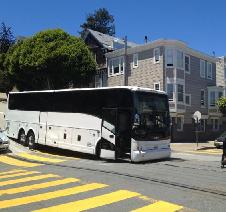
There’s a sense of entitlement about the rich, and the young rich are often the worst. And that’s one reason why the logic of the Google bus — it’s better to have a single luxury vehicle haul all those people to work than have them all drive cars — doesn’t register with a lot of us. They’re too good for Caltrain. They’re too good for Muni. And they’re too damn good to bother to notice that they’ve hit an old lady.


Free expression

0

arts@sfbg.com

VISUAL ART Los Angeles painter John Millei is mostly known for muscular abstraction writ large, either because he usually applies his cerebral mark making to wall size paintings, or because he produces works in very large series.

So it’s a bit of a switch to see his suite of six new, small paintings made specifically for George Lawson’s pocket-size Tenderloin gallery. Each of the works in “Recent Paintings” is titled by a prepositional phrase that sets out various ways to begin a journey, and the titles down by the stream, past the gate, out the door, and so on refer as much to Millei trying out responses to the size of the space as framing an interpretation for the images. Whatever it is, the architectural constraint is very good for the work — these are some of Millei’s most offhand and unguarded paintings, and colors press and slide against each other with something approaching intimacy. In most of the suite, marks become indistinct from color fields presented in slim, tightly compressed layers, held together by off-balance, looping gestures.

You can’t help but think that these were lots of fun to paint.

In conversation, Millei remarked on how these new paintings were informed by a long-running dialogue with area painter Mel Davis, who coincidentally has a show, “Start Here,” up now at Eleanor Harwood Gallery. It’s probably a stretch to draw too thick a line between the two bodies of work, but knowing about the interplay between them does tease out a sort of common concern.

Davis’ work, semi-abstracted, and knowingly winking at Matisse and Gauguin — especially the way that those two painters in particular have been filtered and lensed over the last hundred years by weekend painters and amateurs — presents a slowly unfolding narrative about the difference between loving painting and trying to love painting. There’s something both subdued and lovely in these floral abstractions, especially ones like Space Between the Trees which layers flat, flesh-colored light on top of tropical blues and greens. Where Millei’s paintings use a variety of visual devices at the service of fairly direct and aggressive compositions, Davis is more ruminative about the burden of expertise, and the possibility of reclaiming a beginner’s naiveté.

John Millei, “Recent Paintings”
Extended through May 18
George Lawson Gallery
780 Sutter, SF
www.georgelawsongallery.com

Mel Davis, “Start Here”
Through April 27
Eleanor Harwood Gallery
1295 Alabama, SF
www.eleanorharwood.com

Spring means open studios in the bay, and the chance to rub elbows (and shoulders, since these things get crowded) with 1000-plus artists in their workspaces. The season kicked off with Art Explosion Open Studios last weekend in the Mission, and continues over the next several weeks throughout the area. If you’re looking to support local artists, or just check in on what ideas are being thrown around by area creatives, there’s no better way. Here’s a rundown of upcoming open studios events.

SOMANIA Open House
Fri/29, 6-10pm
Featuring 30 or so artists at six studio locations between 7th and 9th Avenues south of Civic Center BART. Participants include Arc Studios, Lizland Studio & Gallery, Dickerman Prints, the Oddists, Moss St. Studios, and Misho Gallery. www.somac-sf.org

Mission Artists United
April 20-21, noon-6pm
Approximately 130 artists at two dozen venues peppering the Mission; largest is 1890 Bryant, which houses 38 participating artists. According to the website, you’ll be able to spot open studios by looking for red dots on the sidewalks outside each, including several near the 16th St BART stop. Check the site for a map and guide. www.missionartistsunited.org

Hunters Point Open Studios
May 4-5, 11am-6pm
More than 130 artists work at this Bayview facility. You’ll need a car or the 19 bus to get there, but along the route stop at the separate Islais Creek facility to see the Hunters Point sculpture studios. www.shipyardartists.com

American Steel Studios
May 11, noon-11pm; May 12, noon-5pm
More than 40 participating artists and organizations are in this former West Oakland steel plant. An indoor-outdoor exhibition accompanies the event, which also will include guided studio tours, demonstrations, artist talks, and performances. Oh, and fire: Fire Arts Collective will perform, plus there’ll be fire sculpture and fire-breathing art cars. Check the website for updated schedule. www.americansteelstudios.com

Pro Arts Open Studios
June 1-2 and 8-9, 11am-6pm
More than 400 artists throughout the East Bay make this one of the largest open studios events of the year. Pick up a free Pro Arts guide with map and artist descriptions; you’ll need it to cover the sizable ground. www.proartsgallery.org/ebos

Reports of grenade-type devices used in West Oakland raid

A high profile police raid occurred last night in multiple East Bay locations, with most activity centered at the Acorn public housing complex in West Oakland. According to recent news reports, some 150 FBI agents and support staff carried out the raid, along with 120 Oakland police officers and other law enforcement officers from San Leandro, Hayward and Antioch.

OPD Chief Howard Jordan told reporters at a press conference that the raid targeted the Acorn gang of West Oakland, and that officers made five arrests, served 16 narcotics and weapons warrants, and seized firearms, heroin, cocaine and marijuana.  

An official statement attributed to OPD spokesperson Johnna Watson in a Chronicle report suggested that police did not use force during the operation. This suggests OPD does not consider deploying grenade-type devices (considered to be “less lethal weapons”) to be “use of force,” because residents living nearby the Acorn housing complex at Eighth and Adeline streets told the Guardian that they heard loud bangs, probably from flash grenades, go off when the operation was underway around 7:30 Wednesday night.

A neighbor who lives nearby the apartment complex, who asked not to be identified, had a partial view of the police activity from their West Oakland residence. The person described the operation as “like a military presence” due to the sheer number of officers, many outfitted in SWAT gear, and “very precise,” targeting a specific address and lasting roughly an hour and 15 minutes. The streets surrounding the apartment complex were closed off for the duration of the raid.

The neighbor estimated that the flash grenades (or similar devices) were used five times, but since the explosions produce echoes, there could have been fewer deployments. The observer wasn’t able to see how they were used because there wasn’t a clear view of the unit, but heard the bangs in sequence. An OPD officer could be heard addressing occupants inside one of the units on a loudspeaker, reading out the address, telling them they were surrounded, and then saying something like, “you in the suit, get down, get down on the ground.”

The neighbor said they observed three people being removed from the unit and taken into custody – a man who was wearing a suit, a person in a motorized wheelchair, and a tall, younger-looking man. The arrestees were cooperative. 

The West Oakland resident also reported seeing an armored vehicle parked at the scene. A host of official OPD vehicles were parked along the street, along with unmarked cars including SUVs and white vans. 

More details about the massive police operation, the targeted gang, and the criminal activity the cops zeroed in on are sure to come out. A lot of outstanding questions remain, of course, including why officers decided to use the grenade-type devices. So far, OPD hasn’t responded to our email or voice message, but we’ll post the department’s response if we receive one.

The ride-share parasites

18

OPINION These days, all signs point to the eventual deregulation of the San Francisco cab industry.

On any given weekend night in the city, you can find a wide array of illegal taxis operating with impunity, including limo drivers, out-of-town taxis, Super Shuttle vans, ZIP cars, and even some sketchy folks driving their private vans down Valencia Street at 2am soliciting rides for hire. If you have wheels, you can become your own livery service.

It’s a free-for-all out here. The city appears to be giving all comers carte blanche. And while the courts wrangle over ride-sharing rules and what constitutes a taxicab, the cab industry could cave in under the unfair advantage given to its competitors.

The general manager of ride-share startup Uber, Ilya Abyzov, has been quoted as saying that cab companies have had a “state-sanctioned monopoly. They’re not used to competition.” I have two words for him, and they’re not, Yo taxi! We’re competing with about as much chance as the proverbial one-legged man in a kicking fight.

The advertisement on the website of another startup, Lyft, uses for recruiting drivers reads: “Make $22 an hour, have a blast, drive when you want, meet new people, make friends, learn about new restaurants …” This idyllic version of a cab shift could never happen without real cab drivers holding up the foundation.

I don’t think you’ll find a Lyft cab willing to take a sick grandmother from Kaiser Hospital to her home in the Alice Griffith projects. A pink mustache sighting at Griffith and Fitzgerald will probably coincide with the next great earthquake because only a drastic geological shift will cause that to happen.

Right now, it’s a cakewalk for the ride-share drivers. But without the cab industry picking up the rear and girding the underbelly, these parasites couldn’t exist. The Oxford English Dictionary defines a parasite as an organism that lives in or on another organism (its host) and benefits by deriving nutrients at the host’s expense. Substitute the word “nutrients” for the word “money” and you have what in the cab business we call a bingo.

At the end of the day, driving a cab is a hustle. And once your host is gone and the cab business gets deregulated, kiss your city tours goodbye. You won’t be able to rely on donations anymore, and your legal babble and dishonest terminology won’t save you from a harsh descent into the street, into the dog-eat-dog world of a real cab driver.

And then, you’ll know what it’s like to hustle, in the middle of the night when you’re worried about your gates and gas, and it gets real slow, and you have to take chances with your life.

Desoto Shelby III is the pen name for a San Francisco taxi driver.


Editor’s Notes

7

tredmond@sfbg.com

EDITORS NOTES It was breezy and San Francisco-spring-perfect along the Embarcadero the other day. People were jogging, and rollerblading, and sitting in the sun. Red’s Java House was doing brisk business.

Out on the old, crumbling piers, cars were sitting in the lots that now make up most of the economic use of some of the city’s most spectacular and valuable land. Kind of a waste — but the upside (and it’s a big one) was the feeling of open space, the idea that we were all so close to the Bay, that nothing blocked the views of the waterfront or that sense that this is still a city that has some connection to the marine environment that surrounds it.

And then I imagined the Warrior’s Arena. Right there in the middle of everything. And I stopped for a second and wondered what I’d be feeling if I were walking past it 10 years from now. And it made me kind of sad.

I know that parking lots aren’t the best use of Port of San Francisco land. I know that the Port needs huge amounts of capital to rebuild the piers. I know that the most obvious way to get that money is to give developers pieces of waterfront land. I know that a new Warriors Arena will create jobs and bring in tax money. I know that AT&T Park has been a great success for the Giants, the city, and the neighborhood.

I also know that some of the people who oppose the arena are well-off homeowners who don’t want to lose the sight of the Bay out of their fancy condo windows.

But ever since San Francisco, with the help of Mother Nature and a 7.3 earthquake, tore down the Embarcadero Freeway, the waterfront area from Harrison to the Ferry Building has been a really nice place to hang out. Not perfect; not the “Grand Boulevard” that some dream of. But a part of the city where humans can feel the salt breeze and enjoy the outdoors in a relatively mellow way, just blocks from the downtown core. Put an 18-story arena there and it all changes. It mostly goes away.

Is this really the best we can do with the waterfront? What about a bond act for open space, and another Dolphin Club for swimmers, and waterfront parks? Other cities have done it; can’t San Francisco have a world-class waterfront too?

Newsom calls for marijuana legalization

8

For all his flaws, Gavin Newsom has never shied away from taking a stand or showing leadership on emerging issues, particularly when the politicians are lagging behind public opinion. As mayor, he did it on same-sex marriage, temporary public art, and taking street some space from cars. And today, as the state’s lieutenant governor, he is calling for an end to marijuana prohibition.

“It is time for California to decriminalize, tax and regulate marijuana and decide who sells it, who can buy it legally, and for how much. When California became the first state to approve medical marijuana, we led the nation on progressive drug policies, and now it is time to lead again,” Newsom wrote in a Huffington Post column that was posted last night.

Newsom recites a case for legalization that the public has long supported, particularly here in California, citing how damaging and expensive it is to wage “war” on a substance that most Californians know is less harmful than alcohol or tobacco, peppering his column with compelling stats like this: “The U.S. leads the world in the incarceration of its citizens, with less than 5 percent of the world’s population but almost 25 percent of the world’s incarcerated population.”

The Drug Policy Alliance amplified Newsom’s column with a press release today, calling for other politicians to follow his lead and finally remove marijuana from its federal listing as a Schedule One narcotic, “where is current sits alongside heroin,” as Newsom noted. He closes by writing: “There is no reason why California cannot set the example for the nation in responding to drugs in a rational and sensible way. It is time to be bold enough to consider the science and the examples set forth by other states and nations. The time has come to decriminalize, tax and regulate marijuana — anything less is not enough.”

Drug Policy Alliance Executive Director Ethan Nadelmann praised the stand, writing, “What I find remarkable is that not one sitting governor or U.S. senator has spoken out in favor of legalizing marijuana notwithstanding the fact that a majority of Americans now support that approach. But I am confident that it’s only a matter of time until elected officials follow in Gavin Newsom’s bold footsteps as they did with marriage equality.”

Indeed, when Newsom unilaterally began issuing marriage licenses to same-sex couples in 2004, it was opposed by then-House Speaker Nancy Pelosi, US Senator Dianne Feinstein (in fact, all but two US Senators), and the official platforms of both major parties. Today, after a rapid upwelling of political support, it is supported by President Obama and half of the US Senate and it may be on the verge of being legalized by the US Supreme Court (we find out next month). Newsom showed foresight on that issue, and he’s doing so again with marijuana.

Washington and Colorado voters legalized recreational uses of marijuana last year, and they are well on their way to reviving their economies promoting what is already California’s top cash crop, despite its strained legal status. In fact, we also got a press release today from Gaynell Rogers, who handles public relations for Harborside Health Center, the Oakland medical marijuana dispensary that is currently waging an expensive fight for its life after a federal raid.

“Investors Gather to Fund the Most Promising Marijuana Companies in Seattle,” was the headline of a press release about an April 29 event where 40 wealthy investors will “hear pitches from the top entrepreneurs in the hot, new legal cannabis industry,” an event hosted by ArcView Investor Network, which includes many tech entrepreneurs and investors.

“Cannabis is the next great American industry,” said ArcView co-founder and CEO Troy Dayton. “Now that a majority support legalization, a geyser is about to go off. The question is: which companies will be seated on top of it? That is what’s being decided at this investor event.”

Similarly, as California wrestles with tight budgets and a overcrowded prison system, can we really afford to continue wasting money and lives criminalizing such an industry that already is already an important part of the state’s economy? Newsom says no, and so do we.

“Street Fight” examines the politics of mobility in San Francisco

16

Ideology plays a bigger role in shaping San Francisco than most people realize, as we’ve discussed in this space before. Nowhere is that more true than in the politics of land use and transportation, as my friend Jason Henderson, a San Francisco State University geography professor, discusses in his insightful new book, Street Fight: The Politics of Mobility in San Francisco.

He’ll be discussing his work this Friday, April 19, from 7-9pm during a book launch party hosted by Green Arcade Bookstore across the street at the upstairs loft space of McRoskey Mattress, 1687 Market. Or if you miss that but want to join the discussion, you can catch Henderson’s forum on May 15 at SFSU or what will surely be other local events on this pivotal topic.

Henderson chronicles the seminal events in San Francisco’s history with “automobility” and related transportation issues, from the freeway revolts of the late ’50s through 2000 to today’s continuing political struggles over parking, bicycles, livability, gentrification, and the form, function, and financing of Muni.

Yet the lens that Henderson brings to understanding all of these issues and struggles is ideology, which he breaks down into three major categories: progressive, neoliberal, and conservative. Whether we realize it or not, we can all be fairly easily placed in one of those three categories when it comes to how we think about automobility, or the primacy of cars in modern life.

“A progressive framework conceptualizes mobility as a systemic problem that requires deep social commitment and responsibility. How we get there matters. It posits that there can be too much mobility, as exemplified by high levels of [Vehicle Miles Traveled] in the United States, and that excessive mobility results in both environmental degradation and major social inequality at a local, state, and global scale. The main problem, obviously, is that automobility is part of a wider, systemic moral and social problem of over-consumption and disproportionate materialism,” Henderson writes, sounding themes that I echoed in this week’s cover story.

On the other end of the ideological spectrum are those with conservative views on mobility, who see driving as a basic right, which is the dominant mindset on the west side of supposedly liberal San Francisco. “Unlike progressives, conservatives do not think about responsibility as relating to broader systems such as the economic structure of society. Instead, they think in terms of direct causation and of each individual being responsible for the consequences of his or her actions. For example, poverty is a result of individual shortcomings caused by personal and moral characteristics, not of structural themes like socioeconomic forces beyond an individual’s control. Getting to work on time and providing one’s daily needs are not collective concerns but the responsibility of the individual,” he writes.

Of course, these conservatives still rely on government to build and maintain their transportation infrastructure, which they believe should be centered around cars. “Government should guarantee and accommodate automobility, not seek to discourage it or make it more expensive. Government-sponsored road building and other explicit policies that encourage motoring reflect an optimal use of government to stabilize conservative social relations centered on automobility,” Henderson write of the conservative mindset.

Between those two poles are the neoliberals, who have come to dominate City Hall, particularly in the last few years with the ascendancy of Mayor Ed Lee, Board President David Chiu, and Sup. Scott Wiener, who has taken the lead role on transportation issues. Neoliberals rely on market-based solutions to almost any problem, and they end up partnering with either conservatives or progressives in the politics of mobility depending on the issue.

“Neoliberals, consistent with the broader agenda of the privatization of space and market-based pricing of public access to space, envision a mobility system shaped by pricing and markets rather than by regulation and collective action. Unlike progressives, neoliberals feel the built environment must be allowed to develop with the efficacy of the market. Movement, paid for by the individual user, should be unrestrained. Yet such efficacy can include a commodification of nonmovement or slower movement or the package of quality-of-life goods surrounding the ‘walkability’ and ‘livability’ of the city, a package reserved for those who can afford to enter. To that end, neoliberal mobility includes the aggressive use of government to both enhance mobility and rein it in, but only inasmuch as government policy helps realize the goals of profit and facilitating economic growth and development,” Henderson writes.

It’s fascinating to explore how these three distinct mindsets have shaped San Francisco in recent decades, and how they interact today to create the city that we’ll be moving through in the future.

Let it roll

0

le.chicken.farmer@yahoo.com

It’s between the airport and the ballpark in Oakland: the Dry Ice Arena, home of the immediate Bay Area’s thrivingest inline roller hockey scene. There’s a parking lot in back, and a store where you can get you your gear: skates, shirts, helmets. They rent these, too.

Against the windowless outside wall of the building, as you walk along looking for a door, you will find an occasional walk-in rat trap, badly parked cars, and a plastic bag full of crackers, which I wanted very badly to stomp on but didn’t.

Inside, Giant Robot was squaring off with the first-place Gentlemen’s Club in the Sunday Silver League B2 semifinals. The Gentlemen’s Club, top seed going in, had beaten Giant Robot during the regular season. That’s all I knew.

It’s five on five — a goalie, two up, two back — and they have a rule that any player can only score three goals. Which rule came in handy for the Gentlemen’s Club, or they might have lost even worse than 12-3.

Giant Robot team captain Len Amaral, who missed the whole first period on account of Giants’ game traffic, said he didn’t feel comfortable with their lead until near the end of the game.

“They can score in a hurry,” he said. “They’re a fast, good team.”

When he saw 4-1 on the scoreboard coming into the arena, he said, he thought at first his team was losing.

Nah. It was never in doubt. Thanks to some great goalie work by LeMarr Mojica, who had about a gazillion saves, Giant Robot never let the Gentlemen’s Club feel anything other than frustrated.

They extended their lead to 5-1 early in the second period, and by the end of the period it was 8-3.

A nice thing about roller hockey: since it’s not on ice, the puck moves a little slower, or seems to at any rate, and is easier to follow.

Another nice thing: no fights.

Seriously, I don’t believe I’ve watched a whole hockey game since the USA vs. Russia in the 1980 Olympics. And one reason pro hockey has eluded me, fandomwise, is the fighting. Not that I’m a pacifist; it’s not even that I’m a “good sport.” It’s that most of the time, under all that armor, you can’t tell who’s winning.

I’ll have my boxing in a ring, thanks. Without shirts, when possible.

Amateur hockey, though. Roller hockey . . . fun to watch!

We decided to stay for the championship game, but were too hungry to sit through the other semi-final, which would determine Giant Robot’s opponent in the finals.

Dry Ice Arena has a snack bar, but all they have is frozen fried things and candy bars. In retrospect I wish we had stayed put, because the takeout Indian we scored down on International was even inedibler than chicken nuggets.

We should have known. There was a calendar on the wall next to the refrigerator of this joint (which shall remain nameless), and it was still set to March.

“I hope they pay better attention to expiration dates than they do calendar ones,” Hedgehog observed.

“Don’t worry,” I said. I’d seen him take our food out. Of the freezer. It wasn’t going to make us sick. It just wasn’t going to taste any good.

Plus we had to wait forever for it, so we missed the most exciting game of the tournament. Empty Net and Apuckalips went down to the wire, swapping goals in the closing minutes, and Empty Net won by one to advance.

Problem: they didn’t have any subs.

Roller hockey, like the icier kind, is an incredibly strenuous sport. They sub often, when they have them. And Empty Net went into the championship already exhausted.

Giant Robot scored first, and fast. Their initial goal came 14 seconds in, and that was all they’d need. For good measure, they added six more.

Final score: Giant Robot 7, Empty Net 0.

I was them, I’d give the game puck to Mojica. Not only did he pitch a shutout in the Championship game, but he’d skunked the Gentlemen’s Club the final period of the first game. Remember? That’s four straight scoreless quarters! For rec-league hockey, I think, that’s pretty impressive.

Can you skate?

The Dry Ice Arena has beginner leagues, youth and adult leagues, co-ed, and even pickup. Check it out.

Dry Ice Arena, www.dryicehockey.com

Indicator city

74

steve@sfbg.com

When biologists talk about the health of a fragile ecosystem, they often speak of an “indicator species.” That’s a critter — a fish, say, or a frog — whose health, or lack thereof, is a signal of the overall health of the system. These days, when environmentalists who think about politics as well as science look at San Francisco, they see an indicator city.

This progressive-minded place of great wealth, knowledge, and technological innovation — surrounded on three sides by steadily rising tides — could signal whether cities in the post-industrial world will meet the challenge of climate change and related problems, from loss of biodiversity to the need for sustainable energy sources.

A decade ago, San Francisco pioneered innovative waste reduction programs and set aggressive goals for reducing its planet-cooking carbon emissions. At that point, the city seemed prepared to make sacrifices and provide leadership in pursuit of sustainability.

Things changed dramatically when the recession hit and Mayor Ed Lee took office with the promise to focus almost exclusively on economic development and job creation. Today, even with the technology and office development sectors booming and employment rates among the lowest in California, the city hasn’t returned its focus to the environment.

In fact, with ambitious new efforts to intensify development along the waterfront and only lackluster support for the city’s plan to build renewable energy projects through the CleanPowerSF program, the Lee administration seems to be exacerbating the environmental challenge rather than addressing it.

According to conservative projections by the Bay Conservation and Development Commission, the Bay is expected to rise at least 16 inches by 2050 and 55 inches by the end of the century. BCDC maps show San Francisco International Airport and Mission Bay inundated, Treasure Island mostly underwater, and serious flooding the Financial District, the Marina, and Hunters Point.

Lee’s administration has commissioned a report showing a path to carbon reduction that involves promoting city-owned renewable energy facilities and radically reducing car trips — while the mayor seems content do the opposite.

It’s not an encouraging sign for Earth Day 2013.


HOW WE’RE DOING

Last year, the Department of the Environment hired McKinsey and Company to prepare a report titled “San Francisco’s Path to a Low-Carbon Economy.” It’s mostly finished — but you haven’t heard much about it. The department has been sitting on it for months.

Why? Some say it’s because most of the recommendations clash with the Lee administration’s priorities, although city officials say they’re just waiting while they get other reports out first. But the report notes the city is falling far short of its carbon reduction goals and “will therefore need to complement existing carbon abatement measures with a range of new and innovative approaches.”

Data presented in the report, a copy of which we’ve obtained from a confidential source, shows that building renewable energy projects through CleanPowerSF, making buildings more energy-efficient, and discouraging private automobile use through congestion pricing, variable-price parking, and building more bike lanes are the most effective tools for reducing carbon output.

But those are things that the mayor either opposes and has a poor record of supporting or putting into action. The easy, corporate-friendly things that Lee endorses, such as supporting more electric, biofuel, and hybrid vehicles, are among the least effective ways to reach the city’s goals, the report says.

“Private passenger vehicles account for two-fifths of San Francisco’s emissions. In the short term, demand-based pricing initiatives appear to be the biggest opportunity,” the report notes, adding a few lines later, “Providing alternate methods of transport, such as protected cycle lanes, can encourage them to consider alternatives to cars.”

Melanie Nutter, who heads the city’s Department of the Environment, admits that the transportation sector and expanding the city’s renewable energy portfolio through CleanPowerSF or some other program — both of which are crucial to reducing the city’s carbon footprint — are two important areas where the city needs to do a better job if it’s going to meet its environmental goals, including the target of cutting carbon emissions 40 percent from 1990 levels by the year 2025.

But Nutter said that solid waste reduction programs, green building standards, and the rise of the “shareable economy” — with Internet-based companies facilitating the sharing of cars, housing, and other products and services — help San Francisco show how environmentalism can co-exist with economic development.

“San Francisco is really focused on economic development and growth, but we’ve gone beyond the old edict that you can either be sustainable or have a thriving economy,” Nutter said.

Yet there’s sparse evidence to support that statement. There’s a two-year time lag in reporting the city’s carbon emissions, meaning we don’t have good indicators since Mayor Lee pumped up economic development with tax breaks and other city policies. For example, Nutter touted how there’s more green buildings, but she didn’t have data about whether that comes close to offsetting the sheer number of new energy-consuming buildings — not to mention the increase in automobile trips and other byproducts of a booming economy.

Tom Radulovich, executive director of Livable City and president of the BART board, told us that San Francisco seems to have been derailed by the last economic crisis, with economic insecurity and fear trumping environmental concerns.

“All our other values got tossed aside and it was all jobs, jobs, jobs. And then the crisis passed and the mantra of this [mayoral] administration is still jobs, jobs, jobs,” he said. “They put sustainability on hold until the economic crisis passed, and they still haven’t returned to sustainability.”

Radulovich reviewed the McKinsey report, which he considers well-done and worth heeding. He’s been asking the Department of the Environment for weeks why it hasn’t been released. Nutter told us her office just decided to hold the report until after its annual climate action strategy report is released during Earth Day event on April 24. And mayoral Press Secretary Christine Falvey told us, “There’s no hold up from the Mayor’s Office.”

Radulovich said the study highlights how much more the city should be doing. “It’s a good study, it asks all the right questions,” Radulovich said. “We’re paying lip service to these ideas, but we’re not getting any closer to sustainability.”

In fact, he said the promise that the city showed 10 years ago is gone. “Gavin [Newsom] wanted to be thought of as an environmentalist and a leader in sustainability, but I don’t think that’s important to Ed Lee,” Radulovich said.

Joshua Arce, who chairs the city’s Environmental Commission, agreed that there is a notable difference between Newsom, who regularly rolled out new environmental initiatives and goals, and Lee, who is still developing ways to promote environmentalism within his economic development push.

“Ed Lee doesn’t have traditional environmental background,” Arce said. “What is Mayor Lee’s definition of environmentalism? It’s something that creates jobs and is more embracing of economic development.”

Falvey cites the mayor’s recent move of $2 million into the GoSolar program, new electric vehicle charging stations in city garages, and his support for industries working on environmental solutions: “Mayor Lee’s CleantechSF initiative supports the growth of the already vibrant cleantech industry and cleantech jobs in San Francisco, and he has been proactive in reaching out to the City’s 211 companies that make up one of the largest and most concentrated cleantech clusters in the world.”

Yet many environmentalists say that simply waiting for corporations to save the planet won’t work, particularly given their history, profit motives, and the short term thinking of global capitalism.

“To put it bluntly, the Lee administration is bought and paid for by PG&E,” said Eric Brooks with Our City, which has worked for years to launch CleanPowerSF and ensure that it builds local renewable power capacity.

The opening of the McKinsey report makes it clear why the environmental policies of San Francisco and other big cities matter: “Around the globe, urban areas are becoming more crowded and consuming more resources per capita,” it states. “Cities are already responsible for roughly seventy percent of global carbon dioxide emissions, and as economic growth becomes more concentrated in urban centers, their total greenhouse gas emissions may double by 2050. As a result, tackling the problem of climate change will in large part depend on how we reduce the greenhouse gas emissions of cities.”

And San Francisco, it argues, is the perfect place to start: “The city now has the opportunity to crystallize and execute a bold, thoughtful strategy to attain new targets, continue to lead by example, and further national and global debates on climate change.”

The unwritten message: If we can’t do it here, maybe we can’t do it anywhere.


ON THE EDGE

San Francisco’s waterfront is where economic pressures meet environmental challenges. As the city seeks to continue with aggressive growth and developments efforts on one side of the line — embodied recently by the proposed Warriors Arena at Piers 30-32, 8 Washington and other waterfront condo complexes, and other projects that intensify building along the water — that puts more pressure on the city to compensate with stronger sustainability initiatives.

“The natural thing to do with most of our waterfront would be to open it up to the public,” said Jon Golinger, who is leading this year’s referendum campaign to overturn the approval of 8 Washington. “But if the lens you’re looking through is just the balance sheet and quarterly profits, the most valuable land maybe in the world is San Francisco’s waterfront.”

He and others — including SF Waterfront Alliance, a new group formed to oppose the Warriors Arena — say the city is long overdue in updating its development plan for the waterfront, as Prop. H in 1990 called for every five years. They criticize the city and Port for letting developers push projects without a larger vision.

“We are extremely concerned with what’s happening on our shorelines,” said Michelle Myers, director of the Sierra Club’s Bay Chapter, arguing that the city should be embracing waterfront open space that can handle storm surge instead of hardening the waterfront with new developments. “Why aren’t we thinking about those kinds of projects on our shoreline?”

David Lewis, director of Save the Bay, told us cities need to think less about the value of waterfront real estate and do what it can to facilitate the rising bay. “There are waterfront projects that are not appropriate,” Lewis said. Projects he puts in that category range from a scuttled proposal to build around 10,000 homes on the Cargill Salt Flats in Redwood City to the Warriors Arena on Piers 30-32.

“We told the mayor before it was even announced that it is not a legal use of the pier,” Lewis said, arguing it violated state law preserving the waterfront for maritime and public uses. “There’s no reason that an arena has to be out on the water on a crumbling pier.”

But Brad Benson and Diana Oshima, who work on waterfront planning issue for the Port of San Francisco, say that most of San Francisco’s shoreline was hardened almost a century ago, and that most of the planning for how to use it has already been done.

“You have a few seawall lots and a few piers that could be development sites, but not many. Do we need a whole plan for that?” Benson said, while Oshima praises the proactive transportation planning work now underway: “There has never been this level of land use and transportation planning at such an early stage.”

The Bay Conservation and Development Commission was founded almost 50 years ago to regulate development in and around the Bay, when the concern was mostly about the bay shrinking as San Francisco and other cities dumped fill along the shoreline to build San Francisco International Airport, much of the Financial District, and other expansive real estate plans.

Now, the mission of the agency has flipped.

“Instead of the bay getting smaller, the bay is getting larger with this thing called sea level rise,” BCDC Executive Director Larry Goldspan said as we took in the commanding view of the water from his office at 50 California Street.

A few years ago, as the climate change predictions kept worsening, the mission of BCDC began to focus on that new reality. “How do we create a resilient shoreline and protect assets?” was how Goldspan put it, noting that few simply accept the inundation that BCDC’s sea level rise maps predict. “Nobody is talking about retreating from SFO, or Oakland Airport, or BART.”

That means Bay Area cities will have to accept softening parts of the shoreline — allowing for more tidal marshes and open space that can accept flooding in order to harden, or protect, other critical areas. The rising water has to go somewhere.

“Is there a way to use natural infrastructure to soften the effect of sea level rises?” Goldspan asked. “I don’t know that there are, but you have to use every tool in the smartest way to deal with this challenge.”

And San Francisco seems to be holding firm on increased development — in an area that isn’t adequately protected. “The seawall is part of the historic district that the Port established, but now we’re learning the seawall is too short,” Goldspan said.

BCDC requires San Francisco to remove a pier or other old landfill every time it reinforces or rebuilds a pier, on a one-to-one basis. So Oshima said the district is now studying what it can remove to make up for the work that was done to shore up Piers 23-27, which will become a new cruise ship terminal once the America’s Cup finishes using it a staging ground this summer.

Yet essentially giving up valuable waterfront real estate isn’t easy for any city, and cities have both autonomy and a motivation to thrive under existing economic realities. “California has a history of local control. Cities are strong,” Goldspan said, noting that sustainability may require sacrifice. “It will be a policy discussion at the city level. It’s a new discussion, and we’re just in the early stages.”


NEW WORLD

Global capitalism either grows or dies. Some modern economists argue otherwise — that a sustainable future with a mature, stable economy is possible. But that takes a huge leap of faith — and it may be the only way to avoid catastrophic climate change.

“In the world we grew up in, our most ingrained economic and political habit was growth; it’s the reflex we’re going to have to temper, and it’s going to be tough.” Bill McKibben writes in Eaarth: Making a Life on a Tough New Planet. “Across partisan lines, for the two hundred years since Adam Smith, we’ve assumed that more is better, and that the answer to any problem is another burst of expansion.”

In a telephone interview with the Guardian, McKibben discussed the role that San Francisco could and should be playing as part of that awakening.

“No one knows exactly what economy the world is moving toward, but we can sense some of its dimensions: more localized, less material-based, more innovative; these are things that San Francisco is good at,” he told us, noting the shift in priorities that entails. “We need to do conservation, but it’s true that we also need to build more renewable power capacity.”

Right now, CleanPowerSF is the only mechanism the city has for doing renewable energy projects, and it’s under attack on several fronts before it even launches. Most of the arguments against it are economic — after all, renewable power costs more than coal — and McKibben concedes that cities are often constrained by economic realities.

Some city officials argue that it’s more sustainable for San Francisco to grow and develop than suburban areas — thus negating some criticism that too much economic development is bad for the environment — and Radulovich concedes there’s a certain truth to that argument.

“But is it as green as it ought to be? Is it green enough to be sustainable and avert the disaster? And the answer is no,” Radulovich said.

For example, he questioned, “Why are we building 600,000 square feet of automobile-oriented big box development on Hunters Point?” Similarly, if San Francisco were really taking rising seas seriously, should the city be pouring billions of dollars into housing on disappearing Treasure Island?

“I think it’s a really interesting macro-question,” Jennifer Matz, who runs the Mayors Office of Economic Development, said when we asked whether the aggressive promotion of economic development and growth can ever be sustainable, or whether slowing that rate needs to be part of the solution. “I don’t know that’s feasible. Dynamic cities will want to continue to grow.”

Yet that means accepting the altered climate of new world, including greatly reduced fresh water supplies for Northern California, which is part of the current discussions.

“A lot of the focus on climate change has moved to adaptation, but even that is something we aren’t really addressing,” Radulovich said.

Nutter agreed that adapting to the changing world is conversation that is important: “All of the development and planning we’re doing today needs to incorporate these adaptation strategies, which we’re just initiating.”

But environmentalists and a growing number of political officials say that San Francisco and other big cities are going to need to conceive of growth in new ways if they want to move toward sustainability. “The previous ethos was progress at any cost — develop, develop, develop,” Myers said, with the role of environmentalists being to mitigate damage to the surrounding ecosystem. But now, the economic system itself is causing irreversible damage on a global level. “At this point, it’s about more than conservation and protecting habitat. It’s about self-preservation.”

Smell that: Wildflower trains take you away all this month

0

If one-too-many overcrowded Muni rides have left you aching for a more pleasurable mass transit experience, the Western Railway Museum has an option that smells less of body odor and more of spring flowers for you this weekend: the 12th year of its April spring wildflower train rides, which take passengers back to the early 1900s on an hour-long, 10-mile trip around the Montezuma Hills, a mere hour’s drive out of town. 

The trains’ route runs along the original historic main line of the Sacramento Northern Railway fields. Passengers can hop on either the Scenic Limited or the Vintage Comet trains, both of which consist of a 1914 parlor car and Sacramento Northern interurban car. 

THIS. Seriously, leave the city this weekend.

For a mid-day, kid-friendly adventure: Hop aboard the Scenic Limited. First class passengers ride up front in the parlor car and are served cookies and lemonade by attendants dressed in white button downs, vests, and slacks. Coach passengers ride behind in the Sacramento Northern interurban. Docents will be in both cars pointing out botanical views, which are constantly evolving as the season progresses. Expect to spot patches of poppies, goldfields, brass buttons, butter and eggs, clovers, and sheep’s sorrel.

If that options sounds too sober: A late afternoon ride on the Vintage Comet train, its quaint charms augmented by sips via the Suisun Valley Wine Co-Op might be more your speed. Proceeds from your ticket will go towards Solano Midnight Sun Foundation, which provides temporary financial assistance to women with breast cancer.

Whether you’re in it for the wine, the history, or simply as an escape from the particular eau de rush hour of Muni, be sure to bring a camera. Because if you were ever going to make out of state friends jealous of your California digs a shot of wildflower filled fields on a sunny April day aught to do it. 

April Wildflower Train Rides

The Scenic Limited: Saturdays and Sundays through April 28, 11:00am, 12:30pm, and 2:00pm, $10-16

The Vintage Comet: Saturdays through April 28, 5:00pm, $30

Western Railway Museum

5848 State Highway 12, Suisun

www.wrm.org

Dealing with the faux cabs

95

Lots of comments on my article outlining the problems with the fake cabs that are riding around town without medallions or proper screening. The main complaint the trolls have appears to be their dislike of cab drivers and the difficulty of getting a cab in some places and at certain times. I’ve never had a bad experience with an SF cab driver in 30 years of living here and taking cabs, but I’m sure there are others who have; no industry is perfect.

My main concern is that the cab interlopers are lying and cheating — insisting that they don’t have to follow the same rules as everyone else. Somebody in one of the comments said that there’s nothing wrong with “ride shares,” and it’s true that everyone from Craigslist to Caltrans has some verison of a ride board, and it’s not uncommon for casual carpools to share gas costs.

But that’s not what Lyft and Uber etc. are doing. They’re private businesses, set up with venture capital backers, with the aim of making a profit by ferrying passengers around cities. That’s the definition of a taxicab business. If these were just casual shared rides, there would be no business model and they wouldn’t have investors.

I’ll tell you how we can settle the issue quickly. How about all of us who need a ride around town contact Lyft, get a lift, and then voluntarily pay nothing. Or just offer the price of gas — $4.50 a gallon, most of these cars get 25 miles to the gallon, most rides around town are five miles or less, so that would be 90 cents.

Passengers get profiles on the system, just like drivers. Anyone who does that will quickly find it impossible to get rides. Which will demonstrate that this isn’t ride-sharing, it’s commerce. And while I’m all in favor of competition, everyone should play by the same rules.


Hectic days in SFPD’s officer-involved shooting unit

Apparently, the one San Francisco Police Department sergeant tasked with investigating officer-involved shootings has been busy. Yesterday morning, the Guardian received an email from SFPD Media Relations officer Albie Esparza, who apologized for taking almost a month to respond to a Guardian request for information.

“It’s simply been very busy with the multiple officer involved shootings we’ve been having in SF recently,” Esparza explained. “The ONE Sergeant who works in the Internal Affairs Officer Involved Shooting unit is aware of your questions and is trying to research that, as well as investigate the three OIS incidents we’ve had recently.” 

Reached by phone, Esparza said he actually meant to say there were four officer-involved shooting investigations; one involves a Daly City officer who fired upon a person in San Francisco city limits in early March. And whoops, as of yesterday, make that five – an officer shot and killed a pit-bull yesterday in Golden Gate Park.

The three shootings Esparza initally referred to include a March 15 officer-involved shooting in the Richmond District; another one on March 5 in Bayview Hunters Point, and a third one on Feb. 15 in the Tenderloin. Only the March 5 shooting resulted in an individual being struck; he wasn’t killed. Police later held a town hall meeting about that incident, which transpired after a high-speed chase that ended in a cul-de-sac. The suspect drove into two police cars and hit an officer, according to the police department’s account, before officers shot at him. Esparza said he did not have information about whether the incident involving the Daly City officer resulted in a fatal gunshot wound.

The Guardian’s original questions, meanwhile, remain unanswered. We submitted a query regarding a fatal officer-involved shooting that killed Pralith Pralourng last July. The 32-year-old Oakland resident had a history of mental illness, and was killed outside a chocolate factory in San Francisco after brandishing a box cutter. Police Chief Greg Suhr has pointed to this case as a prime example for why police ought to be equipped with Tasers. But the SFPD launched a specialized crisis intervention training (CIT) program over the last several years specifically to help officers better respond to calls involving mentally ill individuals. Local advocates weighing in at recent public hearings convened by SFPD said they feared the department could lose sight of CIT de-escalation tactics if the Tasers plan moves forward. 

The Guardian submitted questions to SFPD in late February asking whether the officer who shot and killed Pralourng had been trained under CIT; if any CIT officers were dispatched to the scene, since the call involved a mentally ill individual; and whether CIT de-escalation techniques were attempted prior to the shooting.

After nearly a month, Esparza finally sent a response from SFPD internal affairs. “We were told that because it’s open and active, the file is exempt from disclosure,” he said. Basically, we hit a dead end and were told to try again later. When things aren’t so busy.