Berkeley

Sundance Diary, volume six: dramarama

0

In a series of posts, Midnites for Maniacs curator-host and Academy of Art film-history teacher Jesse Hawthorne Ficks reports on the 2012 Sundance Film Festival. Check out his first, second, third, fourth, and fifth entries.

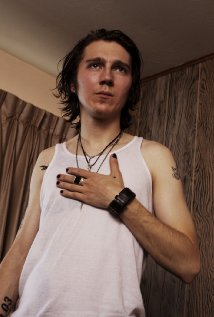
So Yong Kim’s character study For Ellen is only 93 minutes long, but the experience of watching it felt like it took an eternity. But — even though the film did not win awards at this year’s festival — it resonated; it was filled with many memorable, quiet moments. Paul Dano (never before so vulnerable) takes the reigns as a struggling musician who, while taking a break from touring to sign the papers for his long-overdue divorce, is forced to confront his own selfish tendencies when his custody rights start slipping through his fingers.

Writer-director Kim (2008’s Treeless Mountain) uses long, handheld takes that often prevent the viewer from seeing the actual feelings of our anti-hero. This subtle slice-of-life portrait never wavers from its sullen tone, which might explain why many critics seemed underwhelmed after its screening. For Ellen doesn’t give its flawed protagonist an easy way out, in a way that’s reminiscent of Darren Aranofsky’s The Wrestler (2008). 

Ira Sachs (2005’s Forty Shades of Blue) delivered his most personal film to date with Keep the Lights On; oddly enough, it might be a little too personal for its own good. Chronicling an extremely passionate and self-destructive relationship from the late 90s to the present, Sachs transparently exposes the very modern Chelsea neighborhood life of daily phone sex, random hook-ups, and casual usage of hard drugs — all wrapped up in a self-absorbed universe that I am sure more people in this generation can relate to than would actually like to admit. The indie auteur’s latest beautifully-shot effort goes overboard with its honesty (especially toward the end) and I was left in an emotional limbo, wanting to care but feeling like I had read too much of someone’s personal diary.

Barely recognized as mumblecore’s first female director, Ry Russo-Young seems to have graduated to full-fledged indie director with Nobody Walks, which won a Special Jury Prize for Excellence in Independent Film Producing. Most audience members were at the screening thanks to star John Krasinski (The Office), who delivers his usual charm. But truly stealing the show was Olivia Thirlby, whose irresponsible yet utterly motivated 23-year-old artist is so wonderfully performed that you forget about some of the major cues the film has taken from Lisa Cholodenko’s Laurel Canyon (2002) and Tom Kapinos’s Californication. Lena Dunham, who made 2011’s monumental Tiny Furniture, co-wrote the film, and her unromanticized take on strong female voices shines quite brightly here.      

But nothing in this year’s Dramatic Competition could compare to Ben Lewin’s The Surrogate, which won both the U.S. Dramatic Audience Award and a Special Jury Prize for Ensemble Acting. Truly delivering hands-down next year’s best actor performance, John Hawkes (2010’s Winter’s Bone) portrays Berkeley, Calif. journalist Mark O’Brien, whose poetry, autobiographical writings, and physical limitations gave writer/director Ben Lewin more than you could ever ask for. O’Brien’s real-life story was already told in Jessica Yu’s 1995 Academy Award-winning documentary Breathing Lessons: The Life and Work of Mark O’Brien, which hauntingly showcased O’Brien’s inspired and difficult life. For his narrative take, Lewin has pinpointed a very specific part of the story, creating a timeless romance and life-altering drama that ranks alongside Dalton Trumbo’s Johnny Got His Gun (1938) and David Lynch’s The Elephant Man (1980).

http://www.youtube.com/watch?v=SnUuVxL0UJ4

But it’s the acting that makes this film so unforgettable. Hawkes conveys complicated emotions and captures O’Brien’s soft-spoken syntax without ever slipping into pretension. William H. Macy throws in some very needed humor as an understanding, catch-22’d priest, and Helen Hunt gives the film that certain extra sense of surprise and understanding. It’s a cliché to say so, but it’s true: the film left nary a dry eye in the house. The Surrogate will be “the little film that could” for 2012 and for years after.

Up next: night owl Jesse Hawthorne Ficks tackles more Park City at Midnight movies.

Maximum Consumption: Bay Area bands choose their favorite eateries

0

I know, it’s so close to the weekend that you can taste it. But before you sign off for the day, your peepers sore and fingers trembling, here’s a comprehensive list – sure to get your tummy rumbling – of Bay Area bands’ favorite local restaurants, food trucks, and eateries. I compiled these answers from our On the Rise questionnaire (results of which are in this week’s issue) and my ongoing Localized Appreesh column. Enjoy.

San Francisco Bay Guardian: So local Bay Area musicians, what’s your favorite local eatery and dish?

DJ Theory: Cubano sandwich and sangria from Parada 22 in Upper Haight.

Dirty Ghosts: I don’t wanna be boring and say the super burrito at Cancún which is my real answer, so the margarita pizza at Una Pizza Napoletana

Metal Mother: Tacubaya in Berkeley, all the vegetarian dishes are amazing. My favorite is probably the ‘seasonal vegetable’ tamales.

Main Attrakionz: Buffet Fortuna in Downtown Oakland; chow fun noodles

Seventeen Evergreen: So many options here but let’s nominate the Chilaquiles at the farmer’s market in the Ferry Building or a number of places in the Mission for the same.

Jhameel: Cheeseboard Pizza in Berkeley. Perfect vegetarian pizzas.

http://www.youtube.com/watch?v=dPLYLsVDG8w

Future Twin: Secret Spot has delicious bagels, fresh squeezed juice, and homegrown greens.

Terry Malts: The #6 at Turtle Tower, best for hangovers.

Tycho: Thai Time — Red Chicken Curry (or anything else there).

Black Cobra: 1. Cathead’s Barbecue. Cornmeal crusted tofu is killer!
2. The Submarine Shop on West Portal. Italiano center sub with a Coke.

Silver Swans: El Metate Mexican Veggie burrito, the vegetables are roasted and always fresh. Everything there is delicious and on the cheap, right down to their alfajore cookies, I fully endorse the entire menu.

Le Vice: Broken Record — fresh organic soul food in a grimy-ass dive bar. Tasty as fuck. Hipster bling.

Ash Reiter: House of Curries – chicken tikka masala with potato nan.

Magic Touch: Ken Ken Ramen – Japanese ramen + veggie up.

The Fucking Buckaroos:
Mission’s Kitchen – Breakfast Burrito.

Prize: Millenium for overall vegetarian dining experience, and the garlic spread from Stinking Rose for the best actual thing to put in my mouth.

Swiftumz: Fresh Dungeness crabs!

Buffalo Tooth:
Morty’s in the TL, Chicken BLT.

Cosmo  Alleycats: Steve: Le Colonial’s brussels sprouts; Mike: Cordon Blue, California @ Hyde, menu #5; Emily: Where to begin? The food trucks at Off the Grid are ridiculous. I’m addicted to Curry Up Now’s chicken tikka masala burrito. Also, the veggie burger at the Plant Organic is to die for. And I love my Thursday night ‘liquid dinners’ with the band at Blondie’s Bar & No Grill.

Mental 99: Joe: Iwashi (sardine) at Tataki South (Church and 29th). Dawn: It’s hard to go wrong in SF – so many good places to eat. But the veggie burrito at Taqueria Cancún is pretty tasty – and close by, especially if you just played El Rio.

Uni & Her Ukelele:
Green Chili Kitchen.

Symbolick Jews:
The Philly cheese steak at Mission Kitchen is forged in the fires of gastro-intestinal hell, and I stand by its superiority over any other cheese steak in the city.

G-Eazy: Gordo’s on College Ave in Berkeley, without a doubt.

The Spyrals: That’s a tough one. Probably Los Compadres. It’s a family owned Taqueria in South City, near where we rehearse. Damn good carnitas.

TurbonegrA: Esperpento. It’s cheap and fast – like us!

The Sandwitches: Chevys and fried chicken.

http://www.youtube.com/watch?v=1871NoR6IMQ

Debbie Neigher: Plantain black bean burrito at Little Chihuahua.

Violet Hour: Sausages at Rosamunde’s on Haight

Waterstrider:
We frequent Taqueria La Familia. It is the best Mexican food in Berkeley. Their veggie burritos or chile rellenos do the trick for me.

Dreams: Shakin’ Jesse at Rudy’s Can’t Fail Cafe. Guinness, espresso, and ice cream – can’t go wrong with that.

The 21st Century: Al Pastor at El Metate–dynamite.And the Cold House Noodles at Yamo.

Rank/Xerox: Golden Gate Indian Cuisine and Pizza on Judah. Best restaurant in the city, eat everything but the Italian dishes.

The Jauntying Martyrs: Lucca Foods on Irving and 20th.  Best deli in SF, baby. Get the Billy Filly. (You can only get it when Billy’s working).

Religious Girls: Bake Sale Betty’s fried chicken sandwich

Rep Clock

0

Schedules are for Wed/8-Tues/14 except where noted. Director and year are given when available. Double and triple features are marked with a •. All times p.m. unless otherwise specified.

ARTISTS’ TELEVISION ACCESS 992 Valencia, SF; www.atasite.org. $6-10. Dirty Looks presents: City of Lost Souls, Fri, 8. “Mindscapes,” short films, Sat, 8.

CALIFORNIA COLLEGE OF THE ARTS 1118 Eighth St, SF; www.dirtylooksnyc.org. Free. Dirty Looks presents: “Queer Conversations on Culture in the Arts,” with selections from the “Female Trouble” experimental shorts program and a conversation with Margaret Tedesco, Thurs, 7.

CASTRO 429 Castro, SF; (415) 621-6120, www.castrotheatre.com. $7.50-10. •Pickpocket (Bresson, 1959), Wed, 3:30, 7:15, and American Gigolo (Schrader, 1979), Wed, 4:55, 8:45. •Beauty and the Beast (Cocteau, 1946), Thurs, 3:05, 7, and No Such Thing (Hartley, 2001), Thurs, 4:55, 8:50. “Midnites for Maniacs: I’m Black and I’m Proud:” •I’m Gonna Git You Sucka (Wayans, 1988), Fri, 7:30; Pootie Tang (Louis CK, 2001), Fri, 9:30; CB4 (Davis, 1993), Fri, 11:30. French American International School presents: “I-Speak: Celebrating 50 Years of International Education,” Sat, 6:30. This event, $5-10; tickets at www.internationalsf.org. •Do The Right Thing (Lee, 1989), Sun, 2, 8, and Malcolm X (Lee, 1992), Sun, 4:15. “Love: Ali MacGraw:” Love Story (Hiller, 1970), Tues, 8. With pre-show gala performance and MacGraw in person; for tickets ($25-45), visit www.ticketfly.com.

ELMWOOD 10070 San Pablo, El Cerrito; www.rialtocinemas.com. Free. “Community Cinema:” More Than a Month: One Man’s Journey to End Black History Month (Tilghman, 2012), Wed, 7.

CHRISTOPHER B. SMITH RAFAEL FILM CENTER 1118 Fourth St, San Rafael; (415) 454-1222, www.cafilm.org. $6.75-10.25. “Rafael Film Club:” “Jan Wahl,” Thurs, 1. Pina (Wenders, 2011), call for dates and times. “Mostly British Film Festival:” Route Irish (Loach, 2010), Wed, 7; Albatross (MacCormick, 2011), Thurs, 7. “2012 Oscar Nominated Short Films,” narrative and documentary (separate admission), Feb 3-9, call for times.

LAMORINDA THEATRES Four Orinda Theatre Square, Orinda; www.caiff.org. $12-15. “California Independent Film Festival,” 11 features, plus docs, shorts, and educational seminars, Feb 10-16.

MECHANICS’ INSTITUTE 57 Post, SF; (415) 393-0100, rsvp@milibrary.org. $10. “CinemaLit Film Series: Hollywood Dames: Beauty and Brains:” Intermezzo (Ratoff, 1939), Fri, 6.

PACIFIC FILM ARCHIVE 2575 Bancroft, Berk; (510) 642-5249, bampfa.berkeley.edu. $5.50-9.50. “Documentary Voices:” The Green Wave (Ahadi, 2010), Wed, 7. “Seconds of Eternity: The Films of Gregory J. Markopoulos:” “Markopoulos: The Early Films (1940-49)” Thurs, 7; “Eros and Myth (1950-63),” Sat, 6:30. “Austere Perfectionism: The Films of Robert Bresson:” The Trial of Joan of Arc (1962), Fri, 7; Les dames du Bois du Boulogne (1945), Fri, 8:25; Lancelot of the Lake (1974), Sat, 8:30. “Screenagers: 14th Annual Bay Area High School Film and Video Festival,” Sat, 3. “Howard Hawks: The Measure of Man:” The Criminal Code (1931), Sun, 4:30; Bringing Up Baby (1938), Tues, 7. “African Film Festival 2012:” Viva Riva! (Munga, 2010), Sun, 6:30.

ROXIE 3117 and 3125 16th St, SF; (415) 863-1087, www.roxie.com. $6.50-10. Come Back, Africa (Rogosin, 1959/2012), Wed-Thurs, 6:45, 8:30. Drive (Winding Refn, 2011), Wed, 8:45. Into the Abyss (Herzog, 2011), Wed, 6:45. SF IndieFest, Feb 9-23. Visit www.sfindie.com for complete schedule.

SFFS | NEW PEOPLE CINEMA 1746 Post, SF; www.sffs.org. $10-11. Domain (Chiha, 2010), Wed-Thurs, 2, 4:30, 7, 9:30. Once Upon a Time in Anatolia (Ceylan, 2011), Feb 10-16, 2, 5:30, 8:30.

VOGUE 3290 Sacramento, SF; www.mostlybritish.org. $12.50. “Mostly British Film Festival:” Black Butterflies (van der Oest, 2011), Wed, 5; London Boulevard (Monahan, 2010), Wed, 7:15; The Great White Silence (Ponting, 1924), Wed, 9:30; A Passionate Woman (2010), Thurs, 5; Route Irish (Loach, 2010), Thurs, 7:30.

VORTEX ROOM 1082 Howard, SF; www.myspace.com/thevortexroom. $7 donation. “The Second Coming of the Vortex Room:” The Second Coming of Suzanne (Barry, 1974), and Marjoe (Kernochan and Smith, 1972), Thurs, 8.

YERBA BUENA CENTER FOR THE ARTS 701 Mission, SF; (415) 978-2787, www.ybca.org. $6-8. “Bros Before Hos:” The Killing of a Chinese Bookie (Cassavetes, 1976), Thurs, 7:30; “Female Trouble,” experimental shorts program presented by Dirty Looks curator Bradford Nordeen, Sun, 2.

Stage Listings

0

Stage listings are compiled by Guardian staff. Performance times may change; call venues to confirm. Reviewers are Robert Avila, Rita Felciano, and Nicole Gluckstern. Submit items for the listings at listings@sfbg.com. For further information on how to submit items for the listings, see Picks.

THEATER

OPENING

Glengarry Glen Ross Actors Theatre of San Francisco, 855 Bush, SF; (415) 345-1287, www.brownpapertickets.com. $26-40. Opens Fri/3, 8pm. Runs Fri-Sat, 8pm. Through March 24. David Mamet’s cutthroat comedy, courtesy of the Actors Theatre of San Francisco.

Higher Theater at Children’s Creativity Museum, 221 Howard, SF; (415) 749-2228, www.act-sf.org. $10-65. Previews Wed/1-Fri/3, 8pm; Sat/4, 2pm. Opens Sun/5, 7pm. Runs Tues-Sat, 8pm (Tues/7, show at 7pm; also Wed, Sat-Sun, 2pm; no matinee Feb 8). Through Feb 19. American Conservatory Theatre presents Carey Perloff’s smart and sexy world premiere.

Vigilance Phoenix Theatre, 414 Mason, SF; (415) 335-6087, secondwind.8m.com. $20-25. Opens Fri/3, 8pm. Runs Thurs-Sat, 8pm; Sun, 2pm. Through Feb 25. Second Wind performs Bay Area playwright Ian Walker’s thriller.

The Waiting Period MainStage, Marsh San Francisco, 1062 Valencia, SF; (415) 282-3055, www.themarsh.org. $15-50. Previews Thurs/2, 8pm. Opens Fri/3, 8pm. Runs Fri, 8pm; Sat, 5pm. Through March 24. Brian Copeland returns with a new solo show about his struggles with depression.

BAY AREA

Counter Attack! Ashby Stage, 1901 Ashby, Berk; (510) 444-4755, ext. 114, www.stagebridge.org. $18-25. Opens Wed/3, 7:30pm. Runs Wed-Thurs, 7:30pm; Fri-Sat, 8pm (also Sat, 2pm); Sun, 2pm. Through March 4. Stagebridge presents the world premiere of Joan Holden’s waitress-centric play.

A Steady Rain Marin Theatre Company, 397 Miller, SF; (415) 388-5208, www.marintheatre.org. $34-55. Previews Thurs/2-Sat/4, 8pm; Sun/5, 7pm. Opens Tues/7, 8pm. Runs Tues and Thurs-Sat, 8pm (also Feb 11 and 25, 2pm; Feb 16, 1pm); Wed, 7:30pm; Sun, 2 and 7pm. Through Feb 26. Marin Theatre Company performs Keith Huff’s neo-noir drama.

ONGOING

Cabaret Young Performers Theatre, Fort Mason Center, Bldc C, Room 300, Marina at Laguna, SF; (415) 381-1638, cabaretsf.wordpress.com. $25-45. Thurs-Sat, 8pm; Sun, 7pm. Through Feb 19. Shakespeare at Stinson and Independent Cabaret Productions perform the Kander and Ebb classic in an intimate setting.

Food Stories: Pleasure is Pleasure Z Space, Theater Artaud, 450 Florida, SF; www.brownpapertickets.com. $20-55. Wed/1-Thurs/2, 7pm; Fri/3-Sat/4, 8pm; Sun/5, 2pm. Word for Word serves up two short stories with a gastronomical theme — T.C. Boyle’s Sorry Fugu and Alice McDermott’s Enough — fleshed out in W4W’s trademark verbatim style by a versatile six-person ensemble under direction of John Fisher. First course, by Boyle, is a nicely acted but fairly drab comic soufflé that tastes pretty familiar. Its setting is a restaurant turned upside down by the ambition of its portly, middle-aged, married chef (Soren Oliver), obsessed with winning over the big paper’s notoriously dismissive and all-powerful food critic (Molly Benson), who turns out to be a secretly insecure bombshell with a perennial dinner companion nicknamed The Palate (Gendell Hernandez). Fisher’s cast comes together well after a few hiccups, and the staging, while sometimes erratic, includes some inspired moments. But the story as a whole has little more to it than the food-as-sex seduction we see coming early on, and consequently lacks any real suspense. More satisfying all around is McDermott’s Enough, a salty, well acted, and fluidly staged condensation of a single lifetime — bracketed by scenes of eager tonguing of ice cream dregs. In this family history of a sweetly sybaritic but otherwise ordinary American woman (played variously by Delia MacDougall and Patricia Silver) food and sex are intertwined again but hardly, as the author stresses, in a metaphorical sense: “Pleasure is pleasure,” after all, and life is good to the last drop. (Avila)

*Humor Abuse American Conservatory Theater, 415 Geary, SF; (415) 749-2228, www.act-sf.org. $10-85. Wed/1-Sat/4, 8pm (also Wed/1 and Sat/4, 2pm); Sun/5, 2pm. “This is a show about clowning,” Lorenzo Pisoni advises his audience at the outset of his graceful solo performance, “and I’m the straight man.” It’s a funny line, actually — funny because it’s true, and not true. In the deft routines that follow, as well as in the snapshots cast on the atmospherically dingy curtain hung center stage, the career of this Pickle Family Circus brat (already alone in the spotlight by age two) never veers far from the shadow of his father. That fact remains central to the winning comedy and wistful reflection in Humor Abuse. Reared in the commotion and commitment of the famed San Francisco circus founded by his parents Larry Pisoni and Peggy Snider, Lorenzo had a childhood both enviable and unusually challenging. The fact that he shares his name with both a grandfather and his dad’s famous clown persona is instructive. His trials and his triumphs are further conflated — along with his father’s —in such elegant catastrophes as falling down a long flight of stairs. And in his good-humored and honest reflections, the existential poignancy at the heart of such artful buffoonery begins to rise to the surface. The spoken narrative feels a little pinched or abbreviated, in truth, but there are no shortcuts to the skill or wider perspective inculcated by the charming Pisoni and (under direction of co-creator Erica Schmidt) set enthralling in motion. (Avila)

*Little Brother Gough Street Playhouse, 1620 Gough, SF; www.custommade.org. $25-32. Thurs-Sat, 8pm; Sun, 7pm. Through Feb 25. Custom Made Theatre Co. performs Josh Costello’s adaptation of Cory Doctorow’s San Francisco-set thriller.

Not Getting Any Younger Marsh San Francisco, Studio Theater, 1062 Valencia, SF; (415) 826-5750, www.themarsh.org. $15-50. Fri, 8pm; Sat, 5 and 8:30pm. Extended through Feb 25. Marga Gomez is back at the Marsh, a couple of too-brief decades after inaugurating the theater’s new stage with her first solo show — an apt setting, in other words, for the writer-performer’s latest monologue, a reflection on the inevitable process of aging for a Latina lesbian comedian and artist who still hangs at Starbucks and can’t be trusted with the details of her own Wikipedia entry. If the thought of someone as perennially irreverent, insouciant, and appealingly immature as Gomez makes you depressed, the show is, strangely enough, the best antidote. (Avila)

Olivia’s Kitchen Exit Theatre, 156 Eddy, SF; www.generationtheatre.com. $20-40. Fri-Sat, 8pm; Sun, 3pm. Through Feb 19. GenerationTheatre offers this “remix” of Shakespeare’s Twelfth Night.

“SF Sketchfest” Various venues, SF; www.sfsketchfest.com. $10-75. Wed/1-Sat/4. The 11th San Francisco Comedy Festival invades 15 venues in 17 days with local and celebrity-packed (and local-celebrity-packed) performances, film events, improv shows, and more.

Vice Palace: The Last Cockettes Musical Thrillpeddlers’ Hypnodrome, 575 10th St, SF; (415) 377-4202, www.thrillpeddlers.com. $30-35. Fri-Sat, 8pm. Through March 3. Thrillpeddlers revives the Cockettes’ 1972 musical extravaganza.

Waiting for Godot Royce Gallery, 2901 Mariposa, SF; (415) 336-3522, www.tidestheatre.org. $20-38. Thurs-Sat, 8pm. Through Feb 18. The fuchsia papier-mâché tree and swirling grey-on-white floor pattern (courtesy of scenic designer Richard Colman) lend a psychedelic accent to the famously barren landscape inhabited by Vladimir (Keith Burkland) and Estragon (Jack Halton) in this production of the Samuel Beckett play by newcomers Tides Theatre. Director (and Tides’ producing artistic director) Jennifer Welch layers the avant-garde classic with some audio accents as well (although Jon Bernson’s minimalist industrial soundscape is a bit low in the mix to be very effective). More compelling is the gentle, sad humor and couched intelligence captured expertly by Halton in the circular but deliberate rhythms of his hapless tramp. Burkland as pal Vladimir exudes a palpable presence as well, though lacks the same focus. Timing is all in vaudeville — the parallel universe from whence these tangible modernist archetypes hail — as well as in a play whose plot goes intentionally nowhere, or rather loops back on itself in an implied dance with eternity. The halting aspect to Tides’ staging gets compounded with the arrival of brash whip-cracker Pozzo (a suitably stentorian but inconsistent Duane Lawrence) and his pitiful slave Lucky (a haunted, generally sharp Renzo Ampuero, made up to look like a goth doll à la some Tim Burton movie). That said, the best moments here broadcast the brooding beauty of the play, with its purposely vague but readily familiar world of viciousness, servility, trauma, want, fear, grudging compassion, and the daring, fragile humor that can look it all squarely in the eye. (Avila)

BAY AREA

Arms and the Man Lesher Center for the Arts, Margaret Lesher Theater, 1601 Civic, Walnut Creek; (925) 943-7469, www.centerrep.org. $38-43. Wed, 7:30pm; Thurs-Sat, 8pm; Sun, 2:30pm. Through Feb 25. Center REPertory Company presents George Bernard Shaw’s classic romantic comedy.

Body Awareness Aurora Theatre, 2081 Addison, Berk; (510) 843-4822, www.auroratheatre.org. $34-55. Previews Wed/1, 8pm. Opens Thurs/2, 8pm. Runs Tues, 7pm; Wed-Sat, 8pm; Sun, 2 and 7pm. Through March 4. Aurora Theatre performs Annie Baker’s comedy.

Ghost Light Berkeley Repertory Theatre, Thrust Stage, 2025 Addison, Berk; (510) 647-2949, www.berkeleyrep.org. $14.50-73. Tues, Thurs-Sat, 8pm (also Sat and Feb 16, 2pm); Wed and Sun, 7pm (also Sun, 2pm). Through Feb 19. Berkeley Rep performs Tony Taccone’s world-premiere play about George Moscone’s assassination, directed by the late San Francisco mayor’s son, Jonathan Moscone.

*The Kipling Hotel: True Misadventures of the Electric Pink ’80s New venue: Marsh Berkeley, 2120 Allston, Berk; (415) 282-3055, www.themarsh.org. $20-50. Sat, 8:30pm; Sun, 7pm. Through Feb 12. This new autobiographical solo show by Don Reed, writer-performer of the fine and long-running East 14th, is another slice of the artist’s journey from 1970s Oakland ghetto to comedy-circuit respectability — here via a partial debate-scholarship to UCLA. The titular Los Angeles residency hotel was where Reed lived and worked for a time in the 1980s while attending university. It’s also a rich mine of memory and material for this physically protean and charismatic comic actor, who sails through two acts of often hilarious, sometimes touching vignettes loosely structured around his time on the hotel’s young wait staff, which catered to the needs of elderly patrons who might need conversation as much as breakfast. On opening night, the episodic narrative seemed to pass through several endings before settling on one whose tidy moral was delivered with too heavy a hand, but if the piece runs a little long, it’s only the last 20 minutes that noticeably meanders. And even with some awkward bumps along the way, it’s never a dull thing watching Reed work. (Avila)

The Pitmen Painters TheatreWorks at Mountain View Center for the Arts, 500 Castro, SF; (650) 463-1960, www.theatreworks.org. $19-69. Tues-Wed, 7:30pm; Thurs-Sat, 8pm (also Sat, 2pm); Sun, 2 and 7pm. Through Feb 12. TheatreWorks performs a new comedy from the author of Billy Elliot about a group of British miners who become art world sensations.

The World’s Funniest Bubble Show Marsh Berkeley, TheaterStage, 2120 Allston, Berk; (415) 826-5750, www.themarsh.org. $8-50. Extended run: Feb 12, 19, 26, March 11, and 18, 11am. Louis “The Amazing Bubble Man” Pearl returns with this kid-friendly, bubble-tastic comedy.

PERFORMANCE/DANCE

“Cabaret of Love” Stage Werx, 446 Valencia, SF; www.brownpapertickets.com. Mon, 7 and 9pm. $15. Picklewater Clown Cabaret performs in celebration of Valentine’s Day.

Company C Contemporary Ballet Yerba Buena Center for the Arts, 701 Mission, SF; (415) 978-2787. Feb 17, 8pm; Feb 18, 6:30pm (gala benefit); and Feb 19, 3pm. $23-175. The company opens its 10th anniversary season.

“Elect to Laugh” Studio Theater, Marsh San Francisco, 1062 Valencia, SF; (415) 282-3055, www.themarsh.org. Tues, 8pm. Ongoing through Nov 6. $15-50. Will Durst and friends perform in this weekly political humor show that focuses on the upcoming presidential election.

“The Eric Show” Milk Bar, 1840 Haight, SF; www.milksf.com. Tues, 8pm (ongoing). $5. Local comedians perform with host Eric Barry.

“Fortunate Daughter” Stage Werx, 446 Valencia, SF; www.brownpapertickets.com. Sun/5, March 4, April 1, May 6, 7pm. $20. Thao P. Nguyen performs her solo show about being caught between her family and her friends in the queer community.

“The Mandrake” Hastings Studio Theater, 77 Geary, SF; (415) 749-2228, www.act-sf.org. Wed/1-Sat/4 and Feb 8-11, 7:30pm. $15. American Conervatory Theater’s MFA class of 2013 performs Machiavelli’s 16th century satire of Italian society.

“The News” Somarts Cultural Center, 934 Brannan, SF; www.somarts.org. Tues/7, 7:30pm. $5. This new monthly queer performance series highlights new and experimental works and works in progress. “Precious Drop: African and Afro-Fusion Dance, Music, and Theater” CounterPULSE, 1310 Mission, SF; 1-800-350-8850, www.counterpulse.org. Fri/3-Sat/4, 8pm. $20. Mohamed Lamine Bangoura with Jaara Dance and Drum and Bu Falle African Drum and Dance present a work-in-progress about the global importance of water. BAY AREA “Cordelia, Mein Kind” TheaterStage at Marsh Berkeley, 2120 Allston, Berk; (415) 282-3055, www.themarsh.org. Thurs/2-Fri/3, 8pm; Sat/4, 5pm; Sun/5, 3pm. $15-50. The Marsh Berkeley collaborates with the Magnes Collection of Jewish Art and Life to present this multimedia Australian import by Deborah Leiser-Moore. “The Second Sin Again…” Black Repertory Group Theater, 3201 Adeline, Berk; www.punanytickets.com. Sat/4, 7pm. $25. Punany Poets perform a mix of erotic poetry, dance, comedy, and theater.

Metal Mother

0

Like some sort of neon, acid-drenched wood nymph, Metal Mother’s (metalmother.bandcamp.com) Tara Tati wanders through the leafy, NSFW video for the haunting art-pop “Shake” off last year’s Bonfire Diaries and into the mind’s eye. In 2012, there will be a first trip to SXSW, more videos (yay!), a few remixes, and, fingers crossed, another full length out toward the end of this year. And as the shimmering Tati says, she’ll “Continue dismantling the mundane and mediocre thought systems that are ruling the planet.”

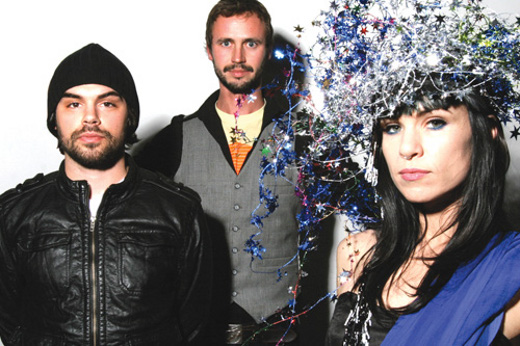
Tati and her band, which came together shortly after the release of Bonfire proved most theatrical of the Guardian photoshoot, with glittering headpieces and flexible posing. In setting up the right headspace for a photo Tati at one point explained, “I imagine we’re on a wind-torn beach in Scotland.” Appropriate given the band’s atmospheric sound. Before embarking on tour, Metal Mother will play Disco Volante on March 3 (347 14 St., Oakl. www.discovolanteoakland.com)

Description of sound: Post-apocalyptic-art-wave.

What do you like most about the Bay Area music scene: Oakland (where I live) has the feeling of being a fairly insulated city, and I think because it feels like we’re off the mainstream radar a bit, in combination with the massive artist population, there’s more support here for being ‘experimental’ and trying new things, than there is for being traditional. There’s this intense camaraderie, like it’s all for one and one for all, yet at the same time, there’s a crazy bullshit filter that really keeps us all in our most authentically creative place.

What piece of music means the most to you and why: The piece that’s recently gotten the most consistent play on my iPod is Sufjan Stevens’ latest album, Age of Adz. I’ve realized that most music that has lasting power for me usually has some symphonic, classical element to it, and he really nailed it with this album. Its masterfully produced; the arrangements are shockingly complex yet have this unyielding elegance that still gets me all emotional. To me, it’s a perfect blend of sweetness, humility, passion, and absurdity; there’s never a dull moment!

Favorite local eatery and dish: Tacubaya in Berkeley, all the vegetarian dishes are amazing. My favorite is probably the ‘seasonal vegetable’ tamales.

Who would you most like to tour with: It’s a tie between Sufjan Stevens and Bjork.

Inside the Occupy Oakland protest

57

UPDATE: We’ve corrected a few factual mistakes. We originally reported that protesters forced open the door of the YMCA; in fact, they asked to be let in and they were. We regret the error.

An Occupy Oakland march that turned violent Jan. 28 led to the arrest of 400 people, including me.

The march, which peaked at about 2,000 protesters, was organized with the intention of entering a vacant building — the Kaiser Convention Center — and turning it into a new “Social Center” that participants in Occupy Oakland hoped to use to gather, teach, and organize.

The move was more than symbolic. Occupy activists have engaged in constant debate about tactics and goals, particularly when it comes to violence and property destruction, and it’s hard to argue at this point that Occupy Oakland is a nonviolent movement.

But many thought that the goal of occupying a vacant building made sense. When Occupy Oakland had a camp in Frank Ogawa Plaza, also known as Oscar Grant Plaza, commonly described as OGP, it created a strong community. It’s a community that bridged divides between the homeless and the housed, between students and labor organizers, and between Oakland residents of different races, genders and levels of ability in an unprecedented fashion.

Besides that, the camp had a kitchen that fed hundreds of people everyday. The camp had a network of shared tents and blankets that welcomed in hundreds who would have slept freezing on the streets, often feeling isolated from other residents of their city and made to feel inferior. Now, they had a place to stay that was warmer, more safe and secure, and was embedded in a community bound together by ties of solidarity.

That community was able to thrive in it’s centralized camp location.

That was the practical reason for wanting to occupy a vacant building: to have a social center for Occupy Oakland.

Of course, there are other reasons. There’s the question that many squatters and homeless advocacy groups have been making for decades: why let buildings lie vacant while people freeze on the street?

The march set off from OGP at 1 p.m. Jan. 28. There was no ambiguity about group’s goal: Many pushed carts stacked with furniture, hoping to furnish the new center; others held a large banner reading “Vacant? Take it!” 

Many other Occupy groups around the world, including protesters in Washington DC, London, England, and Belfast, Ireland, have taken over vacant buildings in an attempt to create social centers, house homeless community members and protest injustice symbolized by buildings lying vacant while people live on the street.

In Oakland, the attempts were staved off when riot police lined up in front of the march and declared unlawful assemblies.

In front of the  Convention Center, police threw smoke bombs into the crowd and warned that those who refused to disperse would be arrested. The march continued around the corner to 12th St and Oak, where protesters and police were involved in another confrontation. Police shot smoke bombs and “pepper bombs,” canisters of pepper spray that explode on impact, into the crowd. Some in the march responded by throwing canisters, along with plastic bottles, back at police. Masked protesters in the front of the group brandished makeshift shields. Protesters say the shields were there to protect them from rubber bullets and bean bag rounds.

The cops had a different perspective. “It became clear that the objective of this crowd was not to peacefully assemble and march, but to seek opportunity to further criminal acts, confront police, and repeatedly attempt to illegally occupy buildings,” said Oakland Police Chief Howard Jordan in a press release.

In a tense moment, hundreds knelt to hide behind the frontline shields while police fired rubber bullets into the crowd.
When police began to advance at both the front and back end of the group, protesters retreated, marching on 12th St back to Ogawa/Grant Plaza.

As they marched on 12th street, Occupy Oakland-affiliated street medics treated injuries from tear gas, pepper spray, and rubber bullets. Police followed in the rear of the march, continuing to project exploding flash-bang grenades at the crowd.

At about 5:30, another march left from the plaza, again with the stated attention of occupying a building. Police marched behind protesters. When the march cut through Fox Square in Oakland’s Uptown neighborhood, police filled in all surrounding sides of the march. Protesters have used the term “kettling” to describe a situation in which police line up on all sides of a group, blocking anyone in the group from leaving.
After “kettling” hundreds of protesters at this location, police began to deploy tear gas. Some protesters with makeshift plastic and metal shields, many marked with the “circle-A” anarchy symbol, advanced towards police. Several police beat the shield back with batons and struck some protesters.

One 19-year-old woman who was struck with a baton to the kidneys was brought to the hospital and treated for internal bleeding.
At Fox Square, police announced that the gathering was an unlawful assembly. Minutes later, some protesters knocked over a line of chain-link fencing, allowing the march to exit the “kettle.” The march continued on Telegraph.

When the march arrived at Broadway between 22nd and 23rd streets, protesters asked to be let into the YMCA and someone who was in there opened the doors. Police later closed in on both sides until they had formed a line preventing the approximately 400 protesters from exiting.

On Broadway, there was no dispersal order issued. This is in violation of the Oakland Police Department’s crowd control policy, which states that “If after a crowd disperses pursuant to a declaration of unlawful assembly and subsequently participants assemble at a different geographic location where the participants are engaged in non-violent and lawful First Amendment activity, such an assembly cannot be dispersed unless it has been determined that it is an unlawful assembly and the required official declaration has been adequately given.”

About 6:30 p.m., police announced that all of the blocked-in group was under arrest.

It was more than six hours before the sidewalk was cleared of all detainees. Most are charged with failure to disperse. Some, such as those who entered the YMCA, have been charged with burglary.

Dozens of protesters who had avoided arrest marched back to City Hall. There, they illegally entered the building and committed several acts of vandalism. According to a press release, these included “breaking an interior window to a Hearing Room, tipping over and seriously damaging the historic model of City Hall, destroying a case containing a model of Frank Ogawa Plaza, and breaking into the fire sprinkler and elevator automation closet.” Protesters also report setting off fireworks in the counsel chambers.

Some protesters took an American flag from City Hall and burned it in front of the government building.

Oakland officials have complained about the cost of the protests. The city had reportedly spent $2.4 million policing Occupy Oakland protesters as of November 15, just weeks after announcing the decision to close down five elementary schools to save $2 million.
Occupy activists say the huge — expensive — police presence is an overreaction.

“The amount of property damage by protesters has been minimal next to Mayor Quan’s destruction of the humanitarian Occupy Oakland community and excessive force against peaceful people, said Wendy Kenin, an Occupy Oakland spokesperson. “The City of Oakland’s commitment to militarism far outweighs its investment in schools. 

Kenin said she was back at Occupy Oakland outside City Hall, with her four children, the day after the incidents.
There were no arrests made in the City Hall incident, partly because so many police resources were deployed at the YMCA.

Cities and counties that provided police reenforcements to handle the mass arrests include Alameda County, San Mateo County, Santa Clara County, San Francisco County and Marin County and the cities of Fremont, Hayward, Berkeley, Pleasanton, San Francisco and Union City/Newark; and the University of California-Berkeley, according to an Oakland Police Department press release. 

Dozens of those detained were brought to Glenn Dyer jail, which quickly filled up; the rest were brought to Santa Rita jail in Dublin.
Several members of the press, as well as passers-by who were on their way to work in the area, were swept up in the arrests.

In jail, those detained debated tactics involved in the day’s demonstrations and discussed the future of Occupy Oakland.

The number of injured protesters is unknown, but in the 19-person sampling of arrestees with whom I spent 20 hours, two had bruises from baton strikes, one suffered from an injured foot after a pepper-bomb exploded upon impact with her ankle, and most had irritation in their eyes, ears, and throat from exposure to tear gas and pepper spray.

Oakland police report that three officers were injured.

As of the morning of Jan. 30, about 100 remained in Santa Rita.

Can SF follow Berkeley in dumping the big banks?

15

The City of Berkeley is considering dropping its contract with Wells Fargo and moving the city’s money to a credit union or a smaller community bank. That makes perfect sense — the Move Your Money Project has been urging individuals to do that, and there’s no reason why cities (which are huge customers of banking services) can’t do the same.


In fact, San Francisco ought to be next on the list.


This city puts all of its short-term money in Bank of America. It’s a lot of cash — if the city spends more than $6 billion a year, much of that at some point goes into a city account and most of the checks the city issues are paid on that account. We’re talking a plum deal for a big bank — particularly since the city’s checks aren’t going to bounce and the money comes in steadily.


Why B of A? Because the contract is put out to bid, and B of A was able to offer the best deal. But the bidding process didn’t consider the issues that Occupy has brought up — nor did it consider the number of local jobs that could be generated if the city put its money in a local bank that actually makes local loans to small businesses and homeowners instead of foreclosing on people and shipping the profits back to North Carolina every night.


I don’t know if there’s a local credit union or community bank big enough to handle the business of a client the size of San Francisco — but there’s no reason the entire contract has to go to one bank.


Besides, we could always create our own.

Sorrow, tears, blood — and dance

0

arts@sfbg.com

MUSIC Musical genius, human rights activist, cultural legend, African icon — late Nigerian Afrobeat pioneer Fela Kuti encompassed multitudes, but to his 1980s-era guitarist Soji Odukogbe, he provided not only inspiration but a way into his music.

“The music was written by Fela, so if you were good enough, you could add to it, and he wouldn’t say anything. But if you were not good enough, he’d say, ‘This is the line,'” explains Odukogbe, 49, by phone from Berkeley where he now lives. “Afrobeat is a written music — you can’t add to it. You can add if you know your instrument, and it’s sweet enough, then you can go there.”

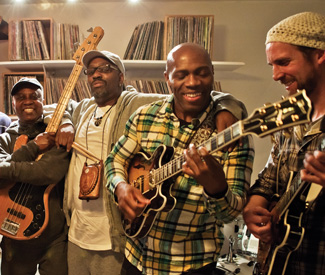
Fortunately the Lagos, Nigeria, native — who as a child was inspired enough by Fela’s hits to take a wood plank, hammer a nail into it, and pretend it was a guitar — was good enough to take his liberties on guitar on legendary Fela albums like Teacher Don’t Teach Me Nonsense, Beasts of No Nation, and Underground System (all Barclay; 1986, 1989, and 1992). “[Fela] was anxious to meet me [after he got out of prison], and when he saw me, he was so happy — he said, ‘I have a guitar player that’s really good!,'” recalls Odukogbe, who joined Fela’s band in ’85. “One day I said, ‘Fela, I want to take a guitar solo. He only allowed horn and keyboard solos, and he said, ‘Yeah, go ahead,’ and I blew his mind. He was so proud of me.” Odukogbe appears with kindred Fela player Baba Ken Okulolo at a “Fela Kuti Extravaganza” dance party at Cafe Du Nord Jan. 28.

The guitarist played with Fela for five years before deciding to take his chances in the U.S. where a so-called world music movement was catching fire with the success of Nigerian juju master King Sunny Adé, Le Mystere des Voix Bulgares (Nonesuch, 1987), and Brazil Classics 1: Beleza Tropical (Luaka Bop, 1990). Now, with publications such as The New York Times trumpeting an “African invasion” in indie rock and a fascination with African music takes hold once more — morphed and bent to new ends by performers ranging from Vampire Weekend to Dirty Projectors to this year’s Pazz and Jop poll-topping tUnE-yArDs — the time seems right to revisit Fela’s legacy.

Long before African outfits like Tinariwen and Blk Jks threaded rock ‘n’ roll guitar into indigenous rhythms, and hipster-cred comps such as the Ethiopiques and Congotronics series touched down stateside, Fela was hybridizing jazz and highlife with a potent dose of James Brown-style funk, a black power sensibility (not for nothing did he dub himself the Black President), and a driving thirst for justice, even after being jailed some 200 times, suffering at the hands of soldiers (the wounds Fela revealed when he dropped his trousers in the 1982 documentary Music Is the Weapon are heartbreaking), and undergoing a level of government harassment and abuse that would break most mortals. It all appeared to climax in 1977 after the release of his military-mocking 1977 LP Zombie (Barclay) and the subsequent invasion of his Kalakuta Republic commune by soldiers, which led to the death of his mother and the beating and brutalization of the performer, his family, wives, and friends.

Though mainstream superstars Will Smith and Jay-Z threw their producing weight behind the recent Tony Award-winning musical production of Fela!, it’s tough to imagine an artist quite like Fela in today’s music scene, fighting back from the top of the pop charts, occupying the public imagination with his radical politics and spiritual beliefs, and speaking his mind, loudly and outrageously. Still, Fela’s story and music speak louder than ever, especially in the context of indie’s less-than-political appropriation of African sounds, the recent SF run of Fela!, the 2011 rerelease of Fela’s Universal-controlled albums in North America by Knitting Factory Records, the upcoming film directed by artist-filmmaker Steve McQueen, and continuing tide of injustice in Nigeria, where weeks of protests continue over fuel prices and the country has undergone its worst oil spill in a decade.

“The thing that’s most interesting about Fela’s music is how traveling and seeing other cultures, going to the United States, and getting familiar with American music and James Brown and American politics inspired him to fulfill his own roots and look back on himself and to really see these international forces as part of his background and his own culture,” observes Will Magid, 26, who organized the Fela dance party and has played with Odukogbe and Okulolo. Magid’s own forthcoming debut album promises to mix Kuti’s influence with Balkan, pop, and funk sounds. “We need more people who are like that and who are speaking up.”

El Cerrito-by-way-of-Nigeria bassist Okulolo played with Fela as well as King Sunny Ade and has performed with Odukogbe in the Kotoja, the Western African Highlife Band, and the Nigerian Brothers. Magid’s friend and mentor since the two met through Okulolo’s son at UCLA, the musician sees “Fela Kuti Extravaganza” as a teaching opportunity.

“Fela was a great musician, and his music will never die,” says Okulolo. “I think it would be a good idea to continue educating people about his music and how beautiful it is. I worked with [Fela] briefly, and I know the man well, and so many bands are playing Afrobeat now — generally the music needs to be out there.”

“It has funk; it has jazz; it has an African beat; it has everything,” he continues. “It’s our opportunity to showcase it to as many people as we can and make it valuable, to put it in a category that someday will be what reggae is today.”

And during hard times, we can all learn something from Fela, his still-vibrant music, and his way of moving, fluidly and artfully, through oppression, through pain. “There’s this element of social consciousness, of people dancing and then hearing about these oil spills,” muses Magid of the upcoming dance party. “It’s a different kind of dancing when you’re dancing through suffering.” *


WILL MAGID’S WORLD WIDE DANCE PARTY: FELA EXTRAVAGANZA

With Baba Ken Okulolo and Soji Odukogbe, Will Magid Trio with Fely Tchaco, MSK.FM, and izzy*wise

Sat/28, 9:30 p.m., $15

Cafe Du Nord

2170 Market, SF

www.cafedunord.com

Rep Clock

0

Schedules are for Wed/25-Tues/31 except where noted. Director and year are given when available. Double and triple features are marked with a •. All times p.m. unless otherwise specified.

ART DECO MOVIE THEATER 2700 Saratoga, Alameda; www.baicff.com. $10-20. "Bay Area International Children’s Film Festival," family films from around the world, Sat-Sun, 10am-5:30pm.

BALBOA 3630 Balboa, SF; www.brownpapertickets.com. $15-20. "Opera and Ballet at the Balboa Theatre:" Caligula, from the Paris Opera Ballet, Wed, 7:30; Cendrillon, from the Royal Opera House, Sat-Sun, 10am. "Jazz and Film:" A Great Day in Harlem (Bach, 1994), with live performance by Jimmy Ryan’s Balboa Be Bop Band, Sun, 5:30.

BERKELEY FELLOWSHIP OF UNITARIAN UNIVERSALISTS 1924 Cedar, Berk; www.bfuu.org. Hypothesis (Smith), followed by a discussion about 9/11 truth, Thurs, 7.

CASTRO 429 Castro, SF; (415) 621-6120, www.castrotheatre.com. $7.50-10. "Noir City X:" •House of Bamboo (Fuller, 1955), Wed, 7:30, and Underworld USA (Fuller, 1961), Wed, 9:20; •Naked Alibi (Hopper, 1954), Thurs, 7:30, and Pickup (Haas, 1951), Thurs, 9:20; •Thieves’ Highway (Dassin, 1949), Fri, 7:30, and The Breaking Point (Curtiz, 1950), Fri, 9:30; •Three Strangers (Negulesco, 1946), Sat, 1, 5, 9, and The Great Gatsby (Nugent, 1949), Sat, 3, 7; Roadhouse Nights (Henley, 1930), Sun, noon; The Maltese Falcon (Del Ruth, 1931), Sun, 1:20; City Streets (Mamoulian, 1932), Sun, 3; Mr. Dynamite (Crosland, 1935), Sun, 4:45; The Glass Key (Heisler, 1942), Sun, 7; The Maltese Falcon (Huston, 1941), Sun, 9. Advance tickets (double features, $10-15) and more info at www.noircity.com.

CHRISTOPHER B. SMITH RAFAEL FILM CENTER 1118 Fourth St, San Rafael; (415) 454-1222, www.cafilm.org. $6.75-10.25. "Rafael Film Club:" Complicated Women (Munro Neely, 2003), Thurs, 1. With author and film critic Mick LaSalle. Pina (Wenders, 2011), Jan 27-Feb 2, call for times. Joffrey: Mavericks of Dance (Hercules, 2011), Sat, 10:30am.

JEWISH COMMUNITY CENTER OF THE EAST BAY 1414 Walnut, Berk; (510) 848-0237, www.brownpapertickets.com. $6-8. "San Francisco Jewish Film Festival Presents:" 77 Steps (Mara’ana, 2010), Thurs, 7:30.

PACIFIC FILM ARCHIVE 2575 Bancroft, Berk; (510) 642-5249, bampfa.berkeley.edu. $5.50-9.50. "Film 50: History of Film, Cinema, and the Other Arts:" "Back to the Beginning: From the Cinema of Attractions to Narrative Illusionism," with lecture by Marilyn Fabe, Wed, 3:10. This event, $5.50-11.50. "Documentary Voices:" David Holzman’s Diary (McBride, 1968), Wed, 7. "African Film Festival 2012:" Medicine for Melancholy (Jenkins, 2007), with director Barry Jenkins in person, Thurs, 7; A Screaming Man (Haroun, 2010), Sun, 4:30. "Howard Hawks: The Measure of Man:" Paid to Love (1927), Fri, 7; Scarface (1932), Tues, 7. "Henri-Georges Clouzot: The Cinema of Disenchantment:" Diabolique (1955), Fri, 8:40; The Spies (1958), Sun, 6:30. "Austere Perfectionism: The Films of Robert Bresson:" Pickpocket (1959), Sat, 6:30; Diary of a Country Priest (1950), Sat, 8:10.

ROXIE 3117 and 3125 16th St, SF; (415) 863-1087, www.roxie.com. $6.50-10. Warren Ellis: Captured Ghosts (Meaney, 2011), Wed, 7:15, 9. The Upsetter: The Life and Music of Lee "Scratch" Perry (Higbee and Bhala Lough, 2011), Thurs, 7:30, 9:30. Sing Your Song (Rostock, 2011), Jan 27-Feb 2, 6:45, 8:45 (also Sat-Sun, 2:45, 4:45).

SFFS | NEW PEOPLE CINEMA 1746 Post, SF; www.sffs.org. $10-11. Fullmetal Alchemist: The Sacred Star of Milos (Murata, 2011), Wed-Thurs, 2, 4:30, 7, 9:15. Sleeping Beauty (Leigh, 2011), Jan 27-Feb 2, 2, 4:30, 7, 9:15 (no 7pm show Mon/30).

YERBA BUENA CENTER FOR THE ARTS 701 Mission, SF; (415) 978-2787, www.ybca.org. $6-8. "British Arrow Awards: Best British Television Commercials of 2011," Thurs-Sun, 2, 4, 6, 8. The House by the Cemetery (Fulci, 1981), Fri-Sat, 10.

ZINC DETAILS 1905 Fillmore, SF; rsvp@zincdetails.com. Free. Eames: The Architect and the Painter (Cohn and Jersey, 2011), Wed, 6. With a discussion about the Eames with former Dwell editor Sam Grawe.

Stage Listings

0

Stage listings are compiled by Guardian staff. Performance times may change; call venues to confirm. Reviewers are Robert Avila, Rita Felciano, and Nicole Gluckstern. Submit items for the listings at listings@sfbg.com. For further information on how to submit items for the listings, see Picks.

THEATER

OPENING

Vice Palace: The Last Cockettes Musical Thrillpeddlers’ Hypnodrome, 575 10th St, SF; (415) 377-4202, www.thrillpeddlers.com. $30-35. Opens Fri/27, 8pm. Runs Fri-Sat, 8pm. Through March 3. Thrillpeddlers revives the Cockettes’ 1972 musical extravaganza.

BAY AREA

Arms and the Man Lesher Center for the Arts, Margaret Lesher Theater, 1601 Civic, Walnut Creek; (925) 943-7469, www.centerrep.org. $38-43. Previews Fri/27-Sat/28, 8pm; Sun/29, 2:30pm. Opens Tues/31, 7:30pm. Runs Wed, 7:30pm; Thurs-Sat, 8pm; Sun, 2:30pm. Through Feb 25. Center REPertory Company presents George Bernard Shaw’s classic romantic comedy.

Body Awareness Aurora Theatre, 2081 Addison, Berk; (510) 843-4822, www.auroratheatre.org. $34-55. Previews Fri/28-Sat/28 and Feb 1, 8pm; Sun/29, 2pm; Tues/31, 7pm. Opens Feb 2, 8pm. Runs Tues, 7pm; Wed-Sat, 8pm; Sun, 2 and 7pm. Through March 4. Aurora Theatre performs Annie Baker’s comedy.

ONGOING

Cabaret Young Performers Theatre, Fort Mason Center, Bldc C, Room 300, Marina at Laguna, SF; (415) 381-1638, cabaretsf.wordpress.com. $25-45. Thurs-Sat, 8pm; Sun, 7pm. Through Feb 19. Shakespeare at Stinson and Independent Cabaret Productions perform the Kander and Ebb classic in an intimate setting.

Food Stories: Pleasure is Pleasure Z Space, Theater Artaud, 450 Florida, SF; www.brownpapertickets.com. $20-55. Wed-Thurs, 7pm; Fri-Sat, 8pm; Sun, 2pm. Through Feb 5. Word for Word presents performances of short stories by T.C. Boyle and Alice McDermott.

Future Motive Power Old Mint, 88 Fifth St, SF; www.mugwumpin.org. $15-30. Fri/27-Sun/29, 8pm. Mugwumpin takes on the life of Nikola Tesla in its latest performance piece.

*Humor Abuse American Conservatory Theater, 415 Geary, SF; (415) 749-2228, www.act-sf.org. $10-85. Tues-Sat, 8pm (also Wed and Sat, 2pm); Sun, 2pm. Through Feb 5. “This is a show about clowning,” Lorenzo Pisoni advises his audience at the outset of his graceful solo performance, “and I’m the straight man.” It’s a funny line, actually — funny because it’s true, and not true. In the deft routines that follow, as well as in the snapshots cast on the atmospherically dingy curtain hung center stage, the career of this Pickle Family Circus brat (already alone in the spotlight by age two) never veers far from the shadow of his father. That fact remains central to the winning comedy and wistful reflection in Humor Abuse. Reared in the commotion and commitment of the famed San Francisco circus founded by his parents Larry Pisoni and Peggy Snider, Lorenzo had a childhood both enviable and unusually challenging. The fact that he shares his name with both a grandfather and his dad’s famous clown persona is instructive. His trials and his triumphs are further conflated — along with his father’s —in such elegant catastrophes as falling down a long flight of stairs. And in his good-humored and honest reflections, the existential poignancy at the heart of such artful buffoonery begins to rise to the surface. The spoken narrative feels a little pinched or abbreviated, in truth, but there are no shortcuts to the skill or wider perspective inculcated by the charming Pisoni and (under direction of co-creator Erica Schmidt) set enthralling in motion. (Avila)

*New Fire: To Put Things Right Again Brava Theater, 2781 24th St, SF; (415) 647-2822, www.brava.org. $10-30. Thurs/26-Sat/28, 8pm; Sun/29, 3pm. You hear a lot of lip service these days to “community-building,” even when that community might represent the merest sliver, unable to reach out or expand beyond its own narrow parameters. That is not the kind of community playwright Cherríe Moraga is interested in paying lip service to, and her latest work New Fire reaches out in all possible directions, most notably digging deep into sacred spaces frequently left out of the conversation altogether. Structured not as a conventional (by Western standards) play, but as a healing ceremony centered around the story’s single protagonist, Vero (Dena Martinez), Celia Herrera Rodriguez’ staging and design blend seamlessly with Alleluia Panis’ ecstatic choreography to create a world where the sacred and the mundane coexist, almost unremarked, but certainly remarkably. Combining new media such as video by Emily Encina, with ancient ritual, the most electrifying moments are those rendered wholly without spoken words — the steady heartbeat of percussion, the ululation of Charlene O’Rourke’s magnificent chanting, the stealthy creeping of spirit figures whose faces are hidden by the wide brims of vibrantly painted hats. But don’t go in expecting a woo-woo, earth mother love fest: New Fire, is heavy with dark moments. But as El Caminante (Robert Owens-Greygrass) points out, such darkness can be beautiful too. (Gluckstern)

Not Getting Any Younger Marsh San Francisco, Studio Theater, 1062 Valencia, SF; (415) 826-5750, www.themarsh.org. $15-50. Fri, 8pm; Sat, 5 and 8:30pm. Extended through Feb 25. Marga Gomez is back at the Marsh, a couple of too-brief decades after inaugurating the theater’s new stage with her first solo show — an apt setting, in other words, for the writer-performer’s latest monologue, a reflection on the inevitable process of aging for a Latina lesbian comedian and artist who still hangs at Starbucks and can’t be trusted with the details of her own Wikipedia entry. If the thought of someone as perennially irreverent, insouciant, and appealingly immature as Gomez makes you depressed, the show is, strangely enough, the best antidote. (Avila)

Olivia’s Kitchen Exit Theatre, 156 Eddy, SF; www.generationtheatre.com. $20-40. Fri-Sat, 8pm; Sun, 3pm. Through Feb 19. GenerationTheatre offers this “remix” of Shakespeare’s Twelfth Night.

“SF Sketchfest” Various venues, SF; www.sfsketchfest.com. $10-75. Through Feb 4. The 11th San Francisco Comedy Festival invades 15 venues in 17 days with local and celebrity-packed (and local-celebrity-packed) performances, film events, improv shows, and more.

Waiting for Godot Royce Gallery, 2901 Mariposa, SF; (415) 336-3522, www.tidestheatre.org. $20-38. Thurs-Sat, 8pm. Through Feb 18. Tides Theatre Company debuts with a bold interpretation of the Beckett classic.

BAY AREA

Ghost Light Berkeley Repertory Theatre, Thrust Stage, 2025 Addison, Berk; (510) 647-2949, www.berkeleyrep.org. $14.50-73. Tues, Thurs-Sat, 8pm (also Sat and Feb 16, 2pm); Wed and Sun, 7pm (also Sun, 2pm). Through Feb 19. Berkeley Rep performs Tony Taccone’s world-premiere play about George Moscone’s assassination, directed by the late San Francisco mayor’s son, Jonathan Moscone.

*The Kipling Hotel: True Misadventures of the Electric Pink ’80s New venue: Marsh Berkeley, 2120 Allston, Berk; (415) 282-3055, www.themarsh.org. $20-50. Sat, 8:30pm; Sun, 7pm. Through Feb 12. This new autobiographical solo show by Don Reed, writer-performer of the fine and long-running East 14th, is another slice of the artist’s journey from 1970s Oakland ghetto to comedy-circuit respectability — here via a partial debate-scholarship to UCLA. The titular Los Angeles residency hotel was where Reed lived and worked for a time in the 1980s while attending university. It’s also a rich mine of memory and material for this physically protean and charismatic comic actor, who sails through two acts of often hilarious, sometimes touching vignettes loosely structured around his time on the hotel’s young wait staff, which catered to the needs of elderly patrons who might need conversation as much as breakfast. On opening night, the episodic narrative seemed to pass through several endings before settling on one whose tidy moral was delivered with too heavy a hand, but if the piece runs a little long, it’s only the last 20 minutes that noticeably meanders. And even with some awkward bumps along the way, it’s never a dull thing watching Reed work. (Avila)

The Pitmen Painters TheatreWorks at Mountain View Center for the Arts, 500 Castro, SF; (650) 463-1960, www.theatreworks.org. $19-69. Tues-Wed, 7:30pm; Thurs-Sat, 8pm (also Sat, 2pm); Sun, 2 and 7pm. Through Feb 12. TheatreWorks performs a new comedy from the author of Billy Elliot about a group of British miners who become art world sensations.

The World’s Funniest Bubble Show Marsh Berkeley, TheaterStage, 2120 Allston, Berk; (415) 826-5750, www.themarsh.org. $8-50. Extended run: Feb 12, 19, 26, March 11, and 18, 11am. Louis “The Amazing Bubble Man” Pearl returns with this kid-friendly, bubble-tastic comedy.

PERFORMANCE/DANCE

“The Best of Times” Alcazar Theatre, 650 Geary, SF; www.42ndstmoon.org. Thurs/26, 7pm. $70. 42nd Street Moon salutes Tony-winning Broadway composer-lyricist Jerry Herman.

“The Eric Show” Milk Bar, 1840 Haight, SF; www.milksf.com. Tues, 8pm (ongoing). $5. Local comedians perform with host Eric Barry.

“Father Panic!” Garage, 975 Howard, SF; (415) 518-1517, www.975howard.com. Fri/27-Sat/28, 8pm, $15. Dan Carbone’s latest autobiographical performance piece.

“Hidden Classics Reading Series” Exit on Taylor, 277 Taylor, SF; www.cuttingball.com. Sun/29, 3pm. Free. Cutting Ball Theater presents two August Strindberg readings: Miss Julie and A Dream Play.

“Loved By You: A Self-Love Story” TJT, 470 Florida, SF; www.brownpapertickets.com. Sat/28-Sun/29, 8pm. $15. Lori Shantzis performs her solo show about self-acceptance.

“Musicircus” Walt Disney Family Museum, 104 Montgomery, the Presidio, SF; www.calartsf.net. Sat/28, 1:30-5:30pm and 6-9pm. Free. CalArts Alumni and the Walt Disney Family Museum present this marathon performance event and showcase concert.

Paufve Dance Dance Mission Theater, 3316 24th St, SF; www.brownpapertickets.com. Fri/27-Sat/28, 8pm; Sun/29, 7pm. $15-18. The company premieres the dance theater work So I Married Abraham Lincoln.

“The Rivalry” Kanbar Hall, Jewish Community Center of San Francisco, 3200 California, SF; www.jccsf.org. Sun/29, 4pm. $42-55. LA Theaterworks presents this performance of Norman Corwin’s depiction of the Lincoln-Douglas debates.

“The XXX Factor” Eureka Theater, 215 Jackson, SF; www.ticketweb.com. Tues/31, 8pm, $15. Comedy Noir performs a new show satirizing televised talent contests (with “mentors” Sarah Palin and John Wayne Gacy, among others).

BAY AREA

Company C Contemporary Ballet Castro Valley Center for the Arts, 19501 Redwood, Castro Valley; (510) 889-8961. Sat/28, 7:30pm and Sun/29, 2pm. $15-27. Also Feb 17, 8pm; Feb 18, 6:30pm (gala benefit); and Feb 19, 3pm, $23-175. Yerba Buena Center for the Arts, 701 Mission, SF; (415) 978-2787. The company opens its 10th anniversary season.

“The Gondoliers” Lesher Center for the Arts, 1601 Civic, Walnut Creek; www.lamplighters.org. Fri/27-Sat/28, 8pm (also Sat/28, 2pm); Sun/29, 2pm. $20-53. Lamplighters Music Theatre performs the Gilbert and Sullivan operetta.

“Lycanthropos: The Werewolf in Story and Song” Parish Hall, St. Alban’s Church, 1501 Washington, Albany; (510) 528-1685. Sun/29, 7pm. $25-30. Tim Rayborn uses spoken word, song, and exotic instruments to illuminate the werewolf legend, from the Middle Ages to the Renaissance.

“Saturday Night Special: Broken Resolutions” Nick’s Lounge, 3218 Adeline, Berk; www.nickslounge.com. Sat/28, 7-9:30pm. Free. Open mic featuring LJ Moore and Chanel Timmons.

“What’s Strunk and White, and Read All Over?: The Elements of Style” Pegasus Books Solano, 1855 Solano, Berk; www.1stpersonsingular.com. Wed/25, 7:30pm. Free. Calling all copy editors: First Person Singular dramatizes The Elements of Style.

Too much in the son

1

arts@sfbg.com

THEATER The Berkeley Rep’s thrust stage sinks to floor-level down front where a simply furnished living room freely communicates with the audience seated nearby, while to the back rises the imposing façade of San Francisco City Hall. The impressive jumble of a set (by Todd Rosenthal) ensures the jarring conflation of private and public life strikes us palpably before a single line is uttered in Ghost Light. As it happens, the first words are those famous ones spoken by Dianne Feinstein from City Hall on November 27, 1978, announcing the assassination of Mayor George Moscone and Supervisor Harvey Milk by former supervisor Dan White. They come over the television to a 14-year-old boy (Tyler James Myers) home sick from school the day his father died.

The dream play that follows is not realistic, but it is also more than fiction. A unique collaboration between Bay Area–based director and California Shakespeare Theater artistic director Jon Moscone (real-life youngest son of the slain mayor) and Berkeley Rep’s Tony Taccone, Ghost Light is an at times promising but otherwise laden attempt to explore the stifled grief of a man haunted by the death of a murdered father — a father who was also a public figure, a political leader whose legacy is in some sense embattled (or at least seriously overshadowed by the subsequent apotheosis of Harvey Milk).

The complex feelings this entails for the son of such a man — whose career in the state senate and as mayor was arguably more important than Milk’s to the legal and social battle for gay rights — are only heightened by the fact that the son is also gay, with a public profile of his own and the mixed blessing of a prominent family name.

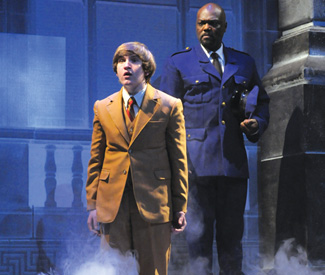
If the son in this situation-turned-scenario sounds a little like Hamlet, the comparison was not lost on Taccone either, who penned the script while drawing on hours of freewheeling conversations with Jon Moscone, initiator of the project and the play’s director. (Ghost Light had its world premiere last year in Ashland at the Oregon Shakespeare Festival, where it was commissioned as part of its “American Revolutions: The United States History Cycle.”) Director-turned-playwright Taccone has the character “Jon” (played with manic energy and sudden introspection by a sympathetic Christopher Liam Moore) stuck midway through the preparations for a production of Hamlet, unable to decide what to do with the Ghost — indeed, haunted by the whole idea. This unusual block has his best friend and collaborator Louise (a lively if slightly affected Robynn Rodriguez) frustrated and worried.

Jon’s block also feeds a dream life populated by several characters — a Loverboy (Danforth Comins) spun from an online flirtation; his perennially 14-year-old self (Myers) locked in a battle of wills with some cosmic undertaker cum grief councilor named Mister (a sure, larger-than-life Peter Macon); the silent image of his black-veiled widow mother (Sarita Ocón); and a menacing prison guard in a soiled shirt (a sharp Bill Geisslinger), who turns out to be the grandfather he never knew.

It’s suggested more than once in the dialogue that all of these characters stalking his sleep (and often arriving onstage through the portal of Jon’s bed, pitch atop the shiny black granite steps of City Hall) are merely the dreamer himself in various disguises and aspects. This much, of course, we are already primed to assume. In fact, the fundamental problem facing the main character — namely, his inability to properly let go of his own grief and suffering around the death of his father, which appears here as an inability to let his own father’s “perturbed spirit” rest at last — is equally a condition readily recognizable to a modern audience in a therapeutic age. It may be grounds to build on in terms of character development, but the lack of mystery here also undercuts any suspense in the plot, as the increasingly blurred line between Jon’s dreaming and waking lives points toward nervous collapse and the threat of some self-inflicted disaster (personified by the foul-mouthed, homophobic, and gun-toting prison guard stalking his unconscious).

Taccone makes a valiant attempt to draw together a complicated and wrenchingly personal yet all-too-public story with a set of interrelated subplots and quick-moving dialogue (filled with as much quippy humor and menace as pathos). But the results are uneven. Although Geisslinger makes a serviceable villain, the danger he represents never feels palpable. Likewise, the underworld subplot involving boyhood Jon (played a little too typically “boyishly” by Myers to be readily believed) comes across as vague and treacly.

Perhaps unsurprisingly, it is the more realistic, down-to-earth scenes that play best and are most evocative. The intricacy of a life divided painfully between public and private personas, public and private pain and loyalties too, comes across best when the character of Jon is operating in the “real” world. To this end, Moscone the director shrewdly brings the audience in at key points as well, raising the houselights for an acting master class led by his onstage character. Meta-theater, town hall meeting, group therapy — the lines begin to blur here in a lively, resonant discussion of “acting” as social action.

Another interesting scene takes place in a bar, where Jon finally meets Basil (Ted Deasy), the man with whom he’s been having an online fling for weeks (and the inspiration for the Loverboy of his increasingly intrusive dream world). The awkwardness, defensiveness, and barely contained rage revealed here — as Jon discovers that Basil’s own fantasy projection incorporates his public familial tragedy — speak more eloquently to the messy particulars of the main character’s dilemma then perhaps any other scene in the play.

In the end, the thematic aptness of the mise-en-scène — which forces Jon, for instance, to open the front doors of City Hall just to retrieve a beer from the fridge — speaks also to the monumental task this play has set itself. If the results prove very mixed, they are all the more discomfiting because the root story is so fascinating, the dramatic project itself audacious and strange, and the insight to be potentially gleaned so tantalizing — speaking to our collective intersections with history in the deepest recesses of the psyche.


GHOST LIGHT

Through Feb. 19

Tues., Thurs.-Sat., 8 p.m. (also Sat. and Feb. 16, 2 p.m.); Wed. and Sun., 7 p.m. (also Sun., 2 p.m.), $14.50-$73

Berkeley Repertory Theatre, Thrust Stage, 2025 Addison, Berk.

(510) 647-2949

www.berkeleyrep.org

Alerts

0

yael@sfbg.com

WEDNESDAY 25

Pity the Billionaire

Best-selling author Thomas Frank will discuss his new book Pity the Billionaire: The Hard Times Swindle and the Unlikely Resurgence of the American Right. Frank set out in 2009 to research expressions of American discontent after the financial collapse — and he found the Tea Party. A frank discussion on why this recession led to “loud demands that the economic system be made even harsher on the recession’s victims and that society’s traditional winners be given even grander shares.”

7:30 p.m., $12

Berkeley Hillside Club

2286 Cedar, Berk

www.kpfa.org/events


FRIDAY 27

Occupy the UN

A rally, march, and educational forum on the rights of indigenous people. Meet at the Human Rights Commission office and march to UN Plaza to “demand repatriations for the theft of tribal lands, gold, and other natural resources and address issues of civil rights violations, hate crimes, broken treaties, and the human rights inherent to all indigenous people.”

10:30 a.m., free

Human Rights Commission

25 Van Ness, SF

(510) 672-7187


SATURDAY 28

Community response to homelessness

A panel discussion featuring homeless advocates with the Homeless Outreach Team, Project Homeless Connect, and Veterans Connect.

2 p.m., free

Koret Auditorium

San Francisco Public Library main branch

100 Larkin, SF

www.sfpl.org


Love Balm for My Spirit Child

A four-part “healing performance workshop” celebrating the importance of mothers’ memory in resistance and justice movements. An innovative mix of testimony, spirituality, rally, and theater that will end in a candlelight vigil.

3 p.m., $5-$20

Eastside Cultural Center

2277 International Blvd, Oakl.

Gov. Brown backs high-speed rail and other big ideas

4

California Gov. Jerry Brown this morning used a big portion of his annual State of the State speech to promote the construction of a high-speed rail system for California – a project that has been under attack by conservatives, as we reported in this week’s paper – chiding those who believe the state can’t do big things anymore.

“Contrary to those declinists, who sing of Texas and bemoan our woes, California is still the land of dreams,” Brown said, a theme that he developed and returned to throughout his speech, calling them “critics who fantasize that California is a failed state.”

Instead, Brown optimistically called for California to take on big projects, singling out high-speed rail, the conversion to sustainable energy sources, and a major water project that will address environmental issues in the Delta and the needs for drinking water and agricultural uses.

But it was the high-speed rail project, for which the Legislature must approve the issuance of bonds this year, that Brown used to make his strongest statement against retreating from big ideas, noting that California can’t simply build enough new freeway and airport expansions to handle a growing population.

“Those who believe that California is in decline will naturally shrink back from such a strenuous undertaking. I understand that feeling but I don’t share it, because I know this state and the spirit of the people who choose to live here,” he said.

And he exhorted Californians to remember the past as they plan for the future: “Critics of the high-speed rail project abound as they often do when something of this magnitude is proposed. During the 1930’s, The Central Valley Water Project was called a ‘fantastic dream’ that ‘will not work.’ The Master Plan for the Interstate Highway System in 1939 was derided as ‘New Deal jitterbug economics.’ In 1966, then Mayor Johnson of Berkeley called BART a ‘billion dollar potential fiasco.’ Similarly, the Panama Canal was for years thought to be impractical and Benjamin Disraeli himself said of the Suez Canal: ‘totally impossible to be carried out.’ The critics were wrong then and they’re wrong now.”

Female trouble

0

arts@sfbg.com

FILM Rooney Mara’s chalk-complected cyberpunk Lisbeth Salander is one of the more fearsome and curious creatures to stalk across movie screens in recent memory, her freak genius and impassive veneer concealing deep reservoirs of pain and rage — and also desire. Cold and distant to the extreme, Salander makes for an odd duck of a femme fatale to disgraced journalist Mikael Blomkvist’s accidental gumshoe.

And yet, as many a reviewer has commented of David Fincher’s The Girl With the Dragon Tattoo (2011), the camera spends plenty of time surveying Mara’s naked body as she takes down Sweden’s patriarchal-industrial complex one misogynist at a time. Salander might be more leather than lace, but like many femme fatales before her she flickers (albeit far more unsteadily than her forbearers) between being an object to be desired and a force to be reckoned with.

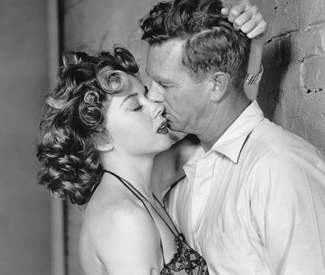
If it is perhaps something of a stretch to claim that the dame-heavy titles at this year’s Noir City offer a tour of the more distant branches of Salander’s genealogy, at the very least, the gallery of black widows and Jezebels-in-disguise Eddie Muller has assembled for the festival’s tenth go-round offer a pointed lesson in how hard it has been for Hollywood, tattoos and mad hacking skills aside, to shake its old regimes of visual pleasure.

Something of Salander’s icy remove is detectable in mid-1960s Angie Dickinson, who will be feted and interviewed in person at a double bill of two of her best: The Killers (1964) and Point Blank (1967). Whereas Ava Gardner simmered her way through Robert Siodmak’s 1948 adaptation of Ernest Hemingway’s short story, the temperature of Dickinson’s Killers mob girl is harder to take in Don Siegel’s remarkably brutal remake: a Monroe in harsher lines with nothing of the little girl lost about her. So too in Point Blank —which re-teams Dickinson with her Killers costar Lee Marvin — does she put up a good fight, even as she brandishes her sexuality like a semi-automatic.

You can add Bedelia — writer Vera Caspary’s lesser-known 1945 follow-up to her convoluted 1943 novel Laura — to the canonical list of first-name-basis sirens (also in Noir City X: 1946’s Gilda and the 1944 film version of Laura). Bedelia‘s titular heroine was touted on an early cover of the 1945 book that inspired the 1946 film (for which Caspary also wrote the screenplay) as “the wickedest woman who ever loved,” a title more than lived up to by Margaret Lockwood’s performance as the small-town temptress.

That description also fits one of noir’s finest leading ladies, Gloria Grahame, who — as always when cast as the bad girl — makes damaged goods look damn fine. In Naked Alibi (1954), she plays a border town torch singer caught in an abusive relationship with a fugitive on the run. Beverly Michaels, on the other hand, is simply damaged (but no less a joy to watch) as the bullet bra-brandishing beauty trying to off her husband for money in Hugo Haas’ sleazoid rarity Pickup (1951).

In keeping with the Pacific Film Archive’s unofficial late-January tradition of running complimentary programming during Noir City, a retrospective of the films of French suspense auteur Henri-Georges Clouzot offers a more nuanced gloss on noir’s troubled women. Simone Signoret and Clouzot’s own wife, Véra, deliver a master class in how to simultaneously do and be undone by a dirty deed in Diabolique (1955). Perhaps more apropos to the dragon-tattooed girl is Clouzot’s final feature Woman in Chains (1968), which, much like Michael Powell’s tour de force Peeping Tom (1960), lays bare the operations of cinema’s gendered voyeurism by having the kinky Josée (Elisabeth Wiener) turning the gaze back on both her artist boyfriend and the amateur pornographer who covets her — a reversal that Clouzot formally mirrors in the film’s electric finale. Though she might not show it, I think Lisbeth Salander would be pleased.

NOIR CITY X

Jan. 20-29, $10-$15

Castro Theatre

429 Castro, SF

www.noircity.com

“HENRI-GEORGES CLOUZOT: THE CINEMA OF DISENCHANTMENT”

Through Feb. 4, $5.50-$9.50

Pacific Film Archive

2575 Bancroft, Berk.

bampfa.berkeley.edu

Rep Clock

0

Schedules are for Wed/18-Tues/24 except where noted. Director and year are given when available. Double and triple features are marked with a •. All times p.m. unless otherwise specified.

ALA COSTA CENTER 1300 Rose, Berk; missreplacosta.eventbrite.com. $15. Miss Representation (Siebel Newsom, 2011), Fri, 7. Benefits Ala Costa’s Adult Transition Program for young adults with developmental disabilities.

BALBOA 3630 Balboa, SF; www.brownpapertickets.com. $17.50-20. “Opera and Ballet at the Balboa Theatre:” Don Giovanni, from La Scala, Wed, 7:30; Caligula, from the Paris Opera Ballet, Sat-Sun, 10am.

CASTRO 429 Castro, SF; (415) 621-6120, www.castrotheatre.com. $7.50-10. •Lenny (Fosse, 1974), Wed, 2:50, 7, and American: The Bill Hicks Story (Harlock and Thomas, 2009), Wed, 4:55, 9:05. “SF Sketchfest:” “Night of the Shorts III: The Search for Schlock,” with Kevin Murphy and Bill Corbett, Thurs, 8. This event, $30; for tickets and more info, visit www.sfsketchfest.com. “Noir City X:” •Dark Passage (Daves, 1947), Fri, 7, and The House on Telegraph Hill (Wise, 1951), Fri, 9:30; •Okay, America (Garnett, 1932), Sat, 1, 4, and Afraid to Talk (Cahn, 1932), Sat, 2:40; •The Killers (Siegel, 1964), Sat, 7, with Angie Dickinson on-stage interview after the film, and Point Blank (Boorman, 1967), Sat, 9:45; •Laura (Preminger, 1944), Sun, 3, 5, 9, and Bedelia (Comfort, 1946), Sun, 7; •Gilda (Vidor, 1946), Mon, 7, and The Money Trap (Kennedy, 1965), Mon, 9:20; •Unfaithfully Yours (Sturges, 1948), Tues, 7, and The Good Humor Man (Bacon, 1950), Tues, 9:15. Advance tickets (double features, $10-15) and more info at www.noircity.com.

CHRISTOPHER B. SMITH RAFAEL FILM CENTER 1118 Fourth St, San Rafael; (415) 454-1222, www.cafilm.org. $6.75-10.25. “For Your Consideration: A Selection of Oscar Submissions from Around the World:” A Simple Life (Hui, 2011), Wed, 6:30; Patagonia (Evans, 2010), Wed, 9; Once Upon a Time in Anatolia (Ceylan, 2011), Thurs, 7:15. Hipsters (Todorovsky, 2009), Wed-Thurs, call for times.

PACIFIC FILM ARCHIVE 2575 Bancroft, Berk; (510) 642-5249, bampfa.berkeley.edu. $5.50-9.50. “Film 50: History of Film, Cinema, and the Other Arts:” “Course Introduction: The Language of Cinema,” with lecture by Marilyn Fabe, Wed, 3:10. This event, $5.50-11.50. “Henri-Georges Clouzot: The Cinema of Disenchantment:” Manon (1949), Wed, 7; Miquette and Her Mother (1949), Fri, 9; The Wages of Fear (1953), Sat, 8:10. “Austere Perfectionism: The Films of Robert Bresson:” Au hasard Balthazar (1966), Thurs, 7; Mouchette (1967), Sat, 6:30. “Howard Hawks: The Measure of Man:” Fazil (1928), Fri, 7; A Girl in Every Port (1928), Tues, 7.

ROXIE 3117 and 3125 16th St, SF; (415) 863-1087, www.roxie.com. $6.50-10. “It’s the Paul Meinberg! Show!”: Bachelor’s Daughters (Stone, 1946), Wed, 7. Battle for Brooklyn (Galinsky and Hawley, 2010), Thurs, 7, 9. Drive (Winding Refn, 2011), Wed-Thurs, 7. Everyday Sunshine: The Story of Fishbone (Anderson and Metzler, 2010), Wed-Thurs, 9.

SFFS | NEW PEOPLE CINEMA 1746 Post, SF; www.sffs.org. $10-11. “Four Samurai Classics:” Harakiri (Kobayashi, 1962), Wed, 1:30, 6; Yojimbo (Kurosawa, 1961), Wed, 4:15, 9:15; Sanjuro (Kurosawa, 1962), Thurs, 2:45, 8:45; Seven Samurai (Kurosawa, 1954), Thurs, 5. Fullmetal Alchemist: The Sacred Star of Milos (Murata, 2011), Jan 20-26, 2, 4:30, 7, 9:15.

VICTORIA THEATER 2961 16th St, SF; www.start-somewhere.com. $10-20. Miss Representation (Siebel Newsom, 2011), Tues, 6. Benefits StartOut’s new Lesbian Entrepreneurship mentoring program.

YERBA BUENA CENTER FOR THE ARTS 701 Mission, SF; (415) 978-2787, www.ybca.org. $6-8. Red Desert (Antonioni, 1964), Thurs and Sat, 7:30; Sun, 2.

Stage Listings

0

Stage listings are compiled by Guardian staff. Performance times may change; call venues to confirm. Reviewers are Robert Avila, Rita Felciano, and Nicole Gluckstern. Submit items for the listings at listings@sfbg.com. For further information on how to submit items for the listings, see Picks.

THEATER

OPENING

Cabaret Young Performers Theatre, Fort Mason Center, Bldc C, Room 300, Marina at Laguna, SF; (415) 381-1638, cabaretsf.wordpress.com. $25-45. Previews Thurs/19-Fri/20, 8pm. Opens Sat/21, 8pm. Runs Thurs-Sat, 8pm; Sun, 7pm. Through Feb 19. Shakespeare at Stinson and Independent Cabaret Productions perform the Kander and Ebb classic in an intimate setting.

Olivia’s Kitchen Exit Theatre, 156 Eddy, SF; www.generationtheatre.com. $20-40. Opens Fri/20, 8pm. Runs Fri-Sat, 8pm; Sun, 3pm. Through Feb 19. GenerationTheatre offers this “remix” of Shakespeare’s Twelfth Night.

“SF Sketchfest” Various venues, SF; www.sfsketchfest.com. Jan 19-Feb 4. $10-75. The 11th San Francisco Comedy Festival invades 15 venues in 17 days with local and celebrity-packed (and local-celebrity-packed) performances, film events, improv shows, and more.

Waiting for Godot Royce Gallery, 2901 Mariposa, SF; (415) 336-3522, www.tidestheatre.org. $20-38. Opens Fri/20, 8pm. Runs Thurs-Sat, 8pm. Through Feb 18. Tides Theatre Company debuts with a bold interpretation of the Beckett classic.

BAY AREA

The Pitmen Painters TheatreWorks at Mountain View Center for the Arts, 500 Castro, SF; (650) 463-1960, www.theatreworks.org. $19-69. Previews Wed/18-Fri/20, 8pm. Opens Sat/21, 8pm. Runs Tues-Wed, 7:30pm; Thurs-Sat, 8pm (also Sat, 2pm); Sun, 2 and 7pm. Through Feb 12. TheatreWorks performs a new comedy from the author of Billy Elliot about a group of British miners who become art world sensations.

ONGOING

Food Stories: Pleasure is Pleasure Z Space, Theater Artaud, 450 Florida, SF; www.brownpapertickets.com. $20-55. Wed-Thurs, 7pm; Fri-Sat, 8pm; Sun, 2pm. Through Feb 5. Word for Word presents performances of short stories by T.C. Boyle and Alice McDermott.

Future Motive Power Old Mint, 88 Fifth St, SF; www.mugwumpin.org. $15-30. Fri-Sun, 8pm. Through Jan 29. Mugwumpin takes on the life of Nikola Tesla in its latest performance piece.

Humor Abuse American Conservatory Theater, 415 Geary, SF; (415) 749-2228, www.act-sf.org. $10-85. Tues-Sat, 8pm (Tues/24, show at 7pm; also Wed and Sat, 2pm; no matinee Wed/18); Sun, 2pm. Through Feb 5. ACT presents Lorenzo Pisoni and Erica Schmidt’s tale (based on Pisoni’s life; he is also the sole performer) of a child growing up amid San Francisco’s Pickle Family Circus.

*New Fire: To Put Things Right Again Brava Theater, 2781 24th St, SF; (415) 647-2822, www.brava.org. $10-30. Thurs-Sat, 8pm; Sun, 3pm. Through Jan 29. You hear a lot of lip service these days to “community-building,” even when that community might represent the merest sliver, unable to reach out or expand beyond its own narrow parameters. That is not the kind of community playwright Cherrie Moraga is interested in paying lip service to, and her latest work New Fire reaches out in all possible directions, most notably digging deep into sacred spaces frequently left out of the conversation altogether. Structured not as a conventional (by Western standards) play, but as a healing ceremony centered around the story’s single protagonist, Vero (Dena Martinez), Celia Herrera Rodriguez’ staging and design blend seamlessly with Alleluia Panis’ ecstatic choreography to create a world where the sacred and the mundane coexist, almost unremarked, but certainly remarkably. Combining new media such as video by Emily Encina, with ancient ritual, the most electrifying moments are those rendered wholly without spoken words — the steady heartbeat of percussion, the ululation of Charlene O’Rourke’s magnificent chanting, the stealthy creeping of spirit figures whose faces are hidden by the wide brims of vibrantly painted hats. But don’t go in expecting a woo-woo, earth mother love fest: New Fire, is heavy with dark moments. But as El Caminante (Robert Owens-Greygrass) points out, such darkness can be beautiful too. (Gluckstern) Not Getting Any Younger Marsh San Francisco, Studio Theater, 1062 Valencia, SF; (415) 826-5750, www.themarsh.org. $15-50. Fri, 8pm; Sat, 5 and 8:30pm. Extended through Feb 25. Marga Gomez is back at the Marsh, a couple of too-brief decades after inaugurating the theater’s new stage with her first solo show — an apt setting, in other words, for the writer-performer’s latest monologue, a reflection on the inevitable process of aging for a Latina lesbian comedian and artist who still hangs at Starbucks and can’t be trusted with the details of her own Wikipedia entry. If the thought of someone as perennially irreverent, insouciant, and appealingly immature as Gomez makes you depressed, the show is, strangely enough, the best antidote. (Avila)

BAY AREA

Ghost Light Berkeley Repertory Theatre, Thrust Stage, 2025 Addison, Berk; (510) 647-2949, www.berkeleyrep.org. $14.50-73. Tues, Thurs-Sat, 8pm (also Sat, Thurs/19, and Feb 16, 2pm; no matinee Sat/21); Wed and Sun, 7pm (also Sun, 2pm). Through Feb 19. Berkeley Rep performs Tony Taccone’s world-premiere play about George Moscone’s assassination, directed by the late San Francisco mayor’s son, Jonathan Moscone.

*The Kipling Hotel: True Misadventures of the Electric Pink ’80s New venue: Marsh Berkeley, 2120 Allston, Berk; (415) 282-3055, www.themarsh.org. $20-50. Sat, 8:30pm; Sun, 7pm. Through Feb 12. This new autobiographical solo show by Don Reed, writer-performer of the fine and long-running East 14th, is another slice of the artist’s journey from 1970s Oakland ghetto to comedy-circuit respectability — here via a partial debate-scholarship to UCLA. The titular Los Angeles residency hotel was where Reed lived and worked for a time in the 1980s while attending university. It’s also a rich mine of memory and material for this physically protean and charismatic comic actor, who sails through two acts of often hilarious, sometimes touching vignettes loosely structured around his time on the hotel’s young wait staff, which catered to the needs of elderly patrons who might need conversation as much as breakfast. On opening night, the episodic narrative seemed to pass through several endings before settling on one whose tidy moral was delivered with too heavy a hand, but if the piece runs a little long, it’s only the last 20 minutes that noticeably meanders. And even with some awkward bumps along the way, it’s never a dull thing watching Reed work. (Avila)

*The Wild Bride Berkeley Repertory Theatre, Roda Theatre, 2015 Addison, Berk; (510) 647-2949, www.berkeleyrep.org. $14.50-73. Wed/18, 7pm; Thurs/19-Sat/21, 8pm (also Sat/21, 2pm); Sun/22, 2pm. In the first act of Kneehigh Theatre’s The Wild Bride, the destinies of an innocent girl (Audrey Brisson), her moonshine-making father (Stuart Goodwin), and a predatory devil in a cheap suit (Stuart McLoughlin) become inextricably entwined by an ill-fated bargain. Steeped in European fairytale logic and American folk and blues music, Bride is inventively staged at the base of a giant tree, combining mime, puppetry, dance, live music, Cirque du Soleil-style vocals, acrobatics, and taut verse into a swooping, expressionistic fable. Accidentally promised to the devil by her doting but drink-dulled dad, “The Girl” suffers first the creepy indignity of being perved on by her preternatural suitor, and secondly the horror of having her hands chopped off by her own father, actions which drive her to flee into the woods, morphing into a character known only as “The Wild” (played by Patrycja Kujawska). After a stint as an unlikely, Edward Scissorhands-esque queen, The Wild too is driven from comfort and morphs a second time into a third character “The Woman” (Éva Magyar), an experience-toughened mother bear who kicks the devil’s ass (literally), and triumphs over adversity, without even uttering a single word. At turns dark, dexterous, fanciful, and fatal, Bride rises above the usual holiday fare with a timeless enchantment. (Gluckstern)

The World’s Funniest Bubble Show Marsh Berkeley, TheaterStage, 2120 Allston, Berk; (415) 826-5750, www.themarsh.org. $8-50. Extended run: Sat/21, Feb 12, 19, 26, March 11, and 18, 11am. Louis “The Amazing Bubble Man” Pearl returns with this kid-friendly, bubble-tastic comedy.

PERFORMANCE/DANCE

Caroline Lugo and Carolé Acuña’s Ballet Flamenco Peña Pachamama, 1630 Powell, SF; www.brownpapertickets.com. Sun/22, 6:15pm. $15-19. Flamenco song and dance from a mother-daughter team.

Davalos Dance Company CounterPULSE, 1310 Mission, SF; www.counterpulse.org. Fri/20-Sat/21, 8pm. $20. The contemporary dance company performs “A Wintry Mix.”

“The Gondoliers” Yerba Buena Center for the Arts, 701 Mission, SF; www.lamplighters.org. Fri/20-Sat/21, 8pm (also Sat/21, 2pm); Sun/22, 2pm. $15-48. Also Jan 27-28, 8pm (also Jan 28, 2pm); Jan 29, 2pm. $20-53. Lamplighters Music Theatre performs the Gilbert and Sullivan operetta.

“Nameless forest” Yerba Buena Center for the Arts, 701 Mission, SF; (415) 978-2787, www.ybca.org. Thurs/19-Sat/21, 8pm. $5-25. Multidisciplinary performance matching the talents of choreographer Dean Moss with sculptor-poet Sungmyung Chun.

San Francisco Cabaret Opera Café Royale, 800 Post, SF; (415) 641-6033. Wed/18, 8pm. Free. Performance of “The Kurt Weill Project.”

“The Screwtape Letters” War Memorial Opera House, 301 Van Ness, SF; (415) 392-4400, www.screwtapeonstage.com. Sat/21, 4 and 8pm; Sun/22, 3pm. $29-59. Adaptation of the C.S. Lewis novel about spiritual warfare from a demon’s POV.

BAY AREA

Company C Contemporary Ballet Lesher Center for the Arts, 1601 Civic, Walnut Creek; (925) 943-7469. Fri/20-Sat/21, 8pm (also Sat/21, 3pm). $23-45. Also Jan 28, 7:30pm and Jan 29, 2pm, $15-27. Castro Valley Center for the Arts, 19501 Redwood, Castro Valley; (510) 889-8961. Also Feb 17, 8pm; Feb 18, 6:30pm (gala benefit); and Feb 19, 3pm, $23-175. Yerba Buena Center for the Arts, 701 Mission, SF; (415) 978-2787. The company opens its 10th anniversary season.

Peking Acrobats Zellerbach Hall, Bancroft at Telegraph, UC Berkeley, Berk; www.calperformances.org. Fri/20-Sat/21, 8pm; Sun/22, 3pm. $20-52. The Chinese folk acrobatic company performs.

Exporting our brains

0

By Gary Brechin

The chancellor was absent as University of California police, kitted out in battle gear, vigorously beat and arrested students and professors at on the Berkeley campus. Called to account by the academic senate two weeks later, Robert Birgeneau explained that he had been on a trip through Asia at the time. The trip, he said, concluded with a “phenomenally successful,” though unspecified, mission to Shanghai, so he did not hear how badly things went at home until the following day.

What Chancellor Birgeneau and the dean of Berkeley’s College of Engineering did on the trip was sign an agreement to open a 50,000-square-foot building in Shanghai’s Zhangjiang High-Tech Park two days after clubs fell on Cal students agitated by what they perceive as the progressive privatization and commercialization of their university. According to The New York Times, the new branch will give U.C. an Asian beachhead by opening “a large research and teaching facility as part of a broader plan to bolster its presence in China.” Other premier American universities such as Duke, NYU, and Stanford are, for a price, establishing similar “partnerships” that China “hope[s] will form the base of a modern high-tech economy.”

As U.S. funding dries up, college administrators hope that such collaborations will “support fundraising efforts that target wealthy Chinese alumni” — not to mention attracting their children, who are more able to pay ever-rising tuition than American students.

California’s business elite until recently oversaw the establishment and growth of a prestigious 12-campus system that was meant to do for the Golden State what the university now will do for China.

The promise of a virtually free and high quality education for Californians worked well to that end until 1978 when voters overwhelmingly passed Proposition 13 to cut their taxes.

Starved of funding, California’s public schools plummeted from the best to near worst — but many believed that the University of California’s crucial role in the state’s and the nation’s economy would immunize it from the rot consuming the rest of the Golden State’s educational apparatus. But as California piled up multi-billion dollar deficits, U.C inevitably joined the rest of the public sector on the dream factory’s cutting room floor.

As with any organism fighting for its life, available money has moved like blood from regions the university administration considers expendable to those regarded as vital profit centers — like business, biotechnology, sports, and online learning initiatives — as well as lavish executive pay packages.

Last year, for example, the university’s flagship campus at Berkeley quietly divested itself of its outstanding Water Resource Center Archives to save the cost of four clerical positions and thus free space for the expanding College of Engineering. At UC San Diego, three specialty libraries closed altogether while a fourth — the largest oceanographic library in the world — will close in 2012.

Advanced communications and information technology will be among the first areas of research undertaken by the College of Engineering’s new partnership with Chinese industries seeking to overtake California’s fabled Silicon Valley.

For centuries, city states and nations jealously guarded their home industries to the point of sending assassins to dispatch those trading secrets with rivals. Decades of neoliberalism have encouraged today’s elites to do the opposite. Availing themselves of the deregulation and lowered trade barriers for which they paid and the communications technology they developed, they exported their industries and jobs to wherever labor costs are lowest and environmental constraints absent. Derelict factories, ruined towns, failing infrastructure, and prisons now pock those countries still imagining themselves members of the First World.

The screams of students belabored for asking where their university is going and for whom raises the question whether intelligence will be our last export, or whether it was among our first.

Gray Brechin is a three-time U.C. Berkeley alumnus and visiting scholar in the UBC Department of Geography. He is the author of Imperial San Francisco: Urban Power, Earthly Ruin. A version of this piece ran first in the Anderson Valley Advertiser.

Occupy Nation

15

news@sfbg.com

The Occupy movement that spread across the country last fall has already changed the national discussion: It’s brought attention to the serious, systemic problem of gross inequities of wealth and power and the mass hardships that have resulted from that imbalance.

Occupy put a new paradigm in the political debate — the 1 percent is exploiting the 99 percent — and it’s tapping the energy and imagination of a new generation of activists.

When Adbusters magazine first proposed the idea of occupying Wall Street last summer, kicking off on Sept. 17, it called for a focus on how money was corrupting the political system. “Democracy not Corporatocracy,” the magazine declared — but that focus quickly broadened to encompass related issues ranging from foreclosures and the housing crisis to self-dealing financiers and industrialists who take ever more profits but provide fewer jobs to the ways that poor and disenfranchised people suffer disproportionately in this economic system.

It was a primal scream, sounded most strongly by young people who decided it was time to fight for their future. The participants have used the prompt to create a movement that drew from all walks of life: recent college graduates and the homeless, labor leaders and anarchists, communities of colors and old hippies, returning soldiers and business people. They’re voicing a wide variety of concerns and issues, but they share a common interest in empowering the average person, challenging the status quo, and demanding economic justice.

We chronicled and actively supported the Occupy movement from its early days through its repeated expulsions from public plazas by police, particularly in San Francisco, Oakland, and Berkeley. We supported the right of the protesters to remain — even as we understood they couldn’t and shouldn’t simply stay forever. Occupy needed to evolve if it was to hold the public’s interest. The movement would ultimately morph into something else.

That time has come. This spring, Occupy is poised to return as a mass movement — and there’s no shortage of energy or ideas about what comes next. Countless activists have proposed occupying foreclosed homes, shutting down ports and blocking business in bank lobbies. Those all have merit. But if the movement is going to challenge the hegemony of the 1 percent, it will involve moving onto a larger stage and coming together around bold ideas — like a national convention in Washington, D.C. to write new rules for the nation’s political and economic systems.

Imagine thousands of Occupy activists spending the spring drafting Constitutional amendments — for example, to end corporate personhood and repeal the Citizens United decision that gave corporations unlimited ability to influence elections — and a broader platform for deep and lasting change in the United States.

Imagine a broad-based discussion — in meetings and on the web — to develop a platform for economic justice, a set of ideas that could range from self-sustaining community economics to profound changes in the way America is governed.

Imagine thousands of activists crossing the country in caravans, occupying public space in cities along the way, and winding up with a convention in Washington, D.C.

Imagine organizing a week of activities — not just political meetings but parties and cultural events — to make Occupy the center of the nation’s attention and an inspiring example for an international audience.

Imagine ending with a massive mobilization that brings hundreds of thousands of people to the nation’s capitol — and into the movement.

Occupy activists are already having discussions about some of these concepts (see sidebar). Thousands of activists are already converging on D.C. right now for the Occupy Congress, one of many projects that the movement can build on.


DEFINING MOMENTS

Mass social movements of the 20th Century often had defining moments — the S.F. General Strike of 1934; the Bonus Army’s occupation of Washington D.C.; the Freedom Rides, bus boycotts and Rev. Martin Luther King Jr.’s March on Washington; Earth Day 1970; the Vietnam War teach-ins and moratoriums. None of those movements were politically monolithic; all of them had internal conflicts over tactics and strategies.

But they came together in ways that made a political statement, created long-term organizing efforts, and led to significant reforms. Occupy can do the same — and more. At a time of historic inequities in wealth and power, when the rich and the right wing are stealing the future of generations of Americans, the potential for real change is enormous.

If something’s going to happen this spring and summer, the planning should get under way now.

A convention could begin in late June, in Washington D.C. — with the goal of ratifying on the Fourth of July a platform document that presents the movement’s positions, principles, and demands. Occupy groups from around the country would endorse the idea in their General Assemblies, according to procedures that they have already established and refined through the fall, and make it their own.

This winter and spring, activists would develop and hone the various proposals that would be considered at the convention and the procedures for adopting them. They could develop regional working groups or use online tools to broadly crowd-source solutions, like the people of Iceland did last year when they wrote a new constitution for that country. They would build support for ideas to meet the convention’s high-bar for its platform, probably the 90 percent threshold that many Occupy groups have adopted for taking action.

Whatever form that document takes, the exercise would unite the movement around a specific, achievable goal and give it something that it has lacked so far: an agenda and set of demands on the existing system — and a set of alternative approaches to politics.

While it might contain a multitude of issues and solutions to the complicated problems we face, it would represent the simple premise our nation was founded on: the people’s right to create a government of their choosing.

There’s already an Occupy group planning a convention in Philadelphia that weekend, and there’s a lot of symbolic value to the day. After all, on another July 4th long ago, a group of people met in Philly to draft a document called the Declaration of Independence that said, among other things, that “governments … deriv[e] their just powers from the consent of the governed … [and] whenever any Form of Government becomes destructive of these ends, it is the Right of the People to alter or to abolish it, and to institute new Government, laying its foundation on such principles and organizing its powers in such form, as to them shall seem most likely to effect their Safety and Happiness.”


ON THE ROAD

If the date is right and the organizing effort is effective, there’s no reason that Occupy couldn’t get close to a million people into the nation’s capital for an economic justice march and rally.

That, combined with teach-ins, events and days of action across the country, could kick off a new stage of a movement that has the greatest potential in a generation or more to change the direction of American politics.

Creating a platform for constitutional and political reform is perhaps even more important than the final product. In other words, the journey is even more important than the destination — and when we say journey, we mean that literally.

Occupy groups from around the country could travel together in zig-zagging paths to the Capitol, stopping and rallying in — indeed, Occupying! — every major city in the country along the way.

It could begin a week or more before the conference, along the coasts and the northern and southern borders: San Francisco and Savannah, Los Angeles and New York City, Seattle and Miami, Chicago and El Paso, Billings and New Orleans — Portland, Oregon and Portland, Maine.

At each stop, participants would gather in that city’s central plaza or another significant area with their tents and supplies, stage a rally and general assembly, and peacefully occupy for a night. Then they would break camp in the morning, travel to the next city, and do it all over again.

Along the way, the movement would attract international media attention and new participants. The caravans could also begin the work of writing the convention platform, dividing the many tasks up into regional working groups that could work on solutions and new structures in the encampments or on the road.

At each stop, the caravan would assert the right to assemble for the night at the place of its choosing, without seeking permits or submitting to any higher authorities. And at the end of that journey, the various caravans could converge on the National Mall in Washington D.C., set up a massive tent city with infrastructure needed to maintain it for a week or so, and assert the right to stay there until the job was done.

The final document would probably need to be hammered out in a convention hall with delegates from each of the participating cities, and those delegates could confer with their constituencies according to whatever procedures they prescribe. This and many of the details — from how to respond to police crackdowns to consulting of experts to the specific scope and procedures of this democratic exercise — would need to be developed over the spring.

But the Occupy movement has already started this conversation and developed the mechanisms for self-governance. It may be messy and contentious and probably even seem doomed at times, but that’s always the case with grassroots organizations that lack top-down structures.

Proposals will range from the eminently reasonable (asking Congress to end corporate personhood) to the seemingly crazy (rewriting the entire U.S. Constitution). But an Occupy platform will have value no matter what it says. We’re not fond of quoting Milton Friedman, the late right-wing economist, but he had a remarkable statement about the value of bold ideas:

“It is worth discussing radical changes, not in the expectation that they will be adopted promptly, but for two other reasons. One is to construct an ideal goal, so that incremental changes can be judged by whether they move the institutional structure toward or away from that ideal. The other reason is very different. It is so that if a crisis requiring or facilitating radical change does arrive, alternatives will be available that have been carefully developed and fully explored.”

After the delegates in the convention hall have approved the document, they could present it to the larger encampment — and use it as the basis for a massive rally on the final day. Then the occupiers can go back home — where the real work will begin.

Because Occupy will wind up spawning dozens, hundreds of local and national organizations — small and large, working on urban issues and state issues and national and international issues.


WASHINGTON’S BEEN OCCUPIED BEFORE

The history of social movements in this country offers some important lessons for Occupy.

The notion of direct action — of in-your-face demonstrations designed to force injustice onto the national stage, sometimes involving occupying public space — has long been a part of protest politics in this country. In fact, in the depth of the Great Depression, more than 40,000 former soldiers occupied a marsh on the edge of Washington D.C., created a self-sustaining campground, and demanded that bonus money promised at the end of World War I be paid out immediately.

The so-called Bonus Army attracted tremendous national attention before General Douglas Macarthur, assisted by Major George Patton and Major Dwight Eisenhower, used active-duty troops to roust the occupiers.

The Freedom Rides of the early 1960s showed the spirit of independence and democratic direct action. Raymond Arsenault, a professor at the University of South Florida, brilliantly outlines the story of the early civil rights actions in a 2007 Oxford University Press book (Freedom Rides: 1961 and the Struggle for Racial Justice) that became a national phenomenon when Oprah Winfrey devoted a show and a substantial online exhibition to it.

Arsenault notes that the rides were not popular with what was then the mainstream of the civil rights movement — no less a leader than Thurgood Marshall thought the idea of a mixed group of black and white people riding buses together through the deep south was dangerous and could lead to a political backlash. The riders were denounced as “agitators” and initially were isolated.

The first freedom ride, in May, 1961, left Washington D.C. but never reached its destination of New Orleans; the bus was surrounded by angry mobs in Birmingham, Alabama, and the drivers refused to continue.

But soon other rides rose up spontaneously, and in the end there were more than 60, with 430 riders. Writes Arsenault:

“Deliberately provoking a crisis of authority, the Riders challenged Federal officials to enforce the law and uphold the constitutional right to travel without being subjected to degrading and humiliating racial restrictions … None of the obstacles placed in their path—not widespread censure, not political and financial pressure, not arrest and imprisonment, not even the threat of death—seemed to weaken their commitment to nonviolent struggle. On the contrary, the hardships and suffering imposed upon them appeared to stiffen their resolve.”

The Occupy movement has already shown similar resolve — and the police batons, tear gas, pepper spray, and rubber bullets have only given the movement more energy and determination.

David S. Meyer, a professor at U.C. Irvine and an expert on the history of political movements, notes that the civil rights movement went in different directions after the freedom rides and the March on Washington. Some wanted to continue direct action; some wanted to continue the fight in the court system and push Congress to adopt civil rights laws; some thought the best tactic was to work to elect African Americans to local, state and federal office.

Actually, all of those things were necessary — and Occupy will need to work on a multitude of levels, too, and with a diversity of tactics.

Single-day events have had an impact, too. Earth Day, 1970, was probably the largest single demonstration of the era — in part because it was so decentralized. A national organization designed events in some cities — but hundreds of other environmentalists took the opportunity to do their own actions, some involving disrupting the operations of polluters. The outcome wasn’t a national platform but the birth of dozens of new organizations, some of which are still around today.

There’s an unavoidable dilemma here for this wonderfully anarchic movement: The larger it gets, the more it develops the ability to demand and win reforms, the more it will need structure and organization. And the more that happens, the further Occupy will move from its original leaderless experiment in true grassroots democracy.

But these are the problems a movement wants to have — dealing with growth and expanding influence is a lot more pleasant than realizing (as a lot of traditional progressive political groups have) that you aren’t getting anywhere.

All of the discussions around the next step for Occupy are taking place in the context of a presidential election that will also likely change the makeup of Congress. That’s an opportunity — and a challenge. As Meyer notes, “social movements often dissipate in election years, when money and energy goes into electoral campaigns.” At the same time, Occupy has already influenced the national debate — and that can continue through the election season, even if (as is likely) neither of the major party candidates is talking seriously about economic justice.

That’s why a formal platform could be so useful — candidates from President Obama to members or Congress can be presented with the proposals, and judged on their response.

Some of the Occupy groups are talking about creating a third political party — a daunting task, but certainly worth discussion.

But the important thing is to let this genie out of the bottle, to move Occupy into the next level of politics, to use a convention, rally, and national event to reassert the power of the people to control our political and economic institutions — and to change or abolish them as we see fit.

OCCUPY AMERICA IS ALREADY UNDERWAY

All across the country, Occupy organizers are developing and implementing creative ways to connect and come together, many of which we drew from for our proposal. We hope all of these people will build on each other’s ideas, work together, and harness their power.

From invading the halls of Congress to “occutripping” road trips to ballot initiatives, here is a list of groups already working on ways to Occupy America:


OCCUPY CONGRESS

Occupy Congress is an effort to bring people from around the country — and, in many cases, from around the world — to Washington DC on Jan. 17. The idea is to “bring the message of Occupy to the doorstep of the capital.” The day’s planned events include a “multi-occupation general assembly,” as well as teach-ins, idea sharing, open mics, and a protest in front of the Capitol building.

A huge network of transportation sharing was formed around Occupy Congress, with a busy Ridebuzz ridesharing online bulletin board, and several Occupy camps organizing buses all around the country, as well as in Montreal and Quebec.

There are still two Occupy tent cities in DC, the Occupy DC encampment at McPherson Square and an occupation called Freedom Plaza, just blocks from the White House. Both will be accepting hundreds of new occupiers for the event, although a poster on the Occupy Congress website warns that “the McPherson Square Park Service will be enforcing a 500 person limit.”

www.occupyyourcongress.info


OCCUPY BUS

The Occupy Bus service was set up for Occupy Congress, but organizers say if the idea works out, it can grow and repeat for other national Occupy calls to action. They have set up buses leaving from 60 cities in 28 U.S. states as well as Canada’s Quebec province. The buses are free to those who can’t afford to pay, and for those who pay, all profits will be donated to Occupy DC camps.

If all goes to plan, buses will be packed with passengers, their gear, and bigger donations for the event, as the “undercarriages of a bus are voluminous.” What gear do they expect each occupier to bring? “One large bag, one small bag, and a tent.”

congress.occupybus.com


DENVER OCCUTRIP

Many occupations have put together car and busloads of people to road trip to other occupations, hoping to learn, teach, network, and connect the movement across geographic barriers. One example is the Denver Occutrip, in which a handful of protesters toured West Coast occupations. The tenacious Occupy Denver recently made headlines when, rather than allow police to easily dismantle their encampment, a couple of occupiers set the camp on fire. It sent delegates to Occupations in Las Vegas, Los Angeles, Long Beach, Oakland, San Francisco, Berkeley, and Sacramento.

Sean Valdez, one of the participants, said the trip was important to “get the full story. What I’d been told by the media was that Occupy Oakland was pretty much dead, but we got there and saw there are still tons of dedicated, organized people working on it. It was important to see it with our own eyes, and gave a lot of hope for Occupy.”

Like lots of road-tripping Occupiers, they made it to Oakland for the Dec. 12 West Coast Port Shutdown action there. In fact, “occutrippers” from all around the country have flocked to Bay Area occupations in general, and especially the uniquely radical Occupy Oakland.

www.occupydenver.org/denver-occutrip-road-trip/


OCCUPY THE CONSTITUTION

An Occupy Wall Street offshoot — Constitution Working Group, Occupy the Constitution — argues that many of the Occupy movements concerns stem from violations of the constitution. They hope to address this with several petitions on issues such as corporate bailouts, war powers, public education, and the Federal Reserve bank. The group hopes to get signatures from 3-5 percent of the United States population before the list of petitions is “formally served to the appropriate elected officials.”

www.givemeliberty.org/occupy


THE 99% DECLARATION

This is a super-patriotic take on the Occupy movement, described on its website as an “effort run solely by the energy of volunteers who care about our great country and want to bring it back to its GLORY.” The group’s detailed plan includes holding nationwide elections on the weekend of March 30 to choose two delegates from “each of the 435 congressional districts plus Washington, D.C. and the U.S. Territories.”

These delegates would write up lists of grievances with the help of their Occupy constituents, then convene on July 4, 2012 in Philadelphia for a National General Assembly. They plan to present a unified list of grievances to Congress, the President, and the Supreme Court. If the grievances are not addressed, they would “reconvene to organize a new grassroots campaign for political candidates who publicly pledge to redress the grievances. These candidates will seek election for all open Congressional seats in the mid-term election of 2014 and in the elections of 2016 and 2018.”

www.the-99-declaration.org/


MOVE TO AMEND/OCCUPY THE COURTS

Move to Amend is a coalition focusing on one of the Occupy movement’s main concerns: corporate personhood. The group hopes to overturn the Citizens United vs. Federal Elections Commission ruling and “amend our Constitution to firmly establish that money is not speech, and that human beings, not corporations, are persons entitled to constitutional rights.”

The group has drafted a petition, signed so far by more than 150,000 people, and established chapters across the country. Its next big step is a national day of action called Occupy the Courts on Jan. 20. On the anniversary of the Citizens United ruling, the group plans to “Occupy the US Supreme Court” and hold solidarity occupations in federal courts around the country.

www.movetoamend.org/


THE OCCUPY CARAVAN

The Occupy Caravan idea originated at Occupy Wall Street, but the group has been coordinating with occupations across the country. If all goes according to plan, a caravan of RVs, cars, and buses will leave Los Angeles in April and take a trip through the South to 16 different Occupations before ending up in Washington DC.

Buddy, one of the organizers, tells us that the group already has “a commitment right now of 10 to 11 RVs, scores of vehicles, and a bio-diesel green machine bus. This caravan will visit cities, encircle city halls, and visit the local Occupy groups to assert their presence, and move on to the next, not stopping for long in each destination.”

This caravan is all about the journey, calling itself a “civil rights vacation with friends and family” and planning to gather “more RVs, more cars, more supporters…and more LOVE” along the way.

occupycaravan.webs.com

OCCUPY WALL STREET WEST

The Occupy movement in San Francisco has been relatively quiet for the past few weeks, but it’s planning to reemerge with a bang on Jan. 20, with an all-day, multi-event rally and march that aims to shut down the Financial District.

The protest is an effort to bring attention to banks’ complicity in the housing crisis plaguing the United States, and how that process manifests itself here in San Francisco.

At least 20 events are planned, centered in the Financial District. The plans range from teach-ins at banks to “occupy the Civic Center playground” for kids to a planned building takeover where hundreds are expected to risk arrest. A list of planned events can be found at www.occupywallstwest.org/wordpress/?page_id=74.

The day is presented by the Occupy SF Housing Coalition, which includes 10 housing rights and homeless advocacy groups. Dozens of other organizations will be involved in demonstrations throughout the day. “We’re asking the banks to start doing the right thing,” said Gene Doherty, a media spokesperson for the Occupy SF Housing Coalition. “No more foreclosures and evictions for profits. On the 20th, we will bring this message to the headquarters of those banks.”




Telegenic Band Check: Lia Rose

0

Berkeley-based musician Lia Rose enchanted SFBG videographer Ariel Soto-Suver and a handful of others with her beautiful voice during an intimate living room concert in the Castro hills last week.

“Toto, I don’t think we’re in Kansas anymore”: Good Vibrations’ company leaders on getting big

0

What will be the San Francisco-in-the-aughtteens equivalent of the creation of Good Vibrations in the Mission District in 1977? Let’s hope some fresh new sexuality invention is fomenting that will be rocking our beds in three decades with the robustness that Good Vibes has shown. From that initial single location, the well-lit place for women to shop for vibrators has expanded to encompass not only six brick-and-mortar shops (five in the Bay Area, one in Massachusetts) — but also a robust online business that has taken the original founders’ dreams of teaching America how to have safer, better sex and made it a reality. In 2007, the one-time worker-owned co-op turned corporation was sold to GVA-TWN, a Cleveland, Ohio sex toy company. 

But the engineers behind the Good Vibes brand say it hasn’t stopped growing. Last week, on the occasion of the brand’s new branch opening (on Lakeshore Avenue in Oakland Jan. 28, details below) the Guardian conducted email interviews with the company’s chief operating officer Jackie Strano and staff sexologist Carol Queen. The woman waxed pleasurably — dammit, now everything is sounding dirty — on the company’s possible digital education programs of the future, Carol Queen shared her views on a future with a Good Vibes location in every American city, plus we reveal what the hell a SESA is, and how it can help improve your orgasms.


San Francisco Bay Guardian: Good Vibrations’ store locations have been growing in leaps and bounds recently. Have online sales been burgeoning at an equal rate?

Jackie Strano, chief operating officer: We are up in double-digit percentages and are grateful for our loyal and fabulous customers. It’s a good place to be after some hard and lean years. We have been committed to keeping expenses down and making the company healthy again. We are still here 35 years later and have learned some hard lessons along the way. We’re grateful for everyone who visits goodvibes.com and who writes and yelps about us. We have always relied on grass roots word of mouth and are proud that our stellar reputation is still intact.

Carol Queen, staff sexologist: We also have always known how significant it is to people to have access to a live experience in one of our brick-and-mortar stores. This is the context within which the Good Vibrations difference was developed, and it really does matter to people when they can see and touch the products, leaf through the books, and talk to a Sex Educator Sales Associate (SESA).


SFBG: What is the company’s vision of success? How big does it want to get? Are there going to be Good Vibes in Kansas someday?

CQ: If we were in Kansas, would Dorothy have to stop saying “Toto, I don’t think we’re in Kansas anymore?” Actually, there has been a faction since co-op days that wanted Good Vibrations to be everywhere — we devoted an entire annual planning meeting to this in about 1997! And we have certainly discussed the possibility of expanding into other regions. Success in that context would mean that people in a much wider range of the US would know about and have access to a Good Vibes store and that we would be able to influence other cities with our values about sex education and culture, as we have in the Bay Area.

JS: Success is paying all your bills, making payroll, opening new stores, introducing new products, being the go-to source for reliable and accurate information on sexual health, and pushing out campaigns like our Ecorotic rating system. But success is also being agents for social change for 35 years and success to me is hearing from someone or meeting someone who says we helped change their life for the better. The original company vision was to have a store in every city so people would have access to a safe and welcoming space to learn more about sex and sexual health. This was before the Internet exploded and companies like Amazon ever existed. We have similar goals still, but overall success is staying solvent and profitable while we reach the masses and keep changing people’s lives for the better.


SFBG: Are there plans to expand the educational opportunities the company’s known for?

JS: Absolutely. We have been active in this arena over the last year, especially where we have sponsored college tours of certified sex educators and we are currently pursuing digital channels for our education department to be featured. We are the only company in our sector that employs two Ph.D.s on staff and we continue to train our staff with the program originated by us. We also partner with many bloggers, authors, and educators at large.

CQ: Wherever we expand, there will be educational programming; we will develop it hand-in-hand with the new area’s existing resources, and take advantage of the fact that many sex educators today travel widely to teach and offer workshops. Charlie Glickman, my colleague in the education department of GV, already does SESA trainings (our in-house staff sex-ed trainings) via webconferencing, so who knows, there may also be more virtual opportunities for education that we can develop.


SFBG: Do you still consider it a San Francisco company?

JS: Yes of course. We are proud of our roots here. Mind you we have been part of the greater Bay Area, including Berkeley and Oakland for decades but our headquarters are here. Our website serves the world and we have stores in Berkeley, Oakland, and Brookline, Massachusetts. We have partnered with many national organizations throughout the years but we are always involved in local communities of all genders, races, and classes here in the Bay Area, including San Francisco where we have four stores.

CQ: At our core, absolutely. We could only have been founded and grown in San Francisco.


SFBG: How has the way Good Vibes markets itself changed over the years?

JS: It’s interesting to look at old catalogs and marketing collateral because the message and logo hasn’t changed much at all, but the collateral and graphics change as we morphed from proprietary illustrations to branded photos and other campaigns depending upon what event we were sponsoring or what season we were calling out. As I said before, we have always relied on grassroots word-of-mouth and customer loyalty, and I think that social media helps translate that perfectly in this day and age. We have always marketed ourselves as the clean, well-lit, women-focused vibrator store where people feel safe and welcomed. We will never change our mantra that “pleasure is your birthright.” We may have an event called “Mommy’s Playdate,” as some of us get older and have kids (ha ha), and our newer stores have a more boutique imprint and overall feel — but we still just want to have fun and hope that people get that when they think of us. We are extremely pleased that things have gotten more mainstream around sexuality, and that sexual health and education are more accepted in the daily dialogue, but we are spoiled by being in some coastal cities and progressive areas. There is still a lot of work to do for everyone to feel safe and welcomed and we are tireless in our efforts to change the world and not just our own backyard.

CQ: We’re very much the same AND different when it comes to marketing. For the first 15 years or so of GV’s existence we did little beyond guerilla marketing — our fully-developed education program began as a way to get new people to enter the store. Then as now, our number one source of new customers is word-of-mouth, though we now have social networking to help boost that — [it’s not just] people bringing their Kansas cousin in to buy a Hitachi Magic Wand! That said, my own role at Good Vibrations developed to try to leverage editorial opportunities. We were the first company to offer a Ph.D. sexologist as a press commentator or expert, and by the end of the 1990s we were judiciously buying advertising in national publications, not just local ones. The other very-much-noticed change was when we began using photos, not just drawn graphics, in our ads and catalogs.


SFBG: Are there any product areas that the company would like to expand into? What about trans-oriented gear?

CQ: Well, we do have some trans-related products, especially for transmen — in fact, our wholesale division distributes packers (along with lots of vibrators and other toys) to other stores around the world. This has been the biggest in-house change lately, in fact — that we are taking charge of this part of the product line and marketing it to other companies, not just selling these items exclusively. I believe our next ideas for product development will involve the wealth of informational content we’ve developed over the years.

JS: Yes we are very keen on product development and bringing new offerings to market especially that are non-toxic and good for you. We carry a lot of products that are transgender-oriented and actually have a transgendered shopping guide on our web site. We were the first ones to do so, others have copied us now but we were the first. We also have a sex and gender policy we are very proud of that is built into the company handbook and culture. 


Good Vibrations’ Lakeshore store opening

Jan. 28 6-9 p.m., free

Good Vibrations

3219 Lakeshore, Oakl.

(510) 788-2389

www.goodvibes.com

Let him entertain you

0

FILM The most famous and honored Hollywood directors have always been easily identifiable by style, genre, emotional tenor, or all the above. There’s Hitchcock with his wryly misanthropic suspense, and John Ford’s outdoor archetypes of masculinity. Even Steven Spielberg, who’s made just about every kind of narrative, has a telltale penchant for sweep and sentimentality running through everything from Jaws (1975) to The Adventures of Tintin (2011).

But the director probably responsible for more popularly embraced classics than any other during the industry’s golden age remains less familiar by name than many inferior talents, and his was the classic case of a lifetime achievement Oscar offered as thinly veiled apology for being ignored by the Academy over a long, conspicuous career haul. Howard Hawks could be said to bring all this upon himself: while far from modest, he was never much interested in self-promotion, or publicity in general. Nor did his films provide the obvious auteur identification points of a recognizable visual style, or consistent interest in particular genres or story elements.

They’re immaculately crafted, with some thematic similarities one can poke an analytic stick at after extended scrutiny. Yet as much as Hawks fought for creative freedom, often exasperating studio executives with his stubborn independence, he had few pretensions (or tolerance) toward art, pretty much measuring his movies’ value by their box-office performance. As has been noted elsewhere, that wasn’t because he was a bottom-line-focused hack, but because for decades his personal taste really did seem precisely in synch with the majority public’s.

The Pacific Film Archive’s “Howard Hawks: The Measure of Man” offers plenty of opportunity to weigh that discriminating yet popular appeal via a retrospective that’s thorough if not quite exhaustive. It reaches from his earliest extant feature (1926 comedy Fig Leaves) to his penultimate (’67 John Wayne horse opera El Dorado).

Between, there’s an almost staggering array of gems, more than any one life’s work should encompass: the seminal gangster flick (1932’s Scarface); deathless screwball classics Twentieth Century (1934), Bringing Up Baby (1938), His Girl Friday (1940), and Ball of Fire (1941); war epics (1930’s The Dawn Patrol, 1941’s Sergeant York); Western totems Red River (1948) and Rio Bravo (1959); setting the standard for cinematic sexual cool via the invention of Bogart and Bacall (1944’s To Have and Have Not, 1945’s The Big Sleep). Hawks wasn’t particularly attracted to musicals or sci-fi. Yet he made one of the all-time most enduring titles in each category, Gentlemen Prefer Blondes (1953) and The Thing from Another World (1951, with “official” directing credit going to Christian Nyby).

Hawks came from Gentile gentry, which lent him an air of entitlement he didn’t mind using to intimidate the largely Jewish, working-class backgrounded studio chiefs he infuriated by running way over budget and schedule. The motion picture business was an odd, borderline-disreputable choice for his like just post-World War I. Yet its wooliness (not to mention the never-ending wellspring of pretty girls) struck his fancy, and he worked in numerous capacities before getting to direct a first feature in 1923.

Later he’d dismiss his silent-era films as apprenticeship, though the few that survive have their points — 1928’s A Girl in Every Port introduces an ongoing motif of jokily tough-loving male camaraderie and finds a quintessential Hawksian woman in coltish flapper legend Louise Brooks, while the same year’s hunk of “Arab sheik” exotica Fazil has some unusually vivid (for Hawks) depictions of sexual desire.

With sound, however, Hawks was immediately in his element: snappy patter and hardboiled realism (or something like) were more to his liking than the pictorial emotionalism of the silent screen, even if as a director he remained close-lipped toward cast and crew to a “sphinx-like” degree. (The many superficially contradictory comments about his on-set demeanor gleaned from collaborators in Todd McCarthy’s definitive biography Howard Hawks: The Grey Fox of Hollywood reveal a technique that liberated some and frustrated others.)

Scarface, which prompted his first of many censorship battles, came out as the gangster vogue was considered kaput. Yet it was a sensation, and remains the only such film from that era still shockingly violent, sexual, and modern. It’s arguable that the Hawksian template wasn’t fully formed until 1939’s Only Angels Have Wings. Its loose, episodic script suited his essential disinterest in narrative (which would become a problem in the 1960s), allowing all the greater focus on a tight group of wisecracking, poker-faced men in daily peril (as mail-delivering pilots in the remotest tropics), while Jean Arthur’s dogged pursuit of a seemingly disinterested Cary Grant posited women as an infrequently worthy adversary-companion on rare occasions invited into the boys’ club. (In the screwball comedies, however, berserk woman often simply torments man into submission.)

Allergic to mush stuff, Hawks liked slim, sporty, husky-voiced women — ones an ever-decreasing fraction of his age as time passed, both on and off screen. (Though Gentlemen made her, he professed zero understanding of bodacious Marilyn Monroe’s appeal.) Yet as with his three marriages, he seldom stuck with one for long, almost never casting leading ladies twice while working recurrently with Grant, Wayne, Gary Cooper, and numerous behind-the-camera personnel.

After a long, nearly unbroken string of hits, his touch began slipping in the mid-1950s; like many old-school Hollywood greats, he seemed quite out of synch with the times a decade later. By then Hollywood was probably relieved to be rid of a filmmaker who’d always used his success as leverage in getting maximum paydays (though as a compulsive gambler he was forever in debt), as well as against studio interference. He avoided long-term contracts whenever possible, acting like an independent agent long before seismic industry changes essentially dismantled the contract system for everyone. His politics were conservative, but seldom flexed — he had little use for politicking unless it helped him get more freedom (and money).

Hawks could be arrogant personally, yet was nothing if not unpretentious about his art, at one late point insisting “I never made a ‘statement.’ Our job is to make entertainment.” An unproduced screenplay from his twilight years describes central characters in terms one imagines he’d readily apply to himself: “Tough, resourceful, cheerfully ruthless but always within limits, deeply loyal to a friend but never sentimental, equally needing women, adventure, and a spice of danger to make life worth living.”

“HOWARD HAWKS: THE MEASURE OF MAN”

Jan. 13-April 17, $5.50-$9.50

Pacific Film Archive

2757 Bancroft, Berk.

(510) 642-5249

bampfa.berkeley.edu

Appetite: Cocktailing the East Bay

0

In this week’s paper we poured out our thoughts on two delicious new additions to the East Bay bar scene, Honor Bar and the New Easy. Below, we glass up some other exciting East Bay drink destinations we think are worth your swizzle:

Oakland boasts the biggest concentration and range for East Bay cocktails, some of its consistent best at Adesso, casual drinks with bocce ball at Make Westing, elegant classic-style at Flora, pizza with cocktails at Marzano and Boot & Shoe ServiceMiel for tequila/mezcal drinks, Conga Lounge and divey Kona Club for tiki kitsch. Berkeley keeps it real with organic drinks at Gather, and artisanal cocktails at Revival Bar & Kitchen. The little island of Alameda hosts the beloved tiki gem, Forbidden Island, launched in part by tiki/rum expert Martin Cate who went on to open SF’s Smuggler’s Cove. Here, cheesy B-movie tribute nights and stmulating live music flow along with Banana Mamacows. As mentioned above, Emeryville now has two destination-worthy bars for cocktail lovers: Prizefighter and Honor Bar.


Albany is blessed with three old school classics merely blocks from each other along San Pablo Ave.: the musty, tiki vibe of Club Mallard, the mid-century, retro swank of Kingman’s Ivy Room, and the edgy comfortability of Hotsy Totsy Club. Though none of these three are exactly craft cocktail bars, Hotsy Totsy comes closest, with house cocktail sodas, gracious bar manager Jessica Maria, and stellar guest bartenders like Scott Baird of The Bon Vivants, who bartends here weekly. They’ve kept on longtime bartender Chet, in his 70’s, who has been tending there the better part of a couple decades. Their gorgeous, restored Wurlitzer jukebox is a treasure of rare and popular 45s, which you can play for free to your hearts content. Hotsy Totsy encourages lingering with friends under pressed tin ceilings, rocking out to excellent tunes hand-selected by staff. Funky ’70’s garage sale paintings line the walls and hilariously creepy movies (like For Your Height Only starring Weng Weng) play silently on the flat screen, add to the edgy, blissfully divey, convivial spirit.

Create and destroy

0

WINTER LOOKS You might have spotted Collin Weber running through the Mission on the way to the Knockout, frantic, with a bag full of satin bows to complete a trio of Sailor Moon costumes. Or perhaps you’ve seen his handy-work elsewhere, in the colorful capes and pointed hats Shannon and the Clams wear in their video for “Sleep Talk” or the sixties striped shifts the Dirty Cupcakes sport in “I Want It (Your Love).”

Weber, a library aid by day and seamster by night, has been creating costumed frocks for an incestuous batch of Bay Area garage rockers for the past two years — Dirty Cupcakes, Shannon and the Clams, Hunx and His Punx, Human Waste — and is open to taking on more acts. ” I think there’s a lot more payoff when you do something and it’s up on stage and out on tour and tons of people see it, and it’s in a music video,” he says leaning against an rack of cloth at Fabric Outlet, “not that I wouldn’t just want to make thing for people to wear. But the costumes are the fun project for me.”

Some of those projects include dinosaur hats, American flag bell-bottoms, gold fake snakeskin skirt and vest combos, and once, for Human Waste, he created full face-masking bodysuits. “The theme they gave me was prisoners on the moon in the future,” Weber laughs. “There’s a whole story behind it, but that’s what I had to go on.”

He created flesh-covering suits, with shiny knee pads and strips of mesh across the mouth and eyes. (Mesh so the band could still see its instruments.) “It’s pretty creepy. The first time I tried it on I was a little scared of my own reflection in the mirror. I think that was a sign that it was going in the right direction.”

I ask if he has his own signature design fixture, something that’s uniquely Weber, and he explains that it can be difficult because he’s often catering to bands’ specific visions, keeping with their imagined themes. Though he says, “one thing that shows up though — and I’ve always been kind of obsessed with — is futuristic, but circa 1960. Special effects, when people tried to guess what people would be wearing in 2012. Shiny, still really mod, but futuristic.” He smiles sheepishly, Queen’s “We Are The Champions” comes pumping through Fabric Outlet’s speakers.

Weber’s style is also influenced by David Bowie circa Ziggy Stardust era, and the designer of those costumes, Kansai Yamamoto. He drops references to the broader glam and loud statement pieces, along with interesting menswear, specifically Comme des Garçons which he describes as “crazy stuff for men that’s just barely wearable.”

His interest in sewing came from a bout of post-college, pre-work boredom while living in Milwaukee. While roommates with Dirty Cupcakes drummer Laura Gravander in the Midwest he learned how to use her sewing machine and begin deconstructing thrifted clothes, doing alterations, and eventually creating his own pieces. He’s all self-taught, and learned through both trial-and-error and diligent YouTube viewing.

Now living in San Francisco (though he moved first with Gravander from Milwaukee to the East Bay), he works shelving books at two library jobs, an aid at the Central Library in Berkeley and a page at the Main Library at Civic Center in SF. He awaits an open librarian position and has kept up the sewing and costume-making as a creative outlet.

Weber mentions that he likes making costumes for bands specifically because there’s a definite deadline: the night of the show. Do or die. He may have been known to run down the street trailing thread, or sew up a piece as the band is about to step on stage, but he also understands the great responsibility of outfitting hard rocking musicians — certain areas must be reinforced, seams must be sturdy because of fierce movement.

And with that comes the punk fate of it all, in sewing costumes for bands, he’s essentially creating what will likely be destroyed. “When you put a lot of work into something, it’s sad to see it get trashed, or blood on it,” says Weber, “but it’s just something you have to take into consideration, whether something just looks nice or whether it’s going to last through rock ‘n’ roll.”