Bayview

Police say they’ve recovered gun used by Harding

The San Francisco Police Department issued a statement this afternoon announcing that the gun that fired the fatal shot at Kenneth Wade Harding Jr. has been found.

“After a weeklong community effort, a neighborhood resident led officers from Bayview Police Station to the gun used by Kenneth Harding,” the SFPD statement says. “The gun, an AMT .380 caliber semi-automatic pistol, was matched through ballistic tests conducted by the San Francisco Police Department Crime Lab,” the official announcement goes on. “These tests confirmed that this was the same gun that fired the fatal .380 caliber bullet.” 

The police describe the weapon as a “small silver and black handgun,” and notes that it was “seen on the widely viewed cell phone video of the incident” and “picked up from the crime scene by an individual during the chaotic aftermath of the shooting.” 

One YouTube video showing the scene of the aftermath is titled, “Aftermath of Bayview gun battle in San Francisco,” and it has had 96,897 views so far.

At around 1 minute and 23 seconds into that video, an individual in a gray hooded sweatshirt reaches down and picks up an object off the sidewalk (which doesn’t look like a gun), but at another point in the clip, a gun-shaped object can be seen lying on the ground.

Lt. Troy Dangerfield, of the SFPD’s media relations unit, would not say whether the man in the hooded sweatshirt had anything to do with recovering the gun. Nor would he say whether an arrest had been made when the gun was turned over to police. “I can’t get into who turned over the gun, or whether that’s where we got the gun from,” he said, but asserted that ballistics testing had confirmed that it was the gun that fired the shot.

“We’re not speaking as to whether fingerprints are on it,” he added when asked if Harding’s fingerprints had been detected on the firearm. He said he did not know whether Harding’s cell phone had been recovered.

There are four separate investigations relating to the officer-involved shooting that occurred in connection with Harding’s death, Dangerfield said. They are being carried out by the District Attorney, the Office of Citizen Complaints, SFPD Homicide Unit and SFPD Internal Affairs.

Asked why SFPD officers did not move in quickly to snap up an unsecured weapon lying on the ground if a suspect had just fired and a crowd of alarmed bystanders was forming around them, Dangerfield said that the police had to prioritize officer safety — and in this case, he asserted, that meant keeping their weapons trained on a suspect who could still potentially pull out a gun and shoot at them. According to training protocol, “crime scene preservation” is a lower priority, he said. Asked if officers were trained to shoot to kill, he said, “we don’t shoot to kill, we shoot to stop the threat.”

Dangerfield went on to say that the video in which Harding is shown to still be moving while police stand with weapons trained on him would make a great police training video. “You do not remove yourself from the target until the target is no longer a threat to you,” he said, indicating that a suspect who is still moving is still perceived as a threat.

However, it was this aspect of the widely viewed video — that police continued to stand with weapons trained on Harding rather than calling for medical assistance after he’d been shot — that seemed to most inflame residents and protesters who’ve condemned the police response in the aftermath.

Dangerfield confirmed that data from SpotShotter revealed that a single bullet was fired, and then multiple rounds fired in succession 1.9 seconds later. The explanation that police have given for this, he confirmed, was that Harding fired a single shot and then police opened fire.

Assuming it’s true that Harding shot himself, as police have said, this suggests that the two police officers on the scene responded to a suspect shooting himself by firing eight rounds, just one of which entered through the leg. Asked why officers would respond to a self-inflicted shot in that way, Dangerfield said, “If you are a police officer and you’re running and chasing … and then shots are fired, what do you think?” He emphasized, “They’re trained to return fire.”

Anger erupts over police shootings

11

rebeccab@sfbg.com

As the murky details of two recent police shootings emerge, a palpable anger surging through targeted communities points to a deeper issue than the particular circumstances surrounding each of these deaths. Simply put, many Bay Area communities are fed up with police violence.

For many activists who descended on transit stations to protest the fatal BART police shooting of Oscar Grant III, the 20-year-old unarmed Hayward man who was killed on New Year’s Day 2009, an upwelling of rage was rekindled after BART cops shot and killed a homeless man named Charles Blair Hill on July 3 in Civic Center Station.

Then, on July 16, San Francisco police officers in the Bayview shot 19-year-old Kenneth Wade Harding Jr. multiple times after he ran from the T-Third train platform because he’d been stopped for fare evasion, leaving him dead on the sidewalk.

The recent officer-involved shootings occurred under two different law enforcement bodies, and both incidents remain under police investigation with many questions still unanswered. BART police say Hill was brandishing a knife; the San Francisco Police Department (SFPD) said its response was justified because Harding fired at officers first. The investigation in Harding’s case took a bizarre twist July 21 when SFPD issued a press release based on a medical examiner’s report stating that Harding had died not from rounds fired by police, but a self-inflicted gunshot wound.

But among communities distrustful of the police, the particulars of each case seemed to matter less than the perception that officers are too quick to escalate conflicts into deadly standoffs. Both incidents provoked intense anger because they resulted in marginalized transit passengers suffering sudden, violent deaths following interactions that were initiated by police. The shootings sparked angry protests, prompting standoffs at Civic Center BART Station, along the T-Third line in the Bayview, on Valencia Street, in Dolores Park, inside the Castro Muni Station, and at the cable car turnaround on Powell Street.

A group of activists staged protests in the Mission following the Bayview police shooting, snaking through the streets as they disrupted traffic and public transit service. “The march began at Dolores Park where nearly 200 of us departed,” an anonymous post on the anticapitalist Bay of Rage website recounted, describing the events of a July 19 protest that resulted in 43 arrests. “Upon reaching the Castro Muni Station, all hell broke loose…. What had now become a mob moved effortlessly past the bewildered cops … Trash was set alight and thrown down onto the tracks below … ticket machines, the fare checkpoints, and the agent booth were all smashed with hammers and flags — totally ruined. Smoke bombs and fireworks were thrown throughout the station.”

This display occurred just eight days after protesters shut down BART stations in downtown San Francisco during rush hour to condemn the fatal shooting of Hill, the homeless BART passenger.

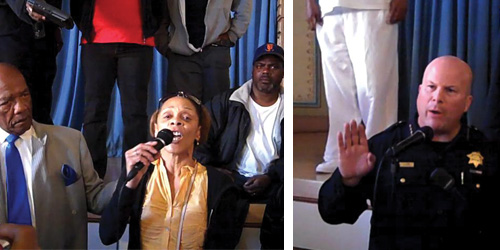
The message from outraged Bayview residents at a chaotic and emotionally charged community forum staged July 20 at the Bayview Opera House was not that people were upset that this had happened to Harding, a Washington state resident, in particular. Instead, people expressed outrage that police had gunned down yet another African American youth, and that unless some complicated and long-standing issues were addressed, it could happen again, to anyone. The forum was organized in partnership with the SFPD and clergy members from the Bayview. Police had prepared a PowerPoint presentation, but never managed to get that far.

At the meeting, Police Chief Greg Suhr tried to provide an explanation for the July 16 shooting. “During this foot pursuit, at some point in time, the suspect … fired at the officers, and the officers returned fire. This is the account that we have so far,” he said. “I cannot tell you how badly that I feel … as captain of this station for two years,” Suhr continued, as an angry crowd shouted him down.

Police escorted Suhr out of the meeting before everyone who had signed up to speak had a chance to be heard. Once outside, the police chief told reporters that he planned to return.

After Suhr and other city officials departed from the meeting, District 10 Supervisor Malia Cohen stayed at the Bayview Opera House and addressed the crowd that remained, she later told the Guardian, and engaged in discussion with Bayview homeowners, merchants, and other community stakeholders.

“We had a very thoughtful conversation,” she said. “People had questions about [Municipal Transportation Agency] policy over the SFPD riding the bus. We talked about the importance of attending Board of Supervisors meetings, Police Commission meetings, and giving public comment. And there will be future conversations, without obstruction.”

Many who attended the meeting voiced concerns that went well beyond the July 16 incident. Several said they believed youth were unduly harassed by law enforcement over Muni fares on a regular basis. Elvira Pollard spoke about how her son was shot 36 times by police and killed seven years ago. Another woman complained that police had used abusive language when she was arrested in the Bayview four years ago.

Mayor Ed Lee told the Guardian that a bigger police presence at the Oakdale/Palou stop on the T-Third line was part of the city’s strategy to prevent violence in that area. “I actually asked the chief to pay more attention to areas that had a history of gun violence and shootings and other kinds of violence … and it just so happens that this particular area, Third and Palou, is a place where there’s a lot of violence,” Lee said. “So we had more uniformed officers on that specifically at not only my request, but with the understanding of the police chief, too.”

Responding to acts of violence by sending in more police sounds simple enough, yet it seems a toxic environment has arisen out of a heightened police presence in a community where tensions between police and residents already run high, fueled by anxiety and bad past experiences. Add to this dynamic a trend of youth who lack other transportation alternatives riding public transit even if they don’t have enough money to pay the fare, and the situation feeds ongoing strife, particularly when fare evaders are asked for identification and searched by police.

Lee, in partnership with Cohen, called a meeting in City Hall July 19 with leaders of the Bayview community. The press was not allowed to attend, but participants said later that officials gave a presentation about the shooting and played an audio of gunfire from the SFPD’s SpotShotter program to offer evidence that Harding had fired first. Later that day, the SFPD reported that gunshot residue had been detected on Harding’s hand, supporting the police account of what happened. Yet the July 21 press release, suggesting that Harding had shot himself because a .380-caliber bullet that police said could not have come from SFPD firearms had entered the right side of Harding’s neck, made it even less clear what really happened.

By July 22, confusion was still swirling over why a gun hadn’t immediately been recovered from the scene of the shooting, and there still wasn’t any clarity on whether an online video of a passerby removing a silvery object from the sidewalk showed a person who retrieved Harding’s firearm after the shooting, as police have claimed. Police recovered a gun that was initially believed to be Harding’s, but later reported that the gun could not have been the same weapon that discharged a .380 caliber round into the victim’s head.

Chris Jackson, a Bayview resident who sits on the board of City College of San Francisco and ran for District 10 supervisor in 2010, said after the City Hall meeting that he felt it had amounted to little more than a lecture from the city’s top officials. Jackson said he perceived a need for a policy shift in terms of how to deal with fare evasion and violence prevention. “We need a better approach,” he said. “We cannot address this with more cops on the T line.”

After Harding’s death, it came to light that the 19-year-old Washington state man had served time for attempting to promote prostitution, and had been named as a person of interest in connection with the fatal shooting of a 19-year-old Seattle woman. Yet a widely circulated online video showing him writhing on the sidewalk in a pool of blood after being shot, while a handful of officers continued to stand around with weapons drawn, sparked outrage. Once the forum at the Bayview Opera House had broken up, LaDonna Callaway condemned the police response, saying, “They didn’t have to shoot him as many times as they did.”

Angelique Mayhem, a Bayview resident who stood nearby, told the Guardian that she didn’t think the meeting had solved anything. “A boy gets gunned down. We don’t know if there was a gun there, but we do know that for 40 damn years, people have been getting gunned down in this community,” Mayhem said. “People are angrier now than when they were when they walked in the door. We’re a community that’s truly in pain, that’s truly frustrated, and really needs some respect.”

Best of the Bay 2011:BEST BET FOR BAROQUE BEAUTY

0

You’ve redecorated your living room, but still something is missing. Could it be? Yes it is — a fuchsia-toned chaise lounge. Do not despair, for we have your marching orders: SF Antiques and Design Mall. The 13-year-old Bayview behemoth is something akin to an indoor flea market, and is home to 200 experts in the art of antique, all of whom have booths filled to the brim with fanciful paperweights, glittering heaps of costume jewelry, and ever-so-whimsical seating options. Seriously, if your interior design is hankering for a touch of the over-embellished, a whiff of kitsch, or perhaps a splash of hanging basket chair, you will find it here.

701 Bayshore, SF. (415) 656-3530, www.sfantique.com

Best of the Bay 2011: BEST SENTIENT WEED WHACKERS

0

From an environmental standpoint, herbicides and lawnmowers are unsatisfactory ways to control invasive plant species. Enter City Grazing‘s goats. The Bayview rental company offers a pack of furry, friendly billies to spruce up your degraded land. While the goats nibble plants, their hooves work seeds into the soil, maintaining beneficial organisms and obviating the need for heavy equipment — thereby minimizing soil disturbance and compaction. They trample dried brush, create natural mulch, and add organic matter to the soil. And don’t forget the cuteness factor. When was the last time your lawnmower bleated playfully, nibbled your sweater hem, and butted your thighs (without causing serious bodily injury)?

Port of San Francisco Railyard, 100 Cargo Way, SF. (415) 756-4233, www.citygrazing.com

Best of the Bay 2011: BEST BIGGEST BAYVIEW BRAZILIAN BURGERS

0

Make sure you’re hungry when you roll up to the Junior Barbecue food truck to order one of Junior’s famous Brazilian burgers. The sandwich Junior hands you, wrapped in paper to keep the juices from cascading out, will be enormous. The uniquely delicious, stick-to-your-ribs burgers are packed with enough ingredients to equal about three meals — beef patty, egg, bacon, hot dog, cheese, ham, pineapple, grilled onion, fresh lettuce, tomato, and corn mayo crammed into a bun. Eight dollars gets you a burger, which will feed you for a couple days, and a Coke. Junior is a gracious Brazilian who has lived in the United States for 11 years and can’t do enough to ensure that his customers are happy. Want some ketchup? Need a napkin? On a bike? How about a bag with handles to make it easier for you?

Napoleon at Evans, S.F.

Best of the Bay 2011 Editors Picks: Shopping

0

Best of the Bay 2011 Editors Picks

Shopping


BEST VINYL FLIPPERS

Tweekin Records in the Lower Haight was one of the centers of Bay Area dance music culture for the better part of two decades. But besides the basic insanity of operating a specialty record store in these e-times, the Tweekin brand had gotten a bit ragged over the years. So it was a charge for vinyl lovers when Manny Alferez and crew stepped up for a reinvigoration, unveiling Black Pancake Records. Pretty much the same concept reigns: great funk, soul, house, techno, jazz, and even (gasp!) rock records, plus a friendly staff with some primo recommendations. Perhaps best of all, there are a couple of those rarest of beasts — listening stations. Yep, you can put the actual circular whatsit on the doohickey that spins around and hear it make the music, little Johnny. All without clickety-clicking on the wee mouse-thingy.

593 Haight, SF. (415) 626-6995, www.blackpancakerecords.com


BEST EVERYDAY KAN DO

Peruse the labels of say, a kitty-shaped exfoliating washcloth or exquisitely lacquered bento box at Ichiban Kan, and you’re likely to see a Good Housekeeping seal of approval-style label trumpeting that the item won a design award in Japan. At times it seems like everything wins a design award in Japan, then the realization sets in that no other country seems to have dedicated itself so fervently to assuring that the everyday things of life — from paper clips to cooking utensils — be attractive, eminently functional, durable, and well-designed. When we want to load up on the best of the quotidian (we’re particular fans of the rolls of plastic wrap for $1), we come here.

Various locations, www.ichibankanusa.com


BEST GEEKDOM: THE GATHERING

It’s a constant nerd alert — not that that’s a bad thing — at Cards and Comics Central, a Richmond District shop where employees know the difference between vine whips and seed bombs and can explain why destroy effects don’t harm a cattank. Kids into Yu-Gi-Oh, Pokémon, or Magic will be overwhelmed by the shop’s vast selection. Parents will be overwhelmed at the price tag — you can spend more than $100 on a single card, though assorted decks (available for under $10) might keep the average young collector sated. Check out the back room for the real action — pale adults playing Magic with an intensity you won’t find at most Vegas poker tables.

5424 Geary, SF. (415) 668-3544, www.candccentral.com


BEST REFILL, NOT LANDFILL

What does it take to win a gazillion green business awards? It certainly starts with a great concept, a seriously vetted supply chain, and a commitment to spreading the eco-word. It also helps to have a pleasing storefront in Noe Valley, cute and eager staff, luscious products, and bulk-store prices without the forklifts and doublewide shopping carts. Green 11, launched by married couple Marco Pietschmann and Bettina Limaco and inspired by a Rachel Carson observation (“For the first time in history, every human being is being subjected to contact with dangerous chemicals, from the moment of conception to death.”), offers soaps, cleaning supplies, pet food, shampoo, conditioners, and lotions, all ready for your refillable, affordable use. Bring your own containers or put for up a starter container at the store.

3980 24th St., SF. (415) 425-5195. www.shopgreen11.com


BEST FAIR FEATHERS

You think your head hurts from the plumage parade that alit on Dolo Park this year? Think of the feather-farm roosters and other avian amigos that have lost their lives to appease the current mania for quill jewelry and hair extensions. Happily, two gentle crafters have taken the torture out of the trend: Erykah Prentice and Martha Hudson started their accessories label Divine Dandelions for peace, not plucking. The two create their cascading earrings and fanciful headdresses from foraged feathers, selling them from a sweet little gazebo at festivals up and down the West Coast. If you find yourself Bay-bound during next month’s Gaia Festival (up in the hills of Laytonville), you can always check out their Kahlil Gibran-quoting website for custom-made creations.

www.divinedandelions.com


BEST MEMORY TRANSFERENCE

Are your childhood camcorder memories gathering worrisome mildew by the minute? Entrust your VHS-ed precious moments to the Mission’s Video Transfer Center run by Jennifer Miko, a 2008 graduate of the L. Jeffrey Selznick School of Film Preservation and a collaborator with the Image Permanence Institute. Miko, along with husband Buck Bito, boasts some of the best equipment in the biz — including a fancy-pants transfer system for 8mm and Super-8 that the center says is California’s first and only. For a small fee, the team will inspect, repair, and transfer your film memories to a digital format that will last forever … or at least until we figure out brain-to-brain info-beaming.

395 South Van Ness, SF. (415) 558-8815, www.videotransfercenter.com


BEST BUGS BUNNY B-BOY FLASHBACKS

Mission vintage stores tend to cater to your typical high-waisted jean-clad, chain-smoking-in-front-of-Four-Barrel kind of girl. (We love her!) But New Jack City is a breath of fresh hype air. This “throwback goods” outpost at 15th and Guerrero streets specializes in sports gear and B-boy stylings straight from your favorite scene in Houseparty 2. Vintage Giants jackets, old school stripes, Bugs Bunny tees of various ages, priceless Afro-centric relics, and breezy caps repping teams or just plain reppin’ … . Actual 1980s and ’90s B-boys (and newer admirers) will feel they never left their Cold Crush Brothers and KRS-One cassettes in their cousin’s janky hoopty’s deck once they step inside.

299 Guerrero, SF. (415) 624-3751, newjackcitysf.blogspot.com


BEST REASON TO NOT GET OUT OF BED

You know those girls who flounce down 24th Street, vintage pastel print sundresses fluttering over their kicky cork wedge sandals, carrying a perfect sexy grandma purse? We know their style secret. Oakland’s Field Day Wearables’ bedding dresses are handmade by a crunchy-awesome label that wants to take the disposable out of fashion. They’ve got pockets and detachable straps that double as a matchy-match headband, and you can find them in patterns from striped to pansied to Batman (yes, they’re made from actual sheets). Score ’em at myriad brick-and-mortar distributing boutiques — or even better, by trying them on over your jeans at one of the craft fairs and street walks where FDW sets up a pretty post.

Available at various Bay Area locations. www.fielddaywearables.com


BEST SMALL WORLDS AFTER ALL

Apparently all the people who came of age in the late 1960s and early ’70s are either dead or too busy filling out Social Security forms to notice that at least one of their cherished craft projects is making a comeback. (No, not candle-splattered Mateus wine bottles or macramé hanging plant slings.) We’re talking about terrariums, the terrestrial equivalent of a ship in a bottle. So what if many G4-era terrarium enthusiasts call them “terraniums”? Their variation on vivarium nomenclature does nothing to diminish the charm of these glassed-in mini-worlds. And particularly high on the charm assessment scale are the creations of the good women of Studio Choo, part of Prairie Collective, whose arrangements of tiny ferns, succulents, and other floral inspire full minutes of unbroken, smart phone-free contemplation.

Available at Prairie Collective 262 Divisadero. (415) 701-8701, www.studiochoo.com, www.prairiecollective.com


BEST BET FOR BAROQUE BEAUTY

You’ve redecorated your living room, but still something is missing. Could it be? Yes it is — a fuchsia-toned chaise lounge. Do not despair, for we have your marching orders: SF Antiques and Design Mall. The 13-year-old Bayview behemoth is something akin to an indoor flea market, and is home to 200 experts in the art of antique, all of whom have booths filled to the brim with fanciful paperweights, glittering heaps of costume jewelry, and ever-so-whimsical seating options. Seriously, if your interior design is hankering for a touch of the over-embellished, a whiff of kitsch, or perhaps a splash of hanging basket chair, you will find it here.

701 Bayshore, SF. (415) 656-3530, www.sfantique.com


BEST FASHION SHRINE

Natural wooden tables, colorful blankets spread here and there, a goat’s head staring placidly down on wonder-covered shelves — Hayes Valley’s Reliquary could be a gaucho explorer’s treasure room. And — minus the gaucho part — that’s pretty much what boutique owner Leah Bershad has created it to be. Bershad stocks the year-old space with crafts and vintage finds from all around the country, plus Europe and — in the case of some elaborate bead-and-quilt satchels stacked near the counter — Afghanistan. The store’s racks of secondhand embroidered dresses and its smattering of designer wear like high-waisted Court denim mean that, as far as fashion church goes, Reliquary lives up to its name: a container for sacred relics.

537 Octavia, SF. (415) 431-4000, reliquarysf.tumblr.com


BEST PLACE TO BUY 300 PAIRS OF PANTS, 250 TELEPHONES, OR 7,651 RUBBER GASKETS

If you’ve ever spent an afternoon wistfully clicking your way through the Craigslist “free” section — pondering all you could do with an extra this or that — you’ve sampled a certain seductive sweet taste. Beware: the California Materials Exchange is crack to Craigslist’s cocaine. It’s eBay on steroids, Urban Ore for colossi. A state-sponsored recycling program, CalMAX facilitates the transfer of bulk, odd, and industrially useful products for wholesale and discount rates, and sometimes for free. So, looking for extra cubicles? How ’bout a free 1000-gallon asphalt-emulsion tank? Or 7,500 pounds of apparel, including 300 women’s black twill pants missing only the waist button? That’ll cost you a paltry 10 grand, but for someone with a plan — and a lot of storage — it could be just the thing.

www.calrecycle.ca.gov/CalMAX


BEST SHOP FOR THE SOCIALLY CONSCIOUS STITCH

A sobering fact: your clothes were probably made in a sweatshop (sorry). Most of our industrially produced togs — you are probably aware — are made by people making far from decent wages, working with toxic, health-shattering dyes. Small wonder then that local fiber movements are beginning to stitch. Visit Oakland yarn shop A Verb For Keeping Warm to be indoctrinated. Owner Kristine Vejar sells an in-house line of local fibers and natural dyes, and stocks other brands as well. Plus she gives classes on the skills you need to clothe yourself sustainably and hosts free sewing nights to develop community among people who purl — responsibly.

6328 San Pablo, Oakl. (510) 595-8372, www.averbforkeepingwarm.com


BEST WAY TO SIGN UP

Beautify the street and bolster your curb appeal in classic style with some legit hand-lettering from New Bohemia Signs. Using traditional enamels and gold leaf, New Bohemia practices its old-school art with pride — snazzing up placards with over-the-top fonts, providing elegant window signage for boutiques and restaurants, crafting appetizing menu boards, even revamping your Victorian with a gilded transom. Founder Damon Styer and crew have also branched out into the gallery scene: a recent art show at Guerrero Gallery featured work by present and past New Bohemia staff. The vintage feel, handmade aesthetic, and design-addict cache — New Bohemia’s products have even been salivated over in The New York Times — seem a perfect sign of our local, small-batch, skill-appreciative times.

281 Ninth St., SF. (415) 864-7057, www.newbohemiasigns.com


BEST PROTOTYPES (PRIMATE OR OTHERWISE)

The website of the Foam Monkeys concept modeling studio has an “awards” section that admits, “While we can’t honestly recall Foam Monkeys ever actually being mentioned for an award, the company has certainly been a part of many award-winning product development teams.” But we’re giving the company itself a real, bona fide Best of the Bay to boast about. Why? Because! Here you can not only construct a polyurethane primate, but also all sorts of useful stuff — like prototypes for everything from MacBooks to microchips. Sure, the company is geared toward creating serious conceptual models for industrial design and product development, but that doesn’t make the idea of an accessible foam-based 3-D modeling studio any less awesome.

32 Shotwell, SF. (415) 552-5577, www.foammonkeys.com


BEST SONIC SAFARI

Deep in the thick of the taquerias, bodegas, butcher shops , and joyerias of 24th Street dwells this exotic little shopping outpost for fearless cultural adventurers. Explorist International captain Chris Dixon (known on assorted music bills as Phengren Oswald) lets his collector come out to play here, sharing new and used recordings of global party riddims, heady jazz, weird old folk and country blues, and various unclassifiables — as well as art books, micro-run zines, and McSweeney’s volumes. The record bins are where the real action is, though: Moondog vinyl canoodles with Sperm Walls rarities, and Charlie Nothing crashes with the Indonesian prog and funk of Those Shocking, Shaking Days. Would we like to snag that vinyl copy of Luk Thung: Classic and Obscure 78s from the Thai Countryside? Yes, Dr. Livingstone, we would indeed.

3174 24th St., SF. (415) 400-5850, www.exploristinternational.com


BEST CHEAP PLACE TO SCORE A CUP AND A CONRAD

Literature and coffee: such sweet, sweet dependencies. Enable both on the cheap at Reader’s Café . Inconspicuous to those on a casual Fort Mason stroll, this used book treasure trove on the bay is infinite and grand once found. With $20, it’s possible to take home a few written works (some only $1!) and still have change for indulging in a custom-brewed cup of Blue Bottle. Reader’s is a production of the San Francisco Friends of the Library, so not only does each purchase soothe the DTs, it’s for a good cause.

Building C, Room 165, Fort Mason Center, SF. (415) 771-1076, www.readerscafe.org


BEST PARTNER IN PREUSED PURCHASE

In a perfect world, each visit to the Apartment would be a leisurely half-day treasure hunt. The Mission District store is packed with vintage furnishings, boxes of old family photos and 1960s magazines, even a $1 tray for affordable finds. No plywood or cheap IKEA stuff here — everything on offer is well maintained and crafted. Of course, that quality comes with some heft, but if you’ve fallen in love with a cedar armoire when you were supposed to be on the hunt for a throw rug, the Apartment will pay for its delivery: $65 plus $10 for every flight of stairs it must ascend to your door. So accommodating!

3469 18th St., SF. (415) 255-1100


BEST ANTI-GOLIATH GAME FACE

After a five-year effort by chain-wary neighborhood activists to keep it off the grand hippie boulevard, megachain Whole Foods opened at Haight and Stanyan streets early this year. It furthered the neighborhood’s fitful transmogrification into Fancy Town (or Ashbury Valley, the ‘hood’s new NoPa-like real estate agency-created moniker), but Haight Street Market is rising to this market-share challenge. With shifts starting before the crack of dawn, the 30-year-old family-owned shop has stepped it up, adding a high-quality butcher counter, a deli, the least pricey and most diverse beer selection in the Upper Haight, and a buffed-up coffee selection. If only all small businesses could up their game in the face of corporate claims.

1530 Haight, SF. (415) 255-0644, www.haightstreetmarket.com


BEST LEATHER-SCENTED TIME WARP

Stepping into cobbler Suzanne George’s shop is like entering a hide-covered time warp. George crafts her clodhoppers in much the same way that shoes were made several hundred years ago. She works the leather by hand, stitching the pieces with thread and hammering it all together with actual nails. Not only are the shoes custom-made to fit every tootsie they encase, they are also unique pieces of art, nearly too lovely to take tramping on the dirty pavement. George shares her high-quality, low-technology workshop with Peter, a shoemaker originally from Italy who used to make sandals for Mother Teresa. Together they make some damn fine throwback sling-backs.

1787 Church, SF. (415) 775-1775, www.suzannegeorgeshoes.com


BEST COUCH-BOUND — BUT COMMUNITY-MINDED — STONER’S DREAM COME TRUE

While a marijuana home delivery business may sound like nothing more than a couch-bound stoner’s dream come true, the Green Cross actually offers a valuable service to many of the city’s neediest residents who are less mobile as a result of illness, disability, or age. And this is no slapdash selection, either. Brick-and-mortar dispensaries can’t beat its impressive array of hard-to-find THC-infused specialty items like olive oil and agave nectar. Plus it boasts vegan, gluten-free, and nut-free goodies, all made in-house. So toke it all in — a portion of the proceeds are reinvested in the community, supporting social service agencies like the SF AIDS Foundation and the YMCA.

(415) 648-4420, www.thegreencross.org


BEST GOAL-GETTERS

Toby and Libby Rappolt hardly leave the balls behind when they exit their 20-year business, Sunset Soccer Supply, for the day. The Rappolts are players, coaches, and fans too. If they’re not holding up the counter at their shop, chatting with regulars about the most recent match or the best way to teach a kid to dribble or selling a team-sized box of scrimmage vests, there’s a good chance they’re out supporting the SF soccer community. The business is especially into rooting for women’s teams: it was present at the Civic Center showing of the World Cup final, it sponsors tournaments, and it has even invited players to in-store signings.

3401 Irving, SF. (415) 753-2666, www.sunsetsoccer.com


BEST PLACE TO PUT A CORD ON IT

Where to trundle if you want to wear that pretty pierced stone you found on your first anniversary hike up Mount Diablo? The Bead Store has a vast assortment of necklace-ready cords, and the Castro shop’s friendly staff can point you toward a nice clasp, or even tie a slip-knot for you if you’re not fancy. It’s the city’s smallest and oldest bead store — it has been in the same spot since 1964 — and stocks centuries-old beads and rare stones you won’t find anywhere else, as well as the standard tools you need to take your diamonds from the rough.

417 Castro, SF. (415) 861-7332, www.thebeadstoresf.com


BEST RING OF SUCCESS

Jewelry — it can be scary! We don’t mean the fun ornamental kind of jewelry, like Celtic nipple rings or jade idol earrings or purple pentagram pendants (although those can be scary too). No, we’re referring to real jewelry — like the fancy traditional kind you’d better get right or Bridezilla/o is gonna ‘splode and slap you silly with a rolled-up copy of Country Weddings magazine. How will you know how to score the perfect engagement ring, or wedding band, or anniversary bracelet, or birthday watch? Don’t fret. The enormously helpful and nice folks of Just Bands will help you with everything, from sizing and color to design and polish. Their showroom in the labyrinthine San Francisco Gift Center sparkles not just with diamonds and silver, but with the smiles of satisfied lovers whose romance wasn’t tarnished by stressful transactions.

888 Brannan, Suite 151, SF. (415) 626-2318


BEST THROUGH THE RABBIT HOLE

The N-Judah thunders by it dozens of times a day, but because it’s tucked well back in a garden courtyard, you’d never know this spirited, magickal little “multitraditional world mysticism” shop existed. Unless you capital-K Know. Look into your third eye: do you Know? Randy, the genial owner of the Sword and the Rose — a man who is part Keith Richards, part Baba Yaga — definitely Knows. And he’ll graciously tell you, spinning tales of about gods and goddesses from esoteric cultures past and present, or reading your tarot cards in a cozy nook warmed by an amber fire, or selling you his house-produced incense, or offering lessons in spellcraft, all while bestowing friendly (if a bit confusing to the uninitiated) guidance to more transcendent realms. First stop: Cole and Carl streets. Next stop: the Divine.

85 Carl, SF. (415) 681-5434


BEST BARREL FULL OF MONKEY SUITS

Let’s face it, if you’re a happenin’ gentleman or a trouser-trusting lady in this fancy-pants city, you’re going to need to bust out the occasional tuxedo. But who wants to spend a few hundred bucks on a new tux? Screw that noise, get over to Held Over, and check out the selection of $20 used tux shirts and wide variety of full monkey suits — from the 1970s-style mariachi look to something a bit more classic. Hell, why don’t you mix-and-match it up? They’ve already got you in a suit, so you might as well have some fun with it.

1542 Haight, SF. (415) 864-0818


BEST GRAND POOBAH OF THE PAST

A visit to the cavernous Potrero Hill digs of Big Daddy’s Antiques ushers you into a wondrous, uncannily postmodern version of the past. There’s definitely a little vintage-meets-steampunk aesthetic going on — Big Daddy grand poobah Shane Brown and his magic elves have collected enough old-school film lights, globes, wooden angel wings, horse-drawn buggies, large animal heads, giant pillars, and studio cameras with bellows to kit out the dreams of antique queens and cyber-fanboys alike. (Tech guys, please get your decor here.) And the large collection of Depression-era Americana like shoe shop signs and flag bunting adds to the pleasantly discombobulating Twilight Zone feel. Don’t worry though; the amiable Big Daddy’s staff will guide you though it all.

1550 17th St., SF. (415) 621-6800, www.bdantiques.com


BEST SHOT OF PANACHE

We just have one question for you, Revolver: can we move in? We would fit so well in your charming, roomy, homey, comfy store-and-gallery. On warm summer days, we could don one of your light summer frocks and Illesteva sunglasses, like contemporary post-ironic preppies but not that heavy; seal in our dewy look with one of your delicious moisturizers; and have coffee while pondering the art on display in your back room. Evenings, we could venture out in a pair of Tretorn rubber boots or suede Volta high tops and Creep khaki chinos, then settle in for the night on one of your durable cotton Japanese Workers pillow covers. In short, Revolver, we like everything about your small, beautifully curated store. Just one more thing: Is that a pistol in your pocket, or are you glad to see us?

136 Fillmore, SF. (415) 578-3363, www.revolversf.com


BEST HOLGA ROLLS

You know what’s tired? Using your iPhone to take a picture of yourself in the mirror for your Google+ profile. You know what’s not tired? Using a low-fi medium format 120 film Chinese toy camera from the 1980s to snap that same pic. Sure, you could just download Hipstamatic, but the hardcore among us prefer to use the delightful original mechanism — an actual Holga camera — which, thanks to a mini-craze in the past few years, has become readily available in the U.S. But you’ll need the right roll of film, and the awesome Photoworks is here to provide. Photoworks stocks hard-to-find film from all over the world, offers excellent print production services, and will even stretch your Holga hotness on a canvas to hang in your hallway.

2077-A Market, SF. (415) 626-6800, www.photoworkssf.com


BEST NATURE NOOKIE NAPSACKS

Backpacks, tents, and BPA-free utensils designed with an eye for classic retro outdoors-y accouterments (think 1980s L.L. Bean and 1970s RV campers), Mission District-based camping company Alite Designs‘ gear is innovative, body conscious, and oh-so-considerate of our decadent ways. Take for example its Sexy Hotness sleeping bag — at first glance, just a pretty sack for camp-crashing, but unzip the center fastener and it becomes a thermo-Snuggie with built-in feet, its center zipper freeing your nether regions for trips to the john or even a little nature nookie. Plus, the bags connect endlessly, so if you roll deep ‘n’ dirty, your camp orgies will be well served.

2505 Mariposa, SF. (415) 626-1526, www.alitedesigns.com

Harding’s family speaks out

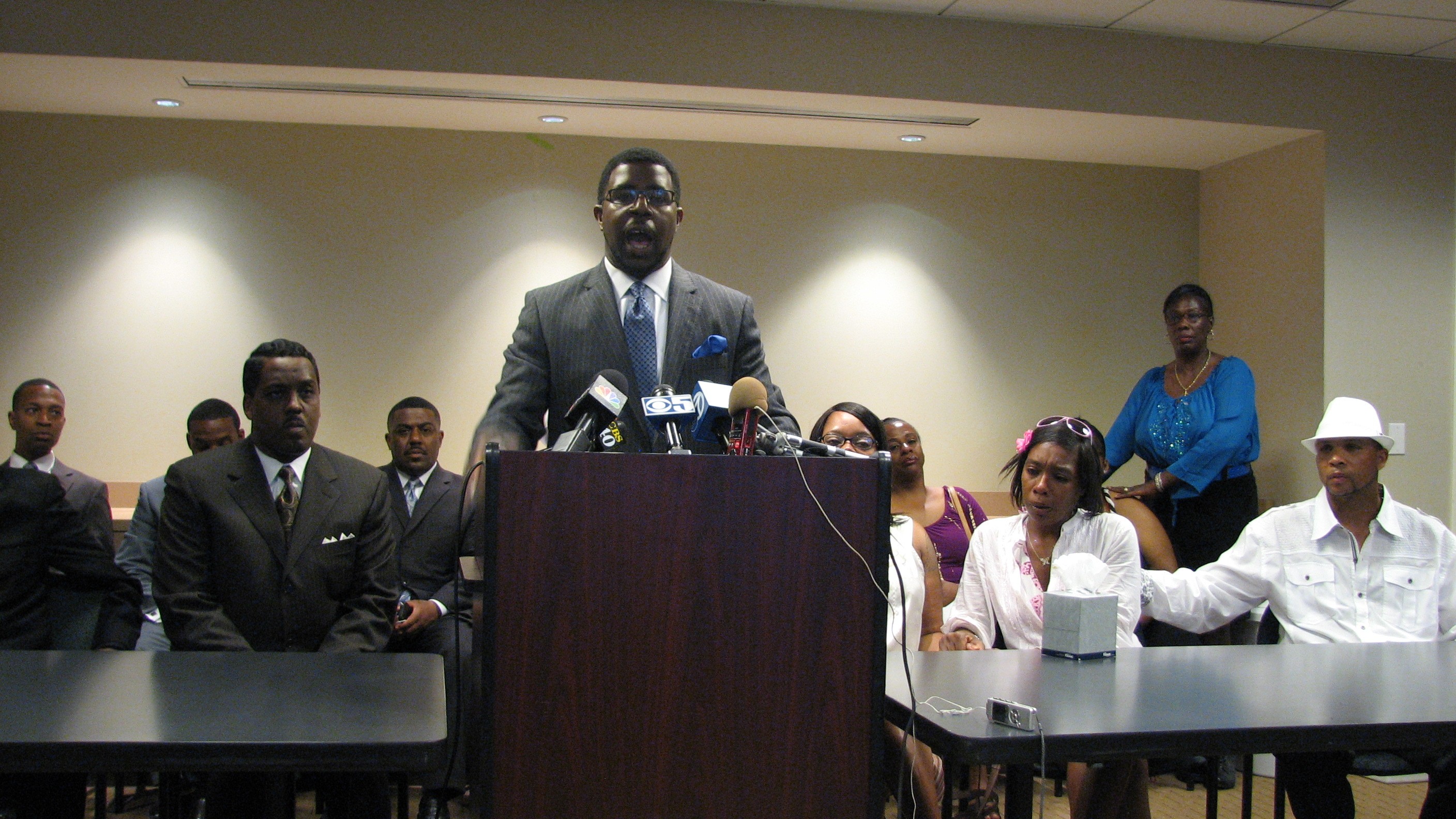
On July 25, the family of Kenneth Wade Harding, Jr. — the 19-year-old who was killed in the Bayview by a gunshot wound after he ran from being detained for MUNI fare evasion by San Francisco police — attended a press conference in Oakland at the law offices of John Burris.

News of Harding’s criminal history quickly surfaced in the days following his death, with reports focusing on how the African American man from Seattle had served time in prison for attempting to promote prostitution, and had been named as a person of interest in connection with the fatal shooting of a 19-year-old Seattle woman.

Harding’s mother, Denika Chatman, presented an alternative profile of her son, describing him as an independent person who cared for his family and dreamed of a music career as a rapper. Chatman said Harding had planned on attending Seattle Central Community College and would have turned 20 on Aug. 5. As for his criminal background and allegations that he violated his parole, “it doesn’t have anything to do with what happened to him,” she said.

Chatman and Pointer asserted that Harding was not in San Francisco because he was on the run. Instead, they said, he was there to visit with family and friends in the Bay Area and meet with his music manager. Chatman said Harding’s older brother is signed on with a record label in San Francisco, but declined to say which label.

Attorney Adante Pointer called Harding’s death “a tragedy and a shocking incident, which has brought us here seeking answers.” While he did not directly address the police account of the shooting thus far — that he was killed not by multiple rounds fired by San Francisco police officers, but a self-inflicted gunshot wound — Pointer did express skepticism.

“Those stories continuously shift,” Pointer said. “That’s nothing that you can build any kind of trust or credibility with.” He added, “This community is seeking some type of logical explanation as to what happened, as opposed to what amounts to be knee-jerk speculation.”

Pointer said his office had met with five eyewitnesses so far and hoped to find more. “There are eyewitnesses, there are persons in that community who’ve said this young man never fired a shot,” he said. “That’s inconsistent with what the police have said … let’s find out what the truth is.”

Pointer and Chatman were joined by members of Harding’s extended family, as well as African American community leaders in the Bay Area including Nation of Islam minister Rev. Christopher Muhammad and Rev. Renard Allen of San Francisco’s Third Baptist Church. Also present was Cephus “Uncle Bobby” Johnson, the uncle of Oscar Grant, the 20-year-old Hayward man who was fatally shot Jan. 1, 2009 by BART police officer Johannes Mehserle in a case which prompted riots. The Law Offices of John Burris represented Grant’s mother in a federal civil rights lawsuit against BART, striking a $1.3 million settlement with the transit agency in late June.  

Video by Rebecca Bowe

Best of the Bay 2011: BEST BEANS ON A TRUCK

0

You’ll know it by the smell of slow-roasting ribs and pulled pork: on weekdays Smoke BBQ generally parks its truck on a semi-desolate warehouse stretch of Bayview-Hunters Point. The pulled pork has a satisfying juiciness, reflecting its Midwest roots. The brisket and ribs are well loved by local worker bees. But what gives the meats a run for their money is the Smoke BBQ’s BBQ beans. Rich broth, smoky beans, and fatty chunks of pork — so good you just might forget your carnivorous entree.

1438 Davidson, SF. (415) 312-1637 www.smokebbqsf.com

More questions in Bayview shooting

After receiving a San Francisco Police Department (SFPD) press release issued July 21 stating that the man who died July 16 following an officer-involved shooting in the Bayview had been killed by a self-inflicted gunshot wound, I phoned the city’s Chief Medical Examiner, Dr. Amy Hart.
 
I asked Hart to walk me through how the conclusion that the gunshot wound was self-inflicted had been reached. But Hart responded that the Medical Examiner has not reached any conclusion so far about the cause of Harding’s death.

“That’s not a component of the press release that we issued,” Hart said. “Maybe it’s a question that would be best addressed to the San Francisco Police Department, probably their homicide division. For us, the cause and manner of death are pending. So, we are going to complete our investigation before we discuss the manner of death. The question that you’re asking is something that came from the police press release, so you have to ask them the nature of why they said that.”

I called the SFPD and left a message, and I’ll be sure to provide an update once they call back.

The SFPD release stated that the Medical Examiner had detected two gunshot wounds in the body of Kenneth Wade Harding, Jr., the 19-year-old from Washington state who died after being shot on a crowded sidewalk in San Francisco’s Bayview neighborhood. One gunshot wound entered and exited Harding’s left leg, the statement said. A second gunshot wound entered the right side of Harding’s neck, and the bullet remained in his head. The round that was lodged in his head was of .380 caliber, police said, so it could not have come from a .40 caliber SFPD-issued firearm.

A .380 caliber round was discovered in the pocket of the jacket Harding was wearing, the press release added. “Based upon evidence known at this time including: officer and witness statements that Harding shot at the police officers, Shot Spotter data, video tape evidence that depicts a firearm at the scene that was subsequently taken and the location of gunshot residue on Harding’s right hand, it appears that Mr. Harding’s head wound was self inflicted,” the press release stated.

The Medical Examiner’s office hasn’t issued a death certificate yet, Hart said, and it generally takes several weeks to determine the cause of death.

I asked Hart if the Medical Examiner’s office had any way to determine which bullet had entered Harding’s body first.

“I wouldn’t say there’s a good way, except for eyewitness accounts,” she responded, adding that the Medical Examiner’s Office doesn’t have information to determine which bullet entered the body first.

While the Medical Examiner determined that the .380 caliber bullet entered through the right side of the neck, it is the ballistics section of SFPD’s crime lab that determines the caliber of the rounds, Hart explained.

When I asked Hart what process the Medical Examiner’s office would follow to determine the cause of death, she said, “It’s a completion of our investigation that will need to happen here at the Medical Examiner’s office. We’re going to make a final determination, and what goes into an investigation depends on a case, there’s no set thing that has to happen.” Eventually, she said, the various components of the investigation, such as witness accounts, the ballistics analysis, and the examination of the body will be merged.

Meanwhile, Mayor Ed Lee offered brief comments to the media today in response to the most recent findings released by the SFPD. The mayor attended a groundbreaking ceremony for the new Bayview Branch Library at Third and Revere streets, which is expected to open in December of 2012. Here’s a video of Lee’s response to the latest evidence released by SFPD:

http://www.youtube.com/watch?v=-YSz1l4mOHQ

Video by Rebecca Bowe

Lee was joined by District 10 Supervisor Malia Cohen as well as Sen. Mark Leno, Sen. Leland Yee, Sup. Scott Weiner, newly installed Municipal Transportation Agency Director Ed Reiskin, City Librarian Luis Herrera, and other prominent San Franciscans. City officials emphasized the positive at the press conference, stressing that the new library would be a center for learning that could serve the youth of the Bayview and offered hope for the future of a neighborhood in transition. “It’s not all doom and gloom here,” Cohen told reporters.

I asked Cohen if she had a comment about the police deparment’s latest findings, but she declined to say anything about it.

At this point, there are still a lot of unanswered questions surrounding Harding’s death. So far, the gun that discharged the .380 caliber bullet into Harding’s head has not been recovered by police. Police believe an unidentified man in a hooded sweatshirt who can be seen in a YouTube video picking up a silvery object off the sidewalk removed Harding’s weapon from the scene, and they say they are searching for the man and the gun. But if the object shown in the video is a gun, and it was Harding’s gun, it’s still not clear how it wound up some 10 yards away from the body after he shot himself.

Outrage at the Bayview Opera House (VIDEO)

A community meeting July 20 at the Bayview Opera House dissolved into chaotic shouting when Police Chief Greg Suhr attempted to present the San Francisco Police Department’s version of what transpired July 16 when a 19-year-old African American man was shot nine times by police and killed just blocks from where the meeting was held.

“On Saturday afternoon, two officers at the Bayview station … contacted a fare evader whose name ended up being Kenneth Wade Harding, Jr. of Seattle, Washington,” Suhr began. “After asking him for his identification, he became a little bit anxious, and at one point in time he jumped off the platform and ran across the street, and ran through crowded Mendell Plaza. I cannot tell you how badly that I feel … as captain of this station for two years. I love the Bayview community.”

At that point, angry shouts rose up and Suhr started getting booed, but he continued. “During this foot pursuit, at some point in time, the suspect … fired at the officers, and the officers returned fire. This is the account that we have so far.”

Kilo Perry began shouting back at the chief, saying, “You are not a friend of ours. You are the enemy,” before bystanders tried to calm him down. The SFPD had planned on showing a power point presentation about the incident, but that didn’t happen. Instead, Suhr was drowned out, and the microphone was passed to various community representatives and members of the clergy, who’d helped organize the meeting, as they tried to regain control. Lifelong Bayview resident Charlie Walker asked people to sit down and relax.

Several hundred people had gathered at the Bayview Opera House to get answers about the shooting, and most remained seated as people continued to swarm around the police chief. After some time had passed, community leaders managed to set up a question-and-answer session with Suhr.

From this brief exchange and venting session, it became clear that people had come to the meeting with broader concerns than just what transpired Saturday. Elvira Pollard stood to recount how, seven years ago, her son had been shot by police 36 times, and that police had claimed that he’d shot first. She said it took more than nine months to get an autopsy report. “It’s the same scenario!” she charged. “Do you really think they aren’t going to lie about this one?” Suhr said that he couldn’t comment on that case specifically since he didn’t know the details, but offered to meet with her.

As people spoke, police violence against youth emerged as a theme. Harding was not a resident of the Bayview, and it came to light after his death that he had served time for attempting to promote prostitution and was a person of interest in connection with the fatal shooting of a 19-year-old woman. But to many who expressed outrage at the meeting, his death was linked to past instances in which youth had been gunned down by law enforcement. One woman showed up wearing a T-shirt, earrings, and a handbag displaying images of Oscar Grant, the 20-year-old unarmed Hayward man who was shot and killed by BART officer Johannes Mehserle on January 1, 2009.

A concern that was voiced again and again was that people felt the police routinely harrassed youth on the T-Third line. Grilled about why police were constantly stopping young people over MUNI transfers, Suhr responded that police had recovered weapons from T-line passengers while conducting fare inspections in the past.

The meeting broke apart when Suhr was escorted out, surrounded by uniformed officers, news cameras, and angry residents who continued to demand that he release the names of the officers who shot Harding. One simply yelled, “stop shooting black people in the back!” Once outside, with beads of sweat rolling down his face, Suhr told reporters, “I’ll be back.”

Here’s a video of the tense exchanges that took place at the July 20 meeting. 

http://www.youtube.com/watch?v=l3cQwtKMsXM

Video by Rebecca Bowe

Mayor Lee meets with Bayview community leaders about officer-involved shooting

Mayor Ed Lee and officials from the San Francisco Police Department met with Bayview community leaders in City Hall July 19 to discuss the police investigation surrounding a July 16 officer-involved shooting that has prompted intense community anger and protests. While city officials indicated that the meeting was called to provide information and updates for the community, frustrated community members emerging from the City Hall conference room dismissed it as “more of a lecture,” saying city officials weren’t open to hearing broader community concerns that have intensified in the wake of this tragic event.

Reporters were not allowed in the room while the meeting was held because “it’s more of a community meeting,” according to mayoral communications staff member Francis Tsang. Attendees included Bayview community leaders Chris Jackson, Geoffrea Morris, Mike Brown, Charlie Walker, Ed Donaldson, and the Rev. Amos Brown. District 10 Sup. Malia Cohen also issued invitations to the meeting, which was scheduled at the same time as the full Board of Supervisors meeting, and sent a representative.


The shooting victim was Kenneth Harding Jr., 19, from Washington. Police say he fired one round at officers before police fired nine rounds, killing him. However, some witnesses initially reported that they did not see Harding fire a gun, and a firearm wasn’t immediately recovered from the scene. Police initially tried to detain Harding on the station platform of the Oakdale / Palou stop on the T-Third line on suspected fare evasion. After Harding was killed, it came to light that he had a criminal history and had been named as a person of interest in the fatal shooting of a 19-year-old pregnant woman from Washington. The incident, which occurred in broad daylight and was captured on film and witnessed by people who were out on the street, proved to be a traumatizing event for a low-income, predominantly African American community where tensions already run high between police and residents.

Lee indicated to the Guardian that the July 19 meeting had been called primarily to clear up misinformation. “There have been a lot of stories spreading about what did and didn’t occur, and we felt it was necessary to get the community updated as quickly as possible,” Lee said. “Any time there is a death in any community we’re very concerned … this one in particular has been represented in many different ways, and a lot of it has been very inflammatory in terms of what people have said occurred. We’ve heard points like there was no gun, when in fact now we’ve found a gun through police investigation. That there was no shot made at officers when … the officers have at least some evidence through the ShotSpotter program that there was an initial shot made by the suspect.”

Lee added that MUNI staff had reported people relaying “all kinds of stories” while riding the buses. “These are very hard, hard feelings,” he said. “So I felt it necessary that we confront this head on with community leaders. We met with some yesterday, we’re meeting with some today, [Police Chief Greg Suhr] is hosting a town-hall meeting in the Bayview tomorrow to yet again find every opportunity to fully explain what they have uncovered as the evidence, and to make sure people base their views on the facts.” A larger community meeting is scheduled for July 20 at 6 p.m. at the Bayview Opera House.

Meanwhile, Bayview community leaders Chris Jackson and Geoffrea Morris were not pleased when they emerged from the conference room. “The mayor left without hearing one public comment,” Morris said. “It was just a lecture. It wasn’t addressing the police, and how they deal with fare evasion, and harass people along the T train. It was not that. It was just, the mayor said his little thing, did not say goodbye, and ran out.”

Morris went on, “We don’t have grief counselors out there. We don’t have the police saying that they’ll stay off the T-Train platform until the investigation is done. We thought this meeting was going to be for them to go, ‘where do we go from here?’ And the thing that people are missing … whatever demon that boy had, that was a human life.” Concerns are still swirling about how long it took for an ambulance to arrive after the shooting, Morris said, and about how police arrived at the scene with high-powered weapons which they kept drawn even as Harding writhed in a pool of blood on the sidewalk.

Morris and Jackson said that during the meeting, officials showed a Channel 7 TV news broadcast clip and played an audio of gunshots being fired to demonstrate that the suspect had fired an initial shot before police opened fire. “We all have Internet, smart phones, and all the footage as well,” Morris said. “I was there on the site.”

Shortly after the meeting, the San Francisco Police Department issued a statement to announce that gunshot residue had been detected on Harding’s right hand during an investigation. “The presence of gunshot residue on Harding’s right hand supports statements from witnesses that Harding held the gun in his right hand as he fired at the police officers,” the press release stated. It went on to note that the presence of gunshot residue on an individual’s hand could indicate that the individual fired a gun, or was in close proximity to a gun when it was fired, or touched something that was coated with gunshot residue.

Morris and Jackson also voiced concerns that went beyond the details of this particular case. “The response really needs to be a policy shift,” Jackson said. “We need a better approach in terms of violence prevention. We cannot address this with more cops on the T line.”

Jackson, who ran for District 10 supervisor in 2010, also questioned why police officers had been tasked with fare evasion enforcement on the T-Third line in the first place. MUNI also employs fare inspectors, he pointed out, and the city has a specialized program, called the ambassadors program, which was created last year in the wake of violence along the T-Third line directed at members of the Asian community. “Where was the public conversation about putting cops on MUNI trains?” Jackson wanted to know. “Who came up with that idea?”

Asked about this, Lee told the Guardian that he had specifically requested a higher police presence in areas where higher levels of crime were anticipated – and the July 16 shooting occurred in just such an area.

“I actually asked the chief to pay more attention to areas that had a history of gun violence and shootings and other kinds of violence … and it just so happens that this particular area, Third and Palou, is a place where there’s a lot of violence,” Lee said. “So we had more uniformed officers on that specifically at not only my request, but with the understanding of the police chief, too. He’s trying to do his best to keep everybody safe. And that in the summer, with all of the evidence that we have about where the shootings are and where they’re occurring, we naturally focus on areas where we think there’s going to be more violence to have more presence. So circumstances occurred where an individual was stopped because of a fare evasion, and I believe police were there to begin to detain him, and ask him to provide some evidence of who he is and why he did what he did, and that turned out to be a chase. A chase is one thing, but a chase with an opening of a firearm is a completely different thing.”

Meanwhile, Bayview community residents who ride the T-Third line experienced delays in recent days because MUNI operations staff decided to stop running light rail trains into the Bayview, instead dropping people off partway through the route and then directing them to wait for shuttle buses.

On July 18, a little before dark, a T-Third driver stopped at the Marin Street stop and announced that all passengers would have to wait for a shuttle bus. When passengers demanded to know why, she responded, “They’re acting up on Third Street, and our bosses don’t want us in the middle of it.”

According to SFMTA spokesperson Kristen Holland, operations staff began receiving reports around 6:30 or 7 p.m. July 18 that “there were upwards of 50 people walking on the right-of-way for the trains. As a safety precaution, our operations folks deployed buses for that portion of the line. We were told that they started at the southern terminus, and were walking north.”

This Guardian reporter hopped onto a shuttle bus with a notebook in hand after hearing that people were “acting up,” but by the time the bus made its way into the heart of the Bayview, the streets were calm. A MUNI employee who asked not to be named said he’d heard that someone had kicked in a window on one of the T-Third cars, and that was why the trains weren’t going through.

Meanwhile, the unexpected transfer left passengers weary, since for many waiting for the shuttle marked a second or third transfer on public transportation to get home. “People’s kind of frustrated. You go a few blocks, and they say it’s the end of the line. You go a couple blocks and they tell you the same thing,” said Darwin Green.

Another passenger, a youth who was with a friend and seemed concerned about the unfamiliar route the shuttle bus was taking, said, “I think it’s bullshit that they’re issuing citations. And there’s no need to shoot somebody because they didn’t have change for the bus fare.”
 
Another passenger was also disgruntled about the delays. Asked what he thought about everything that had been going on in recent days, he said, “It seems like they spend an awful lot of money in wages chasing down $2 fares.”

Killed for riding while poor

113

OPINION We sat together: elders, youth, workers, students, and folks. We were on our way to a low-paid job, an overpriced university, a pre-gentrified home and a public school. There was laughter and shouts, murmurs and silence. Then suddenly, there were nine heavily armed police officers and fare inspectors walking through the crowded 14 Mission Muni line. One stopped in front of me and my son.

“I don’t have a transfer, I lost it,” I tentatively answered a cop who asked to see my paperwork as I clutched my son’s stroller and tried to see how close I was to the back door of the bus.

“We will have to write you a citation and you will have to step off the bus — now.” He was yelling at me and was flanked by another officer. I knew I couldn’t make a run for it, but I almost tried.

I thought of this moment when I heard about the 19-year-old man shot by the SFPD while running away from a Muni bus because he didn’t have a transfer in the Bayview July 16.

Shot and killed for not having $2 bus fare.

At a press conference held July 18 at the scene of the shooting, Joanne Abernathy from People Organized to Win Employment Rights made the point: “No one should be shot for not having enough money to ride the bus.”

For the last few years, police presence on Muni has increased — as have attacks on poor people and people of color whose only crime is not having enough money to ride the increasingly expensive so-called public transportation known as Muni. From fare inspectors working for Muni to fully armed officers, they form a terrifying mob waiting menacingly at bus stops in the Mission, Ingleside, Bayview, and Tenderloin, and then enter buses to harass, eject, and cite anyone too poor to ride.

The police said the man pointed a gun. That’s what they consistently claim when rationalizing involved shootings. Several eyewitnesses said otherwise.

But before we get caught up in whether he had a gun or not, let’s stay with the real point: this young man was shot for not having a transfer. He was shot for not having $2. How did we get here?

Even if you are a supporter of the police, you have to see the Les Miserables-esque insanity in this shooting.

Police culture enables, allows, and encourages the use of deadly force — so much so that it seems at times as if killing can happen for any old thing. Throw in institutional racism and classism, and more and more people will not only be incarcerated but killed with impunity.

“Don’t get on the bus again if you don’t have the fare or you might be arrested,” the cop on Muni told me. He ended by giving me a citation and kicking me off the bus. He should have added “killed” to his threat of what would happen to us for riding while poor.

Tiny, also known as Lisa Gray-Garcia, is coeditor of POOR Magazine.


Burner artists go bigger and wider

66

I’ve been covering Burning Man for many years, both for the Guardian and my book, so it’s easy to feel a little jaded about another year of preparing for that annual pilgrimage to the playa. But then I plug into the innovative projects that people are pursuing – as I did last week for the annual Desert Arts Preview – and I find myself as amazed and wide-eyed as a Burning Man virgin.
And when the weekend came, I watched my old camps go bigger than ever – with Opulent Temple throwing a rocking Rites of Massive six-stage dance party on Treasure Island, and the Flux Foundation lighting up the Electric Daisy Carnival in Las Vegas with its newest installation, BrollyFlock – demonstrating the ambitious scale at which veteran burners are now operating.
Increasingly, burners are putting their energies into real world projects not bound for Burning Man, often with the help of Black Rock Arts Foundation, the nonprofit spinoff of Black Rock City LLC that funds and facilitates public art projects. BRAF’s latest, a project that is also receiving a grant from the National Endowment for the Arts, is The Bike Bridge, which pairs noted burner artist Michael Christian with 12 young women from Oakland to turn old bicycles and bike parts into sculptures that will be built at The Crucible and placed throughout Oakland.
“The Bike Bridge is the next evolution of our community-focused public art projects,” BRAF Executive Director Tomas McCabe said in a June 23 press release. “This educational and creative project is designed specifically to engage Oakland’s youth.”
Later that evening, McCabe and other burners gathered on the waterfront in Kelly’s Mission Cafe for the Desert Arts Preview, where he ticked off a long list of projects that BRAF was working on around the world, from the conversion of a bridge in Portland, Ore. into an elaborate artwork to a sculpture made of sails for next year’s Figment festival in New York City to a bus opera (written about bus culture and performed aboard buses) in Santa Fe to a cool interactive floating eyeball artwork that will tour Paris, London, Barcelona, and San Francisco to the BOOM Parade (combining bicycles and boom boxes) that will roll through Bayview Hunters Point in October.
But the most ambitious artworks are still being planned for that limitless canvas of the Black Rock Desert, where Burning Man will be staged in late August. This year’s temple, The Temple of Transition, is being built out of Reno by a huge international crew from 20 countries headed by a pair of artists known simply by their nationalities, Irish and Kiwi, who built Megatropolis at last year’s event.
“We built a city block of buildings and burned it to the ground,” Kiwi told the gathering, noting how impressed he’s been by a number of recent projects he’s watched. “When you start doing that, you feel challenged and wonder what you can do next.”
Irish said they were particularly inspired by watching the Temple of Flux go up last year, a project involving more than 200 volunteers that I worked on and chronicled for the Guardian, and said it made them want to bid to build this year’s temple. “That’s what inspired us,” Irish said.
The project includes a series of towers and altars, the tallest one in the center reaching about 120-feet into the air, a phenomenal height against the vast flatness of the playa. They said volunteers have been plentiful and the city of Reno has actively facilitated their work, “but our main concern is having enough finances,” Kiwi said.
The project got a grant from the company that stages Burning Man, Black Rock City LLC, which gave almost $500,000 to 44 different projects this year, but most didn’t come anywhere close to covering the full project costs. The Temple of Transition bridged its gap by raising almost $25,000 in a campaign on Kickstarter, which many projects are now using.  
“It’s a great way to cut out the middle man. You guys are funding art directly,” longtime artist Jon Sarriugarte, who got a BRC art grant this year to build the Serpent Twins (with his partner, Kyrsten Mate), said of Kickstarter, where he was about three-quarters of the way to meeting his goal of the $10,000 he needs to cover his remaining project costs.
Serpent Twins is a pair of Nordic serpents crafted from a train of 55-gallon containers and illuminated with fire and LED effects that will snake their way around the playa this year, one of many mobile artworks that have been getting ever more ambitious each year.
“I love the playa. It’s a beautiful canvas, but it’s also a beautiful road,” Sarriugarte told the group, conveying his excitement at driving his art into groups of desert wanderers: “I can’t wait to split the crowds and then contain them.”
Another cool project that is in the final days of a much-needed Kickstarter campaign is Otic Oasis, whose artists (including longtime Burning Man attorney Lightning Clearwater) brought a scale model to the event. It’s a slotted wood structure made up of comfy lounging pods stacked into a 35-foot pyramid design that will be placed in the quietest corner of the playa: deep in the walk-in camping area, inaccessible to art cars and other distractions.
That and other projects that are doing Kickstarter campaign are listed on the Burning Man website, where visitors can get a nice overview of what’s in store.  
One project that didn’t meet its ambitious Kickstarter goal was Truth & Beauty, artist Marco Cochrane’s follow-up to last year’s amazing Blissdance, a 40-sculpture of a dancing nude woman that has temporarily been placed on Treasure Island. But the crew has already made significant progress on the new project, a 55-foot sculpture of the same model in a different pose (stretching her arms skyward), and Cochrane told me they will be bringing a section of her from her knees to shoulders as a climbable artwork.

The Flux crew has been working for months on BrollyFrock, a renegade flock of flaming, illuminated, and shade-producing umbrellas that was commissioned by Imsomniac for its Nocturnal and Electric Daily Carnival music festivals, and it was placed at the latter festival near Wish, large dandelions that were built near the Temple of Flux at Burning Man last year, as well as new artworks by Michael Christian. Flux’s Jessica Hobbs said burners artists have become much sought-after by the large festivals that have begun to proliferate.

“I really think a lot of these music festivals are looking at how our pieces make an experience,” Hobbs said, citing both the spectacularity and interactivity that are the hallmarks of Burning Man artworks of the modern era. The Flux crew was pushed to meet a tight deadline for the project, preventing them from doing a big project for Burning Man this year, but that’s just part of the diversification being experienced by burner artists these days. “We challenged ourselves and we came away with another great project.”


On the hook

4

rebeccab@sfbg.com

Unique Roberts squared back her shoulders and recalled what it was like when she first moved to San Francisco from East Oakland more than a decade ago. A tall, 33-year-old African American transgender woman with piercing eyes and a charming smile despite gaps of missing teeth, Roberts said she performed as a showgirl at clubs like Harvey’s and the Pendulum in the Castro. In those exciting days, “I fell in love with this boy, and he was an addict,” she explained. “I thought that if I did it, it would keep our relationship together.”

She recalled how awful her boyfriend felt when he found out she was using, telling her, “You don’t know what you’re doing to yourself.” He departed for Texas several years later, but addiction stuck with her as a way of life.

She says she’s tried to kick the habit, but it’s wrapped up in a battle against depression stemming from the loss of loved ones. Roberts was wearing one of the bright orange sweatshirts issued to inmates at San Francisco County Jail. She landed there after being arrested in April for allegedly selling a tiny rock of crack, weighing just 9/100s of a gram, to an undercover narcotics officer. According to the police report, the cop offered her $20 for it — but based on National Drug Intelligence Center street-value estimates, that amount is only worth about $2.50.

Roberts may go by the first name Unique, but her lawyer Tal Klement, who works for the San Francisco Public Defender’s Office, is fond of saying her case is hardly unique at all. She was one of several people arrested in the Tenderloin that day after interacting with the same plainclothes officer.

It was part of a coordinated sweep known as a buy-bust, a common practice under which an officer may pose as a homeless person, a clueless outsider, or a dope-sick fiend to lure people into selling crack, pills, meth, heroin, or marijuana. Once a transaction is made, a team of officers awaiting the signal immediately closes in and arrests the seller.

As of June 20, there were at least 109 open buy-bust cases in San Francisco. Based on defendants’ rap sheets, 92 percent had prior drug-use histories, according to a tally conducted by the Public Defender’s Office.

The officers posing as buyers — who often earn overtime — use street lingo, know which drugs can be obtained at which intersections, and sometimes offer higher prices than the accepted street value. Attorney Anne Irwin, also a public defender, is critical of the practice, saying it’s an expensive tactic that’s makes for easy arrests — because the money is irresistible to addicts who think they’re getting an opportunity to convert a personal stash into more drugs.

In a lean budget year, “they’re cutting social services left and right, and these are the very services that could help the addicts get off the street,” Irwin noted. She’s skeptical that the strategy stems the flow of substantial quantities of drugs.

Police Chief Greg Suhr, who said he participated in buy-busts for years as a narcotics officer, credits the tactic for helping to eradicate a rampant open-air drug market on Third Street in the Bayview, and says it can help prevent drug-related violence.

Klement, however, condemns it as a “war on crumbs,” saying it ensnares far more addicts than serious dealers and often ends up unnecessarily pinning felony convictions onto low-level offenders.


NUMBERS GAME

Buy-busts usually involve around eight officers, according to an average calculated by the Public Defender’s Office based on open cases, but have involved as many as 14 and as few as three. There’s the decoy buyer, who sometimes dresses in grimy sweatpants, goes without shaving, or dirties his face to look like a street addict in desperate need of a fix. There’s a “close cover” officer who follows the decoy, plus an arrest team that is also sometimes in plainclothes. Beforehand, officers will photocopy cash — usually $20 bills — to document the serial numbers so that the same marked city funds can be used as evidence once recovered from arrestees. Busts can happen within minutes of one another, and a single shift may net five or six arrests.

Irwin says the people snared aren’t typical drug dealers — certainly not big-time players. But they’re charged as dealers — and in many cases wind up branded as felons, with severe legal penalties such as multiyear prison sentences.

While the police department is able to show on paper that it’s brought hundreds of drug dealers into custody — and the district attorney can point to a boost in the conviction rate thanks to the program’s efficiency — Irwin says the amounts being peddled are tiny.

“In traditional narcotics operations, they cultivated snitches, used surveillance, and obtained search warrants” to go after major dealers, Irwin said. With buy-busts, “It’s like shooting fish in a barrel. Everyone agrees that we need cops on the streets to help keep us safe … But do we want to be paying hundreds of thousands of dollars for this?”

Sharon Woo, chief assistant of operations for the San Francisco District Attorney, told the Guardian that “we charge based on the conduct of the individual.” Woo went on to say that the DA tried to “exercise appropriate discretion” on a case-by-case basis when individuals are selling to support an addiction or due to being in dire financial straits.

Sometimes individuals are ushered into alternative programs such as drug court or a Back on Track program for first-time offenders, Woo said. And while the DA typically includes charges that make defendants ineligible for probation under state law if they have prior convictions for selling crack-cocaine — a discretionary practice that has drawn criticism from public defenders — Woo observed that “it doesn’t mean that’s how cases resolve.”

Police forces in nearly every major metropolitan area practice buy-busts, said Frank Zimring, a law professor at UC Berkeley’s Boalt Hall School of Law specializing in criminal justice issues. Yet he described the practice as costly and noted that paying overtime for it “makes what would ordinarily be a very expensive operation into a more expensive operation.”

Cost estimates for the entire program are tough to pin down. It costs $130 per day to house each prisoner in the county jail, amounting to more than $14,000 per day if all of the defendants with pending cases are in custody. If an average of eight officers per bust were paid $60 an hour each to spend six hours conducting a buy-bust, the current caseload represents more than $300,000 in officer pay — a conservative estimate — and that’s before lawyers in the offices of the public defender and district attorney are paid to prosecute and defend the suspects in court.

But no matter how you add it up, it’s a lot of money.

Suhr told the Guardian that apprehending street-level offenders occasionally leads officers to bigger fish. “Sometimes you get a low-level person, or a buyer if you will … if that same person would say, ‘But I know this guy and he has guns and he’s a big dealer and whatever.’ That is a good way to get to those bigger people.”

“We’ve never seen that happen in practice,” Klement countered.

One of Irwin’s clients, a homeless man, was charged with selling narcotics after he scraped out the contents of his pipe to sell 1/1,000th of a gram of crack to an undercover officer for $20. In a rare twist, the case was ultimately settled on a misdemeanor possession of narcotics.

Inspector Robert Doss, who served as the decoy in that case, has earned substantial amounts of overtime while going undercover to buy drugs, according to a court transcript. In 2009 Doss earned $35,488 in combined overtime and “other pay,” which includes time spent testifying in court, according to a San Francisco Chronicle database of municipal salaries.


ON THE STREET, OFF THE STREET

The Tenderloin is frequently targeted for buy-busts, with 65 percent of open cases as of June 13 having taken place in that neighborhood. The Haight ranked second, with nearly 12 percent of cases, and the Mission followed with 10 percent. Shortly after District Attorney George Gascón was sworn into his prior post as police chief in 2009, he announced a concerted effort to clean up the Tenderloin, and Klement maintains he’s seen a surge in cases stemming from buy-busts there ever since.

Drug dealing in the Tenderloin often makes the news as a source of frustration to merchants and residents. “You try and explain to the people of San Francisco that it’s okay for people to have open-air drug markets right in front of their stores,” Suhr said.

Yet Klement maintains that what is essentially a quality-of-life crime should not be treated as a felony. “There’s a lot of pressure from people who are invested in businesses [in the Tenderloin] who would love to see that neighborhood become the next Hayes Valley,” he said. “But what they don’t realize is that people are paying with prison for that agenda.”

Once someone has been labeled a drug dealer in the eyes of the law, he said, it becomes more difficult for them to access drug treatment — not to mention get a job, qualify for a student loan, or find housing.

Roberts’ case nearly went to trial. If convicted, she could have been sent to prison for a minimum of three and a maximum of 17 years due to extra penalties from prior convictions. On the eve of the trial, however, the case was settled on a possession charge for a year in jail, a rare outcome. Klement was hoping to have her placed in a treatment program.

Asked if she knew of others swept up in undercover operations, Roberts gave a wry chuckle and gestured to the jail corridor behind her, indicating that nearly everyone there had been taken down in similar fashion. Klement noted that the targets of the buy-busts are almost exclusively people of color, saying, “You walk into the holding cell and you think you’re in Alabama or Mississippi, not San Francisco.”

In an editorial on the subject that he wrote a couple years ago, Klement noted that by contrast, predominantly white middle class people with a fondness for illegal drugs are rarely targeted because they aren’t the ones selling drugs on the street. “The hard truth is that the police ignore most of the middle class drug use and dealing occurring out of private homes in every neighborhood or other public venues in the city — bars, nightclubs, concert halls. More drugs are being transported to Burning Man as we speak than will probably be seized during Gascón’s entire crackdown.”

For Klement, it’s just another symptom of a broken system. “A lot of these people are repeat players because we don’t have the right interventions at the right time,” he said. “We don’t understand addiction.”


Stopping foreclosure secrecy

4

OPINION Thanks to a shadowy corporate mortgage recording system, millions of Californians have no idea who owns their home loans.

As we suffer through this recession triggered by reckless subprime lending and Wall Street speculation, our recovery is being held back in part because people are struggling with foreclosures and underwater home values — exacerbated by a lack of mortgage transparency.

The mess created by Wall Street is causing wrongful foreclosures and wreaking havoc. Real people — often lower-income families and communities of color — are enduring the devastation of foreclosure processes because of the excesses of bankers and investment firms.

In San Francisco, we’ve seen the highest number of foreclosures in the Ingleside-Excelsior, Bayview, Tenderloin, and Mission neighborhoods — many of the places where home values have fallen most. Whether or not you face foreclosure, we all pay for this crisis by losing vital tax revenue that could go to support our schools, protect our neighborhoods, or build our economy.

When Wall Street realized it could make billions by bundling mortgages and selling them to investors, banks and financial institutions needed a way around recording the ownership and assignment of home loans. What the banks and Wall Street came up with is a shadowy, industry-backed reporting system called MERS — mortgage electronic reporting system.

Simply stated, subprime and predatory lending allowed banks to create millions of questionable mortgages, Wall Street bundled these risky mortgages together to sell to investors, and MERS made it quicker and easier to conduct these risky transactions with impunity.

As San Francisco’s assessor-recorder and a financial advocate for low-income communities, we have seen harmful industry practices wreak havoc on families trying to stay in their homes — whether by use of MERS that clouds property titles, wrongful foreclosures, or denied loan modifications.

The state Legislature considered several good foreclosure bills this year. One proposal placed a $20,000 fee on financial institutions attempting a foreclosure. This would have discouraged foreclosure and helped defray costs to communities if the process went ahead.

State Sen. Mark Leno( D-SF) and Senate President pro tem Darrell Steinberg (D-Sacramento) offered legislation stopping banks from proceeding with foreclosures when a homeowner is attempting to modify his or her mortgage.

Assessor-Recorder Ting is sponsoring a bill requiring that all mortgage assignments and transfers be recorded with counties, thus taking this process out of the murky MERS system.

Unfortunately, the banks and their armies of lawyers and lobbyists have been able to stymie these reforms.

We must continue to fight these wealthy, powerful lobbies so that the long road to recovery in our housing markets and communities can begin. We cannot let Sacramento forget it was financial institutions that fueled the housing bubble, crashed the stock market, and sent shockwaves throughout the economy with their reckless practices.

Few states have been ravaged by subprime lending and the meltdown of mortgage-backed securities the way California has, so we must continue reforming the practices of banks and Wall Street that have thrown our economy and communities into turmoil.

Phil Ting is San Francisco assessor-recorder. Kevin Stein works with the California Reinvestment Coalition.

Stop the AT&T boxes!

15

By the League of Pissed Off Voters


More than 60 people showed up on the steps of City Hall May 21 to demand that AT&T engage in the same old basic planning process that even small-scale businesses have to go through.  (Read: even little people without expensive corporate lobbyists.)


Neighborhood organizations, disabled and senior representatives and environmentalists all pushed the supervisors to make the sensible vote at tomorrow’s full board meeting: support a full Environmental Impact Review of the consequences of 726 giant metal lockboxes cluttering up our public sidewalks.  As Julian Davis, a longtime community activist put it: “Why would you plunk down 726 giant Buicks all over the city when you have a perfectly good underground high speed rail?”


True that.  San Francisco currently has miles of fiber optic cable pulsing beneath our city streets, and even that is already becoming outdated.  So now AT&T’s brilliant idea is to litter our sidewalks with what amounts to giant crusty supercomputers? And what happens when they’re obsolete?  Basically, taxpayers just got stuck with a bunch of metal junk on our sidewalks, while AT&T expanded its profit margins.


Why do small cafes have to pay hundreds of dollars in permit fees to put two piddly tables outside their shops, while AT&T gets a blanket “categorical exemption” for almost no money to nail down ugly boxes that will block the sidewalk and attract graffiti?  (Hmm, we can probably think of some choice graffiti actually…)


The last time we heard from the folks at AT&T, they were helping the NSA wiretap our private calls from a secret room in their headquarters, so excuse us if we’re a little hesitant about giving the company a free pass to put creepy lock boxes in front of our homes. 


According to the Department of Public Works at the last public hearing on this issue, DPW staffers are relying on AT&T’s “expert analysis” to guide them on whether or not AT&T should receive a categorical exemption – in other words, DPW is relying on AT&T to do its job, and the community just got cut out of the process.  An independent EIR is necessary to address these blatant conflicts of interest. 


Speaking of conflicted interests: The latest scuttlebutt inside City Hall has some progressive supervisors desperately looking to cut a deal to save face in the midst of election season.  And what would that deal look like?  Cutting the number of boxes and giving neighborhoods an opportunity to decide whether they want 4’x4’x7′ lock boxs on their blocks. 


So, basically, if your block doesn’t have a home owner association advocating on your behalf, guess what you’re going to be walking around everyday?  As Juan Monsanto of San Francisco Beautiful pointed out, most of these boxes will be installed in less affluent communities without strong representation at City Hall.   AT&T’s sweetheart deal gives the supervisors cover to punt their responsibility to administer public space safely and equitably. 


So, to recap: we are now officially a city that will arrest human beings for sitting or lying in the middle of the sidewalk, but the board is working overtime to try and figure out how to exempt AT&T from city oversight process so it can stick giant immovable metal boxes in our right of way?


Oh, it’s okay because they’re going in the Bayview. Or in a neighborhood that already has a bunch of blight, so what’s a little more?  Lame.  Call your supervisor today and tell him or her to get a backbone.  It’s tough being the swing vote, you know?  Help ’em out, let ’em know you’re watching – and voting.


The San Francisco League of Pissed-Off Voters is the local chapter of the League of Young Voters, a national organization that engages young people in the political process, organizes around progressive issues and takes it beyond just “get out the vote.” 


Finally, a prosecutor leaps into D.A.’s race

73

From the moment I walked into Sharman Bock’s District Attorney campaign launch and saw the roomful of “signs proclaiming, “A prosecutor for District Attorney”, I realized that Bock isn’t the type of candidate to hold her punches. And that makes perfect sense, because unlike the other candidates in the D.A.’s race, Bock, 48,  is a seasoned prosecutor.


Bock, as I soon found out, is also a longtime San Francisco resident, who moved here from Iran when she was four and has lived in the city for more than four decades. She went to high school here, returned after graduating cum laude from Georgetown University Law Center, and earned a clerkship with the Hon. D. Lowell Jensen of the Northern District of California, before starting her prosecutorial career in Alameda County, where she has served as an Assistant D.A. since 1989.  And she continues to live in San Francisco, where she is currently raising two kids with her husband in the Richmond District.


Joined by Congressmember Jackie Speier, Lulu Flores, President of the National Women’s Political Caucus, and Shronda Wallace, whose mother was brutally murdered in 1989, Bock made no bones about why she has decided to spring into the race.


“I’m running for San Francisco District Attorney because this is a job that requires a seasoned prosecutor who knows what it takes to put the most violent and dangerous criminals behind bars and keep them there,” Bock said. “I am a professional prosecutor. I want to give voters a real choice. No other candidate in this race has prosecuted even a single criminal case. This is no job for rookies. The stakes are too high and rookies make mistakes.”


When Bock noted that her conviction rate is over 90 percent, and that she has never lost a serious or violent jury trial, I wondered how successful the other main contenders–former SFPD Chief George Gascón, who Mayor Gavin Newsom appointed as D.A. in January, and former San Francisco Police Commissioner David Onek, are going to be when it comes to downplaying the fact that neither, as Bock wasn’t afraid to remind reporters, “has ever prosecuted a criminal case.”


“This is not a managerial, police or career job,” Bock continued, confronting head-on the arguments Gascón and Onek have already tossed out in response to questions about how they can be D.A. given their complete lack of prosecutorial experience.


“It’s certainly not a job for a rookie, and with 22 years of experience, I’m ready,” Bock commented.


“To lead an office of trial lawyers, you’d have to walk a mile in their shoes,” Bock added, noting that currently she is doing just that. “I’m responsible for supervising extremely experienced trial lawyers each day,” she said, referring to her job as Assistant D.A. in Alameda County.


Praising the record of former D.A. Kamala Harris, who was elected Attorney General in November, Bock observed that San Francisco “sets the national standard. Kamala did a good job, and I’d like to keep the momentum going. We can’t lose it.”


Next, Bock outlined some of the highlights of her prosecutorial career.


A national expert on efforts to combat human trafficking, Bock leads the Human Exploitation and Trafficking (HEAT) Unit, which prosecutes complex trafficking cases. In fact, Bock actually prosecuted the first human trafficking case in California.


Based on her expertise with DNA and other forensic evidence, Bock was tapped to lead the Cold Case Unit, which focuses on solving old murder and sexual assault cases.


Bock also oversees other specialized felony units, including Public Integrity, Child Sexual Assault, Sexually Violent Predator and Restitution, which recovered more than $15 million for victims of violent crime last year.


In 2009, Bock received the Fay Stender Award from the California Women’s Lawyers Association for her “ability to affect change and her commitment to representing the underprivileged. And in 2010, the California Legislature recognized Bock as “Woman of the Year” for her groundbreaking work to stop human trafficking.


“American children are being sold for sex in our own backyard,” Bock warned, as she talked about what she has learned from her decades as a prosecutor. She said solving cold cases “provides closure that is priceless for families of victims” and is part of keeping the community safe. She talked about the fact that she is an independent prosecutor, who won’t be conflicted by police misconduct and crime lab scandals, unlike our current D.A. And she wrapped up by voicing her desire to serve—and remain in—San Francisco. “I am committed to giving back and serving the city I love,” Bock said.


Meanwhile, across the city, D.A. Gascón had just a neighborhood prosecution program in the Bayview and Mission districts. According to a Gascón press release, the program, “brings immediacy to the resolution of crimes that diminish the livability of local communities by employing a restorative justice model” and “brings the D.A.’s Office into the community, positioning the office to be more directly and immediately responsive to the needs of community members.”


Gascón promised that the program will engage “residents in the process of determining an appropriate sanction focused on repairing the harm done to the community and setting the offender on the path to long-term productivity. This approach will bring a swifter and more certain resolution to offenses that have repeatedly gone unchecked for too long.”


The idea is that designated Assistant D.A’s will be assigned to  local police station to pre-screen eligible individuals and determine if the offenses they have been cited for by police are suitable to be heard in neighborhood courts. “Under the supervision of the District Attorney’s Office local residents are trained in restorative justice to adjudicate matters, instead of having cases charged and heard in criminal courts,” Gascón stated. “The adjudicators represent a wide swath of the community and include merchants, home owners retirees and students.”


Gascón says a range of non-violent offenses, including drinking in public, vandalism and petty theft, fit the criteria for matters that can be reviewed in the neighborhood court.“Eligible individuals cannot be under the supervision of the criminal justice system,” he stated. “Individuals who volunteer to have their matters heard in the neighborhood courts agree to abide by the prescribed outcomes that focus on restoring both the community and the offender. Individuals who are successful in meeting the terms avoid the blight of a mark on their criminal record. By taking this restorative justice approach, the program seeks to break the cycle of crime. It increases the accountability of the offenders to the community and the community’s stake in the offenders’ rehabilitation.”


Gascón claimed the program saves money by significantly shortening the length of time it takes to resolve offenses. “Typically the offenses being heard in a neighborhood court in one to two weeks from the time a citation is written would take nine months to a year to be heard in a criminal court,” he stated. “The average cost of having these cases charged and heard in a traditional criminal court would be $1500 per misdemeanor compared to $300 in a neighborhood court.”


Gascón concluded by noting that this new neighborhood prosecution program will operate under the direction of the newly-formed Collaborative Courts Division of the D.A.’s Office and is scheduled to spread citywide. “The Bayview and Mission district launches are part of D.A. Gascón’s initiative to increase accountability and integration of the former Community Court programs,” Gascón’s press release stated. “The neighborhood prosecution program model will eventually be adopted and employed city-wide, district by district as a replacement for the former model.”


Bock for her part seemed less than impressed by the fairness of Gascón’s program. “People dealing with quality of life crimes deserve a District Attorney,  a defense attorney and a judge,” she said. “You can’t shortchange justice “


And she wasn’t shy about sharing her thoughts on the conflict of interest Gascón faces when dealing with the ongoing police misconduct and crime lab scandals.“George Gascón is between a rock and a hard place,” Bock said. “He was in charge of the police district during that time period,” she observed. “And it’s important that the police don’t get thrown under the bus in the process.”


And unlike Gascón, Bock is personally opposed to the death penalty.“I will oppose any effort to further that law, and I would support ballot measures to change it,” Bock said. “It hasn’t had a deterrent effect, it doesn’t make the community safer, but it is the law of the state.”


As D.A., Bock would implement the same procedures that former D.A. Kamala Harris had in place—a committee where each case is reviewed in fact and law, and not reflective of a personal opinion. “I would look at each case,” Bock said.


“I want to make this city as safe to live in as I have fought in Oakland to achieve,” Bock continued, noting that when she graduated, she faced a choice of a corporate job or public service. “I chose public service,” she said.


Unlike Gascón, Bock does not think the city’s recently enacted sit-lie legislation has resolved anything. “Sit-lie is a perfect example of why political hot-button measures don’t work,” Bock said. “People should be able to use the sidewalks. But at the same time, there are people with serious mental health issues. Sit-lie hasn’t solved any problem. And the good news about me is that I am not a politician.”


Congressmember Jackie Speier enthusiastically endorsed Bock. “This is a very important race for San Francisco, and it’s not a political race,” Speier said. “It’s a race about safety and prosecution and making sure we have a District Attorney who is going to be here for thecommunity.”


Speier noted that Bock has worked for some of the finest law firms, has dedicated more than 20 years of her life to prosecuting heinous criminals, has deep roots in San Francisco, and is on the board of numerous non-profits.


“She has been successful in over 1,000 cases—tough cases, including murder, torture and sex trafficking,” Speier continued. “She is someone who has the capacity to handle this job like no one I’ve ever seen. Her passion for her work knows no bounds.”


“And she is truly committed to San Francisco,” Speier added. “It’s no secret that the present occupant of the D.A.’s office is interested in being a highly placed person in the F.B.I. I think Gaston will be good in some respects should he seek that.”


“Politics is a funny thing, the process works the way it does, but the people of San Francisco have an opportunity to compare and contrast—and this is a stark contrast,” Speier concluded, pointing to Bock’s “impeccable credentials and proven track record in the prosecution of criminals,” and describing her as “the best and brightest” as she lauded Bock’s leadership skills and talent as a prosecutor.


Lula Flores, who flew in from Washington, D.C. to announce the National Women’s Political Caucus early endorsement of Bock, described Bock as a “progressive forward-thinking candidate.”


“We need more women in leadership safety positions,” Flores said, noting that Bock “represents diversity and is the most qualified and most experienced candidate.”


“She will do the best job,” Flores continued. “San Francisco is home to a myriad of leaders, it is the place that has grown so many of our national leaders.”


And Shronda Wallace recalled how her mother’s 1989 murder had been “all but forgotten, but then Sharman Bock took charge.”
Wallace described how, using DNA from the crime, Bock “re-created the scene, identified the killer, proved he intended to kill my mother, convicted him, and put him in prison without parole for the rest of his life. Through her determined and relentless prosecution of this cold case, not only did Sharman Bock make me feel safer, but she brought me desperately needed closure, and that is something I will never forget.”


Held underwater

1

sarah@sfbg.com

Since the recession began four years ago, 2,000 homes have been lost to foreclosure in San Francisco. These numbers sound insignificant compared to other counties in the Bay Area, but they primarily have hit communities of color already struggling to remain in this expensive city.

As panelists at a recent seminar on foreclosures noted, the first wave hit the Bayview and the Excelsior, while the second hit the Richmond and the Sunset. And as the recession drags on and more borrowers go underwater, another 2,000 foreclosures are on the local horizon.

Although foreclosures continue to destabilize communities and drain resources from local governments, the banking lobby continues to oppose legislative reforms that would allow more people to remain in their homes. And this deep-pocketed resistance has labor, religious, and educational organizations forming the New Bottom Line coalition in an effort to find grassroots solutions to the crisis.

“Foreclosures are the new f-word,” said Regina Davis, CEO of Bayview’s San Francisco Housing Development Corporation, at SFHDC’s April 29 foreclosure seminar.

Sups. John Avalos and Malia Cohen illustrated that there is no shortage of horror stories about predatory lending and dual tracking, in which borrowers apply for loan modifications while the bank continues to pursue foreclosure. Representatives for Sup. Ross Mirkarimi and Assessor-Recorder Phil Ting noted that the banking lobby has blocked even the most modest reforms, even as uncertainty continues to devastate the housing market.

Avalos said his family underwent a housing crisis in 2009, when his wife left her job to home school their special-needs daughter. “We tried to get a loan modification and were told we could only get it by going into default,” he said, recalling how Mission Economic Development Agency (MEDA) helped them navigate the process. “If this could happen to an elected official, it could happen to anyone.”

Cohen, who lost her condo in the Bayview to foreclosure earlier this year, described foreclosure as “an incredible beast that has ravaged and wrecked the finances of many Latino, African American, and Asian communities who were sold the American dream of homeownership but then had the rug pulled away.”

Mirkarimi aide Robert Selna, a former San Francisco Chronicle reporter, said the banking industry spent $70 million last year to kill legislation by state Sen. Mark Leno (D-SF) and Senate President Darrell Steinberg (D-Sacramento) to end dual tracking. This year, the industry has been opposing SB729, Leno and Steinberg’s latest attempt to require banks to give people a definitive answer on loan modification, identify who owns the loan, and give borrowers legal recourse if banks don’t take these steps.

“SB729 gets to the heart of helping to keep people in their homes, but it’s difficult to combat the spending power of the banking industry,” Selna said.

Ben Weber, an analyst in the Assessor-Recorder’s Office, said approximately 277,000 homes in California are going through the foreclosure process; an estimated 1.8 million California residents are underwater on their mortgage; and California is sixth in “negative equity” nationwide. “Negative equity is one of the best indicators of foreclosures — so can we expect another 1.5 million to 1.6 million foreclosures statewide?” he asked.

Weber noted that Ting is supporting AB 1321 by Assemblymember Bob Wieckowski (D-Fremont), which would require that all mortgage assignments be recorded within 30 days of their execution; prevent notices of default from being recorded until 45 days after any deed of trust has been recorded; and provide consumers with better transparency about who owns their debt. Yet Ting’s office reports that the banking industry has lobbied against this and other foreclosure-related legislation

Weber said the legislation is a response to problems with the industry’s Mortgage Electronic Registration System (MERS), which was introduced 15 years ago. “The mortgage industry wanted to expedite the transfer of mortgages between entities so that they could be sold and resold on Wall Street,” Weber said, noting that the system also allowed the industry to avoid paying recording fees to counties.

MERS records an average of 6,700 deeds of trust annually in San Francisco, and MERS deeds of trust are usually transferred two to four times, Weber observed. “So MERS members avoided — conservatively — $134,000 per year in fees.”

Grace Martinez of Alliance of Californians for Community Empowerment noted that the banking lobby already killed AB935 by Assemblymember Bob Blumenfield (D-Northridge), which sought to charge a $20,000 fee to compensate for the estimated cost of a foreclosure to local government. “That money would have gone back to the city,” she said.

In an April 14 letter, the banking lobby claimed Blumenfield’s bill was a tax that increases the costs of homeownership for new borrowers. “It also serves to discourage the importation of capital into California at a time when the federal government is winding down their involvement in mortgage finance and protracts and complicates California’s economic recovery,” stated the letter, which the California Bankers Association, the California Chamber of Commerce, and other business groups signed.

But Dan Byrd, research director at Berkeley’s Greenlining Institute, reminded the mostly black and brown crowd at SFHDC’s foreclosure seminar that declining property values due to foreclosures have drained $193 billion from African American and $180 billion from Latino communities nationwide. “Folks from these communities who had credit good enough to qualify for a prime loan were given subprime loans with adjustable mortgage rates,” he said

Byrd stressed that homeowners facing foreclosures need to be more financially literate. “A lot of loan documents are written in language that people can’t understand, and they don’t have the money to hire a lawyer,” Byrd said, as he urged politicians to fund organizations that provide financial counseling and education. “Our elected federal officials just cut the budget that supports SFHDC and similar groups.”

SFHDC housing counselor Ed Donaldson said appraisal values make it hard to sell the below-market-rate units that are coming online. “So if we don’t do something about the foreclosure problem, the housing market will continue to unwind,” he said, urging people to protests banks and show up at City Hall and in Sacramento to support reform.

The Rev. Arnold Townsend, vice president of the local branch of the National Association for the Advancement of Colored People, said San Francisco likes to pretend that the foreclosure crisis didn’t really affect the city. “But it did,” he said. “It badly hit people of color that the city, by its policies, doesn’t seem to care if they leave.”

Attorney Henri Norris noted that bankruptcy can be an alternative to foreclosure. “A bankruptcy can stop a foreclosure, at least temporarily,” Norris said. He recommends that people make their loans current and try to get a loan modification approved. “But it’s going to take running a marathon.”

Avalos, who is running for mayor, noted that the city does not fund enough affordable housing and he proposed an affordable housing bond that would include assistance for mortgage assistance, ownership downpayment, seismic retrofitting, and energy efficiency. “I understand that voters see no personal benefit, but it would raise wealth in property values,” he said.

Cohen observed that the federal Homeowners Affordable Modification Program (HAMP), which President Obama unveiled in March 2009, “hasn’t worked” and that most of the important reform proposals are “happening at the state level.” She encouraged people to show support for SB729, but wasn’t ready to declare support for Avalos’ housing bond.

“I want to make sure the climate is ripe, that Sups. Carmen Chu and Eric Mar are included, because their districts will be impacted by foreclosures, and that the support is broad-based,” she said. “But folks can divest from banks that have not treated us right.”

Noting that divestment was the most effective way to end apartheid in South Africa, SFHDC’s Davis invited seminar participants to a free screening of Charles Ferguson’s documentary Inside Job, which shows how subprime loans, dual tracking, and mortgage bundling triggered the 2008 financial meltdown — and how many of the main players are still calling the shots.

But despite SFHDC’s informative seminar and the New Bottom Line campaign’s May 3 protest at Wells Fargo’s annual shareholder meetings in San Francisco, SB729 failed to make it out of committee May 4, when Sen. Alex Padilla (D-Van Nuys) announced he would introduce an alternative dual tracking bill. In addition, Wieckowski turned his MERS reform into a two-year bill, suggesting the votes weren’t there to approve it.

Paul Leonard, California director of the Center for Responsible Lending, observed that SB729 supporters include a broad array of consumer, civil rights, labor, faith-based groups, and homeowners, but the only groups in opposition were the California Bankers Association, the Mortgage Bankers Association, and the Chamber of Commerce.

“I find it remarkable that after the exposure of deep-seeded scandals about robo-signing and the systematic shortcomings of mortgage loan service operators, none of the bills intended to address these issues got out of their first committee hearing,” Leonard said.

In an April 20 letter, the banking lobby claimed that SB729 was “unnecessarily complex,” could overlap and contradict actions by federal regulators and state attorneys general, and promote strategic defaults that would negatively affect communities and cloud title for a year following a foreclosure, leaving properties vacant.

Dustin Hobbs of the California Mortgage Bankers Association claims the average time for a foreclosure is more than 300 days. “This would have dragged it out further, and the last thing we need is more vacant homes and more homes in foreclosure,” he said.

Ting noted that Wieckowski made the call to turn AB1321 into a two-year bill. “But you would have thought we were offering the end of home ownership,” Ting said, noting that the banking industry was shocked when advocates produced a MERS memo that encourages banks to record documents and pay fees. “It basically recommended our legislation,” Ting observed.

“Assignments out of MERS name should be recorded in the county land records, even if the state law does not require such a recording,” a Feb. 16 MERS memo said.

Ting describes MERS as “a Wall Street set-up, the ultimate in smoke and mirrors.”

“We did a little poking around in MERS and found that it would help if the name of the loan owner was recorded,” Ting said, noting that the confusion MERS created is bad for consumers, the real estate industry, and homeowners.

“Part of the problem is computer systems doing what banks used to do,” Ting said. “It ended up with robo-signing and foreclosures being sent to the wrong people. I thought AB1321 was a no-brainer, but we had to take it to five or six legislators before anyone would pick it up. This is a prime example of how a particular industry has made a huge amount of money and is unwilling to bend any rules to give consumers any recourse.”

But CMBA’s Hobbs described AB1321 as “part of a broader attack on MERS.” And an April 21 opposition letter from the banking industry describes it as “creating impediments for attracting capital to California’s mortgage marketplace and imposing significant new workloads on county recorders and clerks.”

Ting says he has heard lobbyists make that argument. “But my assessor recorders organization supported it — and they are mostly not elected officials,” he said, noting the group usually doesn’t get involved in promoting legislation.

Ting admits that it’s hard to get the national reforms that are needed. “San Francisco still has a big part to play. And our legislators are still very powerful, so we have no excuse not to be fighting in Sacramento where the Democrats have a supermajority. I mean, how could these bills not get out of committee? It’s not like we didn’t take amendments, but no level of amendments would have made anything happen.”

“Foreclosures typify this financial and political era,” he continued. “They are about all the things we should have seen coming — and some of us did. But even then, and now, there is political amnesia. For all the families that lost their homes, shouldn’t we do something to make sure this doesn’t happen again? Wall Street was bailed out two years ago, but Main Street is still waiting.”

City officials pedal and praise on Bike to Work Day

6

photos by Luke Thomas/Fog City Journal

Almost every top city official pedaled up to City Hall this morning for the 17th annual Bike to Work Day, all pledging their support for expanding safe cycling opportunities in San Francisco and declaring the bike to be a vital part of the city’s transportation infrastructure that will only grow in importance in the coming years.

“We should all feel proud that we have more to celebrate than ever in the history of Bike to Work Day,” said Leah Shahum, executive director of the San Francisco Bicycle Coalition, which sponsored the event and facilitated the rides by city officials, including riding Sups. Jane Kim and Carmen Chu to work on tandem bikes. Shahum praised the city for rapidly expanding the network of bike lanes and facilities over the last year.

Shahum accompanied Mayor Ed Lee on a ride along JFK Drive in Golden Gate Park (which Lee announced will soon get the city’s next separated green bikeway), along car-clogged Fell and Oak streets, through the Wiggle, and along Market Street toward City Hall.

Lee told us, “I feel good, exhilarated,” as he neared City Hall, where he and officials gave speeches praising bikes and calling for improvements to the system. “I want to experiment with ways to have detached bike lanes on Fell and Oak,” Lee said to the applause of cyclists familiar with competing with cars on those fast-moving streets.

Lee also declared his support for the goals of SFBC’s Connecting the City initiative, which calls for a system of safe, crosstown bikeways, connecting the bay to the ocean and the northern waterfront to the south side of the city. He also called for continuing the green bike lanes on Market Street all the way to the Ferry Building and said, “I’m dedicated to it.”

Board President David Chiu, who sponsored the legislation that set the goal of achieving 20 percent of all vehicle trips by bicycle by the year 2020, said he was proud to see so many bikes on the streets today. “Thank you for showing the world how we roll,” he told the crowd, also voicing his support for the crosstown bike route plan. “We have to imagine safe enough conditions for 8- and 80-year-olds to bike.”

“It makes us a healthier, happier, and more vibrant city when we bike together,” Sup. Eric Mar told the gathering.

Sup. Sean Elsbernd was the only member of the board not to bike today, but his fellow fiscal conservative Sup. Mark Farrell biked in from District 2 and told the gathering that improving the city’s bicycling infrastructure “is critical to our future.”

Chu doesn’t ride a bike, but she hoped on a tandem bike with SFBC board member Amandeep Jawa and told him, “Thanks for helping me see San Francisco in a new way,” noting her new appreciation for the sights, smells, and small details that opened up along a route to work that she usually drives.

Sup. Ross Mirkarimi called his District 5 the “epicenter” for cycling in the city and declared, “It’s time that we take back Masonic Boulevard…to make sure it’s safe for bicyclists and pedestrians.”

Sup. Jane Kim told the crowd, “I grew up a city girl and I never learned how to ride a bike,” but said that former SFBC director Dave Snyder and others have been trying to teach her recently. In her ride in on the back of a tandem bike, “I got to feel how unsafe it is to have cars and buses jostle around you.”

Sup. Scott Wiener told the gathering, “This was my first Bike to Work Day and it’s not going to be my last.”

Sup. David Campos told us he really enjoyed his ride up Valencia Street, where the stoplights are timed to the pace of bicyclists. “It’s the best ride in the city. If we can make more streets like Valencia we’d be in better shape,” Campos told us.

In his speech, Campos said, “We have so much happening around bicycling, bu we also have a long way to go.”

Sup. Malia Cohen said she biked the longest way in to City Hall, all the way from 3rd Street and Thomas, and that she was happy about both the bike infrastructure improvements and carfree events like Sunday Streets. “I want to encourage you all to come out to the Bayview for Sunday Streets [on June 12],” she said.

For all the celebration and improvements to the system, Sup. John Avalos said it’s important to continue establishing respect on the roads for bicyclists. “We have to change many minds about biking in San Francisco,” he said.

To illustrate the increasingly important role that bicycling is playing in San Francisco, SFMTA Commissioner Cheryl Brinkman cited city studies showing a 58 percent increasing in the number of cyclists on the streets of San Francisco over the last four years, noting a comparable increase in Muni ridership or in motorists on the roads would have resulted in gridlock in those systems.

“It’s a good lesson for us,” Brinkman said, voicing support for the goal to creating 100 miles of dedicated bikeways throughout the city in order to promote safe cycling.