Bayview

On the Cheap Listings

0

Submit items for the listings at listings@sfbg.com. For further information on how to submit items for the listings, see Picks.

WEDNESDAY 28

Glen Canyon habitat restoration Elk and Chenery Sts., SF. www.sfrecpark.org. 9 a.m.-noon, free. Glen Canyon Park has been to quite a few things over the years, from Alfred Nobel’s Giant Powder Factory to today’s multitudinous flora and fauna. Volunteers work tirelessly towards the urban oasis’s restoration and maintenance.

Chanukah Night 8: Jeremiah Lockwood concert The Tivka Store, 3191 Mission, SF. www.idelsohnsociety.com. 7 p.m., free with RSVP (see website). The Idelsohn Society, dedicated to the preservation and dissemination of classic Jewish music, hosts a psych rock folk jam by Jeremiah Lockwood, Luther Dickinson (The Black Crowes, North Mississippi Allstars), and Ethan Miller (Comets on Fire, Howlin Rain).

THURSDAY 29

Kwanzaa celebration Bayview Hunters Point YMCA, 1601 Lane, SF. www.sfpl.org. 3-6 p.m., free. Ujima, the third day of Kwanzaa, honors communal work and responsibility; fittingly, the SFPL and YMCA team up to put on a veritable blow-out of a holiday. The celebration is part of a seven-night series celebrating the guiding principles of Kwanzaa.

FRIDAY 30

I Like Ludwig concert Herbst Theater, 401 Van Ness, SF. www.sfchamberorchestra.org. 8 p.m., free with RSVP online or to (415) 692-5258. Nothing like some Beethoven to violently, excitably ring in the New Year. L.V.B.’s Second Symphony and Violin Concerto get the royal treatment by soloist Robin Sharp.

SATURDAY 31

Last Vampire Tour California and Taylor Streets, SF. www.vampiretoursf.com. 8 p.m., $20. Vampiress Mina Harker has been alive for 100 years and leading Gothic tours of Nob Hill for 10. Tonight marks her last gory and guided gallivant.

All Day Punk Rock New Year’s Eli’s Mile High Club, 3629 Martin Luther King Jr. Blvd., Oakl. www.elismilehigh.com, 2 p.m. – 12:30 a.m., $10. Considering we’re about to embark upon another year full of economic gloom and doom, the band names from Eli’s lineup aren’t too uplifting. But at least they’re angry. World of Shit, Short Changed, Society Dog, and others perform in deliciously spirited form all day and all night.

1984 New Year’s Eve Mighty, 119 Utah, SF. www.mighty119.com. 9 p.m.-2 a.m., free. Light on the Orwellian totalitarianism and heavy on ceaselessly pumping ’80s music, Mighty throws a period-themed New Year’s Eve soiree complete with champagne toast.

New Year’s fireworks show Pier 14, Embarcadero, SF. 12 a.m., free. The damp, strength-sapping chill of midnight on the Embarcadero is still worth the 15 minutes of promised pyrotechnic glory. Ring in the New Year with thousands of San Franciscans huddled together under the sky.

SUNDAY 1

Opulent Temple New Year’s Day party Mission Rock, 817 Terry Francois, SF. www.missionrockcafe.com. 6 a.m.-4:20 p.m., $5 with RSVP. Dedicated to maintaining their sacred space in Black Rock City for top-notch electronic music, OT holds an all-day fundraiser commemorating its 10th year of existence. Music, food, bathrooms, and familiar faces grace Mission Rock.

All backed up

0

news@sfbg.com

In February 2004, San Francisco saw an usually strong winter storm. More than an inch and a half of rain fell within 30 minutes, too much to handle for the wastewater system, which in parts of the city is more than 100 years old. In the Mission and Bayview, some homes were flooded with rainwater and raw sewage.

Before adjourning for the year, the Board of Supervisors on Dec. 13 approved payments settling a lawsuit filed in January 2005 by some of the residents affected by the storm. The main plaintiffs in the case were Jane Martin and David Baker, whose home in the Mission district were flooded.

More than 40 individuals and businesses joined the lawsuit as plaintiffs, with San Francisco and its San Francisco Public Utilities Commission (PUC) as the sole defendant in the case. The plaintiffs sued for dangerous conditions of public property, failure to maintain public property, negligence, nuisance, and the trespass of water and sewage onto the plaintiff’s properties.

The settlement totaled $624,930 in compensation for property damage, including $50,000 for Martin and Baker, and many of the other plaintiffs getting around $25,000 each.

“Simply put, the city wasn’t doing proactive maintenance,” Baker told us.

Representatives of the SFPUC are trying to change that. There are currently several projects in the works to address issues with the city’s sewers, including flooding. These include Model Block improvement programs, such as green streetscaping meant to soak up rainfall, and a Sewer System Improvement Program that is in its early stages.

According to SFPUC spokesperson Jean Walsh, the SSIP is meant to tackle a number of issues with the sewer system, including flooding. She listed “seismic reliability issues” and a projected increase in major storms due to climate change as pressing reasons for the plan.

Besides the ancient pipes, the city’s network of storage transport boxes is routinely overloaded. These boxes are underground containers that catch water and hold it until it can be processed through the system and through to water treatment plants. Walsh says that they “surround the city like a moat… When those boxes fill up and all our capacity is full, the system overflows.”

This can cause flooding, especially in low-lying areas of the city and natural creek beds. Precita Creek, which once flowed freely along what is now Cesar Chavez Street, has been a site of overflows and flooding since it was first incorporated into the city’s sewer system in 1878. Nearby Islais Creek has also been diverted into sewers in the flooding-prone area.

The SSIP will have a particular focus on green technology. “One way that we’re going to address the flooding issue is by using low-impact design,” Walsh said. “We’re looking at permeable paving, bio-retention swales, and rainwater harvesting as ways to reuse the rainwater.”

Walsh says that the Model Block program has been a pilot for the SSIP. In May, the city and the Environmental Protective Agency unveiled a new green “streetscape,” part of the Model Block program, on the 1700 block of Newcomb Avenue. Areas of the sidewalk were replaced with permeable pavement, trees and gardens, meant to improve beauty and calm traffic as well as soak up rainwater so that it does not flow directly into the sewer system. In 2010, a similar project was completed on Leland Avenue between Bayshore Boulevard and Cora Street.

Neighborhoods in San Francisco’s southeast, particularly the Mission and Bayview, have been disproportionately affected by problems with the sewer system. Olin Webb, a lifelong Bayview resident and member of the group Bayview Hunters Point Community Advocates, says that sewer improvements are long overdue.

“Whenever it storms, there’s an overflow here,” Webb said. “Every time it rains, you can smell the raw sewage.”

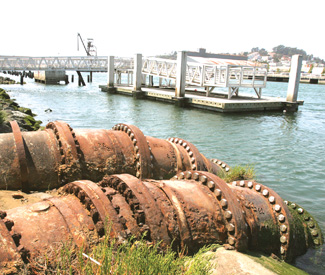
Bayview community organizations have been campaigning for improvement to the sewer system for decades. Webb said some progress has been made in the past few years, including the installation of a pathway at Yosemite Slough Park, part of an effort to restore the wetlands in the area and turn it into a pleasant community space.

Webb was ambivalent about recent improvements. Bayview Hunters Point, like most of San Francisco, has lost much of its African American population during a recent surge in out-migration. According to a 2010 census, San Francisco’s black population has declined by 22.6 percent in the last decade.

“This took too long,” Webb said of the sewer improvement. “I’ve been here 60-something years, my mother worked on this before me. It’s like a joke to me that now everything’s getting fixed up and most of the people can’t enjoy it.”

Residents may still have a to wait for SSIP projects to begin construction. The program will likely span 15-20 years, and is currently in its early stages. “The project is still in design and planning stages,” Walsh said. “It needs to be validated and budgeted. We know it’s going to cost multiple billions of dollars”

Yet Walsh is optimistic that the project will make real change in a sewer system that’s been inadequate for decades. “It’s going to be an impactful project,” she said. “People are going to notice it happening.”

State of the occupations

0

news@sfbg.com, rebeccab@sfbg.com


STUDENTS TARGET THE 1 PERCENT

Another Occupy offshoot sprung up at San Francisco State University Dec. 1 when about 150 students attended a march and rally that culminated at Malcolm X Plaza, now the site of the San Francisco’s newest Occupy camp.

Students symbolically blocked off ATMs, wrapped Chase Bank machines in cellophane and plastered nearby Wells Fargo and Bank of America ATMs with “meet the one percent” flyers profiling wealthy University of California Trustee Monica Lozano and California State University Regent Bill Hauck.

The highlight of the action came when SF State President Robert Corrigan arrived on the scene. The group was using the people’s mic to read a letter addressed to Corrigan, penned by the Occupy SF State General Assembly, demanding that he write two letters. One should be directed to the school’s chancellor and CSU Board of Trustees, “urging them to repeal the 9 percent tuition fee increase” that the board passed Nov. 16, and another should go to “the presidents of every other CSU campus asking them to also contact the chancellor and Board of Trustees regarding a repeal of the 9 percent tuition fee increase.”

Corrigan listened, then participated in a frank question-and-answer session with protesters, urging them to contact Sacramento legislators. Yet he refused to write those letters or declare support for Occupy SF State.

Afterwards, the students returned to Malcolm X Plaza and erected about 15 tents, which organizers said would contain “books, food, and homework help” along with providing shelter for sleeping protesters.


OCCUPY LA MISIÓN

In the Mission, where city officials have been encouraging OccupySF to relocate from its current home in the Financial District, a separate new Occupy effort could be underway.

Organizer Enrique Del Valle says he and other organizers have been distributing flyers and talking to people and organizations throughout the neighborhood. “We’re getting it together to have a General Assembly,” he told us.

The effort is unrelated to the OccupySF General Assembly’s Nov. 29 decision to decline the city’s offer to utilize an abandoned lot at 1950 Mission Street, he added. Before the city made that offer, Del Valle, a community volunteer with connections with many Mission groups, says he was already working on forming a neighborhood occupation.

If Occupy SF had set up shop in the space offered by the city, “We would have worked with them,” he explained, “but set up somewhere else.”

Meanwhile, Mayor Ed Lee and OccupySF are still waiting for one another’s next moves. On the evening of Dec. 1, when San Francisco Police officers surrounded the camp in steel barricades, protesters felt another raid was underway. But they resisted and took down some barricades, causing police to suddenly back down and remove the rest.

“They’ve just been mindfucking us,” OccupySF protester Markus Destin told us. “As soon as they spend all that money breaking us down, we’ll just come back in a week and re-encamp.”

Mayoral Press Secretary Christine Falvey said Lee wasn’t aware OccupySF rejected his offer: “We haven’t heard back one way or another from the group. The offer is still out there and the group has all of the information they need from us. We are awaiting a decision. Mayor Lee has made it very clear to the group that he supports their first amendment rights and their right to assemble, but that overnight camping at Justin Herman Plaza is not an option for the long term because of the health and safety problems it creates.”


OCCUPY AGAINST FORECLOSURE

Community members rallied outside a foreclosed Visitacion Valley home Dec. 1 before moving their protest to the offices of the company that purchased the property.

At 11 a.m., dozens gathered in front of the residence where 75-year-old Josephine Tolbert had lived for nearly 40 years. A day earlier, Tolbert had arrived home with three young grandchildren in tow to find her locks changed. Organizers say the evicted resident needs to access the house to retrieve food and medicine.

The crowd — which included neighbors, friends, and members of Alliance of Californians for Community Empowerment (ACCE), Service Employees International Union (SEIU), OccupySF, and Occupy the Hood — demanded that Tolbert be let back in. According to Bayview resident and self-proclaimed “foreclosure fighter” Vivian Richardson, “They would not let her in to get food, diapers, or her diabetes medicine.”

Tolbert had run a daycare business from her home for 20 years. One of her regular clients, a mother with two young children, arrived during the rally. She was surprised to find that Tolbert was locked out of her home and unable to care for her children that day.

“I want to get in my home so I can resume my business,” Tolbert said. “That’s my occupation there, I don’t have any other way of caring for myself.”

The group then headed to the offices of True Compass Loan Services, LLC, the new owners of Tolbert’s home. About 20 supporters gathered at the Ocean Ave office, where ACCE organizer Grace Martinez singled out True Compass owner Ashok Gujral, who owns a $2.75 million home and multiple restaurants, according to a press release from a group calling itself the Foreclosure Fighters.

“The man is worth $10 million, and he has a bunch of limited liability companies,” said Martinez. “Everyone has been shocked at how this man could do this, he knows she is a senior.”

According to Martinez, Gujral personally refused to let Tolbert into her home Nov. 30. He and others from the company “don’t want her in there because they say she’ll refuse to leave,” Martinez added. Calls to Gujral’s office were referred to attorney Jak Marques, who did not return Guardian requests for comment.

A True Compass representative informed protesters “there’s no one here to talk to you,” then swiftly shut the door. But when a few protesters went around through a side entrance and let everyone else in, the group took their protest to the hallway inside.

They remained there for almost an hour, chanting, pounding rhythmically on the walls, and flooding the office on the other side of a locked door with phone calls, demanding Tolbert be allowed to return to her home to retrieve her medicine and belongings.

Five police officers arrived almost immediately as protesters entered company offices. One explained to the protesters that if they didn’t leave, they would face arrest for trespassing. A heated but measured back-and-forth ensued, in which protesters insisted that if Tolbert was his mother, the officer would feel differently. The officer, Lieutenant C. Johnson, responded, “If it was my mother — I don’t know. I have a house for my mother. But I feel for Josephine, and for the millions of other Americans in the same situation.”

Martinez quieted groans from protesters, replying, “You’re part of the 99 percent, and we’re not going to shoot the messenger.”

Organizers conferred and decided to leave the building voluntarily. Sergeant R. Young, who was also at the scene, told the Guardian, “It’s heartbreaking to do this. Their freedom of speech is a constitutional right that we take a sworn oath to protect.”


THE SEEDS OF A NEW AMERICA?

Does the Occupy movement signify a new beginning for America? Is history repeating itself? Is violence inevitable? These were some of the big questions pondered by a handful of prominent Bay Area writers, thinkers, artists, and activists Dec. 1 during a panel discussion organized by Salon.com.

Dan Siegel, who most recently made headlines for resigning as Oakland Mayor Jean Quan’s legal advisor because he disagreed with her decision to order a police raid of the Occupy Oakland encampment, was a panelist. “The perspective of Mayor Quan and other mayors, besides reflecting the 1 percent, reflects a misguided paradigm,” Siegel said. “The nation’s clearly in an economic crisis that this country has not seen since the 1930s. The mayors should be on the side of the 99 percent. They ought not be the lapdogs of Wall Street.”

Renowned author Rebecca Solnit also participated in the panel discussion. Asked if she thought Occupy symbolized a new beginning, she reflected on the past. “Huge mistakes were made on the left,” in past social movements, she said. “It was supposed to be the revolution, but the women were still expected to make the coffee.” She offered that Occupy represented an evolved manifestation that had benefitted from lessons learned over the years.

“It’s a culmination of decades of refining, searching, and building coalitions,” Solnit said. “It’s the beginning in the sense that summer’s the beginning. We’re reaping the fruit of … what’s been imagined.”

It’s also provided a spark for campus-based organizing. “The Occupy movement has given a tremendous amount of wind to the sails of the student movement and had a consciousness-raising aspect,” said Matt Haney, executive director of the University of California Student Association. “Now they are prepared in a new way to join all of those other folks who are also suffering.”

A key question put to panelists was whether Occupy ought to consider running candidates for office. In response, panelist Melanie Cervantes, an artist and activist, got to the heart of the issue. “What is political power? Is it just representation?” she asked.

Cervantes pointed out that autonomous social movements in Latin America have given rise to leftist political leaders, and she spoke of the past successes of mass-based organizations. “There were things that preceded us generationally, and they worked,” she pointed out. “There’s a lot of different ways people are experienced in trying to change things.”

Panelist Peter Coyote, an actor, activist, and founder of a radical underground group called The Diggers, offered an analogy in response to the idea of Occupy running candidates for office. “If you take a healthy goldfish and throw it into polluted water, it’s gonna get sick,” he said.

Solnit framed her answer as an analogy, too. “We live in a really crummy house with roaches and a leaky roof … Occupy is saying, let’s try to build a better house,” she said. “Our demand is for a better world, isn’t that obvious? We’re building a whole new political vocabulary, a whole new sense of possibility.”

As to the question of whether violence is inevitable as the movement continues to unfold, some panelists discussed nonviolence as a protest tactic, while others focused on the violent behavior of law enforcement officers against protesters. “You don’t hear students talk about using violence,” Haney said. “It’s more like how do we deal with violence that’s being used against us?”

Siegel stressed that the protests ought to be disruptive, yet nonviolent. “The question for our society is, who has the power?” he said. “At the end of the day, we live in a nation state, and people control things. And if they continue to control things, we’re screwed.”


WEST COAST PORT BLOCKADE

Occupy Oakland organizers have been engaged in planning yet another shutdown of the Port of Oakland on Dec. 12, which will coincide with attempts to shut down West Coast ports in San Diego, Los Angeles, Portland, Seattle, Longview, Tacoma, and Anchorage. “On December 12, the Occupy movements in different cities will … effectively shutdown the hubs of commerce, in the same fashion that Occupy Oakland shut down the Port of Oakland on November 2nd, the day of our general strike,” according to a Call to Action on WestCoastPortShutdown.org. “The message to you from Occupy Oakland in the face of police raids and continued disruptions of workers lives by the 1 percent is the following: The Occupy movement will strike back and rise again! We will blockade all of the West Coast Ports on December 12th in solidarity with longshoremen, port workers and truckers in their struggle against the 1 percent!” Steven T. Jones contributed to this report.

Homes for the 99 percent

0

news@sfbg.com

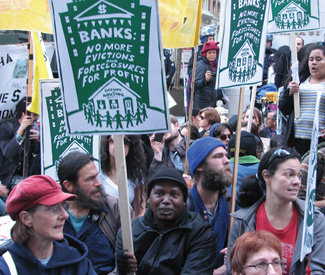
Pressed by foreclosures, evictions, and an economic crisis with the gnawing tenacity of an early winter flu, San Franciscans protested in neighborhoods throughout the city on Saturday, Dec. 3. Marches from four of the city’s most impacted neighborhoods merged in the Financial District to pressure landlords, banks, and what the Occupy movement has dubbed the 1 percent to ease the spreading hardship surrounding housing in San Francisco.

“The 99 percent tenants and homeowners can no longer let the 1 percent banks and real estate speculators destroy our city and our lives so we’re marching in the neighborhoods and on the streets today,” asserted the statement read by the Occupy SF Housing coalition to the crowd gathered in the Financial District. The message echoed through the glass and granite corridors in front of Wells Fargo, passed along in a thousand voices by the now ubiquitous “mic check” style of Occupy crowd communication.

Housing advocates warned that a steady stream of foreclosures, climbing rents, and lagging job opportunities are driving even native San Franciscans out of the city for the relatively affordable housing in the East Bay or forcing them out of the region altogether, transforming the face of San Francisco into an older, whiter, wealthier demographic.

Throughout the economic crisis, San Francisco as a whole has posted lower foreclosure rates than surrounding counties. At first glance, San Francisco, with one in 880 homes facing foreclosure, looks like a safe harbor in the state’s troubled residential real estate market compared with the statewide foreclosure rate of one home in 243, according RealtyTrac. That represents 55,312 residential units across the state. Nationally, one in 563 homes was in some stage of foreclosure as of October 2011, the most recently released numbers.

However, a near absence of foreclosures in affluent, stable, San Francisco neighborhoods like Pacific Heights and Noe Valley hide troubling foreclose rates in the city’s blue collar ZIP codes that far exceed national and statewide levels. In the 94124 zip code that includes the Bayview and Hunters Point, one in 180 homes received foreclosure filings, higher then Oakland’s overall average rate of one in 245 homes — levels that reflect the experience of some of the nation’s most hard hit areas.

Of the 1,513 homes currently listed on the San Francisco housing market, 1,255 were in the pre-foreclosure, auction, or bank-owned stages of the foreclosure process, representing roughly 82 percent of the available housing stock.

At the downtown headquarters of Wells Fargo, Occupy protesters were placing some of the blame for the deepening hardship at the feet of the big banks. According to the Occupy SF Housing coalition, Wells Fargo is the mortgage lender for 226 homes in San Francisco that are in some stage of foreclosure. That represents about 18 percent of the total homes in San Francisco under foreclosure.

In neighborhoods like Hunters Point, these evictions have turned into an economic cascade of household wealth in decline, even for those who have managed to hold onto their homes.

With foreclosures flooding the market, the median sales price for homes in Hunters Point from Aug. 11 to Oct. 11 was $167,500. This represents a decline of 13.2 percent, or $25,500 per home on average, compared to the prior quarter. Sales prices have depreciated 62.6 percent over the last five years in Hunters Point, wiping out equity families have built over years, and leaving those who hang on stuck in underwater mortgages, where their debt far exceeds the value of their home.

“Predatory equity loans make a quick profit (for the lender) at the expense of home owners in the Bayview,” said Grace Martinez of the Alliance of Californians for Community Empowerment (ACCE). “There are 11 homeowners on a two-block stretch of Quesada in default or have already lost their homes.”

While the Obama administration has tried to ease the foreclosure crisis through the federally subsidized Home Affordable Modification Program (HAMP), only a small percentage of people who apply through their mortgage holder for relief under the program receive a loan adjustment. At Wells Fargo, only one in five borrowers applying for HAMP relief have received a loan modification.

Protesters sitting in the streets in front of Wells Fargo demanded that the company establish a moratorium on all foreclosures until it reforms its loan modification practices, halts the eviction of homeowners who have faced foreclosure, and instead offers them a rental option to keep them in their homes — a solution they say will ease the suffering of those caught in the middle of the banking crisis.

The banking and real estate driven economic crash has lead to the largest drop in home ownership nationally since the Great Depression. At the same time that home ownership has become increasingly out of reach for many San Franciscans, increases in rental rates and high competition for rental units are driving out many blue collar San Franciscans from the transit-friendly Mission District, in favor of a generally younger, wealthier, more educated, tech-savvy population.

As rallies took place across the city Saturday in the lead up to the afternoon’s Wells Fargo protest, a group of concerned residents and community groups gathered at 24th and Mission to highlight San Francisco’s other housing crisis — the rental market. The other marches started in the Castro, the Bayview, and the Tenderloin.

Much of the turnover of long-occupied rent controlled housing units in San Francisco comes as a result of the Ellis Act, a state law that allows evictions when an owner’s family wants to move in or when the unit is taken off the rental market. Brenda Nedina’s family is facing an Ellis Act eviction at 874 Shotwell Street.

“I’ve lived in that unit my whole life. My family has lived in the unit for 28 years,” said the tearful, 25-year-old San Franciscan native. “We would love to stay here, but with rents so high, it is not likely that we would find a place in San Francisco.”

Nedina, who works a service industry job at Pier 39, says the economic crisis has made it more difficult for her survive in San Francisco. She has had to cut down her college course load to get by in the tough economy. The troubles will get more complicated if her family is priced out of the city, as critical health services that they rely on are available through their San Francisco residency.

“A lot of people suffer through this as a private problem, but we are making it a public problem, and if the problem belongs to all of us then so does the solution,” said Maria Poblet of Just Cause, hugging a tearful Nedina as she addressed a crowd gathered at 24th and Mission streets.

Latino families like Brenda’s continue to be forced out of the Mission District by rising rent, and less economic opportunity for them in the recession. According to the 2010 U.S. Census, the past decade has seen a 22 percent decrease in the Mission’s Latino population.

“Landlords often abuse the Ellis Act as a way to remove tenants from rent controlled units,” Just Cause organizer Maria Zamudio told the Guardian. “I’m occupying Kaleidoscope free speech zone art space on 24th and Folsom. My slumlord landlord is not down with that mission,” said artist and gallery proprietor Sara Powell, also facing a Ellis Act eviction after pressuring her landlord to address substandard building maintenance issues. Powell’s landlord withdrew a standard eviction process that housing advocates said was unlikely to succeed before launching the Ellis Act eviction.

“With the help off the 99 percent and with right on our side we are going to fight this and we are going to win,” said Powell, whose gallery next door to Philz Coffee is a cornerstone of the neighborhood’s multi-ethnic arts scene. The San Francisco Rent Board has received more than 4,000 petitions to remove rental units from the real estate market since 1999 through the Ellis Act. While Ellis Act evictions have seen some decline during the economic crisis, more Ellis Act evictions are now concentrated in the Mission District, where 40 percent of all Ellis Act petitions are now filed. At the same time, evictions based on breach of lease throughout the city are on track to double pre-recession numbers this year as more and more San Franciscans are have trouble earning enough to keep up with the city’s exorbitant rental rates. According to Just Cause, the average rent for a two-bedroom apartment in the Mission District is now $2,497. “The only way to keep our Chinese, Latino, Arabic, English speaking neighborhood is to fight like hell for our homes,” said Poblet. “Even before Wall Street was occupied, we have been defending this neighborhood. This is the neighborhood of the 99 percent.”

The food divide

4

news@sfbg.com

Antonia Williams is part of a slow, quiet food revolution. After battling obesity for much of her adult life, the 26-year-old lifelong Bayview resident did some research. “I realized it had a lot to do with the food I consumed,” she told us. “As a result of growing up in the neighborhood, I suffer from obesity. I’m overweight because of the lack of options for good healthy food.”

“It’s what I grew up on, McDonald’s and a lot of fried food for dinner,” she recalls. “The grocery stores in the area were very limited in what they offered. I believe my parents weren’t as educated or aware” about health and nutrition.

Williams managed to escape this bad foods trap, change her personal diet, and now works as a “food guardian” for the nonprofit Southeast Food Access (SEFA), helping to bring more nutritious fare to the Bayview.

The complex of challenges Williams faced simply to eat well—the fast food all around her, the dearth of grocery stores, and lack of awareness—reflects the array of systemic barriers to good food that keep tens of thousands of San Franciscans in chronically poor health.

Under the weight of recession and double-digit unemployment, San Francisco’s chronic food divide has grown deeper and wider. From regions of the city like Bayview, Excelsior, and other Southeast neighborhoods, to seniors surviving on marginal fixed incomes, to the city’s swelling unemployed and underemployed who rely on food pantries, access to fresh food is a daily geographic and economic battle.

Roughly one in five San Franciscans each day has no reliable source of adequate sustenance and must scramble for food from soup kitchens, food pantries, or other “emergency” supplies that have become a structural part of the city’s food system, according to the San Francisco Food Bank.

Each month, more than 100,000 families rely on the Food Bank to help feed themselves — nearly double the amount from 2006. Economic recession has dramatically increased the number of city residents using food stamps (known as “CalFresh”) each month, rising from 29,008 in 2008 to 44,185 in 2010.

Yet even that rise belies a far deeper need: only 47 percent of those qualifying for CalFresh are actually accessing benefits, according to a data analysis by California Food Policy Advocates; at minimum, more than 40,000 additional city residents are entitled to get this help, and thus eat better.

Across the city, parallel economic and food divides compound one another, spelling serious trouble for people’s basic nutrition and health — in turn depleting their energy, cognition, and ability to do everything from succeeding in school to getting a job.


BEYOND GROCERY STORES

In Bayview, where poverty and unemployment run about double citywide averages, these geographic and economic food divides come to a head. District 10, encompassing Bayview/Hunters Point (BVHP), features some of the city’s most grocery-impoverished neighborhoods, and has the highest rates of CalFresh usage.

This confluence of lack and need—compounded by a prevalence of fast food and liquor stores over fresh food offerings—has inspired Antonia Williams and other residents to fight for better food in their neighborhoods.

As one of four paid Food Guardians for SEFA, Williams spends about 20 hours a week examining grocery store shelves in Bayview, talking with consumers and food retailers, and educating both about the need for more fresh non-processed foods.

One recent victory: armed with customer survey data, she convinced the Bayview Foods Co. to stock low-sodium tomato paste. Next on Williams’ food improvement list is getting more low-sodium products, less cholesterol, and more fiber on the shelves.

These may sound like small steps, but they’re part of a larger effort to get healthier food in Bayview, where chronic diseases such as obesity, diabetes and heart disease are rampant. “I think a lot of people just don’t know the link between the food we are eating and these chronic diseases,” says Williams.

The Bayview is among the city’s most food-deprived districts, with just 63 percent of residents living within a half-mile of a supermarket (in Excelsior, it’s 57 percent), compared with 84 percent citywide. That ratio improved somewhat with the arrival this August of Fresh & Easy supermarket on Third Street, but access to fresh produce remains limited — a situation that numerous studies show contributes greatly to chronic undernourishment and disease.

Indeed, statistics show Bayview area residents suffer by far the city’s “highest rates of everything negative,” as former district supervisor Sophie Maxwell puts it: obesity, diabetes, heart disease, and cancer.

Ironically, the Bayview’s Third Street is home to the city’s bustling produce warehouses, which rattle early every morning with trucks and crates full of fruits and vegetable, “but you have to go out of the district to get it,” says Maxwell, who helped spearhead a Food Security Task Force while in office. “I was very much aware of [the food access problem] because of what I had to do to get food myself.”

Much of Third Street remains a boulevard of liquor stores and fried and fast food. According to Tia Shimada of California Food Policy Advocates, “A lot of what we see instead of food deserts is food swamps, where the amount of healthy nutritious food available is overwhelmed by all the fast food and junk food.”

Despite a seemingly diverse landscape of food businesses, “There’s a saturation in neighborhoods with unhealthy choices,” SEFA’s Tracey Patterson argues. “When the cheapest choice in front of you is fatty comfort food and fast food, that’s what you get accustomed to eating. The easier options quickly become habit.”

Kenny Hill, a 23-year-old food guardian and Bayview resident, puts it like this: “What we have in our community, that’s what we eat.” But he says history and culture play a role, too. “We need to change the culture of what’s considered good…Growing up eating salad, people would say, ‘Why are you eating that? That’s white people’s food.'”

In other words, it takes more than getting a grocery store—which itself involved a nearly 20-year struggle for Bayview residents and leaders. “Food access is just one part of the issue. Even if you get a grocery store, that doesn’t solve the problem,” says Patterson, whose group, SEFA, espouses “three pillars” to fix the area’s food problems: more grocery stores; education and health literacy; and expanded urban agriculture. “None on their own is enough.”


HUNGER CROSSES LINES

Getting a job isn’t enough either, statistics show. A recent study by the USDA cited by the Food Security Task Force shows that 70 percent of families nationwide with “food insecure” children have at least one member working full-time. And in San Francisco, the task force found, “39 percent of the households that receive weekly groceries through the SF Food Bank include at least one working adult. Only 18 percent of clients are homeless.”

At least by federal definitions of poverty, food insecurity isn’t just for poor people anymore — particularly in San Francisco, where exorbitant housing and other costs compound people’s struggles to meet their food needs. “If you just look at the poverty level, you’re missing a lot of people who are struggling to make ends meet,” says Colleen Rivecca, advocacy coordinator with St. Anthony’s Foundation. “Hunger and health and housing are so interconnected.”

Indeed, while the Federal Poverty Level for a family of three is $18,310, cost-of-living research by the INSIGHT Center for Community Economic Development found that in San Francisco, this family would need almost $40,000 more than that to make ends meet.

Rivecca says the ongoing recession is simultaneously deepening the food divides and undermining efforts to address it. For instance, SSI recipients must make do with $77 a month less than they got in 2009, while California is the only state where SSI cannot be supplemented by food stamps.

According to the Food Security Task Force, San Francisco “has an inordinately high number of residents who are elderly, low-income and/or blind and disabled — over 47,000 residents receive SSI.” Many are homebound, socially isolated, and living in SRO units without kitchens, and no means of preparing their own food. So it’s no surprise that these same people, who need help the most, often get it the least.

Due to “misconceptions about what qualifies,” says CFPA’s Kerry Birnbach, only 5 percent of Californians eligible for Social Security participate in CalFresh. “Senior citizens are more isolated, and the more isolated you are, the less likely you are to know about it.” Birnbach says that leads to lower nutrition, less energy, and greater hospitalization rates. “It’s not having food on the table — choosing between food and medicine.”

A 2006 study by the San Francisco Department of Aging and Adult Services found that while the city’s elders “received approximately 12.2 million free meals through all of the programs in the City including food pantries, free dining rooms, and home delivered meals, the gap between the number of meals served and the number of meals needed was somewhere between 6 [million] and 9 million meals annually.”


BAND-AID FOOD SYSTEM

As television cameras made clear on Thanksgiving, there’s no shortage of food and meal giveaway programs, soup kitchens run by churches and nonprofits — a whole constellation of ad hoc benevolence spread across the city. But this kind of “emergency food assistance” has become a structural part of the city’s dietary landscape.

Another main ingredient in the city’s food infrastructure is seemingly cheap fast food, which for many poor people becomes the diet of first and last resort. Sup. Eric Mar recalls meeting with teenage mothers and hearing one parent speak about dumpster diving at McDonald’s for what she called “fancy dinner.”

“The cheapest possible food like McDonald’s is seen as a luxury,” says Mar, who last year passed legislation preventing fast food chains from selling kids meals with toys unless they improved their nutrition content. “Poor people rely on whatever’s out there, and when McDonald’s or Burger King sells cheap, it undercuts families’ efforts to get healthy.”

District 10 Sup. Malia Cohen sees the impacts of fast food and junk food every day in Bayview. “There is no infrastructure out there to de-program people” from long-standing fast food habits. “I don’t fault people for eating fast food, but I do want them to think twice and know they have a choice.”

So what is the choice, and how will the city address its deep food divides, which cut across geographic and demographic lines?

So far, it’s a patchwork project. As one step, the supervisors in April passed a new zoning ordinance designed to encourage more urban food production. In Bayview, Cohen says, “We’re looking at urban agriculture as something that’s viable” to feed low-income residents.

Despite the arrival of Fresh & Easy, BVHP remains a critical flashpoint for the food security fight. Markets for fresh produce are few and far between. In 2006 the Department of the Environment teamed with Girls 2000 and Literacy for Environmental Justice to create the Bayview Hunters’ Point Farmers Market, but for a variety of reasons, the customer base wasn’t sufficient for farmers to keep selling there, and the project stalled. Now there is talk of reviving a farmers market in the area.

But for larger, more structural change to take hold, Mar argues, the food gap “has to be a citywide goal and priority.” And, he notes, bigger forces — notably agribusiness lobbies and congressional agriculture committees — make local progress more difficult. “It’s hard because the Farm Bill allows these food companies and commodity groups to keep their prices lower, and small businesses and producers have a hard time keeping their prices low,” encouraging more fast food and obesity and other diet-related diseases.


GREEN GLIMMERS

On a chilly gray late afternoon the day before Thanksgiving, we met with Patterson, Williams, and two other food guardians at Bridgeview Community Garden on the corner of Newhall and Revere in Bayview. Perched on a small chunk of slope overlooking houses and freeway traffic, the plot offers a thriving little harvest of tomatoes, kale, leeks, basil, and other vegetables and herbs. It’s not a lot of food, but along with other nearby agriculture, such as Quesada Gardens and the larger Alemany Farm, it helps bolster residents’ weekly dose of fresh produce.

Equally important, it gives budding food activists like Antonia Williams and Kenny Hill reason to believe things can change. After yanking a healthy crop of leeks from the soil, fellow food guardian Jazz Vassar, 25, notes, “There are a lot of community organizations doing good work here. We have high hopes to change things.”

Even as they work to nourish a different food future, the food guardians are acutely aware of the jagged rocks and stubborn old roots that need to be cleared. Asked what the city should do about Bayview’s many-layered food struggles, Hill responds: “Realize there is a problem in Bayview, and allocate resources here. There are statistics that this is a food desert, there are high rates of crime—people have to wake up and see that people here have been disenfranchised.”

It’s not about having the city do it for them, says Hill. “Give us something to latch on to so we can help ourselves.”

Former Bay Guardian city editor Christopher D. Cook is the author of Diet for a Dead Planet: Big Business and the Coming Food Crisis.

Alerts

0

alert@sfbg.com

WEDNESDAY, NOV. 30


Protesting Muni firings

Transport Workers Solidarity Committee hosts a press conference to highlight Muni operators who have recently been fired. The group claims SF politicians, the MTA, and the current Transit Workers Union Local 250A leaders are culpable in unfair and unjustified dismissals. TWSC — with support from the NAACP and United Public Workers for Action — says it hopes to spur the TWU to speak out against unfair contracts and bosses.

11 a.m., free

San Francisco Chronicle 5th & Mission, SF

415-867-3320

www.transportworkers.org


Occupying foreclosed homes

Occupy Santa Cruz is taking opposition to the 1 percent a step further. Congregate and picket in front of corporate banks in downtown Santa Cruz to show contempt for unfair capitalistic practices. A march toward the foreclosed homes in Santa Cruz will protest against banks and highlight how many properties are left empty and unused despite many citizens who struggle to find affordable shelter.

2-6 p.m., free

Meet at the Courthouse on Water Street March to banks at *:30 p.m.

www.occupysantacruz.org


SATURDAY, DEC. 3


OccupySF Housing

OccupySF Housing, a coalition comprised of the Housing Rights Committee, OccupySF, Asian Law Caucus, San Francisco Tenants Union, Eviction Defense Collaborative, Tenants Together, and other groups leads a protest to protect San Franciscans from predatory banks and landlords who degrade the 99 percent’s access to affordable housing. The protest will highlight equity loans designed to turn a fast profit at the expense of homeowners and illegal evictions financed by big banks and their role in contributing to the city’s affordable housing crisis. Delegations from four of the most affected SF neighborhoods will converge on the banks most responsible for foreclosures in the city.

11 am, 3rd and Palou (Bayview)

Noon, Market and Castro (Castro)

1 p.m., Mission and *4th (The Mission)

1 p.m., Civic Center (Tenderloin)

March will end @ 3 p.m. in Justin Herman Plaza

Contact Amitai Heller at 415-971-9664

amitai@sftu.org

SUNDAY, DEC. 4


Occupy Oakland Self Defense

Occupy Oakland ensures that the 99 percent can protect itself. Girl Army spearheads community development as a self-defense collective, run through Suigetsukan Dojo, a nonprofit martial arts school in Oakland. Women and queer people are especially welcome, but the class is also geared toward those who are occupying foreclosed homes and camping in protest of the 1 percent.

1-2:30 p.m., free

Oscar Grant Park/Frank Ogawa Plaza, Oakland

Meet at North Plaza near the flower shop

Contact Melissa at girlarmyoakland@gmail.com

www.girlarmy.org

Mail items for Alerts to the Guardian Building, 135 Mississippi St., SF, CA 94107; fax to (415) 437-3658; or e-mail alert@sfbg.com. Please include a contact telephone number. Items must be received at least one week prior to the publication date.

Dickens and drag queens and dreidels (oh my!)

0

culture@sfbg.com

HOLIDAY GUIDE 2011 You know what would be a good present to yourself this holiday season? Some ankle weights. Imagine all the almond cake and vegan eggnog you’ll have shoved into your belly by this time next month, you soon-to-be-less-svelte snowy sexpot. Not into approximating a house arrest prisoner? How about pledging to run about to as many as the Bay’s holiday hotspots as possible this year — you’ll be a Kwanzaa cutie in no time a’tall. And with such jingling gems — from costume fairs to drag queens in Union Square and free chamber orchestra performances — you’ll come out on the other side (2012) cut and cultured. 


Union Square iceskating rink Good news for nervous wall-grabbers and double axel spinners alike: the holiday ice rink is back at Union Square. Cue icicle lights, grand romantic gestures, and seizing onto strangers for suddenly-needed support.

Through Jan. 16. 10 a.m.-11:30 p.m. except for when closed for private parties, $10 for 90-minute session. Union Square, SF. www.unionsquareicerink.com


Great Dickens Fair Before Harry Potter and Kate Middleton transformed young Americans into full-blown Anglophiles, a whole different conception of Britain flourished stateside: the Dickensian version, replete with scones and hot toddies. Walk off your burgeoning middle with a jaunt through the Cow Palace’s temporary lamp-lit alleys.

Saturdays and Sundays through Dec. 18, 11 a.m.-7 p.m., $25. Cow Palace, 2600 Geneva, SF. www.dickensfair.com


“The Best Time of Year” SF Symphony Christmas special concert The San Francisco Symphony and Chorus exhale classical Christmas picks and carols to a fully-bedecked Davies Symphony Hall.

Nov.30-Dec.1, 8 p.m., $25–$68. Davies Symphony Hall, 201 Van Ness, SF. (451) 864-6000, www.sfsymphony.org


Working Solutions holiday gift fair Showcasing San Francisco businesses assisted by Working Solutions’ micro loan programs, this fair lets shoppers pick up everything from Bernal Heights-wrought knives to chunks of Mission-crafted chocolate.

Dec. 1, 5-8 p.m., free. 101 Second St., SF. (415) 655-5433, www.tmcworkingsolutions.org


The Golden Girls: The Christmas Episodes Trannyshack takes on the blue-haired wonder that was The Golden Girls in a glitzy, raucous yearly San Francisco tradition.

Thursdays, Fridays, and Saturdays Dec. 1-23, 8 p.m., $25–$30. Victoria Theater, 2961 16th St., SF. www.trannyshack.com


A Christmas Carol There’s no better way to get in the mistletoe mood than to watch old Ebenezer slowly thaw out his icy, pinched heart in the Deco glory of the ACT Theatre.

Dec. 1-24, 7 p.m., $20–$75. American Conservatory Theatre, 415 Geary, SF. (415) 749-2228, www.act-sf.org


Holiday tree-lighting ceremony Jack London Square becomes a Bay-side holiday crèche two hours with live reindeer, snow, wintry tunes, and a tree-lighting to launch the flurry of the holidays.

Dec. 2, 5-7 p.m., free. Jack London Square, Oakl. www.jacklondonsquare.com


Oakland-Alameda Estuary lighted yacht parade How can yachts parade, you ask? With style, we answer — East Bay boat owners trick out their vessels with festive lights visible from the shore.

Dec. 3, 5:30 p.m., free. Visible from Jack London Square, Oakl. www.lightedyachtparade.com


Fantasy of Lights celebration ‘Tis the season for brilliant night-time lights, and Union Street will not be an exception. Stately Victorians provide the glowing background for a holiday gathering featuring everything from a monkey to Santa and his elves.

Dec. 3, 3-7 p.m., free. Union between Van Ness and Steiner, Fillmore between Union and Lombard, SF. www.sresproductions.com


San Francisco Forest Choir Imagine yourself in a snowy Narnia glen, the Forbidden Forest, or roaming through the woods with Hansel and Gretel to the music of the San Francisco Forest Choir, an all-female group who sing in Japanese and English at the Western Addition library.

Dec. 3, 3-4 p.m., free. Western Addition branch library, 1550 Scott, SF. (415) 355-5727, www.sfpl.org.


Sharon Art Studio winter pottery and craft sale Thousands of gleaming pieces are up for sale by this staple of the Bay Area craft scene; lug your loot home and get your bicep curls out of the way for a week.

Dec. 4, 11 a.m., free. Sharon Art Studio, Children’s Playground, Golden Gate Park, SF. (415) 753-7005, www.sharonartstudio.org


SF Chamber Orchestra holiday family concert Circus Bella and the SF Chamber Orchestra team up for a strangely compelling holiday pairing: clownish acrobatics set to the strains of classical music.

Dec. 4, 3-4 p.m., free with RSVP. Bayview Opera House, 4705 Third St., SF. (415) 824-0386, www.bayviewoperahouse.org


Gourmet Ghetto’s snow day For those Bay citizens unfamiliar with the bliss of a true snow day, the Gourmet Ghetto’s version provides a superior version to the rest of the country’s admittedly frigid ones: real snow, yes, but also crafting, hot cocoa and cookies, a Snow Queen, and the warmth of community.

Dec. 5 10 a.m.-3 p.m., free. Andronico’s parking lot, 1550 Shattuck, Berk.; 1-4 p.m., free. M. Lowe and Co., 1519 Shattuck, Berk.; Noon-4 p.m., free. Twig and Fig, 2110 Vine, Berk. www.gourmetghetto.org


“Winter in the Wineries” Sixteen wineries will stamp your passport for a two-month period starting December 2, enabling you to enjoy unlimited tastings, tours, and meet-and-greets throughout Napa Valley.

Various locations and times, Calistoga. www.calistogavisitors.com. $50 for one passport ticket


Palestinian Craft Fair Straight from the hands of Palestinian artists and craftspeople: olive oil-based soap, embroidery, glassware, ceramics, books, honey, and Dead Sea products sold to benefit their makers an ocean away.

Dec. 4, 10 a.m.-4 p.m., free. Live Oak Park, 1301 Shattuck, Berk. (510) 548-0542, www.mecaforpeace.org


“Songs and Harps to Celebrate the Holiday Season” Harpists of the Bay, unite! The young pluckers of the Bay Area Youth Harp Ensemble join the Triskela Celtic Harp Trio to perform holiday pieces from around the world. Singing along is not only encouraged but expected.

Dec. 6, 6 p.m., free. Main Library, 100 Larkin, SF. (415) 557-4400, www.sfpl.org


“Drag Queens on Ice” Break out your very best glitz for a night spent skating next to legions of SF’s drag personalities. A 9:30 p.m. performance by the queens in question ends the evening.

Dec. 8, 8 p.m., $10 for 90-minute session. Union Square, SF. www.unionsquareicerink.com


“A Very Shut-Ins Xmas” The vanguard leaders of the “hulabilly” sound, the Shut-Ins return with a Christmas show to benefit San Francisco’s Legal Assistance to the Elderly.

Dec. 8, 5:30-8 p.m., $20. 50 Mason Social House, 50 Mason, SF. (415) 538-3333, www.laesf.org


Golden Gate Park tree lighting Golden Gate Park’s hundred-foot Monterey cypress (shouldn’t it have a name by now?) transforms into a light-bedecked behemoth for the 82 year.

Dec. 8, 5 p.m., free. McLaren Lodge, 501 Stanyan, SF.


La Cocina gift fair Its cryptic but tasty-sounding “tamale alley” should provide enough of a draw, but La Cocina’s gift fair also promises local vendors selling organic olive oils, handmade pasta, and mushrooms nourished by recycled coffee grounds. Pretty easy to stomach.

Dec. 9, 5-9 p.m., free. Mission Cultural Center for Latino Arts, 2868 Mission, SF. www.lacocinasf.org


Winter Wunderkammer holiday art sale The most you can spend here on one item is 50 bucks, the least a dollar. Accompanied by spiced wine and tunes, small-format works from local artists are on sale. Proceeds from this walk-in curio cabinet benefit The Lab and participating artists.

Opening party Dec. 9, 6-11 p.m., free. Also Dec. 10, 11 a.m.-4 p.m., free. The Lab, 2948 16th St., SF. (415) 864-885, www.thelab.org


California Revels Ah, the revels. This year, the interactive period presentation will sit you smack down at the Round Table. Dance and sing, young knight — no one’s mocking you at this costume-heavy conclave.

Dec. 9-11, 16-18; Fri. 8 p.m., Sat. and Sun. 1 p.m. and 5 p.m., $19-52. Scottish Rite Theater, 2850 19th Ave., SF. (510) 452-8800, www.californiarevels.org


SF Ballet’s Nutcracker Even with its lampoonable name, the Nutcracker remains a incomparable date choice for its lush costumes, fantastical storyline, and ability to trigger childhood flashbacks.

Dec. 9-25, various times, $25–$285. War Memorial Opera House, 301 Van Ness, SF. (415) 865-2000, www.sfballet.org


Misfit Toy Factory For one evening, artists cobble together sculptures, toys, and gifts under one roof to the beat of DJ Yukon Cornelius. Items are sold at the end of the evening for a fixed price of forty dollars.

Dec. 10, 7-10 p.m., free. Root Division, 3175 17th St., SF. (415) 863-7668, www.rootdivision.org


The Revolutionary Nutcracker Sweetie A radical alternative to the holiday classic, Dance Brigade’s version features Clara, an undocumented worker, a homeless Sugar Plum Fairy, and an angel of resistance.

Dec. 10, 2 p.m. and 6 p.m.; Dec. 11, 1 p.m. and 5 p.m., $15–$17. Brava Theater, 2781 24th St., SF. www.dancemission.com


Hanukah festival of light Geared towards the younger set and their handlers, the JCC East Bay’s festival of light features storytelling, menorah making, dreidel games, and a concert by Isaac Zones, a mainstay in the Bay’s Jewish music scene.

Dec. 11, 10 a.m-2 p.m., $5. JCC East Bay, 1414 Walnut, Berk. www.jcceastbay.org.


“Holidays: Christmas, Chanukah, and Other Festive Celebrations” lecture Library docents present an examination of paintings from around the world dealing with everyone’s favorite subject: the giving, feasting, and receiving endemic to the holiday season.

Dec. 14, 6:30-7:30 p.m., free. Glen Park branch library, 2825 Diamond, SF. (415) 355-2858, www.sfpl.org


Mechanics’ Institute holiday gift and poster sale The staggeringly lovely Mechanics’ Institute hosts a large sale of hard-cover and paperback books, gifts, and posters straight from its library.

Dec. 15, 4:30-6:30 p.m., free. Mechanics’ Institute, 57 Post, SF. (415) 393-0100, www.milibrary.org


Holiday youth mariachi concert Three zestful youth mariachi bands perform traditional Mexican holiday music, providing an energizing segue into a sometimes exhausting season.

Dec. 16, 7:30 p.m., $10. Mission Cultural Center for Latino Arts, 2868 Mission, SF. (415) 643-2785, www.missionculturalcenter.org


Holiday Memories double feature Head back to the times of toboggans and candle-lit windows with two short films recounting rural winters of yesteryear. A Child’s Christmas in Wales visualizes Dylan Thomas’ Welsh childhood; The Sweater animatedly recounts Roch Carrier’s Quebecois, hockey-centered upbringing.

Dec. 17, 2 p.m., free with $15 museum admission. The Exploratorium, 3601 Lyon, SF. (415) 561-0360, www.exploratorium.edu


Renegade Craft Fair holiday market For the third year and showcasing more than 250 makers and craftspeople, the Renegade Craft Fair’s holiday happening can be a bit overwhelming. But it’s an undeniably great answer to gifting woes: pick up jewelry, body products, paper goods, clothing, and way, way more, all DIY enough to satisfy your most loca-ttired friend.

Dec. 17-18, 11 a.m.-6 p.m., free. Concourse Exhibition Center, 635 Eighth St., SF. www.renegadecraft.com


Reclaiming Yule ritual It may be chilly outside, but Sebastapol’s midwinter celebration (led by Starhawk, a leader in Bay Area earth-based spirituality) is indoors and full of warmth-inducing activities, namely dancing in honor of the Earth and Sun.

Dec. 18, 6:30 p.m., $7. Sebastopol Community Center, 390 Morris, Sebastapol. www.reclaiming.org


Solstice Eve celebration With a bonfire and roles doled out to participants (rocks, trees and mists), celebrating the longest night of the year on Ocean Beach is actually rather toasty. Bring items to release into the transformative fire — love letters are just the starting point.

Dec. 20, 3:30 p.m., free. Ocean Beach at Taraval, SF. www.reclaiming.org


Bill Graham menorah lighting The lighting itself takes place at 5 p.m., but the hours-long run-up is by no means lacking: traditional Jewish music, arts and crafts, and menorahs for every child fill Union Square starting at 3 p.m.

Dec. 20, 5 p.m., free. Union Square, SF. www.chabadsf.org


Kujichagulia celebration Kwanzaa’s day of personal definition and expression comes to City Hall, followed by a candle-lighting ceremony and dinner at Gussie’s, known for its fried tasties, red velvet cake, and Southern sweet tea.

Dec. 27, noon, City Hall, SF., 6 p.m., Gussies Chicken and Waffles, 1521 Eddy, SF. www.kwanzaasanfrancisco.com


Ujima celebration On Ujima, the third day of the week-long Kwanzaa holiday, community members gather to celebrate a collective spirit of responsibility and work.

Dec. 28, 3-6 p.m., free. Bayview Hunters Point YMCA, 1601 Lane, SF. www.sfpl.org


Keeping Score: Ives Holiday Symphony screening Unrecognized at the time of his death, experimentalist composer Charles Ives labored over his Holiday Symphony, which now gets fitting recognition by the San Francisco Symphony in a library concert that follows an hour-long documentary on the man.

Dec. 29, noon, free. Main Library, 100 Larkin, SF. (415) 557-4400, www.sfpl.org


Kuumba celebration Fittingly, the main San Francisco celebration of Kwanzaa’s Kuumba (day of creativity) occurs in the Jazz Heritage Center, a space shared by musical hotspot Yoshi’s. Celebrate the Fillmore’s manifold musical virtuosos on the last day of the year.

Dec. 31, 1-5 p.m., free. Jazz Heritage Center, 1330 Fillmore, SF. www.jazzheritagecenter.org

SFPD allows OccupySF to grow into a tent city

14

Photos by Steven T. Jones, who also contributed to this report.

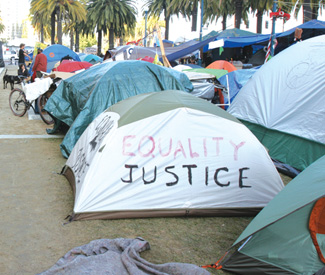
It seems the San Francisco Police Department is laying off the OccupySF encampment, at least for now. After top city officials sent mixed messages to the occupiers during a pair of high-profile hearings in City Hall this week, a full-blown tent city with working kitchen and medical tent has now been erected in Justin Herman Plaza.

During the Board of Supervisors meeting on Tuesday, Mayor Ed Lee voiced support for the movement’s message, but said that tents, tarps, and cooking in the plaza or in OccupySF’s presence on the sidewalk in front of the Federal Reserve wouldn’t be tolerated.

A string of protesters testified against the policy and the two recent police crackdowns, which was also criticized by John Avalos and other progressive supervisors who are working on a legislative solution to the standoff. But at the Police Commission hearing the next night, Police Chief Greg Suhr seemed to announce that police would stand  down and allow the encampment to continue.

Protesters packed the meeting and disrupted the proceedings with chants of “SFPD where is your humanity” and accusations of police brutality at several recent raids of their camp. Many representatives made public comments condemning police brutality and repression of the protests, and many speakers also connected it with a broader problem of police harassment, notably in Bayview-Hunters Point.

Said OccupySF protester Christopher Ray: “Obama himself does not have the right to come tell us to stop, to tell us to take down our tarps, to tell us we can’t eat, to cook food, to sleep there. Period. You would have change the Constitution of the United States in order to do that. We’re not leaving.”

By the end of the long meeting, Suhr expressed support in what seemed like a promise to OccupySF: “We have no future plans to go into the demonstration. We know that it’s for the long haul. We did work, or, I’m told that we were trying to work all day Sunday to take down the tarps and the structures. We did meet last week and I did provide a written notice that’s been provided wholesale since down there. We realize that this movement could go on indefinitely, and as such, I’m actually working with the Mayor’s Office personally to put the port-o-potties and the handwashing stations down there to provide sanitation. I don’t know that anybody’s doing that. And in other towns where this movement has grown and is very large, they’re already experiencing things like dogs that have bitten people, rats, sanitation issues, the lack of running water so I can assure you that our efforts are to keep it safe and to facilitate the First Amendment demonstration.”

His statement was meant with a cry of “Now that’s what I’m talking about!” and thunderous applause from the chamber, and the OccupySF movement has interpreted the remarks as permission for the encampment to continue without further police harassment. Guardian calls to the SFPD Public Affairs Office to clarify the policy have not yet been returned.

By last night, the encampment’s numbers and infrastructure had grown — with a kitchen producing group dinners and new tents being added throughout the evening — and there seemed to be only a cursory police presence. Many protesters were essentially declaring victory, telling the Guardian that the numbers only grew after each police raid, expressing hope that the city has now had a change of heart. 

This comes after a rocky history of SFPD relations with the protest. On October 5, police issued a notice requiring all tents at the encampment to be removed. Protesters complied, but police still moved in, confiscated all the protest’s materials, and ended up making one arrest in the ensuing altercation. Since, OccupySF has mostly refrained from erecting any structures; instead, the growing numbers, now an average of 200 per night, sleep on the sidewalk. When they put up two tarps when weather turned rainy on Sunday the 16th, the result was another nighttime police raid, this time with five arrests and several injuries to demonstrators.

Yet the next morning, protesters had strung up more tarps.  And in the past few days, many have pitched tents. Now, tents number over 40, and the police are yet to raid.

On Thursday, California Nurses Association and the National Nurses Association worked with OccupySF’s medic team to set up a medical tent. The tent has been sorely needed for a while, but it is only recently that supporters of the protest felt safe creating it.

When the tent was put up, police came and circulated a notice that had been issued on Oct. 1 stating, “Tents, overhead tarps, and/or wooden pallets are not to be within the demonstration area unless appropriate permits are obtained because of the potential hazard they present.” But police exited without attempting to enforce this notice, and as of now the medical tent, complete with a cot and a growing stock of supplies, is still in place.

Said Pilar Schiavo, an organizer with CNA who has been working with OccupySF: “We were able to provide treatment to a bunch of occupiers today.” She says there are many at OccupySF with no other access to health care besides the new tent. “It’s just basic first aid so far, but a little goes a long way here. One had a broken finger from Sunday’s raid.”

Schiavo says when they set up the tent early Thursday morning, protesters Tweeted, Facebooked, and otherwise put out calls for needed medical supplies. Shiavo was proud to report that “supplies started showing up an hour later.”

Just a short BART ride away, city officials in Oakland have accommodated Occupy Oakland and it has grown into a large tent city with ever-improving infrastructure and organization. Perhaps OccupySF is now headed down the same path.

Spike salute: Showing love for Mission High volleyball team

3

When head coach Geraldine Poon and assistant coach Kris Thomas got involved with Mission High School’s volleyball program two years ago, their goal was to significantly improve the team’s attitude on the court and in the classroom. They did. 

The young women on the team made such strides on and off the court, in fact, that Thomas got in touch with the Guardian to ask if we could show them some love. We would love to!

“Over the years our student athletes have really put in tons of effort and it really does show,” Thomas told the Guardian in an email. This year has been the strongest start of a season in the history of Mission High School’s volleyball program with a 5-1 record.  

When Poon and Thomas came aboard as the team’s coaches, they started teaching skills that had nothing to do with volleyball. The two thought that for this team, communication skills were more important. The 12 girls on the roster learned how to offer constructive criticism, how to identify a problem and fix it, how to be supportive of their teammates, and how to play with composure and poise. Their new set of skills improved their playing and their schoolwork. 

Most of Mission High School’s student body is made up of students who know or are learning English as a second language and live in underprivileged neighborhoods such as Bayview, Hunters Point, Fillmore, and the Tenderloin. The school is not known for high levels of academic achievement, but the volleyball team has improved its GPA from 3.06 in 2008 to 3.65 in 2010. Many of the girls received straight A’s. 

On the court, the girls have shown a great amount of improvement as well. Middle blocker junior Leonida Radford has been dominating at the net in kills and blocks, totaling 27 kills for the season. 

Thomas offered specific commendations for many of the young women. He expects co-captain and outside hitter sophomore Katie Regalia to continue to post big numbers for the team in kills, digs and aces. She totals 137 service aces and 62 assists for the season. “She is by far the biggest asset to the team,” Thomas wrote. “[Her] undying effort and sheer selflessness …She is the glue that holds the team together.”

Sisters seniors Tianna, middle blocker and Nailafou Mitchell, outside hitter have significantly improved their grades and have both boasted a formidable offense when attacking. “They both had a rocky start to the season, but have both made major adjustments and are also huge assets to the team,” Thomas wrote. 

Coaches also commended junior captain and setter Michelle Li for the way she rallies and holds her teammates responsible. 

Despite its success, the team still has to deal with challenges they have no control over: it’s had to wear the same uniforms for three years and there is no funding to purchase new ones. “Some of the uniforms have holes in the sleeves and are worn and discolored,” Thomas wrote. But that doesn’t discourage the girls when playing volleyball powerhouse high schools like Washington, Lowell, or Lincoln.

There is still a month of games left on their schedule, but next Tuesday is the team’s last home game. “We have full confidence in making playoffs this year,” Thomas wrote. “In fact, I think it would be quite a disappointment if we don’t. A championship would be the proverbial icing on the cake.”


SF’s foreclosure crisis

0

OPINION Foreclosures are still ravaging San Francisco neighborhoods.

As steward of the city’s property roll and head of the department that appraises every home in San Francisco, I see every day the toll the mortgage crisis is having on real estate values and the city budget.

Thousands of Notices of Default have been filed with my office in the last few years, and every Monday there’s a vivid reminder San Francisco is far from out of the woods on foreclosures as homes are auctioned off on the steps of City Hall.

Two Mondays ago, lifelong Bayview-Hunter’s Point resident Curtis Warren’s home — which my office assessed to be worth $165,000 — was scheduled to be auctioned because he had fallen behind on a $15,000 debt.

Imagine having your home foreclosed upon over a loan less than 10 percent of the value of the property. Imagine a family in your neighborhood being put on the street and a home in your community sitting vacant under such circumstances.

Fortunately, the foreclosure sale of Curtis’s home was canceled. Curtis is a member of the Alliance of Californians for Community Empowerment (ACCE) — a grassroots organization working to help victims of the mortgage meltdown.

Unfortunately, cases like Curtis’s are all too common. That is why I am fighting foreclosure as your Assessor-Recorder and working to get Sacramento to act, too.

ACCE recently published startling findings in their “The Wall Street Wrecking Ball” report.

San Francisco homeowners are estimated to lose $6.9 billion in property values as a result of foreclosures.

Foreclosure costs San Francisco government an estimated $42 million in lost revenue.

Local government spends an additional $19,229 on increased safety inspections, police and fire calls, and trash removal and maintenance for every foreclosure. This costs San Francisco $73 million.

San Francisco LITERALLY cannot afford this foreclosure crisis, which is why I have joined with Supervisors John Avalos, Malia Cohen and Ross Mirkarimi in support of the following plan of action:

A foreclosure fee to ensure banks pay their fair share: The city should charge a $10,000 to $20,000 fee per foreclosure to defray loss of home values and costs to taxpayers. This fee would raise roughly $2 billion to $4 billion over the next year to partially reimburse local governments.

A strong AG settlement. Any agreement between banks and the 50 attorneys general must include 1) a monetary settlement commensurate with the harm caused by banks; 2) limited release of bank liability; 3) principal reductions fairly distributed to communities hardest hit by predatory lending and foreclosure; and 4) homeowner restitution for irresponsible and illegal foreclosure practices.

Stop preventable foreclosures: The city should require court-based mediation programs to help homeowners modify loans and end the “dual track” process, whereby banks continue foreclosure proceedings while simultaneously negotiating loan modifications.

Wall Street must pay for foreclosure-related blight: Banks must maintain and pay for the cleanup of blighted, vacant homes in neighborhoods.

As long as our economy and housing market is being hampered by foreclosures caused by banks and Wall Street, we must continue to fight for common-sense solutions that protect our neighborhoods and the city.

Phil Ting is assessor-recorder of San Francisco.

On Guard!

1

news@sfbg.com


CENTRAL SUBTERFUGE

While supporters of the controversial Central Subway project — from Mayor Ed Lee and his allies in Chinatown to almost the entire Board of Supervisors — dismiss the growing chorus of critics as everything from ill-informed to racist, they refuse to address the biggest concerns about the project.

In a nutshell, the main concerns center on serious design flaws (such as the lack of direct connections to either Muni or BART), the city’s responsibility for any cost overruns on this complex $1.6 billion project, its estimated $15.2 million increase to Muni’s already strained annual operating budget (a figure used by the Federal Transportation Administration, well over the local estimate of $1.7 million), and the city’s unwillingness to implement its own plans for improving north-south transit service on congested Stockton Street rather than relying solely on such an expensive option for serving Chinatown that doesn’t start until 2019.

Judge Quentin Kopp, a longtime former legislator, called this summer’s grand jury report, “Central Subway: Too Much Money for Too Little Benefit,” the best he’s ever read and one that should be heeded. He recently wrote a letter to top state officials urging them to reconsider the $488 million in state funding pledged to the project. As we reported last week, mayoral candidate Dennis Herrera is also challenging a project that he supported before its most recent cost overruns and design changes.

But supporters of the project pushed back hard on Sept. 14, using taunts and emotional rhetoric that avoided addressing the core criticisms. “Beneath the unfounded criticism about costs is actually a disagreement over values. The grand jury report relied upon by critics makes a only brief and superficial criticism about costs,” Norman Fong and Mike Casey wrote in an op-ed in last week’s Guardian.

Actually, the 56-page grand jury report goes into great detail about why it believes cost overruns are likely, citing the myriad risks from tunneling and SFMTA’s administrative shortcomings and history of mismanagement, including on this project’s less-complicated first phase, the T-Third line, which was 22 percent over budget and a year and half late in completion. Even with the contingencies built into the Central Subway budget, the report notes that a similar overrun would increase the local share of this project from $124 million to more than $150 million.

Mayor Lee purportedly addressed criticism of the project during the Question Time session in the Sept. 14 Board of Supervisors meeting, prompted by a loaded question from Sup. Sean Elsbernd offering Lee the “opportunity to move beyond the clichés and one-liners of political campaigns.”

But Lee’s answer was classically political, touting the estimated 30,000 jobs it would create, praising those who have pushed this project since the 1980s, offering optimistic ridership estimates (that exceed current FTA figures by about 9,000 daily riders), and ignoring concerns about whether the city can cover the ever-increasing capital and operating costs.

“Now is the time to support the Central Subway,” Lee said, flashing his trademark mustachioed grin.

We called the normally responsive Elsbernd, who prides himself on his fiscal responsibility, twice, to ask about financial concerns surrounding the project and he didn’t call back. During their mayoral endorsement interviews with the Guardian last week, we also asked Sups. John Avalos and David Chiu to address how they think the city will be able to afford this project, and neither had good answers about the most substantive issues (listen for yourself to the audio recordings on our Politics blog).

Once Congress gives final approval to $966 million in federal funding for this project sometime in the next couple months, the city will be formally committed to the Central Subway and all its costs. It’s too bad that, even during election season, all its supporters have to offer to address valid concerns are “clichés and one-liners.”(Steven T. Jones)


BLACK AGENDA

Mayoral candidates faced tougher questions than usual at a Sept. 15 forum hosted by the Harvey Matthews Bayview Hunters Point Democratic Club. Whereas debates hosted in the Castro and Mission Bay, for instance, featured questions on how candidates planned to clean up city streets, what they thought about AT&T’s plan to place utility boxes on city sidewalks, or how they’d promote a more business-friendly environment, residents brought a thornier set of concerns to the Bayview Opera House.

One question pointed to an alarming statistic based on U.S. Census data and cited by racial justice advocates, showing that residents of the predominantly African American Bayview Hunters Point have a life expectancy that’s 14 years lower, on average, than that of residents of the more well-to-do Russian Hill.

Someone else asked about improving mental health services for lower-income community members struggling with post-traumatic stress syndrome (PTSD). High unemployment figured in as a key concern. And one member of the audience wanted to know how candidates planned to “improve the behavior of the police,” alluding to the mid-July officer-involved shooting that left 19-year-old Seattle resident Kenneth Harding dead, triggering community outrage.

Mayor Ed Lee attended the beginning of the forum but left early to attend an anniversary celebration for the Bayview Hunters Point Foundation; other participants included Terry Joan Baum, Jeff Adachi, Bevan Dufty, Dennis Herrera, David Chiu, Michela Alioto-Pier, and Joanna Rees.

Answers to Bayview residents’ sweeping concerns varied, yet many acknowledged that the southeastern neighborhood had been neglected and ill-served by city government for years.

“There is no economic justice here in Bayview Hunters Point,” Adachi said. “There never has been. That’s the reality.” He pointed to his record in the Pubic Defender’s Office on aggressively targeting police misconduct, and played up his pension reform measure, Prop. D, as a vehicle for freeing up public resources for critical services.

Dufty, who has repeatedly challenged mayoral contenders to incorporate a “black agenda” into their platforms, spoke of his vision for a mayor’s office with greater African American representation, and emphasized his commitment to improving contracting opportunities for minority-owned businesses.

Herrera, meanwhile, was singled out and asked to explain his support for gang injunctions, an issue that has drawn the ire of civil liberties groups. “I only support gang injunctions as a last resort,” he responded. “We shouldn’t have to use them. But … people should be able to walk around without being caught in a web of gang violence. I put additional restrictions on myself to go above and beyond what the law requires, to make sure that I am balancing safe streets with protecting civil liberties.”

Herrera asserted that gang violence had been reduced by 60 percent in areas where he’d imposed the controversial bans on contact between targeted individuals, and noted that the majority of those he’d sought injunctions against in Oakdale weren’t San Francisco residents.

Baum brought questions about a lack of services back to the overarching issue of the widening income and wealth gaps. “Right now, the money is being sucked upward as we speak,” she said. “We have to bring that money back down.”

She closed with her signature phrase: “Tax the rich. Duuuuh.” (Rebecca Bowe)


DUFTY REMEMBERS

The selection of Ed Lee as interim (or not-so-interim) mayor of San Francisco was one of those moments that left just about everyone dazed — how did a guy who wasn’t even in town, who had shown no interest in the job, who had never held elective office, suddenly wind up in Room 200?

Well, former Sup. Bevan Dufty, who was going to nominate Sheriff Mike Hennessey and switched to providing the crucial sixth vote for Lee at the last minute, told us the story during his mayoral endorsement interview last week.

Remember: Lee, as recently as a few days earlier, had told people he didn’t want to be mayor. “An hour before the meeting, Gavin (Newsom) called Michela (Alioto-Pier) and me into his office and said Ed Lee had changed his mind,” Dufty told us. He walked out of the Mayor’s Office uncommitted, he said, and even Newsom wasn’t sure where Dufty would go.

After two rounds of voting, with Dufty abstaining, there were five votes for Lee. So Dufty asked for a recess and went back to talk to Newsom — where he was told that the mayor thought the reason the progressives were supporting Hennessey was that the sheriff had agreed to get rid of about 20 mayoral staffers — including Chief of Staff Steve Kawa, “who had engineered Ed Lee running.”

So Kawa, with Newsom’s help, preserved his job and power base. “It’s all turnabout,” Dufty said. “I figure Mike Hennessey’s had a couple of beers and a couple of good times thinking about my vote. But that’s politics.” (Tim Redmond)


ALMOST FREE?

Friends and supporters of Shane Bauer and Josh Fattal were kept in a state of agonizing suspense over whether the two men, both 29, would be released from the Iranian prison where they’ve been held for more than two years following an ill-fated hiking trip in Iraqi Kurdistan.

On Sept. 13, Iranian President Mahmoud Ahmadinejad stated publicly that Bauer and Fattal could be freed “in a couple of days.” The announcement brought hope for family and friends who, just weeks earlier, had absorbed the news that the men were sentenced to eight years in prison after an Iranian court found them guilty of committing espionage, a charge that the hikers, the United States government, religious leaders, and human rights advocates have characterized as completely baseless.

Reports followed that the Iranian judiciary would commute the hikers’ sentences and release them in exchange for bail payments totaling $1 million. But by Sept. 16, when supporters gathered in San Francisco in hopes that of an imminent announcement, they were instead greeted with new delays.

The constantly shifting accounts hinted at internal strife within the Iranian government, and contributed to the sense that Bauer and Fattal were trapped as pawns in a power struggle. By Sept. 19, their Iranian lawyer remained in limbo, awaiting the signature of a judge who was scheduled to return from vacation Sept. 20.

“Shane and Josh’s freedom means more to us than anything and it’s a huge relief to read that they are going to be released,” the hikers’ families said in a statement Sept. 13. “We’re grateful to everyone who has supported us and looking forward to our reunion with Shane and Josh. We hope to say more when they are finally back in our arms.” (Rebecca Bowe)

Our Weekly Picks: September 21-27

0

WEDNESDAY 21

Veronica Falls CANCELLED

Apparently, this UK indie rock band found its relaxed retro pop sound right from the get-go. Singles “Found Love in a Graveyard” and “Beachy Head” combined jangly, propulsive rhythms with light, morbid lyrics for a result that could easily find an anachronistic home in the recent remake of Brighton Rock (and not just because every video for the band looks like it was ran through a Hipstamatic app.) Now with a self-titled debut album on Slumberland Records, Veronica Falls is scheduled to tour in support of the Drums and Dum Dum Girls next month. This will be their West Coast record release show. (Ryan Prendiville)

With The Mantles, Brilliant Colors

9 p.m., $13

Brick and Mortar Music Hall

1710 Mission, SF

(415) 800-8782

www.brickandmortarmusic.com


THURSDAY 22

Teengirl Fantasy at Icee Hot

They put something in the water over at Oberlin. Beach House, Blondes, Teengirl Fantasy. Now at work in the real world, which includes opening for Crystal Castles, Teengirl Fantasy has found a style that’s just as likely to draw from the pop charts as it is from their academic pedigree. A little Lil Jon on one track, a little Raymond Scott on the next. With cooled, slo-mo beats and hyped up MCs turned down, the result is an aural muscle relaxant, allowing you to focus on making bedroom eyes across the dance floor. Teengirl Fantasy comes our way to play monthly party Icee Hot. (Prendiville)

With Total Freedom, Magic Touch (Damon Palermo), Shawn Reynaldo, and Rollie Fingers

10 p.m., $5-10

Public Works

161 Erie, SF

(415) 932-0955

www.publicsf.com


FRIDAY 23

Smuin Ballet

The late Michael Smuin was not one of my favorite choreographers. But he left behind a substantial inheritance that had gained him respectable audiences. Smuin choreographed one his most serious pieces, “Stabat Mater” — Dvorak’s response to the death of his infant daughter — in the aftermath of 9/11. He also loved to play with pop eroticism; “The Eternal Idol” — you can see its inspiration at the Legion of Honor — and “Tango Palace” showcase that propensity. Amy Seiwert premieres what she calls her “most “Smuinesque” piece yet — to Patsy Cline. Not the least of the company’s attractions these days is the quality of its dancers. Parking around the Palace — because of the Doyle Drive reconstruction — is somewhat restricted, so plan for extra time. Muni 43 goes there as well. (Rita Felciano)

9/23-Oct.1

$25-62

Palace of Fine Arts, San Francisco

(415) 556-5000

www.smuinballet.org


FRIDAY 23

“Hong Kong Cinema”

Though this is the San Francisco Film Society’s first-ever Hong Kong Cinema mini-fest, there’s no shortage of HK film fanatics in this town, what with the SF International Asian American Film Festival, the programming at Frank Lee’s Four Star Theatre, and even the occasional HK flick that arrives via Hollywood. If you dug Benny Chan’s now-at-the-Four-Star Shaolin, you won’t want to miss his City Under Siege, about bank-robbing, superpowered circus performers. Also on tap: another superhero action comedy, Vincent Kok’s (Pixar-inspired?) Mr. and Mrs. Incredible; Clement Chan and Yan Yan Mak’s multigenerational drama Merry-Go-Round; All About Love, from Ann Hui (her latest, A Simple Life, has been tearing up the international fest circuit); Law Wing-cheong’s kidnap thriller Punished (starring Anthony Wong, always full of win); Alex Law’s coming-of-age drama Echoes of the Rainbow; and rom-com Don’t Go Breaking My Heart, a genre departure for action man Johnnie To. (Cheryl Eddy)

Through Sun/25, $13–$20

San Francisco Film Society New People Cinema

1746 Post, SF

www.sffs.org


FRIDAY 23

SF Cocktail Week: Barbary Coast Bazaar

San Franciscans have long enjoyed a romance with alcohol — from the debauchery of the Barbary Coast era, to the modern renaissance of the artisan cocktail, the city knows how to knock ’em back. Celebrate this high-proof history with SF Cocktail Week, which features a variety of tastings, dinners, seminars, and parties, including “Barbary Coast Bazaar,” a huge fete inside the Old Mint. Expect a roaring 1920s themed party, with vintage circus acts such as stilt walkers, jugglers, contortionists, magicians, and carnival games, along with food, and of course, a wide variety of tasty cocktails. (Sean McCourt)

SF Cocktail Week events run through 9/25, pricing varies

Barbary Coast Bazaar, 9/23

8-11 p.m., $85–$95

The Old Mint

88 5th St., SF

www.sfcocktailweek.com


SATURDAY 24

Moving Planet Worldwide Rally Day

You can make yourself sick thinking about it: what are you going to tell your kids (or — hey sexy single! — the neighbor’s kids) when they ask you what you did to stop climate change back when we still had a chance and the Bayview-Sunset commute didn’t call for a rowboat? Are we creeping you out? Then let us recommend Moving Planet Day. A worldwide rally for sustainability, it’s sponsored by 350.org and will include Sept. 24 actions from Buenos Aires to Nairobi. In SF, a march of self-propelled peoples on foot, bike, and skate will trek from Justin Herman Plaza to the Civic Center, where an afternoon of speakers, music, and other events awaits. (Caitlin Donohue)

10-a.m.-6 p.m., free

March starts at Justin Herman Plaza, SF

Afternoon activities at Civic Center Plaza, SF

www.moving-planet.org


Hank 3

The grandson of country music royalty, Hank Williams III, or as he’s now known, Hank 3, continues to hone his own brand of diverse music, releasing not one, but four brand new albums this month: Ghost to a Ghost/Guttertown, a double record in a country vein, Attention Deficient Domination, with more of a “hellbilly” feeling, and Cattle Callin, which is more on the metal side of things. The modern torch bearer of outlaw country is promising that this tour will touch on all of them, which he released through his own label, Hank 3 Records, and that fans can expect a two-and-a-half to thee-hour set at each barn burning show. (McCourt)

8:30 p.m., $26

The Regency Ballroom

1290 Sutter, SF

www.theregencyballroom.com


SATURDAY 24

Celsius 7

The superchill but often splendidly goofy Bay rapper, a former member of the Psychokinetics crew, hails from one of the golden ages of local hip-hop — that late ’90s-early ’00s period when earnest showmanship and a healthy dose of good humor trumped aggro attention-seeking, niche genre overload, and crass product placement. Cel’s kept himself busy through Bay rap’s recent twists and turns, though, traveling the world and dropping some ace tracks, all the while staying true to his roots. This release party for his poppin’ second solo album, Life Well Spent (which features a nice roster of collaborators including Dirt Nasty, iLL MEDiA, and Baby Jaymes) will showcase his grin-inducing verbal dexterity, be loaded with special guest appearances, and serve as a convention of true school heads. (Marke B.)

9 p.m., $10 (includes copy of album)

Shattuck Downlow

2284 Shattuck, Berk.

(415) 455-4735

www.shattuckdownlow.com


SUNDAY 25

Chinatown Music Festival

The Yerba Buena Center for the Arts has an exhibit going on called “Daily Lives,” a group showing by local Asian American artists that takes prosaic trinkets and uses them to express the psychic winds that ruffle our insides. This weekend, “Daily Lives” is taking this exploration of the private, public. Put on your dark glasses and check out the sidewalk art exhibit in Chinatown — where your ambling will be soundtracked by a day of rad live music; traditional tunes from the SF Guzheng Society and pianist Jon Jang (who will be sharing his recently-penned homage to the Xinhai Revolution of 1911), plus more modern grooves by the grown-up local kids in Jest Jammin’ and the SF Latin Jazz Youth Ensemble. (Donohue)

1-7 p.m., free

Portsmouth Square Kearny between Clay and Washington, SF

www.apiculturalcenter.org


SUNDAY 25

Ladytron

Given the harder direction that Ladytron has gone in over the last few albums — even touring with Nine Inch Nails — I was not expecting what I heard on Gravity the Seducer: ABBA. Whether or not they were invoking the Swedish gods of pop on purpose, the opener “White Elephant” sets a tone for a lighter album. Not simply a step backwards to the sounds of Ladytron’s early albums, it’s its most synthetically dreamy, spaced out record yet. Of course, harder and softer are relative terms with the band, which has generally stuck to a distinctive sound, becoming electronic pop mainstays and developing a cult following in the process. (Prendiville)

With SONOIO, Polaris at Noon, and DJ Omar

8 p.m., $25

The Regency Ballroom

1300 Van Ness, SF

(800) 745-3000

www.theregencyballroom.com


MONDAY 26

Dr Ruth

We all fondly recall Dr. Ruth Westheimer as the funny, entertaining, and educational “sexpert” that hit the mainstream media in the 1980s and 90s, but did you know her amazing background before she was a household name? Born in 1928 in Germany, she lost her parents in the Holocaust, and actually fought (and was wounded) as a sniper during Israel’s war of independence. The icon will be touching on all these subjects, along with her new book, Heavenly Sex: Sexuality in the Jewish Tradition, at tonight’s special event. (McCourt)

7 p.m., $20–$35

Jewish Community Center of San Francisco

3200 California St., SF

(415) 292-1200

www.jccsf.org


TUESDAY 27

Tony Bennett Night

As San Francisco Giants fans know, whenever the team wins a game here at home, the crowd exits the ballpark to the sounds of the legendary crooner Tony Bennett’s signature song “I Left My Heart In San Francisco.” The 85-year-old icon performed the song live at last year’s World Series, and the team is honoring him with this special event where he will be celebrated in a pre-game ceremony. He also will perform a short set, and fans will receive a “Tony Bennett” bobblehead that has a sound chip that plays his beloved ode to our city by the bay. (McCourt)

Game starts at 7:15 p.m.; arrive early for pre-game events. Pricing varies; see website for current availability.

AT&T Park

24 Willie Mays Plaza, SF

(415) 972-2000

www.sfgiants.com/specialevents


TUESDAY 27

Nurses

If you listened to Nurses’ earliest album, you might not recognize the groovy melodic rock trio that stands before you today, presenting 2011’s Dracula (Dead Oceans). In the past five years, the harmonic freak-folk band — with a penchant for toy instruments and pianos — has gone through lineup changes, sound modifications, and location shifts. The two Nurses mainstays, singer-guitarist Aaron Chapman and singer-keyboardist John Bowers, have lived in the sweet sunshine of San Diego, close quarters during cold winters — the tour van in Chicago — and finally, settled in the dewy DIY spirit of Portland, Oreg., where they gained drummer James Mitchell, and further developed their technique. But that’s the test of a true musician, isn’t it? The ability to roll with the punches, to grow, to evolve. (Emily Savage)

With Dominant Legs

9 p.m., $12

Cafe Du Nord

2170 Market, SF

(415) 861-5016

www.cafedunord.com


The Guardian listings deadline is two weeks prior to our Wednesday publication date. To submit an item for consideration, please include the title of the event, a brief description of the event, date and time, venue name, street address (listing cross streets only isn’t sufficient), city, telephone number readers can call for more information, telephone number for media, and admission costs. Send information to Listings, the Guardian Building, 135 Mississippi St., SF, CA 94107; fax to (415) 487-2506; or e-mail (paste press release into e-mail body — no text attachments, please) to listings@sfbg.com. Digital photos may be submitted in jpeg format; the image must be at least 240 dpi and four inches by six inches in size. We regret we cannot accept listings over the phone.

Cover in pinot: Behind the scenes at the Beer and Wine photoshoot

0

I don’t think I’ve ever seen anyone so covered in wine so early in the morning. Clearly, neither had cover model Diego’s three-year old daughter, who I was hanging with during our photoshoot at Matthew Reamer’s studio in the Mission for this week’s Beer and Wine special issue

“Daddy!” She had a good point — he was standing barefoot in a puddle of wine. Ever the conscientious dad: “Don’t worry sweetie, it’s grape juice!”

And so on. Diego — who you can catch spinning reggae, hip-hop, and world around town as DJ Mr. Lucky — actress Carolyn, and creative-of-all-trades Bayview native Tossie got a chance to experiment with the trajectory of wine last week at our 10 a.m. cover shoot call. That’s real morning to be messing around with flying booze, but they’d pro’d out. Even our art director Mirissa got involved, high-kicking and air-punching Diego into the appropriate defensive posture. 

Our Weekly Picks: September 14-20

0

WEDNESDAY 14

MUSIC

Fake Your Own Death

A few years back, local indie rockers Elephone received an infusion of new life via a teenage singer. Unfortunately, the procedure didn’t stick and the band met its demise. But if someone has to die, let it be the group. At least then the members can go on to new lives like the Downer Party and Kill Moi. Elephone guitarist Terry Ashkinos has found a survivor’s group in Fake Your Own Death. “Open my mouth to speak, but it’s old technology. Fake your own death, watch it on TV,” the band sings on one listless, sonorous track recalling the National. Dying is easy, what comes after is harder. (Ryan Prendiville)

With Bruises, Excuses for Skipping, DJ Neil Martinson (SMiLE!)

9:30 p.m., $10

Cafe Du Nord

2170 Market, SF

(415) 861-5016

www.cafedunord.com


MUSIC

Kylesa

Set your head to banging as Kylesa returns to San Francisco. The Savannah, Ga. double-drummed metal titans have taken music to its heaviest extremes, defying genre boundaries in favor of sheer crushing aggression. Formed by members of 90s sludge innovators Damad, Kylesa obliterates the boundaries between punk and metal, drawing fans of loud and heavy from all over the spectrum — its Pushead-designed logo is practically required adornment on black denim vests worn by crusties and longhairs alike. Last year’s Spiral Shadow, the band’s fifth full length album, proves that Kylesa shows no sign of mellowing out, even as they explore new horizons and incorporate increasingly psychedelic twists to their booming Southern sound. (Cooper Berkmoyer)

With Deafheaven and Castle

8 p.m., $15

859 O’Farrel, SF

(415) 885-0750

www.gamh.com


THURSDAY 15

DANCE

“Extinction Burst: a dance of lost movement”

How refreshing! For once we don’t have to feel guilty about contributing to the extinction of so many threatened species. Think those bottom-of-the-ocean crawlers who will be gone before we have even discovered them. Thank you, Chris Black. Her latest five-person dance installation, “Extinction Burst: a dance of lost movement” brings back to life — sort of — animals who are gone. She is a smart, experienced choreographer who can peek below of just about anything and twist her findings into dance theater that smiles as it informs. (Rita Felciano)

7:30 p.m., $10–$12

California Academy of Sciences

55 Music Concourse, Golden Gate Park, SF

(415) 379-8000

www.calacademy.org


EVENT

Bonny Doon Press Club

Attention local oenophiles! As part of Press Club’s Visiting Vintner Series, Randall Grahm, the founder of Bonny Doon Vineyards (located just to our south in Santa Cruz County) will be on hand tonight for a meet and greet — and to lead tastings of his outstanding wines. The independent owner and author of Been Doon So Long (University of California Press, 2009) has gained a well-earned reputation for innovative ideas in several areas of his business, including the introduction of screw cap bottles and unique labels. His delicious wines, however, remain the real reason for his success, and he’ll be bringing along several limited production varieties for aficionados to enjoy. (Sean McCourt)

6-9 p.m, free admission, tasting flight $21

Press Club

20 Yerba Buena Lane, SF

(415) 744-5000

www.pressclubsf.com


MUSIC

Part Time

Part Time, San Francisco’s lo-fi darling of the moment, is a visitor from another time, a dimension in which the early 80s never soured and the party lived on forever. The debut album What Would You Say?, released by Mexican Summer earlier this year, plays like some fabled bedroom pop gem, thought lost for decades until rediscovered one sunny day at a flea market, wedged between a Barbra Streisand Christmas album and The Return of Bruno. Don’t be fooled into thinking it’s just a novelty band, though. The vintage aesthetic belies Part Time’s innovation on a retro template and the captivating pop goodness it crafts — danceable tunes that sound like home recorded Prince demos with a teenage goth edge. (Berkmoyer)

With Pamela, Surf Club, and Permanent Collection

9 p.m., $5

Thee Parkside

1600 17th St., SF

(415) 252-1330

www.theeparkside.com


DANCE

Project Bandaloop A vertical dance floor ain’t no thing for Project Bandaloop. They’ve been soaring across mountains, skyscrapers, and other breathtaking sites for two decades with work inspired by the possibilities of climbing and rappelling. For the group’s 20th anniversary season, it will take on the Great Wall of Oakland in Bound(less), a multimedia event, synthesizing years of creativity under the direction of Amelia Rudolph. The free performance features a live band in addition to fearless physicality and grace. After years of interacting with environments and audiences around the world, Project Bandaloop’s aerial dance brings a daring artistic edge to the notion of climbing as the vertical ballet. (Julie Potter)

Thurs/15-Sat/17, 8:30 p.m., free

The Great Wall

West Grand Ave. at Broadway, Oakl.

(415) 421-5667

www.projectbandaloop.com


FRIDAY 16

MUSIC


Bayonics

On a cold San Francisco summer night in a Bayview recording studio, Bayonics were talking about when they knew they’d made it big. It happened on Craigslist actually. Members of the Latin-hip-hop-soul-funk-reggae-country (yeah, it goes there) big band spotted an ad from an SF high school bandleader that was looking for new musicians “with a Bayonics-style sound.” Such a tale could only come from a crew with a strong sense of place — and the group (which shares tonight’s bill with Samoa-via-Compton island reggae smoothie J. Boog) sure enough struts its Bay cred during its live shows. Guaranteed to be an ass-shaker, the long-awaited release party for the new album Mission Statement celebrates urban SF sound. (Caitlin Donohue)

With J. Boog 9 p.m., $25

Mezzanine

444 Jessie, SF

www.mezzaninesf.com


SATURDAY 17

EVENT

Rock Make Street Festival

There are so few things in this life that are truly good and free without some sort of hitch. The Rock Make Street Festival — now in its fourth year — is a genuinely fun (and free) outdoor party in the Mission, presented by the Bay Bridged blog, the band Tartufi, and accessory makers Cookie and the Dude. Live bands this year include mainstay Tartufi, along with Birds & Batteries, Bare Wires, Battlehooch, Cannons & Clouds, and more ampersand-less acts. There also will be not-free food truck eats and crafts made by local merchants. True story: I bought my brother a heather gray shirt with a huge California screen-print at the first Rock Make Street Festival and he’s worn that thing into the ground — it’s nearly threadbare. (Emily Savage)

Noon-7 p.m., free

Treat at 18th St., SF

www.rockmake.com


MUSIC

Bring Your Own Queer

You can either load your favorite rainbow-flavored, gender-hopping, sexually transgressive buddy into your bright red Radio Flyer wagon and haul zhim down to this wild free daytime outdoor dance party and arts festival at the Golden Gate Park bandshell — or you can just polish the unicorn horn on your own inner Q until it becomes a blinding beacon and go mingle with a planetload of other fabulosities. (Say, is “Planet Unicorn” retro yet?) In any case: come here, be queer, get shoes for it. DJs Juanita More, the Honey Soundsystem queens, and very special person DJ Bus Station John will provide diverse sounds. Appearances by Adonisaurus, Chica Boom, Philip Huang, the Vagine Regime from Bay Area Derby Girls, and Titland will surely tickle. There will be a fashion forest OMG hi. (Marke B.)

Noon-6 p.m., free

Golden Gate Park Music Concourse

50 Hagiwara Tea Garden Dr., SF

www.byoq.org


MUSIC

Peter Hook and the Light performing Closer

The odd thing about New Order’s disintegration in 2007, with Peter Hook leaving seemingly for good, is that he would tour on Joy Division material. Perhaps it’s simply a commentary on the state of affairs: Hook has attributed illegal downloading to shrinking royalties and live performance are the way to work the back catalog. In any case, his band will perform Joy Division’s final album Closer, a highly acclaimed, darker work that appears on t-shirts less often than Unknown Pleasures, which he played to a packed crowd last year. Obviously, it’s no more Joy Division than upcoming New Order dates without Hook will be New Order, but it will be a showcase for the man’s influential bass style. (Prendiville)

With Oona, DJ Tomas Diablo (Strangelove) 9 p.m., $22

Mezzanine

444 Jessie, SF

(415) 625-8880

www.mezzaninesf.com


MUSIC

Basscenter III

Tempo-mashing electronic artist Bassnectar returns to the Bay Area for the first time since last year’s sold out show at the Fox Theater. This time, however, he’s bringing his Basscenter event started in 2010, previously held in Broomfield, Colo. and Asheville, NC. Bass-ically it’s a three ring circus (no really — the Vau de Vire Society will be performing) with an eclectic lineup of support. With a more straightforward electro sound, it should be interesting to hear how Wolfgang Gartner works the crowd. And while I don’t generally think of wobbly bass when I think of Dan Deacon, his Tim and Eric musical aesthetic brings a certain ADHD liveliness that only the headliner can match. (Prendiville)

With Bassnectar, Big Gigantic, Wolfgang Gartner, Dan Deacon 7 p.m., $40

Bill Graham Civic Auditorium

99 Grove, SF

www.apeconcerts.com


SUNDAY 18

MUSIC

Rorschach

Listening to Rorschach is like being held down and methodically punched in the face. The powerviolence progenitor from New Jersey paved the way for the last two decades of hardcore, alternating between breakneck blast-beat assaults and almost unbearably heavy breakdowns. The 1991 Rorschach/Neanderthal split is a classic of the genre: four songs in under five minutes that helped launch the race to make the meanest music in the world. Although Rorschach called it quits in 1993 after only four years, the band’s varied catalogue has remained an important influence in both the punk and metal scenes; after jumpstarting 90s hardcore, Rorschach went on to lay the foundations of metalcore. Reformed in 2009 for a short East Coast tour, Rorschach is making its way to the bay for what’s sure to be a memorable, if brutal, night. (Berkmoyer)

With Early Graves, Kowloon Walled City, and Kicker

9 p.m., $10

Thee Parkside

1600 17th St., SF

(415) 252-1330

www.theeparkside.com


TUESDAY 20

MUSIC

Laudanum

Laudanum is the East Bay king of doom and gloom, a four piece of the most crushing proportions that features members of Asunder, the other heaviest band in the bay, as well as the now defunct Graves at Sea. If a regent of hell ever enslaved the earth, or a zombie monarch rose to reclaim its throne, it would make sense for Laudanum to compose the coronation march. The slow atmospheric drone is notably more sinister sounding that most contemporaries, drawing black metal influences into the rigor of stoner metal with tortured vocals and dissonant progressions. It’s what an evil bearded wizard riding on the shoulders of a club wielding giant puts on his iPod to jam out to as he lays waste to his enemies and slaughters the innocent. Or, ya’ know, it could be a Zune: evil wizards don’t have brand loyalty. (Berkmoyer)

With the Body and Braveyoung

9 p.m., $7

Hemlock Tavern

1131 Polk, SF

(415) 923-0923

www.hemlocktavern.com

Fresh and Easy displacement

20

OPINION You could cut the hate with a knife. All eyes were on my fumbling fingers, unable to sign my WIC coupons fast enough with one hand while holding my 13-month-old son with the other. “Somebody’s using welfare checks to pay for their food,” A 20 something man in a polo shirt shouted into his phone next to me.

I spend so many days like this while trying to shop as a poor mama, its hard to even think about them. The life of a poor parent in the U.S. is always a scarcity model rollercoaster ride of hate, system abuse, subsistence crumbs and criminalization, best exemplified in the supermarket experience where the so-called paying customers suffer through the bother of waiting for poor parents to pay with our WIC coupons, working poor mamas to pay with payroll checks or indigenous elders to count out their multiple coupons.

I began to reflect on this when I heard about the new fresh and Easy Markets opening in the Bayview-Hunters Point, the Mission and the Portola district. It’s a new supermarket chain from England that by policy doesn’t accept WIC coupons.

WIC — the federal Women, Infants and Children’s program, is not welfare, but rather a supplemental program that allows low-income parents to get milk, grains, cereal and other basic foodstuffs. It’s a program used by many working poor as well as mamas on government crumbs so we can feed our children a balanced diet.

The Bayview, Mission, and Portola neighborhoods are peopled with a lot of multi-generational, multi-lingual mamas, and families in poverty like mine, who need access to affordable fruits and vegetables and non-hormone-filled meat like Fresh and Easy has, but are these stores really being built for us?

Like so much of San Francisco and the whole Bay Area, these communities are under attack from redevelopment and gentrification efforts. Removal and evictions of poor families and elders happen everyday in the city to make way for the corporate veneer of Lennar and John Stewart properties, condominiums, lofts and the rich young people who they are built for.

So who is Fresh and Easy for? They don’t take coupons, personal checks or WIC — and like their Whole Paycheck counterparts, they don’t hire union employees, or ultimately many employees at all, as they have the new self-pay check-out stands.

Fresh and Easy claims it doesn’t except the manufacturers’ coupons for the same reasons it doesn’t accept paper personal checks, W.I.C. vouchers, or cash payroll checks: That elimination of manual paper processing, combined with its self-service checkout system, saves money.

Pressured by community members who protested outside the Bayview store on its opening day, Fresh and Easy CEO Tim Mason now claims that Fresh and Easy in the Bayview will eventually begin taking WIC.

As this poor mama tries to move out from under the lie of criminalized government crumbs and the non-existent, bootstraps centered, corporate underwritten American dream, I have come to realize our collective, self-determined liberation begins with growing our own food in our poor neighborhoods with people-led community gardens, taking back stolen indigenous land and resources with organized poor people led/indigenous people-led efforts and whenever we have the energy, after all the other things we have to do to survive in this capitalist society fighting the exclusion and removal efforts of us by the smooth talking corporations who don’t see us as part of their grand profit-making plans.

Tiny aka Lisa Gray-Garcia, daughter of Dee and mama of Tiburcio is the co-founder of POOR Magazine/PoorNewsNetwork and author of Criminal of Poverty: Growing up Homeless in America

Team Avalos

63

When Supervisor John Avalos chaired the Budget & Finance Committee in 2009 and 2010, his office became a bustling place in the thick of the budget process. To gain insight on the real-life effects of the mayor’s proposed spending cuts, Avalos and his City Hall staff played host to neighborhood service providers, youth workers, homeless advocates, labor leaders, and other San Franciscans who stood to be directly impacted by the axe that would fall when the final budget was approved. They camped out in City Hall together for hours, puzzling over which items they could live without, and which required a steadfast demand for funding restoration.

“One year, we even brought them into the mayor’s office,” for an eleventh-hour negotiating session held in the wee morning hours, recounted Avalos’ legislative aide, Raquel Redondiez. That move came much to the dismay of Steve Kawa, mayoral chief of staff.

Avalos, the 47-year-old District 11 supervisor, exudes a down-to-earth vibe that’s rare in politicians, and tends to display a balanced temperament even in the heat of high-stakes political clashes. He travels to and from mayoral debates by bicycle. He quotes classic song lyrics during full board meetings, keeps a record player and vinyl collection in his office, and recently showed up at the Mission dive bar El Rio to judge a dance competition for the wildly popular Hard French dance party.

Yet casual observers may not be as familiar with the style Avalos brings to conducting day-to-day business at City Hall, an approach exemplified that summer night in 2010 when he showed up to the mayor’s office flanked by grassroots advocates bent on preserving key programs.

“My role is, I’m an insider, … but it’s really been about bringing in the outside to have a voice on the inside,” Avalos said in a recent interview. “People have always been camped out in my office. These are people who represent constituencies — seniors, recipients of mental health care, unions, people concerned about violence. It’s how we change things in City Hall. It’s making government more effective at promoting opportunities, justice, and greater livelihood.” Part of the thrust behind his candidacy, he added, is this: “We want to be able to have a campaign that’s about a movement.”

That makes Avalos different from the other candidates — but it also raises a crucial question. Some of the most important advances in progressive politics in San Francisco have come not just from electoral victories, but from losing campaigns that galvanized the left. Tom Ammiano in 1999 and Matt Gonzalez in 2003 played that role. Can Avalos mount both a winning campaign — and one that, win or lose, will have a lasting impact on the city?

Workers and families

No budget with such deep spending cuts could have left all stakeholders happy once the dust settled, but Avalos and other progressive supervisors did manage to siphon some funding away from the city’s robust police and fire departments in order to restore key programs in a highly controversial move.

“There’s a Johnny Cash song I really like, written by Tom Petty, called ‘I Won’t Back Down.’ I sang it during that time, because I didn’t back down,” Avalos said at an Aug. 30 mayoral forum hosted by the Potrero Hill Democratic Club. “We made … a symbolic cut, showing that there was a real inequity about how we were doing our budgets. Without impacting public safety services, we were able to get $6 million from the Fire Department. A lot of that went into Rec & Park, and health care programs, and to education programs, and we were able to … find more fat in the Police Department budget than anybody had ever found before, about $3 million.”

Last November, Avalos placed a successful measure on the ballot to increase the city’s real-estate transfer tax, which so far has amassed around $45 million in new revenue for city coffers, softening the blow to critical programs in the latest round of budget negotiations. “Without these measures that community groups, residents, and labor organizations worked for, Mayor Ed Lee would not have been able to balance the budget,” Avalos said.

More recently, he emerged as a champion of the city’s Local Hire Ordinance, designed as a tool for job creation that requires employers at new construction projects to select San Francisco residents for half their work crews, to be phased in over the next several years. That landmark legislation was a year in the making, Redondiez said, describing how union representatives, workers, contractors, unemployed residents of Chinatown and the Bayview, and others cycled through Avalos’ City Hall office to provide input.

His collaborative style stems in part from his background. Avalos formerly worked for Service Employees International Union Local 1877, where he organized janitors, and served as political director for Coleman Advocates for Children & Youth. He was also a legislative aide to former District 6 Sup. Chris Daly, who remains a lightning rod in the San Francisco political landscape.

Before wading into the fray of San Francisco politics, Avalos earned a masters degree in social work from San Francisco State University. But when he first arrived in the city in 1989, with few connections and barely any money to his name, he took a gig at a coffee cart. He was a Latino kid originally from Wilmington, Calif. whose dad was a longshoreman and whose mom was an office worker, and he’d endured a climate of discrimination throughout his teenage years at Andover High in Andover, Mass.

Roughly a decade ago, Avalos and a group of youth advocates were arrested in Oakland following a protest against Proposition 21, which increased criminal penalties for crimes committed by youth. Booked into custody along with him was his wife, Karen Zapata, whom he married around the same time. She is now a public school teacher in San Francisco and the mother of their two children, ages 6 and 9, both enrolled in public schools.

“John has consistently been a voice for disenfranchised populations in this city,” said Sharen Hewitt, who’s known Avalos for more than a decade and serves as executive director of The Community Leadership Academy & Emergency Response Project (CLAER), an organization formed to respond to a rash of homicides and alleviate violence. “He understands that San Francisco is at a major turning point in terms of its ability to keep families and low-income communities housed. With the local hiring ordinance, most of us who have been working around violence prevention agree — at the core of this horrible set of symptoms are root causes, stemming from economic disparity.”

Asked about his top priorities, Avalos will invariably express his desire to keep working families rooted in San Francisco. District 11, which spans the Excelsior, Ingleside, and other southeastern neighborhoods, encompasses multiracial neighborhoods made up of single-family homes — and many have been blunted with foreclosure since the onset of the economic crisis.

“Our motto for building housing in San Francisco is we build all this luxury housing — it’s a form of voodoo economics,” Avalos told a small group of supporters at a recent campaign stop in Bernal Heights. “I want to have a new model for how we build housing in San Francisco. How can we help [working-class homeowners] modify their loans to make if more flexible, so they can stay here?” He’s floated the idea of creating an affordable housing bond to aid in the construction of new affordable housing units as well as loan modifications to prevent foreclosures.

“That’s what is the biggest threat to San Francisco, is losing the working-class,” said community activist Giuliana Milanese, who previously worked with Avalos at Coleman Advocates for Youth and has volunteered for his campaign. “And he’s the best fighter. Basically, economic justice is his bottom line.”

Tenants Union director Ted Gullicksen gave Avalos his seal of approval when contacted by the Guardian, saying he has “a 100 percent voting record for tenants,” despite having fewer tenants in his district than some of his colleagues. “David Chiu, had he not voted for Parkmerced, could have been competitive with John,” Gullicksen said. “But the Parkmerced thing was huge, so now it’s very difficult to even have David in same ballpark. Dennis [Herrera] has always taken the right positions — but he’s never had to vote on anything,” he said. “After that, nobody comes close.”

Cash poor, community rich

There’s no question: The Avalos for Mayor campaign faces an uphill climb. Recent poll figures offering an early snapshot of the crowded field peg him at roughly 4 percent, trailing behind candidates with stronger citywide name recognition like City Attorney Dennis Herrera or the incumbent, Mayor Ed Lee, who hasn’t accepted public financing and stands to benefit from deep-pocketed backers with ties to big business.

Yet as Assembly Member Tom Ammiano phrased it, “he’s actually given progressives a place to roost. He doesn’t pussy-foot around on the issues that are important,” making him a natural choice for San Francisco voters who care more about stemming the tides of privatization and gentrification than, say, rolling out the red carpet for hi-tech companies.

One of Avalos’ greatest challenges is that he lacks a pile of campaign cash, having received less than $90,000 in contributions as of June 30, according to an Ethics Commission filing. “He can’t call in the big checks,” said Julian Davis, board president of Booker T. Washington Community Service Center, “because he hasn’t been doing the bidding of big business interests.” A roster of financial contributions filed with the Ethics Commission shows that his donor base is comprised mainly of teachers, nonprofit employees, health-care workers, tenant advocates, and other similar groups, with almost no representatives of real-estate development interests or major corporations.

Despite being strapped for cash, he’s collected endorsements ranging from the Democratic County Central Committee, to the Harvey Milk Democratic Club, to the city’s largest labor union, SEIU 1021; he’s also won the backing of quintessential San Francisco characters such as renowned author Rebecca Solnit; San Francisco’s radical bohemian poet laureate, Diane di Prima; and countercultural icon Diamond Dave.

While some of Avalos’ core supporters describe his campaign as “historic,” other longtime political observers have voiced a sort of disenchantment with his candidacy, saying it doesn’t measure up to the sweeping mobilizations that galvanized around Gonzalez or Ammiano. Ammiano has strongly endorsed Avalos, but Gonzalez — who now works for Public Defender (and mayoral candidate) Jeff Adachi — has remained tepid about his candidacy, stating publicly in an interview on Fog City Journal, “I like [Green Party candidate Terrie Baum] and John fine. I just don’t believe in them.”

Ironically, Sup. Sean Elsbernd, often Avalos’ political opposite on board votes, had kinder words for him. “John is intelligent, John is honest, and John has integrity,” Elsbernd told the Guardian. “I don’t think he knows the city well enough to serve as chief executive … but I’ve seen the good work he’s done in his district.”

Meanwhile, Avalos is still grappling with the fallout from the spending cut he initiated against the police and fire departments in 2009. Whereas those unions sent sound trucks rolling through his neighborhood clamoring for his recall from office during that budget fight, the San Francisco Police Officers Association (SFPOA), the San Francisco Fire Fighters union, and the plumbers’ union, Local 38, have teamed up now that Avalos is running for mayor to form an independent expenditure committee targeting him and Public Defender Jeff Adachi, a latecomer to the race.

“We’ll make sure we do everything we can to make sure he never sees Room 200,” SFPOA President Gary Delagnes told the Guardian. “I would spend as much money as I could possibly summon to make sure neither ever takes office.” Delagnes added that he believes the political makeup of San Francisco is shifting in a more moderate direction, to Avalos’ disadvantage. “People spend a lot of money to live here,” he said, “and they don’t want to be walking over 15 homeless people, or having people ask them for money.”

If it’s true that the flanks of the left in San Francisco have already been supplanted with wealthy residents whose primary concern is that they are annoyed by the sight of destitute people, then more has already been lost for the progressive movement than it stands to lose under the scenario of an Avalos defeat.

The great progressive hope?

Despite these looming challenges, the Avalos campaign has amassed a volunteer base that’s more than 1,000 strong, in many cases drawing from grassroots networks already engaged in efforts to defend tenant rights, advance workplace protections for non-union employees, create youth programs that aim to prevent violence in low-income communities, and advance opportunities for immigrants. According to some volunteers, linking these myriad grassroots efforts is part of the point. Aside from the obvious goal of electing Avalos for mayor, his supporters say they hope his campaign will be a force to re-energize and redefine progressive politics in San Francisco.

“All the candidates that are running are trying to appeal to the progressive base,” Avalos said. But what does it really mean? To him, being progressive “is a commitment to a cause that’s greater,” he offered. “It’s about how to alter the relationship of power in San Francisco. My vision of progressivism is more inclusive, and more accountable to real concerns.”

N’Tanya Lee, former executive director of Coleman Advocates, was among the people Avalos consulted when he was considering a run for mayor. “The real progressives in San Francisco are the folks on the ground every day, like the moms working for public schools … everyday families, individual people, often people of color, who are doing the work without fanfare. They are the unsung heroes … and the rising progressive leaders of our city,” she said. “John represents the best of what’s to come. It’s not just about race or class. It’s about people standing for solutions.”

When deciding whether to run, Avalos also turned to his wife, Zapata, who has held leadership positions in the San Francisco teacher’s union in the past. She suggested rounding up community leaders and talking it through. “The campaign needed to be a movement campaign,” Zapata told the Guardian. “John Avalos was not running because he thought John Avalos was the most important person in the world to do this job. Our question was, if John were to do this, how would it help people most affected by economic injustice?”

Hewitt, the executive director of CLAER, also weighed in. “My concern is that he has been painted as a leftist, rooted in some outdated ideology,” she said. “I think [that characterization] is one-dimensional, and I think he’s broader than that. My perception of John is that he’s a pragmatist — rooted in listening, and attempting to respond.”

Others echoed this characterization. “He doesn’t need to be the great progressive hope,” said Rafael Mandelman, an attorney who ran as a progressive in District 8 last year. “If people are looking for the next Matt Gonzalez, I’m not sure that’s what John is about. He’s about the communities he’s representing.”

As to whether or not he has a shot at victory, Mandelman said, “It’s a very wide field, and I think John is going to have a very strong base. I think he will get enough first-choice votes to be one of the top contenders. And with ranked choice voting, anything can happen.”


The Fillmore’s facelift: Independent Artists Week fills the street

1

Bayview native Meaghan Mitchell first started working in the neighborhood as a hostess at 1300 on Fillmore. Not anymore – now she co-owns a pop-up neighborhood art gallery across the street from the restaurant and is organizing an entire week of events geared towards filling the historic neighborhood’s streets again (Independent Artists Week, now through Sun/11).

The Fillmore’s the kind of neighborhood that inspires creative growth, famous for its days as a cultural hub where African Americans celebrated the arts, succeeded in the business arena, and solidified community. This week’s lineup of IAW events hopes to highlight that legacy, with speed networking for creative types, free art walks, and more. 

Because right now, the area definitely needs some shine.

“We’re struggling with the identity of the Fillmore right now,” says Mitchell, who sits in her small gallery space surrounded by paintings and sculptures done by local artists during her interview with the Guardian. Sisters Melorra and Melonie Green co-own the space, and Mitchell gives us a tour of the neighborhood art the three have filled their gallery with, from elaborate metal wall sculptures to small drawings by local grade-schoolers. The Greens are the other two lead organizers of Independent Artists Week. 

Mitchell gestures to the towering condo and apartment buildings visible through the gallery’s front windows. “Look at all those apartment buildings. Where do those people go?”

Despite its history of locally-owned businesses, Fillmore is far from bustling during the daytime, when the street’s renowned jazz clubs are closed. There’s a handful of black-owned businesses (including New Chicago Barbershop, which we profiled earlier this summer) that are still standing, but you see a lot of empty storefronts when you walk down the sidewalk. 

Mitchell and her partners would like to reverse that trend. “There’s so much potential for African American people to take back our neighborhood,” she says. “Facilitating our own events is a part of that.”

She should know – she learned from an event-planner extraordinaire. Mitchell says she owes her organizing skills to Ave Montague, the woman who was in charge of public relations at 1300 when Mitchell was first hired on. 

“She made this neighborhood poppin’,” remembers Mitchell. Montague organized the Black Film Festival, and took Mitchell under her wing, training her to help coordinate a slew of other events that were important to the Fillmore community – and the country. Montague passed away shortly after she threw the official West Coast inauguration party for Barack Obama in 2008. 

“When she died, this neighborhood was in a different place,” says Mitchell. “It was grey.”

There was some question about who would take up Montague’s crusade to make Fillmore Street a vibrant center of black Bay Area culture once again. But not for long – soon Mitchell and the other neighborhood business-owners and advocates from the Fillmore Community Benefit District were back in talks with the Mayor’s Office, which is now once again subsidizing their event-planning efforts. 

Of course, Mitchell says, there are challenges to this kind of city government-funded community organizing in a neighborhood that was gutted by “redevelopment” campaigns in the past. Long-time residents are less than thrilled to put the future of the neighborhood in the hands of organizations responsible for driving out black families in the first place. She’s attended CBD meetings that ended in shouting and finger-pointing over who did and didn’t deserve a piece of the $800,000 the Mayor’s Office had contributed to their work. 

“You’ve got to check in with folks.” Mitchell says that even though she is a San Francisco native, she’s still a newcomer to the Fillmore scene – and that a big part of her work is involving the long-time movers and shakers in the area. She now holds monthly merchant meetings that started out with three and now generally attract 11 participants. 

But it’s worth it to become a part of a neighborhood this unique. “[Working in] the Fillmore, it was the first time I worked in a place where I really felt appreciated,” she says. “I met all these prestigious African American people who helped me and who I could look up to.” 

Hopefully this week’s events will provide similar opportunities for other up-and-comers – check out the schedule below to see what’s on offer for artists, art lovers, wannabe yogis, and anyone who is into the idea of a new, brighter Fillmore. 

Photo above right: Mitchell has joined Fillmore’s entrepreneurs with a gallery space of her own on the strip. Photo by Caitlin Donohue


“Opportunity Knocks” speed-networking event

Local music scenesters, public relations experts, and other sources of knowledge on making a living off of art in the Bay Area will be available to chat with artists on those topics and more. 

Tues/6 7-9 p.m., $15. Yoshi’s, 1330 Fillmore, SF. 


Sustainable fashion fair-clothing swap

Trade in your clothes for other people’s hand-me-downs – style on a budget (and with a low carbon profile, hell yeah). 

Wed/7 7-10 p.m. African American Cultural Arts Center, 762 Fulton, SF. 


Thank You Awards

Honorees will include filmmaker Kevin Epps, Sup. Ross Mirkarimi, and other supporters of the local arts community. 

Thu/8 7-9 p.m., $15. African American Cultural Arts Center. 


Fillmore Art Walk

Art in the streets! Tour the neighborhood’s galleries and businesses (including Mitchell’s space at 

Fri/9 6 p.m.-midnight, free. Fillmore between Post and McAllister, SF. 


Healing arts demonstration

The perfect, low-commitment intro to tai chi, yoga, acupuncture, meditation, and more. Swing through to ask about body and soul woes with experienced practitioners in the sunshine. 

Sat/10 9 a.m.-1 p.m., free. Fillmore Center Plaza, Fillmore and O’Farrell, SF. 


Western Addition Sunday Streets

A huge swath of Fillmore, Divisadero, and the Panhandle will be blessed with a free roller disco, break dancing lessons, free bike repair and rental, and of course lots of car-free asphalt for walking, biking, boarding, and blading community members. 

Sun/11 11 a.m.-4 p.m., free. Various streets in Western Addition, SF. www.sundaystreetssf.com


The America’s cup confusion

19

If the sponsors (and city officials) are right, the America’s Cup is going to be a huge event, attracting hundreds of thousands of spectators, many of whom will want to be on the San Francisco waterfront to watch. But it’s never been clear to me exactly how that’s going to work — how are all those (rich) people who are used to getting around in limos going to travel from their downtown hotels to the viewing areas? If the city wanted to do this right, we should close down the Embarcadero and some of the feeder streets to all vehicles (except ambulances — always needed when rich old people get excited) and force everyone to travel by pedicab. Buy up a fleet of several hundred of the human-powered vehicles and let all the unemployed teenagers get a shot at driving them. Job creation for youth; environmentally sound transportation; potentially fun bumper-car action with well-heeled patrons screaming in fear.


Remember: The f-line, even with improvements, can’t possibly handle the necessary traffic. And the AC types aren’t going to ride the train anyway. No way private cars can all fit without massive gridlock.


So: Pedicabs. My suggestion.


In the meantime, there’s this little problem of 8 Washington.


See, the developer of what would be the city’s most expensive condos ever is planning on excavating 110,000 cubic yards of soil for a massive underground parking garage — right along the Embarcadero, and right during the America’s Cup events. The Draft Environmental Impact Report for 8 Washington indicates that the dump trucks (about 20 big trucks per day, and possibly a lot more) would be using that roadway to get to 101 or 280.


Actually, if activist Brad Paul is correct, there’s no way the developer can excavate that much dirt in the time frame that it’s supposed to happen unless the number of trucks is closer to 300 a day. Imagine all of that happening while 100,000 people are trying to get to the waterfront to watch the show. Oh, and according to the DEIR for the America’s Cup, the Embarcadero will be CLOSED during that period.


The fact is, the 8 Washington project is not only a terrible idea (just what the city needs — more condos for mega-millionaires) but would directly screw up the whole America’s Cup effort. And the amazing thing is that the AC people and the Mayor’s Office don’t seem to be paying attention.


Paul has put together a lengthy critique of the whole mess that makes great reading if you’re into this sort of thing. So I thought I’d just post it all here. Warning: It’s long. Enjoy.


August 15, 2011                                                                                                         


Bill Wycko
Environmental Review Officer
San Francisco Planning Department
1650 Mission Street, Suite 400
San Francisco, CA  94103


Re: COMMENTS ON DRAFT EIR FOR 8 WASHINGTON STREET/
SEAWALL LOT 351 PROJECT    
Case No. 2007.0030E


Dear Mr. Wycko:


I am writing to my provide my comments on the Draft Environmental Impact Report (“DEIR”) for this project, a document that is incomplete, inadequate and in places quite misleading. I’ve organized my comments in sections beginning with a detailed discussion of how the project’s construction schedule has been greatly underestimated. This is followed by discussions of the DEIR’s failure to address key Housing and Population issues, misstatements regarding historic obligations related to Golden Gateway, comments on recreation issues, and more.  In general, I believe the DEIR fails to present objective information and analysis, it omits a number of relevant issues that are critical to the ability of public officials to make objective and informed decisions about the project and it is filled with judgments and assertions that are not supported by facts.


The DEIR is incomplete and inadequate in the following areas:


I. THE DEIR CONSTRUCTION SCHEDULE FOR 8 WASHINGTON IS BOTH INACCURATE AND MISLEADING.


The DEIR construction schedule is based on overly optimistic assumptions that are totally unrealistic; the ramifications of these erroneous assumptions need to be carefully considered as they will cascade throughout the project requiring major revisions to the DEIR before it can be considered accurate and complete.


At the bottom of page II.19 it states:
 
      Project construction, including demolitions, site and foundation work,
      construction of the parking garage, and construction of the buildings,
      would take 27-29 months. Assuming that construction would begin in 2012,   
      the buildings would be ready for occupancy in 2014. The first phase of the
      construction would take about 16 months and would include demolition       
     (2 months), excavation and shoring (7 months), and foundation and below
      grade construction work (7 months).


While the DEIR unequivocally states the project will take 27-29 months to construct, from 2012 to 2014, facts provided elsewhere in the DEIR together with current city policies,  the City’s America’s Cup Host and Venue Agreement and basic math indicate that this schedule is not tenable. The remainder of this section provides the data and analysis that lead to the conclusion that construction of 8 Washington will take much longer than 27-29 months, almost TWICE AS LONG, with excavation taking 2.5 to 3 TIMES longer.  


Table 1: Requested Changes to the overall DEIR construction schedule


          ACTIVITY             MINIMUM           MAXIMUM


    DEIR’s construction schedule: 27 months    to    29 months  


    Actual excavation schedule:  18 months           22 months
    — DEIR estimate for excavation – 7 months            – 7 months
    + Increased excavation time  11 months      to       15 months 
    + Archeology delays                .5 months      to         2 months
    +  America’s Cup delays                  2.5 months       to         5 months
    +  Weather delays                        .25 months      to         1 months


   ACTUAL CONSTRUCTION TIME 41 months       to      52 months


To refute the numbers in Table 1, project sponsors must present additional, verifiable data supporting their unrealistic assumptions, beginning with the claim that the first phase of construction takes 16 months with a mere seven months allocated for excavation/shoring.


A. The DEIR fails to accurately ascertain and analyze the excavation/shoring schedule.


The DEIR states on page II.20 that “approximately 110,000 cubic yards of soil” will be excavated from the site for an underground garage (approximately 90,000 cubic yards) and other foundation work during the seven (7) month “excavation” portion of the projected timeline. It later states excavation will take place 6.5 hours per day with an average of 20 truck trips per day (pg.IV.D.31). Assuming the average dump truck holds 12 cubic yards of dirt (typical payload for a dump truck), that would mean:


      · 110,000 cu. yards/12 cubic yards per truck = 9,166 truck trips


      · 20 trucks/day X 12 cubic yards/trip = an average of 240 cu. yards/day


      · 110,000 cu. yards/240 cu. yards per day = 458 working days for this task


Could this task be completed in seven (7) months as claimed in the DEIR?  NO.


     ·5 working days per week X 52 weeks = 260 working days per year
             – 11 holidays per year
                   249  total working days/year


     ·458 days to finish task/249 working days per year = 22 months  (not 7)
     
For this to take 7 months as the DEIR asserts, the following would have to be true:


   · 20 trucks/day X 7 months (145 working days ) = 2,900 total truck trips


   · 110,000 cu. yards/2,900 trucks = each truck must average 38 cubic yards/trip
Empirical evidence exists, however, proving the DEIR’s claim that the excavation portion of the schedule will take seven months is inaccurate and misleading:


        CASE STUDY #1: San Francisco General Hospital Rebuild Project


A recent SF General Hospital (SFGH) Newsletter reports the hospital’s contractor just finished hauling 120,000 cu. yards of dirt from the 45’ deep hole that was dug to build two basement levels and the foundation for a new hospital building. This is as close as anyone is likely to get to replicating what 8 Washington proposes, a three level 40’ deep underground garage accounting for most of the 110,000 cubic yards of dirt that must be removed from the site. 


A call to the SFGH Rebuild office revealed their excavation process took seven (7) months with an average truck load of 13 cu. yards per trip. How was that possible?


“The average truck load was 13 cubic yards. Some days we had
over 300 truck loads hauled in one day. This volume was possible
through use of a paved drive that allowed trucks to enter the side, be
loaded up then tires washed to prevent dirt on road causing storm-            
water pollution and dust.”


The SF General site is just a few blocks from U.S. 101 with direct access via Potrero Ave., thus minimizing potential traffic conflicts. The 8 Washington site will require driving long distances on city streets including “The Embarcadero, Harrison Street, and King Street… likely the primary haul and access routes to and from I-80, U.S. 101, and I-280 (pg. IV.D.31).” Imagine 300 trips a day on one of these streets.


               CASE STUDY #2: SF PUC’s New Hetch Hetchy Reservoir Tunnel


A recent Oakland Tribune story (4/8/11) describes construction of a new 3.5-mile tunnel designed to protect the water supply from SF’s Hetch Hetchy reservoir from major earthquakes by boring a 2nd, state-of-the-art tunnel from Sunol to Fremont alongside the existing 81-year-old Irvington Tunnel. The article states:


      “By the time the New Irvington Tunnel is completed in 2014, crews will have
        excavated about 734,000 cubic yards of material—the equivalent of 61,000
        dump-truck trips, said officials with the SF Public Utilities Commission.”


Dividing 734,000 cubic yards of soil by the 61,000 dump truck trips that the PUC says are necessary equals 12 cubic yards per truck trip. Given this job’s overall size and $227 million budget, it would seem to confirm the fact that the most efficient excavation equipment for the 8 Washington site will be 12 cubic yard dump trucks.


In light of these facts and the analysis provided above, the only way 8 Washington could meet its proposed seven (7) month excavation schedule would be to:


a) schedule up to 300 TRUCK TRIPS A DAY, over 10 TIMES the average number of trips per day (20) stated in the DEIR and 3 TIMES the absolute maximum of 100 truck trips per day (pg. IV.D.31)  along the Northeast Embarcadero during a period of time that directly overlaps with the major America’s Cup events and activities, something specifically prohibited by the City’s America’s Cup Host and Venue Agreement ,        


         OR


b) average 38 cubic yards of dirt per truck trip, 3 TIMES the average truck payload of both the PUC’s Irvington Tunnel project and SF General Hospital’s 120,000 cubic yard excavation project—assuming that 38 cubic yard trucks:  a) exist in sufficient quantity in   the Bay Area, b) would be available during that period of time described and c) would be allowed on The Embarcadero, Harrison St., King St., Washington St. and Drumm St. by     the City. [see photo comparison of 12 cubic yard vs. 30 cubic yard trucks below]


Unless the project sponsor can demonstrate that one of these two highly unlikely scenarios is possible, then the EIR must reanalyze a number of impacts (e.g. Land Use, Air Quality, Greenhouse Gases) based on a revised excavation schedule, one that takes 2.5 to 3 TIMES as long as the one described in DEIR to complete excavation work, and this 22 month timeline assumes NO archeological remains are found on site and the City imposes NO stop work orders related to America’s Cup (see below).


This 15-month difference between the excavation period analyzed in the DEIR and the ACTUAL time it will take to complete the excavation (22 months vs. 7 months) is a major deficiency in the DEIR with profound impacts.  For instance, some of the most significant unavoidable negative impacts described in the DEIR involve degraded air quality both during and after construction. Adjusting the environmental analysis to reflect how long excavation will actually take means significant air quality impacts related to excavation (with the greatest detrimental effect on seniors, children and people exercising) will persist for 2.5 to 3 TIMES LONGER than described in the DEIR.  This flaw also requires significant revisions to other sections of the DEIR.


In light of this new information, the next draft of the EIR must contain an analysis of    this longer overall construction period—two months for demolition; a range of 18 to 22 months for excavation (not seven months); a built-in range of time for the shutting down of the site when archeological artifacts are uncovered, documented and extracted (something the DEIR’s archeology consultant states is “likely” ); and the building construction period. Finally, given these overly aggressive excavation schedule estimates, all other estimates for later construction phases must now to be cross checked for accuracy by independent contractors (e.g. not working for 8 Washington developer    or the source of the prior DEIR excavation estimate).


B. The actual construction timeline for 8 Washington will be 41-52 MONTHS. 
If the project sponsors disagree with this assessment, they must provide the Planning Department with much more detailed information on how they expect to achieve a shorter construction period given the restrictions described in the DEIR itself as well as mathematical analysis described above. For instance,


– Did the developers err when they reported that the average number of truck
   trips per day would be 20 as analyzed in the DEIR?  If so, what number do they 
   choose to use now and how does that impact various aspects of the DEIR analysis
   such as air quality, conflicts with pedestrians, MUNI and America’s Cup, etc.. 


– Does the developer plan to raise the limit of truck trips per day from 100 (as
   per the DEIR) to 300 truck trips per day? If so, how often will this happen and 
   how will these changes impact various aspects of the previous EIR analysis (e.g. air
   quality, traffic/transit/pedestrian conflicts, America’s Cup)?


– Does the developer plan to lengthen the average workday or work six days a
   week? If so, how often and how would this impact the previous DEIR analysis?
   NOTE: The DEIR construction schedule (27-29 months) was not predicated on the
   trucks operating 6 days a week EVERY WEEK. But even if the developer ran dump  
   trucks 6 days a week for the ENTIRE excavation period it would still take TWICE AS
   LONG as the DEIR states to remove 110,000 cubic yards of dirt .


– Where is the project sponsor planning to route 100 to 300 trucks a day as they
   leave the site, particularly during the various America’s Cup trials (2012) and
   finals (2013) when vehicular traffic will be severely limited or prohibited?
   Washington Street? The Embarcadero? Drumm Street? Clay Street?, where exactly?


– Have the developers located a source of 30+ cubic yard trucks and secured
   city permission to use them on the specific streets described in the DEIR?
   It seems fair to assume the SF General Hospital’s excavation contractor would have
   done this if it were possible (and the SF PUC’s Irvington Tunnel contractor). See the  
   three photos below to get a sense of the size difference between a typical 12 cubic yard
   dump truck and the type of tractor-trailer rig required to carry 30 cubic yards or more.


As the questions and examples (SF General Hospital) above demonstrate, the DEIR’s claim that 110,000 cubic yards can be excavated in seven months defies the laws of physics and math, not to mention the America’s Cup Host & Venue Agreement between the City and Larry Ellison’s Oracle BMW Racing Team 


 A thorough reading of the DEIR’s Archeology section and the America’s Cup Host and Venue Agreement indicate that additional time must be built into the construction schedule for predictable work stoppages related to both issues.


KNOWN ARCHEOLOGICAL RESOURCES IDENTIFIED ON THIS SITE IN THE DEIR


On page IV.C.12, the DEIR’s archeology consultant, Archeo-Tec, identifies the Gold Rush ship Bethel as located under a portion of the site and states that “If discovered, the Bethel would be the oldest known (and perhaps most intact) archeological example of an early Canadian built ship (Pg. IV.C.3)”. On page IV.C.11, the archeology consultant states “Significant archeological resources are likely to exist at this site”.  The DEIR, goes on to state the proposed project will destroy a portion of city’s original Seawall causing “the largest disturbance of the Old Seawall to date”.


As a result of these DEIR findings, the archeology consultant should now be asked for an estimate of the time required to mitigate the discovery of the Bethel and other likely finds (e.g. original Seawall, other Gold Rush ships, original Chinatown). This “likely” work delay should be built into the construction schedule and stated as a range. For purposes of the matrix below (Table 1) we chose a time of two weeks to two months based on anecdotal information from other similar sites. Archeo-Tec, the archeology consultant, should be able to come up with a more precise estimate.


KNOWN AMERICA’S CUP SCHEDULING CONFLICTS


Based on recent MTA staff presentations on protocols for the America’s Cup, it seems clear that traffic, particularly construction dump trucks, will be banned from Washington Street, Drumm Street and The Embarcadero during major America’s Cup events that include, at a minimum, the America’s Cup World Series warm-up races (July/Sept. 2012), the penultimate Louis Vuitton Cup Series (July/August 2013) and the America’s Cup finals (Sept. 2013).  


This represents a minimum of 2.5 months that must be added to the construction schedule, something the DEIR authors should have included if they had read the America’s Cup DEIR which states there are 9+ weeks of races associated with this event in 2012/2013. The extra few weeks added to the low end range in Table 1 (below) are there to accommodate last minute weather delays and various large non-racing events held along the waterfront that will require closure of The Embarcadero, Washington Street, Drumm Street, etc.


Table 1 below lays out a more credible and realistic construction schedule based on the factors described at length above, taken directly from the DEIR or readily available from the city (e.g. America’s Cup DEIR) and the America’s Cup Host and Venue Agreement.


Table 1: Requested Changes to the overall DEIR construction schedule


          ACTIVITY             MINIMUM           MAXIMUM 


    DEIR’s construction schedule: 27 months    to    29 months  


    Actual excavation schedule:  18 months           22 months
    — DEIR estimate for excavation – 7 months            – 7 months
    + Increased excavation time  11 months      to       15 months 
    + Archeology delays                .5 months      to         2 months
    + America’s Cup delays                   2.5 months        to         5 months
    + Weather delays                        .25 months      to         1 months


   ACTUAL CONSTRUCTION TIME 41 months       to      52 months


To refute these numbers, the project sponsors must not only present a verifiable and detailed plan to remove 110,000 cubic yards (9,167 truck trips) in seven months that the City has signed off on but also produce a letter from the City and Oracle BMW Racing granting a waiver from Section 10.4 of the America’s Cup Host and Venue Agreement that would allow 20 to 300 trucks a day to drive along The Embarcadero, Washington Street   or Drumm Street during major America’s Cup events in 2012 and 2013.


D. Significant Transportation and Energy issues that were not addressed in DEIR.


More specific information related to the construction process needs to be provided and analyzed in the EIR, particularly regarding the far reaching impacts of those 9,166 dump truck trips, impacts that go beyond the immediate Northeast Waterfront.


The DEIR states “While the exact routes that construction trucks would use would depend on the location of the available disposal sites, The Embarcadero, Harrison Street, and King Street would likely be the primary haul and access routes to and from I-80, U.S. 101, and I-280”. At a minimum, The EIR needs to include information on where the two or three most likely disposal sites are located, based on recent experience (SF General Hospital excavation) so that one can analyze the extent of potential conflicts on the Bay Bridge or 101 South where other trucks will be transporting dirt to and/or from the Transbay Terminal project, Hunters Point Shipyard, Mission Bay, Treasure Island, etc. Without this information, the City could find itself creating significant traffic conflicts on the Bay Bridge or highway 101 that greatly increase air quality, traffic and transit problems without having analyzed these potential impacts in a flawed EIR.


Simply saying “While the exact routes that construction trucks would use would depend on the location of the available disposal sites” isn’t adequate or acceptable. Assumptions must be made regarding most likely disposal sites and routes to those sites and what additional cumulative impacts these routes (and 9,166 trucks) will create. The EIR must provide a MAP of the route to be used for hauling soil, all the way from the departure point at 8 Washington to the final destination(s) with an explanation of where trucks will drive and what restrictions there are on hours, size of payload, safety, etc. for the various streets, highways and bridges they will travel on. If the options include trucking the soil to San Francisco’s southern waterfront to transfer it to barges, then this needs to be disclosed and analyzed, including the potential routes and destinations of those barges.
In addition, to accurately compare the environmental impacts of the project sponsor’s ‘Preferred Project’ to the “No Project” alternative (energy consumption, traffic impacts, air quality degradation, etc.), one needs to know not only the destination of the approximately 9,166 dump truck trips but also the average miles per gallon of a typical dump truck. For instance, if the final destination for the soil was 100 miles away and a typical dump truck averages 8 miles per gallon of diesel fuel, then:


      9,166 truck trips X 200 miles per round trip = 1,833,200 miles for all dump trucks;


      1,833,200 gallons/8 MPG = 229,150 gallons of diesel fuel that would be burned. 


In other words, the city’s choices would be:


     229,150 gallons of diesel fuel used to transfer 110,000 cubic yards 1,833,200 miles


VS.


    ZERO (O) gallons of diesel fuel used if the NO PROJECT alternative were approved.


E. Importance of accurate, detailed information re: the construction process.


Given the above discussion, it is clear that the construction schedule set forth in the DEIR is inaccurate at best and has led, in many cases, to the significant understating of major negative impacts associated with this project. The lack of a detailed discussion of some of the key aspects of the construction process, e.g. the route and destination of 9,166 dump trucks, is also highly problematic.


Without a complete and thorough analysis of the impacts of a of an overall construction schedule that is TWICE AS LONG as the one analyzed in this DEIR, city officials will be missing much of the critical information they need to determine whether or not the developer’s ‘Preferred Project’ is necessary, desirable or feasible. A complete and factual analysis of this issue must be included in the next draft of the EIR which, given this and  other major inaccuracies and omissions (see below), should be recirculated in draft form.


II. THE DEIR FAILS TO DISCUSS OR ANALYZE ANY CRITICAL HOUSING ISSUES RELEVANT TO 8 WASHINGTON OR UNIQUE ENVIRONMENTAL AND ENERGY IMPACTS THOSE HOUSING ISSUES CREATE. 


A. Impacts of the project on the City’s Housing Needs were Not Analyzed in DEIR.  The DEIR states that potentially significant impacts to Population and Housing will not be discussed because the 2007 NOP/Initial Study found that the proposed project would not adversely affect them. Unfortunately the DEIR lacks the basic information needed to reach such a conclusion and, as we will demonstrate, an objective review of relevant 2008-2011 housing data contradicts this conclusion.


The world, particularly regarding housing, has changed radically since 2007. Relying   on housing and population information from 2007 ignores the financial and housing meltdown of 2008 and is simply indefensible. In addition, back in 2007, the EIR consultants were relying on stale, seven-year-old census data while today they have access to a multitude of fresh 2010 census data. No one can dispute that the housing environment today could not be more unlike the housing environment in 2007.
By relying solely on pre-2008 housing data from the 2007 NOP/Initial Study, this DEIR    lacks any of the basic information needed to conclude that this project would not have adverse effects on Population and Housing and must now revisit and thoroughly analyze these issues.


B. The DEIR fails to analyze how the type and price of housing proposed for
8 Washington determines whether or not it meets the city’s housing needs.


One of the project objectives (Pg II.14) is to “help meet projected City housing
needs.” How is that possible, given the fact that the developer has publicly stated
that these will be “the most expensive condominiums in the history of SF” ? With a
$345,000,000 project cost , 8 Washington’s 165 units will cost $2.0 million a unit
just to build . To secure financing and a ‘reasonable’ profit, each unit will have to
sell for $2.5-$5 million with penthouses selling for $8-$10 million.


Nowhere in the DEIR is ANY of this discussed. There is no analysis of how these
very high sales prices will determine who lives at 8 Washington (e.g. how many San
Francisco families could afford these prices?) and how the incomes of these new
residents ($250,000 to over $1 million/year) will dramatically change a number of
the environmental impacts of the project, with major implications for sustainability
and energy use, among other things.


The final EIR must state the average cost to build each unit and the range of
sales prices expected so that public officials can assess for themselves whether
the proposed condos will or will not  “help meet projected City housing needs.” 


The 2009 Housing Element, signed into law by Mayor Ed Lee on June 29, 2011, states that 61% of the housing need in San Francisco is for below-market-rate housing—serving families making 30-120% of Area Median Income (AMI), and only 39% of the city’s housing need is for market rate housing (120% to 500+% AMI).


As Planning staff and Commissioners know from their Housing Element discussions, the luxury condos proposed for this project are so expensive they will not help the city meet its current unmet housing needs. If this project objective (Pg II.14) is left in the final EIR, it should include a note explaining that the project, as proposed, is unlikely to meet this objective for the following reasons:


Condominiums selling for $2.5 million and more fall into the one segment of the city’s housing market that is currently overbuilt and has historically been over represented in relation to the state’s Regional Housing Needs Allocation (RHNA) goals that underpin the updated 2009 Housing Element of the city’s General Plan. An ABAG report on housing needs vs. housing production in SF (1999-2006) that came out in 2007—a report that should have informed the 2007 NOP/Initial Study for 8 Washington—states RHNA Allocations (Goal), Permits Issued (Permitted) and % of Allocation Permitted (% of RHNA Goal) by income category as follows:


Table 2: SF Housing Production (1999-2006)*


Housing Type  Very Low    Low              Moderate       Market Rate 
by Income    Income Income  Income           Housing
____________________________________________________________________________________________________________
  % of AMI:    21-50%  51-80%  81-120%         120-500+%
  Annual income: [21-50K] [57-81K] [85-123K]   [123K-$1million+]
———————————————————————————————————-
·RHNA Goal (units)   5,244       2,126   5,639                7,363


·Permitted    4,203       1,101      661                        11,474


·% of RHNA Goal     80%      52%       12%             156%


        * from a 2007 ABAG report entitled: A Place to Call Home


A chart like this, showing housing goals by income group (based on RHNA numbers from the State Office of Housing and Community Development), must be included in the DEIR so public officials can analyze what portion of the city’s unmet affordable and middle income housing needs, if any, the proposed project would meet. It illustrates something local housing experts have long known, that the city consistently comes in well above its RHNA goals for market rate condos, and has historically fallen short of its goals in all other categories for affordable housing, the housing that serves the 61% of San Franciscans that cannot afford ‘market rate’ housing.
C. Dramatic changes to the San Francisco housing market since the 2007 NOP/ Initial Study were not acknowledged and analyzed in the DEIR. All the traditional (pre-2007) sources of funding for the city’s affordable housing programs have dried up since the 2008 housing crash. Redevelopment tax increment funds will either be significantly reduced to pay the state to avoid closure of the SF Redevelopment Agency, or they will be eliminated altogether. Proceeds from the state’s $2.8 billion Affordable Housing Bond (Prop. 1C) are all spent. The federal Low Income Housing Tax Credit, a major source of funding for affordable housing, is under attack by House and Senate Republicans and may not survive.


This indicates that San Francisco won’t come close to meeting its pre-2007 affordable housing production levels  until we find a new permanent local source of funding for affordable housing. How long will that take? The DEIR must address this issue.


Another chart that must be included in the DEIR shows the city’s RHNA goals by income category combined with a summary of a recent SF Business Times (6/24/2011) chart showing all San Francisco residential projects under construction, permitted or  in the planning pipeline . Such a chart would look something like Table 3 below:


Table 3: Where does the city need help in meeting its RHNA goals?


          Extremely Low       Very Low            Low             Moderate          Market Rate   
                 Income          Income           Income            Income               Housing
         Below 30% AMI          31-50%            51-80%           81-120%              120-500+% 
      [21K-30K]         [35K-50]        [57K-81K]      [85K-120K]        [120K-$1M+]
____________________________________________________________________________________________________________


RHNA      439/yr.                   439/yr.           738/yr.            901/yr.                    1,632/yr.
Goals:      10.5%        +          10.5%      +      18%        +     22%  =  61%           39%
# of units                    of total        of total
% of goal
                             All Affordable Categories Combined            Market Rate_


Underway:          470 units                 1,557 units


Approved:                  8,751 units             30,878 units


In Pipeline:                   780 units                     4,184 units 
________________________________________________________________________
                          10,000 units             36,619 units 
            or                     or
          21.5% of all units                 78.5% of all units


                        56% of RHNA goals                                300% of RHNA goal
                in all affordable categories                        in market rate category
Some version of Table 3 must be included in the revised DEIR to help public officials determine whether the significant negative environmental impacts this project creates are outweighed by the ‘need’ for the type of housing that 8 Washington provides given the priorities set forth in the Housing Element of the General Plan and what the above-mentioned SF Business Times chart tells us about likely housing production for each segment of the city’s housing needs (from 2011-2014). 


Table 3 demonstrates that in a few years, if nothing changes, the city will have approved and built out 300% of its RHNA goal for Market Rate projects (such as 8 Washington) but only 56% of its RHNA goals for all other housing that serves San Franciscans making 30% AMI to 120% AMI. But given what we now know about the current lack of funding for affordable housing, the exact opposite of what was true in 2007 (when the city had significant amounts of Redevelopment tax increment and other affordable housing funds), many of the affordable housing projects listed by the Business Times are now on hold and unlikely to come on line by 2014. This means the mismatch between market rate (39% of need but 300% of production) and all categories of affordable will be even greater than Table 3 indicates.


To be fair, one could argue that some of the market rate housing on the Business Times chart may not be built soon either given that banks have been reluctant to lend money lately. However, a recent article in the SF Chronicle (8/11/11) entitled “Rents Go Through Roof” indicates that the city’s housing market is roaring back; Dennis Robal, property manager with Chandler Properties, reports “Noe Valley apartments that were $2,000 a month a year ago are now going for $2,400”. These kinds of increases, driven by new renters from the tech sector, are prompting major increases in investments by financial institutions in new rental housing.


Regarding the condo market, the one group of potential condominium buyers that
have not suffered financially from the economic meltdown are the very people who
caused it, the Wall Street investors, derivatives specialists, hedge fund managers,
etc. who are now making record salaries and bonuses. These are some of the people
8 Washington will be marketing to because they have the cash to spend $2.5-$10
million on a second, third or fourth home in San Francisco.


NONE of this housing analysis appears in the DEIR yet including it in the DEIR is
critical to the ability of public officials to make informed, rational decisions on this
project, particularly claims by the developer that this project will “help meet
projected City housing needs”. The information and analysis described above is
necessary to allow city officials and all readers to determine accurately and
objectively what portion of San Francisco’s unmet affordable and middle income
housing needs, if any, 8 Washington would meet.


Each year, as the City assesses how well it is meeting its RHNA (state) housing goals, the one area that has consistently over produced is high-end market rate housing affordable to people making $250,000 to $1 million+ a year.
How does building second, third and fourth homes for this demographic “help the city meet its housing needs?”


The unmet housing needs in San Francisco are for people making from 30%-50% of median income all the way up to 100-120%, not people making $250,000 to $1,000,000+ a year (200-500% or more of area median income). The DEIR needs to discuss the following questions to be considered complete, adequate and accurate, questions such as:


How does this project relate to the objectives, policies and goals of San Francisco’s recently enacted 2009 Housing Element of the General Plan?


What portion of San Francisco’s affordable and middle-income housing needs will this proposed project actually meet?


How many other projects under construction, approved or in the pipeline (see June 24,
2011 SF Business Times chart) will meet the needs of San Franciscans who can afford market rate housing vs. those that meet the needs of  the 61% of SF residents needing below market housing?


What percentage of “residents” of these condos will be using this housing as their primary residence vs. as second, third and fourth vacation homes?


Given that numerous studies show transit use goes down as income goes up,
how likely is it that these new owners will use public transit?


Again, the answer to each of these questions provides critical information that public
officials need to assess for themselves whether the proposed condos will or will
not “help meet the projected City housing needs.” 


Everything that’s happened since the 2008 economic/housing meltdown has made our housing problems worse, something the DEIR doesn’t attempt to analyze, arguing instead that a 2007 NOP/Initial Study—competed a year before the housing bubble burst—absolves it of all such responsibility, an argument that is factually absurd.


D. The DEIR fails to acknowledge, measure or analyze the unique environmental impacts generated by owners who can pay $2.5 to $10 million for luxury condos.


Building housing for this demographic has measurable impacts on transit and energy use that were not included in the DEIR. We know from national studies that low-and middle- income residents are far greater consumers of public transit than people with higher incomes. Imagine how much different public transit use will be when this inverse relationship includes people who can afford $2.5-10 million condos that come with             1-for-1 parking (costing almost $100,000 a space to build).


But a far greater environmental impact than driving private cars was not addressed in this DEIR, an impact resulting from lifestyle differences one can anticipate with some members of this highest of high-end demographics: owning and/or using private jets.


It’s reasonable to assume that five of the 165 condo buyers at 8 Washington (just 3% of   all buyers) are Wall Street hedge fund managers, derivatives traders or venture capitalists using these condos as second, third or fourth homes. It’s also reasonable to assume that these five buyers will use their condos 1.5 times a month on average and commute to and from SF aboard private business jets, a perfectly rational assumption for Wall Street executives making tens of millions in salary and bonuses each year. Why would they fly private jets rather than take Southwest…because they can. The fact that a handful of  people that are this wealthy will buy units at 8 Washington must be factored into any environmental analysis of a project that will explicitly market to this high-end demographic. That analysis must include, among others, the following:


                           Table 4: The Jet Fuel Burn Rate for Luxury Condominiums
___________________________________________________________________________
Mid to large size business jets used to fly cross country (e.g. Hawker 800XP, Gulfstream G2/G3, Bombardier Global Express) average 400 gallons of jet fuel per hour and take six hours to fly New York to SF and five hours to fly back for an 11 hour round trip  :


     · 11 hours X 400 gallons per hour = 4,400 gallons of jet fuel per trip
          a typical family car burns 1,200 gallons of gas per year so one flight from
          NYC to SF equals almost four years of driving a typical family car.
               ————————————————————————————————————————————————————————————————————-
       
        ·  1.5 trips/mo. = 6,600 gallons/mo. X 12 mo. = 79,200 gallons of jet fuel/year


        ————————————————————————————————————————————————————————————————————-
Using our example of 5 residents, the numbers over one year and 20 years are:


        ·  5 X 79,200 gallons/per year = 396,000 GALLONS OF JET FUEL A YEAR or
         equivalent to driving a family car 330 years, A THIRD OF A MILENNIUM, per year.


        ·  396,000 gallons/year X 20 years = 7,920,000 GALLONS of jet fuel in 20 years
         equivalent to driving family car 6,600 years, OVER 6 MILLENIUM, in 20 years.


Given these condos cost $2+ million to build and will sell for $2.5 to $8 million or more,    it seems quite reasonable to assume a mere 3% of these buyers—just five (5) buyers out of 165 —will be part-time residents wealthy enough to commute to San Francisco by business jet. If this is a reasonable assumption , then the DEIR must include the mathematical calculations above to show the true energy costs of this project. In fact, it would also be reasonable to assume a few other buyers will use private business jets to commute from LA, San Diego, Denver, etc. The only way to prevent this, forbidding buyers to own or use corporate jets, is of course impossible.
This is just one example of how housing prices—and who lives in that housing—greatly changes environmental impacts and why this analysis must be included in the DEIR for    8 Washington. As condo prices reach $2.5-10 million, it’s reasonable to assume a number of buyers will use them as a second, third or fourth homes and that some of those buyers will travel here by jet, not car or public transit. On the other hand, if units at 8 Washington were affordable or market rate rental or affordable-by-design condos (80%-150% AMI), it’s very unlikely any of its residents would own or use business jets. Price does matter with regard to energy consumption and transit use.


Given these facts, the 8 Washington DEIR must analyze such questions as:


How many solar panels do you need to make up for 396,000 gallons of jet fuel per year?


How many low flow toilets make up for 396,000 gallons of jet fuel per year?


How many double pane windows make up for 396,000 gallons of jet fuel per year?


How many on-demand hot water heaters make up for 396,000 gallons of jet fuel per year?


Looking at the longer term impacts of this excessive consumption of energy resources:


How many solar panels compensate for 7,920,000  gallons of jet fuel over 20 years?


How many low flow toilets make up for 7,920,000 gallons of jet fuel over 20 years?


How many double pane windows make up for 7,920,000 gallons of jet fuel over 20 years?


How many on demand water heaters make up for 7,920,000 gallons of jet fuel over 20 years?


Having this information in the DEIR is necessary for the Planning Commissioners or Board of Supervisors to make informed decisions about 8 Washington, especially when the project sponsor keeps touting it as state-of-the-art, sustainable, LEED certified (at Gold or Platinum level), etc. When added to the project sponsor’s insistence on building a 420-car underground (below sea level) garage, one has to question how one can call this a model of sustainable development or let the DEIR include sustainability as a project objective.


Unless the DEIR seriously and objectively addresses questions of how the price of housing and who lives in that housing impacts environmental sustainability, we risk creating a backlash against things like LEED certification and terms like “sustainability”. They could easily become just another example of slick marketing and “greenwashing”. Everyone agrees that building 10,000 s.f. McMansions in the Sierra Foothills on 2-acre lots—even if they’re LEED certified at the highest level—is NOT sustainable development. Why is it any less absurd to use “green” and “sustainable” to describe $2.5-$10 million condos built as second and third homes for extremely wealthy part-time residents, some of whom commute from their primary residence by private jet?


The DEIR must provide public officials with the data and information they need to analyze all the significant impacts that units this expensive have on the environment. With this information, decision makers might choose to require a much smaller garage or no garage at all (insisting on more efficient use of nearby existing garages). They might also choose to support a much smaller project or no project at all, based on the lack of demonstrable need for this housing type and all the other negative impacts described above. But they cannot make any of these decisions in a rational and objective manner without all the facts, many of which are missing from this DEIR.


E. The DEIR confuses project “objectives” with city mandated requirements with regard to Inclusionary Housing, then fails to discuss any of the relevant issues around this city policy.


The project objective (Pg II.14) that talks about the project’s ability “to help meet
projected City housing needs” reads in full:


 “To develop a high-quality, sustainable and economically feasible
   high-density, primarily residential, project within the existing
   density designation for the site, in order to help meet projected
   City housing needs and satisfy the City’s inclusionary affordable
         housing requirement;” 


Satisfying the city’s inclusionary affordable housing requirement, for this or any market  rate housing development, IS NOT an Objective, and stating it as such is misleading. It is,  in fact, legally mandated by city ordinance. The developer doesn’t have a choice in the matter and it should be stricken from this Objective. However, this reference to inclusionary housing leads one to ask several questions that are never addressed in the DEIR but should be. An Inclusionary Housing section must be added that answers questions such as:


What are the specific requirements for including permanent below market rate (BMR) units in all market rate projects and how many would be required on-site for this one?


Did the developer ever consider building on-site BMR units and if not, why not?


If the developer did consider and reject on-site BMR units, why?


If the developer has decided to pay the in-lieu affordable housing fee, what would it be and how and where (e.g. within a 1-mile radius of the project) would it be spent?


Given that the in-lieu fee charged developers to buy out of providing BMR units on-site is based on construction costs and sales prices for “average” condos, how will the extraordinarily high construction costs and sales prices for these condos impact the in-lieu fee? If it doesn’t impact the fee, would an appropriate mitigation measure be amending the Inclusionary Housing policy so that it does?


Mentioning the inclusionary requirement as part of an objective stating that the project seeks to “help meet projected City housing needs” is misleading and inaccurate. It tries to infer that the funding for 30 affordable units provided by the developer’s inclusionary requirement is helping to meet this objective when, in fact, relying on inclusionary payments to advance the city’s affordable housing goals will only drive the city further   out of compliance with its state mandated RHNA goals. The following example clearly demonstrates the validity of this claim:


TNDC’s proposed affordable family apartment project at Eddy and Taylor Streets is typical of the projects now stalled in the city’s affordable housing pipeline due to the lack of affordable housing funding from traditional sources. But the Eddy and Taylor project is a 150 unit development, not 30 units. For it to go forward, you would need the inclusionary housing funds from FIVE market rate projects like 8 Washington. What would that do to San Francisco’s RHNA goals:


         If:  165 market rate units are needed to fund 30 affordable units,
  Then:   825 market units (5X) are needed to fund 150 affordable units (975 total units).
      
         If:  out of a every 975 new housing units, 825 are market rate & 150 are affordable,
   Then:  for each new 975 units built in SF: 85% are market rate, 15% affordable.


But the 2009 Housing Element of San Francisco’s General Plan (based on the state RHNA goals) calls for 39% OF NEW HOUSING TO BE MARKET RATE (NOT 85%). Relying on Inclusionary Housing off-site payments to fund affordable housing clearly runs counter to the housing production goals set forth in the 2009 Housing Element in the General Plan as well as the RHNA goals for San Francisco established by the state of California. Furthermore, as SB375 Sustainable Development funding criteria begins influencing state funding decisions, by driving our RHNA numbers toward 85% market rate, projects like 8 Washington could jeopardize San Francisco’s ability to apply for and receive state and federal infrastructure and transit funding.


The only way to bring San Francisco’s housing production numbers back into line with the goals in the Housing Element (and RHNA numbers) is to create a new local permanent and dedicated source of funding for affordable housing. These relevant facts regarding the impacts of inclusionary housing must be included in the DEIR.


III. THE DEIR IGNORES THE GENTRIFICATION/DISPLACEMENT IMPACTS OF THIS PROJECT THAT WILL RESULT IN THE LOSS OF HUNDREDS OF RENT CONTROLLED UNITS IN THE GOLDEN GATEWAY BY ENCOURAGING THE FURTHER HOTELIZATION OF ITS 1,200 RENTAL APARTMENTS


The other ‘partner’ in this project is Timothy Foo, who bought Golden Gateway from Perini Corp. about 20 years ago. Only 20% of the 8 Washington site is on Port land, while 80% of the site is on land owned by Mr. Foo and currently occupied by Golden Gateway’s community recreation center. However, Mr. Foo’s only mention in the DEIR is in a footnote to the first sentence of the Introduction which states: “On January 3, 2007, an environmental evaluation application (EE application) was filed by San Francisco Waterfront Partners II (the “project sponsor”) on behalf of the Golden Gateway Center*”. That footnote says “*Golden Gateway Center, Authorization Letter from Timothy Foo, December 27, 2006”).


In addition to violating the original Golden Gateway development agreement that required Perini (and future owners) to preserve the recreation center in exchange for deep discounts in land prices charged by Redevelopment, for some time now Mr. Foo has also been converting rent controlled apartments in the Golden Gateway to short term rental use (e.g. on one floor of a high-rise tower, a third of the units are rented this way). These conversions have been documented by the Golden Gateway Tenants Association, the Affordable Housing Alliance and the San Francisco Tenants Union. While such conversions are not unique to the Golden Gateway Center (see attached Bay Citizen article), they are illegal and violate city zoning, rent control and apartment conversion ordinances.


The DEIR must address this issue by posing the following questions to Mr. Foo and incorporating his answers into the DEIR. He must provide this information because as the owner of 80% of the underlying land that comprises the 8 Washington site, he has had and continues to have a direct financial stake in this project. He must be asked the following questions:


How many of Golden Gateway’s 1,200 rental apartments are currently being used as hotel rooms and/or short-term rentals and/or rented to persons other than those using them as primary residences or directly related to the person residing there (e.g. corporations, business organizations, apartment brokers).


Has Mr. Foo consulted with either the Rent Board or the Planning Department as to the legality of his use of apartments in Golden Gateway as hotel rooms or short-term rentals under applicable city zoning codes, the San Francisco Rent Control ordinance or the city’s Apartment Conversion Ordinance?


Upon receiving and analyzing this information from Mr. Foo, the DEIR must then answer the following questions:


Is the ‘hotelization’ of Golden Gateway and other large apartment complexes likely to increase with the approval of 8 Washington, a development that:


a) builds 165 high-end luxury condos ($2.5 – $10 million each)
 on Mr. Foo’s property—creating a much more upscale
environment adjacent to his Golden Gateway apartments;


b) provides Mr. Foo with $10-15 million (what he’s likely to
be paid for his 80% of the site) that can be used to upgrade
his rent controlled apartments at Golden Gateway in order                             to attract even more higher paying hotel users; and


c) if no mention of these conversions is made in the DEIR, after                     these written comments have been submitted, will send a clear
message to Mr. Foo and others that the City has no intention of
enforcing its own zoning, rent control and apartment conversion
ordinances, thereby encouraging even more conversions.


If conversions like those at Golden Gateway are not stopped soon, the city is at risk of losing thousands of residential apartments in its downtown neighborhoods.


What kind of mitigations would prevent the further hotelization of the Golden Gateway’s 1,200 rent controlled apartments?


With larger apartment complexes such as Golden Gateway, Parkmerced and Fox Plaza, owners get around the current prohibition on renting residential apartments for less than 30 days as hotel rooms (an action that is legally prohibited by the San Francisco Apartment Conversion Ordinance) by leasing them for more than 30 days to third parties (e.g. corporations, apartment brokers). These intermediaries then rent the apartments for anywhere from a day or two to a few weeks to a month or two.


A simple amendment to the Apartment Conversion Ordinance that changes “you cannot rent an apartment for less than 30 days” to “you cannot rent or occupy an apartment for less than 30 days” would prevent Golden Gateway and others from renting apartments for anywhere from a few days to up to four weeks. Preventing 30-60 day rentals would be a more complicated matter.


The DEIR must address how constructing 8 Washington could encourage, help fund and accelerate Mr. Foo’s conversion of the 1,200 units at Golden Gateway from rent controlled apartments to hotel use as well as the impacts this would have on the city’s housing goals as set forth in the San Francisco’s 2009 Housing Element and its RHNA goals. For instance, if we’re converting housing to non-housing (hotel) uses as fast or faster than we are creating new housing units, we will never dig ourselves out of our current housing crisis and that outcome would have catastrophic impacts on the environmental and economic sustainability of San Francisco as a city.


The DEIR must also describe, in detail, the kind of mitigations (see above) that, if enacted, could mitigate the potential impact of losing more that 165 rent controlled apartments at the Golden Gateway, erasing the gain, on paper, of 165 luxury condos.


IV. FREQUENT USE OF THE WORD “PRIVATE” AS A MODIFIER OF THE GOLDEN GATEWAY RECREATION FACILITIES THROUGHOUT THE DEIR  IS BOTH MISLEADING AND INNACCURATE IN LIGHT OF THE RECENT PRIVITIZATION AND FEE STRUCTURES IMPOSED ON THE CITY’S “PUBLIC’ RECREATION FACILITIES AND SWIMMING POOLS.


The current fee structure for public recreation facilities in San Francisco results in situations where the cost of attending ‘public’ pools can often exceed fees charged by    the “private” Golden Gate Tennis & Swim Center (GGTSC).


The use of the term “private” in this context throughout the DEIR appears to be an attempt to justify the loss of GGTSC facilities for the 3-4 years that it would be shut down if the “preferred project” were approved (see section I.A for actual construction schedule) as well as the permanent loss of five of nine tennis courts, the basketball court and the current, family-friendly ground level swimming pools, Jacuzzi and open space.


In the past, the city’s public recreation facilities, including its swimming pools, were  “public” in every sense of the word—open long-hours, open 6-7 days a week and “free” to residents. In recent years, however, the San Francisco Recreation & Parks Department has increased resident user fees, reduced hours and increased the privatization of its facilities in response to ongoing budget deficits. Today, both the ‘private’ Golden Gateway facility and ‘public’ pools are open to anyone, anyone who is willing to pay   the fees that they charge. Neither is free.


A. The DEIR fails to discuss the privatization of the City’s  recreation centers: According to a 7/9/11 SF Chronicle article, the city is now leasing 23 of its 47 recreation centers to outside interests (e.g. nursery schools, private classes) with the city staffing only a dozen (12) of the 47 former “public” recreation centers. Seven (7) of the remaining recreation centers are under renovation and five (5) are vacant, unavailable for any kind of use “because no one has leased them and there is no money for city workers to run them”. Out of a total of 47 city recreation centers, only 12 are staffed by city workers who run programs for residents, many of them for a fee, during reduced days and hours.


The City also runs nine “public” swimming pools in neighborhoods such as North Beach, the Mission, Bayview, Visitacion Valley, etc. These pools used to be open five or six days a week and were free for residents. Today, residents pay $5 for each swim and $7 for adult swim lessons/water exercise. Children under 17 pay $1 per swim and $2 for swim lessons/water exercise ($3 for a swim & a class together).


Active Recreation Facilities: Public vs. Private… is there a difference anymore?


Each time a family of two adults goes to a city pool it costs $10 per visit to swim and up to $14 per visit if they participate in swim lessons or water exercise. If that family went three times a week, it would cost them $120-$168 per month depending upon how many times they took a swim vs. participated in swim lessons/water exercise. That comes to at least $1,440 dollars per year. Additional swim lessons/water exercise classes drive costs of using a “public” pool even higher.


Now imagine a family of two adults living at the Golden Gateway who currently       swim every day at the Golden Gate Tennis and Swim Center. At the city’s North Beach (public) pool, it would cost them $200 a month ($10/swim X 20 days) to swim Tuesday through Saturday (the pool is closed Sunday/Monday) and their schedules would have to match specific windows each day when the pool is available for adult lap swimming. Compare that to the two pools at the Golden Gateway Tennis and Swim Center—one just for swimming laps; one for kids, families and seniors that are open seven days a week for longer hours.


B. Comparative Costs. Because our hypothetical couple live at the Golden Gateway Apartments they automatically receive a discounted membership of about $170  per month ($85 each) to use the two pools, full gym across the street and have the ability to reserve tennis courts at $20 per use. Since the Golden Gateway was built (1960’s), residents have always received discounted membership at this facility, one of two community benefits Redevelopment required, along with Sidney Walton Square, in exchange for entitlements to build both the Golden Gateway (1,150 rental units) and the adjacent Gateway Commons (condominiums). Redevelopment felt both amenities were needed to meet the open space and active recreation needs of what was to become one of the densest residential communities in San Francisco and discounted the land for the GGTSC and Gateway Commons in exchange for the owner maintaining an active recreation facility at the GGTSC in perpetuity.


Even for those who don’t get the Golden Gateway resident discount, memberships to the Tennis and Swim Center that don’t include automatic access to the tennis courts cost about $220 a month to swim 30 days a month, the same price two adults would pay to swim only 20 days a month at the North Beach pool, a facility with no gym and only   one pool and therefore greater restrictions on when they could swim laps. It should also be noted that over 300 “guests” are admitted free to the Golden Gateway recreation facility each month, a total of 3,000 to 4,000 guests each year. We are not familiar with   a similar policy for free guests at the North Beach pool (or any other city pools).


Clearly, the recent privatization and escalating fee structures at the city’s “public” recreation centers/swimming pools have erased any real distinctions between public facilities and private facilities as viewed by local families and residents. But one of          8 Washington’s main justifications for closing the Golden Gateway Tennis and Swim Center for 3-4 years during construction—and downsizing the replacement facility—
is that it is a “private” club maintained for the selfish interests of the few.


Putting aside the fact that 8 Washington’s condos will cost $2 million each to build  and will sell for $2.5 to $5 million each and up (for upper floors), making them unaffordable to 97% of all San Franciscans (talk about catering to “the few”), the issue of who uses the current recreation facilities on this site is an important one that the DEIR must address. The similarities outlined above between today’s Golden Gateway recreation facilities and the City’s current “public” recreation centers/swimming pools contradicts the impression created by the DEIR in its current form with so many derogatory references to GGTSC as a ‘private’ club.


It is imperative that public officials have the information outlined above regarding the current costs of “public” recreation in front of them so they can decide for themselves what distinctions, if any, exist in today’s world between this ‘private’ club and so called “public” alternatives. This information is precisely what an EIR is suppose to provide to officials charged with making these kinds of decisions.


For these reasons, we must insist that you provide—in the Comments and Responses document—a clear, complete explanation of this issue, with a chart (see attached for potential template) that compares the facilities, hours, programs and costs to San Francisco residents of the city’s nine (9) “public” swimming pools with the current Golden Gateway recreation facility fee structure. Without such an analysis critical information will be lacking, information that Planning Commissioners, Park and Recreation Commissioners, Port Commissioners and the Board of Supervisors will clearly need as they assess the validity of the developer’s claims about who is served by the current facilities (and what environmental impacts they have) versus those who’ll be served by the proposed project (and its environmental impacts).


Without this information, it will be difficult for these public bodies to make informed decisions as to whether to grant or not grant the conditional use authorizations, upzonings and dozens of separate approvals and permits needed for this complicated and controversial project to proceed.


V. THE DEIR FAILS TO ADDRESS OR ANALYZE ANY OF THE MAJOR ECONOMIC ISSUES RELATED TO THIS PROJECT, ISSUES THAT HAVE SIGNIFICANT ENVIRONMENTAL AND FINANCIAL IMPACTS ON THE NEIGHBORHOOD AND THE CITY.


Several of the project sponsor’s and the Port’s objectives for this project speak to the “economic” benefits of the project for the developers, the Port and the City. The DEIR and other Port documents talk about the need to develop SWL 351 in order to generate revenue for badly needed Port infrastructure work. But the Port’s financial term sheet for this project is unrealistic, misleading and relies on depriving the city of $32 million in general fund dollars as part of a proposed Infrastructure Financing District.


This section addresses the DEIR’s lack of analysis or scrutiny regarding the ‘alleged’ financial benefits of the project as described in the Port’s Term Sheet for Seawall Lot 351 with San Francisco Waterfront Partners (“Term Sheet”) and how that Term Sheet, if executed, would have very real environmental impacts with regard to transit, open space, recreation, housing and population.  An examination of the Term Sheet demonstrates that the stream of income on which the term sheet’s finances rely cannot be achieved.  An objective analysis of “payments” described in this Term Sheet leads one to a much more pessimistic set of income projections than those presented in the September 23, 2010 Director’s Recommendation to the Port Commission. That report describes three payment sources as follows:


(1)  a land lease with annual payments of $120,000 per year;
(2)  future payments triggered by resale of condos created by the Project;
(3)  a to-be-established Infrastructure Financing District (IFD) that allows
              a portion of growth in property taxes to be reinvested in public facilities;  
 
That third source of funding is particularly troubling since it requires a sizeable appropriation of City General Fund revenues ($32 million) by the Port for its own purposes. We will now examine each of these proposed “payment” schemes to determine how realistic they are as well as the potential environmental and economic consequences they create for San Francisco’s residents and taxpayers:
1.  Lease Payments. It is easy to refute the likelihood of the $120,000/year lease payment for parcels to be used as open space with related facilities.  The second paragraph of Director’s Recommendation (page 5) states: “If engineering and cost analyses deem additional funding is needed to finance agreed upon public improve- ments, the Port agrees to designate some or all of the $120,000 per year park rent to augment financing of these public improvements.”  If the developer produces “engineering and cost analyses” showing “additional funding is needed to finance agreed upon public improvements,” the Port will “designate some or all of the $120,000/year in park rent to finance public improvements,” improvements that the developer is responsible for.  Suddenly this $120,000 of alleged “rent” could become no rent. Is that likely to happen? You be the judge:


A Little Recent History


The developer of 8 Washington is San Francisco Waterfront Partners, a partnership between Pacific Waterfront Partners and CALSTRS, the same partnership that  developed Piers 1½, 3 and 5 across the street. According to the Port’s rent rolls, San Francisco Waterfront Partners makes rent payments for Piers 1½, 3  and 5 of  $41,666.67 per month or $500,000 annually. But 90% of this is wiped out by a rent credit of a $450,000 annual rent credit ($37,500.00 per month). This means that the actual rent for Piers 1½, 3 and 5 paid by San Francisco Waterfront Partners isn’t $500,000/year, but $50,000/year or 1/10 of the original rent. Knowing this, it seems highly likely that the Port will grant a similar rent credit to 8 Washington, a credit that it has already offered in the Term Sheet approved last year.


The DEIR needs to discuss this and ask the following questions to help establish for public officials whether or not 8 Washington has the possibility of generating resources to fix up the Port’s historic infrastructure.


Was the $450,000 rent rebate given Piers 1½, 3 and 5 given for “public improvements” in the same way the 8 Washington Term Sheet proposes to give      8 Washington an up-to-$120,000/year (100%) rebate for “public improvements?


How much of this $120,000/year lease payment to the Port is guaranteed?


Based on recent history with this developer (see above box), it would appear that claiming a $120,000 per year lease payment is, at best, a gross overestimate.


2.  Future payments triggered by resale of condos (aka increased transfer tax). The second source of payments (around $25 MILLION over life of the lease) involves the developer recording covenants “committing all owners to transfer payments to the Port of ½ percent of sale value for all sales of the residential condominiums and all re-sales of commercial condominiums” (from Director’s Report, Page 4), in other words, a ‘voluntary’ increase in the transfer tax.  


This idea of obligating future owners to a special transfer “fee” was already tried, unsuccessfully, several years ago by then Mayor Gavin Newsom’s office as a way to provide ‘stimulus’ for large condo developers with approved projects who were trying to get financing. In exchange for agreeing to binding future condo owners to ‘voluntarily’ pay a 1% increase in the real estate transfer tax (but not calling it a “tax”), the Mayor’s Office proposed relieving the developers of 1/3 of their affordable housing requirement. That idea failed to get off the ground for both legal and political reasons. Regarding this proposal:


How does the Port plan to argue this increase in the real estate transfer TAX is not really a tax and do so in a way that convinces the Pacific Legal Foundation, Howard Jarvis Taxpayers Association and SF Board of Realtors not to sue?
Mayor Newsom’s failed proposal did trigger an multi-stakeholder discussion of a broader, legally defensible strategy, going to the voters for a permanent, across the board increase in the transfer tax on ALL real estate transactions (above the median home price) generating tens of millions of dollars a year for affordable housing. A portion of this new money would fund traditional affordable housing built by non- profit housing development corporations, but a portion would also be available to for-profit housing developers to buy down their affordable housing obligations. All sides agreed to this compromise and to place it on the November 2010 ballot, because it HAD to go to the voters, just as the ½% transfer tax increase proposed     in this Term Sheet would need voter approval.


NOTE: The reason that this proposal was not on the ballot that November, as reported in the New York Times, was because Mayor Newsom refused to support it or ANY tax increase, no matter how much support it had, for fear of giving his Republican opponent in the Lt. Governor’s race an issue to use against him in the 2010 election.


If the best legal and political minds in the city couldn’t figure out a way to “voluntarily” increase the real estate transfer tax without going to the voters then, how does the Port propose to do the same thing for 8 Washington now?


3.  New IFD Funding Mechanism. The third weak link in this financing plan is the as yet “to-be-established Infrastructure Financing District (IFD) that will allow a portion of growth in property taxes to be reinvested in public facilities.”  Port Director’s Recommendation, page 2.   While the concept is an interesting one, it is in its infancy in San Francisco. The Board of Supervisors is in the process of setting up a pilot IFD with seven or eight property owners on Rincon Hill to test this model.


To date, citywide discussions about the use of tax increment financing tools, such as the IFD, have linked their use to funding a larger set of neighborhood infrastructure needs and public benefits previously identified through adopted Area Plans such as Eastern Neighborhoods, Market Octavia and Rincon Hill and not for the specific needs of individual projects or developers (e.g. 8 Washington).


Looking ahead, it isn’t hard to imagine the kind of criteria the Board of Supervisors might adopt to determine what developments could avail themselves of IFDs. Those with significant legal, political and financial challenges, such as 8 Washington, would not score well.  Nor would projects that dramatically reduce and eliminate active recreation facilities serving middle-income families and seniors for over 45 years.  Finally, projects that undo decades old community benefits agreements, provided as part of a Redevelopment plan (e.g. Golden Gateway’s permanent active recreation center), probably wouldn’t pass muster .


Assuming the city eventually creates IFDs in certain circumstances, how does the Port make the case for THIS project, given the growing political and legal opposition to it, the long standing community resource that it destroys and the fact that the Board of Supervisors won’t give up $32 million for it (see below).


 4. Diversion of property taxes from the General Fund to the Port. The majority of the 8 Washington/SWL 351 site is NOT Port property, but under the jurisdiction of the City and County of San Francisco. Exhibit A of the Term Sheet shows the boundary of the 0.64 acre under Port control (SWL 351) and the 2.51 acres portion currently privately owned by Golden Gateway on AB168, 171, 291 (80% of the site). SWL 351 (the Port land) is only 20% of the total development site.


While these blocks were under the jurisdiction of the Redevelopment Agency, the property tax increment was diverted from the City’s General Fund to that Agency.  Following termination of the Redevelopment project area several years ago, however, ALL property tax revenue from this land flows to the General Fund.  The Port now proposes to divert the property tax increment from the portion of this site NOT UNDER PORT JURISDICTION away from the General Fund and to the Port.


The Port Director’s Term Sheet Recommendation on page 6 proposes “a new Port IFD” covering both SWL 351 and the Golden Gate Tennis and Swim Club (WHICH IS NOW ENTIRELY UNDER THE CITY’S JURISDICTION AND TAXING AUTHORITY).  Under the “new Port IFD” all the property tax increment from development on non-Port property would be diverted FROM the General Fund TO the Port.  Toward the end of the Term Sheet recommendation the Port Director does state that the Board of Supervisors would have to agree to this arrangement, which prompts several questions that should have been asked and answered in the DEIR:


Who from the city, not the Port, agreed to including these IFD financial terms in the Term Sheet?


Which members of the Board of Supervisors were consulted regarding this planned appropriation of property tax revenue from the city’s general fund?


What would lead the Port to think ANY current or future Board of Supervisors would  ‘voluntarily’ turn over $32 million in General Fund dollars to the Port, providing a $32 MILLION CITY SUBSIDY FOR LUXURY CONDOS when the Board is struggling with massive budget deficits, layoffs and cuts to vital city programs?


The DEIR must address whether or not this project is financially viable because if it is not, then the public facilities and infrastructure the project has promised to provide cannot be built. The DEIR must also assess the likelihood of the Board of Supervisors turning over $32 million in General Fund monies as a subsidy to the Port for this and other Port projects and analyze what environmental impacts this loss of $32 million to the city would create over time: what parks wouldn’t be maintained, which parks and recreation centers closed, what transit lines discontinued or run less frequently, etc.; actions that would not have been necessary had the city kept that $32 million. Specifically, the DEIR must answer the following questions:


Can 8 Washington’s public facilities (e. g. Jackson Commons, other open space) ever  be built with IFD funding, given that:


a) the IFD is predicated on the Port capturing 100% of the tax increment generated by 8 Washington even though the Port only owns 20% of the site, and


b) according to recent testimony before the Planning Commission by Michael Yarne (OEWD), under state law IFD’s are prohibited on land that “is currently,  or was previously part of a redevelopment area”?
 
Under what circumstances does the Port anticipate that the current (or a future) 
Board of Supervisors would voluntarily give up its 80% of this tax increment
($32 million out of $40 projected by the Port) to fund public improvements for   
LUXURY CONDOS at 8 Washington or other Port projects?


Has the Port had any discussions with the Board of Supervisors regarding this?


If so, what was the Board’s reaction?
    
Has the Port or project sponsor had state legislation passed (or introduced) that
provides the necessary waivers from the current state prohibition against
setting up IFD’s in former redevelopment areas?


Again, this is information that public officials must have to make informed, objective
decisions about the impacts of this project.


VI. THE DEIR FAILS TO DISCLOSE THAT 8 WASHINGTON IS THE FOURTH ATTEMPT TO CONVERT THE GOLDEN GATEWAY TENNIS & SWIM CLUB FROM CITY MANDATED ACTIVE RECREATION USE TO CONDOMINIUMS. IT PRESENTS VERY BRIEF AND MISLEADING INFORMATION REGARDING THE HISTORIC RECORD SUPPORTING THE REQUIREMENT TO PRESERVE THE CURRENT ACTIVE RECREATION FACILITIES ON SITE IN PERPETUITY.


The DEIR addresses this issue very briefly in a footnote on page II.3 that states:


2 The original development agreement governing the Golden Gateway Center Lots required the developer to provide non-profit community facilities as part of the overall development with the Golden Gateway Center. In Section 4 (a) of the Agreement for Disposition of Land for Private Development (“Agreement”) between Perini-San Francisco Associates (the “Developer’) and the Redevelopment Agency, dated August 27, 1962, the Developer agreed to maintain “community facilities of  a permanent nature… designed primarily for use on a nonprofit basis” (page 25 of the Agreement). Subsequent to the Agreement, the Agency and Golden Gateway Center (the successor to the Developer) entered into a Second Supplement and Amendment to the Agreement (“Second Supplement”) on March 14, 1976. Section 1(d) of the Second Supplement deleted Section 4(a) of the agreement (page 12 of Second Supplement) and thereby removed the requirement to maintain community facilities on the property in exchange for the dedication of Sydney Walton Park for perpetual use as a public park.


This interpretation of those documents contradicts evidence previously by individuals with intimate, first hand knowledge of those Golden Gateway redevelopment agreements. Those comments are attached as:


Exhibit A: A May 9, 1984 letter from then Mayor Dianne Feinstein that begins:“As a supervisor and as mayor, I have a long history with the redevelopment plan and agree with those who maintain that this site has always been considered set aside for recreation and open space.”


Exhibit B: An August 8, 1990 letter from Robert Rumsey to then redevelopment director Ed Helfeld that states:


  “I happened to be Deputy Director of Redevelopment in the late 1950’s and early  
    1960’s when the Golden Gateway redevelopment plan was adopted by the city and
    when Perini Corp. was subsequently selected as the developer of the Golden Gateway
    over eight other competitors… I feel it is important to place on the record the view of  
    the staff and commissioners of the agency at the time of selection: The provision of that
    open space and recreational space was a significant factor in the selection of the
    Perini proposal. And clearly, the space was presumed to be kept that way in
    perpetuity” (underlining Mr. Rumsey’s).


Exhibit C: A January 24, 2003 letter from Senator Dianne Feinstein reiterating that: 
  
   “I have a long history with the redevelopment area at Washington and Drumm Streets     
    and concur with those who believe this space was intended for recreation and open
    space. Please oppose further development of the Golden Gateway Tennis & Swim Club.”


These letters came in reaction to THREE previous unsuccessful attempts to develop the Golden Gateway Recreation Center as condominiums. Those attempts included:


1. Perini Corp. (early 80’s). The original developer of the Golden Gateway project proposed replacing the Golden Gate Tennis & Swim Club (GGT&SC) with a 9-story condominium project, in violation of its original approvals for the larger project that called for the GGTSC to serve as one of two major community benefits (along with Sidney Walton Sq.) in perpetuity. NOTE: This took place after the Second Supplement and Amendment to the Agreement referenced in Footnote 2 (above) was executed. Clearly, then Mayor Feinstein, had a very different interpretation of the Second Supplement than that of the author of Footnote 2 when she says in her letter that  “I agree with those who maintain that this site has always been considered set aside for recreation and open space.”


2. Perini Corp. (early 90’s). Again the owners of the Golden Gateway proposed replacing the project’s active recreation center with a condo project. This time, a letter from former Redevelopment Director Robert Rumsey date 8/8/90 provides extensive evidence that the interpretation of events contained in Footnote 2 is neither complete nor accurate. His detailed first hand description of that transaction which took place in the 1970’s is quite instructive. In addition to his comment that:


     “I feel it is important to place on the record the view of the staff and commissioners  
      of the agency at the time of selection: The provision of that open space and
      recreational space was a significant factor in the selection of the Perini proposal.
      And clearly, the space was presumed to be kept that way in perpetuity”


his letter states that “if it is now proposed that there is a loophole permitting that space to be invaded by condominiums, I would consider that to be most unfortunate for the city” and describes the land use negotiations that allowed Perini to substitute 155 low-rise condos for the four remaining high-rise rental towers that were suppose to be built as Phase III of the redevelopment plan. According to Rumsey, the agency finally, “albeit reluctantly” agreed to let Perini make this change “because some seven years had elapsed since completion of Phase II and there was otherwise no prospect for building on those long-barren blocks”.


Rumsey then states that the Agency’s October 28, 1975 minutes show the debate over what the Agency should charge Perini for the land that made up Phase III (now Gateway Commons condominiums) focused on “whether it should be $8.45 a square foot, the price established 15 years earlier, or a more realistic 1975 price of $15-$20 a square foot”. He then states:


      “My new successor, Arthur F. Evans, said he might agree with the higher number if
      the land was offered without restrictions, such as requirements of open space. And
      he added: Amenities such as Sidney Walton Square and the Golden Gateway tennis
      courts were on land that was not income producing, and since no one could build
      highrise buildings on this area, its value could be considered zero.”


As a result of this discussion, according to Rumsey, “Evans and the commission agreed to hold the land sales price to the original $8.45 a square foot, as the agency continued to view the open and recreation space to be in perpetuity.”


Based on Rumsey’s letter and substantial community opposition, this second attempt to replace the GGT&SC was defeated.


3. John Hamilton, developer (2003-04). In the mid-90’s Perini sold Golden Gateway to Timothy Foo and a group of investors. In 2003, developer John Hamilton proposed another condo tower on the site. Senator Feinstein’s January 24, 2003 letter was responding to that proposal. After reiterating her conclusion that “this space was intended for recreation and open space”,  she goes on to say, “increasing the height of the Club would drastically change the picturesque panorama of the Bay and would create shadow effects on the newly constructed Embarcadero. Further, development of more residential units would increase traffic noise and pollution, and disregard the original understanding between City officials and area residents that open space and recreational amenities should be preserved.”


4. Current 8 Washington Street/SWL 351 proposal is the 4th Attempt (2006-present) to develop condos on this site and demolish the Golden Gateway’s active recreation center, a facility that’s successfully fulfilled its intended purpose for almost 50 years.


In his written comments on 8 Washington’s DEIR dated August 11, 2010, Mr. Edward Helfeld, Director of the Redevelopment during the second attempt to demolish the Golden Gateway Tennis and Swim Club speaks to the original purpose of the facility, how it has successfully served San Francisco’s recreation needs for over four decades and how relatively inexpensive it is compared to other tennis facilities in the city. He also writes that “As Executive Director (1987-1994) I was in total support of retaining Golden Gateway Tennis and Swim Club”.


Any public official or member of the general public reading the current DEIR would have no knowledge of these three previous attempts to build on this site, their outcome and the role former city officials have played in confirming that the Golden Gateway active recreation center was meant to be preserved as an active recreation center in perpetuity. The Comments and Responses to the 8 Washington Street/SWL 351 DEIR must include this historic information in order to be considered accurate, complete and objective.


VII. ADDITIONAL COMMENTS ON THE 8 WASHINGTON DEIR


A.  The DEIR’s Introduction presents confusing and conflicting information regarding how, when and by whom environmental review for this project was initiated. The first two paragraphs of the DEIR’s Introduction (pg. Intro.1) raise some troubling questions about how environmental review for 8 Washington was carried out that need to be addressed more completely and forthrightly. The timeline for environmental review is described as follows (quoting from the DEIR):


1. “On January 3, 2007, an environmental evaluation application (EE application) was filed by San Francisco Waterfront Partners II (the “project sponsor”) on behalf of the Golden Gateway Center for a project at 8 Washington Street and the adjacent Seawall Lot 351, which is owned by the Port….(the Port is not a co-sponsor of the proposed project, but has authorized San Francisco Waterfront Partners II to submit an EE application that includes Seawall Lot 351).”


2. “On August 15, 2008, the Port issued a Request for Proposals (RFP) for the development of Seawall Lot 351. Two parties submitted timely proposals: SF Waterfront Partners II and a development group led by Dhaval Panchal (which later withdrew its proposal).”


3. “On November 10, 2008, the Port reissued the RFP for this project.”


4. “On February 24, 2009, the Port Commission authorized Port staff to enter into an exclusive negotiating agreement with SF Waterfront Partners II, finding that the proposal submitted by SF Waterfront Partners II meets the requirements of the RFP and meets the Port’s objectives for Seawall Lot 351.”


It appears from this timeline that the ‘project sponsor’, SF Waterfront Partners, was selected to carry out the 8 Washington project on January 3, 2007 when they were “authorized” (by the Port) to submit an Environmental Evaluation (EE) application officially beginning environmental review. However, there’s no explanation in the DEIR as to why, 18 months later (August 2008), the Port decided to issue an official RFP to select a developer for Seawall Lot 351.


This makes no sense given that Seawall Lot 351 was included in the January 3rd EE application submitted by SF Waterfront Partners (if not as designated developer, then in what capacity?). Then three months later (November 2008), we’re told the Port reissued the RFP with no explanation as to why. Finally, on Feb. 24, 2009, twenty five months after SF Waterfront Partners filed the EE application and began the environmental review process, the Port Commission authorizes staff to enter into an exclusive negotiating agreement with SF Waterfront Partners (SFWP) to develop  SWL 351. This raises troubling questions that need to be addressed in the DEIR to give public officials (and the general public) a clearer sense of the appropriateness, completeness and legality of the current environmental review process.


The DEIR must explain:


1. Is this how environmental review is normally sequenced? Is it routine for a developer that has not yet been selected by the Port to undertake a specific project, let alone negotiated an Exclusive Negotiating Agreement (ENA) with the Port for said project, to submit an EE application to Planning for this project that they haven’t yet been selected to develop and then for the Port, eighteen months later, to issue the first RFP to select a developer for the project and have a developer other than the one who submitted the EE respond to the RFP—then drop out (with     no explanation why in the DEIR), then have the RFP reissued six months later and then finally,
25 months after the current developer of 8 Washington submitted the EE, the Port finally selects said developer (SFWP) as the official developer of 8 Washington and begins negotiating an ENA? Is this NORMAL procedure?


2. How could the Port authorize SFWP’s EE application without a written agreement designating SFWP as the approved developer of SWL351? Is this standard procedure in these matters?


3. If this EE process was, in fact, legal prior to August 2008, why did the Port reverse course on August 15, 2008 and issue an RFP for SWL 351 (a site already included in the EE application filed 18 months earlier)? Doesn’t the initial applicant in the EE process have to be either the property owner or his designated developer and be able to demonstrate site control? How would that have been possible back in January 3, 2007 for SWL 351?


4. What role did SFWP play in drafting the RFP (and Port’s objectives for SWL351)?


5. What reasons did the second respondent to RFP give for “withdrawing his proposal?”


6. Why was the RFP reissued on November 10, 2008?


7. When on January 3, 2007, the Planning Department accepted an environmental evaluation application (EE) “filed by San Francisco Waterfront Partners II (the “project sponsor”) on behalf of Golden Gateway Center for a project at 8 Washington Street and the adjacent Seawall Lot 351”, was Planning aware that San Francisco Waterfront Partners had not been and could not be legally designated as “project sponsor” for SWL 351 at that time?


8. Why didn’t the fact that SFWP had no legal basis to claim that it was the “project sponsor” for SWL 351 invalidate the EE application? The DEIR states that the Port “authorized San Francisco Waterfront Partners II to submit an EE application that includes Seawall Lot 351” but wouldn’t that imply SFWP would eventually be selected as the developer and discourage other developers from submitting responses to the Port’s August 15, 2008 RFP given that SFWP had been working with Planning staff on the environmental evaluation for 18 months already?


9. Is what happened in January 2007 legal? If not, when did the Planning Department become aware of this problem and what did it do about it?


10. Having now publicly described this chronology in the DEIR, what legal impact does this have today on the environmental and project review process?


11. Would any other developer be allowed to begin the environmental review process on a project for which they had neither been designated developer nor had site control?


These questions MUST be answered in the DEIR given the bizarre and confusing chronology that now appears in it regarding how environmental review was initiated for this project.


B. In other Port documents related to 8 Washington, San Francisco Waterfront Partners II is described as a partnership between Pacific Waterfront Partners (PWP) and California State Teachers Retirement System (CalSTRS). However, the involvement of CalSTRS in this project appears nowhere in the DEIR. Given that CalSTRS has already spent over $23 million dollars in predevelopment funds for 8 Washington, the DEIR must contain some mention of CalSTRS as a member of this partnership and the fact that the same partnership (PWP and CalSTRS) developed Piers 1½, 3 and 5 across The Embarcadero from this site.


Finally, the first sentence of the Introduction to the DEIR refers to the fact that “on January 3, 2007 an environmental evaluation application (EE) was filed by SF Waterfront Partners on behalf of the Golden Gateway Center   for a project at 8 Washington”. That footnote references “Golden Gateway Center, Authorization Letter from Timothy Foo dated Dec. 27, 2006.”


For this DEIR to be complete and accurate it must address several key questions including:


1. Who is developing this project? Pacific Waterfront Partners?  CalSTRS? Golden Gateway Center (Timothy Foo)? What are their relationships to each other and the proposed project?


2. What precisely is the relationship between these three entities and the Port?


3. What was the understanding between SFWP, Timothy Foo and the Port when SFWP submitted its EE application on behalf of Golden Gateway Center? All three are mentioned in the relevant discussion in the DEIR.


C. The DEIR is inadequate and incomplete due to its failure to include A Community Vision for San Francisco’s Northeast Waterfront. The DEIR is inadequate and biased in discussing the Planning Department’s Northeast Embarcadero Study (NES), while failing to include an equally detailed discussion of the background and recommendations of the study prepared by Asian Neighborhood Design entitled A Community Vision for San Francisco’s Northeast Waterfront, dated February 2011, which was presented to the Planning Commission on July 7, 2011. 


The second sentence in the third paragraph of the Introduction states that the purpose of the Northeast Embarcadero Study (NES) was “to foster consensus on the future of Seawall Lot 351 and at other seawall lot properties on the northern waterfront” and leaves the reader with the impression that it succeeded in this goal by stating how many public workshops were held (five) and “on July 8, 2010, the San Francisco Planning Commission adopted a resolution that it ‘recognizes the design principles and recommendations of the Study’ and urges the Port of San Francisco to consider the recommendations of the NES when considering proposals for new development in this area”.


To be accurate and truthful, the DEIR should mention the level of anger and frustration expressed by the majority of the public that attended these five workshops who felt the Port, who was paying for the NES, was dictating its conclusions in order to facilitate the approval of the
8 Washington. For example, when 30-40 people at a workshop opposed the notion advanced by Planning staff that The Embarcadero needed a “hard edge” and that “higher heights” were appropriate for the 8 Washington site and only 6-8 people expressed support for these ideas, the notes from that meeting would later say that opinion was divided on these matters. To its credit, the Planning Department states clearly in the final draft of the NES that they failed in their goal   of achieving consensus on the future of SWL 351.


The DEIR needs to include this information to provide a more accurate representation of the outcome of the NES process.


People were so upset by what they perceived as a transparent attempt to ‘justify’ 8 Washington, that they began their own community-based planning process to address the larger issues of reconnecting Chinatown, North Beach, Russian Hill and Telegraph Hill to the Waterfront; healing the wounds left by the ramps to the Embarcadero Freeway by making Broadway, Washington and Clay Streets more pedestrian, bicycle and transit friendly; and fostering consensus on the future of Seawall Lot 351 and at other seawall lot properties on the northern waterfront.


Four major community organizations representing thousands of local residents, small businesses        and property owners became the primary sponsors/organizers of this “Community Vision for the Northeast Waterfront” and hired Asian Neighborhood Design to assist them in developing it.    These organizations included: Friends of Golden Gateway; Golden Gateway Tenants Association; Telegraph Hill Dwellers and Barbary Coast Neighborhood Association. Stakeholders from Chinatown, Russian Hill, Nob Hill, Fisherman’s Wharf and other neighborhoods also participated.


On July 7, 2010, when the Planning Department staff presented the NES to the Planning Commission, AND and the four sponsors of the “Community Vision for the Northeast Waterfront” were invited to present a summary of their planning work to date.


The DEIR fails to make any mention of the alternative plan created by these four community groups with AND’s help. It needs to describe this study, how it differs from Planning’s NES and include it in the final EIR so public officials can evaluate the merits of both studies for themselves.
 
The DEIR must describe the reasons why this alternative community planning process was undertaken and include a detailed discussion how the proposed project would or would not conform to each of the recommendations contained in A Community Vision for San Francisco’s Northeast Waterfront?


I am attaching a copy of the AND Study: A Community Vision for San Francisco’s Northeast Waterfront to these comments and ask that it be included in the EIR so that readers and public officials can gauge for themselves if it was more successful in “fostering consensus on the future of Seawall Lot 351 and at other seawall lot properties on the northern waterfront” than the Planning Department’s Northeast Embarcadero Study (NES).


D. The DEIR tries, unsuccessfully, to minimize the loss of iconic views of Coit Tower and Telegraph Hill from in front of the Ferry Building with its argument about ‘episodic’ views and a new claim that “trees” already obscure the views of Coit Tower from in front of the Ferry Building, views enjoyed by millions of tourists, residents and office workers each year.  As demonstrated in Figure IV.B-3: View B (page IV.B.7), the height and mass of the proposed project would completely obstruct views of Coit Tower and Telegraph Hill currently seen from the Embarcadero Promenade at the northern end of the Ferry Building. This significant adverse effect on the visual quality and scenic vistas enjoyed by the public puts the project in direct conflict with a number of city and Port planning policies. The DEIR’s conclusion that this would not create a substantial adverse effect on a scenic vista because “Coit Tower and Telegraph Hill would continue to be visible from numerous vantage pointes in the vicinity of the Project site and the City” is a biased and subjective judgment that is not based on fact. This ‘episodic’ argument could be used to claim that NO building ever blocks an important view because if you walk far enough past the offending structure, you might get the view back.
The comment about trees blocking the view of Coit Tower from in front of the Ferry Building must be stricken from the document. I just came from standing at the main entrance of the Ferry Building and I could clearly see Coit Tower and most of Telegraph Hill. While several trees in front of the F-line stop across the street did impede the view around the edges, these trees could easily be pruned to eliminate the problem.


E. The DEIR’s Traffic and Transit Data is Seriously Out of Date.


The traffic data relied upon by the DEIR in reaching its conclusions is incredibly stale, having been based on surveys done in 2006-2007 and with 2000 census data (page IV.D.5 of the DEIR).  These studies must be updated.  For example, the assumptions made in the DEIR that the existing conditions at the Embarcadero/Broadway and Embarcadero/Washington intersections are “satisfactory” (at LOS D) defy logic.  Anyone familiar with the real time conditions at these intersections knows that this assessment could not be based on a factual analysis of current conditions at peak periods which, by the way, often occur on weekends (not studied in DEIR).


Also out of date is the transit information relied upon by the DEIR in reaching its conclusion that the project would not result in significant transportation impacts to transit systems (Impact TR-2), having been based upon data on capacity and utilization of individual MUNI lines from 2007 (page IV.D.9 of the DEIR).  This data should also be updated. For example, whoever was responsible for the assumption in the DEIR that the F-Line is not at capacity during peak periods has never ridden the F-line at peak periods. The America’s Cup will only make this worse.


F. The DIER belittles Pedestrian Safety Issues. The DEIR states that: “Conflicts between pedestrians and vehicles could occur at the project garage driveway, which could cause the potential inbound vehicles to queue onto Washington Street. Outbound vehicles would queue inside the garage and would not affect street traffic. Conflicts between outbound vehicles and pedestrians could still occur, but their effect on pedestrians would be reduced because pedestrians on the sidewalk have the right-of-way.” (page IV.D.25). I’m sure the fact that pedestrians have the right-of-way is of great comfort to families of children and seniors who’ve been struck and killed by cars. This statement is insulting and MUST be stricken from the DEIR. It’s also not true.


In the very next paragraph the DEIR makes the following statement about these potential vehicular and pedestrian conflicts at the garage driveway:


“The number of vehicles and pedestrians per minute are relatively small (about one vehicle and three pedestrians every 30 seconds on average) and it is therefore not anticipated that the proposed project would cause any major conflict or interfere with pedestrian movements in the area.” (page IV.D.25)


These numbers translate to 2 cars and 6 pedestrians every minute or 120 cars and 360 pedestrians an hour (or approximately 1,440 cars and 4,320 pedestrians coming into potential conflict in any given 7 am to 7 pm period).  The DEIR’s conclusion that such conflict between vehicles and pedestrian movement would be “less than significant” makes no logical sense and is simply not supported by the facts presented in the DEIR. 


G. The DEIR must include a new fence around the Golden Gateway Tennis and Swim Club in its NO PROJECT Alternative. Finally, the comments often heard about the “ugly green fence” around the GGTSC reminds us that the DEIR must let the reader know that it is the owner of the property, Mr. Timothy Foo, who is responsible for the ugly “green fence”. First, he has put the GGTSC operator on a month-to-month lease making it difficult for them to make a substantial investment in a nicer fence. Second, Mr. Foo himself stands to gain financially if 8 Washington is approved, so he has no incentive to fix the fence since its unsightliness is being used as an argument for demolishing the current facility. This simplest way to correct this bias would be to:


Include a rendering of the site with a new, attractive fence in the NO PROJECT alternative .


For the reasons stated in this letter, I believe this DEIR is seriously incomplete and inadequate to address the potentially significant impacts of this project.  I urge you to revise the document and re-circulate it in draft form.


Sincerely,


Brad Paul



The real Leland Yee

53

tredmond@sfbg.com

It’s early January 2011, and the Four Seas restaurant at Grant and Clay is packed. Everyone who is anyone in Chinatown is there — and for good reason. In a few days, the Board of Supervisors is expected to appoint the city’s first Asian mayor.

The rally is billed as a statement of support for Ed Lee, the mild-mannered bureaucrat and reluctant mayoral hopeful. But that’s not the entire — or even, perhaps, the central — agenda.

Rose Pak, who describes herself as a consultant to the Chinese Chamber of Commerce but who is more widely known as a Chinatown powerbroker, is the host of the event. She stands in front of the room, takes the microphone, and, in Cantonese, delivers a remarkable political speech.

According to people in the audience, she says, in essence, that the community has come out to celebrate and support Ed Lee — but that’s just the start. She also urges them not just to promote their candidate — but to do everything possible to prevent Leland Yee from becoming mayor.

She continues on for several minutes, lambasting Yee, the state Senator who lived in Chinatown as a child, accusing him of about every possible political sin — and turning the Lee rally into an anti-Yee crusade. And nobody in the crowd seems terribly surprised.

Across Chinatown, from the liberal nonprofits to the conservative Chamber of Commerce, there’s a palpable fear and distrust of the man who for years has been among San Francisco’s most prominent Asian politicians — and who, had Lee not changed his mind and decided to run for a full term this fall, was the odds-on favorite to become the city’s first elected Chinese mayor.

The reasons for that fear are complex and say a lot about the changing politics of Asian San Francisco, the power structure of a city where an old political machine is making a bold bid to recover its lucrative clout — and about the career of Yee himself.

Senator Leland Yee is a political puzzle. He’s a Chinese immigrant who has built a political base almost entirely outside of the traditional Chinatown community. He’s a politician who once represented a deeply conservative district, opposed tenant protections, voted against transgender health benefits and sided with Pacific Gas and Electric Co. on key environmental issues — and now has the support of some of the most progressive organizations in the city. He’s taken large sums of campaign money from some of the worst polluters in California, but gets high marks from the Sierra Club.

His roots are as a fiscal conservative — yet he’s been the only Democrat in Sacramento to reject budget compromises on the grounds that they required too many spending cuts.

He’s grown, changed, and developed his positions over time. Or he’s become an expert at political pandering, telling every group exactly what it wants to hear. He’s the best chance progressives have of keeping the corrupt old political machine out of City Hall — or he’s a chameleon who will be a nightmare for progressive San Francisco.

Or maybe he’s a little bit of all of that.


Leland Yin Yee was born in Taishan, a city in China’s Guangdong province on the South China Sea. The year was 1948; Mao Zedong’s Communist Party of China had taken control of much of the countryside and was moving rapidly to take the major cities. The nationalist army of General Chiang Kai-Shek was falling apart, and Yee’s father, who owned a store, decided it was time for the family to leave.

The Yees made it to Hong Kong, and since Mee G. Yee had previously lived in the United States and served in the U.S. Army during World War II, he was ultimately able to move the family to San Francisco. In 1951, the three-year-old Leland Yee arrived in Chinatown.

For four years, Yee lived with his sister and mother in a one-room apartment with a shared bathroom while his father worked as a sailor in the merchant marine. It was, Yee recalled in a recent interview, a tight, closed, and largely self-sufficient community.

“The movie theater, the shoe store, the barber shop, food — everything you needed you could get in Chinatown,” Yee said. “You never had to leave.”

Of course, after a while, Yee and his mom started to venture out, down Stockton Street to Market, where they’d shop at the Emporium, the venerable department store. “It was like walking into a different country,” he said. “If you didn’t know English, they didn’t have time for you.”

Yee, like a lot of young Chinese immigrants of his era, put much of his time into his studies — in the San Francisco public schools and in a local Chinese school. “My mom spoke a village dialect, and we had to learn Cantonese,” he said. “Every little kid had to go to Chinese school. We hated it.”

When Yee was eight, his parents managed to buy a four-unit building on Dolores Street, and the family moved to the Mission, where he would spend not only the rest of his childhood but much of his early adult life. He graduated from Mission High School, enrolled in City College, studied psychology and after two years won admission to UC Berkeley.

Berkeley in 1968 was a very different world from Chinatown and even the relatively controlled environment he’d experienced at home in the Mission. “You didn’t protest in school. You’d have been sent home, and your mother would kill you,” he said.

At Berekely, all hell was breaking loose, with the antiwar protests, the People’s Park demonstrations, the campaign to create a Third World College (which led to the first Ethnic Studies Department), and a general attitude of mistrust for authority. “I developed a sense of activism,” Yee said. “I realized I could speak out.”

That spirit quickly vanished when Yee lost faith in some of his fellow activists. “People would work with us, then get into positions of power and use that against you,” he recalled. “A lot of my friends said ‘forget it.’ I left the scene.”

Yee once again devoted his energy to school, earning a masters at San Francisco State University and a Ph.D in child psychology from the University of Hawaii. Along the way, he met his wife, Maxine.

With his new degree, the Yees moved back to San Francisco — and back in with his parents at the Dolores property, where he, Maxine and a family that would grow to four kids would live for more than a decade.


Yee worked as a child psychologist for the San Francisco Department of Public Health, starting the city’s first high school mental-health clinic. He went on to become a child psychologist at the Oakland Unified School District, then joined a nonprofit mental health program in San Jose.

In 1986, Yee decided to get active in politics for the first time since college, and ran for the San Francisco School Board. He lost — and that would be the only election he would ever lose. In 1988, he won a seat, and established himself as an advocate for students of color, fighting school closures in minority neighborhoods. He also tried to get the district to modify its harsh disciplinary rules, arguing against mandatory expulsions.

On fiscal issues, though, Yee was a conservative. For his first term, despite the brutal cutbacks of the recession of the late 1980s and early 1990s, he insisted that the district make do with the money it had. His solution to the red ink: Cut waste. Only in 1992, when he was up for re-election, did he acknowledge that the district needed more cash; at that point, he supported a statewide initiative to tax the rich to bring money to the schools.

The sense of fiscal conservatism — of holding the line on taxes, but mandating open and fair contracting procedures and tight financial controls — was a hallmark of much of his political career. When the Guardian endorsed him for re-election to the board in 1992, we wrote that “there’s real value in his continuing vigilance against administrative fat and favoritism in contracts.”

Over the next four years, Yee worked with then-Superintendent Waldemar “Bill” Rojas, a deeply polarizing figure who pushed his own personal theory of “reconstitution” — firing all the staff at low-performing schools — and later was enmeshed in a scandal that led to prison time for a contractor he’d hired. Yee told me he was the only board member to vote against hiring Rojas, but people who were watching the board closely back then say he didn’t always stand up to the superintendent.

He also became what some say was a bit too close with Tim Tronson, a consultant hired by the district as a $1,000-a-day facilities consultant. Tronson wound up getting indicted on 22 counts of grand theft, embezzlement, and conspiracy in a scheme to steal $850,000 from the schools, and was sentenced to four years in state prison.

In 1998, when some school board members wanted to build housing for teachers on property that the district owned in the Sunset, Yee led the opposition — with Tronson’s help. At one meeting at Sunset Elementary School, Yee went so far as to say, according to people present, that “Tim Tronson is my man, and I rely on him for advice.”

Yee acknowledged that he worked closely with Tronson to defeat that housing project. “He was the facilities manager,” Yee explained, “and I said that I trusted his judgment.”


Yee has either a great sense of political timing or exceptional luck. He ran for the Board of Supervisors in 1996, facing one of the weakest fields in modern San Francisco history. He was the only Chinese candidate and one of just two Asians (the other, appointed incumbent Michael Yaki, barely squeaked to re-election). In an at at-large election with the top five winning seats, Yee came in third, with 103,000 votes.

He was never a progressive supervisor. In 2000, the Guardian ranked the good votes of what we referred to as Willie Brown’s Board, and Yee scored only 43 percent. He was against campaign finance reform. He supported the brutal gentrification and community displacement represented by the Bryant Square development. He voted to kill a public-power feasibility study and opposed the Municipal Utility District initiative. He opposed a moratorium on uncontrolled live-work development.

In 2002, Yee was one of only three supervisors to oppose Proposition D, a crucial public-power measure that would have broken up PG&E’s monopoly in the city. He stood with PG&E (and then-Sups. Tony Hall and Gavin Newsom) in opposition to the measure, then signed a pro-PG&E ballot argument packed with PG&E lies.

When I asked him about that stand, Yee at first didn’t recall opposing Prop. D, but then said he “stood with labor” on the issue. In fact, the progressive unions didn’t oppose Prop. D at all; the opposition was led by PG&E’s house union, IBEW Local 1245.

Yee was particularly bad on tenant issues. He not only voted to deny city funding for the Eviction Defense Collaborative, which helped low-income tenants fight evictions; he actually tried to get the city to put up money for a free legal fund to help landlords evict their tenants. He opposed a ballot measure limiting condo conversions. He opposed a measure to limit the ability of landlords to pass improvement costs on to their tenants.

In 2001, Yee voted to uphold a Willie Brown veto of legislation to limit tenancies in common, a backdoor way to get around the city’s condo conversion ordinance. Only Hall and Newsom, then the most conservative supervisors on the board, joined Yee. At one point, he started asking whether the city should consider repealing rent control.

He opposed an affordable housing bond in 2002, joining the big landlord groups in arguing that it would raise property taxes. Every tenant group in town supported the measure, Proposition B; every landlord group opposed it.

I asked Yee about his tenant record, and he told me that he now supports rent control. But he said that he was always on the side of homeowners and small landlords, and that property ownership was central to Chinese culture. “I was responding to the Chinese community and the West Side,” he said.

He wasn’t much of an environmentalist, either — at least not in today’s terms. He was one of the only city officials to support a “Critical Car” rally in 1999, aimed at promoting the rights of vehicle drivers (and by implication, criticizing Critical Mass and the bicycle movement).

His record on LGBT issues was mixed. While he supported a counseling program for queer youth when he was on the school board, he also supported JROTC, angering queer leaders who didn’t want a program in the public schools run by, and used as a recruiting tool for, the military, which at that point open discriminated against gay and lesbian people.


Yee was also one of only two supervisors who voted in 2001 against extending city health benefits to transgender employees.

That was a dramatic moment in local politics. Nine votes were needed to pass the measure, and while eight of the supervisors were in favor, Yee and Hall balked. At one point, Board President Tom Ammiano had to direct the Sheriff’s Office to go roust Sup. Gerardo Sandoval, who was ducking the issue in his office, to provide the crucial ninth vote.

Yee didn’t just vote against the bill. According to one reliable source who was there at the time, Yee spoke to a community meeting out on Ulloa Street in the Sunset and berated his colleagues, quipping that the city should have better things to do than “spend taxpayer money on sex-change operations.”

It was a bit shocking to trans people — Yee had, over the years, befriended some of the most marginalized members of what was already a marginalized community. “There was one person at the rail crying, saying ‘Leland, how could you do this to us,'” Ammiano recalled.

The LGBT community was furious with Yee. “I didn’t speak to him for at least a year,” Gabriel Haaland, one of the city’s most prominent transgender activists, told me.

Yee now says the vote was a mistake — but at the time, he told me, he was under immense pressure. When he voted for the queer youth program, he said, “the elders of the Chinese community ripped me apart. They called my mother’s friends back in the village [where he was born] and said her son was embarrassing the Chinese community.”

That must have been difficult — and he said that “if I had known the pain I had caused, I wouldn’t have voted that way.” But it was hard to miss that pain his vote caused.

On the other hand, people learn from their experiences, attitudes evolve, we all grow up and get smarter, and the way Yee describes it, that’s what happened to him.

In 2006, when he was running for state Senate, Yee met with a group of trans leaders and formally — many now say sincerely — apologized. It was an important gesture that made a lot of his critics feel better about him.

“He didn’t have to do that,” Haaland said. “People change, and he paid for his crime, and that’s genuine enough for me.”

As a former school board member, Yee kept an interest in the schools — but not always a healthy one. At one point, he actually proposed splitting SFUSD into two districts, one on the (poorer) east side of town and one on the (richer) west. “We strongly opposed that,” recalled Margaret Brodkin, who at the time ran Coleman Advocates for Children and Youth. “Eventually he dropped the idea.”

For all the problems, in his time on the Board of Supervisors, Yee developed a reputation for independence from the Brown Machine, which utterly dominated much of city politics in the late 1990s. His weak 43 percent rating on the Guardian scorecard was actually third-best among the supervisors, after Ammiano and the late Sue Bierman.

In 1998, he was one of the leaders in a battle to prevent the owners of Sutro Tower from defying the city’s zoning administrator and placing hundreds of new antennas on Sutro Tower. He, Bierman, and Ammiano were the only supervisors opposing Brown’s crackdown on homeless people in Union Square.

When he ran in the first district elections, in 2000, against two opponents who had Brown’s support and big downtown money, the Guardian endorsed him, noting that while he “can’t be counted on to support worthy legislation … He’s one of only two board members who regularly buck the mayor on the big issues.”

(He never liked district elections, and used to take any opportunity to denounce the system, at times forcing Ammiano to use his position as president to tell Yee to quit dissing the electoral process and get to the point of his speech.)


In 2002, the westside state Assembly district seat opened up, and both Yee and his former school board colleague Dan Kelly ran in the Democratic primary. Yee won, and went on to win the general election with only token opposition.

His legislative record in the Assembly wasn’t terribly distinguished. Yee never chaired a policy committee — although he did win a leadership post as speaker pro tem. And he cast some surprisingly bad votes.

In 2003, for example, then-Assemblymember Mark Leno introduced a bill that would have exempted single-room occupancy hotels from the Ellis Act, which allows landlords to evict tenants for no reason. Yee refused to vote for the bill. Leno was furious — he was one vote short of a majority and Yee’s position would have doomed the bill. At the last minute, a conservative Republican who had grown up in an SRO hotel voted in favor.

When he ran for re-election in 2004, we noted: “What’s Leland Yee doing up in Sacramento? We can’t figure it out — and neither, as far as we can tell, can his colleagues or constituents. He’s introduced almost no significant bills — compared, for example, to Assemblymember Mark Leno’s record, Yee’s is an embarrassment. The only high-profile thing he’s done in the past several years is introduce a bill to urge state and local governments to allow feng shui principles in building codes.”

In 2006, Yee decided to move up to the state Senate, and he won handily, beating a weak opponent (San Mateo County Supervisor and former San Francisco cop Mike Nevin) by almost 2-1. His productivity increased significantly in the upper chamber — and in some ways, he moved to the left. He’s begun to support taxes — particularly, an oil severance tax — and when I’ve questioned him, he somewhat grudgingly admits that Prop. 13 deserves review.

He’s done some awful stuff, like trying to sell off the Cow Palace land to private developers. But he has consistently been one of the best voices in the Legislature on open government, and that’s brought him some national attention.

Yee has been a harsh critic of spending practices and secrecy at the University of California, and when UC Stanislaus refused in 2010 to release the documents that would show how much the school was paying Sarah Palin to speak at a fundraiser, Leland flew into action. He not only blasted the university and introduced legislation to force university foundations to abide by sunshine laws; he worked with two Stanislaus students who had found the contract in a dumpster and made headlines all over the country.

He’s fought for student free speech rights and this year pushed a bill mandating that corporations that get tax breaks for job creation prove that they’ve actually created jobs — or pay the tax money back. He’s also won immense plaudits from youth advocates and criminal justice reformers for his bill that would end life-without-parole sentences for offenders under 18.

Along the way, he compiled a 100 percent voting record from the major labor unions, including the California Nurses Association and SEIU, and with the Sierra Club. All three organizations have endorsed him for mayor.

Yee told me that he thinks he’s become more progressive over the years. “My philosophy has shifted,” he said.

Yet when you talk to his colleagues in Sacramento, including Democrats, they aren’t always happy with him. Yee has a tendency to be a bit of a loner — he’s never chaired a policy committee and in some of the most bitter budget fights, he’s refused to go along with the Democratic majority. Yee insists that he’s taken principled stands, declining to vote for budget bills that include deep service cuts. But the reality in Sacramento is that budget bills have until this year required a two-thirds vote, meaning two or three Republicans have had to accept the deal — and losing a Democratic vote has its cost.

“You have to give up all sorts of things, make terrible compromises, to get even two Republicans,” one legislative insider told me. “When a Democrat goes south, you have to find another Republican, and give up even more.”

In other words: It’s easy to take a principled stand, and make a lot of liberal constituencies happy, when you aren’t really trying to make the state budget work.


I met Rose Pak on a July afternoon at the Chinatown Hilton. She brought along her own loose tea, in a paper package; the waitress, who clearly knew the drill, took it back to the kitchen to brew. Pak and I have not been on the greatest of terms; she’s called the Guardian all kinds of names, and I’ve had my share of critical things to say about her. But on this day, she was polite and even at times charming.

After we got the niceties out of the way (she told me I was unfair to her, and I told her I didn’t like the way she and Willie Brown played politics), we started talking about Yee. And Pak (unlike some people I interviewed for this story) was happy to speak on the record.

She told me Yee had “no moral character.” She told me she couldn’t trust him. She told me a lot of stories and made a lot of allegations that we both knew neither she nor I could ever prove.

Then we got to talking about the politics of Chinatown and Asians in San Francisco, and a lot of the animosity toward Yee became more clear.

For decades, Chinatown and the institutions and people who live and work there have been the political center of the Chinese community. Nonprofits like the Chinatown Community Development Center have trained several generations of community organizers and leaders. The Chinese Chamber of Commerce, the Six Companies, and other business groups have represented the interests of Chinese merchants. And while the various players don’t always get along, there’s a sense of shared political culture.

“In Chinatown,” Gordon Chin, CCDC’s director, likes to say, “it’s all about personal connections.”

There’s a lively infrastructure of community-service programs, some of which get city money. There’s also a sense that any mayor or supervisor who wants to work with the Chinese community needs to at least touch base with the Chinatown establishment.

Yee doesn’t do that. “He doesn’t give a shit about them,” David Looman, a political consultant who has worked with many Chinese candidates over the years, told me.

Yee’s Asian political base is outside of Chinatown; he told me he sees himself representing more of the Chinese population of the Sunset and Richmond and the growing Asian community in Visitacion Valley and Bayview.

Pak is connected closely to Brown, who Yee often clashed with. For Pak, Brown, and their allies, strong connections to City Hall mean lucrative lobbying deals and public attention to the needs of Chinatown businesses. Then there’s the nonprofit sector.

CCDC and other nonprofits do important, sometimes crucial work, building and maintaining affordable housing, taking care of seniors, fighting for workers rights, and protecting the community safety net. Yee, Pak said, “has never shown any interest in our local nonprofits. We all work together here, and he doesn’t seem to care what we do.” Yee told me he has no desire to see funding cut for any critical social services in any part of town. But he has also made no secret of the fact that he questions the current model of delivering city services through a large network of nonprofits, some of which get millions of taxpayer dollars. And the way Pak sees it, all of that — the nonprofits, the business benefits, the contracts — are all at risk. “If Leland Yee is elected mayor,” she told me, “we are all dead.”

I ran into an old San Francisco political figure the other day, a man who has been around since the 1970s, inside and outside of City Hall, who remains an astute observer of the players and the power relationships in the local scene. At the time we talked, he wasn’t supporting any of the mayoral candidates, but he had a thought for me. “This town,” he said, “is being taken over by a syndicate. Willie Brown is the CEO, and Rose Pak is the COO, and it’s all about money and influence.”

That’s not a pleasant thought — I’ve lived through the era of political machine dominance in this town, and it was awful. In the days when Brown ran San Francisco, politics was a tightly controlled operation; only a small number of people managed to get elected to office without the support of the machine. Developers made land-use policy; gentrification and displacement were rampant; corruption at City Hall turned a lot of San Franciscans off, not only to the political process but to the whole notion that government could be a positive force in society.

A few years ago, I thought those days were over — and to a certain extent, district elections will always make machine politics more difficult. But when I see signs of the syndicate popping up — and I see a candidate like Ed Lee, who’s close friends with Brown, leading the Mayor’s Race — it makes me nervous. And for all his obvious flaws, at least Leland Yee isn’t part of that particular operation. If there’s a better reason to vote for him, I don’t know what it is.

YEE HOME PURCHASE RAISES SUSPICIONS

Rose Pak has a question about Leland Yee. “How,” she asked me, “did the guy manage to buy a million-dollar house on a $30,000 City Hall salary?”

Pak isn’t the only one asking — numerous media reports over the years have examined how Yee raised a family of four and bought a house in the Sunset on very little visible income. And while I’m not usually that interested in the personal finances of political candidates, I decided that it was worth a look.

Here’s what I found: Public records show that in July 1999, Yee and his wife, Maxine, purchased a house on 24th Avenue for $875,000 (it’s now assessed at slightly more than $1 million). At the time, Yee was a San Francisco supervisor, earning a little more than $30,000 a year. (The salary of the supervisors was raised dramatically shortly after Yee left the board and went to the state Assembly.) His wife wasn’t working. And his economic interest statements for that period show no other outside earnings. So the disposable, after-tax income of the entire Yee family couldn’t have been much more than $25,000.

That, by any normal standard, shouldn’t have been enough to float a mortgage that, records show, totaled $516,000. In fact, the interest payments alone on that mortgage alone would total $3,600 a month — more than Yee’s gross income.

Documents in the Assessor’s Office show another paper trail, too. In 1989, Jung H. Lee, Yee’s mother, transferred the deed on a four-unit Dolores St. building where the family had been living to Maxine and Leland Yee — for no money. And a few months before the Yees bought the Sunset house, they took out a $320,000 home-equity loan on that property. That was the down payment on the Sunset property.

Still: At that point, the Yees would have been paying off two mortgages, with a total nut of about $5,000 a month — and supporting four kids, in San Francisco. In 2002, Yee’s economic interest statement’s show some modest income from teaching at Lincoln University — but nowhere near enough to pay that level of expenses.

What happened? Yee explains it this way: “For more than 10 years, we were living rent-free in my parents’ property,” he told me I an interview. “We were a close Chinese family, and my parents provided the food and helped pay for the children’s clothing. So we had almost no expenses and we lived very frugally.”

During that period, Yee was working for the San Francisco Department of Public Health, the Oakland Unified School District, and a San Jose nonprofit, earning, he said, between $50,000 and $90,000 a year. If he saved almost all of that money, he would have had more than a half-million dollars in the bank when he bought the Sunset house.

There’s nothing on any of his economic disclosure forms showing any ownership of stocks or other reportable financial interests during that period, so he wasn’t investing the money. In fact, he says, it was, and is, all in simple savings accounts. A bit unusual for that large a sum of money.

How did he get a mortgage? “Back then,” he said, “banks were willing to lend a lot more freely than they do today.”

Starting in 2003, Yee was in the state Assembly, making a higher salary — but still not much in excess of $100,000 a year. After taxes, he was probably taking home about $75,000 — and $60,000 was going to the two mortgages.

How did he do it? “We have been supplementing our income with our savings,” he said. “We don’t take vacations, we are very careful with our money.” And they clearly aren’t desperate for cash — Yee’s daughter occupies two of the four units in the Dolores St. building they own, but the other two units are vacant.

It’s possible. It’s plausible. But I don’t blame people for wondering how he managed to pull it off. (Tim Redmond, with research assistance by Oona Robertson) 


BIG CORPORATIONS HAVE BACKED YEE

Yee became a prodigious fundraiser in Sacramento — and a lot of the money came from big corporations that had business in the Legislature. And while he has perfect scores from the Sierra Club and the big labor unions, he’s taken tens of thousands of dollars from some of the biggest corporations, agribusiness interests, and polluters in the state. And at times, he’s voted their way.

Since 1993, for example, campaign finance records show Yee has taken more than $20,000 from Chevron, ExxonMobil, Valero, Conoco Phillips, and BP. He’s received another $22,450 from the chemical industry (and industry employees). Most of it came from Clorox, Dow Chemical, and Dupont.

And while the Sierra Club may not have considered it a priority, Sen. Mark Leno has worked hard to pass a bill limiting chemical fire retardants in furniture. In 2008, Yee voted against Leno’s AB 706.

That year he also refused to support a bill that would prohibit the use of the chemical diacetyl in workplaces. The industries that opposed AB 514 (including Bayer, Abbott Laboratories, Pfizer, and Johnson & Johnson) have given Yee a total of more than $60,000.

In 2003, Yee voted against a crucial tenant bill, one that would have prevented the owners of single room occupancy hotels from using the Ellis Act to evict tenants. He received a campaign check for $2,500 from the San Francisco Apartment Association the next day. Landlords in general have given Yee close to $40,000.

Then there’s agribusiness. Yee gets a lot of money from the farming industry, despite the fact that there obviously aren’t many farms in his district. Why, for example, would the California Poultry Association, the California Cattlemen’s Association, and the California Farm Bureau give him money? The Poultry Association’s Bill Mattos told us that Yee “has taken a keen interest in California’s poultry industry.”

Yee also took immense flak from the San Francisco Chronicle and other papers over a 2003 vote against a bill to limit emissions from farm vehicles. In an editorial, the paper wrote that he was “doing dirty work for the lobbyists.” In the end, under immense public pressure, he switched positions and voted for the bill. I asked Yee about all that money from all those bad operators, and he told me — as most politicians will — that campaign cash has never influenced any of his votes.

So why do all these groups give him money? “It’s about whether you will sit down and listen,” Yee said. “I will talk to all sides and at least consider the arguments as a thoughtful human being. Then I vote my conscience.” (Tim Redmond, with research by Oona Robertson) 

Threats or payback?

1

news@sfbg.com

Officers from the San Francisco Police Department arrested a 21-year-old activist from Hunters Point less than 24 hours after he appeared on a public access television show where he indicted the police for a recent shooting and named officers he says have personally harassed him.

Around 4 p.m. on Saturday, July 23, Debray Carpenter, who is also known as Fly Benzo, was arrested near the intersection of Oakdale Avenue and Lane Street and booked on charges of threatening a police officer and resisting arrest. After spending almost four days in jail, the District Attorney’s Office declined to file any charges and Carpenter was released.

“If they feel like they can charge me, they would’ve,” Carpenter said after his release. “SFPD lies and that’s a fact. I just want the people to see how they lie. Just like they are lying about me, they could be lying about Kenneth Harding. Anything they say needs to be taken with a grain of salt.”

On July 16, police shot and killed Kenneth Harding Jr. while he was running from police. When officers stopped Harding at the 3rd and Oakdale Muni platform and asked him to produce a transfer, he bolted. The official story is that while he was running away, Harding pulled out a gun and fired at least one shot at police before they returned fire. Police later said the shot that killed him pierced his neck on the right side and was fired from his own gun, but some witnesses say that Harding didn’t have a gun, and many people in the community still have doubts about what happened.

Carpenter has spoken out against Harding’s death on the TV news, and he has participated in and organized protests calling for greater police accountability in the weeks following the shooting. On July 22, Carpenter appeared as the only guest on the public access program “CLAER Da Corner,” a 90-minute show hosted by Sharen Hewitt, the executive director of Community Leadership Academy & Emergency Response Project (CLAER), an anti-violence nonprofit.

During his appearance on the program, Carpenter named several SFPD officers who he claimed had harassed him in the past. He also recounted an exchange that took place a few days earlier on July 19. It was during this encounter that police say Carpenter made the criminal threat for which he was later arrested.

The police version of the incident differs significantly from the story that Carpenter shared with Hewitt on her show before his arrest.

According to Carpenter, he was with a group of people having a casual conversation with an SFPD officer as two other officers drove up and aggressively pursued a teenager for no apparent reason. When the group asked the officers about their behavior, one of the officers explained that she’s from New York, said Carpenter.

This prompted Carpenter to bring up Sean Bell, a young man who was gunned down by the NYPD, and the officer replied, “I haven’t shot anyone, yet,” according to Carpenter.

“Ya’ll bleed too. Just how we bleed, ya’ll bleed,” Carpenter shot back.

He told the host that the officer then responded by asking, “Is that a threat?”

“No, that’s a fact,” replied Carpenter. The police then drove away, he said.

But the police say that Carpenter threatened to kill one of the officers and was aggressive from the moment they arrived.

“Carpenter started yelling at them and he said, ‘White pig bitch I’m gonna put one in you,'” SFPD spokesman Lt. Troy Dangerfield told us.

“You bleed like I do. I’m gonna put one in you and show you,” Carpenter allegedly told police after being asked if his previous statement had been a threat, according to Dangerfield.

“There was a large crowd of people that began circling around the officers and they determined it was unsafe to make an arrest at the time,” Dangerfield said. “One of our rules is if you know somebody you don’t have to make an arrest right there and cause a big scene.”

The police arrested Carpenter four days later and booked him for allegedly making terrorizing threats and resisting arrest. While in jail Carpenter told his lawyer, John Hamasaki, that he didn’t know why he had been arrested and Hamasaki said at the time he wasn’t sure either.

“The arrest stinks,” Hamasaki told us. “Just an exercise of power by the police letting folks know if they speak up, they can be locked up.”

The District Attorney’s Office said that it declined to file charges because there was insufficient evidence to secure a conviction but declined to go into further detail.

“It is not uncommon for the District Attorney to drop charges that are against the police,” said Dangerfield, the police spokesman. “Unless there’s injuries, photos and things like that, they rarely want to prosecute a lot of threats against police officers, and even more resisting arrest, because they think that’s the type of business we’re in.”

“That’s bullshit,” said Hamasaki. “(Crimes against police are) the hardest things for us to negotiate to get them to come down. … The DA doesn’t want to upset the rank and file.”

Erica Derryck, a spokeswoman for the District Attorney’s Office, also disagreed with Dangerfield’s assessment.

“We take seriously any threats against San Franciscans whether they are uniformed sworn officers or members of the general public,” Derryck said. “We review every case on a case-by-case basis.”

Carpenter says he isn’t the only one being targeted for his activism in Hunters Point. Police arrested Henry Taylor, 54, as he was on his way to speak up at the July 20 town hall meeting at the Bayview Opera House in which Chief Greg Suhr’s appearance ignited pandemonium (see “Anger erupts over police shootings,” July 27).

Dangerfield said that police arrested Taylor for violating a stay-away order, but Taylor says that he isn’t under a stay-away order for that area and that police arrested him to prevent him from testifying at the town hall meeting.

No recordings are known to exist between Carpenter and the officer, just as no video recordings have revealed exactly what happened between Harding and the police on the 3rd Street Muni platform. There are several videos of the immediate aftermath, including footage of Harding writhing on the ground while police raised their weapons and denied him first aid, but apparently no video of the shooting itself. In Oakland, all officers are now issued small cameras to wear on their uniforms that record every interaction an officer has with the public. In the case of both Carpenter and Harding, such equipment would likely provide answers to what actually transpired, but Dangerfield said the SFPD has no plans to follow Oakland’s lead. “I know the chief of police has said he is looking into cameras for officers who do plain clothes assignments, and warrant arrests, and things like that. For the general patrol force, at this point, that’s not the case,” Dangerfield said. “There are some officers who do carry their own. … There’s no rule that says that can’t be done.”

Incident by incident, the Bayview police report on the fan mayhem at Candlestick Park

0

One of the most fascinating local  communiques is issued  regularly to subscribers by the Bayview District Police Station, reporting on incidents handled by the police that cover the Potrero Hill, Bayview,  and Hunters Point districts.

Below, incident by incident, is the district’s PDF report of Monday (8/22/11) on the fan violence at the San Francisco 49er vs. Oakland Raiders game Saturday (8;20/11) at Candlestick Park.

http://test.sfbg.com/PDFs/a_MON_Recap_08-22-11.pdf