Bayview

The rise of bike culture

6

steve@sfbg.com

San Francisco has quickly peddled back into the front of the pack among bicycle-friendly U.S. cities, regaining the ground it lost during a four-year court injunction against new bike projects that was partially lifted in November 2009 and completely ended last June.

Since then, the streets of San Francisco have been transformed as the city completed 19 long overdue bike projects, including 11 miles of new bike lanes, 40 miles of “sharrow” shared lane markings, and hundreds of new bike racks. The city’s first physically separated green bike lanes on Market Street are now being extended, and new ones are being added on Alemany and Laguna Honda boulevards.

“The crews are out on Market Street right now filling in the new green bikeway,” San Francisco Bicycle Coalition Director Leah Shahum told us on May 6. “Far and away the No. 1 encouragement to getting people to bike is to make sure they feel safe.”

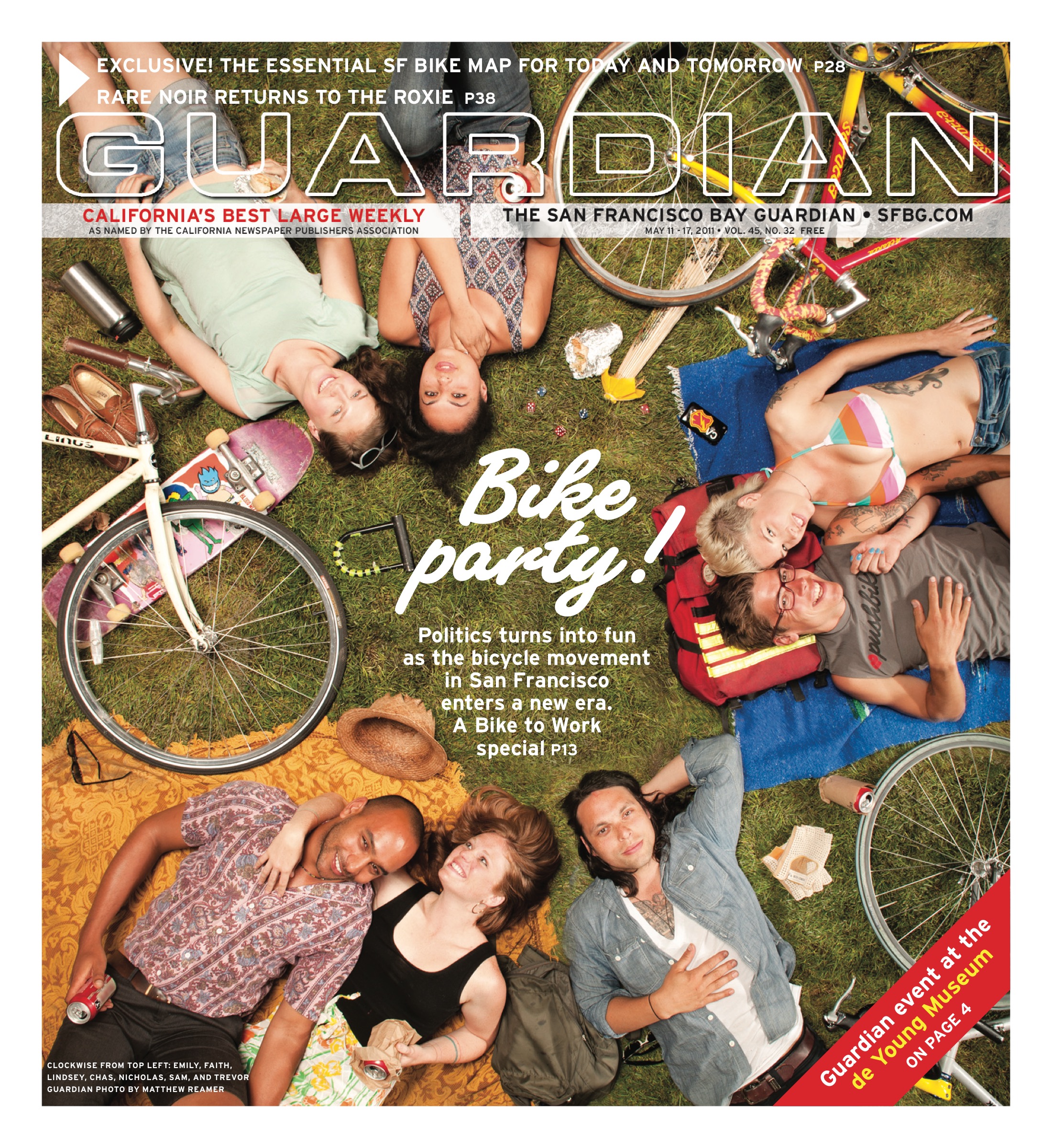
But it isn’t just bike lanes and other infrastructure that are causing bicycling to blossom in San Francisco. Bike culture is also exploding in myriad ways, including events such as the San Francisco Bike Party and Rock the Bike shows we profile in this issue, as well as the popularity of the monthly neighborhood street closures of Sunday Streets.

At the most recent Sunday Streets in the Mission District on May 8, Valencia and 24th streets were packed with thousands of people riding bikes, skating, and walking, or engaged with activities — in streets usually dominated by cars — such as yoga, art projects, shopping, and dancing.

“It’s a celebration. It’s not about confrontation anymore, it’s about bringing people along with a more expanded idea of how we can use public space,” Sunday Streets Coordinator Susan King told us at the event.

She said Sunday Streets has helped bridge the gap between families and the bicycling and skating communities, as well as cutting across classes, cultures, and communities. The response to the event has been phenomenal, she noted, and she hopes to see a similar momentum leading up to the next Sunday Streets event on June 12 in the Bayview.

“The Bayview event is really important to us because we have extraordinary support from the Bayview merchants and they want to get more involved with the bicycling community,” King said.

The earnest work of SFBC, SFMTA, and other entities that have helped expand the bicycling infrastructure in San Francisco, bringing safe cycling opportunities into every neighborhood, has in turn allowed organic expressions of bike culture to flourish.

From hipsters on their colorful fixies to anarchists riding tall bikes, from old-school Schwinns to cargo-laden Xtracycles, from elaborate art bikes to simple bike trailers with amazing sounds systems, from old white guys in Spandex to the young black kids on custom scraper bikes, from the hardcore bike messengers to the tourists on rental bikes, from Critical Mass defiance to Bike Party celebration, the streets of San Francisco are brimming with bike culture diversity. And the only commonality, the only one that’s really needed, is a simple appreciation for pedal power.

“We need to get the message out that biking is fun — and that’s happening,” Smith said. “We need a paradigm shift, and I think we’re really on the cusp of that.”

BIKE TO WORK DAY

Energizer commute stations open:

Thurs/12 7:30–9:30 a.m. and 5–7 p.m., free

Check map on page 28 for locations

Bike From Work party and fashion show

Thurs/12 6–10 p.m., $5 SFBC members/$10 nonmembers (or join at the door and get in free)

DNA Lounge, 375 11th St., SF

www.sfbike.org

Historic preservation debate raises a slew of questions

The Board of Supervisors Land Use Committee spent several hours yesterday hearing from city officials and members of the public on the hot-button issue of historic preservation. The informational hearing was called by Sup. Scott Wiener, who framed it as a discussion about “the impact of historic preservation policies on other major public policy goals and the need to adopt legislation to ensure that the policies are achieved” — a statement that raised alarm bells among historic preservationists and sent members of that community out in droves to defend preservationist efforts and to urge Wiener not to weaken any of the city’s existing policies.

Wiener raised concerns about the time and expense associated with environmental impact reviews (EIR) that could be triggered if a property falls within an historic district, saying, “there’s a sense that the cost is rather high, and the time it takes is rather high,” and added, “a lot of times we order an EIR, and that’s the end of the project.” He also raised questions about whether historic preservation efforts placed too many constraints on upgrading transit-oriented neighborhoods, parks, and libraries.

While Wiener had opened the debate in order to highlight problems associated with historic preservation policies, preservationists packed the room to defend their efforts. “I am dismayed that the importance of historic preservation is being challenged,” June Osterberg noted during public comment. She charged that San Francisco had gone from being “a paradise for residents to a developers’ paradise, to my despair. Please do not diminish the importance of what’s left in San Francisco.”

Arthur Levy noted, “If you go back to 1967 [when policies were first created] you will see that preservation has not thwarted or trumped development” in the decades since. “There’s nothing the matter systematically,” he added.

Wiener seemed surprised by some of the strong reactions. “They thought I was going to start knocking down the Golden Gate Bridge and the painted ladies,” he told the Guardian. He insisted that while he supported historic preservation, he wanted to have a conversation about balancing it with other policy goals, since “it’s an issue that has a lot of pent-up demand.”

The Historic Preservation Commission (HPC), created in 2008 with voter approval of Proposition J, has drawn criticism from members of the development community who’ve suggested that the panel would “shrink wrap” the city, stifling new building projects at a time when unemployment is particularly high in the construction sector. Yet Mike Buhler, executive director of San Francisco Architectural Heritage, noted that the city’s Historic Preservation Commission had given the green light to all but one project proposal that came before the it, suggesting that fears of the HPC freezing out potential development were unfounded.

Asked after the hearing how he reacted to those sending the message that everything was fine, Wiener noted, “In some respects, things are not fine,” citing the lengthy historic review process and lack of clarity on certain requirements.

Meanwhile, Sup. Malia Cohen took a different tack in her line of questioning on this issue. She wanted to know if teams of surveyors who conduct neighborhood assessments for designating historic districts reflected the ethnic diversity of the city, and whether historic context statements generated by those surveys took into account the myriad cultural and ethnic histories in a given neighborhood.

Planning officials assured Cohen that the surveyors were ethnically diverse, and community outreach was done in multiple languages. But one man who spoke during public comment charged that the planning department was “tone deaf” when it came to responding to concerns raised by the African American community, and that efforts to designate certain properties as historic, such as Sam Jordan’s Bar on Third Street in the Bayveiw, had “hit roadblocks.”

Speaking to the Guardian after the hearing, Cohen said she’d been hoping to highlight the omission of certain cultural perspectives when it came to decision-making about which properties are deemed historic. Cohen spoke about the contributions of Filipino, Chinese, Japanese, and African-American communities to the city’s historic landscape.

“And the Native Americans — they’re never included in the conversation,” she said, referencing a Shellmound on Bayview Hill leftover from an era when the Ohlone resided on the San Francisco peninsula. She said she was concerned that cultural contributions may not be reflected in the neighborhood surveys, or in which buildings are ultimately designated. “It’s systemic,” she noted.

And the next chief is…yes, Suhr!

3

Mayor Ed Lee appointed a deeply emotional Captain Greg Suhr as Chief of the San Francisco Police Department during a swearing-in ceremony where the majority of folks were either elected officials, running for election, running each other’s electoral campaigns—or wearing SFPD uniforms.

And in the end it seemed that the choice may have been influenced by pressure from the powerful San Francisco Police Officers Association, judging from the comment Lee jokingly directed at SFPOA leader Gary Delagnes, saying, “Gary, it’s time to get quiet and go to work.”

Lee told a standing-room only crowd that when he returned from Hong Kong to San Francisco four months ago finding a new police chief was his top priority. And that initially it was suggested (Lee did not say by whom) that he leave the SFPD situation alone and allow an elected mayor to appoint the next Chief.

‘While I am an interim mayor, this is not an interim decision,” Lee told the crowd, signaling that while he may be out of office in January, Suhr may be here to stay as the city’s top cop.

“Today, I’ve chosen the best candidate,” Lee continued, thanking Acting Chief Jeff Godown for his work leading the SFPD since former Mayor Gavin Newsom made the shocking decision to appoint former Chief George Gascón as District Attorney.

But while Newsom’s move may have upset the apple cart in the D.A.’s race, it sure seems to be working out well for Suhr.

Describing Suhr as “a police and people’s Chief: and “a reformer from the inside out,” Lee ran through a long list of the new Chief’s contributions to the SFPD. These included Suhr’s 30 years of service, his climb through the ranks to become Captain of the Mission station, his gig as Captain of the San Francisco Public Utilities Commission in a Homeland Security capacity, and, since 2009, as Captain of the Bayview station.

Suhr began by saying he was “speechless.” Donning glasses to read a speech that he had prepared the night before, Suhr choked up when he talked of being “fourth-generation, born and raised in San Francisco.” Recovering his composure, Suhr smoothly changed gears, as he joked how his appointment therefore makes him “a local hire,”—an insider reference to Sup. John Avalos’ recently approved local hire legislation that Mayor Lee is helping enact citywide.

Suhr recalled how he started out as a rookie on the midnight shift in the Tenderloin in 1981. He thanked his family, his friends and his girlfriend Wendy. And then he asked for a moment of silence “ to honor the memory of all the brave officers who have given their lives in the line of duty.”

Lee reclaimed the podium long enough to jokingly ask Suhr  “to investigate the whereabouts of my birth certificate” as his first assignment as the new chief.

Then it was Board President David Chiu’s turn. Chiu described Suhr as someone, ”who knows our streets, walked the walk, and knows the beats, someone who we all feel confident will be able to bring the SFPD the reform that former Chief Godown, Chief Gascón and Chief Heather Fong initiated. “

San Francisco Superior Court Judge Katherine Feinstein, who is the daughter of Sen. Dianne Feinstein and the presiding judge of the Superior Court, recalled how she has known Suhr since the mid 1980s. “I have watched him as each of our careers have moved forward,” Feinstein said, noting how there were some “steps forward and some steps backward” and how, “there were those who thought this day would never come.” (Feinstein’s words were the only reference to some of the less sunny moments in Suhr’s long and distinguished career. These included his 2003 indictment as part of Fajitagate, an incident that involved off-duty officers, a bag of take-out food, a beer bottle and injuries sustained by two local residents. Suhr was cleared of wrongdoing the next year, but was reassigned by then Chief Heather Fong to the PUC position after an incident in 2005, in which a police officer was seriously injured at an anarchist protest, and videographer Josh Wolf was held in federal prison for 226 days after he refused to release unedited footage of the protest.)

Next up was D.A Gascón and his rooster-like shock of silver hair. Gascón noted that when he first came to San Francisco, in the summer of 2009, he had no allegiances to, and no prior knowledge of, people inside the SFPD.

“I looked at Greg Suhr and one of the things that impressed me is how he worked with and related to people,” Gascón said, explaining why he appointed Suhr as Bayview Captain “Not only has he exceeded all expectations he did an incredible job,” he said.

 Police Commission President Thomas Mazzucco said that in the 100 days since the Commission announced it was looking for a new chief, it became clear that Suhr has the support of SFPD’s rank-and-file.

Mazzuco noted that he met Suhr in high school. “I knew he could hold a ball,” Mazzuco added, noting that he subsequently became Suhr’s football coach, even though he is younger than Suhr. “What the Police Commission has brought to us is not only a native son but also a cop’s cop. It’s an honor to have him as his chief.”

And after the swearing-in, the sentiment among officers in blue appeared to be strongly in Suhr’s favor. Lt. Ken Lee of Central Station recalled how he and Suhr went through the police academy together about 30 years ago.

“We went to different assignments but we’ve maintained a friendship,” Lee said. “The moment I met him I liked him. He was a very stand-up person, and as a native San Franciscan like myself, you could tell he had strong ties to the city. He’s a hard worker, he’s very dedicated to what he does.”

Lt. Mario Delgadillo, also of Central Station, said Suhr hasn’t lost his connection to the street. “That also means a lot, when you have a boss who’s walking with you,” Delgadillo said.

Suhr takes over the SFPD as it’s grappling with the fallout from a recent spate of scandals, including videos that Public Defender Jeff Adachi released that appear to show police misconduct at residential hotels and that forced DA Gascón to hand over his investigation of this alleged police misconduct to the FBI. Asked during a media roundtable what his appointment means for Acting Chief Godown, Suhr said Godown has returned to being Assistant Chief of Operations, which was the post he held before Gascón, who recruited Godown from LAPD, was appointed DA.

In response to a question about his top priorities as police chief, Suhr noted, “When I sit down with the mayor this afternoon, the mayor’s going to tell me what his priorities are. My first priority will be blocking the door open on the 5th floor so that if you wanna come see me you can, like it used to be. Then I have to meet with the command staff and captains and get their take on where they think we are, where they think we’re moving forward best, and match that up against how I’ve seen from a position of Bayview, how that matches up. And then see if I can’t meet with different community groups, the different police employee groups and the command staff.”

He didn’t mince words when it came to indicating that SFPD officers are going to be asked to give back during upcoming budget negotiations
“I’m sure that there’s going to have to be adjustments and I look forward to working with a collaborative effort with the mayor and the board and the unions and the rank and file,” Suhr said. “When the economy’s been good we’ve benefited by it, and now that the economy has … gone the other way, to some extent I think that the officers are willing to give back to do whatever needs to be done to keep the city safe.”

So, how does Suhr think he differs from former Chief Gascón? 

”He has a gorgeous head of hair,” Suhr joked. “To put it in a sports analogy, he’s a quarterback shortstop guy, and I’m more of a catcher, lineman, linebacker kind of guy. But I admire him, I think he moved a lot of issues forward for the police department, and I look forward to continuing those initiatives and giving a few of them a shot in the arm that I think were beginning to wane a bit.”

Suhr also talked about how he has always wanted to become a police officer (a comment that suggests he’s not planning to use the Chief’s post as a stepping stone to the District Attorney’s Office).

”When I went into the police department. on Silver Avenue which is now Willie Brown Academy — that was the police academy back in 1991 when I came in — man, we looked at just the regular uniformed police officers with just stars in our eyes, because they were just the sharpest, classiest folks that we were aspiring to be,” Suhr said.

And he indicated that as Chief, he won’t tolerate dishonesty in the face of ongoing investigations into alleged police misconduct. ”The character of a police officer must be above reproach,” Suhr said. “And I think that the investigation will show what it ends up showing, but I don’t think that there’s a police officer in San Francisco that would want to have a dishonest cop and I’d be at the top of that list. So I want all my officers to be of character that is above reproach.

Asked if he welcome clarification around the duties of SFPD officers assigned to the FBI’s Joint Terrorism Taskforce, Suhr said he believed an examination of the wording of the FBI’s most recent memorandum of understanding (MOU) with the department was already under way.

“I believe that the MOU is being revisited,” Suhr said. “I have not been a part of that, but again I think we have a real good policy with regard to our intelligence gathering and that does supercede any ask of any other agency. The officers are bound by policies and procedures. And that policy was well thought out with tremendous community and group input years and years ago, from situations that have not since repeated themselves. I think a lot of people back then couldn’t believe they happened in the first place, but I think measures were well thought out and put in place to make sure we don’t have a problem again.”

And at the end of the day, Suhr expressed the hope that his tenure as Chief would endure long after the interim mayor is replaced by an elected mayor.

”I’m a native San Franciscan, and this is a dream come true,” he said. “It’s my first day. However this story ends, with a little bit of luck (raps on the wood tabletop) it’s not going to end today.”

A new brand of fixie competition ramps up for Saturday

0

“We’re just trying to make it look pretty.” N8 Van Dyke, an SF illustrator, is posted up in the Marine Westar Services Bayview warehouse, unrolling wheatpaste designs on the concrete floor. In other corners of the building, burly men hustle about towing heavy boxes, performing mysterious, industrial functions. But we’re (I didn’t do any of the work, per se, but having watched the process for the better part of a half hour I feel entitled) involved in a different sort of badassery – creating ramps for what might be the biggest fixed gear competition like, ever: Saturday’s Red Bull Ride + Style.

“When the guys are riding their bikes on them,” Van Dyke tells me. “I want it to look Honey I Shrunk the Kids.” The artist, who has a penchant for drawing dark, somewhat tormented-looking chimps, was assigned to decorate a stacked freestyle structure that resembles a game of 52 card pick-up. Fresh from a trip to Kinko’s, he’s now plotting to paste his me-sized playing card designs all over the structure’s flat surfaces. 

N8 Van Dyke plays with his monkey

Also scattered throughout the warehouse is Aaron De La Cruz, swirling his signature black designs over another ramp, plus a brightly-colored monster spider by Arlo Eisenberg. There’s also a cooler full of beer and I guess other liquids, thoughtfully provided by Red Bull, which is sponsoring this boy’s club of extreme athleticism and creativity as part of the brand’s ongoing mission to promote heart-racing, energy drink-necessitating feats of daring, like downhill bike races through Brazilian favelas.

It would appear that this weekend’s competition is somewhat of a first. Jeremy Witek and Ryan Corrigan (the only one drinking a beer, what the hell guys), two BMX riders and ramp builders that are in charge of constructing the designs that the artists are decorating for Ride + Style, tell me that they’ve never heard of a fixie competition like this one. 

Van Dyke and Aaron De La Cruz talk shop behind the De La Cruz ramp-creation

Generally, fixie freestyle competitions, Witek and Corrigan tell me, are held at skate parks – but the ramps they’re building for Saturday are made specifically for fixed gears, an unusual specialization that provided them with an extra challenge — no one’s done these before. “It’s a learning process for us – it’s hard trying to figure out what they want,” Witek told me of the people at Red Bull that contracted them to build the pieces. “They don’t really know what they want.”

The contest is going down at Justin Herman Plaza, just across the street from Harry Bridges Plaza, where SF fixie riders can be seen practicing their endos and bunnyhops on most days. It’ll feature two categories of competition: track (a more common type of fixie contest) and freestyle. This is one of the two cities, after all (New York is the other one), where the bike messenger culture really took root, giving rise to the sport of fixed gear in the first place. 

Tools of the trade

To advise on the construction process, a bunch of fixie riders came out to Bayview to test out what the team was cooking up. Witek says they liked what they saw. “They’re extremely pumped,” he says. “They’re always stuck riding out at stranded skate parks. This is more than just a sport, you know – it’s a culture.”

“This is going to be a real eye-opener for the public, they’ll be able to see what fixed gears can really do,” he sums up. To get a sense before Saturday so you’re not all gawky, you could do worse than going here.


Red Bull Ride + Style

Sat/30 noon-4 p.m., free

Justin Herman Plaza

1 Market, SF

Facebook: Red Bull Ride + Style


Last stand against Lennar

2

news@sfbg.com

Hunters Point, the last major swath of usable land in San Francisco, appears at first glance to be a developer’s dream — a prime piece of real estate with sweeping views of the bay, ample space, and a city government eager to capitalize on its potential.

But community groups have filed lawsuits challenging the project’s many uncertainties, such as the fate of the toxic stew beneath the former U.S. Navy base in the heart of the project area, and both sides are now awaiting a court ruling on whether more studies are needed.

As an EPA-designated Superfund site, the 500-acre plot is home to an abundance of buried chemical contaminants, radioactive waste, and other unknown toxins, and the Navy has been slow to clean it up. Concerned that development plans have been premature in the face of this lingering mess, opponents filed lawsuits against developer Lennar Corp. and the city last year.

The project, approved July 2010 by the Board of Supervisors, includes plans for a new stadium for the 49ers, 10,500 housing units, parks, and commercial retail space. It has received praise from city and state government agencies as an economic and cultural boon to the community. But activist groups say the cleanup should happen before development occurs.

The Sierra Club settled its lawsuit over the project after the developer made some design changes (see “Uncertain developments,” Jan. 18), so the lawsuit filed by People Organized to Win Employment Rights (POWER) and Greenaction is the last piece of litigation holding up the project. At the core of the legal challenge is whether the environmental impact report (EIR) properly analyzed the health impacts from toxic contamination at the site. After an April 18 hearing on the case, both sides are awaiting a ruling on whether the claims have merit and should be the subject of further study.

Activists claim the EIR violates California Environmental Quality Act protocols because it contains too much uncertainty, including the unknown fate of a large parcel of land slated for a stadium that is contingent on whether the 49ers decide to stay in San Francisco. POWER wants more details about the possible threats to human health before the 20-year project gets the final green light. But since the Navy is responsible for the cleanup, Lennar and the city have repeatedly countered that a full analysis is not their responsibility.

“The main issue that Greenaction and POWER have been concerned about throughout lawsuit is that it’s very unclear from the EIR what exactly is going to happen and what level of contamination will be left,” said attorney George Torgun with EarthJustice, which is representing the community groups. “What are the impacts of building on a federal Superfund site? There is a real lack of knowledge in the EIR.”

April 18 was the second of two recent hearings held on the case. On March 24, Judge Ernest H. Goldsmith listened to a full day of testimony before a packed courtroom. Subsequent settlement discussions weren’t successful, so both sides returned to court to seek a ruling that is expected sometime in the next two months.

Lennar attorneys offered to relinquish the possibility of a pre-cleanup early transfer of the property, which has been a major concern for POWER. Under this proposal, no development on any of the six parcels slated for transfer from the Navy could proceed until the federally mandated cleanup process was finished and certified. However, POWER does not believe this offer reduces the scope of the issues because final approval would still ultimately award control of the land to the developer based on what they believe is a flawed EIR.

“Severing any discussion of early transfer from this EIR would only serve to worsen the defects that petitioners have identified and would be contrary to the requirements of CEQA,” Torgun wrote in the April 13 letter to the court.

POWER’s counterproposal would allow large portions of the project to go through — rebuilding the Alice Griffith housing project and development on Candlestick Point — but Lennar considers it economically unfeasible. These portions of the project are not located on the shipyard but are included in overall plan.

“We want to see the project move forward with Alice Griffith and Candlestick Point,” said POWER organizer Jaron Browne. “They’ve rebuilt housing projects at Cesar Chavez and other areas in the city — why can they only rebuild this one if they can redevelop the shipyard? It’s a political game that Lennar has tied the rebuilding of it to this mammoth 770-acre development.”

Lennar representatives wouldn’t comment for this story. Community members have clashed with the megadeveloper over health issues in recent years. In 2008, Lennar was fined more than $500,000 by the Bay Area Air Quality Management District for allowing dust containing asbestos to settle on the surrounding neighborhoods. Then, in March, community organizations released a report showing e-mails from 2006 to 2009 between the EPA, the San Francisco Department of Public Health, and Lennar revealing a possible cover-up of the asbestos exposure.

“They underestimated our understanding of what is happening here,” Browne said. “The whole heart of this issue is that this is a Superfund site. Even if you remove the possibility of early transfer, they are still planning on doing work while remediation is still years to go on other parcels.”

Longtime Bayview resident and Greenaction member Marie Harrison said that not only is the EIR too fraught with uncertainty, it’s incomplete. “There are over 600 blank pages in that document,” she said. “How can you approve an EIR that is supposed to tell you what is there, what the effects will be, and what the project will be? We kept asking the supervisors: How do you convince the community that they are doing something that is good and safe when the history shows otherwise?

During both court hearings, it was evident no clear definition of the project exists since it contains many variables to account for unknowns. Attorneys for Lennar and the city argue that the EIR effectively addresses each potential use and demonstrates a full knowledge of possible contaminants.

Wilma Subra, an environmental scientist for New Orleans-based Environmental Health Advocates, has worked with POWER and Greenaction to understand the breadth of contamination and the typical process of cleanup of a Superfund site. She pointed out that the Navy’s cleanup plan is completely separate from the EIR submitted for the project.

“Those two documents don’t agree with what development will be,” Subra said. “Usually you wait much longer in the process to really know that the land is safe. In a normal Superfund process, you would first do an implementation of the remediation process, find out if it worked, then — years down the line — you would start thinking about development.”

If the EIR is deemed inadequate, Lennar and the city will be required to further analyze the contaminants, outline cleanup strategies, and resubmit a new EIR. If the judge rules the EIR satisfies CEQA, the project can move forward.

“CEQA is one of the few really democratic processes,” Browne said. “If you just have this one moment in 2011 when people are able to comment and weigh in, and then have 20 years where they are building within that, it’s not really fair.”

Reject the Treasure Island plan

18

EDITORIAL After a long, long hearing April 21, as the San Francisco Planning Commission prepared to vote on an ambitious development plan for Treasure Island, Commissioner Gwyneth Borden acknowledged that the plan wasn’t perfect. But, she said, on balance it ought to be approved: “Twenty five percent affordable housing is better than zero percent.”

That’s not necessarily true.

Treasure Island is an usual piece of real estate, 403 acres of artificial land created in 1937 by dumping sand and dirt on a shallow part of the bay. It’s less than two miles from downtown San Francisco — but there’s no rail service, no BART station. The only way off the island is by boat — or by driving onto a Bay Bridge that’s already jammed way beyond capacity every morning and afternoon.

The soil is unstable, prone to liquefying in an earthquake — and if sea levels rise as high as some predictions suggest, the whole place could be underwater in a few decades.

A strange hybrid agency called the Treasure Island Development Authority, created by former Mayor Willie Brown, cut a deal with Lennar Urban (the same outfit that has the redevelopment deal for Bayview Hunters Point) and several partners to construct a neighborhood of some 19,000 people on the island. Among the features: a 450-foot condominium tower and 6,000 units of high-end housing. The developers brag that a fleet of new ferries will offer a 13-minute ride to the city and that some streets will be designed for pedestrians and bicycles.

But the fact remains that the developers want to add 19,000 new residents — almost all of whom will work off the island somewhere — to a place that has no credible transportation system. City studies show that even with an extensive (and costly) ferry service, at least half the new residents would drive cars to work (and, presumably, to shop, and go to movies, and eat and drink), joining the mob of vehicles heading east or west on the bridge. That’s almost 10,000 new cars each day trying to jam onto a roadway that can’t handle the existing traffic. The backups would stretch well onto San Francisco surface streets and as far back as Berkeley.

A rail line on the Bay Bridge would solve part of the problem. So would bike lanes. Neither option is even remotely possible in the foreseeable future. Free, or heavily subsidized ferries could, indeed, be a positive alternative — but who is going to pay for that service? Nonsubsidized ferries would be far more expensive than current Muni or BART service, a particular burden on the residents of the below-market housing.) And does anybody really think there’s going to be enough ferry capacity to carry 10,000 people a day to downtown SF, the East Bay, and the Peninsula?

The bottom line: this isn’t a good deal for San Francisco. The affordable housing level is too low. The transportation problems are nightmarish. The last thing Treasure Island needs is a 450-foot tower.

There’s no rush to approve this — and no immediate downside to waiting for a better deal. The supervisors should tell Lennar to come back with a project that has fewer residents, better transit options, and more affordable housing. Because zero is looking a lot better than what’s on the table.

PS: The 4-3 Planning Commission vote demonstrated exactly why it’s important to have key commission appointments split between the mayor and the Board of Supervisors. The mayoral appointees all rolled over — but at least the board-appointed members made strong points, forced real debate, and gave the supervisors plenty of ammunition to demand a better deal.

Editorial: Reject the Treasure Island plan

1

After a long, long hearing April 21, as the San Francisco Planning Commission prepared to vote on an ambitious development plan for Treasure Island, Commissioner Gwyneth Borden acknowledged that the plan wasn’t perfect. But, she said, on balance it ought to be approved: “Twenty five percent affordable housing is better than zero percent.”

That’s not necessarily true.

Treasure Island is an usual piece of real estate, 403 acres of artificial land created in 1937 by dumping sand and dirt on a shallow part of the bay. It’s less than two miles from downtown San Francisco — but there’s no rail service, no BART station. The only way off the island is by boat — or by driving onto a Bay Bridge that’s already jammed way beyond capacity every morning and afternoon.

The soil is unstable, prone to liquefying in an earthquake — and if sea levels rise as high as some predictions suggest, the whole place could be underwater in a few decades.

A strange hybrid agency called the Treasure Island Development Authority, created by former Mayor Willie Brown, cut a deal with Lennar Urban (the same outfit that has the redevelopment deal for Bayview Hunters Point) and several partners to construct a neighborhood of some 19,000 people on the island. Among the features: a 450-foot condominium tower and 6,000 units of high-end housing. The developers brag that a fleet of new ferries will offer a 13-minute ride to the city and that some streets will be designed for pedestrians and bicycles.

But the fact remains that the developers want to add 19,000 new residents — almost all of whom will work off the island somewhere — to a place that has no credible transportation system. City studies show that even with an extensive (and costly) ferry service, at least half the new residents would drive cars to work (and, presumably, to shop, and go to movies, and eat and drink), joining the mob of vehicles heading east or west on the bridge. That’s almost 10,000 new cars each day trying to jam onto a roadway that can’t handle the existing traffic. The backups would stretch well onto San Francisco surface streets and as far back as Berkeley.

A rail line on the Bay Bridge would solve part of the problem. So would bike lanes. Neither option is even remotely possible in the foreseeable future. Free, or heavily subsidized ferries could, indeed, be a positive alternative — but who is going to pay for that service? Nonsubsidized ferries would be far more expensive than current Muni or BART service, a particular burden on the residents of the below-market housing.) And does anybody really think there’s going to be enough ferry capacity to carry 10,000 people a day to downtown SF, the East Bay, and the Peninsula?

The bottom line: this isn’t a good deal for San Francisco. The affordable housing level is too low. The transportation problems are nightmarish. The last thing Treasure Island needs is a 450-foot tower.

There’s no rush to approve this — and no immediate downside to waiting for a better deal. The supervisors should tell Lennar to come back with a project that has fewer residents, better transit options, and more affordable housing. Because zero is looking a lot better than what’s on the table.

PS: The 4-3 Planning Commission vote demonstrated exactly why it’s important to have key commission appointments split between the mayor and the Board of Supervisors. The mayoral appointees all rolled over — but at least the board-appointed members made strong points, forced real debate, and gave the supervisors plenty of ammunition to demand a better deal. *


The Treasure Island nightmare

83

There are times when people like me, who think development should be driven by public needs, not private profit, are in something of a bind. I don’t like the Lennar plan for Bayview Hunters Point — but I agree that doing nothing isn’t a very good alternative. Sometimes, the “no-project” alternative isn’t an alternative at all — which gives the developers a huge hand up in negotiations with the city. Gee, you want affordable housing? We can give you 15 percent — or we can walk away and you’ll get nothing.


But when it comes to Treasure Island, I think we’re in a different situation. The proposed development is so out of whack, so looney, that it makes no sense to me — and the alternative of doing nothing, at least for now, isn’t so bad at all.


The plan calls for 19,000 new residents on the 403-acre artificial island in the Bay. At most, 25 percent of the units would be below-market. Which means some 13,700 rich people, virtually all of them with jobs in San Francisco, the Peninsula or the East Bay, would be plunked into a place with no viable transportation alternatives.


I wonder if any of these planners have ever tried to leave TI by car; it’s a nightmare. And there’s no way to fix it: Even if they build a new acceleration ramp (the current stop-and-go into 60-mile-an-hour traffic is a death trap), the Bay Bridge is already at full capacity during a very long rush hour in the morning and evening. And does anybody really think those 13,700 people will all take the ferry to work every day?


Impossible: There’s no way to provide enough ferry service for that population at anything resemble the cost the developers are willing to pay. How about all the Google and Yahoo and Genentech employees (and that’s a big part of the population buying new high-end condos in San Francisco)? You think they’re all going to take a ferry to downtown SF then hop on a bus or train then take another bus to the office? Not these folks. A lot of them will want to drive.


And the bridge, which is already backed up, will back up further, driving more traffic onto the streets of SOMA and creating a slowdown all the way back to Berkeley.


Meanwhile, the island is sinking, and water levels are rising. Forget the fancy engineering plans to sink stone columns deep into the clay under the Bay; what happens when the water rises? Are we going to surround the entire place with seawalls?


And here’s the bottom line: The current situation isn’t all that awful. There’s a small amount of housing out there, some of it affordable. There’s lots of open space. A little effort and the playing fields and parkland could be upgraded and TI could, for the intermediate term, be a day-use area for the city. Not a terrible alternative.


At some point, either the island’s going to sink back into the Bay or it’s going to have to be completely redeveloped. But right now, with no public money available, we’re at the whims of private developers. And what they’re offering doesn’t even remotely meed the city’s needs — and will create a catastrophic transportation problem.


So the supervisors are in a great position to negotiate. We want 50 percent affordable housing, we want the developer to pay for substantially increased bus and ferry service (or maybe we want to add a rail line to the Bay Bridge). And if that’s not something the developers want to do, fine: we’ll wait. Nothing wrong with that.


Our Weekly Picks: April 13-19, 2011

0

THURSDAY

APRIL 14

MUSIC


Two Door Cinema Club

Featured as a “You Oughta Know” artist on VH1, Northern Ireland’s Two Door Cinema Club is an indie electropop trio comprised of Alex Trimble (lead vocals/guitar), Sam Halliday (vocals/guitar), and Kevin Baird (bass/vocals). (What of the drummer, you ask? Sometimes human, sometimes a computer.) The band’s Tourist History recently picked up the 2010 Choice Music Prize for Irish album of the year, suggesting its making good on the promise shown by opening for indie rock greats like Foals, Phoenix, and Delphic. If you’re one of the working schmucks who can’t take the time off for Coachella, catch Two Door Cinema Club before it goes to Indio. (Jen Verzosa)

With Globes and Work Drugs

8 p.m., $20

Fillmore

1850 Geary, SF

(415) 346-6000

www.livenation.com

EVENT


“Charles Phoenix Retro Slide Show”

Oddball Americana guru Charles Phoenix has explored and celebrated the best in kitschy, cool, kooky artifacts and history for many years now, having written several books on mid-20th century deep-fried pop culture, fashion, lifestyles, and more. The author of tomes such as Southern California In The ’50s and Americana The Beautiful brings his hilarious slide show and talk to the city, set to roast the imagery found in some of the thousands of vintage Kodachrome slides has collected at flea markets over the years. Be sure to keep an eye out for some familiar places and things — Phoenix has promised to include a bevy of vintage San Francisco slides for this entertaining ode to the odd and unique. (Sean McCourt)

8 p.m., $25

Roxie Theater

3117 16th St., SF

(415) 863-1087

www.roxie.com

PERFORMANCE


Our Daily Bread

Carb load on this: in a collaboration between Amara Tabor-Smith’s Deep Waters Dance Theater, director Ellen Sebastian Chang, and visual artist Lauren Elder, Our Daily Bread delves into the folklore and stories surrounding food traditions. The socially conscious hybrid theater experience draws from a family gumbo tradition, examining how industrialized agriculture, fast food culture, and our global food crisis affect current food practices. In addition, CounterPulse resident artist Tabor-Smith also considers who is missing from the sustainable food movement. With red beans and rice on the mind, expect to fill your plate with individual food legacies and questions regarding your own relationship to food. You are what you eat. (Julie Potter)

Thurs/14–Sun/17, 8 p.m., $18–$22

CounterPulse

1310 Mission, SF

(415) 626-2060

www.counterpulse.org

EVENT


Nikki Sixx

Known not only for his fiery stage presence and key songwriting contributions as bassist for Mötley Crüe, Nikki Sixx also gained a notorious reputation for his off-stage antics, particularly his legendary appetite for drugs and debauchery. Sober now for several years, Sixx detailed many of these early escapades and horrors in his 2007 book The Heroin Diaries. He returns — just before a major summer tour, which includes a June stop in SF — with the follow-up, This Is Gonna Hurt: Music, Photography, and Life through the Distorted Lens of Nikki Sixx, a look at his post-addiction life that finds him a successful author, radio host, and of course, still rocking the stage with the Crüe. (McCourt)

6 p.m., $29.99 (includes book)

Book Passage

One Ferry Building, SF

(415) 835-1020

www.bookpassage.com

FRIDAY

APRIL 15

DANCE


Alonzo King’s Lines Ballet

The longer I watch Alonzo King’s Lines Ballet, the more this choreographer manages to surprise me. What intrigues is not so much his language — intricate, idiosyncratic, and demanding — or even the way he uses it on his dancers. But there is a vision, a philosophy behind his work, that we get glimpses of in every new piece. That’s what good dance is supposed to do. King also goes out of his way to find collaborators who can envelop his choreography in the mantle of new contexts. Of course, it helps that these other-than-dance contributions, in particular, are often spectacular on their own. But to get Mickey Hart, who actually is philosophically pretty close to King, create a score for Lines Ballet is a coup even for a choreographer with a growing international reputation. Architect Christopher Haas, who worked on the de Young Museum, created the set. (Rita Felciano)

Through April 24

Fri.–Sat., 8 p.m.; April 20–21, 7:30 p.m.;

April 24, 5 p.m., $25–$65

Yerba Buena Center for the Arts

Novellus Theater

700 Howard, SF

(415) 978-2787

www.linesballet.org

MUSIC


The Residents

Hang on to your eyeballs, San Francisco’s most enigmatic art-rock collective the Residents will storm the stage at Bimbo’s in support of its for-no-particular-reason, ghost-story themed “Traveling Light” tour. The calculatedly anonymous group (currently a trio), as well known for its elaborately costumed stage personae and mixed-media presentations as for its deconstructed lyrics and dystopian musical baditude, is fast approaching its fourth decade. But don’t expect a set stuffed merely with humdrum nostalgia. Actually, don’t expecting any particular thing, because defying expectations is what the Residents do best. Word is the group will be recording the proceedings in three (possibly four ) dimensions, so wearing your very best top hat to the show might not be a bad idea. (Nicole Gluckstern)

Fri/15–Sat/16, 9 p.m., $30

Bimbo’s

1025 Columbus, SF

(415) 474-0365

www.bimbos365club.com

PERFORMANCE


Zaccho Dance Theatre

With a title — The Monkey and the Devil — taken from racial slurs, Joanna Haigood’s dance theater performance installation, performed by Zaccho Dance Theatre, addresses lingering contemporary racism, rooted in the lasting effects of America’s slave trade. Even in the age of Obama, the performance acknowledges how Americans grapple with the residue of slavery and reunite a split house. Surrounded by two massive, rotating set pieces designed by visual artist Charles Trapolin, audience members are free to navigate the continuously running performance installation in the Yerba Buena Center for the Arts Forum. A post-performance discussion follows Friday’s installment. Don’t miss this immersive, compelling work. (Potter)

Fri/15, 8–10 p.m.;

Sat/16-Sun/17, 12-2 p.m. and 3–5 p.m., free

Yerba Buena Center for the Arts Forum

701 Mission, SF

(415) 978-5210

www.ybca.org

SATURDAY

APRIL 16

EVENT


“How-to Homestead: 11 in 11 Tour”

You can go on tour without ever leaving your city. That’s the idealistic message of How-to Homestead’s “11 in 11 Tour,” a yearlong barnstorming series with dates planned for each of San Francisco’s districts. Spearheaded by Melinda Stone, a University of San Francisco professor equally knowledgeable in matters of celluloid and soil, How-to Homestead’s homebrew of entertainment and education draws on alternative cinema, practical workshops, and live music to create a distinctly flavorful commons. The fourth “11 in 11” program takes place at the historic Bayview Opera House and features a “Chickens in the City” workshop and contra dance call, in addition to the usual potluck dinner and film treats. With spring in the air, it should be an especially lively installment. (Max Goldberg)

4–10:30 p.m., $5 suggested donation

Bayview Opera House

4705 Third St., SF

www.howtohomestead.org

DANCE


ODC Dance Jam

At first the ODC Dance Jam consisted of half a dozen cute kids showing their prowess on an ODC/Dance opening night. Today ODC’s youth program is much too big for such capers, and the tables have been turned. This year the professional company will make an appearance — with Brenda Way’s John Somebody — at ODC Dance Jam’s own concert, “Make the Road by Walking.” Taking classes five times in addition to rehearsing, the 14-member troupe, ages 13-18, may not call itself pre-professional, but its dancers surely are on the way. KT Nelson, Kimi Okada, Bliss Kohlmeyer-Dowman, Greg Dawson, and Kim Epifano, about as professional a group as any, created choreography for them. (Felciano)

Sat/16, 8 p.m.; Sun/17, 4 and 7 p.m., $12

ODC Dance Commons

351 Shotwell, SF

(415) 863-9830

www.brownpapertickets.com/event/166923

SUNDAY

APRIL 17

MUSIC


Foxtails Brigade

(((folkYeah!))) and Antenna Farm Records host a release party in honor of San Francisco duo Foxtails Brigade’s full-length debut, The Bread and the Bait. On its surface, The Bread and the Bait is as delicate as lace — the album art depicts a ladylike tea party in progress. But look closer (why are two of the women blindfolded? And why is one clutching a knife?) and listen closely: there’s an underlying darkness cloaked in those ethereal vocals set against simple cello and violin melodies. Join in the celebration with musical performances by ‘Tails and Rachel Fannan of Sleepy Sun, plus comedy by Brent Weinbach and Moeshe Kasher, and a fashion show featuring designs by Verriers and Sako, Lecon de Vetement, and Zoe Hong. (Verzosa)

With Rachel Fannan

8 p.m., $15

Swedish American Music Hall

2174 Market, SF

(415) 861-5016

www.swedishamericanhall.com MUSIC


Wire

On a recent trip to New York City, I won tickets to watch Wire from the “Band Bench” on Late Night with Jimmy Fallon. Arriving at 30 Rock, I found a few other awkward music nerds who refused to take off their jackets looking forward to the performance. In a bit of TV magic, they filled out the 30 or so “hardcore fans” with tourists eager for a glimpse of Fallon guest Keanu Reeves. It could just be the standard practice, but it’s also typical of the U.K. band’s U.S. reception, remaining relatively unknown despite being perpetual critical darlings and inspiring alternative rock bands throughout a career spanning from the release of 1977’s influential punk album, Pink Flag, to their most recent, Red Barked Tree. (Ryan Prendiville) With Lumerians and DJ Callum McGowan

8 p.m., $21

Slim’s

333 11th St., SF

(415) 255-0333

www.slims-sf.com 

The Guardian listings deadline is two weeks prior to our Wednesday publication date. To submit an item for consideration, please include the title of the event, a brief description of the event, date and time, venue name, street address (listing cross streets only isn’t sufficient), city, telephone number readers can call for more information, telephone number for media, and admission costs. Send information to Listings, the Guardian Building, 135 Mississippi St., SF, CA 94107; fax to (415) 487-2506; or e-mail (paste press release into e-mail body — no text attachments, please) to listings@sfbg.com. Digital photos may be submitted in jpeg format; the image must be at least 240 dpi and four inches by six inches in size. We regret we cannot accept listings over the phone.

Working on it

4

caitlin@sfbg.com

GREEN ISSUE With the recession fast seeping into the everyday fabric of American life (or at least Monday through Friday’s fabric), the enthusiasm that the term “green jobs” generates can be well understood. But can we really call a $10 hourly pay rate for installing solar panels sustainable? And what would be the bigger of the two triumphs: creating a carbon-free country or a more equitable nation? With partnerships springing up across the country like the Blue Green Alliance, created by the United Steelworkers and the Sierra Club, maybe the two goals aren’t so separate after all. Here are some West Coast organizations fighting to make sure that the environmentally-friendly jobs that do exist — and have yet to be created — pay a decent wage.


OAKLAND GREEN JOBS CORPS

Created by the long-time civil rights champions at the Ella Baker Center and other community partners, this program recruits poor young adults to a 38-week course of study that recognizes what it takes to break the cycle of unemployment. Participants begin with classes in basic job skills, literacy, and substance abuse counseling, then continue on to classes at Laney College in basic construction skills, eco-literacy, and specialized green building practices. At graduation, participants are hooked up with well-paying jobs in the green construction sector or traditional building trade union apprenticeships — where their newfound environment-saving skills will make them leaders in the years to come.

www.ellabakercenter.org


CALIFORNIA INTERFAITH POWER AND LIGHT

Pray for change — or change the way you pray? Created 10 years ago in SF, CIPL, whose work has since spread to 38 state affiliates, aides faith communities of all denominations in greening their place of worship. Greatest hits include installing a geothermal heating system in a Berkeley synagogue, work on First Chinese Baptist Church in San Francisco, and tricking out a Bayview-Hunters Point church with solar panels on the congregation’s extremely limited budget. Workers hired to make the holy places sing a song of sustainability are usually sourced from organizations like Richmond Build, which provides training to many people living in public housing and with criminal records.

www.interfaithpower.org


APOLLO ALLIANCE

Apollo Alliance, another nationwide coalition-building organization that got its start in SF, is making green jobs happen in Los Angeles — with or without federal dollars. The group sponsored the city’s Green Retrofit and Workforce ordinance, which required that municipal buildings achieve LEED certification at the silver level or higher, prioritizing updates on the buildings that were near areas with low income and high unemployment rates. Linked directly to workforce training programs, the ordinance is already under attack in Washington by H.R.1, a bill that would strip its funding. But L.A. is making the first move on the threat — the city is hoping to fund the successful program through energy conservation bonds.

www.apolloalliance.org


GREEN FOR ALL

Erstwhile Obama appointee, environmental rock star, and Ella Baker Center founder Van Jones started this organization in 2008 to place the war on poverty at the heart of the sustainability movement. Sure, with offices around the country, it’s not exactly local. But the group plays an important role supporting nationwide policies that will make green jobs fair and just for workers. Plus, it led the charge against last year’s Prop. 23 challenge to the growth of green technologies, taking to the road in a bus that interviewed community members and green energy experts in 10 Californian cities. Plus, it kicked ass with a media campaign smart enough to best the bummers at PG&E and other public utilities.

www.greenforall.org


It’s not easy being green

0

culture@sfbg.com

A smattering of the phenomenal sustainability people and places you can plug into around the Bay.


Green your home

FISHPHONE

Yeah, yeah, you watched The Cove and try to keep up on the latest bycatch horror stories — but sometimes you’re out with friends and that petrale sole looks divine … eek, was it on the “good” list? Text 30644 with the word “FISH” and the name of the waterway inhabitant in question (or be fancy and use the iPhone app) and within minutes you’ll receive a text with its sustainability level — and the rationale behind it.

www.blueocean.org/fishphone


GHOST TOWN FARM

It has been said that the key to success is having good role models. And if your aim is growing your own meals inside city limits, you could do a lot worse than Novella Carpenter. Her book Urban Farmer gave a tantalizing primer on her life farming in West Oakland, and her blog provides inspiration, tips, and community farming news. Carpenter is currently sparring with Oakland city government over urban farming regulations, but we’re confident she’ll pull through in the end — and educate us all while doing so.

ghosttownfarm.wordpress.com


ALEMANY FARMERS MARKET

“Affordable” usually isn’t the first word that comes to mind when it comes to local, natural foods. The Alemany farmers market became the first to open in the Bay Area in 1943, and is affectionately referred to as “the people’s market.” It’s rumored to be one of the most affordable markets in the city, and is well-known for supporting small farmers.

Every Saturday, 8 a.m.-3 p.m. 100 Alemany, SF


ECOVIAN

Ever wonder if your favorite coffee shop or tapas bar is as green as you want it be? This website has user-generated sustainability ratings of hundreds of city eateries (not to mention helpful rankings of businesses from spas to furniture stores).

www.ecovian.com


Cleaner commutin’

POST-CAR PRESS

One of the hardest parts about being car-free are those days when you just want to get out of the city and into nature. Enter Post-Car Press, the website and guidebook assembled by East Bay couple Kelly Gregory and Justin Eichenlaub. The two give you the low-down on how to get to camp-hike spots in Marin County, Mount Diablo, even Big Sur without a motor vehicle.

www.postcarpress.org


BAY BRIDGE BICYCLE SHUTTLE

Biking and BART don’t always mix, especially at peak commute hours. That’s why Caltrans has this smart, cheap shuttle to get you and your bike across the Bay Bridge during morning and afternoon rush hours for only $1. It will pick up you and your steed and drop the two of you off at the MacArthur BART Station and SF Transbay Terminal.

www.dot.ca.gov/dist4/shuttle


PLANETTRAN TAXI SERVICES

These green taxis and shuttles will take you where you need to go without increasing your carbon you-know-what-print. With a fleet of exclusively ultra fuel-efficient vehicles in the country, it’s the first taxi service to put fuel efficiency in the front seat. PlanetTran’s primary business is in green rides to and from the San Francisco and Oakland airports.

www.planettran.com

SUSTAINABLE BIODIESEL RETAILERS ALLIANCE

An association of biodiesel companies committed to providing fuel to those who already use it — and assistance for those who want to lead their diesel engines to greener fields. Go to any of the alliance’s locations to fill up on biofuel or get help converting your vehicle to biodiesel. Biofuel Oasis in Berkeley, Dogpatch Biofuels, and People’s Fuel Cooperative located in Rainbow Grocery are all part of this groovy green oil alternative. www.autopiabiofuels.com


Green your home

SAN FRANCISCO COMMUNITY POWER

Partnering with the San Francisco Department of the Environment, SFCP is a nonprofit that helps small businesses and low-income residents save money and reduce environmental impact. SFCP recently launched a free Green Home Assessment Audit initiative available to all city residents that helps improve home safety, disaster-preparedness (how timely), efficiency, and ecofriendliness. It also distributes vouchers for home improvements.

www.sfpower.org


BAYVIEW GREENWASTE

This benevolent mulch-making company donated all the material needed for sheet-mulching the magnificent Hayes Valley Farm and has contributed, free, to dozens of other community projects. Even the small-time urban grower can pick up mulch, compost, or soil amendment from its SF or Redwood City sites. It also delivers (for a small fee), so go ahead and rip out those invasive, inedible weeds in front of your house. Your own patch of nature awaits.

www.bayviewgreenwaste.com


CALIFORNIA NATIVE PLANT SOCIETY

Speaking of patches of nature … visit this group’s website for gardening tips, links, and a list of local nurseries that sell native plants.

www.cnps.org


RECYCLED MATERIAL BUILDING SUPPLIES

Before you build, paint, remodel, or so much as hammer in a nail, it’s worth tripping to the Bay’s building resource centers — second-life sites for construction debris and used building supplies. The East Bay’s Urban Ore and The Reuse People host landscapes of pink toilets, claw foot tubs, and towering stacks of discontinued tile. Looking for some SF supplies? Try Building Resources in SF (www.buildingresources.org) or www.stopwaste.org.


Build your green community

SAN FRANCISCO GREEN FESTIVAL

Of course, being sustainable isn’t all heavy lifting and culinary vigilance — environmental friendliness can be a fertile way to meet your like-minded neighbors. This weekend, trek to the city’s largest green expo for more than 130 speakers, music, and exhibits featuring everything from Food Not Bombs to reclaimed redwood manufacturers.

Sat/9 10 a.m.–7 p.m.; Sun/10 11 a.m.–6 p.m., $5–$25. SF Concourse Exhibition Center, 635 Eighth St., SF. www.greenfestivals.org


SF GREEN MAP

A great online visual for people looking for the nearest community garden, recycling center, and so much more, this happy cartographic achievement documents our city by highlighting its bright green hubs of activity.

www.sfgreenmap.org


GARDEN FOR THE ENVIRONMENT

Gardening involves more than just a tub of dirt, seeds, and a healthy appetite. To really get your hands dirty, there is a body of knowledge you’d do well to tap into. At Garden for the Environment’s Inner Sunset one-acre farm, you can learn about leafy greens while meeting like-minded seed slaves. After all, it pays to have a buddy who can plant-sit.

www.gardenfortheenvironment.org


Drawing a line in the toxic triangle

5

rebeccab@sfbg.com

GREEN ISSUE California is often viewed as being among the brightest shades of green. The Golden State’s landmark climate-change legislation has proven magnetic for green-tech startups, while Northern California is defined in part by its longstanding love affair with natural foods and solar power. San Francisco boasts a well-used network of bike routes, a ban on plastic bags, mandated composting of kitchen scraps, and a host of urban agriculture projects.

While much of the Bay Area’s environmental reputation is well-deserved, things look different from poor neighborhoods where homes are clustered beside hulking industrial facilities and public health suffers. For years, grassroots organizations working in Richmond, Oakland, and Bayview-Hunters Point have sought to improve air quality and promote environmental justice in neighborhoods plagued by higher-than-average rates of respiratory disease, cancer, and other preventable illnesses.

The Rev. Daniel Buford of Oakland’s Allen Temple Baptist Church told the Guardian that he began talking about the polluted areas of Richmond, Oakland, and San Francisco as a “toxic triangle” two decades ago. It was an analogy, he explained, that plays off the mysterious deaths that the Bermuda Triangle is famous for. Yet the label also served a purpose — to unite three communities of color that were fighting separate yet similar battles against health hazards associated with their surroundings.

“There were a lot of things that weren’t in place with public consciousness that are in place now,” Buford said.

Today, he isn’t the only one uttering the catch phrase. A host of community organizations banded together as the Toxic Triangle Coalition last year to organize three forums on environmental justice in the three cities. Advocates cast the neighborhood-specific problems as three parts of a regionwide phenomenon, highlighting how pollution from shipping, crude oil processing, freeway transportation, abandoned manufacturing sites, hazardous waste handlers, and other industrial facilities disproportionately affect communities of color, where poverty and unemployment rates are already high.

Buford views the Toxic Triangle Coalition as a strategy to mount pressure for stronger enforcement of environmental laws in disproportionately affected areas. “We live in the whole Bay Area — we don’t live in one little part of the Bay Area,” he noted. “Our coalition strongly urges our state representatives in each of the counties to call for a hearing at the state level.”


OIL WARS

In Richmond, California’s top greenhouse-gas emitter looms as an expansive backdrop of the city, a tangled network of smokestacks and machinery near a hillside cluster of large, cylindrical oil storage containers. Chevron Corporation’s Richmond Refinery was built more than a century ago. A few years ago, the oil company began making noise about how it was in need of an upgrade.

Weaving through a blue-collar residential area of Richmond in her sedan, Jessica Guadalupe Tovar recounted how Communities for a Better Environment (CBE), the nonprofit she works for, revealed that Chevron hadn’t told the whole story when it was petitioning for a permit to expand the refinery. The oil company’s long-term goals, CBE learned from a financial report, included gaining capability to process thicker crude that tends to be sourced from places like Canada’s Alberta tar sands.

“We call it dirty crude,” she said. “But it’s really dirtier crude.”

Converting thicker crude to fuel requires higher temperatures and pressures — and that translates to higher greenhouse-gas emissions and a heightened risk of flaring and fires.

The refinery expansion could have meant an air-quality situation going from bad to worse. Public health problems such as asthma and cancer have spurred campaigns led by the West County Toxics Coalition, CBE, and other environmental justice groups. Tovar explained how CBE orchestrated an air-monitoring program in 2006, collecting samples from 40 homes in Richmond and 10 in Bolinas as a point of comparison.

While trace amounts of chemicals from household cleaners were present in both, samples from the Richmond residences also contained the same toxic compounds that spew from Chevron’s refinery. “We found pollution known to come from the oil refinery settling inside people’s homes,” Tovar explained. “Once it’s trapped in your home, it starts to accumulate.”

Chevron won its expansion permit by a slim margin in 2008 with a city council dominated by officials who had reputations for being friendly to the oil giant. Yet environmental organizations filed suit, saying the environmental impact report (EIR) approval was based on was illegal because it failed to analyze the company’s likely plans for heavier crude processing. A Contra Costa County judge ruled in favor of the environmentalists, halting the expansion project in 2009. Chevron appealed, but the decision was upheld in 2010.

Stopping the expansion was a substantial victory, but environmental justice advocates remain wary of Chevron — particularly after the company attempted to blame job losses on the green coalition that filed suit. “Chevron pit workers against us,” Tovar noted. “And also started saying, ‘This is why environmental laws are bad for the economy.'”


GLOBAL TRADE, LOCAL FUMES

Each day, the Port of Oakland fills with trucks waiting to load up on goods shipped in from around the globe on massive cargo vessels. It’s a local symbol of a globalized economy. But for the West Oakland neighborhoods surrounding the port, the daily gathering of diesel rigs means an unhealthy infusion of particulate matter into the air.

A report issued by the East Bay Alliance for a Sustainable Economy (EBASE), the Pacific Institute, and the Coalition for Clean and Safe Ports found that West Oakland residents are exposed to particulate matter concentrations nearly three times higher than the regional average. Health studies have shown that asthma rates in West Oakland are five times higher than that of people living in the Oakland hills, and cancer risks are threefold compared to other Bay Area cities. For the truck drivers, the risk of cancer is significantly higher than average.

A state air-quality law that went into effect in early 2010 banned pre-1994, heavily polluting diesel trucks from the port, thanks in part to years of environmental campaigning that has publicized public-health impacts associated with the diesel pollution. Yet the new regulation brought an unintended consequence: for truck drivers who must purchase their own gas and pay for their own upgrades, the new rule was ruinous. A survey by the Public Welfare Foundation found that since the new environmental regulation went into effect, 25 percent of Oakland truck drivers had declared bankruptcy, been evicted, or faced foreclosure.

Retrofitting the trucks with new air filters is a five-figure prospect, while the cost of a new truck can clear $100,000. “At the end of the day … a lot of them will only take home about $25,000 a year,” explained EBASE spokesperson Nikki Bas. “It’s an immigrant workforce who are living in poverty.”

So the Coalition for Clean and Safe Ports, which pushed for tougher air-quality regulations, is now pressuring for a reform of the trucking industry to place the cost of clean upgrades onto powerful trucking companies instead of low-wage drivers. The coalition’s campaign has sought to link the needs of the drivers and the surrounding community, organizing rallies with blue-green signs bearing the motto “Good Jobs & Clean Air” to call for a change to the truckers’ employment classification from independent contractors to employees, which would shift the cost of compliance onto employers instead of drivers.

West Oakland isn’t the only East Bay area inflicted by excessive levels of diesel particulate matter from trucks entering the Port of Oakland. The fumes also affect East Oakland neighborhoods bisected by the big rigs’ primary thoroughfares. In addition to truck traffic and freeways, East Oakland is also the site of numerous hazardous-waste handlers and abandoned industrial sites.

Nehanda Imara, an organizer with CBE who also helped put together the Toxic Triangle Coalition forums, described how her organization recruited volunteers to count the number of trucks passing through a heavily traveled East Oakland strip as a way to quantify the source of particulate matter pollution. They reached a tally of around 11,700 over the course of 10 days.

Some progress has been made to limit the exposure of diesel pollution for East Oakland residents. The city is working on a comprehensive plan to assess trucking routes, and a campaign to limit truck idling is helping to limit unnecessary tailpipe emissions.

Yet youth hospitalizations for asthma in East Oakland are 150 percent to 200 percent higher than Alameda County taken as a whole, and an air-monitoring project in that area revealed high levels of particulate matter exceeding state and federal standards.

“That’s also an environmental injustice,” Imara said. “When the laws are there, but not being enforced.”


TOXIC SOUP

In San Francisco’s Bayview-Hunters Point neighborhood, environmental justice groups have spotlighted the toxic stew associated with the naval shipyard and other pollution sources for years. A 2004 report produced jointly by Greenaction for Health and Environmental Justice, the Bayview-Hunters Point Mothers Environmental Justice Committee, and the Huntersview Tenants Association outlined a “toxic inventory” of the area. The inventory depicts a more complicated web of toxic sources than the asbestos dust and naval shipyard cleanup that have been focal points of news coverage surrounding Lennar Corp.’s massive redevelopment plans for that neighborhood.

“Over half of the land in San Francisco that is zoned for industrial use is in Bayview-Hunters Point,” this report noted. “The neighborhood is home to one federal Superfund site, the Hunters Point Naval Shipyard … a sewage treatment plant that handles 80 percent of the city’s solid wastes, 100 brownfield sites [a brownfield is an abandoned, idled, or underused commercial facility where expansion or redevelopment is limited because of environmental contamination], 187 leaking underground fuel tanks, and more than 124 hazardous waste handlers regulated by the U.S. Environmental Protection Agency.”

The shipyard, meanwhile, has been the central focus of controversy surrounding plans to clean up and redevelop the area. People Organized to Win Employment Rights (POWER) and Greenaction are currently challenging the EIR for Lennar’s massive redevelopment plan for the neighborhood, charging that the study is inadequate because a cleanup effort on the part of the U.S. Navy has yet to determine the level of toxicity that will need to be addressed, so the assessment is based on incomplete information. Asthma is commonplace in the Bayview, and health surveys have shown that the rates of cervical and breast cancer are twice as high as other places in the Bay Area.

“Our environmental issues are massive still, and it’s not just Bayview- Hunters Point,” notes Marie Harrison, a long-time organizer for Greenaction and a Bayview resident.

Harrison recalled the many times she’d gotten out of bed in the middle of the night to drive a friend’s or neighbor’s asthmatic child to the hospital. “That story has repeated itself tenfold in Richmond and in Oakland,” she added. Nor is the problem simply limited to those Bay Area cities, she said, noting that communities of color throughout the Environmental Protection Agency’s Region 9 face similar issues.

As awareness about the scope of the problem has increased over the years, she said, “We start to say, my God, this triangle has to become a circle.”


5 Things: March 22, 2011

0

>>SUPERMOON SUPERSOUND Miss the GIANT SUPERMOON this weekend? Hell, we all did – it  was storming cats and dogs (interestingly enough, Polish soulful techno DJ duo Catz ‘n Dogz were here this weekend as well, and they were magnificent, as always.) In any case, in memoriam and fantasy, here’s a special electronic “Supermoon Mix” by DJ Deevice, voted Best Radio DJ in our 2010 Best of the Bay Readers Poll:

DJ Deevice “Super Moon” mix by DJ Deevice

>>IN OTHER NATURE NEWS Octopi are storming the Embaracadero – and ready your barbed wire trucks, because they’re here to stop you from skateboarding. We don’t know how long these lovingly crafted, yet grind-deterring metal starfish, sea tortises, and eight-legged have been adorning the lips of concrete benches over by Waterbar and the Raygun Gothic Spaceship, but the fun police has arrived, and it is packing tentacles.

This week on octopus fun police… 

>>CAUTION: ANOTHER THING TO WASTE YOUR TIME ON THE INTERNET In a city that knows how to toe the line between fun and just plain foolish, it’s good to know that we have resources available to help keep safety, if not at the forefront, then at least in the marginalized auxilIary regions of everyone’s mind. So whether you’re planning on unleashing live bison at your next warehouse rager, upgrading your upcoming Critical Mass ride to include a contingent of flame-throwing robotic rhinoceroses, or setting up a road-side stand for DIY weld-on chastity belts, just remember: there’s a sign for that.

>>WHITE LINES FOR YOU AND FOR ME Two wags of our handlebars for the new Potrero Hill 17th street bike lanes! The Bike Coalition explains this was all part of their nefarious plan for 30 miles of (relatively) worry-free bike glory.

>>SADDLE UP YOUR BAY MARE … and ride out for an upcoming exploration of our outer neighborhood’s high-steppin’ pony days — the adorably monikered Woody LaBounty of the Western Neighborhood’s Association, purveyor of amazing snippets from San Franciscos past like the book about the Sunset’s boho gypsy street car roots, will be sharing the story of the neighborhood that’s the midway point between City College and SF State. His yarn takes place Tuesday, March 28 and will involve horsies, a turf rivalry with Bayview, and what it all said about the country’s developement at the time… go here for info. 

Beats the K-Ingleside any day


US EPA, SF Health Department and Lennar accused of asbestos collusion

0

The  SLAM Coalition of Bayview Hunters Point Community Organizations and the New Orleans-based Advocates for Environmental Human Rights held a press conference outside US EPA Region 9’s San Francisco office today to protest the contents of a string of emails they obtained through a Freedom of Information Act request that they claim “show conspiracy by the US Environmental Protection Agency Region 9 and the San Francisco Health Department officials to cover-up dangers of the Lennar Corp.’s development project at the Hunters Point Shipyard.”

“Since 2006 when heavy grading and excavation began by the Lennar Corporation at the Hunters Point Naval Shipyard, residents of the Bayview Hunters Point Community, a majority African-American, Samoan and Latino low-income community, suffered from health problems including nose bleeds, rashes and headaches that they believed were caused by asbestos and heavy metals being unearthed from these actions,” the SLAM/E.H.R.’s press release states. “However, little did residents know that officials in the Environmental Protection Agency Region 9 and the San Francisco Department of Public Health were conspiring with the Lennar Corporation to conceal the health threats of asbestos laden dust.”

E.H.R’s Wilma Subra said she first saw the emails Thursday March 17.
“As I started to go through them, I could clearly see where EPA and DPH are wrestling with how to downgrade, or make less important, the information on asbestos on Parcel A of the shipyard,” Subra said,

Parcel A is the plot of shipyard land where military housing used to stand before the land was transferred to the city in 2004. Lennar began grading and excavating operations on the site in 2006, which led to health complaints and a $500 million fine by the Bay Area Air Quality Management District  when it turned out that Lennar’s asbestos dust monitors had not been properly functioning and that regular dust mitigation measures had not been enforced.

“So, the community has been asking tough questions, because people have been sick,” Subra continued. “And this clearly shows that the agencies are trying to figure out how to message to the community and downplay the impact, and that Lennar was at the table.”

SLAM member and Bayview Organizing Project Organizer Jaron Browne concurred with Subra’s assessment of the email string.

‘This establishes a consistent pattern of communication right from the beginning,” Browne said. “It shows pressure in the agency to communicate in ways that are less negative.”

“The ones we have included are just examples of many, many more, “ Subra added, noting that the community-based agencies did not receive any attachments in their FOIA request, nor did they get copies of responses from Lennar to US EPA’s emails.

“You see this type of collusion fairly frequently but it’s usually limited to a person or two,” Subra continued. She notes that these emails relate to Parcel A, but two more shipyard parcels are scheduled for early release, and that the city’s Redevelopment Agency and Lennar would then take the parcels over.

“If this is how it’s going to go, but public health is being impacted, then it’s totally unacceptable,” Subra said.

Browne predicts that US EPA will issue a statement standing by its original statements around asbestos exposure at the site. “But we’ve asked a number of agencies and will be ccing our findings to US senators,” Browne said.

The emails obtained through SLAM and E.H.S.’s  email request number in the thousands and can be viewed here, which is also the site where POWER has posted its concerns with the city’s environmental draft environmental impact report for Lennar’s shipyard development –concerns that led POWER to file a suit that will be heard in San Francisco’s Superior Court at 400 McAllister Street at 10 a.m. on Thursday March 24.

“The emails are a separate issue from the lawsuit, but what unites then is that the Bayview community is really organizing,” Browne said. “The EPA recognizes that the Bayview is an environmental justice community, and what cuts across all these issues, whether they are at Parcel A or over the EIR [for Lennar’s massive shipyard-Candlestick development] is that we see the same pattern of behavior in which they dismiss the community’s concerns.”

Browne says POWER’s issue with the EIR was that it did not address toxic contamination at the shipyard.
‘The city says that’s the Navy’s concern, but CEQA [the California Environmental Quality Act] requires you to explain what’s there and, if there’s a negative impact on health, how to address it. But the Navy can’t answer that question yet, and therefore it’s premature to approve the EIR.”

Calls to US EPA were not returned today, but we’ll be sure to post their reply here, so stay tuned…

Don’t miss the free MUNI youth bus pass!

4

If you do down to the BART station at 16th and Mission today (Thursday) from 3-5 p.m., you’ll see banners that read ‘Get Your Free Fast Pass.” The PR blitz is the work of the MORE Public Transit Coalition, which is conducting a series of community bus pass clinics in the Mission, the Bayview and Chinatown in the coming weeks to help low-income families apply for free MUNI youth passes. 

Last week, at the urging of the MORE Public Transit Now Coalition and Sup. David Campos, the MTA Board approved the Youth Lifeline Program, which will provide 12,000 low-income youth with free MUNI bus passes in April, May and June.

But to access the free bus pass program, low-income families need to fill out an application and return it to the MTA Office. As a result, community organizers are setting up the bus pass clinics to inform low-income parents and students about the program and to help them to apply.

“We fought hard to get these free bus passes,” Gloria Esteva of POWER (People Organized to Win Employment Rights) said in a press release. “Now we want to make sure that children get these passes in their hands and don’t have to worry having bus fare in order to make it school each day.”

More than 20,000 transit dependant students in San Francisco rely on public transit to travel to and from school daily. But last year, the price of the Youth Fast Pass doubled from $10 to $20.

“We take the bus everywhere we go,” Un Un Che from the Chinese Progressive Association. Said. “My family depends on MUNI to get to school, to work, to the doctor.  Buses are not a luxury; they are a necessity.”

A similar clinic will be held in the Bayview on Monday March 14 at the Mandela Plaza at the corner of 3rd Street and Palou. A second clinic will be held in the Mission on Thursday March 17 and a second in the Bayview on Monday March 21. Future clinics are planned for Chinatown, though dates are not yet available. But applications will be available at all locations in English, Spanish, and Chinese, and assistance will be provided in all three languages.
 Organizers note that while the program is a positive step, the 12,000 passes still fall short of meeting the need for affordable public transportation in San Francisco.
 
“We know that next year the city plans to continue to cut yellow school buses,” POWER organizer Beatriz Herrera said.  “We need a permanent program that will ensure that our children can travel safely around the city, get to school each day, and meet their basic transit needs.”

Waste not

0

sarah@sfbg.com

The San Francisco Board of Supervisors has delayed consideration of a city waste disposal contract while officials investigate a broad range of questions ranging from logistical considerations to whether to break up Recology’s current garbage collection monopoly.

Is it feasible to move the city’s entire infrastructure for waste and recycling to the Port of San Francisco? Would it be more sustainable to barge or rail the city’s trash directly from the port rather than drive it across the Bay Bridge to Oakland every day? Considering that recyclables get shipped from Oakland to Asia anyway, why not send them by barge rather than truck? Or is that idea just an empty gesture since recycles, mostly paper products, consitute only 10 percent of the waste stream?

Some of these questions are being studied as part of a survey the San Francisco Local Agency Formation Commission (LAFCO) is trying to complete by April, others as part of a longer-term investigation by the Department of Environment (DoE). At LAFCO’s Feb. 28 meeting, commissioners requested a survey of how other jurisdictions in the Bay Area procure trash collection, hauling, and disposal contracts.

Although the studies differ in scope and duration, both were triggered by a Feb. 3 Budget and Legislative Analyst (BLA) report that revealed that the annual cost to ratepayers of San Francisco’s waste system is $206 million. Yet only the $11 million landfill contract is being put out to competitive bid (see “Garbage Curveball,” 02/08/11).

The BLA report revealed that a 1932 ordinance intended to address territorial disputes around trash collection and transportation in San Francisco ultimately gave Recology (formerly NorCal Waste) a monopoly on all post-collection recycling, consolidation, composting, long-distance transport to landfills, and waste disposal contracts. The report triggered a political firestorm by recommending that the city replace existing trash collection and disposal laws with legislation that would require competitive bidding on all waste contracts and that rates for residential and commercial trash collection become subject to Board of Supervisors approval.

Faced with these recommendations, the Board of Supervisors Budget and Finance Committee asked Feb. 9 for a two-month delay on DoE’s proposal to award Recology a 10-year contract to dispose of San Francisco’s municipal solid waste at Recology’s Ostrom Road landfill Yuba County when its contract at Waste Management’s Altamont landfill expires.

DoE officials predict the WM contract will expire in 2015. But company representatives estimate the contract will last much longer, based on reduced volumes that San Francisco has been trucking to Altamont.

Sup. John Avalos, a LAFCO commissioner, requested that the LAFCO study include a map to give folks “a visual” of landfill locations throughout the greater Bay Area. “And there’s been an interesting discussion about the use of barging,” Avalos said, pointing to the flotilla of barges involved in building the Bay Bridge, which could be repurposed when that jobs ends. “A new maritime use could help the port raise revenue and reinvigorate other maritime uses on its property.”

At that point in the hearing, Sup. Ross Mirkarimi, the vice chairman of LAFCO, floated his “alternative barge plan,” under which only recyclables would get sent across the Bay to Oakland. Noting that he has met with Port Director Monique Moyer and Office of Economic and Workforce Development staff, Mirkarimi said that “the port is not equipped to deal with solid waste. But it is equipped to deal with recyclables, so this is something we should pursue.”

But Sup. David Campos, the chairman of LAFCO, clarified that the survey should still include a study of barging all trash. “Barging is complicated, but this is about providing basic information,” he said.

Records show the port reached out to DoE in 2009 with a letter that identified rail (but not barging) as an environmentally sustainable mode for moving waste from the city to its next landfill site.

In a June 23, 2009 letter to the DoE, Moyer and David Gavrich, president and CEO of the SF Bay Railroad (SFBR), stated that “rail directly from the port can not only minimize environmental impacts, it can provide an anchor of rail business for the port and a key economic development engine for the Bayview-Hunters Point community and the city as a whole.”

Recology’s trucks currently collect and haul about half the city’s waste to its recycling center, which sits on port-owned land at Pier 96. After the recyclables are offloaded for processing, the trucks haul the rest of the garbage through the Bayview and back onto the freeway to Brisbane, where it is loaded onto bigger trucks that haul the trash over the Bay Bridge each night to WM’s Altamont landfill near Livermore.

“It would seem most efficient to not double- or triple-handle the waste but to put it directly onto rail at the port instead,” Moyer and Gavrich wrote in 2009. “Collection vehicles could then go directly back out onto their routes, reducing time, fuel, emissions, and traffic impacts.”

The pair noted that SFBR and its affiliate Waste Solutions Group have used rail to haul more than 2 million tons of waste directly from the port in the past 15 years, using gondolas and 12-foot high municipal solid waste (MSW) containers on flat cars. They included an aerial photo showing Recology’s central recycling facility at Pier 96 and the extensive rail infrastructure and barge options that surround the facility.

But DoE never got back to them, Gavrich recalled last week as he fired up a SFBR locomotive and rode the rail tracks that crisscross the 20-acre port-owned facility that lies between SFBR’s outfit, Recology’s Pier 96 recycling facility, and the bay that is currently home to idle barges and rail cars that sit rusting a stone’s throw from the economically depressed Bayview.

“All that’s needed is two to four acres for an excellent transfer station,” Gavrich said. “Barge and rail access could not be better. It’s just waiting to be developed.”

In February, DoE officials told the Budget & Finance Committee that they had looked into and rejected barging as an option. But it turns out they did not conduct an official study. “There hasn’t been a study to date,” DoE’s Assmann said March 7, when the Guardian requested DoE’s barging report. “We had a discussion about it, but no formal policy.”

Assmann noted that DoE asked waste management companies that bid on the city’s landfill disposal contract to include a barging option. “But nobody did,” Assmann said, referring to Recology and Waste Management, the two finalists in the city’s landfill disposal contract bid process.

Assmann said DoE is currently doing a long-term study into three transportation and facilities options for waste using port facilities: the first option would involve moving the entire infrastructure for waste and recycling to the port. The second would be to use the port as a transfer facility for garbage, and truck, barge, or rail haul garbage from the port. The third would involve barging recyclables only from Pier 96.

Assmann notes that the majority of infrastructure for the city’s waste system is at Recology’s Tunnel Road facility on the San Francisco-Brisbane border, a situation he claims would make it impossible to design, permit, finance, and build new facilities at the port before 2015.

But Barry Skolnick, WM’s vice president for Bay Area operations, told the Guardian that 2016 is a more realistic estimate of the landfill expiration date. “At the current disposal rate, we do not believe San Francisco will exhaust its disposal volumes under the existing Altamont landfill contract until 2016 at the earliest,” Skolnick said. “There is plenty of time for the Board of Supervisors and LAFCO to explore best practices and options for its collection, recycling, composting, transferring, and residual waste disposal services.”

Skolnick noted that WM discussed extending the Altamont contract at the Budget & Finance Committee hearing and the LAFCO hearing, and is proposing to extend the city’s current contract by several years.

“We are preparing a proposed three-year extension of the disposal agreement for San Francisco’s review this week,” Skolnick said. “The extension would involve a price increase for disposal but less than the disposal rate offered under the proposed Recology rail haul to Ostrom Road in Yuba County. The three-year extension would provide disposal at the Altamont until 2019 or 2020.”

But Assmann noted that Recology, which currently pays the port $1 million a year to lease Pier 96, wants to expand its Brisbane facility on Recology-owned land. “We have offered to analyze [the Brisbane expansion] option,” Assmann said, estimating that a new transfer facility would cost $40 to $60 million, while a new integrated facility would cost $200 to $450 million.

“If the infrastructure moved to the port, that would have big positive implications for the port,” Assmann said, acknowledging that the port would lose money if Recology relocates entirely to Brisbane. Plus, Brisbane might demand fees from a new facility, he noted. “But consolidation would save ratepayers money in the long run because the operation would become more efficient.”

Unlike the LAFCO study, DoE won’t have its report ready by April, when the city needs to decide on the landfill contract.

“Our proposal is to look at the bigger picture,” Assmann said. “If the board approves Recology’s landfill contract, we’ll still go ahead and do it. The board can always delay its landfill decision. But this looks at infrastructure the landfill agreement won’t impact.”

DoE recommends working with Recology to implement a pilot program to barge recyclables from Pier 96 to the Port of Oakland as it studies long term infrastructure options including locating infrastructure at the port, Assmann said. DoE also recommends that the proposed plan to award Recology the landfill contract and facilitation agreement remain the same “since our analysis shows (and the port concurs) that all options for utilizing the port for any kind of landfill transportation would require a permitting process that would last a minimum of five years and a total timeline of at least seven to nine years.”

So far, the landfill contract has not come before the full board because of delays and continuations at the Budget & Finance Committee. As Judson True, legislative aide to Board President David Chiu, recently observed, the process over the last few months has raised more questions than answers, including unexpected angles such as how the port can be better utilized and the implications of the 1932 refuse collection and disposal ordinance. “We need to get these answers before we can move forward,” True said. “We all have a lot of work to do before we can figure out what’s best for the city and pick a path.”

But Gavrich hopes history doesn’t repeat itself and that Chiu shows some leadership on the garbage contract hornet’s nest. “There are so many compelling reasons and benefits for the city — but that hasn’t stopped the city from doing the wrong thing in the past,” Gavrich said. Gavrich pointed to 2007, when all members of the board except Sup. Chris Daly voted to give the sewage sludge contract to Recology even though its bid was $3 million higher than the competitor, S&S Trucking.

A Dec. 14 2007 San Francisco Chronicle article by Robert Selna quoted Mirkarimi as saying that a key reason for awarding the contract to Recology was that it was a union company. “That’s the elephant in the room,” Mirkarimi said, framing the board’s decision to go with Recology as being about “the devil we know.” Selna recently left the Chronicle to work as Mirkarimi’s legislative aide.

Mirkarimi’s recent suggestion that LAFCO explore barging recyclables as a pilot program has Gavrich worried. “Saying let’s explore simply barging recyclables makes no sense. It’s a fraction of what makes barge/rail haul economically viable.” Gavrich said. “It would put a greater burden on the ratepayer than the economic and environmentally inefficient system they have in place at Pier 96. The port should get the deal. It would be a cash cow.”

Redevelopment debate full of bum choices

3

At the Potrero Hill Democratic Club’s debate about Gov. Jerry Brown’s proposal to ax local redevelopment agencies to balance the state’s $26 billion deficit, folks attempted to evaluate if redevelopment agencies are essential for job creation and community revitalization, if reform, not total destruction, is possible, and if bum choices are all we have to look forward to.

The Chronicle’s Marisa Lagos, who moderated the debate, noted that redevelopment agencies were created over 60 years ago to create economic development opportunities by borrowing against future tax increases that agencies think they can create.

 “That’s a fancy way to say ‘borrow against future taxes,’” Lagos joked, pointing to the Candlestick Point/Hunters Point Shipyard project as an example of an ongoing project, and the Yerba Buena project as an example of a completed success.

 “The Governor is arguing that when the state is cutting schools and other essential services, this is not the best use of tax dollars,” Lagos stated.

 Panelist Olson Lee, deputy executive director of San Francisco’s Redevelopment Agency, pointed to affordable housing as evidence of the agency’s positive impact.

 “I think Redevelopment is important because of the good things it has done,” Lee said, pointing to 11,000 units of affordable housing that the agency helped build in the city.

 Panelist Carroll Wills, the communications director for the California Professional Firefighters, said “many wonderful projects” have occurred under Redevelopment. But he pointed to what he called “a decade of tricks and games,” on the part of Redevelopment agencies as one reason why the state is in a fiscal crisis that threatens firefighters’ jobs.

 “Concrete does not trump core services,” Wills said, arguing that it’s not clear that many affordable housing projects would not have been built without redevelopment aid

Arc Ecology’s Saul Bloom accused Gov. Brown of “short-circuiting” what could have been an important statewide discussion about redevelopment reform, with his bombshell suggestion in January to eliminate redevelopment agencies entirely

 “I’m sympathetic to the argument that Redevelopment takes money away from core services,” Bloom said. “But what do we do to replace it? And is economic development versus core services a false choice?”

Lee pointed to Mission Bay as further evidence of Redevelopment’s success.

“It was considered a brown field, and through development, it’s much different,” Lee said, noting that 20 percent of tax increment financing goes to the General Fund to pay for redevelopment infrastructure. “Clearly the university would not have been there. It was an opportunity to place UC there and generate economic opportunities.”

 Wills argued that Redevelopment Agencies are a luxury we can no longer afford, even as he acknowledged being unfamiliar with local redevelopment projects.

“At best, redevelopment moves around the pieces,” Wills said. “It doesn’t increase economic development and it doesn’t necessarily pay for itself.”

Bloom noted that developments like Mission Bay are dependent on large institutions, like the University of California, which can’t be forced to implement city laws like local hire.

And he said he found it “disappointing” that there wasn’t much more of a dialogue around the plans to redevelop Candlestick Point and the Shipyard, despite the fact that the city held hundreds of meetings over the past decade.

“It was more a case of, Here’s our idea, tell us what you think of it,’” Bloom said. “Perhaps if we had invited the nation’s largest industrial developer, instead of the nation’s second largest home developer, we would have had a different dialogue.”

 Lee replied that the Shipyard has been under discussion for 15 years.

“It’s a very large project, the largest in the Western United States,” Lee said. “It’s a brownfield, though I know Espanola will say it’s a Superfund site,” he continued, as Bayview elder Espanola Jackson bristled under her hat, and the audience wondered if Lee meant that the US E.P.A. somehow got it all wrong.

Lee further shocked audience members by saying Treasure Island was not a redevelopment project (leading Bloom to clarify that Treasure Island is under the jurisdiction of the local Treasure Island Development Authority, if not the SF Agency).

“People felt they wanted economic development at the shipyard,” Lee continued, noting that the neighborhood suffered after the Navy withdrew from the shipyard in the 1970s. But he did not mention that major bones of contention around the redevelopment proposal, centered on plans to build 10,000 mostly market-rate condos, a bridge over an environmentally sensitive slough, the taking of a chunk of the community’s only major park, and no proof that thousands of promised jobs will materialize.

Wills noted that most local redevelopment commissions are peopled by the members of each municipality’s city council, a situation he believes leads to a lack of accountability. But members of the audience, including this reporter, noted that San Francisco’s Redevelopment Agency consists entirely of mayoral appointees, who, unlike elected officials, can’t easily be voted off the proverbial island.

It was at this point that panelist Calvin Welch, a longtime housing activist, showed up at the debate, apologizing for being late, but blaming his tardiness on being on a phone call with Sen. Mark Leno to discuss Brown’s redevelopment proposal.

And from there, the conversation veered towards discussions of what could happen to existing redevelopment projects if Brown goes through with his elimination threat.

 Lee noted that if projects simply had a disposition and development Aagreement (DDA), but Redevelopment was no longer there, there would be no project financing. “The devil’s in the details,” Lee said. “Because if you don’t have bonds, what’s the point of having an agreement.”

 Wills opined that Gov. Brown’s proposal has “a vehicle to roll back the bum’s rush” of projects that local municipalities have been trying to push across the finish line, ever since Brown dropped his Redevelopment elimination bomb in January.

 Welch went off on a historical riff about how the San Francisco Redevelopment Agency (SFRA) was met with controversy and outrage until 1988, when Art Agnos was elected mayor, and brokered a deal under which SFRA could do tax increment financing, provided the majority of funds were used for affordable housing.

“It became a finance agency to build infrastructure and affordable housing,” Welch said, noting that attempts to build out Mission Bay around commercial offices and high rises failed, until the Agency used tif to redevelop the site.

 “But mark my words, Lennar is going to come out of this just fine,” Welch added, reminding me of a recent comment that former Lennar executive Emile Haddad reportedly made that suggests Haddad believes the California housing market is poised for a rebound.

(The article outlined how Haddad sold 12,000 acres in California for a $277 million profit at the housing market’s peak four years ago, reacquired it at half the price in 2009, and is now saying it’s time to build in his new role as CEO of FivePoint Communities Inc., which is developing four new master-planned communities with a combined 45,000 residences at Newhall Ranch north of L.A., the El Toro Marine Corps Air Station in Orange County, the Candlestick Point/Hunters Point shipyard and Treasure Island  in San Francisco, with investors including Lennar, Michael S. Dell’s MSD Capital LP, Ross Perot Jr.’s Hillwood Development Co. and Rockpoint Group LLC. “I don’t want the party to show up and I’m not dressed,” Haddad, 52, reportedly said in a recent interview. “When the market says ‘I’m here,’ we’ll be one of the few that can deliver inventory.” 

(The Haddad article, which appears to be a non-bylined reprint from Bloomberg News, also claimed that Hunters Point sales are set to begin by late 2012 with prices starting at $525,000, as the Navy continues its cleanup of the 700-acre site. And that the plan now calls for as many as 12,000 homes, 3 million square feet (of commercial space and a new stadium for the 49ers. And that 7,000 homes may eventually be built on Treasure Island and adjoining Yerba Buena Island, under terms of a final development agreement that may go before the San Francisco Board of Supervisors for approval in May, with units averaging  $800,000 and reaching up to $2 million, according to Lennar V.P Kofi Bonner.)

And during the Potrero Hill Dems debate, Bloom noted that the Treasure Island plan is being “sped up” and that the Board is expected to vote on the plan as soon as possible. “But since these plans were not bonded before January [when Gov. Brown took office], what’s the point of speeding up the process?” Bloom asked.

“We’re basically seeing a brick wall,” Welch interjected. “There are virtually no funds for permanent affordable housing in San Francisco.But Jerry Brown is not going to commit financial hari kari. Every major developer of market rate housing will come out just fine, because of state actions, not because of a local vote. Deals are going to be made. It’s the question of affordable housing that’s our challenge. You’re gonna be stuck with public housing, as it is, unless there’s affordable housing financing.”

 Wills claimed that Prop. 22, which voters approved last November, “created a mechanism so rigid,” that the state’s only option was to eliminate redevelopment. “Basic services are dying on the vine,” he said. “We can’t afford to give developers subsidies.”

 Lee noted that SFRA built thousands of affordable units over the years that saved the city thousands in terms of core services it would otherwise have to provide. “Affordable housing is so basic, you can’t do things we take for granted if you are living under a freeway,” he said.

 Bloom suggested Redevelopment could do a better job of economic development, including the creation of permanent and sustainable jobs, like his proposal to create maritime uses at the Shipyard—something not entertained under the city’s Shipyard plan.

 Welch connected the dots between the taxpayer revolt that led to Prop. 13’s passage and the current fiscal woes of municipalities unable to raise taxes on commercial development. “That’s a killer,” he said, noting that housing costs more to build and maintain than it generates property taxes, especially if it’s family housing. ‘It’s those damn kids,” he joked.

Welch noted that Gov. Brown used redevelopment money to enable market rate development in downtown Oakland when he was mayor of Oakland—and claimed that Brown equated affordable housing with crime, at the time.

“We love Brown better than Meg Whitman, but it’s 2011 and we face bum choices.”

Community advocate Sharen Hewitt, who heads the C.L.A.E.R. project, asked if the panel thought San Francisco could be a “demonstration model” for using Redevelopment funds to build 50 percent affordable housing.

Welch said conversations have “already happened” between Mayor Ed Lee and Gov. Jerry Brown that have led him to believe that, “all of San Francisco’s redevelopment projects will be made whole, affordable housing will be protected and Brown will be committed to a San Francisco model.”

“It’s like the film Casablanca, when people are shocked to find out that gambling is going on in a casino,” Welch said. “People are shocked to find out that capital talks in a capitalist system.”

 Espanola Jackson asked Welch what will happen to the shipyard development, in face of a lawsuit that POWER brought that’s due to be heard March 24.

“The shipyard plan has a political function,” Welch said, noting that it was the result of a citywide vote in 2008. ‘We opposed it, but we lost. The structure of that deal flows from the vote.”

 City College Board member Chris Jackson expressed frustration that the Redevelopment conversation had devolved into a housing conversation.

“Mission Bay is all about biotech, but who works at UCSF?” Jackson said, noting that Redevelopment, as a state-funded agency, does not have to agree to the city’s newly approved local hire law.

Welch acknowledged that there has never been a study to determine the tipping point required to lift the Bayview out of poverty.

Lee admitted that Redevelopment’s focus has been housing, “because San Francisco is such an unaffordable city.” But he claimed that SFRA had a “much more aggressive program on local hire than the city, for many years.” Noting that SFRA has tried to attract restaurants and food establishments to Third Street, over the years, Lee said, “It hasn’t been something we’ve been particularly successful at.”

Welch opined that the “skills and abilities of the San Francisco community are far greater at stopping projects and protecting neighborhood character, but we can’t figure out how community-based organizations can employ their own people.”

 And then it was time to go back out into the cold March wind and try to wrap our minds about the true meaning of “bum choices” in 2011.


Messages to the next police chief

While researching Tasers in the wake of last week’s police commission hearing, I came upon an online series published while the city of San Jose was considering candidates for police chief. Created by Silicon Valley De-Bug as part of an effort with San Jose’s Coalition for Justice and Accountability, the project featured the messages of people who wished to share their personal stories with the next top cop. Each week leading up to the selection of the new chief, the group posted another “Message to the Next Police Chief.”

One video featured Art Calderon, whose 68-year old father was beaten by San Jose police, addressing how officers could improve their relationship with the Latino community. A young homeless person weighed in on their interactions with the police. Another contributor wrote that he was bipolar and wanted the next chief to train officers to be sensitive to people with mental-health issues, since he was slammed against a squad car once while delusional.

Raj Jayadev, director of Silicon Valley De-Bug, told the Guardian that the project also included surveying 3,000 community members in three different languages, and organizing seven community forums to generate input from communities of color on what qualities and characteristics they hoped to see in the next chief. When the former chief retired, “We knew for sure that we were standing at this really historic moment,” Jayadev said. “We wanted to get as much community input as possible.” The coalition was motivated to improve relations between police and communities of color in San Jose amid a history of fatal officer-involved shootings, accidental deaths following deployment of Tasers, and disturbing accounts of excessive use of force, particularly against young people of color.

The group focused their questions on three “hot-button issues,” Jayadev said, including use of force, racial profiling, and concern surrounding police cooperation with federal immigration authorities. Based on a review of the survey responses, the coalition generated a list of six tenets they hoped would guide the selection process for the new police chief.

San Jose Police Chief Chris Moore, who was sworn in last week, wasn’t DeBug’s first choice, Jayadev said. However, Moore has met with the Coalition for Justice and Accountability and plans to sit down with them a second time. Although the community lacked decision-making power, Jayadev noted, thanks to De-Bug’s project “there’s going to be clarity on what the community wants.”

Meanwhile, San Francisco is undergoing its own process of selecting a new police chief, and the San Francisco Police Commission is expected to submit the names of up to three applicants to Mayor Ed Lee by March 15. The process is overshadowed by the mayor’s race, since a newly elected mayor could opt to initiate a new candidate search if he or she isn’t satisfied with Lee’s pick.

That uncertainty hasn’t discouraged the 75 hopefuls who reportedly submitted applications. Police Commission Secretary Lt. Tim Falvey told the Guardian that the number of candidates under consideration was recently whittled down to 25, but he declined to say how many candidates were to be interviewed by commissioners. Nor would he say when the interviews were taking place, or where they were being held.

Meanwhile, the San Francisco Police Commission held three community meetings in February to garner community input on the selection of the next chief, with three commissioners present at each forum. Asked if there were any notes, recordings, or other documentation of those meetings available, Falvey said nothing like that was required since they weren’t official commission meetings. “I don’t know if [commissioners] just took mental notes, or maybe they took notes for themselves, but that’s not something I have here,” he said.

Falvey said the turnout ranged from 25 to 45 people at the three meetings, which were held at the United Irish Cultural Center on 45th Avenue, the Southeast Community Facility in the Bayview, and the San Francisco LGBT Center in the Castro. “A lot of people wanted a track record in community policing,” Falvey noted when asked what points came up repeatedly during the community forums. Another common issue was improved relations with the nightlife and entertainment industry, he said.

At the end of the day, the choice lies with the police commissioners — four of whom were appointees of former Mayor Gavin Newsom — and of course, Mayor Lee.

Falvey said that candidates had expressed concern that they did not want their names publicized, and that every effort was being made to keep the applicants’ identities secret until Mayor Lee makes his final announcement.

What do San Francisco community members want in a new police chief? And in the end, how much will their opinions matter?

Alerts

0

WEDNESDAY 2

Day of Action for public education

Protest Gov. Jerry Brown’s proposed budget cuts to public higher education with a picnic, musical performance, teach-in, and rally. Check the website for a complete schedule of events and to sign up if you would like to perform or teach a class.

12 p.m.–12 a.m., free

UC Berkeley Memorial Glade

ca.defendpubliceducation.org

Facebook: Day for action for public education


FRIDAY 4

Danny Glover on health and wealth

Actor and humanitarian Danny Glover comes to the Bayview to talk about community health and prosperity, discussing ways to bring about positive changes in the community. Glover will also discuss his collaboration with the Bayview Rotary Club to provide scholarships to benefit Bayview-Hunter’s Point college-bound youth.

5 p.m., $40–$50

San Francisco City College

Alex L. Pitcher Jr. Community Room

1800 Oakdale, SF

www.sfbayviewrotary.org


SATURDAY 5

International Women’s Day

Join the Reggae Gyals at a benefit for the Family Violence Law Center of Alameda County, featuring live performances by Queen Makedah , Sistah Beauty, Djs and dance crews, a spoken word competition, and much more.

10 p.m.–2 a.m., $10

Pier 23 Cafe

The Embarcadero, SF

www.reggaegyals.com


SUNDAY 6

Discussion with Tony Serra and Paulette Frankl

Join KPFA and author/illustrator Paulette Frankl for a discussion of her book Lust for Justice: The Radical Life and Law of Tony Serra. Frankl spent 12 years following Serra from courtroom to courtroom as he defended the likes of Black Panther Huey Newton, the Hell’s Angels, the Symbionese Liberation Army, and more to bring you this definitive account of an antiestablishment hero and legal legend.

7:30 p.m., $12–$15

Berkeley Hillside Club

2286 Cedar, Berk.

(800) 838-3006

www.kpfa.org/events

www.brownpapertickets.org


MONDAY 7

Russia’s foremost LGBT activist

To bring to light the violence and government oppression faced by the Russian LGBT community and to promote Moscow’s Pride Parade, Nikolai Alekseev will talk about the efforts of major Russian religious and political parties to quell the Pride Parade, the European Court ruling that the Russian government committed crimes to its LGBT community, and more.

5:30–7:30 p.m., free

San Francisco LGBT Center

1800 Market, SF

www.gayliberation.net


TUESDAY 8

Mothers march to end poverty

Mothers in cities will gathering all over the world today to demand the end of poverty, war, oversees occupations, the criminalization of communities of color, and other global issues. San Francisco’s march — inclusive to all — begins at the 16th Street BART Station and stops at major corporate banks along the way. See the website for updates on the route.

4:30 p.m., free

16th and Mission BART Station, SF

www.globalwomenstrike.net


Mail items for Alerts to the Guardian Building, 135 Mississippi St., SF, CA 94107; fax to (415) 437-3658; or e-mail alert@sfbg.com. Please include a contact telephone number. Items must be received at least one week prior to the publication date.

Local hire victory party a political who’s who

2

The atmosphere at the local hiring victory party that Laborers Local 261 held at its Union Hall this week  was positively elated. Beer, wine and yummy pupusas flowed, commendations were made, and live drumming gave the event a playful edge. And it didn’t hurt that the place was crammed with political candidates, past, present and future, as San Francisco gears up for a a mayor, D.A. and sheriff’s race, this fall.

Sup. David Campos, who hasn’t thrown his hat in the mayor’s race, at least not yet, described the mood as “exciting.” “Who would have thought a year ago that we’d be having this victory,” Campos said, crediting fellow progressive Sup. John Avalos and the community for “great legislative work.”

Sup. John Avalos, who isn’t showing signs of running in the mayor’s race despite his legislative victories, saw implementation and resistant building trades as the biggest hurdles, moving forward. But he felt city departments will lead the way in showing how to implement the new law, when it kicks in March 25. “The San Francisco PUC has shown that local hire can be successful,” he said. “The new PUC building is at 48 percent local hire across all trades.”

Avalos hoped the building trades will come to see local hire in a more positive light. “They need to understand that it’s good for this city, their unions and union membership,” he said.

Avalos noted that he recently met with members of the San Mateo Board of Supervisors to address concerns that SF’s local hire would lead to job losses in San Mateo.Just before Christmas, the San Mateo supes voted unanimously to urge Newsom to veto Avalos’ local hire policy, but it turns out they had been misled around the law’s impacts. ”I met with [County Sups.] Carole Groom and Adrienne Tissier and said, ‘We have a huge misunderstanding,” Avalos said, noting that Jerry Hill’s recent grandstanding against local hire appears to be going nowhere.

Mayor Ed Lee, who insists he’s not planning to run for mayor in November, urged folks to focus on implementation of Avalos’ legislation.
“We are not just here to celebrate a legislative victory but the first jobs we create,” Lee said. “The world does not just turn by signing legislation.”

Board President David Chiu, who dropped by towards the end of the party with Sup. Jane Kim,Board President David Chiu, said he is “still thinking” about running for mayor, and acknowledged that the road to implementing local hire could be challenging. “But during this Great Recession, we have to do everything we can to make sure San Francisco residents get put to work, and local hire is an important part of that.”

Sup. Ross Mirkarimi, who has just announced that he is running for sheriff, linked high recidivism rates in San Francisco to the need to do a better job of hiring local residents. “We have a 70 percent repeat offender rate,” Mirkarimi said. “That’s 3 out of 4 folks.” Noting that there are 1800 parolees in San Francisco daily, Mirkarimi observed that if folks can’t get a job when they come out of the criminal justice system, they are way more likely to re-offend.

Bayview resident Deanna Rice, who got out of a federal penitentiary a year ago, and is still looking for work, said unemployment is another barrier in the way of her trying to regain custody of her kids, who are 9 and 10 years old.

Laborers Local 261 Business Manager Ramon Hernandez acknowledged that more work needs to be done to make local hire a go.
“We will try to do the best we can to get everyone on the same page,” he said

Local 261 Secretary-Treasurer David De La Torre said their membership is struggling and hurting, existing members and residents are not working
“Local hire is not about a sense of entitlement,” he said. “We gotta put people to work and build the local economy. It’s not about race. It’s about community, a disadvantaged community.”

Greg Doxey of the Osiris Coalition pointed to the economic benefits of local hire.
“If you hire local, people are going to shop two, three blocks from home, the economy will get stronger, they’ll be more tax revenue, and folks could even qualify to buy homes

CityBuild’s Guillermo Rodriguez praised the Board, department heads and Mayor Ed Lee “for getting together with labor” to pass Avalos local hire legislation.

But despite the happy vibes at the party, I left wondering if there is going to be adequate investment in workforce development side come budget time, if folks will try to game the system by using the address of locally-based subcontractors to establish local residency, and whether local efforts to sabotage the legislation are going to escalate now that the San Mateo Board no longer seems opposed to the law. But I also left knowing that folks like James Richards, President of Aboriginal Blacks United, have made it clear that if local hire doesn’t get  implemented, they’ll keep protesting until it does. So, stay tuned….


Renew yourself

2

culture@sfbg.com

So 2011 is a couple months in, and already your new year’s resolution list reads like so many dreams deferred? Chuck it in the flames — not all rebirths neatly coincide with the Gregorian calendar. This spring, rejuvenate your inner and outer workings with some of these excellent opportunities to renew everything from your chi, to your core strength, to the sweetness of your swagger.


HEAR THE CRY OF THE MIDNIGHT DOWN-DOG

Tripped the light cataclysmic a time too many? The toxic Fernet fumes ooze from your pores, and you’ve left not only your debit, but your credit, library, and frequent bagel-buyer card in various watering holes about time? Time to purge. Take a night off from tippling and toddle to Laughing Lotus, where Friday night’s midnight yoga class (each week from 10 p.m.-midnight) soothes abused chakras — and livers, need be. Each week even features a different live musician: Fri/25’s class will be home to the didgeridoo and sound-healing savasana of Amber Field.

Laughing Lotus, 3271 16th St., SF. (415) 355-1600, www.laughinglotus.com


PARTICIPATE IN A GROUP POKING

What’s community acupuncture, you ask? Small groups of patients are treated in recliners in a quiet, calm room. During the hour-long sessions, those waiting for their pokes receive staggered personalized care (needles are inserted into one’s limbs, face, and head: no disrobing necessary) from a licensed acupuncturist. Learned how to share in kindergarten? Perfect, because the cooperative method means that a single session will only run you $25–$45, including the initial visit’s paperwork fee. Circle Community Acupuncture, 1351 Harrison, SF. (415) 864-1070, www.circleca.com


ALKALINIZE!

Fasting, ugh. It has its place, but not eating anything is a bitter pill in the land of street tacos and gourmet coffee grounds. If you’re asking our opinion, a day of cleanse is best accessorized with Lydia’s raw green soup, a tangy elixir of kale, cucumber, dulse seaweed, avocado, ginger, and other green delicious majicks. Lydia’s sells neatly packaged soup servings, resplendent kale chips, and other yummy raw treats are favorites at the city’s crunchiest festivals, and you can pick them up at health food stores too.

Available at various SF grocery stores, www.lydiaslovinfoods.com


SWEAT IT OUT

Hidden behind hippie-wear emporium P-Kok is a small green garden and a sauna where tired city souls retreat for the store’s patchouli-heavy full moon ceremonies, complete with vibrational sauna singing. Starting in March, the hidden space will go holistic and become Tall Tree Tambo Wholeness Center. Monthly memberships (to encourage the use of the space as a healthy community hub) will be available for $100–$125 including coed and single-sex sauna access, healing events facilitated by other members, and the center’s four on-site healing arts practitioners, small-group classes in spiritual alignment, yoga, and the ever-popular full moon rites.

776 Haight, SF. (415) 430-8285, www.talltreetambo.org


TAKE INSPIRATION FROM A FEMALE FIGHTER

Forget Rocky. For true Bay Area boxing spirit, you couldn’t do better than checking out the super bantamweight championship boxing match of Ana “the Hurricane” Julaton vs. Franchesca “the Chosen One” Alcanter on Fri/25. Julaton, a Daly City and Bayview raised Filipina American, is looking to regain her standing in the pro world after a disappointing loss last year. Regardless of who walks with the belt, the ring’s high-powered punching — and rock hard musculature — is worth checking out if you’re in need of some gym motivation.

Fri/25 6 p.m., $35–$360. Craneway Pavilion, 1414 Harbour, Richmond. www.brownpapertickets.com


SWEAT TO BOLLYWOOD BREAKS

Of course, you could saddle up your most comfortable heels and get your werqout in the club. Should you try this tactic, you could hardly do better than the rum-tum-tum stylings of Non-Stop Bhangra, a night that’s been teaching San Franciscans how to circle wrists and move hips in pure Punjabi mode since 2004. Nights begin with a hour-long class on Bollywood-style dance, continues with ample time to practice to beats by resident DJs and guest scratchers, and now attract a diverse following of races, ages, and ahem, physical aptitudes. Calorie burn and culture learn at the same time, perfect.

Next show: March 19 9 p.m., $10–$20. Rickshaw Stop, 155 Fell, SF. (415) 861-2011, www.nonstopbhangra.com


READ ABOUT OTHER, HEALTHIER PEOPLE

Maria Arellano was gunning for a healthier lifestyle, so she decided to blog about it. “Accountability,” the chipper office manager e-mailed us when we asked her about Oh Healthy Day‘s providence. “Posting your workouts and healthy eating habits with others is a great way to stay motivated.” Her short, addicting posts and sunny photos of her ongoing journey to fitness are also great ways to hold us accountable — how are you going to down that family-sized bag of corn chips after reading Arellano’s upbeat prose about her delicious protein and veggie dinners or inspiring Crossfit workout? Answer: you’re not.

www.ohhealthyday.com


REACH FOR THE SKY

While the spectacularly cool House of Air has added a valuable component to San Francisco’s kid’s-activity-starved landscape (little ones can’t help but explode with glee at the very sight of the humongous “Bounce House”), there’s trampin’ for adults as well. Specifically, the Air Conditioning workout is a 50-minute fly-through that promises to “leave your cheeks just as sore as your quads from smiling so much.” At $16 for a 50-minute session, it’s not a huge leap to “yes.”

926 Mason, SF. (415) 345-9675, www.houseofairsf.com


BUFF YOUR BRAINPOWER

Feel the burn all you want in your thighs, but no fitness program would be complete without a stretching your mind. At vibrantBrains, you’ll exercise that flabby cerebellum in what amounts to a workout for your brain. Improve your memory, tackle abstractions, and fast-track your alertness, literacy, and comprehension skills with programs like “Neurobics,” “Mind Evolve,” “NeoCORTA,” and “Posit Science Cortex with InSight.” Each program concentrates on a different area of mental agility using a combination of cutting edge techniques and personal attention. Even reading about the various vibrantBrains offerings makes us feel smarter.

3235 Sacramento, SF. (415) 775-1138, www.vibrantbrains.com


IMMERSE YOURSELF IN EGGHEAD

Holy smarty-pants, Batman, there’s a ton of intellectually stimulating stuff going down at the Mechanics’ Institute. Any given day you might enjoy a screwball comedy from the 1940s, a talk by a famous fantasist-cartographer, a book club discussion centering on the Harlem Renaissance, a class in beginner Excel, or intensive chess instruction at any level. It’s also a library! The 1854 Mechanics’ Institute building is a mind-blow in itself — but with a wide-ranging and welcoming program of creatively exhilarating (and very inexpensive) events, you may not even notice your intriguing surroundings.

57 Post. # 415, SF. (415) 393-0110, www.milibrary.org


STROKE SOME FUR

Next time you’re about to calculate your checkbook in your head or cry because your (ex-)drummer stole your boyfriend, head over to the Little Farm petting zoo in Berkeley’s Tilden Regional Park. This fully-loaded snuggle gang of cows, goats, rabbits, chickens, and pigs will have you back to your cute self — because petting zoos are restorative for small, whiny children, but they also work for midsized, whiny adults.

Little Farm petting zoo, Tilden Regional Park, Central Park Drive, Berk. (510) 525-2233, www.ebparks.org


MEDITATE STUPA-SIDE

If you want to change your outlook, pay a visit to the Peace Pagoda in Japan Center, an underrated San Francisco landmark. Designed by artist and architect Yoshiro Taniguchi, the pagoda and its subtly Op Art-tinged interpretation of a Buddhist stupa made their debut in the year of the Summer of Love. Walk around and even step inside Taniguchi’s 100-foot-high, five-tiered, many-passaged structure to meditate from an infinite variety of angles. Or better yet, play a quick game of hide and seek with someone you love. 24-7.

1704 Post, SF. (415) 775-1817, www.sfjapantown.org


LET YOUR SPIRIT WANDER

Sometimes the best way to refresh yourself is to get a little lost. When things begin to spiral out of control, let the ancient spiritual meditative paths of the three Bay Area labyrinths lead you to a calmer place. Take a natural journey to the mysterious Eagle Point Labyrinth (Lands End, Sutro Heights Park, SF.). Experience transcendence — and a spectacular quiet zone — with the Labyrinth at Grace Cathedral (1100 California, SF. www.gracecathedral.org). Or amble with playful tots along the colorful circle of the Scott Street Labyrinth near Duboce Park (Scott between Duboce and Waller, SF).


MULTITASK YOUR RETRO BEAUTY FIX

If you want to feel new, sometimes there’s only one thing to do: get a fresh hairdo at Down at Lulu’s. The bass is thumpin’, the clothes are cheap and sexy, and the pop culture treasures and creative energy are abundant at this self-described “hair salon-vintage clothing-record store-junk shop” co-owned by Tina Lucchesi and Seth Bogart, where you can get hot highlights, cuckoo color jobs, and perms with panache.

6603 Telegraph, Oakl. (510) 601-0964, www.downatlulus.com.


PUT CUTE AT YOUR FINGERTIPS

You’ll break your lease in the land of not-so-fresh after an introduction to wonders of kawaii nail art. Let Trang Bui, the manager of Crystal Nail, facilitate your escape from the days of dull French manicures with her signature collage talons of glitter, jewels, and — so popular you should book and specify you want them well in advance — Hello Kitty 3-D art. Don’t be shocked at the price tag — a full acrylic set with designs and tip will run around $65. Worth it for such blingy digits, no? Next challenge: learning to type with horizontal fingers.

2347 Clement, SF. (415) 752-4425


STICK A FEATHER IN YOUR COIF

Still rocking the all-natural look? Shame that — freshen up your do with some feather hair extensions, slim bursts of hue that’ll set you apart from the other land-locked long hairs, but don’t involve the same commitment as a jar of Manic Panic (though they can last for months). You can get a natural or neon-colored bundle of up to four feathers for $30 or single plumes for $10 each at the Mission’s Pretty Parlor. Move fast — once these hit Dolores Park, the trend’s gonna blow up.

Pretty Parlor. 3150 18th St., SF. (415) 556-2883, www.prettyparlorsf.com

Green Bay Packers’ Desmond Bishop drops in on Lee

3

So, there I was sitting in the Mayor’s Office with fellow Guardian reporter Rebecca Bowe waiting to see Mayor Ed Lee when in walks Green Bay Packers linebacker and D10 native Desmond Lamont Bishop, who helped win the Super Bowl XLV, this month.

Turns out Bishop was there to see Lee, shortly before D10 Sup. Malia Cohen honored Bishop during the Board’s Black History month commendations’ ceremony.

We didn’t get a chance to interview Bishop (he was whisked into Lee’s office super quick), but Bowe and I surfed the web while waiting for our appointment with Lee and soon learned that Bishop was born in San Francisco on July 24, 1984, is 6 feet 2 inches tall, weighs 238 pounds, and was at Cal in 2005/06, before being drafted by the Packers in 2007, where he wears jersey number 55.
 
Cohen later confirmed that Bishop was born in Hunters Point and went to Visitacion Valley Junior High, before going to high school in Fairfield, and then returned to San Francisco to attend City College before heading to the University of California.

“Desmond is also deeply involved in his community,” Cohen said in a press release, which notes that Bishop started the Desmond Bishop Football Camp and participates in programs to help kids to be healthy and learn to read, including the Boys and Girls Club.“The Bishop family moved to San Francisco over 50 years ago, and Desmond’s grandfather still lives in Bayview Hunters Point.”

Too bad we didn’t have a chance to get Bishop’s autograph, but hopefully next time…