Bayview

Black history, local hire, living color

31

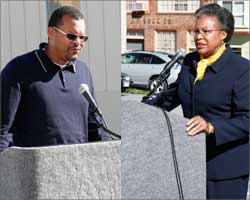
City Hall kicked off its annual Black History month celebrations with a talk by Los Angeles philanthropist and former Xerox Corp. VP Bernard Kinsey about the importance of debunking myths about the absence of blacks in American history. And Mayor Ed Lee, who had just met with five dozen unemployed black construction workers from the Bayview, revealed how, when he was growing up in the projects in Seattle, his neighbors were black, and an African American named Darnell was one of the most loyal patrons of the restaurant that Lee’s father was trying to make succeed.


“And when my dad suddenly died of a heart attack, Darnell was the first person to offer my brother a job at his gas station,” Lee said. “So, this is not just about recognizing African American history, but recognizing what they did for us, and  making sure that no there are jobs and we protect the family structure. I know what it is to be helped by the African American culture.”


Lee’s recollections of Darnell came less than an hour after he met with Aboriginal Blackmen United, a group that represents unemployed construction workers in the Bayview, to discuss how its members can get hired at UCSF’s $1.5 billion hospital complex at Mission Bay and other local building sites.


At that meeting, ABU President James Richards thanked Lee for getting UC to clarify the details of its voluntary local hire plan at the Mission Bay hospitals.
But he warned that the fight is just starting. “We’ve got the unions to deal with,” Richards told Lee, referring to the reality that the unions also want their members to get work at the UCSF site.


Lee said he’d do his best to help.
“The African American community in San Francisco has not got its fair share,” he said. “I can’t say that everyone in the room is going to get a job, but I’ll open up doors and do my best.”


And then Lee confirmed that local hire is one of his top five priorities.
“My top priorities are the budget, pension reform, the America’s Cup, finding a good police chief and local hire,” he said. “I said that directly to every union leader yesterday. Some unions will be there, others will resist.”


ABU’s Richards said the need to have a G.E.D. to get into the city’s ob training programs is a barrier to employment for many in the Bayview.
“We have a lot of people, who are not able to get into CityBuild because they don’t take folks anymore who don’t have their G.E.D,” he said.


And he warned that the city’s black community is in crisis.
“I know there is a budget crisis, but this is a life crisis,” Richards said. “Young people are dying and it’s not even newsworthy any more.”


Lee suggested ABU work with the City to avoid the need to hold protests at construction sites in future,
“Let’s plan together, so you don’t have to go to all the sites,” Lee said. “I am for people getting their GED. But if someone has evidence that they are making an attempt to get their GED, we need to reward that with jobs. So that the GED is not a barrier, it’s a hope.”


And then Lee was off to attend his next round of meetings, which included the city’s Black History month event, where speakers noted that during Bernard Kinsey’s career with Xerox, he helped increase the hiring of blacks, Latinos and women,


Kinsey told the audience that he and Shirley Kinsey, his wife of 44 years, share a passion for African-American history and art. And that their world-famous Kinsey Collection, which contains art, books and manuscripts documenting African American triumphs and struggles from 1632 to the present, is currently on display at the National Museum of American History in Washington D.C, and a number of pieces are at the San Francisco African American Historical and Cultural Society. He noted that the posters of African Americans in the Civil War were reproductions of some of the art in those exhibits. 


Sup. Malia Cohen noted that about 200,000 African Americans participated in that war. Sup. Ross Mirkarimi, who represents the city’s Western Addition, where redevelopment triggered massive displacement of the black community in the 1960s, noted that eight members of the current Board of Supervisors, who selected Lee as the city’s first Chinese American mayor, are people of color.


“This is true representation,” Mirkarimi said, noting that the fact that the city’s African American population continues to drop (reportedly down from 6 percent to 3.9 percent, according to the 2010 Census) to “is a reminder that even the most forward-thinking cities have a lot of work to do.”


And Kinsey urged African Americans to start describing their ancestors as “enslaved.”


‘It will change how you look at your ancestors,” he said, “You don’t have a clue about what they sacrificed to get you to where you are today. We don’t tell you the ‘ain’t-it-awful’ story about slavery. We tell you the story of how we overcame.”


“You need three things for a successful life,” Kinsey added “Something to do. Someone to love. And something to look forward to.”


Kinsey said he and his wife have espoused two life principles, ‘To whom much is given much is required” and live “A life of no regrets.” And then he told a story about an eagle who was raised by a chicken.


The eagle ended up ashamed of his feathers, because the chickens never told him he was an eagle because they were afraid he’d end up ruling the barnyard.“He even grew up ashamed of his daughters,” Kinsey said.


Eventually, the eagle met another eagle, who told him the truth. “You ain’t no chicken,” the other eagle said.


“And this is the message,” Kinsey said. “Don’t think chicken thoughts, or dream chicken dreams. Think like an eagle.”


He warned the audience to be careful of buying into myths that would have them believe that African Americans played no role in building the U.S.
“There are stories that made America and stories that America made up,” Kinsey said. “And too often, the myth becomes the choice.”


And then he concluded by expounding on “the myth of absence.”
‘”African Americans are not seen, not because of their absence, but because of the presence of a myth that prepares and requires their absence,” Kinsey said. “And the manipulation of the myth changes the color of the past. It’s no accident that the dominate images from the past are white. And many of us have swallowed the pill.”


Division of labor

0

sarah@sfbg.com


In the wake of a three-day protest by unemployed workers outside UCSF’s Mission Bay hospital construction site — and under pressure from city leaders — UC officials have announced voluntary local hiring targets at the $1.5 billion complex.


Targets start at hiring 20 percent of the project’s workers in San Francisco during 2011 and increase that by 5 percent each year until the hospital complex is completed, UCSF news director Amy Pyle told us. But she denies that UC was pressured into its decision. UC is a state agency that is exempt from local rules when it builds facilities for UCSF and other campuses.


“Our voluntary goals are not a result of their protest,” Pyle insisted. “We have been aware of the local hire concerns since before they were protesting.”


The protests have focused on the need to hire workers for southeast San Francisco, where unemployment rates are the highest in the city, particularly among the city’s African American population.


“Of course we are looking to be good neighbors and hire people from an area we know has been hard hit,” Pyle said, clarifying that under the University of California’s hiring program, “local residents mean people who live in San Francisco generally.”


Mission Bay Hospitals Projects executive director Cindy Lima said uproar at the site stemmed in part from perceptions that lots of work is available now, but she said that isn’t true.


“Job opportunities should ramp up in May, but right now, they are installing structural piles,” Lima said. “So if there is an opportunity for a carpenter or a laborer to get decks built, we call the union.” UC’s voluntary local hire announcement came after Mayor Ed Lee urged UC officials to formalize a community hiring plan for Mission Bay, and Aboriginal Blackmen United (ABU) president James Richards agreed to call off his group’s protest outside UC’s Mission Bay hospital complex, at least for now.


ABU member Fred Green, an unemployed construction worker who has lived in the Bayview for 50 years and has five children, said the protesters tried to remain peaceful. “But an empty belly makes you do strange things,” Green said. “If there’s enough work for everybody, why should we be stuck at home while someone comes into my community and takes food out of my kids’ mouths?”


Troy Moor, who has lived in the Bayview for 47 years and has two kids, speculated that if ABU blocked both gates to the project, it would cost UC thousands of dollars a day in lost productivity. “Here at the front gates, we are visible. But we figure that if by next week, nothing is happening, we’ll start making them lose money,” he said.


Michelle Carrington is a 58-year-old flagger and operating engineer from the Bayview who has been unemployed for 10 years. She said Dwayne Jones, who worked in the Mayor’s Office and helped her graduate from Young Community Developers, was “working to try and get us jobs.”


Jones, who is now with Platinum Advisors as a consultant to DPR Construction, UC’s prime contractor at its Mission Bay site, put in an appearance on day three of ABU’s protest. But he said his work with DPR had nothing to do with the ABU protest.


“UC is very committed to maximizing local hire where we can,” Lima told the Guardian. “It’s unfortunate there is a protest because it gives the sense we haven’t been working with the community when in fact we have been working with the Mayor’s Office, CityBuild, and every stakeholder interested in this project, including ABU.”


Richards said ABU mounted its protest to challenge UC’s claims that it has hired more local residents at the site. They were also angry over a flyer that encouraged residents interested in working at the site to sign up with the San Francisco Workforce Collaborative, in partnership with Rev. Arelious Walker’s BayView Hope Community Development Corporation, feeling as if the UC was trying to divide their community. Walker did not return our calls for comment.


“We were with Walker when he was fighting the Nation of Islam’s attempt to stop development at the shipyard, so it hurts so bad to see this,” Richards said. “Never again will we stand by and let people come into the southeast community and take our jobs. We’re going to fight until the end. If the community doesn’t work, no one works.”


But even as UC announced its voluntary Mission Bay goals, community advocates pressed UCSF to set higher targets, citing the city’s failure to attain 50 percent local hire goals under San Francisco’s decade-long policy of seeking to hit that goal.


Joshua Arce of the Brightline Defense Project said he is glad Lee expressed support for Sup. John Avalos’ local hire legislation, “but we are waiting to see if he implements the law as written or a watered-down version.”


Then-Mayor Gavin Newsom allowed Avalos’ legislation to become law without signing it, bowing to the veto-proof 8-3 majority that approved it. But in a 12/23/10 letter explaining his position, Newsom recommended modifications to accommodate the concerns of the building trades, whose members come from across the Bay Area.


“I know the passage of this policy has created high expectations among some residents of San Francisco,” Newsom wrote. “The city owes it to them to implement this policy in a way that will result in a successful program that is fiscally responsible and reflects the best thinking of the many stakeholders invested in San Francisco.”


But with Newsom moving to Sacramento, California Assembly member Tom Ammiano and Sens. Mark Leno and Leland Yee are urging legislators to support San Francisco’s newly approved local hire law as approved.


In a Jan. 25 letter that Leno and Yee signed, Ammiano encouraged Bay Area officials to work with the city to explore mutually beneficial “reciprocity agreements” in which local cities would support one another’s programs “aimed at providing disadvantaged job seekers opportunities in the construction sector.”


“In neighborhoods like the Bayview, the Mission, and the Western Addition, the promise of jobs — particularly living wage construction jobs — has been an unfulfilled promise for generations,” Ammiano wrote.


But in a Jan. 28 press release, UC officials clarified that “as one of 10 campuses of a statewide constitutional corporation and public trust,” UCSF is not subject to Avalos’ mandatory requirement and is prohibited from adopting mandatory requirements based upon residency.


Instead, UC promised to do more community outreach and try to carve out financial incentives to encourage contractors to hit UC’s targets at Mission Bay.


Lima said the hospital complex is a historic opportunity to put as many San Franciscans to work as possible. “We have set an ambitious hiring target but we recognize that the economic activity generated by the project can significantly benefit our neighbors and local residents,” she said


After his Jan. 27 meeting with UC, Richards told ABU members that “when DPR needs someone for a job, they’re gonna call Dwayne Jones, and then Dwayne will let us know. There are hundreds of jobs, but I don’t know if they are in every trade. So, I feel good. But not so good that I can say that 10 carpenters will be hired tomorrow. There’s not enough need for that right now. But the work that’s there, when they call, you’re going to know it.”


Lima said UC’s meeting with Richards was “positive”.


“We clarified some misunderstandings and made some progress,” Lima said, noting that work at the site will become increasingly available starting in May. “Our goal is still to create jobs for San Francisco residents and make this project happen. We are continuing to try and match people who need to go to work with available job opportunities. The bottom line is that there are a lot of people in this city who are out of work and a lot of groups with different intentions in mind and we get tangled in that process.”


Lima vowed to work closely with DPR Construction and major subcontractors to ensure qualified local residents — including those from neighborhoods closest to the site — can access the construction jobs. And she promised that results will be reported regularly and the size of the workforce will increase steadily, peaking with 1,000 workers in 2012.


“We are mindful that while these goals challenge us, they are also within reach,” Lima said, noting that UCSF has been engaged in creating job opportunities in the construction trades for San Franciscans since 1993. “Our success will depend on the participation and commitment of the broader community and the trade unions.”


UC’s move comes less than two weeks after Lee announced at the annual San Francisco Labor Council Martin Luther King Jr. Day breakfast that one of his top priorities is implementing Avalos’ mandatory local hire policy.


Lee’s comments suggest a different approach from Newsom’s, but it’s still not clear whether Lee intends to follow the “critical steps” that Newsom felt the city should take “to ensure the responsible and successful implementation of Avalos’ legislation.”


Arce said he was happy to see Lee address the issue at the MLK Day event. “Lee said that if we are using local dollars to create local jobs, those jobs should go to local workers,” Arce recalled, noting that the following week Lee started to coordinate with the Office of Economic and Workforce Development and CityBuild to engage community stakeholders and lay out a road map to implement Avalos’ legislation.


“They set a deadline of March 25 as the target date by which the language of Avalos’ mandatory legislation must be included in all public bids and contracts,” Arce said. “And it’s our understanding that Mayor Lee called UC Chancellor Susan Desmond-Hellmann directly on the morning of Jan. 27 [before ABU’s Richards met with UC officials] to ask that UCSF formalize a community hiring plan for Mission Bay as soon as possible.”


Avalos said he was “very encouraged” by Lee’s remarks. “To say that at the Martin Luther King Labor Breakfast was a big deal,” Avalos said, noting that the building trades were also in the room. “I feel Ed Lee wants to implement the legislation how it is written. He needs help doing that. He needs to create a process to make it happen, and I believe the folks who helped draft the legislation will be ready to do that. That’s not to say that this couldn’t go wrong, but I feel pretty confident that he will implement as strong a local hire model as possible.”

Don’t nobody give a damn: day 3

1

Unemployed construction workers protested outside UC Mission Bay’s Hospital building for the third day straight—but by early afternoon seemed to have got some clarification from UC officials over upcoming job opportunties at the site.


At issue is the tension between UCSF’s stated desire to be a good neighbor and put local residents to work, and the reality that while unemployment remains high throughout the construction industry, the communities immediately neighboring UC’s Mission Bay campus have been hard hit.


.“I want them to set up a system where we have a referral mechanism that includes CityBuild, and for UC to discontinue using DPR’s subcontractor Cambridge and other consultants,” James Richards, President of Aboriginal Blackmen United (ABU), said shortly before he met with UC officials. “Because if you don’t have a community-based organization helping UC make good on its commitment to be a good neighbor, then you are going to see stuff like UC’s voluntary local hire system. The idea that you can have a voluntary system without someone like ABU, which organizes folks from the community, is why this system is going to fail. And it’s why we only see token folks on the site. Because if you don’t work with the community, you won’t get the community to work. Really it’s an easy proposition: you have unemployed union workers at the gate. So put them to work.”

Just then Dwayne Jones, who worked in the Mayor’s Office when Gavin Newsom occupied Room 200, stopped by to chat with Richards and the ABU crew. 
Jones, who is now with Platinum Advisors, told the Guardian that he works as consultant for DPR Construction, UC’s prime contractor at Mission Bay. Fortune recently ranked DPR number 22 in its list of Top 100 companies to work for in the U. S.


Jones noted that his work with DPR had nothing to do with ABU’s local hire protest. “I’m only involved because I have worked with all these folks in the past and know all the players,” Jones said. “So, I’m helping these folks. At the end of the day, DPR’s concerns and mine are the same: I want to facilitate a process that maximizes opportunities for local folks.”

“These are all great people,” Jones continued. “I’ve worked for them for 15 years.”

Asked what the city can do to get the state-owned UC to hire more folks from economically disadvantaged communities on a project that isn’t financed by city funds, Jones said, “I agree that there is little leverage that the city has, given the constraints of the contract, so people need to be creative.”

Jones said he was not aware that Dr.Arelious Walker and the San Francisco Workforce Collaborative has issued a flier stating that they were gathering lists of names to be submitted to UC for jobs, amove that angered ABU members since they have been protesting for jobs at the site for over a year


“I was not aware of this group but there are a multitude of organizations trying to do good work,” Jones said. “And frankly this [multitude] was one of the things that led to the end of the lead agency methodology, because it caused so much division in the community. I hope we build a really strong coalition in the community that leverages its strengths.”

Jones gave UCSF credit for trying to move the local hire process forward
“I’m glad that they accepted the initial recommendation to do whatever they can to mirror the city’s local hire legislation,” he said. “Because although it’s voluntary, if it’s part of your culture and you embrace it, it’ll get done. And these are the people who have been out here for a year.”

Last December, the Board approved local hire legislation for city-funded projects. Mayor Gavin Newsom did not sign the legislation, which met stiff opposition from the building trades, and it’s fallen to Mayor Ed Lee to mplement this new law, which does not apply to state agencies,but had led to a parallel dialogue with UC.


“Much like any policy, implementation is the biggest challenge,” Jones observed. And until we do some inventory of which organizations, contractors, individuals and groups can do each piece of the work, it’s going to be a struggle. What I’m praying for is that local hire legislation allows us to get a bigger table. What I’m interested in doing is creating a pipeline of qualified workers, so that whenever something like this happens, I don’t have to hear the excuse that folks aren’t ready to work.”

Then Richards took off for a meeting with UC Vice Chancellor Barbara French that lasted two hours during which time rumors started circulated that Mayor Ed Lee had called French to try and help move the conversation along, as ABU members continued their protest and shared stories with reporters of how they came to be standing on a picket line in Mission Bay.

One worker, who preferred to remain anonymous, said he was frustrated by UCSF’s plea for workers to remain patient because jobs are coming soon. “We’ve been out here for one and a half years, so since before they did their demolition, and they have been playing games with us,” he said. “ Folks with ABU were promised jobs. But then they didn’t get anything. That’s what UC does. They try to pacify you and tell you stories, then the money gets taken out of the community, and another year goes by. So, if anybody says, why aren’t you more patient, the answer is that the whole area has been built with only a handful of people from our community. Especially now, when no one has jobs, and everybody wants to work here. We are not going into other communities and trying to steal their jobs. We just want to work here. But we could be protesting every day, until this whole stuff has been built. It’s a city within a city. Just look around you. We was patient. And all this stuff has been built and we got no jobs.”

Michelle Carrington, 58, a flagger and an operating engineer from the Bayview, said Dwayne Jones helped her graduate from Young Community Developers. “He got me in tears, he dropped me in the mud at 5 in the morning and made me do push ups, but I fought and kept on and graduated at the top of my class out of three women and 15 men,” she said. “But now we got people going behind the gate, folks who used to work for Dwayne Jones, like Dr. Arelious Walker, who are trying to say that they are the ones who have got the sign-up list for jobs here. But you ain’t been here marching, or down at City Hall fighting for local hire. And I saw Rodney Hampton Jr. on the number 54 bus, and I let him have it. I said, what’s this I heard about you and Walker? And he said he went to UCSF and tried to get a bid but was told ABU had it. So the only way to get in was for him and Marcellus Prentice to go to God’s house.  But Walker’s not out here. Meanwhile, we see folks coming from Hayward, Sacramento and Vallejo and working on this yard. Why is it such a hard decision to try and put us to work? It’s easy. Just take 5 or 10 of us, put us to work, and we will go away. Work smarter, not harder.

Laborer Sharon Brewer, who was born and raised in the Bayview and has been out of work for two years. She helped her granddaughter, Akira Armstrong, hold a protest sign and talked about losing her apartment because she lost her job.
“I had to move back in with my daughter because nobody lets you live for free,” she said. “I used to work for UCSF as a patient coordinator for physical therapy but I got laid off. Now I have to dummy down my resume to try and get a job making $8 an hour selling coffee and donuts .”

Jesse Holford said he had reached the fourth level of his apprenticeship as a Carpenter.
‘There are eight levels between an apprentice and a journeyman,” he said.

Jason Young and Alonzo McClanahan said they were unemployed laborers from  Bayview Hunters Point resident. Robert English, a carpenter journeyman from the Bayview, had been out of work 6 months. Tina Howards, a carpenter’s apprentice from the Bayview with four kids,  had been out of work for a year. And Keith Williams, a carpenter from the Bayview, had been out of work for nine months.


Fred Green, who has lived in the Bayview for 50 years and has five kids, said protesters were trying to remain as peaceful as possible.


“But an empty belly makes you do strange things,” Green said. “If there’s enough work for everybody, why should we be stuck at home while someone comes into my community and takes food out of my kids’ mouths. I got five kids and they all go hungry.”

Bayview resident Carlos Rodriguez has three kids and has been out of work for two years.
“They called me to work before Christmas but never hired me, “ he said.


Bayview resident Truenetta Webb has two kids and has been out of work for four months.
‘Some guys called me and took my information, but there’s been no work,” she said.

Troy Moor, who has lived in the Bayview for 47 years and has two kids, worked in January on Lennar’s shipyard development for 17 days.


“Two weeks ago, UC said they were going to hire four folks on ABU’s list, but they didn’t,” he said. “We don’t want it to get ugly out here. All we want to do is feed our families.”

Moor said he believes Mayor Ed Lee will ensure local hire is implemented on city-funded projects. “Ed don’t want no problem, we know him personally, we used to work for him when he was at DPW (the city’s Department of Public Works),” he said. “He’s a decent guy, as long as you keep the pressure on him.”

Moor speculated that if ABU blocked both gates to the UC Mission Bay hospital project, it would cost UC thousands of dollars.“Here at the front gates, we are visible, but we figure that if by next week, nothing is happening, we’ll start making them lose money,” he said.

Ed Albert, a retired painter and a Bayview resident for 57 years, said he was protesting for folks in his community.
“I grew up in the Bayview, I’m a servant of the Bayview,” he said. “I went from paperboy to contractor. I was a painter for Redevelopment and the San Francisco Housing Authority. But I don’t want a job. Who’d hire a 67-year-old guy with one eye? But I want to see my people get a job.”

James Amerson, a laborer with Local 261, said he worked on the Transbay Terminal in July, then got transferred to Pier 17.
“But when that was over, they didn’t bring me back to the Transbay, so I’ve been out of work since the end of December,” Amerson said. “They sent me to the Transbay as a flagger, and I rode by the other day, and saw they had an apprentice operator doing flagging.”


“When we are not working, we always come back to James [Richards]’s church at Double Rock,” he continued. “We meet at 9 a.m., Monday through Thursday. James is sick with diabetes. But he ain’t asking for anything. He’s here for the people, coming out here, buying food every day. We feed everybody. Yesterday he was feeding the police officers.”

Finally, Richards emerged from his meeting with UC officials. After he crossed 16th Street slowly, Richards was encouraged take a swig of orange juice from the back of ABU’s flatbed truck before giving folks an update.


“When DPR needs someone for a job, they’re gonna call Dwayne Jones, and then Dwayne will let us know,” Richards finally said. “There’s enough work for everybody. There’s hundreds of jobs, but I don’t know if they are in every trade. So, I feel good. But not so good that I can say that ten carpenters will be hired tomorrow. There’s not enough need for that, right now. But the work that’s there, when they call, you’re going to know it. Laborers, there are going to be no others going first. You guys are going first. So, I suppose next week, more laborers should be going, then more carpenters.”

Asked if ABU was going to continue its protest, Richards ‘said he thought folks needed to regroup.


“I think we got enough to not have to come out here tomorrow again. So, we’ll come back to church on Monday and let everyone know what happened. Then we’ll make a decision about what we are going to do. If the majority says, fuck this man, make ‘em hire 10 or 20 more folks, then that’s what we’ll do. But for now, we gotta regroup.”

Reached by phone, as ABU members prepared to pack up for the day, Cindy Lima, executive director of UC Mission Bay Hospitals Project, said she felt UC’s meeting with Richards was positive


“We clarified some misunderstandings and made some progress,” Lima said. “Our goal is still to create jobs for San Francisco residents and make this project happen. So, we are continuing to try and match people who need to go to work with available job opportunities. The bottom line is that there are a lot of people in this city who are out of work and a lot of groups with different intentions in mind and we get tangled in that process. So, maybe we need to have more dialogue about when jobs will become available. And we have made a commitment to talk more.”


Don’t nobody still give a damn?

33

For the second day in a row, Aboriginal Blackmen United (ABU), a community organization that represents unemployed construction workers from Bayview Hunters Point, embarassed University of California officials by blocking the front gate of UC’s $1.7 billion Mission Bay hospital project.


ABU members claim UCSF is refusing to hire workers from local neighborhoods and they say they are prepared to go to jail if their demands aren’t met.

“At 6: 30 this morning, we were full of energy,” ABU President James Richards said on the first day of the protest. And ABU members recalled that they saw ” nothing but skunks”  when they arrived outside the construction site at 6 a.m.


“They’d locked up everything and guarded back fence, so we stopped everyone from coming in this front entrance, including management and cars,” Richards said, as he stood outside UC’s 16th Street and Fourth Street construction site, while ABU members chanted, “If we don’t work, nobody works.”


Richards said the police told employees to go around to the site’s back entrance, as they made calls, trying to figure out what was going on.

“We’ve been out here every day for almost a year and nothing has changed except the paperwork,” Richards continued. “We have qualified union workers standing outside the job site that are ready, willing, and able to work and if the community doesn’t work, no one works.”

But UC officials say they want the Mission Bay Hospitals project to be a model for the nation of how to put people to work, even though, as a state agency, they cannot mandate local hire requirements or give preference to any particular domicile.

“UC is very committed to maximizing local hire where we can,” Cindy Lima, executive director of the Mission Bay Hospitals project, said. “It’s unfortunate that there is a protest because it gives the sense that we haven’t been working with the community, when in fact we have been working with the Mayor’s Office, CityBuild and every stakeholder interested in this project, including ABU.”

Richards said ABU decided to mount their protest this week for two main reasons: to challenge UC’s claims that it has been hiring more local residents at the site, and to register anger over the distribution of a  flier that encouraged local residents interested in working at the UC site and other construction projects in town to sign up with a group called the San Francisco Workforce Collaborative.


The flier, which fueled suspicions that UC is trying to divide the city’s disadvantaged communities, named Dr. Arelious Walker as President of BayView Hope Community Development Corporation.


“We at the San Francisco Workforce Collaborative partnered with BayView Hope CDC are currently doing sign-ups in ALL trades to afford you the opportunity to work on these projects,” the flier stated.


Richards was particularly outraged that Walker was calling his group “the San Francisco Workforce Collaborative,” since this was the name UC used to describe its community outreach efforts last year.


“We guys were with Walker when he was fighting the Nation of Islam’s attempt to stop development at the shipyard, so it hurts so bad to see this,” he said, pointing to a copy of Walker’s flier, which listed Jan. 25 and Jan. 27 as sign-up dates at Walker’s Gilman Avenue building.

“All I know is that ABU is here for the long run and we’re prepared to go to jail,” Richards said. “Never again will we stand by and let people come into the southeast community and take our jobs. We’re going to fight until the end.”


“When Dwayne Jones was with the City, DPR [which is UC’s construction contractor] was trying to notify him about requirements for job hire, and Jones was supposed to notify ABU for job placements, but now we find out that they have brought in another consultant,” Richards said, noting that Jones has left the city and now works for Platinum Advisors. “And now all of a sudden, UC hires this company and is giving this list to DPR?” Richards continued, noting that UC has hired a consultant called Marinus Lamprecht to handle job submissions at its hospital site, but no one from ABU had been hired, despite the fact that Richards submitted five names to UC, months ago.


“We’ve been demonstrating at this site and marching down the street, and UC was telling us at that time, we’re gonna put some of your folks to work,” Richards said. ” All I know is that ABU is working diligently to try and get our people hired. We want to be the first organization, not the only organization to have people work here. After demonstrating and protesting for over a year, we feel that the people who brought UC to the table and supported the city’s new local hire legislation have the right to work first. But it always seems that the powers-that-be go outside our community to cause division amongst the community.”

“We’ve been here since 6 a.m. today and this is the community,” Richards continued. “No so-called community leaders have joined forces with us, including pastors and political leaders. And that’s why we say, don’t nobody give a damn about us, but us.”

Reached by phone, UCSF’s news director Amy Pyle clarified that in recent weeks UC has committed to voluntary hiring goals at the site. The goals start at 20 percent, and increase 5 percent each year until the completion of the project in 2014, Pyle said.

This means UCSF’s voluntary local hiring plan was put together shortly after the Board of Supervisors approved Sup. John Avalos’ mandatory local hire legislation for city-funded projects. Former Mayor Gavin Newsom refused to sign Avalos’ legislation, leaving Mayor Ed Lee to figure out how to implement Avalos’ legislation, which mandates 20 percent local hire this year, increasing 5 percent each year until mandatory 50 percent goals are reached. And UCSF officials stress that, as a state agency, UC can’t have quotas and isn’t subject to the city’s local hire mandates, since its hospital project is not city-funded. But they note that the university has set voluntary local hiring goals, held monthly meetings with stakeholders, and is currently working on carving out financial incentives to encourage contractors to achieve these voluntary goals.

“Our voluntary goals are not a result of their protest,” UCSF news director Pyle said. “We have been aware of the local hire concerns since before they were protesting. So, I don’t think people should expect there to be a quid pro quo.”

And Lima observed that UC has tried to maximize local hire on construction sites, since 1993. “It’s ranged from 7 to 24 percent, so the average has been about 12 percent,” she said, stressing that a lot has changed in recent years, regarding UCSF, local hire, and the overall economy.

“For a start, this project is six times larger than anything we’ve done,” Lima said. “There’s been a shift in capacity of community groups. The city has centralized its actions, concerning local hire efforts. And now it’s advancing its local hire goals, and then there’s the economy.”

Lima said that it’s because of this changed landscape that UCSF is ramping up its efforts to hire local residents.

“While we cannot mandate that our contractors hire locally, we are holding monthly meetings that are open to all community stakeholders,” she said. “We are doing extensive outreach to offer any stakeholders to submit names. We are keeping a list so as jobs become available. We are able to provide those names to unions for job call opportunities. And we have tried to carve out part of our payment to contractors to put it into an incentive program if they hit those goals.”

Lima said the final details of the incentive plan haven’t been worked out.
“But they are substantial,” she said.

She insisted that ABU did not succeed in completely shutting down UC Mission Bay Hospitals’ construction site in the last two days, and she claimed that if the goals of UCSF’s voluntary local hire program are reached, UC will double its historical local hire average, eventually.

Lima pointed to UC Mission Bay’s website where minutes of a Jan. 13 meeting between UCSF and representatives for the local workforce are posted.

Those minutes show that UCSF has agreed to work with its Mission Bay construction contractor DPR “to ensure that qualified San Francisco residents have access to jobs, Lima said, and that names can be submitted to consultant Marinus Lamprecht, using submission forms available here.

UCSF also intends to prepare trade-by-trade name call opportunities and has promised to report on actual local hiring progress at monthly community workforce meetings to be held the second Thursday of each month, she said.


UCSF’s news director Amy Pyle clarified that under UC’s voluntary local hire program,  “local residents mean people who live in San Francisco generally.”


“Of course we are looking to be good neighbors and hire people from an area we know has been hard hit,” Pyle said.

Meanwhile, Lima said UC has not entered into any contract with BayView Hope CDC and requested a copy of Walker’s flier to see if his group “overstepped.”
“For many years, UC did have a memorandum of understanding with the community and was working with a group called the San Francisco Workforce Collaborative,” Lima clarified. “The name has lasted, but the organization has changed. It was very successful historically, and there’s been an effort in the community to resurrect that group and make it stronger, but the landscape has changed, so we decided to open the doors to everybody.”

According to Lima, any interested party can now submit names to UC’s sign-up list.

“I carry that list around with me,” Lima said, promising folks will be hired in the order their names are received, if they match available opportunities.

“The contractors talk to the subcontractors who give them their best monthly estimates,” Lima said, noting that the subcontractors arrive with a core crew and then call the unions to fill their remaining needs.


Lima said part of the current uproar over local hire at UC Mission Bay’s hospital site stems from the misperception that there are lots of jobs available now.


“Job opportunities should ramp up in May, but right now, they are installing 1,052 structural piles,” she said. “So if there is an opportunity for a carpenter or a laborer to get decks built, we call the union.”

Lima added that folks are welcome to review data that UC’s compliance officer gathers.
‘It’s in our and the community’s best interest to put people to work,” she said.

But so far UCSF’s stance has continued to angered ABU members. They note that the university’s local hiring rates hovered at less than 10 percent until a series of ABU-led community protests in late 2010 forced UCSF and its contractor DPR  to request voluntary reporting of worker residency. 

And while UCSF claims that local employment is on the rise at the site, ABU questions the reliability of the university’s self-reported performance at the site. As a result, ABU imembers continued to protest at the site Jan. 26, even as efforts appeared to be underway to address their concerns.

“Dr. Walker called us, he was apologetic,” ABU’s Ashley Rhodes told the Guardian Jan. 26, referring to BayView Hope CDC’s flier. “And the Mayor’s Office just called, saying they wanted to talk with James [Richards, ABU’s leader]. So, that’s where he is right now. But tomorrow we may go to jail.”

Rhodes noted that on Jan. 26, DPR hired one carpenter from ABU’s list.  “And a female receptionist is being interviewed, but we still have three out of five names we submitted last year to bring in,” he said.

Outside UC’s Mission Bay construction site , Michelle Carrington, a 58-year-old Hunters Point resident, continued her protest for a second day straight.

“I’ve been out of work for ten years,” Carrington said, noting that she has over a decade of construction experience as a flagger and an operating engineer.
“I graduated from YCD in 1999,” she said, referring to Young Community Developers. “Dwayne Jones trained me. He just left the Mayor’s Office and now he is working to help us get jobs.”

Uncertain developments

0

sarah@sfbg.com

Gov. Jerry Brown’s proposal to eliminate redevelopment agencies and enterprise zones has San Francisco officials confused about which local projects will be affected.

Currently, the state allows municipalities to redevelop specified areas by borrowing against estimated future property taxes. Brown says he doesn’t want to interfere with any redevelopment bonds or commitments that have been contractually entered into — but the plan would redirect billions from development projects to schools, public safety, and other local programs.

“Redevelopment takes money from schools, cities, and counties,” Brown said at a Jan. 10 budget proposal press conference. “We want to take that money and leave it at the local level for the purposes it was historically intended. That’s police or fire or local activities, county, or schools.”

Brown says his proposal will save the state’s general fund $2.7 billion over the next 18 months. And he wants to help cities and counties raise taxes to replace that money.

But local officials say it remains to be seen what Brown’s plan means for existing obligations, and details won’t emerge until the governor releases a draft budget in March.

“I don’t think we’ll really know until we see what the legislation says,” said Redevelopment general counsel Jim Morales. “Clearly if you have a binding contract, that’s enforceable in court. The Legislature couldn’t pass a law that interferes with that.”

Redevelopment already has contracts related to the Hunters Point Naval Shipyard and Mission Bay. “The fact that we have an agreement is helpful. But a redevelopment plan of itself is not an agreement,” Morales said. “It goes to the question of what is the obligation, who gets it, and what tools do they have to fulfill those obligations.”

Morales said he believes the passage of Proposition 22 in November — which blocked the state from taking local redevelopment funds — lies at the heart of Brown’s proposal.

“The way Prop. 22 was drafted doesn’t give the state Legislature much room to use these funds except to eliminate redevelopment agencies,” he said. “It’s a legal as well as a political strategy to amend by another ballot measure or somehow modify Prop. 22.”

Brown’s bombshell landed just as city officials announced that a settlement had been reached with the Sierra Club and Golden Gate Audubon Society over charges that the city’s environmental impact report for Lennar Corp.’s massive development proposal for Candlestick Point and the former Naval Shipyard was inadequate.

The agreement includes criteria for the design and construction of a bridge across Yosemite Slough to lessen environmental impacts and provide habitat improvements.

“A settlement that provides great benefits to people and wildlife is not one that is often achievable. We’re extraordinarily pleased to have done so in this case,” said Arthur Feinstein, chair of the Sierra Club’s San Francisco Bay Chapter in a Jan. 8 press release.

“The agreement creates benefits for the community and the open space, habitats, and wildlife throughout the project area,” said Mark Welther, executive director of the Golden Gate Audubon Society. “The lagoon and other improvements will create an area whose beauty and ecological significance will rival Crissy Field.”

Lennar’s Kofi Bonner said the settlement helps clear the way for fundraising efforts. “It means we have one less lawsuit to deal with,” Bonner told the Guardian at the Jan. 11 swearing-in for interim Mayor Ed Lee.

Still on the table is a suit that Bayview-based Green Action and Power (People Organized to Win Employment Rights) brought against the city’s EIR for Lennar’s project.

Bonner said POWER’s lawsuit is about issues that the developer does not control. “POWER’s suit is about toxins removal and how the Navy is handling the issue,” he said.

POWER counters that it’s premature for the city to certify the EIR for the Lennar project. “The problem is that we are asking the city to approve future uses at the shipyard when we don’t know the result of the Navy’s clean-up process,” said Jaron Browne, a spokesperson for POWER.

Browne said that there’s nothing in POWER’s lawsuit to prevent Lennar from moving forward at Candlestick Point or with rebuilding the Alice Griffith public housing project.

Jerry Brown wants to eliminate Redevelopment

10

Calitics reveals today that newly sworn-in Gov. Jerry Brown told the Sacramento Bee that he’s proposing to eliminate local redevelopment agencies as part of a set of austerity measures that he is proposing in a purported effort to shock folks into approving new revenues

Brown’s shocking proposal got me calling tenants rights activist Calvin Welch and Arc Ecology executive director Saul Bloom, who both have strong and well- informed views on what’s up with local redevelopment agencies and how they could be improved. And interestingly neither Bloom nor Welch was in favor of eliminating redevelopment.

Welch, who hadn’t yet had time to read the article when I called him, actually laughed when I outlined Brown’s basic idea, which admittedly is big on shock value and thin on explanations, at least at this point.
‘That would be very interesting, but the devil’s in the details.” Welch observed, noting that voters just approved Prop. 22 in Nov. 2010 to prevent the state from taking city redevelopment money to balance the budget in Sacramento. (Unfortunately, Prop. 22’s passage still doesn’t protect San Francisco from having its budget raided by the state, since it’s defined as both a city and a county.)

“That’s an astounding idea,” Welch added, trying to wrap his mind around Brown’s out-of-the-blue proposal. “Because in San Francisco, there are redevelopment areas, including Bayview Hunters Point, Mission Bay and the Transbay Terminal, that have already been authorized for another 25-30 years.”

“Perhaps the language would be ‘no new redevelopment’ but I don’t know how you would do that,” Welch added, noting that Brown has not only been governor before, but was also mayor of Oakland. (During his term as mayor, Brown was credited with starting the revitalization of Oakland but was also accused of being more interested in downtown redevelopment and economic growth than political ideology.)

Welch noted that San Francisco was fortunate in being able to reshape its Redevelopment financing arrangements in 1990 under then mayor Art Agnos.

“It was probably the most progressive and long standing reform of Art Agnos’ administration—and no one understands it,” Welch said. As Welch tells it, when Agnos came into office, he inherited a city that had been bankrupted by a decade of mayor Dianne Feinstein’s business-friendly policies, much like how San Francisco has been milked in the past decade by Newsom’s business-friendly policies.

“Redevelopment doesn’t pay its way in the post Prop. 13 world,” Welch stated. “Under Mayor Gavin Newsom, we’ve had the most market rate housing produced and the biggest deficits in what was a real estate collapse, as part of the collapse of the economic markets. And under Mayor Feinstein’s 10-year rule, we saw massive amounts of commercial office space built that never paid its way, leaving Agnos with a $103 million deficit.”

Welch notes that Agnos also inherited a huge homeless crisis (something Welch says Feinstein was in denial over) and that Agnos sought to reform Redevelopment in large part as a way to address the city’s growing lack of affordable housing. “Art basically said, let’s take a look at tax increment financing,” Welch said, referring to a tax financing arrangement, under which a municipality can a) do an assessed value of an area before redevelopment takes place, b) estimate what that same area’s local taxes would be after redevelopment, and c) borrow money against the incremental difference between a) and b).

“Art said, ‘I want to do that and I want to use the hundreds of millions of dollars available through redevelopment for affordable housing,’” Welch recalled. He noted that Agnos succeeded in his mission by shifting the San Francisco Redevelopment Agency’s mission from ‘urban renewal’ (which had negative connotations following the displacement of African American and other low-income communities from the Fillmore in the 1960s) to ‘community development,’ making Redevelopment subject to the same budgetary process as other departments, and insisting that 20 percent of tax increment financing dollars be devoted to affordable housing.
“But we said, ‘no, 50 percent has to be devoted to affordable housing and Art agreed, and that’s been the case since 1990,” Welch recalled. “And since then our Redevelopment Agency has been the principal source of affordable housing revenue in San Francisco.”

So, in another words, the San Francisco Redevelopment Agency is pretty much alone in the state, in terms of devoting half its tax increment financing revenues to affordable housing. But by the same token, San Francisco’s Redevelopment Agency is pretty much alone in the state in terms of not being governed directly by a city council or a county Board of Supervisors. Instead, it’s governed by a Commission, whose members are appointed solely by the mayor . And therein lies the problem, Welch says.
‘It would only take six votes on the Board of Supervisors, or eight votes to override a mayoral veto, to change that,” Welch observed.

But to date there haven’t been eight votes to do that, even with a progressive Board.
Welch believes the problem is that supervisors, who currently each only have two legislative aides, fear swampage from Redevelopment responsibilities.
“To contemplate taking over a multibillion dollar agencies and taking on the likes of Catellus with only two staffers, well it’s a recipe for disaster,” Welch said, acknowledging that additional reforms, including splitting appointments on the Redevelopment Commission between the mayor and the Board, or allowing the Board to hire additional legislative staff to work on redevelopment issues, could solve the problem.

Bloom, who recently sued after the Redevelopment Commission threw his non-profit under the bus, said his non-profit’s recent experience perfectly illustrates why and how Redevelopment should be reformed, rather than completely eliminated.
“Redevelopment is a process that has been much abused, so it’s easy to say, let’s get rid of it, but I’m not there, ”Bloom said, noting that his beef has been with the way his non-profit was treated by Redevelopment Commissioners, rather than Redevelopment staff.
“But I do believe there needs to be a modification of the process, in which redevelopment is put in the hands of an entity that is answerable to the public.”

Bloom believes this modification could be achieved by making the Board of Supervisors the governing body of the Redevelopment Agency, which is already the case in almost all municipalities in California.
“Give that role to the Board of Supervisors because you can fire your supervisor,” Bloom said, noting that currently there are no limits on how long individuals, who are appointed by the mayor, can serve on the Redevelopment Commission. ‘If you give that role to the supervisors, they will be able to utilize more staff to become better Board members. So, this is an opportunity to increase people’s participation in the process.”

Meanwhile, it’s possible that Brown’s threat to eliminate Redevelopment will be like the time Warren Buffett, who’d just been announced as then newly elected Gov. Arnold Schwarzenegger’s financial adviser, caused a brou-haha when he threatened to reform that even holier of cows, Prop. 13.


Out with the old

6

On the chilly morning of Dec. 21, a crowd of prominent local and state figures huddled in an industrial parking lot overlooking the brick smokestack of the Potrero power plant, which has been in operation for more than 40 years. It was the winter solstice, the morning after a lunar eclipse, and an historic environmental moment for San Francisco.

A longstanding battle to shut down the aging, polluting power plant was finally coming to an end, and it would be effectively shuttered as the calendar flipped to the new year. Although the past decade had been marked by political infighting and a relentless push to persuade the California Independent System Operator (CAISO) to shut it down sooner, the tone that day was buoyant as people made the rounds, embracing one another and offering congratulations and thanks.

Among those who lined up before the media were Mayor Gavin Newsom, who will be sworn in as lieutenant governor in early 2011; Sup. Sophie Maxwell, whose 10 years on the Board of Supervisors is coming to a close; City Attorney Dennis Herrera, who’s thrown his hat into the mayoral race; and San Francisco Public Utilities Commission General Manager Ed Harrington, whose name has been floated as a contender for interim mayor.

Each of these local politicians played a role in the contentious battle to close the plant, and each candidly admitted that shouting matches on the subject had erupted over the years. Yet they all expressed thanks to one another and to community members in the Potrero Hill, Dogpatch, and Bayview/Hunters Point neighborhoods, where residents were most directly affected by the noxious air pollution generated by the plant.

“They say it takes a village to raise a child. Well, it takes a state and a city to close this power plant,” said Maxwell, whose District 10 includes the neighborhoods affected by the power plant. “I started working on these plants when I took office, and now the plants are leaving with me.” Maxwell was credited with displaying dogged persistence and playing an instrumental role in pushing for the shutdown the plant.

“There were a lot of phone calls, there were a lot of arguments, there were a lot of disputes. But the fact of the matter is that everybody was focused on the same goal — and that was getting this plant shut down,” said Herrera, who has also been a key player in the decade-long fight to shut down the plant.

Newsom sounded a similar note. “I want to compliment everybody for their steadfastness and their devotion to this process,” the mayor said. “We didn’t always necessarily agree.”

Joshua Arce, who worked with community members to shut down the plant as part of his work with the Brightline Defense Project, was clearly pleased by the announcement. “It’s a fantastic day. We’re at last going to see the billowing smokestack come down, and for good,” Arce said.

The shutdown finally came to pass because the CalISO, which regulates the state power grid, was willing to accept new energy system upgrades as sufficiently reliable. For years, despite the community’s insistence that the plant was having an unacceptable impact on public health and disproportionately affected low-income communities of color, CalISO refused to terminate a contract requiring the plant to stay in operation for grid-reliability purposes.

However, new pieces to the city’s energy puzzle were recently fitted into place. The Trans Bay Cable, a 53-mile submarine power line that can transmit 400 megawatts of electricity from a Pittsburg generating station to San Francisco, became fully operational Nov. 23, months behind schedule. Meanwhile, a Pacific Gas & Electric Co. re-cabling project deemed important to San Francisco’s electricity reliability was completed Dec. 5.

“This plant has been part of the reliable supply for San Francisco … for a long time. And more recently, it actually provided the security for San Francisco should anything happen outside of San Francisco,” Yakout Mansour, president and CEO of the CalISO said during the shutdown ceremony. “But the time is here to replace the plant with an alternative to make the city more secure and reliable with much less polluting options.”

The CalISO issued a letter to the plant owner, which recently merged with another company and changed its name from Mirant to GenOn, stating that the must-run agreement would be terminated effective Jan. 1. The date of the final termination is Feb. 28, pending approval from the Federal Energy Regulatory Commission (FERC).

Now the major question is what will become of the power plant site, a vast strip of industrial real estate wedged between Illinois Street and the waterfront. “Many ideas have been thrown out there. People have come to us and said everything from office and industrial and research and development, to wind turbines,” noted Sam Lauter, a local spokesperson for GenOn. Lauter noted that community meetings would be held soon to discuss the future site use.

The site was previously owned by PG&E, and the utility is responsible for cleaning up lingering toxic residue including lampblack, a byproduct of coal processing, left behind when PG&E sold the site. Because of the pollution, residential units cannot legally be constructed on the site, even after cleanup.

There is one unfortunate consequence to shuttering the plant. According to plant manager Mike Montany, five or six of the 28 employees of the plant will lose their jobs. The rest will either retire or go to work at a new facility, he said.

While San Francisco will be poised to ring in the new year with improved air quality thanks to the elimination of its last polluting energy facility, residents of the area where the city’s power will now be sourced from won’t be so lucky. They are faced with the construction of two new power plants. The undersea Trans Bay Cable will run from the PG&E’s substation in San Francisco — a humming network of cables and transformers located beside the power plant that will stay put after the shutdown — to a generating station in Pittsburg, located in the delta near the confluence of the Sacramento and San Joaquin rivers.

GenOn owns the Pittsburg power plant, and it recently held a groundbreaking ceremony for a new power plant in neighboring Antioch, called Marsh Landing. At the same time, the California Public Utilities Commission (CPUC) recently gave the green light for another new power plant in that area. The $1.5 billion PG&E facility would be located in Oakley, which borders Antioch. It won commission approval Dec. 16, despite an earlier decision rejecting the proposal.

The plans for new power plants were approved just after the conclusion of an important United Nations convention on Climate Change in Cancún, Mexico, and amid news reports highlighting scientists’ conclusion that polar bears have a shot at survival only if serious efforts are taken to reduce greenhouse gas emissions. While the cheerful ceremony to shut down the Potrero power plant was a satisfying conclusion to a long battle, there’s a long road yet ahead in the overarching struggle against climate change.

Does Mayor Newsom represent SF workers or San Mateo politicians?

2

“Does Newsom represent local workers or San Mateo politicians?” That’s the question being asked  at City Hall today. And it’s threatening to deliver an unwelcome kick to Mayor Gavin Newsom on his way out of City Hall’s revolving doors, as dozens of unemployed construction workers deliver 1,000 Christmas cards that residents of Bayview Hunters Point, Chinatown, the Mission, the Tenderloin and South of Market have signed. The cards urge Mayor Gavin Newsom to “put the Merry into Christmas and the Happy back into New Year” and sign local hire law that the Board passed a week ago.

This special holiday season delivery has been in the works since Dec. 14, when Bayview-based job advocates Aboriginal Blackmen United (ABU) tried to meet with Newsom and get his signature on legislation that a super-majority on the Board support.

But after Newsom was a no-show and his chief of staff Steve Kawa refused to give ABU any assurances, community advocates Brightline Defense Project printed up a thousand of the cards urging Newsom to “put the Merry into Christmas”. And Brightline, ABU, Chinese for Affirmative Action, PODER, and the A. Philip Randolph Institute then asked unemployed workers, activists, and concerned citizens to sign this unusual set of greeting cards.

The move comes a day after the San Mateo County Board of Supervisors voted unanimously to urge Newsom to veto Avalos local hire policy. Local hire advocates suspect this counter-move was orchestrated to give Newsom political cover, should he choose to make the seemingly Scrooge-like move of vetoing, just before the holiday season, legislation that would help San Francisco residents secure work on billions of dollars worth of local tax-payer funded construction projects .

But the San Mateo supervisors claim that San Francisco’s plan, which would mandate that 50 percent of workers on city-funded projects are local residents, threatens to hurt an already sluggish regional economy.

“This is not the time to put isolation around a community,” San Mateo Sup. Carole Groom reportedly said at a hastily convened Dec. 21 special session.
 “If this is rejected, it would be time for all of us to sit down and talk about this,” fellow San Mateo County Sup. Adrienne Tissier reportedly said.

Newsom has until Christmas Eve to either sign or veto the law, though the Board can still override his veto, provided Avalos still has eight votes in the New Year. And if Newsom doesn’t sign or veto the law by week’s end, it will go into effect in 60 days.


San Mateo officials are arguing that the local hire legislation particularly impacts their county, because the law contains a “70-mile” clause that includes the San Francisco Airport, the Hetch Hetchy water system and the San Bruno jail.

Sup. John Avalos previously told the Guardian that project labor agreements protect workers at the airport and working on projects that the San Francisco Public Utilities Commission funds. But Tissier reportedly claimed that San Francisco’s local hire policy would kick in, once new contracts are negotiated.

Reached by phone, Avalos said it’s not clear if the San Mateo supervisors have actually read his legislation
‘If they had, they’d see a lot of ways that is supports San Mateo workers,” Avalos said.

San Francisco’s local hire legislation, which is the nation’s strongest, requires that 20 percent of workers within each construction trade be local residents starting in 2011. That number increases 5 percent annually for seven years, as local workers join trades where community representation is lacking, before reaching 50 percent. In other words, 80 percent of the workforce could be non-city residents in 2011, and even at 50 percent local hire, half of the jobs will still be available to workers who don’t live in San Francisco.
 
“That’s hardly an exclusion especially when you consider that San Francisco taxpayers are making the investments on these projects,” Avalos stated.
He believes that the San Mateo County Building Trades Council pressured the San Mateo Board to pass their Dec. 21 resolution urging a veto on his measure. Either way,  Victor Torreano, vice president of the San Mateo County Building Trades Council was quoted in media coverage of the Dec. 21 vote, saying, “the need for housing in San Francisco and the Peninsula make it impossible for many blue collar workers from sinking family roots in the area.”

Avalos acknowledges that San Francisco International Airport is in San Mateo County, and its workers understandably wants jobs there,
“San Mateo County has to put up with the sound of the airport, and its residents deserve to have jobs there, but this is much ado about nothing,” Avalos said. “But it’s the Building Trades that are uncomfortable with changing slightly their practices.”

Mike Theriault, Secretary-Treasurer of the San Francisco Building Trades Council, acknowledged that his group has never been pleased with Avalos’ legislation.

“But we are resigned to seeing how it plays out,” Theriault told the Guardian. “We think there are better things they could have done to guarantee access of San Francisco residents to careers in our trades.”

Theriault believes that Avalos may not understand the project labor agreement are of limited duration.
“So, they will require an extension of the existing labor agreement,” Theriault said,  noting the legislation states that future extensions would have to comply with the new law.

But Theriault acknowledged that with or without Newsom, Avalos’ legislation still has a chance to move forward.
“If he vetoes it, I understand that the Board will have another crack at it, Jan. 4,” THeriault said, referring to the current Board’s last meeting in January.
 
The Bay Area Council has also announced its opposition to Avalos’ legislation,
 “This troubling trend of intra-county battles being started by the San Francisco Board of Supervisors needs to stop,: Bay Area Council President and CEO Jim Wunderman said in a Dec. 21 statement. “The Bay Area is one regional economy, not nine island states. We need to focus on nurturing the fragile economic recovery in our region, not setting bad policies that pit county against county.  The Bay Area Council urges Mayor Newsom to veto this foolhardy piece of legislation.  Right now, we do not need any more incentives for businesses to leave any county, the Bay Area, or California.”

But advocates for the legislation note that the San Francisco Controller recently estimated that the law will pump $270 million into the local economy over the next 10 years. They hope Newsom will emerge from his warren-like office today and sign the law, delivering a historic Christmas present to the city’s growing ranks of unemployed workers.


But even if he doesn’t, Avalos isn’t sweating it.


“Newsom probably won’t sign it, and he’ll write a letter saying he’s opposed to it,” Avalos predicted. “And even if the new mayor is [SFPUC director] Ed Harrington, he’s been supportive of the measure. So Newsom has to answer his own conscience and ask himself, if he’s going to represent local residents or San Mateo politicians.”


According to Brightline’s Joshua Arce, ABU led about 30 to 40 workers from Bayview, Chinatown, and the Mission up to Room 200 today to drop off 1,000 signed  cards from residents in every neighborhood asking the Mayor to sign the community’s local hiring law by Christmas.
 
“Room 200 was locked, but we kept knocking,” Arce told the Guardian. “Eventually the doors opened and out came [Mayor Gavin Newsom’s chief of staff] Steve Kawa. We showed him all of the Christmas cards that we had for his boss and he thanked us. Ashley Rhodes of ABU explained that since we heard how much the Mayor liked the ABU holiday card last week, we printed up 1,000 more and got them signed by people from every community in San Francisco.”
 
“We asked where the Mayor was in terms of making his decision, he said that the Mayor was still studying all of the issues,” Arce continued. “He brought up the opposition from the San Mateo County Board of Supervisors, so we asked him to tell the Mayor to support us, the thousands of unemployed and job-hungry San Franciscans, over four San Mateo politicians.”
 
“Steve Kawa said that they will be working around the clock to make sure all concerns are addressed, and we showed Steve a card signed by Sup. Bevan Dufty just moments before we came upstairs,” Arce addded. “Sups. John Avalos and Eric Mar also signed Christmas cards to the Mayor.”

According to Arce, ABU left the two huge Santa bags full of cards with Kawa, who picked them up, commenting “These bags are awfully heavy.” 

“I asked him to make sure to tell his boss that the cards were printed on 100% recycled paper,” Arce concluded. “Let’s hope that Mayor Newsom puts the Merry into Christmas and the Happy back into New Year!”

Local hire, Steve Kawa, and the Americas Cup

2

Unemployed workers and community advocates hoping to secure Mayor Gavin Newsom’s support for Sup. John Avalos’ groundbreaking local hire legislation rallied at City Hall December 14 to meet with Newsom’s chief of staff Steve Kawa. But Newsom and Kawa were said to be in intense negotiations over the Americas Cup bid. So, James Richards, founder of Aboriginal Blacks United, waited until Kawa could see him, along with Florence Kong of the Bayview-based Kwan Wo Ironworkers. Joshua Arce of the Brightline Defense Project, and a group of local residents.

“‘Living in the city is so expensive,” Kong observed. “It’s not fair that a lot of local work is being done by workers from outside the city.”

Kawa finally emerged and shepherded folks out of the Mayor’s Office and into a meeting room close to the supervisors’ office. He was uncomfortable with having media at the meeting. But Richards said the group was OK with a reporter. And then he asked Kawa if Newsom would sign Avalos’ local hire law later that day.

“This is a very complex piece of legislation, and if it does become law, that’s when the work begins,” Kawa said, noting that Newsom will have ten days to review it, after its Dec. 14 reading. “Some folks are still concerned about it, partly on the trades union side,” Kawa added.

But Richards pressed his point. “After the Board acts today, we want to talk to the mayor,” Richards said. “We don’t want to wait around another ten days. We want him to assure us.”

But Kawa refused to give assurances. “At the end of the day, 42,000 San Francisco don’t have a job,” Kawa said, claiming the best local jobs program was Jobs Now, under Newsom.  “But the federal government is refusing to extend that program, and now we can’t hire anybody at City Hall and we have to get this economy growing,” he said.

When Joshua Arce of Brightline expressed concern that folks had met privately with Newsom to exert pressure against Avalos’ legislation, Kawa replied that Newsom had concerns that some folks could lose their jobs around San Francisco airport, because, technically, it’s in San Mateo.

“And are we sure this legislation will be successful?” Kawa continued. “The worst thing a government can do is over promise and under deliver. Our question is, you tell me how it will not fail. Because, yes, we want to have local hire, but don’t mislead anybody by saying, we pass this legislation, she gets a job. Our issue is making sure that we are not misleading anyone. Those are the concerns that people have. Will it be successful, as written? Because we can’t mislead your members, James.”

“Tell the mayor, we are here,” Richards said.
And then Kawa was shaking his hand and heading back to the Mayor’s Office, presumably to talk about cups and America.

“It’s a good thing, we are here today,” Richards said to the workers who remained sitting in the meeting room long after Kawa was gone. Many of them were young, black and male–and in search of a job. “Give a round of applause for your own self,” Richards continued. “It’s a good thing to let them know you come down here to take care of your own business.Because don’t nobody…”

He paused and the ABU members in the room immediately picked up the “don’t nobody give a damn” refrain, their voices ringing as one.

“Some times when we push too hard, when we get what we want, he get on a roll and tell all the reasons why he not going to sign. ‘I want to do this, but…” Richard added.

And then Richards turned to the issue of local hire at UC Mission Bay.“They gotta know today that we are hot on their trail,” he said. “Let them go tell that. Let Steve go tell that. Then they know we are fighting that.”

An hour later, when the Board gave Avalos’ legislation a veto-proof majority, Richards, Kong and the rest of the group burst into applause.
“It’s been quite a road to get here,” Avalos said.

“This is the most substantive policy San Francisco has passed in a generation,” Julian Davis observed, as local hire supporters rejoiced by the Tree of Hope, outside the Board’s Chambers.

Inside the Chambers, the Board was voting unanimously to support the city’s Americas Cup bid.

“To win a sailing race, every member of the crew has to work together,” Board President David Chiu said.  And his words could equally have applied to Avalos and the community’s effort to navigate treacherous political seas, get local hire legislation passed and, hopefully, lift everyone’s boat, in the process.

Hiring at home

1

sarah@sfbg.com

The lame duck Board of Supervisors made history Dec. 7 when it voted 8-3 to approve mandatory local hire legislation for city-funded construction projects. The measure ends a decade-long effort to reach 50 percent local hiring goals through good-faith efforts.

“That’s a sea change in our local hiring discussion,” said Sup. John Avalos, who launched the legislation in October as part of the LOCAL-SF (Local Opportunities for Communities and Labor) campaign, which seeks to strengthen local hiring, address high unemployment rates, and boost the local economy.

The veto-proof passage of Avalos’ measure comes in the wake of a city-commissioned study indicating that San Francisco has failed to meet good-faith local hiring goals for public works projects even as unemployment levels rise in the local construction industry and several local neighborhoods face concentrated poverty.

Although Cleveland also has a local-hire law, the Avalos measure will be the strongest in the nation. Avalos’ legislative aide Raquel Redondiez told the Guardian that Cleveland’s 2003 legislation requires 20 percent local hire.

“This legislation doesn’t just have a mandated 50 percent goal,” Avalos explained, noting that San Francisco will require that each trade achieve a mandated rate and that 50 percent of apprentices be residents.

“This will ensure that our tax dollars get recycled back into the local economy, and that San Franciscans who are ready to work are provided the opportunity to do so,” Avalos said.

Avalos’ groundbreaking legislation phases in mandatory requirements that a portion of San Francisco public works jobs go to city residents and includes additional targets for hiring disadvantaged workers.


WHO GETS $25 BILLION?

The legislation replaces the city’s First Source program, under which contractors were required only to make good faith efforts to hire 50 percent local residents on publicly-funded projects. But the measure begins slowly by mandating levels some contractors are already reaching. According to a study commissioned by the city’s Office of Employment and Workforce Development and released in October, 20 percent of work hours on publicly-funded construction projects are going to San Francisco residents.

Avalos’ legislation, which is supported by a broad coalition of labor and community groups including PODER, the Filipino Community Center, Southeast Jobs Coalition, Kwan Wo Ironworks Inc., Rubecon, and Chinese for Affirmative Action, comes at a critical moment for the recession-battered construction industry.

Under the city’s capital plan, more than $25 billion will be spent on public works and other construction projects in the next decade — and two-thirds of this money will be spent over the next five years.

The measure has environmental benefits too. Transportation still accounts for more greenhouse gas emissions generated in the Bay Area than any other source, and San Francisco residents are more likely to take transit, walk, or bike to work than residents of other Bay Area counties. “When local citizens are able to work locally, there are fewer cars on the road and less air pollution,” Avalos said.

Sup. Ross Mirkarimi said that Avalos’ legislation is “just a start.”

“People have talked a good game about local hiring,” observed Mirkarimi, whose district includes the high unemployment-affected Western Addition.

“We are going to have to go beyond construction and start thinking about delving into the private sector,” Mirkarimi continued, pointing to the need to build 100,000 housing units over the next 25 years if the city is to keep up with a projected population increase. “Who is going to build that housing?” he asked.

Sup. Eric Mar noted that “the Sierra Club endorsed the measure early on because of the environmental benefits of having people work close to where they live.”

Sup. David Campos, whose district includes the Mission, said the measure was one of the most significant pieces of legislation to emerge from the board in recent years. “In the past, a lot of obstacles got in the way, including some legal challenges,” said Campos, who credited Avalos for navigating a complicated legal structure. “At the end of the day, I think this is going to benefit everyone.”

Mike Theriault, secretary-treasurer for the San Francisco Building Trades Council, told the Guardian he remains opposed to the legislation because the union presers to allocate jobs based on seniority, not residency. But he said the amendments make the measure “less harmful and more survivable in the short-term.”


THE ECONOMIC GAP

Termed-out Sup. Sophie Maxwell, who represents the city’s economically distressed southeast sector, has often noted that the construction industry provides a path to the middle class for people without advanced degrees or facing barriers to employment. She thanked Avalos for pushing legislation that promises to provides opportunities for “growing the middle class instead of importing it.”

“This industry closes the economic gap,” she said.

Board President David Chiu and termed-out Sups. Chris Daly and Bevan Dufty also supported Avalos legislation. But Dufty, who is running in the 2011 mayoral race, cast the eighth vote, which gave the measure a veto-proof majority.

The board’s Dec. 7 vote came a few hours after Bayview-based Aboriginal Blacks United founder James Richards and a score of unemployed local residents rallied at City Hall in the hopes of securing Dufty’s vote.

ABU has recently been protesting at UCSF’s Mission Bay hospital buildings site on 16th and Third streets. Its members also triggered a shut down at the Sunset Reservoir last month after a court ruled that locals promised jobs installing solar panels at the plant be replaced by higher-skilled engineers,

“It’s been too long that we have been protesting and fighting this good faith effort,” Richards told the Guardian. “We need a mandatory policy.”

Dufty is also hoping the Avalos measure could spread to other cities and benefit workers nationwide. “At a certain point I looked at labor and said, ‘Yes, I’m going for this legislation. But not just for San Francisco — you want to take this concept to other cities,’ ” Dufty said, as he made good on his promise to Richards to vote to support Avalos’ law.

Dufty seemed hopeful that Mayor Gavin Newsom would get behind the legislation. “But I respect that there may be a little bit of coming together between now and the second reading.”

Newsom spokesman Tony Winniker told the Guardian that the mayor has 10 days to review Avalos’ legislation after its Dec. 14 second reading. “He supports stronger local hire requirements but does want to review the many amendments that were added before deciding,” Winnicker said.

But will Newsom, who is scheduled to be sworn in as California’s next lieutenant governor Jan. 3, issue a veto on or before Christmas Eve on legislation that has been amended to address the stated concerns of the building trades?

That would be ironic since the amended legislation appears to match recommendations that the Mayor’s Taskforce on African American Outmigration published in 2009. The California Department of Finance projected that San Francisco’s black population would continue to decline from 6.5 percent (according to 2005 census data) to 4.6 percent of the city’s total population by 2050 — in part because of a lack of good jobs.


WILL NEWSOM VETO?

Avalos originally proposed to start at 30 percent and reach 50 percent over three years. But after the building trades complained that these levels were unworkable, Avalos amended the legislation to require an initial mandatory participation level of 20 percent of all project work-hours within each trade performed by local residents, with no less than 10 percent of all project work-hours within each trade to be performed by disadvantaged workers.

He also amended his legislation to require that this mandatory level be increased annually over seven years in 5 percent increments up to 50 percent, with no less than 25 percent within each trade to be performed by disadvantaged workers in the legislation’s sixth year.

A Dec. 1 report from city economist Ted Egan estimated that the local hire legislation would create 350 jobs and cost the city $9 million annually. But Egan clarified for the Guardian that this cost equals only 1 percent of the city’s spending on public works in any given year.

Vincent Pan of Chinese Affirmative Action, which supports Avalos’ local hiring policy, suggested that the mayor “check the temperature.”

“It would be leadership on the part of the mayor not to veto legislation that’s about San Francisco,” Pan said.

And Mindy Kener, an organizing member of the Southeast Jobs Coalition breathed a deep sigh of relief when Dufty’s vote made the law veto-proof. “It’s gonna go across the country,” Kener said. “We just made history.”

Class of 2010: Malia Cohen

4

sarah@sfbg.com

It took two weeks and 19 updates of San Francisco’s ranked-choice voting system before Malia Cohen, a former Mayor Gavin Newsom staffer and partner in a firm that helps businesses and nonprofits create public policy, was declared the winner of the hotly contested race to represent District 10, which includes Bayview, Hunters Point and Ingleside. The nail-biting time lag was a byproduct of complex calculations that involved 22 candidates, no clear front-runners, and a slew of absentee and provisional ballots.

But when the RCV dust settled, the results proved that the D10 vote continues to break down along class, race, and gender lines. These RCV patterns personally benefited Cohen’s success in picking up second- and third-place votes.

But they also helped D10’s African American community, now smaller than its growing Asian community but still larger that the black community in any other distinct in the city, send an African American supervisor back to City Hall. And it avoided a run-off between Lynette Sweet and Tony Kelly, who won most first-place votes.

Some chalk up Cohen’s victory to her polished appearance, the middle-of-the road positions she took on the campaign trail, and an impressive list of endorsements that include the San Francisco Democratic Party, the Labor Council, the Building and Construction Trades Council, state Sen. Leland Yee (D-SF), Assembly Speaker Pro Tempore Fiona Ma (D-SF), Board of Supervisors President David Chiu, SF Democratic Party Chair Aaron Peskin, and BART Board President James Fang.

But Cohen told us she thinks coalition building was the key. “Endorsements only account for a quarter of the reasons why you win,” she said. “It’s all about building an organization, a net that goes deep and wide.”

Some progressives were alarmed by a Dec. 1 fundraiser to help settle Cohen’s campaign debt whose guest list included Newsom, former Mayor Willie Brown, Sup. Sean Elsbernd, Ma, Building Owners and Managers Association director Ken Cleaveland, Kevin Westlye of the Golden Gate Restaurant Association, and Janan New of San Francisco Apartment Association.

Cohen dismissed concerns over this conservative showing of après-campaign support. “Fear not,” she said. “It is a fundraiser event. And now that I’m a newly elected supervisor, I look forward to meeting everyone. And I will do a great job representing everyone.

So what should we expect from Cohen, who ran as a fourth-generation “daughter of the district from a labor family” on a platform of health, safety, and employment — and will soon represent the diverse southeast sector, which has the highest unemployment, crime, recidivism, foreclosure and African American out-migration rates citywide and is ground zero for Lennar Corp.’s plan to build thousands of condos at Candlestick and the shipyard?

“I’m a bridge-builder,” said Cohen, who attributes her surprisingly tough but open-minded edge to being the oldest of five sisters.

So far, she’s not going out on a progressive limb. She told us she favors a caretaker mayor: “I’d like someone to maintain the business of the city, someone who has zero political ambition,” she said. “That way it creates an even playing field for the mayoral race.”

Cohen says she is determined to address quality of life concerns, including filling potholes, re-striping crosswalks and introducing traffic calming measures, and taking on critical criminal justice issues, including City Attorney Dennis Herrera’s gang injunction in the Sunnydale public housing project in Visitacion Valley. She opposes Herrera’s strategy but notes: “If not gang injunctions, then what? I can’t dispute that they get short-term results, but what about the long-term impacts? We need long-term solutions.”

Cohen supports Sup. John Avalos’ efforts to pass mandatory local hire legislation but is open to “creative solutions” to help get it over the finishing line. “People who live here should be working here,” Cohen said. “But is 50 percent the magic mandatory hire number? I don’t know.”

Cohen, who just survived a foreclosure attempt, has promised to be a “fierce advocate” for constituents facing similar challenges, including those who met predatory loan brokers at church.

But asked how she would cut spending or raise revenue to address the city’s massive budget deficit, she had no specific answer.

Yet Cohen disagrees with detractors who say she lacks experience. “I may look cute, but don’t be misled. I have a public policy background and fire in my belly. I’m a union candidate, I’m smart, I’m talented, and above all, I love the people in D10 and the rest of San Francisco. I want everyone to prosper and receive benefits. So give me a shot.”

Dufty was Avalos’ eighth vote on local hire

3

History was made at City Hall on December 7, when the Board voted 8-3 to approve local hire legislation for city-funded construction projects.
“This is the strongest local hiring measure in the nation, “ said Sup. John Avalos, the legislation’s chief sponsor. “It doesn’t just have a mandated 50 percent goal. It has a ‘by trade’ mandate. It requires 50 percent of apprentices to be residents. More than anything we are moving away from a good faith policy. That’s a sea change in our local hiring discussion.”
Sup. Sophie Maxwell thanked Avalos “for taking up the mantle” and pushing construction industry legislation that will provide opportunities for ”growing the middle class instead of importing it.”
“This industry closes the economic gap,” Maxwell said,
Board President David Chiu, Sups. John Avalos, David Campos, Chris Daly, Bevan Dufty, Eric Mar, Sophie Maxwell and Ross Mirkarimi voted for the legislation. But Dufty was the eighth vote that gave the measure a veto-proof majority. His vote came after he met ABU (Aboriginal Blacks United) leader James Richards and other advocates of unemployed residents. They see the legislation as a way to invest local tax dollars in local communities, reduce crime and poverty, and lessen pollution by reducing workers’ commutes.


“It’s been too long that we have been protesting and fighting this good faith effort,” Richards said.” We need a mandatory policy.”
ABU member Troy, 47, who was born and raised in the Bayview, and has two sons, said he had been unemployed for six months.
“If we don’t work, nobody works, that’s ABU’s motto,” Troy said. ‘We can’t have nobody come from Marin, taking our jobs and pushing us back onto the streets, selling drugs. We gotta put the merry back into Christmas.”


“A lot of moving parts had to come together for this legislation to be successful,” Dufty told the Board, a couple of hours after he met ABU’s Richards. “This is very reminiscent of Healthy San Francisco, which was one of the most monumental changes in the city.”
Dufty said he believes that, much like Healthy San Francisco, local hire legislation is bigger than just San Francisco. “At a certain point, I looked at labor and said, yes, I’m going for this legislation, but not just for San Francisco,” Dufty said. “You want to take this concept to other cities.”


Dufty  was hopeful that Mayor Gavin Newsom will get behind the legislation, before its Dec.14 second reading.
“But I respect that there may be a little bit of coming together between now and the second reading,” he said.
Newsom spokesperson Tony Winniker told reporters that the mayor plans to review the amended legislation and consult with impacted contractors and unions before deciding whether to veto the legislation.
A December 1 report from city economist Ted Egan estimated that the local hire legislation will create 350 jobs and cost the city $9 million annually, or 1 percent of whatever it spends on public works. (San Francisco is set to spend an estimated $27 billion on capital projects over the next decade.)
Vincent Pan of Chinese Affirmative Action, which supports Avalos’ local hiring policy, suggested that the mayor “check the temperature.”
“It would be leadership on the part of the mayor not to veto legislation that’s about San Francisco,” Pan said.

Thrown under the bus, Arc sues Redevelopment

5

Arc Ecology filed suit today in federal court against the San Francisco Redevelopment Agency, citing First Amendment issues and the Commission’s alleged retaliation for Arc’s criticism of the Agency’s Candlestick Point/ Hunters Point Shipyard project

Represented by attorneys from the First Amendment Project, Arc said the purpose of the suit is to hold the Redevelopment Commission accountable on two counts. First, for attaching an unconstitutional condition to the contract that requires silence from its contractors on matters of public concern outside the scope of the contract and second, for taking reprisal actions against Arc Ecology for its award-winning critique of the Candlestick Point Hunters Point Shipyard Redevelopment Plan.

 Redevelopment commissioners threw Arc under the bus this September, when they rejected the recommendation of Agency staff, an independent interagency selection panel, the Hunters Point Citizens Advisory Committee and dozens of Bayview Hunters Point and San Francisco residents to rehire Arc to provide environmental technical and educational services for the cleanup of the shipyard.

At that same meeting, the Commissioners voted to award the contract to Circle Point, a San Francisco-based consulting company that Commissioner Francee Covington worked for, in support of a bridge project near Sacramento, several years earlier.

During the Commission’s Sept. 21 meeting, Commissioners Leroy King, Francee Covington and Darshan Singh joined Commission President Rick Swig in calling for Arc’s ouster, variously accusing Arc’s executive director Saul Bloom of disloyalty and dishonesty, but failing to support their claims with evidence related to the contract in question.

“I’m opposed to giving the contract to Arc,” Commissioner King said, accusing Bloom of talking, “against Lennar.” But Lennar is the developer for the city’s massive Candlestick Point/Shipyard project, and as such it is not in charge of the Navy’s clean-up of the shipyard.

Commissioner Covington pulled out the city’s response to comments on its EIR (environmental impact report) for Lennar’s redevelopment plans, as alleged evidence of Arc’s malfaisance, even though the non-profit’s  Redevelopment contract involved assessing environmental issues related to the Navy’s shipyard clean-up, and not assessing rLennar’s redevelopment proposal.Covington then pointed to, but did not identify, letters she claimed were from individuals who alleged their names were falsely included in a letter supporting Arc’s EIR comments.

(The Guardian subsequently discovered that these missives were form letters. Both were written in identical language. Naim Harrison, who works for Positive Directions, which sent the city one of the form letters, told the Guardian that he signed Arc’s EIR letter, which asked for more time to review the city’s draft EIR. “It seemed a reasonable request,” Harrison said. But Positive Directions director Cedric Akbar, who sent the form complaint letters and was running as a candidate in the hotly contested D10 race, did not return the Guardian’s repeated calls.)

Commission President Swig, a hotel and tourism industry consultant, sought to frame Arc, which was hired as an independent non-profit, as an ungrateful consultant. “As a consultant myself, I don’t agree with all my customers, but I don’t bite the hand that feeds me,” Swig said.
Then the Commission voted 4-0 to reject Arc and award the contract to Circle Point, instead.

“The Redevelopment Commission’s punishment of Arc Ecology sends a message to all contractors that they must now lie for the Commission.” Bloom stated in a Dec. 6 press release. “Just listen to the Agency’s own web-audio of the Commission’s September 21st meeting. This unelected, unaccountable legislative body, one of only a handful of such Commissions in California, is attempting to put responsible criticism in the deep freeze.”

“No matter that the subject of our commentary was outside the scope of our contract, no matter that purpose of the contract was to provide the community with an independent view of the decision-making regarding the Shipyard’s cleanup, and no matter that its own staff found our analysis helpful, the Commission’s action states clearly they prefer public relations to transparency,” Bloom continued. “This is a governmental body with a duty to uphold speech not their private business. The Commission has given notice that to contract with the Agency be prepared to kiss the First Amendment goodbye.”

Arc and the First Amendment Project say their lawsuit will also demonstrate that the Office of Economic and Workforce Development “clearly biased the applicant evaluation score against Arc Ecology but failed in its attempt to rig the recommendation of the Selection Panel” and that the Redevelopment Commissioners “falsely stated the Commission’s policy as always awarding contracts to the highest scoring applicant – even if the difference is only two tenths of one percent out of a possible score of 100.”

First Amendment Project staff attorney Geoffrey King told the Guardian that Arc’s suit focuses on two distinct areas of concern.

“First, there was the attachment of an unconstitutional condition to Arc’s contract, and then there was the taking of retalitory action,” King said. “We allege that statements that Arc made were wholly outside the scope of its contract. But even if its statements were inside the scope of its contract, Arc was hired to be a watch dog and not a lap dog. Arc’s role within that process was to be an independent voice. You can’t condition funding on someone’s silence over something they were not contracting for.”

You could impose conditions like that, King says, if the government hired a public relations firm to disseminate an approved message.

‘That’s where you can control the content,” King said. “But if the government is hiring you to be independent, it can’t get mad at you for providing answers it doesn’t like.”

“And nobody accused Arc of a breach of the duty of loyalty,” King continued, noting that Bloom asked Redevelpment Agency staffers if he was in a breach, and was told that he was not.

“It’s pretty stark when you look at the transcripts of that Redvelopment Commission meeting what the real issue was,” King said.

Critical care

5

Sarah@sfbg.com

A complex and controversial project that would involve five San Francisco hospitals — including building a huge showcase facility for the wealthy atop Cathedral Hill — has prompted a debate about what average city residents need from the health care system.

California Pacific Medical Center, an affiliate of Sutter Health, proposes to downsize St. Luke’s Hospital, which primarily serves a low-income population in the Mission District, as part of a $2.5 billion proposal to renovate and retrofit three existing medical campuses, close another one, and build housing and a megahospital on Cathedral Hill that would draw patients from around the country.

CPMC’s grandiose plan was being considered strictly as a land use decision, despite its far-reaching impact on the city’s health care system. So Sup. David Campos created legislation calling for the city to create a citywide health services master plan and to use that as another tool for gauging future medical projects.

Debate over that legislation left some activists on both sides unhappy, with progressives disappointed that it won’t be able to stop a CPMC project they see as neglectful of the poor, and moderates wary of creating a new way to challenge development projects in the face of widespread unemployment in the construction industry.

But it struck a fine enough balance to win 8-3 approval by the board Nov. 16, enough to override a threatened mayoral veto. “I’m really happy and excited about the passage of this legislation,” Campos told the Guardian after the vote.

The legislation has a two-part mandate, with the first part kicking in as soon as it has final approval. It requires the Planning Department, with input from the Department of Public Health, to prepare a health care services master plan to identify current and projected needs for health care services and where they should be provided.

The second part, which begins in 2013, requires Planning to determine whether medical projects are consistent with the findings of this plan. That delay is credited to a last-minute amendment Campos granted during a Nov. 15 committee hearing after the hospital industry complained that the process could jeopardize its ability to meet state-mandated seismic retrofitting deadlines for projects already in the planning pipeline.

The passage of Campos’ legislation comes eight months after President Barack Obama signed the Patient Protection and Affordable Care Act. Hailed by its supporters as the most significant change to the U.S. health care delivery systems in 40 years, the reform package has also been greeted with criticism on both ends of the political spectrum. Progressives complain that it relies too heavily on private insurance companies and medical providers, while Tea Party supporters says that it’s government run amok and they have vowed to “kill the bill.” Senate Minority Leader Mitch McConnell (R-Ky) recently compared so-called Obamacare to “tyranny” in a speech to conservative legal scholars.

But here in San Francisco, the debate over Campos’ legislation — as heated and divisive as it was at times — yielded a surprising amount of consensus around the long-neglected idea that government should play a role in health care planning.


PULLING THE PLUG

The passage of Campos’ legislation marks the first time in 30 years that a government entity has mandated health care services planning in California. That approach West Bay Health Systems Agency, whose creation he opposed as governor of California.

Lucy Johns, a San Francisco-based health care planning consultant who wrote the only health care services master plan California has ever had, recalls what happened in the mid-1970s after President Gerald Ford signed legislation that established health system agencies nationwide.

“California established 14 health systems agencies, including the West Bay Health System Agency, which governed the nine Bay Area counties,” Johns told the Guardian. “The legislation mandated that they be established by every state, with the federal government providing the funding. So every state had to decide how many, how big, and how structured the health system agencies would be.”

Johns notes that state legislators were constrained when it came to the decisions these health service agencies made. “The governing bodies of the health systems agencies had to have a membership that was 51 percent consumer and 49 percent healthcare provider, which included doctors, nurses, and hospital administrators,” she said.

That history served as a backdrop for discussion of the Campos legislation, with the Planning Department staff report noting, “With the elimination of the West Bay Health Systems Agency in 1981, there is no longer a routine or comprehensive analysis of health service resources, needs, trends, and local impacts conducted for changes to or within medical uses.”

“It’s truly a historic moment for San Francisco,” Campos said after his legislation passed its Nov. 16 first reading (the second and final reading is set for Nov. 23, after Guardian press time). “We are the first city in the country to make sure land use decisions are aligned to our health care needs. That’s an unprecedented step that will shape the future of healthcare planning for years to come.”

Campos acknowledged that the passage of Obama’s heath reform package — which includes a mandate to purchase private health insurance beginning in 2014 — was also a catalyst for his legislation, along with the CPMC project.

“But it had more to do with seeing that the city didn’t have the tools it needed to evaluate projects in terms of whether they met the city’s healthcare needs and how they might impact people’s access to healthcare,” Campos said. “The main catalyst came from the community, which felt it was being asked to make decisions that will have long-lasting health care implications, but didn’t have any way to understand those needs. Those concerns were compounded by changes at the national level — and the recognition that these changes offer us an opportunity to engage in planning.”

Campos’ legislative victory came two months after members of the Cathedral Hill Neighbors Association joined nurses, medical workers, patients, and community groups in voicing concerns at a Sept. 23 public hearing about the draft environmental impact report for CPMC’s Cathedral Hill hospital and the other facilities that are part of its proposal.

These groups collectively expressed fear that downsizing St. Luke’s, closing the CPMC California campus, and transforming CPMC Pacific campus to an outpatient-only hospital will force low-income people to travel farther to access health care services while offering better service to the wealthy at Cathedral Hill. And neighbors worried that the proposed complex would increase traffic and require the demolition of rent-controlled apartments.

Formed in 1991 through the merger of Pacific-Presbyterian Medical Center and Children’s Hospital of San Francisco, CPMC has been affiliated with Sutter Health since 1996 and currently has four medical campuses in San Francisco: Pacific in Pacific Heights, California in Presidio Heights, Davies in the Duboce Triangle, and St. Luke’s in the Mission.

But CPMC’s longtime goal was to build a facility intended to be like the Mayo Clinic of the West Coast, a 15-story, 555-bed full-service hospital and specialty care facility at the corner of Van Ness Avenue and Geary Boulevard. Company officials have made approval for that project conditional on keeping St. Luke’s open in the face of the state’s deadline on seismic safety standards that the hospital doesn’t now meet.

“St. Luke’s Hospital was the big issue that got our attention,” Le Tim Ly, lead organizer for the Chinese Progressive Association, told the Guardian. His group has worked with residents in the city’s southeast sector around environmental justice, air quality, and pollution issues when they became aware of the threat to St. Luke’s. “All this, coupled with efforts to downsize Luke’s, left us alarmed by the disproportionate impact on an already impacted area.”

But alarm over CPMC’s plans has now revived the idea of healthcare planning.


MAKING A PLAN

As recently as the beginning of November, representatives for the Hospital Council of Northern and Central California — whose members include CPMC, Chinese Hospital, Jewish Home, Kaiser Permanente, Laguna Honda, St Luke’s, St. Mary’s, San Francisco General Hospital, and Veterans Affairs Medical Center — seemed opposed to any change in the way healthcare planning is done in San Francisco.

At a Nov. 1 hearing on the Campos legislation at the board’s Land Use and Economic Development Committee, Ron Smith, the Hospital Council’s senior vice president for advocacy, said his organization favored maintaining the city’s current procedures. “We would like to propose that the Health Commission does the planning, the Planning Commission does the land use, and that there is a required determination process which is in the current legislation,” Smith said. “We’re proposing that that continue.”

But two weeks later, after Campos amended his legislation so projects now in the planning pipeline are exempt from having to comply with the city’s health care services master plan, some members of the Hospital Council seemed to have a change of heart.

CPMC’s Chief Executive Officer Warren Browner surprised just about everybody when he publicly stated in mid-November that CPMC supports health care planning. “We strongly support the efforts of the city — we are in favor of health planning,” Browner said at a Nov. 15 hearing on the legislation.

“That statement was extraordinary,” said Lucy Johns, recalling CPMC’s history of resisting government control. “The conversation about this legislation has already changed the discourse, at least in public.”

Linda Schumacher, chief executive officer of Chinese Hospital, a community-owned, not-for-profit facility, explained at the same hearing that her organization had been concerned that Campos’ legislation would affect her hospital’s ability to move ahead with a $150 million project that has been in the pipeline since 2003.

“We thank you for that amendment that allows the effective date to be changed,” she said.

“It shows how much progress had been made, even before this legislation goes into effect,” Campos said of the hospital industry’s apparent shift in attitude. “It’s a monumental step, something that was not expected as recently as a few months ago.”

But Ly of the Chinese Progressive Association said he believes the Hospital Council still doesn’t want to see the city getting involved. “As recently as a month ago, their folks were speaking out against any kind of legislation. But I think they started seeing the writing on the wall.”

Ly fretted about the potential negative impact of Campos’ last-minute amendments. Sup. Campos’ plan represents a victory. But we could use that information as soon as possible. The 2013 deadline means the city will be handicapped: it will have information it can’t use yet.”

Ly ventures that the hospital industry’s approach will be to try to lessen the impact of the legislation. “As written, it still provides the Planning Commission and the board with the discretion to approve projects,” Ly said. “Ultimately, the struggle is about values. Just because there are plans and guidance doesn’t mean the healthcare needs of the community will become a top priority — it just provides us with tools to make an assessment.”

Campos counters that his bill will allow the city to create incentives for, and apply pressure on, the hospital industry. “If they truly want their projects to be expedited and approved before state-mandated seismic retrofitting deadlines kick in, they’ll propose plans that work for the community,” Campos explained.

But even as it publicly vows to be supportive, the Hospital Council continues to express concerns about the Campos legislation. “It’s the council’s job is to be supportive now that the board has approved Campos’ plan,” Smith said. “And Sup. Campos was very generous. He started talking to us in June. But we really didn’t get a handle on his proposal until much later. We think the idea of healthcare planning is very good. We still have concerns about the process, but now the board has voted on the legislation, our goal is to do our best to work with the law.”

Concerns that the legislation would be used to mire projects in repeated appeals and give too much weight to critics’ concerns was raised at the Nov. 16 hearing by Sup. Sean Elsbernd.

“Right now, if anyone has concerns, there’s a conditional use process and a CEQA [California Environmental Quality Act] process,” Elsbernd told the Guardian. “But this turns up a brand new appeal. It means the appeals are heard at the same time, but you’ve now created a third route.”

Campos responded to these concerns by amending the legislation to clarify that the board must act on consistency determination appeals at the same time it acts on other related appeals, so projects won’t be delayed.

Evidently this wasn’t enough to appease the San Francisco Chamber of Commerce. “We cannot be supportive of that piece of legislation,” Rob Black, the Chamber’s vice president of public policy, told the Guardian after the legislation was approved. “We believe appeals should be done at the Department of Public Health in conjunction with service providers, since San Francisco provides 20 percent of service, and private organizations provide the remaining 80 percent.”

Black says the Chamber was pleased Campos amended his legislation so as not to slow down projects that are currently in the planning pipeline. But he claimed Campos’ legislation could actually limit access to healthcare services. “The Chamber is concerned that Campos’ legislation will make it harder for doctors to pool together in pods, and if we don’t do that, it won’t make healthcare more available because services will be more expensive,” Black said. “But we absolutely think” the city should analyze gaps in providing health care to San Franciscans.

Campos’ aide Hillary Ronen confirmed that Black is correct in saying that anyone can appeal a hospital project’s consistency determination. “But the final analysis will revolve around asking if the proposed project meets the health care needs of San Francisco,” she said. “If it doesn’t, and the board doesn’t believe there’s a compelling public policy reason to approve the project, [the board] can override the approval.”


PATIENTS VS. PROFITS

Mary Michelucci, a registered nurse for 40 years and a member of the California Nurses Association, is hopeful that Campos’ legislation will rein in the hospital industry.

“I hope that any plan that would favor patient care over profit would be the way to go,” Michelucci said. “Running a hospital is expensive. But with the profits that Sutter and CPMC are making, they can afford this.”

Michelucci says the dispute over St. Luke’s came to a head three years ago, when nurses began to suspect that CPMC was planning to let the facility fail, suspicions that intensified when CPMC closed St. Luke’s neonatal intensive care unit 18 months ago.

“Now the babies who need neonatal special care are transported to CPMC’s California campus, which is in the Richmond,” Michelucci said. “But the moms may be discharged and most of them live in the Mission or Bayview-Hunters Point.”

Michelucchi still fears that CPMC will wage “a horrific campaign” against the California’s Nurses Association as it continues to push the plan for its megahospital. “CPMC wants to be in complete control of the registered nurses,” she said. “We, unfortunately, are their conscience, while they are a business model in the business of healthcare. The decisions they make about healthcare are not in the interests of patients or nurses, and we are the thorn in their side.”

All this is happening against the backdrop of the worst economic recession since the Great Depression, and for construction workers facing high unemployment rates in San Francisco, CPMC’s megaproject clearly represents light at the end of a very dark tunnel.

“CPMC is my future,” William Hestor, a 28-year-old father of two and member of SEIU-United Healthcare Workers, said at the Nov. 15 hearing. “We worked hard on a contract and we just want to make sure our hospital is built on time.”

CPMC media spokesperson Kevin McCormack told the Guardian that the real issue between CPMC and the CNA is union membership at CPMC’s Cathedral Hill facility. “CPMC is reducing beds at St. Luke’s because the beds aren’t in use, but the facility will be able to take care of 90 percent of patients’ needs and if you need specialist care, a shuttle will take you to Cathedral Hill,” McCormack said. “This centralized arrangement is the best way to attract the best staff and equipment.”

McCormack noted that there are union members and 1,200 nonunion nurses working at CPMC facilities in San Francisco. “We are bringing together nonunion and union nurses together at this facility, and we don’t feel we have the right to force our nonunion nurses to join,” he said, adding that since the Teamsters, the Carpenters, and SEIU-United Healthcare Workers (UHW) are already unionized at the Pacific and California campuses, they’ll be allowed to unionize at Cathedral Hill.

CNA member Eileen Prendiville, who has worked in San Francisco as a registered nurse for decades, recalls the negative changes she has already seen at CPMC’s facilities, including eliminating registered nurses and specialty services.

“If you pull services, as they have, of course you’ll have fewer patients. And the physicians start leaving, so it’s a vicious cycle,” she said. “St. Luke’s was a small community hospital but now it’s all about corporate medicine.”

Sup. Eric Mar sided with those seeking to exempt current projects from the city’s health care services master plan. But Sup. Sophie Maxwell noted that the Planning Commission will take a facility’s historical role into account in determining whether projects are consistent with the city’s health care services plan.

“We believe that addressed community concerns,” Maxwell said. “St. Luke’s would never have been targeted for closure had this legislation been on the books in the past.”

Campos insists his legislation is not simply about CPMC. “Ultimately this legislation stems from a number of pleas we have heard in the last couple of years from people throughout the city,” he said. “It takes the institutional master planning process to the next level. We have tried to consolidate the appeal process under existing law. Important as the legislation is, it’s key to make sure we have the right master plan because that’s where the heavy lifting will take place.”

Meanwhile, the final EIR is being completed for the CPMC project, which should go before the Board of Supervisors for approval early next year.


The perils of unaccountable power

3

By Saul Bloom

OPINION San Francisco has two redevelopment commissions that together have broad, sweeping authority over land use and development in the city. The Redevelopment Agency Commission and the Treasure Island Development Authority (TIDA) have more power in some respects than the Board of Supervisors — people you actually vote for.

There is no way to overstate the importance of the power of these commissions. The Candlestick Shipyard and Treasure Island projects by themselves account for an area the size of the Presidio. Over the next decade, the commissions will oversee the outcome of the Schlage Lock parcel in Visitacion Valley, the Bayview-Hunters Point Project Area, the Hunters Point Shipyard and Candlestick Point, India Basin, Mission Bay, South of Market, and Treasure and Yerba Buena islands.

Two important questions these commissions raise are: 1) Is It healthy for our city and county to vest so much authority into two essentially unaccountable authorities; and 2) Would it be better to vest this responsibility in the Board of Supervisors — considering that it’s the norm around the state for these local legislatures to also act as redevelopment commissions?

In San Francisco, redevelopment commissioners are appointed by the mayor and confirmed by the Board of Supervisors. The board cannot select its own representatives. The commissions wield the power of independent financial authority, multimillion dollar agency contracts, and the ability to destroy a community near you. This is a substantial amount of authority for an unelected body.

The mayor and six members of the Board of Supervisors are all that is required to allow a commissioner to serve for life. There are no term limits for commissioners. There are no meaningful criteria to judge a commissioner’s appointment. There is no yard stick by which to measure a panel member’s worthiness for reappointment every four years. The board’s confirmation and reappointment process is more a popularity party than a Supreme Court nominee review.

Other than the courts, there is no recourse to a commission decision. During the recent Candlestick Point-Hunters Point Shipyard debate members of the Board of Supervisors learned they actually has to seek the approval of these political appointees to modify an environmental impact report.

As a consequence, the appointment of commissioners is highly political. The power of the two commissions makes appointments prime objectives for influential sectors of the city’s political establishment. Those commissioners who disagree with the Mayor’s Office over important issues are not reappointed.

There’s no need to abolish the redevelopment authorities, which have unique legal benefits, particularly in project financing. But we can modify the way the city oversees the agencies.

In most counties in California the Board of Supervisors also serves as the Redevelopment Commission. While that could be a bit unnerving in a city as complicated as San Francisco, it is difficult to see how the process could become more politicized, less accountable, and less democratic.

Having the board oversee redevelopment would at least ensure that agency plans reflect the needs and interests of all 11 districts — and an elected body could be held accountable for those plans.

San Francisco deserves a dialogue about whether this is the best way to chart our course into a very foggy future. 

Saul Bloom is executive director of Arc Ecology.

D10 nail biting continues, but Cohen remains in lead

10

When the city’s Department of Elections ran its second preliminary round of ranked choice voting scores Nov. 9, neither of the leading D10 contenders was in attendance. Malia Cohen, who was sick last week, was still under the weather, according to her campaign manager Megan Hamilton. And Tony Kelly was at home “reading the Bible and eating chocolate,” as he jokingly told the Guardian earlier that afternoon. All of which was hardly surprising since the stress of the unrevolved races in D10 (and D2) is beginning to fray the nerves of even the most hardened elections veterans.

But Marlene Tran, who ended up in third place after yesterday’s RCV count, was waiting outside the Elections office, which is located in the basement of City Hall. And she openly talked about the stress of waiting for the ranked choice results, the failure of English-speaking media to cover issues that concern non-English speaking residents, the unexpected attacks she endured on Chinese radio, and her hope that all the D10 candidates will work together to make the district and its various communities and neighborhoods a better place to live, regardless of who wins.

“I’ve been trying to take care of all my mail and petting my cat, who is extremely demanding,” Tran told the Guardian, when asked how she was dealing with a waiting game that has had campaign managers and members of the media descending daily on the Elections Department at 4 p.m. to get updated results.

Finally, Elections Department director John Arntz emerged and sat on a table outside the Department of Elections office as he gave his daily update.

“We did a big push over the weekend to get 95 percent of the cards processed,” Arntz said, noting that 10,000-11,000 vote-by-mails remain to be counted citywide. He also noted that of the 1,275 provisional ballots from D10, 1,044 have been accepted, and another 231 have been challenged.

“We’ll have a tally sheet tomorrow with reasons why the provisionals were challenged,” Arntz added, observing that one reason provisionals get challenged is when it turns out that folks who voted provisionally aren’t actually registered to vote in San Francisco.

“I think it will be next week until we get to all the provisional ballots,” Arntz continued.“But it’s not like I am trying to prolong anything. I’m guesstimating that all the vote-by-mail ballots will be counted by Friday. So, we may do another ranked choice count on Friday.”

Arntz clarified that the 75 ballots that were found floating in the Palace of Fine Arts pond in the Marina district originated from a polling station in D11—and therefore will not impact the as yet unresolved supervisoral races in D10 and D2, where Janet Reilly leads Mark Farrell in raw first choice votes, but has been slipping into second place when the ranked choice votes are calculated.

“The bag is sealed, but the ballots are damp,” Arntz said of the missing D11 ballots.

After Arntz was done with his daily dose of explaining, the ever outspoken Sharen Hewitt, executive director of the C.L.A.E.R. project, warned of the importance of  counting every provisional vote.
‘If anyone touches my granddaughter vote, they’ll be a tsunami,” Hewitt warned, referring to the fact that her 18-year-old granddaughter Tiara voted provisionally this year.  “And it seems that a disproportionate numbers of challenged provisionals seem to be coming from Bayview Hunters Point.”

Afterwards, as the running dogs of the media rushed off to file stories, Tran lingered long enough to tell the Guardian how she was attacked on afternoon programs on Chinese radio after she announced that Tony Kelly was her second choice in the race (with her first choice being herself, natch.)

“I was called a traitor, I was told I was too old to run, that I can hardly walk around, that I didn’t do anything for the community in 20 years,” Tran recalled. “It was very humiliating.”

But she believes the attacks may have backfired.
“The radio programs in the evening addressed the question of whether Tran deserved to be a traitor—and everyone was very supportive of me,” Tran said. “And everybody who heard about these attacks was very angry, so maybe they worked harder to support me.”

Tran says she didn’t hire a political consultant to manage her campaign, but still found herself ahead of most of the other 21 candidates in this hotly contested race.

“I did a lot of stuff with volunteers, and for the first few months I did everything myself, including the design and layout of my fliers,” Tran confided, showing me a tri-lingual flier which includes translations from Chinese media outlets Sing Tao, which called her the “Guardian Angel of Immigrants.”

Tran, who was born in Hong Kong, and came to the United States when she was 19, says she is grateful that she got to live and work in such a beautiful city, and that many first-time voters got invigorated and decided to participate in the election because she was running.

“Whoever gets elected, I’ll support that person, because this is about D10 and San Francisco,” Tran said. ‘but many voters are now wondering if ranked choice is the best thing, because of the endless wait.”

She also ruminated on what she describes as the “chasm of a communication problem between the ethnic and Western press” and how that worked for and against her in past elections.
“When I ran for DCCC in 1998, I felt like a grain of sand in the Sahara,” Tran said, recalling how folks were surprised when she won that race. “And this time, my results are pretty healthy in the D10 race, and people are also surprised.”

Many of the absentee ballots that have been counted in recent days originated in Viz Valley, giving Tran a boost that takes her to second-place once ranked choices get reassigned, and helps Cohen vault over Lynette Sweet and into first place. But as they say, it ain’t over ’til the fat lady sings, so stay tuned…

ABU to UCSF: adopt local hire plan or halt Mission Bay hospital construction

7

Aboriginal Blacks United (ABU) President James Richards has asked UCSF Chancellor Susan Desmond-Hellmann to meet with the community before Nov. 15 about UCSF’s local hiring plan, or halt all work at its Mission Bay Hospital construction site.

Noting that ABU is still waiting for a call regarding a Nov. 2 letter that ABU hand delivered to the Chancellor’s office, requesting a meeting to discuss the lack of community jobs or even a community hiring policy at UCSF’s Mission Bay Hospital project, Richards is asking UCSF to “halt all work at the UCSF construction site until you sit down to sign a community hiring plan, one that guarantees local workers will perform half the work required to build the new Mission Bay Hospital.”

In his Nov. 2 letter to Desmond-Hellmann, Richards stated, “You are spending $1.7 billion on this construction right here in our backyard, but you and UCSF have no policy or plan in place to put San Francisco residents, especially those from neighboring committees such as Bayview-Hunters Point, to work on your project.”

‘Your staff’s excuse is that work has not yet started at the site and they are working on a plan,” Richards added. “This however is an untruth as there are people out there at the construction site as we speak and we have already seen your team’s haphazard attempts to hite a community worker only to fire them within a matter of days.”

“We represent men and women, black, brown, white and everything else, union workers from Bayview Hunters Point and the southeast sector, workers from our community, a community that no one gives a damn about,” Richards continued. “We believe that if the community doesn’t work, no one works and never again will we allow the lost opportunities before us pass us by as we struggle to survive and stay in the City.”

“Many hours have been wasted by many people in many meetings with various staff over the past year and a half, so now we come to meet with you,” Richards concluded.“We ask you to stop all work at the hospital immediately until you have a community hiring plan in place that has consensus approval from the community.”
 
Richard’s latest missive comes the same day that the Board’s land use and economic development committee is holding an informational hearing at 2 p.m. in Room 263 on San Francisco’s local hiring policy. And comes shortly after Barbara French, UCSF’s vice chancellor for university relations, told the Guardian that UCSF is working to evaluate hiring needs for phase of the project, talking to the unions, and intends to make its findings public in December.

“We have had a voluntary local hiring policy since 1993,” French told the Guardian, confirming that in the past 17 years, the university has reached a 12 percent local hire rate on average. “Sometimes it was 7 percent, sometimes it was 24 percent … Our [goal] is to reach a number that is beyond what we reached before but which is realistic.”

French also recently told community-based organizations that UCSF hadn’t signed a contract with the contractor at its Mission Bay hospital project, didn’t have the permits yet, and that the recent community celebrations didn’t mark the start of active construction at the site. French said general hiring at Mission Bay will begin in December. “We don’t get any city funds at this site, so our commitment is voluntary. But we feel very strongly that we have to reach out.”

To date, Sup. John Avalos, who has introduced legislation to impose phased-in fines on contractors that don’t achieve local hiring goals, has acknowledged that UC is not under San Francisco’s jurisdiction and can’t be compelled to do more local hiring.

“But we know that they are doing a critical amount of building and investing taxpayer dollars, and that this land use impacts the surrounding community,” Avalos told the Guardian. “So it makes sense that we have local hire legislation and access to serious end-use jobs at the hospital.”

D10 crapshoot

7

Right now, D10 watchers are driving themselves crazy trying to predict the ranked choice math in a 22-candidate race. And so far it looks like it’s a toss-up between Tony Kelly, Lynette Sweet and Malia Cohen, with Steve Moss and Marlene Tran trailing in fourth and fifth place in a contest in which race, neighborhood and inter-campaign alliances will likely prove to be the decisive factors.

So far, about 10,000 votes have been cast and counted in D10. Based on a preliminary vote count yesterday, Kelly was leading (13.19 percent, 1,310 votes) Sweet is in second place (12.29 percent, 1,220 votes) and Cohen is in third place (11.90 percent, 1,182 votes) yesterday. And as of 4 p.m. Thursday, Nov. 4, , Kelly remains first( 12.77 percent, 1, 375 votes), Sweet is second (12.08 percent, 1,300 votes), and Cohen is third (11.65 percent, or 1254 votes).

Together this trio account so far for 36.50 percent of the vote. But according to the Elections Department, there are 71,000 vote-by-mail ballots that have yet to be counted and 14,000 provisional ballots, so the outcome continues to be far from certain.

But of these 85,000 citywide votes, only 8 percent are estimated to be from D10. Still, it’s too early to count out Steve Moss and Marlene Tran. Moss was in fourth place (11.33 percent, or 1,125 votes) and Tran was in fifth place ( 9.91 percent, or 984 votes) yesterday. And as of 4 p.m. this afternoon, Moss remained fourth (11.13 percent, or 1198 votes) and Tran remained fifth ((10.83 percent, or 1,166 votes), and the odds remain against them. And here’s why:

The majority of the remaining 16 bottom-ranked candidates are based or have roots in the Bayview.  And it seems fair to predict that their supporters will cast their second and third-place votes primarily along race and neighborhood lines, which will likely benefit Cohen and Sweet.

But the November 2010 election also illustrates the growing importance of the Asian-American vote in D10, as evidenced by Tran and Teresa Duque’s relatively strong showing. Kelly is most likely to benefit from Tran’s candidacy, since she endorsed Kelly as her 2nd choice, but that’s presuming that her supporters actually follow her advice.

Less clear is where Moss and Tran will get second or third place votes. Some observers believe Moss could benefit from Kristine Enea supporters and Tran could benefit from Kelly’s. But at this point, the money is on Sweet being pushed over the finish line by Cohen’s supporters, unless Cohen and/or Kelly manage to win a significant number of second and third-choice votes, district wide.

Elections will post a preliminary ranked-choice voting report at 4 p.m. Friday, November 5, so stay tuned. But Elections spokesperson Rachel Gosiengfiao warns that this report will “only provide a snapshot and not a final report”.

“We still have the vote-by-mails and the provisionals,” Gosiengfiao said.

In the meantime, here’s the complete list of the updated D10 results, so that you can look at the numbers and play the ongoing D10 crapshoot game :

ASHLEY H RHODES 173 1.61%
MARLENE TRAN 1166 10.83%
MALIA COHEN 1254 11.65%
JAMES M. CALLOWAY 272 2.53%
STEPHEN WEBER 221 2.05%
DIANE WESLEY SMITH 239 2.22%
TONY KELLY 1375 12.77%
KRISTINE ENEA 324 3.01%
NYESE JOSHUA 77 0.72%
ELLSWORTH ”ELL” JENNISON 40 0.37%
CHRIS JACKSON 645 5.99%
DEWITT M. LACY 793 7.37%
M.J. MARIE FRANKLIN 46 0.43%
LYNETTE SWEET 1300 12.08%
ERIC SMITH 295 2.74%
 JACKIE NORMAN 103 0.96%
GEOFFREA MORRIS 202 1.88%
STEVE MOSS 1198 11.13%
ED DONALDSON 129 1.2%
TERESA DUQUE 778 7.23%
RODNEY HAMPTON, JR. 134 1.24%


GOLDIES 2010: Hunx and his Punx

0

It should come as no surprise that a gay 30-year-old male living in the Bay Area who borrows elements of his fashion-forward look from Freddie Mercury is putting out the “gayest music ever.” He’s a Pisces who rocks a switchblade comb and blends leather daddy duds with a 1950s-meets-1980s juvenile delinquent touch.

Seth Bogart, a.k.a. Hunx, has been devoted to rock and trash pop culture for years. He made zines as a teen in Arizona when riot grrrl was happening, and has essentially created a life from his variety of enthusiasms.

“I do it for myself, to have fun. It makes me feel better being constantly creative. As cheesy as it sounds, happiness is doing what you want to do,” says the rather butch-looking Bogart over tortas at a 24th Street restaurant. His eyes are piercing, he’s wearing a torn biker jacket, and he’s sporting a few days more than a five o’clock shadow.

Probably tired from having just gotten back from New York City, where he spent eight days recording the next Hunx and His Punx album for Sub Pop’s subsidiary label Hardly Art, Bogart appears happy to be home. After years living in Oakland, he currently resides in the Bayview District.

Thematically, Bogart describes the first proper Hunx and His Punx album as being similar to this year’s compilation Gay Singles (True Panther) in that it deals with love and teenage heartbreak. “It sounds like a dream,” he exclaims. But the upcoming album delves deeper into a sadness he said he’s never really written about before. His father committed suicide when he was just a teen, and with his mom left “out of it and depressed” in the immediate aftermath, it’s no wonder he grew up fast and was on his own by 17.

Bogart found catharsis in freedom of expression. As the tale goes, after his previous group Gravy Train!!! disbanded, friends such as Nobunny and Christopher McVicker helped pen some of the early Hunx and His Punx songs. On the new album, Bogart more fully takes the reins, writing half the album’s tracks himself, with his bold bassist and bandmate Shannon Shaw also contributing a few numbers. As for Hunx’s flirty and quick-witted onstage candor, Bogart attributes some of his brazen confidence to old pal and former roadie Nobunny, who instilled in him that you only have one chance in life. This attitude has led to a colorful album insert of Hunx in the buff, as well as an awkward moment when his Internet-browsing mom unexpectedly saw his boner in a Girls music video.

If you think Bogart’s skills to pay the bills begin and end with music, guess again. He happens to co-own Down at Lulu’s, a popular Oakland vintage boutique and salon, with Tina Lucchesi (of Trashwomen, Bobbyteens, and now Midnite SnaXXX). The shop has been open four years, and Bogart, a licensed cosmetologist, cuts hair there three days a week. He and his friend Brande Baugh are also developing a TV talk show.

Although owning his own shop and contributing to the local music scene are two obvious ways Bogart serves the Bay Area community, it’s what he stands for on a larger scale as a unique gay personality in the still hetero male-dominated genre of punk — and broader realm of rock — that makes him bold and noteworthy. You can call him bubblegum and outrageous, but the fact remains that Hunx exudes an image of strength and confidence. He fills a void in garage rock that isn’t quite clean enough for the Castro and maybe too queer for some fans of harder sounds. He blurs the lines, breaks down boring boundaries, and stays true to himself all the while. 

www.myspace.com/hunxsolo; www.myspace.com/gayestmusicever

>>MORE GOLDIES 2010

SF needs a local hire law

2

EDITORIAL A billion-dollar hospital project, built by a public agency using taxpayer dollars, just broke ground on the edge of District 10, the corner of the San Francisco with the highest unemployment rate and some of the city’s worst economic problems. That’s something job-hungry residents ought to be celebrating — more than 1,000 construction workers will be earning steady paychecks over the next few years.

And yet, when dignitaries including Rep. Nancy Pelosi showed up for the groundbreaking ceremony, they were met with protests. Bayview residents showed up to complain that very few of those jobs are going to the people who live in the project’s neighborhood. In fact, not that many jobs are likely to go to San Francisco residents. That’s because the University of California, San Francisco, which is building the hospital at Mission Bay, has no policy whatsoever requiring its contractors to hire local residents. As Sarah Phelan reports on page 11, San Francisco residents may turn out to make up fewer than 20 percent of the people who work on the project.

That’s a problem for a significant number of local construction projects financed and managed by government agencies. A recent study released by the San Francisco Redevelopment Agency Office of Economic and Workforce Development found that only 20 percent of the workers on public works job sites in the city were San Francisco residents.

Obviously, private construction companies can hire anyone they want — but when San Francisco tax dollars and San Francisco public land are involved, local residents ought to get a fair share of the work. That’s not just a political argument; it’s solid economics. Just as money spent at a locally owned independent business stays in town and does more for the local economy than money sent at big chains, local workers are more likely to spend their paychecks here in town.

Sup. John Avalos has introduced a bill that would set a 50 percent requirement for local hiring on projects paid for by the city. It’s a great idea, and needs strong support. There’s resistance from the building trade unions, which is no surprise — the unions want to keep the seniority system in place and give jobs to the members who have been unemployed the longest, no matter where they live. And a significant percentage of the membership of the building trade unions live out of town.

May of the residents of low-income areas like Bayview lack the specific skills for unionized trade jobs. But with so many longtime members out of work, the unions don’t want to add apprenticeship programs to train new workers for jobs that don’t exist.

But there has to be room for compromise here. The building trades leaders need to understand that San Francisco taxpayers have every right to demand that when they finance public works projects, some of that money will stay in town. And Avalos isn’t pushing for 100 percent local hire — nor is he trying to undermine the time-honored tradition of the union hiring hall.

The UC project is trickier. As a state agency, UC is exempt from local laws — and has a long history of defying San Francisco’s efforts to hold it accountable. The Bayview activists aren’t asking for 50 percent local hire — but they are demanding that the university adopt some sort of enforceable rules to ensure that some percentage of the jobs at the new hospital go to city residents. That’s more than reasonable.

San Francisco’s state legislative delegation ought to be in touch with the UCSF chancellor and send a clear message: This is a problem that needs to be resolved, now — and if it’s not, legislation setting local hire goals for all UC projects ought to be on next year’s agenda.

Don’t nobody give a damn about us!

0

As Supervisor John Avalos’ proposal to mandate local hiring for publicly-funded construction projects heads for a committee hearing next week, local hiring protests continue to break out around UCSF’s Mission Bay groundbreaking celebrations for a $1.5 billion hospital project that the UC Board of Regent recently approved.

The problem, according to community advocates, revolves around UC’s apparent absence of a community hiring plan. Rumor has is that local residents will only get 12-13 percent of the construction jobs, even though the site is only a T-Third ride away from Bayview Hunters Point and other low-income communities where unemployment rates have risen steeply in the last four years.

Yesterday evening, I went to a university-community celebration where UCSF Chancellor Susan Desmond-Hellmann was in attendance. So, I asked her about UC’s local hiring plan. Desmond-Hellmann said I’d need to speak to UCSF’s Barbara French, who recently advised community-based organizations that construction at the site won’t start until December, and that the groundbreaking activities are happening now to take advantage of the weather.

So, while I’m waiting to hear back from French, check out a slideshow (see above) of the Oct. 27 local hiring protest at UC Mission Bay. There’s been coverage of how MC Hammer talked to the protesters Oct. 26, when the Secret Service got upset about the local-hiring demonstration outside the groundbreaking that House Speaker Nancy Pelosi attended. And how Hammer came back with a “we want jobs” message.

But there has been no coverage of how filmmaker Kevin Epps (who is responsible for Straight Outta Hunters Point and Black Rock) was on hand filming the Oct. 27 protest, or how UC’s Terry Rawlins dropped by, or how Terry Anders of the Anders & Anders Foundation) took part in the local hiring protest saying, “This is the first piñata we want to crack open,” or how  Mindy Kener, who is also with Anders & Anders, added, “We want all the candy to fall out.” Or how Aboriginal Blacks United’s Alex Prince, who led the protest to demand fair and equal access to high-paying union jobs on the UC Mission Bay project near the economically depressed Third Street corridor, was accompanied by Heaven, ABU’s cuter than cute mascot dog.

“We want to make sure folks get trained and everything that’s necessary, so there is no dispute,” Prince told me. “UC has not really been helpful. They just said they want to meet with us.”

Osiris Coalition member Greg Doxey, who helped negotiate labor’s community benefits agreement with Lennar in 2008, emphasized the importance of passing local hiring legislation that has some teeth.
“We’ve found that no matter how much dollars is committed for training, it doesn’t help if developer is not committed to doing any training,” Doxey said. “That’s why we are supporting Local SF, Sup. John Avalos’ legislation. We want some teeth. All we have right now is a good faith policy. Avalos’ legislation will give us teeth to set fines to be put in place.”

Charles Hopkins, another local resident, said all the community wants is its fair share.
“It’s sustainable for San Francisco to have local hire,” Hopkins said.

A group of unemployed Asian-American members of the iron unions also participated in the ABU rally where they held up signs saying “Show us the $$$”.

An employee of Cambridge, which along with San Francisco-based DPR, is one of the prime contractors at the site, did come out to talk to the protesters.
“If folks want to put their names on the list, they can,” the Cambridge employee, who declined to give his name, said. “But the unions have their own procedures, when it comes to who they dispatch, including seniority.”

Mindy Kener of the BVHP-based Anders and Anders Foundation said she’d like to see more women hired on local construction sites.“The women want to work and get off the welfare lines,, they need to work and it’ll make a big difference in our neighborhood if we put people to work who live on the T-Third line,” Kener said. “All we need is for UC to give the green light to put our neighborhood to work.”Carlos Rodriguez, a Local 261 member who has been out of work for two years, worries that workers are being forgotten while deal making is going on.“I see how unions talk to management, they forget about the laborers,” Rodriguez said.

A man on a bicycle stopped to see what was going on.
“It’s not going to work, when they can get illegal aliens to work for $6.50 an hour,” the man said, as he resumed his peddling.

Across the street, filmmaker Kevin Epps also indicated that he thought part of the local hire problem is rooted in racism.
“Deeply rooted, institutionalized racism,” Epps said. “We are talking about power, and power doesn’t give up without another power taking it away.”
Standing nearby was UC contract compliance manager Terry Rawlins, who clarified that UC isn’t currently hiring folks to work on the construction site.
But doesn’t the university have leverage?

“Not directly,” Rawlins said, “We try to establish goals, based on cooperation with unions, and without violating any bargaining agreements.”

But UCSF Director of Design and Construction J.Stuart Eckblad told the Guardian that he thought the workers were asking for the right thing.
“I’m all for maximizing the opportunities and participation of the local community,” Eckblad said.” The question is what is realistic, and there are issues of what is really available with labor and the trades.”

Joshua Arce of the Brightline Defense Project noted that folks have been distracted by Lennar’s shipyard project from the reality that there are 6,000 jobs coming on line, a stone’s throw from the Bayview, the Mission and Market Street.
“What is equitable?” Arce asked. “A good faith approach, a market-based approach or a mandatory approach? At the end of the day, it’s about equity, and no one would dispute that this situation is inequitable. Let’s just agree that it’s not equitable [to have no local hiring plan] on a big project like this in a community that is facing such high unemployment levels.”

“There are hundreds of good-paying, union jobs on this projects while we have people in our communities that are dying for lack of work,” ABU president James Richards told me. “We have qualified union workers standing outside the job site that are ready, willing, and able to work and if the community doesn’t work, no one works.Good faith efforts have never worked and now they want us to be fooled again. So, we are going to step it up, and we don’t give a damn about the unions, either. The person who fights for these jobs, deserves these jobs. So, let’s begin to tell the truth. Many of the folks in the labor unions don’t speak English, they are not from San Francisco, and most are not even from this country. Everyone is dancing around the truth. Everyone knows the truth, but they don’t speak it.”

But ABU’s tent looked inclusive at the protest, Arce noted, as he pointed  out the power of teaming up with all marginalized groups in San Francisco.

“I could go for that,” Richards said.  “We got blacks, Mexicans, Asians, whites, everybody in ABU. It’s ain’t no racist thing.  But let us work, too. “Why do we always have to get in last? Don’t nobody give a damn about us! 

FEAST: 7 burrito-free late nights

0

We’re spoiled rotten living in the city where if you fling an ankle boot, it’s bound to hit a taqueria open past last call. Its like a burrito vortex — go out in San Francisco and at some point you will get wrapped up in flour tortilla and snuggle in with your old buddies, carnitas and shredded cheese. But gooey and warm as it is in there, you must resist the pull to turn into a burrito. I know, I know, we’re gonna hold your hand through this one. We’ve assembled the meeting places for Burritos Anonymous: purveyors of snacks so fine — and open at least until 1 a.m. on weekends — that your frijoles negros withdrawal-twitches will subside and your post-bar, pre-bed caloric intake will rejoin your regularly programmed San Francisco culinary adventuring. We’re talking calamari bulgogi, vegan smoked duck sandwiches, chilaquiles, pambazos, and beef brisket with a side of cucumber salad. We’re talking late night. Clip this page and store it near your bus fare.

TOYOSE

There’s a converted garage in the heart of the Sunset District stuffed with carousing young’uns into the wee hours. Its charmingly narrow dining area has enough foliage and hanging screens between tables to hide 1 a.m. sloppiness — and enough Korean delicacies to entertain the most rabble-rousing group for hours. Try their noodle dishes, which can feed four with their toss-it-yourself mounds of veggies, cold rice noodles, and chile sauce. House favorites include the seafood pancake, kimchee fried rice, bulgogi, soju smoothies, and the damn largest bottles of Korean lager seen this side of the Pacific.

Open until 2 a.m. daily.

3814 Noriega, SF, (415) 731-0232


NOMBE

A hip izakaya whose name roughly translates to “he who doesn’t remember the walk over.” Nombe’s menu can be boggling, but that doesn’t detract a smidge from the table of pickled daikon, stewed onion pork belly, steaming bowls of ramen, and sake flights that is apt to materialize after speaking with the friendly serving staff. Motor skills eschewing spoons and forks for the moment? Play swords with something off the tasty skewer menu.

Open until 2 a.m. weekends

2491 Mission, SF. (415) 681-7150. www.nombesf.com

REACTION RESTAURANT

When the owners of all-ages art-punk venue Sub-mission decided to open up a dining room next door, they kept it accessible. Reaction’s got a menu full of little-seen Mexico City specialties that won’t break the bank of their underage clientele, but still don’t relapse into the boring realm that sub–$5 food often falls. Our favorite is the pambazo, a roll that’s been dipped in red sauce, grilled, then stuffed with your choice of meats or beans. You’ll also find huaraches, gorditas, and burgers — all in a sleek, red and black ambience that won’t harsh your buzz.

Open until 3 a.m. weekends

2183 Mission, SF. (415) 552-8200

J & V CAFE

There’s late night, and there’s late night. If the sun’s coming up and you’re not ready to mix and mingle with the morning suits, head to Bayview. Not that J & V will be filled with drunken sops like you — a well-turned, few-frills cafe located in the middle of SF’s wholesale produce market, the work day here begins in the dark of the night. Standard diner fare, decent espresso, a few quality Mexican specials — no b-words, but plenty of heaping chilaquiles plates to palliate that come-down.

1 a.m.-2 p.m. Mon.-Fri.

2095 Jerrold, SF. (415) 821-7786. www.jandvcatering.com

THE LIBERTIES

A place that takes no liberties with the notion of good pub food available when you need it most. The Liberties offers stomach-liners like mashed potato-topped cottage pie, bangers, and Anglo-happy chicken curry for those who’d rather have their biggest meal of the day post their biggest pints of the day.

Open until 2 a.m. weekends

998 Guerrero, SF. (415) 282-6789. www.theliberties.com

TOMMY’S JOYNT

With an exterior decorated in shades of circus tent, the 63-year old legend is a great place for Mom’s cooking at hours Momma woulda freaked had you started rustling around in the kitchen. Hofbrau service has you line up with a tray and point to which braised meat and starch you’d like heaped on your plate. Beef brisket? Buffalo stew (their specialty)? Veggiesaurus? No worries. Scoops of pasta salad, greens, and potatoes await.

Open until 1:40 a.m. daily.

1101 Geary, SF. (415) 775-4216. www.tommysjoynt.com

LOVE N HAIGHT DELI & CAFE

Stating the obvious: vegans get short shrift when it comes to late night. Seriously, how often can you order the same thing Carnivorous Carl is having … minus the protein and sauce? Unfair. Pay it no mind — with Love N Haight’s head-whirlingly large menu of vegan (and some meat) sandwiches, you’ve got the upper hand. Sure, the fake roast duck may taste similar to the fish and the chicken — but its a chewy, satisfying kind of same.

Open until 2 a.m. weekends.

553 Haight, SF. (415) 252-819