Bayview

Don’t believe everything the government tells you

So this is weird. I was poking around on the National Pipeline Safety Mapping System website today, which is administered by the U.S. Department of Transportation’s Pipeline and Hazardous Materials Administration, looking for information relating to the San Bruno pipeline explosion. When I ran a search for gas pipeline operators in San Francisco, two different names cropped up: The first is a gas technician who works for Pacific Gas & Electric Co., and the second, also listed as a PG&E contact, is local environmental justice advocate Francisco Da Costa. Wait, what?

Da Costa is a well-known figure at city hall who frequently speaks up during public comment at Board of Supervisors meetings. He’s the director of a Bayview organization called Environmental Justice Advocacy, and he blogs about local political issues on his website. When he speaks of PG&E, he tends to use phrases like “diabolical.” Da Costa wears several hats, but PG&E gas pipeline operator certainly isn’t one of them. Not only is he incorrectly identified as such in this federal search engine, complete with his email address and phone number, his name is tagged with the phrase “San Bruno Natural Gas Line” — virtually the only subject a member of the public would be on that website to collect information about.

Da Costa told me this headache started when he submitted an information request under the Freedom of Information Act (FOIA) to the National Transportation Safety Board, the federal agency that is conducting an investigation to determine the cause of the San Bruno gas-pipeline rupture. Somehow, in the course of processing his public-records request, it appears that the government wound up incorrectly listing him as a gas operator with PG&E. He’s notified them of the error, but as of this afternoon, it hadn’t been corrected.

Ironically, Da Costa’s request for information on the San Bruno pipeline prompted other info-seekers to contact him. “Ever since I initiated a FOIA request, fire chiefs have emailed me saying to provide them with the maps of the pipelines and so on and so forth,” he said. “I’ve received about 15 or 20 emails from fire chiefs all over California. I had to tell them, I’m not a gas operator.”

When we phoned the National Pipeline Mapping System to ask how Da Costa wound up being a listed as a PG&E pipeline operator, a spokesperson said she would check into it and call us back.

Overcoming a foreclosure, Cohen promises to be a “fierce advocate”

16

D10 candidate Malia Cohen deserves kudos for publicly confronting rumors that she was facing a foreclosure–and for vowing to be a strong advocate, in future.

“I first addressed the rumors publicly a month ago,” said Cohen, who returned to the topic of her foreclosure earlier this week at a San Francisco Housing Coalition candidate night.

You can watch the entire proceedings of the Housing Coalition’s candidate night by clicking on the video clip at the end of this post.

But what Cohen personally told me today not only typifies many of the foreclosure horror stories that have been making national headlines. It also illustrates the abysmal lack of local leadership on this issue–and that’s something that Cohen says she’ll change.

“During the apex of the economic boom, I was the recipient of a predatory loan,” Cohen explained. “I bought a house in the Bayview in 2006 and started the process to modify my home loan. It took one year to get the banks to answer my questions, my paperwork has been lost, and I have a housing counselor I’m working with.”

“Months ago, I got word that my foreclosure has been rescinded and the property is back in my name, so I look forward to being a housing advocate, if elected,” Cohen continued.”Because what the housing crisis has done locally has been to decimate and destabilize our local neighborhoods.”

She notes that 1400 homes have already been lost in the Bayview, and another 1200 are currently teetering on the edge, but so far efforts to reform foreclosure laws have failed in the California legislature.

“Senator Mark Leno proposed SB 1275, which laid out a homeowner’s Bill of Rights, but the bank lobby was too strong,” Cohen said.

‘It’s such a helpless feeling, it’s been a nightmare, “ Cohen continued. “And once again there was no leadership locally to protect our interests, which is another reason why Malia Cohen is in this race. I am going to work hard to advocate on behalf of the community. It’s a crime the amount of money that was transferred out of the Latino and African American community during this crisis. Someone needs to be held accountable.”

On the margins

3

Sarah@sfbg.com

Franklin is a 20-something computer programmer who shares an apartment with 10 other people around his age, an arrangement that helps him and his housemates come up with $3,500 each month for rent in the Mission, a rapidly gentrifying part of town.

“Everyone is pretty much working, but they are in and out at different times so the house isn’t ever really empty. But there’s usually only three or four of us at a time, ” Franklin told the Guardian, speaking on his cell phone as he rode his bike to work.

But how does an apartment that officially has only one bedroom sleep 10 people? Franklin said there are other rooms in the house — including a dining room and a double parlor that splits into two with sliding doors — and that each of these spaces has a couple sleeping in it. “And there is one person sleeping in a closet and another sleeping in a space atop the bathroom.”

While overcrowding has been a problem in immigrant communities in San Francisco, it’s reaching a new area: young people who have for generations flocked to the city to escape uncomfortable home lives, find a supportive community, and make a new start in life.

Ted Gullicksen, director of the San Francisco Tenants Union, said at least 1,250 housing units annually were lost to condominium and tenancy-in-common conversions in the dot.com and housing bubble years, a loss rate that has slowed only slightly since then.

“Right now, it’s about 1,000 units a year,” he said.

It’s become more common for young people to struggle to pay rent in a town where well-paying jobs are scarce and educational programs have been cut — a triple whammy that means youth with additional challenges are at risk of becoming homeless and getting trapped in vicious cycle of abuse and incarceration.

COMPOUNDING THE PROBLEM

Sherilyn Adams, executive director of Larkin Street Youth Services, which provides housing, medical, social, and educational services to at-risk homeless and runaway youth, says all young people in San Francisco face the same basic challenges.

“And if, in addition, these youth are part of a group like LGBTQ youth, or are youth of color, or immigrant youth, documented or not, then the circumstances and barriers are much more exacerbated,” she said.

Adams said San Francisco has done a lot to add resources for transitional age youth, a group that traditionally has been defined as ages 12 to 24. “But there is still a significant gap in resources, especially for the more disenfranchised groups, because the longer you’ve been on the street, the more complex your issues in terms of substance abuse and mental health.”

Civic leaders, including California Assembly member Tom Ammiano, recently held a rally and candlelight march to raise awareness of the tragic rise in homelessness and suicides among LGBTQ youth. Shortly after, Adams told us, “Youth who came here escaping homophobia in their family or city then face the harsh reality of San Francisco.”

Adams understands that some people see Proposition L, legislation on the November ballot to criminalize sitting or lying on city sidewalks, as a way to address disruptive and aggressive behavior on the streets. “But it becomes part of the larger divide, because youth who come here and are on the street are mostly there because they have no other place. So penalizing them in the absence of services, housing, and education is ineffective at best and really harmful at worst,” Adams said.

Many young people on the brink of homelessness are “somewhat invisible,” and therefore at high risk, she said. “Youth will double, triple up. They will couch surf as a way to be off the streets. And we hear the stories where youth are faced with a Sophie’s choice: Do you sleep on the street, or do you barter with what you have available so as to get shelter? And LGBTQ youth are at particular risk because the more disenfranchised and disconnected you are, the more you have to make impossible choices to survive.”

Jodi Schwartz, executive director at Lyric, an SF nonprofit that focuses on building community and inspiring change in LGBTQ youth, said the group serves 500 youth and reaches out to 800 to 1,000 more each year. “We go into classrooms and talk about hate speech, putting it in the context of racism and other forms of oppression,” she said.

“There’s a misconception that because we live in San Francisco and have a lot more dialogue and interaction with the LGBTQ community, that young people’s experience here is so much better. It may be different, but I wouldn’t say it’s better,” Schwartz said, noting that harassment levels, especially for transgendered youth in local schools, are very high.

HELPING THOSE IN NEED

Young women are another at-risk group, especially if they are pregnant, have kids, or are in the foster or juvenile justice system.

As executive director of the Center for Young Women’s Development in San Francisco’s gritty SoMa district, Marlene Sanchez tries to stabilize at-risk young women, then engage them in policy work so they can advocate for other young people they know.

“We work with young women who are involved in the underground street economies, doing prostitution, drug sales, and selling stolen goods like clothes,” Sanchez said. “We try to reach them on the streets and inside Juvenile Hall, so we take an inside-outside approach.”

Leajay Harper, who coordinates CYWD’s Young Mothers United program, works with young pregnant women inside Juvenile Hall.

“We have all experienced poverty, parents on drugs, and having to take care of younger siblings,” Harper said. “When young moms get incarcerated, they are at risk of having their children taken away at much higher rates. So we started parenting classes that are age and culturally relevant.”

City records show that while only about 12 percent of Juvenile Hall detainees are female, they are twice as likely as their male counterparts to land back in custody for probation violations.

“There are lots of young women with felonies struggling to pay their bills and feed their kids who look out the window and see they can sell drugs. And that often seems like the only option,” Sanchez explained.

City statistics also show that of the overwhelmingly male population at Juvenile Hall, almost half is African American, and that many are inside for what appear to be gang-related offenses.

Easop Winston, a 35-year-old local musician, church pastor, and member of the Visitacion Valley Peacekeepers, regularly visits young men inside Juvenile Hall, where gangs are a topic of discussion every week.

“The same guys that they have been fighting with, they are now incarcerated with,” Winston observed. “So one of the approaches I try to take is rehabilitating how they think about their neighbor. You are killing/fighting with someone who lives one block over. It’s plain genocide”

He credits the juvenile justice system for doing its best, but worries that it fails to rehabilitate youthful offenders with jobs skills, education, and counseling before sending them back into society.

He blames the churches for not doing a better job of making youth feel welcome. “Churches are part of the fabric of our community,” he said. “They need to do more outreach and not have so many rules. They need to accept youth as they are, with their tattoos, piercings, and styles of clothing.”

Winston believes politicians need to do a better job of making sure community-based organizations deliver on their promises to help working class communities of color. At the same time, as he acknowledges, “We can’t cure the world in one day.”

“Over the last five to 10 years, the African American population in SF has shrunk,” he observed. “Everybody is moving to Antioch and Fairfield because people can’t afford to live here. People are losing their jobs. And San Francisco has almost become impossible to live in unless you have a college degree. A lot of what I hear from youth is about economics. They want jobs. They want to be trained.”

PUSHING THEM OUT

Political disputes over the city’s sanctuary city policies on undocumented immigrants — which have left in limbo the question of whether arrested immigrants will get their days in court before being turned over to the federal government for possible deportation — have also been a source of instability for immigrant teens, many of whom are homeless and/or LGBTQ.

Police Commissioner Angela Chan, a staff attorney with the Asian Law Caucus, decried Mayor Gavin Newsom for refusing to implement Sup. David Campos’ due process legislation, which the board approved in November 2009.

“It’s been a little bit upsetting for the many groups that took the democratic process seriously. But these groups are still very committed to these kids,” Chan said. “We are hoping to work with the new U.S. Attorney Melinda Haag to clarify this issue and explain that the top priority of the Obama administration is not to deport undocumented youth.”

Other so-called tough-on-crime initiatives also threaten local at-risk young people. In September, City Attorney Dennis Herrera secured an injunction against 41 alleged gang members in Visitacion Valley, a strategy that progressives fear will accelerate the ongoing displacement of the African American community.

Court documents show that 66 percent of the men named in the injunction are 18 to 25 years old and that many have children in public housing, where lease holders are predominantly women of color.

San Francisco City College Trustee Chris Jackson, 27, is running for the District 10 seat on the Board of Supervisors. Noting that the southeast SF district has some of the highest numbers of poor people and children citywide, Jackson said that youth issues are similar to challenges that other voters face.

“But the context is different,” said Jackson, who previously served on the San Francisco Youth Commission. “Young people care about safe streets because it’s us or our friends who are on them. We care about schools because we are in them and want to go to college. And we are concerned about the future of employment because how do you tell folks to go to school if there are no jobs?”

Jackson notes that in the Bayview-Hunters Point, home to the city’s largest remaining African American community, kids don’t come back if they leave for college. “We see a brain drain. It’s really difficult to retain young people, so it’s important to first make sure that youth’s housing needs are met. And they also need access to careers so that when they graduate, they know there is a job in the city. But right now, youth can’t even find a summer job because of the recession.”

He called for city policies that are based on the needs of current city residents rather than developers’ profits or the desires of well-off outsiders to move here.

“San Francisco is more of an opportunity for Silicon Valley residents than for youth who were born and raised here. And part of the problem is city policies, ineffective programs, and a failure to provide job opportunities for youth,” he said. “Everything for youth has been gutted.”

And those evaporating opportunities are compounded by punitive policies like Prop. L, Jackson said, further alienating young people. “It comes down to how much money you have,” Jackson observes. “If you are rich, you can enjoy the parks, the clubs, the transit. But if you are low-income, especially low-income youth of color, it’s very hard to take advantage of everything the city has to offer.”

Noting that both City College and the San Francisco Unified School District canceled their summer school program, Jackson said, “it doesn’t look like youth are prioritized.”

Jackson was recently at Double Rock (a.k.a. the Alice Griffith Public Housing Project) and he saw four kids under 10 who were at home while their parents were at work. “Why aren’t they in school or in child care? And don’t give me the line that these are hard to serve communities. We have to serve them.”

N’tanya Lee, executive director of Coleman Advocates, agrees that while all young people are struggling in the city, African American children and youth are having one of the worst times.

“We don’t need 5,000 different strategies and initiatives when 90 percent of these kids live in extreme poverty, mostly concentrated in public housing, and you could fit the city’s entire black high school student population into one auditorium,” Lee said.

She wants the city to create a database of these youth and develop specific strategies to help this population before it’s too late.

“No one in city government feels accountable for the outcomes for black children and youth,” she said. “Instead you have one group who are about young people and another who are about economic development — and they have nothing to do with each other. Meanwhile, we’ve lost half of all black families with children in this city in the past 20 years.”

Our 44th Anniversary Issue also includes stories by Rebecca Bowe on ageing out of the foster care system, Caitlin Donohue’s account of the Haight street kids, and Tim Redmond’s editorial on the issues facing our rising generation

On the cheap listings

0

Events listings are compiled by Caitlin Donohue. Submit items for the listings at listings@sfbg.com.

WEDNESDAY 20

hell strung and crooked Release Party The Beat Museum, 540 Broadway, SF; www.thebeatmuseum.com. 6pm, free. The Beat Museum helps to present a night of intensely creative bards from the world over in anticipation of the release of their new poetry tome.

Smack Dab Open Mic Magnet, 4122 18th St., SF; wwwmagnetsf.org. 8pm, free. All ages and genders are welcome to this open mic, which sets a medley of musicians and poets onstage to the tune of five minutes a piece. No open mic traumas here, people.

THURSDAY 21

Art Attack One Year Anniversary supperclub, 657 Harrison, SF; www.visualsby3.com. 9:30 pm, $8. The flopsy, floozy art performance group celebrates its first 365 days on this earth with a burlesque-off featuring Alotta Boutté, Scotty the Blue Bunny, and more local A-listers from the world of tassels and tease.

"Graphic Details: Confessional Comics by Jewish Women" Cartoon Art Museum, 655 Mission, SF; (415) CAR-TOON, www.cartoonart.org. 7pm, $5. Beyond the kvetch and kibitz, female Jewish cartoonists have proven themselves adept at a stark, honest rendering of life in the 21st century. Hear them discuss their art at this panel discussion.

Jo Scott-Coe Books Inc., 2275 Market, SF; (415) 864-6777, www.booksinc.net. 7:30 pm, free. An ex-public school teacher exposes the subtle and overt forms of violence in the education system in her latest book, which she’ll discuss at this bookstore klatch.

BAY AREA

Homeless Connect Health Fair Multi Service Center, 2362 Bancroft, Berk; (510) 809-8516, www.sites.google.com/site/bfhphealth. Noon, free. Vision screenings, STD tests, flu shots, therapist and addiction referrals, haircuts, and more at this gathering of service providers for the homeless.

FRIDAY 22

UN-65 Muir Woods Walking Tour Cathedral UN Grove, Muir Woods, Sausalito; (415) 267-1866; www.una-sf.org. 11am, free. Advance registration requested. Mark 65 years of the United Nations’ brand of global collaboration with this trek through the redwoods, a cup of tea, and some Qi Gong — a path braved by UN founders in 1945.

Fog City Necropolis 354 5th St., SF; (415) 606-2503. 7pm, 10pm. Take a tour through SF’s interactive haunted house, whose theme this year is a truly scary trope: eviction! Evade the undead grasp of Jack Kerouac, Frida Kahlo, the crazy cat man of the Presidio, and more so that you can live to pay rent again.

BAY AREA

"Analysis of the Tea Party Movement" UC Berkeley Alumni House, Bancroft and Telegraph, Berk; www.ccsrwm.berkeley.edu/conferences. 8:30am-5:30am, free. Political scientists and sociologists take a look at America’s most grating political movement: are the Tea Partiers part of a grass roots campaign, a media-driven construction, or something in between?

SATURDAY 23

Actors Theatre Season Kick-Off Actors Theatre, 855 Bush, SF; (415) 345-1287; www.actorstheatresf.org. 7 pm, $10. A cabaret to celebrate the new stage season, featuring the psychedelic tropes of comedian Wil Franken, and the world premiere of William Blake Sings the Blues, penned by the theater’s own company member.

Bernal Yoga Literacy Series Bernal Yoga, 461 Cortland, SF; (4125) 643-9007, www.bernalyoga.com. 8pm, $5 suggested donation. Tsering Wangmo Dhopma and Stephen O’Connor, writers both, will fill the chakras of this neighborhood ayurvedic space with readings from their recent publications.

Bring Your Own Queer Festival Music Concourse, Golden Gate Park, SF; www.byoq.org. Noon-6pm, free. Pack a gay in your rucksack for this community collaboration of art, performance, and music, featuring DJ collectives Honey Soundsystem and Hard French, the Bay Area Derby Girls, and a rescue dog fashion show.

Drag Racing Day Velma’s, 2246 Jerrold, SF; (415) 824-4606. Noon, by donation. A Bayview family needs help raising funds for their drag racing team. They make their own motors and transmissions! Grab a bite at this neighborhood restaurant while you watch racing footage and dad Mike Henery’s presentation to interested young people.

Potrero Hill History Night International Studies Academy, 655 De Haro, SF; (415) 863-0784. 5:30 pm barbeque, $6; 7 pm historical program, free. A movie on Potrero Hill public housing, urban gardening in the neighborhood, and hood tales from 50-year residents like "Goat Hill Phil."

Seismic Safety Fair San Francisco General Hospital, 1001 Potrero, SF; www.sfdph.org/dph/rebuildsfgh. 9am, free. Feeling a little shaky? SF General’s setting aside a day to explain the base-isolated design of its new earthquake retrofitting. It’s meant to be the most seismically-resistant plan available today, so go on and get grounded.

BAY AREA

Cal Science and Engineering Festival Haas Pavilion, Bancroft, Berk; (510) 642-0352, www.scienceatcal.berkeley.edu/festival. 10am, free. Kids been clamoring to touch a real human brain? Bring ’em to this hands-on extravaganza of natural science — for free.

Fantastic Fountain Thistle Recovery Work Party Highway 92-W and I-280-N, San Mateo. 9am, free with RSVP. Remove invasive pampas grass and Australian tea tree so that our small bristly friend the fountain thistle can continue to live long and prosper in the Bay Area.

SUNDAY 24

Sunday Streets: Civic Center and Tenderloin Civic Center Plaza, SF; www.sundaystreetssf.com. 10 am- 3pm, free. The last Sunday Streets car-free community event takes the action to the heart of downtown, with clear biking and walking from a roller disco outside the Asian Art Museum to the Tenderloin National Forest.

Tricycle Music Fest West Various libraries and times, SF; www.sfpl.org/tricycle. Free. Three wheel from library to library or plunk the kiddies in front of a show of their choosing for this day of kids’ music, that effervescent establisher of early literary skills.

Maxwell disappoints by endorsing Sweet

10

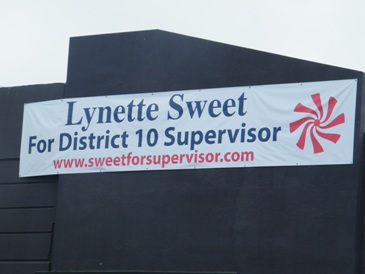
To be honest, I wasn’t surprised that termed-out Sup. Sophie Maxwell endorsed D10 candidate Lynette Sweet yesterday. Just disappointed. And it’s not just because Sweet refused to come into the Guardian this fall for an endorsement interview (a stance that suggests that Sweet would be depressingly inaccessible to reporters that haven’t drunk her Kool-Aid—a stance that, unfortunately, reminds me of Mayor Gavin Newsom’s attitude towards the media).

I’d been hearing rumors that Maxwell was going to endorse Sweet since February, when Sweet, who’d already racked up Mayor Gavin Newsom’s D10 blessing at that point, showed up alongside Maxwell at the city’s kickoff event for Black history month.

Then there was the fact that during an interview in February for the Guardian’s kickoff article about the D10 race, Sweet spouted phrases that sounded eerily similar to Maxwell’s words.
“D10 is a pretty diverse district, but there is only one common thread: the need for economic development,” Sweet told me.

But a few days earlier when I interviewed Maxwell about a third, and ultimately unsuccessful, attempt to recall her , Maxwell talked of common threads:

 “I’m waiting for people to have a better understanding of what this community is, what the common thread running through it is, and how to use rank choice voting,” Maxwell said, by way of explaining why she wasn’t willing to endorse anyone that early in the race.

Now, it’s understandable that Maxwell would be looking for a candidate to carry on her legacy. But it she was looking for a moderate black female candidate  then why not endorse Malia Cohen, who isn’t hampered by all of Sweet’s dirty laundry—and has raised the most money in the race, so far?

Could it be that Cohen wouldn’t be down for the kind of dirty deal making that was par for the course back in the days when Willie Brown was still mayor and Sweet was the swing vote that crowned Lennar as master developer at the shipyard/Candlestick Point?

Rumor has it that Maxwell is upset at all the corporate money that’s flooding into this race in support of Steve Moss—and that she asked the other candidates to hold a press conference in which they decry this practice. Rumor also has it that Sweet signaled her willingness to join Tony Kelly, Dewitt Lacy, Chris Jackson and Eric Smith–to name a few–in making such a statement. But it hasn’t happened, yet. And the corporate money keeps rolling in for Moss.

Meanwhile, with three weeks until the election, D10 forums are beginning to sound like a parody of a “Lost” episode featuring a 22-member cast that all claim to represent the city’s polluted and economically depressed southeast sector:

“One of us is a BART director, one of us worked at City Hall, one of us is a community advocate, one of us is a City College Board member, one of us is a civil rights attorney, one of us is an affordable housing development director, one of us is a bio-diesel advocate, one of us is a public safety advocate, one of us was raised in the Bayview, one of us served on the Navy’s Restoration Advisory Board,” and so on.

I’m not saying this is wrong. Hell, I love all this diversity of choices. but I am concerned that, come election night, the progressive vote will get split into a million pieces, while deep-pocketed conservative forces like the Chamber of Commerce and Golden Gate Restaurant line up behind one candidate in an attempt to crush candidates that would stand up to their powerful influence at City Hall and truly represent the D10 community

Yes, there is ranked choice voting, and it’s unlikely that one candidate will win a majority of the vote in the first round. But it’s critical at this venture that progressives develop a winning strategy. D10 candidate Ed Donaldson told me recently that if a candidate who doesn’t represent the community’s concerns gets elected, then the community would respond just as they did around Maxwell—and organize a recall.

But wouldn’t it be better if the community can come together behind three truly progressive candidates and help them win the November election?

One of the key challenges in this race will be to win votes in Visitacion Valley, as well as in the Bayview and/or Potrero Hill.

In his latest column in the Chron, former mayor and Sweet supporter Willie Brown alluded to the importance of this in a city with ranked-choice voting:”It’s not getting much attention, but someone has finally figured out how to get the Asian vote out,” Brown observed.”You do it by mail. You get ballots and ballot books into every household, then have the whole family sit down together. The kids help with the translation, everyone talks things over and everyone votes.”

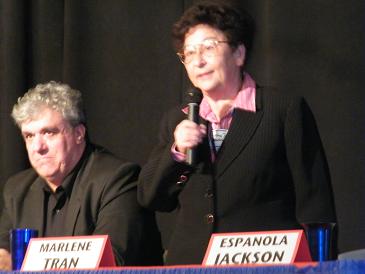
Meanwhile, D10 candidate Tony Kelly told me that Marlene Tran, who is tri-lingual (English, Cantonese, Vietnamese) and has a good handle on community issues in Viz Valley, has confirmed that Kelly is her second-ranked choice (presuming that she votes for herself in first place. of course).

Not a bad strategy–and one that other progressives need to consider, given ranked choice voting–and the brutal reality that they are going to be massively outspent in the next three weeks.


Getting out the in-jail vote

1

Sheriff’s Department spokesperson Eileen Hirst reminded me today that 75-80 percent of the people behind bars at the San Francisco County Jail are still in the pre-trial stage. Hirst first shared that stastic with me earlier this year, when the jail got dumped from the list of buildings that will be earthquake retrofitted, if voters approve Proposition A this fall.

And today the percentage resurfaced in the context of efforts to get out the vote. Because if your case is pre-trial, this means that you have not yet been found guilty and so are still eligible to vote—provided that you are not on parole for a felony conviction. And with several races and measures still in play on the ballot, this means that in-jail voters could be of pivotal importance this November. 

Either way, Hirst tells me that the Department of Elections and the Sheriff’s Department are  working hard to educate inmates about their voting rights.

“We have an office called Prisoners Legal Services, where they do voter education and facilitate applications for absentee ballots,” Hirst said. “We work closely with the Department of Elections to make sure prisoners are aware of their rights, and we carry applications and absentee ballots back and forth, between Elections and the jail.”

According to the Department of Elections’ Voting Guide for Ex-Offenders, a person who has been convicted of a felony can still register and vote if they have completed their prison term for a felony, including any period of parole or supervised release.

are on federal or state probation; and/or are incarcerated in county jail as a condition of felony probation or as a result of a misdemeanor sentence.

“If you have been convicted of a misdemeanor, you can register and vote, even while on probation, supervised release, or incarcerated in county jail,” the Elections Department brochure states.

“To restore your right to vote if you have been convicted of a felony, you only need to complete and return a voter registration form,” the brochure continues. “No other documentation is required.”

Hirst estimated that on any given day, there are 1800-1825 prisoners at the county jail, but she did not have up-to-date information on which districts these prisoners are from.

“Years and years ago, we did a pin map by hand, and we found that they came from every district in town, but were concentrated in the Bayview, the Western Addition and the Mission,” Hirst recalled.

She noted that the county jail population is 50-55 percent African American, 25-30 percent Latino, and the remainder is “white, Asians and other”—statistics that suggest that the D10 and D6 races will likely be the most impacted by the in-prison vote.

She also noted that C.L.A.E.R. executive director Sharen Hewitt has been one of the leading figures in San Francisco in terms of getting out the in-jail vote.

“Sharen really made it a priority and educated a lot of prisoners,” Hirst said.


Downtown money hits district races

42

Downtown cash is pouring into the district supervisorial races.

Ethics Department filings show that an alliance backed by the Chamber of Commerce, the SF Police Officers Association and United Health Care Workers West is dropping major money on Steve Moss in D10, Scott Wiener in D8 and Theresa Sparks in D6. 

Called the “Alliance for Jobs and Sustainable Growth,” the coalition supports the building of a mega-hospital on Cathedral Hill.

The independent expenditure alliance puts UHW, part of the Service Employees International Union, in the odd position of using membership money to attack progressive politics in San Francisco – potentially undermining years of work by another SEIU affiliate, Local 1021.

Campaign disclosure forms show that the Chamber-Police-UHW alliance has spent $20,000 on bilingual (English/Chinese) door hangers for Moss that feature photos of Chamber of Commerce President Steve Falk and United Healthcare Workers political director Leon Chow.

These same interests also spent $20,000 on robo-calls for Moss, with a heavy focus on Visitacion Valley in an effort to secure the Asian vote in the crowded D10, where there is a strong likelihood that the race will be decided by second and third place votes

Word on the street in the Bayview is that former Mayor Willie Brown is pissed off that the Chamber is backing Moss, instead of African American candidate Lynette Sweet, and that termed out D10 Sup. Sophie Maxwell is angry that big corporations are trying to buy an election in the poorest and most ethnically diverse district in town.

But unlike the rumor mill, the money trail doesn’t lie. And from that perspective this is looking like a replay of the June 2008 election, when big businesses bought support for Lennar’s Candlestick Point/shipyard development by claiming it would create thousands of jobs building condos that most workers can’t afford—jobs that have yet to materialize.

This time the battle cry is for jobs building a massive hospital, even though few workers will likely get service from this hospital, which is designed to serve as a regional center for high-end health care.

So far, the same alliance of police and corporate money has plunked down $17,000 for bilingual (English and Chinese) door hangers in support of Theresa Sparks in D6 and another $17,000 for bilingual robo-calls in support of Sparks.

And so far, Scott Wiener has gotten the relatively short end of the corporate money stick: the Alliance has only spent $15,000 on a door hanger in support of Wiener.

This means that the alliance spent $90,000 in a two-week period in September. The numbers lend credence to DCCC Chair Aaron Peskin’s belief that the alliance has a war chest of $800,000, which it intends to use to put pro-downtown candidates into power.

Asked about the support of this alliance, Sparks, Wiener and Moss gave markedly different replies that reveal as much about each candidate as the money behind them.

D6 candidate Theresa Sparks suggested that the Alliance was spending more on her and Moss’ D10 campaign, because it felt Wiener was further ahead in the D8 race than she is in D6 or Moss is in D10.

And Sparks was openly supportive of the Cathedral Hill hospital project. “I’ve been very supportive of that project,” Sparks told us.

Sparks also observed that it was logical that the Chamber would support her.

“D6 has one of the largest numbers of small businesses and one of my biggest platforms has been economic growth, and I think the Chamber has been very supportive of job creation,” Sparks said.

By comparison, Scott Wiener told the Guardian that he has not taken a position on CPMC’s proposed mega hospital on Cathedral Hill.

“Those kind of issues could come before the Board, in terms of CEQA issues, and so I could be conflicted out,” Wiener said.

When the Guardian noted that the Alliance has so far not spent any money on phone banking for Wiener in D8, Wiener said, “I have volunteers doing phone banking.”

As for Moss, he told the Guardian that said he doesn’t have a position on the mega-hospital.

“I haven’t seen the plan,” Moss said. “But I understand that there seems to be an agreement that would maintain St. Luke’s with about 300 beds, but that there is a deep suspicion among the nurses that it’s not economically viable. And there seems to be a much greater need for a hospital in the southeast.”

Moss, however, is with downtown on other key issues: He supports the sit-lie legislation on the November ballot. He also reiterated that he likes the rabidly anti-tenant Small Property Owners Association, whose endorsement he called a “mistake” during a previous interview with the Guardian.

“Landlords feel that they are responsible for maintaining costly older buildings and that they are not provided with ways to upgrade their units in ways that share costs with tenants,” Moss, who sold a condo on Potrero Hill in 2007 for the same price that he paid for the entire building in 2001, and owns a 4-floor rent-controlled apartment building in D8, near Dolores Park, that he bought for $1.6 million in 2007, and where he lived from December 2007 to February 2010.

Moss refused to provide a copy of the lease on his current rental at Vermont and 18th St—something that the Guardian requested in light of an email from his wife that indicated that the family intended to move back to Dolores Park of Moss loses the race.
‘That’s private information,” Moss said, claiming that he does not plan to move back into his apartment building in D8, if he loses in November.

Moss claimed that UHW endorsed him because his position on politicians and unions.
“I agreed that politicians should get not involved in union politics,” Moss said. “The United Healthcare Workers seem to be a worthy group,” he added. “All they said was that they wanted to make sure that they had access.”

All this campaign money drama is playing out against the backdrop of a punishing battle between United Healthcare Workers West and the rest of SEIU. And as these recent filings show, UHW is spending a huge amount of its membership dues to undermine the city’s progressive infrastructure by trying to elect candidates who are not progressive, even though its progressive sister union has endorsed Rafael Mandelman in D8.

SEIU 1021 member Ed Kinchley, who works in the Emergency Room at SF General Hospital, is furious that UHW is pouring all its money into downtown candidates like Moss, Sparks and Wiener and trying to undermine everything that its progressive sister union is trying to do.

“UHW basically isn’t participating in the Labor Council, it’s just doing its own thing,” Kinchley said.

Kinchley noted that UHW is currently in trusteeship, and is being controlled by its International, and not its local membership, thus explaining why it’s doing this dance with forces like the Chamber and the Building Owners and Managers Association, which have long been the enemy of labor.

“Sutter wants a monopoly on private healthcare, and people like Rafael Mandelman in and Debra Walker have been strong supporters of public healthcare,” Kinchley said, Kinchley also noted that he wants supervisors who are willing to state their support for public health care, rather than dodging the issue and hedging their bets, right now.

“I want someone who can straight-up say, here’s what’s important for families in San Francisco, especially something as important as healthcare,” Kinchley said. “but it sounds like UHW is teaming up with the Chamber and supporting people who are not progressive.”

“And it’s not OK for somebody in D10 to say they haven’t seen CPMC’s plans, when people from D10 use St. Luke’s all the time for healthcare, because it sounds like Sutter wants to change St. Luke’s into an out-patient clinic for paying customers,” he continued.

SEIU 1021 activist Gabriel Haaland accused the Chamber, the Building Owners and Managers Association, UHW and the Police Officers Association of putting together a massive political action committee, “to try and steal the election through corporate spending.”

All this leaves the Guardian wondering how Leon Chow, the political director of UHW, who has done good work in the past on health care issues, is feeling about seeing his photograph spreads all over town alongside that of Chamber of Commerce President Steve Falk on door hangers in support of Sparks, Wiener and Moss.
 
As of press time, Chow had not returned our calls, but if he does, we’ll update this post.

Lynette Sweet’s finances: Curiouser and curiouser

4

By this time it’s old news that Lynette Sweet, current BART Board Budget Committee chair and District 10 supervisorial candidate, has some issues with the Internal Revenue Service. She owed the IRS taxes going back to the year 2000, and the consequent lien on her property exceeded $20,000 in 2007.

Sweet says she never knew about the lien and thought she’d paid the taxes.

We’re still trying to figure out exactly how this happened — and the trail gets more and more convoluted.

We first called Sweet early in September, after we read about her tax troubles in the Chronicle. When we asked Sweet how she could have been unaware that the IRS was after her, Sweet told us that she’d been working with the tax firm JK Harris. She and Harris reached a deal to pay the IRS $14,500. She told us she bought a cashier’s check at Wells Fargo and mailed it in. But for some reason, she made the check out to herself, not the U.S. Treasury — so the IRS couldn’t cash it.

Normally, when you owe the IRS money, they let you know. But in this case, Sweet says she heard nothing from the feds.

When the Guardian pressed her, Sweet blamed JK Harris for not having forwarded her any of the mail in question. “I gave them power of attorney,” she said. “They had all the communications from the IRS.”

But we reached the the tax firm recently, and the folks there beg to differ. Gina Anton, Director of Corporate Communications at JK Harris, told the Guardian that any mail the IRS sent, it sent to Sweet. JK Harris’s role in Sweet’s tax kerfuffle appears modest — she hired the firm to merely act as intermediary between herself and the IRS.

Said Anton: “Our role was to obtain documents from both her and the IRS to determine what amount she could afford and what the IRS would consider an acceptable amount.”

JK Harris did not cut any checks, or inspect any checks after Sweet had cut them, Anton told us. Just the opposite: whatever documents the firm had prepared for Sweet, they sent to her for approval before forwarding them to the IRS.

Furthermore, said Anton, JK Harris was trying to reach Sweet for two years, after Sweet sent the IRS the dubious cashier’s check that she had hoped would diffuse her tax problem. Sweet finally returned JK Harris’s calls when she found out the IRS could not cash the check.

It’s all pretty odd for someone who’s worked in the banking industy for 22 years.

Questions surrounding Sweet’s finances reach beyond troubles with the taxman. She told us recently that she has worked at two companies that she never listed on her economic interest statements.

In her discloure forms, viewable at the BART Board website, she lists no sources of income after 2004, when she reported that she was employed by BayCAT (Bayview Hunters Point Center for Arts and Technology). However, in a very short and heated interview Sept. 10, Sweet told the Guardian that after she had worked at BayCAT, she had also worked at the African American Interest Free Loan Association and Trans Bay Cable.

In fact, she said she had worked at Trans Bay Cable, which is building an electricity line from Pittsburg to San Francisco,  until May of this year, when she left the company to run for office.

Which raises the question: If she was working all those years, why do her economic interest statements show no sources of income at all from 2004-2009?

The Guardian has attempted many times over the past week to contact Sweet to follow up on that question, but she’s stopped returning our calls or responding to our emails. (She’s also refused to come talk to us for an endorsement interview.)

Here are the questions her campaign has decided not to answer:

1.) What were Sweet’s periods of employment with the African American Interest Free Loan Association and Trans Bay Cable? Did she receive any income for this work? Whether yes or no, would she like to comment on the nature of that work?

2) What was the source of the tax that Sweet owed the IRS? Was this a tax on income? If so, then for income from work with which companies?

3) Why did Sweet elect to pay what she owed the IRS by means of a cashier’s check? (Why not a personal check?)

We’re also wondering why she didn’t list any income on her disclosure forms or why she made the check out to herself.

If she gets back to us, we’ll let you know.


Redevelopment throws Arc Ecology under the bus

3

No one was really surprised when the Redevelopment Commission voted 4-0 not to renew Arc Ecology’s contract to provide environmental information services regarding remediation plans at Hunters Point Shipyard and award it to Circle Point.

Sad and disgusted, yes. But surprised, no. That’s because everyone expected that Commissioners Leroy King, Darshan Singh, Rick Swig and Francee Covington, who are all appointees of Mayor Gavin Newsom, would throw Arc under the bus as payback for Arc’s decision to comment on the EIR for Lennar’s Candlestick Point/shipyard redevelopment plan and oppose the giving away of state parklands so Lennar could build luxury condos.

“The message was that we shouldn’t have commented ” Arc’s executive director Saul Bloom told the Guardian after the Commission vote went down. “But this you’re-either-on-our-side-or-out-of-a- contract attitude is completely bogus. It’s tactics that Republicans use against Democrats.”

And with the exception of Al Norman (who had the bad manners to burst out laughing when Arc got voted out) and Circle Point staffers, who obviously wanted the contract, those who attended the Commission’s September 21 meeting agreed that the outcome symbolized everything that’s wrong with Redevelopment’s current model of governance, in which political appointees, not elected officials, make decisions that majorly impact the city’s land use.

Thor Kaslofsky, Redevelopment’s shipyard project manager, kicked off the Commission’s contract discussions by explaining why Redevelopment Agency staff were recommending that the Commission award the contract to Arc Ecology.
As Kaslofsky explained, Circle Point received 0.2 points more than Arc from the Agency’s scoring panel, “making it difficult for the panel to determine who is the most qualified.”

Kaslofsky noted that there had been “concerns about Arc Ecology’s multiple roles in the community.”
This was a reference to the fact that, besides, providing independent assessments on the Navy’s clean-up plans, Arc produced “Alternatives For Study,” a report that studied alternatives to a plan that Lennar and the city refused to change–a public-private stubbornness that most recently resulted in a lawsuit from the Sierra Club and the Golden Gate Audubon Society.

“But the panel voted for Arc as the most qualified firm,” Kaslofsky concluded, noting that there were “concerns about Circle Point’s ability to ramp up”—a reference to the fact that though Circle Point has offices in Sacramento and downtown San Francisco, it doesn’t have a presence in the Bayview and little-to-no experience of the military base clean-up process.

Bloom then talked about how Arc has been active in the Bayview for decades.

“We’ve been in the Bayview for 25 years,” Bloom told the Commission. “We’ve read every environmental document that’s been produced. And our office is on Third Street,”
Bloom noted that after Arc scored the highest for Redevelopment’s environmental services contract in 2009, the Agency withdrew its request for proposals (RFP) leaving the community without Arc’s services—and without the services of the Navy’s community-based Restoration Advisory Board—at a time when the Navy was pushing clean-up plans that favor capping the shipyard’s heavily polluted Parcel E-2, rather than digging and hauling out the contamination.

As Bloom noted, the Agency’s contract RFP switcheroo, “caused significant costs to the community because we were unable to provide services at the same time the Navy’s RAB was closed down.”

After Bloom spoke, a stream of Bayview advocates testified in support of Arc.

“Arc is more knowledgeable about clean-up issues than most government regulators,” said Scott Madison, a member of the shipyard’s citizen advisory committee.
“The community asked for—and you granted—an independent contractor, a watch dog, not a lap dog,” Madison continued. “Circle Point may be technically qualified, but they are strangers to the Bayview. The Commission should have the courage to hire a watchdog, even at the risk of a nip at the heels.”

Michael Lynes, conservation director with the Golden Gate Audubon Society, which recently joined the Sierra Club in suing to block the city’s EIR on Lennar’s Candlestick/ shipyard plans, told the Commission that he found “the value provided by Arc to be absolutely essential.”

D10 candidate Eric Smith, a member of the Navy’s now defunct RAB, praised Arc for, “being fantastic in sharing the information.”
“There is no other organization that has their history, has done the work they’ve done, and has the relationship with the community,” Smith said, “With the loss of the RAB, Arc was the only place to go.”

Jackie Phillips of ACCE (Alliance of Californians for Community Empowerment) noted that how a lot of organizations come to the Bayview, but unlike Arc, few stay the course.
“I’ve gone to their workshops,” Phillips said. “They sat us down, they’ve taken us on tours, they’ve taken us to the toxic sites, they have shown us what these changes will mean.”

Phillips also expounded on the difficulty of winning the trust of the Bayview community.
“In the Bayview, we don’t know who to trust, because there have been a lot of broken promises,” Phillips said. “Arc did not try to hide things from us. They have a relationship with the community.”

Next up was Claude Eberhart, who said ordinarily he’d be happy to see Circle Point get the contract, because he likes their staff.
“But by rights, I can’t recommend that,” Eberhart said. “The issue is trust.”
Noting that he has worked with Arc since 1987 when he and Bloom fought plans to homeport the USS Missouri at the shipyard, Eberhart said that in terms of getting “clear, concise and correct information,” Arc is “one environmental organization we can rely on.”

Eberhart also noted that last year, when there was pressure to take a large chunk out of the Candlestick Point State Recreation Area so that the city/Lennar could build luxury condos on state parklands, “Arc stepped forward and provided the information we needed to achieve a community consensus and have the Sierra Club come up with the final deal that allowed for an exchange [of state parklands].”

John Eller, an organizer with ACCE, which co-signed the community benefits agreement that the Labor Council negotiated with Lennar to secure living wages and higher levels of affordable housing, noted that Commission President Rick Swig had spoken earlier in the meeting about how Cohen, Newsom’s former economic advisor, was a consensus builder.

“And that’s exactly what Arc has done over the years,” Eller said.

Kate Kelley, director of the Sierra Club’s San Francisco Bay Chapter, praised Arc’s integrity.
“The information it provided was balanced, responsive and certainly technically competent,” she said.

“This is not a baseball game,” Kelley continued, referring to Circle Point’s understandable claim that it rightfully won the contract based on the Agency’s scoring process. “This is about relationships and trust—and I trust Arc Ecology to do the right thing.”

Al Norman, who heads the Bayview Merchants Association, was the sole dissenter among Bayview residents who spoke at the meeting.
Norman claimed that Arc’s critique of the city’s EIR was somehow “a conflict of interest.”

But instead of providing evidence to support his claims, Norman launched into a personal attack.
“[Bloom] went against this agency and the community, concerning his alternative plan, when we already had a plan in place,” Norman said. “I think Circle Point deserves a chance.”

The son of the late Jesse Mason, who worked for Arc until he died this summer, spoke in support of Arc and Bloom.
“My father believed in Arc, he trusted Arc,” Mason said.

And Christine Johnson, secretary of the shipyard’s Citizen Advisory Committee, spoke of the pressing need in the Bayview for independent review of technical environmental documents.
“We feel it’s imperative to get immediate advice and expert opinion and to properly assimilate information,” Johnson said, referring to the Navy’s shipyard clean-up plans.
‘We’ve been without that advice for nearly a year.”

Terry Ander, whose organization is a member of the Southeast Jobs Coalition, which includes Brightline, Inner City Youth, Visitacion Valley Community Development Coalition and Young Community Developers, spoke highly of Arc.
“Arc Ecology deserves this contract,” Anders said, noting that the Bayview community has been part of “enough neglect and B.S. to last for ten life times.”

And D10 candidate Kristine Enea, a former member of the Navy’s RaB, urged the Commission to “support Arc and focus on the community’s need for information.”

Bayview community advocate Espanola Jackson stressed the need for accurate information from a trusted source, as opposed to politically comfortable lip service.
“We need the correct information and not the lies and the politics that have been played upon my community,” Jackson said.

After 17 folks spoke in favor of Arc, many of them registering surprise that there was talk of taking the contract away from a small Bayview-based non-profit, Bloom sought to correct any misinformation that had been spread about his organization.
Noting that Arc’s Alternative for Studies “was an attempt to do some problem solving,” Bloom observed how, “Instead, we got painted as an opponent to a bridge. We are a strong supporter of the development and we have put 300 people to work in the Bayview.”

But all this support and clarification was not enough to save Arc from being thrown under the bus.

Commissioners Leroy King, Francee Covington and Darshan Singh joined Commission President Rick Swig in calling for Arc’s ouster. And along the way, they variously accused Bloom of disloyalty, dishonesty and expectations of winning the contract. (The latter accusation was a tad ironic given that there are currently no term limits for Redevelopment commissioners, as evidenced by King who has sat on the commission for decades and has just been renominated by Mayor Gavin Newsom to serve yet another term.)

“I’m opposed to giving the contract to Arc,” Commissioner King said. “Each time, [Bloom] spoke opposed to Redevelopment,” King continued, without proffering any details to support his claims, but giving a disturbing insight into how he thinks organizations that contract with Redevelopment for $282,000 a year (the amount Circle Point will be paid for four years for the environmental services contract) should position themselves on all Agency-related issues.

“[Lennar’s] Kofi Bonner called me and said. ‘Will you chance your vote? We need him’” King said, acknowledging that he didn’t want to award the contract to Arc, when it first applied, four years ago.  “But every time [Bloom] was opposed to basic things to fill that shipyard. He talks against Lennar.”

Commissioner Covington confused the audience by pulling out a copy of the city’s response to comments on its EIR for Lennar’s redevelopment plans, even though the Redevelopment contract in question concerns assessing the environmental issues related to the Navy’s shipyard clean-up plans.

Covington then pointed to, but did not identify, letters that she claimed were from individuals who alleged their names were falsely included in a letter supporting Arc’s EIR comments.

Covington then told the audience that the Agency’s 50 percent small business enterprise standard in contract awards “ is a goal but does not apply to non-profits”.

And Commission President Swig, a hotel and tourism industry consultant, sought to frame Arc, which is respected as an independent non-profit, as an ungrateful consultant.
“As a consultant myself, I don’t agree with all my customers, but I don’t bite the hand that feeds me,” Swig said.

And then the Commission voted 4-0 to reject Arc—and award the contract to Circle Point.

Outside the meeting, a black mood reigned.
“It was political payback,” Scott Madison said. “I think the Commission made a bad choice.”

Mike McGowan. Arc’s senior scientist, noted that public support was 17-3 in favor of Arc.
“But I guess only four votes counted,” he observed. “It seemed that Redevelopment’s staff was in favor of Arc, as was the community except for a few voices, but the Commission kept harping on incidental issues. The truth is that there are no holes in our qualifications.”

McGowan noted that the environmental services contract relates primarily to Navy clean-up.
“Arc never got in the way of the development,” McGowan said. “What it did was participate more fully in the EIR process, and, as I understand, Lennar incorporated some of Arc’s suggestions into their design. But by Arc not having its contract for the last 18 months, a lot of misinformation floated to the top.”

McGowan noted that the spirit of the Agency’s policy on small business enterprises is to foster the development of small firms that are disadvantaged and local.
“And Arc definitely is smaller, less advantaged and based in the Bayview, but it seemed like a lot of personal animosity came up,” he said.

Bloom acknowledged that the loss of this contract is a serious economic blow for Arc.
“They screwed a local small non-profit in the face of a multi-million dollar organization that swathed itself in a couple of small Bayview businesses,” Bloom continued, referring to Circle Point’s inclusion of three local SBEs as sub-contractors in its contract proposal.

Others, speaking off the record for fear of political reprisal, told the Guardian that the Commission’s treatment of Arc—and its refusal to listen to community members and community-based organizations that represent many thousands of local residents—calls into question the need for Redevelopment to exist in its present configuration, if the Commission believes its priority is to fire contractors that disagree with its plans in other arenas.

“The Board can eliminate the Redevelopment Agency and/or change its governance,” a Bayview resident said. “The Bayview is the last frontier of the eastern side of San Francisco. It’s a historically neglected neighborhood that many folks in City Hall now see as the next potential gold mine.”


The real Steve Moss

83

Some folks are so mad about D. 10 candidate Steve Moss that they have put together a website titled The Real Steve Moss that pulls together public records and poses a series of questions in an effort to make Moss provide concrete answers about his residency and his handling of tax-payer dollars before the November election rolls around.

“If Mr. Moss believes that he is such a great candidate, we suggest he answer critics instead of hiding out and just dodging the questions,” The Real Steve Moss website states. “Anyone who won’t answer direct questions while running, certainly won’t in office.”

The website challenges Moss to provide more details about his residency, including the exact date he moved back to D10, the identity and move-in date of the person(s) currently living in his Dolores Park home in D8, along with copies of his utility, internet, cable and telephone bills and records from his D8 Dolores Park home and the place he is currently renting in 18th Street to prove Moss’ residency claims.

“If your Dolores home wasn’t occupied till August 2010, did you maintain services such as Internet, cable and telephone, and if so why?” the website asks.

The Real Steve Moss also drills into questions about the $1.5 million that the Department of the Environment paid to Moss’ private company, M-Cubed.
Last week, the Department of Environment confirmed to the Guardian that a grant was awarded to M-Cubed sometime between 2000 and 2001. 
“The total amount of the agreement was $1.5 million and the purpose of the agreement was to set up an energy cooperative in Bayview Hunter’s Point,” the Department told us.

Yet, 990 forms filed by Moss’s SF Community Power Cooperative and his parallel SF Community Power non-profit in 2002 and 2003 do not reflect large infusions of tax payer dollars that the City reportedly paid to Moss’ private company M.Cubed to set up an energy cooperative.

As “The Real Steve Moss” notes, “information easily obtained from Mr.Moss’ for profit, non-profit, and campaign websites do not appear to match records obtained from the City, State or the IRS.”

And while the Guardian waits for the Department of the Environment to respond to our request for more information about this grant, The Real Steve Moss drills into other questions about Moss’ money flow.

“What exactly did you do with the $4m plus in mostly public and private funding that you stated was to create a newswire and help Bayview Hunters Point residents?” The Real Steve Moss  asks, presumably referring to, amongst other donations, a series of $50,000 grants that the Goldman Fund, where Moss’ wife works, paid to Moss’ SF Community Power.

“Exactly how many paid jobs did you create and for how long? Why is your non-profit paying such a lot of rent and for what? Why is your non-profit’s communications bills so high? How much money did you pay yourself from your non-profit and for profit companies funded in majority by taxpayer funds?”
Hopefully, Moss will respond to these and other questions posed at The Real Steve Moss with concrete evidence. And soon. So, stay tuned.

http://www.sfbg.com/politics/2010/09/21/plan-c-endorses-sweet-and-moss-d10

CityPlace, USA — and why Newsom wants developers involved in district elections

18

Speaking at the San Francisco Mariott Hotel today, Sept. 14, to a room packed full of developers, land-use attorneys, building owners and managers, members of the San Francisco Convention & Visitor’s Bureau, and others who had gathered for a San Francisco Business Times event, Mayor Gavin Newsom championed a retail development project proposed for San Francisco’s mid-Market area that is being opposed by Livable Cities and the San Francisco Bicycle Coalition. The project will come under consideration at today’s Board of Supervisors meeting.

“CityPlace will be an anchor of revitalization” in mid-Market between Fifth and Sixth streets, Newsom said. Members of the Board of Supervisors may try to block it, he added, but “we can’t afford to let that happen. It’s a quarter of a million square feet, and it connects right up from Nordstrom’s.”
“CityPlace is critical,” he added. Marcia Smolens of public relations firm HMS Associates is representing Urban Realty, the developer of CityPlace, according to a file included in the Board of Supervisors meeting packet. Smolens contributed $2,500 to Newsom’s run for Lieutenant Governor. An architect with a partnering firm on the project, Gensler, plunked down $1,000 for Newsom’s campaign.

The mid-Market area has long faced issues of blight and crime. Newsom put forth a vision for its revitalized future that would include “more cops” (the development would connect with a police officers’ substation planned near Sixth and Market streets, Newsom noted), a creative bent thanks to partnerships with artists, and an area “a little less crowded with folks panhandling.”

The proposed development is essentially a large glass box with a shopping mall inside. According to the project website, Urban Realty has not yet engaged potential tenants, but appears geared toward attracting low-end retail chains. “We intend to bring affordable, value-based retail tenants to the area and expand the shopping choices available to make this section of Market Street a shopping destination that truly caters to San Francisco’s diverse demographic,” the website notes. Our guess is that they aren’t talking about unique, independently owned thrift stores that offer affordable used items and encourage shoppers to support small business, but something more along the lines of TJ Maxx.

The project would also include 188 parking spaces in an underground garage. In contrast, the Westfield mall near Fourth and Market streets was built with no new parking.

Livable Cities has filed an appeal of the Environmental Impact Report (EIR) for CityPlace on the grounds that transportation issues weren’t adequately dealt with, and the board will vote on the appeal today after opening the item up for public comment. Livable Cities executive director Tom Radulovich noted that the project would demolish the St. Francis Theater, a 1910 building that some had envisioned as a structure that could be rehabbed as part of a revived theater district in that area. He also felt the development was out of character for the neighborhood. “They’ve been given a lot of bonuses, like surplus parking and an excess floor,” Radulovich noted. “We feel like the Planning Department gave them a lot more value — millions of dollars worth. The public should get something out of it.” Partly out of a desire to improve the area, he said, mid-Market amounted to a sort of “Wild West in terms of planning. That’s been the story is that the only way to move forward is to throw away our rules.”

The developer estimates that the project would create up to 250 union jobs during construction, and 760 new permanent retail positions (that is, non-union, low-wage jobs with high rates of turnover — but at least it’s something). This could present a quandary for supervisors who might otherwise hold their nose at the idea of approving a big-box mall in the heart of San Francisco. Construction workers are in dire straits right now, and unemployment in the city is nearing 10 percent — and even higher in communities of color such as the Bayview.

Meanwhile, Newsom urged the crowd of downtown real-estate big shots to get involved in disctrict elections for the Board of Supervisors, lest “you wake up and things get worse quickly.”

The mayor issued a strong warning that “ideology is too strong in this town,” and then referenced the Guardian, speaking to some dangerous influence wielded by “these people who write these blogs.”

“You are the only thing standing between a dramatic shift off course in this town,” he told the crowd. “But our opportunities are limitless as long as we have stable leadership. Please take the time to learn about these candidates. Get involved – even in the districts you don’t reside in.”

At the end of Newsom’s speech, everyone applauded and then turned their attention to a short, flashy video about America’s Cup.

Blocking the bridge

1

sarah@sfbg.com

The Sierra Club and Golden Gate Audubon Society have sued to block the final environmental impact report on the Lennar Corp. redevelopment project, a move that could force reconsideration of a bridge over Yosemite Slough.

The suit against the city, Board of Supervisors, and Redevelopment Agency charges that the final EIR for Lennar’s Candlestick Point-Hunters Point Shipyard project was inadequate, in part because it didn’t consider all the impacts of the bridge or look properly at alternatives.

The move comes as no big surprise: these environmental groups vowed to file a suit within 30 days of the city’s August certification of the project EIR. But advocates hope it will lead to a change in the proposal.

Arthur Feinstein, a member of the Sierra Club’s San Francisco Bay Chapter, said the EIR didn’t comply with the California Environmental Quality Act, or CEQA.

The introduction to the Sierra Club suit notes that “the FEIR failed to identify or underestimated the significance of environmental impacts associated with the project; failed to address the alternative proposed by Arc Ecology, which provides for a bus rapid transit route around Yosemite Slough; and failed to provide adequate responses to comments on the draft EIR.”

Or as Feinstein puts it: “There’s a bridge, and it’s going through a nature area where they say the sound level from the buses will be the equivalent to standing 50 feet from a freeway.

“They say there is no impact and that you can’t have an undisturbed nature experience in an urban area, but you can,” Feinstein continued, pointing to the Presidio, Golden Gate Park, and Crissy Field as examples of places where you can have undisturbed experiences.

Feinstein noted that Candlestick Point State Recreation Area is the only large park on the city’s eastern shoreline, and the only park that people in the Bayview can access easily.

“The city boasts about how much it was improving the Bayview, but this park is the only major open space where you can get away from urban stress — and folks have a lot of stress in the Bayview,” Feinstein said. He added that building the bridge will involve sinking pilings in Yosemite Slough that will disturb wildlife and stir up PCBs and other known contaminants.

“Noise, light and glare all have impacts on wildlife, but the city’s EIR said these are insignificant because these critters are insignificant,” Feinstein said.

Feinstein noted that the city’s final environmental impact report did make a finding of overriding concern that the project will cause air pollution at levels that exceed Bay Area Air Quality Management District (BAAQMD) health standards.

“But [the city] decided that this was a regional problem, so they did not attempt any mitigations for the 25,000 new residents that this 700-acre redevelopment plan is supposed to bring into the Bayview — which already has the city’s highest asthma and cancer rate and the largest number of polluting sources,” Feinstein said. “But they could say that all buses going into the development need to be electrified, or they could limit the number of parking spaces the way they did at Octavia-Market and South of Market.”

Feinstein said the next step in this CEQA lawsuit in a pretrial negotiation session to see if a settlement can be reached. “We’re not looking for a long drawn out fight. We’re ready for one, but we’re also ready to negotiate because that’s how you achieve things.”

Feinstein also noted that the Sierra Club had to go to Los Angeles to hire a traffic consultant to work on its suit because Lennar has contracts with just about every shop in the Bay Area, thanks to its various projects at Hunters Point, Treasure Island, and Mare Island.

“The related problem is that the city is no longer looking at the project with a steely eye,” Feinstein said. “Instead, they have become the developer — except that they are working with Lennar and not reviewing Lennar’s plans with objectivity. By filing this lawsuit, we’re keeping the conversation about this project alive and reminding folks that you don’t have to take everything this mayor and his administration gives you.”

The Sierra Club/Audubon Society suit came four days after the San Francisco Chronicle reported that the California State Parks Foundation entered into an agreement with Lennar to help prepare conceptual designs that reportedly will be used as the basis for the actual bridge over the Yosemite Slough.

Some critics interpreted the timing of CSPF’s announcement, which the Chronicle reported under a confusing “Environmentalists to help design span” headline, as an attempt by Lennar’s well-oiled PR machine to undermine the Sierra Club/Audubon Society suit.

They also questioned CSPF’s independence from Lennar, and from the Mayor’s Office, because Guillermo Rodriguez Jr. from the Mayor’s Office of Economic and Workforce Development sits on CSPF’s board. So does Peter Weiner, a partner at Paul, Hastings, Janofsky & Walker, which has contracts with Lennar. Representatives from Southern California Edison, Toyota, the Walt Disney Company, Pacific Gas and Electric Co., and several other companies that either have contracts with Lennar or have given to Mayor Gavin Newsom’s campaign for lieutenant governor campaign also sit on the park foundation board.

CPSF’s President Elizabeth Goldstein told us that “as park supporters and defenders, we consider ourselves environmentalists.” CSPF originally planned to fight approval of the project’s final EIR when it came before the board in July. But unlike the Sierra Club, CSPF pulled its appeal at the last minute.

Goldstein told the Guardian that the foundation reversed its decision because it had initiated what she characterized as “a fruitful discussion with Lennar.”

“We wanted to play that out,” Goldstein said. “And now we’re glad we did, because the design criteria look quite good and hopefully will be compatible with the project.”

“What we’ve agreed with Lennar about is a set of design criteria to be applied to the bridge, she continued. “These criteria are intended to make sure the bridge fits aesthetically into the park as much as is possible. Lennar asked us, and we agreed, to develop the first set of conceptual plans — obviously in cooperation with them — to make sure that they are, from their first iteration, as sympathetic as possible to the park.”

Goldstein said that some of these design criteria are “quite global.”

“Some are big arcs of things that are very important to us, such as impact from light, glare and noise,” she said, noting that they don’t want to see the proposed bridge lighted at night, à la the Golden Gate Bridge.

“We want the environment at dusk to be as unimpacted as possible,” she said.

Other CSPF concerns are more situation specific.

“We want safe, attractive, easy-to-use signage,” Goldstein said, referring to need to help users and neighbors find their way around and across the bridge. “We also talk about minimizing piers in the water at the slough, and if possible, eliminating them altogether since they impact vehicles and kayaks.”

Goldstein agreed that the foundation’s roots are not in political advocacy. “We were founded as a philanthropic land acquisition partner to the Department of State Parks.” But she noted that the group was involved in blocking a proposed toll road through Orange County and is a leading supporter of Proposition 21, which seeks to raise nearly $500 million a year for state parks by tacking on an $18 vehicle registration fee that would give all vehicles registered in California free access to the majority of state parks.

As Feinstein observed, “The CSPF does great work, but they are not usually advocates for conservation and biodiversity. That is what the club and Audubon Society does.”

Stuart Flashman, attorney for the Sierra Club and the Golden Gate Audubon Society, said that in the long run the lawsuit won’t stop the project from going forward. “But in the short term, if the court finds that the EIR wasn’t adequate and that there are significant impacts from the bridge that could have been avoided, then the city has to go back and redo that part of the EIR, a process that could take two to four months. And if they conclude, yeah, the impacts from the bridge are unavoidable, then they’d have to redo it to go around the slough.”

Flashman says he hasn’t seen the proposal CPSF and Lennar are working on. “But as part of this suit, we are required to sit down with the city and see if we can settle — and we are hopeful we can do that.”

Crackdown on gangs — or civil liberties?

1

Sarah@sfbg.com

City Attorney Dennis Herrera’s Aug. 5 decision to file a civil gang injunction against two alleged gangs in Visitacion Valley is being hailed by top local law enforcement officials as an important weapon in a war between heavily-armed members of two rival gangs in the Sunnydale housing projects.

“I consider this another vital tool in the prosecution of violent criminals,” District Attorney Kamala Harris said in a City Attorney’s Office press release announcing the suit against the Down Below Gangsters (DBG) and Towerside Gang.

But in the middle of a heated race for supervisor in District 10, the gang injunction also has become a political issue — and infuriated civil liberties activists who say it’s unfair and won’t work.

Herrera’s complaint names and identifies 41 young black men using declarations from gang task force members, police reports, photographs of the men sporting tattoos, flashing hand signs, and wearing purported gang clothing — and even extracts from a letter that one listed individual sent to another alleged gang member, who was in jail.

If Herrera’s request is granted in court Sept. 30, it will be San Francisco’s fourth civil gang injunction. Herrera secured similar injunctions against the Bayview-Hunters Point Oakdale Mob in October 2006; the Mission District’s Norteños in 2007; and the Western Addition’s Chopper City, Eddy Rock, and Knock Out Posse in 2007.

The City Attorney’s Office claims a “cooling off” effect as a result of those injunctions. “Since Herrera launched the civil gang injunction program at the end of 2006, 46 percent of identified gang members (43 of 93) have gone without even a single arrest in San Francisco for crimes other than minor violations of the injunction itself,” Herrera’s office states.

It claims that the data also show progressive improvements over time. “Only 14 percent of identified gang members (13 of 93) were arrested for noninjunction crimes so far in 2010 — down from 41 percent in 2007,” Herrera’s office states.

But San Francisco Public Defender Jeff Adachi, civil rights lawyers, and community advocates worry that the injunction raises constitutional issues and practical problems that could be counterproductive in terms of Herrera’s stated effort to reduce violence in Visitacion Valley.

“The first difficulty you observe is that there is no right to counsel,” Adachi said, pointing to the three injunctions Herrera has already launched. “Instead, the burden is on the individuals named in the injunction to come forward and contest the injunction.”

Contesting an injunction is expensive and difficult, Adachi says.

“There’s a large amount of filing, and then there’s a hearing and a trial,” said Adachi, who represented individuals named in Herrera’s 2007 suit against the Norteños. “It costs between $10,000 and $20,000 to mount an adequate defense.”

Adachi claims Herrera’s past injunctions were mostly based on allegations and stale information that could have triggered more violence. “We saw that the city attorney based its injunction solely on what police officers had alleged, officers who in most cases were members of the Gang Task Force,” he said. “For instance, there was a woman who had been in a gang, but left years before. As a result of being named, her family was threatened and she was fearful there would be reprisals.” The woman’s name was ultimately removed.

Adachi represented a young man who had never been in trouble but found himself on Herrera’s Mission-based injunction list after he rapped about the Nortenos. “There was no evidence, but when we said there had been a mistake, the city attorney disagreed,” Adachi said. “In the end, a judge found there was insufficient evidence.”

Adachi worries about the impact on individuals mistakenly named in the suit. “When you name someone, that brands them. What we saw in other injunctions was that people lost jobs.”

He notes that only a few people came forward to challenge past injunctions. “But in at least four cases, people were found not to be gang members,” he said.

At the time of those injunctions, there was no way to get off the list. “So we worked with the ACLU to demand one and the City Attorney’s Office agreed,” Adachi said. “But I don’t know how many people have since filed paperwork.”

Ingleside police station Capt. Louis Cassenego told us that as of Aug. 20, 12 men had been served with the injunction — six allegedly from DBG, six from Ingleside.

“We had signage posted on utility poles, and no signs have been torn down,” Cassenego said. “And so far, the folks served have taken it in a matter-of fact fashion.”

But Sharen Hewitt, executive director of the C.L.A.E.R. Project, a community empowerment and violence prevention nonprofit, said she worries that people don’t understand the implications of being served and won’t take the trouble to opt out. “I talked to a young man after he got served and he tore up his notice,” Hewitt said.

Hewitt invited representatives from the City Attorney’s Office, Police Department, Lawyers Committee for Civil Rights, Bay Area Legal Aid, and residents of the area to an Aug. 12 emergency debriefing. “We are sitting in the middle of a major war zone,” Hewitt said, referring to the meeting’s location at Britton Courts, a public housing project that Herrera claims is on DBG turf. “Although this situation threatens the community, it has also brought us together. And now we are trying to pull together a legal team.”

Deputy City Attorney Yvonne Mere explained that the suit seeks to ban criminal and nuisance conduct by creating a proposed safety zone that covers two-tenths of a square mile and encompasses both gangs’ alleged turf plus a buffer zone.

The injunction would impose a 10 p.m. curfew on the 41 men listed, who are a barred from trespassing, selling drugs, and illegally possessing firearms, loitering, displaying gang signs, and associating in public in neighborhoods surrounding the Sunnydale, Heritage Homes, and Britton Courts developments.

Some of this conduct is already against the law, but other activities, including assembling in groups, is typically protected by the Constitution, Mere explained.

Lt. Mikail Ali of the Ingleside station said many youngsters don’t want to be in a gang. “This is an out,” Ali said.

But some residents questioned whether some men on Herrera’s list are in a gang. “Who are you to say who is a gang member?” asked Sheila Hill, who was concerned that her son, the victim of a shooting a couple of years ago, was on the list. “Yes, they might have done something three or five years ago, but many of them have moved on, got married, and got a job. I don’t believe you guys are really checking your records.”

Mere disagreed (later clarifying that Hill’s son isn’t named by the injunction). “We looked at criminal records within the last five years, including shootings, shots fired, and weapons possessed, and it’s a pretty violent zone down here,” Mere said. Mere claims the war between DBG and the Towerside caused 10 murders in the last three years.

Leslie Burch, president of the Britton Courts Neighborhood Association and cofounder of the Visitacion Valley Peacekeepers, said a lot of the men named grew up together, playing sports, staying at each other’s houses overnight, and making affiliations.

“So I wouldn’t necessarily classify them as gangs,” Burch said. “They are just a bunch of friends who have common interests like music, sports, and hanging out together.”

Mere pointed to the opt-out option, part of a 2008 agreement between the city attorney, ACLU, and Lawyers’ Committee for Civil Rights.

“It’s an option for people to say, ‘No, you are wrong,'<0x2009>” Mere said. “They can submit letters from pastors and friends, and we’ll consider that between now and Sept. 30.

But Burch challenged some of the evidence posted at the City Attorney’s wesbite, including photographs of people sporting alleged gang tattoos and clothing.

“Take the T sign,” Burch explained “The city attorney says it represents the Towerside. But I had a nephew who was murdered. His name was Trayon, and some people wear the letter T in remembrance of him. I was in court with a nephew who was trying to explain that he is not a gang member just because he’s wearing a hat with a T on it.”

Hewitt noted that the injunction follows budget cuts that decimated local nonprofits and that funding is desperately needed for programs that provide young men with jobs and other alternatives to crime.

Hewitt also noted that the injunction gives District 10 candidates an opportunity to show the community that they are tracking all the issues in this pivotal race. “D-10 has been reduced to the Lennar issue, and that’s what’s criminal,” Hewitt said, adding that coverage of the race has so far largely excluded Viz Valley, even though it’s home to the city’s largest public housing site.

Indeed, the injunction is becoming part of the dialogue in the District 10 supervisor campaign. Candidates Isaac Bowers, Kristine Enea, Chris Jackson, Nyese Joshua, Steve Moss, and Marlene Tran attended Sharen Hewitt’s Aug. 12 gang injunction debriefing. By meeting’s end, Bowers and Enea said they would help community members get legal representation. “A lot of people being served don’t know what an injunction is or don’t show up at the hearing, and then they become subject to the injunction,” Bowers said.

Jackson said he’s committed to helping these men get access to job and education opportunities.

Candidate Tony Kelly said if there are gangs in Viz Valley, Herrera’s injunction would be valid. “There is gang-like activity, but it’s small-scale turf wars, shootings. and retaliations. And it’s not organized,” Kelly claimed. “Instead, you’ve got unorganized young black men with no other options doing whatever it takes to get ahead. But instead of doing something constructive, the city attorney calls them gangs.”

DeWitt Lacy, also a candidate, said he remains concerned that gang injunctions are circumventing people’s due process rights. “In a criminal case, you have the right to an attorney — but that’s not so in a civil action.”

Eating humble pie with Glendon “Anna Conda” Hyde

22

It was with a sinking feeling that I read the comments that Glendon “Anna Conda” Hyde’s supporters left on the Guardian’s website last week, after I wrote about the DCCC questionnaires last week—and managed to screw up by omitting Conda/Hyde from my hasty round up.

“How is it that you’ve omitted Anna/Glendon from your election roundup?” was one of many similar comments made by Conda/Hyde’s outraged supporters. “This looks awfully like PREJUDICE, darlings. You should be ashamed of yourselves. Anna/Glendon’s candidacy is not a joke. S/he is one of the most promising progressive voices in SF. Wake up.”

So, I picked up the phone, and called Conda/Hyde to offer my humble apologies.

And today we sat down and talked about the role of the media and political endorsement clubs in propping up the marginalization of marginalized candidates and communities—and the role of radical queers in pushing back against the status quo and the political machines.

Conda/Hyde kicked off by recalling how the DCCC offered congratulations on the campaign’s artwork.

“But then they said you are not a viable candidate, and have you thought about taking the spotlight off yourself,” Conda/Hyde claimed.

(After our interview, I put in a call to DCCC chair Aaron Peskin. He had no recollection of the conversation going down quite like that. But Peskin also noted that the DCCC had done a ton of interviews recently.

“I like Glendon and I remember him appearing,” Peskin said. “But I don’t remember anyone telling him he was not viable.”

But with 26 candidates in the D. 6 race, and 27 candidates in the D. 10 race, it’s likely that some similar-minded candidates in those contests may decide, or be advised, to rally together between now and the election to increase the chances that  “the bad guys” don’t win, right?

“You’d think,” Peskin said. “That’s why I dropped out of the Board of President’s race when Willie Brown’s guy looked like he was going to win, and as a result, Matt Gonzalez won the race.”)

Anyways, back to my interview with Conda/Hyde, who also claimed that D. 6 candidate h.brown recently got barred from a small business debate in SoMa.

I wasn’t at that particular forum, or the D. 10 debate that the SF Young Dems recently hosted in the Bayview.

But I have watched videos of the outrage that was triggered at the Young Dems forum, when D. 10 candidates Dianne Wesley Smith, Nyese Joshua, Ed Donaldson, Marie Harrison and Espanola Jackson were excluded from the debate, even though the Bayview is where they are based.

And it’s similar to the outrage that Conda/Hyde supporters understandably felt when their candidate’s positions on issues like Mayor Gavin Newsom’s sit-lie legislation weren’t included in my original summary of the DCCC questionnaire. Especially since Conda/Hyde led the pushback against Newsom’s sit-lie measure.

“Marginalized districts, marginalized candidate voices,” Conda/Hyde observed.

The point Conda/Hyde is making here is that all candidates bring unique voices and perspectives to a race, and they provide marginalized communities with a rare opportunity to push back against powerful interests and ill-advised measures before this or that political machine can shoe horn its preferred slate into office.

“I was the first candidate to come out against sit-lie aggressively,” Conda/Hyde noted, by way of example.

At this point in our conversation, Labor leader and DCCC member Gabriel Haaland, who sat in on today’s meeting and voiced sharp criticism of my Conda/Hyde omission last week, chimed in.

“So many candidates were ducking sit-lie, so when I introduced a resolution opposing sit-lie at the DCCC, so many people were pissed off,” Haaland said. “And it was refreshing to see Anna Conda vocally opposing sit-lie in drag on Polk Street.”

Haaland added that he’d be working for Conda/Hyde’s campaign, “if not for a 15 year friendship with Debra Walker.”

And then he pointed to the central role that radical queers have played in pushing for political change.

“The first queer to run for elected office was a drag queen,” Haaland observed. “Radical queers have always been leading the movement, busting a move and changing the world. And Anna Conda is more the Harvey Milk of the race, in my opinion.”

“You reflect my radical queer positions more,” Haaland continued, addressing Conda/Hyde direct.  “And you have a real base in the district in a way that Theresa Sparks does not. But people are moving into the district and having bases created for them.”

Conda/Hyde then observed that plans are afoot for an inclusionary District 6 forum.

“Jane Kim and I are getting together to do a forum that includes all the D. 6 candidates,” Conda/Hyde said, “We’ll be including James Keys, Dean Clark and Fortunate ‘Nate’ Payne, who are all out there working hard on their campaigns, as well.”

The ability to raise funds is often an indicator of whether a candidate is viable. Campaign finance records show that Conda/Hyde has applied for public funds, the application is under review, and that Jane Kim, Jim Meko, Theresa Sparks, Debra Walker and Elaine Zamora have qualified for public financing in the D. 6 race.

That level of public fund raising is only bested by D. 10 where Malia Cohen, Kristine Enea, Chris Jackson, Tony Kelly, DeWitt Lacy, Steven Moss, Eric Smith and Lynette Sweet have already qualified for public financing, and Diane Wesley Smith, has her application under review.

(In D. 2, Kat Anderson and Abraham Simmons have already qualified for public funding. In D. 8, Rafael Mandelman, Rebecca Prozan and Scott Wiener have already qualified, and Bill Hemenger’s application is under review.)

At the end of our meeting, Conda/Hyde talked about name recognition problems.
“I have a lot of name recognition as Anna Conda, and not as much as Glendon Hyde,” Conda/Hyde noted, choosing to pose as Glendon Hyde next to his D. 6 campaign sign.
“I think I’ve already proven that I’m a drag queen,” Hyde explained.

“And not just a pretty face,” Haaland concluded.


Community Congress convened

1

news@sfbg.com

About 60 San Francisco citizens voted just before 1 p.m. on Aug. 15 to adopt a progressive platform of approximately 100 policy recommendations they hope will define the agenda of candidates and elected officials in coming years and offer a contrasting vision for the city to that of downtown corporate interests.

Sunday’s culmination of the 2010 Community Congress represented almost a year’s work by some 400 San Franciscans and dozens of community-based organizations, according to the Congress’ draft recommendations. The congress convened all day Aug. 14, at the University of San Francisco’s Fromm Hall, where participants engaged in breakout groups aimed at addressing four distinct local policy categories: health and human services; Muni and public transportation; affordable housing and tenant rights; and community-based economic development.

Recommendations in the four areas were drafted prior to the congress and published by the Guardian (see “Reinvention of San Francisco,” Aug. 4 and “Ideas that work: a plan for a new San Francisco,” Aug. 11), but planning group coordinator Calvin Welch said between a one-quarter and one-third were rewritten and amended during the breakout sessions on Saturday and by the congress as a whole on Sunday. Representatives from the breakout groups are working to finalize all the last-minute amendments and hope to post a final document by on the congress’ website (www.sfcommunitycongress.wordpress.com) by Aug. 20.

“This is a group of left-progressive people trying to articulate a left-progressive view for the city that is distinct from the cynicism of the [San Francisco] Chronicle and [Mayor] Gavin Newsom’s message,” Welch told the Guardian after the vote.

Gail Gilman facilitated the final adoption session on Aug. 15, passing a microphone to those who wished to speak or propose amendments while pushing the group to stick to the schedule. “I think we produced a solid progressive platform that will gain traction in the upcoming supervisors race,” Gilman told the Guardian outside the congress. “We’re hoping to have actionable items implemented over the next five years.”

Some of the congress’ ambitious agenda had to be put on hold, either because consensus couldn’t be reached or groups simply ran out of time. The Muni group’s recommendation to delay the Central Subway Project and use those funds to address “Muni’s backlog of operating, maintenance, and capital improvement needs” was tabled, as was decentralizing control of expenditures in health and human services out of the mayor’s hands. However, several agencies that the congress hopes to create, including a “canopy” entity to manage San Francisco’s public health system, would have direct budgetary control over city departments.

Health and human services group coleader and Bayview-Hunters Point Foundation Executive Director Jacob Moody told the crowd about a question posed early in the congress that informed his group’s recommendations: How do we create a city where people can live, work, and prosper together?

Welch admitted that some of policy recommendations would be difficult to realize and would draw the ire of powerful political groups in San Francisco, but he insisted that creating a municipal bank, an economic redevelopment agency, and a health and human services planning agency, and implementing several of the Muni group’s recommendations, were actionable in the short term.

“Some others would need to wait until the election of a new mayor,” Welch said. “I hope we can get some mayoral candidates to endorse some of these proposals.”

Sunnydale/southeast neighborhood community organizer Sharen Hewitt said that although there were often disagreements at the congress, the most important aspect of the event to her was that everyone learned from the perspectives of others.

“Tension is not always bad,” Hewitt told the Guardian at the event. “Everybody came here with biases and interests. Everybody needs to leave here with more. I’m damn near 60 years old and I grew half an inch today.”

Sunday’s congress and policy platform were modeled after San Francisco’s first Community Congress, which took place in 1975. But Welch told us this congress was entirely new. “To the extent that there is a historical aspect, 35 years ago we tried to figure out a way to bring people together. And 35 years later, young people want to do the same thing.”

“Diamond” Dave Whittaker, a modern Emperor Norton-esque San Francisco personality, closed the congress with a poem. “The basis of real social change is happening here,” he said. “And we need to continue casting a wider net, finding the thread, and letting it flourish.”

Will the Potrero power plant be shut down by the end of the year?

At the beginning of 2010, the official word was that an undersea high-voltage power line called the Trans Bay Cable would go live in February, supplying up to 40 percent of San Francisco’s power. This was the missing piece of the puzzle that would finally lead to the shuttering of Mirant’s Potrero power plant, which activists and city officials have railed against for years.

But February came and went. March, April, May, June, and July brought the same story, and the Potrero power plant kept chugging away. Good news for the roughly 30 employees who work there, bad news for nearby residents with lung problems.

August rolled around, and we decided to ask San Francisco Mayor Gavin Newsom what the deal was.

“We’re very close to making an announcement,” Newsom said at an Aug. 9 press conference, and added that he has been working closely with the head of the California Independent System Operator (Cal-ISO), Yakout Mansour, who has “made it a priority.” Then Newsom found a way to work in something about his bid for lieutenant governor. “I made it clear that I’m not leaving till it’s shut down,” he said, and reminded us that he fully intends to leave for Sacramento in January.

Why the seven-month delay? Newsom’s press secretary, Tony Winnicker, chimed in to say the setback had something to do with how the Trans Bay Cable “couldn’t carry capacity,” which didn’t sound too good for a $500 million project. But project spokesperson P.J. Johnston sounded confident in a recent telephone message, saying work crews have identified the problem and corrected it. “We still believe we can go operational this year,” Johnston said.

Apparently, the delay resulted from a technical issue involving some faulty sub-module parts, which have since been replaced. “Hopefully this fix did the trick,” Johnston said.

“We’ve been doing testing since June with Siemens,” he added, referring to Siemens Power Transmission & Distribution, Inc., a partner in the project development. “We started a second round of testing here in August, and we should be doing so for several weeks, well into September.”

If the Trans Bay Cable goes live before the end of 2010 and the Cal-ISO finally releases the Potrero power plant from a requirement that says it “must run,” the result will be an improvement in air quality in San Francisco – particularly for residents in Dogpatch and Bayview Hunter’s Point neighborhoods.

However, the Trans Bay Cable will ultimately be bringing in power from somewhere else, and for now, the bulk of that electricity will still be generated by fossil fuels. The other end of the 53-mile, high-voltage undersea cable will connect to power sources in the city of Pittsburg. Mirant operates two major electricity generation units there — one is 50 years old and the other is 38 years old — for a total capacity of 1,311 megawatts. It sells the power to Pacific Gas & Electric Co. PG&E is seeking state approval to build two more power plants in Antioch and Oakley, located a bit further east of Pittsburg in Contra Costa County.

A report by Pacific Environment explores the potential health impacts of PG&E’s proposed power plants, highlighting the toxic landmarks that already mar the air quality in that area.

“Contra Costa County already contains more than its share of polluting industries,” Pacific Environment notes, “including over a dozen power plants, five oil refineries, several chemical plants, and many other industrial facilities. Due to the volume of pollution already located in Eastern Contra Costa, the increased emissions from these two new power plants are likely to exacerbate already-high rates of respiratory and other diseases. The report also concludes that PG&E does not need the power plants, as the utility already has more than 30 percent of the power needed in ‘peak’ conditions.”

Maybe Newsom will boast someday about being the San Francisco mayor who worked with the Cal-ISO to shut down the Potrero power plant. But at the state level, a sustainable solution is one that would leave residents of Pittsburg, Antioch, and Oakley breathing easier too.

D. 10 candidate Malia Cohen opposes death penalty

0

It’s relief to discover that D. 10 candidate Malia Cohen does not support the death penalty.  Confusion over her stance arose yesterday, thanks to an answer on her DCCC questionnaire that was posted at the SF Democratic Party’s website. (I noted in an earlier post that I was surprised by Cohen’s position and would include an update once I had a chance to ask Cohen about her position on this issue.)

“Sometimes it’s tricky,” Cohen told me today, making her yet another candidate to confide that they were confused by the DCCC questionnaire’s formatting.


Cohen assures me that the DCCC questionnaire now posted at the Dem Party’s site accurately reflects her opposition to the death penalty. And she’s focussing on moving forward with communicating her vision for D. 10 , following a debate that the SF Young Dems hosted at the Southeast Community Facility last night. 

“It was an excellent turnout, but you can never get your ideas out in 30 seconds,” Cohen said, noting that things got contentious when some D. 10 candidates showed up to complain that they had not been invited to participate in the debate.

“We have out migration and a shrinking African American community, so I do believe a minute could have been extended to allow folks to introduce themselves,” Cohen said, observing that D. 10 candidates Marlene Tran, Nyese Joshua, Diane Wesley Smith,  Espanola Jackson and Ed Donaldson (to name a few) were omitted from the debate table last night.

Sorry to hear that not everyone got to sit at the table. Especially, since being left out of the conversation is a recurring and historical theme in the Bayview. The truth is that there are a ton of interesting candidates in this race. And with D. 10 shaping up to be one of the most pivotal battles this fall, getting to hear the myriad of candidate viewpoints is critical for those wanting to make informed decisions when it comes to voting in November.

What DCCC questionnaires reveal about Adachi reform, sit-lie and marijuana

20

The DCCC makes its endorsements for the November election on August 11. And in preparation for that crucial endorsement, candidates filled out questionnaires that are posted online, providing fodder for those interested in Jeff Adachi’s pension reform, Mayor Gavin Newsom’s sit-lie ordinance, and the legalization of marijuana, amongst other measures.

But before we get to those issues, I have to admit I was a bit surprised to see that D. 10 candidate Malia Cohen, who has already secured the endorsements of Sally Lieber, Fiona Ma and Aaron Peskin, says on her DCCC questionnaire that she supports the death penalty.

Now, to be fair, advocating for or against the death penalty isn’t the duty of the Board of Supervisors. And I haven’t yet caught up with Cohen yet to clarify why she holds this stance, (or whether it was one big typo, though I somehow doubt it). So, I’ll be sure to update this post, once I have a chance to talk to Cohen, who was busy at yet another candidate forum, when I was writing this entry. UPDATE: Cohen says she does not support the death penalty, and that she inadvertently misanswered the question. (Thanks for clearing up the mystery, Malia, and being gracious about it in the process.)

I should mention that Peskin also endorsed D. 10 candidate Tony Kelly.

And I should also note that while D. 10 candidate Lynette Sweet’s questionnaire says she supports Jeff Adachi’s pension and healthcare reform, Sweet’s campaign says that’s not the case, pointing to how Sweet said at the Potrero Hill Democratic Club’s August 2 D. 10 forum that what Adachi did wasn’t a bad thing, but the way he went about it was.

I quoted Sweet saying those very words in a previous post, and Sweet’s campaign manager Shane Mayer told me that he forwarded what I wrote about that meeting to the DCCC to clarify Sweet’s position. But Mayer got testy when I asked him about the rent, or rather the lack of rent, that Sweet, who Mayor Gavin Newsom has already endorsed, appears to be paying for her campaign headquarters at 25 Division Street (at Rhode Island).

As Beyond Chron tells it, the deal looks more than a bit fishy, and appears to be bankrolled by the Visovichs, a family with Republican leanings that supported Mayors Willie Brown and Newsom in past election campaigns.

 Mayer tried to dismiss the Beyond Chron article as a “hit piece”.

“The article focuses on only one candidate,” Mayer said. “We’re paying fair market rate, and using only a small portion of a warehouse. When we moved in, we didn’t have lights.”

But Sweet isn’t the only D. 10 candidate to come under Beyond Chron’s fire in recent days: fellow D. 10 candidate Steve Moss also took flak for receiving $500 from Andrew Zacks, the landlord attorney famous for doing Ellis Act evictions.

While on the phone with Moss recently, I asked what he thought about Newsom’s sit-lie ordinance, Moss said he hadn’t made up his mind yet.

And in his DCCC questionnaire, Moss also waxes ambiguous on sit-lie. “There’s clearly a lack of civility in certain areas of the city,” Moss wrote. “And in Bayview-Hunters Point, youth loitering can create conditions that create violence. However, it’s not clear to me that sit-lie is an appropriate response to this issue, and that it won’t result in unintended consequences. For example, sidewalks in Bayview-Hunters Point are also often used for peaceful gathering of neighbors, which is community-building and non-threatening.”

Makes me wonder what Moss and the rest of the candidates think about City Attorney Dennis Herrera’s recent gang injunction in Viz Valley…

UPDATE: I should add here that termed-out D.6 Sup. Chris Daly has just endorsed legislative aide and D.6 candidate James Keys, whose DCCC answers I’ve included in my round up of some of the candidate responses to this year’s DCCC questionnaire. UPDATE: And for all the Glen “Anna Conda” Hyde supporters, my humble apologies for omitting your candidate’s positions in my first post on this issue:

Chiu’s non-citizen voting in School Board elections
Supportive of non-citizen voting:  Adachi, Sup. Michela Alioto-Pier and D. 2 challenger Janet Reilly, D. 6 candidates Glen “Anna Conda” Hyde, James Keys, Jane Kim, Jim Meko, Debra Walker and Theresa Sparks. D. 8 candidates Rafael Mandelman, Rebecca Prozan and Scott Wiener. D. 10 candidates Isaac Bowers, Cohen, Chris Jackson, Tony Kelly, Dewitt Lacy and Eric Smith.
Opposed: D.2 candidates Farrell and Berwick, D. 4 incumbent Carmen Chu, and D. 10 candidates Kristine Enea and Lynette Sweet.

Newsom’s ban on dual office holding

Supportive: Berwick, Farrell, Glen “Anna Conda” Hyde, Meko, Enea.

“Yes. Better distribution of power,” Anna Conda said.

Opposed: Adachi, Alioto-Pier, Reilly, Keys, Kim, Walker, Sparks, Mandelman, Sweet, Lacy, Kelly, Cohen, Wiener, Jackson, Smith and Prozan.
“This measure is the result of petty politics between the mayor and the Board,” Prozan, who contributed S100 to Newsom’s Lt. Governor campaign, famously wrote on her DCCC questionnaire.

Newsom’s Sit-Lie Ordinance
Supportive: Farrell, Alioto-Pier, Reilly, Chu, Sparks, Wiener and Sweet.
Opposed: Adachi, Berwick, Glen “Anna Conda” Hyde, Keys, Kim, and Walker. Mandelman and Prozan. Cohen, Jackson, Kelly, Lacy and Smith.

Adachi’s Pension Reform
Supportive: Adachi, Berwick, Meko, and Sweet
Opposed: Chu, Farrell and Reilly. Glen “Anna Conda” Hyde, Keys, Kim, Walker and Sparks. Mandelman, Prozan and Wiener. Cohen, Jackson, Kelly, Lacy and Smith.
No position, yet: Alioto-Pier.

Legalization of pot (Prop. 19)
Supportive: Adachi, Berwick. Glen “Anna Conda” Hyde, Keys, Kim, Meko, Sparks, and Walker. Mandelman, Prozan and Wiener. Cohen, Jackson, Kelly, Lacy, Smith and Sweet.
Opposed: Chu and Farrell

No position, yet: Alioto-Pier, Janet Reilly.

Hard to tell: Moss.

“I philosophically support this measure but am concerned that its economic and social implications haven’t been carefully considered, nor its interaction with federal law,” Moss wrote on his DCCC questionnaire.

Sparks for her part just clarified that she mistakenly answered “No” on two DCCC questionnaire items: “Do you opposeprivatization of essential government services,” and “Will you oppose anti-worker initiatives that seek to undermine the ability of union leaders to carry out will of members and engage in political activities.”

“I meant to answer yes, as I explained at my DCCC interview,” Sparks said. “I was confused by the double negatives.”

While she was on the phone, Sparks also admitted that the pace on the campaign trail is getting intense with forums and meetings every night.

“David Campos, who has been a good friend since we were both on the Police Commission, recently told me, ‘win or lose, you need to schedule a few weeks off in November when the election is over,’” Sparks said.

Campos is right. To all the candidates on the campaign trial, here’s wishing you lots of energy and calm in the weeks to come. And see you at the DCCC forum.

<!–[endif]–>

D. 10 candidates split on Lennar’s plan

3

One of the key questions at the Potrero Hill Democratic Club’s forum for D. 10 candidates revolved around Lennar’s Candlestick Point-Hunter’s Point Shipyard redevelopment plan.

The current Board of Supervisors recently approved Lennar’s plan by a 10-1 vote (D.6 Sup. Chris Daly dissented). Following that vote, Mayor Gavin Newsom rushed to sign twelve pieces of legislation that approve and enable what could shape up to be the largest redevelopment project in San Francisco´s history.

“Today is a historic day for San Francisco and a testament to so many who have worked for more than a decade to secure this critical engine for our City´s economic future,” Newsom said in a press statement, after he signed off on the Lennar deal. “I want to thank Sup. Sophie Maxwell for spearheading this effort throughout her entire tenure on the Board of Supervisors and our State and Federal representatives including Speaker Pelosi and Senator Feinstein as we take a giant leap forward towards our shared vision of jobs, housing, and hope for the Bayview-Hunters Point community.”

But with Maxwell termed out in January, the successful candidate in the D. 10 race stands to inherit a plan that has been approved, but apparently isn’t funded yet. And by my accounting, the majority of the candidates who spoke at the D. 10 forum expressed reservations with Lennar’s proposal, with only a few firmly against it, and only a few firmly in favor of it. But read their comments, decide for yourself–and keep tracking this fascinating race!

 
Asked how she would have voted on Lennar’s plan, Lynette Sweet, who voted to make Lennar the shipyard’s master developer when she was a member of the Redevelopment Commission in 1999, said she would have approved it.
“I voted for it then, and I would have voted for it now,” Sweet said. “And I want to be the person who shepherds it through in the next eight years.” But Sweet also sought to reduce the many ongoing questions about the plan–including housing affordability levels, local job creation, air quality impacts, and the  Navy’s related shipyard clean-up–to one simplistic issue: the bridge over Yosemite Slough.

“There’s been a lot of controversy over a bridge,” Sweet said. “But we don’t give up on people for a bridge. We just can’t.”

Eric Smith said he was supportive of the plan and the community benefits agreement, but he voiced criticism of the project’s environmental Impact report (EIR).
“The project’s EIR wasn’t perfect,” Smith noted. “And I wasn’t a huge fan of the bridge, but I’ve walked around Alice Griffith [a dilapidated public housing project in the Bayview] and when you see folks with moldy pipes, broken ceilings, and rats, it moves you. So, I’m supportive of it, and I’m supportive of the community benefits agreement [that the SF Labor Council negotiated with Lennar] and the jobs it can bring.”

Nyese Joshua said she would have voted against the plan, starting years ago.
“I would have voted to stop that project in 2006, when the dust issue was going on,” Joshua said. “And it’s a misnomer to claim the Board voted 10-1 for Lennar,” Joshua contined, as she pointed out that five progressive supervisors on the Board voted against the bridge and for air quality analysis, greater affordability and greater workforce protections. But ultimately, this progressive core was unable to pass those amendments, because Sups. Maxwell, Bevan Dufty, Sean Elsbernd, Carmen Chu, Michela Alioto-Pier and Board President David Chiu did not support them.
“That 10-1 vote is being called a pyrrhic victory,” Joshua added.


Kristine Enea indicated that she would have voted yes, but with reservations.
“I would have consistently voted yes to amendments, but there was no comprehensive transportation analysis,” Enea said.
Enea, who has served on the now disbanded Navy’s Hunter’s Point Shipyard Restoration Advisory Board, noted that she is “intimately familiar with the technical data,” surrounding the Navy’s shipyard clean-up plans.
“And I live a stone’s throw from the shipyard, and I believe we are safe,” Enea added.
“There is hope soon to be a restored public process on the Navy’s clean up,” Enea continued, referring to the Navy’s 2009 decision to dissolve the RAB.“But we need to be very vigilant that cleanup of Parcel E2.”

Malia Cohen said she would have supported Lennar’s plan,
“Lennar has dominated the lion’s share of our conversations,” Cohen said, noting that there are a bunch of redevelopment projects in the southeast. “So, we can’t be singular in our vision of what we want our community to look like. We can’t let Lennar dominate. But I’d have supported the project because I believe what Lennar represents is an extraordinary opportunity for us to pick ourselves up, organize and collectively voice what we’d like our community to look like. It’s imperative that Lennar’s plan moves forward, but it has to be environmentally sound.”

Steve Moss said he probably would have voted for the project’s EIR, but voiced concern about the lack of affordability within the project’s 10,500 units of housing.
“But nothing is more toxic than the shipyard than the conversation about the shipyard,” Moss added, noting that the Navy and US EPA have collectively committed to spend millions and millions on shipyard cleanup, but the community doesn’t trust the process.
“So, what went wrong with the conversation in a community that is clearly wounded?” Moss said. “We need to start having honest conversations. And we’re programming a lot of housing [within the Lennar development,] but not enough jobs.”

Stephen Weber said he would have voted for it.
“ I believe that we need it, that we can’t wait any longer,” Weber said. “But it goes back to oversight. It’s the responsibility of the city to make sure the developer and everyone connected to the development is held accountable and is made to follow through on procedures, and make sure affordable housing is mixed into the plan. It has to be a neighborhood built on diversity.”

Isaac Bowers said he’d have been in favor of sending the plan back to Redevelopment to be amended.
“This is a very difficult decision,” Bowers observed. “We all know that the area has suffered from many decades of neglect. But when I looked closely at the plan’s environmental impact report and the process, I didn’t think the range of alternatives for the bridge were sufficient. The demands for [greater oversight] of the shipyard clean-up were legitimate. The analysis of how many jobs in research and development was insufficient. There was no analysis of displacement. There were inadequate levels of truly affordable housing. We need to look at real jobs when we look at development. And the Redevelopment Agency has to be put back under the control of the Board. It can’t be allowed to put out fake projects that don’t benefit the community.”

Diane Wesley Smith suggested she’d have voted no when she pointed to Lennar’s “trail of broken promises.”
“And talk about collusion,” Wesley Smith said. “ I understand this was a done deal, five years ago.”

Geoffrea Morris said she would have voted no.
“There was a lot of money, a lot of power pushing the shipyard project,” Morris said.
“If this happened in any other community [in the city], it wouldn’t have happened,” Morris continued. And they wouldn’t have got rid of the [Navy’s community-based] restoration advisory board,” Morris added.”But ours is a poor community of minority people and a majority are African Americans.”

Chris Jackson said he would have voted yes, but with amendments.
“I would have supported the plan, but with amendments to ensure the full clean-up of the shipyard to residential standards, and to work towards on agreement on the bridge,” Jackson said.
 “We are a better city than just saying no,” Jackson continued, as he outlined ways to ensure that local workers get decent paying jobs, the community gets an expanded health clinic, the city includes a cooperative housing and land trust element to provide affordable housing, and the city is required to provide a supplemental environmental impact report.

Tony Kelly said he would have voted no–and noted that he was the only candidate to publicly testify against the certification of project’s EIR.
“I was the only candidate to testify against the environmental impact report and in support of the appeal [that three separate groups brought after the Redevelopment and Planning Commissions voted to certify the city’s EIR for Lennar’s plan],” Kelly said.
‘Michael Cohen, the Mayor of San Francisco,” Kelly half-jokingly continued, “has said the project is not going to be started to be built for at least 4 to 5 years. So, how can the city say, you must support the plan now, when it’s not going to happen for a long time?”

Marlene Tran said she can’t support the plan until the shipyard’s cleaned up.
Tran explained that initially, when Arc Ecology’s Saul Bloom gave the community a presentation about the plan, she was intrigued.
“It seemed to bring a lot of promises, but then Bloom presented ten of the deficiencies with the plan,” Tran said, referring to heavy metals and other toxins on the shipyard.
“I will make sure they will do the clean-up first,” Tran said. “If we go for it, and then construction workers and residents, get sick…well, there’s no way I can condone the project, until it’s absolutely clean. And what if the developer goes bankrupt?”

Espanola Jackson gave folks a history lesson
“When I learned that the shipyard was a Superfund site was not until 1990, because we was illiterate about environmental justice in a black community,” Jackson recalled. “I thought environmental justice was white kids chasing whales. But then I went to Monterey and learned about restoration advisory boards [RABs].”

Noting that the local community got its own RAB in 1994, Jackson recalled how former Mayor Willie Brown appointed Lynette Sweet to the Redevelopment Commission, before the Commission voted 4-3 in 1999 to select Lennar as master developer for the shipyard.
“Willie Brown brought in Lynette Sweet to be the swing vote to bring Lennar into the community,” Jackson said.

DeWitt Lacy said he wouldn’t have supported the plan, as it was, and given the Board’s limited ability to amend it under the city charter.
“I’d have supported the plan, if I’d had the power to amend the project’s environmental impact report and get it done right,” Lacy explained.
Lacy faulted the plan for carving up a state park, building a bridge over an environmentally sensitive slough, and not doing enough to ensure local jobs or guarantee benefits.
“Folks didn’t believe it was important for black folks to have state park land, but it’s important for our kids to have this,” Lacy said. “The state has spent $5 million to rehabilitate Yosemite Slough… And a ‘good faith’ agreement [around local hiring quotas] doesn’t get it for me. We have to have absolute certainties to make sure our people get the benefits.”


You can watch video of both the D. 10 forums, which were moderated by Keith Goldstein, here. And stay tuned for coverage of the endorsements and financing behind each candidates’ campaign. D. 10 is already shaping up to be one of the most fascinating and pivotal races in the fall.


Chiu left out of Gascon’s Community Ambassadors loop

2

SFPD Chief George Gascon kicked off today’s press conference about a Community Ambassadors program on the Third Street corridor by saying that it’s a grassroots pilot.

“This is not a police program, it’s a community program,” Gascon said, as he introduced Adrienne Pon from the Mayor’s Office to speak about what is being framed as a trailblazing effort to address violence on public transit at a time when money is tight all around.

Board President David Chiu, Sups. Carmen Chu, Sophie Maxwell and Eric Mar, and Chinese Chamber of Commerce consultant Rose Pak were also in attendance and everyone was all smiles and put on an apparent show of solidarity for what appears to be a desperately needed program

But Chiu did not know that the press conference was happening, when I called him last night for details. I’d assumed that he would be in the loop as the Board President and the most visible of the city’s top Asian American political leaders. But as Chiu confirmed today, he only was briefed a few hours before it took place.

Asked what was going on, Chiu waxed diplomatic.
“As you know, I didn’t know about it yesterday when you called,” Chiu said. “So, when I heard about it, I called the Chief and he sent the information. I’m happy this is happening.”

Oddly, when I called the SFPD this morning to confirm that today’s press conference was happening, I was asked who had told me about it. By then, I also knew that D. 10 candidate Marlene Tran was going to be speaking at the press conference. And while it’s great that Tran is an advocate for public safety programs, it’s weird that a candidate on the November ballot was in Gascon’s press conference loop, when Board President Chiu was not.

“We are in a neighborhood with serious public safety concerns,” Chiu told reporters today. “The issues that come from one of our ethnic communities are of concern for us all.

“We are working with the Mayor’s Office and the Chief,” Chiu continued, noting that the Board has been working hard to restore funding for violence prevention programs and to ensure there is funding for a new program for translation services.

“A multi-ethnic program is the type of program we need to move the healing process forward,” Chiu said, thanking the SFPD and the District Attorney’s Office for working to help victims of violence get help and translation services.

Sup. Maxwell talked about how the Ambassadors Program will be good for seniors, young people and very very young people.
“We need to make sure we continue these kinds of programs,” Maxwell said.

Sup. Eric Mar thanked AT& T for providing cell phones to the 12 outreach workers who have been trained as Community Ambassadors.
And Pon of the Mayor’s Office promised that this would be the first of many efforts to address public safety concerns.
‘There is no place for violence in the community,” Pon said. “Any time anyone gets hurt, it rips a hole in the fabric of society. It’s not just the recent acts of physical violence and threats against some of our residents. No one should have to contend with being spit upon and name-calling and threats.”

Thanking Sharen Hewitt, Rose Pak and “the courageous community members who came forward,” Pon said the pilot program will last until mid-September and will focus on the Number 9-San Bruno bus and the T-Third line. Funding is coming from the city’s general fund and federal job stimulus funds.

“Unfortunately, those funds are going to end in September, so we’re looking for funding from the corporate community,” Pon said, referring to AT&T.

She described the Community Ambassadors program as a “non-law enforcement presence.”
“People can get along regardless of their cultural and linguistic differences,” Pon said.

AT& T California President Ken McNeely talked about his company’s “long and storied history”, noting that the first transcontinental call happened over 100 years ago and involved a call from San Francisco’s Chinatown to New York City.

“We’re in the business of really connecting people,” McNeely said.

Sup. Carmen Chu said the pilot program is the beginning of efforts to build community across ethnic lines.
“It starts to sends a message about what we want to accomplish,” Chu said.
“Crime is not something we want to see tolerated,” Chu continued.

On August 3, the Board considered legislation that Chu authored to implement higher penalties for crimes on and around Muni. Like the Community Ambassadors program, Chu’s legislation came in response to recent attacks on Asian Americans by African-American teens. In one case, a group beat a 57-year-old woman then pushed her onto the tracks. In another, an 83-year-old man died in the hospital after he was assaulted.

If passed, Chu’s legislation would increase the penalties for aggressive pursuit and loitering while carrying a concealed weapon to $1,000 if the crime occurred on or around MUNI (as opposed to $500 for the same crime committed elsewhere.) The Board also recommended that juveniles convicted of these crimes be given community service or in-home sentences instead of probation or juvenile hall.

Police Commission President Dr. Joe Marshall was also on hand today to voice his enthusiasm for the Community Ambassadors pilot.
“This is pretty cool,” Marshall said. “We got a model. I don’t know if any other cities are doing this, but they should be. I commend the ambassadors for being involved.”

And D. 10 candidate Marlene Tran said the program represented an opportunity to work “for peace and harmony.”
“This is an auspicious occasion,” Tran said, noting that there would be “double happiness” in the Asian American community over two community hubs, one in Viz Valley, the other in the Bayview.
“We encourage more collaboration amongst our community,” she said.

Rose Pak, consultant to the Chinese Chamber of Commerce, hinted that she would be squeezing more money out of AT&T.
“I knew we had a problem, and I knew who to go to,” Pak said, noting that she wasn’t not going to let AT&T “get away with pilot support.”
“I expect them to write a big check,” she said.

Pon told reporters that the Community Ambassadors speak a total of seven languages: English, Cantonese, Mandarin, Vietnamese, Spanish, Samoan and Hawaiian.

But when reporters asked how City Attorney Dennis Herrera’s newly announced gang injunction against two warring street gangs, the Down Below Gangsters and Towerside Gang, in Viz Valley, might be compromised by the Community Ambassadors program, Gascon stepped forward.
“If thoughtfully implemented, gang injunctions can be a powerful tool,” Gascon said, noting he believes the Community Ambassadors will be a model that “we’d like to take to other neighborhoods.”

But how can 12 people armed solely with AT&T cell phones and fluorescent yellow jackets tackle what seems primarily to be youth violence against Asians? And what will happen in six weeks when the pilot program’s funding dries up?
“For the past two weeks, and continuously until mid-September, they are going through training at the SFPD and the MTA,” Pon said, noting that some of this training involved cultural and linguistic competency training.

“We’re building a pilot,” Pon continued. “The phones are preprogrammed to speed dial the SFPD, and we recruited these 12 ambassadors from over a hundred candidates in the Jobs Now program’s census outreach team. So, they are used to working in public and are comfortable with working with individuals of diverse backgrounds and ethnicities.

Pon acknowledged that the pilot has a shoestring budget.
“We are seeking private and foundation funding, so I’ll be doing lots of grant writing,” Pon continued, noting that a permanent program would need “at least half a million dollar budget.”

Asked if the Mayor’s Office was kept in the loop about today’s event more than Chiu, Pon smiled.

“SFPD called the conference and we are all making sure that we are working together,” Pon said.

But AT&T’s Ken McNeely was happy to talk about his company’s efforts to provide cell phones for connecting with first responders.
“Public-private partnerships are critically important,” McNeely told the Guardian.
“We’ve made education one of our key pillars for giving back,” he said. “ For us all to do well, it’s going to take public private partnerships.”

Gascon rolls out program to address violence against Asians on Third Street

0

SFPD Chief George Gascon will roll out a pilot program today in an effort to address  violence against Asians seniors on public transit.

A press release notes that the SFPD in conjunction with AT&T and the Office of Civic Engagement & Immigrant Affairs, which is a division of the City Administrator’s Office, has developed the San Francisco Community Ambassadors program.

“This is a pilot program, designed to enhance community awareness and safety,” the release states. “The pilot program will consist of community safety teams assigned to public transit locations in Visitation Valley and Bayview to provide a safe, visible and supportive presence for residents. This program will consist of 12 ambassadors who are from various cultural backgrounds. Many of the ambassadors are bilingual as well.”

D. 10 candidate Marlene Tran, who speaks Cantonese, Mandarin, understands Vietnamese and has taught English as a Second Language for 37 years, told the Guardian she has been working on community safety issues for 20 years. Tran also said that she recently did a bilingual survey in light of a wave of violence against seniors on the Third St. corridor.

“I have daily contact with students and residents, so I have my finger on the pulse of the community as a whole,” Tran said. “It’s a battleground out there, but for a long time no one knew about it, because many of the victims are not English speaking.”

“We want to be an integrated community,” Tran continued, “and seniors should have the flexibility to move around, but many of them don’t dare go out after 4 p.m., unless they are escorted, so having this program is a step in the right direction. Some of these cases are never reported. We need to encourage residents to be more proactive.”

Details of how the program will be funded and how long it will last remain sketchy at this point. Sharen Hewitt, founder of the Community Leadership Academy and Emergency Response Project (CLEAR), told the Guardian that she pitched the concept of having monitors on the bus some months ago, during her last meeting with Board President David Chiu and Sup. Carmen Chu.

“I suggested we take money from Trent Rohrer’s Jobs Now program to pay for it,” Hewitt said. “I also suggested we go to developers in the Bayview and engage them in a constructive conversation about donating dollars to help with translation services.”

Gascon and 12 ambassador staff will be present to speak about the program at today’s press conference, which takes place at 2:45 p.m. at 2574 San Bruno Ave.


The deal is done

1

Mayor Gavin Newsom was quick to frame the Board of Supervisors’ 10-1 vote for Lennar Corp.’s massive redevelopment proposal for Candlestick Point-Hunters Point Shipyard on July 27 as a sign that plans to revitalize the Bayview are about to begin.

“Now we can truly begin the work of transforming an environmental blight into a new center of thousands of permanent and construction jobs, green technology investment, affordable housing, and parks for our city,” Newsom claimed in a prepared statement after the board (with Sup. Chris Daly as the lone dissenter) approved Lennar’s 700-acre project.

The proposal calls for 10,500 residential units; 320 acres of parks, retail and entertainment facilities, green-tech office space; and a San Francisco 49ers stadium if the team decides not to move to Santa Clara.

But Kofi Bonner, who worked for Mayor Willie Brown before becoming Lennar’s top Bay Area executive in 2006, said the vote means he can start shopping the plan around. “Now we have to find some money to move forward with the project,” Bonner told the San Francisco Chronicle.

Given the stubbornness of the recession, Bonner’s revelation that Lennar has yet to find all the necessary investors means local workers and public housing residents could be waiting a long time for jobs and housing in Bayview. If and when the project finally breaks ground, it will involve building condos in the Bayview’s only major park.

These realities undermine the claims of Lennar, which used the mantra of “jobs, housing, and parks” in 2008 to sell Proposition G but made no mention of a bridge over environmentally sensitive Yosemite Slough or selling state parkland for condos.

Also disturbing, says Sierra Club local representative Arthur Feinstein, is the lack of any economic analysis to support Lennar’s claims that the bridge is needed.

Indeed, the only thing clear to longtime observers of the plan is that the much vaunted jobs won’t happen soon, most of the housing will be unaffordable to current Bayview residents, and Candlestick Point State Recreation Area, the only major open space in the Bayview, will be carved up so Lennar can build luxury condos on waterfront land.

These concerns have led the Sierra Club to threaten a lawsuit over issues on which Board President David Chiu was the swing vote in favor of the Lennar and Redevelopment Agency plan. Yet Chiu told the Guardian that the process got him thinking that it might be time to reform the redevelopment process.

“Now might be a good time to address concerns about the potential for inconsistency between Redevelopment and the city when it comes to land use and planning visions,” Chiu said. “And I have concerns about the tax increment financing process.” Tax increment financing allows the Redevelopment Agency to keep all property tax increases from the project, up to $4 billion, to use in redevelopment projects rather than into city coffers.

Chiu says the amendment he offered July 12, which narrows Lennar’s proposed bridge over Yosemite Slough by half, was based “on the belief that having a connection between jobs and housing is important. And I had understood that it would cost the developer an additional $100 million if the bridge was removed.”

But Feinstein counters that it’s hard to imagine that building a bridge over an environmentally sensitive slough will attract investors that support green technology. He is concerned that the development is expected to attract 24,465 new residents but that the Lennar plan fails to mitigate for transit-related impacts on air quality. “The Bayview already has the highest rates of asthma and cancer in the city,” Feinstein said.

Chiu says the supervisors can introduce separate legislation to address this concern. “It’s my understanding that an air quality analysis could be implemented by the board,” he said.

Although the board’s July 27 vote was a relief for termed-out Sup. Sophie Maxwell, its failure to support the no-bridge alternative, increased affordability standards, and an air quality analysis could result in expensive and time-consuming litigation, Feinstein warns.

And although Sups. Chris Daly, Ross Mirkarimi, David Campos, John Avalos, and Eric Mar supported all three of these amendments, they were ultimately thwarted by a redevelopment law that limits the city’s control of such projects.

During the meeting, Daly acknowledged that it would be impossible for Lennar to meet his 50 percent affordability amendment. But he noted that if the project becomes too expensive “there’s going to be a pretty new neighborhood with lots of white folks living in the Bayview.”

But after Michael Cohen, Newsom’s top economic advisor, said the project would not be financially viable with 50 percent affordability, Sups. Chiu, Maxwell, Bevan Dufty, Michela Alioto-Pier, Carmen Chu, and Sean Elsbernd voted against Daly’s amendment.

These same six supervisors voted against Mirkarimi’s proposal to eliminate plans for a bridge across Yosemite Slough, even though Cohen was unable to point to any economic analysis to support Lennar’s claims that the bridge is necessary.

Arc Ecology owner Saul Bloom, whose nonprofit did studies indicating that an alternative route wrapping around the slough is feasible, says Lennar’s plan illustrates the problem that San Francisco has with development. “Elected officials couldn’t do anything,” he said, except give the nod to a plan he describes as “developed by a mayoral administration and approved by that mayor’s political appointees [on the Redevelopment Agency board],” Bloom said.

“The message that the environmental community takes away from all this is that it doesn’t pay to play well,” Bloom continued. “No matter how much you spend to try and ensure that litigation is not the only way to obtain the desired outcome, ultimately the message that comes back from the city and the developer is ‘sue us!’ That brings out the worst political conduct, not the most appropriate.”

Feinstein wouldn’t confirm that a Sierra Club lawsuit is imminent, but predicted that if the coalition — which includes Golden Gate Audubon, the California Native Plant Society, and SF Tomorrow — goes to court, it’s likely to win. “If we do litigate, we’ll probably do it on a wide range of issues,” Feinstein said. “They approved a fatally flawed document, and they could provide no documented evidence of the need for a bridge — and admitted that publicly.”

Feinstein contends that Lennar’s plan has been a runaway project from the get-go. “The idea was to march it through before the mayor is gone with little regard for process. And despite all the much vaunted public meetings, little in the plan has changed,” he said.

Feinstein added that he was disappointed in Chiu’s stance on the bridge. “There were five supervisors in the Newsom camp, but as board President, Chiu had a responsibility to be more vigilant,” he said. “We told him what’s wrong with the bridge plan, but he didn’t share our view.”

“This is a rare opportunity,” Maxwell said before the board’s final vote. “It focuses public and private investment into an area that has lacked it in the past. It’s unmatched by any development project in San Francisco. This project is large and complicated, no doubt. But let us not be fearful of this project because of its scale, because how else can we transform a neglected landscape?”

But project opponents say everyone should fear a deal that required the board to ask Lennar’s approval to amend a plan that was pitched by the Newsom administration and approved by a bunch of mayoral appointees on the Redevelopment Commission with little chance for elected officials to make changes.

Mirkarimi said the problem with a process in which redevelopment law trumps municipal law is that it creates a shadow government in those few municipalities in California where the Board of Supervisors or City Council is not the same entity as the Redevelopment Commission.

“This is not the first time Redevelopment’s plans have trumped the concerns of local residents,” Mirkarimi said, referring to the agency’s botched handling of the Fillmore District in the 1960s, which led to massive displacement of African and Japanese Americans.

“I’ve been told, ‘Don’t worry, Ross, this is not going to happen, we’re not going to use eminent domain.’ Well, jeez, that’s a consolation, because even when we’ve exercised our legislative influence and given our blessing, [Redevelopment] unilaterally changed the plan after it left the board,” Mirkarimi said, referring to Lennar’s decision to replace rental units with for-sale condos when it first began work on the shipyard in 2006. “That suggests a condescending role in which the developer is able to go to the Redevelopment Commission and make a unilateral change.”

Mirkarimi’s concerns seemed justified after Cohen, Bonner, and Redevelopment Director Fred Blackwell huddled in a corner of City Hall during the board’s July 27 meeting to decide which of the supervisors’ slew of amendments they would accept. When Cohen returned with the amendments organized into three categories (acceptable as written, to be modified, and completely unacceptable), Mirkarimi’s no-bridge amendment had been sorted into the “unacceptable” pile.

“With regard to your insistence on the economic reasons [for the bridge], please point to which document says that,” Mirkarimi said, leafing in vain through the project materials.

Cohen mentioned “a lessening of attractiveness,” “a lower-density product,” and a reduction of revenue available through tax increment financing to pay for the bridge.

“Yes, but I’m still trying to look for the information and all I’m hearing is this pitch,” Mirkarimi said. “The economic study is absent. There are no supporting documents here. This is why I feel it’s justified for us to have a review of this.”

Cohen rambled on about “rigorous public discussion over a number of years” and claimed that a “huge amount of studies had been done.”

“But there is no economic study,” Mirkarimi repeated.

The board then voted 6-5 against Mirkarimi’s amendment after deputy City Attorney Charles Sullivan said that the only way to remove the bridge — since the project’s environmental impact report had rejected that option — would be to reject the entire plan. “I wish we had been able to eliminate the bridge,” Campos told the Guardian after the vote. “Part of the challenge we have is to reexamine how Redevelopment works and explore the potential for taking it over.”

Daly believes the bridge has nothing to do with connecting the neighborhood to the city. “The idea is to allow white people to get the fuck out of the neighborhood,” he said. “And it connects a different class of people to a new job without having to go through a low-income community of color. That’s why the bridge is needed.”

Mirkarimi said he was satisfied that he had dissected the arguments against the no-bridge alternative but fears that institutional memory is lacking on the current board. “A lot of my colleagues have not been involved in the debacle,” he said, referring to decades of problems with redevelopment in San Francisco. But Maxwell was all smiles. “I did my homework a long time ago — that’s why they couldn’t touch the core of the project,” she said. “They just added to and augmented it.”

Schoolyard bully

6

news@sfbg.com

The San Francisco Unified District is facing scrutiny over its decision to move a charter high school into Horace Mann Middle School for the 2010-11 school year. Parents and teachers at Horace Mann and even members of the Board of Education were not informed of this decision until it was finalized last month, sparking questions about how this decision could have been made without communicating to all the parties involved.

This is the third time in recent years that the district has moved charter schools into public school facilities without notifying employees and parents before a decision is reached. In 2008, the district decided to relocate Excelsior Middle School to International Studies Academy High School, notifying parents of the move just months before the school year started. The charter school City Arts and Technology took over Excelsior’s site and was notified of the move a month before Excelsior parents.

In another case from 2008, district officials made a decision to co-locate Denman Middle School with Leadership High Charter School, again without informing the community of its decision until it was finalized. Now the charter school Metro Arts and Technology High School is moving from Burton High School in the Bayview District to Horace Mann in the Mission.

San Francisco Board of Education member Jill Wynns didn’t know about Metro’s move until parents brought up the issue at the June meeting. She said it’s hard to let the community know about impending decisions because balancing community involvement and trying to avoid “public hysteria” is a difficult task. “Our commitment is to involve the community, but they are not allowed to make the decisions,” Wynns told the Guardian. “We want them to know, but the decision is not up to them.”

Still, Horace Mann teachers said that the district’s habit of not notifying the community of its decisions isn’t fair, especially since Metro parents knew about the move months before they did. “The process is really disrespectful to the parents and it’s happening consistently to the disempowered,” a Horace Mann teacher who asked not to be named for fear of retribution, told us. “This is happening to schools with high amounts of people of color and low socioeconomic statuses.”

Envision Schools, the Oakland-based organization managing two charter schools in San Francisco, including Metro, wrote a letter to Superintendent Carlos Garcia on Oct. 15 requesting to move Metro to another facility, citing lack of natural light in its classrooms, lack of offices and spaces for administration, inadequate science labs, and lack of an identifiable school front entrance. Metro is protected under Proposition 39, a law voters approved in 2000 mandating that school districts must accommodate charter schools with facilities comparable to those used by other students.

Wynns said part of the problem is that Prop. 39 gives charter schools too much power. “The regulations are all biased in favor of the charter schools, and the charter schools rights are paramount,” Wynns told us. “We had Metro in a facility that, in my opinion, was more Prop. 39 compliant than the facility they will be going to now. And now we are going to crowd them in a middle school.”

Board members who criticize the deal say that the district didn’t follow district policy in this case. Wynns said that while some members of the board were under the impression that Metro was staying at Burton or that Horace Mann was only a consideration, district officials had already made the decision that Metro was moving to Horace Mann without notifying the board — a violation of board policy.

In an April 1 memo, the district finalized the offer for Horace Mann and then took the offer back and offered the Burton site in an April 30 memo. Metro lawyer Paul Minney responded in a May 11 memo, demanding co-location at Horace Mann and threatening legal action. The district responded by reinstating its initial offer of Horace Mann in a May 28 memo.

“Districts have a legal obligation to provide all charter schools with appropriate space to run a quality educational program. Consideration has to be given to determine if a designated school site is able to share facilities without having a significant impact on either school’s day to day operations,” district spokesperson Gentle Blythe told the Guardian. “In the case of Mann and Metro, the decision to co-locate was a matter of pending litigation and the ideal process was usurped by legal constraints.”

Board member Rachel Norton said that much of the miscommunication was the result of informal conversations between Envision Schools CEO Bob Lenz, Superintendent Garcia, and Horace Mann Principal Mark Sanchez about the impending move. In an e-mail dated March 11, Lenz contacted Garcia about their upcoming March 17 meeting and stated that Sanchez thought a partnership between Metro and Horace Mann would be “revolutionary.” According to board policy, negotiations are made between Director of Charter Schools Mary Richards and the head of the affected charter school. Although these informal conversations aren’t a violation of board policy, Norton said that these conversations created miscommunication.

Lenz wouldn’t comment on Norton’s remarks, but said, “It’s most important to look at how the district and Envision Schools could be good partners together. Rather than look back, we look forward to participating in a transparent process with the district going forward with the Prop. 39 process.”

According to Horace Mann teachers, Garcia and Sanchez claimed they were not aware that they had agreed to a final, binding offer, although correspondences suggested otherwise. E-mails dated March 30 included final offer copies of facilities for Metro to Garcia and Sanchez, who did not return our calls seeking comment by press time.

“I’m not quite sure who knew what, when,” Norton said. “I think it’s pretty clear that people were notified about the final offer that went out. Whether or not they saw that notification is another question. I’m certainly not accusing anyone of lying, but I think that there were just two levels of understanding because it wasn’t a clear process.”

“Its hard to believe that as previous president of the school board, Mark [Sanchez] did not know that this was a final offer,” a Horace Mann teacher said. “This has put a huge strain on the relationship with the staff and the principal.”

Despite tensions within Horace Mann staff, newly appointed Metro Principal Nick Kappelhof said he’s looking forward to the next school year. “I view this as an opportunity to partner in ways that’s not common in other co-locations,” Kappelhof told us. “Our philosophies are aligned and we’re excited to learn from them. I see it as a rich opportunity between staff and a great community.”

Metro has a one-year lease with Horace Mann and will occupy eight classrooms in the sixth-grade annex building and five rooms in the main building. Although many parents have fears about these middle school and high school students interacting, staff members at Horace Mann and Metro plan on organizing different bell schedules and designating separate areas for the two groups.

As the school year draws nearer, Horace Mann staff hopes for ways to get past this messy situation. “I hope Envision doesn’t feel the need to retaliate against the public school system, and that they think twice before they threaten a lawsuit because it’s easy and it’s the first thing they go to,” a Horace Mann teacher told us. “I hope there are lessons learned on both sides about how to do this successfully in the future. I think it can be a positive experience — co-location doesn’t have to be hard.”

But Wynns and Norton fear Metro will pressure the district to let the charter school remain at the site, whether or not students and parents there now think it’s a good fit. “I will be very surprised if their Prop. 39 request [for facilities following this school year] will not say Horace Mann — and I believe [it] will,” Wynns said of Metro.

“I want us to do everything in our power to protect ourselves against that happening [Metro extending its stay at Horace Mann],” Norton said. “I don’t know precisely what that would be, but I think we have to take steps to make it clear that the site is unavailable for them next year.”

With an uncertain future, Horace Mann will open its doors to Metro this month, becoming either another example of a growing partnership or another public facility fallen prey to charter school takeover, depending on one’s perspective.